THE CATHOLIC ENCYCLOPEDIA
AN INTERNATIONAL WORK OF REFERENCE
ON THE CONSTITUTION, DOCTRINE,
DISCIPLINE, AND HISTORY OF THE
CATHOLIC CHURCH
EDITED BY
CHARLES G. HERBERMANN, Ph.D., LL.D.
EDWARD A. PACE, Ph.D., D.D. CONDE B PALLEN, Ph.D., LL.D.
THOMAS J. SHAHAN, D.D. JOHN J. WYNNE, S.J.
ASSISTED BY NUMEROUS COLLABORATORS
IN FIFTEEN VOLUMES
VOLUME 7
Gregory XII to Infallability
New York: ROBERT APPLETON COMPANY
Imprimatur
JOHN M. FARLEY
ARCHBISHOP OF NEW YORK
Pope Gregory XII
(ANGELO CORRARIO, now CORRER).
Legal pope during the Western Schism; born at Venice, of a noble family, about 1327; died at Recanati, 18 October, 1417.
He became Bishop of Castello in 1380 and titular Patriarch of Constantinople in 1390. Under Pope Innocent VII he was made Apostolic secretary, the Legate of Ancona, and finally, in 1405, Cardinal-Priest of San Mareo. It was due to his great piety and his earnest desire for the end of the schism that after the death of Innocent VII the cardinals at Rome unanimously elected him pope on 30 Nov., 1406. He took the name of Gregory XII. Before the papal election each cardinal swore that in order to end the schism he would abdicate the papacy if he should be elected, provided his rival at Avignon (Benedict XIII) would do the same. Gregory XII repeated his oath after his election and to all appearances had the intention to keep it. On 12 Dec., 1406, he notified Benedict XIII of his election and the stipulation under which it took place, at the same time reiterating his willingness to lay down the tiara if Benedict would do the same. Benedict apparently agreed to the proposals of Gregory XII and expressed his desire to have a conference with him. After long negotiations the two pontiffs agreed to meet at Savona. The meeting, however, never took place. Benedict, though openly protesting his desire to meet Gregory XII, gave various indications that he had not the least intention to renounce his claims to the papacy; and Gregory XII, though sincere in the beginning, also soon began to waver. The relatives of Gregory XII, to whom he was always inordinately attached, and King Ladislaus of Naples, for political reasons used all their efforts to prevent the meeting of the pontiffs. The reason, pretended or real, put forth by Gregory XII for refusing to meet his rival, was his fear that Benedict had hostile designs upon him and would use their conference only as a ruse to capture him. The cardinals of Gregory XII openly showed their dissatisfaction at his procedure and gave signs of their intention to forsake him. On 4 May, 1408, Gregory XII convened his cardinals at Lucca, ordered them not to leave the city under any pretext, and created four of his nephews cardinals, despite his promise in the conclave that he would create no new cardinals. Seven of the cardinals secretly left Lucca and negotiated with the cardinals of Benedict concerning the convocation of a general council by them at which both pontiffs should be deposed and a new one elected. They summoned the council to Pisa and invited both pontiffs to be present. Neither Gregory XII nor Benedict XIII appeared. At the fifteenth session (5 June, 1409), the council deposed the two pontiffs, and elected Alexander V on 26 June, 1409. Meanwhile Gregory stayed with his loyal and powerful protector, Prince Charles of Malatesta, who had come to Pisa in person during the process of the council, in order to effect an understanding between Gregory XII and the cardinals of both obediences. All his efforts were useless. Gregory XII, who had meanwhile created ten other cardinals, convoked a council at Cividale del Friuli, near Aquileia, for 6 June, 1409. At this council, though only a few bishops had appeared, Benedict XIII and Alexander V were pronounced schismatics, perjurers, and devastators of the Church.
Though forsaken by most of his cardinals, Gregory XII was still the true pope and was recognized as such by Rupert, King of the Romans, King Ladislaus of Naples, and some Italian princes. The Council of Constance finally put an end to the intolerable situation of the Church. At the fourteenth session (4 July, 1415) a Bull of Gregory XII was read which appointed Malatesta and Cardinal Dominici of Ragusa as his proxies at the council. The cardinal then read a mandatory of Gregory XII which convoked the council and authorized its succeeding acts. Hereupon Malatesta, acting in the name of Gregory XII, pronounced the resignation of the papacy by Gregory XII and handed a written copy of the resignation to the assembly. The cardinals accepted the resignation, retained all the cardinals that had been created by him, and appointed him Bishop of Porto and perpetual legate at Ancona. Two years later, before the election of the new pope, Martin V, Gregory XII died in the odour of sanctity.
SALEMBIER, Le Grand Schisme d'Occident (Paris, 1900), 225-267, 357, 363; tr. M. D., The Great Schism of the West (New York, 1907), 218-258, 344-357; SAUERLAND, Gregor XII. von seiner Wahl bis zum Vertrag von Marseille in SYBEL'S Historische Zeitschrift (Munich, 1875), XXXIV, 74-120; FINKE, Papst Gregor XII. und Konig Sigismund im Jahre 1414 in Romische Quartalschrift (Rome, 1887), I, 354-69; LISINI, Papa Gregorio XII e i Senesi in Rassegna Nazionale (Florence, 1896), XCI.
MICHAEL OTT
Pope Gregory XIII
(UGO BUONCOMPAGNI).
Born at Bologna, 7 Jan., 1502; died at Rome, 10 April, 1585. He studied jurisprudence at the University of Bologna, from which he was graduated at an early age as doctor of canon and of civil law. Later, he taught jurisprudence at the same university, and had among his pupils the famous future cardinals, Alessandro Farnese, Cristoforo Madruzzi, Otto Truchsess von Waldburg, Reginald Pole, Carlo Borromeo, and Stanislaus Hosius. In 1539 he came to Rome at the request of Cardinal Parizzio, and Paul III appointed him judge of the Capitol, papal abbreviator, and referendary of both signatures. In 1545 the same pope sent him to the Council of Trent as one of his jurists. On his return to Rome he held various offices in the Roman Curia under Julius III (1550-1555), who also appointed him prolegate of the Campagna in 1555. Under Paul IV (1555-1559) he accompanied Cardinal Alfonso Caraffa on a papal mission to Philip II in Flanders, and upon his return was appointed Bishop of Viesti in 1558. Up to this time he had not been ordained a priest. In 1559 the newly-elected pope, Pius IV, sent him as his confidential deputy to the Council of Trent, where he remained till its conclusion in 1563. Shortly after his return to Rome, the same pope created him Cardinal Priest of San Sisto in 1564, and sent him as legate to Spain to investigate the case of Archbishop Bartolomé Carranza of Toledo, who had been suspected of heresy and imprisoned by the Inquisition. While in Spain he was appointed secretary of papal Briefs, and after the election of Pius V, 7 Jan., 1566, he returned to Rome to enter upon his new office. After the death of Pius V on 1 May, 1572, Ugo Buoncompagni was elected pope on 13 May, 1572, chiefly through the influence of Cardinal Antoine Granvella, and took the name of Gregory XIII. At his election to the papal throne he had already completed his seventieth year, but was still strong and full of energy.
His youth was not stainless. While still at Bologna, a son, named Giacomo, was born to him of an unmarried woman. Even after entering the clerical state he was worldly-minded and fond of display. But from the time he became pope he followed in the footsteps of his holy predecessor, and was thoroughly imbued with the consciousness of the great responsibility connected with his exalted position. His election was greeted with joy by the Roman people, as well as by the foreign rulers. Emperor Maximilian II, the kings of France, Spain, Portugal, Hungary, Poland, the Italian and other princes sent their representatives to Rome to tender their obedience to the newly-elected pontiff. At the first consistory he ordered the Constitution of Pius V, which forbade the alienation of church property, to be read publicly, and pledged himself to carry into execution the decrees of the Council of Trent. He at once appointed a committee of cardinals, consisting of Borromeo, Palcotti, Aldobrandini, and Arezzo, with instructions to find out and abolish all ecclesiastical abuses; decided that the cardinals who were at the head of dioceses were not exempt from the Tridentine decree of episcopal residence; designated a committee of cardinals to complete the Index of Forbidden Books, and appointed one day in each week for a public audience during which everyone had access to him. In order that only the most worthy persons might be vested with ecclesiastical dignities, he kept a list of commendable men in and out of Rome, on which he noted their virtues and faults that came to his notice. The same care he exercised in the appointment of cardinals. Thirty-four cardinals were appointed during his pontificate, and in their appointment he always had the had the welfare of the Church in view. He cannot be charged with nepotism. Two of his nephews, Filippo Buoncompagni and Filippo Vastavillano, he created cardinals because he considered them worthy of the dignity; but when a third one aspired after the purple, he did not even grant him an audience. His son Giacomo he appointed castellan of St. Angelo and gonfalonier of the Church, but refused him every higher dignity, although Venice enrolled him among its nobili and the King of Spain appointed him general of his army.
Like his holy predecessor, Gregory XIII spared no efforts to further an expedition against the Turks. With this purpose in view he sent special legates to Spain, France, Germany, Poland, and other countries, but the discord of the Christian princes among themselves, the peace concluded by the Venetians with the Turks, and the treaty effected by Spain with the Sultan, frustrated all his exertions in this direction.
For stemming the tide of Protestantism, which already had wrested entire nations from the bosom of the Church, Gregory XIII knew of no better means than a thorough training of the candidates for holy priesthood in Catholic philosophy and theology. He founded numerous colleges and seminaries at Rome and other suitable places and put most of them under the direction of the Jesuits. At least twenty-three such institutions of learning owe their existence or survival to the munificence of Gregory XIII. The first of these institutions that enjoyed the pope's liberality was the German College at Rome, which for lack of funds was in danger of being abandoned. In a Bull dated 6 August, 1573, he ordered that no less than one hundred students at a time from Germany and its northern borderland should be educated in the German College, and that it should have an annual income of 10,000 ducats, to be paid, as far as necessary, out of the papal treasury. In 1574 he gave the church and the palace of Sant' Apollinare to the institution, and in 1580 united the Hungarian college with it. The following Roman colleges were founded by Gregory XIII: the Greek college on 13 Jan., 1577; the college for neophytes, i.e. converted Jews and infidels, in 1577; the English college on 1 May, 1579; the Maronite college on 27 June, 1584. For the international Jesuit college (Collegium Romanum) he built in 1582 the large edifice known as the Collegio Romano which was occupied by the faculty and students of the Collegium Romanum (Gregorian University) until the Piedmontese Government declared it national property and expelled the Jesuits in 1870. Outside of Rome the following colleges were either founded or liberally endowed by Gregory XIII: the English college at Donai, the Scotch college at Pont-à-Mousson, the papal seminaries at Graz, Vienna, Olmutz, Prague, Colosvar, Fulda, Augsburg, Dillingen, Braunsberg, Milan, Loreto, Fribourg in Switzerland, and three schools in Japan. In these schools numerous missionaries were trained for the various countries where Protestantism had been made the state religion and for the missions among the pagans in China, India, and Japan. Thus Gregory XIII at least partly restored the old faith in England and the northern countries of Europe, supplied the Catholics in those countries with their necessary priests, and introduced Christianity into the pagan countries of Eastern Asia. Perhaps one of the happiest events during his pontificate was his arrival at Rome of four Japanese ambassadors on 22 March, 1585. They had been sent by the converted kings of Bungo, Arima, and Omura, in Japan, to thank the pope for the fatherly care he had shown their country by sending them Jesuit missionaries who had taught them the religion of Christ.
In order to safeguard the Catholic religion in Germany, he instituted a special Congregation of Cardinals for German affairs, the so-called Congregatio Germanica, which lasted from 1573-1578. To remain informed of the Catholic situation in that country and keep in closer contact with its rulers, he erected resident nunciatures at Vienna in 1581 and at Cologne in 1582. By his Bull "Provisionis nostrae" of 29 Jan., 1579, he confirmed the acts of his predecessor Pius V, condemning the errors of Baius, and at the same time he commissioned the Jesuit, Francis of Toledo, to demand the abjuration of Baius. In the religious orders Gregory XIII recognized a great power for the conversion of pagans, the repression of heresy and the maintenance of the Catholic religion. He was especially friendly towards the Jesuits, whose rapid spread during the pontificate was greatly due to his encouragement and financial assistance. Neither did he neglect the other orders. He approved the Congregation of the Oratory in 1574, the Barnabites in 1579, and the Discaleed Carmalites in 1580. The Premonstratensians he honoured by canonizing their founder, St. Norbert, in 1582.
Gregory XIII spared no efforts to restore the Catholic Faith in the countries that had become Protestant. In 1574 he sent the Polish Jesuit Warsiewicz to John III of Sweden in order to convert him to Catholicity. Being then unsuccessful, he sent another Jesuit, the Norwegian Lawrence Nielssen in 1576, who succeeded in converting the king on 6 May, 1578. The king, however, soon turned Protestant again from political motives. In 1581, Gregory XIII dispatched the Jesuit Antonio Possevino as nuncio to Russia, to mediate between Tsar Ivan IV and King Bathory of Poland. He not only brought about an amicable settlement between the two rulers, but also obtained for the Catholics of Russia the right to practice their religion openly. Gregory's efforts to procure religious liberty for the Catholics of England were without avail. The world knows of the atrocities committed by Queen Elizabeth on many Catholic missionaries and laymen. No blame, therefore, attaches to Gregory XIII for trying to depose the queen by force of arms. As early as 1578 he sent Thomas Stukeley with a ship and an army of 800 men to Ireland, but the treacherous Stukeley joined his forces with those of King Sebastian of Portugal against Emperor Abdulmelek of Morocco. Another papal expedition which sailed to Ireland in 1579 under the command of James Fitzmaurice, accompanied by Nicholas Sanders as papal nuncio, was equally unsuccessful. Gregory XIII had nothing whatever to do with the plot of Henry, Duke of Guise, and his brother, Charles, Duke of Mayenne, to assassinate the queen, and most probably knew nothing whatever about it (see Bellesheim, "Wilhelm Cardinal Allen", Mainz, 1885, p. 144).
Some historians have severely criticized Gregory XIII for ordering that the horrible massacre of the Huguenots on St. Bartholomew's Day in 1572 be celebrated in Rome by a "Te Deum" and other marks of rejoicing. In defence of Gregory XIII it must be stated that he had nothing whatever to do with the massacre itself, and that he as well as Salviati, his nuncio in Paris, were kept in ignorance concerning the intended slaughter. The pope indeed participated in the Roman festivities, but he was probably not acquainted with the circumstances of the Parisian horrors and, like other European rulers, had been informed that the Huguenots had been detected in a conspiracy to kill the king and the whole royal family, and had been thus punished for their treacherous designs. But even if Gregory XIII was aware of all the circumstances of the massacre (which has never been proven), it must be borne in mind that he did not rejoice at the bloodshed, but at the suppression of a political and religious rebellion. That Gregory XIII did not approve of the massacre, but detested the cruel act and shed tears when he was apprised of it, is expressly stated even by the apostate Gregario Leti in his "Vita di Sisto V" (Cologne, 1706), I, 431-4, anad by Beautome, a contemporary of Gregory XIII, in his "Vie de M. l'Amiral de Chastillon" (Complete works, The Hague, 1740, VIII, 196). The medal which Gregory XIII had struck in memory of the event bears his effigy on the obverse, which ion the reverse under the legend Vgonotiorum Strages (overthrow of the Huguenots) stands an angel with cross and drawn sword, killing the Huguenots.
No other act of Gregory XIII has gained for him a more lasting fame than his reform of the Julian calendar which was completed and introduced into most Catholic countries in 1578. Closely connected with the reform of the calendar is the emendation of the Roman martyrology which was ordered by Gregory XIII in the autumn of 1580. The emendation was to consist chiefly in the restoration of the original text of Usuard's martyrology, which was in common use at the time of Gregory XIII. He entrusted the learned Cardinal Sirleto with the difficult undertaking. The cardinal formed a committee, consisting of ten members, who assisted him in the work. The first edition of the new martyrology, which came out in 1582, was full of typographical errors; likewise the second edition of 1583. Both editions were suppressed by Gregory XIII, and in January, 1584, appeared a third and better edition under the title of "Martyrologium Romanum Gregorii XIII jussu editum" (Rome, 1583). In a brief, dated 14 January, 1584, Gregory XIII ordered that the new martyrology should supersede all others. Another great literary achievement of Gregory XIII is an official Roman edition of the Corpus juris canonici. Shortly after the conclusion of the Council of Trent, Pius IV had appointed a committee which was to bring out a critical edition of the Decree of Gratian. The committee was increased to thirty-five members (correctores Romani) by Pius V in 1566. Gregory XIII had been a member of it from the beginning. The work was finally completed in 1582. In the Briefs "Cum pro munere", dated 1 July, 1580, and "Emendationem", dated 2 June, 1582, Gregory XIII ordered that henceforth only the emended official text was to be used and that in the future no other text should be printed.
It has already been mentioned that Gregory XIII spent large sums for the erection of colleges and seminaries. No expense appeared too high to him, if only it was made for the benefit of the Catholic religion. For the education of poor candidates for the priesthood he spent two million sendi during his pontificate, and for the good of Catholicity he sent large sums of money to Malta, Austria, England, France, Spain, and the Netherlands. In Rome he built the magnificent Gregorian chapel in the church of St. Peter, and the Quirinal palace in 1580; a capacious granary in the Thermae of Diocletian in 1575, and fountains at the Piazza Navona, the Piazza del Pantheon, and the Piazza del Popolo. In recognition of his many improvements in Rome the senate and the people erected a statue in his honour on the Capitoline Hill, when he was still living.
The large sums of money spent in this manner necessarily reduced the papal treasury. Acting on the advice of Bonfigliuoto, the secretary of the Camera, he confiscated various baronial estates and castles, because some forgotten feudal liabilities to the papal treasury had not been paid, or because their present owners were not the rightful heirs. The barons were in continual fear lest some of their property would be wrested from them in this way. The result was that the aristocracy hated the papal government, and incited the peasantry to do the same. The papal influence over the aristocracy being thus weakened, the barons of the Romagna made war against each other, and a period of bloodshed ensued which Gregory XIII was helpless to prevent. Moreover, the imposition of port charges at Aneona and the levy of import taxes on Venetian goods by the papal government, crippled commerce to a considerable extent. The banditti who infested the Campagna were protected by the barons and the peasantry and became daily more bold. They were headed by young men of noble families, such as Alfonso Piccolomim, Roberto Malatesta, and others. Rome itself was filled with these outlaws, and the papal officers were always and everywhere in danger of life. Gregory was helpless against these lawless bands. Their suppression was finally effected by his rigorous successor, Sixtus V.
CLAPPI, Compenitio delle attioni e santa vita di Gregorio XIII (Rome, 1591); BOMPLANI, Historia Pont. Greg. XIII (Dillingen, 1685); PALATIUS, Gesta Pontificum Romanorum (Venice, 1688), IV, 329-366; MAFFEL, Annales Gregorii XIII, 2 vols. (Rome, 1712); PAGI, Breviarium Gestorum Pontificum Romanorum (Antwerp, 1753), VI, 718-863; RANKE, Die romischen Papste, tr. FOSTER, History of the Popes (London, 1906), I, 319-333; BROSCH, Gesch. des Kirchenstaates (Gotha, 1880), I, 300 sqq.; MILEY, History of the Papal States.
MICHAEL OTT
Pope Gregory XIV
(NiccolÒ Spondrati).
Born at Somma, near Milan, 11 Feb., 1535; died at Rome, 15 Oct., 1591.
His father Francesco, a Milanese senator, had, after the death of his wife, been created cardinal by Pope Paul III, in 1544. Niccolò studied at the Universities of perugia and Padua, was ordained priest, and then appointed Bishop of Cremona, in 1560. He participated in the sessions of the Council of Trent, 1561-1563, and was created Cardinal-Priest of Santa Cecilia by Gregory XIII on 12 December 1583. Urban VII having died on 27 September, 1590, Sfondrati was elected to succeed him on 5 December, 1590, after a protracted conclave of more than two months, and took the name of Gregory XIV. The new pope had not aspired to the tiara. Cardinal Montalto, who came to his cell to inform him that the Sacred College had agreed on his election, found him kneeling in prayer before a crucifix. When on the next day he was elected he burst into tears and said to the cardinals: "God forgive you! What have you done?" From his youth he had been a man of piety and mortification. Before entering the ecclesiastical state he was a constant companion of Charles Borromeo, and when cardinal, he was an intimate friend of Philip Neri whose holy life he strove to imitate.
As soon as he became pope, he gave his energetic support to the French League, and took active measures against Henry of Navarre, whom Sixtus V, in 1585, had declared a heretic and excluded from succession to the French throne. In accordance with the Salic law, after the death of Henry III in 1589, Henry of Navarre was to succeed to the French throne, but the prevalent idea of those times was that no Protestant could become King of France, which was for the most part Catholic. The nobles, moreover, threatened to rise up against the rule of Henry of Navarre unless he promised to become a Catholic. In order to reconcile the nobility and the people to his reign, Henry declared on 4 August, 1589, that he would become a Catholic and uphold the Catholic religion in France. When Gregory XIV became pope, Henry had not yet fulfilled his promise and gave little hope of doing it in the near future. The pope, therefore, decided to assist the French League in its efforts to depose Henry by force of arms and in this he was encouraged by Philip II of Spain. In his monitorial letter to the Council of Paris, 1 March, 1591, he renewed the sentence of excommunication against Henry, and ordered the clergy, nobles, judicial functionaries, and the Third Estate of France to renounce him, under pain of severe penalties. He also sent a monthly subsidy of 15,000 sendi to Paris, and dispatched his nephew Ercole Sfondrati to France at the head of the papal troops. In the midst of these operations against Henry, Gregory XIV died. after a short pontificate of 10 months and 10 days.
Gregory XIV created five cardinals, among whom was his nephew Paolo Camillo Sfondrati. He vainly tried to induce Philip Neri to accept the purple. On 21 September, 1591, he raised to the dignity of a religious order the Congregation of the Fathers of a Good Death (Clerici regulares ministrantes infirmis) founded by St. Camillus de Lellis. In his Bull "Cogit nos", dated 21 March, 1591, he forbade under pain of excommunication all bets concerning the election of a pope, the duration of a pontificate, or the creation of new cardinals. In a decree, dated 18 April, 1591, he ordered reparation to be made to the Indians of the Philippines by their conquerors wherever it was possible, and commanded under pain of excommunication that all Indian slaves in the islands should be set free. Gregory XIV also appointed a commission to revise the Sixtine Bible and another commission to continue the revision of the Pian Breviary. The former commission had its first session on 7 Feb., 1591, the latter on 21 April, 1591. Concerning these two commissions see Bäumer, "Geschichte des Breviers" (Freiburg im Breisgau, 1895), pp. 479-90.
RANKE, History of the Popes (London, 1906), II, 33-8; BROSCH, Geschichte des Kirchenstaates (Gotha, 1880), I, 300 sq.; PALATIUS, Gesta Pontificum Romanorum (Venice, 1688), IV, 425-36; CIACONIUS-OLDONIUS, Historioe Romanorum Pontificum (Rome, 1677), IV, 213 sq.
MICHAEL OTT
Pope Gregory XV
(ALESSANDRO LUDOVISI).
Born at Bologna, 9 or 15 January, 1554; died at Rome, 8 July, 1623. After completing the humanities and philosophy under Jesuit teachers, partly at the Roman and partly at the German College in Rome, he returned to Bologna to devote himself to the study of jurisprudence. After graduating at the University of Bologna in canon and civil law, he went back to Rome and was appointed judge of the Capitol by Gregory XIII. Clement VIII made him referendary of both signatures and member of the rota, and appointed him vicegerent in temporal affairs of Cardinal Vicar Rusticuccio. In 1612 Paul V appointed him Archbishop of Bologna, and sent him as nuncio to Savoy, to mediate between Duke Charles Emmanuel of Savoy and King Philip of Spain in their dispute concerning the Duchy of Monferrat. In 1616 the same pope created him Cardinal-Priest of Santa Maria Transpontina. Henceforth Ludovisi remained at his see in Bologna until he came to Rome after the death of Pope Paul V to take part in the election of a new pope. On 9 February Ludovisi himself was elected successor of Paul V, chiefly through the influence of Cardinal Borghese, and took the name of Gregory XV. Although at his elevation to the papal throne he had already reached the age of 67 years and was, moreover, in a bad state of health, his pontificate of two years and five months was one of remarkable activity. He saw that he needed a strong and energetic man, in whom he could place implicit confidence, to assist him in the government of the Church. His nephew Ludovico Ludovisi, a young man of 25 years, seemed to him to be the right person and, at the risk of being charged with nepotism, he created him cardinal on the third day of his pontificate. On the same day, Orazio, a brother of the pope, was put at the head of the pontifical army. The future revealed that Gregory XV was not disappointed in his nephew. Ludovico, it is true, advanced the interests of his family in every possible way, but he also used his brilliant talents and his great influence for the welfare of the Church, and was sincerely devoted to the pope. Eleven cardinals in all were created by Gregory XV.
One of the most important pontifical acts of Gregory XV, affecting the inner affairs of the Church, was his new regulation concerning papal elections. In his Bull "Aeterni Patris" (15 Nov., 1621) he prescribes that in the future only three modes of papal election are to be allowed: scrutiny, compromise, and quasi-inspiration. His Bull "Decet Romanum Pontificem" (12 March, 1622) contains a ceremonial which regulates these three modes of election in every detail. The ordinary mode of election was to be election by scrutiny, which required that the vote be secret, that each cardinal give his vote to only one candidate and that no one vote for himself. Most of the papal elections during the sixteenth century were influenced by political conditions and by party considerations in the College of Cardinals. By introducing secrecy of vote Pope Gregory XV intended to abolish these abuses. The rules and ceremonies prescribed by Gregory XV are substantially the same as those that guide the papal elections of our day. Gregory XV took great interest in the Catholic missions in foreign countries. These missions had become so extensive and the missionary countries differed so greatly in language, manners, and civilization from the countries of Europe, that it was extremely difficult to keep a proper control over them. At the request of the Capuchin Girolamo da Narni and the Discalced Carmelite Dominicus a Jesu-Maria, the pope established on 6 January, 1622, a special congregation of cardinals who were to have supreme control over all foreign missions (Congregatio de Propaganda Fide). Gregory XIII and Clement VIII had already previously formed temporary congregations of cardinals to look after the interest of particular foreign missions, but Gregory XV was the first to erect a permanent congregation, whose sphere of activity should extend over all foreign missions (see PROPAGANDA). For particulars concerning the rights and duties of the new congregation see the Bull "Inscrutabili" of 22 June, 1622, in "Bullarium Romanum", XII, 690-3.
Both Gregory XV and his nephew Ludovico held the religious orders in high esteem, especially the Jesuits. On 12 March, 1622, he canonized Ignatius of Loyola, their founder, and Francis Xavier, their most successful missionary. He had already permitted them on 2 October, 1621, to recite the office and celebrate the mass in honour of the angelic youth Aloysius of Gonzaga. Other religious orders he honoured in the same way. On 12 March, 1622, he canonized Philip Neri, the founder of the Oratorians, and Theresa, the reformer of the Carmelites in Spain. In the same year he beatified Albertus Magnus, the great Dominican theologian, and permitted the feast and the office of Ambrogio Sansedoni, another Dominican, to be celebrated as that of a saint. On 18 April, 1622, he beatified the Spanish Minorite, Peter of Alcantara, and on 17 Feb., 1623, he ordered the feast of St. Bruno, the founder of the Carthusians, to be entered in the Roman Breviary. One layman, the Spanish husbandman Isidore, he canonized on 22 March, 1622. During his short pontificate he approved the famous Maurist Congregation of Bénédictines, the Congregation of the French Benedictine nuns of Calvary (Benedictines de Notre-Dame du Calvaire), the Theatine nuns and the Theatine recluses, the Congregation of Pious Workmen (Pii Operarii), the Priests of St. Briget in Belgium (Fratres novissimi Brigittini), and raised the Piarists and the Priests of the Mother of God (Clerici regulares Matria Dei) to the dignity of a religious order. On 18 March, 1621, he founded at Rome an international college for the Benedictines, the Collegium Gregorianum which was the cradle of the now famous international Benedictine college of St. Anselm. Before passing to the political achievements of Gregory XV, mention must be made of his Constitution "Omnipotentis Dei", issued against magicians and witches on 20 March, 1623. It is the last papal ordinance against witchcraft. Former punishments were lessened, and the death penalty was decreed only upon those who were proved to have entered into a compact with the devil, and to have committed homicide with his assistance.
The great activity which Gregory XV displayed in the inner management of the Church was equalled by his efficacious interposition in the politics of the world, whenever the interests of Catholicity were involved. He gave great financial assistance to Emperor Ferdinand II in regaining the Kingdom of Bohemia and the hereditary dominions of Austria. Gregory XV then sent Carlos Caraffa as nuncio to Vienna, to assist the emperor by his advice in his efforts to suppress Protestantism, especially in Bohemia and Moravia, where the Protestants considerably outnumbered the Catholics. To a great extent it was also due to the influence of Gregory XV that, at a meeting of princes at Ratisbon, the Palatinate and the electoral dignity attached to it were granted to Duke Maximilian of Bavaria in the early part of January, 1623. In order to effect this grant, the pope had previously sent the Capuchin Father Hyacinth, a skilled diplomat, to the imperial court at Vienna. The transfer of the Palatinate Electorate from a Protestant (Frederick V) to a Catholic was of great consequence, since it secured a Catholic majority in the supreme council of the empire. Out of gratitude to Pope Gregory XV, Maximilian presented him with the Palatinate library of Heidelberg, containing about 3500 manuscripts. Early in 1623 Gregory XV sent the Greek theologian Leo Allatius to transport the valuable collection to Rome, where it was put up as the "Gregoriana" in the Vatican Library. Thirty-nine of these manuscripts, which had come to Paris in 1797, were returned to Heidelberg at the Peace of Paris in 1815, and Pius VII returned 852 others as a gift in 1816.
The relations between England and the Roman See assumed a more friendly character during the pontificate of Gregory XV. For a time it seemed probable that, through the intended marriage of the Prince of Wales (afterwards King Charles I) with the Spanish Infanta Maria, Catholicity could be restored in England. Though the pope favored the marriage, it never took place. The treatment, however, of the Catholic subjects of James I became more tolerable and, to some extent at least, they enjoyed religious liberty. In France, the power of the Huguenots was on the decrease, owing to the influence of Gregory XV with King Louis XIII. Here the Capuchins, the Jesuits, and the Franciscans converted large numbers of heretics to Catholicity. Even in the Netherlands, that stronghold of Protestantism, a Catholic reaction set in, despite the fact that the Catholic priests were persecuted and expelled from the country.
The Catholic rulers respected the authority of Gregory XV, not only in religious affairs, but also in matters of a purely political nature. This was noticeable when an international dispute arose concerning the possession of the Valtelline (1620) the Spaniards occupied that district, while the Austrians took possession of the Grisons passes and were in close proximity to the Spaniards. The proximity of the two allied armies endangered the interests of France, Venice, and Savoy. These three powers, therefore, combined to compel the Austrians and Spaniards to evacuate the Valtelline, by force of arms if necessary. Upon request, Pope Gregory XV intervened by sending his brother Orazio at the head of the pontifical troops to take temporary possession of the Valtelline. After a little reluctance on the part of Archduke Leopold of Austria, the disputed territory with its fortresses was yielded to Orazio, and the impending war was thus averted.
RANKE, History of the Popes (London, 1906), II, 202-38; PALATIUS, Gesta Pontificum Romanorum (Venice, 1688), IV, 522-36; CIACONIUS-OLDOINUS, Historioe Rom. Pontif. (Rome, 1677), IV, 465 sq.; BROSCH, Geschichte des Kirchenstaates (Gotha, 1880), I, 371 sq.; L'AREZIO, La politica della Santa Sede risp. alla Valtellina dal concord. d'Avignone alla morte di Gregorio XV (Cagliari, 1899).
MICHAEL OTT
Pope Gregory XVI
(MAURO, or BARTOLOMEO ALBERTO CAPPELLARI).
Born at Belluno, then in the Venetian territory, 8 September, 1765; died at Rome, 9 June, 1846. His father, Giovanni Battista, and his mother, Giulia Cesa-Pagani, were both of the minor nobility of the district and the families of both had in former times been prominent in the service of the state. When eighteen, Bartolomeo gave evidence of a religious vocation, and after some opposition on the part of his relations, was clothed in 1783 as a novice in the Camaldolese monastery of San Michele di Murano, taking the name Mauro. Here, three years later, he was solemnly professed, and was ordained priest in 1787. The young monk soon showed signs of unusual intellectual gifts. He devoted himself to the study of philosophy and theology, and was set to teach these to the juniors at San Michele. In 1790 he was appointed censor librorum for his order, as well as for the Holy Office at Venice. Five years later he was sent to Rome, where he lived at first in a small house (since destroyed) in the Piazza Veneta, afterwards in the great monastery of San Gregorio on the Coelian Hill. The times were not favourable to the papacy. In 1798 took place the scandalous abduction of Pius VI by General Berthier, at Napoleon's orders, and in the following year the death of the pope in exile at Valence. It was this very year, 1799, that Dom Mauro chose for the publication of his book, "Il trionfo della Santa Sede", upholding papal infallibility and the temporal sovereignty. The work, according to Gregory himself, did not attract great attention till after he had become pope, yet it attained three editions and was translated into several languages. In 1800 Cardinal Chiaramonti was elected pope at Venice, and took the name of Pius VII, and returned to Rome the same year. Early in that year Dom Mauro had been nominated Abbot Vicar of San Gregorio, and in 1805 the pope appointed him abbot of that ancient house. He retired to Venice to rest, but returned in 1807 as procurator general, only to be driven out in the following year, when General Miollis repeated on the person of Pius VII the outrage of Berthier on Pius VI. Dom Mauro returned to Venice, but San Michele was closed as a monastery the next year by the emperor's orders. In spite of this the religious remained, in secular habit, at the monastery, and Dom Mauro taught philosophy to the students of the Camaldolese college at Murano. But, in 1813, the college was transferred to the Camaldolese convent of Ognissanti at Padua, Venice being too disturbed and inimical. The following year Napoleon fell from power, Pius VII returned to Rome, and Dom Mauro was at once summoned thither. In rapid succession the learned Camaldolese was appointed consultor of various Congregations, examiner of bishops, and again Abbot of San Gregorio. Twice he was offered a bishopric and twice he refused. It was considered certain that he would become a cardinal, and it caused general surprise when, in 1823, Pius VII chose in his stead the geographer, Dom Placisdo Zurla (also a Camaldolese). In that year the pope died, and Cardinal della Genga, who took the name of Leo XII, was elected. On 21 March, 1825, the new pope created Dom Mauro cardinal in petto, and the creation was published the following year. Cappillaria became Cardinal of San Callisto and Prefect of the Congregation of Propaganda. It was in this office that he successfully arranged a concordat between the Belgian Catholics and King William of Holland in 1827, between the Armenian Catholics and the Ottoman Empire in 1829. On St. George's Day of the latter year Cardinal Capillaria had the joy of learning that Catholic Emancipation had become a fact in the British Isles.
On 10 February, 1829, Leo XII died, and Pius VIII, broken by the revolutions in France and in the Netherlands, followed him to the grave on 1 December, 1830. A fortnight later the conclave began. It lasted for seven weeks. At one time Cardinal Giustiniani appeared likely to secure the requisite number of votes, but Spain interposed with a veto. At last the various parties came to an agreement, and on the Feast of the Purification, Cardinal Capillaria was elected by thirty-one votes out of forty-five. He took the name of Gregory XVI, in honour of Gregory XV, the founder of Propaganda. Hardly was the new pope elected when the Revolution, which for some time had been smouldering throughout Italy, broke into flame in the Papal States. Already on 2 February the Duke of Modena had warned Cardinal Albani that the conclave must come to a speedy decision, as a revolution was imminent. The next day the duke caused the house of his erstwhile friend, Ciro Menotti, at Modena, to be surrounded, and arrested him and several of his fellow conspirators. At once a revolt broke out at Reggio, and the duke fled to Mantua, taking the prisoners with him. The disturbance spread with prearranged rapidity. On 4 February Bologna revolted, drove the pro-legate out of the town, and by the eighth had hoisted the tricolour instead of the papal flag. Within a fortnight nearly the whole of the Papal States had repudiated the sovereignty of the pope, and on the nineteenth Cardinal Benvenuti, who was sent to quell the rebellion, became a prisoner of the "Provisional Government". Even in Rome itself a rising projected for 12 February was only averted by the ready action of Cardinal Bernetti, the new secretary of state. In these conditions, the papal forces being obviously unable to cope with the situation, Gregory decided to appeal to Austria for help. It was immediately forthcoming. On 25 February a strong Austrian force started for Bologna, and the "Provisional Government" soon fled to Ancona. Within a month the whole movement had collapsed, and on 27 March Cardinal Benvenuti was released by the rebel leaders, on the understanding that an amnesty should be granted by the pope. The cardinal's action, however, was without authority and was not endorsed, either by the papal government or by the Austrian general. But the rebellion, for the moment, was crushed, and after an abortive attempt to seize Spoleto, from which they were dissuaded by Archbishop Mastai-Ferretti, all the leaders who were able to do so fled the country. On 3 April the pope was able to assert that order was re-established.
In the same month, the representatives of the five powers, Austria, Russia, France, Prussia and England, met in Rome to consider the question of the "Reform of the Papal States". On 21 May they issued a joint Memorandum urging on the papal government reforms in the judiciary, the introduction of laymen into the administration, popular election of the communal and municipal councils, the administration of the finances by a skilled body selected largely from the laity. Gregory undertook to carry out such of these proposed reforms as he deemed practicable, but on two points he was determined not to yield: he would never admit the principle of popular election to the councils, and he would never permit the establishment of a council of State, composed of laymen, parallel to the Sacred College. By a succession of edicts, dated 5 July, 5 October, and 5 and 21 November, a comprehensive scheme of reform of the administration and of the judiciary was set afoot. The delegations were to be divided into a complex hierarchy of central, provincial and communal governments. At the head of each of these bodies respectively was to be a pro-legate, a governor or a mayor, representing the pope, and assisted by, and (in financial matters) controlled by, a council who was selected, out of a triple-elected list, by the government. All these bodies were to keep the pope informed as to the wished and requirements of his subjects. The reform of the judiciary, as regards civil litigation, was even more thorough. An end was put to the confusing multiplicity of tribunals (in Rome no less than twelve out of the fifteen conflicting jurisdictions, including that of the arbitrary uditore santissimo, were abolished), and three hierarchies, composed each of three civil courts, one for Bologna and the legations, one for Romagna and the Marches, and one for Rome, were established. In each of these the agreement of any two courts inhibited further appeal, and most of the courts were to be composed largely of laymen skilled in the law. The criminal courts were not so radically reformed, but even in these an end was made of the vexatious and often tyrannous secrecy and irregularity that had hitherto prevailed.
All these reforms, however, despite their extent, were far from satisfying the aims of the revolutionary party. The Austrian troops were withdrawn on 15 July, 1831, but by December much of the Papal States was again in revolt. Papal troops were dispatched to the aid of the legations, but the only result was the concentration of 2000 revolutionists at Cesena. Cardinal Albani, who had been appointed commissioner-extraordinary of the legations, appealed on his own authority for aid to the Austrian General Radetsky, who at once sent troops. These forces joined the papal troops at Cesena, attacked and defeated the rebels, and by the end of January had taken triumphant possession of Bologna. This time France intervened, and as a protest against the Austrian occupation, seized and held Ancona, in sheer violation of international law. The pope and Bernetti protested energetically and even Prussia and Russia disapproved of this act, but though, after long negotiations, the French commander was ordered to restrain the outrages of the revolutionists in Ancona, the French troops were not withdrawn from that city until the final departure of the Austrians from the Papal States in 1838. The rebellion, however, was quelled and no further serious outbreak occurred for thirteen years. But, amidst all these disturbances in his own kingdom, Gregory had not been free from anxieties for the Faith and the Universal Church. The revolutions in France and the Netherlands had created a difficult situation: the pope had been expected by the one party to condemn the change, by the other to accept it. In August, 1831, he issued the Brief, "Sollicitudo Ecclesiarum", in which he reiterated the statements of former Pontiffs as to the independence of the Church and its refusal to be entangled in dynastic politics. In November of the same year, the Abbé de Lamennais and his companions came to Rome to submit to the pope the questions in dispute between the French episcopate and the directors of "L'Avenir". Gregory received them kindly, but caused them to be given more than one hint that the result of their appeal would not be favourable, and that they would be wise not to press for a decision. In spite, however, of the representations of Lacordaire, Lamennais persisted, with the result that, on the feast of the Assumption, 1832, the pope issued the Encyclical "Mirari vos", in which were condemned, not only the policy of "L'Avenir", but also many of the moral and social doctrines that were then put forward by most of the revolutionary schools. The Encyclical, which certainly cannot be considered favourable to ideas that have since become the commonplaces of secular politics, aroused a storm of criticism throughout Europe. It is well to remember, however, that some of its adversaries have not read it with great attention, and it has been sometimes criticized for statements that are not to be found in the text. Two years after its publication, the pope found it necessary to issue a further Encyclical, "Singulari nos", in which he condemned the "Paroles d'un croyant", the reply of Lamennais to "Mirari vos".
But it was not only in France that errors had to be met. In Germany the followers of Hermes were condemned by the Apostolic Letter, "Dum acerbissima", of 26 September, 1835. And in 1844, near the end of his reign, he issued the Encyclical, "Inter praecipuas machinationes", against the unscrupulous anti-Catholic propaganda in Italy of the London Bible Society and the New York Christian Alliance, which then, as now, were chiefly successful in transforming ignorant Italian Catholics into crudely anti-clerical free-thinkers. While he was engaged in combating the libertarian movements of current European thought, Gregory was obliged also to struggle with the rulers of States for justice and toleration for the Catholic Church in their realms. In Portugal the accession of Queen Maria da Gloria was the occasion of an outburst of anti-clerical legislation. The nuncio at Lisbon was commanded to leave the capital and the nunciature was suppressed. All ecclesiastical privileges were abolished, bishoprics filled by the ex-king, Dom Miguel, were declared vacant, religious houses were suppressed. The pope protested in consistory, but his protest only led to severer measures, and no efforts on his part were successful until 1841, when the growing popular uneasiness forced the queen to come to terms.
In Spain, too, the regent, Queen Maria Cristina, was able, during the minority of her daughter, Queen Isabella, to carry out an anti-clerical programme. In 1835 the religious orders were suppressed. Then the secular clergy were attacked: twenty-two dioceses were left without bishops, Jansenist priests were admitted to the committee appointed to "reform the Church", the salaries of the priests were confiscated. In 1840 bishops were driven from their sees, and when the nuncio protested against arbitrary acts of the government in power, he was conducted to the frontier. Peace was not restored to the Church in Spain till after Gregory's death.
In Prussia, at the very commencement of his reign, the question of mixed marriages was causing trouble. Pius VIII had dealt with these in a Brief of 28 March, 1830. This, however, did not satisfy the Prussian Government, and von Bunsen, the Prussian ambassador, exhausted every means, honest and dishonest, of bringing about a modification of the Catholic policy. The Archbishop of Cologne and the Bishops of Paderborn, Munster, and Trier were induced, in 1834, to enter into a convention not to put into execution the papal legislation. But the archbishop died the following year, and his successor, von Droste zu Vischering, was a man of very different calibre. In 1836 the Bishop of Trier, feeling his end approach, revealed the whole plot to the pope. Events moved quickly. The new Archbishop of Cologne announced his intention of obeying the Holy See, and was in consequence imprisoned by the Prussian Government. His arrest caused general indignation throughout Europe, and Prussia endeavoured to justify its action by inventing charges against the prelate. Nobody, however, believed the official story, and the Archbishop of Gnesen and Posen, who had imitated the courageous example of his brother of Cologne, was also imprisoned. But his arbitrary action aroused the indignation of German Catholics, and when King Frederick William III died in 1840 his successor was more ready to come to terms. In the end Archbishop Droste zu Vischering was given a coadjutor, and retired to Rome; the Archbishop of Gnesen was released unconditionally and the question at issue was quickly allowed to be decided in favour of the Catholic doctrine.
But no such success was possible in Poland and France. In the former unhappy country the Catholic religion was, then as now, inextricably united with the nationalist aspirations. As a consequence the whole force of the Russian autocracy was employed to crush it. With monstrous cruelty the Ruthenian Uniats were driven or cajoled into the Orthodox communion, the heroic nuns of Minsk were tortured and enslaved, more than 160 priests were deported to Siberia. The Catholics of the Latin rite were no better treated, bishops being imprisoned and prelates deported. Gregory protested in vain, and in 1845, when the Emperor Nicholas visited him in Rome, rebuked the autocrat for his tyranny. We are told that the Czar made promises of reform in his treatment of the Church, but, as might have been expected, nothing was done.
In France, the success of the Catholic revival had been so great that the anti-clericals were infuriated. Pressure was brought to bear upon the Government to obtain the suppression of the Jesuits, always the first to be attacked. M. Guizot sent to Rome Pellegrino Rossi, a former leader of the revolutionary party in Switzerland, to negotiate directly with Cardinal Lambruschini, who had replaced Bernetti in 1836 as secretary of state. But Gregory and Lambruschini were both firmly opposed to any attack on the society. Rossi, therefore, turned his attention to Father Roothan, the General of the Jesuits, and through the Congregation of Ecclesiastical Affairs, was successful in obtaining a letter to the French provincials advising that the novitiates and other houses should be gradually diminished or abandoned.
The reign of Gregory was drawing to its close. In August, 1841, with the intention of entering into closer relations with his people, he undertook a tour throughout some of the provinces. He travelled through Umbria to Loreto, thence to Aneona, and on to Fabriano, where he visited the relics of St. Romuald, the founder of the Camaldolese. He returned by Assisi, Viterbo and Orvieto, reaching Rome by the beginning of October. The progress had cost 2,000,000 francs, but it is very doubtful whether it had the intended result. Cardinal Lambruschini, to whom the pope as he grew older confided more and more of the actual direction of state affairs, was even more arbitrary and less accessible to modern political doctrines than Bernetti; the discontent grew and threatened. In 1843 there were attempts at revolt in Romagna and Umbria, which were suppressed with relentless severity by the special legates, Cardinals Vannicelli and Massimo. In September, 1845, the city of Rimini was again captured by a revolutionary force, which, however, was obliged to retire and seek safety in Tuscany. But the impassioned appeals of Niccolini, of Gioberti, of Farini, of d'Azeglio, were spread throughout Italy and all Europe, and the fear was only too well founded that the Papal States could not long outlast Gregory XVI. On 20 May, 1846, he felt himself failing, and ordered Cretineau-Joly to write the history of the secret societies, against which he had struggled vainly. A few days later the pope was taken ill with erysipelas in the face. At first the attack was not thought to be serious, but on 31 May his strength suddenly failed, and it was seen that the end was near. He died early on 9 June, with but two attendants near him. His tomb, by Amici, is in St. Peter's.
Gregory XVI has been treated with but scant respect by later historians, but he has by no means deserved their contempt. It is true that in political questions he showed himself almost as opposed as his immediate predecessors to even a minimum of democratic progress. But in this he was but similar to most rulers of his time, England itself, as Bernetti sarcastically remarked, being ready enough to suggest to other reforms it would not try at home. Gregory believed in autocracy, and neither his inclinations nor his experience was such as to make him favourable to increased political freedom. Probably the policy of his predecessors had made it very difficult for any but a very strong pope to oppose the growing revolution by efficient reforms. In any case both his temperament and his policy were such that he left to his successor an almost impossible task. But Gregory was by no means an obscurantist. His interest in art and all forms of learning is attested by the founding of the Etruscan and Egyptian museums at the Vatican, and of the Christian museum at the Lateran; by the encouragement given to men like Cardinals Mai and Mezzofanti, and to Visconti, Salvi, Marchi, Wiseman, Hurter, Rohrbacher, and Gueranger; by the lavish aid given to the rebuilding of St. Paul's Outside-the-Walls and of Santa Maria degli Angioli, at Assisi; by researches encouraged in the Roman Forum and in the catacombs. His care for the social welfare of his people is seen in the tunnelling of Monte Catillo to prevent the devastation of Tivoli by the floods of the river Anio, in the establishment of steamboats at Ostia, of a decimal coinage in the Roman States, of a bureau of statistics at Rome, in the lightening of various imposts and the re-purchase of the appanage of Eugene Beauharnais, in the foundation of public baths and hospitals and orphanages. During his reign the losses of the Church in Europe were more than balanced by her gains in the rest of the world. Gregory sent missionaries to Abyssinia, to India, to China, to Polynesia, to the North American Indians. He doubled the number of Vicars-Apostolic in England, he increased greatly the number of bishops in the United States. During his reign five saints were canonized, thirty-three servants of God declared Blessed, many new orders were founded or supported, the devotion of the faithful to the Immaculate Mother of God increased. In private as in public life, Gregory was noted for his piety, his kindliness, his simplicity, his firm friendship. He was not, perhaps, a great pope, or fully able to cope with the complicated problems of his time, but to his devotion, his munificence, and his labours Rome and the Universal Church are indebted for many benefits.
BIANCHI, Storia documentata della diplomazia europea in Italia dall' anno 1814 al 1861 (Turin, 1865-72), III; Cambridge Modern History, X, iv, v (Cambridge, 1907); CIPOLLETTA, Memorie politiche sui conclavi da Pio VII a Pio IX (Milan, 1863); COPPI, Annalo d'Italia dal 1750, VIII (Florence, 1859); CRETINEAU-JOLY, L'Eglise romaine en face de la Revolution (Paris, 1859); DARDANO, Diario dei conclavi del 1829-30-31 (Florence, 1879); DARRAS and FEVRE, Histoire de l'Eglise, XL (Paris, 1886); DASSANCE, Gregoire XVI in Biographie Universelle, XVII (Paris, 1857); DOLLINGER, The Church and the Churches (London, 1862); FARINI, Lo stato romano dall' anno 1815 (Turin, 1850-3); GIOVAGNOLI, Pellegrino Rossi e la rivoluzione romana (Rome, 1898); GUIZOT, Memoires pour servir a l'histoire de mon temps (Paris, 1858-67); KING, History of Italian Unity (London, 1899); LAVISSE and RAMBAUD, Histoire generale du IVe siecle a nos jours, X (Paris, 1898); LUBIENSKI, Guerres et revolutions d"Italie (Paris, 1852); MAYNARD, J. Cretineau-Joly (Paris, 1875); METTERNICH, Memoires (Paris, 1880-4); Nielsen, Gregor XVI in Realeneyk. fur prot. Theol., VII (Leipzig, 1899); NIELSEN, History of the Papacy in the Nineteenth Century, 11, 51-101 (London, 1875); ORSI, Modern Italy, 1748-1898 (London, 1900); PHILLIPS, Modern Europe, 1815-1899 (London, 1902); SILVAGNI, La corte e la societa romana ne' secoli XVIII e XIX, III (Rome, 1885); SYLVAIN, Gregoire XVI et son Pontificat (Lille, 1889); VON REUMONT, Zeitgenossen, Biografien u. Karakteristiken, I (Berlin, 1862); WARD, Life and Times of Cardinal Wiseman, I (London, 1897); WISEMAN, Recollections of the last four Popes and of Rome in their times (London, 1858).
LESLIE A. ST. L. TOKE
Gregory Bæticus
Bishop of Elvira, in the province of Baetica, Spain, from which he derived his surname; d. about 392. Gregory is first met with as Bishop of Elvira (Illiberis) in 375; he is mentioned in the luciferian "Libellus precum ad Imperatores" (Migne, P.L., XIII, 89 sq.) as the defender of Nicean creed, after Bishop Hosius of Cordova had given his assent in Sirmium to the second Sirmian formulation of doctrine, in the year 357. He proved himself at any rate an ardent opponent of Arianism, stood for the Nicean creed at the Council of Rimini, and refused to enter into ecclesiatical intercourse with the Arian Bishops Ursacius and Valens. He took, in fact, the extreme view, in common with Bishop Lucifer of Calaris (Cagliari), that it was unlawful to make advances to bishops or priests who at any time had been tainted with the Arian heresy, or to hold any religious communion with them. This Luciferian party found adherents in Spain, and on the death of Lucifer (370 or 371) Gregory of Elvira became the head and front of the movement. Such at least is the mention found of him in the "Libellus precum" above referred to, as well as in St. Jerome's chronicle (Migne, P.L. XXVII, 659). However, the progress made in Spain was by no means considerable.
Gregory found time also for literary labours. St. Jerome says of him that he wrote, until a very ripe old age, a diversity of treatises composed in simple and ordinary language (mediocri sermone), and produced an excellent book (elegantem librum), "De Fide", which is said to be still extant (Hieron., De viris ill., c. 105). The book "De Trinitate seu de Fide" (Rome, 1575), which was ascribed to Gregory Bæticus by Achilles Statius, its first editor, did not come from his pen, but was written in Spain at the end of the fourth century. On the other hand early historians of literature, e.g. Quesnel, and quite recently Morin, have attributed to him the treatise "De Fide orthodoxa", which is directed against Arianism, and figures among the works of St. Ambrose (Migne, P.L., XVII, 549-568) and of Vigilius of Thapsus (Migne, P.L., LXII, 466-468; 449-463). The same may be said of the first seven of the twelve books "De Trinitate", the authorship of which has been ascribed to Vigilius of Thapsus (Migne, P.L., LXII, 237-334). A few inquiring commentators have also sought to prove that Gregory Bæticus was the writer of the tractatus "De Libris Sacarum Scripturarum", published by Batiffol (Paris, 1900) as the work of Origen. But so far it has been impossible to ascertain positively the authorship in question. There is preserved a letter to him from Eusebius of Vercelli (Migne, P.L., X, 713). As from Eusebius of Vercelli (Migne, P.L., X, 713). As St. Jerome, in his "De Viris Illustribus", written in 392, does not mention Gregory as being dead, the supposition is that the latter was still living at the time. He must, however, have been then a very old man and cannot in any event have long survived the year 392. He is venerated in Spain as a saint, his feast being celebrated on 24 April.
FLORIO, De Sancto Gregorio Illiberitano, libelli de Fide auctore (Bologna, 1789); MORIN, Les Nouveaus Tractatus Origenis et l'heritage litteraire de l'eveque espagnol, Gregoire d'Illiberis in Revue d'historie et de litterature relig. (1900, V, 145 sq.); BARDENHEWER, Patrologie, tr. SHADAN (St. Louis, 1908), 415; GAMS, Kirchengeschichte vom Spanien (Ratisborn, 1864), II, 256 sq.; KRUGER, Lucifer, Bischof von Calaris, und das Schisma der Luciferianer (Leipzig, 1886), 76 sq.; LECLERQU, L'Espagne chretienne (Parish, 1906), 130 sq.
J.P. KIRSCH
Gregory of Heimburg
Humanist and Statesman, b. at Würzburg in the beginning of the fifteenth century; d. at Tharandt near Dresden, August, 1472. About 1430 he received the degree of Doctor of Both Laws at the University of Padua. Filled with the prevalent ideas of reform, this ardent and eloquent jurist was naturally attracted to the Council of Basle, convened, according to the assembled prelates, for "the extirpation of heresy, and of the Greek schism. . . .and for the reformation of the Church in her Head and members". While at the council he became the secretary of Æneas Sylvius. He left Basle in 1433, when he was elected syndic of Nuremburg, in which capacity he served until 1461. After the election of Albert II of Austria, he was sent, with John of Lysura to the Council of Basle to demand that the proceedings against the pope be suspended, and then to Eugene IV at Ferrara to propose that the negotiations with the Greeks be carried on in a German city. In 1446 he was again placed at the head of an embassy to Eugene IV. The pope had deposed the Archbishops of Cologne and Trier, both electoral princes, who favoured the antipope Felix V. The other electors now demanded of Eugene (1) his approval of certain decrees of Basle; (2) the convocation of a general council in a German city within three months; (3) the acceptance of the article on the superiority of the council over the pope; and (4) the reinstating of the two deposed archbishops. But Gregory's mission was unsuccessful. On the advice of Frederick III the pope sent Cardinals Tommaso de Sarzana and Carvajal, with Nicholas of Cusa, as legates to the Diet of Frankfort, 14 Sept., 1446. With them was Æneas Sylvius, now the private secretary of Frederick III. Some of the electors were won over to the cause of the pope; a new embassy was organized; and in February, 1447, shortly before the death of Eugene, the four Bulls constituting the Concordat of the Princes was promulgated. In February, 1448, a complete agreement was reached in the Concordat of Vienna, concluded between Frederick III and Nicholas V. Gregory, who had considered even the declaration of neutrality and ignoble concession, was disappointed at this turn of events and decided to abandon ecclesiastical politics. During the negotiations between the pope and the electors there appeared the anonymous "Admonitio de injustis usurpationibus paparum" or, as Flacius entitles it, "Confutatio primatus papæ", which is generally ascribed to Gregory.
In 1458 Gregory entered the service of Albert of Austria and his opposition to papal authority was again aroused. Æneas Sylvius had ascended the papal throne as Pius II the same year, and soon afterwards (1459) summoned the princes of Christendom to Mantua to plan a crusade against the Turks. Gregory was present as the representative of Bavaria-Landshut, Kurmainz, and the Archduke Albert of Austria. The failure of the project was partly due to his influence. Sigismund of Austria, on his return from the Congress of Mantua, imprisoned Nicholas of Cusa, Bishop of Brixen, with whom he was quarrelling over certain fiefs. He was excommunicated 1 June, 1460, and through Gregory of Heimburg appealed to a general council. Gregory went to Rome, but to no avail, and on his return journey posted the duke's appeal on the doors of the cathedral of Florence. The pope then excommunicated him and ordered the Council of Nuremberg to confiscate his property (18 October, 1460). Gregory answered in January, 1461, with an appeal to a general council. Pius II renewed the excommunication and commissioned Bishop Lelio of Feltre to reply to Gregory's appeal. The "Replica Theodori Lælii episcopi Feltrensis pro Pio Papa II et sede Romanâ" brought forth from Gregory his "Apologia contra detractationes et blasphemias Theodori Lælii" together with his "Depotestate ecclesiæ Romanæ", in which he defended the theories of Basle. His next important writing, "Invectiva in Nicolaum de Cusa", appeared in 1461. Shortly before the death of Pius II in 1464, Sigismund made his peace with the Church, but Gregory was not absolved. In 1466 he was taken into the service of George Podiebrad, King of Bohemia, and exercised a great influence on the Bohemian king's anti-Roman policy. In two apologies for Podiebrad Gregory violently attacked Pope Paul II, whom he charged with immorality. He was again excommunicated and his property at Dettlebach confiscated. After the death of Podiebrad (22 March, 1471) Gregory took refuge in Saxony. Writing to the Council of Würzburg as early as 22 January, 1471, he said he was never accused of having erred in one article of Christian faith. He applied by letter to Sixtus IV, who gave the Bishop of Meissen full power to absolve him. He was buried in the Kreuzkirche at Dresden. His writings were published at Frankfort in 1608 under the title "Scripta nervosa justiaque plena ex manuscriptis nunc primum eruta". They may be found in Goldast, "Monarchia", in Freher, "Scriptores rerum Germanicarum", and in Joachimsohn (see below).
Brockhaus, Gregor von Heimburg (Leipzig, 1861); Joachimsohn, Gregor Heimburg (Bamberg, 1891); Pastor, The History of the Popes, tr. Antrobus (2nd ed., St. Louis, 1902), IV; Staminger in Kirchenlex., s.v. Heimburg; Tschackert in Realencyck. für. Prot. Theol., s. v. Gregor von Heimburg; Knöpfler in Kirchliches Handlex., s. v. Heimburg.
LEO A. KELLY
St. Gregory of Nazianzus
Doctor of the Church, born at Arianzus, in Asia Minor, c. 325; died at the same place, 389. He was son -- one of three children -- of Gregory, Bishop of Nazianzus (329-374), in the south-west of Cappadocia, and of Nonna, a daughter of Christian parents. The saint's father was originally a member of the heretical sect of the Hypsistarii, or Hypsistiani, and was converted to Catholicity by the influence of his pious wife. His two sons, who seem to have been born between the dates of their father's priestly ordination and episcopal consecration, were sent to a famous school at Caesarea, capital of Cappadocia, and educated by Carterius, probably the same time who was afterwards tutor of St. John Chrysostom. Here commenced the friendship between Basil and Gregory which intimately affected both their lives, as well as the development of the theology of their age. From Caesarea in Cappadocia Gregory proceeded to Caesarea in Palestine, where he studied rhetoric under Thespesius; and thence to Alexandria, of which Athanasius was then bishop, through at the time in exile. Setting out by sea from Alexandria to Athens, Gregory was all but lost in a great storm, and some of his biographers infer -- though the fact is not certain -- that when in danger of death he and his companions received the rite of baptism. He had certainly not been baptized in infancy, though dedicated to God by his pious mother; but there is some authority for believing that he received the sacrament, not on his voyage to Athens, but on his return to Nazianzus some years later. At Athens Gregory and Basil, who had parted at Caesarea, met again, renewed their youthful friendship, and studied rhetoric together under the famous teachers Himerius and Proaeresius. Among their fellow students was Julian, afterwards known as the Apostate, whose real character Gregory asserts that he had even then discerned and thoroughly distrusted him. The saint's studies at Athens (which Basil left before his friend) extended over some ten years; and when he departed in 356 for his native province, visiting Constantinople on his way home, he was about thirty years of age.
Arrived at Nazianzus, where his parents were now advanced in age, Gregory, who had by this time firmly resolved to devote his life and talents to God, anxiously considered the plan of his future career. To a young man of his high attainments a distinguished secular career was open, either that of a lawyer or of a professor of rhetoric; but his yearnings were for the monastic or ascetic life, though this did not seem compatible either with the Scripture studies in which he was deeply interested, or with his filial duties at home. As was natural, he consulted his beloved friend Basil in his perplexity as to his future; and he has left us in his own writings an extremely interesting narrative of their intercourse at this time, and of their common resolve (based on somewhat different motives, according to the decided differences in their characters) to quit the world for the service of God alone. Basil retired to Pontus to lead the life of a hermit; but finding that Gregory could not join him there, came and settled first at Tiberina (near Gregory's own home), then at Neocaesarea, in Pontus, where he lived in holy seclusion for some years, and gathered round him a brotherhood of cenobites, among whom his friend Gregory was for a time included. After a sojourn here for two or three years, during which Gregory edited, with Basil some of the exegetical works of Origen, and also helped his friend in the compilation of his famous rules, Gregory returned to Nazianzus, leaving with regret the peaceful hermitage where he and Basil (as he recalled in their subsequent correspondence) had spent such a pleasant time in the labour both of hands and of heads. On his return home Gregory was instrumental in bringing back to orthodoxy his father who, perhaps partly in ignorance, had subscribed the heretical creed of Rimini; and the aged bishop, desiring his son's presence and support, overruled his scrupulous shrinking from the priesthood, and forced him to accept ordination (probably at Christmas, 361). Wounded and grieved at the pressure put upon him, Gregory fled back to his solitude, and to the company of St. Basil; but after some weeks' reflection returned to Nazianzus, where he preached his first sermon on Easter Sunday, and afterward wrote the remarkable apologetic oration, which is really a treatise on the priestly office, the foundation of Chrysostom's "De Sacerdotio", of Gregory the Great's "Cura Pastoris", and of countless subsequent writings on the same subject.
During the next few years Gregory's life at Nazianzus was saddened by the deaths of his brother Caesarius and his sister Gorgonia, at whose funerals he preached two of his most eloquent orations, which are still extant. About this time Basil was made bishop of Caesarea and Metropolitan of Cappadocia, and soon afterwards the Emperor Valens, who was jealous of Basil's influence, divided Cappadocia into two provinces. Basil continued to claim ecclesiastical jurisdiction, as before, over the whole province, but this was disputed by Anthimus, Bishop of Tyana, the chief city of New Cappadocia. To strengthen his position Basil founded a new see at Sasima, resolved to have Gregory as its first bishop, and accordingly had him consecrated, though greatly against his will. Gregory, however, was set against Sasima from the first; he thought himself utterly unsuited to the place, and the place to him; and it was not long before he abandoned his diocese and returned to Nazianzus as coadjutor to his father. This episode in Gregory's life was unhappily the cause of an estrangement between Basil and himself which was never altogether removed; and there is no extant record of any correspondence between them subsequent to Gregory's leaving Sasima. Meanwhile he occupied himself sedulously with his duties as coadjutor to his aged father, who died early in 374, his wife Nonna soon following him to the grave. Gregory, who was now left without family ties, devoted to the poor the large fortune which he had inherited, keeping for himself only a small piece of land at Arianzus. He continued to administer the diocese for about two years, refusing, however, to become the bishop, and continually urging the appointment of a successor to his father. At the end of 375 he withdrew to a monastery at Seleuci, living there in solitude for some three years, and preparing (though he knew it not) for what was to be the crowning work of his life. About the end of this period Basil died. Gregory's own state of health prevented his being present either at the death-bed or funeral; but he wrote a letter of condolence to Basil's brother, Gregory of Nyssa, and composed twelve beautiful memorial poems or epitaphs to his departed friend.
Three weeks after Basil's death, Theodosius was advanced by the Emperor Gratian to the dignity of Emperor of the East. Constantinople, the seat of his empire, had been for the space of about thirty years (since the death of the saintly and martyred Bishop Paul) practically given over too Arianism, with an Arian prelate, Demophilus, enthroned at St. Sophia's. The remnant of persecuted Catholics, without either church or pastor, applied to Gregory to come and place himself at their head and organize their scattered forces; and many bishops supported the demand. After much hesitation he gave his consent, proceeded to Constantinople early in the year 379, and began his mission in a private house which he describes as "the new Shiloh where the Ark was fixed", and as "an Anastasia, the scene of the resurrection of the faith". Not only the faithful Catholics, but many heretics gathered in the humble chapel of the Anastasia, attracted by Gregory's sanctity, learning and eloquence; and it was in this chapel that he delivered the five wonderful discourses on the faith of Nicaea -- unfolding the doctrine of the Trinity while safeguarding the Unity of the Godhead -- which gained for him, alone of all Christian teachers except the Apostle St. John, the special title of Theologus or the Divine. He also delivered at this time the eloquent panegyrics on St. Cyprian, St. Athanasius, and the Machabees, which are among his finest oratorical works. Meanwhile he found himself exposed to persecution of every kind from without, and was actually attacked in his own chapel, whilst baptizing his Easter neophytes, by a hostile mob of Arians from St. Sophia's, among them being Arian monks and infuriated women. He was saddened, too, by dissensions among his own little flock, some of whom openly charged him with holding Tritheistic errors. St. Jerome became about this time his pupil and disciple, and tells us in glowing language how much he owed to his erudite and eloquent teacher. Gregory was consoled by the approval of Peter, Patriarch of Constantinople (Duchesne's opinion, that the patriarch was from the first jealous or suspicious of the Cappadocian bishop's influence in Constantinople, does not seem sufficiently supported by evidence), and Peter appears to have been desirous to see him appointed to the bishopric of the capital of the East. Gregory, however, unfortunately allowed himself to be imposed upon by a plausible adventurer called Hero, or Maximus, who came to Constantinople from Alexandria in the guise (long hair, white robe, and staff) of a Cynic, and professed to be a convert to Christianity, and an ardent admirer of Gregory's sermons. Gregory entertained him hospitably, gave him his complete confidence, and pronounced a public panegyric on him in his presence. Maximus's intrigues to obtain the bishopric for himself found support in various quarters, including Alexandria, which the patriarch Peter, for what reason precisely it is not known, had turned against Gregory; and certain Egyptian bishops deputed by Peter, suddenly, and at night, consecrated and enthroned Maximus as Catholic Bishop of Constantinople, while Gregory was confined to bed by illness. Gregory's friends, however, rallied round him, and Maximus had to fly from Constantinople. The Emperor Theodosius, to whom he had recourse, refused to recognize any bishop other than Gregory, and Maximus retired in disgrace to Alexandria.
Theodosius received Christian baptism early in 380, at Thessalonica, and immediately addressed an edict to his subjects at Constantinople, commanding them to adhere to the faith taught by St. Peter, and professed by the Roman pontiff, which alone deserved to be called Catholic. In November, the emperor entered the city and called on Demophilus, the Arian bishop, to subscribe to the Nicene creed: but he refused to do so, and was banished from Constantinople. Theodosius determined that Gregory should be bishop of the new Catholic see, and himself accompanied him to St. Sophia's, where he was enthroned in presence of an immense crowd, who manifested their feelings by hand-clappings and other signs of joy. Constantinople was now restored to Catholic unity; the emperor, by a new edict, gave back all the churches to Catholic use; Arians and other heretics were forbidden to hold public assemblies; and the name of Catholic was restricted to adherents of the orthodox and Catholic faith.
Gregory had hardly settled down to the work of administration of the Diocese of Constantinople, when Theodosius carried out his long-cherished purpose of summoning thither a general council of the Eastern Church. One hundred and fifty bishops met in council, in May, 381, the object of the assembly being, as Socrates plainly states, to confirm the faith of Nicaea, and to appoint a bishop for Constantinople (see CONSTANTINOPLE, THE FIRST COUNCIL OF). Among the bishops present were thirty-six holding semi-Arian or Macedonian opinions; and neither the arguments of the orthodox prelates nor the eloquence of Gregory, who preached at Pentecost, in St. Sophia's, on the subject of the Holy Spirit, availed to persuade them to sign the orthodox creed. As to the appointment of the bishopric, the confirmation of Gregory to the see could only be a matter of form. The orthodox bishops were all in favor, and the objection (urged by the Egyptian and Macedonian prelates who joined the council later) that his translation from one see to another was in opposition to a canon of the Nicene council was obviously unfounded. The fact was well known that Gregory had never, after his forced consecration at the instance of Basil, entered on possession of the See of Sasima, and that he had later exercised his episcopal functions at Nazianzus, not as bishop of that diocese, but merely as coadjutor of his father. Gregory succeeded Meletius as president of the council, which found itself at once called on to deal with the difficult question of appointing a successor to the deceased bishop. There had been an understanding between the two orthodox parties at Antioch, of which Meletius and Paulinus had been respectively bishops that the survivor of either should succeed as sole bishop. Paulinus, however, was a prelate of Western origin and creation, and the Eastern bishops assembled at Constantinople declined to recognize him. In vain did Gregory urge, for the sake of peace, the retention of Paulinus in the see for the remainder of his life, already fare advanced; the Fathers of the council refused to listen to his advice, and resolved that Meletius should be succeeded by an Oriental priest. "It was in the East that Christ was born", was one of the arguments they put forward; and Gregory's retort, "Yes, and it was in the East that he was put to death", did not shake their decision. Flavian, a priest of Antioch, was elected to the vacant see; and Gregory, who relates that the only result of his appeal was "a cry like that of a flock of jackdaws" while the younger members of the council "attacked him like a swarm of wasps", quitted the council, and left also his official residence, close to the church of the Holy Apostles.
Gregory had now come to the conclusion that not only the opposition and disappointment which he had met with in the council, but also his continued state of ill-health, justified, and indeed necessitated, his resignation of the See of Constantinople, which he had held for only a few months. He appeared again before the council, intimated that he was ready to be another Jonas to pacify the troubled waves, and that all he desired was rest from his labours, and leisure to prepare for death. The Fathers made no protest against this announcement, which some among them doubtless heard with secret satisfaction; and Gregory at once sought and obtained from the emperor permission to resign his see. In June, 381, he preached a farewell sermon before the council and in presence of an overflowing congregation. The peroration of this discourse is of singular and touching beauty, and unsurpassed even among his many eloquent orations. Very soon after its delivery he left Constantinople (Nectarius, a native of Cilicia, being chosen to succeed him in the bishopric), and retired to his old home at Nazianzus. His two extant letters addressed to Nectarius at his time are note worthy as affording evidence, by their spirit and tone, that he was actuated by no other feelings than those of interested goodwill towards the diocese of which he was resigning the care, and towards his successor in the episcopal charge. On his return to Nazianzus, Gregory found the Church there in a miserable condition, being overrun with the erroneous teaching of Apollinaris the Younger, who had seceded from the Catholic communion a few years previously, and died shortly after Gregory himself. Gregory's anxiety was now to find a learned and zealous bishop who would be able to stem the flood of heresy which was threatening to overwhelm the Christian Church in that place. All his efforts were at first unsuccessful, and he consented at length with much reluctance to take over the administration of the diocese himself. He combated for a time, with his usual eloquence and as much energy as remained to him, the false teaching of the adversaries of the Church; but he felt himself too broken in health to continue the active work of the episcopate, and wrote to the Archbishop of Tyana urgently appealing to him to provide for the appointment of another bishop. His request was granted, and his cousin Eulalius, a priest of holy life to whom he was much attached, was duly appointed to the See of Nazianzus. this was toward the end of the year 383, and Gregory, happy in seeing the care of the diocese entrusted to a man after his own heart, immediately withdrew to Arianzus, the scene of his birth and his childhood, where he spent the remaining years of his life in retirement, and in the literary labours, which were so much more congenial to his character than the harassing work of ecclesiastical administration in those stormy and troubled times.
Looking back on Gregory's career, it is difficult not to feel that from the day when he was compelled to accept priestly orders, until that which saw him return from Constantinople to Nazianzus to end his life in retirement and obscurity, he seemed constantly to be placed, through no initiative of his own, in positions apparently unsuited to his disposition and temperament, and not really calculated to call for the exercise of the most remarkable and attractive qualities of his mind and heart. Affectionate and tender by nature, of highly sensitive temperament, simple and humble, lively and cheerful by disposition, yet liable to despondency and irritability, constitutionally timid, and somewhat deficient, as it seemed, both in decision of character and in self-control, he was very human, very lovable, very gifted -- yet not, one might be inclined to think, naturally adapted to play the remarkable part which he did during the period preceding and following the opening of the Council of Constantinople. He entered on his difficult and arduous work in that city within a few months of the death of Basil, the beloved friend of his youth; and Newman, in his appreciation of Gregory's character and career, suggests the striking thought that it was his friend's lofty and heroic spirit which had entered into him, and inspired him to take the active and important part which fell to his lot in the work of re-establishing the orthodox and Catholic faith in the eastern capital of the empire. It did, in truth, seem to be rather with the firmness and intrepidity, the high resolve and unflinching perseverance, characteristic of Basil, than in his own proper character, that of a gentle, fastidious, retiring, timorous, peace-loving saint and scholar, that he sounded the war-trumpet during those anxious and turbulent months, in the very stronghold and headquarters of militant heresy, utterly regardless to the actual and pressing danger to his safety, and even his life which never ceased to menace him. "May we together receive", he said at the conclusion of the wonderful discourse which he pronounced on his departed friend, on his return to Asia from Constantinople, "the reward of the warfare which we have waged, which we have endured." It is impossible to doubt, reading the intimate details which he has himself given us of his long friendship with, and deep admiration of, Basil, that the spirit of his early and well-loved friend had to a great extent moulded and informed his own sensitive and impressionable personality and that it was this, under God, which nerved and inspired him, after a life of what seemed, externally, one almost of failure, to co-operate in the mighty task of overthrowing the monstrous heresy which had so long devastated the greater part of Christendom, and bringing about at length the pacification of the Eastern Church.
During the six years of life which remained to him after his final retirement to his birth-place, Gregory composed, in all probability, the greater part of the copious poetical works which have come down to us. These include a valuable autobiographical poem of nearly 2000 lines, which forms, of course, one of the most important sources of information for the facts of his life; about a hundred other shorter poems relating to his past career; and a large number of epitaphs, epigrams, and epistles to well-known people of the day. Many of his later personal poems refer to the continuous illness and severe sufferings, both physical and spiritual, which assailed him during his last years, and doubtless assisted to perfect him in those saintly qualities which had never been wanting to him, rudely shaken though he had been by the trails and buffetings of his life. In the tiny plot of ground at Arianzus, all (as has already been said) that remained to him of his rich inheritance, he wrote and meditated, as he tells, by a fountain near which there was a shady walk, his favourite resort. Here, too, he received occasional visits from intimate friends, as well as sometimes from strangers attracted to his retreat by his reputation for sanctity and learning; and here he peacefully breathed his last. The exact date of his death is unknown, but from a passage in Jerome (De Script. Eccl.) it may be assigned, with tolerable certainty, to the year 389 or 390.
Some account must now be given of Gregory's voluminous writings, and of his reputation as an orator and a theologian, on which, more than on anything else, rests his fame as one of the greatest lights of the Eastern Church. His works naturally fall under three heads, namely his poems, his epistles, and his orations. Much, though by no means all, of what he wrote has been preserved, and has been frequently published, the editio princeps of the poems being the Aldine (1504), while the first edition of his collected works appeared in Paris in 1609-11. The Bodleian catalogue contains more than thirty folio pages enumerating various editions of Gregory's works, of which the best and most complete are the Benedictine edition (two folio volumes, begun in 1778, finished in 1840), and the edition of Migne (four volumes XXXV - XXXVIII, in P.G., Paris, 1857 - 1862).
Poetical Compositions
These, as already stated, comprise autobiographical verses, epigrams, epitaphs and epistles. The epigrams have been translated by Thomas Drant (London, 1568), the epitaphs by Boyd (London, 1826), while other poems have been gracefully and charmingly paraphrased by Newman in his "Church of the Fathers". Jerome and Suidas say that Gregory wrote more than 30,000 verses; if this is not an exaggeration, fully two-thirds of them have been lost. Very different estimates have been formed of the value of his poetry, the greater part of which was written in advanced years, and perhaps rather as a relaxation from the cares and troubles of life than as a serious pursuit. Delicate, graphic, and flowing as are many of his verses, and giving ample evidence of the cultured and gifted intellect which produced them, they cannot be held to parallel (the comparison would be an unfair one, had not many of them been written expressly to supersede and take the place of the work of heathen writers) the great creations of the classic Greek poets. Yet Villemain, no mean critic, places the poems in the front rank of Gregory's compositions, and thinks so highly of them that he maintains that the writer ought to be called, pre-eminently, not so much the theologian of the East as "the poet of Eastern Christendom".
Prose Epistles
These, by common consent, belong to the finest literary productions of Gregory's age. All that are extant are finished compositions; and that the writer excelled in this kind of composition is shown from one of them (Ep. ccix, to Nicobulus) in which he enlarges with admirable good sense on the rules by which all letter-writers should be guided. It was at the request of Nicobulus, who believed, and rightly, that these letters contained much of permanent interest and value, that Gregory prepared and edited the collection containing the greater number of them which has come down to us. Many of them are perfect models of epistolary style -- short, clear, couched in admirably chosen language, and in turn witty and profound, playful, affectionate and acute.
Orations
Both in his own time, and by the general verdict of posterity, Gregory was recognized as one of the very foremost orators who have ever adorned the Christian Church. Trained in the finest rhetorical schools of his age, he did more than justice to his distinguished teachers; and while boasting or vainglory was foreign to his nature, he frankly acknowledged his consciousness of his remarkable oratorical gifts, and his satisfaction at having been enabled to cultivate them fully in his youth. Basil and Gregory, it has been said, were the pioneers of Christian eloquence, modeled on, and inspired by, the noble and sustained oratory of Demosthenes and Cicero, and calculated to move and impress the most cultured and critical audiences of the age. Only comparatively few of the numerous orations delivered by Gregory have been preserved to us, consisting of discourses spoken by him on widely different occasions, but all marked by the same lofty qualities. Faults they have, of course: lengthy digressions, excessive ornament, strained antithesis, laboured metaphors, and occasional over-violence of invective. But their merits are far greater than their defects, and no one can read them without being struck by the noble phraseology, perfect command of the purest Greek, high imaginative powers, lucidity and incisiveness of thought, fiery zeal and transparent sincerity of intention, by which they are distinguished. Hardly any of Gregory's extant sermons are direct expositions of Scripture, and they have for this reason been adversely criticized. Bossuet, however, points out with perfect truth that many of these discourses are really nothing but skillful interweaving of Scriptural texts, a profound knowledge of which is evident from every line of them.
Gregory's claims to rank as one of the greatest theologians of the early Church are based, apart from his reputation among his contemporaries, and the verdict of history in his regard, chiefly on the five great "Theological Discourses" which he delivered at Constantinople in the course of the year 380. In estimating the scope and value of these famous utterances, it is necessary to remember what was the religious condition of Constantinople when Gregory, at the urgent instance of Basil, of many other bishops, and of the sorely-tried Catholics of the Eastern capital, went thither to undertake the spiritual charge of the faithful. It was less as an administrator, or an organizer, than as a man of saintly life and of oratorical gifts famous throughout the Eastern Church, that Gregory was asked, and consented, to undertake his difficult mission; and he had to exercise those gifts in combating not one but numerous heresies which had been dividing and desolating Constantinople for many years. Arianism in every form and degree, incipient, moderate, and extreme, was of course the great enemy, but Gregory had also to wage war against the Apollinarian teaching, which denied the humanity of Christ, as well as against the contrary tendency -- later developed into Nestorianism -- which distinguished between the Son of Mary and the Son of God as two distinct and separate personalities.
A saint first, and a theologian afterwards, Gregory in one of his early sermons at the Anastasia insisted on the principle of reverence in treating of the mysteries of faith (a principle entirely ignored by his Arian opponents), and also on the purity of life and example which all who dealt with these high matters must show forth if their teaching was to be effectual. In the first and second of the five discourses he develops these two principles at some length, urging in language of wonderful beauty and force the necessity for all who would know God aright to lead a supernatural life, and to approach so sublime a study with a mind pure and free from sin. The third discourse (on the Son) is devoted to a defence of the Catholic doctrine of the Trinity, and a demonstration of its consonance with the primitive doctrine of the Unity of God. The eternal existence of the Son and Spirit are insisted on, together with their dependence on the Father as origin or principle; and the Divinity of the Son is argued from Scripture against the Arians, whose misunderstanding of various Scripture texts is exposed and confuted. In the fourth discourse, on the same subject, the union of the Godhead and Manhood in Christ Incarnate is set forth and luminously proved from Scripture and reason. The fifth and final discourse (on the Holy Spirit) is directed partly against the Macedonian heresy, which denied altogether the Divinity of the Holy Ghost, and also against those who reduced the Third Person of the Trinity to a mere impersonal energy of the Father. Gregory, in reply to the contention that the Divinity of the Spirit is not expressed in Scripture, quotes and comments on several passages which teach the doctrine by implication, adding that the full manifestation of this great truth was intended to be gradual, following on the revelation of the Divinity of the Son. It is to be noted that Gregory nowhere formulates the doctrine of the Double Procession, although in his luminous exposition of the Trinitarian doctrine there are many passages which seem to anticipate the fuller teaching of the Quicumque vult. No summary, not even a faithful verbal translation, can give any adequate idea of the combined subtlety and lucidity of thought, and rare beauty of expression, of these wonderful discourses, in which, as one of his French critics truly observes, Gregory "has summed up and closed the controversy of a whole century". The best evidence of their value and power lies in the fact that for fourteen centuries they have been a mine whence the greatest theologians of Christendom have drawn treasures of wisdom to illustrate and support their own teaching on the deepest mysteries of the Catholic Faith.
Acta SS.; Lives prefixed to MIGNE, P.G. (1857) XXXV, 147-303; Lives of the Saints collected from Authentick Records (1729), II; BARONIUS, De Vita Greg. Nazianz. (Rome, 1760); DUCHESNE, Hist. Eccl., ed. BRIGHT (Oxford, 1893), 195, 201, etc.; ULLMAN, Gregorius v. Nazianz der Theologe (Gotha, 1867), tr. COX (Londone, 1851); BENOIT, Saint Greg. de Nazianze (Paris, 1876); BAUDUER, Vie de S. Greg. de Nazianze (Lyons, 1827); WATKINS in Dict. Christ. Biog., s. v. Gregorius Nazianzenus; FLEURY, Hist. Ecclesiastique (Paris, 1840), II, Bk. XVIII; DE BROGLIE, L'eglise et l'Empire Romain au IV siecle (Paris, 1866), V; NEWMAN, The arians of the Fourth Century (London, 1854), 214-227; IDEM, Church of the Fathers in Historical Sketches; BRIGHT, The Age of the Fathers (London, 1903), I, 408-461; PUSEY, The Councils of the Church A.D. 31 - A.D. 381 (Oxford, 1857), 276-323; HORE, Eighteen Centuries of the Orthodox Greek Church (London, 1899), 162, 164, 168, etc; TILLEMONT, Mem. Hist. Eccles., IX; MASON, Five Theolog. Discourses of Greg. of Nazianz. (Cambridge, 1899).
D.O. HUNTER-BLAIR
St. Gregory of Neocaesarea
Known at THAUMATURGUS, (ho Thaumatourgos, the miracle-worker).
Born at Neocaesarea in Pontus (Asia Minor) about 213; died there 270-275. Among those who built up the Christian Church, extended its influence, and strengthened its institutions, the bishops of Asia Minor occupy a high position; among them Gregory of Neocaesarea holds a very prominent place. His pastoral work is but little known, and his theological writings have reached us in a very incomplete state. In this semi-obscurity the personality of this great man seems eclipsed and dwarfed; even his immemorial title Thaumaturgus (the wonder-worker) casts an air of legend about him. Nevertheless, the lives of few bishops of the third century are so well authenticated; the historical references to him permit us to reconstruct his work with considerable detail.
Originally he was known as Theodore (the gift of God), not an exclusively Christian name. Moreover, his family was pagan, and he was unacquainted with the Christian religion till after the death of his father, at which time he was fourteen years old. He had a brother Athenodorus, and, on the advice of one of their tutors, the young men were anxious to study law at the law-school of Beirut, then one of the four of five famous schools in the Hellenic world. At this time, also, their brother-in-law was appointed assessor to the Roman Governor of Palestine; the youths had therefore an occasion to act as an escort to their sister as far as Caesarea in Palestine. On arrival in that town they learned that the celebrated scholar Origen, head of the catechetical school of Alexandria, resided there. Curiosity led them to hear and converse with the master, and his irresistible charm did the rest. Soon both youths forgot all about Beirut and Roman law, and gave themselves up to the great Christian teacher, who gradually won them over to Christianity. In his panegyric on Origen, Gregory describes the method employed by that master to win the confidence and esteem of those he wished to convert; how he mingled a persuasive candour with outbursts of temper and theological argument put cleverly at once and unexpectedly. Persuasive skill rather than bare reasoning, and evident sincerity and an ardent conviction were the means Origen used to make converts. Gregory took up at first the study of philosophy; theology was afterwards added, but his mind remained always inclined to philosophical study, so much so indeed that in his youth he cherished strongly the hope of demonstrating that the Christian religion was the only true and good philosophy. For seven years he underwent the mental and moral discipline of Origen (231 to 238 or 239). There is no reason to believe that is studies were interrupted by the persecutions of maximinus of Thrace; his alleged journey to Alexandria, at this time, may therefore be considered at least doubtful, and probably never occurred.
In 238 or 239 the two brothers returned to their native Pontus. Before leaving Palestine Gregory delivered in presence of Origen a public farewell oration in which he returned thanks to the illustrious master he was leaving. This oration is valuable from many points of view. As a rhetorical exercise it exhibits the excellent training given by Origen, and his skill in developing literary taste; it exhibits also the amount of adulation then permissible towards a living person in an assembly composed mostly of Christians, and Christian in temper. It contains, moreover, much useful information concerning the youth of Gregory and his master's method of teaching. A letter of Origen refers to the departure of the two brothers, but it is not easy to determine whether it was written before or after the delivery of this oration. In it Origen exhorts (quite unnecessarily, it is true) his pupils to bring the intellectual treasures of the Greeks to the service of Christian philosophy, and thus imitate the Jews who employed the golden vessels of the Egyptians to adorn the Holy of Holies. It may be supposed that despite the original abandonment of Beirut and the study of Roman law, Gregory had not entirely given up the original purpose of his journey to the Orient; as a matter of fact, he returned to Pontus with the intention of practising law. His plan, however, was again laid aside, for he was soon consecrated bishop of his native Caesarea by Phoedimus, Bishop of Amasea and Metropolitan of Pontus. This fact illustrates in an interesting way the growth of the hierarchy in the primitive Church, for we know that the Christian community at Caesarea was very small, being only seventeen souls, and it was given a bishop. We know, moreover, from ancient canonical documents, that it was possible for a community of even ten Christians to have their own bishop. When Gregory was consecrated he was forty years old, and he ruled his diocese for thirty years. Although we know nothing definite as to his methods, we cannot doubt that he must have shown much zeal in increasing the little flock with which he began his episcopal administration. From an ancient source we learn a fact that is at once a curious coincidence, and throws light on his missionary zeal; whereas he began with only seventeen Christians, at his death there remained but seventeen pagans in the whole town of Caesarea. The many miracles which won for his the title of Thaumaturgus were doubtless eprformed during these years. The Oriental mind revels so naturally in the marvellous that a serious historian cannot accept unconditionally all its product; yet if ever the title of "wonder-worker" was deserved, Gregory had a right to it.
It is to be noted here that our sources of information as to the life, teaching, and actions of Gregory Thaumaturgus are all more or less open to criticism. Besides the details given us by Gregory himself, and of which we have already spoken, there are four other sources of information, all, according to Kötschau, derived from oral tradition; indeed, the differences between them force the conclusion that they cannot all be derived from one common written source. They are:
- Life and Panegyric of Gregory by St. Gregory of Nyssa (P.G., XLVI, col. 893 sqq.);
- Historia Miraculorum, by Russinus;
- an account in Syriac of the great actions of Blessed Gregory (sixth century manuscript);
- St. Basil, De Spirtu Sancto.
Gregory of Nyssa with the help of family traditions and a knowledge of the neighbourhood, has left us an account of the Thaumaturgus that is certainly more historical than any other known to us. From Rufinus we see that in his day (c. 400) the original story was becoming confused; the Syriac account is at times obscure and contradictory. Even the life by Gregory of Nyssa exhibits a legendary element, though its facts were all supplied to the writer by his grandmother, St. Macrina the Elder. He relates that before his episcopal consecration Gregory retired from Neocaesarea into a solitude, and was favoured by an apparition of the Blessed Virgin and the Apostle St. John, and that the latter dictated to him a creed or formula of Christian faith, of which the autograph existed at Neocaesarea when the biography was being written. The creed itself is quite important for the history of Christian doctrine (Caspari, Alte und neue Quellen zur Gesch, d. Taufsymols und der Glaubernsregel, Christiania, 1879, 1-64). Gregory of Nyssa describes at length the miracles that gained for the Bishop of Caesarea the title of Thaumaturgus; herein the imaginative element is very active. It is clear, however, that Gregory's influence must have been considerable, and his miraculous power undoubted. It might have been expected that Gregory's name would appear among those who took part in the First Council of Antioch against Paul of Samosata (Eusebius, Hist. Eccl. VII, xxviii); probably he took part also in the second council held there against the same heresiarch, for the letter of that council is signed by a bishop named Theodore, which had been originally Gregory's name (Eusebius, op. cit., VII, xxx). To attract the people to the festivals in honour of the martyrs, we learn that Gregory organized profane amusements as an attraction for the pagans who could not understand a solemnity without some pleasures of a less serious nature than the religious ceremony.
Writings of Gregory
The Oratio Panegyrica in honour of Origen describes in detail that master's pedagogical methods. Its literary value consists less in its style than in its novelty, it being the first attempt at autobiography in Christian literature. This youthful work is full of enthusiasm and genuine talent; moreover, it proves how fully Origen had won the admiration of his pupils, and how the training Gregory received influenced the remainder of a long and well spent life. Gregory tells us in this work (xiii) that under Origen he read the works of many philosophers, without restriction as to school, except that of the atheists. From this reading of the old philosophers he learned to insist frequently on the unity of God; and his long experience of pagan or crudely Christian populations taught him how necessary this was. Traces of this insistence are to be met with in the Tractatus ad Theopompum, concerning the pasibility and impassibility of God; this work seems to belong to Gregory, though in its general arrangement it reminds us of Methodius. A similar trait was probably characteristic of the lost Dialogus cum Aeliano (Pros Ailianon dialexis), which we learn of through St. Basil, who frequently attests the orthodoxy of the Thaumaturgus (Ep. xxviii, 1, 2; cciv, 2; ccvii, 4) and even defends him against the Sabellians, who claimed him for their teaching and quoted as his formula: patera kai ouion epinoia men einai duo, hypostasei de en (that the Father and the Son were two in intelligence, but one in substance) from the aforesaid Dialogus cum Aeliano. St. Basil replied that Gregory was arguing against a pagan, and used the words agonistikos not dogmatikos, i.e. in the heat of combat, not in calm exposition; in this case he was insisting, and rightly, on the Divine unity. he added, moreover, that a like explanation must be given to the words ktisma, poiema (created, made) when applied to the Son, reference being to Christ Incarnate. Basil added that the text of the work was corrupt.
The "Epostola Canonica", epistole kanonike (Routh, Reliquiae Sacrae, III, 251-83) is valuable to both historian and canonist as evidence of the organization of the Church of Caesarea and the other Churches of Pontus under Gregory's influence, at a time when the invading Goths had begun to aggravate a situation made difficult enough by the imperial persecutions. We learn from this work how absorbing the episcopal charge was for a man of conscience and a strict sense of duty. Moreover it helps us to understand how a man so well equipped mentally, and with the literary gifts of Gregory, has not left a greater number of works.
The Ekthesis tes pisteos (Exposition of the Faith) is in its kind a theological document not less precious than the foregoing. It makes clear Gregory's orthodoxy apropos of the Trinity. Its authenticity and date seem now definitely settled, the date lying between 260-270. Caspari has shown that this confession of faith is a development of the premises laid down by Origen. Its conclusion leaves no room for doubt:
There is therefore nothing created, nothing greater or less (literally, nothing subject) in the Trinity (oute oun ktiston ti, he doulon en te triadi), nothing superadded, as though it had not existed before, but never been without the Son, nor the Son without the Spirit; and this same Trinity is immutable and unalterable forever.
Such a formula, stating clearly the distinction between the Persons in the Trinity, and emphasizing the eternity, equality, immortality, and perfection, not only of the Father, but of the Son and of the Holy Spirit, proclaims a marked advance on the theories of Origen.
A Metaphrasis eis ton Ekklesiasten tou Solomontos, or paraphrase of Ecclesiastes, is attributed to him by some manuscripts; others ascribe it to Gregory of Nazianzus; St. Jerome (De vir. illust., c. lxv, and Com. in eccles., iv) ascribes it to our Gregory. The Epistola ad Philagrium has reached us in a Syriac version. It treats of the Consubstantiality of the Son and has also been attributed to Gregory of Nazianzus (Ep. ccxliii; formerly Orat. xiv); Tillemont and the Benedictines, however, deny this because it offers no expression suggestive of the Arian controversy. Draeseke, nevertheless, calls attention to numerous views and expressions in this treatise that recall the writings of Gregory of Nazianzus. The brief Treatise on the Soul addressed to one Tatian, in favour of which may be cited the testimony of Nicholas of Methone (probably from Procupius of Gaza), is now claimed for Gregory.
The Kephalaia peri pisteos dodeka or Twelve Chapters on Faith do not seem to be the work of Gregory. According to Caspari, the Kata meros pistis or brief exposition of doctrine concerning the Trinity and the Incarnation, attributed to Gregory, was composed by Apollinaris of Laodicea about 380, and circulated by his followers as a work of Gregory (Bardenhewer). Finally, the Greek, Syriac, and Armenian Catenæ contain fragments attributed more or less correctly to Gregory. The fragments of the De Resurrectione belong rather to Pamphilus Apologia for Origen.
Gregory's writings wree first edited by Voss (Mainz, 1604) and are in P.G., X. For the Tractatus ad Theopompum see DE LAGARDE, Aanlecta Syriaca (Londond, 1858), 46-64; and PITRA, Analecta Sacra (Paris, 1883), IV. See also RYSSEL, Gregorius Thaumaturgus, sein Leben, und seine Schriften (Leipzig, 1880); KOTSCHAU, Des Gregorios Thaumaturgos Dankrede an Origenes (Frieburg, 1894); BARDENHEWER, Patrology, tr. SHAHAN (St. Louis, 1908), 170-175. For an English version of the literary remains of Gregory see Ante-Nicene Fathers (New York, 1896), VI, 9-74.; cf. also REYNOLDS in Dict. Chr. Biog., s.v. Greorius (3).
H. LECLERCQ
St. Gregory of Nyssa
Date of birth unknown; died after 385 or 386. He belongs to the group known as the "Cappadocian Fathers", a title which reveals at once his birthplace in Asia Minor and his intellectual characteristics. Gregory was born of a deeply religious family, not very rich in worldly goods, to which circumstances he probably owed the pious training of his youth. His mother Emmelia was a martyr's daughter; two of his brothers, Basil of Cæsarea and Peter of Sebaste, became bishops like himself; his eldest sister, Macrina, became a model of piety and is honoured as a saint. Another brother, Naucratius, a lawyer, inclined to a life of asceticism, but died too young to realize his desires. A letter of Gregory to his younger brother, Peter, exhibits the feelings of lively gratitude which both cherished for their elder brother Basil, whom Gregory calls "our father and our master". Probably, therefore, the difference in years between them was such as to have enabled Basil to supervise the education of his younger brothers. Basil's training was an antidote to the lessons of the pagan schools, wherein, as we know from a letter of St. Gregory of Nazianzus, Gregory of Nyssa spent some time, very probably in his early youth, for it is certain that while still a youth Gregory exercised the ecclesiastical office of rector. His family, it would seem, had endeavoured to turn his thoughts towards the Church, for when the young man chose a secular career and began the study of rhetoric, Basil remonstrated with him long and earnestly; when he had failed he called on Gregory's friends to influence him against that objectionable secular calling. It was all in vain; moreover, it would seem that the young man married. There exists a letter addressed to him by Gregory of Nazianzus condoling with him on the loss of one Theosebeia, who must have been his wife, and with whom he continued to live, as with a sister, even after he became bishop. This is also evident from his treatise "De virginitate".
Some think that Gregory spent a certain time in retreat before his consecration as bishop, but we have no proof of the fact. His extant letters make no mention of such retirement from the world. Nor are we better informed of the circumstances of his election to the See of Nyssa, a little town on the banks of the Halys, along the road between Cæsarea and Ancyra. According to Gregory of Nazianzus it was Basil who performed the episcopal consecration of his brother, before he himself had taken possession of the See of Sozima; which would place the beginning of Gregory of Nyssa's episcopate about 371. Was this brusque change in Gregory's career the result of a sudden vocation? St. Basil tells us that it was necessary to overcome his brother's repugnance, before he accepted the office of bishop. But this does not help us to an answer, as the episcopal charge in that day was beset with many dangers. Moreover in the fourth century, and even later, it was not uncommon to express dislike of the episcopal honour, and to fly from the prospect of election. The fugitives, however, were usually discovered and brought back, and the consecration took place when a show of resistance had saved the candidate's humility. Whether it was so in Gregory's case, or whether he really did feel his own unfitness, we do not know. In any case, St. Basil seems to have regretted at times the constraint thus put on his brother, now removed from his influence; in his letters he complains of Gregory's naive and clumsy interference with his (Basil's) business. To Basil the synod called in 372 by Gregory at Ancyra seemed the ruin of his own labours. In 375 Gregory seemed to him decidedly incapable of ruling a Church. At the same time he had but faint praise for Gregory's zeal for souls.
On arriving in his see Gregory had to face great difficulties. His sudden elevation may have turned against him some who had hoped for the office themselves. It would appear that one of the courtiers of Emperor Valens had solicited the see either for himself or one of his friends. When Demosthenes, Governor of Pontus, convened an assembly of Eastern bishops, a certain Philocares, at one of its sessions, accused Gregory of wasting church property, and of irregularity in his election to the episcopate, whereupon Demosthenes ordered the Bishop of Nyssa to be seized and brought before him. Gregory at first allowed himself to be led away by his captors, then losing heart and discouraged by the cold and brutal treatment he met with, he took an opportunity of escape and reached a place of safety. A Synod of Nyssa (376) deposed him, and he was reduced to wander from town to town, until the death of Valens in 378. The new emperor, Gratian, published an edict of tolerance, and Gregory returned to his see, where he was received with joy. A few months after this (January, 379) his brother Basil died; whereupon an era of activity began for Gregory. In 379 he assisted at the Council of Antioch which had been summoned because of the Meletian schism. Soon after this, it is supposed, he visited Palestine. There is reason for believing that he was sent officially to remedy the disorders of the Church of Arabia. But possibly his journey did not take place till after the Council of Constantinople in 381, convened by Emperor Theodosius for the welfare of religion in that city. It asserted the faith of Nicæa, and tried to put an end to Arianism and Pneumatism in the East. This council was not looked on as an important one at the time; even those present at it seldom refer to it in their writings. Gregory himself, though he assisted at the council, mentions it only casually in his funeral oration over Meletius of Antioch, who died during the course of this assembly.
An edict of Theodosius (30 July, 381; Cod. Theod., LXVI, tit. I., L. 3) having appointed certain episcopal sees as centres of Catholic communion in the East, Helladius of Cæsarea, Gregory of Nyssa and Otreius of Melitene were chosen to fill them. At Constantinople Gregory gave evidence on two occasions of his talent as an orator; he delivered the discourse at the enthronization of St. Gregory of Nazianzus, also the aforesaid oration over Meletius of Antioch. It is very probable that Gregory was present at another Council of Constantinople in 383; his "Oratio de deitate Filii et Spiritus Sancti" seems to confirm this. In 385 or 386 he preached the funeral sermon over the imperial Princess Pulcheria, and shortly afterwards over Empress Flaccilla. A little later we meet him again at Constantinople, on which occasion his counsel was sought for the repression of ecclesiastical disorders in Arabia; he then disappears from history, and probably did not long survive this journey. From the above it will be seen that his life is little known to us. It is difficult to outline clearly his personality, while his writings contain too many flights of eloquence to permit final judgment on his real character.
Works
Exegetical
Most of his writings treat of the Sacred Scriptures. He was an ardent admirer of Origen, and applied constantly the latter's principles of hermeneutics. Gregory is ever in quest of allegorical interpretations and mystical meanings hidden away beneath the literal sense of texts. As a rule, however, the "great Cappadocians" tried to eliminate this tendency. His "Treatise on the Work of the Six Days" follows St. Basil's Hexæmeron. Another work, "On the Creation of Man", deals with the work of the Sixth Day, and contains some curious anatomical details; it was translated into Latin by Dionysius Exiguus. His account of Moses as legislator offers much fine-spun allegorizing, and the same is true of his "Explanation of the Titles of the Psalms". In a brief tractate on the witch of Endor he says that the woman did not see Samuel, but only a demon, who put on the figure of the prophet. Besides a homily on the sixth Psalm, he wrote eight homilies on Ecclesiastes, in which he taught that the soul should rise above the senses, and that true peace is only to be found in contempt of worldly greatness. He is also the author of fifteen homilies on the Canticle of Canticles (the union of the soul with its Creator), five very eloquent homilies on the Lord's Prayer, and eight highly rhetorical homilies on the Beatitudes.
Theological
In theology Gregory shows himself more original and more at ease. Yet his originality is purely in manner, since he added little that is new. His diction, however, offers many felicitous and pleasing allusions, suggested probably by his mystical turn of mind. These grave studies were taken up by him late in life, hence he follows step by step the teaching of St. Basil and of St. Gregory of Nazianzus. Like them he defends the unity of the Divine nature and the trinity of Persons; where he loses their guidance, our confidence in him tends to decrease. In his teaching on the Eucharist he appears really original; his Christological doctrine, however, is based entirely on Origen and St. Athanasius. The most important of his theological writings is his large "Catechesis", or "Oratio Catechetica", an argumentative defence in forty chapters of Catholic teaching as against Jews, heathens, and heretics. The most extensive of his extant works is his refutation of Eunomius in twelve books, a defence of St. Basil against that heretic, and also of the Nicene Creed against Arianism; this work is of capital importance in the history of the Arian controversy. He also wrote two works against Apollinaris of Laodicea, in refutation of the false doctrines of that writer, viz. that the body of Christ descended from heaven, and that in Christ, the Divine Word acted as the rational soul. Among the works of Gregory are certain "Opuscula" on the Trinity addressed to Ablabius, the tribune Simplicius, and Eustathius of Sebaste. He wrote also against Arius and Sabellius, and against the Macedonians, who denied the divinity of the Holy Spirit; the latter work he never finished. In the "De anima et resurrectione" we have a dialogue between Gregory and his deceased sister, Macrina; it treats of death, resurrection, and our last end. He defends human liberty against the fatalism of the astrologers in a work "On Fate", and in his treatise "On Children", dedicated to Hieros, Prefect of Cappadocia, he undertook to explain why Providence permits the premature death of children.
Ascetical
He wrote also on Christian life and conduct, e.g. "On the meaning of the Christian name or profession", addressed to Harmonius, and "On Perfection and what manner of man the Christian should be", dedicated to the monk Olympius. For the monks, he wrote a work on the Divine purpose in creation. His admirable book "On Virginity", written about 370, was composed to strengthen in all who read it the desire for a life of perfect virtue.
Sermons and Homilies
Gregory wrote also many sermons and homilies, some of which we have already mentioned; others of importance are his panegyric on St. Basil, and his sermons on the Divinity of the Son and of the Holy Ghost.
Correspondence
A few of his letters (twenty-six) have survived; two of them offer a peculiar interest owing to the severity of his strictures on contemporary pilgrimages to Jerusalem.
For a discussion of his peculiar doctrine concerning the general restoration (Apocatastasis) to divine favour of all sinful creatures at the end of time, i.e. the temporary nature of the pains of hell, see the articles APOCATASTASIS and MIVART. The theory of interpolation of the writings of Gregory and of Origen, sustained among others by Vincenzi (below), seems, in this respect at least, both useless and gratuitous (Bardenhewer).
Notes
The writings of Gregory are best collected in P.G., XLIV-XLVI. There is no critical edition as yet, though one was begun by FORBES and OEHLER (Burntisland, 1855, 61); of another edition planned by Oehler, only one volume appeared (Halle, 1865). The best of the earlier editions is that of FRONTO DUCÆUS (Paris, 1615). Cf. VINCENZI, In Gregorii Nysseni et Origenis scripta et doctrinam nova recensio, etc. (Rome, 1864-69); BAUER, Die Trostreden des Gregorios von Nyssa in ihrem Verhältniss zur antiken Rhetorik (Marburg, 1892); BOUËDRON, Doctrines philosophiques de Saint Grégoire de Nysse (Nantes, 1861); KOCH, Das mystische Schauen beim hl. Gr. v. Nyssa in Theol. Quartalschrift (1898), LXXX, 397-420; DIEKAMP, Die Gotteslehre des hl. Gregor von Nyssa: ein Beitrag zur Dogmengesch. der patristischen Zeit (Münster, 1897); WEISS, Die Erziehungslehre der Kappadozier (Freiburg, 1903); HILT, St. Gregorii episcopi Nysseni doctrina de angelis exposita (Freiburg, 1860); KRAMPF, Der Urzustand des Menschen nach der Lehre des hl. Gregor von Nyssa, eine dogmatisch-patristische Studie (Würzburg, 1889); REICHE, Die kunstlerischen Elemente in der Welt und Lebens-Anschauung des Gregor von Nyssa (Jena, 1897); and on the large Catechesis (logos katechetikos ho megas), generally known as Oratio Catechetica, see SRAWLEY in Journal of Theol. Studies (1902), III, 421-8, also his new edition of the Oratio (Cambridge, 1903). For an English version of several works of Gregory see Library of Nicene and Post-Nicene Fathers, second series (New York, 1893), II, v; and for a German version of some works, HAYD in the Kemptener Bibliothek der Kirchenväter (1874).
H. LECLERCQ
Gregory of Rimini
An Augustinian theologian; born at Rimini, Italy, in the second half of the thirteenth century; died at Vienna, 1358. After completing his studies, he became professor and subsequently rector of the Augustinian seminary in his native city. But it was not long before he was called to Paris to take a professorship at the Sorbonne, where he achieved great distinction as a teacher. He was one of the chief leaders of the Nominalists in the controversy over the nature of "universals", and his disciples conferred most respectful titles on him, such as Doctor acutus, Lucerna splendens, and especially Doctor authenticus. Many people even called him "beatus" not only out of esteem for his remarkable erudition, but for his heroic and virtuous qualities. As a theologian he belonged naturally to the older Augustinian school founded by the Augustinian Ægidius of Colonna, commonly known as the Schola Aegidiana. In some respects, however, his views diverged from those of the founder of the school. For, while the latter's views on the disposition of sinners towards grace by no means coincide with the opinions of St. Augustine, and are far more nearly akin to Semipelagianism, Gregory on the other hand was a most pertinacious champion of the teachings of this saint, and had no hesitation in opposing the general teaching of the Scholastics with respect to the need for grace in fallen man and the punishment of original sin, even though the Ægidian school followed in general St. Thomas. These views of Gregory found many zealous supporters again in the seventeenth century, Cardinal Noris in particular defending them vigorously. Gregory's opponents delighted to call him the "Infantium Tortor" (Tormentor of children), because he held, in opposition to the other Scholastics, the severe and extreme views concerning the fate of children who died unbaptized. In 1357 he succeeded the equally famous Thomas of Strasburg as General of the Augustinian Hermits, but died the next year at Vienna. Of his writings, the "Commentaries" on the "Books of the Sentences" have appeared in print (Lectura in primum et secundum librum Sententiarum, Paris, 1482, 1487; Milan, 1494; Valentia, 1500; Venice, 1518); also a treatise on the prohibition of usury (De usuris, Rimini, 1522, 1622). Commentaries on the Epistles of St. James and St. Paul are also attributed to him.
PATRICIUS SCHLAGER
St. Gregory of Tours
Born in 538 or 539 at Arverni, the modern Clermont-Ferrand; died at Tours, 17 Nov., in 593 or 594. He was descended from a distinguished Gallo-Roman family, and was closely related to the most illustrious houses of Gaul. He was originally called Georgius Florentius, but in memory of his maternal great-grandfather, Gregory, Bishop of Langres, took later on the name of Gregory. At an early age he lost his father, and went to live with an uncle, Gallus, Bishop of Clermont, under whom he was educated after the manner of all ecclesiastics in his day. An unexpected recovery from a serious illness turned his mind towards the service of the Church. Gallus died in 554, and Gregory's mother went to live with her friends in Burgundy, leaving her son at Clermont in the care of Avitus, a priest, later Bishop of Clermont (517-594). Avitus directed his pupil towards the study of the Scriptures. According to Gregory, rhetoric and profane literature were sadly neglected in his case, an omission that he ever after earnestly regretted. In his writings he complains of his ignorance of the laws of grammar, of confounding the genders, employing the wrong cases, not understanding the correct use of prepositions, and the syntax of phrases, self-reproaches that need not be taken too seriously. Gregory knew grammar and literature as well as any man of his time; it is a mere affectation on his part when he poses as ill-instructed; perhaps he hoped thereby to win praise for his learning. Euphronius, Bishop of Tours, died in 573, and was succeeded by Gregory, Sigebert I being then King of Austrasia and Auvergne (561-576). Charibert's death (567) had made him master of Tours. The new king was acquainted with Gregory and insisted that in deference to the wishes of the people of Tours he should become their bishop; thus it came to pass that Gregory went to Rome for consecration. The poet, Fortunatus, celebrated the elevation of the new bishop in a poem full of sincere enthusiasm whatever its defects ("Ad cives Turonicos de Gregorio episcopo"). Gregory justified this confidence, and his episcopal reign was highly creditable to him and useful to his flock; the circumstances of the time offered peculiar difficulties, and the office of bishop was onerous both from a civil and a religious point of view.
I. GREGORY AS BISHOP
He undertook with great zeal the heavy task imposed on him. In the near past King Clovis had both used and abused his power, but his services to the social order and the fame of his exploits caused the abuses of his reign to be in great part forgiven. His successors, however, had fewer merits, and when they sought to increase their authority by deeds of violence, almost endless civil war was the result. Might overcame right so often that the very notion of the latter tended to disappear. Barbarian fierceness and cruelty were everywhere rampant. During the war between Sigebert and Chilperic, Gregory could not restrain his just indignation at the sight of the woes of his people. "This", he wrote, "has been more hurtful to the Church than the persecution of Diocletian". In Gaul, at least, such may have been the case. The Teutonic tribes newly established in Gaul, or loosely wandering throughout the whole Roman Empire, were well aware of their physical prowess, and disinclined to recognize any rights save that of conquest. Their chiefs claimed whatever they desired, and the army took the rest. Whoever ventured to oppose them was put out of the way with pitiless rapidity. The civilization on which they so suddenly entered was for them a source of annoyance and confusion; coarse material pleasures appealed to them far more than the higher ideals of Roman life. Drunkenness was prevalent in all classes, and even the proverbial chastity of the Franks was soon a forgotten glory. Vengeance threw off all restraint of religion; the powerful and the lowly, clergy and laity, were a law unto themselves. Queen Clotilda, the model of women, was popularly thought to have nourished feelings of revenge against the Burgundians for more that thirty years (see, however, for a rehabilitation, G. Kurth, "Sainte Clotilde", 8th. ed., Paris, 1905, and article CLOTILDA). Guntram, one of the best of the Frankish kings, put to death two physicians because they were unable to restore Queen Austrechilde to health. This being the moral temper of the upper classes, it is needless to speak of the Gallo-Frankish multitude. It is greatly to St. Gregory's honour that amid these conditions he fulfilled the office of bishop with admirable courage and firmness. His writings and his actions exhibit a tender solicitude for the spiritual and temporal interests of his people, whom he protected as best he could against the lawlessness of the civil power.
Amid his labours for the general welfare he upheld always what was right and just with prudence and courage. By his office he was the protector of the weak, and as such always opposed their oppressors. In him the Merovingian episcopate appears at its best. The social morality of the sixth century has no braver or more intelligent exponent that this cultivated gentleman. Gregory explains the government of the world by the constant intervention of the supernatural: direct assistance of God, intercession of saints, and recourse to the miracles wrought at their tombs. He also played a prominent part in increasing the number of churches, which were then the centres of religious life in Gaul. The cathedral church at Tours, burnt down under his predecessor, was rebuilt, and the church of St. Perpetuus restored and decorated. Since the days of Clovis the Church had held, through her bishops, a preponderating position in the Frankish world. In the eyes of the people the bishops were the direct representatives of God, and dispensed His heavenly graces quite as the king bestowed earthly favours. This was not owing, however, to their moral or religious position, but rather to their social influence. With the spread of the rude barbarian civilization in Gaul the old Roman civilization, especially in municipal administration, was unable to cope. The civil authority was unequal to the former responsibilities it assumed, and was soon oblivious of its obligations. The public offices, however, which it neglected corresponded to pressing social needs that must somehow be satisfied. At this juncture the bishops stepped into the breach and became at once politically more important under Frankish than they had been under Roman rule. The Frankish kings gladly recognized in them indispensable auxiliaries. They alone possessed science and learning, while they rendered signal services on different missions freely intrusted to them, and which they alone were capable of fulfilling. On the other hand they were slow to reprove their barbarian masters or to resist them. Gregory himself says in his reply to Childeric: "If one of us were to leave the path of justice, it would be for you to set him right; should you, however, chance to stray, who could correct or resist?". The only duty the bishops seem to have preached to the Frankish kings was a conscientious fulfilment of the royal duties for the good of souls. This duty the kings did not deny, though they often failed to execute it or took refuge in a too liberal conscience.
Tours, which had long possessed the tomb of Saint Martin, was one of the most difficult sees to rule. The city was continually changing masters. On the death of Clotaire (561) it fell to Charibert, and when he died it reverted to the kingdom of Sigebert, King of Austrasia, but not till after a lively conflict. In 573, Chilperic, King of Neustria, seized it, but was soon constrained to abandon the city. He seized it again only to lose it once more; at last, on the assassination of Sigebert in 576, Chilperic became its final master, and held it till he died in 584. Though Gregory took no direct part in these struggles of princes, he has described for us the sufferings they caused his people, also his own sorrows. It is easy to see that he did not love Chilperic; in return the king hated the Bishop of Tours, who suffered much from the attacks of royal partisans. A certain Leudot, who had been deprived of his office through Gregory's complaints, accused the bishop of defamatory statements concerning Queen Fredegunde. Gregory was cited before the judges, and asserted his innocence under oath. At the trial his bearing was so full of dignity and uprightness that he astonished his enemies, and Chilperic himself was so impressed that ever afterwards he was more conciliatory in his dealings with such an opponent. After the death of Chilperic, Tours fell into the hands of Guntram, King of Burgundy, whereupon began for the bishop an era of peace and almost of happiness. He had long known Guntram and was known and trusted by him. In 587, the Treaty of Andelot brought about the cession of Tours by Guntram to Childebert II, son of Sigebert. This king, as well as his mother Brunehaut, honoured Gregory with particular confidence, called him often to court, and entrusted to him many important missions. This favour lasted until his death.
II. GREGORY AS A HISTORIAN
From the time of his election to the episcopate Gregory began to write. His subjects seem to have been chosen, at the beginning of his literary activity, less for their importance than for the purpose of edification. The miracles of St. Martin were then his main theme, and he always cherished most the themes of the hagiographer. Even in his strictly historical writings, biographical details retain a place often quite disproportionate to their importance. His complete works deal with many subjects, and are by himself summarized as follows: "Decem libros historiarum, septem miraculorum, unum de vita patrum scripsi; in psalterii tractatu librum unum commentatus sum; de cursibus etiam ecclesiasticis unum librum condidi", i.e. I have written ten books of "historia", seven of "miracles", one on the lives of the Fathers, a commentary in one book on the psalter, and one book on ecclesiastical liturgy. The "Liber de miracles b. Andreae apostoli" and the "Passio ss. martyrum septem dormientium apud Ephesum" are not mentioned by him, but are undoubtedly from his hand. His hagiographical writings must naturally be read in keeping with the spirit and tastes of his own times. An edict of King Guntram, taken from the "Historia Francorum", illustrates both quite aptly: "We believe that the Lord, who rules all things by His might, will be appeased by our endeavours to uphold justice and right among all people. Being our Father and our King, ever ready to succour human weakness by His grace, God will grant our needs all the more generously when He sees us faithful in the observance of His precepts and commandments". The mental attitude of the king differed little, of course, from that of his people. Nearly all were deeply persuaded that all events were divinely foreseen; but sometimes even to a superstitious extreme. Thus, despite the contemporary social degradation and crimes, the people were ever on the alert for supernatural manifestations, or for what they believed to be such. In this way arose a religious devotion, real and active, indeed, but also impulsive and not properly controlled by reason. Providence seemed to intervene so directly in every minute detail that men blindly thanked God for an enemy's death just as they would for some wonderful grace that had been granted them. The supernatural world was always quite near to the men of that age; God and His saints seemed ever to deal intimately and immediately with the affairs of men. The tombs and relics of the saints became the centres of their miraculous activity. In the contemporary hagiographical narratives those who refuse to believe in the miracles are the exception, and are generally represented as coming to an evil end unless they repent of their incredulity. Occasionally one notes a reaction against this excessive credulity; here and there an individual ventures to assert that certain miracles are fictive, and sometimes impostures. Sensible men endeavour to calm the too ardent credulity of many. Gregory tells us of an abbot who severely punished a young monk who believe he had wrought a miracle: "My son", said the abbot, "endeavour in all humility to grow in the fear of the Lord, instead of meddling with miracles."
Gregory himself, though he relates a great many miracles, seems occasionally to have doubted some of them. He knew that unscrupulous men were wont to abuse the credulity of the faithful, and many agreed with him. Not everyone was willing to consider a dream as a supernatural manifestation. This distrust, however, affected only particular cases; as a rule belief in the multiplicity of miracles was general. The first work of Gregory was an account in four books of the miracles of St. Martin, the famous thaumaturgus of Gaul. The first book was written in 575, the second after 581, the third was completed about 587; the fourth was never completed. After finishing the first two books he began an account of the miracles of an Auvergne saint then famous, "De passione et virtutibus sancti Juliani martyris". Julian had died in the neighbourhood of Clermont-Ferrand and his tomb at Brioude was a well known place of pilgrimage. In 587, Gregory began his "Liber in gloria martyrum", or "Book of the Glories of the Martyrs". It deals almost exclusively with the miracles wrought in Gaul by the martyrs of the Roman persecutions. Quite similar is the "Liber in gloria confessorum" a vivid picture of contemporary or quasi-contemporary customs and manners. The "Liber vitae Patrum", the most important and interesting of Gregory's hagiographical works, gives us much curious information concerning the upper classes of the period.
Gregory's fame as a historian rests on his "Historia Francorum" in ten books, intended, as the author assures us in the preface, to hand down to posterity a knowledge of his own times. Book I contains a summary of the history of the world from Adam to the conquest of Gaul by the Franks, and thence to the death of St. Martin (397). Book II treats of Clovis, founder of the Frankish empire. Book III comes down to the reign of Theodebert (548). Book IV ends with Sigebert (575), and contains the story of many events within the personal knowledge of the historian. According to Arndt these four books were written in 575. Books V and VI treat of events that took place between 575 and 584, and were written in 585. The remaining four books cover the years between 584 and 591, and were written at intervals that cannot be exactly determined. Gregory relates, indeed, as stated above, the story of his age, but in the narrative he himself always plays a prominent part. The art of exposition, of tracing effects to their causes, of discovering the motives which influenced the characters he described, was unknown to Gregory. He tells a plain unvarnished tale of what he saw and heard. Apart from what concerns himself, he always tries to state the truth impartially, and in places even attempts some sort of criticism. This work is unique in its kind. Without it the historical origin of the Frankish monarchy would be to no small extent unknown to us. Did Gregory, however, correctly appreciate the spirit and tendencies of his age? It is open to question. His mind was always busied with extraordinary events: crimes, miracles, wars, excesses of every kind; for him ordinary events were too commonplace for notice. Nevertheless, to grasp clearly the religious or secular history of a people, it is more important to know the daily popular life than to learn of the mighty deeds of the reigning house. The morality of the people is often superior to that of its governing classes. In Gregory's day, great moral and religious forces, beloved by the people, must have been leavening the country, counterbalancing the brute force and immorality of the Frankish kings, and saving the strong new race from wasting away in civil strife. From Gregory's account, however, one could scarcely conclude that the people were altogether satisfied with their religion. What Gregory failed to note in a discriminating way, perhaps because it did not enter into the scope of the work, a contemporary, the Greek Agathias, has observed and put on record.
GREGORY AS A THEOLOGIAN
The theological ideas of Gregory appear not only in the introductions of his various works, and especially to his "Historia Francorum", but also incidentally throughout his writings. His theological education was not very profound; and he wrote but one work immediately theological in character, his commentary on the psalms. The book entitled "De cursu stellarum ratio" (on the courses of the stars) was written for a practical purpose to settle the time, according to the position of the stars, when the night office should be sung. The "Historia Francorum" makes known, in its opening pages, Gregory's theological views. The teaching of Nicaea was his guide; the doctrine of the Church was beyond all discussion. God the Father could never have been without wisdom, light, life, truth, justice; the Son is all these; the Father therefore was never without the Son. In Jesus Christ Gregory saw the Lord of Eternal Glory and the Judge of mankind. He sometimes speaks of the death and the blood of Christ as the means of redemption, though it is not clear that he grasped the inner meaning of this doctrine. He saw in Christ's Death a crime committed by the Jews; in the Resurrection, on the other hand, it seemed to him he beheld the Redemption of mankind. From the psalms he had learned that Jesus had saved the world by His blood, but Gregory's idea of Christ was not that of the Lamb slain for the sins of "the world"; it was rather that of a great king who had left an inheritance to his people. Generally speaking his theological writings exhibited the influence of the Frankish idea of royalty. He does not seem to have been deeply versed in the teaching and the writings of the Fathers on the Incarnation and Death of Christ. This is evident from the story he tells of a discussion he had one day in the presence of King Chilperic with a Jewish merchant. The Jew had questioned the possibility of the fact of the Incarnation and Death of Jesus, and Gregory, without making a direct reply, went on to assert that the Incarnation and Death of the Son of God were necessary, seeing that guilty man was in the power of the Devil and could only be saved by an incarnate God. The Jew, pretending to be convinced, made answer: "But where was the necessity for God to suffer in order to redeem man?" Gregory reminded him that sin was an offence, and that the death of Jesus was the only means of placating God. The Jew in turn asked why God could not have sent a prophet or an apostle to win mankind back to the path of salvation, rather than humble Himself by taking human flesh. Gregory could only reply by lamenting the incredulity of those who would not believe the prophets, and who put those who preached penance to death. And so the Jew remained unanswered. This controversy displays Gregory's lack of dialectical and theological skill.
H. LECLERCQ
St. Gregory of Utrecht
Abbot; b. about 707 or 708; d. 775 or 780. Gregory was born of a noble family at Trier. His father Alberic was the son of Addula, who, as widow, was Abbess of Pfalzel (Palatiolum) near Trier. On account of the similarity of names, and in consequence of a forged last will, Addula has been frequently confounded with Adala (Adela), daughter of Dagobert II of Austrasia--thus falsely making Gregory a scion of the royal house of the Merovingians. He received his early education at Pfalzel. When, in 722, St. Boniface passed through Trier on his way from Frisia to Hessia and Thuringia, he rested at this convent. Gregory was called upon to read the Sacred Scriptures at the meals. St. Boniface gave an explanation and dwelt upon the merits of an apostolic life, in such warm and convincing terms that the heart of Gregory was filled with enthusiasm. He announced his intention of going with St. Boniface and nothing could move him from his resolution. He now became the disciple and in time the helper of the great Apostle of Germany, sharing his hardships and labours, accompanying him in all his missionary tours, and learning from the saint the secret of sanctity. In 738 St. Boniface made his third journey to Rome; Gregory went with him and brought back many valuable additions for his library. About 750 Gregory was made Abbot of St. Martin's, in Utrecht. In 744 St. Willibrord, the first Bishop of Utrecht, had died but had received no successor. St. Boniface had taken charge and had appointed an administrator. In 754 he started on his last missionary trip and took with him the administrator, St. Eoban, who was to share his crown of martyrdom. After this Pope Stephen II (III) and Pepin ordered Gregory to look after the diocese. For this reason some (even the Mart. Rom.) call him bishop, though he never received episcopal consecration. The school of his abbey, a kind of missionary seminary, was now a centre of piety and learning. Students flocked to it from all sides: Franks, Frisians, Saxons, even Bavarians and Swabians. England, though it had splendid schools of its own, sent scholars. Among his disciples St. Liudger is best known. He became the first Bishop of Munster later, and wrote the life of Gregory. In it (Acta SS., Aug., V, 240) he extols the virtues of Gregory, his contempt of riches, his sobriety, his forgiving spirit and his almsdeeds. Some three years before Gregory's death, a lameness attacked his left side and gradually spread over his entire body. At the approach of death he had himself carried into church and there breathed his last. His relics were religiously kept at Utrecht, and in 1421 and 1597 were examined at episcopal visitations. A large portion of his head is in the church of St. Amelberga at Sustern, where an official recognition took place 25 Sept., 1885, by the Bishop of Roermond (Anal. Boll., V, 162). A letter written by St. Lullus, Bishop of Mainz, to St. Gregory is still extant (P.L., XCVI, 821).
FRANCIS MERSHMAN
Gregory of Valencia
Professor of the University of Ingolstadt, b. at Medina, Spain, March, 1550 (1540, 1551?); d. at Naples, 25 April, 1603. The "Annales Ingolstadiensis Academiae" formally announce in 1598: "During the current year the faculty of theology lost a celebrated man and a veteran teacher, Gregory of Valencia, who left Ingolstadt 14 Feb.; the General of the Society of Jesus had summoned him to Rome to take part in the discussions concerning grace which were to be held in presence of the pope. When Duke Maximilian heard of this he requested Gregory to travel to Italy by way of Munich, where supplied him with horses, servants, and money for the journey, thus showing his high regard for the man who, during twenty-four years, had rendered such important services to the university, to Bavaria, and to the Catholic cause in general." In its tribute to him the theological faculty has this statement: "Gregory of Valencia, S.J. a native of Medina, Spain, and doctor of theology, was sent by his superiors to Rome in 1598. He was a peer among the learned theologians of his time; Paris was eager to secure him as was also Stephen, King of Poland; he was an ornament to our university in which he spent twenty-four years; for sixteen years as professor of theology he gave general satisfaction and contributed to the progress of science. In the controvesies of the day, he took a prominent part, combating error, and always with success, by means of his polemical writings. His work in four volumes, covering the whole field of scholastic theology at Rome for a number of years and held the position of prefect of studies in the Roman College until, broken in health through incessant work, he died at Naples, at the age of fifty-four years. Pope Clement VIII honoured him with the significant title of Doctor doctorum.
If this estimate of his age (54) be correct -- and it coincides with the necrology of the Neapolitan province of the Society of Jesus -- it would follow, since March is givn as the month of his birth, that he was born in March, 1550. Southwell in his "Biblioth. scriptorum S.J." says he was born in 1551, but he also states in two different places, "mortuus, anno aetatis 63" from which it would appear that Gregory was born in 1541. The date of his reception into the Society of Jesus, however is known. In 1565 Gregory was at Salamanca studying philosophy and jurisprudence. Attracted by the preaching of Father Ramirez, S.J. he sought admission into the recently founded Society of Jesus, and entered the novitiate 25 November of the same year under the guidance of Father Balthasar Alvarez, one of the spiritual directors of St. Teresa. After finishing his studies, but not yet ordained he was called in 1571 by St. Francis Borgia, superior general of the order, to teach philosophy in Rome. There he was ordained a priest. In a short time his intellectual attianments and his abilit as a teacher attracted such widespread attention that after the death of St. Francis Borgia and the election of his successor, Mercurian, the provincials of France and North Germany tried to secure Gregory for university work while the King of Poland desired his services for that country. He was ultimately affiliated with the German province and appointed by the provincial, Father Hoffaus, to the chair of theology at Dillingen, whence, two years later, he was transferred to a similar position at Ingolstadt. Here he remained seventeen years (1575-1592) teaching scholastic theology, during fifteen of which he was rector of studies.
This period was marked by intense religious ferment. Not only did the anti-Catholic movement started in that century continue, but the conflict among the various sectarian leaders, especially after Luther's death, became sharper. Lectures on theology had to be adapted to the altered circumstances of the times both in defence of Catholic dogma and in refutation of numerous errors. That Gregory realized the need of this course is evident from the dissertations produced under his direction and the disputations that were held by candidates for the doctor's degree at Ingolstadt. But what he chiefly aimed at was the positive construction of Catholic doctrine, as he shows in his commentary on the "Summa Theologica" of St. Thomas which contains the substance of the lectures he delivered during many years. After resigning his professorship at Ingolstadt, he devoted most of his time (1592-97) to the revision and publication of these lectures. They appeared under the title "Commentariorum theologicorum tomi quatutor"; the first volume was published at Ingolstadt (1591); a second edition of this appeared in 1592 together with the second volume; the third was published in 1595, the fourth in 1597. After another revisiion by the author they were republished in 1603, and again in 1611 after the author's death. Other editions appeared at Venice, 1600-08; Lyons, 1600-03-09-12. It was one of the first comprehensive theological works produced among the Jesuits. These editions brought out in such rapid succession attest the high rank occupied by this work in contemporaneous theological leterature. Its distincitve features are clearness, comprehensivesness, and depth in the treatment both of speculative and moral subjects.
His duties as professor, however, had not hindered him from publishing many polemical essays. These were directed principally against Jakob Heerbrand, who was a professor at Tübingen and a zealous adherent of Luther. The catalogue of the "Ingolstadter Annalen" (Mederer, II, 156) enumerates eight publications of this sort. Their principal purpose was to defend the veneration of the saints and the Holy Sacrifice of the Mass, e.g. "Apologeticus de Idololatria, adversus impium libellum Jacobi Herbrandi etc." (Ingolstadt, 1579); an enlarged edition was published in 1580. In the same year he published "De sacrosancto Missae sacrificio contra impiam disputationem Tubingae nuper a Jac. Herbrando propositam etc.", which was followed by the "Apologia de SS. Missae sacrificio" (Ingolstadt, 1581). Later he edited his polemical writings on the Blessed Sacrament, attacking the ubiquity theory of the Lutheran champion Jacob Schmidelin and the teachings of the Calvinists Crell and Sadeel (surnamed Chandieu) concerning the Sommervogel (in the Bibliothèque de la Comp. de J.) enumerates forty polemical pamphlets written by Gregory, many of which, however, are only compilations of various theses which formed the basis of disputations for the doctorate. In 1591 he published at Lyons a collective volume of his controversial writings with a preface (dated 4 Sept., 1590) saying that in response to the demand for his polemical writings he had collected, revised, added some later treatises, arranged the whole in a certain logical order and put them at the disposal of his publisher at Lyons, that place being the most likely centre for the purpose of distribution. After Gregory's death, this volume was republished (Paris, 1610) with over one hundred additional pages (unnumbered) of indexes. It was entitled: "De rebus fidei hoc tempore controversis". its weightiest and most comprehensive treatise is without a doubt, the "Analysis Fidei Catholica" which had been published first in 1585. This is a methodical demonstration that the true Christian faith is founded solely in the Roman Church, and that union with the pope is the only guarantee of right belief. As a demonstratio catholica, it retains its value to the present day.
It is worthy of note that the last two volumes culminated in the proof of papal infallibility. In fact some of Gregory's theses not only foreshadow but express wellnigh literally the dogmatic definition of the Vatican Council in 1870, e.g. "In the Roman Pontiff himself is vested the authority which the Church possesses to pass judgment in all controversies regarding matters of faith. Whensoever the Roman pontiff makes use of his authority in defining matters of faith, all the faithful are bound by Divine precept to accept as doctrine of faith that which he so defines. And they must further believe that he is using this authority whensoever, either in his own right or in union with a council of bishops, he decides upon controverted matters of faith in such wise as to make the decision binding upon the whole Church". Gregory also became a leading factor in other discussions, for instance, the theologico-economical questions of the so-called "five per cent contract" which caused consciences astray. Even then the modern capitalistic system was nascent, though economic conditions had not yet reached the stage where money to any amount could be profitably invested and interest rightfully demanded on loans simply as such. The Church remained firm in its stand against usury, and insisted that if interest were to be charged it should be put on some other basis than the mere fact of borrowing and lending. But as in passing upon the validity of different additional titles varying degrees of strictness were exercized, there resulted serious and even extreme differences in the direction of souls and in the practice of the confessional; the bishops themselves contradicted one another in their decrees on this subject; and meantime the five percent contract became the general custom.
During the last decades of the sixteenth century, confusion in matters of conscience was widespread, especially in Bavaria. Duke William of Bavaria, who was personally in favour of strictly enforcing the law, called on the University of Ingolstadt for a ruling and eventually besought the Holy See to settle the question. In both the decisions Gregory played a conspicuous part. He sought to have the practice of taking interest declared lawful on the basis of the so called contractus trinus and of a rental-purchase agreement which either party was free to terminate. (The latter arrangement had been devised and quite generally resorted to during the Middle Ages as a method of lending money without contravening the laws in regard to interest. It grew out of the earlier practice whereby the creditor acquired both possession and use of the property which secured the loan. By a later modification, the borrower retained possession and use, but ceded to the lender a real right in the property. Finally, the system here referred to was introduced, the creditor was entitled to an income from the property which, however, still belonged to the borrower; the lender purchased the rental. Originally such agreements were binding in perpetuity; but in course of time they were so framed that the parties might withdraw under mutually accepted conditions). He argued that contracts surrounded by such provisions were not contrary to natural law and were therefore permissible in all cases where no positive law forbade them. He also advocated these views as collaborator in the opinion which a theological commission, by order of Gregory XIII, elaborated in 1581. It was in connection with this matter that Gregory's superiors sent him to Rome, where his personal acquaintance with conditions in Germany would enable him to state all the more accurately the question at issue and its significance. On other matters of importance also he was consulted by the Duke of Bavaria and by his own superiors in the society. In the witchcraft question Gregory unfortunately did not have the grasp of the situation subsequently shown by Friedrich von Spee of the same society. Sorcery he thought was a frequently occuring fact; hence in the opinion which he expressed in 1590, he aimed, not to set aside the juridical procedure then in vogue, but simply to temper the undue severity of its application. Still it was unjust to reproach him for the statement (Commentarii, div. III, col. 200S, sqq.), that where the guilt (of sorcery) is legally established the judge must inflict penalty even though he were personally convinced of the nullity of the charge.
In this matter Gregory only followed the then prevalent teaching taken from St. Thomas Aquinas, viz. that a judge's personality and private knowledge should not be allowed to affect his official decisions; in the special case of witchcraft Gregory could not consistently make an exception. This opinion indeed is controverted; it seems to grate on natural feeling; but this apparent harshness vanishes when we further consider what is laid down by the adherents of this view, especially Gregory, in their treatment of the more general question, namely that a judge is under grave obligations to make all possible use of his private knowledge towards securing the acquittal of the accused person, and if needs be to refer the case to a higher court or to endorse and support a well-grounded plea for clemency. That Gregory meant this principle to apply in the case of condemnation for sorcery is quite obvious; moreover, in the very passage for which he is criticzed (III, 2009), he refers to an earlier part of his work (III, 1380) in which he discusses the duties of a judge. In 1592 Gregory resigned as professor at Inglostadt to devote himself more fully to the editing of his "Commentarii theologici". In 1598 he was sent to Rome to teach scholastic theology. A more important work, however, awaited him there; the vindication of the Society's teaching on grace. A book by Molina (d. 1600) entitled "De Concorida liberi arbitrii cum gratiae donis etc." had created a stir. On many points in which it set forth essentially the Society's doctrine regarding grace, it was suspected of heresy and was formally denounced by the Dominicans. Pope Clement VIII ordered both parties to debate the matter publicly before him and the College of Cardinals. Acquaviva, the General of the Jesuits, selected Gregory as champion of the Molinistic doctrine.
At the first public disputation, 20 March, 1602, Gregory had to prove that Molina had not deviated from St. Augustine's teaching by any undue extension of man's freedom. He maintained his position so ably against the objections of Father Didacus Alvarez, O.P., that friend and opponent alike awarded him the palm. Then the method of debate was changed. Isolated statements taken from Molina's book had to be compared with similar passages all through the works of St. Augustine. It turned out to be a laborious and seemingly endless undertaking. The second debate was not held until 8 July. Tomas de Lemos was selected to represent the Dominicans in this and in most of the subsequent debated (9 July, 22 July, etc.). The ninth occurred 30 Sept. Gregory's bodily strength, already reduced by illness and mental strain, gave way at the close of this debate, although the pope, contrary to custom, had permitted him to remain seated during his discourses. He was sent to Naples in the hope that his health would be restored and the debates were discontinued for a month and a half, the pope having expressed the wish that Gregory would be able to continue the defence. Only when this seemed hopeless were the public discussions resumed. Pedro Arrubal was then selected to take Valencia's place. The assertion that Gregory had tampered with certain texts of St. Augustine and had fainted when the pope charged him with it, is as mythical as the rumour that the Jesuits poisoned Clement VIII for fear lest he should pronounce their doctrine heretical.
MEDERER, Annales Ingolstadiensis Academiae (Ingolstadt, 1782); SOUTHWELL, Bibliotheca scriptorum S.J. (Rome, 1676); ELEUTHERIUS (MEYER), Historiae controversiarum de Auriliis (Antwerp, 1705); SOMMERVOGEL, bibliotheque de la Comp. de Jesus (Brussels and Paris, 1898); WERNER, Geschichte der kath. Theologie seit dem Trienter concil (Munich, 1866); HURTER, Nomenclator; DUHR, Geischichte der Jesuiten in den Landern deutscher Zunge im 16. Jahrh (Freiburg im Br., 1907).
AUG. LEHMKUHL.
Gregory the Illuminator
Born 257?; died 337?, surnamed the Illuminator (Lusavorich).
Gregory the Illuminator is the apostle, national saint, and patron of Armenia. He was not the first who introduced Christianity into that country. The Armenians maintain that the faith was preached there by the Apostles Bartholomew and Thaddaeus. Thaddaeus especially (the hero of the story of King Abgar of Edessa and the portrait of Christ) has been taken over by the Armenians, with the whole story. Abgar in their version becomes a King of Armenia; thus their land is the first of all to turn Christian. It is certain that there were Christians, even bishops, in Armenia before St. Gregory. The south Edessa and Nisibis especially, which accounts for the Armenian adoption of the Edessene story. A certain Dionysius of Alexandria (248-265) wrote them a letter "about penitence" (Euseb., "Hist. Eccl.", VI, xlvi). This earliest Church was then destroyed by the Persians. Ardashir I, the founder of the Sassanid dynasty (226), restored, even extended, the old power of Persia. Armenia, always the exposed frontier state between Rome and Persia, was overrun by Ardashir's army (Khosrov I of Armenia had taken the side of the old Arsacid dynasty); and the principle of uniformity in the Mazdean religion, that the Sassanids made a chief feature of their policy, was also applied to the subject kingdom. A Parthian named Anak murdered Khosrov by Ardashir's orders, who then tried to exterminate the whole Armenian royal family. But a son of Khosrov, Trdat (Tiridates), escaped was trained in the Roman army, and eventually came back to drive out the persians and restore the Armenian kingdom.
In this restoration St. Gregory played an important part. He had been brought up as a Christian at Caesarea in Cappadocia. He seems to have belonged to an illustrious Armenian family. He was married and had two sons (called Aristakes and Bardanes in the Greek text of Moses of Kkhorni; see below). Gregory, after being himself persecuted by King Trdat, who at first defended the old Armenian religion, eventually converted him, and with him spread the Christian faith throughout the country. Trdat became so much a Christian that he made Christianity the national faith; the nobility seem to have followed his example easily, then the people followed -- or were induced to follow -- too. This happened while Diocletian was emperor (284-305), so that Armenia has a right to her claim of being the first Christian State. The temples were made into churches and the people baptized in thousands. So completely were the remains of the old heathendom effaced that we know practically nothing about the original Armenian religion (as distinct from Mazdeism), except the names of some gods whose temples were destroyed or converted (the chief temple at Ashtishat was dedicated to Vahagn, Anahit and Astlik; Vanatur was worshipped in the North round Mount Ararat, etc.). Meanwhile Gregory had gone back to Caessarea to be ordained. Leontius of Caesarea made him bishop of the Armenians; from this time till the Monophysite schism the Church of Armenia depended on Casearea, and the Armenian primates (called Catholicoi, only much later patriarchs) went there to be ordained. Gregory set up other bishops throughout the land and fixed his residence at Ashtishat (in the province of Taron), where the temple had been made into the church of Christ, "mother of all Armenian churches". He preached in the national language and used it for the liturgy. This, too, helped to give the Armenian Church the markedly national character that it still has, more, perhaps, than any other in Christendom. Towards the end of his life he retired and was succeeded as Catholicos by his son Aristakes. Aristakes was present at the First General Council, in 325. Gregory died and was buried at Thortan. A monastery was built near his grave. His relics were afterwards taken to Constantinople, but apparently brough back again to Armenia. Part of these relics are said to have been taken to Naples during the Iconoclast troubles.
This is what can be said with some certainty about the Apostle of Armenia; but a famous life of him by Aganthangelos (see below) embellishes the narrative with wonderful stories that need not be taken very seriously. According to this life, he was the son of the Parthian Anak who had murdered King Khosrov I. Anak in trying to escape was drowned in the Araxes with all his family except two sons, of whom one went to Persia, the other (the subject of this article) was taken by his Christian nurse to Caesarea and there baptized Gregory, in accordance with what she had been told in vision. Soon after his marriage, Gregory parted from his wife (who became a nun) and came back to Armenia. Here he refused to take part in a great sacrifice to the national gods ordered by King Trdat, and declared himself a Christian. He was then tortured in various horrible ways, all the more when the king discovered that he was the son of his father's murderer. After being subjected to a variety of tortures (they scourged him, and put his head in a bag of ashes, poured molten lead over him, etc.) he was thrown into a pit full of dead bodies, poisonous filth, and serpents. He spent fifteen years in this pit, being fed by bread that a pious widow brought him daily. Meanwhile Trdat goes from bad to worse. A holy virgin named Rhipsime, who resists the king's advances and is martyred, here plays a great part in the story. Evenetually, as a punishment for his wickedness, the king is turned into a boar and possessed by a devil. A vision now reveals to the monarch's sisters that nothing can save him but the prayers of Gregory. At first no one will attend to this revelation, since they all think Gregory dead long ago. Eventually they seek and find him in the pit. He comes out, exorcizes the evil spirit and restores the king, and then begins preaching. Here a long discourse is put into the saint's mouth -- so long that it takes up more than half his life. It is simply a compendium of what the Armenian Church believed at the time that it was written (fifth century). It begins with an account of Bible history and goes on to dogmatic theology. Arianism, Nestorianism and all the other heresies up to Monophysite times are refuted. The discourse bears the stamp of the latter half of the fifth century so plainly that, even without the fact that earlier writers who quote Agathangelos (Moses of Khorni, etc.) do not know it, no one could doubt that it is the composition of an Armenian theologian of that time, inserted into the life that was already full enough of wonders. Nevertheles this "Confession of Gregory the Illuminator" was accepted as authentic and used as a kind of official creed by the Armenian Church during all the centuries that followed. Even now it is only the more liberal theologians among them who dispute its genuiness.
The life goes on to tell us of Gregory's fast of seventy days that followed his rescue from the pit, of the conversion, and of their journeys throughout the land with the army to put down paganism. The false gods fight against the army like men or devils, but are always defeated by Trdat's arms and Gregory's prayers and are eventually driven into the Caucasus. The story of the saint's ordination and of the establishment of the hierarchy is told with the same adornment. He baptized four million persons in seven days. He ordained and sent out twelve apostolic bishops, and sons of heathen priests. Eventually he ruled a church of four hundred bishops and priests too numerous to count. He and Trdat hear of Constantine's conversion; they set out with an army of 70,000 men to congratulate him. Constantine, who had just been baptized at Rome by Pope Silvester, forms an alliance with Trdat; the pope warmly welcomes Gregory (there are a number of forged letters between Silvester and Gregory, see below) -- and so on. It would not be difficult to find the models for all these stories. Gregory in the pit acts like Daniel in the lion's den. Trdat as a boar is Nabuchodonosor; the battles of the king's army against the heather and their gods have obvious precedents in the Old Testament. Gregory is now Elias, now Isaias, now John the Baptist, till his sending out his twelve apostles suggests a still greater model. The writer of the life calls himself Agathangelos, chamberlain or secretary of King Trdat. It was composed from vaious sources after the year 456 (see Gutschmid, below) in Armenian, though sources may have been partly Greek or Syriac (cf. Lagarde). The life was soon translated into Greek used by Symeon Metaphrastes, and further rendered into Latin in the tenth century. During the Middle Ages this life was the invariable source for the saint's history. The Armenians (Monophysites and Uniates) keep the feast of their apostle on 30 September, when his relics were deposed at Thortan. They have many other feasts to commemorate his birth (August 5), sufferings (February 4), going into the pit (February 28), coming out of the pit (October 19), etc. (Niles "Kalendarium Manuale", 2nd ed., Innsbruck 1897, II, 577). The Byzantine Church keeps his feast (Gregorios ho phoster) on 30 September, as do also the Syrians (Nilles, I, 290-292). Pope Gregory XVI, in September, 1837, admitted his namesake to the Reman Calendar; and appointed 1 October as his feast (among the festa pro aliquibus locis).
AGATHANGELOS'S Life of St. Gregory was published in Armenian by the MECHITARISTS at Venice, in 1835 (reprinted at Tiflis, in 1882); translated into french and Italian (Venice, 1843). the Greek text was edited by STILTING in the Acta SS., Sept. VIII, 320 sqq; and again by LAGARDE, Agathangelos in Alhandl. der Gottinger Gesellschaft (1889). See also GUTSCHMID, Agathangelos in Zeitschrift der Deutschen, Morgenland. Geselischaft (1877), I. MOSES OF KHORNI (MOYSES CHORENVENNIS) in his History of Aremnia (III books, VII or VIII cent., ed by the MERCHITARISTS, Venice, 1843; in French by LE VAILLANT DE FLORIVAL, Parish, 1847; italian by TOMMASEO, Venice 1850) uses Agathangelos. See GUTSCHMID, Moses von Chorene in his Kleine Schriften, III, 332 sqq.; and CARRIERE, Nouvelles sources de Moise de Kkhoren (Vienna, 1893). FAUSTUS OF BYZANTIUM (fifth century) tells the story of the conversion of Armenia (Aremnian tr., Venice, 1832); French by LANGLOIS, Collection des historiens anciens et modernes de l'Armenic (2 vols., Paris, 1867, 1869). I; German by LAUER (Cologne, 1879). GELZER, Die Anfange der armenischen Kirche in Sitzungsberichte der Gottinger Gesellschaft 91895), 109 sqq. THUMAIAN, Agathangelos et la doctrine de l'Eglise armenienne au V siècle (Lausanne, 1879). The so-called letters between Pope Silvester I and St. Gregory are printed in AZARIAN, Ecclesiae armeniae traditio de romani pontificis primatau (Rome, 1870).
ADRIAN FORTESCUE
University of Greifswald
The oldest university of Prussia, founded in 1456. Even before this, Greifswald had, for a short time, been the seat of a university. In 1436, when on account of dissensions among the townspeople, the University of Rostock was placed under interdict by the Council of Basle, it was removed to Greifswald with the consent of the same council, where it remained for seven years. After the return of the university to Rostock, six professors remained at Greifswald, whereupon the burgomaster, Heinrich Rubenow, hismself a doctor of laws and a member of one of the most influential and aristocratic families of the city, conceived the idea of establishing a university in his native city. Pope Callistus III issued the Bull of foundation on 29 May, 1456, and on 17 October the dedication the new university took place, Rubenow, as vice-chancellor and first rector, admitting 173 students to matriculation. The bishop of Kammin was chancellor of the university, for the support of which Duke Wratislaw, IX, of Pomerania and his successors set apart, in addition to certain sums of money, the revenues from certain villages and monasteries. He and Rubenow also established, in connection with the church of St. Nicholas, a college of canons, the members of which were at the same time teachers in the university. During the first years the Greifswald professors were frequently drawn from Rostock and Leipzig, and among them, as among the students, were many Danes and Swedes. At the instance of the Greifswald council, the preacher Johann Knipstro proclaimed the reformed dectrines in the city. Duke Philipp I, who being the son of Palatine Princes Amalie, had been educated at the court of Heidelberg, in 1534 introduced the Reformation into his territories, thus becoming the founder of the Lutheran Church in Pomerania. The confusion and dissensions of these years affected the university seriously; for twelve years the lectures were entirely suspended. They were resumed in 1539, under the auspices of the Reformers, with one professor for each of the three upper faculties, the university being established in the suppressed Dominican monastery.
Philipp I and his sons, in compensation for its property which had been turned over to the Reformed Church, endowed the university with the land of suppressed monasteries. During the Thirty Years War the city and University of Greifswald suffered severely. In 1562 the last Duke of Pomerania, who was without issue, settled on the university as patrimony the former Cistercian Abbey of Eldena, with all its estates, including about twenty villages, in order that the arrears of salary might be paid to the professors, and their future provided for. Although this monastic property was in a sadly neglected condition and heavily burdened with debt, the ten professors accepted the royal gift, which, however, did not yield sufficient revenue to maintain the professors until after the war with Norway and Sweden. When, in 1637, Pomerania was annexed to Sweden of which it remained a possession after the Peace of Westphalia, 1648, Queen Christine repeatedly assisted the Greifswald professors from the royal treasury. During the war between Brandenburg and Sweden, and likewise during the Northern War, the university suffered frequent and serious injury, its property was confiscated and the university was almost deserted. Not until after the Peace of Stockholm (1720) was order restored. In 1730 the foundation of the Society for the Collection and Investigation of National History and Law (Gesellschaft zur Sammlung und Erforschung für die Landesgeschichte und das Landesrecht) and the German Language and German Poetry (Deutsche Gesellschaft fur die Veredulung der deutschen Sprache und Dichtung) occasioned lively literary activity.
In 1775 Gustavus III imposed on the university a new constitution affecting the organization of the teaching body, the several institutions of learning, the administration of its property, and laws governing the student body. By the second Peace of Vienna, in 1815, Swedish Pomerania was ceded to the Kingdom of Prussia, and the University of Greifswald, which had suffered greatly during the Napoleonic wars, gradually became a highly respected school for science, especially for medicine and positive theology. The institutions connected with the university were at the same time improved and enlarged, and many new ones were founded and organized along the most approved lines, e.g. the zoological, anatomical, and physiological institutes, the botanical garden, the institutes of chemistry and physics, the library, and the clinics. In the exhibition of modern lecture-halls, operating rooms, and equipment, at the World's Fair of St. Louis the surgical and woman's clinic of Greifswald received one of the five grand prizes that went to Germany. The increase in the revenues of the estates belonging to the university helped greatly to defray the expenses of the new institutions. The forest land alone yields an annual income of approximately twenty-five thousand dollars, and the rentals over a hundred thousand dollars. During the scholastic year 1908-09, 786 students attended the university. Of late years the competition of Kiel and Münster and of the universities established in the larger cities has so affected Greifswald that now the number of students enrolled is less than at any other Prussian university.
KOSEGARTEN, Geschichte der Universitat Greifswald (Greifswald, 1857); Die Matrikel der Universitat Greifswald (until 1700) (Leipzig, 1893).
KARL HOEBER
Karl Johann Greith
Bishop and church historian, b. at Rapperswyl, Switzerland, 25 May, 1897; d. at St. Gall, 17 May, 1882. He received his early education at St. Gall, then went to the lyceum at Lucerne and the University of Munich; at the university he studied theology, philosophy, and history, and was fortunate enough to meet with the fatherly protection of the famous Joseph von Gorres. In 1829 he went to Paris to perfect himself in library work; while there he decided to enter the priesthood and completed his theological studies in the Sulpician seminary of that city. He was ordained priest in 1831, and was made sub-librarian of St. Gall, also sub-regent and professor of the ecclesiastical seminary. During the ecclesiastico-political troubles which soon after distracted his fatherland, Greith was prominent with pen and voice in defence of the Catholic Church. He was, consequently, deprived of his offices, wherefore he went to Rome, at the instance of the English Government, for the purpose of collecting documents in the Roman libraries and archives relating to English history. After the restoration of peace he devoted himself to parochial work in St. Gall, was made dean of the cathedral in 1847, professor of philosophy in 1853, and was consecrated Bishop of St. Gall in 1862. From early youth he had been an intimate friend of Döllinger, and at the Vatican Council he held, in regard to the question of Papal Infallibility, that a dogmatic decision was unadvisable under existing circumstances. However, he accepted loyally the decision of the Council and used all his influence to induce Döllinger to do the same. Greith was a strong champion of ecclesiastical interests and continually defended the Church against the encroachments of the civil power. He could not prevent the suppression of his seminary for boys nor hinder the civil prohibition of missions and retreats; nevertheless he renewed the religious life of his diocese and called into being an educated clergy. He devoted himself with zeal to the study of history and corresponded with numerous scholars, among others Lasaberg, Pertz, Böhmer, Franz Pfeiffer, Schosser, Mone, Gall Morel, and others. His numerous ecclesiastico-political writings were only of transient importance, though they bear witness to his thoroughly Catholic sentiments. As an orator he was not infrequently called the Bossuet of Switzerland. In his sermons and pastoral letters he laid great stress on the greatness and majesty of God as exhibited in the Redemption and in the founding and continuous activity of the Catholic Church. He published: "Katholische Apologetik in Kanzelreden" in three volumes (Schaffhausen, 1847-52); he also wrote, in collaboration with the Benedictine Georg Ulber, "Handbuch der Philosophie fur die Schule und das Leben" (Frieburg, 1853-57). Greith had no sympathy with Scholastic philosophy and esteemed too highly Descarted and Leibnitz. His best and most lasting work was done in history. Among his historical publications were: "Spicilegium Vaticanum, Beiträge zur näheren Kenntniss der vatikanischen Bibliothek für deutsche Poesie des Mittelalters" (Frauenfeld, 1838); "Die deutsche Mystik im Predigerorden" (Freiburg, 1861); "Der heilge Gallus (St. Gall, 1864); "Die heiligen Glauensboten Columban und Gall (St. Gall, 1865); "Geschichte der altirischen Kirche und ihrer Verbindung mit Rom, Gallien und Alemannien, 430-630 (Freiburg, 1867). This last work is his chief literary monument and still retains its value as an exhaustive study of the foreign relations of the early Irish Church, especially its relations with Rome and its missionary work.
BAUMGARTNER, Erinnerungen an Karl Johann Greith in Stimmen aus Maria-Laach, XXIV, XXVI; ROTHENFLUE in Historisch-politische Blatter, XC, gives a bibliography of Greith's occsional addresses, sermons, Lenten and pastoral letters.
PATRICIUS SCHLAGER
Gremiale
A square or oblong cloth which the bishop, according to the "Cæremoniale" and " Pontificale", should wear over his lap, when seated on the throne during the singing of the Kyrie, Gloria, and Credo by the choir, during the distribution of blessed candles, palms or ashes, and also during the anointments in connection with Holy orders. The gremiale is never used during pontifical Vespers. The primary object of the gremiale is to prevent the soiling of the other vestments, especially the chasuble. The gremiale used during the pontifical Mass is made of silk. It should be decorated by a cross in the centre, and trimmed with silk embroidery. Its colour must correspond with the colour of the chasuable. The gremiales used at other functions are made of linen, to facilitate their cleansing in case they be soiled. Little is known of its history; apparently its origin dates back to the later Middle Ages. The Roman Ordo of Gaetano Stefaneschi (c. 1311) mention it first (n. 48); soon after it is mentioned in the statutes of Grandison of Exeter (England) as early as 1339, In earlier times it was used not only any bishop but also by priests. It is not blessed and has no symbolical meaning.
BARBIER DE MONTAULT, Traité pratique de la construction . . . des églises, II (Paris, 1878), app.; DE HERDT. Praxis pontificalis, I (Louvain, 1873); BOCK, Geschichtes der liturgischen Gew nder, III (Bonn, 1871).
JOSEPH BRAUN
Grenoble
DIOCESE OF GRENOBLE (GRATIANOPOLITANA)
Now comprises the Department of Isère and the Canton of Villeurbanne (Rhône). The ancient diocese was a suffragan of Vienne and included the Deanery of see at Savoy, which in 1779, was made a bishopric with the see at Chambéry. By the Concordat, the Bishop of Grenoble was made a suffragan of the Archbishop of Lyons, thirteen archipresbyterates of the former Diocese of Vienne were affiliated to the Diocese of Grenoble, and there were annexes to it some parishes in the Dioceses of Belley, Gap, Lyons, and Die.
Domninus, the first Bishop of Grenoble known to history, attended the Council of Aquileia in 381. Among his successors are mentioned: St. Ceratus (441-52), celebrated in legend for his controversies against Arianism; St. Ferjus (Ferreolus) (at the end of the seventh century), who, according to tradition, was killed by a pagan while preaching; St. Hugh (1080-1132), noted for his zeal in carrying out Gregory VII's orders concerning reform and for his opposition to Guy of Burgundy, Bishop of Vienne, and subsequently pope under the title of Callistus II; Pierre Scarron (1621-1667), who, with the co-operation of many religious orders, restored Catholicism in Dauphiné; Cardinal Le Camus (1671-1707), organizer of charitable loan associations; Jean de Caulet (1726-1771), who brought about general acceptance of the Bull "Unigenitus", whose collection of books was the nucleus of the public library of the city, and during whose episcopate Bridaine, the preacher, after delivering a sermon on almsgiving went through the streets of the city with wagons and was unable to gather all the donations of linen, furniture and clothing that were offered. The Benedictines and Augustinians founded at an early date numerous priories in the diocese, that of Vizille dating from 994, but during St. Hugh's episcopal administration, monastic life attained a fuller development. The chapter-abbey of Saint-Martin de Miséré, whence originated many Augustinian priories, and the school of the priory of Villard Benoît at Pontcharra were important during twelfth and thirteenth centuries. But the peculiar monastic foundation of Dauphiné, contemporaneous with St. Hugh's regime, was that of the Carthusians under St. Bruno in 1084. The Frères du Saint-Esprit, who during the Middle Ages were scattered broadcast through the Diocese of Grenoble, did much to inculcate among the people habits of mutual assistance. The two sojourns at Grenoble in 1598 and 1600 respectively by Cotton, the Jesuit, later confessor to Henry IV, were prolific of some notable conversions from Protestantism; in memory of this the Constable de Lesdiguières, himself a convert in 1622, favoured the founding at Grenoble of a celebrated Jesuit house. In 1651 a college was established in connexion with the residence, and here Vaucanson, the well-known mechanician, studied. In 1700 the institution included theological courses in its curriculum. From the first half of the thirteenth century the French branch of the Waldenses had its chief seat in Dauphiné, from which country emanated Guillaume Farel, the most captivating preacher of the French Reformation. Pierre de Sébiville, an apostate Franciscan friar, introduced Protestantism into Grenoble in 1522. The diocese was sorely tried by the wars of religion, especially in 1562, when the cruel Baron des Andrets acted as the Prince de Condés lieutenant-general in Dauphiné. Pius VI, when taken a prisoner to France, spent two days at Grenoble in 1799. Pius VII, in turn was kept in close confinement in the prefecture of Grenoble from 21 July until 2 August, 1808, Bishop Simon not being permitted even to visit him.
The following saints may be mentioned as natives of what constitutes the present Diocese of Grenoble: St. Amatus, the anchorite (sixth century), founder of the Abbey of Remiremont, and St. Peter, Archbishop of Tarantaise (1102-1174), a Cistercian, born in the Ancient Archdiocese of Vienne. Moreover, it was in the chapel of the superior ecclesiastical seminary of Grenoble that J.-B. Vianney, the future Curé of Ars, was ordained a priest, 13 August, 1815. The Bishopric of Grenoble is in possession of an almost complete account of the pastoral visits made between 1339 and 1970, a palæographical record perhaps unique of its kind in France.
Archbishopric of Vienne
The legend according to which Crescens, the first Bishop of Vienne, is identical with the Crescens of II Tim., iv, 20 certainly postdates the letter of Pope Zosimus to the Church of Arles (417) and the letter of the bishops of Gaul in 451; because, although both these documents allude to the claims to glory which Arles owes to St. Trophimus, neither of them mentions Crescens. Archbishop Ado, of Vienne, (860-75) set afoot this legend of the Apostolic origin of the See of Vienne and put down St. Zachary, St. Martin, and St. Verus, later successors of Crescens, as belonging to the Apostolic period. This legend was confirmed by the "Recueil des privilèges de l'Eglise de Viene", which, however, was not compiled under the supervision of the future Pope Callistus II, as M. Gundlach has maintained, but a little earlier date, about 1060, as Mgr. Duchesne has proved. This collection contains the pretended letters of a series of popes, from Pius I to Paschal II, and sustains the claims of the Church of Vienne. "Le Livre épiscopal de l'archevêque Léger" (1030-1070) included both the inventions of Ado and the forged letters of the "Recueil".
It is historically certain that Verus, present at the Council of Arles in 314, was the fourth Bishop of Vienne. In the beginning the twelve cities of the two Viennese provinces were under the jurisdiction of the Archbishop of Vienne, but when Arles was made an archbishopric, at the end of the fourth century, the See of Vienne grew less important. The disputes that later arose between it and the See of Arles concerning their respective antiquity are well-known in ecclesiastical history. In 450 Leo I gave the Archbishop, or Vienne the right to ordain the Bishop of Tarantaise, Valance, Geneva, and Grenoble. Many vicissitudes followed, and the territorial limit of the powers of Metropolitan of Vienne followed the wavering frontier of the Kingdom of Burgundy and in 779, was considerably restricted by the organization of a new ecclesiastical province comprising Tarantaise, Aosta, and Sion. In 1120 Callistus II, who was Bishop of Vienne under the name of Guy of Burgundy, decided that the Archbishop of Vienne should have for suffragans the Bishops of Grenoble, Valence, Die, Viviers, Geneva, and Maurienne; that the Archbishop of Tarantaise should obey him, notwithstanding the fact that this archbishop himself had suffragans, that he should exercise the primacy over the provinces of Bourges, Narbonne, Bordeaux, Aix, Auch, and Embrun, and that, as the metropolitans of both provinces already bore the title of primate, the Archbishop of Vienne should be known as the "Primate of Primates". In 1023 the Archbishops of Vienne became lords paramount. They had the title of Count, and when in 1033 the Kingdom or Arles was reunited to the empire, they retained their independence and obtained from the empire the title of Archchancellors of the Kingdom or Arles (1157). Besides the four Bishops of Vienne heretofore mentioned, others are honoured as saints. In enumerating them we shall follow M. Duchesne's chronology: St. Justus, St. Dionysius, St. Paracodes, St. Florentius (about 374), St. Lupicinus, St. Simplicius (about 400), St. Paschasius, St. Nectarius, St. Nicetas (about 449), St. Mamertus (d. 475 or 476), who instituted the rogation days, whose brother Claudianus Mamertus was known as a theologian and poet, and during whose episcopate St. Leonianus held for forty years the post of grand penitentiary at Vienne; St. Avitus (494-5 Feb., 518), St. Julianus (about 520-533), St. Pantagathus (about 538), St. Namatius (d. 559), St. Evantius (d. 584-6), St. Verus (586), St. Desiderius (Didier) 596-611, St. Domnolus (about 614), St. Ætherius, St. Hecdicus, St. Chaoaldus (about 654-64), St. Bobolinus, St. Georgius, St. Deodatus, St. Blidrannus (about 680), St. Eoldus, St. Eobolinus, St. Barnardus (810-41), noted for his conspiracies in favour of the sons of Louis the Pious, St. Ado (860-875), author of a universal history and two martyrologies, St. Thibaud (end of the tenth century). Among its later bishops were Guy of Burgundy (1084-1119), who became pope under the title of Callistus II, Christophe de Beaumont, who occupied the See of Vienne for seven months of the year 1745 and afterwards became Archbishop of Paris, Jean Georges Le Franc de Pompignan (1774-90), brother of the poet and a great enemy of the "philosophers", and also d'Aviau (1790-1801), illustrious because of his strong opposition to the civil constitution of the clergy and the first of the emigré bishops to re-enter France (May, 1797), returning under an assumed name and at the peril of his life.
Michael Servetus was living in Vienne, whither he had been attracted by Archbishop Palmier, when Calvin denounced him to the Inquisition for his books. During the proceedings ordered by ecclesiastical authority of Vienne, Servetus fled to Switzerland (1553) In 1605 the Jesuits founded a college at Vienne, and here Massilon taught at the close of the seventeenth century. The churches of Saint-Pierre and Saint-André le Haut are ancient Benedictine foundations. (For the celebrated council held at Vienne in 1311 see TEMPLARS and VIENNE, COUNCIL OF.)
After the Concordat of 1801 the title of Vienne passed to the See of Lyons, whose titular was henceforth called "Archbishop of Lyons and Vienne," although Vienne belongs to the Diocese of Grenoble.
The principal places of pilgrimage in the present Diocese of Grenoble are: Notre-Dame de Parménie, near Rivers, re-established in the seventeenth century at the instance of a shepherdess; Notre-Dame de l'Osier, at Vinay, which dates from 1649 and Notre-Dame de la Salette, which owes its origin to the apparition of the Virgin, 19 September, 1846, to Maximin Giraud and Mélanie Mathieu, the devotion to Notre-Dame de la Salette being authorized by Bishop Bruillard, 1 May, 1852.
Before the enforcement of the law of 1901 there were in the Diocese of Grenoble Assumptionists, Olivétans, Capuchins, Regular Canons of the Immaculate Conception, Oblates of Mary Immaculate, Fathers of Holy Ghost and the Holy Heart of Mary, Brothers of the Cross of Jesus, Brothers of the Holy Family, Brothers of the Christian Schools and Brothers of the Sacred Heart. The diocesan congregations of women were: the Sisters of Our Lady of the Holy Rosary, devoted to hospital work and teaching, and founded by Cathiard, who, after having been an officer under Napoleon, died Archpriest of Pont de Beauvoisin; the Sisters of Providence, founded in 1841, devoted to hospital duty and teaching (mother-house at St. Marcellin), and the Sisters of Our Lady of the Cross, likewise devoted to hospital and educational work, founded in 1832 (mother-house at Murinais). Prior to the congregations law of 1901, the following institutions in the Diocese of Grenoble were in charge of religious orders: 65 infant schools, 1 asylum for incurable children, 2 asylums for deaf-mutes, 4 boys' orphanages, 8 girls' orphanages, 7 free industrial schools (ouvroirs), 2 houses of shelter, 33 hospitals, hospices, or private hospitals, 1 dispensary, and 18 houses for religious nurses caring for the sick in their homes. In 1905, when the Concordat ceased, the Diocese of Grenoble had a population of 601,940 souls, with 51 parishes, 530 succursales, and 87 curacies subventioned by the State.
II. UNIVERSITY OF GRENOBLE
Created by three Bulls of Benedict XII, 12 May, 27 May, and 30 September, 1339. On 25 July, 1339, the Dauphin Humbert II (the counts of Dauphiné bore the title of Dauphin) drew up a charter of the privileges granted to the students at Grenoble, promulgated measures to attract them, and stipulated that the university should give instruction in civil and canon law, medicine, and the arts. A curious ordinance issued 10 May, 1340 by Humbert II commanded the destruction of all the forges in the vicinity of Grenoble lest they should produce an irreparable famine of wood and charcoal. Humbert may have wished that life should be frugal where university was established. Finally on 1 August, 1340, he declared that the superior court of justice of Dauphiné (conseil delphinal), which he removed from Saint-Marcellin to Grenoble, should be composed of seven counsellors, four whom might be chosen from among the professors at Grenoble. Humbert's projects do not appear to have been completely realized. The university lacked resources, indeed arts and medicine were not taught, and even the chairs of law seem scarcely to have survived the reign of Humbert II. At all events, when Louis XI created the University of Valence in 1452, he declared that no institution of the kind existed at that time in Dauphiné. But in 1542 Francois de Bourbon, Count of Saint-Pol, great-uncle of Henry IV of France, and governor of Dauphiné, re-established the university. The Italian jurist Gribaldi, the Portuguese jurist Govea, and the French jurist Pierre Lorioz, called Loriol, attracted many students thither, but the orthodoxy of these professors was suspected. This was one of the reasons which, in April, 1565, led Charles IX to unite the University of Grenoble to that of Valence, for which in 1567 Bishop Montluc, well known as a diplomat and powerful at court, was able to obtain the noted jurist Cujas. The citizens of Grenoble protested and sent delegates to Paris, but the edict of union between the universities was strengthened by the circumstance that at the very time when Charles IX published his edict Govea and Loriol were compelled to institute a suite against the town of Grenoble in order to secure the payment of their arrears of salary. Equally ineffectual were the efforts for the renewal of the university frequently made by the town in the seventeenth and eighteenth centuries. Napoleon I, on 1 November, 1805, re-established the faculty of law of Grenoble. Since 1896 the different faculties of Grenoble form the University of Grenoble.
I. DIOCESE: Gallia Christiana (Nova) (1866), XVI, 1-146; 217-264, instrumenta, 1-172; PRUDHOMME, Histoire de Grenoble (Grenoble, 1888); VERNET, Histore de Grenoble (3 vols., Grenoble, 1900-2); BELLET, Notes pour servir à la géographie et à l'histoire de l'ancien diociese de Grenoble Montbéliard, 1833); IDEM, De I'apostolicité de léglise de Vienne in Semaine Religieuse de Grenoble (1869-70); GUNDLACH, Der Streit der Bisth?mer Arles und Vienne (HANOVER, 1890); DUCHESNE, Fastes épiscopaux, I, 84-206; Jules Chevalier, Mémoire sur les Héresies en Dauphiné (Valence, 1890); PRA, Les Jésuites à Grenoble (Lyons, 1901); COLLOMBET, Histoire de la sainte église de Vienne (4 vols., Vienne, 1847-48); MERMET, Chronique religieuse de la ville de Vienne (Vienne, 1856).
II. UNIVERSITY: MARCEL FOURNIER, Les statuts et privilèges des universités francaises, II (Paris, 1891), 723-28; PAUL FOURNIER, L'ancienne université de Grenoble; BUSQET, Documents relatifs à l'ancienne université in Livre du centenaire de la faculté de droit (Grenoble, 1906), 12-69, 115-261. GEORGES GOYAU.
Dietrich Gresemund
German humanist; b. in 1477, at Speyer; d. 1512, at Mainz. His father, also named Dietrich, was a native of Meschede in Westphalia, and was educated first at Erfurt, where he became magister, and subsequently in Italy. Having graduated in medicine at Speyer, he bacame court-physician and councillor to the Elector of Mainz, in which city young Dietrich grew up and attracted great attention at an early age by his learning and ability. As early as 1493 he became associated with Wimpfeling, Werner von Themar, and Abbot Trithemius, and in 1494 he published his first work. Even at that date Trithemius admitted him to his "Catalogus illustrium viroum" with warm eulogies, on the ground that the youth had far surpassed many men of mature age, including even doctors. Having received a thorough classical education from his father and attended lectures in dialectics at the University of Mainz, Dietrich studied law at Padua in 1495, and at Bologna in 1497. In 1498 he received the degree of doctor legum at Ferrara, and in 1499 he matriculated at Heidelberg. About 1501 he was in Rome to study antiquities, but soon had enough of the city, and wrote two very caustic epigrams upon Alexander VI. On his return to Mainz a succession of honours awaited him during the brief remnant of life that was allotted to him. In 1505 he became canon at St. Stephen's, in 1506 vicar-general, in 1508 prothonotary and judex generalis, in 1509 diffinitor cleri minoris at St. Stephen's, and in 1510 scholasticus in the same chapter. He was a sound and an upright judge, and led a pious, irreproachable life. He continued to apply himself to humanistic studies, cultivated as extensively friendly and literary intercourse, and was associated with the most renowned scholars of his day.
His first work was called "Lucubratiunculæ" (1494) and dedicated to Trithemius. The book is divided into three parts. The first of these, a dialogue in which is discussed the value of the seven liberal arts, met with special applause and was reprinted several times. It is worth remarking that this book contains the first plea from the Rhenish country for a reform in the teaching of grammar. His dialogue on the carnival deals with a humorous subject (1495) at Mainz, he delivered a discourse at a synod presided in the light of a stern censor of the moral life of the clergy. His longest poem -- a work of little merit -- tells in moralizing, didactic fashion the story of the mutilation of a crucifix by an actor ("Historia violate crucis", written about 1505, but not printed until 1512). Gresemund's hobby was the collection of ancient coins and inscriptions. In 1510 he issued an edition of short texts in Roman archaelogy. Death prevented the publication of his works on antiquities, and the manuscripts had been lost. Individual poems were written for the publications of his friends. He died of hernia in the prime of life. Erasmus paid him a splendid tribute in his edition of St. Jerome in 1516, and Gebwiler describes him in the following words: "Dietrich was slender of body and of medium height, with well-moulded features, dark hair, grey eyes, even-tempered, without rancour, without presumption, without pride, without affectation, gentle in his manner, and truthful".
GEIGER in Allgem, deutshce Biog., IX (Leipzig, 1879), 640; BAUCH in Archiv fur Literaturgesch, XII (Leipzig, 1884), 346-59; BAUCH in Archiv fur hessische Geach, und Alterumsakunde, V (Darmstadt, 1907), 18-35; LOFFELER in H. Hamelmanns Geschichtliche Werke, vol. I, part iii (Munster, 1907), 13, 279-82.
KLEMENS LOFFLER
Adrien Greslon
French missionary; b. at Perigueux, in 1618; entered the Society of Jesus at Bordeaux, 5 November, 1635; d. in 1697. He taught literature and theology in various houses of his order until 1655, when he was sent as a missionary to China. He arrived there in 1657, and after mastering the Chinese and Manchu languages went to the Province of Kiang-si, which he describes as a veritable Garden of Eden. Here he remained, engaged in his missionary labours, until 1670, when he returned to France. Greslon wrote two books: "Les vies des saints patriarches de l'Ancien Testament", with reflections in Chinese; and "Histoire de la Chine sous la domination des Tartares. . .depuis l'année 1651. . .jusqu'en 1669" (Paris, 1671).
MORERI, Grand Dictionaire historique.
LEO A. KELLY
Jean Baptiste Gresset
Born 29 August, 1709; died 16 June, 1777, at Amiens. Having finished his studies at the college of the Jesuits of his native town, he joined their order, and after his novitiate, taught literature in the schools of the Society at Moulins, Tours, and Rouen. He was a teacher in the celebrated college Louis-le-Grand in Paris, when he published his comico-heroic poem "Vert-Vert" (1734), which created quite a sensation in literary circles. It is the story of a parrot, the delight of a convent, who on being sent to another convent, learns profane expressions on the way, and shocks the nuns by swearing and bad manners. He is sent back to his abode, repents, and being too well fed, soon dies. This insignificant subject is treated in a masterly manner, giving a life-like picture of innocent convent pastimes. The ten-syllable line is used with the greatest ability. Other poems in the same vein followed. "Le Carême Impromptu", "Le Lutrin Vivant" (1736), and then a few "Epîtres". The publication of "La Chartreuse", which was imbued with Epicurean ideas, caused his dismissal from the Society of Jesus. Thereupon he wrote "Les Adieux aux Jésuites", a splendid testimonial of respect and gratitude. On his return to a secular life Gresset was induced to write for the stage, and he successively composed "Edouard III", a tragedy (1740), "Sidney", a drama (1745), and finally "Le Méchant", a comedy (1747). The first and second failed, while the last obtained a great success. It is still regarded as the best comedy in verse that was produced in the eighteenth century. Besides its merits of structure and style, it proved to be a strong satire of the manners of that period. At a period when wickedness, as Duclos says, "was raised to the dignity of an art and even took the place of merit with those who had no other way of distinguishing themselves, and often gave them reputation", the picture of the scoundrel's character was considered as representative of the time. In fact, "Le Méchant" marks the transition between the "Petits-Maîtres" of Marivaux and Valmont of the "Liaisons Dangereuses". In 1748 he was elected to the French Academy. It was then that he was invited by Frederick II, King of Prussia, to go to Potsdam and join the crowd of French writers who paid their court to the "Solon of the North", but he declined the invitation, being afraid of the materialitic doctrines which were professed there. In 1759 he left Paris and retired to Amiens, where he led for eighteen years a very austere life, atoning for the frivolity of his youth. His austerity was regarded as excessive by Voltaire, who wrote the well-known epigram:
"Gresset se trompe, il n'est pas si coupable"
The poet was not dismayed by Voltaire's disapproval and continued to live in seclusion, and for the rest of his life left Amiens only on two occasions, to go to the French Academy and to make a speech at the reception of D'AIembert and Suard. Before his death he destroyed all his manuscripts. In 1750 he founded at Amiens an Academy of Sciences, Letters, and Arts, which still exists.
DAIRE, Vie de Gresset (Paris, 1779); ROBESPIERRE, Eloge de Gresset (Paris, 1785), CAMPENON, Essai sur la vie et les ouvrages de Gresset (Paris, 1823); WOGUE, Gresset (Paris. 1894).
LOUIS N. DELAMARRE
Jacob Gretser
A celebrated Jesuit writer; b. at Markdorf in the Diocese of Constance in 1562; d. at Ingolstadt in 1625. He entered the Society of Jesus in 1578, and nine years later he defended publicly theses covering the whole field of theology. Ingolstadt was the principal scene of his work; here he taught philosophy for three years, dogmatic theology for fourteen and moral theology for seven years. He gave at least ten hours a day to his studies, which he protracted, at times, till late into the night, in order to devote part of the day to works of charity and zeal. He was recognized as one of the best controversialists of his time, and was highly esteemed by Pope Clement VIII, Emperor Ferdinand II, and Maximilian I of Bavaria. Some of the greatest lights of his age, such as Cardinal Bellarmine and Marcus Welser, corresponded with him and consulted him in their difficulties. He edited or expained many works of the patristic and medieval writers, and composed erudite treatises on most diverse subjects. Sommervogel enumerates two hundred and twenty-nine titles of printed works and thirty-nine manuscripts attributed to Father Gretser, but for our purpose it will be more convenient to follow the grouping of his writings as they are distributed in the seventeen folios of the complete edition which appeared in Ratisbon (1734-1741). Vols., I-III contain archaeological and theological disquisitions concerning the Cross of Christ; IV-V, a defence of several ecclesiastical feasts and rites; VI-VII, apologies for several Roman pontiffs, VIII-IX, a defence of Bellarmine's writings, to which vol. X adds a defence of some lives of the Saints; XI, a defence of the Society of Jesus, XII. polemics against the Lutherans and Waldenses; XIII, polemic miscellanies; XIV-XV, editions and translations of Greek ecclesiastical writers; XVI-XVII, philological works, philosophical and theological disquisitions, and other miscellaneous addenda. But these general headings hardly give an idea of the erudition displayed in Father Gretser's separate works. The first volume, for instance, contains five books treating successively of the Cross on which Jesus Christ died, of images of the cross, of apparitions of the Holy Cross, of the sign of the cross, and of the spiritual cross. The second volume given fifty-seven Graeco-Latin eulogies of the Holy Cross by Greek writers, the third treats of cross-bearing coins, of the Crusades, adding also a defence of both the Crusades and the veneration of the Cross.
SCHRODL, in Kirchenlex., s. v.; HURTER, Nomenclator; SOMMERVOGEL, Bibl. de la C. de J., s. v.
A.J. MAAS
Jean-Baptiste Greuze
French painter, b. at Tournus in Ardeche, 21 August, 1725; d. at Paris, 21 March, 1805. His father, a master-tiler, wished to make him an architect, but ended by leaving him free to follow his own vocation, and sent him to Lyons to study under Gromdon, father-in-law of the musician Grétry. As Gromdon was only a contractor and a picture-dealer and agent, it is hard to see what he could have taught his pupil. Greuze, however, had already attained some skill when he came to Paris in 1755, with his picture "Père de famille expliquant la Bible à ses enfants" (A father explaining the Bible to his children). His name was at once proposed to the Academy by Sylvestre, and he was received as an associate. The picture, which was purchased by the celebrated amateur La Live de Jully, was exhibited along with a second painting, "L'aveugle trompé" (The blind man cheated), that same Year. It was a triumph for Greuze. In one day he had become famous in Paris, though he was only thirty years of age.
Like all artists of his time, he thought it necessary to travel through Italy. He set out towards the end of 1755, with the Abbe Grognot, the celebrated savant and archaeologist. Rome and Florence, however, do not seem to have exerted any influence on his art. It is true, he brought back from Naples some scènes de moeurs for the exhibition of 1757, but they were Neapolitan only in costume and name. He soon returned to his true style, paintings of humble and bourgeois life, and from that moment there began for him a wonderful career of success and good fortune. A strange change was then taking place in the French mind -- a curious variation, so to say, of the moral temperature. Reason, the critical faculty, and the intellect had run riot, and now men felt the need of living the life of the heart. Society, satiated with frivolity and licentiousness, sought repose in a simple, honest life. This it was that made Rousseau's "Julie" and "Emile" so wonderfully popular; it was, in a word, the great moral and religious crisis of the century, it could not but exert an influence on art, and it fell to Greuze to express it in paintings. In this, it is true, he was preceded by an artist much greater than he J-B-Siméon Chardin whose paintings the "Ecureuse" (1738), the "Pourvoyeuse" the "Bénédicité" (1740) are still masterpieces of the homely family life. Chardin, too, was an excellent draughtsman, and Greuze was much his inferior in this respect, just as he falls far short of his precursor's tender kindliness and lovable, unpretentious poetry. For Chardin's charming simplicity Greuze substitutes a host of moral aims and edifying thoughts. The interest of pure sympathy which a painter ought to feel in the model's life was not enough for Greuze, he must mingle with it a strain of anecdote and a concealed lesson. His work is more or less a painted sermon; he is ever a preacher. In this respect he resembles Hogarth, whom he is undoubtedly imitated as Rousseau imitated Richardson. The success of Greuse was therefore one of the innumerable forms of the eighteenth-century anglomania.
All this conspired to make him, for some years, the most widely known and most celebrated painter in Europe. His art was hailed as the triumph of natural bourgeois virtue over the mythological and immoral painting of Boucher. His work was a pleasing return to reality and life as it is. The "Tricoteuse", "Devideuse", and "Jeune fille pleurant son oiseau mort", at the Exhtbition of 1759, carried away the public with a new feeling of life, an emotion that unexpectedly arose from the most commonplace scenes. The "Accordee de village", exhibited in 1761, raised popular enthusiasm to the highest pitch. The picture marked an epoch. It had the distinction hitherto unheard of for a picture, that the scene it presented furnished the subject of a play at the "Comédie Italienne" the climax of this play was the betrothal scene, which was reproduced by the actors exactly as it was painted by Greuze. This compliment, in the present writer's opinion, contains a most delicate piece of criticism. For the artist's main fault is that he betrays his effort to lecture the public. Nature never presents these ready-made scenes, where the lesson is plainly written; some artifice is requisite to draw it out. Greuze is no less conventional than Boucher, while he lacks his power of description and his brilliant imagination. Instead of the grand opera, which is saved by its lyricism we are disappointed at finding only the comic opera. The naturel of Greuze is that "Rose et Colas", the "Déserteur" or the "Devin de village". His paintings all resemble one of Sedaine's little dramas suddenly stopped in the midst of a performance.
In addition, his notion of morality is always uncertain or equivocal or, rather, he confuses morality and pleasure, which always ruins his best work. The idea, that virtue is pleasure, that the virtuous man is the one who really enjoys himself, that beneficence is to be measured by the intensity of the emotion it causes in him who practises it, all these conceptions of a well-defined epicurism and a philanthropy identified with egotism, are the most commonplace and silly moral platitudes, for which the age of "philosophy" is responsible. This coarse sensualism and affected sentimentalism, with which the literature of the day was replete, infected Greuze. Despite the innocent appearance of his art, it is quite as reprehensible as that of Boucher and his son-in-law Baudoin, whose charming elegance he does not possess. The eroticism of the eighteenth century had changed only on outward appearance. With all its bourgeois prudish airs, Greuze's painting is full of lascivious hints and equivocal suggestions. To be convinced of this, one has only to read Diderot's commentaries on the "Cruche cassée" or the "Jeune fine qui pleure son oiseau mort". But this did not impede the success of Greuze or diminish his renown. His paintings, engraved by Flipart, Massart, Gaillard, and Levasseur, continued to be most popular, and brought him a fortune. Meanwhile, although it was customary for artists admitted by the Academy as associates to present a picture to the Society within six months, ten years had passed, and Greuze had not fulfilled this obligation. Finally, in 1769, he offered his "Septime Sevère reprochant à Caracalla d'avoir voulou l'assassiner" (Septimus Severus reproaching Caracalla). This painting, which may be seen in the Louvre, met with a very cold reception. Greuze, who expected it would gain him membership in the Academy as an historical painter, was received only as a painter of genre. Proud, like all self-taught men, and spoiled, moreover, by his triumphal career, the artist could not pardon the Academy for this humiliation which he attributed to the envy of his fellow-painters, From that time he ceased to work for the exhibitions and contented himself with displaying his works in his studio, whither the public continued to go to see them, as they went to see Rousseau in his fifth-floor room in the rue Plâtrière. Among others, Mme Roland, then Mlle Phlipon, visited him twice in 1777.
As successful as ever, Greuze went on to produce some of his most renowned works, the "Bénédiction" and the "Malédiction paternelle", the "Mort du bon père de famille" and the "Mort de père dénaturé". He intended to paint a suite of twenty pictures, a moral romance, "Bazile et Thibaut" or "Deux éducations", showing the lives of good and bad. But this plan was not carried into execution. At length evil days were approaching for Greuze. His fame never recovered completely from the check it received at the Academy. Differences with his wife, which led to a painful separation, created for him a doubtful situation. The preacher of the joys of family life became, in the midst of his domestic troubles, all object of derision or of pity to the populace. Younger painters, like Fragonard, surpassed him in his own style; their sentiment and form were freer than his, and their excecution much superior. Lastly, for some years, public taste had been changing. The wind blew in another direction. The ideas of Winckelmann were becoming diffused. The enthusiasm for antiquity, stirred up by excavations at Herculaneum and Pompeii, disgusted the the public with the divinities of Boucher and the bourgeoisie of Greuze. Diderot, who had lauded the latter so highly, began to abandon him. "I no longer care for Greuze", he wrote in 1769. Everything foreshadowed the movement that was to culminate in the artistic Jacobinism of David. From the "Mort de Socrate" (1784) of this painter, which is the manifesto of the new school, Greuze was intellectually dead. The Revolution was the finishing blow to his renown. His last works show him trying to fall in with the new ideas; they are a curious compromise between his style and that of Prudhon and the Directory. One of his last paintings was the portrait of the First Consul Bonaparte, now preserved at Versailles. Ruined by the mismanagement of his affairs and the treachery of his wife, abandoned by his clientele, deserted by the public, the old man would have fallen into the most abject poverty but for the help he received from one of his daughters. He used to say to Fragonard: "I am seventy-five years old, I have been working for fifty, I earned three hundred thousand francs, and now I have nothing." He died at the age of eighty, in complete oblivion, having survived a world whose idol he was, and whose ideal he expressed most perfectly.
Overpraised in his lifetime, and always popular (on account of his theatrical display and is moralizing literary painting), this artist fully merited his reputation. Though his style was a false one, he was a brilliant master of it. He represents, perhaps, the bourgeois ideal of art and morality. Of the intellectual movement that produced the plays of Diderot, Sedaine, and Mercier, the comic opera of Grétry and Montigny, his work is all that survives to-day. And as a painter of expressive heads, especially of children and young girls, he has left a number of specimens that display the highest artistic gifts. His "Sophie Arnould" (London, Wallace Gallery) and his "Portrait d'inconnue" (Van Horne collection, Montreal, Canada) are among the most beautiful portraits of women produced by the French School.
DIDEROT, Salons, in the complete works, ed. ASSEZAT (Paris, 18--); DE VALORI, Notice en tete de I' Accordee de Village (Paris, 1901); GRETRY, Memoires, II (Paris, Year VII): MARIETTE, Abecedario, II (Paris. 1853): E. and J. DE GONCOURT, L'Art au XVIIIe siecle, I (2nd ed., Paris, 1873), DILKE, French Painters of the Eighteenth Century (London, 1899): GOSSE, French Painting from Watteau to Prudhon (London, 1903): MAUCLAIR. J-B. Greuze, Sa vie, son oeuvre, son epoque (Paris, 1906).
LOUIS GILLET
Grey Nuns
The Order of Sisters of Charity of the Hôpital Général of Montreal, commonly called Grey Nuns because of the colour of their attire, was founded in 1738 by the Venerable Marie-Marguerite Dufrost de Lajemmerais (Madame d'Youville) and the Rev. Louis M. Normand du Faradon, at that time superior of the seminary of St. Sulpice of Ville Marie (now Montreal). Madame d'Youville's first associates were Mlle. Louise-Thaumur Lassource, Mlle. Demers, and Mlle. Cusson. The four ladies rented a small house, and began by receiving four or five poor people, which number shortly rose to ten. This beginning was made 30 Oct. 1738. On 3 June, 1753, the little association of ladies received the royal sanction which transferred to them, under the title of "Soeurs de la Charité de l'Hôpital Général", the rights and privileges which had been granted by letters patent to the "Frères Hospitaliers" in 1694. The peculiar dress of the sisterhood was adopted by mutual consent and worn for the first time on 25 August, 1755. The rule which had been given Madame d'Youville and her companions by Father Normant in 1745 received episcopal sanction in 1754, when Mgr. de Pontbriant formed the little society into a religious community. This rule forms the basis of the present constitutions, which were approved by Leo XIII, 30 July, 1880. Besides the three vows of poverty, chastity, and obedience, the Sisters pledge themselves to devote their lives to the service of suffering humanity. The Grey Nunnery offers a refuge to old people of both sexes incurables, orphans, and abandoned children or foundlings. Hundreds of these waifs are received yearly into the institution.
Montreal alone possesses fifteen charitable institutions under the care of the Grey Nuns, viz., orphanges, infant schools, homes for the infirm and aged, and academy for the blind; hospitals, a night refuge and two servants' homes. Ten others are in parishes outside of the city and eleven in the United States, namely, in Boston, Salem, Lawrence, Worcester, and Cambridge (Massachusetts), Nashua (New Hampshire), Toledo (Ohio), Morristown (New Jersey), and Fort Totten (North Dakota). These cities possess homes for working girls, hospitals, and orphanges. In the latter upwards of twelve hundred poor children are cared for and instructed. Three large convents were also erected by the mother house with the rights of founding others in turn, viz., those of St. Hyacinth, Quebec, and ottawa, but they are distinct branches, independent of the "Hôpital Général" (or Grey Nunnery). Nicolet has branched from St. Hyacinth. In 1844 a colony of Grey Nuns left their convent in Canada to devote their lives to the relief of the Indian tribes and the ducation of youth in the far Northwest. Their principal establishment is at St. Boniface, and is now a vicarial house, with thirteen other missions in the archdiocese. these include hospitals, and parochials, boarding, and industrial schools. St. Boniface Hospital, conducted by the Grey Nuns, is the largest in Manitoba, affording ample accomodation for three hundred and dorty patients. In the province of Alberta, Diocese of St. Albert, the Sisters have hospitals at Edmonton and Calgary, and parochial, boarding, and industrial schools at St. Albert, Dunbow Saddle Lake. further north, in the Vicariates of Athabasea and Mackenzie, there are schools and orphanages at Fort Resolution (Great Slave Lake) and also at providence on the banks of the Mackenzie River. This last mission was founded in 1866. These houses have ach a local superior who is subject to the superiors vicar of St. Boniface or of St. Albert, who in trun owe allegiance to the superior general of the Grey Nunnery, Montreal. In the year 1906 the number of professed Grey Nuns was 1893; charitable and educational establishments committed to their care numbered 135. In the former 6960 poor inmates are provided for, and in the latter 25,964 children are instructed.
SISTER M.E. WARD
Grey Nuns of the Cross
A community founded in 1745 at Monteal by Madame d'Youville, known as the Grey Sisters, or Grey Nuns, from the colour of the costume. Just one century later, February, 1845, at the request of Bishop Phelan, Kingston, Mother General McMullin snet four sisters to ottawa, Ontario, then Bytown, in the Diocese of Kingston. Schools being the greatest need at Bytown, two classes were opened without delay, Sisters Elizabeth Bruyère and Helen Howard being the first teachers. Over one hundred and fifty ppupils attended. This was the beginning of the well-known Sacred heart or Rideau Street Boarding School. At the same time, a sister in charge of the sick poor organized the laity into helping centres. providentially a hospital was in working order when the ship-fever victims arrived from Ireland in the famine year of 1847. Teaching and the works of mercy are on a footing in this community. The Grey Nuns undertake any needed good work. Their novitiate receives choir nuns and lay sisters. The institute has so steadily increased that it has in Ottawa, in addition to Rideau Street convent, two high schools and sixteen parochial schools. The teachers hold summer schools, attend the normal summer school and qualify for the highest diplomas.
Attached to the hospital is the first training-school for nurses formed in Canada. There are also five homes for children and the aged poor, supported by voluntary offerings and a government allowance. In Hull, opposite Ottawa, are large parish schools, academic and elementary. A Catholic normal school will be opened in September, 1909. At Hudson Bay is an Indian school for the Crees; along the ottawa River from its upper waters are three boarding schools, ten parochial schools and five hospitals; at Lake St. peter, in Quebec province, are two boarding schools and an Indian school for the Abnaki. In 1857, a school was opened in Holy Angels parish, Buffalo, N.Y. it is situated on Porter and prospect Avenues and has had a very successful history.
In 1860 a boarding school and academy was founded at Plattsburg, N.Y. A parish school, governed by the public school principal and supported by the public school funds, existed until the "Garb-question" caused the sisters to withdraw. Plattsburg School Board sent protest in vain to Albany. There was but one anwer; the exciting garb must be discarded. But the school still exists, supported by Catholics. In 1863 a school was opened at Ogdensburg, N.Y., in the old Ford mansion, on a beautiful site, facing the St. Lawrence. It is now a home for the homeless. St. Mary's or the Cathedral school of Ogdensburg is second to none under the Regents. At the World's Fair it was accorded a medal in the exhibit of the University of New York. The sisters have also two hospitals at Odgensburg. Since 1881 Lowell and Haverhill, Mass., have had parochial schools. Leo XIII proclaimed Mother d'Youville venerable. Her canonization is being considered at Rome. As she, the first Grey Nun, chose the Cross as her emblem, and the object of her special devotion, Leo XIII named her faithful daughters "Grey Nuns of the Cross", a title limited to the Ottawa foundation only, the headquarters of the houses mentioned above.
SISTER VERONICA O'LEARY
Gerald Griffin
A novelist, dramatist, lyricist; b. 12 December, 1803, at Limerick, Ireland; d. at Cork, 12 June, 1840.
His parents came from good families in the south of Ireland. Thirteen children were born to them, nine boys (of whom Gerald was the youngest) and four girls. When Gerald was seven years old his parents moved to Fairy Lawn by the river Shannon about twenty-seven miles from Limerick. Gerald received a good education; he had many teachers, but he owed most to his mother, a woman of deep religious feeling and great talent. "She was", as Dr. Griffin Gerald's brother and biographer, remarks "of exceedingly fine tastes on most subjects, intimately acquainted with the best models of English classical literature, and always endeavoured to cultivate a taste for them in her children". Gerald's early life was happy and profitable. When free from his books he was wont to roam through the neighbouring countries, so rich in ruins, which told him of the past glories of his native land. At that time, too he got an insight into the customs of the people and became familiar with the popular legends and folk-tales which he later worked into his stories. In 1820 the family at Fairy Lawn was broken up. The parents with several of the children emigrated to America and settled in the State of Pennsylvania. Gerald, with one brother and two sisters, was left behind under the care of an elder brother, a practising physician in Adare, County Limerick. Gerald had thought of following the professlon of his brother, but love of literature had too strong a hold on him. His chief interest was in the drama. The modern stage he considered in a decadent condition. Boy though he was, he conceived the bold project "of revolutionizing the dramatic tastes of the time by writing for the stage". With this idea in view he wrote several plays, expecting to have them staged in London. When only nineteen years old he started on his quixotic journey--"a laughable delusion", he called it some years later, "a young gentleman totally unknown coming into town with a few pounds in one pocket and a brace of tragedies in the other". His life during the first two years was life in a city wilderness; it is sad reading. He could not get an opening for his dramas, he did not live to see his "Gisippus" acted at Drury Lane in 1842, when Macready presented it in his effort to restore the classical drama to the stage.
Disappointed in his dramatic aspirations he tried his hand at all sorts of literary drudgery; he translated works from the French and the Spanish; he wrote for some of the great magazines and weekly publications, most of which, he says, cheated him abominably. And yet he kept on writing, ever hopeful of success, though he was often in straitened circumstances, going for days without food. His resolve to rely on his own efforts for success, and his abhorrence of anything that savoured of patronage, kept him from making known his needs. To disappointment was added ill-health, an affection of the lungs and palpitation of the heart. At the end of two years he obtained steady employment in the publishing house as reader and reviser of manuscripts, and in a short time became frequent contributor to some of the leading periodicals and magazines. He wrote on a great variety of topics and displayed such talent that his services were well rewarded. What spare time he had he devoted to the writing of novels wishing by this means to make known the people and places with which he was most familiar--those of the south of Ireland. And so he started a series of short stories, "Anecdotes of Munster", which he later called "Holland-Tide". This series established his reputation and enabled him to give up his literary drudgery. No longer haunted by the failure he returned to Ireland. Though broke down by poor health, he kept on working and produced his "Tales of the Munster Festivals". His next work "The Collegians", published in his twenty-fifth year, assured him of fame and fortune. It is perhaps the best of his novels. It gives a comprehensive picture of every phase and gradation of Irish life. The story is well worked out, giving the strongest proof of the dramatic talent of the author. It was dramatized in the popular play, "The Colleen Bawn", but, unfortunately not by Griffin. He took up the study of law at the London University, but in a short time removed to Dublin for the study of ancient Irish history, preparatory to his work "The Invasion", which was published in 1832. This work had a good sale and was highly praised by scholars, but never became popular. For several years more he kept at his literary work.
It became evident, however, that a great change had come over him in his views of fame and fortune. In a letter to his father in 1833 he told of the desire he had "for a long time entertained of taking orders in the Church", and adds, "I do not know any station in life in which a man can do so much good, both to others and to himself, as in that of a Catholic priest." This idea of doing good had been the motive power at work with him; but soon the conviction had forced itself upon him that he had overrated the value of fiction, and he was afraid that "he was wasting his time". The rest of his life may be briefly told. With the exception of a tour through Scotland and a short trip on the Continent, he lived with his brother, keeping up to some extent his literary labours, but devoting more and more time to prayer and to teaching the poor children of the neighbourhood. This last occupation was so congenial that he resolved to enter the Institute of the Christian Brothers, a society which has as its special aim the education of children of the poor. It was apparently a sense of the deep responsibility of the duties attached to the priesthood that caused him to turn to the humbler position of Christian Brother. But before entering upon his religious life he gathered together and burned almost all his unpublished manuscripts. On 8 Sept. 1838, he entered the Institute and there as Brother Joseph spent the rest of his life content and happy. Writing to an old friend he said "he felt a great deal happier in the practice of this daily routine than he ever did while roving about the great city, absorbed in the modest project of rivalling Shakespeare and throwing Scott in the shade". In June, 1839, he was transferred from Dublin to the south monastery of Cork, where he died of typhus fever at the early age of thirty-six.
Notwithstanding the severe trials he was put to during his residence in London he remained singularly pure-minded, and the purity of his mind is refected in all he wrote. Though he thought he had failed, he really succeeded in his aim of furnishing healthy food to the imagination. He knew the Irish character, and portrayed faithfully its many peculiarities. The same may be said, but perhaps in a lesser degree, of the Banim brothers, but not of the other novelists of this period. Lover, Lever, and Carleton do not give the true sketches of Irish life, for they were out of sympathy with it. An edition of the novels of Griffin in ten volumes was published in New York in 1896.
DANIEL GRIFFIN, The life of Gerald Griffin (London, 1843); READ, Cabinet of Irish Literature (London, 1891); Dublin Review, vols. XV, XVI.
M.J. FLAHERTY
Thomas Griffiths
Born in London, 2 June, 1791; died 19 August, 1847; the first and only Vicar Apostolic of the London District educated wholly in England. At the age of thirteen he was sent to St. Edmund's College, Old Hall, where he went through the whole course, and was ordained priest in 1814. Four years later he was chosen as president, at the early age of twenty-seven. He ruled the college with remarkable success for fifteen years, at the end of which time he was appointed coadjutor to Bishop Bramston, Vicar Apostolic of the London District. He was consecrated as Bishop of Olena at St. Edmund's College, 28 October, 1833. Within three years Bishop Bramston died, and Bishop Griffiths succeeded him.
It was a time when great activities, which reached their full development later under Cardinal Wiseman, were already beginning to show themselves. The agitation for a regular hierarchy became more and more pronounced and as a preliminary measure, in 1840, the four ecclesiastical "districts" into which England had been divided since the reign of James II were subdivided to form eight, Dr. Griffiths retaining the new London District. Soon after this, the Oxford conversions began: before Dr. Griffiths died, Newman had been a Catholic nearly two years, and many others had followed him into the Church. There was also a revival of Christian art, due to the enthusiasm of Pugin, while the immigration of the Irish, in consequence of the potato famine, necessitated the opening of many new missions. At the same time the growth of the British colonies, many of which had been tin lately ruled as part of the London District, brought him into contact with the government. In all these different spheres Dr. Griffiths discharged his duties with great practical ability; but it was thought that he would not have the breadth of view or experience necessary for initiating the new hierarchy, and according to bishop Ullathorne, this was the reason why its establishment was postponed. He bears witness, however, to the esteem in which Dr. Griffiths was held, and when the latter died, somewhat unexpectedly, in 1847 Ullathorne himself preached the funeral sermon. The body of the deceased prelate was laid temporarily in the vaults of Moorfields Church; but two years later it was removed to St. Edmund's College, where a new chapel by Pugin was in course of erection, and a special chantry was built to receive the body of Dr. Griffiths, to whose initiative the chapel was due. An oil painting of Dr. Griffiths is at Archbishop's House, Westminster; another, more modern, at St. Edmund's College.
COOPER in Dict. Nat. Biog., s.v; GILLOW, Bib. Dict., Eng. Cath. s. v., WARD, History of St. Edmund's College (London, 1893); BRADY, Annals of the Cath. Hierarchy; E. Price in Dolman's Magazine, VI, Cox in Cath. Directory for 1848.
BERNARD WARD
Franz Grillparzer
An Austrian poet, b. at Vienna, 15 January, 1791, d. 21 January, 1872. After desultory schooling at home and at the gymnasium he entered the university to study law and philosophy. His tastes, however, were more for literature and music, and at the age of sixteen, under Schiller's influence, he tried his hand at dramatic composition. In 1813, he entered the civil service in the customs department, but his official life was anything but happy. Throughout his career, he had to submit to the ill-will and distrust of his superiors, and the interference of a rigid censorship. His rise was very slow; repeatedly preferment was denied him and he never got beyond the position of director of the Hofkammerarchiv, to which he was promoted in 1832. His application in 1834 for the directorship of the university library was rejected; he was thus compelled to retain his uncongenial position until 1856, when he retired with a pension and the title Hofrat. Repeatedly he sought distraction in travel. In 1819, prostrated by the shock caused by his mother's suicide, he obtained a furlough and visited Italy, travelling unofficially in the retinue of the Empress. While in Rome he wrote the well-known poem on the ruins of the Campo Vacino, which gave offence to the Catholic party and drew upon the poet the censure of the emperor. This unfortunate affair was largely responsible for the setbacks which Grillparzer subsequently experienced in his official career. In 1826 he visited Germany, and ten years later Paris and London. Another journey was made to Greece and the Orient in 1843, followed by a second visit to Germany in 1847. Subsequently he could not be induced again to leave Vienna.
If the poet's public career was full of disappointment, his private life was equally unhappy. He had several love affairs, but the attachment of his life was to the handsome and accomplished Katharina Frohlich, to whom he was betrothed in 1821. Each of the lovers possessed unyielding personality, and though the engagement was not formally broken, they were never married. In 1849, Grillparzer took up his abode with the Frohlich sisters, and in their house he spent his remaining years. When his comedy, "Weh dem, der lugt" had been rudely hissed by the Viennese public, the poet in despair and anger withdrew from the stage and henceforth in strictest seclusion. The recognition and honours that finally came to him left him unmoved. In 1871, the enthusiasm with which his eightieth birthday was celebrated throughout Germany and Austria proved that at last his greatness was recognized. When he died the next year, he was accorded a public funeral.
Grillparzer's earliest drama, "Blanka von Kastilien" (1807), was written while he was still a student. The play that first made him famous was "Die Ahnfrau" (The Ancestress), performed in 1817. It is one of the so-called fate-tragedies, in such vogue at the time, and, though crude and full of horrors, it shows unmistakable signs of dramatic power. In his next drama, "Sappho" (1818), the poet turned to ancient Greece for inspiration and took for his theme the legendary love of the famous Greek poetess for Phaon. This tragedy was received with enthusiasm, and translated into several foreign languages. To this day it has remained Grlllparzer's most popular play. It was followed in 1821 by the trilogy "Das goldene Vliess" a dramatization of the story of Jason and Medea. It has three parts: "Der Gastfreund" (the Guestfriend), a kind of prologue, "Die Argonauten", and "Medea". By many critics this trilogy is regarded as the poet's greatest work; on the stage, however, it was not as successful as his former plays. After this he turned to history for his subjects. "Konig Ottokars Cluck und Ende" (King Ottokars Fortune and End) presents in dramatic form the downfall of the Bohemian kingdom and the rise of the House of Hapsburg. An episode from Hungarian history is treated in "Ein treuer Diener seines Herrn" (a faithful Servant of his Lord) (1828) -- a drama which glorifies the spirit of self-sacrificing loyalty. For his next effort the poet again turned to Greece and produced one of his most finished dramas in "Des Meeres und der Liebe Wellen" (1831) (The Waves of the Sea and of Love), its theme is the story of the love of Hero and Leander. With the exquisite dream-play "Der Traum ein Leben" (1831) (Dream is Life) Grillparzer again won a popular success. Its title suggests the influence of Calderon's "La Vida es Sueno", but the plot was suggested by Voltaire's story "Le Blanc et le Noir". In 1838 appeared the poet's only attempt at comedy, "Weh dean, der lugt" (Woe to him who Lies). Its failure caused his retirement from the stage, and with the exception of the beautiful fragments, "Esther", which appeared in 1863, the poet's later dramas were not published until after his death. They are: "Ein Bruderzwist im Hause Habsburg", treating a theme from Austrian history, "Die Judin von Toledo", based on a pity of Lope de Vega, and "Libussa", the subject of which is the legendary story of the foundation of Prague.
Grillparzer also wrote critical essays and studies especially on the Spanish theatre, of which he was a great admirer. He is also the author of two prose-stories, "Das Kloster bei Sendomir" and "Der arme Spielmann". His Iyric poems are as a rule too intellectual, they lack the emotional quality which a true lyric should possess. He excels in epigram. His autobiography which he brought down to the year 1886, is invaluable for a study of his life. But his title to fame rests on his dramas. As a dramatic poet he stands in the front rank of German writers, by the side of Schiller and Kleist. His complete works have been edited by August Sauer (Stuttgart, 1892-93, 5th ed., 20 vols.), M. Necker (Leipzig, 1903, 16 vols.), Alfred Klaar (Berlin, 1903, 16 vols.), Albert Zipper (Leipzig, 1903, 6 vols.), Minor (Stuttgart and Leipzig, 1903), W. Eichner (Berlin, 1904, 20 vols.). A critical selection was edited by Rudolf Franz (Leipzig and Vienna 1903-05, 5 vols.). His letters and diaries were edited by Carl Glossy and A. Sauer (Stuttgart and Berlin, 1903, 2 vols).
ARTHUR F.J. REMY
Francesco Maria Grimaldi
Italian physicist, b. at Bologna, 2 April, 1618; d. in the same city, 28 Dec., 1663. He entered the Society of Jesus, 18 March, 1632; and, after the usual course of studies, spent twenty-five years as professor of belles-lettres in the colleges of the order. His tastes were, however, scientific, and he found time for study and research in physics and astronomy, to which he devoted himself almost entirely in his later years. He assisted P. Riccioli in his experiments (1640-1650) on falling bodies, and in his surveys, in 1645, to determine the length of an arc of the meridian. He was also a close observer of the moon's surface and constructed a map which was incorporated in Riccioli's "Almagestum Novum". He gave the names of illustrious philosophers and astronomers to the elevations and depressions on the moon to which Hevelius, before him, had applied the names borne by terrestrial seas and mountains.
Grimaldi's most important scientific work was done in optics, in which field he became a worthy predecessor of Newton and Huyghens. He made several discoveries of fundamental importance, but they were much in advance of the theory of the time, and their significance was not recognized until over a century later. The first of these is the phenomenon of diffraction. He allowed a beam of sunlight to pass through a small aperture in a screen, and noticed that it was diffused in the form of a cone. The shadow of a body placed in the path of the beam was larger than that required by the rectilinear propagation of light. Careful observation also showed that the shadow was surrounded by coloured fringes, similar ones being seen within the edges, especially in the case of narrow objects. He showed that the effect could not be due to reflection or refraction, and concluded that the light was bent out of its course in passing the edges of bodies. This phenomenon, to which he gave the name of diffraction, was also studied by Hooke and Newton; but the true explanation was only given by Fresnel on the basis of the wave theory. Grimaldi also discovered that when sunlight, entering a room through two small apertures, was allowed to fall on a screen, the region illuminated by the two beams was darker than when illuminated by either of them separately. He was thus led to enunciate the principle that an illuminated body may become darker by adding light to that which it already receives. This is, in reality, the well-known principle of interference afterwards so brilliantly employed by Young and Fresnel. It has been questioned whether the phenomenon observed by Grimaldi was really due to interference. He himself regarded it simply as a conclusive proof of the immaterial nature of light which he was then investigating. He was likewise the first to observe the dispersion of the sun's rays in passing through a prism. Grimaldi was conspicuous for his amiability, gentleness, and modesty. He was the author of "Physicomathesis de lumine, coloribus, et iride, aliisque annexis" (Bologna, 1665), published after his death.
SOMMERVOGEL, Bibliothèque de la Comp. de Jésus (Paris, 1892), III, 1834; HELLER, Geschichte der Physik (Stuttgart, 1884), II, 26; ROSENBERGER, Geschichte der Physik (Brunswick, 1887-90), II, 131.
H. M. BROCK
Giovanni Francesco Grimaldi
An eclectic painter of the Bolognese school; b. at Bologna, 1606; d. at Rome, 1680. He was a pupil of the Carracci, but he made his mark when he left Bolonga for Rome, and was employed by Innocent X to execute some fresco decoration in the Vatican. His work was so much admired that Prince Pamfili, the pope's nephew, employed him to decorate the rooms of his villa with landscapes, and then wrote to Louis XIV, describing the work. His appreciation of it was so high that he induced Cardinal Mazarin to invite Grimaldi to Paris, where he decorated two of the rooms in the Louvre and painted some landscapes, and he is said to have received the honour of knighthood from the French king. Returning to Rome, he again entered the papal service, and worked for Alexander VII and Clement IX, was appointed president of the Academy of St. Luke, and became all exceedingly popular person in the Holy City. He was a skilful etcher, especially in landscape-work, and his chief pictures are in the Colonna palace at Rome, in the Quirinal, and in the gallaries of Vienna and Paris.
MALVASIA, Felsina Pittrice (Bologna, 1678); ORLANDI, Abbecedario Pittorico (BOLOGNA, 1719).
GEORGE CHARLES WlLLIAMSON
Johann Jacob Christoffel von Grimmelshausen
The greatest German novelist of the seventeenth century. What we know of his life is largely gathered from his own writing. He was born near Glenhausen in Jesse about the year 1625, when the Thirty Years War was at its height. While still a boy he was carried off by marauding troopers, and until the close of the war in 1648 he led a soldier's life. In 1667 he was in the service of the Bishop of Strasburg as Schultheiss (bailiff) in the town of Renehen in Baden. In this position he remained up to the time of his death, 17 August, 1676. Nothing definite is known of his life during the period from 1648 to 1667; but it seems that he travelled extensively, for his writings show acquaintance with many lands and peoples. In the earlier part of his life Grimmelshausen was a Protestant but later on he became a Catholic as is attested by a notice of his death in the parish-record of Renehen.
He is the author of many romances but the most is famous is "Der abenteurliche Simplicissimus", which appeared at Mompelgard 1669. It is modelled on the picaresque novels of Spain and relates in the form of an autobiography, for which, no doubt, the author's own life furnished many traits, the fortunes of the hero during the troublous times of the great war. Many of the episodes narrated are coarse and repulsive, but are related with never-failing humour, and the whole work is pervaded by a deeply religious spirit. A number of writings in similar vein followed, such as "Trutzsimplex" (1670?), "Der selzame Springinsfeld" (1670), "Das wunderbarliche Vogel-Nest" (in 2 parts, 1672), and other minor works. Grimmelshausen also wrote a number of romances in the heroic-gallant manner in vogue in his day; such are "Der keusche Joseph", his earliest work (probably 1667), "Dietwald und Amelinde" (1670), and "Proximus und Lympida" (1672). The last two works mentioned were published with the author's real name on the title-page, for most of his other works he used pseudonyms, that were anagrams of his name, so that for a long time it remained unknown.
The "Simplicissimus", together with other writings of Grimmelshausen, was edited by Keller (Stuttgart, 1854-62, "Bibliothek des Litterarischen Vereins zu Stuttgart", xxxiii, xxxiv); by Kurz (Leipzig, 1863, 4 vols., "Deutsche Bibliothek", III-VI); by Tittman (2nd ed., Leipzig, 1877, in "Deutsche Dichter des 17. und 18. Jahrhunderts", ed. Goedeke and Tittmann), and by Bobertag (in "Kürschners Deutsche National Litteratur", xxxiii-xxxv). A reprint of the oldest original edition of the "Simplicissimus" was published by Kogel (Halle, 1880, "Neudrucke deutscher Literaturwerke des 16 und 17 Jahrhunderts", xix-xxv).
Consult introductions to above-mentioned editions; also KELLER in Allgemeine deutsche Biorgraphie (Leipzig, 1875-1900), s. v.; ANTOINE, Etude sur le Simplicissimus de Grimmelshausan (Paris, 1882); BOBERTAG, Geschichte des Romans in Deutschland (Breslau and Berlin, 1876-84), II, pt. II, 1-110.
ANTHER F.J. REMY
Valentin Gröne
A Catholic theologian, b. at Paderborn, 7 December, 1817; d. at Irmgarteichen, in the district Siegen, Westphalia, 18 March, 1882. On the completion of his studies he was ordained priest at Paderborn (4 July, 1844), after which he took an advanced course in Church history at the University of Munich, where he obtained the degree of Doctor in Theology (1848). He was then sent as chaplain to Bielefeld, Warstein (10 Nov., 1848), Brilon, Scherfede (10 Dec., 1853), and on 14 Oct., 1857, was appointed rector of the city high-school at Fredeburg, going later (17 Dec., 1860) to Schmallenherg in a similar capacity. On 24 Sept., 1868, he was made pastor at Irmgarteichen, and later dean.
Gröne's best-known works are "Tetzel und Luther oder Lebensgeschichte und Rechtfertigung des Ablasspredigers und Inquisitors Dr. Johann Tetzel aus dem Predigerorden (Soest and Olpe, 1853, 2nd ed. 1860, abridged popular ed., "Tetzel und Luthur", Soest. 1862); "Die Papst-Geschichte" (2 vols., Ratisbon, 1864- 66, 2nd ed., 1875). Other important works are: "Sacramentum oder Begriff und Bedeutung von Sacrament in der alten Kirche bis zur Scholastik" [Brilon (Soest), 1853]; "Glaube und Wissenschaft" (Schaffhausen, 1860); "Der Ablass, seine Geschichte und Bedeutung in der Heilsokonomie" (Ratisbon, 1863); "Compendium der Kirchengeschichte" (Ratisbon, 1870). Among his minor writings are: "Zustand der Kirche Deutschlands vor del Reformation" in the "Theologische Quartalschrift" (Tubingen, 1862), 84-138; "Papst und Kirchenstaat" (Arnsberg, 1862). His translations for the Kempten "Bibliothek der Kirchenvater" are entitled "Tatians, des Kirchenschriftstellers, Rede an die Griechen" (1872); "Melitos des Bischofs von Sardes, Rede an den Kaiser Antonius" (1873), "Hippolytus, des Presbyters and Martyrers, Buch uber Christus und den Antichrist" (1873); "Hippolytus Canones" (1874), "Ausgewahlte Schriften des hl. Basilius des Grossen, Bischofs von Caesarea und Kirchenlehrers" (3 vols., 1875-81).
FRIEDRICH LAUCHERT
Gerard Groote
(Or Geert De Groote; Gerhardus Magnus.)
Founder of the "Brethren of the Common Life", b. 1340 at Deventer, Gelderland; d. 20 Aug., 1384. From the chapter school in his native town Geert went for higher studies first to Aachen, then to Paris, where at the Sorbonne he studied medicine, theology, and canon law. He returned home, barely eighteen years old. In 1362 he was appointed teacher at the Deventer chapter school. A few years later his admiring countrymen sent him to Avignon on a secret mission to Pope Urban V. Soon after we find him in Cologne teaching philosophy and theology, enjoying two prebends and ample means. Warnings of the vanity and danger of this life he heeded not until he met his fellow-student of the Sorbonne, Henry Æger of Calcar, prior of the Chartreuse of Munnikhuizen near Arnheim. Geert stripped himself at once of honours, prebends, and possessions and entered seriously upon the practice of devout life. At this time he also frequently visited the famous ascetic Ruysbroek, and no doubt by the advice of this man of God he withdrew into the monastery of Munnikhuizen, where he spent three years in recollection and prayer. From his retreat he issued burning with apostolic zeal. He had received the diaconate and licence to preach in the Diocese of Utrecht wherever he wished. Young men especially flocked to him in great numbers. Some of these he sent to his schools, others he occupied at transcribing good books, to all he taught thorough Christian piety. Florence Radewyns, his favourite disciple, asked him one day: "Master, why not put our efforts and earnings together, why not work and pray together under the guidance of our Common Father?" In perfect accord both set to work and founded at Zwolle the "Brethren of the Common Life".
His fearless attacks on vice, which spared neither priest nor monk, developed considerable opposition, which culminated in the withdrawal of his licence to preach. He submitted to episcopal authority, but applied to the Soveregin Pontiff for redress. Henceforth his communities, which were spreading rapidly through the Netherlands, Lower Germany, and Westphalia, claimed and received all his attention. He contemplated organizing his clerics into a community of canons regular, but it was left to Radewyns, his successor, to realize this plan at Windesheim two years later. Before the answer to his petition to the pope arrived, Geert De Groote died from pestilence, contracted in ministering to the sick. Groote was the first successful practical mystic, who worked and prayed, and taught others to do the same. He did much for literature in general, for the spread of knowledge, and for the development of the vernacular in the Netherlands and Germany. Of his biographies the "Vita Gerardi" of Thomas à Kempis still remains the best.
Kerkgesch, van Nederl.; DELPART, Broederschap van Geert Groot (Arnheim, 1856); ACQUOY, Het Kloester te Windesheim; WEISS, Weltgeschichte, vol. VI (Graz and Leipzig, 1894).
CHARLES B. SCHRANTZ
John Gropper
An eminent jurist and theologian, b. 24 Feb., 1503, at Soest, Westphalia; d. at Rome, 13 March, 1559. On the completion of his classical studies in his native place, he entered at the age of fourteen the University of Cologne to take up the study of jurisprudence, and there on 7 Nov., 1525, received the degree of Doctor of Civil Law. The following year he received the office of official sealer in the electoral municipality of Cologne. The religious questions of the day, consequent upon the doctrines of the reformers, now led him to apply himself to the study of theology, and in a short time he had acquired, "privately and without a master", such an extensive knowledge of that science that he became known as the "os cleri Coloniensis". In 1522, he was made canon at Kanten, and then successively dean, canon, and finally pastor and dean of Soest. His learning, eloquence, and charity towards the poor elicited admiration from friends and enemies. He supported Archbishop Hermann V of Wied in the reorganization and and adjustment of the ecclesiastical and civil law in the electoral province, and was the first to determine the jurisdiction of the archiepiscopate (Jurisdictionis ecclesiasticae archiepiscopalis Curiae Coloniensis reformatio, Cologne, 1529). In 1530 he accompanied the archbishop as assistant counsellor to the Diet of Augsbug, where, with Arnold of Wesel and Bernard of Hagen, he came into closer relationship with Melanchthon. To combat more effectually the errors of the Reformers, the archbishop decided upon a Provincial synod to be held in Cologne in 1536, and, to insure the best possible results, entrusted the preparation of the decrees to Gropper. The latter performed the task with great credit to himself, and formulated the old canonical regulations regarding the duties of the secular and regular clergy with such clearness and precision that the synod approved his proposals with but slight changes and requested him to compose an enchiridion which would contain at once the canons ard a commentary on them (Institutio compendiaria doctrinae christianae, Cologne, 1538). Other editions appeared simply under the title "Enchiridion" (Paris, 1541, 1550). In it the author gives an exposition of the Apostles' Creed, the Seven Sacraments, the Lord's Prayer, and the Decalogue. Notwithstanding the fact however that the work was placed on the index of prohibited books by Clement VIII, because of the author's adoption of a twofold formal cause of justification, namely the "justitia inhaerens" and the "justitia imputata", it was nevertheless received by many with enthusiastic approbation. It was sanctioned by the theologians of Cologne, and Cardinals Contarini, Pole, and Morone looked upon it as particularly adapted to bring about a reconciliation of the sects with Rome. At the Congress of Hagenau, in 1540, Gropper, at the instance of Philip, Landgrave of Hesse, entered into conciliatory negotiations with Bucer, which were continued at Worms and at the religious discussions in Ratisbon; but, while an apparent union was effected on the questions of grace and justification, in regard to the authority of the Church and the doctrine of the Eucharist no reconciliation was attempted. While Gropper no doubt accomplished much good by his opposition to the innovations of the reformers, it is but too evident that his zeal for union sometimes led him to sacrifice Catholic principles.
When, however, the Council of Trent defined the Catholic doctrine of justification, he at once submitted to its decision. In the meantime the archbishop himself gradually abandoned the Catholic faith and allowed the new doctrines to be preached in his diocese. He engaged Bucer and, later, Melanchthon to draw up plans for a complete reformation of the diocese on Protestant principles. In this critical moment Gropper published his "Antididagma seu christianae et catholicae religionis propuguatio" (Cologne, 1544), in which he vigorously defends the Catholic Faith and refutes the errors of the reformers, at the same time requesting the deposition of the archbishop from his see. With this Paul III complied on 16 April, 1546, and his successor in the electrorate of Cologne appointed the cadjurator archbishop Adolph III of Schauenburg, who, with the assistance of Gropper, succeeded in expelling from the diocese the Protestant preachers and restoring the Catholic religion. In recompense for his services to the Church, the pope appointed Gropper Provost of Bonn. In 1561 he accompanied his archbishop to the Council of Brent, where he assisted at numerous sessions and delivered the discourse, "De appellationum abusu" (Cologne, 1552). On 20 Jan., 1556, Paul IV created him Cardinal-Deacon of Santa Lucia in Silice. This honour he accepted with great reluctance; neither did he proceed to Rome till the Protestant-minded John Gebhard of Mansfeld was appointed archbishop in 1558. His death occurred at Rome, and the pope himself preached the funeral oration. Among Gropper's other publications may be mentioned: "Formula examinandi designatos seu praesentatos ad ecclesias parochiales" (Cologne, 1552); "Manuale pro administratione sacramentorum" etc. (Cologne, 1550); "Vonn Warer, Wesenlicher vnd Pleibender Gegenwertigkeit des Leybs vnd Bluts Christi nach beschener Consecration" (Cologne, 1548).
JOSEPH SCHROEDER
Robert Grosseteste
Bishop of Lincoln and one of the most learned men of the Middle Ages; b. about 1175; d. 9 October, 1253. He came from Stradbroke in the county of Suffolk. Little is known of his family, but it was certainly a poor one. His name is probably a family name. The first definite date which we can connect with his life, is that of a letter written in 1199 by Giraldus Cambrensis to recommend him to the Bishop of Hereford. Giraldus spoke of his knowledge of the liberal arts and of literature, and of his excellent character and industry. We may also gather from this letter, that he was acquainted with law and medicine. If he was in 1199 a "master" of such distinction he must have gone to the young, but already very flourishing, University of Oxford not later than 1192 or 1193. That he afterwards studied and taught theology in Paris is intrinsically probable, and is indirectly confirmed by a local tradition, by his intimacy with a number of French ecclesiastics and with the details of the Paris curriculum, and perhaps, for a man of his origin, by his knowledge of French. One of the most popular of the many writings attributed to him was a French religious romance, the "Chasteau d'Amour". He was back, however, at Oxford fairly early in the thirteenth century, and, with the possible exception of a second visit to Paris, he seems to have remained there till his election as bishop in 1235. Dignities and preferments soon began to flow in upon the most distinguished of the Oxford masters. He was for a time (the exact dates are uncertain) head of the university, either as chancellor or with the more modest title of "master of the schools". His practical abilities led to his being appointed successively to no less than four archdeaconries. He held several livings and a prebend at Lincoln. Pluralism of this kind was not uncommon in the thirteenth century, but an illness which came upon him in 1232 led to his resigning all his preferments except the Lincoln prebend. He was moved to this act mainly by a deepened religious fervour which had aroused his scruples and by a real love of poverty. In 1235 he was freely elected to the Bishopric of Lincoln, the most populous diocese in England, and he was consecrated in the abbey church of Reading., in June of the following year, by St. Edmund Rich, Archbishop of Canterbury.
Grosseteste was a man of such varied interests and his career was so many-sided that it will be better to touch separately on his numerous activities than to attempt a chronological account of his life. His work as a teacher, a philosopher, and a man of learning, is naturally more especially connected with his Oxford career, but his episcopal duties, so zealously performed, did not diminish his scholarly interests, while the fact that Oxford was in his diocese, and in a sense under his government, kept him in the closest touch with the university. He repeatedly intervened in university affairs, settled questions of discipline and administration, and contributed to those early regulations and statutes which determined the constitution and character of Oxford. It is not easy to define exactly Grosseteste's position in the history of thirteenth century thought. Though he was from many points of view a schoolman, his interests lay rather in moral questions than in logical or metaphysical. In his lectures he laid more stress on the study of Scripture than on intellectual speculation. His real originality lay in his effort to get at the original authorities, and in his insistence on experiment in science. It was this which drew from Roger Bacon the many expressions of enthusiastic admiration which are to be found in his works. In the "Opus Tertium" he says: "No one really knew the sciences, except the Lord Robert, Bishop of Lincoln, by reason of his length of life and experience, as well as of his studiousness and zeal. He knew mathematics and perspective, and there was nothing which he was unable to know, and at the same time he was sufficiently acquainted with languages to be able to understand the saints and the philosophers and the wise men of antiquity." In theology proper we have the titles of between two and three hundred sermons and discourses of Grosseteste and of more than sixty treatises. There are commentaries on the Gospels, and on some of the books of the Old Testament, as well as an interesting collection of "Dicta", or notes for lectures and sermons. His Aristotelean studies were considerable. His commentaries on the logical works were repeatedly printed in the sixteenth century. His most valuable contributions, however, to the knowledge of Aristotle and to medieval philosophy were the translations which he procured from the original Greek. The "Eudemian Ethics" he commented on while at Oxford, and in the lasts years of his life he was occupied with a translation of the "Nicomachean".
More original still were his studies in Christian antiquities. He had translations made of the "Testaments of the Twelve Patriarchs" and of some of the writings of Dionysius the Areopagite, though no doubt he thought that in both cases the attributions were genuine. His translation of the Epistles of St. Ignatius is a work of permanent value, so important indeed as to lead a recent writer, James (Cambridge Modern History, I, 587), to date from Grosseteste's studies the first beginnings of the "Christian Renaissance". In addition to this knowledge of Greek, he was also partly acquainted with Hebrew, a rare accomplishment in the thirteenth century. Besides being learned in the liberal arts, Grosseteste had an unusual interest in mathematical and scientific questions. He wrote a commentary on the "Physics" of Aristotle; and his own scientific works included studies in meteorology, light, colour, and optics. Amongst his mathematical works was a criticism of the Julian calendar, in which he pointed out the necessity for the changes introduced in the Gregorian. He attempted a classification of the various forms of knowledge; and few indeed, among his contemporaries, can have had a more encyclopedic range. Nor did he neglect the practical side of life. He had Walter of Henley's "Treatise on Husbandry" translated from the Latin, and drew up himself some rules on estate management, known as "Les Reules Seynt Robert", which throw much light on the agricultural conditions of the time. Finally, lest we should think that the claims of art had been neglected, his contemporaries celebrate his love of music. It is not surprising that Grosseteste's reputation as a philosopher and a universal genius long survived him. Few thirteenth-century writers are as frequently quoted as "Robertus Lincolniensis", and even after the invention of printing many of his writings were issued and re-issued, especially by the presses of Italy. His scientific interests naturally won for him in a later age the compliment of being popularly spoken of as a magician.
It was while at Oxford that Grosseteste formed an intimate and lifelong friendship with the newly arrived Franciscans. It is quite possible that he was chancellor when the friars first came to Oxford, the Dominicans in 1221 and the Franciscans three years later; he at any rate befriended the latter in a very practical manner by being the first lecturer in the school which was one of the earliest of their very simple buildings. Short of becoming a friar himself, as indeed he at one time thought of doing, he could not have identified himself more closely with the sons of St. Francis, and his influence with them was proportionately great. He must have helped to give the English Franciscans that devotion to learning which was one of their most distinguishing characteristics, and which affected the whole history of the order. Though it was contrary to their founder's own ideal of "poverty", the friars without it would have lost a most powerful means of influencing a century in which intellectual interests played so large a part. Grosseteste and the Friars Minor were inseparable for the rest of his life. The most intimate of his friends was Adam Marsh, the first Franciscan to lecture at Oxford, a man of great learning and an ardent reformer. Adam's letters to his friends give us much valuable information about Grosseteste, but unfortunately the answers have not been preserved. The Bishop of Lincoln could do even more for the friars than the Chancellor of Oxford. He extended the sphere of their evangelizing work, and facilitated the relations, at times a difficult enough task to perform, between the secular and monastic clergy and the Franciscans. In a letter to Gregory IX he spoke enthusiastically of the inestimable benefits which the friars had conferred on England, and of the devotion and humility with which the people flocked to hear the word of life from them. The diocese which for eighteen years Grosseteste administered was the largest in England; it extended from the Humber to the Thames, and included no less than nine counties; and the work of government and reform was rendered particularly difficult by the litigious character of the age. In every direction the bishop would find powerful corporations exceedingly tenacious in their rights. From the very first he revived the practice of visitations, and made them exceedingly searching. His circular letters to his archdeacons, and his constitutions enlighten us on the many reforms which he considered necessary both for the clergy and their flocks.
These visitations, however, brought the bishop into conflict with the dean and chapter, who claimed exemption for themselves and their churches. The dispute broke out in 1239 and lasted six years. Grosseteste discussed the whole question of episcopal authority in a long letter (Letter cxxvii, "Rob. Grosseteste Epistolæ", Rolls Series, 1861) to the dean and chapter, and was forced to suspend and ultimately to deprive the dean, while the canons refused to attend in the chapter house. There were appeals to the pope and counter appeals and several attempts at arbitration. Eventually, Innocent IV settled the question, in the bishop's favour, at Lyons in 1245. The visitations affected the majority of the numerous religious houses in the diocese as well as the secular clergy, and in his very first tour Grosseteste deposed seven abbots and five priors. Only in one of these cases was there any moral turpitude involved, and indeed he seldom complains of the moral conduct of the monks; his chief grievance against them was connected with their control over the parishes. Even in the twelfth century more than two-thirds of the parish churches are said to have been under the control of the monasteries, and in many cases the latter made merely temporary and uncertain arrangements for the care of souls. Grosseteste made it his object to insist on a worthy and resident parish clergy by compelling the monasteries to appoint and pay permanent vicars. Throughout his whole episcopacy this question occupied much of his energy. His greatest difficulty was with the Cistercian houses, which were exempt from his rights of visitation, and a desire to remedy this state of affairs was one of the reasons which induced him to visit the pope at Lyons in 1250.
His efforts were partially successful, but the rigour with which he visited the monasteries and nunneries under his rule led the St. Alban's chronicler, Matthew Paris, to call him a "persecutor of monks"; and it is probable that at times he was unnecessarily severe. In 1243, during a vacancy of the archiepiscopal see, the monks of Christ Church, Canterbury, actually excommunicated him. Though he treated the sentence with contempt, he had again to get the pope's assistance to bring the dispute to an end.
The reputation which Grosseteste has acquired since the Reformation has been due in large part to his relations with the papacy. That he opposed to the utmost of his power the abuses of the papal administration is certain, but a study of his letters and writings should long ago have destroyed the myth that he disputed the plena potestas of the popes. This error, which has been common among non-Catholic writers from Wyclif till recent years, can partly, however, be explained by the exaggerations and inventions of Matthew Paris, and by a confusion of two men having the same name. The letter in which Grosseteste expressed most strongly his resistance to what he considered the unrighteous demands of the pope was addressed to "Master Innocent". It was assumed even by Dr. Luard, the editor of Grosseteste's letters, in the Rolls Series, that this correspondent was Innocent IV, whereas as a matter of fact he was one of the pope's secretaries then resident in England. It is, however, admitted by all recent historians that Grosseteste never denied the pope's authority as Vicar of Christ and Head of the Church. What he did maintain was that the power of the Holy See was "for edification and not for destruction", that the commands of the pope could never transgress the limits laid down by the law of God, and that it was his duty, as bishop, to resist an order that was "for manifest destruction". In such a case "out of filial reverence and obedience I disobey, resist, and rebel". It is impossible to discuss here, or even to enumerate, the abuses which drew so strong an expression of his position from a man who had constantly shown his devotion to the papacy. The English people at large complained chiefly of the enormous revenue which the pope and the Italians drew from the country; Grosseteste, however, fully realized how necessary it was to support the papacy against the Emperor Frederick II, and his objection was chiefly to the manner in which much of this revenue was raised, the appointment of papal partisans in Italy to English benefices and preferments. Such a practice necessarily involved much spiritual damage, and was consistently resisted by the bishop. He felt, also, very deeply the abuses of the Curia, and the ease with which exemptions and privileges which counteracted his own reforms could be obtained from Rome by means of pecuniary supply. On the other hand, he himself constantly appealed to Rome, and frequently received papal support.
He visited the court of Innocent IV on two occasions: in 1245, when he attended the General Council at Lyons, and for the second time in 1250, when he came to beg the pope's help in his many difficulties. This time the aged bishop (he must have been about seventy-five), more zealous than ever for ecclesiastical reform, but troubled to the depths of his soul by the royal misgovernment, the resistance of the regulars to his measures, the difficulty of reforming the seculars, the financial demands of the Curia, which had not diminished with the defeat of Frederick, and finally by a quarrel in which he had been involved with his own archbishop, read out in the presence of the pope and cardinals an impressive recital of the evils of the time and a protest against the abuses of the Curia, "the cause and origin of all this". Innocent listened without interruption, and probably had some previous knowledge of the attack which the bishop intended to make upon his court. The last case in which Grosseteste refused to obey a papal order called forth the letter to "Master Innocent" which has been already mentioned. In the last year of his life Grosseteste received a letter which notified him that the Holy See had conferred a vacant canonry at Lincoln on the pope's nephew, Frederick di Lavagna, and had furthermore threatened excommunication against anyone who should oppose his installation. The bishop's refusal to acknowledge the papal choice, and the terms in which it was expressed, led to the report, quite unfounded, that he had actually been excommunicated before his death; and to much fanciful history on the part of Matthew Paris. As a matter of fact the protest was partly successful; in November, 1253, Innocent IV issued a Bull, restoring to the English ecclesiastical authorities their full rights of election and presentation.
The Bishop of Lincoln held a high position in the State, but his relations with the civil authorities were unusually difficult, as he had to carry out the duties of his office during such a period of misgovernment as the reign of Henry III. Personally, he was usually on friendly terms with the king and his family; but he was often in opposition to the royal policy, both in ecclesiastical and civil matters, and threatened on one occasion to lay the king's chapel under an interdict. Grosseteste's attitude on the question of ecclesiastical privilege was much the same as that adopted by St. Thomas. He took a prominent and sometimes a leading part in the constitutional opposition to Henry, and in 1244 was one of the committee of twelve nominated by Parliament to draw up a list of reforms. When, in 1252, the charters were solemnly confirmed, and a sentence of excommunication pronounced against anyone who should violate them, Grosseteste had the sentence read out to the people in every parish of his diocese. His friendship with Simon de Montfort was one of intimacy and long standing, and was celebrated in contemporary popular songs. It was of moment in confirming Simon in that devotion to national interests which distinguished him later from the other leaders of the baronial opposition. Grosseteste before his death was full of anxiety for the state of the country and dread for the civil war which was so soon to break out. He was buried in his cathedral. Very soon he was regarded almost universally in England as a saint. The chroniclers tell of miracles at his tomb, and pilgrims visited it. Early in the following century a Bishop of Lincoln granted them an indulgence. Efforts were made by different prelates, by Edward I, and by the University of Oxford to procure his canonization by the pope, but they were all unsuccessful.
Besides MATTHEW PARISH, whose monastic and anti-papal bias must never be forgotten, and the other chroniclers, the chief materials for Grosseteste's life are to be found in his Letters (Roberti Grosseteste Epistolæ, Rolls Series, ed. LUARD, 1861), in Monumenta Fraciscana, I (Rolls Series, ed. BREWER, in 1858), which contain Adam Marsh's letters, and in the Calendar of Papal Registers, ed. BLISS. The most important modern authorities are LUARD's Preface to the Letters; FELTEN, Robert Grosseteste, Bischof von Lincoln (Freiburg, 1887); STEVENSON, Robert Grosseteste, Bishop of Lincoln (London, 1899), a most impartial work, which supersedes PERRY's rather biased Life and Times of Robert Grosseteste (1871). See also POHLE in Kirchenlex., s. v. Information of Grosseteste's Oxford career can be obtained from RASHDALL, Universities of Europe during the Middle Ages; LITTLE, Grey Friars at Oxford; and FELDER, Geschichte d. wissenschaftl. Studien im Franziskaner-Orden (Freiburg, 1904), 260 sqq. For a list of the printed editions of his works see LUARD in Dict. Nat. Biog., s. v.
F.F. URQUHART
Grosseto
(Grossetana)
Grosseto, suffragan diocese of Siena, has for its episcopal city the capital of the provence of Grosseto in Tuscany. Grosseto is situated at the mouth of the Ombrone, in the unhealthy Maremma country. It is first mentioned in 803 as a fief of the Counts Aldobrandeschi. It grew in importance with years, owing to the decay of Rusellæ and Vetulonia. The ruins of the former are still to be seen, about five miles from Grosseto — cyclopean walls four miles in circumference, and sulphur baths, which in the last century were restored for medicinal uses. There was formerly an amphitheatre. Grosseto was one of the principal Etruscan cities. In 1137 it was besieged by Henry of Bavaria, envoy to Lothair III. In 1224 the Sienese captured it and were legally invested with it by the imperial vicar; thus Grosseto shared the fortuned of Siena. It became an important stronghold, and the fortress (rocca), the walls, and bastions are still to be seen. In 1266, and again in 1355, it sought freedom from the overlordship of Siena, but in vain. The Romanesque cathedral was completed in 1295 and restored in 1846. It was the work of Sozo Rustichini of Siena. The façade consists of alternate layers of white and black marble. The campanile dates from 1402, and the wondrously carved baptismal font from 1470.
Rusellæ was an episcopal city from the fifth century. St. Gregory the Great commended to the spiritual care of Balbinus, Bishop of Rusellæ, the inhabitants of Vetulonia. In 1138 Innocent II transferred the see to Grosseto, and Rolando, Bishop of Rusellæ, became the Bishop of Grosseto. Among his successors were: Fra Bartolommeo da Amelia (1278), employed by the popes on many legations; Angelo Pattaroli (1330), a saintly Dominican; Cardinal Raffaele Petrucci (1497), a native of Siena and lord of that city, hated alike for his cupidity and his worldly mode of life; Ferdinand Cardinal Ponzetti (1522), a learned man but fond of wealth; Marcantonio Campeggio (1528), who was distinguished at the Council of Trent. From 1858 to 1867, for political and economical reasons, the see remained vacant. The diocese contains 26 parishes and numbers 30,250 faithful. It has two religious houses and one convent for girls.
Cappelletti, Le chiese d'Italia, XVII (1862), 633 — 77; Cognacci, Scritti, Scrittori, e uomini celebri della provencia di Grosseto (Grosseto, 1874).
U. BENIGNI
Grosswardein
(Hung, Nagy-Várad; Magno-Varadinensis)
A diocese of the Latin Rite in Hungary, suffragan of Kalocsa-Bács. It includes the whole of the Counties of Bihar and Szilágy, parts of Békés and Szatmár, and the city of Debreczin. The see is divided into four archidiaconates, that of the cathedral and those of Békés, Kraszna, and Mittle-Szolnok, and twelve vice-archidiaconates. The diocese includes 1 abbey, 16 titular abbeys, 3 provostships, and 15 titular provostships, 66 parishes, and 193 clergy. Patronage, in the hands of 26 patrons, is exercised over 65 benefices. The training of the clergy takes place in the seminary at Grosswardein and in the central ecclesiastical seminary at Budapest. In 1908 the total number of seminarians was 26 theologians, there being three clerics attending the gymnasium. The total population of the diocese is (1908) 1,157,160, of whom 161,293 are Roman Catholics, 165168 Greek Catholics, 215,710 Orthodox Greeks, 105,439 disciples of Augustine of Bohemia, 453,853 of the Helvetic Confession, 1261 Unitarians, 52,688 Jews, and 1748 professing other creeds. There are 269 Greek Catholic churches and twenty-four convents of men and women, having in all 307 members.
The foundation of the see is ascribed by the historian Georg Pray to St. Stephen; the seat of the diocese, however, was then Byhor (Bihar), whence it was transferred by the saintly King Ladislaus to Grosswardein. However that may be, the statutes of the chapter of 1370 explicitly attribute the founding of the see to St. Ladislaus. The year 1083 is the accepted date of the foundation. The patron of the diocese is the sainted King Ladislaus. Sixtus (1103-1113) is said to have been the first bishop. In 1241, the bishopric and the city were devastated by the Tartars. However, in the fourteenth and fifteenth centuries, the diocese developed very considerably, and as early as the fourteenth century embraced six archidiaconates, with over 300 parishes. Bishop Andreas Báthori (1329-1345) rebuilt the cathedral in Gothic style. Jotram (1383-1395) erected the famous equestrian statue of King Ladislaus. >From that epoch dates also the Hermes, now preserved at Györ, which contains the skull of King Ladislaus, and which is a masterpiece of the Hungarian goldsmith's art. Bishop Johann Vitíz von Zredna (1445-1465) was one of the most distinguished and active promoters of Humanism in Hungary. The political dissolution following the battle of Mohács in 1526 and the aggressiveness of Protestantism caused the rapid decline of the diocese. After the death of Georg Utiessenovicz-Martinuzzi (1535-1551), the greatest of the bishops of Grosswardein and the partisan of Queen Isabella and King John, the see still deteriorated.
Protestantism continually gained in extent, and even the establishment of the Jesuits at Grosswardein in 1579 could not save the Catholic religion in the diocese from ruin. In 1606 the last Catholic priest left the city of Grosswardein. The old cathedral fell into disrepair, and in 1618 the walls which still stood were torn down by Gabriel Bethlen. In 1660 Grosswardein was conquered by the Turks and ruled by them until 1692. Upon their departure, the reorganization of the diocese was begun under Bishop Gosf Emerich Csáky (1702-1732). The foundation stone of the present cathedral was laid in 1752 by Bishop Gosf Paul Forgách (1747-1757). From that time onwards the condition of the Catholic religion improved.
The Greek Catholic diocese of Grosswardein was founded in 1777, the faithful of that Rite having been up to that time under the jurisdiction of the Latin bishop. Originally the see was a suffragan of Gran; when, however, in 1853 the Greek Catholic Diocese of Fogaras became the Archdiocese of Fogaras and Alba Julia, the Diocese of Grosswardein was transferred to its jurisdiction. The see is divided into six archidiaconates and nineteen vice-archidiaconates. There are (1906) one hundred and seventy parishes. The right of patronage is exercised in ninety-four parishes by twelve patrons.
Schematismus venerabilis cleri di c. Magno-Varadinensis latinorum pro 1908; Bunziky, Geschichte des Bistums von Várad, I-III (Grosswardein, 1883-84); Das katholische Ungarn (Budapest, 1902); the two last works are in Hungarian.
A. ALDÁSY
Abbey of Grottaferrata
(Lat. Crypta ferrata.)
A Basilian monastery near Rome, sometimes said to occupy the site of Cicero's Tusculanum and situated on the lower slopes of the Alban hills, in the Diocese of Frascati, two and a half miles from the town itself. The monastery was founded in 1004 by St. Nilus, sometimes called "the Younger" or "of Rossano". This abbot, a Calabrian Greek, and hence a subject of the Byzantine Empire, had left Rossano in 980 to avoid the inroads of the Saracens and with his community had spent the intervening years in various monasteries without finding a permanent home. The legend narrates that, at the spot where the abbey now stands, Our Lady appeared and bade him found a church in her honour. From Gregory, the powerful Count of Tusculum, father of Popes Benedict VIII and John XIX, Nilus obtained the site, but died soon afterwards (26 Dec., 1005). The building was carried out by his successors, especially the fourth abbot, St. Bartholomew, who, is usually accounted the second founder. The abbey has had a troubled history. The high repute of the monks attracted many gifts; its possessions were numerous and widespread, and in 1131 King Roger of Sicily made the abbot Baron of Rossano with an extensive fief. Between the twelfth century and the fifteenth the monastery suffered much from the continual strife of warring factions: Romans and Tusculans, Guelphs and Ghibellines, pope and antipope, Colonna and Orsini. From 1163 till the destruction of Tusculum, in 1191, the greater part of the community sought refuge in a dependency of the Benedictine protocaenobium of Subiaco. In the middle of the thirteeth century the Emperor Frederick II made the abbey his headquarters during the siege of Rome, in 1378 Breton and Gascon mercenaries held it for the antipope Clement VII; and the fifteenth century saw the bloody feuds of the Colonnas and the Orsini raging round tile walls. Hence in 1432 the humanist Ambrogio Traversari tells us that it bore the appearance of a barrack rather than of a monastery. In 1462 began a line of commendatory abbots, fifteen in number, of whom all but one were cardinals.
The most distinguished were the Greek Bessarion, Giulio della Rovere (afterwards Julius II, and the last of the line, Cardinal Consalvi, secretary of state to Pius VII. Bessarion, himself a Basilian monk, increased the scanty and impoverished community and restored the church; Cardinal Giulio della Rovere, from more selfish motives, erected the Castello and surrounded the whole monastery with the imposing fortifications that still exist. Till 1608 the community was ruled by priors dependent on the commendatories, but in that year Grottaferrata became a member of the Basilian congregation founded by Gregory XIII, the revenues of the community were separated from those of the commendatories, and the first of a series of triennial regular abbots was appointed. The triennial system survived the suppression of the Commendam and lasted till the end of last century, with one break from 1834 to 1870, when priors were appointed by the Holy See. In 1901 new constitutions came into force and Arsenio Pellegrini was installed as the first perpetual regular abbot since 1462.
The Greek Rite which was brought to Grottaferrata by St. Nilus had lost its native character by the end of the twelfth century, and gradually became more and more latinized, but was restored by order of Leo XIII in 1881 (see Rocchi, "Badia", cap. iv). The Basilian abbey has always been a home of Greek learning, and Greek hymnography flourished there long after the art had died out within the Byzantine Empire. Monastic studies were revived under Cardinal Bessarion and again in 1608. The best known of modern Basilian writers is the late Abbot Cozza Luzi (d. 1905), the continuator of Cardinal Mai's "Nova Bibliotheca Patrum". Of the church consecrated by John XIX, in 1024, little can be seen except the mosaics in the narthex and over the triumphal arch, the medieval structures having been covered or destroyed during the "restorations" of various commendatory abbots. Domenichino's famous frescoes, due to Cardinal Odoardo Farnese, are still to be seen in the chapel of St. Nilus. In 1904 the ninth centenary of the foundation of the abbey was marked by a judicious but partial restoration, the discovery of some fragmentary thirteenth century frescoes and an exhibition of Byzantine art. The monastery has been exempt from episcopal jurisdiction since the days of Calixtus II, but its claims to the dignity of an abbey nullius were disallowed by Benedict. In 1874 the building was declared a national monument and in 1903 the church received the rank of a Roman basilica.
RAYMUND WEBSTER
Johann Grueber
A German Jesuit missionary in China and noted explorer of the seventeenth century; b. at Linz, 28 October, 1623; d. in 1665. He joined the Society of Jesus in 1641, and went to China in 1656, where he was active at the court of Peking as professor of mathematics and assistant to Father Adam Schall von Bell. In 1661 his superiors sent him, together with the Belgian Father Albert de Dorville (D'Orville), to Rome on business concerning the order. As it was impossible to journey by sea on account of the blockade of Macao by the Dutch, they conceived the daring idea of going overland to India by way of China and Thibet. This led to Grueber's memorable journey (Dorville died on the way), which won him fame as one of the most successful explorers of the seventeenth century (Tonnier). They first travelled to Sinning-fu, on the borders of Kan-su; thence, through the Kukunor territory and Kalmuck Tartary (Desertum Kalnac), to the "Holy City" of Lhasa in Thibet; crossed, amid countless difficulties and hardships, the mountain passes of the Himalayas; arrived at Nepal, and thence passed over the Ganges plateau to Patna and Agra. This journey lasted two hundred and fourteen days. Dorville died at Agra, a victim of the hardships he had undergone. Grueber, accompained by a Sanskrit Scholar, Father Henry Roth, followed the overland route through Asia and succeeded in reaching Europe. His journey produced a sensation similar to that aroused its our times by the explorations of Sven Hedin. It showed the possibility of a direct overland connection between China and India, and the value and significance of the Himalayan passes. Tonnier says: "It is due to Grueber's energy that Europe received the first correct information concerning Thibet and its inhabitants". Although Oderico of Pordenone had traversed Thibet, in 1327, and visited Lhasa, he had not written any account of this journey. Antonio de Andrada and Manuel Marquez had pushed their explorations as far as Tsparang on the northern Setledj. In 1664 Grueber set out to return to China, attempted to push his way through Russia, was obliged to return, and then undertook the land route to Asia. He was taken sick in Constantinople and died in Florence, or, according to others, in Patak, Hungary.
An account of this first journey through Thibet in modern times was published by Father Athanasius Kircher to whom Grueber had left his journals and charts, which he had supplemented by numerous verbal and written additions ("China illustrata", Amsterdam, 1667, 64-67). In the French edition of "China" (Amsterdam, 1670) is also incorporated a letter of Grueber written to the Duke of Tuscany. For letters of Grueber see "Neue Welt-Bott" (Augsburg and Gratz, 1726), no. 34; Thévenot (whose acquaintance Grueber had made in Constantinople), "Divers voyages curieux" (Paris, 1666, 1672, 1692), II; extracts in Ritter, "Asien" (Berlin, 1833), II, 173; III, 453; IV, 88, 183; Anzi, "II genio vagante" (Parma, 1692), III, 331-399.
CARLIERI, Notizie varie dell' Imperio della China (Florence, 1697); ASHLEY, Collection of voyages (London, 1745-47), IV, 651sq; MARKHAM, Narrative of the Mission of Boyle and Manning, (London, 1876), 295 sq.; VON RICHTHOFEN, China (Berlin, 1877), 761, etc., with routes and plate, the best monograph; TONNIER, die Durchquerung Tibets seitens der Jesuiten Joh. Grueber und Albert de Dorville im Jahre 1661 in Zeitschr, d. Ges.fur Erdkunde zu Berlin, 1904, pp. 328-361 (route shown on plate 8).
A. HUONDER
Anastasius Grün
A pseudonym for Anton Alexander (Maria), Count von Auersperg, an Austrian poet; b. at Laibach in 1806. d. at Graz in 1876. He received his earliest training at the Theresian academy, at Vienna, and later studied philosophy and jurisprudence at Vienna and Graz. From 1831 on he was occupied with the care of his paternal estates at Thurn. Repeatedly he undertook journeys through Italy, France, and England, until he married a Countess in 1839. Henceforth he divided his time between his estates and Vienna. In the meantime his poems had made him famous as a charnpion of liberalism, and he had entered the political field. In 1848 he was elected a member of the National Assembly at Frankfort. Disappointed in his expectations, he withdrew and retired to private life, from whence he did not emerge until 1830, when Austria had become a constitutional State. He was appointed a life member of the Austrian Reichsrat serving at the same time first as a member of the Carniolan and then of the Styrian diet.
His first collection of lyric poems, "Blatter der Liebe", appeared in 1830. This was followed by a romantic cycle, "Der letzte Ritter" (Stuttgart, 1830), in praise of Emperor Maximilian I. But fame came to from through his political poems, the first collection of which appeared anonymously in 1831 under the title of "Spaziergange eines Wiener Poeten". It was a severe arraignment of the oppressive conditions prevailing under the regime of Metternich, and created a sensation among all classes. The next collection, "Schutt" ("Ruins"--1835), was also political in tendency. Neither this nor the preceding collection has won enduring fame. This Grün owes rather to some of his lyrics like "Das Blatt im Buche" and "Der letzte Dichter", which appeared in "Gedichte" (Leipzig, 1837). His two humorous poems, "Nibelungen im Frack" (1843) and "Der Pfaff vom Kahlenberg" (1850) were never really popular. Other works of Grün are the "Volkslieder aus Krain" (Leipzig, 1850), a collection of Slovenic folk-songs, and "Robin Hood" (Stuttgart, 1864), a free rendering of old English ballads. His complete works were edited by L. A. Frankl (Berlin, 1877, 5 vols.), new edition by Anton Schlossar (Leipzig).
VON RADICS, A. Grün und seine Heimath (Stuttgart, 1876); IDEM, A. Grün, Verschollenes und Vergilbtes aus dessen Leben und Wirken (Leipzig, 1878); SCHATZMAYER, Anton Graf von Auereperg, sein Leben und Dichten (2nd ed, Frankfort, 1872); SCHONBACH, Anastasius Grün in Gesammete Aufsatze zur neueren Litteratur in Deutechland, Oesterreich, Amerika (Graz, 1900), pp. 174-185.
ARTHUR F.J. REMY
Guadalajara
(Guadalaxara)
Archdiocese in Mexico, separated from the Diocese of Michoacan by Paul III, 31 July, 1548. The residence of the bishop was first fixed at Compostela, in the Province of Tepic, but in 1560 was transferred by Pius IV to Guadalajara. Since its foundation the see has had a cathedral chapter, of twenty-seven members between 1830 and 1850, but at present (1908) they number only seventeen. The present cathedral was begun in 1571, completed and dedicated in 1618, and consecrated in 1716. It contains a celebrated painting by Murillo.
Among its notable bishops was the Dominican missionary, Felipe Galindo y Chávez, who was consecrated in 1695, and died in 1702. He founded in 1699 the diocesan seminary and gave it its constitution and a library. The same prelate exerted his influence towards securing the foundation of a university, entrusted the missions of Lower California to the Jesuits, and made two visitations of the diocese as far as the neighbourhood of Coahuila. Nicolás Carlos Gómez de Cervantes, a canon of Mexico, consecrated Bishop of Guatamala in 1723, was transferred to Guadalajara in 1725 and died in 1734. He made a visitation of the whole diocese, strengthened the Jesuits in the California missions, founded in Texas the parish of San Antonio de Bexar, and assisted in building convents for the Dominican and Augustinian nuns. The Franciscan Francisco de S. Buenaventura Martinez de Texada Diez de Velasco was the first Auxiliary Bishop of Cuba and built the parish church of St. Augustine, Florida; later he became Bishop of Yucatan (1745), and was transferred to Guadalajara in 1752. He twice visited the whole of his diocese, made generous donations of church ornaments and sacred vessels to indigent parishes, and aided in the erection of many churches. He died in 1760. The Dominican Antonio Alcalde, born in 1701, a lector in arts, master of students, lector in theology for twenty-six years, and prior of several convents of his order, became Bishop of Yucatan in 1763, and was transferred to Guadalajara in 1771. There he founded the university and a hospital (S. Miguel de Belén) for five hundred sick poor; he also improved the standard of teaching in the seminary and in the college of S. Juan Bautista, founded and endowed the girls college called El Beaterio, and placed it under the care of religious women. It was this bishop who built the sanctuary of Guadalupe, and left funds to defray there the expenses of worship. Another very large bequest left by him was for the building of the cathedral parish church. He introduced various industries to improve the condition of the poor, and during the great famine (1786) supported a multitude of destitute persons. After spending $1,097,000 on good works in his diocese, he died, 7 August, 1793, a poor man — "the father of the poor and benefactor of learning".
Juan Cruz Ruiz de Cabañas, rector of the seminary of Burgos (Spain), became Bishop of Nicaragua in 1794, and of Guadalajara in 1796. He gave new constitutions to the seminary and founded there new classes, also the clerical college and the hospice for the poor, established moral conferences for the clergy, fostered agriculture and the fine arts, and was instrumental in popularizing the practice of vaccination. It was he who crowned Iturbide emperor in 1824.
Pedro Espinosa, born in 1793, was rector of the seminary and of the university, and a dignitary of the cathedral, became Bishop of Guadalajara in 1854, and archbishop in 1863. He was persecuted on account of his vigorous defence of the rights of the Church, being banished for that reason by the Liberal Government. He placed the charitable institutions under the care of the Sisters of Charity. Pedro Loza, Bishop of Sonora in 1852, became Archbishop of Guadalajara in 1868, assisted at the Council of the Vatican, and died in 1898. He was the initiator of the system of free parochial primary schools; he improved the seminary to a remarkable degree, gave it its present building, ordained 536 priests, and built the churches of Nuestra Señora de los Dolores and San José.
The population of the diocese is about 1,200,000; it contains 83 parishes, 5 of which are in the episcopal city. The once numerous convents of Franciscans, Dominicans, Mercedarians, Augustinians, Carmelites, and Oratorians were suppressed by the Liberals; the Government, assuming the rights of ownership of the conventional buildings, converted most of them into barracks and afterwards alienated the remainder. Some of the Franciscans, Augustinian, and Mercedarian religious remained as chaplains of the churches that had been their own. In the ancient convent building of the Friars Minor at Zapopan there is a college for young men under the direction of Franciscans. The Jesuits, expelled by Charles III of Spain (1767), did not return until 1906, when they founded a college in the city of Guadalajara. The Religious of the Sacred Heart have for some years carried on a girls'school. The seminary, having, in consequence of Liberal legislation, lost its own building, acquired the old convent of Santa Monica, which Archbishop Loza began to rebuild in 1891. Besides many other illustrious ecclesiastics, no fewer than thirty-one bishops have been trained in this establishment, which has now (1908) 1000 students. In the cities of Zapotlan and San Juan de los Lagos there are auxiliary seminaries. Free primary instruction is established in all the parishes of the archdiocese. At Guadalajara there is a female normal school under ecclesiastical supervision, also several hospitals and orphan asylums supported by charity. The hospital and endowments of S. Miguel de Belén and the hospice for the poor, foundations of former bishops, were siezed by the Liberals.
Vera, Catecismo Geográfico-Histórico-Estadistisco de la Iglesia Mexicana (Amecameca, 1881); Lorenzana, Concilios Provinciales Primero y Secundo celebrados en la Ciudad de Mexico (Mexico, 1769); Santoscoy, Memoria presentada en el Concurso Literario y Artistico, con que se celebró el primer Centenario de la muerte del Ilmo. Sr. D. Fray Antonio Alcalde(Guadalajara, 1893); Idem, Catálogo biográfico de los Prelados que han regido la Iglesia de Guadalajara, de los han sido sus hijos ó sus domiciliados, y de las Diócesis que ha producido (Guadalajara), Verdia, Vida del Ilmo. Sr. Alcalde (Guadalajara, 1892); Traslación de los restos del Ilmo. Sr. Espinosa, y oraciones fúnebres (Guadalajara, 1876); Santoscoy, Exequias y Biografia del Ilmo. Sr. Arzbpo. D. Pedro Loza (Guadalajara, 1898); Padilla, Historia de Provincia de la Nueva Galicia(Mexico, 1870); Tello, Cronica Miscelanea de la Santa Provincia de Xalisco (Guadalajara, 1891); Smith, Guadalajara: The Pearl of the West in The Messenger (New York, 1900), 499-505.
DANIEL R. LOWEREE
Shrine of Guadalupe
Guadalupe is strictly the name of a picture, but was extended to the church containing the picture and to the town that grew up around. The word is Spanish Arabic, but in Mexico it may represent certain Aztec sounds.
The place, styled Guadalupe Hidalgo since 1822 -- as in our 1848 treaty -- is three miles northeast of Mexico City. Pilgrimages have been made to this shrine almost uninterruptedly since 1531-32. In the latter year there was a shrine at the foot of Tepeyac Hill which served for ninety years, and still, in part, forms the parochial sacristy. In 1622 a rich shrine was erected; a newer one, much richer, in 1709. Other structures of the eighteenth century connected with it are a parish church, a convent and church for Capuchin nuns, a well chapel, and a hill chapel. About 1750 the shrine got the title of collegiate, a canonry and choir service being established. It was aggregated to St. John Lateran in 1754; and finally, in 1904 it was created a basilica. The presiding ecclesiastic is called abbot. The greatest recent change in the shrine itself has been its complete interior renovation in gorgeous Byzantine, presenting a striking illustration of Guadalupan history.
The picture really constitutes Guadalupe. It makes the shrine: it occasions the devotion. It is taken as representing the Immaculate Conception, being the lone figure of the woman with the sun, moon, and star accompaniments of the great apocalyptic sign, and in addition a supporting angel under the crescent. Its tradition is, as the new Breviary lessons declare, "long-standing and constant". Oral and written, Indian and Spanish, the account is unwavering. To a neophyte, fifty five years old, named Juan Diego, who was hurrying down Tepeyac hill to hear Mass in Mexico City, on Saturday, 9 December, 1531, the Blessed Virgin appeared and sent him to Bishop Zumárraga to have a temple built where she stood. She was at the same place that evening and Sunday evening to get the bishop's answer. He had not immediately believed the messenger; having cross-questioned him and had him watched, he finally bade him ask a sign of the lady who said she was the mother of the true God. The neophyte agreed so readily to ask any sign desired, that the bishop was impressed and left the sign to the apparition. Juan was occupied all Monday with Bernardino, an uncle, who seemed dying of fever. Indian specifics failed; so at daybreak on Tuesday, 12 December, the grieved nephew was running to the St. James's convent for a priest. To avoid the apparition and untimely message to the bishop, he slipped round where the well chapel now stands. But the Blessed Virgin crossed down to meet him and said: "What road is this thou takest son?" A tender dialogue ensued. Reassuring Juan about his uncle whom at that instant she cured, appearing to him also and calling herself Holy Mary of Guadalupe she bade him go again to the bishop. Without hesitating he joyously asked the sign. She told him to go up to the rocks and gather roses. He knew it was neither the time nor the place for roses, but he went and found them. Gathering many into the lap of his tilma a long cloak or wrapper used by Mexican Indians he came back. The Holy Mother, rearranging the roses, bade him keep them untouched and unseen till he reached the bishop. Having got to the presence of Zumárraga, Juan offered the sign. As he unfolded his cloak the roses fell out, and he was startled to see the bishop and his attendants kneeling before him: the life size figure of the Virgin Mother, just as he had described her, was glowing on the poor tilma. A great mural decoration in the renovated basilica commemorates the scene. The picture was venerated, guarded in the bishop's chapel, and soon after carried processionally to the preliminary shrine.
The coarsely woven stuff which bears the picture is as thin and open as poor sacking. It is made of vegetable fibre, probably maguey. It consists of two strips, about seventy inches long by eighteen wide, held together by weak stitching. The seam is visible up the middle of the figure, turning aside from the face. Painters have not understood the laying on of the colours. They have deposed that the "canvas" was not only unfit but unprepared; and they have marvelled at apparent oil, water, distemper, etc. colouring in the same figure. They are left in equal admiration by the flower-like tints and the abundant gold. They and other artists find the proportions perfect for a maiden of fifteen. The figure and the attitude are of one advancing. There is flight and rest in the eager supporting angel. The chief colours are deep gold in the rays and stars, blue green in the mantle, and rose in the flowered tunic. Sworn evidence was given at various commissions of inquiry corroborating the traditional account of the miraculous origin and influence of the picture. Some wills connected with Juan Diego and his contemporaries were accepted as documentary evidence. Vouchers were given for the existence of Bishop Zumárraga's letter to his Franciscan brethren in Spain concerning the apparitions. His successor, Montufar, instituted a canonical inquiry, in 1556, on a sermon in which the pastors and people were abused for crowing to the new shrine. In 1568 the renowned historian Bernal Díaz, a companion of Cortez, refers incidentally to Guadalupe and its daily miracles. The lay viceroy, Enríquez, while not opposing the devotion, wrote in 1575 to Philip II asking him to prevent the third archbishop from erecting a parish and monastery at the shrine; inaugural pilgrimages were usually made to it by viceroys and other chief magistrates. Processes, national and ecclesiastical, were laboriously formulated and attested for presentation at Rome, in 1663, 1666, 1723, 1750.
The clergy, secular and regular, has been remarkably faithful to the devotion towards Our Lady of Guadalupe, the bishops especially fostering it, even to the extent of making a protestation of faith in the miracle a matter of occasional obligation. The present pontiff [1910] is the nineteenth pope to favour the shrine and its tradition. Benedict XIV and Leo XIII were its two strongest supporters. The former pope decreed that Our Lady of Guadalupe should be the national patron, and made 12 December a holiday of obligation with an octave, and ordered a special Mass and Office; the latter approved a complete historical second Nocturne, ordered the picture to be crowned in his name, and composed a poetical inscription for it. Pius X has recently permitted Mexican priests to say the Mass of Holy Mary of Guadalupe on the twelfth day of every month and granted indulgences which may be gained in any part of the world for prayer before a copy of the picture. A miraculous Roman copy for which Pius IX ordered a chapel is annually celebrated among the "Prodigia" of 9 July.
G. LEE
Guadeloupe
(Or Basse Terre; Guadalupensis; Imæ Telluris)
Diocese in the West Indies, comprises the islands of Guadeloupe, Les Saintes, Marie-Galante, La Désirade, and the French portions of St. Martin and St Bartholomew. When, on 4 November, 1493, Christopher Columbus discovered the island of Karukera, he called it Guadalupe, in honor of the miraculous Madonna of Guadalupe in Spain. Guadeloupe has been French since 1653, with the exception of some brief periods of English occupation. It was formerly administered by a prefect Apostolic. In 1837 Jean-Marie de Lamennais, by agreement with the French Government, sent to Guadeloupe, as instructors, several brothers of the Institute Ploërmel. On the publication of the royal ordinance of 5 January, 1840, recalling to the priests of the colonies their obligation to instruct the young slaves, and to the masters their duty of allowing the latter to be instructed, Lamennais realized that the clergy of Guadeloupe must be reorganized. He addressed a note to the Government, in which he asked for the creation of three dioceses, at Martinique, Guadeloupe, and Guiana. Montalembert, in a speech delivered before the Chamber of Peers (7 April, 1845), demanded the appointment, if not of titular bishops, at least of vicars Apostolic, in the colonies. In 1848 Father Libermann, superior-general of the Congregation of the Holy Ghost, drew M. de Falloux's attention to the question, and, by an agreement between France and the Holy See, the Bull of 27 September, 1850, created for Guadeloupe the Bishopric of Basse-Terre as suffragan of the Archdiocese of Bordeaux. The clergy of Guadeloupe are educated in the seminary of the Holy Ghost, at Paris. Its first bishop (1851-53) was the celebrated preacher Lacarrière, of whom Chateaubriand said, " If I were a priest, I should wish to preach like him." In 1905 (the last year of the concordatory regime) the diocese numbered 182,112 inhabitants, 2 archidiaconates, 3 archipresbyterates, 19 deaneries, 37 parishes, 54 priests (besides the bishop and vicars-general). At that time the regulars were represented by the Fathers of the Holy Ghost, the Brothers of Ploërmel, the Sisters Hospitallers of St. Paul of Chartres, and the Teaching Sisters of St. Joseph of Cluny.
Lacombe, Lettre pastorale du Préfet Apostolique au clergé de la Guadeloupe sur l'instruction religieuse dans les colonies (Basse-Terre, 1839); Laveille, Jean-Marie de Lamennais, II (Paris, 1903), 265-66; 639-41; L'épiscopat français depuis le Concordat (Paris, 1907), 271-78.
GEORGES GOYAU
Guaicuri Indians
(Pronounced Waikuri.)
A group of small tribes, speaking dialectic forms of a common language, probably of distinct stock, formerly occupying part of Lower California. They ranged from about 24° to 26° N. lat., having for neighbours, on the south the Pericue, of very similar characteristics, and on the north the somewhat superior Cochimi. They may have numbered originally some 7000 souls. According to our best authority, the Jesuit Baegert, who laboured among the Guaicuri for seventeen years until the expulsion of the order in 1767, they lived in the open air without shelter of any kind by day or night, excepting a mere brushwood windbreak in the coldest winter weather. The men were absolutely naked, while the women wore only an apron of skin or strings woven from vegetable fibre. They sometimes used sandals—mere strips of skin—to protect the soles of their feet from rocks and thorns. They wore their hair loose, and the men cut and stretched their ears with pieces of bone until they hung down nearly to the shoulder. They painted their bodies with mineral colours. Their implements and furniture consisted of a long bow and arrows, a flint knife, a sharpened stick for digging roots, a turtle shell for basket and cradle, a bladder for water, and a bag for provisions.
The preparation of these simple things constituted their only arts and the time left from hunting food was given up to lounging, sleeping, or an occasional intertribal orgy of brutish licentiousness. Their food comprised practically everything of animal or vegetable nature to be found in their country, no matter how disgusting in habit or condition. Owing to the desert character of their country they lived in a condition of chronic starvation throughout most of the year. Constantly on the move in search of food, they lay down in the open air wherever night found them, and rarely twice consecutively in the same spot. They had practically no form of government, and marriage could hardly be said to exist in view of the universal licentiousness, jealousy apparently being unknown. The rest of their moral make-up was of a parity. Honour, shame, and gratitude were unknown virtues, and after years of effort, the missionary was obliged to confess "that they was but very little result because their was no foundation to build upon. They had no religious ceremonies or emblems, and their mathematical ability did not permit them to count beyond six, so that", as Baegert quaintly puts it, "none of them can say how many fingers he has." To save the souls and ameliorate the temporal conditions of such naked, houseless, and utterly degraded savages, some of the most devoted and scholarly men of the Jesuit Order gave the best years of their lives.
Through the efforts of that celebrated Jesuit, Father Kino, priest of the Sonora mission, who had already begun the religious instruction of the Pericui and a study of their language in 1683-5, attention was directed to the peninsula, and the work was entrusted to Father Juan María Salvatierra, S. J., who landed on the east coast near the Island of Carmen, on 15 October, 1697, with six companions, a few cattle, sheep, and pigs, and founded the mission of Our Lady of Loretto, destined to become the center of the peninsula missions. The particular tribe in the vicinity was the Laimón, the Pericui range beginning a few miles to the south. The natives appeared friendly, and after a short time the boat returned to the mainland, leaving the missionary alone to act as "priest, officer, sentry, and even cook". Other missionaries followed and the work grew, largely assisted by the benefactors of the Pious Fund, until, at the close of the Jesuit period, there existed along the peninsula a chain of fourteen missions. Most of the earlier missions were within the territory of the Guaicuri, including San Luis Gonzaga, where Baegert was stationed, or the Pericuri, the northern Cochimi being visited later. After Salvatierra, who died in 1717, the most prominent name associated with these missions is probably that of Father Ugarte, who first explored the Gulf of California in a ship of his own building. The mission day began with Mass and a short recitation of a catechism in the Indiana language, followed by breakfast, after which the workers scattered to their daily tasks. The sunset bell summoned them to church for the litany. Regular cooked meals of meat and grain, besides fruit from the mission orchards and vineyards were furnished three times daily to the sick, the old, and the workers, the others, who roved at will, being expected to look out for themselves.
In spite of the fickle character of the natives, the missionaries encountered very little active opposition excepting from the Pericui, but their efforts for good were largely frustrated by the vicious example of the pearl fishers and other adventurers, who, following the opening up of the country, introduced dissipation and disease until the blood of the whole Indian population was hopelessly poisoned. On the departure of the Jesuits in 1768, the missions were turned over to the Franciscans, but subject to so many restrictions that, in 1773, they transferred them to the Dominicans. Nine other missions, all among the more northern tribes, were founded by the latter order up until 1797, making a total of twenty-three then in existence on the peninsula. The missions, however, soon declined, chiefly owing to the rapid extinction of the Indians themselves. Serious scandals also crept in. Governmental interference was succeeded by governmental hostility and spoilation under the revolutionary regime, culminating in 1833, in the act of secularization by which the ruin of the missions was completed. The few surviving Indians scattered to the mountains or starved about their former homes. Those within the mission area, estimated originally at 25,000 numbered less than 3800 in 1840. In 1908 these had dwindled to a handful of supposed Guaicuri about San Xavier and a few individuals of the Cochimi about Santa Gertrudis and San Borja, orderly in conduct and devoutly Catholic.
Baegert, Nachrichten von der Amerikanischen Halbinsel Californiens (Mannheim, 1773); edited in extracts by Rau as Account of the Aboriginal Inhabitants of the California Peninsula in Smithsonian Reports for 1863 and 1864 (Washington, 1864 and 1865); Bancroft, Native Races of the Pacific States: I: Wild Tribes (San Francisco, 1882); Idem, History of the North American States and Texas (San Francisco, 1886); Browne, Settlement and Exploration of Lower California (San Francisco, 1859); Clavigero, Storia della California (Venice, 1789); Gleeson, History of the Catholic Church in California (San Francisco, 1872); Duflot de Mofran, Exploration du Territoíre de l'Orégon, 1840-2 (Paris, 1844); North, The Mother of California (San Francisco and New York, 1908); Venegan, Noticia de la California (Madrid, 1757).
JAMES MOONEY
Guaraní Indians
(Pronounced Waraní.)
One of the most important tribal groups of South America, having the former home territory chiefly between the Uruguay and lower Paraguay Rivers, in what is now Paraguay and the Provinces of Corrientes and Entre Rios of Argentina. The name by which they are commonly known is of disputed origin and meaning. They called themselves simply Abá, that is, men. They belong to the great Tupí-Guaraní stock, which extends almost continuously from the Paraná to the Amazon, including most of eastern Brazil, with outlying branches as far west as the slopes of the Andes. Upon the Tupí-Guaraní dialect is based the lingoa geral or Indian trade language of the Amazon region.
The Guaraní are best known for their connection to the early Jesuit missions of Paraguay, the most notable mission foundation ever established in America, and for their later heroic resistance -- as the State of Paraguay, against the combined powers of Brazil, Argentina, and Uruguay -- until practically all their able-bodied men had been exterminated. In physique they are short and stoutly built, averaging but little over five feet, and are rather light in colour. In their primitive condition they were sedentary and agricultural, subsisting largely upon manioc, the root from which tapioca is prepared, together with corn, game, and wild honey, and occupying palisaded villages of communal houses, large enough to accommodate from ten to fifteen families each. They were expert and artistic potters and woodcarvers. Their arms were the bow and the blow-gun. According to the Jesuit missionary Dobrizhoffer, besides being cannibals, as were many other South American tribes, they, in ancient times, even ate their own dead, but later disposed of them in large jars placed inverted upon the ground. The men wear only the G-string, with labrets on the lower lip, and feather crowns. The women wore woven garments covering the whole body. Polygamy was allowed but was not common. Their religion was the animistic Pantheism usual among northern Indians. There was no central government, the numerous village communities being united only by the bond of common interest and language, with a tendency to form tribal groups according to dialect. At a minimum estimate they numbered when first known at least 400,000 souls.
The first entry into the Rio de la Plata, the estuary of the Paraná or Paraguay, was made by the Spanish navigator, Juan de Solis, in 1511. Sebastian Cabot followed in 1526, and in 1537 Gonzalo de Mendoza ascended the Paraguay to about the present Brazilian frontier, and returning founded Asuncion, destined to be the capital of Paraguay, and made first acquaintance with the Guaraní. Under the very first governor was initiated the policy of intermarriage with Indian women, from which the present mixed Paraguayan race derives its origin, and also of the enslavement of the native tribes who found no protector until the arrival of the Jesuits, the first two of whom, Father Barcena and Angulo, coming overland from Bolivia reached the Guaraní territory of Guayrá, in what is now the Province of Paraná, Southern Brazil, in 1585. Others soon followed, a Jesuit college was established at Asuncion, a provincial named for Paraguay and Chile, and in 1608, in consequence of their strong protests against the enslavement of the Indians, King Philip III of Spain issued royal authority to the Jesuits for the conversion and colonization of the Indians of Guayrá It should be noted that in the early period the name Paraguay was loosely used to designate all the basin of the river, including besides the present Paraguay, parts of Uruguay, Argentina, Bolivia, and Brazil.
As usual in the Spanish colonies the first exploring expeditions were accompanied by Franciscan friars. At an early period in the history of Asuncion Father Luis de Bolanos translated the catechism into the language of the Guaraní in order to preach to those of that tribe in the neighbourhood of the settlement. In 1588-9 the celebrated St. Francis Solanus crossed the Chaco wilderness from Peru, preaching to the wild tribes, and stopped for some time as Asuncion, but without giving attention to the Guaraní. His recall left the field clear to the Jesuits, who assumed the double duty of civilizing and Christianizing the Indians and defending them against the merciless cruelties and butcheries of the slave dealers and the employers, including practically the whole white population, lay, clerical, and official. "The larger portion of the population regarded it as a right, a privilege in virtue of conquest, that they should enslave the Indians" (Page, 470). The Jesuit provincial, Torres, however, on his arrival in 1607, "immediately placed himself at the head of those who had opposed the cruelties at all times exercised over the natives" (Ibid).
The great centre and depot of the Indian slave trade was the town of São Paulo, below Rio de Janiero in the south of Brazil. Originally, a rendezvous of the Portuguese, Dutch, and Spanish pirates, it had become a refuge for the desperate criminals of all nations, who, finding a lack of wives of their own class and colour, had intermixed with Indian and negro women, producing a mongrel and bloodthirsty breed, without law, religion, mercy, or good faith. "Slave dealers of profession, they speedily overrode the influence and power of the Church, and drove out its ministers. Their town became the great slave market whence issued thousands and thousands of Indians to be bartered away on the public squares of the Atlantic cities. Here they assembled day after day as party after party returned from its inhuman expedition, the crowds of trembling, bleeding wretches who had been hunted and captured in some distant wilds . . . . These well-trained, well-armed, roaming, pillaging Paulistas, or Mamelucas as they were popularly called, became the dread and scourge of this beautiful land" (Page, 476). To oppose these armed and organized robbers, the naked tribes had only their bows, the Spanish government strictly prohibiting fire-arms, even to the civilized Indians. It is estimated that in the space of 130 years 2,000,000 Indians were slain or carried into captivity by these Brazilian slave-hunters. With the royal authority as guarantee of protection the first of the Guatrá missions, Loreto, was established on the Paranapané by Fathers Cataldino and Marcerata (or Maceta?) in 1610. The Guaraní flocked to them in such numbers, and listened so gladly and so obediently to these the first white men who have ever come to them as friends and helpers, that twelve missions rose in rapid succession, containing in all some 40,000 Indians. Stimulated by this success, Father Gonzalez with two companions in 1627 journeyed to the Uruguay and established two or three small missions, with good promise for the future, until the wild tribes murdered the priests, massacred the neophytes, and burned the missions.
But while the Guaraní missions grew and multiplied the slave raiders were on the watch and saw in them "merely an opportunity of capturing more Indians than usual at a haul" and as "nest of hawks, looked at their neophytes as pigeons, ready fattening for their use" (Graham). In 1629 the storm broke. An army of Paulistas with horses, guns, and bloodhounds together with a horde of wild Indians shooting poisoned arrows suddenly emerged from the forest, surrounded the mission of San Antonio, set fire to the church and other buildings, butchered the neophytes who resisted, and all who were to young or too old to travel, and carried the rest into slavery. San Miguel and Jesu Maria quickly met the same fate. In Concepción Father Salazar defended his flock through a regular siege even when reduced to eating snakes and rats, until reinforcements, gathered by father Cataldino, though armed only with bows, drove off the enemy. No other mission was so fortunate. Within the space of two years all but two of the flourishing establishments were destroyed, the houses plundered, the churches pillaged of their rich belongings upon which almost the whole surplus of the mission revenues had been lavished, the altars polluted with blood in sacrilegious frenzy and 60,000 Christian and civilized converts carried off for sale in the slave markets of São Paulo and Rio Janiero. To insure the larger result, the time chosen for attack was usually on Sunday, when the whole mission population was gathered at the Church for Mass. As a rule the priests were spared -- probably from fear of government reprisals -- although several lost their lives while ministering to the wounded or pleading with the murderers. Father Maceta and Mansilla even followed one captive train on foot through the swamps and forests, confessing the dying who fell by the road and carrying the chains of the weakest, despite threats and pricks of lances, to plead with the Paulista chiefs in their very city, and then to Baja, five hundred miles beyond, to ask the mediation of the governor-general himself, but all in vain, and they returned as they had come.
It was now evident that the Guayrá missions were doomed. The few thousand Indians left of nearly 100,000 just before the Paulista invasion had scattered to the forests, and could hardly be made to believe that the missionaries were not in league with the enemy. Father Antonio Ruiz de Montoya was able to buy 10,000 cattle, and thus transform his Indians from farmers to stock raisers. Soon again the work was on a prosperous basis, and under Fathers Rançoncier and Romero the Uruguay missions were re-established, only to be again destroyed (1632) by the old enemy, the Mamelucos, who had discovered a new line of attack from the south. This time the neophytes made some successful resistance, but in 1638 all of the twelve missions beyond the Uruguay were abandoned and their people consolidated with the community of the Missions Territory. In the last raid Father Afaro was killed, which at last brought about tardy interference by the governor.
In the same year Father Montoya, after having successfully opposed both governor and Bishop of Asunción in attempts upon the liberties of the Indians and the mission administration, sailed for Europe, accompanied by Father Diaz Taño, and succeeded in getting from Urban VIII a letter forbidding the enslavement of the mission Indians under the severest church penalties, and from King Philip IV, the long-desired and long-refused permission for the Indians to be furnished with fire-arms for their own defense, and to be trained to their use by veteran soldiers who had become members of the Jesuit order. When the next Paulista army, 800 strong, entered the mission territory in 1641, a body of Christian Guaraní armed with guns and led by their own chief met them on the Acaray river and in two pitched battles inflicted such severe defeat as put an end to the invasions for ten years. Differences with the Franciscans and with the Bishop of Paraguay on the old questions of jurisdiction and privilege, gave only a temporary check to the missions, now numbering twenty-nine, but in 1651 the was between Spain and Portugal, the latter represented in America by Brazil, gave encouragement to another Paulista attempt on a scale intended to wipe out every mission at one blow and hold the territory for Portugal. And now the Spanish authorities roused themselves and sent promise of help against the invading army, advancing in four divisions, but before any of the government troops could reach the frontier the fathers themselves, arming their neophytes, led them against the enemy, whom they repulsed at every point, and then turning, scattered a horde of savages who had gathered in the rear in the hope of plunder. In 1732, the year of their greatest prosperity, the Guaraní missions were guarded by a well-drilled and well-equipped army of 7000 Indians. On more than one occasion this mission army, accompanied by their priests, defended the Spanish colony.
The missions, of which the ruins of several still remain, were laid out upon a uniform plan. The buildings were grouped about a great central square, the church and store-houses at one end, and the dwellings of the Indians, in long barracks, forming the other three sides. Each family had its own separate apartments, but one veranda and one roof served for perhaps a hundred families. The churches were of stone or fine wood, with lofty towers, elaborate sculptures, richly adorned altars, and the statuary imported from Italy and Spain. The priests' quarters, the commissary, the stables, the amoury, the workshop, and the hospital also usually of stone, formed an inner square adjoining the church. The plaza itself was a level grass plot kept cropped by sheep. The Indian houses were sometimes of stone, but more often of adobe or cane, with home-made furniture or religious pictures, often made by the Indian themselves. The smaller missions had two priests, the larger more, the population varying from 2000 to 7000 in the different missions. Everything moved with military precision, lightened by pleasing ceremonial and sweet music, for both of which the Guaraní had an intense passion. The rising sun was greeted by a chorus of children's hymns, followed by the Mass and breakfast, after which the workers went to their tasks. "The Jesuits marshalled their neophytes to the sound of music, and in procession to the fields, with a saint borne high aloft, the community each day at sunrise took its way. Along the way at stated intervals were shrines of saints, and before each of them they prayed, and between each shrine sang hymns. As the procession advanced it became gradually smaller as groups of Indians dropped off to work the various fields and finally the priest and acolyte with the musicians returned alone" (Graham, 178-9). At midday each group assembled for the Angelus, after which came dinner and a siesta; work was then resumed until evening, when the labourers returned singing to their homes. After supper came the rosary and sleep. On rainy days they worked indoors. Frequent festivals with sham battles, fireworks, concerts, and dances, prevented monotony.
Besides the common farm each man had his own garden. In addition to agriculture, stock raising, and the cultivation of the maté or native tea, which they made famous, "the Jesuits had introduced amongst the Indians most of the arts and trades of Europe. Official inventory after the order of expulsion, shows that thousands of yards of cotton were sometimes woven in one mission in a single month." In addition to weaving, they had tanneries, carpenter shops, tailors, hat makers, coopers, cordage makers, boat builders, joiners, and almost every industry useful and necessary to life. They also made arms. powder, and musical instruments, and had silversmiths, musicians, painters, turners, and printers to work their printing presses; for many books were printed at the missions, and they produced manuscripts as finely executed as those made by the monks in European monasteries (Graham). The produce of their labour, including that from the increase of the herds, was sold at Buenos Aires and other markets, under supervision of the fathers, who portioned the proceeds between the common fund and the workers and helpless dependents, for their was no provision for able-bodied idleness. Finally "much attention was paid to the schools; early training was very properly regarded as the key to all future success" (Page, 503). Much of the instruction was in Guaraní, which was still the prevailing language of the country, but Spanish was also taught in every school. In this way as the Protestant Graham notes (183), "without employing force of any kind, which in their case would have been quite impossible, lost as they were amongst the crowd of Indians", the Jesuits transformed hordes of cannibal savages into communities of peaceful, industrious, highly-skilled Christian workmen among whom idleness, crime, and poverty were alike unknown.
In 1732, the Guaraní missions numbered thirty, with 141,252 Christian Indians. Two years later a visitation of smallpox, that great destroyer of the Indian race, swept off 30,000 souls. In 1765 a second visitation carried off more than 12,000 more, and then spread westward through all the wide tribes of the Chaco. In 1750 a boundary treaty between Spain and Portugal transferred to the latter the territory of the seven missions on the Uruguay, and this was followed soon after by an official order for the removal of the Indians. The Indians of the seven towns, who knew the Portuguese only as slave-hunters and persecutors, refused to leave their homes, rose in revolt under their own chiefs and defied the united armies of both governments. After a guerrilla warfare of seven years, resulting in the slaughter of thousands of Indians and the almost complete ruin of the seven missions, the Jesuits secured a royal decree annulling the boundary decision and restoring the disputed mission territory to Spanish jurisdiction. In 1747 two missions, and in 1760 a third were established in the sub-tribe of the Itatines, or Tobatines, in Central Paraguay, far north of the older mission group. In one of these, San Joaquin (1747), the celebrated Dobrizhoffer ministered for eight years. These were the last of the Guaraní foundations.
The story of the royal edict of 1767 for the expulsion of the Jesuits from Spanish dominions is too much a matter of world history to be recounted here. Fearing the event, the viceroy Bucareli intrusted the execution of the mandate in 1768, to two officers with a force of some 500 troops, but although the mission army then counted 14,000 drilled warriors of proved courage, the fathers, as loyal subjects, submitted without resistance, and with streaming tears turned their backs on the work which they had built up by a century and a half of devoted sacrifice, With only their robes and their breviaries, they went down to the ship that was waiting to carry them forever out of the country. The Paraguay missions so called, of which, however, only eight were in Paraguay proper, were then thirty-three in number, with seventy-eight Jesuits, some 144,000 Christian Indians, and a million cattle. The rest of the story is briefly told. The missions were turned over to priests of other orders, chiefly Franciscans, but under a code of regulations drawn up by the viceroy and modelled largely upon the very Jesuit system which he had condemned. Under divided authority, uncertain government support, and without the love or confidence of the Indians, the new teachers soon lost courage and the missions rapidly declined, the Indians going back by thousands to their original forests or becoming vagabond outcasts in the towns. By the official census of 1801, less than 45,000 Indians remained, cattle, sheep, and horses had disappeared, the fields and orchards were overgrown and cut down and the splendid churches were in ruins. The long period of revolutionary struggle that followed completed the destruction. In 1814 the mission Indians numbered but 8000 and in 1848 the few who remained were declared citizens. The race however persists. Nearly all the forest tribes on the borders of Paraguay are of Guaraní stock; many of them are descendants of mission exiles, while in Paraguay the old blood so predominates in the population that Guaraní is still largely the language of the population.
The Guaraní language has been much cultivated, its literature covering a wide range of subjects. Many works written by the fathers, and wholly or partly in the native language, were issued from the mission press in Loreto. Among the most important treatises upon the language are the "Tesoro de la Lengua Guaraní (Madrid, 1639), by Father Montoya, the heroic leader of the exodus, published in Paris and Leipzig in 1876; and the "Catecismo de la Lengua Guaraní" of Father Diego Díaz de la Guerra (Madrid, 1630).
Charlevoix, Histoire du Paraguay (Paris, 1756; tr. London, 1769); Dobrizhoffer, Historia de Abiponibus equestri bellicosaque Paraguié natione (Vienna, 1784); Germ. tr. (Vienna, 1784); tr., An Account of the Abipones, an equestrian people of Paraguay (London, 1822); Nunes, Ensayo de la Historia civil de Paraguay (Buenos Aires, 1816); Cunninghame Graham, A Vanished Arcadia (London, 1901); Guerrara, Historia del Paraguay in Colección de Angelis (Buenos Aires, 1836); Lozano, Descripcion corographica, etc. (Cordoba, 1733); Muratori, Cristianesimo Felice nelle Missione . . . nel Paraguai (Venice, 1743); Page, La Plata, the Argentine Confederation and Paraguay (New York, 1859); Reclus, The Earth and Its Inhabitants; South America, II; Amazonia and La Plata (New York, 1895).
JAMES MOONEY
Law of Guarantees
(LA LEGGE DELLE GUARENTIGIE)
A name given to the law passed by the senate and chamber of the Italian parliament, 13 May, 1871, concerning the prerogatives of the Holy See, and the relations between State and Church in the Kingdom of Italy. The principal stipulations of the law may be summed up as follows:
- the pope's person to be sacred and inviolable;
- insult or injury to the pope to be treated on a par with insult or injury to the king's person; discussion of religious matters to be absolutely free;
- royal honours to be paid to the pope; that he have the right to the customary guards;
- the pope to be given an annual endowment of 3,225,000 lire ($622,425 or £127,933) to cover all the needs of the Holy See (college of cardinals, Roman congregations, embassies, etc.) and the maintenance of church buildings;
- the Vatican and Lateran palaces, as well as the Villa of Castel Gandolfo, to remain the property of the pope; these articles assure the pope and all engaged in the spiritual government of the Church, as well as the college of cardinals assembled in conclave, complete liberty of communication with the Catholic world, exempt them from all interference with their letters, papers, etc.;
- the clergy to have freedom of assembly;
- the government to renounce the "Apostolic Legation" in Sicily, and the right of nomination to major benefices, with reservation, however, of the royal patronage; the bishops are not obliged to take the oath (of allegiance) on appointment;
- the Exequatur to be maintained only for the major benefices (except in Rome, and in the suburbicarian sees) and for acts affecting the disposition of ecclesiastical property;
- in spiritual matters no appeal to be allowed against ecclesiastical authority; the civil courts, however, to be competent to pass judgment on the juridical effects of ecclesiastical sentences. Provision to be made, by a future law, for the reorganization, conservation, and administration of all the church property in the kingdom.
The Italian government, which had declared that it entered Rome to safeguard the person of the Holy Father (Visconti-Venosta, circular of 7 September, 1870; the autograph letter of Victor Emanuel to Pius IX, dated 29 Aug., received 10 Sept.; again the king's answer to the Roman deputation which brought him the result of the plebiscite), and which, in the very act of invading pontifical territory, had assured the people that the independence of the Holy See would remain inviolate (General Cadorna's proclamation at Terni, 11 Sept.), felt obliged to secure in a legal and solemn way the executions of its aforesaid intention. It owed no less to its own Catholic subjects, and to Catholics the world over. Two ways were open to it for keeping its promise. It might call an international congress of all nations having a very large Catholic population, or it might pass a domestic Italian law. In the aforesaid circular of the minister Visconti-Venosta, addressed to all the powers, the former way was hinted at. But the unconcern of Catholic governments over the events that ended in the occupation of Rome put an end to all thought of consulting them; and so a domestic law was passed. Before its adoption, however, Pius IX, by a letter of his cardinal vicar, dated 2 March, 1871, protested against the law "in which", he said, "it was no easy task to decide whether absurdity, cunning, or contempt played the largest part".
The pope refused to recognize in the Italian government any right to grant him prerogatives, or to make laws for him. Indeed, each of the "concessions carried with it a special servitude, while later events proved that they were not intended to be seriously observed. In the Encyclical of 15 May following, the pope declared that no guarantees could secure him the liberty and independence necessary in the exercise of his power and authority. He renewed this protest at the consistory of 27 October. And it stands to reason that a law voted by two houses of Parliament could with equal ease be abrogated by them at will. Indeed, it has ever been part of the programme of the "Left" party in the Italian Parliament to suppress the Law of Guarantees. Pius IX, moreover, was unwilling to accept formally the arrangements made concerning the relations of Church and State, especially the Exequatur and the administration of ecclesiastical property. Moreover, if, as he hoped, the occupation of Rome was to be only temporary, the acceptance of this law seemed useless. Doubtless, too, such acceptance on his part would have been interpreted as at least a tacit recognition of accomplished facts, as a renunciation of the temporal power, and the property which had been taken from the Holy See (e. g. the Quirinal Palace). The abandonment of the "Apostolic Legation" in Sicily, for eight centuries an apple of discord between the Holy See and the Kingdom of Sicily (Sentis, "La Monarchia Sicula", Freiburg im Br., 1864), and the endowment granted the pope, were truly but slight compensation for all that had been taken from him. Consequently neither Pius IX nor his two successors have ever touched the aforesaid annual endowment, preferring to depend on the offerings of the faithful throughout the Catholic world. It may be added that the endowment was not sufficient to meet the needs of the Church, nor with their multiplication could it be increased.
A few years ago the question arose as to whether this untouched endowment would be confiscated by the Italian treasury at the end of every five years, as is usual with other public debts of the Kingdom of Italy. The "Civiltà Cattolica" maintained that it could not be confiscated, but the Italian courts long ago decided differently, when they rejected the claims of the heirs of Pius IX on the ground that as he had not accepted the endowment he had never come into possession of it. What need then of confiscating it? Pius IX expressly rejected this income, 13 November, 1872.
There is occasional controversy between writers on international law and on Italian ecclesiastical legislation over various matters connected with this law: whether in the eyes of the Italian government the pope is a sovereign, whether he enjoys the privilege of extraterritoriality (not expressly recognized to him, though granted to foreign embassies to the Holy See), etc. As far as the Holy See is concerned these controversies have no meaning; it has never ceased to maintain its sovereign rights.
GIOBBIO, Lezioni di diplomazia ecclesiastica (Rome, 1899), I, passim; CASTELLARI, La Santa Sede (Milan, 1903), I, 108 sqq.; II, 488-608; GEFFCKEN, Die völkerrechtliche Stellung des Papsttums (Rome, 1887), 172; Gazetta Ufficiale, series II, no. 214; Acta Pii IX (Rome, s. d.), pt. I, vol. V, 286 sqq., 306 sqq., 352 sqq.; Acta Sanctœ Sedis (Rome, 1870-1871), VI.
U. BENIGNI.
Diocese of Guarda
(EGITANIENSIS.)
Province of Beira, Portugal. Near the episcopal city are the ruins of Idanha, the ancient Civitas Aegiditanorum, whose ecclesiastical rank it inherited in 1199, under Sancho I, since when the see is known officially as Egiditana or Egitaniensis. Many Roman ruins in the vicinity attest the existence of a city called Igaedi in the Roman period. This see, probably founded by Theudomir, King of the Suevi, is first mentioned in 572, date of the Second Council of Braga, at which Adoricus, the contemporary occupant, assisted. His successors were Commundus, Licerius, Montensis, Armenius, and Sclua, suffragans of Braga. After 666 the see was suffragan to Mérida, and continued so until 715, when Aegidi was destroyed by the Moors. On the re-establishment of the see at Guarda a controversy arose between the Archbishops of Braga and of Compostela (the latter being administrator of Mérida); the decision of Innocent III (1198-1216) was in favour of Compostela. In 1490 Guarda passed to the jurisdiction of Lisbon, and in 1549 surrendered part of its territory to form the Diocese of Portalegre. Among its noteworthy bishops were Sclua, who assisted at the Council of Mérida in 666; Vasco Martins de Alvelha, who, at the Council of Salamanca (1310) urged the absolution of the Templars of Castile, and the celebration "with solemnity" (solemniter) of the feast of the Immaculate Conception on the eighth day of December every year; Pedro Vaz Gaviao, who successfully completed the sumptuous cathedral of Guarda (Santa Maria); Nunho de Noronha (1596-1608), who founded the seminary; and several princes or infantes of the reigning house of Portugal.
FLOREZ, Espana Sagrada (Madrid, 1786), XIV, 142-58; GAMS, Series episcoporum (1873), 100-02, and Supplem. (1879), 31; HUBNER, Inscriptiones Hispaniae latinae (Berlin, 1871), nn. 435-60, 5130; FITA, Actas ineditas de siete concilios espanoles (Madrid, 1881), 72-74; EUBEL, Hierarchia catholica medii aevi (Munich, 1901), I, 244; II, 165.
F. FITA
Francesco Guardi
Venetian painter; born at Venice, 1712; died in the same city, 1793. He was a pupil of Canaletto, and in style a close follower of his master. Of his life practically nothing is known, save that he is believed to have always lived in Venice, and to have painted scenes confined to that city and its neighbourhood. He painted with extraordinary facility, three or four days being enough for producing an entire work, with the result that, although his pictures are rich and forcible in colouring, and accurate in general effect, they are far behind those of Canaletto in the accuracy of their details, and are less solid and firm, and less well grounded, than the paintings of his master. They are noted, however, for their spirited touch and sparkling colour. Examples are to be found in almost every European gallery, notably in Paris, Berlin, Modena, Brussels, Venice, and Verona, and his smaller works are in great demand in the houses of the wealthier collectors of choice pictures. A sketchbook by Guardi was sold in London two or three years ago for a very high price, and it contained, amongst other drawings, the original sketches for the views of Venice in the Bridgewater House collection. The artist is said to have been responsible for nearly a thousand pictures. Berenson speaks of him as "anticipating both the Romantic and the Impressionist painters of our own country", and again refers to his "eye for the picturesque, and his remarkable instantaneous effects".
ZANETTI, Della Pittura Veneziana (Venice, 1771); BERENSON, The Venetian Painters of the Renaissance (London, 1894).
GEORGE CHARLES WILLIAMSON
Guardian Angel
(See also FEAST OF THE GUARDIAN ANGELS.)
That every individual soul has a guardian angel has never been defined by the Church, and is, consequently, not an article of faith; but it is the "mind of the Church", as St. Jerome expressed it: "how great the dignity of the soul, since each one has from his birth an angel commissioned to guard it." (Comm. in Matt., xviii, lib. II).
This belief in guardian angels can be traced throughout all antiquity; pagans, like Menander and Plutarch (cf. Euseb., "Praep. Evang.", xii), and Neo-Platonists, like Plotinus, held it. It was also the belief of the Babylonians and Assyrians, as their monuments testify, for a figure of a guardian angel now in the British Museum once decorated an Assyrian palace, and might well serve for a modern representation; while Nabopolassar, father of Nebuchadnezzar the Great, says: "He (Marduk) sent a tutelary deity (cherub) of grace to go at my side; in everything that I did, he made my work to succeed."
In the Bible this doctrine is clearly discernible and its
development is well marked. In
This sums up the Old Testament doctrine on the point; it is clear that the Old Testament conceived of God's angels as His ministers who carried out his behests, and who were at times given special commissions, regarding men and mundane affairs. There is no special teaching; the doctrine is rather taken for granted than expressly laid down; cf. II Machabees 3:25; 10:29; 11:6; 15:23.
But in the New Testament the doctrine is stated with greater
precision. Angels are everywhere the intermediaries between God and
man; and Christ set a seal upon the Old Testament teaching: "See that
you despise not one of these little ones: for I say to you, that their
angels in heaven always see the face of my Father who is in heaven."
(
Without dwelling on the various passages in the New Testament where
the doctrine of guardian angels is suggested, it may suffice to mention
the angel who succoured Christ in the garden, and the angel who
delivered St. Peter from prison.
St. Thomas teaches us (Summa Theologica I:113:4) that only the
lowest orders of angels are sent to men, and consequently that they
alone are our guardians, though Scotus and Durandus would rather say
that any of the members of the angelic host may be sent to execute the
Divine commands. Not only the baptized, but every soul that cometh into
the world receives a guardian spirit; St. Basil, however (Homily on
HUGH POPE
Feast of Guardian Angels
This feast, like many others, was local before it was placed in the Roman calendar. It was not one of the feasts retained in the Pian breviary, published in 1568; but among the earliest petitions from particular churches to be allowed, as a supplement to this breviary, the canonical celebration of local feasts, was a request from Cordova in 1579 for permission to have a feast in honour of the guardian angels. (Bäumer, "Histoire du Breviaire", II, 233.) Bäumer, who makes this statement on the authority of original documents published by Dr. Schmid (in the "Tübinger Quartalschrift", 1884), adds on the same authority that "Toledo sent to Rome a rich proprium and received the desired authorization for all the Offices contained in it, Valencia also obtained the approbation in February, 1582, for special Offices of the Blood of Christ and the Guardian Angels."
So far the feast of Guardian Angels remained local. Paul V placed it (27 September, 1608) among the feasts of the general calendar as a double "ad libitum" (Bäumer, op. cit., II, 277). Nilles gives us more details about this step. "Paul V", he writes, "gave an impetus to the veneration of Guardian Angels (long known in the East and West) by the authorization of a feast and proper office in their honour. At the request of Ferdinand of Austria, afterwards emperor, he made them obligatory in all regions subject to the Imperial power; to all other places he conceded them ad libitum, to be celebrated on the first available day after the Feast of the Dedication of St. Michael the Archangel. It is believed that the new feast was intended to be a kind of supplement to the Feast of St. Michael, since the Church honoured on that day (29 September) the memory of all the angels as well as the memory of St. Michael (Nilles, "Kalendarium", II, 502). Among the numerous changes made in the calendar by Clement X was the elevation of the Feast of Guardian Angels to the rank of an obligatory double for the whole Church to be kept on 2 October, this being the first unoccupied day after the feast of St. Michael (Nilles, op. cit., II, 503). Finally Leo XIII (5 April, 1883) favoured this feast to the extent of raising it to the rank of a double major.
Such in brief is the history of a feast which, though of comparatively recent introduction, gives the sanction of the Church's authority to an ancient and cherished belief. The multiplicity of feasts is in fact quite a modern development, and that the guardian angels were not honoured with a special feast in the early Church is no evidence that they were not prayed to and reverenced. There is positive testimony to the contrary (see Bareille in Dict. de Theol. Cath., s.v. Ange, col. 1220). It is to be noted that the Feast of the Dedication of St. Michael is amongst the oldest feasts in the Calendar. There are five proper collects and prefaces assigned to this feast in the Leonine Sacramentary (seventh century) under the title "Natalis Basilicae Angeli in Salaria" and a glance at them will show that this feast included a commemoration of the angels in general, and also recognition of their protective office and intercessory power. In one collect God is asked to sustain those who are labouring in this world by the protecting power of his heavenly ministers (supernorum . . . . praesidiis . . . . ministrorum). In one of the prefaces, God is praised and thanked for the favour of angelic patronage (patrociniis . . . . angelorum). In the collect of the third Mass the intercessory power of saints and angels is alike appealed to (quae [oblatio] angelis tuis sanctisque precantibus et indulgentiam nobis referat et remedia procuret aeterna" (Sacramentarium Leonianum, ed. Feltoe, 107-8). These extracts make it plain that the substantial idea which underlies the modern feast of Guardian Angels was officially expressed in the early liturgies. In the "Horologium magnum" of the Greeks there is a proper Office of Guardian Angels (Roman edition, 329-334) entitled "A supplicatory canon to man's Guardian Angel composed by John the Monk" (Nilles, II, 503), which contains a clear expression of belief in the doctrine that a guardian angel is assigned to each individual. This angel is thus addressed "Since thou the power (ischyn) receivest my soul to guard, cease never to cover it with thy wings" (Nilles, II, 506).
For 2 October there is a proper Office in the Roman Breviary and a
proper Mass in the Roman Missal, which contains all the choice extracts
from Sacred Scripture bearing on the three-fold office of the angels,
to praise God, to act as His messengers, and to watch over mortal men.
"Let us praise the Lord whom the Angels praise, whom the Cherubim and
Seraphim proclaim Holy, Holy, Holy" (second antiphon of Lauds). "Behold
I will send my angel, who shall go before thee, and keep thee in thy
journey, and bring thee into the place that I have prepared. Take
notice of him, and hear his voice" (
NILLES, Kalendarium Manuale utriusque Ecclesiae Orientalis et Occidentalis (Innsbruck, 1896); BAUMER, Geschichte des Breviers, Fr. tr. BIRON (Paris, 1905); Sacramentarium Leonianum, ed. FELTOE (Cambridge, 1896); Roman Missal and Breviary.
T.P. GILMARTIN
Guardianship, in Civil Jurisprudence
Guardianship is "the condition or fact of being a guardian; the office or position of guardian" (Murray, New English Dictionary, s. v.); "a person intrusted by law with the interests of another whose youth, inexperience, mental weakness or feebleness of will, disqualifies him from acting for himself in the ordinary affairs of life, and who is hence known as the ward" (Schouler, "Law of the Domestic Relations", Boston, 1905, 277). Etymologically, the words guardian and ward are of like derivation. Warden is an older term for guardian. The verb, to ward, is derived from the Old French, warder, garder, guarder, and one of the definitions of the noun, ward, is "guardianship, control or care of a minor" (The Century Dictionary, s. v.). This "control or care" conferred by law is a substitute for, or "an artificial extension of the parental power" (Taylor, "The Science of Jurisprudence", New York, 1908, 558).
The Roman law terms such "control or care" of a minor under the age of fourteen years, tutela, "an authority and power over a free person given and permitted by the civil law in order to protect one whose tender years prevent him defending himself" ("The Institutes of Justinian" tr. Sanders, L. I, t. xiii, 1, Chicago, 1876), the civil law thus providing what the Institutes pronounce agreeable to natural law, naturali juri conveniens, ibid., L. I, t. xx, 6. Tutors were so termed "as being protectors", tuitores (ibid., L. I, t. xiii, 2), protectors of a person in the exercise of his rights. A tutor did not confer rights on his ward; the tutor's authority supplied the ward's deficiency for exercise of rights which he already had. "When one person increased (augebat) what another had, so as to fill up a deficiency, this was called auctoritas" (ibid., Introduction, §43, note, and see p. 76, t. xiv, p. 120, p. 134). Only one who was free could have that right, a deficiency in which, according to this explanation of its meaning, authority could supply. A slave could not be regarded as deficient for exercising rights, because a slave (who in law was not even regarded as a person) having no capacity to acquire the rights themselves, there could arise no question of his capacity to exercise them. Thus, a free person only could have occasion for a tutor, or could be a ward (pupillus, pupilla). On the other hand, no person not vested with the rights of citizenship was qualified to become a tutor. Being deemed a public office, tutela was compulsory upon those who were qualified and who could present no legal excuse (ibid., L. I, t. xxv).
The tutela of a male ended with his fourteenth year, of a female with her twelfth. But a minor was not deemed perfectœ œtatis (of full age) and fit to protect his or her own interests, while under the age of twenty-five years, and so, on the discharge of the tutor, there was appointed a curator (ibid., L. I, tt. xix, xxii, xxiii). Tutela might be testamentaria, legitima, or dativa.
Tutela testamentaria arose from appointment in the last will of the parent (Instit., L. I, t. xiii, 3). Tutela legitima occurred in the instance of minors to whom by will no tutor had been appointed. For them the law prescribed the tutela of certain relations who were hence called tutores legitimi (ibid., t. xv.). "If any one had no tutor at all" one was assigned by certain magistrates and termed tutor dativus (ibid., t. xx).
The English common law recognized the father and, on his death, the mother as guardian by nature or "for nurture" of a child's person. But during feudal times the tenure by which land was held determined the right to the guardianship of its owner while under age. A male orphan under twenty-one years of age inheriting land held by tenure of knight-service was, with his land, committed to the guardianship of the lord of the fee, "to instruct him", explains Sir John Fortescue (De Laudibus legum Angliæ, 2nd ed., 1741, xliv), "in deeds of arms which in virtue of his tenure he's obliged to perform for the lord of the fee." Of a female orphan the lord's guardianship continued until she reached the age of sixteen years, or until her marriage, if fourteen years of age, when her husband was entitled to perform the service. Fortescue wrote in the reign of King Henry VI (1422-61); this wardship, intended for instruction "in deeds of arms", was by Queen Elizabeth "used to secure the education of all Catholic minors in the Protestant faith" (Green, "History of the English People", New York, 1903, III, 1324), not being abolished until 1660. A minor might, however, inherit land held by what was known as socage tenure, which according to Sir William Blackstone "seems to denote a tenure by any certain and determinate service" (Commentaries, Bk. II, vi, 79). Guardianship of such an heir, both as to his person and his land, was intrusted, if the inheritance had come from his father's side, to a relation on the mother's side, and if the inheritance had come from the mother's side, to some relation on the father's side. This practice Fortescue extols for a reason which has been very appropriately deemed to imply "melancholy consciousness of the corruption of public morals" (Kent, "Commentaries", II, 223). For Fortescue observes (loc. cit.) that "to commit the care of a minor to him who is the next heir-at-law is the same as delivering up a lamb to the care of a wolf".
Each of the guardianships so far mentioned resembled the tutela legitima of the Roman law. A father's right to appoint a testamentary guardian for his son, which in Rome seems to have been more ancient than the law of the Twelve Tables (Pandectæ Justinianeæ, ed. Pothier, L. XXVI, t. ii, note), was conferred by an English statute of the year 1660, a statute which, by a prohibition now no longer in force, forbade the appointment of Roman Catholics. In England the lord chancellor presiding in the Court of Chancery, was "paramount guardian to all the infants in the nation" (Reeve, "The Law of Husband and Wife", etc., 4th ed., Albany, New York, 1888, 392). The sovereign as parens patriœ was deemed to be protector of the interests of alI of his subjects who were minors, and the exercise of this universal guardianship devolved upon the Court of Chancery by what was assumed to be delegation of the royal authority. In such exercise of authority, the court followed "in many respects", remarks Mr. Justice Story, "the very dictates of the Roman Code" (Commentaries on Equity Jurisprudence, 13th ed., Boston, 1886, II, 682).
Throughout the United States the law of the various states which regulates guardianship and the conduct of guardians is, in many particulars, local and statutory. For guardianship is "a local and temporary status" (Taylor, op. cit., 559). But in all the states (except in Louisiana) the law is based to a great extent on the law as administered by the English Court of Chancery. The same general remarks apply to British possessions other than those acquired from France, Holland, and Spain. Founded upon the civil law, the statutory law of Louisiana bears a resemblance to the modern law of France, as well as to that of the Canadian Province of Quebec. The Anglo-Indian Code provides for guardianship by will, and this guardianship as well as the sovereign's supervisory powers are recognized by the existing native Hindu law. In Australia, by the "Commonwealth of Australia Constitution Act" of 1900, power has been conferred upon the Parliament of the commonwealth to make laws with respect to "guardianship of infants" in relation to "divorce and matrimonial causes" ("Constitution", I, P. V, 51, XXII; "The General Public Acts of the United Kingdom of Great Britain and Ireland", London, 1900, c. xii).
As in England the Lord Chancellor is "paramount guardian", so, within those jurisdictions where, as just mentioned, the law administered in the Court of the Chancellor is the basis of the law of guardianship, any Court possessing Chancery powers, which no local statute may have limited, "possesses", to quote from a New York case, "a controlling and superintending power over all guardians" (People v. Wilcox, Barbour's N. Y. Supreme Court Reports, XXII, 189). Parental power must yield to that of this "paramount guardian". "A man", remarks a very learned chancellor, "has a right to the custody of the person of his wife; in general, also to that of his child" (Vesey, Reports, X, 62). But this right "in general", being dependent upon observance of a father's duties, any father will forfeit whenever shown to be "an improper person to have the sole control and education of his children" (Wellesley vs. Wellesley, Bligh's New Reports, II, 137, 144). The father may control his child's religious education, and, in respect to it, the expressed desires of a deceased father have been declared to be generally controlling. For it is said Religio sequitur patrem [English Law Reports, Chancery Division, I (1902), 689]. "As regards religious education", it is further said, "the wishes of the father must be regarded by the court, and must be enforced, unless there is some strong reason for disregarding them" [In re McGrath, English Law Reports, Chancery Division, I (1893), 148. See also Irish Reports, Equity, V, 118]. The court has held that a promise before marriage, such as the Church when permitting a mixed marriage requires concerning the religious education of children of the marriage, is not legally binding on the husband (In re Clarke, English Law Reports, Chancery Division, XXI, 817). The amount to be expended out of their property on maintenance and education of minor wards was according to Roman law to be determined by the prætor when not fixed by a will (Instit., tr. Sanders, 152). Allowances for these purposes became an important branch of the supervisory guardianship of chancery, and in various states of the United States other courts have been by statute vested with a like power.
Chancery guardianship included supervision of the marriage of its wards. The English common law concerning a wife's property rendered this supervision especially salutary to female wards. For by the common law the property of a wife vested by her marriage in her husband. But Chancery did not permit its guardianship of property to be thus terminated. The chancellor would only sanction the proposed marriage of a female ward on her property being secured by such a settlement as met his approval. An unsanctioned marriage rendered the husband guilty of contempt of court, and liable to imprisonment until he agreed to a proper settlement on his wife. For, "though by the ecclesiastical law a woman is of age to marry, yet by the temporal law she cannot dispose of her fortune" (Fonblanque, "A Treatise on Equity", Philadelphia, 1820, II, 227, note b). Modern statutes have in many jurisdictions rendered this curious branch of Chancery guardianship less necessary than it was in former times.
Contrary to the Roman law and to the modern law of France and other civil law countries, guardianship is not by English law a public office, and therefore no person is compelled by that law to assume its duties. Guardianship does not cease, as did tutela, when the ward reaches fourteen years of age. Guardianship in socage (which without the old rules as to its devolution is yet recognized in a New York statute), is said to cease when the ward reaches that age "so far as to entitle the infant to enter and take the land to himself". But yet if no other guardian be appointed, the guardianship will continue (Byrne vs. Van Hoesen, Johnson's New York Supreme Court Reports, V, 66). And twenty-one years being the equivalent of the perfecta œtas of the Roman law, guardianship continues generally until the minor reaches that age. But by the law of some states females become of full age when eighteen years old, or on marrying, and according to a New York statute guardianship of a female ceases on her marriage as to her person, continuing, however, as to her property. In some states the father has been deprived of his paramount right to appoint a guardian. Various statutes authorize the appointment of guardians, called usually "committees", for persons of unsound mind. And (as in the Roman law) guardianship of spendthrifts — persons "who", to quote a Scotch legal expression, "are in danger of suffering by their profusion or facility of temper" (Bell, Principles of the Law of Scotland, 10th ed., Edinburgh, 1899, 806) — has, also, been provided by the statutes of several states.
The guardian is called by Blackstone "a temporary parent", "the power and reciprocal duty of a guardian and ward" being declared by this authority to be "the same pro tempore as that of a father and child" (Commentaries, Book I, xvii). But although guardianship of a minor has been said to be "an artificial extension of the parental power" (Taylor, op. cit.), the power and duties in the artificial are similar to, but are not identical with, those in the natural relation. The duties of a guardian are, indeed, "those of protection, education and maintenance" (Schouler, op. cit., 315), with right generally to the custody of the ward's person (ibid., 311). But while a parent is under the duty of supporting his child from his own means, and may claim the labour and services of the child in return, a guardian, as such, cannot sustain this claim, and he is required to support his ward so far only as the latter's property supplemented by the liberality of other persons will allow (ibid., 305, and note 2).
"The guardian's trust" is "one of obligation and duty" (Kent, "Commentaries", II, 229). Of the property intrusted to his care, he is to take possession, suffering "no waste or destruction of the ward's land" and investing legally any funds belonging to him. And whenever the guardianship may be terminated, whether by the ward attaining full age, or, at an earlier period, by marriage of the ward, by death of either ward or guardian, or by the latter's removal or resignation, a final accounting of the guardianship is to be made "for the personal estate and the issues and profits of the real estate" (Kent., loc. cit.). To a minor who is a party defendant to a suit in court there is assigned a protector known as a guardian ad litem.
EVERSLEY, The Law of the Domestic Relations (3rd ad., London, 1906), 618, 621, 624, 634, 635; STEPHEN, New Commentaries on the Laws of England (14th ed., London, 1903), Bk. II, 308, 309, 340, 353; BURGE, Commentaries on Colonial and Foreign Laws (London, 1838), III, 931, 933, 937, 943, 944, 978 (also see edition of 1907, I, 8); WOERNER, A Treatise on the American Law of Guardianship (Boston, 1897), 7, 15, 16, 40, 58, 180, 214, 327; MACKELDEY, Compendium of Modem Civil Law, tr. KAUFMANN (New York, 1845), 129; Laws of the State of New York, 1896 (Albany, 1896), I, 223-225 (see also Code of Civil Procedure, §2821); MERRICK, The Revised Civil Code of the State of Louisiana (New Orleans, 1900), Art. 246-388; BEAUCHAMP, The Civil Code of the Province of Quebec (Montreal, 1904), §§249, 290; La Grande Encyclopédie, s. v. Tutelle; STOKES, The Anglo-Indian Codes (Oxford, 1887), 229, 356; GRADY, A Manual of Hindu Law (London, 1871), 60, 61; WESSELS, History of the Roman-Dutch Law (Grahamstown, 1908), 422.
CHARLES W. SLOANE.
Battista Guarini
An Italian poet, b. at Ferrara, 1538, d. at Venice, 7 Oct., 1612. His father, Francesco Guarini, was a great-grandson of the famous humanist, Guarino da Verona, who had founded the fortunes of the family at Ferrara in the fifteenth century. Battista's early life, divided between Padua and his native city, was mainly academic, until, in 1567, he entered the court of Alfonso II, the last Duke of Ferrara. He was employed as a diplomatist, notably in the unsuccessful negotiations (1574 and 1575) for obtaining for Alfonso the crown of Poland. Excepting for occasional intervals, during which he was employed by the Dukes of Savoy and Mantua, he spent most of his time in the service of the Duke of Ferrara, until the death of Alfonso (1597) and the devolution of the duchy to the Holy See. Later, Guarini frequented the courts of the Grand Duke of Tuscany and the Duke of Urbino. His last years were mostly passed at Rome and Venice, where he was surrounded by admirers and enjoyed great fame as a poet. Guarini's domestic life was stormy and unhappy. His daughter, Anna Guarini was murdered by her husband, Ercole Trotti, with the assistance of one of the poet's own sons. His own conduct towards the latter was the reverse of exemplary, and his whole career was embittered by his quarrels and perpetual lawsuits with them and others.
Guarini's literary reputation is almost entirely based upon his "Pastor Fido" (The Faithful Shepherd), a Iyrical pastoral drama written to rival the "Aminta" of his friend and contemporary, Tasso. This "pastoral tragi-comedy" is a masterpiece of the kind that Flectcher's "Faithful Shepherdess" has made familiar to English readers, and marks the culmination of the pastoral poetry of the Italian Renaissance. In an age of conflict and intrigue, men turned with pleasure to these artificial pictures of the loves of shepherds and nymphs, and found a refuge from reality in the sentimental world of an imaginary Arcadia. Written with considerable dramatic power, its main charms lies in the lyrical portions. It was published at the end of 1589, dedicated to Carlo Emanuele I of Savoy, and was frequently represented with success on the stage. Guarini also wrote a collection of Iyrical poems, "Rime"; a comedy, "Idropica"; "Il Secretario", a dialogue; and a political treatises, "Il Trattato della Politica Liberta", in support of the Medicean rule in Florence. His letters were printed in his lifetime. During Tasso's confinement, Guardini saw an edition of his rival's "Rime" through the press, per sola pietà, as he puts it.
EDMUND G. GARDNER
Guarino da Verona
A humanist, b. 1370, at Verona, Italy; d. 1460, at Ferrara. He studied Latin in the school of Giovanni da Ravenna, and afterwards went to Constantinople, where he studied Greek under Manuel Chrysoloras, in whose household he spent five years. In 1408 he returned with more than fifty Greek manuscripts to Venice, where he was received with great enthusiasm. The rest of his life was spent in teaching and lecturing with extraordinary success in Florence, Venice, Verona, Ferrara, and other Italian cities. His method of instruction was so celebrated that students flocked from all parts of Italy, and even from England, to his lecture-room. Many of them, notably Vittorino da Feltre, afterwards became well-known scholars. In 1429 he was engaged by Niccolo d'Este, Marquess of Ferrara, as tutor to his eldest son Lionello. After devoting several years to Lionello's education, he was appointed professor of rhetoric in the University of Ferrara (1436), a post which he held for many years. The last thirty years of his life were spent in teaching at Ferrara, where he acted as interpreter between the representatives of the Greek and Latin Churches at the council of 1438. A master of Greek and Latin, Guarino was endowed with a wonderful memory and an indefatigable industry. Moreover, he led an exemplary life and deserves to be remembered with respect as a humanist whose moral character was equal to his learning. Unlike some other humanists, he showed no antagonism to the authority of the Church. His works included grammatical treatises, translations from the Greek, and commentaries on the works of various classical authors. In addition to an elementary Latin grammar, he brought out a widely popular Latin version of the catechism of Greek grammar by Chrysoloras. His translations included the whole of Strabo and some fifteen of Plutarch's "Lives", besides some of the works of Lucian and Isocrates. He commented on Persius, Juvenal, Martial and some others. He was an industrious discover and collector of Latin manuscripts, among them being manuscripts of the younger Pliny, Cicero, and Celsus. At Venice he discovered a manuscript of Pliny's "Epistles" containing about 124 letters, and several copies of this were made before it was lost. He left behind him many speeches and some 600 letters.
SANDYS, History of Classical Scholarship (Cambridge, 1908), II, 49-51; SYMONDS, Renaissance in Italy (London, 1882), II: The Revival of Learning, 298-.301: ROSMINI, Vita di Guarino (3 vols., Brescia, 1805-6); SABBADINI, La Scuola e gli Studi di Guarino (1896).
EDMUND BURKE
Diocese of Guastalla
(GUASTELLENSIS).
In the province of Reggio Emilia (Central Italy) on the left bank of the Po at its junction with the Crostolo. Until the tenth century it was an obscure hamlet, near the direction of the Marchesi di Canossa. In 998 Gregory V consecrated there the church of St. Peter (la Pieve). In 1106 Paschal II held at the same place a council of investitures. During the struggle between the popes and the Hohenstaufen the town fell under the control of Reggio; in the fourteenth century it belonged to Cremona, and later to Milan. In 1406 Filippo Maria Visconti made it a county (contea) and gave it to Guido Torelli of Mantua. Ferrante I, Gonzaga, ruled there in 1538; in 1621 it became a duchy and remained in the hands of the Gonzaga family until 1746. Later it was joined (1748) to the Duchy of Parma given to Philip Bourbon. It formed part of the Cisalpine Republic in 1798, and in 1805 was given as a principality to Pauline Borghese. In 1815 the Treaty of Venice assigned it as a duchy to Marie Louise, wife of Napoleon I, and after her death, in 1847, it went to the Duke of Lucca, who in 1848 made it over to Modena. In 1860 it was joined to the Kingdom of Italy. Ecclesiastically it formed a Part of the Archdiocese of Reggio until 1471, when it became an archipresbyterate nullius. Sixtus V (1583) gave it abbatial rank; it was only in 1828 that Leo XII, at the wish of Marie Louise, made it a bishoprics with Modena an metropolitan. Its first bishop was John Neuschel, a Hungarian abbot, and chaplain to the duchess. Among his successors of note was Monsignor Pietro Rota (1855-71), afterwards translated to Mantua. The diocese has 26 parishes, 65,000 souls; 11 convents, and 2 girls' boarding schools; it has a weekly and a monthly Catholic paper, and is the headquarters of a flourishing Catholic "Unione Agricola".
CAPPELLETTI, Le chiese d' Italia (1858), XIV, 425-40; AFFO, Storia della citta e ducato di Guastalla (4 vols., Guasllalla, 1773).
U. BENIGNI
Guastallines
Luigia Torelli, Countess of Guastalla (b. about 1500; d. 29 Oct., 1559 or 1569), widowed for the second time when she was twenty-five, resolved to devote her life to the service of God. The Principality of Guastalla, which she had inherited from her father, was laid claim to by another branch of the family, and the affair carried before Pope Clement VIII and Emperor Charles V, whereupon she settled the matter by disposing of her estates to Fernando Gonzaga, thereby also increasing her resources for the religious foundations she had in mind. In 1536 she entered the Angelicals (q.v.), a congregation which she had founded and richly endowed, taking the name in religion of Paola Maria; and later she established or assisted in the establishment of several other religious houses in various parts of Italy. With other Angelicals she accompanied the Barnabites on their missions, working among women, and converting numbers from lives of sin. When Paul III imposed the cloister on the Angelicals, whom their foundress had destined for works of active charity, particularly the care of the sick and orphans, she instituted another community, also at Milan, for whom she built a house between the Roman and the Tosa gate, known as the college of Guastalla. Like the Angelicals, they were under the direction of the Barnabites. The members, known as Daughters of Mary, dedicated themselves to the care of orphans of noble family, eighteen being provided for in the endowment. The orphans, appointed by prominent Milanese, who eventually became administrators of the institute, may remain for twelve years, after which they are free either to return to the world, or remain as religious, receiving in the former event a dowry of 2000 lire ($400). After the death of the foundress, Pope Urban VIII, at the instance of St. Charles Borromeo, enclosed the community. The sisters live as religious, attend choir, have their meals in common, observe definite hours for prayer, silence, and work, but take no solemn vows. Their garb is black, fashioned according to a more secular style than was that of the Angelicals and their veil is folded in a peculiar coronet form; each also wears a gold ring engraved with a hand holding a cross. Their charges dress in blue and are also popularly known as Guastallines.
HELYOT, Dict. des ordres rel., I (Paris, 1847), 219; HEIMBUCHER, Orden and Kongregationen (Paderborn, 1908); ROSSIGNOLI, Vita e virtu della contessa di Guastalla (Milan, 1686); WEITZ, Abbildungen sammt. geistl. Orden (Prague, 1821).
F.M. RUDGE
Santiago de Guatemala
(Sancti Jacobi majoris de Guatemala)
Archdiocese conterminous with the Republic of Guatemala, in Central America. It is bounded on the north by the State of Yucatan in Mexico, the British colony of Belize, and the Gulf of Honduras; on the east by the Republics of Honduras and Salvador; on the south by the Pacific Ocean; on the west by the States of Chiapas and Tabasco in Mexico. Its area is 28,950 square miles. Santiago de Guatemala was made a diocese by Paul III 18 December, 1534, its first bishop being Don Francisco Marroquin, who came from Spain with the adelantado or governor, Don Pedro de Alvarado. The episcopal line of succession is as follows: (2) Bernardino de Villalpando, (3) Gómez Fernández de Córdova, (4) Juan Ramírez de Arellano, (5) Juan Cabezas Altamirano, (6) Juan Zapata y Sandoval, (7) Agustín de Ugartey Saravia, (8) Bartolomé González Soltero, (9) Payo Enríquez de Rivera, (10) Juan de Santo Matía Sáenz Mañozca y Murillo, (11) Juan de Ortega y Montañez, (12) Andrés de las Navas y Quevedo, (13) Mauro de Larreátegui y Colón, (14) Juan Bautista Alvarez de Toledo, (15) Nicolás Carlos Gómez de Cervantes, (16) Juan Gómez de Parada. On 16 December, 1743, the Diocese of Guatemala was raised to metropolitan rank by Benedict XIV, the Dioceses of Nicaragua and Comayagua (Honduras) being assigned to it as suffragans. The Diocese of San Salvador, erected by Gregory XVI, 28 September, 1842, and that of San José de Costa Rica, erected in 1850, were also added to these suffragans, so that the metropolitan church of Santiago de Guatemala has four suffragan dioceses, which are, in the order of their erection: Nicaragua, Honduras, San Salvador, and Costa Rica. With the archdiocese, they constitute the ecclesiastical Province of Central America. The series of archbishops since the erection of the archdiocese, in 1743, is (1) Pedro Pardo de Figueroa, (2) Francisco José de Figueredo y Victoria, (3) Pedro Cortez y Larraz, (4) Cayetano Francos y Monroy, (5) Juan Félix de Villegas, (6) Luis Peñalver y Cárdenas, (7) Rafael de la Vara de la Madrid, (8) Ramón Casaus y Torres, (9) Francisco de Paula García Pelaez, (10) Bernardo Piñol y Aycinena, (11) Ricardo Casanova y Estrada. Church and State being now separated, there is no official relation between the two. By the twenty-fourth article of the Constitution of the Republic, the free exercise of all forms of religion, with no pre-eminence for any one form, is guaranteed, but only within their respective places of worship.
Formerly, there existed in this archdiocese communities of Friars Preachers (Dominicans), Minor Observantines of St. Francis, Recollect and Capuchin Missionaries, Jesuits, the Oratory of St. Philip Neri, and the Priests of the Mission of St. Vincent de Paul. There were also religious communities of the following female orders: Poor Clares, Capuchins, Conceptionists, Catarinas, Belemites, Rosas, and Dominicans, besides the Religious of the Institute of St. Vincent de Paul engaged in the service of hospitals and the teaching of poor children; these Sisters are employed in the hospitals of the city of Guatemala, of Quezaltenango, and of Antigua Guatemala. There is but one ecclesiastical college, the Colegio de Infantes, for the choir- and altar-boys of the cathedral of Santa Iglesia. It has fifteen professors and tow inspectors, and numbers (1908) 47 intern and 102 extern pupils. The Sisters of Charity conduct in the Casa Central of the city of Guatemala a teaching establishment which, during the year 1908, had 98 girls as interns and gave instruction to 750 girls and 160 boys as externs; in the same year the orphan asylum at the capital, conducted by religious of the same institute, sheltered 190 male and 112 female orphans of more advanced age, besides 35 infants of both sexes. In the Asilo Santa María these Sisters had under their care 90 girl interns. There is also in the city of Guatemala the Colegio San Agustín, an establishment for the education of older boys, conducted by a secular priest, with 329 pupils; in the city are nine girls' schools in which religious instruction and training are given. By the eighteenth article of the Fundamental Law, the teaching in the national institutes, colleges, and schools is entirely secular and gratuitous. The 101 parishes of the archdiocese are grouped, for purposes of ecclesiastical administration, into sixteen vicariates forain. The capital contains four parishes, each served by a parish priest (cura) and an assistant (vicario); there are also 19 churches in the city under a presbíterio rector. The cathedral clergy consists of the archbishop, the chapter (six dignitaries: dean, archdean, cantor, schoolmaster, treasurer, and magistral), a priest sacristan in chief, a priest master of ceremonies, six choir chaplains, and a sub-cantor. The administrative organization of the diocese consists of the archbishop, vicar-general, and private and administrative secretary; in addition to these the treasurer-general and two ecclesiastical registrars are members of the ecclesiastical curia. In 1908 the archdiocese had 120 secular and 12 regular priests. According to the census of 1902, the denominational statistics of the republic were: Catholics 1,422,933; Protestants, 2254; professing other religions, 1146; of no religion, 5113. By the decree of 15 November, 1879, the cemeteries were absolutely secularized, and their construction, administration, and inspection subjected exclusively to municipal authority. There is an archdiocesan seminary for the formation of the clergy, governed by a rector, a vice-rector, a chaplain, several prefects and professors; in 1908 it had 16 students.
JOSÉ MA RAMÍREZ COLOM
Guayaquil
Archdiocese of Guayaquil (Guayaquilensis).
Guayaquil, the capital of the Ecuadorian province of Guayas, is situated on the right shore of the Lower Guayas, the estuary of which expands into the Gulf of Guayaquil, and affords the best harbour on the Western South American coast. Next to the capital city of Quito, it is the most important community in Ecuador.
The city was founded by Benalcazar in 1535; it numbered 51,000 inhabitants in 1851, and must today [1910] have an increased population of about 70,000 or 75,000. The fear of earthquake has caused it to be constructed almost entirely of wood, including even its double-belfried cathedral. As a consequence it has been destroyed several times by fire (the latest recurrences of this were in 1896 and 1902).
Steamers from three European and from one New York line visit this port. In 1907 there entered 209 vessels of 416,139 tons (205,412 tons British), while there cleared 208 vessels of 415,179 tons (204,452 tons British) (Statesman's Yearbook, 1909, 737).
Guayaquil has a State national college (a branch institution of the University of Quito). a diocesan seminary for priests, a Dominican convent to which is attached a large church, a Franciscan monastery (founded in 1864 by Fathers exiled from Colombia), which holds at present eight Fathers, an institute maintained by the Salesian Fathers of Don Bosco and known as "The Philanthropic House", with about fifty boarding pupils and over 600 scholars, etc.
The Bishopric of Guayaquil was established on 16 February, 1837, by the separation of this portion from the Diocese of Cuenca. It was first a suffragan of Lima, until 13 January, 1849, when it became a suffragan of Quito. The diocese comprises the province of Guayas (districts of Guayaquil, Yaguachi, Daule, and Santa Elena) and Los Rios (districts of Babahoyo, Baba, Vinces, Pueblo, Viejo) and covers altogether 11,500 square miles; it numbers 130,900 souls, 40 parishes, 52 churches and chapels, 60 secular priests, and 20 members of the regular clergy, 1 seminary for the priesthood and 4 colleges for boys besides 60 schools.
Its first bishop was F.X. de Garaycoa (1838-51), who subsequently went to Quito as archbishop. The diocese then remained vacant through a period of ten years, at the end of which, in 1861, it was given another bishop, in the person of Tomás Aguirre (d. 1868). The latter was succeeded in 1869 by José María Lizarzabaru, S.J. (D. 1877), who took part in the Vatican Council and was followed, after another interregnum of seven years, by Roberto María del Pozo y Martín, S.J. (b. 28 August, 1836, at Ibarra, and made bishop, 13 November, 1884).
Wolf, Geografía y Geología del Ecuador (Leipzig, 1892), 557 seq.; González Suárez, Historia eclesística del Ecuador (Quito, 1881); Idem, Historia general del Ecuador (Quito, 1890-1903); Kolberg, Nach Ecuador (4th ed., Freiburg im Br., 1897), 176 sq.; Boletin eclesiástico (Quito); Guayaquil artístico (Guayaquil); Pedagogia y Letras (Guayaquil).
GREGOR REINHOLD
Gubbio
Diocese of Eugubinensis, in the province of Perugia in Umbria (Central Italy).
The city is situated on the slopes of Monte Ingino, watered by the rushing Camignano, and overlooks a fertile valley. In the neighbourhood are several ferruginous mineral springs. On pre-Roman coins this very ancient place is called Ikvvini or Ikvvins. The Gubbio Tables (Tabulæ Eugubinæ) are famous. They are bronze slabs with seven inscriptions, two of which are in Latin, and five in the ancient Umbrian tongue. They were found in 1444 among the ruins of the temple of Jupiter Appeninus near Scheggia; in 1456 were acquired by the city of Gubbio, and inset in the walls of the Palazzo del Podestà. This find gave the first impetus to the study of the ancient Italian dialects. For the inscriptions see Fabretti, "Corpus Inscriptionum Italicarum antiquioris aevi" (Turin, 1857). The Romans called Gubbio "Iguvium", but as early as the fifth century B.C. the form "Eugubium" is met with. From the aforesaid tables we learn that at that time the inhabitants of Eugubium were on bad terms with the neighbouring Tadinum. During the civil war (49 B.C.) Curio, one of Caesar's generals, conquered Gubbio. In the eighth century it became part of the Patrimony of St. Peter together with the duchy of Spoleto. From the twelfth to the fifteenth century it had a population of about 50,000, was organized as a municipality with a podesta and two consuls, and had within its jurisdiction Pergola, Costacciaro, Terra San Abbondio, Cantiano, and other Umbrian villages. It was often at war with Perugia, and its victory in 1151 over Perugia and ten other towns is famous. St. Ubaldo, bishop of the city, directed the campaign. Gubbio favoured the Ghibelline party; however, in 1260 the Guelphs surprised the town, and drove out the Ghibellines, who returned again in 1300 under the leadership of Uguccione della Faggiuola, and Federigo di Montefeltro, whereupon Boniface VIII sent thither his nephew Napoleone Orsini who drove them out once more. Its distance from Rome favoured the growth of the Signoria, or hereditary lordship. The first lord of Gubbio was Bosone Raffaeli (1316-1318) who entertained Dante; later the Gabrielli family were the Signori, or lords. Giovanni Gabrielli was expelled by Cardinal Albornoz (1354) and the town handed over to a pontifical vicar. In 1381, however, the bishop, Gabriele Gabrielli, succeeded in being appointed pontifical vicar. At his death, his brother Francesco wished to seize the reins of power, but the town rebelled. Francesco called to his aid Florence and the Malatesta, whereupon the city surrendered to the Duke of Urbino (1384), Antonio di Montefeltro, and remained subject to the duchy as long as it existed, save for a few short intervals (Caesar Borgia, 1500; Lorenzo de' Medici, 1516). During all this time, however, Gubbio retained its constitution, and the right to coin its own money. Among the famous citizens are: Bosone Raffaeli, poet and commentator on Dante; the poet Armannino; Caterina Gabrielli Contarini, a fifteenth-century poetess; the historians Guarniero Berni and Griffolino; the lawyers Giacomo Benedetto and Antonio Concioli; the physician Accoramboni; the botanist Quadramio; the archaeologist Ranghiasci; the painter Oderigi (whom Dante calls "l'onor d'Agobbio") with his disciples Guido Palmerucci, Angioletto d'Agobbio, Martino and Ottaviano Nelli; Federigo Brunori and the miniaturist Angelica Allegrini; also Mastro Giorgio (Giorgio Andreoli) who in the fifteenth century raised to high perfection the art of working in majolica.
Besides the ruins of the temple of Jupiter Appenninus, there has been found at Gubbio an ancient semicircular theatre. In the churches and in the municipal gallery are frescoes and carvings by many eminent masters, natives of the city and elsewhere. The cathedral has some artistically embroidered cinquecento copes. The Palazzo dei Consoli joined to that of the Podestà (1332-1346) is a splendid specimen of Angiolo da Orvieto's work; in the chapel are frescoes by Palmerucci. The ducal palace built by Federigo II, di Montefeltro (1474-1482) is a worthy monument to that accomplished prince's exquisite artistic sense.
The earliest known Bishop of Gubbio is Decentius, to whom Innocent I addressed (416) the well-known reply concerning liturgy and church discipline. St. Gregory the Great (590-604) entrusted to Bishop Gaudiosus of Gubbio the spiritual care of Tadinum, about a mile from the modern Gualdo, which had been long without a bishop of its own. Arsenius of Gubbio (855) together with Nicholas of Anagni opposed the election Benedict III. Other bishops of Gubbio were St. Rodolfo, honoured for his sanctity by St. Peter Damian; St. Giovanni II of Lodi (1105), a monk of Fonte Avellana; St. Ubaldo (1160), in whose honour a church was built in 1197, which afterwards belonged to the Franciscans; Teobaldo, a monk of Fonte Avellana, against whom Emperor Frederick Barbarossa set up as anti- bishop one Bonatto; St Villano (1206); Fra Benvenuto (1278), papal legate to restore peace between Alfonso of Castile and Philip III of France. Cardinals Bembo and Marcello Cervino, afterwards Pope Marcellus II, were also bishops of Gubbio, likewise Alessandro Sperelli (1644), author of many learned works, who restored the cathedral. Gubbio was originally directly subject to the Holy See, but in 1563 became a suffragan of Urbino; as a result of the resistance begun by Bishop Mariano Savelli it was not until the eighteenth century that Urbino could exercise metropolitan jurisdiction. The see has 65 parishes, 40,200 souls, 7 monasteries for men, 12 convents for women, 3 boarding-schools for boys, and 4 for girls.
CAPPELLETTI, Le chiese d'Italia (1846), V, 355-458; SARTI, De Episcopis Eugubinis (Pesaro, 1755); LUCARELLI, Memorie e guida storica di Gubbio (Citta di Castello, 1886); COLASANTI, Gubbio in Italia Artistica (Bergamo, 1906), XIII.
U. BENIGNI
Moritz Gudenus
A German convert to the Catholic faith from the Protestant ministry; b. 11 April, 1596, at Cassel; d. February, 1680, at Treffurt near Erfurt. He was a descendant of a Calvinist family which had removed from Utrecht to Hesse. After attending school at Cassel he continued his studies at the University of Marburg, in which city he subsequently acted as deacon of the reformed church. He had held this position for less than two years, when a change of civil rulers resulted in the official substitution of Lutheranism for Calvinism at Marburg. Gudenus lost his office because of his refusal to adopt the Augsburg Confession. He returned to Cassel, was appointed assistant at Abterode, and in 1625 became pastor there. The reading of Bellarmine's works revealed to him the Catholic doctrine in its true light, and after careful study he and his family were received into the Church in 1630. The conversion was made at the cost of considerable personal sacrifices. After a time of need and trials Gudenus was named high bailiff at Treffurt, a position which he held until his death. His funeral panegyric was delivered by Herwig Boning, representative of the Archbishop of Mainz in the district of Eichsfeld and parish priest of Duderstadt. Boning included the panegyric in his edition of the works of Gudenus, which comprised a treatise on the Eucharist and two letters on the history of his conversion, one addressed to the Jesuits of Heiligenstadt, the other to his brother-in-law, Dr. Paul Stein: "Mensa Neophyti septem panibus instructa a cl. viro Dno. Mauritio Gudeno, electorali Moguntino praefecto in Trefurt p.m. sive ejusdem de sua ad fidem romano-catholicam conversione et divina erga se providentia narratio" (Duderstadt, 1686). Gudenus was survived by five sons, some of whom achieved distinction in ecclesiastical and academic circles. John Daniel became Auxiliary Bishop of Mainz; John Maurice, electoral and imperial counsellor and praetor at Erfurt, wrote a history of that city, "Historia Erfurtensis" (Duderstadt, 1675); Dr. John Christopher, who was diplomatic representative of the Archdiocese of Mainz at Vienna, and Dr. Urban Ferdinand, who occupied a university chair, became the founders of the two noble branches of the Gudenus family, which still flourish in Austria.
RASS, Convertiten, V (Freiburg, 1867), 366-81; BINDER in Kirchenlex., s. v.; Universal Lexikom, XI (Halle and Leipzig, 1735), 1212-13; KNESCHKE, Neues Allg. Deutsch. Adels-Lexikon, IV (Leipzig, 1863), 86-87.
N.A. WEBER
St. Gudula
(Latin, Guodila).
Born in Brabant, Belgium, of Witger and Amalberga, in the seventh century; died at the beginning of the eighth century. After the birth of Gudula her mother Amalberga, who is herself venerated as a saint, embraced the religious life, and according to tradition received the veil at the hands of St. Aubert, Bishop of Cambrai (d. about 668). Gudula's sister was St. Reinelda, and her brother, St. Emebertus, who succeeded St. Vindician as Bishop of Cambrai about 695. From an early age Gudula proved herself a worthy child of her mother, and with Reinelda and Emebertus lived in an atmosphere of piety and good works. She frequently visited the church of Moorzeele, situated at a distance of two miles from her parents' house. She was buried at Ham (Eastern Flanders). About a century after her death, her relics were removed from Ham to the church of Saint-Sauveur at Moorzeele, where the body was interred behind the altar. Under Duke Charles of Lorraine (977-992), or more exactly, between 977 and 988, the body of the saint was taken from the church of Moorzeele and transferred to the chapel of Saint Géry at Brussels. Count Balderic of Louvain caused another translation to be made in 1047, when the relics of the saint were placed in the church of Saint-Michel. Great indulgences were granted on the feast of the saint in 1330, to all who assisted in the decoration and completion of the church of St. Gudula at Brussels. On 6 June, 1579, the collegiate church was pillaged and wrecked by the Gueux and heretics, and the relics of the saint disinterred and scattered. The feast of the saint is celebrated at Brussels on 8 January, and at Ghent—in which diocese Ham and Moorzeele are located—on 19 January.
If St. Michael is the patron of Brussels, St. Gudula is its most venerated patroness. In iconography, St. Gudula is represented on a seal of the Church of St. Gudula of 1446 reproduced by Pere Ch. Cahier (Caracteristiques des saints, I, 198) holding in her right hand a candle, and in her left a lamp, which a demon endeavours to extinguish. This representation is doubtless in accord with the legend which relates that the saint frequently repaired to the church before cock-crow. The demon wishing to interrupt this pious exercise, extinguished the light which she carried, but the saint obtained from God that her lantern should be rekindled. The flower called "tremella deliquescens", which bears fruit in the beginning of January, is known as "Sinte Goulds lampken" (St. Gudula's lantern). The old woodcarvers who professed to represent the saints born in the states of the House of Austria, depict St. Gudula with a taper in her hand.
Acta Sanctorum Belgii, V, 689-715, 716-735; Mon. Germ. Hist.: Scriptores, XV, 2, 1200-1203; Catalogus codicum hagiographicorum bibliothecae regiae Bruxellensis (Brussels, 1886), I, 391; BOLLANDUS, De S. Gudila virgine commentarius praevius, with add. by GHESQUIERE, in Acta Sanctorum Belgii, loc. cit., 667-689; De S. Gudila et ejus translatione and De translatione corporis B. Gudulae virginis ad ecclesiam S. Michaelis et de institutione canonicorum Bruxellae et Lovanii, in LEUCKENBERG, Selecta juris et histor., III, 211-218; CAHIER, Caracteristiques des Saints dans l'art populaire (Paris, 1867), I, 197, II, 507; VAN DER ESSEN, Etude critique et litteraire sur les Vitae des saints Merovingiens de l'ancienne Belgique (Louvain, 1907), 296-298.
L. VAN DER ESSEN
Guelphs and Ghibellines
Names adopted by the two factions that kept Italy divided and devastated by civil war during the greater part of the later Middle Ages.
It has been well observed by Grisar, in his recent biography of Pope Gregory the Great, that the doctrine of two powers to govern the world, one spiritual and the other temporal, each independent within its own limits, is as old as Christianity itself, and based upon the Divine command to "render to Caesar the things that are Caesar's and to God the things that are God's". The earlier popes, such as Gelasius I (494) and Symmachus (506), write emphatically on this theme, which received illustration in the Christian art of the eighth century in a mosaic of the Lateran palace that represented Christ delivering the keys to St. Silvester and the banner to the Emperor Constantine, and St. Peter giving the papal stole to Leo III and the banner to Charlemagne. The latter scene insists on the papal action in the restoration of the Western Empire, which Dante regards as an act of usurpation on the part of Leo. For Dante, pope and emperor are as two suns to shed light upon man's spiritual and temporal paths respectively, Divinely ordained by the infinite goodness of Him from Whom the power of Peter and of Caesar bifurcates as from a point. Thus, throughout the troubled period of the Middle Ages, men inevitably looked to the harmonious alliance of these two powers to renovate the face of the earth, or, when it seemed no longer possible for the two to work in unison, they appealed to one or the other to come forward as the saviour of society. We get the noblest form of these aspirations in the ideal imperialism of Dante's "De Monarchia", on the one hand; and, on the other, in the conception of the ideal pope, the papa angelico of St. Bernard's "De Consideratione" and the "Letters" of St. Catherine of Siena.
This great conception can vaguely be discerned at the back of the nobler phases of the Guelph and Ghibelline contests; but it was soon obscured by considerations and conditions absolutely unideal and material. Two main factors may be said to have produced and kept alive these struggles: the antagonism between the papacy and the empire, each endeavouring to extend its authority into the field of the other; the mutual hostility between a territorial feudal nobility, of military instincts, and of foreign descent, and a commercial and municipal democracy, clinging to the traditions of Roman law, and ever increasing in wealth and power. Since the coronation of Charlemagne (800), the relations of Church and State had been ill defined, full of the seeds of future contentions, which afterwards bore fruit in the prolonged "War of Investitures", begun by Pope Gregory VII and the Emperor Henry IV (1075), and brought to a close by Callistus II and Henry V (1122). Neither the Church nor the Empire was able to make itself politically supreme in Italy. Throughout the eleventh century, the free Italian communes had arisen, owing a nominal allegiance to the Empire as having succeeded to the power of ancient Rome and as being the sole source of law and right, but looking for support, politically as well as spiritually, to the papacy.
The names "Guelph" and "Ghibelline" appear to have originated in Germany, in the rivalry between the house of Welf (Dukes of Bavaria) and the house of Hohenstaufen (Dukes of Swabia), whose ancestral castle was Waiblingen in Franconia. Agnes, daughter of Henry IV and sister of Henry V, married Duke Frederick of Swabia. "Welf" and "Waiblingen" were first used as rallying cries at the battle of Weinsberg (1140), where Frederick's son, Emperor Conrad III (1138-1152), defeated Welf, the brother of the rebellious Duke of Bavaria, Henry the Proud. Conrad's nephew and successor, Frederick I "Barbarossa" (1152-1190), attempted to reassert the imperial authority over the Italian cities, and to exercise supremacy over the papacy itself. He recognized an antipope, Victor, in opposition to the legitimate sovereign pontiff, Alexander III (1159), and destroyed Milan (1162), but was signally defeated by the forces of the Lombard League at the battle of Legnano (1176) and compelled to agree to the peace of Constance (1183), by which the liberties of the Italian communes were secured. The mutual jealousies of the Italian cities themselves, however, prevented the treaty from having permanent results for the independence and unity of the nation. After the death of Frederick's son and successor, Henry VI (1197), a struggle ensued in Germany and in Italy between the rival claimants for the Empire: Henry's brother, Philip of Swabia (d. 1208), and Otho of Bavaria. According to the more probable theory, it was then that the names of the factions were introduced into Italy. "Guelfo" and "Ghibellino" being the Italian forms of "Welf" and "Waiblingen". The princes of the house of Hohenstaufen being the constant opponents of the papacy, "Guelph" and "Ghibelline" were taken to denote adherents of Church and Empire, respectively. The popes having favoured and fostered the growth of the communes, the Guelphs were in the main the republican, commercial, burgher party; the Ghibellines represented the old feudal aristocracy of Italy. For the most part the latter were descended from Teutonic families planted in the peninsula by the Germanic invasions (of the past), and they naturally looked to the emperors as their protectors against the growing power and pretensions of the cities. It is, however, clear that these names were merely adopted to designate parties that, in one form or another, had existed from the end of the eleventh century. In the endeavour to realize the precise signification of these terms, one must consider the local politics and the special conditions of each individual state and town. Thus, in Florence, a family quarrel between the Buondelmonti and the Amidei, in 1215, led traditionally to the introduction of "Guelph" and "Ghibelline" to mark off the two parties that henceforth kept the city divided; but the factions themselves had virtually existed since the death of the great Countess Mathilda of Tuscany (1115), a hundred years before, had left the republic at liberty to work out its own destinies. The rivalry of city against city was also, in many cases, a more potent inducement for one to declare itself Guelph and another Ghibelline, than any specially papal or imperial proclivities on the part of its citizens. Pavia was Ghibelline, because Milan was Guelph. Florence being the head of the Guelph league in Tuscany, Lucca was Guelph because it needed Florentine protection; Siena was Ghibelline, because it sought the support of the emperor against the Florentines and against the rebellious nobles of its own territory; Pisa was Ghibelline, partly from hostility to Florence, partly from the hope of rivalling with imperial aid the maritime glories of Genoa. In many cities a Guelph faction and a Ghibelline faction alternately got the upper hand, drove out its adversaries, destroyed their houses and confiscated their possessions. Venice, which had aided Alexander III against Frederick I, owed no allegiance to the Western empire, and naturally stood apart.
One of the last acts of Frederick I had been to secure the marriage of his son Henry with Constance, aunt and heiress of William the Good, the last of the Norman kings of Naples and Sicily. The son of this marriage, Frederick II (b. 1194), thus inherited this South Italian kingdom, hitherto a bulwark against the imperial Germanic power in Italy, and was defended in his possession of it against the Emperor Otho by Pope Innocent III, to whose charge he had been left as a ward by his mother. On the death of Otho (1218), Frederick became emperor, and was crowned in Rome by Honorius III (1220). The danger, to the papacy and to Italy alike, of the union of Naples and Sicily (a vassal kingdom of the Holy See) with the empire, was obvious; and Frederick, when elected King of the Romans, had sworn not to unite the southern kingdom with the German crown. His neglect of this pledge, together with the misunderstandings concerning his crusade, speedily brought about a fresh conflict between the Empire and the Church. The prolonged struggle carried on by the successors of Honorius, from Gregory IX to Clement IV, against the last Swabian princes, mingled with the worst excesses of the Italian factions on either side, is the central and most typical phase of the Guelph and Ghibelline story. From 1227, when first excommunicated by Gregory IX, to the end of his life, Frederick had to battle incessantly with the popes, the second Lombard League, and the Guelph pary in general throughout Italy. The Genoese fleet, conveying the French cardinals and prelates to a council summoned at Rome, was destroyed by the Pisans at the battle of Meloria (1241); and Gregory's successor, Innocent IV, was compelled to take refuge in France (1245). The atrocious tyrant, Ezzelino da Romano, raised up a bloody despotism in Verona and Padua; the Guelph nobles were temporarily expelled from Florence; but Frederick's favourite son, King Enzio of Sardinia, was defeated and captured by the Bolognese (1249), and the strenuous opposition of the Italians proved too much for the imperial power. After the death of Frederick (1250), it seemed as if his illegitimate son, Manfred, King of Naples and Sicily (1254-1266), himself practically an Italian, was about to unite all Italy into a Ghibelline, anti-papal monarchy. Although in the north the Ghibelline supremacy was checked by the victory of the Marquis Azzo d'Este over Ezzelino at Cassano on the Adda (1259), in Tuscany even Florence was lost to the Guelph cause by the sanguinary battle of Montaperti (4 Sept., 1260), celebrated in Dante's poem. Urban IV then offered Manfred's crown to Charles of Anjou, the brother of St. Louis of France. Charles came to Italy, and by the great victory of Benevento (26 Feb., 1266), at which Manfred was killed, established a French dynasty upon the throne of Naples and Sicily. The defeat of Frederick's grandson, Conradin, at the battle of Tagliacozzo (1268) followed by his judicial murder at Naples by the command of Charles, marks the end of the struggle and the overthrow of the German imperial power in Italy for two and a half centuries.
Thus the struggle ended in the complete triumph of the Guelphs. Florence, once more free and democratic, had established a special organization within the republic, known as the Parte Guelfa, to maintain Guelph principles and chastise supposed Ghibellines. Siena, hitherto the stronghold of Ghibellinism in Tuscany, became Guelph after the battle of Colle di Valdelsa (1269). The pontificate of the saintly and pacific Gregory X (1271-1276) tended to dissociate the Church from the Guelph party, which now began to look more to the royal house of France. Although they lost Sicily by the "Vespers of Palermo" (1282), the Angevin kings of Naples remained the chief power in Italy, and the natural leaders of the Guelphs, with whose aid they had won their crown. Adherence to Ghibelline principles was still maintained by the republics of Pisa and Arezzo, the Della Scala family at Verona, and a few petty despots here and there in Romagna and elsewhere. No great ideals of any kind were by this time at stake. As Dante declares in the "Paradiso" (canto vi), one party opposed to the imperial eagle the golden lilies, and the other appropriated the eagle to a faction, "so that it is hard to see which sinneth most". The intervention of Boniface VIII in the politics of Tuscany, when the predominant Guelphs of Florence split into two new factions, was the cause of Dante's exile (1301), and drove him for a while into the ranks of the Ghibellines. The next pope, Benedict XI (1303-1304), made earnest attempts to reconcile all parties; but the "Babylonian Captivity" of his successors at Avignon augmented the divisions of Italy. From the death of Frederick II (1250) to the election of Henry VII (1308), the imperial throne was regarded by the Italians as vacant. Henry himself was a chivalrous and high minded idealist, who hated the very names of Guelph and Ghibelline; his expedition to Italy (1310-1313) roused much temporary enthusiasm (reflected in the poetry of Dante and Cino da Pistoia), but he was successfully resisted by King Robert of Naples and the Florentines. After his death, imperial vicars made themselves masters of various cities. Uguccione della Faggiuola (d. 1320), for a brief while lord of Pisa "in marvellous glory", defeated the allied forces of Naples and Florence at the battle of Montecatini (29 Aug., 1315), a famous Guelph overthrow that has left its traces in the popular poetry of the fourteenth century. Can Grande della Scala (d. 1339), Dante's friend and patron, upheld the Ghibelline cause with magnanimity in eastern Lombardy; while Matteo Visconti (d. 1322) established a permanent dynasty in Milan, which became a sort of Ghibelline counterbalance to the power of the Angevin Neapolitans in the south. Castruccio Interminelli (d. 1328), a soldier of fortune who became Duke of Lucca, attempted the like in central Italy; but his signory perished with him. Something of the old Guelph and Ghibelline spirit revived during the struggle between Ludwig of Bavaria and Pope John XXII; Ludwig set up an antipope, and was crowned in Rome by a representative of the Roman people, but his conduct disgusted his own partisans. In the poetry of Fazio degli Uberti (d. after 1368), a new Ghibellinism makes itself heard: Rome declares that Italy can only enjoy peace when united beneath the scepter of one Italian king.
Before the return of the popes from Avignon, "Guelph" and "Ghibelline" had lost all real significance. Men called themselves Guelph or Ghibelline, and even fought furiously under those names, simply because their forbears had adhered to one or other of the factions. In a city which had been officially Guelph in the past, any minority opposed to the government of the day, or obnoxious to the party in power, would be branded as "Ghibelline". Thus, in 1364, we find it enacted by the Republic of Florence that any one who appeals to the pope or his legate or the cardinals shall be declared a Ghibelline. "There are no more wicked nor more mad folk under the vault of heaven than the Guelphs and Ghibellines", says St. Bernardino of Siena in 1427. He gives an appalling picture of the atrocities still perpetuated, even by women, under these names, albeit by that time the primitive signification of the terms had been lost, and declares that the mere professing to belong to either party is in itself a mortal sin. As party catch-words they survived, still attended with bloody consequences, until the coming to Italy of Charles V (1529) finally re-established the imperial power, and opened a new epoch in the relations of pope and emperor.
SISMONDI, Histoire des Republiques italiennes du moyen age; BALBO, Sommario della Storia d'Italia (Florence, 1856); BRYCE, The Holy Roman Empire; TOUT, The Empire and the Papacy (London, 1903); LANZANI, Storia dei communi italiani dalle origini al 1313 (Milan, 1881); SALZER, Ueber die Anfange der Signorie in Oberitalien (Berlin, 1900); BUTLER, The Lombard Communes (London, 1906); CAPPONI, Storia della Repubblica di Firenze (Florence, 1888); VILLARI, I primi due secoli della Storia di Firenze (new ed., Florence, 1905); earlier ed. translated into English by Linda Villari); DOUGLAS, A History of Siena (London, 1902); WIKSTEED AND GARDNER, Dante and Giovanni del Virgilio (London, 1901); RENIER, Liriche edite ed inedite di Fazio degli Uberti (Florence, 1883); SCHOTT, Welfen und Gibelinge in Zeitschrifte f. Geschichtswissenschaft (1846), V, 317; HOLDER-EGGER, Cronica Fratris Salimbene (Hanover, 1905-08).
EDMUND G. GARDNER
Prosper Louis Pascal Guéranger
Benedictine and polygraph; b. 4 April, 1805, at Sablé-sur-Sarthe; d. at Solesmes, 30 January, 1875.
Ordained a priest 7 October, 1827, he was administrator of the parish of the Missions Etrangères until near the close of 1830. He then left Paris and returned to Mans, where he began to publish various historical works, such as "De la prière pour le Roi" (Oct., 1830) and "De l'élection et de la nomination des évêques" (1831), their subject being inspired by the political and religious situation of the day. In 1831 the priory of Solesmes, which was about an hour's journey from Sablé, was put up for sale and Père Guéranger now saw a means of realizing his desire to re-establish, in this monastery, religious life under the Rule of St. Benedict. His decision was made in June, 1831, and, in December, 1832, thanks to private donations, the monastery had become his property. The Bishop of Mans now sanctioned the Constitutions by which the new society was to be organized and fitted subsequently to enter the Benedictine Order. On 11 July, 1833, five priests came together in the restored priory at Solesmes, and on 15 August, 1836, publicly declared their intention of consecrating their lives to the re-establishment of the Order of St. Benedict. In a brief issued 1 September, 1837, Pope Gregory erected the former priory of Solesmes into an abbey and constituted it head of the "Congrégation Française de l'Ordre de Saint Benoît". Dom Guéranger was appointed Abbot of Solesmes (Oct. 31) and Superior General of the Benedictines of the "Congrégation de France", and those of the little society who had received the habit 15 August, 1836, made their solemn profession under the direction of the new abbot, who had pronounced his vows at Rome, 26 July, 1837.
Thenceforth Dom Guéranger's life was given up to developing the young monastic community, to procuring for it the necessary material and indispensable resources, and to inspiring it with an absolute devotion to the Church and the Pope. Amongst those who came to Solesmes, either to follow the monastic life or to seek self-improvement by means of retreats, Dom Guéranger found many collaborators and valuable steadfast friends. Dom Pitra, afterwards Cardinal, renewed the great literary traditions of the Benedictines of the seventeenth and eighteenth centuries; Bishops Pie of Poitiers and Berthaud of Tulle, Pere Lacordaire, the Count de Montalembert and Louis Veuillot, were all interested in the abbot's projects and even shared his labours. Unfortunately the controversy occasioned by several of Dom Guéranger's writings had the effect of drawing his attention to secondary questions and turning it away from the great enterprises of ecclesiastical science, in which he always manifested a lively concern. The result was a work in which polemics figured prominently, and which at present evokes but mediocre interest, and, although the time spent upon it was by no means lost to the cause of the Church, Dom Guéranger's historical and liturgical pursuits suffered in consequence. He devoted himself too largely to personal impressions and neglected detailed and persevering investigation. His quickness of perception and his classical training permitted him to enjoy and to set forth, treat in an interesting way, historical and liturgical subjects which, by nature, were somewhat unattractive. Genuine enthusiasm, a lively imagination, and a style tinged with romanticism have sometimes led him, as he himself realized, to express himself and to judge too vigorously.
Being a devout and ardent servant of the Church, Dom Guéranger wished to re-establish more respectful and more filial relations between France and the See of Rome, and his entire life was spent in endeavouring to effect a closer union between the two. With this end in view he set himself to combat, wherever he thought he found its traces, the separatist spirit that had, of old, allied itself with Gallicanism and Jansenism. With a strategic skill which deserves special recognition, Dom Guéranger worked on the principle that to suppress what is wrong, the thing must be replaced, and he laboured hard to supplant everywhere whatever reflected the opinion he was fighting. He fought to have the Roman liturgy substituted for the diocesan liturgies, and he lived to see his efforts in this line crowned with complete success. On philosophical ground, he struggled with unwavering hope against Naturalism and Liberalism, which he considered a fatal impediment to the constitution of an unreservedly Christian society. He helped, in a measure, to prepare men's minds for the definition of the papal infallibility, that brilliant triumph which succeeded the struggle against papal authority so bitterly carried on a century previously by many Gallican and Josephite bishops. Along historical lines Dom Guéranger's enterprises were less successful and their influence, although once very strong, is daily growing weaker.
In 1841 he began to publish a mystical work by which he hoped to arouse the faithful from their spiritual torpor and to supplant what he deemed the lifeless or erroneous literature that had been produced by the French spiritual writers of the seventeenth and eighteenth centuries. "L'Année liturgique", of which the author was not to finish the long series of fifteen volumes, is probably the one of all Dom Guéranger's works that best fulfilled the purpose he had in view. Accommodating himself to the development of the liturgical periods of the year, the author laboured to familiarize the faithful with the official prayer of the Church by lavishly introducing fragments of the Eastern and Western liturgies, with interpretations and commentaries.
Amid his many labours Dom Guéranger had the satisfaction of witnessing the spreading of the restored Benedictine Order. Two unsuccessful attempts at foundations in Paris and Acey respectively did not deter him from new efforts in he same line, and, thanks to his zealous perseverance, monasteries were established at Liguge and Marseilles. Moreover, in his last years, the Abbot of Solesmes founded, at a short distance from his monastery, a community of women under the Rule of St. Benedict. This life, fraught with so many trials and filled with such great achievements, drew to a peaceful close at Solesmes.
The complete bibliography is to be found in 126 numbers in CABROL, Bibliographie des Benedictins (Solesmes, 1889), 3-33. We shall only mention here the most important works: Origines de l'Eglise romaine (Paris, 1836); Institutions liturgiques (Paris, I, 1840, II, 1841, III, 1851), 2nd edition, 4 vols. 8vo (Paris, 1878-1885); Lettre a Mgr. l'archeveque de Reims sur le droit de la liturgie (Le Mans, 1843); Defense des Institutions liturgiques, lettre a Mgr. l'archeveque de Toulouse (Le Mans, 1844); Nouvelle defense des Institutions liturgiques (Paris, 1846-47); L'Annee liturgique (Paris, 1841-1901, tr. SHEPHARD, Worcester, 1895-1903); Memoire sur la question de l'Immaculee Conception de la tres sainte Vierge (Paris, 1850); Essais sur le naturalisme contemporain, 8vo (Paris, 1858); Essai sur l'origine, la signification et les privileges de la medaille ou croix de Saint Benoit, 12mo (Poitiers, 1862); L'Eglise romaine contre les accusations du P. Gratry (Le Mans, 1870); Deuxieme defense (Paris, 1870); Troisieme defense, Eng. tr., Defence of the Roman Church against Father Gratry, by WOODS (London, 1870); De la Monarchie pontificale, a propos du livre de Mgr. l'eveque de Sura, 8vo (Paris, 1870); Sainte Cecile et la Societe romaine aux deux premiers siecles, 4to (Paris, 1874), and Reglements du noviciat pour les Benedictins de la Congregation de France, 16mo (Solesmes, 1885).
H. LECLERCQ
Robert Guérard
Born at Rouen, 1641; died at the monastery of Saint-Ouen, 2 January, 1715. For some time he collaborated at Saint-Denys in the Maurist edition of St. Augustine's works. In 1675, however, he had to leave Saint-Denys by order of the king, who wrongly suspected him of having had a hand in the publication of "L'Abbé commendataire", a work which severely criticized the practice of holding and bestowing abbeys, etc., in commendam. His superior sent him to the monastery of Notre Dame, at Ambronay, in the Diocese of Belley. While in exile, he discovered at the Carthusian monastery of Portes a manuscript of St. Augustine's "Opus imperfectum" against Julian of Eclanum, which was afterwards used in the Maurist edition of St. Augustine's works. After a year of exile he was recalled, and spent the rest of his life successively at the monasteries of Fécamp and Saint-Ouen. He is the author of a biblical work entitled "L'Abrégé de la sainte Bible en forme de questions et de réponses familières", which he published at Rouen in 1707 (latest edition, Paris, 1745).
TASSIN, Histoire literaire de la Congr. de St-Maur (Brussels, 1770), 372-4; BERLIERE, Nouveau Supplement a l'hist. lit. de la Congr. de St-Maur (Paris, 1908), I, 270; MICHAUD, Biographie universelle, s.v.
MICHAEL OTT
Anne-Thérèse Guérin
(In religion, Mother Theodore)
Born at Etables (Côte du Nord), Brittany, France, 2 October, 1798; died 14 May, 1856. She entered the Community of Sisters of Providence, Ruillé-sur-Loire, in 1823, received the religious habit and, by dispensation, made profession of vows, 8 September, 1824, being appointed the same day to the superiorship of the convent at Rennes. She was transferred to Soulaines in 1833, chosen foundress of St. Mary-of-the-Woods, Diocese of Vincennes, Indiana, in 1840, and at the same time declared superior general of the Sisters of Providence in America. The "Life and Life-Work" (1904) of [Bl.] Mother Theodore Guérin reveals her to have been, in the words of [James] Cardinal Gibbons, who furnishes the introduction:
A woman of uncommon valour, one of those religious athletes whose life and teachings effect a spiritual fecundity that secures vast conquests to Christ and His holy Church. . . . Not the least glory encircling the diocese was its possessing such a magnanimous pioneer Religious. . . . She was distinctively a diplomat in religious organizations and eminently a teacher.
Father Charles Coppens, S.J., adds:
She was a very superior woman both in natural gifts and in supernatural virtues. She lived a life of extraordinary union with God and conformity to His holy will, and she practised these virtues under the most difficult circumstances, where they required heroic faith, hope and charity. A perfect model of consummate virtue for all classes of the faithful, but especially for religious men and women.
[Bl.] Mother Theodore's mental attainments were of a superior order. The French Academy recognized her scholarship by according her medallion decorations. She was skilled in medicine and was a thorough theologian. As foundress of an institution whose expansion is evidence of her energetic and penetrating spirit, her whole history is a record of the power of holy souls who live but for the glory of God and the salvation of mankind.
[ Note: Anne-Thérèse (Mother Theodore) Guérin was beatified in Rome by Pope John Paul II on 25 October, 1998.]
ALMA M. LE BRUN
Guérin
(1) Eugénie de Guérin
A French writer; b. at the château of La Cayla, in Languedoc, 15 January, 1805; d. there 5 June, 1848. The Guérins were descended from an old noble family, originally from Venice, which has lived for centuries in Southern France. Among their ancestors, they counted crusaders, a bishop, several cardinals, and Grand Masters of the Order of St. John of Jerusalem. In spite of their noble origin, they were in veery moderate circumstances at the beginning of the nineteenth century. M. de Guérin, the father, had lost his wife when Eugénie was thirteen years old, and was left with four children, Eugénie, Marie, Eremberg, and Maurice. Upon her death-bed, the mother, more deeply attached to Maurice than to any of the others, because of his beauty and his delicate health, commended him to the care and solicitude of Eugénie, who loved him dearly. In fact, her whole life was devoted to her brother. Had she been free to follow her own desires, she would have entered the convent; but she remained in the world for the sake of Maurice. Her life was spent entirely in the loneliness of the old homestead, which she left only once, for a few months, in 1838, when she went to Paris to attend the wedding of her brother. Her way of living was simple and eminently Christian. After she had discharged her household duties, she would indulge in reading. The lives of the saints, Bossuet's sermons, and other religious works were her favorite reading. She interested herself also in literature, and her "Journal" shows that she had read Homer, Virgil, Shakespeare, Dante, Scott, Goldsmith, not to mention all the great masters of French literature. Speaking of her reading, she said: "I read, not to become learned, but to raise my soul." Her main concern, however, was for her brother. From the day when he left home to go to school, and afterwards, especially when he was at La Chênaie and in Paris, she frequently wrote long letters to him, most of which unfortunately are lost. In 1834 she began a "Journal" or diary of events, which was sent to her brother from time to time. Both in her letters and"journal", she related the insignificant facts of her lonely life, her impressions of nature, her innermost thoughts, and, above all, spoke to him of his soul. During the unfortunate period when he renounced his Faith, she became more tender and loving, in order that her advice might be more surely listened to. Her devotion was rewarded; for, a few months before his death, he returned to the fold. She survived him only eight years, seeking for no other relief to her bereavement than prayer. Her "Journal" had been written for Maurice only, and was not intended for publication. It was, however, printed under the title of "Reliquiæ" (Caen, 1855), first for private circulation. Seven years later a public edition entitled "Journal et lettres d'Eugénie de Guérin" (Paris, 1862), met with considerable success and has been reprinted many times. Together with her devotion to her brother, and her piety, we admire the simple and vivid style of the writer. She loves to depict the scenic beauties that surrounded her, and her descriptions are charming and free from that tinge of pantheism which is so often noticeable in admirers of nature.
(2) Georges-Maurice de Guérin
A French poet, brother of Eugénie; b. at the château of La Cayla, in Languedoc, 5 August, 1810; d. there, 19 July, 1839. At the age of thirteen he went to the preparatory seminary of Toulouse, and two years later to the Collêge Stanislas, at Paris. He then thought of becoming a priest. In 1832 he went to La Chênaie, where Lamennais had established a school of higher religious studies. He met there pious and learned men, among whom must be mentioned the Abbé Gerbet, afterwards a bishop, and the Abbé de Cazalès, whose philosophical and theological discussions he related in his journal. He remained at La Chênaie a little more than a year, and it seems that Lamennais did not pay much attention to him. In the month of February, 1834, he was in Paris, trying to find a position. He was soon imbued with the ideas of the world, and lost his faith. He hoped for a time to enter the College of Juilly as instructor, but was disappointed and obliged to accept a position as substitute in the Collège Stanislas. He occasionally contributed articles to a magazine, "La France Catholique". His life was saddened by his naturally dreamy disposition and a vague regret for his lost faith. Though surrounded by a choice circle of friends, in which he had ample opportunity to display his brilliant qualities, he suffered from constant weariness and poor health. Towards the end of 1838 he married a young Indian girl, whom Eugénie describes as a "charming and refined creature". A few months later, yielding to his sister's entreaties, he returned to Le Cayla, and at the same time came back to the Faith of his childhood, and died piously in 1839. His fame as a writer began only one year after his death, when his poem "Le Centaure" appeared in the "Revue des Deux Mondes", together with an enthusiastic article from the pen of George Sand. He then ranked among the great poets of France, though it may be said that this pantheistic composition was praised a little beyond its real value. The remainder of his works were published for the first time, twenty years later, by Trébutien (2 vols., Caen, 1860). By far the more interesting part is the "Journal", which was written day by day to be sent to his sister. His complete works have been published under the title of "Journal, Lettres et Poèmes". A joint edition of Maurice and Eugénie's works has been given in three vols. (Paris, 1869).
Sainte-Beuve, Causeries du Lundi, XII (Paris, 1856), 231-47; XV (Paris, 1860), 1-34; G. Sand in Revue des deux Mondes, 15 May, 1840; Arnold, Essays on Criticism (London, 1865); Parr, Maurice and Eugénie de Guérin (London, 1870); The Fordham Monthly, XXV, No. 8, The Journal of Eugénie de Guérin.
LOUIS N. DELAMARRE
Joseph Heinrich Aloysius Gügler
Born at Udligerschwyl, near Lucerne, Switzerland, 25 August, 1782; died at Lucerne, 28 February, 1827. The only son of simple country people, he was a delicate child and received no regular schooling, but read the books belonging to his father again and again, so that, when only twelve years old, he had read the entire Holy Scriptures several times. Religiously inclined from childhood, he early desired to enter the clerical state, and after many entreaties his parents permitted him to begin his studies at the abbey school of Einsiedeln. When the storms of the French Revolution crossed the Rhine, Abbot Beatus, the religious, and students, in May, 1798, went to the Abbey of St. Gerold, and at the end of the year Gügler was sent to Petershausen, near Constance. In 1800 he continued his classical course at Solothurn. In 1801 he began philosophy, which he finished with great credit at Lucerne according to Kant and Jacobi. Even as a student he showed those opposite traits of character, for which he was noted all through life: a courage ready to overcome any obstacles and fearing no consequences in the defence of right, with at the same time an unobtrusive, almost shrinking nature; a very comprehensive knowledge of men and affairs together with a dread of showing it. During this period he became acquainted with Widmer, a fellow-student, the acquaintance ripening into a life-long friendship. Through the influence of Widmer, Gügler, who had become undecided as to his future career, took up the study of theology, which both pursued at Landshut under Sailer and Zimmer. Shortly before his ordination to the priesthood he was appointed professor of exegesis at the lyceum in Lucerne. After he had received Holy orders, 9 March, 1805, at the hands of Testa Ferrata, the papal legate, he was made a canon of the collegiate church of St. Leodegar (Saint-Léger), retaining his position as professor of exegesis. Later he also taught pastoral theology, and 1822-24 acted as prefect of the lyceum.
Gügler and Widmer, who had also been made a professor at Lucerne, put new life into the study of the Scriptures, theology, and cognate branches. Students were encouraged to drop antiquated notions, to think and investigate for themselves, to gain solid knowledge, and to avoid superficiality. The methods of the new teachers brought them into conflict, as well with the supporters of the old school, as with the followers of Wessenberg and the "Illuminati" of Switzerland who accused the professors of unchristian mysticism. A controversy followed between Gügler and Thaddæus Müller, city pastor of Lucerne, during which appeared, among other writings, Gügler's "Geist des Christentums und der Literatur im Verhältniss zu den Thaddæus Müllerschen Schriften". Müller made a formal demand to the municipal authorities for the removal of Gügler from the professorship, which was decreed 12 Dec., 1810. Immediately Widmer handed in his resignation, a large number of students threatened to leave, and even the majority of citizens sided with Gügler. Müller saw his mistake, and, at his special request Gügler was reinstated 23 Jan., 1811. Gügler had also a dispute with Marcus Lutz, pastor at Leufelfingen, and issued the sarcastic pamphlet "Chemische Analyse und Synthese des Marcus Lutz zu Leufelfingen" (1816). Another controversy was with Troxler, who later became known as a philosopher. Gügler devoted his time chiefly to teaching and to literary work, but he frequently preached, and he wrote a poem for the twenty-fifth anniversary of Sailer's ordination. To his scholars he was a true friend, adviser, and consoler. Perhaps the last literary work of Gügler was a protest against the admission of non-Catholics to the Canton of Lucerne, as he wished to preserve for the people the inestimable boon of unity in faith. His career, though short, was a source of great blessing to his country. Sketches of his life were written by Widmer and Geiger, and his biography was prepared by Joseph L. Schiffmann, "Lebensgeschichte des Chorherrn und Professors Aloys Gügler" (Augsburg, 1833); a lengthy article on Gügler and his exegetical works appeared in the "Katholik" (1829), XXXIV, 53, 196.
His principal work is: "Die hl. Kunst oder die Kunst der Hebräer" (1814, 1817, 1818), 3 vols. It is a philosophical exposition of Old Testament Revelation undertaken by a mind which gives full credence to the truth of Revelation, and under the veil of the letter sees hidden treasures of wonderful wisdom which it considers the highest achievement of human investigation to find and give to the world. In 1819 Widmer published the continuation of this work in relation to the New Testament: "Ziffern der Sphinx oder Typen der Zeit und ihr Deuten auf die Zukunft" (Solothurn, 1819). This wishes to show the divine order of current events which are presented in grand pictures and prophetic visions. A periodical founded by Gügler in 1823, "Zeichen der Zeit im Guten und Bösen", was continued by Dr. Segesser. Among Gügler's published works is a volume entitled "Privatvorträge", lectures on the Gospel of St. John, the Epistle to the Hebrews, and the Christian doctrine of St. Augustine, together with a brief sketch of the sacred books of the Old Testament (Sarmenstorf, 1842). His posthumous works were edited by Widmer between 1828 and 1842. A complete list of all his printed works is given in the "Thesaurus librorum rei catholicæ" (Würzburg, 1856), I, 337.
HURTER, Nomencl., s. v.; Tübinger Quartalschrift (1836), 453; Stimmen aus Maria-Laach, XXIV, 489; Allg. Deutsche Biogr., X, 95; WERNER, Geschichte der apologet. u. polem. Literatur (Schaffhausen, 1867), V, 356.
FRANCIS MERSHMAN.
Giovanni Battista Guglielmini
Scientist, b. at Bologna, 16 August, 1763; d. in the same city, l5 December, 1817. He is known as the first scientific experimenter on the mechanical demonstration of the earth's rotation. He received the tonsure in early youth, with the title of Abate, but does not seem to have received any higher orders, and died single. With the help and protection of Cardinal Ignazio Boncompagni, he pursued higher studies, and graduated in philosophy, in 1787, at the age of 24. Two years later he published his. first treatise in Rome, "Riflessioni sopra un nuovo esperimento in prova del diurno moto della terra" (Rome, 1789). The experiments which followed were made in the city tower of Bologna, called "Asinelli", and famous from former experiments of Riccioli on the laws of falling bodies. A small octavo volume, published in Bologna in 1792, "De diuturno terræ motu experimentis physico-mathematicis confirmato opusculum" gives (in the preface) the history and description of Guglielmini's experiments, then resumes in the first article the contents of the "Riflessioni", defends the same in the second article against opponents, and in the third presents the results. The book bears the imprimatur of the Holy Office at Bologna. Sixteen balls were dropped from a height of 241 feet, between June and September, 1791, and the plumb-line fixed in February, 1792, all during the night and mostly after midnight. The mean deviations towards east and south proved to be 8.4"' and 5.3"' respectively, while the computation gave 7.6"' and 6.2"' (1"'= 1-12 inch). In spite of their agreement both observation and calculation were defective, the plumb-line having been determined half a year later, and the theory of motion relative to the moving earth being as yet undeveloped.
The experimental skill and laborious precautions of Guglielmini, however, served his followers, Benzenberg (1802 and 1804) and Reich (1831), as models, and the inner agreement of his results was never surpassed. Guglielmini's theory was right, in considering the absolute path of the falling body (apart from the resistance of the air) as elliptical, or approximately parabolical, and the orbital plane as passing a little north of the vertical, through the centre of attraction, while the errors in his formulæ, afterwards repeated by Olbers, served to incite Gauss and Laplace to develop the correct theory of relative motion. Two years later, Guglielmini was nominated professor of mathematics at the University of Bologna, which office he held for twenty-three years (1794-1817). In 1801, he also filled the chair of astronomy, and during the scholastic year 1814-15, officiated as rector of the University. From about 1802 until 1810, Guglielmini was put in charge of the extensive waterworks of Bologna. If he was a relative of the famous engineer and physician, Domenico Guglielmini, who had been general superintendent of the Bologna waterworks a hundred years previously, he was certainly not his direct descendant. Don Guglielmini bore the title of "Cavaliere", was a member of the "Accademia Benedettina" (founded by Benedict XIV), of the "Regio Istituto Italiano" and "Elettore del Collegio dei Dotti". He was continually in frail health, and died of slow consumption, at the age of 54. In 1837, the city of Bologna ordered a marble bust of him to be erected in the pantheon of the cemetery.
MAZZETTI, Memorie storiche sopra l'Università e l'Istituto delle Scienze di Bologna (Bologna, 1840); Repertorio di tutti i professori... della famosa Università e del celebre Istituto delle scienze di Bologna, etc. (Bologna, 1847); BENZENBERG, Versuche über die Umdrehung der Erde (Dortmund, 1804), 294, 384; POGGENDORFF, Handwörterbuch (Leipzig, 1863); Il Panteon di Bologna (Bologna, 1881).
J.G. HAGEN
Guiana
(Or Guayana.)
Guiana was the name given to all that region of South America which extends along the Atlantic coast from the Orinoco to the Amazon. This name is still locally applied to a district of Venezuela and another in Brazil, but its ordinary geographical application is limited to the three colonies of British, Dutch, and French Guiana. British Guiana is separated from Venezuela, partially by the Orinoco, and partly by a line drawn to the east of that river. The Corentyn separates British Guiana from Dutch Guiana, on the east, while the latter is separated from the French colony by the Maroni. A decided similarity exists in the climate, physical formation, flora, and fauna of all Guiana; the low, flat coast lying between 8° and 2° N. lat. is hot, humid, and so scourged with yellow fever and other tropical diseases that the French government has been obliged to stop the use of Cayenne as a penal colony for white convicts. This coast country is hemmed on on the south by high table lands, rising in Mount Roraima to a height of about 8000 feet. The lowlands are fertile, and their forests are comparable to those of the Amazon basin, while the elevated country, with a fairly healthy climate, is mostly barren. Guiana is the habitat of several dangerous species of wild beasts, including the jaguar, as well as of the anaconda and of the most deadly reptiles in the New World.
Among the first explorers to visit this coast were Vespucci, Pinzon, Ojeda, and Balboa (1499-1504), but the first real discovery of Guiana is claimed by Diego de Ordaz, a follower of Cortés (1531). During this earliest period Catholic missionaries are said to have gone inland to attempt to the conversion of the Arawaks, Warraus, and other races. But exploration was diverted during the sixteenth century from the Guiana coast to the neighbouring Orinoco, which Raleigh ascended in 1595, in quest, like other adventurers of his day, of the fabled "Dorado" or "Gilded Man". In 1580, Dutch adventurers attempted a settlement near the Pomerun River; the earliest French attempts, chiefly on the Sinnamary River, were made in 1604. in 1635 a corporation of merchants of Normandy, having been granted by the French king all the privileges within the whole territory of Guiana, made a settlement where now is the city of Cayenne, but eight years later, Poncet de Brétigny, coming with reinforcements, found only a few of predecessors alive, living as savages among the aborigines. Of all these, and a still later reinforcement, only two remained alive in 1645, to take refuge in the Dutch settlement in Surinam. By the middle of the seventeenth century, the long, though intermittent struggle between French, Dutch, and English for the possession of this country had fairly begun. The French being then absent from Guiana, Charles II of England, in defiance of the treaty of Westphalia, which had given all Guiana to the Dutch West India Company, granted to Francis, Lord Willoughby of Parham, the territorial rights of Paramaribo. By the Treaty of Breda, in 1667, the British gave up all claims to any part of Guiana in exchange for the surrender by the Dutch of all their claims in the territory of New Netherlands (now New York), which had in fact been occupied by an English force, under the orders of the Duke of York, three years previously. In 1664 the Dutch West India Company had begun in earnest the settlement of Guiana. Simultaneously the French West India Company made a new attempt to settle Cayenne, and from that time forward the Cayenne territory has remained French.
During most of the eighteenth century, Guiana, with the exception of this French portion, remained Dutch. The difficulties of the Dutch during this period came chiefly from rebellious slaves or savages who roamed the interior. But when the American revolution deprived the British of New York, aggression recommenced in Guiana, and in 1799 a British administration replaced the Dutch. What is now British Guiana became so between the years 1803 and 1815, while in the latter years Surinam was restored to the Dutch. The actual existing status in Guiana may be considered as having begun in 1815.
Leaving aside the vague reports of early Spanish missionaries, the history of Catholicism in Guiana during the first century after the discovery belongs to the story of Portuguese missionary effort. The Treaty of Tordesillas gave this territory to Portugal. No important success appears to have been achieved in the conversion of the aborigines until the seventeenth century. With French West India Company's colonists some Dominican arrived at Cayenne, and these friars were followed by Capuchins. In 1666 the proprietary company brought the Jesuits in Cayenne, and that order laboured with considerable success among the negro slaves and the savages. Among the most remarkable Jesuits in this missionary field were Fathers de Creuilly, Lombard, d'Ayma, Fauque, Dausillac, and d'Huberland. De Creuilly spent thirty-three years on the mission (1685-1718), during a great part of which he cruised from point to point along the coast, landing there to preach; the others are memorable for having established settlements of Indian converts on the plan of the Paraguay "reductions". While in Protestant Dutch Guiana, little could be done for the spread of the Faith, in Cayenne at least the work was in a promising condition when the anti-Jesuit movement in continental Europe brought about the expulsion of the Society from this field (1768). The revolution checked the efforts of the French secular clergy to continue what the Jesuits had begun.
British Guiana, the largest of the three colonies, has an area of 90,277 square miles. Its western boundary was the subject of a dispute with Venezuela in 1894; the United States intervening and insisting that the matter should be settled by arbitration; Great Britain accepted the award of the arbitrators in October, 1899. The population is about 307,000. Of these, the whites are less than 6 per cent.; negroes, 41 per cent.; coolies, 38 per cent.; aborigines, 3 per cent. The government is carried on by an English governor, assisted by a council.
The Vicariate Apostolic of British Guiana, established by Gregory XVI in 1837, covers a mission which has now for some time been entrusted to the Society of Jesus. The vicar Apostolic resides at Georgetown, and his jurisdiction includes Barbados. There are twenty-six churches and five mission stations, served by seventeen priests. the Catholic population is about 22,000.
Dutch Guiana, or Surinam, with an area of 46,060 miles, had in 1905 a population of 75,465. The government, is administered by a council under the presidency of a Dutch governor. The Vicariate Apostolic of Dutch Guiana, with its seat at Paramaribo, was erected by Gregory XVI in 1842, and has spiritual jurisdiction over 13,300 Catholics, a number exceeded by no other Christian denomination in the colony except the Moravians (28,025). The coolie population numbers nearly 12,000 pagans, besides a large number of Mohammedans. The mission here has been entrusted by the Holy See to the Redemptorists.
French Guiana, also called Cayenne, has an area of 30,500 square miles, and since 1855, has been used as a penal settlement. Its population in 1901 was 32,908, including 4097 convicts at hard labour, and 2193 on ticket of leave. The capital city, Cayenne, has a population of over 12,000. The government appointed from Paris, is assisted by a council of five members, in addition to which there is an elective assembly, and the colony is represented in the Paris chamber by one deputy. The chief industry is placer gold-mining. The Prefecture Apostolic of Cayenne, separated from Martinique in 1731, includes jurisdiction over the Brazilian district of Guiana. There are about 20,000 Catholics, 27 churches or chapels, 18 mission stations, 22 priests, and five schools with 900 pupils. The Sisters of Saint-Paul de Chartres have had charge of the hospital at Cayenne since 1818. The mission was the scene of the heroic labours of Mother Anne-Marie de Javouhey (d. 1851), who was locally known as la Mère des Noirs.
Piolet, Les missions catholiques françaises (Paris, 1903), VI; André, A Naturalist in the Guianas (London, 1904); Mulhall, The English in South America (Buenos Aires, 1877); Scruggs and Storrow, the Brief for Venezuela (London, 1896).
E. MACPHERSON
Guibert of Ravenna
An antipope, known as Clement III, 1080 (1084) to 1100; born at Parma about 1025; died at Cività Castellana, 8 Sept., 1100. This adversary of Pope Gregory VII and of his reform policies came from a noble family of Parma, which was related to the Margraves of Canossa. We first find him in history as a cleric and imperial chancellor for Italy. This office he received in the year 1057 from the Empress Agnes. He retained it until 1063. Guibert took part in the synod which was held by the newly elected pope, Nicholas II (1058-1061), at Sutri in January, 1059. But on the latter's death he contrived through his influence with the anti-reform party of the Upper Italian clergy and at the imperial court to bring about the election of the antipope, Cadalous of Parma (Honorius II), and became an opponent of Pope Alexander II. Owing to the active support of Duke Godfrey of Lorraine, of Archbishop Anno of Cologne, and especially of St. Peter Damian, the lawful pope was soon recognized even in Germany and by the Empress Agnes. Perhaps this was the reason of Guibert's dismissal in 1063 from the chancellorship. The following nine years give us no trace of him. He must have continued, however, in friendly relations with the German Court, and retained the favour of the Empress Agnes, for when, in the year 1072, the Archbishopric of Ravenna became vacant, Emperor Henry IV, on the recommendation of the empress, named him to this important archiepiscopal see. Pope Alexander II hesitated to confirm this choice, but was prevailed upon by Cardinal Hildebrand to sanction it. Guibert thereupon took the oath of allegiance to the Holy Father and to his successors, and was consecrated Archbishop of Ravenna (1073).
Alexander II died shortly afterwards, and was succeeded by Hildebrand, who assumed his holy office on 29 April, 1073, under the name of Gregory VII. Guibert participated in the first Lenten synod of the new pope, which was held in Rome (March, 1074), and at which important laws were passed against simony and the incontinence of the clergy. But it was not long before he joined the party in opposition to the great pontiff, with whom he had quarrelled about the city of Imola. The accusation was made against him that he had entered into an alliance with Cencius and Cardinal Hugo Candidus, the antagonists of Gregory VII in Rome. He absented himself from the Lenten Synod of 1075, although he was bound by oath to obey the summons to attend it. By his absence he made manifest his opposition to Gregory VII, who now suspended him for his refusal to attend the synod. It was in this same year that Emperor Henry IV began his open war on Gregory. At the synod of the German bishops at Worms (January, 1076), a resolution was adopted deposing Gregory, and in this decision the simoniacal bishops of Lombardy joined. Among these must have been Guibert, for he shared in the sentence of excommunication and interdiction which Gregory VII pronounced against the guilty bishops of Upper Italy at the Lenten Synod of 1076.
In April of the same year a synod was held at Pavia by a number of Lombard bishops and abbots, presided over by Guibert. As these did not hesitate to proclaim the excommunication of the pope, Gregory found himself compelled to resort to still stronger measures with regard to Guibert. At the Lenten Synod of February, 1078, he excommunicated Guibert by name, and with him Archbishop Tebaldo of Milan. In March, 1080, he renewed his decree of anathema against Henry IV, and gave his recognition to Rudolph of Swabia as ruler of Germany, whereupon Henry summoned such partisans as he had among the German and Lombard bishops to a meeting at Brixen (June, 1080). This meeting drew up a new decree purporting to depose the sovereign pontiff, which Henry himself also signed, and then proceeded to elect the Archbishop of Ravenna antipope. Henry at once recognized him as pope, swearing that he would lead him to Rome, and there receive from his hands the imperial crown. Guibert put on papal garments and proceeded with great pomp to Ravenna. At the Lenten Synod of 1081 Gregory VII reiterated against Henry and his followers his decree of excommunication. The antipope failed to secure recognition outside of Henry's dominions; he was in fact but a tool in the hands of the latter, and quite devoid of personal initiative. On 21 March, 1084, Henry IV succeeded after many fruitless attempts in gaining possession of the greater part of Rome. Gregory VII found himself besieged in the Castle of Sant' Angelo, while, on 24 March, Guibert was enthroned as pope in the church of St. John Lateran as Clement III. On 31 March Guibert crowned Henry IV emperor at St. Peter's. However, when the news was brought that Robert Guiscard was hastening to the aid of Gregory, Henry with his antipope left Rome to take up the fight in Tuscany against the troops of the Margravine Matilda. Gregory, escorted by Robert Guiscard, repaired to Salerno, where he renewed his excommunication of Henry and Guibert. This was at the close of the year 1084.
The German episcopate stood divided. While bishops loyal to Gregory held a synod in Quedlinburg, at which they denounced and condemned the antipope, those who supported Henry approved at Mainz the deposition of Gregory and the elevation of Guibert (1085). This conflict continued even after the death of the great Gregory (25 May, 1085), during the entire reigns of whose successors, Victor III, Urban II, and Paschal II, Guibert figured as the antipope of Henry and his party. Victor III, who was elected after a prolonged vacancy caused by the critical position of the Church in Rome, was compelled, eight days after his coronation in St. Peter's (3 May, 1087), to fly from Rome before the partisans of Guibert. The latter were in turn assailed by the troops of Countess Matilda, and entrenched themselves in the Pantheon. The succeeding pope, Urban II (1088-1099), was at one time master of Rome, but he was afterwards driven from the city by the adherents of Guibert, and sought refuge in Lower Italy and in France. In June, 1089, at a pseudo-synod held in Rome, the antipope declared invalid the decree of excommunication launched against Henry, and various charges were made against the supporters of the legitimate pope. Still, the years which followed brought to Urban ever-increasing prestige, while Henry IV's power and influence were more and more on the wane. The greater part of the city of Rome was captured by an army of crusaders under Count Hugh of Vermandois, brother of the King of France. The party of Guibert retained only the castle of Sant' Angelo, and even this in 1098 fell into the hands of the papal champion. Guibert's influence, after Henry IV's withdrawal from Italy, was virtually confined to Ravenna and a few other districts of Northern Italy. He repaired to Albano after the accession of Paschal II (1099-1118), hoping again to become master of Rome, but he was compelled to withdraw. He reached Cività Castellana, where he died on 8 September, 1100. His followers, it is true, elected another antipope, Bishop Theodorus of S. Rufina, who, however, never held any real power. (Compare also the articles GREGORY VII; VICTOR III; URBAN II; and PASCHAL II.)
Libelli de lite Imperatorum et Pontificum saec. XI et XII conscripti in Mon. Germ, hist. (3 vols., Hanover, 1890-1897); JAFFÉ, Regesta Romanorum Pontif., 2nd ed., I, 649-55; KÖHNCKE, Wibert von Ravenna (Leipzig, 1888); HEFELE, Konziliengesch., 2nd ed., V, 20 sqq.; HERGENRÖTHER AND KIRSCH, Kirchengesch., 4th ed., II, 346 sqq.: cf. also the bibliography given under the articles mentioned above.
J.P. KIRSCH
Francesco Guicciardini
An historian and statesman; born at Florence, 1483; died there, 23 May, 1540. His parents, Piero di Jacopo Guicciardini and Simona Gianfigliazzi, belonged to ancient Florentine families, attached to the party of the Medici. Francesco's early career was that of a successful lawyer. He increased his aristocratic and Medicean connexions by his marriage with Maria Salviati (1508), whose family was bitterly opposed to the then dominant republican regime. In 1511, though legally too young for the post, he was sent as Florentine ambassador to the King of Spain. During his absence, the Medici were restored in Florence. On his return (1514), he entered their service, from which he passed into that of the Church. Under Leo X he governed Modena and Reggio with conspicuous success; and, in the confusion that followed the pope's death, he distinguished himself by his defence of Parma against the French (1521). He was influential with Clement VII in forming the anti-imperial League of Cognac (1526), and was lieutenant-general of the army that, through no fault of his, failed to prevent the sack of Rome in 1527. For a while, Guicciardini kept on terms with the restored republican government of Florence; but, at the beginning of the siege, he joined the pope, and was declared a rebel by the democratic party. On the surrender of Florence to the papal and imperial armies, he returned to the city (Sept., 1530), was made a member of the Eight (Otto di pratica), and became one of the chief agents in the subjugation of the state to the Medicean rule. From June, 1531, to September, 1534, he ruled Bologna as papal vice-legate. Returning to Florence on the death of Clement VII, he supported the tyranny of Alessandro de' Medici. After the murder of Alessandro, he played the chief part in securing the succession of Cosimo de'Medici (1537); but fell into disfavour when he attempted to check the new duke's absolutism by giving the government an oligarchical complexion. Henceforth, although until his death Guicciardini held various public offices in Florence, his influence was at an end. The few remaining years of his life were mainly passed in retirement, in his villa at Arcetri, devoting his enforced leisure to the composition of his great "Storia d'Italia".
The "Storia d'Italia" embraces the whole period from the death of Lorenzo de'Medici in 1492 to that of Clement VII in 1534, that most disastrous epoch in Italian history which witnessed the loss of the nation's independence. Its vast accumulation of details does not obscure the main lines of the terrible story. The author writes as an eyewitness who has himself taken part in the scenes he describes; a keen observer, with no delusions, no enthusiasms, and little hope for the future; one above all intent upon tracing the motives of men's actions — almost invariably, in his opinion, bad or unworthy. His minor works, such as the earlier "Storia Fiorentina" (1509) and the dialogue "Del Reggimento di Firenze" (circa 1527), are less artificial in style. The "Ricordi politici e civili" (1530) reveal much of the author's character and beliefs. While mistrusting all patriotism, and regarding the profession of noble motives as a mere cloak for personal ends, he declares that the three things he most longs to see are the establishment of a well-ordered republic in Florence, the liberation of Italy from the barbarians, and the overthrow of the rule of bad ecclesiastics throughout the world. He admits that, had not his own personal interests been bound up with the temporal success of two popes, he would have loved Martin Luther as himself. Much of his political correspondence has been preserved.
CANESTRINI, Opere inedite di Francesco Guicciardini (10 vols., Florence, 1857-1867); VILLARI, Niccolò Machiavelli e i suoi tempi (3 vols., Milan, 1895, 1897); ROSSI, Francesco Guicciardini e il Governo Fiorentino (Bologna, 1896-99); ZANONI, Vita pubblica di Francesco Guicciardini (Bologna, 1896); MORLEY, Miscellanies, Fourth Series (London and New York, 1908). A critical edition of the Storia d'italia by the late ALESSANDRO GHERARDI is now promised; hitherto the most accessible edition has been that of ROSINI (5 vols., Turin, 1874). The best English translation is that of FENTON (1579). An admirable translation of the " Ricordi" has been made by THOMPSON, Counsels and Reflections of Francesco Guicciardini (London, 1890).
EDMUND G. GARDNER.
Guido of Arezzo
(Guido Aretinus).
A monk of the Order of St. Benedict, b. (according to Dom Morin in the "Revue de l'art Chretien", 1888, iii) near Paris c. 995; d. at Avellano, near Arezzo, 1050. He invented the system of staff-notation still in use, and rendered various other services to the progress of musical art and science. He was educated by and became a member of the Benedictine Order in the monastery of St. Maur des Fosses, near Paris. Early in his career Guido observed the confusion which prevailed in the teaching and performance of liturgical melodies generally, and especially in his immediate surroundings. His endeavours to improve these conditions by innovations in the current methods of teaching are fully described in his writings; these made him unpopular with his brethren in the order and led to his removals to the monastery of Pomposa near Ferrara, Italy. Here the same lot seems to have befallen him. Intrigues and calumnies caused him to ask for admission to the monastery of Arezzo. The exact date of his entrance into this community is uncertain, but it occurred during the incumbency of Theudald as Bishop of Arezzo (i.e., between 1033 and 1036), and while Grunwald was abbot of the monastery. It was during this period that Guido perfected the new system of notation which brought such order and clearness into the teaching of music. Guido seems by this time to have overcome all opposition to his new method, and to have removed all doubt as to its value among those who took cognizance of it and saw its application. His fame soon reached the reigning pope, John XIX (1024-1033), who sent three different messengers urging Guido to come to Rome and exhibit his antiphonary containing the liturgical melodies transcribed from the sign-notation heretofore in use into his own staff-notation. Pope John was overjoyed at the ease with which he was enabled to decipher and learn the melodies without the aid of a master, and invited Guido to take up his abode in Rome, to instruct the Roman clergy in the new system, and to introduce it into general practice in the Eternal City. Unfortunately the Roman climate made it impossible for Guido to accept the invitation of the supreme pontiff. He soon fell ill of Roman fever and had to leave the city. He now returned to the monastery of Pomposa. The abbot (also called Guido) and monks, who had caused him so much chagrin by their opposition to his innovations, now received him with open arms, admitted their former mistake, and urged him to become a member of the community. His stay at Pomposa seems to have been only of short duration, for he soon returned to Arezzo. Regarding the remaining days of the reformer, traditional reports vary. M. Faulty (Studi su Guido Monaco, 1882) holds that Guido ended his days at Arezzo, while others are of the opinion, based upon the chronicle and other evidences of a Camaldolese monastery near Avellano, that Guido died there as prior in the year 1050. Guido himself has left to posterity in his "Epistola Michaeli monaco Pomposiano" (reprinted in Gerbert's Scriptures, ii) a naive but lively description of his, for the most part, eventful life, its trials and bitterness, and his final triumph over the opponents of his innovations.
In order to realize the importance of Guido's services to musical progress and development it is necessary to take a glance at the systems of the notation in use before his time. Since in the early Church the liturgical melodies were not very numerous and were in daily use, they were easily perpetuated by oral transmission among the clergy, the chanters, and the people; but, as Christian hymnody developed with the expansion of the liturgy, and as the number of feasts increased the melodies became too numerous to be learned and retained by the memory without the aid of some unchangeable means. The absence of this determining means, the frequent carelessness of copyists, the temperament and even caprice of singers, and the great variety of conditions under which they were propagated and performed caused the melodies to undergo numerous changes. The necessity for a system of notation which would clearly record the various intervals of the melodies became more and more urgent. While in theoretical treatises the practice of the Greeks of employing the first fifteen letters of the alphabet to designate the various intervals was still in use, there was no means at hand by which the intervals and rhythm of a melody;might be graphically displayed, so that anyone might learn it from a manuscript without the aid of a master. The so-called neumatic notation (from meuma, a nod), which probably in the eighth century found its way from the Orient into the Latin Church, where it suffered many modifications, had mainly a rhythmical purpose, and was intended to serve only in a general way a diastematic end, i.e. an indication of the intervals of the melody. An attempt to indicate the intervals with greater precision was made by placing the neumatic signs at a lesser or greater distance from the words comprising the text, and, in order to obtain more exact results from this proceeding, the copyist would draw a line upon which he would place one of the letters of the alphabet and from which he would measure the distance of the melodic steps above or below. It is held that Guido found two such lines in use, namely, a red one upon which F was placed, and a yellow one for C, indicating the place of the tones represented by these letters of the alphabet and employed by theorists of his time. His great improvement consisted in adding two more lines to the existing ones, in utilizing the spaces between the lines themselves and in indicating, by combining the letters of the alphabet with the neumatic signs, not only the various intervals of the melody, but also its rhythm. This system, called staff-notation, has been used ever since. The reason why only four lines were used, instead of the five we employ, is that these four and the five spaces were regarded as sufficient for the ambitus, or range, of the average Gregorian melody. In the course of time as the melodies were transcribed into the new notation, the neumatic signs formerly in use evolved into our present notes, and the letters F and C became the clefs of later times. Guido's influence was so great in his time that many things have been attributed to him which belong to a later period; but which are elaborations and developments of his teachings. The impetus he gave to musical progress lasted throughout the Middle Ages. Especially did incipient polyphony advance by his advocacy of contrary motion of the voices as against the still prevailing parallelism. Of the works attributed to him, the following are undoubtedly authentic: "Micrologus de disciplina artis musicae', which treatise, especially the fifteenth chapter, is invaluable to present-day students endeavoring to ascertain the original rhythmical and melodic form of the Gregorian chant; "Regulae de ignoto cantu", prologue to his antiphonarium in staff-notation; "Epistola Michaeli monaco de ignoto cantu directa:. All these were reproduced in Gerbert's "Scriptores", ii, 2-50.
Falchi, Studi su Guido monaco (1882); Les melodies gregoriennes d'apres la tradition (Tournai, 1880); Ambros, Geschichie der Musik, II (Leipzig, 1880), 144-216; Riemann, Handbuch der Musikgeschichte, I (Leipzig, 1905), ii.
JOSEPH OTTEN
Guigues du Chastel
(Guigo de Castro).
Fifth prior of the Grande Chartreuse, legislator of the Carthusian Order and ascetical writer, born at Saint-Romain in Dauphiné in 1083 or 1084; died 27 July, 1137 (1136 and 1138 are also given). He became a monk of the Grande Chartreuse in 1107, and three years later his brethren elected him prior. To Guigues the Carthusian Order in great measure owes its fame, if not its very existence. When he became prior, only two charterhouses existed, the Grande Chartreuse and the Calabrian house where St. Bruno had died; nine more were founded during his twenty-seven years' priorship. These new foundations made it necessary to reduce to writing the traditional customs of the mother-house. Guigues's "Consuetudines" (see CARTHUSIAN ORDER), composed in 1127 or 1128, have always remained the basis of all Carthusian legislation. After the disastrous avalanche of 1132, Guigues rebuilt the Grande Chartreuse on the present site.
A man of considerable learning, endowed with a tenacious memory and the gift of eloquence, Guigues was a great organizer and disciplinarian. He was a close friend of St. Bernard and of Peter the Venerable, both of whom have left accounts of the impression of sanctity which he made upon them. His name is inscribed in certain martyrologies on 27 July, and he is sometimes called "Venerable" or "Blessed", but the Bollandists can find "no trace whatever of any ecclesiastical cultus". Guigues edited the letters of St. Jerome, but his edition is lost. Of his genuine writings there are still in existence, besides the "Consuetudines," a "Life of St. Hugh of Grenoble", whom he had known intimately, written by command of Pope Innocent II after the canonization of the saint in 1134; "Meditations", and six letters (P.L., CLIII). These letters are all that remain of a great number, many of them addressed to the most distinguished men of the day. Guigues's letters to St. Bernard are lost, but some of the saint's replies are extant. Other works which have been attributed to him are: the letter "Ad Fratres de Monte Dei" (P.L., CLXXXIV), which is perhaps genuinely his, but is also attributed to William of Saint-Thierry, and the "Scala Paradisi" (P.L., XL), probably the work of his namesake, the ninth prior.
RAYMUND WEBSTER
André Guijon
Bishop and orator; born in November, 1548, at Autun; died in September, 1631. He was the son of Jean Guijon, a physician and Oriental scholar, who travelled in the East and brought back to France a Greek manuscript copy of the New Testament, dating from the eleventh century. He had three brothers with more than one title to fame: Jacques, Jean, and Hugues, all three lawyers, writers, and savants. Philibert de la Mare, counsellor at the Parliament of Dijon, collected the principal works of the four brothers in one volume, in quarto of 612 pages, under the title "Jacobi, Joannis, Andreæ et Hugonis fratrum Guiionorum opera varia" (1658). This contained both their prose works and Latin poems. André became vicar-general to Cardinal de Joyeuse, and afterwards Bishop of Autun. He went to Rome to be consecrated and came back to France in 1586. His "Remontrance à la cour du Parlement de Normandie sur l'octroy des sentences fulminatoires" is extant. Unfortunately his "Eloge funèbre de Pierre Jeannin" has not been preserved.
J. EDMUND ROY
Guilds
Guilds were voluntary associations for religious, social, and commercial purposes. These associations, which attained their highest development among the Teutonic nations, especially the English, during the Middle Ages, were of four kinds:
- religious guilds,
- frith guilds,
- merchant guilds, and
- craft guilds.
The word itself, less commonly, but more correctly, written gild, was derived from the Anglo-Saxon gildan meaning "to pay", whence came the noun gegilda, "the subscribing member of a guild". In its origin the word guild is found in the sense of "idol" and also of "sacrifice", which has led some writers to connect the origin of the guilds with the sacrificial assemblies and banquets of the heathen Germanic tribes. Brentano, the first to investigate the question thoroughly, associating these facts with the importance of family relationship among Teutonic nations, considers that the guild in its earliest form was developed from the family, and that the spirit of association, being congenial to Christianity, was so fostered by the Church that the institution and development of the guilds progressed rapidly. This theory finds more favour with recent scholars than the attempts to trace the guilds back to the Roman collegia. The connexion or identity of the guilds with the Carlovingian geldoniœ or confratriœ cannot be ascertained, for lack of definite information about these latter institutions, which were discouraged by the legislation of Charlemagne.
IN ENGLAND
The earliest traces of guilds in England are found in the laws of Ina in the seventh century. These guilds were formed for religious and social purposes and were voluntary in character. Subsequent enactments down to the time of Athelstan (925-940) show that they soon developed into frith guilds or peace guilds, associations with a corporate responsibility for the good conduct of their members and their mutual liability. Very frequently, as in the case of London in early times, the guild law came to be the law of the town. The main objects of these guilds was the preservation of peace, right, and liberty. Religious observances also formed an important part of guild-life, and the members assisted one another both in spiritual and temporal necessities. The oldest extant charter of a guild dates from the reign of Canute, and from this we learn that a certain Orcy presented a guild-hall (gegyld-halle) to the gyldschipe of Abbotsbury in Dorset, and that the members were associated in almsgiving, care of the sick, burial of the dead, and in providing Masses for the souls of deceased members. The social side of the guild is shown in the annual feast for which provision is made. In the "Dooms of London" we find the same religious and social practices described, with the addition of certain advantageous commercial arrangements, such as the establishment of a kind of insurance-fund against losses, and the furnishing of assistance in the capture of thieves. These provisions, however, are characteristic rather of the merchant guilds which grew up during the latter half of the eleventh century.
Merchant Guilds
These differed from their predecessors, the religious or frith guilds, by being established primarily for the purpose of obtaining and maintaining the privilege of carrying on trade. Having secured this privilege the guilds guarded their monopoly jealously. Everywhere the right to buy and sell articles of food seems to have been left free, but every other branch of trade was regulated by the merchant guild or hanse, as it was often called. The first positive mention of a merchant guild, the "enighten on Cantwareberig of ceapmannegilde", occurs during the primacy of St. Anselm (1093-1109). From the time of Henry I the charters of successive sovereigns bear witness to the existence of merchant guilds in the principal towns. These charters, such as those granted to Bristol, Carlisle, Durham, Lincoln, Oxford, Salisbury, and Southampton, were of the utmost importance to the guilds as they secured to them the right and power of enforcing the guild regulations with the sanction of law. For this reason Glanvill, the lawyer, writing in the twelfth century, regards the guild merchant as identical with the commune, that is, the body of citizens with rights of municipal self-government (Ashley, op. cit., inf., 72). From the fact that out of one hundred and sixty towns which were represented in the parliaments of Edward I, ninety-two are certainly known to have possessed a merchant guild, the conclusion is drawn that a guild was to be found in every town of any size, including some that were not much more than villages.
The organization of the merchant guilds is known from the constitutions or guild rolls which have survived. These documents are only four in number, but fortunately refer to towns in four different parts of England. They are the guild statutes of Berwick and of Southampton, and the guild rolls for Leicester and Totnes (Ashley, p. 67). From these we learn that each guild was presided over by one or two aldermen assisted by two or four wardens or échevins. These officials presided over the meetings of the society and administered its funds and estates. They were assisted by a council of twelve or twenty-four members. The guildsmen were originally the actual burgesses, those inhabitants who held land within the town boundaries, whether they were merchants or holders of agricultural land; but in course of time rights of membership passed by inheritance and even by purchase. Thus the eldest sons of guildsmen were admitted free as of right, while the younger sons paid a smaller fee than others. The guildsmen could sell their rights, and heiresses might exercise their membership either in person or through their husbands or sons.
The merchant guilds possessed extensive powers, including the control and monopoly of all the trades in the town, which involved the power of fining all traders who were not members of the guild for illicit trading, and of inflicting punishment for all breaches of honesty or offences against the regulations of the guild. They also had liberty of trading in other towns and of protecting their guildsmen wherever they were trading. They exercised supervision over the quality of goods sold, and prevented strangers from directly or indirectly buying or selling to the injury of the guild. Besides these commercial advantages the guild entered largely into the life of all its members. The guildsmen took their part as a corporate body in all religious celebrations in the town, organized festivities, provided for sick or impoverished brethren, undertook the care of their orphan children, and provided for Masses and dirges for deceased members. As time went on the merchant guilds became more exclusive, and when the rise of manufactures in the twelfth century caused an increase in the number of craftsmen, it was natural that these should organize on their own account and form their own guilds.
Craft Guilds
Seeing that the merchant guilds had become identical with the municipality, the craftsmen, ever increasing in numbers, struggled to break down the trading monopoly of the merchant guilds and to win for themselves the right of supervision over their own body. The weavers and fullers were the first crafts to obtain royal recognition of their guilds, and by 1130 they had guilds established in London, Lincoln, and Oxford. Little by little through the next two centuries they broke down the power of the merchant guilds, which received their death-blow by the statute of Edward III which in 1335 allowed foreign merchants to trade freely in England. In the system of craft guilds the administration lay in the hands of wardens, bailiffs, or masters, while for admission a long apprenticeship was necessary. Like the merchant guilds, the craft guilds cared for the interests both spiritual and temporal of their members, providing old age and sick pensions, pensions for widows, and burial funds. The master craftsman was an independent producer, needing little or no capital, and employing journeymen and apprentices who hoped in time to become master craftsmen themselves. Thus there was no "working class" as such, and no conflict between capital and labour. At the end of the reign of Edward III there were in London forty-eight companies, a number which later on rose to sixty. Besides the merchant and craft guilds, the religious and social guilds continued to exist through the Middle Ages, being largely in the nature of confraternities. At the Reformation these were all suppressed as superstitious foundations. The trade guilds survived as corporations or companies, such as the twelve great companies of London which still maintain a corporate existence for charitable and social purposes, though they have ceased to have close connexions with the crafts, the names of which they bear. The merchant guild of Preston also survives in a similar state, but such bodies have no real significance. The Reformation shook their constitution, while the altered industrial and social conditions finally deprived them of the power and influence they had possessed in the Middle Ages.
IN FLANDERS AND FRANCE
The word gilde, or ghilde, is but one of many terms used formerly in France and in the Low Countries to denote what the more modern word corporation stands for, viz., an association among men of the same community or profession. Gilde, métier, métier juré, confrérie, nation, maîtrises et jurandes, and other like appellations, all essentially express this idea of association, at the same time laying stress on some particular feature of it. The word gilde, however, is the first to appear and we meet it very early in the history of western continental Europe. A capitulary of 779 says: "Let no one dare to take the oath by which people are wont to form guilds. Whatever may be the conditions which have been agreed upon, let no one bind himself by oaths concerning the payment of contributions in case of fire or shipwreck." This prohibition appears several times in the laws enacted under the Carlovingian emperors; nevertheless the guilds continued to exist, at least in the northern part of the empire. The records of the provincial councils held in those districts also show that the guilds were a matter of no small concern for the ecclesiastical authorities; for a long time the Church was bent on extirpating from their organization a number of objectionable features which made them a menace to morals.
In France and the Low Countries a guild was originally a sort of fraternity for common support, protection, and amusement. The members paid each a certain contribution to the common fund; they pledged their word to give one another assistance; they took care of the children of the deceased members and had Masses offered up for the repose of their souls; they celebrated the patron saint's day with great festivities in which the poor had their share. These and other features of the guilds did not, of course, appear all at the same time. Like most human institutions they had a modest beginning, and they developed according to circumstances. Again, it should be noted that they do not everywhere present one and the same type. Some are mainly social, others emphasize the religious side of the organization, while, later on, in the merchant and craft guilds, it is the economic aspect which becomes predominant. Before speaking of the latter a word should be said of the origin of the guilds in the two countries with which we are concerned here. This has been a much debated question. Some scholars consider the guilds as the product in Christian soil, of the German instinct of association, and they would assign for their remotest origin the banquets (convivia) so common among the Teutons and Scandinavians. Others claim that they were nothing else than the Roman corporations (collegia) established in Western Europe under Roman sway and reconstructed on Christian principles after the great invasions. That the Roman colleges of artisans flourished in southern and central Gaul has been established beyond doubt by the discovery of numerous inscriptions at Nice, Nîmes, Narbonne, Lyons, and other cities. It is not likely that the Barbarian invasion broke entirely the Roman traditions in countries where the influence of Rome had been felt so deeply, and one is warranted in saying that in southern and central France the origin of the guilds was to a certain extent Roman. Such an assertion, however, could hardly be made for northern France and still less for the Low Countries. There is no evidence to show that the Roman collegia ever attained great importance in these regions. At any rate, the dominion of Rome was established there much later than in the South and was never so deep-rooted. Roman institutions and customs had scarcely had time to take root before the German invasion, and they must have given way very easily under the pressure of the conquerors, whose numbers, rapidly increasing, soon insured to them a preponderating influence.
But whether a legacy of Roman civilization or a native institution of the young Teutonic race, the guild would never have attained its wonderful development had not the Church taken it under its tutelage and infused into it the vivifying spirit of Christian charity. Furthermore, it is certain that a large number of guilds owed their existence solely to the aspirations which gave rise to chivalry and induced thousands of men to join the monastic communities. Towards the end of the tenth century, with the greater security following the Norman invasions, there was an increase of trade on the Continent. In each of the large towns, such as Rouen, Paris, Bruges, Arras, Saint-Omer, there soon arose a corporation which was known as the Merchant Guild and which was, in some instances at least, a development of an older association. None but the brethren of the corporation were allowed to trade in any article except food. Whether the communes (chartered towns) of France and the Low Countries had their origin in the Merchant Guild is a moot question, although it seems certain that the merchants were at least instrumental in the granting of charters by princes, for the right of managing its own affairs, conferred on the town, practically meant that its government fell into the hands of the trading class. At the origin of the Merchant Guild, any townsman might become a member of the corporation on payment of a stated fee, but with the increase of their wealth, the traders showed more and more a tendency to shut out the poorer classes from their association. The latter classes, however, were not without organization; they had their own corporations (the craft guilds), most of which seem to have been constituted in the twelfth and thirteenth centuries. Each one of these craft guilds, like the merchant guilds, had its charter and statutes, its patron saint, its banner and altar, its hall, its feast day, and its place in the religious processions and public festivities. There were in the craft guilds three classes of persons: the apprentices, or learners (apprendre, "to learn"), the journeymen (journée, "day"), or men hired to work by the day, and the masters or employers.
The apprentice had to remain from three to ten years in a condition of entire dependence under a master, in order to be qualified to exercise his trade as a journeyman. Before a master could engage an apprentice, he had to satisfy the officers of the guild of the soundness of his moral character. He was to treat the boy as he would his own child, and was held responsible not only for his professional, but also for his moral, education. On completing his apprenticeship, the young artisan became a journeyman (compagnon); at least, such was the rule from the fourteenth century onward. To become a master, he must have some means and pass an examination before the elders. At the head of the corporation was a board of trustees composed of two or more deans (doyens, syndics) assisted by a secretary, a treasurer, and six or more jurymen (jurés, assesseurs, trouveurs, prud'hommes). These officers were elected from among the masters and entrusted with the management of the guild's interests, the care of its orphans, the defence of its privileges, and the protection of its members. It was more especially the duty of the jurymen to enforce the statutes of the guild bearing on the relations between employer and employee, engagement of apprentices and journeymen, salaries, hours of work, holidays, etc. They could punish or even expel from the corporation any member whose conduct incurred their disapprobation.
From this strong organization, all pervaded with the spirit of Christianity, there resulted great benefits for the artisan. His work, which was well regulated and broken by many holidays, did not tax his strength too severely; the good life he was induced to live saved him from need, while his rights and interests were protected against the vexations of the local or central government. Still more noteworthy was the brotherly character of the relations between employee and employer, to which the great cities of the Middle Ages were indebted for the social peace which they enjoyed for many centuries. This alone would outweigh what disadvantages may have been attached to this organization of labour. The guilds of the Low Countries, otherwise similar to the French guilds, differed from them in one respect: political importance. The latter never gained enough influence to free themselves from the condition of utter dependence in which they had been placed by the kings, but in the Low Countries several circumstances combined which gave the labouring classes a power they could not have in France. Of these circumstances, the most important were the wealth of the cities, the large number of artisans, and their organization into military brotherhoods (confréries militaires) which formed a regular militia, capable of holding its own against the feudal armies, as was illustrated many times in the history of Flanders and Liège.
As this article has to deal mainly with the guilds in the Middle Ages, but little can be said of the corporations of artists, which, in France and the Low Countries, were few and had not much importance before the sixteenth century. The explanation of this tardy growth is found, at least partly, in the fact that, during the greater part of the Middle Ages, the fine arts remained within the Church or under its supervision; even in the thirteenth century the number of laymen engaged in these professions was still very small, as is shown in "Le Livre des métiers de Paris", or book of the statutes of the Paris craft guilds, drawn up by Etienne Boileau under the direction of St. Louis. Two other classes of guilds which deserve a special mention are the basoches (see Vol. VI, p. 193) and the temporary or permanent corporations for the exhibition of religious and other plays. The best known of the latter class of guilds is "La Confrérie de la Passion", established in 1402. Its Mystères form the link which unites the French tragedy of the seventeenth century with the dramatic literature of the Middle Ages.
After the end of the fifteenth century, under the despotic rule of the French kings, the guilds ceased to be a means of protection for a majority of their members — the journeymen — who formed associations of their own, regardless of all professional and even religious distinctions. Their privileges became a means of filling the royal coffers at the expense of the employers; the latter retaliated on the public, all the more readily that they had no competition to fear. By the middle of the eighteenth century the outcry against the guilds was general in France. In 1776 Turgot, then prime minister, planned their suppression, but his fall gave them some respite. In 1791 they were abolished by the Constituent Assembly. But remnants of these corporations are still found in many French and Belgian customs, as, for instance, the fees to be paid by notaries, solicitors, sheriff's officers, when they enter office. In the first half of the nineteenth century, several attempts were made in France to partially restore the craft guilds, but without success. During the last thirty years, however, there has been a Catholic movement in France and Belgium to counteract the evil effects of socialism by forming associations of employers and employed.
IN GERMANY
The first well-known German guild is that of the watermen of Worms, its charter (Zunftbrief) dating from 1106; the shoemakers of Würzburg received theirs in 1112; the weavers of Cologne, in 1149, the shoemakers of Magdeburg, in 1158. But it was not until the thirteenth century that the German guilds became numerous and important. Zunft, Innung, Genossenschaft, Brüderschaft, Gesellschaft, are the terms used in Germany to designate these associations. Here, as in Italy and the Low Countries, the most conspicuous guilds were those connected with the manufacture of linen and wool. In Ulm, for instance, towards the end of the fifteenth century, there were so many linen-weavers that the number of pieces of linen prepared in one year amounted at one time to 200,000. In the year 1466 there were 743 master weavers in Augsburg (Herberger, "Augsburg, und seine frühere Industrie", p. 46). In the large cities, the linen- and the wool-weavers formed two distinct corporations, and the wool-weavers again were divided into two classes: the makers of fine Flemish or Italian goods, and the makers of the coarser homespun materials.
Other important guilds were those of the tanners and the furriers; the latter included the shoemakers, the tailors, the glove-makers, and the stocking-knitters. In the shoemaker's trade there was a sharp distinction between the Neumeister, who made new shoes, the cobbler, and the slipper maker. The most striking example of an elaborate classification according to craft is found in the metal-workers: the farriers, knife-makers, locksmiths, chain-forgers, nail-makers, often formed separate and distinct corporations; the armourers were divided into helmet-makers, escutcheon-makers, harness-makers, harness-polishers, etc. Sometimes they went so far as to have special guilds for each separate article of a suit of armour. This accounts for the remarkable skill and finish seen in the simplest details.
A class of brotherhoods which deserves special mention is that of the guilds of the mining trades, which from an early date were very important in Saxony and Bohemia. "No politician or socialist of modern times", says H. Achenbach (Gemeines Deutsches Bergrecht, I, 69, 109), "can suggest a labour organization which will better accomplish the object of helping the labourer, elevating his position, and maintaining fair relations between the employer and the employed than that of the mining works centuries ago." The statutes of these mining guilds show, indeed, a remarkable care for the well-being of the labourer and the protection of his interests. Hygienic conditions in the mines, ventilation of the pits, precautions against accident, bathing houses, time of labour (eight hours daily — sometimes less), supply of the necessaries of life at fair prices, scale of wages, care of the sick and disabled, etc. — no detail seems to have been lost sight of.
As to their organization, government, and relations with the public or the civil authorities, the German guilds did not substantially differ from those in other European countries. The members were divided into apprentices, journeymen, and masters. At the head of the corporation was a director assisted by several officers. He was the sworn and responsible power of the guild, called the meetings, presided at them, had the right of final decision, managed the property of the guild, led it in case of war. Each guild had its fully equipped court of justice and enjoyed complete independence in all private concerns, but all the guilds were subject to the town council and town authorities, and were obliged to submit their statutes and ordinances to them. In the event of quarrels, either within or between the guilds, the civil authorities exercised the rights of a commercial judge; in conjunction with the guild, they also made regulations for the markets and police arrangements, fixed the prices of wares, organized the supervision of traffic and the protection from fraud or dishonest dealing.
The purchase of raw material was managed by the guild as a body so as to prevent monopoly. Strict regulations protected the rights of every one. There was equality between all the members with regard to the sale of their productions. The protection of purchasers and customers was assured by the city authorities; the guild was held responsible for the quality and quantity of the goods which it brought for sale to the market. In Germany, as elsewhere, however, the most striking feature of the guilds was the close connexion they established between religion and daily life. Labour was conceived by them as the complement of prayer, as the foundation of a well-regulated life. We read in the book "A Christian Admonition": "Let the societies and brotherhoods so regulate their lives according to Christian love in all things that their work may be blessed. Let us work according to God's law, and not for reward, else shall our labour be without blessing and bring evil on our souls." Each guild had its patron saint, who, according to tradition, had practised its particular branch of industry, and whose feast day was celebrated by attending church and by processions; each had its banner, its altar, or chapel in the church, and had Masses offered up for the living and the dead members. The religious observance of Sunday and holy days was commanded by most of the guilds. Whoever worked or made others work on those days, or on Saturday after the vesper bell, or neglected to fast on the days appointed by the Church, incurred a penalty. This union of religion and labour was a strong tie between the members of the guilds, and it was of great assistance in settling peacefully the differences arising between masters and companions.
The guilds were also mutual and benevolent societies; they helped the impoverished and sick members; they took care of the widows and orphans; they remembered the poor outside the society. Many benevolent institutions owed their foundation to some guild, as, for instance, St. Job's Hospital for smallpox patients at Hamburg, which was founded in 1505 by a guild of fishmongers, shopkeepers, and hucksters. There were a large number of these benevolent associations of tradesmen in the Middle Ages; at the close of the fifteenth century there were seventy at Lubeck, eighty at Cologne, and over one hundred at Hamburg.
In connexion with the guilds should be mentioned the workmen's clubs, which were very common at the end of the fifteenth century. So long as the German journeyman remained at work in a city, he belonged to one of these clubs, which supplied for him the place of his family and country. If he fell sick he was not left to public charity, but taken into the family of some master or cared for by his brother members wherever he went he could make himself known by the society's badge or password, and receive help and protection from the local branch of the association to which he belonged. Thus the journeyman was, in the first place, associated with the family of his employer, in whose house he generally lodged and boarded; in the second place, he stood in close relation with his associates of the same age and trade, co-members with him of the society which protected and helped him; finally, he enjoyed special connexion with the Church, because he generally belonged to one of the sodalities which were ordinarily, but not necessarily, a part of the society's organization.
Side by side with the artisans' guilds, there were also merchants' guilds, organized on the same plan as the former, and having similar objects in view with respect to the communal life of their members and their moral and religious well-being. But they differed in their attitude towards trade; for, while the chief object of the artisans' guilds was the protection and improvement of the different trades, the merchants' guilds aimed at securing commercial advantages for their members and obtaining the monopoly of the trade of some country or some particular class of goods. Not alone in the German cities, but also in all foreign countries where German commerce prevailed, corporations of this sort, guilds, or Hansa (the word Hansa has the same signification as guild), had existed from an early date and had obtained recognition, privileges, and rights from the foreign rulers and communities. By degrees these Hansa in foreign countries became banded together in one large association forming an important and rival commercial body in the midst of the native merchants and traders. Such was the case in London, where the merchants who had come from Cologne, Lübeck, Hamburg, and other cities formed an association of German merchants.
To further strengthen their position, the guilds belonging to different foreign cities decided to join in one common association. In England, those of Bristol, York, Ipswich, Norwich, Hull, and other cities were affiliated with the London Hansa, and were each represented there. On the same plan were organized the associations of Novgorod in Russia, of Wisby in the island of Gothland, and the so-called Komtoor of Bruges. The last-named was divided into three branches: one comprising with Lübeck the cities of the Slavonic country and of Saxony; the second, those of Prussia and Westphalia; and the third, those of Gothland, Livonia, and Sweden. This vast corporation, calling itself the Society of German Merchants of the Holy Roman Empire, was the foundation of the general German Hansa, or Hanseatic League, which by degrees embraced all the cities (at one time more than ninety) of Lower Germany, from Riga to the Flemish boundaries, and those in the South as far as the Thuringian forests. This league attained the summit of its power in the fifteenth century, and Dantzic was then universally acknowledged as its most important city; in the year 1481, more than 1100 ships had gone from its harbour to Holland. The ships were divided into flotillas of from thirty to forty craft, each flotilla having armed ships, called Orlogschiffe or Friedenskoggen, attached to it for its protection.
After a time, the Hanseatic League was broken up into separate sections whose centres were Lübeck for the Slavonic country, Cologne for the Rhenish, Brunswick for Saxony, and Dantzic for Prussia and Livonia. The Hansa lasted from the thirteenth to the seventeenth century; its last meeting took place in 1669, and the cities of Lübeck, Bremen, Brunswick, Cologne, Hamburg, and Dantzic were the only ones that had sent representatives. The causes of the ruin of this once so powerful association were the growth of the commerce of Holland and England, the Wars of the League, against Denmark and Sweden in the fifteenth and sixteenth centuries, and the Thirty Years' War, which was so detrimental to German commerce and manufactures. Lübeck, Bremen, and Hamburg are still called the Hanseatic cities.
The history of the German guilds of artists is closely connected with that of the guilds of artisans. For a long time the artists were incorporated in the trade associations, and their organization into independent corporations took place only at the close of the Middle Ages. The architects were probably the first to have their own organization.
In Germany, as in the other countries of Europe, the guilds were compulsory bodies, having the right to regulate trade, under the supervision of the civil authorities; but the system was not injurious in the Middle Ages. It was so only at the close of the sixteenth century, when the guilds became narrowly exclusive with regard to the admission of new members, and were nothing but a mere benefit society for a small number of masters and their associates. The abuses of the German corporations were brought to the attention of the Imperial Government in the diets of 1548, 1577, and 1654, but it was only in the course of the nineteenth century that the guilds were successively abolished in the different States of Germany. In the last twenty-five years, there were enacted in that country a number of laws whose aim was not the re-establishment of the old corporations, which had each its special domain and privileges, but the protection of the labourers, who had been left without organization and defence by the abolition of the guilds.
IN ITALY
"Of all the establishments of Numa", says Plutarch, "no one is more highly prized than his distribution of the people into colleges according to trade and craft. "From these words we should infer that the first well-known Italian corporations date from the seventh century b.c., but some authors, whose contention is founded on a text of Florus, have claimed that Servius Tullius, and not Numa, was the founder of the Roman colleges of artisans (e. g., Heineccius, "De collegiis et corporibus opificum", 138). Whatever may be the truth on this point, it is certain that the collegia opificum existed in the sixth century b.c., because they were incorporated in the constitution of Servius Tullius which remained in force until 241 b.c. There were but few of these corporations in the Republic, but their numbers increased under the emperors; in Rome alone there were in the third century more than thirty colleges, private and public (Theodosian Code, XIII and XIV). The latter were four in number: the navicularii, who supplied Rome with provisions, the bakers, the pork butchers, and the calcis coctores et vectores, who supplied Rome with lime for building. The members of these corporations received a fixed salary from the State.
Among the private colleges were numbered the argentarii, or bankers, the negotiatores vini, or wine merchants, the medici, or physicians, and the professores, or teachers. On the whole it might be said that the collegia were prosperous until the end of the third century b.c., but in the course of the next century they began to show signs of decline. The few privileges they enjoyed had ceased to be a compensation for their responsibilities to the State, and it was only by the most drastic measures that the last emperors succeeded in keeping the artisans in their collegia.
And now arise the questions: What remained of these corporations after the invasions? Is there any connexion between them and the Italian guilds of the thirteenth century? We can only answer this query by conjecture. The period extending from the fifth to the eleventh century is extremely poor in documents; the few annalists of those days have limited their work to a bare enumeration of events and a dry list of dates. Mention is made here and there of the existence of a guild, but we are not told whether these guilds are new associations or the development of an older organization. Since we know, however, that the Roman law was to a large extent incorporated in the codes of the Goths and Lombards, we have good ground to believe that many of the municipal institutions survived the fall of Rome. In support of this view, we have the well-known fact that the Barbarians usually dwelt in the country and left the government of the cities in the hands of the clergy, most of whom, being Italians, were naturally inclined to retain the Roman institutions, all the more readily as a better education enabled them to appreciate their value. All this leads to the conclusion that, in most cities, enough of the old Roman corporation must have been preserved to form the nucleus of a new organization which slowly but steadily developed into the guild of the Middle Ages.
The mercanzia, the earliest well-known type of these guilds, existed in Venice, Genoa, Milan, Verona, Pisa, and elsewhere in the tenth century; it somewhat resembled the merchant guild of Northern Europe, being an association of all the mercantile interests of the community without any professional distinction, but, as the increase of trade which followed the First Crusade brought about an increase of industrial activity, the arts found it more convenient to have an association of their own, and the mercanzia was split into craft guilds. As an example of this evolution, we may take the Roman mercanzia. Although it had been in existence at least since the beginning of the eleventh century, it received its final constitution only in 1285. At that time it was composed of thirteen arts, all united into one common association, but in the course of the following century we see these arts withdrawing successively from the mother guild and forming independent corporations until finally the mercanzia was merely a merchant guild.
The Italian arts were not all placed on the same footing. Some, being more important, had a right of precedence over the others and a larger share of the political rights. This hierarchy varied, of course, from one city to another; in Rome the farmers and drapers came first; in Venice and Genoa, the merchants. In Florence we find the most striking illustration of this type of organization. The arts were divided into major and minor. The former were, in the order of importance, the judges and notaries, the drapers, the bankers, the wool-manufacturers, the physicians and apothecaries, the silk-manufacturers, and the skin-dressers. They formed the popolo grosso, or burgesses, and governed the city with the old feudal families; but in 1282 the latter were deprived of their political rights, and the burgesses were compelled to share the government of Florence with the popolo minuto, or minor arts — the blacksmiths, the bakers, the shoemakers, the carpenters, and the retailers of wine.
In its main lines, the organization of the Italian guilds resembled that of the French guilds. Their members were divided into apprentices, journeymen, and employers. Their life was regulated by an elaborate system of statutes bearing on the professional and religious duties of the brethren, the relations of the corporations as a body with the local government, competition, monopoly, care of the sick, of the orphans, etc. The officers were all elected usually for a term not exceeding six months. At first they were few, but their number increased rapidly with the importance of the guild. One of the most remarkable illustrations of guild government is given us by the Roman corporations. At the head of each one was a cardinal protector, but the real managers were the consuls (sometimes called priori, capitudini). Until the beginning of the fifteenth century they were invested with great judicial power, but after the return of the popes to Rome their functions became merely administrative and their authority was limited by a number of other officers-assessors, procurators, delegates, defensors, secretaries, archivists. The second great officer of the corporation was the camerlingo, or treasurer; at one time his office was even more important than that of the consul, but little by little a large part of his powers went to computors, exactors, taxators, depositors. The proveditor had the custody of the guild's furniture and was to preserve good order in the assemblies; the syndics examined the administration of the officers at the end of their term; the physician and nurses attended the sick members free of charge, and the visitor had to call on those who were in prison. Besides, there were many officers attached to the chapel: vestrymen, churchwardens, chaplains.
Guilds of artists appeared very early in Italy. Sienna, Pisa, Venice seem to have been in the lead. The first of these cities had a corporation of architects and sculptors in 1212; the statutes of the sculptors and stone-cutters of Venice date from 1307; those of the carpenters and cabinet-makers in the same city from 1385. In Rome the guilds of artists were formed relatively late; the sculptors in 1406, the painters in 1478, the goldsmiths in 1509, the masons in 1527. On the whole it is seen that the arts connected with construction were the first to have their own association, then came the goldsmiths, and finally the painters. It often happened that artists were incorporated into trade guilds, as, for instance, the painters of Florence, who still belonged to the grocers' guild in the sixteenth century. The famous "Accademia del Desegno" of that city, one of the first academies of fine arts in Europe, grew out of the "Compagnia di San Luca", a semi-religious, semi-artistic guild. The decline of the Italian guilds began in the sixteenth century and was brought about by the decay of the commerce of the country. They were abolished in Rome by Pius VII in 1807, and by the end of the first half of the nineteenth century they had become a thing of the past in all Italian cities.
IN SPAIN
What has been said of the origin of the guilds in Italy applies to Spain. In no other province (except, perhaps, Southern Gaul) had the inhabitants been influenced more deeply by Roman civilization, and the Visigoths, who settled there in the fifth century, were, of all the Barbarians, those who showed the strongest tendency to retain Roman institutions and customs. Unfortunately, the growth of this neo-Roman civilization was stopped by the Arabian invasion in the eighth century, and in the following 700 years the Christians of Spain, who were bent on the task of wresting their country from the infidels, turned their energies to warfare. Domestic trade fell into the hands of the Jews, foreign trade into those of the Italians, and manufactures existed mostly in cities under Moorish dominion. Religious and military associations were many and powerful, but merchant and craft guilds could not grow on this battlefield.
ENGLAND: TOULMIN SMITH, English Gilds; ordinances of over 100 English Gilds, with the usages of Winchester, Worcester, Bristol etc. Introduction on the history of guilds by BRENTANO. Early English Text Society, Vol. XL (London, 1870); GROSS, Gilda mercatoria (Göttingen, 1883); BLANC, Bibliographie des corporations ouvrières avant 1789 (Paris, 1885); SELIGMAN, Mediœval Gilds of England in Publications of American Economic Association, II, No. 5 (New York, 1887); ASHLEY, Introduction to English Economic History and Theory, I (London, 1888); LAMBERT, Two Thousand Years of Gild Life, containing bibliography by PAGE (Hull, 1891); MILNES, From Gild to Factory (London, 1904); GASQUET, Eve of the Reformation (London, 1900).
FLANDERS AND FRANCE: SAINT-LÉON, Histoire des corporations de métiers depuis leurs origines jusqu'à leur suppression en 1791 (Paris, 1887); VALLEROUX, Les corporations d'arts et métiers et les syndicats professionnels en France et à l'étranger (Paris, 1885); LEVASSEUR, Histoire des classes ouvrières en France depuis la conquête de Jules César jusqu'à la Révolulion (Paris, 1859); PYCKE, Mémoire sur les corporations connues sous le nom de métiers (Bruxelles, 1827); BROUWER ANCHER, De Gilden (The Hague, 1895); DEPPING, Introduction aux réglements sur les arts et métiers de Paris, rédigés au XII ème siècle et connus sous le nom de Livre des métiers d'Etienne Boileau (Paris, 1837); GUIBERT, Les anciennes corporations de métiers en Limousin (Limoges, 1883); CHAUVIGNÉ, Histoire des corporations d'arts et métiers de Touraine (Tours, 1885); DU BOURG, Les corporations ouvrières de la ville de Toulouse du XIII ème au XV ème siècle (Toulouse, 1884); LACROIX, Histoire des anciennes corporations d'arts et métiers et des confréries religieuses de la capitale de la Normandie (Rouen, 1850); DE MAROLLES, Considérations historiques sur les bienfaits du régime corporatif in Annales internationales d'histoire (Paris, 1902); BLANC, Bibliographie des corporations ouvrières avant 1789 (Paris, 1885); CHÉRUEL, Dictionnaire historique des institutions, mœurs et coutumes de la France (Paris, 1884); Mémoires de la Société des antiquaires (Paris, 1850); THIERRY, Recueil de monuments inédits de l'histoire du Tiers-Etat (Paris, 1850-70); VANDERKINDERE, Liberté et propriété en Flandre du IX ème au XII ème siècle in Bulletin de l'Académie royale de Belgique (Brussels, 1906); DE LETTENHOVE, Histoire de Flandre (Brussels, 1847-50); GUIZOT, Histoire de la civilisation en Europe depuis la chute de l'empire romain jusqu'à la Revolution française (Paris, 1873).
GERMANY: For the establishment of the guilds in Germany, STIEDA in HILDEBRAND, Jahrbuch für Nationalökonomie, II (Jena, 1876), pp. 1-133; EBERSTADT, Der Ursprung des Zunftwesens (Leipzig, 1900). The following will also give valuable information: JANSSEN, History of the German People at the Close of the Middle Ages (tr., London, 1896); WILDA, Das Gildwesen im Mittel Alter (Halle, 1831); NITZSCH, Ueber die Niederdeutschen Genossenschaften des XII und XIII Jahrhunderts in Monatsberichte der Akad. der Wissenschaften (Berlin, 1879); HEGEL, Städte und Gilden der germanischen Völker (Leipzig, 1891); LAPPENBERG, Urkundliche Geschichte des Ursprungs der deutschen Hansa (Leipzig, 1854); HÖFPEBAUM, Hansisches Urkundenbuch (Halle, 1876-84); Hansische Geschichtsblätter (Leipzig, 1871-82).
SPAIN: WALFORD, Guilds, their Origin, etc. (London, 1880); GROSS, The Guild Merchant (Oxford, 1890); OLIVIERI, Le forme medievali d'associazione (Ancona, 1890); RYLLO, L'associazione nella storia (Catanzaro, 1892); Florentine Wool Trade in Transac. Royal Hist. Soc., XII; PERRENS, Histoire de Florence (Paris, 1877-83); RODOCANACHI, Corporations ouvrières de Rome au moyen-âge (Paris, 1894); CANTÚ, Storia d'Italia (French tr., Paris, 1859-62); LABARTE, Histoire des arts industriels au moyen-âge (Paris, 1864-66); GIBBINS, History of Commerce in Europe (London, 1892); SETON, Commerce of Italy in the Middle Ages in Catholic World, XIII (1876), 79; LAFUENTE Y ZANALLOU, Historia general de España (Madrid, 1850-69).
EDWIN BURTON P.J. MARIQUE
Patrick Robert Guiney
Second and eldest surviving son of James Roger Guiney and Judith Macrae; born at Parkstown, Co. Tipperary, Ireland, on 15 Jan., 1835; died at Boston, 21 March, 1877. From his father's people he inherited Jacobite blood, gentle and adventurous, with one French cross in it. James Guiney, impoverished and dispirited after an ill-assorted runaway marriage, brought with him on his second voyage to New Brunswick his favourite child, then not six years old. After some years, Mrs. Guiney rejoined her husband, lately crippled by a fall from his horse; a settlement followed in Portland, Maine, where the boy attended the public schools. Clever, studious, and a capital athlete, he matriculated at Holy Cross College, Worcester, but left before graduating, actuated by a scruple of honour entirely characteristic. His book-loving, sympathetic father having meanwhile died, he went to study for the Bar under Judge Walton, and was admitted in Lewiston, Maine, in 1856, evincing from the first a genius for criminal law. In politics he was a Republican. He won its first suit for the Massachusetts Society for the Prevention of Cruelty to Animals. In 1859 he married in the old cathedral, Boston, Miss Janet Margaret Doyle, related to the distinguished "J. K. L.", the Rt. Rev. James Warren Doyle, Bishop of Kildare and Leighlin. They had one son, who died in infancy, and one daughter. Home life in Roxbury and professional success were cut short by the outbreak of the Civil War. Familiar with the manual of arms, Guiney enlisted for example's sake as a private, refusing a commission from Governor Andrew until he had worked hard to help recruit the Ninth Regiment of Massachusetts Volunteers. Within two years (July, 1862), the first colonel having died from a wound received in action, Lieutenant-Colonel Guiney succeeded young to the command. He fought in over thirty engagements, and won high official praise, notably for courage and presence of mind at the Battle of the Chickahominy, or Gaines's Mill, Virginia. Here, after three successive colour-bearers had been shot down, the colonel himself seized the flag, threw aside coat and sword-belt, rose white-shirted and conspicuous in the stirrups, inspired a final rally, and turned the fortune of the day. After many escapes, he was struck in the face by a sharpshooter at the Wilderness (5 May, 1864); the Minié ball destroyed the left eye, and inflicted, as was believed, a fatal wound. During an interval of consciousness, however, Guiney insisted on an operation which saved his life. Honourably discharged just before the mustering out of his old regiment, he did not receive his commission as brigadier-general by brevet until 13 March, 1865, although throughout 1864 he had been frequently in command of his brigade, the Second, First Division, Fifth Corps, A. P. Brevet was then bestowed "for gallant and meritorious services during the War". Kept alive for years by nursing and by force of will, he ran unsuccessfully for Congress on a sort of "Christian Socialist" platform, was elected assistant district attorney (1866-70), and acted as consulting lawyer (not being longer able to plead) on many locally celebrated cases. His last exertions were devoted to the defeat of the corruption and misuse of the Probate Court of Suffolk County, Massachusetts, of which he had become registrar (1869-77). He died suddenly and was found kneeling against an elm in the little park near his home, having answered his summons in this soldierly and deeply religious fashion, as he had always meant to do. General Guiney was Commandant of the Loyal Legion, Major-General Commandant of the Veteran Military League, member of the Irish Charitable Society, and one of the founders and first members of the Catholic Union of Boston. He was notable throughout a brief, thwarted career for the charm of his manner and his chivalrous ideals in public life. A good literary critic, he printed a few graphic prose sketches and some graceful verse.
Adjutant General's Reports; Newspapers, passim; Family in formation.
LOUISE IMOGEN GUINEY.
Robert Guiscard
Duke of Apulia and Calabria, founder of the Norman state of the Two Sicilies; born about 1016; died 17 July, 1085. He was the eldest son of the second marriage of Tancred, seigneur of Haute-ville-la-Guichard near Coutances, Normandy, a fief of ten chevaliers. Already three of his brothers, William Bras-de-Fer and Drogo, about 1034, and Humphrey, about 1045, had entered the pay of the Lombard princes of Southern Italy who were in revolt against the Byzantine Empire. In turn Robert left Normandy accompanied by five horsemen and thirty foot-soldiers, and set out to rejoin his brothers in 1046. Of gigantic stature, broad-shouldered, with blond hair, ruddy complexion, and deep voice, he owed to his crafty shrewdness the soubriquet of "Guiscard" (Wiseacre). He encountered difficulties on his first entrance into Italy. His brother Drogo, who had been elected Count of the Normans, repulsed him. Having wandered about for a time he returned to enter the service of Drogo and assisted him to conquer Calabria. He established himself at the head of a small troop on the heights of San Marco, which dominated the valley of the Crati, whence he practised actual brigandage, surprising the Byzantine posts, pillaging monasteries, and robbing travellers. But subsequent to his marriage with Aubrée, a kinswoman of a Norman chief of the territory of Benevento, he renounced this manner of life and had two hundred horsemen under his command. Drogo having been assassinated in 1051, his brother Humphrey succeeded to his possessions and the title of Count of the Normans, and Guiscard remained in his service. In 1053, he took part in the battle of Civitella, in which Pope Leo IX was vanquished and taken prisoner by the Normans. In 1055, he took possession of Otranto. On the death of Humphrey in 1057, Robert Guiscard caused himself to be elected leader of the Normans to the detriment of the two sons of his brother, whose inheritance he appropriated. At this juncture the Normans aimed openly at taking possession of southern Italy. Richard of Aversa, who had just taken Capua, was after Guiscard the most powerful leader. Through energy of character and skilful policy, Robert Guiscard succeeded in inducing the Norman chiefs to submit to his authority and in accomplishing with them the conquest of Italy. He established his young brother Roger in Calabria in 1058. In 1059, Hildebrand, the chief councillor of Pope Nicholas II, desiring to shield the papacy from the attacks of the adversaries of ecclesiastical reform, entered into an alliance with the Normans. At the Council of Melfi (August, 1059), Guiscard declared himself the vassal of the Holy See, pledged himself to bring about the observance of the decrees of the Council of Lateran with regard to the election of popes, and received in exchange the title of Duke with the investiture of his conquests in Apulia, Calabria, and Sicily. He at once began to make war on the remaining Byzantine possessions, took possession of Reggio (1060), despatched his brother Roger to begin the conquest of Sicily, took Brindisi (1002), and finally, in 1068, laid siege to Bari, the capital of Byzantine Italy, which he entered after a siege of three years on 16 April, 1071. In the following year, the capture of Palermo, besieged at once by Robert and Roger, left the Normans masters of all Sicily. Roger retained the greater part of the country, but remained his brother's vassal.
These conquests would have been but of ephemeral duration had Guiscard not devoted all his energy to consolidating them. The Norman chiefs who had become his vassals were not too readily disposed to submit to his authority, and revolted while he was in Sicily. In 1073 Guiscard besieged and reduced to submission all the rebels in succession. The great commercial republic of Amalfi yielded voluntarily to him. At this juncture, however, Gregory VII, alarmed by Guiscard's aggressions on the papal territories excommunicated him. At the same time, Guiscard having wished on the occasion of his daughter's marriage to raise the usual feudal aid, his vassals once more revolted (1078). Having put down this revolt, Guiscard was once again all-powerful, and Gregory VII, threatened by the intrigues of Emperor Henry IV, became reconciled to him (1080). In the interval Salerno had fallen under his sway, and, save for the Norman principality of Capua, which remained independent, and the city of Naples, all southern Italy obeyed him.
Having now reached the height of his power, Guiscard conceived the ambition, at the age of sixty-four, to undertake the conquest of the Byzantine empire, whose civilization exercised over him a powerful attraction. As the master of Byzantine Italy, he considered himself the heir of the emperors, caused himself to be depicted on his seal in their costume, and thus inaugurated a tradition which nearly all sovereigns of the Two Sicilies down to Charles of Anjou sought to follow. In May, 1081, Robert and his son Bohemond set out for Otranto, captured the island of Corfu, and disembarked before Durazzo, the possession of which would assure them access to the Via Egnatia, which led through Macedonia to Constantinople. But the emperor Alexius Comnenus had formed an alliance with Venice, whose fleet won a great victory over that of the Normans (July). Alexius came himself to the assistance of Durazzo, but Guiscard, who had burnt his ships in order to inspire courage in his troops, put the imperial army to flight (18 October). Despite this victory, the Normans, being still incapable of laying siege in the regular manner, could not have entered into the place, if Guiscard had not contrived that it should be delivered to him by treason (21 February, 1082). Guiscard was now master of the route to Constantinople, and had advanced as far as Castoria when he received a letter from Gregory VII recalling him to Italy. Henry IV, with whom Alexius Comnenus had formed an alliance, had come down into Italy and was threatening Rome. At his approach the Lombard vassals of Apulia and the Prince of Capua had revolted. Guiscard resigned the command of his expedition to his son Bohemond, who abandoned the march on Constantinople to ravage Thessaly. Guiscard returned to Italy and profited by Henry IV's short delay in Lombardy to subdue his rebellious vassals, capturing their cities one by one (1083). During this time Henry IV returned and laid siege to Rome. On 2 June, 1083, he took possession of the Leonine City, and compelled Gregory VII to seek refuge in the castle of Sant' Angelo. The emperor made his entry into Rome on 21 March, 1084, and, on the following 31 March, he was crowned at St. Peter's by the antipope Clement III. Gregory VII, who all the time was confined to the castle of Sant' Angelo, sent a message to Robert Guiscard. On 24 May, 30,000 Normans camped beneath the walls of Rome. On the 27 May, Guiscard captured the Porta Flaminia, gave battle on the Campo Mania, delivered Gregory VII and installed him in the Lateran while the imperial troops beat a retreat. But the Romans, exasperated by the pillaging of the Normans, revolted. The city was sacked, and the inhabitants massacred or sold as slaves. On the 28 June, Guiscard left Rome and conducted Gregory VII as far as Salerno. Thanks to his intervention the projects of Henry IV had been baffled and the cause of ecclesiastical reform had triumphed.
But Robert Guiscard thought only of resuming his expedition against Constantinople. Beaten by the troops of Alexius Comnenus, Bohemond had been compelled to retire with his army to Italy (1083). Guiscard made fresh preparations, and, at the end of 1084, embarked at Otranto. After having defeated the Venetian fleet, he recovered Corfu and was preparing to capture Cephalonia, where he had just disembarked, when he died after a short illness, 17 July, 1085. Having come into Italy forty years previously as a mere soldier of fortune, he had since founded a sovereign state and become one of the most important personages of Christendom. Two emperors had had to reckon with him. From one of them he had taken Rome, from the other he had been on the point of taking Constantinople. In 1058, he had repudiated Aubrée, the mother of Bohemond, to wed the Lombard Sykelgaite, sister of Gisulf, Prince of Salerno. She gave him three Sons and seven daughters, and appears to have been actively associated in all his undertakings, accompanying him in his expeditions and exercising so much influence over him as to cause him to designate as his successor his son Roger, to the detriment of Bohemond.
Gesta Roberti Wiscardi (Epic in 5 cantos by WILLIAM OF APULIA, composed at the request of Urban II and dedicated to Duke Roger), ed. WILMANS, Mon. Germ. Hist.: Scriptores, IX, 241 sqq.; AMATUS OF MONTE CASINO, Ystoire de li Normant (ed. SOCIÉTÉ DE L'HIST. DE FRANCE, Paris, 1835. Fr. tr. of fourteenth century from orig.); LEO OSTIENSIS (MARSICANUS), Chronica Monasterii Casinensis, ed. WATTENBACH, in Mon. Germ. Hist.: Script., VII, 574 sq.; LUPUS PROTOSPATHARIUS, Annales, 805-1102, ed. in Mon. Germ. Hist.: Script, V, 52 sq.; GEOFFREY MALATERRA, Historia Sicula (to 1099), ed. MURATORI, Rerum italic. Scriptor., V. 574 sqq.; ANNA COMNENA, Alexiade, ed. REIFFERSCHEID (Leipzig, 1884), I-VI; Cecaumeni Strategicon, ed. WASILIEWSKY (St. Petersburg, 1886), 35; GREGORY VII, Registrum epistolarum, ed. JAFFÉ, Bibliotheca rer. germanic., II; CHALANDON, La Diplomatique des Normands de Sicile et de l'Italie méridionaie (Mélanges d'Archéologie et d'Histoire de l'école française de Rome, 1900); HEINEMANN, Normanische Herzogs- und Königsurkunden (Tübingen, 1899); ENGEL, Recherches sur la numismatique et la sigillographie des Normands d'Italie (Paris, 1882); GAY, L'Italie méridionale et l'empire byzantin (Paris, 1904); CHALANDON, Histoire de La domination normande en Italie (Paris, 1907), I, containing excellent bibliography; IDEM, Essai sur le règne d'Alexis I Comnène (Paris, 1900); HEINEMANN, Geschichte der Normannem im Unteritalien und Sicilien (Leipsic, 1894), I; DENTZER, Topographie der Feldzüge Robert Guiscards gegen das byzantinische Reich (Breslau, 1901).
LOUIS BRÉHIER
House of Guise
The House of Guise, a branch of the ducal family of Lorraine, played an important part in the religious troubles of France during the seventeenth century. By reason of descent from Charlemagne, it laid claim for a brief period to the throne of France. The Guises upheld firmly Catholic interests not only in France, but also in Scotland, where Marie de Lorraine and her daughter, Mary Stuart, were allied to them. Their religious zeal, however, was often tarnished by their own violence, and by that of their partisans; it also covered certain plans for political reform that were dangerous to monarchical centralization. Finally, the relations which existed for thirty-five years between Spain and the House of Guise roused the suspicion of French patriotism. In their favour it must be said that the Huegonots were also guilty of many acts of violence, and appealed to England, as the Guises did to Spain, and that the Calvinistic nobility was even more dangerous to French unity than the Catholic. We shall here consider only those members of this famous family who are especially interesting from the viewpoint of religious history.
I. CLAUDE DE LORRAINE
First Duke of Guise, born at the Château de Condé, 20 Oct., 1496; d. at Joinville, 12 April, 1550, the son of René II, Duke of Lorraine, and his second wife, Philippa of Guelders. Claude de Guise wished to possess the Duchy of Lorraine, to the detriment of his elder brother Antoine, whom he declared illegitimate, inasmuch as he was born during the lifetime of Marguerite d'Harcourt, the (divorced) first wife of René II, but he was obliged to be content with the Countships of Guise and Aumale, the Barony of Joinville, and the Seigniories of Mayenne and Elbeuf, which his father possessed in France. He soon made his appearance at the French court, where he at once gave evidence of his ability to please. He followed Francis I to Italy, and at the battle of Marignano (1515) received twenty-two wounds. He took a courageous part in the campaigns against Charles V, for which Francis I rewarded him by making him master of the hounds and first chamberlain, and by the erection of the countship of Guise to a ducal peerage, an honour hitherto reserved for princes of the blood. Claude de Guise also merited the gratitude of the Catholic party for the struggle which he maintained in 1525 against the bands of Anabaptists attempted to invade Lorraine, whom he exterminated at Lupstein near Saverne (Zabern), 16 May, 1525. His campaign in Luxembourg (1542), the services which he rendered in 1543 by his defence of Landrecies, and his success in quieting the Parisians, alarmed by the approach of the imperial forces, justified the favour of the king, who finally confided to him the government of Burgundy; the Duke's ambition, however, his large fortune, and powerful relatives gave offense to Francis I. It was said that the latter counseled Henry II never to admit the Guises to a share in government, and a popular quatrain current in Paris ran:—
François premier prédit ce point
Que ceux de la maison de Guise
Mettraient ses enfants en purpoint
Et son pauvre peuple en chemise.
In 1513 Claude de Guise married Antoinette de Bourbon (1493-1583), noted for the simplicity of her life, her renunciation of all rich materials in dress, and her great charity toward hospitals, the poor, and orphans. By her he had eight sons and four daughters. If the memoirs of François de Guise, Claude's son, are to be credited, his father died of poison.
II. JEAN DE LORRAINE
Brother of the above, b. 1498; d. 18 May, 1550. He became a cardinal at twenty, the first cardinal of Lorraine. His activity was exercised chiefly in France, where he assisted Claude de Guise to strengthen the ascendancy of his family. Having been sent in 1536 as the ambassador of Francis I to Charles V to reconcile their differences, he warned the king on his return of the unmistakably warlike intentions of the emperor. Even before Claude de Guise had offended the king, the cardinal was regarded with suspicion. He fell into disgrace with Francis I in 1542, but still retained great influence owing to the bounties which he was able to make with his immense revenues, for he had acquired the bishoprics of Metz, Toul, Verdun, Thérouanne, Luçon, and Valence, the Archbishoprics of Lyon, Reims, and Narbonne, and a number of abbeys. "Thou art either Christ or the Cardinal of Lorraine", exclaimed a Roman beggar on whom he had bestowed large alms.
III. FRANÇOIS DE LORRAINE
Second Duke of Guise, b. at the Château de Bar, 17 Feb., 1519, of Claude de Guise and Antoinette de Bourbon; d, 24 Feb, 1563. He was the warrior of the family, el gran capitan de Guysa, as the Spanish called him. A wound which he received at the siege of Boulogne (1545), won for him the surname Balafré (the Scarred). His defense of Metz against Charles V (1552) crowned his reputation. After a siege of two months the emperor was obliged to retire with a loss of 30,000 men. François de Lorraine fought valiantly at the battle of Renty (1554). The Truce of Vaucelles, signed in 1556 for a period of six years, followed by the abdication of Charles V, seemed about to end his military career.
The dukes of Guise, however, as descendants of the House of Anjou, had certain pretensions to the Kingdom of Naples, and it was doubtless with the secret intention of defending these claims that François de Lorraine furthered an alliance between Henry II and Pope Paul IV which was menaced by Philip II. In consequence of this alliance François de Guise entered Milanese territory (Jan., 1557), marched thence through Italy, and although neither the petty princes nor the pope gave him the assistance he expected, he took the little Neapolitan town of Campli (17 April, 1557), and on 24 April laid siege to Civitella. At the end of twenty-two days, being threatened at the same time by epidemic and the Duke of Alva, he fell back upon Rome, where he reorganized his army, and was preparing to return southward, when Henry II, after the victory of the Spaniards over the Constable de Montmorency at Saint-Quentin (23 Aug., 1557), summoned him to "restore France".
Guise returned to court (20 Oct., 1557) and was invested with the title of lieutenant-general of the kingdom. He captured the city of Calais (1-8 January, 1558) by taking into account the plans of attack drawn up by Coligny. In June he took Thionville, in July, Arlon. He was about to attack Luxemburg when he was halted by the peace of Cateau-Cambrésis (3 April, 1559), concluded by Henry II, despite the protests of the duke. Moreover, Henry was on the point of disgracing François de Guise, at the insistence of Diana of Poitiers and the Constable de Montmorency.
The accession of Francis II (10 July, 1559), however, and his consort, Mary Stuart, niece of François d Guise, was a triumph for the Guise family, and the Constable de Montmorency was disgraced. "François de Guise was supreme in the royal council. "My advice", he would say, "is so-and-so; we must act thus." Occasionally he signed public acts in the royal manner, with his baptismal name only. At the investigation of Antoine de Bourbon and the Prince de Condé, La Renaudie, a Protestant gentlemen of Périgord, organized a plot to seize the person of François de Guise and his brother, the second cardinal of Lorraine. The plot was discovered (conspiracy of Amboise, 1560) and violently suppressed. Condé was obliged to flee the court, and the power of the Guises was increased. The discourse which Coligny, leader of the Huguenots, pronounced against them in the Assembly of the notables at Fountainbleau (August, 1560), did not influence Francis II in the least, but resulted rather in the imprisonment of Condé. The king, however, died, 5 December, 1560—a year full of calamity for the Guises both in Scotland and France (see below, VI. Mary of Guise). Within a few months their influence waxed great and waned. After the accession of Charles, IX, François de Guise lived in retirement on his estates. The regent, Catharine de' Medici, at first inclined to favour the Protestants, and to save the Catholic party, François de Guise formed with his old enemy, the Constable de Montmorency and the Maréchal de Saint-André the so-called triumvirate (April, 1561), hostile to the policy of concession which Catharine de' Medici attempted to inaugurate in favour of the Protestants. The plan of the Triumvirate was to treat with Spain and the Holy See, and also to come to an understanding with the Lutheran princes of Germany to induce them to abandon the idea of relieving the French Protestants. About July, 1561, Guise wrote to this effect to the Duke of Würtemberg. The Colloquy of Poissy (September and October, 1561) between theologians of the two confessions was fruitless, and the conciliation policy of Catharine de' Medici was defeated. From 15 to 18 February, 1562, Guise visited the Duke of Würtemberg at Saverne, and convinced him that if the conference at Poissy had failed, the fault was that of the Calvinists. As Guise passed through Vassay on his was to Paris (1 March, 1562), a massacre of Protestants took place. It is not known to what extent he was responsible for this, but it kindled the religious war. Rouen was retaken from the Protestants by Guise after a month's siege (October); the battle of Dreux, at which Montmorency was taken prison and Saint-André slain, was in the end turned by Guise to the advantage of the Catholic cause (19 December), and Condé, leader of the Huguenots, taken prisoner. Guise was about to take Orléans from the Huguenots when (18 February, 1563) he was wounded by the Protestant Poltrot de Méré, and died six days later. "We cannot deny", wrote the Protestant Coligny, in reference to his death, "the manifest miracles of God."
At the suggestion of Henry II Guise has married in 1549 Anne d'Este (1531-1607), daughter of Hercule II d'Este, Duke of Ferrara, and of René of France, through her mother, granddaughter of Louis XII; she had been on the point of becoming the wife of Sigismund I, King of Poland. By her Guise had six sons and one daughter. Anne held the Admiral de Coligny responsible for the death of her husband, and her interview with the admiral at Moulins was only an apparent reconciliation. She soon married James of Savoy (d. 1583), by whom she had two children. She lived to see the extinction of the House of Este by the death of Alphonso II, fifth Duke of Ferrara, and to see two of her sons, Henry Duke of Guise, and the Cardinal of Guise (see below) slain at the château de Blois. "Oh great king", she cried before the statue of her grandfather, Louis XII, "did you build this château that the children of your granddaughter might perish in it?" The poet Ronsard sang the praises of the wife of François de Guise, according to the fashion of the time:
Venus la sainte en ses grâces habite,
Tous les amours logent en ses regards;
Pour ce, a bon droit, telle dam mérite
D'avoir été femme de notre Mars.
IV. CHARLES DE LORRAINE
Cardinal of Guise, b. at Joinville, 17 Feb., 1524; d. at Avignon, 26 December 1574; appointed archbishop of Reims in 1538, cardinal in 1547, the day after the coronation of Henry II, at which he had officiated. He was known at first of the Cardinal of Guise, and as the second Cardinal of Lorraine, after the death of his uncle, Jean (1550), first Cardinal of Lorraine. His protection of Rabelais and Ronsard and his generous foundation of the University of Reims (1547-49) assure him a place in the history of contemporary letters; his chief importance, however, is in political and religious history.
The efforts of this cardinal to enforce his family's pretensions to the Countship of Provance, and his temporary assumption, with this object, of the title of Cardinal of Anjou were without success. He failed also when he attempted, in 1551, to dissuade Henry II form uniting the Dutchy of Lorraine to France. He succeeded, however, in creating for his family interests certain political alliances that occasionally seemed in conflict with each other. He coquetted, for instance, on the one hand with the Lutheran princes of Germany, and on the other, with his interview (1558) with the Cardinal de Granvelle (at Péronne), he initiated friendly relations between the Guises and the royal house of Spain. Thus the man who, as the Archbishop of Reims, crowned successively Henry II, Francis II, and Charles IX had a personal policy which was often at variance with that of the court. This policy rendered him at times an enigma to his contemporaries. The chronicler L'Estoile accused him of great duplicity; Brantôme spoke of his "deeply stained soul, churchman though he was", accused him of skepticism, and claimed to have heard him occasionally speak half approvingly of the Confession of Augsburg. He is also often held to be responsible for the outbreak of the Huguenot wars, and seems now and then to have attempted to establish the Inquisition in France. Many libelous pamphlets aroused against him strong religious and political passions. From 1560 at least twenty-two were in circulation and fell into his hands; they damaged his reputation with posterity as well as among his contemporaries. One of them, "La Guerre Cardinale" (1565), accuses him of seeking to restore to the Empire the three bishoprics of Metz, Toul, and Verdun, which had been conquered by Henry II. A discourse attributed to Théodore de Bèze (1566) denounced the pluralism of the cardinal in the matter of benefices.
Under Charles IX, the Cardinal of Guise constantly alternated between disgrace and favour. In 1562, he attended the Council of Trent, possessing the full confidence of his royal master. Louis de Saint-Gélais, Sieur de Lansac, Arnaud du Ferrier, president of the Parlement of Paris, and Guy de Faur de Pibrac, royal counsellor, who represented Charles IX at the Council from 26 May, 1562, towards the end of the year were joined by the Cardinal Lorraine. He was instructed to arrive at an understanding with the Germans, who proposed to reform the church in head and members and to authorize at once Communion under Both Kinds, prayers in the vernacular, and the marriage of the clergy. In the reform articles which he presented (2 Jan., 1563), he was silent on the last point, but petitioned for the other two. Pius IV was indignant, and the cardinal denounced Rome as the source of all abuses. In the questions of precedence which arose between him and the Spanish ambassador, Count de Luna, Pius IV decided for the latter. However, in September 1563, while on a visit to Rome, the cardinal, intent perhaps on securing the pope's assistances for the realization of the political ambitions of the Guises, professed opinions less decided Gallican. Moreover, when he learned that the French ambassadors, who had left the council, were dissatisfied because the legates had obtained from the council approval of a project for the "reformation of the princes", which the latter deemed contrary to the liberties of the Gallican church, he endeavoured, though without success, to bring about the return of the ambassadors, prevailed on the legates to withdraw the objectionable articles, and strove to secure the immediate publication in France of the decrees of the council; this, however, was refused by Catharine di' Medici.
When, in 1566, François de Montmorency, governor of Paris and his personal enemy, attempted to prevent the cardinal from entering the capital with an armed escort, the ensuing conflict and the precipitate flight of the cardinal gave rise to an outcry of derision which obliged him to retire to his diocese for two years. In 1570 he aroused the anger of Charles IX by inducing Duke Henri, the eldest of his nephews, to solicit the hand of Margaret of Valois, the king's sister, and in 1574 he vexed the king still more when, through spite, he prevented the marriage of this princess with the king of Portugal. His share in the negotiations for the marriage between Charles IX and Elizabeth of Austria, and for that of Margaret Valois with the prince of Navarre, seems to have won him some favor which, however, was but brief, for Catharine di' Medici knew only too well what a constant menace the personal policy of the Guises constituted for that of the king. Shortly after the death of Charles IX, the cardinal appeared before his successor, Henry III, but died soon afterwards.
V. LOUIS I DE LORRAINE
Cardinal of Guise, b. 21 Oct., 1527, d. at Paris, 24 March, 1578, the brother of François de Guise and of the second cardinal of Lorraine. He became Bishop of Troyes in 1545, of Albi in 1550, cardinal in 1553, under the name of Cardinal of Guise, Archbishop of Sens in 1561, but resigned the episcopal see in 1562, in favour of Cardinal de Pellevée. He crowned Henry III, 13 Feb., 1575. Contemporary witnesses do not seem to agree with regard to him. L'Estoile calls him a merry gourmet, le cardinal des bouteilles, while Brantôme praises his knowledge and political good sense, especially in his old age.
VI. MARY OF GUISE
Queen of Scotland, b. 22 Nov. 1515; d. at Edinburgh, 10 June 1560; sister of François de Guise, and of the second cardinal of Lorraine, and eldest of the twelve children of Claude de Lorraine, Duke of Guise, and Antoinette de Bourbon. Left a widow in 1535, after a year of married life with Louis II d'Orleans, Duke of Longueville, she refused to marry Henry VIII, King of England, but at the express command of Francis I consented to go to Scotland to wed (9 May, 1538) James V, king of Scotland, whose first wife, Margaret of France, had died a year before. By James V she had (7 or 8 Dec, 1542) one daughter, Mary Stuart, and a week later (14 Dec.) she became a widow and regent. Henry VIII sought to take advantage of this regency to establish in Scotland an anti-Catholic influence, and to this end wrung from Mary of Guise the treaty of 12 March, 1543, which promised Mary Stuart in marriage to Edward, his son. Mary of Guise, however, particularly after the death of her advisor, Cardinal Beaton, looked to France for the support of a Catholic policy, and it was decided by the Estates of Scotland (5 Feb., 1548), that Mary Stuart should be sent to that country, Scotland's oldest and most faithful ally, to be married to the young Dauphin Francis, son of Henry II. While the Reformation continued to progress in Scotland, Mary de Guise, through the advice and assistance of her brothers, François de Guise and the second Cardinal of Lorraine, succeeded in maintaining her authority. From Paris her brothers kept her informed of the great success achieved by her daughter, Mary Stuart. "She rules the king and queen", wrote the Cardinal de Lorraine. On the marriage of Henry II with the Dauphin Francis, Henry II desired them to assume the titles of king and Queen of England and Ireland, alleging that Elizabeth, daughter of Henry VIII, and Anne Boleyn, was ineligible, having been the child of an illegitimate marriage, also a heretic. The Guises hoped for a brief period that as a result of their policy Catholic rule would be established throughout Britain. Nicholas de Bellève, Bishop of Amiens, and several doctors of the Sorbonne, went to Scotland in 1559 to prevail upon Mary of Guise to put on trial all non-Catholic ecclesiastics. Though of a moderate temper, and though she wrote to the Guises that the only means of preserving the old religion in Scotland was to allow the people complete liberty of conscience, the queen dared not oppose the order from France. A revolt followed; the Protestants pillaged churches and monasteries and entered Edinburgh. John Knox proclaimed the right of insurrection against tyranny; and the assembly of the peers and the barons of the kingdom declared Mary of Guise deposed from the regency (21 Oct., 1559). She was then at Leith, guarded by a troop of French soldiers. They soon overcame the Protestant troops and she was then able to enter Edinburgh, but an English army sent by Elizabeth to the assistance of the Protestant laid siege to Edinburgh, and at this juncture, Mary of Guise died.
VII. HENRI I DE LORRAINE
Prince de Joinville, and in 1563 third Duke of Guise, b. 31 Dec. 1550, the son of François de Guise and Anne d'Este; d. at Blois, 23 Dec., 1588. The rumours which attributed to Coligny a share in the murder of François de Guise hailed in the young Henri de Guise, then thirteen years old, the avenger of his father and the leader of the Catholic party. While the Cardinal of Lorraine retained the ascendancy and the numerous following of his family, the young Henri, leaving France, had no part in the patched-up reconciliation at Moulins between his mother and Coligny. In July, 1556, he went to Hungary to fight in the emperor's service against the Turks. When he returned to France he took part in the second and third Huguenot wars, distinguishing himself at the battles of Saint-Denis (1567), Jarnac, Moncontour, and at the defence of Portiers (1569) against Coligny. His pretension (1570) to the hand of Margaret of Valois, sister of Charles IX, seriously offended the king, but he was restored to favour on his hastily marrying Catherine de Clèves (1548-1633), widow of the Prince of Porcien and goddaughter of Catharine de' Medici, noted for the frivolity of her youth and for the strange freedom with which she had caused her lovers to be painted in her Book of Hours as crucified.
Between 1570 and 1572 Henri de Guise was much disturbed by the ascendancy of Coligny and the Protestants in the counsels of Charles IX. To similar suspicious fears, shared by Catharine de' Medici, must be traced the St. Bartholomew massacre. Guise was accused of having given the impulse by stationing Maurevers (22 Aug., 1572) on the route taken by Coligny, and when the next day Catharine de' Medici insisted that, in order to forestall an outbreak of Protestant vengeance, Charles IX should order the death of several of their chiefs, Guise was summoned to the palace to arrange for the execution of the plan. For the massacre and the deplorable proportions its assumed, see Saint Bartholomew's Day. during the night of 24 August, Henri de Guise, with a body of armed men, went to Coligny's dwelling, and while his attendants slew Coligny, he waited on horseback in the courtyard and cried, "Is he quite dead?" In repelling the repeated attacks of the Huguenots at the battle of Dormans (10 Oct. 1575) during the Huguenot war, Henri received a wound on the cheek which led to his being thenceforth known, like his father, as Le Balafré. His power increased, and he was regarded as a second Judas Machabeus. His popularity was now so great that a contemporary wrote, "It is too little to say that France was in love with that man; she was bewitched by him."
King Henry III began to feel that his own safety was threatened, the powerful family was beginning to aspire to the throne. In 1576 the Holy League was organized, centered at once about the popular hero, Henri de Guise, and in a few months had at its disposal 26,000 infantry and 5000 cavalry. The object of the League was to defend the Catholic religion in France. Still earlier at Toulouse (1563), Angers (1565), Dijon (1567), Bourges and Troyes (1568), Catholic leagues had been formed, composed of loyal and pious middle class citizens. In 1576, however, the Holy League was established among the nobility and, according to a declaration spread throughout France by Guise, this association of princes, lords, and gentlemen had a twofold purpose: (1) to establish in its fullness the law of God; to restore and maintain God's holy service according to the form and manner of the Holy, Catholic, Apostolic, and Roman church; to preserve king Henry III in the state of splendour, authority, duty, and obedience owed to him by his subjects, but with the proviso that nothing shall be done to the prejudice of what may be enjoined by the States-General. (2) To restore to the provinces and states of the realm, under the protection of the League, their ancient rights, pre-eminence, franchises and liberties such as they have been from the time of Clovis, the first Christian king, and as much better and more profitable, if improvement were possible, as they could be made under the protection of the League. From the beginning, therefore, a decentralizing as well as a Catholic tendency characterized the League.
The Huguenots soon pretended to have discovered among the papers of one Jean David that the Guises had forwarded to Rome a memoir claiming that, by reason of their descent from Charlemagne, Henry III should yield them the throne of France.
The League was first organized in Picardy, under the direction of the Maréchal de Humiéres, governor of Péronne, Roye, and Montdider, then in other provinces, and finally in Paris, under the direction of the avocat, Pierre Henequin, and the Labruyères, father and son. Henry III, fearing to become a prisoner of the Catholic forces, immediately signed with the Protestants the Peace of Beaulieu, by which he granted them important concessions, but at the States-General (November-December, 1576, the influence of the League was preponderant. By the edict of 1 Jan, 1577, the Court annulled the Peace of Beaulieu, and Henry III even joined the League. This was the signal for two new religious wars, during which the military talents and Catholic zeal of Henri de Guise naturally contrasted with the cowardice and wavering policy of the king. The former stood out more and more distinctly as the leader of the Catholic party, while Henry of Navarre, the future Henry IV, now posed as the champion of the Protestants.
In the meantime occurred the death of Francis of Valois (10 June, 1584), brother of Henry III and heir presumptive to the throne. It was at once obvious that the Valois dynasty would become extinct with Henry III, and that Henry of Navarre, leader of the Protestants, would be the natural heir to the throne. Henri de Guise and the League determined at once to provide against the possibility of such an event. On the one hand, pamphleteers and genealogists, with an eye to the future, wrote countless brochures to prove that the Guises were the real descendants of Charlemagne, and that, like Pepin the Short, they might, with the assistance of the Holy See ascend the throne of France. On the other hand Henri de Guise concluded the Treaty of Joinville (31 Dec., 1584) with Philip II of Spain, and had it ratified by Sixtus V. This stipulated that, at the death of Henry III, the Cardinal de Bourbon, Archbishop of Rouen (1520-90), the third son of Charles de Bourbon, Duke of Vendôme, should be recognized as heir to the crown, "to the exclusion of all French princes of the blood at present heretics and relapsed". The Cardinal de Bourbon published a manifesto to this effect (1 April, 1585). Philip II of Spain granted the League a subsidy of 50,000 crowns a month; moreover the clergy and lower middle classes of Paris organized for the Catholic defence, although the municipality was hostile to the League.
Civil war now broke out, and by the treaty of Namours Henry III took sides with the League and revoke all edicts which granted liberty to Protestants (18 July, 1585). When Sixtus V was assured that Henry III and Henri de Guise had come to an agreement, he launched a Bull of excommunication against the future Henry IV. So long as he was solicited to uphold the Guises against Henry III, the pope had temporized, but now that the League was operating under royal authority, he interfered in favour of the movement. The Guises in the meantime roused all Champagne and Picardy, and took Toul and Verdun. Their lieutenant, Anne de Joyeuse, was defeated at Coutras by Henry of Navarre, but the victories of Henri de Guise at Vimory (26 Oct., 1587) compelled the withdrawal of the German Protestant troops. A secret committee organized the League at Paris. In the provinces it was supported by the nobility, but in Paris it drew its strength from the common people and the religious orders. The secret committee, at first five members, then sixteen, divided Paris into quarters, and in each quarter made preparation for war. Soon 30,000 Parisians declared themselves ready to serve Guise, while in the pulpits the preachers of the League upheld in impassioned language the rights of the people and of the pope. Furthermore, by agreement with Philip II, Guise sent the Duc d'Aumale to overthrow the strongholds of Picardy, in order to assure by this means a way of retreat to the Invincible Armada, which was being sent to England to avenge Mary Stuart, niece of François de Guise, executed at the command of Elizabeth (8 Feb., 1587).
Henry III now took fright and ordered Henri de Guise to remain in his government of Champagne; he entered Paris, nevertheless, in defiance of the king (9 May, 1588), and was welcomed with enthusiasm by the masses. Repairing to the Louvre, accompanied by 400 gentlemen, he called on Henry III to establish the Inquisition and promulgate in France the decrees of the Council of Trent. The king protested and sought to bring troops to Paris on whom he might rely. A riot then broke out, and the people were about to march on the Louvre (Day of the Barricades, 12 May, 1588), but Guise, on horseback and unarmed, rode about Paris calming them. He felt assured that the king, who had made him fine promises, was thenceforth in his hands. The former, however, to escape Guise's tutelage, withdrew on the morrow to Chartres.
Guise was now absolute master of Paris, and for some days was all-powerful. The brilliancy of his victory, however, encouraged the extremist of the League. The Sixteen, now in possession of the municipalities, committed many excesses, while such preachers as Boucher, Guincestre, and Pighenat, cried loudly for civil war. Feeling that he was overruled, Guise now offered to treat with the king, and the latter signed the Edict of Union at Rouen (10 July, 1588), by which he ratified the League, gave Guise various offices of trust, and made him lieutenant-general of the kingdom in opposition to the Protestants, barred Henry of Navarre from succession to the throne, and promised the immediate convocation of the States-general. In this way Henry III gained time.
The States-General assembled at Blois (Sept.-Dec. 1588), the members of the League being in control. Speeches were made, some aristocratic in sentiment, others democratic, but all against royal absolutism; and Guise was thenceforth the leader, not only of a religious, but also of a political movement. The members of the assembly treated Henry II as a sluggard king; the rôle of Guise resembled that of Charlemagne's forebears under the last Merovingians.
At this junction, Henry III determined to rid himself of Guise, and his death was decided upon. Upon taking his seat at table (22 Dec., 1588) Guise found beneath his napkin a note which warned him that a plot was on foot against him. Below the warning he wrote, "None would dare", and threw it away. The next morning he was summoned to Henry III, and was slain by the guards. A carpet was thrown over his body, and the courtiers made sarcastic speeches as they passed, calling him the "handsome king of Paris". Henry III left his apartments to kick the dead man in the face. That same night, Louis, Cardinal of Guise (1555-88), brother of Henri, was assassinated by four archers of the king, who feared less the cardinal should become a peril to the State. The bodies of the two leaders of the League were burned and thrown into the Loire. This double assassination was at once the subject of a multitude of pamphlets.
By Catherine de Clèves, Henri de Guise had seven daughters and seven sons, on one of whom, François-Alexandre (1589-1614), a posthumous son, the enthusiastic Parisians bestowed a third name, Paris.
VIII. CHARLES DE LORRAINE
Duke of Mayenne, b. 26 March, 1554; d. at Soissons, 3 Oct. 1611; son of François de Guise and brother of Henri de Guise. He first bore arms in 1569 besides Henri de Guise at the defence of Portiers against Coligny, then at the battle of Moncontour and at the siege of Brouage. After the close of this war he went to Venice to engage in the campaign against the Turks, became a Venetian lord, and embarked with a fleet to assist the expedition of Don Juan of Austria. He did not return to France until after the massacre of St. Bartholomew. He took part in the fourth Huguenot war, and accompanied the Duke of Anjou to the siege of La Rochelle (1573). Later he followed the duke to his domain in Poland, and when the death of Charles IX made the duke King of France, under the name Henry III, Mayenne escorted him thither. He took part in the sixth and seventh Huguenot wars, capturing Poitou (1577) and Dauphiny (1580). His policy was that of his brother, Henri: alliances with Spain against Henry of Navarre, ultimately against Henry III, to bring about the succession to the throne of the Cardinal de Bourbon and ultimately the Guises. Henry III, it is true, had allied himself with the League by the Treat of Nemours, but Mayenne soon realized the uncertainty of the royal attitude. The Maréchal de Matignon, who governed Guyenne for the king, hindered more than he favoured Mayenne's campaign against the Protestants of the south. When the assassination of Henri de Guise revealed the extent of royal duplicity, Mayenne was at Lyons. Warned by Bernardo de Mendoza, the Spanish ambassador, he had time to gain a place of safety before the arrival of Colonel d'Ornano, whom Henry VIII had sent to arrest him. He retired to his government of Burgundy, roused that province and also Champagne, of which his dead brother had been governor, marched on Paris, and began his active share in the history of the League.
Henry III, who had caused the assassination of Henri de Guise, was denounced by the preachers as a traitor, a heretic, and excommunicate. The Sorbonne and the Parlement proclaimed his disposition. Together with the aldermen and the city councillors, representatives of the Parisian middle classes, Mayenne organized the General Council of Union (Conseil général d'union). This council undertook measures in behalf of the whole kingdom, decreased taxes by one-fourth, prepared to defend Paris against Henry of Navarre, called for material assistance from Philip II and for moral aid from the pope, and entered into communion with most of the large cities of the kingdom.
Civil war now raged in France, and many cities took the side of the League and Catholicism against the Protestant Henry of Navarre and the indecision of Henry III. After vainly endeavouring to enter into negotiations with Mayenne, who naturally distrusted the assassin of his brother, Henry III joined forces with the Protestant troops of Henry of Navarre (1 May, 1589). For some time Mayenne waged war against the allied forces, but after the defeat of the Duc D'Aumale at Senlis (17 May), he felt that Paris was threatened and was obliged to fall back for its defence. The united Royalist and Protestant forces received assistance from Switzerland and Germany, while the troops of Mayenne and the League, shut up in Paris (1 June), were cut off from all reinforcements, weakened by desertions, and reduced to 8000 men, when Henry III and Henry of Navarre, with a force of 42,000 began an active siege of the capital (28 July). A sort of terror now seized upon the Parisian populace. Suspicion fell on all; domiciliary visits and proscriptions were the order of the day. Finally the Dominican monk, Jacques Clément, assassinated Henry III, whereupon Henry of Navarre, abandoned by some of his troops, raised the siege.
The throne was now vacant, the Catholics who formed the majority of France being unwilling to recognize the protestant Henry of Navarre. Had Mayenne dared to seize the throne and proclaim himself king, his boldness might have succeeded. With Henri de Guise, however, he had five years previously designated the aged Cardinal de Bourbon as heir presumptive, and while the latter lived it was difficult for Mayenne to pretend to the throne. But the sick and aged prelate was a prisoner of Henry of Navarre; the members of the League were therefore unable to place their candidate securely upon the throne, since he was in the hands of the Protestant pretender. Mayenne assumed the title of Lieutenant-General of the Kingdom, took the offensive, and set out for Normandy. At Arques, near Dieppe, he vainly offered battle to Henry of Navarre, and after eleven days of skirmishing (September, 1589), withdrew to Amiens. Learning suddenly that Henry of Navarre had stolen on Paris, and had taken by surprise the suburbs of of the left bank of the Siene, he hastened to the capital to compel the retreat of Navarre.
A certain number of moderate Catholics, known as les Politiques, were in favour of the latter, and he agreed with them that within six months he would submit the religious question to a council, and until that event would offer no hindrance to the practice of the Catholic religion. Among the Politiques were some who already cherished the hope that Henry of Navarre would become a Catholic. One of them, Faudoas de Belin, urged Mayenne to join the Politiques and to entreat Henry IV to become a Catholic. While the violence of the Leaguers in Paris caused Mayenne to reflect, he nonetheless did not accept Belin's proposal, and in the spring of 1590, being reinforced from Flanders and Lorraine, he attacked Henry IV on the plain of Ivry (14 March 1590). Being defeated, he was compelled to return to Paris, where he announced to the inhabitants that he was going to seek reinforcements in Flanders, and called upon them to defend themselves energetically. The death of Cardinal de Bourbon (8 May, 1590) left the members of the League uncertain on an important point, namely, who was the Catholic heir to the throne.
Then began, in Mayenne's absence, the famous siege of Paris by Henry IV. Each day the Spanish ambassador, Bernardo de Mendoza, distributed 120 crowns' worth of bread, the papal legate gave his plate to pay the troops, and even the ornaments of the churches were sold. The people satisfied their hunger at the street corners, where they ate from great cauldrons, in which a mixture of oats and bran was boiling, and spent the days in the churches, where twice a day the preachers encouraged them. They assured the people that Mayenne and Alessandro Farnesse, Duke of Parma, would come to their relief. Mayenne, however, tarried, and the famine continued. Henry of Navarre permitted the beggars, women, and students to leave the city, but the provisions still grew less. Men ate the skin of animals, ground and boiled their bones, disinterred the bodies in the cemetery of the Innocents and made food of them.
Mayenne, meanwhile, was negotiating with Alessandro Farnese, governor of the Spanish Low Countries, for reinforcements. He succeeded in sending some troops to the relief of Paris (17 June), and the arrival of Farnese (23 Aug.), who joined Mayenne at Meaux, made it possible to revictual the city. Henry of Navarre was compelled to retire, and Mayenne re-entered Paris (18 Sept.). The war dragged on, but the capture by Mayenne of Château-Thierry in 1591 could not offset the damage done by the occupation by Henry of Navarre of the city of Chartres, regarded as the granary of Paris.
The League now suffered from divided counsels. The young son of Duke Henri de Guise had just left his prison at Tours, and the more enthusiastic members of the League planned his marriage to a Spanish princess, after which they would make him king. Mayenne was considered too lukewarm, and when Gregory XIV, elected 5 Dec., 1590, and more resolutely devoted to the League than Sixtus V, had renewed the excommunication of Henry of Navarre, and hurled anathema against his adherents (March-June, 1591), the faction of the Sixteen, a body drawn from the councils (nine members each) which directed the various quarters of Paris, and about which were gathered more than 30,000 adherents, desired the establishment of radical laws, according to which every heretic, whether prince, lord, or citizen, should be burned alive, also that the new king should make war on all foreign heretical princes. If the young Duke of Guise could not or would not become king, the Sixteen were quite willing, under certain conditions, to accept Philip II as King of France. To assert their power and intentions, they forthwith hung several Catholics of the moderate party; Brisson, first President of the Parlement, and the two councillors Larcher and Tardif (15 Nov., 1591).
This news reached Mayenne at Laon, and he returned precipitously to Paris (28 Nov.); he caused four of the Sixteen to be strangled (4 Dec.) and ranged himself decisively on the side of the moderate party. Negotiation with the victor was henceforth a matter of time. President Jeannin transmitted Mayenne's conditions to Henry of Navarre (8 May, 1592). These were that the latter should abjure Protestantism, that all the places in possession of the Catholics should remain for six years under the protection of the League, that Mayenne should become hereditary Duke of Burgundy and Lyonnais, and grand constable or lieutenant-general of the realm, and that all the members of the League should retain their posts. Henry IV rejected these conditions, and many members of the League were also dissatisfied with them. Mayenne then convoked the States-General (26 Jan., 1593) and announced that they were confronted by the task of electing a king. He adjourned the body until 2 April. Mayenne desired neither a Protestant king nor a Spanish queen, hence his delays. But he was in the midst of the Parisians who were for the most part inclined to have as Queen of France the Spanish Infanta, daughter of Philip II, on the condition she should wed the young Duke of Guise. Mayenne could not openly oppose the project, but he shrewdly caused the Parlement to issue a decree forbidding the transfer of the crown to foreign princesses or princes (28 June, 1593), the result of which was the abandonment of the Spanish match.
Henry IV made his abjuration 25 July, 1593, and on 31 July signed a truce with Mayenne. While the satire "Ménippée", professing to speak for France, held up to public ridicule the favour exhibited towards Spain by certain members of the League, another pamphlet, the "Dialogue du Maheustre et du manat", issued by the Leaguers of the extreme left, cast aspersions on the ability of Mayenne and all but accused him of treason. On 3 January 1594, the Parlement rallied to Henry IV and expressed the desire that Mayenne should treat definitely with him. Paris, moreover, had ceased to be in sympathy with the League, and was preparing to welcome Henry IV (22 March, 1594). Mayenne kept up the struggle for two years longer, assisted by the Spaniards, who, nevertheless, distrusted him since he had prevented their Infanta from becoming Queen of France. Finally, Mayenne retired, discouraged, to his government of Burgundy, and by a definite treaty with Henry IV (January, 1596), declared the League dissolved, retained three places of safety, Soissons, Chalon-sur-Sâone, and Seurre, obtained that the princes of the League should be declared innocent of the assassination of Henry III, and that the debts which he had contracted for his party should be paid by Henry IV to the sum of 350,000 crowns. He resigned his government of Burgundy; but his son, Henri de Lorraine, became governor of the Ile de France (exclusive of Paris) and grand chamberlain. Until his death Mayenne remained a faithful subject of Henry IV and the regent, Marie de' Medici. By his wife, Henriette de Savoie, he had two sons and two daughters.
IX. CHARLES DE LORRAINE
Fourth Duke of Guise, b. 20 Aug., 1571; d. at Cune (Siena), 30 September, 1640; the eldest son of Henri de Guise. He was arrested at Blois on the day of his father's assassination, and was held prisoner at Tours until 1591. His liberation weakened more than its strengthened the League, for while the Parlement of Paris and the forty members of the League who formed the Council of Union at Paris wished to place Mayenne, the brother of Henri de Guise, on the throne, the faction of the Sixteen and the populace, on the contrary, claimed as king this young Duke of Guise, thus giving rise to dissensions in the League. The chances of the young duke were increased by the possibility of his marriage to the daughter of the King of Spain, Mayenne being already married. But at the States-General of 1593, convoked by Mayenne after the death of the Cardinal de Bourbon, Mayenne diverted the discussion, postponed a decision, and had himself simply confirmed in his position as lieutenant-general of the realm. The Duke of Guise soon ceased to belong to the League. In 1594 he declared himself a subject of Henry IV, and slew with his own hand an old member of the League, the Maréchal de Saint-Pol, who reproached him with betraying the memory of his father. Henry IV completed the conquest of the young duke by the confidence which he placed in him. Despite the longstanding pretensions of the Guises to Provence, the king sent him thither to capture Marseilles from the Duc d'Epernon, who occupied the city in the name of the League. Thus, after 1595, the Duke of Guise, who two years before was on the point of being made king by the League, was in arms against it. Thus ended the political and religious policy of the Guises. Charles de Lorraine married (1611) Henriette-Catherine de Joyeuse, by whom he had ten children. He served under Louis XIII against the Protestants, and, having taken the side of the queen-mother, Marie de' Medici, against Richelieu, retired to Italy in 1631, where he died in obscurity.
X. HENRI DE LORRAINE
Fifth Duke of Guise, son of Charles de Lorraine, b. 1614, d. 1664. He distinguished himself in 1647 and 1654 during the revolt of the Neapolitan Masaniello against Spain by the two ineffectual attempts which he made, with the consent of France, to wrest from the Spaniards for his own benefit the throne of Naples, to which he revived his family's former pretension. He died without issue.
Contemporary documents: Mémoires-journaux du duc François de Guise in Collection Michaud et Poujoulat; Correspondance de François de Lorraine avec Christophe, duc de Würtemberg, in Bulletin de la Société de l'histoire du protestantisme français, XXIV (1875); Mémoires de la Ligue (Amsterdam, 1758); Aubigné, Histoire universelle, ed. Ruble, I-IX (Paris, 1886-97); de Thou, Histoire universelle (London, 1773); Mémoires journaux de l'Estoile; Mathieu, Histoire des derniers troubles de France depuis les premiers mouvements de la Ligue jusqu'à la clôture des Etats à Blois (Lyons, 1597); Journal de siège de Paris, ed. Franklin (Paris, 1876); Palma Cayet, Chronologie novénaire (1589-98); journal d'un curé liguer, ed. Barthélémy (Paris, 1886).Historical works: de Bouiullé, Histoire des ducs de Guise (4 vols., Paris, 1849); de Croze, Les Guise, les Valois et Philippe II (2 vols., Paris, 1866); Forneron, Les ducs du Guise et leur époque (2 vols., Paris, 1878); de Lacombe, Catherine de Médicis entre Guise et Condé (Paris, 1899); Romier, Le maréchal de Saint-André (Paris, 1909); Chalambert, Histoire de la Ligue (2 vols, Paris, 1854); de l'Epinois, La Ligue et les Papes (Paris, 1886); Labitte, De la démocratie chez les prédicateurs de la Ligue (Paris, 1841); Zeller, Le mouvement Guisard en 1588 in Revue historique, XLI (1889). For special treatment of Cardinal de Lorraine's connection with the Council of Trent, consult Dupuy, Instructions et lettres des rois très chrétiens et des leurs ambassadeurs concernant le concile de Trente (Paris, 1654); Hanotaux, Instructions données aux ambassadeurs et ministres de France à Rome (Paris, 1888), preface. lxvi-lxxiii.
GEORGES GOYAU
Guitmund
A Bishop of Aversa, a Benedictine monk, theologian, and opponent of Berengarius; born at an unknown place in Normandy during the first quarter of the eleventh century; died between 1090-95, at Aversa, near Naples. In his youth he entered the Benedictine monastery of La-Croix-St-Leufroy in the Diocese of Evreux, and about 1060 he was studying theology at the monastery of Bec, where he had Lanfranc as teacher and St. Anselm of Canterbury as fellow-student. In 1070 King William the Conqueror called him to England and, as an inducement to remain there, offered him a diocese. The humble monk, however, not only refused the offer, but fearlessly denounced the conquest of England by the Normans as an act of robbery ("Oratio ad Guillelmum I" in P. L., CXLIX, 1509). He then returned to Normandy and became a stanch defender of the Catholic doctrine of Transubstantiation against the heretical Berengarius of Tours. Some time between 1073-77 he wrote, at the instance of one of his fellow-monks by the name of Roger, his famous treatise on the Holy Eucharist, entitled "De corporis et sanguinis Jesu Christi veritate in Eucharistia". It is written in the form of a dialogue between himself and Roger and contains an exposition as well as a refutation of the doctrines of Berengarius concerning the Holy Eucharist. Guitmund ably defends Transubstantiation against Berengarius, but his notion of the manner of the Real Presence is obscure. Moreover, he does not well distinguish between substance and accident, and hence concludes that the corruptibility of the species is merely a deception of our senses. The work has often appeared in print. The first printed edition was brought out by Erasmus (Freiburg, 1530). Shortly after Guitmund had published his treatise against Berengarius, he obtained permission from his abbot, Odilo, to make a pilgrimage to Rome. Because the name Guitmund had become too well known to suit the humble monk, he exchanged it for that of Christianus and lived for some time in the obscurity of a Roman monastery. When Urban II, who had previously been a monk at Cluny, became pope, he appointed Guitmund Bishop of Aversa, near Naples, in 1088. A few historians hold that he afterwards became a cardinal, but there seems not to be sufficient evidence for this assumption. Besides the work mentioned above, Guitmund is the author of a short treatise on the Trinity and of an epistle to a certain Erfastus, which deals with the same subject. His works are published in "Bibl. Patr. Lugd.", XVIII, 440 sqq.; in Gallandi, "Bibl. veterum Patr.", XIV, 240 sqq., and Migne, "P. L.", CXLIX, 1427-1513.
Histoire littéraire de la France, VIII, 553-573; WERNER, Gerbert von Aurillac (Vienna, 1881), 178-182; SCHEEBEN in Kirchenlex, s. v.; HURTER, Nomenclator (Innsbruck, 1903), I, 1053-4; SCHNITZER, Berengar von Tours (Stuttgart, 1892), 350 sqq.; 406 sqq.
MICHAEL OTT.
Gulf of St. Lawrence
Vicariate erected 12 September, 1905, and formed from the prefecture Apostolic of the same name organized 29 May, 1882. It comprises the north-eastern part of the Province of Quebec, east of the Diocese of Chicoutimi, and is a suffragan of Quebec. All the missions of this vicariate have been entrusted to the care of the Eudist Fathers, except the Montagnais Indian stations and other missions for the Naskapi and Eskimo, which are attended by the Oblates of Mary Immaculate. The first vicar Apostolic was the Reverend Gustave Blanch, C.J.M., who was born 30 April, 1849, at Josselin, Diocese of Vannes, France, and ordained priest 16 March, 1878. He was appointed Titular Bishop of Sicca and Vicar Apostolic of the Gulf of St. Lawrence, 12 September, 1905, and consecrated in the cathedral of Chicoutimi, 28 October, 1905. He fixed his residence at Seven Islands, Saguenay County, Quebec. There is a Catholic population of 9,650 (including 2,000 Indians) in the vicariate, attended by 20 priests, who care for 12 missions with residences, 28 other stations, 19 chapels, and 19 oratories. The Sisters of the Congregation of the Daughters of Jesus teach in 28 schools having 950 pupils (380 boys; 570 girls).
Le Canada Ecclsiastique (Montreal 1909); Catholic Directory (Milwaukee, l909).
THOMAS F. MEECHAN
The Gunpowder Plot
(Oath taken May, 1604, plot discovered November, 1605). Robert Catesby, the originator of the Powder Plot, owned estates at Lapworth and Ashby St. Legers. His ancient and honourable family had stood, with occasional lapses, perhaps, but on the whole with fidelity and courage, for the ancient faith. Robert, however, had begun differently. He had been at Oxford in 1586, after Protestantism had won the upper hand, had married into a Protestant family, and his son was baptized in the Protestant church. Father Gerard says that he "was very wild, and as he kept company with the best noblemen in the land, so he spent much above his rate." But at, or soon after, his father's death in 1598 "he was reclaimed from his wild courses and became a Catholic", and was conspicuously earnest in all practices of religion. We, unfortunately, also find in him an habitual inclination towards political and violent measures. This was conspicuously shown during the brief revolt of the Earl of Essex, in February, 1601. Upon receiving a promise of toleration for his co-religionists, Catesby immediately joined him, and also induced some other Catholics to join -- among others, Thomas Percy, Thomas Winter, John Wright, and Lord Monteagle, all of whom we shall afterwards find in, or at the edge of, the Powder Plot. Catesby, who is said to have behaved with great courage and determination, escaped the fate of Essex with a ruinous fine, from which his estates never recovered.
But the mental warp caused by those few days at Southampton House was more deleterious still. He was probably henceforth connected with all the schemes for political or forcible remedies which were mooted at this time. Early in 1602 his ally, Thomas Winter, is found negotiating in Spain for assistance, in case Elizabeth's death should leave the Catholics a chance of asserting themselves, for it was one of Elizabeth's manias to leave the succession an open question. Again, he knew of, perhaps had something to do with, the obtaining of a Brief from Clement VII which exhorted Catholics to work for a Catholic successor to the throne (The Month, June, 1903). Still it is not to be imagined that Catesby's faction, for all their ultra-Catholic professions, thought themselves debarred from treating with Protestants when that was to their advantage. While Winter negotiated at Madrid, Percy was busy at Edinburgh, and received from James promises of favour for the English Catholics. So notorious was it that the Catesby clique were "hunger-starved for innovations", that when Elizabeth was sickening, he, with Tresham, Bainham and the two Wrights, was put under restraint by order of the council, but apparently for a few days only (Camden to Cotton, 15 march, 1603); and Privy Council Registers, XXXII, 490). Then the queen died and James succeeded (24 March 1603). After that everything seemed full of promise, and, so far as we can see, the universal hope of better things to come brought a period of peace to Catesby's restless mind.
But as time went on, James found it difficult, nay impossible, with Elizabeth's ministers still in office, to carry out those promises of toleration, which he had made to the Catholics when he was in Scotland, and believed that their aid would be extremely important. When he felt secure on his throne and saw the weakness of the Catholics, his tone changed. It was reported that, when he had crossed the English border on his way to London, and found himself welcomed by all classes, he had turned to one of his old councillors, and said "Na, na, gud fayth, wee's not need the Papists now" (Tierney-Dodd, Vol. IV). His accession was indeed marked by a very welcome relaxation of the previous persecution. The fines exacted for recusancy sank in King James's first year to about one-sixth of what they used to be. But the policy of toleration was intensely abhorrent to the Puritan spirit in England, and James could not continue it with the government machinery at his command, and he began to give way. In the fifth half-year of his reign the fines were actually higher than they had ever been before, and the number of martyrs was not far short of the Elizabethan average. At the first indication of this change of policy (March, 1604), Catesby made up his mind that there was no remedy except in extremes, resolved on the Powder Plot, and insisted in his masterful way on his former allies joining him in the venture. Thomas Winter says that when Catesby sent for him in the beginning of Lent, and explained his project, "he wondered at the strangeness of the conceit", expressed some doubt as to its success, and no doubt as to the scandal and ruin that would result from its failure. But there was no resisting his imperious friend, and he soon expressed himself ready "for this, or whatever else, if he resolved upon it.". The first orders were that Winter should go to the Spanish Netherlands and see whether political pressure applied by Spain might not relieve the sufferings of the Catholics in England, but he was also to bring back "some confident [i.e. trusty] gentleman", such as Mr. Guy Fawkes. Winter soon discovered what Catesby had probably foreseen in England, that there was no hope at all of any immediate relief from friends abroad, and he returned with Fawkes in his company.
Early in May, 1605, Catesby, Thomas Percy (who by some is believed to have been the originator of the plot), Thomas Winter, John Wright, and Fawkes met in London, were initiated into the plot, and ten adjourned till they could take an oath of secrecy. They did this one May morning in "a house behind St. Clement's", and then, passing to another room, heard Mass and received Communion together, the priest (whom they believed to be Father John Gerard) having no inkling of their real intentions. It is of course impossible to give a rational explanation of their insensate crime. They did not belong to the criminal class, they were not actuated by personal ambitions. They were of gentle birth, men of means and honour, some were married and had children, several of them were zealous converts who had made sacrifices to embrace Catholicism, or rather to return to it, for they mostly came from Catholic parents. On the other hand, though religiously minded, they were by no means saints. They were dare-devils and duelists, and Percy was a bigamist. They were kept in a state of constant irritation against the government by a code of infamous laws against their religion, and a series of galling fines. They had, as we have seen, dabbled in treason and plans of violence for some years past, and now they had formed themselves into a secret society, ready to poniard any of their number who should oppose their objects. They understood their oath to contain a promise not to tell even their confessors of their plans, so sure did they feel of the rectitude of their design. Nor did they do so until fifteen months later, when, Father Garnet having written to Rome to procure a clear condemnation of any and every attempt at violence, Catesby, with the cognizance of Winter, had recourse to Father Greenway with results to which we must return later.
The first active step (24 May, 1604) was to hire as a lodging Mr. Whynniard's tenement, which lay close to the House of Parliament, and had a garden that stretched down towards the Thames. But no sooner was this taken than a government committee claimed the right of sitting there, so the preparations for mining had to be postponed for six months. Before Christmas, however, they had opened a mine from the ground floor of their house, and advanced as far as the wall of the House of Lords; then they made slow progress in working their way through its medieval masonry. In March, however, they discovered that the cellar of the House of Lords might be hired, and on Lady Day, 1605, a bargain was struck for that purpose. They had now only to carry in their powder, and cover it with faggots of firewood, and the first part of their task had been accomplished with surprising facility. They then separated, to make preparations for what should follow when the blow was struck. For this it was necessary to procure more money, and by consequence to admit more members. Five were mentioned before, and five more, Christopher Wright, Robert Keyes, Thomas Bates, Robert Winter, and John Grant had been added since. Three richer men were now sworn in, Ambrose Rookwood, Sir Everard Digby, and lastly, Francis Tresham. It was this thirteenth man who has been generally believed to have caused the detection of the plot, by a letter sent to his cousin Lord Monteagle on 26 October. This mysterious document, which is still extant, is written in a feigned hand, with an affectation if illiterateness and in the obscurest of styles. The recipient was warned against attending Parliament on the day appointed, and hints were added as to the specific character of a "terrible blow" that would befall it. "There [will] be no appearance of any stir"; "they shall not see who hurt them"; "the danger will be past as soon [i.e. quickly] as you have burnt this letter." Monteagle, having received this letter, first caused it to be read aloud at his table before some mutual friends of the conspirators, then he took it to the government.
Contrary to what might have been expected, no measures were taken for the security of the House, and the conspirators, who had heard of Monteagle's letter breathed again. Catesby had from the first laid down this principle, "Let us give an attempt, and where it faileth, pass no further." The attempt had not yet failed, they did not think the time had come to "pass no further". So the continued all their preparations, and their friends were invited to meet for a big hunt in Warwickshire on the fatal day. The official account of the government delay is briefly this: No one at first understood the inner meaning of the letter until it was shown to James, who "did upon the instant interpret and apprehend some dark phrases therein, and thereupon ordered a search to be made". That this story is not strictly true is acknowledged by every critic (See end of this article). Whatever the germ of truth in it may be, the delay in itself was far from sagacious. If the conspirators had not been foolhardy, they would have fled as soon as they knew that one of their number had turned informer. However, on the last day before that fixed for the explosion, an inspection of the precincts of the House was resolved upon and conducted by a high official, but led to no result. Yet another search was then ordered, on the pretext that some hangings of Parliament house had been purloined, and this was immediately successful. The powder was found and Fawkes, who was on the watch close by, was arrested. Next day (5 November) the conspirators fled to their rendezvous, and thus betrayed themselves. It was with difficulty that they got their own retainers to keep with them, the Catholics everywhere refusing them aid.
Their only chance, they thought, was to fly into Wales, where, in the hilly country, and among a people which had not yet fully accepted religious changes they might still possibly find safety. But on reaching Holbeche, in Worcestershire, they perceived that further retreat was impossible, and were preparing to sell their lives dearly when a chance spark exploded their store of powder, wounding some and discouraging all. It seemed a judgment of God, that those who had plotted with powder should perish through powder. Their eyes seemed to have been at length opened to the reality of their offence. They made their last confessions to a passing priest, Father Hammond, and they prepared without illusions for the fate that was before them. Next morning (8 November) they were attacked, and defended themselves bravely against heavy odds -- Catesby, Percy, and the two Wrights were killed, and the rest wounded and captured. After an almost endless series of examinations the survivors were put on their trials on 27 January, and executed on 31 January, 1606. Their deaths did them credit; in particular the last letters and verses of Sir Everard Digby, which were not intended for the public eye, and were not discovered or published till long after, produce the impression of a man who deserved a happier fate.
THE ATTEMPT TO INCRIMINATE THE CHURCH
We have already seen that the plot had been occasioned by the persecution. "If any one green leaf for Catholics could have been visibly discerned by the eye of Catesby, Winter, Garnet, Faux and the rest, they would neither have entered into practice [i.e. treason] nor missions nor combinations" ("True Relation", sig. M. 4). This was a boast of one of the king's ministers, to show how far toleration had ever been from their policy. Now their object was to make the plot an excuse for increasing the persecution. The following words of Lord Salisbury (4 Dec., 1605), to a private secretary of James, will show the spirit and method with which they addressed themselves to their task: "I have received from your directions to learn the names of those priests, which have been confessors and ministers of the sacraments to those conspirators, because it followeth indeed in consequence that they could not be ignorant of their purposes. For all men that doubt, resort to them for satisfaction, and all men use confession to obtain absolution." He then goes on to say that most of the conspirators "have wilfully forsworn that the priests knew anything in particular, and obstinately refuse to be accusers of them, yea what tortures soever they be put to." But, of course, the unfortunate victims were not able to resist indefinitely, and ere long the inquisitors discovered that the conspirators had frequented the Jesuit fathers for confession. So a proclamation was issued, 15 Jan., 1606, declaring that Fathers Henry Garnet, John Gerard, and Oswald Greenway (Greenwell) were proved to be co-operators in the plot "by divers confessions of many conspirators". This accusation was reaffirmed in no less than four Acts of Parliament (James I, cc. 1,2,4,5), in the indictment of the conspirators, and in other public documents, though as yet the government knew nothing of the real state of the case, of which we shall now hear. Indeed Salisbury afterwards confessed in an unguarded moment that it was by the hole-in-the-wall trick that "the Lords had some light and proof of matter against you [Garnet], which must otherwise have been discovered by violence and coertion". The true extent of the intercourse of the conspirators with the priests will be best shown, going back to the commencement and following the historical order.
Catesby, then, had been acquainted with Garnet since the close of Elizabeth's reign, and probably since his conversation, for he was a visitor at the house of the Vauxes and Brookesbys, with whom Garnet lived as chaplain. And as far back as May, 1604, he had noticed Catesby's aversion of mind from the king and government. On 29 Aug., 1604, he wrote to his superiors in Rome (apropos of the treaty of peace with Spain, which he hoped might contain a clause in favour of the English Catholics): "If the affair of toleration go not well, Catholics will no more be quiet. Jesuits cannot hinder it. Let the pope forbid all Catholics to stir." Next spring (8 May, 1605) he wrote in still more urgent tones: "All are desperate. Divers Catholics are offended with Jesuits, and say that Jesuits do impugn and hinder all forcible enterprises. I dare not inform myself of their plans, because of the prohibition of Father General for meddling in such affairs, and so I cannot give you an exact account. This I know by mere chance." The "desperation" referred to here was caused by the serious increase of persecution at this time. In particular Garnet had in mind the "little tumult" in Whales, where the Catholics had assembled in force (21 march, 1605) and had defiantly buried with religious ceremonies the body of Mrs. Alice Wellington, after the parson had refused to do so, because she was, he said, excommunicated (Cath. Record Society, ii, 291). Garnet's letter, which may have been backed by others, drew from Rome a letter ordering the archpriest Blackwell and himself, in mandato Papae, "to hinder by all possible means all conspiracies of Catholics. This prohibition was published by Blackwell, 22 July, 1605, and his letter is still extant (Record Office, Dom. Jac., xv, 13).
Till June, 1605, Garned had no serious suspicions of Catesby. On 9 June, however, at Garnet's lodging on Thames Street, London, Catesby asked him whether it were lawful to explode mines in war, even though some non-combatants might be killed together with the enemy's soldiers. Garnet, as any divine might do, answered in the affirmative, and thought no more about it, until Catesby came up to him when they were alone, and promised him never to betray the answer he had given. At this Garnet's suspicions were decidedly aroused, and at their next meeting, in July, he insisted on the need of patience, and on the prohibitions that had come from Rome of all violent courses. Catesby's answer calmed the Father's fears for the time, but still at their next meeting Garnet thought well to read to him the pope's prohibition of violent courses, which Blackwell was about to publish. Catesby's answer was not submissive; he was not bound, he said, to accept Garnet's word as to the pope's commands. Garnet rather weakly suggested that he should ask the pope himself, and to this the crafty conspirator at once consented, for with careful management he could thus stave off the papal prohibition, until it would be too late to stop. Though here and elsewhere Garnet does not show himself possessed of the wisdom of the serpent, his mild and straightforward conduct was not without its effect, even on the masterful Catesby. For only now, after having committed himself so thoroughly to his desperate enterprise, did he feel the need of consulting his confessor on its liceity, and told the story under the seal of confession to Father Greenway, and "so that he could reveal it to none but Garnet" (Foley, iv, 104). Not knowing what to do in the presence of such a danger, Greenway (26 July) came and consulted Garnet, of course again under the seal. Garnet conjured Greenway to do everything he possibly could to stop Catesby's mad enterprise, and Greenway afterwards solemnly declared that he had in truth done his best, "as much as if the life of the pope had been at stake" (Apologia", 258).
Catesby did not refuse to obey, and Garnet too easily assumed, until too late, that the attempt was, if not given up, postponed till the pope should be consulted, though in truth the plotting continued unchecked until all was discovered. Garnet afterwards asked pardon for this, admitting that between hope and fear, embarrassment and uncertainty, he had not taken absolutely all the means to stop the conspirators, which he might perhaps have taken on the strength of his general suspicions, even though he could do nothing in virtue of his sacramental knowledge. We have already seen that a proclamation for his arrest was issued on 15 January, 1606, and on 31 January he was found stiff and unable to move, after lying a week cramped in a hiding-hole with Father Oldcorne, the martyr, in the house of Mr. Abington at Hindlip, Worcestershire. At first Garnet successfully withstood every attempt to incriminate him, but he was finally thrown off his balance by stratagem. He was shown a chink in his door through which he might whisper to the cell of Father Oldcorne. Acting on the hint, the two Jesuits conferred on the matters that lay nearest to their hearts, making their confessions one to another, an recounting what questions they had been asked, and how they had answered; but spies, who had been stationed hard by, overheard all this confidential intercourse. After some days, Garnet was charged with one of his own confessions, and when he endeavoured to evade it, he found to his consternation that all his secrets were betrayed.
Though the extant reports of the spies show that the subjects overheard were by no means fully understood, Garnet was made to believe that the evidence was fatal and overwhelming against others, as well as against himself. Not knowing how to act, he thought hat his only course was to tell everything frankly and clearly, and so made use of the permission which Greenway had given him, to speak about the secret in case a case of grave necessity, after the matter had become public. The government thus eventually came to know the whole story. Though, in moments of supreme difficulty like these, Garnet seems somewhat lacking in worldly wisdom it is hard to see where we can definitely blame him, considering the simplicity of his character and the continuous deceptions practiced upon him, which were far more numerous than can be set forth here. "If I had been in Garnet's place", wrote Dr. Lingard to a friend, "I think I should have acted exactly as he did". In his public trial, on the other hand, he showed to advantage. Though attacked unscrupulously by the ablest lawyers of the day, and of course condemned, his defence was simple, honest, and convincing. His story could not be shaken.
After sentence he was long kept in prison, where further frauds were practised upon him. One of these was very subtle. Sir William Waade, Lieutenant of the Tower, wrote (4 April 1606): "I hope to use the means to make him acknowledge. . .that the discourse he had with Greenway of those horrible treasons was not in confession. I draw him to say he conceived it to be in confession" -- as if that were the first step to an acknowledgement that in truth it was not so -- "howsoever Greenway did understand it" (The Month, July, 1901). These last words about Greenway's dissenting from Garnet (which he never did), taken together with the presence in Waade's letter of an intercepted note from Garnet addressed to Greenway in prison (Greenway was really free and out of England), leads obviously to the inference that Waade had conveyed to Garnet the false information that Greenway was taken, and was alleging that he did not understand that their discourse was in confession. Garnet had in fact again been overreached, and had sent through his keeper (who feigned friendliness and volunteered to carry letters secretly) the note to Greenway, which had come into Waade's hands. If Garnet had not been clear about the fact of the confession both in mind and conscience, this note would most certainly have betrayed him; as it is, his letter, by its sincerity and consistency, offers to us convincing evidence of the truth of his story. Garnet's execution took place in St. Paul's churchyard, before a crowd, the like of which had never been seen before, on 3 May, 1606. As he had done at his trial, Garnet made a favourable impression on his audience. Being still under the illusions described above, he carefully avoided every appearance of claiming beforehand the victory of martyrdom, but this, in effect, rather increased than diminished the lustre of his faith, piety and patience.
The results of the plot on the fortunes of the English Catholics
were indeed serious. The government made use of the anti-Catholic
excitement to pass new and drastic measures of persecution. Besides a
sweeping act of attainder, which condemned many innocent with the
guilty, there was the severe
This is the main difference between the two critics. In truth "the traditional story" may be exaggerated, and in need of correction in every detail, which is Father Gerard's contention; and yet Gardiner's view, that truth will be found a short way beneath the surface, may also be valid and sound. The most substantial divergence between the two is found in relation to the time at which they conceived the government heard of the Plot. If, as Father Gerard thinks (and he is not at all alone in his opinion), the government knew of it for some time before Monteagle's letter and yet allowed it to proceed, from that time it was no longer a conspiracy against the crown, but a conspiracy of the crown against political adversaries, whom they were luring on, by some agent provocateur, to their doom. In the case of the Babington Plot, indeed, we have direct proof that this was done in the letters of the provocateurs themselves. In this case, however, direct proof is wanting, and the conclusion is inferential only.
"Discourse of the Discovery of the Gunpowder Plot", 1605, etc., etc.; "True and Perfect relation of the proceedings against the late Traitors" (reprinted in State Trials and translated into French and Latin -- "Actio in Henricum Garnettum et caeteros"); "The Calendars of State Papers and Hatfield Calendar" (Hist. MSS. Commission); JARDINE, "Criminal Trials, II (1832), and "A Narrative of the gunpowder Plot", 1857; GARDINER, "History of England" (1883), I; IDEM, "What the Gunpowder Plot was" (1889); "The Life of a Conspirator, being a biography of Sir Everard Digby, by one of his descendants (1895); GERARD, "What was Gunpowder Plot" (1897); "The Problem of the Gunpowder Plot" (1897); (cf. "The Month", 1894-1895, Dec. to May; 1896, May, June; 1897, Sept. Nov.); SPINK, "The Gunpowder Plot and Lord Monteagle's Letter (1902); SIDNEY, "A History of the Gunpowder Plot" (1904). For Fther Garnet see POLLEN, "Father Garnet and the Gunpowder Plot" (1888); "The Month", 1888, cf. 1901, June, July). EUDAEMON-JOANNES, "Apologia pro R. P. H. Garnetto (1610); ABBOTT, "Antilogia adversus A. Eudaemon-Joannem" (1611; CAUSABON, "Epistola ad Frontonem Ducaeum" (Ep. 730, ed. 1709). Also Dict. Nat. Biog., s. vv. "Catesby, Robert"; "Winter, Thomas", "Garnet, Henry"; "Coke, Edward"; Cecil, Robert"; etc.
J.H. POLLEN
Blessed Gunther
A hermit in Bohemia in the eleventh century; b. about 955; d. at Hartmanitz, Bohemia, 9 Oct., 1045. The son of a noble family, he was a cousin of St. Stephen, the King of Hungary, and is numbered among the ancestors of the princely house of Schwarzburg. He passed the earlier of his life at court in the midst of worldly pleasures and ambitious intrigues. He was converted in 1005 at the age of fifty by St. Gotthard, Abbot of Hersfeld, later Bishop of Hildesheim, and resolved to embrace the monastic life in order to do penance for his past faults. With the consent of his heirs, he bequeathed all his goods to the Abbey of Hersfeld, reserving the right to richly endow and maintain the monastery of Göllingen, the ownership of which he persisted in retaining despite all the efforts of St. Gotthard to prevent him. In 1006, the novice made a pilgrimage to Rome, and in the following year rnade his vows as lay brother in the monastery of Niederaltaich before the holy Abbot Gotthard. Soon afterwards, Gunther urgently entreated to be allowed to govern his monastery of Göllingen, and St. Gotthard's remonstrances could not turn him aside from his purpose. Shortly after his elevation to the abbacy, the former lay brother fell ill, and as he could not agree with his monks, the affairs of the monastery were soon in a perilous condition. By his charitable counsels mingled with severe reprimands, St. Gotthard succeeded in dispelling the ambitious delusions of Gunther, who returned once more to his humble condition at Niederaltaich, and led a edifying life.
In 1008, he withdrew to a wild, steep place near Lalling, to live as a hermit. In 1001 he penetrated farther north in the forest with several companions and settled at Rinchnach, where he built cells and a church of St. John Baptist. Here he lived for thirty-four years a life of the greatest poverty and mortification. The very water was measured out to the brothers, guests alone being free to use at as they wound. Although he had never learned more than the psalter, Gunther received from God, in reward for his excessive auserities, profound knowledge of the Holy Scripture and edified by his teaching all who came to visit him. Wolferus, his biographer, relates that he knew him intimately, and often heard his admirable sermons on his patron, St John the Baptist—sermons which drew tears from all who heard them. The holy hermit paid many visits to his relative the King of Hungary, obtained from him large alms for the poor, and urged him to build a number of churches and monasteries. Mabillon has reproduced the deed of donation made by King Stephen, 6 June, 1009. In 1029 Conrad II richly endowed the monastery of Rinchnach, and in 1040 Henry III affiliated it with the Abbey of Niederaltaich. Gunther died in the arms of Duke Brzetislaw of Poland, and of the Archbishop of Prague. He was buried in the church of Brzevnow but his remains were destroyed by the Hussites in 1420.
CANISIUS, Lectiones antiquae (2nd ed., Antwerp, 1725), III, 1, l83-189; MABILLON, Acta SS. O.S.B. (Venice) saec. VI, pt. I, 356-58 (Life of St. Gotthard); also 419- 428; Acta SS. (ed. Palme 1866), Oct., IV, 1054-1084; ROENICKIUS, Dissertatio de Gunthero eremita, reformationis sacr. XI suasore (Gottingen, 1759); BONAVENTUEA PITER, Thesaurus absconditus in agro seu monasterio Brzewnoviensi prope Pragam O.S.B. seu Guntherus confessor et eremita, clarus vita et miraculis (Brunn, 1762); WATTENBACH in PERTZ, Mon. Germ. Scr., 1894, XI, 276-279; Deutschlands Geschichisquellen, 1874, 20; 1866, 24-29; 1894, 26; AIGNER in Kirchenlez., s.v.
J.M. BESSE
Anton Günther
Philosopher; b. 17 Nov., 1783, at Lindenau, near Leitmeritz, Bohemia; d. at Vienna, 24 February, 1863. From 1796 to 1800 he attended the monastic school of the Piarists at Haide, and from 1800 to 1803 the gymnasium of Leitmeritz. Subsequently he studied at Prague philosophy and jurisprudence. After completing these studies he became a tutor in the household of Prince Bretzenheim. The religious views of the young man, the son of devout Catholic parents, had been sadly shaken during the years of his student life by his study of the modern systems of philosophy (Kant, Fichte, Jacob, Schelling); but his removal in 1811 to Brunn near Vienna with the princely family mentioned above brought him under the influence of the parish priest of this place, named Korn, and particularly of Saint Clement Mary Hofbauer, and restored him to firm Christian convictions. He then took up the study of theology, first at Vienna and afterwards at Raab, Hungary, where in 1820 he was ordained to the priesthood. In 1822 he entered the Jesuit novitiate at Starawicz, Galicia, but left it in 1824. For the rest of his life he resided at Vienna as a private ecclesiastic, and until 1848 occupied a position in that city as member of the State Board of book Censorship.
From 1818 Günther was active in the world of letters as contributor to the "Viennese Literary Chronicle" (Wiener Jahrbücher der Literatur). In 1828 began to appear the series of works in which he expounded his peculiar system of philosophy and speculative theology: "Vorschule zur speculativen Theologie des positiven Christenthums" (Introduction to the Speculative Theology of Positive Christianity), in letter form; part I: "Die Creationstheorie" (The Theory of Creation); part II "Die Incarnationstheorie" (The Theory of the Incarnation) (1st ed., Vienna, 1828-9; 2nd ed., 1846-8); "Peregrins Gastmahl. Eine Idylle in elf Octaven aus dem deutschen wissenschaftlichen Volksleben, mit Beiträgen zur Charakteristik europäischer Philosophie in älterer und neuerer Zeit" (Vienna, 1830; new ed., 1850); "Süd- und Nordlichter am Horizont speculativer Theologie, Fragment eines evangelischen Briefwechsels" (Vienna, 1832; new ed., 1850); "Janusköpfe für Philosophie und Theologie" (in collaboration with J. H. Pabst; Vienna, 1833); "Der letzte Symboliker. Eine durch die symbolischen Werke Dr. J. A. Möhlers und Dr. F. C. Baurs veranlasste Schrift in Briefen" (Vienna, 1834); "Thomas a Scrupulis. Zur Transfiguration der Persönlichkeits-Pantheismen neuester Zeit" (Vienna, 1835); "Die Juste-Milieus in der deutschen Philosophie gegenwärtiger Zeit" (Vienna, 1838); "Eurystheus und Herakles. Metalogische Kritiken und Meditationen" (Vienna, 1843). A new edition of these eight works, collected into nine volumes, appeared at Vienna in 1882 under the title of Günther's "Gesammelte Schriften". In addition to these, Günther produced in conjunction with J. E. Veith: "Lydia, Philosophisches Jahrbuch" (5 volumes, Vienna, 1849-54). A work, "Lentigos und Peregrins Briefwechsel", was printed in 1857, but was issued only for private circulation. Finally, long after Günther's death, Knoodt published from his posthumous papers "Anti-Savarese" (Vienna, 1883).
In all his scientific work, Günther aimed at the intellectual confutation of the Pantheism of modern philosophy, especially in its most seductive form, the Hegelian, by originating such a system of Christian philosophy as would better serve this purpose than the Scholastic system which he rejected, and would demonstrate clearly, even from the standpoint of natural reason, the truth of positive Christianity. As against this Pantheism, he seeks a speculative basis for Christian "Creationism" in the twofold dualism of God and the world, and, within the world, of spirit and nature; he furthermore strives to demonstrate scientifically that the fundamental teachings of the Christian Faith, and even the mysteries of the Trinity and the Incarnation, at least in their raison d'être if not in their form, are necessary truths in the mere light of reason. He would thus change faith into knowledge. A systematic and complete development of his ideas is not given in any of his works, not even in his "Introduction to Speculative Theology", in which one would most naturally look for it. Abounding in polemic against widely divergent schools of philosophy, of a style aphoristic, often quaintly humorous, and sparkling with flashes of genius, but frequently such in form and tenor as to prove little palatable to the reader, Günther's writings contain only sporadic fragments of his thought.
The starting-point of Günther's speculation is his theory of knowledge. Man is endowed with a twofold faculty of thought, the one a logical or conceptual function, which deals with appearances, and the other ontological, ideal, self-conscious, which penetrates through appearances to being; hence it is inferred that there are in man two essentially different thinking subjects. This "dualism of thought" establishes the dualism of spirit (Geist) and nature in man, who thus exhibits their synthesis. The subject of the conceptual function is the "mind" (Seele), which belongs to the nature-principle (Naturprincip). From the "mind" must be distinguished the "soul" (Geist), which differs from the former essentially as the subject of ideal thought. The first result of this ideal thought-process is self-consciousness, the knowledge which man acquires of himself as a real being. The immediate object of inner perception is the conditions or states of the Ego, which make their appearance as the expressions of the two primary functions, "receptivity" and "spontaneity", when these are called into activity by influences from without. Inasmuch as the soul refers the manifestations of these two forces to the one principle and contradistinguishes itself as a real being from whatever appears before it, it arrives at the idea of the Ego. By this speculative process, which Günther calls a "metalogical" or ideal (ideell) inference, as distinct from a logical or conceptual conclusion, the idea of its own being becomes for the soul the most certain of all truths (the Cartesian cogito ergo sum). Then from the certainty of its own existence the thinking soul arrives at the knowledge of an existence outside itself, since it is confronted by phenomena which it cannot refer to itself as cause, and for which, in line with the ontological inference, it must assign a cause in some real being external to itself.
Thus regarding man as a compound of two qualitatively different principles, spirit and nature, he arrives at the knowledge of the real existence of nature. The fact of self-consciousness leads him also to the knowledge of God; and Günther believes that the following proof of the existence of God is the only one that is possible and conclusive: when the soul, once self-conscious, has become certain of the reality of its own existence, it immediately recognizes that existence as afflicted with the negative characteristics of dependency and limitedness; it is therefore compelled to postulate another being as its own condition precedent or its own creator, which being it must recognize, in contradistinction to itself and its own inherent negative characteristics, as absolute and infinite. Wherefore this being cannot be the Absolute Being of Pantheism, which only arrives at a realization of itself with the development of the universe; it must be One Who dominates that universe and, differing substantially from it, is the personal Creator thereof. This is the point at which Günther's speculative theology takes up the thread. Proceeding along purely philosophical lines, and prescinding entirely from historical Divine Revelation, the absolute necessity of which Günther contests, it seeks to make evident the fundamental tenets of positive Christianity by the mere light of reason. Thus, to begin with, the threefold personality of God is, according to him, the consequence of that process which must be supposed to take place in God as well as in the created soul, whereby the differentiation or transition is made from indeterminateness to determinateness, with the difference that this process in God must be thought of as consummated from all eternity. God, according to this theory, first sets up for His own contemplation a complete substantial emanation (Wesensemanation) of His own Being (Thesis and Antithesis: Father and Son); a further total substantial emanation, which issues from both simultaneously, constitutes the third personal Subject (the Holy Ghost), or the Synthesis, in which the opposition of thesis and antithesis disappears and their perfect parity is made manifest.
On his views concerning the Trinity, Günther builds up his theory of the Creation. Inseparably united with the self-consciousness of God in the three Divine Persons is His idea of the Non-Ego, that is, the idea of the Universe. This idea, in formal analogy to the threefold Divine Being and Life, has likewise a threefold scheme of Thesis, Antithesis, and Synthesis. God's love for this world-idea is His motive for realizing it as His own counterpart (Contraposition), and as necessarily entailing all three of its factors, two of which (spirit and nature) are in antithesis to each other, while the third (man) exists as the synthesis of both. This world-reality, which God, by the mere act of His will, has through creation called from nothingness into being, does indeed exist as really as God Himself; its reality, however, is not drawn from the essence of God, but endures as a thing essentially different from Him, since it is indeed the realized idea of non-Divine Being and Life (Dualism of God and Universe). Thus the two antithetical factors of spirit and nature in the created world differ substantially from each other and stand in mutual opposition. The antithetical relation of spirit and nature shows itself in this, that the realm of the purely spiritual is formed of a plurality of substances, of unitary and integral real principles, each of which must ever retain its unity and its integrity; while nature, which was created a single substance, a single real principle, has in its process of differentiation lost its unity for ever, and has brought forth, and still brings forth, a multiplicity of forms or individuals. For this very reason nature, in her organic individual manifestations, each of which is only a fragment of the universal nature-substance, can only attain to thought without self-consciousness. Self-conscious thought, on the other hand, is peculiar to the spirit, since self-consciousness, the thought of the Ego, presupposes the substantial unity and integrity of a free personality. The synthesis of spirit and nature is man. From man's character as a generic being, the result of his participation in the life of nature, Günther deduces the rational basis of the dogmas of the Incarnation and Redemption. And, as this explains why the guilt of the first parent extends to the entire race, so also does it show how God could with perfect consistency bring about the redemption of the race which had fallen in Adam through the God-Man's union with that race as its second Head, Whose free compliance with the Divine will laid the basis of the fund of hereditary merit which serves to cancel the inherited guilt.
Günther was a faithful Catholic and a devout priest. His philosophical labours were at any rate a sincere and honest endeavour to promote the triumph of positive Christianity over those systems of philosophy which were inimical to it. But it is questionable whether he pursued the right course in disregarding the fruitful labours of Scholastic theology and philosophy–of which, like all who scorn them, he had but scanty knowledge–and permitting his thought, particularly in his natural philosophy, and his speculative method to be unduly influenced by those very systems (of Hegel and Schelling) which he combated. The fact is that the desired result was in no wise attained. The schools of philosophy which he thought he could compel, by turning their own weapons against them, to recognize the truth of Christianity, took practically no notice of his ardent contentions, while the Church not only was unable to accept his system as the true Christian philosophy and to supplant with it the Scholastic system, but was finally obliged to reject it as unsound.
Among Catholic scholars Günther's speculative system occasioned a far-reaching movement. Though he never held a position as professor, he gathered about him through his writings a school of enthusiastic, and in some instances distinguished, followers, who, on the other hand, were opposed by eminent philosophers and theologians. At its zenith the school was powerful enough to secure the appointment of some of its members to academic professorships in Catholic philosophy. Günther himself was offered professorships at Munich, Bonn, Breslau, and Tübingen; he refused these because he hoped for a like offer from Vienna, but his expectation was never realized. In 1833 he received from Munich an honorary degree of Doctor of Theology, and a similar degree in philosophy and theology was conferred on him by the University of Prague in 1848. His earliest friends and collaborators were: the physician, Johann Heinrich Pabst (d. 1838, author of "Der Mensch und seine Geschichte", Vienna, 1830; 2nd ed., 1847; "Gibt es eine Philosophie des positiven Christenthums?" Cologne, 1832; "Adam und Christus. Zur Theorie der Ehe", Vienna, 1835; in collaboration with Günther, the "Janusköpfe"); the celebrated homilist Johann Emmanual Veith, a convert (d. 1876, co-editor of the publication "Lydia"); and Karl Franz von Hock (d. 1869; wrote "Cartesius und seine Gegner, ein Beitrag zur Charakteristik der philosophischen Bestrebungen unserer Zeit", Vienna, 1835, and other works; later took an active part in the discussion of political and economical questions). Other prominent adherents of Günther were: Johann Heinrich Löwe (professor of philosophy at Salzburg, 1839-51; at Prague, 1851); Johann Nepomuk Ehrlich (d. 1864; from 1836 taught philosophy in Krems; in 1850 became professor of moral theology at Graz, in 1852 at Prague, where in 1856 he became professor of fundamental theology); Jakob Zukrigl (d. 1876; professor of apologetics and philosophy at Tübingen, 1848); Xaver Schmid (d. 1883; in 1856 he became a Protestant); Jakob Merten (d. 1872); professor of philosophy in the seminary of Trier, 1845-68); Karl Werner (d. 1888; professor at St. Pölten, 1847; at Vienna, 1870); Theodor Gangauf, O.S.B. (d. 1875; professor of philosophy at the college of Augsburg, 1841-75, and simultaneously, 1851-59, Abbot of the Benedictine convent of St. Stephen's at the same place); Johann Spörlein (d. 1873; from 1849 professor at the college of Bamberg); Georg Karl Mayer (d. 1868; from 1842 professor at the college of Bamberg); Peter Knoodt (d. 1889; from 1845 professor of philosophy at Bonn); Peter Joseph Elvenich (d. 1886; from 1829 professor of philosophy at Breslau, at first a Hermesian and later a disciple of Günther); Johann Baptist Baltzer (d. 1871; from 1830 professor of dogmatic theology at Breslau, originally a Hermesian); Joseph Hubert Reinkens (d. 1896; from 1853 professor of church history at Breslau; from 1873 Old Catholic bishop at Bonn). Finally, in a younger generation, the most distinguished advocates of the system were pupils of Knoodt, Theodor Weber (d. 1906; professor of philosophy at Breslau, 1872-90; from 1890 vicar-general under Reinkens at Bonn, and from 1896 Old Catholic bishop in that city), whose "Metaphysik" (2 vols., Gotha, 1888-91), containing an independent reconstruction of Günther's speculation, is on the whole the most important work of the Güntherian School, and Ernst Melzer (d. in 1899 at Bonn).
Among the literary opponents of Günther's philosophy the following deserve mention: Johann Hast, Wenzeslaus Mattes, P. Volkmuth, P. Ildephons Sorg, O.S.B., Johann Nepomuk Oischinger, Franz Xaver Dieringer, Franz Jakob Clemens, Friedrich Michelis, Johann Adam Hitzfelder, Joseph Kleutgen, Johannes Katshthaler.
The Congregation of the Index in Rome began in 1852 an investigation of Günther's doctrines and writings, Günther being invited to appear personally or to send some of his disciples to represent him. This mission was entrusted to Baltzer and Gangauf who arrived at Rome in November, 1853. Gangauf was replaced by Knoodt in the summer of 1854. The latter and Baltzer laboured together until the end of November in that year, when they submitted their written defence to the Congregation of the Index and returned to Germany. These efforts, however, and the favourable intervention of friends in high station failed to avert the final blow, though they served to defer it for a time. Cardinals Schwarzenberg and Diepenbrock, and Bishop Arnoldi of Trier, were friendly to Günther and assisted him at Rome. Even the head of the Congregation of the Index, Cardinal d'Andrea, was well-disposed towards him. On the other hand, Cardinals von Geissel, Rauscher, and Reisach urged his condemnation. The Congregation, by decree of 8 January, 1857, placed the works of Günther on the Index. The special grounds of this condemnation were set forth by Pius IX in the Brief addressed by him to Cardinal von Geissel, Archbishop of Cologne, on 15 June, 1857, which declares that Günther's teachings on the Trinity, the Person of Christ, the nature of man, the Creation, and particularly his views on the relation of faith to knowledge, as well as the fundamental rationalism, which is the controlling factor of his philosophy even in the handling of Christian dogmas, are not consistent with the doctrine of the Church.
Before the publication of the Index decree, Günther had been summoned to submit thereto, and in fact had declared his acquiescence, but for him internal submission and rejection of his errors was out of the question. He felt keenly the blow, which he looked upon as an injustice and which embittered him; but subsequently he published nothing. Some of his followers, like Merten, now turned away from Güntherianism, but the greater number held to it obstinately, and for many years it found academic support at Bonn (through Knoodt) and at Breslau (through Elvenich and Weber). After the Vatican Council most of the Güntherians named above who were still living at the time (with the exception of Veith) joined the Old Catholic movement, in which some of them assumed leading parts. Their hopes of thus imparting new vigour to Güntherianism were not realized, whereas, by their separation from the Church, they brought about the final elimination of Güntherian influence from Catholic thought.
Knoodt, Anton Günther, Eine Biographie (2 vols., Vienna, 1881); Idem in Allgem. Deutsche Biog., X (1879), 146-67; Weber in Ersch and Gruber, Allgem. Encykl. der Wissenschaften und Künste, Sect. i, pt. xcvii (Leipzig, 1878), 313-33; KÜpper in Kirchenlex., V (1888), s. v.; Hurter, Nomenclator, III (Innsbruck, 1895), col. 936-9; Schindele in Kirchliches Handlex., I (1907), 1816-8. Other works bearing on Günther's philosophy are: Merten, Haputfragen der Metaphysik in Verbindung mit der Speculation, Versuch über die Güntherische Philosophie (Trier, 1840); da SchÜtz, Hegel und Günther (Leipzig, 1842); Zukrigl, Wissenschaftliche Rechtfertigung der christlichen Trinitätslehre (Vienna, 1846); Idem, Kritische Untersuchungen über das Wesen der vernünftigen Geistseels und der psychischen Leiblichkeit des Menschen (Ratisbon, 1854); Trebisch, Die christliche Weltanschauung in ihrer Bedeutung für Wissenschaft und Leben (Vienna, 1852); GÄrtner, Die Welt, angeschaut in ihren Gegensätzen: Geist und Natur (Vienna, 1852); Mayer, Der Mensch nach der Glaubenslehre der allgem. Kirche und im speculativen System Günthers (Bamberg, 1854-6); Kastner, Die philosophischen Systeme Anton Günthers und Martin Deutingers in Programm des Lyceums zu Regensburg (1873); Flegel, Günthers Dualismus von Geist und Natur, aus den Quellen dargestellt (Breslau, 1880); Schmid, Wissenschaftliche Richtungen auf dem Gebiete des Katholicismus (Munich, 1862), 7-12; Werner, Gesch. der katholischen Theologie (Munich, 1866), 452-64, 624-8; Ueberweg, Grundriss der Gesch. der Philosophie, IV (9th ed., Berlin, 1902), 182-4. The following works in refutation may be noted: Hast, Ueber das historische Auffassen und wissenschaftliche Erfassen des Christenthums; zur Würdigung der Speculation der Günther'schen Schule (Münster, 1834); Mattes, Günther und sein Verhältniss zur neuen theologischen Schule in Theologische Quartalschrift (1844), 347-416; Volkmuth, Kritik der Günther'schen Glaubenstheorie in Katholische Vierteljahresschrift für Wissenschaft und Kunst (1847-8); Oischinger, Die Günther'sche Philosophie mit Rücksicht auf die Gesch. und das System der Philosophie, sowie auf die christliche Religion dargestellt und gewüudigt (Sdchaffhausen, 1852); Dieringer, Dogmatische Erörterungen mit einem Güntherianer (Mainz, 1852); Sorg, Die Unhaltbarkeit des speculativen Systems der Güntherianer nachgewiesen von kirchlich-dogmatischen Standpunkte (Graz, 1851); Kleutgen, Die Theologie der Vorzeit (4 vols., Münster, 1853; 2nd ed., 1867); Clemens, Die speculative Theologie A. Günthers und die katholische Kirchenlehre (Cologne, 1853); Idem, Die Abweichung der Günther'schen Speculation von der katholischen Kirchenlehre (Cologne, 1853; against Baltzer); Idem, Offene Darlegung des Walterspruchens der Günther'schen Speculation mit der katholischen Kirchenlehre durch Herrn Prof. Dr. Knoodt in seiner Schrift: Günther und Clemens (Cologne, 1853); Michelis, Kritik der Günther'schen Philosophie (Paderborn, 1854); Hitzfeldner, Die neuesten Verhandlungen über die speculative Theologie Günthers und seiner Schule in Theolog. Quartalschrift (1854), 3 sqq.; Idem, Die Theologie und Polemik der Güntherianer in Theol. Quartalschrift (1854), 589 sqq.; Vraetz, Speculative Begründung der Lehre der katholischen Kirche über die Wesen der menschlichen Seele und ihr Verhältniss zum Körper (Cologne, 1865); Katschthaler, Zwei Thesen für das allgemeine Concil von Dr. G. K. Mayer (2 parts, Ratisbon, 1868-70; Mayer's publication, Bamberg, 1867). In defence of Güntherianism: Baltzer and Knoodt (replies to Volkmuth) in Katholische Vierteljahresschrift für Wissenschaft und Kunst (1848); Baltzer, Neue theologische Briefe am Dr. A. Günther; ein Gericht für seine Ankläger (2nd series; Breslau, 1853); Knoodt, Günther und Clemens, I-III (Vienna, 1853-4).
Friedrich Lauchert.
Günther of Cologne
(also GUNTHAR)
An archbishop of that city, died 8 July, 873. He belonged to a noble Frankish family and, if we may believe the poet Sedulius Scottus (Carm. 68 sqq. in "Mon. Germ. Hist.", Poetæ Lat., III, 221 sqq.), was a man of great ability. He was consecrated Archbishop of Cologne on 22 April, 850 (Annal. Col., ad an. 850). For a long time he refused to cede his suffragan Diocese of Bremen to St. Ansgar who, in order to facilitate his missionary labours, desired to unite it with his Archdiocese of Hamburg. The affair was finally settled (c. 860) by Nicholas I in favour of St. Ansgar, and Günther reluctantly consented. Günther, who had become arch-chaplain of King Lothair II, received an unenviable notoriety through his unjustifiable conduct in the divorce of this licentious king from his lawful wife Thietberga. At a synod held at Aachen in January, and another in February, 860, a few bishops and abbots, under the leadership of Günther, compelled Thietberga to declare that before her marriage with the king she had been violated by her brother. Upon her compulsory confession the king was allowed to discard her and she was condemned to a convent. At a third synod held at Aachen in April, 862, Günther and a few other Lorrainese bishops allowed the king to marry his concubine Waldrada. Nicholas I sent two legates to investigate the case, but the king bribed them, and at a synod which they held in Metz, in June, 863, the divorce was approved. Günther and his tool Thietgaud, Archbishop of Trier, were bold enough to bring the acts of the synod to the pope and ask for his approval. The pope convened a synod in the Lateran in October, 863, at which the decision of the Synod of Mets was rejected, and Günther and Thietgaud, who refused to submit, were excommunicated and deposed. The two archbishops drew up a calumnious document of seven chapters (reprinted in P. L., CXXI, 377-380) in which they accused the pope of having unjustly excommunicated them. They sent copies of the document to the pope, the rebellious Photius, patriarch of Constantinople, and to the bishops of Lorraine. The pope, however, did not waver even when Emperor Louis II appeared before Rome with an army for the purpose of forcing him to withdraw the ban of excommunication from the archbishops. Though excommunicated and deposed, Günther returned to Cologne and performed ecclesiastical functions on Maundy Thursday, 864. When, however, the other bishops of Lorraine and King Lothair submitted to the pope, Günther and Thietgaud appeared before the synod which the pope convened at Rome in November, 864, asking to be released from excommunication and restored to their sees, but they were unsuccessful. After the accession of Adrian II, Günther and Thietgaud returned to Rome in 867. Thietgaud was now freed from the ban, but Günther remained excommunicated until the summer of 869, when, after a public retraction (P. L., CXXI, 381), he was admitted by the pope to lay communion at Monte Cassino. The See of Cologne had in 864 been given by Lothair to the subdeacon Hugo, a nephew of Charles the Bald. He was deposed in 866 and Günther regained his see. Being under the ban, Günther engaged his brother Hilduin of Cambrai to perform ecclesiastical functions in his place. After the death of Günther's protector, Lothair II, Willibert was elected Archbishop of Cologne (7 January, 870). Seeing that all efforts to regain his see would be useless, Günther acknowledged the new archbishop and left Cologne for good.
MANN, The Lives of the Popes in the Early Middle Ages (London and St. Louis, 1906), III, passim; DÜMMLER, Gesch. des ostfränkischen Reiches (Leipzig, 1887), I, II; FLOSS in Kirchenlex.; CARDAUNS in Allgemeine Deutsche Biog.; HEFELE, Conciliengesch., IV; ENNEN, Gesch. der Stadt Cöln (Cologne, 1862), I, 202 sqq.
MICHAEL OTT.
Diocese of Gurk
(GURCENSIS)
A prince-bishopric of Carinthia, suffragan to Salzburg, erected by Archbishop Gebhard of Salzburg, with the authorization of Pope Alexander II (21 March, 1070) and Emperor Henry IV (4 Feb., 1072). The first bishop installed was Günther von Krapffeld (1072-90). The right of appointment, consecration, and investiture of the Bishop of Gurk was reserved to the Archbishop of Salzburg. The episcopal residence was not at Gurk, but in the neighbouring castle at Strasburg. The boundaries of the diocese were only defined in 1131, by Archbishop Konrad I of Salzburg. Originally the territory embraced was small, but the jurisdiction of the Bishop of Gurk extended beyond the limits of his diocese, inasmuch as he was also vicar-general of that part of Carinthia under the Archbishop of Salzburg. Under Bishop Roman I (1132-67) the cathedral chapter obtained the right of electing the bishop, and it was only after a contest of a hundred years that the metropolitan regained the right of appointment. Dissensions did not cease, however, for at a later date the sovereign claimed the right of investiture. Finally, on 25 October, 1535, the Archbishop of Salzburg, Matthäus Lang, concluded with the House of Austria an agreement which is still in force, according to which the nomination of the Bishop of Gurk is to rest twice in succession with the sovereign and every third time with the Archbishop of Salzburg; under all circumstances the archbishop was to retain the right of confirmation, consecration, and investiture. The diocese received an accession of territory under Emperor Joseph II in 1775, and again in 1786. The present extent of the diocese, embracing the whole of Carinthia, dates only from the reconstitution of the diocese in 1859. The episcopal residence was, in 1787, transferred to the capital of Carinthia, Klagenfurt. Prominent among the prince-bishops of modern times was Valentin Wiery (1858-80). Dr. Joseph Kahn has been prince-bishop since 1887.
According to the census of 1906, the Catholic population of the diocese is 369,000, of whom three-fourths are German and the rest Slovenes. The 24 deaneries embrace 345 parishes. The cathedral chapter at Klagenfurt consists of three mitred dignitaries; five honorary and five stipendiary canons. Among the institutions of religious orders the Benedictine Abbey of St. Paul (founded in 1091; suppressed in 1782; restored in 1807) holds first place. There are also Jesuits at Klagenfurt and St. Andrä; Dominicans at Friesach; Capuchins at Klagenfurt and Wolfsberg; Franciscans at Villach; Olivetans at Tanzenberg; Servites at Kötsehach; Brothers of Mercy at St. Veit on the Glan (in charge of an immense hospital founded in 1877); and a number of religious communities of women for the care of the sick and the instruction of youth. The clergy are trained in the episcopal seminary at Klagenfurt, which has been, since 1887, under the direction of the Jesuits. The professors are Benedictines from the Abbey of St. Paul and Jesuits. The education of aspirants to the priesthood is provided for at Klagenfurt, in a preparatory seminary established by Bishop Wiery in 1860 and enlarged by Bishop Kahn. At St. Paul's the Benedictines conduct a private gymnasium with the privileges of a government school. At Klagenfurt there is also a Catholic teachers' seminary under ecclesiastical supervision. Chief among the examples of ecclesiastical architecture, both in point of age and artistic interest, is the cathedral at Gurk, which dates back to the beginnings of the diocese, having been completed about 1220. Also worthy of note are the Gothic cloister of the church at Milstadt and, as monuments of Gothic architecture, the parish churches at St. Leonard in the Lavant-Thal, Heiligenblut, Villach, Völkermarkt, Grades (St. Wolfgang), and Waitschach. One of the largest and most beautiful churches of Carinthia is the recently renovated (1884-90) Dominican church at Friesach. The present cathedral at Klagenfurt was built in 1591 by the Protestants; in 1604 it was acquired by the Jesuits, and consecrated in honour of the Apostles Sts. Peter and Paul. Prominent among the places of pilgrimage in the diocese is Maria Saal, visited annually by from 15,000 to 20,000 pilgrims. Among Catholic associations special mention should be made of those for the advancement of the Catholic Press and for the diffusion of good books: for the German population, the St. Joseph's Verein founded at Klagenfurt in 1893, and the St. Joseph's Book Confraternity; for the Slovenes, the St. Hermagoras Verein, established in 1852 (1860), with its headquarters at Klagenfurt, and widely established among Slovenes in other dioceses.
VON JAKSCH, Monumenta historica ducatus Carinthiœ, I-III (Klagenfurt, 1896-1904), I and II: Die Gurker Geschichtsquellen; Mon. Germ. Hist., Script., XXIII, 8-10: Chronicon Gurcense; ibid., Necrologia, II, 448-54: Necrologium Gurcense; GREINZ in Die Katholische Kirche unserer Zeit und ihre Diener im Wort und Bild, II (Munich, 1900), 447-53; II (2nd ed., Munich, 1907), 293-98; NEHER in Kirchenlex., s. v.; GREINZ in Kirchliches Handlex., s. v.; SCHROLL, Series episc. Gurcensium in Archiv für vaterländische Gesch. und Topographie, ed. Historical Society for Carinthia (Klagenfurt 1885), XV, 1-43; HIRN, Kirchen- und reichsgeschichtliche Verhältnisse des Salzburgischen Suffraganbisthums Gurk (Innsbruck, 1872); CIGOI, Das sociale Wirken der katholischen Kirche in der Diöcese Gurk (Herzogthum Kärnten) (Vienna, 1896) in Das sociale Wirken der katholischen Kirche in Oesterreich, I; MÜLLER, Das Diöcesanseminar und die theologische Lehranstalt in Klaqenfurt in ZSCHOKKE, Die theologischen Studien und Anstalten der katholischen Kirche in Oesterreich (Vienna, 1894), 725-43. Many special contributions to diocesan history are contained in the periodicals Archiv für vaterländische Geschichte und Topographie and Carinthia.
FRIEDRICH LAUCHERT.
Jean-Pierre Gury
Moral theologian; b. at Mailleroncourt, Haute-Saône, 23 January, 1801; d. at Merc ur, Haute Loire, 18 April, 1866; entered the Society of Jesus at Montrouge, 22 August, 1824; he taught moral theology for thirty-five years at the seminary of Vals, France, 1834-47 and 1848-66, and for one year at Rome, 1847-48. It was in 1850, after his return from Rome necessitated by the events of 1848, that the first edition of his "Compendium theologiæ moralis" appeared, which at the time of the author's death had reached the seventeenth edition, to mention neither the German translation of Wesselack (Ratisbon, 1858), not the imitations and adaptations published in Belgium, Italy, Spain, Austria, and Germany. In the last-named country the annotated edition of Professor Seitz itself already reached the fifth edition in 1874 (Ratisbon). Deserving of note is the specially annotated edition of A. Ballerini and D. Palmieri (Prato, 15th ed., 1907); the edition of Dumas (5thed., Lyons, 1890); the abridged edition of Sabetti-Barret (New York and Cincinnati, 1902, 16th ed.); the edition adapted to Spain and Latin America by Ferreres (Barcelona, 4th ed., 1909); finally the "Compendium ad mentis P. Gury" by Bulot (Tournay and Paris, 1908). In 1862, Gury published his "Casus conscientiæ in præcipuas quæstiones theologiæ moralis". Of this work the following editions have appeared: Dumas, 8th ed., Lyons, 1891; Ferreres, for the second time in 1908 (Barcelona); and a German edition at Ratisbon (7th ed., 1886).
The brevity of the compendium led inevitably to a lack of scientific solidarity. For the uses of his classes at Vals, Gury lithographed a more scientific manual which was unhappily never published. His mind was essentially practical, orderly and clear. His method was to proceed by question and answer, taking in the exposition of principles and their conclusions, and finally adding the discussion of more special points. He also knew how to blend happily in his lessons solidity and variety, a quality that gained for him the appointment to the chair of moral theology at the Roman College from Father General Roothaan. Opportunity for actual contact with souls was afforded him by numerous confessions, which he heard during retreats and missions conducted by him in vacations. An ardent follower of Busenbaum and of St. Alphonsus Ligouri, he contributed largely towards the extirpation of Jansenism, and is accounted besides one of the restorers of the old casuistic method, a fact that made him worthy of personifying the "Jesuit Moral" in the eyes of some, who, especially in Germany, attacked his doctrine.
De Backer-Sommervogel, Bibl. Des écrivains de la Comp. De Jésus; Duhr, Jesuiten-Fabeln, 3rd ed., 446 sqq.; Hurter, Nomenclator; Noldin in Kirchenlex.; Etudes religieuses (Paris, 1867); Kirchliches Handlexikon; Literarischer Handweiser (1867), c. 244; (1875), c. 74-8, 107-11, 207-13; Desjardins, Vie du R.P. J.P. Gury (Paris, 1867).
J. SALSMANS
Bartholomeu Lourenço de Gusmão
Naturalist, and the first aeronaut; b. in 1685 at Santos in the province of São Paulo, Brazil; d. 18 November, 1724, in Toledo, Spain. He began his novitiate in the Society of Jesus at Bahia when he was about fifteen years old, but left the same in 1701. He went to Portugal and found a patron at Lisbon in the person of the Marquess d'Abrantes. He completed his course of study at Coimbra, devoting his attention principally to philology and mathematics, but received the title of Doctor of Canon Law. Heis said to have had a remarkable memory and a great command of languages. In 1709 he presented a petition to King John V of Portugal, begging a privilege for his invention of an airship, in which he expressed the greatest confidence. The contents of this petition have been preserved, as well as a picture and description of his airship. Following after Francesco Lana, S.J., Gusmão wanted to spread a huge sail over a bark like the cover of a transport wagon; the bark itself was to contain tubes through which, when there was no wind, air would be blown into the sail by means of bellows. The vessel was to be propelled by the agency of magnets which, apparently, were to be encased in two hollow metal balls. The public test of the machine, which was set for 24 June, 1709, did not take place. According to contemporary reports, however, Gusmão appears to have made several less ambitious experiments with this machine, descending from eminences. His contrivance in the main represented the principle of the kite (aeroplane). In all probability he did not have magnets in the aforementioned metal shells, but gases and hot air generated by the combustion of various materials. It is certain that Gusmão was working on this principle at the public exhibition he gave before the Court on 8 August, 1709, in the hall of the Casa da India in Lisbon, when he propelled a ball to the roof by combustion. The king rewarded the inventor by appointing him to a professorship at Coimbra and made him a canon. He was also one of the fifty chosen members of the Academia Real da Historia, founded in 1720; and in 1722 he was made chaplain to the Court. He busied himself with other inventions also, but in the meantime continued his work on his airship schemes, the first idea for which he is said to have conceived while a novice at Bahia. His experiments with the aeroplane and the hot-air balloon led him to conceive a project for an actual airship, or rather a ship to sail in the air, consisting of a cleverly designed triangular pyramid filled with gas, but he died before he was able to carry out this idea. The fable about the Inquisition having forbidden him to continue his aeronautic investigations and having persecuted him because of them, is probably a later invention. The only fact really established by contemporary documents is that information was laid against him before the Inquisition, but on quite another charge. He fled to Spain and fell ill of a fever, of which he died in Toledo. He wrote: "Manifesto summario para os que ignoram poderse navegar pelo elemento do ar" (1709): "Varios modos de esgotar sem gente as naus que fazem agua" (1710); some of his sermons also have been printed.
Biographie Universelle, XIX (Paris, 1817), 218-220; CARVALHO, Memoria que tem por objecto revindicar para a nação portugueza a gloria da invenção das machinas aerostaticas (Lisbon, 1843); SIMÕES, A invenção dos aerostatos reivindicada (Evora, 1868); MOEDEBECK, Zeitschrift für Luftschiffahrt (1893), 1-10; JOÃO JALLES, Os balões (Lisbon, 1887); WILHELM, An der Wiege der Luftschiffahrt, Pt. II (Hamm, Westphalia, 1909).
B. WILHELM
Johann Gutenberg
(Henne Gänsfleisch zur Laden, commonly called Gutenberg).
Inventor of printing; born about 1400; died 1467 or 1468 at Mainz. Gutenberg was the son of Friele (Friedrich) Gänsfleisch and Else Wyrich. His cognomen was derived from the house inhabited by his father and his paternal ancestors "zu Laden, zu Gutenberg". The house of Gänsfleisch was one of the patrician families of the town, tracing its lineage back to the thirteenth century. From the middle of the fourteenth century there were two branches, the line to which the inventor belongs and the line of Sorgenloch. In the fourteenth and fifteenth centuries it scions claimed an hereditary position as so-called Hausgenossen, or retainers of the household, of the master of the archiepiscopal mint. In this capacity they doubtless acquired considerable knowledge and technical skill in metal working. They supplied the mint with the metal to be coined, changed the various species of coins, and had a seat at the assizes in forgery cases. Of Johann Gutenberg's father, Friele Gänsfleisch, we know only that he was married in 1386 to Else Wyrich, daughter of a burgher of Mainz, Werner Wyrich zum steinern Krame (at the sign of the pottery shop), and that he died in 1419, his wife dying in 1433. Of their three children — Friele (d. 1447), Else, and Johann — the last-named (the inventory of typography) was born some time in the last decade of the fourteenth century, presumably between 1394 and 1399, at Mainz in the Hof zum Gutenberg, known today as Christophstrasse, 2.
All that is known of his youth is that he was not in Mainz in 1430. It is presumed that he migrated for political reasons to Strasburg, where the family probably had connections. The first record of Gutenberg's sojourn in Strasburg dates from 14 March, 1434. He took a place befitting his rank in the patrician class of the city, but he also at the same time joined the goldsmiths' guild — quite an exceptional proceeding, yet characteristic of his untiring technical activity. The trades which Gutenberg taught his pupils and associates, Andreas Dritzehn, Hans Riffe, and Andreas Heilmann, included gem-polishing, the manufacture of looking-glasses and the art of printing, as we learn from the records of a lawsuit between Gutenberg and the brothers Georg and Klaus Dritzehn. In these records, Gutenberg appears distinctly as technical originator and manager of the business. Concerning the "new art", one witness states that, in his capacity of goldsmith, he had supplied in 1436 "printing requisites" to the value of 100 gulden; mention is also made of a press constructed by Konrad Saspach, a turner, with peculiar appliances (screws). The suit was therefore obviously concerned with experiments in typography, but no printed matter that can be traced to these experiments has so far come to light.
The appearance at Avignon of the silversmith Waldvogel, who taught "artificial writing" there in 1444, and possessed steel alphabets, a press with iron screws and other contrivances, seems to have had some connection with the experiments of Gutenberg. As of Gutenberg's, so of Waldvogel's early experiments, no sample has been preserved. In the year 1437 Gutenberg was sued for "breach of promise of marriage" by a young patrician girl of Strasburg, Ennel zur eisernen Tür. There is nothing to show whether this action led to a marriage or not, but Gutenberg left Strasburg, presumably about 1444. He seems to have perfected at enormous expense his invention shortly afterwards, as is shown by the oldest specimens of printing that have come down to us ("Weltgerichtsgedicht", i.e. the poem on the last judgment, and the "Calendar for 1448"). The fact that Arnolt Gelthuss, a relative of Gutenberg, lent him 150 gulden in the year 1448 at Mainz points to the same conclusion. In 1450 Gutenberg formed a partnership with the wealthy burgher, Johann Fust of Mainz, for the purpose of completing his contrivance and of printing the so-called "42-line Bible", a task which was finished in the years 1453-1455 at the Hof zum Humbrecht (today Schustergasse, 18, 20). Fust brought suit in 1455 to recover the 2000 gulden he had advanced and obtained judgment for a portion of the amount with interest. As a result of Gutenberg's insolvency, the machinery and type which he had made and pledged to Fust became the property of the latter. In addition to the types for the 42-line Bible, the mortgage covered the copious stock of type which had evidently been already prepared for the edition of the Psalter, which was printed by Fust and Schäffer in August, 1457. This included new type in two sizes, as well as the world-famous initial letters with their ingenious contrivance for two-color printing. About 1457 Gutenberg also parted with his earliest-constructed founts of type, which he had made for the 36-line Bible, and which were in existence as early as the fourth decade of the century. Long before this Bible was printed the type had been used in an edition of the "Weltgerichtsgedicht", in the "Calendar for 1448", in editions of Donatus, and various other printed works. Most of this type fell into the possession of Albrecht Pfister in Bamberg. Gutenberg next manufactured a new printer's outfit with the assistance he received from Conrad Humery, a distinguished and wealthy doctor of law, leader of the popular party, and chancellor of the council. This outfit comprised a set of small types fashioned after the round cursive handwriting used in books at that time and ornamented with an extraordinary number of ligatures. The type was used in the so-called "Catholicon" (grammar and alphabetic lexicon) in the year 1460, and also in several small books printed in Eltville down to the year 1472 by the brothers Echtermünze, relatives of Gutenberg.
Little more is known of Gutenberg. We are aware that his declining years were spent in the court of Archbishop Adolf of Nassau, to whose suite he was appointed on 18 January, 1465. The distinction thus conferred on him carried with it allowances of clothing and other necessities which saved him from actual want. In all likelihood he died at Mainz towards the end of 1467 or the beginning of 1468, and was buried probably as a tertiary in the Franciscan church, no longer in existence.
A cloud of deep obscurity thus conceals for the most part the life of the inventor, his personality, the time and place of his invention, and particularly the part he personally took in the production of the printed works that have come down to us from this period. On the other hand, expert research has thrown much light on the printed works connected with the name of Gutenberg, and has established more definitely the nature of his invention. Mainly from the technical examination of the impressions of the earliest Gutenberg productions, the "Poem of the Last Judgment" and the "Calendar for 1448", it has been shown that he effected substantial improvements in methods of printing and in its technical auxiliaries, especially in the printer's ink and in the building of printing presses. Of course he had to invent neither letter-cutting, nor the die, nor the mode of obtaining impressions from the die. All these had been long known, and were in common use in Gutenberg's time, as is shown by the steel dies of the goldsmiths and bookbinders, as well as the punches used for stamping letters and ornamental designs in the striking of coins and seals. The mechanical manifolding of handwriting also had been known for a long time. The prints of the so-called Formschneider (that is, engravers on wood), especially the playing-cards, pictures of the saints, ad block books, prove beyond question that writing had been reproduced in manifold by means of woodcuts as early as the beginning of the fifteenth century. But with woodcutting and its technic Gutenberg's invention had nothing to do; Gutenberg was a goldsmith, a worker in metals, and a lapidary, and his invention both in conception and execution shows the worker in metals. Gutenberg multiplied the separate types in metal moulds. The types thus produced he built in such a way that they might be aligned like the manuscript he was copying.
His aim, technically and æsthetically so extremely difficult, was the mechanical reproduction of the characters used in the manuscripts, i.e. the books of the time. The works printed by Gutenberg plainly prove that the types used in them were made by a casting process fundamentally the same as the method of casting by hand in vogue today. The letter-patterns were cut on small steel rods termed patrices, and the dies thus made were impressed on some soft metal, such as copper, producing the matrices, which were cast in the mould in such a manner as to form the "face" and "body" of the type at one operation. The printing type represents therefore a multiplicity of cast reproductions of the original die, or patrix. In addition to this technical process of type-founding, Gutenberg found himself confronted with a problem hardly less difficult, namely, the copying of the beautiful calligraphy found in the books of the fifteenth century, constantly bearing in mind that it must be possible to engrave and to cast the individual forms, since the types, when set, must be substantially replicas of the model. The genius of Gutenberg found a brilliant solution to this problem in all its complicated details. Even in the earliest types he made (e.g. in the Calendar for 1448), we can recognize not only the splendid reproduction of the actual forms of the original handwriting, but also the extremely artistic remodeling of individual letters necessitated by technical requirements. In other words, we see the work of a calligraphic artist of the highest order. He applied the well-tested rules of the calligraphist's art to the casting of types, observing in particular the rudimentary principle of always leaving the same space between the vertical columns of the text. Consequently Gutenberg prepared two markedly different forms of each letter, the normal separate form, and the compound or linked form which, being joined closely to the type next to it, avoids gaps. It is significant that this unique kind of letter is to be found in only four types, and these four are associated with Gutenberg. No typographer in the fifteenth century was able to follow the ideal of the inventor, and consequently research attributes to Gutenberg types of this character, namely, the two Bible and the two Psalter types. Especially in the magnificent design and in the technical preparation of the Psalter of 1457 do we recognize the pure, ever-soaring inventive genius of Gutenberg which achieved so marked a technical improvement in the two-coloured Psalter initials. The precision and richness that had now become possible in colour-printing effected a substantial advance over the standard displayed in other editions.
Gutenberg's invention spread rapidly after the political catastrophe of 1462 (the conquest of the city of Mainz by Adolf of Nassau). It met in general with a ready, any an enthusiastic reception in the centres of culture. The names of more than 1000 printers, mostly of German origin, have come down to us from the fifteenth century. In Italy we find well over 100 German printers, in France 30, in Spain 26. Many of the earliest printers outside of Germany had learned their art in Mainz, where they were known as "goldsmiths". Among those who were undeniably pupils of Gutenberg, and who probably were also assistants in the Gutenberg-Fust printing house were (besides Schäffer), Numeister, Keffer, and Ruppel; Mentel in Strasburg (before 1460), Pfister in Bamberg (1461), Sweynheim in Subiaco and Rome (1464), and Johann von Speyer in Venice (1469).
The invention of Gutenberg should be classed with the greatest events in the history of the world. It caused a revolution in the development of culture, equalled by hardly any other incident in the Christian Era. Facility in disseminating the treasure of the intellect was a necessary condition for the rapid development of the sciences in modern times. Happening as it did just at the time when science was becoming more secularized and its cultivation no longer resigned almost entirely to the monks, it may be said that the age was pregnant with this invention. Thus not only is Gutenberg's art inseparable from the progress of modern science, but it has also been an indispensable factor in the education of the people at large. Culture and knowledge, until then considered aristocratic privileges peculiar to certain classes, were popularized by typography, although in the process it unfortunately brought about an internal revolution in the intellectual world in the direction of what is profane and free from restraint.
FALKENSTEIN, Gesch. der Buchdruckerkunst (2nd ed., Leipzig, 1856); DE VINNE, Invention of Printing (London, 1877); VAN DER LINDE, Gesch. der Erfind. der Buchdruckkunst (Berlin, 1886); HARTWIG (etc., etc.), Festschrift zum 500 jähr. Geburstage v. J. Gutenberg (Mainz, 1900); also publications of the GUTENBERG SOCIETY (Mainz, 1902-).
HEINRICH WILHELM WALLAU
St. Guthlac
Hermit; born about 673; died at Croyland, England, 11 April, 714. Our authority for the life of St. Guthlac is the monk Felix (of what monastery is not known), who in his dedication of the "Life" to King Æthelbald, Guthlac's friend, assures him that whatever he has written, he had derived immediately from old and intimate companions of the saint. Guthlac was born of noble stock, in the land of the Middle Angles. In his boyhood he showed extraordinary signs of piety; after eight or nine years spent in warfare, during which he never quite forgot his early training, he became filled with remorse and determined to enter a monastery. This he did at Repton (in what is now Derbyshire). Here after two years of great penance and earnest application to all the duties of the monastic life, he became fired with enthusiasm to emulate the wonderful penance of the Fathers of the Desert. For this purpose he retired with two companions to Croyland, a lonely island in the dismal fen- lands of modern Lincolnshire. In this solitude he spent fifteen years of the most rigid penance, fasting daily until sundown and then taking only coarse bread and water. Like St. Anthony he was frequently attacked and severely maltreated by the Evil One, and on the other hand was the recipient of extraordinary graces and powers. The birds and the fishes became his familiar friends, while the fame of his sanctity brought throngs of pilgrims to his cell. One of them, Bishop Hedda (or Dorchester or of Lichfield), raised him to the priesthood and consecrated his humble chapel. Æthelbald, nephew of the terrible Penda, spent part of his exile with the saint.
Guthlac, after his death, in a vision to Æthelbald, revealed to him that he should one day become king. The prophecy was verified in 716. During Holy Week of 714, Guthlac sickened and announced that he should die on the seventh day, which he did joyfully. The anniversary (11 April) has always been kept as his feast. Many miracles were wrought at his tomb, which soon became a centre of pilgrimage. His old friend, Æthelbald, on becoming king, proved himself a generous benefactor. Soon a large monastery arose, and through the industry of the monks, the fens of Croyland became one of the richest spots in england. The later history of his shrine may be found in Ordericus Vitalis (Historia Ecclesiastica) and in the "History of Croyland" by the Pseudo-Ingulph. Felix's Latin "Life" was turned into Anglo-Saxon prose by some unknown hand. This version was first published by Goodwin in 1848. There is also a metrical version attributed to Cynewulf contained in the celebrated Exeter Book (Codex Exoniensis).
Acta SS., XI, 37, contains FELIX'S chronicle and extracts from ORDERICUS and the PSEUDO-INGULPH; FULMAN, ed. Historia Croylandensis in R. S.; GOODWIN, Anglo-Saxon Version of the Life of Guthlac (London, 1848); THORPE, Codex Exoniensis (London, 1842); GOLLANCZ, The Exeter Book (London, 1895); GALE, edition of INGULPH, though old (1684), is still valuable.
JOHN F.X. MURPHY
Jeanne-Marie Bouvier de la Motte-Guyon
A celebrated French mystic of the seventeenth century; born at Montargis, in the Orléanais, 13 April, 1648; died at Blois, 9 June, 1717. Her father was Claude Bouvier, a procurator of the tribunal of Montargis. Of a sensitive and delicate constitution, she was sickly in her childhood and her education was much neglected. Incessantly going and coming between her home and the convent, and passing from one school to another, she changed her place of abode nine times in ten years. Her parents, who were very religious people, gave her an especially pious training; while she received and retained profound impressions from her reading of the works of St. Francis de Sales, and her intercourse with certain nuns, her teachers. At one period she desired to become a nun, as one of her elder sisters had, but this desire did not last long. When scarcely sixteen years of age, she accepted the hand of a wealthy gentleman of Montargis, Jacques Guyon, twenty-two years older than herself. After twelve years of a union in which she gave more devotion than it yielded her happiness, Madame Guyon lost in succession two of her children and her husband. Thus, at twenty-eight she was left a widow with three young children.
Her Experiences and Theories
In the meantime Madame Guyon had been initiated into the secrets of the mystical life by Père Lacombe, a Barnabite who very soon acquired a great influence over her. Under his direction she passed through a series of interior experiences which are described in the "Vie de Madame Guyon" written by herself. First she attained a lively sentiment of the presence of God, perceived as a tangible reality. Prayer becomes easy to her; in it she is vouchsafed a savour of God which detaches her from creatures. This is what she calls "the union of the powers". She remains in this state for eight years; it is succeeded by another state in which she loses the sense of God's graces and favours, she has no taste for anything spiritual, is powerless to act, and afraid of her own baseness. This was the state of "mystical death" in which she remained for seven years; from this crisis she passes, as it were re-awakened and transformed, into the state of resurrection and new life. Whereas in the first of the three states she possessed God, in this last state she is possessed by Him; then God was united to the powers of her soul, but now He is united to its substance; it is He who acts in her; she becomes like an automaton in His hands; she writes remarkable things without preparation and without reflection. Her own activity disappears, to be replaced by the action of God which moves her, and she now enters into the "apostolic state". This apostolate she is to exercise not in preaching the Gospel, but in spreading the mystical life, the theory of which she presents in the "Moyen court et facile de faire oraison" (Short and Easy Method of Prayer), a work inspired mostly by her own experiences. In this work she distinguishes three kinds of prayer. The first is meditation properly so-called, the second is "the prayer of simplicity", which consists in keeping oneself in a state of recollection and silence in the presence of God; in the third, which is active contemplation, the soul, conscious that God is taking possession of it, leaves Him to act and remains in repose, abandoning itself to the Divine effluence which fills it -- powerless to ask anything for itself, since it has renounced all its own interests. This last state is pure love. In the "Torrents spirituels", and the commentaries on Holy Scripture, the same theory is presented under very slightly different images and forms.
Proselytism and Trials
Having attained what she called the "apostolic state", Madame Guyon felt herself drawn to Geneva. She left her children and repaired to Annecy, to Thonon, where she was to find Père Lacombe (July, 1681) and again place herself under his direction. She began to disseminate her mystical ideas, but, in consequence of the effects they produced, the Bishop of Geneva, M. D'Aranthon d'Alex, who had at first viewed her coming with satisfaction, asked her to leave his diocese, and at the same time expelled Père Lacombe, who betook himself to the Bishop of Vercelli. Madame Guyon followed her director to Turin, then returned to France and stayed at Grenoble, where she published the "Moyen court" (January, 1685) and spread her doctrine. But here, too, the Bishop of Grenoble, Cardinal Le Camus, was perturbed by the opposition which she aroused. At his request she left the city; she rejoined Père Lacombe at Vercelli and a year later they went back to Paris (July, 1686). Forthwith Madame Guyon set about to gain adherents for her mystical theories. But the moment was ill-chosen. Louis XIV, who had recently been exerting himself to have the Quietism of Molinos condemned at Rome, was by no means pleased to see gaining ground, even in his own capital, a form of mysticism, which, to him, resembled that of Molinos in many of its aspects. By his order Père Lacombe was shut up in the Bastille, and afterwards in the castles of Oloron and of Lourdes. The arrest of Madame Guyon, delayed by illness, followed shortly (9 January, 1688); brought about, she alleged, by her own brother, Père de La Motte, a Barnabite.
She was not set at liberty until seven months later, after she had placed in the hands of the theologians, who had examined her book, a retraction of the propositions which it contained. Some days later (October, 1688) she met, at Beyne, in the Duchess de Béthune-Charrost's country house, the Abbé de Fénelon, who was to be the most famous of her disciples. She won him by her piety and her understanding of the paths of spirituality. Between them there was established a union of piety and of friendship into which no element ever insinuated itself that could possibly be taken to resemble carnal love, even unconscious. Through Fénelon the influence of Madame Guyon penetrated, or was increased in, religious circles powerful at court--among the Beauvilliers, the Chevreuses, the Montemarts--who were under his spiritual direction. Madame de Maintenon, and through her, the young ladies of Saint-Cyr, were soon gained over to the new mysticism. This was the apogee of Madame Guyon's fortune, most of all when Fénelon was appointed (18 August, 1688) tutor to the Duke of Burgundy, the king's grandson. Before long, however, the Bishop of Chartres, in whose diocese Saint-Cyr happened to be, took alarm at the spiritual ideas which were spreading there. Warned by him, Madame de Maintenon sought the advice of persons whose piety and prudence recommended them to her, and these advisers were unanimous in their reprobation of Madame Guyon's ideas. Madame Guyon then asked for an examination of her conduct and her writings by civil and ecclesiastical judges. The king consented that her writings should be submitted to the judgment of Bossuet, of the Bishop of Chblons (afterwards Archbishop of Paris and Cardinal de Noailles), and of M. Tronson, superior of the Society of Saint-Sulpice.
After a certain number of secret conferences held at Issy, where Tronson was detained by a sickness, the commissioners presented in thirty-four articles the principles of Catholic teaching as to spirituality and the interior life (four of these articles were suggested by Fénelon, who in February had been nominated to the Archbishopric of Cambrai). But the Archbishop of Paris, who had been excluded from the conferences at Issy, anticipated their results by condemning the published works of Madame Guyon (10 October, 1694). She, fearing another arrest, took refuge for some months at Meaux, with the permission of Bossuet, then bishop of that see. After placing in his hands her signed submission to the thrity-four articles of Issy, she returned secretly to Paris, where the police, however, arrested her (24 December, 1695) and imprisoned her, first at Vincennes, then in a convent at Vaugirard, and then in the Bastille, where she again signed (23 August, 1696) a retraction of her theories and an undertaking to refrain from further spreading them. From that time she took no part, personally, in public discussions, but the controversy about her ideas only grew all the more heated between Bossuet and Fénelon. The course of that controversy we have traced elsewhere (see FÉNELON). Madame Guyon remained imprisoned in the Bastille until 21 March, 1703, when she went, after more than seven years of captivity, to live with her son in a village in the Diocese of Blois. There she passed some fifteen years in silence and isolation, spending her time in the composition of religious verses, which she wrote with much facility. She was still venerated by the Beauvilliers, the Chevreuses, and Fénelon, who never failed to communicate with her whenever safe and dscreet intermediaries were to be found.
Posthumous Success
Her writings began to be published in Holland in 1704, and brought her new admirers. Englishmen and Germans--among them Wettstein and Lord Forbes--visited her at Blois. Through them Madame Guyon's doctrines became known among Protestants and in that soil took vigorous root. But she did not live to see this unlooked-for diffusion of her writings. She passed away at Blois, at the age of sixty-eight, protesting in her will that she died submissive to the Catholic Church, from which she had never had any intention of separating herself. Her doctrines, like her life, have nevertheless given rise to the widest divergences of opinion. Her published works (the "Moyen court" and the "Règles des assocées à l'Enfance de Jésus") having been placed on the Index in 1688, and Fénelon's "Maximes des saints" branded with the condemnation of both the pope and the bishops of France, the Church has thus plainly reprobated Madame Guyon's doctrines, a reprobation which the extravagance of her language would in itself sufficiently justify. Her strange conduct brought upon her severe censures, in which she could see only manifestations of spite. Evidently, she too often fell short of due reserve and prudence; but after all that can be said in this sense, it must be acknowledged that her morality appears to have given no grounds for serious reproach. Bossuet, who was never indulgent in her regard, could say before the full assembly of the French clergy: "As to the abominations which have been held to be the result of her principles, there was never any question of the horror she testified for them." It is remarkable, too, that her disciples at the Court of Louis XIV were always persons of great piety and of exemplary life.
On the other hand, Madame Guyon's warmest partisans after her death were to be found among the Protestants. It was a Dutch Protestant, the pastor Poiret, who began the publication of her works; a Vaudois pietist pastor, Duthoit-Mambrini, continued it. Her "Life" was translated into English and German, and her ideas, long since forgotten in France, have for generations been in favour in Germany, Switzerland, England, and among Methodists in America.
Œuvres complètes de Madame Guyon (Paris, 1790), this work was really published at Lausanne; COOPER, Poems translated from French of Madame de la Motte Guyon (Newport, 1801); FÉNELON, Œuvres (Versailles, 1820), IV, iv; IDEM, Correspondance (Paris, 1828), VII-XI; BOSSUET, Œuvres (Paris, 1885); PHILIPPEAUX, Relation de l'origine, du progrhs, et de la condamnation du Quiitisme (s. l., 1732); IRONSON, Correspondance (Paris, 1904), III; Vie de Madame Guyon, written by herself (Cologne, 1720); Ger. tr., Frankfort, 1727; tr. BROOKE, London, 1806; UPHAM, Life and religious opinions and experience of Madame de la Motte-Guyone (New York, 1848); GUILLON, Histoire ginirale de l'Eglise pendant le XVIIIe sihcle (Besancon, 1823); GUERRIER, Madame Guyon, sa vie, sa doctrine, et son influence (Orléans, 1881); CROUSLÉ, Fénelon et Madame Guyon (Paris, 1895); MASSON, Fénelon et Madame Guyon (Paris, 1907); DELACROIX, Etudes d'histoire et de psychologic du mysticisme (Paris, 1908).
ANTOINE DEGERT
Fernando Pérez de Guzmán
Señor de Batres; Spanish historian and poet (1376-1458). He belonged to a family distinguished both for its patrician standing and its literary connections, for his uncle was López de Ayala, Grand Chancellor of Castile, historian and poet, and his nephew was the Marquis of Santillana, one of the most important authors of the time of Juan II. Part of his verse, such as the "Proverbios" and the "Diversas virtudes", is purely moral and didactic. The more important part is represented by the panegyrical "Loores de los claros varones de España", which in 409 octaves gives a rather full account of the leading figures in Spanish history from Roman times down to that of Benedict XIII. The most notable of his prose historical compositions is the "Generaciones é Semblanzas", a collection of biographies which constitutes the third part of a large compilation, "La mar de historias". The first two parts of this work, suggested doubtless by the Mare historicum" (or Mare historiarum) of Johannes de Columna, are devoted to a perfunctory and uninteresting account of the reigns of the sovereigns of pre-Arabic times. The third part, the "Generaciones", contains thirty-six portraits of contemporary personages, especially of members of the courts of Enrique III and Juan II, and furnishes one of ther best examples of character painting in Spanish literature.
No detail, even the most trivial physical trait, escapes the observation of Pérez de Guzmán. On grounds still regarded as uncertain there has been attributed to him the "Cronica de Juan II". His prose works may be found in the "Biblioteca de autores españoles" LXVIII; a separate edition of the of the "Generaciones " appeared at Madrid in 1775. His verse is given in the "Cancionero de Baena", and in the "Cancionero general".
RENNERT, Some Unpublished Poems of Ferran Pérez de Guzmán (Baltimore, 1897).
J.D.M. FORD
Györ
(German RAAB; Latin JAURINENSIS).
A Hungarian see, suffragan to the Archdiocese of Gran. After the county of Vas and parts of the county of Veszprém had been taken in 1777 to form the Diocese of Szombathely, the Diocese of Györ assumed its present proportions; it comprises the Counties of Moson and Sopron, the greater portion of the County of Györ, and a part of the County of Komárom. There are two cathedral chapters, the chapter of Györ with 14 canonicates, and that of Sopron with 5; there are also 8 titular abbacies, 6 provostships, and 4 titular provostships. The diocese is divided into 7 archdeaconries and 22 vice-archdeaconries, and contains 239 parishes. The clergy number 379, of whom 315 are engaged in parish work; 52 patrons exercise the right of presentation to 224 benefices. The diocese has two seminaries attended (1908) by 102 students, and 48 monasteries with 630 religious. The total population is 563,093, the Catholics slumbering 451,150. The diocese was founded by King St. Stephen, the date being, as believed, 1001. Modestus (1019-37) is said to have been the first bishop. Arduin or Hartvik (1097-1103) wrote the life of St. Stephen. Thomas Bakocz of Erdod, later primate of Hungary and cardinal, occupied the See of Györ from 1489 to 1494. Georg Draskovich (d. 1587), together with the chapter, fled before the Turks, who seized part of the diocese but held it only for a short time. After the reconquest of Györ Martinus Pethe (1598-1605), who restored the cathedral, was appointed bishop. In 1608 Demetrius Náprágyi (1607-19) acquired the reliquary, which up to that time had been preserved at Grosswardein containing the skull of King St. Ladislaus. Georg Draskovich (1635-50) was one of the most zealous champions of the Counter-Reformation. Among the more recent bishops of Györ Johann Simor (1857-67) later Archbishop of Gran, was the most illustrious. The present bishop is Count Nikolaus Szechenyi.
KABOLYI, Speculum ecclesias Jaurinensis (1797); PRAY, Specimen Hierarchiae Hungaricae (1776-79); Das katholische Urgarn (Budapest, 1902); Die Komitate und Stadte Ungarns: Komitat Györ (Budapest, 1908); the last two works are is Hungarian.
A. ALDÁSY
Haarlem
DIOCESE OF HAARLEM (HARLEMENSIS).
One of the suffragan sees of the Archdiocese of Utrecht in the Netherlands. The city of Haarlem is the capital of the Province of North Holland and is about nine miles distant from Amsterdam. The medieval Diocese of Utrecht being ill-adapted on account of its great extent to oppose successfully the nascent heresies, Paul IV divided it by the Bull "Super universas orbis" (12 May, 1559) into an archdiocese and five suffragan sees. The principal of these five was the Diocese of Haarlem. At that time it only comprehended the present Province of North Holland with a small portion of South Holland. The right of nomination was bestowed on King Philip of Spain and his successors. On 10 March, 1561, Pius IV, Paul's successor, incorporated the Abbey of Egmond in the diocese in perpetuity as the episcopal mensa (or chief means of revenue) by his Bull "Sacrosancta Romana" (10 March, 1561). One day later (11 March, 1561), Pius issued the Bull "Ex injuncto nobis", in which the new diocese was defined, 11 towns and 151 villages being mentioned in the papal document. The parish-church of Haarlem, dedicated to St. Bavo, was made into a cathedral.
The first bishop was Nicolas van Nieuwland, formerly assistant Bishop of Utrecht. He was appointed by a Brief dated 26 May, 1561. In April, 1564, he held a synod, the proceedings of which are still in print. When after the iconoclastic outbreak of 1566, then fortunately prevented in Haarlem, the Duke of Alva was sent to punish the Netherlands, the bishop wrote him a letter trying to move him to deal leniently with the guilty persons of his diocese. In 1569, on account of his sluggishness, caused in part by the gout from which he was suffering, he was obliged by Alva to send in his resignation to Brussels and to Rome.
The second bishop was Godfried van Mierlo, formerly Provincial of the Dominicans for the Province of Lower Germany, a man conspicuous for virtue, zeal, and eloquence. At first appointed to act as vicar-general (sede vacante), Pope Pius V created him Bishop of Haarlem and Prelate of Egmond on 11 December, 1570. He established the episcopal chapter in 1571, and convened a synod in the same year. His efforts to make the clergy and laity conform to the regulations of the Council of Trent were soon interrupted by the revolt of the Netherlands against Spain. On 30 April, 1572, Haarlem joined the side of the Prince of Orange, the leader of the revolt, but, when in the following July a mob of foreign and ribald soldiery came to garrison the town, the bishop fled and sought refuge in the Cistercian convent Ter Kamere near Brussels. A year later, when the Spaniards had recaptured the town, he returned to his episcopal see, and on 15 August, 1573, consecrated anew the desecrated and pillaged cathedral. For the next three years Haarlem remained in the power of the Spaniards; the bishop did everything he could for the spiritual and temporal welfare of his flock, which, already thinned and impoverished by the siege, was now sorely afflicted by the Spanish garrison. Negotiations were opened with the Prince of Orange at Veere, and in January, 1577, the bishop personally took part in the transaction resulting in a sworn compromise, which conceded equal rights of religious worship to Catholics and Protestants and delivered one of the churches within the town-walls, the Onzelieve Vrouwekerk on the Bakenessergracht, to the latter sect. This condition of affairs lasted only for a year and a half, as on Corpus Christi (29 May), 1578, the so-called Nona Harlemiana took place. With the connivance of the authorities the sworn compact was scandalously broken. At ten o'clock in the morning, when the procession of the Blessed Sacrament was just starting inside the cathedral, soldiers with drawn swords entered the sacred edifice, assaulted the defenceless people, plundered the faithful, wounded the priests, and committed sacrileges of all sorts. The bishop escaped, fled from the town disguised as a cattle-driver, came to Münster, where he acted as auxiliary bishop, and lived in the greatest poverty till his death at Deventer in 1587.
In 1592 all Catholics of the Netherlands under Calvinistic civil government were placed under the jurisdiction of a vicar Apostolic, the entire diocese of Haarlem thus becoming a portion of the Missio Batava. The Catholics remained for a long time in the majority in the former diocese, but they were excluded from all public offices, and the exercise of their religion was forbidden by law under penalty of fines and exile. Nevertheless the old worship was continued in secret, either with the connivance of the magistrates in consideration of large bribes, or even at the risk of imprisonment and exile. At first there were scarcely any but secular priests, but in 1592, at the express wish of Clement VIII, the first two Jesuits came to assist the seculars, being followed in the seventeenth century by members of various other orders.
From the second half of the seventeenth century the persecution began to abate; it became more and more apparent that the Catholic Faith could not be exterminated, and the exigencies of trade were decidedly opposed to extreme measures. The Catholic barn and house-chapels were connived at, and the priests were tolerated on payment of a pecuniary fine. In this manner the number of Catholics remained very considerable in most towns, and even predominated in many villages. In the beginning of the eighteenth century occurred the Jansenist schism, long since prepared for by the jealousy and quarrels between the secular and regular clergy. In the old Haarlem Diocese the principal secular priests, the so-called Chapter of Haarlem, shrank from excommunication and schism, and the great majority of clergy and laity remained faithful to Rome. In consequence of the disturbances, the mission was, in 1721, placed directly under the papal nuncio at Brussels, who exercised his functions under the title of vice-superior, until the nunciature was abolished in 1794. On the whole the Catholics were for the greater part of the eighteenth century allowed to exercise their religion without much hindrance, provided they obtained the consent of the government and worshipped in churches not outwardly recognizable as such; however, their exclusion from all public offices was rigorously maintained. The Netherlands revolution of 1795 was to bring some change in this inequality between Catholic and non-Catholic citizens. In 1796 the supreme authority of the Batavian Republic, the National Assembly, declared the Calvinistic State Church abolished, decreed equal rights in the exercise of religious worship to all creeds, and granted equality before the law to all citizens of the State. These articles were subsequently embodied in the fundamental law of 1798.
Nevertheless, a great many years were still to elapse before Catholics could obtain in fact the full enjoyment of the rights guaranteed to them. At that time the mission was governed, with authorization of the Propaganda, by Luigi Ciamberlani (1794-1828), who was at first obliged to reside in Münster. In 1799, this vice-superior, making use of the legal rights conferred, founded a seminary in Warmond near Leyden, which still flourishes as the grand seminary of the present Diocese of Haarlem. King Louis Bonaparte (1806-1810) did much for the Catholics of Holland. In his residential city -- first The Hague, afterwards Amsterdam -- he had his own chapel, to which he admitted the public, and faithfully assisted at the religious services of his two chaplains, both excellent men and prêtres non assermentés (priests who had refused to take the oath required by the French government). He contributed large funds to enable the Catholics to build and restore their churches; he requested the vice-superior to take up his permanent abode in the royal residence of Amsterdam, and admitted some Catholics to the higher government offices. He even intended to have Amsterdam selected as an archiepiscopal see, but the constant opposition of his brother, Emperor Napoleon, obliged him to abdicate in 1810. Under the direct reign of Napoleon from 1810-1813 the Catholics of the old diocese shared to a great extent in the financial losses caused by his commercial policy (Continental blockade) and his financial operations (tierçage), but with regard to religion they were left in peace. The Archpriest of Holland and Zeeland, who under the vice-superior in Amsterdam directed the affairs of the mission in these provinces, repeatedly obtained from the minister of worship exemption from military service for the theological students of Warmond.
The reign of King William I (1815-1840) was not favourable to the Catholics. Although the constitution of 1815 granted them equal rights with the Protestants, the king listened too much to counsellors who grudged the Catholics the enjoyment of this liberty. In 1817 a preparatory seminary, called Hageveld and destined for the education of the future aspirants to the priesthood in Holland and Zeeland, was opened near Velsen. In 1847 it was transferred to Voorhout near Leyden, and though, of course, much enlarged, still serves for the same purpose. Though much admired as a seat of virtue and learning, William ordered it to be closed, in 1825, because he wished to force on the future priests the unclerical education of his Philosophical College at Louvain. He also continued to exclude the Catholics completely from official positions. In 1827 he concluded a concordat with Leo XII, by which Amsterdam was again selected as one of the two episcopal sees of Northern Netherlands, but this was never put into execution, mainly in consequence of the subsequent revolt of Belgium. His successor, the generous William II (1840-1849), was much more favourably inclined towards the Catholics; yet intolerance was too powerful to allow even this liberal-minded monarch to put the concordat into execution. However, in 1848 a revision of the constitution in a liberal sense was taken in hand, and this was destined to advance rapidly the influence of the Catholics, as was proved in the same year by the arrival of the newly-appointed vice-superior, Monsignor Belgrado, at The Hague as the first permanent papal legate to William II. In the following years several addresses were sent to Rome, requesting the pope to restore to the Catholics of the Netherlands episcopal government, as necessary for their spiritual and social development and not opposed by any laws of the State.
The New Diocese
On 4 March, 1853, Pius IX acceded to the fervent wishes of the numerous Dutch Catholics, and by his Brief "Ex qua die arcano" restored the ecclesiastical hierarchy to the Netherlands. For the sake of tradition Utrecht was again made an archdiocese, but the Diocese of Haarlem was now made much larger than in 1559, the whole of South Holland and the islands of the Province of Zeeland being added to it. It numbered then 199 churches and chapels, served by 317 priests, secular and regular, whilst the laity were reckoned at 259,577 souls. The following bishops have since occupied the See of Haarlem: (1) F. J. van Vree (1853-1861), a man of exceptional organizing talents. In the seven years of his episcopate he erected a chapter, circumscribed the boundaries of the parishes, some of which were assigned to regulars, drew up regulations for vestry-men and guardians of the Catholic poor, took special care of neglected children and fallen women, and prepared a catechism for use in his diocese. (2) G. P. Wilmer (1861-1877). In 1867 he called together a diocesan synod, the first after three centuries, in which the provisional settlement of the diocese as arranged by his predecessor was finally concluded and declared permanent. Zealous for the veneration of the saints of his diocese, he purchased the locality near Brielle, where, according to the decisive arguments of Professor Smit of Warmond, four secular and fifteen regular priests had been cruelly put to death for the faith in 1572, and where their bodies had been interred. He also began at Rome a canonical process to obtain approval of the "immemorial" veneration of the Blessed Lidwina of Schiedam. He regulated the contributions to the Peter's-pence for the whole of his diocese. Pursuant to the "Mandamus" of the collective bishops of the Netherlands (1868), he was unwearied in his efforts for the preservation, the success, and the increase of Catholic denominational schools in his diocese. To further this end he nominated a committee of clergymen and prominent laymen (Union for the promotion of Catholic education in the Diocese of Haarlem), and united all the Catholic school-teachers into a separate body. The preparatory seminary of Hageveld was considerably enlarged during his episcopate. Finally he strongly encouraged the diocesan secretary, J. J. Graaf, in establishing the episcopal museum at Haarlem, and in starting with his colleague, I. F. Vregt, the publication of a periodical, "Contributions to the History of the Diocese of Haarlem". (3) P. M. Snickers (1877-1883). On account of the great concourse of pilgrims on the field of the martyrs near Brielle, this bishop caused a large chapel and covered galleries to be built there. For the housing of the rich collections of books and precious manuscripts he erected a separate building near the seminary of Warmond. He approved for his diocese the statues of the Gregorius Vereeniging (Society of Saint Gregory) for the promotion of the liturgical plain chant and sacred music, founded by M. J. A. Lans, professor at Hageveld. In 1883 the bishop was transferred to the Archiepiscopal See of Utrecht. (4) C. J. M. Bottemanne (1883-1903). Although sixty years of age when he was made bishop, this energetic man did much for the development of the diocese. The schools increased during his episcopate to over 200, so that even in the villages a parish without a Catholic school became the exception, while in the towns many schools were opened. From his clergy he selected able men to act as inspectors of Catholic education; at Hoorn he opened a Catholic training college. He showed no less diligence in dealing with the social question. In 1888, three years before the promulgation of the Papal Encyclical "Rerum Novarum", a Roman Catholic Workman's League (De R.K. Volksbond) was founded under his auspices. This league or union is meant to embrace all the Catholic workmen of the diocese, and in 1903 numbered 16,000 members. Soon afterwards the master-workmen were also brought together in a special league, De R.K. Gildenbond (The League of Roman Catholic Guilds). Bishop Bottemanne favoured greatly public meetings, which he addressed on many occasions. In 1897 he laid the foundation stone of an important addition to the seminary at Warmond, which was solemnly dedicated two years later on the occasion of the centenary of the institution. During this episcopate twenty-five new parishes were established and seventy churches consecrated. At the celebration of the golden jubilee of his priesthood (1896), Bishop Bottemanne instituted the Perpetual Adoration of the Blessed Sacrament in such a way that day and night throughout the year the Blessed Sacrament is solemnly exposed for adoration in some church or chapel of the diocese. The new cathedral of St. Bavo is another evidence of the flourishing condition of the diocese. This noble edifice -- new, though not startling in conception -- was designed by the Dutch architect, Joseph Cuypers. It is situated in a new quarter of Haarlem, mainly inhabited by workmen, who use it as their parish church. At first only the choir and transept were built, taking three years to complete, and on 2 May, 1898, the aged bishop had the happiness of consecrating this part of the great work. (5) A. J. Callier (1903--). For eleven years he had been vicar-general of the diocese, when he was appointed successor to Monsignor Bottemanne. The plans laid down and partly executed by his predecessor were now further developed. The educational question was the object of his special care. In 1904 a boys' school was opened near the new cathedral; in 1906 the training college was transferred from Hoorn to a new and commodious building at Beverwyk. With regard to higher education the Catholics are still suffering under the old system of partiality and exclusion; but, as the new educational laws permit them to have professors of their own attached to the state-universities, provided they pay for them, the Saint Radbout's Fund (St. Radbouts stichting) was set on foot by the Catholics to secure co-religionists as professors, with the additional intention of preparing the way for a Catholic university. To promote still further the solution of the social question, the bishop laid the foundation of a society for the assistance and development of citizens of the middle-class engaged in trade, a very large number of whom belong to his diocese. Wherever possible Catholic clubs for youths are instituted to safeguard young men against the special dangers of their age and to promote their intellectual and religious development. When vicar-general to his predecessor, the present bishop was the moving spirit in the building of the new cathedral, and he personally devised the highly significant scheme of symbolism for this sacred edifice. In 1903 the work was resumed, and three years later the exterior of the great cathedral was finished, except the two towers and the decoration of the west façade. As to the interior decoration, this remains the object of the bishops' special care, and is being effected (1909) with the greatest deliberation. Both decoration and furniture must be in keeping with the artistic value of the building itself, and great artists of original mind, as Brom, Toorop, and Mengelberg, have ample opportunity given to them to display their exceptional talent. The diocese counts (1909) 234 parishes, served by 650 priests, seculars and regulars; the laity are reckoned at about 510,000 souls.
MIRÆUS-FOPPENS, Diplomatum Belgicorum nova collectio (Antwerp, 1734), III; VAN HEUSSEN, Batavia sacra (Brussels, 1714); IDEM, Historia episcopatuum Foederati Belgii (Antwerp, 1755), II; WENSING, Kerkelyk Nederland ('S Hertogenbosch, 1854); Verzameling van herderlyke brieven van Mgr. van Vree (Haarlem, 1862); Acta et statuta synodi diocesanæ Harlemensis (Haarlem, 1867); SMIT, De ware ligging der voormalige kloosterschuur van St. Elisabeth te Rugge ('S Hertogenbosch, 1869); NUYENS, Geschiedenis van het Nederlandsche Volk (Amsterdam, 1883); IDEM, Geschiedenis der Nederlandsche beroerten in de XVI eeuw (Amsterdam, 1904); Neerlandia catholica (Utrecht, 1888); THOMPSON, St. Bavo, de nieuwe kathedrale kerk van Haarlem (Haarlem, 1898); HENSEN, Het eeuwfeest van het seminarie te Warmond ('S Hertogenbosch, 1899); GRAAF, Gids van het bisschoppelyk museum te Haarlem (Leyden, 1900); FRUIN, Verspreide geschriften (The Hague, 1900), I, III; COPPENS, Kerkgeschiedenis van Noord Nederland (Utrecht, 1903); ALBERS, Geschiedenis van het herstel der hierarchie in de Nederlanden (Nimwegen, 1903); IDEM, Handboek der algemeene kerkgeschiedenis (Nimwegen, 1908), II; KALF, De Katholieke kerken in Nederland (Amsterdam, 1908); BROM, Archivalia in Italie (The Hague, 1908), I; De Katholiek (Leyden), CXV, CXII, CXIII; Bydragen voor de geschiedenis van het bisdom van Haarlem (Leyden), XXIII, XXVI; Archief van het aartsbisdom van Utrecht (Utrecht), IX, XI; Sint Bavo, Godsdienstig weekblad van het bisdom van Haarlem (Amsterdam); Sint Gregorius blad (Haarlem).
A.H.L. HENSEN
Habacuc (Habakkuk)
The eighth of the Minor Prophets, who probably flourished towards the end of the seventh century b.c.
I. NAME AND PERSONAL LIFE
In the Hebrew text (i,1; iii, 1), the prophet's name presents a doubly intensive form Hàbhàqqûq, which has not been preserved either in the Septuagint: Ambakoum, or in the Vulgate: Habacuc. Its resemblance with the Assyrian hambakûku, which is the name of a plant, is obvious. Its exact meaning cannot be ascertained: it is usually taken to signify "embrace" and is at times explained as "ardent embrace", on account of its intensive form. Of this prophet's birth-place, parentage, and life we have no reliable information. The fact that in his book he is twice called "the prophet" (i, 1; iii, 1) leads indeed one to surmise that Habacuc held a recognized position as prophet, but it manifestly affords no distinct knowledge of his person. Again, some musical particulars connected with the Hebrew text of his Prayer (ch. iii) may possibly suggest that he was a member of the Temple choir, and consequently a Levite: but most scholars regard this twofold inference as questionable. Hardly less questionable is the view sometimes put forth, which identifies Habacuc with the Judean prophet of that name, who is described in the deuterocanonical fragment of Bel and the Dragon (Dan., xiv, 32 sqq.), as miraculously carrying a meal to Daniel in the lion's den.
In this absence of authentic tradition, legend, not only Jewish but also Christian, has been singularly busy about the prophet Habacuc. It has represented him as belonging to the tribe of Levi and as the son of a certain Jesus; as the child of the Sunamite woman, whom Eliseus restored to life (cf. IV Kings, iv, 16 sqq.); as the sentinel set by Isaias (cf. Is. xxi, 6; and Hab., ii, 1) to watch for the fall of Babylon. According to the "Lives" of the prophets, one of which is ascribed to St. Epiphanius, and the other to Dorotheus, Habacuc was of the tribe of Simeon, and a native of Bethsocher, a town apparently in the tribe of Juda. In the same works it is stated that when Nabuchodonosor came to besiege Jerusalem, the prophet fled to Ostrakine (now Straki, on the Egyptian coast), whence he returned only after the Chaldeans had withdrawn; that he then lived as a husbandman in his native place, and died there two years before Cyrus's edict of Restoration (538 b.c.). Different sites are also mentioned as his burial-place. The exact amount of positive information embodied in these conflicting legends cannot be determined at the present day. The Greek and Latin Churches celebrate the feast of the prophet Habacuc on 15 January.
II. CONTENTS OF PROPHECY
Apart from its short title (i, 1) the Book of Habacuc is commonly divided into two parts: the one (i,2-ii, 20) reads like a dramatic dialogue between God and His prophet; the other (chap. iii) is a lyric ode, with the usual characteristics of a psalm. The first part opens with Habacuc's lament to God over the protracted iniquity of the land, and the persistent oppression of the just by the wicked, so that there is neither law nor justice in Juda: How long is the wicked thus destined to prosper? (i, 2-4). Yahweh replies (i, 5-11) that a new and startling display of His justice is about to take place: already the Chaldeans -- that swift, rapacious, terrible, race -- are being raised up, and they shall put an end to the wrongs of which the prophet has complained. Then Habacuc remonstrates with Yahweh, the eternal and righteous Ruler of the world, over the cruelties in which He allows the Chaldeans to indulge (i, 12-17), and he confidently waits for a response to his pleading (ii, 1). God's answer (ii, 2-4) is in the form of a short oracle (verse 4), which the prophet is bidden to write down on a tablet that all may read it, and which foretells the ultimate doom of the Chaldean invader. Content with this message, Habacuc utters a taunting song, triumphantly made up of five "woes" which he places with dramatic vividness on the lips of the nations whom the Chaldean has conquered and desolated (ii, 5-20). The second part of the book (chap. iii) bears the title: "A prayer of Habacuc, the prophet, to the music of Shigionot." Strictly speaking, only the second verse of this chapter has the form of a prayer. The verses following (3-16) describe a theophany in which Yahweh appears for no other purpose than the salvation of His people and the ruin of His enemies. The ode concludes with the declaration that even though the blessings of nature should fail in the day of dearth, the singer will rejoice in Yahweh (17-19). Appended to chap. iii is the statement: "For the chief musician, on my stringed instruments."
III. DATE AND AUTHORSHIP
Owing chiefly to the lack of reliable external evidence, there has been in the past, and there is even now, a great diversity of opinions concerning the date to which the prophecy of Habacuc should be ascribed. Ancient rabbis, whose view is embodied in the Jewish chronicle entitled Seder olam Rabbah, and is still accepted by many Catholic scholars (Kaulen, Zschokke, Knabenbauer, Schenz, Cornely, etc.), refer the composition of the book to the last years of Manasses's reign. Clement of Alexandria says that "Habacuc still prophesied in the time of Sedecias" (599-588 b.c.), and St. Jerome ascribes the prophecy to the time of the Babylonian Exile. Some recent scholars (Delitzsch and Keil among Protestants, Danko, Rheinke, Holzammer, and practically also Vigouroux, among Catholics, place it under Josias (641-610 b.c.). Others refer it to the time of Joakim (610-599 b.c.), either before Nabuchodonosor's victory at Carchemish in 605 b.c. (Catholic: Schegg, Haneberg; Protestant: Schrader, S. Davidson, König, Strack, Driver, etc.); while others, mostly out-and-out rationalists, ascribe it to the time after the ruin of the Holy City by the Chaldeans. As might be expected, these various views do not enjoy the same amount of probability, when they are tested by the actual contents of the Book of Habacuc. Of them all, the one adopted by St. Jerome, and which is now that propounded by many rationalists, is decidedly the least probable: to ascribe, as that view does, the book to the Exile, is, on the one hand, to admit for the text of Habacuc an historical background to which there is no real reference in the prophecy, and, on the other., to ignore the prophet's distinct references to events connected with the period before the Bablyonian Captivity (cf. i, 2-4, 6, etc.). All the other opinions have their respective degrees of probability, so that it is no easy matter to choose among them. It seems, however, that the view which ascribes the book to 605-600 b.c. "is best in harmony with the historical circumstances under which the Chaldeans are presented in the prophecy of Habacuc, viz. as a scourge which is imminent for Juda, and as oppressors whom all know have already entered upon the inheritance of their predecessors" (Van Hoonacker).
During the nineteenth century, objections have oftentimes been made against the genuineness of certain portions of the Book of Habacuc. In the first part of the work, the objections have been especially directed against i, 5-11. But, however formidable they may appear at first sight, the difficulties turn out to be really weak, on a closer inspection; and in point of fact, the great majority of critics look upon them as not decisive. The arguments urged against the genuineness of chapter ii, 9-20, are of less weight still. Only in reference to chapter iii, which forms the second part of the book, can there be a serious controversy as to its authorship by Habacuc. Many critics treat the whole chapter as a late and independent poem, with no allusions to the circumstances of Habacuc's time, and still bearing in its liturgical heading and musical directions (vv. 3, 9, 13, 19) distinct marks of the collection of sacred songs from which it was taken. According to them, it was appended to the Book of Habacuc because it had already been ascribed to him in the title, just as certain psalms are still referred in the Septuagint and in the Vulgate to some prophets. Others, indeed in smaller number, but also with greater probability, regard only the last part of the chapter iii, 17-19 as a later addition to Habacuc's work: in reference to this last part only does it appear true to say that it has no definite allusions to the circumstances of Habacuc's time. All things considered, it seems that the question whether chapter iii be an original portion of the prophecy of Habacuc, or an independent poem appended to it at a later date, cannot be answered with certainty: too little is known in a positive manner concerning the actual circumstances in the midst of which Habacuc composed his work, to enable one to feel confident that this portion of it must or must not be ascribed to the same author as the rest of the book.
IV. LITERARY AND TEXTUAL FEATURES
In the composition of his book, Habacuc displays a literary power which has often been admired. His diction is rich and classical, and his imagery is striking and appropriate. The dialogue between God and him is highly oratorical, and exhibits to a larger extent than is commonly supposed, the parallelism of thought and expression which is the distinctive feature of Hebrew poetry. The Mashal or taunting song of five "woes" which follows the dialogue, is placed with powerful dramatic effect on the lips of the nations whom the Chaldeans have cruelly oppressed. The lyric ode with which the book concludes, compares favourably in respect to imagery and rhythm with the best productions of Hebrew poetry. These literary beauties enable us to realize that Habacuc was a writer of high order. They also cause us to regret that the original text of his prophecy should not have come down to us in all its primitive perfection. As a matter of fact, recent interpreters of the book have noticed and pointed out numerous alterations, especially in the line of additions, which have crept in the Hebrew text of the prophecy of Habacuc, and render it at times very obscure. Only a fair number of those alterations can be corrected by a close study of the context; by a careful comparison of the text with the ancient versions, especially the Septuagint; by an application of the rules of Hebrew parallelism, etc. In the other places, the primitive reading has disappeared and cannot be recovered, except conjecturally, by the means which Biblical criticism affords in the present day.
V. PROPHETICAL TEACHING
Most of the religious and moral truths that can be noticed in this short prophecy are not peculiar to it. They form part of the common message which the prophets of old were charged to convey to God's chosen people. Like the other prophets, Habacuc is the champion of ethical monotheism. For him, as for them, Yahweh alone is the living God (ii, 18-20); He is the Eternal and Holy One (i, 12), the Supreme Ruler of the Universe (i, 6, 17; ii, 5 sqq.; iii, 2-16), Whose word cannot fail to obtain its effect (ii, 3), and Whose glory will be acknowledged by all nations (ii, 14). In his eyes, as in those of the other prophets, Israel is God's chosen people whose unrighteousness He is bound to visit with a signal punishment (i, 2-4). The special people, whom it was Habacuc's own mission to announce to his contemporaries as the instruments of Yahweh's judgment, were the Chaldeans, who will overthrow everything, even Juda and Jerusalem, in their victorious march (i, 6 sqq.). This was indeed at the time an incredible prediction (i, 5), for was not Juda God's kingdom and the Chaldean a world-power characterized by overweening pride and tyranny? Was not therefore Juda the "just" to be saved, and the Chaldean really the "wicked" to be destroyed? The answer to this difficulty is found in the distich (ii, 4) which contains the central and distinctive teaching of the book. Its oracular form bespeaks a principle of wider import than the actual circumstances in the midst of which it was revealed to the prophet, a general law, as we would say, of God's providence in the government of the world: the wicked carries in himself the germs of his own destruction; the believer, on the contrary, those of eternal life. It is because of this, that Habacuc applies the oracle not only to the Chaldeans of his time who are threatening the existence of God's kingdom on earth, but also to all the nations opposed to that kingdom who will likewise be reduced to naught (ii, 5-13), and solemnly declares that "the earth shall be filled with the knowledge of the glory of Yahweh, as the waters cover the sea" (ii, 15). It is because of this truly Messianic import that the second part of Habacuc's oracle (ii, 4b) is repeatedly treated in the New Testament writings (Rom., i, 17; Gal., iii, 11; Hebr., x, 38) as being verified in the inner condition of the believers of the New Law.
COMMENTARIES: CATHOLIC:--SHEGG (2nd ed., Ratisbon, 1862); RHEINKE (Brixen, 1870); TROCHON (Paris, 1883); KNABENBAUER (Paris, 1886); NON-CATHOLIC:--DELITZSCH (Leipzig, 1843); VON ORELLI (Eng. tr. Edinburgh, 1893); KLEINERT (Leipzig, 1893); WELLHAUSEN (3rd ed., Berlin, 1898); DAVIDSON (Cambridge, 1899); MARTI (Freiburg im Br., 1904); NOWACK (2nd ed., Göttingen, 1904); DUHM (Tübingen, 1906); VAN HOONACKER (Paris, 1908).
FRANCIS E. GIGOT
William Habington
Poet and historian; born at Hindlip, Worcestershire, 1605; died 1654; son of Thomas Habington the antiquarian. He was educated at Saint-Omer and Paris. The information given by Anthony à Wood in his "Athenae" that Habington returned to England "to escape the importunity of the Jesuits to join their order" rests only on a vague statement made by the ex-Jesuit Wadsworth in his "English Spanish Pilgrim". Habington married Lucy, daughter of William Herbert, Baron Powis, and a year or two after his marriage, in 1634, issued his well-known "Castara" (see Arber's English Reprints, 1870), a series of poems addressed mainly to his wife. In 1635 and 1640 second and third enlarged editions of the book respectively appeared. The poems are mostly short, many of them sonnets, and interspersed are several prose "characters such as it was the fashion then to write. A few verses are addressed to friends, one of whom is Ben Jonson. All the poetry of "Castara" shows a peculiarly refined and pure imagination. It is always skilful and melodious and contains some passages of real beauty. It is marked, though not excessively, by the "metaphysical" qualities which pervaded mostof the Caroline verse. In 1640 Habington also published a romantic tragedy, the "Queen of Arragon", of less interest for its dramatic quality, which is small, than for special passages in it which illustrate the poet'sindependence of mind upon certain social and political questions. It was acted at Court, and after the Restoration was revived. Habington produced in the same year, 1640, a prose "History of Edward IV", reprinted in Kennet's "Complete History of England" (London, 1706), stated by Wood to have been written and published at the desire of King Charles I. In 1641 followed "Observations upon History", a series of reflective sketches in prose of great events in Europe, "such as" (he says) "impressed me in the reading and make the imagination stand amazed at the vicissitude of time and fortune". Professor Saintsbury remarks of Habington that "he is creditably distinguished from his contemporaries by a very strict and remarkable decency of thought and language".
K.M. WARREN
Habit
Habit is an effect of repeated acts and an aptitude to reproduce them, and may be defined as "a quality difficult to change, whereby an agent whose nature it is to work one way or another indeterminately, is disposed easily and readily at will to follow this or that particular line of action" (Rickaby, Moral Philosophy). Daily experience shows that the repetition of actions or reactions produces, if not always an inclination, at least an aptitude to act or react in the same manner. To say that a man is accustomed to a certain diet, climate, or exercise, that he is an habitual smoker or early-riser, that he can dance, fence, or play the piano, that he is used to certain points of view, modes of thinking, feeling, and willing, etc., signifies that owing to past experience he can do now that which formerly was impossible, do easily that which was difficult, or dispense with the effort and attention which were at first necessary. Like any faculty or power, habit cannot be known directly in itself, but only indirectly--retrospectively from the actual processes which have given rise to it, and prospectively from those which proceed from it. Habit will be considered:
I. Habit in general
II. Physiological aspects
III. Psychological aspects
IV. Ethical aspects
V. Pedagogical aspects
VI. Philosophical aspects
VII. Theological aspects
I. HABIT IN GENERAL
If an attitude, action, or series of actions resulting from a well-formed and deep-rooted habit is compared with the corresponding attitude, action, or series before the habit was contracted, the following differences are generally observed:
- Uniformity and regularity have succeeded diversity and variety; under the same circumstances and conditions the same action recurs invariably and in the same manner, unless a special effort is made to inhibit it;
- Selection has taken the place of diffusion; after a number of attempts in which the energy was scattered in several directions, the proper movements and adaptations have been singled out; the energy now follows a straight line and goes forth directly toward the expected result;
- Less stimulus is required to start the process, and, where perhaps resistance had to be overcome, the slightest cue now suffices to give rise to a complex action;
- Difficulty and effort have disappeared; the elements of the action, every one of which used to require distinct attention, succeed one another automatically;
- Where there was merely desire, often difficult to satisfy, or indifference, perhaps even repugnance, there is now tendency, inclination, or need, and the unwonted interruption of an habitual action or mode of thinking generally results in a painful feeling of uneasiness;
- Instead of the clear and distinct perception of the action in its details, there is only a vague consciousness of the process in its totality, together with a feeling of familiarity and naturalness. In a word, habit is selective, produces quickness of response, causes the processes to be more regular, more perfect, more rapid and tends to automatism.
From these effects of habit, together with the wideness of the field which it covers, its importance is easily inferred. Progress requires flexibility, power to change and to conquer, fixity of useful modifications and the power to retain conquests. Adaptability to new surroundings, and facility of processes presuppose the power of acquiring habits. Without them, not only mental functions like reflecting, reasoning, counting, but even the most ordinary actions like dressing, eating, walking, would necessitate a distinct effort for every detail, consume a great deal of time, and withal remain very imperfect. Hence habit has been called a second nature, and man termed a bundle of habits; and, although such expressions, like all aphorisms, may be open to criticism if taken too literally, yet they contain much truth. Nature is the common groundwork of all activities and essentially the same in all men, but its special direction and manifestations, the special emphasis of certain forms of activity together with their manifold individual features, are, for the most part, the results of habits. Speech, writing, skill in its varied applications, in fact every complex action of organism and mind, which are matters of course for the adult or the adept, appear simple only because they are habitual; the child or the beginner knows how complex they are in reality. Even in merely physiological functions the influence of habit is felt: the stomach becomes accustomed to certain foods; the blood to certain stimulants and poisons; the whole organism to certain hours for resting and awaking, to the climate and surroundings. All mental functions in the adult are the results of habits, or are modified by them. Habits of thought, speculative and practical, habits of feelings and will, religious and moral attitudes, etc., are constantly shaping man's views of things, persons, and events, and determine his behaviour toward those who agree with or differ from him. Observation and reflection show that the empire of habit is wellnigh unlimited, and that there is no form of human activity to which it does not extend. It is hardly possible to exaggerate its importance; the danger is rather that one may under-estimate, or at least fail to fully appreciate it.
Habit is acquired by exercise; in this it differs from the instincts and other natural predispositions and aptitudes which are innate. In a series of actions, it begins with the first act, for, if this left no trace whatsoever, there would be no more reason why it should begin with the second or any subsequent act. Yet at this early stage the trace or disposition is too weak to be called a habit; it must grow and be strengthened by repetition. The growth of habit is twofold, intensive and extensive, and may be compared to that of a tree which extends its branches and roots farther and farther, and at the same time acquires a stronger vitality, can resist more effectively obstacles to life, and becomes more difficult to uproot. A habit also ramifies; its influence, restricted at first to one line of action, gradually extends, making itself felt in a number of other processes. Meanwhile it takes deeper root, and its intensity increases so that to remove or change it becomes a more and more arduous task.
The main factors in the growth of habit are:
- The number of repetitions, as every repetition strengthens the disposition left by previous exercise;
- their frequency: too long an interval of time allows the disposition to weaken, whereas too short an interval fails to give sufficient rest, and results in organic and mental fatigue;
- their uniformity: at least change must be slow and gradual, new elements being added little by little;
- the interest taken in the actions, the desire to succeed, and the attention given;
- the resulting pleasure or feeling of success which becomes associated with the idea of the action.
No general rules, however, can be given for a strict determination of these factors. For instance, how frequently the actions should be repeated, or how rapidly the complexity may be increased, will depend not only on actual psychological factors of interest, attention, and application, but also on the nature of the actions to be performed and on natural aptitudes and tendencies. Habits decrease or disappear negatively by abstaining from exercising them, and positively by acting in an opposite direction, antagonistic to the existing habits.
II. PHYSIOLOGICAL ASPECTS
All organic functions are due to, facilitated or modified by, habit. Some habits, like those referring to climate, temperature, certain foods, etc., are purely physiological, the mind contributing little or nothing. For instance, the same dose of alcohol or stimulants might be fatal for some organisms, while it is necessary for those which have been used to it. Or again, a bird, confined in an enclosed place in which the air gradually becomes foul, grows so far accustomed to the fetid condition of the atmosphere that it may continue to live for several hours after the air has been so poisoned with carbonic acid as to kill almost immediately another bird suddenly placed therein. In the acquisition of other physiological habits, especially those of skill and dexterity, psychological factors have a great importance, above all the antecedent idea of the end, which directs the selection of the appropriate movements, and the subsequent idea of success associated with them. Moreover a number of such habits are made use of under the guidance of the mind. Thus the acquired facility for writing is adapted to the ideas to be expressed; fencing consists in the adaptation of certain movements facilitated by habit to the perceived or foreseen movements of the adversary. They are therefore mixed habits of organism and mind.
Physiological habit supposes that an action, after being performed, leaves some trace in the organism, especially in the nervous system. In the present stage of physiological science, the nature of these traces cannot be determined with certainty. By some they are described as persisting movements and vibrations; by others, as fixed impressions and structural modifications; by others finally, as tendencies and dispositions to certain functions. These views are not exclusive, but may be combined, for the disposition, which has a more direct reference to future processes, may result from permanent impressions and movements, which have special reference to past processes. Somewhat metaphorically, physiological habit has also been explained as a canalization, or the creation of paths of least resistance which the nervous energy tends to follow.
III. PSYCHOLOGICAL ASPECTS
Psychologically habit signifies the acquired facility of conscious processes. The education of the senses, association of ideas, memory, mental attitudes derived from experience and from studies general or special, the powers of attention, reflection, reasoning, insight, etc., and all these complex factors which form man's frame of mind and character, such as strength of will, weakness or obstinacy, irascibility or calmness, likes and dislikes, prejudices, and so on, are due largely to habits intentionally or unintentionally contracted. Owing to the great variety of conscious processes and the complexity of their determinants, it is difficult to reduce the psychological effects of habit to universal laws. The statement frequently made that habit lessens consciousness cannot be accepted without qualification; for sometimes the being accustomed to a stimulus means ceasing to have a clear consciousness of it, as in the case of the ticking of a clock which little by little ceases to be perceived distinctly, while sometimes on the contrary it means an increase of consciousness, as in the case of the developed keenness of the musician's ear in discriminating sounds of slightly different pitch. Here a few distinctions must be kept in mind. First, between prolonged sensation, producing fatigue and consequently dullness of the sense-organ, and repeated sensation allowing sufficient rest. A second, between mental processes in which the mind is chiefly passive, and those in which it is chiefly active, as habit lessens passive and augments active sensitiveness. Finally one must see whether conscious processes are ends or simply means. Compared to the quality of the sounds to be produced, the special activity of the pianist's fingers or the singer's vocal organs is but a means to an end. Hence the musician becomes less conscious of this activity but more conscious of its result. In any case, since the energy flows naturally in the wonted direction, effort and attention are in inverse ratio to habit.
To pleasures as a rule applies the proverb "Assueta vilescunt" (Familiarity breeds contempt). By being repeated the same experience loses its novelty, which is one of the elements of pleasure and interest. But the rapidity of the decrease depends, not only on the frequency of the repetitions, but also on the wealth and variety contained in the experiences; hence it is that some musical compositions become tiresome much sooner than others in which the mind continues to discover some new pleasurable element. Pleasures resulting from the satisfaction of periodical wants, like resting or eating, undergo no change from the mere fact of repetition. Inclinations (i. e. desire and aversion) decrease; desires frequently change into needs of, or unconscious cravings after, experiences which formerly were pleasurable, but have now become tasteless or are even known to be injurious. Persons or things habitually met with, even if they are the source of no pleasure, are missed if they happen to disappear. Painful impressions become less keen unless they are increased in reality or exaggerated by the imagination. By exercise mental activity is strengthened in proportion to natural dispositions and to the quantity and quality of the energy employed. Hence habit is a force which impels to act, diminishes the strength of the will, and may become so strong as to be almost irresistible.
IV. ETHICAL ASPECTS
From the point of view of ethics, the main division of habits is into good and bad, i. e. into virtues and vices, according as they lead to actions in conformity with or against the rules of morality. It is needless to insist on the importance of habit in moral conduct; the majority of actions are performed under its influence, frequently without reflection, and in accordance with principles or prejudices to which the mind has become accustomed. The actual dictates of an upright conscience are dependent on intellectual habits, especially those of rectitude and honesty without which it happens too often that reason is used, not to find out what is right or wrong, but to justify a course of action one has taken or wishes to take. Custom also is an important factor, as that which is of frequent occurrence, even if known at first to be wrong, little by little becomes familiar, and its commission no longer produces in us feelings of shame or remorse. The voice of conscience is stifled; it ceases to give its warning, or at least no attention is paid to it.
By lessening freedom, habit also lessens the actual responsibility of the agent, for actions are less perfectly attended to, and in varying degrees escape the control of the will. But it is important to note the distinction between habits acquired and retained knowingly, voluntarily, and with some foresight of the consequences likely to result, and habits acquired unconsciously, without our noticing them, and therefore without our thinking of the possible consequences. In the former case, actions good or bad, though actually not quite free, are nevertheless imputable to the agent, since they are voluntary in their cause, that is, in the implied consent given them at the beginning of the habit. If on the contrary the will had no part at all in acquiring or retaining the habit, actions proceeding from it are not voluntary, but, as soon as the existence and dangers of a bad habit are noticed, efforts to uproot it become obligatory.
V. PEDAGOGICAL ASPECTS
Between the child and the adult there is not merely a difference in the quantity of energy, bodily and mental, which they command, but especially a difference of adaptability, co-ordination or habit, thanks to which such energy is made more available for a definite purpose. Growth or increase and development or organization must proceed together. The main end of education is to direct the harmonious development of all the child's faculties according to their relative importance, and thus to do for the child that which it is not yet able to do for itself, namely to fit its various energies for future use, and to select from among the tendencies deposited in its nature those which are to be cultivated and those which are to be destroyed. While the work must proceed gradually according to the increasing capacities of the child, the fact must always be kept in view that in early years both organism and mind are plastic and more easily influenced. Later their power of adaptability is much less, and frequently the learning of a new habit implies the difficult task of breaking off an old one.
As the complexity of functions increases, it becomes imperative, as far as possible, that the new elements find at once their proper place and associations, and take root there, since otherwise it would be necessary later on to eradicate them and perhaps transplant them somewhere else. Hence all habits necessary to human perfection must be cultivated so as to be grooved into one another. Hence also the principle of negative education advocated by Rousseau is inadmissible. In early years, according to him, "the only habit which the child should be allowed to form is that of contracting no habit whatsoever", not even that of using one hand rather than the other, or that of eating, sleeping, acting at the same regular hours. Up to twelve, the child should not be able to distinguish its right from its left hand. With regard to intelligence and will, "the first education must be purely negative. It consists not in teaching virtue or truth, but in guarding the heart against vice and the mind against error". To judge this principle, it must be remembered that there are three periods in the development of activity: one of diffusion during which actions take place largely at random, and the energy is dispersed in many channels; the second of effort at co-ordination during which the proper modes of functioning are selected and practised; the third of habit which removes everything superfluous, and greatly facilitates correct modes of functioning. To prolong the first of these periods, since the last is the most perfect, would be an injustice against the child, who has a right not only to the necessaries of life, but also to the help required for its development. Moreover, it may be asked, how can the heart be guarded against vice, and the mind against error, without showing what vice and error are, and without teaching virtue and truth? How in general can a bad habit be avoided or combated more effectively than by the acquisition of the contrary habit? Experience shows that many good habits, if not cultivated in childhood, are never acquired at all, or not so perfectly, and defects in the adult may often be traced back to early education.
To obtain the best results, it is important for the teacher to know the natural aptitudes of every pupil, for the effort which is possible for one might be, if required of another, a source of discouragement, or exercise even a still more deleterious influence on the mind of the child. The use of rewards and punishments must always be made in a manner suited to the child's dispositions and directed by the general effects of habit upon pleasurable and painful impressions and emotions. At the same time that habits grow, attention has to be paid to their dangers, and the child must not be allowed to become a mere automaton. Habits of reflection and attention, together with determination and strength of will, will enable the child to control, direct, and govern other habits.
VI. PHILOSOPHICAL ASPECTS
In Aristotelean and Scholastic metaphysics habit comes under the category called quality. To be the subject of habits a being must be in potentia (see ACTUS ET POTENTIA), i. e. capable of determination and perfection; and this potentia must not be restricted to only one mode of activity or receptivity, for, where there is absolute fixity, where one and the same line is invariably followed, there is no room for habit, which implies adaptation and specification. On the strength of this condition, Saint Thomas holds that habit properly so-called cannot be found in the material world, but only in the spiritual faculties of intellect and will. In man, however, we may speak of organic habits for such functions as are under the dependence of these spiritual faculties. Matter, even in plants and animals, is the subject merely of dispositions, and the difference between habit and disposition is that the former is more stable, the latter more easily changed. Against this position several objections have been urged. In the first place, the proposed distinction of habit and disposition is not based on anything essential, but on a difference of degree, which seems insufficient to draw a strict line between beings that are the subjects of habits and those that are the subjects of dispositions only. If it is clear that moral habits of will differ from merely organic habits, it is impossible to say why, e. g. the habit of a horse of stopping at certain places, or the habits of trained animals differ radically from human habits of skill and dexterity and why to the latter alone the name of habits can be given. Furthermore it is true, as Aristotle remarks, that, by being thrown in the air, a stone will never acquire any facility for taking the same direction, but will always tend to fall toward the centre of attraction according to a vertical line; and that after any number of revolutions in the same direction a mill-stone acquires no facility for that special movement, unless it be an extrinsic one due to the adaptation of the mechanism. Nevertheless, in proportion as the elements of a material system are more varied, there is room for different arrangements, and consequently for new permanent aptitudes. In the sheet of paper which, after being folded, is more easily folded again; in the clothes or shoes which fit better after being worn for some time; in the mechanism which gives the best results after some functioning; in the violin which good use improves and bad use deteriorates, in domestic or trained animals, etc., there is something at least analogical to habit, and which cannot be distinguished from it on the mere ground of greater changeableness.
Hence if habit is considered exclusively from the point of view of retentiveness, there is no reason to deny its existence in the material world. It has been even said that, being simply an application of the law of inertia, it finds its maximum of application in inorganic matter, which, unless acted on by some contrary force, keeps indefinitely its modifications and conditions of rest or movement. Hence James writes that "the philosophy of habit is thus, in the first instance, a chapter in physics rather than in physiology or psychology" (Principles of Psychology I, 105). However, since habit means essentially specificizing of that which was indetermined, and the fixating of that which was indifferent, from this point of view of plasticity, adaptability, indetermination, selectiveness, it applies more strictly to organic than to inorganic matter, and more strictly still to the will which is capable even of such contrary determinations as temperance and intemperance, speaking the truth and lying, and, in general, of acting in one or another way and of abstaining entirely from action.
VII. THEOLOGICAL ASPECTS
In theology, the question of habits has several important applications. In fundamental morals, its discussion is necessary for the determination of the degree of responsibility in human actions, and the treatise de paenitentia deals with the attitude to be taken by the confessor toward penitents who habitually fall into the same sins, with the rules for granting or denying absolution, and with the advice to be given such persons in order to help them out of their habits. The scholastics, using a terminology. which is little in accordance with the modern meaning of habit and somewhat confusing to the lay reader, make a distinction between natural and supernatural, and between acquired and infused habits. Of the natural habits some are acquired by practice, others are innate like the habitus primorum principiorum, that is, the innate aptitude of the human mind to grasp at once the truth of self-evident principles as soon as their meaning is understood. Supernatural habits cannot be acquired, since they direct man to his supernatural end, and, therefore, are above the exigencies and the forces of nature. They suppose a higher principle, given by God, which is sanctifying or "habitual" grace. With habitual grace the three theological virtues, which are also habitus supernaturales, and, according to the more common opinion, the four cardinal virtues and the gifts of the Holy Ghost, are infused in the soul. Of themselves, such "habitus" give no facility to act, but only the power, the mere potentia. The facility--habit proper, or virtue in the strict sense--is acquired by the co-operation of man with Divine grace and the repetition of acts. By sin, on the contrary, these habitus are lessened or lost.
C.A. DUBRAY
Habor
[Heb.
habhor; Sept. 'A
Bwr: IV Kings (II), xvii, 6, 'A
Biwr: IV Kings, xviii, 11; X
aBwr:
A river of Mesopotamia in Asiatic Turkey, an important eastern affluent of the Euphrates. It still bears the name of Habur. It rises in Mt. Masius (the present Karaja Dagh), some fifty miles north of Resaina (Ras el-'Ain, "the head of the spring"), flows south/southwest, imparting great fertility to its banks in its winding way through the midst of the desert, and falls into the Euphrates at Karkisiya (the ancient Carchemish) after a course, to a great extent navigable, of about two hundred miles. The most important tributary of the Habor is the Jeruyer, or ancient Mygdonius, which flows into it after passing Nisibis and Thubida. In IV Kings, xvii, 6; xviii, 11, the Habor is called "the river of Gozan" (the modern Kaushan), on account of the district of that name which it waters and which is now covered with mounds, the actual remains of Assyrian towns. The river Habor is distinctly named in the cuneiform inscriptions of Tiglath-pileser I (about 1120-1110 B.C.), and, of Asshurnasir-pal (885-860 B.C.), and it seems from the expressions used by the last-named monarch that the river then emptied itself into the Euphrates through several mouths. In I Chronicles v, 26, it is stated that Phul, also called Thelgathphalnasar (Tiglathpileser III), carried away the exiles of the Transjordanic tribes of Israel into the district of the Habor. It is in the same land that according to IV Kings, xvii, 3-6; xviii, 9-11, Salmanasar IV--and perhaps Sargon, his immediate successor--settled the captives--of Northern Israel.
The Habor of IV Kings and I Chronicles must not be identified with the Chobar (Heb. Kebhar) which is repeatedly mentioned by the prophet Ezechiel (i, 1, 3; iii, 15, 23, etc.), and which was a large navigable canal, east of the Tigris, near Nippur. The Greek historian Procopius (6th cent. after Christ) says that the Chaboras (the classical name of the Habor) formed the limit of the Roman Empire. When the Spanish rabbi Benjamin of Tudela visited (A.D. 1163) the mouth of the Habor, he found near by some two hundred Jews who may have in part been the descendants of the ancient captives of the Assyrian kings. At the present day, the plain of the Habor is a favourite camping ground for wandering Bedouins.
FRANCIS E. GIGOT
Haceldama
Haceldama is the name given by the people to the potter's field, purchased with the price of the treason of Judas.
In Aramaic hagel dema, signifies "field of blood". The name is written in Greek ’Akeldamá, and very often ’Akeldamách, to render by the letter ch the guttural sound of the final aleph. St. Peter said in his discourse (Acts, i, 18-19): "He [Judas] indeed hath possessed a field of the reward of iniquity, and being hanged, burst asunder in the midst: and all his bowels gushed out. And it became known to all the inhabitants of Jerusalem: so that the same field was called in their tongue, Haceldama, that is to say, The field of blood."
Judas seeing that Jesus was condemned, relates St. Matthew (xxvii, 3-8), threw down the thirty pieces of silver in the temple and went and hanged himself. "But the chief priests having taken the pieces of silver, said: "It is not lawful to put them into the corbona, because it is the price of blood. And after they had consulted together they bought with them the potter's field, to be a burying place for stangers. For this cause, that field was called [Haceldama, that is,] The field of blood, even to this day" (the bracketed words are added by the Vulgate). According to the Acts this blood was that of Judas, according to St. Matthew it was that of Christ. It is not impossible that the people should have so designated the potter's field, for both reasons. In saying that Judas acquired a field with the reward of his crime, St. Peter undoubtedly did not intend to say that the traitor purchased a field in order to commit suicide therein. Since there was question of replacing the fallen Apostle, St. Peter by an oratorical motion recalled his tragic death and the acquisition of the field where he perished, which was the sole reward of his treason. St. Matthew, on the contrary, writes as an historian, and relates the manner in which the prophecies were fulfilled (Zach., xi, 12-13; Jer., xxxii, 2, 15, 43; vii, 32).
It is permissible to conjecture from these two accounts, that after the potter's field was polluted by the suicide of the traitor, the proprietor hastened to rid himself of it, at any cost. In this manner the chief priests were enabled to buy it for thirty pieces of silver or thirty shekels, equivalent to about twenty dollars. It seems to correspond to "the potter's house" of Jeremias (xviii, 2-3), which further on (xix, 1-2) is spoken of as being in the valley of the Son of Ennom, south of Jerusalem. The same prophet declares (vii, 32) that in this valley, "they shall bury in Topheth, because there is no other place" owing to the Moloch worship being practised there. In his "Onomasticon" (ed. Klostermann, p. 102, 16) Eusebius makes the "field of Haceldama" lie nearer to "Thafeth of the valley of Ennom". But under the word "Haceldama" (p. 38, 20) he says that this field was pointed out as being "north of Mount Sion", but this was evidently through inadvertence. St. Jerome corrects the mistake and writes "south of Mount Sion" (p. 39, 27).
Tradition with regard to this place has remained the same throughout the centuries. In fact, the Pilgrim of Piacenza who was known by the name of Antoninus (c. 570) went from the pool of Silo "to the field of Akeldemac", which then served as a burial-place for pilgrims. Arculf (c. 670) visited it to the south of Mount Sion and makes mention also of the pilgrims' sepulchre. In the twelfth century, the crusaders erected beyond the field, on the south side of the valley of Ennom, a large building now in a ruined condition, measuring seventy-eight feet in length from east to west, fifty-eight feet in width, and thirty in height on the north. It is roofed and, towards the southern end, covers several natural grottoes, which were once used as sepulchres of the Jewish type, and a ditch is hollowed out at the northern end which is sixty-eight feet long, twenty-one feet wide, and thirty feet deep. It is estimated that the bones and rubbish which have accumulated here form a bed from ten to fifteen feet thick. They continued to bury pilgrims here up to the beginning of the nineteenth century. Haceldama (Hagg ed Dumm), has been the property of the non-United Armenians since the sixteenth century.
Schick, Palestine Expl. Fund, Quarterly Statement (1892), 283-9; Conder and Warren, The Survey of Western Palestine, Jerusalem (London, 1884), 380.
Barnabas Meistermann
Bl. Hadewych
(HADEWIG, HEDWIG).
Prioress of the Premonstratensian convent of Mehre (Meer), near Büderich, in Rhenish Prussia; b. about 1150; d. 14 April, about the year 1200. She was a daughter of Hildegundis, with whom she founded the convent of Meer about 1165, and whom she succeeded as prioress at the convent in 1183. Her brother Herman was provost of the Premonstratensian monastery of Kappenberg, in the Diocese of Münster, from 1171-1210. She, as well as her mother and her brother, are counted among the Blessed.
MICHAEL OTT
Publius Ælius Hadrian
Emperor of the Romans; born 24 January, a.d. 76 at Rome; died 10 July, 138. He married his cousin and ward, Julia Sabina, grand-niece of Trajan. He reigned from 118 to 138, devoted himself to art and science, and possessed notable qualifications as a statesman and soldier. He abandoned Armenia, Mesopotamia, and Assyria, countries that his predecessor had hoped to acquire permanently by the conquest of the Parthians, and confined his efforts to developing the Province of Arabia. He strengthened his amicable relations with the Senate by various favours; he remitted arrears of taxes that had been owing to the treasury for fifteen years. The absolute power of the emperor reached limits never attained before. A conspiracy formed against Hadrian's life by distinguished officers during one of his campaigns in Mœsia was suppressed by the senators, and the four ringleaders were executed without the emperor's knowledge. In pursuance of his political, scientific, and military interests he travelled over the Roman provinces during his reign, first through those in the North and the North-West, then Spain and Mauretania, and finally the Orient and Greece, thereby assuring the loyalty of thirty legions and raising the discipline and warlike efficiency of the Roman army to a high standard, though his policy was far-sighted and peaceful. He was commemorated on the coinage as the restorer of the provinces. By protecting the boundaries in the valley of the Lower Danube, and by building many fortified places he encouraged the settlement of the province of Dacia by Roman colonists. In Germany he completed the palisaded ditch between the Rhine and the Danube (limes Hadriani). In Britain the legions constructed a fortified wall extending from the mouth of the River Tyne to the Solway Firth (vallum Hadriani) to protect the Roman boundaries from the inroads of the Picts. This has been partially preserved. He desisted from any attempt to subjugate the northern part of the island. Numerous fortresses and military roads were built in Africa and on the Black Sea. He built up the old Thracian colony Uscudama into the flourishing city of Adrianople. A description of the Pontic coasts was written at Hadrian's request by his legate, the historian Flavius Arrianus of Nicomedia, in his "Periplus". Although on his return he had lost some of his popularity at Rome, he made a second tour abroad for several years in 129, and conferred such an abundance of benefits and gifts, particularly on Greece and Athens, that, according to his biographer Spartianus, this city, where a new section called Hadrian's quarter was built at the south-east of the old town, again became the centre of Hellenic culture. He completed the Olympieum that Pisistratus had begun, the largest temple in the Græco-Roman world.
The Greeks set up Hadrian's statue in the temple at Olympia and built the Panhellenium in the new town in honour of Zeus Panhellenius. In the provinces of Asia Hadrian encouraged and aided the construction of aqueducts, bridges, roads, and temples, and the restoration of ruined cities. By this means he sought to relieve economic distress and at the same time to promote his domestic policy. During an inundation of the Nile, while he was travelling through Egypt, his favourite, the beautiful young Antinous, a native of Bithynia, was drowned, in the year 130. The emperor caused him to be deified. In order to prevent the recurrence of insurrections by the Jews, who in their religious schools were cherishing hopes of reviving a Jewish kingdom under the Messias, the emperor ordered the Roman troops in Jerusalem to raze the ruins left standing in that ancient city and to set up a military colony, Ælia Capitolina. It was his wish to eradicate Judaism as such. The Jews revolted in 132 under Simon, whom they called Bar-Cocheba. (Son of the Stars). Inside of three years Sextus Julius Severus put down the rising amid terrible destruction and bloodshed. The Jews were forbidden to set foot within the old city. In the year 134 Hadrian returned to Italy. He built a temple to Trajan in Rome, a colossal double temple to Venus and Roma, and the gigantic mausoleum on the right bank of the Tiber, which constitutes the kernel of the castle of Sant' Angelo. At his villa near Tivoli he copied the monuments and landscapes that had made the strongest impressions on him during his travels. In order to unify jurisprudence throughout the entire empire, he ordered the prætor Salvius Julianus to revise and codify systematically the prætorian edicts and the annual supplementary edicts. In the year 131 this "perpetual edict" (edictum perpetuum) obtained force of law by virtue of a decree of the senate; the same force was given to the opinions of the jurisconsults in all points wherein they were agreed among themselves, in order, that the system of the law might continue to develop. He bestowed the highest administrative offices on men of knightly rank, instead of on freedmen as heretofore, and regulated the succession of these officers. During his absence from Rome he had created an efficient, salaried council, clothed with statutory authority, which was confirmed by the senate, and which had the decision of all current important affairs in the administration of the empire. According to Hadrian's wishes, the Christians were to be punished only for such offences as came under the common law. Although there was no outspoken statutory toleration of them, they were not persecuted on account of their religion. With the sanction of the senate, he adopted L. Ceionius Commodus Verus and designated him as his successor by having the title of Cæsar conferred on him in 136. Because his brother-in-law, L. Julius Ursus Servianus, cherished hopes of the succession for his own youthful grandson, Fuscus Salinator, Hadrian had them both put to death. After the death of Verus (1 January, 138) he adopted the admirable Aurelius Antoninus, who was fifty-two years old, appointed him co-ruler with himself, and prevailed upon him to adopt L. Verus, the son of his own first adopted son. Hadrian died of dropsy on 16 July, 138.
GREGOROVIUS, Der Kaiser Hadrian, Gemälde der röm.-hellen. Welt (3 vols. Stuttgart, 1884); DÜRR, Die Reisen Kaiser Hadrians (Vienna, 1881); HILZIG, Die Stellung Kaiser Hadrians in der röm. Rechtsgeschichte (Zurich, 1892); SCHILLER, Römische Kaiserzeit, (2 vols. Gotha, 1883).
KARL HOEBER
Hadrian
Martyr, died about the year 306. The Christians of Constantinople venerated the grave of this victim of Diocletian's persecution. We are told by legendary and unverified records, which have been preserved in Greek and Latin, that Hadrian was an officer in the bodyguard of Emperor Galerius. In this capacity he was present one day, with the emperor, at the trial and torture of twenty-two Christians in Nicomedia. He was so impressed that he forthwith declared himself a Christian, and with the others was thrown into prison. His wife, Natalia, who had secretly become one herself, cheered and ministered to her husband and his fellow-prisoners. The account given in the Acts of the martyrs is embellished with a number of legendary and, in part, very poetical details. Hadrian and his companions in martyrdom were finally put to death. Their members were first broken, after which they were delivered up to the flames. Natalia is supposed to have brought to Constantinople the mortal remains of her martyred husband. Another legend speaks of a martyr, Hadrian of Nicomedia, who figures in the Roman Martyrology and in the Greek Menaion under 26 August. Though different in detail, the story deals with the same person. The remains of St. Hadrian were later laid in the church erected under his name and patronage on the Roman forum, which church (S. Adriano al Foro) is standing at the present day. The feast of the translation, which, in the Roman Church is the principal feast of this martyr and of his companions, is celebrated on 8 September. The Roman Martyrology, however, mentions them also on 4 March, while the Greek calendar places their feast on 26 August. On this last date the Roman Martyrology likewise makes mention of a Hadrian.
J.P. KIRSCH
Hadrumetum
(ADRUMETUM, also ADRUMETUS).
A titular see of Byzacena. Hadrumetum was a Phoenician colony earlier than Carthage, and was already an important town when the latter rose to greatness. Hannibal made use of it as a military base in his campaign against Scipio at the close of the Second Punic War. Under the Roman Empire it became very prosperous; Trajan gave it the rank of a colonia. At the end of the third century it became the capital of the newly-made province of Byzacena. After suffering greatly from the Vandal invasion, it was restored by Justinian, who called it Justinianopolis. It was again afflicted by the Arabs (to whom it is known as Susa) and restored by the Aglabites in the eleventh century. In the twelfth century Norman of Sicily held it fora time; the French captured it in 1881.
Susa has today 25,000 inhabitants, of whom 1100 are French, and 5000 are other Europeans, mainly Italians and Maltese. It is a government centre in the Province of Tunis. It has a few antiquities and some curious Christian catacombs. The native portion of the town has hardly altered. It has a museum, a garrison, an important harbour, and there are many oil wells in the neighbourhood.
Between 255 and 551 we know of nine bishops of Hadrumteum, the last of whom was Primasius, whose works are to be found in P.L., LXVIII, 467.
S. PETRIDES
Benedict van Haeften
(Haeftenus).
Benedictine writer, provost of the Monastery of Afflighem, Belgium; born at Utrecht, 1588; died 31 July 1648, at Spa, Belgium, whither he had gone to recover his health. After studying philosophy and theology at Louvain, he entered the Benedictine Abbey of Afflighem in 1609, took solemn vows on 14 May, 1611, and was ordained priest in 1613. Hereupon he returned to Louvain to continue his theological studies, but has recalled to his monastery when he was about to receive the licentiate in theology. In 1616 he became prior, and in 1618 Matthias Hovius, Archbishop of Mechlin, who wasat the same time Abbot of Afflighem, appointed him provost of his monastery. Afflighem at the time belonged to the Bursfeld Union, and under the prudent direction of the pious van Haeften was in a flourishing spiritualand temporal condition. Jacob Boonen, who had succeeded Hovious as archbishop and abbot in 1620, desired to join the monastery to the new Congregation of St. Vannes, in Lorraine, which had a stricter constitution than Bursfeld. After some prudent hesitation, van Haeften agreed to the change, and on 18 October, 1627, began his novitiate under the direction under the direction of a monk of the Congregation of Lorraine. Together with eight of his monks, he made confession according to the new reform on 25 October, 1628, and founded the Belgian Congregation of the Presentation of the Blessed Virgin. The new reform enjoined perpetual abstinence, daily rising at two o'clock in the morning, and manual labour joined with study.Unhappily the new congregation was of short duration. The intrusion uponthe rights of the monks by the Archbishop of Mechlin brought about its dissolution in 1654.
Van Haeften is the author of a learned and painstaking work of monastic researches n the life and rule of St. Benedict, entitled: "S. Benedictus illustratus, sive Disquisitionsum monasticarum libri XII, quibus S.P. Benedicti Regula et religiosorum rituum antiquitates varie dilucidantur" (Antwerp, 1644). The other six works of van Haeften that found their way intoprint are of an ascetical character.
MICHAEL OTT
Gottfried Hagen
Gottfried Hagen, town clerk of Cologne, and author of the Cologne "Reimchronik" (rhymed chronicle); died 1299. He filled many influential positions, and took an active part in the public life of his native city. Subsequently to the year 1268, he is mentioned repeatedly in documents as "Magister Godefridus clericus Coloniensis", "Notarius civitatis Coloniensis" pastor (plebanus) of St. Martin the Lesser at Cologne, and dean of the chapter of St. George. He gives his name with the title town-clerk (der stede schriver) at the end of his "Book of the City of Cologne" (Dit is dat boich van der stede Colne). This "Reimchronik" is a very remarkable work of some 3000 couplets; as a chronicle it is almost complete, if based at times on unreliable traditions. At earliest, it was written in 1270 with a supplement in 1271; it cannot have appeared later than the period between 1277 and 1287. After a legendary introduction, permeated with the idea of municipal liberty, it recounts the conflicts between the city of Cologne and the Archbishops Conrad and Engelbert II, and the feuds between the patrician party and the guilds in the years 1252-71. Its arrangement is simple, its style negligent, and its artistic merit slight, although it does not lack some lively descriptions. The importance of the chronicle lies in its contents. No other German city has records so complete and so full of life for this early period. For historical purposes, however, it should be used with great caution. It is true that the strictures formerly passed upon its reliability have proved to be very exaggerated. In rehearsing facts the work is fairly accurate, but Hagen is a thorough partisan, and an enthusiastic patriot. He was an adherent of the group of patricians led by his relatives, the "Overstolzen", and he opposed bitterly both the party of the "Weisen", the despised guilds, and also the archbishops of Cologne, who, as lords of the city, were the natural enemies of the development of Cologne into a free imperial city. Nevertheless, the bishops and still more the Holy See are always treated with respect. It cannot be said that Hagen forged facts, but he modified them, and his judgment is coloured to a high degree by party spirit. His curious book is not so much a chronicle as a pamphlet written for a purpose. It was highly esteemed in Cologne as a plea for municipal liberty. Several medieval chroniclers have drawn largely upon its contents. For a critical edition of the "Reimchronik", see Cardauns and Schröder in "Chroniken der niederrheinischen Städte: Köln", I, 1-236, in "Chroniken der deutschen Städte", XII (Leipzig, 1875); cf. III, 963.
See MERLO in Jahrbucher des Vereins von Altertumsfreunden im Rheinlande, LIX, 114, and especially KELLETER, Gottfried Hagen (Trier, 1894).
HERMANN CARDAUNS.
Haggith
This is the ordinary form of the name in the English Bible; it corresponds better to the Hebrew Haggith, "Festive", than Aggith, as the name is spelled in I Par., iii, 2. Haggith was one of David's wives (II Kings, iii,4). Whose daughter she was, we are not told. The Bible records only thatshe born to him Adonias, the fourth of his sons, in Hebron, before he was king over all Israel. That she was an uncommonly remarkable woman, seems to be suggested from the custom of Biblical writers to speak usually of Adonias as "the son of Haggith". Although harem intrigues have ever played a great part in the East, nothing indicates, however, that Haggith had anything to do either with the attempt of her son to secure for himself the crown of Israel (III Kings, I, 5-53), or with his fatal request, likely also prompted by political motives, to obtain his father's Sunamite concubine, Abisag, from Solomon (III Kings, ii, 13-25).
CHARLES L. SOUVAY
Hagiography
The name given to that branch of learning which has the saints and their worship for its object. Writings relating to the worship of the saints may be divided into two categories:
- (a) those which are the spontaneous product of circumstances or have been called into being by religious needs of one kind or another (and these belong to what may be called practical hagiography);
- (b) writings devoted to the scientific study of the former category (and these constitute critical hagiography).
(a) The worship of the saints has everywhere given rise, both in the East and in the West, to a very considerable number of documents, varying, in form and in tenor, with the object which the author in each case had in view. Such, in primitive times, are the lists of martyrs drawn up in particular Churches with a view to the celebration of anniversaries, which lists become the nucleus of the martyrologies. Documents of this kind merit a special study (see MARTYROLOGY), and we need only mention them here in passing (see "Analecta Bollandiana", XXVI, pp. 78-99). Side by side with the martyrologies and calendars there are also the narratives of martyrdoms and the biographies written by contemporaries in memory of the heroes whom the Church celebrates. Such are the "Passion of the Scilitan Martyrs", the "Life of St. Augustine by Possidius, and the "Life of St. Martin", by Sulpicius Severus. Sometimes, again, they are accounts composed by writers who lived at some distance of time from the events recorded, and whose object was to edify the faithful or satisfy a pious curiosity. These hagiographers write either in prose, like the author of the Acts of St. Cecilia, or in verse, like Prudentius and so many others. Then again there are texts composed or arranged, for liturgical use, from historical documents or from artificial compositions. These various classes of hagiographic works — historical memoirs, literary compositions, liturgical texts — existed at first as monographs; but soon the need was felt of gathering into a collection separate pieces of the same nature. The most ancient hagiographic collection of which mention is made is Eusebius's compilation ton archaion martyrion synagoge, containing the Passions of martyrs previous to the persecution of Diocletian. Eusebius himself wrote, all in one piece, the book of the martyrs of Palestine of the last persecution, as Theodoret afterwards compiled his philotheos Historia from a series of thirty biographies of which he himself was the author. Thus we have two types of collections to one or other of which we may attribute all those to be mentioned hereafter — the type which consists of a grouping of unlike pieces under one title and the type which is a series of narratives all from the same pen. Among the most famous collections of the Middle Ages we may cite those of Gregory of Tours, under the titles "In Gloriâ Martyrum" (P. L., LXXI, 705-80) and "In Gloriâ Confessorum" (loc. cit., 827-910), the dialogues of St. Gregory the Great, "De Vitâ et Miraculis Patrum Italicorum" (P. L., LXXVII, 147-429), the three books of Eulogius of Toledo (died 859) entitled "Memorialis Sanctorum" (P. L., CXV, 731-818).
In these collections the order is the historical order of the particular subjects — saints' Lives or Passions — which they include; later on there appear collections of a more artificial character in which the Passions and the biographies of the saints follow each other according to the dates of the calendar. In the West these collections are known as "Passionaries" or "Legendaries". In course of time every region came to have its own; the Roman Legendary constitutes the common foundation of all, and the special parts are determined by the local cultus. The legendaries are usually made up of biographies and Passions of relatively great length. Beginning with the thirteenth century, collections of a more convenient size begin to appear, containing the matter of the legendaries in a condensed form. Of these unquestionably the most famous is the "Legenda Aurea" of the Dominican Jacobus de Voragine, manuscripts of which were plentifully distributed until the time when copies began to be multiplied by printing. This work, moreover, was translated during the Middle Ages into several modern languages, and indeed it is to be remarked that a large number of saints' lives and hagiographic collections in the vulgar tongues, which are now of interest chiefly to students of philology, may be traced to Latin originals. The importance of this body of literature may be estimated by a perusal of, e. g., for French, M. Paul Meyer's memoirs, "Notice sur un légendier français classé selon l'ordre de l'année liturgique" (Paris, 1898), "Notice sur trois légendiers français attribués à Jean Belet" (Paris, 1889). and "Légendes hagiographiques en français" [in "Histoire littéraire de la France", XXXIII (1906), pp. 328-459]. For German we may mention F. Wilhelm, "Deutsche Legenden und Legendare" (Leipzig, 1907).
Other hagiographical compilations dating from the Middle Ages are worthy of mention, although they have not all enjoyed the same popularity. Such are the Sanctoral of Bernard Guy, Bishop of Lodève (died 1331), still unedited (see L. Delisle, "Notice sur les manuscrits de Bernard Guy" in" Notices et Extraits", XXVII, 2, 1879); the legendary of the Dominican Pierre Calo (died. 1348}, also unedited; the "Sanctilogium Angliæ" of John of Tynemouth (died 1366), which became the "Nova legenda Angliæ" of John Capgrave (1464), of which we now have a critical edition by C. Horstmann (Oxford, 1901, 2 vols., 8vo); the "Sanctuarium" of B. Mombritius, printed at Milan about the year 1480, in two folio volumes, and especially precious because it reproduces the lives and the Passions of the old Manuscripts without any reshaping or rehandling; the great compilations of Jean Gielemans, a Brabantine canon regular (died 1487) under the titles "Sanctilogium", "Hagiologium Brabantinorum", "Novale Sanctorum" (see "Analecta Bollandiana", XIV, pp. 5-88); Hilarion of Milan's supplement to Jacobus de Voragine (Legendarium . . . supplementum illius de Voragine, Milan, 1494). After the middle of the sixteenth century, the lives of the saints begun by Aloysius Lipomano, Bishop of Verona ("Sanctorum priscorum patrum vitæ", Venice, 1551-60), continued and completed by Surius ("De probatis sanctorum historiis", Cologne, 1570-75) which were offered as both edifying reading and at the same time a polemical arsenal against the Protestants, enjoyed a considerable reputation and were several times reprinted. Father Ribadeneyra's "Flos Sanctorum" (first edition Madrid, 1599) had a greater popular success and was translated into several languages; it was followed by a great number of lives of the saints for every day in the year. Among the most famous of these must be mentioned Alban Butler's, "The Lives of the Fathers, Martyrs and Other Principal Saints", which first appeared in 1756 and was often reprinted and translated, and Mgr Guérin's "Les petits Bollandistes" a collection which has nothing in common with the "Acta Sanctorum" or with the publications of the Bollandists. Most collections of lives of the saints, particularly those in modern languages, are inspired by the idea of edifying and interesting the reader, and without any great solicitude for historical truth. We shall not speak here of isolated biographies the number of which grew incessantly during the Middle Ages and in later times, and which as constantly served to swell the collections.
Among the Greeks the development of hagiography was — at least outwardly — the same as among the Latins. The Passions of the martyrs, biographies and panegyrics of the saints were gathered in just the same way into collections, arranged in the order of the Calendar, in the menologies mentioned as early as the ninth century (see "Analecta Bollandiana", XVI, pp. 396-494; XVI, pp. 311-29; XVII, pp. 448-52). The Greeks, too, have their shorter menologies, composed of abridged lives (bioi en syntomo, see "Analecta Bollandiana", XVI, p. 325), and their Synaxaries, the use of which is chiefly liturgical, are mainly compositions in which the more extended lives and Passions are reduced to the form of brief notices (see H. Delehaye, "Synaxarium ecclesiæ Constantinopolitanæ, Propylæum et Acta Sanctorum Novembris", p. lix). Neither is there any lack of collections in popular (modern) Greek, while the saints' lives of Margunios, Agapios Landos, and others, down to the Megas Synaxaristes of C. Dukakis (14 vols., 8vo, Athens, 1889-97), are widely read in Greek-speaking countries.
Closely connected with Greek hagiography is Slavonic hagiography. The reader is referred, for purposes of orientation, to Martinov, "Annus græcoslavicus" in "Acta SS." October, vol. XI, and the critical edition of the Menæa" of Macarius now in course of publication at St. Petersburg (Moscow) under the auspices of the Archæographic Commission. The Orient has been the scene of an analogous development. Passions of the martyrs, lives of the saints, collections, synaxaries are all found in the various Oriental languages; but, in spite of the very praise-worthy efforts of the specialists, we are still insufficiently informed as to details. Those desiring a summary account of the hagiography of the different peoples of those regions are referred, for the Armenian, to the "Vitæ et Passiones Sanctorum", published by the Mechitarists of Venice in 1874, the great Armenian Synaxary of Ter-Israel (Constantinople, 1834), and the "Acta Sanctorum pleniora" of Aucher (12 vols., Venice, 1810-35); for the Coptic, to H. Hyvernat, "Actes des martyrs de l'Egypte" (Pads, 1886), I. Balestri and H. Hyvernat "Acta martyrum" in "Corpus scriptorum Orientalium; Scriptores Coptici" (Paris, 1907), the Coptic Jacobite Synaxary, two editions of which are in course of publication, one by I. Forget in "Corpus script. christ. Or.: Scriptores Arabici", and the other by R. Basset in the "Patrologia Orientalis", I; for the Ethiopian, to the "Acta martyrum" by Esteves Pereira, and the "Vitæ Sanctorum indigenarum", by C. Conti Rossini and B. Turajev, in "Corpus script. christ. Or.: Scriptores Æthiopici", the "Monumenta Æthiopiæ hagiologica" of Turajev, and the Ethiopian Synaxary, by I. Guidi, in the "Patrologia Orientalis", vol. I; for the Syriac, to the "Acta martyrum Orientalium" of St. Ev. Assemani (2 vols, folio, Rome, 1748) and the "Acta martyrum et sanctorum" of Bedjan (7 vols., 8vo, Leipzig, 1890-97); for the Georgian, to the "Sakart'hvelos Samot'hkhe" of G. Sabmin (St. Petersburg, 1832). We must content ourselves here with a rapid glance; a complete bibliography of hagiographical materials would require several volumes. For fuller details we refer the reader to the three works published by the Bollandists: "Bibliotheca hagiographica latina" (2 vols, 1898-1901); "Bibliotheca hagiographica græca" (2nd ed., 1909); "Bibliotheca hagiographica orientalis" (1910).
(b) Scientific hagiography has for its object the criticism of documents belonging to all the categories which we have enumerated above. It involves two operations which are hardly separable: the study of written tradition for the purpose of establishing texts; and research into sources with the object of determining the historical value of those texts. The earliest attempts at a methodical hagiographic criticism date from the beginning of the seventeenth century. It is known that Rosweyde (died 1629) first conceived that project of forming a collection of the "Acta Sanctorum" which since 1643 has been put into execution by Bollandus and his collaborators (see BOLLANDISTS), and which has for its essential aim the critical sifting and the publication of all the hagiographic texts which have come down to us relating to the saints quotquot toto orbe coluntur. From the first volumes Bollandus and his colleagues have submitted their documents to a criticism as severe as the means of information and the state of historical science permitted. With the developments attained by all branches of science in the course of the last century, the importance of archæological discoveries in that period, the progress of philology and palæography, the possibility of using means of rapid communication to obviate the difficulty of scattered material, hagiography could not but take a new orientation. The Bollandists have been induced to undertake, side by side with the compilation of the "Acta Sanctorum", a course of labours which, without modifying the spirit of their work, assures for it a broader and firmer basis and a more rigorous application of the principles of historical criticism. But they have not been alone in their devotion to the science of hagiography as constituted since the inauguration of their work; Mabillon, "Acta SS. O.S.B.; Ruinart, "Acta martyrum sincera", and the Assemani, "Acta martyrum Orientalium", have furnished important supplements to the work.
Especially since the middle of the nineteenth century a host of solid works have made their appearance to push forward hagiographic science to a notable extent. We may recall here the fine editions of the lives of German saints in the collection of the "Monumenta Germaniæ historica", the numerous Greek texts brought to light by M. Papadopoulos-Kerameus and other learned Hellenists in various countries, the recent publications of Oriental writers mentioned above, and a mass of labours in minute details which have often opened new paths for the science of criticism. In passing, we may mention the researches of R. A. Lipsius on the apocryphal Acts of the Apostles and the beautiful studies of M. P. Franchi de' Cavalieri on a selection of Acts of the martyrs. The" Bulletin des publications hagiographiques" of the "Analecta Bollandiana" may fill in for the reader the gaps left by this rapid review. Something should also be said as to the progress of hagiographical criticism as applied to martyrologies; but the subject is worthy of a special article. It would not be proper however, to pass over in silence the researches of J. B. De Rossi and of L. Duchesne on the Hieronymic Martyrologium and the critical edition to which these researches have led (Acta Sanctorum, November, II, at the beginning of the volume). The critical researches on historical martyrologies brilliantly inaugurated by Sollerius ("Martyrologium Usuardi" in "Acta Sanctorum", June, VI, VII) have been enlarged and brought into line with modern criticism by D. Quentin ("Les martyrologes historiques", Paris, 1908).
As will be readily understood, the distinction which we have established between practical and scientific hagiography is not always sharply defined. More than one attempt has been made to conciliate science with piety and to supply the latter with nourishment that has been passed through the sieve. The first collection of saints lives conceived in this spirit is that of A. Baillet, "Les Vies des saints composées sur ce qui nous est resté de plus authentique et de plus assuré dans leurs histoires" (Paris, 1701), the first volumes of which (January-August) were put upon the Index (cf. Reusch, "Der Index der verbotenen Bucher", II, 552). Again, the programme of a series of separate saints' lives, edited in France under the title "Les Saints", was inspired by a like idea of edifying the reader with biographies which should be irreproachable from the historical point of view. it is hardly necessary to add that more than one hagiographical publication of erudite and critical pretensions possesses no importance from a scientific point of view. Examples are as numerous as they appear superfluous.
HIPPOLYTE DELEHAYE.
The Hague
(Fr. LA HAYE; Dutch 's GRAVENHAGE, "the Count's Park"; Lat. HAGA COMITIS)
Capital and seat of Government of the Kingdom of the Netherlands as well as of the (civil) Province of South Holland. It is situated two miles from the shores of the German Ocean, on a piece of low ground, which was at one time thickly wooded, between the mouths of the Mass and the Old Rhine. In 1908 it had 254,500 inhabitants, of whom 71,000 were Catholics. Among the most noteworthy edifices are the Gothic Groote Kerk (Great Church), originally a Catholic church, dating from the fifteenth and sixteenth centuries, the Nieuwe Kerk (New Church) built in 1649, with the monuments of the brothers de Witt and of Spinoza. Of the nine Catholic churches in the city the most famous are St. James's (built, in 1878, by Cuypers), St. Joseph's (1868), St. Anthony's (1835), and the Willibrordus (built, 1821; enlarged, 1865). The Binnenhof is historically the most important public edifice. It is an irregular pile of architecture of various dates, enclosing a square court and formerly surrounded by a moat. The nucleus of the whole is the Rittersaal (Hall of the Knights), which dates from the time of the city's foundation. In the Binnenhof are the council chambers of the old States-General, as well as the assembly halls of both houses of the actual Parliament of the Netherlands. Other structures worthy of mention are the royal palace, built in the first half of the seventeenth century and extended in 1816; the Mauritzhuis picture gallery, rich in masterpieces of Rembrandt, Potter, and Rubens, the City Hall (erected in 1565; enlarged and restored 1882-83), and the royal country residence, 't Huis ten Bosch (the House in the Wood), the meeting place of the famous first International Peace Conference.
Ecclesiastically, The Hague is a deanery of the Diocese of Haarlem, and has nine parishes, two of which are administered by Jesuits (eighteen fathers) and one by Franciscans (nine fathers). There are also houses of the Brothers of Mercy, the Brothers of the Congregation of Our Lady of Lourdes, the Sisters of Tilburg, the Sisters of Rosendaal, the Sisters of Delft, the Borromean Sisters (two convents), and the Ladies of the Sacred Heart (one school). There are numerous pious associations, of which the most important are the Dutch Society of St. Gregory, the League of St. Peter Claver, the Catholic Teachers' Union, the St. James's Association for the Instruction of the Catholic Youth of The Hague, the Societies of St. Boniface and St. Canisius, the Society of St. Vincent, and the Catholic People's Union.
HISTORY
In the eleventh century the Counts of Holland built themselves a hunting-lodge in the great forest which then covered the site of The Hague. William II, Count of Holland and King of Germany, replaced this earlier building with the castle which formed the nucleus of the Binnenhof mentioned above. This castle was enlarged by his son Floris V, who made it his residence after 1291. Although many of the Counts of Holland maintained a brilliant Court, affording hospitality to poets and painters (Jan van Eyck among the latter), the place nevertheless remained unimportant. During the war between Guelders and Germany, The Hague was captured and pillaged by bands of Guelders, freebooters under Martin of Rossum. The ideas of the German Reformers soon found entrance into the city, but were suppressed with sanguinary rigour. It was here that the first Dutch martyr for the new creed, the pastor Jan de Bakker of Worden, suffered death by fire in the Binnenhof in 1526. Again, in 1570, under the Duke of Alva's reign of terror, four preachers were burnt for heresy at The Hague. The Reformation, however, gained the upper band during the revolt of the Netherlands from Spain. The town suffered grievous pillage at the hands of the Spanish troops in the course of the Dutch War of Independence. But with the conclusion of peace commerce and industry rapidly recovered. In 1593 The Hague was the seat of the Dutch States-General, but, owing to the jealousy of the cities which had votes, it was deprived of representation in the States, and became "the largest village" in Europe, having, in 1622, as many as 17,430 inhabitants. With the rise of Holland to the position of the first maritime and colonial power of Europe, in the seventeenth and eighteenth centuries, The Hague became the most important centre of European diplomacy. Many international treaties were concluded there: in 1666, the alliance between Denmark and Holland against England; in 1668, the Triple Alliance of England, Sweden, and Holland, which compelled Louis XIV to conclude the Peace of Aachen; in 1707, the great alliance of the maritime powers and the Emperor Leopold against France; in 1710, the "Concert of The Hague", consisting of the German emperor, England, and Holland, to maintain the neutrality of Northern Germany in the war of the Northern powers with Sweden; in 1718, the Quadruple Alliance between England, France, the emperor, and Holland, to enforce the conditions of the Treaty of Utrecht, and thereby check the aggressive policy of Spain.
During the bitter partisan strife within the Republic, The Hague was the scene of many memorable historical episodes. In the course of the religious feuds between the Arminians and the Gomarists, Prince Maurice of Orange caused the arrest of Jan van Olden-Barneveld, the septuagenarian grand pensionary, an Arminian, together with his learned companions Hugo Grotius and Hogerbeets, in the Binnenhof (1619). The grand pensionary, in spite of a brilliant defence, was condemned and executed (13 May, 1619). The death of the two brothers de Witt, in 1672, was even more tragic. Jan de Witt, as grand pensionary, had directed the policy of Holland for nearly two decades and, while at the height of his power, had, by the Perpetual Edict, debarred William III of Orange from enjoying the hereditary office of stadtholder. When, in spite of this, William was elected Stadtholder of Holland and Captain-General of the Netherlands, in 1672, Jan's brother, Cornelius de Witt, was falsely accused of an attempt to murder the prince, and was thrown into prison. A frenzied rabble of partisans of the Prince of Orange broke into the prison, into which Jan de Witt, also, had been inveigled by a pretended summons from his brother, seized both the de Witts, and tore them to pieces.
During the French Revolution, The Hague was the capital of the Batavian Republic. When Napoleon turned this republic into a kingdom for his brother Louis, The Hague obtained a city charter, but the seat of government was transferred to Amsterdam, until the Restoration (1815), when The Hague regained its political importance. It was the meeting-place of the International Peace Conferences of 1899 and 1907, and is the permanent seat of the International Court of Arbitration.
VAN STOCKUM, 's Gravenhage in den loop der tijden (2 vols., The Hague, 1889); Onze Pius Almanak (Amsterdam, 1909).
JOSEPH LINS
Ida Hahn-Hahn
Countess, convert and authoress, born 22 June, 1805; died 12 January, 1880. She was descended from a family that formerly was one of the wealthiest and most illustrious of the wealthiest and most illustrious of the Mecklenburg nobility. Her father, the tragic and famous "Theatergraf" (theatrical count), sqandered such huge sums on his one hobby, the drama, that he reduced the family to great straits and finally had to be placed under the supervision of a guardian. Fortunately he did not have much influence on Ida's education. On the other hand, the pious disposition of her mother also seems to have been antipathetic to her. Consequently the bringing up of the sixteen-year old girl, who ought to have been preparing for confirmation, seems to have been particularly superficial in all matters of religion, according to her own admission. Her mind was just as deficiently cultivated in other lines of study, so that the countess later in life had to fill out many a gap in her education by reading. When she was twenty-one years old she married her cousin, Count Friedrich von Hahn, Erbmarschall (hereditary marsha]) of Basedow: hence her double name Hahn-Hahn. It was a marriage of convenience, contracted without any affection on either side and culminating in a divorce at the end of three years. Her only child being mentally and bodily deformed, was for years the source of acute grief to the mother. She withdrew from society and lived for a long while in retirement with her mother in the Greifswald. But after a time she visited Switzerland, Austria, Italy, Spain and France. Later on she made a tour of the North and after that of the East.
The countess enjoyed absolute independence during this period (1829-1849), and led the life of an emancipated woman of the world. Much talk was caused by her association with Baron von Bistram, who used to accompany her on her travels, as also by her brief acquaintance with the famous lawyer, Henry Simond. One day, in 1849, opening the Bible at random she chanced on Isaias 60:1: "Arise, be enlightened, O Jerusalem: for thy light is come, and the glory of the Lord is risen upon thee." She accepted the sign and, after wrestling with her soul for several months, wrote to Prince Bishop Diepenbrock, asking to be admitted to the Catholic Church. The Prelate subjected her to a severe test to make sure that her resolution was earnest, but she withstood this ordeal, and on 26 March, 1850, made profession of the Catholic Faith before Bishop von Ketteler in the Hedwigs-Mainz with the Sisters of the Good Shepherd, for whom she had founded a convent there, mostly out of her own means. The last thirty years of life were devoted entirely to works of piety and to serious writing with a definite and lofty purpose: she condemned her own earlier compositions before the whole literary world. She was afflicted with much bodily suffering during her last few years on earth, but she bore it with consummate heroism.
Poems
The small volumes, "Gedichte" (1835), "Neuere Gedichte" (1836), "Venezianische Nachte" (1836), "Lieder und Gedichte" (1837), and "Astralion" (1839), show depth of sentiment and a high standard of form and contents; but at the same time they betray the youthfulness of the author and the almost overwhelming influence of her favourite poet, Lord Byron. Two small volumes written after her conversion are: "Unsere Liebe Frau" (1851) and "Das Jahr der Kirche" (1854), their titles being significant of their contents.
Novels written before the conversion
The Countess's real literary talent was evinced in her novels. Her first two attempts were "Ilda Schonholm" or "Aus der Gesellschaft" (1838) and "Der Rechte" (1839). Even these books show promise of the sureness and self-confidence that were so characteristic of her later works, but they are marred by slovenly and inartistic construction. From the point of view of morality, the two first-fruits are the least worthy of all that countess ever wrote. Her next novels and tales are of a far higher order in both respects. "Gräfin Faustine" (1840) still shows the influence of her learning towards emancipation, but this, of course, was somewhat mitigated by the fact that at the end of the book the Gräfin enters a convent. Both artistically and morally, "Sigismund Forster" (1847) is the best of the many books which came from Ida's pen at that time, including "Ulrich" (1841), "Die Kinder auf dem Abendberg" (1843), "Cecil" (1844), "Zwei Frauen" (1845), "Clelia Conti" (1846), "Sibylle" (1846)—an autobiography—and "Levin" (1848).
Books of travel
These are among the most mature works that the countess produced in this period. They are not books of travels in the ordinary sense, but rather the personal impressions of their author. "Jenseits der Berge" (1840), dealing with Italy, was followed by "Erinnerungen aus und an Frankreich" (1842), " Ein Reiseversuch im Norden" (1843), and lastly "Orientalische Briefe" (1844).
Tales and novels written after her conversion
The story of her conversion is set forth in her famous book: "Von Babylon nach Jerusalem" (1851). This work could also reasonably be called a defence of the Catholic Church. The little book: "Aus Jerusalem" (1851) runs along the same trend of thought, and was followed by "Die Liebhaber des Kreuzes" (1852). Eight years later (1860) she reverted to the novel pure and simple in "Maria Regina", which achieved an immense circulation. In "Doralice" (1861) she displayed even more improvement and artistic refinement. This book was followed by "Die zwei Schwestern" (1863), "Peregrin" (1864), "Die Erbin von Cronenstein" (1869), "Geschichte einer armen Familie" (1869), "Die Erzählung des Hofrats" (1871), "Die Glocknerstochter" (1871), "Vergieb uns unsere Schuld" (1874), "Nirwana" (1875), "Der breite Weg und die enge Strasse" (1877), and "Wahl und Fuhrung" (1878).
Devotional works
"Die Martyrer" (1856), "Die Väter der Wüste" (1857), "Die Väter der orientalischen Kirche" (1859), "Vier Lebensbilder. Ein Papst, ein Bischof, ein Priester, ein Jesuit" (1861); "St. Augustinus" (1866), "Eudoxia" (1867), "Leben der hl. Theresia von Jesus" (1867), and many others written in a straightforward, simple style.
Her works, before her conversion, appeared at Leipzig and Berlin; after her conversion, at Mainz. The "Jubilee edition" appeared at Ratisbon in 1905, with a preface by Schaching.
HELENE (Lemaitre), Grafin Ida Hahn-Hahn (Leipsig, 1869); HAFFNER, Grafin Ida Hahn-Hahn (Frankfort, 1880), KEITER, Ida Grafin Hahn-Hahn, ein Lebens und Literaturbid (Wurzburg, s.d. STOCKMANN, Ida Grafin Hahn-Hahn, ein Lebensbild in Stimmen aus Maria-Laach (1905), 300-14, 424-39, 542-56.
N. SCHEID
Herenaus Haid
Catechist, born in the Diocese of Ratisbon, 16 February, 1784; died 7 January, 1873. His parents were quite destitute, and Raid, in his earliest youth, was deprived of all schooling. He was a shepherd's boy and had learned from his pious mother only how to say the rosary and to recite the little catechism of Canisius. Despite privation and obstacles, he finished his preparatory studies at Neuburg and his theological studies at Landshut. At Munich, which diocese he entered (1807) after his ordination, he obtained the degree of Doctor of Divinity, in 1808. But parochial work was not to be his field. His relations with Sailer (q. v.) inclined him to a literary life and among the first shorter productions of his pen was a treatise "Der Rosenkranz nach Meinung der kath. Kirche" (Landshut, 1810). It was through Sailer's intervention too that he was called to St. Gall as professor of exegesis. Here he taught from 1813 to 1818, and also acted as spiritual director in the seminary. His ability was soon recognized even at Munich, and he was called back and placed in charge of an important parish. The exasperation shown in anti-religious circles of Munich at his return is the best possible evidence of his apostolic zeal and energy. After much chicanery and government pressure he was relegated to a country parish (1824). But he ventured to return to the capital under Ludwig and was highly honoured by his bishop.
One of his most intimate friends, Dr. Ringseis, has paid in his "Erinnerungen" (I, p. 113) a glowing tribute to Haid's labours as a confessor. His life work was the establishment of the catechism course in his church of Unsere liebe Frau, whereby he has merited a place in the history of catechetics. The origin and growth of this foundation is described in his large catechetical work "Die gesamte christliche Lehre in ihrem Zusammenhang" (7 vols., Munich, 1837-45). In the preface to the seventh volume he explains the manner in which he was wont to conduct his catechizing. In his simple statements is to be found a complete theory or system of catechetics. He lays special stress on the Roman catechism and the catechism of Canisius. The deep veneration in which Raid, from his earliest youth, had held the latter found expression in his later writings, when he not only edited under different forms and translated the "Summa doctrinæ christianæ" of Blessed Peter Canisius, but also published some of the smaller works and a comprehensive biography of their author. During the closing years of his life he was afflicted with almost total blindness, but he bore his affliction with the greatest resignation. When death claimed him he had almost reached his ninetieth year. An account of a number of Haid's smaller works, not mentioned above, is to be found in the third volume of Kayser's "Bucherlexikon" (Leipzig, 1835), 16.
Münchener Pastoralblatt, 1873; RINGSEIS, Erinnerungen, especially I and IV (1886).
N. SCHEID.
Hail Mary
The Hail Mary (sometimes called the "Angelical salutation", sometimes, from the first words in its Latin form, the "Ave Maria") is the most familiar of all the prayers used by the Universal Church in honour of our Blessed Lady.
It is commonly described as consisting of three parts. The first, "Hail (Mary) full of grace, the Lord is with thee, blessed art thou amongst women", embodies the words used by the Angel Gabriel in saluting the Blessed Virgin (Luke, I, 28). The second, "and blessed is the fruit of thy womb (Jesus)", is borrowed from the Divinely inspired greeting of St. Elizabeth (Luke, i, 42), which attaches itself the more naturally to the first part, because the words "benedicta tu in mulieribus" (I, 28) or "inter mulieres" (I, 42) are common to both salutations. Finally, the petition "Holy Mary, Mother of God, pray for us sinners now and at the hour of our death. Amen." is stated by the official "Catechism of the Council of Trent" to have been framed by the Church itself. "Most rightly", says the Catechism, "has the Holy Church of God added to this thanksgiving, petition also and the invocation of the most holy Mother of God, thereby implying that we should piously and suppliantly have recourse to her in order that by her intercession she may reconcile God with us sinners and obtainfor us the blessing we need both for this present life and for the life which has no end."
ORIGIN
It was antecedently probable that the striking words of the Angel's salutation would be adopted by the faithful as soon as personal devotion to the Mother of God manifested itself in the Church. The Vulgate rendering, Ave gratia plena, "Hail full of grace", has often been criticized as too explicit a translation of the Greek chaire kecharitomene, but the words arein any case most striking, and the Anglican words are in any case most striking, and the Anglican Revised Version now supplements the "Hail, thouthat art highly favoured" of the original Authorized Version by the marginal alternative, "Hail thou, endued with grace". We are not surprised, then, to find these or analogous words employed in a Syriac ritual attributed to Severus, Patriarch of Antioch (c. 513), or by Andrew of Crete and St. John Damascene, or again the "Liber Antiphonarious" of St. Gregory the Great as the offertory of the Mass for the fourth Sunday of Advent. But such examples hardly warrant the conclusion that the Hail Mary was at that early period used in the Church as a separate formula of Catholic devotion. Similarly a story attributing the introduction of the Hail Mary to St. Ildephonsus of Toledo must probably be regarded as apocryphal. The legend narrates how St. Ildephonsus going to the church by night found our Blessed Lady seated in the apse in his own episcopal hair with a choir of virgins around her who were singing her praises. Then St. Ildephonsus approached "making a series of genuflections and repeating at each of them those words of the angel's greeting: `Hail Mary full of grace the Lord is with thee, blessed art thou amongst women, and blessed is the fruit of thy womb'". Our Lady then showed her pleasure at this homage and rewarded the saint with the gift of a beautiful chasuble (Mabillon, Acta SS. O.S.B., saec V, pref., no. 119). The story, however, in this explicit form cannot be traced further back than Hermann of Laon at the beginning of the twelfth century.
In point of fact there is little or no trace of the Hail Mary as an accepted devotional formula before about from certain versicles and responsories occurring in the Little Office or Cursus of the Blessed Virgin which just at that time was coming into favour among the monastic orders. Two Anglo-Saxon manuscripts at the British Museum, one of which may be as old as the year 1030, show that the words "Ave Maria" etc. and "benedicta tu in mulieribus et benedictus fructus ventris tui" occurred in almost every part of the Cursus, and though we cannot be sure that these clauses were at first joined together so as to make one prayer, there is conclusive evidence that this had come to pass only a very little later. (See "The Month", Nov., 1901, pp. 486-8.) The great collections of Mary-legends which began to be formed in the early years of the twelfth century (see Mussafia, "Marien-legenden") show us that this salutation of our Lady was fast becoming widely prevalent as a form of private devotion, though it is not quite certain how far it was customary to include the clause "and blessedis the fruit of thy womb". But Abbot Baldwin, a Cistercian who was made Archbishop of Canterbury in 1184, wrote before this date a sort of paraphrase of the Ave Maria in which he says:
To this salutation of the Angel, by which we daily greet the most Blessed Virgin, with such devotion as we may, we are accustomed to add the words, "and blessed is the fruit of thy womb," by which clause Elizabeth at a later time, on hearing the Virgin's salutation to her, caught up and completed, as it were, the Angel's words, saying: "Blessed are thou amongst women and blessed is the fruit of thy womb."
Not long after this (c. 1196) we meet a synodal decree of Eudes de Sully, Bishop of Paris, enjoining upon the clergy the see that the "Salutation of the Blessed Virgin" was familiarly known to their flocks as well as the Creed and the Lord's Prayer; and after this date similar enactments become frequent in every part of the world, beginning in England with the Synod of Durham in 1217.
THE HAIL MARY A SALUTATION
To understand the early developments of this devotion it is important to grasp the fact that those who first used this formula fully recognized that the Ave Maria was merely a form of greeting. It was therefore long customary to accompany the words with some external gesture of homage, a genuflection, or least an inclination of the head. Of St. Aybert, in the twelfth century, it is recorded that he recited 150 Hail Marys daily, 100 with genfluctions and 50 with prostrations. So Thierry tells us of St. Louis of France that "without counting his other prayers the holy King knelt down every evening fifty times and each time he stood upright then knelt again and repeated slowly an Ave Maria." Kneeling at the Ave Maria was enjoined in several of the religious orders. So in the Ancren Riwle (q.v.), a treatise which an examination of the Corpus Christi manuscript 402 shows to be of older date than the year 1200, the sisters are instructed that, at the recitation both of the Gloria Patri and the Ave Maria in the Office, they are either to genuflect or to incline profoundly according to the ecclesiastical season. In this way, owing to the fatigue of these repeated prostrations and genufletions, the recitation of a number of Hail Marys wasoften regarded as a penitential exercise, and it is recorded of certain canonized saints, e.g. the Dominican nun St. Margaret (d. 1292), daughterof the King of Hungary, that on certain days she recited the Ave a thousand times with a thousand prostrations. This concept of the Hail Mary as a form of salutation explains in some measure the practice, which is certainly older than the epoch of St. Dominic, of repeating the greeting as many as 150 times in succession. The idea is akin to that of the "Holy, Holy, Holy", which we are taught to think goes up continually before the throne of the Most High.
DEVELOPMENT OF THE HAIL MARY
In the time of St. Louis the Ave Maria ended with the words of St. Elizabeth: "benedictus fructus ventris tui"; it has since been extended by the introduction both of the Holy Name and of a clause of petition. As regards the addition of the word "Jesus," or, as it usually ran in the fifteenth century, "Jesus Chrustus, Amen", it is commonly said that this was due to the initiative of Pope Urban IV (1261) and to the confirmation and indulgence of John XXII. The evidence does not seem sufficiently clear to warrant positive statement on the point. Still, there, can be no doubt that this was the widespread belief of the later Middle Ages. A popular German religious manual of the fifteenth century ("Der Selen Troïst", 1474) even divides the Hail Mary into four portions, and declares that the first part was composed by the Angel Gabriel, the second by St. Elizabeth, the third, consisting only of the Sacred Name. Jesus Christus, by the popes, and the last, i.e. the word Amen, by the Church.
THE HAIL MARY AS A PRAYER
It was often made a subject of reproach against the Catholics by the Reformers that the Hail Mary which they so constantly repeated was not properly a prayer. It was a greeting which contained no petition (see. e.g. Latimer, Works, II, 229-230). This objection would seem to have long been felt, and as a consequence it was uncommon during the fourteenth and fifteenth centuries for those who recited their Aves privately to add some clause at the end, after the words "ventris tui Jesus". Traces of this practice meet us particularly in the verse paraphrases of the Ave which date from this period. The most famous of these is that attributed, though incorrectly, to Dante, and belonging in any case to the first half of the fourteenth century. In this paraphrase the Hail Mary ends with the following words:
Comparing the versions of the Ave existing in various languages, e.g. Italian, Spanish, German, Provençal, we find that there is a general tendency to conclude with an appeal for sinners and especially for help at the hour of death. Still a good deal of variety prevailed in these forms of petition. At the close of the fifteenth century there was not any officially approved conclusion, though a form closely resembling our present one was sometimes designated as "the prayer of Pope Alexander VI" (see "Der Katholik", April, 1903, p. 334), and was engraved separately on bells (Beisesel, "Verehrung Maria", p. 460). But for liturgical purposes the Ave down to the year 1568 ended with "Jesus, Amen", and an observation in the "Myroure of our Ldy" written for the Bridgettine nuns of Syon, clearly indicates the generally feeling. "Some saye at the begynnyng of this salutacyon Ave benigne Jesu and some saye after `Maria mater Dei', with other addycyons at the ende also. And such thinges may be saide when folke saye their Aves of theyr own devocyon. But in the servyce of the chyrche, I trowe it to be moste sewer and moste medeful (i.e. meritorious) to obey the comon use of saying, as the chyrche hath set, without all such addicions."
We meet the Ave as we know it now, printed in the breviary of the Camaldolese monks, and in that of the Order de Mercede c. 1514. Probably this, the current form of Ave, came from Italy, and Esser asserts that it is to be found written exactly as we say it now in the handwriting of St. Antoninus of Florence who died in 1459. This, however, is doubtful. What is certain is that an Ave Maria identical with our own, except for the omission of the single word nostrae, stands printed at the head of the little work of Savonarola's issued in 1495, of which there is a copy in the British Museum. Even earlier than this, in a French edition of the "Calendar of Shepherds" which appeared in is repeated in Pynson's English translation a few years later in the form: "Holy Mary moder of God praye for us synners. Amen.". In an illustration which appears in the same book, the pope and the whole Church are depicted kneeling before our Lady and greeting her with this third part of the Ave. The official recognition of the Ave Maria in its complete form, though foreshadowed in the words of the Catechism of the Council of Trent, as quoted at the beginning of this article, was finally given in the Roman Breviary of 1568.
One or two other points connected with the Hail Mary can only be briefly touched upon. It would seem that in the Middle Ages the Ave often become so closely connected with the Pater noster, that it was treated as a sort of farsura, or insertion, before the words et ne nos inducas in tentationem when the Pater noster was said secreto (see several examples quoted in "The Month", Nov., 1901, p. 490). The practice of preachers interrupting their sermons near the beginning to say the Ave Maria seems to have been introduced in the Middle Ages and to be of Franciscan origin (Beissel, p. 254). A curious illustration of its retention among English Catholics in the reign of James II may be found in the "Diary" of Mr. John Thoresby (I, 182). It may also be noticed that although modern Catholic usage is agreed in favouring the form "the Lord is with thee", this is a comparatively recent development. The more general custom a century ago was to say "our Lord is with thee", and Cardinal Wiseman in one of his essays strongly reprobates change (Essays on Various Subjects, I, 76), characterizing it as "stiff, cantish and destructive of the unction which the prayer breathes". Finally it may be noticed that in some places, and notably in Ireland, the feeling still survives that the Hail Mary is complete with the word Jesus. Indeed the writer is informed that within living memory it was not uncommon for Irish peasant, when bidden to say Hail Marys for a penance, to ask whether they were required to say the Holy Marys too. Upon the Ave Maria in the sense of Angelus, see ANGELUS. On account of its connection with the Angelus, the Ave Maria was often inscribed on bells. One such bell at Eskild in Denmark, dating from about the year 1200, bears the Ave Maria engraved upon it in runic characters. (See Uldall, "Danmarks Middelalderlige Kirkeklokker", Copenhagen, 1906, p. 22.)
HERBERT THURSTON
Karl von Haimhausen
(Corrupt form of Aymausen.)
German missionary; b. at Munich, of a noble Bavarian family, 28 May, 1692; d. in Chile, 7 April, 1767. On 20 October, 1702, he entered the Society of Jesus, and, in 1724, went as a missionary to Chile. He was a professor of theology and for many years rector of the Collegium Maximum at Santiago. Chile having been constituted an independence province of the order in 1624, Father Haimhausen was made provincial procurator, master of novices, and instructor. In these capacities he won such high esteem that even the Spanish bishops and the viceroy chose him for their confessor in spite of the fact of his being a foreigner.
Haimhausen completed the magnificent college church in Santiago, built a novitiate establishment and two houses for spiritual retreats, with churches attached to them, and rendered most valuable service in promoting the economic and industrial development of the colony. The abundance of gold and silver that poured out of the mines of the newly acquired countries has ruined the industries of the mother country, since it was easier and more convenient for Spain to import manufactured articles from abroad and pay for them in specie (R. Capps, "Estudios criticos acerca de la dominación española en América", XIII, 169, and passim). As a result, art and industries in the colonies decayed. Their regeneration was due especially to the German and Dutch missionaries who went thither at the end of the seventeenth century. Haimhausen founded an arts-and-crafts school at Calera, near Santiago, himself procuring the proper assistance from Germany. Here the ateliers of the bell-founder, the watchmaker and the goldsmith, the organ-builder and the furniture maker, and the studios of the painter and sculptor turned out monuments of arts and crafts such as Chile had hitherto never seen.
Huonder, Jesuitenmissionäre des 17ten und 18ten Jahrhunderts (Freiberg im Br., 1899), 65-75 sqq. 92, 132; Cappa, Estudios críticos acerca de la dominación española en America, VIII, Industrias mecánicas, 193 sqq.; XIII, 170; Enrich, Historia de la Campañía de Jesús en Chile, I (Barcelona, 1891), 103 sqq., 129 sqq., 243, 294; Carayon, Documents inédits, XVI (Poitiers, 1867-68), 331 sqq. Two letters of Haimhausen are published in the Welt-Bott, nos. 203 and 776. The manuscript of an apologia for the Society of Jesus, written in 1755, is contained in the archives of the Foreign Office at Santiago.
A. HUONDER
Hair (in Christian Antiquity)
The subject of this article is so extensive that there can be no attempt to describe the types of head-dress successively or simultaneously in use in the Catholic Church. An idea can be formed only from the texts and monuments quoted, and here we shall simply indicate the principal characteristics of head-dress at different times and among different classes.
The paintings in the catacombs permit the belief that the early Christians simply followed the fashion of their time. The short hair of the men and the waved tresses of the women were, towards the end of the second century, curled, frizzed with irons, and arranged in tiers, while for women the hair twined about the head forming a high diadem over the brow. Particular locks were reserved to fall over the forehead and upon the temples. Religious iconography proceeds even now in accordance with types created in the beginning of Christianity. Images of Christ retain the long hair parted in the middle and flowing to the shoulders. Those of the Blessed Virgin still wear the veil which conceals a portion of the brow and confines the neck. The Orantes, which represent the generality of the faithful, have the hair covered by a full veil which falls to the shoulders. Byzantine iconography differs little as to head-dress from that of the catacombs. Mosaics and ivories portray emperors, bishops, priests and the faithful wearing the hair of a medium length, cut squarely across the forehead. Women then wore a round head-dress which encircled the face. Emperors and empresses wore a large, low crown, wide at the top, ornamented with precious stones cut en cabochon, and jeweled pendants falling down to the shoulders, such as may be seen in the mosaics of S. Vitalis at Ravenna and a large number of diptychs. The hair of patriarchs and bishops was of medium length and was surmounted by a closed crown or a double tiara.
The barbarians allowed their hair to grow freely, and to fall unrestrained on the shoulders. After the fall of the Merovingians, and while the barbarian invaders were conforming more and more to the prevailing Byzantine taste or fashion, they did not immediately take up the fashion of cutting the hair. Carloman, the brother of Charlemagne, is represented at the age of fourteen with his hair falling in long tresses behind. The councils regulated the head-dress of clerics and monks. The "Statuta antiqua Ecclesiae" (can. xliv) forbade them to allow hair or beard to grow. A synod held by St. Patrick (can. vi) in 456 prescribed that the clerics should dress their hair in the manner of the Roman clerics, and those who allowed their hair to grow were expelled from the Church (can. x). The Council of Agde (506) authorized the archdeacon to employ force in cutting the hair of recalcitrants; that of Braga (572) ordained that the hair should be short, and the ears exposed, while the Council of Toledo (633) denounced the lectors in Galicia who wore a small tonsure and allowed the hair to grow immoderately, and two Councils of Rome (721 and 743) anathematized those who should neglect the regulations in this matter. This legislation only shows how inveterate was the contrary custom. The insistence of the councils is readily explained if we recall the ridiculous fantasies to which the heretical sects permitted themselves to go. Whether through the love of mortification or a taste for the bizarre, we see, according to St. Jerome's testimony, monks bearded like goats, and the "Vita Hilarionis" also states that certain persons considered it meritorious to cut hair each year at Easter.
In the ninth century there is more distinction between freemen and slaves, as regards the hair. Henceforth the slaves were no longer shorn save in punishment for certain offences. Under Louis the Débonnaire and Charles the Bald the hair was cut on the temples and the back of the head. In the tenth century the hair cut at the height of the ears fell regularly about the head. At the end of twelfth century the hair was shaven close on the top of the head and fell in long curls behind.
Thus people passed from one fashion to another, from hair smooth on the top of the head and rising in a sudden roll in front, a tuft of hair in the form of a flame, or the more ordinary topknot. Not every one followed these fashions, but the exceptions were considered ridiculous. If anyone wishes to form an idea of the head-dress of the more modern epoch, pictures, stamps, and books furnish so many examples that it is useless to attempt description. The clergy followed with a sort of timidity the fashion of the wig, but, except prelates and court chaplains, they refrained from the over-luxurious models. Priests contented themselves with wearing the wig in folio, or square, or the wig á la Sartine. They bared the part corresponding to the tonsure. The decadence of the religious orders has always been noticeable in the head-dress. The tonsure very early interposed an obstacle to fantastic styles, but the tonsure itself was the occasion of many combinations.
Information relative to the head-dress of regulars will be found in HÉLYOT, Histoire des ordres religieux. See also DAREMBERG AND SAGLIO, Dict. des Antiques grecques et lat., s. v. Coma; BAUMEISTER, Denkmäler des klass. Alterthums, I, 615 sq.; KRAUSE, Plotina, oder die Kostüme des Haupthaares bei den Völkern der Alten Welt (Leipzig, 1858); RACINET, Le costume historique (1882).
H. LECLERCQ
Hairshirt
(Latin cilicium; French cilice).
A garment of rough cloth made from goats' hair and worn in the form
of a shirt or as a girdle around the loins, by way of mortification and
penance. The Latin name is said to be derived from Cilicia, where this
cloth was made, but the thing itself was probably known and used long
before this name was given to it. The sackcloth, for instance, so often
mentioned in Holy Scripture as a symbol of mourning and penance, was
probably the same thing; and the garment of camels' hair worn by St.
John the Baptist was no doubt somewhat similar. The earliest Scriptural
use of the word in its Latin form occurs in the Vulgate version of
During the early ages of Christianity the use of hair-cloth, as a means of bodily mortification and as an aid to the wearer in resisting temptations of the flesh, became very common, not only amongst the ascetics and those who aspired to the life of perfection, but even amongst ordinary lay people in the world, who made it serve as an unostentatious antidote for the outward luxury and comfort of their lives. St. Jerome, for instance, mentions the hairshirt as being frequently worn under the rich and splendid robes of men in high worldly positions. St. Athanasius, St. John Damascene, Theodoret, and many others also bear testimony to its use in their times. Cassian, however, disapproved of it being used by monks, as if worn outside it was too conspicuous and savoured of vanity and if underneath it hindered the freedom of the body in performing manual labour. St. Benedict does not mention it specifically in his rule, but van Haeften maintains that it was worn by many of the early Benedictines, though not prescribed universally throughout the order.
Later on, it was adopted by most of the religious orders of the Middle Ages, in imitation of the early ascetics, and in order to increase the discomfort caused by its use it was sometimes even made of fine wire. It was not confined to the monks, but continued to be fairly common amongst lay people also. Charlemagne, for instance, was buried in the hairshirt he had worn during life (Martene, "De Ant. Eccl. Rit."). The same is recorded of St. Thomas of Canterbury. There was also a symbolic use made of hair-cloth. St. Augustine says that in his time candidates for baptism stood with bare feet on hair-cloth during a portion the ceremony (De Symb. ad Catech., ii, 1). Penitents wore it on Ash Wednesday, and in the Sarum Rite a hair-cloth banner was carried in procession at their reconciliation on Maundy Thursday. The altar, too, was sometimes covered with the same material at penitential seasons.
In modern times the use of the hairshirt has been generally confined to the members of certain religious orders. At the present day only the Carthusians and Carmelites wear it by rule; with others it is merely a matter of custom or voluntary mortification. Objections have been raised against its use on sanitary grounds, but it must be remembered that ideas as to personal cleanliness have changed with the advance of civilization, and that what was considered a sign of, or aid to, piety in past ages need not necessarily be regarded in the same light now, and vice versa, but the ideas and practices of the ancients must not for that reason be condemned by us, because we happen to think differently.
G. CYPRIAN ALSTON
Haiti
(Sp. Santo Domingo, Hispaniola.)
An island of the Greater Antilles.
I. STATISTICS
The area is 28,980 square miles; population about 1,900,000. the chief products are coffee, sugar, cotton and tobacco.
Political
The island is divided into the Republic of Santo Domingo in the east, and the negro Republic of Haiti in the west. The latter covers 11,070 square miles with 1,579,630 inhabitants in 1909 (Church statistics). The language is a debased French (Creole); the religion, Catholic, although the natives are still widely affected with African fetichism (Voodoo or snake-worship). Education is deficient; it requires a yearly appropriation of 1,000,000 dollars. In addition to nearly 400 State free elementary schools, there are five public lycées.
The president is the head of the Republic (salary £4800). The Chamber of Deputies consists of ninety-five members. The senate numbers thirty-nine members. The revenue amounted for the financial year ending 30 Sept., 1907, to $2,547,664 (U. S. gold), and 6,885,660 paper gourdes. In 1907 the foreign debt was $11,801,861; the home debt, $13,085,362. The army consists of 6828 men; there is a special "guard of the government," numbering 650 men, commanded by 10 generals. The Republic possesses a fleet of six small vessels. The exports were valued in 1907 at $14,330,887, of which nearly $3,000,000 went to the United States—in 1906-07, $2,916,104, while the imports from the United States to Haiti for the same period were only $1,274,678. The capital is Port-au-Prince (population 75,000).
II. POLITICAL HISTORY
Haiti (i.e., the "hilly country") was discovered by Columbus, 6 December, 1492. In December, 1493, Columbus founded Port Isabella, which was soon re-named Santo Domingo.—As the aborigines soon became extinct the importation of negroes began about 1517. But the colony fell into decay, when, about 1638, the filibusters obtained a footing at Santo Domingo, and harassed commerce. After 1659 French settlements were established on the west side of the island with the help of the filibusters, which led to the definite occupation by the French at the Peace of Ryswijck (1697). While the parts left to the Spaniards became more and more impoverished and depopulated, the French colony flourished greatly until the French Revolution also affected Haiti, and there led to an insurrection of the blacks in which the negro Toussaint L'Ouverture finally in 1800 made himself dictator, declared Haiti's independence, and gave the country a constitution. He was soon overthrown by the French general Leclere and sent to France. The negro Dessalines, the author of a massacre of whites in 1804, was proclaimed James I, Emperor of Haiti, 8 Oct., 1804, but he was murdered two years later in a conspiracy under Christophe and Pétion.
Christophe thereupon established another negro state in the north which he ruled from 1811 to 1820 as King Henry I; while Pétion in the south founded a mulatto republic, and Spain re-conquered the eastern part which she had surrendered to France at the Peace of Basle (1795). Christophe's successor, Boyer, united all three parts of the island in 1822, but he was driven out in 1843, and the eastern part declared itself the independent Dominican Republic on 27 Feb., 1844. The western part became again an "empire" under Soulouque (Emperor Faustin I) in 1849, but a republic was again proclaimed by the mulatto Geffrard after the expulsion of Soulouque in 1859. Geffrard was replaced by the negro party under Salnave, 13 March, 1867. then followed a succession of presidents, who were nearly all disturbed by revolution, and under whom the republic was brought to the verge of ruin by civil war, financial maladministration, corruption, and thoughtlessly occasioned conflicts with European Powers. Even to-day (1909) the country has not yet settled down after the last revolution in the autumn of 1908.
III. MISSION HISTORY
On the erection of the Dioceses of Santo Domingo and Concepción de la Vega, in 1511, the whole island was divided between these bishoprics. In 1527 Concepción was suppressed, and its territory united to Santo Domingo, which was the only diocese until 1862. Many regular clergy came with the French into the French territory, especially the Dominicans and the Capuchins. The Dominicans devoted themselves especially to the mission in the western part of the colony, and were for a time supported therein by other orders and secular priests.
The Dominicans were also designated as missionaries to the southern part of the island. The Capuchins, who looked after the northern part of the island, and were likewise assisted by other orders and secular priests, soon were unable to supply enough missionaries. On that account they gave up this mission in 1704, and in their place came the Jesuits, who worked there until their expulsion at the end of 1763. Secular priests followed, but after five years they were superseded by Capuchins.
The Revolution brought confusion into the ranks of the clergy; several priests took the constitutional oath, and in the northern part of the country Divine worship ceased. while the mission in the west, uninterfered with under the British occupation (1794-8), was able to improve more and more. But in the south the prefect Apostolic, Père Viriot, was murdered. When Toussaint L'Ouverture came to power in 1800, he restored its rights to the Catholic religion. But meanwhile the council of Constitutional bishops at Paris had nominated a bishop of Santo Domingo, who, however, obtained no recognition either from Toussaint or the Capuchins. In 1802 General Leclere restored the former jurisdictions of Cap-Haïtien and Port-au-Prince, and named as prefects Apostolic Pères Corneille Brelle, O. Cap., and Lecun, O. P., these arrangements being confirmed at Rome. On account of the massacre of 1804 nearly all the clergy left the colony, so that for that two years the only religious services given at Port-au-Prince were held by a former sacristan. After the overthrow of James I (1806) some missionaries returned.
After many years of fruitless negotiations, a concordat was signed at Rome, 28 March, 1860. In Dec., 1860, Mgr. Monetti arrived as Apostolic delegate.
The Concordat provides that the Catholic religion shall enjoy the special protection of the Government. The president nominates the archbishop and the bishops, but the pope can refuse them canonical institution. The clergy receives an annual salary of 1200 francs from the State.
Five bishoprics were erected in 1861; the Archbishopric of Port-au-Prince, and the suffergan Sees of Cap-Haitien, Les Cayes, Gonaïves, and Port-de-Paix. the Archbishop of Port-au-Prince at first admninistered all the dioceses. A separate bishop was not appointed to Cap-haitien until 1873, and at the same time was entrusted with the administration of Port-au-Paix. In 1893 a separate bishop was appointed for Les Cayes; while Gonaïves is still administered by the archbishop. On the conclusion of the Concordat, three fathers of the Congregation of the Holy Ghost and of the Holy Heart of Mary were sent to Port-au-Prince. These restored the regular parish organization in the capital. The first archbishop, du Cosquer, and his successor, Quilloux, visited France to enlist new priests. Owing to the unhealthy tropical climate, death caused serious gaps in the ranks of the clergy; thus, at the beginning of 1906, out of 516 priests who had come from France since 1864, 200 had died, 150 were still at their posts, and the rest were invalided to Europe. To ensure recruits, Mgr. du Cosquer established at Paris in 1864 the Saint-Martial Seminary, which was united with the Colonial Seminary conducted by the Fathers of the Holy Ghost; it received a State subvention of 20,000 francs per annum, the payment of which, however, was suspended owing to the political troubles of 1867, and in 1869 it was entirely abrogated. When in 1870 owing to the war, the Fathers of the Holy Ghost gave up direction of the seminary, Mgr. Quilloux founded a new seminary in Pontchâteau (Loire inférieure) in 1873 under the direction of the Fathers of the Society of Mary. Finally in 1893 the seminary was removed to St-Jacques (Finisterre) and its direction entrusted to the secular priests; Pontchâteau Seminary had sent 196 priests to Haiti, and St. Jacques, in 15 years (down to 1909) 171. In 1864, in the whole of Haiti, there were only 34 priests devoted to the care of souls in the 65 parishes and 7 annexes. The progress which the Church has made in Haiti since then is shown by the fact that there are now (1909) 182 priests and 92 parishes.
Of ecclesiastical seminaries and schools, Haiti has: (1) at Port-au-Prince the "Petit Séminaire-Collège," under the Fathers of the Holy Ghost and of the Holy Heart of Mary. There is affiliated to it a children's school; also a meteorological observatory. A second observatory was founded by the Christian Brothers; (2) in Cap-Haitien, the College of Notre-Dame-du-Perpétuel-Secours, directed by four secular priests. The religious societies include: (1) the Brothers of Christian Instruction, who direct a secondary school at Port-au-Prince, besides nine primary schools elsewhere; (2) the Sisters of St. Joseph of Cluny direct a pensionnat at Port-au-Prince, and eighteen primary schools elsewhere (also 2 hospitals); (3) the Sisters de la Sagesse, who direct a pensionnat in Port-au-Prince, 5 primary schools and 3 hospices. Of ecclesiastical benevolent institutions there are: an orphan asylum for girls and two hospitals, of which one is supported at the cost of the clergy, while the other is supported by the Dames Patronesses. The Society of St. Vincent de Paul also labours in Port-au-Prince. Among the religious associations mention may also be made of: the Third Order of St. Francis, and the Confraternities of the Sacred Heart, the Holy Rosary, the Children of Mary, the Christian Mothers, La Persévérence, etc.
Du Tertre, Histoire générale des Ant-Isles habitées par les Français (3 vols, Paris, 1671); Charlevoix, Histoire de l'Isle Espagnole ou de St-Dominique (Paris, 1730); Moreau de Saint-Mery, Lois de Constitutions des Colonies Françaises de l'Amérique sous le Vent de 1550-1785 (6 vols. Paris, 1784-5); Idem, Topographique, physique, civile, politique et historique de la partie française de St-Dominique (2 vols., Philadelphia, 1798); Jordan, Gesch. der Insel Hayti, I-II (Leipzig, 1846-9); Madiou, Histoire du Haïti (3 vols, Port-au-Prince, 1847-8); Arduin, Etudes sur l'histoire d'Haïti (11 vols., Paris, 1853-6); Handelman, Gesch. von Hayti (Kiel, 1856); Linstant-Pradine, Recueil général des lois et actes du Gouvernement d'Haïti (6 vols, Paris, 1866); Eduoard, Recueil général des lois et des actes du Gouvernement d'Haïti (2 vols., 1888), continuation of the preceding work to the year 1845; Le Selve, Histoire de la littérature haïtienne (Versailles, 1876); Idem, Le Pays de Nègres; Voyage à Haïti (Paris, 1881); Janvier, Le République d'Haïti, 1840-82 (Paris, 1883); St. John, Haiti, or the Black Republic (London 1884; 2nd ed., ibid, 1889); Mathon, Documents pour l'histoire l'Haïti (Paris, 1890, dealing with the revolution of 1888-9); Vibert, La République d'Haïti son présent, son avenir économique (Paris, 1895), a reckless diatribe against the clergy of Haiti, cfr. Anon, Simple réplique à M. Paul Vibert (Paris, 1897); Tippenhauer, Die Insel Haïti (Leipzig, 1893); Justin, Etudes sur les institutions haïtiennes, I-II (Paris, 1894-5); Sundstral, Aus der schwarzen Republik (Leipzig, 1903); Léger, Haïti, her History and Detractors (New York, 1907); de Vaissière, Saint-Dominique, le société et la vie créoles sous l'ancien régime, 1629-1789 (Paris, 1909). Concerning the Concordat, see; Dubois, Deux ans et demi de ministère (2nd ed., Paris, 1867); Guilloux, Le Concordat d'Haïti, ses resultats (Rennes, 1885). For mission-history, Piolet, La France au dehors: les missions catholiques françaises au XIXe siècle, VI (Paris, 1903), 302-30, where a bibliography is given; Caplan, La France en Haïti: Catholicisme, Vaudoux, Maçonnerie (Paris, s. d.); Pouplard, Notice sur l'hist. de l'Eglise de Port-au-Prince (Port-au-Prince, 1905). Periodicals: Bulletin Religieux (Port-au-Prince, 1872—); La Croix—Catholic Weekly (1895-8); Ordo divinii officii in usum prov. eccl. haitiané (Paris, issued annually with statistics).
GREGOR REINHOLD
Haito
(HATTO).
Bishop of Basle; b. in 763, of a noble family of Swabia; d. 17 March, 836, in the Abbey of Reichenau, on an island in the Lake of Constance. At the age of five he entered that monastery. Abbot Waldo (786-806) made him head of the monastic school, and in this capacity he did much for the instruction and classical training of the monks, as well as for the growth of the library. When Waldo was transferred to the Abbey of St. Denis, near Paris, in 806, Haito was made Abbot of Reichenau, and about the same time Bishop of Basle. He enjoyed the confidence of Charlemagne and in 811 was sent with others to Constantinople on a diplomatic mission, which he fulfilled to the satisfaction of his master. The interests of his diocese and abbey were not neglected. He rebuilt the cathedral of Basle and the abbey church of Reichenau, and issued appropriate instructions for the guidance of clergy and people in the ways of religion. In 823 he resigned both positions, owing to serious infirmities, and spent the remainder of his life as a simple monk in the monastery of Reichenau.
Haito was the author of several works. He wrote an account of his journey to Constantinople, the "Hodoeporicon", of which, however, no trace has been found so far. In 824 he wrote the "Visio Wettini" (P.L., CV, 771 sqq.; Mon. Germ. Hist.: Poetae Lat. Aev. Car., II, 267 sqq.), in which he relates the spiritual experiences of Wettin, president of the monastic school of Reicheneau. The day before his death (4 November, 824) Wettin saw in a vision bad and good spirits; an angel took him through hell, purgatory, and heaven, and showed him the torments of the sinners and the joys of the saints. The book, which bears some resemblance to Dante's "Divina Commedia", was soon afterwards put into verse by Walafrid Strabo (Mon. Germ. Hist., loc. cit.). White Bishop of Basle, he issued a number of regulations in twenty-five chapters, known as the "Capitulare Haitonis" (P.L., CV, 763 sqq., Melon. Germ. Leg., Sect. II, Capitular. Reg. Franc., I, 363 sqq., Mansi, XIV, 393 sqq.), in which he legislated on matters of diocesan discipline. The statutes were probably published in a synod.
VAUTREY, Histoire des eveques de Bale. I (Einsiedeln. 1884); WATTENBACH, Deutschlands Geschichtsquellen (Berlin, 1904), I; HAUCK, Kirchengeschichte Deutschlands (Leipzig, 1890), II; BUCHI in Kirchliches Handlexikon, I; SCHRODL in Kirchenlex., V; WIEGAND in Realencyklopadie, VII.
FRANCIS J. SCHAEFER
Hakodate
Situated between 138º and 157º E. long., and between 37º and 52º N. lat., comprises the six northern provinces of the island of Nippon, the island of Yezo, and the Kurile Islands, as well as the administration of the southern part of the island of Saghalin, which still belongs to the Diocese of Mohilev. It contains about 9,000,000 Japanese inhabitants, 17,000 of whom are Aino aborigines, the last representatives of the primitive population of the Japanese archipelago; they are confined to the Island of Yezo and the Kuriles. At the last census (15 August, 1908) the number of Catholics was 4427. The Vicariate Apostolic of Hakodate, created 17 April, 1891, was made a diocese on 15 June of the same year. It was confided to the missionaries of the Société des Missions Etrangères of Paris, who in 1891 numbered twelve and resided at six stations in the territory designated above. The undersigned was the first bishop. The staff is at present composed of twenty-four missionaries of the same society, one Japanese priest and seventeen regulars. The residences number twenty. As auxiliaries the mission has three communities of men and four of women: Trappists (1896), Friars Minor (1907), and Fathers of the Society of the Divine Word (1907); Sisters of St. Paul of Chartres (1891), the Reformed Cistercians (1898), the Sisters of Steyl (1908), and the Franciscan Missionaries of Mary.
Christianity was widespread during the sixteenth and seventeenth centuries, but the only vestiges now left of these earlier missions are a few religious objects, crosses, statuettes, medals, pictures, and images, secretly preserved in families or preserved in the treasuries of pagodas. The actual Catholics are exclusively neophytes, recruited for the most part before 1895, at which time it was still believed that Christianity was the sole basis of true civilization. At present the instruction of all classes is dominated by materialism, and pride of success blinds the Japanese intelligence; consequently conversions to Catholicism have become rare and difficult. Each year, however, yields its small harvest of baptisms. During 1908 there were baptized in this diocese 345 adults. The writer is persuaded that the Japanese will yet come in large numbers to the Catholic Church. There is yet manifest among them a strong love of truth, despite the deceptions of material civilization; to this we may add a growing respect and esteem for Catholicism, whose orderly hierarchy, unity of faith, purity of morals, and self-sacrificing missionaries it admires. The apostolic spirit newly aroused in English-speaking countries is also a precious pledge of hope, for it foreshadows the irresistible union of all Catholic forces, hitherto widely scattered.
Katholische Missionen, 1896, p. 142; 1903, 87; Compte rendu de la société des missions étrangères, 1905 (Paris, 1906), 23-31; DELAPORTE, La découverte des anciens chrétiens au Japon in Etudes (1897), 577-603; LIGNEUL AND VERRET, L'Evangile au Japon au XX e siècle (Paris, 1904); JOLY, Le Christianisme et l'Extréme-Orient, II: Missions catholiques du Japon (Paris, 1907); BATCHELOR, The Ainu of Japan (New York, 1892).
A. BERLIOZ.
Hakon the Good
King of Norway, 935 (936) to 960 (961), youngest child of King Harold Fair Hair and Thora Mosterstang. Harold several years previous to the birth of Hakon, had divided his realm among his sons by former wives and, except for a species of suzerainty over the whole, retained only the central portion of the country (Gulathingslagen) for himself. Hakon remained under his mother's care, and developed into a beautiful youth, in every respect like his father. But as his elder half-brothers showed but little love for him and even tried to compass his death, Harold determined to remove him out of harm's way and accordingly sent him to the court of his friend, King Athelstan of England, who brought him up (hence his nickname Adelstenfostre) and gave him a splendid education. Hakon was destined never to see his father again, as the latter expired at the advanced age of eighty-three in 932 (or 933) at his residence at Hange, after a glorious reign of seventy years. His successor as ruler of the kingdom was Eric Blodoexe, who disarmed his brothers by craft and war, and earned the hatred of the people by his despotic temper. The disaffected nobles (Jarls) consequently turned to Hakon in the hope that he might take the reins of government into his hands and at the same time restore their old-time rights. The ambitious youth gladly agreed to their views. Above all Hakon won the support of Sigurd, the leader of the nobility, who had given proofs of a sincere attachment to him from the very beginning, by promising him increased power; moreover, he managed to gain the goodwill of the freedmen by his clemency and liberality. Eric soon found himself deserted on all sides, and saved his own and his family's lives by fleeing from the country. Hakon was now undisputed master of the nation, the unity of which seemed to be assured; of course the royal power was signally curtailed to the advantage of the people. Before he could feel secure on his throne, Hakon had to fight a dangerous war with the Danes. Having emerged victorious from this, he directed his efforts towards the improvement of domestic conditions as well as to the extension of his power abroad. Judiciously planned reforms in the administration of justice, government, and military affairs were carried out, and suitable measures were taken to promote commerce and to advance the deep sea fishing industry. At this juncture Jämtland and Vermland were annexed to Norway, provinces which that country afterwards lost to Sweden. Having been brought up a Christian, and being firmly convinced of the benign influence of Christianity on the intellectual as well as the moral life of mankind, Hakon attempted by precept and by duress to spread the new faith, and to root out paganism with its bloody ceremony. But meanwhile the sons of King Eric had grown up, and Hakon stood in need of the help of the entire nation in order to repel their invasion. Consequently, to his grief, he was compelled first to let matters rest half-way and subsequently to tolerate paganism which was still powerful. Finally, to escape the fury of the fanatical pagans, he was forced to take part in their sacrifices. When the heathens, however, subsequently grew so arrogant as to demolish Christian temples and murder Christian priests, the gallant prince determined to punish the criminals at all hazards and to enforce the laws he had enacted for the conversion of the nation. Taking advantage of the civil war that ensued, three of Eric's sons (Gamle, Harold, and Sigurd) landed unnoticed on Hoerdaland in 950 (961) and surprised the king at Fitje. The latter, although he was at the head of only a few faithful followers and vastly outnumbered, drove the enemy back to his ships. During the over-hasty pursuit of the vanquished, Hakon was struck in the forearm by an arrow, which caused the hero's death by hæemorrhage. He expressed his contrition for his sins before dying, begged the forgiveness of those who were present, and recommended his former enemy Harold as his successor, excluding his daughter Thora from the succession. As he had deemed himself unworthy of a Christian burial, he was interred according to ancient custom as a warrior in a raised mound at his palace at Sacim near Lygren in Nordhoexdadalen. He left behind him an honoured name. The people surnamed him "the Good", and historians extol him as the second founder of Norway's power. His memory lived long in songs and is not forgotten even to-day.
MUNCH, Det norske Folks Historie, I (Christiania, 1852), 1; SARS, Udsigt over den norske Historie, pt. I (Christiania, 1873); BANG, Udsigt over den norske Kirkes Historie under Katholicismen (Christiania, 1887); Historisk Tidskrift (udgivet af den norske Historiske Forening) (Christiania, 1870); WITTMANN in Kirchenlex., s. v. Schweden und Norwegen.
PIUS WITTMANN.
Halicarnassus
A titular see of Caria, suffragan of Stauropolis. It was a colony from Trœzen in Argolis, and one of the six towns that formed the Dorian Hexapolis in Asia Minor. It was situated on Ceramic Gulf and the isthmus known as Zephyrion, whence its original name, Zephyria, was protected by many forts, and was the largest and strongest town in Caria. Its harbour was also famous. The Persians imposed tyrants on the town who subdued all Caria, and remained faithful to Persia, though they adopted the Greek language, customs, and arts. Its queen, Artemisia, and her fleet were present with Xerxes at Salamis. Another Artemisia is famous for the magnificent tomb (Mausoleum) she built for her husband, Mausolus, at Halicarnassus, a part of which is now in the British Museum. The town was captured and burnt by Alexander. Though rebuilt, it never recovered its former prosperity, and gradually disappeared almost from history. The historians Herodotus and Dionysius were born there. It is the modern Bodrum, the chief town of a caza in the vilayet of Smyrna, and has 6000 inhabitants, of whom 3600 are Mussulmans and 2200 Greeks. Halicarnassus is mentioned (I Mach., xv, 23) among the towns to which the consul Lucius sent the letter announcing the alliance between Rome and the high-priest Simon. To its Jewish colony the Romans, at a later date, gave permission to build houses of prayer near the sea coast (Josephus, Ant. jud., XIV, x, 23). In the "Notitiæ Episcopatuum" mention of it occurs until the twelfth or thirteenth century.. Lequien (Oriens Christ., I, 913) mentions three bishops: Calandion, who sent a representative to the Council of Chalcedon, 451; Julian, condemned in 536 as an Aphthartodocetist; Theoctistus, present at the Council of Constantinople, 553. At the Second Council of Nicæa in 787, the see was represented by the deacon Nicetas.
NEWTON, A History of Discoveries at Halicarnassus, Cnidus, and Branchidœ (London, 1862-3); SMITH, Dict. of Greek and Roman Geogr., s. v.; CUINET, La Turquie d'Asie (Paris, 1894), 662-664; BEURLIER in Vig., Dict. de la Bible, s. v.
S. PÉTRIDÈS.
Archdiocese of Halifax
(HALIFAXIENSIS)
This see takes its name from the city of Halifax which has been the seat of government in Nova Scotia since its foundation by Lord Cornwallis in 1749. The archdiocese includes the middle and western counties of the province (Halifax, Lunenburg, Queens, Shelburne, Yarmouth, Digby, Annapolis, Kings, Hants, Cumberland, and Colchester), and the British colony, Bermuda. The island last mentioned has been attached to the archdiocese since 1851. It has a population of about 16,000, of whom about 700 are Catholics. The majority of these are Portuguese or of Portuguese extraction. Bermuda has one resident priest. There is a convent school at Hamilton, the capital of Bermuda, which is in charge of the Sisters of Charity. The portion of the archdiocese which lies within the Province of Nova Scotia had at the last federal census (1901) a Catholic population of 54,301. Of this number about forty per cent are descendants of the early French settlers; they reside principally in the Counties of Yarmouth and Digby, at Chezzetcook in the County of Halifax, and in portions of Cumberland County. At Church Point, Digby County, is St. Anne's College, which is devoted to the education of the French Acadian youth. It is conducted by the Eudist Fathers. Within the archdiocese is Port Royal, now known as Annapolis. It was founded by De Monts in 1604, and, with the exception of the early Spanish settlement in Florida, it is the oldest European settlement in North America. With De Monts came Rev. Nicholas Aubry and another priest, and at Port Royal in that year the Holy Sacrifice was offered up by them, for the first time on what is now Canadian soil. From the founding of Port Royal down to the time of the cruel expulsion of the Acadians in 1755, the Catholic missionaries who laboured in Nova Scotia, or Acadia as it was then called, came from France. Some of the early priests were Jesuits. After the colony had been temporarily broken up by Argall in 1613, the Recollect Fathers arrived, and, besides attending to the spiritual wants of the French settlers, they laboured with great success in converting the Micmacs, the native Indians of Nova Scotia. In 1632 Capuchin Friars of the province of Paris were sent to Acadia, and were still at work among the Indians in 1655. One of the most famous of the French missionaries was Abbé Antoine-Simon Maillard, who left France in 1741. He acquired great influence over the Indians, to whom he ministered with devoted zeal. He was taken prisoner by the English, but on account of the favour with which he was regarded by the Micmacs he was not expelled. His aid was invoked in making treaty arrangements with the natives. In 1760 he was made administrator of Acadia. He carried on his missionary labours down to the time of his death in 1762. He was highly esteemed by the civil authorities, and his name is held in great veneration by the Micmacs to this day.
A legislature was established in Nova Scotia in 1758, and severe laws directed against the Catholics were passed without delay. A Catholic was not allowed to hold land except by grant direct from the Crown, and Catholic priests were ordered to depart from the province by a given date. These disabilities continued for upwards of twenty years. In the meantime there was considerable Irish immigration, and in 1783 the Irish Catholics of Halifax petitioned for the removal of the disabilities, and the obnoxious laws were then repealed. Two years later, Rev. James Jones, of the Order of Capuchins, came to assume spiritual charge of the Catholics of Halifax, and he remained for fifteen years. Other Irish priests followed. A noted missionary was the Abbé Sigogne, who arrived in Nova Scotia in 1797, and continued his work among the Catholics of western Nova Scotia until his death in 1844. He became the leader and adviser of the Acadians in civil as well as in religious matters, and he was unceasing in his efforts to promote the welfare of the French population. He also cared for the Micmacs, whose language he spoke with ease. He held a commission of the peace from the Government.
In 1801 Father Edmund Burke left Quebec to enter upon his useful work in Halifax, which at that time formed part of the Diocese of Quebec and so remained until it was made a vicariate in 1817. Father Burke was consecrated Vicar Apostolic of Nova Scotia in 1818, and filled the office until his death in 1820. It was not until 1827 that his successor, Rt. Rev. William Fraser, was appointed. The vicariate was erected into a diocese 15 Feb., 1842, and was called the Diocese of Halifax. It included the whole of Nova Scotia. In 1844 the diocese was divided; Bishop Fraser became Bishop of the new Diocese of Arichat; and Bishop WILLIAM WALSH, who had been Bishop Fraser's coadjutor, "with the right of succession", became Bishop of Halifax. In 1852 Halifax was made an archdiocese. Archbishop Walsh administered the affairs of his see until his death in 1858. He was scholarly and devout, and although at that time the feeling between Protestants and Catholics was occasionally somewhat bitter, the "British Colonist", a newspaper owned and edited by Protestants, said of him at his death: "The Archbishop was distinguished for his attainments as a scholar and divine. In society the courtesy and affability of his manners and his conversational powers made his intercourse agreeable and instructive."
The second Archbishop of Halifax was the Most Rev. THOMAS LOUIS CONNOLLY, who was consecrated in 1859, and died in 1876. Like his predecessor, he was a native of Ireland. He was ordained at Lyons, France, in 1838. In 1842 he came to Nova Scotia as secretary to Bishop Walsh. In 1852 he was appointed Bishop of St. John, N. B., and in 1859 was transferred to Halifax. Of Archbishop Connolly, Mr. Nicholas Flood Davin, a non-Catholic, wrote: "He belonged to the great class of prelates who have been not merely Churchmen, but also sagacious, far-seeing politicians and large-hearted men, with admiration for all that is good, and a divine superiority to the littleness which thinks everybody else wrong." By his tact he soon removed the ill-feeling that had existed between Catholics and Protestants in Nova Scotia. He took a great interest in public affairs. He was strongly opposed to Fenianism, and was a warm advocate of the confederation of the British North American provinces. At the Vatican Council he was a prominent figure, and, while opposed to the declaration of the dogma of infallibility, he loyally accepted it as soon as it had been declared. During his administration, St. Mary's Cathedral, a beautiful edifice, was modernized and completed. When he died the Rev. Principal Grant, one of the most noted Presbyterian divines in Canada, wrote: "I feel as if I had not only lost a friend, but as if Canada had lost a patriot; for in all his big-hearted Irish fashion he was ever at heart a true Canadian"
The Most Rev. MiCHAEL HANNAN succeeded Archbishop Connolly. He was a native of Limerick, and was ordained priest in 1845. In May, 1877, he was consecrated archbishop, and he died in 1882. He was a prelate of calm and sound judgment, and was greatly beloved by all classes.
The Most Rev. CORNELIUS O'BRIEN, the fourth Archbishop of Halifax, was consecrated 21 January, 1883; died 9 March, 1906. Archbishop O'Brien was a native of Prince Edward Island. He was a distinguished scholar, and as a preacher, historian, novelist, and poet, he displayed a versatility rarely found in combination. In his Lenten pastorals he not only gave excellent explanations of Catholic doctrines but he made unanswerable attacks upon the theological and scientific errors of his time. His funeral sermon on the Rt. Hon. Sir John Thompson, the first Catholic Prime Minister of Canada, is a model of dignified pulpit eloquence. He was, besides, a prelate of rare executive ability, as the numerous charitable institutions that owe their foundation to his zeal bear ample witness. In political matters he was a strong imperialist.
Archbishop O'Brien's successor is the Most Rev. EDWARD J. MCCARTHY, a native of Halifax, who was consecrated 9 Sept., 1906. He is noted for his zeal, industry, and courtesy, and is held in high esteem by all classes.
There are 73 priests in the archdiocese and 96 churches. Among the educational institutions are: St. Anne's College, already mentioned; St. Mary's College, Halifax; Holy Heart Seminary, Halifax, in charge of the Eudist Fathers; the Sacred Heart Academy, Halifax, an institution conducted by the Religious of the Sacred Heart; and the Academy of Mount St. Vincent at Rockingham, a successful institution in charge of the Sisters of Charity.
DAVIS, The Irishmen in Canada (Toronto, 1877); O'BRIEN, Memoirs of the Rt. Rev. Edmund Burke, Bishop of Zion, First Vicar-Apostolic of Nova Scotia (Ottawa, 1894); DENT, The Canadian Portrait Gallery (Toronto, 1880); WILSON, A Geography and History of the County of Digby, Nova Scotia (Halifax, 1900); CAMPBELL, Nova Scotia in its Historical, Mercantile and Industrial Relations (Montreal, 1873); BOUINOT, Builders of Nova Scotia (Toronto, 1900); MORE, The History of Queen's County, N. S. (Halifax, 1873); HALIBURTON, An Historical and Statistical Account of Nova Scotia (Halifax, 1829); MURDOCH, A History of Nova Scotia or Acadia (Halifax, 1865); MAGUIRE, The Irish in America (New York, 1868); The Official Catholic Directory and Clergy List (Milwaukee, 1909); AKINS, The History of Halifax City (1847); Fourth Census of Canada, 1901, I (Ottawa, 1902).
JOSEPH A. CHISHOLM.
Margaret Hallahan
Foundress of the Dominican Congregation of St. Catherine of Siena (third order); b. in London, 23 January, 1803; d. 10 May, 1868. The parents of this remarkable, holy woman were poor and lowly Irish Catholics, who died when Margaret, their only child was nine years old. She was sent to an orphanage at Somers Town for two years, and then at the age of eleven went out to service, in which state of life she remained for nearly thirty years. In 1826 she accompanied the family in which she was living to Bruges; there she tried her vocation as a lay sister in the convent of the English Augustinian nuns, but only ramained there a week, feeling sure God had other work for her. She became a Dominican tertiary in 1842, and then came to England, proceeding to Coventry where she worked under Dr. Ullathorne, afterwards Bishop of Birmingham, among the factory girls. Presently she was joined by others, and with the consent of the Dominican fathers formed a community of Dominican tertiaries, who were to devote themselves to active works of charity. The rule of the Third Order of St. Dominic, being intended for persons living in the world, was not suited to community life; she therefore drew up, from the rule of the first and second orders, constitutions which she adapted to her own needs. The first professions were made on the feast of the Immaculate Conception, 1845. From Coventry the community moved to Bristol, where several schools were placed under their charge, from there they went to Longton, the last of the pottery towns in Stafford-shire, where a large field of labour was opened to them.
In 1851 her congregation received papal approbation, and in 1852 the foundation stone of St. Dominic's convent was laid at Stone, also in Stafford-shire, but not in the Black Country: this became the mother house and novitiate, and to it the Longton community afterwards rnoved. This stone convent at one time enjoyed the reputation of numbering some of the cleverest women in England its subjects, of whom the late mother provincial, Theodosia Drane, was one. At Stone a church and a hospital for incurables were built; this latter was one of Mother Margaret's dearest schemes, and was begun on a small scale at Bristol. In 1857 she opened another convent at Stoke-on-Trent, a few miles from Stone, and the same year founded an orphanage at the latter place. In 1858 she went to Rome, to obtain the final confirmation of her constitutions, which was granted, and the congregation was placed under the jurisdiction of the master general of the Dominicans, who appoints a delegate, generally the bishop of the diocese, to set for him. New foundations were made at Bow, and at Marychurch, Torquay, before her death. She was a woman of great gifts both natural and supernatural, she had marvellous faith and wonderful determination. She refused to accept government aid for any of her schools, or to place them under government inspection, but since her death her congregation has followed the custom of the country in these respects.
Life of Mother Margaret Hallahan by her religious children (Lordon, 1869); Die Orden und Congregationem der katholischen Kirche II (Paderborn, 1901); STEELE, Convents of Great Britain (London, 1902).
FRANCESCA M. STEELE
Karl Ludwig von Haller
A professor of constitutional law, b. 1 August, 1768, at Berne, d. 21 May, 1854, at Solothurn, Switzerland. He was a grandson of the famous poet Albrecht von Haller, and son of the statesman and historian Gottlieb Emmrnuel von Haller. He did not, however, receive an education worthy of his station, but after some private lessons, and having passed through a few classes of the gymnasium, he was forced at the age of fifteen to enter the chancery of the Republic of Berne. Being extremely talented, however, he studied by himself and so filled out the gaps in his education. He even considered himself fortunate in this respect as circumstances compelled him to investigate, think and prove things for himself. At the age of nineteen he was appointed to the important office of Kommissionsschreiber, or clerk of a public commission. In this capacity he obtained an insight into methods of government, practical politics, and criminal procedure. As secretary of the Swiss diet held at Baden and Frauenfeld, he became familiar with the conditions of things in the Swiss Confederation. A journey to Paris in 1790 made him acquainted with the great ideas that were agitating the world at that time. As secretary of legation he served several important embassies, for instance, one to Geneva in 1792, about the Swiss troops stationed there; to Ulm in 1795, regarding the import of grain from southern Germany; to Lugano, Milan, and Paris in 1797, regarding the neutral attitude of Switzerland towards the warring powers. These journeys were very instructive and made him acquainted with the leading personalities of the day, including Bonaparte, Talleyrand, and others. When the old Swiss Confederation was menaced he was dispatched to Rastatt to allay the storm. It was too late, however, and when he returned in February, 1798, the French army was already on Bernese territory. Even his pamphlet, "Projekt einer Constitution für die schweizerische Republik Bern", was unable to stay the dissolution of the old Swiss Republic. But he soon renounced the principles expressed in this pamphlet. Close acquaintance with the new freedom made him an uncompromising opponent of the Revolution. Thereupon he resigned the government office he had held under the revolutionary authorities and established a paper, the "Helvetische Annalen", in which he attacked their excesses and legislative schemes with such bitter sarcasm that the sheet was suppressed, and he himself had to flee to escape imprisonment. Henceforth, von Haller was a reactionary, and was more and more exalted by one party as the saviour of an almost forlorn hope, and hated and reviled by the other as a traitor to the rights and dignity of man. Nevertheless, both parties alike acknowledged the independence and forcefulness of his opinions, the fearless logic of his conclusions, and the wealth of his erudition.
After many wanderings, he came to Vienna, where he was court secretary of the council of war, from 1801 till 1806. A revulsion of public opinion at home resulted in his being recalled by the Bernese Government in 1806, and appointed professor of political law at the newly founded higher school of the academy. When the old aristocratic regime was reinstated, he became a member of the sovereign Great Council, and soon after also of the privy council of the Bernese Republic. But in 1821, when his return to the Catholic Church became known, he was unjustly dismissed. This change of religion caused the greatest sensation, and the lettter he wrote to his family from Paris, explaining his reasons for the step he had taken, went through about fifty editions in a short time and was translated into nearly every modern language. Of course it called forth numerous rejointers and apologies. In this document he made known his long-felt inclination to join the Catholic Church, exhibiting a keen analysis of his feelings and has growing conviction that he must bring his political opinions in harmony with his religious views. His family soon followed him; with them he left Berne for ever and took up his residence in Paris. There the Foreign Office invited him to assume the instruction of candidates for the diplomatic service in constitutional and international law. After the revolution of July he went to Solothurn and, from that time until the day of his death, was an industrious contributor to political journals, including the "Neue preussische zeitung" and the "Historisch-Politische Blätter". In 1833 he was again elected to the Grand Council of Switzerland and exercised an important influence in ecclesiastical affairs which constituted the burning question of the hour. In connection with his other work, Haller had propounded and defended his political opinions as early as 1808 in his "Handbuch der allgemeinen Staatenkunde, des darauf begründeten allgemeinen Rechts und der allgemeinen Straatsklugheit nach den Gesetzen der Natur". This was his most important work. It was this, moreover, that impelled Johann von Müller to offer Haller the chair of constitutional law at the University of Göttingen. In spite of the great honour involved in this offer, he declined it.
Haller's magnum opus, however, was the "Restauration der Staatswissenschaft oder Theorie des naturich-geselligen Zustandes, der Chimare des kunstlich-burgerlichen entgegengesetzt". It was published at Winterthur in six volumes from 1816 to 1834. In this he uncompromisingly rejects the revolutionary conception of the State, and constructs a natural and juridical system of government, showing at the same time how a commonwealth can endure and prosper without being founded on the omnipotence of the state and official bureaucracy. The first volume, which appeared in 1816, contains the history and the refutation of the older political theories, and also sets forth the general principles of his system of government. In the succeeding volumes he shows how these principles apply to different forms of government: in the second to monarchies; in the third (1888) to military powers; in the fourth (1820) and fifth (1834) to ecclesiastical states; and in the sixth (1825) to republics. This work, written primarily to counteract Rousseau's "Contrat Social", has been thus commented on: "It was not merely a book, but a great political achievement. As such it found not only innumerable fanatical friends but even more numerous enemies." There is no doubt that his weakness consists in the fact that he does not make sufficient distinction between the State and other natural social relations. The book in its entirety was translated into Italian, part of it into French, and an abridged version into English, Latin and Spanish. All his later writings are influenced by the ideas here set forth, and oppose vigorously the revolutionary tendencies of the times and the champions of liberalism in Church and State.
SCHERER, Erinnerungen am Grabe Hallers (Solothurn, 1854); Notice sur la vie et les ecrits de Haller (Fribourg, 1854); MOHL, Geschichte und Literatur der Staatswissenschaften, Il. 529-60.
PATRICIUS SCHLAGER
Jean-Baptiste-Julien D'Omalius Halloy
Belgian geologist, b. at Liège, Belgium, 16 February, 1783; d. at Brussels, 15 January, 1875. He was the only son of an ancient and noble family, and his education was carefully directed. After completing his classical studies he was sent to Paris in 1801 by his parents to avail himself of the social and literary advantages of the metropolis. A lively interest, however, in natural history awakened by the works of Buffon, directed his steps to the museums and the Jardin des Plantes. He visited Paris again in 1803 and 1805, and during these periods attended the lectures of Fourcroy, Lacépède, and Cuvier. His homeward journeys were usually made the occasion of a geological expedition through northern France. He thus conceived the project of making a series of surveys throughout the whole country. This was furthered by a commission to execute a geological map of the empire which brought with it exemption from military duty. He devoted himself energetically to the work and by 1813 had traversed over 15,500 miles in France and portions of Italy. His family had, however, but little sympathy with his geological activity, and persuaded him about this time to gave up his expeditions. The map which he had made of France and the neighbouring territories was not published until 1822 and served as a basis for the more detailed surveys of Dufrénoy and Elie de Beaumont. After having served as sous-intendant of the arrondissement of Dinant and general secretary of the province of Liège, he became in 1815 governor of Namur. He held this office until after the Revolution of 1830. He was elected a member of the Belgian Senate in 1848, became its vice-president in 1851, was made a member of the Academy of Brussels in 1816, and was elected its president in 1850.
As a statesman Halloy had at heart the well-being of the people and, though his duties allowed him little opportunity for extended geological research, he retained a lively interest in his favourite science and engaged occasionally in field work. In his later years he gave much attention to questions of ethonology and philosophy. His death was hastened by the exertions of a scientific expedition undertaken alone in his nine-first year.
Halloy was one of the pioneers of modern geology, and in particular laid the foundation of geological knowledge over wide areas. He made important studies in the carboniferous districts of Belgium and the Rhine provinces and in the Tertiary deposits of the Paris basin. He was a practical Catholic during his long and active life, and was characterized by his loyalty and devotion to the Church. He insisted on the harmony between faith and science, making this the subject of his oration on the occassion of the golden jubilee of the Belgian Academy in 1866. Among his published works are: "Description géologique des Pays-Bas" (1828); "Eléments de Géologie" (1831); "Introduction à la Géologie" (1833); "Coup d'oeil sur la géologie de la Belgique" (1842); "Precis elementaire de Géologie" (1843); "Abrégé de Géologie" (1853); "Des Races humaines ou Eléments d' Ethnographie" (1845).
DUPONT, Annuaire de l'Academie Belgique (Brussels, 1876), XLII, 181; KNELLER, Das Christentum u. die Vertreter der neueren Naturwissenschaft (Freiburg, 1904), 266; VON ZITTEL, Hist. of Geology and Palaeontology (London, 1901).
HENRY M. BROCK
Nicholas Halma
French mathematician; born at Sedan, 31 December, 1755; died at Paris, 4 June, 1828. He was educated at the College of Plessis, Paris, took Holy orders, and received the title of Abbé. In 1791 he became principal of Sedan College. When this school closed in 1793, he went to Paris and entered military service as surgeon. In 1794 he was appointed secretary to the Polytechnic School. He held the chair of mathematics at the Prytanéee of Paris, and then that of geography in the military school at Fontainebleau. As librarian of the Empress Josephine and of the Ecole des Ponts et Chaussées, he was charged to instruct the empress in history and geography. Underthe Restoration he was appointed curator at the library of Sainte Geneviève and became a canon of Notre Dame. In 1808 he was commissioned by the minister of the interior to continue the "History of France" of Velly, and prepared the manuscript of two volumes. His most important work, however, was the editing and the translating into Latin and French of Ptolemy's "Almagest" (Paris, 1813-16). This work, undertaken at the instance of Lagrange and Delambre, is used to this day, almost exclusively, as a standard in connection with the history of astronomy. He also translated the "Comentaries" of Theon (Paris, 1822-25). Other works of his are: "Table pascale du moine Isaac Argyre" (Paris, 1825); "Astrologie égyptienne" (Paris, 1824); "Examen historique et critique des monuments astronomiques des anciens" (Paris, 1830).
WILLIAM FOX
Hamatha
(AMATHA).
A titular see of Syria Secunda, suffragan of Apamea. Hamath was the capital of a Canaanite kingdom (IV Kings, xxiii, 33; xxiv, 21) whose king, Thou, congratulated David on his victory over the king of Soba (II Kings, viii, 9-11; I Chron., xiii, 9-11). Solomon, it would seem took possession of Hamath and its territory (III Kings, iv, 21-24; II Chron., viii, 4). Amos (vi, 2) calls the town "Hamath the Great". The Assyrians took possession of it in the seventh century B.C. At the time of the Macedonian conquest it was given the name Epiphania, no doubt in honour of Antiochus Epiphanes. Aquila and Theodoretus call it Emath-Epiphania. It is as Epiphania that it is best known in ecclesiastical documents. Lequien (Oriens Christianus, II, 915-918) mentions nine Greek bishops of Epiphania. The first of them, whom he calls Mauritius, is the Manikeios whose signature appears in the Council of Nicaea (Gelzer, "Patrum Nicaenorum Nomina", p. lxi). Conquered by the Arabs in 639, the town regained its ancient name, and has since retained it, under the form Hamah, meaning a fortress.
Tancred took it in 1108, but in 1115 the Franks lost it definitively. The Arab geographer, Yakout (1148-1229), was born there. The modern Hamah is a town of 45,000 inhabitants, prettily situated on the Orontes. It is the residence of a Mutessarif, depending on Damascus. The main portion of the population is Mussulman; but there are about 10,000 Christians of various rites. It has two Catholic archbishops, a Greek Melchite and a Syrian, the one residing at labroud, the other at Homs, reuniting the titles of Homs (Emesus) and Hamah (Missiones Catholicae, 781-804) The Orthodox Greeks have a bishop of their own for either see. The modern town is without interest, the main curiosity of the place being the norias used for watering the gardens.
LEQUIEN, Oriens Christianus II, 915-918; BLUMENBACH, Antiquitates Epiphaniorum (Leipzig, 1737); JULIEN, Sinai et Syrie, 189-192; LEGENDRE in Dict. de la Bible, s.v. Emath.
S. SALAVILLE
Ven. John Hambley
English martyr (suffered 1587), born and educated in Cornwall, and converted by reading one of Father Persons' books in 1582. After his course at Reims (1583-1585), he returned and worked for a year in the Western Counties. Betrayed and captured about Easter, 1586, he was tried and condemned at Taunton. He saved his life for the moment by denying his faith, then managed to break prison, and fled to Salisbury. Next August, however, the Protestant bishop there, in his hatred of the ancient Faith, resolved to search the houses of Catholics on the eve of the Assumption, suspecting that he might thus catch a priest, and in fact Hambley was recaptured. Being now in a worse plight that ever, his fears increased; he again offered conformity, and this time he gave up the names of most of his Catholic friends. Next Easter he was tried again, and again made offers of conformity. Yet after this third fall he managed to recover himself, and suffered near Salisbury "standing to it manfully, and inveighing much against his former fault". How he got the grace of final perseverance was a matter of much speculation. One contemporary, Father Warford, believed it was due to his guardian angel, but another, Father Gerard, with great probability, tells us that his strength came from a fellow-prisoner, Thomas Pilchard, afterwards himself a martyr.
J.H. POLLEN
Hamburg
A city supposed to be identical with the Marionis of Ptolemy, was founded by a colony of fishermen from Lower Saxony, who settled on the wooded heights (hamma-wald) at the end of a tongue of land between the Elbe and the Alster, on the spot now occupied by the church of St. Peter and the Johanneum Gymnasium. Between 805 and 810 Charlemagne fortified the place and used it as a base of operations for the diffusion of Christianity in the North. By permission of Gregory IV, Louis the Pious established there an archiepiscopal see, in 831, with jurisdiction over all missions in Scandinavia, Northern Russia, Iceland, and Greenland. The see was given to St. Ansgar, the Apostle of the North, but the piratical raids of the Northmen and the Obotrites compelled him to remove to Bremen. When, in 845, the Bishop of Bremen died, Ansgar sought to have the two sees united, and his request was granted, but the consolidation was not ratified by Nicholas I until 31 May, 864, Bremen being detached from the metropolitan Province of Cologne. Ansgar died in 865, after preparing the way for the conversion of Sweden and giving new life to the missionary movement among the Danes. He was succeeded by his disciple Rimbert, a second Apostle of the North (865-88), who carried on the work of evangelization in Denmark and Sweden in spite of repeated raids by the Northmen and the Wends. Rimbert's immediate successors were St. Adalgar (888-909) and Holger (909-916), both of them monks from Corvey, in whose time Cologne renewed its claims to metropolitan jurisdiction. Under Reginwart (916-18), the successor of Holger, the diocese was overrun by the Huns, who burned Bremen. Of the succeeding archbishops, St. Unni (918-36) became known as the third Apostle of the North, such was his energy, and so successful was he, in evangelizing Denmark and Sweden, while St. Adalgag (936-88) is credited with having established the suffragan Sees of Aarhuus (946), Schleswig (c. 948), Ripen (950), and Odensee (980), as well as the Wendish See of Oldenburg, later Lübeck (940). Lubentius I (988-1013), an Italian, proved a very able administrator of the diocese. Like St. Ansgar, he was forced by the Danish pirates to flee in order to save his own life and the sacred treasures of the Church. The first Swedish see was established at Skara during the incumbency of Unwann (1013-30). Lubentius II (1030-32) established a chapter of canons at Hamburg, the city having been rebuilt in 1015. He also founded a hospital and organized in a practical way the work of relieving the poor. The next archbishop was Hermann (1032-35), who was succeeded by Bezzelin Alebrand (1035-43). The latter built the stone cathedral and the archiepiscopal palace, and transferred the see to Hamburg.
The united See of Hamburg-Bremen reached both the height of its greatness and the depth of its misfortune under Adalbert the Great (1043-72), a scion of the royal Saxo-Thuringian line, and a remarkable man in every respect. He was contemporary with Adam of Bremen (died c. 1076), the first and best of the medieval historians of North Germany. Adam's chief work is the "Gesta Hammaburgensis Ecclesiæ Pontificum" in four books, the third of which deals exclusively with the administration of Adalbert, whose loyal and devoted adherent he was, though he did not deny or conceal that prelate's weaknesses of mistakes. The political eminence attained by Adalbert makes Adam's work exceedingly important for the history of the German Empire. It may be noted that the fourth book of the "Gesta", entitled "Descriptio Insularum Aquilonis" (Account of the Islands of the North) is unique in its kind, and is in fact a geography of Northern Europe and of the Baltic Coast so far as those regions were then known at Bremen. The decline of the metropolitan See of Hamburg-Bremen was hastened under the administration of Adalbert's successors, Liemar (1072-1101) and Humbert (1101-04). On account of their opposition to Gregory VII, they were compelled to reside outside of the diocese. Externally, the decline of Hamburg was indicated by the separation from it of the See of Lund, which became the metropolitan of the entire Germanic North. As the Wendish sees had already disappeared, Hamburg-Bremen had now only nominal suffragans. This state of affairs prevailed during the period following, in spite of the efforts of Frederick (1104-23) and Adalbero (1123-48). Hartwig I, of Stade (1148-68), a clever and energetic, but haughty, prelate, who introduced brick into the construction of the many and magnificent churches which he built, made things worse by his quarrel with Henry the Lion, who, in the incumbency of Baldwin of Holland (1169-78), was not only the temporal lord of Hamburg-Bremen, but also dominated the ecclesiastical administration. Whatever Sigfrid, the successor of Hartwig, accomplished in the brief period from 1178 to 1184 was undone under Hartwig II, of Ultede (1184-1207). His death was followed by a disputed election, the Hamburg chapter supporting the claims of Burkhard of Stumpenhusen, prior of the cathedral, while the Bremen chapter chose for bishop Waldemar of Schleswig. Even the speedy death of Burkhard did not put an end to the conflict, and Gerhard I, of Oldenburg, though elected by the combined chapters in 1210, did not take possession of his see until 1216. Under Gerhard II, of Lippe (1219-58), the see was finally removed, in 1223, to Bremen, whence Bezzelin Alebrand (see above) had transferred it to Hamburg.
The ecclesiastical importance of Hamburg thenceforward declined with the rapid growth of its commerce and its consequent political development, especially after the city had joined the Hanseatic League, in 1253. Despite temporary improvements, the condition of Hamburg on the whole grew worse from year to year, and at last the popular discontent with the clergy became so great that the Reformation, generally accepted by the cities, was here welcomed with eagerness. It entered Hamburg in 1525, under the leadership of Magister Stiefel, of the apostate Minorite Kempe, the blacksmith Ziegenhagen, and others. As early as 1528 the faithful Catholic clergy were forced to leave the city, for which new religious regulations were made by Johann Bugenhagen, generally known as Doctor Pommer. The last Mass publicly celebrated at Hamburg was on 15 August, 1529. Catholic services in the cathedral were prohibited, while the cathedral and the convents and monasteries were secularized. The stone cathedral built, in 1037, by Bezzelin Alebrand remained in the possession of the archbishops of Bremen until the Treaty of Westphalia placed it in the possession of Hanover. It was given back to the city in 1802, but in 1805 was condemned as unsafe and was razed to the ground. The "Long Recess" Decree of 1529 commanded strict observance of the Lutheran creed and the prosecution and punishment of all who did not conform; while the Protestant preachers, both in speech and writing, insisted upon rigorous enforcement of that decree.
Nevertheless, Catholic merchants and residents managed to re-establish themselves gradually, and as early as 1581 incorporated themselves as an independent community under the protection of the emperor, and found a home in the neighbouring city of Altona. Emperor Rudolf II issued an edict protecting Catholics from the molestation and persecution of the Hamburg magistrates. Relying upon this edict, the Jesuits, led by the historian, Michael of Isselt, began missionary work. In spite of many obstacles they succeeded in opening two chapels for religious services, one in the palace of the French envoy, the other in that of Queen Christina of Sweden, who had been converted to the Catholic Faith. The envoys from the courts of Catholic rulers furthered the Catholic cause by lending it valuable protection and influence. In 1671 Leopold I sent a most powerful protector in the person of an imperial minister resident. The chapel in his legation served the Catholics of Hamburg for more than a hundred years as their parochial church, until, on 10 September, 1719, a mob desecrated and destroyed it. During the era of Illuminism the hatred against Catholics was stirred up on the one hand by the Lutheran preachers, who, in 1777, abandoned all use of ecclesiastical vestments, and on the other hand, especially after 1770, by many apostate priests and monks who sought and found asylum at Hamburg. Among these latter was the ex-Augustinian F. A. Fidler of Vienna, who conducted a particularly vehement "Antipapistisches Journal", in which he reviled the Catholics of Hamburg, until he was taken into the service of the Duke of Mecklenburg as consistorial councillor and superintendent.
In 1784 the Catholics of Hamburg were officially recognized by the civic authorities and were legally authorized to celebrate Divine worship. In 1792 they became independent of the parish of Altona, even in respect to church property. During the French occupation, in 1806 and in 1810-14, the prefect of the Department of Elbemündungen raised the mission to the rank of a parish, and in 1811 established as its parish church the chapel known as Little St. Michael's, which had grown out of the former chapel of the legation. The downfall of Napoleon did not disturb these privileges. Religious liberty, already fully established, was extended, in 1815, by Article 16 of the Decrees of the Confederation, which guaranteed civil equality to Catholics. This was also guaranteed later on by the Constitution of 28 September, 1860. New dangers arose in 1821-24 and in 1839, when Gregory XVI sought to make Hamburg the residence of the Vicar Apostolic of the Northern Missions. These troubles, however, soon passed away. The parish clergy for a long time suffered from lack of means, so that at times only one resident priest could be appointed. Not until 1831 was the parish able to support two.
The first Catholic school was established in 1840. The support of the schools is a heavy burden on the faithful, as the State refuses aid to Catholic schools. In the last three decades, not only has the condition of the Catholics of Hamburg greatly improved, but their numbers have materially increased. Of nearly 900,000 inhabitants, about 840,000 are Protestants, and some 18,000 are Jews. The State of Hamburg consists of the Hanseatic Free City itself and what is known as the Vierlande or Four Districts¯i.e. the Geestland and Marschland, Bergedorf and Ritzebüttel, the last-named including Cuxhaven, the four Walddörfer, or forest hamlets, of Farmsen, Volksdorf, Wohldorf, and Grosshausdorf, in Holstein, Geesthacht in Lauenburg, Moorburg and Gudendorf in Hanover, and the islands of Neuwerk and Scharhörn. Notwithstanding the separation of Church and State, Protestant ecclesiastical affairs are supervised by the Senate. The Protestant population is divided into four church districts, with 33 parish churches and 100 clergymen, under the government of a council and the synod. The 32,000 Catholics belong to the Vicariate Apostolic of the Northern Missions, under the Bishop of Osnabrück, who appoints the pastors. Non-Lutheran Christians are subject to a special board of control. Of the 28 places of worship in the city 18 are Protestant, 5 Catholic, and 5 Hebrew. There are altogether 6 Catholic parishes: St. Michael, St. George, Eimsbüttel, Hammerbrook, Rothenburgsort, and Barmbek. The oldest parish church is that of St. Ansgar, which dates from the eighteenth century and was formerly known as Little St. Michael's. Next come St. Boniface's chapel, dating from 1892. St. Mary's church, built in 1893 in Romanesque style, by Güldenpfennig, with two steeples 200 feet high, St. Sophia's, built in 1900, by Beumer, in Early Gothic, and St. Joseph's, by the same architect, in 1901, in Late Gothic. There is another Catholic church at the emigrant piers of the Hamburg-American Line, on the Veddel. Fifteen priests attend to the needs of these churches. According to the latest census (1905) there are altogether 143 elementary, or public, schools (Volkschulen), and of these 6 are Catholic parochial schools. The secondary schools include one Catholic high school for boys (Realschule and Progymnasium). Among the 50 girls' high schools two are Catholic, that of St. Johannis Kloster and that of the Ursuline Sisters. More than one-third of the children baptized as Catholics attend Protestant schools and receive scanty Catholic religious instruction, in many cases none at all. The loss sustained every year by the Catholic Church in Hamburg in this way and through mixed marriages is very considerable. There are several Catholic charitable institutions, among them St. Joseph's Convent (St. Josephstift) and St. Mary's Hospital (1864), conducted by the Borromean Sisters, a Catholic orphanage with school attached. Towards the expenses of the Church in Hamburg the Boniface Association has contributed in all, since 1858, about half a million marks ($125,000). Voluntary contributions are the only other resource, and, as the German Catholics are generally poor, great sacrifices must be made for the preservation of the Faith. The social and charitable life of Catholic Hamburg is sustained by numerous associations, among them the Gesellenverein and the Societies of St. Elizabeth and St. Vincent (three conferences each).
Rimbertus, Vita Ansgarii in Mon. Germ. Hist.: Script., II, 683-725; Tappehorn, Leben d. hl. Ansgar (Münster, 1863); Adam of Bremen, Gesta Hammab. eccl. pontif. in Mon. Germ. Hist.: Script., VII, 267-389; Krantz, Metropolis, sive hist. eccles. Saxoniæ (Bar, 1548); Lappenberg, Hamburg. Urkundenbuch (Hamburg, 1842); Idem, Hamburg, Chroniken, 1852-61; Hodenberg, Die Diözese Bremen und ihre Gaue (Celle, 1858-59); Dehio, Hartwig von Stade (Göttingen, 1872); Idem, Gesch. des Erzbist. Hamburg-Bremen (Berlin, 1877); Drever, Gesch. der kathol. Gemeinden Hamburg und Altona (Schaffhausen, 1866); Idem, Annuæ Missionis Hamb. a 1529 ad 1781 (Freiburg, 1867); Hist.-polit. Blätter, XC (Munich, 1882), 407 sqq.; Bollheimer, Zeittafeln der Hamb. Gesch. (Hamburg, 1896-98); Wichmann, Hamb. Gesch. in Darstell. aus alter und neuer Zeit (Hamburg, 1880); Koppmann, Aus Hamburgs Vergangenheit (Hamburg, 1885-86); Pieper, Die Propaganda-Kongreg. und die Nord. Missionen (Cologne, 1886); Woker, Aus norddeut. Missionen (Cologne, 1894); Der Bonifatius Verein (Paderborn, 1899); Curschmann, Die älteren Papsturk. d. Erzb. Hamburg (Hamburg, 1909).
P. Albert
Diocese of Hamilton
(Hamiltonensis). Located in Ontario, Canada; a suffragan of Toronto. It comprises the counties of Haldimand, Brant, Wentworth, Halton, Waterloo, Wellington, Grey and Bruce, and has 43 seculars and 18 religious priests ministering to 55,000 people with 42 churches, 24 chapels and 20 stations. This diocese was erected out of Toronto by papal Bull, 17 February, 1856. Its first bishop was Rt. Rev. John Farrell, a native of Ireland, consecrated 11 May, 1856. He introduced Catholic schools, built St. Mary's cathedral, established academies of the Ladies of Loretto at Hamilton and Guelph, encouraged the founding of St. Jerome's College by the Fathers of the Resurrection, and confided the Own Sound Missions to the Basilian Fathers. He died 26 September, 1873, and was succeeded by Rt. Rev. P.F. Crinnon, born in Ireland in 1818 and consecrated 19 April, 1873. He built St. Patrick's Church, Hamilton, established the House of Providence, Dundas, and secured a site for Holy Sepulchre cemetery. He died 25 November, 1882 and was succeeded by Rt. Rev. James Joseph Carbery, O.P. Bishop Carbery was consecrated 11 November, 1883, held an important diocesan synod and died in Ireland, 19 December 1887. Rt. Rev. T. J. Dowling, D.D., bishop of Peterborough, was installed Bishop of Hamilton, 2 May, 1889. Since then 14 new parishes have been established, 28 priests ordained, 22 new churches, schools and presbyteries erected, besides hospitals at Hamilton and Guelph, and the new House of Providence at Dundas. Of the priests in the diocese, 42 are Canadian by birth, 4 Irish, 4 are from the United States, 4 French, 3 German, 2 Polish and 2 Italian. Candidates for the priesthood study in St. Jerome's College (Berlin) and Grand Seminary, Montreal. The diocese has 9 parishes for German-speaking people and one Indian parish, besides chapels for Poles and Italians.
There are 51 Catholic separate schools under the Sisters of St. Joseph (Hamilton), the Sisters of Loretto (Toronto), and the Sisters of Notre Dame (Milwaukee), with 6000 pupils. The State accords to Catholic schools practically the same rights as to public schools. The taxes paid by Catholics go to support Catholic schools only. Teachers, whether religious or lay, must qualify exactly like public school teachers. Higher education of young women is provided for in the academies of the Ladies of Loretto at Hamilton and Guelph. St. Jerome's College, Berlin, in charge of the Resurrectionist Fathers, has 150 pupils. Connected with the college is also the American novitiate for candidates before going to Rome to complete their studies. Hamilton, the largest city, has 65,000 population (about 11,000 Catholics), 5 churches, mother-house, novitiate and house of study of the Sisters of St. Joseph. There are asylums for orphans and destitute children at Hamilton and St. Agatha, homes for the aged and indigent at Dundas and Guelph, hospitals at Guelph and Hamilton. By the "Neglected Children's Act" of Ontario, children of immoral or dissolute parents are adopted by the State, but Catholic children must be placed in Catholic homes. In all the civil institutions there is freedom of worship. In addition to the Resurrectionists and Basilians, there are the Jesuits who have charge of Guelph, also of Cape Croker, an Indian mission. The cathedral was consecrated 20 May, 1906, on the occasion of the celebration of "the Golden Jubilee" of the Diocese.
Teefy, History of the Diocese of Toronto (Toronto, 1892); O'Reilly, Golden Jubilee of the Diocese of Hamilton (Hamilton, 1906); Archives of St. Mary's Cathedral.
J.M. MAHONY
John Hamilton
Archbishop of St. Andrews; b. 1511; d. at Stirling, 1571; a natural son of James, first Earl of Arran. Placed in childhood with the Benedictines of Kilwinning, he acquired, through James V, the abbacy of Paisley, which he held from the age of fourteen till his death. It is doubtful whether he ever actually entered the order. After studying in Glasgow he entered the University of Paris. Then he received holy Orders, and returned to Scotland in 1543. His half-brother James, second Earl of Arran, being then regent during Mary Stuart's minority, Hamilton was speedily promoted to important offices of state, becoming privy seal, and later, high treasurer. Knox's "Historie" gives evidence of the hopes entertained by the reformers of winning him over, but he soon showed himself a strong partisan of Cardinal Beaton and the Catholic party, and was instrumental in overcoming the Protestant sympathy of Arran and reconciling him with the cardinal. In 1544 Hamilton was appointed Bishop of Dunkeld, and after the assassination of Beaton, succeeded that prelate not only as metropolitan, but also as the prominent opponent of nascent Protestantism. By the assembling of ecclesiastical councils in 1549, 1552 and 1559, the archbishop took an important part in the framing of statutes for the much-needed reformation of the clergy and religious instruction of the laity. When the packed parliament of 1560 voted the overthrow of Catholicism and the adoption of the Protestant "Confession of Faith", Hamilton was the leading dissentient. He has been accused of making too feeble a protest, but his correspondence with Beaton, Archbishop of Glasgow, then in Paris, shows that he regarded the matter as one of less serious import than events proved. When the Abbey of Paisley was wrecked by the reforming mob in that same year, Hamilton narrowly escaped with his life. In 1563 he was seized and put to trial together with forty-seven other ecclesiastics, on the charge of saying Mass and hearing confessions, contrary to the new laws; after imprisonment for a time, he was released through the queen's intervention. He baptized with solemn rites, in December, 1566, the infant prince James, afterwards James VI. The opposition of the Protestant party to the use of Catholic ceremonies, upon which Mary was determined, had delayed the baptism for six months. The queen having restored the archbishop's consistorial jurisdiction, which the parliament of 1560 had abolished, he took his seat in the assembly of 1567. In the troubles which beset the hapless Mary, Hamilton was the queen's constant supporter. After the ruin of her hopes at Langside, and her flight into England, which he had done his utmost to prevent, he was compelled to seek his own safety in Dumbarton Castle, but in 1571 that stronghold was cast down and Hamilton taken prisoner. He was carried to Stirling, and three days after his capture, was hanged there in his pontifical vestments on the common gibbet. No record remains of any formal trial; he was put to death on the strength of his previous forfeiture as a traitor on the fall of Mary. Though a man of wisdom and moderation, possessed of many sterling qualities, and a valiant champion of the Catholic cause, Hamilton was not free from grave irregularities in his private life, as records of legitimation of his natural children testify. His complicity in the murders of Darnley and of the regent Murray has never been proved; with his last breath he protested that his death was due solely to his loyalty to Church and sovereign. It is difficult to explain how he could declare the nullity from consanguinity of the marriage between Bothwell and his countess, enabling the earl to espouse Queen Mary, although he had previously granted the necessary dispensation; it has been suggested, however, that the dispensation was worthless, owing to some flaw.
Two works bearing his name, since they were published by his authority and at his expense, though compiled by another, are "Archbishop Hamilton's Catechism" and "Ane Godlie Exhortatioun". The catechism was printed at St. Andrews in August, 1552. It had been drawn up in obedience to a decree of the provincial council of the previous January, for the use of the clergy in instructing their people. The council ordered it to be read in the churches on all Sundays and Holy Days, when there happened to be no sermon, for the space of half an hour.
The work consists of an introduction commending its use to the clergy, followed by another addressed to the laity on the necessity of a thorough knowledge of the doctrines of faith. The body of the book is divided into four parts: I, "Of the ten commandis", consisting of 26 chapters; II, "The twelf artiklis of the Crede", in 13 chapters; III, "The sevin Sacramentis", 13 chapters; IV, "Of the maner how Christin men and wemen suld mak their prayer to God"; 10 chapters are devoted to an explanation of the seven petitions of the Pater Noster, followed by instructions on the Ave Maria, invocation of saints, and prayer for the dead. The whole work is in the vernacular Scottish of the period. The catechism is thoroughly Catholic in tone, while it has been highly commended, even by Protestant writers, such as Bishop Keith and Hill Burton, as an excellent work of its kind–learned, moderate, and skilfully compiled. It is especially valuable as a specimin of pure Scottish speech, unadulterated by foreign idioms. The original work is very rare. There have been two reprints; one a facsimile in 1882, edited by Professor Mitchell; the other published in 1884 with a preface by the Right Hon. W.E. Gladstone.
The "Godlie Exhortatioun" is much smaller, consisting of but four pages of black letter. It was printed in 1559. Besides its proper title, it has often borne that of "The Twopenny Faith", given in derision on account of its price when hawked abroad by pedlars. The treatise consists of an explanation of Holy Communion; it was intended to be read by the clergy to the people when the latter approached the sacraments. A facsimile reprint is appended to the 1882 edition of the catechism.
Hamilton was a munificent benefactor to his cathedral city; he completed and endowed St. Mary's College, strengthened the castle, erected other buildings, and constructed as many as fourteen bridges in the neighbourhood. He was the last Catholic metropolitan of the pre-Reformation Church in Scotland.
Lang, History of Scotland (Edinburgh and London, 1902), II, 235; Bellesheim, tr. Hunter- Blair, Hist. of the Cath. Church in Scotland (Edinburgh, 1890), II, 200-219, 240-53, 302-7; III, 15, 73, 117, 128, 154, 161-4, 214; Regist. Mag. Sigil. in Rolls Series, 1551 and 1580; Theiner, Monumenta (Rome, 1864), 538; Mitchell, Archbishop Hamilton's Catechism (Edinburgh, 1882).
Michael Barrett
Joseph, Baron von Hammer-Purgstall
A distinguished Austrian Orientalist; b. at Graz, 9 June, 1774; d. at Vienna, 23 November, 1856. He studied at Graz and Vienna, entering the Oriental academy of Vienna in 1788, to devote himself to Oriental languages. His first scholarly work was done as collaborator of von Jenisch, the editor of Meninski's Arabic-Persian-Turkish dictionary. In 1796 he entered the Austrian diplomatic service as secretary in the ministry of foreign affairs, was appointed interpreter to the internuncio at Constantinople in 1799 and was sent from there to Egypt where he took part in as secretary in the campaign of the English and Turks against the French. He returned to Vienna in April, 1802, but in August went again to Constantinople as secretary of the legation, remaining there until 1807, when he returned definitely to Vienna, where he continued to serve in various diplomatic capacities. In 1817 he was made Aulic Councillor, was knighted in 1824, and when he inherited the Styrian estates of the Countess Purgstall in 1835, he was made a baron and received permission to join her name to his. In 1847 he was elected president of the newly founded Academy of Sciences. Hammer-Purgstall was a very prolific writer. His knowledge of Oriental languages was extensive but not thorough. This detracts seriously from the value of his work; his text editions are unreliable and his translations often inaccurate. Much of his work is to-day antiquated. But his wide range of studies enabled him to make valuable contributions to the field of Oriental history, while his translations have exerted a noteworthy influence, especially on German literature. His version of the Persian poems of Hafiz inspired Goethe's "Westöstliche Divan" (1815-1819); Rückert and Platen were also indebted to him.
His chief historical works are: "Die Staatsverfassung und Staatsverwaltung des osmanischen Reichs" (Vienna, 1814, 2 vols.); "Geschichte der Assassinen" (Stuttgart and Tübingen, 1818); "Geschichte des osmanischen Reichs" (Pest, 1827-35, 10 vols.); "Gemaldesaal der Lebensbeschreibungen grosser moslimischer Herrscher" (Darmstadt, 1837-39, 6 vols); "Geschichte der Goldenen Horde in Kiptschalk" (Pest, 1840); "Geschichte der Ilchane" (Darmstadt,1843, 2 vols.); and "Geschichte der Chane der Krim" (Vienna, 1856). His translations are numerous. From the Arabic he translated the poems of Mutanabbi (Vienna, 1824), and the "Atwak al-dhahab" of Zamahsharl under the title "Samachscharis Goldene Halsbander" (Vienna, 1835). From the Persian he translated the entire "Divan" of Hafiz (Stuttgart and Tübingen, 1812-13). Unfortunately this rendering is in German prose and does scant justice to the original but it was the first time the poems of Persia's greatest lyrist were made known to Europe in their entirety. He also published the Persian text with a German version of Mahmud Shabistarl's famous Sufi poem "Gulshan-i-raz" under the title of "Mahmud Schabisteris Rosenflor des Geheimnisses" (Pest, 1838), and a part of the "Ta'rikh-i-Wassaf", under the title "Geschichte Wassafs" (Vienna, 1856). From the Turkish he made a translation of the "Divan" of Baki (Vienna, 1825), of Fazli's romantic poem "Gul u Bulbul", i.e. "Rose and Nightingale" (Pest, 1834), and of the "Baznamah", a treatise on falconry, which he published with two other treatises on the same subject, one Greek and one German, under the title "Falknerklee" (Vienna, 1840).
Hammer's contributions to literary history were very important. Together with Count Reviczky he founded the "Fundgruben des Orients" (Vienna, 1809-19, 6 vols.), a periodical devoted to Oriental subjects. His "Geschichte der schönen Redekünste Persiens" (Vienna, 1818), based on Daulatshah's "Taz-kirat-ushu'ara", a sort of history of Persian poetry although now wholly antiquated, had great influence on German poetry. Goethe and Rückert made liberal use of it. Hammer also wrote a history of Turkish poetry, "Geschichte der osmanischen Diehtkunst" (Pest, 1836-3S, 4 vols.), and one of Arabic literature, "Literaturgeschichte der Araber" (Vienna, 1850-56, 7 vols), which to-day has little more than historic value. His original poems, based mostly on Oriental models, are devoid of literary merit.
SCHLOTTMAN, Joseph von Hammer-Purgstall (Zurich, 1857); AHLWARDT, Chalef Elahmars Quasside, nebst Wurdigung Joseph von Hammer als Arabistan (Greifswald, 1859). See also GOETHE, Westosliche Divan, notes.
ARTHUR F.J. REMY
Hammurabi
(Ha-am-mu-ra-bi)
The sixth king of the first Babylonian dynasty; well known for over fifty years to students of Babylonian history. Inscriptions of Hammurabi were published by Rawlinson in 1861 and Oppert in 1863; the "Cuneiform Texts from Babylonian tablets, etc., in the British Museum" contained many letters and other documents belonging to his period; finally the most valuable work of L. W. King, "Letters and Inscriptions of Hammurabi" (1895-1900) supplied a mine of information on the reign of the now famous Babylonian ruler of 4000 years ago. The origin and etymology of Hammurabi's name are somewhat puzzling, for this name does not appear to be distinctly Babylonian. Later scribes regarded it as foreign and translated it Kimta-rapaashtum, "great family", a fairly good rendering of Hammu-rabi in the S. Arabian dialect. It is noteworthy that, with only two exceptions, the names of the kings of that so-called Babylonian dynasty are likewise best explained from the Arabic. This fact gives much weight to the hypothesis, first suggested by Pognon in 1888, of the Arabic or Aramean origin of that dynasty. All scholars seem to agree that the nationality of these rulers must be sought in the "land of Amurru", whereby the Babylonians designated all the regions lying to the west (N. and S.) of their own country.
There is not so great a divergence of opinions as to the date to be assigned to Hammurabi. The King-lists would suggest 2342 b.c. as the date of his accession; but it is now commonly believed that these lists need to be interpreted, for from the "Chronicles concerning early Babylonian Kings", published by L. W. King (1907), it appears that the first and second Babylonian dynasties were not successive, but in part contemporary; the first kings of the second dynasty (that of Shesh-ha) ruled not at Babylon, but on "the Sea-country". Other indications furnished by Nabonidus, Assurbanipal, and Berosus lead us to lower the above date. Thureau-Daugin and Ungnad place the reign of Hammurabi between 2130 and 2088 b.c.; Tofteen adopts the dates 2121-2066 b.c.; King suggests 1990- 1950 b.c.; Father Scheil, O.P., says 2056 b.c. is the probable date of the king's accession, which Father Dhorme places in 2041. Hammurabi's was therefore a long reign. Since the victorious expedition of Kutir-Nahhunte, in 2285, against Babylonia, the latter country had been in a condition of vassalage to Elam. Under Hammurabi's predecessors, it gradually improved its condition; but it was reserved to him to free it from the foreign yoke. In the thirtieth year of his reign, Hammurabi defeated the army of Kudur-Lagamar (?), King of Elam, thereby winning Babylonia's independence; the ensuing year he completed this success by conquering the lands of Iamuthala (W. of Elam) and Larsa, and taking, in consequence, the title of King of Sumer and Akkad. Other triumphs followed: Rabiqu, Dupliash, Kar-Shamash, possibly Turukku, Kakmum, and Sabe fell into his power, so that towards the end of his life he had knit together into a mighty empire N. and S. Babylonia, and very likely extended his sway, at least nominally, over the land of Amurru as far as Chanaan.
The warlike exploits of "Hammurabi, the strong warrior, the destroyer of his foes, the hurricane of battle", are not perhaps such as would make him the peer of the most renowned captains; what has won for him a well-deserved prominent place among the rulers of kingdoms is that to his military achievements he joined the wisdom of a consummate statesman in the government of his vast domains. From the brief outline of his reign sketched in the "Chronicles" we learn that every year there was some important work accomplished: temples erected or restored, cities built or embellished, canals dug, agricultural progress promoted, justice re-established; and his letters witness to the attention given by him to every detail of administration: revenue, public works, regulation of food supplies, exemptions from duty. Assyriologists agree that Hammurabi's reign was, moreover, a period of great literary activity. The interest which attaches to his history has waxed more intense since Schrader proposed, in 1887, to identify this prince with Amraphel, King of Sennaar, mentioned in Gen., xiv. That Senmar (Hebr. Shin‘ar) corrsponds to Shaanhaar, an Assyrian name for Babylonia, is beyond dispute; that the two names Hammurabi and Amraphel are phonetically identical, most scholars readily admit; as, moreover, the other names cited in the same context: "Arioch, king of Pontus (Hebr. Ellasar), and Chodorlahomor, king of the Elamites, and Thadal king of nations (Hebr., Gôyîm)", may designate Rim-Sin (’-Riw- Akû), King of Larsa, Kudur-Lagamar, King of Elam, and a certain Thudhula, otherwise unknown, sâr mâtâti, i. e. "king of the (foreign) countries", the identification of Hammurabi and Amraphel is, to say the least, very probable. We should gather thence that the expedition referred to in the Bible must have taken place before Rim-Sin's downfall, when Babylon was still a vassal to Elam, hence before the thirtieth year of Hammurabi's reign, that is to say, before about 2010, a date in perfect agreement with the probable chronology of Abraham.
The discovery of Hammurabi's Code has raised him to a leading place in the roll of the greatest men of antiquity. This wonderful document was unearthed partly in Dec., 1901, and partly in Jan., 1902, by the French Délégation en Perse, under M. de Morgan, in their excavations at Susa, once the capital of Elam and, later, of Persia. The stele containing the Code is an obelisk-like block of black diorite measuring 7 ft. 4½ in. in height and 6 ft 9½ in. in circumference at the base. With the exception of a large carving in relief on the upper end, it was once entirely convered with forty-four columns (over 3800 lines) of text in the old Babylonian wedge-writing. From the inscription we learn that it was engraved for the temple of Shamash at Sippar, and that another copy stood in the temple of Marduk in the city of Babylon, and the discovery of various fragments make it probable that more copies had been set up in different cities. This stele, now in the Louvre Museum, was carried off from Sippar, about 1120 b.c., by Shutruk-Nahhunte, King of Elam, who set it in his capital as a trophy of his victory. To this circumstance should likely be attributed the chiseling away of some five columns of the text, probably to make place for a record of the Elamite ruler's triumphs, which, however, was never written. The relief carved at the upper end of the stele represents the king standing before the sun-god Shamash seated upon a throne, clothed in a flounced robe, wearing the swathed head-gear and holding in his hand the sceptre and ring.
With wonderful promptness, the editio princeps of the text, accompanied with a French translation, was published late in 1902. A German version by Winckler, and one in English by Johns, appeared in 1903. The text of the inscription may be divided into three parts: the introduction, the Code, and the conclusion. In the first part there is a lengthy enumeration of Hammurabi's honorific title and a recital of his deeds of war and peace, ending with these words, very aptly prefacing the Code: "When Marduk sent me to govern men, to sustain and instruct the world, right and justice in the land I established, I brought about the happiness of men".
According to a fragment found in Assurbanipal's library, the Code contained 285 "legal judgments of Hammurabi" (Cuneif. Texts, etc., XIII, pl. 46 and 47). Fr. Scheil estimated that the five columns erased, as has been described above, contained about forty laws; the exact nuimber might be 37, thus giving a total of 285; at any rate, the numbering of the editio princeps is usually followed.
An idea of the comprehensiveness of the Code may be gathered from the enumeration of the legal matters, both civil and criminal, dealt with in it. It opens with two laws concerning ban and witchcraft (§§ 1, 2), two dealing with false witnesses (§§ 3, 4), and one on prevaricating judges (§ 5). The next laws treat of theft (§§ 6-8), stolen property found in another's hand (§§ 9-13), kidnapping (§ 14), escape and kidnapping of slaves (§§ 15-20), burglary and brigandage (§§ 21-25). Others are devoted to feudal relations to the king (§§ 26-41); the relations between landowner and cultivator (§§ 42-52), responsibility for damages caused to crops by careless farmers (§§ 53-56) and shepherds (§§ 57, 58), enactments concerning orchards (§§ 59-65).
Among the laws chiselled off, three have been recovered by Fr. Scheil from mutilated copies of the Code: they deal with loans and house-renting. Following the blank space are provisions touching the respective rights of merchants and agents (§§ 100-107) and the policing of wine-shops (§§ 108-111), appropriation of consignments (§ 112), debts (§§ 113-119), and deposits (§§ 120-126) are also treated of. These are followed by laws treating of the family. Slander against a woman, either dedicated to a god or married, opens the series (§ 127); then, after having defined the position of the woman (§ 128), the Code deals with adultery (§ 129), violation of a married virgin (§ 130), suspicion of unchastity (§§ 131, 132), separation and divorce (§§ 133-143), taking a concubine (§§ 144-149), women's property (§§ 150-152), various forms of unchastity (§§ 153-158) and the customs regarding the purchase price for, and the marriage portion of, the bride (§§ 159-164). Inheritance laws come next; they define the rights of children, wives, concubines (§§ 165-174), slaves (§§ 175-176), widows (§ 177), and non-marriageable temple- and street-girls (§§ 178-184); provisions respecting adoption and foster-children (§§ 185-193) conclude this important part of the Code. Following are various series of regulations concerning personal damages (§§ 194-214), fees and responsibilities of physicians (§§ 215-227), payment and responsibilities of house-builders (§§ 228-233), ship-builders (§§ 234, 235), and boatmen (§§ 236-240). Another set is devoted to agricultural labour: hiring of domestic animals (§§ 241-249), injuries caused by goring oxen (§§ 250-252), the hiring of persons, animals, wagons, and ships (§§ 253-277). The last regulations deal with slave-trade (§§ 278-281) and the penalty inflicted on rebellious slaves (§282).
The conclusion of the inscription sounds like a hymn of high-keyed self-praise. The document ends with a blessing for those who will obey the laws and a long series of curses against him who will give no heed to the laws, or interfere with the word of the Code. Hammurabi's Code cannot by any means be regarded as a faltering attempt to frame laws among a young and inexperienced people. Such a masterpiece of legislation could befit only a thriving and well-organized nation, given to agriculture and commerce, long since grown familiar with the security afforded by written deeds drawn up with all the niceties and solemnities which clever jurists could devise, and accustomed to transact no business otherwise. It is inspired throughout by an appreciation of the right and humane sentiments that make it surpass by far the stern old Roman law.
Of all the ancient legislations, that of the Hebrews alone can stand comparison with the Babylonian Code. The many points of resemblance between the two, the Babylonian origin of the father of the Hebrew race, the long relations of Babylon with the land of Amurru, have prompted modern scholars to investigate whether the undeniable relation of the two codes is not one of dependence. The conclusions arrived at may be breifly stated as follows. Needless to notice that Hammiurabi is in no wise indebted to the Hebrew Law. As to the latter, its older part, the Code of the Covenant (Exod., xxi, 1- xxiii, 19), is intended for a semi-nomadic people, and therefore cannot depend on Hammurabi's enactments. Both codes derive from a common older source, to be sought in the early customs of the Semitic race, when Babylonians, Hebrews, Arabs, and others were still forming one people. The work of the Hebrew lawgiver consisted in codifying these ancient usages as he found them, and promulgating them under Yahweh's authority. The early Israelite code may, perhaps, seem imperfect in comparison with the Babylonian corpus juris, but, whilst the latter is founded upon the dictates of reason, the Hebrew Law is grounded on the faith in the one true God, and is pervaded throughout by an earnest desire to obey and please Him, which reaches its highest expression in the Law of Deuteronomy.
I.
Inscriptions of Hammurabi.–
Rawlinson,
Cuneiform Inscriptions of Western Asia (London, 1861-1884);
Cuneiform texts from Babylonian tablets, etc., in the British
Museum (London, 1896);
King,
Letters and Inscriptions of Hammurabi (London, 1898-1900);
Menant,
Inscriptions de Hammurabi (Paris, 1863);
Amiaud,
Recueil de Travaux (Paris, 1880);
Scheil,
Délégation en Perse. Mémoires publiés sous la
direction de M. J. de Morgan, IV:
Textes Elamites-Sémitiques, deuxième série
(Paris, 1902–
Editio princeps of the Code);
Scheil,
Loi de Hammurabi (Paris, 1904);
Johns,
Oldest Code of Laws in the World (Edinburgh, 1903);
Hauper,
Code of Hammurabi King of Babylon (Chicago, 1904);
Winckler,
Die Gesetze Hammurabis. Das älteste Gesetzbuch der Welt
übersetzt (Leipzig, 1903);
Idem,
Die Gesetze Hammurabis in Unschrift und Uebersetzung herausgeben
(Leipzig, 1904);
Kohler and Peiser,
Hammurabis Gesetz (Leipzig, 1903).
II.
History of Babylonia at the Time of Hammurabi.–Besides the works
mentioned in the articles on
Assyria and
Babylonia:
King,
Chronicles concerning early Babylonian kings (London, 1907);
Ungnad,
Selected Babylonian business and Legal documents of Hammurabi's
period (London, 1907);
Boscaven,
The First of Empires (London, 1907);
King,
History of Babylonia and Assyria from the earliest times to the
Persian conquest (London, 1908);
Schrader,
Keilinschriften Bibliotek, III, i:
Hist. Texte altbabyl. Herrscher (Leipzig, 1889);
Ulmer,
Hammurabi, sein Land und seine Zeit (Leipzig, 1907).
III.
Studies on the Hfammurabi Code.–
Cook,
Law of Moses and the Code of Hammurabi (London, 1903);
Davies,
Codes of Hammurabi and Moses (Cincinnati, 1905);
Edwards,
Hammurabi Code and the Sinaitic legislation (London, 1904);
Johns,
Notes on the Code of Hammurabi (London, 1903);
Idem,
Babylonian and Assyrian Laws, Contracts and Letters (London,
1904);
Idem,
Code of Hammurabi in
Hastings,
Dict. of the Bible, extra vol. (1905);
Pinches,
Old Testament in the light of the Historical Records and Legends of
Assyria and Babylonia (London, 1904);
Grimme,
Das Gesetz Chammurabis und Moses. Eine Skizze (Cologne, 1903),
tr. by
Pilter:
The Law of Hammurabi and Moses. A Sketch (London, 1907);
Orelli,
Das Gesetz Hammurabis und die Thora Israels: Eine religions- und
rechtgeschichtliche Parallele (Leipzig, 1903);
Cohn,
Die Gesetze Hammurabis (Zurich, 190a3);
Daiches,
Altbabylonische Rechtsurkunden aus der Zeit der
Hammurabi-Dynastie (Leipzig, 1903);
Jeremias,
Moses und Hammurabi (Leipzig, 1903);
Mueller,
Die Gesetze Hammurabis und der Verhältnis zur mosaischen
Gesetzgebung sowie zu den römischen XII Tafeln (Vienna, 1903);
Idem,
Ueber die Gesetz Hammurabis (Vienna, 1904);
Idem,
Das syrisch-römische Rechtsbuch und Hammurabi (Vienna,
1905);
Mari,
Il Codice di Hammurabi e la Bibbia (Rome, 1903);
Bonfante,
Le leggi di Hammurabi re di Babylonia (Milan, 1903);
Bischeron,
Babylone et la Bible (Paris, 1906); Among the numerous articles
in theological and other reviews, we shall mention only the following:
Johns,
Code of Hammurabi in
Journal of Theological Studies (Jan., 1903);
Sayce,
The Legal Code of Babylonia in
American Journal of Theology (1904), 256--66;
Buhl,
Kong Hammurabis lovsamling in
Nordisk Tidskrift (1903), 335-54, 556-99;
Oussani,
Code of Hammurabi in
New York Review (Aug.-Sept., 1905), 178-97, copious bibliography
to date;
Idem,
Code of Hammurabi and the Mosaic Legislation in
New York Review (Dec., 1905- Jan., 1906), 488-510;
Dareste,
Code babylonien d'Hammourabi in
Journal des Savants (1902), 517-28, 586-99;
Idem,
Code babylonien d'Hammourabi in
Comptes Rendus des Séances et Travaux de l'Académie des
Sciences Morales et Politiques, CLIX, 306-39;
Lagrange,
Code de Hammourabi in
Revue Biblique (1907), 27-51;
HalÉvy,
Le Code d'Hammourabi et la Législation Hébraïque
in
Revue Sémitique (1903), 149-53, 240-49, 323-24;
Oppert,
La loi de Hammourabi (Paris, 1905);
Cuq,
Le Mariage à Babylone d'après les lois de Hammourabi
in
Revue Biblique (1905, 359-71.
IV.
Hammurabi- Amraphel.–See the works mentioned in the
bibliographies to the articles
Assyria and
Babylonia, and the modern commentaries on
Genesis:
Oussani,
The Fourteenth Chapter of Genesis in
New York Review (Sept.-Oct., 1906), 204-43;
Dhorme,
Hammurabi-Amraphel in
Revue Biblique (1908), 205-26.
Charles L. Souvay
Adrian Hamsted
Founder of the sect of Adrianists; born at Dordrecht, 1524; died at Bruges, 1581. We know nothing of his personal history, and very little concerning the short-lived sect to which he gave his name. The Adrianists, who were mostly women, professed in general the doctrines of the Anabaptists; but what their specific beliefs were cannot be ascertained. Charges of immorality have been named against them, but have never been proved.
LEO A. KELLY
Daniel Bonifacius von Haneberg
A distinguished German prelate and Orientalist of the nineteenth century, b. At Tanne near Kempten, Bavaria, 16 June, 1816; d. At Speyer, the capital of the Rhine Palatinate (Bavaria), 31 May, 1876. He began his classical course at Kempten, where he pursued with superior ability and industry the studies prescribed by the curriculum, and mastered with hardly any guidance several Oriental languages (Hebrew, Arabic, Syriac, Persian, and Ethiopic). He next betook himself to Munich, where he completed his elementary studies in the gymnasium, and followed the courses of philosophy and theology in the university. While a theological student, he cultivated Sanskrit and Chinese over and above the Oriental languages with which he was already acquainted, translated a few works of Cardinal Wiseman, contributed several essays and poems to various German periodicals, and neglected nothing of what appertains to the spiritual life in one preparing for the Catholic priesthood. He took his degree of Doctor of Theology at the University of Munich in 1839, and was ordained priest at Augsburg, on 29 August of the same year. The following November he qualified for a Privatdozent in the University of Munich by his thesis "De significationibus in Veteri Testamento præter literam valentibus" (Munich, 1839), and began in December his career of thirty-three years as a lecturer of the Old Testament. In 1841, he became extraordinary professor of Hebrew and of Holy Scripture in the same university, and in 1844 ordinary professor. His lectures, wherein he displayed a solid learning, a constant discretion, and a deep piety, were attended with great profit and delight by an increasing number of students not only from Bavaria, but also from the other German States, and soon caused him to be regarded as one of the most prominent Catholic professors of his day.
Haneberg was also a distinguished and prolific writer. During the years 1840 and 1841 he worked on his "Die religiösen Alterthümer der Hebrüer", and in 1844 he published his "Einleitung in das Alte Testament" as a text-book for his lectures. In the course of time, he recast both these works, the former of which passed to the second edition in 1869 under the title of "Die religiösen Alterthümer der Bibel", and the latter of which appeared rewritten as "Geschichte der biblischen Offenbarung," and was rendered into French by Goschler (Paris, 1856), reaching a fourth edition in 1876. Besides these, his best-known works, he published several others which were chiefly the fruit of his Hebrew and Arabic studies, and formed his contribution to the Journal of the Oriental Society and to the transactions of the Bavarian Academy of Sciences of which he became a member in 1848. Among these latter works the following may be mentioned: "Ueberdie arabische Psalmenübersetzung des Saadia;" "Uber das Schulwesen der Mohammedaner;" "Erörerungen über Bendo-Wakidi's Geschichte der Eroberung von Syrien;" "Ueber die Theologie des Aristotles;" and chiefly his "Canones S. Hippolyti arabice e codd. Romanis cum versione latinâ, annotationibus, et prolegomenis." He found time also for contributing articles to the Kirchenlixicon of Wetzer and Weite. Nor did he neglect in any way the various duties of his priestly calling, such as preaching, attendance at the confessional, answers to sick-calls, etc. His learning and still more his virtues, secured for him great favor at the Bavarian court, and he acted as tutor in the families of the Duke Maxmilian and Prince Leopold. In 1850, he joined the Order of St. Benedict, and a few years afterwards (1854) was chosen abbot of the Benedictine monastery of St. Boniface at Munich. He soon founded the Reform School at Andechs in Upper Bavaria, and a little he tried, but with small success, to establish missions of his order in Algiers and in the Orient.
At the approach of the Vatican Council he was invited by Pope Pius IX to share in the labours preparatory to that August assembly. After the dogma of papal infallibility had been solemnly proclaimed by the Council (18 July, 1870), and publicly accepted by the German Bishops assembled at Fulda, (end of August, 1870), Hanneberg humbly gave up his former views concerning this point of doctrine, and sincerely submitted to the authority of the Church. From 1864 onwards, several episcopal sees had been offered him, but he had declined them all. At length, however, on his presentation by the King of Bavaria for the Bishopric of Spires and at the instance of the Sovereign Pontiff, the humble abbot accepted that see, and was consecrated 25 August, 1872. His zeal and success in the government of this diocese fully justified his selection for the episcopal dignity. In days of violent opposition to Catholicism in Germany — the days of the framing and application of the Falk Laws (1872-1875) — he unflinchingly fought against the encroachments of the civil power on the ecclesiastical jurisdiction. He also strenuously, though not always successfully, combated the influence of the Old Catholics of the time. He was most unsparing of himself in his confirmation tours, although the bodily fatigues thus entailed were far too much for his failing strength. After a few days of sickness he succumbed (31 May, 1876) to pneumonia, which he had contracted in one of those episcopal tours, and was lamented by both clergy and people who revered him as a saint.
Jocham, D. B. Haneberg (Würzburg, 1874); Schegg, Erinnerungen an D. B. von Haneberg (Munich, 1878); Weinhart in Kirchenlexicon, s.v.; Guérin, Dictionnaire des Dictionnaires. Supplément (Paris, 1895).
FRANCIS E. GIGOT
Hanover
The former Kingdom of Hanover has been a province of the Prussian monarchy since 20 September, 1866. Its nucleus was a region inhabited, when its history began, by Saxon tribes, which subsequently formed part of the old Duchy of Saxony. From the year 1137, under the name of the Guelphic Lands (Welfissche Lande), it was under the Dukes of Brunswick. In 1692 this country was raised to the dignity of the ninth electorate, as Hanover (or Bruswick-Lüneburg). As such it consisted of the Principalities of Lüneburg (Celle), Calenberg, Göttingen, and Grubenhagen.
After the partition of the Guelphic Lands (1569) it was extended to include the County of Hoya in 1582, the County of Diepholz in 1585, parts of the County of Schaumburg in 1640, the Duchy of Lauenburg in 1689, the Duchies of Bremen and Verden in 1719, the Principality of Osnabrück in 1802, the Principality of Hildesheim, Goslar, the Lower Eichsfeld, Eastern Friesland, the Duchy of Aremberg-Meppen, the district of Emsbüren, the Sub-county of Lingen, and the County of Bentheim in 1814, the Dominion of Plesse together with the Abbey of Höckelheim and the Bailiwick of Neuengleichen in 1816. In 1714 Hanover was connected with Great Britain through the personal union of its rulers. Thereafter it was under a peculiar regime, ruled over at times by a governor-general or viceroy. During the Napoleonic wars it was annexed now to one and then to another state. By the Congress of Vienna it was raised to the dignity of a kingdom, after the separation of Saxe-Lauenburg. A new constitution was conferred upon the kingdom in 1819; this was amended in 1833, in 1840, again in 1848, and, by the annexation to Prussia in 1866, was annulled.
The beginnings of Christianity in Hanover date from the time of the Emperor Charlemagne. This monarch having conquered the Saxons under their chieftain, Wittekind, after a war that lasted for thirty years, marked by unparalleled stubbornness, opened the way (785) for the conversion of this contumacious race. It was not until a comparatively late date that they were won over to civilization, and even after their nominal conversion they cherished heathen superstitions and customs for a long time. For centuries the Christian Church continued to exert all its might and power in the effort to eradicate the relics of paganism from the minds of this people. In this, however, she did not completely succeed. Until far into the Middle Ages they continued obstinate, notwithstanding the rigour with which the State and Church punished any relapse into heathen customs. In a certain sense, these customs are not quite extinct even at the present day. Various attempts to convert the Saxons were made, even before Charlemagne, by St. Boniface and other apostles. Apparently they succeeded in implanting Christianity in the Hanoverian Province of Eichsfeld and the region directly north of it. The next foothold secured by the Faith was in the North Thuringian counties of Eastphalia, where Charlemagne, as early as A. D. 777, bestowed churches at Allstedt, Riestedt, and Osterhausen in the Friesenfeld, on the Abbey of St. Wigbert at Hersfeld. St. Liafwin, a Briton, at Marklo, and Abbot Sturm of Fulda were less successful in their missionary preaching, from 760 to 770. Thanks to the zealous co-operation of the Emperor Charlemagne, the scattered missions were built up into bishoprics, but not until the supremacy of the Franks over the Saxons had been firmly secured. The first of these bishoprics was at Osnabrück, where a church had been in existence before the year 787; Wiho appears to have been the first bishop, in 803. Another bishopric was established, about the same time, at Mimigardeford (afterwards Münster), where St. Liudger, a Frieslander, laboured successfully; and others at Paderborn, Minden, and Verden. The Bishopric of Bremen, under St Willehad, was added to the number in the year 787. The two bishoprics for Eastphalia proper and Northern Thuringia, Hildesheim and Halberstadt, were created with the help of Charlemagne's son and successor, Louis the Pious. In addition to this, the Archdioceses of Cologne and Mainz extended their influence into the western and southern portions of the Saxon country.
Aside from the episcopal sees, the abbeys took an exceedingly important part in the work of converting and civilizing the Saxons, in the country that later became Brunswick-Lüneburg territory. The most important of all was the Abbey of Corvey, founded by Louis the Pious at the beginning of his reign. This developed into not merely the chief source of Christian civilization and learning for its immediate neighbourhood, but became the centre of an active and self-denying missionary movement which carried its teachings as far north as Scandinavia. It was from this place that St. Ansgar, the Apostle of the North, directed his great campaign of conversion. Next in importance were the Abbeys of Bücken and Bassum in the County of Hoya, Wunstorf, Lamspringe, and Gandersheim. The most eloquent and brilliant testimony to the fervour and depth of religious feeling that already inspired large sections of the Saxon people at the period is given by the Old Saxon poem "Heliand" (Evangelienharmonie), the only monument in German philology that has survived from the early days of Christianity in Saxony. This poem is unique in its simplicity and grandeur.
It was not long before the ecclesiastical dignitaries, bishops and abbots, became as powerful as the temporal lords, the dukes, margraves, and counts, even in the Saxon country. They were supported by the rest of the clergy, then, and for a long time afterwards, almost the sole custodians of culture and learning, and exponents of business methods. The princes of the Church in Saxony during the Othonian and Salic era included many men of rare intellectual endowments, men, moreover, of extensive learning and of moral excellence. Their names will always reflect honour on the German episcopate: names such as those of Bishop Bernward and Bishop Godehard of Hildesheim; of Liemar and Adalbert, Archbishops of Bremen; of Benno II of Osnabrück; of Meinwerk of Paderborn, and others. Besides Benno II (died 1088), Drogo, (952-968) and Detmar (1003-1022) stand pre-eminent among the Bishops of Osnabrück in the early Middle Ages. Benno II was as illustrious on account of his knowledge and efficiency in building and husband ry as because of his ecclesiastical and political ability. Detmar, according to contemporary accounts, was one of the most learned men of his day. Of the later bishops, Adolf (1216-1224), who was venerated as a saint, was especially notable. Most of them had to fight against the encroachments of their temporal and spiritual neighbours, and the nobility in general, so that the entire period prior to the sixteenth century was taken up with endless, devasating feuds, both internal and external. Little can be reported of the See of Verden, for its history is enveloped in obscurity because of its limited extent, and the bishops were, for the most part, insignificant or unfit men; moreover, they frequently were changed so rapidly that even the really strong characters among them had scarcely time enough to achieve anything noteworthy. The Bishoprics of Paderborn, Münster, Minden, and Halberstadt, though larger than Verden, had little influence on Hanover.
Much more important was the part played by the Church of Hildesheim and her rulers, above all by Bishop Bernward (d. 1022), an exceptionally pious, learned, and art-loving prelate, one of the most influential men of this period. The Church canonized him in the year 1193, but even during his lifetime he looms up a venerable and saintly figure, in the midst of wild excitement, wars, and strife. Rarely do we meet with a prince of the Church who at the same time held so brilliant a position in the world and was yet a man of such touching modesty, of such learning and love of art, and so solicitous a father of the lowly and the poor. He was the tutor, friend, and counsellor of his emperor; he conducted negotiations for him and followed him into battle. He governed his diocese, founded churches and abbeys, and also built strong fortresses for a protection against foreign marauders, and raised the fortifications around his metropolitan city. He took care of the needy and the sick and adjusted legal disputes. He was not only a liberal patron of art and science, but was himself a scholar and an artist and the foremost educator of his day. In the history of art his importance is even greater than in political history or in legend. In his time began the religious movement which, starting in Cluny, about the year 1007, leavened the entire religious life of the Church; which, in the monasteries, preferred asceticism to the practical work of the old Benedictine rule and the confined views of the cloister, to freedom of motion; but which, moreover, gradually infused its spirit into bishops and secular clergy and forced them to take a political attitude fundamentally different from that which they had hitherto held. The literary and artistic activity of this time was purely religious and was notably conspicuous in monasteries and episcopal cities. Widukind, a monk of the Abbey of Corvey, published, in 967, an historical work on the fortunes and achievements of the Saxon race from its origin down to the days of Otto the Great. Hroswitha, the nun of Gandersheim (d. about 1002), wrote several dramatic and other poems. Much more brilliant and many-sided were the achievements of Christian art, especially of architecture, calligraphy, and metal work, whose grandest creations were inspired by Bernward of Hildesheim, and bear the impress of royal magnificence and deep religious sentiment. They may be looked upon as the finest products of the truly Christian spirit which in the tenth and eleventh centuries pervaded Europe.
The steady growth of power and wealth in the Church, since the beginning of the twelfth century, introduced an ever increasing spirit of worldliness. Even the austerity that emanated from Cluny did not suffice to check it, inasmuch as it was fostered by the Crusades. However, both spiritual and temporal powers sought to stop this decay. The monastic orders themselves repeatedly attempted to reform the monastic and ecclesiastical abuses, and this was done especially by the newly founded Premonstratensian and Cistercian Orders in the twelfth century. The former founded in Hanover two excellent centres for their activities at Pöhlde and Ilfeld; but the latter established more than eighteen: at Walkenried, Amelungsborn, Mariental near Helmstedt, Rigsdagshausen, Michnelstein near Halberstadt, Lokkum, St. Mary's Convent at Osterode, Wibrechtshausen, Bischofsrode, Mariensee or Isensee, Wöltingerode, Neuwerk zu Goslar, Heiligkreuz near Brunswick, Wienhausen and Isenhagen, Altenmedingen, and several other places. From these points of vantage monks and nuns most efficiently promoted education and culture. Besides introducing rational methods of husbandry, they fostered learning and the minor arts, erected churches, and produced liturgical vessels and vestments that challenge our admiration to this day. To the progress due to these causes the Church in Hanover owed the dominant position it held since the fourteenth century, which had its sure material foundations in the donations and gifts, both of money and property of every kind, offered to the Church by the laity. As pre-eminent examples of wealth thus bestowed, as well as of its wise administration, we may cite the cathedral of Hildeshelin, the Abbey of Walkenried, St. Michael's Convent near Lüneburg, and even such less prominent institutions as the Martinikirche in Brunswick, the hospital of the Holy Ghost at Hanover; and there were others.
The Church now attained the summit of her power, influence, and prestige. While the disintegration of the Empire was affecting all its ancient institutions, while the administrative affairs of the State were bordering on anarchy, the Church was the sole immovable bulwark of the country, the only thing permanent amid the changes and revolution of the time. In the Hartz country, throughout the valley of the Ecker, near the Brocken, over Elend and Hohegeiss, then down and along the valley of the Zorge, were found her chapels of succour, her hospices for travellers, her hospitals, infirmaries, and houses of worship, where the wretched could find shelter and safety, where the sick and the maimed were taken in and nursed. To the persecuted she afforded protection against the rich and the powerful, against the despotism of princes and the aggressions of the nobility, by using the numerous and effective means of punishment at her disposal. When the abuse of her temporal power and wealth threatened to destroy her, the Church twice reformed herself before the Lutheran revolt. The first time was during the thirteenth century, through the instrumentality of the Dominicans and Franciscans; and again, during the fifteenth century, by means of the reform movement led by the Brethren of the Common Life under Johannes Busch of Zwolle (1437-79), which had its origin in the Dutch Abbey of Windesheim. Busch, one of the chief champions of the internal reform movement, laboured with most signal success in Hanover, first in Wittenburg and Neuwerk, and then in the Sültenkloster near Hildesheim. With the help of friends sympathizing with his aims he thoroughly reorganized, from this place, most of the monasteries of Lower Saxony, and revived their discipline and religious zeal.
This revival, however, was confined almost entirely to the religious orders, while the secular clergy, especially the high dignitaries, became more and more corrupt. This paved the way for the revolt against the Church, which convulsed Germany under the lead of Martin Luther in the sixteenth century, resulting in a lasting schism and the division of the country into two hostile camps. Favoured by the internal dissensions called the Stiftsfehde and supported by the burghers, Luther's innovations found ready entrance at first among the lower classes, then spread through the larger cities amid more or less tumultuous rioting, and finally gained the ascendancy even in the country, when the reigning house in all its branches embraced the new doctrines. Duke Ernest of Brunswick-Lüneburg, in 1529 and Duke Julius of Brunswick-Wolfenbüttel, in 1545, reorganized ecclesiastical affairs along Lutheran lines. In this they were not actuated by religious motives but by a desire to extend their possessions. The establishment of the Protestant Church administration threw a great part of the possessions and the revenue of ecclesiastical property and of the abbeys into the princely exchequer. This, of course, increased their influence on the religious views of their Church. Hanover had become almost entirely Protestant by about the middle of the sixteenth century. Only the episcopal chapter of Hildesheim and a few abbeys held out against the Reformation in that diocese, until Bishop Ernest II of Bavaria (1573-1612) improved the situation somewhat by inviting the Jesuits to Hildesheim. In Osnabrück the see was even occupied by Protestant sympathizers, until here also the Jesuits, who were summoned in 1624 by Eitel Frederick of Hohenzollern, effected a tardy improvement.
The conversion, in 1651, of John Frederick, who was Duke of Calenherg-Grubenhagen from 1665 to 1679, and resided at Hanover, led to the establishment of several new mission parishes in the electorate. He organized the Catholic congregations in Hanover, Hameln, and Göttingen, from Catholic newcomers and numerous converts. Ernest Augustus I, his successor (1679-1698), who annexed Celle, made a compact with the emperor, guaranteeing to Catholics the right to practice their religion in the aforesaid places and in Celle. But it was only when liberty of worship was accorded at the beginning of the eighteenth century, and freedom of settlement was permitted towards its middle, that numerous new Catholic parishes were established. Until the reorganization of church affairs after the secularization of 1803 the country belonged to the Vicariate Apostolic of Lower Saxony and the North. By the circumscription Bull of Pope Leo XII, "Impensa Romanorum", 26 August 1824, the Kingdom of Hanover was divided between the Bishoprics of Hildesheim and Osnabrück, the revenues of the church regulated, the rules laid down for the election of bishops, and the limits of parishes and succursals fixed. The agreement arrived at was not carried out until 1928. Since then the Catholic Church in Hanover has grown visibly stronger and the Catholic population has markedly increased. In a total population of 2,500,000 in 1905, the Catholics numbered more than 325,000.
LAUENSTEIN. Hildesheim. Kirehen- u. Reinmationsgesch. (Hildesheim, 1736); SPLITTLER, Gesch. d. Fürstent. Hannover seit d. Reformation (Hanover, 1798); HÜNE, Getch. d. Königr. Hannover (Hanover, 1824-30); HAVEMANN, Gesch. d. Lande Braunachweig u. Lüneburg (Lüneburg, 1837-38); LUNTZEL, Die ältere Diözese Hildesheim (Hildesheim, 1837); IDEM, Gesch. d. Diözese u. Stadt Hildesheim (Hildesheim, 1858); VON MANN, Gesch. von Braunschaeig u. Hannover (Gotha, 3884-92); WOKER, Gesch. d. kathol. Kirche in Hannover u. Celle (Paderborn, 1889); IDEM, Der Bonifatius-Verein 1849-1899, II (Paderborn, 1899), 84-97.
P. ALBERT
Blessed Everald Hanse
Martyr; b. in Northamptonshire; executed 31 July, 1581. He was educated at Cambridge, and was soon presented to a good living. His brother William, who had become a priest in April, 1579 tried to convert him, but in vain until a sharp attack of illness made him enter into himself. He then went over to Reims (1580-1581), was ordained, and returned but his ministry was very short. In July he was visiting in disguise some Catholic prisoners in the Marshalsea, when the keeper noticed that his shoes were of a foreign make. He was closely examined, and his priesthood was discovered. As yet there was no law against priests, and to satisfy the hypocritical professions of the persecutors, it was necessary to find some treason of which he was guilty. He was asked in court at the Newgate Sessions, what he thought of the pope's authority, and on his admitting that he believed him "to have the same authority now as he had a hundred years before", he was further asked whether the pope had not erred (i.e. sinned) in declaring Elizabeth excommunicate, to which he answered, "I hope not." His words were at once written down as his indictment, and when he was further asked whether he wished others to believe as he did, he said "I would have all to believe the Catholic faith as I do." A second count was then added that he desired to make others also traitors like himself. He was at once found guilty of "persuasion" which was high treason by 23 Elizabeth. He was therefore in due course sentenced and executed at Tyburn. The case is noteworthy as one of the most extreme cases of verbal treason on record, and it was so badly received that the Govermnent had afterwards to change their methods of obtaining sentences. The martyr's last words were "O happy day!" and his constancy throughout "was a matter of great edification to the good". The Spanish ambassador wrote, "Two nights after his death, there was not a particle of earth on which his blood had been shed, which had not been carried off as a relic."
ALLEN, Briefe Historie of the Glorious Martyrdom of Twelve Reverend Priests (1582), ed. POLLEN, (London, 1908), 98-106; CAMM, Lives of the English Martyrs, II (London, 1905), 249-265.
J.H. POLLEN
Markus Hansiz
Historian, b. at Volkermarkt, Carinthia, Austria, 25 April, 1683; d. at Vienna, 5 September, 1766. He was only fifteen when he entered the Society of Jesus at Eberndorf. He was ordained a priest in 1708 and became on the completion of his studies professor of humanities at Vienna. From 1713 to 1717 he taught philosophy at Graz, and from 1717 devoted himself entirely to the study of history. His interest in the "Anglia Sacra" of Wharton, the "Gallia Christiana" of Sainte-Marthe, Ughelli's "Italia Sacra", and other similar treatises, together with the advice of the scholarly librarian, Bernardo Gentilotti, determined him to execute a comprehensive "Germania Sacra". For this purpose he examined numerous libraries and archives, and published (1727-1729) histories of the Church of Lorch and of the Sees of Passau and Salzburg: "Germaniae Sacrae tomus primus: Metropolis Laureacensis cum episcopatu Pataviensi chronologice proposita" (Augsburg, 1727), and an "Archiepiscopatus Salisburgensis chronologice propositus" (Vienna, 1729). This work took him to Rome, where he profited by his intercourse with Muratori and Maffei.
Despite the composition of divers short treatises, chiefly canonical and dogmatic, he did not lose sight of his main purpose, but gathered assiduously his materials for his history of the Dioceses of Ratisbon, Vienna, Neustadt, Seckau, Gurk, Lavant, and for the secular history of Carinthia. lt is true that the only result of his industry published by him on these subjects was a preliminary inquiry into the earliest periods of the See of Ratisbon: "Germaniae sacrae tomus tortius. De episcopatu Ratisbonensi" (Vienna, 1754). His copious notes are preserved in the Hofbibliothek at Vienna. Contrary to the Salzburg tradition he maintained in his second volume, that St. Rupert first founded this see about the close of the seventh century; this aroused oppositlon. The third volume also involved him in controversy with the canons of St. Emmeram, from which he emerged with honour. With advancing age he ceased personal researches, but induced his younger brethren in the Society, at Graz, and Klagenfurt, to take up and carry on his labours. With the same end in view he communicated, only a short time before his death, with the learned prince abbot, Gerbert of St. Blasien, the result being that the Benedictine Fathers, Emil Usserman, Ambrosius Eichhorn, and Trudpert Neugart, took charge of the work for the Dioceses of Wurzburg, Chur, and Constance. Hansiz was a genuine historian; he combined with great learning and thoroughness of method a discerning mind and an uncompromising love of truth, and he possessed the gift of an attractive style.
PLETZ, Wiener Theologische Zeitschrit (1834, I, 13, sq., 161 sq.; Allg. Deutsche Biographie, X (1879), 541 sq.; Hurter, Nomenclator.
PATRICIUS SCHLAGER
Chrysostomus Hanthaler
(JOHANNES ADAM.)
A Cistercian, historical investigator and writer; b. at Marenbach, Austria, 14 February, 1690; d. in the Cistercian monastery of Lilienfeld in Lower Austria, 2 September, 1754. Having finished his scholastic education, he made his profession in 1716, and subsequently he devoted himself with untiring zeal to historical research. The archives and rich library of the monastery offered a splendid field for his activity. On becoming a librarian, he made it his first task to compile a reliable catalogue, and then collected all documents bearing on the history of Lilienfeld and of Austria. Copies and impression of memorial tablets, seals, and coins were reproduced until his transcripts and compilations filled twenty-two folio volumes. From this matter he composed the "Fasti Campililienses" in two large volumes (Link, 1747-1754), which gives a complete history of his monastery from the thirteenth century to the end of the Middle Ages, together with a history of the Babenberg dukes of Austria and Steyer. The completion of his great work of compilation was delayed by his death. On the suppression of the monastery in 1789, the manuscript was brought to the Imperial Library at Vienna, but the copper plates and prints were sold. Subsequently both came into the hand of Abbot Ladislaus Pyrker, who published the last two volumes under the title of "Fastorum Campiliensium Chrysostomi Hanthaler continuatio seu Recensus genealogico-diplomaticus archivi Campiliensis" (Vienna, 1819-20), together with two appendixes containing descriptions of the tomestones and extracts from the necrology of the monastery. Hanthaler left behind numerous other writings among which may be mentioned the three volume work published at Linz (1744) "Grata pro gratiis memoria eorum, quorum pietate Vallis de campo liliorum et surrexit et crevit", also a memorandum book, a valuable contribution to Austrian history. His knowledge of numismatics was displayed in an excellent book of instructions for amateur collectors, entitled "Excercitationes faciles de numis veterum" (Nuremberg and Vienna, 1753). The glory to which Hanthaler is undoubtedly entitled for these works is considerably dimmed by the fact that, led asthay by ambition, he endeavoured to palm off in his "Fasti" four chronicles that he himself had written as newly discovered ancient sources of the history of the Babenbergs. These are the "Ortilonis de Lilienfeld Liber de exordio Campililii", "Notulae anecdotae e chronica stirpis Babenbergicae, quam Aloldus de Peklarn capellanus conscripsit, excerptae"; "Chronicon Ricardi canonici Newnburgensis" and "Chronicon Fridrici bellicosi" of the Dominican Pernold.
Allgemeine Deutsche Biographie, X, 547; ZEISSERG, Das Totenbuch des Cisterzieserstiftes Lilienfeld (Vienna, 1879); WATTENBACH, Deutschlands Geschichtsquellen, II (1894), 496.
PATRICIUS SCHLAGER
Johann Ernest Hanxleden
Jesuit missionary in the East Indies: b at Ostercappeln, near Osnabruck, in Hanover, 1681; d. in Malabar, 20 March, 1732. He volunteered for the East India mission while a young student, and went through his novitiate on the journey thither. He started from Augsburg on 8 December, 1699, in the company of Fathers Weber and Mayer and a German barber named Johann Kaspar Schillinger. They proceeded across Italy, through Turkey, Asia Minor, Syria, Armenia, and Persia to Bender-Abbas on the Gulf of Persia where they took ship to Surat. Both the Fathers died on the voyage. Hanxleden and a lay brother set foot in India alone on 13 December, 1700, and settled in Goa Major. Thenceforth, for more than thirty years, he laboured on the coast of Malabar, and died while professor in the seminary of the Christians of St. Thomas. Esteemed for virtue and erudition, he was mourned greatly. The heathen ruler of the country declared that the Paulists (as the Jesuits were then called in India) had lost in him a great man and a pillar of their religion.
To Hanxleden and his colleague, Heinrich Roth, belongs the credit of having been the pioneers among Europeans in the study of Sanskrit. He was the first European to write a Sanskrit grammar, and also the first to compile a Malabar-Sanskrit-Portughese lexicon. The Carmalite Paulinus a Sancto Bartholomaeo brought back Hanxleden's manuscript Sanskrit grammer to Rome and made use of part of it; he pronounced him the best Sanskrit scholar of his time. His Sanskrit works would probably have created a great stir among scholars had they been published immediately after their completion, and Schlegel and Max Muller speak of them in the highest terms. Hanxleden compiled a "Dictionarium samscredamico-lusitanum", with the assistance of the two Jesuits, Anton Pimentel and Bernhard Bischopinck (of Borken in Westphalia). He left also a "Grammatica malabarico-lusitana" and a long list of religious poems in the Malabar tongue, a life of Christ, songs of the end of all things, on St. Genevieve, the Mater Dolorosa, etc. Many of his songs were still sung on the Malabar coast in the time of the aforesaid Paulinus.
SCHILLINGER, Ost-lndianische Reise-Beschreibung (Nuremberg, 1707), epitomized in STOCKLEIN, Der Neue Welt-Bott (Augsburg, 1726), no. 93; ibidem, no. 601; PLATZWEG, Lebensbider deutscher Jesuiten (Paderborn, 1822). 54; PAULINUS A. S. BARTHOLOMAEO, Examen historico-criticum codicum indicorum biblioth. sacrae congreg. de prop. fide (Rome, 1792), 51, 55, 76; IDEM. India orientalis christiana (Rome, 1794), 191; HUONDER, Deutsche Jesuitenmissionare (Freiburg irn Br. 1899), 48, 89, 175; DAHLMANN, Die Sprachkude u. die Missionen (Freiburg, lm Br. 1891), 18 sqq.; manuscript Ietters in the library of the Ecole St-Genevieve at Paris: cf. SOMMERVOGEL, Bibliotheque de la Soc. de Jesus. s. v, BENFEY, Geschichte der Sprachwissenschaft (Munich, 1869), 335 sq. and 352; VON SCHLEGEL, Ueber die Sprache und Weisheit der Inder (Heidelberg, 1808), preface, XII; IDEM, Samtliche Werke (Vienna, 1846),VIII, 277; MAX MULLER, Vorlesungen uber die Wissenschaft der Sprachen (2nd ed. Leipzig, 1866) I, 429; GILDEMEISTER, Bibliotheca Sanskritica sive recensus librorum Sanskritorum hucusque typis vel lapide exscriptorum critici specimen, I, (Bonn, 1847).
A. HUONDER
Happiness
(Fr. bonheur; Germ. Glück; Lat. felicitas; Gr. eutychia, eudaimonia).
The primary meaning of this term in all the leading European languages seems to involve the notion of good fortune, good chance, good happening; but from a very early date in the history of Greek philosophy the conception became the centre of keen speculation and dispute. What is happiness? What are its constituents? What are the causes and conditions of happiness? How, if at all, does it differ from pleasure? What are its relations to man's intellect, to his will, to his life as a whole? What is its position in a general theory of the universe? These are questions which have much occupied the various schools of philosophy and, indeed, have exercised men who would not be willingly accused of philosophizing. For happiness is necessarily amongst the most profoundly interesting subjects for all of us. With the Greeks interest in the problem was mainly ethical, the psychology of happiness being ancillary; whereas for several modern schools of philosophy psychology is deemed the key to many of the most important queries respecting this familiar yet enigmatic conception.
Dismissing the view that happiness was a lot arbitrarily bestowed by capricious Fortune, the more serious thinkers among the Greeks regarded it as a gift of the gods. Further reflection led to the view that it was given as a reward for goodness of life. Hence the acquisition of happiness depends on the working out of the good for man in man's life. What then is the good? For Socrates it is eupraxia, which receives closer definition at the hands of Plato, as such harmonious functioning of the parts of man's soul as shall preserve the subordination of the lower to the higher, of the non-rational to the rational. In this view happiness becomes for Plato less the reward than the inevitable concomitant of such harmony. It is the property of the whole soul; and the demand of any element of the soul for preferential treatment in the matter of happiness Plato would thus look upon as unreasonable. In setting happiness as the intrinsic result of a policy of "following nature", the Stoics and the Cyrenaics were in verbal agreement with Plato, though diverging to opposite poles in their answer to the psychological question as to the constituents of happiness. "Follow Nature", for the Cyrenaics, meant: "Gratify the sensuous faculties which are the voices of nature." For the Stoics it signified: "Satisfy your reason which nature bids us to exalt by the entire suppression of our sensuous appetites." Happiness is for these latter the consequence of the virtuous life which issues in spiritual freedom and peace.
In Aristotle's ethical system, happiness, as expressed by eudaimonia, is the central idea. He agrees with Plato in rejecting the exaggerated opposition set up between reason and nature by the Sophists, and fundamental to both the Stoic and Epicurean schools. For Aristotle, nature is human nature as a whole. This is both rational and sensuous. His treatment of happiness is in closer contact with experience than that of Plato. The good with which he concerns himself is that which it is possible for man to reach in this life. This highest good is happiness. This must be the true purpose of life; for we seek it in all our actions. But in what does it consist? Not in mere passive enjoyment, for this is open to the brute, but in action (energeia), of the kind that is proper to man in contrast with other animals. This is intellectual action. Not all kinds of intellectual action, however, result in happiness, but only virtuous action, that is, action which springs from virtue and is according to its laws; for this alone is appropriate to the nature of man. The highest happiness corresponds to the highest virtue; it is the best activity of the highest faculty. Though happiness does not consist in pleasure, it does not exclude pleasure. On the contrary, the highest form of pleasure is the outcome of virtuous action. But for such happiness to be complete it should be continued during a life of average length in at least moderately comfortable circumstances, and enriched by intercourse with friends. Aristotle is distinctly human here. Virtues are either ethical or dianoetic (intellectual). The latter pertain either to the practical or to the speculative reason. This last is the highest faculty of all; hence the highest virtue is a habit of the speculative reason. Consequently, for Aristotle the highest happiness is to be found not in the ethical virtues of the active life, but in the contemplative or philosophic life of speculation, in which the dianoetic virtues of understanding, science, and wisdom are exercised. Theoria, or pure speculation, is the highest activity of man, and that by which he is most like unto the gods; for in this, too, the happiness of the gods consists. It is, in a sense, a Divine life. Only the few, however, can attain to it; the great majority must be content with the inferior happiness of the active life. Happiness (eudaimonia), therefore with Aristotle, is not identical with pleasure (hedone), or even with the sum of pleasures. It has been described as the kind of well-being that consists in well-doing; and supreme happiness is thus the well-doing of the best faculty. Pleasure is a concomitant or efflorescence of such an activity.
Here, then, is in brief Aristotle's ethical theory of eudemonism; and in its main features it has been made the basis of the chief Christian scheme of moral philosophy. Constituting happiness the end of human action, and not looking beyond the present life, Aristotle's system, it has been maintained with some show of reason, approximates, after all, in sundry important respects towards Utilitarianism or refined Hedonism. This is not the place to determine precisely Aristotle's ethical position, but we may point out that his conception of happiness (eudaimonia) is not identical with felicity — the maximum sum of pleasures — which forms the supreme end of human conduct for modern hedonistic schools. It is rather in his failure to perceive clearly the proper object of man's highest faculty, on the one hand, and, on the other, his limitation of the attainment of this proper end of man to a handful of philosophers, that the most serious deficiency in this part of his doctrine lies. It is here that the leading Schoolmen, enlightened by Christian Revelation and taking over some elements from Plato, come to complete the Peripatetic theory. St. Thomas teaches that beatitudo, perfect happiness, is the true supreme, subjective end of man, and is, therefore, open to all men, but is not attainable in this life. It consists in the best exercise of the noblest human faculty, the intellect, on the one object of infinite worth. It is, in fact, the outcome of the immediate possession of God by intellectual contemplation. Scotus and some other Scholastic writers accentuate the importance of the will in the process, and insist on the love resulting from the contemplative activity of the intellect, as a main factor; but it is allowed by all Catholic schools that both faculties play their part in the operation which is to constitute at once man's highest perfection and supreme felicity. "Our heart is ill at ease till it find rest in Thee" was the cry of St. Augustine. "The possession of God is happiness essential." "To know God is life everlasting." With all Christian writers true happiness is to come not now, but hereafter. Then the bonum perfectum quod totaliter quietat appetitum (the perfect good that completely satisfies desire) can be immediately enjoyed without let or hindrance, and that enjoyment will not be a state of inactive quiescence or Nirvana, but of intense, though free and peaceful, activity of the soul.
The divorce of philosophy from theology since Descartes has, outside of Catholic schools of thought, caused a marked disinclination to recognize the importance in ethical theory of the future life with its rewards and punishments. Consequently, for those philosophers who constitute happiness — whether of the individual or of the community — the ethical end, the psychological analysis of the constituents of temporal felicity, has become a main problem. In general, such writers identify happiness with pleasure, though some lay considerable stress on the difference between higher and lower pleasures, whilst others emphasize the importance of active, in opposition to passive, pleasures. The poet Pope tells us, "Happiness lies in three words: Peace, Health, Content". Reflection, however, suggests that these are rather the chief negative condition, than the positive constituents of happiness. Paley, although adopting a species of theological Utilitarianism in which the will of God is the rule of morality, and the rewards and punishments of the future life the chief part of the motive for moral conduct, yet has written a celebrated chapter on temporal happiness embodying a considerable amount of shrewd, worldly common sense. He argues that happiness does not consist in the pleasures of sense, whether the coarser, such as eating, or the more refined, such as music, the drama, or sports, for these pall by repetition. Intense delights disappoint and destroy relish for normal pleasures. Nor does happiness consist in exemption from pain, labour, or business; nor in the possession of rank or station, which do not exclude pain and discomfort. The most important point in the conduct of life is, then, to select pleasures that will endure. Owing to diversity of taste and individual aptitudes, there is necessarily much variety in the objects which produce human happiness. Among the chief are, he argues, the exercise of family and social affections, the activity of our faculties, mental and bodily, in pursuit of some engaging end, that of the next life included, a prudent constitution of our habits and good health, bodily and mental. His conclusion is that the conditions of human happiness are "pretty equally distributed among the different orders of society, and that vice has at all events no advantage over virtue even with respect to this world's happiness". For Bentham, who is the most consistent among English Hedonists in his treatment of this topic, happiness is the sum of pleasures. Its value is measured by quantity: "Quantity of pleasure being equal, push-pin is as good as poetry." Rejecting all distinctions of higher or lower quality, he formulates these tests of the worth of pleasure as an integral part of happiness: (1) its intensity, (2) duration, (3) propinquity, (4) purity, or freedom from pain, (5) fecundity, (6) range. J. Stuart Mill, whilst defining happiness as "pleasure and absence of pain", and unhappiness as "pain and privation of pleasure", insists as a most important point that " quality must he considered as well as quantity", and some kinds of pleasure are more desirable and valuable than others on grounds other than their pleasantness. "It is better", he urges, "to be a human being dissatisfied than a pig satisfied." This is true; but it is an inconsistent admission fatal to Mill's whole position as a Hedonist, and to the Hedonistic conception of happiness.
The aid of the evolutionist hypothesis here as elsewhere was called to the support of the Sensationist school of psychology and ethics. Pleasure must be life-giving, pain the reverse. The survival of the pleasure fittest to survive will, according to Herbert Spencer, lead to an ultimate well-being not of the individual, but of the social organism; and the perfect health of the organism will be the concomitant of its perfect functioning, that is, of its perfect virtue. Thus happiness is defined in terms of virtue, but of a virtue which is a mere physical or physiological excellence. Spencer's critics, however, have been keen to point out that the pleasure of an activity in man is not by any means a safe criterion of its healthiness or conduciveness to enduring well-being. In the writings of the German Rationalists from Kant onwards we meet echoes of the ancient Stoicism. Usually there is too narrow a view of human nature, and at times an effort to set aside the question of happiness as having no real bearing on ethical problems. Kant is inclined to an over-ready acceptance of the Hedonistic identification of happiness with sensuous pleasure, and for this reason he is opposed to our working for our own happiness whilst he allows us to seek that of others. His rigoristic exclusion of happiness from among the motives for moral action is psychologically as well as ethically unsound, and although "Duty for duty's sake" may be an elevating and ennobling hortatory formula, still the reflective reason of man affirms unequivocally that unless virtue finally results in happiness, that unless it be ultimately happier for the man who observes the moral law than for him who violates it, human existence would be irrational at the very core, and life not worth living. This latter, indeed, is the logical conclusion of Pessimism, which teaches that misery altogether outweighs happiness in the universe as a whole. From this the inevitable inference is that the supreme act of virtue would be the suicide of the entire human race.
Reverting now to the teaching of St. Thomas and the Catholic Church respecting happiness, we can better appreciate the superiority of that teaching. Man is complex in his nature and activities, sentient and rational, cognitive and appetitive. There is for him a well-being of the whole and a well-being of the parts; a relatively brief existence here, an everlasting life hereafter. Beatitudo, perfect happiness, complete well-being, is to be attained not in this life, but in the next. Primarily, it consists in the activity of man's highest cognitive faculty, the intellect, in the contemplation of God — the infinitely Beautiful. But this immediately results in the supreme delight of the will in the conscious possession of the Summum Bonum, God, the infinitely good. This blissful activity of the highest spiritual faculties, as the Catholic Faith teaches, will redound in some manner transcending our present experience to the felicity of the lower powers. For man, as man, will enjoy that perfect beatitude. Further, an integral part of that happiness will be the consciousness that it is absolutely secure and everlasting, an existence perfect in the tranquil and assured possession of all good — Status omnium bonorum aggregatione perfectus, as Boethius defines it. This state involves self-realization of the highest order and perfection of the human being in the highest degree. It thus combines whatever elements of truth are contained in the Hedonist and Rationalist theories. It recognizes the possibility of a relative and incomplete happiness in this life, and its value; but it insists on the importance of self-restraint, detachment, and control of the particular faculties and appetencies for the attainment of this limited happiness and, still more, in order to secure that eternal well-being be not sacrificed for the sake of some transitory enjoyment.
(See also EPICUREANISM; ETHICS; GOOD; HEDONISM; LIFE; MAN; STOIC PHILOSOPHY; UTILITARIANISM; VIRTUE.)
Joseph Rickaby, Aquinas Ethicus, I (London, 1892); Idem, Moral Philosophy (New York and London, 1893); Cronin, The Science of Ethics (Dublin, 1909); Janet, Theory of Morals (tr., Edinburgh, 1872); Paley, Principles of Moral and Political Philosophy (London, 1817); Bentham, Works, Pt. I, ed. Bowring (Edinburgh, 1838); Mill, Utilitarianism (New York and London, 1844); Spencer, Data of Ethics (Edinburgh, 1879); Seth, Ethical Principles (New York and London, 1904); Lecky, History of European Morals, I (New York and London, 1894); Plato, Philebus, tr. Jowett (Oxford, 1892); Grant, Aristotle's Nicomachean Ethics, I (4th ed., London, 1884); Rashdall, Aristotle's Theory of Conduct (London, 1904). — There are several of the translations of the Nicomachean Ethics; Williams (New York and London, 1879) and Peters (9th ed., London, 1904) are good. — Sidgwick, Methods of Ethics (6th ed., New York and London, 1907); Idem, History of Ethics, (17th ed., New York and London, 1896); OllÉ- Laprune, Essai sur la morale d'Aristote (Paris, 1891).
MICHAEL MAHER
Harbor Grace
(Portus Gratiæ)
Diocese in Newfoundland, erected in 1856. It comprises all the northern bays — Conception, Trinity, Bonavista, Notre Dame, and White Bays — together with that portion of the coast of Labrador over which the Government of Newfoundland exercises jurisdiction. Engaged in the ministerial work of the diocese are twenty-three priests, who minister to the Catholic population of twenty-nine thousand (29,000), consisting chiefly of sparse congregations scattered over five hundred miles of coastline. There are within the diocesan boundaries forty-nine churches, eighty- five stations, five convents, of which three are of the Order of the Presentation and two of the Order of Mercy, and one hundred Catholic schools, having an attendance of four thousand five hundred pupils. The towns of Harbor Grace and Carbonear have each an academy, and in some other of the more populous settlements there are superior or high schools. The system of education is denominational, the annual legislative grand of $245,323 being divided pro rata among the several religious denominations of the island. Besides the educational institutions within the diocese there is in the city of St. John's the College of St. Bonaventure conducted by the Irish Christian Brothers. The position which this seat of learning occupies with regard to the whole Catholic body of the island is clearly laid down in a joint circular letter recently addressed by the archbishop and bishop of the ecclesiastical province to the reverend clergy and laity. "The College", the circular states, "is the center of our educational system. It belongs not to St. John's alone, but to the whole island. It is the nursery in which are trained the youths who are, in future years, to be the teachers of our boys all over the country. It is the lyceum in which is given the Higher Education which fits our young men for the learned professions." In 1893 the Legislature incorporated a Council of Higher Education with power to confer diplomas and scholarships, as the result of competitive examinations, upon candidates from any educational institutions in the colony.
Among the institutions that appertain to the internal (religious) life of the diocese are the Priests' Eucharistic League, the Sodality of the Blessed Virgin Mary, the Society of the Children of Mary, and the League of the Sacred Heart.
BISHOPS
Rev. John Dalton, a native of Thurles, Ireland, and for some years pastor of St. Patrick's Church, Carbonear, was appointed first Bishop of Harbor Grace, 20 January, 1856, and on 12 May of the same year was consecrated by Rt. Rev. Dr. Mullock in the cathedral, St. John's. He died in May 1869, having ruled the diocese thirteen years. His episcopate was peaceful and full of good works, the great achievement of his administration being the erection of the Cathedral of the Immaculate Conception.
Bishop Dalton was succeeded by Rt. Rev. Henry Carfagnini, an Italian friar of the Order of St. Francis. He had been previously president of St. Bonaventure's College, St. John's. Dr Carfagnini was consecrated in 1870. He was a man of large conception, breadth of view, and bold initiative. During his ten years' administration he increased the number of the diocesan clergy from six to fourteen, encouraged the erection of churches and schools, and completed and embellished the cathedral at Harbor Grace. His episcopate was, however, thick sown with trials of the most painful character. He had to struggle with a spirit of insubordination and faction which threatened to result in an open schism. In 1880 he was translated to the See of Gallipoli, Italy. He died in Rome in 1904.
Rev. Ronald MacDonald, parish priest of Pictou, Nova Scotia, was appointed third Bishop of the see. He was consecrated in Pictou, 21 August, 1881. A happy result of his rule was the restoration of peace to the diocese which had been torn by conflicting factions. His twenty-five years' episcopate was a period of great activity, and full of enterprise for the cause of religion. The rebuilding of the cathedral at Harbor Grace, destroyed by fire in 1889, was one of the great works of his administration. In 1906 the venerable prelate was, by reason of a protracted illness, obliged to retire from the scene of his active labours, and in June of the same year he published his farewell pastoral, announcing the acceptance by the Holy See of his resignation. Before severing connection with the diocese he was made titular Archbishop of Gortyna.
The present bishop, Rt. Rev. John March, D.D., was consecrated on 4 November, 1906. He is a native of Northern Bay, Newfoundland, where he was born on 13 July, 1863. He was ordained priest on 16 March, 1889, in the College of the Propaganda, of which institution he is a graduate. Returning to Newfoundland he was appointed rector of the cathedral, a position he continued to occupy until his elevation to the episcopacy. He possesses unusual executive ability and is fully cognizant of the requirements of the diocese. His first important move in the administration of the see was the inauguration, in 1907, of an ecclesiastical students' fund.
FELIX D. MCCARTHY
William J. Hardee
Soldier, convert, b. at Savannah, Georgia, U.S.A., 1817, d. at Wytheville, Virginia, 6 Nov., 1873. He graduated from the U. S. Military Academy at West Point in 1838, and served in the second dragoons in the Florida Indian war. In 1839 he was sent to the French military training school at St. Maur for professional study and attached to the French cavalry department. On his return to the United States he was stationed in the West and promoted to be captain of dragoons on 18 Sept., 1844. During the Mexican War his services were conspicuous. At its close he was made of the twentieth cavalry and ordered to prepare a manuel of tactics for the army. This he finished in 1856 and was then appointed commandant of cadets at West Point. At the breaking out of the Civil War he joined the Confederacy and was given the rank of colonel in its army. He served all through the contest, attaining the rank of lieutenant-general and corps commander. After the war he retired to live on his plantation in Alabama. His book, "United States Rifle and Light Infantry Tactics", published in New York, 1856, was eclectic rather than original, and drawn chiefly from French sources.
Encycl. of Am. Biog., s.v.
THOMAS F. MEEHAN
Mary Aloysia Hardey
Of the Society of the Sacred Heart, who established all the convents of her order, up to the year 1883, in the eastern part of the United States, Canada, and Cuba; b. at Piscataway, Maryland, 1809; d. at Paris, France, 17 June. 1886. Both her parents (Frederick Hardey, Sarah Spalding) were descended from old Maryland Catholic families. Mr. Hardey removed to Louisiana, his daughter became (1822) one of the first pupils of the Sacred Heart, Grand Coteau. She entered the order in 1820 and her extraordinary endowments soon justified her appointment (1835) as superioress of St. Michael. Bishop Dubois having invited the society to New York, Mothers Calitzin and Hardey opened in Houston Street the first Eastern convent, this school is now located in Aqueduct Avenue. A visit to Rome, the benediction of Gregory XVI, and a sojourn with Mother Barat in France, prepared Mother Hardey for her future work. Thenceforth she was directed in all by the blessed foundress until the death of that holy guide in 1865. Amidst overwhelming labours she maintained that unalterable serenity which was her distinctive trait. She was gifted by nature and grace for immense undertakings; she was of simple manners, her words were few and kind, and she had great power of organization. When asked on her death-bed the number of her foundations, she replied: "I have never counted them, I went where obedience sent me"; that sentence delineates her character and her career. This alphabetic list of thirty convents, of which a few are now closed, represents the toil of more than forty years (from New York, 1841, to Atlantic City, 1883): Albany (New York), Astoria (New York), Atlantic City (New Jersey), Boston (Massachusetts), Buffalo (New York), Cincinnati (Ohio), Clifton (Cincinnati, Ohio), Detroit (Michigan), Eden Hall (Torresdale, Pennsylvania), Elmhurst (Rhode Island), Grosse Pointe (Michigan), Halifax (Nova Scotia), Havana (Cuba), Kenwood (Albany, New York), London (Ontario), Montreal (Quebec), McSherrystown (Pennsylvania), Manhattanville (New York), New York City (Aqueduct Avenue, and Madison Avenue), Philadelphia (Pennsylvania), Providence (Rhode Island), Rochester (New York), Rosecroft (Maryland), Sancti Spiritus (Cuba), Sandwich (Ontario), Sault-au-Recollet (Montreal), Saint Jacques (Quebec), St. John (New Brunswick), St Vincent (Quebec).
The hardships and perplexities entailed on one woman by all these foundations are hard to realize in these days when travelling is so easy and money so plentiful. Ten voyages to Europe, five to Cuba, and constant journeyings as mother provincial or visitatrix forced her to undergo much fatigue and peril. Her paramount concern was not the erection of convents but the formation of fervent religious as consecrated teachers, and where the world saw an executive and a benefactress, her communities found simply a vigilant but tender mother, an unfailing friend whose memory they bequeathed as a sacred legacy. The Civil war rent her heart, equally bound to North and South: food, money, hospital supplies, provisions for the Holy Sacrifice, went wherever suffering appealed. Her name became a household word. With Northern leaders, her influence was exerted on behalf of Southern convents and she herself, passing through contending armies, brought aid to the southwestern houses. Liberal benefactions went to Cuban homes, 1860-70; to Chicago, after its great fire; to France, 1870-71; to the South, when ravaged with fever; in a word, to sorrow and necessity, always and everywhere. She provided twenty-five free schools in the States and Canada, beyond computing is the number of young girls educated gratuitously in her academies; while she delicately assisted many young aspirants to the priesthood to fulfil their vocations. Kenwood, Albany, became her residence and the novices' home in 1866 when she erected the buildings which now contain the general novitiate for North America.
In 1871 she was appointed assistant general, an office requiring residence in the mother-house, Paris. She inspected first, as visitatrix, all convents of the order in the United States and Canada and embarked for Europe in 1872. In the central government, her wisdom and experience there invaluable, while the example of her self-effacing humility was not less precious. She aided the superiors-general in visitations and foundations of French and Spanish convents, still supervising those of America. She came back to America on her official visits in 1874, 1878, 1882. Her daughters, who treasured her parting counsels as oracles, bade her a last farewell in 1884, when she returned to Paris as member of the general council. She had spent herself for God in the Institute, a severe illness struck her down in 1885, and after months of patient suffering the end came peacefully.
She was buried in Conflans crypt, the tomb of the general administrators; but the persecutions of the French government suggesting removal of the venerated dead, her remains were bestowed on the country she had loved so profoundly and so loyally served. On 12 December, 1900, she was interred at Kenwood, Albany, where, on the tablet from Conflans vault, her own order records its testimony to the work she achieved ". . . late per regiones Americae. . . prudentia virtute".
DUFOUR, Vie la Rererende Mere Aloysia Hardey (Paris, 1890), compiled from original documents in the archives of the mother-house.
MARY BELINDA MCCORMACK
Thomas Harding
Controversialist; b. at Combe Martin, Devon, 1516 d. at Louvain, Sept., 1572. The registers of Winchester school show that after attending Barnstaple school he obtained a scholarship there in 1528, being then twelve years old. If this information be correct, he was three years younger than is commonly stated. He went to New College, Oxford, in 1534, was admitted a Fellow in 1536, and took his Master's degree in 1542, in which year he was appointed Hebrew professor by Henry VIII. Having been ordained priest he became chaplain to Henry Grey, Marquess of Dorchester and afterwards Duke of Suffolk. He at first embraced the Reformed opinions, but on the accession of Mary he declared himself a Catholic, despite the upbraidings of his friend Lady Jane Frey, and the events of his later life proved his sincerity. In 1554 he took the degree of Doctor of Divinity and was appointed prebendary of Winchester, becoming treasurer of Salisbury in the following year. He also acted as chaplain and confessor to Bishop Gardiner. When Elizabeth became queen he was deprived of his preferments and imprisoned (Sander, "Report to Cardinal Moroni"). Subsequently he retired to Louvain to escape persecution. There he served St. Gertrude's church and devoted himself to study and to his long controversy with Jewel, the Bishop of Salisbury and champion of Protestantism.
In 1564 he published "An answere to Maister Juelles Challenge", Jewel having undertaken to conform to the Catholic Church if any Catholic writer could prove that any of the Fathers of six centuries taught any of twenty-seven articles he selected. Jewel replied first in a sermon (which Harding answered in a broadsheet "To Maister John Jeuell", printed at Antwerp in 1565) and then in a book. Against the latter Harding wrote "A Rejoindre to M. Jewel's Replie" (Antwerp, 1566) and "A Rejoindre to M. Jewel's Replie against the Sacrifice of the Mass" (Louvain, 1567). Meanwhile he had become engaged in a second controversy with the same author, and, in his confutation of a book entitled an "Apologie of the Church of England" (Antwerp, 1565), he attacked an anonymous work, the authorship of which Jewel admitted in his "Defence of the Apologie of the Churche of Englande". Harding retorted with "A Detection of Sundrie Foule Errours, Lies, Sclaunders, corruptions, and other false Dealinges, touching Doctrine and other matters uttered and practized by M. Jewel" (Louvain, 1568). In 1566 Pius V appointed Harding and Dr. Sander Apostolic delegates to England, with special powers of giving faculties to priests and of forbidding Catholics to frequent Protestant services. Harding was of great assistance to his exiled fellow-countrymen and to Dr. Allen in founding the English College at Douai. He was buried (16 Sept., 1572) in the Church of St. Gertrude, Louvain.
KIRBY, Winchester Scholars (London, 1892); PITTS, De illustr. Angliae Scriptoribus (Paris, 1623); DODD, Church History (Brussels, 1739-42); GILLOW, Bibl. Dict. Eng. Cath. (London, 1887), s. v.; PERRY in Dict. Nat. Biog. (London, 1890), s. v.; SANDER. Report to Card. Moromi in Catholic Record Society's Publications: Miscellanea, I (London, 1905); BIRT, Elizabethan Religious Settlement (London, 1907).
EDWIN BURTON
Mary Juliana Hardman
Known in religion as Sister Mary; b. 26 April, 1813; d. 24 March, 1884; was the daughter of John Hardman, senior, of Birmingham, a rich manufacturer, by his second wife, Lydia Waring. The Hardmans were a stanch old Catholic family, who had suffered for the Faith in penal times; they were also most generous to the Church. Mary Juliana was one of a large family; she was educated in the Benedictine convent at Caverswall, in Staffordshire, and, when she was nineteen, her father founded the convent of Our Lady of Mercy at Handsworth, near Birmingham, spending upwards of 5000 pounds (25,000 dollars) upon it. In 1840 Miss Hardman and three friends offered themselves to Bishop Walsh, to form the nucleus of a new community, and by his advice they went to Dublin to make their novitiate under Mother M. C. McAuley, the holy foundress and first superioress of the Institute of the Sisters of Mercy, Baggot Street, Dublin. The novices made their profession on 19 August, 1841, and a day or two later Mother McAuley accompanied them to the new convent at Handsworth, where they were solemnly received by Bishop, afterwards Cardinal, Wiseman. Shortly afterwards Sister Mary Juliana was appointed first prioress of the community, and held that office off and on for thirty-five years, her first appointment lasting for six. She was then elected for three years, and twice re-elected for the same period, and from 1870 she held the office of superioress till her death. In 1849 she opened another convent at St. Chad's, Birmingham, and also one at Wolverhampton. The next year she built an almonry for the relief of the poor, and opened poor-schools. In 1851 she placed the orphanage founded by her father at Maryvale under the care of Sisters of her community, making her own sister, Mary Hardman, in religion Sister Mary of the Holy Ghost, superioress. In 1858 she built a middle-class boarding-school; twelve years later she erected elementary schools for the working classes at Handsworth; and in 1874 she opened a middle-class day-school for both of boys and girls. She died at Handsworth, at the age of seventy. She is said to have been the personification of the rule of her institute, in her exercise of piety, self-sacrifice, and humility; she was also most wise and prudent, gentle and loving, in her government: she was unassuming and retiring; "deeds not words" was the motto up to which she lived. Her brother, John Hardman, founded the well-known ecclesiastical metal works and stained glass works at Birmingham, and was, like his father, a most generous benefactor of the Church, besides taking an active interest in the Catholic revival of his time.
AMHERST, St. Mary's Convent of Mercy, Handsworth (Birmingham 1891); GlLLOW, Bibl. Dict. Eng. Cath., s.v.
FRANCESCA M. STEELE
Jean Hardouin
Jesuit, and historian; b. at Quimper, Brittany, 23 Dec., 1646, son of a bookseller of that town; d. at Paris, 3 Sept., 1729. He entered the novitiate of the Society, 25 Sept., 1660; and was professor of belles-lettres and rhetoric, and afterwards taught positive theology for fifteen years. He became librarian at the Jesuit College of Louis-le-Grand in Paris, where he succeeded Pere Garnier whose biography he published in 1684. His first scientific work was an article published in the "Journal des Scavans", 10 March, 1681, on the meaning of a passage in Pliny (Hist. Nat. XXXIII, iii). His books are numerous, but many of them are ill-balanced and full of errors. Others, however, have won for him a place among men of learning. Many of his works deal with ancient numismatics, especially, his "Nummi antiqui populorum et urbium illustrati" (Paris, 1684); others treat of Greek and Roman classical literature, e.g. his "Themistii Orationes XXXIII" (Paris, 1684), and Pliny secundi Historae Naturalis libri XXXVII" (Paris, 1685; a new edition by Hardouin in 1723). It was especially in his "Chronologia Veteris Testamenti" (Paris, 1697; reprinted Strasburg, 1697, after the Parliament of Paris had interdicted the sale of the works that he questioned the authenticity of nearly all the works attributed to the classical writers; the only exceptions he made were in favour of the works of Cicero, Pliny's Natural History, Virgil's Georgies, Horace's Satires and Epistles, and in some writings Homer, Herodotus, and Plautus. In Iike manner he cast doubts on the authenticity of many of the writings of early Christian literature, and denied the authenticity of the Alexandrian version and the Hebrew deal with the interpretation OId and New Testament and the chronology of the life of Christ, especially the date on which He kept the Passover and the date of His birth. He also wrote a number of polemical works which, like those of his adversaries, are lacking in dignity and reserve. He attacked Pere Courayer on the subject of Anglican orders, Mlle Darcier on the basic idea of Homer's Iliad, and Gravius on the authenticity of the classical authors.
His greatest work is the "Conciliorum collectio regis maxima", or "Acta conciliorum, et epistolae decretales ac constitutiones summorum pontificum" (Paris, 1726). He received a pension from the French clergy for this work, and it was printed at the expense of the King of France. It is generally conceded to be the most critical edition we have of the text of the Councils. The work had been printed ten years (1715) before it was issued to the public. At the instigation of the Sorbonne, the Parliament of Paris had opposed it because Hardouin had studded the work with maxims opposed to the claims of the Gallican Church. His "Commentarius in Novum Testamentum" was not published till after his death (Amsterdam, 1741), and then it was put on the Index. Other works of his placed on the Index there the edition of his "Opera Selecta," published without its author's knowledge (Amsterdam, 1709); and his "Opera Varia" Amsterdam, 1733).
ZIMMERMANN in Kircheler, s. v; SCHMIDT-PFENDER in Realencyk fur. prof.Theol., s.v.; SOMMERVOGEL, Bibl. de la c. de J. (Brussels, 1893), IV, 84 -111, which mentions all Hardouin's works; QUENTIN, Jean-Dominique Mansi et les grandes collectiones conciliares (Paris, 1900), 38-54.
A. VAN HOVE
John Hardyng
An English chronicler; b. 1378; d. about 1460. He was of northern parentage and entered the service of Henry Percy (Hotspur), and subsequently that of Sir Robert Umfreville. He was present at the battles of Homildon Hill (1402) and Shrewsbury (1403), and in 1405 was made constable of Warkworth Castle. In 1415 he accompanied Umfreville to Harfleur, took part in the battle of Agincourt, and was later employed by Henry V to visit Scotland in order to procure official documents to show that Scotland was subservient to England. Shortly before Henry's death (1422) Hardyng returned with his results and was rewarded with the manor of Geddington, Northamptonshire. In 1424 he was in Rome consulting historical works on behalf of Cardinal Beaufort, and later on he resumed his Scottish investigations. His conduct on this mission is indefensible, for he forged many documents, some of which still survive in the Record Office, London, and returned to claim a reward for his fraudulent work. Before 1436 he had been made constable of Kyme Castle, in Lincolnshire, where he lived for many years, and he now received an annual grant from that county. His later years were occupied in the compilation of his chronicle, which is valuable because of his acquaintance with the leading statesmen of his age. He wrote three different versions: the first, compiled in the Lancastrian interest, ends in 1436; the second was written as a Yorkist; and the third, dedicated to Edward IV and his queen, goes down to 1461. No critical edition of the Chronicle has yet been published and the version first printed by Richard Grafton differs from all existing manuscripts. The latest edition was polished by H. Ellis in 1812, and reproduces Grafton's version including his continuation to the reign of Henry VIII.
WARTON, History of English Poetry, ed. HAZLITT, (London, 1871); PALGRAVE, Documents and Records illustrating the History of Scotland (London, 1837); HARDY, Descriptive Catalogue, I, II, 806 (London, 1862-1871); LEE, in Dict. Nat. Biog., s. v.; CHEVALIER, Repertoire des sources historiques du Moyen Age (Paris, 1905), I, 2027.
EDWIN BURTON
Hare Indians
A Déné tribe which shares with the Loucheux the distinction of being the northernmost Redskins in America, their habitat being immediately south of that of the Eskimos. Their territory extends from Fort Norman, on the Mackenzie, west of Great Bear Lake, to the confines of the Eskimos, not far from the Arctic Ocean. They are divided into five bands or sub-tribes, namely: the Nni-o'tinné, or "People of the Moss", who rove along the outlet of Great Bear Lake; the Kra-tha-go'tinné or "People among the Hares", who dwell on the same stream; the Kra-cho-go'tinne, "People of the Big Hares", whose hunting grounds are inland, between the Mackenzie and the coast of the Arctic Ocean; the Sa-cho-thu-go'tinné, "People of Great Bear Lake", whose name betrays their location, and lastly, the Nne-lla-go'tinné, "People of the End of the World", whose district is conterminous with that of the Eskimos. The Hares do not now number more than 600 souls. They are a timorous and kindly disposed set of people, whose innate gentleness long made them and their hunting grounds, bleak and desolate as they are, a fair field for exploitation by their bolder neighbours in the West and South-East. According to some this natural timidity is responsible for their name; but others apparently better informed contend that it is derived from the large number of arctic hares (lepus arcticus) to be found in their country, and the aboriginal designations of some of their ethnic divisions confirms this opinion. Their medicine men, or shamans, were formerly an object of dread to the sub-arctic Dénés, being famous for the effectiveness of their ministrations and the wonderfulness of their tricks.
The Hare Indians are naturally very superstitious. Owing partly to the nature of their habitat, dreary steppes which are the home of starvation much more than abundance, and partly from the distance which at first separated them from religious centres, they retained their practice of abandoning and even eating the old and infirm in times of scarcity, and adhered to their superstitious customs, long after their more favoured congeners had discarded them. The first Hare Indian admitted into the church was baptized some fifteen hundred miles south of the land of his birth in the summer of 1839 by Father Belcourt, a famous missionary of the Red River Settlement. The Indian was then dying while in the employ of the Hudson Bay Company. But his tribe was not evangelized until 1859, when Father Grollier, a French Oblate of Mary Immaculate, reached Fort Norman and later Good Hope, where he established his residence. He laboured unremittingly to win over the Hares, among whom he died, practically in the act of instructing them. Fathers Séguin and Petitot, of the same congregation, perfected his work, and the latter was the first minister of the Gospel to visit (1866) their lands on Great Bear Lake, and take the glad tidings to the tribal division that lived on its shore. To-day the Hare Indians are almost all Catholics.
Petitot, Exploration de Grand Lac des Ours (Paris, 1893); Monographie des Déné Dindjié (Paris, 1876); Maurice, The Great Déné Race (in course of publication, Vienna); and the works of the explorers, Franklin and Richardson.
A.G. MORICE
Family of Harlay
An important family of parliamentarians and bishops, who deserve a place in religious history.
(1) Achille de Harlay
Born At Paris, 7 March, 1536; d. at Paris, 21 October, 1619. Councillor of the Parlement of Paris in 1558, president to the Parlement in 1572, "first president" (premier president) in 1582, he was the typical Christian and Gallican parliamentarian of the old regime. De la Vallée, his panegyrist, calls him the Christian Cato. He opposed the League when its action in Paris became revolutionary (see Guise, The House of); he incited the protest of the Parlement against the Bull of 1585, which declared Henry of Bourbon, the future Henry IV, stripped of his rights to the throne. Throughout the Jour des Barricades, and after the assassination of the Guises by order of Henry III, Harlay displayed great courage before the excited members of the League; he was imprisoned by them in the Bastille till after the death of Henry III. Under Henry IV his memories of the League led him to take the initiative in the condemnation of certain theologians (e.g. Mariana, Bellarmine) whom he considered an obstacle to royal absolutism. These opinions of Harlay explain his attempt after the assassination of Henry IV, to implicate the Society of Jesus as responsible for that deed.
(2) Achille de Harlay
Baron de Sancy, b. in 1581; d. 29 November, 1646. He belonged to a younger branch of the house of Harlay. Bishop-elect of Lavaur he gave up the ecclesiastical state in 1601, on the death of his elder brother, to follow a military career. Marie de Medici, the queen regent, sent him in 1611 as ambassador to Constantinople, his mission being to protect the Jesuit establishments from Mussulman fanaticism. His secretary and dragoman, Deays, has left a journal in which de Sancy is represented as prodigal, debauched, and negligent of his duties, but an attentive study of his embassy gives quite another idea of him. At the end of 1617 he was the victim of a very annoying incident. The Turks, exasperated by the escape of the Polish prisoner Koreski, accused Sancy of having been his accomplice, put several of his secretaries to the torture, and held him prisoner for five days. In consequence of these events Sancy was recalled to France and the Turkish Government apologized to Louis XIII. At Constantinople, nevertheless, Sancy had been useful to the Jesuits, whom he defended against the vexatious proceedings of the Porte. He had also been helpful to science. Himself a polyglot, he applied himself to the discovery of rare manuscripts, and for this purpose sent to Egypt M. d'Orgeville, a doctor of the Sorbonne. Sancy was thus enabled to bring home, among other manuscripts, a Pentateuch in four languages¯Hebrew, Chaldean, Arabian, and Persian¯and several works of St. Cyril of Alexandria. Having fallen ill in 1619, Sancy, who had known Bérulle at Constantinople, resolved to enter the Oratory. He later supported with his own money the houses of the Oratory at Dieppe, Troyes, Nantes, Clermont, and Paris, and figures among the twelve priests of the Oratory whom Henrietta of France, when she had become Queen of England, brought to London with her in 1625. It was to him that Bérulle, on leaving London, committed the spiritual direction of the queen. Sancy, who was certainly back in France at the end of 1628, seconded the policy of Cardinal Richelieu, and when in 1629 Richelieu thought of issuing his "Mémoires", he entrusted that charge to Sancy. The Italian historian, Vittorio Siri, quoting in his unedited "Memoire" passages found in exactly the same form in the "Mémoires" of Richelieu, says that he borrowed them from the "Historia manoscritta del vescovo di San Malo" (manuscript history of the Bishop of St-Malo). Robert Lavollé compared the manuscripts of the "Mémoires" of Richelieu and the autograph letters of Sancy, and found that the handwriting in both was the same. Sancy, who in fact became Bishop of St-Malo in 1631, was therefore the editor of the "Mémoires" of the celebrated cardinal. This discovery, made in 1904, has greatly increased his renown.
(3) Charlotte Harlay de Sancy
(1569-1652), sister of the foregoing, widow of the Marquis de Bléauté, assisted Madame Acarie to establish the Carmelites in France and was in 1604, under the name of Marie de Jésus, one of the first religious of the convent of Paris, of which she became prioress.
(4) François de Harlay
Born at Paris in 1585; died 22 March, 1653. He belonged to the branch of the Harlays which, by its union with the family of Marck-Bouillon, was allied with the princely houses of Europe. Abbot of St-Victor, he became in 1616 Archbishop of Rouen, and so remained until 1651, when he resigned in favour of his nephew. His episcopate was notable for the establishment in his archdiocese of a large number of religious houses, which aided the reform of the clergy, and also for the reform of the Benedictines, for which he manifested great zeal, and which he inaugurated in 1617 in the monastery of Jumièges. The Château de Gaillon, which Cardinal Georges d'Amboise had bequeathed to the Church of Rouen, became under the episcopate of Harlay a sort of centre for the study of the Scriptures and religious questions. It was the seat of an academy whose members were to consecrate themselves as apologists of St. Paul. It possessed also a printing-press which published some of Harlay's writings. Under Harlay, also, the library of the chapter of Rouen was opened to the public. Harlay took a successful part in certain polemics against the Protestants. In 1625 he published the "Apologia Evangelii regem", and in 1633 "Le mystère de l'Eucharistie expliqué par Saint Augustin avec un avis aux ministres de ne plus entreprendre d'alléguer Saint Augustin pour eux". His zeal against the Reformation extended beyond his archdiocese. He joined with Pierre de Marca in the re-establishment of Catholic worship in Béarn, where the Calvinists had made great progress. Even his most ill-disposed contemporaries¯like Mme des Loges, who said that Harlay's brain was a library upside-down, and Vigneul Marville, who spoke of his "well of knowledge so deep that it was impossible to see a drop"¯were compelled to recognize at least the prodigious erudition of this prelate.
(5) Françoise de Harlay-Chanvallon
The nephew of the foregoing; b. 14 August, 1625; d. at Conflans, 6 August, 1695. From Abbot of Jumièges, he became Archbishop of Rouen in 1651. St. Vincent de Paul was unfavourable to this appointment, concerning which Anne of Austria had consulted him, but one day, when the saint was absent from the council, Hardouin de Péréfixe, tutor of Louis XIV, put through the nomination. Desiring to play a political rôle, Harlay laboured to further the policy of Mazarin, and obtained from King Louis XIV Mazarin's recall from exile. In 1671 he became Archbishop of Paris, and each week Louis XIV discussed with Harlay and Père LaChaise the interests of the Church in Paris. In honour of Harlay the Archdiocese of Paris was made a ducal peerage for him and his successor. He possessed real talent as an orator, and played an important part in the assemblies of the clergy (see Assemblies of the French Clergy), notably in the Assembly of 1682, at which his influence was supreme. It was at his instigation that Le Tellier, Archbishop of Reims, was entrusted with the report on the conflict between the king and the pope concerning the monastery of Charonne, and decided that the pope should have secured information from the Archbishop of Paris. It was probably he who, early in 1685, blessed at Versailles the marriage of Louis XIV and Madame de Maintenon. During his episcopate, in 1683, the foundation-stone was laid of the Séminaire des Missions Etrangères. Under him appeared the "Synodicon Parisiense", a collection of all the synods held by his predecessors, and it was at his command that the oratorian, Gérard Dubois, undertook to write the "Historia Ecclesiæ Parisiensis". The character of this prelate gave rise to much discussion, and unpleasant rumours were current concerning his death. "There are but two little trifles", wrote Mme de Sévigné, "which render praise of him difficult: his life and his death." Harlay's opposition of Jansenism and his active share in the religious policy of Louis XIV against the Protestants may have excited the eulogy of the "Gallia Christiana", Père Armand Jean, S.J., declares that "he administered his diocese with more show and cleverness than edification, that his attitude in the Assembly of 1682 was reprehensible, and that he was not less blameworthy in his private life".
For Achille de Harlay see: De la ValÉe, Eloge de M. de Harlay (Paris, 1624); Perrens, L'Eglise et l'Etat sous Henry IV et la régence de Marie de Medicis (Paris, 1873).¯For Achille de Harlay, Baron de Sancy: Batterel, Mémoires domestiques pour servir à l'histoire de l'Oratoire, ed. Ingold and Bonnardet (Paris, 1902), I, 178 sq.; Flamant, Revue d'Histoire diplomatique (1903), 533-40; LavollÉe Revue des études historiques (1904), 449-77; de Mun, Revue des questions historiques, LXXIV (1903), 163-72.¯For François de Harlay: Batiffol, Une réforme des Bénédictins sous Louis XIII in Revue de Paris (1903), V, 57-89.¯For François de Harlay-Chanvallon: Legendre, Vie de Harlay (Paris, 1720); Jean, Les évéques et archevéques de France depuis 1682 jusqu'en 1801 (Paris, 1891), 283-4.
Georges Goyau.
Charles-Joseph de Harlez de Deulin
A Belgian Orientalist, domestic prelate, canon of the cathedral of Liège, member of the Academic Royale of Belgium; b. at Liège, 21 August, 1832; d. at Louvain, 14 July, 1899. The family of de Harlez was an old and noble family of Liège. On completing his ordinary college course de Harlez devoted himself to the study of law in the University of Liège. His success in legal studies was considerable, and a brilliant doctorate examination brought his career at the law school to a close. His family connections and his own ability gave promise of a bright future, but, growing dissatified with the law, de Harlez soon abandoned the legal profession altogether. He then took up the study of theology, and in 1858 was ordained priest. After his ordination he was appointed director of the college of St-Quirin at Huy. In 1867 he was put in charge of a new arts' school which had been established for young ecclesiastics in connection with the University of Louvain. This position he held for four years. An old predilection for Oriental studies began then to make itself felt again in him. He was appointed to a professorship in the Oriental department of the University of Louvain in 1871 and devoted himself with intense energy to the study of the Zoroastrian Bible—the Zend-Avesta—of which he published an excellent translation (1875-77).
Spiegel had already translated the Avesta into German and Anqueil-Duperron had attempted a translation into French. The translation of de Harlez was a considerable addition to Avesta exegesis, and the second edition of the work, which appeared in 1881, is still most useful to the student of Old Persian. In the second edition there is a preface of much value both for philology and history. The relations of the Rig-Veda to the Avesta were not yet fully understood, and these relations de Harlez set himself to determine accurately. He did much for the understanding of Zoroastrianism by emphasizing the differences, in spite of many apparent agreements, of the Rig-Veda and Avesta. His view met with much opposition, but at last some of his most brilliant opponents—for instance Darmesteter—came round to his point of view. The second edition of his translation of the Avesta is in many respects his most important work.
In 1883 Mgr de Harlez turned to a new department—the language and literature of China. In this department he was chiefly attracted by the problems of the ancient Chinese religion. He shows everywhere in his works this same taste for the study of religious developments. To it ought probably to be traced the foundation of the "Muséon". This journal of which de Harlez was the chief founder and first chief editor, was intended to be devoted to the objective study of history generally and of religious history in particular. It was founded in 1881, and many of the most important of its early articles were contributed by de Harlez. Though he was editor of the "Muséon" and still a keen student of Iranian and Chinese, de Harlez had time for other work. He was all the time professor of Sanskrit in the university and produced a Sanskrit manual for the use of his students. Another department with which this untiring student made himself familiar was Manchu literature; and in 1884 he published at Louvain a handbook of the Manchu language. Besides all this work he frequently contributed learned papers to various periodicals. His influence on the University of Louvain was immense, and under him the school of Louvain Oriental studies was most popular and flourishing. The actual position of de Harlez in the scientific world is best indicated by the "Mélanges Charles de Harlez" (Leyden. 1896), a collection of more than fifty scientific articles written by scholars of all countries and creeds, presented to him on the twenty-fifth anniversary of his Louvain professorship. The "Mélanges" is a striking monument to his ability, energy, and love of truth.
Besides the works mentioned above de Harlez published the following important studies: "Manuel de la langue de l'Avesta" (Paris, 1879; 2nd ed., 1888); "Manuel du Pehlevi" (Paris, 1880); "Etudes éraniennes" (Paris, 1880); "La Bible dans l' Inde" (Paris, 1882); "Le texte originaire du Yih-King "; "Védisme, brahmanisme et christianisme" (Brussels, 1881); etc.
Annuaire de l'universite catholique de Louvain (1900), XI sqq., XXII sqq.; Bulletin de l' academie royale de Belgique (1899), pp. 599 sqq.; The Tablet (London, 22 July, 1899); Mélanges Charles de Harlez (Leyden, 1896); Bibliographie de l'univ. cath. de Louvain (1900), pp. 9,230 sqq.
PATRICK BOYLAN
Harmony
(Gr., harmonia; Lat., harmonia)
A concord of sounds, several tones of different pitch sounded as a chord; among the Greeks, the general term for music. Although it is probable that the notion and practice of harmony existed among the peoples of the North — the Scandinavians, Celts, and Britons — and that singing in two or more parts was in popular use much earlier, the principle was not applied to the chant of the Church, as far as we now know, until the ninth century. The first interval which was used simultaneously with the melodic note was the fourth below (See COUNTERPOINT). By doubling this interval in its upper octave, the interval of the fifth above the melodic note was formed, thus suggesting three-part harmony, which was introduced into practice later on. It was Hucbald de St-Amand (840-930) who systematized and gave a theoretic basis to this manner of performing the music of the Church (Organum). These added intervals were conceived as ornaments to the liturgical melody, and moved in parallel motion with it. The text syllables were applied to them in the same manner as they were to the original melody. When, in the eleventh century, one or more added (or organal) voices were beginning to be sung in contrary motion to that of the original melody, they would begin on the initial note of the melody, on its octave or on the fifth above, and at the end of the organum, or piece of music, return to their starting point, thus forming a final point of repose, consonance, or harmony. While, up to the twelfth century, the concept of harmony was restricted on the Continent to the simultaneous sounding of the intervals of the fourth below the melodic note with its octave above, in the British Isles — in their gymel (cantus gemellus) — they were using also the interval of the third both below and above the melodic note, and, by transposing the third below an octave higher, they created the so-called falso-bordone, faux-bourdon, false bass, or three-part harmony (inverted triad), as we know it to-day.
The interval of the third was not definitely recognized as a consonance, however, until the end of the fifteenth century. With the introduction in France, in the twelfth century, of the déchant (discantus), which consisted at first in the addition of one freely improvised melody to the cantus firmus, but which was soon increased to two or three, the idea of harmony made a further great advance. Contrary motion and rhythmical differentiation of the voices, as against the parallel motion and equal notes in all voices of the organum, gymel, and falso-bordone, now became the general practice, and the necessity arose of formulating rules governing the incipiency, movement, and return to the point of rest or consonance of the different voices of the composition. Thus the laws of counterpoint and a system of notation fixing the exact time-value of each note (mensuralism) came into existence. The necessity felt in music as in the other arts during the thirteenth and fourteenth centuries for greater expansion and freer expression originated, developed, and perfected many new forms. Among these was the conductus, a composition in four-part harmony, the principal part being sung and the others generally played on instruments. Another form of composition, the motetus (prototype of our present day motet) consisting of a Gregorian theme with two or more added original melodies, the latter sometimes having differing texts, originated at the beginning of the thirteenth century. The motetus meant a considerable step toward the independence of the various voices or parts.
Another very important move takes place at this time in the definitive discarding of the practice of having the intervals of the fifth and octave move in parallel motion (Johannes de Muris, Normannus). With the striving for independence of the voices or parts goes hand in hand the desire for consonance (harmony) on the strong notes of the cantus firmus, even in the many secular forms which came into vogue at this period, e. g., caccia (chase), rondeau (round dance), until we have the perfected canon (first Netherland school), in which the various voices move with the greatest possible rhythmical variety without detriment to symmetry and meet in perfect consonance on the thetic tones of the cantus firmus. From now until the beginning of the seventeenth century, we witness the production of works (Roman school, Palestrina) in which the concept of harmony, or harmonious co-operation of many different parts, is more luminously exemplified than it has been at any time in the history of music. It must be borne in mind that up to this time the liturgical melody, based upon the diatonic scale, still dominated every field of musical creation, but especially the compositions destined to serve the Church. The melody, vehicle of the liturgical word, was the all-important factor and informing principle of the whole structure. Hence the compositions to liturgical texts of those days may be defined as a number of melodies giving expression to the text and harmonizing among themselves. Their flow is untrammelled and unrestrained, and harmony among them results from their flow incidentally. The diatonic character of the melodies or voices, vehicles and servants of the sacred text, imparts and preserves to the whole structure the elevation, serenity, nobility, objectivity, and universality, which characterize the works of the masters of this period. The temporary dissonances resulting from passing notes, suspensions, etc., are constantly being resolved into consonance (harmony, repose, peace), with which the composition also invariably ends. We have here a true image of the Christian's life with its constant change from sorrow to joy, its unceasing combat in working out its ultimate salvation. As the diatonic character of each voice is kept intact, except when chromatic alteration is necessary as a concession to harmony, the hearer never loses consciousness of the fact that the melodic (moving) principle is paramount, and that harmony (repose) is only a temporary result which he may enjoy but not permanently dwell upon.
The endeavour to throw off the supremacy of the liturgical melody with its diatonic character (which was then and is now the expression in music of the spirit of the Church par excellence), and to substitute for it a system better adapted to the expression of individual thought and feeling, began as early as the first part of the thirteenth century. It became known by the general name of ars nova. In the numerous instrumental and secular vocal forms which were developed at this time and later (ricercar, canzone, tiento, toccata, præambulum, capriccio, chanson, strambotto, madrigal), original melodies were often substituted for a cantus flrmus taken from the Gregorian chant. The harmonic element gradually gained ascendancy over the melodic in the whole field of production, and exercised an ever-growing influence over the general taste. It was through the Venetian school, founded by Adrian Willaert (1480 or 1490-1562) and continued principally by the two Gabrielis, Andrea and Giovanni, that this trend was applied to the music of the Church.
The custom introduced by Willaert, and imitated by many other masters of the time, of writing and performing works for two or more choruses, which would alternate and occasionally unite in brilliant harmonic climaxes, met with such general approval that it spread over all Italy, invaded Rome itself, and soon overshadowed the melodic or truly polyphonic form, so that it hastened the complete emancipation from the melodic principle as exemplified in the Roman school. With the Venetian masters the harmonic effect had become the chief aim instead of being a result incidental to the melodic co-operation of the parts. But this school enjoyed only a passing favour. It was only a reflex of a departing glory, the effect of a cause which had been removed. In the meantime, Gregorian chant, now poorly performed at best, gradually fell into almost complete disuse. The humanists, having lost the spirit of which it is the expression, decried it as inadequate, unsatisfactory, even barbarous, and advocated a return to Greek monody. In imitation of this, metrical poems were set to music for one voice with other voices or instruments as harmonic adjuncts. They insisted upon a style capable of expressing every individual feeling and every subjective state of the soul. In their writings they gave a philosophic basis for that which musicians had been practising more or less for generations, but which now gained supremacy. With Gioseffo Zarlino's (1517-1519) definition and introduction into practice of the dual nature of harmony, major and minor, a further step was made in the breach with the past.
The diatonic modes were now definitively replaced by the two modern tonalities, the major and minor keys. Composers no longer conceived their creations melodically but harmonically. The thoughts and emotions, suggested and engendered by the sacred text and expressed in the diatonic melody, yielded to the subjective psychic state, harmonically expressed, of the composer. Introspection took the place of contemplation. The concept of harmony was no longer limited to the consonance as formerly understood. The chromatic scale and chords built out of its elements found their way into use, and, with the introduction of the chord of the seventh (consisting of the tonic, third, fifth and seventh intervals of the scale) by Claudio Monteverdi (1567-1643) and the same master's further innovation of setting liturgical texts to what became known as the aria and the arioso forms, the abandonment of the former standard was complete. Secular forms, the oratorio, the opera, and purely instrumental music, now began that conquest of the mind and heart of man which we have witnessed since. This conquest was so rapid that as early as the end of the seventeenth century and for the next two hundred years the style in which even the greatest masters wrote for the Church was identical with that in which their secular works (operas, oratorios, symphonies) were composed. The beginning of the nineteenth century witnessed the last stage of the degradation of church music. Every form of subjective feeling found its way into the temple by means of music. Not only were comparatively few works to be heard anywhere which were expressive of the spirit of the liturgy, but even from the standpoint of art music written to liturgical texts had, with rare exceptions, fallen below the level of that composed for the theatre and concert hall. Gregorian chant was either entirely ignored or performed in a wretched manner. Being dominated by the spirit of the world, as expressed through the multiform voice of secular music, men had no longer any affinity with, or taste for, the simple diatonic chant.
A great change has taken place within the last fifty years. Three successive popes have urged and commanded the restoration of the chant of the Church to its rightful place. Learned men have made the Catholic world acquainted with its nature, form and spirit. Model performances of the chant in many places throughout the world have revealed to the faithful its beauty and revived a taste for it. The restoration of the chant signifies the restoration of the objective standard as against the subjective. Not only has the chant come into its own again, but, through the mighty labours of men animated by the spirit of the Church, the great productions of polyphony have been made accessible so that the present generation is enabled to study the harmonic structures which were reared upon the diatonic modes in the fifteenth, sixteenth and seventeenth centuries. Within the last fifty years the diatonic modes have again become the basis for many works of polyphony which may be placed side by side with what is highest and best in the great period of the art. The musical world to-day presents a striking illustration of the present moral and mental state of mankind. The principle of cultivating harmony as an end in itself, rather than seeing in it the incidental result of harmonious co-operation of many independent voices, has borne its full fruit. The extreme modern development of secular music is but the legitimate offspring of the revolt against the diatonic principle; which revolt was the musical expression of the spirit of the Renaissance. Its strident and cacophonous dissonances are but the manifestation of modern moral and social disorder. In its luxuriant harmonic combinations modern sensuality finds its outlet and indulgence. Opposed to this, as expressive of the spirit of the Church, we have restored to its rightful supremacy as servant of the liturgical word, the diatonic melody, which in its turn, is served by harmony.
WOOLDRIDGE, Oxford History of Music (Oxford, 1901); COUSSEMAKER, Histoire de l'harmonie au moyen-âge (Paris, 1852); RIEMANN, Geschichte der Musiktheorie (Leipzig, 1898); JACOB, Die Kunst im Dienste der Kirche (Landshut, 1885).
JOSEPH OTTEN.
Harney
(1) William Selby Harney
Soldier, convert; b. near Haysboro, Tennessee, U.S.A., 27 August, 1800; d. at St. Louis, Missouri, 9 May, 1889. Appointed to U.S. army, 13 Feb., 1818, he served in the Black Hawk and Florida Indian wars, and with gallantry in the conflict with Mexico, after which he was made a brigardier-general. He then had command in the far west during the Sioux troubles of 1855 and there became the friend and admirer of the famous missionary, Father J.B. DeSmet, S.J., who was of great assistance to him in making peace. Having seized San Juan Island near Vancouver in 1858, a dispute with England over the Oregon boundary line followed his action. When the Civil War broke out he was in charge of the Department of the West at St. Louis, and while en route to Washington was captured and held prisoner for a short time by the Confederates. A brevet promotion as major-general for long and faithful services followed his retirement 1 August, 1863.
(2) John Milton Harney
Brother of foregoing, b. in Delaware, 9 March, 1789; d. at Somerset, Kentucky, 15 January, 1825. Their father, Thomas Harney, was an officer in the Revolutionary war. John Harney studied medicine and settled in Kentucky. After a visit to Europe he accepted an appointment in the navy and spent several years in South America. On his return he edited a paper, became a Catholic, joined the Dominicans, then beginning their mission in Kentucky, and died in their ranks. He was the author of a number of poems printed in various magazines.
REAVIS, The Life and Military Service of Gen. W.S. Harney (St. Louis, 1887); Encycl. of Am. Biog., s.v.
THOMAS F. MEEHAN
Francis Harold
Irish Franciscan and historical writer, d. at Rome, 18 March, 1685. He was for some time professor of theology in the Irish College at Prague; and afterwards went to Rome, where he spent the remaining years of his life in the Irish Franciscan College of St. Isadore, fulfilling the duties of librarian. In 1662 he published at Rome in two folio volumes an epitome of the "Annals" of his uncle Like Wadding, extending from 1208 to 1540, to which he prefixed a life of Wadding, dedicating it to Cardinal Francesco Barberini. This life was again published at Rome in 1731. He also wrote "Beati Thuribii Alphonsi Mogroveii archiepiscopi Limensis vita exemplaris", published at Rome in 1683. A copy of this work with the author's manuscript corrections is still preserved in the library of the Royal Irish Academy. His "Lima Limata conciliis, constitutionibus synodalibus et aliis monumentis . . . notis et scholiis illustrata", published at Rome in 1673, contains a collection of documents connected with the councils and other affairs of importance in the Church of Peru.
Ware-Harris, Writers of Ireland, II (Dublin, 1739-40), 200-01; Gilbert in Dict. Nat. Biog., XXIV.
STEPHEN M. DONOVAN
Harold Bluetooth
(Blaatand)
Born 911; died 1 November, 985 or 986. He was the son of King Gorm the Old of Denmark and of Thyra, daughter of a noblemen of Schleswig (Sunderjylland) who is supposed to have been kindly disposed towards Christianity. His mother must have implanted in the child's soul the first germs of faith which his father, a devout servant of Wotan, did his utmost to destroy. The latter's invasion of Friesland in 934 involved him in war with the German King, Henry I. Having been vanquished, he was forced to restore the churches which he had demolished as well as to grant toleration to his Christian subjects, and he died one year later, bequeathing his throne to Harold. Bishop Unni of Bremen, accompanied by Benedictine monks from the Abbey of Corvey, preached the gospel in Jutland (Jylland) and the Danish isles, and soon won the confidence of the young ruler, although he did not succeed in persuading him to receive baptism. Harold sought to shut the Germans out of his kingdom by strengthening the "Danawirk"–a series of ramparts and fortifications that existed until the latter half of the nineteenth century; moreover, as absolute quiet prevailed throughout the interior, he was even able to turn his thoughts to foreign enterprises. Again and again he came to the help of Richard the Fearless of Normandy (in the years 945 and 963), while his son conquered Semland and, after the assassination of King Harold Graafeld of Norway, he also managed to force the people of that country into temporary subjection to himself. Meanwhile the new religion had become more and more deeply rooted among the Danes. Even a few members of the nobility (such as Frode, Viceroy of Jutland) embraced the faith and soon episcopal sees were established (Schleswig, Ribe, Aarhus). However the prominent part the Germans had in these achievements as well as the lofty idea of the Roman Empire then prevailing led Otto I, the Great, to require Harold to recognize him as "advocatus", or lord protector of the Danish church, and even as "Lord Paramount". It is easy to understand why the indignant king of the Danes replied to this demand with a declaration of war, and why the "emperor" sought to force his "vassal" into subjection. The devastating expeditions, which were pushed as far as the Lÿmfjord, enabled the emperor to beat down all opposition (972), and to compel Harold not only to conclude peace but to accept baptism. Henceforth paganism steadily lost ground. The Bishopric of Odense was established at Fünen (Fyen) in 980; the sacrificial grove at Lethra (on Zealand), which, until then, had been from time to time the scene of many human sacrifices, was deserted. King Harold removed his royal residence to Roeskilde and erected there a wooden church dedicated to the Holy Trinity. Later (in the eleventh century) it was replaced by a basilica which in turn was soon torn down. Since about the year 1200 its site has been occupied by the Gothic cathedral (dedicated to St. Lucius), the burial place of the kings of Denmark. Christian houses of worship were also built in many other places during Harold's reign; in these German and Danish priests preached the gospel of the crucified and risen Saviour. There is no doubt that Harold professed Christianity at that time: it is also true that he contributed to its spread. But his moral conduct in many respects distinctly violated the Divine commandments. Consequently many people looked on the plots that were directed against the sovereignty and life of the ageing prince by his own son (Svend) as a punishment from Heaven. Although baptized, the latter joined forces with Palnatoke, the most powerful chieftain on Fünen, who was leader of the heathen party. The fortunes of war varied for a time, but finally Harold was slain on 1 November, 985 or 986. His remains were buried in the cathedral at Roeskilde, where his bones are still preserved, walled up in one of the pillars of the choir.
See Denmark ; also Kobke, De danske Kirkebygninger (2nd ed., Copenhagen, 1908).
Pius Wittmann
Harpasa
A titular see of Caria, suffragan of Stauropolis. Nothing is known of the history of this town, situated on the bank of the Harpasus, a tributary of the Mæander. It is mentioned by Ptolemy (V, ii, xix), by Stephanus Byzantius, by Hierocles (Syneed., 688), and by Pliny (V, xxix). According to Pliny, there was in the neighbourhood a rocking-stone which could be set in motion by a finger-touch, whereas the force of the whole body could not move it. Aarpas Kalehsi, in the vilayet of Smyrna, preserves the old name. Harpasa appears in the lists of the "Notitiæ Episcopatuum" until the twelfth or thirteenth century. Lequien (Or. Christ., I, 907) mentions only four bishops: Phinias, who took part in the Council of Ephesus, 431; Zoticus, represented at Chalcedon by the prespyter Philotheos, 451; Irenæus, an opponent of the Council of Chalcedon; Leo, in Constantinople at the Photian Council of 879.
Fellows, Discoveries in Lycia, 51; Leake, Asia Minor, 249.
S. PÉTRIDÈS
Thomas Morton Harper
Priest, philosopher, theologian and preacher. Born in London 26 Sept., 1821, of Anglican parents, his father being a merchant of good means in the City; d. 29 Aug., 1893. He was educated first at St. Paul's School, London; then at Queen's College, Oxford. Having taken his B.A. degree, he subsequently received orders in the Anglican Church, in which he worked for five years as a curate. His first mission was at Barnstaple in Devonshire. Here he manifested High Church proclivities and took a vigorous part in ecclesiastical controversies in the local press. Getting into collision with his bishop on some points of doctrine, he left Devonshire and purchased a small proprietary chapel in a poor district in Pimlico, London. But his ritualistic views and practices here again brought him into conflict with his diocesan—Blomfield, Bishop of London. He was obviously drifting steadily towards the Catholic Church. The final impulse came oddly enough, from the perusal of an attack on the Jesuit Order in a volume entitled "One Year in the Noviceship of the Society of Jesus" by Andrew Steinmetz. Harper's logical instinct discerned the intrinsic discrepancies of the book and the feebleness of the argument as a whole. Within half a year he was received into the Catholic Church, and some months later, in October, 1852, he entered the Society of Jesus. He passed through his noviceship and philosophical studies in Belgium. His four years' theological course was divided between the English Jesuit Theological College, St. Beuno's in Wales, Rome, and Louvain. Ordained priest in 1859, he was appointed professor of theology the following year at St. Beuno's College. Two years later he was transferred to the chair of logic and general metaphysics at St. Mary's Hall, Stonyhurst. A man of highly-strung nervous disposition and intense mental application, his health made frequent changes necessary. He returned after a short time to teach theology at St. Beuno's and subsequently worked on the mission for some years, achieving a high reputation as a preacher. During the last half-dozen years of his life he suffered from prolonged attacks of mental prostration, the malady at times assuming an acute form.
He possessed considerable powers of abstract thought, with a remarkable talent for metaphysical reasoning. Indeed, excessive subtlety impaired his efficiency both as lecturer and writer, leading him to devote disproportionate time and space to obscure ontological questions of minor significance, and consequently to leave unfinished the treatment of more important philosophical issues. A vigorous controversialist, he was personally of a most amiable and childlike disposition. His chief literary works were: "Peace through the Truth, or Essays on Subjects connected with Dr. Pusey's Eirenicon", I (London, 1869), II (1874); "The Metaphysics of the School", 3 vols. (London, 1879-1884). In addition to these he published several smaller works in booklet form. Amongst them were the following: "On Modern Principles"; "God the True the Good and the Beautiful"; "Manchester Dialogues"; "Lectures on Papal Infallibility". He also wrote a series of articles on Newman's "Grammer of Assent", shortly after its appearance. But the penchant for metaphysical rather than psychological analysis which characterized Harper's mind rendered him not very sympathetic with that remarkable work. Though possessed of considerable literary gifts he adhered to the method rather of anglicizing the scholastic terminology than translating the concept of the Schoolmen into the language of modern philosophical literature.
MICHAEL MAHER
Venerable William Harrington
English martyr; b. 1566; d. 18 February, 1594. His father had entertained Campion at the ancestral home, Mount St. John, early in 1581. Though the family did not persevere in the Faith, the youngest son never forgot Campion's example. He went abroad, first the seminary at Reims, then to the Jesuits at Tournai (1582-1584) and would have joined the order had not his health broken down and forced him to keep at home for the next six or seven years. In February, 1591, however, he was able to return once more to Reims, and, having been ordained, returned at midsummer 1592. Next May he fell into the hands of the persecutors, and nine months later suffered at Tyburn, after having given proofs of unusal constancy and noblemindedness in prison, at the bar, and on the scaffold. It was, we may suspect, this very heroism, which induced a posthumous calumniator, Friswood or Fid Williams, an apostate of evil life, to say that he had had a child by her before he was a priest (see Harsnet, cited below). If the charge had stood alone, it might have been difficult to refute it now. Fortunately for us, Fid had joined to it many other base and certainly untenable accusations, both against him and also against the rest of the clergy and the whole Catholic body. Her assertions must therefore be everywhere suspected, and in Harrington's case entirely rejected, as Father Morris (cited below) clearly proves. It is also noteworthy considering the frequency with which foul accusations were made in those days, that this is the only one against an English martyr remaining on record.
The Month, April, 1874, 411-423; HARSNET, Declaration of egregious Popish Impostures, whereunto are annexed the confessions of the parties themselves (London, 1603), 230-232; Academy (London, 19 Feb., 1876), 165; MORRIS, Troubles of our Catholic Forefathers (London, 1875), 104-107; KNOX, Douay Diaries (London, 1878).
J.H. POLLEN
Joel Chandler Harris
Folklorist, novelist, poet, journalist; born at Eatonton, Georgia, U.S.A., 1848; died at Atlanta, Georgia, 3 July, 1908. Chiefly known for his stories of negro folk-lore which created an original department in American literature, he spent most of his life in journalistic work.
Of humble parentage and meagre education, he knew and loved as a boy "fields, animals, and folk" better than books. Apprenticed in 1862 to a Plantation editor, whose library was open to journalism in a grove, worked on various Louisiana and Georgia papers, and from 1876 to his retirement in 1890 was on the staff of the Atlanta Constitution. "The Tar Baby", contributed by accident (1877), found him his vocation. His knowledge of nature and the negro, acquired unconsciously in "the plantation", ripened as he wrote, resulting in a series of volumes whereof "Bre'r Rabbit" the hero, "Bre'r Fox", the villain, and other animals, with Mr. Sun, Sister Moon, Uncle Wind, and Brother Dust are the dramatic personae. "Uncle Remus" a wise old negro, is the narrator, "Miss Sally" the guardian spirit, "the little boy" a breathless listener. Wit, humour, homely wisdom, and kindly sympathy, combined with unrivalled knowledge of negro dialect and character, make "Uncle Remus, His Songs and Sayings" (1881), "Nights with Uncle Remus" (1883), "Uncle Remus and His friends (1893), "Little Mr. Thimblefinger" (1894), "Mr. Rabbit at Home" (1895) unique among folk-stories, distinctively American, and interesting to "children of all ages". They were translated into twenty-seven languages, and their author, popularly named "Uncle Remus", was lost in the narrator. But apart from his Uncle Remus's tales Harris ranks high as a novelist. "Mingo" (1884), "Free Joe" (1887), "Daddy Jake the Runaway" (1889), "Balam and his Master" (1891), "Aaron", "Aaron in the Wildwoods" (1893), and the "Chronicle of Aunt Minervy Ann" disclose a sympathy and intimate acquaintance with slave and master possessed by no other writer, and point to the wisest solution of the race problem.
Of his forty volumes he prized most "Sister Jane" and "Gabriel Tolliver", stories of his native Shady Dale, and written in his later years. They are his most finished work and the best record of his life and thoughts. The "Uncle Remus Magazine", founded in 1906, contains many a wise essay flavoured with the originality, whimsical humour, gentle charity, and purity of thought and expression that characterized all he wrote: "a homely, kind philosophy that uplifts the mind and grips the heart".
His favourite reading -- the Bible, Newman, Faber, à Kempis, and Sheehan -- his mental honesty, and the example of his wife, a cultured Canadian Catholic (the Mary Bullard of "Gabriel Tolliver"), to whom he credited his mental growth and the best that was in him, had long convinced him of Catholic truth. But a sensitive modesty that shunned notoriety and crowds, and confined him to the society of his family, restrained him from seeking baptism till 20 June 1908, a few weeks before his death. He died with the sole regret that he had so long deferred his entrance into the Catholic Church.
The universal tribute paid him showed that he had grown into the heart not only of the South, but of the nation. Atlanta has purchased his residence, "The Wren's Nest", and his "Snapbean Farm" to transform them into "Uncle Remus Park" as a monument to his memory.
The Messenger (Sept. 1908); Uncle Remus Home Magazine (1906-1909); The World' Best Literature; Dictionary of American Authors, ed. ADAMS; American Authors, ed. FOLEY. See also Literary Digest; Current Literature; Atlanta Constitution; Georgian Journal; Macon Telegraph; Savanah News; all for July, 1908.
MICHAEL KENNY
Diocese of Harrisburg
(Harrisburgensis.)
Established 1868, comprises the Counties of Dauphin, Lebanon, Lancaster, York, Adams, Franklin, Cumberland, Perry, Juniata, Mifflin, Snyder, Northumberland, Union, Montour, and Columbia, in the State of Pennsylvania, U.S.A., an area of 8000 square miles. Lycoming and Center Counties were also included within its original boundaries, but the two were taken from it in 1901, when the Diocese of Altoona was formed. In 1868 the boundaries of the Diocese of Philadelphia were curtailed for the third time by the creation of the Dioceses of Harrisburg, Scranton, and Wilmington. There were then within the Harrisburg limits a Catholic population estimated at 25,000, for whose care there were only a score or so of priests and about as many churches and chapels
As first bishop the Rev. Jeremiah F. Shanahan was consecrated 12 July, 1868. He was the head of the preparatory seminary at Philadelphia when he was selected to govern the new diocese; he was born 13 July, 1834, at Silver Lake, Susquehanna County, Pennsylvania, and ordained priest 3 July, 1859. Progress was slow, as the people were poor. Bishop Shanahan died 24 Sept., 1886, at Harrisburg. Thomas McGovern, the second bishop, was born in 1832 at Swanlinbar, Co. Cavan, Ireland, and ordained priest 27 December, 1861, at Philadelphia. He was consecrated at Harrisburg, 11 March, 1888, and died there, 25 July, 1898. After his death an administrator had charge of the diocese for nearly a year. At that time the churches had increased to fifty and the priests to fifty-five. John Walter Shanahan, third bishop, and a brother of the first incumbent of the see, was consecrated 1 May, 1899. Born in Susquehanna County, Pennsylvania, in 1846, he was ordained, 2 January, 1869, and when appointed bishop was superintendent of schools at Philadelphia.
Statistics
Religious in the diocese include Franciscans and Fathers of the Holy Ghost; Sisters of Mercy, Sister-Servants of the Immaculate Heart, Sisters of St. Joseph, of the Blessed Sacrament, of Notre Dame, of the Holy Cross, of Charity (Emmitsburg, Maryland; and Mount-Saint-Vincent-on-the-Hudson), of Christian Charity, of the Third Order of St. Francis, of St Francis, O.M.C., Felician Sisters, O.S.F. Priests number 86 (6 regulars), ecclesiastical students, 24: churches with resident priests, 63, missions, 15; parish schools, 36; pupils, 8000; orphan asylums,2, inmates 110; hospitals, 2: Catholic population 57,000. The mining regions have attracted Poles, Slavs, Austrians, Italians, Greeks, and Lithuanians, for whom separate congregations are provided with priests of their own nationalities.
Catholic Directory (1909); The Catholic (Pittsburg); The Catholic Standard and Times (Philadelphia); files; Reuss, Biog. Cycl. Cath. Hierarchy of U.S. (Milwaukee, 1898)
THOMAS F. MEEHAN
James Harrison
Priest and martyr; b. in the Diocese of Lichfield, England, date unknown; d. at York, 22 March, 1602. He studied at the English College at Reims, and was ordained there in September, 1583. In the following year he went on the English mission, where he laboured unobtrusively. In the early part of 1602 he was ministering to Catholics in Yorkshire and was resident in the house of a gentleman of the name of Anthony Battie (or Bates). While there, he was arrested by the pursuivants, together with Battie was tried at York and sentenced to death for high treason. The only charge against Harrison was that he performed the functions of a priest, and that against Battie was merely that he had entertained Harrison. The judge left York without fixing the date of execution, but Harrison was unexpectedly informed on the evening of 21 March that he was to die the next morning. With Battie, he was hanged, drawn, and quartered. The English Franciscans at Douai had his head as a relic for many years.
GILLOW, Bibl. Dict. Eny. Cath., s. v.; CHALLONER, Memoirs, I; Douay Diaries; Dodd-Tierney, Church History, II.
C.F. WEMYSS-BROWN
William Harrison
Third and last archpriest of England, b. in Derbyshire in 1553; d. 11 May, 1621. He was educated at Douai (1575-77). He went to Rome as a deacon and, after his ordination, took the mission oath at the newly founded English College (23 April, 1579). He laboured in England from 1581 to 1587, when he went to study civil and canon law at Paris. Early in 1591 he undertook the direction of the small school founded by Father Persons, S.J., at Eu in Normandy. When this School was broken up by war, in 1593, he went back to Reims as procurator to the English College and, having returned to Douai when the college was restored there, took his doctorate in divinity, in 1597, in that university, and was professor of theology at the English College until 1603. He then spent five years in Rome, where he gained wide experience in ecclesiastical affairs. In 1609 he returned to England, where, on the death of the archpriest, George Birkhead, in 1614, he was chosen to succeed him by Paul V (11 July, 1615). His policy was to restore peace between the secular clergy and the Jesuits while endeavouring to secure the independence of the former. To this end he aided Dr. Kellison, president of Douai, in lessening the influence of the Jesuits there. He also aimed at restoring episcopal government in England. His influence ultimately secured this, though he himself died just as envoy was setting out of Rome.
DODD, Church History (Brussels, 1739-42); SERJEANT, Account of the Chapter, ed. TURNBULL, (London, 1853); BERINGTON, Memoirs of Panzani (London, 1793), BUTLER, Hist. Memoirs of English Catholics (London,1819-22); KNOX, Douay Diaries (London, 1878); GILLOW, Bibl. Dict. Eng. Cath., s. v.; COOPER, in Dict. Nat. Biog., s. v.
EDWIN BURTON
Harrowing of Hell
This is the Old English and Middle English term for the triumphant descent of Christ into hell (or Hades) between the time of His Crucifixion and His Resurrection, when, according to Christian belief, He brought salvation to the souls held captive there since the beginning of the world. According to the "New English Dictionary" the word Harrowing in the above connection first occurs in Aelfric's homilies, about A.D. 1000; but, long before this, the descent into hell had been related in the Old English poems connected with the name of Caedmon and Cynewulf. Writers of Old English prose homilies and lives of saints continually employ the subject, but it is in medieval English literature that it is most fully found, both in prose and verse, and particularly in the drama. Art and literature all through Europe had from early times embodied in many forms the Descent into Hell, and specimens plays upon this theme in various European literatures still exist, but it is in Middle English dramatic literature that we find the fullest and most dramatic development of the subject. The earliest specimen extant of the English religious drama is upon the Harrowing of Hell, and the four great cycles of English mystery plays each devote to it a separate scene. It is found also in the ancient Cornish plays. These medieval versions of the story, while ultimately based upon the New Testament and the Fathers, have yet, in their details, been found to proceed from the apocryphal Gospel of Nicodemus, the literary form of a part of which is said to date back to the second of third century. In its Latin form this "gospel" was known in England from a very early time; Bede and other Old English writers are said to show intimate acquaintance with it. English translations were made of it in the Middle Ages, and in the long Middle English poem known as "Cursor Mundi" a paraphrase of it is found.
EARLY ENGLISH TEXT SOCIETY, The Middle English Harrowing of Hell and Gospel of Nicodemus, ed. HULME (London, 1908), in which will be found a full bibliography of the whole subject.
K.M. WARREN
Hartford
Diocese of Hartford, established by Gregory XVI, 18 Sept., 1843. When erected it embraced the States of Connecticut and Rhode Island. As Providence was the most considerable city, the Bishop of Hartford resided there until 1872, when a new see was erected (see Diocese of Providence). As now constituted, the Diocese of Hartford is coextensive with the State of Connecticut. It has an area of about five thousand square miles and a Catholic population of 375,000, or one-third of the total population of Connecticut.
EARLY HISTORY
The vestiges of Catholic travellers and sojourners in the territory now embraced by the Diocese of Hartford are numerous. Irish immigrants were scattered throughout the colony, and they rendered notable service during the Pequot war of 1637. Their movements are chronicled in the governorship of Theophilus Eaton (1639-57). Their numbers became considerably augmented during the century which followed. In the War of Independence they took an important part, but they were deprived of the consolations of their religion. Throughout the Colonial period Spanish, Portuguese, and French sailors and adventurers landed at New London and the other ports of the State, and some remained to spend their lives and lose their faith among those by whom the Catholic Church was hated or feared. In the year 1756 four hundred Acadians were scattered throughout the State, but, bereft of priests, and plunged into a hostile atmosphere, they and their descendants made shipwreck of the faith so much cherished by their ancestors. Now and again priests visited Connecticut, coming either as emissaries or chaplains to the French troops, but they took no part in the upbuilding of the future diocese. The attitude of the white settlers was decidedly hostile to the Catholic Church, and the few confessors who persevered are lost in oblivion. Bishop Cheverus, of Boston (1810-23), and Bishop Fenwick, his successor, made occasional missionary journeys to Connecticut. At the request of the latter, the Rev. R. D. Woodley, of Providence, visited and ministered to the Catholics of the section during the earlier months of 1828. In August of that year the Rev. Bernard O'Cavanaugh was appointed first resident priest of the present Diocese of Hartford. His parish comprised the State of Connecticut, and he made Hartford his home. July, 1829, was a memorable month for the Catholics of the future diocese. On the 10th of that month Bishop Fenwick came to Hartford; on the 11th the first number of the "Catholic Press" appeared; on the evening of that day the visiting prelate preached to a fine concourse of people, and before departing answered an attack made upon the Catholics by the "Episcopalian Watchman". He also gave directions for the purchase of the old Episcopalian church which was subsequently moved to Talcott Street. Bishop Fenwick was pleased with the visit and wrote in his journal: "Splendid prospects for religion in Hartford". Father O'Cavanaugh laboured alone in Hartford until 1 July, 1830, when he was joined by the Rev. James Fitton. Father Fitton continued to serve in Connecticut, sometimes alone and sometimes with one or two assistants, for six years. On the erection of the diocese in 1843, there were but three resident priests in Connecticut. Hartford and New Haven had pastors, but Bridgeport was attended from the latter place. Father Fitton ministered to the Catholics in New London, going to them from Worcester, where he was then stationed.
BISHOPS OF HARTFORD
(1) WILLIAM TYLER was born at Derby, Vt., 5 June, 1806. He was from a family of converts. His parents, with their seven children, like the family of his maternal cousin, the Rev. Virgil Barber, renounced Protestantism for the Catholic Church, the future bishop embracing the Faith in his sixteenth year. Having completed his classical course at Mr. Barber's academy at Claremont, N.H., young Tyler became a member of the household of Bishop Fenwick in 1826. He was ordained three years later, and immediately distinguished himself for zeal on the missions of Massachusetts and Maine. He held the office of Vicar-General of Boston until his promotion to the Bishopric of Hartford. He was consecrated 17 March, 1844, and installed at Holy Trinity Church 14 April. At his advent the entire diocese contained 9937 Catholics, of whom only 4817 resided in Connecticut. At that time Hartford was a city of 13,000 inhabitants, and of these only 600 were adult Catholics. Providence, however, could boast of 23,000 inhabitants, 2000 of whom were adherents of the Catholic Faith. The bishop accordingly petitioned Rome to move his see from Hartford to Providence, where he took up his residence in June, 1844. So poor was the Diocese of Hartford at its inception that Bishop Kendrick of Philadelphia, in writing to the rector of the Irish College at Rome, was constrained to make the following complaint: "The unfortunate haste with which Little Rock and Hartford were made sees in a former council should make us pause when a new see is to be erected". The chief anxiety of the new bishop was to provide priests and care for the instruction of the young. His episcopal residence was a mere shanty, "which could be easily drawn by oxen from one end of Providence to the other". Bishop Tyler appealed successfully for priests to All Hallows College, Dublin; he likewise received substantial aid from the Society for the Propagation of the Faith, Lyons, France, and from The Leopold Society, Vienna. He attended the Seventh Provincial Council of Baltimore which convened 5 May, 1849. Never robust, his health was broken by consumption, and he petitioned the Fathers of the council to accept his resignation. They refused to accede to his wishes, but requested the Holy See to grant him a coadjutor in the person of the Very Rev. Bernard O'Reilly, Vicar-General of the Diocese of Buffalo. But it was a successor and not a coadjutor that the good bishop needed, for he was called to his reward 18 July, 1849. His episcopate covered five years. Bishop Fitzpatrick characterized him as "a man of saintly life consumed with true sacerdotal zeal".
(2) BERNARD O'REILLY was a native of Columkille County Longford, Ireland, where he was born in 1801. He made his classical studies before coming to America, and completed his course of theology at St. Mary's Baltimore. He was ordained in New York, 13 Oct. 1831. He began his priestly life in the metropolis, the city of Brooklyn being his out-mission. The future bishop distinguished himself by devoted heroism during the plague which swept over New York in 1832. He was later on transferred to Rochester, where he served with great success for fifteen years. On the erection of the Diocese of Buffalo, in 1847, Father O'Reilly was made vicar-general, and remained in that capacity until appointed Bishop of Hartford. He was consecrated at St. Patrick's church, Rochester, N.Y., 10 Nov., 1850. Dearth of priests was the chief anxiety which weighed upon him in his new field. "A short time since", he wrote in 1852, "our affliction was very great, when, from almost every section of the State, the faithful were asking for priests, and we had none to give them." On his accession there were but seven priests in Connecticut, and five churches. The zealous bishop at once opened a seminary in his own house, over which he placed the Rev. Hugh Carmody. The institution prospered, and the clerical body was considerably augmented. Two years after his consecration, Bishop O'Reilly visited Europe, and at All Hallows, Dublin, he secured several priests for his growing mission. Among these was a young man named Thomas Hendricken who laboured with distinction in Connecticut, and later on became the first Bishop of Providence. To provide for the education of the young, Bishop O'Reilly brought to his diocese the Sisters of Mercy, establishing them in his episcopal city in 1851. When Knownothingism was raging, a mob assembled to demolish their convent. The Bishop came to the rescue, making use of these words: "The Sisters are in their home; they shall not leave it for an hour. I shall protect them while I have life, and if needs be, register their safety with my blood." The mob was not prepared for such heroism. Intent upon the welfare of the young, Bishop O'Reilly went to Europe again in 1854 in order to secure the aid of the Christian Brothers. He sailed for home 23 Jan., 1856, on the ill-fated "Pacific". He perished with all hands on board. The activity of Bishop O'Reilly may be realized when it is recalled that during the six years of his episcopate he added to the equipment of the diocese 34 churches, 28 priests, 5 academies, 9 parochial schools, and 3 orphan asylums. At his death there were within the present limits of the Diocese of Hartford 27 churches, 26 priests, 2 academies, and 2 orphan asylums.
(3) FRANCIS PATRICK MCFARLAND was born at Franklin, Penn., 16 April, 1819. He studied at Mt. St. Mary's, Emmitsburg, Md., and was ordained by Archbishop Hughes in New York. After teaching for a year at Fordham College, he was made pastor of Watertown, N.Y. On 1 March, 1851, he was sent to preside over the parish of Utica. He was appointed Vicar-Apostolic of Florida 9 June, 1857. He declined the honour, and was made Bishop of Hartford in March, 1858. The same labours that consumed the energies of his predecessor confronted the new bishop: the building of churches and schools, the securing of priests and religious women. The devoted prelate multiplied himself, visiting all corners of his extensive diocese, preaching, lecturing, and examining every child whom he admitted to confirmation. He went to Rome in 1869 to attend the Vatican Council. His health failing, he asked to be relieved from the cares of his office, or to be granted a coadjutor. Neither request was granted. But, as a compromise, the diocese was divided, the State of Rhode Island being cut off. Dr. McFarland retained his title of Bishop of Hartford, and came to reside in his episcopal city in February, 1872. He immedediately addressed himself to the labour of erecting a cathedral, an episcopal residence, and a mother-house for the Sisters of Mercy, who were already engaged in educational work throughout the State. Two of these works he lived to complete. The third, the statly edifice of which the faithful of the Diocese of Hartford are so justly proud, was well started before his death. He departed this life 2 Oct., 1874, in the fifty-sixth year of his age and the seventeenth of his episcopate. He was a scholar and a man of rare sanctity.
(4) THOMAS GALBERRY was likewise born outside of the diocese, coming from Ireland with his parents at the tender age of three years. He was educated at Villanova College, and was called from the presidency of that institution to the See of Hartford in 1875. When notified of his elevation, he declined the honour, and begged the Holy See to relieve him of the burden. A mandamus was returned 17 Feb., 1876. He then proceeded to prepare for his consecration. On coming to Hartford he selected St. Peter's church for his procathedral, pushing forward the erection of the new edifice with energy. He set out for his ad limina visit in May, 1876. Returning in autumn, his health began to fail, but he ceased not to provide churches and schools, priests and religious teachers for his rapidly developing diocese. Seeking rest, he set out for Villanova College 10 Oct., 1878. On the way to New York he was stricken with a haemorrhage and died in the Grand Union Hotel a few hours later. During his episcopate "The Connecticut Catholic" was established, and since that memorable day, in 1876, the Diocese of Hartford has never been without a Catholic paper.
(5) LAWRENCE S. MCMAHON, the fifth Bishop of Hartford, though a native of St. John's, N.B., spent his childhood and youth in Cambridge, Mass. He entered Holy Cross College, Worcester, Mass., at the age of fifteen. He pursued his higher studies in France and Italy, and was ordained at Rome 21 March, 1860. He was serving as assistant at the cathedral at Boston when the 28th Massachusetts called from swamps of South Carolina for a chaplain. Father McMahon volunteered, and served with distinction until his health completely failed him. After the war he became pastor successively of Bridgewater and New Bedford. He was the first Vicar-General of the Diocese of Providence and was consecrated Bishop of Hartford 10 August, 1879. His great work in his new field was the erection and the adornment of St. Joseph's Cathedral. In ten years he collected more than $500,000, and on 8 May, 1892, he consecrated the splendid edifice free from all debt. While engaged in this work, he gave direction for the wise development of his diocese, organizing 18 new parishes, dedicating 70 churches, and establishing 16 parochial schools, as well as 16 convents. He died at Lakeville, 21 August, 1893, and was interred in the great cathedral to erect which he had laboured so hard and with such distinguished success.
(6) MICHAEL THERNEY was consecrated Bishop of Hartford 22 Feb., 1891. Born in Ireland, he spent his youth at Norwalk, in the diocese over which he was destined to preside with such fruit. After completing his studies at Bardstown, at Montreal, and at Troy, New York, he was ordained in May, 1866. Bishop McFarland immediately made the young priest his chancellor and the rector of his cathedral, which offices he held until his appointment as pastor of New London. After a year in that post he was transferred to Stamford, and three years later he was promoted to the rectorship of St. Peter's church, Hartford. Here, besides his parochial duties, he was charged with the responsible office of inspecting the erection of the new cathedral - a post for which he was admirably fitted by his aptitude for the technical details of the building art as well as by his experience at Providence, New London, and Stamford, where he was called upon successively to erect a school, to rebuild a church, and push to completion one of the stateliest ecclesiastical edifices in New England. Previously to the episcopate of Bishop Tierney, the resources at the disposal of the bishop were mainly absorbed in the erection of the cathedral, and it happened that there were within the confines of the State but few charitable institutions. The new bishop felt the need of a preparatory college for boys destined for the priesthood, and proceeded to erect one in his episcopal city. The foundation flourished, and before his death, that is, during the first decade of its existence, St. Thomas's Seminary could boast of 100 students. Other charitable works established under Bishop Tierney's inspiration are St. Mary's Home for the Aged, St. John's Industrial School, the hospitals at Hartford, New Haven, Bridgeport, Waterbury, Willimantic, and the numerous charitable enterprisis conducted by the Sisters of the Holy Ghost and the Little Sisters of the Poor. Bishop Tierney was a man of tireless activity. He multiplied himself, visiting every parish and every school-room in his diocese at least once a year. During his episcopate he confirmed 85,000 children and administered to every one of them the total-abstinence pledge. He was a patron of literature and established a diocesan missionary band to preach retreats to Catholics and non-Catholics. He died on 5 Oct., 1908, universally mourned.
PRESENT CONDITION OF THE DIOCESE
Within the limits of the State of Connecticut there are now at least 375,000 Catholics. They are ministered to by 350 priests. The number of parishes in the diocese (9 July, 1909) is 173; of these 121 are English-speaking churches, 13 French, 6 German, 8 Italian, 13 Polish, 4 Lithuanian, 2 Hungarian, 2 Slavonian, and 4 Ruthenian. There are 1250 religious women in the diocese. The religious orders of men represented are the Dominican Friars at New Haven, Franciscan Friers Minor at Winsted, Franciscan Conventuals at Bridgeport, Jesuits at South Norwalk, Missionaries of La Salette at Hartford and Danielson, Fathers of the Congregation of St. Charles at New Haven and Bridgeport, Vincentian Fathers at Derby and New Haven, Fathers of the Holy Ghost at Darien. The Brothers of the Christian Schools have a house at Hartford, and the Xaverian Brothers conduct an industrial school at Deep River. The Sisters of Mercey have 3 mother-houses in Connecticut: that at Hartford has 440 sisters affiliated to it. They conduct a high school and an academy at Hartford, and academy at Putnam, and furnish the teaching staff for St. Francis Orphan Asylum at New Haven, for St. Augustine's Preparatory School for Boys at West Hartford, and for 21 parochial schools throughout the diocese. A second at Meriden numbers 133 sisters teaching 4100 children. The sisters of this community conduct an academy for young ladies at Milford. The third mother-house is situated at Middletown. It has 90 sisters who are responsible for the education of 2100 children. The Sisters of the Congregation of Notre Dame conduct an academy at Waterbury, the Sisters of St. Dominic at New Haven, and the Sisters of Charity at Baltic.
O'DONNELL, History of the Catholic Church in New England (Boston, 1899); CLARKE, Deceased Bishops (New York, 1872); SHEA, The Catholic Church in the United States (New York, 1888); The Catholic Transcript (Hartford, Conn.); The Connecticut Catholic Year Book (Hartford, Conn.).
T.S. DUGGAN
Ven. William Hartley
Martyr; b. at Wyn, in Derbyshire, England, of a yeoman family about 1557; d. 5 October, 1588. At eighteen he matriculated at St. John's, Oxford, where he became a chaplain. Being ejected by the vice-chancellor, Tobie Mathew, in 1579, he went to Reims in August, was ordained at Châlons, and returned to England in June, 1580. He was of great service to Fathers Persons and Campion in printing and distributing their books, but was eventually arrested, 13 August, 1581, and sent to Marshalsea Prison, London. Here he was detected saying Mass in a cell before Lord Vaux, and for this he was laid in irons (5 December, 1583). He was indicted for high treason, 7 February, 1584, but for some unknown reason, not tried. In January, 1585, he was sent into exile. He then spent some little time at Reims, recovering his health, and made a pilgrimage to Rome (15 April, 1586), before returning to his perilous mission. In September, 1588, he was arrested in Holborn, London, and, as his friend father Warford said, "being beset by the deceits of the heretics, incurred the suspicion of having apostatized. But the event showed how unjust the suspicion was; when he suffered at Tyburn he won the greatest credit for constancy. He was a man of the meekest disposition and naturally virtuous, modest, and grave, with a sober and peaceful look. His beard was blackish and his height moderate" ("Acts of English Martyrs", cited below, 272).
The Armada year was for Catholics both the time of worst bloodshed and of the greatest dearth of news, and this explains why we know but little of Hartley's companions. The first was a priest, the Venerable John Hewitt, son of a draper at York and a student at Caius College, Cambridge. He had once been in York prison, but was arrested in Grey's Inn Lane, London, 10 March, 1857, going under the name of Weldon, and died under that name; this had led several early martyrologists into the curious mistake of making him into two martyrs, Hewett dying at York, and Weldon at London. Hartley's second companion was the Venerable Robert Sutton, a tutor or schoolmaster, born at Kegworth in Leichestershire, who had practiced his profession in Paternoster Row, London. The fourth [sic] was John Harrison, alias Symons, who had carried letters from one priest to another. As he had before "been slandered to be a spy" we can guess why his fame suffered some obscurity. It is also hardly doubtful that his name, Harrison, was confounded with that of either Matthias or James Harrison, priests, who suffered martyrdom in 1599 or 1602 respectively. This perhaps explains why his name has fallen out of the process of the English martyrs, and in its place we find inserted that of Venerable Richard Williams, a "Queen Mary priest" who really suffered four years later.
The Month, January, 1879, 71-85; January, 1905, 19; Pollen, Acts of English Martyrs (London, 1891); Catholic Records Society (London, 1906, 1908), II, V; Jaeffreson, Middlesex County Records (London, 1886), II, 171, 180; Boase, Oxford registers, (Oxford, 1885-89), II, ii, 68; Challoner, Memoirs, I; Gillow, Bibl. Dict. Eng. Cath., s. v.
J.H. POLLEN
Georg Hartmann
Mechanician and physicist; b. at Eckoltsheim, Bavaria, 9 Feb. 1489; d. at Nuremberg, 9 April, 1564. He studied theology and mathematics, probably with Glareanus and Melanchthon. After travelling in Italy he settled down in Nuremberg in 1518 as mechanician. There he constructed a great many globes, astrolabes, sundials, and similar instruments. To him is attributed the discovery, in 1544, of the so-called dip or inclination of the magnetic needle. If a steel needle is carefully balanced on a horizontal axis and is then magnetized, it will be found to take an inclined position, the angle of dip depending on the locality. Later he became vicar of St. Sebaldus's church in Nuremberg. He published a number of papers on astrological subjects.
WOLF, Geschichte der Astronomie (Munich, 1877).
WILLIAM FOX
Hartmann von Aue
A Middle High German epic poet and minnesinger; died between 1210 and 1220. Little is known concerning his life; neither the place nor the date of his birth has been ascertained. He Was a Swabian knight in the service of the Lords of Aue, and was exceptionally well-educated for a layman of his time, being able to read and to write and possessing a knowledge of French and Latin, besides being well versed in the literature of his time. His life Was comparatively uneventful. The death of his liege lord, whom he mourns in tender verses, was the occasion of his joining a crusade, whether that of 1197, or the earlier one of 1189, is uncertain. He must have died shortly after 1210, for Gottfried von Strasburg in his "Tristan", composed about that year, speaks of him as still living, while Heinrich von dem Türlin in his "Krone", written between 1215 and 1220, mentions him as one deceased. Hartmann is the author of a number of lyric poems in the fashion of the age, dealing largely with Minne or love. More original than these Minnesongs are his crusading lyrics. He also wrote two büchelîn poetic epistles of an amatory nature; but his authorship of the second of these epistles is disputed. His fame rests on his four epics, "Erec", "Iwein", "Gregorius", and "Der arme Heinrich" (Poor Henry).
The "Erec", Hartmann's earliest work, composed about 1192, marks the introduction of the Arthurian romances into German literature. It was modelled on the French poem of Chrestien de Troyes, but considerably amplified and otherwise altered. Its fundamental motif is the conflict between Minne and knightly honour. Erec neglects his knightly duties in his devotion to his lovely bride Enite; when reproached by her, he makes her accompany him on an expedition which restores his tarnished prestige, but in the course of which Enite suffers the harshest treatment. In the end the lovers are reconciled. In the "Iwein", based on Chrestien's "Chevalier au Lion", the same motif is utilized, but here the hero, having neglected his wife for knightly adventures, is rejected by her and goes insane. After passing through many ordeals he regains her favour. In this poem the court epic is shown in its classic form. Less pretentious are the legendary epics. "Gregorius", based on a French poem of unknown authorship, is the story of a medieval Œdipus, who unwittingly marries his own mother, but atones for his enormities by most rigorous penance, and in the end is esteemed a saint and elected pope. "Der arme Heinrich" is a charming tale of womanly devotion. A poor maid offers herself as a sacrifice that her lord, who is smitten with leprosy, may be healed. But at the last moment the knight refuses the sacrifice; as a reward he is miraculously restored to health and the maiden becomes his wife. For this work the poet used a written source, probably a Latin chronicle, of which however nothing definite is known.
Hartmann was the favourite poet of courtly circles, whose ideals are most perfectly reflected in his works. The faultless form and polished diction of his epics made them the classic models for subsequent poets. A complete edition of Hartmann's works is that of Fedor Bech (2nd ed., 3 vols.) in "Deutsche Klassiker des Mittelalters", edited by Pfeiffer, IV-VI (Leipzig, 1887-1893). Selections were edited by P. Piper in Kürschner's "Deutsche National Litteratur". There is a separate edition of "Erec" by M. Haupt (2nd ed., Leipzig, 1871); of "Iwein" by Emil Henrici (Halle, 1891-93); of "Gregorius" by H. Paul (Halle, 1873); of "Der arme Heinrich" by H. Paul (3rd ed., Halle, 1904). Translations of the last-mentioned work into modern German were made by Simrock (2nd ed., Heilbronn, 1874), Bötticher (Halle, 1891), and Legerlotz (Bielefeld, 1904).
See the introductions to the editions above mentioned; also SCHÖNBACH, Ueber H. von Aue (Graz, 1894); PIQUET, Etude sur H. d'Aue (Paris, 1898).
ARTHUR F. J. REMY.
Vincenz Hasak
Historian, b. at Neustadt, near Friedland, Bohemia, 18 July, 1812; d. 1 September, 1889, as dean of Weisskirchlitz, near Teplitz. After completing his classical and theological studies at Leitmeritz, he became chaplain at Arnsdorf, a post he held for eighteen years. Thenceforth to his death he was pastor at Weisskirchlitz. While chaplain, he began to collect old books, paintings, and copper-plate engravings, also gems and shells. He succeeded in collecting a small but valuable museum, that excited the astonishment of all connoisseurs for the treasures it contained. His library attained to especial celebrity because of the copious collection of rare early printed books, e.g. the ten pre-Reformation German translations of the Bible. He also made a scientific use of his treasures, and wrote several books about them, notable contributions in his day to the knowledge of medieval German religious life and the German language. Especially worthy of mention are: "Der christliche Glaube des deutschen Volkes beim Schluss des Mittelalters" (Ratisbon, 1868), a very valuable and authoritative work, treating of ninety-three printed books and manuscripts; "Dr. M. Luther und die religiöse Literatur seiner Zeit bis zum Jahre 1520)" (Ratisbon, 1881), a documentary description of the religious and moral conditions of the Middle Ages; also: "Die Himmelstrasse" (Ratisbon, 1882); and "Die letzte Rose, oder Eklärung des Vater Unser nach Markus von Weida" (Ratisbon, 1883), "Ein Vergissmeinnicht oder Von der heiligen Messe" (Ratisbon, 1884); finally, "Herbstblumen, oder christlicher Volksunterricht in der vorreformatorischen Zeit" (Ratisbon, 1885).
Historisch-polititsche Blatter, LXXXIX (1882), 645.
PATRICIUS SCHLAGER
Lorenz Leopold Haschka
A poet-author of the Austrian national anthem; b. at Vienna, 1 Sept. 1749, d. there 3 Aug., 1827, was in his youth a member of the Society of Jesus. On the suppression of the Society (1773) he devoted himself, in secular life, to poetry, this was now to become his vocation and his means of livehood. His pupil, the wealthy Johann v. Alxinger, the most distinguished of Wieland's imitators, came to the assistance of the poor instructor. Haschka also found aid in the home of the poetess, Karoline Pichler. Unfortunately, the ex-Jesuit, under the influence of Josephinism, renounced for a time his principles: he became a freemason and wrote venomous odes against the papacy during the presence of Pius VI in Vienna, as well as against the religious orders. He returned, however, to his Catholic sentiments after the death of Joseph II, and was selected to compose a national anthem, which was first sung on 12 February, 1797, at the celebration of Emperor Francis's birthday. Haschka was given a position as assistant in the library of the university of Vienna and was made instructor in aesthetics in the newly founded Theresianum. He retired in 1824. As a poet, he belongs to the group of poet-musicians.
GIGITZ, Grillparzer Jahrbuch, 1907, 32-127 (really a biography; NAGEL AND ZEIDLER, Deutch-Oesterr. Literaturgesch. last volume, p. 331, 336; SOMERVOGEL, Bibliotheque de la C. de J.
N. SCHEID
Johann Simon (Joachim) Haspinger
A Tyrolese priest and patriot; b. at Gries, Tyrol, 28 October, 1776; d. in the imperial palace of Mirabell, Salzburg, 12 January, 1858. His parents were well-to-do country people, and destined their son for the priesthood. It was, however, only in 1703 after having devoted himself until his seventeenth year to farm work and mountain-climbing, that he entered the gymnasium at Bozen. While yet a mere youth, he found occasion to give proof of his intrepidity. In 1796 he joined a troop of volunteer marksmen, intended to assist the regular troops in defending their native soil against the army of the French Revolution, and, by capturing one of the enemy's officers, won the medal for bravery. He also took an active part in the engagements near Spinges in 1797, in consequence of which GeneraI Joubert was compelled to retire from the Pusterthal. Young Haspinger then resumed his studies and in 1799 attended for some time the University of Innsbruck. The almost immediate renewal of hostilities, however, did not permit the continuation of his studies. The fight in the Taufersthal saw him again among the foremost. Returning later to the university, he attended medical lectures for a few terms but in 1802 joined the Capuchin Order at Eppan, near Bozen, receiving Joachim as his name in religion. Ordained priest on 1 September, 1805, he laboured first at Schlanders in Vintschgau. During the Austro-Russian war against Napoleon, he served as chaplain among his fellow-countrymen, but even then could not altogether resist his inclination towards the soldier's life. On the unfortunate termination of the struggle begun under such fair auspices, Father Joachim retired to his cell at Schlanders.
The Peace of Presburg ceded Tyrol to Bavaria, whose Government, under the influence of atheistical reformers and visionaries, soon exasperated, by its inconsiderateness and brutality, the mountaineers, stanch in their fidelity to their God and to the imperial house. An especial bitterness was aroused by the detestable policy adopted towards the universally esteemed mendicant friars, who were dragged forcibly from their abodes and thrust like criminals, into the so called "Central Cloisters". Like the rest, Haspinger had to submit to this rough treatment, and took little pains to conceal his indignation. He was not long in getting into connection with Hofer (q.v.), the peasant patriot, to whom the Archduke John and others had entrusted the task of inciting Tyrol to rebel once more against France and its vassal States. So busily and successfully did the conspirators bestir themselves that at the beginning of April, 1809, the Austrian troops threw in their lot with the movement, and soon the whole country was in arms. On the morning of Whit-Sunday Haspinger announced from the pulpit at Klausen Hofers summons to rise, and by midday had formed, at Verdings, a company of picked marksmen and placed himself at their head. In the first battle on Mount Isel (28-29 May) he commanded the left wing of the peasant army, operating near Natters. Armed only with his stick, and reckless of danger, hour after hour he led attacks on the well-posted Bavarian troops and their artillery, without pausing to partake of food, until the enemy were dislodged and their battery captured. On the following day he marched victoriously to Innsbruck in company with Hofer, whose urgent representations alone suceeded in prevailing on Haspinger's religious superiors to allow him to remain with the patriotic defenders of the soil.
A little later he played an illustrious part in the contests in the Eisckthal (4-5 August), where his "stone batteries" proved fatal to hundreds of men and horses, and compelled the majority of the enemy to capitulate (the "Saxon ambush"). To "the redbearded Capuchin" (Pater Rothbart) also belongs the chief credit of blocking the way ot General Lefebre, who was advancing from Sterzing, forcing him to withdraw, and inflicting severe losses on his troops during their retreat. For the victory in the second battle on Mount Isel (15 August) the Tyrolese were again chiefly inflected to Haspinger, who once more led the left wing. Unfortunately, these successes seemed to intoxicate Haspinger, to whom everything now seemed possible, and who proceeded in all earnestness with preparations to carry the war beyond the frontiers, to incite to rebellion the populations of the Austrian Alps, and, if possible, to capture Napoleon and his army. However, after some early successes, his undisciplined followers were dispersed at Hallein. Although no one of calm judgment could have failed to recognize the futility of further prolonging the struggle, Haspinger would not hear of submission, and thus he became the evil genius of Hofer and of many other brave men. Even the adverse issue of the third battle on Mount Isel (1 November) did not bend his iron spirit; he took the field for the last time near Klausen, where his levies with indescribable valour vainly strove to prevent the enemy from penetrating to Bozen.
The whole country now fell rapidly into the hands of the allied French and Bavarians, and a price was set upon the heads of the insurgent leaders. Being thus compelled to take flight, Haspinger withdrew at first to Switzerland but later returned to his native mountains, and lay for some months in concealment at Tschengls. Danger again threatening him here, he once more sought shelter in Swiss territory and, under an assumed name worked for a whole year as an upholster's assistant. He then contrived to make his way through Upper Italy to Klagenfurt, where he could at last rest in safety. The emperor gave him necessary assistance from the privy purse until the Archbishop of Vienna assigned him to a good parish in Lower Austria. In 1816 he again performed important services for his country as a spy and agitator. He subsequently administered the parish of Frauenfeld until 1836, after which date he received a pension and resided at Hietzing, near Vienna. 1848, although he was then seventy-two years of age, he again took the field as chaplain to a company of Tyrolese riflemen enrolled at Vienna. It was then that he wrote on the muster roll: "Joachim Haspinger gibt Blut und Leben für Gott, Kaiser u. Vaterland" (Joachim Haspinger gives blood and life for God, emperor, and fatherland). The aged patriot naturally took no active part in the campaign, but he well knew how to fan into a flame the glowing spirits of his young comrades. On the successful termination of the war against the Piedmontese, he took up his residence at Vienna, whence he later removed to Salzburg, celebrating the golden jubilee of his priesthood in the latter city. The Emperor Frances Joseph, whose favour he enjoyed, placed at his disposal a splendid suite of apartments in the Mirabell palace, and there Haspinger met his end calmly and in a truly Christian manner. A battalion of Jäger, such as had escorted the remains of Hofer, accompanied those of Haspinger to Insbruck where he rests in the castle church beside Hofer and Speckbacher.
Haspinger and Speckbacher must be regarded as the heroic protagonists in the great drama enacted in Tyrol at the opening of the nineteenth century. Hofer's services consisted rather in organizing and guidng the insurrection, and, although a man of undoubted courage, he never equalled the personal prowness of his two companions. This difference was very clearly indicated by Haspinger himself when he wrote: "Hofer was more priest than soldier; I am more soldier than priest." The quondam religious and general, however, never failed to discharge his duties as a priest.
SCHALLHAMMER, Biogr. des J.Haspinger (Salzburg, 1856); HEIGEL, Haspinger in Allgem. deutsche Biog., X; HIRN, Die Erhebung Tirols im J. 1809 (2nd ed., Innsbruck, 1909).
PIUS WITTMANN
John Rose Greene Hassard
An editor, historian; b. in New York, U.S.A., 4 September, 1836; d. in that city, 18 April, 1888. His parents were Episcopalians, his mother being a granddaughter of Commodore Nicholson of Revolutionary fame. He became a Catholic at the age of fifteen and, after graduating at St. John's College, New York, entered the diocesan seminary, intending to study for the priesthood. Ill-health, however, forced him to abandon this idea and turned to literature. He was the first editor of the "Catholic World Magazine", and assistant editor of the "Chicago Republican" and of the "American Cyclopedia", and joined the editorial staff of the "New York Tribune", on which paper his principal work was that of literary and musical critic. In the latter capacity he was one of the Wager school of modern music. His letters descriptive of the festivals at Bayreuth were among the first informative chapters in this department of music, where his critical judgement and cultivated taste did much for the advancement of the highest musical art. He had a peculiarly impartial mind, and in his writings displayed a remarkable purity of style and vigour of expression. Most of his literary life was spent as a journalist, but in addition to his work as such and his contributions to the magazines he wrote a very comprehensive life of Archbishop John Hughes of New York, and a short one of the Pope Pius IX. He also prepared a "History of the United States" in both extended and abridged forms for use in Catholic colleges and schools.
The Catholic Family Annual (New York, 1889); Freeman's Journal; Tribune (New York, April, 1888), Encycyl. of Am. Biog., s.v.
THOMAS F. MEEHAN
Peter Hasslacher
Preacher; b. at Coblenz, 14 August, 1810; d. at Paris, 5 July, 1876. He was one of that band of missionaries from the Society of Jesus whose fruitful labours throughout Germany, from Freiburg to Berlin and Danzig, reawakened and strengthened the country's Catholic forces after the stormy year of 1846. Hasslacher's youth was somewhat tempestuous. As a medical student in the university in Bonn, in 1831, he identified himself with the German student movement, which was looked upon as revolutionary; and he was compelled, in consequence, to undergo seven years confinement at Berlin, Magdeburg, and Ehrenbreitstein. During these years he underwent a spiritual change, and in particular, by studying the Fathers of the Church, stirred his mind with theological knowledge; after his liberation he entered, in the spring of 1840, the novitiate of the Society of Jesus, at St.-Acheul, France. He was ordained to the priesthood, on 1 Sept., 1844, and then preached with much success in the cathedral at Strasburg, until the year 1849. It was at this time that the popular missions were inaugurated in Germany; but Hasslacher's delicate health could not long withstand the physical exertions entailed; and this apparent difficulty and disadvantage led the zealous-heated missionary into the field of activity which was particularly his own, namely, the conference. This he himself explains in a detailed letter (Deutsches Ordensarchiv) written from Bad Ems to his provincial in 1860. He gave conferences in all the larger cities in the Rhine and Westphalia. His strength failing, he was sent in 1863 to conduct, in Paris, the St. Joseph's Mission for German Catholics; but even this labour became after ten years too much of a tax on his physical powers so that he was compelled to abandon it and to take up similar but lighter duties at Poitiers. After a year he was brought back, very ill, to Paris, where he died.
Hertkens, Erinnerungen an P. Hasslacher (Münster, 1879), with numerous letters and twenty-three sketches for lectures; the author makes use of Beda Weber, Cartons aus dem deutschen Kirchenleben (Mainz, 1858, 451 sqq.; Hasslacher's a letter on his lectures is not used in these works; many corrections and supplementary data, therefore, must be borne in mind in its connection; this criticism holds also for the articles in the Kirchenlex. and the Allgem. Deutsch. Biographie.
N. SCHIED
Hatred
Hatred in general is a vehement aversion entertained by one person for another, or for something more or less identified with that other. Theologians commonly mention two distinct species of this passion.
- One (odium abominationis, or loathing) is that in which the intense dislike is concentrated primarily on the qualities or attributes of a person, and only secondarily, and as it were derivatively, upon the person himself.
- The second sort (odium inimicitiae, or hostility) aims directly at the person, indulges a propensity to see what is evil and unlovable in him, feels a fierce satisfaction at anything tending to his discredit, and is keenly desirous that his lot may be an unmixedly hard one, either in general or in this or that specified way.
This second kind of hatred, as involving a very direct and absolute violation of the precept of charity, is always sinful and may be grievously so. The first-named species of hatred, in so far as it implies the reprobation of what is actually evil, is not a sin and may even represent a virtuous temper of soul. In other words, not only may I, but I even ought to, hate what is contrary to the moral law. Furthermore one may without sin go so far in the detestation of wrongdoing as to wish that which for its perpetrator is a very well-defined evil, yet under another aspect is a much more signal good. For instance, it would be lawful to pray for the death of a perniciously active heresiarch with a view to putting a stop to his ravages among the Christian people. Of course, it is clear that this apparent zeal must not be an excuse for catering to personal spite or party rancour. Still, even when the motive of one's aversion is not impersonal, when, namely, it arises from the damage we may have sustained at the hands of others, we are not guilty of sin unless besides feeling indignation we yield to an aversion unwarranted by the by the hurt we have suffered. This aversion may be grievously or venially sinful in proportion to its excess over that which the injury would justify.
When by any conceivable stretch of human wickedness God Himself is the object of hatred the guilt is appallingly special. If it be that kind of enmity (odium inimicitiae) which prompts the sinner to loathe God in Himself, to regret the Divine perfections precisely in so far as they belong to God, then the offence committed obtains the undisputed primacy in all the miserable hierarchy of sin. In fact, such an attitude of mind is fairly and adequately described as diabolical; the human will detaches itself immediately from God; in other sins it does so only mediately and by consequence, that is, because of its inordinate use of some creature it is averted from God. To be sure, according to the teaching of St. Thomas (II-II:24:12) and the theologians, any mortal sin carries with it the loss of the habit of supernatural charity, and implies so to speak a sort of virtual and interpretive hatred of God, which, however, is not a separate specific malice to be referred to in confession, but only a circumstance predicable of every grievous sin.
JOSEPH F. DELANY
Hatto
Archbishop of Mainz; b. of a noble Swabian family, c. 850; d. 15 May, 913. He was educated at the monastery of Ellwagen in Swabia, became a Benedictine monk at Fulda, was elected in 888 Abbot of Reichenau, and, a year later, also Abbot of Ellwangen. As abbot of these two imperial monasteries he exercised a great influence on the political affairs of Germany. On account of his deep insight, his energy, and his unselfish devotion to the royal throne, King Arnulf of Germany appointed him Archbishop of Mainz in September, 891. In 892 he presided over a synod at Frankfort, at which, the rights of the Archbishop of Cologne over the Diocese of Bremen were discussed by order of Pope Formosus. He likewise presided over the great politico-ecclesiastical assembly at Tribur (now Trebur), near Mainz, in May, 895 (Mansi, Coll. Conc. Ampl., XVIII, 129-166). When in 894 Pope Formosus called upon King Arnulf to defend him against Guido (or Wido) of Spoleto and his son Lambert, Hatto accompanied the King to Italy. He also accompanied him on a second expedition to Italy (from the autumn 895 to the spring 896), on which occasion he received the pallium from Pope Formosus at Rome.
In his far-reaching political Hatto was guided by the idea of a consolidated German kingdom with a strong king possessing the central authority. For this reason he was hated by the dukes who desired to break up the German nation into independent states. After the death of Arnulf in 899, the election of King Louis the Child, the six year old son of Arnulf, was chiefly due to Hatto, who with prudence and strength administered the affairs of the State during the short life of the young king (d. 911). The election of Conrad I, Duke of Franconia, as King of Germany was again the work of Hatto. During the remaining two years of his life Hatto was the chief councillor of Conrad I. Hatto has been greatly maligned by historians. His alleged implication in the "treacherous" capture of Duke Adalbert of Badenberg was probably and invention of his enemies, and the fable of the "Müusethurm", where he is said to have been eaten up by mice and rats in punishment for his hardheartedness during a famine, has no historical foundation. The same story is related of Hatto II, Archbishop of Mainz (968-970), and of many other persons.
Dammert, Hatto I Erzbischof von Mainz in Freiburger Program (1864, 1865); Heidemann, Hatto I, Erzb. Von Mainz (Berlin, 1865); Will, Regesten der Mainzer Erzbischöfe (Innsbruck, 1877), I. For the fable of the "Müusethurm": Baring-Gould, Curious Myths of the Middle Ages London, 1901), 447-470.
MICHAEL OTT
Edward Anthony Hatton
Dominican, apologist; b. in 1701; d. at Stourton Lodge, near Leeds, Yorkshire, 23 October, 1783—according to some authorities, 1781. He was probably the son of Edward Hatton, yeoman, of Great Crosby, Lancashire, who registered his estate as a Catholic non-juror in 1717, and whose family appears in the recusant rolls for many generations. He received his education in the Dominican college at Bornhem, near Antwerp, where he was professed, 25 May, 1722, taking the name in religion of Antoninus. Having filled the duties of teacher for several years, he was ordained priest and on 7 July, 1730, he left college for the mission work in his own country. He first officiated as chaplain, in turn, to several gentleman in Yorkshire, and in the year 1749 he went to assist Father Thomas Worthington, O.P, at Middleton Lodge, near Leeds. After the latter's death, which occurred on 25 February, 1753 (or 1754), Father Hatton was entrusted with the care of the mission. Shortly afterwards he was compelled to remove the mission to Stourton Lodge, where ultimately he succeeded in having a new chapel erected (1776), but a few miles distant from the of his former labours. Twice was Father Hatton appointed to the office of provincial of his order in England: on 21 May, 1754—until the year 1758; his second term of office lasted from 7 May, 1770, till 1774. In 1776 he began the mission at Hunslet, near Leeds, but did not live long to behold the unfolding of the work he had originated.
His writings include: "Moral and Controversial Lectures upon the Christian Doctrines and Christian Practice (By E.H.)". To this work neither place of publication nor date is assigned. "Memoirs of the Reformation of England; in two parts. The whole collected chiefly from Acts of Parliament and Protestant historians", published (London, 1826; 2nd ed., 1841) under the pseudonym of Constantius Archaeophilus. Hatton is also the author of "Miscellaneous Sermons upon some of the most important Christian Duties and Gospel Truths", 7 vols., MS.
OLIVER, Collections illustrative of the Dominican, Benedictine, and Franciscan Orders in England, in his Collections (London, 1857), 458; GILLOW, Bibl. Dict. Eng. Cath. s.v.: REIGHT in BUCHBERGER, Kirchliches Handlez., s.v.; COOPER in Dict. Nat. Biog., s.v.; HURTER, Nomenclator.
P.J. MACAULEY
Hauara
A titular see of Palestina Tertia, suffragan of Petra. Peutinger's map locates a place of this name thirty-eight miles of Petra (see Clermont-Ganneau in "Revue biblique", N.S. III, 419-421). The city is also mentioned by Ptolemy (V, 16) and by the "Notitia dignitatum" (ed. Boecking, 79), which mentions the garrison of equites sagittarri indigenae. This Hauara, which is situated between Aila and Petra, is certainly distinct from the Hauara of Stephen of Byzantium, the leuke kome of the Greeks, a harbour of the Red Sea, but it has been impossible to discover its location. It is unknown even when it became a titular see, because it formerly had no bishop, and does not figure in any episcopal "Notitiae". It must not be confounded with Haura, a Jacobite see in Mesopotamia.
LEQUIEN, Oriens Christianus, II, 1507.
S. VAILHÉ
Haudriettes
A religious congregation founded in Paris early in the fourteenth century by Jeanne, wife of Etienne Haudry, a private secretary of St. Louis, King of France. During a prolonged absence of her husband on a pilgrimage to the tomb of St. James of Compostela, Jeanne, believing him dead, gathered under her roof a number of pious women, with whom she made a vow of perpetual chastity, and consecrated herself to a religious life devoted to the service of the poor. On his return in 1329, Etienne obtained for his wife a dispensation from her vow on condition that the pious association be permitted to retain his house and be endowed with a capital sufficient for the maintenance of twelve poor women. He also erected a chapel for the community, which was soon in possession of its own hospital, and rapidly increased in numbers. The statutes of the Haudriettes, as prescribed for them by Cardinal d'Ailly, were approved in 1414 by Cardinal Nicolò da Pisa, legate of John XXII, and later confirmed by several pontiffs. A gradual relaxation in the original fervour of the congregation caused a thorough reform to be instituted under Cardinal de La Rochefoucauld, Grand Almoner of France. Gregory XV placed the religious under the Rule of St. Augustine, the vow of poverty being added to those of chastity and obedience and monastic observance and the recitation of the Office of the Blessed Virgin imposed. In 1622 the mother-house was transferred to the Saint-Honoré, where a new monastery and church were built, the latter being dedicated to the Assumption of Our Lady, from which the religious were thenceforth called Daughters of the Assumption. The congregation was not restored after the Revolution.
HEIMBUCHER, Orden und Kongregationen der kath. Kirche (Paderborn, 1908); HELYOT, Dict. des ordres religieux in MIGNE, Encyc. Theol.
F.M. RUDGE
Jean-Barthélemy Hauréau
Historian and publicist; b. at Paris, 1812; d. there, 1896. He was educated at the Louis le Grand and Bourbon colleges in his native city, and won high honours at his public examination. After graduating he became a journalist, and soon was a contributor to several democratic papers: "La Tribune", "Le National", "Le Droit", "La Revue du Nord". In 1838 he took the chief editorship of the "Courrier de la Sarthe" and was appointed librarian of the city of Le Mans, which position he retained until 1845, when he was dismissed on account of comments of his on the daring speech of the Mayor of le Mans to the Duke of Nemours. He returned to Paris and once more became one of the editors of "Le National". In 1848 the department of la Sarthe sent him to the Constituent Assembly, but his political career was neither long nor remarkable. In the same year he had been appointed keeper of the manuscripts at the Bibliotheque Nationale, but he resigned in 1851 in order to protest against the coup d'état of Louis Napoleon. In 1861 the Association of Advocates chose him as its librarian and in 1862 he became a member of the Academie des Inscriptions et Belles-Lettres. From 1871 to 1882 he was director of the Imprimerie Nationale. While Hauréau was not always sound in his philosophical views, he died as a good Catholic, after receiving the sacraments of the Church.
Hauréau was a voluminous writer. He contributed the "Pharsale" of Lucan and the "Facétie sur la mort de Claude" of Seneca, two translations, to the collection of Latin classics of Nisard. Besides writing numerous articles for political and historical cyclopedias, he published a number of important works on history and philosophy:—"Critique des hypothèses métaphysiques de Manès, de Pélage et de l'idéalisme transcendental de saint Augustin" (Le Mans, 1840); "Histoire littéraire du Maine" (Paris, 1843-52), "Manuel du Clergé" (Paris, 1844), "Histoire de la Pologne" (Paris, 1846); "Charlemagne et sa cour" (Paris, 1854); "François Ier et sa cour" (Paris, 1855); "Hugues de saint-victor" (Paris,1859); "Singularités historiques et littéraires" (Paris, 1861); "Histoire de la philosophie scolastique" (Paris, 1872-80), the best-known of his works, "Le commentaire de Jean Scot Erigène sur Martinus capella" (Paris, 1861), etc. He is also the author of vols. XIV and XV of "Gallia Christiana" (Paris, 1856-1865).
VAPEREAU, Dictionnaire universel des contemporains (Paris, 1893); Revue des questions historique." (Paris, 1896), 325; FRANK, Essais de critique philosophique (Paris, 1885).
P.J. MARIQUE
Hautecombe
(Altacomba, Altæcombæum)
A Cistercian monastery near Aix-les-Bains in Savoy, Diocese of Chambéry (formerly Geneva); founded about a. d. 1101 in a narrow valley (or combe) between hills near the Lake of Bourget by hermits from Aulpes, in the Lake of Geneva. About 1125 it was transferred to a site on the north-western shore of the lake under Mont du Chat, granted to it by Amadeus, Count of Savoy; and shortly afterwards it accepted the Cistercian Rule from Clairvaux. The first abbot was the saintly and learned Amadeus de Haute-Rive, afterwards Bishop of Lausanne. Two daughter-houses were founded from Hautecombe at an early date, one, Fossa-Nuova (afterwards called For Appio), in the Diocese of Terracina, in 1135, and the other, S. Angelo de Petra, close to Constantinople in 1214. Celestine IV and Nicholas III have been claimed as alumni of Hautecombe, but this is disputed by Janauschek, the historian of the Cistercian Order. The chief interest of Hautecombe, apart from the beauty of its situation, arises from its having been for centuries the burial-place of the Counts and Dukes of Savoy. Count Humbert III, known as "Blessed", and his wife Anne were interred there in the latter part of the twelfth century; and about a century later Boniface, Archbishop of Canterbury (1245-1270), son of Count Thomas I, was buried in the sanctuary of the abbey church. He had come out from England with King Edward I to accompany him in a crusade, but died at the castle of St. Helena in Savoy. The last abbot, Anthony of Savoy, a son of Charles Emmanuel I, was interred there in 1673. The abbey was restored (in a debased style) by one of the dukes about 1750, but it was secularized and sold in 1792, when the French entered Savoy, and was turned into a china-factory. King Charles Felix of Sardinia purchased the ruins in 1824, had the church rebuilt and re-constructed, and restored it to the Cistercian Order. He and his queen (Maria Christina of Naples) are buried in the Belley chapel, which forms a kind of vestibule to the church. Some 300 statues and many frescoes adorn the interior of the church, which is 215 feet long, with a transept 85 feet wide. Most of the tombs are little more than reproductions of the medieval monuments.
Cibrario, Storia e descrizione della r. badia d'Altacomba (Turin, 1843-3); Jacqkuemont, descript. Hist. del'abbaye de Hautecombe (Chambéry, 1843); Chronica Abbati Alt cumbi, 1125-1421, ed. Promis in Monum. hist. patr script (1839), II, 672-7; Blanchard, Hist. de l'abbaye de Hautecombe in Mem. Soc. Savois. d'hist. d'archéol,XI (1867), 185-212; Barthélemy in Rev. des. soc. sav. (1875), II, 353-6; Cot, Notice sur l'abbaye royale de Hautecombe (Chambéry, 1836); Janauschek, Orig. Cisterc. (1877), I, 34,35; Lettres sur la royale abbaye de Hautecombe (Genoa, 1827); Coquet, L'Abbaye de Hautecombe in Ann. Soc. acad. archit. Lyon., VII, (1881-2), 89-103.
D.O. HUNTER-BLAIR
Jean de Hautefeuille
French physicist, b. at Orléans, 20 March, 1647; d. there, 18 October, 1724. He was the son of a baker and was brought up in humble circumstances. While a mere boy he attracted the notice of the Duchess of Bouillon and was aided by her in his studies. She proved a generous patroness to him during her life and left him a pension at her death. He travelled in her suite through England and Italy, and received several benefices from her, after his entrance into the ecclesiastical state. He was endowed with an inventive turn of mind, and gave much attention to the practical problems of mechanics and particularly of horology. One of his most important achievements in the improvement of timepieces was the proposal to employ a spiral spring with a balance wheel in place of a pendulum to control the mechanism. Huyghens and Hooke had also made the same suggestion, and each claimed the right of priority. To Huyghens, however, must he given the credit of perfecting the device, and the first watch provided with a hair spring is said to have been made under his direction. In acoustics Hautefeuille investigated the action of speaking trumpets, and wrote an essay on the cause of echoes which was crowned by the Academy of Bordeaux in 1718. He made improvements in lenses, and suggested a method of raising water by the explosive action of gun-powder. The phenomenon of the tides also excited his interest, and he invented an instrument called a thalassameter for their registration.
Though not without genius, Hautefeuille lacked the power of perfecting his inventions. He was too often inclined to publish his ideas prematurely and then abandon them to take up something new. The Paris Academy of Sciences attested the value and usefulness of many of his discoveries, but it never conferred on him the honour of electing him as a member. He was the author of a number of essays an a variety of subjects. Among them may be mentioned: "Explication de l'effet des trompettes parlantes" (1673); "Pendule perpétuelle, avec un moyen d'élever l'eau par la poudre à canon (1678); "L'art de respirer sous l'eau" (1692); "Nouvelle moyen de trouver la déclinaison de l'aiguille aimantée avec une grande précision" (1683); "Microscope micrométrique, gynomon horizontal, et instrument pour prendre les hauteurs des astres" (1703); "Problèmes d'horlogerie" (1719); "Nouveau système du flux et du reflux de la mer" (1719).
DELAUNAYE, in Biographie unverselle, XVIII; MONTUCLA, Hist. des math. (Paris, 1799), II, 421; POGGENDORP, Gesch. d. Physik (Leipzig, 1879).
HENRY M. BROCK
Hauteserre
(ALTESERRA).
(1) Antoine Dadin d'Hauteserre
Born 1602, died 1682; a distinguished French historian and canonist, dean of the faculty of law at the University of Toulouse. He had a familiar knowledge of the writings of the Greek and Latin Fathers and the councils of the Church, and was held in the highest estimation by the French clergy. It was he who, at the request of two bishops, critically reviewed (1670) certain legal treatises concerning the appel comme d'abus and refuted them. He was the author of many important works on feudal and Roman law, the antiquities of Aquitaine, ecclesiastical and monastic antiquities, and the historical works of Gregory of Tours. Very noteworthy is his "Ecclesiasticae Jurisdictionis Vindictae" (Paris, 1707). His works appeared at Naples (16 vols., 1776-80).
Flavius Hauteserre
Younger brother of the above, died about 1670; professor of law at Poitiers, also a learned canonist and annotator (1630) of the early canonical collections of Fulgentius Ferrandus and Cresconius Afer.
JUGLER, Beitrage zur juristischen Biog. V (Leipzig, 1773-80), 51, 59; LAURIN in Kirchenlex., I, 638-640.
FRANCIS W. GREY
René-Just Haüy
Mineralogist; b. at Saint-Just (Oise), 28 Feb., 1743; d. at Paris, 3 June, 1822. His father was a poor weaver and he owed his early education to the monks of the Premonstratensian Abbey of saint-Just, who were struck by his talent and piety and his predilection for ecclesiastical chant. Their prior sent him to Paris, where he served for a time as chorister and then was admitted to the College of Navarre. After a successful course of study he was made one of the teaching staff. A few years later he was ordained priest and became Professor at the college of Cardinal Lemoine. Up to this time literature had been his chosen study but a friendship for one of his fellow-professors induced him to take up botany. His interest was, however, more powerfully awakened in mineralogy by some lectures of Daubenton which he happened to hear at the Jardin du Roi. The crystalline structure of minerals appealed to him more than their chemical or geological characteristics. It is said that while examining the crystal collection of Du Croisset, he had the misfortune to drop a fine specimen of calc-spar which broke into pieces. This accident proved the beginning of those exhaustive studies which made him the father of modern crystallography. He examined the fragments and was struck by the forms which they assumed. Many specimens were studied and he found that crystals of the same composition possessed the same internal nucleus, even though their external forms differed. He also established the law of symmetry and was able to show that the forms of crystal are perfectly definite and based an fixed laws.
The merit of his discoveries was early recognized by Daubenton and Laplace. They urged him to make them known to the Academy of Sciences, which admitted him membership. Besides his researches in crystallography, Haüy was also one of the pioneers in the development of pyro-electricity. After twenty years' service, he retired from his professorship at the college of Cardinal Lemoine, to devote himself exclusively to his favourite science. During the Revolution he suffered much in common with other ecclesiastics who refused to take the oath demanded of them. His papers were seized, has collection of crystals scattered, and he himself was imprisoned at the Seminaire de Saint-Firmin. Nothing, however, could disturb his equanimity. He continued his studies as before, and it was only with difficulty that his colleague and former pupil, Geoffroy Saint-Hilaire, could induce him to accept the release he had procured for him. In 1794 he was appointed curator of the Cabinet des Mines, and in the same year he became professor of physics at the Ecole Normale. After the death of Dolmieu he was appointed to the chair of mineralogy at the Museum of Natural History, in Paris, where he lectured with much success and materially increased the collections. After the Restoration he was deprived of his professorship and spent his last days in poverty. His courage and cheerfulness, however, never deserted him. His life was simple and his character lofty, and he ever remained faithful to his priestly duties. Few teachers have so thoroughly gained the affection of their students and the esteem and homage of their contemporaries. Napoleon held him in admiration and made him honorary canon of Notre Dame and one of the first members of the Legion of Honour.
Haüy was the author of many important works, the chief being "Essai d'une Théorie sur la Structure des Cristaux" (Paris, 1784); "Exposition raisonnée de la Théorie de l'Electricité et du Magnetisme" (Paris, 1787) "Traité de Minéralogie" (Paris, 1801); "Traité élémentaire de Physique" (Paris, 1803); "Traité de Cristallographie" (Paris, 1817).
CUVIER, Recuil des Eloges historiques lus dans les seances publiques de l'Institut royal de France (Paris, 1827), III, 123 -175; Walsh, Catholic Churchmen in Science (Philadelphia, 1906).
HENRY M. BROCK
Valentin Haüy
Founder of the first school for the blind, and known under the endearing name of "Father and Apostle of the Blind"; b. at Saint-Just, in the department of Picardy, France, 13 November, 1745: d. at Paris, 19 March, 1822. He received his early education with his elder brother, Réne, at the abbey school of the Premonstratensians, not far from Saint-Just. Valentin never became a priest. After his preliminary studies he went to Paris, where he applied himself to calligraphy and to modern languages. These he taught for a time, to support himself, until he became attached to the Ministry of Foreign Affairs as an interpreter of state papers and foreign despatches. The inspiration to devote the remainder of his life to the education of the blind came to Haüy in 1771 after witnessing at a fair, in one of the suburbs of Paris, burlesque performance in which the blindness of sightless beggars was made the object of ridicule and general merriment. "I shall substitute truth for mockery", he said to himself; "I shall teach the blind to read and to write, and give them books printed by themselves." This was no empty boast. The inspiration to do for the blind what the Abbé de l'Epée was then doing for the deaf and dumb became an accomplished fact thirteen years later. In June, 1784 Haüy sought his first pupil at the church door of Saint-Germain des Pres. Francois Lesueur, who was a beggar and blind from birth, was then sixteen years old. Haüy prevailed upon him to give up begging by promising to support his parents. Before the fall of 1786 Haüy had made the discovery of what had only dimly been foreshadowed, the art of printing books in relief for the blind. This discovery, the undisputed triumph of Haüy's ingenuity, solved for all time the most difficult problem in the education of the blind and, with the foundation of the first school for the blind, led to a movement which has resulted in the social and intellectual rehabilitation of the blind througthout the whole civilized world. By 5 December, 1786, Haüy's pupils had embossed from movable letterpress type his "Essai sur l'éducation des aveugles" the first book ever published for the blind (see S.V., EDUCATION OF THE BLIND, V, 308). On 26 December of the same year, twenty-four of Haüy's pupils gave at Versailles in the presence of Louis XVI and the royal family an exhibition of their attainments in reading, writing, geography, arithmetic, handcraft work, and orchestral music. With the patronage of the king, Haüy had also secured for his school the approbation of the Academy of Science and Arts and the support of the Philanthropic Society. During the French Revolution and the subsequent disorganization of the Philanthropic Society, Haüy's school lacked its wonted support. Although the National Assembly, and later on the Convention, had declared it a national institution and had voted for it an annual subsidy, yet so scanty was the help accorded to it that it barely survived the Reign of Terror. In 1801, on a report to Napoleon from Chaptal, Minister of the Interior, the school was merged with the Hospice Quinze-Vingts. A year later, Napoleon relieved Haüy of the direction of the school and granted him a pension of 2000 francs. ln February, 1802, Haüy started a private school in the rue Sainte-Avoye. Through lack of funds, however, the "Musée des Aveugles", his new foundation, never attained much prominence. In 1806, on the invitation of Alexander I, Haüy left for St. Petersburg where he founded, in 1808, a school for the blind, on the model of the National Institution in Paris. On his way to Russia, Haüy had an interview at Charlottenburg with Frederick William III of Prussia. He prevailed upon the king to found an institution for the blind at Berlin, and to appoint Dr. Zeune as its first director. From his arrival at St. Petersburg, 9 Sept., 1806, until his departure, Haüy's devotion and zeal in doing for the blind of Russia what he had done for those of his own native country were put to many a severe test, and rewarded with but scanty gratitude. Weakened with age and infirmity, Haüy wished to die in France. He left St. Petersburg in 1817. On his return to Paris he went to live with his brother, the Abbé Haüy, in whose arms he peacefully expired.
The publications of Valentin Haüy are his "Essai sur l'éducation des aveugles" (Paris, 1786), and "Mémoire historique sur les télégraphes" (Paris, 1810).
DE LA SlZERANNE, Les aveugles par un aveugle (Paris, 1904); MELL, Encyktopadisches Handbuch des Blindenwesens (Leipzig, 1900); GUILBEAU, Histoire de l'instruction nationale des jeunes aveugles (Paris, 1907).
JOSEPH M. STADELMAN
Mathias Hauzeur
A Franciscan theologian, b. at Verviers, 1589; d. at Liège 12 November, 1676, for many years professor of theology. He was a prolific writer and left behind twenty works, while, as a keen controversialist, he attained great celebrity in consequence of his disputation with the Calvinist preacher Gabriel Hotton, which continued from 19 to 22 April, 1633, and, was brought by Hauzeur to such a successful conclusion that the Catholics throughout the vicinity lit bonfires to celebrate his triumph. He describes this controversy in his "Accusation et conviction du Sieur Hotton" (Liège, 1633), issued also in Latin under the title "Conferentia publica inter M. Hauzeur et G. Hotton" (ibid., 1633). Other important works of Hauzeur are: "Exorcismes catholiques du maling esprit hérétique etc." (ibid., 1634), directed against the same opponent; "Equulcus ecclesiasticus, aculeatus exorcismis XXlII etc." (ibid., 1635), against the Calvinist Samuel des Maretz; "Praejudicia augustissima D. Augustini pro verâ Christi Ecclesiâ" (ibid. 1634) of which he published a Synopsis in French. He then combined the last-named three works in including in the new volume the "Livre de ce grand Docteur S. Augustine du soing qu'il faut porter pour les morts" (Liège, 1636). He also issued a Flemish translation of Augustin's "De utilitate credendi" (ibid., 1636), but his writings against Jansenism remained unpublished. His chief title to remembrance rests on his two great works, "Anatomia totius Augustissimae Doctrinae S. Augustini, secundum litteram . . . . et spiritum" (2 vols., Augustae Eburonum 1643-45), and "Collatio Totius Theologiae inter Maiores nostros Alexandrum Halensem, S. Bonaventuram, Fr. Joannem Druns Scotum, ad mentem S. Augustini" (2 vols., Liège and Namur, 1652). This work is really a commentary on the second, third, and fourth books of the "Sentences". Like the majority of Hauzeur's works, it was issued from the private press of Franciscans. In reply to Boverius's "Annales Ord. Min. Capucc". Hauzeur wrote the "Apologia Analogica pro vero ordine et successore S. Francisci" (Aug. Eburorum, 1650, and 1653).
SBARALEA, Supplementum ad Scriptores Ord. Min. (Rome, 1806), 531; DIRKS, Histoire litteraire et bibliographique des Freres Mineurs de l'Observance en Belgique (Antwerp, 1885), 246-56.
MICHAEL BIHL
Havana
Diocese of Havana (San Cristóbal de la Habana) — Avanensis
The city of Havana is situated in longitude 82° 21' west of Greenwich; latitude 23° 8' north. The present jurisdiction of the See of Havana comprises the two provinces of Havana and Matanzas. This city, while the chosen residence of the Cuban bishops on account of the means of communication afforded by the port and the protection afforded by its fortifications against pirates and sea-rovers, was not always the episcopal see. That honour belonged for a brief period to Baracoa (1518), and then to Santiago de Cuba (1522). As early as the eighteenth century (1786), King Charles III, having first consulted the Spanish Ministry of the Indies (Supremo Consejo de Indias), projected a partition, taking into consideration the excessive size of the Cuban diocese, which then comprised, besides the island itself, the territories of Louisiana and Florida. Rome confirmed this project by a pontifical Decree (10 September, 1787). The duty of effecting the partition was committed to Don José de Tres-Palacios, and his discretion and ability were rewarded by his appointment as first Bishop of Havana. The diocese comprised, by the disposition then made, the provinces of Santa Clara, Matanzas, Havana, and Pinar del Río, in Cuba, as well as Florida and Louisiana. The cathedral of Havana was erected as such in 1789.
Tres-Palacios was a man distinguished for moral rectitude and talent. Born at Salamanca, he was a doctor of that university, and, while still young, emigrated to Santo Domingo, where his merits obtained for him the post of vicar-general. He left this charge to assume the episcopal dignity of Porto Rico, where his labours in the cause of reform were interrupted by the commission to divide the old Cuban diocese. The episcopacy of Tres-Palacios coincides historically with a period of renovation in the economic, intellectual, and political life of Cuba. That island will always recognize as a great benefactor Don Luis de las Casas y Arragorri (1790-1796), whose efforts for education and for the progressive development of all classes on the island were without precedent, and have since remained without parallel, but his policy was infected with a secularizing tendency, which Tres-Palacios viewed with disapproval and combated with firmness. In this was to be found the secret of the bishop's dissension with Governor las Casas. That Tres-Palacios was not an ambitious man is proved by his administration, the crowning event of which was the erection of New Orleans into a see independent of Havana. New Orleans accordingly took as its bishop Don Luis María Peñalvery Cárdenas, a native of Havana, who set out for the new diocese 7 March, 1796. Tres-Palacios died 16 October, 1799.
His successor, Don Juan José Díaz Espada y Landa, was a bishop whose memory is greatly cherished by the people. He spent the ample revenues of his bishopric for the benefit of education and the public health, and no charitable undertaking ever sought his help in vain. Espada seconded the efforts of the Patriotic Society for the increase of the number of schools. The college of St. Francis de Sales, the work of Don Evelino de Compostela, and the Beneficencia counted him among their generous benefactors. At his own expense he sent Dr. J. B. O'Gaban to Madrid to study in the Pestalozzian Institute the new pedagogical methods in order to introduce them into Cuba. The college of San Jose, commonly called San Ignacio, which had been under the direction of the Jesuits, and after their expulsion (1767) was known as the seminary of S. Carlos, was the favourite object of his efforts in the sense of higher, or university, teaching. It is true that his tendencies diverged somewhat from the prescription of the Council of Trent, but his work on the whole evidenced a burning zeal for the higher culture of his country. To this marked determination of his must be attributed the lofty conception which issued in the chairs of physics and chemistry established in the college and the laboratories attached to them. Not less famous, indeed, were the chairs of law and philosophy, the latter of which the priest Félix Varela illuminated with a brilliancy surpassed by none. Of all native Cubans Varela must be accounted the most worthy of the name of philosopher. His was a wide and comprehensive intelligence, influenced unduly by the school of Condillac, but not shut up within its narrow limits, the result being a thoroughly eclectic mind with decidedly positive preferences, which rendered him antagonistic to Scholasticism and put him out of harmony with metaphysics. The proof of this is his "Institutiones Philosophiae Eclecticae ad usum studiosae juventutis" (1812), as well as the "Miscellany" (Miscelánea, Etica y Elencos anuales). His life is linked with the history of the Diocese of New York, where for some years he devoted himself to missionary work, founded churches, and edited publications ["The Protestant Abridger and Annotator" (1830), and "The Catholic Expositor and Literary Magazine" (1841-43)], to say nothing of the defence of Catholicism which he called "Letters to Elpidius". He became (1837) Vicar-General of New York. Espada was his inspiration and his mentor. As a promoter of public sanitation, Havana owes to Espada the old cemetery which bears his name, and the drainage of the marsh lands which have since been converted into the beautiful Campo de Marte. Famous, too, is his pastoral on vaccination, in which he annihilates prejudices and recommends the clergy to become propagators of Jenner's beneficent discovery. Espada y Landa was born at Arroyave, Alava, in 1756; his death 13 August, 1832, was an event pregnant with sorrow for the whole island of Cuba.
Don Pedro Valera y Jiménez (d. 1833), Archbishop of Santo Domingo, and Fray Ramón Casaus y Torres, a Franciscan (d. 1845), governed the Diocese of Havana as administrators Apostolic. The latter had been successively Bishop of Oajaca in Mexico, and of Guatemala. The arrival in Cuba of Don Francisco Fleix y Solans (1846-64) marked the beginning of a period fertile in enterprises for the renewal of spiritual life in a people dominated by indifference and the feverish ambition of lucre. The seminary, decadent and estranged from the Tridentine spirit, was soon placed under a system more adequate to that formation of sacerdotal character which is the aim of its existence. Fleix y Solans built and restored eighty-six churches and chapels which had been ruined or damaged by the hurricane of 1846. He introduced the organ and plain chant in the more important country churches. But the achievement which reflects most credit upon his episcopacy is the restoration of the religious orders. With this end he obtained from Queen Isabella II (1852) a partial restitution of the property of the regulars, and with this, concurrently with the re-establishment to some extent of the older ones which had been suppressed by legal enactments, he introduced new institutes adapted to the new exigencies. Thus arose the Franciscans, the Jesuits, and the Escolapios. The Daughters of Charity of St. Vincent de Paul took possession of the college of St. Francis de Sales and, subsequently, of other colleges, asylums, charitable institutions, and hospitals. The Religious of the Sacred Heart also opened their academy, and the Lazarist Fathers arrived to take up the work of missions and the education of the clergy.
Two of the most influential educational institutions in the country have been the Royal College of Belén, under the direction of the Jesuits, and the Pious Schools of Guanabacoa under the Sons of St. Joseph Calasanctius (Piarists). To the former of these belongs, moreover, the glory of its observatory which began its existence in 1857 under the direction of the Rev. A. Cabré, S.J. This institution having already obtained a position of prominence in 1863, under Father Ciampi, then received its first magnetic instruments. Its career as a scientific institution continued somewhat languidly and with difficulty until, in 1870, the religious with whose name as that of an organizer the glory of Belén will ever be inseparably linked took charge of the observatory — Father Benito Viñes, S.J., a man of a patient and investigative turn of mind, whose observation not the minutest details escaped, while he formulated principles and deduced general laws. For twenty-three years (1870-93) he persevered in his charge, and not only augmented the apparatus of observation, acquiring exact modern instruments (1882), but, moreover, gained honourable distinction and preminums at the Exhibitions of Philadelphia (1876), Paris (1878), Barcelona (1888), etc. His predictions were regarded in Cuba as oracles, and ship-captians looked upon him as their official adviser. In 1877 he published his work on West Indian hurricanes (Apuntes Relativos á los Huracanes de las Antillas), which, complemented by his posthumous "Investigaciones", constitutes the most complete and original work on the subject in existence. He was succeeded by Father Gangoiti, S.J., who had been his assistant. The observatory eventually established a seismographic station and still maintains its scientific prestige and its practical utility. Another work too important and interesting to be passed without mention was the foundation of the Society of St. Vincent de Paul (1858), which owed to Fleix y Solans both the encouragement of his approving words and the substantial means of support for thirty destitute persons. Fleix y Solans died Archbishop of Tarragona. Fray Jacinto Martínez, consecrated in the chapel royal of Madrid in 1865, arrived at Havana in the same year. A Capuchin who had been a missionary in Venezuela and Mexico, President of the Oratory of St Philip at Havana in 1847, parish priest of Matanzas in 1853, and secretary of the legation sent by Pius IX to the Far East, as bishop he ruled his diocese with inflexible firmness and with elevation of purpose in the midst of political turmoil and confusion. Martínez, who died at Rome in 1873, was the author of, among other works, "Pius IX and the Italy of One Day" (Pío IX y la Italia de un dia), "Catholic Vigils" (Veladas Católicas), a treatise on the glories of the Blessed Virgin, and an historical essay on the Middle Ages (Edad Media comparada con los tiempos modernos). His successor in the see, Dr. Apolinaris Serrano y Díaz (September, 1875 to June, 1876), joined to the ardent zeal of an apostle the sweetness of the holy Bishop of Geneva.
Of architectural monuments, the chief among the sacred edifices of Cuba is the Church of the Merced (1867), the work of Father Jerónimo Viladás, C.M. (d. 1883). With the rococo style much in evidence in its older portion (1792), its grave and simple lines nevertheless resemble the Doric more than any other order, and its combination of the massive with the ornate produce a profoundly religious impression. The Cathedral of Havana is the old church of St. Ignatius converted into a parish church by Morell de Santa Cruz, enlarged by Don S. J. Echevarría, transformed by the first bishop, Tres-Palacios, and adorned with much magnificence by Espada y Landa. The high altar of Carrara marble is the work of Banchini. The diocese has been governed successively by Don Ramón Fernández Piérola from 1880 to 1886; Don Manuel Santander y Frutos from 1887 to 1900, when he resigned. From 1900 to 1901 the administration was in the hands of Monsignor Donato Sbarretti y Tazza. Among the diocesan publications are "La Verdad Católica" (1858); "El Eco de San Francisco" (1883); "La Revista Católica" (1876); the "Boletín Eclesiastico" (1880). Ecclesiastical discipline has been regulated throughout the various periods since the erection of the bishopric by the synodal decrees made in 1682 by Don Juan García de Palacios, Bishop of Santiago, which were later reprinted and annotated by Espada y Landa (1814), and again, in 1844, by Fray Ramón Casaus y Torres. In 1888-89 a synod was held by Don Manuel Santander y Frutos, and its enactments are still in force. Pope Leo XIII by the Brief "Actum Praeclare" 20 February, 1903, subdivided the Diocese of Havana into those of Pinar del Río and Cienfuegos. Don Pedro Gonzalez Estrada, who at present (1909) governs the latter diocese, is the first bishop since the partition, which came into effect 5 April, 1903, under the administration of Monsignor Placide Louis Chapelle, Archbishop of New Orleans, acting as Delegate Apostolic Extraordinary for the Islands of Cuba and Porto Rico.
DE ARRATE, La Habana Descripta (Havana, 1876); VALDES, Historia de la Isla de Cuba, y en especial de la Habana (Havana, 1877); DE LA PEZUELA, Diccionario Geog. Estad. Hist. de la Isla deCuba (Madrid, 1863-66); SAN PEDRO, Legislacion Ultramarina (Madrid, 1866); La Verdad Catolica (Habana). current volumes to 1864; Revista de Cuba (1882), XI; ROSAINZ, Necropolis de la Habana (Havana, 1875); CALCAGNO, Diccionario Biografico Cubano (New York, 1878); RODRIGUEZ, Vida del Presbitero D. Felix Varela (New York, 1878); VINES, Apuntes relativos a los Huracanes de las Antillas (Havana, 1877); Album commemorativo del Quincuagesimo del Colegio de Belen (Havana, 1904); Quincuagesimo Aniversario de la Instalacion en la Habana de la Sociedad de S. Vicente de Paul (Havana, 1908); TRELLES, Ensayo de Bibliografia Cubana (Matanzas, 1907); a supplement to the last-mentioned was published in 1908.
JUAN ALVAREZ
Bernhard Havestadt
German Jesuit; b. at Cologne, 27 February, 1714; died at Münster after 1778. He entered the Lower-Rhenish province of the order on 20 October, 1732, and in 1746 went to Chile. He was one of the 102 German Jesuits who laboured on the Chilian mission between 1720-67, and in the twenty years of his sojourn in the country, spent mostly among the Araucanian Indians, his displayed remarkable energy and ability. With his splendid linguistic gifts, knowing more or less perfectly nine languages, he took up with enthusiasm the study of Chilidugu, which, in his opinion, "towered over all other languages as the Andes over all other mountains". The result of these studies appeared in a work of great linguistic importance: "Chilidugu, sive Res Chilenses, vel descriptio, status tum naturalis, tum civilis, cum moralis regni populique Chilensis, inserta suis, locis perfectæ ad Chilensem linguam manuductioni etc." (3 vols., Münster, 1777). This work was written in Germany after the expulsion of the Jesuits from the Spanish colonies; it had been originally composed in Spanish, and was now issued in Latin. Besides a grammar and dictionary, it includes copious specimens of the native Chilian tongue, hymns, and valuable ethnographic notes, etc. The work was re-issued in two volumes by the well-known Americanist Dr. Julius Platzmann (Leipzig, 1883), under its original title, "Chilidugu sive tractatus linguæ Chilensis" (see Zarncke, "Literar. Centralblatt", 1883, col. 693).
Huonder, Deutsche Jesuitenmissionäre (Freiburg im Br., 1899), 133; von Murr, journal (Nuremburg, 1776-90), I, 122 sqq.: Idem, Nachrichten aus verschiedenen Ländern der spanischen Amerika, II (Halle, 1810), 431 sqq.; Adelung und Vater, Mithridates (Berlin, 1806-17), III, 2, 404; Enrich, Hist. de la Comp. de Jésus en Chile, II (Barcelona, 1891), 213, 294, 352, and elsewhere; Zwölf Missionsspredigten . . . durch den Wolchrw. Herrn. Bernhardt Havestadt, chemaligen Missionarium aus der Gesell. Jesu (Cologne, 1778), which contains some bibliographical information.
A. HUONDER
Edward Hawarden
(HARDEN).
Theologian and controversialist, b. in Lancashire, England, 9 April, 1662; d. in London, 23 April, 1735. The loyalty to the Faith that came to be a heritage among the Hawardens is testified by their maintenance of domestic chapels in their residences in Appleton and Widnes throughout the period of persecution, as well as the frequent appearance of the name on the list of non-jurors and the recusant-rolls. Edward, after a brilliant course at the English College, Douai remained there as a classical tutor, and after his ordination (7 June, 1686), as professor of philosophy. In 1688 having taken the bachelor's degree at the University of Douai, he spent two months as tutor of divinity at Magdalen College, Oxford, which James II purposed making a seat of Catholic education, but the impending revolution forced him to return to Douai, where he soon proceeded D.D. and was installed in the chair of divinity. In 1702 he was persuaded by the all but unanimous desire of the secular and ecclesiastical authorities of Douai to take part in the concurrence for one of the royal chair of divinity in the university, but the influence of a hostile minority secured the installation of another candidate by mandatory letters from the court. Shortly afterwards complaints were lodged at Rome that the Douai professors, Dr. Hawarden in particular, were propagating the errors of Jansenism, but official investigation completely exonerated all.
In 1707 Hawarden left Douai to take charge of the mission of Gilligate, Durham, and later Aldcliffe Hall, near Lancaster. The quaint brief entrees in the Tyldesley Diary give an idea of his daily life until the seizure of Aldcliffe Hall in 1717, after which he removed to London, probably on his appointment as controversy-writer. Dr. Hawarden received the thanks of the University of Oxford for his able defence of the Blessed Trinity in the famous conference with Dr. Samuel Clarke (1719). Among his works are: "The True Church of Christ, shewed by Concurrent Testimonies of Scripture and Primitive Tradition" (London, 1714); "The Rule of Faith truly stated in a new and easy Method" (London, 1721); "Charity and Truth or Catholicks not uncharitable in saying that none are saved out of the Catholick Communion, because the Rule is not Universal" (Brussels, 1728); "An Answer to Dr. Clarke and Mr. Whiston concerning the Divinity of the Son, and of the Holy Spirit" (London, 1729); a collective edition of his works was published at Dublin in 1808.
SUTTON in Dict. Nat. Birg., s. v., GILLOW, Bibl. Dict. Eng. Cath., s. v.; Tyldesley Diary, ed. GILLOW AND HEWITSON (Preston, 1873); Douay Diaries, ed. KNOX: (1878).
F.M. RUDGE
Stephen Hawes
Poet; b. in Suffolk about 1474; d. about 1523. Very little is known of his life. He was educated at Oxford, and afterwards travelled and visited some foreign universities. He seems to have studied English literature as well as foreign languages, and on his return from abroad became groom of the chamber to Henry VII. According to Anthony a Wood's account, he was noted for his wit and his at memory, being able to repeat by heart many of the English poets, especially Chaucer and Lydgate. While attached to the court he wrote, about 1506, his best known poem, "The Passetyme of Pleasure", which went through several editions during the next half century. It is an allegory written, with the exception of a few heroic couplets, in the seven-line stanza known as rime royal, and consists of nearly six thousand lines in forty-five divisions or chapters.
The poem is an attempt to revive the type of medieval allegory which had its origin in the "Romaunt of the Rose" and which had almost passed away. Its matter, "an allegory of the life of a man", shows the poetics learning and some ingenuity in fashioning allegories detail. Its versification marks, on the whole, the extraordinary low ebb which poetry at this date had reached, though here and there stanzas of some charm appear. Hawes wrote also some shorter poems, amongest which are "The Example of Virtue", another allegory, "The Conversion of Swearers", an exhortation against swearing by the Body of Christ; and a coronation poem on the accession of Henry VIII. John Bale's remark upon the life of Hawes, virtutis exemplum, is agreed with by all who judge the poet from has writings.
Works
"The Passetyme of Pleasure", ed. Wright Percy Society (London, 1845); "The Conversion of Swearers", ed. Abbotsford Club (Edinburgh, 1865); "A joyful Medytacyon to All Englande of the Coronation of Henry VIII", ed. Abbotsford Club (Edinburgh, 1865). Dict. Nat. Biog. s. v.; Cambridge Hist. Eng. Lit.. (Cambridge, 1908), WOOD, Athenae (Oxford, 1848), I; See also the preface of the Abbotsford Club edition, above.
K.M. WARREN
Robert Stephen Hawker
Poet and antiquary; b. at Plymouth 3 December, 1803, d. there 15 August, 1875, son of Jacob Stephen Hawker, M. D., who took orders soon after the birth of his son Robert and became vicar of Stratton, Cornwall. He was educated at Liskeard Grammar School, and, at the age of sixteen, placed with a solicitor at Plymouth. But the law was distasteful to him, and his aunt bore the expense of sending him to Cheltenham Grammar School. Here he published, in 1821, "Tendrils", a small book of poems not of much literary value. In 1823 he went to Pembroke College, Oxford, and within a year married Charlotte I'ans, a Cornish lady twenty vears older than himself, a marriage that brought him much happiness. He continued (though with a change of college) his undergraduate life at Oxford, and in 1827 won the Newdigate prize for a poem on Pompeii. He took his degree in 1828 and Church of England orders in 1831. After filling a curacy at N. Tamerton in Cornwall, he was appointed, in 1834, vicar of Morwenstow, a parish with a dangerous rocky coast on the north-east of the same country. Here until his death he lived all active life as the pastor of a sea-faring population, and gave liberally of his means to the parish. Amongst other things he restored the church and parsonage, established a school, and set on foot, when rural dean, periodical synods of the surrounding clergy. From the many wrecks round the coast of his parish he succoured escaped sailors and buried the washed-up bodies of those who were drowned. Beyond these activities he was all enthusiastic student of the history and legends of the Cornish people which he embodied in many prose essays as well as in his poems. He was a true poet, though, in the judgment of the best critics, he just missed being a great one. From 1832, when he put forth his first important piece of work, "Records of the Western Shore", until the end of his life he produced a long series of romantic and religious poems, the finest of which is the "Quest of the San Graal", and the most famous the "Ballad of Trelawney". His religious views as embodied in his preaching and in these poems were those of the Tractarians. In 1863 his wife died, and his loneliness became extreme. In 1864 he married again, a Polish lady, Pauline Anne Kuczynski, by whom he had three daughters. Hawker's impulsive and artistic temperament led him into continual acts of generosity as well as of imprudence which kept him pecuniarly embarrassed. These difficulties increased as years went on doubtless undertermined his health, which began to fail in 1873. On his death-bed, 14 August, 1875, he was received into the Catholic Church. He had always possessed Catholic instincts and from some of his letters it is fairly clear that he had been gradually turning more and more towards Rome in later years. His reception caused a hot debate in the press concerning the question of his previous loyalty to the Anglican Church, a debate which has never since quite ceased. His "Cornish Ballads and other Poems" was re-edited by Byles (London, 1904), and his prose works by Goodwin (London, 1893).
COURTNEY in Dict. Nat. Biog., s. v.; BYLES, Life and Letters of R. S. Hawer (London, 1905); GILLOW, Bilb. Dict. of Eng. Cath., s. v.
K.M. WARREN
Sir Henry Hawkins
Raised to the peerage as Lord Brampton, eminent English lawyer and Judge, b. at Hitchin, Hertfordshire, 14 September, 1817; d. at London, 12 October, 1907. He was the eldest son of John Hawings, solicitor of Hitchin. Educated at Bedford School, he was articled to an uncle, a country solicitor, but, "hating the drudgery of an attorney's office", he went to London, studied at the Middle Temple, and was called to the Bar in May, 1843. Without either money or influence to help him, he made his mark as an advocate by sheer hard work, and in 1858 became a Queen's Counsel. He was engaged in many famous lawsuits, including the great Tichborne case, in which his cross-examination of the leading witnesses for the false claimant of the estates completely exposed the fraudulent nature of the claim. He then successfully conducted the prosecution of the claimant. He was appointed a judge of the Queen's Bench and was knighted in November, 1875. Next year he married a Catholic lady, Jane Louisa, daughter of H. F. Reynolds of Hulme, Lancashire. The decisions of Judge Hawkins were noted for their combination of sound law and shrewd common sense. Stern where his duty required it, he was kindly and merciful to mere human weakness, and was opposed to long or vindictive sentences. His kindly disposition was also shown in his love of animals, and he was strongly opposed to vivisection. His country education made him find his recreation in outdoor sports; he was often seen at the races, though he did not bet, and was a prominent member of the Jockey Club. He retired from the Bench in 1898, and the next year was raised to the peerage, taking his title from Brampton, Huntingdonshire, where he had some property. Among his many friends was Cardinal Manning. "He never tried to proselytize me", wrote Lord Brampton, "he left me to my own free uncontrolled and uncontrollable action. My reception into the Church of Rome was purely of my own free choice and will, and according to the exercise of my own judgment. I thought for myself and acted for myself or I should not have acted at all. I have always been and am satisfied that I was right." He was received into the Church by Cardinal Vaughan in the summer of 1898. Three years after, in reply to an inquiry, he wrote "it was the result of my deliberate conviction that the truth—which was all I sought—lay within the Catholic Church. I thought the matter out for myself, anxiously and seriously, uninfluenced by any human being, and I have unwavering satisfaction in the conclusion at which I arrived." In thanksgiving for his conversion he founded the beautiful chapel of Sts. Gregory and Augustine in the new cathedral of Westminster; altogether he contributed some 10,000 pounds to the building of the cathedral. He left no heir to his title.
HARRIS, ed., Reminiscences of Sir Henry Hawkins, Lord, Brarnpton (London, 1904), II, reprinted in Nelson's Shilling Library (1908); IDEM, Illustrations in Advocacy (4th ed.), gives an account of the Tichborne case.—His conversion is noticed in BAUPERT, Roads to Rome (3d ed., 1908).
A. HILLIARD ATTERIDGE
Hay
(1) Edmund Hay
Jesuit, and envoy to Mary Queen of Scots, b. 1540?; d. at Rome, 4 Nov., 1591. he was the son of Peter Hay of Megginch (castle still standing), the bailie of Errol, and related to the earl of that title. In 1562 (being already a B. D., probably of Paris University), he was selected to accompany Father Nicolas de Gouda (Floris), S. J., on his mission (June to September, 1562) from Pius IV to Mary Queen of Scots, then lately returned to Scotland, Hay practically took charge of the mission, and conducted de Gouda amid many dangers to the queen's presence in a small room at Holyrood, while the majority of the court were hearing a Calvinistic sermon; and he acted as interpreter during the important meeting, a full account of which will be found in de Gouda's report (Pollen, "Papal Negotiations", 113-161). Before they returned to the continent, Hay had persuaded a small band of young men to accompany him and to offer themselves to the Society. They comprised William Crichton, Robert Abercromby (the future chaplain of Queen Anne of Denmark), James Tyrie, James Gordon, and two others, all of whom did splendid service for their country in later years. Hay made his studies at Rome with rapidity and distinction. Sent to Innsbruck in 1564, he became confessor to the archduchesses of Austria, and gained such favour that he was with difficulty removed to Paris to become rector of Clermont college. He was already regarded as the probable head of the Scottish mission, and was commissioned to report to Rome on the varying fortunes of that country and its queen. In 1566, St. Pius V resolved to send Bishop, afterwards Cardinal, Laureo to Mary as nuncio, and Hay was to accompany him. Hay started first (6 November) with the Piedmontese envoy Du Croc to see what could be done. Their object was to induce the queen to break with Murray, Lethington, and the other Protestant ministers, whose conduct in the violent scenes that accompanied the murder of Rizzio showed that they were not only faithless, but capable of appalling crime.
On 14 January, 1567, the momentous interview took place. The last Catholic sovereign of Scotland was receiving the last envoys from Rome to Holyrood. If they had the inspiration to say exactly the right thing, and to urge it with sufficient skill, her whole future might have changed. Unfortunately, Laureo had ordered Hay to ask for the execution of the treacherous ministers, and this was demanding more than Mary was at all likely to grant. She answered that "she could not stain her hands with her subjects' blood". Before the envoys could return, the queen's refusal became relatively unimportant in consequence of the murder of Darnley (10 February): a crime carried out with the connivance, if not the full consent, of that party in Mary's council from whose influence Father Hay had wished her to free herself. He was in Edinburgh at the time, and his reports, being those of a friendly, well-informed witness, cannot but be considered of the greatest importance in regard to Mary's guilt or innocence. Like other representative Catholics, who were at that moment in touch with the circumstances of the case, he took a view adverse to Mary, and afterwards significantly described her as "peccatrix". Back in Paris, 15 March, 1567, Hay was soon appointed provincial of France, till 6 September, 1574, during the difficult years that covered the conflict between the University of Paris and Father Maldonatus. He was next rector of the college of Pont-à-Mousson, till 1581. He then returned again to Paris and filled the responsible post of consultor to the Province. In 1585, he was sent back the third time to Scotland with Father James Gordon, but was forced to return after two of three years, so harsh was the persecution. He was once more placed in high office, called to Rome, and chosen "assistant" for Germany and France, but his health was undermined by the severity of his missionary life, and he soon died.
(2) John Hay
Kinsman and contemporary of Edmund, of the family of Hay of Dalgetti; b., 1546; d. at Pont-à-Mousson, 1608; a well-known scholar, professor, and writer. When a student he fell into consumption and was spitting blood. While going to consult a doctor in Strasburg, in 1576, he found that a Protestant (? Ambrose, Pape of Wittenberg), was challenging Catholics to disputation and that no one would appear against him. The Scot promptly entered the lists and soon defeated his adversary. He then returned to Scotland for a while, and was completely restored by his native air. He was afterwards stationed at Tournon, where he carried on long and vigorous polemics against the Huguenots at La Rochelle, especially with Jean de Serres, and in later life he published Latin translations of Jesuit letters from the missions.
Pollen, Papal Negotiations with Mary Queen of Scots (Scotland Hist. Soc., Edinburgh, 1901); Forbes-Leith, Narratives of Scottish Catholics (London, 1889); Prat, Maldonat at l'Université de Paris (Paris, 1856); Sommervogel, Bibliothèque de la C. de J., IV (Brussels, 1896), 161-165.
J.H. POLLEN
George Hay
Bishop and writer, b. at Edinburgh, 24 Aug., 1729; d. at Aquhorties, 18 Oct., 1811. His parents were Protestant, his father having been a non-juring Episcopalian, sentenced to banishment for his adherence to the Stuarts in 1715. Destined for a medical career, young Hay began his studies at Edinburgh university, and when barely sixteen found himself summoned, after the battle of Prestonpans, to attend the wounded soldiers on the battlefield. He afterwards followed the army of Charles Edward for some months; but before the decisive fight at Culloden illness compelled him to return to Edinburgh. He was later arrested for having participated in the rising, and taken to London, where he was kept in custody for twelve months. Here a Catholic bookseller named Neighan gave him his first insight into Catholic teaching, and on his return to Scotland he studied Gother's well-known work, "The Papist Represented and Misrepresented". An introduction to Father Seaton, a Jesuit missionary at Edinburgh, was followed by a prolonged course of instruction, and Hay was received into the Catholic Church, making his first communion 21 Dec., 1749.
Debarred by the penal laws from graduating or receiving his medical diploma, he accepted an appointment as surgeon on a trading vessel bound for the Mediterranean. While in London, on his way to join his ship, he became acquainted with the illustrious Bishop Challoner. The result of their intercourse was that May determined to enter the priesthood, and on the arrival of his vessel at Marseilles, Hay journeyed to Rome, where he studied in the Scots' College for nearly eight years. Among his fellow-students was the future Cardinal Erskine. In April, 1758, he was ordained priest by Cardinal Spinelli, and on his return to Scotland was appointed to assist Bishop Grant in the important district of the Enzie, in Banffshire. In 1766 Bishop Grant succeeded Bishop Smith as Lowland Vicar Apostolic, and soon afterwards procured the appointment of Hay as his coadjutor. He was consecrated on Trinity Sunday, 1769, and thenceforward for nearly forty years sustained practically the whole burden of the vicariate.
Of strong constitution and untiring energy, as well as sterling piety and zeal, he did an immense work for religion in Scotland during this period. The stress of his ministerial labours did not prevent him from doing much active literary work. He published the first English Catholic Bible printed in Scotland; but the work which secured his own reputation as a religious writer was his complete cycle of Catholic doctrine entitled "The Sincere, Devout, and Pious Christian" published 1781-86, and still recognized as a work of standard value. Bishop Hay's own life was a perfect example of that ordered devotion and assiduous labour which he inculcated in his writings, and his calm and equable temperament was proof against the many trials and difficulties inseparable from his position as a Catholic prelate under the penal laws. The Scottish Catholics, numbering at this time some 25,000, were, through the operation of these iniquitous statutes, in a condition little better than that of slaves or outlaws. Bishop Hay's efforts to procure some relief for his co-religionists aroused a storm of fanatical fury, and in February, 1779, the chapel and house which he had recently built in Edinburgh were burned by the mob. Very inadequate compensation for this outrage was made by the magistrates, and the outbreak of the Gordon Riots in England, in 1780, further delayed the long-hoped-for relief. In 1793, however, Bishop Hay had the satisfaction of seeing his flock released by Act of Parliament from the most oppressive of the penal laws. He had meanwhile laboured not only for the Church at home, but also to improve the condition of the national colleges at Rome and Paris. His great object, in regard to the college at Rome, was to have it placed under the control of Scottish superiors. His efforts on behalf of the institute in Paris were interrupted by the French Revolution, in which it was entirely swept away. The bishop's last public work was the foundation of a new seminary at Aquhorties, in Aberdeenshire, and here, after transferring, with the sanction of Pius VII, the entire government of the Lowland District to his coadjutor, Bishop Cameron, he died, deeply regretted, at the age of eighty-three.
STOTHERT, Life of Hay in Gordon, Scotichronicon, IV; STRAIN, Memoir in his ed. of Hay's Works, I; MACPHERSON, History of Scottish Missions; BRADY, Episcopal Succession in England, Irelend, and Scotland, II, III (Rome, 1876); Archives of Propaganda: Scozia, passim; Scots Magazine, XL, XLI; BELLESHEIM, Hist. of the Cath. Church in Scotland. IV (Edinburgh, 1890); Catholic Magazine and Review, 276-282.
D.O. HUNTER-BLAIR
Johann Michael Haydn
A younger brother of Franz Joseph Haydn; born at Rohrau, Austria, 14 September, 1737; died at Salzburg, 10 August, 1806. In 1745, Michael Haydn entered the choir of the Cathedral of St. Stephen, in Vienna, where his brother Joseph had been active as soprano soloist since 1740. By the order of the choir-master, Johann Adam Karl Reuter, Joseph was entrusted with the musical education of his younger brother. They were together in the choir for three years. When Joseph's soprano voice gave out, Michael succeeded him as soloist, remaining with St. Stephen's choir until 1755. In 1757 he was called to Grosswardein to serve Archbishop Sigismund as choir- master of his cathedral, and in 1762 he accepted the position of orchestra conductor to the Prince-Archbishop Hieronymus of Salzburg, later assuming also the duties of organist at the church of St. Peter, at Salzburg, which was presided over by the Benedictines. The latter he subsequently exchanged for similar duties at the cathedral. Although Michael Haydn retained these honourable positions to the end of his days, i.e. for almost forty- four years, during the first years of his incumbency his services were not quite satisfactory to his employers, nor did they call forth the approval of his contemporaries, among whom were Leopold Mozart and his great son Wolfgang. Neither his musical activities nor his personal conduct were edifying to those around him. But his wife, the court singer, Maria Magdalena Lipp, daughter of the cathedral choir-master, was a person of extraordinary piety and austerity of life, and she seems to have wrought such a change in her husband that his slothfulness and inertia gave place to wonderful activity and industry.
As was the custom among composers in his day, and by virtue also of his function as conductor and organist, Haydn wrote in every form of composition, but by predilection on liturgical texts. To the musical interpretation of these he undoubtedly devoted his best efforts. We can form an idea of his great productivity (which, however, does not equal his brother's) when we consider that he wrote twenty-four masses, four so-called German masses (consisting of five or six numbers to be sung during low Mass), two requiems, one hundred and fourteen graduals, sixty-seven offertories, litanies, vespers, cantatas, oratorios, and several operas. Among his instrumental works are thirty symphonies, serenades, marches, minuets, string quartettes, and fifty preludes for the organ. Michael Haydn had an aversion to seeing his works in print, and most of his productions remained in manuscript. His style might be called eclectic. His tendency was to unite the salient traits and characteristics of contemporary masters who wrote for the Church. While he gave to everything he wrote a certain personal stamp, his individuality and depth of conception were not sufficiently pronounced to preserve many of his works to posterity. Some of his organ compositions are contained in B. Kothe's "Handbuch fur Organisten", and the same author's "Praludienbuch". Kothe's collection "Musica Sacra", Seiler's "Laudate Dominum" and "Sammlung leicht ausfuhrlicher Kirchenmusik", published by the Caecilienverein of Salzburg, contain some of his vocal works. A complete collection of the unpublished works of Michael Haydn is preserved in the library of the Benedictine monastery of St. Peter, at Salzburg.
WOOLDRIDGE, Oxford History of Music, V (Oxford, 1904); JAHN, W. A. Mozart, II (Leipzig, 1867); MENDEL, Musikalisches Conversations-Lexikon (Berlin, 1875).
JOSEPH OTTEN
Franz Joseph Haydn
Born of staunch Catholic parents at Rohrau, Austria, 1 April, 1732; died at Gumpendorf, Vienna, 31 May, 1809. He began his great musical career in the choir-school of St. Stephen's, Vienna. For nine years he was a chorister there, and yielded his place as solo-boy to his younger brother Michael when the inevitable signs of change appeared in his voice. During these years he manifested an extraordinary passion for music, availing himself of every opportunity to improve his knowledge of the art. He was enabled to pursue his musical studies. At this time he came under the influence of Emanuel Bach, Dittersdorf, and Porpora, who may be said to have been his principal masters, although the credit of his remarkable achievements must be given rather to his own incessant industry than to any particular instruction. The year 1756 found Haydn so well informed in the various branches of his art that he began to be ranked among the first music-masters of Vienna. In 1759 he accepted the appointment of vice-capellmeister to Count Morzin, a Bohemian nobleman, who maintained an orchestra at his country-house. His contract with this prince brought him into the daily necessity of composing "divertimenti" for the orchestra, thus affording a splendid opportunity for the study of instrumentation. It was at this time that Haydn made the mistake of contracting a loveless marriage with Maria Anna Keller. Had he been more prudent in the choice of a spouse, perhaps his after life might have been free from the suspicions which his relations with other women justify. By temperament he was deeply religious, and gave back to Almighty God, in his compositions for the services of the Church, the talent with which he was so richly endowed.
In 1761 he became vice-capellmeister at Eisenstadt, and in 1766 went as capellmeister with Prince Nicholaus to his new palace at Esterház. His life during these years was of singular steadiness of purpose. The duties of his position were most arduous, involving the necessity of providing daily orchestral recitals, two operatic performances and at least each week one concert. He received a salary of one hundred pounds annually. In 1785 he joined the Freemasons to please his friend Mozart, who was an ardent member; and it is not clear how long he remained in that society. Upon the occasion of his two visits to London (1791 and 1794) he was hailed as the greatest musician of the day, and received marked attention from royalty. The University of Oxford conferred upon him the degree of Doctor of Music. His career in London was brilliant, and his successes signal. Salomon's orchestra was the vehicle he chose to introduce his compositions to the English public, and the twelve symphonies performed under his direction created a profound impression. He left London in 1795, and in January, 1797, moved to Gumpendorf, Vienna, where he died.
As a composer, Haydn will always be spoken of with reverence. He was the founder of the Viennese school of composition. His career began at the time when the accepted conventions of the Palestrinesque school of counterpoint had been abandoned as the last word in music. A craving for more liberty of style and greater breadth of conception was felt among the musicians of Haydn's day, and, catering to the growing taste, he built up a school of composition which became so popular, through his contributions and those of Mozart and Beethoven, that history has made it the starting point of modern composition. He has been hailed as the "father of instrumentation", the "inventor of the symphony", the "creator of modern chamber music". His instrumental compositions include 125 symphonies, 31 concertos, 77 quartets, 30 trios, and more than 300 compositions for wind and string instruments. His contributions to ecclesiastical music comprise 14 Masses, 1 Stabat Mater, 2 Te Deums, and 34 offertories and anthems. Haydn's "Masses" have been particularly popular, especially in Germany, and have many features which recommend them, but the reform of Church music instituted by Pope Pius X has equivalently debarred them from use at liturgical services, in some instances on account of the alterations and repetitions effected in the text, and in others because of the operatic character of the music itself, which Mendelssohn is reported to have styled "scandalously gay". In the field of vocal writing Haydn was not notably successful; his solos are not on the same level as his other works, but his three and four part songs are generally accorded the same high appreciation given to his more pretentious efforts. In opera, he cannot be said to have achieved any remarkable success. Although he contributed over twenty compositions to the operatic repertoire, not one of them or all of them together made the impression so widely felt at the hearing of his oratorios. His best known operas are "Acide e Galatea" and "Orfeo". The works which have made Haydn's name immortal are his oratorios, not so much because of their intrinsic merit musically, but because of the appeal they have made to popular taste. The composition of the "Creation" was suggested to Haydn by Salomon as the crowning effort of his great career. It was received enthusiastically in Vienna, London and Paris, and until a quarter of a century ago it divided popularity with the masterpieces of Handel. The other well-known oratorios of Haydn are "The Seasons", the "Seven Last Words of Christ", the "Return of Tobias".
POHL, Mozart and Haydn (Vienna, 1867); HADOW, A Croatian composer (1897); MASON, Beethoven and his Forerunners (1904); HADOW, The Viennese Period in Oxford History of Music, V (1904); POHL in GROVE, Dictionary of Music and Musicians, s.v. (New York, 1906).
WILLIAM J. FINN
Ven. George Haydock
English martyr; born 1556; executed at Tyburn, 12 February, 1583-84. He was the youngest son of Evan Haydock of Cotton Hall, Lancashire, and Helen, daughter of William Westby of Mowbreck Hall, Lancashire; was educated at the English Colleges at Douai and Rome, and ordained priest (apparently at Reims), 21 December, 1581. Arrested in London soon after landing, he spent a year and three months in the strictest confinement in the Tower, suffering from the recrudescence of a severe malarial fever first contracted in the early summer of 1581 when visiting the seven churches of Rome. About May, 1583, though he remained in the Tower, his imprisonment was relaxed to "free custody", and he was able to administer the Sacraments to his fellow-prisoners. During the first period of his captivity he was accustomed to decorate his cell with the name and arms of the pope scratched or drawn in charcoal on the door or walls, and through his career his devotion to the papacy amounted to a passion. It therefore gave him particular pleasure that on the following feast of St. Peter's Chair at Rome (16 January) he and other priests imprisoned in the Tower were examined at the Guildhall by the recorder touching their beliefs, though he frankly confesses it was with reluctance that he was eventually obliged to declare that the queen was a heretic, and so seal his fate. On 5 February, 1583-4, he was indicted with James Fenn, a Somersetshire man, formerly fellow of Corpus Christi College, Oxford, the future martyr William Deane (q.v.), who had been ordained priest the same day as himself, and six other priests, for having conspired against the queen at Reims, 23 September, 1581, agreeing to come to England, 1 October, and setting out for England, 1 November. In point of fact he arrived at Reims on 1 November, 1581. On the same 5 February two equally ridiculous indictments were brought, the one against Thomas Hemerford, a Dorsetshire man, sometime scholar of St. John's College, Oxford, the other against John Munden, a Dorsetshire man, sometime fellow of New College, Oxford, John Nutter, a Lancashire man, sometime scholar of St. John's College, Cambridge, and two other priests. The next day, St. Dorothy's Day, Haydock, Fenn, Hemerford, Munden, and Nutter were brought to the bar and pleaded not guilty.
Haydock had for a long time shown a great devotion to St. Dorothy, and was accustomed to commit himself and his actions to her daily protection. It may be that he first entered the college at Douai on that day in 1574-5, but this is uncertain. The "Concertatio Ecclesiae" says he was arrested on this day in 1581-2, but the Tower bills state that he was committed to the Tower on the 5th, in which case he was arrested on the 4th. On Friday the 7th all five were found guilty, and sentenced to death. The other four were committed in shackles to "the pit" in the Tower, but Haydock, probably lest he should elude the executioner by a natural death, was sent back to his old quarters. Early on Wednesday the 12th he said Mass, and later the five priests were drawn to Tyburn on hurdles; Haydock, being probably the youngest and certainly the weakest in health, was the first to suffer. An eyewitness has given us an account of their martyrdom, which Father Pollen, S.J., has printed in the fifth volume of the Catholic Record Society.
He describes Haydock as "a man of complexion fayre, of countenance milde, and in professing of his faith passing stoute". He had been reciting prayers all the way, and as he mounted the cart said aloud the last verse of "Te lucis ante terminum". He acknowledged Elizabeth as his rightful queen, but confessed that he had called her a heretic. He then recited secretly a Latin hymn, refused to pray in English with the people, but desired that all Catholics would pray for him and his country. Whereupon one bystander cried "Here be noe Catholicks", and another "We be all Catholicks"; Haydock explained "I meane Catholicks of the Catholick Roman Church, and I pray God that my bloud may encrease the Catholick faith in England". Then the cart was driven away, and though "the officer strock at the rope sundry times before he fell downe", Haydock was alive when he was disembowelled. So was Hemerford, who suffered second. The unknown eyewitness says, "when the tormentor did cutt off his members, he did cry, `Oh! A!'; I heard myself standing under the gibbet". As for Fenn, "before the cart was driven away, he was stripped of all his apparell saving his shirt only, and presently after the cart was driven away his shirt was pulled of his back, so that he hung stark naked, whereat the people muttered greatly". He also was cut down alive, though one of the sheriffs was for mercy. Nutter and Munden were the last to suffer. They made speeches and prayers similar to those uttered by their predecessors. Unlike them they were allowed to hang longer, if not till they were dead, at any rate until they were quite unconscious. Haydock was twenty-eight, Munden about forty, Fenn, a widower, with two children, was probably also about forty, Hemerford was probably about Haydock's age; Nutter's age is quite unknown.
GILLOW, Bibl. Dict. Eng. Cath., III, 202; cf. III, 265; V, 142, 201; CATHOLIC RECORD SOCIETY, publications (London, 1905-), II, V, passim, III, 12-15; IV, 74; FOLEY, Records Eng. Prov. S.J., VI (London, 1875-1883), 74, 103; BRIDGEWATER, Concertatio Ecclesiae Catholicae (Trier, 1588), passim; WAINEWRIGHT in CATHOLIC TRUTH SOCIETY's pamphlets: George Haydock; James Fenn; John Nutter; Two English Martyrs; POLLEN, Acts of English Martyrs (London, 1891), 252, 253, 304.
J.B. WAINEWRIGHT
George Leo Haydock
Priest and Biblical scholar; b. 11 April, 1774, at Cottam, near Wood Plumpton, Lancashire; d. 29 Nov, 1849, at Penrith, Cumberland. At an early age he was placed in a school kept by the Rev. Robert Banister at Mowbreck Hall, near Kirkham, and in 1785 entered the English College of Douai. In the beginning of the French Revolution he escaped from Douai, August, 1793, in company with his brother Thomas and one of the minor professors. He stayed for a short while at Old Hall Green, near Ware, Hertfordshire, but went to his home at the Tagg on 3 November, 1794, where he remained until January, 1796, when he rejoined some of his Douai companions in the college at Crook Hall, Durham. After being ordained priest on 22 September, 1798, he held the offices of general prefect and master of all the schools under poetry till 26 January, 1803, Receiving 5 pounds (25 dollars) for his five years' work. Next he took charge of the poor mission at Ugthorpe, Yorkshire, and in July, 1816, the mission of Whitby, whence he was removed on 22 September, 1830, to the mission at Westby Hall, Lancashire, owing to a misunderstanding with his superiors. On 19 August, 1831, he was forbidden to say Mass by Bishop Penswick, whereupon he retired for the succeeding eight years to the Tagg, devoting himself to study. In 1832 he twice appealed to the Propaganda, but both his letters were intercepted and sent to the bishop; after his third appeal in 1838, his faculties were restored on 18 November, 1839, and he was appointed to the mission at Penrith where he spent his last ten years. Father Haydock's chief publication was a new edition of the English translation of the Latin Vulgate first published at Reims in 1582, and at Douai in 1609; Bishop Challoner's text of 1750 was the basis of the work, but in the New Testament Dr. Troy's edition of 1794 is largely followed. The notes are partly original, partly selected from other writers, those on the New Testament not having been compiled by Father Haydock. The edition appeared in Manchester, 1812-14; Dublin, 1812-13; Edinburgh and Dublin, 1845-8; New York, 1852-6. The other works published by Father Haydock are: "The Tree of Life; or the One Church of God from Adam until the 19th or 58th century" (Manchester, 1809); "Prayers before and after Mass proper for Country Congregations" (York, 1822); "A Key to the Roman Catholic Office" (Whitby, 1823); "A Collection of Catholic Hymns" (York, 1823); "Method of Sanctifying the Sabbath Days" (York, 1824). Besides his published books, Father Haydock left a number of works in manuscript, five volumes of "Douay Dictates"; four volumes of "Psalms and Canticles in the Roman Office"; several volumes of "Biblical Disquisitions"; a treatise on "The Various Points of Difference between the Roman and the Anglo-Catholic Churches"; etc. The pecuniary risks of the press deterred him from publishing these works.
GILLOW, Bibl. Dict. of Eng. Cath. (London and New York, 1888), s.v.; COOPER in Dict. Nat. Biog., s.v.; see also GILLOW, Haydock Papers; COTTON, Rhemes and Douay, 406; WHITTLE, Preston, II, 336; HARDWICK, Preston, 656; SUTTON, Lancashire Authors.
A.J. MAAS
Haymo
(Or Haimo).
A Benedictine bishop of the ninth century; d. 26 March, 853. The exact date and place of his birth are unknown. When a youth, he entered the Order of St. Benedict at Fulda, where the celebrated Rabanus Maurus was one of his fellow-students. He went together with him to the Monastery of St. Martin at Tours to profit by the lessons of its great teacher, Alcuin. After a brief sojourn at Tours, both friends came back to the Benedictine house at Fulda, and spent there most of their life previous to their promotion to the episcopal dignity. Haymo became chancellor to the monastery, as is proved by his records of its transactions, which are still extant. It is indeed probable that owing to his great learning he was also entrusted with the teaching of theology in the same monastery; yet there is no positive proof that such was actually the case. He had been living for only a short while in the Benedictine monastery at Hersfeld, perhaps as its abbot, when in the last weeks of 840 he was nominated to the Bishopric of Halberstadt. Hearing of Haymo's promotion, Rabanus Maurus, his old friend, gave him at great length -- in a work entitled "De Universo" and divided into 22 books -- advice that would help him in the discharge of the episcopal office. And it is in compliance with Rabanus's suggestions, that Haymo stood aloof from the Court of King Louis the German, did not entangle himself in the affairs of the State, preached often, and lived solely for the welfare of his diocese. The only public assembly which he attended was the Council of Mainz, held in 847 for the maintenance of the ecclesiastical rights and immunities.
Although a certain number of works have been wrongly ascribed to Haymo of Halberstadt, there is no doubt that he was a prolific writer. Most of his genuine works are commentaries on Holy Writ, the following of which have been printed: "In Psalmos explanatio"; "In Isaiam libri tres"; "In XII Prophetas"; "In Epistolas Pauli omnes"; "In Apocalypsim libri septem". As might be naturally expected from the exegetical methods of his day, Haymo is not an original commentator; he simply repeats or abridges the Scriptural explanations which he finds in patristic writings. As a pious monk, and a faithful observer of Rabanus's recommendations, he sets forth almost exclusively the moral and mystical senses of the sacred text. He is also the author of a rather elegant "Epitome" of Eusebius's "Ecclesiastical History", of a large number of Sermons, and of a spiritual work, "De amore coelestis patriae". An extant passage from his writings, relating to the Holy Eucharist, shows that there is no substantial difference between his belief with regard to the Real Presence, and that of the other Catholic theologians. His works are contained in vols. cxvi-cxviii of Migne, Patr. Lat.
ELLIES DUPIN, Bibliotheque Ecclesiastique (2nd ed., Paris, 1697); ANTONIUS, Exercitatio de Vita et Doctrina Haymonis (Halle, 1704); MABILLON, Acta SS. O.S.B. (2nd ed., Venice, 1733); Annales O.S.B. (Lucca, 1739); DERLING, De Haymone Commentatio historica (Helmstadt, 1747); FABRICIUS, Bibliotheca Latina mediae et infimae Aetatis (Florence, 1858); CEILLIER, Histoire Generale des Auteurs Sacres et Ecclesiastiques (Paris, 1862).
FRANCIS E. GIGOT
Haymo of Faversham
English Franciscan and schoolman, b. at Faversham, Kent; d. at Anagni, Itlay, in 1243, according to the most probable opinion; Wadding gives 1244. He had already acquired fame as a lecturer in the University of Paris and also as a preacher when he entered the Order of the Friars Minor, probably in 1224 or 1225. Shortly after this he was appointed custos at Paris, in which capacity he seems to have attended the general chapter of the order at Assisi in 1230, and was one of the deputies sent by the chapter to Pope Gregory IX to petition for an explanation of certain points in the rule about which there had arisen some discussion in the order. The pope replied with the celebrated Bull "Quo elongati" of 28 September, 1230. After this chapter Haymo probably came to England, for from a mention of him in the "Patent Rolls Henrici III" he seems to have been at Oxford in 1232, probably as a lecturer in the Franciscan school there. In 1233 he was one of the Friars Minor sent by the Holy See to Constantinople to negotiate for the reunion of the Latin and Greek Churches. He led a peculiarly active life, for during these years he not only lectured at Oxford, but also at Tours, Bologna, and Padua. He was, moreover, employed by Gregory IX in revising the Breviary of the Roman Curia, and the edition published in 1241 of this Breviary (which afterwards was ordered to be used in all the Roman churches and eventually, with some modification, became the Breviary of the whole Catholic Church) was chiefly the work of Haymo (cf. trans. of Batiffol, "Hist. of the Roman Breviary", p. 213). In 1239 he took part in the general chapter of the order held at Rome when the notorious Brother Elias was deposed from the office of general. From Eccleston's account of this chapter it appears that Haymo was one of the chief spokesmen against Elias. He also brought about the degradation of Gregory of Naples, a lieutenant of Elias and a nephew of the pope. After the deposition of Elias, Albert of Pisa, Provincial of England, was elected general, and Haymo succeeded him in the English provincialate. Albert, however died during the first year of his generalate, and Haymo was then elected to the supreme office in the order. According to Wadding, Haymo was elected general in 1239, but this is an evident error. Eccleston expressly says that Haymo, while Provincial of England, gave the habit of the order to Ralph of Maidstone, Bishop of Hereford; but Ralph only resigned his bishopric on December 17, 1239; Haymo, therefore, could not have been elected general of the order until 1240.
Haymo at once set about rectifying the disorders caused among the friars by Elias. The latter had increased the number of provinces in the order to seventy-two, "after the manner of the seventy-two disciples", says Eccleston, and because he wished to rival the Dominicans, who had divided their order into twelve provinces in honor of the twelve Apostles. Haymo reduced the number of provinces. As Elias had found his chief supporters amongst the lay brothers, whom he had attached to his person by promoting them to high places, Haymo decreed that in future no lay brother should be appointed superior except when there were no priests to fill the office. He also defined the rights of superiors, and set their jurisdiction within definite bounds. Although very zealous for the poverty of the rule, he yet was aware of the disadvantages of depending too much on alms and preferred that the friars should live by their own labours; hence, when Provincial of England, he obtained in several places larger grounds for the friars, that they might cultivate the land and so supply themselves with food, in order that they might not have to beg. On his death-bed, says Eccleston, he was visited by Innocent IV; but Innocent IV was at Anagni only from 25 June til the middle of October, 1243, and during the whole of 1244 was resident at Rome. Haymo's epitaph reveals the repudiation in which he was held. It runs:
As a schoolman he was styled, in the fashion of the time,Speculum honestatis. Besides his lectures on the Sentences he left a treatise on the ceremonies of the Mass and a book of sermons.
Thomas of Eccleston, De Adventu FF. MM. in Angliam (of which an English translation has been published); Chronica XXIV Gen. in Analecta Franciscana, III, 246-261; Wadding, Annales ad an. 1239, 1244; Wadding and Sbaralea, Scriptores Ord. FF. MM., s.v.
FATHER CUTHBERT
Lajos Haynald
Cardinal, Archbishop of Kalocsa-Bács in Hungary; b. at Szécsény, 3 October, 1816; d. at Kalocsa, 3 July, 1891. Having completed his studies in the secondary schools, he entered the Emericianum at Pozsony (Presburg) in 1830, remaining there for one year. He studied philosophy at Nagyszombat (Tyrnau) in 1831, theology at Vienna in 1833; entered Holy orders on 15 October, 1839, and received the degree of Doctor of Theology in 1841. After a brief period spent in the care of souls, he became professor of theology at the seminary at Gran in 1842. The prince-primate, Kopácsy, appointed him his secretary in 1846, but before he had entered upon the duties of that office, dispatched him abroad to study the training of pastors and ecclesiastical administration. Haynald probably was the first Hungarian to study such subjects in foreign countries. He applied himself to these questions with especial diligence in Paris, where he passed most of the time that he spent on his mission. On his return he was appointed chancellor-director to the prince-primate, early in 1848. When the Hungarian parliament proclaimed the independence of Hungary on 14 April, 1849, Haynald refused to publish this declaration. The consequence was that he lost his position, whereupon he returned to his birth-place Szécsény. At the close of the Revolutionary War he was restored to his office; on 15 September, 1851, he was appointed coadjutor to the Bishop of Transylvania, Nicholas Kovács, whom he succeeded on 15 October, 1852. On the publication of the October diploma, in 1860, Haynald became one of the champions of the union of Transylvania with Hungary. His political opinions and activity thereupon brought him into conflict with the Viennese Government. Count Francis Nádasdy, head of the Transylvanian Chancellery, accused Haynald of disloyalty. Haynald went to Vienna and presented a memorial in which he set forth his political views. Notwithstanding this, the dissensions between the Government and Haynald continued, and resulted in Haynald's resignation in 1864. Pius IX summoned him to Rome and appointed him titular Archbishop of Carthage.
Until 1867 he laboured in Rome, where he did valuable work as a member of the Congregation of Extraordinary Ecclesiastical Affairs. After the restoration of the Hungarian constitution, Haynald was appointed Archbishop of Kalocsa-Bács, in 1867, at the instance of Baron Joseph Eötvös. He played an important part in the Vatican Council of 1870, being, with George Strossmayer, Bishop of Diaková r, one of the foremost opponents of the dogma of Infallibility, although he submitted to the decree of the council. Leo XIII made Haynald a cardinal in 1879. As bishop and archbishop, he aimed chiefly to maintain ecclesiastical discipline and to raise the standard of studies in the public schools. His pious bequests amounted to nearly five millions of gulden. While still a young priest he devoted himself earnestly to the study of botany and made a large collection of plants and of books, which subsequently came into the possession of the Hungarian National Museum. The Hungarian Academy of Sciences made him an honorary member in recognition of his scientific work.
A. ALDÁSY
Cornelius Hazart
Controversialist, orator, and writer, b. 28 October, 1617, at Oudenarde in the Netherlands; entered the Society of Jesus, 24 Sept., 1634; d. 25 October, 1690, at Antwerp. He was ordained priest, 6 April, 1647, at Louvain, where he had already the reputation of perfectus orator; was professed on 1 Nov., 1651; and preached during a period of thirty-six years, for a time at Dunkirk and Brussels, permanently at Antwerp. Hazart's life, apart from the duties of his pastoral office, was almost exclusively taken up with the struggle against the Calvinists of the Low Countries. There were times when his activities extended beyond the frontiers of his native country, as was shown by his "Epistola ad Langravium Hassiæ-Rheinfeldtium". This conflict was waged in part from the pulpit. He delivered at the church of the professed house at Antwerp, a series of sermons on controverted questions, and some of these he preached in the open market-place, before the numerous Calvinists who were assembled there for the festivities held in connection with church dedication services. His forte, however, lay rather in the domain of literary endeavour. Sommervogel enumerates about ninety writings of his, chiefly in the Dutch tongue. Among his larger systematized works it is worthwhile to note particularly the "Kerkelijke Historie van de geeheele wereldt" (Universal Church History), 4 vols. (Antwerp, 1667-71). This, although somewhat antiquated, perhaps, as a mission and church history, remains, nevertheless, serviceable to this day; it was translated into high German and added to by other Jesuits, under the title "Kirchengeschichte, das ist katholiches Christendum, durch die ganze Welt verbreitet". All of Hazart's writings are apologetic and polemical in character. They treat of Holy Mass, the Real Presence of Christ in the Blessed Sacrament, the invocation of the saints, the force of good works, auricular confession, extreme unction, purgatory, idolatry, the primacy and infallibility of the pope, the Roman catechism, in short, all of those questions which owing to the attacks of the preachers had become of more special present interest and concern. Next to Holy Writ, Hazart looked preferable to the Fathers of the first four centuries for his proofs. he was quick at refutation, and showed himself a tactician of the highest order, but had the faults of the polemical writers of those tumultuous times. In the case of Schuler, he contented himself with a "Vriendelyke t'saemen-spraek tuschen D. Joannes Schulen Predicant tot Breda ende P. C. Hazart" (A friendly colloquy between John Schuler, preacher of Breda, and P. C. Hazart). The estimation in which his books were held may be gleaned from the number of their new editions and of their translations into the German, from the retorts of his opponents, and from the fact that many of his writings, such as "Triomph de pausen van Roomen" (Triumph of the Roman Pontiffs) gave rise to voluminous literature.
Sommervogel, Bibliothèque de la Compagnie de Jésus, IV, 181-97.
N. SCHIED
George Peter Alexander Healy
An American portrait and historical painter, b. at Boston, 15 July, 1808; d. at Chicago, 14 June 1894. His father was an Irish captain in the merchant marine, and "the Celtic strain ran bright and lovable through the temperament of the son' (Isham). The eldest of five children, Healy, early left fatherless, helped to support his mother. When sixteen years of age he began drawing, and at once fired with the ambition to be an artist. Miss Stuart, daughter of the American painter, aided him in every way, loaned him a Guido's "Ecce Homo", which he copied in colour and sold to a country priest. Later, she introduced him to Sully, by whose advice Healy profited much, and gratefully repaid Sully in the days of the latter's adversity. At eighteen, Healy began painting portraits, and was soon very successful. In 1834, he went to Europe, leaving his mother well provided for, and remained abroad sixteen years during which he studied with Baron Gros, came under the pervading influence of Couture, painted assiduously, and won (1840) a third class medal in the Salon. His "Franklin urging the Claims of the Colonists before Louis XVI" gained him a second-class gold medal at the Paris International Exhibition of 1855. This year, also, saw him in Chicago, where he remained until 1869, when he again visited the Continent, painting steadily, chiefly in Rome and Paris, for twenty-one years. His final return to Chicago was in 1892. Healy painted more portraits than any other American artist, and of more eminent men than any other artist in the world. Among his sitters were Pius IX (1871), Lincoln, Grant (1878) Cardinal McCloskey, Louis Philippe ("his royal patron"), Marshal Soult, Webster, Calhoun, Hawthorne, Prescott, Longfellow, Liszt, Gambetta, Thiers, Lord Lyons, and the Princess (now the queen) of Rumania. In one large historical work, "Webster's Reply to Hayne" (1851), now in Faneuil Hall, Boston, there are one hundred and thirty portraits. Healy was remarkably facile, enterprising, courageous, and industrious. "All my days are spent in my painting room" (Reminiscences). His style, essentially French, was sound, his colour fine, his drawing correct and his management of light and shade excellent. His likenesses, firm in outline, solidly painted, and with later glazings, are emphatic, rugged, and forceful. Healy was an honorary member of the National Academy of Design and wrote a delightful book: "Reminiscences of a Portrait Painter".
Among his principal works are: Lincoln (Corcoran Gallery), Bishop (later Cardinal) McClosky (bishop's residence, Albany), Guizot (1841, in Smithsonian Institution), Audubon (1838, Boston Soc. Nat. Hist.), Comte de Paris (Met. Mus. Of Art, New York).
Isham, The History of American Painting (New York, 1905); Tuckerman, Book of the Artists New York, 1867); Clement and Hutton, Artists of the XIX Cent. (Boston, 1880); Healy, Reminiscences of a Portrait Painter (Chicago, 1894).
LEIGH HUNT
Tenebrae Hearse
The Tenebrae Hearse is the triangular candlestick used in the Tenebrae service. The name is derived, through the French herse, from the Latin herpex, which means a harrow, and is the same as that now used in connection with funeral processions. The funeral hearse was originally a wooden or metal framework, which stood over the bier or coffin and supported the pall. It was provided with numerous prickets to hold burning tapers, and, owing to the resemblance of these prickets to the spikes or teeth of a harrow, was called a hearse. Later on, the word was applied, not only to the construction above the coffin, but to any receptacle in which the coffin was placed. Thus it came to denote the vehicle in which the dead are carried to the grave. Likewise in the case of the Tenebrae hearse, the term was employed because the prickets were supposed to resemble the teeth of a harrow. The triangular candlestick for the Tenebrae dates back at least as far as the seventh century, being mentioned in an ordo of that period published by Mabillon. The number of candles, however, has varied at different times and in different places. Thus Amalarius of Metz speaks of a hearse of twenty-four candles; other references show that hearses of thirty, twelve, nine, and even seven candles were used. At the present day, the Tenebrae hearse is made to bear fifteen candles, all of which, according to the "Caeremoniale Episcoporum" (II, xxii, 4), should be of unbleached wax, though in some churches a white candle is used on the apex of the triangle. During the service, these candles are gradually extinguished, one at the end of each psalm, alternately on either side of the candlestick, beginning with the lowest. Since there are nine psalms in the Matins and five in the Lauds, only the highest candle of the triangle is left burning after the psalms have all been sung. As each of the last six verses of the Benedictus is chanted, one of the six candles on the altar, also of unbleached wax, is extinguished. Likewise, all other lights in the church are put out, except the candle on the summit of the triangle. This candle is then taken from its place, and hidden behind the altar, to be brought forth again, still lighted, at the conclusion of the service. The symbolism of the Tenebrae hearse and its candles is variously explained. The triangle itself is said to be a symbol of the Blessed Trinity; according to some the highest candle represents Christ, while the other fourteen represent the eleven Apostles and the three Maries; again we are told that the centre candle is a type of the Blessed Virgin, who alone believed in the Resurrection, while the gradual extinction of the others symbolizes the waning faith of the Apostles and Disciples. (See TENEBRAE.)
A good account of the Tenebrae hearse, with a discussion on the origin of the custom of gradually extinguishing the candles, may be found in THURSTON, Lent and Holy Week (London, 1904); ROCK, The Church of Our Fathers, ed. HART AND FRERE (4 vols., London, 1903), II, 399 sqq., describes and gives illustrations of the ancient funeral hearse. For the ceremony of extinguishing the candles and other lights, described above, see Caeremoniale Episcoporum (II, xxii, 4 sqq.). Cf. WISEMAN, Four Lectures on Holy Week (Baltimore, 1854); POPE, Holy Week in the Vatican (Boston, 1874); Handbook to Christian and Ecclesiastical Rome: Liturgy (London, 1897).
LEO A. KELLY
Devotion to the Sacred Heart of Jesus
The treatment of this subject is divided into two parts:
I. DOCTRINAL EXPLANATIONS
Devotion to the Sacred Heart is but a special form of devotion to Jesus. We shall know just what it is and what distinguishes it when we ascertain its object, its foundations, and its proper act.
(1) Special object of the devotion to the Sacred Heart
The nature of this question is complex and frequently becomes more complicated because of the difficulties arising from terminology. Omitting terms that are over-technical, we shall study the ideas in themselves, and, that we may the sooner find our bearings, it will be well to remember the meaning and use of the word heart in current language.
(a) The word heart awakens, first of all, the idea of a material heart, of the vital organ that throbs within our bosom, and which we vaguely realize as intimately connected not only with our own physical, but with our emotional and moral, life. Now this heart of flesh is currently accepted as the emblem of the emotion and moral life with which we associate it, and hence the place assigned to the word heart in symbolic language, as also the use of the same word to designate those things symbolized by the heart. Note, for instance, the expressions "to open one's heart", "to give one's heart", etc. It may happen that the symbol becomes divested of its material meaning that the sign is overlooked in beholding only the thing signified. Thus, in current language, the word soul no longer suggests the thought of breath, and the word heart brings to mind only the idea of courage and love. But this is perhaps a figure of speech or a metaphor, rather than a symbol. A symbol is a real sign, whereas a metaphor is only a verbal sign; a symbol is a thing that signifies another thing, but a metaphor is a word used to indicate something different from its proper meaning. Finally, in current language, we are constantly passing from the part to the whole, and, by a perfectly natural figure of speech, we use the word heart to designate a person. These ideas will aid us in determining the object of the devotion to the Sacred Heart.
(b) The question lies between the material, the metaphorical, and the symbolic sense of the word heart; whether the object of the devotion is the Heart of flesh, as such, or the love of Jesus Christ metaphorically signified by the word heart; or the Heart of flesh, but as symbol of the emotional and moral life of Jesus, and especially His love for us. We reply that worship is rightly paid to the Heart of flesh, inasmuch as the latter symbolizes and recalls the love of Jesus, and His emotional and moral life. Thus, although directed to the material Heart, it does not stop there: it also includes love, that love which is its principal object, but which it reaches only in and through the Heart of flesh, the sign and symbol of this love. Devotion to the Heart of Jesus alone, as to a noble part of His Divine Body, would not be devotion to the Sacred Heart as understood and approved by the Church, and the same must also be said of devotion to the love of Jesus as detached from His Heart of flesh, or else connected therewith by no other tie than that of a word taken in the metaphorical sense. Hence, in the devotion, there are two elements: a sensible element, the Heart of flesh, and a spiritual element, that which this Heart of flesh recalls spiritual element, that which this Heart of flesh recalls and represents. But these two elements do not form two distinct objects, merely co-ordinated they constitute but one, just as do the body and soul, and the sign and the thing signified. Hence it is also understood that these two elements are as essential to the devotion as body and soul are essential to man. Of the two elements constituting the whole, the principal one is love, which is as much the cause of the devotion and its reason for existence as the soul is the principal element in man. Consequently, devotion to the Sacred Heart may be defined as devotion to the adorable Heart of Jesus Christ in so far as this Heart represents and recalls His love; or, what amounts to the same thing, devotion to the love of Jesus Christ in so far as this love is recalled and symbolically represented to us by His Heart of flesh.
(c) Hence the devotion is based entirely upon the symbolism of the heart. It is this symbolism that imparts to its meaning and its unity, and this symbolism is admirably completed by the representation of the Heart as wounded. Since the Heart of Jesus appears to us as the sensible sign of His love, the visible wound in the Heart will naturally recall the invisible wound of this love. This symbolism also explains that the devotion, although giving the Heart an essential place, is but little concerned with the anatomy of the heart or with physiology. Since, in images of the Sacred Heart, the symbolic expression must dominate all else, anatomical accuracy is not looked for; it would injure the devotion by rendering the symbolism less evident. It is eminently proper that the heart as an emblem be distinguished from the anatomical heart: the suitableness of the image is favourable to the expression of the idea. A visible heart is necessary for an image of the Sacred Heart, but this visible heart must be a symbolic heart. Similar observations are in order for physiology, in which the devotion cannot be totally disinterested, because the Heart of Flesh toward which the worship is directed in order to read therein the love of Jesus, is the Heart of Jesus, the real, living Heart that, in all truth, may be said to have loved and suffered; the Heart that, as we feel ourselves, had such a share in His emotional and moral life; the Heart that, as we know from a knowledge, however rudimentary, of the operations of our human life, had such a part in the operations of the Master's life. But the relation of the Heart to the love of Christ is not that of a purely conventional sign, as in the relation of the word to the thing, or of the flag to the idea of one's country; this Heart has been and is still inseparably connected with that life of benefactions and love. However, it is sufficient for our devotion that we know and feel this intimate connection. We have nothing to do with the physiology of the Sacred Heart nor with determining the exact functions of the heart in daily life. We know that the symbolism of the heart is a symbolism founded upon reality and that it constitutes the special object of the devotion to the Sacred Heart, which devotion is in no danger of falling into error.
(d) The heart is, above all, the emblem of love, and by this characteristic, the devotion to the Sacred Heart is naturally defined. However, being directed to the loving Heart of Jesus, it naturally encounters whatever in Jesus is connected with this love. Now, was not this love the motive of all that Christ did and suffered? Was not all His inner, even more than His outward, life dominated by this love? On the other hand, the devotion to the Sacred Heart, being directed to the living Heart of Jesus, thus becomes familiar with the whole inner life of the Master, with all His virtues and sentiments, finally, with Jesus infinitely loving and lovable. Hence, a first extension of the devotion is from the loving Heart to the intimate knowledge of Jesus, to His sentiments and virtues, to His whole emotional and moral life; from the loving Heart to all the manifestations of Its love. There is still another extension which, although having the same meaning, is made in another way, that is by passing from the Heart to the Person, a transition which, as we have seen, is very naturally made. When speaking of a large heart our allusion is to the person, just as when we mention the Sacred Heart we mean Jesus. This is not, however, because the two are synonymous but when the word heart is used to designate the person, it is because such a person is considered in whatsoever related to his emotional and moral life. Thus, when we designate Jesus as the Sacred Heart, we mean Jesus manifesting His Heart, we mean Jesus manifesting His Heart, Jesus all loving and amiable. Jesus entire is thus recapitulated in the Sacred Heart as all is recapitulated in Jesus.
(e) In thus devoting oneself to Jesus all loving and lovable, one cannot fail to observe that His love is rejected. God is constantly lamenting that in Holy Writ, and the saints have always heard within their hearts the plaint of unrequited love. Indeed one of the essential phases of the devotion is that it considers the love of Jesus for us as a despised, ignored love. He Himself revealed this when He complained so bitterly to St. Margaret Mary.
(f) This love is everywhere manifest in Jesus and in His life, and it alone can explain Him together with His words and His acts. Nevertheless, it shines forth more resplendently in certain mysteries from which great good accrues to us, and in which Jesus is more lavish of His loving benefactions and more complete in His gift of self, namely, in the Incarnation, in the Passion, and in the Eucharist. Moreover, these mysteries have a place apart in the devotion which, everywhere seeking Jesus and the signs of His love and favours, finds them here to an even greater extent than in particular acts.
(g) We have already seen that devotion to the Sacred Heart, being directed to the Heart of Jesus as the emblem of love, has mainly in view His love for men. This is obviously not that it excludes His love for God, for this included in His love for men, but it is above all the devotion to "the Heart that has so loved men", according to the words quoted by St. Margaret Mary.
(h) Finally, the question arises as to whether the love which we honour in this devotion is that with which Jesus loves us as Man or that with which He loves us as God; whether it is created or uncreated, His human or His Divine Love. Undoubtedly it is the love of God made Man, the love of the Incarnate Word. However, it does not seem that devout persons think of separating these two loves any more than they separate the two natures in Jesus. Besides, even though we might wish to settle this part of the question at any cost, we would find that the opinions of authors are at variance. Some, considering that the Heart of Flesh is connected with human love only, conclude that it does not symbolize Divine love which, moreover, is not proper to the Person of Jesus, and that, therefore, Divine love is not the direct object of the devotion. Others, while admitting that Divine love apart from the Incarnate Word is not the object of the devotion, believe it to be such when considered as the love of the Incarnate Word, and they do not see why this love also could not be symbolized by the Heart of flesh nor why, in this event, the devotion should be limited to created love only.
(2) Foundations of the devotion
The question may be considered under three aspects: the historical, the theological, and the scientific.
(a) Historical foundations
In approving the devotion to the Sacred Heart, the Church did not trust to the visions of St. Margaret Mary; she made abstraction of these and examined the worship in itself. Margaret Mary's visions could be false, but the devotion would not, on that account, be any less worthy or solid. However, the fact is that the devotion was propagated chiefly under the influence of the movement started at Paray-le-Monial; and prior to her beatification, Margaret Mary's visions were most critically examined by the Church, whose judgment in such cases does not involve her infallibility but implies only a human certainty sufficient to warrant consequent speech and action.
(b) Theological foundations
The Heart of Jesus, like all else that belongs to His Person, is worthy of adoration, but this would not be so if It were considered as isolated from this Person and as having no connection with It. But it not thus that the Heart is considered, and, in his Bull "Auctorem fidei", 1794, Pius VI authoritatively vindicated the devotion in this respect against the calumnies of the Jansenists. The worship, although paid to the Heart of Jesus, extends further than the Heart of flesh, being directed to the love of which this Heart is the living and expressive symbol. On this point the devotion requires no justification, as it is to the Person of Jesus that it is directed; but to the Person as inseparable from His Divinity. Jesus, the living apparition of the goodness of God and of His paternal love, Jesus infinitely loving and amiable, studied in the principal manifestations of His love, is the object of the devotion to the Sacred Heart, as indeed He is the object of the Christian religion. The difficulty lies in the union of the heart and love, in the relation which the devotion supposes between the one and the other. Is not this an error long since discarded? If so, it remains to examine whether the devotion, considered in this respect, is well founded.
(c) Philosophical and scientific foundations
In this respect there has been some uncertainty amongst theologians, not as regards the basis of things, but in the matter of explanations. Sometimes they have spoken as if the heart were the organ of love, but this point has no bearing on the devotion, for which it suffices that the heart be the symbol of love, and that, for the basis of the symbolism, a real connection exist between the heart and the emotions. Now, the symbolism of the heart is a fact and every one feels that in the heart there is a sort of an echo of our sentiments. The physiological study of this resonance may be very interesting, but it is in no wise necessary to the devotion, as its foundation is a fact attested by daily experience, a fact which physiological study confirms and of which it determines the conditions, but which neither supposes this study nor any special acquaintance with its subject.
(3) The proper act of the devotion
This act is required by the very object of the devotion, since devotion to the love of Jesus for us should be pre-eminently a devotion of love for Jesus. It is characterized by a reciprocation of love; its aim is to love Jesus who has so loved us, to return love for love. Since, moreover, the love of Jesus manifests itself to the devout soul as a love despised and outraged, especially in the Eucharist, the love expressed in the devotion naturally assumes a character of reparation, and hence the importance of acts of atonement, the Communion of reparation, and compassion for Jesus suffering. But no special act, no practice whatever, can exhaust the riches of the devotion to the Sacred Heart. The love which is its soul embraces all and, the better one understands it, the more firmly is he convinced that nothing can vie with it for making Jesus live in us and for bringing him who lives by it to love God, in union with Jesus, with all his heart, all his soul, all his strength.
II. HISTORICAL IDEAS ON THE DEVELOPMENT OF THE DEVOTION
(1) From the time of St. John and St. Paul there has always been in the Church something like devotion to the love of God, Who so loved the world as to give it His only-begotten Son, and to the love of Jesus, Who has so loved us as to deliver Himself up for us. But, accurately speaking, this is not the devotion to the Sacred Heart, as it pays no homage to the Heart of Jesus as the symbol of His love for us. From the earliest centuries, in accordance with the example of the Evangelist, Christ's open side and the mystery of blood and water were meditated upon, and the Church was beheld issuing from the side of Jesus, as Eve came forth from the side of Adam. But there is nothing to indicate that, during the first ten centuries, any worship was rendered the wounded Heart.
(2) It is in the eleventh and twelfth centuries that we find the first unmistakable indications of devotion to the Sacred Heart. Through the wound in the side of the wound Heart was gradually reached, and the wound in the Heart symbolized the wound of love. It was in the fervent atmosphere of the Benedictine or Cistercian monasteries, in the world of Anselmian or Bernardine thought, that the devotion arose, although it is impossible to say positively what were its first texts or were its first votaries. To St. Gertrude, St. Mechtilde, and the author of the "Vitis mystica" it was already well known. We cannot state with certainty to whom we are indebted for the "Vitis mystica". Until recent times its authorship had generally been ascribed to St. Bernard and yet, by the late publishers of the beautiful and scholarly Quaracchi edition, it has been attributed, and not without plausible reasons, to St. Bonaventure ("S. Bonaventurx opera omnia", 1898, VIII, LIII sq.). But, be this as it may, it contains one of the most beautiful passages that ever inspired the devotion to the Sacred Heart, one appropriated by the Church for the lessons of the second nocturn of the feast. To St. Mechtilde (d. 1298) and St. Gertrude (d. 1302) it was a familiar devotion which was translated into many beautiful prayers and exercises. What deserves special mention is the vision of St. Gertrude on the feast of St. John the Evangelist, as it forms an epoch in the history of the devotion. Allowed to rest her head near the wound in the Saviour's she heard the beating of the Divine Heart and asked John if, on the night of the Last Supper, he too had felt these delightful pulsations, why he had never spoken of the fact. John replied that this revelation had been reserved for subsequent ages when the world, having grown cold, would have need of it to rekindle its love ("Legatus divinae pietatis", IV, 305; "Revelationes Gertrudianae", ed. Poitiers and Paris, 1877).
(3) From the thirteenth to the sixteenth century, the devotion was propagated but it did not seem to have developed in itself. It was everywhere practised by privileged souls, and the lives of the saints and annals of different religious congregations, of the Franciscans, Dominicans, Carthusians, etc., furnish many examples of it. It was nevertheless a private, individual devotion of the mystical order. Nothing of a general movement had been inaugurated, unless one would so regard the propagation of the devotion to the Five Wounds, in which the Wound in the Heart figured most prominently, and for the furtherance of which the Franciscans seem to have laboured.
(4) It appears that in the sixteenth century, the devotion took an onward step and passed from the domain of mysticism into that of Christian asceticism. It was constituted an objective devotion with prayers already formulated and special exercises of which the value was extolled and the practice commended. This we learn from the writings of those two masters of the spiritual life, the pious Lanspergius (d. 1539) of the Carthusians of Cologne, and the devout Louis of Blois (Blosius; 1566), a Benedictine and Abbot of Liessies in Hainaut. To these may be added Blessed John of Avila (d. 1569) and St. Francis de Sales, the latter belonging to the seventeenth century.
(5) From that time everything betokened an early bringing to light of the devotion. Ascetic writers spoke of it, especially those of the Society of Jesus, Alvarez de Paz, Luis de la Puente, Saint-Jure, and Nouet, and there still exist special treatises upon it such as Father Druzbicki's (d. 1662) small work, "Meta Cordium, Cor Jesu". Amongst the mystics and pious souls who practised the devotion were St. Francis Borgia, Blessed Peter Canisius, St. Aloysius Gonzaga, and St. Alphonsus Rodriguez, of the Society of Jesus; also Venerable Marina de Escobar (d. 1633), in Spain; the Venerable Madeleine St. Joseph and the Venerable Marguerite of the Blessed Sacrament, Carmelites, in France; Jeanne de S. Mathieu Deleloe (d. 1660), a Benedictine, in Belgium; the worthy Armelle of Vannes (d. 1671); and even in Jansenistic or worldly centres, Marie de Valernod (d. 1654) and Angélique Arnauld; M. Boudon, the great archdeacon of Evreux, Father Huby, the apostle of retreats in Brittany, and, above all, the Venerable Marie de l'Incarnation, who died at Quebec in 1672. The Visitation seemed to be awaiting St. Margaret Mary; its spirituality, certain intuitions of St. Francis de Sales, the meditations of Mère l'Huillier (d. 1655), the visions of Mother Anne-Marguerite Clément (d. 1661), and of Sister Jeanne-Bénigne Gojos (d. 1692), all paved the way. The image of the Heart of Jesus was everywhere in evidence, which fact was largely due to the Franciscan devotion to the Five Wounds and to the habit formed by the Jesuits of placing the image on their title-page of their books and the walls of their churches.
(6) Nevertheless, the devotion remained an individual or at least a private devotion. It was reserved to Blessed Jean Eudes (1602-1680) to make it public, to honour it with an Office, and to establish a feast for it. Père Eudes was above all the apostle of the Heart of Mary; but in his devotion to the Immaculate Heart there was a share for the Heart of Jesus. Little by little the devotion to the Sacred Heart became a separate one, and on 31 August, 1670, the first feast of the Sacred Heart was celebrated with great solemnity in the Grand Seminary of Rennes. Coutances followed suit on 20 October, a day with which the Eudist feast was thenceforth to be connected. The feast soon spread to other dioceses, and the devotion was likewise adopted in various religious communities. Here and there it came into contact with the devotion begun at Paray, and a fusion of the two naturally resulted.
(7) It was to Margaret Mary Alacoque (1647-1690), a humble Visitandine of the monastery at Paray-le Monial, that Christ chose to reveal the desires of His Heart and to confide the task of imparting new life to the devotion. There is nothing to indicated that this pious religious had known the devotion prior to the revelations, or at least that she had paid any attention to it. These revelations were numerous, and the following apparitions are especially remarkable: that which occurred on the feast of St. John, when Jesus permitted Margaret Mary, as He had formerly allowed St. Gertrude, to rest her head upon His Heart, and then disclosed to her the wonders of His love, telling her that He desired to make them known to all mankind and to diffuse the treasures of His goodness, and that He had chosen her for this work (27 Dec., probably 1673); that, probably distinct from the preceding, in which He requested to be honoured under the figure of His Heart of flesh; that, when He appeared radiant with love and asked for a devotion of expiatory love -- frequent Communion, Communion on the First Friday of the month, and the observance of the Holy Hour (probably June or July, 1674); that known as the "great apparition" which took place during the octave of Corpus Christi, 1675, probably on 16 June, when He said, "Behold the Heart that has so loved men . . . instead of gratitude I receive from the greater part (of mankind) only ingratitude . . .", and asked her for a feast of reparation of the Friday after the octave of Corpus Christi, bidding her consult Father de la Colombière, then superior of the small Jesuit house at Paray; and finally, those in which solemn homage was asked on the part of the king, and the mission of propagating the new devotion was especially confided to the religious of the Visitation and the priests of the Society of Jesus. A few days after the "great apparition", of June, 1675, Margaret Mary made all known to Father de la Colombière, and the latter, recognizing the action of the spirit of God, consecrated himself to the Sacred Heart, directed the holy Visitandine to write an account of the apparition, and made use of every available opportunity discreetly to circulate this account through France and England. At his death, 15 February 1682, there was found in his journal of spiritual retreats a copy in his own handwriting of the account that he had requested of Margaret Mary, together with a few reflections on the usefulness of the devotion. This journal, including the account and a beautiful "offering" to the Sacred Heart, in which the devotion was well explained, was published at Lyons in 1684. The little book was widely read, even at Paray, although not without being the cause of "dreadful confusion" to Margaret Mary, who, nevertheless, resolved to make the best of it and profited by the book for the spreading of her cherished devotion. Moulins, with Mother de Soudeilles, Dijon, with Mother de Saumaise and Sister Joly, Semur, with Mother Greyfié, and even Paray, which had at first resisted, joined the movement. Outside of the Visitandines, priests, religious, and laymen espoused the cause, particularly a Capuchin, Margaret Mary's two brothers, and some Jesuits, among the latter being Fathers Croiset and Gallifet, who were destined to do so much for the devotion.
(8) The death of Margaret Mary, 17 October 1690, did not dampen the ardour of those interested; on the contrary, a short account of her life published by Father Croiset in 1691, as an appendix to his book "De la Dévotion au Sacré Cœur", served only to increase it. In spite of all sorts of obstacles, and of the slowness of the Holy See, which in 1693 imparted indulgences to the Confraternities of the Sacred Heart and, in 1697, granted the feast to the Visitandines with the Mass of the Five Wounds, but refused a feast common to all, with special Mass and Office, the devotion spread, particularly in religious communities. The Marseilles plague, 1720, furnished perhaps the first occasion for a solemn consecration and public worship outside of religious communities. Other cities of the South followed the example of Marseilles, and thus the devotion became a popular one. In 1726 it was deemed advisable once more to importune Rome for a feast with a Mass and Office of its own, but, in 1729, Rome again refused. However, in 1765, it finally yielded and that same year, at the request of the queen, the feast was received quasi officially by the episcopate of France. On all sides it was asked for and obtained, and finally, in 1856, at the urgent entreaties of the French bishops, Pope Pius IX extended the feast to the universal Church under the rite of double major. In 1889 it was raised by the Church to the double rite of first class. The acts of consecration and of reparation were everywhere introduced together with the devotion. Oftentimes, especially since about 1850, groups, congregations, and States have consecrated themselves to the Sacred Heart, and, in 1875, this consecration was made throughout the Catholic world. Still the pope did not wish to take the initiative or to intervene. Finally, on 11 June, 1899, by order of Leo XIII, and with the formula prescribed by him, all mankind was solemnly consecrated to the Sacred Heart. The idea of this act, which Leo XIII called "the great act" of his pontificate, had been proposed to him by a religious of the Good Shepherd from Oporto (Portugal) who said that she had received it from Christ Himself. She was a member of the Drost-zu-Vischering family, and known in religion as Sister Mary of the Divine Heart. She died on the feast of the Sacred Heart, two days before the consecration, which had been deferred to the following Sunday. Whilst alluding to these great public manifestations we must not omit referring to the intimate life of the devotion in souls, to the practices connected with it, and to the works and associations of which it was the very life. Moreover, we must not overlook the social character which it has assumed particularly of late years. The Catholics of France, especially, cling firmly to it as one of their strongest hopes of ennoblement and salvation.
JEAN BAINVEL
Congregations of the Heart of Mary
I. Sisters of the Holy Heart of Mary
Founded in 1842 at Nancy, by Mgr Menjaud, Bishop of Nancy and Toul, for the purpose of instructing young girls in various trades, and protecting their virtue. The statutes, drawn up by the Abbé Masson, provide that the congregation shall own nothing but the houses which they occupy; that everything over and above shall go to the maintenance of poor children and the decoration of altars. The devotion of Perpetual Adoration was instituted in the mother-house.
II. Sister-Servants of the Holy Heart of Mary
Founded at Paris, in 1860, by Père Delaplace, and Marie-Jeanne Moisan, for the Christian education of children, and the visitation and care of the sick in hospitals and in their own homes. This congregation is particularly flourishing in Canada, where about 140 sisters have charge of about 2500 children. There are six communities in the United States.
III. Daughters of the Holy Heart of Mary
Founded by Mgr Kobès, at Dakar, Senegambia, 24 May, 1858, for native women. In touch as they are with the customs and dialects of their country, they render invaluable services in teaching, visiting various mission stations, caring for the sick, and preparing catechumens for baptism. Their immunity from yellow fever enables them to care for the Europeans stricken during epidemics. In the Vicariate of Senegambia are six communities with about forty sisters.
IV. Congregation of the Holy and Immaculate Heart of Mary
Founded, at the desire of the Synod of Pondicherry, by Père Dupuis for the Christian education of young Indian girls. The native prejudice against the education of their women was gradually overcome and the congregation now counts over 200 religious, in charge of orphanages, pharmacies, and schools. Most of the sisters have government certificates of proficiency in the various grades.
V. Sisters of the Holy and Immaculate Heart of Mary
Founded in July, 1848, at Pico Heights, Los Angeles, California, U.S.A. In the Diocese of Monterey and Los Angeles the sisters number about 110, and have charge of about 700 children and 60 orphans, in 1 college, 5 academies, and 1 orphan asylum.
VI. Daughters of the Immaculate Heart of Mary
The name taken by an association of ladies in charge of the home for incurables at Rennes, on their organization into a religious community in 1841. The home had been in existence since 1700, had withstood the rigours of the Revolution, and had never been without a band of devoted women, bound only by the ties of charity, and tacitly rendering obedience to the oldest of their number.
VII. Sister-Servants of the Immaculate Heart of Mary
Founded at Quebec in 1859 by Mgr Turgeon, Archbishop of Quebec, and Mme Marie Roy, in religion Sister Marie du Sacré-Coeur (d. 1885), to shelter penitent girls, and provide Christian education for children. The congregation now numbers about 400 members in the United States and Canada in charge of 26 establishments, 152 penitents, and about 5500 children.
VIII. Sisters Servants of the Immaculate Heart of Mary
Founded at Monroe, Michigan, U.S.A., 28 November, 1845, by the Rev. Louis Gillet, C.SS.R., for the work of teaching. In 1856 an independent mother-house was established at Villa Maria, Westchester County, Pennsylvania, and later a third at Scranton, Pennsylvania. The members of this congregation are in charge of academies, normal schools, parochial schools, and asylums in eleven dioceses, and number about 1200 sisters.
IX. Missionary Sons of the Immaculate Heart of Mary
(The Claretians).
Founded at Vich, Spain, in 1848, by [Saint] Antonio María Claret (d. 1870). They have charge of a mission on the Fernando Po, and are also stationed at Corisco and Annabon in Western Africa.
[ Note: The founder of the Claretians, Antonio Maria Claret y Clara (1807-70), Archbishop of Santiago, Cuba, and Confessor to Queen Isabella II of Spain, was canonized by Pope Pius XII in 1950; his feast day is 24 October.]
X. Congregation of the Immaculate Heart of Mary
(Also called the Congregation of Scheutveld).
Founded in 1863 by Ven. Théophile Verbiest (d. 1865), a former military chaplain, for mission work in heathen countries. Father Verbiest's desire to consecrate himself to the life of a missionary seemed on the point of fulfilment when the Treaty of Peking (1861) opened China to his zeal and that of the little band who desired to accompany him. On seeking ecclesiastical permission, however, they were commissioned by Cardinal Barbaro, Prefect of the Propaganda, to begin their work by founding a seminary in Belgium to supply priests for foreign missions, and laid the foundations of the Scheutveld College, 28 April, 1863, in the Field of Scheut, a short distance from Brussels. In September, 1863, missionaries set forth for Mongolia. The Scheutveld priests have faced severe perils, as, for instance, the Boxer rebellion in China, involving the massacre of Bishop Hamer, Vicar Apostolic of South-Western Mongolia, seven missionaries, and 3000 Christians; the even greater decimation of their numbers by the Congo climate, not to mention the persecution of the missionaries and the negro colonies established by them. The congregation now numbers over 300 members in charge of the Vicariates Apostolic of Central, Eastern, and South-Western Mongolia, and in China the Vicariate of Northern Kan-su and the Prefecture Apostolic of Southern Kan-su, where in all about 155 Fathers have charge of about 51,600 Catholics, 20,000 catechumens, 250 churches and chapels, and 263 schools, with an attendance of 6000; in Africa, in the Vicariate Apostolic of Belgian Congo and the Prefecture of Upper Kassai, 52 priests and 20 lay brothers are over about 15,000 Catholics, 29,300 catechumens, 38 churches and chapels, and 28 schools, attended by 2300 children. In connection with their missions the Fathers have opened a number of benevolent institutions, for example the hospital at St-Trudhon, Upper Kassai, for those afflicted with sleeping sickness. Their activity in ransoming and educating negro children is reaping a rich harvest. The organ of the congregation is "Missions en Chine et au Congo".
XI. Sisters of the Most Pure Heart of Mary
Founded at Vienna, in 1843, by Barbara Maix (d. 1873), and in 1848 established in Brazil, where, in addition to the mother-house at Porto Alegre, they have nine institutions, chiefly orphan asylums.
XII. Sisters of the Sacred Heart of Mary
Founded in 1848 by Jean Gailhac at Béziers in the Diocese of Montpellier, for the work of teaching and the care of orphans. They were approved by Pius IX and Leo XIII, and have institutions in Ireland, England, Portugal, and the United States.
HEIMBUCHER, Orden und Kongregationen (Paderborn, 1908); PIOLET, Missions catholiques francaises (Paris, 1899-1903); HELYOT, Dict. des ordres religieux (Paris, 1859). For XI see Kath. Missionen (1875), 117 sqq.; VERMEERSCH, La question congolaise (Brussels, 1906).
F.M. RUDGE
Devotion to the Immaculate Heart of Mary
As in the article on devotion to the Sacred Heart of Jesus, this subject will be considered under two heads:
- the nature, and
- the history of the devotion.
The Nature of the Devotion
Just as devotion to the Sacred Heart of Jesus is only a form of devotion to the adorable Person of Jesus, so also is devotion to the Holy Heart of Mary but a special form of devotion to Mary. In order that, properly speaking, there may be devotion to the Heart of Mary, the attention and the homage of the faithful must be directed to the physical heart itself. However, this in itself is not sufficient; the faithful must read therein all that the human heart of Mary suggests, all of which it is the expressive symbol and the living reminder: Mary's interior life, her joys and sorrows, her virtues and hidden perfections, and, above all, her virginal love for her God, her maternal love for her Divine Son, and her motherly and compassionate love for her sinful and miserable children here below. The consideration of Mary's interior life and the beauties of her soul, without any thought of her physical heart, does not constitute our devotion; still less does it consist in the consideration of the Heart of Mary merely as a part of her virginal body. The two elements are essential to the devotion, just as soul and body are necessary to the constitution of man.
All this is made sufficiently clear in the explanations given elsewhere (see DEVOTION TO THE HEART OF JESUS), and, if our devotion to Mary must not be confounded with our devotion to Jesus, on the other hand, it is equally true that our veneration of the Heart of Mary is, as such, analogous to our worship of the Heart of Jesus. It is, however, necessary to indicate a few differences in this analogy, the better to explain the character of Catholic devotion to the Heart of Mary. Some of these differences are very marked, whereas others are barely perceptible. Devotion to the Heart of Jesus is especially directed to the Divine Heart as overflowing with love for men, and it presents this love to us as despised and outraged. In the devotion to the Heart of Mary, on the other hand, what seems to attract us above all else is the love of this Heart for Jesus and for God. Its love for men is not overlooked, but it is not so much in evidence nor so dominant. With this difference is linked another. The first, act of the devotion to the Heart of Jesus is the love eager to respond to love, in devotion to the Heart of Mary there is no first act so clearly indicated: in this devotion, perhaps, study and imitation hold as important a place as love. For, although this study and imitation are impregnated with filial affection, the devotion presents itself with no object sufficiently conspicuous to call forth our love, which is, on the contrary, naturally awakened and increased by the study and imitation. Hence, accurately speaking, love is more the result than the object of the devotion, the object being rather to love God, and Jesus better by uniting ourselves to Mary for this purpose and by imitating her virtues. It would also seem that, although in the devotion to the Heart of Mary the heart has an essential part as symbol and sensible object, it does not stand out as prominently as in the devotion to the Heart of Jesus; we think rather of the thing symbolized, of love, virtues, and sentiments, of Mary's interior life.
The History of the Devotion
The history of the devotion to the Heart of Mary is connected on many points with that to the Heart of Jesus; nevertheless, it has its own history which, although very simple, is not devoid of interest. The attention of Christians was early attracted by the love and virtues of the Heart of Mary. The Gospel itself invited this attention with exquisite discretion and delicacy. What was first excited was compassion for the Virgin Mother. It was, so to speak, at the foot of the Cross that the Christian heart first made the acquaintance of the Heart of Mary. Simeon's prophecy paved the way and furnished the devotion with one of its favourite formulae and most popular representations: the heart pierced with a sword. But Mary was not merely passive at the foot of the Cross; "she cooperated through charity", as St. Augustine says, "in the work of our redemption".
Another Scriptural passage to help in bringing out the devotion was the twice-repeated saying of St. Luke, that Mary kept all the sayings and doings of Jesus in her heart, that there she might ponder over them and live by them. A few of the Virgin's sayings, also recorded in the Gospel, particularly the Magnificat, disclose new features in Marian psychology. Some of the Fathers also throw light upon the psychology of the Virgin, for instance, St. Ambrose, when in his commentary on St. Luke he holds Mary up as the ideal of virginity, and St. Ephrem, when he so poetically sings of the coming of the Magi and the welcome accorded them by the humble Mother. Little by little, in consequence of the application of the Canticle of the loving relations between God and the Blessed Virgin, the Heart of Mary came to be for the Christian Church the Heart of the Spouse of the Canticles as well as the Heart of the Virgin Mother. Some passages from other Sapiential Books, likewise understood as referring to Mary, in whom they personify wisdom and her gentle charms, strengthened this impression. Such are the texts in which wisdom is presented as the mother lofty love, of fear, of knowledge, and of holy hope. In the New Testament Elizabeth proclaims Mary blessed because she has believed the words of the angel; the Magnificat is an expression of her humility; and in answering the woman of the people, who in order to exalt the Son proclaimed the Mother blessed, did not Jesus himself say: "Blessed rather are they that hear the word of God and keep it", thus in a manner inviting us to seek in Mary that which had so endeared her to God and caused her to be selected as the Mother of Jesus? The Fathers understood His meaning, and found in these words a new reason for praising Mary. St. Leo says that through faith and love she conceived her Son spiritually, even before receiving Him into her womb, and St. Augustine tells us that she was more blessed in having borne Christ in her heart than in having conceived Him in the flesh.
It is only in the twelfth, or towards the end of the eleventh century, that slight indications of a regular devotion are perceived in a sermon by St. Bernard (De duodecim stellis), from which an extract has been taken by the Church and used in the Offices of the Compassion and of the Seven Dolours. Stronger evidences are discernible in the pious meditations on the Ave Maria and the Salve Regina, usually attributed either to St. Anselm of Lucca (d. 1080) or St. Bernard; and also in the large book "De laudibus B. Mariae Virginis" (Douai, 1625) by Richard de Saint-Laurent. Penitentiary of Rouen in the thirteenth century. In St. Mechtilde (d. 1298) and St. Gertrude (d. 1302) the devotion had two earnest adherents. A little earlier it had been included by St. Thomas Becket in the devotion to the joys and sorrows of Mary, by Blessed Hermann (d.1245), one of the first spiritual children of St. Dominic, in his other devotions to Mary, and somewhat later it appeared in St. Bridget's "Book of Revelations". Tauler (d. 1361) beholds in Mary the model of a mystical, just as St. Ambrose perceived in her the model of a virginal soul. St. Bernardine of Siena (d.1444) was more absorbed in the contemplation of the virginal heart, and it is from him that the Church has borrowed the lessons of the Second Nocturn for the feast of the Heart of Mary. St. Francis de Sales speaks of the perfections of this heart, the model of love for God, and dedicated to it his "Theotimus".
During this same period one finds occasional mention of devotional practices to the Heart of Mary, e.g. in the "Antidotarium" of Nicolas du Saussay (d.1488), in Julius II, and in the "Pharetra" of Lanspergius. In the second half of the sixteenth century and the first half of the seventeenth, ascetic authors dwelt upon this devotion at greater length. It was, however, reserved to St. Jean Eudes (d. 1681) to propagate the devotion, to make it public, and to have a feast celebrated in honor of the Heart of Mary, first at Autun in 1648 and afterwards in a number of French dioceses. He established several religious societies interested in upholding and promoting the devotion, of which his large book on the Coeur Admirable (Admirable Heart), published in 1681, resembles a summary. Pere Eudes' efforts to secure the approval of an Office and feast failed at Rome, but, notwithstanding, this disappointment, the devotion to the Heart of Mary progressed. In 1699 Father Pinamonti (d. 1703) published in Italian his beautiful little work on the Holy Heart of Mary, and in 1725 Pere de Gallifet combined the cause of the Heart of Mary with that of the Heart of Jesus in order to obtain Rome's approbation of the two devotions and the institution of the two feasts. In 1729 his project was defeated, and in 1765 the two causes were separated, to assure the success of the principal one.
In 1799 Pius VI, then in captivity at Florence, granted the Bishop of Palermo the feast of the Most Pure Heart of Mary for some of the churches in his diocese. In 1805 Pius VII made a new concession, thanks to which the feast was soon widely observed. Such was the existing condition when a twofold movement, started in Paris, gave fresh impetus to the devotion. The two factors of this movement were first of all the revelation of the "miraculous medal" in 1830 and all the prodigies that followed, and then the establishment at Notre-Dame-des-Victoires of the Archconfraternity of the Immaculate Heart of Mary, Refuge of Sinners, which spread rapidly throughout the world and was the source of numberless graces. On 21 July, 1855, the Congregation of Rites finally approved the Office and Mass of the Most Pure Heart of Mary without, however, imposing them upon the Universal Church.
Now there are at least three feasts of the Heart of Mary, all with different Offices:
- that of Rome, observed in many places on the Sunday after the Octave of the Assumption and in others on the third Sunday after Pentecost or in the beginning of July;
- that of Pere Eudes celebrated among the Eudists and in a number of communities on 8 February; and
- that of Notre-Dame-des-Victoires, solemnized a little before Lent.
However, no feast has as yet been granted to the entire Church.
JEAN BAINVEL
Ven. Henry Heath
English Franciscan and martyr, son of John Heath; christened at St. John's, Peterborough, 16 December, 1599; executed at Tyburn, 17 April, 1643. He went to Corpus Christi College, Cambridge, 1617, proceeded B.A. in 1621, and was made college librarian. In 1622 he was received into the Church by George Muscott, and, after a short stay at the English College at Douai, entered St. Bonaventure's convent there in 1625, taking the name of Paul of St. Magdalen. Early in 1643, he with much trouble obtained leave to go on the English mission and crossed from Dunkirk to Dover disguised as a sailor. A German gentleman paid for his passage and offered him further money for his journey, but, in the spirit of St. Francis, Heath refused it and preferred to walk from Dover to London, begging his way. On the very night of his arrival, as he was resting on a door step, the master of the house gave him into custody as a shoplifter. Some papers found in his cap betrayed his religion and he was taken to the Compter Prison. The next day he was brought before the Lord Mayor, and, on confessing he was a priest, was sent to Newgate. Shortly afterwards he was examined by a Parliamentary committee, and again confessed his priesthood. He was eventually indicted under 27 Eliz. c. 2, for being a priest and into the realm. At Tyburn he reconciled in the very cart one of the criminals that were executed with him. He was allowed to hang until he was dead.
CHALLONER, Missionary Priests, II, 175; COOPER, in Dict. Nat. Biog., s.v.; GlLLOW., Bibl. Dict. Cath, III, 239.
J.B. WAINEWRIGHT
Heaven
This subject will be treated under seven headings:
I. Name and Place of Heaven;
II. Existence of Heaven;
III. Supernatural Character of Heaven and the Beatific Vision;
IV. Eternity of Heaven and Impeccability of the Blessed;
V. Essential Beatitude;
VI. Accidental Beatitude;
VII. Attributes of Beatitude.
I. NAME AND PLACE OF HEAVEN
The Name of Heaven
Heaven (Anglo-Saxon heofon, O.S. hevan and himil, originally himin) corresponds to the Gothic himin-s. Both heaven and himil are formed from himin by a regular change of consonants: heaven, by changing m before n into v; and himil, by changing n of the unaccented ending into l. Some derive heaven from the root ham, "to cover" (cf. the Gothic ham-ôn and the German Hem-d). According to this derivation heaven would be conceived as the roof of the world. Others trace a connection between himin (heaven) and home; according to this view, which seems to be the more probable, heaven would be the abode of the Godhead. The Latin coelum (koilon, a vault) is derived by many from the root of celare "to cover, to conceal" (coelum, "ceiling" "roof of the world"). Others, however think it is connected with the Germanic himin. The Greek ouranos is probably derived from the root var, which also connotes the idea of covering. The Hebrew name for heaven is thought to be derived from a word meaning "on high"; accordingly, heaven would designate the upper region of the world.
In the Holy Bible the term
heaven denotes, in the first place, the blue firmament, or the
region of the clouds that pass along the sky. Gen., i, 20, speaks of
the birds "under the firmament of heaven". In other passages it denotes
the region of the stars that shine in the sky. Furthermore heaven is
spoken of as the dwelling of God; for, although God is omnipresent, He
manifests Himself in a special manner in the light and grandeur of the
firmament. Heaven also is the abode of the angels; for they are
constantly with God and see His face. With God in heaven are likewise
the souls of the just (
- the kingdom of heaven (Matt., v, 3),
- the kingdom of God (Mark, ix, 46),
- the kingdom of the Father (Matt., xiii, 43),
- the kingdom of Christ (Luke, xxii, 30),
- the house of the Father (John, xiv, 2),
- city of God, the heavenly Jerusalem (Hebr., xii),
- the holy place (Hebr., ix, 12; D. V. holies),
- paradise (II Cor., xii, 4),
- life (Matt., vii, 14),
- life everlasting (Matt., xix, 16),
- the joy of the Lord (
Matthew 25:21 ), - crown of life (James, i, 12),
- crown of justice (II Timothy iv, 8),
- crown of glory (I Peter, v, 4),
- incorrup crown (I Cor., ix, 25),
- great reward (
Matthew 5:12 ), - inheritance of Christ (Eph., i, 18),
- eternal inheritance (Hebr., ix, 15).
The Location of Heaven
Where is heaven, the dwelling of God and the blessed?
Some are of opinion that heaven is everywhere, as God is everywhere. According to this view the blessed can move about freely in every part of the universe, and still remain with God and see everywhere. Everywhere, too, they remain with Christ (in His sacred Humanity) and with the saints and the angels. For, according to the advocates of this opinion, the spatial distances of this world must no longer impede the mutual intercourse of blessed.
In general, however, theologians deem more appropriate that there should be a special and glorious abode, in which the blessed have their peculiar home and where they usually abide, even though they be free to go about in this world. For the surroundings in the midst of which the blessed have their dwelling must be in accordance with their happy state; and the internal union of charity which joins them in affection must find its outward expression in community of habitation. At the end of the world, the earth together with the celestial bodies will be gloriously transformed into a part of the dwelling-place of the blessed (Apoc., xxi). Hence there seems to be no sufficient reason for attributing a metaphorical sense to those numerous utterances of the Bible which suggest a definite dwelling-place of the blessed. Theologians, therefore, generally hold that the beaven of the blessed is a special place with definite limits. Naturally, this place is held to exist, not within the earth, but, in accordance with the expressions of Scripture, without and beyond its limits. All further details regarding its locality are quite uncertain. The Church has decided nothing on this subject.
II. EXISTENCE OF HEAVEN
There is a heaven, i.e., God will bestow happiness and the richest gifts on all those who depart this life free from original sin and personal mortal sin, and who are, consequently, in the state of justice and friendship with God. Concerning the purification of those just souls who depart in venial sin or who are still subject to temporal punishment for sin, see PURGATORY. On the lot of those who die free from personal sin, but infected with original sin, see LIMBO (limbus pervulorum). On the immediate beginning of eternal happiness after death, or eventually, after the passage through purgatory, see PARTICULAR JUDGMENT. The existence of heaven is, of course, denied by atheists, materialists, and pantheists of all centuries as well as by those rationalists who teach that the soul perishes with the body -- in short, by all who deny the existence of God or the immortality of the soul. But, for the rest, if we abstract from the specific quality and the supernatural character of heaven, the doctrine has never met with any opposition worthy of note. Even mere reason can prove the existence of heaven or of the happy state of the just in the next life.
We shall give a brief outline of the principal arguments. From these we shall, at the same time, see that the bliss of heaven is eternal and consists primarily in the possession of God, and that heaven presupposes a condition of perfect happiness, in which every wish of the heart finds adequate satisfaction.
- God made all things for His objective honour and glory. Every creature was to manifest His Divine perfections by becoming a likeness of God, each according to its capacity. But man is capable of becoming in the greatest and most perfect manner a likeness of God, when he knows and loves His infinite perfections with a knowledge and love analogous to God's own love and knowledge. Therefore man is created to know God and to love Him. Moreover, this knowledge and love is to be eternal; for such is man's capability and his calling, because his soul is immortal. Lastly, to know God and to love Him is the noblest occupation of the human mind, and consequently also its supreme happiness. Therefore man is created for eternal happiness; and he will infallibly attain it hereafter, unless, by sin, he renders himself unworthy of so high a destiny.
- God made all things for His formal glory, which consists in the knowledge and love shown Him by rational creatures. Irrational creatures cannot give formal glory to God directly, but they should assist rational creatures in doing so. This they can do by manifesting God's perfections and by rendering other services; whilst rational creatures should, by their own personal knowledge and love of God, refer and direct all creatures to Him as their last end. Therefore every intelligent creature in general, and man in particular, is destined to know and love God for ever, though he may forfeit eternal happiness by sin.
- God, in his infinite justice and holiness, must give virtue its due reward. But, as experience teaches, the virtuous do not obtain a sufficient reward here; hence they will be recompensed hereafter, and the reward must be everlasting, since the soul is immortal. Nor can it be supposed that the soul in the next life must merit her continuance in happiness by a continued series of combats; for this would be repugnant to all the tendencies and desires of human nature.
- God, in His wisdom, must set on the moral law a sanction, sufficiently appropriate and efficacious. But, unless each man is rewarded according to the measure of his good works, such a sanction could not be said to exist. Mere infliction of punishment for sin would be insufficient. In any case, reward for good deeds is the best means of inspiring zeal for virtue. Nature itself teaches us to reward virtue in others whenever we can, and to hope for a reward of our own good actions from the Supreme Ruler of the universe. That reward, not being given here, will be given hereafter.
- God has implanted in the heart of man a love of virtue and a love of happiness; consequently, God, because of His wisdom, must by rewarding virtue establish perfect harmony between these two tendencies. But such a harmony is not established in this life; therefore it will be brought about in the next.
- Every man has an innate desire for perfect beatitude. Experience proves this. The sight of the imperfect goods of earth naturally leads us to form the conception of a happiness so perfect as to satisfy all the desires of our heart. But we cannot conceive such a state without desiring it. Therefore we are destined for a happiness that is perfect and, for that very reason, eternal; and it will be ours, unless we forfeit it by sin. A natural tendency without an object is incompatible both with nature and with the Creator's goodness. The arguments thus far advanced prove the existence of heaven as a state of perfect happiness.
- We are born for higher things, for the possession of God. This earth can satisfy no man, least of all the wise. "Vanity of vanities", says the Scripture (Eccles., i, 1); and St. Augustine exclaimed: "Thou hast made us for Thyself (O God) and our heart is troubled till it rests in Thee."
- We are created for wisdom, for a possession of truth perfect in its kind. Our mental faculties and the aspirations of our nature give proof of this. But the scanty knowledge, that We can acquire on earth stands in no proportion to the capabilities of our soul. We shall possess truth in higher perfection hereafter.
- God made us for holiness, for a complete and final triumph over passion and for the perfect and secure possession of virtue. Our natural aptitudes and desires bear witness to this. But this happy goal is not reached on earth, but in the next life.
- We are created for love and friendship, for indissoluble union with our friends. At the grave of those we love our heart longs for a future reunion. This cry of nature is no delusion. A joyful and everlasting reunion awaits the just man beyond the grave.
- It is the conviction of all peoples that there is a heaven in which the just will rejoice in the next life. But, in the fundamental questions of our being and our destiny, a conviction, so unanimous and universal, cannot be erroneous. Otherwise this world and the order of this world would remain an utter enigma to intelligent creatures, who ought to know at least the necessary means for reaching their appointed end.
- Very few deny the existence of heaven; and these few are practically all atheists and epicureans. But surely it cannot be that all the rest have erred, and an isolated class of men such as these are not the true guides in the most fundamental questions of our being. For apostasy from God and His law cannot be the key to wisdom.
Revelation also proclaims the existence of heaven. This we have already seen in the preceding section from the many names by which the Bible designates heaven; and from the texts of Scripture, still to be quoted on the nature and peculiar conditions of heaven.
III. SUPERNATURAL CHARACTER OF HEAVEN AND THE BEATIFIC VISION
(1) In heaven the just will see God by direct intuition, clearly and distinctly. Here on earth we have no immediate perception of God; we see Him but indirectly in the mirror of creation. We get our first and direct knowledge from creatures, and then, by reasoning from these, we ascend to a knowledge of God according to the imperfect likeness which creatures bear to their Creator. But in doing so we proceed to a large extent by way of negation, i.e., by removing from the Divine Being the imperfections proper to creatures. In heaven, however, no creature will stand between God and the soul. He himself will be the immediate object of its vision. Scripture and theology tell us that the blessed see God face to face. And because this vision is immediate and direct, it is also exceedingly clear and distinct. Ontologists assert that we perceive God directly in this life, though our knowledge of Him is vague and obscure; but a vision of the Divine Essence, immediate yet vague and obscure, implies a contradiction. The blessed see God, not merely according to the measure of His likeness imperfectly reflected in creation, but they see Him as He is, after the manner of His own Being. That the blessed see God is a dogma of faith, expressly defined by Benedict XII (1336):
We define that the souls of all the saints in heaven have seen and do see the Divine Essence by direct intuition and face to face [visione intuitivâ et etiam faciali], in such wise tbat nothing created intervenes as an object of vision, but the Divine Essence presents itself to their immediate gaze, unveiled, clearly and openly; moreover, that in this vision they enjoy the Divine Essence, and that, in virtue of this vision and this enjoyment, they are truly blessed and possess eternal life and eternal rest" (Denzinger, Enchiridion, ed. 10, n. 530--old edition, n, 456; cf. nn. 693, 1084, 1458 old, nn. 588, 868).
The Scriptural argument is based especially on I Cor., xiii, 8-13 (cf. Matt., xviii, 10; I John, iii, 2; II Cor., v, 6-8, etc.). The argument from tradition is carried out in detail by Petavius ("De. theol. dogm.", I, i, VII, c. 7). Several Fathers, who seemingly contradict this doctrine, in reality maintain it; they merely teach that the bodily eye cannot see God, or that the blessed do not fully comprehend God, or that the soul cannot see God with its natural powers in this life (cf. Suárez, "De Deo", l. II, c. 7, n. 17).
(2) It is of faith that the beatific vision is supernatural, that it transcends the powers and claims of created nature, of angels as well as of men. The opposite doctrine of the Beghards and Beguines was condemned (1311) by the Council of Vienne (Denz., n. 475 -- old, n. 403), and likewise a similar error of Baius by Pius V (Denz., n. 1003 -- old, n. 883). The Vatican Council expressly declared that man has been elevated by God to a supernatural end (Denz., n. 1786 -- old, n. 1635; cf. nn. 1808, 1671 -- old, nn. 1655, 1527). In this connection we must also mention the condemnation of the Ontologists, and in particular of Rosmini, who held that an immediate but indeterminate perception of God is essential to the human intellect and the beginning of all human knowledge (Denz., nn. 1659, 1927 -- old, nn. 1516, 1772). That the vision of God is supernatural can also be shown fromthe supernatural character of sanctifying grace (Denz., n. 1021 -- old, n. 901); for, if the preparation for that vision is supernatural. Even unaided reason recognizes that the immediate vision of God, even if it be at all possible, can never be natural for a creature. For it is manifest that every created mind first perceives its own self and creatures similar to itself by which it is surrounded, and from these it rises to a knowledge of God as the source of their being and their last end. Hence its natural knowledge of God is necessarily mediate and analogous; since it forms its ideas and judgments about God after the imperfect likeness which its own self and its surroundings bear to Him. Such is the only means nature offers for acquiring a knowledge of God, and more than this is not due to any created intellect; conseuqently, the second and essentially higher way of seeing God by intuitive vision can but be a gratuitous gift of Divine goodness. These considerations prove, not merely that the immediate vision of God exceeds the natural claims of all creatures in actual existence; but they also prove against Ripalda, Becaenus, and others (Recently also Morlias), that God cannot create any spirit which would, by virtue of its nature, be entitled to the intuitive vision of the Divine Essence. Therefore, as theologians express it, no created subsatance is of its nature supernatural; however, the Church has given no decision on this matter. Cf. Palmieri, "De Deo creante et elevante" (Rome, 1878), thes. 39; Morlais, "Le Surnaturel absolu", in "Revue du Clergé Français", XXXI (1902), 464 sqq., and, for the opposite view, Bellamy, "La question du Surnaturel absolu", ibid., XXXV (1903), 419 sqq. St. Thomas seems to teach (I, Q. xii, a. 1) that man has a natural desire for the beatific vision. Elsewhere, however, he frequently insists on the supernatural character of that vision (e.g. III, Q. ix, a. 2, ad 3um). Hence in the former place he obviously supposes that man knowsfrom revelation both the possibility of the beatific vision and his destiny to enjoy it. On this supposition it is indeed quite natural for man to have so strong a desire for that vision, that any inferior kind of beatitude can no longer duly satisfy him.
(3) To enable it to see God, the intellect of the blessed is supernaturally perfected by the lift of glory (lumen gloriae). This was defined by the Council of Vienne in 1311 (Denz., n. 475; old, n. 403); and it is also evident from the supernatural character of the beatific vision. For the beatific vision transcends the natural powers of the intellect; therefore, to see God the intellect stands in need of some supernatural strength, not merely transient, but permanent as the vision itself. This permanent invigoration is called the "light of glory", because it enables the souls in glory to see God with their intellect, just as material light enables our bodily eyes to see corporeal objects. On the nature of the light of glory the Church has decided nothing. Theologians have elaborated various theories about it, which, however, need not be examined in detail. According to the view commonly and perhaps most reasonably held, the light of glory is a quality Divinely infused into the soul and similar to sanctifying grace, the virtue of faith, and the other supernatural virtues in the souls of the just (cf. Franzelin, "De Deo uno", 3rd ed., Rome, 1883, thes. 16). It is controverted among theologians whether or not a mental image, be it a species expressa or a species impressa, is required for the beatific vision. But by many this is regarded as largely a controversy about the appropriateness of the term, rather than about the matter itself. The more common and probably more correct view denies the presence of any image in the strict sense of the word, because no created image can represent God as He is (cf. Mazzella, "De Deo creante", 3rd ed., Rome, 1892, disp. IV, a. 7, sec. 1). The beatific vision is obviously a created act inherent in the soul, and not, as a few of the older theologians thought, the uncreated act of God's own intellect communicated to the soul. For, "as seeing and knowing are immanent vital actions, the soul can see or know God by its own activity only, and not through any activity exerted by some other intellect. Cf. Gutherlet, "Das lumen gloriae" in "Pastor bonus", XIV (1901), 297 sqq.
(4) Theologians distinguish the primary and the secondary object of the beatific vision. The primary object is God Himself as He is. The blessed see the Divine Essence by direct intuition, and, because of the absolute simplicity of God, they necessarily see all His perfections and all the persons of the Trinity. Moreover, since they see that God can create countless imitations of His Essence, the entire domain of possible creatures lies open to their view, though indeterminately and in general. For the actual decrees of God are not necessarily an object of that vision, except in as afar as God pleases to manifest them. Therefore finite things are not necessarily seen by the blessed, even if they are an actual object of God's will. Still less are they a necessary object of vision a long as they are mere possible objects of the Divine will. Consequently the blessed have a distinct knowledge of individual possible things only in so far as God wishes to grant this knowledge. Thus, if God so willed, a blessed soul might see the Divine Essence without seeing n It the possibility of any individual creature in particular. But in fact, there is always connected with the beatific vision a knowledge of various things external to God, of the possible as well as of the actual. All these things, taken collectively, constitute the secondary object of the beatific vision.
The blessed soul sees these secondary objects in God either directly (formaliter), or in as far as God is their cause (causaliter). It sees in God directly whatever the beatific vision discloses to its immediate gaze without the aid of any created mental image (species impressa). In God, as in their cause, the soul sees all those things which it perceives with the aid of a created mental image, a mode of perception granted by God as a natural complement of the beatific vision. The number of objects seen directly in God cannot be increased unless the beatific vision itself be intensified; but the number of things seen in God as their cause may be greater of smaller, or it may very without any corresponding change in the vision itself.
The secondary object of the beatific vision comprises everything the blessed may have a reasonable interest in knowing. It includes, in the first place, all the mysteries which the soul believed while on earth. Moreover, the blessed see each other and rejoice in the company of those whom death separated from them. The veneration paid them on earth and the prayers addressed to them are also known to the blessed. All that we have said on the secondary object of the beatific vision is the common and reliable teaching of theologians. In recent times (Holy Office, 14 Dec., 1887) Rosmini was condemned because he taught that the blessed do not see God Himself, but only His relations to creatures (Denz., 1928-1930 -- old, 1773-75). In the earlier ages we find Gregory the Great ("Moral.", l. XVIII, c. liv, n. 90, in P.L., LXXVI, XCIII) combating the error of a few who maintained that the blessed to not see God, but only a brilliant light streaming forth from Him. Also in the Middle Ages there are traces of this error (cf. Franzelin, "De Deo uno", 2nd ed., thes. 15, p. 192).
(5) Although the blessed see God, they do not comprehend Him, because God is absolutely incomprehensible to every created intellect, and He cannot grant to any creature the power of comprehending Him as He comprehends Himself. Suárez rightly calls this a revealed truth ("De Deo", l. II, c. v, n. 6); for the Fourth Council of the Lateran and the Vatican Council enumerated incomprehensibility among the absolute attributes of God (Denz., nn. 428, 1782 -- old nn. 355, 1631). The Fathers defend this truth against Eunomius, an Arian, who asserted that we comprehend God fully even in this life. The blessed comprehend God neither intensively nor extensively -- not intensively, because their vision has not that infinite clearness with which God is knowable and with which He knows Himself, nor extensively, because their vision does not actually and clearly extend to everything that God sees in His Essence. For they cannot by a single act of their intellect represent every possible creature individually, clearly, and distinctly, as God does; such an act would be infinite, and an infinite act is incompatible with the nature of a created and finite intellect. The blessed see the Godhead in its entirety, but only with a limited clearness of vision (Deum totum sed non totaliter). They see the Godhead in its entirety, because they see all the perfections of God and all the Persons of the Trinity; and yet their vision is limited, because it has neither the infinite clearness that corresponds to the Divine perfections, nor does it extend to everything that actually is, or may still become, an object of God's free decrees. Hence it follows that one blessed soul may see God more perfectly than another, and that the beatific vision admits of various degrees
(6) The beatific vision is a mystery. Of course reason cannot prove the impossibility of such a vision. For why should God, in His omnipotence, be unable to draw so near and adapt Himself so fully to our intellect, that the soul may, as it were, directly feel Him and lay hold of Him and look on Him and become entirely immersed in Him? On the other hand, we cannot prove absolutely that this is possible; for the beatific vision lies beyond the natural destiny of our intellect, and it is so extraordinary a mode of perception that we cannot clearly understand either the fact or the manner of its possibility.
(7) From what has been thus far said it is clear that there is a twofold beatitude: the natural and the supernatural. As we have seen, man is by nature entitled to beatitude, provided he does not forfeit it by his own fault. We have also seen that beatitude is eternal and that it consists in the possession of God, for creatures cannot truly satisfy man. Again, as we have shown, the soul is to possess God by knowledge and love. But the knowledge to which man is entitled by nature is not an immediate vision, but an analogous pereeption of God in the mirror of creation, still a very perfect knowledge which really satisfies the heart. Hence the beatitude to which alone we have a natural claim consists in that perfect analogous knowledge and in the love corresponding to that knowledge. This natural beatitude is the lowest kind of felicity which God, in His goodness and wisdom, can grant to sinless man. But, instead of an analogous knowledge of His Essence He may grant to the blessed a direct intuition which includes all the excellence of natural beatitude and surpasses it beyond measure. It is this higher kind of beatitude that it has pleased God to grant us. And by granting it He not merely satisfies our natural desire for happiness but He satisfies it in superabundance.
IV. ETERNITY OF HEAVEN AND IMPECCABILITY OF THE BLESSED
It is a dogma of faith that the happiness of the blessed is everlasting. This truth is clearly contained in the Holy Bible (see Section I); it is daily professed by the Church in the Apostles' Creed (credo . . . vitam aeternam), and it has been repeatedly defined by the Church, especially by Benedict XII (cf. Section III). Even reason, as we have seen, can demonstrate it. And surely, if the blessed knew that their happiness was ever to come to an end, this knowledge alone would prevent their happiness from being perfect. In this matter Origen fell into error; for in several passages ot his works he seems to incline to the opinion that rational creatures never reach a permanent final state (status termini), but that they remain forever capable of falling away from God and losing their beatitude and of always returning to Him again. The blessed are confirmed in good; they can no longer commit even the slightest venial sin; every wish of their heart is inspired by the purest love of God. That is, beyond doubt, Catholic doctrine. Moreover this impossibility of sinning is physical. The blessed have no longer the power of choosing to do evil actions; they cannot but love God; they are merely free to show that love by one good action in preference to another. But whilst the impeccability of the blessed appears to be unanimously held by theologians, there is a diversity of opinion as to its cause. According to some, its proximate cause consists in this that God absolutely withholds from the blessed His co-operation to any sinful consent. The beatific Vision does not, they argue, of its very nature exclude sin directly and absolutely; because God may still displease the blessed soul in various ways, e.g., by refusing a higher degree to beatitude, or by letting persons whom that soul loves die in sin and sentencing them to eternal torment. Moreover, when great sufferings and arduous duties accompany the beatific vision, as was the case in the human nature of Christ on earth, then at least the possibility of sin is not directly and absolutely excluded. The ultimate cause of impeccability is the freedom from sin or the state of grace in which at his death man passes into the final state (status termini), i.e. into a state of unchangeable attitude of mind and will. For it is quite in consonance with the nature of that state that God should offer only such co-operation as corresponds to the mental attitude man chose for himself on earth. For this reason also the souls in purgatory, although they do not see God, are still utterly incapable of sin. The beatific vision itself may be called a remote cause of impeccability; for by granting so wondrous a token of His love, God may be said to undertake the obligation of guarding from all sin those whom He so highly favours, whether by refusing all co-operation to evil acts or in some other manner. Besides, even if the clear vision of God, most worthy of their love, does not render the blessed physically unable, it certainly renders them less liable, to sin. Impeccability, as explained by the representatives of this opinion, is not, properly speaking, extrinsic, as is often wrongly asserted; but it is rather intrinsic, because it is strictly due to the final state of blessedness and especially to the beatific vision. This is substantially the opinion of the Scotists, likewise of many others, especially in recent times. Nevertheless the Thomists, and with them the greater number of theologians, maintain that the beatific vision of its very nature directly excludes the possibility of sin. For no creature can have a clear intuitive view of the Supreme Good without being by that very fact alone irresistibly drawn to love it efficaciously and to fulfil for its sake even the most arduous duties without the least repugnance. The Church has left this matter undecided. The present writer rather inclines to the opinion of the Scotists because of its bearing on the question of the liberty of Christ. (See HELL under the heading Impenitence of the Damned.)
V. ESSENTIAL BEATITUDE
We distinguish objective and subjective beatitude. Objective beatitude is that good, the possession of which makes us happy; subjective beatitude is the possession of that good. The essence of objective beatitude, or the essential object of beatitude is God alone. For the possession of God assures us also the possession of every other good we may desire; moreover, everything else is so immeasurably inferior to God that its possession can only be looked upon as something accidental to beatitude. Finally, that all else is of minor importance for beatitude is evident from the fact that nothing save God alone is capable of satisfying man. Accordingly the essence of subjective beatitude is the possession of God, and it consists in the acts of vision, love, and joy. The blessed love God with a twofold love; with the love of complacency, by which they love God for His own sake, and secondly with the love less properly so called, by which they love Him as the source of their happiness (amor concupiscentiae). In consonance with this twofold love the blessed have a twofold joy; firstly, the joy of love in the strict sense of the word, by which they rejoice over the infinite beatitude which they see in God Himself, precisely because it is the happiness of God whom they love, and secondly, the joy springing from love in a wider sense, by which they rejoice in God because He is the source of their own supreme happiness. These five acts constitute the essence of (subjective) beatitude, or in more precise terms, its physical essence. In this theologians agree.
Here theologians go a step farther and inquire whether among those five acts of the blessed there is one act, or a combination of several acts, which constitutes the essence of beatitude in a stricter sense, i.e. its metaphysical essence in contradistinction to its physical essence. In general their answer is affirmative; but in assigning the metaphysical essence their opinions diverge. The present writer prefers the opinion of St. Thomas, who holds that the metaphysical essence consists in the vision alone. For, as we have just seen, the acts of love and joy are merely a kind of secondary attributes of the vision; and this remains true, whether love and joy result directly from the vision, as the Thomists hold, or whether the beatific vision by its very nature calls for confirmation in love and God's efficacious protection against sin.
VI. ACCIDENTAL BEATITUDE
Besides the essential object of beatitude the souls in heaven enjoy many blessings accidental to beatitude. We shall mention only a few:
- In heaven there is not the least pain or sadness; for every aspiration of nature must be finally realized. The will of the blessed is in perfect harmony with the Divine will; they feel displeasure at the sins of men, but without experiencing any real pain.
- They delight greatly in the company of Christ, the angels, and the saints, and in the reunion with so many who were dear to them on earth.
- After the resurrection the union of the soul with the glorified body will be a special source of joy for the blessed.
- They derive great pleasure from the contemplation of all those things, both created and possible, which, as we have shown, they see in God, at least indirectly as in the cause. And, in particular, after the last judgment the new heaven and the new earth will afford them manifold enjoyment. (See GENERAL JUDGMENT.)
- The blessed rejoice over sanctifying grace and the supernatural virtues that adorn their soul; and any sacramental character they may have also adds to their bliss.
- Very special joys are granted to the martyrs, doctors, and virgins, a special proof of victories won in time of trial (Apoc., vii, 11 sq.; Dan., xii, 3; Apoc., xiv, 3 sq.). Hence theologians speak of three particular crowns, aureolas, or glorioles, by which these three classes of blessed souls are accidentally honoured beyond the rest. Aureola is a diminutive of aurea, i.e. aurea corona (golden crown). (Cf. St. Thomas, Supp:96.)
Since eternal happiness is metaphorically called a marriage of the soul with Christ, theologians also speak of the bridal endowments of the blessed. They distinguish seven of these gifts, four of which belong to the glorified body -- light, impassibility, agility, subtility (see RESURRECTION); and three to the soul -- vision, possession, enjoyment (visio, comprehensio, fruitio). Yet in the explanation given by the theologians of the three gifts of the soul we find but little conformity. We may identify the gift of vision with the habit of the light of glory, the gift of possession with the habit of that love in a wider sense which has found in God the fulfilment of its desires, and the gift of enjoyment we may identify with the habit of love properly so called (halitus caritatis) which rejoices to be with God; in this view these three infused habits would he considered simply as ornaments to beautify the soul. (Cf. St. Thomas, Supp:95)
VII. ATTRIBUTES OF BEATITUDE
There are various degrees of beatitude in heaven corresponding to the various degrees of merit. This is a dogma of faith, defined by the Council of Florence (Denz., n. 693 -- old, n. 588). The Bible teaches this truth in very many passages (e.g., wherever it speaks of eternal happiness as a reward), and the Fathers defend it against the heretical attacks of Jovinian. It is true that, according to Matt., xx, 1-16, each labourer receives a penny; but by this comparison Christ merely teaches that, although the Gospel was preached to the Jews first, yet in the Kingdom of Heaven there is no distinction between Jew and Gentile, and that no one will receive a greater reward merely because of being a son of Judah. The various degrees of beatitude are not limited to the accidental blessings, but they are found first and foremost in the beatific vision itself. For, as we have already pointed out, the vision, too, admits of degrees. These essential degrees of beatitude are, as Suárez rightly observes ("De beat.", d. xi, s. 3, n. 5), that threefold fruit Christ distinguishes when He says that the word of God bears fruit in some thirty, in some sixty, in some a hundredfold (Matt., xiii, 23). And it is by a mere accommodation of the text that St. Thomas (Supp:96, aa. 2 sqq.) and other theologians apply this text to the different degrees in the accidental beatitude merited by married persons, widows, and virgins.
The happiness of heaven is essentially unchangeable; still it admits of some accidental changes. Thus we may suppose that the blessed experience special joy when they receive greater veneration from men on earth. In particular, a certain growth in knowledge by experience is not excluded; for instance, as time goes on, new free actions of men may become known to the blessed, or personal observation and experience may throw a new light on things already known. And after the last judgment accidental beatitude will receive some increase from the union of soul and body, and from the sight of the new heaven and the earth.
JOSEPH HONTHEIM
Hebrew Bible
As compared with the Latin Vulgate, the Hebrew Bible includes the entire Old Testament with the exception of the seven deuterocanonical books, Tobias, Judith, Wisdom, Ecclesiasticus, Baruch, I and II Machabees, and the deuterocanonical portions of Esther (x, 4 to end) and Daniel (iii, 24-90; xiii; xiv). So far as Jewish tradition testifies, these books end passages never belonged to the official Hebrew Bible, though Hebrew was the original language of Ecclesiasticus, most probably also of Baruch and I Machabees, and either Hebrew or the closely allied Aramaic, of Tobias, Judith, and the additions to Esther; also, according to some, the additions to Daniel. Even if several of these books were written in Aramaic, that fact alone would not account for their exclusion from the Hebrew Bible, since lengthy passages of Daniel (ii, 4, to vii, 28) and of Esdras (iv, 7, to vi, 18; vii, 12 to 26) are in that language. The Protestant versions adopt the contents of the Hebrew Bible only.
By its threefold division, which antedates the prologue to Ecclesiasticus, into the Law, the Prophets, and the Writings, or Hagiographa, the Hebrew Bible differs considerably from the arrangement and order of the Septuagint, which have been adopted by the Vulgate and the Protestant versions. The Law contained the five books of Moses in the unvarying order of Genesis, Exodus, Leviticus, Numbers, and Deuteronomy. The Prophets comprised the four books of the Former Prophets, in the unvarying order of Joshua, Judges, Samuel, Kings; and the four books of the Latter Prophets, Isaias, Jeremias, Ezechiel, Minor Prophets (all twelve counted as forming one book). The Writings comprised the remaining eleven books, the poetical works, Psalms, Proverbs, Job, the five Megilloth, or Rolls (Canticle of Canticles, Ruth, Lamentations, Ecelesiastes, Esther), and finally Daniel, Esdras, Nehemias, Chronicles -- twenty-four books in all, though perhaps more frequently reckoned as twenty-two by counting Ruth with Judges, and Lamentations with Jeremias. The above order is that of the printed Bibles, which, in the ease of the Latter Prophets and the Hagiographa, differs widely from that prescribed in the Babylonian Talmud, while no fixed order obtains in the manuscripts. In this arrangement the most noteworthy differences from the Vulgate are the classifying of the historical books as prophetical, the placing of the Latter Prophets before the Hagiographa, the ranking of Daniel not with the Prophets, but with the Hagiographa, and the grouping together of the five Rolls, which is a witness to the special favour they enjoyed of being read publicly on certain feasts. The Hebrew names for the sacred books of the Pentateuch differ from our own, which are derived from the Septuagint.
With the arrangement into books, the labours of the earliest editors seem to have ended; they made no further division into sections or chapters. The text at first was a close succession of consonantal letters without vowel-signs or spacing or punctuation to guide the reader; but Jewish scholars through many centuries of painstaking care have provided a most perfect system of helps to the intelligent reading of the Hebrew Bible. Words were separated at an early date, perhaps before Christ. This was imperative, as the letters were frequently combined in different ways. The Septuagint translation bears witness not seldom to a combination different from the Massoretic. Verse divisions, too, were made by the early scribes, who found this necessary not only to aid the reading, hut to guard against the intrusion of new verses. Uniformity did not obtain, however, as the Palestinian Jews, we are told, had shorter verses than the Babylonian. The present system is that of neither, but was partly a new arrangement elaborated by the Massoretes. The care taken is shown by the fact that every verse, in fact every letter, was counted by the scribes. Our chapter divisions were unknown to early Jewish scholars, who had their own divisions, according to sense, into the open and closed sections. A change in subject was marked by the open section, so called because of the vacant space showing its close, which was either the remainder of an unfilled line or a blank line succeeding a full line. The closed section began a minor break in thought, indicated only by a short interval of space, the new section recommencing on the same line, or after a brief interval at the beginning of the next line. In late manuscripts and in printed Bibles, the open section is indicated by the letter Pe in the vacant space preceding it, the closed section by the letter Samech.
The Christian division into chapters, invented by Archbishop Stephen Langton about the beginning of the thirteenth century, has gained an entrance into the Hebrew Bible. The beginning was made by Rabbi Solomon ben Ismael who first (c. A D. 1330) placed the numerals of these chapters in the margin of the Hebrew text. In printed Bibles this system made its first appearance in the first two Bomberg editions of 1518. Arias Montanus, in his Antwerp Bible of 1571, "broke up the Hebrew text itself into chapters and introduced the Hebrew numerals into the body of the text itself" (Ginsburg). This, though contrary to the Massoretic directions, is still followed in nearly all printed Bibles on account of its great usefulness. In most instances (617 out of 779) the chapter coincides with one or other of the Massoretic sections. In Bomberg's great Bible of 1547-8, Hebrew numerals were affixed to every fifth verse. It was in the above mentioned Antwerp Bible that the Arabic numerals for all the verses were first placed against them in the margin, though this had been done on a more limited scale in the "Basle Psalter" of 1563. A further division of the text was for liturgical purposes. It was the custom in Palestine to complete the Pentateuch in Sabbath readings every three years; the various sections into which the text was thus divided were called sedarim. The same name was applied to the sections from the Prophets and the Hagiographa appointed to be read at the same service. The length of a sedar may be judged approximately from the fact that the fifty chapters of Genesis are counted as forty-five sedarim, the forty chapters of Exodus as thirty-three sedarim. Instead of the triennial cycle, the Babylonian Jews had an annual cycle, and the Talmud divides the Law into fifty-four sections called Parashiyoth, one for each Sabbath of the interealary year. The corresponding readings from the Prophets were called Haphtaroth, or dismissals, because they were read before the close of the service (see BIBLE; CANON OF THE HOLY SCRIPTURES; CRITICISM, BIBLICAL; MANUSCRIPTs OF THE BIBLE; EDITIONS OF THE BIBLE; MASSORAH; VERSIONS OF THE BIBLE).
JOHN F. FENLON
Hebrew Language and Literature
Hebrew was the language spoken by the ancient Israelites, and in
which were composed nearly all of the books of the Old Testament. The
name
Hebrew as applied to the language is quite recent in Biblical
usage, occurring for the first time in the Greek prologue of
Ecclesiasticus, about 130 B.C. (hebraisti, rendered by the Vulgate
verba hebraica). In Isaias, xix, 18, it is designated as the
"language of Chanaan". In other passages (IV Kings, xvii, 26; Is.,
xxxvi, 11; II Esd., xiii, 24) it is referred to adverbially as the
"Jews' language" ( ,
ioudaisti,
judaice). In later times the term "sacred language" was
sometimes employed by the Jews to designate the Bible Hebrew in
opposition to the "profane language", i.e. the Aramaean dialects which
eventually usurped the place of the other as a spoken language. In
New-Testament usage the current Aramaic of the time is frequently
called Hebrew (hebrais dialektos, Acts, xxi, 40; xxii, 2; xxvi, 14), not in the
strict sense of the word, but because it was the dialect in use among
the Jews of Palestine. Among Biblical scholars the language of the Old
Testament is sometimes termed "ancient" or "classical" Hebrew in
opposition to the neo-Hebrew of the Mishna. With the exception of a few
fragments, viz. one verse of Jeremias (x, 11), some chapters of Daniel
(ii, 4b-vii, 28) and Esdras (I Esd., iv, 8-vi, 18; vii, 26), which are
in Aramaic, all the protocanonical books of the Old Testament are
written in Hebrew. The same is true also of some of the
deuterocanonical books or fragments (concerning Ecclesiasticus there is
no longer any doubt, and there is a fair probability with regard to
Dan., iii, 24-90; xiii; xiv; and I Mach.) and likewise some of the
Apocrypha, e.g. the Book of Henoch, the Psalms of Solomon, etc. apart
from these writings no written documents of the Hebrew language have
come down to us except a few meagre inscriptions, e.g. that of Siloe
discovered in Jerusalem in 1880, and belonging to the eighth century
B.C. a score of seals dating from before the Captivity and containing
scarcely anything but proper names, and finally a few coins belonging
to the period of the Machabees.
,
ioudaisti,
judaice). In later times the term "sacred language" was
sometimes employed by the Jews to designate the Bible Hebrew in
opposition to the "profane language", i.e. the Aramaean dialects which
eventually usurped the place of the other as a spoken language. In
New-Testament usage the current Aramaic of the time is frequently
called Hebrew (hebrais dialektos, Acts, xxi, 40; xxii, 2; xxvi, 14), not in the
strict sense of the word, but because it was the dialect in use among
the Jews of Palestine. Among Biblical scholars the language of the Old
Testament is sometimes termed "ancient" or "classical" Hebrew in
opposition to the neo-Hebrew of the Mishna. With the exception of a few
fragments, viz. one verse of Jeremias (x, 11), some chapters of Daniel
(ii, 4b-vii, 28) and Esdras (I Esd., iv, 8-vi, 18; vii, 26), which are
in Aramaic, all the protocanonical books of the Old Testament are
written in Hebrew. The same is true also of some of the
deuterocanonical books or fragments (concerning Ecclesiasticus there is
no longer any doubt, and there is a fair probability with regard to
Dan., iii, 24-90; xiii; xiv; and I Mach.) and likewise some of the
Apocrypha, e.g. the Book of Henoch, the Psalms of Solomon, etc. apart
from these writings no written documents of the Hebrew language have
come down to us except a few meagre inscriptions, e.g. that of Siloe
discovered in Jerusalem in 1880, and belonging to the eighth century
B.C. a score of seals dating from before the Captivity and containing
scarcely anything but proper names, and finally a few coins belonging
to the period of the Machabees.
Hebrew belongs to the great Semitic family of languages, the geographical location of which is principally in South-Western Asia, extending from the Mediterranean to the mountains east of the valley of the Euphrates, and from the mountains of Armenia on the north to the southern extremity of the Arabian Peninsula. The migrations of the southern Arabs carried at an early date a branch of the Semitic languages into Abyssinia, and in like manner the commercial enterprise of the Phoenicians caused Semitic colonies to be established along the northern coast of Africa and on some of the islands of the Mediterranean.
The Semitic languages may be divided geographically into four groups, viz. the southern: Arabic and Ethiopic; the northern, embracing the various Aramaen dialects; the eastern or Assyro-Babylonian; and the central or Chanaanitish, to which belong, together with Phoenician Moabitic, and other dialects, the ancient Hebrew and its later offshoots, neo-Hebrew and Rabbinic.
WRITING
The Hebrew alphabet comprises twenty two letters, but as one of
these ( ) is used to represent a twofold sound, there
are equivalently twenty-three. These letters are all consonants, though
a few of them (
) is used to represent a twofold sound, there
are equivalently twenty-three. These letters are all consonants, though
a few of them ( ) have secondary vowel values analogously
with our
w and
y. From the writing found on pre-Exilic monuments, as well as
from other indications, it is clear that in the earlier period of the
history of the language the Hebrew letters were quite different in form
from those with which we are now familiar, and whose use probably goes
back to the close of the Captivity. The accompanying
schema exhibits the letters of the alphabet in the current,
so-called square, form, together with their approximate phonetic
values, their names and probable signification and their value as
numerals.
) have secondary vowel values analogously
with our
w and
y. From the writing found on pre-Exilic monuments, as well as
from other indications, it is clear that in the earlier period of the
history of the language the Hebrew letters were quite different in form
from those with which we are now familiar, and whose use probably goes
back to the close of the Captivity. The accompanying
schema exhibits the letters of the alphabet in the current,
so-called square, form, together with their approximate phonetic
values, their names and probable signification and their value as
numerals.

It will be noticed that five of the letters ( ) have a different form when they stand at
the end of a word, and that the letter
Shin differs from
Sin only by the position of the diacritical point. Hebrew, like
Arabic and Syriac, is written from right to left. Words are never
divided at the end of a line, the scribes preferring either to leave a
blank space or to stretch out certain letters (
) have a different form when they stand at
the end of a word, and that the letter
Shin differs from
Sin only by the position of the diacritical point. Hebrew, like
Arabic and Syriac, is written from right to left. Words are never
divided at the end of a line, the scribes preferring either to leave a
blank space or to stretch out certain letters ( , hence called dilatable) in order to fill
out the line. Among the essential characteristics which Hebrew has in
common with the other Semitic languages is the preponderating
importance of the consonants over the vowels. Indeed so inferior was
the role of the latter that originally, and so long as Hebrew remained
a living language, no provision was made for the writing of the vowels
other than by a sparing use of the four weak consonants above
mentioned, which were occasionally employed to remove ambiguity by
indicating certain vowel sounds. In Semitic generally the role of the
vowels is quite secondary, viz. to modify the root idea expressed by
the consonants, generally three in number, and indicate some of its
derived meanings. For instance, the consonantal root
, hence called dilatable) in order to fill
out the line. Among the essential characteristics which Hebrew has in
common with the other Semitic languages is the preponderating
importance of the consonants over the vowels. Indeed so inferior was
the role of the latter that originally, and so long as Hebrew remained
a living language, no provision was made for the writing of the vowels
other than by a sparing use of the four weak consonants above
mentioned, which were occasionally employed to remove ambiguity by
indicating certain vowel sounds. In Semitic generally the role of the
vowels is quite secondary, viz. to modify the root idea expressed by
the consonants, generally three in number, and indicate some of its
derived meanings. For instance, the consonantal root
 ,
qtl, represents the notion of killing or smiting, and the
varying vowels that may be associated with the consonants serve only to
indicate different aspects of this signification; thus:
qátal, "he killed";
qetól, "to kill";
qotel, active participle, "slaying", "slayer";
qatûl, passive participle, "slain", etc. This explains why
the alphabet and writing of the ancient Hebrews, as well as those of
the later Syrians and Arabs, consisted only of consonants, the educated
reader being able to determine through practice, and from the general
sense of the passage. The proper vowels to be supplied for each word.
After the Christian Era, when, through the final dispersion of the Jews
and the destruction of their cetnre of religious worship, Hebrew was
becoming more and more a dead language, and the danger of losing the
traditional pronunciation and readings was correspondingly increased,
the rabbis realized the absolute necessity of making a more adequate
provision for the indication and fixing of the vowel sounds, and this
in time led to the painstaking elaboration of the vowel system which is
known as the work of the Massoretes
,
qtl, represents the notion of killing or smiting, and the
varying vowels that may be associated with the consonants serve only to
indicate different aspects of this signification; thus:
qátal, "he killed";
qetól, "to kill";
qotel, active participle, "slaying", "slayer";
qatûl, passive participle, "slain", etc. This explains why
the alphabet and writing of the ancient Hebrews, as well as those of
the later Syrians and Arabs, consisted only of consonants, the educated
reader being able to determine through practice, and from the general
sense of the passage. The proper vowels to be supplied for each word.
After the Christian Era, when, through the final dispersion of the Jews
and the destruction of their cetnre of religious worship, Hebrew was
becoming more and more a dead language, and the danger of losing the
traditional pronunciation and readings was correspondingly increased,
the rabbis realized the absolute necessity of making a more adequate
provision for the indication and fixing of the vowel sounds, and this
in time led to the painstaking elaboration of the vowel system which is
known as the work of the Massoretes
The vowels, five in number (a, e, e, o, u), each of which may be short or long, are indicated by means of dots or dashes placed either above or below the consonants, and, particularly for the long vowels, in conjunction with one of the weak letters. Besides these full vowels, there are also four half vowels or shewas, indicated likewise by combinations of dots and dashes, and representing very short vowel sounds, e.g. like that contained in the first syllable of the English word before. This rather minute analysis and puzzling notation of the vowel sounds is due to the fact that the Massoretes were anxious to indicate and fix, not the conversational pronunciation of the language, but rather the traditional and distinctly articulated enunciation employed in the public reading of the Old Testament in the synagogues As in the case of all languages, this solemn and emphatic mode of utterance involved distinctions and shades of sound that were doubtless overlooked in everyday conversation. Many other signs generally called "accents" were added by the subtle and painstaking Massoretes. Some of them determine with greater precision the pronunciation of certain consonants; others (the accents properly so called) indicate the tone syllable in each word, and, besides, serve to indicate pauses and also the logical connection between words and clauses. Still another function of this complicated system of accents was to serve as a musical notation governing the modulations of the liturgical chant in the service of the synagogue. The tone accent in Hebrew words is ordinarily on the last syllable; sometimes it falls on the penult, but never on the antepenult.
VOCABULARY
The vocabulary of the Hebrew language as known to us is quite small, and there is also a dearth of grammatical forms, especially when comparison is made in this twofold respect with the marvellous richness of the sister Semetic tongue, Arabic. But we are justified in assuming that to the living Hebrew belonged many words and forms that never found a place in the writings of the Old Testament. As a matter of fact, lexicographers count only about 2050 root words, and of these a large number occur only seldom in the Bible, or have little importance in the formation of derivatives. It is generally claimed that a knowledge of 500 roots is a sufficient equipment for the reading of most of the Old Testament texts, and the total number of words in the language as preserved in the Bible is estimated at about 5000. There is an abundance of Hebrew terms to express the things that belong to everyday life-domestic animals and utensils, phenomena and actions that are of common occurrence, ordinary social relations, etc., and in particular to express the acts and objects pertaining to religious life and worship. But the Hebrew vocabulary is notably wanting when considered from the philosophical and psychological standpoint, there being few terms for the expression of abstract ideas or the sentiments of the soul. In such matters there is little evidence of psychological analysis or logical precision. Thus in the Old Testament, which is eminently a religious monument, there appears no abstract term corresponding to what we call "religion", the idea being rather inadequately rendered by the words, "fear f the Lord". There are words for love and hate, but no intermediary term to express the idea of simple preference. Hence the surprising harshness of certain expressions found even in the Gospels, which, though written in Greek, often exhibit the limitations of the Hebrew idiom in which the Evangelists thought. Such, for instance, is the passage (Luke, xiv, 26): "If any man come to me, and hate not his father, and mother, and wife and children, and brethren, and sisters. . .he cannot be my disciple". In like manner the terms used in referring to the supposed organic seat of the soul's various operations are vague and give evidence of a rather crude psychological analysis. Thus the "heart", while affections are connected with the "reins" or the "liver", mercy with the "bowels" etc.
Among the structural characteristics which Hebrew possesses in
common with the other Semitic languages may be mentioned the great
predominance of triliteral roots, which in Hebrew constitute, with the
proper vowels, words of two syllables (,
qatal). True it is that many root forms exhibit only two
consonants (e.g.
 ,
sab), but these are considered as contractions of original
triliteral stems (e.g.
,
sab), but these are considered as contractions of original
triliteral stems (e.g.
 ,
savav), and the few quadriliteral roots that occur are almost
entirely of foreign origin, or can be otherwise accounted for. Among
the parts of speech the verb is of paramount importance, not only
because it is the principal element in the construction of a sentence,
but also for the reason that the other parts of speech, with relatively
few exceptions, are derived from verbal stems. Even when certain verbs
called denominative are derived from nominal stems, these latter are
generally found to be radically dependent on other verbal forms. In
fine, it may be noted that Hebrew syntax, like that of the Semitic
languages generally, is very elementary and simple-long and involved
periods or sentences being entirely foreign to either the prose or
poetic writings of the Old Testament. For further discussion of the
grammatical structure and peculiarities of the language the reader is
referred to the standard treatises on the subject, which are very
numerous.
,
savav), and the few quadriliteral roots that occur are almost
entirely of foreign origin, or can be otherwise accounted for. Among
the parts of speech the verb is of paramount importance, not only
because it is the principal element in the construction of a sentence,
but also for the reason that the other parts of speech, with relatively
few exceptions, are derived from verbal stems. Even when certain verbs
called denominative are derived from nominal stems, these latter are
generally found to be radically dependent on other verbal forms. In
fine, it may be noted that Hebrew syntax, like that of the Semitic
languages generally, is very elementary and simple-long and involved
periods or sentences being entirely foreign to either the prose or
poetic writings of the Old Testament. For further discussion of the
grammatical structure and peculiarities of the language the reader is
referred to the standard treatises on the subject, which are very
numerous.
HISTORY
To construct an historical sketch of he origin and development of the Hebrew language is a task beset with much difficulty. In the first place the number of literary documents available for that purpose is very limited, being confined exclusively to the writings of the Old Testament, which doubtless represent only a portion of the Hebrew literature, and although these writings were produced at different intervals, covering a period of over a thousand years, yet there is not a little uncertainty as to the date of the various books. Moreover, in those early times the rules of grammar and orthography requisite for the stability of a language had not yet been formulated. Hence the notable divergencies that appear when the same passage happens to be reproduced in different books of the Old Testament (e.g. in II Kings, xxii, and Ps. xvii). It seems quite probable that the scribes in reproducing the older texts took the liberty of changing the archaic words and locutions into the more intelligible ones in current use, as is known to have been done with regard to the Hebrew text of Ecclesiasticus. Naturally the earlier stages of the growth of the language are the ones involved in the greatest obscurity. The convention that Hebrew was the original language bestowed upon mankind may be left out of the discussion, being based merely on pietistic a priori considerations. That it was simply a dialect belonging to the Chanaanitish group of Semitic languages is plain from its many recognized affinities with the Phoenician and Moabitic dialects, and presumably with those of Edom and Ammon (see Jeremias, xxvii,3). Its beginnings are consequently bound up with the origins of this group of dialects. The existence in remote antiquity of the Chanaanitish language is vouched for by conclusive monumental evidence. Thus the Tel-el-Amarna tablets bear witness that in the fifteenth century B.C. the peoples inhabiting the eastern shores of the Mediterranean, though making use of Assyrian in their official documents, employed the dialects of Chanaan in current spoken intercourse. Furthermore, the Egyptian records, some of which go back to the sixteenth century and earlier, contain words borrowed from the language of Chanaan, though it must be admitted that these loan words are more frequent in the papyri of the thirteenth and fourteenth centuries. But these documents, however ancient, do not, of course, take us back to the origin of the Chanaanitish group; its beginnings, like those of the other Semitic languages, are lost in the haze of prehistoric antiquity.
In connection with this problem scholars, assuming that some of the known Semitic languages were derived from others of the same family, have tried to discover their mutual relationships of parent stock and affiliation, to determine which was the mother tongue from which the others were derived. Thus Richard Simon accorded the honour of priority to Hebrew, but this view has now no adherents. Nor have the efforts of modern savants in this direction resulted in the general acceptance of any definite theory of derivations. Friedrich Delitzasch (The Hebrew Language Viewed in the Light of Assyrian Research) awards the priority to Assyrian, while Margoliouth (Hastings, "Dict. of the Bible", Vol III, p. 26) places in the first place, and contends that the Chanaanitish language was derived from it when already in a classical stage of development. Obviously the question does not admit of a clear and ready solution, and there seems at present to be a tendency among Semitic scholars to give up the assumption that any of the known Semitic languages were derived directly from any of the others, and to consider them rather as sister idioms, all being derived in more or less parallel lines from one original parent stock of prehistoric origin, which survives only in the elements common to the different members of the group. This view of the case would seem to be confirmed by the results of philological investigations in the field of the Indo-European languages. For a time it was thought that Sanskrit would prove to be the parent stem, but deeper research pointed rather to the existence of a prehistoric language denominated "Aryan", from which Sanskrit, as well as the others was derived. So also in the case of the Semitic tongues; they probably all go back to an original parent language spoken in a certain locality by the first ancestors of the Semitic race. They became diversified more or less rapidly and profoundly as a result of the successive migrations of the various tribes from the common centre, and according to the circumstances and conditions of the milieux into which the migrations took place. While nothing definite is known as to the precise location of the original home of the Semites, the more common opinion of scholars, based on various indications, places it somewhere on or near the borders of the Persian Gulf. From this centre migrations went forth at different epochs, and to different portions of South-Western Asia, where the tribes settled and in the course of time formed separate nations. With this political isolation and independence came also gradual deviations from the original spoken idiom, which, in the course of time became so pronounced as to constitute distinct languages. In this hypothesis it is easy to understand why there are closer resemblances between some of the Semitic tongues (e.g. Hebrew and Arabic) than between others (e.g. Hebrew and Aramaic), the difference being due to the diversity of conditions in which the respective deviations from the parent stock took place. An obvious illustration of this is furnished by a comparative study of the Romance languages, all of which represent more or less independent and parallel derivations from the parent stem, Latin. As regards the Semitic group, it is possible that certain resemblances may be due to supervening influences of a later epoch. Thus, for instance, the Chanaanitish may have been affected more or less profoundly by the official use of Assyrian during the period of the Tell-el-Amarna letters.
Nothing definite is known as to the antiquity of the primitive Semitic nucleus near the Persian Gulf, nor concerning the date of the migration of the tribes who settled in Chanaan. The Book of Genesis (xix, 37 sqq.) connects with the family of Abraham the origin of the Moabites and Ammonites. At all events, it seems probable that the migration of these tribes was anterior to the year 2000 B.C. Whether Abraham already spoke the language of Chanaan at the time of his migration thither, or whether, having first spoken Assyrian or Aramaic, he later adopted the language of the country in which he established himself, it is hard to say. But be that as it may, the language spoken by the clan of Abraham was a dialect closely akin to those of Moab, Tyre, and Sidon, and it bore a greater resemblance to Assyrian and Arabic than to Aramaic. Once formed, it seems to have been little affected by the intrusion of foreign words. Thus, notwithstanding the long sojourn in Egypt, the number of Egyptian words that have found a place in the Hebrew vocabulary is exceedingly small. The attempt on the part of some scholars to prove the existence of several Hebrew dialects has not produced any definite results. The analysis invoked to show, for instance, traces in the Biblical writings of a northern and southern dialect is so minute and subtle, and often so arbitrary, that it is not surprising to find that the conclusions arrived at by different scholars are chiefly noteworthy for their wide divergencies. On the other hand, there seems to be good ground for asserting that, anterior to the period represented by the Biblical Hebrew, the language had already passed through the vicissitudes of long development and subsequent disintegration. Among the indications upon which this contention is base may be mentioned: (1) the presence of archaic words or forms occurring especially in poetic fragments of old war songs and the like; (2) the occurrence of certain classical forms which imply the existence of previous forms long since obsolete; and (3) the fact of the analogies between Hebrew and the other Semitic tongues, from which scholars are led to infer the existence, in a more remote antiquity, of analogies closer and more numerous. Such evidences are, of course, subject to sober and cautious scrutiny, else they are liable to be made the basis of hasty and unwarrantable generalizations, but their proving force is cumulative, and they seem to indicate in the Hebrew a long process of growth and decay through which it had passed, in great part at least, before the Biblical period. In fact, it is claimed by some that the Hebrew of the Old Testament betrays evidences of as great a disintegration and departure from its assumed typical perfection as does the vulgar Arabic of to-day from the classical idiom of the golden literary age of Islam.
A noteworthy characteristic of the Hebrew of the Biblical period is its uniform stability. All due allowance being made for scribal alterations whereby archaic passages may have been made more intelligible to later generations, the astounding fact still remains that throughout the many centuries during which the Old-Testament writings were produced the sacred language remained almost without perceptible change-a phenomenon of fixity which has no parallel in the history of any of our Western languages. This is especially true of the period anterior to the Captivity, for that great event marks the beginning of rapid decadence. Nevertheless, though from that date onward the spoken Hebrew gave way more and more to the prevailing Aramaic, it still maintained its position as a literary language. The post-Exilic writers strove doubtless to reproduce the style and diction of their pre-Exilic models, and some of their compositions (e.g. certain psalms), though belonging to the latter part of the Jewish period, possess a literary merit scarcely surpassed by that of the best productions of the age of Ezechias, which is generally reckoned as the golden age of Hebrew letters. Not all of the writings, however, of the post-Exilic period are up to this high literary standard. Marks of decadence are already discernible in the prolixity of certain passages of Jeremias, and in the frequent occurrence of Aramaisms in the prophecies of Ezechiel. The substitution of Aramaic for Hebrew as a spoken language began with the Captivity and progressed steadily not only in Babylonia but also in Palestine. Certain parts of Daniel and of Esdras have dome down to us in Aramaic (whether they were thus originally composed is a moot question), and other books of that period though written in Hebrew, belong clearly to an epoch of literary decline. Such are Chronicles, Nehemias, Aggeus, and Malachias.
The period of transition from the spoken Hebrew to Aramaic coincided with that of the completion of the Old-Testament canon-a period of ever-increasing veneration for the Sacred Writings. From these circumstances arose in the minds of the rabbis a twofold preoccupation. As the people no longer understood the classical Hebrew, and were unable to follow the official reading of the Old Testament in the synagogues, it became necessary to translate it into the vernacular and explain it to them. It was this need that determined the translation of the Sacred Books into Greek for the use of the hellenizing Jews of Alexandria. This is the version known as the Septuagint (q.v.), and its beginnings go back to the third century B.C. The same need was met in Palestine and Babylonia by the free paraphrastic translations into Aramaic known as the Targums (q.v.). To these were added glosses and explanations by the rabbis, which, after having been for a time preserved by oral tradition, were later reduced to writing and incorporated in the Talmud (q.v.). Another urgent need growing out of the altered circumstances was a definite fixation of the Hebrew text itself. Hitherto the work of transcribing the Sacred Books had not been performed with all the care and accuracy desirable, partly through negligence on the part of the scribes, and partly because of their tendency to elucidate obscure passages by introducing intentional simplifications. From these and other causes numerous variations had gradually crept into the codices in both public and private use, and through these differences of reading were generally confined to details of minor consequence, it is nevertheless plain, from a comparison of the Septuagint version with the fixed Masoretic text of a later age, that in many cases they seriously affected the sense. The natural course of things would be in the direction of still further divergencies, but the ever-growing veneration for the Sacred Books caused a reaction which began to be felt as early as the third century B.C. Great and ever-increasing care was henceforth taken in the copying of the Biblical manuscripts, especially those of the Torah or Pentateuch. Variant readings were gradually and systematically eliminated, and so successful were these efforts that from the second century A.D. onwards a practically complete and final unity of text was established for all the Jewish communities.
But the fixation of the consonantal text which was perfected during
the Talmudic period extending from the second to the fourth century
A.D., was not the only end to be attained. It was necessary also to
determine and fix orthographically the traditional pronunciation of the
vowels which hitherto had to be supplied from the reader's knowledge of
the language, or at best were only occasionally indicated by the use of
one of the weak letters ( ). The use of these had been introduced as
early as the third century B.C., as is proved from the Septuagint
version, and they were doubtless of great utility in determining
grammatical forms that would otherwise remain ambiguous, but their
introduction had been neither official nor uniform, being rather left
to the initiative and preference of the individual scribes, whence
arose a considerable diversity in different manuscripts. But aside from
inconsistencies of application, the system was at best quite
inadequate, as it provided for the indication of only a small number of
the more important vowel sounds. Nevertheless, no systematic attempt
seems to have been made to supply this deficiency until the sixth
century A.D. This was the beginning of what is known as the Massoretic
period in the history of the Hebrew language.
). The use of these had been introduced as
early as the third century B.C., as is proved from the Septuagint
version, and they were doubtless of great utility in determining
grammatical forms that would otherwise remain ambiguous, but their
introduction had been neither official nor uniform, being rather left
to the initiative and preference of the individual scribes, whence
arose a considerable diversity in different manuscripts. But aside from
inconsistencies of application, the system was at best quite
inadequate, as it provided for the indication of only a small number of
the more important vowel sounds. Nevertheless, no systematic attempt
seems to have been made to supply this deficiency until the sixth
century A.D. This was the beginning of what is known as the Massoretic
period in the history of the Hebrew language.
The Massoretes, so called from the Talmudic word massorah or massoreth, signifying tradition, were a body of Jewish scholars who succeeded the Talmudists, and who during the period from the sixth to the eleventh century worked out the great Massoretic system. Their object, like that of the Talmudists, was to provide means for the inviolate preservation of the traditional reading and understanding of the Old Testament text, but what was still left to oral transmission by their predecessors was now reduced to writing and incorporated into the text by means of a most elaborate and ingenious system of annotations and conventional signs. The Massoretes drew up rules for the guidance of copyists, made exhaustive statistics of verses, words, and letters contained in the Sacred Books, noted peculiar forms, etc., but the most important part of their great work was the elaboration of the vowel system whereby all ambiguousity was henceforth practically removed, at least so far as the traditional reading was concerned. So great was the veneration entertained for the consonantal text that no modification of it could be tolerated, not even to correct palpable errors-such corrections being noted in the margin, and for the same reason the vowel signs were not allowed to disturb in any way the form or position of the consonants, but were added to the text in the form of dots and dashes together with other minute arbitrary signs generally known as accents. Two parallel systems with different methods of notation were developed, one in the Western or Tiberian, the other in the Eastern or Babylonian School. The work of the former reached its culmination in the tenth century in the text of Ben Asher, and that of the Oriental School about the same time in the text of Ben Naphthali. The former became the standard text upon which all subsequent manuscripts in the West and all printed editions of the Hebrew Bible have been based. Not only is the Massoretic system a marvel of ingenuity and minute painstaking labour, but it is moreover a work which has proved of inestimable value to all subsequent generations of Biblical students. In the light of modern philological knowledge it has indeed its defects and limitations; grammarians and lexicographers have doubtless at times followed its lead with too great servility, often to the extent of accepting as normal certain forms that are nothing more than scribal errors-a fact which accounts in part of the multitude of exceptions which bewilder the student when trying to master the Hebrew grammar. But when all this is conceded, the fact remains that the Massoretic text is the only reliable foundation on which to base a serious study of the Old Testament. It is a well-recognized right of modern scholarship to question and emend many of its readings, but the text is, so to say, in possession, and it must be confessed that many of the corrections suggested by some of our modern critics are more arbitrary than scientific.
LITERATURE
Prose literature of the historical type constitutes a large portion of the Old Testament. The history of the Jewish people with a sketch of their ancestors going back to the beginnings of the human race is related from a twofold point of view. Commonly known as the priestly and the prophetic. To the former belongs such books as Chronicles, Esdras, and Nehemias (II Esd.), and important sections of the Pentateuch. Its main characteristics are the annalistic style with precise dates, statistics, genealogies, official documents, etc., and it enters with minute detail into the religious prescriptions and ceremonies of the Law. It has the dryness of a series of legal documents, and is devoid of imagination or living descriptions of events. To the prophetic type of Hebrew prose belong large portions of the Pentateuch as well as of the succeeding gooks: Josue, Judges, Samuel (I and II Kings), and Kings (III and IV Kings). Its narratives are graphic and full of life, and they are characterized by imagination and a refined aesthetic taste. The Deuteronomic writers, and to some extent the Hebrew historiographers in general, employ the narration of historic facts chiefly as a vehicle for the conveying of prophetic and religious lessons. In like spirit, and on account of their didactic value, legends and ancient Semitic traditions and even accounts chiefly imaginary, find a place in the historical books. Other prose writings of the Old Testament, though cast in historical form, contain a large element of fiction introduced for a didactic purpose similar to the one underlying such narratives as that of the prodigal son in the New Testament. Among these writings, the chief object of which is to inculcate religious and patriotic lessons, may be mentioned Tobias, Judith, Esther, and Jonas.
The Old Testament embodies a considerable amount of poetry, most of which is religious in character. But various indications go to show that the Hebrew literature must have contained many other poetical works which unfortunately have not come down to us. Mention is occasionally made of some of these in the Sacred Writings, e.g. the Book of Yashar [II Sam. (Kings), I,18] and the Book of the Wars of Yahweh (Num., xxi,14). Besides fragments called "canticles" scattered here and there throughout the historical books [e.g. that of Jacob, Gen., xlix, 2-27; that of Moses, Deut., xxxii, 1-43, also xxxiii, 2-29; that of Deborah, Judges, v, 2-31; that of Anna, I Sam. (Kings), ii, 1-10, etc.], the poetical writings of the Old Testament embrace the Psalms, the Book of Job, except the prologue and the epilogue, the Canticle of Canticles, Proverbs, Ecclesiastes, Ecclesiasticus, the Lamentations of Jeremias, and considerable portions of the prophetic books. The Psalms belong chiefly to the lyric genre, Job is a religious and philosophical drama, while Proverbs, Ecclesiastes and Ecclesiasticus are collections of what is called didactic or gnomic poetry.
Apart from its sacred character, the poetry of the Old Testament possesses the highest literary merit, and there is abundant evidence of the great influence it exercised on the religious and national life of the Hebrews. Among its literary characteristics may be mentioned in the first place its naturalness and simplicity. It knows little of fixed, artificial forms, but has a natural sublimity of its own due to the loftiness of the ideas. It deals with things concrete and is essentially subjective. It re-echoes the poet's own thoughts and feelings, and sets forth the varied phases of his own experiences. To these qualities is due in great measure the influence exercised by Hebrew poetry on the Jewish people, as well as its wonderful adaptability to the needs and tastes of all classes of readers. It rarely involves anything like a logical process of reasoning, but is intuitive and sententious, expressing with authority religious and ethical truths in brief, terse, pregnant utterances having little connexion one with another save through the unity of the general theme. Another characteristic of Hebrew poetry is its realism. "The sacred writers enter into deep and intimate fellowship with external nature, the world of animal, vegetable and material forces: and by regarding them as in immediate connection with God and man, deal only with the noblest themes" (Cf. Briggs, "Gen. Introd.", p. 360). All nature is aglow with the glory of God, and at the same time it is represented as sharing in the destinies of man.
As regards literary form, Hebrew poetry takes little or no account of rhyme, and in this it differs essentially from the poetry of its sister language Arabic. It makes frequent and effective use of alliteration, assonance, and play upon words, but its main and essential characteristic is what is known as parallelism. This peculiarity, though remarked by earlier writers, was first set forth in a scientific treatise by the Anglican Bishop Lowth (De Sacrâ Poesi Hebr., 1753). Parallelism, traces of which are found likewise in the Assyrian and Babylonian hymns, consists essentially in the reiteration, in one form or another, in succeeding lines of the idea expressed in a pervious one. The more common form of this reiteration is a simple repetition of the idea in more or less synonymous terms. Thus:--
(1) In thy strength, O Lord, the king shall joy;
And in thy salvation he shall rejoice--(Ps.xx,2)
(2) Let thy hand be found by all thy enemies:
Let thy right hand find out all them that hate thee--(ibid., 9)
Sometimes, especially in the gnomic poetry, the reiteration of the idea is put in the form of an antithesis, constituting what Bishop Lowth termed antithetic parallelism. Thus:--
(1) A wise son maketh the father glad:
But a foolish son is the sorrow of his mother--(Prov., x, 1).
(2) The slothful hand hath wrought poverty:
But the hand of the industrious getteth riches--(ibid. 4).
Still another form of parallelism is the synthetic or cumulative, of which the following lines may serve as an example:--
Praise the Lord from the earth,
Ye dragons, and all ye deeps:
Fire, hail, snow, ice,
Stormy winds, which fulfil his word.--(Ps. cxlvii, 7-8).
Sometimes the thought expressed in the first verse is a figure of the truth enunciated in the second in which case the parallelism is called emblematic. Thus:
When the wood faileth, the fire shall go out:
And when the talebearer is taken away, contentions shall cease.
As coals are to burning coals, and wood to fire,
So an angry man stirreth up strife--(Prov., xxvi, 20-21).
For examples of other and rarer forms of parallelism such as the progressive or staircase form in which a final word or clause of one line is made the starting point of the succeeding one and so on; introverted parallelism, in which the first line corresponds with the fourth, and the second with the third, the reader is referred to special treatises (e.g.Briggs, "General Introduction", ch. xiv: "Characteristics of Biblical Poetry").
For the apocryphal works pertaining to the later Hebrew literature, see APOCRYPHA, and for the Neo-Hebrew of the Mishna and the Gemara, see TALMUD.
WORK OF THE GRAMMARIANS
Although some of the Old Testament writers give etymological renderings of various proper names, no trace of grammatical or philological study of the Hebrew language appears prior to the Talmudic period. Many of the observations preserved in the Talmud have a grammatical bearing, and remarks of a similar kind are frequently met with in the commentaries of St. Jerome and the other early Christian writers. The first systematic attempts to frame the rules of Hebrew grammar were made by the Oriental Jews, chiefly of the Babylonian School. The movement began with Manahem Ben Sarouk (d. 950) and continued until the end of the twelfth century, but the results of these early efforts left much to be desired. More successful was the movement inaugurated about the same time under the influence of Arabic culture among the Jewish colonies of Spain and Northern Africa. Among the writers belonging to this school may be mentioned Jehuda Ben Koreish (880), Saadyah (d. 942), Rabbi Jonah Ben Gannah (physician of Cordova, b. about 990), first author of a Hebrew grammar and lexicon, and Juda Hayug (d. 1010). In the sixteenth century the study of Hebrew, hitherto almost exclusively confined to the Jews, was taken up by Christian scholars, and under the influence of the Protestant principle of the Bible as the sole rule of faith it received a great impetus. Prior to the Reformation Johann Reuchlin (1455-1522) and the Dominican Santes Paginus (1471-1541) had prepared the way for such scholars as the famous Johann Buxtorf (1564-1629) and his son (1599-1664). The former was appointed professor of Hebrew at Basle in 1590 and was accounted the most learned hebraist of his time. He published in 1602 a manual of Biblical Hebrew containing a grammar and a vocabulary, and in the following year a work on the Jewish Synagogue. In 1613 he brought out a lexicon of rabbinical Hebrew and its abbreviations, and in 1618 appeared his greatest work, the folio Hebrew Bible, together with the Targums (q.v.) and the commentaries of the rabbinical writers Ben Ezra and Rashi. Buxtorf died of the plague in 1629, leaving many important works unfinished. Some of these were completed and edited by his son Johann, who became his successor as professor of Hebrew at Basle. Another scholar of that period was Paul Buchlein (Fagius), a Bavarian (1504-49), who after having studied Hebrew under Elias Levita became professor of theology at Strasburg in 1542) In 1549 he was called to England by Cranmer and appointed professor of Hebrew at Cambridge, where he died shortly afterwards. He enjoyed a great reputation as a Hebrew scholar, and he published more than a score of works dealing chiefly with Old Testament exegesis. But the work of these and other eminent scholars of the same school was defective because based too exclusively on the principles of the Jewish grammarians, and it was to a great extent superseded in the eighteenth century by the works of such scholars as Albert Schultens of Leyden (1686-1750) and Schroder of Marburg (1721-98), who introduced new methods, notably that of comparative grammar. The nineteenth century was marked by a strong revival of Hebrew studies. The movement was begun by Wilhelm Gesenius (d.1842), whose "Thesaurus" and grammar have been the basis of all subsequent works of the kind, and continued by Bottcher (d.1863), Ewald (d. 1875), Olshausen, Stade, Konig, Bickell, etc. These scholars, profiting by the great advance in linguistic knowledge derived from the comparative study of the Indo-European languages, have introduced into the study of Hebrew a more extensive application of phonetic and other philological principles and have thus brought it nearer than did their predecessors to the realm of an exact science.
TOUZARD in VIG., "Dict. de la Bible", s.v. "Hebraique (Langue)", anexhaustive treatise, of which the foregoing is in great measure an abstract and adaptation; MARGOLIOUTH in HAST., "Dict. of the Bible", s.v. "Language of the Old Testament"; GENESIUS, "Grammar of the Hebrew Language", ed. MITCHELL (1903); VOSEN, "Rudimenta", 7th ed., tr. GABRIELS, "Rudiments of the Hebrew Grammar" (Freiburg and St. Louis, 1888); HARPER, "Elements of Hebrew Syntax" (New York, 1892); WRIGHT, "Lectures on the Comparative Grammar of the Semitic Languages" (Cambridge, 1890); BRIGGS, "General Introduction to the Study of the Holy Scripture" (New York, 1899), ch. xiii-xvii; MOULTON, "A Literary Study of the Bible"; IDEM, "A Short Introduction to the Literature of the Bible" (Boston, 1901); ABBOTT, "Life and Literature of the Ancient Hebrews" (Boston, 1901).
JAMES F. DRISCOLL
Epistle to the Hebrews
This will be considered under eight headings: (I) Argument; (II) Doctrinal Contents; (III) Language and Style; (IV) Distinctive Characteristics; (V) Readers to Whom it was Addressed; (VI) Author; (VII) Circumstances of the Composition; (VIII) Importance.
I. ARGUMENT
In the Oldest Greek manuscripts the Epistle to the Hebrews (pros Hebraious) follows the other letters to the Churches and precedes the pastoral letters. In the later Greek codices, and in the Syriac and Latin codices as well, it holds the last place among the Epistles of St. Paul; this usage is also followed by the textus receptus, the modern Greek and Latin editions of the text, the Douay and Revised Versions, and the other modern translations.
Omitting the introduction with which the letters of St. Paul usually begin, the Epistle opens with the solemn announcement of the superiority of the New Testament Revelation by the Son over Old Testament Revelation by the prophets (Heb., i, 1-4). It then proves and explains from the Scriptures the superiority of this New Covenant over the Old by the comparison of the Son with the angels as mediators of the Old Covenant (i, 5-ii, 18), with Moses and Josue as the founders of the Old Covenant (iii, 1-iv, 16), and, finally, by opposing the high-priesthood of Christ after the order of Melchisedech to the Levitical priesthood after the order of Aaron (v, 1-x, 18). Even in this mainly doctrinal part the dogmatic statements are repeatedly interrupted by practical exhortations. These are mostly admonitions to hold fast to the Christian Faith, and warnings against relapse into the Mosaic worship. In the second, chiefly hortatory, part of the Epistle, the exhortations to steadfastness in the Faith (x, 19-xii, 13), and to a Christian life according to the Faith (xii, 14-xiii, 17), are repeated in an elaborated form, and the Epistle closes with some personal remarks and the Apostolic salutation (xiii, 18-25).
II. DOCTRINAL CONTENTS
The central thought of the entire Epistle is the doctrine of the Person of Christ and His Divine mediatorial office. In regard to the Person of the Saviour the author expresses himself as clearly concerning the true Divine nature of Christ as concerning Christ's human nature, and his Christology has been justly called Johannine. Christ, raised above Moses, above the angels, and above all created beings, is the brightness of the glory of the Father, the express image of His Divine nature, the eternal and unchangeable, true Son of God, Who upholdeth all things by the word of His power (i, 1-4). He desired, however, to take on a human nature and to become in all things like unto us human beings, sin alone excepted, in order to pay man's debt of sin by His passion and death (ii, 9-18; iv, 15, etc.). By suffering death He gained for Himself the eternal glory which He now also enjoys in His most holy humanity on His throne at the right hand of the Father (i, 3; ii, 9; viii, 1; xii, 2, etc.). There He now exercises forever His priestly office of mediator as our Advocate with the Father (vii, 24 sq.).
This doctrine of the priestly office of Christ forms the chief subject-matter of the Christological argument and the highest proof of the pre-eminence of the New Covenant over the Old. The person of the High-priest after the order of Melchisedech, His sacrifice, and its effects are opposed, in an exhaustive comparison, to the Old Testament institutions. The Epistle lays special emphasis on the spiritual power and effectiveness of Christ's sacrifice, which have brought to Israel, as to all mankind, atonement and salvation that are complete and sufficient for all time, and which have given to us a share in the eternal inheritance of the Messianic promises (i, 3; ix, 9-15, etc.). In the admonitory conclusions from these doctrines at the end we find a clear reference to the Eucharistic sacrifice of the Christian altar, of which those are not permitted to partake who still wish to serve the Tabernacle and to follow the Mosaic Law (xiii, 9 sq.).
In the Christological expositions of the letter other doctrines are treated more or less fully. Special emphasis is laid on the setting aside of the Old Covenant, its incompleteness and weakness, its typical and preparatory relation to the time of the Messianic salvation that is realized in the New Covenant (vii, 18 sq.; viii, 15; x, 1, etc.). In the same manner the letter refers at times to the four last things, the resurrection, the judgment, eternal punishment, and heavenly bliss (vi, 2, 7 sq.; ix, 27, etc.). If we compare the doctrinal content of this letter with that of the other epistles of St. Paul, a difference in the manner of treatment, it is true, is noticeable in some respects. At the same time, there appears a marked agreement in the views, even in regard to characteristic points of Pauline doctrine (cf. J. Belser, "Einleitung" 2nd ed., 571-73). The explanation of the differences lies in the special character of the letter and in the circumstances of its composition.
III. LANGUAGE AND STYLE
Even in the first centuries commentators noticed the striking purity of language and elegance of Greek style that characterized the Epistle to the Hebrews (Clement of Alexandria in Eusebius, "Hist. Eccl.", VI, xiv, n.2-4; Origen, ibid., VI, xxv, n. 11-14). This observation is confirmed by later authorities. In fact the author of the Epistle shows great familiarity with the rules of the Greek literary language of his age. Of all the New Testament authors he has the best style. His writing may even be included among those examples of artistic Greek prose whose rhythm recalls the parallelism of Hebrew poetry (cf. Fr. Blass, "[Barnabas] Brief an die Hebraer". Text with indications of the rhythm, Halle, 1903). As regards language, the letter is a treasure-house of expressions characteristic of the individuality of the writer. As many as 168 terms have been counted which appear in no other part of the New Testament, among them ten words found neither in Biblical or classical Greek, and forty words also which are not found in the Septuagint. One noticeable peculiarity is the preference of the author for compound words (cf. E. Jacquier, "Histoire des livres du N.T.", I, Paris, 1903, 457-71; Idem in Vig., "Dict. de la Bible". III, 530-38). A comparison of the letter as regards language and style with the other writings of St. Paul confirms in general the opinion of Origen that every competent judge must recognize a great difference between them (in Eusebius, "Hist. Eccl.", VI, xxv, n. 11).
IV. DISTINCTIVE CHARACTERISTICS
Among other peculiarities we should mention:
- The absence of the customary form of the Pauline letters. The usual opening with the Apostolic greeting and blessing is entirely lacking; nor is there any clear evidence of the epistolary character of the writing until the brief conclusion is reached (xiii, 18-25). On this account some have preferred to regard the letter rather as a homily, but this is plainly incorrect. According to the statement of the author it is an admonition and exhortation (logos tes karakleseos, xiii, 22), which, above all, presupposes a well-defined situation of an actually existing individual Church.
- The method of citing from the Old Testament. The author in his instruction, demonstration, and exhortation draws largely from the copious treasures of the Old Testament. All the citations follow the text of the Septuagint even where this varies from the Masoretic text, unless the citation is freely rendered according to the sense and without verbal exactness (examples, i, 6; xii, 20; xiii, 5). In the other Pauline letters, it is true, quotations from the Old Testament generally follow the Greek translation even when the text varies, but the Apostle at times corrects the Septuagint by the Hebrew, and at other times, when the two do not agree, keeps closer to the Hebrew.
In regard to the formula with which the citations are introduced, it is worthy of note that the expression "It is written", so commonly used in the New Testament, occurs only once in the Epistle to the Hebrews (x, 7). In this Epistle the words of Scripture are generally given as the utterance of God, at times also of Christ or the Holy Spirit.
V. READERS TO WHOM IT WAS ADDRESSED
According to the superscription, the letter is addressed to "Hebrews". The contents of the letter define more exactly this general designation. Not all Israelites are meant, but only those who have accepted the faith in Christ.
Furthermore, the letter could hardly have been addressed to all Jewish Christians in general. It presupposes a particular community, with which both the writer of the letter and his companion Timothy have had close relations (xiii, 18-24), which has preserved its faith in severe persecutions, and has distinguished itself by works of charity (x, 32-35), which is situated in a definite locality, whither the author hopes soon to come (xiii, 19, 23).
The place itself may also be inferred from the content with sufficient probability. For although many modern commentators incline either to Italy (on account of xiii, 24), or to Alexandria (on account of the reference to a letter of Paul to the Alexandrians in the Muratorian Canon and for other reasons), or leave the question undecided, yet the entire letter is best suited to the members of the Jewish Christian Church of Jerusalem. What is decisive above all for this question is the fact that the author presupposes in the readers not only an exact knowledge of the Levitical worship and all its peculiar customs, but, furthermore, regards the present observance of this worship as the special danger to the Christian faith of those addressed. His words (cf. particularly x, 1 sq.) may, if necessary, perhaps permit of another interpretation, but they indicate Jerusalem with the highest probability as the Church for which the letter is intended. There alone the Levitical worship was known to all by the daily offering of sacrifices and the great celebrations of the Day of Atonement and of other feast-days. There alone this worship was continuously maintained according to the ordinances of the Law until the destruction of the city in the year 70.
VI. AUTHOR
Even in the earliest centuries the question as to the author of the Epistle to the Hebrews was much discussed and was variously answered. The most important points to be considered in answering the inquiry are the following:
(1) External Evidence
(a) In the East the writing was unanimously regarded as a letter of St. Paul. Eusebius gives the earliest testimonies of the Church of Alexandria in reporting the words of a "blessed presbyter" (Pantaenus?), as well as those of Clement and Origen (Hist. Eccl., VI, xiv, n. 2-4; xxv, n. 11-14). Clement explains the contrast in language and style by saying that the Epistle was written originally in Hebrew and was then translated by Luke into Greek. Origen, on the other hand, distinguishes between the thoughts of the letter and the grammatical form; the former, according to the testimony of "the ancients" (oi archaioi andres), is from St. Paul; the latter is the work of an unknown writer, Clement of Rome according to some, Luke, or another pupil of the Apostle, according to others. In like manner the letter was regarded as Pauline by the various Churches of the East: Egypt, Palestine, Syria, Cappadocia, Mesopotamia, etc. (cf. the different testimonies in B. F. Westcott, "The Epistle to the Hebrews", London, 1906, pp. lxii-lxxii). It was not until after the appearance of Arius that the Pauline origin of the Epistle to the Hebrews was disputed by some Orientals and Greeks.
(b) In Western Europe the First Epistle of St. Clement to the Corinthians shows acquaintance with the text of the writing (chs. ix, xii, xvii, xxxvi, xlv), apparently also the "Pastor" of Hermas (Vis. II, iii, n.2; Sim. I, i sq.). Hippolytus and Irenaeus also knew the letter but they do not seem to have regarded it as a work of the Apostle (Eusebius, "Hist. Eccl.", xxvi; Photius, Cod. 121, 232; St. Jerome, "De viris ill.", lix). Eusebius also mentions the Roman presbyter Caius as an advocate of the opinion that the Epistle to the Hebrews was not the writing of the Apostle, and he adds that some other Romans, up to his own day, were also of the same opinion (Hist. Eccl., VI, xx, n.3). In fact the letter is not found in the Muratorian Canon; St. Cyprian also mentions only seven letters of St. Paul to the Churches (De exhort. mart., xi), and Tertullian calls Barnabas the author (De pudic., xx). Up to the fourth century the Pauline origin of the letter was regarded as doubtful by other Churches of Western Europe. As the reason for this Philastrius gives the misuse made of the letter by the Novatians (Haer., 89), and the doubts of the presbyter Caius seem likewise to have arisen from the attitude assumed towards the letter by the Montanists (Photius, Cod. 48; F. Kaulen, "Einleitung in die Hl. Schrift Alten und Neuen Testaments", 5th ed., Freiburg, 1905, III, 211).
After the fourth century these doubts as to the Apostolic origin of the Epistle to the Hebrews gradually became less marked in Western Europe. While the Council of Carthage of the year 397, in the wording of its decree, still made a distinction between Pauli Apostoli epistoloe tredecim (thirteen epistles of Paul the Apostle) and eiusdem ad Hebroeos una (one of his to the Hebrews) (H. Denzinger, "Enchiridion", 10th ed., Freiburg, 1908, n. 92, old n. 49), the Roman Synod of 382 under Pope Damasus enumerates without distinction epistoloe Pauli numero quatuordecim (epistles of Paul fourteen in number), including in this number the Epistle to the Hebrews (Denzinger, 10th ed., n. 84). In this form also the conviction of the Church later found permanent expression. Cardinal Cajetan (1529) and Erasmus were the first to revive the old doubts, while at the same time Luther and the other Reformers denied the Pauline origin of the letter.
(2) Internal Evidences
(a) The content of the letter bears plainly the stamp of genuine Pauline ideas. In this regard it suffices to refer to the statements above concerning the doctrinal contents of the Epistle (see II).
(b) The language and style vary in many particulars from the grammatical form of the other letters of Paul, as in sufficiently shown above (see III).
(c) the distinctive characteristics of the Epistle (IV) favour more the opinion that the form in which it is cast is not the work of the author of the other Apostolic letters.
(3) Most Probable Solution
From what has been said it follows that the most probable solution of the question as to the author is that up to the present time the opinion of Origen has not been superseded by a better one. It is, consequently, necessary to accept that in the Epistle to the Hebrews the actual author is to be distinguished from the writer. No valid reason has been produced against Paul as the originator of the ideas and the entire contents of the letter; the belief of the early Church held throughout with entire correctness to this Apostolic origin of the Epistle.
The writer, the one to whom the letter owes its form, had apparently been a pupil of the Apostle. It is not possible now, however, to settle his personality on account of the lack of any definite tradition and of any decisive proof in the letter itself. Ancient and modern writers mention various pupils of the Apostle, especially Luke, Clement of Rome, Apollo, lately also Priscilla and Aquila.
VII. CIRCUMSTANCES OF THE COMPOSITION
An examination both of the letter itself and of the earliest testimonies of tradition, in reference to the circumstances of its composition, leads to the following conclusions:
(1) The place of composition was Italy (xiii, 24), and more precisely Rome (inscription at end of the Codex Alexandrinus), where Paul was during his first imprisonment (61-63).
(2) The date of its production should certainly be placed before the destruction of Jerusalem (70), and previous to the outbreak of the Jewish War (67), but after the death of James, Bishop of Jerusalem (62). According to ch. xiii, 19, 23, the Apostle was no longer a prisoner. The most probable date for its composition is, therefore, the second half of the year 63 or the beginning of 64, as Paul after his release from imprisonment probably soon undertook the missionary journey "as far as the boundaries of Western Europe" (St. Clement of Rome, "I Epistle to the Corinthians", v, n. 7), that is to Spain.
(3) The reason for its composition is probably to be found in the conditions existing in the Jewish Christian Church at Jerusalem. The faith of the Church might fall into great danger through continued persecution by the Jews, who had put James, the head of the community to a violent death. Precisely at this period the services in the temple were celebrated with great pomp, as under Albinus (62-64) the magnificent building was completed, while the Christian community had to struggle with extreme poverty. The national movement which began shortly before the outbreak of the last Jewish war would increase the danger. These circumstances might lead the Apostle to write the letter.
(4) The Apostle himself declares the aim of his writing to be the consolation and encouragement of the faithful (xiii, 22). The argument and context of the letter show that Paul wished especially to exhort to steadfastness in the Christian Faith and to warn against the danger of apostasy to the Mosaic worship.
VIII. IMPORTANCE
The chief importance of the Epistle is in its content of theological teaching. It is, in complete agreement with the other letters of St. Paul, a glorious testimony to the faith of the Apostolic time; above all it testifies to the true Divinity of Jesus Christ, to His heavenly priesthood, and the atoning power of His death.
LEOPOLD FONCK
Hebron
(hbrwn, chebrón)
An ancient royal city of Chanaan, famous in biblical history, especially at the time of the patriarchs and under David. During the Middle Ages it was an episcopal see — at present it is only a titular one — and was situated in Palestine Prima, with Cæsarea as metropolitan. Hence the division of this article into two parts: (I) Biblical Epoch, (II) Christian Epoch.
BIBLICAL EPOCH
Hebron is one of the earliest towns mentioned in history. According to the Bible (Num., xiii, 23) it was founded seven years before Zoan or Tanis, the most ancient town in Lower Egypt, which means that it existed from the first half of the third millennium b.c. Josephus (Bel. Jud., IV, ix, 7) says that in his time the town was already 2300 years old. It was originally called Kiriat Arba, or Kiriat- ha-Arba (D. V. Cariath-Arbe, Gen., xxiii, 2, xxxv, 27; Jos., xiv, 15, xv, 13, 54, xx, 7, xxi, 11; Judges, i, 10; II Esd., xi, 25) from the name of Arba, "the greatest among the Enacims" (Jos., xiv, 15). The Vulgate, taking the common name ha-adam in this last expression, i. e. the man, for the proper name Adam, translates as follows: "Adam the greatest among the Enacim was laid there"; whence it should not be inferred, as was the case with some ancient authors, that Hebron contains the tomb of the first man. The explanation of the name Kiriat-Arba by the Bible shows all others to be merely fanciful. Such, for instance, is that of St. Jerome (De locis et nominibus locorum Hebraicorum, s. v. Arbac, P. L., XXIII, 862; Ep. xlvi, P. L., XXII, 491; Ep. cviii, P. L. XXII, 886; Quest. in Gen., P. L., XXIII, 978) and of some Jewish commentators who take the word Arba to mean "four", and Kiriat-Arba to be the "town of the four", i. e. the four patriarchs buried in the cave of Machpelah: Abraham, Isaac, and Jacob, to whom must be added, according to various opinions, either Adam, Caleb, Esau, or Joseph. According to de Saulcy (Voyage en Terre Sainte, I, 152) the name means "the town of the four quarters"; while it suits the modern town, this is not at all true of the ancient one. The Bible, however, insists over and over again on the true origin of the name: "Cariath-Arbe the father of Enac, which is Hebron" (Jos., xv, 13; xxi, 11). The name Hebron is also very ancient. It appears under the form Cheburo on Egyptian monuments of the second milennium b.c. (Brügsch, "Geog. Inschriften altägypt. Denkmäler", II, 76).
The earliest mention of Hebron in the Scriptures occurs (Gen., xiii, 18) on the occasion of Abraham's coming to the vale of Mambre; and this last name is often given to Hebron (Gen., xxiii, 19, xxxv, 27). On the death of Sara, his wife, the patriarch bought from Ephron the Hethite the cave of Machpelah to serve as a burying place for his family (Gen., xxiii); Abraham himself was buried there (Gen., xxv, 9), as were also Isaac (Gen., xxxv, 27-29) and Jacob (Gen., l, 13). Hebron thus became the second homeland of Abraham, and the centre of attraction during the wanderings of the patriarchs. Isaac and Jacob dwelt at Mambre, and it was from the "vale of Hebron" that Joseph was sent towards Sichem and Dothain to inquire after his brethren (Gen., xxxvii, 14, 17). The Hebrew spies sent by Moses into Chanaan went as far as Hebron, and it was from the adjacent valley of Escol that they brought back a vine-branch with its cluster of grapes, and some pomegranates and figs (Num., xiii, 23-25). When the Israelites invaded Chanaan, Oham, King of Hebron, allied himself against them with four other Chanaanite princes to besiege Gabaon. After Josue had defeated them, and put them to death, he went on to attack Hebron, which he took, putting all its inhabitants to death (Jos., x, 3, 23-26, 36-37; xi, 21; xii, 10). On the division of the Promised Land, Hebron fell to the tribe of Juda and was given to Caleb (Jos., xiv, 13, 14, xv, 13, 54; Judges, i, 20). It soon afterwards became a city of refuge, falling to the lot of the children of Aaron (Jos., xx, 7, xxi, 11, 13; I Par., vi, 55, 57). After the death of Saul on Mount Gelboe, David went to Hebron with his men, and occupied all the surrounding villages (II Kings, ii, 1, 3). He was there anointed King of Juda; made Hebron his capital, and reigned there seven years and a half (II Kings, ii, 11, iii, 2, 5, v, 5; III Kings, ii, 11; I Par., iii, 1, 4; and xxix, 27). Abner, the leader of Saul's army, came to Hebron to see David, was well received by him, but was afterwards killed by Joab. The king wept over Abner, gave him burial, and composed a lament over him (II Kings, iii, 19-iv, 1). It was also to Hebron that Baana and Rechab, chiefs of the bands of Isboseth, brought the head of that son of Saul whom they had traitorously slain. David ordered the murderers to be put to death; their hands and feet were cut off, and hanged up over the pool in Hebron (II Kings, iv, 2-12). Then all the tribes of Israel came and made submission to David (II Kings, v, 1-3; I Par., xi, 1-3). When Absalom revolted against his father, who had then become King of Jerusalem, it was Hebron he made his headquarters (II Kings, xv, 7-11). The town was fortified by Roboam (II Par., xi, 10). Cariath-Arbe is also mentioned among the towns occupied by the children of Juda after the captivity (II Esd., xi, 25). Under Syrian domination, it passed into the hands of the Idumeans; Judas Machabeus, who drove them out, razed the fortifications of Chebron (I Mach., v, 65).
CHRISTIAN EPOCH
Some writers, following Baronius, Papebroch, Cornelius a Lapide, and Matth. Polus, have identified Hebron as the city of Juda where the Visitation took place, and where St. John the Baptist was born. They hold that Hebron was the most important of the towns of Juda, since Jerusalem belonged to Benjamin; and that, moreover, Hebron was the most important of the Levitical towns belonging to the sons of Caath, from whom came Zachary, father of the Precursor. However there is fairly strong local tradition in favour of identifying the "city of Juda" with Carem, the modern Ain-Karim (see Carem; Heidet in Vig., "Dict. de la Bible", s. v. Carem; and Meistermann, "La partrie de S. Jean Baptiste"). At the time of the great Jewish rebellion, Simon ben Giora captured Hebron from the Romans; but the town was soon retaken, shortly before the siege of Jerusalem, by Cerealis, one of Vespasian's generals, who ravaged it with fire and sword (Josephus, "Bel. Jud.", IV, ix, 7-9). It was with great difficulty that Hebron ever recovered. Eusebius (Onomast., s. v. ’Arbó) tells us that in his day (fourth century) it was merely a large hamlet; but the neighbourhood has always been dear to pagans, Jews, and Christians alike (Eusebius, "Vita Constantini", III, li, lii, in P. G. XX, 1112-1117; Socrates, "Hist Eccl.", in P. G. LXVII, 124; Sozomen, "Hist. Eccl.", in P. G. LXVII, 941-946). Even the Mussulmans held it dear by reason of its many Scriptural associations, especially the apparition of the angels to Abraham, and because it contains the tomb of the patriarchs. This tomb is mentioned by Josephus (loc. cit.; "Ant.", I, 14), by Eusebius (Onomasticon, loc. cit.), by the Pilgrim of Bordeaux in 333, and by visitors of after-ages, as a sanctuary held in the highest reverence. At the time of the Arab conquest in 637, Hebron, for all these reasons, was chosen as one of the four holy cities of Islam. Previously Khusrau (614), the Persian king, had spared it in deference to the Jews of whom there were many in his army. Eusebius, Socrates, and Sozomen (loc. cit.) relate that Constantine ordered a church to be built at Mambre, with the object of putting an end to the superstitious practices that took place there every year during a semi-religious fair. But we do not know at what epoch a basilica was first built over the cave of Machpelah. It is certain that the Crusaders took the town in 1100, and that the sanctuary became the church of Saint Abraham, also called the church of the Holy Cave (Sancta Caverna or Spelunca, ’ágion spelaîon). The town itself is often styled by the chroniclers of that period Castel Saint-Abraham, Præsidium or Castellum ad Sanctum Abraham. A priory of Canons Regular of St. Augustine was installed to take charge of the basilica (de Rozière, "Cartulaire du Saint-Sépulchre", 120, 142, etc., 171).
A curious document relating to the medieval period and taken from a fifteenth-century manuscript, is found in the "Recueil des historiens des croisades" (Hist. Occid., V, 302-316) under the heading: "Canonici Hebronensis tractatus de inventione sanctorum patriarcharum Abraham, Ysaac et Jacob" [see Riant, "Invention de la sépulture des patriarches … à Hébron, le 25 juin 1119", in "Archives de l'Orient latin", II (1883), 411-421; also "Acta SS.", Oct., IV, 683-691; and "Analecta Bollandiana", XX (1901), 464]. This story seems to be founded on fact; two Arab historians, who may have lived contemporaneously, mention such a discovery (Recueil des Hist. des Croisades, op. cit., p. 64).
Its most interesting historical materials are: a description of the sanctuary existing on the site of the tombs before the coming of the Franks; the sending of an embassy from Constantinople to Palestine by Theodosius the Younger, about 415, to bring back the bodies of the three patriarchs, and the failure of this attempt; the existence of a synagogue at Hebron at the time of the First Crusade; the spoliation of the sanctuary at Hebron between 1099 and 1102 by a Latin archbishop, probably Pierre de Narbonne, transferred from the See of Alban to that of Apamea between 1112 and 1119. A reference is made, at the year 1119, to Rainier, prior of Hebron, and to two monks, Odo and Arnulph, who gave the anonymous writer the facts he relates; mention is also made of Baudouin, seigneur of Saint-Abraham; Guermond, Patriarch of Jerusalem (d. 1128); and a description occurs of the sepulchral crypt where the bodies of the patriarchs lay. In 1167 Hebron became a Latin see; its first titular was Rainaldus (1167-1170), nephew of the patriarch Foucher (Du Cange, "Families d'outremer", 794).
A letter of Clement IV, dated 1 June, 1267, orders the Patriarch of Jerusalem to supply the church of Hebron with a priest (Eubel, "Hierarchia Catholica", I, 283). After Geoffrey (Gaufridus), O.P., 1273-1283, the bishops of Hebron were merely titulars, and a great confusion existed in their list (Lequien, "Oriens Christ.", III, 639-642, 1269-1270; Gams, "Series episc.", 435; Eubel, op. cit., I, 283, II, 180). Cardinal Mermillod was at one time Titular of Hebron. The titular at present is Monsignor Petkoff, Vicar Apostolic of the Uniat Bulgarians in Thrace, who resides at Adrianople. As a residential see, Hebron enjoyed a very brief existence. However it survived the triumph of Saladin in 1187, and the march of the Kharesmian hordes in 1244. Saladin, after the victory at Hattin (15 July, 1187), and that at Ascalon (5 September), hastened, before marching on Jerusalem, to occupy Hebron, and to associate the sanctuary of Abraham with the worship of Islam. The Kharesmians destroyed the town, but did not touch the sanctuary (Riant, "Archives", II, 420-421).
In spite of Mohammedan fanaticism, which since the fourteenth century had forbidden a non-Mussulman to enter the hallowed place (Isaac Chelo, 1334, "Les chemins de Jérusalem, in Carmoly, "Itinéraires", 243), the schismatic Greeks, after the departure of the Latins, retained for a time a residing bishop in Hebron. Lequien (III, 641-642) mentions one of these bishops, Joannikios, whose name appears with that of Christodoulos of Gaza in the Acts of the Council of Jerusalem in 1672 (Mansi, XXXIV B, 1771) under the title of Ioannikíou toû theophilestátou ’archiepiskópou toû ‘agíon spelaíon (Joannikios, most holy Archbishop of the holy Cave). Among the other signatories (ibid., 1174) were two priests of the same church, George and Isas, both of whom describe themselves as ‘iereùs toû ‘agíou spelaíou (priest and servant of the holy Cave). This Greek see did not last long; and it is not mentioned in the notice of Chrysanthus, Patriarch of Jerusalem, 1707-1731. In 1834, after defeating, near the Pools of Solomon, the inhabitants of Hebron who had risen against his authority, Ibrahim Pasha took their town by assault.
Hebron is to-day one of the principal towns of Palestine. It is about twenty-four miles to the south of Jerusalem, is the residence of a kaimakam, and has a population of 20,000, of whom 2000 are Jews of German, Spanish, or Portuguese origin; the remainder are Mussulman fanatics. Its Arab name, El-Khalil, signifies "the friend of God", and calls to mind Abraham who is given that appellation in James, ii, 23. The town is picturesquely situated at about 3000 feet above the sea, on a narrow plateau among the hills of Judea. Its only monument of interest is the "Holy Enclosure" (Haram-el-Khalil), within which stands the mosque over the burial cave of Machpelah. The Haram is in the form of a rectangular parallelogram about 200 feet long, by 120 broad, and 50 to 60 feet high. The walls are adorned with many pilasters, and are built of enormous rough stones. The style of the construction belongs to the time when the crypts of the Haram at Jerusalem were built, and seems Roman in character. The modern mosque is built on the site of an ancient basilica restored by the Crusaders (La Palestine, Guide historique et pratique, par des professeurs de N. D. de France à Jérusalem, p. 268). The sacred enclosure is one of the finest relics of ancient architecture in Palestine, and has been admired since the time of the Pilgrim of Bordeaux (fourth century). In the opinion of many it is of Jewish origin and dates from the time of the kings of Juda (cf. Legendre in Vig., "Dict. de la Bible", s. v. Hébron). Consult Riant, "Archives", II, 412, for a list of the few travellers who, during the nineteenth century, were able to visit this sanctuary so fanatically guarded by the Mussulmans. In 1862 the present King of England, then Prince of Wales, and in 1869 the Crown Prince of Prussia, later Frederick III, were among the visitors. The trade of the town is much the same as in all Arab countries. The comparative fertility of the soil and an abundance of water contribute to increase this trade, which consists mainly in the making of goat-skin water bags, jars, and especially glass ware for which, for centuries, Hebron has used a soda extracted from the trans-Jordan regions. The vineyards around the town are very fine; they belong mainly to the Jews who trade in dried raisins, and manufacture a syrup and an excellent wine known as Hebron wine. Of late years the Russians have contrived to get a foothold at El-Khalil, and they have now a hostelry at the entrance to the town.
A complete bibliography of Hebron would mean a lengthy enumeration; the principal works alone will be mentioned here. GuÉrin, Description de la Judée, III, 214-256; Robinson, Biblical Researches in Palestine, II, 73-94; Conder and Kitchener, Memoirs of a Survey of Western Palestine, III, 305-8; 333-46; Thomson, The Land and the Book, I: Southern Palestine (London, 1881), 268-82; Rosen, Ueber das Thal und die nächste Umgebung Hebrons in Zeitschrift des deutschen morgenl. Gesellschaft, XII, 477; Legendre in Vig., Dict. de la Bible, s. v. On its Christian history, see the works referred to in the body of this article: Lequien, Du Cange, Eubel, and the historians of the Crusades at places indicated; also, for both epochs, Sauvaire, Histoire de Jérusalem et d'Hébron depuis Abraham jusqu'à la fin du XV e siecle de J. C. (Paris, 1876), containing fragments of the chronicle of Mondjired-din, translated from the Arabic text.
S. Salaville
Isaac Thomas Hecker
Missionary, author, founder of the Paulists; b. in New York, 18 December, 1819; d. there, 22 Dec., 1888. His parents were John Hecker, a native of Wetzlar, and Caroline Freund, of Elberfeld, Prussia. John Hecker professed no religious faith; his wife, who had originally been a Lutheran, became an ardent Methodist; none of the three children, all boys, ever joined any of the Protestant sects. A reverse in the family fortune made it necessary for Isaac, who was the youngest of the sons, to begin work at the age of eleven, helping his elder brothers in their business as bakers. His consequent want of even a complete common-school education would have been a serious and permanent impediment to any future intellectual work had he not been a studious, thoughtful boy, instinctively eager for knowledge. Even while kneading the dough in the bakery he studied Kant's "Critique of Pure Reason", which he had fixed conveniently before his eyes. His mind was original, intuitive, and prone to seek the hidden solution of the grave problems of philosophy and of life. As a lad, he was anxious to improve the social condition of American workingmen. While still in his early teens he was accustomed to make street speeches on politico-social topics, and before he became of age, he was a friend and correspondent of Orestes A. Brownson, who was already famous as a philosopher and social reformer. Along with his keen sense for practical affairs, young Hecker was then, as always, predominantly mystical, and of a profoundly religious temperament. Perhaps because his religious sentiments were instinctively Catholic, he was repelled by the teachings of Luther and Calvin. Their doctrines of the total depravity of human nature and of the necessary sinfulness of reason were especially repugnant to him. On the other hand, becoming acquainted with the Transcendentalists, he found that they overexalted human nature. Driven from both extremes he sought religious truth restlessly until he became convinced of the Divinity of the Catholic Faith. He was baptized by Bishop McCloskey, in New York January, 1844. Once within the Catholic Church, he was powerfully attracted by the ideal of religious life in community, while his ever-increasing consciousness of a vocation to help his fellow-men drew him towards the apostolic priesthood. To satisfy both demands of his soul, he applied for admission into the Redemptorist community. He entered their novitiate in Belgium in 1845.
The period of preparation and study thus begun was one of acute suffering to him, and of perplexity to his superiors. His native bent was towards philosophy and theology, and he had from his boyhood informally exercised himself in these studies; but when he came to the formal study of ecclesiastical sciences he was halted and tortured by an inexplicable obscuration of the mind. However, in spite of the fears and doubts of some who did not understand him, he was recommended for Holy orders, and was ordained priest by Bishop Wiseman. After spending one year as a parish priest and chaplain in England, he returned to New York in March, 1851, as one of a band of Redemptorist missionaries assigned to work in the United States. The tide of immigration was then at its height, and for years Father Hecker and his four companions, Fathers Walworth, Hewit, Deshon, and Baker, were engaged in continuous and very arduous labours amid the rapidly increasing Catholic population. Father Hecker was deficient, at first, in some of the niceties of elocution, and he was never remarkable for those surges of emotion and imagination that are usually associated with oratorical power, but he was unrivalled as an instructor, persuasive in the highest degree, earnest, humorous, and apt in illustration; and he soon developed into a forceful, intense, and magnetic public speaker. He was much in demand as a lecturer and exponent of Catholic truth, and for years he was eagerly welcomed by overflowing audiences in New York, Boston, Detroit, St. Louis, Chicago, and other large cities. The novelty of the lectures and the courage of the lecturer, as well as his skill in presenting doctrinal and historical themes, assured his success in the career for which he had long prayed and laboured. He became an apostle primarily to the Gentiles, and then to those of the household of the Faith.
Meanwhile, a misunderstanding had arisen between the American Redemptorists and their superiors. In order to seek an final and authoritative settlement of the difficulty, Father Hecker went to Rome as the representative of the American Fathers, to lay their case before the superior general of the order. Upon his arrival, he found the general and his council extremely hostile, and on the third day he was expelled from the order. Pius IX dispensed Hecker and his four companions from their vows as Redemptorists, and authorized and encouraged them to form a new congregation devoted to missionary work in the United States, in dependence upon the hierarchy. St. Paul was chosen patron of the new institute, which is called legally "The Missionary Society of St. Paul the Apostle in the State of New York". Father Hecker was elected superior of the society, and so continued until his death. He worked, during the prime of his life, with immense energy. In addition to his duties as superior, he continued his work as a lecturer; he notably promoted the apostolate of the press among Catholics in America; he organized the Catholic Publication Society, founded and edited "The Catholic World" magazine, directed "The Young Catholic", a paper for children, and created a new movement in Catholic literary activities. He was the author of three books: "Questions of the Soul", "The Aspirations of Nature", "The Church and the Age". However varied his works, his object in view was always simple: the propagation of Catholicity.
Father Hecker's work has been likened to Cardinal Newman's, by the cardinal himself—"I have ever felt", Newman wrote to Father Hewit on the occasion of Father Hecker's death, "that there was a sort of unity in our lives, that we had both begun a work of the same kind, he in America and I in England". In spite of some obvious differences in the character of the two men and of their work, the comparison is justifiable. Newman, better than anyone else, it has been said, made Catholic dogmas and practices acceptable to the English mind, which had long been estranged from Catholicity on the pretence that the Church was a foreign institution. Hecker, a man of and from the people, strove unceasingly to recommend the Catholic Faith to the democratic American people, who had been reared in hostility to the Church on the pretence that she was foreign and anti-democratic. He was an ardent American, in love with American institutions, but he was likewise absolutely and uncompromisingly Catholic. He won the respect and confidence of his non-Catholic countrymen to a surprising extent, while at the same time eliciting repeated letters of approval from the highest authorities of the Church at Rome. The regrettable controversy on "Americanism", in which Father Hecker's name was mentioned, is discussed elsewhere in this book (see TESTEM BENEVOLENTIÆ). It suffices to say here that, on the occasion of the issue, by Leo XIII, of the Brief "Testem Benevolentiæ", the hierarchy in the United States all but unanimously gave spontaneous testimony that Father Hecker had never countenanced any deviation form, or minimizing of, Catholic doctrines. And it is quite generally recognized by American Catholics that among the notable champions of the Holy See in the nineteenth century none was more loyal, none spent himself more generously, than Father Hecker, in upholding its dignity and extending its sway.
The Life of Father Hecker, with an Introduction by the Most Rev. John Ireland, D. D., Abp. of St. Paul (New York, 1891); BARRY, Father Hecker, Founder of the Paulists, reprinted from The Dublin Review for July, 1892; SEDGWICK, Father Hecker in Beacon Biographies Series (Boston, 1901); KEANE, Isaac Thomas Hecker in The Catholic World, XXXIV (New York, 1889); ELLIOT, Life of Isaac Thomas Hecker in The Catholic World, LI-LIV (New York, 1890, 1891).
MICHAEL PAUL SMITH
Hedonism
(hedoné, pleasure).
The name given to the group of ethical systems that hold, with various modifications, that feelings of pleasure or happiness are the highest and final aim of conduct; that, consequently those actions which increase the sum of pleasure are thereby constituted right, and, conversely, what increases pain is wrong.
HISTORY
The father of Hedonism was Aristippus of Cyrene. He taught that pleasure is the universal and ultimate object of endeavour. By pleasure he meant not merely sensual gratification but also the higher forms of enjoyment, mental pleasures, domestic love, friendship, and moral contentment. His followers, however, reduced the system to a plea for self-indulgence (see CYRENAIC SCHOOL OF PHILOSOPHY).
To the Cyrenaic succeeded the School of Epicurus, who emphasized the superiority of social and intellectual pleasures over those of the senses. He also conferred more dignity an the hedonistic doctrine by combining it with the atomic theory of matter; and this synthesis finds its finished expression in the materialistic determinism of the Roman poet Lucretius. Epicurus taught that pain and self-restraint have a hedonistic value; for pain is sometimes a necessary means to health and enjoyment; while self-restraint and prudent asceticism are indispensable if we would secure for ourselves the maximum of pleasure (see EPICUREANISM). With the decay of old Roman ideals and the rise of imperialism the Epicurean philosophy flourished in Rome. It accelerated the destruction of pagan religious beliefs, and, at the same time, was among the forces that resisted Christianity.
The revival of hedonistic principles in our own times may be traced to a line of English philosophers, Hobbes, Hartley, Bentham, James Mill, John Stuart Mill, the two Austins, and, more recently, Alexander Bain, who are popularly known as Utilitarians. Herbert Spencer adopted into his evolutionary theory of ethics the principle that the discriminating norm of right and wrong is pleasure and pain, though he substituted the progress of life for the hedonistic end.
EXPOSITION
Contemporary Hedonists are sometimes classed into egoistic and altruistic. The classification, however, is not quite satisfactory when applied to writers; for many Hedonists combine the egoistic with the altruistic principle. The distinction, however, may conveniently be accepted with regard to the principles that underlie the various forms of the doctrine. The statement that happiness is the end of conduct at once raises the question: whose happiness? To this egoism answers: the happiness of the agent; while altruistic Hedonism replies: the happiness of all concerned, or, to use a phrase that is classic in the literature of this school, "the greatest happiness of the greatest number". Perhaps the only thoroughgoing egoistic Hedonist is Thomas Hobbes, though in many places Bentham too, proclaims himself the uncompromising apostle of selfishness (see EGOISM), while elsewhere he, like J.S. Mill, expands into altruism. The intrinsic difficulties in the task of constructing any decent code of morals on the egoistic principle, together with the destructive criticism which any such attempts encountered, led Hedonists to substitute the happiness of all concerned for the happiness of the individual. The transit from the one to the other is attempted through a psychological analysis which would show that, through the operation of the law of association of ideas, we come to love for their own sakes objects which in the first instance we loved from a selfish motive. This is true to a certain extent, but the cases in which it may occur fall far short of the range which the principle would have to cover in order to justify the theory. Besides, by adopting the happiness of others as the end, the Hedonist loses the only semblance of a proof which he had to offer in support of his first contention, that happiness is the end, viz. that every man does desire happiness and can desire nothing else; it is only too plain that not everybody desires the happiness of everybody else. Another modification was introduced to meet the criticism that, if pleasure is the standard of right and wrong, sensual indulgence is just as good as the noblest form of self-sacrifice. The Hedonists, or at least some of them, replied that not merely the quantity of pleasure but also the quality is to be taken into account. There are higher and lower pleasures; and the higher are more desirable than the lower; therefore conduct which aims at the higher is the better. But if pleasures are thus to be divided into higher and lower, irrespective of quantity, the hedonistic standard is, by the very fact, displaced, and some other ultimate scale of moral valuation is appealed to or implied. The subjective norm, pleasurable feeling, is made to retire in favour of some unnamed objective norm which dictates what the agent ought to pursue. This is the suicide of Hedonism. Other advocates of the system have, contrary to its initial principle, introduced a primary altruistic impulse co-ordinate with and controlling the egoistic as a spring of action.
CRITICISM
The fundamental errors of Hedonism and the chief unanswerable objections to the theory may be briefly summed up as follows:
(1) It rests on a false psychological analysis; tendency, appetite, end, and good are fixed in nature antecedent to pleasurable feeling. Pleasure depends on the obtaining of some good which is prior to, and causative of, the pleasure resulting from its acquisition. The happiness or pleasure attending good conduct is a consequence, not a constituent, of the moral quality of the action.
(2) It falsely supposes that pleasure is the only motive of action. This view it supports by the fallacy that the pleasurable and the desirable are interchangeable terms.
(3) Even if it were granted that pleasure and pain constitute the standard of right and wrong, this standard would be utterly impracticable. Pleasures are not commensurable with one another, nor with pains; besides no human mind can calculate the quantity of pleasure and pain that will result from a given action. This task is impossible even when only the pleasure of the agent is to be taken into account. When the pleasure and pain of "all concerned" are to be measured the proposal becomes nothing short of an absurdity.
(4) Egoistic Hedonism reduces all benevolence, self-sacrifice, and love of the right to mere selfishness. It is impossible for altruistic Hedonism to evade the same consummation except at the cost of consistency.
(5) No general code of morality could be established on the basis of pleasure. Pleasure is essentially subjective feeling, and only the individual is the competent judge of how much pleasure or pain a course of action affords him. What is more pleasurable for one may be less so for another. Hence, on hedonistic grounds, it is evident that there could be no permanently and universally valid dividing line between right and wrong.
(6) Hedonism has no ground for moral obligation, no sanction for duty. If I must pursue my own happiness, and if conduct which leads to happiness is good, the worst reproach that can be addressed to me, however base my conduct may be, is that I have made an imprudent choice.
Hedonists have appropriated the term happiness as an equivalent to the totality of pleasurable or agreeable feeling. The same word is employed as the English rendering of the Latin beatitudo and the Greek eudaimonía, which stand for a concept quite different from the hedonistic one. The Aristotelean idea is more correctly rendered in English by the term well-being. It means the state of perfection in which man is constituted when he exercises his highest faculty, in its highest function, on its highest good. Because they fail to give due attention to this distinction, some writers include eudæmonism among hedonistic systems. Hedonism sometimes claims the credit of much beneficent effort in social reform in England which has been promoted by professed Utilitarians; and everywhere movements popularly designated as altruism are pointed out as monuments to the practical value of the hedonistic principle "the greatest good of the greatest number". But it must be observed that this principle may have another genesis and another part to play in ethics than those assigned to it by Hedonism. Besides, as Green has pointed out, the Utilitarians illogically annexed it, and the fruits it bore in their political activity are to be credited to it in its democratic, rather than in its hedonistic, character.
JAMES J. FOX
St. Hedwig
Duchess of Silesia, b. about 1174, at the castle of Andechs; d. at Trebnitz, 12 or 15 October, 1243. She was one of eight children born to Berthold IV, Count of Andechs and Duke of Croatia and Dalmatia. Of her four brothers, two became bishops, Ekbert of Bamberg, and Berthold of Aquileia; Otto succeeded his father as Duke of Dalmatia, and Heinrich became Margrave of Istria. Of her three sisters, Gertrude married Andrew II, King of Hungary, from which union sprang St. Elizabeth, Landgravine of Thuringia; Mechtilde became Abbess of Kitzingen; while Agnes was made the unlawful wife of Philip II of France in 1196, on the repudiation of his lawful wife, Ingeborg, but was dismissed in 1200, Innocent III having laid France under an interdict. Hedwig was educated at the monastery of Kitzingen, and, according to an old biography, at the age of twelve (1186), was married to Henry I of Silesia (b. 1168), who in 1202 succeeded his father Boleslaw as Duke of Silesia. Henry's mother was a German; he himself had been educated in Germany; and now through his wife he was brought into still closer relations with Germany. Henry I was an energetic prince, who greatly extended the boundaries of his duchy, established his authority on a firm basis, and rendered important services to civilization in the realm. For this purpose he encouraged to the utmost the spread of the more highly developed civilization existing in the German territories adjoining his to the west, so that Silesia became German in language and customs.
Hedwig now took a prominent part in the beneficent administration of her husband. Her prudence, fortitude, and piety won for her great influence in the government of the land. In particular she gave her support to new monastic foundations and assisted those already in existence. It was chiefly through the monasteries that German civilization was spread in Silesia. Henry and Hedwig endowed munificently the Cistercian monastery of Leubus, the Premonstratensian monastery of St. Vincent, and the foundation of the Canons of St. Augustine at Breslau. The following monasteries were established: the Augustinian priory of Naumburg on the Bober (1217), later transferred to Sagan, the Cistercian monastery of Heinrichau (1227), and the priory of the Augustinian Canons at Kamenz (1210). St. Hedwig brought the Dominicans to Bunzlau and Breslau, the Franciscans to Goldberg (1212) and later to Krossen. The Templars established a house at Klein-Oels. Henry was also the founder of the Hospital of the Holy Ghost at Breslau (1214), and Hedwig tended with disinterested charity the leper women in the hospital at Neumarkt. At the instance of his saintly wife, the duke then founded at his own expense, and on ground donated by himself the convent of the Cistercian nuns at Trebnitz (1202), and generously endowed it. This was the first house of religious women in Silesia. The first nuns came from Bamberg and took possession of their new monastery early in 1203. The first abbess is said to have been Petrussa, succeeded by Bl. Gertrude, a daughter of Henry and Hedwig, who at an early age had been betrothed to Otto von Wittelsbach. After he murdered the German King Philip of Swabia (1208), the betrothal was annulled and Gertrude entered the Abbey of Trebnitz (before 1212), where she later became abbess.
For some years after her marriage, Hedwig resided chiefly at Breslau. She had seven children. A son, Boleslaw, and two daughters, Sophia and Agnes, died at an early age; Henry succeeded to his father's title; Conrad died while still a young man, in consequence of a fall from his horse (c. 1214); and Gertrude embraced the religious life. On Christmas Day, 1208, another son of Hedwig's was baptized, probably not identical with the above-mentioned Boleslaw, who had died before this time. On the suggestion of Hedwig, after the birth of this last child, she and her husband led a virgin life (1209), and pronounced a vow of chastity before the Bishop of Breslau. Duke Henry took the tonsure and allowed his beard to grow, like the Cistercian lay brothers (whence his sobriquet of "the Bearded"). From this time forward Hedwig spent much of her time at the Abbey of Trebnitz, where, on the death of her husband (1238), she took up her permanent abode, that she might devote herself unreservedly to exercises of mortification and piety as well as to works of charity. She transferred to the abbey her inheritance of Schawoine. Hedwig had had many trials and tribulations. In the year 1227 her husband, with Duke Lesko of Sandomir, was treacherously set upon by Swantopolk, Duke of Pomerania, and severely wounded. Hedwig immediately hastened to Gonsawa, where the bloody deed had taken place, to care for her husband. Lesko had been killed, and war now broke out between Henry of Silesia and Conrad of Masovia over the possession of Cracow. Conrad was defeated, but succeeded in surprising Henry in a church attending Divine service and led him captive to Plock (1229). Hedwig forthwith went to her husband's assistance, and her very appearance made such an impression on Conrad of Masovia that he released the duke.
Of Hedwig's children, only Gertrude survived her; Duke Henry II fell at Wahlstatt (1241) in a battle against the Tatars. After her husband's death, Hedwig took the grey habit of the Cistercians, but was not received into the order as a religious, that she might retain the right to spend her revenues in charities. The duchess practised severe mortification, endured all trials with the greatest resignation, with self-denying charity cared for the sick and supported the poor; in her interior life of prayer, she gave herself up to meditation on supernatural things. Her piety and gentleness won for her even during life the reputation of a saint. She was interred in the church attached to the monastery, and was canonized by Clement IV, 26 March, 1267, and on 25 August of the same year her remains were raised to the honours of the altar. Her feast is celebrated 17 October; she in honoured as the patroness of Silesia.
With St. Hedwig as patroness, R. Spiske, later canon at Breslau, founded, in 1848, a pious association of women and young girls, from which developed the congregation of the Sisters of St. Hedwig, established in 1859, at Breslau, under the Rule of St. Augustine, and constitutions approved by the bishop. Their chief aim is the education of orphaned and abandoned children; they also conduct schools for little girls and trade schools. Their activity extends chiefly over Germany and Austria, but they also have a house in Denmark. The sisters number about three hundred, with mother-house at Breslau.
Acta SS., Oct., VIII, 189-267; STENGEL, Scriptores rerum Silesiacarum, II (Breslau, 1835–), 1 sqq; SEMKOWICZ, Monumenta Poloniæ historica, IV (Lemberg, 1884), 510-651; POTTHAST, Bibliotheca hist. med. ævii, II, 1362-63, with bibliography; Bibliotheca hagiographica latina, ed BOLLAND., I, 562; GÖRLICH, Das Leben der hl. Hedwig, Herzogin von Schlesien (Breslau, 1843; 2nd ed., 1854); WOLFSKRON, Die Bilder der Hedwigslegende (Vienna, 1846); KNOBLICH, Lebensgeschichte der Landespatronin Schlesiens, der hl. Hedwig (Breslau, 1860); LUCHS, Ueber die Bilder der Hedwigslegende (Breslau, 1861); BECKER, Die hl. Hedwig, Herzogin von Schlesien und Polen (Freiburg im Br., 1872); JUNGNITZ, Die hl. Hedwig (Breslau, 1886); IDEM, Das Breslauer Brevier und Proprium (Breslau, 1893), 24 sqq.; BAZIN, Ste Hedwige, sa vie et ses oeuvres (Paris, 1895); MICHAEL, Geschichte des deutschen Volkes vom 13. Jahrh. bis zum Ausgang des Mittelalters, II (Freiburg im Br., 1899) 225 sqq.; BRAUNSBERGER, Rückblick auf das katholisches Ordenswesen im 19. Jahrhundert (Freiburg im Br., 1901).
J.P. KIRSCH
Cornelius Heeney
Merchant and philanthropist; b. in King's County, Ireland, 1754; d. at Brooklyn, U.S.A., 3 May, 1848. After acquiring a practical mercantile education in Dublin, he emigrated to America in 1784 and became a fellow employe of the founder of the Astor family in the store of a New York fur dealer. His employer, retiring, left the business to John Jacob Astor and Heeney, and they prospered in it for several years and then separated. Heeney continued in the same line and amassed a considerable fortune. He was a bachelor and used his income in the promotion of religious and charitable works, St. Peter's church, St. Patrick's and the Catholic Orphan Asylum, New York, were the recipients of generous gifts. He was one of the first Catholics to hold public office in New York, and served five terms in the State Assembly from 1818 to 1822. He retired from business in 1837 and went to live in Brooklyn, where he had purchased a large farm in what is now one of the best residence sections. Here he continued his charitable benefactions, and having spent the most of his income for so long in good works, he planned to secure the disposition of the whole of his estate for the same purpose. Accordingly it was incorporated by Act of Legislature, 10 May, 1845, as "The Trustees and Associates of the Brooklyn Benevolent Society" with the object of administering the estate for the benefit of the poor and the orphans. The income amounts to about $25,000, and from its incorporation the society has distributed (1909) more than a million dollars.
U. S. Cath. Hist. Soc., Historical Records and Studies (New York, Oct., 1906), IV, pts. I and II Fordam Monthly (New York, Jan, 1906), 135; STILES, History of Brooklyn (Brooklyn, 1867-70); U. S. Cath. Hist. Magazine (New York, 1890-91).
THOMAS F. MEEHAN
Freiherr von Heereman von Zuydwyk
(Clemens Aug. Ant.).
Catholic statesman and writer on art, b. 26 Aug., 1832, at Surenburg near Riesenbeck, Westphalia; d. 23 March, 1903, at Berlin. He studied law at the Universities of Bonn, Heidelberg, and Berlin. In the German capital he took an active part in the organization of a reading circle for Catholic students. For several years he was employed as referendary the Circuit Court, and later to the Governmental Council of Münster, and in 1874 was appointed a member of the Governmental Council of Merseburg. In 1870 he was chosen a member of the Prussian Diet (Landtag), and in 1871 of the Reichstag for the district of Münster-Cosfeld. During the Kulturkampf towards the end of 1875, he resigned as a government official and devoted himself exclusively to parliamentary labours on behalf of the oppressed Church. His efforts were chiefly directed against the Law of 31 May, 1875, which threatened the existence of several charitable orders devoted to the care of the sick, and he secured several important modifications of that law. He was at this time one of the leaders of the Centre Party. From 1879-82 he was second vice-president of the Prussian Landtag, and from 1882 to the time of his death first vice-president of the same body. After the death of Freiherr von Schorlemer-Alst (1889) he was chosen chairman of the Centre Party in the Landtag, and in 1900 retired as its honorary president.
In the course of his active parliamentary career he took a leading part in the debates on the tariff, in 1879, and on all subjects relating to the interests of the Church, schools, and fine arts. His acknowledged ability as an art critic is displayed in the work on "Die alteste Tafelmalerei Westfalens" (1882). He was also an active member of the Gorres-Gesellschaft, president of the Kunstverein of Westphalia, and encouraged the study of the history and archaeology of his native country. Above all, he was a devout, practical Catholic. His tact and moderation won the admiration and respect of men of all political creeds, and although he was not so fervent an orator as Freiherr von Schorlemer, he was a diligent and painstaking worker. One of his admirers characterizes him as a "refined art critic, an eminent member of parliament, a former chairman of the Centre Party, a glorious champion of the Church, a friend of the religious orders and a self-sacrificing promoter of Catholic Congresses". In 1887 he invited a number of friends of art to assemble at Bonn; one of the immediate results of this meeting was the establishment of the "Zeitschrift fur christliche Kunst" (Magazine of Christian Art), still published at Dusseldorf.
FREYS in BUCHBERGER, Kirchl. Handlez. (Munich, 1907); The Messenger, XXXIX (New York, 1903), HOCHWART in Alte und neue Welt, V, 38; Zeitschrift fur christl. Kunst (Dusseldorf, 1903).
ALEXIUS HOFFMANN
Heeswijk
A village in the diocese of Hertogenbosch (Bois-le-Duc), Holland, in which the dispersed religious of the confiscated Norbertine Abbey of Berne have created a new abbey and college. The present name is the Abbey of Berne at Heeswijk. The Abbey of Berne, two miles southeast of Heusden on the Maas, and about six miles northwest of Bois-le-Duc, was founded in the year of St. Norbert's death, 1134, by Fulcold, Lord of Teisterband, with a colony sent from Marienweerd under Everard, its first abbot. Numerous legends surround its foundation. One is that Fulcold, when hotly pressed in battle, made a vow to build an abbey, if, by throwing himself into the river Maas, his life might be preserved from the enemy. This prayer having been heard, Fulcold converted his castle at Berne into an abbey, and he himself became a lay brother therein. Blessed Fulcold died on 12 April, 1149, on which day his name is recorded in the hagiology of the order. The Abbey of Berne has always been held in high esteem by the counts of Holland and the dukes of Brabant, as is proved by the privileges which they granted to it. It possessed the right of patronage over nine parishes, which were always served by priests from the abbey. In 1534 the abbot obtained the privilege of wearing the mitre. In the second half of the sixteenth century the abbey had much to suffer from the Dutch Calvinists, who plundered and partly destroyed it in 1572 and again in 1579. In 1623 the abbot bought the former convent of the Brothers of the Common Life at Bois-le Duc, but at the capture of this town the religious were expelled and the property was confiscated. In 1648 the last of what the abbey once possessed in houses or in land had been confiscated. But the religious were not discouraged, and the abbot obtained a house at Vilvorde, near Brussels, from which he directed the spiritual and temporal interests of his dispersed community. Several of the priests of Berne, though compelled to remain in hiding and always in danger, continued to minister to the spiritual wants of their people, and if some parts of North Brabant and Gelderland have preserved the Faith, the result may be ascribed to the apostolic exertions of these zealous priests. The future of the community was provided for by the admission of subjects, who made their novitiate and continued their studies at Vilvorde or in one of the Belgian abbeys. In this manner the Abbey of Berne has been kept up, while nearly all monasteries, which had made no such provision, have died out in Holland.
At the end of the seventeenth century, the religious succeeded in renting the house of Heeswijk which had been confiscated by the State, and in 1786 they were enabled to buy the property. Though dispersed, the religious met frequently at Heeswijk or in some presbytery, and at the death of the abbot, they always elected another, so that from the foundation of the abbey in 1134, there has been an unbroken succession of abbots. But at the end of the eighteenth century the French Republic confiscated the house at Vilvorde and so put an end to their refuge in Belgium. But novices were admitted as usual, who had their time of probation and made their studies either at the house at Heeswijk or in some presbytery of the order. With the arrival of better times Abbot Neefs in 1847 enlarged the house at Heeswijk and inaugurated the community life. The community grew in numbers, and in 1889 the abbot saw his way to open a college, the full staff of which consisted of priests of the abbey. In 1893 the abbot was able to comply with the pressing request of Bishop Messmer of Green Bay, Wisconsin, U.S.A., to send some priests whose special mission would be to minister to the spiritual needs Belgian and Dutch settlers in his diocese, and to bring back to the fold such Catholics as had been deceived by the schismatic "Bishop" Vilatte. Prior Pennings, Father Lambert Broens, and a lay brother were sent in 1895, and were soon followed by other priests. So successful were their labours in the various parishes confided to them, that at present hardly a vestige of Vilatte's schism remains. In 1898 St. Joseph's church at De Pere, Wis., was transferred to the Norbertine Fathers, and from that time became the headquarters of the order in the United States. The first stone of St. Norbert's college for classical and commercial students was laid in 1901. At the general chapter in 1902 the house at De Pere was canonically created a priory, and was granted leave to have a novitiate attached to it. At present the priests of the De Pere priory have the charge of parishes in the Archdiocese of Chicago, and in the Dioceses of Grand Rapids, Green Bay, and Marquette. They also have a mission among the Oneida Indains of Wisconsin. Some of the priests conduct missions for Catholics and non-Catholics. At the general chapter of the order in 1908 the priory was declared substantially independent of the mother-abbey in Holland, within limits specified by the constitution of the order. The Abbey of Berne at Heeswijk is at present very prosperous, being filled with active and industrious members, some fulfilling the usual duties in the abbey, some giving missions, while others teach in the college or write for newspapers and reviews, no fewer than five of these being published by the fathers.
Annales Pr m., s.v. Berne; Gasper, Les Prémontrés Belges et les Missions Etrangères (Louvain).
F.M. GEUDENS
Karl Joseph von Hefele
Bishop of Rottenburg, b. at Unterkochen, Würtemberg, 15 March, 1890; d. at Rottenburg, 5 June, 1893. He was the son of the royal superintendent of furnaces at Unterkochen. After attending the gymnasia at Ellwangen (1817-25) and Ehingen (1825-27), and the University of Tübingen (1827-32), he was ordained on 10 August, 1833. For a time the young priest was vicar at Mergentheim, tutor at the Wilhelmsstift, Tübingen, and substitute professor in Rottweil Gymnasium. After the departure in the autumn of the year 1835, of the famous church historian Möhler, for the University of Munich, Hefele was appointed by the Catholic faculty of theology of Tübingen to the department of church history, with which he was connected as privatdozent from the spring of 1836. In 1840 he became ordinary professor. He retained this post until his election as bishop in the summer of 1869. In scholarly method as well as in the general character of his work, he followed closely in the footsteps of his great predecessor, Johann Adam Möhler. He combined accuracy in historical detail with a thorough grasp of the chief facts of church history, and a great power of exposition.
Möhler, though at first affected by the current Illuminism, had eventually freed himself from it and introduced into the Catholic faculty of Tübingen an unswerving devotion to the Catholic Church and a high degree of enthusiasm, thereby counteracting the aforesaid Illuminism (as far as it was an inner disrupting force) and the external attacks of Protestantism. This was also the spirit and the method of Hefele who, in addition, was endowed with rare gifts as a teacher, an excellent memory, a clear understanding, earnest affection for his pupils, and a diction at once simple and beautiful. His lectures were frequented, in the golden age of the Tübingen faculty of Catholic theology, by hundreds of students from all parts of Germany and Switzerland. In 1895, Professor Knöpfler of Munich published his admirable manual of church history based on the academic lectures of Hefele. Von Funk, successor of Hefele at Tübingen, also owes much in his manual of church history to Hefele's teaching. The same spirit and scientific temper pervaded all the writings of Hefele. Besides his work in various learned periodicals, etc. he wrote about 150 articles for the first edition of the "Kirchenlexikon" and contributed a multitude of critical book notices and reviews to the Tübingen "Theologische Quartalschrift", some of which were collected and published in two volumes under the title "Beiträge zur Kirchengeschichte, Archäologie und Liturgik" (1864). Hefele was probably the first Catholic theologian to introduce Christian archæology into the academic curriculum (1840). From 1854 to 1862 he was also at the head of the diocesan association for Christian art (Christliches Diözesankunstverein). Among his earlier works are "Geschichte der Einführung des Christentums im südwestlichen Deutschland, besonders in Würtemberg" (1837); "Patrum Apostolicorum Opera" (1839; 4th ed., 1855); "Das Sendschreiben des Apostels Barnabas" (1840); "Der Kardinal Ximenes und die kirchlichen Zustande Spaniens am Ende des 15. und Anfange des 16. Jahrhunderts" (1844; 2nd ed., 1851); "Chrysostomuspostille" (1845; 3rd ed., 1857); "S. Bonaventuræ Breviloquium" (1845, 1861).
The standard work of Hefele's, however, is the "Conciliengeschichte" in seven volumes, reaching to the fifteenth century and embracing the history of dogma, canon law, liturgy, ecclesiastical discipline, and political history, so far as necessary. Von Funk rightly says that "as one of the most detailed and thorough works on church history, it has attained a prominent place in the learned literature of our time". The first edition, for which the matter had been in part gathered in a prize essay on Nicholas of Cusa, written during his student years, and in a number of more important recensions and articles, appeared between 1855 and 1874. His life of Cardinal Ximenes was soon translated into French and English, and his history of the councils was likewise rendered into French and the earlier volumes into English. The second edition was edited by Hefele himself as far as the fourth volume inclusive, and appeared in 1873-79 (Freiburg im Br.); the next two volumes were prepared by Professor Knöpfler in 1886 and 1890 respectively. Cardinal Hergenröther issued (1887, 1890) an eighth and ninth volume extending to the Council of Trent. Since 1907 the Benedictine H. Leclercq is publishing a French translation of the second edition. Suitable honours were conferred on Hefele by faculties, universities, and even by the Government. In 1852-53 he was made rector of the university, and in the spring of the latter year he was made a Knight of the Order of the Würtemberg Crown, and with it received the rank of nobility.
In addition to his other work, he had a parliamentary seat (1842-45) as representative of the government district of Ellwangen. In Würtemberg, as in almost all districts of Germany in the first half of the nineteenth century, the Church groaned under the oppression of the Illuminati and a Protestant government. When in 1842 Bishop von Keller made an energetic attempt to liberate the Church, he was supported by the skill and vigour of his fellow- representative Hefele, who endeavoured in this way to realize Möhler's ideal programme. The historian of the councils was summoned to Rome in 1868 as consultor for the Vatican council. He spent the winter of 1868-69 in Rome, and on his return he was appointed Bishop of Rottenburg; his consecration took place 29 December of the same year. He was to bring sorely needed peace to the diocese, torn by the so-called "Rottenburg Dissensions", a conflict between the more rigorous and the laxer clergy. Immediately after his consecration, the bishop set out for Rome to attend the council. When the definition of the dogma of papal infallibility was proposed, he was one of the most prominent bishops in the opposition minority. He even published the reason for the stand he had taken in his "Causa Honorii Papæ" (Naples, 1870). In the decisive session of 13 July he voted "Non placet", and having signed the address of the minority to the pope on 17 July, returned home. Even after the definition of the dogma he held to his opinion, but was soon placed in a most difficult position, whence neither his expectation of a common stand on the part of the opposition bishops, nor his hope of a speedy resumption of the œcumenical council, nor yet the thought of resignation, could extricate him. Shrinking from a schism, urged by Rome, importuned by the clergy of his diocese, perhaps also influenced by the desire of the Government, but above all, solicitous for his diocese, Hefele promulgated the decrees of the council, 10 April, 1871.
Various judgments were pronounced on this step. Karl von Hase, in his "Handbuch der Polemik gegen die römisch-katholische Kirche" (5th ed., 1890, p. 237), declared that "the bishop had strangled the scholar". It was the Old Catholics, however, who attacked Hefele the most severely. To compromise him they published various letters written to their leaders both during and after the council, and explained that his submission was merely external. But they erred; good evidence for this may be found in the declaration made to his coadjutor bishop during an illness in the late autumn of 1890: "It is true that I stood on the side of the opposition. But thereby I made use of my right; for the question was proposed for discussion. However, once the decision had been made, to tarry in the opposition party would have been inconsistent with my whole past. I would have set my own infallibility in the place of the infallibility of the Church" [From a discourse of Bishop Reiser at the burial of Bishop Hefele (Rottenburg, 1893), p. 11]. Apart from the aforesaid matter, the bishop brought peace to his diocese. It was not disturbed when the Kulturkampf was raging in other parts of Germany. That peace was preserved in Würtemberg, was due, after King Charles, to the services of Hefele. After November, 1886, he was aided by Bishop Reiser as auxiliary bishop.
Funk, Theologische Quartalschrift, LXXVI (1894); Idem in Allgem. deutsche Biog., L (1905), 109; Hegler in Realencyk. für prot. Theol. und Kirche, s. v.; Granderath- Kirsch, Geschichte des vatikanischen Concils, III (1906), 31, 163, 174, 559.
Johannes Baptist SÄgmÜller
Hegelianism
(1) Life and Writings of Hegel
Georg Wilhelm Friedrich Hegel was born at Stüttgart in 1770; died at Berlin in 1831. After studying theology at Tübingen he devoted himself successively to the study of contemporary philosophy and to the cultivation of the Greek classics. After about seven years spent as private tutor in various places, he began his career as university professor in 1801. His first appointment was at Jena. After an intermission of a year which he spent as newspaper editor at Bamberg, and a short term as rector of a gymasium at Nuremberg, he was made professor of philosophy at Heidelberg in 1816, whence he was transferred to the University of Berlin in 1818. Hegel's principle works are his "Logic" (Wissenschaft der Logik, 1816), his "Phenomenology of Spirit" (Phanomenologie des Gesites, 1807), his "Encyclopedia" (Encyklopädie der philosophischen Wissenschaften, 1817), and his Philosophy of History (Vorlesungen uber die Philosophie der Geschichte, 1820). His works were collected and published by Rosenkranz in 19 vols., 1832-42, second edition 1840-54.
(2) Aim of his Philosophy
Hegel's philosophy is an attempt to reduce to a more synthetic unity the system of transcendantal idealism bequeathed to him by Kant, Fichte, and Schelling. Kant had taught that, so far as our theoretical experience is concerned, there exists nothing except the appearances of things and the unknown and unknowable noumenal substrate of these appearances, the Ding-an-sich. Hegel starts out by assuming that, if for Kant's destructive criticism of theoretical experience we substitute an incessantly progressive and productive immanent criticism, we shall find that the noumenal reality is not an unknowable substrate of appearances, but an ever-active process, which in thought and in reality constantly passes into its opposite in order to return to a higher and richer form of itself. This process in its barest and most meagre form is being; in its fullest and richest form it is spirit, absolute mind, the state, religion, philosophy. The busines of philosophy is to trace this process through all its stages.
(3) His Method
Hegel's method in philosophy consists, therefore, in following out the triadic development (Entwicklung) in each concept and in each thing. Thus, he hopes, philosophy will not contradict experience, but will give to the data of experience the philosophical, that is, the ultimately true, explanation. If, for instance, we wish to know what liberty is, we take that concept where we first find it, in the unrestrained action of the savage, who does not feeel the need of repressing any thought, feeling, or tendency to act. Next, we find that the savage has given up this freedom in exchange for its opposite, the restraint, or, as he considers it, the tyranny, of civilization and law. Thirdly, in the citizen under the rule of law, we find the third stage of development, namely liberty in a higher and a fuller sense than that in which the savage possessed it, the liberty to do and to say and to think many things which were beyond the power of the savage. In this triadic process we remark that the second stage is the direct opposite, the annihilation, or at least the sublation, of the first. We remark also that the third stage is the first returned to itself in a higher, truer, richer, and fuller form. The three stages are, therefore, styled:
- in itself (An-sich);
- out of itself (Anderssein); and
- in and for itself (An-und-fur-sich).
These three stages are found succeeding one another throughout the whole realm of thought and being, from the most abstract logical process up to the most complicated concrete activity of organized mind in the succession of states or the production of systems of philosophy.
(4) Doctrine of Development
In logic---which really is a metaphysic---we have to deal with the process of development applied to reality in its most abstract form. For in logic we deal in concepts robbed of their empirical content: in logic we are discussing the process in vacuo, so to speak. Thus, at the very beginning of our study of reality, we find the logical concept of being. Now, being is not a static concept, as Aristotle supposed it was. It is essentially dynamic, because it tends by its very nature to pass over into nothing, and then to return to itself in the higher concept, becoming. For Aristotle, there was nothing more certain that that being=being, or, in other words, that being is identical with itself, that everything is what it is. Hegel does not deny this; but, he adds, it is equally certain that being tends to become its opposite, nothing, and that both are united in the concept becoming. For instance, the truth about this table, for Aristotle, is that it is a table. For Hegel, the equally important truth is that it was a tree, and it "will be" ashes. The whole truth, for Hegel, is that the tree became a table and will become ashes. Thus, becoming, not being, is the highest expression of reality. It is also the highest expression of thought; because then only do we attain the fullest kowledge of a thing when we know what it was, what it is, and what it will be---in a word, when we know the history of its development.
In the same way as being and nothing develop into the higher concept becoming, so, farther on in the scale of development, life and mind appear as the third terms of the process and are in turn are developed into higher forms of themselves. But, one cannot help asking, what is it that develops or is developed? Its name, Hegel answers, is different in each stage. In the lowest form it is being, higher up it is life, and in still higher form it is mind. The only thing always present is the process (das Werden). We may, however, call the process by the name of spirit (Geist) or idea (Begriff). We may even call it God, because at least in the third term of every triadic development the process is God.
(5) Division of Philosophy
The first and most wide-reaching consideration of the process of spirit, God, or the idea, reveals to us the truth that the idea must be studied (1) in itself; this is the subject of logic or metaphysics; (2) out of itself, in nature; this is the subject of the philosophy of nature; and (3) in and for itself, as mind; this is the subject of the philosophy of mind (Geistesphilosophie).
(6) Philosophy of Nature
Passing over the rather abstract considerations by which Hegel shows in his "Logik" the process of the idea-in-itself through being to becoming, and finally through essence to notion, we take up the study of the development of the idea at the point where it enters into otherness in nature. In nature the idea has lost itself, because it has lost its unity and is splintered, as it were, into a thousand fragments. But the loss of unity is only apparent, because in reality the idea has merely concealed its unity. Studied philosophically, nature reveals itself as so many successful attempts of the idea to emerge out of the state of otherness and present itself to us as a better, fuller, richer idea, namely, spirit, or mind. MInd is, therefore, the goal of nature. It is also the truth of nature. For whatever is in nature is realized in a higher form in the mind which emerges from nature.
(7) Philosophy of Mind
The philosophy of mind begins with the consideration of the individual, or subjective, mind. It is soon perceived, however, that individual, or subjective, mind is only the first stage, the in-itself stage, of mind. The next stage is objective mind, or mind objevtified in law, morality, and the State. This is mind in the condition of out-of-itself. There follows the condition of asboslute mind, the state in which mind rises above all the limitations of nature and instituitions, and is subjected to itself alone in art, religion, and philosophy. For the essence of mind is freedom, and its development must consist in breaking away from the restrictions imposed on it in it otherness by nature and human institutions.
(8) Philosophy of History
Hegel's philosophy of the State, his theory of history, and his account of absolute mind are the most interesting portions of his philosophy and the most easily understood. The Stae, he says, is mind objectified. The individual mind, which, on account of its passions, its prejudices, and its blind impulses, is only partly free, subjects itself to the yoke of necessity---the opposite of freedom---in order to attain a fuller realization of itself in the freedom of the citizen. This yoke of necessity is first met with in the recognition of the rights of others, next in morality, and finally in social morality, of which the primal institution is the family. Aggregates of families form civil society, which, however, is but an imperfect form of organization compared with the State. The State is the perfect social embodiment of the idea, and stands in this stage of development for God Himself. The State, studied in itself, furnishes for our consideration constitutional law. In relation to other States it develops international law; and in its general course through historical vicissitudes it passes through what Hegel calls the "Dialectics of History". Hegel teaches that the constitution is the collective spirit of the nation and that the government is the embodiment of that spirit. Each nation has its own individual spirit, and the greatest of crimes is the act by which the tryrant or the conqueror stifles the spirit of a nation. War, he teaches, is an indispensable means of political progress. It is a crisis in the development of the idea which is embodied in the different States, and out of this crisis the better State is certain to emerge victorious. The "ground" of historical development is, therefore, rational; since the State is the embodiment of reason as spirit. All the apparently contingent events of history are in reality stages in the logical unfolding of the sovereign reason which is embodied in the State. Passions, impulse, interest, character, personality---all these are either the expression of reason or the instruments which reason moulds for its own use.We are, therefore, to understand historical happenings as the stern, reluctant working of reason towards the full realization of itself in perfect freedom. Consequently, we must interpret history in purely rational terms, and throw the succession of events into logical categories. Thus, the widest view of history reveals three most important stages of development. Oriental monarchy (the stage of oneness, of suppression of freedom), Greek democracy (the stage of expansion, in which freedom was lost in unstable demagogy), and Christian constitutional monarchy (which represents the reintegration of freedom in constitutional government).
(9) Philosophy of Absolute Mind
Even in the State, mind is limited by subjection to other minds. There remains the final step in the process of the acquistion of freedom, namely, that by which absolute mind in art, religion, and philosophy subjects itself to itself alone. In art, mind has the intuitive contemplation of itself as realized in the art material, and the development of the arts has been conditioned by the ever-increasing "docility" with which the art material lends itself to the actualization of mind or the idea. In religion, mind feels the superiority of itself to the particularizing limitations of finite things. Here, as in the philosophy of history, there are three great moments, Oriental religion, which exaggerated the idea of the infinite, Greek religion, which gave undue importance to the finite, and Christianity, which represents the union of the infinite and the finite. Last of all, absolute mind, as philosophy, transcends the limitations imposed on it even in religious feeling, and, discarding representative intuition, attains all truth under the form of reason. Wahtever truth there is in art and in religion is contained in philosophy, in a higher form, and free from all limitations. Philosophy is, therefore, "the highest, freest and wisest phase of the uinion of subjective and objective mind, and the ultimate goal of all development.
(10) Hegelian School
Hegel's immediate followers in Germany are generally divided into the "Hegelian Rightists" and the "Hegelian Leftists". The Rightists developed his philosophy along lines which they considered to be in accordance with Christian teaching. They are Goschel, Gabler, Rosenkranz, and Johann Eduard Erdmann. The Leftists accentuated the anti-Christian tendencies of Hegel's system and developed schools of Materialism, Socialism, Rationalism, and Pantheism. They are Feuerbach, Richter, Karl Marx, Bruno Bauer, and Strauss. In England, Hegelianism was represented during the nineteenth century by Stirling, Thomas Hill Green, John Caird, Edward Caird, Nettleship, McTaggart, and Baillie. Of these the most important is Thomas Hill Green. Hegelianism in America is represented by Thomas Watson and William T. Harris. In its most recent form it seems to take its inspiration from Thomas Hill Green, and whatever influence it exerts is opposed to the prevalent pragmatic tendency. In Italy the Hegelian movement has had manydistinguished adherents, the chief of whom at the present time is Benedetto Croce, who as an exponent of Hegelianism occupies in his own country the position occupied in France by Vicherot towards the end of the nineteenth century. Among Catholic philosophers who were influenced by Hegel the most prominent were Georg Hermes (q.v.), and Anton Gunther (q.v.). Their doctrines, especially their rejection of the distinction between natural and supernatural truth, were condemned by the Church.
(11) Influence of Hegel
The far reaching influence of Hegel is due in a measure to the undoubted vastness of the scheme of philosophical synthesis which he conceived and partly realized. A philosophy which undertook to organize under the single formula of triadic development every department of knowledge, from abstract logic up to the philosophy of history, has a great deal of attractiveness to those who are metaphysically inclined. But hegel's influence is due in a still larger measure to two extrinsic circumstances. His philosophy is the highest expression of that spirit of collectivism which characterized the ninetheenth century, and it is also the most extended application of the principle of development which dominated nineteenth-century thought in literature, science, and even in theology. In theology especially Hegel revolutionized the methods of inquiry. The application of his notion of development to Biblical criticism and to historical investigation is obvious to anyone who compares the spirit and purpose of contemporary theology with the spirit and purpose of the theological literature of the first half of the nineteenth century. In science, too, and in literature, the substitution of the category of becoming for the category of being is a very patent fact, and is due to the influence of Hegel's method. In political economy and political science the effect of Hegel's collectivistic conception of the State supplanted to a large extent the individualistic conception which was handed down from the eighteenth century to the nineteenth. Whether these changes are for good or for ill remains to be seen. Some of them have certainly wrought so much evil, especially in theology, in our own day, that one can hardly dare to hope that they will in the future be productive of much benefit to philosophy or to scientific method.
(12) Estimate of Hegel's Philosphy
The very vastness of the Hegelian plan doomed it to failure. "The rational alone is real" was a favourite motto of Hegel. It means that all reality is capable of being expressed in rational categories. This is a Gnosticism more detrimental to Christian conceptions than the Agnosticism of Huxley and Spencer. It implies that God, being a reality, must be capable of comprehension by the finite mind. It impliess, moreover, as Hegel himself admits, that God is only in so far as He is conceived under the category of Becoming; God is a process. It is by this doctrine, which is at once so out of place in a great system of metaphysics and so utterly repugnant to the Christian mind, that Hegel's philosophy is to be judged. Hegel attempted the impossible. A complete synthesis of reality in terms of reason is possible only to an infinite mind. Man, whose mental power is finite, must be content with a partially complete synthesis of reality and learn in his failure to attain completeness he should learn that God, Who evades his rational synthesis and defies the limitations of his categories, is the object of faith as well as of knowledge.
Notes
Hegel's Werke, ed. ROSENKRANZ (Berlin, 1832-42; 2nd ed., 1840-54); Hegel's Briefwechsel, ed. K. HEGEL (19 vols., Berlin, 1887); translations of several of Hegel's works made by HARRIS in the Journal of Speculative Philosophy (St. Louis, 1867-71); several treatises translated by WALLACE, Logic of Hegel (Oxford, 1892); IDEM, Hegel's Philosophy of Mind (Oxford, 1894); and SIBREE, Philosophy of History (London, 1860, 1884). The best English exposition of Hegel's philosophy is CAIRD, Hegel in Blackwood's Philosophical Classics (Edinburgh and Philadelphia, 1896); STIRLING, Secret of Hegel (2 vols., London, 1865) is difficult reading. Also consult FISCHER, Hegel (Heidelberg, 1898-1901); Mind, especially the new series; SETH, Hegelianism and Personality (2nd ed., London, 1893); MORRIS, Hegel's Philosophy of the State and of History in Grigg's Classics (Chicago, 1887); HIBBEN, Hegel's Logic (New York, 1892); TURNER, History of Philosophy (Boston, 1903), pp. 560-583.
WILLIAM TURNER
St. Hegesippus
(Roman Martyrology, 7 April).
A writer of the second century, known to us almost exclusively from Eusebius, who tells us that he wrote in five books in the simplest style the true tradition of the Apostolic preaching. His work was entitled hypomnemata (Memoirs), and was written against the new heresies of the Gnostics and of Marcion. He appealed principally to tradition as embodied in the teaching which had been handed down in the Churches through the succession of bishops. St. Jerome was wrong in supposing him to have composed a history. He was clearly an orthodox Catholic and not a "Judaeo-Christian", though Eusebius says he showed that he was a convert from Judaism, for he quoted from the Hebrew, he was acquainted with the Gospel according to the Hebrews and with a Syriac Gospel, and he also cited unwritten traditions of the Jews. He seems to have belonged to some part of the East, possibly Palestine. He went on a journey to Corinth and Rome, in the course of which he met many bishops, and he heard from all the same doctrine. He says: "And the Church of the Corinthians remained in the true word until Primus was bishop in Corinth; I made their acquaintance in my journey to Rome, and remained with the Corinthians many days, in which we were refreshed with the true word. And when I was in Rome, I made a succession up to Anicetus, whose deacon was Eleutherus. And in each succession and in each city all is according to the ordinances of the law and the Prophets and the Lord" (Euseb., IV, 22).
Many attempts have been made to show that diadochen epoiesamen, "I made for myself a succession," is not clear, and cannot mean, "I made for myself a list of the succession of the bishops of Rome." A conjectural emendation by Halloix and Savile, diatriben epoiesamen, is based on the version by Rufinus (permansi inibi), and has been accepted by Harnack, McGiffert, and Zahn. But the proposed reading makes nonsense: "And being in Rome, I made a stay there till Anicetus." When did he arrive? And what does "till Anicetus" mean? Eusebius cannot have read this, for he says that Hegesippus came to Rome under Anicetus and stayed until Eleutherus. The best scholars have accepted the manuscript text without difficulty, among others Lipsius, Lightfoot, Renan, Duchesne, Weizsaecker, Salmon, Caspari, Funk, Turner, Bardenhewer. In fact diadoche had then a technical meaning, which is precisely found in the next sentence, where "in each succession and in each city", may be paraphrased "in each list of bishops in every city", the argument being that of St. Irenaeus (Adv. Haer., III, 3): "We are able to enumerate those who were made bishops in the Churches by the Apostles, and their successions up till our own time, and they have taught and known nothing resembling the wild dreams of these heretics." The addition of Soter and Eleutherus is intended by the writer to bring his original catalogue up to date.
With great ingenuity Lightfoot has found traces of this list in St. Epiphanius, Haer., XXVII, 6, where that saint of the fourth century carelessly says: Marcellina came to us lately and destroyed many, in the days of Anicetus, Bishop of Rome", and then refers to "the above catalogue", though he has given none. He is clearly quoting a writer who was at Rome in the time of Anicetus and made a list of popes beginning with St. Peter and St. Paul, martyred in the twelfth year of Nero. A list which has some curious agreements with Epiphanius, and extends only to Anicetus, is found in the poem of Pseudo-Tertullian against Marcion; the author has mistaken Marcellina for Marcion. The same list is at the base of the earlier part of the Liberian Catalogue, doubtless from Hippolytus (see under Clement I). It seems fairly certain that the list of Hegesippus was also used by Irenaeus, Africanus, and Eusebius in forming their own. It should be said, however, that not only Harnack and Zahn, but Funk and Bardenhewer, have rejected Lightfoot's view, though on weak grounds. It is probable that Eusebius borrowed his list of the early bishops of Jerusalem from Hegesippus.
Eusebius quotes from Hegesippus a long and apparently legendary account of the death of St. James, "the brother of the Lord", also the story of the election of his successor Symeon, and the summoning of the descendants of St. Jude to Rome by Domitian. A list of heresies against which Hegesippus wrote is also cited. We learn from a note in the Bodleian MS. Barocc. 142 (De Boor in "Texte und Unters.", V, ii, 169) that the names of the two grandsons of St. Jude were given by Hegesippus as Zoker and James. Dr. Lawlor has shown (Hermathena, XI, 26, 1900, p. 10) that all these passages cited by Eusebius were connected in the original, and were in the fifth book of Hegesippus. He has also made it probable (Journal of Theol. Studies, April, 1907, VIII, 436) that Eusebius got from Hegesippus the statement that St. John was exiled to Patmos by Domitian. Hegesippus mentioned the letter of Clement to the Corinthians, apparently in connection with the persecution of Domitian. It is very likely that the dating of heretics according to papal reigns in Irenaeus and Epiphanius -- e.g., that Cerdon and Valentius came to Rome under Anicetus, etc. -- was derived from Hegesippus, and the same may be true of the assertion that Hermas was the brother of Pope Pius (so the Liberian Catalogue, the poem against Marcion, and the Muratorian fragment). The date of Hegesippus is fixed by the statement that the death and apothesis of Antinous were in his own time (130), that he came to Rome under Anicetus (154-7 to 165-8) and wrote in the time of Eleutherus (174-6 to 189-91). Zahn has shown that the work of Hegesippus was still extant in the sixteenth and seventeenth centuries in three Eastern libraries.
The fragments of Hegesippus, including that published by De Boor (above) and one cited from Stephen Gobaras by Photius (Bibl. 232), have been elaborately commented upon by Zahn, Forschungen zur Gesch. des N.T. Kanons (Leipzig, 1900), VI, 228 sqq., who discusses other traces of Hegesippus. On the papal catalogue see Lightfoot, Clement of Rome (London, 1890), I, 327, etc.; Funk, Kirchengesch. Abhandlungen (Paderborn, 1897), I, 373; Harnak, Chronol., I, 180; Chapman in Revue Bened., XVIII, 410 (1901); XIX, 13 (1902); Flamon in Revue d Hist. eccl., Dec., 1900, 672-8. On the lost manuscripts, etc., see Zahn in Zeitschr. fur Kirchengesch., II (1877-8), 288, and in Theol. Litteraturblatt (1893), 495. For further references and a fuller account see Bardenhewer, Gesch. der altkirchl. Litt., I, 483 sqq.
JOHN CHAPMAN
The Pseudo-Hegesippus
A fourth-century translator of the "Jewish War" of Flavius Josephus. The name is based on an error. In the manuscripts of the work "Iosippus" appears quite regularly for "Josephus". From Iosippus an unintelligent reviser derived Hegesippus, which name, therefore, is merely that of the original author, ignorantly transcribed. In the best manuscripts, the translator is said to be St. Ambrose. Although formerly much contested, this claim is today acknowledged by the greater number of philologists. The work began to circulate about the time of the death of the Bishop of Milan (398), or shortly after. A letter of St. Jerome (Epist lxxi), written between 386 and 400, bears witness to this. But there is nothing to prove that St. Ambrose wrote this work at the end of his life. The various allusions, notably that to the conquest of Britain by Theodosius (c. 370) are more readily explained if it be an earlier work of St. Ambrose, antedating his episcopate. The translator worked with great freedom, curtailing and abridging here and developing there. As a whole it suggests the work of a rhetorician. There are only five books, the first four corresponding to the first four of Josephus, but the fifth of Hegesippus combines the fifth and sixth books of Josephus, and a part of the seventh book. The authors most frequently imitated are Virgil, Sallust, and Cicero, precisely the writers most frequently imitated by St. Ambrose. The Bible is rarely quoted or made use of, which can be readily understood if the work is anterior to his career as preacher and bishop. The language and style are perceptibly the same as those of St. Ambrose. This translation of the "Bellum Judaicum" must not be confounded with that of Rufinus, which has seven books corresponding to the original, and is more literal. The best edition is that of C.F. Weber and J. Caesar (Marburg, 1864).
Against the attribution to St. Ambrose: VOGEL,
De Hegesippo qui dicitur Iosephi interprete (Munich, 1880);
KLEBS,
Festschrift für Friedländer (1895), 210.
For the attribution: IHM,
Studia Ambrosiana (Leipzig, 1889), 62; LANDGRAF,
Die Hegesippus Frage in
Archiv für lateinische Lexikographie und Grammatik, XII,
465; USSANI,
La Questione e la critica del cosi detto Egesippo in
Studi italiani di Filologia classica (Florence, 1906), 245.
PAUL LEJAY
Alexander Hegius
Humanist; b. probably in 1433, at Heeck (Westphalia); d. 7 December, 1498, at Deventer (Netherlands). Nothing is known of his earlier studies; but he must have been of quite mature age when ordained to the priesthood. He himself declares that he was a pupil of Rudolph Agricola, the most distinguished exponent of earlier German Humanism; there is no doubt that the latter, though eleven years his junior, exerted over him no small influence, so that he was compelled to admit: "When forty years of age I came to young Agricola, from whom I have learned all that I know, or that others think I know." He became in 1469 rector of the school at Wesel, and soon afterwards was made head of the monastic school at Emmerich. In 1474, he assumed direction of the school at Deventer, which even in those days had acquired renown. As a Humanist he was an enthusiastic admirer of the ancient classic period; he spoke and wrote a pure Ciceronian Latin. He was equally versed in Greek and sought to instil into his pupils a love for the tongue of Homer. But Hegius earned his claim to recognition chiefly in the domain of pedagogics. He simplified and improved the method of teaching and banished from the schools the ancient books which for centuries had been used therein. He instituted a course which centered about the classics and drew from them a new vitality. The school of Deventer made progress under his guidance; it was common for more than two thousand students to gather there, and these he inspired with zeal not only for their studies, but also for the high calling of an educator. It was his whole personality, his deeply religious mind, moral qualities, modesty and simplicity, the charm of his pure heart, added to his learning, that made such a deep impression. He was a real father to his pupils, particularly to the poor, to whom he gave what he received from the rich. Shortly before his death he distributed all he had among the poor of Deventer, who amid tears and lamentations followed the remains of their benefactor. Among his most distinguished pupils were Erasmus, Murmellius, Mutianus, and others. He did not acquire prominence as a writer. His small treatises, letters and poems were published by Jakob Fabri in 1503, at Deventer.
Reichling, Beitrüge zur Charakeristik der Humanisten Alexander Hegius, Joseph Hortenius, &c. In Picks, Monatschrift für rheinisch westfülische Geschichtsforschung., III, 283-303; Molhuysen-Tross, Alexander Hegius in Zeitschrift für vaterlündische Geschichte: XXI, 339-362; Geiger, Allegemeine Deutsch Biographie, XI, 283-285.
PATRICIUS SCHLAGER
University of Heidelberg
Heidelberg, a city of 41,000 inhabitants, is situated in the Grand Duchy of Baden, on the left bank of the Neckar. From the obscurity of a legendary origin the city emerges into the light of history in 1214, when the Hohenstaufen Emperor Frederick II bestowed on Duke Louis I of Wittelsbach the dignity of Count Palatine of the Rhine on account of his faithful services; from that time, the fortunes of the Palatinate and its capital, Heidelberg, were bound up with those of its thirty counts and electors, until, by the Imperial Delegates Enactment of 1803 at Ratisbon, it passed from the ranks of German states and was partitioned among the neighboring states. The fame of Heidelberg is due to its university, which was founded in 1386 by the warlike Rupert I of Wittelsbach when he was over seventy years of age, on the model of the University of Paris. The same prince erected the Heiliggeistkirche, formerly the university church, which contains the graves of the Palatine Counts of Witttelsbach. After Pope Urban VI had issued the Bull of authorization (23 October, 1385), the founder granted the university a succession of privileges, exemptions, and prerogatives. It was to consist of four faculties, theology, law, medicine and art, each to have its separate organization. At first, the rector was elected every quarter, after 1393 semi-annually, and after 1522, annually, like the deans of the faculties. Teachers and students were provided with safe-conducts, were exempt from taxes and tolls in the electorate, and were granted all the privileges that obtained at the University of Paris. The Bishop of Worms, in whose diocese Heidelberg was situated, was judge in ordinary of the clerics. The regulations were publicly read and posted up in the Heiliggeistkirche every year.
On 18 October, 1386, the feast of St. Luke the Evangelist, the university was solemnly opened with Divine service, and the next day lectures on logic, exegesis, and natural philosophy were begun. Dr. Marsilius from Inghen, near Arnheim, Guelderland, former representative of Nominalism in Paris, was chosen first rector. In accordance with the terms of the papal Bull of authorization, the provost of the cathedral of Worms acted as chancellor of the university, and until the end of the eighteenth century exercised in the name of the Church the right of superintending and sanctioning the conferring of academic degrees, either in person or through a vice-chancellor. Soon after the opening of the university the faculties of theology and law were reinforced by bachelors and licentiates from Prague and Paris. But as most of the students came from the Rhenish provinces, the custom followed by other universities of classifying them according to nationality was not imitated here. The faculty of medicine was not organized until 1390. the faculty of arts, the alma totius Universitatis mater, was here as everywhere else, the first in point of numbers. St. Catherine was the patron saint, and her feast day (25 November) was observed with great solemnity. In the first year of its existence the university had in its roll 525 teachers and students. The foundations of the celebrated library of Heidelberg were laid by means of donations from the bishops, chancellors, and early professors. Louis III willed his large and valuable collection to the university. Later, when Otto Henry had added the gift of his books and MSS., the entire collection received the name of Bibliotheca Palatina and was considered the most valuable in Germany. At the instance of Elector Rupert III, later German king (1400-1410), Pope Boniface IX, in 1399, relinquished twelve important livings and several patronages to the university. Rupert's eldest son, Louis III, changed the Heilggeistkirche into a collegiate church and united its twenty-four prebends to the university, a measure sanctioned by Pope Martin V.
Nominalism had been prevalent from the time of Marsilius until after 1406, when Jerome of Prague, the friend of John Hus, introduced realism, on which account he was expelled by the faculty which, six years later, also condemned the teachings of John Wycliffe. Several distinguished professors took part in the Council of Constance and acted as counsellors for Louis III who, as representative of the emperor and chief magistrate of the realm, attended this council and had Hus executed as a heretic. In 1432 the university, pursuant to papal and imperial requests, sent to the Council of Basle two delegates who faithfully supported the legitimate pope. The transition from scholastic to humanistic culture was effected by the learned chancellor and bishop, Johann von Dalberg. Humanism was represented at Heidelberg by Rudolph Agricola, founder of the older German Humanistic School, the younger humanist Conrad Celtes, the pedagogue Jakob Wimpheling and that "marvel in three languages", Johann Reuchlin. The learned Æneas Silvius Piccolomini was chancellor of the university in his capacity of provost of Worms and, as Pope Pius II, always favored it with his friendship and good-will. In 1482 Sixtus IV, through a papal dispensation, permitted laymen and even married men to be appointed professors in ordinary of medicine, and in 1553 Pope Julius III sanctioned the allotment of ecclesiastical benefices to secular professors.
In April, 1518, the Augustinian monks of Heidelberg held a convention in their monastery in which Dr. Martin Luther from Wittenberg participated. In a public debate he maintained forty theological and philosophical theses which maintained in part the uselessness of moral effort and the doctrine of justification by faith alone. The university as a body looked quite unfavourably upon the reform movement which Luther and his followers had inaugurated. Pope Adrian VI, in a Brief, dated 1 December, 1523, warned individual members of the university who were inclined towards the new teachings, to oppose the Reformation in speech and writing and to guide back to the path of truth all who had gone astray - an admonition which the university accepted in a spirit of gratitude. But when in consequence of the attitude of certain professors, the Reformed teachings began to take a firmer hold at Heidelberg, Elector Louis V in 1523 ordered an inquiry. Matters did not then reach a crisis, though in spite of the Elector's exertions, the university became more and more unsettled, its revenues were considerably reduced, and the professors exceeded the students in numbers. In 1545 some of the citizens and university members declared themselves in favor of Luther's teaching; Elector Frederick II remained a Catholic, but his consort Dorothea, a Danish princess, and their household received Communion under both kinds on Christmas Day of that year. The last two Catholic electors, Louis V and Frederick II, with the support of learned advisers, had made repeated attempts at timely reforms in the university. The only outcome was a revision of the constitutions of the faculty of arts undertaken by the professor of Greek, Jakob Mikyllus, and approved by the university in 1551. To terminate the brawls between the occupants of the different students' halls, the three halls were, in accordance with the elector's desire, united in 1546 with the college of arts and by this means with the university proper, and were thus consolidated under their own statutes and administration. Frederick II also founded the Sapientia College in 1556, to accommodate sixty to eighty poor but talented students from the Palatinate. With the consent of Pope Julius III it was established in 1560 in the abandoned Augustinian monastery. Under Frederick III in 1561, it was transferred to the Protestant Consistory and turned into a theological seminary; as such it continued until 1803 when its revenues were given over to a more advanced institute at Heidelberg. In 1560 the grammar school which had declined under Otto Henry was revived as a preparatory college.
The university recognized the pope's authority for the last time, when, on the invitation of Julius III, it resolved to send two professors as delegates to the Council of Trent, an intention which was not after all carried into effect. Under Otto Henry (1556-59), who immediately after his accession established Lutheranism as the State religion, the last two Catholic professors resigned their chairs. Reforms affecting economic management and administration, faculty organization, number, subjects, and order of courses, and the appointment of professors, were carried out by Otto Henry with the assistance of Mikyllus and Philip Melanchthon, in 1556 and during the following years when the elector's brother, the Palatine Count George John, was rector. The latter chose a pro-rector from among the professors, and subsequently it became customary to associate a pro-rector with the rector magnificentissimus. Through these innovations, the university was transformed into a school of the Evangelical-Lutheran and later of the Calvinistic stamp. At that time, the rigid Calvinists of the theological faculty gave the Reformers their most important doctrinal formulary in the Heidelberg Catechism. As under Louis VI (1576-83) all the Calvinist professors were dismissed from the university, so under his successor, John Casimir (1583-92), the Lutherans were sent away and the Reformed readmitted. In 1588 some further regulations for the faculties, discipline, and economy were proposed and were carried out by Frederick IV. The university gained an international reputation, but its prosperity was destroyed by the Thirty Years War. In September, 1622, the city and castle of Heidelberg were taken by Tilly and the university practically abolished. It was reorganized in 1629 as a Catholic institution and some of the chairs were filled by Jesuits; but the tempestuous conditions then prevalent made the fostering of science impossible and the work was entirely suspended from 1631 to 1652. After the occupation of Heidelberg the Bibliotheca Palatina was presented to the pope by Duke Maximillian of Bavaria and sent in wagons to Rome, a fortunate arrangement for this collection which otherwise would have been burned to ashes, with the other libraries of the city, in May, 1693. In 1815 and 1816 a number of these MS. were returned to Heidelberg. After the Peace of Westphalia, Elector Charles Louis restored the university as a Protestant institution and reorganized its economic management. On 1 November, 1652, it was reopened and a number of distinguished scholars were invited there, among others, Samuel Pufendorf, professor of natural and international law. The philosopher Spinoza also received a call to Heidelberg but declined it, fearing that on account of the religious conflicts philosophical teaching would be restricted within narrow limits.
In the Palatine-Orléans war Heidelberg was burned by the troops of Louis XIV. At that time the elector's castle also went up in flames. The foundation of this residence had been laid by the Palatine Count Rudolph I (1294-1319), who built for himself a castle on the Jettenbühl above the city, which is the oldest part of the entire structure. When Rupert III became King of the Romans (1400-10) he erected a stately building the interior of which was especially rich in design. Opposite, near the picturesque group of fountains, stood Louis's building. Both were fortified by Louis V, and the south wing was completed by his brother, Frederick II. The actual edifice dates from Otto Henry, Frederick IV and Frederick V. Otto Henry's building is in the classic Early Renaissance style adorned with numerous plastic escutcheons, ornaments, and statues. Of the later ruins, Frederick's building is best preserved. It was erected in 1601-07 by the architect Johannes Schoch, and, like Otto Henry's, is remarkable for its numerous ornamental figures. In addition to these there is the English building, with its exquisite, fairy-like gardens and fountains, built in Italian later Renaissance style by order of Frederick V and his wife Elizabeth, who was a granddaughter of Queen Mary Stuart. The castle was partly blown up and partly burned by the French in May, 1693. During these terrible times the professors and students sought safety in flight, and in 1694 established the university temporarily at Frankfort and then at Weinheim. In 1700 it was moved back to Heidelberg. Three years later, under the Catholic Elector John William of the House of Palatine Neuburg, the first Jesuits were appointed as teachers. A Catholic faculty of theology was established side by side with that of the Reformers and invested with equal prerogatives. The first Jesuit rector served during the year 1709. John William in 1712 began the new university buildings which were completed in 1735 in the reign of Charles Philip, who, in 1720 transferred the electoral residence, which had been maintained at Heidelberg for six hundred years, to Mannheim, where he built a new palace.
Through the efforts of the Jesuits a preparatory seminary was established, the Seminarium ad Carolum Borromæum, whose pupils were also registered in the university. After the suppression of the Jesuit Order, most of the schools they had conducted passed into the hands of the French Congregation of Lazarists (1773). They deteriorated from that time forward. The university itself continued to lose in brilliance and prestige until the reign of the last elector, Charles Theodore, of the House of Sulzbach, who established new chairs for all the faculties, founded scientific institutes such as the Electoral Academy of Science, and transferred the school of political economy from Kaiserslautern to Heidelberg, where it was combined with the university as the faculty of political economy. He also founded an observatory in the neighboring city of Mannheim, where the celebrated Jesuit Christian Meyer laboured as director. In connexion with the commemoration of the four hundredth anniversary of the university, a revised statute book which several of the professors had been commissioned to prepare, was approved by the elector, and the financial affairs of the university, its receipts and expenditures, were put in order. At that period the number of students varied from three to four hundred; in the jubilee year 133 matriculated.
In consequence of the disturbances caused by the French Revolution and particularly through the Peace of Lunéeville, the university lost all its property on the left bank of the Rhine, so that its complete dissolution was expected. At this juncture, the elector and (after 1806) Grand Duke Charles Frederick of Baden, to whom had been allotted the part of the Palatinate situated on the right bank of the Rhine, issued on 13 May, 1803, an edict of organization for the Baden dependencies and determined the rights and constitution of Heidelberg, now the State university. He divided it into five faculties and placed himself at its head as rector, as did also his successors. From a local college of Baden the present Ruperto-Carola became a renowned German university. In 1807 the Catholic faculty of theology was removed to Freiburg. Heidelberg then had 432 students on its register. During this decade Romanticism found expression here through Clemens Brentano, Achim von Arnim, Ludwig Tieck, Joseph Görres, and Joseph von Eichendorff, and there went forth a revival of the German Middle Ages in speech, poetry, and art. The German Students Association exerted great influence, which was at first patriotic and later political in the sense of Radicalism. After Romanticism had died out, Heidelberg became a centre of Liberalism and of the movement in favour of national unity. The historians Friedrich Christoph Schlosser, Georg Gervinus, and Ludwig Haüsser were the guides of the nation in political history. The modern scientific schools of medicine and natural science, particularly astronomy, were models in point of construction and equipment. The law faculty was for a time the first in Germany. Its most distinguished representatives were the professors of Roman law, Thibaut, and von Vangerow; K. F. A. Mittermaier in the departments of civil law, penal law, and criminal law; and in commercial law L. Goldschmidt. The division of political economy was represented for a long time by Karl Heinrich Rau, champion of the Liberal-individualist movement, which was greatly influenced by the English, and by Karl Knies, leader of the historic movement. Distinguished among the professors of medicine are the anatomists Henle, Arnold, and Gegenbaur, and the surgeons, von Chelius and Czerny, the latter the founder and head of the Institute for the Investigation of Cancer. Robert Bunsen and Gustav Robert Kirchhoff share the glory of the discovery of the spectrum analysis. Hermann von Helmholtz, inventor of the opthalmoscope Erwin Rohde, the classical scholar and philologian; and Kuno Fischer, historian of modern philosophy, should be especially mentioned.
In the summer of 1909 the family of the Mannheim machine builder, Heinrich Lanz gave one million marks ($250,000) for the foundation of an academy of science in connexion with Heidelberg University. At present the number of professors in Heidelberg is about 150; students, 2200.
HAUTZ, Gesch. d. Uníversität Heidelberg (2 vols., Mannheim, 1864); THORBECKE, Die älteste Zeit der Universität Heidelberg, I (Heidelberg, 1886), 1386-1449; WINCKELMANN, Urkundenbuch der Universität Heidelberg (2 vols., Heidelberg, 1886); TOEPKE, Matrikel d. Univ. Heidelberg von 1386-1662 (Heidelberg. 1884-); FISCHER, Die Schicksale der Univ. Heidelberg (4th ed., Heidelberg, 1903); PALATINUS, Heidelberg u. seine Universität (Freiburg, 1886); MARCKS, Die Universität Heidelberg im 19 Jahrhundert (Heidelberg, 1903); PFAFF, Heidelberg und Umgebung (2nd ed., Heidelberg, 1902); WALDSCHMIDT, Altheidelberg und sein Schloss (Jena, 1909).
KARL HOEBER
Heiligenkreuz
(SANCTA CRUX).
An existing Cistercian monastery in the Wienerwald, eight miles north-west of Baden in Lower Austria. It was founded in 1135 by Margrave St. Leopold at the request of his son Otto, Abbot of the Cistercian monastery of Morimund in Burgundy and afterwards Bishop of Freising. Its first monks with their abbot, Gottschalk, came from Morimund. Heiligenkreuz was richly endowed by the dukes of Babenberg. During the fifteenth and sixteenth centuries it was often imperilled by epidemics, floods, and fires, and suffered severely during the Turkish wars of 1529 and 1683. Nearly all its abbots were noted for both piety and learning. In 1734 the Abbey of St. Gotthard in Hungary was ceded to Heiligenkreuz by Emperor Charles VI, but was taken away and united with the Hungarian Abbey of Zirez in 1778. In its place the monastery of Neukloster at Wiener-Neustadt was joined to Heiligenkreuz in 1880. The church of Heiligenkreuz combines two styles of architecture. The naves and the transept (dedicated 1187) are Romanesque, while the choir (13th century), which is an extension of the original church, is Gothic. The thirteenth-century window paintings of the choir are some of the most beautiful remnants of medieval art. The following Cistercian monasteries received their first monks from Heiligenkreuz: Zwettl in Lower Austria in 1138 (still existing); Czikador in Hungary in 1142 (ceased in 1526); Baumgartenberg in Upper Austria in 1142 (ceased in 1784); Marienberg in Hungary in 1194 (ceased in 1526); Lilienfeld in Lower Austria in 1206 (still existing); Goldenkron in Bohemia in 1263 (ceased in 1785); Neuberg in Styria in 1327 (ceased in 1785). Heiligenkreuz has a library of 50,000 volumes, and its own theological seminary and college. Its 52 priests are engaged in teaching and administering the affairs of the 22 parishes that belong to the monastery.
GSELL in BRUNNER, Ein Cisterzienserbuch (Wurzburg, 1881), 52-116; WATZL, Die Cisterziser von Heiligenkreuz (Graz, 1898); HALUSA in Studien und Mittheilungen aus dem Benediktiner und dem Cistercienser-Orden (Brunn, 1902), XXIII, 373-386 and 605-662; LANZ, ibid. (1895), XVI, 40-53.
MICHAEL OTT
Heilsbronn
(FONS SALUTIS).
Formerly a Cistercian monastery in the Diocese of Eichstatt in Middle Franconia. It was founded in 1133 by St. Otto, Bishop of Bamberg, and received its first monks with their Abbot Rapatho from the Cistercian monastery of Ebrach in Upper Franconia. It was richly endowed by the dukes of Abenberg and their heirs, the burgraves of Nuremberg. The abbey church contains the sepulchral monuments of most of the burgraves of Nuremberg and the electors of Brandenburg. Heilsbronn was a flourishing monastery until the time of the Reformation. In 1530 Abbot John Schopper founded a monastic school at Heilsbronn, which later became a Protestant school for princes. Under Abbot Schopper (1529-1540) the doctrines of Luther found favour in the monastery. His successor, Sebastian Wagner, openly supported Protestantism. He married and resigned in 1543. In 1549 the Catholic religion was restored at Heilsbronn, but only ostensibly. The last abbot who made any pretense to Catholicity was Melchior Wunderer (1562-1578). The five succeeding abbots were Protestants, and in 1631 Heilsbronn ceased to be an abbey. Its valuable library is at present at Erlangen.
STILLFRIED, Kloster Heilsbroun (Berlin, 1877); MUCK, Geschichte von Kloster Heilsbroun von der Urzeit bis zur Neuzeit (Nordlingen, 1879-80).
MICHAEL OTT
Monk of Heilsbronn
This name indicates the unknown author of some small mystical treatises, written about the beginning of the fourteenth century at the Cistercian Abbey of Heilsbronn (between Ansbach and Nuremberg; not to be confounded with Heilbronn on the Neckar). The Monk cites St. Bonaventure and Albert the Great (d.1280) and draws largely on the works of Conrad of Brundelsheim (Soccus), Abbot of Heilsbronn in 1303 (d. 1321), whose preaching was so efficacious in the diffusion of the spiritual doctrines of St. Bernard. The date of the composition of the treatises is determined by these borrowings and quotations; they are written in Middle German with some traces of the Bavarian dialect. The first, in verse, is "The Book of the Seven Degrees" (Das Buch der siben Grade), which comprises 2218 lines, and has only been preserved in one manuscript—that of Heidelberg, transcibed in 1390 by a priest, Ulric Currifex of Eschenbach. In it the author, taking as his starting point the vision of Ezechiel (xl, 22) describes the seven degrees which make the pure soul mount up to the realms of heaven: prayer, penitence, charity, the habitual thought of God, with the devotion, which purifies and which ravishes, union and conformity with God, contemplation of God. Has the author utilized a treatise of the same nature attributed to David of Augsburg? This question is still under discussion; in any case, however, his originality is undeniable.
The other work is in prose with a prologue and and epilogue in verse and it is in this prologue that the author was himself the "Monk of Heilsbronn" (einem Muniche von Hailsprunne) and asks the prayers of the reader. The title of the treatise is the "Liber de corpore et sanguine Domini" (or "Das Puch on den VI namen des Fronleichnams", or also the "Goldene Zunge"). In it the author sets himself to give us a collection of the flowers gathered by the Fathers from the broad meadows of Scripture with the purpose of teaching us how to receive and how to conduct ourselves towards the Sacred Flesh of the Saviour. He then passes in review six different names given to the Blessed Sacrament: Eucharist, Gift, Food, Communion, Sacrifice, Sacrament; he gives the reasons for these names and suggests considerations on the Divine love, union with God, etc. (cf. supra), especially when speaking of the second and the sixth names. He cites St. Bernard, "his father", very frequently, while much less frequently Augustine and Gregory are quoted. We find the same work also in Latin translations. A third work "On Love" (Das Puch von der Minne), if it ever existed, has not been recovered. Two other treatises which are found in the manuscript of Heidelberg have been attributed to the same author, they are "The Daughter of Sion" (Tochter Syon), a short poem of 596 lines, in the Alamannian dialect, rich in matter and full of emotion; it treats of the mystical union of the soul with God, a theme frequently dealt with in the poetry of the thirteenth and fourteenth centuries. The second work (von Sante Alexis) gives us in 456 lines the well-known legend of St. Alexis. However, peculiarities of language, rhyme, and verse, coupled with an original fashion of conceiving things (e.g. the idea of soul and spirit), forbid us to consider the "Monk of Heilsbronn" as the author of these two poems. In his writings, the Monk of Heilsbronn shows a very great humility, an attractive simplicity which draws us towards him, and a really practical good sense; his poetry is full of imagery and rich in comparisons which render the Latin of the Bible very happily. His mystical conceptions, which by no means betray the influence of Eckhart, show a close relation to St. Bernard and to Hugo of St. Victor.
MERZDORF, Der Monch von Heilsbronn (Berlin, 1870); WAGNER, Ueber den M. von H. (Strasburg, 1876); DENIFLE in Anzeiger fur deutsches Altherthum und deutsche Litteratur, II (1876), 300-313; BIRLINGER in Alemannia, III (1875), 105 sqq.; WIMMER, Beitrage zur Kritik und Erklarung der Werke des Monchs von Heilsbronn (Kalksburg, 1895).
J. DE GHELLINCK
François Joseph Heim
French historical painter, b. near Belfort, 1787, d. in Paris, 1865. This clever painter commenced work when eight years old, and gained the first prize for drawing in Strasburg before he was eleven. He was a pupil of Vincent in 1803, his people having sent him to Paris to receive the best instruction they could afford. In 1807 he won a prize at the Academy with a picture of Theseus and the Minotaur, and a travelling scholarship with which he went to Rome. On his return to Paris he carried off the gold medal at the Academy, became a full member in 1829, and a professor in 1831. He was appointed painter to the Institute of France, and exhibited over sixty portraits of members, the drawings for which are now in the Louvre. His historical and religious paintings were very attractive. The best of them, representing Jacob in Mesopotamia, was executed in 1814, and is now to be seen at Bordeaux. Two of the ceilings in the Louvre, and three of the ceilings in the Senate house in Paris are his work, and his pictures are also to be found at Versailles and Strasburg.
A privately printed essay from the Strasburg Artistic Society's Proceedings (1901).
GEORGE CHARLES WILLIAMSON
Heinrich der Glïchezäre
(i.e. the hypocrite, in the sense of one who adopts a strange name or pseudonym).
A Middle High German poet, author of a narrative poem "Reinhart Fuchs" (Reynard the Fox), the oldest German beast-epic that we possess. The date of its composition is about 1180. It is based on a French poem, part of an extensive "Roman de Renart", but older than any of the branches of this romance that have come down to us. Of the German poem in its original form entitled "Isengrïnes nöt" (Isengrin's trouble), only a few fragments are preserved in a mutilated manuscript discovered in 1839 in the Hessian town of Melsungen. We possess, however, a complete version made by an unknown hand in the thirteenth century and preserved in two manuscripts, one at Heidelberg and one belonging to the archiepiscopal library of Kalocsa. This version is very faithful the changes made therein pertaining apparently only to form and versification. Its title is "Reinhart Fuchs". In the beginning of this poem the fox is anything but a successful impostor, being generally outwitted by far weaker animals. But later on this changes. Reynard plays outrageous pranks on most of the animals, especially on Isengrin, the wolf, but escapes punishment by healing the sick lion. This the fox accomplishes at the expense of his adversaries. In the end he poisons the lion, his benefactor, and the poem closes with a reflection on the success attending craft and falsehood while honesty goes unrewarded. The story is told in a plain, straightforward manner; compared with the French model the german poem shows abbreviations as well as additions, so that it is not a mere translation. The order in which the different incidents are related has also been changed, and occasional touches of satire are not wanting. The poem of der Glichezare is the only beast-epic of Middle High German literature. The famous later versions of this material are Low German. It is on one of these latter that Goethe based his well-known "Reineke Fuchs". The complete poem (from the Heidelberg MS.) was edited by J. Grimm under the title "Reinhart Fuchs" (Berlin,1834), and together with the older fragments by K. Reissenberger in "Paul's Altdeutsche Textbibliothek", VII (Halle, 1886). The Kalocsa MS. was published by Mailáth and Köffinger (Budapest, 1817). Selections are found in P. Piper's "Die Spielmannsdichtung" (in Kurschner, "Deutsche National literatur", II), pt. I, 287-315.
Consult the introduction to the above-mentioned editions and BUTTER, Der Reinhart Fuchs und seine franzosische Quelle (Strasburg, 1891).
ARTHUR F.J. REMY
Heinrich von Ahaus
(Hendrik van Ahuis)
Founder of the Brethren of the Common Life in Germany, b. in 1371, the natural son of Ludolf, Lord of the principality of Ahaus, and Hadwigis of Schöppingen; d. at Münster, 1439. About 1396 he joined the Brethren of the Common Life at Deventer, where personal intercourse with the companions of the founder, especially Florentius Radewyns, thoroughly acquainted him with the spirit and methods of the congregation, then in its first fervour. It is probable that during the plague of 1398 he left Deventer for Amersfort with Florentius on whose death he returned to his native Münster to establish a community there. In any case the records at Münster point to 1400 as the date of foundation. The benefactions of his family enabled Heinrich to provide generously for the new community, and in 1429 to establish it on his family estate of Springbrunnen (Ad fontem salientem), where he and his companions, besides continuing their missionary work in the diocese, applied themselves to the copying of MS. Heinrich also founded houses of the congregation at Cologne (1416), Weswl (1435), and Osnabrück, and the communities of sisters at Borcken, Kösfeld, Lippstadt, Wesel, and Bodeken, labouring all the while in the face of continuous opposition from both priests and laymen. He accompanied Johann Vos of Huesden, rector of Windesheim, to the Council of Constance, to refute the charges lodged against the Brethren by the Dominican, Mathüus Grabow, and of which they were triumphantly cleared. In 1428 he inaugurated the union of the Münster and Cologne houses, which was sanctioned by papal decree, a few months after his death, and joined in 1441 by the house at Wesel. Heinrich's influence was incalculable, in connection with the training and reform of the clergy, the cause of education, the spread of religious literature, and the advancement of the spiritual life among the masses of the German people.
Schulze, Heinrich von Ahaus in Luthardts Zeitschrift (1882), I, ii; Idem in Herzog-Hauck, Realencyk. für prot. Theol.; Chronicon Windesheimense, ed. Grube (Halle, 1886).
F.M. RUDGE
Heinrich von Laufenberg
A German poet of the fifteenth century, d. at Strasburg in 1460; he was a priest in Freiburg (Breisgau), and later dean of the cathedral. In 1445 he entered the cloister of the Knights of St. John. He was a fertile writer in prose and verse. Among his works there is a collection of sermons, also rhymed German versions of two lengthy Latin works, a "Speculum humanæ salvationis", and the "Opus figurarum" of Konrad von Alzei. The former version dates from 1437 and gives an account of the Fall and Redemption, with a number of Biblical and profane stories interspersed and symbolically interepreted. The other work is devoted to the glorification of the Blessed Virgin, stories of the Old Testament being explained allegorically and mystically with reference to Mary. All these works, however, have not come down to us, the manuscripts having been destroyed during the siege of Strasburg (1870). A metrical German version of a Latin hygienic treatise called "Regimen Sanitatis" is still extant. It dates from 1429. But the chief significance of Laufenberg is as a writer of religious lyrics. Some of these are renderings of Latin hymns, while others are original poems expressive of his love for Jesus and Our Lady. Most notworthy are his recasts of worldly lyrics and folksongs in religious form (so-called Contrafacta). In these he adhered as closely as possible to the form and diction of the folksong, retaining the popular melodies but infusing into them a religious spirit. While most of these poems are simple and effective, many of his original poems are marred by a laboured artificiality, acrostics and other metrical devices being quite common. His translations show occasional latinisms; sometimes, too, Latin and German verses are intermingled. A number of his hymns (97) are found in Wackernagel, "Das deutsche Kirchenlied", II (Leipzig, 1864-77), 528-612.
See Müller, Heinrich Laufenberg (Berlin, 1889).
ARTHUR F.J. REMY
Heinrich von Meissen
Usually called "Frauenlob" (Woman's praise), a Middle High German lyric poet; b. at Meissen about 1250; d. at Mainz, 1318. He received a learned education, probably at the cathedral school of his native town. He led a wandering life, roving over the greater part of Germany. Poems in praise of different princes enable us to trace his travels after 1278 as far as Bohemis and Carinthia in the south and Denmark in the north. In 1311 he settled down at Mainz, where he is said to have founded the first school of Mastersingers. Tradition relates that he was borne to his grave by women. His tomb in the cathedral of Mainz was renovated in 1842 and is still to be seen. The surname "Frauenlob" is said to have been given to him because in a poetic contest with the poet Barthel Regenbogen he maintained that the term Frau (in the sense of "lady", "mistress") was superior to Weib (woman, as the opposite of man). But it has been shown that he had the surname when quite young and before the poetic contest took place.
Heinrich von Meissen marks the transition from Minnesong to Mastersong; certain it is that the later Mastersingers looked to him as their model. He has written a great many lyric poems on a wide range of subjects, theological, ethical, erotic, and didactic or gnomic. Many of these poems sing the praises of women, matrimony especially being exalted. As a poet he lacks inspiration and spontaneity; his lyrics are the product of learning and reflection, and excel chiefly on the formal side. The artificiality of their form renders most of them unpalatable to modern readers, while the excessive use of far-fetched metaphors and the frequent occurrence of learned allusions tend to obscurity that at times verges on the unintelligible, as, for instance, in his poem in honour of the Blessed Virgin. He is at best in the Spruch or gnomic poem. His poems were edited by Ettmüller, "Heinrichs von Meissen des Frauenlobes Leiche, Sprüche, Streigedichte und Lieder" (Quedlinburg-Leipzig, 1843). Selections were edited by Pfaff in Kürschner's, "Deutsche National Litteratur", VIII, pt. I, pp. 234-239.
See the introduction and notes to the editions mentioned above: Also Boerckel, Frauenlob. Sein Leben und Dichten (Mainz, 2nd ed., 1881). For comments on particular poems and passages, see Bech in Germania, XXVI, 257 sq., 379 sq.; XXIX, 1 sq.
ARTHUR F.J. REMY
Heinrich von Melk
German satirist of the twelfth century; of knightly birth and probably a lay brother in the convent of Melk, in Styria. His chief work is a poem "Von des todes gehugede" (the remembrance of death), a discourse on the theme memento mori. It is a bitter invective against the vices and sins of all classes, especially of knighthood. After an introduction wherein the poet explains how the depravity of his age has incited him to his task, he turns to his real subject, the contemplation of death, the horrors of which are portrayed in glaring contrast with the vanity of earthly life. Concrete examples are summoned up. A wife is brought to the bier of her deceased spouse, and the ugliness of death is depicted with hideous realism. A son sees his dead father in a vision, and hears from him a gruesome description of the torments which await the sinner after death. The poet does not shrink from the disgusting and revolting in order to impress hardened souls. While this poem is mainly directed against the vices of the laity, particularly those of knighthood, the clergy are made the subject of scathing satire in the poem known as "Priesterleben", which is also attributed to Heinrich von Melk, though his authorship is not certain. It is to be noted, however, that, while the clergy are severely arraigned, their sacred office is scrupulously respected. Both poems date from about 1160. Heinrich von Melk is one of the most notable exponents of the spirit of asceticism that followed in the wake of the reform movement emanating from the monastery of Cluny. In his writings the conflict between asceticism and secularism, so characteristic of the eleventh and twelfth centuries, has found its most impassioned expression. The two poems were edited by Heinzel, "Heinrich von Melk", (Berlin, 1867).
See the introduction to Heinzel; also Kelle, Geschichte der deutschen Literatur von der ültesten Zeit bis zum 13. Jahrhundert (2 vols., Berlin, 1892-96), I, 88 sq.; Kochendörffer in Zeitschrift für deutsches Alterthum, XXXV, 187 and 281 sq.; Wilmanns in Beitrüge zur Geschichte der ülteren deutschen Literatur, I, (Bonn, 1885), has tried to prove that the first of the poems dates from the fourteenth century.
ARTHUR F.J. REMY
Heinrich von Veldeke
A medieval German poet of knightly rank; b. near Maastricht in the Netherlands about the middle of the twelfth century. He received a learned education, knew Latin and French, and was familiar with the writings of Virgil and Ovid. His chief work is the "Eneide" (Eneit), an epic poem dealing with the love romance of Æneas and Dido. The greater part of the poem had been completed by 1175 at the court of Cleves, when the manuscript, which had been loaned to a Countess of Cleves, was carried away to Thuringia. There after nine years the poet regained possession of it, and finished his poem under the patronage of Hermann, the Count Palatine of Saxony, afterwards Landgrave of Thuringia. This happened before 1190, when Hermann became landgrave, but later than 1184, the date of the great Whitsuntide festival given by Frederick I at Mainz, at which the poet was present. The "Eneide" is based on an old French romance of unknown authorship, though it is possible that Virgil's poem was also used. The subject is treated with considerable freedom and thoroughly medievalized. Minne or love is the central theme of the poem. Its form is the short rhyming couplet used by all subsequent writers of courtly epics. Through the introduction of a strict metrical form, purity of rhyme, and the courtly style, Heinrich von Veldeke became the pioneer of the romances of chivalry in Germany. Previous to the "Eneide" he had written at the instance of a Countess of Los and epic on the legend of St. Servatius. Besides the epics he also composed lyrics, which in structure and versification show the French influence, so that in the field of the Minnesong also he was one of the first to introduce the foreign element into German literature. Editions of the "Eneide" were given by L. Ettmüller (Leipzig, 1852) and O. Behaghel (Heilbronn, 1882); the "servatius" by J. H. Bormans (Maastricht, 1858). The lyrics are found in Ettmüller's edition, also in Lachmann and Haupt's "Minnesangs Frühling", IX (2nd ed., Leipzig, 1888). Selections from all the works were edited by P. Piper in his "Höfische Epik", pt. I, 56-281 (in Kürschner's "Deutsche National Literatur", IV).
Consult the introductions to the editions above mentioned; also non Muth, H. von Veldeke und sie Genesis der romantischen und heroischen Epik um 1190 (Vienna, 1880); and Krams, H. von Veldeke und die mittelochdeutsche Dichtersprache Halle, 1899).
ARTHUR F.H. REMY
Joseph Heinz
Swiss painter; b. at Basle, 11 June, 1564; d. near Prague, Bohemia, October, 1609. He appears to have been a pupil of Hans Bock, and to have educated himself by diligent practice in copying the works of Hans Holbein the younger. Between 1585 and 1587 he lived in Rome, registering himself a pupil; to Hans von Aachen. He next settled in Bohemia in 1591, and was at once appointed court painter to Rudolf II, but he remained at Prague for two years only, as in 1593 he was commissioned to make some copies from the antique for the emperor, and for that purpose went to Rome, where he spent some years. In 1604 we hear of him in Augsburg, and from the time we know little of his history, until his decease is recorded in a village outside of Prague. His works were at one time in extraordinary demand, but later on suffered an eclipse, and are now not so highly esteemed as they deserve. His portraits and landscapes are his best works; the family portrait at Berne and that of his patron Rudolf II at Vienna are excellent examples of serious and academic portraiture. In his landscapes he was too fond of a remarkable green colour, but in composition his works were simple and not so crowded as were those of many of his contemporaries in the Dutch School. He was constantly investigating subtle questions of light, and almost all of his landscapes show the interest he took in this technical matter. A notable work by him is the "Rape of Proserpine", which hangs in the Dresden Gallery, and was engraved by Kilian; in the same gallery are two other well-known works, "Lot and His Daughters" and "Ecce Homo". He had a son, who bore the same name, and who painted a few religious pictures not of special importance; several of these works hitherto attributed to the son are now believed to be late productions by the father.
Woermann, Gesch. Der Kunst (Dresden, 1902); Bohemian Dict. Of Artists (Dlabacz, 1877); Schweizerisches Kunstlerlexikon (1902).
GEORGE CHARLES WILLIAMSON
Eduard Heis
German astronomer, b. at Cologne, 18 February, 1806; d. at Münster, Westphalia, 30 June, 1877. He graduated from the gymnasium at Cologne in 1824; in 1827 from the university at Bonn, where during his course he solved two prize questions, one on the reconstruction of the Latin text "De sectione determinata" of Apollonius Pergæus, the other on the solar eclipse of Ennius (350 U. C. "Soli luna obstitit et nox") mentioned by Cicero (De republica, I, 16). He then taught mathematics and sciences in the gymnasium of Cologne (1827-37) and in the commercial high-school at Aachen (1837-52). In 1852, on the request of Alexander von Humboldt, he was appointed by King Frederick William IV to the chair of mathematics and astronomy at the Academy (now University) of Münster, which he filled for twenty-five years; in the same year, on presentation by Argelander, he was honoured by his alma mater at Bonn with the title of doctor honoris causa. He was rector of the academy in 1869, was decorated in 1870 with the order of the Red Eagle, nominated in 1874 foreign associate of the Royal Astronomical Society of London, and in 1877 became honorary member of the Leopoldine Academy and of the Scientific Society of Brussels.
Being endowed with exceptionally good eyes and finding at the academy of Münster only a four-inch telescope, Heis devoted himself to the observation with the eye alone of the brilliance of all the stars visible to the naked eye; his observations were also extended to the Milky Way, the zodiacal light, and shooting-stars. The publications containing the results of these investigations are, "Atlas Coelestis" (Cologne, 1872), with 12 charts, a catalogue of 5421 stars, and the first true delineation of the Milky Way; "Zodiakal-Beobachtungen", extending over twenty-nine years (1847-75);" Sternschnuppen-Beobachtungen", which includes over 15,000 shooting-stars observed by himself and his students during forty-three years (1833-75). The latter two works appeared as vols. I and II of the publications of the royal observatory of Münster (1875 and 1877). The work on the "Atlas", which was the result of twenty-seven years' labour, was accompanied by observations of variable stars (1840-70), into which field he was introduced by Argelander. These observations were recently published by the writer of the present article (Berlin, 1903). He also turned his attention to the auroral light and to sun-spots. Among his minor publications were treatises on the eclipses of the Peloponnesian war (1834), on Halley's comet (1835), on periodic shooting-stars (1849), on the magnitude and number of the stars visible to the naked eye ("De Magnitudine", etc., 1852), which work gained him the title of doctor, on Mira Ceti (1859), and on the fable of Galileo's E pur si muove (1874, also in the Annals of the Scientific Society of Brussels, 1876-77, I). He wrote a number of mathematical text-books, of which the "Sammlung von Beispielen und Aufgaben aus der allgemeinen Arithmetik und Algebra" reached 107 editions in various languages. Heis was one of the founders of "Natur und Offenbarung" (1855), and editor of the scientific journal "Wochenschrift" (1857-1877). Shortly before his death he prepared the design of the Scriptural and symbolical constellations (Orion, Ursa, Pieces, Virgo, Crux) for the ceiling of the choir in the cathedral of Münster. Heis was an excellent teacher, a fatherly friend to his students, charitable to his neighbour, especially the poor, and an exemplary husband and father. During the Vatican Council and the Kulturkampf he stood faithfully by the Church. In 1869 as rector he offered the jubilee congratulations of the Academy of Münster to Pius IX, and in 1872 he received from the same pontiff a precious medal with a Latin Brief for the "Atlas Coelestis" which he had dedicated to the pope through Father Secchi. Heis died of apoplexy, three months before his golden jubilee as teacher. He had his own tombstone prepared in the proportions of the "golden section", with the symbol of the dove and olive-branch from the catacombs.
Monthly Notices R. Astr. Soc. (1878), XXXVIII, 152; Deutscher Hausschatz (1877), III, 807; Mitteilungen Fr. d. Astr. u. kosm. Phys. (1906), XVI, 13.
J. G. HAGEN
Heisterbach
(Vallis S. Petri).
A former Cistercian monastery in the Siebengebirge near the little town of Oberdollendorf in the Archdiocese of Cologne. It traces its origin to a knight named Walther, who lived as a recluse on the Stromberg, or Petersberg, one of the mountains forming the Siebengebirge. When numerous disciples began to settle near the cell of Walther, he built a monastery (1134) where they lived according to the Rule of St. Augustine. After the death of Walther his disciples left their monastery on the Petersberg and built the monastery of Reussrath on the Sulz. In 1189 Archbishop Philip of Cologne requested Gisilbert, the Abbot of the Cistercian monastery of Himmerod in the Diocese of Trier, to repeople the deserted monastery of Petersberg with Cistercians from Himmerod. On 22 March, 1189, twelve Cistercian monks with their newly-appointed Abbot Hermann took possession of Petersberg. Three or four years later they removed to the foot of the mountain, where they built a new monastery which they called Petersthal or Heisterbach. The famous basilica of Heisterbach was begun by Abbot Gerard (1195-1208), and consecrated in 1237 under Abbot Henry (1208-1244). Being built during the period of transition from the Romanesque round arch to the Gothic pointed arch, its style of architecture was a combination of the Romanesque and the Gothic. Heisterbach, which had large possessions and drew revenues from many neighbouring towns, remained one of the most flourishing Cistercian monasteries until its suppression in 1803. The library and the archives were given to the city of Dusseldorf; the monastery and the church were sold and torn down in 1809, and at present only the apse with the ruins of the choir remains. Caesarius of Heisterbach, one of the greatest men that the Cistercian Order has produced, was a monk at this abbey (1199-c. 1240). A monument was erected in his honour near the ruins of Heisterbach in 1897.
SCHMITZ, Die Abtei Heisterbach (Dusseldorf, 1900); POHL, Schicksale der letzten Monche v. Heisterbach in Annalen des hist. Vereins fur den Niederrhein (1902), 88-111; REDLICH, Aufhebung der Abtei Heisterbach, ibidem (1901), 86-95.
MICHAEL OTT
St. Helena
The mother of Constantine the Great, born about the middle of the third century, possibly in Drepanum (later known as Helenopolis) on the Nicomedian Gulf; died about 330. She was of humble parentage; St. Ambrose, in his "Oratio de obitu Theodosii", referred to her as a stabularia, or inn-keeper. Nevertheless, she became the lawful wife of Constantius Chlorus. Her first and only son, Constantine, was born in Naissus in Upper Moesia, in the year 274. The statement made by English chroniclers of the Middle Ages, according to which Helena was supposed to have been the daughter of a British prince, is entirely without historical foundation. It may arise from the misinterpretation of a term used in the fourth chapter of the panegyric on Constantine's marriage with Fausta, that Constantine, oriendo (i. e., "by his beginnings," "from the outset") had honoured Britain, which was taken as an allusion to his birth, whereas the reference was really to the beginning of his reign.
In the year 292 Constantius, having become co-Regent of the West, gave himself up to considerations of a political nature and forsook Helena in order to marry Theodora, the step-daughter of Emperor Maximianus Herculius, his patron, and well-wisher. But her son remained faithful and loyal to her. On the death of Constantius Chlorus, in 308, Constantine, who succeeded him, summoned his mother to the imperial court, conferred on her the title of Augusta, ordered that all honour should be paid her as the mother of the sovereign, and had coins struck bearing her effigy. Her son's influence caused her to embrace Christianity after his victory over Maxentius. This is directly attested by Eusebius (Vita Constantini, III, xlvii): "She (his mother) became under his (Constantine's) influence such a devout servant of God, that one might believe her to have been from her very childhood a disciple of the Redeemer of mankind". It is also clear from the declaration of the contemporary historian of the Church that Helena, from the time of her conversion had an earnestly Christian life and by her influence and liberality favoured the wider spread of Christianity. Tradition links her name with the building of Christian churches in the cities of the West, where the imperial court resided, notably at Rome and Trier, and there is no reason for rejecting this tradition, for we know positively through Eusebius that Helena erected churches on the hallowed spots of Palestine. Despite her advanced age she undertook a journey to Palestine when Constantine, through his victory over Licinius, had become sole master of the Roman Empire, subsequently, therefore, to the year 324. It was in Palestine, as we learn from Eusebius (loc. cit., xlii), that she had resolved to bring to God, the King of kings, the homage and tribute of her devotion. She lavished on that land her bounties and good deeds, she "explored it with remarkable discernment", and "visited it with the care and solicitude of the emperor himself". Then, when she "had shown due veneration to the footsteps of the Saviour", she had two churches erected for the worship of God: one was raised in Bethlehem near the Grotto of the Nativity, the other on the Mount of the Ascension, near Jerusalem. She also embellished the sacred grotto with rich ornaments. This sojourn in Jerusalem proved the starting-point of the legend first recorded by Rufinus as to the discovery of the Cross of Christ.
Her princely munificence was such that, according to Eusebius, she assisted not only individuals but entire communities. The poor and destitute were the special objects of her charity. She visited the churches everywhere with pious zeal and made them rich donations. It was thus that, in fulfilment of the Saviour's precept, she brought forth abundant fruit in word and deed. If Helena conducted herself in this manner while in the Holy Land, which is indeed testified to by Eusebius, Bishop of Caesarea in Palestine, we should not doubt that she manifested the same piety and benevolence in those other cities of the empire in which she resided after her conversion. Her memory in Rome is chiefly identified with the church of S. Croce in Gerusalemme. On the present location of this church formerly stood the Palatium Sessorianum, and near by were the Thermae Helenianae, which baths derived their name from the empress. Here two inscriptions were found composed in honour of Helena. The Sessorium, which was near the site of the Lateran, probably served as Helena's residence when she stayed in Rome; so that it is quite possible for a Christian basilica to have been erected on this spot by Constantine, at her suggestion and in honour of the true Cross.
Helena was still living in the year 326, when Constantine ordered the execution of his son Crispus. When, according to Socrates account (Hist. eccl., I, xvii), the emperor in 327 improved Drepanum, his mother's native town, and decreed that it should be called Helenopolis, it is probable that the latter returned from Palestine to her son who was then residing in the Orient. Constantine was with her when she died, at the advanced age of eighty years or thereabouts (Eusebius, "Vita Const.", III, xlvi). This must have been about the year 330, for the last coins which are known to have been stamped with her name bore this date. Her body was brought to Constantinople and laid to rest in the imperial vault of the church of the Apostles. It is presumed that her remains were transferred in 849 to the Abbey of Hautvillers, in the French Archdiocese of Reims, as recorded by the monk Altmann in his "Translatio". She was revered as a saint, and the veneration spread, early in the ninth century, even to Western countries. Her feast falls on 18 August. Regarding the finding of the Holy Cross by St. Helena, see CROSS AND CRUCIFIX.
J.P. KIRSCH
Helena
(Helenensis)
Erected from the Vicariate of Montana, 7 March, 1884. It comprises the western part of the State of Montana, U.S.A., and is made up of Lewis and Clark, Teton, Flathead, Missoula, Sanders, Powell, Granite, Ravalli, Deer Lodge, Silver Bow, Jefferson, Broadwater, Meagher, Gallatin, Madison, and Beaverhead counties, an area of 51,922 square miles. Montana Territory was first included in the jurisdiction of the Viciariate of Nebraska, created in 1851. When in 1868 that part west of the Rocky Mountains was taken to make up the Vicariate of Idaho there were nineteen priests, twenty-three churches and chapels, four hospitals, six parish schools, and an estimated Catholic population of 15,000 when the diocese was formed. Missions among the Flathead, Blackfeet, and Cheyenne Indians took up a large part of the time of the band of Jesuit priests located in the diocese, while the Sisters of Charity, the Ursulines, and the Sisters of Charity of Providence looked after the schools.
The first bishop was the Right Rev. John Baptist Brondel, consecrated 14 December, 1879, at Victoria, V.I., and transferred to Helena, 7 March, 1884. He died 3 November, 1903. John P. Carroll, second bishop, was consecrated 21 December, 1904. He was born at Dubuque, Iowa, 22 February, 1864, and ordained priest 7 July, 1889.
The following religious have communities in the diocese: Jesuits, Brothers of Christian Instruction, Sisters of Charity, Sisters of the Good Shepherd, Ursulines, Sisters of Charity of Providence, Sisters of the Third Order of St. Dominic, Sisters of Charity B.V.M.
Statistics
45 priests (8 religious), 45 churches with resident priests, 34 missions, 72 stations, 48 chapels, 20 parish schools (4900 pupils), 5 Indian schools (400 pupils), 15 brothers, 219 sisters, 36 ecclesiastical students; 1 orphan asylum (250 inmates), 1 industrial and reform school (50 inmates), total young people under Catholic care 5762, 5 hospitals, Catholic population 50,000.
Catholic Directory, 1909; Catholic News (New York), files; Biog. Encycl. Cath. Hierarchy U.S. (Milwaukee, 1898).
THOMAS F. MEEHAN
St. Helen of Sköfde
Martyr in the first half of the twelfth century. Her feast is celebrated 31 July. Her life (Acta SS., July, VII, 340) is ascribed to St. Brynolph, Bishop of Skara, in Sweden (d. 1317). She was of noble family and is generally believed to have been the daughter of the Jarl Guthorm. When her husband died she remained a widow and spent her life in works of charity and piety; the gates of her home were ever open to the needy and the church of Sköfde was almost entirely built at her expense. Her daughter's husband was a very cruel man, and was in consequence killed by his own servants. His relatives, wishing to avenge his death, examined the servants. These admitted the crime, but falsely asserted that they acted on the instigation of Helen. She had then gone on a pilgrimage to the Holy Land, but on her return she was killed in 1160 (?) at Gothene by her husband's relatives. Her body was brought to Sköfde for burial, and many wonderful cures were wrought at her intercession. The report of these miracles was sent to Rome by Stephen, the Archbishop of Upsala, and he, by order of Pope Alexander III, in 1164 inscribed her name in the list of canonized saints (Benedict XIV, "De canonizatione sanctorum", I, 85). Great was the veneration shown her relics even after the Reformation had spread in Sweden. Near her church was a holy well, known to this day as St. Lene Kild. At various times the Lutheran authorities inveighed against this remnant of what they called popish and anti-Christian superstition. Especially zealous in this regard was Archbishop Abraham, who had all the springs, mineral or pure water, filled up with stones and rubbish (Baring-Gould, "Lives of the Saints", July, II, 698). St. Helen's tomb and well (St. Elin's) were also honoured at Tiisvilde in the parish of Tibirke in the island of Zealand. Pilgrimages were made every summer, cripples amd sick came in numbers; they would remain all night at the grave, take away with them little bags of earth from under the tombstone, and frequently would leave their crutches or make votive offerings in token of gratitude. Such was the report sent in 1658 from Copenhagen to the Bollandists by the Jesuit Lindanus. A similar statement is made by Werlaiff, in 1858, in his "Hist. Antegnelser". The legend says that St. Helen's body floated to Tiisvilde in a stone coffin, and that a spring broke forth where the coffin touched land. The Bollandists (loc. cit.) give as a possible reason for her veneration at Tiisvilde that perhaps St. Helen had visited the place, or some of her relics had been brought there.
DUNBAR, Dictionary of Saintly Women (London, 1904); PREGER in Kirchenlex.; THIELE, Danmarks Folkesagen (Copenhagen, 1843).
FRANCIS MERSHMAN
Helenopolis
A titular see of Bithynia Prima, suffragan of Prusa. On the southern side of the Sinus Astacenus was a place known as Drepana or Drepanon, where about 258 St. Helena, mother of Constantine the Great, was born. Near it were some famous mineral springs. In 318 Constantine gave the place the name Helenopolis, and built there a church in honour of the martyr St. Lucian; it soon grew in importance, and Constsntine lived there very often towards the end of his life. Justinian built there an aqueduct, baths, and other monuments. Yet it does not seem ever to have grown in prosperity, and hence it was slightingly called Eleinou Polis, "the wretched town". It has been identified with the modern village of Hersek in the vilayet of Broussa. The mineral springs are those of Coury near Yalova. Helenopolis occurs in the "Notitif Episcopatuum" until the twelfth and thirteenth centuries. Lequien (Oriens Christ., I, 623) mentions nine of its bishops; Macrinus, the first, is said to have been at the Council of Nicaea (325), but his name is not given in the authentic lists of the members of the council. About 400 the church of Helenopolis was governed by Palladius, the friend and defender of St. John Chrysostom, and author of the famous "Historia Lausiaca". The last known bishop assisted at the Photian Council in Constantinople (879).
There was another Helenopolis, suffragan of Scythopolis in Palestina Secunda; and a third, suffragan of Sardes in Lydia.
S. PÉTRIDÈS
Heli
Heli the Judge and High Priest
Heli (Heb. ELI, Gr. HELI) was both judge and high-priest, whose history is related in I Kings, i-iv. He lived at Silo, where the ark of the Lord was kept at that time. Samuel's early history is connected with that of the last days of the aged Heli, whom he succeeded in the office of judge, just before the appointment of Saul as king (I Kings, vii, 15; viii, 22). Heli must have been held in the highest esteem, and yet the Bible represents him to us in his old age as weak and indulgent to his sons, Ophni and Phinees, whose crimes brought ruin on their country and on their father's house. The high-priesthood had been promised to Phinees, son of Eleasar and grandson of Aaron, for his zeal (Num., xxv, 13); and how Heli, who was a descendant of Aaron through Ithamar (Lev., x, 12; I Pr., xxiv, 2; III Kings, ii, 27), became high-priest is not known; but his title to the office had the Divine sanction (I Kings, ii, 30). The Lord spoke to Heli through the boy Samuel, and the word of the Lord was fulfilled. The Philistines were victorious in battle, Ophini and Phinees being among the slain, and the ark was carried away as a part of the spoils. The death of the high-priest is thus described: "Now Heli was ninety and eight years old. . .he fell from his stool backwards by the door, and broke his neck, and died" (I Kings, iv, 15-18). According to the Heb. Text, with which Josephus agrees (Ant., V, xi, 3), Heli judged Israel forty years, so that the twenty of the Gr. Text is generally considered an error. Heli spoke when he should have been silent (I Kings, I, 14), and he was silent when he should have spoken and corrected his children. The words "And thou shalt see thy rival in the temple" (I Kings, ii, 32) refer to the taking of the high-priesthood from his family; but as this was done in the days of Solomon, more than a hundred years later, for he "cast out Abiathar, from being the priest of the Lord" (III Kings, ii, 27; Josephus, "Ant.", VIII, i, 3), they were addressed, not to Heli as an individual, but rather to his house. The passage however is obscure.
Heli the Father of Joseph
Heli (Gr. HELEI--Luke 3:23) is evidently the same name as the preceding. In Luke he is said to be the father of Joseph, while in Matt., I, 16, Jacob was Joseph's father. The most probable explanation of this seeming contradiction is afforded by having recourse to the levirate law among the Jews, which prescribes that when a man dies childless his widow "shall not marry to another; but his brother shall take her, and raise up seed for his brother" (Deut., xxv, 5). The child, therefore, of the second marriage is legally the child of the first (Deut., xxv, 6). Heli having died childless, his widow became the wife of his brother Jacob, and Joseph was the offspring of the marriage, by nature the son of Jacob, but legally the son of Heli. It is likely that Matt. gives the natural, and Luke the legal descent. (Cf. Maas, "The Gosp. acc. to S. Matt.", i, 16.) Lord A. Hervey, Bishop of Bath and Wells, who wrote a learned work on the "Genealogies of Our Lord Jesus Christ", thinks that Mary was the daughter of Jacob, and Joseph was the son of Jacob's brother, Heli. Mary and Joseph were therefore first cousins, and both of the house of David. Jacob, the elder, having died without male issue, transmitted his rights and privileges to the male issue of his brother Heli, Joseph, who according to genealogical usage was his descendant.
JOSEPHUS, Ant., V, ix, x, xi; GEIKIE, O. T. Characters: Eli, 184-193; MALDONATUS, In Matt., i, 16; Eccl. Rev. (Jan., 1896), 21 sqq.
THOMAS J. TIERNEY
Paul Heliae
(POVL HELGESEN)
A Carmelite, opponent of the Reformation in Denmark, born at Warberg (in the Laen of Halland), about 1480; died after 1534, place unknown, In early youth he entered the Carmelite convent of his native town, where he received his first education, and in course of time obtained the degrees of Lecturer on Holy Scripture and Bachelor of Divinity; he was elected provincial in 1519 and soon after professor at the University of Copenhagen. In these positions he had to choose sides in the religious strife which broke out on the appointment of a Lutheran pastor to the parish of St. Nicholas, and the introduction of a new ecclesiastical code of distinctly schismatical tendencies. In a sermon preached at court he warmly defended the Catholic Faith and made some pointed remarks on the king's morals, with the result that he had to seek safety in flight until the dethronement of Christian II and the election of Frederick I procured a short respite to the Catholic religion. Unfortunately Helgesen through misdirected zeal, rendered his own faith suspect; he preached against simony, avarice, and other clerical vices with a vehemence peculiar to Protestant invectives, and also published a Danish translation of Luther's "Betbüchlein" (prayer book on the commandments, the Creed, the Our Father and Hail Mary); his object in placing Luther's work before the Catholics of Denmark was evidently to eliminate what was unsound in faith and to preserve only that which agreed with the doctrine of the Church; yet, owing to hurry, Helgesen allowed much to pass which should have been omitted, and failed to emphasize some of the most important dogmas.
The result was that both Catholics and Protestants remained for some time uncertain as to his real belief, and afterwards, when his attitude proved him to be an uncompromising adherent of the Catholic religion, he was nicknamed Vendekaabe (weathercock), under which name he went down to posterity. Nevertheless he missed no occasion to attack heresy, writing no less than six works in defence of the old faith, and taking part in public disputations. But all in vain; protected by the king (in flagrant violation of his oath), and fostered both by Germany and Sweden, the new religion grew every day more powerful; Catholic worship was gradually abolished, and Helgesen had the sorrow to see the convents of his order secularized. Nothing is known concerning his last days; Schmitt inclines to think that he met with a violent death during or after the siege of Roskilde (1536), and thus gained a martyr's crown; others are of opinion that he may have withdrawn to some convent abroad, perhaps in Holland.
SCHMITT, Der Karmeliter Paulus Heliae (Freiburg im Br., 1893), where there is a complete list of his works, whether extant or lost; among the former mention must be made of the polemical writings published by SECHER, Povel Eliesens danske Skrifter, I, 1855.
B. ZIMMERMAN.
The Heliand
(Germ. Heiland, Saviour)
The oldest complete work of German literature. Matthias Flacius Illyricus (1520-75) published in his "Catalogus testium veritatis" the Latin text of the "Præfatio", reciting that Emperor Louis the Pious had ordered a translation of the Old and the New Testament into the Saxon language, to make Christianity better known to his Saxon subjects. A fragment of the manuscript of the "Heliand" in the Cottonian Library was discovered by Junius before 1587, and extracts from the poem were first published by George Hickes in 1705. In 1720 J. G. von Eckhart identified it with the Old Saxon poem mentioned in the "Præfatio" of Flacius. The full text appeared in 1830, edited by J. Andrew Schmeller, from a Munich manuscript. To Schmeller also is due the title "Heliand", The genuineness of the "Præfatio", important because it bears witness to the language of the Heliand as Saxon, and to its composition under Louis the Pious, (c. 830), was for a long time doubted, because it asserted that Louis had also commissioned the Saxon bard to write poetic versions of the Old Testament. Since 1894, however, when K. Zangemeister found fragments of a Saxon translation of Genesis in the Bibliotheca Palatina, the genuineness of the "Præfatio" is generally acknowledged. The Heiland is an epic poem whose theme, like that of the Anglo-Saxon Cædmon, is the life of Christ. The author is unknown; some, like Rückert, are convinced that the poem was written by a priest, while others, like Piper, advocate the authorship of a layman. The basis of the story is thought to be Tatian's "Diatessaron" (Gospel Harmony), or a work like it. The author, however, has also consulted various commentators, among whom are mentioned the Venerable Bede and Rabanus Maurus. This fact favours the view that the author was a priest, while his intimate mastery of the formulæ and metrical shifts of the Old Saxon minstrels suggests that he was a skop and a layman. Certain theological inaccuracies also make for the latter opinion. The author was a man of poetic power, for unlike Ottfried, who shortly after him wrote the rhymed Gospel Harmony, in High German, he produced a work of real poetic inspiration. His work was difficult. The Saxons had been forcibly converted to Christianity by Charlemagne only a few years before. They were a rude, vigorous and warlike race, loyal to their chiefs, without culture and learning, who cared little for religious speculations. To interest such men in the story of the Divine Teacher and His doctrines was of course difficult. The poet therefore adopted a bold expedient. He represents Christ not so much as a Divine Teacher but as the Prince of Peace, the Sovereign Ruler, who gathers about him his loyal vassals, the Apostles. With their aid He founds His kingdom upon earth, and appears throughout His career as the beneficent Lord of men. His life is related from His birth to His ascension in accordance with the Gospel narrative. Just as the atmosphere of the masterpieces of the great Christian painters of Italy is Italian, so the atmosphere of the Heliand is purely German. The marriage at Cana takes place in the great banqueting hall of a German lord. The guests are seated on long rows of benches and there is an imposing display of tankards and viands. St. Thomas and St. Peter are bold German warriors who cannot restrain their valour and their loyalty, when their Liege-Lord is assailed by the traitorous Jews. The Saxon minstrel seems to have been a skilled seaman, for he revels in the description of the storm on Lake Genesareth. He is throughout animated with the warmest devotion to his Lord. He respects, honours, but above all loves Him. For St. Peter, too, he entertains a feeling of deep loyalty and admiration, and beholds in him the God-given chief of Christendom. The personality of Christ gives unity to the long epic. To secure the needful movement he confines the didactic side of Christ's career to one or two cantos, the nucleus of which is the Sermon on the Mount. The poem is composed in the alliterative verse in which the pagan Saxon lays were probably written, and he handles this instrument with considerable skill. Even without the statement found in the "Præfatio", that Louis selected a bard well known among his people for poetic genius, to sing for his countrymen the wonderful story of the Old and the New Testament, the versification, the poetic language, and the frequent use of poetic formulæ, some of which still betray their pagan origin, convince the reader that the old Saxon Homer must have been a popular bard. His recital is characterized by simplicity and the absence of grandiloquence. Modern critics have judged the work variously. Some, like Scherer, approach it with the feeling that it was primarily a kind of Saxon tract in verse, and condemn it because of its didactic character. Others, like Behringer and Windisch, regard it as a perfect work of art. Vilmar declares it to be the finest Christian epic in any language. The interest aroused by the poem may be measured by the fact that since its publication in 1830 two hundred and seventy-three books and pamphlets on the Heliand, including some ten editions of the text, have been published in Germany and elsewhere.
RÜCKERT, Heliand (Leipzig, 1876); PIPER, Heliand (Stuttgart, 1897); HEYNE, Heliand (Paderborn, 1905); COOK, Studies in the Heiland; GIBB, Heliand, a Religious Poem of the Ninth Century in Fraser's Magazine (1880), CII, 658; STEPHEN, The "Heiland" and the "Genesis" in Academy (1876), 1409; HERBERMANN, The Heiland in Am. Cath. Quarterly Rev. (Philadelphia, Oct., 1905).
CHARLES G. HERBERMANN.
Hélinand
A celebrated medieval poet, chronicler, and ecclesiastical writer; born of Flemish parents at Pronleroi in the Department of Oise in France c. 1150; died 3 February, 1223, or 1227, or 1237. His talents won the favor of King Philip Augustus, and for some time he freely indulged in the pleasures of the world, after which he became a Cistercian monk at the Monastery of Froidment in the Diocese of Beauvais about the year 1190. From being a self-indulgent man of the world he became a model of piety an d mortification in the monastery. Whatever time was not consumed in monastic exercises he devoted to ecclesiastical studies and, after his ordination to the priesthood, to preaching and writing. The Church of Beauvais honors him as a saint and celebrates his feast on 3 February. Many of his writings are lost. The extant ones (published in P.L., CCXII, 482-1084) are the following:
- twenty-eight sermons on various Church festivals; two ascetic treatises, viz. "De cognitione sui" and "De bono regimine principis";
- one epistle entitled "De reparatione lapsi", in which he exhorts a renegade monk to return to his monastery;
- a passio of Gereon, Victor, Cassius, and Florentius, martyrs of the Theban Legion (reprinted by the Bollandists in "Acta SS.", October, V, 36-42);
- a chronicle (from the beginning of the world to 1204) of which everything up to A.D. 634 has been lost;
- a poem on death, in the French language, of which only four incomplete stanzas remain.
His sermons, written in a neat Latin style, give evidence of a remarkable acquaintance with the pagan poets as well as with the Fathers of the Church. His chronicle is not sufficiently critical to be of much historical value. It is still not decided whether Hélinand of Fro idment is a different person from the Cistercian Hélinand of Perseigne, the author of a commentary on the Apocalypse and glosses on the Book of Exodus.
MICHAEL OTT
Heliogabalus
(Elagabal)
The name adopted by Varius Avitus Bassianus, Roman emperor (218-222), born of a Syrian family and a grandnephew of Julia Domna, the consort of Emperor Septimus Severus. When Emperor Caracalla had fallen a victim to a conspiracy of his officers at Carrhæ in 217, the prætorian prefect, M. Opellius Macrinus, seized the reins of power. Empress Julia Domna committed suicide; her sister, Julia Mæsa, was exiled to Emesa with her daughters and her eldest grandchild, Avitus Bassianus. The latter was appointed priest of the sun-god Elagabal, whose name he adopted. A report was then spread among the soldiers in Syria, that Elagabalus was a son of Caracalla, and by appointment the fifteen-year-old youth betook himself to the Roman camp in 218, and allowed himself to be elected emperor on 16 May by the soldiers. He received the official name of M. Aurelius Antoninus in recognition of the general desire to pay a tribute to the memory of the glorious Antonine. A rising in favour of Macrinus failed, as well as his attempt to win over the soldiers and the inhabitants of Rome by bribery. An important battle fought on the borders of Syria and Phœnicia to the east of Antioch, was decided in favour of Heliogabalus; the troops of Macrinus, bribed by money and promises, joined the army of his opponent, while Macrinus himself was put to death during the flight. Heliogabalus lived in Rome as an oriental despot and, giving himself up to detestable sensual pleasures, degraded the imperial office to the lowest point by most shameful vices, which had their origin in certain rites of oriental naturalistic religion. His mother Soæmias and his grandmother Julia Mæsa, who also took part in the sessions of the Senate, exercised a controlling influence over Heliogabalus. A conical, black, meteoric stone from Emesa served as the idol of the sun-god, which Heliogabalus married to the Syrian moon-goddess Astarte, introduced from Carthage, and whose high-priest became pontifex maximus of Rome. This led to the greatest religious confusion and disintegration among the pagans in the city, the Christians affording a marked contrast in the manner in which they maintained the integrity of their faith. Influenced by his grandmother, the emperor adopted his so far uncorrupted twelve-year-old cousin Aurelius Alexander, and assigned him the title of Cæsar. The repeated attempts of Heliogabalus to encompass his cousin's death were always frustrated by the soldiers. In a mutiny in favour of Alexander (11 March, 222) Heliogabalus was murdered, together with his mother.
Schiller, Römische Kaiserzeit (Berlin, 1883); Allard, Hist. des persécutions de l'Eglise (Paris, 1875–); Reville, La religion à Rome sous les Sévèred (Paris, 1866); Duchesne, dfHist. ancienne de l'Eglise, I (2nd ed., Paris, 1906); Smith, Dict. of Greek and Roman Biog., s. v.
Karl Hueber
Hell
This subject is treated under eight headings: (I) Name and Place of Hell; (II) Existence of Hell; (III) Eternity of Hell; (IV) Impenitence of the Damned; (V) Poena Damni; (VI) Poena Sensus; (VII) Accidental Pains of the Damned; (VIII) Characteristics of the Pains of Hell.
I. NAME AND PLACE OF HELL
The term hell is cognate to "hole" (cavern) and "hollow". It is a substantive formed from the Anglo-Saxon helan or behelian, "to hide". This verb has the same primitive as the Latin occulere and celare and the Greek kalyptein. Thus by derivation hell denotes a dark and hidden place. In ancient Norse mythology Hel is the ill-favoured goddess of the underworld. Only those who fall in battle can enter Valhalla; the rest go down to Hel in the underworld, not all, however, to the place of punishment of criminals.
Hell (infernus) in theological usage is a place of punishment after death. Theologians distinguish four meanings of the term hell:
- hell in the strict sense, or the place of punishment for the damned, be they demons or men;
- the limbo of infants (limbus parvulorum), where those who die in original sin alone, and without personal mortal sin, are confined and undergo some kind of punishment;
- the limbo of the Fathers (limbus patrum), in which the souls of the just who died before Christ awaited their admission to heaven; for in the meantime heaven was closed against them in punishment for the sin of Adam;
- purgatory, where the just, who die in venial sin or who still owe a debt of temporal punishment for sin, are cleansed by suffering before their admission to heaven.
The present article treats only of hell in the strict sense of the term.
The Latin infernus (inferum, inferi), the Greek Hades, and the Hebrew sheol correspond to the word hell. Infernus is derived from the root in; hence it designates hell as a place within and below the earth. Haides, formed from the root fid, to see, and a privative, denotes an invisible, hidden, and dark place; thus it is similar to the term hell. The derivation of sheol is doubtful. It is generally supposed to come from the Hebrew root meaning, "to be sunk in, to be hollow"; accordingly it denotes a cave or a place under the earth. In the Old Testament (Sept. hades; Vulg. infernus) sheol is used quite in general to designate the kingdom of the dead, of the good (Gen., xxxvii, 35) as well as of the bad (Num., xvi, 30); it means hell in the strict sense of the term, as well as the limbo of the Fathers. But, as the limbo of the Fathers ended at the time of Christ's Ascension, hades (Vulg. infernus) in the New Testament always designates the hell of the damned. Since Christ's Ascension the just no longer go down to the lower world, but they dwell in heaven (II Cor., v 1). However, in the New Testament the term Gehenna is used more frequently in preference to hades, as a name for the place of punishment of the damned. Gehenna is the Hebrew gê-hinnom (Neh., xi, 30), or the longer form gê-ben-hinnom (Jos., xv, 8), and gê-benê-hinnom (IV Kings, xxiii, 10) "valley of the sons of Hinnom". Hinnom seems to be the name of a person not otherwise known. The Valley of Hinnom is south of Jerusalem and is now called Wadi er-rababi. It was notorious as the scene, in earlier days, of the horrible worship of Moloch. For this reason it was defiled by Josias (IV Kings, xxiii, 10), cursed by Jeremias (Jer., vii, 31-33), and held in abomination by the Jews, who, accordingly, used the name of this valley to designate the abode of the damned (Targ. Jon., Gen., iii, 24; Henoch, c. xxvi). And Christ adopted this usage of the term. Besides Hades and Gehenna, we find in the New Testament many other names for the abode of the damned. It is called "lower hell" (Vulg. tartarus) (II Peter, ii, 4), "abyss" (Luke, viii, 31 and elsewhere), "place of torments" (Luke, xvi, 28), "pool of fire" (Apoc., xix, 20 and elsewhere), "furnace of fire" (Matt., xiii, 42, 50), "unquenchable fire" (Matt., iii, 12, and elsewhere), "everlasting fire" (Matt., xviii, 8; xxv, 41; Jude, 7), "exterior darkness" (Matt., vii, 12; xxii, 13; xxv, 30), "mist" or "storm of darkness" (II Peter, ii, 17; Jude, 13). The state of the damned is called "destruction" (apoleia, Phil., iii, 19, and elsewhere), "perdition" (olethros, I Tim., vi, 9), "eternal destruction" (olethros aionios, II Thess., i, 9), "corruption" (phthora, Gal., vi, 8), "death" (Rom., vi, 21), "second death" (Apoc., ii, 11 and elsewhere).
Where is hell? Some were of opinion that hell is everywhere, that the damned are at liberty to roam about in the entire universe, but that they carry their punishment with them. The adherents of this doctrine were called Ubiquists, or Ubiquitarians; among them were, e.g., Johann Brenz, a Swabian, a Protestant theologian of the sixteenth century. However, that opinion is universally and deservedly rejected; for it is more in keeping with their state of punishment that the damned be limited in their movements and confined to a definite place. Moreover, if hell is a real fire, it cannot be everywhere, especially after the consummation of the world, when heaven and earth shall have been made anew. As to its locality all kinds of conjectures have been made; it has been suggested that hell is situated on some far island of the sea, or at the two poles of the earth; Swinden, an Englishman of the eighteenth century, fancied it was in the sun; some assigned it to the moon, others to Mars; others placed it beyond the confines of the universe [Wiest, "Instit. theol.", VI (1789), 869]. The Bible seems to indicate that hell is within the earth, for it describes hell as an abyss to which the wicked descend. We even read of the earth opening and of the wicked sinking down into hell (Num., xvi, 31 sqq.; Ps., liv, 16; Is., v, 14; Ez., xxvi, 20; Phil., ii, 10, etc.). Is this merely a metaphor to illustrate the state of separation from God? Although God is omnipresent, He is said to dwell in heaven, because the light and grandeur of the stars and the firmament are the brightest manifestations of His infinite splendour. But the damned are utterly estranged from God; hence their abode is said to be as remote as possible from his dwelling, far from heaven above and its light, and consequently hidden away in the dark abysses of the earth. However, no cogent reason has been advanced for accepting a metaphorical interpretation in preference to the most natural meaning of the words of Scripture. Hence theologians generally accept the opinion that hell is really within the earth. The Church has decided nothing on this subject; hence we may say hell is a definite place; but where it is, we do not know. St. Chrysostom reminds us: "We must not ask where hell is, but how we are to escape it" (In Rom., hom. xxxi, n. 5, in P.G., LX, 674). St. Augustine says: "It is my opinion that the nature of hell-fire and the location of hell are known to no man unless the Holy Ghost made it known to him by a special revelation", (De Civ. Dei, XX, xvi, in P.L., XLI, 682). Elsewhere he expresses the opinion that hell is under the earth (Retract., II, xxiv, n. 2 in P.L., XXXII, 640). St. Gregory the Great wrote: "I do not dare to decide this question. Some thought hell is somewhere on earth; others believe it is under the earth" (Dial., IV, xlii, in P.L., LXXVII, 400; cf. Patuzzi, "De sede inferni", 1763; Gretser, "De subterraneis animarum receptaculis", 1595).
II. EXISTENCE OF HELL
There is a hell, i.e. all those who die in personal mortal sin, as enemies of God, and unworthy of eternal life, will be severely punished by God after death. On the nature of mortal sin, see SIN; on the immediate beginning of punishment after death, see PARTICULAR JUDGMENT. As to the fate of those who die free from personal mortal sin, but in original sin, see LIMBO (limbus parvulorum).
The existence of hell is, of course, denied by all those who deny the existence of God or the immortality of the soul. Thus among the Jew the Sadducees, among the Gnostics, the Seleucians, and in our own time Materialists, Pantheists, etc., deny the existence of hell. But apart from these, if we abstract from the eternity of the pains of hell, the doctrine has never met any opposition worthy of mention.
The existence of hell is proved first of all from the Bible. Wherever Christ and the Apostles speak of hell they presuppose the knowledge of its existence (Matt., v, 29; viii, 12; x, 28; xiii, 42; xxv, 41, 46; II Thess., i, 8; Apoc., xxi, 8, etc.). A very complete development of the Scriptural argument, especially in regard to the Old Testament, may be found in Atzberger's "Die christliche Eschatologie in den Stadien ihrer Offenbarung im Alten und Neuen Testament", Freiburg, 1890. Also the Fathers, from the very earliest times, are unanimous in teaching that the wicked will be punished after death. And in proof of their doctrine they appeal both to Scripture and to reason (cf. Ignatius, "Ad Eph.", v, 16; "Martyrium s. Polycarpi", ii, n, 3; xi, n.2; Justin, "Apol.", II, n. 8 in P.G., VI, 458; Athenagoras, "De resurr. mort.", c. xix, in P.G., VI, 1011; Irenaeus, "Adv. haer.", V, xxvii, n. 2 in P.G. VII, 1196; Tertullian, "Adv. Marc.", I, c. xxvi, in P.L., IV, 277). For citations from this patristic teaching see Atzberger, "Gesh. der christl. Eschatologie innerhalb der vornicanischen Zeit" (Freiburg, 1896); Petavius, "De Angelis", III, iv sqq.
The Church professes her faith in the Athanasian Creed: "They that have done good shall go into life everlasting, and they that have done evil into everlasting fire" (Denzinger, "Enchiridion", 10th ed., 1908, n.40). The Church has repeatedly defined this truth, e.g. in the profession of faith made in the Second Council of Lyons (Denx., n. 464) and in the Decree of Union in the Council of Florence (Denz., N. 693): "the souls of those who depart in mortal sin, or only in original sin, go down immediately into hell, to be visited, however, with unequal punishments" (poenis disparibus).
If we abstract from the eternity of its punishment, the existence of hell can be demonstrated even by the light of mere reason. In His sanctity and justice as well as in His wisdom, God must avenge the violation of the moral order in such wise as to preserve, at least in general, some proportion between the gravity of sin and the severity of punishment. But it is evident from experience that God does not always do this on earth; therefore He will inflict punishment after death. Moreover, if all men were fully convinced that the sinner need fear no kind of punishment after death, moral and social order would be seriously menaced. This, however, Divine wisdom cannot permit. Again, if there were no retribution beyond that which takes place before our eyes here on earth, we should have to consider God extremely indifferent to good and evil, and we could in no way account for His justice and holiness.-Nor can it be said: the wicked will be punished, but not by any positive infliction: for either death will be the end of their existence, or, forfeiting the rich reward of the good, they will enjoy some lesser degree of happiness. These are arbitrary and vain subterfuges, unsupported by any sound reason; positive punishment is the natural recompense of evil. Besides, due proportion between demerit and punishment would be rendered impossible by an indiscriminate annihilation of all the wicked. And finally, if men knew that their sins would not be followed by sufferings, the mere threat of annihilation at the moment of death, and still less the prospect of a somewhat lower degree of beatitude, would not suffice to deter them from sin.
Furthermore, reason easily understands that in the next life the just will be made happy as a reward of their virtue (see HEAVEN). But the punishment of evil is the natural counterpart of the reward of virtue. Hence, there will also be punishment for sin in the next life. Accordingly, we find among all nations the belief that evil-doers will be punished after death. This universal conviction of mankind is an additional proof for the existence of hell. For it is impossible that, in regard to the fundamental questions of their being and their destiny, all men should fall into the same error; else the power of human reason would be essentially deficient, and the order of this world would be unduly wrapt in mystery; this however, is repugnant both to nature and to the wisdom of the Creator. On the belief of all nations in the existence of hell cf. Lüken, "Die Traditionen des Menschengeschlechts" (2nd ed., Münster, 1869); Knabenbauer, "Das Zeugnis des Menschengeschlechts fur die Unsterblichkeit der Seele" (1878). The few men who, despite the morally universal conviction of the human race, deny the existence of hell, are mostly atheists and Epicureans. But if the view of such men in the fundamental question of our being could be the true one, apostasy would be the way to light, truth, and wisdom.
III. ETERNITY OF HELL
Many admit the existence of hell, but deny the eternity of its punishment. Conditionalists hold only a hypothetical immortality of the soul, and assert that after undergoing a certain amount of punishment, the souls of the wicked will be annihilated. Among the Gnostics the Valentinians held this doctrine, and later on also Arnobius, the Socinians, many Protestants both in the past and in our own times, especially of late (Edw. White, "Life in Christ", New York, 1877). The Universalists teach that in the end all the damned, at least all human souls, will attain beatitude (apokatastasis ton panton, restitutio omnium, according to Origen). This was a tenet of the Origenists and the Misericordes of whom St. Augustine speaks (De Civ. Dei, XXI, xviii, n. 1, in P.L., XLI, 732). There were individual adherents of this opinion in every century, e.g. Scotus Eriugena; in particular, many rationalistic Protestants of the last centuries defended this belief, e.g. in England, Farrar, "Eternal Hope" (five sermons preached in Westminster Abbey, London and New York, 1878). Among Catholics, Hirscher and Schell have recently expressed the opinion that those who do not die in the state of grace can still be converted after death if they are not too wicked and impenitent.
The Holy Bible is quite explicit in teaching the eternity of the pains of hell. The torments of the damned shall last forever and ever (Apoc., xiv, 11; xix, 3; xx, 10). They are everlasting just as are the joys of heaven (Matt. xxv, 46). Of Judas Christ says: "it were better for him, if that man had not been born" (Matt., xxvi, 24). But this would not have been true if Judas was ever to be released from hell and admitted to eternal happiness. Again, God says of the damned: "Their worm shall not die, and their fire shall not be quenched" (Is., lxvi, 24; Mark ix, 43, 45, 47). The fire of hell is repeatedly called eternal and unquenchable. The wrath of God abideth on the damned (John, iii, 36); they are vessels of Divine wrath (Rom., ix, 22); they shall not possess the Kingdom of God (I Cor., vi, 10; Gal. v, 21), etc. The objections adduced from Scripture against this doctrine are so meaningless that they are not worth while discussing in detail. The teaching of the fathers is not less clear and decisive (cf. Patavius, "De Angelis", III, viii). We merely call to mind the testimony of the martyrs who often declared that they were glad to suffer pain of brief duration in order to escape eternal torments; e.g. "Martyrium Polycarpi", c. ii (cf. Atzberger, "Geschichte", II, 612 sqq.). It is true that Origen fell into error on this point; but precisely for this error he was condemned by the Church (Canones adv. Origenem ex Justiniani libro adv. Origen., can. ix; Hardouin, III, 279 E; Denz., n. 211). In vain attempts were made to undermine the authority of these canons (cf. Dickamp, "Die origenistischen Streitigkeiten", Münster, 1899, 137). Besides even in Origen we find the orthodox teaching on the eternity of the pains of hell; for in his words the faithful Christian was again and again victorious over the doubting philosopher. Gregory of Nyssa seems to have favoured the errors of Origen; many, however, believe that his statements can be shown to be in harmony with Catholic doctrine. But the suspicions that have been cast on some passages of Gregory of Nazianzus and Jerome are decidedly without justification (cf. Pesch, "Theologische Zeitfragen", 2nd series, 190 sqq.). The Church professes her faith in the eternity of the pains of hell in clear terms in the Athanasian Creed (Denz., nn. 40), in authentic doctrinal decisions (Denz, nn. 211, 410, 429, 807, 835, 915), and in countless passages of her liturgy; she never prays for the damned. Hence, beyond the possibility of doubt, the Church expressly teaches the eternity of the pains of hell as a truth of faith which no one can deny or call in question without manifest heresy.
But what is the attitude of mere reason towards this doctrine? Just as God must appoint some fixed term for the time of trial, after which the just will enter into the secure possession of a happiness that can never again be lost in all eternity, so it is likewise appropriate that after the expiration of that term the wicked will be cut off from all hope of conversion and happiness. For the malice of men cannot compel God to prolong the appointed time of probation and to grant them again and again, without end, the power of deciding their lot for eternity. Any obligation to act in this manner would be unworthy of God, because it would make Him dependent on the caprice of human malice, would rob His threats in great part of their efficacy, and would offer the amplest scope and the strongest incentive to human presumption. God has actually appointed the end of this present life, or the moment of death, as the term of man's probation. For in that moment there takes place in our life an essential and momentous change; from the state of union with the body the soul passes into a life apart. No other sharply defined instant of our life is of like importance. Hence we must conclude that death is the end of our probation; for it is meet that our trial should terminate at a moment of our existence so prominent and significant as to be easily perceived by every man. Accordingly, it is the belief of all people that eternal retribution is dealt out immediately after death. This conviction of mankind is an additional proof of our thesis.
Finally, the preservation of moral and social order would not be sufficiently provided for, if men knew that the time of trial were to be continued after death.
Many believe that reason cannot give any conclusive proof for the eternity of the pains of hell, but that it can merely show that this doctrine does not involve any contradiction. Since the Church has made no decision on this point, each one is entirely free to embrace this opinion. As is apparent, the author of this article does not hold it. We admit that God might have extended the time of trial beyond death; however, had He done so, He would have permitted man to know about it, and would have made corresponding provision for the maintenance of moral order in this life. We may further admit that it is not intrinsically impossible for God to annihilate the sinner after some definite amount of punishment; but this would be less in conformity with the nature of man's immortal soul; and, secondly, we know of no fact that might give us any right to suppose God will act in such a manner.
The objection is made that there is no proportion between the brief moment of sin and an eternal punishment. But why not? We certainly admit a proportion between a momentary good deed and its eternal reward, not, it is true, a proportion of duration, but a proportion between the law and its appropriate sanction. Again, sin is an offence against the infinite authority of God, and the sinner is in some way aware of this, though but imperfectly. Accordingly there is in sin an approximation to infinite malice which deserves an eternal punishment. Finally, it must be remembered that, although the act of sinning is brief, the guilt of sin remains forever; for in the next life the sinner never turns away from his sin by a sincere conversion. It is further objected that the sole object of punishment must be to reform the evil-doer. This is not true. Besides punishments inflicted for correction, there are also punishments for the satisfaction of justice. But justice demands that whoever departs from the right way in his search for happiness shall not find his happiness, but lose it. The eternity of the pains of hell responds to this demand for justice. And, besides, the fear of hell does really deter many from sin; and thus, in as far as it is threatened by God, eternal punishment also serves for the reform of morals. But if God threatens man with the pains of hell, He must also carry out His threat if man does not heed it by avoiding sin.
For solving other objections it should be noted:
- God is not only infinitely good, He is infinitely wise, just, and holy.
- No one is cast into hell unless he has fully and entirely deserved it.
- The sinner perseveres forever in his evil disposition.
- We must not consider the eternal punishment of hell as a series of separate of distinct terms of punishment, as if God were forever again and again pronouncing a new sentence and inflicting new penalties, and as if He could never satisfy His desire of vengeance. Hell is, especially in the eyes of God, one and indivisible in its entirety; it is but one sentence and one penalty. We may represent to ourselves a punishment of indescribable intensity as in a certain sense the equivalent of an eternal punishment; this may help us to see better how God permits the sinner to fall into hell -- how a man who sets at naught all Divine warnings, who fails to profit by all the patient forbearance God has shown him, and who in wanton disobedience is absolutely bent on rushing into eternal punishment, can be finally permitted by God's just indignation to fall into hell.
In itself, it is no rejection of Catholic dogma to suppose that
God might at times, by way of exception, liberate a soul from hell.
Thus some argued from a false interpretation of
IV. IMPENITENCE OF THE DAMNED
The damned are confirmed in evil; every act of their will is evil and inspired by hatred of God. This is the common teaching of theology; St. Thomas sets it forth in many passages. Nevertheless, some have held the opinion that, although the damned cannot perform any supernatural action, they are still able to perform, now and then, some naturally good deed; thus far the Church has not condemned this opinion. The author of this article maintains that the common teaching is the true one; for in hell the separation from the sanctifying power of Divine love is complete. Many asset that this inability to do good works is physical, and assign the withholding of all grace as its proximate cause; in doing so, they take the term grace in its widest meaning, i.e. every Divine co-operation both in natural and in supernatural good actions. The damned, then, can never choose between acting out of love of God and virtue, and acting out of hatred of God. Hatred is the only motive in their power; and they have no other choice than that of showing their hatred of God by one evil action in preference to another. The last and the real cause of their impenitence is the state of sin which they freely chose as their portion on earth and in which they passed, unconverted, into the next life and into that state of permanence (status termini) by nature due to rational creatures, and to an unchangeable attitude of mind. Quite in consonance with their final state, God grants them only such cooperation as corresponds to the attitude which they freely chose as their own in this life. Hence the damned can but hate God and work evil, whilst the just in heaven or in purgatory, being inspired solely by love of God, can but do good. Therefore, too, the works of the reprobate, in as far as they are inspired by hatred of God, are not formal, but only material sins, because they are performed without the liberty requisite for moral imputability. Formal sin the reprobate commits then only, when, from among several actions in his power, he deliberately chooses that which contains the greater malice. By such formal sins the damned do not incur any essential increase of punishment, because in that final state the very possibility and Divine permission of sin are in themselves a punishment; and, moreover, a sanction of the moral law would be quite meaningless.
From what has been said it follows that the hatred which the lost soul bears to God is voluntary in its cause only; and the cause is the deliberate sin which it committed on earth and by which it merited reprobation. It is also obvious that God is not responsible for the reprobate's material sins of hate, because by granting His co-operation in their sinful acts as well as by refusing them every incitement to good, He acts quite in accordance with the nature of their state. Therefore their sins are no more imputable to God than are the blasphemies of a man in the state of total intoxication, although they are not uttered without Divine assistance. The reprobate carries in himself the primary cause of impenitence; it is the guilt of sin which he committed on earth and with which he passed into eternity. The proximate cause of impenitence in hell is God's refusal of every grace and every impulse for good. It would not be intrinsically impossible for God to move the damned to repentance; yet such a course would be out of keeping with the state of final reprobation. The opinion that the Divine refusal of all grace and of every incitement to good is the proximate cause of impenitence, is upheld by many theologians, and in particular by Molina. Suarez considers it probable. Scotus and Vasquez hold similar views. Even the Fathers and St. Thomas may be understood in this sense. Thus St. Thomas teaches (De verit., Q. xxiv, a.10) that the chief cause of impenitence is Divine justice which refuses the damned every grace. Nevertheless many theologians, e.g. Suarez, defend the opinion that the damned are only morally incapable of good; they have the physical power, but the difficulties in their way are so great that they can never be surmounted. The damned can never divert their attention from their frightful torments, and at the same time they know that all hope is lost to them. Hence despair and hatred of God, their just Judge, is almost inevitable, and even the slightest good impulse becomes morally impossible. The Church has not decided this question. The present author prefer's Molina's opinion.
But if the damned are impenitent, how can Scripture (Wisdom, v) say they repent of their sin? They deplore with the utmost intensity the punishment, but not the malice of sin; to this they cling more tenaciously than ever. Had they an opportunity, they would commit the sin again, not indeed for the sake of its gratification, which they found illusive, but out of sheer hatred of God. They are ashamed of their folly which led them to seek happiness in sin, but not of the malice of sin itself (St. Thomas, Theol. comp., c. cxxv).
V. POENA DAMNI
The poena damni, or pain of loss, consists in the loss of the beatific vision and in so complete a separation of all the powers of the soul from God that it cannot find in Him even the least peace and rest. It is accompanied by the loss of all supernatural gifts, e.g. the loss of faith. The characters impressed by the sacraments alone remain to the greater confusion of the bearer. The pain of loss is not the mere absence of superior bliss, but it is also a most intense positive pain. The utter void of the soul made for the enjoyment of infinite truth and infinite goodness causes the reprobate immeasurable anguish. Their consciousness that God, on Whom they entirely depend, is their enemy forever is overwhelming. Their consciousness of having by their own deliberate folly forfeited the highest blessings for transitory and delusive pleasures humiliates and depresses them beyond measure. The desire for happiness inherent in their very nature, wholly unsatisfied and no longer able to find any compensation for the loss of God in delusive pleasure, renders them utterly miserable. Moreover, they are well aware that God is infinitely happy, and hence their hatred and their impotent desire to injure Him fills them with extreme bitterness. And the same is true with regard to their hatred of all the friends of God who enjoy the bliss of heaven. The pain of loss is the very core of eternal punishment. If the damned beheld God face to face, hell itself, notwithstanding its fire, would be a kind of heaven. Had they but some union with God even if not precisely the union of the beatific vision, hell would no longer be hell, but a kind of purgatory. And yet the pain of loss is but the natural consequence of that aversion from God which lies in the nature of every mortal sin.
VI. POENA SENSUS
The poena sensus, or pain of sense, consists in the torment of fire so frequently mentioned in the Holy Bible. According to the greater number of theologians the term fire denotes a material fire, and so a real fire. We hold to this teaching as absolutely true and correct. However, we must not forget two things: from Catharinus (d. 1553) to our times there have never been wanting theologians who interpret the Scriptural term fire metaphorically, as denoting an incorporeal fire; and secondly, thus far the Church has not censured their opinion. Some few of the Fathers also thought of a metaphorical explanation. Nevertheless, Scripture and tradition speak again and again of the fire of hell, and there is no sufficient reason for taking the term as a mere metaphor. It is urged: How can a material fire torment demons, or human souls before the resurrection of the body? But, if our soul is so joined to the body as to be keenly sensitive to the pain of fire, why should the omnipotent God be unable to bind even pure spirits to some material substance in such a manner that they suffer a torment more or less similar to the pain of fire which the soul can feel on earth? The reply indicates, as far as possible, how we may form an idea of the pain of fire which the demons suffer. Theologians have elaborated various theories on this subject, which, however, we do not wish to detail here (cf. the very minute study by Franz Schmid, "Quaestiones selectae ex theol. dogm.", Paderborn, 1891, q. iii; also Guthberlet, "Die poena sensus" in "Katholik", II, 1901, 305 sqq., 385 sqq.).
It is quite superfluous to add that the nature of hell-fire is different from that of our ordinary fire; for instance, it continues to burn without the need of a continually renewed supply of fuel. How are we to form a conception of that fire in detail remains quite undetermined; we merely know that it is corporeal. The demons suffer the torment of fire, even when, by Divine permission, they leave the confines of hell and roam about on earth. In what manner this happens is uncertain. We may assume that they remain fettered inseparably to a portion of that fire.
The pain of sense is the natural consequence of that inordinate turning to creatures which is involved in every mortal sin. It is meet that whoever seeks forbidden pleasure should find pain in return. (Cf. Heuse, "Das Feuer der Hölle" in "Katholik", II, 1878, 225 sqq., 337 sqq., 486 sqq., 581 sqq.; "Etudes religieuses", L, 1890, II, 309, report of an answer of the Poenitentiaria, 30 April, 1890; Knabenbauer, "In Matth., xxv, 41".)
VII. ACCIDENTAL PAINS OF THE DAMNED
According to theologians the pain of loss and the pain of sense constitute the very essence of hell, the formar being by far the most dreadful part of eternal punishment. But the damned also suffer various "accidental" punishments.
- Just as the blessed in heaven are free from all pain, so, on the other hand, the damned never experience even the least real pleasure. In hell separation from the blissful influence of Divine love has reached its consummation.
- The reprobate must live in the midst of the damned; and their outbursts of hatred or of reproach as they gloat over his sufferings, and their hideous presence, are an ever fresh source of torment.
- The reunion of soul and body after the Resurrection will be a special punishment for the reprobate, although there will be no essential change in the pain of sense which they are already suffering.
As to the punishments visited upon the damned for their venial sins, cf. Suarez, "De peccatis", disp. vii, s. 4.
VIII. CHARACTERISTICS OF THE PAINS OF HELL
(1) The pains of hell differ in degree according to demerit. This holds true not only of the pain of sense, but also of the pain of loss. A more intense hatred of God, a more vivid consciousness of utter abandonment by Divine goodness, a more restless craving to satisfy the natural desire for beatitude with things external to God, a more acute sense of shame and confusion at the folly of having sought happiness in earthly enjoyment -- all this implies as its correlation a more complete and more painful separation from God.
(2) The pains of hell are essentially immutable; there are no temporary intermissions or passing alleviations. A few Fathers and theologians, in particular the poet Prudentius, expressed the opinion that on stated days God grants the damned a certain respite, and that besides this the prayers of the faithful obtain for them other occasional intervals of rest. The Church has never condemned this opinion in express terms. But now theologians are justly unanimous in rejecting it. St. Thomas condemns it severely (In IV Sent., dist. xlv, Q. xxix, cl.1). [Cf. Merkle, "Die Sabbatruhe in der Hölle" in "Romische Quartalschrift" (1895), 489 sqq.; see also Prudentius.]
However, accidental changes in the pains of hell are not excluded. Thus it may be that the reprobate is sometimes more and sometimes less tormented by his surroundings. Especially after the last judgment there will be an accidental increase in punishment; for then the demons will never again be permitted to leave the confines of hell, but will be finally imprisoned for all eternity; and the reprobate souls of men will be tormented by union with their hideous bodies.
(3) Hell is a state of the greatest and most complete misfortune, as is evident from all that has been said. The damned have no joy whatever, and it were better for them if they had not been born (Matt., xxvi, 24). Not long ago Mivart (The Nineteenth Century, Dec., 1892, Febr. and Apr., 1893) advocated the opinion that the pains of the damned would decrease with time and that in the end their lot would not be so extremely sad; that they would finally reach a certain kind of happiness and would prefer existence to annihilation; and although they would still continue to suffer a punishment symbolically described as a fire by the Bible, yet they would hate God no longer, and the most unfortunate among them be happier than many a pauper in this life. It is quite obvious that all this is opposed to Scripture and the teaching of the Church. The articles cited were condemned by the Congregation of the Index and the Holy Office on 14 and 19 July, 1893 (cf. "Civiltà Cattolia", I, 1893, 672).
PETER LOMBARD, IV sent., dist. xliv, xlvi, and his commentators; ST. THOMAS, I:64 and Supplement 9:97, and his commentators; SUAREZ, De Angelis, VIII; PATUZZI, De futuro impiorum statu (Verona, 1748-49; Venice, 1764); PASSAGLIA, De aeternitate poenarum deque igne inferno (Rome, 1854); CLARKE, Eternal Punishment and Infinite Love in The Month, XLIV (1882), 1 sqq., 195 sqq., 305 sqq.; RIETH, Der moderne Unglaube und die ewigen Strafen in Stimmen aus Maria-Laach, XXXI (1886), 25 sqq., 136 sqq.; SCHEEBEN-KÜPPER, Die Mysterien des Christenthums (2nd ed., Freiburg, 1898), sect. 97; TOURNEBIZE, Opinions du jour sur les peines d'Outre-tombe (Paris, 1899); JOS. SACHS, Die ewige Dauer der Höllenstrafen (Paderborn, 1900); BILLOT, De novissimis (Rome, 1902); PESCH, Praelect. dogm., IX (2nd. ed., Freiburg, 1902), 303 sqq.; HURTER, Compendium theol. dogm., III (11th ed., Innsbruck, 1903), 603 sqq.; STUFLER, Die Heiligkeit Gottes und der ewige Tod (Innsbruck, 1903); SCHEEBEN-ATZBERGER, Handbuch der kath. Dogmatik, IV (Freiburg, 1903), sect. 409 sqq.; HEINRICH-GUTBERLET, Dogmatische Theologie, X (Münster, 1904), sect. 613 sqq.; BAUTZ, Die Hölle (2nd. ed., Mainz, 1905); STUFLER, Die Theorie der freiwilligen Verstocktheit und ihr Verhältnis zur Lehre des hl. Thomas von Aquin (Innsbruck, 1905); various recent manuals of dogmatic theology (POHLE, SPECHT, etc.); HEWIT, Ignis Æternus in The Cath. World, LXVII (1893), 1426; BRIDGETT in Dub. Review, CXX (1897), 56-69; PORTER, Eternal Punishment in The Month, July, 1878, p. 338.
JOSEPH HONTHEIM
Maximilian Hell
(Höll).
Astronomer, b. at Schemnitz in Hungary, 15 May, 1720; d. at Vienna, 14 April, 1792. He entered the Society of Jesus at Trentschin, 18 October, 1738, and after his novitiate was sent to Vienna, where he made his philosophical studies. From his early years he had shown a strong inclination for scientific pursuits, and in 1744 he devoted himself to the study of mathematics and astronomy, acting at the same time as assistant to Father Joseph Franz, the director of the observatory at Vienna. After teaching with much success for a year at Leutschau, he returned to Vienna to study theology, and in 1751 was ordained priest. He received a professorship of mathematics at Klausenberg in 1752, and remained there until 1755, when he was appointed director of the imperial observatory at Vienna.
Father Hell's most important work was perhaps the annual publication of the "Ephemerides astronomicæ ad meridianem Vindobonensem", which he began in 1757 and continued for many years. These contain a large number of valuable observations and data. He was invited by the King of Denmark to undertake at Vardöhuus, Norway, the observations of the transit of Venus of 1769. The transit observations were successful, and after spending some months in Copenhagen preparing his results for the press, he returned to Vienna in 1770. Owing to delays in publication Hell was afterwards suspected of manipulating his data to make them fit with others taken elsewhere. The suspicion was strengthened by Littrow when director of the Vienna Observatory, after a study of the original manuscripts (cf. Hell's "Reise nach Wardö u. seine Beobachtung des Venus-Durchgangs in Jahre 1769", Vienna, 1835). It was not until 1890 that Father Hell's reputation was cleared of the stain of forgery by Professor Simon Newcomb, who made a critical study of the journal in question, and showed conclusively that Littrow's inferences were entirely at fault. The latter, it appears, had originally been led into error by a defect in his sense of colour. Father Hell was of a gentle disposition and simple in his tastes. His devotion to the Church and to his order often cost him much persecution. Besides his "Ephemerides", he was also the author of "Elementa algebræ Joannis Crivelli magis illustrata" (Vienna, 1745); "Adjumentum memoriæ manuale chronologico-genealogico-historicum" (Vienna, 1750); "De la célébration de la Pâque" (ibid, 1761); "Elementa arithmeticæ numericæ et litteralis' (ibid, 1763); "De satellite Veneris" (ibid, 1765); "De Transitu Veneris" (Copenhagen, 1770), etc.
Schlichtegroll, Nekrolog. (Gotha, 1792), I, 282; Sommervogel, Bibl. de la C. de J., IV, 238; Wolf, Geschicte der Astronomie (Munich, 1877), 645; Newcomb, Month. Notices Royal Astron. soc., XLIII, 371; idem, Reminiscences of an Astronomer (Boston, 1903); Woodstock Letters, XXI, i, 70.
HENRY M. BROCK
Helmold
A historian, born in the first half of the twelfth century; died about 1177. He was a native of, or at least he grew up in, Holstein (Germany), and received his instruction in Brunswick from Gerold, the future Bishop of Oldenburg. Later he came under the direction of the saintly Vicelinus, the Apostle of the Wends, first in the Augustinian monastery of Faldera, afterwards known as Neumünster. He finally became a parish-priest at Bosow on Plöne See. He wrote, at Gerold's suggestion, a chronicle of the Wends ("Chronica Slavorum" or "Annales Slavorum"), the purpose of this chronicle was to demonstrate how Christianity and German nationality gradually succeeded in gaining a footing among the Wends, especially in the eastern portion of Holstein. As an eyewitness he gives a clear description in fluent Latin of Vicelinus's self-sacrificing missionary labours, of the founding of the bishopric in Oldenburg, of the transfer of this bishopric to Lübeck when German commerce at the latter place had become more important than in the former city, of the spread of German influence among the Wends, of the merciless subjugation and extermination of these, and of the summoning to their lands of foreign settlers, principally Westphalian and Dutch. The work is divided into two parts: the first covers a period closing with the year 1168, while the second continues to the year 1171. This second part, however, was written subsequently to 1172. He drew his knowledge of the earliest period from the church history of Adam of Bremen and the Saxon records bearing on Henry IV, besides the life of Willehadus, the list of Ansgarius, and perhaps also a life of Vicelinus, but the summaries which he made of these records are unreliable. He is, however, our most important source of information for the history of his own period, his account of which rests on the verbal information of Vicelinus and of Gerold. His fund of information becomes noticeably meagre after the latter's death in 1163. His trustworthiness has been very seriously questioned in recent times (see particularly Sehirren, "Beiträge zur Kritik holsteinischer Geschichtsquellen", Leipzig, 1876) owing to his antagonism towards the archbishops of Bremen and his partiality for the Oldenburg-Lübeck bishopric, but it should not be supposed that be was guilty of an intentional falsification of facts [cf. with Schirren's observations and conclusions Wigger, "Ueber die neueste Kritik des Helmold" in "Jahrbücher des Vereins für Mecklenburgische Geschichte", XLII (1877), 21-63]. The chronicle was first published in 1556 at Frankfort on the Main, and finally in "Mon. Germ. Hist.: Script.", XXI (1868), 11-99, and in "Script. rer. Germ."
WATTENBACH, Deutschlands Geschichtsquellen, II (1894), 338-41; POTTHAST, Bibliotheca historica, I (1896), 576.
PATRICIUS SCHLAGER.
Jan Baptista van Helmont
Born at Brussels, 1577; died near Vilvorde, 30 December, 1644. This scientist, distinguished in the early annals of chemistry, belonged to a good Flemish family. He was brought up by his uncle, and studied humanities at Louvain, but refused to take his degree of Master of Arts, on the theory that it was a source of pride. The Jesuit order attracted him, but he did not enter it. He investigated the Stoic school of philosophy, and, to practice the evangelical counsel of poverty, he conveyed all his property to his sister. Urged on by a desire to relieve human suffering, he began to study medicine. He was appointed to the chair of surgery at Louvain. The course of his studies was interfered with by a sickness, scabies, which affected him. The Galenists treated him with purgatives, not recognizing that it was a parasitical disease. This disgusted him with the Galenists; and he began his travels through England, France, Switzerland, and Italy, for the purpose of investigating the practice of medicine in these different countries. Eventually he was healed by an Italian charlatan, who used sulphur and mercury. He practised as a physician and, instead of using plants, prepared his medicines in the laboratory of the day, in which the furnace, crucible, and retort were most largely employed; this made him known as the medicus per ignem. He departed somewhat from the counsel of poverty by marrying Margaret van Ranst, an heiress of Brabant, and settled down at Vilvorde. He had now acquired a wide reputation in medicine, and had received his doctor's degree at Louvain as early as 1599. Yet he failed in the treatment of his own family; and, in spite of his remedies, death carried off one of its members when attacked by scabies, the very disease of which he had been cured. His celebrity was now very great, and it is said that he was suspected of diabolism. A fantastic element appears in his work, largely due to the age in which he lived; but his scientific work is of a high order of merit. He investigated gases, notably carbon dioxide, which he discovered in various sources, and it was he who first applied the name gas (geist) to this family of substances. He applied the balance in his investigations. He discovered sulphuretted hydrogen in the human system, made hydrochloric gas, which he called gas of salt, explained the explosion of gun-powder on the theory of the expansion of gases, discovered or investigated sulphuric acid, nitric acid, and nitrogen oxide. He was one of the first to recognize the rôle played by acid in the gastric juice, attributing disease to an excess of the same. Like all other chemists of the time, he studied the transmutation of metals, naming his son Mercury, believing that he had succeeded in getting gold from mercury. His various books were published from 1622 to 1652. In 1648 a collection of his works was published posthumously under the auspices of his son.
POULTIER D' HELMOTH, Mémoires sur van Helmont et ses érits (Brussels, 1847); ROMMELAERE, Etudes sur Helmont (Brussels, 1868).
T. O'CONOR SLOANE
Society of the Helpers of the Holy Souls
(Auxiliatrices des Ames du Purgatoire)
A religious order of women founded in Paris, France, 1856, with the object of assisting the Holy Souls, by [Blessed] Eugénie Smet (in religion, Marie de la Providence), b. at Lille, 25 March, 1825; d. at Paris, 7 Feb., 1871; educated at the convent of the Sacred Heart, at Lille, she distinguished herself by intellectual acquirements and striking traits of devotion to the Holy Souls. She went to Paris on 19 Jan., 1856; the society dates its foundation from that day. On 22 Jan. [Bl.] Eugénie obtained the permission of Archbishop Sibour to establish her order in Paris. The community Mademoiselle Smet had gathered round her took possession of No. 16, Rue de la Barouillère, on 1 July, 1856. This is still the mother-house of the order. On 27 Dec., 1857, the foundress, with five of her first companions, pronounced her first vows; a Jesuit was appointed chaplain, and the Rule of St. Ignatius was adopted. Besides the three usual vows, they take a fourth obligation to "pray, suffer, and labour for the souls in purgatory", offering up the satisfactory part of all their works of mercy, their vows and prayers, as well as indulgences applicable to themselves. There are two classes of religious, the choir nuns and the lay sisters; both make the same vows, follow the same rule, and enjoy the same privileges. The subjects admitted to the first probation have a postulate of three months, followed by a two-year novitiate; the sisters then make their first profession and receive a crucifix, which they wear on their breast. After another year's probation (about ten years after their first vows), they can be admitted to perpetual vows, with the usual ecclesiastical approbation. On that day each professed religious receives a ring, a token of her eternal alliance with Jesus Christ.
On entering the novitiate their family name is replaced by a name in religion. The society is governed by a reverend mother general, who is aided by a council of at least four assistants. Each separate convent has a local superior. To facilitate their works of mercy among the poor, the Helpers adopt a simple black costume. Their principal work of mercy is the visiting and care of the sick poor. During the time which is not occupied by their spiritual exercises, they go to the home of the poor afflicted by sickness, and bring them every relief and consolation religious devotedness can devise; rendering them the humblest services their state requires. The Helpers also undertake, according to the requirements of the place in which they are settled, numerous other works of zeal and charity, such as the religious instruction of children and adults, guilds for women and girls of the working classes, mothers' meetings, meetings for governesses and business employés, free circulating libraries, catechism classes, etc. All these works are gratuitous, the rule of the order forbidding compensation for services rendered.
Soon after their institution, they adopted "honorary members", "associates", and "benefactors", who enter into a union of prayer and sacrifice with the Helpers, and participate in the privileges enjoyed by the society. Priests can become honorary members by promising to offer up the Holy Sacrifice once a month for the prescribed intentions; and religious, by offering up a monthly Communion for the same intentions.
In 1859 Pius IX blessed the Confraternity of Lady Associates and granted it a special indulgence; on 9 June, 1873, he granted the society the Lauda or first Brief of approbation, and on 25 June, 1878, the constitutions of the order were approved by Leo XIII. The first branch house was established at Nantes, July, 1864. In 1867 six nuns were conducted by Bishop Languillat to Shanghai; the works which they undertook were the superintendence of a congregation of Chinese Catholic maidens and widows; the preparation of converts for reception into the Church; the direction of a native orphanage and of European schools for the wealthier classes. The Chinese congregation, now known as Présentandines, are trained by the Helpers. They visit the sick, baptize abandoned children, and keep native schools. The Helpers have established in Shanghai a high school for the Chinese, under the name of "L'Etoile du Matin". In December, 1869, a house was established in Brussels. The Helpers did good work in the ambulances for the wounded of both nations during the Franco- Prussian War.
In 1873 the Helpers were installed in the Archdiocese of Westminster, at 23 Queen Anne Street, Cavendish Square. They removed to Gloucester Road, Regent's Park, in 1882. From 1874 to 1880 communities were established at Cannes, Orléans, Tourcoing, and Montmartre. In the last twenty-five years convents have arisen at Rome, Turin, Florence, and San Remo; in Belgium at Brussels, Liège, Ghent, and Namur. There is a house in Vienna, one in Switzerland, and one at San Sebastian in Spain. There is a novitiate at Versailles; another at Beaulieu, Jersey. The Helpers are also at Lourdes, at Blanchelande in Normandy, at Lille, and at Edinburgh, Scotland. When it was decided to erect a commemorative chapel on the site of the fire of the charity bazaar in the Rue Jean Goujon, Paris (4 May, 1897), Cardinal Richard selected the Helpers as the guardians of this sanctuary. This foundation is named Notre-Dame de la Consolation.
In May, 1892, seven Helpers sailed for New York, and were heartily welcomed by Archbishop Corrigan. The first convent was a very small house in Seventh Avenue; there they laboured for nearly three years, when they removed to 114 East 86th Street. In 1906, they had five houses in the same neighbourhood. Children from the public schools come to the convents for religious instruction. The girls have sewing classes three times a week, and are allowed to take home the garments they have made. Often Protestants and Jewesses ask permission to join. Some idea of this work may be obtained when it is considered that over thirty-seven thousand general instructions were given to the classes during 1905. In the winter months a number of entertainments are held for the older women as well as for the young girls and boys, and during 1905 a course of lectures on hygiene and first aid to the injured was given. In 1903, some Helpers were sent to St. Louis, Missouri. They have now a prosperous convent in Washington Boulevard. In 1905, the Sisters went to San Francisco, where they settled in a house in Howard Street, which was destroyed in the earthquake of 1906, when they found ample scope for their zeal in the exercise of their double vocation, ministering to the sick and dying, while praying unceasingly for those who had perished. They have now a new convent in Golden Gate Avenue.
[ Note: The foundress, Eugénie Smet (in religion, Mary of Providence), was beatified in Rome on 26 May, 1957 by Pope Pius XII. Her feast is kept on 7 February, the anniversary of her death.]
Flavius Rusticius Helpidius
The name of several Latin writers. It appears in the manuscript of Pomponius Mela and Julius Paris as the signature of a reviser, in the form Fl. Rusticius Helpidius Domnulus. Julius Paris is an abbreviator of Valerius Maximus, and lived at the end of the fourth century or the beginning of the fifth. On the other hand a correspondent of Sidonius calls himself Domnulus (Epist., IV, 25; cf. IX, 13) and wrote poetry during a stay at Aries under Majorian (457-461). Among the signatures of revisers of certain manuscripts he appears as "count of the consistory"; Sidonius calls him an ex-quæstor, i. e. the rank superior to that of count of the consistory. There is, therefore, no reason for distinguishing the author of the signatures from the Domnulus of Sidonius. On the other hand the deacon Helpidius (died about 533), friend of Ennodius and physician of Theodoric, King of the Ostrogoths, is unquestionably another person. Under the name of Helpidius, the "former quæstor", we have twenty-four strophes of three hexameters each, on scenes from the Old and New Testaments. Sixteen of these scenes correspond to one another, e. g. as type and fulfilment. These verses were probably intended as texts for the decoration of a church. Under the title of "Rustici Elpidii carmen de Christi beneficiis" a short poem of one hundred and forty hexameters celebrates the miracles of Christ. Its opening prayer is addressed to Christ as Creator and intimately united with the Father. A very mystical tone dominates these verses. The best edition is that of W. Brandes in a programme of the Brunswick Gymnasium (1890). For the aforesaid tristichs there are only as yet the ancient editions in P. L., LXII, 545.
MANITIUS, Geschichte der christlich-lateinischen Poesie (Stuttgart, 1891), 379; BRANDES, Wiener Studien, XII, 297.
PAUL LEJAY.
Pierre Hélyot
(Usually known as HIPPOLYTE, his name in religion)
Born at Paris, in 1660; died there 5 January, 1716. He came of noble family, and at twenty-three took the habit of the Third Order of St. Francis, in a monastery (Picpus) founded by his uncle, Jerome Hélyot. The lengthy journeys which he made all over Europe afforded him opportunity to collect material for his great work on the religious orders, to the composition of which he had already devoted much time. The first four volumes appeared after twenty-five years of preparation; but he died while the fifth was still in press. The work was completed by his fellow religious, Maximilian Bullot, and treats of the history of religious and knightly orders, and of congregations of both sexes, down to his own time, and exhibits more particularly their origin, growth, deterioration, suppression, or dissolution, various offshoots and reforms; he added also the lives of the chief founders, and illustrations of different monastic habits. The work appeared at Paris in 1714-1719, and comprised eight quarto volumes entitled: "Histoire des ordres monastiques, religieux et militaires, et des congregations séculières de l'un et de l'autre sexe, qui ont été établis jusqu'à présent . . ." Being written on scientific principles, though not always with critical insight, it was very favourably received, and achieved a wide circulation. The French edition was reprinted three times (1721, 1792, and 1838). An Italian edition by Fontana appeared at Lucca in 1737; a German one in eight quarto volumes at Leipzig in 1753, and another at Frankfort-on-the-Main in 1830. Hélyot's work was made the basis of an alphabetical dictionary of religious orders, "Dictionnaire des ordres religieux, ou histoire des ordres monastiques", prepared by M. L. Badiche, which appeared in Migne's "Encyclopédie Theologique" (Paris, 1858) xx-xxiv.
Biographie Universelle, XIX, 95; HURTER, Nomenclator.
PATRICIUS SCHLAGER.
Felix Hemmerlin
(MALLEOLUS) properly HEMERLI
A provost at Solothurn, in Switzerland, born at Zurich, in 1388 or 1389; died about 1460. He was educated at the school of the collegiate church of his native town, and afterwards entered the University of Erfurt, whence in 1408 he betook himself to the University of Bologna, where he studied law for four years. At the beginning of 1412 he became a canon of the collegiate church of Sts. Felix and Regula at Zurich. A little later a similar dignity was conferred upon him from the church of St. Mauritius, in Zofingen. In 1413 we find him once more at the University of Erfurt, where he won the degree of Bachelor of Canon Law. Soon after this he took part in the Council of Constance. He identified himself there with the Church Reform party, the principles of which were thenceforth to govern his religious activities and his attitude in matters of ecclesiastical policy. He became, in 1421, provost (prœpositus) of the collegiate church of St. Ursus at Solothurn. As such he undertook to reform the collegiate clergy, drew up new regulations bearing on Divine service on the ecclesiastical duties and the life of choir-members, and even defended energetically the rights of the collegiate church against the municipal authorities. Two years later he returned to the University of Bologna, from which he obtained in the year which followed the degrees of Licentiate and Doctor of Canon Law. His doctorate certificate is still in existence and is preserved in the public museum at Zurich. It is the most ancient doctorate diploma known to exist to-day in the original. His learning covered a very wide field. Besides his legal studies he had taken up ancient languages and knew Greek and Hebrew. On his return to Solothurn he devoted himself to theology, and was ordained a priest in 1430. He had great hopes of the Council of Basle, and took part in the deliberations which preceded the general sessions of the council, as well as in the debates with the Hussites. He also espoused at the outset the cause of the antipope Felix against Eugene IV. But the subsequent proceedings of the council offended him, and he became dissatisfied with the ecclesiastical conditions of his day. Meanwhile he reformed the clergy of the collegiate church of Zofingen. In January, 1439, he undertook the reform of the collegiate clergy of Zurich, where as early as 1428 he had become cantor. But here he met strenuous opposition. After he had written a violent pamphlet against the mode of living in this community, several members of the choir formed a plot against him, and he was seriously wounded. He recovered, however, and renewed his attacks against ecclesiastical abuses.
Hemmerlin composed more than thirty polemical treatises on various subjects, the chief of which were directed against the mendicant friars, the Beguines, and even against Nicholas of Cusa, against the cardinals, the Roman Curia, and even the pope. In politics, too, he sided earnestly with his native city, Zurich, allied with Austria against the Swiss confederates. He attacked the Swiss most violently in his work entitled: "De nobilitate et rusticitate" (completed in 1450). In this way he made numerous enemies, who sought a favourable opportunity to avenge themselves. In 1456 a popular celebration in honour of the reconciliation of the inhabitants of Zurich with the people of Switzerland was made the occasion of a popular outcry against Hemmerlin. He was seized in his own house, delivered to the Vicar-general of Constance, and was condemned by the episcopal court in that place to the loss of his canonicate at Zurich and to lifelong confinement. He was taken to Lucerne and underwent a mild imprisonment in the Franciscan monastery of that place. Numerous writings employed his time at Lucerne, and eventually he exchanged his provostship at Solothurn for the parish of Penthaz in the Diocese of Lausanne. Only a portion of his works have been printed. An edition appeared at Basic (s. d.) prepared by Sebastian Brant, and another at the same place in 1497. There is not the slightest justification for the attempt to present Hemmerlin as a forerunner of the Protestant Reformation.
REBER, Felix Hemmerlin von Zurich, neu nach den Quellen bearbeitet (Basle, 1846); FIALA, Dr. Felix Hemmerlin als Propst des St. Ursenstiftes in Solothurn (Solothurn, 1857); VÖGELI, Zum Verständniss von Meister Haemmerlis Schriften (Zurich, 1873); SCHNEIDER, Der Zürcher Kanonikus und Kantor Felix Hemmerli an der Universität Bologna (Zurich, 1888).
J. P. KIRSCH.
Issac Austin Henderson
Born at Brooklyn, 1850; died in Rome, March, 1909. His family was of Scotch and Irish extraction and had lived for many generations in America. After an early education in private schools and under tutors, he graduated from Williams College with the degrees of Bachelor and Master of Arts, and Doctor of Civil Law. In 1872 he became connected with the New York "Evening Post", which his father owned in partnership with William Cullen Bryant and John Bigelow, became assistant publisher in 1875, and from 1877 was publisher, stockholder, and member of the Board of Trustees. He was a member of the Union League, University, and Mendelssohn Glee Clubs, all of New York. Selling his interest in the New York "Evening Post" in 1881, he went to Europe and lived in London and Rome. In 1886 Mr. Henderson published his first novel, "The Prelate", while still a Protestant, and followed it two years later with "Agatha Page". The latter, soon (1892) dramatized as "The Silent Battle", was produced by Sir Charles Wyndham at the Criterion Theatre, London, another dramatic version, entitled "Agatha", being produced the same year at the Boston Museum. His second drama, "The Mummy and the Humming Bird", was presented at Wyndham's Theatre, 1901, the principal male part being again taken by Wyndham. In 1902 it was played at the Empire Theatre, New York. In 1896 he became a Catholic, adopting the name of Austin at his Confirmation. In 1903 he was appointed private chamberlain to Pope Pius X. In early life he had been a prime promoter of "The New York Evening Post's Fresh Air Fund for Children"; as an ardent Catholic, his chief work was among the poor lads of the Trastevere quarter in Rome, to whom he gave a playground and a well-equipped rainy-day playroom, having kept up always his keen interest in manly sports. Mr. Henderson was a man of varied literary ability, and of versatile talents; he was a keen theologian, had an exquisite sense of humour, was a musician, and gifted with a fine tenor voice.
JULIA G. ROBINS.
Thomas Augustine Hendrick
First American and the twenty-second Bishop of Cebú, Philippine Islands, b. at Penn Yan, New York, U.S.A., 29 Oct., 1849; d. at Cebú, 29 Nov., 1909. He was ordained priest at St. Joseph's Seminary, Troy, New York, 7 June, 1873, and spent the twenty-nine subsequent years in parish work in the Diocese of Rochester. When the reorganization of the Church in the Philippines was undertaken after the Spanish American War, he was appointed Bishop of Cebú, and consecrated in Rome 23 August, 1903. Taking possession of the See 6 March, 1904, he was most successful up to the time of his death, which was due to cholera, in restoring order and discipline and providing for the spiritual needs of his large diocese. During his pastorate in Rochester he was prominent and active in public and charitable work, and served for several years as a member of the Board of Regents of the State University. (See CEBÚ, DIOCESE OF.)
America (New York, 4 Dec 1909); Catholic Union and Times (Buffaloo 4 Dec., 1909); Catholic Directory, (1904, 1910).
THOMAS F. MEEHAN
Lawrence Hengler
Catholic priest and the inventor of the horizontal pendulum, b. at Reichenhofen, Würtemberg, 3 Feb., 1806; d. at Tigerfeld, 1858. At the age of fourteen he entered the Latin School of Leutkirch and attended successively those of Ehingen and Tübingen. In 1828 he studied mathematics and astronomy at Munich. It was at this place, and while a pupil of Gruithuisen, that he invented the horizontal pendulum, which at present is the basis of more than half the seismographs in use the world over. In 1832 he published this invention in the "Analecta" of Gruithuisen, together with some experiments he had made. In 1835 he was ordained in Rottenburg and was pastor of Tigerfeld at the time of his death. He left a very perfect and elaborate telescope unfinished.
In modern publications the horizontal pendulum is mostly accredited to Zollner (1869), sometimes to Perrot (1862), but illustrated articles with observations in the "Analecta" of Gruithuisen, vol.I, and in Dingler's "Polytechnic Journal", 1832, secure for Hengler the indisputable right of priority. A full description of the pendulum and its history may be found in Zollner's "Abhandlungen", vol. IV, and also in Poggendorf's "Annals", vol. CL.
F.L. ODENBACH
Louis Hennepin
One of the most famous explorers in the wilds of North America during the seventeenth century, b. at Ath, province of Hainaut, Belgium, about thirty miles south-west of Brussels, in or about the year 1640; d., probably at Rome, soon after 1701. In his writings he always refers to himself as a Fleming. Very little is known of his childhood and early manhood, but, after a proper course of education, he entered upon a novitiate in the Récollet branch of the Franciscan Order, whose members adopted the most austere regimen and undertook most arduous labours (see Friars Minor, Order of). he passed his novitiate in the Récollet monastery at Béthune, province of Artois (now the department of Pas-de-Calais), France. During his youth he had been sent to Ghent in Belgium for the purpose of learning the Dutch language, and, at the time, had mentioned to one of his sisters residing there the strong inclination which he had always felt to travel about the world. His sister attempted to dissuade him from such a design, but Hennepin continued under the sway of two impulses, of which one is described in his own language thus: "I always found in myself a strong inclination to retire from the world and to regulate my life according to the rules of pure and severe virtue, and, in compliance with this humor, I entered the Franciscan Order, designing to confine myself to an austere way of living.
Naturally enthusiastic for travel and deeply impressed by the examples of the missionaries of his own order, Hennepin soon had opportunities for realizing his ambition. Shortly after his ordination to the priesthood, Hennepin made a journey to Italy, and, in obedience to the orders of his superior, visited all the great churches and most important convents of the Franciscan Order both in that country and in Germany. In narrating the next ensuing events of his life, Hennepin states; "Having returned to the Netherlands, the Reverend Father William Herenx, late bishop of Ypres, manifested his averseness to the resolution I had taken of continuing to travel by detaining me in the convent of Halles in Hainaut, where I was obliged to perform the offices of preacher for a year." After this experience, Hennepin, with the consent of his superior, went into Artois, France, and was thence sent to Calais, as he himself states, "to act the part of a mendicant there in time of herring-salting."
While at Calais he took every possible opportunity of hearing the stories of the various voyages and experiences in other lands related by shipmasters and sailors. To use his own language, he used ofttimes to frequent "victualling-houses to hear the seamen give an account of their adventures. The smoke of tobacco was offensive to me and created pain in my stomach, while I was thus intent on giving ear to their relations, but for all that I was very attentive to the accounts they gave of their encounters by sea, the perils they had gone through, and all the accidents which befell them in their long voyages. This occupation was so agreeable that I have spent whole days and nights without eating; for thereby I always came to understand some new thing concerning the customs and ways of living in remote places and concerning the pleasantness, fertility, and sights of the country where these men have been." Hennepin's desire to wander was gratified by journeys as a missionary to most of the towns of Holland. At Maastricht he remained for eight consecutive months during the year 1673, and was in the midst of the war then in progress between the French and the Spanish. He states: "During the eight months I administered the sacraments to over eight thousand wounded men. In which occupation I ventured many dangers among the sick people, being taken ill both of a spotted fever and of a dysenterie which brought me very low and near unto death; but God at length restored me my former health by the care and help of a very skillful Dutch physician."
The young monk continued his career among scenes of battle for some time, and, during the succeeding year, was present at the Battle of Seneffe (1674), where he busied himself in administering comfort to the wounded. He then received orders from his superiors to go to Rochelle, France, in order to embark there and go to Canada as a missionary. While waiting for the sailing of the ship upon which his voyage was to be made, Hennepin performed at a place near Rochelle the duties of a curate for nearly two months at the request of the local pastor, who had occasion to be absent from his charge. At last, during the summer of the year 1675, Hennepin was destined to realize his fondest hopes, because he had then set sail, 14 July, for the New World, leaving France as a member of an expedition approved by Colbert and placed by "Le Grand Monarque", Louis XIV, under the leadership of the famous cavalier, René Robert, Sieur de la Salle, who had been recently endowed with a title, and had been appointed to the governorship of Fort Frontenac, one of the principle outposts of "Le Nouvelle France", as the French dominions in America were then called. The ship arrived in Quebec in September, having successfully withstood the attacks by Turkish, Tunisian, and Algerian pirates. The first experience of the young missionary was to serve during the first four years of his life in Canada as a preacher in Advent and Lent in the cloister of St. Augustine in the hospital in Quebec, in addition to performing the usual duties of the monastic life. This appointment as preacher was due to the favour acquired by Hennepin, during his voyage, in the opinion of François de Laval de Montmorency, newly appointed bishop of Quebec, who had been a passenger on the ship which brought Hennepin to New France.
During his period of residence at Quebec, Hennepin employed his leisure time with great industry in travelling to regions within twenty or thirty leagues of that city—often on snow-shoes, his luggage being transported upon sledges drawn by dogs, sometimes travelling in a canoe—always with a view to learning the languages and customs of the Indians so as to prepare himself for missionary labours among the savages of the North American Continent. He was an acute observer, and his books contain most minute and accurate descriptions of the characteristics, arts, and customs of the Indians. Hennepin's first independent labours in America began when he was sent in company with Father Luke Buisset to take care of a mission at a place on the north shore of Lake Ontario near the headwaters of the River St. Lawrence. The mission station had borne the Iroquois name, Catarokouy, and was the place at which Count Frontenac, Governor-General of Canada, had built in 1673 a fort which subsequently bore his name. This site is now occupied by the city of Kingston, Ontario. After remaining two years and a half at Fort Frontenac, where they built with their associates a large mission-house and laboured assiduously for the conversion of the natives, the two missionaries went down the River St. Lawrence in a canoe. Upon reaching Quebec, Hennepin entered the Récollet convent of St Mary's, in order, as he states, to prepare and sanctify himself for the long expedition to the westward under the leadership of La Salle, which was then in process of preparation. On 18 September 1678, La Salle inaugurated his expedition by sending forward from Fort Frontenac in a brigantine of about ten tons burden a detachment of his followers under the command of Pierre de St-Paul, Sieur de la Motte-Lussiére, a French military officer, with directions to establish a post on the Niagara River near Lake Erie and to make preparations for the building of a ship for the navigation of the Great Lakes. This detachment arrived at the River Niagara on 6 December after encountering great perils. On 20 January La Salle arrived at the same place and took command. During the winter Hennepin went to Fort Frontenac but returned to the Niagara outpost shortly before 30 July, 1679, accompanied by two other Récollet Fathers, Gabriel de la Ribourde and Zénobe Mambré, who, in common with Hennepin, had been directed by the superior of their order to accompany the expedition of the Chevalier de la Salle. Meanwhile La Motte had disconnected himself entirely from the expedition and returned to Fort Frontenac.
On 7 August, 1679, the famous expedition sailed from the Niagara River on a ship which had been built during the preceding winter and was named "Griffon", a griffin being one of the figures on the coat of arms of La Salle. The mouth of the Detroit River was reached on 10 August, and received from La Salle the name which it has since borne. Sailing up this river and through Lake St. Clair, named by the same explorer after the saint on whose feast-day he first beheld it, they passed through the St. Clair River and up Lake Huron, and late in the same month arrived at a place, called by the Indians Michilimacinac, and christened by the famous Marquette with the more religious name, St-Ignace. Leaving this place on 2 September, the expedition soon reached Green Bay, made a short stop there, and departed for the south on 19 September. Storms prevailed and great dangers were encountered, but on 1 November, La Salle and his followers reached the mouth of a river, then called the River of the Miamis and now named the River St. Joseph, the greater part of which lies within the present State of Michigan. At the mouth of this river La Salle built a fort, and on 20 November his principal lieutenant, an Italian named Enrico di Tonti, arrived with certain members of the expedition who had come along the eastern shore of Lake Michigan, while La Salle, Hennepin and the rest followed the western shore. Setting out on 3 December, the expedition traversed the River St. Joseph to a point near its headwaters, then made a portage to the Kankakee River, and went down that river to the stream called by Hennepin "the River of the Illinois" and still called the Illinois River. Down this stream the expedition travelled until they arrived, during the latter days of December, at a village of the Illinois Indians, which lies, as Hennepin states, one hundred and thirty leagues from the fort built at the mouth of the River St. Joseph.
They continued their journey, a halt was soon made and a celebration held upon the banks of the river on 1 January, 1680. Mass was celebrated and all wished a Happy new Year to M. de la Salle, the missionaries adding words of encouragement and congratulation to their leader and at the same time exhorting all the members of the expedition to preserve confidence and fidelity. On the same day the expedition passed through a lake which has since been known as Lake Peoria, and soon after reached the principal village of the Illinois Indians. The members of the La Salle expedition here smoked the calumet with the Indians and enjoyed a brief rest. A short distance below the outlet of the lake, a fort was constructed which La Salle called Fort Crève-coeur, so named, according to Hennepin, "because the desertion of our men, and the other difficulties we laboured under had almost broken our hearts". Other authorities, however, express the opinion that the name was given in compliment to Louis XIV, and in reference to his capture during the year 1672 of a fortress named Crève-coeur near Bois-le-due in the Netherlands.
Leaving Tonti in charge of the fort, La Salle departed for a journey on foot to Fort Frontenac and Quebec, having given directions to Hennepin to proceed down the Illinois River, and then up the Mississippi River as far as possible upon a voyage of discovery. The members of this expedition were the intrepid Récollet and two Frenchmen—Antoine Augelle, born at Amiens at Picardy, and surnamed Picard du Gay, and Michel Accault, a native of the province of Poitou. These three men started out from Fort Crève-coeur on 29 February, 1680, soon after reached the Mississippi River, and then turned northwards. On 12 April they were captured by a band of the Issati Sioux, living on or near the shores of a lake called by the original European explorers "the Lake of the Issati" (afterwards called Lac Baude in honour of count Frontenac, his family name being Baude), and now known as Mille Lacs, one of the largest lakes in the state of Minnesota. Hennepin's captors were on their way to make war against the Miamis and the Illinois, but abandoned their design and turned back toward their homes carrying with them the three explorers. They travelled nineteen days, passing en route Lake Pepin, which was named by Hennepin the Lake of Tears because of the demonstrative grief demonstrated at a certain place upon its banks by an Indian chief mourning for his son who had been killed in battle. On 21 April they stopped at an Indian village situated about fifteen miles below the present site of the city of St. Paul, Minnesota. At this point they left their canoes and travelled on foot to the principal village of the Issati at or near the place where a river, called by Hennepin the River St. Francis and now known as the Rum River, emerges from Mille Lacs.
Hennepin and his companions had then to undergo all of the hardships which would naturally be the lot of civilized men thrown into close associations with barbarians. Whenever the Indians moved about from place to place, according to their nomadic inclinations, they carried with them the Franciscan Father and the two other captives. During one of their excursions the wanderers stopped at the great cataract in the Mississippi which is now encircled by the city of Minneapolis, Minnesota, and which still bears the name of St. Anthony Falls, given to it by Hennepin in honour of St. Anthony of Padua. In July the Indians went down the St. Francis River, and, after camping there a while, permitted Hennepin and Augelle to leave them for the purpose of going down the Mississippi River to get the supplies which La Salle had promised to send and deposit at the mouth of the Wisconsin River. After making a journey down the river of about one hundred and sixty miles, a large band of Issati overtook them and carried them back to the great camp at Mille Lacs. While on the journey to that place, Hennepin and his savage companions met the famous French explorer, Daniel Graysolon Du Lhut, who had been roaming about the region in the west and south-west of lake Superior. At the end of September, owing to the vigorous and determined insistence of Du Lhut, Hennepin and his companions were released by the Indians and accompanied Du Lhut and his followers down the Mississippi to the mouth of the Wisconsin, thence upon the Wisconsin River to the famous portage between the headwaters of that river and those of the Fox River, down the Fox River to the French settlement at Green Bay, and thence to St-Ignace.
At St-Ignace, Hennepin was agreeably surprised to meet a Jesuit named Father Pierson, whose birthplace was also Ath. After spending the winter there, pleasantly interspersing with his missionary labours some recreation, Hennepin left St-Ignace during Easter week in the year 1681, and arrived safely at Fort Frontenac soon after Pentecost Sunday. A few days later he arrived at Montreal where he made a report to Count Frontenac, the Governor-General of New France, concerning his wanderings and experiences. At the request of the govenor-general and his guest, Hennepin proceeded to Quebec. On the way, at Fort Champlain, they met Bishop Laval, who was ascending the St. Lawrence River on a tour of episcopal visitation. The bishop was greatly interested in the thrilling narrative of Father Hennepin, and, knowing his need of rest, granted him permission to retire to the Franciscan monastery, "Our Lady of the Angels", in the city of Quebec. Having passed the remainder of the summer within the cloisters of this institution, Hennepin sailed for Europe in the autumn of the same year, and for a year or more was secluded in a monastery of his order at St-Germain-en-Laye, during which period he published his first book, entitled "Description de la Louisiane, nouvellement découverte au Sud-Oest de la Nouvelle France, par ordre du Roy. Avec le carte du Pays: Les Moeurs et la Manière de vivre des Sauvages. Dedièe à sa Majesté par le R. P. Louis Hennepin Missionaire Rècollet et Notaire Apostolique". The book was printed at Paris and was issued during the month of January in the year 1683. This book is regarded as not only very interesting, but as fairly accurate. In the year 1697 Hennepin published at Utrecht another book, entitled "Nouvelle Découverte d'un tres grand Pays, situé dans l'Amerique". In this book Hennepin claims for the first time that he had traversed not only the upper but the lower Mississippi, and had traced the course of the stream to its outlet in the Gulf of Mexico. As the time which elapsed between the date when Hennepin left the country of the Illinois and the date upon which he was captured by the Issati was not sufficient for a canoe voyage from Fort Crève-coeur to the mouth of the Mississippi and then upstream to a point near the present southern boundary of Mississippi, Hennepin has been denounced by many historians and historical critics as a arrant falsifier. Certain writers have sought to repel this charge by claiming that the erroneous statements are in fact interpolations by other persons. The weight of the evidence is however adverse to such a theory. The "Nouvelle Découverte" was follow by another book coming from the press at Utrecht in the year 1698. This was entitled "Nouveau Voyage". Almost simultaneously, English translations of the two last-mentioned works appeared in London under the title "A new discovery of a vast country in America". Both the "Nouvelle Découverte" and the "New Discovery" were dedicated to William the Third, King of England. At that time Hennepin had lost the favour of the French king, and the archives of the French government contain an order from Louis XIV directing the governor of New France to arrest the famous missionary and traveller in case of his appearance in America and to send him home.
Memorials of the expedition to the upper Mississippi exist in the name of certain places. The county in Minnesota wherein are situated the Falls of St. Anthony bears the name of Hennepin, and the same name appears on the map of the State of Illinois designating a township close to the site of Fort Crève-coeur. The last years of Father Hennepin were in all probability passed in Rome, since a letter is in existence written from that city by a man named Dubos, which contains mention of the fact that the famous Rècollet, then in his sixty-first or sixty-second year, was, at that time (1701), in a monastery at Rome and had hopes of returning soon afterwards to America under the protection of Cardinal Spada. The actual time and place of the death of Père Louis Hennepin are not recorded, but it is probable that he died at Rome soon after the date of the letter written by Dubos.
Winsor, Narrative and Critical History of America, IV (Boston, 1884), 184, 247; Van Hulst, Notice sur le Père Louis Hennepin né à Ath (Belgique) vere 1640 (Liège, 1845); Bancroft, History of the United States of America, II (Boston, 1879); Abbott, The Adventures of the Chevalier de la Salle and his companions (New York, 1875); Neill, History of Minnesota (Minneapolis, 1882).
JOHN W. WILLIS
Henoch
(Greek Enoch).
The name of the son of Cain (Gen., iv, 17, 18), of a nephew of Abraham (Gen., xxv, 4), of the first-born of Ruben (Gen., xlvi, 9), and of the son of Jared and the father of Mathusala (Gen., v. 18 sq.). The last-named patriarch is the most illustrious bearer of the name. At the time of the birth of Mathusala Henoch was sixty-five years of age, "and all the days of Henoch were three hundred and sixty-five years" (Gen., v, 23). Instead of the clause "and he died", added to the sketches concerning the other patriarchs, the text says of Henoch: "And he walked with God, and was seen no more: because God took him" (Gen., v, 24). The inspired writer of Heb., xi, 5, adds: "By faith Henoch was translated, that he should not see death." Ecclus., xliv, 16, and xlix, 16, intimates the same truth about the patriarch. The Epistle of St. Jude (14, 15) shows us Henoch in the light of a prophet, announcing the judgement of God upon the ungodly. Some writers have supposed that St. Jude quoted these words from the so-called apocryphal Book of Henoch (See APOCRYPHA); but, since they do not fit into its context (Ethiopic), it is more reasonable to suppose that they were interlopated into the apocryphal book from the text of St. Jude. The Apostle must have borrowed the words from Jewish tradition.
HAGEN, Lexicon Biblicum (Paris, 1907), II, 485 sq.; CHASE, Dictionary of the Bible (New York, 1900), I, 705.
A.J. MAAS
Henoticon
The story of the Henoticon forms a chapter in that of the Monophysite heresy in the fifth and sixth centuries. It is the name of the unhappy and unsuccessful law made by the Emperor Zeno in order to conciliate Catholics and Monophysites. Really, it satisfied no one and brought about the first great schism between Rome and Constantinople.
When Zeno (474-91) came to the throne the Monophysite trouble was at its height. The mass of the people of Egypt abd Syria rejected the Council of Chalcedon (451) altogether, and found in Monophysitism an outlet for their national, anti-imperial feeling. The three Patriarchates of Alexandria, Antioch, and Jerusalem were in schism. The Catholic Patriarch of Alexandria, Proterius, had been murdered in 457; a fanatical Monophysite, Timothy Aelurus (Ailuros), had been elected as his successor. He died in 477; the heretics elected one Peter Mongus - the "Stammerer" - to succeed him; the Catholics, John Talaia. Peter Gnapheus (Fullo), one of the most determined leaders of the heretical party, occupied the See of Antioch; Theodosius, also a Monophysite, that of Jerusalem. Over 500 bishops in these patriarchates were open partisans of Eutyches's heresy. Zeno found himself in a difficult position. On the one hand he was a friend of Peter Fullo of Antioch and sympathized with the Monophysites, on the other he was forced into the defence of the Catholic Faith by the fact that his rival Basiliscus (whom he succeeded in deposing) had made himself the protector of the heretics. Zeno, in spite of his personal feeling, came to the throne as the champion of the Catholic party. At first he protected the Catholic bishops (John Talaia, for instance). But he was anxious to conciliate his old friends in Egypt and Syria, and he realized how much harm this schism was doing to the empire. He therefore issued a law that was meant to satisfy every one, to present a compromise that all could accept. This law was the famous Henoticon (henotikon, "union"). It was published in 482.
As an attempt at conceding what both parties most desired, the Henoticon is a very skillful piece of work. It begins by insisting on the faith defined at Nicaea, confirmed at Constantinople, followed faithfully by the Fathers at Ephesus. Nestorius and Eutyches are both condemned, the anathemas of Cyril approved. Christ is God and man, one, not two. His miracles and Passion are works of one (whether person or nature, is not said). Those who divide or confuse, or introduce a phantasy (i.e. affirm a mere appearance) are condemned. One of the Trinity was incarnate. This is written not to introduce a novelty, but to satisfy every one. Who thinks otherwise, either now or formerly, either at Chalcedon or at any other synod, is anathematized, especially Nestorius, Eutyches, and all their followers. It will be noticed that the Henoticon carefully avoids speaking of nature or person, avoids the standard Catholic formula (one Christ in two natures), approves of Peter Fullo's expression (one of the Trinity was incarnate), names only the first three councils with honour, and alludes vaguely but disrespectfully to Chalcedon. There is no word against Dioscurus of Alexandria. Otherwise it offends rather by its omissions than by its assertions. It contains no actually heretical statement (the text is in Evagrius, "H. E.", III, 14; Liberatus, "Breviarium", XVII). Peter Mongus accepted it, explaining that it virtually condemned Chalcedon and thereby secured his place as Patriarch of Alexandria. His rival, John Talaia, was banished. Peter Fullo at Antioch accepted the new law too. But the strict Monophysites were not content, and separated themselves from Mongus, forming the sect called the Acephali (akephaloi, "without a head" - with no patriarch). Nor were Catholics satisfied with a document that avoided declaring the Faith on the point at issue and alluded in such a way to Chalcedon. The emporer succeeded in persuading Acacius (Akakios), Patriarch of Constantinople (471-80), to accept the Henoticon, a fact that is remarkable, since Acacius had stood out firmly for the Catholic Faith under Basiliscus. It is perhaps explained by his personal enmity against John Talaia, orthodox Patriarch of Alexandria. The Henoticon was addressed in the first place to the Egyptians, but was then applied to the whole empire. Catholic and consistent Monophysite bishops were deposed, their sees were given to people who agreed to the compromise. But the emporer had not counted with Rome. From all parts of the East Catholics sent complaints to Pope Felix II (or III: 483-92) entreating him to stand out for the Council of Chalcedon. He then wrote two letters, one to Zeno and one to Acacius, exhorting them to continue defending the Faith without compromise, as they had done before (Epp. i et ii Felicis III in Thiel, "Epistolae Rom. Pontificum genuinae" Braunsberg, 1868, vol. I, pp. 222-39). Then John Talaia, exiled from Alexandria, arrived at Rome and gave a further account of what was happening in the East. The pope wrote two more letters, summoning Acacius to Rome to explain his conduct (Epp. iii et iv, ibid., pp. 239-241). The legates who brought these letters to Constantinople were imprisoned as soon as they landed, then forced to receive Communion from Acacius in a Liturgy in which they heard Peter Mongus and other Monophysites named in the diptychs. The pope, having heard of this from the Acoemeti (akoimetoi, sleepless) monks at Constantinople, held a synod in 484 in which he denounced his legates, deposed and excommunicated Acacius (Epp. vi, vii, viii, ibid., 243 sq.). Acacius retorted by striking Felix's name from his diptychs. Thus began the Acacian schism that lasted thirty-five years (484-519). The Acoemeti monks alone at Constantinople stayed in communion with the Holy See; Acacius put their abbot, Cyril, in prison. Acacius himself died in schism in 489. His successor, Flavitas (or Fravitas, 489-90), tried to reconcile himself with the pope, but refused to give up communion with Monophysites and to omit Acacius's name in his diptychs. Zeno died in 491; his successor, Anastasius I (491-518), began by keeping the policy of the Henoticon, but gradually went over to complete Monophysitism. Euphemius (490-496), patriarch after Flavitus, again tried to heal the schism, restored the pope's name to his diptychs, denounced Peter Mongus, and accepted Chalcedon; but his efforts came to nothing, since he, too, refused to remove the names of Acacius and Flavitas from the diptychs (see Euphemius of Consstantinople). Gelasius I (492-96) succeeded Felix II at Rome and maintained the same attitude, denouncing absolutely the Henoticon and any other compromise with the heretics. Eventually, when the Emporer Anastasius died (518), the schism was healed. His successor, Justin I (518-27), was a Catholic; he at once sought reunion with Rome. John II, the patriarch (518-20), was also willing to heal the schism. In answer to their petitions, Pope Hormisdas (514-23) sent his famous formula. This was then signed by the emperor, the patriarch, and all the bishops at the capital. On Easter day, 24 March, 519, the union was restored. Monophysite bishops were deposed or fled, and the empire was once more Catholic, till the troubles broke out again under Justinian I (527-65).
EVAGRIUS SCHOLASTICUS, Historia Ecclesiastica, V, 1-23, tells the whole story; LIBERATUS, Brevarium Historiae Nestorianorum et Eutychianorum (P.L., LXVIII, 963-1096); TILLEMONT, Memoires pour servir a l'histoire ecclesiastique des six premiers siecles, XV and XVI (Venice, 1732); Id., Histoire des Empereurs, VI (Venice, 1739); KRUEGER, Monophysitische Streitigkeiten im Zusammenhange mit der Reichspolitik (Leipzig, 1884); HEFELE, Conciliengeschichte (Freiburg, 1875), also French tr., ed. LECLERQ (Paris, 1907-); HERGENROTHER-KIRSCH, Handbuch der allgemeinen Kirchengeschichte (4th ed., Frieburg, 1902), I, 584-95.
ADRIAN FORTESCUE
Henri de Saint-Ignace
A Carmelite theologian, b. in 1630, at Ath in Hainaut, Belgium; d. in 1719 or 1720, near Liège. As a professor of moral theology he was noted for his learning, but still more for his Jansenistic tendencies. He took part in all the controversies of his time on grace and free will, and, while professing himself a follower of St. Augustine and St. Thomas Aquinas, he favoured the errors of Baius and Jansenius. His long sojourn in Rome during the pontificate of Clement XI helped to save his orthodoxy, but did not diminish his antipathy towards the Jesuits, whom he opposed vigorously all his life. He published "Theologia vetus fundamentalis", according to the mind of "the resolute doctor", J. Bacon (Liège, 1677); "Theologia sanctorum veterum et novissimorum", a defence of morality against the attacks of the modern casuists (Louvain, 1700). His chief work is entitled "Ethica amoris, or the theology of the saints (especially of St. Augustine and St. Thomas) on the doctrine of love and morality strenuously defended against the new opinions and thoroughly discussed in connection with the principal controversies of our time" (3 vols., Liège, 1709). The first volume treats of human acts; the second of laws, virtues, and the decalogue; the third, of the sacraments.
In the last volume the author makes frequent use of the "Tempestas novaturiensis" written by his fellow-religious, Alexandre de Sainte-Therese (1686), and adopts all the novel opinions then in vogue with regard to the administration of the Blessed Eucharist. The theologians pointed out the errors of this work, and it was forbidden at Rome by the decrees of 12 September, 1714, and 29 July, 1722. The Parlement of Paris also condemned it. The style is so venomous that the work would have been more accurately called "Ethica odii" (the morals of hatred). Instead of explaining the teaching of the Church, the author fills his book with all the disputes about the relaxation of public morality that were then disturbing men's minds. While not explicitly approving of the errors of Jansenism, he favors them. He even praises the "Reflexions morales" of Quesnel, which, it is true, had not yet been condemned. He incurred the censure of the theologians of his own order (Memoires de Trevoux, 1715, a. 100). In 1713, before the appearance of the Bull "Unigenitus", he published "Gratiae per se efficacis seu augustiniano-thomisticae defensio", which is a defence of Jansenism. This provoked a vigorous reply from P. Meyer, S.J. (Brussels, 1715). Finally, we may mention his "Molinismus profligatus" (Cologne, 1717), in which he defends himself against the Fathers of the same society, notably "Artes jesuiticae in sustinendis pertinaciter novitatibus laxitatibusque sociorum" (4th ed., Strasburg, 1717), where doctrinal controversy is clearly replaced by venomous disquisitions against his opponents and their order.
Memoires de Trevoux, 1713 and 1715; FELLER, Biographie Universelle; HURTER, Nomenclator.
A. FOURNET
Mathieu-Richard-Auguste Henrion
Baron, French magistrate, historian, and journalist; b. at Metz, 19 June, 1805; d. at Aix, September, 1862. After completing his studies in law, he became a member of the Paris Bar as avocat à la cour royale. Under the July Monarchy he was made assistant librarian at the Bibliothèque Mazarine; Napoleon III appointed him counsellor at the court of appeals of La Guadeloupe, whence he was transferred in the same capacity to the court of Aix, a position which he occupied until his death. An untiring writer, he contributed for the greater part of his life to Catholic and royalist periodicals -- first to the "Drapeau Blanc", then the "Journal de l'Instruction Publique", and to others of lesser importance. Finally, in 1840, he assumed the editorship of "L'Ami de la Religion", which passed in 1848 under the control of Abbe Dupanloup. Besides his numerous articles in periodicals, Henrion wrote many books which breathe all the fervour of his Catholic and royalist convictions, and reveal close observation and extensive learning. They are, however, not sufficiently critical nor are they always remarkable for justice and impartiality, since the baron belonged to the generation of fiery French Ultramontanes of the middle of the nineteenth century, and his judgments are too often biased by his religious and political affiliations. His principal works are: "Histoire des ordres religieux" (Paris, 1831); "Tableau des congrégations religieuses formées en France depuis le XVIIe siècle" (Paris, 1831); "Histoire de la papauté" (Paris, 1832); "Histoire générale de l'Englise pendant les XVIIIe et XIXe siècles" (Paris, 1836; "Histoire littéraire de la France au moyen-age" (Paris, 1837); "Vie et travaux apostoliques de M. de Quélen, archevêque de Paris" (Paris, 1840); "Histoire generale de l'Eglise" (Paris, 1843-); "Vie de M. Frayssinous" (Paris, 1844); "Vie du Père Loriquet" (Paris, 1845).
LAGRANGE, Vie Mgr. Dupanloup (Paris, 1886); L'ami de la Religion, CIII, CIV, CXXXIX, CXL, etc.; HOUTIN, La controverse de l'apostolicite des eglises en France au XIXe siecle (Paris, 1903), 41, 236, 307; ARBELLOT, Documents inedits sur l'apostolat de S. Martial et sur l'antiquite des eglises de France (Paris, 1862); Annales de philosophie chrétienne (March, 1861), III, 5 sqq., 165-82.
JOHN A. NAINFA
Crisóstomo Henríquez
A Cistercian religious of the Spanish Congregation; b. at Madrid, 1594; d. 23 December, 1632, at Louvain. At the age of thirteen, after having finished his humanities, he entered the Cistercian monastery of Huerta, where he received the religious habit, and in 1612 was admitted to profession. He was then sent by his superiors to different monasteries of the order, where he studied successively philosophy and theology under the most eminent professors. During his studies he manifested a marked aptitude and taste for historical research; and, while yet a student, published his first work, the "History of the Monastery of Meyra". Having completed his studies, he returned to Huerta. During this time his parents had left Spain to take up their residence at the court of the Archduke Albert, Governor of Flanders, and at their request this prince wrote to the general of the Cistercian Congregation of Spain to ask that Henríquez be sent to the Low Countries. The general acceded to this petition, and Henríquez left Spain never to see it again.
He now received from his superiors the command to write the history of the Cistercian Order. With this end in view, he visited the various Flemish monasteries, especially those of Aulnes, of Villers, and of Dunes — then the most flourishing in all Europe — consulting their libraries, studying their archives, and seeking all the information obtainable for the realization of his great project; everywhere he received cordial co-operation, his amiable character having won the sympathy and goodwill of all. A complete list of his works cannot be given within the length of this article. From 1619 until 1632 he published upwards of forty separate works in Latin, Spanish, and Flemish, chief among them being "Thesaurus Evangelicus vel Relatio Illustrium Virorum Ordinis Cisterciensis in Hibernia", which was among his earliest works; "Sol Cisterciensis in Belgio", or "History of men remarkable for their virtues and miracles of the Abbey of Villers, so fruitful in saints"; "Fasciculus SS. O. C.", where he recounts the lives of the patriarchs, prelates, abbots, defenders of the Faith, and martyrs of the order, and also speaks of the origin of the military orders; "Coronae Sacrae O. C.", in which he gives the lives of queens and princesses who had renounced the world in order to be clothed with the Cistercian habit. In his "Bernardus Immaculatus" he explains and justifies the opinion of St. Bernard concerning the Immaculate Conception, the sanctification of St. John the Baptist, and the beatitude of the elect before the general resurrection. In "Phoenix Reviviscens" he gives interesting notices of ancient Cistercian authors in England and modern ones of Spain. It is in this work also that he gives us a short autobiographical sketch. His "Menologium Cisterciense" (2 vols., folio) was his principal work; in the first volume he gives the lives of Cistercians notable for their sanctity, while the second volume contains the rule, the constitutions, and privileges of the order, with a history of the founding of the military orders thereunto attached. It was through him, too, that portraits were engraved of very many of the beatified and other illustrious members of the Cistercian Order, for the honour and glory of which he never ceased to labour during his all too brief life.
All his works are written in a style at once elegant and concise, and manifest a profound erudition; nevertheless, they are not wholly without fault. Claude Chalemot, Cistercian Abbot of La Colombe (France), an esteemed historian, reproaches him with having omitted many saints of the order, and of having inserted persons in his menology who have no right to be there, either because they did not merit it or because they were never clothed with the Cistercian habit. Another fault is that he does not always give the dates with exactitude. He was, however, an exemplary religious from every point of view, his knowledge was only equalled by his humility, and his submission to his superiors was unqualified, while his agreeable demeanor gained for him the affection of all. His superiors were lavish in bestowing on him marks of esteem and honourable titles. He was appointed successively historian of the Spanish Congregation of the Cistercian Order, afterwards vicar-general of the same congregation, and finally Grand Prior of the Military Order of Calatrava.
DE VISCH, Bibliotheca Scriptorum S. O. Cist. (Cologne, 1656); CHALEMOT, Series Sanctorum et Beatorum illustrium Virorum S. O. C. (Paris, 1670); HURTER, Nomenclator.
EDMUND OBRECHT
Enrique Henríquez
Noted Jesuit theologian, b. at Oporto, 1536; d. at Tivoli, 28 January, 1608. At the age of sixteen, in 1552, he entered the Society of Jesus, and soon became celebrated for his philosophical and theological erudition. He taught both these branches at the Jesuit colleges of Cordova and Salamanca; in the latter place he numbered Suarez and Gregory of Valencia among his pupils. In 1593 he left the Society of Jesus and entered the Order of St. Dominic, but soon returned to his former companions. Father Alcazar (Hist. Prov. Tolet., I, 204) gives the following account of this incident. After Henríquez had printed in the preface of one of his theological works some passages not approved by the censors, Father Acquaviva ordered him to tear out the page containing these paragraphs. Henríquez felt so disturbed over this punishment that he obtained permission from the holy father to leave the society and enter the Dominican Order. It was Gregory of Valencia who advised him to return to his former associates. Father Henríquez is especially noted for two theological works: (1) The first part of his "Theologiæ Moralis Summa" was published at Salamanca in 1591, the second in 1593; the work appeared again at Venice, in 1597, and 1600; at Mentz, in 1613, under the title "Summa Theologiæ Moralis libri XV" etc. It was forbidden by decree of 7 Aug., 1603, donec corrigatur, because the author allowed confession (but not absolution) by way of letter, and held opinions too unfavorable to the rights of the Church. In the "Summa", Henríquez treats only of the end of man, of the sacraments, and of ecclesiastical censures and irregularities; but he manages to find an opportunity of declaring himself against Molina's scientia media; he defends the Dominican theory of physical predetermination, and of a predestination antecedent to the Divine foresight of our future merits. St. Alphonsus highly esteems the authority of Henríquez on moral questions, an opinion fully shared by Doujat in his "Prænot. canon.", V. xv. (2) Henríquez's second work is entitled "De pontificis romani clave, libri VI". It was published at Salamanca in 1593, but nearly all its copies were burnt by the Apostolic nuncio of Madrid on account of its allowing the king too much power over ecclesiastics. It is said that only three or four copies have been preserved among the rarities of the Escorial. The subjects treated by Henríquez in his second work are: the power and election of the Roman pontiff; the authority of the councils; the question of law. The rarity of Father Henríquez's second work is the reason why some biographers consider its treatises as part of his "Theolgiæ Moralis Summa".
Hurter, Nomenclator; Sommervogel, Bibl. de la C. de J., IV (Brussels and Paris, 1893), 275 sq.; Morgott in Kirchenlex., s. v.
A.J. MAAS
Henry II
King of England, born 1133; died 6 July, 1189; was in his earlier life commonly known as Henry Fitz-Empress from the fact that his mother Matilda, daughter of Henry I, was first married to the Emperor Henry V. Henry himself, however, was the son of her second husband, Geoffrey Plantagenet, and inherited from him the three important fiefs of Anjou, Touraine, and Maine. Soon after his birth the English Witan were made to swear fealty to the infant prince as heir to the throne of England, but when Henry I died, in 1135, both Norman and English barons, who greatly disliked Geoffrey Plantagenet, lent their support to the rival claimant, Stephen of Blois. Despite the confusion and civil war which marked the ensuing years, young Henry seems to have been well educated, partly in England, partly abroad. When he was sixteen he was knighted at Carlisle by King David of Scotland, when he was eighteen he succeeded to Normandy and Anjou, when nineteen he married Eleanor of Aquitaine, the divorced wife of Louis VII of France, and secured her inheritance, and when he was twenty he came to England and forced King Stephen to submit to terms. It is plain that when, a year later, upon Stephen's death, he succeeded to the English crown, men felt that they had no novice to deal with either in diplomacy or in war. Whether through the accident of heredity or through conscious imitation, Henry II at once took up with signal success that work of constitutional and legal reform which marked the administration of his grandfather, Henry I. The Angevin Henry was not a hero or a patriot as we understand the terms nowadays, but he was, as Stubbs has said, "a far-seeing King who recognized that the well-being of the nation was the surest foundation of his own power". At home, then, he set to work from the beginning to face a series of problems which had never yet been settled, the question of Scotland, the question of Wales, the frauds of fiscal officers, the defects of royal justice, and the encroachments of the feudal courts. In all these undertakings he was loyally seconded by his new chancellor, one who had been cordially recommended to him by Archbishop Theobald and one who was sufficiently near his own age to share his vigour and his enthusiasm. There is but one voice amongst contemporaries to render homage to the strong and beneficial government carried on by Henry and his chancellor Thomas Becket during seven or eight years. All dangerous resistance was crushed, the numberless feudal castles were surrendered, and the turbulent barons were not unwilling to acquiesce in the security and order imparted by the reorganized machinery of the exchequer and by a more comprehensive system of judicial administration. The details cannot be given here. The reforms were largely embodied in the "Assizes" issued later in the reign, but in most cases the work of reorganization had been set on foot from the beginning. As regards foreign policy Henry found himself possessed of dominions such as no English king before him had ever known. Normandy, Maine, Anjou, and Aquitaine were united to the English crown in 1154, and before twenty years had passed Nantes, Quercy, Brittany, and Toulouse had all practically fallen under English rule. It has recently been maintained (by Hardegan, "Imperialpolitik Heinrichs II.", 1905) that Henry deliberately adopted a policy of competing with the emperor and that he made the empire itself, as Giraldus Cambrensis seems to state (Opera, VIII, 157), the object of his ambition, being invited thereto both by the whole of Italy and by the city of Rome. If this be an exaggerated view, it is nevertheless certain that Henry occupied a foremost position in Europe, and that England for the first time exerted an influence which was felt all over the Continent.
The prosperity which smiled on Henry's early years seems in a strange way to have been broken by his quarrel with his former favourite and chancellor. He whom we now honour as St. Thomas of Canterbury was raised to the archbishopric at his royal master's desire in 1162. It is probable that Henry was influenced in his choice of a primate by the anticipation of conflicts with the Church. No doubt he was already planning his attack on the jurisdiction of the Courts-Christian, and it is also probable enough that Thomas himself had divined it. This, if true, would explain the plainly expressed forebodings which the future archbishop uttered on hearing of his nomination. The story of the famous Constitutions of Clarendon has already been given in some little detail in the article ENGLAND (Vol. V, p. 436). In his attack on the jurisdiction of the spiritual courts Henry may have desired sincerely to remedy an abuse, but the extent of that abuse has been very much exaggerated by the anti-papal sympathies of Anglican historians, more especially of so influential a writer as Bishop Stubbs. Henry's masterful and passionate nature was undoubtedly embittered by what he deemed the ingratitude of his former favourite -- even St. Thomas's resignation of the chancellorship, on being made archbishop, had deeply mortified him -- but when, as the climax of six years of persecution which followed the saint's rejection of the Constitutions of Clarendon, the archbishop was brutally murdered on 29 December, 1170, there is no reason to doubt that Henry's remorse was sincere. His submission to the humiliating penance, which he performed barefoot at the martyr's shrine in 1174, was an example to all Europe. When the news came that on that very day the Scottish king, who was supporting a dangerous insurrection in the North, had been taken prisoner at Alnwick, men not unnaturally regarded it as a mark of the Divine favour. It is not impossible, and has been recently suggested by L. Delisle, that the restoration of the style "Dei gratia Rex Anglorum" (by the grace of God King of the English), which is observable in the royal charters after 1172, may be due to intensified religious feeling. In any case there is no sufficient reason for saying with Stubbs that St. Thomas was responsible for a grievous change in Henry's character towards the close of his life. The misconduct and rebellion of his sons, probably at the instigation of his queen, Eleanor of Aquitaine, are amply sufficient to account for some measure of bitterness and vindictiveness. On the other hand, after Henry by his penance had owned himself beaten upon the question of the Church Courts, his legal and constitutional reforms (such as those which developed the germs of trial by jury, the circuits of the travelling justices, etc.) were pushed on more actively than ever. This fact forms a strong argument for the view that St. Thomas was resisting nothing which was essential to the well-being of the kingdom. Moreover, it is in these last years of Henry's life that we find the most attractive presentment of his character in his relations with the Carthusian, St. Hugh of Lincoln, a saint whom the king himself had promoted to his bishopric. St. Hugh evidently had a tender feeling for Henry, and he was not a man to connive at wickedness. Again, the list of Henry's religious foundations is a considerable one, even apart from the three houses established in the commutation of his vow. Moreover, at the very end of his life he seems to have been sincere in his interest in the crusade, while his organization of the "Saladin Tithe", like that of the "Scutage" at the beginning of the reign, marked an epoch in the history of English taxation. The conquest of Ireland which Henry had projected in 1156 and for which he obtained a Bull from Pope Adrian IV (q.v.) was carried out later with the full sanction of Pope Alexander III, preserved to us in letters of unquestionable authenticity which concede in substance all that was granted by the disputed Bull of Adrian. The death of Henry was sad and tragic, embittered as it was by the rebellion of his sons Richard and John, but he received the last sacraments before the end came. "I think", says William of Newburgh, "that God wished to punish him severely in this life in order to show mercy to him in the next."
All histories of England and notably LINGARD'S contain a detailed account of Henry's important reign, but Lingard's estimate of his character seems unnecessarily severe. The prefaces to STUBBS" editions of various chronicles in the Rolls Series are important and have been printed together in a separate volume. Among more recent works DAVIS, England under the Normans and Angevins (London, 1905), and ADAMS, History of England from 1066 to 1216 (London, 1905) may be specially recommended. See also DELISLE, articles on Henry's Charters in the Bibliothéque de l'Ecole des Chartes, 1906, 1907, and 1909, and ROUND in the Archaeological Journal, 1908; EYTON, Itinerary of Henry II (London, 1878); NORGATE, England under the Angevin Kings (London, 1887); THURSTON, Life of St. Hugh of Lincoln (London, 1898); HARDEGEN, Imperialpolitik König Heinrichs II. von England (Heidelberg, 1905). Fuller bibliographies are given in GROSS, Sources of Eng. Hist., and by NORGATE in Dict. Nat. Biog., s.v.
HERBERT THURSTON
Henry VIII
King of England, born 28 June, 1491; died 28 January, 1547.
He was the second son and third child of his father, Henry VII. His elder brother Arthur died in April, 1502, and consequently Henry became heir to the throne when he was not yet quite eleven years old. It has been asserted that Henry's interest in theological questions was due to the bias of his early education, since he had at first been destined by his father for the Church. But a child of eleven can hardly have formed lifelong intellectual tastes, and it is certain that secular titles, such as those of Earl Marshal and Viceroy of Ireland, were heaped upon him when he was five. On the other hand there can be no question as to the boy's great precocity and as to the liberal scope of the studies which he was made to pursue from his earliest years.
After Arthur's death a project was at once formed of marrying him to his brother's widow, Catherine of Aragon, who, being born in December, 1485, was more than five years his senior. The negotiations for a papal dispensation took some little time, and the Spanish Queen Isabella, the mother of Catherine, then nearing her end, grew very impatient. Hence a hastily drafted Brief containing the required dispensation was privately sent to Spain in 1504, to be followed some months later by a Bull to the same effect which was of a more public character. The existence of these two instruments afterwards caused complications. Owing, however, to some political scheming of Henry VII -- who was trying to outwit his rival Ferdinand -- Prince Henry, on attaining the age of fourteen, was made to record a formal protest against the proposed marriage with Catherine, as a matter arranged without his consent. Still, when his father died in 1509, Henry carried out the marriage nine weeks after his accession, he being then eighteen, and showing from the first a thorough determination to be his own master. Great popularity was won for the new reign by the attainder and execution of Empson and Dudley, the instruments of the late king's extortion. Besides this, it is unanimously attested by contemporaries that the young sovereign possessed every gift of mind and person which could arouse the enthusiasm of his people. His skill in manly sports was almost equalled by his intelligence and his devotion to letters. Of the complicated foreign policy which marked the beginning of his reign no detail can be given here. Thanks partly to Henry's personality, but still more to the ability of Wolsey, who soon took the first place in the council chamber, England for the first time became a European power. In 1512 Henry joined Pope Julius II, Ferdinand of Spain, and the Venetians in forming the "Holy League" against the King of France. Julius was feverishly bent on chasing the "barbarians" (i.e. the French and other foreigners) out of Italy, and Henry cooperated by collecting ships and soldiers to attack the French king in his own dominions. No very conspicuous success attended his arms, but there was a victory at Guinegate outside Therouanne, and the Scotch, who, as the allies of France, had threatened invasion, were disastrously defeated at Flodden in 1513. During all this time Henry remained on excellent terms with the Holy See. In April, 1510, Julius sent him the golden rose, and in 1514 Leo X bestowed the honorific cap and sword, which were presented with much solemnity at St. Paul's.
The League having been broken up by the selfish policy of Ferdinand, Henry VIII now made peace with France and for some years held the balance of power on the Continent, though not without parting with a good deal of money. Wolsey was made a cardinal in 1515 and exercised more influence than ever, but it was somewhat against his advice that Henry, in 1519, secretly became a candidate for the succession to the empire, though pretending at the same time to support the candidature of Francis, his ally. When, however, Charles V was successful, the French king could not afford to quarrel with Henry, and a somewhat hollow and insincere renewal of their friendship took place in June, 1520, at the famous "Field of the Cloth of Gold", when the most elaborate courtesies were exchanged between the two monarchs. The prospect of this rapprochement had so alarmed the Emperor Charles that, a month before it took place, he visited Henry in England. In point of fact a continuous game of intrigue was being played by all three monarchs, which lasted until the period when Henry's final breach with Rome led him to turn his principal attention to domestic concerns. Meanwhile the strength of Henry's position at home had been much developed by Wolsey's judicious diplomacy, and, despite the costliness of some of England's demonstrations against France, before the French king became the emperor's prisoner at Pavia, the odium of the demand for money fell upon the minister, while Henry retained all his popularity. Indeed, whatever disaffection might be felt, the people had no leader to make rebellion possible. The old nobility, partly as a result of the Wars of the Roses, and partly owing to the repressive policy dictated by the dynastic fears of Henry VII, had been reduced to impotence. In 1521 the most prominent noble in England, the Duke of Buckingham, was condemned to death for high treason by a subservient House of Peers, simply because the king suspected him of aiming at the succession and had determined that he must die. At the same period Henry's prestige in the eyes of the clergy, and not the clergy only, was strengthened by his famous book, the Assertio Septem Sacramentorum. This book was written against Luther and in vindication of the Church's dogmatic teaching regarding the sacraments and the Sacrifice of the Mass, while the supremacy of the papacy is also insisted upon in unequivocal terms. There is no reason to doubt that the substance of the book was really Henry's. Pope Leo X was highly pleased with it and conferred upon the king the title of Fidei Defensor (Defender of the Faith), which is maintained to this day as part of the royal style of the English Crown. All this success and adulation were calculated to develop the natural masterfulness of Henry's character. He had long shown to discerning eyes, like those of Sir Thomas More, that he would brook contradiction in nothing. Without being guilty of notable profligacy in comparison with the other monarchs of his time, it is doubtful if Henry's married life had ever been pure, even from the first, and we know that in 1519 he had, by Elizabeth Blount, a son whom, at the age of six, he made the Duke of Richmond. He had also carried on an intrigue with Mary Boleyn which led to some complications at a later date.
Such was Henry when, probably about the beginning of the year 1527, he formed a violent passion for Mary's younger sister, Anne. It is possible that the idea of the divorce had suggested itself to the king much earlier than this (see Brown, "Venetian Calendars", II, 479), and it is highly probable that it was motivated by the desire of male issue, of which he had been disappointed by the death in infancy of all Catherine's children save Mary. Anne Boleyn was restrained by no moral scruples, but she saw her opportunity in Henry's infatuation and determined that she would only yield as his acknowledged queen. Anyway, it soon became the one absorbing object of the king's desires to secure a divorce from Catherine, and in the pursuit of this he condescended to the most unworthy means. He had it put about that the Bishop of Tarbes, when negotiating an alliance in behalf of the French king, had raised a doubt as to the Princess Mary's legitimacy. He also prompted Wolsey, as legate, to hold with Archbishop Warham a private and collusive inquiry, summoning Henry to prove before them that his marriage was valid. The only result was to give Catherine an inkling of what was in the king's mind, and to elicit from her a solemn declaration that the marriage had never been consummated. From this it followed that there had never been any impediment of "affinity" to bar her union with Henry, but only the much more easily dispensed impediment known as publicae honestatis. The best canonists of the time also held that a papal dispensation which formally removed the impediment of affinity also involved by implication that of publicae honestatis, or "public decency." The collective suit was thereupon dropped, and Henry now set his hopes upon a direct appeal to the Holy See, acting in this independently of Wolsey, to whom he at first communicated nothing of his design so far as it related to Anne. William Knight, the king's secretary, was sent to Pope Clement VII to sue for the declaration of nullity of his union with Catherine, on the ground that the dispensing Bull of Julius II was obreptitious -- i.e. obtained by false pretences. Henry also petitioned, in the event of his becoming free, a dispensation to contract a new marriage with any woman even in the first degree of affinity, whether the affinity was contracted by lawful or unlawful connexion. This clearly had reference to Anne Boleyn, and the fictitious nature of Henry's conscientious scruples about his marriage is betrayed by the fact that he himself was now applying for a dispensation of precisely the same nature as that which he scrupled about, a dispensation which he later on maintained the pope had no power to grant.
As the pope was at that time the prisoner of Charles V, Knight had some difficulty in obtaining access to him. In the end the king's envoy had to return without accomplishing much, though the (conditional) dispensation for a new marriage was readily accorded. Henry had now no choice but to put his great matter into the hands of Wolsey, and Wolsey, although the whole divorce policy ran counter to his better judgment, strained every nerve to secure a decision in his master's favour. An account of the mission of Gardiner and Foxe and of the failure of the divorce proceedings before the papal commissioners, Wolsey and Campeggio, mainly on account of the production of the Brief, has been given in some detail in the article CLEMENT VII, to which the reader is referred. The revocation of the cause to Rome in July, 1529, owing, no doubt, in part to Queen Catherine's most reasonable protests against her helplessness in England and the compulsion to which she was subjected, had many important results. First among these we must count the disgrace and fall of Wolsey, hitherto the only real check upon Henry's wilfulness. The incredible meanness of the praemunire, and consequent confiscation, which the cardinal was pronounced to have incurred for obtaining the cardinalate and legateship from Rome -- though of course this had been done with the king's full knowledge and consent -- would alone suffice to stamp Henry as one of the basest of mankind. But, secondly, we may trace to this same crisis the rise of both Cranmer and Thomas Cromwell, the two great architects of Henry's new policy. It was Cranmer who, in the autumn of 1529, made the momentous suggestion that the king should consult the universities of Europe upon the question of the nullity of his marriage, a suggestion which at once brought its author into favour.
The project was carried out as soon as possible with a lavish expenditure of bribes, and the use of other means of pressure. The result was naturally highly favourable to the king's wishes, though the universities which lay within the dominions of Charles V were not consulted. The answers were submitted to Parliament, where the king still kept the pretense of having no personal interest in the matter. He professed to be suffering from scruples of conscience, now rendered more acute by such a weight of learned opinion. With the same astuteness he persuaded the leading nobility of the kingdom to write to the pope praying him to give sentence in Henry's favour for fear that worse might follow. All this drew the king into closer relations with Cranmer, who was made ambassador to the emperor, and who, a year or two afterwards, despite the fact that he had just married Osiander's niece (his second wife), was summoned home to become Archbishop of Canterbury. The necessary Bulls and the pallium were obtained from Rome under threat that the law (referred to again below) for the abolition of annates and first-fruits would be made permanent. The vacillating Clement -- who probably hoped that by making every other kind of concession he might be able to maintain the position he had assumed upon the more vital question of the divorce -- conceded Bulls and pallium. But to benefit by them it was necessary that Cranmer should take certain prescribed oaths of obedience to the Holy See. He took the oaths, but committed to writing a solemn protest that he considered the oaths in no way binding in conscience, a procedure which even so prejudiced a historian as Mr. H.A. Fisher cannot refrain from describing as a "signal dishonesty." "If", asks Dr. Lingard, "it be simony to purchase spiritual office by money, what is it to purchase the same by perjury?" The father of the new Church of England, and future compiler of its liturgy, was not entering upon his functions under very propitious auspices.
But the Church which was soon to be brought into being probably owes even more to Thomas Cromwell than to its first archbishop. It is Cromwell who seems to have suggested to Henry as a deliberate policy that he should abolish the imperium in imperio, throw off the papal supremacy, and make himself the supreme head of his own religion. This was in fact the course which from the latter part of 1529 Henry undeviatingly followed, though he did not at first go to lengths from which there was no retreat. The first blow was struck at the clergy by involving them in Wolsey's praemunire. Some anti-clerical disaffection there had always been, partly, no doubt, the remnants of Lollardy, as was instanced in the case of Richard Hunne, 1515. This, of late years, had been a good deal aggravated by the importation into England of Tyndale's annotated New Testament and other books of heretical tendency, which, though prohibited and burnt by authority, still made their way among the people. Henry and his ministers had, therefore, some popular support upon which they could fall back, if necessary, in their campaign to reduce the clergy to abject submission. At the beginning of 1531 the Convocation of Canterbury were informed that they could purchase a pardon for the praemunire they had incurred by presenting the king with the enormous sum of 100,000 pounds. Further, they were bidden to recognize the king as "Protector and Supreme Head of the Church of England." Convocation struggled desperately against the demand, and in the end succeeded in inserting the qualification "so far as is allowed by the law of Christ." But this was only a brief respite. A year later Parliament under pressure passed an edict forbidding the payment to the Holy See of Annates or first-fruits, but the operation of it was for the present suspended at the sovereign's pleasure, and the king was meanwhile solicited to come to an amicable understanding with "His Holiness" on the subject of the divorce. The measure amounted to a decently veiled threat to withdraw this source of income from the Holy See altogether if the divorce was refused. Still the pope held out, and so did the queen. Only a little time before, a deputation of lords and bishops -- of course by the king's order -- had visited Catherine and had rudely urged her to withdraw the appeal in virtue of which the king, contrary to his dignity, had been cited to appear personally at Rome; but though deprived of all counsel, she stood firm. In the May of 1532 further pressure was brought to bear upon Convocation, and resulted in the so-called "Submission of the Clergy", by which they practically renounced all right of legislation except in dependence upon the king.
An honest man like Sir Thomas More could no longer pretend to work with the Government, and he resigned the chancellorship, which he had held since the fall of Wolsey. The situation was too strained to last, and the end came through the death of Archbishop Warham in August, 1532. In the appointment of Cranmer as his successor, the king knew that he had secured a subservient tool who desired nothing better than to see the papal authority overthrown. Anne Boleyn was then enceinte, and the king, relying, no doubt, on what Cranmer when consecrated would be ready to do for him, went through a form of marriage with her on 25 January, 1533. On 15 April Cranmer received consecration. On 23 May, Parliament having meanwhile forbidden all appeals to Rome, Cranmer pronounced Henry's former marriage invalid. On 28 May he declared the marriage with Anne valid. On 1 June Anne was crowned, and on 7 September she gave birth to a daughter, the future Queen Elizabeth. Clement, who had previously sent to Henry more than one monition upon his desertion of Catherine, issued a Bull of excommunication on 11 July, declaring, also, his divorce and remarriage null. In England Catherine was deprived of her title of Queen, and Mary her daughter was treated as a bastard. Much sympathy was aroused among the populace, to meet which severe measures were taken against the more conspicuous of the disaffected, particularly the "Nun of Kent", who claimed to have had revelations of God's displeasure at the recent course of events.
In the course of the next year the breach with Rome was completed. Parliament did all that was required of it. Annates, Peter's Pence, and other payments to Rome were finally abolished. An Act of Succession entailed the crown on the children of Anne Boleyn, and an oath was drawn up to be exacted of every person of lawful age. It was the refusal to take this oath, the preamble of which declared Henry's marriage with Catherine null from the beginning, which sent More and Fisher to the Tower, and eventually to the block. A certain number of Carthusian monks, Brigittines, and Observant Franciscans imitated their firmness and shared their fate. All these have been beatified in modern times by Pope Leo XIII. There were, however, but a handful who were thus true to their convictions. Declarations were obtained from the clergy in both provinces "that the Bishop of Rome hath no greater jurisdiction conferred upon him by God in this kingdom of England than any other foreign bishop", while Parliament, in November, declared the king "Supreme Head of the Church of England", and shortly afterwards Cromwell, a layman, was appointed vicar-general to rule the English Church in the king's name. Though the people were cowed, these measures were not carried out without much disaffection, and, to stamp out any overt expression of this, Cromwell and his master now embarked upon a veritable reign of terror. The martyrs already referred to were most of them brought to the scaffold in the course of 1535, but fourteen Dutch Anabaptists also suffered death by burning in the same year. There followed a visitation of the monasteries, unscrupulous instruments like Layton, Legh, and Price being appointed for the purpose. They played, of course, into the king's hand and compiled comperta abounding in charges of disgraceful immorality, which have been shown to be at least grossly exaggerated. In pursuance of the same policy Parliament, in February, 1536, acting under great pressure, voted to the king the property of all religious houses with less than 200 pounds a year of annual income, recommending that the inmates should be transferred to the larger houses where "religion happily was right well observed." The dissolution, when carried out, produced much popular resentment, especially in Lincolnshire and the northern counties. Eventually, in the autumn of 1536, the people banded together in a very formidable insurrection known as the Pilgrimage of Grace. The insurgents rallied under the device of the Five Wounds, and they were only induced to disperse by the deceitful promises of Henry's representative, the Duke of Norfolk. The suppression of the larger monasteries rapidly followed, and with these were swept away numberless shrines, statues, and objects of pious veneration, on the pretext that these were purely superstitious. It is easy to see that the lust of plunder was the motive which prompted this wholesale confiscation. (See Suppression of the Monasteries.)
Meanwhile, Henry, though taking advantage of the spirit of religious innovation now rife among the people whenever it suited his purpose, remained still attached to the sacramental system in which he had been brought up. In 1539 the Statute of the Six Articles enforced, under the severest penalties, such doctrines as transubstantiation, Communion under one kind, auricular confession, and the celibacy of the clergy. Under this act offenders were sent to the stake for their Protestantism just as ruthlessly as the aged Margaret, Countess of Salisbury, was attainted by Parliament and eventually beheaded, simply because Henry was irritated by the denunciations of her son Cardinal Pole. Neither was the king less cruel towards those who were nearest to him. Anne Boleyn and Catherine Howard, his second and fifth wives, perished on the scaffold, but their whilom lord only paraded his indifference regarding the fate to which he had condemned them. On 30 July, 1540, of six victims who were dragged to Smithfield, three were Reformers burnt for heretical doctrine, and the other three Catholics, hanged and quartered for denying the king's supremacy. Of all the numerous miserable beings whom Henry sent to execution, Cromwell, perhaps, is the only one who fully deserved his fate. Looking at the last fifteen years of Henry's life, it is hard to find one single feature which does not evoke repulsion, and the attempts made by some writers to whitewash his misdeeds only give proof of the extraordinary prejudice with which they approach the subject. Henry's cruelties continued to the last, and so likewise did his inconsistencies. One of the last measures of confiscation of his reign was an act of suppression of chantries, but Henry by his last will and testament established what were practically chantries to have Masses said for his own soul.
HERBERT THURSTON
Henry IV
King of France and Navarre, son of Jeanne d'Albret and Antoine de Bourbon, b. 14 December, 1553, in the castle of Pau; d. 14 May, 1610. He began his military career under Admiral de Coligny and, from 1569, played a decisive part in the wars of religion as head of the Protestant party. By the death of the Duke of Anjou, in 1584, Henry of Bourbon became heir-presumptive to the crown of France. The manifesto of Pérrone (March, 1585) issued by the Catholic princes gave proof of their uneasiness: Cardinal de Pellevé and the Jesuit Claude Mathieu expressed their anxiety at Rome. Although Sixtus V, a strong supporter of royal authority, was not in complete sympathy with the programme and the action of the League, yet relying on the public right which in the Middle Ages had been acknowledged in the whole of Christian Europe, he took decisive measures against Henry of Bourbon. Wishing France to have a king who was respected and hostile to heresy, he declared that Henry of Bourbon had forfeited his rights to the throne of France, deprived him of the crown of Navarre, and released his subjects from their oath of fidelity (9 September, 1585). The parliamentarians and the Gallican lawyers protested. Hofmann published his "Brutum fulmen Pape Sixti V" in answer to the papal Bull. Henry of Bourbon appealed to France, through his letters to the clergy and the nobility (1 January, 1586); he attempted to gain the support of the Protestant princes of Germany, and resolved to try the fortune of arms. For the account of the circumstances and the military events that assured the throne to Henry of Bourbon see Guise, the House of. To establish himself on the throne his conversion was necessary; and the conversion of Henry IV is still an historical problem which must be examined in detail. A legend attributes to Henry IV the saying "Paris is well worth a Mass"; his conversion, then, would only have been a piece of policy devoid of all contrition. No contemporary document records this epigram, though the "Caquets de l'accouchée", a satirical collection of the year 1622, speaks of Sully saying to Henry IV "Sire, Sire, la couronne vaut bien une messe", and these words, themselves doubtful, are probably the origin of the famous epigram so often attributed to the king. The opinion that the conversion of Henry IV was not sincere is refuted by the circumstances of his conversion, by the great interest Henry IV took in the so-called theological colloquies between Catholics and Protestants, and by his regarding it as a point of honour to seek and find theological reasons before carrying out that religious change necessitated by political exigency.
When, on 2 August, 1589, by the death of Henry III, Henry of Bourbon definitively inherited the royal crown, he had on his side the Protestants, the politiques, who belonged mainly to parliamentary and Gallican circles, and finally many Catholics who entreated him to become a member of the Catholic Chirch; against him he had the Guises and the League supported by Philip II of Spain and Pope Gregory XIV. Among the Catholics who stood by Henry of Bourbon, a certain number, from 1591 to 1593, seeing that he took no steps to be instructed in the Catholic Faith, began to form a tiers parti, who were in favour of selecting as king the young Cardinal Charles de Bourbon, second son of Louis I, Prince of Condé. Not having received Holy orders, Charles could have married. By the spring of 1593 the more moderate members of the League, fearing the influence of Philip II on French affairs, were in agreement with the tiers parti to elect a Catholic Bourbon, that is to say, Henry of Bourbon, if he would be converted, or, if he would not, Cardinal Charles de Bourbon. Henry IV had declared on several occasions that he would never embrace Catholicism for merely political reasons. "Religion is not changed as easily as a shirt", he wrote in 1583. "It would be setting very little value on either religion", said Villeroy, Henry's representative, in 1592, "to promise a change before being instructed and well-informed." From March, 1592, Henry IV had an intimate friend in Jacques Davy Duperron, a convert from Protestantism, later a priest and a cardinal, and the conversations with Duperron had a great influence on his mind. The theological conference at Mantes (April, 1593) in which, for seven consecutive days, Duperron argued with four Protestant pastors as to whether the whole Christian doctrine is contained in the Sacred Scriptures, ended in the defeat of the pastors. One of them, Palma Gayet, who had been Henry of Bourbon's tutor, carried away from the discussion the germs of his own conversion to the Catholic Faith. At the same time Sully, although he was a Protestant, told Henry IV that the means of salvation through Christ were to be found in the Catholic as well as in the Reformed Church, and he urged him to become a Catholic in order to win the tiers parti over definitively. Henry IV announced to the Grand Duke of Tuscany on 26 April, 1593, and to the Prince de Conti on 10 May, 1593, his coming submission to the Catholic Church; on 16 May the royal council pronounced in favour of the conversion. In the beginning of June Henry IV assisted at Mantes at another discussion on the Church and salvation, in which Duperron, who had just been named Bishop of Evreux, again vanquished two Protestant pastors; then on 22 July he went to Saint-Denis, where a score of bishops and theologians awaited him. The following morning he had a conference with Duperron, with the Archbishop of Bourges, and with the Bishops of Le Mans and Nantes; he questioned them on three points that were not yet clear to him–the veneration of the saints, auricular confession, and the authority of the pope. The discussion lasted five hours. That afternoon, after a lengthy discussion, Henry signed a formula of adhesion to the Catholic Faith, and a special promise of obedience to the Holy See. On 26 July he renewed his declaration before the assembled theologians; and on 25 July, amidst great pomp, Renaud de Beaune de Semblançay, Archbishop of Bourges and Grand Almoner of France, received his abjuration at the door of the basilica of Saint-Denis, and then heard his confession. The joy of the people was unbounded.
But it was necessary to have the situation regularized by the Holy See, which had formerly excommunicated Henry of Bourbon. An officer of the king's household, La Clielle, was dispatched to Rome in September to announce to Pope Clement VIII that Louis de Gonzague, Duke of Nevers, would soon arrive with a solemn embassy to offer the pope the obedience of Henry IV. Cardinal Toledo informed La Clielle, in the name of Clement VIII, that it was first necessary for Henry to do penance and be absolved from the crime of heresy, and that the embassy would not be received for the time being. In fact, the Jesuit, Possevino, was sent to meet it and to forbid it to come to Rome, though Nevers was permitted to enter the city alone, and even then, not as an ambassador, but as a private individual; between 21 November, 1593, and 14 January, 1594, he had five audiences with the pope, but obtained nothing, the pope refusing even to receive three of the French bishops, then in Rome, who had taken part in the ceremonies at Saint-Denis. In February, 1594, Cardinal de Plaisance, papal legate in France, learning that Henry IV was to be consecrated at Chartres on 27 February, informed the Catholics that he would not be absolved. This caused a great sensation in France, and soon Cardinal de Plaisance began to fear that a schism like that of Henry VIII in England was imminent. Cardinal de Gondi, Archbishop of Paris, finally won (May, 1584) the consent of Clement VIII to enter in to negotiations with Henry IV. Henry first charged Arnaud d'Ossat, a priest living in Rome, with the preliminary secret negotiations. The papacy first contended that Henry required not only absolution, but rehabilitation, which would render him capable of being recognized as a legitimate sovereign; d'Ossat, little by little, won some concessions. But the measures taken by the Parlement of Paris against the Jesuits in January, 1595, after the attempt of Jean Chastel on the life of Henry IV, were exploited at the papal court by the ambassador of Philip II; and Clement VIII seemed, for a time, decided to make the recall of the Jesuits the condition sine qua non of the absolution of Henry. It was a French Jesuit, Alexandre Georges, who, being presented to the pope by Father Acquaviva, general of the Society, represented to Clement VIII that the public weal demanded a prompt reconciliation between the Holy See and France. Clement allowed himself to be persuaded, and on 12 July, 1595, Duperron, the official ambassador of Henry, arrived in Rome to settle the conditions of absolution. Clement VIII did not confirm purely and simply the absolution pronounced at Saint- Denis, but took another course, and on 17 September, 1595, in the portico of St. Peter's, solemnly declared the King of France free from all excommunication. This moral triumph was followed by the victory of Fontaine Française (1595) which gave Burgundy to Henry IV, by the capture of Amiens which gave him Picardy, by the defection of the Duke of Mercœur which put him in possession of Brittany, and by the Treaty of Vervins, concluded in 1598 with Philip II. On the dissolution of his marriage with Margaret of Valois, sister of Charles IX, by the Holy See, in 1599, he married Marie de Medici (1600). This union resulted in an increase of French influence in Italy.
Henry's foreign policy consisted in preserving peace to allow France time to strengthen her finances and her army; he negotiated with the Low Countries against Spain, and with the Protestant princes of Germany against the empire, but without going the length of open hostilities. His plan was to gather the weaker states around France and unite against the Hapsburgs. Sully in his "Economies Royales" credits him with projecting a coalition of all the states of the empire against the Hapsburgs of Vienna and Madrid, and with planning, on their downfall, a redivision of Europe into fifteen states (six hereditary monarchies, six elective monarchies, and three republics), between wiich peace would be guaranteed by congresses of perpetual peace. It is now proved that this pretended plan, called by many historians the grand dessein of Henry IV, was entirely the product of Sully's imagination, and that he amused himself in his old age with forging letters and stories wholesale to have the history of this "great design" believed.
The domestic policy of Henry IV was marked by an increased centralization of the royal authority and by great industrial, commercial, and agricultural prosperity, due in a large measure to the intelligent solicitude of Sully. France enjoyed a period of genuine religious peace during the last twelve years of Henry's reign. The Edict of Nantes (see France, Huguenots) guaranteed security to the Protestants, and Catholicism arose from the ruin caused by the long years of religious warfare. In the name of the Assembly of the Clergy in 1596, Claude d'Augennes de Rambouillet, Bishop of Le Mans, complained to Henry IV of the appointment of unworthy candidates and of children to abbacies and bishoprics. Henry promised to give the matter his attention; he nominated d'Ossat bishop and tried to induce St. Francis de Sales to settle in France. But the abuses continued, when it suited the whims of the king; he appointed one of his illegitimate sons Bishop of Metz at the age of six, and a child of four years of age Bishop of Lodève. The reform of the Church was begun through the initiative of Catholic piety and not by the influence of royalty. Henry IV, however, contributed towards it, owing to the influence of Père Coton, by favouring the work of the Jesuits, who, although they had been banished by a decree of the Parlement of Paris, were left undisturbed in the districts under the jurisdiction of the Parlements of Bordeaux and Toulouse. The Edict of Rouen (1603) authorized them to remain in all places where they were established, and, further, to found colleges at Lyons, Dijon, and La Flèche, and in 1605 they were permitted to return to their Collège de Clermont at Paris.
Henry IV, despite the efforts of d'Ossat and Duperron, did not dare, through fear of the reformers and the parlementaires, to allow the publication of the decrees of the Council of Trent in France, but the researches of the Abbé Couzard with regard to the embassy of Philippe de Béthune, a younger brother of Sully, and a convert from Protestantism, at Rome (September, 1601-June, 1605) show that the relations of Henry towards the Holy See were marked by a very cordial respect, frankness, and a conciliating attitude. The frivolity of Henry IV in his private life won for him the nickname Vert galant; the royal mistresses Gabrielle d'Estrées and Henriette d'Entraigues are notorious. He was assassinated by Ravaillac on 14 May, 1610.
Berger de Xivrey and Guadet, Recueil des lettres missives de Henri IV (9 vols., Paris, 1845-76); Lestoule, Mémoires journaux (10 vols., Paris, 1875-88); Duperron, Ambassades et négociations (Paris, 1623); Amelot de la Houssaye, Lettres du Cardinal d'Ossat (5 vols., Paris, 1708); Duplessis- Mornay, Mémoires et Correspondance (10 vols., Paris, 1824-5); Poirson, Histoire du regne de Henri IV (4 vols., Paris, 1862); de Lacombe, Henri IV et sa politique (Paris, 1877); Willert, Henry of Navarre and the Huguenots of France (London, 1893); Blair, Henry of Navarre and the Religious Wars (Philadelphia, 1895); Philippson, Heinrich IV und Philipp III., die Begründung des französoschen Uebergewichtes in Europe (3 vols., Berlin, 1;871-76); Pfister, Les Economies royales et la grand dessein de Henri IV in Revue historique (1804), LIV, LV, LVI; DE LA BriÈre, La conversion de Henri IV: Saint-Denis et Rome (Paris, 1905); FÉret, Henri IV et l'Eglise (Paris, 1875); Idem, Le Cardinal Du Perron (Paris, 1877); Prat, Recherches sur la Compagnie de Jésus en France au temps du P. Coton (5 vols., Lyons, 1876); Perrens, L'Eglise et l'Etat en France sous le règne du Henri IV (Paris, 1873); Couzard, Une mabassade à Rome sous Henri IV, Septembre, 1601-Juin, 1605 (Paris, 1900).
Georges Goyau
St. Henry II
German King and Holy Roman Emperor, son of Duke Henry II (the Quarrelsome) and of the Burgundian Princess Gisela; b. 972; d. in his palace of Grona, at Gottingen, 13 July, 1024.
Like his predecessor, Otto III, he had the literary education of his time. In his youth he had been destined for the priesthood. Therefore he became acquainted with ecclesiastical interests at an early age.
Willingly he performed pious practices, gladly also he strengthened the Church of Germany, without, however, ceasing to regard ecclesiastical institutions as pivots of his power, according to the views of Otto the Great. With all his learning and piety, Henry was an eminently sober man, endowed with sound, practical common sense. He went his way circumspectly, never attempting anything but the possible and, wherever it was practicable, applying the methods of amiable and reasonable good sense. This prudence, however, was combined with energy and conscientiousness. Sick and suffering from fever, he traversed the empire in order to maintain peace. At all times he used his power to adjust troubles. The masses especially he wished to help.
The Church, as the constitutional Church of Germany, and therefore as the advocate of German unity and of the claims of inherited succession, raised Henry to the throne. The new king straightway resumed the policy of Otto I both in domestic and in foreign affairs. This policy first appeared in his treatment of the Eastern Marches. The encroachments of Duke Boleslaw, who had founded a great kingdom, impelled him to intervene. But his success was not marked.
In Italy the local and national opposition to the universalism of the German king had found a champion in Arduin of Ivrea. The latter assumed the Lombard crown in 1002. In 1004 Henry crossed the Alps. Arduin yielded to his superior power. The Archbishop of Milan now crowned him King of Italy. This rapid success was largely due to the fact that a large part of the Italian episcopate upheld the idea of the Roman Empire and that of the unity of Church and State.
On his second expedition to Rome, occasioned by the dispute between the Counts of Tuscany and the Crescentians over the nomination to the papal throne, he was crowned emperor on 14 February, 1014. But it was not until later, on his third expedition to Rome, that he was able to restore the prestige of the empire completely.
Before this happened, however, he was obliged to intervene in the west. Disturbances were especially prevalent throughout the entire north-west. Lorraine caused great trouble. The Counts of Lutzelburg (Luxemburg), brothers-in-law of the king, were the heart and soul of the disaffection in that country. Of these men, Adalbero had made himself Bishop of Trier by uncanonical methods (1003); but he was not recognized any more than his brother Theodoric, who had had himself elected Bishop of Metz.
True to his duty, the king could not be induced to abet any selfish family policy at the expense of the empire. Even though Henry, on the whole, was able to hold his own against these Counts of Lutzelburg, still the royal authority suffered greatly by loss of prestige in the north-west.
Burgundy afforded compensation for this. The lord of that country was Rudolph, who, to protect himself against his vassals, joined the party of Henry II, the son of his sister, Gisela, and to Henry the childless duke bequeathed his duchy, despite the opposition of the nobles (1006). Henry had to undertake several campaigns before he was able to enforce his claims. He did not achieve any tangible result, he only bequeathed the theoretical claims on Burgundy to his successors.
Better fortune awaited the king in the central and eastern parts of the empire. It is true that he had a quarrel with the Conradinians over Carinthia and Swabia: but Henry proved victorious because his kingdom rested on the solid foundation of intimate alliance with the Church.
That his attitude towards the Church was dictated in part by practical reasons, primarily he promoted the institutions of the Church chiefly in order to make them more useful supports his royal power, is clearly shown by his policy. How boldly Henry posed as the real ruler of the Church appears particularly in the establishment of the See of Bamberg, which was entirely his own scheme.
He carried out this measure, in 1007, in spite of the energetic opposition of the Bishop of Wurzburg against this change in the organization of the Church. The primary purpose of the new bishopric was the germanization of the regions on the Upper Main and the Regnitz, where the Wends had fixed their homes. As a large part of the environs of Bamberg belonged to the king, he was able to furnish rich endowments for the new bishopric. The importance of Bamberg lay principally in the field of culture, which it promoted chiefly by its prosperous schools. Henry, therefore, relied on the aid of the Church against the lay powers, which had become quite formidable. But he made no concessions to the Church.
Though naturally pious, and though well acquainted with ecclesiastical culture, he was at bottom a stranger to her spirit. He disposed of bishoprics autocratically. Under his rule the bishops, from whom he demanded unqualified obedience, seemed to be nothing but officials of the empire. He demanded the same obedience from the abbots. However, this political dependency did not injure the internal life of the German Church under Henry. By means of its economic and educational resources the Church had a blessed influence in this epoch.
But it was precisely this civilizing power of the German Church that aroused the suspicions of the reform party. This was significant, because Henry was more and more won over to the ideas of this party. At a synod at Goslar he confirmed decrees that tended to realize the demands made by the reform party. Ultimately this tendency could not fail to subvert the Othonian system, moreover could not fail to awaken the opposition of the Church of Germany as it was constituted.
This hostility on the part of the German Church came to a head in the emperor's dispute with Archbishop Aribo of Mainz. Aribo was an opponent of the reform movement of the monks of Cluny. The Hammerstein marriage imbroglio afforded the opportunity he desired to offer a bold front against Rome. Otto von Hammerstein had been excommunicated by Aribo on account of his marriage with Irmengard, and the latter had successfully appealed to Rome.
This called forth the opposition of the Synod of Seligenstadt, in 1023, which forbade an appeal to Rome without the consent of the bishop. This step meant open rebellion against the idea of church unity, and its ultimate result would have been the founding of a German national Church. In this dispute the emperor was entirely on the side of the reform party. He even wanted to institute international proceedings against the unruly archbishop by means of treaties with the French king. But his death prevented this.
Before this Henry had made his third journey to Rome in 1021. He came at the request of the loyal Italian bishops, who had warned him at Strasburg of the dangerous aspect of the Italian situation, and also of the pope, who sought him out at Bamberg in 1020. Thus the imperial power, which had already begun to withdraw from Italy, was summoned back thither. This time the object was to put an end to the supremacy of the Greeks in Italy. His success was not complete; he succeeded, however, in restoring the prestige of the empire in northern and central Italy.
Henry was far too reasonable a man to think seriously of readopting the imperialist plans of his predecessors. He was satisfied to have ensured the dominant position of the empire in Italy within reasonable bounds. Henry's power was in fact controlling, and this was in no small degree due to the fact that he was primarily engaged in solidifying the national foundations of his authority.
The later ecclesiastical legends have ascribed ascetic traits to this ruler, some of which certainly cannot withstand serious criticism. For instance, the highly varied theme of his virgin marriage to Cunegond has certainly no basis in fact.
The Church canonized this emperor in 1146, and his wife Cunegond in 1200.
FRANZ KAMPERS
Henry III
German King and Roman Emperor, son of Conrad II; b. 1017; d. at Bodfeld, in the Harz Mountains, 5 Oct., 1056.
It was to his father's forceful personality that he owed the resources by means of which he could maintain for himself the great and powerful position which Conrad had created. Of course this position was no longer an undisputed one, especially towards the end of his reign. On the contrary it became evident by that time that through his rule Germany had reached the critical turning-point in her history. The key to the domestic and foreign policy of this emperor can be found altogether in his character. Henry was extraordinarily gifted, having a quick intellect and many-sided interests. Consequently he rapidly mastered the problems of administration and government into which his father had him initiated; but with equal rapidity he acquired the literary and artistic culture of his time which his episcopal tutors imparted to him. His profound piety and the serious, austere bent of his nature were still more important factors in his character. Putting the garment of the penitent on the same plane as the regalia of the king, he lived and moved altogether according to the Christian view of life. The Christian moral law regulated his actions. In this conception of life his stern sense of duty had its roots, and to this sense of duty was added a stubborn self-reliance. With such spiritual tendencies it is not surprising to learn that the king frequently subjected his frail body to severe penitential exercises, and that his private life bore a marked resemblance in many points to that of a monk. But at the same time it is not surprising to learn that such a man was reserved, that consequently, though a man of the utmost good faith, he remained a stranger to the spirit of his people. This basic trait of his character imparted to both his domestic and foreign policy idealistic aims which frequently disregard facts, or for that matter were even outside of the necessities of the State. According to his conception his kingship was religious in character. Like the bishops, he considered himself called to the service of God. Like Charlemagne of old, he compared himself to the priest-king David. He desired to be the ruler of God's universal State which should constitute the outward and visible form for the Church. The goodly object of his ecumenic imperialism, therefore, was to carry out the moral idea of Christianity.
With this fundamental idea as a starting-point, it was but natural that Henry should recognize the law of the Church as the arbiter of his conscience. At the very beginning of his reign the king announced that he recognized the fundamental principle of this law; that a bishop could only be judged by the ecclesiastical tribunals. He bitterly lamented his father's behaviour towards the princes of the Church in Lombardy. He considered the deposing of Aribert of Milan uncanonical. In general it soon became apparent that Henry was resolved to make religious ideas once more the determining factors in the art of government. This renewed triumph of religious ideas was straightway demonstrated at the synod of Constance in 1043. There the king, clad in the garment of the penitent, preached the peace of God to the awe-struck masses from the high pulpit. Henceforth this serious Cluniac spirit was predominant in all the imperial entourage. Minstrels and tumblers vanished from the court.
The king was still more confirmed in his austere conception of life by his second wife, Agnes of Poitou, daughter of the Duke of Aquitaine, who likewise had been brought up according to the ideas of Cluny. (Henry's first wife, the Danish princess Gunhild, died in 1038.) This attitude of the king towards the world accounts for the leniency and indulgence that characterized his domestic and foreign policy and it determined absolutely his conduct in ecclesiastical politics. At the beginning of his reign it looked as if the imperial authority were still increasing. In the East, success attended his arms. The aggressive Slavic policy of Duke Bretislaw of Bohemia was checked in 1041. After that, Bohemia was for a long time a support of the German king. Hungary also became a tributary vassal. It is due to these successes that Henry's reign is so generally considered the zenith of German history. Not altogether correctly. His leniency and indulgence fostered an opposition, especially in the interior, which he was destined never completely to overcome. This decline of his commanding position within the empire took place while the king was trying to discharge the supreme duties of his high office as priest-king.
Henry's ideal was the purity of the Church. Only a church that was immaculate might and could be a true helpmeet to him in the kingship. He himself was never party to any act of simony. But as presumptive priest-king, he held inflexibly to the right of investiture. As such he also presided over the synods; as such he also passed sentence in ecclesiastical affairs. He did not realize that this involved a striking contradiction. The Church, pure and morally regenerate in the spirit of the reform party, could not fail to resist imperial domination. This error on the part of the king resulted in the rapid rise of the papacy and the slow decline of the imperial power in its fight for its old ecclesiastical privileges. In the first period of Henry's reign, Rome saw the schism of three popes: Benedict IX, Sylvester III, and Gregory VI. Although of spotless character, Gregory had bought the tiara from the unprincipled Benedict. Perhaps he had recourse to simony as an expedient to secure the supremacy of the reform party, perhaps also merely in order to get the scandalous Benedict out of the way. Henry, however would consent to accept the emperor's crown only from hands that were pure, while those of the de facto Pope Gregory seemed to him tainted with simony. All three popes were repudiated by the Synod of Sutri on 20 December, 1046. This synod revealed Henry's attitude towards the canon law. He knew that according to this law no one can sit in judgment on a pope. Therefore the pope was not deposed by that synod, which, on the contrary, demanded that the pope himself pronounce the judgment. He went into exile in Cologne, accompanied by Hildebrand, who was soon to reveal the power of the papacy. The German popes, supported by the power of the German emperors, were now able to elevate their holy office above the partisan strife of the turbulent factions of the Roman nobility, and above the desperate moral barbarism of the age. Under Suidger of Bamberg, who called himself Clement II, Henry still asserted his claim to the right of the Roman patriciate, that of control over the nominations to the papal throne. But under Leo IX the emancipation of the papacy from the imperial authority already began to manifest itself.
Freed at last from the narrow local Roman policy, the universal point of view once more dictated the conduct of the Roman pontiffs. Immediately a great wave of reform also set in, directed first and foremost against simony and the marriage of priests. The restless and ubiquitous energy of Leo was also turned against the overweening assertions of independence on the part of the episcopal potentates on both sides of the Alps. At the same time, however, the same pope pointed the way to his successors, even for their temporal policy in Italy. He was the first to demonstrate the importance of Southern Italy to the papal policy. Of course his own plans in that part of the country were wrecked by the Normans.
Henry's ecclesiastical policy, therefore, had not only helped the reform party to victory but also led to the triumph of the idea of the supremacy of the Church, which was inseparably connected with it. The preparatory scenes of the great drama of the following epoch were over. At the same time new forces sprang up in Germany: the cities and the petty lay nobility. Marked disaffection prevailed, especially among the latter. Of course Henry was still quite strong enough to subdue these rising powers. But for how long? It was already extremely ominous that Henry did not retain in his own hands the escheated Duchies of Bavaria, Swabia, and Carinthia. His failure to do so must needs bring its revenge, for the new dukes were unreliable men. The dissatisfaction was especially clamorous in Saxony. Here the people took offence at the relations between the emperor and the strenuous Archbishop of Bremen, who sought to create a great northern patriarchate, but also strove to build up a strong temporal foundation for his bishopric.
In the natural course of events this brought him into conflict with the lay nobility. While the king was carrying on futile military operations in the year 1051 and later, against the Hungarians, who were trying to throw off the suzerainty of Germany, the discontent in Germany came to a head in the revolt of Lorraine. This revolt, which was repeated several times, assumed dangerous proportions through the marriage of Duke Godfrey of Lorraine with Beatrice, widow of the Margrave Boniface of Tuscany, who was master of an important and commanding position in Upper and Central Italy. Henry endeavoured to break up this threatening coalition by means of a journey to Rome in 1055. But Godfrey instigated a fresh insurrection in Germany. A movement in opposition to the king in Southern Germany attained alarming dimensions. Henry, it is true, deposed the rebellious dukes, Conrad of Bavaria, and Guelph of Carinthia. But Duke Conrad stirred up the Hungarians and destroyed the last vestiges of German prestige in that country. The death of both the South German dukes in the interim soon led to the overthrow of the Duke of Lorraine. It was in these domestic troubles that the disastrous results of the emperor's leniency and indulgence were to appear most clearly and fully. Unbroken now was the opposition to the Crown in Saxony and Southern Germany, unweakened the dangerous alliance of Lorraine and Tuscany in the South, unimpaired the growing power of the Normans, while the papacy grew without hindrance. All the forces with which the fourth Henry had to cope were in the field, ready for action, at Henry III's death.
STEINDORFF, Jahrbücher des Deutschen Reichs unter Heinrich III. (Leipzig, 1874-81); GRIESINGER, Römerzug Kaiser Heinrich III. im Jahre 1046 (Rostock Dissertation, 1900); MARTENS, Die Besetzung des päpstlichen Stuhles unter den Kaisern Heinrich III. und Heinrich IV. in Zeitschrift für Kirchenrecht, 20-22; GERDES, Geschichte des deutschen Volkes und seiner Kultur im Mittelalter, II (1898); MANITIUS, Deutsche Geschichte unter den s*chsischen und salischen Kaisern, 911-1125 (Stuttgart, 1889); HAMPE, Deutsche Kaisergeschichte in der Zeit der Salier und Staufer (Leipzig, 1909); also the literature on the popes of this period.
FRANZ KAMPERS
Henry IV
German King and Roman Emperor, son of Henry III and Agnes of Poitou, b. at Goslar, 11 November, 1050; d. at Liège, 7 August, 1108. The power and resources of the empire left behind by Conrad II, which Henry III had already materially weakened, were still further impaired by the feebleness of the queen regent, who was devoid of political ability. The policy of Henry III, which had been chiefly directed to Church affairs, had already called forth the opposition of the princes. But now, under the regency, which continued the same policy, the hostility between the ecclesiastical and temporal nobles came to a climax on the kidnapping of the king from Kaiserswert (1062). The regency passed into the hands of of the princes after the seizure of the boy-king. At the outset Archbishop Anno of Cologne had charge of the government of the empire and supervised the education of the royal child. But he was soon compelled to accept the energetic Adalbert, Archbishop of Bremen, as a colleague. The boy's whole heart went out to the joyous, splendour-loving Archbishop of Bremen. That prelate was now de facto the real ruler of Germany. He returned with vigorous steps to the deserted paths of Conrad II's policy and attempted, not in vain, to restore the empire's prestige, particularly in the East. At the Diet of Tribur this masterful prelate fell a victim to the jealous hostility of the princes (1066). It now appeared that the young king was quite able to satisfy his violent craving for independence; and he determined to carry out the policy of Adalbert.
Henry IV's real political independence did not begin until 1070. When he seized the reins of government, thanks to the energetic rule of Adalbert, the condition of the empire was no worse than at the death of Henry III. But, meantime, the papacy had been entirely emancipated from the imperial power, and the German Church, on which Otto the Great had built up his power, had become more closely united to Rome and ceased to be a constitutional state church. Consequently, though this did not appear immediately, the foundations of the Othonian system were undermined. Strong and energetic popes had appeared on the scene and found allies. On the one hand the powers of Lorraine and Tuscany offered a valuable support to the papacy in Central Italy. Here Beatrice of Tuscany had contracted a matrimonial alliance with the unruly Duke Godfrey of Lorraine. On the other hand Hildebrand's admirable conciliatory policy had likewise gained allies in the southern half of the peninsula among the Normans. And finally the high Church party did not lack friends even in Northern Italy. The Pataria of Milan, a democratic movement that combined an economic with an ecclesiastical reform agitation, was won over by Hildebrand to the cause of the Papal See.
This policy inaugurated by Hildebrand had already indicated opposition to the empire. It is true that one the German side there was a reaction against violations of the legal status prevailing in papal elections and other affairs: but definiteness of aim and enduring vigour were on the side of the reform party and its masterful spokesman Hildebrand, who, as Gregory VII, was soon to come forward as the young king's opponent. (See CONFLICT OF INVESTITURES.) Hatred and passion distorted the portraits of both these men in contemporary history. Even to-day we can see only faint outlines of these two men, the central figures of a tragedy of world-wide historical import. We know that Henry IV had a good literary education, but that his literary and artistic interests were not profound and were not, as in the case of his father, submerged in unpractical idealism. He was a conscious realist. He failed altogether to understand the politico-religious aims of his father's policy. Some of his contemporaries disparaged his moral character, with some justice perhaps, but certainly with much exaggeration. Of course his nature was passionate: that is probably the reason he never in his whole life acquired a refined harmony of character. At times he was plunged in the depths of despair, but he always reacted against the most serious disasters, overcame the worst fits of despondency and was ready to renew the combat. He was also a clever, though perhaps not always an honest diplomat. This hapless king was truly the idol of his people because of his pride as a ruler, his earnest defence of the dignity of the empire and his benevolent care for the peace of the empire and the welfare of the common people.
Henry had no sooner become independent than he reverted to the principles that governed the policy of Conrad II. He also founded his military power on the ministerials, the lower nobility. These ministerials were to counterbalance the power of the spiritual and temporal princes, the latter of whom, however, were beginning to achieve territorial independence and to establish within the State a power that could not be overestimated. With his usual hopefulness Henry expected to be able to crush them: he believed that he could at least revive the power of Conrad II. Henry's strong hand first made itself felt in Bavaria. Otto von Northeim lost his duchy and important possessions in Saxony besides. The king bestowed the duchy on Guelph IV, son of Azzo of Este. We now see at once how well considered was Henry's policy; for from the Saxon lands of Otto von Northeim he sought to create a well rounded personal domain which was to provide an economic basis for his royal power. This personal domain he sought to protect by means of royal fortresses. But to the ever restless Saxons, whose ancient rights the king had indubitably violated in the consolidation of his landed possessions, these fortresses might well appear so many threats to their liberties. Soon, not only in Saxony, but elsewhere throughout the empire, the particularist princes rose to oppose the vigorous centralizing policy of the emperor. The situation assumed a dangerous aspect. Henry's diplomatic skill was now shown. Through the mediation of the spiritual princes the Treaty of Gerstungen (1074) was effected, by which, on the one hand, the king's possessions were left intact, while, on the other, the insurgents secured the dismantling of the royal fortresses and the restoration of all their rights. But soon the revolt broke out anew and was not subdued until Henry's victory at the Unstrut (1075), which resulted in the overthrow of Saxony. Henry seemed to have attained all his desires. In truth, however, the particularist forces had only withdrawn for the moment and were awaiting a favourable opportunity to break the chains which fettered their independence. The opportunity soon came.
In 1073 Hildebrand had ascended the papal throne as Gregory VII. The "greatest ecclesiastical statesman", as von Ranke calls him, directed his attacks against the traditional right of the German kings to participate in the filling of vacant sees. At the Lenten synod of 1075 in Rome he forbade investiture by laymen. The bishops were to cease being dependents of the Crown and become materially the dependents of the papacy. That foreboded a death-blow to the existing constitution of the empire. The bishops of the empire were also the most important officials of the empire: the imperial church domains were also the chief source of income of the emperor. It was a question of life and death for the German Crown to retain its ancient influence over the bishops. A bitter conflict between the two powers began. A synod at Worms (1076) deposed Gregory. Bishops and king again found their interests threatened by the papacy. Gregory's answer to Henry's action was to excommunicate him at the Lenten synod of the same year. For the particularist powers this was the signal of revolt. At Tribur Henry's opponents formed an alliance. Here the final decision in Henry's case was left to the pope, and a resolution was passed that if Henry were not freed from excommunication within a year he should forfeit the empire. At this critical juncture, Henry decided on a surprising step. He submitted himself to solemn ecclesiastical penance and thus forced Gregory as a priest to free him from excommunication (1077).
By doing so Gregory in no wise gave up his design of making himself the arbiter of Germany. In Gregory's opinion Henry's penance could only postpone but not prevent this arbitration. Henry was satisfied once more to set his feet on solid ground. But the German princes now broke out into open revolution. They set Rudolph of Rheinfelden up as a rival king. With his difficulties, however, Henry's ability grew more apparent. He had recourse to his superior resources as a diplomatist. In his struggle with the pope, who took the side of the German princes, he made use of the opposition within the Church in Italy against the hierarchical aims of the Curia; in his dispute with the princes and their rival king Henry looked for support to the loyalty of the masses, who honoured him as the preserver of order and peace. After several years of civil war, Rudolph lost his throne and his life at Mölsen in 1080. By his death the opposition in Germany lost their leader. In Italy also affairs took a more favourable turn for Henry. It is true that in 1080 the pope had excommunicated Henry anew, but the ban did not make the same impression as before. Henry retorted by setting up Guibert of Ravenna, who proclaimed himself antipope under the title of Clement III. The growing opposition within the Church aided Henry on his journey to Rome in 1081. From 1081 to 1084 he went four times to the Eternal City. Finally his antipope was able to crown him in St. Peter's. Soon after the pope was liberated by his Norman allies and escorted to Salerno, where he died, 25 May, 1085.
The struggle was continued under Gregory's second successor, Urban II, who was determined to follow in Gregory's footsteps. Germany was suffering from the horrors of civil war, and the great masses of of the people still supported their king, who in 1085 proclaimed the Truce of God for the whole empire. By means of skilful negotiation he now succeeded in winning over the greater part of the Saxons, to whom he restored their ancient rights. On the other hand the ranks of the bishops loyal to the king had been thinned out by the clever and energetic policy of the pope. Moreover a new and dangerous coalition was formed in Italy when the seventeen-year old Guelph married Matilda of Tuscany who had reached the age of forty. Henry's efforts to break up this alliance were successful at first; but at this point his son Conrad deserted him. The latter had himself crowned in Milan and formed alliances with the pope and with the Guelph-Tuscan party. This had a paralysing effect on the emperor, who passed the year 1094 inactive in Italy, while the pope became the leader of the West, in the First Crusade. Fortunately for Henry's interests the younger Guelph now dissolved his marriage with Matilda, and the elder Guelph made his peace with the king once more. The latter was now able to return to Germany and compel his enemies to recognize him. His son Henry was elected king in 1098.
Henry sought to restore order once more, even to the point of proclaiming general peace throughout the empire (1103). This policy of pacification benefited the great mass of the people and the rapidly growing cities and was directed against the disorderly lay nobility. Perhaps this may have induced the newly chosen young king to take up arms in rebellion against his father. Perhaps he wished to make sure of the sympathies of this nobility. At all events the younger Henry gathered a host of malcontents around his banner in Bavaria in 1104. Supported by the pope, to whom he swore obedience, he betook himself to Saxony, where he soon reawakened the traditional dissatisfaction. No humiliation was spared the prematurely aging emperor, who was kept prisoner in Böckelheim by his intriguing son and compelled to abdicate, while only those elements on whom he had always relied, particularly the growing cities, stood by him. Once more the emperor succeeded in gathering troops around his standard at Liège. But just as his son was drawing near at the head of an army Henry died. After some opposition his adherents buried him in Speyer. In him perished a man of great importance on whom, however, fortune frowned. Still his achievements considered from the point of view of their historical importance, were by no means insignificant. As defender of the rights of the Crown and of the honour of the empire, he saved the monarchy from a premature end, menaced though it was by the universal disorder.
See also bibliographies under HENRY III, GREGORY VII, URBAN II, and INVESTITURES, CONFLICT OF; MEYER VON KNONAU, Jahrbächer des Deutschen Reiches unter Heinrich IV. und Heinrich V., I-V (Leipzig, 1890-1904); DIECKMANN, Heinrich IV., seine Persönlichkeit und sein Zeitalter (Wiesbaden, 1889); ECKERLIN, Das Deutsche Reich während der Minderj*hrigkeit Heinrich IV. bis zum Tage von Kaiserswert (Halle Dissertation, 1888); SEIPOLDY, Das Reichsregiment in Deutschland unter König Heinrich IV. 1062-66 (Göttingen Dissertation, 1871); FRIEDRICH, Studien aus Wormser Synode (Greifswald Dissertation, 1905) : the most important literature issued during this period is collected in the Libelli de lite in Monumenta Germaniæ Historica.
FRANZ KAMPERS
Henry V
German King and Roman Emperor, son of Henry IV; b. in 1081; d. at Utrecht, 23 May, 1125. He was a crafty, sullen man, of far from blameless morals; but he defended tenaciously the rights of the Crown and, by his qualities as a ruler, the most conspicuous of which were prudence and energy, he achieved important results. His harshness and want of consideration for others made him numerous enemies. Henry V ascended the throne under a compact with the papacy and the territorial princes, that is, with his father's bitterest opponents. Yet he had scarcely taken up the reins of government when he forthwith adopted the very policy which his father had pursued. It is true that he saw fit to preserve toward Rome a semblance of ready submission, but he was by no means disposed to give up the royal prerogatives over the German Church, least of all the right of investiture. All negotiations opened to this end by Paschal II, who was too sanguine of results, remained barren failures. In 1110, Henry, accompanied by a numerous army, set out for the imperial coronation in Rome. The pope, though rather aggressive in temperament, was quick to lose heart, and deemed that a new conflict with this German king, who now appeared with such imposing array, would be fraught with the most serious danger. Disregarding totally the lessons of history, he suggested a radical measure, the aim of which was to end once for all the great strife between pope and emperor. He determined to realize the monastic ideal of a Church free from all worldly entanglements. Therefore bishops and abbots, the entire German Church, were to surrender to the king all their worldly possessions and rights. The king was to abandon in return the right of investiture, henceforth worthless. The latter, who saw nothing but gain in this proposal, accepted the offer. He was too shrewd not to realize that the pope's plan was impossible of execution. It is true that he had no serious intention of depriving of their possessions the ecclesiastical lords and their vassals, while he attached much importance to the unequivocal way in which the king's rights to the temporal possessions of the Church were to be recognized. However, no actual agreement was ever reached. The German princes in Rome, on reading the papal proposition, openly proclaimed their disapproval. Henry, after this vehement protest, demanded of the pope the right of investiture and the imperial crown. As the latter refused both, he carried him off a prisoner. Yielding to force, the pope agreed to Henry's demands, and at the same time swore that he would never excommunicate him. Henry, after this success, returned to Germany. He stopped on the way back, to visit Countess Matilda of Tuscany, who made him the heir of all her estates. Meanwhile the followers of the pope resumed their activity. The weakness of Paschal was loudly denounced. The Burgundian archbishop, Guido of Vienne, declared investiture a heresy and excommunicated the king. And as had happened in the days of the latter's father, this attack of the reform party on Henry found support in the opposition of the German princes. As so often in the past, Saxon particularism again manifested itself. In Saxony, the last male heir of the House of Billung had died. The new duke, Lothair of Supplinberg, placed himself at the head of a strong movement against the king, who did not meet this attack with equal vigour. The years 1114 and 1115 brought the uprising to a critical phase for Henry, who was defeated at Welfesholze, near Mansfeld, whereupon the traditional thirst for independence reasserted itself on many sides. First one and then another of the German ecclesiastical princes excommunicated the king. A papal envoy made his appearance in Saxony. Henry, despite the seriousness of this situation, hastened to Italy on learning the death of Countess Matilda in 1116, and led his army towards Rome. The pope fled and sought refuge among his friends, the Normans. The German ruler was favourably received by the Romans, had himself crowned emperor at St. Peter's (1117), and at once set out to restore order in Upper Italy. The prudent endowment of cities with privileges, coupled with his gifts to the Italian nobles, enabled him to carry out his plans. He took possession of the hereditary lands of Countess Matilda, and thus strengthened his power in Italy. In 1119, Henry's most outspoken adversary, Guido of Vienne, ascended the papal throne as Callistus II. The emperor perceived that the conflict was to begin anew with fresh violence, and in order the better to protect himself, determined to put an end to internal dissensions in his empire by a treaty of peace. But he failed to achieve this until the Diet of Würzburg, in 1121. Preliminary negotiations here resulted in an agreement that final peace should depend on a treaty between pope and emperor. Thus was the way prepared for the important Diet of Worms, which assembled in September, 1122. The distinction between the conferring of an ecclesiastical office and the conferring of temporal possessions was relied on at Worms to bring about peace. Henry's skill as a diplomat proved particularly notable at this juncture, and was not the least influential factor in bringing about the concordat of 23 September, 1122 (see CALLISTUS II). This famous agreement provided that the emperor should surrender his right to the selection of bishops and abbots in the empire, but that he should be authorized to send a representative to the ecclesiastical elections. Accordingly, the German sovereign was furthermore to abandon the symbolical ring and crosier at an investiture; but he retained the right to confer their temporal possessions on the ecclesiastical princes by investing them with a sceptre, and this was to be done before the bishop-elect received the papal consecration. In Burgundy and in Italy alone was this investiture to follow within six weeks of the consecration. This just and natural solution of the great controversy could, with the proper good will, have been brought about at a much earlier date. Like all compromises it had its defects, and was obscure in certain respects. To this day, the learned do not agree as to the important question whether or not the concordat was a personal agreement with Henry or with the empire as such. It is assumed, however, that the rights which it created were to be permanent. Was it a victory for the papacy or for the empire? To answer this question one must bear in mind, so far as the empire is concerned, that the Ottonic system of government, a principle of which was the dependency of the German episcopate on the Crown, and which made use of the German Church in striving to keep down the particularistic elements, was now seriously undermined. The subordination of the princes was already virtually done away with, and could only be enforced with difficulty. It is well to consider that in these protracted struggles between Church and State, in which rebellion often assumed the garb of religion, the power of the German princes was vitally strengthened. It was also significant that the bishops were henceforth no longer to be named by the king, whose relations with the episcopate had hitherto been almost those of lord and vassals. A new community of interests bound together for the future the ecclesiastical and temporal princes. The crown found itself face to face with a closed phalanx of territorial magnates, so that the termination of the controversy brought no advantage to the German imperial power. Henry, nevertheless, secured all that was possible under the circumstances, and he saved for the royal power the possibility of future recovery. The Concordat of Worms did not eliminate altogether the differences existing between the empire and the territorial princes. King Henry's marriage had brought him no issue, and the German princes now claimed their right to elect his successor. How they would use this right could not be foretold. In 1123, Henry was compelled once more to enter the lists against Lothair and the Saxons. The emperor's capacity as a ruler again appeared when, towards the close of his reign, he laid bare the weakest point in the constitution of the Empire, and earnestly tried to heal it by perfecting a plan for levying necessary taxes. But any effort to improve the finances of the central royal authority was opposed by the territorial princes. Henry was the last of the Salic kings.
Cf. literature on HENRY III; HENRY IV; PASCHAL II; INVESTITURES, CONFLICT OF. GULEKE, Deutschlands innere Kirchenpolitik von 1105-1111 (Dorpat Dissertation, 1882); PEISER, Der deutsche Investiturstreit unter K. Heinr. V. bis zu dem päpstlichen Privileg vom 13. April 1111 (Berlin, 1883); GERNANDT, Die erste Romfahrt Heinrichs V. (Heidelberg Dissertation, 1890); BERNHEIM, Zur Geschichte des Wormser Konkordats (Göttingen, 1878); SCHAEFER, Zur Beurteilung des Wormser Konkordats in Abhandlungen der Berl. Akademie (1905). BERNHEIM, Das Wormser Konkordat und seine Vorurkunden (1906), and RUDORFF, Zur Erklärung des Wormser Konkordats (1906), take issue with the last mentioned work.
FRANZ KAMPERS
Henry VI
German King and Roman Emperor, son of Frederick Barbarossa and Beatrice of Burgundy; b. in 1165; d. 28 September, 1197. He became German King on 15 August, 1169. In many ways he afforded a strong contrast to his father. Whereas the latter, even in his old age, was an imposing figure on account of his powerful frame and the impressiveness of his actions, his son, pale and slender, was of a more quiet and serious disposition; the former a man of action, experienced, and idolized by his people, the latter a somewhat solitary, positive character, not easy to penetrate, who took his measures according to well-considered and statesmanlike views. Henry VI was great in his conceptions, great also in the energy with which he pursued his aims, clearly conscious of passing failures but never daunted by them. The restlessness which led him ever to advance his aims, and the ambition that ever impelled him to enlarge his empire (semper Augustus), often make him appear nervous and not less frequently hard and unfeeling. It is natural that such a man living in such an age should aim at world-empire. And the key to this ambitious policy of Henry's lay in Sicily. Having married Constance, daughter of Roger II of Sicily, Henry became heir of William II upon the latter's death without issue (18 November, 1189).
Henry was the legitimate heir, but the Neapolitan princes were in no humour to tolerate a German emperor over them. Precarious as the conditions were for him in Germany, Henry was determined to act at once and with vigour. Henry the Lion had returned from exile in violation of his oath. His father-in-law, Richard Coeur de Lion of England, abetted him in his revolt. After fighting with varying success, both parties were inclined to make peace. This was especially true of the king, who wished to have his hands free for his Italian projects. The peace was a sham. It provided that Duke Henry should be left undisturbed and should have half of the revenues of Lübeck, while on the other hand Brunswick and Lübeck were henceforth to be open cities and two of the duke's sons were to remain at the king's court as hostages. Meanwhile the nationalist party in Sicily had placed the able Tancred of Lecce on the throne. Pope Clement gladly ratified the election of this national king and absolved all the Sicilian nobles from the oath they had sworn to the German king. His successor on the papal throne, Celestine III, thought that he might safely refuse the imperial crown to the German king though his power was steadily growing. By skilful diplomatic methods, and especially by taking advantage of the local conditions in the city of Rome that were the cause of so much trouble to the papacy, Henry finally managed to change the pope's mind.
Henry was crowned emperor in St. Peter's, 15 April, 1191. Thereupon he started at once for his hereditary possession, Sicily, at the head of his army. But the enterprise was doomed to complete disaster. While the emperor was besieging Naples, Henry the Lion's son, Henry, escaped from the king's camp in order to stir up the rebellion in Germany. In fact, Cologne and the Lower Rhine, as well as the Saxon Guelphs, entered into an alliance against the emperor. England was the backer of the league. Upon Henry's return to Germany the opposition was fostered by the dispute over the Liège succession. Henry now acted with offensive recklessness in filling the vacant bishoprics. In Liège this led to bloody disturbances. In that town the pope's candidate, Albert, a brother of the Duke of Brabant, was murdered by German knights (1192). The emperor was accused of complicity -- probably without reason. The insurrection now spread throughout all the provinces on the Lower Rhine. The conspiracy of the princes assumed constantly increasing proportions. It was in league not only with the King of England but also with the pope and the rival King of Sicily. In this critical situation Henry showed himself to be an able diplomat and his shrewd, statesmanlike measures checked the formidable uprising for a considerable time. Then an unexpected stroke of fortune came to the aid of the king. King Richard Coeur de Lion of England, on his return from Palestine, was taken prisoner by Duke Leopold of Austria and delivered into Henry's hands. Thereupon the dangerous opposition of the princes was paralysed. The Guelphs themselves were won over by means of a matrimonial alliance with the emperor's consent, a cousin of the emperor and daughter of the Count Palatine Conrad of the Rhine.
Richard of England had returned to his kingdom as a vassal of the German king. Thereby the first step had been taken towards a far-reaching policy of expansion. Henry was now able to start on his second expedition to Italy (1194) with a much stronger force. King Tancred had died there, 20 February, 1194. His only issue was an infant son. Henry was able to to enter Palermo without opposition. The day after his coronation his wife Constance bore him a son who was baptized and received names held in especial honour by the Normans, Frederick and Roger. This child was now the legitimate heir to the throne of Sicily. With the birth of this son the idea of an hereditary imperial crown first assumed really tangible shape in the emperor's mind. He was already thinking of the constitutional union of Sicily with the empire. Thereby -- so ran his thoughts -- the hereditary right to the throne of Sicily would accrue to the Roman imperial crown. This plan was naturally the first step to a policy looking towards world-empire and would have divested the empire of its national character. Henry pursued this design obstinately, although as he well perceived, it was unfeasible without the co-operation of the pope and of the German princes. He was prepared to purchase the assent of the German princes by concessions. Consequently he was willing to give up the right of spoils to the spiritual princes and to grant the temporal princes the right to transmit their fiefs which had become hereditary by tradition, to the female line. Perhaps they were only apparent concessions, perhaps it was Henry's purpose after the acceptance of his scheme to extend Sicilian regulations with their princely officials to Germany. The German territorial lords would have been automatically and gradually reduced thereby to the status of large landed proprietors. The emperor's power was so great that at first no serious opposition was made to his plan. But it was not long before the Saxon princes and the Archbishop of Cologne opposed it. Henry shrewdly put aside his great plan of an hereditary empire, satisfied for the time being with the election of his son Frederick as king at the Frankfort Diet.
The years 1196-97 saw the Staufian kingdom at its zenith. England and half of France were vassals to the empire, Hungary and Denmark acknowledged the suzerainty of Germany. Once more the national party in Sicily rose in rebellion against the emperor's growing power, and this time it seems to have been in league with Henry's hot-blooded wife, Constance. But a plot for a general massacre was discovered in time and suppressed in a most cruel fashion. The course was now absolutely clear for Henry's policy of world-empire. With Sicily as a centre, Henry pursued a Mediterranean policy that was to recall ancient Roman times. Already he seriously thought of conquering Constantinople and had demanded the cession of territory from the Byzantine emperor. Already the Kings of Cyprus and Armenia became the vassals of Henry. A crusade on a magnificent scale was to crown Henry's world-policy. In fact, 60,000 crusaders left Sicily in 1197, led by Henry's chancellor, Conrad. The emperor intended to follow later. However, Henry VI died at the height of his power. Of this the chronicler of St. Blasien writes: "His premature death should be mourned by the German people and by all men throughout the empire. For he increased their glory by the wealth of foreign countries, struck terror into the surrounding nations by his bravery and proved that they (the Germans) would certainly have surpassed all other nations had not death cut him short." Henry's death in truth foreboded a catastrophe for Germany.
See bibliography to the articles FREDERICK I and FREDERICK II. A recent addition to the history of the time is furnished by HAMPE, Deutsche Kaisergeschichte im Zeitalter der Salier und Staufer (Leipzig, 1909). TOECHE, Jahrbücher der deutschen Geschichte unter Kaiser Heinrich VI. (1867); CARO, Die Beziehungen Heinrichs VI. zur römischen Kurie während der Jahre 1190-97 (Berlin, 1902); BLOCH, Forschungen zur Politik Kaiser Heinrichs VI. 1191-94 (Berlin, 1892); OTTENDORF, Dir Regierung der beiden Normannenkönige Tancreds und Wilhelms III. von Sizilien und ihre Kämpfe gegen Kaiser Heinrich VI. (Bonn, 1899).
FRANZ KAMPERS
Henry of Friemar
(DE VRIMARIA)
German theologian; b. at Friemar, a small town near Gotha in Thuringia, about the end of the thirteenth century; d. probably at Erfurt about 1355. At an early age he entered the Order of Hermits of Saint Augustine, and was sent to the University of Paris, where he was made master in sacred theology, and taught there until 1318. In that year he was made regent of studies in the monastery of St. Thomas, Prague, and examiner for Germany. Later he was chosen provincial for Thuringia and Saxony. His printed works are: (1) "Opus Sermonum Exactissimorum De Sanctis"; (2) "De Quadruplici Instinctu, Divino, Angelico, Diabolico, et Humano" (Parma, 1514); (3) "Additiones Ad Libros Sententiarum" (Cologne, 1513); (4) "De Spiritibus, Eorumque Discretione"; (5) "Tractatus De Beatae, Mariae Virginis Conceptione" (Louvain, 1664); (6) "De Origine Fratrum Eremitarum Sancti Augustini".
FRANCIS E. TOURSCHER
Henry of Ghent
(HENRICUS DE GANDAVO, known as the DOCTOR SOLEMNIS)
A notable scholastic philosopher and theologian of the thirteenth century, better known by his works than by his life; d. at Paris or Tournai, 1293. He was born at Ghent in Belgium. The exact year of his birth, early in the thirteenth century, is unknown, as is also his family name, the name Goethals (Bonicollii) being an invention. He was called also Henricus de Muda or Mudanus or ad Plagam, probably from his place of residence in the town of Tournai, where we find him living in 1267 as a secular priest and canon. In 1276, the date of his first disputatio de quodlibet, he appears as Archdeacon of Bruges, and a few years subsequently as Archdeacon of Tournai. Although he does not seem to have resided permanently at the University of Paris, he must have taught for frequent and prolonged periods at the great intellectual metropolis, for he was well known and highly esteemed there. In 1277 he received the degree of Magister or Doctor of Theology. In 1282 he was selected with two others by Martin IV to arbitrate in the dispute about the privileges of the mendicant friars in regard to hearing confessions: he defended the rights of the bishops as against St. Bonaventure and the regulars. From this to the end of his life he figured prominently in the ecclesiastical affairs of Tournai as well as in the university life of Paris. Recent researches have eliminated much of the legendary from his biography, notably the story that he was a Servite or at least a member of some religious order.
As philosopher and theologian Henry ranks immediately below his great contemporaries, St. Thomas, St. Bonaventure, and John Duns Scotus. He lived through the golden age of Scholasticism, in the midst of the intense intellectual activity which marked the close of the thirteenth century. His two greatest works, the "Quodlibeta" and the "Summa Theologica", show him to be by preference a psychologist and metaphysician. He treated all the great debated questions of the schools with an originality that gives his work quite a personal impress. His doctrine, too, forms a consistent whole, with perhaps the single exception of his teaching on the Divina Scientia, which scarcely harmonizes with the rest of his philosophy. Wherever he differs from St. Thomas (e.g. on the Principle of Individuation, the existence of Materia Prima, the plurality of the "formative" principle in man), or from his contemporaries generally (e.g. in rejecting the species intelligibilis in his theory of knowledge), his own views are seldom as sound or satisfactory as theirs, though his criticisms of the latter are often vigorous and convincing. His occasional want of clearness has exposed him to severe criticism, especially from Duns Scotus. Hence also some have claimed, but without sufficient foundation, to detect the seeds of unorthodox views in his philosophy and theology. He has been somewhat persistently described as a medieval Platonist, but such a description is misleading. Like the other great scholastics he was an intelligent, not a servile, follower of Aristotle. His philosophy is peripatetic, but he supplemented and completed it by drawing largely on Plato through St. Augustine, thus transmitting the wholesome Augustinian element in Scholasticism to Duns Scotus and his successors. Henry's writings reflect much deep and searching thought on the perennial problems of philosophy and religion. Their perusal will persuade the impartial inquirer that much of our modern knowledge about these matters is medieval.
Henry is the author of the following works: "Disputationes Quodlibetales" or "Quodlibeta" (Paris, 1518; Venice, 1608, 1613; "Summa Theologica," incomplete, containing only the prologue and theodicy (Ghent, 1520; Ferrara, 1646); "Liber de Scriptoribus Illustribus", probably not authentic (Cologne, 1580). Still unpublished: a short "Treatise on Logic" (Bruges and Erfurt libraries); a "Commentary on Aristotle's Physics" (Paris, Bib. Nat., n. 1660); "Questions on Aristotle's Metaphysics", of doubtful authenticity (Escorial library); a treatise "De Virginitate" (Brussels and Berlin libraries); "Questiones super Decretalibus" (Vienna library); many unpublished sermons.
BIBLIOGRAPHY.-DE WULF, Etudes sur Henri de Gand, a monograph from the same author's Histoire de Philosophie scolastique dans les Pays-Bas et la Principauté de Liège (Louvain and Paris, 1895); Histoire de la Philosophic médiévale (Louvain and Paris, 2nd ed., 1905); EHRLE, Heinrich von Gent in Archiv für Litteratur und Kirchengeschichte, I (1885), 365-401, 507-508; French tr. by RASKOP in Bulletins de la Soc. hist. et litt. de Tournai, XXI; WAUTERS in Bull. de la Commission royale d'histoire (1887), 185; DE PAUW, Dernières découvertes concernant le docteur solennel (ibid., 1888 and 1889), 135; DELEHAYE, in the Messager des Sciences Historiques (1886), 353, 438 (1888), 426; and in the Revista Augustiniana, IV (1882), 428; TURNER, History of Philosophy (Boston, 1903). Less recent biographies: WERNER, Heinrich von Gent als Repräsentant des christlichen Platonismus im XIII Jahrh. (from vol. XXVIII of Denkschriften, etc. der Akademie der Wissenschaften, Vienna); SCHWARTZ, Henri de Gand et ses derniers historians in Mem. de l'Acad. roy. de Belgique, X, 1860; HUET, Recherches historiques et critiques sur la vie, les ouvrages et la doctrine de Henri de Gand (Ghent, 1838).
P. COFFEY
Henry of Herford
(Or HERWORDEN; HERVORDIA)
Friar and chronicler; date of birth unknown; died at Minden, 9 Oct., 1370. He was a native of Herworden, Westphalia, and was professed in the Dominican friary at Minden. There he wrote his chronicle "Liber de rebus memorabilioribus", in which he summarizes the work of older historians from Eusebius down to the writers of his own age. The work, which is continued down to the coronation of the Emperor Charles IV in 1355, was one of the chief sources of historical information in fourteenth-century literature. It was printed under the editorship of Potthast at Göttingen in 1859. He also composed the "Catena aurea in decem partes distincta", a summary of theology, and a treatise — still unpublished — "De Conceptione Virginis gloriosae". Seven years after his death the emperor caused his remains to be solemnly transferred to a place of honour near the high altar.
FABRICIUS, Biblioth. med. aet. (1735), III, 658-9; POTTHAST, Chronicon Henrici de Hervordia (Göttingen, 1859), Diss. I; FRANKLIN, Dictionnaire des Noms, Surnoms et Pseudonymes Latins de 1'histoire littéraire du Moyen Age (Paris, 1875); WEGELE in Allgemeine deutsche Biographie (1881); STREBER in Kirchenlex.; DIEKAMP in Zeitschr. Gesch. Altert. Westfal. (1899), LVII, 90-103; HURTER, Nomenclator; CHEVALIER, Répertoire des sources historiques du Moyen Age (Paris, 1905).
EDWIN BURTON
Henry of Huntingdon
Historian; b. probably near Ramsey, Huntingdonshire, between 1080 and 1085; d. 1155. Little is known of his life except from chance allusions in his own works. He refers to the Abbot of Ramsey as his lord, to Lincoln as his diocese and to Albinus of Angers as his teacher. The opening section of his "Epistola de contemptu mundi" suggests that he was educated in the household of the Bishop of Lincoln, Robert Bloet (1093-1123). In 1109 or 1110 he was made archdeacon of Huntingdon, so that he was then already a priest. His interest in history was due to a visit to the Abbey of Bec, which he made while accompanying Archbishop Theobald to Rome in 1139, for at Bec he met the Norman historian, Robert de Torigny, who brought to his notice the "Historia Britonum" of Geoffrey of Monmouth. Shortly after he was himself requested by Alexander, Bishop of Lincoln, to undertake the composition of a history, using the writings of Venerable Bede as a groundwork. This he did, carrying the work down to the death of Stephen in 1154. The early part of his work is taken from the customary sources, but from 1127 he is original and writes as an eye-witness. His details are, however, occasionally invented, and his chronology is not reliable. To the later copies of his history he added two books entitled "De miraculis" and "De summitatibus", the former relating the miracles of several Anglo-Saxon saints, the latter containing his epilogue and three letters of historical subjects. One of these is the "Epistola de contemptu Mundi", printed in Migne (P.L., CXCV), Wharton (Anglia Sacra, II), and elsewhere as a separate work. Two books of epigrams are found in a Lambeth MS., and according to Leland there were six other books of these, as well as eight books "De Amore", and treatises "De Herbis", "De Aromatibus", "De Gemmis", and "De Lege Domini", but these are no longer extant. Probably he died in 1155, as a new archdeacon of Huntingdon is found in that year. His tomb is in Lincoln Cathedral. "Henrici Archidiaconi Huntendunensis Historia Anglorum", edited by Thomas Arnold (R. S., London, 1879), is the latest and most critical edition, with a valuable introduction. The history, first printed by Saville in "Scriptores post Bedam" (London, 1596), is reprinted in Migne, P.L., CXCV. The "Epistola de contemptu Mundi" is printed in Wharton's "Anglia Sacra", II, as well as in the Rolls Series and Migne. One book of the epigrams will be found in Wright's "Anglo-Latin Satirical Poets and Epigrammatists of the Twelfth Century", II, R.S. (London, 1872).
CAPGRAVE, De Henrico Archidiacono Huntingdonensi in De Illustribus Henricis (R.S., London, 1858); contains little or nothing. HARDY, Descriptive Catalogue (London, 1865-71); LIEBERMANN, Heinrich von Huntingdon in Forschungen zur deutschen Geschichte, XVIII (Leipzig, 1878); LUARD in Dict. Nat. Biog., s.v.
EDWIN BURTON
Henry of Kalkar
(Egher).
Carthusian writer, b. at Kalkar in the Duchy of Cleves in 1328; d. at Cologne, 20 December, 1408. Henry began his studies at Cologne, and completed them at Paris, where he became Master of Arts in 1357. He forthwith occupied the post of procurator of the German nation in 1358, being also a professor of theology. Having obtained canonries in the collegiate churches of St. Swibert in Kaiserswerth and St. George in Cologne in 1362, he returned to his native land. Soon after, however, disgusted with the world, he retired in 1365 to the Charterhouse of Cologne, where, owing to his talents and virtues, he was rapidly raised to the most important offices. Successively prior of the Charterhouses of Arnheim (1368-72), of Ruremonde (1372-77), which he had built, of Cologne (1377-84) and of Strasburg (1384-96), which he restored, and visitor of his province for the space of 20 years, he was thus called upon to play, under the trying circumstances produced by the Great Schism, a considerable role in the Netherlands and German-speaking countries. Relieved at length, at his earnest request, of all his offices, he retired in 1396 to the Charterhouse of Cologne, and there lived in recollection and prayer until his death.
Henry of Kalkar was celebrated not only as a writer, but also as a reformer. During his priorate at Arnheim he had the happiness and honour of "converting" one of his friends and fellow-students at Paris, Gerard Groote (the future founder of the "Brothers of the Common Life"), whom he attracted into his Charterhouse and directed for three years. "Moreover by his spiritual writings . . . . he exercised on the whole school of Deventer and Windesheim the influence of a recognized master." He was to this extent the organizer of the great movement of the Catholic Renaissance, which, initiated at Windesheim and in the convents of the Low Countries, went on developing throughout the fifteenth century, finding its definite expression in the Council of Trent. He distinguished himself in the eyes of his contemporaries by his religious zeal, his great piety, and above all by his remarkable devotion towards the Blessed Virgin, who, it is said, deigned to appear to him several times. Indeed such was his reputation, that many attributed to him, though wrongly, the institution of the Rosary and the composition of the "Imitation of Christ", and [Saint Peter] Canisius went so far as to insert his name in his German martyrology for 20 December.
As a writer he has left a number of works on very diverse subjects. At once a man of learning and letters, a distinguished musician, theologian, and ascetic, he composed the treatises: "Loquagium de rhetorica", "Cantuagium de musicâ", "De Continentiis et Distinctione Scientiarum", and was also the author of sermons, letters, treatises on the spiritual life, etc. These works, which have never been printed, are scattered about in different libraries — at Basle, Brussels, St. Gall, etc. One alone has been published and has enjoyed a strange career, the "Exercitatorium Monachale" or "Tractatus utilis proficere volentibus". Inserted in a number of manuscripts of the "Imitation" between the first and third books, it has sometimes passed as an unedited book of that work, and was published as such by Dr. Liebner at Göttingen in 1842. Several times reprinted, especially by Mgr. Malou in his "Recherches sur le véritable auteur de l'Imitation", it has been translated into French (Waille, Paris, 1844) under the title "L'Imitation de J. C., livre inédit trouvé dans la bibliothèque de Quedlinbourg". Moreover it has in great part passed into the "Mystica theologia" (chap. I) of Henry of Balma, and into the treatise "De Contemplatione" (lib. I, art. xxi) of Denis the Carthusian, and, after having inspired Thomas à Kempis and Garcia de Cisneros, it furnished St. Ignatius himself with some ideas for his famous "Exercises".
LE VASSEUR, Ephemerid. Ord. Cart., IV (Montreriel, 1892), 540; PETREIUS, Bibliotheca Cartusiana, p. 131 (Cologne, 1509); HARTZHEIM, Biblioth. Coloniensis, p. 117 (Cologne, 1747); FERET, La Faculte theologique de Paris, IV (Paris, 1897), 377; HERTZOG AND HAUCK, Realencyklopedie, VII (Leipzig, 1899), 602; BRUCKERT in Etudes publiees par les Peres de la Comp. de Jesus (June, 1900), 691.
AMBROSE MOUGEL
Henry of Langenstein
(Henry of Hesse the Elder.)
Theologian and mathematician; b. about 1325 at the villa of Hainbuch (Hembuche), near Langenstein in Hesse; d. at Vienna, 11 Feb., 1397. He studied at the University of Paris, where he also became professor of philosophy in 1363, and of theology in 1375. In 1368, at the occasion of the appearance of a comet, which the, astrologers of his times claimed to be a sure foreboding of certain future events, he wrote a treatise entitled "Quæstio de cometa", in which he refutes the then prevalent astrological superstitions. At the instance of the university he wrote three other treatises on the same subject, completed in 1373. When the Western Schism broke out in 1378, Henry sided with the lawfully-elected Urban VI against Clement VII, and wrote various treatises in defence of the former. In 1379 he composed "Epistola pacis" (see "Helmstädter Program", 1779 and 1780) in which, under the form of a disputation between an Urbanist and a Clementine, he advocates tbe suppression of the schism by way of a general council or a compromise. In his "Epistola concilii pacis", composed in 1381, and based on a similar work, "Epistola Concordiæ" of Conrad of Gelnhausen, he urges still more strongly the necessity of a general council and severely criticises the many abuses that were permitted to go on within the Church. These two treatises of Henry, and the "Epistola Concordiæ" of Conrad, formed the basis of a discourse delivered by Cardinal Pietro Philargi, the future Alexander V, at the first session of the Council of Pisa (26 March, 1409); see Bliemetzrieder in "Historisches Jahrbuch" (Munich, 1904), XXV, 536-541. Henry's "Epistola concilii pacis" is printed in von der Hardt's "Concilium Constantiense", II, 1, 3-60, with the exception of the first and the second chapter, which were afterwards published by the same author in "Discrepantia mss. et editionum" (Helmstadt, 1715), 9-11.
When in 1382 the French court compelled the professors of the Paris university to acknowledge the antipope Clement VII, Henry left the university and spent some time at the Cistercian monastery of Eberbach near Wiesbaden. A letter which he wrote here to Bishop Eckard of Worms, and which bears the title "De scismate" was edited by Sommerfeldt in "Historisches Jahrbuch" (Munich, 1909), XXX, 46-61. Another letter which he wrote here to the same bishop, on the occasion of the death of the bishop's brother, is entitled "De contemptu mundi" and was edited by Sommerfeldt in "Zeitschrift fiir kath. Theologie" (Innsbruck,1905), XXIX, 406-412. A second letter of condolence, written about 1384, was edited by Sommerfeldt in "Hist. Jahrbuch" (Munich, 1909), XXX, 298-307. Following the invitation of Albert III, Duke of Austria, he came to the University of Vienna in 1384, and assisted in the foundation of a theological faculty. Here he spent the remainder of his life, teaching dogmatic theology, exegesis, and canon law, and writing numerous treatises. He refused an episcopal see which was offered him by Urban VI. Roth (see below) ascribes to him seven works on astronomy, eighteen historico-political treatises on the schism, seventeen polemics, fifty ascetical treatises, and twelve epistles, sermons and pamphlets. Among his printed works the most important are: "De conceptione", a defence of the Immaculate Conception (Strasburg, 1500); "Contra disceptationes et prædicationes contrarias fratrum Mendicantium", another defence of the Immaculate Conception against some of the Mendicants (Milan, 1480; Basle, 1500; Strasburg, 1516); "Speculum animæ" or mirror of the soul, an ascetical treatise edited by Wimpfeling (Strasburg, 1507); "Secreta Sacerdotum", treating of certain abuses in the celebration of Mass, edited by Lochmayer (Heidelberg, 1489), and often thereafter; "De contractibus emtionis et venditionis", a very important work, on the politico-economical views of his times, published among the works of Gerson (Cologne, 1483), IV, 185-224. Other valuable treatises are: "Summa de republica", a work on public law; and "Cathedra Petri", a work on ecclesiastical policy, both still unedited.
HARTWIG, Leben and Schriften Heinrichs de Langenstein (Marburg, 1857); ROTH, Zur Bibliographie des H. Hembuche de Langenstein in II Beiheft zum Centralblatt für Bibliothekswesen (Leipzig, 1888); KNEER, Die Entstehung der Konziliaren Theorie. Zur Geschichte des Schismas und der Kirchen politischen Schriftsteller K. von Gelnhausen and H. von Langenstein (Rome, 1893); BLIEMETZRIEDER, Des General Konzil im grossen abendländischen Schisma (Paderborn, 1904), passim; ASCHBACH, Gesch. der Wiener Univ. (Vienna, 1865), I, 366-402; SCHEUFFGEN, Beiträge zar Gesch. des gr. Schismas (Freiburg im Br., 1889), 35 sqq.
MICHAEL OTT
Henry of Nördlingen
A Bavarian secular priest, of the fourteenth century, date of death unknown; the spiritual adviser of Margaretha Ebner (died 1351), the mystic of Medingen. Henry's many acquaintances, his travels, his influence as a director of souls, as preacher and confessor, excite a special interest because of the light they cast upon the immense development of mysticism, and the religious state of Germany at the time of Louis of Bavaria. Among the laity of both sexes, the nobility, and in monasteries of men and women, from the Low Countries across the Rhenish Provinces, Bavaria, etc., to Northern Italy, we find the mystics, the Gottesfreunde, coming into intercourse with one another; Henry is often the connecting link. He writes to, or visits, Margaretha Ebner, Tauler, Christina Ebner, Suso, Rulman Merswin, etc.; he translates into High German the book of Mechtilde of Magdeburg and urges other mystics, as Margaretha Ebner, to write their visions; his visits and instructions are received by the Cistercians of Kaisheim, etc., the Dominican nuns of Engelthal, Medingen, etc., the Bernardines of Zimmern, etc., and by the Benedictine nuns of Hohewart, etc.; to his correspondents he sends books now of theology (St. Thomas), now of mysticism, with relics, etc. But, as in the case of many other mystics of his time, the life of Henry is unhappily unknown to us save from his correspondence and the writings of the Ebners during the period between 1332 and 1351. Of these nineteen years, the first three were spent in or about Nördlingen, where Henry was the beloved director of a group of mystics which included his mother. In 1335 he set out for Avignon on a voluntary exile in consequence of the dispute between the pope and the emperor. In 1339, a short while after his return to Nördlingen, his fidelity in abiding by the interdict brought him into a critical position, and he went by way of Augsburg and Constance to Basle, where he found Tauler and whither several of the Gottesfreunde followed him from Bavaria.
At Basle (January, 1339), which he now made the centre of his activity, his success in the confessional and pulpit brought crowds to him, especially in 1345. Letters to Margaretha Ebner give an idea of his work, fears, and hopes; in 1346-7 he made several trips to Cologne, Bamberg, etc.; then he left Basle, much regretted by the Gottesfreunde, and after a wandering life of preaching in Alsace (1348-9), while the black pest was raging in Germany, he returned to his country (1350), a little before the death of Margaretha Ebner. We then find him in communication with the aged Christina Ebner of Engelthal, but after 1352 nothing more is heard of him.
His works consist of a collection of fifty-eight letters, of which but one manuscript remains (British Museum). It is the first collection of letters, properly so called, in German literature, as the letters of Henry Suso, which are an earlier composition, are practically sermons, a title which they bear in many manuscripts. We remark in these letters the tender sympathetic soul of Henry, impressionable and burning with zeal for the practice of the interior life and union with God; they are not speculative, or deep meditations on mysticism; but rather with him all was sentiment. Of Henry's preaching in Basle and Alsace nothing has been handed down to us, if indeed anything was ever written. To his letters must be joined the translation from Low German into High German of the work of Mechtilde, now at Einsiedeln; but for him, this precious jewel of German literature would have been preserved to us only in a Latin translation, inaccurate and incomplete.
STRAUCH, Margaretha Ebner und Heinrich von Nördlingen (Freiburg and Tübingen, 1882); DENIFLE in Deutsche Litteraturzeitung, III (1882), 921; DE VILLERMONT, Un groupe mystique allemand (Brussels, 1907), 312, 423, etc.
J. DE GHELLINCK.
Henry of Rebdorf
Alleged author of an imperial and papal chronicle of the thirteenth and fourteenth centuries, is not an historical personage. The only connexion between the chronicle to which the name of Henry of Rebdorf has been attached and the foundation of the Augustinian canons at Rebdorf, near Eichstätt, Bavaria, lay in the fact that the first editor of the said chronicle published it from a manuscript preserved there, and now in the Bibliothèque Nationale at Paris, while other manuscripts, displaying no essential points of difference, are known to exist in the monastery of Neuburg and in the Hof-bibliothek at Vienna. Its title is: "Chronica", or "Annales rerum ab imperatoribus Adolpho, Alberto, Friderico, Ludovico Bavarico et Carolo IV. gestarum", or again "Annales imperatorum et paparum". It is a chronological treatise extending from 1294 to 1362, and consists of two parts. The first part is a sequel to what is called the" Flores Temporum", a well-known chronicle of the world's history compiled by a Swabian Franciscan, and reaches to the year 1343; it was probably compiled by an unknown writer about 1346 or 1347. The second part is a history of the twenty years from 1343 to 1363. Its author was the magister Heinrich Taub, or Heinrich der Taube (Heinrich the Deaf), or Henricus Surdus of Selbach, who officiated as chaplain at St. Willibald's in Eichstätt and died about 1364. Practically nothing has been learned of his life. We only know that he journeyed to Rome in 1350, for the purpose of gaining the jubilee indulgence, and that in 1361 he admired at Nuremberg the crown jewels then exhibited in honour of the christening of the new-born imperial prince, Wenceslaus. Various conjectures have been made as to the personality of the author, but nothing certain has been established. The chronicle itself, particularly in its second part, has some importance, and was first edited by Freher in "Rerum Germanicarum Scriptores", I, 411-52 (Frankfort-on-the-Main, 1600); 2nd ed., 1634; again by Gewold (Ingolstadt, 1618); later by Struve (Strasburg, 1717), and finally by Böhmer-Huber in "Fontes rerum Germanicarum", IV (1868), 507-68. It was translated into German under the title: "Annales Imperatorum et Paparum Eistettenses", by Dieringer (Eichstätt, 1883); also by Grandaur in the "Geschichtschreiber der deutschen Vorzeit" (Leipzig, 1883).
SCHULTE, Die sogenannte Chronik des Heinrich von Rebdorf. Ein Beitrag zur Quellenkunde des 14. Jahrhunderts (Münster, 1879).
PATRICIUS SCHLAGER.
Blessed Henry of Segusio
Usually called Hostiensis, an Italian canonist of the thirteenth century, born at Susa (in the ancient Diocese of Turin); died at Lyons, 25 October, 1271.
He gave himself up to the study of Roman law and canon law at Bologna, where he seems to have taught, and to have taken his degree "utriusque juris". He taught canon law at Paris, and spent some time in England, whence King Henry III sent him on a mission to Innocent IV.
Later he became Provost of Antibes, and chaplain to the pope and was soon promoted to the See of Sisteron (1244), afterwards to the Archdiocese of Embrun (1250). He became Cardinal-Bishop of Ostia and Velletri, 4 December, 1261, whence his name Hostiensis. His health forced him to leave the conclave which, after the Holy See had been vacant for three years, elected Gregory X (1271-1276).
As a canonist Hostiensis had a great reputation. His works are:
- Lectura in Decretales Gregorii IX (Strasburg, 1512; Paris, 1512), a work begun at Paris but continued during his whole life
- Summa super titulis Decretalium (Strasburg, 1512; Cologne, 1612; Venice, 1605), also known as Summa archiepiscopi or Summa aurea; written while he was Archbishop of Embrun, a useful work on Roman and canon law, which won for its author the title "Monarcha juris, lumen lucidissimum Decretorum". One portion of this work, the Summa, sive tractatus de poenitentia et remissionibus was very popular. It was written between 1250 and 1261
- Lectura in Decretales Innocentii IV, which was never edited.
A work on feudal law has also been attributed to him, but without foundation.
A. VAN HOVE
Robert Henryson
Scottish poet, born probably 1420-1430; died about 1500.
His birthplace, parentage, and place of education are unknown, but it is conjectured that he may have been at some foreign university -- perhaps Paris or Louvain.
Little, also, is known of his later life. The earliest extant edition of his Fables (1570) described him on its title-page as "Scholemaister of Dunfermeling". It is probable that he was a master at the Benedictine school of the Abbey of Dunfermline, was in minor orders, and a notary public of that town. In 1462 he seems to have been admitted as a member of the newly-founded University of Glasgow.
The order or the date of composition of his poems is not known. As a poet he belongs to the group of Northern or Scottish Chaucerians, who, at a time when poetry in England was at a very low ebb, were practising the art of verse in a way worthy of the followers of Chaucer. Amongst these poets Henryson stands out as especially original -- perhaps the most truly Chaucerian of them all.
His work shows much variety and consists of two rather long poems, the Testament of Cresseid, and Orpheus and Eurydice, of a collection of Morall Fabillis of Esope, with a prologue attached - and of a number of miscellaneous shorter poems, of which the pastoral dialogue of Robene and Makyne is the best known.
All these poems are remarkable, and sometimes of high poetic power. The Testament of Cresseid, in the well-known rhyme-royal seven line stanza, is a not unworthy tragic sequel to Chaucer's Troylus. The thirteen pastoral Fables, also in rhyme-royal, are told with great freshness, humour, and directness, and the moral of each does not lose by being kept artistically separate from the story. The pastoral Robene and Makyne is, however, generally ranked as his most artistic achievement. Henryson, like all the Scottish Chaucerians, was a true lover of nature, which he describes carefully and vividly.
His Fables were re-edited by Gregory Smith, for the Scottish Text Society, in 1906.
K. M. WARREN
Blessed Henry Suso
(Also called Amandus, a name adopted in his writings). German mystic, born at Constance on 21 March, about 1295; died at Ulm, 25 January, 1366; declared Blessed in 1831 by Gregory XVI, who assigned his feast in the Dominican Order to 2 March.
HIS LIFE
His father belonged to the noble family of Berg; his mother, a holy woman from whom he took his name, to a family of Sus (or Süs). When thirteen years of age he entered the Dominican convent at Constance, where he made his preparatory, philosophical, and theological studies.
From 1324 to 1327 he took a supplementary course in theology in the Dominican studium generale at Cologne, where he sat at the feet of Johann Eckhart, "the Master", and probably at the side of Tauler, both celebrated mystics. Returning to Constance, he was appointed to the office of lector, from which he seems to have been removed some time between 1329 and 1334. In the latter year he began his apostolic career. About 1343 he was elected prior of a convent, probably at Diessenhofen. Five years later he was sent from Constance to Ulrn where he remained until his death.
Suso's life as a mystic began in his eighteenth year, when giving up his careless habits of the five preceding years, he made himself "the Servant of the Eternal Wisdom", which he identified with the Divine essence and, in a concrete form, with the personal Eternal Wisdom made man. Henceforth a burning love for the Eternal Wisdom dominated his thoughts and controlled his actions. He had frequent visions and ecstasies, practised severe austerities (which he prudently moderated in maturer years), and bore with rare patience corporal afflictions, bitter persecutions and grievous calumnies.
He became foremost among the Friends of God in the work of restoring religious observance in the cloisters. His influence was especially strong in many convents of women, particularly in the Dominican convent of Katherinenthal, a famous nursery of mysticism in the thirteenth and fourteenth centuries, and in that of Toss, where lived the mystic Elsbeth Stagel, who turned some of his Latin into German, collected and preserved most of his extant letters, and drew from him the history of his life which he himself afterwards developed and published.
In the world he was esteemed as a preacher, and was heard in the cities and towns of Swabia, Switzerland, Alsace, and the Netherlands. His apostolate, however, was not with the masses, but rather with individuals of all classes who were drawn to him by his singularly attractive personality, and to whom he became a personal director in the spiritual life.
It has often been incorrectly said that he established among the Friends of God a society which he called the Brotherhood of the Eternal Wisdom. The so-called Rule of the Brotherhood of the Eternal Wisdom is but a free translation of a chapter of his "Horologium Sapientiae", and did not make its appearance until the fifteenth century.
HIS WRITINGS
The first writing from the pen of Suso was the "Büchlein der Wahrheit", which he issued while a student at Cologne. Its doctrine was unfavourably criticized in some circles -- very probably on account of its author's close relations with Eckhart, who had just been called upon to explain or to reject certain propositions -- but it was found to be entirely orthodox.
As in this, so in his other writings Suso, while betraying Eckhart's influence, always avoided the errors of "the Master". The book was really written in part against the pantheistic teachings of the Beghards, and against the libertine teachings of the Brethren of the Free Spirit. Father Denifle considers it the most difficult "little book" among the writings of the German mystics.
Whereas in this book Suso speaks as a contemplative and to the intellect, in his next, "Das Büchlein der ewigen Weisheit", published early in 1328, he is eminently practical and speaks out of the fullness of his heart to "simple men who still have imperfections to be put off". Bihlmeyer accepts Denifle's judgment that it is the "most beautiful fruit of German mysticism", and places it next to the "Homilies" of St. Bernard, and the "Imitation of Christ" by Thomas à Kempis. In the second half of the fourteenth and in the fifteenth century there was no more widely read meditation book m the German language.
In 1334 Suso translated this work into Latin, but in doing so added considerably to its contents, and made of it an almost entirely new book, to which he gave the name "Horologium Sapientiae". Even more elevating than the original, finished in language, rich in figure, rhythmic in movement, it became a favourite book in the cloisters at the close of the Middle Ages, not only in Germany, but also in the Netherlands, France, Italy, and England.
To the same period of Suso's literary activity may belong "Das Minnebüchlein" but its authenticity is doubtful.
After retiring to Ulm Suso wrote the story of his inner life ("Vita" or "Leben Seuses"), revised the "Büchlein der Wahrheit", and the "Büchlein der ewigen Weisheit", all of which, together with eleven of his letters (the " Briefbüchlein"), and a prologue, he formed into one book known as the "Exemplar Seuses".
Besides the above-mentioned writings we have also five sermons by Suso and a collection of twenty-eight of his letters (Grosses Briefbuch), which may be found in Bihlmeyer's edition.
Suso is called by Wackernagel and others a "Minnesinger in prose and in the spiritual order." The mutual love of God and man which is his principal theme gives warmth and colour to his style. He used the full and flexible Alamannian idiom with rare skill, and contributed much to the formation of good German prose, especially by giving new shades of meaning to words employed to describe inner sensations. His intellectual equipment was characteristic of the schoolmen of his age. In his doctrine there was never the least trace of an unorthodox tendency.
For centuries he exercised an influence upon spiritual writers. Among his readers and admirers were Thomas à Kempis and Bl. Peter Canisius.
A.L. McMahon
Prince Henry the Navigator
Born 4 March, 1394; died 13 November, 1460; he was the fourth son of John I, King of Portugal, by Queen Philippa, a daughter of John of Gaunt. In 1415 he commanded the expedition which captured Ceuta, Portugal's first oversea conquest, and there won his knightly spurs. Three years later he went to the assistance of the town, when it was besieged by a Moorish army, and twice afterwards fought in Africa. He was responsible for a disastrous attack on Tangier in 1437, which caused the captivity and death of his brother Fernando (Blessed Ferdinand), "the Constant Prince", while at the end of his life, in 1458, he took part in the capture of Alcacer. On the death of his brother, King Duarte, Henry acted as intermediary between his brother Pedro, who claimed the regency, and Queen Leonor, to whom it had been left by her husband, and he greatly promoted the success of Pedro's claim. But when, later on, Pedro's vaulting ambition led him into conflict with King Affonso V, Henry was unable to save him from defeat and death at the battle of Alfarrobeira. It is not, however, as a man of war or of politics that Henry has won fame, but as the initiator of continuous maritime exploration.
Fulfilling the mission of the Military Order of Christ, of which he was Grand Master, his ships carried on a constant war against the infidels, and in one of the voyages (1418) Zarco by chance discovered the Madeira Islands. Henry had entered on his career of discovery immediately after the fall of Ceuta, and his objects were:
- (1) to know the country beyond Cape Bojador, the furthest limit of the known world on the west side of Africa;
- (2) to open up trade relations;
- (3) to learn the extent of the Mohammedan power;
- (4) to find a Christian prince who would aid him in his crusading work (he had heard of Prester John);
- (5) to spread the Christian Faith.
To achieve these objects, his swift caravels made continual voyages down the African coast, and in 1434, after twelve years of failures, one of his seamen, Gil Eannes, bolder than the rest, and inspired by his master's zeal and generosity, doubled the terrible Cape. From that date events move quickly, and Henry, while still bearing in mind his crusading ideal, became more and more an explorer for the sake of knowledge, though he also endeavoured to draw commercial profit from the new-found Lands which would recoup his order for the vast expense of the voyages. He showed his scientific sagacity by obtaining from some captured natives (Azenegues) sufficient information about the Senegal to enable his men to recognize it when they reached it; moreover, he not only studied the ancient geographers and medieval maps, but engaged an expert map and instrument-maker, Jayme of Majorca, so that his explorers might have the best nautical information. This last incident probably accounts for the legend of the School of Sagres, which is now discredited. Though Henry certainly spent much time in the Algarve, of which province he was governor, the centre of his maritime activity was not Sagres or the Villa do Infante, but Lagos, where nearly all the early expeditions were equipped.
In 1436 Affonso Baldaya reached the Rio do Ouro and went 300 miles beyond Bojador; in 1441 Antam Gonçalves brought back the first captives, and Nuno Tristam penetrated as far as Cape Branco, and a year later to Arguim Bay; while in 1445 Dinis Diaz discovered Cape Verde. In two subsequent voyages, Cadamosto (1455-6) and Diogo Gomes (1458-60) explored the Senegal and the Gambia, and sailed down the coast as far as Sierra Leone. But this and the finding of the Azores and Cape Verde Islands was all the result Prince Henry saw, for he died in November, 1460, deeply in debt as the price of his lifelong service to the cause of Christianity and science. The finding of the road to India by Vasco da Gama, which completed Henry's work, and the discovery of America, to which Columbus was inspired by the achievements of Henry and his successors, led to a greater spread of the Faith than the Prince could have imagined. By his voyages he removed the imagined terrors of the deep and, in the words of Azurara, "joined East to West, that the peoples might learn to exchange their riches". Under his ægis were established the first exploring and commercial companies of modern times, and, though he has been reproached with encouraging slavery, it must be remembered that the age saw no harm in the traffic; that the Africans who were brought to Portugal by his captains were employed in domestic offices and fairly treated, and that nearly all of them became Christians. If the men who carried on his work fell short of his high ideals, Henry at least lived up to the very letter of his device, Talant de bien faire, "the desire to do well".
MAJOR, Life of Prince Henry of Portugal (London, 1868); ID., Discoveries of Prince Henry the Navigator (London, 1877); BEAZLEY, Prince Henry the Navigator (New York and London, 1895); AZURARA, Chronica de Guiné (Paris, 1841), and tr. by BEAZLEY AND PRESTAGE, The Chronicle of Guinea (2 vols., London, 1896-9); OLIVEIRA MARTINS, Os Filhos de D. Joäo I. (Oporto, 1891); Alguns Documentos da Torre do Tombo acerça das Navegaçãoes e Conquistas Portuguezas (Lisbon, 1892;) DE VEER. Prinz Heinrich der Seefahrer (Danzig, 1864); DE SOUSA HOLSTEIN, A Escola de Sagres (Lisbon, 1877). BOURNE, Prince Henry the Navigator in Yale Review (1894); RUGE, Prinz Heinrich der Seefahrer in Globus (1894), LXVI; MEES, Henri le Navigateur (Brussels, 1901).
EDGAR PRESTAGE.
Godfrey Henschen
(Or Henskens.)
Jesuit, hagiographer; b. at Venray (Limburg), 21 June, 1601; d. at Antwerp, 11 Sept., 1681. The son of Henry Henschen, a cloth merchant, and Sibylla Pauwels, he studied the humanities at the Jesuit College of Bois-le-Duc ('s Hertogenbosch) and entered the novitiate at Mechlin, 22 Oct., 1619. He taught successively Greek, poetry, and rhetoric at Bergues, Bailleul, Ypres, and Ghent, and was ordained priest on 16 April, 1634, sent to the professed house at Antwerp the following year, and admitted to the profession of the four vows on 12 May, 1636. From the time of his arrival in the city he was associated as collaborator with Father Bollandus, who was then preparing the first volumes of the "Acta Sanctorum". As has been said in speaking of this collection (see Bolandists), it was Henschen who, by his commentary on the Acts of St. Amand, suggested to Bolandus the course to follow, and gave to the scientific work undertaken by his learned master its definitive form. The same article speaks of the literary journey, undertaken by Henschen in company with Father Papebroch, to Italy, France, and Germany (22 July, 1660-21 December, 1662). He collaborated on the volumes for January, February, March, and April, and on the first six volumes for May, that is on seventeen volumes of the "Acta Sanctorum". Several of his posthumous commentaries appeared in the succeeding volumes. A list of some other works from his pen will be found in De Backer's "Bibliothèque des escrivains de la Compagnie de Jésus". Henschen was the first librarian of the museum Bollandianum at Antwerp.
Papebroch, De vitâ, operibus, et virtutibus God. Henschenii in Acta SS., VII, May; Habets, Godfried Henschenius medestichter der Acta Sanctorum (Maastricht, 1868).
HIPPOLYTE DELEHAYE
Luise Hensel
Poetess and convert; born at Linum, 30 March, 1798; died. at Paderborn, 18 December, 1876. Her father was Johann Hensel, Lutheran parson at Linum in the Mark of Brandenburg. After the father's death in 1809, the mother with her son and three daughters returned to her birthplace, Berlin, where the family dwelt, at first in somewhat needy circumstances. Luise attended the high school (Realschule), now the Elisabethschule, showing extraordinary talent. In consequence of the religious teaching there, she conceived doubts as to the truth of the Lutheran creed. When she was about to be confirmed (on 31 March, 1813), she made the following compact with God: "that by this act I only embrace Christianity in general and renew the covenant of my baptism, but that I in no way agree to bind myself to any creed concerning which I am not convinced as to whether or not it is the Church established by Christ". The political events in 1813 inspired several fervid patriotic poems. Three years later she for the first time made the acquaintance of a Catholic, Klemens Brentano. It was the poet himself who during the "Storm and Stress" period was the first to profit by this intercourse; he became once more a devout Catholic and accordingly he justly called his friend "the angel in the wilderness". Luise's gradual approach to the Catholic Church ended in her conversion, which came about, without creating the slightest sensation, on 8 December, 1818, in the Hedwigskirche, Berlin. Her subsequent career was like a perpetual journey. She left Berlin and became companion to the Princess Salm in Münster and Düsseldorf. Then (in 1820) she undertook the education of the three youngest daughters of Count von Stolberg, holding the same relation to her nephew in Wiedenbrück (Westphalia) in 1823; then, after a short sojourn in Coblenz and on the Marienberg near Boppard, she took the position of head teacher of the St. Leonard's Academy for girls at Aachen, which she held for six years. She was obliged to give up this abundantly blest activity owing to ill health and returned to her brother's pleasant home in Berlin, where she nursed her aging mother until the death of the latter in 1835. Then began another period of wandering activity in educational fields: in the seminary at Neuburg (1840-41), in Cologne (1841-50), then again in Wiedenbrück. Finally she settled in the convent of the Society of the Daughters of Christian Love at Paderborn, where the foundress, Pauline von Malinckrodt, a former pupil of hers, had set aside a home for her. There she passed the twilight of her pious life in peaceful retirement, without becoming a member of the order.
Her poetic works consist of more or less religious verses composed for special occasions. They were published in various places. Unfortunately her modesty would not admit of a complete edition of her writings. The most just and impartial judgment on her muse has been passed by R. M. Meyer in his "Deutsche Literatur des 19. Jahrhunderts" (1906, p. 79). "In her pious humility she compares herself in one place to an ugly little vase in which beautiful flowers have been put: God's special grace; it was preeminently by His grace that every prayer became a poem to her, and each poem a prayer. The result was a rich bouquet of pious songs, the impressive simplicity of which reminds one of the old songs of the Church. She wrote with little care, scribbling her verses on scraps of paper. But thousands and tens of thousands found edification in those simple prayers, a tribute denied to the admirable, spiritual poems of her friend Klemens." The most important edition of her poems is that by C. Schlüter (Paderborn, 1869), several times reprinted.
ROSENTHAL in Konvertitenbilder; REINKENS (Old Catholic Bishop), Luise Hensel und ihre Lieder (Bonn, 1877), partisan in tone, as is also IDEM, in Allgem. deutsche Biog.; BARTSCHER, Der innere Lebensgang der Dichterin Luise Hensel nach den Aufzeichnungen in ihren Tagebüchern (Paderborn, 1882); KEITER, Zeitgenössische Kath. Dichter Deutschlands (Paderborn, 1884); BINDER, Ein Lebensbild nach gedructken und ungedruckten Quellen (Freiburg im Br., 1885); DIEL, Clemens Brentano (Freiburg im Br., 1878), especially Vol. II.
N. SCHEID.
John Henten
John Henton, Biblical exegete, born 1499 at Nalinnes Belgium; died 10 Oct., 1566, at Louvain. When quite young he took the vows of religion in the Hieronymite Order in Spain, but left it about 1548 to enter the Dominican Order at Louvain, where he had gained a name at the university for sound scholarship. In 1550 he began to teach in the Dominican convent of that city, in which he became regent of studies three years later. He was made defender of the Faith and inquisitor in 1556. While prior of the Louvain convent he was chosen by the theological faculty of the university to take the place of John Hessel, Regius Professor of Sentences, who had been sent by the king to the Council of Trent, and was teaching at the university in 1565. Quétif and Echard (Script. Ord. Præd., II, 195-6) say that he was praised by the writers of his century, especially by William Seguier in "Laur. Beig.", pt. I, 5 Dec., no. I, p. 57. His principal writings are:
- (1) "Biblia Latina ad vetustissima exemplaria castigata" (Louvain, 1547, and many times elsewhere);
- (2) "Commentaria in quatuor Evangelia", consisting of commentaries by St. John Chrysostom and other early writers collected by Euthymius Zigabenus and interpreted by Henten (Louvain, 1544);
- (3) "Enarrationes in Acta Apost. et in Apocalypsin" (Louvain, 1845, and repeatedly elsewhere);
- (4) the same work, together with commentaries on the Epistles, as "Œcumenii commentaria in Acta Apost. etc." (Paris, 1631).
Arthur L. McMahon.
Heortology
(From the Greek heorte, festival, and logos, knowledge, discourse)
Heortology etymologically implies a relation to feasts or festivals in general, an exposition of their meaning. The word, however, is used to denote specifically the science of sacred festivals, embracing the principles of their origin, significance, and historical development, with reference to epochs or incidents in the Christian year.
P. J. MacAuley.
Hephæstus
A titular see of Augustamnica Prima, mentioned by Hierocles (Synecd., 727, 9), by George of Cyprus, and by certain rare documents, as among the thirteen towns of that province. It was a suffragan of Pelusium (see Parthey's "Notitia Prima" and the Coptic allusion to it published by J. de Rougé, in his "Géographie ancienne de la Basse Egypte" (Paris, 1891, 157). Lequien (Oriens christ., II, 547) mentions only two bishops: John, who took part in the two Councils of Ephesus (431 and 449), and Peter, present at the Council of Constantinople in 459. Both the native name of Hephæstus and its site are unknown.
GELZER, Georgii Cyprii descriptio orbis romani (Leipzig, 1890), 112; SMITh, Dict. Greek and Roman Geogr., s. v.
S. PÉTRIDÈS.
Heptarchy
(Anglo- Saxon Heptarchy)
By the term heptarchy is understood that complexus of seven kingdoms, into which, roughly speaking, Anglo-Saxon Britain was divided for nearly three centuries, until at last the supremacy, about the year 829, fell definitely and finally into the hands of Wessex.
The use of the term is as old as the sixteenth century, and it is employed in Camden's "Britannia", but its propriety has been much questioned. One objection made against it is that, upon the analogy of other similar compounds, heptarchy ought strictly to mean a ruling body composed of seven persons. Another set of critics urge that during the period referred to there were often more than seven independent kingdoms in England, and still more frequently fewer. However, the retention of this loose term has been sanctioned by Stubbs and other modern historians on the ground of its obvious convenience; and, as Stubbs remarks, during the greater part of the early Saxon period "there were actually seven kingdoms of Germanic origin in the island".
The kingdoms in question were Wessex, Sussex, Kent, Essex, East Anglia, Mercia, and Northumbria; though in this last Deira and Bernicia were constantly regarded as separate kingdoms. Between these nominally independent states war, and as a consequence some measure of subjugation, was continually occurring. Moreover, it has to be admitted that in the early chronicles and charters persons who must have ruled over much smaller tracts of territory than are presupposed in this heptarchic division are also styled cyning (king) or rex. Edwin, King of Deira, a part of Northumbria, who was converted by St. Paulinus (c. 627), slew five "kings" when fighting against the Saxons. Again four kings were reigning at one and the same time in Sussex and three in Essex. There were also kings of the Hwiccas (Worcestershire and Warwickshire), as well as a separate Kingdom of the Middle Angles and of Lindsey.
As regards the reception of Christianity, the heptarchic kingdoms seem in a measure to have formed the earliest units of ecclesiastical organization, Kent of course being the first to accept the Gospel. But even here we find St. Augustine, before his death, consecrating St. Justin to be Bishop of Rochester, a second see within the Kingdom of Kent, at the same time that he consecrated St. Laurence to be his own successor at Canterbury, and St. Mellitus to be Bishop of London, which was included in the Kingdom of Essex.
There is of course a large literature dealing with the divisions of Anglo-Saxon England from the sixth to the ninth century. The subject of this article, so far as regards the nature of early kingship, is specially discussed in CHADWICK, Anglo-Saxon Institutions (London, 1905), 269-307. But see also LINGARD, Anglo-Saxon Church (London, 1845); GREEN, The Making of England (London, 1883); and for an exaggeratedly Anglican standpoint consult G. F. BROWNE, The Conversion of the Heptarchy.
HERBERT THURSTON
Heraclas
Bishop of Alexandria from 231 or 232; to 247 or 248. Of his earlier life Origen tells us, when defending his own philosophical studies (Eusebius, "Hist. Eccl.", VI, xix): "In this we imitated Pantænus, who before our day assisted many and had no little knowledge of these matters, and Heraclas, who is now one of the priests of Alexandria, whom I found a hearer of my own teacher of philosophical studies, for he had already been with him for five years before I began to attend these lectures. On this teacher's account he put aside the ordinary dress he had worn till then, and assumed the garb of a philosopher, which he still wears, and he ceases not to study the books of the Greeks with all his might." Thus Heraclas was probably at least five years older than Origen, who was born in 185. Yet when Origen in his eighteenth year was obliged by his father's martyrdom and the consequent confiscation of his goods to commence teaching grammar (for a short time) and philosophy, Heraclas and his brother Plutarch were the first pupils of the young teacher. Origen converted them both to Christianity, and St. Plutarch soon suffered for the faith, being the first of Origen's pupils to gain the crown of martyrdom. Heraclas "gave a great example of philosophical life and askesis (ibid., vi, 33), and it was his reputation for knowledge of philosophy and Greek learning that drew Julius Africanus to visit Alexandria. In course of time Origen found his day so occupied by pupils that he had scarce breathing space from morn till eve, so that he chose Heraclas as his assistant in the catechetical school (of which he was himself now head in succession to Clement), to teach the beginners (ibid., vi, 15). Heraclas was made a priest by the long-lived Bishop Demetrius. When in 231 the latter condemned Origen, who remained at Cæsarea, Heraclas became head of the school. Soon afterwards he succeeded Demetrius as bishop. According to Theophilus of Alexandria (in Gennadius, "De vir. ill.", xxxiv), when Origen returned to the city, Heraclas deposed him from the priesthood and banished him (cf. the life of St. Pachomius in Acta SS., 14 May, §21, and the probably spurious "Mystagogia" of St. Alexander of Alexandria, in Routh's "Reliquiæ Sacræ", IV, 81). This statement is supported by an interesting fragment of Photius (Synag. kai apod.; 9), who probably had good authority. It runs as follows (Döllinger, "Hippol. und Kallist.", 264, Engl. transl. 245): "in the days of the most holy Heraclas, Origen, called Adamantius, was plainly expounding his own heresy on Wednesdays and Fridays; the said holy Heraclas therefore separated him from the Church and drove him from Alexandria, as a distorter of the wholesome doctrine and a perverter of the orthodox faith. Origen, thus excommunicated, on his way to Syria reached a city called Thmuis, which had an orthodox bishop named Ammonius, who committed to Origen the delivery of an instruction in his Church. The said Pope Heraclas, having heard this, went to Thmuis, deposed Ammonius for this cause, and set up in his stead as bishop a younger man named Philip, who was of great note among the Christians. Later on, Heraclas, being besought by the people of the city, received Ammonius again as bishop, and gave the episcopate of Thmuis to both Ammonius and Philip. But after the holy Heraclas had gone thence, Philip never sat upon the bishop's throne, but when Ammonius expounded or celebrated the liturgy, always stood behind him all the days of the life of Ammonius. But when the latter was dead, then Philip sat on the throne, and became one of the bishops remarkable for virtue." On the identification of this Ammonius with the author of the "Ammonian Sections", mentioned in the letter of Eusebius to Carpianus, see Harnack, "Chronol.", II, 81-2. Heraclas was succeeded in the third year of the Emperor Philip, by St. Dionysius, who had previously been his successor as head of the catechetical school. St. Dionysius describes the custom of Heraclas in receiving heretics into the Church without rebaptism, but only after a public examination of their conduct (Euseb., "Hist. Eccl.", VII, vii, 4). Heraclas was inserted by Usuard in his martyrology on 14 July, and he has thus come into the Roman Martyrology on that day. The Copts and Ethiopians celebrate his feast on 4 Dec.
On the testimony of St. Jerome (Ep. xlvi) that "until Heraclas and Demetrius" the bishops of Alexandria were ordained by priests, see EGYPT (V). The latest discussion (with full bibliography) is by Cabrol in "Dict. d'archéol. chrét.". In close connexion with this question is the statement of Eutychius of Alexandria (933-40) that until Demetrius there was but one bishop for all Egypt; Demetrius established three suffragan sees, and Heraclas twenty more. Eutychius adds that one of the new bishops, named Eumenius (is this a mistake for Ammonius?), fell into error; Heraclas, having summoned a council of bishops, went to his city, examined the matter and brought him back to the truth. The people, hearing the bishops call their patriarch "Aba" (Father), entitled him their grandfather "Baba", hence the title "Papas" given to the Alexandrian as to the Roman bishop.
Acta SS., 14 July, and June, V (VII), Hist. Chronol. Patriarcham Alex.; LEQUIEN, Oriens Christ., II; HARNACK, Gesch. der altchr. Litt. I, 332, Chron., II, 24; SMITH AND WACE, Dict. of Christ. Biography, s. v.
JOHN CHAPMAN.
Heraclea
A titular see of Thracia Prima. Heraclea is the name given about four centuries before the Christian era to the town of Perinthus, a very ancient Samian colony, built like an amphitheatre on the hillside of a peninsula in the Propontis (Sea of Marmora). It became famous because of its resistance to Philip of Macedonia. Its port and its happy situation at the junction of several great sea-routes, made it a town of commercial importance. Many of its coins have come down to us, and give us information concerning the festivals held there. Justinian restored its aqueducts and a palace. It now forms part of the vilayet of Adrianople, has 2000 inhabitants, Turkish and Greek, and is known to the Turks as Eregli. The ruins of the ancient town of Heraclea are on a cape close to the modern one. Heraclea became a see at an early date: according to a Greek tradition it dates from apostolic times. It would seem that in the beginning the Bishop of Byzantium was under its jurisdiction. Later it appears to have had 5 suffragan sees, and this number gradually increased, to 15 and 17. A little before the Ottoman conquest the number stood at 6; then it fell to 5 once more; in our days it has but two (Myriophyton and Metræ.
The Metropolitan of Heraclea has retained the title of Exarch of Thrace and Macedonia. He resides at Rodosto and not at Eregli. It is his privilege to hand the newly appointed Patriarch of Constantinople his crozier. Lequien (Oriens Christianus, I, 1101 sqq.) gives a list of 48 titulars, which might easily be increased. Among the names are: St. Philip, martyr (feast 22 October); Pæderos, present at the Council of Nicæa in 325; Theodorus, an Arian, author of a commentary on the Scriptures, who played a rather important part between 335 and 351; Hypatius, a Semi-Arian, deposed in 365; Dorotheus, an Arian, 366; Sabinus, a Macedonian; John, the friend and correspondent of Photius; Nicetas, eleventh century, a writer of commentaries and other works; Pinacas, who accepted the union with Rome proclaimed at Lyons in 1274; Philotheus, a Palamite, Patriarch of Constantinople in 1354; Antonius, who signed the Union at Florence; Neophytus, Joannicius, Methodius, and Callinicus, Patriarchs of Constantinople in 1636, 1646, 1668, and 1726. At one time Heraclea treasured the relics of St. Glyceria, a virgin martyred at Trani (feast 13 May). In the thirteenth century Heraclea had Latin bishops in residence (Lequien, "Or. Christ.", III, 965; Eubel, "Hierarchia catholica medii ævi", I, 283). Three other towns bearing the same name were episcopal sees; two in Caria, suffragans of Stauropolis, and the Heraclea of Pontus in Honorias, suffragan of Claudiopolis.
CLARKE, Travels, VIII, 122 sqq.; SMITH, Dictionary of Greek and Roman Geography.
S. PÉTRIDÈS.
Ecclesiastical Heraldry
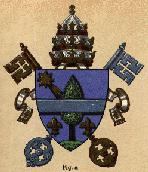
Ecclesiastical heraldry naturally divides itself into various branches, principally: the arms of religious corporations, and other bodies; the insignia of ecclesiastical dignity, rank, or office; the charges, terms, and forms of general heraldry having a religious or ecclesiastical origin, usage, or character; the emblems or devices attributed to or typifying particular saints or other beings venerated by the Church. Intermingled with all these categories is their symbolism, real, suggested, or imaginary; and deeply interwoven, more especially in relation to the insignia of ecclesiastical rank, lies the consideration of ecclesiastical vestments.
THE ORIGIN OF HERALDRY
In general
The origin of heraldry itself is still shrouded in much mystery. It is really a development and conjunction of three ideas, none of which alone can be regarded as heraldry.
- First came the mere personal device or emblem indicative of the individual, an idea traceable through the standards of the children of Israel, through the devices of the Romans, the Greeks, and the Egyptians, attributed both to real and mythical personages, and through the totems of the savage.
- Next came the decorative idea of the indication of ownership evolving itself in one direction into the authentication of the seal by its device.
- Lastly came the military necessity of proclaiming identity when armour rendered ready recognition difficult; and imposed upon the combination of these ideas was evolved the heredity or continuity of these emblems, by which time heraldry was a perfected and (for the necessities of the period) a completed science, used everywhere upon seals, banners, shields, and surcoats.
It is universally admitted that armory, as we now understand the term, did not exist at the time of the Norman conquest of England. By the end of the twelfth century it had become general throughout England, France, Italy, and Germany, and no doubt it was due to the common meeting-ground of the Christian nations at and during the Crusades that the fundamental principles of the science of heraldry are and have always been cosmopolitan.
Ecclesiastical heraldry
There is no hard and fast dividing line between heraldry in general and ecclesiastical heraldry -- each has the same origin, the same lines of coeval development -- but the application of heraldry to ecclesiastical purposes first occurs in the appearance of armorial bearings of a personal and family nature on ecclesiastical seals, and of sacred or saintly devices upon vestments and ecclesiastical banners. The latter influence is of less importance because it was more ephemeral and more in the nature of pure symbolism than of armory.
The earliest ecclesiastical seals -- nearly all, in early times, vesica-shaped, as they have continued to the present day -- bore the bust, half-length or full effigy of the owner of the seal. So, at that period, did the seals of non-ecclesiastics upon which are the mounted effigies of knight and noble with (as they developed) the armorial shield and bardings fully displayed. Then we get, from about 1300, the seal showing no more than the shield of arms, and concurrently the ecclesiastical seal progressed through the canopied effigy with the shield of arms in the base to the later form with heraldic achievement and legend alone. Ecclesiastical heraldry simply progressed coevally and upon the same lines as heraldry in general.
The earliest ecclesiastical seals were unquestionably purely personal, bearing the effigy, arms, or device of bishop or abbot respectively, as the case might be, but, in England at any rate, the "Statutum de apportis religiosorum" of 1307 (35 Edward I) enacted that every religious house should have a common seal, and that all grants made to which this common seal was not affixed should be null and void. With the common seal of a community came the idea of an impersonal coat of arms for that community, but as there is no definite date at which such common seals became armorial so there is no common origin from which the devices were drawn.
It has been a matter of keen controversy in England at what date control was effectively exercised by the sovereign authority in matters armorial. It can be definitely carried back to the beginning of the fourteenth century; but in matters of religion the appeal was to Rome and not to the temporal sovereign, and there is little, if indeed any, evidence of a regularized control of ecclesiastical heraldry before the date of the Reformation. For this reason the arms of abbeys and priories have little of the exactitude that characterizes other heraldry of the period, and we find that in England, as in all other countries, the personal arms of donors, benefactors, or predecessors in office were constantly impressed into service for the purpose of impersonal arms of a community. In some cases (e.g., in the case of the arms of the See of Hereford) even these personal arms became stereotyped by repetition of usage into the impersonal arms of the office or community, though of course many, perhaps the majority, from the character of the charges and devices which make up the coat of arms, are obviously designed for, and indicative of, the purpose they serve and the community for which they may stand.
A large number of ecclesiastical, as of other public, coats of arms, are based upon the figures and effigies of patron saints originally used and represented as such and without heraldic intention. The natural consequence is that in many cases of religious communities there are two or more entirely different coats of arms doing duty indifferently. Impersonal arms of this character were borne for the sees, episcopal and archiepiscopal, and for the abbeys and priories, and for the religious orders. These arms, regarded merely as coats of arms in all matters of heraldic rule and blazon, conform to the ordinary rules and laws of general armoury so far as these may concern them; nor in character do they in any way differ therefrom, save in matters of external ornament.
One point, however, may he alluded to here. The shield is the ordinary vehicle of a coat of arms. It is obviously and essentially a military instrument, and the supposedly peace-loving ecclesiastic has often preferred to substitute for the shield the oval cartouche (Figure 1). In some countries, notably Italy, Spain, and France, the use of the cartouche for ecclesiastical purposes has been very general, but with the recognition of this ecclesiastical preference for the cartouche, it should not be overlooked that the laity have also made occasional use of it for purely personal armory and that the usage of the shield for ecclesiastics is too universally general at all periods for any suggestion of impropriety to follow its use in preference to the cartouche.
IMPERSONAL ARMS
England
Although England is a Protestant country, and her post-Reformation ecclesiastical heraldry is devoid of any subsequent Roman developments, nevertheless the official control of armory in that country has been and has remained more efficient and effective than the control in any other country, and when in England the temporal power assumed the headship of the Anglican Church, and in consequence the control of her heraldry, the armorial practice existing at that date was stereotyped and has since remained unaltered. For that reason the English law concerning episcopal arms may well be considered as indicative of the reality at a period when heraldry was of greater importance than at present.
The official arms of a bishop appertain neither to him personally nor to his rank. They attach to his jurisdiction as a part of the State and the State-established religion. For that reason a suffragan bishop (corresponding to what is known among Catholics as a bishop auxiliary), though possessing a local titular description, has no official coat of arms. For the same reason, on the disestablishment of the Scottish and Irish Episcopalian Churches the arms of the sees in law became extinct and are officially no longer recognized, although a number of prelates of those churches continue to use them. (Woodward, by the way, states that all the Irish Episcopalian arms are post-Reformation.)
For this same technical reason the English Crown declines to grant arms of office for any of the sees established in the United Kingdom by the Holy See, although request therefor with a tender of the proper fees has been made on several occasions. The result is that Catholic bishops in England, as in some other countries, use only personal arms with their exterior insignia of rank. In the case of the archiepiscopal See of Westminster arms were granted by papal Brief, but this is a solitary instance, and no official recognition of them has been made by the temporal authorities. In the registration of the personal arms of His Eminence the late Cardinal Vaughan, in the College of Arms in London, and in the matriculation of the personal arms of the Rt. Rev. Æneas Chisholm, Bishop of Aberdeen, no objection was made to the registration of the red hat of the cardinal and the green hat of the bishop.
As examples of official ecclesiastical arms, Figure 2 represents the arms of the Anglican See of Hereford; (Plate I, Figure B), the arms of the Archbishopric of Cologne, and Figure 3 the arms of the Abbey of Melk. These official arms, in the earliest cases borne upon a separate shield from the personal arms, are now at the pleasure of the individual borne alone or marshalled with his personal arms upon a single shield. In England it has always been customary when marshalling official with personal arms to do so by impalement and in no other manner, the official arms taking the precedence on the dexter side (Figure 4).
A curious consequence of the English Reformation with its abolition of the necessity of celibacy is to be found in the marshalling of the arms of a married (Anglican) bishop. This is never done upon a single shield. Two are used placed accollé. On the dexter shield the official arms of the see are impaled with the personal arms of the bishop and on the sinister shield these personal arms are impaled with those of the wife (Figure 5).
Italy
In Italy most of the sees have official arms, but these are not often made use of, but when they are used they frequently occupy the upper, or "chief", portion of a shield divided per fesse.
Germany
In Germany the official and personal arms, though sometimes marshalled by impalement, are usually quartered, the official coat being placed in the first and fourth quarters. Where several sees are united in one person the various official arms are quartered, and the personal arms are placed en surtout; but on the contrary, where the personal arms consist of a quartered coat the official arms will sometimes be found en surtout, which illustrates a diversity of practice to which the English rigid exactitude of rule would seem preferable.
France
In France the ecclesiastical peers (the Archbishop-Duke of Reims, the Bishop-Dukes of Laon and Langres, and the Bishop-Counts of Beauvais, Chalons, and Noyons) all had official arms which they sometimes quartered and sometimes impaled with their personal arms.
The Holy See
Strictly speaking there are no official arms for the papal sovereignty. Although the crossed keys of St. Peter displayed upon an azure field, have occasionally been used for that purpose, and with such intention, they are more properly a device in the nature of external ornaments to the shield, and as such will be again referred to later.
PERSONAL ARMS
In relation to the use of personal arms, although in England the ordinary rule and practice were usually observed, elsewhere an ecclesiastic seldom made use of any marks of cadency. Even marks of bastardy are found to have been discarded. The reason is simply that, ecclesiastics being celibate, there would be no descendants to claim pedigree whom it would be necessary to place correctly in a family, whilst for the individual concerned his ecclesiastical ornaments of rank were sufficient distinction. But the omission of cadency marks does not appear to have been a matter of universally accepted rule.
The chief distinction in the bearing of personal arms by an ecclesiastic is found in the use of the mitre, the crosier, and the ecclesiastical hat. Though there are a few examples which might be mentioned of the use of the biretta, both scarlet and black, these may be regarded as merely freaks based upon personal inclination.
The ecclesiastical hat
The heraldic use of the ecclesiastical hat undoubtedly originates in the red hat of the cardinal, which, as a vestment, dates from 1245. The sending of the actual hat was of course a matter of ceremony and of importance, and for that reason the armorial use of the hat as indicative of the rank was a foregone conclusion.
Its heraldic use dates from the early part of the fourteenth century. There is abundant evidence in England of this heraldic use before the Reformation, but the writer is unaware of a single instance in which any other ecclesiastical hat than that of a cardinal was ever employed heraldically. This would seem to show, as was indeed the fact, that the extended use of the ecclesiastical hat was a subsequent development even in Italy and France, though it must be admitted that in Spain the green hat of bishops and archbishops had had some usage since 1400, a practice which grew in that country, where it was an alternative, and preferred to the use elsewhere of the cross and mitre.
In the seventeenth century the use of the ecclesiastical hat for the lower ranks of the Church became, as it has since remained, fairly universal. The ecclesiastical hat is low, flat, wide-brimmed and depending from either side are cords and tassels. Though usually referred to as tassels, they are sometimes termed houppes or fiocci. Originally the number of tassels was indeterminate, the natural consequence of the exclusive use of the hat by cardinals; there are even examples to be found in which no tassels are shown, the strings of the hat being simply knotted. But in early representations six tassels on either side are most usually to be found, these being arranged in three rows containing one, two, and three tassels respectively. In later times, with the extension of the use of the ecclesiastical hat, differentiation was made both in the colour and in the number of the tassels, but in attempting to make use of such differentiation it should be remembered that even after an established rule and usage had come into being adhesion thereto was far from being universal.
In the Catholic clergy and in the Anglican as well (where many of the archbishops have preferred and assumed the coroneted mitre of the Bishop of Durham) there seems to have been a constant desire to appropriate more than belonged to them of right. In the armorial display made by ecclesiastics there is a far greater amount of bogus and incorrect heraldry than is to be met with elsewhere.
The assumption of personal arms by those of plebeian birth and the invention of arms of office where none have been assigned by any competent authority, bring armory into grave disrepute, and its study into hopeless confusion. Some excuse may be urged in mitigation in America and other republican countries which do not officially countenance the granting and creation of arms, which is admittedly an attribute of sovereignty, but there is no such excuse as to personal arms in monarchical countries, as the religious sovereignty of the papacy is universal and surely sufficient to apply what may be lacking in matters which are purely ecclesiastical. But to this unfortunate habit of the ecclesiastical mind is due the fact that in a very large number of cases it will be found that, whatever the rank, one more row of tassels has been added than should be the case.
The rules which follow are those which are recognized in Rome, and in recent years there has been a healthy reversion in many cases to the proper procedure in matters heraldic.
- Scarlet hat
- The cardinal's hat is scarlet and has on either side fifteen tassels arranged in five rows of one, two, three, four, and five tassels respectively (Plate I, Figure C and Plate II, Figure C).
- The green hat is employed by patriarchs, archbishops, bishops, and
archabbots.
- The patriarch has fifteen tassels, as a cardinal, but the cords and tassels of a patriarch's hat are interwoven with gold (S. Congr. Cærem., 3 Nov., 1826).
- An archbishop has ten tassels arranged in four rows of one, two, three, and four respectively (Plate I, Figure B).
- A bishop (Plate II, Figure D) has six tassels on each side arranged in three rows of one, two, and three respectively. But as far back as the seventeenth century bishops were using ten tassels, and a hat with that number appears in the matriculation of the arms of the Bishop of Aberdeen previously referred to.
- Archabbots possess episcopal rank and use the same hat as a bishop.
- Black hat
- Generals of orders are assigned six tassels.
- Three tassels are assigned to provosts, mitred abbots, and provincial superiors of orders (Plate II, Figure E).
- Two tassels are assigned to local superiors (prior guardian, and rector).
- The ordinary ecclesiastical hat of the simple priest is black, but of the same shape, and had originally on either side a single tassel of the same colour (Figure 6) but following upon the ecclesiastical habit of taking the next higher emblem than was proper the single tassel later developed into a double one (Figure 7). This practice has been followed so widely that one almost hesitates to say it is wrong, and there has been a subsequent unauthorized progression to three tassels arranged in two rows of one and two on either side. Nevertheless, the rules for the black hat which are recognized in Rome assign a single tassel to the simple priest.
- White hat
- The General of the Order of the Premonstratensians (White Canons) uses a white hat with six white tassels.
- Violet hat
- The prelates of the papal chamber use a violet hat with ten red tassels on either side.
- Apostolic prothonotaries are entitled to a violet hat with six red tassels at each side.
- Domestic prelates, privy chamberlains, and privy chaplains of His Holiness have a violet hat with six violet tassels.
- Honourary chamberlains and chaplains have the violet hat, but only three violet tassels.
The heraldic mitre is placed above the arms of all persons who in the Catholic, Eastern, Anglican, or Episcopalian Churches are in theory or fact entitled to wear the mitre. Archbishops and bishops use it. Most abbots use it and did in England before the Reformation, though some abbots are not mitred abbots and have therefore no justification for its display. The mitre as a vestment, of course long antedates the existence of heraldry, and in fact exists in three forms, termed respectively pretiosa, auriferata and simplex.
The auriferata (which is made of cloth of gold or of thin gold plates, and is not jewelled) is the one always used in English heraldry for an Anglican bishop or archbishop. The shape of the heraldic mitre has varied somewhat according to the varying styles of heraldic art in vogue, and there is at present a tendency to revert to the ancient wider and lower shape in armorial representations. It is always represented as of gold, and the lappets or infulæ depending from within it are of the same colour (Figure 8). It has been asserted that in pre-Reformation usage a distinction was drawn between the mitre of a bishop and an abbot by the omission in the case of the latter of the infulæ. Certainly, in England and France it was usual, for heraldic purposes, to place the mitre of an abbot slightly in profile. In most continental countries it has been more usual to represent the mitre of white ornamented with gold, no doubt an attempt to represent the pretiosa mitre, which, though heavily jewelled, is really on a foundation of gold. The representation of the simplex mitre cannot be intended, as this is really of plain white linen. In spite of many statements to the contrary, the mitre (in fact and heraldically) of bishop and an archbishop are identical.
The cornoneted mitre
The coroneted mitre (Figure 9), which has so often been used by archbishops under the belief that it appertained to archiepiscopal rank, is really and exclusively the mitre of the Bishop of Durham. The See of Durham, until early in the nineteenth century, was in fact and law also a temporal palatinate, and, though latterly its attributes of temporal sovereignty had declined, anciently the temporal power was of wide extent, the Bishops of Durham having their own separate parliament. In token of the temporal power the bishop had his coronet, in token of his spiritual power he had his mitre. Alone amongst the English bishops, his arms were surmounted by a helmet [they so appear in the famous "Armorial de Gelre" (Figure 10) where the helmet, with its mantling, is shown with the small shield tilted in the fashion of early heraldic displays], and on his helmet was placed his coronet. Within the coronet was his mitre and the representation of the two together led to the appearance of the coronet as the rim of the mitre, and coronet and mitre have been armorially depicted together. But no evidence of the wearing or actual existence of a coroneted mitre is known, and the present form is the heraldic conjunction of a coronet and a mitre. Whether since the abolition of the palatinate the right to the coronet still remains, is open to argument, but officially its use is still sanctioned.
The crosier
The crosier, which is another external ornament to the shield widely made use of by ecclesiastics, must not be confounded, as it often has been, with the processional cross of an archbishop. Nor is the name, crosier, a confusion of terms. The crosier is, as it has always been, the pastoral staff. Originally nothing more than a staff used for assistance in walking, it has been conjectured that its ceremonial use and ecclesiastical status is a consequence of its convenience to aged prelates as an assistance and support during lengthy services.
The crosier as a sign of episcopal dignity is said to be traceable to the fourth century and to have been used by abbots in the fifth. In its early form it was surmounted only by a boss or a simple bend, and in the Eastern Churches the crosier terminates not in a crook but in a tau, the ordinary form of a crutch. This, however, has now developed into an elaborated form, much as if the crook of the Western crosiers were duplicated at the other side of the staff (Figure 11). The development of this crook is merely artistic and decorative the symbolism of the shepherd's crook has been invoked. In this, as in all other matters of symbolism, it is exceedingly difficult to determine whether the form followed the symbolism or whether this is a later attribution. Certain it is, however, that there is a widespread belief that, whilst the crook in the case of an abbot should terminate inwards (Figure 12), that of a bishop should terminate outwards (Figure 13), the suggested symbolism being that, whilst the jurisdiction of an abbot was strictly confined to his abbey, that of a bishop was not so restricted. The same symbolism has been read into a heraldic practice, which undoubtedly has much acceptance, by which the crosier of an abbot placed in bend sinister behind the shield was represented with the crook turned inwards towards the mitre (Figure 3) whereas the contrary position was adopted for the crosier of a bishop (e.g., Figure 2). But no such distinctions appear ever to have been recognized in relation to the actual crosiers carried by bishops or abbots. The sudarium or veil, which really has no symbolism, and is attached to the crosier for mere purposes of cleanliness, is sometimes met with in armorial representations (Figure 13).
In England, in the Anglican Church, two crosiers are placed in saltire behind the shield of a bishop or archbishop (Figure 2, Figure 5, and Plate I, Figure D). Woodward questions the propriety of this fully established practice, unless in a case of a double episcopate, but that writer has apparently overlooked the fact that, whereas in other countries a crosier, e.g., is represented singly in bend, or most frequently in bend sinister. It has been the invariable custom in England to duplicate insignia of this character and place them in saltire behind the shield, e.g. the batons of the Earl Marshal or of Lyon King of Arms.
The Bishop of Durham alone amongst the Anglican bishops substitutes a naked sword (indicative of the temporal palatinate of Durham) for one of the crosiers. The seal of Bishop Gilbert Burnett of Salisbury. Chancellor of the Order of the Garter, shows his shield encircled by the Garter and imposed upon a crosier and key in saltire -- the latter, no doubt, an allusion to his office of chancellor. In no other case is temporal jurisdiction united with a spiritual office in England, but in Germany and elsewhere a number of cases can be alluded to, and in such cases the naked sword is similarly disposed in saltire with a crosier, or these are placed in pale one on either side of the escutcheon. The use of the temporal sword is said to have been originated by Erlang, Bishop of Würzburg, 1106 to 1121, but its heraldic use is not nearly so ancient.
The processional cross
The processional cross (Figure 14), which, within his province, is carried in front of (but not by) an archbishop -- a privilege granted to all archbishops by Gregory IX -- is also used armorially, being represented in pale behind the shield. Its use in this form by an Anglican archbishop is very rare -- certainly no ancient examples exist -- but elsewhere its use is practically universal. The cross of an ordinary archbishop has but a single traverse; in practice it is really a crucifix placed on the summit of a staff; but heraldry distinguishes the cross of an archbishop from the primatial cross which has the double traverse (Figure 15) and the papal cross with the treble traverse. The last named, however, is never placed behind the papal arms. Unfortuneately the bearing of the cross with the double traverse has become very far from unusual by archbishops, under the belief that the double traverse is indicative of an archbishop.
The pallium
The use of the pallium has received no little attention in recent years. As a vestment, its form is well known, and as a rule (to which there have been few exceptions, if any) archbishops alone have the right to wear it. It is made of fine white lamb's wool, and now has upon it six crosses pattée of black silk edged with cord. Originally the number of these crosses was indeterminate; in early examples we find two of a bright purple or, occasionally, of red, later we find four. The pallium in continental Europe has only had a limited heraldic use and that curiously disposed as an external ornament of the shield. The English method of display is nowhere else employed. In England the pallium has been the principal charge in the official archiepiscopal coats.
ARMS OF PARTICULAR SEES
Canterbury
The arms of the See of Canterbury (Plate I, Figure D) are "azure, an episcopal staff in pale or, ensigned with a cross pattée argent, surmounted of a pall of the last, edged and fringed of the second charged with four crosses pattée fitchée sable."
Armagh and Dublin
The arms of the archiepiscopal See of Armagh are identical with those of Canterbury except that the staff is of argent ensigned with a cross pattée or. The arms of the archiepiscopal See of Dublin are the same as those of Armagh, except that the pall has five crosses pattée fitchee upon it, instead of four.
York
Anciently the arms of the archiepiscopal See of York were the same as Canterbury, but, for some reason which is not now known, the arms of the see were changed to "gules two keys in saltire argent in chief a royal crown or". Woodward asserts that the crown was originally the papal tiara, and if this be correct one is inclined to hazard the suggestion that the emblems of the papacy were granted to York as a solatium after the long enduring contest between Canterbury and York had been decided in favour of Canterbury who was to be Primate of All England, whilst York ceded the precedence and was only Primate of England. The right to use the tiara in lieu of a mitre was granted to the Patriarchs of Lisbon by Pope Clement XII, and the change from the papal tiara to the royal crown would be a natural consequence of the Reformation.
Westminster
The arms granted by the papal Brief to the Archbishopric of Westminster consist of the pallium (without the cross in pale as in the Anglican shields) upon a field of gules, and the same device is used by the Archbishop of Glasgow.
The Holy See
The emblems of the papacy consist of the tiara and the crossed keys of St. Peter "to bind and to unloose", one key being of gold and one of silver, the two being usually tied together with a cord. These are usually, and most properly, placed in saltire behind the personal arms of His Holiness (a practice originated by Adrian VI, in 1522), the shield being surmounted by the tiara, but the keys are frequently disposed in saltire below the tiara and above the shield, and, as the emblem of the papacy, the tiara and keys are often used alone without any shield at all.
OTHER INSIGNIA
Crests and helmets
Crests and helmets are not usually borne by ecclesiastics. The possession of a crest is not denied to an Anglican ecclesiastic, who of course transmits it to his male descendants, but it is not correct (except in Germany) to use a crest concurrently with a mitre or ecclesiastical hat, both of which, of course, are substitutes for the helmet, to which the crest appertains. The Bishop of Durham, however, was an exception, by reason of his temporal sovereignty. In Germany, the land of many crests, it is considered quite correct to display mitre and crests simultaneously and a central helmet to carry the mitre is not unusual.
Motto
The use of a motto by a bishop or other ecclesiastic is quite correct, though rather unusual in the case of an Anglican bishop.
Coronet
In Rome itself the use of all coronets of rank by cardinals was forbidden by a Bull of Innocent X, but elsewhere the coronet is not discarded if such an ornament appertains to the personal arms. In England the mitre would surmount the coronet with its cap, but in Continental Europe it is more general to use the circlet (Continental coronets have no cap, which is really the English parliamentary cap of dignity) disposed along the top of the escutcheon and enclosing the mitre, cross, and crosier, as may be correct. In Germany temporal lordships are often attached as endowments to ecclesiastical dignities, and in such cases the coronets of the latter are made use of.
Supporters
No ecclesiastic in any country by reason of ecclesiastical rank alone acquires a right to use supporters, but where a personal right to these has been inherited ecclesiastical rank or office places no prohibition whatever upon their use. There is one exception: the arms of the papacy are frequently depicted with angels as supporters, each of which holds in the exterior hand a papal cross (i.e. with three traverse bars).
Pavilion
At the funeral ceremonies of a deceased pope, the papal arms are shown surmounted by the tiara, but the keys are omitted, these taking their place above the shield, but below the "pavilion de l'Eglise" of the Cardinal Camerlengo, who, whilst holding that position, surmounts his arms with the curious canopy of red and yellow which belongs to the office (Plate II, Figure E).
Impalement
Members of a regular order frequently impale (on the dexter side) the arms of the order with their personal arms, but how far such a practice has authoritative sanction is at least open to argument. As arms of patronage, cardinals have frequently impaled with their personal arms those of the pope who has raised them to that rank, but the practice (except in the case of the majordomo of the papal household) is now falling into disuse.
Miscellaneous insignia
Precentors denote their office by placing a baton behind their shields, and the arms of a canon are often displayed upon the almuce (the tippet or hood) which forms a part of his official dress. Priors and prioresses place a bourdon (or knobbled staff) of silver in pale behind their shields. An abbess uses her arms upon a lozenge and her crosier in pale behind. Frequently the lozenge is surrounded by branches of palm, or a crown of thorns, or, more usually, by a knotted girdle of black, or black and white, silk disposed in the form of a cordelière. Armenian archbishops use a green hat with ten green tassels. Behind the shield are placed a Latin crosier and a Greek crosier in saltire, the shield is ensigned by a mitre, and in pale is a cross with a double traverse.
WOODWARD, Ecclesiastical Heraldry (London, 1894); FOX-DAVIES, Art Of Heraldry (London, 1904); CHEVALIER, Topo Bibl. (Montbéliard, 1894-99), s. vv. Armoiries, Blason; BATTANDIER, Ann. Pont. Cath. (Paris, 1889) 269-323; (1900), 389-393; (1902), 366-84; (1904), 127.
C. FOX-DAVIES
Herbart and Herbartianism
The widespread and increasing influence of Herbart and his disciples in the work of education makes a brief treatment of this German philosopher and educationist desirable in the present work. John Frederick Herbart, b. at Oldenburg, 1776; d. at Göttingen, 1841. He was the son of a lawyer whose wife, a woman of brilliant parts, was subsequently divorced from her husband. The child was delicate and was at first educated by an able tutor under the supervision of his mother. He exhibited extraordinary precocity, was of quick intelligence and retentive memory, and showed remarkable aptitude for mathematics, physical science and music. He began logic at eleven and metaphysics at twelve; he went to the gymnasium of his native town at thirteen and, after a distinguished course there, passed to the University of Jena at the age of eighteen to study law. This subject he neglected, becoming an enthusiastic student of philosophy under Fichte, then at the zenith of his fame. Herbart, however, was of too critical a mind to be content with Fichte's Idealism, and at the age of twenty began the elaboration of a philosophic system of his own. In 1807, after three years, his course still incomplete, he left the University to become a private tutor in the family of a German nobleman. The education of the three sons aged 14, 10, and 8 was entirely entrusted to Herbart on condition that he should write a lengthy report by letter to the father every two months. This was Herbart's first and most important experience in the work of teaching. Five of the letters which remain are amongst his most interesting writings and contain some of his main educational ideas. During this period he visited Pestalozzi at Burgdorf. In 1799 he resigned his tutorships, devoted himself for a couple of years to the study of philosophy and wrote some small works on education including appreciations of Pestalozzi's writings. In 1802 he went to Göttingen, obtained his degree of doctor and began lecturing on philosophy and pedagogics at the modest stipend of $225 per annum. Between 1802 and 1808 he published several pedagogic works, including the "Æsthetic Revelation of the World" and the "Science of Education"; also works on metaphysics and logic. In 1809 he was appointed to the chair at Königsberg formerly occupied by Kant, where he lectured on philosophy and pedagogics for over twenty years. His chief interest, however, was in the latter subject. With the approval of the Minister of Education he founded a pedagogic seminary having a practicing school attached. In this he himself taught for an hour daily. In 1809 he married an Englishwoman. During the remainder of his life he lectured to large audiences, and published sundry works on education. He returned to profess at Göttingen in 1833, where he laboured till his death in 1841.
General Philosophical Views
Though Herbart was an able and original thinker his influence in philosophy has not been considerable. In metaphysics his scientific temper led him to advocate a system of Realism in opposition to the Idealism then in vogue. In ethics he approximates towards Kant's teaching in some respects; but instead of Kant's Categorical Imperative he puts forward five Practical or Moral Ideas--the Ideas of Inner Freedom, Perfection, Benevolence, Right, and Equity--as the frame-work of his moral system. In psychology he rejected the doctrine, generally accepted from Aristotle to Kant, of a soul endowed with certain native faculties or powers. For this he substitutes a simple soul with presentations, states, or impressions. As, however, in his view, we know nothing about this simple soul in itself, after it has once been postulated as the arena for the operations of the presentations, the soul becomes, for all practical purposes, merely the series or mass of these presentations, whilst their permutations, interactions, and combinations constitute the entire fibre of our mental life. Herbart strove to apply mathematics to the working of these presentations and to establish quantitative laws describing their mutual interactions. This attempt had in itself no success, but indirectly stimulated the subsequent allied movement in favour of experimental measurement of mental states carried on by Fechner Weber, Wundt, and others. There is remarkable similarity between Herbart and the English Associationist school in their common mechanical view of the nature of mental life, though Herbart is spiritualistic whilst their tend towards Materialism.
Herbart's main interest in philosophy however, is the problem of Education--its object, its method, its possibilities. Education is in fact both the starting point and the goal of all his philosophical inquiries. The end of education is, he holds, determined by ethics. It is the formation of noble, cultivated, moral character. Morality is goodness of will. Moral conduct cannot be embraced, as Kant imagined, under one principle. It is best included under the five practical ideas. Ideal character is to be attained by "many-sided interest". The full development of the individual, the realization of all his capabilities should be then the constant aim of the process of education. The main foundations on which Herbart's whole theory of education rests are his doctrines of apperception and interest. Apperception, with Herbart means the act or process of assimilating, appropriating and identifying an object, impression or idea. All progress in knowledge after the first percipient act is a process of apperception, and the character of each new perception is determined by those which have gone before. The first sensation or impression affords no knowledge, but results in a presentation which persists in existence gradually sinking down below the surface of consciousness. This original presentation existing in the sub-conscious state of our mental life will be partially wakened and called up into conscious activity by the next impression. Thus aroused it modifies the reception of the latter and partially fuses with it. Again this pair of presentations or this compound state similarly sinking down into subconscious life still remains ready to appropriate the next impression assimilating it in like fashion. But the method of the reception and the character of the appropriation is constantly varying with the increasing collection of presentations or ideas already in the mind. The facility and completeness with which each fresh idea is assimilated is determined by what has gone before. Herein, according to the Herbartian school, lies the importance of directing the process of apperception by judicious selection of the materials which are to constitute the experience of the child. As the mind, in this view is simply built up entirely out of the ideas which it has received, the kinds of ideas presented to it and the order in which they come are of the utmost moment in the work of education. Ideas or objects are assimilable or apperceivable when partially familiar; a totally foreign idea has no friends already lodged in the mind to welcome it.
In the pleasure of the process of apperception lies the great fact of interest. Interest depends on what is already in the mind. It is the factor of most vital importance in education--and in moral life, as a whole. Interest and knowledge react on each other. Interest stimulates voluntary attention and sustains involuntary. It thus ties at the root of the mental activity of observation. It determines what we shall see and also what we shall desire and will. With Herbart interest is not simply a means: it is an end in itself. "Many-sided interest" frees from narrow prejudices and counteracts evil possessions, but it is also an ideal worthy of all admiration in se. Ignorance is really the main factor in vice. All action springs out of "the circle of thought"; hence the decisive influence of the matter or content of instruction in the work of character building. "Make your instruction educative," is the great Herbartian maxim. Connected with the insistence on the psychological agencies of apperception and interest is the Herbartian principle of correlation and the five formal steps of instruction. The former should, according to the school, govern the drawing up of the curriculum. Organize the course of studies so that the matter of the different branches simultaneously treated, e.g. the literature, history and geography, may be connected with one another; and as far as possible let the subsidiary subjects be arranged in concentric circles around the chief study. The five formal steps prescribe the order and method of procedure in an ideal lesson. Prepare the mind for the reception of the new matter by repetition of questions which freshen the pupil's recollection of ideas related to the subject of the coming lesson. Next present the matter clearly, developing it in an orderly method. Then, or pari passu by comparison or illustration associate the new ideas or facts with those already familiar. After this generalize the results and finally apply the knowledge gained in some form of practical exercise. These latter doctrines and other deductions from Herbart's principles--some of them very disputable--have been elaborated in very pedantic fashion by certain of the later Herbartians. Besides instruction, practical education includes two other factors,--government and discipline. Though character, according to Herbart, is formed in very large measure by the instruction, i.e. by the ideas apperceived and absorbed by the mind, yet he allows something to these other agencies. Government is mainly repressive, checking disorder and providing the conditions for instruction. Training and discipline are of greater importance. They look to the future building up of the will and forming lasting habits. But as discipline is effected not merely by the form but also by the matter of the school exercises, we come back once more to instruction as the essential factor.
Criticism
Undoubtedly there is much that is stimulating and valuable in Herbart's works on Education. His insistence on certain psychological laws established by experience; his frequent invocation of rational principles in opposition to mere empiricism in education; his accentuating the value of interest; his earnest advocacy of an ethical aim; his demand for wide culture; his faith in the potency of education, and his enthusiasm for the vocation of the teacher are all deserving of warm commendation But there are other features in his theory to which serious objections are made. Firstly, his account of the soul, as being capable originally only of simple reactions to impressions and as being then virtually swallowed up by, or dissolved into the stream of subsequent presentations or ideas, is metaphysically erroneous, and in educational practice exceedingly dangerous if carried to its logical conclusions. For it implies an entirely mechanical view of the mind, as rigidly determinist as that of the English Associationists, with which indeed, notwithstanding Herbart's spiritualism, it has sundry points of similarity. It leaves no place for free-will, nor, if logically pressed, for individual responsibility. The soul seems to be conceived merely as the arena for chance experiences coming from without. Our whole mental life is solely the resultant of the collision or coalescence of the presentations flowing in upon us. Every volition is the inexorable product of the circle of thought. Yet Herbart himself, as well as the best educationists of today, insist much on the duty of respecting and developing the individuality of the pupil; but where the individuality is seated, or in what it consists, is not easy to understand in the Herbartian system. Here especially lies the strength of the rival doctrine of the Fröbelian School, which so earnestly inculcates the importance of self-activity. Again, the ethical aim of Herbartianism is after all the Ego. It is not God--not an end outside of self, not even humanity--but self-culture. Further, knowledge and intellectual culture, however varied or refined, are not virtue. Herbart has here fallen into the old Socratic error. Knowledge is desirable and its attainment may be a duty; but virtue is essentially a quality of the will, not of the intellect. Its essence lies in self-control, and self-denial, often in "action in the line of greatest resistance" as Professor James well calls it. Asceticism, so obnoxious to the Herbartian, is therefore not unintelligent. Many-sided interest, too, though ethically helpful is not virtue. Intellectual ignorance and narrow-mindedness may and often are combined with a high quality of moral fibre, whilst men of abundantly many-sided interest as e.g., Francis Bacon or Goethe, may fall sadly short of being ethical models.
Furthermore, although, as Catholic doctrine insists, the positive moral and religious teaching of the young and the ethical quality of the ideas on which their intellects are fed exert a real influence on the will and moral disposition of the child, yet the value of mere instruction in comparison with that of discipline is exaggerated by the Herbartian school. It is not the mere cognition of the facts of history and literature, or in general the content of the instruction in these subjects, that makes for morality, but the exercise of our faculties, our moral judgment, imagination, sympathy, aversions etc. upon these facts. Moral sensibility is developed by action in harmony with the intimations and suggestions of conscience, rather than by the acquisition of moral information. Again, whilst interest is to be fostered and advantage taken of every psychological law which facilitates learning, we must not forget the educational worth of effort and the conquest of difficulties, nor the disciplinary value of stiff formal studies such as mathematics. Strenuousness of character will not be cultivated by a "soft" pedagogy which would eliminate all obstacles from the student's path--though this latter attempt is not the outcome of the true Herbartian spirit. The evil also of an unenlightened formalism has exhibited itself in a somewhat slavish adhesion to details of the Herbartian method by certain members of the school. Nevertheless it remains true that Herbart has given a substantial contribution of permanent value to educational theory and educational method.
MICHAEL MAHER
Herbert of Bosham
A biographer of St. Thomas Becket, dates of birth and death unknown. He was probably born in the County of Sussex at the place from which he took his name, and he must have joined Becket's household before 1162, as, on his elevation in that year, the new archbishop immediately promoted him to a responsible position. He was to give his master advice on the performance of his duties, and to assist and even direct his studies of Scripture. Herbert remained closely attached to St. Thomas during the arduous and troubled years of his episcopacy and exile down to the very eve of the final scene in Canterbury Cathedral. Of all the archbishop's followers he was the keenest antagonist of the king and the royal "customs", quite ready on occasion to beard Henry II to his face or to undertake dangerous missions to England. After the martyrdom Herbert seems to have lived mainly on the Continent, and he complains that he was neglected by the friends and adherents of the master whom he had served so faithfully; he records, however, a friendly interview with the king himself. We know nothing of him after the year 1189. As a biographer Herbert had many advantages. He shared St. Thomas's ideals and was an eyewitness of most of the incidents of his episcopacy. He had sat by him, for instance, during the stormy scenes of the trial at Northampton. On the other hand he did not begin to write till 1184, many years after the events which he records, and Dom L'Huillier has given good reasons to doubt the accuracy of Herbert's reminiscences. The biographer certainly exaggerated his own personal influence over St. Thomas. Herbert of Bosham's work has not, therefore, the historical value of that of Fitzstephen, and it is also extremely verbose. Besides the "Life of St. Thomas", he wrote a very lengthy "Liber Melorum" in praise of the martyr. The best edition of the "Life" is that contained in vol. III of the "Materials for the History of Thomas Becket" (Rolls Series) edited by Canon Robertson; the volume also contains some extracts from the "Liber Melorum".
Introduction to vol. III of the Materials; NORGATE in Dict. Nat. Biog., s. v.; L'HUILLIER, St. Thomas de Canterbury, I (Paris, 1891), note A.
F.F. URQUHART.
St. Herbert of Derwentwater
(Hereberht).
Date of birth unknown; d. 20 March, 687; an anchorite of the seventh century, who dwelt for many years on the little island still known as St. Herbert's Isle, in the Lake of Derwentwater. He was for long the friend and disciple of St. Cuthbert of Lindisfarne. Little is known about him, save that it was his custom every year to visit St. Cuthbert for the purpose of receiving his direction in spiritual matters. In the year 686, hearing that his friend was visiting Carlisle for the purpose of giving the veil to Queen Eormenburg, he went to see him there, instead of at Lindisfarne as was usual. After they had spoken together, St. Cuthbert said, "Brother Herbert, tell to me now all that you have need to ask or speak, for never shall we see one another again in this world. For I know that the time of my decease is at hand." Then Herbert fell weeping at his feet and begged that St. Cuthbert would obtain for him the grace that they might both be admitted to praise God in heaven at the same time. And St. Cuthbert prayed and then made answer, "Rise, my brother, weep not, but rejoice that the mercy of God has granted our desire." And so it happened. For Herbert, returning to his hermitage, fell ill of a long sickness, and, purified of his imperfections, passed to God on the very day on which St. Cuthbert died on Holy Island. It is said that the remains of St. Herbert's chapel and cell may still be traced at the northern end of the island on which he lived. In 1374 Thomas Appleby, Bishop of Carlisle, granted an indulgence of forty days to all who, in honour of St. Herbert, visited the island in Derwentwater and were present at the Mass of St. Cuthbert to be sung annually by the Vicar of Crosthwaite.
Acta SS., 20 March, III, 110, 123, 142-43; BEDE, Historia Ecclesiastica, IV, xxix, in Mon. Hist. Brit., 245; RAINE, Saint Cuthbert (Durham, 1828), 32-33; RAINE in Dict. Christ. Biog. s.v.; STANTON, Menology of England and Wales (London, 1887), 127-8.
LESLIE A. ST. L. TOKE
Johann Georg Herbst
Born at Rottweil, in Würtemberg, 13 January, 1787; died 31 July, 1836. His college course, begun in the gymnasium of his native city, was pursued in the Benedictine monastery of St. Peter in the Black Forest and in 1806 Herbst registered at the University of Freiburg. After some time spent in completing his mathematical and philosophical studies, he devoted his talents to mastering Oriental languages and Biblical science under the tutorship of Johann Leonard Hug. From the university Herbst went, in 1811, to the seminary of Meersburg, to prepare himself for Holy orders, and was ordained to the priesthood in March, 1812. Called at once to the seminary of Ellwangen to discharge the office of repetent, he at the same time accepted the chair of Hebrew and Arabic at the newly-erected University of Ellwangen, and, two years later, was promoted to the professorship of Oriental languages and Old Testament exegesis. In 1817 the theological faculty of Ellwangen was transferred to Tübingen, and there, in addition to the courses already entrusted to him, Herbst taught introduction to the Holy Scriptures and Biblical archæology; he also occasionally was prevailed upon to lecture on New-Testament exegesis, church history, and pastoral theology. Those were heroic times for the young faculty of theology, which, with such men as Sebastian Drey, J. B. Hirscher, and Möhler on its staff, and pupils of the stamp of J. C. Hefele, was rapidly winning a conspicuous place in the realm of scholarship.
What the intellectual activity of Herbst was amidst his manifold occupations as a professor, may be gathered from his works. His first publication was a volume entitled: "Observationes quædam de Pentateuchi quatuor librorum posteriorum auctore et editore" (Gmünd, 1817). From the foundation, in 1819, of the Tübingen "Theol. Quartalschrift", he was a steady contributor thereto; but his principal work, left unfinished, and perhaps slightly tainted by the then prevalent tendencies to rationalism, is an introduction to the Old Testament, which was completed and edited by his pupil Welte (1841-44). In 1832 Herbst was appointed head librarian of the Royal University; but through overwork his health soon failed, and he died after a short sickness borne with admirable resignation. A remarkable linguist, thoroughly conversant with the vast literature of his favourite studies, endowed with true critical acumen, Herbst possessed, moreover, in a high degree, the gift of imparting his knowledge in a most clear, attractive, and appealing manner.
Theol. Quartalschrift (Tübingen, 1836), 767; FRITZ in Kirchenlex., s. v.; RUCKGABER, Geschichte der Frei- und Reichstacdt Rottweil (Rottweil, 1835).
CHARLES L. SOUVAY.
Alejandro Herculano de Carvalho e Araujo
Born at Lisbon, 28 March, 1810; died near Santarem, 13 Sept., 1877. Because of his liberal principles, he was forced to flee from his native land during the despotic times of Dom Miguel, and therefore he was in Paris in 1828, and during 1830 and 1831 in England. When he returned home, in 1832, he was already imbued with the doctrines of romanticism which Almeida Garrett preached so loudly in Portugal, and which he had seen exemplified in the literatures of England and France. Prominent already as a liberal in politics, he now attracted attention by his poetical work, such as the "Voz do Propheta" (1836), which reflects the influence of Lamennais' "Paroles d'un croyant", and dealt in rhythmical prose with the future of Portugal in the "Harpa do Crente" (Lisbon, 1838), which also testified to the robustness of his Catholic Faith. He entered into journalism also with the periodical "O Panorama" (1837), which he himself founded and conducted. As a romanticist, he now started upon his career as an historical novelist, with his "Monasticon", of which the first part, "Eurico o Presbytero", appeared in 1844, and the sequel, "O Monge de Cister", in 1848. With these stories, of which the second has its scene laid in the reign of John I of Portugal, he really naturalized the historical novel in Portuguese. He continued the tradition with his story "O Bobo", which turns upon events in Portuguese history of the early twelfth century, and in his "Lendas e Narrativas" (1851). In this latter he gave modern form to some old legends, such as "A dama Pê-de-Cabra", "O bispo negro", "O morte do Lidador", etc. To the period from 1846 to 1853 belongs his "Historia de Portugal" (4 vols.), which stops short with events of the end of the thirteenth century. Before retiring to his place near Santarem, he produced still other historical works, especially "Da origem e estabelecimento da inquisição em Portugal" (2 vols., Lisbon, 1854-55); afterwards he wrote the essays and treatises contained in collected form in his "Opusculos" (6 vols., 1873-84). To his patience as an historical investigator he bears testimony with the collection of documents drawn from the national archives, which he, as a member of the Lisbon Academy of Sciences, published (Portugalliæ Monumenta Historica).
DE SERPA PIMENTEL, Herculano e o seu tempo (Lisbon, 1881); VON DÖLLINGER, Gedächtnisrede auf A. Herculano in his Akademische Vorträge; ROMERO ORTIZ, La literatura portuguesa en el siglo XIX (Madrid, 1870); DE VASCONCELLOS, Portugiesische Litteratur in GROEBER, Grundriss der romanischen Philologie, vol. II, pt. II, pp. 372 sqq.
J.D.M. FORD
Herder
The name of a German firm of publishers and booksellers.
Bartholomäus Herder
Founder of the present publishing firm, b. at the Swabian free- town of Rottweil on the Neckar, 22 August, 1774; d. at Freiburg im Breisgau, 11 March, 1839. Originally destined for Holy orders, he was elaborating, while yet a student at the abbey school of St. Blasien and at the University of Dillingen, his plan of "gaining his livelihood by the dissemination of good books" as a "scholarly publisher". In 1801, during the turbulent period prior to the dissolution of the old German Empire, he began his career, at the instance of the Prince-Bishop (soon afterwards Prince Primate) Karl Theodore von Dalberg, in the capacity of "publisher to the princely episcopal court of Constance", at Meersburg on the Lake of Constance, the episcopal residence and seat of a seminary. Among his first publications, which were mainly of a theological and pedagogic character, we find Wessenberg's "Archiv für pastorale Conferenzen in den Landkapiteln des Bisthums Constanz" (1802-27). In 1810 Bartholomäus transferred his business to Freiburg im Breisgau, where, in close connexion with the university, he gave a more comprehensive character to his publications and developed his miscellaneous stock in new directions. One of his most important publications was Karl von Rotteck's "Allgemeine Geschichte vom Anfang der historischen Kenntniss bis auf unsere Zeiten" (9 vols., 1812-27; the 15th edition being issued by another firm), which for more than a generation was "the gospel of the educated liberal middle classes". Being entrusted with the publication of the official war bulletin, the "Teutsche Blätter", by the royal and imperial authorities at head- quarters as early as the end of 1813, Herder went to Paris with the allied armies in 1815 in Metternich's train as "Director of the Royal and Imperial Field Press". Subsequent to the conclusion of peace he founded an art institution for lithography, copperplate engraving, and modelling in terra cotta, in connexion with his publishing business. In the course of time upwards of three hundred pupils were turned out from this institution, while the sumptuous illustrations and maps that were issued mark an epoch in the history of this branch of technic–especially the "Heilige Schriften des Alten und Neuen Testamentes in 200 biblischen Kupfern" (the Holy Writ of the Old and the New Testament in 200 biblical engravings), of which he reproduced numerous impressions by an original lithographic process, and Woerl's "Atlas von Central-Europa in 60 Blättern" (Atlas of Central Europe in 60 plates, 1830), which was the earliest employment of two-colour lithography. As late as 1870 this atlas rendered important service to the German army by reason of the map of France it contained. Although such great achievements won a European reputation for the house, the commercial profits derived therefrom were entirely disproportionate to the expenditure. Consequently the condition of the house at Bartholomäus Herder's death in 1839 was by no means a satisfactory one. His two sons succeeded to the heritage.
Karl Raphael Herder
(Born 2 November, 1816; died 10 June, 1865), the older son of Bartholomäus, took up the commercial side of the business, while the younger Benjamin Herder (b. 31 July, 1818; d. 10 November, 1888), took charge of the publishing department until his brother's retirement in 1856, when he undertook the sole management. Equipped with a thorough, scholarly education, trained in the book business by his father and under Gauthier de Laguionie in Paris, Benjamin had had his views further broadened early in life by travels through Germany, Austria, France, England, and Italy. Of a character earnest and religious, he was strongly impressed by the Cologne troubles of 1837, and, as in the case of so many of his contemporaries, they gave a direction to his life, and this youth of twenty-one set to work with the definite aim of taking his part in the liberation and revival of the Catholic Church in Germany. First of all he gradually abandoned fine-art publications in favour of book-publishing, being thus enabled to devote the full measure of his energies to the service of religious learning. Herein he displayed such activity in the encouragement of particular branches of erudition that the history of his theological publications, for instance, would comprise a considerable fragment of the history of modern theological literature, and the catechetical branch thereof would constitute one of the most important divisions of the history of catechetics. After theology Herder applied himself with the greatest zest to pedagogies, to the lives and learning of the saints as well as to other edifying biographies; also after a long and cautious delay to the publication of sermons. He next took up works dealing with the religious and political problems of the day, with questions of ecclesiastical policy and social controversies and issues. Finally, passing beyond the limits which previously Catholic literature had seldom ventured to transcend, he began the publication of works on the general sciences–history and philosophy, the natural sciences, geography, and ethnology, including the publication of atlases, school textbooks, music, art and its literature, the history of literature, and belles-lettres. His governing purpose throughout was to avoid wasting his energies on particular publications, but to build up the various branches gradually and systematically by the publication of more comprehensive "collections" and "libraries" and by the issue of scientific periodicals.
The "Kirchenlexikon" (Church Lexicon) was the great centre of his fifty years' activity as a publisher. It was the first comprehensive attempt to treat everything that had any connexion with theology encyclopedically in one work, and also the first attempt to unite all the Catholic savants of Germany, who had hitherto pursued each his own path, in the production of one great work. Herder had nursed this project since 1840. The difficulties encountered even in the preliminary work were almost inconceivable. Then, when its appearance was made possible and its issue was begun in 1847 under the direction of Welte, the exegete of Tübingen, and Wetzer, the Orientalist of Freiburg, followed the even graver difficulties of ensuring its continuation, difficulties which were heightened at the beginning by the terrors of the Revolution of 1848, and towards the end by the oppression of the Church in Baden. But finally, after sixteen years of struggling and striving on the part of Herder, all obstacles were overcome, and the work was brought to completion in 1856, thanks chiefly to the never-failing, self-sacrificing support of Hefele. It had a decisive influence on the subsequent intellectual activity of Catholicism, and the importance which the Protestant scientific world attributed to it was eloquently demonstrated in the fact that, while it was still in process of issue, the Protestant scholars made use of Herder's scheme, even down to the smallest details, for the "Real-Encyklopädie für protestantische Theologie". It was sixteen years more before the preliminary work could be begun on the new edition which soon became necessary, and ten years more before its publication could be started. While the historical element had been especially emphasized in the first edition, the dogmatic and exegetical side was expanded to equal dimensions in the second edition, in view of the far-reaching change which had taken place in the domain of theology. The subjects to be treated were chosen by Adalbert Weiss, professor at the Freising lyceum, and the editorial chair was held by Hergenröther until his elevation to the cardinalate, and afterwards by Kaulen, the exegete of Bonn.
The stupendous plan, which Benjamin had cherished since 1841, of building up a "Theologische Bibliothek" (Theological Library) according to an equally logical and symmetrical scheme, he was unable to realize until thirty years later. When the "Kirchenlexikon" was nearing completion, Herder sought, by the publication of the "Konversations-Lexikon" (Universal Encyclopedia, 1st ed., 1853-7), to make the Catholic public independent of the hostile literature which ruled unchallenged in the highly important domain of works of general information. Although, out of regard for the limited purchasing capacity of the Catholic public in Germany, he confined himself to the modest limits of five medium-sized volumes, still the undertaking was for his day a very courageous one. Of the very great number of other works published by him, we can draw attention only to the most notable, which spread the reputation of the house far beyond the limits of Germany. Among the earliest were the works of Alban Stolz, a man endowed by nature with all the gifts of the popular theologian and teacher of the people, whose "Kalender für Zeit und Ewigkeit", assailing in powerful and eloquent language the fundamental evils of the world and the age, achieved an extraordinary success in strengthening and deepening the faith of the people. Alongside of Stolz we find Ignaz Schuster, whose catechisms and Biblical histories, issued in constantly improved editions and based upon the tradition of the Church and the text of Holy Writ, were scattered over the world, like Stolz's works, in hundreds of thousands of copies, the larger editions of the Biblical histories being translated into no less than twenty-five languages. Even before the completion of the "Kirchenlexikon" Hefele began his monumental "Conciliengeschichte". The strong religious revival that set in with the sixties was heralded by Hettinger's pioneer work, the "Apologie des Christentums", which set forth the religious teachings of Christianity to the cultured world in well-timed fashion, and which, reprinted again and again, and constantly improved, continues to exercise a potent influence in five foreign civilized languages even to this day. The "Apologien" of Weiss and Schanz were subsequently issued to support and supplement Hettinger's "Apologie". Of these works the one contrasts Christian life and its historical and cultural development with a purely worldly knowledge and the outlook of the age, while the other strives to harmonize the doctrines of the Church and the results of scientific research.
The Encyclicals of December, 1864, and the question of infallibility called forth in the pages of the "Stimmen aus Maria Laach" the comprehensive defence of the authority of the pope, as pastor and teacher, while the controversies concerning the Vatican Council occasioned Hergenröther's masterly "Anti-Janus", afterwards expanded and strengthened in the almost inexhaustible hisorico-theological essays, the "Katholische Kirche und christlicher Staat in ihrer geschichtlichen Entwicklung und in Beziehung auf Fragen der Gegenwart". The "Stimmen", which at first appeared irregularly, inaugurated those relations between the house of Herder and the German Jesuits which have proved of so great importance to Catholic learning and Catholic life, and have kept the Jesuits in such close touch with their native country even while they were in exile during the persecution of the Kulturkampf. Of the abundant fruits of these relations we may mention the great "Collectio Lacensis" of the more recent councils, which displays a Benedictine industry in the collection of materials, and the "Philosophia Lacensis", nor can we forget the vigorous "Stimmen", which rapidly developed into the organ of the current intellectual movement, and its thoroughly stimulating and very instructive "Ergänzungshefte" (Supplementary Numbers), which already number more than one hundred. After the promulgation of the fundamental decrees of the Vatican Council, the "Theologische Bibliothek" was opened under brilliant auspices with Scheeben's profound "Handbuch der Dogmatik". While the Kulturkampf was threatening to silence every expression of Catholic life, Janssen's epoch-making "Geschichte des deutschen Volkes" began its triumphant course, and carried, for the first time, Cathlic research into wide Protestant circles. The last ten years of Herder's existence crowned his life-work. Quite apart from the individual volumes of the various Collections and of the Apologies already mentioned, he produced, among other works, the "Real-Encyklopädie der christlichen Alterthümer" by F. X. Kraus, the new edition of the "Kirchenlexikon", Knecht's "Praktischer Kommentar zur biblischen Geschichte", the "Bibliothek für Länder- und Völker-kunde", the "Jahrbuch der Naturwissenschaften", Pastor's "Geschichte der Päpste", the "Staatslexikon der Görres-Gesellschaft", the "Archiv für Literature und Kirchengeschichte des Mittelalters" by Denifle and Ehrle, and the "Bibliothek für katholische Pädagogik".
Thus Benjamin Herder's activity as a publisher was always a faithful mirror of the Catholic revival in Germany in the nineteenth century, and furthermore a powerful lever exerted in favour of the Catholic cause. This was so much the more creditable, since Herder was not merely the agent, but also in general the originator of his enterprises. Possessing a clear and profound knowledge of the needs of Catholic literature, it was usually he who selected the themes for literary treatment. When he once recognized a project to be right, he clung to it tenaciously until conditions proved favourable, although decades elapsed before his scheme could be realized. Almost always on the watch for competent collaborators, he discovered the majority by his own exertions, personal acquaintance usually developing into lifelong friendship. In no undertaking did he allow material gain to be the deciding factor; even in times of crisis–and of such he encountered more than one, beginning with the Baden uprising of 1848, right through the wars which raged between 1859 and 1871, down to the dreary years of the Kulturkampf which crippled the resources of both clergy and people–the end in view alone determined his decision. Thoroughly alive to his grave responsibility as a publisher, he devoted extraordinary care to the training of capable and conscientious assitants. His partner, Franz Joseph Hutter (b. at Ravensburg, 25 November, 1840) issued from the ranks of these "pupils". His essentially practical nature happily complemented Benjamin's idealism, which even repeated warnings had not been able to shake. New branches were established to open a wider market than the older establishments at Freiburg and Strasburg afforded. In 1873 were founded the St. Louis (U. S. A.) branch, under the management of Joseph Gummersbach, and the Munich branch under Herder's brother-in-law, Adolf Streber, and in 1886 that at Vienna, while enterprises of even greater promise were contemplated. In 1863 Herder married Emilie Streber, the accomplished daughter of Franz Streber, professor at the Munich University, and celebrated as a numismatist. His alliance with the Streber family introduced Herder to that very circle of men who played the most important part in the Catholic revival in Germany. It was also contemporaneous with a more active movement in the Church, in which Herder took a notable part. Though handicapped throughout by great physical sufferings, he bore all to the end without complaining, striving unceasingly onwards and upwards.
Under the new management, conducted by Hermann Herder, a series of collections, chiefly theological and historical, have been issued, and also a steadily increasing number of publications in foreign languages, principally Spanish and English, while in recent years various annuals have been published. We may here mention the monumental undertakings, the "Geschichte der Weltliteratur" of Baumgartner, the definitive collection of sources for the Tridentine Council, the third, completely revised, edition of the "Konversations-Lexikon", which now ranks with the great Leipzig encyclopedias, and Wilpert's superb work on the catacombs. In 1906 a branch of the firm was established at Berlin.
Weiss, Fünfzig Jahre eines geistigen Befreiungskampfes (Freiburg im Br., 1890); Anon. (Hutter), Barth. Herder und seine Buchhandlung (manuscript printed 1880); Katalog der Herderschen Verlagshandlung (1801-1895); Mitteilungen der Herderschen Verlagshandlung (1896-1906; new series, 1906–); Auswahl-Katalog (1909).
Franz Meister
Christian Wolfgang Herdtrich
(According to Franco, Christianus Henriques; Chinese, Ngen).
An Austrian Jesuit missionary in China; born at Graz, Styria, 25 June, 1625; d. 18 July, 1684. He entered the Austrian province of the Society of Jesus on 27 October, 1641, and in 1656 was chosen for the Chinese mission. For two years he laboured on the island of Celebes, and after 1660 was in the Chinese provinces of Shan-si and Ho-nan. In 1671 he was called to the court of Peking as mathematician, and was one of that group of scholarly Jesuits with whom the great emperor Kang-he surrounded himself. He professed a profound knowledge of the Chinese language and literature, and was a collaborator in the great work: "Confucius, Sinarium Philosophus, sive Scientia Sinensis latina exposito studio et operâ Properi Intorcetta, Christiani Herdtrich, Francisci Rougemont, Philippi Couplet, PP. Soc. Jesu" (Paris, 1778). This earliest translation and elucidation gave European scholars their first insight into the teachings of the Chinese sage. Herdtrich was also the author of a large Chinese-Latin dictionary (Wentse-Ko), probably one of the first of its kind. The last nine years of his life were spent as superior of the mission of Kiang-tcheon, province of Shan-si. Emperor Kang-hi himself composed his epitaph (cf. "Welt-Bott", Augsburg, 1726, Nos. 16, 49).
Huonder, Deutsche Jesuitenmissionäire (Freiburg im Br., 1899), 188; Dahlmann, Die Sprachenkunde und de Missionen (Freiburg im Br., 1891), 32-37; Hazart-Sontermann, Kirchengesch., I (Vienna and Munich, 1707), 706 sqq. Letters of Herdritch may be found in: Intorcetta, Compendiosa Narratione della Missione Cinense (Rome, 1672), 115-128; Greslon, Histoire de la Chine sous la domination des Tartares (Partis, 1670), 56; Kathol. Missionen (Freiburg im Br.) for 1901-02, pp. 25 sqq.; 1905-05, pp. 4 sqq.
A. HUONDER
Heredity
The offspring tends to resemble, sometimes with extraordinary closeness, the parents; this is heredity. This definition omits the cases of (1) alternation of generations, where the offspring resembles a more remote ancestor in the direct line, the alternation being in regular or irregular rhythm; (2) the production of neuters, like their equally neuter uncles and aunts but unlike their (fertile) parents. On the other hand there is almost always, amongst higher forms at any rate, a certain unlikeness as well as a likeness; this is variation. In these two sentences is summed up most of what is absolutely certain respecting these two subjects in spite of the enormous amount of attention which has been devoted to them and the voluminous literature consecrated to them. Some have conceived these two processes as at variance with one another, but this conception is false or at least wholly inadequate. Two methods are employed in studying the processes of heredity, the biometrical method, which seeks to work out the problem by mathematical means, and the method which follows the lines laid down by Abbot Mendel of Brunn, whose long-forgotten observations have led to many very profitable results and give greater hope of a real solution of the difficult questions involved in the subject of heredity than any others which have so far been made public. Particularly do they seem to throw light upon the much-discussed but most imperfectly explained matter known as reversion. Where a unicellular organism divides into two cells it is hard to say which is mother and which is daughter, but there is no difficulty in understanding why both of them closely resemble the cell from which both of them have been derived since both of them are that cell or part of it. This is heredity in its simplest terms. The matter becomes more complicated when the descendant is the offspring of a multicellular organism, even asexually, and infinitely more complicated when ordinary sexual reproduction comes into question. In the asexual case, however, if it could be shown that in the first division of an ovum a certain portion of the substance was set aside for future reproductive purposes, and that this was always the case, the condition would approximate to that of the unicellular organism above mentioned and the heredity would be explained by the fact that the offspring was actually a portion of the original ancestor. Similarly in sexual reproduction, though the matter is more complex, still the offspring would be the result of two ancestors whose reproductive substance had been handed down in the manner indicated above.
This is practically Weismann's "germ-plasm theory". He supposes that each individual consists of two portions, somato-plasm, making up the main portion of the body, and germ-plasm stored away in the sex-gland. This last he believes arises always from germ-plasm, that substance being set aside at the earliest stages of development and finally deposited in the sex-gland, when that organ becomes developed. It is obvious that this theory of a potentially immortal germ-plasm entails great difficulties when the question of variation and especially variation induced by environment, comes into consideration. Moreover, there is no available evidence in higher forms that there is any such setting aside of germinal substance at early stages of development, and all the facts of regeneration are against the theory, as has been pointed out by Hertwig, Weismann's great opponent. If it be true, as it undoubtedly is, that a hydra, cut into several pieces can produce as many new individuals, and a begonia, by cuttings, propagate any number of new plants, it is difficult to see how it can be argued that all the reproductive substance is stored up in one only portion of the animal or plant. Weismann's views, which have undoubtedly exerted great influence on biologists and at one time met with a very large amount of acceptance, have, it must be admitted, failed to meet a great deal of the criticism which has been directed against them, and do not at all hold the position which they occupied some years ago in scientific favour.
Another method of explaining heredity is that which presupposes that fragments from the different portions of the body become aggregated in the sex-cells and thus become the progenitors of the different portions of the offspring. Darwin's theory of "pangenesis" and other similar explanations are of the character, and of them it may be said that they not only rest upon no demonstrable evidence but require so complicated a machinery as to become practically inconceivable. There remains the remarkable theory of "unconscious memory" put forward by Hering, and more recently by Semon and Francis Darwin, and developed in the writings of Samuel Butler. Psychological explanation seems destined to receive more attention in the future than it has in the past. Much doubt remains as to what portion of the cell is the bearer of the hereditary characteristics. Some years ago it was firmly held that these were borne by the nucleus, and further, by the chromosomes of the nucleus alone. Recent experiments have tended to make this theory, if not untenable, at least most doubtful, and it now seems that it may be the nucleus, the protoplasm, or the centrosome, or a combination of any or all of these, which may be held to occupy this position, if indeed it must be held that some definite part of the cell has to be indicated. The inheritance of acquired conditions is a point around which controversy rages and has raged for some time. It may at least be said that Weismann has proved, as far as such a matter can be proved, that mutilations are not inheritable and this may be said in spite of the still doubtful explanation of Brown-Séquard's experiments in connexion with the production of epilepsy in guinea-pigs. Weismann denies the possibility of the inheritance of acquired characters and has invented a cumbrous and, many would say, fanciful explanation to account for variation otherwise. Haeckel, on the contrary, would rather, as he says, believe in the Mosaic theory of creation than doubt the inheritance of acquired conditions.
This matter has often been complicated by the question of inherited disease, which is a wholly different question and of which all that can here be said is that, where it is not a case of bacterial or toxic infection of the germ, it is not the disease which is inherited, but a certain character, or organ, or structure which renders its owner predisposed to the attacks of that disease, should he come in its way. As to the true inheritance of acquired conditions, however, there is, as above indicated, great difference of opinion, the Lamarckians and the so-called neo-Lamarckians holding that in this and in this alone, according to the straiter sect, we have the true explanation of variation and evolution, whilst the Weismannites take up a wholly opposite point of view. It must be admitted that the extremer views of Weismann as to the impossibility of the inheritance of acquired conditions are daily losing ground. The same may be said as to the theory of telegony. It is well known that breeders consider that if a valuable bitch has borne pups to an under-bred dog, she is ruined for breeding purposes, since she is liable at any time to throw ill-bred pups, even though the sire of later litters may be a highly-bred male. The same view is held by horse-breeders. And the condition, which supposes that the maternal organism is, so to speak, infected, by the male congress, is called telegony. The most important argument in its favour is that it is implicitly held by persons whose bread is earned by attention to the laws of inheritance, yet it must be owned that Professor Cossar Ewart's careful experiments, at Penicuik, do not lend authority to the view, and it may perhaps turn out that the true explanation of this puzzling variety of heredity depends on some law of reversion, at present misunderstood, but which may be cleared up by further researches along Mendelian lines. (See Mind.)
The subject is well summed up in THOMSON, Heredity (London 1908) written by one belonging to the Weismannite side See also WILSON, The Cell in Development and Inheritance (London and New York, 1896, 1900), the best book on the cellular question which involves so much in the matter of heredity; BATESON Mendel's Principles of Heredity (London 1900); HUTTON The Lesson of Evolution (1907); BUTLER, Life and Habit (London 1878); IDEM, Unconscious Memory (London 1880); BROOKS, The Law of Heredity (Baltimore, 1891); RIBOT L'hérédité (Paris 1873; Eng. tr., London, 1875); MIVART in Dublin Review, CV (1889), pp.269-296; SPENCER, The Inadequacy of Natural Selection in Contemporary Review, LXIII (1893).
B.C.A. WINDLE
Ancient Diocese of Hereford
(HEREFORDENSIS)
Located in England. Though the name of Putta, the exiled Bishop of Rochester, is usually given as the first Bishop Of Hereford (676), Venerable Bede's account merely states that he was granted a church and some land in Mercia by Sexulf, Bishop of Lichfield. This, however, was probably the nucleus from which the diocese grew, though its limits were not precisely fixed even by the end of the eighth century. In 793 the body of the martyred Ethelbert, King of the East Saxons, was buried at Hereford, and his shrine became a place of pilgrimage famous for miracles. His name was joined with that of the Blessed Virgin as titular, so that the cathedral, which was served by secular canons, was known as the Church of St. Mary and St. Ethelbert. The shrine was destroyed by the Welsh in 1055, when the cathedral, which had been recently rebuilt, was much damaged. It was restored after the Norman Conquest by Bishop Robert de Losinga, the intimate friend of St. Wulstan of Worcester. His immediate successors made further additions, and the great central tower was built about 1200. The clerestory to the choir, the beautiful Early English Lady Chapel and the north transept were added during the thirteenth century. Unfortunately the cathedral has suffered much from unskilful restoration, and some of the medieval work has been replaced by eighteenth-century architecture, notably the west front, which was ruined by the fall of a tower in 1786. The cathedral was remarkable for not conforming to the Sarum Rite, but for maintaining its own "Hereford Use" down to the Reformation. It had its own Breviary and Missal, and portions of the antiphonary have also survived. The diocese was generally fortunate in its bishops, two of whom are specially prominent: John de Breton, the great English lawyer (1268-1275); and his successor, Thomas de Cantilupe, better known as St. Thomas of Hereford, the last English saint to be canonized. He was chancellor to King Henry III when he was elected bishop, and had wide experience of government. In the disputes which arose between Archbishop Peckham and his suffragans, St. Thomas was chosen to lay the cause of the bishops before the pope, and while on this mission he died. His relics were buried at Hereford, where his shrine became the scene of numerous miracles. Part of the relics were saved at the Reformation and are now at Stonyhurst, but it would appear that some remained at Hereford, for as late as 1610 they were carried in procession by the people during the plague. In the cathedral is still preserved the celebrated "Mappa Mundi", designed by Richard of Battle in the thirteenth century. The diocese consisted of nearly all Herefordshire, with part of Shropshire, and parishes in the counties of Worcester, Monmouth, Montgomery and Radnor. It was divided into two archdeaconries, Hereford and Salop. There were about thirty religious houses in the diocese, the Augustinians having seven, including the priory of Wigmore, and the Benedictines ten, among which was the great priory of Leominster. There were Cluniacs at Clifford, Wenlock and Preen, Cistercians at Dore and Flaxley. Dominicans and Franciscans both had priories in Hereford; at Ludlow there were Carmelites and Austin Friars.
The following is the list of bishops of Hereford, with dates of appointment, the chronology before 1012 being partly conjectural: —
| Putta, 676 | Vacancy, 1168 |
| Thyrtell, 693 | Robert Foliot, 1174 |
| Torchtere, 710 | William de Vere, 1186 |
| Walchstod, 727 | Giles de Braose, 1200 |
| Cuthbert, 736 | Hugh de Mapenor, 1216 |
| Podda, 746 | Hugh Foliot, 1219 |
| Acca, c. 758 | Ralph de Maydenstan,1234 |
| Aldberht, 777 | Peter of Savoy, 1240 |
| Esne, 781 | John de Breton, 1268 |
| Celmundus, 793 | St. Thomas de Cantilupe, 1275 |
| Edulf, 796 | Richard Swinfield, 1283 |
| Utel, c. 798 | Adam Orleton, 1316 |
| Wulfhard, 803 | Thomas Charleton, 1327 |
| Benna, 824 | John Trilleck, 1344 |
| Eadulf, c. 825 | Lewis Charleton, 1361 |
| Cuthwulf, 838 | William Courtenay, 1370 |
| Mucellus, c. 857 | John Gilbert, 1375 |
| Deorlaf, 866 | Thomas Trevenant, 1389 |
| Ethelbert, 868 | Robert Mascall, 1404 |
| Cunemund, 888 | Edmund Lacy, 1417 |
| Athelstan I, 895 | Thomas Polton, 1420 |
| Eadgar, c. 901 | Thomas Spofford, 1421 |
| Tidhelm, c. 930 | Richard Beauchamp, 1448 |
| Wulfhelm, c. 935 | Reginald Buller, 1450 |
| Aifric, 941 | John Stanberry, 1453 |
| Athulf, c. 966 | Thomas Mylling, 1474 |
| Athelstan II, 1012 | Edmund Audley, 1492 |
| Leofgar, 1056 | Adrian de Castello, 1503 |
| Vacancy, 1056 | Richard Mayhew, 1504 |
| Walter of Lorraine, 1061 | Charles Booth, 1516 |
| Robert de Losinga, 1079 | Schismatical bishops: — |
| Gerard, 1096 | Edward Foxe, 1535 |
| Vacancy, 1101 | Edmund Bonner, 1538
(translated to London before consecration) |
| Reynelm, 1107 | |
| Geoffrey de Clive, 1115 | John Skypp, 1539 |
| Richard de Capella, 1121 | John Harley, 1553 |
| Vacancy, 1127 | Canonical bishops: — |
| Robert de Bethune, 1131 | Robert Parfew, 1554 |
| Gilbert Foliot, 1148 | Thomas Reynolds, 1557
(died a prisoner for the faith before consecration) |
| Robert de Maledon, 1163 |
The arms of the see were: Gules, three leopard's heads reversed, jessant as many fleurs-de-lys, or.
HAVERGAL, Fasti Herefordenses (1869), giving full bibliography of cathedral and city; PHILLOTT, Hereford: Diocesan History (London, 1888); FISHER, Hereford: The Cathedral and See (London, 1898). For the Hereford Use, see Hereford Missal, reprinted by HENDERSON (London, 1874), and Hereford Breviary, edited by FRERE AND BROWN for Henry Bradshaw Society, I (London, 1903), vol. II in preparation. The Mappa Mundi was published in facsimile in 1869. See also MILLER, Die Herefordkarte (1896).
EDWIN BURTON.
St. Hereswitha
(HAERESVID, HERESWYDE).
Daughter of Hereric and Beorhtswith and sister of St. Hilda of Whitby. She was the wife of Aethelhere, King of East Anglia, to whom she bore two sons, Aldwulf and Alfwold. By the "Liber Eliensis" she is stated to have been the wife of King Anna, the leder brother of King Aethelhere, but this is certainly a mistake. Her husband having been killed in the battle of Winwaed (655), St. Hereswitha became a nun at the Abbey of Chelles, then in the Diocese of Paris, where she remained until the end of her life. Her feast is variously assigned -- by Stanton to 3 September, by the second edition of the English Martyrology to 20 September, by the first edition and by Ferrari to 23 September. Bucelinus, however, assigns it to 1 December, and the Bollandists propose to discuss her cultus on that date.
Acta SS., 20 Sept., VI, 106; BEDE, Historia Ecclesiastica, IV, xxiii, in Mon. Hist. Brit., 234; ECKENSTEIN, Woman under Monasticism (Cambridge, 1896), 82, 96-7; FLORENCE OF WORCESTER, Genaelogia and Ad Chron. Append. in Mon. Hist. Brit., 628, 636; HOLE in Dict. Christ. Biog., s. v.; Liber Eliensus, ed. STEWART (London, 1848); STANTON, Menology of England and Wales (London, 1887), 435.
LESLIE A. ST. L. TOKE
Heresy
I. Connotation and Definition
II. Distinctions
III. Degrees of heresy
IV. Gravity of the sin of heresy
V. Origin, spread, and persistence of heresy
VI. Christ, the Apostles, and the Fathers on heresy
VII. Vindication of their teaching
VIII. Church legislation on heresy: ancient, medieval,
present-day legislation
IX. Its principles
X. Ecclesiastical jurisdiction over heretics
XI. Reception of converts
XII. Role of heresy in history
XIII. Intolerance and cruelty
I. CONNOTATION AND DEFINITION
The term heresy connotes, etymologically, both a choice and the thing chosen, the meaning being, however, narrowed to the selection of religious or political doctrines, adhesion to parties in Church or State.
Josephus applies the name (airesis) to the three religious sects prevalent in Judea since the Machabean period: the Sadducees, the Pharisees, the Essenes (Bel. Jud., II, viii, 1; Ant., XIII, v, 9). St. Paul is described to the Roman governor Felix as the leader of the heresy (aireseos) of the Nazarenes (Acts, xxiv, 5); the Jews in Rome say to the same Apostle: "Concerning this sect [airesoeos], we know that it is everywhere contradicted" (Acts, xxviii, 22). St. Justin (Dial., xviii, 108) uses airesis in the same sense. St. Peter (II, ii, 1) applies the term to Christian sects: "There shall be among you lying teachers who shall bring in sects of perdition [aireseis apoleias]". In later Greek, philosophers' schools, as well as religious sects, are "heresies".
St. Thomas (II-II:11:1) defines heresy: "a species of infidelity in men who, having professed the faith of Christ, corrupt its dogmas". "The right Christian faith consists in giving one's voluntary assent to Christ in all that truly belongs to His teaching. There are, therefore, two ways of deviating from Christianity: the one by refusing to believe in Christ Himself, which is the way of infidelity, common to Pagans and Jews; the other by restricting belief to certain points of Christ's doctrine selected and fashioned at pleasure, which is the way of heretics. The subject-matter of both faith and heresy is, therefore, the deposit of the faith, that is, the sum total of truths revealed in Scripture and Tradition as proposed to our belief by the Church. The believer accepts the whole deposit as proposed by the Church; the heretic accepts only such parts of it as commend themselves to his own approval. The heretical tenets may be ignorance of the true creed, erroneous judgment, imperfect apprehension and comprehension of dogmas: in none of these does the will play an appreciable part, wherefore one of the necessary conditions of sinfulness--free choice--is wanting and such heresy is merely objective, or material. On the other hand the will may freely incline the intellect to adhere to tenets declared false by the Divine teaching authority of the Church. The impelling motives are many: intellectual pride or exaggerated reliance on one's own insight; the illusions of religious zeal; the allurements of political or ecclesiastical power; the ties of material interests and personal status; and perhaps others more dishonourable. Heresy thus willed is imputable to the subject and carries with it a varying degree of guilt; it is called formal, because to the material error it adds the informative element of "freely willed".
Pertinacity, that is, obstinate adhesion to a particular tenet is required to make heresy formal. For as long as one remains willing to submit to the Church's decision he remains a Catholic Christian at heart and his wrong beliefs are only transient errors and fleeting opinions. Considering that the human intellect can assent only to truth, real or apparent, studied pertinacity, as distinct from wanton opposition, supposes a firm subjective conviction which may be sufficient to inform the conscience and create "good faith". Such firm convictions result either from circumstances over which the heretic has no control or from intellectual delinquencies in themselves more or less voluntary and imputable. A man born and nurtured in heretical surroundings may live and die without ever having a doubt as to the truth of his creed. On the other hand a born Catholic may allow himself to drift into whirls of anti-Catholic thought from which no doctrinal authority can rescue him, and where his mind becomes incrusted with convictions, or considerations sufficiently powerful to overlay his Catholic conscience. It is not for man, but for Him who searcheth the reins and heart, to sit in judgment on the guilt which attaches to an heretical conscience.
II. DISTINCTIONS
Heresy differs from apostasy. The apostate a fide abandons wholly the faith of Christ either by embracing Judaism, Islamism, Paganism, or simply by falling into naturalism and complete neglect of religion; the heretic always retains faith in Christ. Heresy also differs from schism. Schismatics, says St. Thomas, in the strict sense, are they who of their own will and intention separate themselves from the unity of the Church. The unity of the Church consists in the connection of its members with each other and of all the members with the head. Now this head is Christ whose representative in the Church is the supreme pontiff. And therefore the name of schismatics is given to those who will not submit to the supreme pontiff nor communicate with the members of the Church subject to him. Since the definition of Papal Infallibility, schism usually implies the heresy of denying this dogma. Heresy is opposed to faith; schism to charity; so that, although all heretics are schismatics because loss of faith involves separation from the Church, not all schismatics are necessarily heretics, since a man may, from anger, pride, ambition, or the like, sever himself from the communion of the Church and yet believe all the Church proposes for our belief (II-II, Q. xxix, a. 1). Such a one, however, would be more properly called rebellious than heretical.
III. DEGREES OF HERESY
Both matter and form of heresy admit of degrees which find expression in the following technical formula of theology and canon law. Pertinacious adhesion to a doctrine contradictory to a point of faith clearly defined by the Church is heresy pure and simple, heresy in the first degree. But if the doctrine in question has not been expressly "defined" or is not clearly proposed as an article of faith in the ordinary, authorized teaching of the Church, an opinion opposed to it is styled sententia haeresi proxima, that is, an opinion approaching heresy. Next, a doctrinal proposition, without directly contradicting a received dogma, may yet involve logical consequences at variance with revealed truth. Such a proposition is not heretical, it is a propositio theologice erronea, that is, erroneous in theology. Further, the opposition to an article of faith may not be strictly demonstrable, but only reach a certain degree of probability. In that case the doctrine is termed sententia de haeresi suspecta, haeresim sapiens; that is, an opinion suspected, or savouring, of heresy (see CENSURES, THEOLOGICAL).
IV. GRAVITY OF THE SIN OF HERESY
Heresy is a sin because of its nature it is destructive of the virtue of Christian faith. Its malice is to be measured therefore by the excellence of the good gift of which it deprives the soul. Now faith is the most precious possession of man, the root of his supernatural life, the pledge of his eternal salvation. Privation of faith is therefore the greatest evil, and deliberate rejection of faith is the greatest sin. St. Thomas (II-II, Q. x, a. 3) arrives at the same conclusion thus: "All sin is an aversion from God. A sin, therefore, is the greater the more it separates man from God. But infidelity does this more than any other sin, for the infidel (unbeliever) is without the true knowledge of God: his false knowledge does not bring him help, for what he opines is not God: manifestly, then, the sin of unbelief (infidelitas) is the greatest sin in the whole range of perversity." And he adds: "Although the Gentiles err in more things than the Jews, and although the Jews are farther removed from true faith than heretics, yet the unbelief of the Jews is a more grievous sin than that of the Gentiles, because they corrupt the Gospel itself after having adopted and professed the same. . . . It is a more serious sin not to perform what one has promised than not to perform what one has not promised." It cannot be pleaded in attenuation of the guilt of heresy that heretics do not deny the faith which to them appears necessary to salvation, but only such articles as they consider not to belong to the original deposit. In answer it suffices to remark that two of the most evident truths of the depositum fidei are the unity of the Church and the institution of a teaching authority to maintain that unity. That unity exists in the Catholic Church, and is preserved by the function of her teaching body: these are two facts which anyone can verify for himself. In the constitution of the Church there is no room for private judgment sorting essentials from non-essentials: any such selection disturbs the unity, and challenges the Divine authority, of the Church; it strikes at the very source of faith. The guilt of heresy is measured not so much by its subject-matter as by its formal principle, which is the same in all heresies: revolt against a Divinely constituted authority.
V. ORIGIN, SPREAD, AND PERSISTENCE OF HERESY
(a) Origin of Heresy
The origin, the spread, and the persistence of heresy are due to different causes and influenced by many external circumstances. The undoing of faith infused and fostered by God Himself is possible on account of the human element in it, namely man's free will. The will determines the act of faith freely because its moral dispositions move it to obey God, whilst the non-cogency of the motives of credibility allows it to withhold its consent and leaves room for doubt and even denial. The non-cogency of the motives of credibility may arise from three causes: the obscurity of the Divine testimony (inevidentia attestantis); the obscurity of the contents of Revelation; the opposition between the obligations imposed on us by faith and the evil inclinations of our corrupt nature. To find out how a man's free will is led to withdraw from the faith once professed, the best way is observation of historical cases. Pius X, scrutinizing the causes of Modernism, says: "The proximate cause is, without any doubt, an error of the mind. The remoter causes are two: curiosity and pride. Curiosity, unless wisely held in bounds, is of itself sufficient to account for all errors. . . . But far more effective in obscuring the mind and leading it into error is pride, which has, as it were, its home in Modernist doctrines. Through pride the Modernists overestimate themselves. . . . We are not like other men . . . they reject all submission to authority . . . they pose as reformers. If from moral causes we pass to the intellectual, the first and most powerful is ignorance . . . . They extol modern philosophy . . . . completely ignoring the philosophy of the Schools and thus depriving themselves of the means of clearing away the confusion of their ideas and of meeting sophisms. Their system, replete with so many errors, had its origin in the wedding of false philosophy with faith" (Encycl. "Pascendi", 8 September, 1907).
So far the pope. If now we turn to the Modernist leaders for an account of their defections, we find none attributing it to pride or arrogance, but they are almost unanimous in allowing that curiosity--the desire to know how the old faith stands in relation to the new science--has been the motive power behind them. In the last instance, they appeal to the sacred voice of their individual conscience which forbids them outwardly to profess what inwardly they honestly hold to be untrue. Loisy, to whose case the Decree "Lamentabili" applies, tells his readers that he was brought to his present position "by his studies chiefly devoted to the history of the Bible, of Christian origins and of comparative religion". Tyrrell says in self-defence: "It is the irresistible facts concerning the origin and composition of the Old and New Testaments; concerning the origin of the Christian Church, of its hierarchy, its institutions, its dogmas; concerning the gradual development of the papacy; concerning the history of religion in general--that create a difficulty against which the synthesis of scholastic theology must be and is already shattered to pieces." "I am able to put my finger on the exact point or moment in my experience from which my 'immanentism' took its rise. In his 'Rules for the discernment of Spirits' . . . Ignatius of Loyola says . . . etc." It is psychologically interesting to note the turning-point or rather the breaking-point of faith in the autobiographies of seceders from the Church. A study of the personal narratives in "Roads to Rome" and "Roads from Rome" leaves one with the impression that the heart of man is a sanctuary impenetrable to all but to God and, in a certain measure, to its owner. It is, therefore, advisable to leave individuals to themselves and to study the spread of heresy, or the origin of heretical societies.
(b) Spread of Heresy
The growth of heresy, like the growth of plants, depends on surrounding influences, even more than on its vital force. Philosophies, religious ideals and aspirations, social and economic conditions, are brought into contact with revealed truth, and from the impact result both new affirmations and new negations of the traditional doctrine. The first requisite for success is a forceful man, not necessarily of great intellect and learning, but of strong will and daring action. Such were the men who in all ages have given their names to new sects. The second requisite is accommodation of the new doctrine to the contemporary mentality, to social and political conditions. The last, but by no means the least, is the support of secular rulers. A strong man in touch with his time, and supported by material force, may deform the existing religion and build up a new heretical sect. Modernism fails to combine into a body separate from the Church because it lacks an acknowledged leader, because it appeals to only a small minority of contemporary minds, namely, to a small number who are dissatisfied with the Church as she now is, and because no secular power lends it support. For the same reason, and proportionately, a thousand small sects have failed, whose names still encumber the pages of church history, but whose tenets interest only a few students, and whose adherents are nowhere. Such were, in the Apostolic Age, the Judeo-Christians, Judeo-Gnostics, Nicolaites, Docetae, Cerinthians, Ebionites, Nazarenes, followed, in the next two centuries, by a variety of Syrian and Alexandrian Gnostics, by Ophites, Marcionites, Encratites, Montanists, Manichaeans, and others. All the early Eastern sects fed on the fanciful speculations so dear to the Eastern mind, but, lacking the support of temporal power, they disappeared under the anathemas of the guardians of the depositum fidei.
Arianism is the first heresy that gained a strong footing in the Church and seriously endangered its very nature and existence. Arius appeared on the scene when theologians were endeavouring to harmonize the apparently contradictory doctrines of the unity of God and the Divinity of Christ. Instead of unravelling the knot, he simply cut it by bluntly asserting that Christ was not God like the Father, but a creature made in time. The simplicity of the solution, the ostentatious zeal of Arius for the defence of the "one God", his mode of life, his learning and dialectic ability won many to his side. "In particular he was supported by the famous Eusebius of Nicomedia who had great influence on the Emperor Constantine. He had friends among the other bishops of Asia and even among the bishops, priests, and nuns of the Alexandrian province. He gained the favour of Constantia, the emperor's sister, and he disseminated his doctrine among the people by means of his notorious book which he called thaleia or 'Entertainment' and by songs adapted for sailors, millers, and travellers." (Addis and Arnold, "A Catholic Dictionary", 7th ed., 1905, 54.) The Council of Nicaea anathematized the heresiarch, but its anathemas, like all the efforts of the Catholic bishops, were nullified by interference of the civil power. Constantine and his sister protected Arius and the Arians, and the next emperor, Constantius, assured the triumph of the heresy: the Catholics were reduced to silence by dire persecution. At once an internecine conflict began within the Arian pale, for heresy, lacking the internal cohesive element of authority, can only be held together by coercion either from friend or foe. Sects sprang up rapidly: they are known as Eunomians, Anomoeans, Exucontians, Semi-Arians, Acacians. The Emperor Valens (364-378) lent his powerful support to the Arians, and the peace of the Church was only secured when the orthodox Emperor Theodosius reversed the policy of his predecessors and sided with Rome. Within the boundaries of the Roman empire the faith of Nicaea, enforced again by the General Council of Constantinople (381), prevailed, but Arianism held its own for over two hundred years longer wherever the Arian Goths held sway: in Thrace, Italy, Africa, Spain, Gaul. The conversion of King Recared of Spain, who began to reign in 586, marked the end of Arianism in his dominions, and the triumph of the Catholic Franks sealed the doom of Arianism everywhere.
Pelagianism, not being backed by political power, was without much difficulty removed from the Church. Eutychianism, Nestorianism, and other Christological heresies which followed one upon another as the link, of a chain, flourished only so long and so far as the temporal power of Byzantine and Persian rulers gave them countenance. Internal dissension, stagnation, and decay became their fate when left to themselves.
Passing over the great schism that rent East from West, and the many smaller heresies which sprang up in the Middle Ages without leaving a deep impression on the Church, we arrive at the modern sects which date from Luther and go by the collective name of Protestantism. The three elements of success possessed by Arianism reappear in Lutheranism and cause these two great religious upheavals to move on almost parallel lines. Luther was eminently a man of his people: the rough-hewn, but, withal sterling, qualities of the Saxon peasant lived forth under his religious habit and doctor's gown; his winning voice, his piety, his learning raised him above his fellows yet did not estrange him from the people: his conviviality, the crudities in his conversation and preaching, his many human weaknesses only increased his popularity. When the Dominican John Tetzel began to preach in Germany the indulgences proclaimed by Pope Leo X for those who contributed to the completion of St. Peter's Basilica in Rome, opposition arose on the part of the people and of both civil and ecclesiastical authorities. Luther set the match to the fuel of widespread discontent. He at once gained a number of adherents powerful both in Church and State; the Bishop of Würzburg recommended him to the protection of the Elector Frederick of Saxony. In all probability Luther started on his crusade with the laudable intention of reforming undoubted abuses. But his unexpected success, his impetuous temper, perhaps some ambition, soon carried him beyond all bounds set by the Church. By 1521, that is within four years from his attack on abuse of indulgences, he had propagated a new doctrine; the Bible was the only source of faith; human nature was wholly corrupted by original sin, man was not free, God was responsible for all human actions good and bad; faith alone saved; the Christian priesthood was not confined to the hierarchy but included all the faithful. The masses of the people were not slow in drawing from these doctrines the practical conclusion that sin was sin no longer, was, in fact, equal to a good work.
With his appeal to the lower instincts of human nature went an equally strong appeal to the spirit of nationality and greed. He endeavored to set the German emperor against the Roman pope and generally the Teuton against the Latin; he invited the secular princes to confiscate the property of the Church. His voice was heard only too well. For the next 130 years the history of the German people is a record of religious strife, moral degradation, artistic retrogression, industrial breakdown; of civil wars, pillage, devastation, and general ruin. The Peace of 1648 established the principle: Cujus regio illius et religio; the lord of the land shall be also lord of religion. And accordingly territorial limits became religious limits within which the inhabitant had to profess and practise the faith imposed on him by the ruler. It is worthy of remark that the geographical frontier fixed by the politicians of 1648 is still the dividing line between Catholicism and Protestantism in Germany. The English Reformation, more than any other, was the work of crafty politicians. The soil had been prepared for it by the Lollards or Wycliffites, who at the beginning of the sixteenth century were still numerous in the towns. No English Luther arose, but the unholy work was thoroughly done by kings and parliaments, by means of a series of penal laws unequalled in severity.
(c) Persistence of Heresy
We have seen how heresy originates and how it spreads; we must now answer the question why it persists, or why so many persevere in heresy. Once heresy is in possession, it tightens its grip by the thousand subtle and often unconscious influences which mould a man's life. A child is born in heretical surroundings: before it is able to think for itself its mind has been filled and fashioned by home, school, and church teachings, the authority of which it never doubted. When, at a riper age, doubts arise, the truth of Catholicism is seldom apprehended as it is. Innate prejudices, educational bias, historical distortions stand in the way and frequently make approach impossible. The state of conscience technically termed bona fides, good faith, is thus produced. It implies inculpable belief in error, a mistake morally unavoidable and therefore always excusable, sometimes even laudable. In the absence of good faith worldly interests often bar the way from heresy to truth. When a government, for instance, reserves its favours and functions for adherents of the state religion, the army of civil servants becomes a more powerful body of missionaries than the ordained ministers. Prussia, France, and Russia are cases in point.
VI. CHRIST, THE APOSTLES, AND THE FATHERS ON HERESY
Heresy, in the sense of falling away from the Faith, became possible only after the Faith had been promulgated by Christ. Its advent is clearly foretold, Matt., xxiv, 11, 23-26: " . . . many false prophets shall rise. and shall seduce many. . . . Then if any man shall say to you: Lo here is Christ, or there, do not believe him. For there shall rise false Christs and false prophets, and shall show great signs and wonders, insomuch as to deceive (if possible) even the elect. Behold I have told it to you, beforehand. If therefore they shall say to you: Behold he is in the desert, go ye not out: Behold he is in the closets, believe it not. "Christ also indicated the marks by which to know the false prophets: "Who is not with me is against me" (Luke, xi, 23); "and if he will not hear the Church let him be to thee as the heathen and the publican" (Matt., xviii, 17); "he that believeth not shall be condemned" (Mark, xvi, 16). The Apostles acted upon their Master's directions. All the weight of their own Divine faith and mission is brought to bear upon innovators. "If any one", says St.Paul, "preach to you a gospel, besides that you have received, let him be anathema" (Gal., i, 9). To St. John the heretic is a seducer, an antichrist, a man who dissolves Christ (I John, iv, 3; II John, 7); "receive him not into the house nor say to him, God speed you" (II John, 10). St. Peter, true to his office and to his impetuous nature, assails them as with a two-edged sword: " . . . lying teachers who shall bring in sects of perdition, and deny the Lord who bought them: bringing upon themselves swift destruction . . . These are fountains without water, and clouds tossed with whirlwinds, to whom the mist of darkness is reserved" (II Pet., ii, 1, 17). St. Jude speaks in a similar strain throughout his whole epistle. St. Paul admonishes the disturbers of the unity of faith at Corinth that "the weapons of our warfare . . . are mighty to God unto the pulling down of fortifications, destroying counsels, and every height that exalteth itself against the knowledge of God . . . and having in readiness to revenge all disobedience" (II Cor., x, 4, 5, 6).
What Paul did at Corinth he enjoins to be done by every bishop in his own church. Thus Timothy is instructed to "war in them a good warfare, having faith and a good conscience, which some rejecting have made shipwreck concerning the faith. Of whom is Hymeneus and Alexander, whom I have delivered up to Satan, that they may learn not to blaspheme" (I Tim., i, 18-20). He exhorts the ancients of the Church at Ephesus to "take heed to yourselves, and to the whole flock, wherein the Holy Ghost hath placed you bishops, to rule the Church of God, . . . I know that, after my departure, ravening wolves will enter in among you, not sparing the flock . . . Therefore watch, . . ." (Acts, xx. 28, 29, :31). "Beware of dogs", he writes to the Philippians (iii, 2), the dogs being the same false teachers as the "ravening wolves". The Fathers show no more leniency to perverters of the faith. A Protestant writer thus sketches their teaching (Schaff-Herzog, s. v. Heresy): "Polycarp regarded Marcion as the first-born of the Devil. Ignatius sees in heretics poisonous plants, or animals in human form. Justin and Tertullian condemn their errors as inspirations of the Evil One; Theophilus compares them to barren and rocky islands on which ships are wrecked; and Origen says, that as pirates place lights on cliffs to allure and destroy vessels in quest of refuge, so the Prince of this world lights the fires of false knowledge in order to destroy men. [Jerome calls the congregations of the heretics synagogues of Satan (Ep. 123), and says their communion is to be avoided like that of vipers and scorpions (Ep. 130).]" These primitive views on heresy have been faithfully transmitted and acted on by the Church in subsequent ages. There is no break in the tradition from St. Peter to Pius X.
VII. VINDICATION OF THEIR TEACHING
The first law of life, be it the life of plant or animal, of man or of a society of men, is self-preservation. Neglect of self-preservation leads to ruin and destruction. But the life of a religious society, the tissue that binds its members into one body and animates them with one soul, is the symbol of faith, the creed or confession adhered to as a condition sine qua non of membership. To undo the creed is to undo the Church. The integrity of the rule of faith is more essential to the cohesion of a religious society than the strict practice of its moral precepts. For faith supplies the means of mending moral delinquencies as one of its ordinary functions, whereas the loss of faith, cutting at the root of spiritual life, is usually fatal to the soul. In fact the long list of heresiarchs contains the name of only one who came to resipiscence: Berengarius. The jealousy with which the Church guards and defends her deposit of faith is therefore identical with the instinctive duty of self-preservation and the desire to live. This instinct is by no means peculiar to the Catholic Church; being natural it is universal. All sects, denominations, confessions, schools of thought, and associations of any kind have a more or less comprehensive set of tenets on the acceptance of which membership depends. In the Catholic Church this natural law has received the sanction of Divine promulgation, as appears from the teaching of Christ and the Apostles quoted above. Freedom of thought extending to the essential beliefs of a Church is in itself a contradiction; for, by accepting membership, the members accept the essential beliefs and renounce their freedom of thought so far as these are concerned.
But what authority is to lay down the law as to what is or is not essential? It is certainly not the authority of individuals. By entering a society, whichever it be, the individual gives up part of his individuality to be merged into the community. And that part is precisely his private judgment on the essentials: if he resumes his liberty he ipso facto separates himself from his church. The decision, therefore, rests with the constitutional authority of the society--in the Church with the hierarchy acting as teacher and guardian of the faith. Nor can it be said that this principle unduly curtails the play of human reason. That it does curtail its play is a fact, but a fact grounded in natural and Divine law, as shown above. That it does not curtail reason unduly is evidenced by this other fact: that the deposit of faith (1) is itself an inexhaustible object of intellectual effort of the noblest kind, lifting human reason above its natural sphere, enlarging and deepening its outlook, soliciting its finest faculties; (2) that, side by side with the deposit, but logically connected with it, there is a multitude of doubtful points of which discussion is free within the wide bounds of charity--"in necessariis unitas, in dubiis libertas, in omnibus charitas." The substitution of private judgment for the teaching magisterium has been the dissolvent of all sects who have adopted it. Only those sects exhibit a certain consistency in which private judgment is a dead letter and the teaching is carried on according to confessions and catechisms by a trained clergy.
VIII. CHURCH LEGISLATION ON HERESY
Heresy, being a deadly poison generated within the organism of the Church, must be ejected if she is to live and perform her task of continuing Christ's work of salvation. Her Founder, who foretold the disease, also provided the remedy: He endowed her teaching with infallibility (see CHURCH). The office of teaching belongs to the hierarchy, the ecclesia docens, which, under certain conditions, judges without appeal in matters of faith and morals (see COUNCILS). Infallible decisions can also be given by the pope teaching ex cathedra (see INFALLIBILITY). Each pastor in his parish, each bishop in his diocese, is in duty bound to keep the faith of his flock untainted; to the supreme pastor of all the Churches is given the office of feeding the whole Christian flock. The power, then, of expelling heresy is an essential factor in the constitution of the Church. Like other powers and rights, the power of rejecting heresy adapts itself in practice to circumstances of time and place, and, especially, of social and political conditions. At the beginning it worked without special organization. The ancient discipline charged the bishops with the duty of searching out the heresies in their diocese and checking the progress of error by any means at their command. When erroneous doctrines gathered volume and threatened disruption of the Church, the bishops assembled in councils, provincial, metropolitan, national, or ecumenical. There the combined weight of their authority was brought to bear upon the false doctrines. The first council was a meeting of the Apostles at Jerusalem in order to put an end to the judaizing tendencies among the first Christians. It is the type of all succeeding councils: bishops in union with the head of the Church, and guided by the Holy Ghost, sit as judges in matters of faith and morals. The spirit which animates the dealings of the Church with heresy and heretics is one of extreme severity. St. Paul writes to Titus: "A man that is a heretic, after the first and second admonition, avoid: knowing that he, that is such a one, is subverted, and sinneth, being condemned by his own judgment" (Tit., iii, 10-11). This early piece of legislation reproduces the still earlier teaching of Christ: "And if he will not hear the church, let him be to thee as the heathen and the publican" (Matt., xviii, 17); it also inspires all subsequent anti-heretical legislation. The sentence on the obstinate heretic is invariably excommunication. He is separated from the company of the faithful, delivered up "to Satan for the destruction of the flesh, that the spirit may be saved in the day of our Lord Jesus Christ" (I Cor., v, 5).
When Constantine had taken upon himself the office of lay bishop, episcopus externus, and put the secular arm at the service of the Church, the laws against heretics became more and more rigorous. Under the purely ecclesiastical discipline no temporal punishment could be inflicted on the obstinate heretic, except the damage which might arise to his personal dignity through being deprived of all intercourse with his former brethren. But under the Christian emperors rigorous measures were enforced against the goods and persons of heretics. From the time of Constantine to Theodosius and Valentinian III (313-424) various penal laws were enacted by the Christian emperors against heretics as being guilty of crime against the State. "In both the Theodosian and Justinian codes they were styled infamous persons; all intercourse was forbidden to be held with them; they were deprived of all offices of profit and dignity in the civil administration, while all burdensome offices, both of the camp and of the curia, were imposed upon them; they were disqualified from disposing of their own estates by will, or of accepting estates bequeathed to them by others; they were denied the right of giving or receiving donations, of contracting, buying, and selling; pecuniary fines were imposed upon them; they were often proscribed and banished, and in many cases scourged before being sent into exile. In some particularly aggravated cases sentence of death was pronounced upon heretics, though seldom executed in the time of the Christian emperors of Rome. Theodosius is said to be the first who pronounced heresy a capital crime; this law was passed in 382 against the Encratites, the Saccophori, the Hydroparastatae, and the Manichaeans. Heretical teachers were forbidden to propagate their doctrines publicly or privately; to hold public disputations; to ordain bishops, presbyters, or any other clergy; to hold religious meetings; to build conventicles or to avail themselves of money bequeathed to them for that purpose. Slaves were allowed to inform against their heretical masters and to purchase their freedom by coming over to the Church. The children of heretical parents were denied their patrimony and inheritance unless they returned to the Catholic Church. The books of heretics were ordered to be burned." (Vide "Codex Theodosianus", lib. XVI, tit. 5, "De Haereticis".)
This legislation remained in force and with even greater severity in the kingdom formed by the victorious barbarian invaders on the ruins of the Roman Empire in the West. The burning of heretics was first decreed in the eleventh century. The Synod of Verona (1184) imposed on bishops the duty to search out the heretics in their dioceses and to hand them over to the secular power. Other synods, and the Fourth Lateran Council (1215) under Pope Innocent III, repeated and enforced this decree, especially the Synod of Toulouse (1229), which established inquisitors in every parish (one priest and two laymen). Everyone was bound to denounce heretics, the names of the witnesses were kept secret; after 1243, when Innocent IV sanctioned the laws of Emperor Frederick II and of Louis IX against heretics, torture was applied in trials; the guilty persons were delivered up to the civil authorities and actually burnt at the stake. Paul III (1542) established, and Sixtus V organized, the Roman Congregation of the Inquisition, or Holy Office, a regular court of justice for dealing with heresy and heretics (see ROMAN CONGREGATIONS). The Congregation of the Index, instituted by St. Pius V, has for its province the care of faith and morals in literature; it proceeds against printed matter very much as the Holy Office proceeds against persons (see INDEX OF PROHIBITED BOOKS). The present pope [1909], Pius X, has decreed the establishment in every diocese of a board of censors and of a vigilance committee whose functions are to find out and report on writings and persons tainted with the heresy of Modernism (Encycl. "Pascendi", 8 Sept., 1907). The present-day legislation against heresy has lost nothing of its ancient severity; but the penalties on heretics are now only of the spiritual order; all the punishments which require the intervention of the secular arm have fallen into abeyance. Even in countries where the cleavage between the spiritual and secular powers does not amount to hostility or complete severance, the death penalty, confiscation of goods, imprisonment, etc., are no longer inflicted on heretics. The spiritual penalties are of two kinds: latae and ferendae sententiae. The former are incurred by the mere fact of heresy, no judicial sentence being required; the latter are inflicted after trial by an ecclesiastical court, or by a bishop acting ex informata conscientia, that is, on his own certain knowledge, and dispensing with the usual procedure
The penalties (see CENSURES, ECCLESIASTICAL) latae sententiae are: (1) Excommunication specially reserved to the Roman pontiff, which is incurred by all apostates from the Catholic Faith, by each and all heretics, by whatever name they are known and to whatever sect they belong, and by all who believe in them (credentes), receive, favour, or in any way defend them (Const. "Apostolicae Sedis", 1869). Heretic here means formal heretic, but also includes the positive doubter, that is, the man who posits his doubt as defensible by reason, but not the negative doubter, who simply abstains from formulating a judgment. The believers (credentes) in heretics are they who, without examining particular doctrines, give a general assent to the teachings of the sect; the favourers (fautores) are they who by commission or omission lend support to heresy and thus help or allow it to spread; the receivers and defenders are they who shelter heretics from the rigours of the law. (2) "Excommunication specially reserved to the Roman Pontiff incurred by each and all who knowingly read, without authorization from the Apostolic See, books of apostates and heretics in which heresy is defended; likewise readers of books of any author prohibited by name in letters Apostolic, and all who retain possession of, or print, or in any way defend such books" (Apost. Sedis, 1869). The book here meant is a volume of a certain size and unity; newspapers and manuscripts are not books, but serial publications intended to form a book when completed fall under this censure. To read knowingly (scienter) implies on the reader's part the knowledge that the book is the work of a heretic, that it defends heresy, and that it is forbidden. "Books . . . prohibited by name in letters Apostolic" are books condemned by Bulls, Briefs, or Encyclicals emanating directly from the pope; books prohibited by decrees of Roman Congregations, although the prohibition is approved by the pope, are not included. The "printers" of heretical books are the editor who gives the order and the publisher who executes it, and perhaps the proof-reader, but not the workman who performs the mechanical part of printing.
Additional penalties to be decreed by judicial sentences: Apostates and heretics are irregular, that is, debarred from receiving clerical orders or exercising lawfully the duties and rights annexed to them; they are infamous, that is, publicly noted as guilty and dishonoured. This note of infamy clings to the children and grandchildren of unrepented heretics. Heretical clerics and all who receive, defend, or favour them are ipso facto deprived of their benefices, offices, and ecclesiastical jurisdiction. The pope himself, if notoriously guilty of heresy, would cease to be pope because he would cease to be a member of the Church. Baptism received without necessity by an adult at the hands of a declared heretic renders the recipient irregular. Heresy constitutes an impedient impediment to marriage with a Catholic (mixta religio) from which the pope dispenses or gives the bishops power to dispense (see IMPEDIMENTS). Communicatio in sacris, i. e. active participation in non-Catholic religious functions, is on the whole unlawful, but it is not so intrinsically evil that, under given circumstances, it may not be excused. Thus friends and relatives may for good reasons accompany a funeral, be present at a marriage or a baptism, without causing scandal or lending support, to the non-Catholic rites, provided no active part be taken in them: their motive is friendship, or maybe courtesy, but it nowise implies approval of the rites. Non-Catholics are admitted to all Catholic services but not to the sacraments.
IX. PRINCIPLES OF CHURCH LEGISLATION
The guiding principles in the Church's treatment of heretics are the following: Distinguishing between formal and material heretics, she applies to the former the canon, "Most firmly hold and in no way doubt that every heretic or schismatic is to have part with the Devil and his angels in the flames of eternal fire, unless before the end of his life he be incorporated with, and restored to the Catholic Church." No one is forced to enter the Church, but having once entered it through baptism, he is bound to keep the promises he freely made. To restrain and bring back her rebellious sons the Church uses both her own spiritual power and the secular power at her command. Towards material heretics her conduct is ruled by the saying of St. Augustine: "Those are by no means to be accounted heretics who do not defend their false and perverse opinions with pertinacious zeal (animositas), especially when their error is not the fruit of audacious presumption but has been communicated to them by seduced and lapsed parents, and when they are seeking the truth with cautious solicitude and ready to be corrected" (P. L., XXXIII, ep. xliii, 160). Pius IX, in a letter to the bishops of Italy (10 Aug., 1863), restates this Catholic doctrine: "It is known to Us and to You that they who are in invincible ignorance concerning our religion but observe the natural law . . . and are ready to obey God and lead an honest and righteous life, can, with the help of Divine light and grace, attain to eternal life . . . for God . . . will not allow any one to be eternally punished who is not wilfully guilty" (Denzinger, "Enchir.", n. 1529). X.
X. ECCLESIASTICAL JURISDICTION OVER HERETICS
The fact of having received valid baptism places material heretics under the jurisdiction of the Church, and if they are in good faith, they belong to the soul of the Church. Their material severance, however, precludes them from the use of ecclesiastical rights, except the right of being judged according to ecclesiastical law if, by any chance, they are brought before an ecclesiastical court. They are not bound by ecclesiastical laws enacted for the spiritual well-being of its members, e. g. by the Six Commandments of the Church.
XI. RECEPTION OF CONVERTS
Converts to the Faith, before being received, should be well instructed in Catholic doctrine. The right to reconcile heretics belongs to the bishops, but is usually delegated to all priests having charge of souls. In England a special licence is required for each reconciliation, except in case of children under fourteen or of dying persons, and this licence is only granted when the priest can give a written assurance that the candidate is sufficiently instructed and otherwise prepared, and that there is some reasonable guarantee of his perseverance. The order of proceeding in a reconciliation is: first, abjuration of heresy or profession of faith; second, conditional baptism (this is given only when the heretical baptism is doubtful); third, sacramental confession and conditional absolution.
XII. ROLE OF HERESY IN HISTORY
The role of heresy in history is that of evil generally. Its roots are in corrupted human nature. It has come over the Church as predicted by her Divine Founder; it has rent asunder the bonds of charity in families, provinces, states, and nations; the sword has been drawn and pyres erected both for its defence and its repression; misery and ruin have followed in its track. The prevalence of heresy, however, does not disprove the Divinity of the Church, any more than the existence of evil disproves the existence of an all-good God. Heresy, like other evils, is permitted as a test of faith and a trial of strength in the Church militant; probably also as a punishment for other sins. The disruption and disintegration of heretical sects also furnishes a solid argument for the necessity of a strong teaching authority. The endless controversies with heretics have been indirectly the cause of most important doctrinal developments and definitions formulated in councils to the edification of the body of Christ. Thus the spurious gospels of the Gnostics prepared the way for the canon of Scripture; Patripassian, Sabellian, Arian, and Macedonian heresies drew out a clearer concept of the Trinity; the Nestorian and Eutychian errors led to definite dogmas on the nature and Person of Christ. And so down to Modernism, which has called forth a solemn assertion of the claims of the supernatural in history.
XIII. INTOLERANCE AND CRUELTY
The Church's legislation on heresy and heretics is often reproached with cruelty and intolerance. Intolerant it is: in fact its raison d'être is intolerance of doctrines subversive of the faith. But such intolerance is essential to all that is, or moves, or lives, for tolerance of destructive elements within the organism amounts to suicide. Heretical sects are subject to the same law: they live or die in the measure they apply or neglect it. The charge of cruelty is also easy to meet. All repressive measures cause suffering or inconvenience of some sort: it is their nature. But they are not therefore cruel. The father who chastises his guilty son is just and may be tender-hearted. Cruelty only comes in where the punishment exceeds the requirements of the case. Opponents say: Precisely; the rigours of the Inquisition violated all humane feelings. We answer: they offend the feelings of later ages in which there is less regard for the purity of faith; but they did not antagonize the feelings of their own time, when heresy was looked on as more malignant than treason. In proof of which it suffices to remark that the inquisitors only renounced on the guilt of the accused and then handed him over to the secular power to be dealt with according to the laws framed by emperors and kings. Medieval people found no fault with the system, in fact heretics had been burned by the populace centuries before the Inquisition became a regular institution. And whenever heretics gained the upper hand, they were never slow in applying the same laws: so the Huguenots in France, the Hussites in Bohemia, the Calvinists in Geneva, the Elizabethan statesmen and the Puritans in England. Toleration came in only when faith went out; lenient measures were resorted to only where the power to apply more severe measures was wanting. The embers of the Kulturkampf in Germany still smoulder; the separation and confiscation laws and the ostracism of Catholics in France are the scandal of the day. Christ said: "Do not think that I came to send peace upon earth: I came not to send peace, but a sword" (Matt., x, 34). The history of heresy verifies this prediction and shows, moreover, that the greater number of the victims of the sword is on the side of the faithful adherents of the one Church founded by Christ (see INQUISITION).
J. WILHELM
Joseph Hergenröther
Church historian and canonist, first Cardinal-Prefect of the Vatican Archives, b. at Würzburg, 15 Sept., 1824; d. at Mehrerau (Bodensee), 3 Oct., 1890. He was the second son of Johann Jacob Hergenröther, professor of medicine in the University of Würzburg. In 1842 Hergenröther completed with notable success his gymnasium course in his native town, and entered the University of Würzburg to take up a two-year course of philosophical studies, to which he added certain branches of theology. His historical tendencies exhibited themselves at this early age in a dramatic poem entitled "Papst Gregor VII" (Würzburg, 1841). Bishop von Stahl took a lively interest in the promising youth, and in 1844 sent him to the Collegium Germanicum at Rome, whither he had already sent Denzinger and Hettinger. Among his scholarly teachers were Perrone and Passaglia in doctrinal theology, Tomei in moral theology, Ballerini in church history, Patrizi in Scriptural exegesis, and Marzio in canon law. The political troubles of 1848 prevented the completion of his theological studies at Rome; he was ordained to the priesthood 28 March of that year, and returned to Würzburg, where he pursued his ecclesiastical preparation for another year. In 1849 he was appointed chaplain at Zellingen, and for some time devoted himself with zeal to the duties of his office. In 1859 he stood successfully for the degree of doctor of theology before the University of Munich, and offered as his dissertation a treatise on the Trinitarian teaching of St. Gregory Nazianzen (Die Lehre von der göttlichen Dreieinigkeit nach d. heil. Gregor von Nazianz, Ratisbon, 1850). The brilliant qualities of the young doctor induced the theological faculty of Munich to offer him a place as instructor (privatdozent) in theology, which he accepted. Following ancient usage, he justified the confidence of the university by a printed thesis (Habilitationschrift) on the later Protestant theories of the origins of the Catholic Church (De catholicæ ecclesiæ primordiis recentiorum Protestantium systemata expenduntur, Ratisbon, 1851). Henceforth he devoted himself without reserve to his professional duties. In 1852 he was called to Würzburg, as professor extraordinary of canon law and church history; after three years (1855) he was promoted to the full possession of that chair. To his other duties he added the teaching of patrology. In those years Würzburg rejoiced in the possession of such brilliant theologians as Hettinger, Denzinger, Hähnlein, and Hergenröther; their reputation spread far and wide the fame of this old Franconian school. Hergenröther was often honoured by election to the office of dean of his faculty, and occasionally to the University Senate; the latter office he never held after 1871, because of his opposition to Döllinger. For a similar reason he was never chosen to be rector of the university. Until 1869 Hergenröther was occupied as teacher and writer, chiefly with early Christian and Byzantine ecclesiastical history. The discovery (1851) of the Greek Christian text known as the Philosophoúmena led him to examine its disputed authorship in a series of studies in the "Tübinger Theol. Quartalschrift" (1852) and in the supplementary volume (1856) to the first edition of the "Kirchenlexikon" of Wetzer and Welte. He again defended the authorship of Hippolytus in the "Œsterreichische Vierteljahrschrift f. kath. Theol." (1863).
Hergenröther was especially interested in the career of Photius and in the origins of the Greek Schism, and kept up continuous research in the principal libraries for manuscripts of the works of Photius, in order to exhibit the original materials in as perfect a text as could be established. This led to the publication (Ratisbon, 1857) of the work, "Photii Constantinopolitani Liber de Spiritus Sancti mystagogia". He contributed essays on the same work and on the "Amphilochia" of Photius to the "Tüb. Theol. Quartalschrift" (1858). In 1860 appeared at Paris the Migne edition of "Photius" (P. G., CI-CIV). It offered many textual emendations that were owing to Hergenröther, particularly in the "Amphilochia"; it was against his will that his earlier edition of the "Liber de Sp. Sancti mystagogia" was reprinted by Migne. When Pichler's work on the history of the separation of the Eastern and Western Churches appeared (Munich, 1864), Hergenröther was prepared to criticize it in the most thorough manner, which he did in a series of studies in a Würzburg theological periodical, the "Chilianeum" (1864-65), and in the "Archiv. f. kath. Kirchenrecht" (1864-65). The results of his twelve years of research in the history of the Greek Schism appeared finally in the classical work, "Photius Patriarch von Constantinopel, sein Leben, seine Schriften, und das griechische Schisma" (3 vols., Ratisbon, 1867-69). An additional volume bears the title: "Monumenta Græca ad Photium ejusque historiam pertinentia" (Ratisbon). In this monumental work it is difficult to say whether the palm belongs to the author's extensive knowledge of all the manuscript material, to his profound erudition, or to his calm objective attitude. Krumbacher, the historian of Byzantine literature, says that the work cannot be surpassed. In these volumes Hergenröther laid here in minute detail the origins of the Byzantine Church, its development since the fourth century, and after the death of Photius until the unfortunate completion of the schism in the twelfth and thirteenth centuries.
While professor of canon law at Würzburg, Hergenröther published several important historico-canonical essays on such subjects as early ecclesiastical reordinations (Ester, Vierteljahrsch. f. kath. Theol., 1862), the canonical relations of the various rites in the Catholic Church (Archiv f. kath. Kirchenrecht, 1862), the politico-ecclesiastical relations of Spain and the Holy See (ibid., 1863-66), and the canon law of the Greeks to the end of the ninth century (ibid., 1870). His interest in the ecclesiastical vicissitudes of his own day was manifested by valuable essays on the States of the Church after the French Revolution (Hist.-polit. Blätter, 1859), spirit of the age (Zeitgeist) and papal sovereignty (Der Katholik, 1861), and the Franco-Sardinian Treaty (Frankfort, 1865). Among his historico-apologetic essays we may count his treatises on the modern errors condemned by the Holy See in the Encyclical (Syllabus) of 8 Dec., 1864 (in the Chilianeum, 1865), the veneration of the Blessed Virgin in the first ten centuries of the Christian Era (Münster, 1870). He was a regular contributor of similar but briefer articles to the Würzburg periodicals, "Die katholische Wochenschrift" and the "Chilianeum". Hergenröther was constantly engaged in attempting to develop a genuine Catholic sentiment and truly Christian life among the faithful. He preached frequently, and was always a welcome speaker at the general assemblies of the German Catholic associations (Vereine; 1863-77). For the Fulda meeting of the Prussian bishops (1870) he prepared an exhaustive historical study on the spoliation of the Papal States, in which he developed at length the arguments for the temporal power of the papacy.
Together with other Catholics of prudence and insight, Hergenröther deplored the attitude that certain Catholic theologians assumed from about 1860, in particular that of the celebrated historian Döllinger. The latter's work "Kirche und Kirchen, Papsttum und Kirchenstaat" (1861) was criticized by Hergenröther in "Der Katholik". At the Munich meeting of Catholic savants (1863), Hergenröther was one of the eight who sent in a written protest against the opening discourse of Döllinger on the past and present of Catholic theology. Among the other signers were Heinrich Moufang von Schäzler, Haffner, Philipps, Hettinger, and Scheeben. Hergenröther was soon called on to answer the pamphlet of Dr. Michelis, "Kirche oder Partei? Ein offenes u. freies Wort an den deutschen Episkopat" (Church or Faction? A Frank Address to the German Episcopate), in which this writer attacked violently the "Mainz" and the "Roman" theologians. Hergenröther's answer appeared in the "Chilianeum" (1865) under the title of "Kirche u. nicht Partei. Eine Antwort auf die jüngste Broschüre des Herrn Dr. Fr. Michelis" (Church and not Faction: an Answer to the latest Brochure of Dr. Michelis). In the same review (1863) Hergenröther had written a critical account of the latest efforts of Western Catholics for ecclesiastical reunion with the Oriental Churches.
The opening of the Vatican Council (1870) brought to a head the domestic conflict in Germany. Hergenröther was the foremost defender of the council and its decrees; as early as 1868 he had been appointed, with Hettinger, consultor for the preparation of the council's work and had taken up his residence at Rome. His inexhaustible knowledge of ecclesiastical history, canon law, and Catholic dogma made him a valuable co-labourer in the many careful and detailed preliminary meetings of the council commission. In the meantime he prepared, with Hettinger, and published in the "Chilianeum" (1869) a memorial of the theological faculty of Würzburg in reply to five questions, submitted by the Bavarian Government, concerning the approaching council. He also publsihed (Der Katholik, 1871) another outlined memorial concerning the Vatican Council, in reply to eleven questions submitted by the Bavarian Minister of Worship to the theological and law faculties of Würzburg. This memorial, though projected, was never formally called for by the Government. The oppositon to the Vatican Council reached its acme in the notorious work, "Der Papst und das Concil", by "Janus" (Döllinger). In the same year (1869) Hergenröther prepared his "Anti-Janus", an historico-theological critique (Freiburg, 1870). He also publsihed a number of small brochures in favour of the council and against Döllinger, e. g. "Die Irrthümer logischer Censor" (Freiburg, 1870), and a critique of Dr. Döllinger's declaration of 28 March, 1871 (Freiburg, 1871). His pen was also active in the "Historisch-politische Blätter", where he published (1870) a series of articles on the "Allgemeine Zeitung" and its letters from the council, on papal infallibility before the Vatican Council, and on ancient Gallicans and modern Appellants. In 1871 he published the solid study "Das unfehlbare Lehrant des Papstes" [The Infallible Magisterium (teaching office) of the pope, Passau, 1871]. These grave and exhausting labours were crowned and partially summarized by a new work, "Katholische Kirche u. christlicher Staat in ihrer geschichtlichen Entwicklung u. in Beziehung auf die Gegenwart" (The Catholic Church and the Christian State, in their historical development and their relations to the present), together with an "Anti-Janus vindicatus" (Freiburg, 1872, 2nd annotated ed., Freiburg, 1876). The former is a thesaurus of information concerning politico-ecclesiastical conflicts of the past, and is marked throughout by an uncompromising Catholic tone. It was translated into Italian (Pavia, 1877) and into English (London, 1876; Baltimore, 1889).
The friends and disciples of Hergenröther had often urged him to compose a manual of ecclesiastical history, but the labours of the Vatican Council had left him no time for such a task; moreover, he had been considering an extensive work on Church and State in the eighteenth century. He yielded, however, to the general desire, and published his "Handbuch der allgemeinen Kirchengeschichte" (Manual of General Church History) in the "theological Library" of Herder (Freiburg, 1876). A second annotated edition appeared in 1879; in 1880 a third volume was added, containing the notes and documentary evidence. This work was then and remains yet unsurpassed for abundance of information, accuracy of narrative, and manifold sources of historical proof. A third edition appeared (1884-86), in which the notes are no longer printed apart, but accompany the text. The writer of this article is the editor of a fourth edition (3 vols., Freiburg, 1902-1909). When it was proposed to bring out a new edition of the "Kirchenlexikon" of Wetzer and Welte, Hergenröther was naturally suggested as the savant most capable of executing this gigantic task. He accepted it, but was compelled to abandon it when scarcely begun; his elevation to the dignity of cardinal with the obligation of a Roman residence, left him no freedom for the enterprise. The first volume contains many articles from his pen, some of them quite lengthy. He was unable to do as much for the other volumes–in all there are eighty-seven articles signed by him. Other minor literary tasks consumed his spare hours in the last period of his life at Würzburg. The various subjects were Pius IX (Würzburg, 1876); Athanasius the Great (Cologne, 1876); Cardinal Maury in "Katholische Studien" (Würzburg, 1878); a short history of the popes (Würzburg, 1878); the vow of poverty among the Oriental monks in "Archiv f. kath. Kirchenrecht" (1877); the canonical significance of nomination (ibid., 1878). Hergenröther's solid and important works in the departments of church history and canon law, and his firm attitude on the great ecclesiastical questions of the day, won for him the confidence of all the bishops and Catholic scholars of Germany. In 1877 Pius IX had recognized his services to the Vatican Council and the ecclesiastical sciences by making him a domestic prelate. When Leo XIII detmined to open the Vatican Archives to the scholars of the world, he found in him the savant to whom he might safely entrust the practical execution of this generous act. Hergenröther was made Cardinal-Deacon of San Nicolò in Carcere, 12 May, 1879, to the great joy of all German, and particularly Bavarian, Catholics. At a later date he was transferred to Santa Maria in Via Lata. He was also appointed Cardinal-Prefect of the Apostolic Archives, a new office, which he was the first to fill, and in which he was charged with the establishment of research work in the Vatican Archives and the systematizing, on scientific lines, of scholarly work amid these rich treasures. That he executed the views of Leo XIII in a satisfactory and even generous manner, is acknowledged by the numerous historical workers who have laboured in the archives since 1879. Hergenröther was also a member of several Roman congregations (Index, Studies, and Extraordinary Ecclesiastical Affairs), and protector of several religious institutes. He undertook, moreover, to edit the official correspondence (Regesta) of Leo X, a rather thankless task, and one of great difficulty, because of the exceedingly bad handwriting of that day. He was efficiently aided by his younger brother, Franz Hergenröther, who had accompanied him to Rome. Before his death the cardinal published eight parts or fasciculi of this extensive work, "Leonis X Pont. Maximi Regesta", Vol. I (Freiburg, 1884-85). A small part of the second volume was brought out (Freiburg, 1891) by his brother and fellow-editor, since which time the publication has ceased by reason of the latter's return to Würzburg as canon capitular of the cathedral.
Despite the grave burdens that now weighed upon him, Cardinal Hergenröther undertook another work of the most exacting nature, the continuation of Hefele's "History of the Councils", two volumes of which he published before his death (vol. VIII, Freiburg, 1887; vol. IX, 1890). The latter volume contains the preliminary history of the Council of Trent and is also a history of the Lutheran Reformation. He suffered much in the last years of his life, as the result of an apoplectic attack which crippled him grievously though it did not affect the brightness and vigour of his intellect. He was able to keep up his literary labours to the day of his death. During the summer vacation of 1880 he took up his residence in the Cistercian Abbey of Mehrerau (on the Bodensee) the hospitality of which he had more than once enjoyed. In this secluded spot he met with another apoplectic stroke, and died. He was laid to rest in the church of the abbey. In 1897 a suitable monument was erected to his memory by his friends, and dedicated (25 March).
Steiner, Cardinal Hergenröther in Der Episcopat der Gegenwart in Lebensbildern dargestellt (Würzburg, 1882); Heinrich, Cardinal Hergenröther in Der Katholik (1890), II, 481-99; Hollweck, Ein bayerischer Cardinal in Historisch-politische Blätter, CVI (1890), 721-29; Stamminger, Rede zum Gedächtnisse Cardinal Hergenröthers (Freiburg, 1892); Zobi, Trauerrede beim Leichenbegängnisse Sr. Eminenz des Cardinals Hergenröther (Feldkirch, 1890); Nirschl, Gedächtnissrede (Würzburg, 1897); Lauchert in Allgem. deutsche Biogr., s. v.
J.P. Kirsch
St. Heribert
Archbishop of Cologne; born at Worms, c. 970; died at Cologne, 16 March, 1021. His father was Duke Hugo of Worms. After receiving his education at the cathedral school of Worms, he spent some time as guest at the monastery of Gorze, after which he became provost at the cathedral of Worms. In 994 he was ordained priest; in the same year King Otto III appointed him chancellor for Italy and four years later also for Germany, a position which he held until the death of Otto III on 23 January, 1002. As chancellor he was the most influential adviser of Otto III, whom he accompanied to Rome in 906 and again in 997. He was still in Italy when, in 999, he was elected Archbishop of Cologne. At Benevento he received ecclesiastical investiture and the pallium from Pope Sylvester II on 9 July, 999, and on the following Christmas Day he was consecrated at Cologne. In 1002 he was present at the death-bed of the youthful emperor at Paterno. While returning to Germany with the emperor's remains and the imperial insignia, he was held captive for some time by the future King Henry II, whose candidacy he first opposed. As soon as Henry II was elected king, on 7 June, 1002, Heribert acknowledged him as such, accompanied him to Rome in 1004, mediated between him and the House of Luxemburg, and served him faithfully in many other wys; but he never won his entire confidence until the year 1021, when the king saw his mistake and humbly begged pardon on the archbishop. Heribert founded and richly endowed the Benedictine monastery and church of Deutz, where he lies buried. He was already honoured as a saint during his lifetime. Between 1073 and 1075 he was canonized by Pope Gregory VII. His feast is celebrated on 16 March.
MICHAEL OTT
Heribert
(ARIBERT)
Archbishop of Milan (1018-1045)
An ambitious and warlike prince of the Church; died at Monza, 16 January, 1045. After Conrad II was elected King of Germany in 1024, Heribert visited the new king at Constance in 1025, and in consideration of various privileges promised to help him to secure the crown of Lombardy. On 23 March, 1026, Heribert crowned Conrad II at Milan with the iron crown of Lombardy, and a year later was present at his imperial coronation, which was performed in Rome by John XIX on 26 March, 1027. In 1034 he assisted Conrad II in the conquest of Burgundy. In his ambition to be the supreme spiritual ruler of Upper Italy, he disregarded the rights of other dioceses, and consequently came into collision with the Metropolitan of Ravenna. He, moreover, committed many acts of violence against the inferior nobility, the so-called valvassores, who in consequence revolted against him. Upon his request the emperor came to Italy to quell the revolt. When, however, the emperor demanded that the archbishop should give an account of his actions, the latter refused to do so on the plea that he was not a subject, but the equal of the emperor. Upon this the emperor had him arrested. The Milanese looked upon this act as a national insult, and, after the archbishop's escape, assisted him loyally against all the attempts of the emperor to gain possession of Milan, even after the archbishop was excommunicated by Benedict IX in March, 1038. In the same year Heribert introduced the famous carroccio as the military insignia of Milan. It was afterwards accepted by the cities of Lombardy and Tuscany and by Rome. After the death of Conrad II, Heribert made peace with the new emperor, Henry III, at Ingelheim in 1040.
PABST, De Ariberto II Mediol. primisque medii œvi motibus popularibus (Berlin, 1864); Archivio storico Lombardo, Anno XXIX. See also the biographical sketches of Heribert by ANNONI (Milan, 1872) and by BONFADINI (Milan, 1883).
MICHAEL OTT.
Heriger of Lobbes
A medieval theologian and historian; born about 925; died 31 October, 1007. After studying at the cathedral school of Liege, he became a Benedictine monk at the monastery of Lobbes, where for many years he was scholasticus of the monastic school. He was an intimate friend of Bishop Notger of Liege, whom he accompanied to Rome in 989, and at whose instance he wrote a few works. In 990 he was elected to succeed the deceased Folcwin as Abbot of Lobbes. By long and assiduous study of the Fathers of the Church and the writers of classical antiquity he amassed an amount of learning quite unusual in those times. On the whole, he wrote with more historical criticism than most of his contemporaries, though as a hagiographer he at times sinks to the level of an ascetical novelist. His chief work is a history of the bishops of Liège, "Gesta episcoporum Leodiensium", which, however, reaches only to the death of St. Remaclus in 667. It was first published by Chapeauville in "Auctores de Gestis Pontificum Tungrensium . . . . . . et Leodiensium" (Liège, 1618), 1-98; a better edition was issued by Martène and Durand in "Veterum Scriptorum Amplissima Collectio" (Paris, 1724-33), IV, 837-912; finally, it was published with a valuable historical disquisition on the writings of Heriger by Köpke in "Mon. Germ. Hist.: Script.", VII, 134-94, whence it was reprinted in Migne, P. L., CXXXIX, 958-1068. The history was continued to the year 1048 by Anselm of Liège. Heriger's other writings are: the "Life of the Virgin St. Berlendis", published in "Acta SS.", February, I, 378-81; the "Life of St. Landoald", ibidem, March, III, 35-42; a metrical "Life of St. Ursmar", of which only a few fragments remain; a treatise on the Body and Blood of Christ, "De Corpore et Sanguine Dormini", which is little else than a compilation of excerpts from the Fathers, and must not be confounded with another work of the same title, generally ascribed to Gerbert; and a few other works on hagiological and liturgical subjects. Most of these works are printed in Migne, P.L., CXXXIX, 999-1136. Heriger is also the author of an arithmetical work entitled "Regulæ de numerorum abaci rationibus", which was published by Bubnov in the "Opera Mathematica" of Gerbert (Berlin, 1899), 205-25.
KÖPKE, loc. cit. above; KURTH in Biographie nat. de Belgique, IX (Brussels, 1886), 245-51; BERLIÈRE, Monasticon Belge (Bruges, 1890-7), I, 209; DÜMMLER in Neues Archiv der Gesellschaft für ältere deutsche Geschichtskunde, XXVI (Hanover, 1900), 755-9; EBERT, Allgem. Gesch. der Litteratur des Mittelalters im Abendlande (Leipzig, 1879-87), III, 405-9.
MICHAEL OTT.
William Herincx
A theologian, born at Helmond, North Brabant, 1621; died 17 Aug., 1678. After receiving his preliminary education at 'S Hertogenbosch he entered the University of Louvain, where he devoted himself with great ardour to the study of the ancient classics and obtained the degree of Doctor of Philosophy. As a student he was distinguished for his diligence, modesty, and piety. After completing his university course, he resolved to embrace the religious state and entered the Franciscan Order. In 1653 he was appointed lecturer in theology at Louvain. His superiors, who had observed his great talents and success in teaching, ordered him (1658) to draw up a course of theology for use in the Franciscan schools, and the first volume of his work was published in 1660. The style is concise and clear. A spirit of piety pervades the work. In the preface to his "Summa Theologica", he writes: "The teaching of theology does not consist alone in the search after truth, but it behooves us to make use of the truth for our own sanctification and for the sanctification of others, and above all for kindling and nourishing in ourselves and in others the love of God." According to the constitutions of his order, Father Herincx propounds the doctrine of Duns Scotus, but he does not neglect the teachings of St. Bonaventure or St. Thomas.
Father Herincx was a Probabilist, and his tractate "De conscientia" is a masterpiece. He shows that the system of Probabilism is not altogether new, and he draws his proofs from St. Thomas, St. Bonaventune, St. Antonine, and Scotus, although the Subtle Doctor is not so explicit on the matter as the other ancient writers. According to Herincx, the tempest that arose in the seventeenth century against Probabilism had its origin in Jansenism, for Rigorism was unknown among the theologians of the Middle Ages. The decrees of Alexander VII, issued in 1665 and 1666, after the publication of Herincx's work, called for some modifications in the latter, and Father Van Goorlacken, lector jubilate, was commissioned to bring out a new edition. After fifteen years spent in teaching theology, Father Herincx was honoured with the title of Lector Jubilate, equivalent to the university degree of Doctor of Divinity. He was twice elected minister provincial, then definitor general, and finally commissary general for the northern countries of Europe. On 28 April, 1677, whilst making a canonical visitation in England, he received word at Newport that Charles II had nominated him Bishop of Ypres. He was consecrated on 24 October in the same year, in the Franciscan church, Brussels. He left immediately for his diocese but ruled it for less than a year; he died while making his first diocesan visitation. The epitaph on his tombstone in the cathedral of Ypres says: "Ob virtutem et omnimodam eruditionem ad has infulas assumptus". Letters found in his room after his death show that his promotion to the cardinalate had been determined on by the pope. His "Summa Theologica Scholastica et Moralis" was published at Antwerp, 1660-63; 2nd ed., 1680; 3rd, 1702-04.
FOPPENS, Bibliotheca Belgica (Brussels, 1739), contains a portrait of Herincx; SCHOUTENS, Martyrologium Minoritico-Belgicum; HURTER, Nomenclator; DIRKS, Histoire littéraire et bibliographique des Frères Mineurs en Belgique et dans les Pays - Bas (Antwerp, 1885); Bibliotheca Univ. Franciscana (Madrid).
GREGORY CLEARY.
Hermann I
Landgrave of Thuringia (1190-1217), famous as a patron of medieval German poets. He was the second son of Ludwig surnamed der Eiserne (the iron one) and of Judith, sister of the Emperor Frederick I. Together with his brother Ludwig, he warred against Henry the Lion, Duke of Saxony, who had been put under the ban of the empire. The brothers were defeated and taken prisoners in the battle of Weissensee (1180) but released the following year. Ludwig had been made Count Palatine of Saxony as a reward for his services to the emperor, but he transferred the dignity to Hermann, who now took up his residence at Neuenburg on the Unstrut (at present Freiburg), which he exchanged for the Wartburg castle near Eisenach, when in 1190 on the death of Ludwig he became Landgrave of Thuringia. He successfully maintained his possessions against the ambitious designs of Henry VI. In 1197 he took part in a crusade, but returned on the news of Henry's decease. In the wars between the rival kings, Philip of Swabia and Otto of Brunswick (1198-1208), he played a conspicuous, but not very glorious, part, changing sides more than once for material advantage. As a consequence his dominions suffered fearfully, being repeatedly overrun and devastated by the armies of the rival factions. When Otto was excommunicated by Pope Innocent III, a number of German princes, among them Hermann, assembled at Nuremberg, in 1211, and chose in his place Frederick of Hohenstaufen, King of Sicily. In the struggle that ensued Thuringia was again invaded by Otto, and Hermann was reduced to great distress, from which he was saved only by the timely arrival of Frederick, the newly elected emperor, at the news of which Otto turned back. Henceforth he remained loyal to Frederick, though he was always regarded with distrust. He died at Gotha, 25 April, 1217, and was buried at Reinhardsbrunn. Hermann was twice married, his second wife being Sophia, daughter of Duke Otto of Bavaria. His oldest son Ludwig, who succeeded him, was the husband of St. Elizabeth.
The liberality of the art-loving landgrave made the Thuringian Court the meeting-place of poets from all parts of Germany. Heinrich von Veldeke, Walther von der Vogelweide, and Wolfram von Eschenbach were among those who enjoyed the landgrave's hospitality. Wolfram wrote his "Willehalm", and Herbort von Fritzlar his "Liet von Troye", at Hermann's suggestion. That this generosity was not always discriminating, and hence was liable to be abused, is attested by Walther as well as Wolfram. "If a cart-load of wine", exclaims the former, "should cost a thousand pounds, he [Hermann] would nevertheless not allow any knight's goblet to be empty." The famous poetic contest, which is said to have occurred at the Wartburg in 1207, and which is the subject of a poem of the thirteenth century, of unknown authorship, is purely legendary.
KNOCHENHAUER, Geschichte Thuringens zur Zeit des ersten Landgrafenhauses, ed. MENZEL (Gotha, 1871); DEVRIENT, Thuringische Geschichte (Leipzig, 1907), especially pp. 38-41.
ARTHUR F.J. REMY
Hermann Contractus
(Herimanus Augiensis, Hermann von Reichenau).
Chronicler, mathematician, and poet; b. 18 February, 1013, at Altshausen (Swabia); d. on the island of Reichenau, Lake Constance, 21 September, 1054.
He was the son of Count Wolverad II von Altshausen. Being a cripple from birth (hence the surname Contractus) he was powerless to move without assistance, and it was only by the greatest effort that he was able to read and write; but he was so highly gifted intellectually, that when he was but seven years of age his parents confided him to the learned Abbot Berno, on the island of Reichenau. Here he took the monastic vows in 1043, and probably spent his entire life. His iron will overcame all obstacles, and it was not long before his brilliant attainments made him a shining light in the most diversified branches of learning, including, besides theology, mathematics, astronomy, music, the Latin, Greek, and Arabic tongues. Students soon flocked to him from all parts, attracted not only by the fame of his scholarship, but also by his monastic virtue and his lovable personality. We are indebted to him chiefly for a chronicle of the most important events from the birth of Christ to his day. It is the earliest of the medieval universal chronicles now extant, and was compiled from numerous sources, being a monument to his great industry as well as to his extraordinary erudition and strict regard for accuracy. While it is not improbable that this work was based on a previous state chronicle of Swabia, since lost (called "Chronicum Universale Suevicum", or "Epitome Sangallensis"), it has nevertheless a significance entirely its own. But the full measure of his genius appears from the objectivity and clearness with which he wrote the history of his own time, the materials of which were accessible to him only by means of verbal tradition.
He also wrote mathematico-astronomical works. Of his poems the most successful was the "De octo vitiis principalibus", which he addressed to nuns, and in which he gave proof of uncommon skill in the handling of different kinds of metres, as well as in the charm with which he contrived to blend earnestness with a happy mirth. He composed religious hymns, and is not infrequently credited with the authorship of the "Alma Redemptoris Mater", and the "Salve Regina". Finally, it may be mentioned that Hermann constructed astronomical and musical instruments.
PATRICIUS SCHLAGER
Bl. Hermann Joseph
Premonstratensian monk and mystic; b. at Cologne about 1150; d. at Hoven, 7 April, 1241. According to the biography by Razo Bonvisinus, contemporary prior of Steinfeld (Acta SS., 7 April, I, 679), Hermann was the son of poor parents who had once been rich. At the age of seven he attended school and very early he began the tender devotion to the Blessed Virgin for which he was known during his entire life. At every available moment he could be found at the church of St. Mary on the Capitol, where he would kneel wrapt in prayer and child-like appeal to Mary. One day he is said to have presented an apple, saved from his own scanty repast, to the Child Who accepted it. According to still another legend, on another occasion, when on a bitter cold day he made his appearance with bare feet, Mary procured him the means of getting shoes. At the age of twelve he entered the monastery of the Norbertine or Premonstratensian Canons at Steinfeld, in the present Rhenish Prussia, made his studies in the Netherlands, and on his return was entrusted with the service of the refectory and later of the sacristy.
After he had been ordained priest, it was remarkable with what reverence and devotion he offered the Holy Sacrifice. He was known for his gentle demeanour and affability, his humility, his extraordinary mortifications, but, above all, for his affection for the Mother of God, before whose altar he remained for hours in pious intercourse and ecstatic visions, and in whose honour he composed wonderful prayers and hymns. Mary, in turn, showed him her predilection, called him her chaplain and her spouse, and confirmed his surname Joseph, given to him by his brothers in religion. Hermann was sometimes sent out to perform pastoral duties and was in frequent demand for the making and repairing of clocks. He had under his charge the spiritual welfare of the Cistercian nuns at Hoven near Zulpich. Here he died and was buried in the cloister. His body was later transferred to Steinfeld, where his marble tomb and large picture may be seen to the present day; portions of his relics are at Cologne and at Antwerp. He is represented in art as kneeling before a statue of the Virgin and Child and offering an apple. The process of his canonization was begun in 1626, at the request of Archbishop Ferdinand of Cologne and the Emperor Ferdinand II, but was interrupted. His feast was, however, celebrated on 7 April, and the name of Blessed Hermann is in the Premonstratensian supplement to the Roman Martyrology. They also celebrate the translation of his relics on 24 May. His works are: "A Commentary on the Canticle of Canticles", which is lost; "Opuscula" (new edition, Namur, 1899), including: "Duodecim gratiarum actiones"; "Jubilus seu Hymnus de SS. undecim millibus Virginibus"; "Oratio ad Dominum nostrum Jesum Christum", taken to a great extent from the Canticle of Canticles; "Alia Oratio"; "Precula de quinque Gaudiis B. Mariae V." It is not quite certain whether the last three are the works of Hermann, though they are generally ascribed to him.
[ Note: Hermann Joseph was canonized by Pope Pius XII in 1958.]
TIMMERMANS, Vie du b. Herman Joseph (Lille and Paris, 1900); KAULEN, Legende von dem sel. Hermann Joseph (Mainz, 1880); MICHAEL, Geschichte des deutsch. Volkes, III,211; POSL, Leben des sel. Hermann Joseph (Ratisbon, 1862); DEISSEL, Gesch. der Verehr. Mariens in Deutschl. (Freiburg im Br., 1909); GOOVAERTS, Ecriv. de l'Ordre de Premontre (Brussels, 1899).
FRANCIS MERSHMAN
Hermann of Altach
(Niederaltaich).
A medieval historian; b. 1200 or 1201; d. 31 July, 1275. He received his education at the Benedictine monastery of Niederaltaich, where he afterwards made his vows and was appointed custos of the church. In this capacity he became thoroughly acquainted with the records of the monastery. Under Abbot Ditmar (1232-42) he was sent on important missions concerning the interests of the monastery, first to the emperor at Verona, then to the Roman Curia in 1239 and again in 1240. On 27 October, 1242, he was elected Abbot of Niederaltaich. During his abbacy of thirty- one years the monastic discipline and the finances of the monastery were greatly improved. On 12 March, 1273, he resigned his office on account of ill-health and old age, and spent the remaining two years of his life in retirement at his monastery. Hermann is the author of a few historical works, of which the chief is the "Annales Hermanni", reaching from 1137 to 1273. Up to 1146 they are based on previous chronicles; but from 1146 to 1173 they are the independent work of Hermann and are considered one of the most important historical sources for that period, especially as regards the countries of Bavaria, Bohemia, and Austria. His other literary productions are: "De rebus suis gestis", an account of the various architectural improvements made at Niederaltaich while he was abbot; "De institutione monasterii Altahensis", a short narration of the foundation of Altach; "De advocatis Altahensibus", a brief history of the Dukes of Bogen, patrons of Altach. The works of Hermann were published by Jaffé in "Mon. Germ. Hist.", XVII, 351- 427, German translation by Weiland in "Geschichtschreiber der deutschen Vorzeit" (Berlin, 1871; second edition, Leipzig, 1898).
BRAUNMULLER, Hermann Abt von Niederaltach in Verhandlungen des hist. Vereins fur Niederbayern, XIX (Landshut, 1875), 245-328; IDEM, Programm (Metten, 1876); WICHERT, Die Annalen Hermanns von Niederaltaich in Neues Archiv fur altere deutsche Geschichtskunde, I (Hanover, 1876), 369-394; KEHR, Hermann von Altaich und seine Fortsetzer (Gottingen, 1883); MICHAEL, Geschichte des deutschen Volkes vom 13. Jahrh. bis zum Ausgang des Mittelalters, III (Freiburg, 1903), 350-4.
MICHAEL OTT
Hermann of Fritzlar
With this name are connected two works on mysticism written in German. The first, "Das Heiligenleben", preserved in a single manuscript, is a collection of ninety-one short sermons on the lives of the saints, composed between 1343 and 1349, the matter being drawn from other books, as is expressly stated in the introductory sermon. The sermons, which begin with the feast of St. Andrew, contain here and there mystical considerations, wholesome and concise, which give the work a distinct place in the history of mysticism. Some are merely theoretical, as definitions, notes on union with God, the birth of Christ in the soul, etc.; others are based on the personal experience of the writer. This work, for a long time attributed to Hermann of Fritzlar, whose name is quoted at the end, was compiled, at his request, by Gisiler of Slatheim, one of the Dominican preachers of that period, who played a prominent part in the history of German mysticism. Gisiler, formerly a reader of theology at Cologne and Erfurt, had made for himself a collection of sermons; now he compiled another work, drawing largely from his former one, and adding, with several of his own sermons, extracts from the travels and mystical considerations of Hermann; the simultaneous use of the first and third person may be easily noticed.
The other work attributed to Hermann, "Blume der Schauung" (Flower of Contemplation), and quoted in the sermon on the Annunciation, has been lately found in a manuscript of Nuremberg; it consists of a number of questions, often loosely thrown together, on union with God through the contemplative life, the various models to be assigned to this life, the road to perfect contemplation, etc.; many authorities are quoted, especially St. Augustine, St. Bernard, St. Thomas, Pseudo-Dionysius, Origen, Eckhart, etc. In their mysticism the two works show traces of the influence of Eckhart; but in neither can be exactly determined the part due personally to Hermann. Even the person of Hermann is only known from the scattered suggestions and reminiscences in his works; he was neither a Dominican nor a Franciscan, but a pious layman; he sometimes attacks the manners of the clergy; he had travelled much, but stories of travel, descriptions of customs, etc., cannot always be used as a proof of Hermann's authorship, as they are found also in other collections of sermons (for instance the carnival at Rome); the writer speaks chiefly of Rome, then of Spain and St. James of Compostela, for he has visited the tombs of all the Apostles save those of Sts. John and Thomas; he has seen also Lisbon, Paris, and St-Denis, Salerno, Amalfi, etc. The sermons, at least the first set compiled by Gisiler, were written at Erfurt.
PFEIFFER, Deutsche Mystiker des XIV. Jahrhunderts, I (Leipzig, 1845), pp. xiii, 4 sqq.; PREGER, Geschichte des deutschen Mystik, II (Leipzig, 1881), pp. 89, 103, 426, etc.; STRAUCH in Anzeiger fur deutsches Alterthum und deutsche Litteratur, IX (1883), p. 123 sqq.; HAUPT, Beitrage zur Litteratur der deutschen Mystiker in Sitzungsberichte der philos.-hist. Classe der kais. Akad. der Wissenschaften, LXXVI (Vienna, 1874), 51 sqq.; XCIV (1879), 235 sqq.
J. DE GHELLINCK
Hermann of Minden
Provincial of the German province of Dominicans; b. at or near Minden on an unknown date; d. shortly after 1294. He belonged to the noble family of Scynne (Schinna), took the religious garb of St. Dominic at Minden, became papal penitentiary and chaplain, acted as vice-provincial "super Rhenum" during the provincialate of Conrad von Eschingen (1277-81), was provincial of the German Dominican province 1286-90, and vicar of the provincial in 1293 and 1294. In the capacity of provincial he attended the German national Council of Wurzburg in March, 1287. Hermann's provincialate occurred in one of the most turbulent periods in the history of the German Dominicans. The secular clergy and the laity combined to prevent the spread of the youthful order. Especially serious were the quarrels of the order with the cities of Warburg and Strasburg, and with the cathedral chapters of Ratisbon and Zofingen. It was due to the energy and tact of Hermann that, despite all efforts to the contrary, the order continued to flourish in Germany. His literary activity was confined to two juridical works, "Tractatus de interdicto" and "De criminum inquisitionibus", and a number of letters. The first was a concise treatise on the ecclesiastical interdict and based on the recent decrees of Innocent IV. It was written in 1270. The second work, of which neither manuscript nor print exists, regulated the inquisitorial proceedings against members of his order. His numerous letters, which are of great historical value, were published by Finke (loc. cit. infra). An instruction concerning the "cura monialium", which Hermann sent in 1287 to those of his subjects who were entrusted with the spiritual guidance of nuns, was published by Denifle in "Archiv fur Literatur und Kirchen- geschichte" (Berlin, 1886), II, 649-651.
FINKE, Ungedruckte Dominikanerbriefe des 13. Jahrh. (Paderborn, 1891), 22-43; Westfalische Zeitschrift fur Altertumskunde, XLV, 120 sqq.; QUETIF AND ECHARD, Scriptores Ord. Praedicatorum (Paris, 1719), I, 434.
MICHAEL OTT
Hermann of Salza
Fourth Grand Master of the Teutonic Order, descendant of the noble Thuringian house of Salza; b. 1180 at Langensalza in Thuringia; d. 19 March, 1239, at Barletta in Southern Italy. Nothing is known of him until in 1210 he succeeded Hermann Bart as Grand Master of the Teutonic Order. Soon after his accession he became one of the most influential persons in Europe, and the Teutonic Order, which had dwindled down to a mere handful of knights, enjoyed a period of unprecedented prosperity during his term of office. In 1211 King Andrew II of Hungary applied to Hermann for assistance against the pagan Cumanes who had repeatedly devastated the south-eastern portion of Transylvania. Hermann sent some of his knights to settle in that district and protect it against further devastation. As reward he received the so-called Burzaland, a territory along the River Burza, including Kronstadt and its vicinity. The Hungarian nobility, however, protested against this grant and the knights were compelled to leave Burzaland in 1225. About this time Duke Conrad of Masovia and Bishop Christian of Prussia agreed to ask the Grand Master for assistance against the pagan Prussians who continually harassed the Christian settlers in and near Prussia. In case the Prussians were subdued by the order, the Duke of Masovia offered Hermann the district of Culm and all the territory which the order could bring under subjection in Prussia. In a diploma of March, 1226, Emperor Frederick II allowed Hermann to accept the offer and gave him all the rights of a sovereign. The Grand Master appointed Hermann von Balk to take charge of the hostile operations against the Prussians, and under his direction began, in 1230, that memorable series of expeditions which finally resulted in the Christianization of Prussia and raised the Teutonic Order to one of the great powers of the Middle Ages. The strength of the order was materially increased when in 1237 it absorbed the Order of the Brothers of the Sword.
Amidst these activities of the Teutonic Order in the north, Hermann never lost sight of the main objective of his order, the recovery of the Holy Land. With many of his knights he accompanied the German crusaders to the Holy Land and distinguished himself for his heroism at the taking of Damietta in 1219. In reward for his bravery John of Brienne, the King of Jerusalem, honoured him with the Golden Cross of Jerusalem, which he thereafter wore beside the black cross of his order. He incessantly urged Emperor Frederick II to undertake the crusade which he had repeatedly promised to Honorius III, and in order to join the interests of the Holy Land with those of the emperor he influenced him to marry the daughter of John of Brienne, Iolanthe, who was heiress to the throne of Jerusalem. It was chiefly due to the efforts of Hermann that in 1226 a reconciliation was effected between the emperor and the Lombard cities. In 1228-9 he accompanied the excommunicated emperor to Jerusalem, and upon their return to Italy he effected the famous Treaty of San Germano on 23 July, 1230, by which the Patrimony of St. Peter was reconstituted and the ban removed from Frederick II. Hermann spent the remaining nine years of his life mostly in Italy, working incessantly for the welfare of the Teutonic Order.
KOCH, Hermann von Salza, Meister des deutschen Ordens (Leipzig, 1885); LAVISSE, De Hermano Salzensi, ordinis Teutonici magistro (Paris, 1875); LORCK, Hermann de Salza, sein Itinerar (Kiel, 1881).
MICHAEL OTT
St. Hermas
Martyr
The Roman Martyrology sets down for 18 August (XV Kal. Septembris) the feast of the holy martyrs Hermas, Serapion, and Polyaenus, with the statement that they suffered death in Rome for the Faith. The Greek calendars note all three names for the same day; but there is nothing in the historical notices of the Menaea and Synaxaria from which any inference can be drawn either as to the circumstances or the time of their martyrdom. The Martyrologium Hieronymianum does not give these names under the above date. On the other hand, the 28 August (V Kal. Septembris) is the day set apart for the feast of the Roman martyr Hermes and of several others who were buried in the catacomb of Hermes and Basilla, and under the same date appear two Alexandrian martyrs, Polienus and Serapion. The writer surmises that the three martyrs of 18 August are identical with those of the 28th of the same month, namely, with the Roman martyrs Hermes and the Alexandrians Polienus and Serapion. Their appearance under the earlier date could have been the result of a mistake easily accounted for (XV instead of V Kal. Septembris). The name Hermas also appears for Hermaeus (Hermaios), a priest mentioned in the Roman Martyrology and in the Greek Menaea as companion of Bishop Nicander of Myra in Lycia, and whose feast as a martyr is set down for 4 November. It would seem from the Greek calendars that both saints had been ordained by St. Titus, the disciple of St. Paul.
Acta SS., August, III, 546-547; Martyrologium Hieronymianum, edd. DE ROSSI AND DUCHESNE, 112; NILLES, Kalendarium manuale utriusque ecclesiae, I (Innsbruck, 1896), 315; Synaxarium ecclesiae Constantinopolitanae, ed. DELEHAYE (Brussels, 1902), 908.
J.P. KIRSCH
Hermas
(First or second century), author of the book called "The Shepherd" (Poimen, Pastor), a work which had great authority in ancient times and was ranked with Holy Scripture. Eusebius tells us that it was publicly read in the churches, and that while some denied it to be canonical, others "considered it most necessary". St. Athanasius speaks of it, together with the Didache, in connection with the deuterocanonical books of the Old Testament, as uncanonical yet recommended by the ancients for the reading of catechumens. Elsewhere he calls it a most profitable book. Rufinus similarly says that the ancients wished it to be read, but not to be used as an authority as to the Faith. It is found with the Epistle of Barnabas at the end of the New Testament in the great Siniatic Bible Aleph (fourth century), and between the Acts of the Apostles and the Acts of Paul in the stichometrical list of the Codex Claromontanus. In accordance with this conflicting evidence, we find two lines of opinion among the earlier Fathers. St. Irenaeus and Tertullian (in his Catholic days) cite the "Shepherd" as Scripture. Clement of Alexandria constantly quotes it with reverence, and so does Origen, who held that the author was the Hermas mentioned by St. Paul, Rom., xvi, 14. He says the work seems to him to be very useful, and Divinely inspired; yet he repeatedly apologizes, when he has occasion to quote it, on the ground that "many people despise it". Tertullian, when a Montanist, implies that Pope St. Callistus had quoted it as an authority (though evidently not as Scripture), for he replies: "I would admit your argument, if the writing of the Shepherd had deserved to be included in the Divine Instrument, and if it were not judged by every council of the Churches, even of your own Churches, among the apocryphal and false." And again, he says that the Epistle of Barnabas is "more received among the Churches than that apocryphal Shepherd" (De pudic., 10 and 20). Tertullian was no doubt right, that the book had been excluded at Rome from the Bible Instrumentum, but he is exaggerating in referring to "every council" and to a total rejection, for the teaching of the "Pastor" was in direct contradiction with his own rigid views as to penance. His earlier use of it is paralleled by the Acts of Sts. Perpetua and Felicitas, before the end of the second century, but there is no trace of it in St. Cyprian, so that it would seem to have gone out of use in Africa during the early decades of the third century. Somewhat later it is quoted by the author of the pseudo-Cyprianic tract "Adv. aleatores" as "Scriptura divina", but in St. Jerome's day it was "almost unknown to the Latins". Curiously, it went out of fashion in the East, so that the Greek MSS. of it are but two in number, whereas in the West it became better known and was frequently copied in the Middle Ages.
Contents
The book consists of five visions, twelve mandates, or commandments, and ten similitudes, or parables. It commences abruptly in the first person: "He who brought me up sold me to a certain Rhoda, who was at Rome. After many years I met her again, and began to love her as a sister." As Hermas was on the road to Cumae, he had a vision of Rhoda, who was presumably dead. She told him that she was his accuser in heaven, on account of an unchaste thought he had once had concerning her, though only in passing; he was to pray for forgiveness for himself and all his house. He is consoled by a vision of the Church in the form of an aged woman, weak and helpless from the sins of the faithful, who tells him to do penance and to correct the sins of his children. Subsequently he sees her made younger through penance, yet wrinkled and with white hair; then again, as quite young but still with white hair -- this is the Church of the forgiven. Lastly, she shows herself all glorious as a Bride -- this is the Church of the end of the days. In the second vision she gives Hermas a book, which she afterwards takes back in order to add to it. He is to give this writing to the presbyters, who will read it to the people; another copy is for "Grapte", who will communicate it to the widows; and a third is to be sent by Clement to the foreign Churches, "for this is his office". We see here the constitution of the Roman Church: the presbyters set over different parishes; Grapte (no doubt a deaconess) who is connected with the widows; Clement, the pope, who is the organ of communication between Rome and the rest of the Church in the second century is well known to us from other sources. The fifth vision, which is represented as taking place twenty days after the fourth, introduces "the Angel of repentance" in the guise of a shepherd, from whom the whole work takes its name. He delivers to Hermas a series of precepts (mandata, entolai) as to the belief in one God, simplicity, truthfulness, chastity, long-suffering, faith, fear, continence, confidence, cheerfulness, humility, good desires. These form an interesting development of early Christian ethics. The only point which needs special mention is the assertion of a husband's obligation to take back an adulterous wife on her repentance. The eleventh mandate, on humility, is concerned with false prophets who desire to occupy the first seats (that is to say, among the presbyters). It is possible that we have here a reference to Marcion, who came to Rome about 142-4 and desired to be admitted among the priests (or possibly even to become pope). After the mandata come ten similitudes (parabolai) in the form of visions, which are explained by the angel. The longest of these (ix) is an elaboration of the parable of the building of a tower, which had formed the matter of the third vision. The tower is the Church, and the stones of which it is built are the faithful. But in Vis. iii it looked as though only the holy are a part of the Church; in Sim. ix it is clearly pointed out that all the baptized are included, though they may be cast out for grave sins, and can be readmitted only after penance.
The whole book is thus concerned with the Christian virtues and their exercise. It is an ethical, not a theological, work. The intention is above all to preach repentance. A single chance of restoration after fall is given to Christians, and this opportunity is spoken of as something new, which had never been clearly published before. The writer is pained by the sins of the faithful and is sincerely anxious for their conversion and return to good works. As a layman, Hermas avoids dogma, and, when incidentally it comes in, it is vague or incorrect. It has been thought with some reason that he did not distinguish the Son from the Holy Ghost, or that he held that the Holy Ghost became the Son by His Incarnation. But his words are not clear, and his ideas on the subject may have been rather misty and confused than definitely erroneous.
Authorship and Date
It is not easy to decide whether the writer has given us a genuine fragment of autobiography and a true account of visions which he saw or imagined that he saw, or whether the entire work is fictitious both in form and in setting. Three dates are suggested by the variety of evidence available. The reference to St. Clement as pope would give the date 89-99 for at least the first two visions. On the other hand, if the writer is identified with the Hermas mentioned by St. Paul, an earlier date becomes probable, unless he wrote as a very old man. But three ancient witnesses, one of whom claims to be contemporary, declare that he was the brother of Pope St. Pius I, who was not earlier than 140-55. These three are (a) the Muratorian fragment; (b) the Liberian catalogue of popes, in a portion which dates from 235 (Hippolytus?); (c) the poem of Pseudo-Tertullian against Marcion, of the third or fourth century. (a) "Pastorem uero nuperrime temporibus nostris in urbe Roma Herma conscripsit, sedente cathedra urbis Romae ecclesiae Pio episcopo fratre ejus. Et ideo legi eum quidem oportet, se publicare uero in ecclesia populo neque inter prophetas completos numero, neque inter apostolos in fine temporum, potest" -- "And very recently, in our own times, in the city of Rome, Herma wrote the Pastor, when his brother Pius, the bishop, sat upon the chair of the Church of the city of Rome. And therefore that [book] ought to be perused, but it cannot be publicly read to the people assembled in church, neither among the Prophets, whose number is complete, nor among the Apostles [who came] in the end of times." (b) "Sub hujus [Pii] episcopatu frater ejus Ermes librum scripsit, in quo mandatum continetur quae [quod] praecepit ei angelus, cum venit ad illum in habitu Pastoris" -- "Under his [Pius's] episcopate, his brother Ermes wrote a book in which are contained the precepts which the angel delivered to him, coming to him in the guise of a Shepherd." (c) "Post hunc deinde Pius, Hermas cui germine frater angelicus Pastor, quia tradita verba locutus." -- "Then, after him, Pius, whose brother according to the flesh was Hermas, the angelic shepherd, because he spoke the words given to him." The three authorities are probably citing the same papal catalogue (of Hegesippus?). As (c) quotes some details from this list which are absent from (b), it would seem that he is independent of (b). (a) has added the inference that the "Pastor" may be read publicly, provided it be not numbered among the fourteen prophets, nor among the Apostolic writings. The statement that Hermas wrote during his brother's pontificate may similarly be an inference from the fact that it was in a list of popes, against the name of Pius, that the writer found the information that Hermas was that pope's brother. He may have been an elder brother of the pope, who was probably an old man in 140. Hence it is quite possible that Hermas might have been past thirty when Clement died, at the time of his first and second visions. But because this is possible, it does not follow that it is very probable.
Older critics unanimously attributed the authorship to the Hermas of Rom., xvi, 14 -- Bellarmine, Cave, Le Nourry, Remi Ceillier, Lardner, etc., with Baronius, who strangely thought the same Hermas might have been brother to Pius I. In the middle of the eighteenth century Mosheim and Schroeck preferred the testimony of the Muratorian Canon, which was published in 1740; but Gallandi and Lumper adhered to the earlier view. Zahn, in an early work (1868), stood by the references to St. Clement and imagined a Hermas, neither known to St. Paul nor brother to St. Pius, but writing in the last decade of the first century. He was followed by Peters and Caspari. But Hefele had been teaching that we cannot refuse the contemporary witness of the Muratorian Fragment, and this view has in the end prevailed amongst scholars, being now almost universally received. The question remains how we are to explain the mention of St. Clement. It was suggested above that Hermas may have been older than his brother Pius. But Harnack, holding that monepiscopacy was unknown in Rome until Anicetus, the successor of Pius, has no difficulty in holding that Clement really lived into the beginning of the second century, and that Pius was the most prominent among the priests at Rome even before 140. He therefore dates part of Visio ii, the kernel of the whole, before 110, and the final redaction not earlier than 135, nor later than 145. It is indeed true that the book itself describes the various parts as having been written down successively, and the process may well have taken three or four years, but hardly a decade or two. Perhaps the most probable view is that the historical data in the book are fictitious; the author was really the brother of Pope Pius, and wrote during his brother's pontificate. The evils of the Church in his day which he describes are not impossible in the first century, but they certainly suit the second better. There is a possible reference to Marcion's visit to Rome about 142, and there is a probable reference to Gnostic theories in Simil. viii, ix. The writer wished to be thought to belong to the preceding generation -- hence the name of Clement, the most famous of earlier popes, instead of the name Pius. We cannot even be sure that the writer's name was really Hermas. It is a suitable name for a slave, being a shortened form of Hermogenes, Hermodorous, or some such word. Dr. Rendel Harris has urged in an interesting essay that where Hermas describes twelve mountains in Arcadia (Simil. ix, 1), the description of the locality is taken from Pausanias. Dr. Armitage Robinson thought that we must even suppose that Hermas knew the place himself, and had been brought up in Arcadia. But all this is inconclusive, though plausible. The notion of De Champagny (who was followed by Dom Gueranger), that the "Shepherd" is made up of two works, the one (Vis. i-iv) by the disciple of St. Paul, the remainder by the brother of Pope Pius, is sufficiently refuted by the unity of style and matter, as Baumgaertner has shown. The same is to be said of Hilgenfeld's opinion, that we have before us a fusion of works by three authors. Spitta has brought into patristic study the method he has applied to the Acts of the Apostles and the Apocalypse, and he finds in Hermas traces of a Christian enlargement of a Jewish writing, as Voelter had said of the Apocalypse. It is natural that Voelter should have approved this theory, but Spitta has not been followed by patristic scholars. Haussleiter formerly attributed only Vis. v-Simil. x to the brother of Pius, regarding Vis. i-iv as an addition made at the end of the second century in order to recommend the book as the work of Hermas, disciple of St. Paul. But that personage is not even mentioned.
There is but one direct quotation in the "Shepherd", and that is from the apocryphal book of "Eldad and Modat, who prophesied to the people in the wilderness", and the reference is apparently ironical. But there are many indirect citations from the Old Testament. According to Swete, Hermas never cites the Septuagint, but he uses a version of Daniel akin to that of Theodotion. He shows acquaintance with one or other of the Synoptic Gospels, and, since he also uses that of St. John, he probably knew all three. He appears to employ Ephesians and other Epistles, including perhaps I Peter and Hebrews. But the books he most certainly and most often uses are the Epistle of St. James and the Apocalypse. His matter is rather dull to us moderns, and the simplicity of his manner has been characterized as childish. But the admiration of Origen was not given to a work without depth or value; and, even with regard to the style, Westcott has reason to say ("On the Canon", pt. I, ch. ii): "The beauty of the language and conception in many parts has never been sufficiently appreciated. Much of it may be compared with the 'Pilgrim's Progress' and higher praise than this cannot be given to a book of its kind." There is indeed some resemblance between the intensity and directness of the ancient Roman Catholic and that of the persecuted Puritan, however antipodean the antithesis between the individualism of the one and the conception of a Universal Church which dominate the whole thought of the other.
The "Shepherd" was first printed in Latin by Faber Stapulensis (Lefevre d'Etaples) in "Liber trium virorum et trium spiritualium virginum" (Paris, 1513); better edition by Fell (Oxford, 1685), and especially by Hilgenfeld (Leipzig, 1873), and von Gebhardt (Leipzig, 1877). This version, which is contained in many MSS., and has been frequently reprinted in the editions of the Apostolic Fathers, is known as the Vulgate. It was certainly known to the author of the "Adversus aleatores" (third or fourth cent.), and possibly to Tertullian, and the translation was probably made in the second century. Another version is contained in a single MS. (Vat. Palat. 150, saec. xiv), and has been printed by Dressel, "Patres Apost." (Leipzig, 1857 and 1863), and von Gebhardt and Harnack ("Patres Apost.", Leipzig, 1877). It is of the fifth century, according to Harnack, and the translator has used the Vulgate version as an aid. Haussleiter's attempt to show that the Palatine is the older is rejected by Harnack and Funk. An Ethiopic version was discovered in 1847 by d'Abbadie; it has unfortunately a few lacunae and accidental omissions. It seems to have been made in the year 543. The Greek original was first known from a fourteenth-century MS. on Mount Athos. The well-known forger Simonides stole four of the leaves and copied the rest. But he sold to the library of the University of Leipzig a Greek version which he had composed himself. This was published in 1856 by Rudolf Anger, with preface and index by Dindorf. The fraud was soon discovered. The four leaves and Simonides' copy were procured by the library, and the true readings were published by Anger in the "Leipziger Repertorium der deutschen und auslaendischen Literatur", III (1856), 138. Since then the six leaves which remain on Mount Athos have been collated by J. Armitage Robinson. The Codex Sinaiticus discovered by Tischendorf and published by him in 1862, contains the "Pastor", but in both MSS. the end is wanting. Two fragments of the book are found on a papyrus leaf from the Fayoum, now at Berlin.
On the MSS. of the Vulgate version, see HARNACK, Gesch., I, 51;
DELEHAYE in Bull. crit., 1894, p.14; EHRHARD, Altchristl. Litteratur,
104. The Palatine MS. has been carefully collated by FUNK in Zeitschr.
fuer die oesterreich. Gymn., XXXVI (1885), 245. On the date and style
of the Palatine version. HAUSSLEITER, De versionibus Pastoris Hermae
latinis (Erlangen, 1884); IDEM in Z. fuer wiss. Theol., XXXVI (1883),
345. For the Ethiopic version, see D'ALBADIE and DILLMAN, Hermae
Pastor, with Latin translation, in Abhandlungen fuer die Kunde des
Morgenlandes, II (Leipzig, 1860), 1. The true Greek text appeared first
in DRESSEL, Patres Apostolici (Leipzig, 1857 and 1863), and has been
frequently republished in similar collections, as by HILGENFELD (1866
and 1881), GEBHARDT, and HARNACK (1877-); LIGHTFOOT and HARMER with
English translation (1891), FUNK (1901). On the Athos MS., LAMBROS and
ROBINSON, A Collation of the Athos Codex of the Shepherd (Cambridge,
1888); HILGENFELD in Z. Weiss. Theol., XXXII (1889), 94. The Berlin
Papyrus is given in facsimile by WILCKEN, Tafeln zur aelteren
griechischen Palaeogr. (Leipzig, 1891); a citation is found in a
papyrus in GRENFELL and HUNT, The Oxyrhynchus papyri, I (London, 1898),
8. On both papyri see DIELS and HARNACK in Sitzungsber. der K.
preussischen Akad. der Wiss. (Berlin, 1891), p. 427, and EHRHARD in
Theolog. Quartalschrift, LXXIV (1892), 294.
The literature dealing with Hermas is very large, and only a
selection is here mentioned. The best introduction and notes, in Latin,
are by FUNK, Patres Appostolici, I (Tuebingen, 1901). An excellent
summary account by BARDENHEWER, Gesch. der altkirchl. Litt., I
(Freiburg im Br., 1902), 557-578; see also HARNACK, Gesch. der altchr.
Litt., I, 49, and Chronol., I, 257; KRUGER (who dates the book c. 100),
Gesch. der altchr. Litt. (1895), 29; ZAHN, Der Hirt des Hermas
untersucht (Gotha, 1868); IDEM, Gesch. des N.T. Kanons, I (1888), 326;
NIRSCHL, Der Hirt des Hermas (Passau, 1879); BRUELL, Der H. des H.
(Freiburg im Br., 1882); RENDEL HARRIS, Hermas in Arcadia in Journal of
Soc. of Bibl. Lit. and Exeg. (1887, and reprinted, Cambridge, 1888). On
Hermas's use of the N.T. see the works of WESTCOTT, ZAHN, GREGORY, etc.
on the Canon; and C. TAYLOR, The witness of Hermas to the four Gospels
(London, 1892); IDEM, Hermas and the Cebes (an attempt to show that
Hermas has used the
pinakes of the Stoic philosopher Cebes) in Journal of Philo.,
XXVIII (1900), 276. On the plural authorship, DE CHAMPAGNY. Les
Antonins, I (Paris, 1863); SPITTA, Zur Gesch. und Litt. des
Urchristentums, II (Goettingen, 1896); VOELTER, Die Visionen des
Hermas, die Sibylle, und Klemens von Rom (Berlin, 1900). For the unity,
LINK, Die Einheit des Hermasbuches (Freiburg im Br., 1889); FUNK in
Theol. Quartalschr., LXXXI (1899), 321; STAHL, Patrische Untersuchungen
(Berlin, 1901-), gives the date as 165-70, after the appearance of
Montanism; REVILLE, La valeur du temoignage historique du Pasteur
d'Hermas (Paris, 1900). On the theology of the Shepherd, LINK, Christi
Person und Werk im Hirten des Hermas (Marburg, 1886); BENIGNI in
Bessarione, VI (1899); HEURTIER, Le dogme de la Trinite dans l'epitre
de S. Clem. et le Pateur d'H. (Lyons, 1900). Further bibliography in
RICHARDSON, Synopsis; CHEVALIER, Repertoire, and BARDENHEWER, loc.
cit.
JOHN CHAPMAN
Hermeneutics
Derived from a Greek word connected with the name of the god Hermes, the reputed messenger and interpreter of the gods. It would be wrong to infer from this that the word denotes the interpretation or exegesis of Sacred Scripture. Usage has restricted the meaning of hermeneutics to the science of Biblical exegesis, that is, to the collection of rules which govern the right interpretation of Sacred Scripture. Exegesis is therefore related to hermeneutics, as language is to grammar, or as reasoning is to logic. Men spoke and reasoned before there was any grammar or logic; but it is very difficult to speak correctly and reason rightly at all times and under any circumstances without a knowledge of grammar and logic. In the same way our early Christian writers explained Sacred Scripture--as it is interpreted in particular cases even in out days by students of extraordinary talent--without relying on any formal principles of hermeneutics, but such explanations, if correct, will always be in accordance with the canons of our present-day science of exegesis.
I. NECESSITY OF HERMENEUTICS
The reader must not infer from what has been said that hermeneutics is a mere accomplishment in the Biblical exegete, that its knowledge is not necessary for the Bible student. It is true that in the early Church the science of exegesis was not developed; but it must be remembered that the so-called sacred languages were the vernacular tongues of the Syrian and Greek writers, who were familiar with what are to us Biblical antiquities, and who were also imbued with the early oral traditions containing the true explanation of the many difficult passages of Sacred Scripture. As soon as these natural aids of the Christian interpreter began to wane, the principles of hermeneutics began to develop. Even at the time of St. Augustine they were collected into a single book, so that they could be made known and put into practice without much difficulty. Anyone acquainted with the variety of opinion concerning the meaning of some of the most important passages of the Bible will wonder rather at the suggestion of explaining Scripture without the aid of hemeneutics, than at the claim for its urgent necessity. Nor can it be said that the variety of exegetical results on the part of writers well-versed in the principles of scientific interpretation shows the uselessness of hermeneutics in the explanation of Sacred Scripture. No scientific principles have ever done away with all disagreement of scientists in any branch of knowledge; besides, in the case of Scripture, hermeneutics has diminished the number of the opinions of interpreters by eliminating the views not supported by any solid scientific principle. Such principles are even more necessary for the Biblical interpreter than a study of logic is for the thinker; for while the laws of thought are based on an inborn tendency of the mind, the rules of hermeneutics rest to a great extent on facts external to the mind. And the results flowing from the application of the principles of hermeneutics are not less important than those derived by means of the formal laws of logic, since the controversies between Jews and Christians, between Christians and Rationalists, between Catholics and Protestants, are in the end brought back to hermeneutic questions.
II. LIMITS OF HERMENEUTICS
Though the influence of hermeneutics is so far-reaching, its efficiency must not be overestimated. Hermeneutics doe not supply a deficiency of natural ability, nor does it rectify false philosophical principles or perverse passions, nor again does it impart the needed philological and historical erudition. Secondly, of itself hermeneutics does not investigate the objective truth of a writer's meaning, which has been established by its canons; it does not inquire what is true or false, but only what the writer intended to say. Hence a hermeneutic truth may be an objective falsehood, unless the writing subjected to the hermeneutic rules be endowed with the prerogative of inerrancy. Thirdly, hermeneutics does not inquire into the authenticity of a writing, nor into the genuineness of its text, nor again into its special character--for instance, whether it be of a sacred or profane nature. Biblical hermeneutics presupposes, therefore, a knowledge of the history of the Canon of both the Old and the New Testament, an acquaintance with the results of the lower or textual criticism, and a study of the dogmatic treatise on inspiration. The number of limitations of hermeneutics will not render the reader impatience, if he keeps in mind that he bears with the limits which circumscribe the field of other branches of learning; no one blames grammar, for instance, because it does not confer any special linguistic aptitude on the grammarian, or because it does not improve the melody or the syntactical structure of the language.
III. OBJECT OF HERMENEUTICS
After removing what is foreign to hermeneutics, we are enables to understand its proper object more thoroughly. Its material object is the book or writing which is to be explained; its formal object is concerned with the sense expressed by the author of the book in question. Thus, Biblical hermeneutics deals with Sacred Scripture as its material object, furnishing a complex set of rules for finding and expressing the true sense of the inspired writers, while the discovery and presentation of the genuine sense of Sacred Scripture may be said to be its formal object.
IV. DIVISION OF HERMENEUTICS
The most direct and simple method of determining the meaning of an author consists in the latter's statement of the sense he intended to convey. Such a statement, whether it proceed from the author himself or from another person who has certain knowledge of the author's mind, is called an authentic interpretation. The legal interpretation differs from the authentic in that it proceeds, not from the lawgiver himself but from his successor, or from this equal in legislative power or from the supreme legal authority. The scientific interpretation differs from both the authentic and the legal; its value is not derived from authority, but from the trustworthiness and the learning of the commentator, from the weight of his arguments, and from his faithful adherence to the rules of hermeneutics. Authority as such does not enter into the field of general hermeneutics The rules of hermeneutics, thus circumscribed, may be either of universal or particular application, that is, they may be valid for the right explanation of any book or writing, or they may be adapted for a particular class of books, e. g., Sacred Scripture or canon law. Biblical hermeneutics belongs to this second class, not because the universal rules of exegesis are inapplicable to the Sacred Books, but because the sacred character of the Bible demands additional rules of interpretation, which are not applicable to profane writings. Finally, Biblical hermeneutics is either general or special, according to the character of the exegetical rules it contains: it is general if its rules are applicable to the whole Bible; it is special if they are intended for the explanation of particular books only, e.g., the Psalms or the Pauline Epistles. But, as in logic the species contains all the essential notes of the genus, so does special hermeneutics contain all the exegetical rules of general hermeneutics, and so does particular hermeneutics embrace all the laws of interpretation imposed by universal hermeneutics.
V. FIRST PRINCIPLE IN HERMENEUTICS
Since the more special hermeneutical laws do not contradict the more general laws, but only determine them more accurately in order to adapt them to the particular writings which they are to explain, it ought to be possible to determine the first and highest principle or law of hermeneutics, from which all the special exegetical rules are derived. The reader will remember that such first principles exist in other sciences, too; in logic, for instance, and in ethics, we have the principle of contradiction an the principle of doing good respectively. Returning to hermeneutics, thought must be derived from language according to the same law which regulates the expression of thought in language, the process alone being inverted. In this respect language in general does not differ from a cipher message which must be read according to the code in which it was written. Now a writer commonly uses the code of his day and of his own peculiar circumstances; he employs language in accordance with its peculiar usages and its rules of grammar; he follows in the expression of his thoughts the sequence of logic, and his words reflect his mental as well as his physical and social conditions. If the interpreter wishes to fully understand the writer, he must be guided by these quasi-criteria of the author's meaning: his language, his train of thought or the context, and his psychological and historical condition at the time of writing. Hence flows the first and highest principle of hermeneutics: Find the sense of a book by way of its language (grammatically and philologically), by way of the rules of logic (from the context), and by way of the writer's mental and external condition. Expressing the same truth negatively, we may say that any meaning of a passage which does not agree with its grammar, its context, and the internal and external conditions of its author, cannot be the true sense of the writer. In the case of Scripture, the fact of its inspiration and of its authentic interpretation by the Church must be added to the three common criteria of interpretation; hence any meaning not in keeping with Scriptural grammar, context, or the concrete conditions of the Biblical writers, or not in harmony with the fact of inspiration and the spirit of the Church's interpretation, cannot be the true sense of Scripture. Regard to only the first three of these criteria renders the exegesis rationalistic; observance of the first four is a recognition of the specific Christian doctrine of Biblical inspiration; but it is only the conjunction of the fifth with the other four that gives birth to true Catholic exegesis without destroying the rational and simply Christian character of the interpretation.
VI. SOURCES OF HERMENEUTIC PRINCIPLES
The foregoing remarks reveal the sources from which hermeneutics derives its secondary principles. It presupposes a grammatical and philological knowledge of the language in which the work is written, an acquaintance with the laws of logic and rhetoric, and a familiarity with the data of psychology and the facts of history. These are the sources of the rules of universal hermeneutics; in the case of the Sacred Scriptures, the scientific interpreter must be well-grounded in the so-called Sacred or Biblical language; he must be well-versed in Biblical history, archaeology, and geography; he should know the various Christian dogmas bearing on the Bible and their history; finally he must be instructed in patrology, ecclesiastical history, and Biblical literature. Before entering on the explanation of any particular book of Scripture, the commentator must also be versed in the dogmatic, moral, philosophical, and scientific questions connected with his particular subject. In the light of these many requirements, one easily understands why it is so hard to find commentaries which are fully satisfactory, and one also realized the need of reading several commentaries before one can claim fully to understand the Scriptures or any part thereof.
VII. HISTORICAL DEVELOPMENT OF HERMENEUTICS
Seeing the importance of Biblical hermeneutics, it may seem a matter for surprise that this branch of study was not developed earlier. But the history of every science shows that practice precedes theory. Language, for instance, had been in use for many generations before systematic grammars were written, health had been the object of care for centuries before the growth of the science of medicine. In a similar way, the books of Sacred Scripture were read and explained by means of what may be called natural hermeneutics before the science of exegesis was thought of. Deut., xvii, 8-12, 18; xxi, 5; xxxi, 9-13, 24-26, may be regarded as containing at least implied testimony in favour of the practice of exegesis, though it is impossible to determine the hermeneutical laws then in force.
A. Jewish Development
Not long after the days of Christ, R. Hillel set forth seven hermeneutic rules (middoth), among which are found the inference from the greater to the less, from the general to the particular, from the context, and from parallel passages. At the beginning of the second century R. Yishma 'el ben Elisha' increased the number of Hillel's rules to thirteen, treating among other questions the way of harmonizing contradictory passages. About the middle of the second century R. Eli'ezer derived thirty-two hermeneutic rules from the then prevailing method of interpretation, and these are still to be found in the editions of the Talmud after the treatise "Berakhoth". In the Middle Ages Aben Ezra and Maimonides explained certain hermeneutic rules, but no rabbinic writer has written ex professo any complete treatise on Biblical hermeneutics.
Christian Development
The First Three Centuries
Among the earliest Christians, too, the Scriptures were read and explained without the guidance of any acknowledged rules of hermeneutics. We may infer from the sayings of the Fathers that tradition and the analogy of faith were the sovereign laws of the early Christian interpreters. In the second century Melito of Sardis composed a hermeneutic treatise, entitled "The Key", in which he explained the Biblical tropes. The Fathers of the third and fourth centuries suggested many rules of interpretation without collecting them into any distinct work. Besides Tertullian and Clement of Alexandria, Origen proposed and defended against Jews and heretics his rules of exegesis in his work "De principiis", lib. IV; Diodorus of Tarsus (d. before 394) wrote on the difference between type and allegory, but his work "Quomodo differt theoria ab allegoriâ" had been lost; St. John Chrysostom urges the commentator to study the context, the author, the readers, the intention of the speaker, the occasion, place, time, and manner of writing (Hom. in Jer. x, 33; Hom. xv in Joan.) St. Jerome, too, has left many hints on the proper method of interpretation ("Ep. ad Pammach."; "De optimo genere interpretandi"; "Lib. quaest. Hebr. in Gen."; "De nominibus et loc. Hebr."; "Praef. in 12 prophet."; "In quat. evang.", etc.).
From the Fourth to the Fourteenth Century
About A. D. 390 the Donatist Tychonius published a work entitled "Septem regulae ad inquirendum et inveniendum sensum S. Scripturae", which was both incomplete and infected with error; it was on this account that St. Augustine (d. 430) wrote his work "De doctrinâ Christianâ libri quatuor", in which he treated the rules of interpretation more satisfactorily than had ever been done before his time. Hermeneutic principles may be found scattered also in other works of the great African Doctor., e. g., in his "De Genes.", his "Exposit. Psalm.", and his "De civit. Dei". Isidore of Pelusium (d. about 440-450) left letters explaining the hermeneutic principles of the School of Antioch, and also a work entitled "De interpretatione divinae scripturae". To Eucherius of Lyons (d. about 450) we are indebted for two hermeneutic works, "Formularum spiritualis intelligentiae ad Uranium liber unus: and "Instructionum ad Salonium filium libri duo". In the fifth century, too, or at the beginning of the sixth, the monk Adrian explained the figurative expressions of Sacred Scripture, especially of the Old Testament, according to the principles of the School of Antioch in a work entitled "Introductio ad divinas scripturas". About the middle of the sixth century Junilius Africanus wrote his celebrated letter to Primasius, "De partibus divinae legis" in which he expounds the rules of Biblical interpretation, as he received them from an adherent of the School of Edessa. About the same time M. Aurelius Cassiodorus (d. about 565-75) wrote, among other works. "De institutione divinarum litterarum", "De artibus et disciplinis liberalium litterarum", and"De schematibus et tropis".
To the Council of Trent
Though we meet with fewer complete hermeneutic works during the period of the Middle Ages, still we have copious exegetical rules in the commentaries and introductions of St. Venerable Bede, Alcuin, Rabanus Maurus, Hugh of St. Victor, and especially St. Thomas (Summ. theol., I, Q. i, n. 9 sq.). There were several special reasons which led to the promotion of Biblical and hermeneutical studies in the fourteenth and fifteenth centuries. The Council of Vienne (1311) ordained that chairs of Oriental languages were to be erected in the universities; the humanistic studies began to flourish anew and reacted favourably on the pursuit of Biblical languages; the discovery of the art of printing (1440-1450) facilitated the spread of the Scriptures; the taking of Constantinople by the Turks (1453) occasioned the westward emigration of numerous learned Greeks, who carried with them their literary treasures as well as their learning and artistic skill. It was during this period, too, that Nicolaus Lyranus (d. 1340) wrote his works, "Tractatus de differentiâ nostrae translationis ab Hebr. litterâ and "Liber differentiarum V. et N. Testamenti", and John Gerson (d. 1429) produced his hermeneutic treatise entitled "Propositiones de sensu litterali Scripturae Sacrae", in which he considers the various kinds of Scriptural sense, and expresses his preference for the literal sense to be determined according to the teaching of tradition and the pronouncements of the Church. In the sixteenth-century the so-called Reformers began with regarding the analogy of faith and the symbols as the criteria of Biblical exegesis, but in the en they had to fall back on the rules of Christian and even rationalistic hermeneutics, so that they naturally prepared the way for the Biblical rationalism of the eighteenth century. The Catholic hermeneutic literature also grew during these centuries, partly owing to the rivalry between Catholic and Protestant scholars. As this tended to enlarge the hermeneutic works, clearness and thoroughness demanded the separation from hermeneutics of critical, historical, and dogmatic questions, and the development and solid proof of the strictly hermeneutic principles.
VIII. RELATIONS OF HERMENEUTICS TO THE OTHER BRANCHES OF SACRED STUDY
It may be of interest to consider the relation in which hermeneutics, thus reduced to its own specific limits, stands to the other branches of Scriptural studies. Needless to say, the first step in the scientific study of the Bible consists in acquainting oneself with the foundation and the extent of the human and Divine authority with which the Scripture is endowed; the so-called historico-critical introduction to Sacred Scripture teaches us all this. The second step leads us to the key for the right understanding of this doubly authoritative collection of books, that is, to the study of hermeneutics proper. The final stage of Bible study is exegesis, which opens to us the innermost treasures of the inspired writings. All this would be very simple and clear, if the second stage did not demand the additional knowledge: sacred philology, history, and sacred archaeology. It would be quite impossible to apply the rules of hermeneutics without possessing this knowledge. Finally, those who arrange theological studies systematically place philosophy and Bible study, together with ecclesiastical history and patrology, among the preambles preparing us for theoretic theology (fundamental, dogmatic, and apologetic), practical theology (moral), pastoral theology, and canon law.
IX. CONTENTS OF HERMENEUTICS
After considering hermeneutics in relation to its cognate branches of study, we may return to a more accurate scrutiny of its own contents. We have seen that the science of interpretation has for its formal object the discovery and the presentation of the sense of Sacred Scripture. Starting from this fact, we may infer that
- a complete treatise of hermeneutics ought to treat first of the sense of Scripture in general;
- it must lay down definite rules for finding this sense;
- it must teach us how to present this sense to others.
These three questions have been fully explained in the article EXEGESIS, so that it is unnecessary to repeat their respective developments here. It will be useful, however, for the reader to have before his eyes a summary of the principal points treated in that article.
X. SUMMARY OF HERMENEUTIC PRINCIPLES
(1) The writer begins by dividing the genuine sense of Sacred Scripture like so:
- the literal sense
- its nature
- its division
- its ubiquity
- its unity and multiplicity
- The two kinds of a so-called sense of Scripture which at best bear only an analogy to the real Biblical sense:
-
- the derivative or consequent sense, and
- Biblical accommodation.
- the typical sense.
- its nature
- its divisions
- its existence
- its occurrence in the Old Testament and in the New
- its criterion
- its theological value.
(2) In the next place the writer treats of the method of finding the genuine sense of Scripture, considering:
- the human character of the Bible, which demands an
historico-grammatical interpretation so that the commentator must keep
in mind
- the significance of the literary expression of its sacred and Scriptural language;
- the sense of its literary expression, which is often determined by the subject matter of the writing, by its occasion and purpose, by the grammatical and logical context, and by parallel passages;
- the historical setting of the book and its author.
- The Divine or inspired character of the Bible requires a so-called
Catholic interpretation, which involves additional directions of both
- a negative character preventing (a) all irreverence and (b) the admission of any error and
- of a positive nature, which bid the interpreter to respect (a) the definitions of the Church, (b) the patristic interpretation, and (c) the analogy of faith.
(3) After the genuine sense of Sacred Scripture has been found, it had to be presented to others by means of
- the version,
- the paraphrase,
- the gloss and scholion,
- the dissertation,
- or finally the commentary.
The homily may also be classed among the more popular method of Biblical exposition.
(4) The concluding pages of the article EXEGESIS are devoted to a brief history of the subject:
- Jewish exegesis is divided into (a) Palestinian and (b) Hellenistic;
- Christian exegesis comprises,
- the patristic period
- the Apostolic Fathers and apologists,
- the Greek Fathers of both Alexandrian and Antiochene tendencies,
- the Latin Fathers
- the time from the Patristic age (in its narrower sense) to the Council of Trent, where we again meet with (a) Greek writers, and (b) Latin scholars, either pre-Scholastic or Scholastic;
- the period after the Council of Trent with
- its Catholic writers of the golden age, of the transition period, and of recent times, and
- the non-Catholic exegetes, whether they be of the number of the early Reformers, or of their immediate successors, or again of the rationalists.
- the patristic period
We have added this survey of the history of exegesis because it throws light on the historic development of hermeneutics.
XI. TWO SPECIAL QUESTIONS
No difficulties will be raised against the Biblical interpreter as long as he remains within the sphere of the rules which govern his grammatico-historical exegesis; but protest will rise up on every side as soon as he urges the principle of Biblical inerrancy, and the duty of bowing to the authority of the Church. A few additional observations on these two points will therefore not be out of place.
A. INERRANCY
Nature of Inerrance
The inerrancy of Scripture means that its hermeneutic truth is also objectively true, and that its genuine sense is adequately presented by its literal expression, at least by its complete literal expression, found in the original text interpreted in the light of the special purpose of the Holy Ghost and of its intended circle of readers. But this perfection of literary presentation does not remove obscurity and ambiguity of expression, defects which flow naturally from the human authors of the various books of Sacred Scripture, and were foreseen, and for good reasons permitted or even intended, by the Holy Ghost. Nor does the absolute truthfulness of Sacred Scripture imply that the Bible always presents the whole truth under all its aspects, nor does it demand that all the saying quoted by the Bible as historical facts are objectively true. Words quoted in Scripture as spoken by infallibly truthful speakers, e.g., by God Himself, or the good angels, or the prophets and apostles actually inspired, or by the sacred writer himself while under the influence of inspiration, all these words are nor merely historically, but also objectively, true; but words quoted in Scripture as proceeding from speakers open to error are not necessarily objectively true, though they are historically true. If however such profane words are expressly approved of by the inspired writers, they are also objectively true.
Consequences flowing from Inerrancy
It follows from what has been said that there can be no contradictions in the Bible, an that there can be no real opposition between Biblical statements and the truths of philosophy, science, or history.
No Contradictions in Sacred Scripture
The impossibility of any contradiction existing in the Bible itself flows from the fact that God is the author of Sacred Scripture, and would be responsible for any such discrepancy. But how are we to remedy apparent contradictions in Scripture, the existence of which cannot be denied?
In some cases it is practically certain that our present text has been corrupted. I Kings, xiii, I, says that Saul was a child of one year when he began to reign, and he reigned two years over Israel, though, according to Acts, xiii, 21 (and Joseph., Antiq., VI, xiv) Saul reigned forty years, beginning at the age of twenty-one. In the former case, the letters of the Hebrew text denoting forty and twenty respectively must have been lost. A similar corruption must be admitted in III Kings, iv, 26, which grants to Solomon 40,000 stalls of chariot horses instead of the 4000 assigned to him in II Par., ix, 25 (Hebrew text).
In other cases the apparent contradictions in the Bible are due to an erroneous exegesis of one or both of the passages in question. Such wrong interpretations are easily caused by the change of the meaning of a word; by the assumption of a wrong nexus of ideas (chronological, real, or psychological); by a restriction or an extension of the meaning of a passage beyond its natural limits; by an interchange of figurative with proper, of hypothetical with absolute, language; by a concession of Divine authority to mere quotations from profane sources, or by a neglect of the difference between the Old and the New Testament. Thus the word "tempt" has one sense in Gen., xxii, 1, and quite another sense in James, i, 13; the expressions "faith" and "works" have not the same sense in Rom., iii, 28, and James, ii, 14, 24; the "sincere companion" of Phil., iv, 3, does not mean "wife", and does not place this passage in opposition to I Cor., vii, 8; the "hatred of parents" inculcated in Luke, xiv, 26, is not the hatred prohibited by the commandment of the decalogue; the nexus of events in the First Gospel is not chronological and does not establish an opposition between St. Matthew and the other Evangelists; in I Kings, xxxi, 4, the inspired writer testifies that Saul killed himself, while in II Kings, i, 10, the lying Amalecite boasts that he slew Saul; in John, i, 21, the Baptist denies that he is "the prophet:, without contradicting the statement of Christ in Matt., xi, 9, that John is a prophet; etc.
Apparent contradictions in the Bible may have their source in an erroneous identification of distinct words or facts, in a neglect of the difference of standpoint of different writers or speakers, or finally in an erroneous assumption of opposition between two really concordant passages. Thus Gen., xii, 11 sqq., refers to facts wholly different from those related in Gen., xx, 2, and xxvi, 7; the healing of the centurion's servant related in Matt., viii, 5 sqq., is entirely distinct from the healing of the king's son mentioned in John, iv, 46 sqq.; the multiplication of loaves in Matt., xiv, 15 sqq., is distinct from that described in Matt., xv, 32 sqq., the cleansing of the temple related in John ii, 13 sqq., is not identical with the event told in Matt., xxi, 12 sqq.; the anointing described in Matt., xxvi, 6 sqq., and John, xii, 3 sqq., differs from that told in Luke, vii, 37 sqq.; the prophets view the coming of Christ now from an historical, now from a moral, and again from an eschatological standpoint, etc.
No Opposition between Biblical and Profane Truth
Proof -- Thus far we have considered apparent contradictions between different statements of Sacred Scripture; a word must be added about the opposition which may appear to exist between the teaching of the Bible and the tenets of philosophy, science, and history. The Bible student must be convinced that there can be no such real opposition. The Vatican Council declares expressly: "Though faith is above reason, still there can never be a true discrepancy between faith and reason, since the same God, who reveals mysteries and infuses faith, implants in the human mind the light of reason" (Sess. III, Constit. de fide cath., cap. iv). The same truth is upheld by Leo XIII in the Encyclical "Providentissimus Deus": "Let the learned maintain steadfastly that God the creator and ruler of all things is also the author of the Scriptures, and that therefore nothing can be gathered from nature, nothing from historical documents, which really contradicts the Scriptures." Consequently, any contradiction between Biblical and profane truth is only apparent. Such an appearance of opposition may spring from one of three sources: Scripture may be wrongly interpreted, there may be a mistake in reputed profane truth, or finally the proof establishing the opposition between profane and Biblical truth may be fallacious.
Apparent Opposition -- Any statement resting on a faulty text, or an exegesis neglecting one or more of the many hermeneutic rules, cannot be said to be a Biblical truth. On the other hand, a mere theory in philosophy, or a mere hypothesis in science, or again a mere conjecture in history, cannot claim the dignity or right of a profane truth. Many mistakes have been made by Scriptural exegetes, but their number is not greater than scientific blunders. But even in cases in which the sense of the Bible is certain, and the reality of the profane truth cannot be doubted, the proof of their mutual opposition may be faulty. It is all the easier to go wrong in the proof of such an opposition, because the language of the Bible is not that of philosophy, or of science, or of the professional historian. The Scriptures do not claim to teach ex professo either philosophical theses, or scientific facts, or historical chronology. The expressions of Scripture must be interpreted in the light of their own age and of their original writer, before they are placed in opposition to any profane truth. There are expressions even in the language of to-day (for instance, the rising and the setting of the sun, etc.) which contradict acknowledged scientific truths, if no attention be paid to the conformity of such language with "sensible appearances".
Relation between Hermeneutics and Profane Learning -- What is, therefore, the relation between the interpreter and the scientist?
- It would be wrong to make Scripture the criterion of science, to decide our modern scientific questions from our Biblical data. In certain historical controversies this course may be followed, because some of the books of Scripture are truly historical works. But in scientific questions, it suffices to hold that "in matters of faith and morals" Scripture agrees with the truths of science; and that in other matters, Scripture rightly understood does not oppose true scientific results.
- Towards the use of profane truths in Biblical exegesis, the attitude adopted by commentators is not so uniform. The ultra-conservatives are inclined to explain Scripture without any regard to the progress of profane learning. This method is opposed even to the warning of St. Thomas (I:68:1). The conservatives are prone to adhere to traditional scientific views until such are evidently superseded by modern results; these exegetes expose themselves to the danger of at least seeming defeat--a disgrace that reflects on Biblical exegesis. It is well, therefore, to temper our conservatism with prudence; prescinding from "matters of faith and morals" in which there can be no change, we should be ready to accommodate our exegesis to the progress of historians and scientists in their respective fields, showing at the same time that such harmonizing expositions of Scripture represent only a progressive stage in Bible study which will be perfected with the progress of profane learning. To repeat once more, with regard to "matters of faith and morals" there is no progress of the faith in the faithful, but only progress of the faithful in the faith; with regard to other matters, the progress of profane knowledge may throw additional light on the true sense of Sacred Scripture.
B. AUTHORITY OF THE CHURCH
Thus far we have considered the inerrancy of the Bible which can never be lost sight of by the believing interpreter; we come now to the question of authority to which the Catholic exegete owes obedience.
Law of the Church
The Council of Trent (Sess. IV, De edit. et usu ss. II.) forbids that, in "matters of faith and morals belonging to the building-up of Christian doctrine", the Bible be explained against the sense held by the Church, or against the unanimous consent of the Fathers. The Tridentine Confession of Faith and the Vatican Council (Sess. III, Const. de fide cath., cap. ii) enjoin in a positive form that in "matters of faith and morals belonging to the building-up of Christian doctrine", the Scriptures be explained according to the teaching of the Church and the unanimous consent of the Fathers. In the article EXEGESIS the rules have been laid down which will ensure due conformity of Catholic exegesis with Catholic and patristic teaching; but little had been said about the meaning of the clause "in matters of faith and morals" and about the relation of ecclesiastical authority to hose truths which do not belong to "matters of faith and morals".
Meaning of the "Matter of Faith and Morals"
The phrase "matters of faith and morals" has been compared with St. Thomas's truths revealed on their own account as distinct from truths revealed, accidentally as it were, on account of their connexion with the former (II-II:1:6, ad 1um); matters not of "faith and morals" have been found in the Angelic Doctor's expression, "in his quae de necessitate fidei non sunt" (II Sent., dist. ii, Q. i, a. 3); Vacant extends the words "matters of faith and morals" to the dogmas of faith and the truths pertaining to the custody of the deposit of faith; Granderath identifies "matters of faith and morals" with all religious truths as distinct from merely profane verities: Egger is inclined to comprise under "matters of faith and morals" all revealed truth, and again the whole deposit of faith. in which he includes all Biblical truths; Vinati appears to extend "matters of faith and morals" to all truths that must be believed with Catholic or Divine faith, adding that all Biblical statements fall under these groups; Nisius seems to identify "matters of faith and morals" with the truths contained in the deposit of faith without including all Biblical statements in this collection). Whatever may be thought of the foregoing opinions, it appears to be clear that "matters of faith and morals" contain all truths that must be believed with either Catholic, Divine, or theological faith. The further clause, pertaining to "the building-up of Christian doctrine", includes all the truths necessarily connected with the Christian system of doctrine and morals whether by way of foundation, or necessary proof, or, again, logical inference.
As to Matters not of Faith or Morals
Certain writers have inferred from the fact that the decrees of the councils do not say anything explicitly about the interpreter's subjection to authority in case of Biblical truths not included among "matters of faith and morals", that the Church has left the commentator perfectly free in this part of Biblical exegesis. The laws of logic hardly justify this inference. On the contrary, logic demands that he should not give any explanation which would not be in keeping with the analogy of faith. The most reasonable view of this question maintains that in matters not of faith or morals the teaching of the Church offers no positive guide to the commentator, but that it supplies a negative aid, inasmuch as it tells the Catholic student that any explanation must be false which is not conformable with the spirit of the Catholic Faith. To illustrate the foregoing rules, we may consider the attitude of the Bible towards the movement of the earth as involved in the Galileo question:
- If the Bible evidently teaches the stability of the earth, it is not permitted by Biblical inerrancy to say that the earth moves;
- if the Biblical teaching needs any explanation with regard to this point, the question arises whether the stability of the earth belongs to the "matters of faith and morals"; this is a question of right;
- if the question of right be answered in the affirmative, it is followed by the question of fact: does the teaching of the Church, or the analogy of faith, or again the unanimous consent of the Fathers maintain the stability of the earth? Or even if the second question be answered in the negative, is there any unanimous consent o the Fathers on this point which compels the reverent consideration of the Catholic interpreter?
A careful study of these points will show how the rules of hermeneutics affect the judgment passed on Galileo.
A. J. MAAS
St. Hermengild
Date of birth unknown; d. 13 April, 585. Leovigild, the Arian King of the Visigoths (569-86), had two sons, Hermengild and Reccared, by his first marriage with the Catholic Princess Theodosia. Hermengild married, in 576, Ingundis, a Frankish Catholic princess, the daughter of Sigebert and Brunhilde. Led by his own inclination, and influenced by his wife as well as by the instructions of St. Leander of Seville, he entered the Catholic fold. Leovigild's second wife, Goswintha, a fanatical Arian, hated her daughter-in-law and sought by ill-treatment to force her to abandon the Catholic Faith. Hermengild had accordingly withdrawn, with his father's sanction, to Andalusia, and had taken his wife with him. But when Leovigild learned of his son's conversion he summoned him back to Toledo, which command Hermengild did not obey. The fanatical Arianism of his step-mother, and his father's severe treatment of Catholics in Spain, stirred him to take up arms in protection of his oppressed co-religionists and in defence of his own rights. At the same time he formed an alliance with the Byzantines. Leovigold took the field against his son in 582, prevailed on the Byzantines to betray Hermengild for a sum of 30,000 gold solidi, besieged the latter in Seville in 583, and captured the city after a siege of nearly two years. Hermengild sought refuge in a church at Cordova, whence he was enticed by the false promises of Leovigild, who stripped him in camp of his royal raiment and banished him to Valencia (584). His wife, Ingundis, fled with her son to Africa, where she died, after which the boy was given, by order of Emperor Mauritius, into the hands of his grandmother Brunhilde. We are not fully informed as to Hermengild's subsequent fate.
Gregory the Great relates (Dialogi, III, 31, in P.L. LXVII, 289-93) that Leovigild sent an Arian bishop to him in his prison, on Easter Eve of 585, with a promise that he would forgive him all, provided he consented to receive Holy Communion from the hands of this bishop. But Hermengild firmly refused thus to abjure his Catholic belief, and was in consequence beheaded on Easter Day. He was later venerated as a martyr, and Sixtus V (1585), acting on the suggestion of King Philip II, extended the celebration of his feast (13 April) throughout the whole of Spain.
Acta SS., April, II, 134-138; GAMS, Kirchengeschichte Spaniens, II (Ratisbon, 1864), i, 489 sqq.; II (1874), ii, 1 sqq.; GÖRRES, Hermengild in Zetschrift für historische Theologie, 1873, 1-109; LECLERCQ, L'Espagne chrétienne (Paris, 1906), 254 sqq.
J.P. KIRSCH
St. Hermes
Martyr, Bishop of Salano (Spalato) in Dalmatia. Very little is known about him; in Rom., xvi, 14, St. Paul says: "Salute Asyncritus, Phlegon, Hermas, Patrobas, Hermes, and the brethren that are with them." This last name is supposed by many to refer to the subject of his article, who is also said to have succeeded Titus as Bishop of Dalmatia, and to have been martyred. A passing mention is made of a Hermas in the Acta SS. Bolland., April 8, under Herodion; and Pape says he was one of the seventy-two disciples of Our Lord. Hermes was a very common name among slaves. Migne (P.G., 4 November) says he was one of the seventy disciples, along with Patrobas, Linus, Gaius and Philologus; and Canisius talks of a "Hermæus presbyter" . . . who converted many from idols to Christ, suffered for his faith with Nicander, Bishop of Myra, and was "lacerated and hanged."
De SOYRES in Dict. Christ. Biog., s. v. Hermes (2); Menæa, 4 Nov.; Menologium Basilianum, 4 Nov.; Migne, P.G., CXVII, 143; FARLATI, Illyric. Sacr. (1751), i, 393-404; PAPE, W=94rterbuch der griechischen Eigennamer (1863-70), I, 382-4; CANISIUS, Lectiones Antiquæ (Amsterdam, 1725), III, pt. I, 484.
C.F. WEMYSS BROWN
George Hermes
Philosopher and theologian, b. at Dreierwalde near Theine (Westphalia), 22 April, 1775; d. at Bonn on the Rhine, 26 May 1831. After completing his course in the gymnasium, or high school, at Rheine, Hermes studied philosophy at the University of Münster from 1792 until 1794. He then took up theology in order to remove the doubts regarding faith awakened in his mind by the study of Kant and Fechte. Initiated as he was into the science of theology by professors of limited ability, and altogether dissatisfied with the traditional methods of proof, he determined for the time being to adhere to the faith of the Church as set forth in the Catechism, but afterwards to seek on his own account a better basis for the truths of Christianity. In 1797 Hermes became professor at the Münster gymnasium; in 1799 he was ordained a priest. The first work he wrote, "Untersuchung über die innere Wahrheit des Christentums" (Münster, 1805), in which he sought to demonstrate the harmony between reason and revelation, was received with so much favour that in 1807 its author, warmly commended by the Protestant theologian Niemeyer, at Halle, was appointed to a chair of theology at the University of Münster.
Hermes lectured on dogmatic theology, and, with especial zest, on the introduction to theology. Impressive and attractive in appearance, he was highly esteemed by his students because of his extraordinary pedagogic ability and his exemplary priestly bearing. He also earned the respect and appreciation of his colleagues by his zealous devotion to the interests of the university; up to 1819 they elected him dean three times. But his rationalistic methods of instruction, which were out of harmony with the theology of the past, roused opposition among the ruling circles at Münster including several men of eminence, such as Clement August von Droste-Vischering (later Archbishop of Cologne), Frederick von Stolberg, Obverberg, Katerkamp, Kistemaker, Kellermann. When the Vicar-General von Droste-Vischering, who was at the head of the administration of the diocese during a vacancy of the see, demanded that Hermes should continue the use of the Latin tongue in the dogmatic lectures, the latter refused to obey. The same prelate, by order of the pope, denied the legality of the uncanonical reorganization of the cathedral chapter by Napoleon I, refused to acknowledge the wrongful appointment of Baron von Spiegel (later Archbishop of Cologne) as vicar-general, and on 31 March 1813, took back into his own hands the government of the diocese. Thereupon Hermes published a voluminous opinion disputing his right to such a procedure ("Gutachten in Streitsachen des Münsterschen Domkapitels mit dem Generalvikar des Kapitels. Mit Bewilligung des hochwürdigen Domkapitels herausgegeben", Münster, 1815). As confidential adviser of the Prussian ministry he wrote at its request, particularly between the years 1815 and 1819, several important opinions, e.g. the one published in 1818 concerning the establishment of a theological faculty at the new University of Bonn. His loyalty to the Church is attested by the opinion he wrote condemning the inaccurate and erroneous translation of the Bible by Carl and Leander van Ess and the first-named author's "Geschichte der Vulgata". Although the Prussian ministry, to his deep regret, reduced the Münster University to the rank of an academy in 1818, Hermes refused a call to the new University of Bonn just as firmly as he had declined, in 1816, the offer of a professorial chair at the University of Breslau. In 1819 Hermes published "Die philosophische Einleitung", the first part of his principal work "Einleitung in die christ-katholische Theologie" (Münster, 1819; 2nd ed., 1831). The purpose of this book was to put an end to all doubts regarding three questions which are of fundamental importance to all religious conviction, and especially to that of the Christian. These questions are: Whether there is any truth at all; whether God exists, and what are His attributes; whether a supernatural revelation is possible, and under what conditions. The theological faculty of Breslau conferred on his the degree of Doctor of Theology honoris causâ for his "Philosophische Einleitung." After that Hermes, yielding to the persistent urging of the Prussian Government, accepted the chair of dogmatic theology at Bonn, 27 April, 1820. His inaugural lecture dealt with the relation of positive theology to the general principles of science (see "Zeitschrift für Philosophie und katholische Theologie", 1833, pp. 52-61). His election, 3 August 1820, as "Rector Magnificus", which he declined, and the degree of Doctor of Philosophy honoris causâ, which the philosophical faculty of Bonn subsequently conferred on him, in 1821, are ample evidence of the respect paid to him in Bonn. The University of Freiburg in Breisgau tried in vain to secure him for its faculty. His lectures on philosophy, the introduction to theology, and dogmatic theology attracted a tremendous following in Bonn, being attended even by large numbers of philologists and jurists. The Prussian ministry suspended the theological faculty in Münster for six months, on account of the interdict which the Vicar-General Clement August issued against Hermes, forbidding all theological students in the Diocese of Münster to attend any outside university without his permission. It was revoked immediately upon the retirement of the vicar-general. The theologians in the Diocese of Paderborn were also forbidden by the ecclesiastical authorities to attend Hermes' lectures. To please Hermes, the Government in 1825 dismissed his colleague Seber who was not in sympathy with him. Moreover, the Archbishop Baron von Spiegel, who had been a patron of Hermes even in his Münster days, appointed him a member of the cathedral chapter, examiner to the synod, and ecclesiastical counsellor in Cologne, without disturbing his professorial duties or obliging him to reside at Cologne.
As examiner, Hermes was a bitter opponent of all ecclesiastics who did not share his views. Like the theological faculty at Bonn, to which only pupils of Hermes had been appointed since 1826 (Achterfeldt, Braun, Bogelsang, Müller), the seminary at Cologne and a large part of the clergy were soon imbued with his ideas. Even the other faculties of Bonn included followers of his, particularly Professor Clement August von Droste-Hülshoff in law and Elvenich in philosophy. In a very short time the theological faculties of Breslau, Münster, and Braunsberg, the seminary at Trier, many cathedral chapters and instructorships in religion at the gymnasia were filled with Hermesians. In 1830 Hermes cast the decisive vote against calling Mühler and Döllinger to the chair of ecclesiastical history at Bonn. On the other hand the appointment of Professor Klee for Biblical exegesis and dogmatic theology implied a distinct concession to the anti-Hermesian movement which in the meantime had been slowly gathering strength. Hermes began to publish the second part of his "Introduction to Theology", the "Positive Einleitung", or "Positive Introduction", in 1829 (Münster, 1829, 2nd ed., 1834). Therein he sought to demonstrate the truth of Christianity by way of completing the "Philosophical Introduction". The "Philosophical Introduction" having shown the possibility of proving that Christianity is both extrinsically and intrinsically true, and having shown also how the demonstration should proceed, we have now got to the point of furnishing this proof such is the purpose of the "Positive Introduction" (Positive Introduction, 1). In carrying out this purpose he investigates five questions: (1) Are the books of the New Testament externally (historically) true? (2) Is the so-called oral tradition likewise historically true? (3) Are the expositions and interpretations of Jesus' doctrine, as communicated by the oral teaching of the Catholic Church, infallibly correct? (4) Are the teachings of Jesus contained in the books of the New Testament intrinsically true? (5) Are the teachings of Jesus that have been handed down by oral tradition likewise intrinsically true?
In its essence Hermes' theological system, or "Hermesianism", was rationalism; and, though in many respects opposed to the doctrines of Kant and Fichte, it was strongly influenced by them. According to Hermes our knowledge is subjectively true when we are convinced in our minds that it coincides with its object. This conviction, however, becomes a certainty when it is irresistible. The necessity of our conviction, therefore, is the criterion of objective truth. This necessity is either physical or moral, that is, it is either independent of, or dependent on, duty and conscience. It comes to pass in two ways: it is either forced upon us, or we admit it freely. In the first case, we call our conviction belief in truth, in the second, acceptance of a truth. Belief in a truth is a matter of theoretical reason, while acceptance is a matter of practical, or obligating, reason. Belief in a truth is in part the result of mediate necessity, in which case it is founded either on imagination, i.e. on the clearness and vividness of the mental content, or on insight (understanding); in part, also, it springs from immediate necessity, and only in this case is knowledge philosophically certain. "It is of immediate necessity that we must accept the following proposition as true, together with all propositions subordinate to it: Everything that is must have a sufficient reason" (Philosophische Einleitung, no. 14). Now the first and most immediate reality, that is forced upon the reason of direct necessity, is inseparably connected with the consciousness that I know, and with the thought that something is there. In order to discover the sufficient reason for this first reality, we are referred to the world as it appears to us, both within and outside of ourselves. The variations which occur in these phenomena require a sufficient reason in order to account for them; the variations in the origin of things call for a sufficient and absolute reason for their origin, and this ultimately can only be found in the idea of God. In such wise Hermes proves the existence of God along lines of theoretical reason in contradistinction to Kant, who treated the acknowledgment of God's existence as a postulate of practical reason.
The knowledge of the existence of God and of His attributes, which determine His relation to the world and to mankind, is a preliminary condition indispensable to the solution of the question as to whether supernatural revelation is possible. Hermes answers this question in the affirmative, first, because God is able directly to produce representations in the human mind, and secondly, because by means of representations man can be convinced of the intrinsic truth of conceptions supernaturally imparted to him, and also of conceptions naturally produced by himself, the truth of which he cannot himself demonstrate (cf. Philosophische Einleitung, no. 74). The question of the fact of a supernatural revelation must be distinguished from the question of its possibility. Revelation, said Hermes, must be admitted as a fact so soon as it can be shown that a message has emanated supernaturally from God. But the duty of the practical reason to admit revelation as a fact is demonstrated if in any alleged Divine revelation all the conditions are present on fulfillment of which it can and must be accepted for what it purports to be. Hermes, however, deems it necessary to make a very questionable distinction between philosophers and non-philosophers in regard to the duty of accepting revelation. No precept of practical reason, he says, can oblige the philosopher, who has a well-founded confidence in his knowledge, to accept a revelation that was imparted to him supernaturally, even if he had ascertained it supernatural character, and even it if fulfilled all the conditions of a Divine origin. For the philosopher can, through his own discerning perceive very definitely his natural duties, and he will always be convinced that he does so perceive them. Consequently, practical reason cannot oblige him to look for this perception outside of himself, or to accept it if offered to him unsought, whether by another person or by superhuman agency.
On the other hand, when a revelation known to be supernatural is offered to a person unversed in philosophy, he is bound by practical reason to accept it in order that he may learn his natural obligations. He must accept it, since he could not otherwise acquire the sum total of needful knowledge, being unable to attain it by philosophical methods. If, however, it is incumbent on the great majority of mankind -- consisting, of course, of non-philosophers -- to obey the behests of practical reason by believing in revelation, then neither can the philosopher refuse to accept the truth of revelation; reflective theoretical reason obliges him to accept it. At the most he could refuse to do so only on the ground that he had not yet been convinced of its Divine origin, since the fact that it could not be of any advantage to him would be no reason for withholding his acquiescence in its Divine origin. In order, therefore, to deny this certainty of the Divine origin of revelation, he must assume that what others, millions in fact, are in strictest duty bound to assume as true may possible by untrue, and that obligatory reason when it leads mankind of absolute necessity to believe something to be true can guide them to the opposite of objective truth. Hermes' rationalistic conception of the idea of revelation follows from this line of argument; and furthermore he says expressly that reason cannot teach the existence of truths of such primary importance and yet declare that it is unable to know them.
Again, Hermes' opinions on the motiva credibilitatis were quite absurd. Theoretical reason, he said, can accept the probability of the Divine origin of extraordinary phenomena (miracles and prophecies) only because it does not know all the laws of the natural world, while practical reason, for the sake of duty, can accept their supernatural origin as certainly true. Theoretical reason, for example, could not assert with certainty that the revival of a decomposing corpse was of supernatural origin, whereas practical reason could. For, if such a phenomenon could have a natural cause, men should be allowed to act accordingly and, in this case, to delay the burial of the corpse because the possibility of a natural reanimation was as yet by no means excluded. In this way Hermes sought to demonstrate the moral duty of accepting miracles under certain circumstances, in opposition to Kant who had laid it down as a moral principle never to presuppose the miraculous. Furthermore, Hermes denied that miracles afforded conclusive testimony in favour of revelation; he distinguished between the proof of the supernaturalness of miracles and the proof of the Divinity of a revelation. That many of the supernatural miracles worked by higher intelligent powers are of Divine origin can only be proved by the contents of the revelation and its moral character. A revelation shown to be genuine to the satisfaction of practical reason demonstrates the Divinity of the miracles.
According to Hermes, the starting-point and chief principle of every science, and hence of theology also, is not only methodical doubt, but positive doubt. One can believe only what one has perceived to be true from reasonable grounds, and consequently one must have the courage to continue doubting until one has found reliable grounds to satisfy the reason. We may follow only where reason leads us, because this is the only guide that the Author of our being has given us for this life. Hermes differentiated the Herzensglaube, or belief of the heart, i.e. the accepting of revealed truths dictated by the will, from the Vernunftglaube, or belief of the reason, brought about by scientific demonstration. He says,
In order that one's faith may be efficacious it is not enough for the intellect, impelled by the laws of our cognitive faculties, to acquiesce in the evidence of all these truths which reason or revelation teaches or establishes, nor to adhere firmly to the same consequence, but it is also required that men should surrender themselves to these truths (realities). Efficacious faith is not the faith dictated by reason, which is subject to necessity and can, therefore, be demonstrated, but the faith of the heart, that cannot be compelled by any proof, but is accepted by a free, unconditional surrender of the will. It is for reason to prevent us from believing blindly or in a visionary way, but it is for the will as a free agent to impel us to work by faith. (Christkatholische Dogmatik, III, no. 285)
Although he was absolutely lacking in originality as a philosopher, and although as a theologian his acquaintance with the traditional theology was very limited, Hermes soon acquired a following. In philosophy there were Esser, Biunde, and Elvenich; in ethics G. Braun and Vogelsang; in natural and ecclesiastical law Droste-Hülshoff, all of whom treated their subjects according the Hermesian way of thinking, while Achterfeldt and Siemers wrote for use in the higher schools textbooks of religious instructions incorporating his views. Among his other disciples were Baltzer, Hilgers, Rosenbaum, and J.W.J. Braun. The last-named, together with Achterfeldt, founded the "Zeitschrift für Philosophie und katholische Theologie" (1832-52) in defence of Hermes' ideas. The Archbishop of Cologne, Baron von Spiegel, continued to champion Hermesianism even after the death of its author, and he silenced by repeated favourable reports the doubts that had been awakened in Rome as to correctness of the new doctrine.
Hitherto only individual attacks had been made on Hermesian theology. With the exception of a few anonymous articles in Mastiaux's "Literaturzeitung" (1820, p. 369-394), and in the "Ashaffenburger Kirchenzeitung", Windischmann was the first to write an incisive and thorough criticism of Hermes' doctrines, in the "Katholik", 1825. But the controversy became sharp and bitter when Pope Gregory XVI, in a Brief of 26 September, 1835, condemned the Hermesian system and placed both "Introductions" as well as the first part of the "Dogmatik" on the Index. The same fate befell the second and third parts of the "Dogmatik" in a decree of 7 January 1836. Prior to the issuing of this condemnation, the Holy See, at the solicitation of several German bishops, advised by Windischmann and Binterim among others, had ordered the most thorough investigation possible. Prominent theologians, such as Reisach, director of studies in the Propaganda and later cardinal, and Father Perrone, the Jesuit dogmatist, were entrusted with the task of examining Hermesian doctrines. The papal Brief characterized the theological errors of Hermesianism as "false, rash, captious, leading to scepticism and indifferentism, erroneous, scandalous, harmful to Catholic schools, subversive of Divine faith, savouring of heresy, and already condemned by the Church." The decree expressly designated the doctrinal points in which Hermes had diverged from the Catholic Church, namely: on the nature and rule of faith; on Holy Writ and tradition, Revelation, and the teaching office of the Church; the motiva credibilitatis, the proofs of the existence of God, and the doctrines concerning the nature, holiness, justice, and freedom of God, and His ultimate purpose in His works ad extra; on the necessity of grace and its bestowal; on the reward and punishment of men; on the original state of our first parents; on original sin and on the powers of man in the fallen state.
The Hermesians tried to weaken the force of the impression produced by this unexpected condemnation and to prevent the carrying out of the Brief. In fact, they succeeded in inducing the Prussian Government to forbid the publication of the Brief, and Hüsgen, Vicar Capitular of Cologne, enjoined "strict silence" on his clergy in respect to the condemnation, on the pretext that the document had not come to him in the regular course of official procedure, through the Prussian Government. On the contrary, the new Archbishop of Cologne, Clement August von Droste-Vischering, former Vicar-General of Münster, demanded the submission of the theological professors at Bonn, forbade theological students to attend the lectures of recusant professors, and compelled the clergy, on their appointment, to repudiate the Hermesian errors in eighteen theses. Although it was not in sympathy with the archbishop's measures, the Prussian Government, on 21 April 1837, forbade the theological professors at Bonn, as well as the philosopher Windischmann and the canonist Walter, to take part in any controversy on the subject of Hermesianism. The Bonn professors, Braun and Elvenich, made a last attempt to vindicate the system, journeying to Rome in May, 1837, in order to prevail upon the pope to withdraw the condemnation by emphasizing the (Jansenist) distinctio juris et facti. The repeated personal interviews they had with the Secretary of State, Cardinal Lambruschini, and with the General of the Jesuits, Father Roothan, who had been entrusted with their case, were just as fruitless as was their comprehensive treatise on Hermesianism entitled: "Meletemata theologica", which was handed back to them unopened (printed, in Latin, at Leipzig, in 1839; in German, at Cologne, in 1839, under the title "Theologische Studien"). After their return in April, 1838, they both gave a one-sided version of their unsuccessful mission in the monograph "Acta Romana" (printed at Hanover and Leipzig, 1838).
Most of the Hermesians now gave up their cause for lost and submitted, some of them spontaneously, and some at the demand of their bishops. Thanks to the energetic action of Cardinal-Archbishop von Geissel of Cologne in particular, Hermesianism was completely eradicated, and in 1860 even the most stubborn Hermesians, Braun and Achterfeldt, returned to their allegiance. Since their dismissal from their academic professorships in 1844, they had for a long time continued their defence of Hermesianism in their periodical and in polemical pamphlets, but they had only a few followers. The Vatican Council, with special reference to the doctrines of Hermes (cf. Cone. Coll. Lac., VII, 166d, 184bc), in the "Constitutio de fide catholicâ", cap. iii, can. v, defined the freedom of the act of faith and the necessity of grace for faith (see Denzinger-Bannwart, 1814).
A complete bibiography on Hermes and Hermesianism is furnished in GLA, Repertorium der katholisch-theologischen Literatur, I (Paderborn, 1904), ii, 355-70; WERNER, Geschichte der katholischen Theologie (1889), 405 sqq. 423 sqq.; BRÜCK, Geschichte der katholischen Kirche in Deutschland im neunzehnten Jahrhundert, II (1903), 496 sqq.; REUSCH in Allgemeine Deutsche Biographie, XII, 192 SQQ.; KESSEL in Kirchenlex., s.v.; SCHMID-TSCHACKERT in Protestantische Realencyklopädie, VII, 750 sqq.
JOSEPH SCHULTE
Charles Hermite
Born at Dieuze, Lorraine, 24 December, 1822; d. at Paris, 14 January, 1901; one of the greatest mathematicians of the nineteenth century. He studied at the Collège de Nancy and then, in Paris, at the Collège Henri IV and at the Collège Louis-le-Grand. As a boy he read some of the writings of Lagrange on the solution of numerical equations, and of Gauss on the theory of numbers. In 1842, his first original contribution to mathematics, in which he gave a simple proof of the proposition of Abel concerning the impossibility of obtaining an algebraic solution for the equation of the fifth degree, was published in the "Nouvelles Annales de Mathématiques". The same year he entered the Ecole Polytechnique, where he remained as a student but one year. A correspondence with Jacobi, begun in 1843 and continued in 1844, led to the insertion, in the complete edition of Jacobi's works, of two articles by Hermite, one concerning the extension to Abelian functions of one of the theorems of Abel on elliptic functions, and the other concerning the transformation of elliptic functions. In 1848, Hermite returned to the Ecole Polytechnique as répétiteur and examinateur d'admission. In 1856, through the influence of Cauchy and of a nun who nursed him, he resumed the practice of his religion. On 14 July, of that year, he was elected to fill the vacancy created by the death of Binet in the Académie des Sciences. In 1869, he succeeded Duhamel as professor of mathematics, both at the Ecole Polytechnique, where he remained until 1876, and in the Faculty of Sciences of Paris, which position he occupied until his death. From 1862 to 1873 he was lecturer at the Ecole Normale Supérieure. Upon his seventieth birthday, on the occasion of his jubilee which was celebrated at the Sorbonne under the auspices of an international committee, he was promoted grand officer of the Legion of Honour.
As a teacher Hermite was inspiring. His correspondence with Stieltjes testifies to the great aid he gave those entering scientific life. His efforts in teaching were directed not towards too rigorous minuteness, but towards exciting admiration for things simple and beautiful. His published courses of lectures have exercised a wide influence. His important original contributions to pure mathematics, published in the leading mathematical journals of the world, dealt chiefly with Abelian and elliptic functions and the theory of numbers. In 1858 he solved the equation of the fifth degree by elliptic functions; and in 1873 he proved e, the base of the natural system of logarithms, to be transcendent. This last was used by Lindemann to prove (1882) the same for pi. The following is a list of his works. "Cours d'analyse de l'Ecole Polytechnique", Paris, 1873; "Cours professé à la Faculté des Sciences", edited by Andoyer, 4th ed., Paris, 1891; "Correspondance", edited by Baillaud and Bourget, Paris, 1905, 2 vols. The "Oeuvres de Charles Hermite" were edited by Picard for the Academy of Sciences, 2 vols., Paris, 1905 and 1908.
BOREL, Charles Hermite in Annuaire des Mathèmaticiens (Paris, 1902); CAPELLI, In commemorazione di Carlo Hermite in Acad. di sci. fis. e mat., Atti, VII (Naples, 1901); DARBOUX, Notice historique sur Charles Hermite in Memoires de l'Acad. des Sci., XLIX (Paris, 1901); KNELLER, Das Christentum und die Vertreter der neueren Naturwissenschaft in Stimmen aus Maria Laach, supplement, no. 84-5. (Freiburg im Br., 1903); MANSION, Charles Hermite, esquisse bioigraphique et bibliographique (Paris, 1901); OVIDIO, Carlo Hermite, commemorazione, R. accad. di sci., Atti, XXXVI (Turin, 1901); PICARD, L'oeuvre scientifique de Charles Hermite in Acta mathematica, XXV; VOIT, Charles Hermite, obituary in Kgl. Akad. d. Wissenschaft, Sitzungsb., math-phys. Classe (Munich, 1902).
PAUL H. LINEHAN
Hermits
(Eremites, "inhabitants of a desert", from the Greek eremos), also called anchorites, were men who fled the society of their fellow-men to dwell alone in retirement. Not all of them, however, sought so complete a solitude as to avoid absolutely any intercourse with their fellow-men. Some took a companion with them, generally a disciple; others remained close to inhabited places, from which they procured their food. This kind of religious life preceded the community life of the cenobites. Elias is considered the precursor of the hermits in the Old Testament. St. John the Baptist lived like them in the desert. Christ, too, led this kind of life when he retired into the mountains. But the eremitic life proper really begins only in the time of the persecutions. The first known example is that of St. Paul, whose biography was written by St. Jerome. He began about the year 250. There were others in Egypt; St. Athanasius, who speaks of them in his life of St. Anthony, does not mention their names. Nor were they the only ones. These first solitaries, few in number, selected this mode of living on their own initiative. It was St. Anthony who brought this kind of life into vogue at the beginning of the fourth century. After the persecutions the number of hermits increased greatly in Egypt, then in Palestine, then in the Sinaitic peninsula, Mesopotamia, Syria, and Asia Minor. Cenobitic communities sprang up among them, but did not become so important as to extinguish the eremitic life. They continued to flourish in the Egyptian deserts, not to speak of other localities. Discussions arose in Egypt as to the respective merits of the cenobitic and the eremitic style of life. Which was the better? Cassian, who voices the common opinion, believed that the cenobitic life offered more advantages and less inconveniences than the eremitic life. The Syrian hermits, in addition to their solitude, were accustomed to subject themselves to great bodily austerities. Some passed years on the top of a pillar (stylites); others condemned themselves to remain standing, in open air (stationaries); others shut themselves up in a cell so that they could not come out (recluses).
Not all these hermits were models of piety. History points out many abuses among them; but, considering everything, they remain one of the noblest examples of heroic asceticism the world has ever seen. Very many of them were saints. Doctors of the Church, like St. Basil, St. Gregory of Nazianzus, St. John Chrysostom, St. Jerome, belonged to their number; and we might also mention Sts. Epiphanius, Ephraem, Hilarion, Nilus, Isidore of Pelusium. We have no rule giving an account of their mode of life, though we may form an idea of it from their biographies, which are to be found in Palladius, "Historia Lausiaca", P. L., XXXIV, 901-1262; Rufinus, "Historia Monachorum", P. L., XXI, 387-461; Cassian, "Collationes Patrum; De Institutis coenobitarum", P. L., IV; Theodoret, "Historia religiosa", P. G., LXXXII, 1279-1497; and also in the "Verba Seniorum", P. L., LXXIV, 381-843, and the "Apophthegmata Patrum", P. G., LXV, 71-442.
The eremitic life spread to the West in the fourth century, and flourished especially in the next two centuries, that is to say, till experience had shown by its results the advantages of the cenobitic organization. St. Gregory the Great, in his "Dialogues", gives an account of the best-known solitaries of central Italy (P. L., LXXVII, 149-430). St. Gregory of Tours does the same for a part of France (Vitae Patrum), P. L. LXXI, 1009-97). Oftentimes those who helped most to spread the cenobitic ideal were originally solitaries themselves, for instance, St. Severinus of Norica and St. Benedict of Nursia. Monasteries frequently, though by no means always, sprang from the cell of a hermit, who drew a band of disciples around him. From the beginning of the seventh century, we meet with instances of monks who at intervals led an eremitic life. As an example we may cite St. Columbanus, St. Riquier, and St. Germer. Some monasteries had isolated cells close by, where those religious who were judged capable of living in solitude might retire. Such was especially the case at the monastery of Cassiodorus, at Viviers in Calabria, and the Abbey of Fontenelles, in the Diocese of Rouen. Those who felt the want of solitude were advised to reside near an oratory or a monastic church. The councils and the monastic rules did not encourage those who were desirous of leading an eremitic life.
The widespread relaxation of monastic discipline drove St. Odo, the great apostle of reform in the sixth century, into the solitude of the forest. The religious fervour of the succeeding age produced many hermits. But to guard against the serious dangers of this kind of life, monastic institutes were founded that combined the advantages of solitude with the guidance of a superior and the protection of a rule. Thus, for example, we had the Carthusians and the Camaldolese at Vallombrosa and Monte Vergine. Nevertheless there still continued to be a large number of isolated hermits, and an attempt was made to form them into congregations having a fixed rule and a responsible superior. Italy especially was the home of these congregations at the beginning of the thirteenth century. Some drew up an entirely new rule for themselves; others adapted the Rule of St. Benedict to meet their wants; while others again preferred to base their rule on that of St. Augustine. Pope Alexander IV united the last into one order, under the name of the Hermits of St. Augustine (1256). Three congregations of hermits were called after St. Paul, one formed in 1250 in Hungary, another in Portugal, founded by Mendo Gomez de Simbria, who died in 1481, and the third in France, established by Guillaume Callier (1620); these last hermits were known also by the name of the Brothers of Death. Eugene IV formed into a congregation, to be called after St. Ambrose, the hermits who dwelt in a forest near Milan (1441). We may mention also the Brothers of the Apostle (1484), the Colorites (1530), the Hermits of Monte Senario (1593), and those of Monte Luco, who were in Italy; those of Mont-Voiron, whose constitutions were drawn up by St. Francis de Sales; those of St-Sever, in Normandy, founded by Guillaume, who had previously been a Camaldolese; those of St. John the Baptist, in Navarre, approved by Gregory XIII; the hermits of the same name, founded in France by Michel by Michel de Sainte-Sabine (1630); those of Mont-Valérien, near Paris (seventeenth century); those of Bavaria, established in the Diocese of Ratisbon (1769). The Venerable Joseph Cottolengo founded a congregation of hermits in Lombardy in the middle of the nineteenth century. Some Benedictine monasteries had hermitages depending on them. Thus we have the case of St. William of the Desert (1330) and the hermits of Our Lady of Montserrat, in Spain. The latter were well known from the sixteenth century, from their connexion with García de Cisneris. They disappeared in the eighteenth century. At the present time there exists a body of hermits on a mountain near Cordova.
We see, therefore, that the Church has always been anxious to form the hermits into communities. Nevertheless, many preferred their independence and their solitude. They were numerous in Italy, Spain, France, and Flanders in the seventeenth century. Benedict XIII and Urban VIII took measures to prevent the abuses likely to arise from too great independence. Since then the eremitic life has been gradually abandoned, and the attempts made to revive it in the last century have had no success. (See AUGUSTINE, RULE OF SAINT; CAMALDOLESE; CARMELITE ORDER; CARTHUSIAN ORDER; HIERONYMITES; also under GREEK CHURCH, Vol. VI, p. 761.)
J.M. BESSE
Hermits of St. Augustine
(Generally called Augustinians and not to be confounded with the Augustinian Canons).
A religious order which in the thirteenth century combined several monastic societies into one, under this name. The order has done much to extend the influence of the Church, to propagate the Faith, and to advance learning.
FOUNDATION
As is well known, St. Augustine of Hippo, first with some friends and afterwards, as bishop, with his clergy, led a monastic community life. Vows were not obligatory, but the possession of private property was prohibited. Their manner of life led others to imitate them. Instructions for their guidance were found in several writings of St. Augustine, especially in "De opere monachorum" (P.L., XL, 527), mentioned in the ancient codices regularum of the eighth or ninth century as "The Rule of St. Augustine". Epistola ccxi, otherwise cix (P.L., XXXIII, 958), contains the early "Augustinian Rule for Nuns"; epistolae ccclv and ccclvi (P.L., XXXIX, 1570) "De moribus clericorum". The instructions herein contained formed the basis of the rule which, in accordance with the decree of the Lateran Synod, in 1059, was adopted by canons desiring to practise a common apostolic life (Holstenius, "Codex regularum", II, Rome, 1661, 120). Thence the title "Canons Regular of St. Augustine". Later, many monastic societies and brotherhoods, especially in Italy, adopted the Augustinian Rule, either voluntarily or by command of the pope, without, however, giving up certain peculiarities of life and dress introduced by the founder, or handed down by custom. These differences led to their being confounded with other orders (e.g., the Friars Minor) and gave rise to quarrels. To remedy these evils and to ensure harmony and unity amongst the various religious congregations, Pope Alexander IV sought to unite them into one order. For this purpose he commanded that two delegates be sent to Rome from each of the hermit monasteries, to discuss, under the presidency of Cardinal Richard of Santi Angeli, the question of union. The first meeting of the delegates took place on the first of March, 1256, and resulted in a union. Lanfranc Septala of Milan, Prior of the Bonites, was appointed the first prior-general of the new order. A uniform black habit was adopted, and the staves formerly carried by the Bonites to distinguish them from Friars Minor were dispensed with. The Bull "Licet ecclesiae catholicae", issued on 4 May, 1256 (Bullarium Taurinense, 3rd ed., 635 sq.), ratified these proceedings and may be regaraded as the foundation-charter of the "Ordo Eremitarum S. Augustini"; and furthermore, the pope commanded that all hermit monasteries which had sent no delegates, should conform to the newly drawn up Constitutions.
EXTENSION OF THE ORDER
The Bull "Licet ecclesiae catholicae" mentions the hermit convents which had been invited to take part in the proceedings at Rome, in 1256, which led to the union. "Quaedam [domus] S. Guillelmi, quaedam S. Augustini ordinum, nonnullae autem fratris Joannis Boni, aliquae vero de Fabali, aliae vero de Britinis." - According to this statement, the original branches of the hermits were: (1) The Williamites, founded by St. William of Maleval shortly before his death in 1157. From this congregation sprang two others, the principal houses being at Stabulum Rodis, in the valley of Maleval, and at Fabali on Monte Fabali. The mode of life, originally very severe, was mitigated by Pope Gregory IX, under whom the majority of the Williamite monasteries adopted the Rule of St. Benedict. When these were required by the Bull "Licet ecclesiae catholicae" to join the new order, they raised objections and obtained a prohibition to exchange the Benedictine Rule for the milder one of the Augustinians. (See Guil. De Waha, "Explanatio vitae S. Guillelmi Magni" etc., 1693; "Acta Sanct. Boll.", Feb., II, 450 sqq.; "Kirchenlex.", 2nd ed., XII, 1609 sqq.) (2) Several unspecified houses of the Order of St. Augustine, established chiefly in Italy, and forming separate congregations. To these belong the Hermits of the Holy Trinity in Tuscany, who had already been united into an Augustinian congregation by Pope Innocent IV, in 1243, with Cardinal Richard for a protector, and with indulgences granted to those who visited their churches (in 1244). (3) The Bonites, so called from their founder, Blessed John Buoni, a member of the Buonuomini family, born about 1168 in Mantua. He lived a hermit's life at Cesena, and died in his native city in 1249 (Lodi, "Vita e miracoli del b. Giov. Buoni", Mantua, 1591; "Acta SS. Boll.", Oct., IX, 693 sq.). In the year 1256 the Bonites possessed eleven monasteries and gave the first general to the Augustinian Order (see above). (4) The Brittinians (Brictinians), so called from their oldest foundation, that of St. Blasius de Brittinis, near Fano, in the district of Ancona. Many congregations, such as the Brothers of Penance of Christ (Saccati, or "Sack-bearers"), the foundations of Durandus of Huesca (Osca), and those of the "Catholic Poor", united with the Bonites.
The Hermits of St. Augustine spread rapidly, partly because they did not radiate from a single parent monastery, and partly because, after violent conflicts in the previously existing congregations, the active life was finally adopted by the greater number of communities, following the example of the Friars Minor and the Dominicans. To the Brittinians alone, in 1260, was granted permission to continue following the contemplative life. A few years after the reorganization of the Augustinian Order, Hermit monasteries sprang up in Germany, France, and Spain. Germany soon possessed forty, many of them large and important, such as those at Mainz, Würzburg, Worms, Nuremberg, Speyer, Strasburg, Ratisbon, all built between 1260 and 1270. As early as the year 1299, the German province was divided into four sub-provinces: the Rhenish-Swabian, the Cologne, the Bavarian, and the Saxon. At the period of its greates prosperity the order possessed 42 provinces and 2 vicariates numbering 2000 monasteries and about 30,000 members. (Cf. Aug. Lubin, "Orbis Augustinianus sive conventuum O. Erem. S. A. chorographica et topographica descriptio", Paris, 1659, 1671, 1672.)
PRESENT CONDITION OF THE ORDER
Since the sixteenth century the order, owing to many causes, particularly to the Reformation, lost numbers of monasteries. During the French Revolution the greater part of the 157 monasteries were destroyed, as well as all the monasteries of the Discalced Augustinian Hermits. The secularization of the religious houses in Germany, Austria, and Italy brought about great losses. In 1835, out of a total of 153 in Spain, 105 were suppressed. The Augustinian monasteries in Mexico were suppressed in 1860; in Russia, in 1864; in the Kingdom of Hanover, in 1875. The Philippine Islands, however, suffered the heaviest losses, during the disturbances of 1896. Hence the Augustinian Order of to-day has only a tenth of the monasteries which it possessed at the time of its greatest prosperity.
Without counting the Discalced Augustinians, the order comprises 19 provinces, 2 commissariates, 2 congregations, and 60 large monasteries (with 6 or more fathers), in all, including residences and mission stations, 275 foundations, with 2050 members (priests, clerical novices, and lay brothers). These provinces, according to the "Catalogus Fratrum O. Erem. S. Augustini" (Rome, 1908) are:--
- Provincia Romana (Rome), with 13 convents.
- Provincia Picena (north-eastern Italy), with 16 convents.
- Provincia Castellae (Spain), with 5 colleges and 2 residences (S. German and Cabo Rojo) in Porto Rico.
- Provincia Hollandica, with 6 convents.
- Provincia Belgica, with 3 convents.
- Provincia Umbriae, with 9 convents.
- Provincia Bavarico-Germanica et Polonica, with 7 convents in Bavaria, 1 in Prussia, and 1 in Austrian Galicia.
- Provincia Bohemiae, with 7 convents in Bohemia.
- Commissariatus Neapolitanus, with 2 convents.
- Commissariatus Siculus, with 8 convents in Sicily.
- Provincia Etruriae, with 5 convents.
- Provincia Hiberniae, with 12 convents in Ireland (Dublin, Galway, Cork, Limerick, Drogheda, Callan, Dungarvan, New Ross, Fethard, Ballyhaunis, Clonmines, and Orlagh), 3 in England (Hoxton, West Kensington, and Hythe), 3 in Australia (Echuca, Rochester, and Kyabram), and 1 in Italy (St. Patrick's, Rome).
- Provincia Liguriae, with 5 convents.
- Provincia Michoacanensis (Mexico), with 10 convents, 16 vicariates or parishes, and 1 chaplaincy.
- Provincia SS. Nominis Jesu Insularum Philippinarum. This comprises 2 residences at Madrid; the Real Colegio at Valladolid; 4 other residences and 7 convents in other parts of Spain; a procurator's house (domus procurationis) at Rome; 3 convents and 10 parish residences in the Philippines; a procurator's house and 6 mission stations in China; one college and five houses in the Republic of Colombia; 1 convent, 3 colleges, and 3 mission stations in Peru; a procurator's house and 16 other houses (including 1 diocesan seminary) in Brazil; 5 colleges, 1 school, and 4 other houses in Argentina.
- Provincia S. Michaelis Quitensis (Ecuador), with 3 convents.
- Provincia Mexicana SS. Nominis Jesu (Mexico), with 6 convents and 7 vicariates.
- Provincia Chilensis (Chile), with 6 convents and 1 house.
- Provincia Melitensis (Malta), with 3 convents.
- Provincia S. Thomae a Villanova in Statibus Faederatis Americae Septentrionalis (United States of America) comprises, besides the college of Villanova, in Pennsylvania, and that of St. Augustine, at Havana, Cuba, 9 convents and 11 houses.
- Provincia Matritensis SS. Cordis Jesu (Spain), with 2 chapels in Madrid, a convent and 2 colleges in the Escorial, 1 college each at Palma (Majorca), Guernica, and Ronda, and a school at Portugalete.
- Congregatio S. Joannis ad Carbonariam (Naples), with 4 convents.
- Congregatio S. Mariae de Nemore Siciliae (Sicily), with 2 convents.
The convents of St. Thomas, at Alt Brunn, Moravia, and of Our Lady of Good Counsel, Philadelphia, U.S.A., are immediately subject to the general of the Augustinian Order.
The chief house of the order is the International College of St. Monica at Rome, Via S. Uffizio No. 1. It is also the residence of the general of the order (prior generalis) and of the curia generalis. Another monastery of the Augustinian Hermits in Rome is that of S. Augustinus de Urbe, established in 1483, near the church of St. Augustine, in which the remains of St. Monica, the mother if St. Augustine, were deposited when they were brought from Ostia in the year 1430. This, formerly the chief monastery of the order, is now occupied by the Italian Ministry of Marine, and the Augustinian Fathers who serve the church retain only a small portion of their former property. Another Augustinian convent in Rome is S. Maria de Populo de Urbe.
In 1331 Pope John XXII had appointed the Augustinian Hermits guardians of the tomb of St. Augustine in the Church of S. Pietro in Ciel d'Oro at Pavia. They were driven thence in 1700, and fled to Milan. Their monastery being destroyed in 1799, and the church desecrated, the remains of St. Augustine were taken back to Pavia and placed in its cathedral. In recent times the church of S. Pietro was restored, and on 7 October, 1900, the body of the saint was removed from the cathedral and replaced in San Pietro--an event commemorated in a poem by Pope Leo XIII. The Augustinians are again in possession of their old church of S. Pietro.
REFORM MOVEMENTS
In the fourteenth century, owing to various causes, such as the mitigation of the rule, either by permission of the pope, or through a lessening of fervour, but chiefly in consequence of the Plague and the Great Western Schism, discipline became relaxed in the Augustinian monasteries; hence reformers appeared who were anxious to restore it. These reformers were themselves Augustinians and instituted several reformed congregations, each having its own vicar-general (vicarius-generalis), but all under the control of the general of the order. The most important of these congregations of the "Regular Observants" were those of Illiceto, in the district of Siena, established in 1385, having 12, and subsequently 8, convents; of St. John ad Carbonariam (founded c. 1390), having 14 convents, of which 4 still exist; of Perugia (1491), having 11; the Lombardic Congregation (1430), 56; the Congregation of the Spanish Observance (1430), which since 1505 has comprised all the Castilian monasteries; of Monte Ortono near Padua (1436), having 6 convents; of the Blessed Virgin at Genoa, also called Our Lady of Consolation (c. 1470), 25; of Apulia (c. 1490), 11; the German, or Saxon, Congregation (1493) (see next paragraph); the Congregation of Zampani in Calabria (1507), 40; the Dalmatian Congregation (1510), 6; the Congregation of the Colorites, or of Monte Colorito, Calabria (1600), 11; of Centorbio in Sicily (1590), 18 (at present 2, which form the Congregation of S. Maria de Nemore Siciliae); of the "Little Augustinians" of Bourges, France (c. 1593), 20; of the Spanish, Italian, and French congregations of Discalced, or Barefooted, Augustinians (see below), and the Congregation del Bosco in Sicily established in the year 1818 and having 3 convents.
Among these reformed congregations, besides those of the Barefooted Augustinians, the most important was the German (Saxon) Congregation. As in Italy, Spain, and France, reforms were begun as early as the fifteenth century in the four German provinces existing since 1299. Johannes Zachariae, an Augustinian monk of Eschwege, Provincial of the Order from 1419-1427, and professor of theology at the University of Erfurt, began a reform in 1492. Andreas Proles, prior of the Himmelpforten monastery, near Wernigerode, strove to introduce the reforms of Father Heinrich Zolter in as many Augustinian monasteries as possible. Proles, aided by Father Simon Lindner of Nuremberg and other zealous Augustinians, worked indefatigably till his death, in 1503, to reform the Saxon monasteries, even calling in the assistance of the secular ruler of the country. As the result of his efforts, the German, or Saxon, Reformed Congregation, recognized in 1493, comprised nearly all the important convents of the Augustinian Hermits in Germany. Johann von Staupitz his successor, as vicar of the congregation, followed in his footsteps. Staupitz had been prior at Tubingen, then at Munich, and had taken a prominent part in founding the University of Wittenberg in 1502, where he became a professor of theology and the first dean of that faculty. He continued to reform the order with the zeal of Proles, as well as in his spirit and with his methods. He collected the "Constitutiones fratrum eremitarum S. Aug. ad apostolicorum privilegiorum formam pro Reformatione Alemanniae", which were approved in a chapter held at Nuremberg in 1504. A printed copy of these is still to be seen in the university library of Jena. Supported by the general of the order, Aegidius of Viterbo, he obtained a papal brief (15 March, 1506), granting independence under their own vicar-general to the reformed German congregations and furthermore, 15 December, 1507, a papal Bull commanding the union of the Saxon province with the German Congregation of the Regular Observants. All the Augustinian convents of Northern Germany were, in accordance with this decree, to become parts of the regular observance. But when, in 1510, Staupitz commanded all the hermits of the Saxon province to accept the regular observance on pain of being punished as rebels, and to obey him as well as the general of the order, and, on 30 September, published the papal Bull at Wittenberg, seven convents refused to obey, among them that of Erfurt, of which Martin Luther was a member. In fact, Luther seems to have gone to Rome on this occasion as a representative of the rebellious monks.
In consequence of this appeal to Rome, the consolidation did not take place. Staupitz also continued to favour Luther even after this. They had become acquainted at Erfurt, during a visitation, and Staupitz was responsible for Luther's summons to Wittenberg in 1508; nay, even after 1517 he entertained friendly sentiments for Luther, looking upon his proceedings as being directed only against abuses. From 1519 on he gradually turned away from Luther. Staupitz resigned his office of vicar-general of the German congregations in 1520. Father Wenzel Link, preacher at Nuremberg, former professor and dean of the theological faculty at Wittenberg, who was elected his successor, cast his lot with Luther, whose views were endorsed at a chapter of the Saxon province held in January, 1522, at Wittenberg. In 1523 Link resigned his office, became a Lutheran preacher at Altenberg, where he introduced the Reformation and married, and went in 1528 as preacher to Nuremberg, where he died in 1547. The example of Luther and Link was followed by many Augustinians of the Saxon province, so that their convents were more and more deserted, and that of Erfurt ceased to exist in 1525. The German houses that remained faithful united with the Lombardic Congregation. There were, however, many Augustinians in Germany who by their writings and their sermons opposed the Reformation. Among them Bartholomäus Arnoldi of Usingen (d. 1532 at Würzburg), for thirty years professor at Erfurt and one of Luther's teachers, Johannes Hoffmeister (d. 1547), Wolfgang Cappelmair (d. 1531), and Konrad Treger (d. 1542).
THE DISCALCED AUGUSTINIANS
(Sometimes called the Barefooted
Augustinians, or Augustinian Recollects)
More fortunate than that of the German (Saxon) province was the reform of the order begun in Spain in the sixteenth century, which extended thense to Italy and France. The originator of this reform was Father Thomas of Andrada, afterwards called Thomas of Jesus. Born at Lisbon, in 1529, he entered the Augustinian Order in his fifteenth year. Although aided in his efforts at reform by the Cardinal Infante Henry of Portugal, and his teacher, Louis of Montoya, his plans were impeded at first by the hesitation of his brethren, then by his captivity among the Moors (1578), on the occasion of the crusade of the youthful King Sebastian of Portugal, and lastly by his death in prison which took place on 17 April, 1582. The celebrated poet and scholar Fray Luis Ponce de León (d. 1591), of the Augustinian monastery at Salamanca, took up the work of Thomas of Andrada. Appointed professor of theology at the University of Salamanca in 1561, he undertook the revision of the constitutions of his order and in 1588 Father Díaz, with the support of Philip II, established at Talavera the first monastery of the Spanish Regular Observance. In a short time many new monasteries of Discalced Augustinians sprang up in Spain and were followed by others in the Spanish colonies. In 1606 Philip III sent some Discalced Augustinians to the Philippine Islands where, as early as 1565, Fray Andrés de Urdaneta, the well-known navigator and cosmographer (cf. "La Ciudad de Dios", 1902; "Die katholischen Missionen", 1880, pp. 4 sqq.), had founded the first mission station on the island of Cebú. In a few years, many mission stations of the Discalced Augustinians sprang up in the principal places on the islands and developed a very successful missionary activity. In 1622 Pope Gregory XV permitted the erection of a separate congregation for the Discalced, with its own vicar-general. This congregation comprised four provinces: three in Spain and the Philippine province, to which was later added that of Peru. When the Discalced Augustinians in Spain were either put to death or obliged to flee, during the revolution of 1835, they continued to flourish in the Philippines and in South America.
In Italy, Father Andrés Díaz introduced the reformed congregations in 1592, the first house being that of Our Lady of the Olives, at Naples, which was soon followed by others at Rome and elsewhere. As early as 1624 Pope Urban VIII permitted the division of the Italian congregations of Barefooted Augustinians into four provinces (later, nine). In 1626 a house of this congregation was founded at Prague and another at Vienna, in 1631, of which the celebrated Abraham a Sancta Clara was a member in the eighteenth century. In France, Fathers François Amet and Matthew of St. Frances, of Villar-Benoit, completed the reform of the order in 1596. The French Congregation of Discalced Augustinians comprised three provinces, of which all the houses were destroyed during the French Revolution. As the only convent of Calced Augustinian Hermits, St. Monica, at Nantes, is at present untenanted, there is now not a single Augustinian convent in France. The Italian Congregation of Discalced Augustinians in Italy possess seven houses, six in Italy and one in Austria (Schlusselburg, with a parish in the Diocese of Budweiss). The chief house of this congregation is that of St. Nicholas of Tolentino in Rome (Via del Corso 45). Including the scattered members of the Spanish congregation in the Philippine Islands and South America, the Discalced Augustinians still number about 600 members. They are independent of the Augustinian general and are divided into two congregations, under two vicars-general.
Organization of the Order
The Augustinian Hermits, while following the rule known as that of St. Augustine, are also subject to the Constitutions drawn up by Bl. Augustinus Novellus (d. 1309), prior general of the order from 1298 to 1300, and by Bl. Clement of Osimo. The Rule and Constitutions were approved at the general chapter held at Florence in 1287 and at Ratisbon in 1290. A revision was made at Rome in 1895. The Constitutions have frequently been printed: at Rome, in 1581, and, with the commentary of Girolamo Seripando, at Venice, in 1549, and at Rome, in 1553. The newly revised Constitutions were published at Rome in 1895, with additions in 1901 and 1907.
The government of the order is as follows: At the head is the prior general (at present, Tomás Rodríguez, a Spaniard), elected every six years by the general chapter. The prior general is aided by four assistants and a secretary, also elected by the general chapter. These form the Curia Generalitia. Each province is governed by a provincial, each commissariate by a commissary general, each of the two congregations by a vicar-general, and every monastery by a prior (though the monastery of Alt-Brunn, in Moravia, is under an abbot) and every college by a rector. The members of the order are divided into priests and lay brothers. The Augustinians, like most religious orders, have a cardinal protector (at present, Mariano Rampolla del Tindaro). The choir and outdoor dress of the monks is of black woollen material, with long, wide sleeves, a black leather girdle, and a long pointed cowl reaching to the girdle. The indoor dress consists of a black habit with scapular. In many monasteries white was formerly the colour of the house garment, also worn in public, in places where there were no Dominicans. Shoes and (out of doors) a black hat complete the costume.
The Discalced Augustinians have their own constitutions, differing from those of the other Augustinians. Their fasts are more rigid, and their other ascetic exercises stricter. They wear sandals, not shoes (and are therefore not strictly discalced). They never sing a high Mass. As an apparent survival of the hermit life, the Discalced Augustinians practise strict silence and have in every province a house of recollection situated in some retired place, to which monks striving after greater perfection can retire in order to practise severe penance, living only on water, bread, fruits, olive oil, and wine.
PRIVILEGES OF THE ORDER
Privileges were granted to the order almost from its beginning. Alexander IV freed the order from the jurisdiction of the bishops; Innocent VIII, in 1490, granted to the churches of the order indulgences such as can only be gained by making the Stations at Rome; Pius V placed the Augustinians among the mendicant orders and ranked them next to the Carmelites. Since the end of the thirteenth century the sacristan of the papal palace has always been an Augustinian. This privilege was ratified by Pope Alexander VI and granted to the order forever by a Bull issued in 1497. The present holder of the office is Guglielmo Pifferi, titular Bishop of Porphyra, rector of the Vatican parish (of which the chapel of St. Paul is the parish church). To his office also belongs the duty of preserving in his oratory a consecrated Host which must be renewed weekly and kept in readiness in case of the pope's illness, when it is the privilege of the papal sacristan to administer the last sacraments to His Holiness. The sacristan must always accompany the pope when he travels, and during a conclave it is he who celebrates Mass and administers the sacraments. He lives in the Vatican with a sub-sacristan and three lay brothers of the order (cf. Rocca, "Chronhistoria de Apostolico Sacrario", Rome, 1605). The Augustinian Hermits always fill one of the chairs of the Sapienza University, and one of the consultorships in the Congregation of Rites.
The work of the Augustinians includes teaching, scientific study, the cure of souls, and missions. The history of education makes frequent mention of Augustinians who distinguished themselves particularly as professors of philosophy and theology at the great universities of Salamanca, Coimbra, Alcala, Padua, Pisa, Naples, Oxford, Paris, Vienna, Prague, Würzburg, Erfurt, Heidelberg, Wittenberg, etc. Others taught successfully in the schools of the order. The order also controlled a number of secondary schools, colleges, etc. In 1685 the Bishop of Würzburg, Johann Gottfried II, of Guttenberg, confided to the care of the Augustinians the parish and the gymnasium of Munnerstadt in Lower Franconia (Bavaria), a charge which they still retain. Connected with the monastery of St. Michael in that place is a monastic school, while the seminary directed by the Augustinians forms another convent, that of St. Joseph. From 1698 to 1805 there existed an Augustinian gymnasium at Bedburg in the district of Cologne. The order also possesses altogether fifteen colleges, academies, and seminaries in Italy, Spain, and America. The chief institutions of this kind in Spain are that at Valladolid and that in the Escorial. As a pedagogical writer, we may mention the general of the order Aegidius of Colonna, also called Aegidius Romanus, who died Archbishop of Bourges in 1316. Aegidius was the preceptor of the French king, Philip IV, the Fair, at whose request he wrote the work "De regimine Principum". (An extract from this book "on the care of parents for the education of their children" will be found in the "Bibliothek der katholischen Padagogik", Freiburg, 1904.) Jacques Barthelemy de Buillon, a French Augustinian exiled by the Revolution, fled to Munich and began the education of deaf and dumb children. Aegidius of Colonna was a disciple of St. Thomas Aquinas, and founded the school of theology known as the Augustinian, which was divided into an earlier and a later. Among the representatives of the earlier Augustinian school (or Aegidians), we may mention besides Aegidius himself (Doctor fundatissimus) Thomas of Strasburg (d. 1357), and Gregory of Rimini (d. 1358), both generals of the order, and Augustine Gibbon, professor at Würzburg (d. 1676). The later Augustinian school of theology is represented by Cardinal Henry Noris (d. 1704), Fred. Nicholas Gavardi (d. 1715), Fulgentius Bellelli (d. 1742), Petrus Manso (d. after 1729), Joannes Laurentius Berti (d. 1766), and Michelangelo Marcelli (d. 1804). The following were notable theologians: James of Viterbo (Giacomo di Capoccio), Archbishop of Benevento and Naples (d. 1308), called Doctor speculativus; Alexander a S. Elpideo (also called Fassitelli or A. de Marchina) (d. 1326), Bioshop of Melfi; Augustinus Triumphus (d. 1328); Bartholomew of Urbino (also called de Carusis) (d. 1350), Bishop of Urbino; Henry of Friemar (d. 1354); Blessed Herman of Schildesche (Schildis, near Bielefeld) (d. 1357), called Doctor Germanus and Magnus legista; Giacomo Caraccioli (d. 1357); Simon Baringuedus (d. after 1373); Johann Klenkok (Klenke) (d. 1374), author of the "Decadicon", an attack upon the "Sachsenspiegel"; Johannes Zachariae (d. 1428), known for his controversy with John Hus at the Council of Constance and for his "Oratio de necessitate reformationis"; Paulus (Nicolettus) de Venetiis (d. 1429); Giovanni Dati (d. 1471); Ambrose of Cora (Corianus, Coriolanus) (d. 1485), general of the order after 1476; Thomas Pencket (d. 1487); Aegidius of Viterbo (d. 1532); Cosmas Damian Hortulanus (Hortola) (d. 1568); Caspar Casal (d. 1587), Bishop of Coimbra; Pedro Aragon (d. 1595); Giovanni Battista Arrighi (d. 1607); Gregorio Nuñez Coronel (d. 1620); Aegidius a Praesentatione Fonseca (d. 1626); Luigi Alberti (d. 1628); Basilius Pontius (d. 1629); Ludovicus Angelicus Aprosius (d. 1681); Nikolaus Gircken (d. 1717). Giovanni Michele Cavalieri (d. 1757) was a rubricist of note. Father Angelo Rocca, papal sacristan and titular Bishop of Tagaste (d. 1620), known for his luturgical and archaeological researches, was the founder of the Angelica Library (Bibliotheca Angelica), which was called after him and is now the public library of the Augustinians in Rome.
Many Augustinians have written ascetic works and sermons. In the department of historical research the following are worthy of mention: Onofrio Panvini (d. 1568); Joachim Brulius (d. after 1652), who wrote a history of the colonization and Christianizing of Peru (Antwerp, 1615), also a history of China; Enrique Florez (d. 1773), called "the first historian of Spain", author of "Espana Sagrada"; and, lastly, Manuel Risco (d. 1801), author of a history of printing in Spain.
To the missionaries of the order we owe many valuable contributions in linguistics. Father Melchor de Vargas composed, in 1576, a cathechism in the Mexican Otomi language; Father Diego Basalenque (d. 1651) and Miguel de Guevara compiled works in the languages of the savage Matlaltzinkas of Mexico; Father Manuel Perez translated the Roman Cathechism into Aztec in 1723. Others have made researches in the languages of the Philippine Islands, such as Father Diego Bergano and, in more recent times, José Sequi (d. 1844), a prominent missionary of the order, who baptized 30,000 persons. Many wrote grammars and compiled dictionaries. Father Herrera wrote a poetical life of Jesus in the Tagalog language in 1639. Fathers Martin de Hereda and Hieronymus penetrated into the interior of China in 1577, to study Chinese literature with the intention of bringing it into Europe. Father Antonius Aug. Georgius (d. 1797) composed the "Alphabetum Tibetanum" for the use of missionaries. Father Agostino Ciasca (d. 1902), titular Archbishop of Larissa and cardinal, a prominent member of the order in recent times, established a special faculty for Oriental languages at the Roman Seminary, published an Arabic translation of Tatian's "Diatessaron" and wrote "Bibliorum Fragmenta Copto-Sahidica". Father Dionysius of Borgo San Sepolcro (d. 1342), Bishop of Monopoli in Lower Italy, is the author of a commentary on the "Factorum et dictorum memorabilium libri IX" of Valerius Maximus, and was also much esteemed for his talents as poet, philosopher, and orator. The missionaries of the order have also given us valuable descriptive works on foreign countries and peoples. In this class of writing Cipriano Navarro's important work on "The Inhabitants of the Philippines" and a monumental work in six volumes entitled "La Flora de Filipinas" (Madrid, 1877--), are valuable contributions to literature and learning. Manuel Blanco, Ignacio Mercado, Antonio Llanos, Andrés Naves, and Celestino Fernandez are also worthy of mention. Fathers Angelo Perez and Cecilio Guemes published in 1905 a work in four volumes entitled "La Imprenta de Manila".
A number of mathematicians, astronomers, and musicians are also found among the members of the order, but it was the great scientist Johann Gregor Mendel, abbot of the monastery of St. Thomas at Alt-Brunn in Moravia (d. 1884) who shed glory on the Augustinian Order in recent times. He was the discoverer of the Mendelian laws of heredity and hybridization (see under EVOLUTION; and GREGOR MENDEL). The value set upon learning and science by the Augustinian monks is proved by the care given to their libraries and by the establishment of their own printing-press in their convent at Nuremberg, in 1479, as well as by the numerous learned men produced by the order and still contributing valuable additions to knowledge. Father Tomás Cámaro y Castro (d. 1904), Bishop of Salamanca, founded a scientific periodical, "La Ciudad de Dios", formerly entitled "Revista Agustiniana", and published by the Augustinians at Madrid since 1881. In Spain the order possesses besides several meteorological stations, the observatory of the Escorial. Among the Augustinian writers of the present time should be mentioned: Zacarías Martínez Nuñez, a celebrated Spanish orator and master of natural science; Honorato del Val, author of a great work on dogma; Aurelio Palmieri, one of the best authorities on the Russian language, literature, and church history.
The Augustinian Order has devoted itself from its beginning, with great zeal to the cure of souls. Only those engaged in teaching and inmates of the houses of recollection, among the Discalced, are exempt from the obligation to this duty, to follow which the order, though retaining its name Hermits, exchanged the contemplative life for the active. Seeing the good done by the Friars Minor and the Dominicans, they wished to share in the harvest, undertaking to preach and instruct the people. Augustinians became the confessors and advisers of popes, princes, and rulers. Many became bishops, several cardinals, exercising these offices for the good of the Church and the honour of their order. At present the order has a cardinal, Sebastiano Martinelli (formerly Apostolic delegate for the United States), several bishops--Guglielmo Pifferi (see above); Stephen Reville, Bishop of Sandhurst in Australia; Arsenio Campo y Monasterio, Bishop of Nueva Cáceres in the Philippine Islands; Giovanni Camilleri, Bishop of Gozzo; José López de Mendoza y Garcia, Bishop of Pampeluna, Spain; Giuseppe Capecci, Bishop of Alessandria in Italy; Francisco Xavier Valdés y Noriega, Bishop of Salamanca; William A. Jones, Bishop of Porto Rico; the Vicars Luis Perez of Northern Hu-nan (China) and Dominic Murray, Cooktown, Australia; the Prefect Apostolic (Paulino Díaz Alonso) of San León de Amazonas--and, finally, two mitred abbots.
The order has produced many saints, for example, Sts. Nicholas of Tolentino (d. 1305), John of Sahagún (a Sancto Facundo) (d. 1479), and Thomas of Villanova (d. 1555). Stefano Bellesini (d. 1840), the Augustinian parish priest of Genazzano, in the Roman province, was beatified by Pius X, 27 December, 1904. The process for the beatification of seven Augustinians, among them the papal sacristan Bartolommeo Menochio (d. 1827), is under consideration.
As to the devotional practices specially connected with the Augustinian Order, and which it has striven to propagate, we may mention the veneration of the Blessed Virgin under the title of "Mother of Good Counsel", whose miraculous picture is to be seen in the Augustinian church at Genazzano in the Roman province. This devotion has spread to other churches and countries, and confraternities have been formed to cultivate it. Several periodicals dedicated to the honour of Our Lady of Good Counsel are published in Italy, Spain, and Germany by the Augustinians (cf. Meschler on the history of the miraculous picture of Genazzano in "Stimmen aus Maria-Laach", LXVII, 482 sqq.). Besides this devotion the order fosters the Archconfraternity of Our Lady of Consolation, a so-called girdle confraternity, the members of which wear a blessed girdle of black leather in honour of Sts. Augustine, Monica, and Nicholas of Tolentino, recite daily thirteen Our Fathers and Hail Marys and the Salve Regina, fast strictly on the eve of the feast of St. Augustine, and receive Holy Communion on the feasts of the three above-named saints. This confraternity was founded by Pope Eugene IV at S. Giacomo, Bologna, in 1439, made an archconfraternity by Gregory XIII, in 1575, aggregated to the Augustinian Order, and favoured with indulgences. The Augustinians, with the approbation of Pope Leo XIII, also encourage the devotion of the Scapular of Our Lady of Good Counsel and the propagation of the Third Order of St. Augustine for the laity, as well as the veneration of St. Augustine and his mother St. Monica, in order to instil the Augustinian spirit of prayer and self-sacrifice into their parishioners.
The Augustinians hold an honourable place in the history of foreign missions. Before the middle of the fourteenth century, Father Nikolaus Teschel (d. 1371), auxiliary Bishop of Ratisbon, where he died, with some brethren preached the Gospel in Africa. In 1533, after the subjugation of Mexico by Cortez, some Augustinians, sent by St. Thomas of Villanova, accomplished great missionary work in that country. Monasteries sprang up in the principal places and became the centers of Christianity, art, and civilization. The Patio (Cloister) of the former monastery of St. Augustine, now the post office, at Queretaro, is one of the most beautiful examples of stone-carving in America. The Augustinian monasteries in Mexico are to-day either deserted or occupied by a few fathers only; some even only by one. The Provincia Michoacanensis (see above, Present Condition) at present has about 55 members, while the Provincia Mexicana has 31, most of whom are priests. Augustinian missionaries extended their labours to South America (Colombia, Venezuela, Peru) with great success. Political events in these countries prevented the order from prospering and hindered the success of its undertakings, so that in course of time the monasteries became deserted. Late events in the Philippine Islands, however, have permitted the Augustinians to return to their former churches and monasteries and even to found new ones.
In the Republic of Colombia, 26 members of the Philippine province are employed, including 6 at the residence of Santa Fe de Bogota, 8 in the college at Facatativa, and 12 at other stations. In Peru 49 members of the same province are employed: 14 priests and 2 lay brothers belonging to the convent at Lima; 12 priests to the college in the same city; 6 in each of the two seminaries at Cuzco and Ayacucho. In the Prefecture Apostolic of San León de Amazonas, at the mission stations of Peba, Río Tigre, and Leticia in the territory of the Iquito Indians there are 9 priests. In June, 1904, Father Bernardo Calle, the lay brother, Miguel Vilajoli, and more than 70 Christians, were murdered at the recently erected mission station, Huabico, in Upper Maranon and the station itself was destroyed. The Augustinian settlements in Brazil also belong to the Philippine province. In the procuration house at S. Paulo (Rua Apeninos 6) and in the college at Brotas there are 4 Augustinians each; in the diocesan seminary at S. José de Manaos, 6; and in the other settlements, 27 priests--in all, 42 members of the order, including one lay brother. In Argentina, there are 25 priests and two lay brothers in the six colleges and schools of the order. In Ecuador, which forms a province by itself, there are 21 members of the order; 9 priests and 7 lay brothers in the monastery at Quito; 3 priests in the convent at Latagun and 2 in that at Guayaquil. The province of Chile has 56 members, including 18 lay brothers; 11 at Santiago, 4 at La Serena, 5 at Concepción, 22 at Talca, 8 at San Fernando, 4 at Melipilla, and 2 in the residence at Picazo. The province of the United States of America is very large, as the Augustinians driven out of many European countries in 1848 sought refuge in that republic. This province now numbers 200 members. The largest convent is at Villanova, Pa.; it is also the novitiate for North America, and among the 117 religious occupying the convent 21 are priests (see above, Present Condition). The other convents contain 60 members, of whom 5 are lay brothers. To the province of the United States belongs also St. Augustine's College at Havana, Cuba, where there are 5 priests and 3 lay brothers.
The greatest missionary activity of the Augustinian Order has been displayed in the Philippine Islands, and the first missionaries to visit these islands were Augustinians. When Magalhaes discovered the Philippines (16 March, 1521) and took possession of them in the name of the King of Spain, he was accompanied by the chaplain of the fleet, who preached the Gospel to the inhabitants, baptizing Kings Colambu and Siagu and 800 natives of Mindanao and Cebú, on Low Sunday, 7 April, 1521. The good seed, however, was soon almost destroyed; Magalhaes was killed in a fight with natives on the little island of Mactan on 27 April and the seed sown by the first Spanish missionaries all but perished; nor were those missionaries brought from Mexico in 1543 by Ruy López Villalobos more successful, for they were obliged to return to Europe by way of Goa, having gained very little hold on the islanders. Under the Adelantado Legaspi who in 1565 established the sovereignty of Spain in the Philippines and selected Manila as the capital in 1571, Father Andrés de Urdaneta and 4 other Augustinians landed at Cebú in 1565, and at once began a very successful apostolate. The first houses of the Augustinians were established at Cebú, in 1565, and at Manila, in 1571. In 1575, under the leadership of Father Alfonso Gutierez, twenty-four Spanish Augustinians landed in the islands and, with the provincials Diego de Herrera and Martin de Rado, worked very successfully, at first as wandering preachers. The Franciscans first appeared in the Philippines in 1577 and were warmly welcomed by the Augustinians. Soon they were joined by Dominicans and Jesuits. Sent by Philip III, the first Barefooted Augustinians landed in 1606. All these orders shared in the labours and difficulties of the missions. Protected by Spain, they prospered, and their missionary efforts became more and more successful. In 1773 the Jesuits, however, were obliged to give up their missions in consequence of the suppression of the Society.
The religious orders have suffered much persecution in the Philippines in recent times, especially the Augustinians. In 1897 the Calced Augustinians, numbering 319 out of 644 religious then in the Philippine province, had charge of 225 parishes, with 2,377,743 souls; the Discalced (Recollects), numbering about 220, with 233 parishes and 1,175,156 souls; the Augustinians of the Philippine province numbered in all 522, counting those in the convents at Manila, Cavite, San Sebastian, and Cebú, those at the large model farm at Imus, and those in Spain at the colleges of Monteagudo, Marcilla, and San Millan de la Cogulla. Besides the numerous parishes served by the Calced Augustinians, they possessed several educational institutions: a superior and intermediate school at Vigan (Villa Fernandina) with 209 students, an orphanage and trade school at Tambohn near Manila, with 145 orphans, etc. In consequence of the disturbances, the schools and missions were deserted; six fathers were killed and about 200 imprisoned and sometimes harshly treated. Those who escaped unmolested fled to the principal house at Manila, to Macao, to Han-kou, to South America, or to Mexico. Up to the beginning of 1900, 46 Calced and 120 Discalced Augustinians had been imprisoned. Upon their release, they returned to the few monasteries still left them in the islands or set out for Spain, Colombia, Peru, Brazil, Argentina and China. The province of the United States sent some members to supply the vacancies in the Philippines. The monastery of St. Paul, at Manila, now has 24 priests and 6 lay brothers; that at Cebú, 5 members of the order, that at Iloilo, on the island of Panay, 11 priests and 2 lay brothers, while in the 10 residences there are 20 fathers; so that at the present time there are only 68 Calced Augustinians in the islands. In all, the Provincia Ss. Nominis Jesu Insularum Philippinarum, including theological students and the comparatively small number of lay brothers, has 600 members: 359 in Spain, 185 of whom are priests; 68 in the Philippines; 29 in China; 26 in Colombia; 49 in Peru; 42 in Brazil; 27 in Argentina.
The Augustinian missions in the Philippines have provided missionaries for the East since their first establishment. In 1603 some of them penetrated into Japan, where several were martyred, and in 1653 others entered China, where, in 1701, the order had six missionary stations. At present the order possesses the mission of Northern Hu-nan, China, where there are 24 members, 2 of whom are natives; 6 in the district of Yo-chou; 6 in the district of Ch'ang-te; 9 in the district of Li-chu; three other religious are also labouring in other districts-all under the vicar Apostolic, Mgr. Perez. The mission comprises about 3000 baptized Christians and 3500 catechumens in a population of 11 millions of heathens. In 1891 there were only 219 Christians and 11 catechumens, as well as 29 schools, with 420 children and 750 orphans. There are, moreover, two priests at the mission house at Han-kou and two at the procuration house at Shang-hai (Yang-tsze-poo Road, 10). The missionary history of Persia also mentions the Augustinians. Towards the close of the sixteenth century, Alexio de Menezes, Count of Cantanheda (d. 1617), a member of the order, appointed Archbishop of Goa in 1595, and of Braga in 1612, Primate of the East Indies, and several times Viceroy of India, sent several Augustinians as missionaries to Persia while he himself laboured for the reunion of the Thomas Christians, especially at the Synod of Diamper, in 1599, and for the conversion of the Mohammedans and the heathens of Malabar. (Govea, "Jornada do Arcebispo de Goa Dom Alexio de Menezes", Coimbra, 1606; also, "Histoire Orient. de grans progres de l'eglise Romaine en la reduction des anciens chrestiens dit de St. Thomas" translated from the Spanish of Franc. Munoz by J.B. de Glen, Brussels, 1609; Joa. a S. Facundo Raulin, "Historia ecclesiae malabaricae", Rome, 1745.)
The Augustinians also established missions in Oceanica and Australia. Here the Spanish Discalced Augustinians took over the missions founded by Spanish and German Jesuits in the Ladrones, which now number 7 stations, with about 10,000 souls, on Guam and about 2500 on each of the German islands of Saipan, Rota, and Tinian. The mission on the German islands was separated from the Diocese of Cebú on 1 October, 1906, and made a prefecture Apostolic on 18 June, 1907, with Saipan as its seat of administration, and the mission is now in charge of the German Capuchins. In Australia the Calced Augustinians are established in the ecclesiastical Province of Melbourne and in the Vicariate Apostolic of Cooktown, Queensland, where there are at present twelve priests of the Irish province under Monsignor James D. Murray. Three monasteries, each with two priests, in other parts of Australia also belong to this province. The order has furnished some prominent bishops to Australia, among them, James Alipius Gould. The Irish Augustinian college of St. Patrick at Rome, built in 1884 by Father Patrick Glynn, O.S.A., is the training college for the Augustinian missions. The present rector is Reginald Maurice McGrath.
AUGUSTINIAN NUNS
These regard as their first foundation the monastery of nuns for which St. Augustine wrote the rules of life in his Epistola ccxi (alias cix) in 423. It is certain that this epistle was called the Rule of St. Augustine for nuns at an early date, and has been followed as the rule of life in many female monasteries since the eleventh century. These monasteries were not consolidated in 1256, like the religious communities of Augustinian monks. Each convent was independent and was not subject to the general of the order. This led to differences in rule, dress, and mode of life. Only since the fifteenth century have certain Augustinian Hermits reformed a number of Augustinian nunneries, become their spiritual directors, and induced them to adopt the Constitution of their order. Henceforth, therefore, we meet with female members of the Order of Hermits of St. Augustine in Italy, France, Spain, Belgium, and later in Germany, where, however, many were suppressed during the Reformation, or by the secularizing law of 1803. In the other countries many nunneries were closed in consequence of the Revolution. The still existing houses, except Cascia, Renteria (Diocese of Vittoria), Eibar (Diocese of Vittoria), and Cracow, are now under the jurisdiction of the bishop of the diocese. Many convents are celebrated for the saints whom they produced, such as Montefalco in Central Italy, the home of Blessed Clara of the Cross (Clara of Montefalco, d. 1308), and Cascia, near Perugia, where St. Rita died in 1457. In the suppressed convent of Agnetenberg near Dulmen, in Westphalia, lived Anne Catherine Emmerich celebrated for her visions.
Mention should also be made of the monastery of the Augustinians called delle Vergini, at Venice, founded in 1177 by Alexander III after his reconciliation with Frederick Barbarossa, whose daughter Julia, with twelve girls of noble birth, entered the monastery and became first abbess. Doge Sebastiano Zani, who had endowed the institution, was appointed patron, with the privilege of approving the election of the abbess before the granting of the papal confirmation. On the French occupation in the eighteenth century the religious went to America, where they devoted themselves to the work of teaching and the care of the sick. Later they established monasteries in Italy and in 1817 in Paris. Towards the end of the sixteenth century communities of female Discalced Augustinians appeared in Spain. The first convent, that of the Visitation, was founded at Madrid, in 1589, by Prudencia Grillo, a lady of noble birth, and received its Constitution from Father Alfonso of Orozco. Juan de Ribera, Archbishop of Valencia (d. 1611), founded a second Discalced Augustinian congregation at Alcoy, in 1597. It soon had houses in different parts of Spain, and in 1663 was established at Lisbon by Queen Louise of Portugal. In addition to the Rule of St. Augustine these religious observed the exercises of the Reformed Carmelites of St. Teresa. In the convent at Cybar, Mariana Manzanedo of St. Joseph instituted a reform which led to the establishment of a third, that of the female Augustinian Recollects. The statutes, drawn up by Father Antinólez, and later confirmed by Paul V, bound the sisters to the strictest interpretation of the rules of poverty and obedience, and a rigorous penitential discipline. All three reforms spread in Spain and Portugal, but not in other countries. A congregation of Augustinian nuns under the title "Sisters of St. Ignatius" was introduced into the Philippines and South America by the Discalced Augustinian Hermits. They worked zealously in aid of the missions, schools, and orphanages in the island, and founded the colleges of Our Lady of Consolation and of St. Anne at Manila, and houses at Neuva Segovia, Cebú, and Mandaloya on the Pasig, where they have done much for the education of girls.
Panvini, Augustiniani Ordinis Chronicon per annorum seriem digestum a S.P. Augustino ad a. 1510; Roman, Cronica de la Orden de los Eremitanos de Padre San Agustin (Salamanca, 1569); Pamphilus, Chronicon O. Erem. S. A. et eius viri vel sanctitate vel rebus gestis illustres (Rome, 1581); Empoli, Bullarium O. Erem. S.A. ab Innocentio III usque ad Urbanum VI, cum Catalogo Priorum, Capitularium, Procuratorum, Generalium, etc. (Rome, 1628); Torelli, Secoli Agostiniani (Bologna, 1659-86); de Herrera, Alphabetum Augustinianum in quo domicilia et monasteria, viri faeminaeque illustres Eremitici Ordinis recensentur (Madrid, 1664); Kolde, Die deutsche Augustiner-Kongregation und Johann von Staupitz (Gotha, 1875); Paulus in Historisches Jahrbuch, XII, 68 sqq.; XXII, 110 sqq.; XXIV, 72 sqq.; and Historisch-politische Blatter, CXLII, 738 sqq.; Crusenius, Monasticon Augustinianum (Munich, 1623), continued by Tirso, 1903; Heylot, Histoire des Ordes, II-IV, especially III; Privilegia Erem S. Aug. sive Mare Magnum (Pesaro, 1615); Maiocchi and Casacca, edd., Codex diplomaticus O. Erem S. Augustini Papiae (3 vols., Pavia, 1907); Heimbucher, Die Orden und Kongregationen der katholischen Kirche, II (2nd ed., Paderborn, 1907), 177 sqq., where other books of reference are indicated; Bauer, s.v. Augustiner in Kirchenlex., I, 1655 sqq.; Analecta Augustiniana (periodical, Rome, 1907--); Revista Augustiniana, later, La Ciudad de Dios (Madrid, 1881--).
On the Discalced Augustinians.-- Andrés de San Nicolas, Historia de los Agustinos descalzos (Madrid, 1664); Sacra Eremus Augustiniana sive de Institutione fratrum Eremitarum excalceatorum O. S. Aug. (Cambrai, 1658); Pierre de Ste-Helene, Abrege de l'histoire des Augustins dechausses (Rouen, 1672); Andrada, Virorum illustrium ... exegesis summaria (Prague, 1674); Constitutiones de la Cong. de descalzos Agustinos (Madrid 1590); Constitutiones congregationis Italiae (Rome, 1623-32); Constitutiones Congregationis Gallicanae (Lyons, 1653); Andrés de S. Nicolas, Proventus messis Dom. FF. Excalceatorum O. Erem S. Aug. congr. Hispaniae (Rome, 1656).
On the Hagiology of the Order.-- Staibanus de Taranta, Tempio Eremitano dei Santi e Beati dell' ordine Agostiniano (Naples, 1608); Torelli, Ristretto (Bologna, 1647); Joa. Navii Eremus Augustiniana (Louvain, 1658); Maigretius, Martyrologium Augustinianum (Antwerp, 1625); Hormannseder, Heiliges Augustinerjahr (Vienna, 1733); De Wouter, Saintes de l'ordre de St-Augustin (Tournai).
On Augustinian Writers.-- Elsius, Encomiasticon Augustinianum (Brussels, 1654); Curtius, Virorum illustrium ... elogia (Antwerp, 1636, 1658); Gratianus, Anastasis Augustiniana (Antwerp, 1613), continued by Loy (Antwerp, 1636); Arpe, Pantheon Augustinianum (Genoa, 1709); Ossinger, Bibliotheca Augustiniana historica, critica et chronologica (Ingolstadt and Munich, 1776); Moral, Catalogo de escritores Agustinos Espanoles, Portugueses y Americanos in La Ciudad de Dios, XXXIV sqq.
On Augustinian Missions.-- Calancha, Cronica moralizada de la orden de San Agustin en el Peru (Barcelona, 1638); Baldani, Vita del fra Diego Ortiz, protomartire nel regno di Peru, martirizzato l'a. 1571 (Genoa, 1645); Brulius, Historiae Peruanae O. Erem. S. Aug. (Antwerp, 1651--); The Philippine Islands 1493-1898 (Cleveland, 1903--); Gaspar de S. Agustin, Conquista de las islas Filipinas (Madrid, 1698), continued by Díaz (Valladolid, 1890); Mozo, Noticia de los triumphos ... de la Orden de San Ag. en las misiones en las islas Filipinas y en imperio de la China (Madrid, 1763); Memoria acerca de las Misiones de los PP. Agustinos Calzados (Madrid, 1892); Los Frailes Filipinos (Madrid, 1898); Documentos Interesantes acerca de la secularizacion y amovilidad de los Curas Regulares de Filipinas (Madrid, 1897); Francisco del Carmen, Catalogo de los religiosos Agustinos Recoletos de la Provincia de San Nicolas de Tolentino de Filipinas desde 1606 hasta nuestros dias (Madrid, 1906).
MAX HEIMBUCHER
Hermon
[From the Hebrew meaning "sacred (mountain)"; Septuagint, Aermon]
A group of mountains forming the southern extremity of Anti-Lebanon, and marking on the east of the Jordan the northern boundary of Israel. The primitive name among the Sidonians was Siryon, and by the Amorrhites the most prominent part of the group was called Sanir (Deut., iii, 9), corresponding to the Sa-ni-ru of the cuneiform inscriptions. These varying forms all signify a cuirass or coat of armour, and were probably applied to one or other of the peaks, either on account of its shape, or because its snow-clad heights shone in the sunlight after the manner of a polished shield. The name sometimes occurs in the plural form Hermonim, doubtless because the range has three conspicuous peaks. In the Talmud and in the Targums Hermon is designated the "mountain of snow", and the same appellation is used by the old Arab geographers. The modern name is Jebel-esh-Sheikh, "mountain of the sheikh or chief", because in the tenth century A.D. Hermon became the centre of the Druse religion, viz. when its founder, Sheikh-ed-Derazi retired thither from Egypt. It is sometimes called the Great Hermon to distinguish it from the Small Hermon situated on the east of the plain of Esdrelon, between Thabor and Gelboe, and so named through an erroneous interpretation of Ps. lxxxviii [Hebrew, lxxxix], 13.
The geological formation of the range is calcareous with occasional veins of basalt. Hermon is noted as offering the most striking piece of mountain scenery in Palestine. The view from the summit is also magnificent, embracing the Lebanon and the plain of Damascus. It is at the foot of Hermon that the River Jordan takes its rise. The highest peak, which is covered with snow until late in summer, rises to a height of 9200 feet above the level of the Mediterranean. On the summit of one of the peaks is to be seen an extensive mass of ruins, probably the remains of an early pagan sanctuary dedicated to Baal, whence the designation Baal-Hermon, applied to the mountain in two Biblical passages (Judges, iii, 3; I Par., v, 23).
In the Old Testament, Hermon is hardly mentioned except as the northern boundary of Palestine. Poetical allusions occur in the Psalms (v.g. Ps. lxxxviii [Hebrew, lxxxix], 13) and in the Canticle of Canticles, iv, 8. In Ps. cxxxii [Hebrew, cxxxiii], 3, the happiness of brotherly love is compared to the "dew of Hermon, which descendeth upon mount Sion". In which connection it may be noted that in no other locality of Palestine is the dew so heavy and abundant as in the vicinity of this mountain group. Some scholars think it probable that Hermon is the "high mountain" near Caesarea Philippi which was the scene of the Transfiguration (Matthew, xvii, 1; Mark, ix) and which by Luke, ix, 28, is called simply "a mountain".
LEGENDRE in VIG., Dict. de la Bible, s.v.; CONDER in HAST., Dictionary of the Bible, s.v.; GUERIN, Galilee, II, 292; VAN DER VELDE, Reise durch Syrien und Palestina, I (Leipzig, 1855), 97.
JAMES F. DRISCOLL
Hermopolis Magna
A titular see of Thebais Prima, suffragan of Antinoe, in Egypt. The native name was Khmounoun; in Coptic, Chmoun. It is today the village of Ashmounein on the left bank of the Nile, about four miles south-west of Rôda (a station on the Cairo-Thebes railway, 180 miles from Cairo). Khmounoun dates from a very remote antiquity, and at a very early period was an important religious centre. It worshipped a moon-god Thoth (Hermes), ibis or baboon, attended by four pairs of deities, whence the name Khmounoun (the eight). It played an important part from the sixth to the eleventh dynasties; and later became the chief town of the nome of Hermopolis. To the west of the village is the Ibeum, or burial place of the animals sacred to Thoth; at the foot of Gebel-el-Bershêh is the necropolis of the local rulers. Palladius (Hist. Laus., lii) records a tradition to the effect that the Holy Family came to Hermopolis. St. Colluthus suffered martyrdom there under Maximian and Diocletian. For a time, also, St. Athanasius lived there. Lequien (Oriens Christianus, II, 595) mentions eight bishops; and the place is still a see for the Monophysite Copts. In 1895 it was re-established by Leo XIII for the Coptic Catholics, but the titular lives at Minieh.
SMITH, Dict, of Greek and Roman Geogr., s.v.; JULLIEN, L'Egypte, Souvenirs bibliques et Chrétiens (Lille, 1891), 247.
S. PÉTRIDÈS
Hermopolis Parva
A titular see of Ægyptus Prima, suffragan of Alexandria. Its ancient name, Dimanhoru or Tema-en-Hor, signifies the town of Horus. The Copts call it Tuininhor, and the Arabs, Damanhur. Situated on the canal uniting Lake Mareotis (Mariout) to the Canopic branch of the Nile, it has no history and no ruins. It was near Damanhur that, on 10 July, 1798, Bonaparte, walking unaccompanied, barely escaped being taken by the Mamelukes. The modem Damanhur, forty miles from Alexandria, on the Cairo-Alexandria railway, has 20,000 inhabitants and is the chief town of the province of Behera. It is famous for its silk, linen, and cotton stuffs. Lequien (Or. Christ., II, 513 sqq.) mentions a dozen bishops of Hermopolis Parva, among them Dracontius, about 354, who suffered exile for the faith under Constantius; St. Isidore, his successor (feast kept 3 January); Dioscorus, the oldest of the four famous monks of Nitria, known as the Tall Brethren.
VENABLES in Dict. Christ. Biog., s. v. Dioscorus; SMITH, Dict. of Greek and Roman Geogr.; DE ROUGÉ, Géographie ancienne de la Basse Egypte (Paris, 1891).
S. PÉTRIDÈS
Herod
(Gr. Herodes, from Heros.)
Herod was the name of many rulers mentioned in the N.T. and in history. It was known long before the time of the biblical Herods. (See Schürer, "Hist. of the Jewish People", etc., Div. I, v. I, p. 416, note.) The Herods connected with the early history of Christianity are the following:
I. HEROD THE GREAT
Herod, surnamed the Great, called by Grätz "the evil genius of the Judean nation" (Hist., v. II, p. 77), was a son of Antipater, an Idumæan (Jos., "Bel. Jud.", I, vi, 2). The Idumæans were brought under subjection by John Hyrcanus towards the end of the second century b.c., and obliged to live as Jews, so that they were considered Jews (Jos., "Ant.", XIII, ix, 4). Yet Antigonus called Herod a half-Jew (Jos., "Ant.", XIV, xv, 2, and note in Whiston), while the Jews, when it furthered their interests, spoke of Herod their king as by birth a Jew (Jos., "Ant." XX, viii, 7). Antipater, the father of Herod, had helped the Romans in the Orient, and the favour of Rome brought the Herodian family into great prominence and power. Herod was born 73 b.c., and he is first mentioned as governor of Galilee (Jos., "Ant.", XIV, ix, 2). Here the text says he was only fifteen years old, evidently an error for twenty-five, since about forty-four years later he died, "almost seventy years of age" (Jos., "Bel. Jud.", I, xxxiii, 1). His career was more wonderful than that of many heroes of fiction. Among the rapidly changing scenes of Roman history he never failed to win the goodwill of fortune's favourites. In 40 b.c. the young Octavian and Antony obtained for him from the Roman senate the crown of Judea, and between these two powerful friends he went up to the temple of Jupiter to thank the gods of Rome. Antigonus was beheaded in 37 b.c., and from this date Herod became king in fact as well as in name. He married Mariamne in 38 b.c., and thereby strengthened his title to the throne by entering into matrimonial alliance with the Hasmoneans, who were always very popular among the Jews (Jos., "Bel. Jud.", I, xii, 3).
The reign of Herod is naturally divided into three periods: 37-25 b.c., years of development; 25-13, royal splendour; 13-4, domestic troubles and tragedies. During the first period he secured himself on the throne by removing rivals of the Hasmonean line. He put to death Hyrcanus, grandfather of Mariamne, and Aristobulus her brother, whom though but seventeen years old he had appointed high-priest. Their only offence was that they were very popular (Jos., "Ant.", XV, vi, 1, iii, 3). Mariamne also was executed in 29 b.c.; and her mother Alexandra, 28 b.c. (Jos., "Ant", XV, vii; "Bel. Jud.", I, xxii). As Herod was a friend to Antony, whom Octavian defeated at Actium 31 b.c., he was in great fear, and set out for Rhodes like a criminal with a halter around his neck to plead with the conqueror; but Cæsar confirmed him in the kingdom, with a grant of additional territory (Jos., "Bel. Jud.", I, xx).
Herod and his children were builders. Having the reins of government well in hand, and having wreaked vengeance upon his enemies, he adorned his kingdom by building cities and temples in honour of the emperor and of the gods. Samaria was built and called Sebaste, from the Greek name for Augustus. Cæsarea with its fine harbour was also built; and, being a Greek in his tastes, Herod erected theatres, amphitheatres, and hippodromes for games, which were celebrated at stated times even at Jerusalem (Jos., "Ant." XV, viii, 1, XVI, v, 1; "Bel. Jud.", I, xxi, 1, 5). As he builds temples to the false gods -- one at Rhodes, for instance, to Apollo (Jos., "Ant.", XVI, v, 3) -- we may judge that vanity rather than piety suggested the greatest work of his reign, the temple of Jerusalem. It was begun in his eighteenth year as king (Jos., "Ant." XV, xi, 1), i.e. about 22 b.c. (Grätz, "Gesch. d. Jud." V, iii, 187). In Josephus (Bel. Jud., I, xxi, 1) the text has the fifteenth year, but here the historian counts from the death of Antigonus, 37 b.c., which gives the same date as above. The speech of Herod on the occasion, though full of piety, may be interpreted by what he said to the wise men: "that I also may come and adore him" (Matt., ii, 8; Jos., "Ant.", XV, xi, 1). The temple is described by Josephus ("Ant.", XV, xi; cf. Edersheim, "The Temple its Ministry and Services", i and ii), and the solidity of its architecture referred to in the N. T. (Matt., xxiv, 1; Mark, xiii, 1). In John, ii, 20, forty-six years are mentioned since the building was undertaken, but it requires some juggling with figures to make this number square with the history of either the second temple, or the one built by Herod (see Maldonatus, who thinks the text refers to the second temple, and MacRory, "The Gospel of St. John", for the other view).
The horrors of Herod's home were in strong contrast with the splendour of his reign. As he had married ten wives (Jos., "Bel. Jud.", I, xxviii, 4 -- note in Whiston) by whom he had many children, the demon of discord made domestic tragedies quite frequent. He put to death even his own sons, Aristobulus and Alexander (6 b.c.), whom Antipater, his son by Doris, had accused of plotting against their father's life (Jos., "Ant.", XVI, xi). This same Antipater, who in cruelty was a true son of Herod, and who had caused the death of so many was himself accused and convicted of having prepared poison for his father, and put to death (Jos., "Bel. Jud.", I, xxxiii, 7). The last joy of the dying king was afforded by the letter from Rome authorizing him to kill his son; five days later, like another Antiochus under a curse, he died. The account of his death and of the circumstances accompanying it is so graphically given by Josephus ("Ant.", XVII, vi, vii, viii; "Bel. Jud.", I, xxxiii), who follows Nicholas of Damascus, Herod's friend and biographer, that only an eye-witness could have furnished the details. In the hot springs of Callirrhoe, east of the Dead Sea, the king sought relief from the sickness that was to bring him to the grave. When his end drew near, he gave orders to have the principal men of the country shut up in the hippodrome at Jericho and slaughtered as soon as he had passed away, that his grave might not be without the tribute of tears. This barbarous command was not carried into effect; but the Jews celebrated as a festival the day of his death, by which they were delivered from his tyrannical rule (Grätz, "Gesch. d. Jud.", III, 195 -- "Hist." (in Eng.), II, 117). Archelaus, whom he had made his heir on discovering the perfidy of Antipater, buried him with great pomp at Herodium -- now called Frank Mountain -- S. E. of Bethlehem, in the tomb the king had prepared for himself (Jos., "Ant.", XVII, viii, 2, 3; "Bel. Jud.", I, xxxiii, 8, 9).
The death of Herod is important in its relation to the birth of Christ. The eclipse mentioned by Josephus (Ant., XVII, vi, 4), who also gives the length of Herod's reign -- thirty-seven years from the time he was appointed by the Romans, 40 b.c.; or thirty-four from the death of Antigonus, 37 b.c. (Ant., XVII, viii, 1)-- fixes the death of Herod in the spring of 750 a.d., or 4 b.c. Christ was born before Herod's death (Matt., ii, 1), but how long before is uncertain: the possible dates lie between 746 and 750 a.d. (see a summary of opinions and reasons in Gigot, "Outlines of N. T. Hist.", 42, 43).
Herod's gifts of mind and body were many. "He was such a warrior as could not be withstood . . . . fortune was also very favourable to him" (Jos., "Bel. Jud.", I, xxi, 13), yet "a man of great barbarity towards all men equally and a slave to his passions; but above the consideration of what was right" (Jos., "Ant.", XVII, viii, 1). His ruling passions were jealousy and ambition, which urged him to sacrifice even those that were nearest and dearest to him: murder and munificence were equally good as means to an end. The slaughter of the Innocents squares perfectly with what history relates of him, and St. Matthew's positive statement is not contradicted by the mere silence of Josephus; for the latter follows Nicholas of Damascus, to whom, as a courtier, Herod was a hero. Hence Armstrong (in Hastings, "Dict. of Christ and the Gospels", s. v. "Herod") justly blames those who, like Grätz (Gesch. d. Jud., III, 194 -- Hist. (Eng.), II, 116), for subjective reasons, call the evangelist's account a later legend. Macrobius, who wrote in the beginning of the fifth century, narrates that Augustus, having heard that among the children whom Herod had ordered to be slain in Syria was the king's own son, remarked: "It is better to be Herod's swine than his son" (Saturn., II, 4). In the Greek text there is a bon mot and a relationship between the words used that etymologists may recognize even in English. The law among the Jews against eating pork is hinted at, and the anecdote seems to contain extra-biblical elements. "Cruel as the slaughter may appear to us, it disappears among the cruelties of Herod. It cannot, then, surprise us that history does not speak of it" [Maas, "Life of Christ" (1897), 38 (note); the author shows, as others have done, that the number of children slain may not have been very great].
II. ARCHELAUS
Archelaus, son of Herod the Great, was, with Antipas his brother, educated at Rome (Jos., "Ant.", XVII, i, 3), and he became heir in his father's last will (Jos., "Ant.", XVII, viii, 1). After the death of his father he received the acclamations of the people, to whom he made a speech, in which he stated that his title and authority depended upon the good will of Cæsar (Jos., "Ant.", XVII, viii, 4). The death of Herod having delivered the Jews from his tyrannical rule, they petitioned Cæsar to put them under the jurisdiction of the presidents of Syria. He, however, not willing to set aside Herod's will, gave to Archelaus the half of his father's kingdom, with the title of ethnarch, the royal title to follow should he rule "virtuously". The N. T. says that he reigned (Matt., ii, 22), and in Josephus (Ant., XVII, viii, 2, ix, 2) he is called king, by courtesy, for the Romans never so styled him. His territory included Judea, Samaria, and Idumæa with the cities of Jerusalem, Cæsarea, Sebaste, and Joppa (Jos., "Ant.", XVII, xi, 2, 4, 5). He soon aroused opposition by marrying his brother's wife -- a crime like that of Antipas later -- and having been accused of cruelty by his subjects, "not able to bear his barbarous and tyrannical usage of them", he was banished to Vienne, Gaul, a.d. 7 in the tenth year of his government (Jos., "Ant.", XVII, ix, xiii, 1, 2). The N . T. tells us that Joseph, fearing Archelaus, went to live at Nazareth (Matt., ii, 22, 23); and some interpreters think that in the parable (Luke, xix, 12-27) our Lord refers to Archelaus, whom the Jews did not wish to rule over them, and who, having been placed in power by Cæsar, took vengeance upon his enemies. "Whether our Lord had Archelaus in view, or only spoke generally, the circumstances admirably suit his case" (MacEvilly, "Exp. of the Gosp. of St. Luke").
III. ANTIPAS
Antipas was a son of Herod the Great, after whose death he became ruler of Galilee. He married the daughter of Aretas, King of Arabia, but later lived with Herodias, the wife of his own half-brother Philip. This union with Herodias is mentioned and blamed by Josephus (Ant., XVIII, v) as well as in the N. T., and brought Antipas to ruin. It involved him in a war with Aretas in which he lost his army, a calamity that Josephus regarded "as a punishment for what he did against John that was called the Baptist; for Herod slew him, who was a good man, and commanded the Jews to exercise virtue, both as to righteousness towards one another, and piety towards God, and so to come to baptism" (Ant., XVIII, v, 2). The N. T. gives the reason why Herodias sought John's head. As she had married Herod Philip -- not the tetrarch of the same name -- who lived as a private citizen at Rome, by whom she had a daughter, Salome, she acted against the law in leaving him to marry Antipas. John rebuked Antipas for the adulterous union, and Herodias took vengeance (Matt., xiv, 3-12; Mark, vi, 17-29). Josephus does not say that John's death was caused by the hatred of Herodias, but rather by the jealousy of Herod on account of John's great influence over the people. He was sent to the frowning fortress of Machærus on the mountains east of the Dead Sea, and there put to death (Jos., "Ant.", XVIII, v, 2). Grätz (Gesch. d. Jud., III, xi, 221 -- Hist. (Eng.), II, 147) as in other instances thinks the gospel story a legend; but Schürer admits that both Josephus and the evangelists may be right, since there is no contradiction in the accounts (Hist. of the Jewish People, etc., Div. I, V, ii, 25). The most celebrated city built by Antipas was Tiberias on the western shore of the Sea of Galilee. He named it after his friend the Emperor Tiberius, and made it the capital of the tetrarchy. The city gave its name to the sea, and yet stands; it was for a long time a great school and centre of Jewish learning. It was before this Herod that Our Lord appeared and was mocked (Luke, xxiii, 7-13). Antipas had come to Jerusalem for the Pasch, and he is named with Pilate as a persecutor of Christ (Acts, iv, 27). The enmities that existed between him and Pilate were caused by Pilate's having put to death some Galileans, who belonged to Herod's jurisdiction (Luke, xiii, 1); a reconciliation was effected as related in Luke, xxiii, 12. When Herodias saw how well her brother Agrippa had fared at Rome, whence he returned a king, she urged Antipas to go to Cæsar and obtain the royal title, for he was not king, but only tetrarch of Galilee -- the N. T. however sometimes calls him king (Matt., xiv, 9; Mark, vi, 14), and Josephus likewise so styles Archelaus (Ant., XVIII, iv, 3), though he was never king, but only ethnarch. Contrary to his better judgment he went, and soon learned that Agrippa by messengers had accused him before Caligula of conspiracy against the Romans. The emperor banished him to Lyons, Gaul (France), a.d. 39, and Herodias accompanied him (Jos., "Ant.", XVIII, vii, 2). Josephus (Bel. Jud., II, ix, 6) says: "So Herod died in Spain whither his wife had followed him". The year of his death is not known. To reconcile the two statements of Josephus about the place of exile and death, see Smith, "Dict. of the Bible", s. v. "Herodias" (note).
IV. AGRIPPA I
Agrippa I, also called the Great, was a grandson of Herod the Great and Mariamne, son of Aristobulus, and brother of Herodias. The history of his life and varying fortunes is stranger than romance. He was deeply in debt and a prisoner in Rome under Tiberius; but Caius, having come to the throne in a.d. 37, made him king over the territories formerly ruled by Philip and Lysanias, to which the tetrarchy of Antipas was added when the latter had been banished in a.d. 39 (Jos., "Ant.", XVIII, vi, vii). In a.d. 41 Judea and Samaria were given to him by the Emperor Claudius, whom he had helped to the throne (Jos., "Ant.", XIX, iv, 1), so that the whole kingdom which he then governed was greater than that of Herod his grandfather (Jos., "Ant.", XIX, v, 1). He was, like many other Herods, a builder, and, according to Josephus, he so strengthened the walls of Jerusalem that the emperor became alarmed and ordered him "to leave off the building of those walls presently" ("Ant.", XIX, vii, 2). He seems to have inherited from his Hasmonean ancestors a great love and zeal for the law (Jos., "Ant.", XIX, vii, 3). This characteristic, with his ambition to please the people (ibid.), explains why he imprisoned Peter and beheaded James (Acts, xii, 1-3). His death is described in "Acts", xii, 21-23; "eaten up by worms, he gave up the ghost." He died at Cæsarea during a grand public festival; when the people having heard him speak cried out, "It is the voice of a god and not of a man", his heart was elated, and "an angel of the Lord struck him, because he had not given the honour to God". Josephus gives substantially the same account, but states that an owl appeared to the king to announce his death, as it had appeared many years before to predict his good fortune (Jos., "Ant.", XIX, viii, 2). His death occurred in a.d. 44, the fifty-fourth year of his age, the seventh of his reign (ibid.). Grätz considers him one of the best of the Herods (Gesch. d. Jud., III, xii -- Hist. (Eng.), II, vii); but Christians may not be willing to subscribe fully to this estimate.
V. AGRIPPA II
Agrippa II was the son of Agrippa I and in a.d. 44, the year of his father's death, the emperor Claudius wished to give him the kingdom of his father, but he was dissuaded from his purpose because a youth of seventeen was hardly capable of assuming responsibilities so great (Jos., "Ant.", XIX, ix). About a.d. 50 he was made King of Chalcis (Jos., "Bel. Jud.", II, xii, 1), and afterwards ruler of a much larger territory including the lands formerly governed by Philip and Lysanias (Jos., "Bel. Jud.", II, xii, 8). He was also titular king of Judea, and in twenty years appointed seven high-priests (Grätz, "Gesch. d. Jud.", III, xiv -- "Hist." (Eng.), II, ix). When the Jews wished to free themselves from the dominion of Rome in the time of Florus, Agrippa showed them the folly of violent measures, and gave them a detailed account of the vast resources of the Roman empire (Jos., "Bel. Jud.", II, xvi, 4). St. Paul pleaded before this king, to whom Festus, the governor, referred the case (Acts, xxvi). The Apostle praises the king's knowledge of the "customs and questions that are among the Jews" (v. 3); Josephus likewise appeals to his judgment and calls him a most admirable man -- thaumasiotatos (Cont. Ap., I, ix). It was, therefore, not out of mere compliment that Festus invited him to hear what St. Paul had to say. His answer to the Apostle's appeal has been variously interpreted: it may mean that St. Paul had not quite convinced him, which sense seems to suit the context better than the irony that some see in the king's words. The indifference, however, which he manifested was in harmony with the" great pomp" with which he and his sister Berenice had entered the hall of audience (Acts, xxv, 23). After the fall of Jerusalem he lived at Rome, where he is said to have died in the third year of Trajan, a.d. 100. Grätz (Gesch. d. Jud., III, xvii, 410) gives a.d. 71-72 as the date of his death, a date based upon a more correct reading of a Greek text as authority.
Many histories and special studies throw light upon the Herodian age and family, but nearly all we know about the Herods comes through Josephus. The following, among many works, may be consulted:
SCHÜRER, Gesch. d. Jüd. Volkes im Zeitalter Jesu Christi (Leipzig, 1898-1901), with comprehensive bibliography; tr. A Hist. of the Jewish People in the Time of Jesus Christ (Edinburgh, 1897-1898); GRÄTZ, Gesch. d. Jud. (III, 11 vols., Leipzig); tr. Hist. of the Jews, 6 vols. (Jew. Pub. Soc., Phila., 1891-1902), without notes or references, II; MILMAN, The History of the Jews (3 vols. New York, 1870); and histories by JOST, EWALD, etc.; HASTINGS, A Dict. of Christ and the Gospels (New York, 1907); EDERSHEIM, The Life and Times of Jesus the Messiah, I; FARRAR, The Herods; JOSEPHUS, Ant., Books XIV-XX; IDEM, Bel. Jud., Books I and II.
JOHN J. TIERNEY.
Herodias
Herodias, daughter of Aristobulus -- son of Herod the Great and Mariamne -- was a descendant of the famous Hasmonean heroes, the Machabees, who had done so much for the Jewish nation. Having married Herod Philip, her own uncle, by whom she had a daughter, Salome, Herodias longed for social distinction, and accordingly left her husband and entered into an adulterous union with Herod Antipas, Tetrarch of Galilee, who was also her uncle (Jos., Ant., XVIII, v, 1, 4). St. John the Baptist rebuked Antipas for this union and thus aroused the hatred of Herodias, who by the dance of her daughter brought about the death of the prophet (Matt., xiv, 3-12; Mark, vi, 17-29). Josephus gives the main facts, but adds that John was put to death because Herod feared his influence over the people (Ant., XVIII, v, 2, 4). Schurer admits that here both the Evangelists and Josephus may be right; since all the motives mentioned may have urged Herod to imprison and murder John [Hist. (Eng. tr.) Div. I, V, ii, 25].
When Agrippa, the brother of Herodias became king, she persuaded Antipas to go to Rome in search of the royal title, as his claim to it was far greater than that of her brother. Instead of a crown, however, he found awaiting him a charge of treason against the Romans, with Agrippa as chief accuser, who in advance had sent messengers to defeat the ambitious plans of Antipas. He was therefore banished to Lyons in Gaul. At the same time Herodias, spurning the kind offers of the emperor, preferred exile with Antipas to a life of splendour in the palace of her brother Agrippa (Jos., Ant., XVIII, vii). This generosity, if we may so style it, came from her Hasmonean blood, but her cruelty she inherited from her grandfather Herod (see HEROD under ANTIPAS).
JOSEPHUS, Ant., XVIII, v, vii; IDEM, de Bell. jud., I, xxviii, II, ix; also authorities mentioned under HEROD.
JOHN J. TIERNEY
Heroic Act of Charity
A decree of the Sacred Congregation of Indulgences dated 18 December, 1885, and confirmed the following day by Leo XIII, says:
The Heroic Act of Charity in favour of the souls detained in purgatory consists in this, that a member of the Church militant (Christifidelis), either using a set formula or simply by an act of his will, offers to God for the souls in purgatory all the satisfactory works which he will perform during his lifetime, and also all the suffrages which may accrue to him after his death. Many Christians devoted to the B.V. Mary, acting on the advice of the Theatine Regular Cleric Father Gaspar Olider, of blessed memory, make it a practice to deposit the said merits and suffrages as it were into the hands of the Bl. Virgin that she may distribute these favours to the souls in purgatory according to her own merciful pleasure.
Olider lived at the beginning of the eigtheenth century.
The Heroic Act is often called a vow, yet it partakes more of the nature of an offering made to God and to Mary, and it is also, unlike a vow, revocable at will. This point has been decided by the S.C. Indulg., 20 Feb., 1907, in answer to a question from Chicoutimi in Canada. A special vow "never to revoke the Act" would probably be binding, because its subject matter is an act of the personal will of which man can freely dispose, whereas he has not the disposal of his satisfactory works in favour of the departed; that depends on God; for man it is only a matter of pious desire, and only in this sense a votum. It always remains doubtful to what extent God accepts the oblation, and it is certain that the holy souls altogether lack the power of accepting it. The practice of the Heroic Act is based on the communion of saints, in virtue of which the good deeds of one member of Christ's body benefit all other members. Its meritoriousness results from the more intense charity (love of God and His suffering friends) which inspires it, and on which the intrinsic perfection of all our good deeds depends. Its heroicity arises from the willingness it involves to take upon one's self the dreadful pains of purgatory for the love of one's neighbour, although there remains the reasonable hope that God in His goodness, and the sainted souls in their gratitude, will not allow the punishment to be exacted to the full.
The Heroic Act has been enriched with numerous indulgences by Benedict XIII (1728), Pius VI (1788), and Pius IX (1852). Priests who make it receive the personal privilege of gaining a plenary indulgence for a soul of their choice each time they say Mass (see ALTAR, under Privileged Altar). Laymen gain a similar indulgence each time they receive Holy Communion, also each Monday they hear Mass for the departed; in both cases the usual visit to a church and prayers for the intention of the pope are required.
J. WILHELM
Heroic Virtue
The notion of heroicity is derived from hero, originally a warrior, a demigod; hence it connotes a degree of bravery, fame, and distinction which places a man high above his fellows. St. Augustine first applied the pagan title of hero to the Christian martyrs; since then the custom has prevailed of bestowing it not only on martyrs, but on all confessors whose virtues and good works greatly outdistance those of ordinary good people. Benedict XIV, whose chapters on heroic virtue are classical, thus describes heroicity: "In order to be heroic a Christian virtue must enable its owner to perform virtuous actions with uncommon promptitude, ease, and pleasure, from supernatural motives and without human reasoning, with self-abnegation and full control over his natural inclinations." An heroic virtue, then, is a habit of good conduct that has become a second nature, a new motive power stronger than all corresponding inborn inclinations, capable of rendering easy a series of acts each of which, for the ordinary man, would be beset with very great, if not insurmountable, diffulties.
Such a degree of virtue belongs only to souls already purified from all attachment to things worldly, and solidly anchored in the love of God. St. Thomas (I-II:61:4) says:
Virtue consists in the following, or imitation, of God. Every virtue, like every other thing, has its type [exemplar] in God. Thus the Divine mind itself is the type of prudence; God using all things to minister to His glory is the type of temperance, by which man subjects his lower appetites to reason; justice is typified by God's application of the eternal law to all His works; Divine immutability is the type of fortitude. And, since it is man's nature to live in society, the four cardinal virtues are social [politicae] virtues, inasmuch as by them man rightly ordains his conduct in daily life. Man, however, must raise himself beyond his natural life unto a life Divine: `Be you therefore perfect, as also your heavenly Father is perfect' (Matt., v, 48). It is, therefore, necessary to posit certain virtues midway between the social virtues, which are human, and the exemplary virtues, which are Divine. These intermediate virtues are of two degrees of perfection: the lesser in the soul still struggling upwards from a life of sin to a likeness with God -- these are called purifying virtues [virtutes purgatoriae]; the greater in the souls which have already attained to the Divine likeness -- these are called virtues of the purified soul [virtutes jam purgati animi]. In the lesser degree, prudence, moved by the contemplation of things Divine, despises all things earthly and directs all the soul's thought unto God alone; temperance relinquishes, as far as nature allows, the things required for bodily wants; fortitude removes the fear of departing this life and facing the life beyond; justice approves of the aforesaid dispositions. In the higher perfection of souls already purified and firmly united with God, prudence knows nothing but what it beholds in God; temperance ignores earthly desires; fortitude knows nothing of passions; justice is bound to the Divine mind by a perpetual compact to do as it does. This degree of perfection belongs to the blessed in heaven or to a few of the most perfect in this life.
These few perfectissimi are the heroes of virtue, the candidates for the honours of the altar, the saints on earth.
Together with the four cardinal virtues the Christian saint must be endowed with the three theological virtues, especially with Divine charity, the virtue which informs, baptizes, and consecrates, as it were, all other virtues; which associates and unifies them into one powerful effort to participate in the Divine life. Some remarks on the "proofs of heroicity" required in the process of beatification will serve to illustrate in detail the general principles exposed above.
As charity stands at the summit of all virtues, so faith stands at their foundation. For by faith God is first apprehended, and the soul lifted up to supernatural life. Faith is the secret of one's conscience; to the world it is made manifest by the good works in which it lives, "Faith without works is dead" (James, ii, 26). Such works are: the external profession of faith, strict observance of the Divine commands, prayer, filial devotion to the Church, the fear of God, the horror of sin, penance for sins committed, patience in adversity, etc. All or any of these attain the grade of heroicity when practiced with unflagging perseverance, during a long period of time, or under circumstances so trying that by them men of but ordinary perfection would be deterred from acting. Martyrs dying in torments for the Faith, missionaries spending their lives in propagating it, the humble poor who with infinite patience drag out their wretched existence to do the will of God and to reap their reward hereafter, these are heroes of the Faith.
Hope is a firm trust that God will give us eternal life and all the means necessary to obtain it; it attains heroicity when it amounts to unshakeable confidence and security in God's help throughout all the untoward events of life, when it is ready to forsake and sacrifice all other goods in order to obtain the promised felicity of heaven. Such hope has its roots in a faith equally perfect. Abraham, the model of the faithful, is also the model of the hopeful "who against hope believed in hope. . .and he was not weak in faith; neither did he consider his own body now dead.. nor the dead womb of Sara" (Rom., iv, 18-22).
Charity inclines man to love God above all things with the love of friendship. The perfect friend of God says with St. Paul: "With Christ I am nailed to the cross. And I live, now not I; but Christ liveth in me" (Gal., ii, 19-20). For love means union. Its type in heaven is the Divine Trinity in Unity; its highest degree in God's creatures is the beatific vision, i.e. participation in God's life. On earth it is the fruitful mother of holiness, the one thing necessary, the one all-sufficient possession. It is extolled in I Cor., xiii, and in St. John's Gospel and Epistles; the beloved disciple and the fiery missionary of the cross are the best interpreters of the mystery of love revealed to them in the Heart of Jesus. With the commandment to love God above all Jesus coupled another: "And the second is like to it: Thou shalt love thy neighbor as thyself. There is no other commandment greater than these" (Mark, xii, 31). The likeness, or the linking of the two commandments, lies in this: that in our neighbor we love God's image and likeness, His adopted children and the heirs of His Kingdom. Hence, serving our neighbor is serving God. And the works of spiritual and temporal mercy performed in this world will decide our fate in the next: "Come, ye blessed of my Father, possess you the kingdom. . .For I was hungry, and you gave me to eat. . .Amen I say to you, as long as you did it to one of these my least brethren, you did it to me" (Matt, xxv, 34-40). For this reason the works of charity in heroic degree have been, from the beginning to this day, a distinctive mark of the Catholic Church, the pledge of sanctity in countless numbers of her sons and daughters.
Prudence, which enables us to know what to desire or to avoid, attains heroicity when it coincides with the "gift of counsel", i.e. a clear, Divinely aided insight into right and wrong conduct. Of St. Paschasius Radbert, the Bollandists say: "So great was his prudence that from his mind a bourn of prudence seemed to flow. For he beheld together the past, the present, and the future, and was able to tell, by the counsel of God, what in each case was to be done" (2 January, c.v, n.16).
Justice, which gives every one his due, is the pivot on which turn the virtues of religion, piety, obedience, gratitude, truthfulness, friendship, and many more. Jesus sacrificing His life to give God His due, Abraham willing to sacrifice his son in obedience to God's will, these are acts of heroic justice.
Fortitude, which urges us on when difficulty stands in the way of our duty, is itself the heroic element in the practice of virtue; it reaches its apex when it overcomes obstacles which to ordinary virtue are insurmountable.
Temperance, which restrains us when passions urge us to what is wrong, comprises becoming deportment, modesty, abstinence, chastity, sobriety, and others. Instances of heroic temperance: St. Joseph, St. John the Baptist.
In fine it should be remarked that almost every act of virtue proceeding from the Divine principle within us has in it the elements of all the virtues; only mental analysis views the same act under various aspects.
BENEDICT XIV, De servorum Dei beatificatione et beatorum canonizatione, chs. xxxi-xxxviii, in Opera omnia, III (Prato, 1840); DEVINE, Manual of Mystical Theology (London, 1903); SLATER, A Manual of Moral Theology (London, 1908); WILHELM AND SCANNELL, Manual of Catholic Theology (London, 1906).
J. WILHELM
Henry Herp
(Or HARP, Lat. CITHARŒDUS, or ERP as in the old manuscripts)
A fifteenth century Franciscan of the Strict Observance and a distinguished writer on mysticism, praised by Mabillon, Bona, etc. Only the last thirty years of his life are known to us. Born either at Düren (Marcoduranus), at Erp near Düren, or at Erps-Querbs near Louvain, Herp appears as rector of the Brethren of the Common Life, first in 1445 at Delft in Holland, then at Gouda, "to the great good of his subjects". In 1450, on a pilgrimage to Rome, he took the habit of St. Francis at the Convent of Ara Cœli. Twenty years later we find him provincial of the Province of Cologne (1470-73), then guardian of the convent of Mechlin in Belgium, where he died in 1478. The Franciscan Martyrology of Arturus of Rouen gives him the title of Blessed. Of his works, only one was printed during his life-time, "Speculum aureum decem præceptorum Dei" (Mainz, 1474); it is a collection of 213 sermons on the Commandments for the use of preachers and confessors. Another collection of 222 sermons (Sermones de tempore, de sanctis, etc.) was printed in 1484, etc. Both frequently quote the Doctors of the Middle Ages, especially St. Thomas, Alexander of Hales, St. Bernard, etc., and were often reprinted.
The other works of Herp, of which some — still unpublished — are to be found in the libraries of Cologne, Brussels, etc., are devoted to mystical subjects. The principal of these is the "Theologica Mystica", written on Mount Alverno and published in full at Cologne in 1538 by the Carthusian Th. Loher, with a dedication to George Skotborg, Bishop of Lund. It was reprinted five times before 1611, and translated into French, German, etc. The whole work comprises three parts: "Soliloquium divini Amoris", "Directorium Aureum contemplativorum", "Paradisus contemplativorum". The second part, the most famous, was written originally in Flemish (Spiegel der Volcomenheyt), printed in 1501, etc.; then, with several short treatises on kindred matters, it was translated into Latin under the title given above (Cologne, 1513, etc.), into Italian, Spanish, German, etc. The edition of the mystical theology, dedicated to St. Ignatius in 1556 by Loher, was censured by the Index (1559, 1580, 1583, etc.). Corrected editions followed with an "Introductio ad doctrinam" (Rome, 1585), an "Index Expurgatorius" (Paris, 1598), where can he found, as well as in the "Index of Sotomayor" (1640), the opinions to be corrected. As a whole and in the chief divisions of his doctrine, Herp shows several points of contact with his compatriot John of Ruysbroeck; he has some beautiful passages on the love of God and of Christ. The Franciscan Chapter of Toledo in 1663 recommended his works as standard writings in mystic theology.
DIRKS, Histoire littéraire et bibliographique des Frères Mineurs del' Observance en Belgique et dans les Pays-Bas (Antwerp, 1885); REUSENS in Bibliographie Nationale, IX (1886-7), 278-284; SCHLAGER, Beiträge zur Geschichte der kölnischen Franziskaner Ordensprovinz im M. A. (Cologne, 1904), and Zum Leben des Franziskaners H. Harp in Der Katholik (1905), II, 46-48.
J. de Ghellinck.
Herrad of Landsberg
(or LANDSPERG)
A twelfth-century abbess, author of the "Hortus Deliciarum"; born about 1130, at the castle of Landsberg, the seat of a noble Alsatian family; died 1195. At an early age she entered the convent of Odilenberg, or Hohenburg, which crowns one of the most beautiful of the Vosges mountains, about fifteen miles from Strasburg. Here she succeeded to the dignity of Abbess in 1167, and continued in that office until her death. As early as 1165 Herrad had begun within the cloister walls the work "Hortus Deliciarum", or "Garden of Delights", by which she is best known. The text is a compendium of all the sciences studied at that time, including theology. The work, as one would expect from what we know of the literary activity of the twelfth century, does not exhibit a high degree of originality. It shows, however, a wide range of reading and when we remember that it was intended for the use of the novices of Odilenberg, we are enabled to glean from it a correct idea of the state of education in the cloister schools of that age. Its chief claim to distinction is the illustrations, three hundred and thirty-six in number, which adorn the text. Many of these are symbolical representations of theological, philosophical, and literary themes, some are historical, some represent scenes from the actual experience of the artist, and one is a collection of portraits of her sisters in religion. The technique of some of them has been very much admired and in almost every instance they show an artistic imagination which is rare in Herrad's contemporaries. The poetry which accompanies the excerpts from the writers of antiquity and from pagan authors is not the least of Herrad's titles to fame. It has, of course, the defects peculiar to the twelfth century, faults of quantity, words and constructions not sanctioned by classical usage, and peculiar turns of phrase which would hardly pass muster in a school of Latin poetry at the present time. However, the sentiment is sincere, the lines are musical, and above all admirably adapted to the purpose for which they were intended, namely, the service of God by song. Herrad, indeed, tells us that she considers her community to he a congregation gathered together to serve God by singing the divine praises. The fate of Herrad's manuscript is well-known. After having been preserved for centuries at her own monastery it passed about the time of the French Revolution into the municipal library of Strasburg. There the miniatures were copied by Engelhardt in 1818. The text was copied and published by Straub and Keller, 1879-1899. Thus, although the original perished in the burning of the Library of Strasburg during the siege of 1870, we can still form an estimate of the artistic and literary value of Herrad's work.
STRAUB U. KELLER, Hortus Deliciarum, folio ed. with plates (Strasburg, 1899); ENGELHARDT, Herrad von Landsberg (Stuttgart and Tübingen, 1819); SCHMIDT, Herrade de Landsberg (Strasburg, 1892); articles in: Bibl. de l'école des Chartes, I, 239; Gazette d'archéologie, IX, 57; Congrès archéol. de France, XXXVI, 274; see chapter in ECKSTEIN, Woman under Monasticism (Cambridge, 1896), 238 sqq.
WILLIAM TURNER.
Herregouts
There were three artists of the name of Herregouts, father, son, and grandson, of whom the chief was Hendrik, the son of David, and the father of Jan.
DAVID HERREGOUTS, historical painter; born at Mechlin in 1603; died at Ruremonde. He was a pupil of his cousin Salmier and a member of the corporation of painters in his own city in 1624. The latter part of his life he spent at Ruremonde, where he was received in 1647 a member of the Guild of St. Luke. One of his pictures is still preserved in the little town, but his chief work, "St. Joseph Awakened by an Angel", is at Mechlin in the church of St. Catherine.
HENDRIK his son; born at Mechlin in 1633; died at Antwerp in 1724. When his father left Mechlin for Ruremonde, Hendrik went to Rome, to which city he became so attached that he added the name of Romain to his signature on certain of his pictures. We hear of him at Cologne in 1660, where he was married the following year. In 1664 he was admitted a member of the Guild of St. Luke at Antwerp and practised his art in that city. Two years afterwards he came back to Mechlin and was admitted into the guild there, remaining in his native place for some years. In 1680 he was once more in Antwerp, and his studio was full of pupils, one of them being Abraham Goddyn. His best work, "The Last Judgment", is now to be seen at Bruges; his "Martyrdom of St. Matthew" in the cathedral at Antwerp is a very fine picture, and in Brussels there are two important works, the chief of which is "St. Jerome in the Desert". He was employed by the Corporation of Antwerp to design and eventually decorate a triumphal arch which was erected to celebrate the jubilee of the restoration of the Catholic Faith in the city, and for this work, which was executed in 1685, he was thanked and honoured by the citizens. His work is imposing, as the figures are noble and expressive, and the colouring admirable.
JAN, died at Bruges, 1721. It is uncertain where Jan was born. Some authorities say his birth took place at Rome, others Termonde. Of his early life we know nothing, the first date we have in connexion with him being 1677, when he was admitted to the Guild of St. Luke at Antwerp. He eventually settled in Bruges, was a member of its guild, held many important positions in its Corporation, and was one of the founders of its Academy. It was there he died in 1721, and his best pictures are to be seen in the Academy, and in the churches of St. Anne and of the Carmelites. His portraits of his grandfather and of himself are admirable, and his chief picture in the Carmelites' church is of the Blessed Virgin and saints kneeling before Christ. He practised engraving and also etching, his "St. Cecilia" being a notable work. He was an artist of distinct merit, and his colouring is particularly good.
SANDRART, German Academy; Werdenberger und Obertoggenburger (1902).
GEORGE CHARLES WILLIAMSON.
Fernando de Herrera
A Spanish lyric poet; born 1537; died 1597. The head of a school of lyric poets who gathered about him at Seville, Herrera was an avowed disciple of Garcilasso de la Vega, whose form he perfects and to whose expression he adds more pathos and dignity. Although a cleric, having taken minor orders, he rarely reflects in his verse the feelings of a churchman. On the contrary, it is the martial note that he sounds most loudly and most frequently, when he is not singing in Petrarchian strains of his Platonic attachment — it should be remembered that he had only minor orders, and had probably taken them only that he might enjoy certain ecclesiastical benefices — to Eliodora, that is, Leonor de Milan, Condesa de Gelves and wife of Alvaro de Portugal. The most famous of his compositions are the odes in which he extols the prowess of Don John of Austria, as exhibited in the suppression of the outbreak of the Moriscos in the region of the Alpujarras and at the battle of Lepanto, and commemorates the death of Dom Sebastian, King of Portugal, who perished with the flower of the Portuguese nobility during a Quixotic expedition against the tribes in Northern Africa. These are classics of Spanish literature. That Herrera was not devoid of critical acumen is proved by his prose "Anotaciones á las obras de Garcilaso de la Vega", his poetical master. In the opinion of Ticknor, he deliberately undertook to create a new poetical diction and style in Spanish, deeming that the language as written before his time lacked the full measure of dignity, sonority, and poetic pliancy that it should have; but Ticknor has probably exaggerated the endeavours of Herrera in this direction, in so far as any conscious process is concerned. However the case may be, it must be admitted that there is real beauty and majesty in the verse of Herrera, and that his countrymen are right in terming him "the divine" (el divino). He himself published only part of his verse, "Algunas obras" (Seville, 1582). His "Poesías" are accessible in the "Biblioteca de autores españoles", vol. XXXII; the ode "Por la victoria de Lepanto" was edited critically by Morel-Fatio (Paris, 1893).
Fernando de Herrera, Controversia sobre sus anotaciones á las obras de Garcilaso de la Vega, Poesías inéditas (Seville, in publications of the Sociedad de bibliófilos andaluces); BOURCIEZ, Les sonnets de F. de H. in the Annales de la Faculté des Lettres de Bordeaux (1891); FITZMAURICE-KELLY, History of Spanish Literature; TICKNOR, History of Spanish Literature.
J. D. M. FORD.
Francisco Herrera
(1) Francisco Herrera (el Viejo, the Elder)
A Spanish painter, etcher, medallist, and architect; born in Seville, 1576; died in Madrid, 1656. Luiz Fernandez was his teacher, but Herrera soon broke away from the timid style and Italian traditions of Spanish painting of his day, and became the pioneer of that bold, vigourous, effective, and natural style whose preeminent exponent was Velasquez. Herrera was the first to use long brushes, which may, in part, account for his "modern" technique and dexterous brushwork. Many authorities ascribe to him the foundation of the Spanish School. His great talent brought him many pupils, whom his passionate temper and rough manners soon drove away. Velasquez, when thirteen years old, was placed under this great professor, and remained a year with him. Herrera, who was an accomplished worker in bronze, engraved medals skilfully. This gave rise to the charge of counterfeiting, and he fled for sanctuary to the Jesuit College, for which he painted "The Triumph of St. Hermengild", a picture so impressive that when Philip IV saw it (1621) he immediately pardoned the painter. Herrera thereupon returned to Seville. His ungoverned temper soon drove his son to Rome and his daughter to a nunnery. Herrera's pictures are full of energy, the drawing is good and the colouring so cleverly managed that the figures stand out in splendid relief. Many of his small easel pictures, in oil, represent fairs, dances, interiors of inns, and deal with the intimate life of Spain. His large works are nearly all religious. In Seville he painted a "St. Peter" for the cathedral and a "Last Judgment" for the church of San Bernardo, the latter being considered his masterpiece. After executing many commissions in his native town he removed to Madrid (1650), where he won great renown. In the archiepiscopal palace are four large canvases, one of which, "Moses Smiting the Rock", is celebrated for its dramatic qualities and daring technique. In the cloister of the Merced Calzada is a noteworthy series of paintings whose subjects are drawn from the life of St. Ramon. He painted much in fresco, in which medium his best effort is believed to have been on the vault of San Bonaventura, but this, with all his other frescoes, has disappeared. None of his architectural productions are mentioned, and there remain but a few of his etchings, all of which were reproductions of his paintings. One of his pictures, "St. Basil dictating his doctrine", is in the Louvre, and another, "St. Matthew", is in the Dresden Gallery. Herrera left two sons, "el Rubio" (the ruddy) who died before he fulfilled the great promise of his youth, and "el Mozo" (the younger).
(2) Francisco Herrera (el Mozo, the Younger)
A Spanish painter and architect; born in Seville, 1622; died in Madrid, 1655. He was the second son of Herrera, "el Viejo", and began his career under his father's instruction, but the elder's violent temper at last became so intolerable that the youth fled to Rome. For six years the younger Herrera assiduously devoted himself to the study of architecture, perspective, and the antique, his aim being fresco painting. But it was still life in which he excelled. He already painted bodegones, fish so cleverly done that the Romans called him: "il Spagnuolo degli pesci". In 1656 he returned to Seville, founded the Seville Academy, and in 1660 became its sub-director under Murillo. He is said to have been vain, suspicious, hot-tempered, and jealous; at any rate he resented his subordinate post and went to Madrid about 1661 (Cean Bermúdez). Before leaving his native city he painted two large pictures for the cathedral and a "St. Francis" for the chapel of this saint. Sir E. Head declares the latter to be his masterpiece. In Madrid he painted a great "Triumph of St. Hermengild" for the church of the Carmelite friars, and so beautiful a group of frescoes in San Felipe el Real that Philip IV commanded him to paint the dome of the chapel of Our Lady of Atocha, and thereafter made him painter to the king and superintendent of royal buildings. Besides his marvellous work in still life he painted many portraits, and while these lacked the vigour, colour, and bold design which characterize his father's work, they exhibit a far greater knowledge and use of chiaroscuro. Charles II kept him at his Court and made him master of the royal works. For this king Herrera renovated the cathedral of El Pilar, in Saragossa. The Madrid gallery contains his "St. Hermengild".
RADCLIFFE, Schools and Masters of Painting (New York, 1907); STIRLING-MAXWELL, Annals of the Artists of Spain (London, 1848).
LEIGH HUNT.
Sebastiano de Herrera Barnuevo
A painter, architect, sculptor and etcher; born in Madrid, 1611 or 1619; died there, 1671; son of Antonio Herrera, a sculptor of fair ability, who, after teaching his son the rudiments of his art, placed him with Cano. Under this famous artist he made such great progress in both painting and sculpture that Philip IV took him into his service, commanded him to decorate the chapel of Our Lady of Atocha, and made him guardian of the Escorial, for which he henceforth worked. Most of his pictures are in Madrid. His masterpiece is the "St. Barnabas" in the hail of the council-chamber in the Escorial, and was long regarded as by the hand of Guido. Nearly as famous is the "Beatification of St. Augustine" in the chapel of the Augustinian Recollects and the "Nativity" in the church of San Gerónimo. Barnuevo's colouring was as brilliant and harmonious as that of Titian, whom he imitated; his style was scarcely to be differentiated from Guido's; his draughtsmanship was excellent, and his work with the graver and etching-needle highly esteemed. He was an able architect, and won such fame in this branch of art that he received many commissions from the Court and the nobility. He was a simple, modest, urbane, and deeply religious man, as well as a most versatile artist.
SANTOS, La Descripción del Escorial (Madrid, 1657); QUELLIET, Dictionnaire des peintres espagnols (Paris, s. d.); SIRET, Dictionnaire historique des peintres (Louvain, 1883).
LEIGH HUNT.
Antonio de Herrera y Tordesillas
A Spanish historian; born at Cuellar, in the province of Segovia, in 1559; died at Madrid, 27 March, 1625. He was a great-grandson of the Tordesillas who was put to death by the Comuneros at Seville. He studied in Spain and Italy, and became secretary to Vespasiano Gonzaga, a brother of the Duke of Mantua, who was afterwards Viceroy of Navarre and Valencia, and who recommended him to Philip II in the last year of that monarch's reign. Philip appointed him grand historiographer (cronista mayor) of America and Castile, and he filled that office during part of his royal patron's reign, the whole reign of Philip III, and the beginning of that of Philip IV. At his death his body was conveyed to Cuellar, and interred in the church of Santa Marina, where his tomb is still to be seen.
His most famous work is the "Historia General de los Hechos de los Castellanos en las Islas y Tierra Firme del Mar Océano" (General History of the deeds of the Castilians on the Islands and Mainland of the Ocean Sea), divided into eight periods of ten years each, and comprising all the years from 1472 to 1554. This work was printed at Madrid in 1601; reprinted by Juan de la Cuesta in 1615; revised and augmented by Andrés González and published at Madrid by Nicolas Rodríguez in 1726, and at Antwerp, by Juan Bautista Verdussen, in 1728. Worthy of note is the "Description of the West Indies", in the first volume of his work, which was translated into Latin and published at Amsterdam, by Gaspar Barleo, in 1622, a French version being published at Paris in the same year. In 1660 there appeared a French translation of the first three decades of his "Historia" by Nicolás de la Corte. In writing his great work Tordesillas made use of all the public archives, having access to documents of every kind. It is evident in his writings that he had to deal with a large number of historical manuscripts, and contented himself with relating events as he found them recorded. A great part of his work is more or less a transcript of the History of the Indies left by the famous Bishop Bartolomé de las Casas, though expurgated of wellnigh everything unfavourable to the settlers. A painstaking and conscientious investigator for the most part, his style does not correspond to his other admirable qualifications. He was a learned and judicious man, though, particularly in the later decades, somewhat prone to overpraise the conquerors and their exploits.
In addition to that already mentioned, his most important works are: "A General History of the World during the time of Philip II from the year 1559 to the King's death"; "Events in Scotland and England during the forty-four years of the lifetime of Mary Stuart, Queen of Scotland" (Historia de lo sucedido en Escocia é Inglaterra en los cuarenta y cuatro años que vivió Maria Estuardo Reina de Escocia); Five books of the history of Portugal and the conquests of the Azores in the years 1582, 1583; "History of events in France from 1585 to 1594" (a work published in Madrid in 1598, but suppressed by command of the king); "A Treatise, Relation, and Historical Discourse on the Disturbances in Aragon in the years 1591 and 1592" (Tratado, relación y discurso histórico de los movimientos en Aragon en los años de 1591 y 1592); "Commentary on the deeds of the Spaniards, French, and Venetians in Italy, and of other Republics, Potentates, famous Italian Princes and Captains, from 1281 to 1559"; "Chronicle of the Turks, following chiefly that written by Juan Maria Vicentino, chronicler to Mahomet, Bajazet, and Suleiman, their lords" (unpublished); various works translated from the French and Italian, preserved in the National Library at Madrid.
Dicc. enciclopédico hispano-americano (Barcelona, 1892), X; ASTRÁIN, Breves apuntes de literatura española; Works of Ant. Herrera (Madrid, 1615, 1726; Antwerp, 1728).
CAMILLUS CRIVELLI.
Marquard Herrgott
A Benedictine historian and diplomat; born at Freiburg in the Breisgau, 9 October, 1694; died at Krozingen near Freiburg, 9 October, 1762. After studying humanities at Freiburg and Strasburg, he became tutor in a private family at the latter place and accompanied his two pupils to Paris, where he remained two years. Upon his return to Germany he entered the Benedictine Abbey of St. Blasien in the Black Forest, made his vows on 17 Nov., 1715, and was sent to Rome to study theology. After being ordained priest on 17 Dec., 1718, he returned to St. Blasien. In 1721 he went to the Abbey of St. Gall to study Oriental languages, but was soon recalled in order to accompany his abbot to Vienna, where he devoted himself for a few months to the study of history. Shortly after, he was sent to the Abbey of Saint-Germain-des-Prés to continue his historical studies under the direction of the learned Maurist Benedictines. The first fruit of these studies was a valuable work on old monastic customs, "Vetus disciplina monastica" (Paris, 1726). Shortly after the publication of this work, Herrgott returned to St. Blasien, gathered material for a history of the Diocese of Constance and wrote a history of St. Blasien, which is preserved in manuscript at St. Paul's Abbey in Carinthia. In 1728 he was sent to the imperial Court of Vienna as diplomatic representative of the Estates of Breisgau, which then belonged to Austria, and filled this position very creditably over twenty years. While at Vienna he made a thorough study of the history of the imperial house of Hapsburg and, after eight years of diligent researches, published the first three volumes of his valuable work on the Austrian Imperial family "Genealogia diplomatica Augusta Gentis Habsburgicæ" (Vienna, 1737). The continuation of this work he published under the title "Monumenta Augustæ Domus Austriacæ", vol. I (Vienna, 1750), vol. II (Freiburg, 1753), vol. III (Freiburg, 1760), second edition (St. Blasien, 1773). As reward for his labours he had been appointed imperial councillor and historiographer in 1737. In 1749 he gave offence to the imperial Court by courageously defending the rights of the Church and the privileges of the Estates, and, in consequence, was forced to resign his office. His abbot appointed him provost of Krozingen and governor of Staufen and Kirchhofen, which were dependencies of the Abbey of St. Blasien.
Scriptores Ordinis S. Benedicti qui 1750-1880 fuerunt in Imperio Austriaco-Hungarico (Vienna, 1881), 184-7; WEGELE in Allgemeine Deutsche Biographie, s. v.; KOENIG in Kirchenlex, s. v.
MICHAEL OTT.
Hersfeld
An ancient imperial abbey of the Benedictine Order, situated at the confluence of the Geisa and Haune with the Fulda, in the Province of Hesse-Nassau, Prussia. Sturmi, a disciple of St. Boniface, originally founded a monastery here in 742, but, owing to its position being exposed to attacks from the Saxons, he transferred it to Fulda. Some years later (about 768) after the defeat of the Saxons by the Franks, Lullus, Bishop of Mainz, re-founded the monastery at Hersfeld. Charlemagne (who had recently succeeded to the crown) and other benefactors provided endowments, and Pope Stephen III granted exemption from episcopal jurisdiction to the house, which soon possessed 1050 hides of land and a community of 150 monks. It became a place of pilgrimage after 780, owing to the bringing thither of the relics of St. Wigbert, and the reputed occurrence of miracles. A valuable library was collected, the annals of the monastery were regularly kept, and it became renowned as a seat of piety and learning. Towards the close of the tenth century Hersfeld suffered from the general decadence of the age, and the monastic discipline became relaxed. Some years later, however, the observance was reformed by St. Gotthard (afterwards Bishop of Hildesheim), and we find members of the community sent out to other houses of the order to carry out in them the work of religious revival.
During the long struggle between the Emperor Henry IV and Pope Gregory VII, Hersfeld espoused the imperial cause. Henry himself visited it not infrequently, sometimes accompanied by his consort; and their son Conrad (who afterwards succeeded to the throne) was born and baptized within the precincts of the abbey. In the last decade of the eleventh century the abbey seems to have been fully restored to papal favour, and it continued to prosper for a long subsequent period. The town of Hersfeld, outside the abbey walls, also grew and flourished, one result of this being that it found itself strong enough to assert its independence of the rule of the monks, and in 1371 formally placed itself under the protection of the Landgraves of Hesse. As time went on the state of the monastery again deteriorated, and in 1513 it was at so low an ebb that the abbot (Wolpert) resigned his office into the hands of Pope Leo X, and the Abbot of Fulda was authorized by the Emperor Maximilian to incorporate the house into his own famous abbey. A melancholy account has come down to us of the condition into which the venerable Abbey of Hersfeld had at this time been allowed to fall. The library was in a state of ruin and decay, many precious volumes had altogether disappeared, and manuscripts containing the archives and records of the house were used in the kennels as litter for the dogs. This forced union between Hersfeld and Fulda lasted little more than two years, and a new Abbot of Hersfeld was chosen. Abbot Krato, who held office in 1517, was in sympathy with Lutheranism, and he swore allegiance to Philip, the Lutheran Landgrave of Hesse, in 1525. The abbey church was consequently closed to Catholic worship, the Holy Sacrifice of the Mass being said only in a chapel within the monastery.
During the remainder of the century the abbey dragged on an inglorious existence, and on the death of the last abbot (Joachim Röll) in 1606, Otto, hereditary Prince of Hesse, was elected lay administrator. The pope made a fruitless endeavour, after Otto's death, to replace the abbey under Catholic administration. It continued in the hands of the princely family until about the middle of the seventeenth century, when, after the conclusion of the Treaty of Westphalia, Hersfeld was, as an imperial fief, united to Hesse under the title of a principality. The town of Hersfeld continued to rank as the capital of a principality until 1828. It is now the chief town of a circle in the government district of Kassel, and has a population of nearly 8000, with some important manufactures. The Stadtkirche, dating from about 1300, was restored in 1899, and there is a Rathaus of the sixteenth century. The ruined collegiate church, in the Romanesque style, was built in the early part of the twelfth century, but was destroyed by the French in 1761, in the course of the Seven Years War. Outside the town, of which the old walls are still preserved, are the remains of the once famous monastery, with its extensive surrounding grounds. The "Annales Hersfeldienses" are often cited as sources of medieval German history (see below).
Annales Hersfeldienaes in PERTS, Mon. Germ. Hist.; Script. (Hanover, 1839), III, 18-116; HAFNER, Die Reichsabtei Hersfeld bis zur Mitte des 13. Jahrh. (Hersfeld, 1890); LORENZ, Die Jahrbücher von Hersfeld (Leipzig, 1885); Gallia Christiana, V (Paris, 1877), 567-572; ERSCH-GRUBER, Allgem. Encyclop. (Leipzig, 1830). VII, 46-52; STREBER in Kirchenlex., s. v.; GAUTSCH, Das Lehnsverhältnis zwischen Hersfeld und den Markgrafen von Meissen in Archiv. sächs. Gesch., V (Leipzig, 1867), 233-263.
D. O. HUNTER-BLAIR.
Lorenzo Hervás y Panduro
Spanish Jesuit and famous philologist; b. at Horcajo, 1 May, 1735; d. at Rome, 24 August, 1809. Having entered the Jesuit order at Madrid, he studied at Alcalá de Henares, devoting himself with special zeal to architecture and and linguistics. For a time he taught at the royal seminary in Madrid and at the Jesuit college of Murcia; then he went to America as a missionary and remained there until 1767, when in connection with the abolition of the Jesuits the establishments of the Society were taken away from the order. Hervás now returned to Europe, taking up residence first at Cesena, Italy, then in 1784 at Rome. In 1799 he went back to his native land, but four years later left Spain and lived in Rome for the remainder of his life. He was held in high honour; Pope Pius VII made him prefect of the Quirinal library, and he was a member of several learned academies. In Italy he had a chance to meet many Jesuits who had flocked thither from all parts of the world after the suppression of the order. He availed himself diligently of the exceptional opportunity thus afforded him of gaining information about remote and unknown idioms that could not be studied from literary remains. The results of his studies he laid down in a number of works, first in Italian, and subsequently translated into Spanish.
The greatest work of Hervás is the huge treatise on cosmography, "Idea dell' Universo" (Cesena, 1178-87, in 21 vols. in 4to). It consists of several parts, almost all of which were translated into Spanish and appeared as separate works. Of these the most important, which had appeared separately in Italian in 1784, is entitled "Catálogo de las lenguas de las naciones conocidas, y numeración división y clase de éstas según la diversitad de sus idiomas y dialectos" (Madrid, 1800-5 6 vols.). Here Hervás attempts to investigate the origin and ethnological relationship of different nations on the basis of language. The main object of the book, therefore, is not really philological. Vol. I treats of American races and idioms; vol. II of those islands in the Indian and Pacific Oceans; the remaining volumes, devoted to the European languages, are inferior in value to the first two. The American dialects are certainly better described and classified than they had been before; the existence of a Malay and Polynesian speech-family is established. For determining affinity in languages similarity in grammar is emphasized as against mere resemblance in vocabulary. While there were gross errors and defects in the work, it is conceded that it presented its materials with scholarly accuracy and thus proved useful to later investigators. Other parts of the work to appear separately in Italian and later in Spanish were "Virilità dell' Uomo" (4 vols., 1779-80); "Vecchiaja e morte dell' Uomo" (1780); Viaggio estatico al Mondo planetario" (1780); "Storia della Terra" (1781-83, 6 vols.); "Origine, formazione, mecanismo ed armonia degl' Idiomi" (1785); "Vocabolario, Poliglotto, con prolegomeni sopra più de CL lingue" (1787); "Saggio practicco delle Lingue con prolegomeni e una raccolta di orazioni dominicali in più di trecento lingue e dialetti" (1787).
Hervás also wrote a number of educational works for deaf-mutes, the most notable being "La escuela española de sordo-mudos ó arte para enseñarles á escribir y hablar el idioma español (Madrid, 1795), and other works of miscellaneous character, of which we mention "Descripción de los archivos de la corona de Aragón y Barcelona", etc. (Cartagena, 1801). He also left a number of works that have not been edited: "Historia de la Escritura"; "Paleografía universal"; "Moral de Confucio"; "Historia de als primeras colonias de América"; "El hombre vuelto á la religión", as well as tracts of a controversial or theolgical nature.
Consult the article in Diccionario Enciclopédico Hispano-Americano de Literatura, Ciencias y Artes, X, 258; Augustin and Alois de Backer, Bibliothèque des éscrevains de la compagnie de Jésus (Liége, 1859), 302-6. For a critical apprecaition of Hervás's philological work, see Max Müller, Lectures on the Science of Language (New York, 1862), 139-42, and especially Benfey, Geschicte der Sprachwissenschaft (Munich, 1869), 269-71.
ARTHUR F.J. REMY
Gentian Hervetus
French theologian and controversialist; b. at Olivet, near Orléans, in 1499; d. at Reims, 12 September, 1584. After studying the humanities at Orléans, he went to Paris where he became tutor of Claude d'Aubespine, afterwards secretary of state. Here he became acquainted with Thomas Lupset, an Englishman, whom he later followed to England, where he was charged with the education of a brother of Cardinal Reginald Pole. He accompanied his scholar to Rome, where he remained some time in the house of Cardinal Pole, occupying himself chiefly with the Latin translation of various Greek Fathers. Returning to France he taught the humanities for a short time at the College of Bordeaux, then went back to Rome and became secretary to Cardinal Cervini, the future Pope Marcellus II. In 1546 he accompanied this cardinal to the Council of Trent, and delivered an oration before the assembled fathers against clandestine marriages. In 1556, when he was already fifty-seven years old, he was ordained priest. Soon after, he became Vicar-General of Noyon and received a canonry at Reims. As pastor he preached very successfully against the Calvinists and wrote numerous pamphlets against them. In 1562 he returned to the Council of Trent in company of Cardinal Charles of Lorraine. He is the anthor of "Le saint, universel et general concile de Trente" (Reims, 1564, Rouen, 1583; Paris, 1584), and numerous controversial pamphlets. He also translated into Latin and French many works of the Greek Fathers, collections of canons, decrees of councils, etc.
NICERON, Memoires pour servir a l'histoire des hommes illustres, XVII, XX; Germ. ed. BAUMGARTEN, V, 87-102; HUNTER, Nomenclator, III, 296; WEISS, in MICHARD, biographie universelle. s.v.; STREBER, in Kirchenlex., s.v.
MICHAEL OTT
Hesebon
(A.V. HESHBON; Gr. Esebon, Esbous; Lat. Esbus).
A titular see of the province of Arabia, suffragan of Bostra. It is the ancient Hesebon beyond the Jordan, the capital of Sehon, King of the Amorrhites (Num., xxi, 26). Hesebon was taken by the Israelties on their entry to the Promised Land, and was assigned to the tribe of Ruben (Num. xxxii, 37); afterwards it was given to the tribe of Gad (Jos. xxi, 37; I Par., vi, 81). The Canticle of Canticles (vii, 4) speaks of the magnificent fish-pools of Hesebon. The Prophets mention it in their denunciations of Moab (Is., xv, 4, xvi, 8, 9; Jer., xlviii, 2, 34, 45). Alexander Jannaeus (106-79 B.C.) took it, and made it a Jewish town, and Herod established a fort there (Josephus, Ant., XV, viii, 5). It occurs in Josephus very often under the form Esbonitis or Sebonitis (Antq., XIII, xv, 4., XII, iv, 11; Bell, Jud., II, xviii, 1) After the Jewish War (A.D. 68-70) the country was invaded by the tribe that Pliny calls (Hist. Nat., V, xii, 1) Arabes Esbinitae. Restored under the name of Esboús or Esboúta, it is mentioned among the towns of Arabia Petraea by Ptolemy (Geogr. V, xvi). Under the Byzantine domination, as learned from Eusebius (Onomasticon), it grew to be a town of note in the province of Arabia; George of Cyprus refers to it in the seventh centuty and it was from Hesebon that the milestones on the Roman road to Jericho were numbered.
Christianity took root there at an early period. Lequien (Orient Christ., II, 863-64), and Gams (Series Episcoporum, 435) mention three bishops between the fourth and seventh centuries. Gennadius, present at Nicaea (Gelzer, Patrum Nicaen. Nomina, p. Ixi); Zosius, whose name occurs in the lists of Chalcedon, and Theodore, champion of orthodoxy against Monothelism, who received (c. 649) from Martin I a letter congratulating him on his resistance to the heresy and exhorting him to continue the struggle in conjunction with John of Philadelphia. To the latter the pope had entrusted the government of the patriarchates of Antioch and Jerusalem. Eubel (Hierarchia Catholica, II, 168) mentions two Latin titulars of Hesebon in the latter part of the fifteenth century. At the beginning of the Arab domination Hesebon was still the chief town of the Belka, a territory corresponding to the old Kingdom of Sehon. It seems never to have been taken by the Crusaders. The ruins are to be seen at Hesbân, to the north of Mâdaba, on one of the highest summits of the mountains of Moab.
DE LUYNES, Voyage d'exploration a la mer Mort, a Petra et sur la rive gauche du Jourdain, I, 147; DE SAULEY, Voyage en Terre Sainte, I, 239- 87; HEIDET, in VIG., Dict. de la Bible. s. v.; SEJOURNE in Revue biblique, Il, 136; LEQUIEN, Oriens Christ. (1740), II, 863-64; VAILHE in Echos, d'Orient, Il, 172-173; ROBINSON, Survey of Eastern Palestine, I, 104-109.
S. SALAVILLE
Hesse
(Hessen).
The name of a German tribe, and also a district in Germany extending along the Lahn, Eder, Fulda, Werra, and the Lower Main and Rhine. The district comprises today the Grand Duchy of Hesse-Darmstadt and the Prussian province of Hesse-Nassau (capital, Kassel). The territory of the Hessians -- the descendants of the Chatti, who, with the Cherusci, were masters of Germany before the Roman domination -- was divided during the period of the Frankish empire into several Gaue (i. e. districts -- Saxon Hessengau, Frankish Hessengau, Buchonia, Oberlahngau, etc.), ruled over by counts.
About 350 Christianity was preached in a portion of this territory by St. Lubentius of Trier, who built a church at Dietkirchen near Limburg. In the sixth century St. Goar preached the Gospel along the Rhine, while in the following century St. Kilian (d. 689) preached in the districts along the Main and the Rhön. The chief missionary of the Hessians was St. Boniface. He baptized two counts at Amöneburg about 722, founded a Benedictine abbey there, felled the celebrated sacred oak of Thor at Geismar, and founded at Büraberg near Fritzlar the first Hessian bishopric in 741, consolidated with Mainz in 774, and also the monastery of St. Peter at Fritzlar. Commissioned by the saint, his disciple Sturmi founded the monastery of Fulda and St. Lullus the Abbey of Hersfeld. From these centres of Christian culture many religious communities and cloisters were founded on the conclusion of the Saxon wars, and Christianity subsequently made rapid progress among the people. The greater portion of the land was throughout the Middle Ages under the ecclesiastical jurisdiction of the Archbishops of Mainz; the smaller portion under the exempt Abbots of Fulda and Hersfeld, or under the Bishops of Trier (10 churches in Lahngau) and Paderborn (4).
Under the weak successors of Charles the Great, the old constitution of the Gaue gradually changed, and the counts (Grafen) from responsible officials became independent lords. As the bishops and monasteries also acquired much landed property, Hesse was parcelled up into numerous territories. Among the Hessian nobility, the most prominent in the tenth and eleventh centuries were the Counts of Ziegenhain, of Felsberg, of Schaumburg, of Diez, but above all the Gisos, Counts of Gudensberg. The daughter of the fourth and last Giso married in 1122 Count Louis I of Thuringia, who in 1130 was raised to the rank of landgrave by Emperor Lothair. As the Hessian nobility recognized him as their overlord, Hesse was thus united with Thuringia. Louis at the same time received the protectorate of the most important religious foundations of the land, and for a period of more than a century the union of Hesse and Thuringia continued unbroken. With Henry Raspe, the brother-in-law of St. Elizabeth of Thuringia, the male line of the Thuringian landgraves became extinct in 1247, whereupon the Hessians chose Henry of Brabant, Elizabeth's grandson, as their landgrave. Hesse was separated from Thuringia, and, after a long struggle with other claimants of the title, Henry established his authority as Landgrave of Hesse. For a large portion of his territories he owed fealty to the Archbishop of Mainz; for his allodial estate and the imperial fiefs which he possessed, he received in 1292 from King Adolph of Nassau the hereditary rank of prince of the empire. He chose Kassel as his residence, and from him is descended the present princely house of Hesse, which can thus trace its line back to St. Elizabeth.
By the acquisition of previously independent territories (Giessen, Treffurt, Schmalkalden, Katzenellenbogen, Diez, etc,) Henry's successors increased the domain of the landgraviate to such an extent that it became one of the most powerful German principalities. Hermann I (1377-1413) played an important rôle in ecclesiastical affairs. Intended originally for Holy Orders and surnamed "the learned" on account of his love of the sciences, he espoused during the Great Schism the cause of Gregory XII in opposition to Mainz. The slumbering quarrel with Mainz broke out under Hermann's son, Louis I the Peaceful (1413-58), and Archbishop Conrad of Mainz suffered a decisive defeat at Fulda in 1427. The schism and the wrangles between the landgraves and the archbishops greatly contributed to disturb ecclesiastical order, and in many of the numerous monasteries the ancient discipline had fallen into decay. On the whole, however, the Hessian Church was in an excellent condition at the outbreak of the Reformation in Germany.
After repeated divisions, all the Hessian lands were reunited by William II. Philip the Magnanimous (1509-67), William's son and successor, at first adopted a hostile attitude towards the doctrines of Luther, which soon found adherents in the Franciscan Jacob Limburg of Marburg and the Augustinian provincial Tilemann Schnabel of Alsfeld. He banished or imprisoned the heretical preachers, and came to be regarded by them as the most dangerous opponent of "the Gospel". In 1525, however, he was won over to Protestantism by Joachim Camerarius and Melanchthon, who wrote for him the "Epitome renovatæ ecclesiasticæ doctrinæ". The recess of the Diet of Speyer in 1526 enabled him to set up a territorial Church. At a synod of the higher dignitaries of the regular and secular clergy at Homberg in October, 1526, the reform regulations devised by the ex-Franciscan, Lambert of Avignon, were adopted. The Franciscan guardian, Nikolaus Ferber of Marburg, alone raised his voice against their adoption, but his protest was disregarded. At the Convention of Hitzkirch, in 1528, the Archbishop of Mainz, Albert of Brandenburg, found himself compelled to waive temporarily his claims to ecclesiastical jurisdiction in Hesse. Thus the Reformatory ordinances (Reformationsordnung) -- which were of an extreme type, rejecting the Mass, feasts of the saints, pilgrimages, pictures, relics, etc. -- spread rapidly over the country. Foundations and monasteries were suppressed, their property confiscated, public worship forbidden to Catholics. To establish the new teaching on a firmer basis the first Protestant university was founded at Marburg in 1527, while the Rituals of 1537, 1539, and 1566, in the composition of which Bucer's influence is unmistakable, fixed the constitution of the Hessian Church on an episcopal synodal basis.
Philip's imprisonment by Charles V scarcely exercised a perceptible influence on the progress of the Reformation, and in 1551 Sebastian von Heusenstamm, Archbishop of Mainz, was compelled to resign finally all claims to jurisdiction in Hesse. In this manner was the Church founded by St. Boniface almost entirely annihilated. The Reformation was also introduced into the territories which were subsequently (e. g. in 1648) acquired by Hesse; only in the domain of the Abbey of Fulda and in a few enclaves belonging to the Archbishopric of Mainz (Fritzlar, Amöneburg, Neustadt) did the Catholic Faith survive. Philip the Magnanimous divided Hesse at his death among his four legitimate sons, but, as two of these died without heirs in 1583 and 1604 respectively, his family was split into two chief lines -- that of Hesse-Darmstadt, represented by George I, and that of Hesse-Kassel, represented by William IV. From these two lines sprang in the course of time some collateral lines, but no member of the family at present occupies a throne. In contrast to his father, the first Landgrave of Hesse-Darmstadt, George I (1567-96) espoused the cause of the Hapsburgs. He increased his family possessions considerably, and in this his example was followed by his eldest son Louis V (1596-1626), who for his attachment to the emperor was called "the Faithful". He founded the University of Giessen in 1607. George II (1628-61) acquired a portion of Upper Hesse in 1648; his brother Frederick returned to the Catholic Faith, became Cardinal and Prince-Bishop of Breslau, and died in 1682. Although three sons of Louis VI (1661-78) also returned to Catholicism, there was no mitigation in the stern Lutheranism of the land.
Only in the territory belonging to the collateral branch, Hesse-Rheinfels-Rotenburg, which became Catholic in 1652 and extinct in 1834, was the Catholic Church tolerated. Landgraves Ernest Louis (1678-1739) and Louis VIII (1739-68) sought an understanding with Austria. Louis IX (1768-90) afforded free religious facilities to the Reformed Churches; in 1786 he granted to the Catholics Darmstadt as a "privilege" permission to hold Divine service. General freedom was first received by the Catholics under Louis X (1790-1830), who created the present Grand Duchy of Hesse. In the war against revolutionary France, the possessions of Hesse-Darmstadt on the right bank of the Rhine were ceded to the French by the Peace of Lunéville, a few districts in Baden and Nassau being also lost. In compensation Louis received the Duchy of Westphalia, which had previously belonged to the Archdiocese of Cologne, and some districts in the Archdiocese of Mainz and the Bishopric of Worms, and later (1809) three Hessian domains of the German Order, the Fulda domain of Herbstein, and the estates of the Order of Malta in Hesse. In 1806 Louis received the title of Grand Duke (Louis I); at the Congress of Vienna he received in compensation for the Duchy of Westphalia, which fell to Prussia, the old ecclesiastical and palatinate lands on the left bank of the Rhine together with the towns Mainz and Worms. With the accession of such Catholic territories, the existing anomalous ecclesiastical conditions could no longer be maintained. Hesse therefore took part in the negotiations of several German states, which resulted in the erection of the ecclesiastical province of the Upper Rhine by the papal Bulls "Provida solersque" (1821) and "Ad Dominici gregis custodiam" (1827). In furtherance of the arrangements, the Grand Duchy of Hesse founded the new Bishopric of Mainz, which was made subject to the Archbishopric of Freiburg. Although the organic decrees of 1803 had created a kind of national Church, they were only partially carried out, and the position of the Catholic Church was here more favourable than in the other states of the ecclesiastical province of the Upper Rhine (e. g. in Baden). Under Louis III (1848-77), who began to rule during the lifetime of his father Louis II (1830-48), conditions were at first favourable to the Catholics. In 1854 Bishop Ketteler concluded with the Minister von Dalwigk the Convention of Mainz, which ensured for the Church a greater measure of freedom and independence, but on the other hand made great concessions to the State. In consequence of the opposition of the Estates, the convention had to be withdrawn in 1866. After the foundation of the German Empire, the Kulturkampf extended also to Hesse under the Liberal ministries of Hofmann and von Starck, that is from 1871 to 1884. The five ecclesiastical laws of 23 April, 1875, are in their Kulturkampf spirit an exact reproduction of the Prussian "May Laws". After the death of Bishop Ketteler in 1877, the episcopal See of Mainz remained vacant until 1886. It was only under Grand Duke Louis IV (1877-92) and during the Finger ministry, that the church laws were revised, and those of 1875 modified. Under Ernest Louis, who succeeded in 1892, further changes facilitated the admission of religious orders. (Concerning the ecclesiastical statistics of the Grand Duchy of Hesse, whose boundaries coincide with those of the Bishopric of Mainz, see MAINZ.)
In Hesse-Kassel William IV (1567-92) was succeeded by Moritz "the Learned" (1592-1627), during whose reign the Thirty Years' War broke out. His son, William V (1627-37), allied himself with Gustavus Adolphus and was forced to retire into exile. Under William VI (1637-63) the foundation of Hersfeld and a portion of Upper Hesse were acquired by Hesse-Kassel. The succeeding rulers were William VII (1663-70) and then Charles (1670-1730), whose son became King of Sweden as Frederick I in 1720, and later, during his government of Hesse (1730-51), was represented by his brother William (landgrave, 1751-60). William's son, Frederick II, reverted to the Catholic Church in 1749, but, when his conversion became known, his father, in concert with the Estates, with Prussia, and Hanover, demanded that Frederick as landgrave should neither appoint a Catholic to a public position nor permit public Catholic worship. To these demands Frederick, to preserve his right of succession, was compelled to agree. During his reign (1760-85) the abuse of selling soldiers to England reached its culmination. In North America between 15,000 and 20,000 Hessians fought for England against the colonies struggling for freedom. His son, William IX (1785-1821), in accordance with the Peace of Lunéville, received rich compensation (mostly in ecclesiastical territory) for Rheinfels, ceded to the French, and was granted in 1803 the title of elector. From 1806 to 1813, Hesse-Kassel belonged to the Kingdom of Westphalia, founded by Napoleon. After the Restoration the greater part of the estates of the Abbey of Fulda was assigned to Hesse-Kassel. The Revolution of 1830 compelled William II (1821-47) to give the land a constitution which ensured to every citizen complete liberty of conscience and freedom to practise his religion. The status of Catholics was regulated by the erection of the ecclesiastical province of the Upper Rhine, when Electoral Hesse was placed under the Bishopric of Fulda. The profligacy of William II, the tyrannical rule of his son Frederick William I (1847-66), and the suppression of all political freedom caused an estrangement between princes and people. In the conflict between Prussia and Austria in 1866, when the elector, after a period of neutrality, voted against Prussia at the German Diet and ordered the mobilization of his troops, his territories were occupied by the Prussian army, and united with Prussia on 20 September, 1866, since which date they have shared the destiny of Prussia. It now forms with other territories acquired by Prussia in 1866 (the Duchy of Nassau, the Landgraviate of Hesse-Homburg, Frankfort-on-the-Main, etc.) the Prussian province of Hesse-Nassau. The Catholics of the government district of Kassel and those of Bockenheim, one of the wards of the city of Frankfort, belong to the Diocese of Fulda; the remainder belong to the Diocese of Limburg. The ecclesiastical statistics will be found under these articles.
WENCK, Hessische Landesgesch. (4 vols., 1783-1803); ROMMEL, Gesch. von Hessen (10 vol., Gotha and Kassel, 1820-58); STEINER, Gesch. des Grossherzogtums Hessen (5 vols., Darmstadt, 1833-4); REHM, Grundriss der Gesch. der hessischen Kirche (Marburg, 1835); FALCKENHEINER, Gesch. hessischer Städte u. Stifter (2 vols., Kassel, 1841-42); Urkunden zur hessischen Landes-, Volks-, u. Familiengesch. published by BAUR and continued by others in Archiv für hessische Gesch. . . . (15 vols., Darmstadt, 1846-80); HASSENKAMP, Hessische Kirchengesch. im Zeitalter der Reformation (2 vols., 2nd ed., Frankfort, 1864); BRÜCK, Die oberrheinische Kirchenprovinz (Mainz, 1868); WAGNER, Die vormaligen geistlichen Stifte im Grossherzogtum Hessen (2 vols., Darmstadt, 1873-8); HEPPE, Kirchengesch. beider Hessen (2 vols., Marburg, 1876-8); Die Bau- u. Kunstdenkmäler des Grossherzogtums Hessen (6 vols., Darmstadt, 1885-98); SOLDAN, Gesch. des Grossherzogtums Hessen (Giessen, 1896); BRÜCK, Gesch. der kathol. Kirche im 19. Jahrhundert, II-IV (Mainz, 1889-1905); RADY AND RAICH, Gesch. der kathol. Kirche in Hessen vom hl. Bonifatius bis zu deren Aufhebung durch Philipp den Grossmütigen, 722-1526 (Mainz, 1904); REIDEL, Die kathol. Kirche im Grossherzogtum Hessen (Paderborn, 1904); HESSLER, Hessische Landes- u. Volkskunde (3 vols., Marburg, 1904-07); Archiv für hessische Gesch. u. Altertumskunde (42 vols., Darmstadt, 1835-1908); GROTEFEND, Regesten der Landgrafen von Hessen (Marburg, 1909--).
JOSEPH LINS
Jean Hessels
A distinguished theologian of Louvain; born 1522; died 1566. He had been teaching for eight years in Parc, the Dominican house near Louvain, when he was appointed professor of theology at the university. Like Baius, who was his senior colleague, Hessels preferred drawing his theology from the Fathers, especially from Augustine, rather than from the Schoolmen, without, however, ever swerving from traditional doctrine. In 1559 he accompanied the elder Jansen (later Bishop of Ghent, died 1576) and Baius to Trent and took an active part in the council, e. g. he prepared the decree "De invocatione et reliquiis sanctorum et sacris imaginibus". Even at Trent the Scholastic party found fault with his departure from the beaten tracks of learning; after his return the attacks continued. Hessels, however, used his energy against the Protestants instead of wasting it in dogmatic quarrels. He upheld the doctrine of the Immaculate Conception (impugned by Baius), and he is a protagonist of papal infallibility in his "De perpetuitate Cathedræ Petri et ejus indefectibilitate", which is an appendix to his polemical work "Confutatio novitiae fidei quam specialem vocant, adv. Johannem Monhemium" (Louvain, 1565) His other polemical works are: "De invocatione sanctorum . . . censura" (1568); "Probatio corporalis præsentiæ corporis et sanguinis dominici in Eucharistia (Cologne, 1563); "Confutatio confessionis hæreticæ, teutonice emissæ, qua ostenditur Christum esse sacrificium propitiatorium" (Louvain, 1565); "Oratio de officio pii viri exsurgente et vigente hæresi" (Louvain, 1565); "Declaratio quod sumptio Eucharistiæ sub unica panis specie neque Christi præcepto aut institutioni adversetur" (Louvain). He also wrote commentaries: "De Passione Domini" (Louvain, 1568); "de I Tim. et I Petri" (Louvain, 1568); "Com. de Evang. Matthæi" (Louvain, 1572); "Com. de Epp. Johannis" (Douai, 1601). His chief dogmatic work is an excellent "Catechism", first published in 1571, by Henry Gravius, who removed from it all traces of Baianism. Hessels is not a brilliant writer, but his judgment is accurate and all his work most conscientious.
J. WILHELM.
Hesychasm
(Greek hesychos, quiet).
The story of the system of mysticism defended by the monks of Athos in the fourteenth century forms one of the most curious chapters in the history of the Byzantine Church. In itself an obscure speculation, with the wildest form of mystic extravagance as a result, it became the watchword of a political party, and incidentally involved again the everlasting controversy with Rome. It is the only great mystic movement in the Orthodox Church. Ehrhard describes it rightly as "a reaction of national Greek theology against the invasion of Western scholasticism" (Krumbacher, Byzant. Litt., p. 43). The clearest way of describing the movement will be to explain first the point at issue and then its history.
I. THE HESYCHAST SYSTEM
Hesychasts (hesychastes -- quietist) were people, nearly all monks, who defended the theory that it is possible by an elaborate system of asceticism, detachment from earthly cares, submission to an approved master, prayer, especially perfect repose of body and will, to see a mystic light; which is none other than the uncreated light of God. The contemplation of this light is the highest end of man on earth; in this way is a man most intimately united with God. The light seen by Hesychasts is the same as appeared at Christ's Transfiguration. This was no mere created phenomenon, but the eternal light of God Himself. It is not the Divine essence; no man can see God face to face in this world (John i, 18), but it is the Divine action or operation. For in God action (energeia, actus, operatio) is really distinct from essence (ousia). There was a regular process for seeing the uncreated light; the body was to be held immovable for a long time, the chin pressed against the breast, the breath held, the eyes turned in, and so on. Then in due time the monk began to see the wonderful light. The likeness of this process of auto-suggestion to that of fakirs, Sunnyasis, and such people all over the East is obvious.
Hesychasm then contains two elements, the belief that quietist contemplation is the highest occupation for men, and the assertion of real distinction between the divine essence and the divine operation. Both points had been prepared by Greek theologians many centuries before. Although there was comparatively little mysticism in the Byzantine Church, many Greek Fathers and theologians had maintained that knowledge of God can be obtained by purity of soul and prayer better than by study. The quotations made by Hesychasts at the councils (see below) supply many such texts. Clement of Alexandria was most often invoked for this axiom. Pseudo-Dionysius seems to have brought the statement a step nearer to Hesychasm. He describes a medium in which God may be contemplated; this medium is a mystic light that is itself half darkness. But it was Simeon, "the new theologian" (c. 1025-c. 1092; see Krumbacher, op. cit., 152-154), a monk of Studion, the "greatest mystic of the Greek Church" (loc. cit.), who evolved the quietist theory so elaborately that he may be called the father of Hesychasm. For the union with God in contemplation (which is the highest object of our life) he required a regular system of spiritual education beginning with baptism and passing through regulated exercises of penance and asceticism under the guidance of a director. But he had not conceived the grossly magic practices of the later Hesychasts; his ideal is still enormously more philosophical than theirs. There seems also to have been a strong element of the pantheism that so often accompanies mysticism in the fully developed Hesychast system. By contemplating the uncreated light one became united with God so intimately that one became absorbed in Him. This suspicion of pantheism (never very remote from neo-Platonic theories) is constantly insisted on by the opponents of the system.
The other element of fourteenth-century Hesychasm was the famous real distinction between essence and attributes (specifically one attribute -- energy) in God. This theory, fundamentally opposed to the whole conception of God in the Western Scholastic system, had also been prepared by Eastern Fathers and theologians. Remotely it may be traced back to neo-Platonism. The Platonists had conceived God as something in every way unapproachable, remote from all categories of being known to us. God Himself could not even touch or act upon matter. Divine action was carried into effect by demiurges, intermediaries between God and creatures. The Greek Fathers (after Clement of Alexandria mostly Platonists) had a tendency in the same way to distinguish between God's unapproachable essence and His action, energy, operation on creatures. God Himself transcends all things. He is absolute, unknown, infinite above everything; no eye can see, no mind conceive Him. What we can know and attain is His action. The foundation of a real distinction between the unapproachable essence (ousia) and the approachable energy (energeia) is thus laid. For this system, too, the quotations made by Hesychasts from Athanasius, Basil, Gregory, especially from Pseudo-Dionysius, supply enough examples. The Hesychasts were fond of illustrating their distinction between God's essence and energy (light) by comparing them to the sun, whose rays are really distinct from its globe, although there is only one sun. It is to be noted that the philosophic opponents of Hesychasm always borrow their weapons from St. Thomas Aquinas and the Western Schoolmen. They argue, quite in terms of Latin Aristotelean philosophy, that God is simple; except for the Trinity there can be no distinctions in an actus purus. This distinct energy, uncreated light that is not the essence of God, would be a kind of demiurge, something neither God nor creature; or there would be two Gods, an essence and an energy. From one point of view, then, the Hesychast controversy may be conceived as an issue between Greek Platonist philosophy and Latin rationalist Aristoteleanism. It is significant that the Hesychasts were all vehemently Byzantine and bitter opponents of the West, while their opponents were all latinizers, eager for reunion.
II. HISTORY OF THE CONTROVERSY
The leaders of either side were Palamas the Hesychast and Barlaam, from whom the other side is often called that of the Barlaamites. Gregory Palamas (d. about 1360; Krumbacher, op. cit., 103-105) was a monk at Athos, then from 1349 Bishop of Thessalonica. He wrote no less than sixty works in defence of Hesychasm, one especially against the Scholastic identification of God's essence and attributes. He found fifty heresies in his opponents. He was also vehemently anti-Latin, wrote a refutation of John Beccus's latinizing work, and did his duty by Orthodoxy in supplying the usual treatise against the double procession of the Holy Ghost. Naturally his opponents call him a ditheist, while he considers them Arians, Sabellians, and Epicureans. Barlaam (Krumbacher, op. cit., 100), his chief adversary, was a monk from Calabria who came to Constantinople in the reign of Andronicus III (1328-1341). At first he opposed the Latins, but eventually he wrote in defence of reunion, of the Filioque, and the papal primacy. In 1348 he left Constantinople and became Bishop of Gerace in Calabria. The date of his death is unknown. It was from this Barlaam that Petrarch learned Greek. Gregory Akindynos, a friend and contemporary of Barlaam, also a monk, wrote a work against the Hesychasts " Peri ousias kai energeias," in six books, of which the first two are nothing but translations from St. Thomas's "Summa contra Gentes". Nicephorus Gregoras (ib., 101, 293-298), the historian (d. after 1359), was also one of the chief opponents of Hesychasm. He came to the emperor's court as a young man, was educated by the most famous scholars of that time the Patriarch John Glycus (John XIII, 1316-1320), and the Great Logothete Theodorus Metochites, and became himself perhaps the most distinguished man of learning in the Greek world of the fourteenth century. He wrote theology, philosophy, astronomy, history, rhetoric, poetry, and grammar. His best-known work is a Roman history in thirty-seven books, describing the period from 1204 to 1329. In the midst of so many occupations he made the acquaintance of Barlaam, and entered the lists with him against Palamas and the Hesychasts. He wrote a number of controversial works to confute these people, and tells the story of the quarrel in his history (books XV, XVIII, XIX, XXII) with much animus against them. Like most of the anti-Hesychasts Gregoras was a pronounced latinizer. At the time when Barlaam was opposed to the Latins Gregoras wrote against him; with Palamas too he discussed the question of reunion with the West in a friendly and conciliatory way. Eventually Gregoras fell into disfavour with the Court and disappeared.
The monks of Athos might have contemplated their uncreated light without attracting much attention, had not the question become mixed up with the unending Latin controversy and with political issues. They had already practised their system of auto-suggestion for a long time when Barlaam, arriving at Constantinople, began to denounce it as superstitious and absurd. There had been some opposition before. People had heard Palamas boast that he could see the light of God with his eyes, and had accused him of blasphemy; but, since Isaias, the Patriarch of Constantinople (1323-1334), was himself a monk of Athos and a disciple of Palamas, the opposition had not been very successful. However, from the year 1339, when Barlaam arrived in the city, began the really serious quarrel which for twenty years was to rend Orthodox theology, cause enormous commotion at Constantinople, Athos, and all the great centres of the Orthodox world, and lead even to active persecution. Barlaam, like all opponents of Hesychasm, based his objections mainly on a vehement denial of the possibility of an uncreated light that was yet not God's essence; throughout the controversy he and his party used the arguments they had learned in the West to show the impossibility of such distinctions in God. He also made bitter mockery of what he calls the Homphalopsychia of the monks who sit with bent heads gazing at their own person, and brought various accusations against Palamas's life and manners. After Isaias, John XIV (John Aprenus, 1334-47) had become patriarch. Barlaam demanded of him a synod to settle the question. For a time the patriarch refused to take the matter so seriously; eventually, since the quarrel became more and more bitter, in 1341 the first synod of the Hesychast question was summoned at Constantinople. The emperor (Andronicus III) presided. This first synod considered only two questions; (1) Whether the light of Thabor (that of the Transfiguration) was created or not; (2) a certain prayer used by Hesychasts, stated by Barlaam to contain ditheism. The enormous influence of the monks at Court and the want of energy of the patriarch (who was in his heart on Barlaam's side) made this first synod a victory for Hesychasm. In both points the monks and their theory were approved, and Barlaam was forced to withdraw his accusations. Soon afterwards he left Constantinople forever; his cause was taken up by Gregory Akindynos. The emperor died a few days after the synod. John VI, Cantacuzenus (1341-1355), who gradually usurped the imperial power, first as rival, then as fellow-emperor, of Andronicus's son John V, Palæologus (1341-76), was always a friend of Palamas and the Hesychast monks. The second Hesychast synod under Cantacuzenus, but without the patriarch, condemned Akindynos and introduced a new element by representing him and all its opponents as latinizers who were trying to destroy Orthodoxy.
In 1345 the patriarch summoned the third synod. By now he had definitely made up his mind to withstand the Hesychasts. This synod then, under his direction, excommunicated Palamas and Isidore Buchiras, Bishop elect of Monembasia in Thessaly, one of Palamas's disciples. Buchiras and Palamas withdrew their heresy outwardly, and waited for a better chance. The chance came in 1347. By this time their protector John Cantacuzenus had entered Constantinople in triumph and had been crowned emperor. The other party (that of the child-emperor John Palæologus and of his mother Ann of Savoy) was now helpless. The controversy from this time is complicated by a political issue. Cantacuzenus and his friends were Hesychasts; the party of the Palæologi were Barlaamites. As long as Cantacuzenus triumphed the Hesychasts triumphed with him; by the time he fell Hesychasm had become so much identified with the cause of the Orthodox Church against the Latins that the other side never succeeded in ousting it. On 2 February, 1347, the fourth Hesychast synod was held. It deposed the patriarch, John XIV, and excommunicated Akindynos. Isidore Buchiras, who had been excommunicated by the third synod, was now made patriarch (Isidore I, 1347-1349). In the same year (1347) the Barlaamites held the fifth synod, refusing to acknowledge Isidore and excommunicating Palamas. From this time Nicephorus Gregoras becomes the chief opponent of Hesychasm. Isidore I died in 1349: the Hesychasts replaced him by one of their monks, Callistus I (1350-1354). In 1351 the sixth synod met in the Blachernæ palace under Cantacuzenus. Gregoras defended his views boldly and skillfully, but again the Hesychasts had it all their own way, deposed Barlaamite bishops, and used violence against their own opponents. In this synod six questions about God's essence and attributes were answered, all in the Hesychast sense, while Palamas was declared to be without any doubt orthodox and unimpeachable. The synod finally published, in defence of Palamas and his views, a decree (Tomos) which eventually was looked upon as an authentic declaration of the Orthodox Church. From this time Hesychasm may be said to have defeated all opposition. Gregoras was arrested and kept in custody in his own house. He was not set free till Cantacuzenus (with whom rests the eternal disgrace of having first invited to Turks to Europe) was deposed and the Palæologi triumphed in 1354. Cantacuzenus then withdrew to Athos, became a monk himself, taking the name of Joasaph, and spent the rest of his life writing a history of his own times and contemplating the uncreated light. This history in four books (in Migne, P.G., CLIII, CLIV) covers the period from 1320 to 1356, and tells the whole story of the Hesychast controversy. Being written by a violent partisan, it forms an interesting contrast to that of Gregoras.
After the deposition of Cantacuzenus, the Barlaamites held an anti-Hesychast synod at Ephesus; but the patriarchs of Constantinople and the great mass of the people had by now become too firmly persuaded that the cause of Hesychasm was that of Orthodoxy. To oppose it was to incur the guilt of latinizing; so even Cantacuzenus's fall was not enough to turn the scale. Hesychasm from this time is always triumphant. About 1360 Palamas died. In 1368 the seventh Synod of Constantinople (concerning this matter) under the Patriarch Philotheus (1364-1376: Callistus's successor) excommunicated the Barlaamite monk Prochorus Cydonius, confirmed the "Tomus" of 1351 as a "Faultless Canon of the true faith of Christians", and canonized Palamas as a Father and Doctor of the Church. So by the end of the fourteenth century Hesychasm had become a dogma of the Orthodox Church. It is so still. The interest in the question gradually died out, but the Orthodox still maintain the Tomus of 1351 as binding; the real distinction between God's essence and operation remains one more principle, though it is rarely insisted on now, in which the Orthodox differ from Catholics. Gregory Palamas is a saint to them. They keep his feast on the second Sunday of Lent and again on 14 November (Nilles, "Kalandarium manuale", Innsbruck, 1897, II, 124-125). The office for this feast was composed by the Patriarch Philotheus. In the nineteenth century there was among the Orthodox a certain revival of interest in the question, partly historical, but also speculative and philosophical. Nicodemus, a monk of Athos, defended the Hesychasts in his Egcheiridion symbouleutichon (1801); Eugenius Bulgaris and others, especially Athos monks, have again discussed this old controversy; it is always evident that their theology still stands by the Tomus of 1351, and still maintains the distinction between the Divine essence and energy.
There was a very faint echo of Hesychasm in the West. Latin theology on the whole was too deeply impregnated with the Aristotelean Scholastic system to tolerate a theory that opposed its very foundation. That all created beings are composed of actus and potentia, that God alone is actus purus, simple as He is infinite -- this is the root of all Scholastic natural theology. Nevertheless one or two Latins seem to have had ideas similar to Hesychasm. Gilbertus Porretanus (de la Porrée, d. 1154) is quoted as having said that the Divine essence is not God -- implying some kind of real distinction; John of Varennes, a hermit in the Diocese of Reims (c. 1396), said that the Apostles at the Transfiguration had seen the Divine essence as clearly as it is seen in heaven. About the same time John of Brescain made a proposition: Creatam lucem infinitam et immensam esse. But these isolated opinions formed no school. We know of them chiefly through the indignant condemnations they at once provoked. St. Bernard wrote to refute Gilbert de la Porrée; the University of Paris and the legate Odo condemned John of Brescain's proposition. Hesychasm has never had a party among Catholics. In the Orthodox Church the controversy, waged furiously just at the time when the enemies of the empire were finally overturning it and unity among its last defenders was the most crying need, is a significant witness of the decay of a lost cause.
I. Sources: The chief sources for the whole story are NIKEPHOROS GREGORAS, Romaike historia, ed. by SCHOPEN in 2 vols. (Bonn, 1829-1830), MIGNE, P.G., CXLVIII-CXLIX; JOHN VI KANTAKUZENOS, Historiai, ed. SCHOPEN in 3 vols. (Bonn, 1828-1832); and in P.G., CLIII-CLIV. The published works of PALAMAS are in P.G., CL-CLI; those of BARLAAM in P.G., CLI; of AKINDYNOS, ib., CLI. KYDONES, Adv. Greg. Palam. in ARCUDIUS, Opusc. aurea theol. (Rome, 1670). Further bibliography and accounts of the various writers who took part in the controversy in KRUMBACHER, Byzantinische Litteratur (2nd ed., Munich, 1897), 100-06, 293-300, etc.
II. Literature: ALLATIUS, De eccl. occid. et orient. perpetua consensione (Cologne, 1648); STEIN, Studien über die Hesychasten des XIV Jahrh. (Vienna, 1874); HOLL, Enthusiasmus und Bussgewalt bei dem griechischen Mönchthum (1898); ENGELHARDT, Die Arsenier und Hesychasten in Zeitschr. f. histor. Theologie, VIII (1838), 48 sqq.; MIKLOSICH AND MÜLLER, Acta patriarchatus Constantinop. (Vienna, 1860).
ADRIAN FORTESCUE
Hesychius of Alexandria
Grammarian and lexicographer; of uncertain date, but assigned by most authorities to the later fourth or earlier fifth century. We have no information whatever about him, his parentage, or his life; beyond what can be learned from the epistolary preface to his Lexicon. This purports to be written by "Hesychius of Alexandria, Grammarian, to his friend Eulogius": its authenticity was needlessly questioned by Valckenaer. It tells us that the author bases his work on that of Diogenianus (probably Diogenianus of Heraclea, who in Hadrian's reign composed one of the successive anthologies of Greek minor poetry which are imbedded in the "Anthologia Palatina"), who first digested into a single lexicon the various dictionaries of Homeric, comic, tragic, lyric, and oratorical Greek, adding also the vocabularies of medicine and history. The letter ends with "I pray to God that you may in health and well-being enjoy the use of this book"; but Hesychius is commonly held to have been a pagan. The work has certainly not come down to us in its original form: it contains biblical and ecclesiastical glosses, of which the preface gives no hint. It is generally agreed that these are a later interpolation; and there is no good ground for identifying this Hesychius (as Fabricius did) with his namesakes, a third-century bishop and a translator of the Scriptures (Bardenhewer, tr. Shahan, 160). The classical part of the Lexicon is of the greatest importance to Greek scholars, not only as a rich vocabulary of otherwise unknown words and rare usages, but as a mine of information about ancient Realien and lost authors; few instruments have been equally serviceable for the critical emendation of Greek poetry texts.
The disturbance in that alphabetical order which Hesychius (in the preface) says he carefully followed, is only one of many evidences that the book has been altered in the process of tradition: Ernesti held that the true author lived in the first century, and that his work, excerpted by Diogenianus, was roughly brought up to date by the interpolated additions of an otherwise unknown Hesychius; others, that Hesychius's book was "contaminated" with a lexicon attributed to St. Cyril of Alexandria. Whoever it may have been who added the "Glossae Sacrae" to Hesychius, they have received much separate attention. They derive, says Ernesti, from three sources: (1) the parallelism of Scripture, i.e. a word is glossed by the correlative word in the parallel half-verse; (2) the synonym, or explanatory doublets of the sacred writer; (3) the early commentators, such as Aquila, Symmachus, Theodotion. The difficulties of exploring Hesychius's sources and utilizing his stores are aggravated by the bad state of the text: the Lexicon, first printed by Musurus (fol. ap. Aldum) at Venice in 1514, had only been transmitted in a single deeply-corrupt fifteenth-century codex.
The standard complete edition is by SCHMIDT (Jena, 1857); of the Glossae Sacrae, by ERNESTI (Leipzig, 1785). Discussions and elucidations in BENTLEY, Epistolae; VALCKENAER, Opuscula, i, 175; also MULLER AND DONALDSON, Literature of Ancient Greece, iii, 384; CROISET, Hist. de la litt. Gr., V, 975; and in general, PAULY, Real-Encyclopadie, s.v.
J.S. PHILLIMORE
Hesychius of Jerusalem
Presbyter and exegete, probably of the fifth century. Nothing certain is known as to the dates of his birth and death (433?), or, indeed concerning the events of his life. Bearing as he does the title tou presbyterou, he is not to be confused with Bishop Hesychius of Jerusalem, a contemporary of Gregory the Great. A monograph on this brilliant scholar, whose fame has been so long obscured, would fill one of the most urgent needs of patristic theology.
The writings of Hesychius of Jerusalem have been in part lost, in part handed down and edited as the work of other authors, and some are still buried in libraries in MS. Whoever would collect and arrange the fragments of Hesychius which have come down to us must go back to the MSS.; for in the last edition of the Fathers (P.G., XCIII, 787-1560) the works of various writers named Hesychius are thrown together without regard for order under the heading "Hesychius, Presbyter of Jerusalem". About half of the matter under "Hesychius" must be discarded, namely, the commentary on Leviticus (787-1180) which is extant only in Latin and is unauthentic, being based on the Vulgate text rather than the Septuagint, and therefore the work of a later Latin (Isychius). The collection of ascetic maxims (1479-1544) is the work of Hesychius of Sinai (q.v.), and not of his namesake of Jerusalem. Neither are all the homilies (1449-80) as certainly the work of Hesychius of Jerusalem as the sixth, the authenticity of which is supported by an ancient Escorial MS. (phi, III, 20, saec. 9). Unfortunately, this collection does not include the homily on Bethlehem from the Turin MS., C IV4, saec. 12-13, a gem of religious rhetoric worthy of furnishing the lessons for an Office of the Church. Subjoined to the "Legend of the Martyrdom of St. Longinus" (P.G., XCIII, 1545-60) is the testimony of "Hesychius Presbyter of Jerusalem" himself, that he had found the MS. in the library of the Holy Sepulchre at Jerusalem.
Method and Importance of his Exegetical Writings
Judging from the extant fragments, Hesychius must have been a very prolific writer on Biblical, particularly Old-Testament, exegetics. The notice in the Greek Menology under 28 March, in which mention is made of the exposition of the entire Scriptures, can refer to none other than Hesychius of Jerusalem. In hermeneutics he adheres closely to the allegorico-mystical method of the Alexandrines; he finds in every sentence of the Bible a mystery of dogma, and reads into texts of the Old Testament the whole complexus of ideas in the New. He follows Origen in choosing for the enunciative form of exegesis the shortest possible marginal gloss (paratheseis). His comment on Is., xix, 1, "the Lord will ascend upon a swift cloud, and will enter into Egypt" is "Christ in the arms of the Virgin". Water represents always to him "the mystical water" (of baptism), and bread, "the mystical table" (of the Eucharist). It is this hyper-allegorical and glossarial method which constitutes the peculiar characteristic of his exegesis, and proves a valuable help to the literary critic in distinguishing authentic Hesychiana from the unauthentic. The anti-Semitic tone of many scholia may find an explanation in local conditions; likewise geographical and topographical allusions to the holy places of Palestine would be expected of an exegete living at Jerusalem. The importance of Hesychius for textual criticism lies in the fact that many of his paraphrases echo the wording of his exemplar, and still more in his frequent citation of variants from other columns of the Hexapla or Tetrapla, particularly readings of Symmachus, whereby he has saved many precious texts. He is likewise of importance in Biblical stichometry. His "Capitula" (P.G., XCIII, 1345-86) and commentaries show the early Christian division into chapters of at least the Twelve Minor Prophets and Isaias, which corresponds to the inner sequence of ideas of the respective books far better than the modern division. In the case of certain separate books, Hesychius has inaugurated an original stichic division of the Sacred Text -- for the "citizen of the Holy City" (hagiopolites) cited in the oldest MSS. of catenae of the Psalms, and the Canticles, is none other than Hesychius of Jerusalem. It has been discovered by Mercati that in some MSS. the initial letter of each division according to Hesychius is indicated in colour. Hesychius must have been generally known as an authority, for he is quoted simply as Hagiopolites, or, elsewhere, by the equally laconic expression "him of Jerusalem" (tou Hierosolymon).
Separate Commentaries
It is certain that Hesychius was the author of consecutive commentaries on the Psalms, the Canticle of Canticles, the Twelve Minor Prophets, Isaias, and Luke (Chapter i?). His name occurs in catenae in connection with an occasional scholium to texts from other books (Genesis, I and II Kings, Ezechiel, Daniel, Matthew, John, Acts, the Catholic Epistles), which, however, apart from the question of their authenticity, are not necessarily taken from complete commentaries on the respective books. Likewise the citations from Hesychius in ascetic florilegia, as in Bodl. Barocc. 143, saec. 12, are taken from exegetical works. The most perplexing problem is the connection of Hesychius with the commentary on the Psalms attributed to him. The numerous citations from Hesychius in catenae of the Psalms and the exegetical works on the Psalms handed down over his name, particularly in Oxford and Venice MSS., are so widely at variance with each other as to preclude any question of mere variations in different transcriptions of one original; either Hesychius was the author of several commentaries on the Psalms or the above-mentioned commentaries are to be attributed to several authors named Hesychius. As a matter of fact Spanish MSS. clearly distinguish between Hesychius the Monk, author of commentaries on the Psalms and Canticles, and Hesychius the Priest. In 1900 the present writer explained the commentary on the Psalms included among the works of St. Athanasius (P.G., XXVII, 649-1344) as the glossary of Hesychius issued over a pseudonym. This hypothesis has since been confirmed by further evidence (Escorial, psi, I, 2, saec. 12).
A complete commentary of Hesychius on the Canticles of the Old and New Testament, which are known to have constituted a distinct book in the early Christian Bible, is preserved in MS.; any edition of this must be based on the Bodl. Miscell., 5, saec. 9. Another codex which would have been particularly valuable for this edition and for the solution of the Hesychius problem, the Turin MS. B, VII, 30, saec. 8-9, has unfortunately been destroyed by fire. The Mechitarists of San Lazzaro have in their possession an Armenian commentary on Job over the name of Hesychius of Jerusalem. The scholia of Hesychius to the Twelve Minor Prophets are preserved in six MSS. at Rome, Paris, and Moscow, and await publication. His commentary on Isaias was discovered in 1900 in the anonymous marginal notes to an eleventh-century Vatican MS. (Vatic., 347) by the present writer, who published it with a facsimile; the authenticity of these 2860 scholia was later confirmed by a ninth-century Bodleian MS. (Miscell., 5).
Scholia to the Magnificat, in the catenae of Canticles, and MSS. at Paris and Mount Athos establish beyond doubt the fact that Hesychius left a commentary on the Gospel of St. Luke, at least on the first chapter. For evidence as to the authenticity of the "Harmony of the Gospels" (P.G., XCIII, 1391-1448) the treatise on the Resurrection must first be examined. This is extant in two forms, a longer (under Gregory of Nyssa, in P.G., XLVI, 627-52) and a shorter, the latter an abridgement of the former and as yet unpublished. In tenth-, eleventh-, and twelfth-century MSS. of the former, to "Hesychius Presbyter of Jerusalem" is added the further title "the theologian". The works of Hesychius of Jerusalem so far published are to be found in P.G., XCIII, 787-1560 (see also loc. cit., 781-88 for the older literary and historical notices), Faulhaber, "Hesychii Hierosolymitani interpretatio Isaiae prophetae nunc primum in lucem edita" (Freiburg, 1900), and Jagic, "Ein unedierter griechischer Psalmenkommentar" (Vienna, 1906), also Mercati, "Studi e Testi".
BARDENHEWER, Patrology, tr. SHAHAN (Freiburg im Br., 1909); FAULHABER, Eine wertvolle Oxforder Handschrift in Theol. Quartalschrift (Tubingen, 1901); KARO AND LIETZMANN, Catenarum graecarum catalogus (Gottingen, 1902).
MICHAEL FAULHABER
Hesychius of Sinai
A priest and monk of the Order of St. Basil in the Thorn-bush (Batos) monastery on Mt. Sinai, and ascetic author of the Byzantine period in literature. Nothing definite is known concerning his career or the exact time at which he lived. Only a few paltry fragments of the literary remains of this almost completely forgotten author have been preserved, and they have still to be collected and separately criticized. In manuscripts, as a rule, he is given the honorary title of "Our Holy Father" (tou hosiou patros hemon Hesychiou presbyterou) and, in cases where the authenticity of this title on a manuscript is certain, it is sufficient to distinguish him from others of the same name, and especially from the celebrated Hesychius of Jerusalem (q.v.). Examination of the Bible text on which the treatises of one or the other Hesychius are based is just as important a test as this external criterion; thus, Hesychius of Sinai in his Bible quotations regularly follows the version of the "Codex Sinaiticus". How much of the literary material in the latest edition of the works of the Fathers (Migne, P.G., XCIII, 787-1560), published without any attempt at critical selection under the title of "Hesychius, Presbyter of Jerusalem", should properly be ascribed to Hesychius of Sinai, can only be determined by monographic investigation. The pivotal point about which such investigation would turn is a collection of 200 ascetic maxims (Peri nepheos kai aretes, De temperantia et virtute) which Migne, loc. cit. 1479-1544, attributes to Hesychius of Jerusalem under a pseudonym, but which should, without doubt, be credited to Hesychius of Sinai. For the author of these maxims acknowledges, by a play on words (ho hesychias pheronymos), that his name is Hesychius and that he is a Basilian monk; furthermore a number of manuscripts support this intrinsic evidence (Bodl. Barocc. 118, saec. XII-XIII; Bodl. Laud. 21, saec. XIV; Bodl. Canon. 16, saec. XV; Mus. Brit. Burn. 113, saec. XV et al.). The text of the Migne edition could be completed and improved to particular advantage from English MSS. (Mus. Brit. Addit. 9347, saec. XII, and Bodl. Cromwell. 6, saec. XV). The fact that the maxims are dedicated to a certain Theodulus has given rise in certain manuscripts to the erroneous statement that Theodulus was their author. It cannot be determined here how many of these maxims were derived from older ascetics or how many were adopted by later ones. It is probable that the ascetic and Biblical-ascetic fragments that I have found in Turin Codices (B V 25, saec. XV, fol. 171-174 and C VI 8, saec. XIV, fol. 39 verso 41) under the name of "Our Holy Father Hesychius" should also be attributed to Hesychius of Sinai.
MICHAEL FAULHABER
Hethites
(A.V. Hittites)
One of the many peoples of North-Western Asia, styled Hittim in the Hebrew Bible, Khuti or Kheta on the Egyptian monuments, and Hatti in the cuneiform documents. For many centuries the existence of the Hethites was known only from scanty allusions in the Bible. Egyptian and Assyrian documents revealed to the scholars of the latter part of the nineteenth century the power of the Hethite empire, and discoveries now pursued at the very home of this long-forgotten people almost daily supply important new information concerning it, whetting the interest of scholars, and fostering the hope that before long Hethite history will be as well known as that of Egypt and Assyria. In the latter part of the eighteenth century a German traveller had noticed two figures carved on a rock near Ibreez, in the territory of the ancient Lycaonia. Major Fischer rediscovered them in 1838, and made a drawing of the figures and a copy of the two short inscriptions in strange-looking characters which accompanied these figures. But what they were no one could tell at the time. In his travels along the Orontes (1812) Burckhardt had likewise noticed at Hamah, the site of the ancient city of Hamath, a block covered with what appeared to be an inscription, although the characters were unknown. He mentioned this discovery in his "Travels in Syria" (p. 146), without, however, attracting the attention of travellers and Orientalists. Almost sixty years later three other slabs of the same description were found in the same place by Johnson and Jessup; and in 1872 Dr. W. Wright had the stones removed to the Imperial Museum of Constantinople. The characters carved in relief on the stones were long designated as "Hamathite writing", although as early as 1874 Dr. Wright had suggested that they were of Hethite origin. Comparing the inscriptions of Ibreez with those from Hamah, E. J. Davis noticed that the former were also in the "Hamathite writing". Soon new texts were discovered at Aleppo, Jerabûls, Ninive, Ghiaur-ka-lessi, Boghaz-Keui, Mount Sipylus, the Pass of Karabel: all presented the same strange hieroglyphic characters, engraved in relief and in boustrophedon fashion. When figures accompanied the inscriptions, they likewise bore a striking resemblance to one another: all were clad in a tunic reaching to the knees, were shod with boots with turned-up ends, and wore a high peaked cap. It became certain that these monuments belonged to the Hethite population located by Egyptian and Assyrian inscriptions in the east of Asia Minor. The true home of the Hethite monuments, indeed, extends from the Euphrates to the Halys River; monuments found beyond these limits either mark the site of eccentric colonies, or are memorials of military conquests. This geographical distribution, as well as some of the features noticeable in the figures carved on these monuments, makes it clear that the Hethites must have been originally inhabitants of a cold and mountainous region, and that the high plateaux of Cappadocia should be regarded as their primeval home. Both their own and the Egyptian monuments describe them as ugly in appearance with yellow skins, black hair, receding foreheads, oblique eyes, and protruding upper jaws. The type may still be found in Cappadocia.
As to their language, it may be said, despite the researches of Conder, Sayce, and others, to have so far challenged the patience and genius of Orientalists. The first Hethite texts known were all written in the so-called Hamathite characters; the royal archives discovered since 1905 at Boghaz-Keui, under the auspices of the "Deutsche Orient- Gesellschaft", contain many Hethite texts written in cuneiform characters. It is to be hoped that this will enable scholars to detect the secret of that old language which still lingered in Lycaonia at the time of St. Paul's missionary journeys in these regions. Little likewise is known of the Hethite religion. The special difficulty here arises partly from the syncretic tendencies manifest in the religious development of the ancient peoples in the East, and partly from the scarcity of information bearing on distinctly Hethite worship. Lucian's description of the great temple of Mabog and its worship may contain some features of the worship going on in the older city of Carchemish; but it seems to be a hopeless task to try to trace back these features over a gap of some ten centuries. Owing to the permanence of popular customs in remote country places, and particularly in mountainous regions, less accessible to foreign influence, there is perhaps more reliable information to gather on the primitive Hethite worship from Strabo's description of Cappadocian religious solemnities in classical times (Strabo, XII, ii, 3, 6, 7). The Hethite pantheon is known, however, to a certain extent, from the proper names which quite frequently contain as a constitutive element the title of some deity. Among the divine names most usually employed may be mentioned here: Tarqû, Rho, Sandan, Kheba, Tishûbû, Ma, and Hattû. The compact entered upon by Ramses II and Hattusil suggests the idea that heaven, earth, rivers, mountains, lands, cities, had each its male or female Sutekh, a kind of genius loci, like the Aramæan Ba‘al or Ba‘alath. A treaty between the same Hattusil and the ruler of Mitanni mentioning first deities of Babylonian origin, then others of a more distinctly Hethite character, and lastly some Indo-Persian gods, witnesses to the syncretic character of the Hethite religion as early as the fourteenth century b.c. Thanks to the Egyptian and Assyrian documents we are in possession of more details concerning the history of the Hethites. At an early date some of their tribes forced their way through the defiles of the Taurus range into Northern Syria and established themselves in the valley of the Orontes: Hamath and Cades (A. V. Kadesh) were very early Hethite cities. Some bands, pursuing their march southwards, settled in the hilly region of Southern Palestine, where they intermingled with the Amorrhites, then in possession of the land. Ezechiel, stating that the mother of Jerusalem was a Hethite (an Hittite–A. V., xvi, 3, 45; D. V.: Cethite), very likely refers to an old tradition concerning the origin of the city. At all events, when Abraham came to Chanaan he found a Hethite colony clustered around Hebron (Gen., xxiii, 3; xxvi, 34, etc.). The bulk of the nation established itself in the Naharina (comp. Hebr.: Aram Naharaim), between the River Balikh and the Orontes, on the slopes of the Amanus range and in the Cilician plains. This position, between the two foremost empires of the ancient world, namely Chaldee and Egypt, made the territory occupied by the Hethites, on the road followed by the merchants of both nations, one of the richest commercial countries in the East.
But the population was perhaps still more inclined to war than to commerce, and local monuments, no less than Egyptian records, bear witness to the military conquests and the power of the Hethites in the distant regions of Western and Southern Asia Minor. There are some grounds for the belief that certain traditions lingering on in those regions centuries later (origin of the Lydian dynasty, legend of the Amazons) originated in the Hethite conquests, and that we may recognize the swarthy Cappadocian warriors in the Kéteioi mentioned in Odyss., XI, 516-521. Certain it is, at any rate, that the Troad, Lydia, and the shores of the Cilician Sea acknowledged the Hethite supremacy at the beginning of the eighteenth century b.c.
The Hethites first appear in historical documents at the time of the eighteenth Egyptian dynasty (about 1550 b.c.). Thothmes I, in the first year of his reign, carried his arms to N. Syria and set up his trophies on the banks of the Euphrates, perhaps near Carchemish. His grandson, Thothmes III, was a great warrior. Twice, he tells us, in 1470 and 1463 b.c., the king of the land of the Hethites, "the Greater", paid him tribute. After a signal victory at Megiddo, and the taking of this city, which was the key to the Syrian valleys, Thothmes III repeatedly seized Cades and Carchemish and invaded the Naharina. At his death the Egyptian empire bordered on the land of the Hethites. The successes of the Egyptian armies did not dishearten their sturdy neighbours. Their restless enterprises forced Ramman-Nirari, King of Assyria, to invoke the aid of Thothmes IV against the Hethites of Mer’ash; and the help was apparently given, for an inscription tells us that the first campaign of the Egyptian prince was directed against the Khetas. These, however, with their allies the Minni, the Amurru, the Kasi, and the King of Zinzar, did not cease to press southwards, thereby causing serious alarm to the Egyptian governors. Held in check until the death of Amenhotep III by the King of Mitanni, Dushratti, who had made alliance with the King of Egypt, the Hethites resumed the offensive during the reign of Amenhotep IV. They were led by Etaqqama, son of Sutarna, Prince of Cades, who had formerly warred against them, had been made captive, and, although professing to be still acting on behalf of the pharaoh, had become their warm supporter. Before Etaqqama, Teuwaatti, Arzawyia, and Dasa, one by one the Syrian cities and the Egyptian strongholds fell, and Cades on the Orontes, conquered, became for centuries a strong centre of Hethite power. Subbiluliuma, during whose reign the Hethite empire won, by its military successes, a place of prominence in the Eastern world, is the first great Hethite sovereign named in inscriptions: Carchemish, Tunip, Nii, Hamath, Cades, are mentioned among the principal cities of his empire; the Mitanni, the Arzapi, and other principalities along the Euphrates acknowledged his suzerainty; and Troad, Cilicia, and Lydia owned his sway.
The successors of Amenhotep IV, hampered by the trouble and disorder prevailing at home, were no match for such a powerful neighbour; Ramses I, the founder of the nineteenth dynasty, after an attack, the success of which seems to have been doubtful, was compelled to conclude with Subbiluliuma a treaty which left the Hethites their entire freedom of action. His son and successor, Seti I, attempted to reconquer Syria. At first he was victorious. Marching his armies through Syria as far as the Orontes, he fell suddenly upon Cades which he wrested from the hands of Muttalu. The success of this campaign was, however, by no means decisive, and an honourable peace was concluded with the Hethite ruler, Mursil.
The epoch of Seti's death was one of revolution in the Hethite Government. Muttallu, the son of Mursil, having been murdered, his brother Hattusil was called to the throne (about 1343 b.c.). He at once mustered all his forces against Egypt. The encounter took place near the city of Cades: in a hard-fought battle in which the Egyptian king, surprised from an ambush, hardly escaped, the northern confederacy was defeated and the Hethite ruler sued for peace. The treaty then concluded was, however, but a short truce, and only sixteen years later, the twenty-first year of Ramses, on the twenty-first day of the month Tybi, was peace finally signed between the Egyptian ruler and "the great king of the Hethites". The treaty, the Egyptian text of which has long been known in full, and of which a Babylonian minute was found in 1906 at Boghaz-Keui, was a compact of offensive and defensive alliance between the two powers thus put on a par; this treaty, as well as the marriage of Hattusil's daughter to Ramses in the thirty-fourth year of the latter's reign, shows forcibly the position then attained by the Hethite empire. So powerful a prince indeed was Hattusil that he pretended to interfere in Babylonian politics. An alliance had been entered upon between him and Katachman-Turgu, King of Babylon. At the latter's death Hattusil threatened to sever the alliance if the son of the deceased prince was not given the crown. The peaceful relations of the Hethite empire with its southern neighbour continued during the reign of Ramses' son, Mineptah, the pharaoh of the Exodus; this prince, indeed, soon after his accession, sent corn to the Hethites at a time when Syria was devastated by famine. It is true that Egypt had to repel on its own shores an invasion of the Libyans and other peoples of Asia Minor; but although these peoples seem to have been vassals to the Hethites, nothing indicates that the latter had any interest in the enterprise. Such was not the case under Ramses III. A formidable confederacy of the nations of the coast and of the islands of the Ægean Sea swept N.-W. Asia, conquered the Hethites and other inland peoples and, swollen by the troops of the conquered kingdoms, fell upon the shores of Egypt. The invading army met with a complete disaster, and, among other details, Ramses III records that the King of the Hethites was captured in the battle. The Hethite empire was no longer a political unity, but had been split into independent states: perhaps some tribes in the far west and the south of Asia Minor had shaken off the Hethite allegiance; however, we learn from Theglathphalasar I (A. V. Tiglath-pileser) that, towards the end of the twelfth century, the "land of the Hatti" still extended from the Lebanon to the Euphrates and the Black Sea. As early as the close of the fourteenth century b.c., Hattusil had showed good political foresight in warning the Babylonian king against the progress of Assyria. It was indeed at the hands of the Assyrians that the Hethites were to meet their doom. The first dated mention of the latter in the Assyrian documents is found in the annals of Theglathphalasar I (about 1110 b.c.). In various expeditions against the land of Kummukh (Commagene), he penetrated farther and farther into the Hethite country; but he never succeeded in forcing his way across the fords of the Euphrates: the city of Carchemish, commanding them, compelled his respect.
The two hundred years which followed the death of Theglathphalasar I were for the Assyrian empire a period of decay. The realtions of the Hethites with the Israelite kingdom, which, under David and Solomon, rose then to prominence, seem to have been few. David, we are told, had Hethites in his army and in his bodyguard (I Kings, xxvi, 6; II Kings, xi, 6, etc.); these were possibly descendants of the Hethites settled in S. Palestine. Bethsabee, Solomon's mother, perhaps belonged to their race. At any rate, it seems that Adarezer, King of Soba, was endeavouring to extend his possessions at the expense of the Hethites' Syrian dominion (II Kings, viii, 3) when he was smitten by David. It is known also from II Kings, xxiv, 6, that the officers of David went as far as Cades on the Orontes (Hebrew text to be corrected) when they were sent to take the census of Israel. The text of III Kings, x, 28, sq., adds that in Solomon's time Israelite merchants bought horses in Egypt and from the Syrian and Hethite princes. What Adarezer could not effect the rulers of Damascus succeeded in doing; they built up their power partly out of the empire of Solomon and partly out of the Hethite dominion, which betokens that the once unshaken supremacy of Carchemish was apparently on the wane. Of this the inscriptions of Assurnasirpal (885-860) leave no doubt. Renewing the campaigns of Theglathphalasar I against the Eastern Hethite tribes, he succeeded in crossing the Euphrates; Carchemish escaped assault at the hands of the Assyrian conqueror by buying him off at a tremendous price. Continuing his raid westwards, Assurnasirpal appeared before the capital of the Kattinians: like Carchemish, the city bribed him away and induced him to turn towards the Phœnician cities. A few centuries of profitable commercial operations had, it seems, altogether changed the warlike spirit of the once aggressive Hethite race. Year after year Shalmaneser II (860- 825)–D. V. Salmanasar–led his armies against the various Hethite states, with the purpose of possessing himself of the high road between Phœnicia and Ninive. The overthrow of the Khattinians finally aroused once more the warlike spirit of the Hethite princes; a league was formed under the leadership of Sangara of Carchemish; but the degenerate Hethites, unable to withstand the Assyrian onslaught, were compelled to purchase peace by the payment of a heavy tribute (855). This victory, breaking the power of the Hethites of Syria, and reducing them to the rank of tributaries, opened to the Assyrians the way to Phœnicia and Palestine. The very next year Shalmaneser came into contact with Damascus and Israel. Carchemish, however, was still in the hands of the Hethites. A period of decadence for the Assyrian empire followed Shalmaneser's death; during this period the mutual relations of the two nations appear to have remained unaltered. But new enemies from the East were pressing close on the land of the Hethites. Vannic inscriptions record the raids of Menuas, King of Dushpas, against the cities of Surisilis and Tarkhigamas, in the territory of the Hethite prince Skadahalis. In another expedition Menuas defeated the King of Gupas and overran the Hethite country as far as Malatiyeh. Menuas's son, Argistis I, again marched his armies in the same direction, conquering the country along the banks of the Euphrates from Palu to Malatiyeh. The accession of Theglath- phalasar III (745) put a stop to the conquests of the Vannic kings; but this meant no respite for the much weakened Hethites; their country indeed was soon again visited by the Assyrian troops, and, in 739, King Pisiris of Carchemish had to pay tribute to the Ninivite ruler. Profiting, it seems, by the political troubles which marked the close of the reign of Shalmaneser IV, Pisiris, with the help of some neighbouring chieftains, declared himself independent. It was, however, of no avail; in 717 Carchemish fell before Sargon, its king was made a prisoner, and its wealth and trade passed into the hands of the Assyrian colonists established there by the conqueror. The fall of the great Hethite capital resounded through the whole Eastern world and found an echo in the prophetical utterances of Isaias (x, 9); it marked indeed the final doom of a once powerful empire. Henceforth the Hethites, driven back to their original home in the fastnesses of the Taurus, ceased to be reckoned among the peoples worth retaining the attention of historians.
Sayce, The Hamathite Inscriptions in Transactions of the Society of Biblical Archæology, V, p. 27-29; Idem, The Monuments of the Hittites, ibid., VII, pp. 251, 284; Idem, The Hittites. The Story of a Forgotten Empire (3rd ed., London, 1903); Wright, The Empire of the Hittites (London, 1884); Conder, Heth and Moab (London, 1889); Idem, Altaic Hieroglyphs and Hittite Inscriptions (London, 1887); Idem, The Hittites and their language (London, 1898); Maspero, Histoire ancienne des peuples de l'Orient classique, II (Paris, 1897); De Lantsheere, De la race et de la langue des Hittites in Compte rendu du congrés scientifique international des catholiques (1891); Idem, Hittites et Omorites (Brussels, 1887); HalÉvy, La langue des Hittites d'après les textes assyriens in Recherches Bibliques, pp. 270-288; Vigouroux, Les Héthéens de la Bible, leur histoire et leurs monuments in Mélanges bibliques, (2nd ed., Paris, 1889); Jensen, Hittiter und Armenien (Strasburg, 1898); Winckler, Die im Sommer 1906 in Kleinasien ausgeführten Ausgrabungen in Orientalistische Litteratur-Zeitung (15 Dec., 1906); Idem in Mitteilungen der Orient-Gesellschaft (Dec., 1907).
Charles L. Souvay
Franz Hettinger
A Catholic theologian; born 13 January, 1819, at Aschaffenburg; died 26 January, 1890, at Würzburg. He attended the gymnasium in his native city and afterwards, from 1836 to 1839, the academy in the same city, where he finished philosophy and began theology. As the teaching of the latter science was discontinued in this academy in 1839, he entered the ecclesiastical seminary at Würzburg and continued his studies there from the autumn of 1839 to that of 1841. Acting on the advice of Bishop Georg Anton Stahl of Würzburg, who had taught him Christian doctrine in the gymnasium of Aschaffenburg, and had then been his professor of dogmatic theology at Würzburg until 1840, he went to Rome in the fall of 1841 for a four years' course in the German College. Here he was ordained on 2 September, 1843, by Cardinal Patrizi, and upon the completion of his studies, in 1845, he received the degree of Doctor of Theology. In the first volume of his work, "Aus Welt und Kirche", Hettinger gives a full and interesting account of his student days in Rome.
After his return home, he was made chaplain at Alzenau, 3 October, 1845. On 25 October, 1847, he was appointed assistant, and on 20 May, 1852, subregent, in the ecclesiastical seminary of Würzburg. On 1 June, 1856, he became extraordinary professor, and on 16 May, 1857, ordinary professor, of patrology and propædeutics in the University of Würzburg. He took up the teaching of apologetics and homiletics, with the direction of the homiletic seminary, on 1 January, 1867. From 1871 he lectured on dogmatic theology in the place of Denzinger, whose health had failed, and after the latter's death, he became ordinary professor of dogmatic theology (16 Dec., 1884). In 1859 he received the honorary degree of Doctor of Philosophy from the philosophical faculty of Würzburg. Twice, 1862-63 and 1867-68, he was rector of the university. Hettinger and his colleagues, Hergenröther and Denzinger, formed a brilliant constellation to which the theological faculty of Würzburg owed the high repute which it enjoyed for many years. Hettinger's merits were also recognized abroad. He was made an honorary member of the college of doctors of the theological faculty of the University of Vienna in 1866, honorary doctor of theology of Louvain in 1884, and, in 1885, honorary member of the Academia Religionis Catholicæ of Rome. He was called to Rome with Hergenröther in 1868 to assist in the preliminary work of the Vatican Council, and appointed consultor to the theologico-dogmatic commission. On 21 November, 1879, he was appointed a domestic prelate by Leo XIII.
With the qualities of a distinguished scholar of wide culture, of a clear and penetrating thinker, and of an enthusiastic teacher singularly fitted for academic instruction, Hettinger joined the brilliant gifts of a classic writer. His famous masterpiece, the "Apologie des Christenthums", was published in 2 vols. in 5 parts (Freiburg im Br., 1863-67; 2nd ed., 1815-67; 3rd ed., 1867-69; 4th ed., 1871-73; 5th ed., 1875-80; 6th ed., 1885-87). After the death of Hettinger, his pupil, Professor Eugen Müller, of Strasburg, prepared the further editions in 5 vols.; 7th ed., 1895-98; 8th ed., 1899-1900; 9th ed., 1906-8. It was translated into French, English, Portuguese, and Spanish. This work was not intended for theologians alone, but also for circulation among people of culture generally. It is one of the most important productions of apologetic literature, on account of the richness of its content and its thoroughness of argument, combined with classic clearness and beauty of language and exposition, even in its most technical and complicated passages. This was followed by the more strictly scientific "Lehrbuch der Fundamental-Theologie oder Apologetik" (2 parts, Freiburg, 1879; 2nd ed. in 1 vol., 1888). If we except the "Apologie des Christenthums", the beautiful work "Aus Welt und Kirche; Bilder und Skizzen" has had the widest circulation of any of Hettinger's writings (2 vols., Freiburg, 1885; 2nd ed., 1887; 3rd ed., 1893; 4th ed., 1897; 5th ed., 1902). It was the fruit of his repeated sojourns in Italy, and particularly Rome, and of his other vacation trips through various parts of Germany, Austria (especially Tyrol), Switzerland, and France. Some of the sketches of travel from which this work was compiled appeared first in various issues of the "Historisch-politische Blätter" (1874-84). His long and intimate study of Dante inspired the following productions: "Grundidee und Charakter der göttlichen Komödie von Dante Alighieri" (Bonn, 1876); "Die Theologie der göttlichen Komödie des Dante Alighieri in ihren Grundzügen dargestellt" (Cologne, 1879); "Die göttliche Komödie des Dante Alighieri nach ihrem wesentlichen Inhalt und Charakter dargestellt. Ein Beitrag zu deren Würdigung und Verständniss" (Freiburg, 1880; 2nd ed., 1889, tr. by Father Sebastian Bowden as "Dante's Divina Commedia, Its Scope and Value", London, 1887); "De theologiæ speculativæ ac mysticæ connubio in Dantis præsertim trilogiâ" (Würzburg, 1882); "Dante und Beatrice" (Frankfort, 1883); "Dantes Geistesgang" (Cologne, 1888). To the domain of practical theology belong the two following excellent and invaluable works, which were the last written by Hettinger: "Aphorismen über Predigt und Prediger" (Freiburg, 1888; 2nd ed., edited by P. Hüls, 1907), and "Timotheus. Briefe an einen jungen Theologen" (Freiburg, 1890; the following editions prepared by Albert Ehrhard: 2nd ed., 1897; 3rd ed., 1909; also tr. into Spanish and English, Freiburg, 1901 and 1902).
Of Hettinger's lesser writings there remain to be mentioned: "Das Priesterthum der katholischen Kirche. Primizpredigten" (Ratisbon, 1851; 2nd ed. edited by Eugen Müller, 1897); "Die kirchlichen und socialen Zustände von Paris" (Mainz, 1852); "Die Idee der geistlichen Uebungen nach dem Plane des hl. Ignatius von Loyola" (Ratisbon, 1853; 2nd ed. prepared by Rudolf Handmann, S.J., 1908); "Herr, den du liebst, der ist krank. Ein Kranken- und Trostbuch" (Würzburg, 1855, 3rd ed., 1878; 5th ed., 1904); "Die Liturgie der Kirche und die lateinische Sprache" (Würzburg, 1856); "Der Organismus der Universitätswissenschaften und die Stellung der Theologie in demselben" (rectoral discourse, Würzburg, 1862); "Die Kunst im Christenthum" (rectoral discourse, Würzburg, 1867); "Die kirchliche Vollgewalt des apostolischen Stuhles" (Freiburg, 1873; 2nd ed., 1887); "Der kleine Kempis, Brosamen aus den meist unbekannten Schriften des Thomas von Kempis" (Freiburg, 1874; 2nd ed., 1900); "David Friedrich Strauss. Ein Lebens- und Literaturbild" (Freiburg, 1875); "Thomas von Aquin und die europäische Civilisation" (Frankfort, 1880); " Die 'Krisis des Christenthums', Protestantismus und katholische Kirche" (Freiburg, 1881); "Dreifaches Lehramt. Gedächtnissrede auf Denzinger" (Freiburg, 1883). Numerous treatises and some more considerable essays, which were partly preparations for his great works, were published by Hettinger in various reviews: "Katholische Wochenschrift" (Würzburg, 1853-56); "Katholik" (1860-62); "Chilianeum" (Würzburg, 1862-69); "Oesterreichische Vierteljahresschrift für katholische Theologie" (1865); "Historisch-politische Blätter" (1874-90); "Theologisch-praktische Quartalschrift" (Linz, 1881-87, 1889-90). "Gutachten der theologischen Facultät der k. Julius-Maximilians-Universität in Würzburg über fünf ihr vorgelegte Fragen das bevorstehende ökumenische Concil in Rom betreffend" (printed in "Chilianeum", New Series, Vol. II, 1869, pp. 258-307; and separately, Würzburg, 1870) was written jointly by Hettinger and Hergenröther, the former being the author of the parts concerning dogma, and the latter, of the historico-canonical matter.
STAMMINGER, Gedenkblatt an den Hochwürdigsten Herrn Dr. Franz Ser. Hettinger (2nd ed., with portrait, Würzburg, 1890); RENNINGER, Prälat Hettinger, ein Lebensbild, in Katholik, I (1890, 385-402; GÖPFERT, Gedächtnissrede auf F. Hettinger (Würzburg, 1890); ATZBERGER in Jahresbericht der Görres-Gesellschaft (1890), 25-29; MÜLLER in Vol. I of the 7th-9th editions of Apologie des Christenthums, edited by him; KAUFMANN, Franz Hettinger, Erinnerungen eines dankbaren Schülers (Frankfort, 1891); Allgemeine Deutsche Biographie, L, 283 sq.
FRIEDRICH LAUCHERT.
Pierre Heude
Missionary to China and zoologist; b. at Fougères in the Department of Ille-et-Vilaine, France, 25 June, 1836; d. in the Jesuit college at Zi-ka-wei, near Shanghai, 3 January, 1902. Heude entered the Society in 1856 and was ordained to the priesthood in 1867. He went in 1868 to China, where he was destined to accomplish most of his scientific work. As a boy he secured a manual of botany and eagerly learned its secrets. Even after his arrival in China he continued his botanical researches, but soon turned to zoology, in which for more than thirty years he was to labour with admirable and unflagging zeal. His first step was to pass through middle and eastern China, chiefly by water routes, between 1868 and 1881, his chief subjects of investigation then being the fresh-water molluscs of those regions. The results of these researches are to be found in "Conchyliologie fluviatile de la province de Nanking et de la Chine centrale" (Paris, 1876-85), which appeared in ten numbers. It contained eighty plates which made known numerous new species and received high commendation from the scientific colleagues of the author. To this day the most important work on the land molluscs of China is Heude's treatise: "Notes sur le mollusques terrestres de la vallée du Fleuve Bleu" (188 pages of text and 32 plates). This essay may be found in the first volume of the "Mémoires concernant l'histoire naturelle de l'Empire Chinois" (Shanghai, Imprimerie de la Mission Catholique), founded by the Jesuits of Zi-ka-wei in 1882. Of these "Mémoires" there had appeared at the time of Heude's death four volumes, of four numbers each, and the first number of volume V, containing in all more than 800 pages and, in round numbers, 200 illustrations and plates, partly coloured, in royal folio. There is in the first volume a short article by P. C. Rathouis; the rest is due to the pen of Father Heude, who by this time had taken up the study of mammals. He had in the meanwhile (1881-83) founded, with the cooperation of a number of missionaries a museum in Zi-ka-wei for the natural history of Eastern Asia, and had visited Europe to study the great museums of natural history in Paris, London, Antwerp, and Leyden.
Henceforth he directed his studies particularly to the systematic and geographical propagation of Eastern Asiatic species of mammals, as well as to a comparative morphology of classes and family groups according to tooth-formation and to skeleton. His fitness for this work arose from an extremely keen eye, and accurate memory, and the enormous wealth of material which he partly accumulated in the course of his earlier travels, partly found in the museum of Zi-ka-wei, and partly ferreted out in new expeditions which he undertook in all directions. These expeditions covered chiefly the years from 1892 to 1900. They took him to the Philippines (which he visited three times), to Singapore, Batavia, the Celebs, the Moluccas, New Guinea, Japan, Vladivostock, Cochin-China, Cambodia, Siam, Tongking. Volumes II to V of the "Mémoires" give the results of these studies in numerous articles which treat practically of all classifications of mammals, notably the "Etudes odontologiques", and, lastly, discuss the tooth-formation of the anthropoid apes and of man. As an investigator in connection with his morphological treatises, Heude carried on his work with absolute independence of method. He contented himself with the facts before him and sought little assistance from authorities. He did not fear to deduce theoretical conclusions from his own observations, which flatly contradicted the views of other investigators—e.g., Rütimeyer—consequently, he was drawn into controversies. Heude fell seriously ill at Tongking in July, 1900 (his travelling diary, which he kept scrupulously up to date, began in November, 1867, and ended 22 July, 1900), and after October, 1900, resided in Zi-ka-wei, where, though in bad health, he continued his scientific work until just before his death.
Etudes, XC (Paris, 1902); Natur und Offenbarung, XLVIII (Münster, 1902).
JOSEPH ROMPEL
John Hewett
(Alias WELDON).
English martyr; son of William Hewett of York; date of birth unknown; executed at Mile End Green, 6 October, 1588. The two names Hewett and Weldon gave rise to some confusion, and Challoner in his "Memoirs", in addition to his sketch of "John Hewit", records under the same date one John Weldon "priest of the College of Douay according to Champney and Molanus". That but one martyr is referred to is proved by Law in "Martyrs of the Year of the Armada" (The Month, XVI, 3rd ser., 71-85), chiefly on the testimony of a certain tract dated 24 Oct., 1588, entitled "A True Report of the inditement, arraignment, conviction, condemnation, and Execution of John Weldon, William Hartley, and Robert Sutton; Who suffered for high Treason, in several places, about the Citie of London on Saturday the fifth of October, Anno 1588. With the Speeches, which passed between a learned Preacher and them: Faithfullie collected, even in the same wordes so neere as might be remembered. By one of credit, that was present at the same" (London, 1588). From Caius College, Cambridge, Hewett passed to the English College, Reims, where, in 1583, he received minor orders.
Later he went to England where he was captured and banished, reaching Reims once more in November, 1585. After his ordination he returned to England, where he was again captured and exiled, early in 1587, to the Netherlands, this time only to fall into the hands of the Earl of Leicester who arrested him on a false accusation and sent him back to England for trial. In October, 1588, he was formally arraigned on a charge of obtaining ordination from the See of Rome and entering England to exercise the ministry. He was sentenced to death, and the day following was taken through the streets of London to Mile End Green, where before his execution he held disputes with two preachers, one of whom seems to have been the author of the above-mentioned tract.
CHALLONER, Memoirs of English Catholics, I (London, 1878); Douay Diaries, ed. KNOX; GILLOW, Bibl. Dict. Eng. Cath.
F.M. RUDGE
Augustine Francis Hewit
Priest and second Superior General of the Institute of St. Paul the Apostle; b. at Fairfield, Conn., U.S.A., 27 November, 1820; d. in New York, 3 July, 1897. His father was Rev. Nathaniel Hewit, D.D., a prominent Congregationalist minister; and his mother, Rebecca Hillhouse Hewit, was a daughter of Hon. James Hillhouse, United States Senator from Connecticut. He was educated at the Fairfield public school, Phillips (Andover) Academy, and Amherst College, from which he was graduated in 1839. Although strictly educated in the religious sect of his parents, his aversion to its peculiar Calvinistic tenets prevented him from joining their Church until after his graduation from college, when, as he declares, he first learned that "a baptized person may claim the privilege of a Christian, if he is willing to acknowledge and ratify the covenant of which the sacrament is the sign and seal". Shortly after his conversion he began the study of theology at the Congregationalist seminary at East Windsor, Conn. Scarcely had he finished its prescribed course and been licensed to preach when he became convinced that episcopacy is of Divine origin and he entered the Episcopal Church. The Oxford Movement in that Church had already extended to America, and Hewit became one of its most ardent followers. He received the Anglican order of deacon in 1844, but with the expressed condition that he might interpret the Thirty-nine Articles in the sense of "Tract 90". The conversion of Newman in 1845 gradually unsettled his belief in the validity of the claims of Anglicanism, and he made his submission to the Catholic Church, 25 March, 1846. He then studied Catholic theology privately under the direction of Dr. Patrick N. Lynch, afterwards Bishop of Charleston, S.C., and Dr. James A. Corcoran, subsequently professor at Overbrook Seminary, Philadelphia. He was ordained priest on the first anniversary of his profession of faith by Right Rev. Ignatius A. Reynolds, D.D., Bishop of Charleston. He then became a teacher in a collegiate institute founded by Bishop England at Charleston, and assisted Bishop Reynolds in the compilation of Bishop England's works for publication. This occupation called him to Baltimore and Philadelphia, where he resided with Bishop Francis P. Kenrick and became acquainted with the Venerable John Nepomucen Neumann, C.SS.R. [Editor's note: St. John N. Neumann was canonized by Pope Paul VI in 1977]. Here he was attracted to the Congregation of the Most Holy Redeemer, which he entered in 1849. He made his religious profession 28 Nov., 1850. As a Redemptorist he laboured principally on missions with Fathers Isaac T. Hecker, Clarence A. Walworth, Francis A. Baker, and George Deshon, until with them he was dispensed from his religious vows by a decree of the Roman Congregation of Bishops and Regulars, 6 March, 1858. Under the leadership of Father Hecker all of these priests immediately formed the Institute of St. Paul the Apostle in New York, with a rule enjoining poverty and obedience with the obligations of the vows. Father Hewit, on account of his rare judgment, learning, and piety, was chosen to draft the first constitution and laws of this new institute, which aims to satisfy the aspirations of clerics who desire to lead an apostolic and religious life in community without assuming the canonical responsibilities of the religious state, strictly so called. As a Paulist, Father Hewit laboured assiduously in the parochial and missionary fields and in the establishment and management of "The Catholic World" magazine. He was a deep student of philosophy, theology, patristic literature, church history, and Scripture, and taught all of these branches to the first novices of the institute. He was also a prolific writer and for twenty years was one of the foremost Catholic apologists in the United States. In this field he was chiefly noted for his loyalties to the magisterium of the Church and his agreement with the opinions of the most approved theologians. He wrote nothing that could be styled original; he simply aimed to explain and popularize the teaching of the doctors and saints of Holy Church. Most of his articles were published in "The Catholic World" and "The American Catholic Quarterly Review", and a few of them have reappeared in a volume entitled "Problems of the Age with Studies in St. Augustine on Kindred Topics". His most popular book was "The Life of Rev. Francis A. Baker", one of his companions, who died in 1865. "The King's Highway", which he wrote in 1874, is an excellent work to place in the hands of Protestants who are seeking truth from Scripture. Upon the death of Father Hecker (1888), Father Hewit was almost unanimously chosen superior general of the institute and held this office until his death. One of his first acts as superior was to pledge the Paulist community to support the Catholic University at Washington, D.C. St. Thomas College for the education of candidates of the institute was accordingly opened in one of the university buildings in 1889. Under his direction, Rev. Walter Elliott, C.S.P., gave the first regular missions to non-Catholics in the United States, and a new foundation of the institute was established in San Francisco, Cal.
Hewit, How I became a Catholic, Stories of Conversions (New York, 1892). Very Rev. Augustine F. Hewit in The Cahtolic World (August, 1897); O'Keefe, Very Rev. Augustine F. Hewit in Amer. Cath. Quarterly Review (July, 1903); Hewit, Life of Rev. Francis A. Baker (New York, 1865); Elliott, Life of Isaac Thomas Hecker (New York, 1891); Walworth, The Oxford Movement in America (New York, 1895).
HENRY H. WYMAN
Hexaemeron
Hexaemeron signifies a term of six days, or, technically, the history of the six days' work of creation, as contained in the first chapter of Genesis. The Hexaemeron in its technical sense -- the Biblical Hexaemeron -- is the subject of the present article. We shall consider: I. Text; II. Source; III. Meaning .
I. TEXT OF THE HEXAEMERON
The Hexaemeron prooper deals with the six days of the earth's formation, or the so-called Second Creation. In its Biblical setting it is preceeded by the account of the First Creation, and is followed by the mention of the seventh day, or the Day of Rest. Completeness and clearness render it advisable to give the text of both of these additions.
A. First Creation
Verse 1: In the beginning God created heaven, and earth. 2: And the earth was void and empty, and darkness was upon the face of the deep; and the spirit of God moved over the waters.
B. Second Creation
(a) Work of Division
First Day. -- Verse 3: And God said: Be light made. And light was made. 4: And God saw the light that it was good; and he divided the light from the darkness. 5: And he called the light Day, and the darkness Night; and there was evening and morning one day.
Second Day. -- Verse 6: And God said: Let there be a firmament made amidst the waters: and let it divide the waters from the waters. 7: And God made a firmament, and divided the waters that were under the firmament, from those that were above the firmament, and it was so. 8: And God called the firmament, Heaven; and the evening and morning were the second day.
Third Day. -- Verse 9: God also said: Let the waters that are under the heaven, be gathered together into one place: and let the dry land appear. And it was so done. 10: And God called the dry land, Earth; and the gathering together of the waters, he called Seas. And God saw that it was good.
(b) Work of Adornment
Verse 11: And he said: Let the earth bring forth the green herb, and such as may seed, and the fruit tree yielding fruit after its kind, which may have seed in itself upon the earth. And it was so done. 12: And the earth brought forth the green herb, and such as yieldeth seed according to its kind, and the tree that beareth fruit, having seed each one according to its kind. And God saw that it was good. 13: And the evening and the morning were the third day.
Fourth Day. -- Verse 14: And God said: Let there be lights made in the firmament of heaven, to divide the day and the night, and let them be for signs, and for seasons, and for days and years. 15: To shine in the firmament of heaven, and to give light upon the earth. And it was so done. 16: And God made two great lights: a greater light to rule the day; and a lesser light to rule the night: and the stars. 17: And he set them in the firmament of heaven to shine upon the earth. 18: And to rule the day and the night, and to divide the light and the darkness. And God saw that it was good. 19: And the evening and morning were the fourth day.
Fifth Day. -- Verse 20: God also said: Let the waters bring forth the creeping creature having life, and the fowl that may fly over the earth under the firmament of heaven. 21: And God created the great whales, and every living and moving creature, which the waters brought forth, according to their kinds, and every winged fowl according to its kind. And God saw that it was good. 22: And he blessed them, saying: Increase and multiply, and fill the waters of the sea: and let the birds be multiplied upon the earth. 23: And the evening and morning were the fifth day.
Sixth Day. -- Verse 24: And God said: Let the earth bring forth the living creature in its kind, cattle and creeping things, and beasts of the earth, according to their kinds. And it was so done. 25: And God made the beasts of the earth according to their kinds, and cattle, and every thing that creepeth on the earth after its kind. And God saw that it was good.
26: And he said: Let us make man to our image and likeness: and let him have dominion over the fishes of the sea, and the fowls of the air, and the beasts, and the whole earth and every creeping creature that moveth upon the earth. 27: And God created man to his own image: to the image of God he created him: male and female he created them. 28: And God blessed them, saying: Increase and multiply, and fill the earth, and subdue it, and rule over the fishes of the sea, and the fowls of the air, and all living creatures that move upon the earth. 29: And God said: Behold I have given you every herb bearing seed upon the earth, and all trees that have in themselves seed of their own kind, to be your meat: 30: And to all beasts of the earth, and to every fowl of the air, and to all that move upon the earth, and wherein there is life, that they may have to feed upon. And it was so done. 31: And God saw all the things that he had made, and they were very good. And the evening and morning were the sixth day.
C. Day of Rest
Chapter ii, verse 1: So the heavens and the earth were finished, and all the furniture of them. 2: And on the seventh day God ended his work which he had made: and he rested on the seventh day from all his work which he had done. 3: And he blessed the seventh day, and sanctified it: because in it he had rested from all his work which God created and made.
The work of division separates between light and darkness, between the waters above and the waters below, between the seas and the dry land: the work of adornment covers the earth with vegetation, beautifies the firmament with heavenly bodies, fills the waters with fishes, the air with birds, and the continents with animal life. The third day and the sixth are distinguished by a double work, while each of the other four days has only one production assigned to it. Including the account of what is called the First Creation, God intervenes nine distinct times: (1) He creates matter; (2) He produces light; (3) He develops the firmament (the atmosphere); (4) He raises the continents; (5) He produces vegetation; (6) He causes the heavenly bodies to be visible; (7) He produces aquatic and bird life; (8) He calls into being the land animals; (9) finally, He creates man and makes him ruler of the earth. Hence the suspicion arises that the division of God's creative acts into six days is really a schematism employed to inculcate the importance and the sanctity of the seventh day. A trace of schematism may also be detected in the grouping of the Hexaemeron into the works of division and the works of adornment, in the division of things immovable (first three days) and things that move (second three days), and even in the separate accounts of each day. These latter begin with the respective Divine edict, add in the second place the description of its fulfillment, and end with the Divine approval of the work. On each of the first three days the Creator gives a name to His new production, and He imparts His special blessing at the end of each of the last two days.
II. SOURCE OF THE HEXAEMERON
The critics no longer ask whether the Biblical cosmogny taught by the Hexaemeron can be reconciled with the results of natural science, but whence the cosmogonic ideas expressed in the Old Testament have been derived. Prescinding from minor variations, the various views as to the source of the Hexaemeron may be reduced to four: (1) The Hebrews borrowed their ideas from others; (2) the Hebrew cosmogony is an independent development of a primitive Semitic myth; (3) the Biblical cosmogony is the resultant of two elements: Divine inspiration and Hebrew folk-lore; (4) the Hexaemeron is derived from Divine Revelation.
(1) Babylonian Source
Professor J. P. Arendzen has treated of the various cosmogonic ideas of the principal ancient and modern nations in the article Cosmogony. For our present purpose it suffices to keep in mind a summary of the Babylonian traditions. The Babylonian account carries us back to a period prior to the existence of any god. The universe begins with a double, purely material, principle, Apsu and Tiamtu, male and female, probably personifying the mass of salt and sweet water, mixed into one. From these sprang first Lalimu and Lahamu, more probably the personifications of dawn and twilight than the monsters and demons with which popular mythology identified them. After a long interval Ansar and Kisar were produced, the personified ideas of the above and the below, or of heaven and earth in their most general acceptation. Another long interval intervened, and then Anu, Bel, and Ea (the sky, the earth, and the water) sprang forth. Then Ea and his consort Dauke gave birth to Belos or Marduk, the sun-god.
After this the differentiation of the watery All is seriously threatened. Tiamtu creates a set of monsters which endeavour to bring back the original chaos. Who were these monsters? Nightly darkness obscuring and enveloping all nature in the primeval shroud; black mists and vapours of fantastic shape, reuniting at times the waters of heaven and earth; continued rains threatening to deluge the earth and again to convert the celestial and terrestrial waters into the one vast original ocean; the crashing thunder and the fierce tornado, too, were among the offspring and the abetters of Tiamtu in her bitter warfare against the established order. Ansar, the lord of the comprehensive heavens, attempted in vain to overcome these foes; Ea, the deity of the earthly waters, availed still less. Finally, Marduk, the rising sun, is sent. A fearful storm ensues, a battle between Marduk and Tiamtu; but the god of the rising sun dispels the darkness, lifts the vapours in masses on high, subdues the tempest, reopens the space between heaven and earth. According to the personifying ideas of the Babylonian records, Marduk slays Tiamtu, establishes the superiority of Ansar, cleaves Tiamtu in twain, and with one half overshadows the heavens. Then he measures the watery abyss opposite the heavens and founds an edifice like Ishara, which he had built as heaven, and lets Amu, Bel, and Ea occupy their dwellings. Then he embellishes the heavens, prepares places for the great gods, makes the stars, sets the Zodiac, founds a place for Nibiru, fixes the poles, opens the gates provided with locks on either side, causes the moon to shine forth and establishes its laws. The remainder of the Babylonian tablet-series, as first known, is fragmentary, narrating only the creation of plants (possibly) and animals. Any reference to man it may have contained is broken off. But Berosus, priest of Bel, supplies this deficiency. Bel commanded one of the gods to remove his (Bel's) head and mix the earth with the thence-flowing blood, and to form men and beasts capable of enduring the light. The more recently recovered additional fragments of the Babylonian Creation Epos agree with Berosus. "Let me gather my blood", says Marduk, "and let me [take my] bone, let me set up man".
We do not here consider the question of some remote connexion between the Babylonian creation story and the Hexaemeron -- which is of course possible. But we ask: can the Babylonian story claim to be the source of the Biblical account? Their difference in form is striking, though not fully decisive. The Babylonian story knows nothing of a division into days, whereas a division into six days forms the whole framework of the Hebrew account. Again, the Babylonian presentation amplifies the plain narrative of creation with the account of the choice and of the deeds of a demiurgus: it is highly figurative and anthropomorphic to the highest degree. The Hexaemeron, on the contrary, is the sober recital, in simple yet stately prosse, of the impressive teaching concerning the development of the ordered universe from chaos. This literary excellence of the Hebrew account might be due to the special capability of the inspired writer; if no other considerations prevented it, the Hebrew writer might be thought to have borrowed his material from the Babylonian cosmogony. But the discrepancy of ideas between the profane and the inspired writer prevents such an assumption. The cuneiform record goes back to a time when the gods did not exist: the Hebrew account places God before all creation. The Babylonian cosmogony knows nothing about the production of the original chaotic matter the Hebrew writer derives even the primeval matter from the action of God. There is no idea of any creative action in the Babylonian tablets; the inspired account opens with God's creative act. The Babylonian record starts with a double material principle; the Hebrew text knows only one God. The Babylonian stories taken together describe the primeval waters as spontaneously generative; the Hebrew acount represents the material of the universe as lying waste and lifeless, and as not assuming order or becoming productive of life until the going forth of the Divine command. The Babylonian course of cosmic development is interrupted by the opposition of Tiamtu; the Hebrew Hexaemeron proceeds uninterruptedly from the less to the more perfect. According to the Babylonians the world arises out of a struggle between chaos and order, between good and evil; according to the Hebrew conception there is no opposition to the power of the Divine command. In the light of all these discrepancies between the Babylonian and the Hebrew cosmogonies, it is hardly possible to consider the former the source of the latter.
In reply, the critics grant that "the cosmogony of Gen., i, cannot have been simply taken over from the Babylonians"; they add, therefore, the following two modifications: (a) The Hebrew Hexaemeron does not correspond to the first part of the Babylonian account, but only to the formative work ascribed to Marduk. (b) "Circumstanced as the Israelites were, we must allow for the possibility of Phœnecian, Egyptian, and Persian, as well as Babylonian influences, and we must not refuse to take a passing glance at cosmogonies of less civilized peoples."
Both of these modifications deserve a passing examination.
(a) It is urged that in Marduk's work the primeval light, the primeval flood, the production of heaven by the division of the primeval flood, the order of the creative acts, the Divine admonitions addressed to men after their creation, and the creation by a word are so many points of contat between the Hebrew and the Babylonian cosmogony. But several of these points present a discrepancy rather than a harmony. The critics themselves admit that the parallelism "in the present form of Gen., i, is imperfect"; they admit, too, that the Babylonian record does not mention creation by a word, but they merely suppose that this idea must have been prominent in the full Babylonian epic. It is true that Marduk, being the sun-god, was a god of light, but it is probable that the Babylonian primeval light is represented by Lahmu and Lahamu, the dawn and the twilight; again, Marduk is only a demiurge, a creature, and as such does not resemble the Hebrew God. Moreover, Marduk has no connexion with the primeval waters in the Babylonian account; he is at best the restorer of the order destroyed by Tiamtu. He does not produce heaven, but only reopens the space between heaven and earth. Finally, it would be hard to imagine a greater discrepancy than is found between the Babylonian story of man's creation and the Hebrew account of the event. The source of the Hexaemeron, therefore, is not the Babylonian record of Marduk's work.
(b) The appeal of the critics to Phœnician, Egyptian, and Persian influences is of a rather elusive character. It is hard to see which particular points of these various cosmogonies can be said to have influenced the Hebrew writer. The Phœnicians begin with air moved by a breath of wind, and dark chaos; another account places first time, then desire, then darkness. The union of desire and darkness begets air (representing pure thought) and breath (the prototype of life); from these springs the cosmic egg. Sun, moon, and stars spring from the cosmic egg, and under the influence of light and heat the cosmic development continues, till the present universe is completed. The Egyptian cosmogony does not appear to contain any elements more fit to serve as the source of the Hexaemeron than are the Phœnician successive evolutions. In the beginning we find the primeval waters called Nun, containing the male and female germs, and informed by the divine proto-soul. The latter felt a desire (personified as the got Thot) for creative activity, the image of the future universe having formed itself in the eyes of Thot. Thot causes a movement in the waters, and the latter differentiate themselves into four pairs of deities, male and female. These cosmogonic gods transform the invisible divine will of Thot into a visible universe. First an egg is formed, out of which arises the god of light, Ra; he is the immediate cause of life in this world. In the subsequent formation of the universe the great Ennead of gods concurs. Variations of this cosmogony are found in the more popular accounts of creation, but they are not such as might be regarded as the source of the Hebrew cosmogony. The Persian cosmogony is really the second phase of the Iranian concept of creation. The great characteristic of Iranian thought is its dualism, which gradually tends towards monism. The early Persian phase dates from the time of the Sassanids, but in its present form is not earlier than the seventh century of the Christian Era. At any rate it seems quite impossible that the well-ordered and clear account of the Hexaemeron should be the outcome of the complicated and obscure presentation of the Avesta and the Pahlavi literature. Generally speaking, the Biblical Hexaemeron cannot be surpassed in grandeur, dignity, and simplicity. To derive it from any of the profane cosmogonies implies a derivation of order from disorder, of beauty from hideousness, of the sublime from the bizarre.
(2) Primitive Semitic Myth
Professor T. K. Cheyne ("Encyclopædia Biblica", art. "Creation", 940) writes: "Either the Hebrew and the Babylonian accounts are independent developments of a primitive Semitic myth, or the Hebrew is borrowed directly or indirectly from the Babylonian." We have already excluded the second alternative. Professor Cheyne himself proves, against Dillmann, that the first alternative is inadmissible. A specifically Hebrew myth ought to be in keeping with the natural surroundings of the people. And, as the human mind naturally pictures to itself the first rise of the world as it still arises every day and every year, a distinctively Hebrew myth of the first rise, or the creation, of the universe should be a picture of the early morning and the springtime in Palestine or the Syro- Arabian desert. The watery chaos of the Hexaemeron, its division into the waters above and the waters below, and its separation between the waters and the dry land, do not agree with the sandy and desert country of the Hebrews. If it could be established that the Babylonian cosmogony is a mere nature myth, the foregoing data would agree with the phenomena of the Babylonian spring and the Babylonian morning. Owing to the heavy rains, the Babylonian plain looks like the sea during the long winter; then the god of the vernal sun, Marduk, brings forth the land anew, dividing the waters of Tiamtu, and sending them partly upwards as clouds, partly downwards to the rivers and canals. Again, the god of the rising sun, Marduk, every day conquers the cosmic sea, Tiamtu, dispelling the chaos of darkness, and dividing the nightly mists and fogs of the plain. A similar origin is quite impossible from a purely Hebrew point of view. While the foregoing considerations are hardly conclusive against those who admit a supernatural element in the formation of the Hebrew cosmogony, they are quite convincing against those who regard the Hebrew views on creation as a mere nature myth.
(3) Hebrew Folk-Lore
Those who regard Hebrew folk-lore as the source of the Hexaemeron point out that each nation has its tradition concerning its early history, or rather concerning men who lived and events which happened before the properly historical age of the nation. Among the Hebrews similar traditions must have existed, even including views as to the origin of the universe. Combining this fact with the Christian doctrine that the Biblical Hexaemeron is Divinely inspired, we may ask whether its text may not be a snatch of folk-lore, by Divine influence purged of error and of all that is not in keeping with the sacred character of the word of God, and committed to writing in order to teach men that the whole universe is the creature of God, and that the seventh day must be sanctified. In this case, the first chapter of Genesis would not be supernaturally revealed in the strictest sense of the word, but it would be an infallible record of an ancient belief, current among the Hebrews, as to the origin of the world. The sacred writer would have left us an inspired report of a Hebrew tradition just as other inspired writers have left us inspired accounts of certain historical documents. In itself, such a view of Gen., i, does not seem impossible; but, taking the Hexaemeron in the light of Christian tradition, its folk-lore theory of origin seems to be inadmissible. The Fathers, the early ecclesiastical writers, the Scholastics, and the more recent commentators would have been wrong in their endeavours to explain each sentence and even every word of Gen., i, in the same strict way in which they interpret the most sacred passages of Scripture. Their occasional recourse to figure and allegory only shows their conviction that the Hexaemeron contains not only inspired but also strictly revealed truth. A Catholic interpreter can hardly surrender such an uninterrupted Christian tradition in order to make room for a theory which sprang up only towards the end of the nineteenth century. Nor can it be urged that every sentence and every word of the Hebrew tradition concerning the origin of the universe, purified and infallibly preserved to us by inspiration, are equivalent to the strictly revealed passages of Scripture. Such an assumption concerning a profane ancient tradition implies the admission of a greater miracle than is demanded by a supernatural revelation in the strict sense of the word. Besides, the patrons of the folk-lore theory must explain the origin or source of the sublime Hebrew tradition, the existence of which they assume; thus they burden themselves with all the difficulties which are encountered by the critics in their endeavours to explain the natural origin of the creation myths.
Finally the Biblical Commission in a decree issued 30 June, 1909, denies the existence of any solid foundation for the various exegetical systems devised and defended with a show of science to exclude the literal, historical sense of the first three chapters of Genesis; in particular, it forbids the teaching of the view that the said three chapters of Genesis contain, not accounts of things which have really happened, but either fables derived from mythologies and the cosmogonies of ancient peoples, and by the sacred author expurgated of all error of polytheism and adapted to monotheistic doctrine, or allegories and symbols destitute of any foundation of objective reality and proposed under the form of history to inculcate historical and philosophical truths, or legends partly historical and partly fictitious freely composed for the instruction and edification of minds. The commission bases its prohibition on the character and historical form of the Book of Genesis, the special nexus of the first three chapters with one another and with those that follow, the almost unanimous opinion of the Fathers, and the traditional sense which, transmitted by the people of Israel, the Church has ever held.
(4) Revelation
As no man witnessed the creation and formation of the universe, all human speculations concerning this subject present only conjectures and hypotheses. In this field we obtain certain knowledge only by Divine revelation. Whether God granted this revelation by way of language, or by vision, or by another more intellectual process, we do not know; all of these methods are possible, and as such they may enter into the exegesis of Gen., i. Again, though very plausible reasons may be advanced for the thesis that God granted such a revelation to the first man, Adam, they are not absolutely convincing; the full instruction as to the origin of the world may have been given at a later period, perhaps only to the inspired writer of the Hexaemeron. If the revelation in question was granted at an earlier time, perhaps immediately after man's creation, its substance may have been preserved by the aid of a special providence among the ancestors of the Hebrews. While the primitive doctrine degenerated among the races into their respective cosmogonies, modified by their various natural surroundings, one race may have kept alive the spark of Divine truth as it had been received from God in the cradle of humanity. Or, if such a purity of doctrine among the Hebrew ancestors appears to be incompatible with the vagaries of other Semitic cosmogonies, it may be assumed that God partially or wholly repeated His primitive revelation, during the time of the Patriarchs, for instance, or of Moses. At any rate, the attitude of Christian tradition towards the Hexaemeron implies its revealed character; hence, whatever theories may be held as to its transmission, its ultimate source is Divine revelation.
III. MEANING OF THE HEXAEMERON
The genuine meaning of the Hexaemeron is not self-evident. The history of its exegesis shows that even the greatest minds differ in their opinion as to its real meaning. All interpreters begin by feeling the need of an explanation of this passage of the Bible, and all end by differing from all other interpreters. There are hints as to the meaning of Gen., i, in other parts of Scripture. Prov., iii, 19 sq.; viii, 22 sq.; Wisd., ix, 9; Ecclus., xxiv, refer to the personal Divine Wisdom what the Hexaemeron attributes to the word of God; Prov., viii, 23 sqq., and Ecclus., xxiv, 14, exclude eternal creation. The words of the woman recorded in II Mach., vii, 28, inculcate a production out of nothing. Ps. ciii and Job, xxxviii sq., give a poetical amplification of the Hexaemeron. But these Biblical elucidations cannot claim to be a commentary on Gen., i. Nor has the Church given us any official explanation of the Mosaic account of God's creative work. We must, therefore, rely on the principles of Catholic hermeneutics and the writings of Catholic interpreters for our understanding of the Hexaemeron. It will be found convenient, in our review of the pertinent exegetical work, to distinguish between literal and allegorical explanations.
The legitimate character of this method of proceeding will become clear in the light of the aforesaid decree of 30 June, 1909, issued by the Biblical Commission. After safeguarding the literal, historical sense of the first three chapters of Genesis in as far as they bear on the facts touching the foundations of the Christian religion -- e.g., the creation of all things by God at the beginning of time, the special creation of man, the formation of the first woman from the first man, the unity of the human race -- the commission lays down several special principles as to the interpretation of the first part of Genesis: -- (1) Where the Fathers and Doctors differ in their interpretation, without handing down anything as certain and defined, it is lawful, saving the judgment of the Church and preserving the analogy of faith, for everybody to follow and defend his own prudently adopted opinion. (2) When the expressions themselves manifestly appear to be used improperly, either metaphorically or anthropomorphically, and when either reason prohibits our holding the proper sense, or necessity compels us to set it aside, it is lawful to depart from the proper sense of the words and phrases in the above-mentioned chapters. (3) In the light of the example of the holy Fathers and of the Church herself, presupposing the literal and historical sense, the allegorical and prophetical interpretation of some parts of the said chapters may be wisely and usefully employed. (4) In interpreting the first chapter of Genesis we need not always look for the precision of scientific language, since the sacred writer did not intend to teach in a scientific manner the intimate constitution of visible things and the complete order of creation, but to give his people a proper notion according to the common mode of expression of the time. (5) In the denomination and distinction of the six days mentioned in the first chapter of Genesis the word yôm (day) can be taken either in its proper sense, as a natural day, or in an improper sense, for a period of time, and discussion on this point among exegetes is legitimate.
A. Literal Explanations
Literal explanations do not necessarily exclude the admission of any figurative language in the Hexaemeron. The various actions of God, for instance -- His commands, His review of His work, His blessings -- are expressed in anthropomorphic language. But a literal explanation insists on the literal interpretation of the six days, understanding them as periods corresponding to our spaces of twenty-four hours.
(a) Non-Concordist Interpretations
The author of IV Esdr., vi, 38 sqq., is excessive in the literalness of his interpretation; he also supplements the Biblical account of creation with profane Jewish traditions. Omitting the views of Theophilus of Antioch ("Ad Autol.", II, in P. G., VI, 1069 sqq.), Hippolytus (fragm, in P. G., X, 583 sqq.), Tertullian ("Adv. Hermog.", xix sqq., in P. L., II, 214 sqq.), and Clement of Alexandria ("Strom.", V, xiv, in P. G., IX, 129 sqq.), who have dealt only cursorily with the Hexaemeron problem, we find patrons of the literal interpretation of Gen., i, in such writers as Ephraem (Opp., ed. Rome, 1737, I), Jacob of Edessa (ibid., p. 116), Diodorus of Tarsus (P. G., XXXIII, 1561 sqq.), Theodore of Mopsuestia (P. G., LXVI, 636 sqq.), St. Basil (P. G., XXIX, 17), Gregory of Nyssa ("Hexaemeron" in P. G., XLIV, 68), Philoponus ("De mundi creatione"; ed. Corderius, Vienna, 1730), Gregory the Great ("Mor." in Job, xl, 10, in P. L. LXXVI, 644 sqq.), the Venerable Bede ("Hexaemeron" in P. L., XCI, 10 sqq.), Rabanus Maurus ("Comm. in Gen." in P. L., CVII, 439), Walafried ("Gloss ord." in P. L., XCIII, 67), Hugh of St. Victor ("Annot. in pentateuch"; "De sacram. fidei" in P. L., CLXXV, 29, and CLXXVI, 173), and other authors of minor importance. During the Scholastic age, too, the literal interpretation of the Hexaemeron was the prevalent one, as may be seen in the great works of Peter Lombard (Sent., II), Bl. Albertus Magnus (Summ. theol., II, tract. XI), and St. Thomas (Summa, I, Q. lxv sqq.). Most of the subsequent commentators urged the literal sense of the Hexaemeron; this is true even of the early Protestant writers who were always insisting on the primitive text of Scripture. The scientific difficulties implied in the literal interpretation of Gen., i, were explained mainly by recourse to miracle, a method occasionally employed even down to our own day by some theological writers. We call these interpreters non- Concordist, not because they do not explain the difficulties in an absolutely possible way, but because they have no regard for the harmony between the inspired record and the laws of nature.
(b) The Hexaemeron Prior to the Geological Strata
In order to avoid any opposition between the Hexaemeron and the data of geology, it has been attempted to place the geological formations after the six days of creation. A. González de Sala (1650), I. Woodward (1659), I. Scheuchzer (1731), and others expressed the opinion that our present geological strata, fossils, etc. are due to the waters of the Deluge. G. Leibniz, A. L. Moro (1740), and others expressed their belief that the influence of fire and heat had been at least partial causes of the present conformation of the earth's crust and surface. There was a great diversity of opinion as to the real length of time covered by the six days: G. Wiston (1696) maintained that before the rotation of the earth around its axis a day lasted a year; G. L. Buffon (1749) required a hundred thousand years for the Hexaemeron; while I. E. Silberschlag (1780) is content with six natural days. Among more recent writers the following are Diluvialists: C. F. Keil ("Biblischer Commentar", Leipzig, 1866), P. Laurent ("Etudes géologiques", Paris, 1863), A. Sorignet ("La Cosmogonie de la Bible", etc., Paris, 1854), V. M. Gatti ("Institutiones apologetico-polemicæ", 1867), I. E. Veith ("Die Anfänge der Menschenwelt", Vienna, 1865), A. Bosizio ("Das Hexaemeron und die Geologie", Mainz, 1865; "Die Geologie und die Sündfluth", Mainz, 1877), A. Trisel ("Sündfluth oder Gletscher?" Munich, 1894, and "Das biblische Sechstagewerk", Ratisbon, 1894), G. I. Burg ("Biblische Chronologie", Trier, 1894). But this theory does not fully agree with the Biblical account of the Flood, nor does it satisfy the geologists.
(c) The Hexaemeron Posterior to the Geological Data
Another class of writers, whom we may call Restitutionists, are of the opinion that the Hexaemeron gives the history of the restoration of the earth after it had been so utterly destroyed that its chaos is properly described in Gen., i, 2. The geological data belong, therefore, to the period preceding this destruction of the world. Among the patrons of this theory we may mention: I. G. Rosenmüller ("Antiquissima telluris historia", Ulm, 1776), W. F. Hetzel ("Die Bibel, Altes und Neues Test.", Lemgo, 1780), Th. Chalmers ("Review of Cavier's Theory of the Earth", Edinburgh, 1814; "Evidence and Authority of the Divine Revelation", Edinburgh, 1814), N. Wiseman ("Twelve Lectures", London, 1849), W. Buckland ("Geology and Mineralogy", London, 1838). The following interpreters identified the primeval destruction of the earth with the catastrophe brought on by the fall of the angels: L. Schmid ("Erklärung der hl. Schriften", etc., Münster, 1834), A. Westermayer ("Das Alte Testament und seine Bedeutung", Schaffhausen, 1861), and I. H. Kurtz ("Bibel und Astronomie", Berlin, 1842). The speculations implied in this theory are hardly upheld by Sacred Scripture.
(d) The Hexaemeron within the Geological Formations
Father Pianciani has expressed the view that the six days of the Hexaemeron, though natural days, may not be continuous days; they may be picked out from among the long geological periods to which they respectively belong in such a way as to illustrate, as it were, the work going on in the several formative ages. A vast space of time may intervene between every two consecutive days, so as to make the six days cover the whole period of geological formation. But this explanation is hardly in keeping with the Biblical account of the six days. Besides, it can hardly be maintained that long ages intervened between the sixth and seventh day.
(e) The Hexaemeron is a Vision
Father von Hummelauer ("Commentarius in Genesim", Paris, 1895) feels convinced, on the one hand, that the Hexaemeron speaks of six natural days, and that, on the other hand, it does not oppose the certain results of science. He believes that the vision theory will safeguard both these requirements. Instead of revealing the origin of the world in so many words, God showed Adam in a vision the general dependence of everything on His creative power; hence the Biblical Hexaemeron must be explained in the way in which other Scriptural visions are interpreted. The real length of time covered by the six visional days is not determined by Scripture; even the sequence of certain details may be different in nature from that in the vision, so that this theory does not interfere with the data of geology, while it safeguards the veracity of the inspired record. It is urged that the idea of Adam's learning the history of the origin of the world in a vision was suggested by Chrysostom (P. G., LIII, 27), Severianus Gabalitus ("Or. V", P. G. LVI, 431), and Junilius Africanus ("Instit. regularia", lib. I, iii sq., in P. L. LXVIII, 17), for they taught that Moses learned the cosmogony by means of a prophetic light illuminating past, instead of future, events. Similar views concerning the origin of the Biblical cosmogony are advanced by Basil (P. G., XXIX, 5), Ambrose (P. L., XIV, 131 sqq.), Eustathius (P. L., LIII, 869), Gregory of Nyssa (P. G., XLIV, 65), Procopius (P. G., LXXXVII, 28), and other early writers. In more recent times the vision theory has ben explained and partly defended by such writers as I. H. Kurtz ("Bibel und Astronomie", Berlin, 1842), H. Miller ("The Testimony of the Rocks", Edinburgh, 1857), F. W. Schultz ("Die Schöpfungsgeschichte nach Naturwissenschaft und Bibel", Gotha, 1865), H. Reusch ("Bibel und Natur", Freiburg, 1870), F. de Rougemont ("Le surnaturel démontré par les sciences naturelles", Neuchâtel, 1870), B. Schäfer ("Bibel und Wissenschaft", Münster, 1881), Moigno ("Les splendeurs de la foi", Paris, 1877), E. Bougaud ("Le christianisme et les temps présents", Paris, 1878), M.I. Scheeben ("Handbuch der katholischen Dogmatik", Freiburg, 1878), von Hummelauer ("Der biblische Schöpfungsbericht", Freiburg, 1877; "Stimmen aus Maria Laach", XXII, 1882, p. 97), V. Becker ("Studien op godsdienstig, wetenschappelik en letterkundig gebied", Brussels and Bar-le-Duc, 1879), I. Corlay ("Spicil. dogm.-bibl.", I, 880 sqq., Ghent, 1884; "La science catholique", 15 July, 1889), W. Gray Elmslie ("The First Chapter of Genesis" in "Contemporary Review", 1887), and some anonymous authors ("The Mosaic Record in Harmony with the Geological", London, 1855; the "Katholik", I, 1879, p. 250 sqq.). Still, there are other interpreters who take exception to the vision theory; they urge that in other parts of the Bible the presence of a vision is always indicated, that such a practical precept as the observance of the Sabbath cannot be based on a mere vision, etc.
(f) The Poetic Theory
We omit here the view that the Hexaemeron is merely an inspired record of a Semitic myth or a profane tradition (cf. F. Lenormant, "Origines", I); this theory has been considered above. In a modified form it has been adopted by those writers who consider the Biblical cosmogony as a poem incorporated by Moses in the Book of Genesis. G. E. Paulus ("Neues Repertorium", Jena, 1790) calls Gen., i, a Sabbath hymn; Rorison ("Replies to Essays and Reviews", 1861), a creation psalm; Huxtable (The Sacred Record of Creation), a parable intended to teach the keeping of the Sabbath; Bishop Clifford ("Dublin review", 1881, I, p. 311 sqq.; II, p. 498 sqq.; "The London Tablet", 1881, April to July), a scheme to consecrate each day of the week to a particular creative act of God, so as to do away with the previous consecration of the weekdays to the several heathen gods. But both the setting of the Hexaemeron in the Book of Genesis and the constant tradition concerning its literary character agree in proclaiming its historicity; the poetic theory is at variance with this testimony.
B. Allegorical Explanations
Philo maintained the eternity of matter, identified the light of the
first day with the angels, and gave a similar allegorical explanation
of the other cosmogonic days. Origen, too ("Hom. in Hex." in P. G.,
XII, 145 sqq.; "De princ.", lib. IV, n. 16, and "C. Cels.", lib. VI,
60, in P. G., XI, 376 sq., 1380), follows an allegorical explanation --
the light of the first day denotes the angels, the abyss is hell, the
upper and lower waters are the good and bad angels, the sun and the
moon are Christ and His Church, etc. The world was created
simultaneously, the various days denote only the diversity of created
objects. Athanasius ("Or. II, c. Arian.", n. 60, in P. G., XXVI, 276)
also appears to maintain a simultaneous creation of the world;
Procopius ("Comment." in P. G., LXXXVII, 28 sqq.) regards the days of
the Hexaemeron as purely ideal, indicating the order of created things.
St. Augustine attempted three different times to explain the Hexaemeron
in a literal sense, but each time he ended with an allegorical
exegesis. In 389 ("De
(a) The Concordists
I. Kant (1755) and P. S. Laplace (1796) suggested that the stars were formed under the influence of the force of gravity by the rotation of the primitive body of matter around its own axis. G. Cuvier ("Discours sur les révolutions du globe", Paris, 1812) divided the ages of geological formation into six periods and separated one from the other by great catastrophes. He was followed in this by M. de Serres (De la cosmogonie de Moïse), J. F. Krüger ("Geschichte der Urwelt", Quedlinburg and Leipzig, 1822), D. A. de Frayssinous ("Défense du christianisme", Paris, 1825), A. Nicolas ("Etudes philosophiques sur le Christianisme", Paris, 1842), and I. B. Pianciani ("In historiam creationis mosaicam commentatio", Naples, 1851). C. Lyell (1836-38) denied the occurrence of the six great catastrophes, substituting an imperceptibly slow process of geological formation in their place. Still, there remains the general division into the palæozoic, the mesozoic, and the cenozoic strata; the first are characterized by their remains of carboniferous plants; the second by traces of amphibious and fish life; the third show remnants of mammals. These periods correspond, therefore, roughly speaking, to the third, fifth, and sixth days of the Hexaemeron. Similarly, there appear to be astronomical periods which correspond to the first, second, and fourth days of Gen., i. It is not surprising, therefore, that the so-called Concordists have found these six long periods in the six days of the Hexaemeron, and have endeavoured to establish an identity between the product of each period and the work described in each day of Gen., i. Moreover, these scholars point out that the Hebrew word translated "day" does not necessarily mean a natural day; that, in the absence of the sun, the first three days of the Hexaemeron cannot be natural days, and that therefore the second three days are not necessarily natural days; again, that the seventh day is certainly not a natural day, so that the first six days must be indefinite periods of time rather than natural days. Among the writers who favour this theory we may name: C. G. Hensler ("Bemerkungen über Stellen aus den Psalmen und der Genesis", Kiel, 1791), S. Turner ("Sacred History of the World", 3rd ed., London, 1833), H. Miller ("The Testimony of the Rocks", Edinburgh, 1857), I. Ebrard ("Der Glaube an die heilige Schrift und die Ergebnisse der Naturforschung", Königsberg, 1851), Mgr Meignan ("Le monde et l'homme primitif", Paris, 1869), G. Molloy ("Geology and Revelation", London, 1870), M. Pozzy ("La terre et le récit biblique de la création", Paris, 1874). On the other hand, it has been pointed out that more than 20,000 species of animal life are found in the old palæozoic strata, while the fruit-bearing plants are found only in the mesozoic strata; moreover, that the plants found in the palæozoic strata resemble the plants found in the more recent strata, so that they must have needed the light of the sun, though the sun appeared only in the period succeeding that of the palæozoic strata; finally, that, according to the obvious sense of the text, the work of each day of the Hexaemeron was complete before the next day commenced. Arguments like these are urged by such writers as H. Reusch ("Bibel und Natur", 3rd ed., Freiburg, 1870, pp. 235 sqq.; 4th ed., 1876, pp. 344 sqq.) and C. Gütler ("Naturforschung und Bibel", Freiburg, 1877, pp. 91 sqq.).
(b) The Idealists
We have seen that St. Augustine and a number of patristic writers maintained the simultaneity of creation, and regarded the division into six days only as a classification of the various things created. The Idealists take their start from the second part of St. Augustine's position, while for the great African Doctor's simultaneous creation they substitute the gradual development of the earth as demanded by the scientist. Among the first to propose this theory was F. Michelis ("Natur und Offenbarung", Münster, 1855). He believes that Moses narrates the creation story as an historian might write the life of Charlemagne by considering him successively as king, as lawgiver, as Christian, as father of a family. Reusch, who had been a Concordist in the first editions of his great work, became an Idealist in the third edition ("Bibel und Natur", Freiburg, 1870). Father Braun ("Ueber Kosmogonie vom Standpunkt christlicher Wissenschaft", Münster, 1889) endeavours to combine Concordism with Idealism. I. B. Baltzer ("Die biblische Schöpfungsgeschichte", Leipzig, 1867), Reusch ("Theol. Literatur-Blatt", Bonn, 1867, p. 232), C. Gützler ("Naturforschung und Bibel", Freiburg, 1877, pp. 101 sqq.), and Schäfer ("Bibel und Wissenschaft", Münster, 1881, pp. 237 sq.) have written against Idealism either as a whole or in its various special forms. The cosmogonic days and their succession, as exhibited in the Hexaemeron, appear to lose all meaning in the Idealists' theory.
Considering the foregoing theories without bias, and in the light of both science and Revelation, a moderate form of Concordism or the theory of vision will be found to serve the Catholic interpreter most effectually both from a scientific and a critical point of view.
Gunkel and Zimmern, Schöpfung und Chaos (Göttingen, 1895); Delitsch, Das babylonische Weltschöpfungsepos (Leipzig, 1896); Jensen, Mythen und Epen (Berlin, 1900); Loisy, Les mythes babyloniens (Paris, 1905); Damascus, Quæstiones de primis principiis, ed. Kopf (1826); Abydenus in Eusebius, Præpar. evang., IX, xli; Berosus in Eusebius, Chronicon, Armenian version, according to Alexander Polyhistor; Davis, Genesis and Semitic Tradition (London, 1894); Lagrange, Etudes sur les religions sémitiques (2nd ed., Paris, 1905); Vigouroux, Manuel biblique (9th ed.), I, 499 sqq; Idem, Les Livres saints et la critique rationaliste (4th ed.), III, 235 sqq; Idem, La cosmogonie mosaïque d'après les Pères in Les Mélanges bibliques (2nd ed.), 11 sqq.; Motais, Moïse, la science et l'exégèse (Paris, 1882). -- Add all the authors and works cited in the body of the article.
A.J. Maas
Hexapla
The name given to Origen's edition of the Old Testament in Hebrew and Greek, the most colossal critical production of antiquity. This work was urgently demanded by the confusion which prevailed in Origen's day regarding the true text of Scripture. The Church had adopted the Septuagint for its own; this differed from the Hebrew not only by the addition of several books and passages but also by innumerable variations of text, due partly to the ordinary process of corruption in the transcription of ancient books, partly to the culpable temerity, as Origen called it, of correctors who used not a little freedom in making "corrections", additions, and suppressions, partly to mistakes in translation, and finally in great part to the fact that the original Septuagint had been made from a Hebrew text quite different from that fixed at Jamnia as the one standard by the Jewish Rabbis, under Akiba the founder of Rabbinical Judaism. Aquila, a proselyte from Christianity, gave (c. a.d. 130) a very accurate translation of this text, aiming above all at being literal; still he borrows quite freely from the Septuagint when its rendering is consistent with his own chief aim. Symmachus and Theodotion both flourished towards the end of the second century, but it is uncertain which had priority as translator. Symmachus, who was an Ebionite according to Eusebius and Jerome, a Jewish proselyte from Samaritanism according to Epiphanius, gave a new translation which was to a considerable extent a more idiomatic and elegant rendering of Aquila. It was followed extensively by Jerome in his own work as translator of the Old Testament. Both Aquila and Symmachus produced two editions to which Jerome refers. Theodotion, who was an Ebionite or a Jew, and perhaps had been a Christian, gave a version much closer than the others to the Septuagint.
The circulation of these versions, each so insistent in its claim to superiority, in so many instances differing from the Septuagint and yet so close to it in many others, made a comparison between them and the Septuagint imperative for a knowledge of the true text of Holy Scripture. The Hexapla, the concept of a great genius executed with unexampled patience and industry, is Origen's attempt to show the exact relations of the Septuagint to these versions and especially to the Hebrew text. The work itself has perished; its character, however, has been pretty well known to scholars through statements in early Church writers, through scholia on numerous manuscripts of the Bible, and through chance quotations found in the works of certain Fathers. Quite recently (1896 and 1900) fragments of the Hexaplar Psalms were fortunately discovered, which give us our only specimens of connected portions of Origen's work and afford a good idea of its general appearance. Our earliest authorities, Eusebius of Cæsarea, St. Epiphanius, and St. Jerome, agree that Origen made a collection into one work of texts and versions of the entire Old Testament, arranging them in parallel columns according to the following order: First, the Hebrew text in Hebrew characters; second, the Hebrew text transliterated into Greek characters; third, the version of Aquila; fourth, that of Symmachus; fifth, the Septuagint; sixth, the version of Theodotion. The recovered fragments corroborate this testimony, though they lack the first column. Aquila's version was placed next to the Hebrew, most probably because it was the most literal rendering; Symmachus next to Aquila, because his version was largely a revision of the other; for a similar reason, Theodotion's version came after the Septuagint. To these six columns, according to the same testimony, Origen added, but for certain books only, a seventh and an eighth column containing two more Greek versions, which were called respectively the Quinta and the Sexta, because they were the fifth and sixth versions in Origen's arrangement. Eusebius and Jerome mention a seventh Greek version, however nothing seems to be known of the character of the Septima. It may have been a very fragmentary version, a collection of variant readings which later editors did not consider worth preserving. Concerming the Quinta and Sexta, St. Jerome tells us that their authors were Jews. Field finds traces of the Quinta not only in Psalms, Job, Proverbs, and the Canticle of Canticles, but also in the Pentateuch and IV Kings, though, in regard to IV Kings, Burkitt has advanced good reasons for considering the Quinta a collection of variant readings, probably rejected from the Septuagint. The Sexta is quoted for Exodus, III Kings, Psalms, Job, Canticle of Canticles, Amos, and Habacuc.
The presence of these two additional versions in the Hexapla has led to a discussion of that term and of others applied to Origen's work. By some the "six-fold" Bible was considered so called because it contained six Greek versions of certain books; but the common opinion has been that the name designates probably the six columns (the two of Hebrew and the four of the chief Greek versions, which consititute the bulk of the work), and came to be extended to the entire work. The terms Pentapla, Heptapla, Octapla, were also used of Origen's work, according as it contained five, seven, or eight columns. Since the six or seven columns, as the case might be, were visible at every opening of the Hexapla, each column must have been quite narrow. The fragments show, in fact, that one or at most two Hebrew words were placed on each line, with the transliteration in the adjoining column and the various renditions in the succeeding columns, all on the same level. This arrangement would naturally necessitate, at times, a shifting of the Greek words from their proper order, although this was not always done. An arrangement so minute and liberal must produce a work of enormous bulk. Swete estimated 3250 leaves, or 6500 pages, but Nestle considers 6000 leaves not far beyond the number. In addition to these columns of texts and versions, Origen copied out on the margins or between the lines other readings which he cited as given by ‘o ‘Ebrâios, ‘o Eúros, tò Samareitikón, the meaning of which is obscure. Field considers "the Hebrew" to be the Hebrew author of a Greek version, otherwise unknown, of certain books; "the Syrian", the author of another Greek version made in Syria; while "the Samaritan" gives Greek readings taken, not from the current Hebrew text, but from the Samaritan Pentateuch (thirty-six out of forty-three readings agree with that text). Loisy's opinion, not the mention many others, is that "the Hebrew" denotes citations from a Targum, "the Syrian", from the Peschito.
Origen's purpose, as regards the Septuagint, was to indicate very clearly its exact relation to the Hebrew text, and incidentally to the other Greek versions. With this in view, he adopted (and placed in the Septuagint column only) the symbols used by Aristarchus in his edition of Homer. "As employed by Origen in the fifth column of the Hexapla, the obelus was prefixed to words or lines which were wanting in the Hebrew, and therefore, from Origen's point of view, of doubtful authority, while the asterisk called attention to words or lines wanting in the Septuagint, but present in the Hebrew. The close of the context to which the obelus or asterisk was intended to apply was marked by another sign known as the metobelus" (Swete). The fifth column, therefore, contained not the mere text of the Septuagint only, but in addition a translation taken generally from Theodotion (occasionally from Aquila) of these words or lines of the Hebrew which were lacking in the Septuagint. In certain instances, where the Septuagint translation differed widely from the Hebrew meaning, Origen inserted the true rendering (from Theodotion or Aquila) alongside the false; he deleted nothing from the Septuagint text. By this arrangement and these symbols, any reader, even if ignorant of Hebrew, could generally tell at a glance the exact relation of the Septuagint text to the Hebrew.
The principles which guided Origen in his work as textual critic are partly explained by Origen himself. He began by assuming the correctness of the current Hebrew textus receptus, and considered the Septuagint as more or less pure according to the degree in which it approximated to the Hebrew. He frequently changed the spelling of proper names to conform with the Hebrew. The symbols were intended not only to indicate a difference between the two texts, but to mark a departure from the Hebrew verity or genuine text. These principles are rightly discredited by modern scholars, who recognize that the Septuagint often bears plain witness to a Hebrew original different from the textus receptus and older than it in some parts. Moreover, of two readings, one a free, the other a literal, translation of the Hebrew, the free is more likely to be the original rendering of the Septuagint translator, while the literal is more apt to represent the effort of correctors, who very frequently endeavoured to bring the Greek into greater conformity with the Hebrew. Origen's critical principles were at fault, then, but his use of symbols ought to have guarded others from being led by his work into error. Unfortunately, the symbols were not reproduced in many copies which were taken of the fifth column — the Septuagint together with the readings from Theodotion and Aquila.
After the completion of the Hexapla, Origen prepared a minor edition, or extract from it, consisting of the four principal versions, Aquila, Symmachus, the Septuagint, and Theodotion; this is the Tetrapla. It has been sometimes maintained, however, that the Tetrapla is the earlier work and was expanded into the Hexapla, principally on the ground that the Hexapla, which in a few instances has a superior reading, as at Ps. lxxxvi, 5, presents light missing to Origen when he composed the Tetrapla, a very unstable ground, we judge, for the Hexapla did not leave the hand of Origen as a printed work becomes independent of a modern author, but received occasional additions and corrections with the progress of his knowledge. The language of Eusebius implies that the Tetrapla was the later work. The dates of the two works, however, cannot be definitely fixed; all we know, says Field, is that the Hexapla or the Tetrapla was composed before Origen's letter to Africanus (c. 240).
No copy of the entire Hexapla, on account of the immense labour and expense involved, seems ever to have been made, but the Psalter, minus the first column, was copied, as the two fragments prove. A reading in Isaias is quoted from the Pentapla, which possibly (though very doubtfully) implies the existence of a similar copy. Shortly after the beginning of the fourth century, Pamphilus, the martyr, and Eusebius, Bishop of Cæsarea, gave out an edition of the fifth column of the Hexapla, containing the Septuagint, the insertions from Theodotion and Aquila, and the symbols, together with variant readings on the margin, in the belief that they were bestowing on the Church the purest text. It was through the reproduction of this edition by later scribes, without Origen's critical signs, that arose the Hexaplar text which so greatly increased the confusion of Septuagint manuscripts. However, it hardly circulated outside of Palestine. It was translated into Syriac, "with the Origenic signs scrupulously retained", by Paul, Bishop of Tella, in Mesopotamia, who accomplished the work at Alexandria about 616-17. Several books and large portions of this Syro-Hexaplar text survive, and are the source, in a very great measure, of our knowledge of Origen's work. The Hexaplar text also influenced St. Jerome very strongly in his first two translations of the Psalter into Latin, the Psalterium Romanum and (particularly) the Gallicanum. Saint Jerome also followed the Hexaplar text, for which he had a very high regard, as the basis of his translations, no longer extant, of other books. The same influence is further seen in the Coptic (Sahidic), the Arabic, and the Armenian versions. If the original Septuagint text be taken as the standard, it is unquestionable that Origen's influence, both upon the Septuagint and its daughter versions, ultimately availed, through the negligence of copyists, to remove them further from the pristine purity of the Biblical text; but by all those who regard the Hexaplar text, by reason of its insertions and corrections from the textus receptus, as nearer to the original Hebrew than is the Septuagint, his influence must be judged to have worked, on the whole, for the spread of a truer text. The Hexaplar MS. was kept at Cæsarea in Palestine, where it was consulted by Eusebius, Epiphanius, and Jerome; it disappeared from sight shortly after the beginning of the seventh century.
The first attempt to collect its disjecta membra, scattered over Biblical manuscripts and patristic writings, was made by Drusius (Driesch) in his work "In Psalmos Davidis Veterum Interpretum quæ extant Fragmenta", Antwerp, 1581 (so Mercati). Additions were made by Peter Morin in his notes to the Greek Bible authorized by Sixtus V (158), as also in the posthumous work of Drusius (1622), and the monumental work of Montfaucon (1713). The publication of the Syro-Hexaplar text by Ceriani and others gave back to the world a great part of Origen's work. Frederick Field in his "Origenis Hexaplorum quæ supersunt … fragmenta" (Oxford, 1875) collected into one grand work the results of two centuries of investigation and discovery. Since his day, Pitra's "Analecta Sacra", III (Venice, 1883), Klosterman's "Analecta zur … Hexapla" (Leipzig, 1895), and Dom Morin's "Anecdota Maredsolana", III, i, have given the world further discoveries. Add to these, to complete the history of the Hexapla's recovery, the palimpsest fragments of several of the psalms discovered by Mercati in the Ambrosian Library of Milan (1896), and the palimpsest fragment of Ps. xxii recovered from a genizah of Cairo (1900), which reproduce almost the exact form of Origen's work. Though much has been lost, including most of the versions of Aquila, Symmachus, and Theodotion, still, by these patient, untiring labours, vast materials have been gathered for the reconstruction of a purer Sacred Text. [See Manuscripts of the Bible; Origen; Septuagint; Versions of the Bible Greek)].
Of the above mentioned works Field is by far the most important. See also Taylor in Dict. Christ. Biog., s. v.; Swete, Introduction to the Old Testament in Greek (Cambridge, 1902); Loisy, Histoire Critique du Texte et des Versions de la Bible (Amiens, 1892); Nestle in Hast., Dict. of the Bible, s. v. Septuagint; Ermoni in Vig., Dict de la Bible s. v. Hexapla; Howarth, The Hexapla and Tetrapla of Origen in Proceedings of the Society of Biblical Archæology (London, May, 1902); Burkitt, The So-Called Quinta of IV Kings, ibid. (June, 1902); Mercati, Un Palimpsesto Ambrosiano dei Salmi Esapli (Turin, 1896), extract from Accademia Reale delle Scienze di Torino (1895-96); Mercati, Psalmorum Hexaplorum Reliquiæ a Codice rescripto Ambrosiano (Rome, 1901)–cf. Expository Times (Nov., 1901); Dryer, Notes on the Hebrew Text of the Books of Samuel (Oxford, 1890), pp. 44 sqq. A considerable number of patristic and other references may be found in Field and Swete.
John F. Fenlon
Hexateuch
A name commonly used by the critics to designate the first six books of the Old Testament, i.e. the Pentateuch and Josue. The purpose of the name is to show that the five books of the Pentateuch, together with the book of Josue, form a literary whole. The name Hexateuch, in the intention of the critics, does not mean that the sources of these books are to be found only in the six books herein included. (See PENTATEUCH and JOSUE.)
WALTER DRUM
Hexham and Newcastle
Diocese of Hexham and Newcastle (Hagulstadensis et Novocastrensis).
Hexham, in Northumberland, England, receives its name from the stream Hextold; its old name, Hagustald, came from another stream, the Halgut, whence the adjective Hagustaldensis used by Bede and medieval writers. It was founded as an abbey by St. Wilfrid of York, in 674, on land given by the Northumbrian queen St. Etheldreda. When the Diocese of York was divided (678) Hexham was made a bishopric for the country between the Rivers Aln and Tees; although, under its first bishop, St. Eata, it remained for a time united with Lindisfarne (founded in 635 by St. Aidan), which diocese extended northwards from the Aln to the Forth. Of the eleven bishops of Hexham who followed St. Eata, six were saints, among them being St. John of Beverley (685-705), St. Wilfrid, who, resigning the See of York, died Bishop of Hexham in 709; and his successor, St. Acca, to whom Venerable Bede dedicated several of his works. The last bishop of this ancient line was Tidfert, who died about 821; no successor was appointed, the condition of the country being too unsettled. A period of disorder followed the Danish devastations, after which Hexham monastery was reconstituted in 1113 as a priory of Austin Canons, which flourished until its dissolution under Henry VIII. Meantime the bishopric had been merged in that of Lindisfarne, which latter see was removed to Chester-le-Street in 883, and thence to Durham in 995.
On the establishment of the present English hierarchy in 1850, the See of Hexham was revived, that of Newcastle (where the cathedral is) being joined to it in 1861. The previous Vicar Apostolic of the Northern District, William Hogarth, became its first bishop under the new regime, being followed by James Chadwick (1866-82), John William Bewick (1882-86), and Henry O'Callaghan (1888-89). Bishop Thomas William Wilkinson, consecrated as auxiliary in 1888, succeeded in 1889, and resided at Ushaw College as its president till his death on 17 April, 1909. The present diocese answers to the two medieval Dioceses of Durham and Carlisle, comprising the Counties of Northumberland, Durham, Cumberland, and Westmoreland. Its Catholic population was estimated in 1908 at 179,021, the secular clergy numbering 182, the regular clergy (Benedictines, Dominicans, Redemptorists) 45, and the public churches and chapels (not counting those of communities), 122. It contains three convents of contemplative nuns and numerous schools and institutions conducted by religious. St. Cuthbert's College, Ushaw, educates some 300 students, clerical and lay; and there is a boys' grammar school at Newcastle. Together with Our Lady Immaculate, the diocese's chief patron is St. Cuthbert, to receive whose incorrupt body Durham's magnificent cathedral was originally built; his ring, now preserved at Ushaw, is worn by the bishop when ordaining. Its long list of native saints includes St. Bede the Venerable, recently proclaimed Doctor of the Church; St. Oswald, king and martyr; St. Godric, hermit; and Blessed Thomas Percy, Earl of Northumberland, with other martyrs of the penal days.
"Northern Catholic Calendar for Hexham and Newcastle Diocese" (Halifax, 1909); "Catholic Directory (London, 1909); BEDE, "Historia Ecclesiastica, ed. PLUMMER (Oxford, 1896); "Hexham Priory, Historians", etc,. "Surtees Society" (Durham, 1864); WILLIAM OF MALMSBURY, "Gesta Pontificum" in "Rolls Series" (London, 1870).
G.E. PHILLIPS
Johann Heynlin of Stein
(A LAPIDE)
A theologian, born about 1425; died at Basle, 12 March, 1496. He was apparently of Swabian origin. On the completion of his academic studies in Germany, presumably at Leipzig and Freiburg, he proceeded to Paris to pursue the study of philosophy and theology. Here he came in contact with the foremost representatives of Realism, who, recognizing his abilities and probable future influence, exerted their powers to the utmost to mould his mind after their own and thus make him like themselves a bitter opponent of Nominalism. Their efforts were successful. In 1464 he went to the University of Basle and applied for admission to the professorial faculty of arts. The old controversy regarding the nature of Universals had not yet subsided and in the university of Basle Nominalism held sway. Hence in view of this and the maintenance of peace within the institution, the admission of Heynlin to the faculty was not accomplished without a most vigorous opposition. Once a member of the faculty he hoped to rid it of all Nominalistic tendencies nor was he disappointed in his expectation. In 1465 he became dean of the faculty of arts and in this capacity he revised the university statutes and thus brought about a firmly established curriculum of studies. In 1466 he returned to Paris, obtained the doctorate in theology, was in 1469 elected rector of the university and became professor of theology at the Sorbonne. His most noteworthy achievement was the establishment, in connexion with Fichet, of the first printing-press in Paris in 1470; Ulrich Gering and his two associates were put in charge of it and Heynlin gave valuable pecuniary aid to their undertakings, especially for the printing of the works of the Fathers. In 1478 he was called to teach theology in the newly founded University of Tübingen, where his learning, eloquence and reputation secured for him the same year the rectorship. The opposition, however, he met from the Nominalists Gabriel Biel, Paul Scriptoris, and others, rendered his service here of short duration. He severed his connexion with the university, proceeded to Baden-Baden and thence to Berne, where he engaged in preaching. Dissatisfied with Berne he returned to Basle, and tired of wandering, he entered in 1487 the Carthusian Monastery of St. Margarethenthal to spend his declining years in prayer and literary work. As a scholar and academic disputant Heynlin manifested an erudition and intellectual acumen of no mean order. Naturally of a peaceful disposition he was often forced by circumstances to play an important part in the theological controversies of his time. At his suggestion Johann Amerbach, the early printer of Basle, undertook the editing of the works of the ancient philosophical writers. Of his theological works the only important one thus far issued is the "Resolutorium dubiorum circa missarum celebrationem".
HURTER, Nomenclator, s. v.; PRANTL, Allg. deutsche Biogr., XII, 379; Biographie universelle, XXXIII, 289.
JOSEPH SCHROEDER.
Jasper and John Heywood
(1) Jasper Heywood
A poet and translator; born 1535 in London; died 1598 at Naples. As a boy he was page of honour to Princess (afterwards Queen) Elizabeth. In 1547 he was sent to Oxford, and took the degree of Bachelor of Arts in 1553, and of Master in 1558. In 1554 he was elected probationary fellow of Merton College where he distinguished himself in public and private disputations, in writing verse translations of Seneca's dramas, and in acting as Lord of Misrule at the Christmas festivities. He and his brother are said by Anthony à Wood to have been "for a time very wild", and he resigned his fellowship to prevent expulsion in 1558. Later on, however, in the same year he was elected fellow of All Souls, but before long had to resign on account of his non-compliance with the new religious order of things under Elizabeth. Having been ordained priest he was admitted to the Society of Jesus at Rome in 1562. After two years at the Roman College he was made professor of moral philosophy and controversy at the Jesuit College of Dillingen in Bavaria where he stayed for seventeen years. In 1570 he took the full Jesuit vows. In 1581 he came to England as a missionary with Father William Holt, and together they were the means of numerous conversions to the Catholic Faith. Father Heywood was appointed superior of the English Mission in succession to Father Parsons. In the controversy then rife concerning the observance by English Catholics of the severe ancient fasts, Heywood opposed the rigid party. He was considered by the authorities to have erred on the side of laxity, and was therefore recalled from England by his superiors. On this return journey he was arrested as a suspected priest, brought back to London and imprisoned. Several times he was examined by the Privy Council and strongly urged to conform, but neither bribes nor threats moved him, and he was brought up for trial at Westminster with other priests. Before the trial finished, however, he was taken to the Tower and closely imprisoned for seventeen months. Finally, he was exiled with others to the coast of France, and forbidden under pain of death to return. He then went to the Jesuit College at Dôle in Burgundy, and in 1589 was sent to Rome and afterwards to Naples, where, worn out by the sufferings and hardships he had undergone, he died at the age of sixty-three. His authentic literary work consists of:
- (1) translations into English verse of three of Seneca's tragedies (the "Troas", "Thyestes", and "Hercules Furens"). He was the first to translate these into English. He takes liberties with the Latin text and occasionally introduces original matter.
- (2) Four poems in the Elizabethan collection known as the "Paradise of Dainty Devices", three didactic and one upon Easter Day. None is of much poetical value. He is known to have written many other verses not preserved.
- (3) According to Wood's statement, he also wrote "A Compendium of Hebrew Grammar".
No edition of his Senecan translations has been issued since 1591. The "Paradise of Dainty Devices" is reprinted in "Collier's Seven English Miscellanies" (London, 1867).
(2) John Heywood
Father of the above, dramatist and epigrammatist; born probably c. 1497; died about 1580. The first certain record of him is in 1515 as one of the king's singing men, receiving the wages of eightpence per day. He would seem to have been first a choir boy and afterwards retained as a singer at the Chapel Royal. He was perhaps also engaged to train companies of boy actors for court performances. Tradition says that he was a member of Broadgates Hall, now Pembroke College, Oxford, but nothing further is known of his college life. His wit and his musical gifts seem to have led to his promotion and general prosperity. He received an annuity of ten marks as king's servant in 1521, and in 1526 he was paid a sum as "player of the Virginals", while in 1538 he again received payment for "playing an interlude with his children" before the Princess Mary. It was through Sir Thomas More, whose niece Eliza Rastell he had married, that he was introduced to the princess. It is probable that Heywood became attached to her retinue. He was a sincere Catholic and would seem to have got into trouble in Edward VI's reign for denying the king's spiritual supremacy. Unfortunately there is some proof, though not perhaps quite conclusive, that he publicly recanted this denial.
At the coronation of Queen Mary, however, he delivered a Latin oration and he was undoubtedly "in complete sympathy with her policy in Church and State". There is evidence that he was a favourite with Mary, who could take, as Dr. A. W. Ward says "an intelligent delight" in his accomplishments and his wit. He wrote poems in her honour and is said to have been present at her last moments. Anthony à Wood quaintly tells us that "after her decease he left the nation for religion sake, and settled at Mechlin in Brabant, which is a wonder to some who will allow no religion in poets, that this person should above all of his profession be a voluntary exile, for it". He probably lived at Mechlin till his death.
Heywood's chief writings consist of:
- (1) three interludes (i. e. "short comic pieces containing an element of action that entitles them to be called dramatic") of which the most famous is "The Four P's". These pieces form a dramatic link between the morality plays and comedy proper, the personified abstractions of the morality being superseded by personal types;
- (2) "The Play of the Weather", a kind of mythological morality;
- (3) "The Play of Love", a disputation between four characters, with slight dramatic action;
- (4) "The Dialogue of Wit and Folly";
- (5) "Proverbs and Epigrams". All the above are comprised in the edition of Heywood's works issued by the Early English Drama Society (2 volumes, London, 1905-6);
- (6) "An Allegory of the Spider and the Fly", in which the flies are the Catholics and the spiders Protestants, and Queen Mary the maid with a broom sweeping away cobwebs (not reprinted since 1556).
All the works of Heywood show wit and humour with some underlying pathos. His humour has been defined by Dr. Ward as "of a kind peculiarly characteristic of those minds which, while strongly conservative at bottom, claim a wide personal liberty in the expression of opinion, and are radically adverse to all shams". A devout Catholic, Heywood did not hesitate to satirize the folly or vice of unworthy members of the Church. Some of his wit is marked with the coarseness of his age, though less so than that of many other sixteenth-century writers. To judge justly of the literary quality of his work it must be viewed with its own background of the "dull and tedious" dramatic literature of the time. Certain judges have even gone so far as to regard him in wit and satire as a not altogether unworthy follower of Chaucer.
(1) COOPER in Dict. Nat. Biog.; WARTON, Hist. English Poetry, ed. HAZLITT, IV (London, 1871); GILLOW, Bibl. Dict. Eng. Cath., III (London, 1887); OLIVER, Jesuit Collections; WOOD, Athenœ, ed. BLISS, I (Oxford, 1813).
(2) WARD in Dict. Nat. Biog., s. v.; WARTON, Hist. Eng. Poetry, ed. HAZLITT, IV (London, 1871); WARD, Hist. English Drama, I (London, 1899); WOOD, Athenœ, ed. BLISS, I (Oxford, 1813); SYMONDS, Predecessors of Shakspere (London, 1900); COLLIER, Hist. Dram. Poetry (London, 1879); GAYLEY, Representative English Comedies; POLLARD, Introduction to Heywood (New York and London, 1903).
K. M. WARREN.
Ancient Order of Hibernians (in America)
This organization grew up gradually among the Catholics of Ireland owing to the dreadful hardships and persecutions to which they were subjected. It is impossible to give the exact date of the foundation of the order in Ireland. Some authorities contend that the first impulse towards forming such an association was due to the publication of an edict against the Catholic religion by the Earl of Sussex (Thomas Radcliffe), who was made Lord-Lieutenant of Ireland in 1562. He prohibited all monks and Catholic priests from either eating or sleeping in Dublin, and ordered the head of each family to attend Protestant services every Sunday, under the penalty of a fine. Not only did the English begin a bitter persecution of the Catholics, they also confiscated the property of the Irish nobles. The prince Rory O'Moore with his companions took up the cause of religion and the protection of the priesthood as well as the defence of their dominions, and through their asssistance the priests said Mass, on the mountains, in the valleys and glens, while "The Defenders", as they were called, acted as faithful sentinels to guard them from danger. The principality ruled over by Rory O'Moore was called Leix; it covered the greater part of Queen's County and part of County Kildare. The O'Moore's belonged to the Clan Rory of the Province of Ulster, and were descended from the celebrated hero, Conall Cearnach, who was the chieftain of the Red Branch Knights at the beginning of the Christian Era. This famous Rory O'Moore was victorious over the English forces in many battles during the reigns of Queens Mary and Elizabeth, and in consequence recovered the principality of Leix, which had been the property of his forefathers and which he governed until his death in 1578.
It is claimed that this Rory Oge O'Moore organized and founded Hibernianism in the year 1565, in the County of Kildare, in the Province of Leinster, and gave to his followers the name of "The Defenders". After the death of Rory, "The Defenders" rallied around the Irish chieftains, and after many glorious battles betook themselves to the mountains and defied the tyranny of England. In the course of time branches sprang up among the descendants in opposition to the Protestant organizations, such as the "Hearts-of-Steel", the "Oak-Boys", the "Peep-O'Day-Boys", the "Protestant-Boys", the "Wreckers", and finally the "Orangemen". The principal Catholic organizations were the "White-Boys", so called from wearing a white shirt, the "Rapparees", who received this designation on account of a half pike which they carried, and the "Ribbon-Men", so called because their badge was two pieces of green and red ribbon. In due time there arose also the "Terry-Alts" and the "Fenians". The spirit of these organizations gave rise to what is known in Ireland as the Ancient Order of Hibernians. Anyone familiar with the history of Ireland under English and Protestant domination will recognize that it was natural enough for such organizations to be formed among Irish Catholics. When the laws were made against the interests of the great mass of the people, it was the necessary to erect a barrier of defence. No doubt, some abuses were occasionally connected with the operation of these societies, but, in the main, they defended the religious and civil liberties of the Irish people.
While we have no authentic information as to when the Ancient Order of Hibernians was formally established under that title in Ireland, we know that, in 1836, certain Irishmen in New York, who desired to establish a branch of the organization in America, communicated with their brethren in Ireland, and received the following reply:
Brothers, Greeting: Be it known that to you and to all whom it may concern that we send to our few brothers in New York full instructions with our authority to establish branches of our society in America. The qualifications for membership must be as follows: All the members must be good Catholics, and Irish or of Irish descent, and of good and moral character, and none of your members shall join any secret societies contrary to the laws of the Catholic Church, and all times and at all places your motto shall be: ‘Friendship, Unity, and True Christian Charity' * * *.
This letter concluded with the date: "This fourth day of May, in the year of our Lord, 1836", and it is signed by fourteen officers representing the organization in Ireland, Scotland, and England. The association rapidly increased in membership, but, after a few years, factions arose. They vainly attempted to heal the breach by consultation among themselves, and then referred their difficulties to the present writer, who was selected as arbitrator. Mr. P.J. O'Connor, of Savannah, Georgia, was national president of the faction called, "The Ancient Order of Hibernians of America", and Rev. E. S. Phillips, of the Diocese of Scranton, national delegate of the other faction, called "The Ancient Order of Hibernians of the Board of Erin". The arbitrator, after several months' deliberation with the principal leaders of both organizations successfully adjusted all difficulties, and the unified body became henceforth known as "The Ancient Order of Hibernians in America". This union was ratified at the national convention held at Trenton, New Jersey, from 27 June to 1 July, 1898.
Preamble of constitution revised and adopted at the national convention held at Indianapolis, Ind., 21-26 July, 1908:
The members of The Ancient Order of Hibernians in America declare that the intent and purpose of the Order is to promote Friendship, Unity and Christian Charity among its members by raising or supporting a fund of money for maintaining the aged, sick, blind and infirm members, for the payment of funeral benefits, for the advancement of the principles of Irish nationality, for the legitimate expenses of the Order, and for no other purpose whatsoever.
The motto of this Order is Friendship, Unity and Christian Charity. Friendship shall consist of helping one another and in assisting each other to the best of our power. Unity, in combining together for mutual support in sickness and distress. Christian Charity, in loving one another and doing to all men as we would wish that they should do unto us.
(1) This Order is to be formed exclusively of practical Catholics. Therefore, each member is expected to comply with all his Christian duties. (2) Should any of the members fail in the above, and instead of giving edification and encouragement, become a stumbling block and a disgrace to the Organization, such a one, after proper charitable admonition, unless there be an amendment in his conduct, shall be expelled from the Order. (3) In order, however, that all may be done with justice, Christian charity and edification, there shall be in each county a Chaplain, appointed by the Ordinary of the Diocese, to be consulted by the Division before determining anything relating to morality or religion. (4) The Chaplain in each county shall see that nothing is done or countenanced within his jurisdiction which is contrary to the laws of the Catholic Church, the decrees of the Plenary Councils of Baltimore, and the Synodical Constitutions of the Diocese. In any difficulty or doubt which he may not be able to solve, he shall consult the Ordinary of the Diocese. (5) All Divisions of this Order shall adopt the foregoing preamble, and their special Constitution and By-Laws shall be in harmony with the Constitution and By-Laws of this Order.
The constitution of 1908 gives full directions regarding the government of the organization and the manner of joining it. Article XXXV, sect. 1, treats of the place of joining the order: "Members of this Order shall join and belong to a Division in the city or town in which they reside if the Order exists therein or in the nearest locality in which a Division is located."
The membership of the A.O.H., according to the annual report for the year ending 31 Dec., 1908, is 127,254, distributed over the United States, including Hawaii, and the Dominion of Canada. The immense good done by the order can be estimated from the amount of funds expended during the part twenty-four years. During that period, about $8,000,000 have been paid for sick and funeral benefits, and for charitable purposes over $4,500,000. Among some of the noble works of the order may be mentioned the endowment of a $50,000 Gaelic chair at the Catholic University of America, Washington, D.C., and a donation of $40,000 towards their members who suffered in the San Francisco earthquake. The order also made generous gifts to the Gaelic League and established scholarships in colleges and academies to encourage the study of Irish literature and history. It was likewise instrumental in having Congress appropriate $50,000 towards the erection of a monument at Washington, D.C., to perpetuate the memory of Commodore John Barry, "Father of the American Navy".
THE LADIES AUXILIARY TO THE ANCIENT ORDER OF HIBERNIANS IN AMERICA
The Ladies Auxiliary is the female branch of the order. It was established in Omaha, Nebraska, in May, 1894, and has the same objects and principles as the male branch. The Ladies Auxiliary remained for some time under the tutelage of the male Ancient Order, but, as it rapidly advanced in numbers, the ladies were permitted in 1906, at the Saratoga National Convention, to elect their own national officers, and to conduct their own affairs generally, although remaining an auxiliary organization. It is now a national body, having a membership of about 56,000 in the United States and the Dominion of Canada. The ladies have followed the generous example of the men and have established a scholarship in Trinity College, Washington, D.C., with an endowment of $10,000.
MACGEOGHEGAN, History of Ireland, contd. by JOHN MITCHEL (New York, 1868); MCGRATH, History of the A.O.H. (Cleveland, Ohio, 1898); SHAHAN, Lecture on the A.O.H. (Chicago, 1904); Proceedings of National Conventions and Annual Reports of the A.O.H.
JAMES A. MCFAUL
Antony Hickey, O.F.M.
A theologian, born in the Barony of Islands, Co. Clare, Ireland, in 1586; died in Rome, 26 June, 1641. He received his early education in his native place, entered the college of St. Antony at Louvain, which had just been founded as a refuge for Irish students, and received the Franciscan habit on 1 November, 1607. Among his teachers at Louvain were the celebrated Irish scholars Hugh Mac an Bhaird (Ward) and Hugh Mac Caghwell, later Archbishop of Armagh. After his ordination to the priesthood, Father Antony was appointed lecturer in theology at Louvain, and subsequently professor in the college of St. Francis at Cologne. In 1619 he was summoned to Rome to collaborate with Father Luke Wadding in preparing for publication the Annals of the Franciscan Order and the works of Duns Scotus. He lived for some time at S. Pietro in Montorio on the Janiculum and, from 1624 till his death, in the college of St. Isidore. During the discussions which were held in Rome concerning the doctrine of the Immaculate Conception, Father Hickey won distinction by his learning and acuteness. His treatise on this subject is called by Marracius (Bibliotheca Mariana) "opus insigne et absolutum". In his work on the Fourth Book of Sentences, he shows great breadth of view and critical perception; in addition to the scholastic method, he makes use of the historical method and fully recognizes the development of sacramental theology. He took an active part in the labours of the commissions appointed by Urban VIII to revise the Roman Breviary, and to examine into the affairs of the Eastern Church. At the general chapter of the order held in Rome in 1639, he was elected definitor general.
Hickey wrote "Commentarii in Lib. IV Sententiarum" (Lyons, 1639), "Nitela Franciscanæ Religionis" (Lyons, 1627), in this book he refutes the aspersions cast on the early history of the Franciscan Order by Abraham Bzovius; "De Conceptione Immaculata B. Mariæ Virginis"; "De Stigmatibus S. Catharinæ Senensis", written by order of the Sacred Congregation of Rites; "Ad pleraque dubia moralia, et ascetica, gravissimæ responsiones". This work, which Wadding calls "opus doctissimum", is still in Manuscript. Among the Manuscripts preserved in the Franciscan Convent, Dublin, are several letters written to Father Hickey from Ireland on the civil and ecclesiastical affairs of that country. There is also an important letter of his on the Irish language. Many of the Irish bishops consulted him on matters of grave moment. His acquaintance with the history, language, and antiquities of Ireland was extensive, and in co-operation with John Colgan, Hugh Ward, and other Irish scholars, he drew up a plan for a critical history of Ireland in all its branches, — but this idea was not realized.
WADDINGUS-SBARALEA, Scriptores Ord. S. Francisci (Rome, 1806); IOANNHS A S. ANTONIO, Bibliotheca Univ. Franciscana (Madrid, 1732); VERNULÆUS, De Academia Lovaniensi; WARE-HARRIS, Works (Dublin, 1764); BRENNAN, Ecclesiastical History of Ireland (Dublin, 1840).
GREGORY CLEARY.
Hierapolis
Titular Archdiocese, metropolis of the Province of Euphrates, in the Patriarchate of Antioch. The native name, Mabog or Maboug, the Greeks make Bambyke and Seleucus Nicator transforms into Hierapolis or Hieropolis, both forms being found on the coins. This appellation of "Holy City" is an allusion to the celebrated temple erected to the Syrian goddess Atargatis or Derceto, who was also venerated at Palmyra, Ascalon, and elsewhere. The dove was sacred to this goddess, who is represented under the form of a woman-fish. The temple of Hierapolis was pillaged by Crassus at the time of his expedition against the Parthians. Lucian of Samosata tells us that numerous pilgrims repaired thither twice a year in order to pour water through the opening of an abyss. Under the Seleucides and the Romans, Hierapolis became a great commercial centre, a halting-place for the caravans going from Seleucia to Babylon. As the capital of the province of Commagene, or Euphrates, it became an important military stronghold where the Roman and Byzantine armies were concentrated, once the Persians had crossed the frontier and taken the first line of the defences. Julian the Apostate stopped here for some days before marching against Sapor. In 540 the city escaped pillage by the troops of Chosroes only by the payment of a heavy fine. Justinian fortified it, reducing the extent of the ramparts, which, with their numerous towers, also built by this emperor, are still standing. It requires about an hour to make the circuit of them. In 1068 the Emperor Romanus Diogenes took the city, thus staying the progress of the Turks.
Lequien (Or. Christ., II, 925-8) names ten bishops of Hierapolis. Among the best-known may be mentioned Alexander, an ardent advocate of the Nestorian heresy, who died in exile in Egypt; Philoxenus or Xenaia (died about 523), a famous Monophysite scholar; Stephen (c. 600), author of a life of St. Golindouch. Under the Patriarch Anastasius, in the sixth century, the metropolitan See of Maboug had nine suffragan bishoprics (Echos d'Orient, 14, 145). Chabot (Revue de l'orient chrétien, VI, 200) mentions thirteen Jacobite archbishops from the ninth to the twelfth century. One Latin bishop, Franco, in 1136, is known (Lequien, III, 1193). This see must not be confounded with Hierapolis in Arabia, a large number of whose titulars in the fifteenth century are mentioned by Eubel (II, 181). To-day Membidj is a caza of the sanjak and vilayet of Aleppo in a rich plain. The village is situated twenty miles west of the Euphrates, and contains 1500 inhabitants, all Circassians. The ruins of the city of Hierapolis are thirteen miles north, at Kara-Membidj, where remains of aqueducts and the Byzantine walls of Justinian are still to be seen.
CHESNEY, Expédition Euphrate, I, 5, 6; SMITH, Dictionary of Greek and Roman Geography, I, 1064; CHABOT, La frontière de l'Euphrate (Paris, 1907), 338-340; CUINET, La Turquie d'Asie, II (Paris, 1892), 218-20.
S. VAILHÉ
Hierapolis
A titular see of Phrygia Salutaris, suffragan of Synnada. It is usually called by its inhabitants Hieropolis, no doubt because of its hieron (which was an important religious centre), is mentioned by Ptolemy (v, 2, 27), and by Hierocles (Synecd., 676, 9). It appears as a see in the "Notitiæ Episcopatuum" from the sixth to the thirteenth centuries. It has been identified as the modern village of Kotchhissar in the vilayet of Smyrna, near which are the ruins of a temple and the hot springs of Ilidja. Hierapolis once had the privilege of striking its own coins. We know three of its bishops: Flaccus, present at the Council of Nicæa in 325 and at that of Philippopolis in 347; Avircius, who took part in the Council of Chalcedon, 451; Michael, who assisted at the second Council of Nicæa in 787. St. Abercius, whose feast is kept by the Greek Church on 22 October, is celebrated in tradition as the first Bishop of Hierapolis. He was probably only a priest, and may be identical with Abercius Marcellus, author of a treatise against the Montanists (Eusebius, H.E., V, xvi) about the end of the second century. On the epitaph of Abercius and its imitation by Alexander, another citizen of Hierapolis, see ABERCIUS, INSCRIPTION OF. The town in question must not be confounded with another Hierapolis or Hieropolis, more important still, a see of Phrygia Pacatiana. Lequien in his "Oriens Christianus" makes this error (I, 831 sqq.). There is also another Hierapolis, a see of Isauria, suffragan of Seleucia (Lequien, II, 1025).
RAMSAY, Cities and Bishoprics of Phrygia (Oxford, 1895-1897); IDEM, Trois villes phrygiennes in Bulletin de correspondance hellénique, 1882, VI; DUCHESNE, Hierapolis, patrie d'Abercius in Revue des questions historiques (July, 1883).
S. PÉTRIDÈS
Hierarchy
(Gr. Hierarchia; from hieros, sacred; archein, rule, command).
This word has been used to denote the totality of ruling powers in the Church, ever since the time of the Pseudo-Dionysius Areopagita (sixth century), who consecrated the expression in his works, "The Celestial Hierarchy" and "The Ecclesiastical Hierarchy" (P. G., III, 119 and 370). According to this author and his two commentators, Pachymeres (P. G., III, 129) and Maximus (P. G., IV, 30), the word connotes the care and control of holy or sacred things, the sacer principatus. The "Hierarcha", it is here explained, is he who has actual care of these things; who, indeed, both obeys and commands, but does not obey those he commands. There is, consequently, a necessary gradation among hierarchs; and this gradation, which exists even among the angels, i.e. in the heavenly hierarchy (on which the ecclesiastical hierarchy is modelled), must a fortiori be found in a human assembly subject to sin, and in which this gradation works for peace and harmony ("S. Gregorii Reg. Epist.", V, 54, in P. L., LXXVII, 786; "Decreta Dionysii papæ", in the Hinschius ed. of the Pseudo-Isidorean Decretals, 195-6, Berlin, 1863; "Decretum" of Gratian (Pseudo-Boniface), pt. I, D. 89, c. vii). The hierarchy, therefore, connotes the totality of powers established in the Church for the guiding of man to his eternal salvation, but divided into various orders or grades, in which the inferior are subject to and yield obedience to the higher ones.
I. HIERARCHY OF ORDER AND OF JURISDICTION
It is usual to distinguish a twofold hierarchy in the Church, that of order and that of jurisdiction, corresponding to the twofold means of sanctification, grace, which comes to us principally through the sacraments, and good works, which are the fruit of grace. The hierarchy of order exercises its power over the Real Body of Christ in the Eucharist; that of jurisdiction over His Mystical Body, the Church (Catech. Conc. Trid., pt. II, c. vii, n. 6). Christ did not give to all the faithful power to administer His sacraments, except in the case of baptism and matrimony, or to offer public worship. This was reserved to those who, having received the sacrament of order, belong to the hierarchy of order. He entrusted the guidance of the faithful along the paths of duty and in the practice of good works to a religious authority, and for this purpose He established a hierarchy of jurisdiction. Moreover, He established His Church as a visible, external, and perfect society; hence He conferred on its hierarchy the right to legislate for the good of that society. For this double purpose, the sanctification of souls and the good or welfare of religious society, the hierarchy of jurisdiction is endowed with the following rights:
- the right to frame and sanction laws which it considers useful or necessary, i.e. legislative power;
- the right to judge how the faithful observe these laws, i.e. judicial power;
- the right to enforce obedience, and to punish disobedience to its laws, i.e. coercive power;
- the right to make all due provision for the proper celebration of worship, i.e. administrative power.
Furthermore, with the power of jurisdiction there should be connected the right to exercise the power of order. The acts of the power or order are, it is true, always valid (except in the sacrament of Penance, which requires in addition a power of jurisdiction). However, in a well-ordered society like the Church, the right to exercise the power of order could never be a mere matter of choice. For its legitimate exercise the Church requires either jurisdiction, or at least permission, even of a general character.
Ordinarily, also, the teaching power (magisterium) is connected with the power of jurisdiction. It is possible, of course, to distinguish in the Church a threefold power: the potestas magisterii, or the right to teach in matters of faith and morals; the potestas ministerii, or the right to administer the sacraments, and the potestas regiminis, or the power of jurisdiction. Christ, however, did not establish a special hierarchy for the "potestas magisterii", nor does the teaching power pertain to the power of order, as some have maintained, but rather to the power of jurisdiction. The Vatican Council, indeed, seems to connect the supreme magisterial power of the pope with his primacy of jurisdiction (Constitutio de Ecclesiâ Christi, cap. i and iv). Moreover, the power of jurisdiction implies the right of imposing on the faithful a real obligation to believe what the Church proposes. Finally, in the Church, no one can teach without a missio canonica, or authorization from ecclesiastical superiors, which brings us back again to the power of jurisdiction. Nevertheless, as a general rule, the "potestas magisterii" belongs to those only who have also the power of order, i.e. to the pope and the bishops, and cannot be separated from the latter power; the same is equally true of the power of jurisdiction (Schnell, "Die Gliederung der Kirchengewalten" in "Theologische Quartalschrift", LXXI 1889, 387 sq.). Jurisdiction is exercised in foro interno (potestas vicaria), and in foro externo. The latter aims directly at the welfare of religious society, indirectly at that of its individual members; the former deals directly with individuals, and only indirectly with the religious society as a whole.
Finally, jurisdiction is either ordinary or delegated; the first is acquired by the acceptance of specified functions to which the law itself attaches this power, that the possessor must exercise in his own name; the second is obtained by virtue of a special delegation from ecclesiastical authority, in whose name it is to be exercised.
A. Hierarchy of Order
The Council of Trent has defined the Divine institution of the first three grades of the hierarchy of order, i.e. the episcopate, priesthood, and diaconate (Sess. XXIII, De sacramento ordinis, cap. iv, can. vi). The other orders, i.e. those of subdeacon, acolyte, exorcist, lector, and porter, are of ecclesiastical institution. There is some controversy about the subdiaconate. The Council of Trent did not decide the question, but only declared that Fathers and councils place the subdiaconate among the major orders (loc. cit., cap. ii). It is now pretty generally held that the subdiaconate is of ecclesiastical institution, chiefly because of the lateness of its appearance in ecclesiastical discipline. Its introduction was due to the unwillingness of certain Churches to have more than seven deacons, conformably to Apostolic practice in the Church of Jerusalem (Acts, vi, 1-6). Furthermore, the ordination rite of subdeacons does not seem sacramental, since it contains neither the imposition of hands nor the words "Receive the Holy Ghost". Finally, in the Eastern Catholic Churches the subdiaconate is reckoned among the minor orders. For this opinion may be quoted Urban II in the Council of Benevento in 1091 (Hardouin, "Acta Conc.", VI, ii, 1696, Paris, 1714), the "Decretum" of Gratian (pars I, dist. xxi, init.), Peter Lombard ("Sent.", Lib. IV, dist. xxiv), and others; see Benedict XIV, "De Synodo Di cesanâ.", VIII, ix, n. 10). This hierarchy of ecclesiastical origin arose at the end of the second and the beginning of the third century, and appears definitely fixed at Rome under Pope Cornelius (251-252), who tells us that in his day the Roman Church counted 46 priests, 7 deacons, 7 subdeacons, 42 acolytes, and 52 clerics of lower grades, exorcists, lectors, and porters (Eusebius, "Hist. Eccl.", VI, 43). In the primitive Church there were also deaconesses, widows, and virgins, but these did not belong to the hierarchy properly so called, nor does Pope Cornelius include them in his list of the Roman clergy. Their principal functions were prayer, the practice of works of charity, and of hospitality; while they performed certain liturgical functions, as in the baptism of women and at the agape, they never took any part, except by unauthorized abuse, in the ministry of the altar strictly speaking (Duchesne, "Christian Worship", London, 1904). Finally, although abbots of monasteries may confer the four minor orders, they do not constitute a special order or grade in the hierarchy. It is not by virtue of the blessing they receive from the bishop that they may confer orders, but by virtue of a privilege which canon law grants to abbots who have received such solemn blessing from a bishop (Gasparri, "Tractatus Canonicus de sacrâ ordinatione", I, iv, Paris, 1893). The Latin Church, therefore, counts eight grades in the hierarchy of order, the episcopate being counted a separate order from that of the priesthood, and ecclesiastical tonsure not being an order.
This latter point, formerly controverted by canonists, is no longer in doubt: the tonsure is, in the present discipline, a simple rite by which a layman becomes an ecclesiastic, a necessary antecedent condition for the lawful reception of orders proper, and not an order itself, except in a very inaccurate way of speaking, since the ceremony conveys no "potestas ordinis". In the Middle Ages Scholastic theologians denied that the episcopate was a distinct order from priesthood, alleging that the former is only the complement and perfection of the latter. In respect of the offering of the Holy Sacrifice the bishop, it is true, has no more power than a priest; on the other hand, it is only a bishop who can ordain a priest; and this difference of power implies a distinction of order. Against this distinction it has been objected that an episcopal ordination would be invalid unless the subject had first of all received sacerdotal ordination. It is true that, according to the modern practice, one should admit this theory; but formerly, especially in the case of the ordination of the bishops of Rome, the practice of the Church was different. The title De septem ordinibus, which we read in the editions of the Council of Trent (Sess. XXIII, De sacramento ordinis cap. ii), is an addition of a later period, and the council expressly declares that bishops have a power of order superior to that of priests. The Byzantine Catholic Church, as a general rule, only counts two grades of ecclesiastical institution: the subdiaconate and the lectorship. Nevertheless, ordination to the subdiaconate implies also the minor orders of acolyte and porter, and ecclesiastical tonsure is given when the bishop confers the lectorship. The order of exorcist is in reality the only one not known to the Greek Church. It considers the power of exorcising as a special gift of Divine goodness, not as something acquired by ordination. By the Constitution "Etsi pastoralis" Benedict XIV derogated from the decision of Innocent IV, and completely approved the discipline of the Greek Church on this matter (Papp-Szilàgyi, "Enchiridion juris Ecclesiæ Orientalis catholicæ", Grosswardein, 1862, 405-7). It is probable that no other minor orders were originally known to the Greek Church. In Christian antiquity, it is true, especially among the Greek Christians, we meet with many subordinate functionaries, e.g. singers (" cantores", or "confessores"); "parabolani", who cared for the sick; "copiatæ" (fossores), or sextons who buried the dead; "defensores", who attended to ecclesiastical trials; notaries and archivists; "hermeneutæ", or interpreters, whose duty it was to translate for the people the Scriptures, also the homilies of the bishop; with these, however, there is not question of orders, but of functions entrusted, without ordination, either to clerics or laymen (Benediet XIV, "De Synodo Di cesanâ.", VIII, ix, n. 8; Gasparri, "op. cit.", I, vii).
B. Hierarchy of Jurisdiction
In the hierarchy of jurisdiction the episcopate and the papacy are of Divine origin; all the other grades are of ecclesiastical institution. According to the Vatican Council the Bishop of Rome, as successor of St. Peter, has been established by Christ as the visible head of the whole Church militant, and possesses a real primacy of jurisdiction, in virtue of which he has supreme power of jurisdiction over the universal Church in matters of faith, morals, discipline, and the government of the Church. This power is ordinary and immediate over all the Churches, and over each one in particular, over all the pastors and faithful, collectively and individually (Const. de Eccl. Christi, cap. i-3). The government of the Church is strictly monarchical. The bishops are the successors of the Apostles, but do not inherit their personal prerogatives, such as universal jurisdiction and infallibility (Conc. Trid., Sess. XXIII, De sacramento ordinis, cap. iv). The pope is bound to establish bishops who enjoy genuine ordinary power in the Church (potestas ordinaria), and who are not merely his delegates or vicars, as some medieval theologians held. On the other hand, the theory proposed in the fifteenth century at the Councils of Constance and Basle, which made the pope subject to an cumenical council; the Gallican theory, that would impose limits on his power by the ancient canons received in the Church, and requiring the acceptance or consent of the Church before his decisions could become irreformable; and the theory of Febronius, who maintained that the Holy See had usurped many rights which properly belonged to the bishops and that ought to be restored to them, are all equally false and opposed to the monarchical constitution of the Church (see GALLICANISM; FEBRONIANISM). An cumenical council does, indeed, possess sovereign authority in the Church, but it cannot be cumenical without the pope.
It will suffice to mention the now universally rejected opinion of Gerson and a few other doctors of the University of Paris in the Middle Ages, who held that parish priests were of Divine institution, being (in this opinion) the successors of the (72) disciples of Christ. This opinion was defended, in more recent times, by certain Jansenists, by Van Espen, and a few other canonists (Houwen, "De parochorum statu", Louvain, 1848, 7 sqq.).
The composition of the hierarchy of jurisdiction in the (Western) Catholic Church is indicated, in summary form, as follows. By virtue of his primacy, supreme authority over the whole Church belongs to the pope, who is at the same time Patriarch of the West, Primate of Italy, metropolitan of the ecclesiastical province of Rome, and bishop of the city of Rome. In the actual discipline of the Church, the cardinals hold second place. They are the pope's advisers in the more important matters concerning the universal Church, and exercise their jurisdiction in the various congregations, tribunals, and offices instituted by the pope for the government of the universal Church. (For the recent reorganization of the Roman Curia and the Roman Congregations, see articles under those headings; and cf. the "Sapienti Consilio" of Pius X, 29 June, 1908.) Next in order come the patriarchs. The Councils of Nicæa (325), of Constantinople (381), of Chalcedon (451) recognized in the Bishop of Rome for the West, in those of Alexandria, Antioch, Jerusalem, and Constantinople for the East, over the territories included within their patriarchates, a jurisdiction higher than that of archbishops. The four Eastern patriarchates, as a consequence of the Mohammedian invasion and the Greek schism, gradually lost communion with Rome, but were re-established in the Latin Rite at the time of the Crusades.
After the Fall of Constantinople (1453) the Holy See contented itself with nominating for these sees four titular patriarchs resident in Rome; however, since 1847, the Latin Patriarch of Jerusalem resides in that city. Besides these ancient or "greater" patriarchs there are, in the Latin Rite, minor patriarchs, whose title is purely honorary. They are: the Patriarch of Venice (formerly Patriarch of Grado); the Patriarch of the West Indies, who resides in Spain; the Patriarch of the East Indies (Archbishop of Goa); and the Patriarch of Lisbon. The Patriarchate of Aquileia was suppressed in 1751.
In the West the dignity of primate corresponds to that of exarch in the East. With the exception of the Primate of Gran (Strigonensis) in Hungary, primates have a mere pre-eminence of honour over metropolitans. Among the primates are the Archbishop of Salzburg (Germany), Prague (Bohemia), Gnesen-Posen and Warsaw (Poland), Toledo and Tarragona (Spain), Rouen (France), Armagh (Ireland), Venice (for Dalmatia), Mechlin (Belgium), and Carthage (Africa). Metropolitans, on the other hand, have real rights over the bishops within their ecclesiastical province, and over the province itself. The bishops subject to their jurisdiction are called episcopi comprovinciales or provinciales, also suffraqanei or suffragans. Since the sixth century metropolitans have been also known as archbishops, which title they share with titular archbishops. By this term are meant archbishops who administer a diocese but have no suffragans, also archbishops merely titular, i.e. who have no jurisdiction, but only the title of some extinct archdiocese. Metropolitans arc obliged at stated times to summon provincial synods, to legislate for the whole province.
After the archbishops come the bishops, who of Divine right administer the dioceses entrusted to them by the Holy See, which may determine or in a measure limit their rights. If they are not subject to the authority of an archbishop, they are known as exempt bishops, and are directly subject to the Holy See. Besides the diocesan bishops there are also titular bishops, formerly called bishops in partibus infidelium. These receive episcopal consecration, but have no jurisdiction over the dioceses of which they bear the title. They may be appointed by the pope as auxiliary bishops or coadjutors to diocesan bishops. In the eighth century there are found, in the West, chorepiscopi, i.e. auxiliary bishops and substitutes for diocesan bishops sede vacante. They had no distinct territory and ceased to exist in the ninth century.
After the bishops in the hierarchy of jurisdiction come the pr lati nullius; they are more correctly styled pr lati nullius cum territorio separato, and exercise episcopal authority over a territory not belonging to any diocese; they must be carefully distinguished from the pr lati nullius cum territorio conjuncto, and from superiors of exempt religious colleges, whether secular or regular. "Prælati nullius cum territorio conjuncto" exercise a quasi-episcopal authority over a territory which forms part of a diocese, whereas superiors of exempt colleges have authority only over the personnel of their own community.
In the government of his diocese the bishop is assisted by various ecclesiastics. Chief among these formerly was the archdeacon, i.e. the principal deacon of the cathedral church. In time dioceses came to be divided into several archdeaconries, the titulars of which exercised a right of surveillance over their particular territory and enjoyed extensive judicial power. The Council of Trent (1547-65) limited their powers, after which they gradually disappeared. At present the bishop's chief assistant is known as his vicar-general, an institution dating back to the thirteenth century. The members of the cathedral chapter, or canons, make up the council of the bishop, and in certain matters he may not act without their consent. Where there is no chapter, the consultores cleri di cesani take their place, but have only at consultative voice. To the chapter belongs the right of nominating the vicar capitular, charged with administering the diocese during a vacancy. After the ninth century archpriests or deans appear, charged with the supervision of the clergy and laity in their districts; it was their duty to enforce the observance of the canons in the administration of church property.
Finally, at the head of a parish is the pastor (parochus), with ordinary jurisdiction. Where parishes have not been canonically erected, his place is taken by a "rector", whose jurisdiction is merely delegated, but whose rights and duties are those of a parish priest (see RECTOR). A few words are here pertinent concerning the manner in which the pope exercises his immediate jurisdiction in the various parts of the Catholic world. This is done principally through legates, of whom there are three kinds:
- legati nati, or incumbents of certain archdioceses to which was formerly attached the right of representing the Holy See (e.g. Canterbury), such pre-eminence is now purely honorific;
- legati a latere, or cardinals sent by the pope on extraordinary missions or as temporary representatives;
- nuntii apostolici, i.e. ordinary representatives of the pontifical authority in certain countries; they also act as diplomatic representatives with civil governments. When they lack the latter quality they are known as Apostolic delegates.
In mission countries, i.e. where the hierarchy is not established, the pope delegates vicars Apostolic, who are, as a rule, titular bishops, and whose rights resemble, in general, those of bishops. Prefects Apostolic govern a mission, whether subject to a vicar Apostolic or not; a final category is known as missionaries Apostolic, who differ from simple missionaries in that they receive their powers directly from the Holy See, and not from a vicar or prefect Apostolic. When the latter has no coadjutor with the right of succession, he is bound to appoint a pro-vicar or pro-prefect.
In the Eastern Catholic Church the hierarchy in general resembles that of the West; the variations are few, and may be briefly stated as follows. The Holy See exercises its authority over Churches of the Eastern Rite through a "Congregatio pro negotiis rituum Orientalium", attached to Propaganda, but charged exclusively with questions concerning the Eastern Churches; the Holy See acts also through Apostolic delegates. While the patriarchic organization is preserved, all patriarchs have not equal powers; some of them are even subject to Apostolic delegates. In the Maronite Church we find among the bishop's assistants an archdeacon who is also vicar-general, but has no authority over the priests; an " conomus", who looks after the property and revenue of the church, subject to the bishop's supervision; a "periodeuta" or bardût, charged with the supervision of the churches and the clergy of the diocese (he has also the right to consecrate baptisteries, churches, and altars, and, with the consent of the patriarch, to administer confirmation). The "chorepiscopus" resembles the bardût, but may also give minor orders. The bishop has the right to establish a chorepiscopus wherever there is a numerous clergy; in the cathedral city itself he is known as the archipresbyter, or chûri-episcoupe. These various functions are conferred by a rite resembling that of ordination (Silbernagl-Schnitzer, "Verfassung und gegenwärtiger Bestand sämtlicher Kirchen des Orients", Ratisbon, 1904, 346 sqq.).
The Hierarchy of the Anglican Church
The organization of the Anglican closely resembles that of the Catholic Church. In its hierarchy of order it counts three grades of Divine institution, episcopate, priesthood, and diaconate. In its hierarchy of jurisdiction come first the archbishops, some of whom have the title of primate, are at the head of an ecclesiastical province, and may convene a provincial synod or Convocation (see CONVOCATION OF THE ENGLISH CLERGY). The bishop rules his diocese with the aid of a chancellor or vicar-general; in the larger dioceses there are suffragan or auxiliary bishops. Chapters and deans of cathedral churches have survived, but are not active in diocesan administration. The bishop may convene a diocesan synod. The Anglicans have also retained archdeacons, deans, and pastors. At present the Anglican Church counts 15 ecclesiastical provinces, comprising 216 dioceses; there are 33 dioceses belonging to no province, of which 24 acknowledge to some extent the Archbishop of Canterbury, 2 the Archbishop of York, 3 the Primate of Canada, 4 the Primate of Australia. There are also 42 suffragan bishops. At the time of the schism Henry VIII proclaimed himself head of the Anglican Church; but the authority of the sovereign in church matters, even within his own dominion, has greatly lessened. The Archbishop of Canterbury enjoys a sort of pre-eminence of honour. Since 1867 a Lambeth Conference is held every ten years at London, to which all the Anglican bishops of the world are invited. In 1897 it established a "Central Consultative Body", reorganized in 1908, but without judicial authority. In spite of many efforts to unify the Anglican Church this aim has not yet been realized. (Siegmund-Schultze in "Deutsche Zeitschrift für Kirchenrecht", 1909, XLI, 52-63.)
BANOSIUS, De politiâ civitatis Dei et hierarchiâ (Frankfort, 1592); COLUMBUS, De angelicâ et humanâ hierarchiâ (Lyons, 1647); PETAVIUS, De ecclesiasticâ hierarchiâ (Paris, 1643); HALLIER, De ecclesiasticâ hierarchiâ (Paris, 1646); DARTIS, De ordinibus et dignitatibus ecclesiasticis (Paris, 1648); MORINUS, Commentarium de sacris ecclesi ordinationibus (Antwerp, 1695); BINER, Tractatus de Summâ Trinitate, fide catholicâ et hierarchiâ ecclesiasticâ (Augsburg, 1765); ANDREUCCI, Hierarchia ecclesiastica in varias suas partes distributa (Rome, 1766); HOFFMANN, De ecclesi catholic hierarchiâ tum ordinis quum jurisdictionis (Warsaw, 1825); SCHNEEMAN, Die kirchliche Gewalt und ihre Träger in Stimmen aus Maria-Laach, Supplement VII (l867). -- See also theological works on the tract De ecclesiâ et de Romano pontifice; likewise treatises on orders, v. g. GASPARRI, Tractatus canonicus de sacrâ ordinatione (Paris, 1893): MANY, Pr lectiones de sacrâ ordinotione (Paris. 1905) -- See also manuals on canon law, especially HINSCHIUS, System des katholischen Kirchenrechts (Berlin, 1869-97), I and II; SCHERER, Handbuch des Kirchenrechts, I (Gratz, 1886-98); SMITH, Elements of Ecclesiastical Law (New York, 1881); WERNZ, Jus decretalium, I (Rome, 1899); SÄGMÜLLER, Lehrbuch des katholischen KirchenrechtS (Freiburg, 1900-04); TAUNTON, The Law of the Church (London, 1906). For the Eastern Churches see BISHOP. Cf. articles on the various grades in the hierarchy.
A. VAN HOVE
Hierarchy of the Early Church
The word hierarchy is used here to denote the three grades of bishop, priest, and deacon (ministri). According to Catholic doctrine (Council of Trent, sess. XXIII, can. vi), this threefold gradation owes its existence to Divine institution. Another name for this hierarchy is hierarchia ordinis, because its three grades correspond to the three grades of the Sacrament of Holy Orders. The word hierarchy is, however, also used in a wider sense. A further gradation of dignity is obtained by the inclusion of the Bishop of Rome, the head of the Church and Vicar of Christ, to whom, by reason of the Divine origin of the hierarchy, the three grades just mentioned are subordinated. If however, those features be taken into account which are of merely ecclesiastical origin, the hierarchy will include not only the remaining sacred orders, viz, the subdiaconate and the minor orders, but also all clerics who possess definite faculties not conferred by the orders themselves. Such are cardinals, nuncios, delegates, patriarchs, primates, metropolitans, archbishops, vicars-general, archdeacons, deans, parish priests, and curates. This hierarchy in the wider sense is called hierarchia jurisdictionis, because the persons in question have actual power in the Church. There is still a third sense in which the expression hierarchy may be used; in this it includes the whole clergy and laity, inasmuch as they are all members of the Church. No instance of the word hierarchia, corresponding to the term hierarches, can be shown before Dionysius, the Pseudo-Areopagite. It is not to be interpreted as hiera arche (sacred office), but as hieron arche (office of sacred rites) (Petavius, "De angelis", II, ii, 2). That the expression heriarchia found general acceptance is due to the authority of the Pseudo-Areopagite. The third sense of the expression may be also traced to Dionysius [cf., J. Stiglmayr in "Zeitschr. für kathol. Theologie", XII (1898), 180 sqq.].
In the present article the expression hierarchy is employed in its narrowest sense. Since, however, the earliest history of this threefold institution -- the episcopate, presbyterate, and diaconate -- cannot be given without a detailed inquiry into the entire organization and inner constitution of the early Church, it is proposed to survey in full the earliest history of the organization of the Christian Church up to the year 150; and in this survey it is essential that we extend our inquiry to the Apostolic Office, as the root from which sprang the early Christian episcopate. The foundation of the Church by Christ, the history of the Primacy of the Bishop of Rome will not be dealt with here (cf. the articles: BISHOP; CHURCH; COLLEGE, APOSTOLIC; DEACON; PRIEST; PRIMACY; POPE; SUCCESSION, APOSTOLIC). The treatment of the subject will be under these six main heads:
(II) Enumeration of the Groups of Documents and the Explanation why these Groups have been thus arranged;
(III) Discussion and Interpretation of all Texts of Date not later than the Middle of the Second Century (the full wording of the texts will be necessary only in exceptional cases);
(IV) Detailed Evidence from Pagan Inscriptions, Papyri, and Ostraka, which throw light on Christian institutions;
(V) Historical or Quasi-Historical Testimonies on the Constitution of Primitive Christianity, taken from Irenæus, Clement of Alexandria, Tertullian, Origen, Eusebius, Jerome, Theodore of Mopsuestia, and others;
(VI) Short Synopsis of the Principal Results of the Investigation.
I. THE PRINCIPLES GOVERNING THE GROUPING OF THE ORIGINAL DOCUMENTS
The common division into an Apostolic and a post-Apostolic period cannot be aptly applied to the collection of historical testimony bearing on the constitution of the early Church; such a division is indeed misleading. Because:
A. Our sources for the very earliest times are too scanty and fragmentary to give us anything approaching a clear picture of the institutions; it is therefore plain that the mere omission of certain things in these sources gives us no right to infer their non-existence.
B. Although the development of the primary elements and fundamental principles of the inner constitution of the Church was surprisingly rapid and uniform, at least in the essential features, the variations in different localities were not inconsiderable.
C. Several testimonies taken from the end of the first and the first half of the second century contain valuable historical information directly concerning the organization of the early Church and thus lead us to the border of the earliest epoch.
D. A wealth of formulæ of archæological interest, and many implicit statements of contemporary legal conceptions are found in these testimonies. They contain, as it were, the crystallized institutions of the earliest period.
E. One should not imagine the primitive ecclesiastical structure as a mere aggregate of disjoined fragments, but rather as a living and regularly developed organism, from whose inner construction we can under certain conditions arrive at definite conclusions as to its origin and growth.
The last two points show that it is allowable, and even necessary to determine from later sources the earliest state of the ecclesiastical constitution by cautious and critical method. A scientific investigation will first bulk together all the sources up to the middle of the second century, and then conceive as a whole, the development up to that time. Research will show that many of the institutions are undoubtedly post-Apostolic, while of the greater number of them, it can only be said that they followed one another in a certain order: it is impossible to determine the exact date of their first appearance. The encyclicals of St. Ignatius (about 110) mark the close of a definite period; and there are other sources, the dates of which are exactly known, that enable us to ascertain the first beginnings and some intermediate steps in the development of this period. This makes it possible to sketch more or less accurately the remaining stages without fixing upon the exact date of each document. For instance, it cannot be doubted that certain descriptions in the "Doctrine of the Twelve Apostles" (Didache) suppose an older phase of corporate development than that which we meet with in the Pastoral Epistles and the Epistle of Clement. This fact however does not decide the question whether the Didache was actually written before the Epistle of Clement and the Pastoral Epistles. As to the latter, it is clear that the system of government depicted therein represents an earlier phase than that given in the Letters of Ignatius.
It is not our intention in this article to undertake a preliminary and cursory review of the sources, which would only establish the most evident facts of chronology. This task has been already sufficiently often undertaken from widely different standpoints, and it has been shown on incontestable evidence that the several grades of the hierarchy did not exist from the beginning in their later finished form, but grew up to it by various processes, partly of development and partly of self-differentiation. Supposing therefore that the process of development has been determined in its most general outlines, we can arrange the sources accordingly. Whether the chronology be treated previously or consequently to such an arrangement, that factor must be considered separately.
The classification will now follow of the whole documentary material up to the second half of the second century. From the entire material we shall first collect those testimonies which evidently exhibit the most advanced stage of development and the closest resemblance to the institutions of this period. These documents will form the fourth group. We then gather all those accounts in which the plenitude of the Apostolic authority is shown in conjunction with a somewhat unfinished and fluctuating system of ecclesiastical government; these form the first group. The remaining documents will be assigned to the second or third group accordingly as they are more nearly related to the first or to the fourth.
II. GROUPS OF DOCUMENTS
A. Enumeration
(1) The First Group includes:
(a) the first six chapters of the Acts of the Apostles, and the
passages in the Synoptics concerning the special call and unique
position of the Twelve,
(b) the two Epistles to the Corinthians, the Epistle to the
Galatians, the two to the Thessalonians, and the Epistle to the Romans,
(c) some texts from the Acts of the Apostles (to be collected
later) about the Apostles as witnesses and preachers, about the
obedience due to them, and about the fellow-labourers of St. Paul,
(d) the account in the Acts about the seven helpers of the
Apostles (vi, 10), of the presbyters of Palestine (xi, 30; xv, xvi, 4;
xxi, 18), of the presbyters in Asia (xiv, 23), of the prophets (xiii,
1-3; xv, 32; xxi, 8 sq.).
(2) The Second Group includes:
(a) the Epistles to the Philippians, Ephesians, Colossians, and to
Philemon,
(b) the twentieth chapter of the Acts of the Apostles (17 sq.),
(c) the First Epistle of Peter,
(d) the Didache.
(3) The Third Group includes:
(a) the Treatise to the Hebrews,
(b) the Epistle of James,
(c) the Second Epistle of Peter,
(d) the Epistle of Jude,
(e) the Three Epistles of John,
(f) the Pastoral Epistles,
(g) the First Letter of Clement,
(h) the Ascension of Isaias.
(4) The Fourth Group includes:
(a) the Apocalypse,
(b) the Gospel of St. John,
(c) the Seven Encyclicals of Ignatius, and the Letter of
Polycarp,
(d) the Letter of Barnabas, and the homily known under the title
of the Second Letter of Clement,
(e) the Pastor of Hermas,
(f) Justin,
(g) Hegesippus,
(h) Abercius, besides
(i) a brief dissertation on Gnosticism and Montanism.
B. Explanation of the Groups
(1) General Remarks
The Apologists (Justin excepted), the fragments of the presbyters and of Papias, the Letter to Diognetus (chaps. xi and xii are spurious), the "Acta" and "Passiones" of the martyrs of this period, excepting a passage from the "Passio Polycarpi"; the Apocrypha properly so called, with the exception of the Ascension of Isaias; all these furnish nothing directly bearing on our matter. The same is true of the Christian papyri, the Ostraka, and the inscriptions. One cannot attach the value of independent testimony to four passages dealing with the special call and vocation of the Twelve, viz, from the Ebionitic Gospel (Epiphanius, "Hær.", xxx, 13), from the Apology of Aristides (Texte und Untersuch., IV, iii, 1893, 9, 10), from the Mission Sermon of Peter (Kerygma Petrou; Robinson, "Texts and Studies", 1891, 86 sq., fragm. 1), and from a Coptic papyrus at Strasburg -- (cf. Göttinger gel. Anz., 1900, 481 sq.). In regard to the oldest Greek Christian papyri, see Wessely "Les plus anciens monuments du christianisme écrits sur Papyrus" ("Patrologia Orientalis", ed. Graffin and Nau, IV, 2). Even without taking into account the lack of a critical text, we must nevertheless abandon any attempt to argue from the Clementines, since even the oldest parts betray themselves more and more as a product of the third century. The writer of the original document may now and then have made use of valid traditions, in questions affecting the constitution of the Church, but he is guilty of arbitrary inventions and changes. All the conclusions regarding primitive conditions which Hilgenfeld's acumen and learning enabled him to draw from the Clementines, must give way under the pressure of careful criticism. Neither does the present writer make use of the so-called "Apostolic Church Ordinance", because of the invalidity of Harnack's hypothesis ("Die Quellen der sog. Apost. Kirchenord.", 1886, 32 sq.), which would base Chaps. 16-21:22-28 on two ancient sources dating from the middle of the second century. The work belongs to the third century and hardly admits of critically safe conclusions. The same is true of the Syriac Didaskalia.
(2) Remarks on the First Group, Section (a)
According to the restrictions made above, we consider here the Gospel accounts only in so far as their testimony enables us to form an idea of the Church as it existed in the first generation. The accounts about the position, the authority, the activity of the original Twelve in Jerusalem (Acts, i-vi) bear the most evident signs of antiquity and genuineness, and agree with all the other information about the dignity of the Apostles handed down to us from early times.
(3) Remarks on the First Group, Section (d)
It will not suffice, with regard to the presbyters of the Acts of the Apostles, to establish historically the fact that about A. D. 50 there were presbyters in Jerusalem and in other localities in Palestine, and that at the same time, Paul on his first journey appointed presbyters in Asia Minor. There remains another important question to be solved, whether all these presbyters are, in a true sense of the word, the predecessors of that primitive college which we meet, for instance about 115, in the writings of Ignatius of Antioch. There is not the slightest critical reason -- we shall prove this later on at full length -- why the presbyters of Asia Minor should be understood as different from the superiors mentioned in the First Epistle to the Thessalonians. On the other hand, we regard the presbyter-bishops of Ephesus (Acts, xx) as belonging to the second group of the sources, because they represent an authority that is much more definite.
(4) Remarks on the First Group, Section (b) and on the Second Group
In the First Epistle to the Thessalonians, the state of the Church as a corporate body does not differ in any essential point from that described in the accounts of the first group. The Apostle Paul appears as the first, nay, the only authority. In the Epistles to the Ephesians, Philippians, and Colossians, the conditions have changed a little. Indeed, the personal rule of the Apostle is still supreme; but some traits point to a gradual passing of power to other superiors. We are reminded of this fact by the title of the Epistle to the Philippians, in which bishops and deacons are mentioned. We are again reminded of it by the mention of Archippus, the minister, in the Epistle to the Colossians. The note to Philemon is likewise connected to some extent with this change. In the second group we place also the Epistle to the Ephesians, since it shows a remarkable decrease in the importance, of individuals endowed with the charismata as members of the organized Body of Christ. For similar reasons we insert here the Didache.
(5) Remarks on the Third and Fourth Group
All the writings enumerated in the third group show the organization of the Church more developed. The fourth group witnesses the preponderance of the monarchic episcopate. It is not easy to find the right place for the Pastor of Hermas. The degree of organic development supposed in that work, the pronounced control of the presbyters, and the presence to all appearances of a leading personality, Clement, all this points to an intermediate stage, the place of which we are much inclined to fix between the First Letter of Clement and the Encyclicals of Ignatius. Only once is Clement mentioned and then in passing; little therefore can be gathered as to the position assigned him by Hermas. On the other hand, the Church's organization is more stable than it was in Corinth at the time of the first Clement about A. D. 98. Whether Hermas really attempted to carry back his description of the Church to the end of the first century by giving it a tinge of antiquity is as yet an open question; the categorical "No" of recent scholars provokes contradiction. At all events the attempt of Hermas, supposing it to have been made, was rather weak. But, on the other hand, the personal tone is no proof to the contrary. Still, there are strong indications that the prophet wrote about A. D. 150. A monarchic bishop, it is true, is nowhere mentioned, but from this it does not follow that Hermas finished his work before the election of his brother Pius to the Bishopric of Rome. Just because he was the brother of the Head of the Church, he must have thought it more advisable to be silent concerning him and to antedate the abuses which he reprehends.
III. DISCUSSION OF TEXTS OF DATE NOT LATER THAN THE MIDDLE OF THE SECOND CENTURY
A. The Texts of the First Group
If we judge of the organization of the Churches depicted in the first group of documents simply according to the account given in the texts, without using a definite theory as a basis, nine questions naturally present themselves as to:
(2) The Position of the Seven Ministers of the Table (cf. diakonein trapezais Acts, vi, 2) mentioned in the Acts, and of the Presbyters of Palestine;
(3) Origin of the Apostolic Authority;
(4) Relations between the Apostles and the Christian Communities;
(5) The Rights of the Christian Communities;
(6) The Position of those Individuals possessing the Charismata;
(7) The Origin of Ecclesiastical Authority in General;
(8) The Position of the Superiors spoken of in some texts;
(9) The Position of the Apostolic Fellow-Labourers
(1) The Position of the Twelve
In the first six chapters of the Acts the Eleven (Twelve if we include Matthias) appear as a governing body to whom the community of Jerusalem is subject (i, 13, 25, 26; ii, 14, 37, 42, 43; iv, 33, 35, 37; v, 2, 12, 18-42; vi, 2 sq., 6). The chief personality is Simon Peter (i, 15 sq., ii, 14, 37; iv, 8; v, 3 sq., 15, 29). Next to him stands John (iii, 1, 3, 4, 11; iv, 1, 13 sq.). According to these texts the Twelve are heralds of the Word of God and rulers of the community. This conception agrees with the traditions in the Synoptics. These traditions inform us: (a) of the special appointment of the Twelve, (b) of the office entrusted to them, and their future destiny.
(a) Special selection of the Twelve
(i) Appointment -- The vocation of individuals, viz, of Peter,
Andrew, James and John. They are to be fishers of men (Mark, i, 16-20;
Matthew, iv, 18-22). According to Luke, v, 10, Jesus, after the
miraculous draught of fishes, says to Simon that henceforth he shall
catch men. The calling of Matthew (Mark, ii, 13, 14; Matt., ix, 9;
Luke, v, 27, 28). Appointment of the Twelve (Mark, iii, 13-19; Matthew,
x, 2-4; Luke, vi, 12-16). Christ "also named them apostles" (Luke, vi,
13).
(ii) The Office of the Twelve and their Future Destiny -- They
are to be with Him and to be sent to preach (Mark, iii, 14). They are
the salt of the earth and the light of the world (Matt., v, 13-16).
They also must protect the world against corruption and elevate it by
their holy example. What Christ has told them in the dark, they shall
speak in the light (Matt., x, 26-27).
(iii) Mission of the Twelve to preach the kingdom and to heal the
sick (Mark, vi, 7 sq.; Matt., x, 5 sq.; Luke, ix, 1 sq.). To the
Gentiles they are not to go. Mission of the Seventy (Luke x, 1-16). All
are obliged to receive the Twelve and the Seventy, and to hear them;
otherwise a severe judgment awaits them (l. c.).
(iv) The power to bind and to loose given to the Twelve (Matt.,
xviii, 15 sq.); they shall judge the twelve tribes of Israel (Luke,
xxii, 30).
(v) The Mission to the world (Mark, xvi, 14-18; Matt., xxxii,
18-20; Luke, xxiv, 44-49).
(vi) The Apostles will survive their Master and pass through days
of sadness (Mark, ii, 19, 20; Matt., ix, 15; Luke, v, 34-35; similarly
Mark, viii, 35 sq.; Matt., xvi 24 sq.; Luke, ix, 22 sq.; Luke, xvii, 20
sq.). They will be dragged before tribunals (Luke, xii, 11, 12; xxi, 12
sq.; Mark, xiii, 9 sq.; Matt., x, 17 sq.).
(b) Special Appointment and Position of Simon Peter
Peter is the foundation of the Church and the keeper of the keys; he has full power to bind and to loose (Matt., xvi, 18 sq.). Peter is to be like a wise and faithful steward, whom the master setteth over his family (Luke, xii, 41 sq.; cf. Matt., xxiv, 45 sq.). Christ prays for Peter; Peter is to confirm his brethren in the Faith (Luke, xxii, 31-34). No passage in early Christian literature permits our explaining the primitive and marked position of importance enjoyed by the Church of Jerusalem by the importance of this city itself. Only the Twelve are the bearers of this authority, and later James, the "brother of the Lord", and his circle. Nowhere do we hear that brethren gifted with the charismata had any influence in matters of government. The Apostolic authority is represented as the result of the Divine ordinance. This authority included jurisdiction. The Twelve regarded their prerogatives as a moral power conferred by God and Christ, as a right which exacted from others the correlative service of obedience.
(2) The Seven Apostolic Helpers (Acts, vi) and the Presbyters of Palestine
(a) The Seven Administrators of the Table
Owing to the complaint of Hellenistic Jewish Christians that their widows were less cared for than those of the "Hebrews", the Twelve provide that seven men, full of the Holy Ghost and wisdom be "looked out" and chosen (cf. to plethos ton matheton, Acts, vi, 2, and enopion pantos tou plethous, vi, 5) by the whole community (cf. episkepsasthe of vi, 3, and exelexanto of vi, 5). The Apostles themselves intend to install the persons chosen in their office (vi, 3). This enables the Twelve to devote themselves (henceforth exclusively) to prayer and preaching. The Seven Elect are presented to the Apostles who "praying impose hands upon them" (vi, 5 and 6). No critical doubt can be cast upon any part of the narrative. An official name for the Seven has not come down to us. Their office is described as a ministering to the tables (diakonein trapeizas, vi, 2), the care of the temporal support of the poor. In reality, however, one of those elected, Stephen, soon devotes himself with ardent zeal to the preaching of the Word of God. Another, Philip, becomes a missionary (viii, 5 sq.) He is called evangelist (xxi, 8).
The sources thus show that these seven men, elected by the people in obedience to the Apostles, were invested by the Apostles in the almoner's office with prayer and imposition of hands. In addition they could act as preachers. Whether this institution existed for any length of time, we do not know. There is no dogmatic tradition strictly speaking, nor any decisive historical reason to suppose that these seven men were deacons in the later sense of the word. The question of their position is usually looked at from a wrong point of view. For from the difference between the original and the later sphere of activity we cannot infer a lack of continuity between the office of the Seven and that of the deacons of the second century. The office of the Seven was no more completely independent than that of the later deacons. One and the same office may in course of time shift the limits of its competence to a very considerable extent; so much so that only a minimum may remain of what it was originally. Yet nobody speaks in this case of an essentially different office. To be convinced of this, we have only to consider the Roman offices of prætor and quæstor. In later times too the care of the poor and sick was one of the duties of deacons proper. The distribution of the Eucharist was likewise part of their duty. It is not impossible that the last mentioned duty is already included in the expression "ministering to the tables", used in our text; for comparison see chap. ii, 46, "Breaking bread from house to house (klontes te kat okon arton) they took their meat (metelambanon trophes)". The most important point however is this: the Seven were appointed to their office by the Apostles with imposition of hands and prayer. This prayer must have contained, implicitly at least the petition that the Holy Ghost might empower and strengthen the chosen ones to fulfil their office (of ministering to the tables), thus conferring all that was essentially necessary to make their office the same as the later diaconate. Nor has the Church ever placed the essence of the diaconate in anything else.
(b) The Presbyters of Palestine
We do not know whether or not there is an historical basis for the legendary tradition that the first twelve Apostles, following the command of their Master, remained twelve years in Jerusalem. At all events only Simon Peter, (James), and John and James the "Brother of the Lord" are met with in Jerusalem between the years 45 and 50. About this time presbyters appeared in addition to the Apostles. We find mention of them for the first time in Acts, xi, 30. They are to be found in several Christian communities of Palestine. In Jerusalem the presbyters hold a middle rank between the Apostles and the rest of the community. Together with the Apostles they write the letter which conveys the decision reached by the Church of Jerusalem as to the proper mode of observing the law (xv, 1-30; cf. xvi, 4). The Acts mention the presbyters in connexion with James only on one other occasion (xxi, 18). It is contrary to the principles of historical research to associate the first appearance of the Palestinian presbyters with the monarchical position held by James of the house of David. It is only at a later time, probably after Peter had left Jerusalem for a long time or for ever that James appears as the monarchic bishop of the holy city. The presbyters were at first simply assistants of the Twelve outside the capital. Then a substitute for the Apostles was needed in Jerusalem as well, when most of them had left that city. This was not a revolution in the system of church government; it was merely the natural course of events. No one who clearly understands the practice and the ideas of the earliest times will doubt that the installation of these presbyters was effected by means of imposition of hands and prayer. Very probably the presbyterate of the earliest time was only a dignity.
(3) The Origin of the Apostolic Authority
(a) Paul proves that he is an Apostle sent directly by God and Christ and endowed with full power (Gal., i, 1, 12, 15; ii, 8-9; I Cor., i, 1; iii, 9-11; iv, 1; ix, 1; II Cor., i, 1; iii, 6; x, 4-8; xi, 4-5; the whole of chapters xi and xii; I Thess., i, 4-5; ii, 4, 13; Rom., i, 1-16; xi, 13 sq.; xii, 3; xv, 15-22; xvi, 25-27).
(b) Supplementary texts: Gal., i, 8-9 (Paul preaches the absolute truth); Gal., ii, 2 (comparison between his Gospel and that of the original Apostles); Gal., ii, 6 (he did not receive power from other Apostles, whether the word Apostles be taken in the narrower or the wider sense). The thought underlying all these texts is this: Paul conceived his own authority as analogous to the power conferred by God and Christ upon the Twelve, a power which Paul himself acknowledged.
(c) These utterances of Paul agree with the following from the Acts of the Apostles: ii, 32; iv, 33; v, 32; viii, 25 (the Apostles are authoritative witnesses of the Resurrection and the deeds of Jesus Christ): ix, 3 sq.; xxii, 14 sq.; xxvi, 15 sq. (vocation of St. Paul); iv, 19, 20; v, 29; x, 42 (the Apostles are bound to make known what they have seen and heard); ix, 27 (Paul is presented to the Apostles by Barnabas at Jerusalem); xiii, 47 [Paul (and Barnabas?) appointed by Christ to be the light of the Gentiles]; xx, 24, teleioto [teleiosai] . . . ten diakonian en elabon para tou kyriou Iesou, diamartyrasthai to euaggellion . . . This text is equivalent to those given above under (a).
(4) Relations of the Apostle to the Communities Founded by him
(a) Galatians
The Galatians were obliged to believe and obey the preaching of Paul (Gal., i, 6-12; iii, 1-2; iv, 14-19; v, 2, 7-10). Their relations are based upon the following three facts strongly emphasized by Paul:
(i) They have received the Holy Ghost
ex akons pisteos ("by the hearing of faith", iii, 2).
(ii) Paul preaches the absolute truth, therefore let him be
anathema who preaches a Gospel besides that which he has preached (i,
8-9).
(iii) To resist the truth when preached, is to disobey (v,
7).
(b) Corinthians
Paul introduces himself as an authoritative teacher: (I Cor., i, 11 sq.; cf. iii, 4-7; ii, 4-5; iv, 3-5, 15, 16, 17, Paul threatens to use severe measures (iv, 19-21); he commands them to expel the incestuous adulterers (v, 1-13); to appoint arbitrators (vi, 1-7); he distinguishes between his permission (syggnome) and his command (epitage) (vii, 6); cf. vii, 7, "I would"; 8, "I say"; 10, "I command, not I, but the Lord"; 12, "1 speak, not the Lord"; 25, "I give counsel"; 40, he wishes them to follow his counsel. Paul has the right to be maintained by those to whom he preaches, but he has not made use of this right (ix, 1-2; 7-16). He praises them that keep his ordinances (xi, 2); "now this I ordain", 17; "the rest I will set in order, when I come", xi, 33 and 34; cf. also the orders, xiv, 28 sq. and xv, i sq.; xvi, i sq.: ordinance concerning the collection, which according to the will of the Apostles, was always to be looked upon as a free act of kindness. Cf. II Cor., ix and Rom., xv, 26 sq. In the first Epistle to the Corinthians the Apostle does not attribute to the community any authority whatsoever over himself; he refuses to be the object of any arrogant judgment (iv, 3). In three instances he admits that the community has certain rights which, however, have their origin in his command or his directions (v, 1-13; vi, 1-7; xvi, 1 sq.). II Cor., i, 23 sq.: Paul assures them that he avoided coming to Corinth in order to spare them, and he adds: "Not because we exercise dominion over your faith, but we are helpers of your joy." This is the only passage of this kind found in the writings of St. Paul. II Cor., ii, 9: "For this end also did I write, that I may know the experiment of you, whether you be obedient in all things;" iii, 2-3; vii, 8-12; viii, 10 sq. (mild requests); x, 1-18; up to this chapter of the second Epistle to the Corinthians St. Paul lays little stress upon his authority; he does not so much utter injunctions as counsels and requests, without, however, acknowledging any power of the community over himself. Now he speaks of the spiritual weapons given by God "unto the pulling down of fortifications", (4) "bringing into captivity every understanding (noema) unto the obedience of Christ", (5) "having in readiness to revenge all disobedience", (6) the Lord has given him power "unto edification" (8; cf. xiii, 10; xi, 4); there is no other Christ, no other Gospel, but that which he has brought (anechesthe, not aneichesthe) (xiii, 2); if he comes again, he will not spare the sinners. From chap. x on Paul again forcibly emphasizes his full authority over the community.
(c) Romans
We must take into account that the Apostle speaks to a community which he himself has not founded (cf. especially chap. xv); consequently he does not give commands; nevertheless he teaches with full authority, as one who has power. He refers (xiii, 3) to the grace granted him in order that he might be enabled to give earnest admonitions; hence it is that the Gentiles owe him obedience (xv, 15-19). The same idea is expressed in chap. xvi, 17-19. The text (x,14-17) is one of those most helpful in giving us an insight into the beginnings of Christianity. Belief is impossible if one has not heard a preacher of the Faith, and preaching requires the sending of the preacher.
(d) Thessalonians
In I Thess., ii, 7 (I Cor., ix, 7-16 and II Thess., iii, 7-9); I Thess., iv, 1; II Thess., ii, 12-14 (cf. 2-4), Paul exhorts the Thessalonians to hold the traditions which they have learned, whether by word or by his epistle; cf. also iii, 6. If one of the faithful does not obey Paul's epistle, they shall not keep company with him and shall admonish him (iii, 14 and 15).
(e) Supplementary notes from the Acts of the Apostles
Acts, ii, 42 (The community perseveres in the doctrine of the Apostles). Acts, xv, 6-31 (The Apostles and the presbyters of Jerusalem issue an authoritative encyclical concerning the observance of the law). Acts, xvi, 4 extends it to Asia Minor.
(5) The rights of the Communities
The first group of our documents contains fifteen texts from which may be drawn conclusions with regard to certain community rights. These texts may be divided into eight classes. The first contains information on elections of an official character held by the communities; the second, on elections of a private character; the third, on judicial proceedings; the fourth, on private courts of arbitration; the fifth, on the opinions of the faithful with regard to the Apostles; the sixth, on collections taken up in the communities; the seventh, on credentials granted in the name of the community; the eighth, on the acknowledgment of superiors by the community. In order to view the matter in the proper critical light, one must keep in mind that from the very beginning the concept Ecclesia expressed not only the local particular Church, but also the universal Church as a whole, in as much as it is superior to the individual communities and operates in them as their vital principle. This is now admitted by Protestant scholars of the first rank. Even when Ecclesia was used in the sense of local Church it did not, in the earliest Christian literature, designate the community as opposed to the Apostles or any other superiors, but it meant the organized community Such is the obvious meaning of the term in all the writings of the New Testament. In only two passages which, moreover, belong to the quite exceptional fifteenth chapter of the Acts, the Ecclesia is placed side by side with the Apostles and presbyters: The Apostles of the Gentiles are received by the Church (of Jerusalem) and by the Twelve and the presbyters (xv, 4); the Apostles and presbyters together with the entire Church of Jerusalem elect the envoys for Antioch. Acts, xiv, 22 says Paul appointed presbyters in every Church (kat ekklesian) of Asia Minor.
Elsewhere, however, St. Paul's conception of the Church prevails; the Church, both in its ideal form and in its concrete realization, is always the body of Christ and consequently an organic, articulated whole. It is in the Epistle to the Ephesians that we find for the first time the notion of this ideal Church, i.e., of the universal Church taken as an individual unit (Ephes., i, 22; iii, 10, 21; v, 23, 24, 25, 27, 29, 32; so too Col., i, 18, 24; Hebr., xii, 23 sq.). This is the meaning of Matt., xvi, 18: "I will build my church". Something like a transition to this meaning is found in I Cor., xii, 28: "God indeed hath set some in the church; first apostles, etc." One plainly feels however that behind these words there still lurks the idea that in every individual Church (i. e. community) the various charismata are operative. Something similar may be observed in I Cor., x, 32 with the difference, however, that here the actual particular Church is still more clearly to be seen. On the other hand in the three passages where Paul speaks of himself as the former persecutor of the Church, he may possibly have in mind the community of Jerusalem (Gal. i, 13; I Cor., xv, 9; Phil., iii, 10). In Acts, xi, 26 the word Ekklesia seems also to have a signification intermediate between that of the particular concrete Church and that of the ideal universal Church. There remain eighty-four texts in which the word Ecclesia occurs. In no single one of them does the expression signify the community or the congregation taken in a distinctly democratic sense, by which emphasis would be laid on the self-government of the faithful. It is therefore not admissible to consider the actions of the Ecclesia as a mere outcome of democratic rights, thus arbitrarily excluding both the unitary operation of the organism as a whole and the graded activity of the individual members and different organs of administration. St. Paul certainly ascribes all rights and powers to the Ecclesia as the ideal whole, through whose vivifying action they are imparted to the local Churches, the proximate sources whence the individual administrative organs derive their vital prerogatives. But all this is possible only because the Church is the body of Christ and thus in vital union with the giver of life, Jesus Christ.
This early Christian view of the Church has nothing in common with the idea of a purely human, democratic authority and supremacy of the community. In our own days as well, it is of course the only correct conception of the Christian Church; it is the Catholic idea of the Church. Even towards the end of the second century the use of terms had already begun to undergo a change. This is perhaps to be regretted. Instead of speaking of the activity, the efficiency, and the sacrificial office of the Church of God, it gradually became customary to lay stress on the acting organs, i.e., to ascribe these functions to the bishop or presbyter. This brought out more clearly the element of jurisdiction and defined more sharply the grades of authority. As long as the Church in general was conceived as the subject of all activity, the functions of the individual organs remained undefined nor could any clear distinction be drawn between their respective attributions. While these were more plainly marked off in the later development, the depth and unity of thought was impaired by the obscuring of the idea that the Church is the mystical body of Christ. St. Paul never derived all the rights and powers of the Churches founded by him from the plenitude of his Apostolic power. He never forgot that the Church of God was primarily a creation of God, and therefore the subject of rights founded in her very nature. But these rights and powers which come from God have nothing in common with community rights. By community rights we understand, of course, only those rights which were proper to actually existing, complete communities. In most of the Protestant works on this subject we find these latter rights confounded with those that belong to the Church as an organism, as the body of Christ. Harnack, in his latest treatise on the inner constitution of the Church (Realencyklop. für Protest. Theol. und Kirche, ed. 3, XX, 1908, 508-546; cf. especially 519 sq.) has attempted to remove this confusion, but only with partial success.
In the next series of texts we cannot, of course, insert those in which St. Paul, as for instance in Gal., iv, 17, exhorts the Christians to admonish one another, to warn, to correct the sinners. This is a duty imposed by the Lord's command; and the right to fulfil that duty is included in the right to administer fraternal correction; it is not a community right. The first group of texts deals with electoral proceedings of an official character.
(a) The entire assembly of the faithful takes part in the election
of Matthias (Acts, i, 23-26), after two candidates had been proposed.
Peter opens the proceedings; but no information is given about the
right of presentation and the manner of casting the lot.
(b) The seven assistants of the Apostles are chosen by the whole
community in accordance with the injunction of the Twelve (pan to plethos . . . exelexanto); and from the Apostles they
receive the imposition of hands with prayer (Acts, vi, 2-6).
(c) In Acts, xi, 22 sq., we are told that the "Church that was at
Jerusalem" sends Barnabas as an official envoy to Antioch.
After the council of the Apostles, envoys are sent out by the Apostles, presbyters, and the whole Church (syn ole te ekklesia, Acts xv, 22). A semi-official election is spoken of in only one text (second group of texts). St. Paul is given a companion "by the churches" (II Cor., viii, 19) to accompany him in collecting alms. It is easy to read between the lines that St. Paul desired to have them appointed in order to protect himself against evil tongues. In these electoral acts one must bear in mind all that has been said about the Church as an organism and also take into account the dependence of the voters upon the Apostles, which the texts themselves suggest. Finally the following important methodological rule should constantly be kept in view: if a document simply reports the fact that a community chose its officials or that it had a share in their appointment, this does not warrant the conclusion that the government is based on democratic principles.
A third group of texts contains information about 'the judicial prerogatives of the community. They include the sentence condemning the incestuous man, which was passed in a plenary session of the community at Corinth (I Cor., v, 3 sqq.) and an allusion to a similar event that took place later in the same Church (II Cor., ii, 6-9, and vii, 12). In both cases one finds an ordinance of the Apostle, and this means that the competency of the community depends on St. Paul. The fourth group consists of only one text. It deals with private courts of arbitration to be introduced at Corinth by order of St. Paul (I Cor., vi, 1 sq.). In the fifth group we have three texts which tell of the harsh judgment passed by the faithful on St. Paul (Gal., vi, 1; I Cor., iv, 3) and St. Peter (Acts, xi, 1-4). With regard to their manner of acting, only the text in the Epistle to the Corinthians speaks of a "day" (hemera) of the community. The points at issue are party differences that had sprung up between the followers of Paul, Cephas, and Apollo. However only a superficial exegesis would draw from the discussions conclusions as to the fundamental elements of the ecclesiastical organization. Indeed St. Paul himself declares his complete indifference to all these judgments. He was, of course, extremely cautious with regard to the collection of alms (II Cor., viii, 18 sq) -- sixth group. He left it to the Christians themselves to keep or to give their mite. It would be absurd to speak here of definable rights. The credentials and letters of recommendation (II Cor., iii, l) -- seventh group -- were not a matter of compulsion. No community rights can he inferred from them.
There remains in consequence only the eighth group, consisting of two texts. The question here is, what rights can be deduced from the acknowledgment of superiors by the community (I Cor., xvi, 16; I Thess., v, 12)? No proof has been found hitherto for Weizsacker's assertion (Das apostolische Zeitalter der christlichen Kirche, 3rd ed., 1902, p. 601) that this acknowledgement was "at all times" dependent upon the free choice of the community. The altogether unwarranted conclusions drawn from our texts by Weizsacker (op. cit., 599 sq.) and many scholars after him have been refuted by me in detail in "Zeitschrift für katholische Theol.", XXVII, 1903, pp. 64-74. This article with the help of other documents shows also the further point, that the circumstance of the Epistles being directed to the entire community does not in the least prove the autonomy of the community and the absence of superiors. This serves also as a refutation of Knopf's statements (Das nachapostolische Zeitalter, 1905, p. 148 sq.). Even if the community rights as described in the whole first group of documents were much more extensive than the texts actually show them to be, we could not yet speak in any way of a democratic reform of the constitution (cf. Dunin Borkowski, "Methodologische Vorfragen zur urchristlichen Verfassungsgeschichte" in "Zeitschr. für Kath. Theol.", XXVIII, 1904, pp. 218-249, and XXIX, 1905, pp. 28-52 and 212-257). Even though the critical analysis of all the texts reduces to their true value the alleged rights of the first Christian communities, we of course do not deny that St. Paul allowed the communities which he founded a larger autonomy on many points, thus making the local Church in various matters independent of himself. We must, however, always understand the Church in the sense in which Paul understands it, namely as an organic body whose several members enjoy distinct activities proportionate to the functional power, with which each of them is endowed by God.
(6) Position of Charismatic Individuals
The longer Epistles of St. Paul contain information about certain wonderful, mystic manifestations of the religious life in the earliest communities. These are : prophecy, working of miracles in general (energemata or energemata dynameon or dynameis), healing of the sick (charismata iamaton), discerning of spirits (diakriseis pneumaton, diakrinein), the gift of tongues (geneglosson, ai glossai, ho [pneumati] lalon glosse or glossais), the interpretation of these tongues (ermeneia glosson, diermeneuesthai, eusemon logon dounai, dynamin tes phones eidenai, hermeneia), revelation (lalein en apokalypsei, apokalypsin echein). In I Cor., xiv, 6, the gift of revelation is distinguished from that of prophecy, while in verses 26 and 29 it is declared to be prophecy. Prophecy reveals not only the future but also, and especially, the secrets of hearts (I Cor., xiv, 23-25). The gift of the discerning of spirits distinguishes between several (probably conflicting) prophetic speeches (I Cor., xiv, 29 sq.). These gifts of the Holy Ghost and only these are to be counted among the mystic, extraordinary manifestations. The Apostle calls them charismata, pneumata, charismata pneumatika, ta pneumatika. The individuals so endowed are oi pneumatikoi. According to the Apostle's mode of speaking, charisma is used to mean every activity that in any way originates from the ordinance of God or Christ, and is granted chiefly for the good of the Church. It need not be given to the individual immediately by God; it may have been established by God as an ordinary supernatural function. In other words, every religious activity exercised within the Church as the body of Christ, and in the service of the Church, is considered by the Apostle as a gift of God and in certain cases as a Divinely appointed office.
In the first group of texts the word charisma (charismata) occurs fourteen times: Rom., i, 11; v, 15, 16; vi, 23; xi, 29; xii, 6; I Cor., i, 7; vii, 7; xii, 4, 9, 28, 30, 31 (chapters xiii and xiv speak throughout of charismata without, however, mentioning the word); II Cor., i, 11. There are only three other passages in which the expression occurs, but in these it is used in the exact meaning in which St. Paul uses it: I Tim., iv, 14; II Tim., i, 6; I Pet., iv, 10. With the exception, perhaps, of Rom., v and vi, the meaning given above is quite evident. In the fifth and sixth chapters of the Epistle to the Romans the meaning is even more general. Charity, faiths, and hope, exercised in any manner for the service of the Church, are charismata. They are even more perfect than the gift of miracles (I Cor., xii, 31, and xiii). As the spreading of the Kingdom of God and the preaching of the Gospel are charismata of the Spirit (Rom., xv, 27: tois pneumatikois [i.e. charismasin] . . . ekoinoesan -- cf. I Cor., ix, 11), so also is that mutual consolation which the common Faith affords. Those Christians are "spiritual" who are governed by the Spirit of Divine meekness (Gal., vi, 1). The word of wisdom (logos sophias), the word of knowledge (logos gnoseos), ordinary teaching (didache, didaskalia) are not, therefore, necessarily mystic and miraculous manifestations. The contrary opinion, although widely spread, cannot be proved from the sources. Whether all these charismata are mystic or miraculous (see above) or not depends on their object and their character. The opposition of the "spiritual" individual to the prophet in I Cor., xiv, 37, is only apparent. The he in the sentence ei tis dokei prophetes einai he pneumatikos is to be translated by "or in general". Every charismatic individual is spiritual, but not vice versa. It shows lack of exact criticism to suppose extraordinary charismata, or miraculous endowments, in all those cases where there is mention of charismata.
We now proceed to a more detailed examination of these texts. In Rom., xii, 3-8, the diverse charismata are enumerated which determine the dignity of the members of the mystical body of Christ. Among these charismata Paul mentions (v. 6) prophecy "according to the rule of faith" (kata ten analogian tes pisteos), the ministry and the gift of teaching (v. 7). With regard to the two latter, it cannot be shown that they were charismata in a different sense than any other Christian virtue, or any work undertaken out of love or under the ordinary influence of grace. This is confirmed by the circumstance that immediately afterwards there are mentioned: (v. 8) he that exhorteth (parakalon), he that giveth (metadidous), he that ruleth (proistamenos), and he that sheweth mercy (eleon). In I Cor., xii, 4-31, Paul distinguishes (v. 4, 5, 6), charismata, probably healing of the sick, ministries (diakoniai), and operations (energemata). In the Epistle to the Romans he counts ministries among the charismata. However, in the Epistle to the Corinthians he does not adhere strictly to this threefold division. For in verses 8 and 9 he evidently enumerates as charismata the (obscure) word of wisdom (logos sophia), the (interpreting) word of knowledge (logos gnoseos), faith (pistis), and the grace of healing (charismata iamaton). In v. 10 miracles are mentioned in the first place, probably expulsions of demons (energemata dynameon), and then follow prophecy, discerning of spirits, the gift of tongues, and the interpretation of speeches. Verse 28 gives another list: apostles, prophets, doctors, miracles (dynameis), the graces of healings, helps (antilepseis), governments (kyberneseis), kinds of tongues, interpretations of speeches. The Apostles, prophets, and doctors are introduced by "first", "secondly", and "thirdly". For the Apostles are the first heralds of the Faith; in the prophets the marvellous power of the Holy Ghost is displayed in the first and most necessary manifestations; the doctors explain the new doctrine to the newly converted. In chapters xiii, 1-3, and xiv, 1-5 and 19, Paul again refers incidentally to some of the charismata, in order to warn against overvaluation and misuse. In xiv, 27-33 and 37-38, it is stated that the prophets do not possess the privilege of absolute truth; they have to control one another. Furthermore they, as well as all charismatic members, must be in conformity with the teaching of the Apostle (cf. Rom., xii, 6), and acknowledge that his teaching is the command of God [Ei tis dokei prophetes einai he pneumatikos, epiginosketo, ha grapho hymin, oti kyriou estin entole. Ei de tis agnoei, agnoeitai (I Cor., xiv, 37-38 -- the reading agnoeito gives no sense)].
The comforter of the Epistle to the Romans who admonishes and teaches is charismatic in the same sense as Tychicus, whose office it is to console the Ephesians and Colossians (Eph., vi, 21 and 22; Col., iv, 7 and 8), as Timothy in Thessalonica (I Thess., iii, 2). Paul regards every admonition and consolation proceeding from the Faith as a form of activity included in charismata, and Paul, Timothy, and Titus act as parakalountes when they admonish and instruct (I Thess., ii, 11; I Tim., v, 1; vi, 2; II Tim., iv, 2; Tit., ii, 6, 15). The word paraklesis in the New Testament has always the meaning of an explanatory admonition and consolation, or an instruction; so Acts, xiii, 15; xv, 31; II Cor., viii, 17; I Thess., ii, 3; cf. Heb., xiii, 22. Frequently it denotes consolation in the passive sense; so II Cor., i, 3, 4, 5, 6 (bis), 7; vii, 4, 7, 13; viii, 4(?); Phil., ii, 1; II Thess., ii, 16; Philem., 7 (cf. Heb., vi, 18; xii, 5; Acts, ix, 31). As denoting a prophetic admonition and consolation we find paraklesis in I Cor., xiv, 3, and I Tim., iv, 13, where it is found in combination with didaskalia. It signifies, therefore, consoling exhortation as distinguished from instruction. Nor does metadidonai imply a charisma in the sense of an extraordinary command of the Spirit. It is used not only of material alms (Eph., iv, 28 -- cf. Luke, iii, 11), but also of a spiritual gift (Rom., i, 11), and of the Gospel (I Thess., ii, 8 -- metadounai). Hilarotes occurs only in the above-mentioned passage in the Epistle to the Romans (Rom., xii, 8). The heleon is simply every one who from motives of Faith exercises mercy in the service of the Church. Neither do we know anything of a mystic or miraculous charisma relating to spiritual or material help (antilepseis) and government (kyberneseis), words which do not occur elsewhere in the New Testament; they were simply voluntary or official services. The ruler (proistamenos) of the Epistle to the Romans is endowed with just such a spiritual gift. These gifts are charismata in St. Paul's sense (see above). On account of the local colour of the "Didache" we cannot draw from it any general conclusions concerning the Apostles, prophets, and doctors of the oldest times. This triad -- Apostles, prophets, doctors -- occurs in the New Testament only in I Cor., xii, 28 and 29. In the Epistle to the Ephesians (iv, 11) Apostles, prophets, evangelists, pastors, and doctors are enumerated. In the Acts we find (xiii, 1) only prophets and doctors. Apart from the Gospels, we find doctors (didaskaloi) mentioned alone in the following texts: Rom., ii, 20 (some Christians believe themselves to be teachers of infants); Heb., v, 12 (those addressed ought to be masters); I Tim., ii, 7, and II Tim., iv, 3 (in the last the reference is to false teachers); James, iii, 1 (there should not be many masters). In none of these places does the word doctor or its equivalent imply a mystic or miraculous charisma; at least such cannot be shown from the sources themselves. The same is true of the expressions didache and didaskalia, which denote simply the doctrine itself and its actual communication. They were charismata just as every gift granted by God for the service of the Church was a charisma. The same is found to be true from a study of the Pastoral Epistles. Neither does the expression teach (didasko, I teach) signify anything more.
More difficult is the correct valuation of the term apostle. Beginning with Lightfoot (St. Paul's Epistle to the Galatians, 1887 and 1902, 92 sqq.) this question has been discussed again and again. The present writer takes the view that in the Acts the word is always used of the Twelve, with the exception however of xiv, 4 and 13. There Barnabas and Paul are called "the apostles" (oi apostoloi). From this we cannot at once conclude that Barnabas was an Apostle in the same sense as Paul. For, as it was everywhere known that Paul enjoyed the title of Apostle, it may well be that Barnabas as his companion shared this name. Neither he nor Sylvanus is ever called Apostle by Paul himself, not even in I Cor., ix, 6. Paul does, however, allow Barnabas (and Sylvanus) to share in his Apostolic privileges when they are in his company; so, for instance, in Gal., ii, 9. Paul commonly gives the title of Apostle to none but the Twelve besides himself. In II Cor., xi, 5, and xii, 11, it is plain that those who are "above measure" apostles are ironically so called and are to be looked upon as pseudo-apostles. In II Cor., viii, 23, the apostoloi ekklesion are envoys. The word is used here in its original meaning, not unknown, perhaps, to the Hellenistic Jews. In II Cor., xi, 13, it is stated that the pseudo-apostles claimed the position of real Apostles (probably, therefore, in the strict sense); they certainly assumed the name of "apostles". From this it does not of course follow that they had a right to that name. The three well known passages, I Cor., xii, 28 and 29; Eph., ii, 20 (iii, 5); and Eph., iv, 11, which speak of the "apostles" together with the prophets as members of Christ and as the foundation of the Church, do not permit us to decide with certainty whether Paul speaks here of apostles in the wider sense or, as in all the other texts, of himself and the Twelve. The latter is the more probable. There remains, therefore, only the remarkable passage in Rom., xvi, 7; here Andronicus and Junias are mentioned as episemoi en tois apostolois. These words evidently intended to designate these two as especially distinguished apostles. This, therefore, would be the only passage in the New Testament where "apostle" occurs in a wider sense, unless it should have to be translated thus: "they did excellent service as messengers of the community", and the word would mean the same as in II Cor., viii, 23. Apostole (office of an apostle) occurs four times in the New Testament. Twice Paul uses it to denote his own vocation (Rom., i, 5; I Cor., ix, 2); once to denote that of Peter (Gal., ii, 8). In the Acts, i, 25, this word (apostleship) together with ministry designates the office of the Twelve. The thirty-six passages in the New Testament, apart from the Gospels, which contain the word send (apostellein) do not permit of any conclusions being reached on this point.
According to the earliest Christian sources the office of Apostle is a charisma, but not a mystic charisma. The Eleven are Apostles in so far as they are witnesses of the life of Christ and recipients of His Divine injunctions. Paul is an Apostle because he has actually seen the heavenly Christ and received his mission from Him. Matthias is an Apostle because he has known Christ and because at his election the Lord Himself determined on whom the lot was to fall. Nothing certain can be said about the source of the " Apostolate" of Barnabas. At all events he was an Apostle only in the sense that he preached in places where nobody had as yet announced the Gospel, for this was essential in order to merit the title of Apostle. It is certain that the Apostles were frequently moved by a special Divine inspiration to direct their course to some particular locality, but it cannot be proved that this was always the case nor is that at all probable. Other missionaries were most probably called evangelists (cf. Acts, xxi, 8; Eph., iv, 11; II Tim., iv, 5). But the corresponding verb evaggelizesthai is also used for the first Apostolic preaching. Even if towards the end of the so-called Apostolic age there existed Apostles in the wider sense of the word, as we rightly conclude from the "Didache", our first group of sources contains nothing definite as to their authority and unquestionably excludes their being placed on the same level with the Twelve and with Paul (and Barnabas?). The rest of Paul's Epistles belonging to the first group contain the following additional data with regard to the charismata. Paul bids the Thessalonians not to despise prophecy (I Thess., v, 20). The admonition in the preceding verse (19) to extinguish not the spirit hardly refers to a mystic charisma. The Second Epistle to the Thessalonians (ii, 2) contains too the noteworthy warning to the Christians not to be easily terrified, nor drawn away from the teachings of the Apostles by any "spirit".
The Acts often speak in general terms of an influence of the Spirit of God and mention in particular the gift of tongues (ii, 4; x, 46; xix, 6) and the charisma of prophecy. The word prophecy (propheteia) does not occur. The newly converted Christians at Ephesus, on the occasion of Paul's third journey (Acts, xix, 6), prophesied and at the same time spoke with tongues. Chapter xxi, v. 9, speaks of the daughters of Philip "who did prophesy." The remaining texts to be considered are the following: xi, 27 sq.; xiii, 1 sq.; xv, 32; xxi, 10 and 11 (cf. xxi, 4, and xx, 23; xix, 21; xvii, 16; xvi, 6, 7). In chapter xv, 32, Judas and Silas are called prophets; in ch. xiii, 1, Barnabas and Saul are mentioned among the "prophets and doctors" of Antioch. These two latter are designated by the Holy Ghost as instruments of God for the spread of the Gospel; the others while praying impose their hands upon them. But there is no trace of any ecclesiastical organization based on the distribution of charismata, of any control exercised over the Churches by the recipients of these gifts, nor of any infallible teaching authority enjoyed by these ecstatic members. While these charismatics were numerous and continued to occupy their position of marked prominence, the local authorities, if not similarly gifted, remained as a matter of course in the background. But this does not prove that there was an institution and an organization of charismatic individuals. When elections were to be held, prophetic doctors frequently pointed out the most suitable candidates. Again some communities were governed by prophets and doctors before the appointment of regular administrators. History, however, forbids us to assert that a regular organization did not come into existence until the ecstatic and miraculous charismata had decreased. But it is true that after the disappearance of this species of charismata the normal administrative functions became more prominent and consequently a stronger organization was needed. The other hypothesis which would represent the subjects of these supernatural gifts as thrust aside by the ordinary governing power of the Church is also wholly untenable. The truth of the matter is that certain officious individuals of that class were put in their proper place by the authorities, and that later on some of them, whose "gifts" had been artificially developed by suggestion, were shown up as charlatans.
(7) Origin of Ecclesiastical Authority in General
The doctrine of St. Paul about the Church as the body of Christ, which finds expression in the Epistle to the Romans, the First Epistle to the Corinthians, and the Epistle to the Ephesians, is a central feature of his theology. The operation of Christ in the Church and the activity of the various organs of this corporate body, whose members are at the same time members of the mystical body of Christ, find in these epistles their clearest expression. In the Epistle to the Romans (xii, 8) and the First Epistle to the Corinthians (xii, 28) the governing body and the office of governing are depicted as part of the body of Christ and as constituted therein by God and Christ Himself. These two most important and classical passages together with a text of the Epistle to the Ephesians (iv, 11 -- second group) show us the origin of the primitive Christian governing body in general; it is an institution of God and Christ. They show us furthermore the necessity of those administrative organs, for by their very nature they belong to the body of Christ, the Church. Consequently it is the will of God that besides the Apostolate there should be governing superiors in the local churches as well. For this reason Ignatius speaks of an entole theou, and his teaching is nothing but the purest doctrine of St. Paul. We can therefore speak in a certain sense of a charismatic organization of the Church, for the administrative function is itself a charisma; only we must take charisma in that correct and broader sense in which Paul uses it. Since therefore some form of governing body is, according to the doctrine of the Apostle, inseparable from the very notion of the Church, there can be nothing more opposed to Paul's ideas than the thought of rights being conferred on superiors by a democratic community. The governing body is in Paul's mind something religious and Divine. Nevertheless the administration need not at once and everywhere appear in its specific form; for the Apostolate is able to supply all that is wanting. The Divine institution of the threefold hierarchy cannot of course be derived from our texts; in fact it cannot in any way be proved directly from the New Testament; it is Catholic dogma by virtue of dogmatic tradition, i.e. in a later period of ecclesiastical history the general belief in the Divine institution of the episcopate, presbyterate, and diaconate can be verified and thence be followed on through the later centuries. But this dogmatic truth cannot be traced back to Christ Himself by analysis of strictly historical testimony.
(8) Position of the Superiors
When a person of his own free choice offers himself for an office, it does not immediately follow that his acknowledgment by the community is entirely free; this latter point has to be positively proved. For the offer may simply be the occasion or a necessary condition that enables some one exercising authority over the community to accept this proposal, to appoint the applicant and to communicate to him the necessary faculties. The approbation by the community may be a further condition, or a privilege to be respected or disregarded, or finally it may be altogether wanting. Nor is it true that every "ethical" office based on a free offer and free approbation lacks by its very nature all juridical validity; on the contrary, the offer and the acknowledgment produce of themselves a peculiar legal status. If one wants to assert the contrary -- of course, a purely personal authority unsupported by any legal power is possible -- he has to prove this theory just as he must prove each of the above-mentioned juridical elements, by a positive argumentation from the sources. After these introductory remarks, we proceed to the examination of all the texts. Acts, xiv, 22, mentions the appointment of presbyters in Lycaonia by Paul and Barnabas. The truth of this statement cannot, of course, be shaken by simply remarking that Paul did not appoint superiors in other places. It is likely that, on his very first Apostolic journey, Paul placed superiors at the head of his newly-founded Churches, who assumed the title then in use among the Jews; to this measure he was probably led by the example of the Jewish communities of the Diaspora or perhaps of the Christian circles in Palestine.
It was looked upon as a natural and obvious step by the inhabitants of Asia Minor who, Jews and Gentiles alike, were accustomed to a religious authority. In some cases unfortunate experiences may have moved St. Paul to desist from this measure. However, the fourteenth chapter of the Acts does not allow any further conclusion than this: Paul at his departure from southern Asia Minor left there for special reasons a governing body of some kind or other, endowed with certain administrative rights over the communities. The two facts that in the early Christian literature the elders (presbyteroi) are frequently contrasted with the younger members (neoteroi) and that, as late as the third century, Christians who have suffered for the Faith are given the honorary title of presbyter (cf. Duchesne, "Bulletin crit.", 1891, 43 sq.), make it probable that in the earliest times the presbyterate was frequently, though not perhaps exclusively, an honorary title and not the name of an office. The name may have been borrowed from the Jewish presbyters, or perhaps from the Gentile presbyters -- officials of Asia Minor. It is of course understood that from this we cannot conclude that their sphere of activity was the same. Such an analogy if made would only suggest new riddles. For the Jewish presbyters in Palestine had a position quite different from those of the Diaspora. Now which of the two was the model for the Christians? Since therefore the name elder (presbyter) is altogether of a general nature, since our sources remain silent, since furthermore conclusions based on what we know of later times are unreliable in this particular case and the analogies drawn from the environment furnish no definite result, we may say that the Christian presbyters of the earliest period cannot be accurately defined. In some places they were certainly the forerunners of the later presbyters; in others, of the bishops, or of the bishops and deacons; in others still, they formed but a provisional government for the regulation and administration of affairs, or they were the representatives of the community in its external relations. Those who pretend to know more cannot appeal to the sources. Nor is it admissible simply to generalize from the institution in Asia Minor and make it a type, as Ramsay has done ("St. Paul the Traveller and the Roman Citizen," 7th ed., London, 1903, 121 sq.). If, therefore, we take this governing body of the presbyters in the wider sense mentioned above, then there is not the slightest reason to doubt that this appointment of presbyters by Paul about A. D. 50 did actually take place. We do not deny that all these "elders" were presbyters or bishops in the later sense of these words; but from the sources nothing certain can be derived.
The Texts of the Epistles of St. Paul. -- I Cor., xvi, 15,16. Stephanas and his household being the "first-fruits of Achaia" have dedicated themselves (etaxan heautous) to the ministry of the community. Paul bids the Corinthians to subject themselves to them (hypotassesthe), as also to everyone who offers his service and co-operation. The whole character of the text depicts mutual relations that are an outcome more of free-will and kindness than of strictly juridical conditions. The Epistle to the Romans (xii, 8) mentions among the prominent members of the body of Christ him that ruleth (ho proistamenos) and adds furthermore that he ought to rule with carefulness. Of course, the singular is here no criterion; it has the same force as in the two phrases "he that giveth" and "he that sheweth mercy ". The text has a meaning only if Paul supposes the existence of one or more rulers in Rome. In chap. v of the First Epistle to the Thessalonians (12, 13), the faithful are asked to know (eidenai, acknowledge), to love and to have peace with those who labour among them (kopiontas en hymin), who are over them in the Lord (proistamenous), and who admonish them (nouthetountas). Here we see that acknowledgment does not create the prerogatives of superiors.
There were therefore at Corinth heads of families who, partly because they had been the first to accept the Gospel, offered themselves for the service of the community. How they were appointed to office we are not told. The proïstamenoi at Thessalonica and Rome possess, according to all appearances, a more official character. One must not forget that some of these results are merely negative. They do not justify us in denying that there were other institutions of which nothing is said. The name proïstamenos is not an official title : Paul speaks of them as we speak of heads, directors, or superiors. Whether they had an official name from the beginning we do not know. The name presbyter is certainly more definite. As to the question whether all these superiors were inducted into office by imposition of hands with prayer, see the remark made by us concerning the presbyters of Palestine. The prayer accompanying the imposition of hands expressed of course in only the most general terms the kind of activity they were to exercise. The persons thus "consecrated" were according to the Catholic idea ipso facto presbyters or bishops in the later sense of the words.
(9) Position of the Apostolic Fellow-Labourers
In the first group of texts the following persons are mentioned: Andronicus and Junias (the latter is probably also a man, not a woman): Rom., xvi, 7. Apollo coadjutor: I Cor., iii, 4, 9, cf. v. 6 and i, 12 etc. together with Paul, Apollo is minister of Christ and dispenser of the mysteries of God, I Cor., iv, i (cf. Acts, xviii, 24 sq.; xix, 1). Aquila and Prisca (Priscilla): the Church which is in their house is mentioned, Rom., xvi, 5, and I Cor., xvi, 19 (cf. Acts, xviii, 1-3; 18, 19, 26). Barnabas: Acts, xi, 22; prophet and (?) doctor, Acts, xiii, 1; he preaches together with Paul, Acts, xiii, xiv, xv; I Cor., ix, 6 (cf. Gal., ii, 1), Gal., ii, 9; by the Apostles and presbyters of Jerusalem he (Barnabas) with Judas and Silas is sent to Antioch, Acts, xv, 22 sq. Epenetus: the first fruits of Asia, Rom., xvi, 5. Erastus: Acts, xix, 22 (Rom. xvi, 23?). John Mark: Acts, xii, 25; xiii, 5. Judas and Silas: prophets, Acts, xv, 32; Silas is with Paul, Acts, xv, 40 (cf. xvi, 19 sq.; xvii, 4 sq.; xviii, 5 sq.); II Cor., i, 19; I Thess., i, 1: II Thess., i, 1. Stephanas: with Fortunatus and Achaicus he is counted among the first-fruits of Achaia (I Cor., xvi, 15). Timothy: fellow-labourer of Paul, Acts, xvi, 1 sq. (cf. Acts, xvii, xviii, xix, xx); Rom., xvi, 21; as Paul's envoy he teaches the doctrine of Paul, I Cor., iv, 17; xvi, 10 (cf. II Cor., i, 1; I and II Thess., i, 1); a very important text is I Thess., iii, i sq. Titus: fellow-labourer of Paul, II Cor., ii, 12; vii, 5; he teaches Paul's doctrine, II Cor., vii, 13 sq.; sent by Paul he takes charge of the collection of alms, II Cor., viii, 6 sq., 16-24; he walks in the same steps with Paul, II Cor., xii, 17 sq. Trophimus and Tychicus: companions of Paul, Acts, xx, 4 sq.; Trophimus alone, Acts, xxi, 29. Urbanus: helper of Paul, Rom., xvi, 9 (concerning these labourers see H. Brunders, S. J., "Die Verfassung der Kirche", Mainz, 1904, 215-315). The superiors and the numerous Apostolic helpers are considered by Paul as fellow-labourers because, and in so far as, they work in his spirit and agree with his doctrine. If for a time they preach independently, as Barnabas and Mark, Paul always supposes that they preach his Gospel. The activity of the women is described by Paul in two places as "labouring in the Lord" (kopian) Rom., xvi, 12 (bis). Instead of this word, the Epistle to the Philippians uses synathlein. If we use the word organization in a very general sense, we may say, that the women belonged to the organization of the primitive Church. In the Epistle to the Romans (xvi, 1) a woman is given the title of deacon.
B. The Texts of the Second Group
(2) the Epistle of Peter; and
(3) the Didache.
The texts from St. Paul will be classified similarly to those of the first group above.
(1) The Epistles of Paul and Acts, xx
(a) The authority of the Apostle over the communities: Eph., iii, 7-12; vi, 19, 20; Phil., iii, 17; Col., i, 23-29; ii, 4-8 (cf. 16 sq.). Also to be compared is Eph., i, 13 (cf. iv, 21): the preaching of Paul is "truth". The authority of the Apostle appears here in the same light as in his earliest letters; there is no question of autonomous communities.
(b) Charismatic prophets together with Apostles are mentioned as the foundation of the Church (Eph., ii, 20): in union with Apostles, evangelists, pastors and doctors, they co-operate in building up the body of Christ; by the grace of God (which here, Eph., iv, 7, is called charis, not charisma) they have been sent for the work of the ministry (eis ergon diakonias) (Eph., iv, 11-20). The Apostle wishes the Ephesians the spirit of wisdom and of revelation (Eph., i, 17; cf. Col., iii, 16). The mystico-miraculous charismata remain altogether in the background.
(c) Superiors
In the address of the Epistle to the Philippians (i, 1), bishops and deacons are mentioned. There is no reason why we should consider their position and activity to have been different from that of the proïstamenoi of the First Epistle to the Thessalonians, v, 12, and of the Epistle to the Romans, xii, 8. In the present text, it is true, the names are somewhat more definite. These rulers are the chief workers (tous kopiontas en hymin) (I Thess., v, 12). According to this we have not to consider as distinct from the said superiors those presbyter-bishops of Ephesus (Acts, xx, 17-32) who are appointed by the Holy Ghost (again St. Paul's idea as above, no. 7), and who rule as pastors. Their work is to instruct, to exhort, to warn against deception and false doctrine. Since, as we have seen, the designation proïstamenoi had a very general meaning, it would be uncritical to assert that they constituted a governing body of only one grade which was not divided into the grades of bishop and deacon until later times. It is quite possible that the proïstamenoi already contained several grades within their own class. Whence did the Christians take the title bishop (used at first only in the plural) to designate their rulers? The hypothesis (Heinrici, Hatch, etc.) of their having borrowed it from pagan religious societies has long since been given up. Most scholars agree to-day with the results obtained by Ziebarth: "A special characteristic of the terminology describing Greek associations is its lack of definiteness. Episkopoi as well as epimeletai designate in a very general way overseers or administrators. It is today an established fact that the title episkopoi, which now and then occurs as an official title in Greek associations, does not furnish an argument for the derivation of the Christian office from pagan religions associations" (Das griechische Vereinswesen, 1896, 131). Nor does the present writer attach any great importance to the circumstance that even before the time of Christ there is mentioned at Phodos an episkopos as being in charge of certain matters of worship (cf. Deissmann, "Neue Bibelstudien", 57 sq.). The title episkopos is also applied here and there to municipal officers. In the Septuagint Eleazar appears as episkopos (Num., iv, 16); generals of the armies are episkopoi (Num., xxx, 14; IV Kings, xi, 15, 18); higher officials together with archons (II Esd., xi, 9, 14, 22; Is., lx, 17; I Mach., i, 51; cf. Judges, ix, 28). In Job, xx, 29, God is called episkopos. In connection with work of a religious character the word is used II Par., xxxiv, 12, 17. We must recall that in the First Epistle of Peter (ii, 25), Christ is called the shepherd and bishop of our souls. Clement calls God the creator and bishop of all spirits (I Clem., lix, 3). In Christian circles the word seems from the very beginning to have denoted an activity of high rank and excellence. Originally it was not a title or the name of an office. The attempts of recent Protestant scholars (Hatch, Harnack, Dobschütz, etc.) to separate even in the earliest times the functions of the bishops from those of the presbyters are to be considered as unsuccessful. In the New Testament and even with Clement the two expressions are synonymous. It is indeed possible that the presbyters or the proïstamenoi were called bishops after their sphere of action had been more accurately circumscribed. There remains only one text. At Colossa, Archippus has to fulfil a ministry (diakonia) (Col., iv, 17). In the Epistle to Philemon, 2, he is called fellow-soldier (systratiotes). Here we perhaps find the trace of a monarchical bishop.
(d) Fellow-labourers of Paul
Epaphras (Col., iv, 12), servant of Jesus Christ (cf. Philem., 23); Luke (Col., iv, 14); Mark (Col., iv, 10, 11), "touching whom you have received commandments" (entolas). He is a fellow-labourer, as are also Aristarchus (cf. Acts, xx, 4; xxvii, 2; Philem., 24), and Jesus Justus. Clement (Phil., iv, 3) and other unknown fellow-labourers, also women: one of these fellow-labourers is addressed as gnesie syzyge (or Synzyge). Tychicus, a faithful minister (diakonos) and fellow-servant in the Lord (syndoulos); Eph., vi, 21, he is called faithful minister. Epaphroditus, Phil., ii, 25-30, and iv, 18: brother, and fellow-labourer, and fellow-soldier, your apostle. Philemon also (Philem., 2) is a fellow-labourer.
(2) The First Epistle of Peter
The evangelical preaching is absolute truth; it is the word of the Lord which endureth forever (i, 25), the fulfilment of the prophecies, and the work of the Holy Ghost (i, 11, 12); consequently it is simply to be obeyed (i, 14; cf. i, 2). Endowed with such authority the writer teaches and exhorts; Peter is the Apostle of Jesus Christ (i, 1), the sympresbyteros and witness of the sufferings of Christ (v, 1). Two charismata are mentioned, the preaching of the Word of God and the ministry of the community (iv, 11). Whosoever has received a charisma should, as a good steward, use it in the service of his neighbour (iv, 10). The phrase "if any man speak" (ei tis lalei) certainly does not mean the gift of tongues, but, as is shown by the additional clause hos logia theou, the preaching of the Word of God. Lalein ton logou tou theou soon becomes a standing expression for the preaching of the Gospel to Jews and Gentiles. The preacher has to adhere to the Word of God, i.e. to the common doctrine which is to be considered as the Word of God Himself. The ministry for the community is also looked upon by the writer, as a power granted by God; ei tis diakonei, os ex ischyos es choregei ho theos (iv, 11); cf. ischys used to denote the power of God (Eph., i, 19; vi, 10; II Thess., i, 9; Apoc., vii, 12). In these texts we see again Paul's idea of government and superiors; they are in his eyes institutions of God. For the rest superiors occur only in chap. v, 1-5; they are called presbyters; their duty is to feed the flock of Christ, to take care of it, without constraint however and without lording it over them (episkopountes -- the reading is doubtful); the young men shall be subject to them. This text presents difficulties. On the one hand it would seem that the exhortation is addressed to presbyter-bishops as a governing body, while on the other hand the opposition between the presbyters and the younger men (neoteroi) points to merely patriarchal relations. It is however most probable that the two expressions -- presbyteroi -- neoteroi -- passed through a parallel development. After the "ancients" had become superiors in the strict sense, the "younger men" were considered as subjects.
(3) The Didache
The author of the Didache considers the teachings of the Faith as truths received from Jesus and announced by his Apostles, which men are obliged to accept (cf. the title and the first eleven chapters). He who teaches otherwise is not to be listened to (xi, 2). If he teaches the truth he is to be received as the Lord himself (loc. cit.) . He who announces the Word of God is to be honoured as the Lord Himself (iv, 1). The travelling Apostles, the prophets, and doctors are to be duly respected. Neither prophets nor Apostles nor doctors possess an absolute authority; nay more, the Christians are taught certain signs to enable them to distinguish the true missionaries from the false (xi-xii). The Apostles (travelling missionaries) are described as of rare occurrence. Somewhat exceptional is the position of the prophets who have settled in a community. The Didache calls them high-priests (xiii, 3); as such they can lay claim to the first-fruits (xiii, 3-7). And since in addition to this they have the privilege of reciting eucharistic prayers at their own discretion (x, 7), we look upon them as presiding over the celebration of the breaking of bread. Important information about the constitution of the Church at that time is contained in chap. xv, 1 and 2: "choose bishops and deacons, worthy of the Lord, men of meekness, who are not lovers of money, who are true and well tried. For they fulfil for you the ministry of the prophets and doctors. Do not therefore slight them; for it is they among you that enjoy high esteem with the prophets and doctors". From this text we derive the following items: First: Since the electoral proceedings are not given in detail, we cannot make a definite statement about the authority vested in the community. Second: As substitutes in performing the duties of prophets and doctors we find bishops and deacons; they are therefore shepherds who preach and explain the word of God.
The qualities required of them show that they possessed certain powers of government (praeis), and were entrusted with the administration of alms and other positions of responsibility (aphilargyrous kai aletheis kai dedokimasmenous). The text in question does not show us how these various occupations were divided between the two classes of officials. During a period of transition from a comparatively incoherent state to a more settled form of government, the several communities would evidently enjoy certain powers and prerogatives; but no sober critic would read between the lines of the artless catechetical instruction the description of a generally-adopted system of democratic government. Those measures which every one of the faithful may and should employ as protection against doubtful prophets and false teachers are not juridically-determined prerogatives vested in the community. Nothing is left but a rather undefined participation in the election of superiors. It is just as though the duty of holding these elections was imposed upon the community by some external authority. The literary form of the document shows that in the author's conviction the community is not independent of authority in the principal points of doctrine, discipline, and corporate existence, but is obliged to observe those regulations which the writer authoritatively details. He prescribes even the prayers that are to be recited By the community in the celebration of the Eucharist. The regulations governing prayer, fasting, Eucharistic celebrations, and elections of superiors do not emanate from the local Church. On the contrary, certain local Churches are earnestly enjoined by the author to observe exactly the usages which he regards as of Apostolic origin. But from what source does the author, apparently a teacher (didaskalos) or prophet, derive his authority? It is evidently an Apostolic tradition known to him in its main outlines. In this sense, Durell's words are true ("The Historic Church", Cambridge, 1906), "The authority of discipline resides in the Church as a whole" (p. 76). But Durell does not distinguish with sufficient clearness between the local community and the one universal Church, which the Didache itself represents as a unitary organization.
C. The Texts of the Third Group
(1) Epistle to the Hebrews
It is important to note how the author (ii, 3, 4,) traces the genesis of the authoritative preaching of doctrine. It originates with Christ (archen labousa laleisthai dia tou kyriou). Those who have heard the Lord declare His words to others with authority (hypo ton akousanton eis hemas ebebaiothe), and God bears witness to them by miracles and various manifestations of the Spirit. Faith therefore is a duty. The same doctrine is indicated in iv, 2. In xiii, 7, the faithful are reminded of those superiors (hegoumenoi) no longer living, who announced the Word of God to them in the past. Contemporary superiors are also called hegumenoi (xiii, 17, 24). Nowhere else in the New Testament are Christian superiors called simply hegumenoi. In one passage of the Acts (xiv, 12), Paul is called "chief speaker" (en ho hegoumenos tou logou); in xv, 22, Paul, Barnabas, Judas, and Silas are designated as "chief men", leading personages pempsai . . . andras hegoumenous en tois adelphois). The expression may have been modelled on the words of our Lord; "He that is the leader, let him become as he that serveth" (ho hegoumenos hos ho diakonon, Luke, xxii, 26). The hypothesis that the hegumenoi of the Epistle to the Hebrews were prophets or even recipients of charismata in the strict sense of the word, is devoid of any historic foundation.
(2) The Epistle of St. James
The warning that there should not be too many doctors (me polloi didaskaloi ginesthe) is explained by the great responsibility attached to this position. It is not clear whether the members of the third class of the threefold division "apostles, prophets, doctors", are here in question; probably they are. But the subjects of charismata in the strict sense are certainly not meant, since, in their own opinion, they do not set themselves up as teachers, but are entrusted with that office by the Spirit of God. But the labouring and patient prophets mentioned in v, 10, who spoke in the name of the Lord, are most probably Old Testament seers.
(3) The Second Epistle of St. Peter and the Epistle of St. Jude
The Christians are exhorted to remember the words of the holy prophets (probably of the Old Testament), and the precepts of their Lord and Saviour made known to them by their Apostles (iii, 2). Most likely, Apostles in the strict sense of the word are meant. These are certainly in the mind of Jude, when in his Epistle (5, 17) he addresses similar words to the recipients of his letter.
(4) The Three Epistles of St. John
The "ancient" (ho Presbyteros) of the Second and Third Epistle shows his authority by forbidding all intercourse with Christians who will not receive the doctrine of Christ (II John, 9-11). In the Third Epistle Diotrephes is blamed for misuse of the position of pre-eminence which he enjoyed in the community. The presbyter will reprimand him on his arrival (III John, 9, 10). But the expression, "who loveth to have the pre-eminence among them" (ho philoproteuon, not used elsewhere), does not warrant the conclusion that Diotrephes had usurped his position of authority. Nor can any solid grounds be found for the conjecture that the brethren, who went out "for his name" and were kindly received by Gaius (III John, 3, 8) were travelling apostles or even charismatical teachers, and were therefore dismissed as suspicious "pneumatikoi" by the "monarchical bishop" Diotrephes.
(5) The Pastoral Epistles
In these Timothy and Titus appear as delegates and representatives of the Apostle Paul (I Tim., i, 3; cf. II Tim., iv, 11; Tit., i, 5; cf. iii, 12); their authority is derived from the imposition of hands and from the prayer of the Apostle and the presbyterate (I Tim., iv, 14; II Tim., i, 6). Previously to this consecration an approval appears to have been given to the choice of candidates by prophecy (referred to in I Tim., iv, 14, and probably also in i, 18). One may certainly apply all this to Titus as well as to Timothy. Timothy and Titus each bear the title episkopos (I Tim., iii, 2; Tit., i, 7); their office is called episkope (I Tim., iii, 1), and once diakonia (II Tim., iv, 5); Timothy is termed diakonos (I Tim., iv, 6). They hold a position of monarchical authority, impose hands on those whom they judge to be fit candidates for the priesthood (I Tim., v, 2; Tit., i, 5); they choose their successors in the office of teaching (II Tim., ii, 2); they keep order in the community by their energetic exhortations (I Tim., v, 1-22; II Tim., ii, 25, 26; iv, 2; Tit., i, 5, 11; ii, 1 sqq.; ii, 15); they judge even the presbyters (I Tim., v, 19, 20; cf. Tit., . i, 9 sq.); they teach (I Tim., iv, 1-13, 16; vi, 2; II Tim., iii, 16, 17; iv, 2). As teacher Timothy is called "evangelist" (ergon poieson euaggelistou, ten diakonian sou plerophoreson, II Tim., iv, 5). The description of the model episkopos (I Tim., iii, 1 sq.; Tit., ii, 7 sq.) represents him also as administering money and practising hospitality. Perhaps a presbyter is meant by the episkopos in Tit., i, 7; verses 5 and 6 immediately preceding speak of presbyters, and verse 7 continues: "For (gar) a bishop (episkopos) must be without crime." But it is also possible that there is a sudden transition in the author's thought and a freer use of gar. A greater probability is given to this by the exact correspondence between the qualifications of the bishop given here, and those set down in the First Epistle to Timothy (iii). The presbyters are probably united in a college (presbyterion, I Tim., iv, 14); and they are subordinate to the bishops (I Tim., v, 17-20; Tit., i, 5). They rule over the community. Some of them are to declare and teach the Word of God (I Tim., v, 17: oi kopiontes en logo kai didaskalia). The presbyteros in I Tim., v, 1, is probably an older member of the community (cf. Tit., ii, 2). Deacons are mentioned in I Tim., iii, 8 and 12 (cf. 13). Timothy and Titus are subordinate to Paul, and must follow his teaching and precepts (I Tim., i, 8-12; cf. 19, 20; ii, 7; iii, 15; and in general ii, iv, v, vi; II Tim., i, 11-14; iii, 10; iv, 13 sq., 21; Tit. i, 5; all ii; iii, 9). No information is given about community rights.
(6) Epistle of the Roman Church (Clement) to the Corinthians
The position of superiors of the Christian community is attributed only twice at the utmost to the hegumenoi (hegoumenoi and proegoumenoi in i, 3, and xxi, 6). The first citation speaks approval of the obedience shown to them by the faithful; and in the second due respect and reverence are enjoined. But since the term in all other parts of the Epistle -- where it is used, either seven or eight times, according as one reads archegois or hegoumenois in lxiii, 1 -- signifies the secular civil or military rulers, it seems more probable that the same meaning should be attached to it in the two passages mentioned. Now if the word stands for the ecclesiastical authorities in the two passages mentioned, how are they to be discriminated from the presbyters, who in both instances are spoken of in company with them: "the faithful in times past have shown due reverence to their presbyters" (i, 3); "the faithful should honour the elders" (xxi, 6)? There are only two probable solutions: either the term hegoumenoi (or proegoumenoi) is used for persons of authority in a broad sense, including deacons and other people of importance; or the word "presbyter" in both cases has the simple meaning of "elder", the reference being to the older and more esteemed members of the community -- an explanation which is all the more probable because of the mention in both passages of the "younger members" (neoi) along with the "elders". Presbyters are expressly mentioned many times in the Epistle -- in the two places discussed, and in xliv, 5; xlvii, 6; liv, 2; lvii, 1. Reference is also made to them in lxiii, 1, and in other texts to be cited presently. Jewish presbyters are spoken of in lv, 4. Their office is termed episkope (xliv, 4) -- a word which Clement uses once (1, 3) for Christ's office as judge at His second advent. The word episkopos appears in only one other place (lix, 3), where it is applied to God. Except in chapter lii, nothing is said of deacons. In chapter xl, 5, the services of the levites are called diakonia. It is clear from xlii and xliv that Clement identifies bishops and presbyters, unless perhaps in the two texts already referred to, since he speaks here of the rebellion against the presbyters (stasis, xlvii, 6; xlvi, 7, 9; cf. iii, 2, 3; li, 1; liv, 2; lvii, 1; xliv, 4: hamastia) as "no small misdeed", for it shows disregard for the express wishes of the Apostles, who instituted bishops (episkopoi) in obedience to the ordinance of Christ Himself. It is a mistake to say that the presbyter-bishops are mentioned in the Epistle of St. Clement only as officers of administration and public worship (cf. xliv, 4: amemptos kai hosios prosenegkontas ta dopa). Their position as spiritual guides (lxiii, 1) and successors of the Apostles manifests clearly their authoritative office of administering the Word of God.
No indication can be found that Clement supposed the office of declaring the Word of God in Corinth to be entrusted to ecstatic "spiritual" preachers; nor is there any satisfactory basis for the theory that the rebellion against legitimate authority was started by the recipients of charismata. Miraculous charismata are perhaps spoken of in chapter xlviii, 5, but the reference is uncertain, for those Divine gifts which are mentioned in addition to faith and holiness of life, the word of knowledge and the skilful interpretation of others' words are not manifestly mystical or miraculous in their nature. The presbyter-bishops are to be obeyed (lvii, 1); their authority as spiritual guides (lxiii, 1) is to be heeded. The institution of the presbyter-bishops dates from Christ. After examining the first-fruits of the Faith in the light of the Holy Ghost, the Apostles established them as bishops and deacons (xlii, 4). The commission to do this came from Christ (xliii, 1). Christ foretold them that a conflict would arise with regard to the episcopal office (epi tou honomatos tes episkopes); for which reason they instituted the bishops and deacons just mentioned and enjoined (epinomen edokan -- a doubtful reading; Lightfoot has epimonen) that after their death other tried men should succeed to their office. This provision had the approval of the entire Church (xliv, 1, 3).
Some points in Clement's argumentation are undoubtedly pure theory (e.g. the revelation of a future contest regarding the episcopal office), but the central facts cannot be critically controverted. The thought that the governing body in general was an institution of God and of Christ is an inheritance from St. Paul. The whole argumentation used by the Roman community would be completely absurd, if the story of Apostolic institution were a mere fable. It may be observed that Clement looks upon the hierarchy of the Old Testament with its high priest, priests, levites as a type of the Christian hierarchy (xi, 5; xli). He seems to regard the high-priest as a type of Christ, and sees a typical significance in the contest under Moses regarding the priesthood (xliii, 2). The local Church is also called the flock of Christ (poimnion, xvi, 1; xliv, 3; liv, 2; lvii, 2), but nowhere is autonomy or even complete authority attributed to it. It is obvious that amid the general disorder and revolt it was not the presbyters threatened with deposition who were able to judge the disturbers of the peace, but only the people as a whole in a kind of plenary council. Hence the remark that the more noble-minded among the party of opposition give in and say, "I do whatever is enjoined unto me by the people" (ta prostassomena hypo tou plethous, liv, 2). To construct a general law out of this particular concrete case without further investigation would argue a strange lack of critical sense.
(7) The Ascension of Isaias
If the section, iii, 13-iv, 1, really belongs to the second or even the first century (Fleming, Tisserant), then attention should be called, as very remarkable, to the prophecies of the elders (presbyters) at the end of the world; these love their office although they have no wisdom, and are unjust and violent shepherds of their sheep. Somewhat further on in the same section reference is made to the dissension which shall arise in the last days between the elders and the shepherds. Here the presbyters seem to be old, highly respected members of the Christian community.
D. The Texts of the Fourth Group
(1) The Apocalypse
Our motive for including in the fourth group of texts the data given in i, 4 and iii, 22, is the possibility that the "Angels" of the Seven Churches are the "monarchical bishops" of these communities. This supposition offers undoubtedly many difficulties, yet it cannot be simply rejected. Toward the communities addressed the author takes the position, and claims the jurisdiction, of an Apostolic and monarchical superior. The only other texts to be touched upon are the following: the twelve foundations of the wall of the holy city bear the names of the "twelve apostles of the Lamb" (xxi, 14); "apostles and prophets" rejoice at the destruction of the city of sin (xviii, 20); and the prophets slain in the city (verse 24) are undoubtedly also Prophets of the New Testament. The existence of any relation between the four-and-twenty ancients (iv, 20) and the constitution of the early Church cannot be ascertained.
(2) The Gospel of St. John
We need mention only the choice of the Twelve (vi, 71); their vocation, life-course, and union with Christ as portrayed in His, final discourse (xiii, 33-xvii incl.), the unique position and special election of Simon Peter (i, 24; vi, 69, 70; xiii, 6 sq.; xx, 2 sq.; xxi, 3 sq., 15 sq.).
(3) The seven Epistles of St. Ignatius of Antioch (about A. D. 115)
(a) The general topic is the exhortation to obedience towards the bishop, the presbyters, and deacons, and to intimate union with the bishop. The position of the bishop is throughout monarchical.
(i) General admonition to reverence the bishop and remain in
agreement with him (ad Eph., i, 3); to love and imitate him (ad Magn.,
xiii, 12); to be subordinate to him (ad Trall., xii, 2); to comfort him
(ad Polyc., vi. 1); to keep to him (ad Philad., ii, 1); to follow him
as sheep follow the shepherd (ad Magn., iii, 1); to honour him, even
though he be young (ad Eph., vi, 1), all the more if he keeps silence.
(ii) Exhortation to be subject to bishops, presbyters, and
deacons (ad Philad., vii 1; ad Magn., xiii, 1; ad Polyc., vi. 1; cf. ad
Trall., iii, 1).
(iii) Unity with the bishop, the presbyters, and deacons,
especially in things which concern Divine service (ad Eph., iv, 1; ad
Trall., ii, 2; vii; ad Magn., vi, 2); unity with the bishop and
superiors (tois prokathemenois) (ad Eph., v, 1 sq.); unity in prayer, in
the Sacrifice of the altar, and (xx, 1 and 2) in the breaking of bread.
Unity in the Eucharistic celebration is also emphasized in ad. Smyrn.,
viii, 2 and ad Philad., iii, 3, and iv, 1; cf. v, 1. Nothing at all is
to be done without the bishop (ad Philad., vii, 2; cf. ad Polyc., iv,
1), especially no ecclesiastical functions, such as baptism and agape
(ad Smyrn., viii, 1 and 2); marriages are to be contracted subject to
the approval of the bishop (Polyc., v, 2) .
(iv) This obedience is necessary for sanctification and is the
commandment of God (ad Eph., ii, 2; v.3; ad Magn., iv, 1; ad Trall.,
ii, 1. Cf. vii, 2 and xiii, 2; ad Philad., iii, 2; ad Smyrn., ix, 1).
He who submits to the bishop subjects himself to the Father of Jesus,
who is the Bishop of all men (ad Magn., iii, 1 and 2).
(b) Origin and Basis of the Hierarchy
(i) The institution of the single bishop, of the priests and the
deacons originates from God, i.e. from Christ (ad Eph., iii, 2). As
Christ is the thought (he gnome) of the Father, so the bishops established unto the
ends of the earth are according to the intention of Christ (en gnome) (ibid., vi, 1). He whom the master sends in His stead
should be received even as the Sender Himself; in like manner you
should look on the bishop as upon the Lord Himself (ad Magn., ii, 1);
the deacon Zotion gives joy to St. Ignatius, because he is obediently
devoted to the bishop as to a gift of God's grace, and to the
presbyters as to a law of Jesus Christ. Bishops and priests are also
spoken of as a "commandment of God" in ad Trall., iii, 2; ad Philad.
(title); the bishops and the priests are instituted pursuant to the
ordinance of Jesus Christ, and, in accordance with His will, they are
protected and confirmed by the Holy Ghost (cf. i, 1; ad Smyrn., viii,
1). The deacons also are to be regarded as the commandment of God.
(ii) The bishop, priests, and deacons compared with God, with
Christ, or with the Apostles. The bishop presides in place of God (ad
Magn., vi, 1). The deacons are to be respected as Christ; the bishop as
an image of the Father; the presbyters are compared to the Apostles (ad
Trall., iii, 1). Other comparisons between the presbyterate and the
Apostolic college (ad Magn., vi. 1; ad Trall., ii, 2; ad Philad., vi,
1; ad Smyrn., viii, 1).
(iii) The bishops (presbyter and deacons) belong to the essence,
the idea of the Church (ad Trall., iii, 1). Separated from the bishops
and presbyters no Church can exist, Cf. also ad Smyrn., viii, 2.
(c) Field of activity of the bishop, the presbyters, and the deacons
(i) The bishop
Principal texts are in the Epistle to Polycarp. The bishop's duties include: admonition of the whole body and of individuals as well (i, 2, 3, and v, 1), convocation of frequent assemblies (iv, 2), preservation of unity (i, 2), healing of spiritual ailments (i, 2, and ii, 1), firm resistance to teachers of false doctrine (iii, 1), care of widows (iv, 1). Nothing shall be done without his co-operation (iv, 1). The texts quoted above show he same field of activity; in particular, the bishop appears also as the centre of the liturgical celebration and supreme guardian of the Faith. The position of the bishop is moderately monarchical, i.e., not tyrannical or autocratic. This is to be inferred also from the position of the presbyters.
(ii) Presbyters
According to all texts previously quoted the presbyterate is the bishop's advisory council and his support, and constitutes with him a governing body which has a claim to due reverence and obedience while itself subordinate to him (ad Trall., xii, 2; ad Eph., iv, 1; cf. Polyc., v, 2).
(iii) Deacons
(Texts already cited). They are subordinate to the bishop and the presbyters, and have a right to honour and esteem (ad Magn., ii, 1). In ad Trall., ii, 3, is the most important passage: "But those, too, who are deacons of the mysteries of Jesus Christ should in every wise be acceptable to all. For they are not deacons of meat and drink, but servants (hyperetai) of the Church of God. Therefore they should protect themselves against accusation as they would against fire." The sense is, evidently, that in the Eucharistic celebration they handle as deacons no ordinary food and common drink, but a mystical food.
(d) Rights of the Community
A community as chief seat of authority not only receives no mention from Ignatius, but such a conception is in direct contradiction to all the principal texts of his Epistles. The community is to be consulted on the question of sending envoys to other Churches (ad Philad., x, 2; ad Smyrn., xi, 2; Polyc., vii, 2). The first passage shows that the bishop or the presbyters could also fill the office of envoys. As the choice was naturally made by the organized community -- i.e., with bishop and priests presiding -- we can say nothing definite about the part taken by the community, since the sources make no mention of it.
(e) Divine Origin of the Hierarchy
In spite of the clearly worded passages given above under (b) (i), even Catholics have denied that St. Ignatius was aware of a Divine origin for the hierarchy: "St. Ignatius does not teach the Divine origin of this hierarchy in the sense of its institution by God, or by Christ, in the form of three degrees -- and it is intelligible why he does not." (Genouillac, "L'Eglise chrét. au temps de S. Ignaced' Antioche", p. 132.) This is a question of words. Genouillac grants that Ignatius taught very clearly the Divine institution of the spiritual governing power in general: "It would be difficult to express the Divine origin and right of the ecclesiastical powers with greater insistence and clearness than does St. Ignatius in these texts." (Ibid., 135.) If anyone had asked St. Ignatius whether bishops, priests, and deacons, constituted in such a threefold dignity and endowed with such authority over the community, were a commandment of God (entole tou theou), he would have answered "Yes", as anyone who has eyes to read must see from our texts. He does not seem, however, to have entered into further speculations on the matter. But the hierarchy as a "commandment of God" is the very essence of Catholic teaching on this point. Many other additions made by later times to this concept of a Divinely originated hierarchy are to be ascribed to the development of the Church, her discipline, and her canon law. No serious historian would expect to find all that in the writings of Ignatius.
However much he may insist on the Divinely appointed hierarchical gradation, on episcopal authority, and on the obedience that the faithful owe to their ecclesiastical superiors, Ignatius shows throughout that he does not regard this organization as an end in itself, but as a means to the end, to the attainment of perfect unity in faith and religious life. He shows himself in this point an intelligent disciple of the Apostle of the Gentiles, a Christian to the core, an aner pneumatikos in the best sense of the word. It is also evident that the ideal of unity between bishop, priests, deacons, and community was not found everywhere. Ignatius is convinced that the threefold governing power, decreed and established by God and Christ, belongs to the idea of the Church.
(4) The Epistle of Polycarp to the Philippians and the "Passio Polycarpi"
Polycarp also exhorts the faithful to be subject to the priests and deacons as to God and Christ (v, 3). The particular functions of each of these two classes of the governing body cannot be inferred from the qualities in which Polycarp desires they should both be conspicuous (v and vi). The letter seems to indicate that at that time there was no bishop in Philippi. In the "Passio Polycarpi" we are interested only in the one passage where there is mention of an Apostolic and prophetic teacher and bishop of the Catholic Church of Smyrna (xvi, 2). It gave great satisfaction when the bishop possessed miraculous charismata and when he, the teacher of the faithful, was a disciple of the Apostles.
(5) The Epistle of St. Barnabas
The Epistle of St. Barnabas mentions the twelve Apostles as chosen by Christ to preach his Gospel (v; ix; viii, 3). Once (xix, 9) he admonishes us to love the preacher of the Word of the Lord as the apple of our eye. Besides this, there are allusions to a sort of secret doctrine of the Lord, which is understood by the initiated (ix, 9, and x, 12). The writer of the Epistle evidently looks on this higher form of knowledge as an extraordinary gift imparted by the Spirit of God (cf. xvi, 8-10, and xvii). He considers his own exposition of the Scriptures as the effect of the Spirit working within him, even if he twice insists modestly on the point that he is not writing as a teacher (hos didaskalos) (i, 8, and iv, 9).
(6) Another kind of mysticism
Another kind of mysticism is revealed to us in the homily which has come down to us as the Second Epistle of St. Clement. St. Paul's image of the Church as the Body of Christ is developed, not very successfully, in an obscure speculation about a Church which pre-existed with Jesus and was created before sun and moon (xiv, 1-4). The presbyters mentioned in xvii (3, 5) must exhort and declare the Word of God in the presence of those assembled for Divine worship.
(7) The "Pastor" of Hermas
We must exclude from our positive exposition a number of rather widespread but incorrect views about the hierarchy of the "Pastor" of Hermas.
(a) It cannot be ascertained with certainty whether the Apostles
mentioned in five places (Vis., iii, 5, 1; Sim., ix, 15, 4; 16, 5; 17,
1; 25, 2) are apostles in the broader sense (Harnack, Zahn), or only
the Twelve (Dorsch); the latter is more probable.
(b) In either case Hermas regards the Apostolate as a thing of
the past.
(c) The prophets, to whom Hermas himself belongs, are never
spoken of in connexion with the Apostles and teachers; Hermas's
silence, however, is not due to modesty, as his display of
self-importance in Vis., iii, 1, plainly demonstrates, but to his
concept of the prophet's office; for though he looks upon it as a
social charisma, he accords it only a private authority, that allows
each of the faithful to pass his own judgment on its validity (cf.
Dorsch in "Zeitschrift fur Kath. Theol.", xxviii, 19O4, pp. 276 sq.).
(d) Consequently one cannot prove from Hermas that the triad of
"Apostles, prophets, and teachers", held the highest place in the
community as preachers of the Word of God.
(e) There is absolutely no truth in Harnack's assertion
("Analecta zu Hatch ", 230 sq., and "Prolegomena zur Lehre der 12
Apostel", pp. 150 sq.) that Hermas never mentions bishops and deacons,
where there is question of the community as a system composed of rulers
and subjects (cf. Zeitschrift fur Kath. Theologie, xxvii, 1903, pp. 198
sq.).
The following certain conclusions can be derived from Hermas:
(a) The superiors are called presbyters (Vis., ii, 4, 2; Vis., iii,
1, 7, 8; Vis., iii, 11, 3); bishops and deacons (Vis., iii, 5, 1; Sim.,
ix, 27, 2, bishops alone; Sim., 26, 2, deacons alone),
proegoumenoi tes ekklesias Vis., ii, 2, 6); together with
protokathedritai (Vis., iii, 9, 7); pastors (pastores; no Greek text; Sim., ix, 31, 5 and 6).
(b) Since Hermas has no exact and fixed terminology, no clear
distinction can be discovered in his writings between bishops and
presbyters.
(c) It is certain that the presbyters are identical with the
proegoumenoi and the pastors.
(d) They are primarily pastors of souls, whose duty it is to
preserve the proper spirit in the community.
(e) Hermas says nothing about bishops of the Roman community;
they are spoken of in company with the Apostles, teachers, and deacons
as stones that go to build up the edifice of the
Ecclesia; in a subordinate measure their office is to be one of
devotion to works of charity and the cares of the poor. Since in
Hermas's time the name
episkopos was extensively used for the monarchical bishop,
Hermas seems to have had one in mind. The Clement spoken of by him in
Vis., ii, 4, 3 is evidently such an
episkopos in Rome; Hermas gives him no official title; his duty
it is to send to the other Churches the book given to Hermas by the
ecclesia. The teachers (didaskaloi, Vis., iii, 5, 1; Sim., ix, 15, 4; 16, 5; 25, 2;
Man., iv, 3, 1,
didaskaloi ponerias Sim., ix, 19, 2) are preachers of the Word
of God.
(f) A certain strife for precedence between the rulers of the
community and prominent Christians, which Hermas seems to refer to, is
of course no proof of a contest about the ecclesiastical constitution
itself. It is probable that not only the holders of office were
entitled to the first places of honour in the common assemblies but the
teachers as well, who thus were numbered among the
protokathedritai. The assertion is constantly made, but cannot
be proved, that Hermas included them among those endowed with mystical
or miraculous "spiritual" gifts.
(8) Justin Martyr
In his first "Apology" Justin Martyr represents the presiding officer (proestos) at the Divine service as a liturgical agent, by whose prayer in the Eucharistic celebration, the bread and wine are changed into the Body and Blood of Christ (lxv, 3-5; lxvii, 5). After a lector has read, the same presiding officer addresses words of counsel and encouragement to the assembled brethren (lxvii, 4). He also receives the voluntary offerings of those present, and distributes them to the widows and orphans, to the sick, the prisoners, and strangers, in short to all who need help (lxvii, 6 and 7). We find therefore in Rome about the year 150 a monarchical presiding officer who acts as liturgical celebrant, teacher, and declarer of the Word of God and as administrator of the sacred funds: an interesting testimony. Justin does not speak of presbyters, but mentions deacons; they distribute the Eucharist to those present and bring it to the homes of those who are absent (lxv, 5; lxvii, 5).
(9) Hegesippus
In his "Memorabilia" (the book was probably called hypomnemata), he describes the inerrant tradition of the Apostolic teaching. He regards the unbroken succession of bishops as the guarantee of truth (cf. Euseb. "Hist. Eccl.", iv, 22, 1 sq.). On his journey to Rome he found the true doctrine in Corinth, and mentions Bishop Primus in this connexion. In Rome he "examined the series of the bishops of that place" as far as Anicetus (epoiesamen ten diadochen) the translation; "I made for myself a list of them in their succession" is hardly credible; Rufinus's conjecture "'mansi', I abode there" (diatriben epoiesamen) is arbitrary; the Syriac reads literally: "I made there in the derivation of the bishops" (Nestle). I read: diadochen ereunesamen or eponesamen.
(10) Abercius
It seems to me as good as proved that Abercius was Bishop of Hierapolis (not Hieropolis) in Phrygia (Salutaris) in the second half of the second century. The attempt of some scholars, notably Dieterichs (Die Grabschrift des Aberkios, 1896), to deny the Christian character of the epitaph appears to have found a final refutation in Fr. Cumont ["L'inscription d'Abercius et son dernier exégète" in the "Revue de l'instr. publique en Belgique" (1897), 91; cf. also Ramsay, "Cities and Bishoprics of Phrygia", II (Oxford, 1897), 722 sq. and 788 sq. and the excellent article of H. Leclercq in Dom Cabrol's "Dictionnaire d'Archéologie chrétienne et de Liturgie", I, 1903, 66 sq.]. Here we can only mention his witness to the primacy of the Roman Church (11-18).
(11) Gnosticism and Montanism
The fantastic speculations of the Gnostics of the second and third centuries, which apotheosized the Apostles as demigods and æons, supply, of course, no more material to the historian than those other Gnostic teachings which minimized the authority of the first Apostles in order to raise to prominence the secret doctrine and the personality of the Gnostic teachers. The same is to be said of the Gnostic metaphysical doctrine of the Church. The Epistle of the Gnostic Ptolemæus to Flora deserves special notice (Epiphanius, "Hæres.", XXXIII, c. iii, ed. Oehler II, 1, 401 seq.). At the close of c. vii (ib., 413) Flora's attention is called to the Apostolic doctrine, "which we also have received through a line of succession" (en ek diadoches kai hemeis pareilepsamen). The "also" is worthy of remark. Ptolemæus means that not merely the universal Church, but they also had an Apostolic tradition. The progress of historical investigation disproves more and more the assumption of certain Protestant scholars that the Gnostics were the first to elaborate the theories of Tradition and Apostolic succession, and that afterward the Catholic Church gradually and unconsciously assimilated them. Catholic scholarship has recently established the following two points:
(a) The polemical writings of Irenæus and Tertullian offer
clear proof that the ideas of Tradition and Apostolic succession, with
which these ecclesiastical writers repeatedly assail the Gnostics, were
inherited from ancient times, at any rate in their essential character.
(b) The most rigidly critical analysis of the Gnostic system has
demonstrated that their theories of Tradition and Apostolic succession
show unmistakable signs of being the copy and replica of a system
already existing.
Marcion and his Church should be mentioned in this connexion, although Marcionism cannot be directly classified as Gnosticism. The same remarks, however, apply to him. His Church is precisely lacking in those elements, which constitute the chief strength of the Catholic Church: unity of Faith, unity and permanence of government. The legend of a well-established organization of the Marcionite communities about the year 160, far surpassing in firmness that of the Roman Church, originated in a misunderstanding. The true statement is this: At the time of the first appearance of Marcion and his doctrines, speculative minds of many Christians were inclined, in consequence of Gnostic theorizing, to reject as a deceiver the God of the Old Testament and to accept instead a God the Father who was superior to Him, and unknown to Him as well. This God enters into relation with the world through a series of intermediary beings. One of these æons unites himself with the man Jesus and operates apparently as a mere human being. These assertions disgusted and repelled many minds, not merely because of the grotesque theory of intermediary existences, but also because of the impossibility of reconciling the Christian Scriptures with this new doctrine and would-be secret tradition. The contradictions were palpable and unavoidable; and the assertions altogether arbitrary and devoid of proof. For this reason Marcion abandoned first his fantastic theory of æons, then his mystical dream of ecstatic and prophetic inspirations, and finally his fraudulent fiction of a secret tradition. Thereupon he tried to solve the contradictions of his system by rejecting the Old Testament, taking as a basis St. Paul, to the exclusion, however, of everything Jewish in the Epistles, retaining only the Gospel of St. Luke, and assuming a more convenient position. Jesus was merely the good God manifesting himself under an apparently human form. Everything centred around the doctrine of the Redemption; he rejected all dogma and speculation. In that way he hit upon a convenient creed for those Gnostic adepts who had departed from Catholic Christianity and classical Gnosticism. His negations alone formed their bond of fellowship. His scriptural canon and his rule of Faith served to unite his followers, not through any positive belief but by the denial of Catholic (and Gnostic) principles. He seems indeed to have had a talent for organization; the historian, however, has to look on his work not as a new creation, but as a mutilation of that which had long been in existence. Our remarks on Gnosticism apply, mutatis mutandis, in a far greater degree to Montanism. The organization of Montanism was not a remnant of early Christianity, but an artificial revival of primitive customs. (cf. D'Alès, "La théologie de Tertullien", 201 sq., and Batiffol, "L'église naissante et le catholicisme", 317 sq.).
IV. DETAILED EVIDENCE FROM PAGAN INSCRIPTIONS, PAPYRI, AND OSTRAKA
We intend here merely to point out certain contemporary expressions for profane and sacred offices which may shed some light on the constitution of primitive Christianity.
A. The Negative sense
In the negative sense it is interesting to note that certain expressions, which were then in very general use for different kinds of governing officials were not adopted by the Christians, such as epistates and epimeletes. For servants, in the religious sense, hyperetes was used more frequently than diakonos [cf. Thieme, "Die Inschriften von Magnesia am Maander und das neue Test." (Borna-Leipzig, 1905), 33]
B. Positive parallelisms
(1) Antilepsis (= assistance), with a religious implication, is found, besides in I Cor., xii, 28, in the Septuagint and on papyri [cf. Deissmann, "Bibelstudien" (Marburg, 1895), 87; and "Neue Bibelstudien" (1897), 51].
(2) Archipoimen (=chief shepherd) of I Peter, v, 4, is found on a mummy label [cf. Deissmann, "Licht vom Osten" (Tubingen, 1908), p. 64].
(3) Diakonos in a religious sense is found in an inscription, from Magnesia on the Meander, of about 100 B. C. (O. Kern, "Die Inschriften am Mäander", p. 109). The same is found frequently in other places (cf. Thieme, op. cit., 17 sq.), for instance mention is made of a college of deacons with a priest (hiereus) at their head for the worship of Serapis and Isis (cf. Corpus Inscr. Græc. II, 1800 and 3037).
(4) Episkopos in a religious sense: cf. remarks above and Daremberg-Saglio, "Dictionnaire des Antiquités" under episkopos. This article is unfortunately not satisfactory, whereas the articles epimeletes and epistates are excellent.
(5) Liturgy (leiyrgos, letyrgeo, etc.) in a religious sense is found at Magnesia (Kern, ib 98, 17 and 98, 58; Thieme, ibid., 16; Deissmann, "Bibelstudien", 137 sq.).
(6) Logeia, that is, collections of a religious character (cf. I Cor., xvi, 1 and 2) on papyri and ostraka (Wilcken, "Griechische Ostraka", I, 253; Deissmann," Lichtvom Osten", 69 sq.; Kern, l. c., 105, 72; Thieme, l. c., 16 sq.).
(7) Presbyter, also in a religious sense; for instance the members of a sacerdotal college in Egypt were called thus, in the middle of the second century (cf. the papyri in Deissmann, "Neue Bibelstudien", 60 sq.).
(8) Prophets. They formed a class of the superior priesthood in Egypt (cf. Krebs, "Zeitschrift fur ægypt Sprache und Altermskunde", xxxi, 36). Prophet-priests are also found in Miletus [cf. Thieme, I. c., 19; cf. also R. Cagnat, "Inscriptiones Græcæ", III (Paris, 1906), n. 680 and n. 1105].
V. HISTORICAL ON QUASI-HISTORICAL TESTIMONIES
Since an exhaustive treatment is impossible, I have tried to collect at least all the typical texts.
A. Mention of Bishops by Polycrates
In a synodal letter written by Polycrates of Ephesus about the year 190 this bishop, sixty-five years of age, speaks of seven of his relatives who had been bishops before him. Besides these he mentions Polycarp and Papirius of Smyrna, Thraseas of Eumenea, Sagaris of Laodicea and Melito of Sardes (Eusebius, "Hist. Eccles.", v, 24, 2 sq.).
B. Iren us's View of the Connexion with Apostolic Times
The famous texts of Irenæus on Apostolic succession are a testimony to the faith of the second century, rather than an example of ancient historical narrative. Exceptions are;
(1) the list of the Roman bishops (Hær., iii, 3 sq.);
(2) the account of Polycarp's instalment by the Apostles (op. cit., iii, 3, 4, and Euseb., "Hist. eccles.", iv, 14); and especially
(3) the passage (Hær., v. 20, 1) pointing out the fact that the Apostles entrusted the Churches to the bishops. On the contrary, historical value cannot be attached to the statement (Hær., iii, 14, 2) that St. Paul summoned to Miletus the bishops and presbyters of Ephesus and the vicinity.
C. Eusebius's Account of the Earliest Times
(l) The accounts that we have of St. James the First as Bishop of Jerusalem, based on the "Hypotyposes" of Clement of Alexandria (Eusebius, "Hist. eccl", ii, 1) cannot be used as historical data. This applies still more to the story (op. cit., iii, 11) of the choice of Simeon as a successor to James. The bare fact, however, that both filled the highest office in Jerusalem, is well attested (cf . Eusebius, ibid., iv, 5, and iv, 12; and especially Hegesippus, iv, 22).
(2) Euseb., iii, 37, has a good historical basis. Eusebius tells us here that the disciples of the Apostle, after distributing their goods, spread the Christian religion in the character of "evangelists".
D. Colleges of Presbyters
The mere fact that the ancient sources speak of colleges of presbyters, without any mention of a monarchical bishop at their head, does not warrant the immediate conclusion that there was no such bishop. This is clearly shown by the following texts. The anonymous Antimontanist in Eusebius (Hist. eccl., v, 16, 1 sq.) speaks of such governing presbyters in Ancyra. Tertullian mentions elders as presidents of the assemblies (Apologet., xxxix).
E. Charismata
(1) Eusebius's anonymous Antimontanist and Miltiades (Hist. eccl., v, 17) testify that the true prophets (of the Old and the New Testament) did not speak in ecstasy (i.e. in unconscious ravings). This looks more like a theological inference than a piece of evidence from first-hand historical sources.
(2) In the "Testament of Jesus Christ" (edit. Ephræm Rahmani, I, xlvii) an ordinance is found prohibiting the imposition of hands on those who possess the gift of healing, of knowledge, or of tongues, since the work of God is already made manifest in them.
(3) In view of the passages which speak of prophets, it does not seem improbable that the word "prophet", even in early times, signified not merely the possessor of an ecstatic charisma, but was also a substitute for "priest", at a time when men were still afraid to use this expression. Prophet appears here as a synonym for hypophetes. This recalls a remarkable passage of the Ambrosiast (in Ep. ad Ephes., iv, 11, 12), where the observation is made that "now" the interpreters of Scripture are called prophets. The "now" may however be due to a hurriedly copied quotation.
(4) If Tertullian defines the teachers (doctores) as brethren "endowed with the gift of knowledge" (gratia scienti donati -- De Præscript., xiv), a miraculous charisma cannot be immediately inferred, since the idea of grace or endowment (gratia) was of very wide application.
F. Different Orders of the Hierarchy
Besides patriarchs, prophets, levites, priests, and archons, Tertullian mentions also Apostles, evangelists, and bishops (De Corona, ix, 2). Only the last three have reference to the New Testament, according to the context. The list given in another passage (Præscr., III), bishop, deacon, widow, virgin, doctor, martyr, is evidently arbitrary and accidental. The same may be said of the seven orders of Hippolytus (Fragm. in Prov., ix, 1) prophets, martyrs, hierarchs, ascetics, saints, just.
G. Deacons
The hypothesis that the deacons were originally on a higher footing than the priests, almost equal to that of the bishops, is supported by a few of the vaguest indications taken from the earliest sources. That such naive texts prove nothing is best shown by the later texts, which allow the deacon remarkable privileges, although his rank was definitively established as no higher than the third order of the hierarchy.
(1) At the Council of Elvira (Eliberis) a discussion took place regarding deacons who govern churches (diaconus regens plebem, can. lxxvii); that is to say, where there is no bishop and no priest.
(2) In the Apostolic Constitutions (lib. II, c. xxvi) the deacons come directly after the bishop, although it was then established that their order held third place.
H. The Hierarchy as an Ecclesiastical Institution
(1) The utterance of Tertullian (De exhort. cast. vii), declaring that the difference between the priests and the laity was due to ecclesiastical institution, and that therefore any layman in the absence of a priest could offer sacrifice, baptize, and act as priest, is based on Montanistic theories and contradicts earlier teachings of Tertullian (e.g., De baptismo, xvii).
(2) Nor is there any better historical foundation for the statement of Cyprian (Epist., III, 3) that Christ spoke only of bishops and priests, whereas the deacons are of Apostolic institutions. The latter is simply a conclusion drawn from the sixth chapter of Acts; while the preceding expresses a dogmatic judgment and the belief at the time of St. Cyprian.
I. Supposed Original Equality of Bishops and Priests
(1) Epiphanius (Panar., III, c. iv, hær. lxxv)
Epiphanius's arguments against Arius, who held this original equality, form an excellent dogmatic thesis; but the description of primitive conditions is an artificial construction, not a real historical account.
(2) Jerome, Theodore of Mopsuestia, the Ambrosiast
Jerome holds that bishops and priests were identical in the earliest times. According to him the monarchical episcopate is an ecclesiastical institution, although it is for the good of the Church and based on Apostolic tradition ("Epist. ad Evangelum", 146 [85], 1; "Epist. ad Oceanum", 69 [83], 3; "Comment. in Tit.": Migne, P. L., XXVI, 562, 563, 694, 695 and 696 -- "Dialog. advers. Lucifer", 9; Migne, P. L., XXIII, 164 sq.). But since on the other hand Jerome regards the power of ordination as peculiar to the bishop, his theory labours under an insoluble contradiction (cf. Epist. 146 [85) and "In Ep ad Tit.", ib.). Jerome's accounts do not offer any historical testimony, but an artificial and hypothetical construction. He infers far too much from the fact that the titles presbyter and bishop are synonymous in the New Testament, relying chiefly on an ordinance concerning the election of bishops of the Alexandrian Church, which prescribed that, in accordance with an ancient tradition the college of presbyters should always choose and consecrate one of its own number. The texts of St. Jerome are thoroughly discussed by Michiels, "L'origine de l'épiscopat" (Louvain, 1900), 420 sq., and by Dom Léon Sanders, "Etudes sur saint Jerôme" (Brussels and Paris, 1903), 298 sq. We shall speak presently about the election of the Alexandrian bishops. From the time of Isidore of Seville until late in the Middle Ages these accounts of St. Jerome were transcribed over and over without any attempt at criticism. For the history of these texts of St. Jerome, cf. Dunin Borkowski in "Histor. Jahrbuch.", XXI (1900), 221 sq.
Jerome and the Ambrosiast deny the original equality of bishops and priests; both maintain that the Churches even in Apostolic times were governed by single superiors, who all possessed the power of ordination and bore the name of Apostle [cf. Ambros., in Eph., iv, 11 and 12; in I Cor., xii, 18; in Philipp., i, 1; in I Tim., iii, etc.; "Opera Ambrosii", ed. Ballerini, III (Milan, 1877), 809 sq., 631, 830, 916; "Theodori Episcopi Mopsuesteni in epist. B. Pauli commentarii", ed. H. B. Swete, 1882; in I ep. ad Tim., iii, 8; l. c., II, 114 sq.; in ep. ad Tit., i, 7, 239]. The statements of Theodore and of the Ambrosiast have much more value than those of St. Jerome. We find similar utterances in Theodoret's Commentary on Philippians, i, 1 (Migne, P. G., LXXXII, 559 [445]) and on I Tim., iii (ib., 803 [652]) and also in John of Dara (in Abrah. Echellensis, "Eutychius Patriarcha Alexandrinus vindicatus" [Rome, 1668], 190 sq.). A similar notion is found in Origen (Hom. in Num., xi, 4, Migne, P. G., XII [Orig. II], 308 col. 649); except that he seems to speak of his own time. He speaks of the possibility of a man coming to a place where there are as yet no Christians, of his teaching the people the Faith and inducing them to accept it, and finally becoming bishop himself. In the places mentioned, Theodore of Mopsuestia has another peculiar statement. He declares that in the most ancient times those supreme ecclesiastical superiors, who were instituted by the original Twelve and called likewise apostles, ruled over entire provinces, whereas the towns were subject to presbyters. Even in later times not more than three bishops, usually only two were to be found in a province; this condition, he adds, had lasted in the Occident almost up to his own time. Duchesne attached some historical value to these utterances of Theodore [Fastes épiscopaux de l'ancienne Gaule, I (1894), 36 sq.]. Harnack has refuted him very thoroughly in a valuable excursus in the second volume of his work, "Die Mission und die Ausbreitung des Christentums in den ersten drei Jahrhunderten", 2nd ed. (1906), 373 sq. Harnack assigns its true value to Theodore's testimony, though in some places he lets himself be influenced by his own extremely hypothetical concept of the primitive Christian constitution. Theodore is correct in saying that originally whole provinces were under one chief ruler known as an "apostle". One cannot, however, accept his conclusion that for a long time the single local communities were without any bishops of their own (cf. Harnack, l. c., 378-395).
(3) The Alexandrian bishops are said to have been placed in office and consecrated by the local priests. History offers widely different accounts of this singular occurrence. Heretical monks complained to the holy monk Poimen about the Alexandrian archbishop, and claimed that he had been consecrated by priests. The event can have taken place between 370 and 460 (P. G., LXV, 341). Jerome mentions the fact (Presbyteri . . . unum ex se electum . . . episcopum nominabant) (Epist. 146 ad Evangelum, Migne, P. L., XXII, 1194). Severus of Antioch also speaks of it in a letter written between 518 and 538 [E. W. Brooks, "The ordination of the early Bishops of Alexandria" in "Journal of Theol. Studies", II (1901), 612 sq.]. Finally in the tenth century the story is told at great length by Eutychius, Melchite Patriarch of Alexandria (P. G., CXI, 903-06 and 982). It seems doubtful whether the Ambrosiast (l. c., in Eph., iv, 11, 12) refers to these conditions in Alexandria. Abraham Echellensis, notwithstanding his serious errors in chronology, has shown that Eutychius and his first editor, Selden, caused an irremediable confusion ["Eutychius, Patriarcha Alexandrinus vindicatus" (Rome, 1661), 39 sq., 47 sq., 53 sq., 63 sq., 103 sq. On page 227 an important text of George Homaidius is given as a parallel to Eutychius. Cf. also A. von Gutschmid, "Kleine Schriften", II 399 sq.; 379 sq., 486, and Renaudot, "Liturgiarum Oriental. Collectio", I, 365 sq.; 379 sq.]. The remaining three texts, when compared with one another, present serious difficulties. Moreover, they can hardly be reconciled with statements made by Clement of Alexandria and Origen [cf. Ch. Gore, "On the Ordination of the Early Bishops of Alexandria", in "Journal of Theol. Studies" (1902), III, 279 sq.; and Cabrol in "Dictionnaire d'archéologie chrétienne et de liturgie", s. v. "Alexandrie"]. The outcome of it all is, as Cabrol states, that in the fourth century and later a tradition existed that the Bishops of Alexandria were chosen, or perhaps even consecrated, by the presbyterate.
VI. SHORT SYNOPSIS OF THE PRINCIPAL RESULTS GAINED BY EXAMINATION OF ALL THE TEXTS
In the earliest times those who first preached the Gospel in a place, usually retained the supreme direction of the communities which they had themselves founded. We say usually; for the message of Christianity could be carried to some places by men who were not missionaries by their calling, and thus could claim no personal authority (Rome); or by men who felt sure of their vocation as preachers of the Word of God, but did not wish to organize or govern (Ephesus?). Accordingly, there were cases in which the foundation proper did not coincide with the first preaching of the Gospel; and in such cases the Apostle who was founder became the chief ruler. This position, in which the Apostle Paul and the first Apostles were established was charismatical in the sense given above, i.e., it originated in a personal commission from Jesus. We know nothing definite about the calling of the apostles in the wider sense. The idea that they always followed a direct intimation of the Spirit is not impossible, but it cannot be proved. The apostolate was not a mystical or miraculous charisma, like the gift of tongues and of prophecy. The founding of the Church included its organization as well. The individual Churches could not have evolved their organization out of their own inner power of jurisdiction, for it was as an organism that each existed from the start, and only as an organism that it put forth its activity. That is the most ancient Christian concept of the body ecclesiastic that we know of. But the conclusion is also established that the Church's power of action was not bestowed on her by the founding Apostles. As a second Christ, as the Body of Christ, both the universal Church and the local Churches possessed certain rights and powers which could not have been conferred by men. The Church was essentially the creation of God and Christ. But these rights and privileges can no more be referred to the autonomous communities than to the founding and governing Apostles; they are the work of God and Christ. Communal autonomy, in the modern sense, which makes the community not merely the subject, but also the creator and ultimate reason of its own juridical powers, it a concept directly opposed to the deepest convictions of the early Christians. Since the Churches were regarded as organisms, these Divinely given powers and privileges did not pertain to the community as distinguished from the governing officials, but to the organized community. Primitive Christian faith represented the organs of the mystical body of Christ, including the local governing powers in general, as a law, an ordinance of God and Christ. It has been mistakenly asserted that the governing organs did not stand above the community. This is true only in the sense that the community, as the organized body of Christ, includes within itself all its organs; but, as soon as the idea is introduced that the superiors received their power from the autonomous community of the faithful, the view is contrary to that of primitive Christianity.
Neither the power of the Apostles nor of the other superiors was tyrannical and autocratic in its nature. All were equally bound by the Word of God. The importance which was attached to charity and humility gave a patriarchal tone to Christian society. But true juridical relations were there none the less. The foremost Protestant scholars reject the paradox proposed by Rudolf Sohm in the first volume of his "Kirchenrecht", that legal right is alien to the concept of the Ecclesia. But a great deal of confusion and obscurity is still brought into a naturally clear and simple matter by an improper use of modern legal concepts and certain one-sided peculiarities of the Roman law. The investigator should bear in mind the juridical conditions of the early Church and the manner of expression peculiar to those times. Did the first Christians accept ecclesiastical authority as a manifestation of the Divine will in the abstract, and quite independently of the question whether the superior offered himself spontaneously, was elected, or was otherwise placed in office? Did they understand their subjection to superiors as an obligation imposed upon subjects of God, and, consequently, the superior's right of government as a moral possession allotted by God? Our texts oblige us to answer both these questions in the affirmative. But this is the very essence of Divine jurisdiction. In other words, the organic disposition of the Church is the will and commandment of God and Christ. A second question is: Did the Apostles and ecclesiastical superiors, in view of their Divinely given mission, ascribe to themselves certain rights of government which, though not determined as to their subject-matter by a direct mandate of Christ, were none the less obligatory on the faithful? To this question, also, the sources give the same distinctly affirmative answer.
Since, likewise, local authority was regularly accepted as an ordinance of Christ, different members and organs, with strictly regulated functions, must have gradually been evolved everywhere. These include also the governing communal organs together with the universal apostolate and the travelling helpers of the Apostles. In many places, of course, men of power, endowed with miraculous gifts, such as prophets, could for a time take the place of the regular governing officials. An organization of the Church based solely on mystical or miraculous charismatical gifts is as fabulous as the alleged democratic organization. The Apostle, who had some sense of order and ability for organizing, took care to establish resident helpers in the newly-founded communities. St. Paul was pleased when the first-fruits of the Faith in any city offered themselves for the service of the community. If they were men of proved character, and were recognized by the Apostle, it became the duty of the Christian to respect and obey them. But in some cities peculiar offices existed from the earliest times. In the midst of the Jewish and heathen society of Asia Minor and Palestine, such personages were given the name of presbyter; but in other regions no special title seems to have been attached to them at the beginning; only superiors and servants (deacons) were spoken of. But the name of episkopos (overseer) soon came into use; and the title of deacon was restricted more and more to the assistants of the chief local officials. These presbyters, or bishops, formed a sort of college. There is no proof that in the Apostolic times there existed, besides the deacons, two separate corporations, each provided with special powers: a college of presbyters and a college of bishops, who were drawn from the ranks of the presbyters or added to their number.
To explain the Epistles of St. Ignatius, one must assume that the separation of the titles bishop and presbyter took place in many localities as early as 70-80, and that, even at this time, the monarchical head of the community was frequently called episkopos. At an early period these superiors were given the favourite title of shepherd. The name hegoumenoi (leaders) was of somewhat later appearance, and probably later still (Clement and Hermas) the compound word proegoumenoi (Clement and Hermas); the terms prokathemenoi (presiding officials) and protokathedritai (holders of seats of honour) are undoubtedly of later origin. It seems probable that, side by side with proistamenoi, the form proestotes was used, but this cannot be proved with certainty. In I Tim., v. 17, the word is an adjective (oi kalos proestotes presbyteroi). The preaching and interpretation of the Word of God was undertaken in the earliest times by the Apostles and their travelling helpers, among whom the "evangelists" were included. These were missionaries, prophets, and "doctors", some of whom, had a direct Divine calling and a gift of infused knowledge. Other teachers were distinguished from evangelists by permanent residence in some community. This abundance of preachers of the Word of God (lalountes ton logou tou theou) mentioned only by St. Paul, I Tim., ii, 7; II Tim. i, 11; and I Clem., v, 6) frequently relieved the local superiors of their obligation to preach in person.
With the growth of the communities, the Apostle-founders entrusted part of their office to men worthy of their confidence, who were thus invested with a monarchical authority over several communities, without, however, succeeding to all Apostolic prerogatives. These men soon received the title of episkopos; and, as a result, this term became obsolete as a mere synonym for presbyter. Such are the historical beginnings of the monarchical episcopate. For a long time, however, the bishops were also called by the simple title of presbyter. The greater the number of distinct communities, the more numerous were the monarchical bishops; and in some districts every town soon had a bishop of its own. Those early recipients of the Apostolic confidence were not as yet local superiors in the strict sense, although of course they usually resided in some particular town. The presbyters of their province were subject to them. In this we find the beginning of the system of metropolitan bishops. In some places the presbyterate remained for a considerable time the highest local authority. About the same time, the order of deacons became fully organized. They were the right hand of the bishop.
All the germs of later development were present at the very beginning. The constitution of the Church in its essential structural features is an original product of Christianity. In the light of the laws of history and of Divine Providence, it is easy to understand how from the earliest times the social environment of Christian institutions, the varieties of religious activity and organization, the local and provincial forms of government, were important factors in developing a great multitude of unessential details.
Valuable bibliography is to be found in Revue d'histoire ecclésiastique (Louvain, 1900-); bibliography and references in Theol. Jahresbericht (Leipzig and New York) and in Jahresberichten für Geschichtswissenshaft (Berlin). The literature up to 1900 has been treated in full by BORKOWSKI, Die neueren Forschungen über die Anfänge des Episcopats (Freiburg, 1900). Still useful are PETAVIUS, De ecclesiasticâ hierarchiâ libri 5 (Paris, 1643); MAMACHI, Originum et Antiquitatum christian. libri 5 (Rome, 1749-55); BINGHAM, Antiquities of the Christian Church (new ed., Oxford, 1855). Among the numerous works written in the earlier nineteenth century the following may still be read with profit: MÖHLER, Die Einheit in der Kirche (1825 and 1843); ROTHE, Die Anfänge der christlichen Kirche und ihrer Verfassung, I (1837); above all, DÖLLINGER, Christentum und Kirche in der Zeit der Grundlegung (Ratisbon, 1869); also LIGHTFOOT, The Christian Ministry, in his work St. Paul's Epistle to the Philippians (2nd ed., 1869), 179-267; reprint in Dissertations of the Apostolic Age (1892), 137-246). In order to understand the last specimens of the older Tübingen School, see LÜDERMANN in Theol. Jahresbericht; SEUFERT, Der Ursprung und die Bedeutung des Apostolats (Leyden, 1887); and Ueber den Ursprung und die Bedeutung des Zwölfapostolats (Karlsruhe, 1903); SEYERLEN in Zeitschrift für prakt. Theolog., IX (1887), 97-143; 201-245; 297-333). At least two of BAUR'S numerous writings must be read: Das Christentum und die christliche Kirche der drei ersten Jahrhunderte (Tübingen, 1853) and Ueber den Ursprung des Episkopats (Tübingen, 1838). Another tendency in Protestant scholarship dates from RITSCHL, Die Entstehung der altkatholischen Kirche (2nd ed., Bonn, 1857). The germs of many of the latest hypotheses relating to our subject can be discovered in the following works: LECHLER, Das apostolische und nachapostolische Zeitalter (1851); JAKOBY, Die konstitutiven Faktoren des apostolischen Gottesdienstes in Jahrbücher für deutsche Theol., XVIII (1873), 539-583; HACKENSCHMIDT, Die Anfänge des katholischen Kirchenbegriffs, I (1874); HOLSTEN, Das Evangelium des Paulus, I and II (1880 and 1898); HEINRICI, Aufsätze über die paulinischen Gemeinden in Zeitschrift für wissenschaftliche Theologie (1876), 465-516, and (1877), 89-130. Little notice is taken of the influence of these works. The following two works have exercised a great and lasting influence on Protestant scholarship: WEIZSÄCKER, Das apostolische Zeitalter (Tübingen and Leipzig, 1886; 2nd ed., 1896; 3rd ed., 1902) and HOLTZMANN, Die Pastoralbriefe (Leipzig, 1880). The following works had a considerable, but only passing, influence: HATCH, The Organization of the Early Christian Church (Oxford, 1881; 2nd ed., 1882), translated into German and amplified by HARNACK (1883); WEINGARTEN, Die Umwandlung der ursprünglichen christlichen Gemeindeorganisation zur kathol. Kirche, in Sybels Histor. Zeitschrift, XLV (1881), 441-67). All writings on the subject by HARNACK, besides his Dogmengeschichte, his large edition of the Didache and his Analekten zu Hatch, an article on the origin of the Christian ministry, in Expositor, V, XXIX (1887), 321-43. More recently his work, Die Mission und Ausbreitung des Christentums in den ersten drei Jahrhunderten, I (Leipzig, 1906), 267-418; SOHM, Kirchenrecht, I (1892), 16-180; RÉVILLE, Les origines de l'épiscopat, I (1894).
Among the works, the value of which lies in their criticism of the various hypotheses, without their offering any conclusions of lasting value, are to be numbered: KÜHL, Die Gemeindeordnung in den Pastoralbriefen (1885); LÖNING, Die Gemeindeverfassung des Urchristentums (1888); LOOFS, Die urchristliche Gemeindeverfassung in Studien und Kritiken, LXIII (1890), II, 619-58. Many other works aroused considerable attention at the time of their appearance, but afterwards lost their value: those, for instance, by SCHWEGLER, BUNSEN, SCHAFF, HAVET, RENAN, HAUSRATH, the entire Dutch radical school, PRESSENSÉ, etc. Eight articles in the Expositor for 1887 show an extraordinary confusion in the line of historical research. HORT, The Christian Ecclesia (1897) is very unsatisfactory.
Useful collections of material are found in: the notes and excursus in LIGHTFOOT, Apostolic Fathers; the liturgical works of PROBST; works by RAMSAY, e.g., The Church in the Roman Empire (London, 1893, 7th ed., 1903); St. Paul the Traveller and the Roman Citizen (7th ed., London, 1903): The Cities and Bishoprics of Phrygia (Oxford, 1897-97); CABROL AND LECLERCQ, Monumenta Ecclesi Liturgica (Paris, 1900); works of HILGENFELD, as Die apostolischen Väter (1853), Das Urchristentum in den Hauptwendepunkten seines Entwicklungsganges (1855), and articles in Zeitschrift für wissenschaftl. Theologie (1874-97) (1874, 103, Sq.; 1886, 1 sq.; l80 sq.; 385sq.; 456sq.; 1890, 223 sq.; 303 sq.; 1897, 1 sq.). Few, however, of the positive results can be accepted. Very many of the remaining works are based wholly on the labours of others. MCGIFFERT, Hist. of Christianity in the Apost. Age (Edinburgh, 1897) is in close relation with German Protestant historical investigation.
Catholic scholarship has been influenced by the following works among others: DE SMEDT, L'organisation des égliseschrétiennes in Revue des questions historiques, XLIV (1888), 329-84; JACQUIER, La doctrine des douze apôtres (1891), 216-257; also the corresponding Sections in SCHANZ, Apologie. The subject has also been well treated by LESQUOY, De regimine ecclesiastico juxta patrum apostolicorum doctrinam (Louvain, 1881); BRÜLL, Der Hirt des Hermes (1882) and Der erste Brief des Clemens von Rom (1883); GOBET, De l'origine divine de l'épiscopat (Fribourg, 1898); SOBKOWSKI, Episkopatat und Presbyterat in den ersten christlichen Jahrhunderten (Würzburg, 1893); DOUAIS, Les origines de l'épiscopat, in Mélanges publ. à l'occasion du jubilé de Mgr de Cabrières, I (Paris, 1899), 1-48. The Journal of Theological Studies; American Eccl. Review; American Journal of Theology; Revue Biblique; Revue Bénédictine; Revue Thomiste; Revue de l'Orient Chrétien; Zeitschrift für neutestamentliche Wissenschaft und die Kunde des Christentums; Rivista storico-critica delle scienze teologiche; Civiltà Cattol. (e.g., May, 1906, 257-274). Also the important articles in HASTINGS, Dict. of the Bible; in Dictionnaire de théologie, and the recent new edition of the Dictionnaire d'Apologétique.
More important works by Protestant authors that have recently appeared (since 1900): ROPES, The Apostolic Age in the Light of Modern Criticism (New York, 1906); MONNIER, La notion de l'apostolat des origines à Irénée (Paris, 1903); DURELL, The Historic Church (Cambridge, 1906), well worth reading; HEINRICI, Das Urchristentum (1902); WERNLE, Die Anfänge unserer Religion (1903); DOBSCHÜTZ, Probleme des apostolischen Zeitalters (1904); Die urchristlichen Gemeinden (1902); KNOFF, Das nachapostolischer Zeitalter (1905). Many monographs on St. Paul -- Harnack in Realencyclopadie für protest Theologie und Kirche, XX (3rd Gd., 1908, 508-546), s. v. Verfassung, is important and interesting.
Some of the more important Catholic works since 1900: MICHIELS, Les origines de l'épiscopat (Louvain, 1900); BATIFFOL, L'hiérarchie primitive in Etudes d'histoire et de théologie positive (2nd ed., Paris, 1902); and especially L'Eglise naissante et le Catholicisme (Paris, 1909); BRUDERS, Die Verfassung der Kirche (Mainz, 1904); DUCHESNE, Histoire ancienne de l'Eglise, I (Paris, 1906), 89 sq.; LE CAMUS, L' uvre des apôtres, II, III (Paris, 1905); MATHEW, Ecclesia, the Church of Christ (London, 1906); CABROL, Les origines liturgiques (Paris, 1906); GENOUILLAC, L'Eglise chrétienne au temps de Saint Ignace d'Antioche (Paris, 1907); PEAT, La théologie de St. Paul, I (Paris, 1908), Note J, 488-511. Finally the notable work by MERTENS, De hierarchie in de eerste eeuw des christendoms (Amsterdam, 1908).
STANISLAUS DE DUNIN BORKOWSKI
Hierocæsarea
A titular see of Lydia, suffragan of Sardis. This town is mentioned by Ptolemy (VI, ii, 16). Judging from its Coins it worshipped Artemis Persica. The site of Hierocæsarea must have been between the villages of Beyova and Sasova, seven or eight miles south-east of Thyatira, on the left bank of the Koum-Chai, a tributary of the Hermus, and in the vilayet of Smyrna. It is mentioned as an episcopal see in all the "Notitiæ Episcopatuum" until the twelfth or thirteenth century, but we know only three of its bishops: Cosinius, at Chalcedon, 451; Zacharias, at Nicæa, 782; Theodore, at constantinople, 879.
RAMSAY, Asia Minor, 128; LEQUIEN, Or. Christ., I, 891; FOUCART in Bulletin de correspondance hellénique, XI (1887), 93 sqq.
S. PÉTRIDÈS
Hieronymites
In the fourth century, certain Roman ladies, following St. Paula, embraced the religious life in Bethlehem, putting themselves under the direction of St. Jerome, who had founded a monastery in that city. It is not to be inferred from this that he composed any monastic rule or founded an order. Some Hieronymites of the sixteenth and seventeenth centuries, indeed, asserted as much, but their claims rest upon no substantial basis, so that no historical link is to be looked for between St. Jer ome and this religious family. The congregation was formed in Spain and Italy in the fourteenth century, by the amalgamation of several groups of hermits, and the sovereign pontiffs, while granting it their approval, imposed upon it the rule of St. Augustine, though the name of St. Jerome, whom the religious had chosen as their model and patron, was retained.
In Spain the cradle and centre of this congregation was the monastery of San Bartolome de Lupiana. Its first prior, Fernando Pecha, in conjunction with Peter of Rome, obtained from Pope Gregory XI Bulls confirming their order, 8 October, 1373. The pope received their solemn vows and gave them their habit, which consisted of a white tunic, a brown scapular and mantle. Their constitutions resembled those of the Augustinians of St. Mary of the Sepulchre at Florence. Fernando Pecha received the profession of the other hermits in 1374. Their numbers rapidly increased; in the reigns of Philip II and his successors and their prosperity was extraordinary. Charles V held them in high esteem. In 1389 they received the monastery of Our Lady of Guadalupe, in Estramadura, in which is preserved the image of the Blessed Virgin most venerated throughout Spain. In 1415 their houses numbered twenty-five. They were then removed from the jurisdiction of the ordinary and made an exempt order. They were established in Portugal, and the religious of these two countries formed one congregation (1595). Philip II built on a grand scale the monastery of St. Lawrence of the Escorial, in which the kings of Spain are buried. Its library is one of the richest in Spain, and it possesses many works of art. The kings of Portugal are buried in the monastery of Belem, founded by King Manuel in 1497, which was the largest and finest in the kingdom. Emperor Charles V, on his abdication (1555), withdrew to the monastery of St. Jerome of Yuste, where he died. The monasteries of Madrid and Seville must also be mentioned. The hieronymite nuns founded by Maria Garcias, who died 10 February, 1426, occupied the monasteries of St. Paula of Toledo, of La Concepcion Jeronima of Madrid (1504), of St. Paula of Seville (1473), of St. Martha of Cordova, and St. Paula of Granada. The Hieronymites became celebrated for their generous almsgiving. The authority which they gained from so holy a manner of living allowed of their being employed efficaciously in the reformation of other religious orders, among which were the Premonstratensians, the Trinitarians, the Canons Regular of Coimbra, of St. John the Evangelist, the Knights of the Order of Christ and of St. James of the sword. It was by their help that St. John of God was enabled to found his first hospital. They cooperated in the evangelization of the New World. The government of the island of San Domingo was at first confided to them. Many of them have been raised to the episcopal dignity.
Lupo de Olmedo introduced into this order a reform which issued in the establishment of the Congregation of the Monk-Hermits of St. Jerome of the Observance (1424). Their manner of life resembled that of the Carthusians. Their constitutions were drawn up with extracts made from the writings of St. Jerome. The monastery of St. Jerome of l'Acella and others which existed in Spain were incorporated with the Spanish Congregation of the Hieronymites (1595); those which Lupo de Olmedo had founded in Italy retained their independence, and were known as the Hermits of St. Jerome of Lombardy, their general residing at San Pietro del Ospitaletto, in the Diocese of Lodi. They had seventeen houses, notably that of St. Alexis on the Aventine, at Rome.
There were two other congregations at Rome under the patronage of the same Doctor of the Church: the Hermits of St. Jerome [of the Congregation] of Blessed Peter of Pisa, and the hermits of St. Jerome of Fiesole. The former came into existence at Montebello, in Umbria, about the year 1375; Blessed Peter of Pisa, its founder, died in 1435. Its constitutions were not drawn up until 1444, and St. Pius V gave the congregation its definitive form in 1568. It was augmented by the incorporation of several ermitical groups: that of Blessed Nicola di Furca-Palena, under the generalship of Blessed Bartolommeo Malerba, after 1446; that of the Hermits of Monte Legastro, near Genoa (1579), founded by Blessed Lawrence; lastly the Tyrolese and Bavarian hermits (1695). The forty houses of Italy formed the two Provinces of Ancona and Treviso. At Rome these religious occupied the monastery of Sant' Onoforio on the Janiculum. Their habit was brown and consisted of a tunic, a hood, and a mozzeta, with a leathern girdle. Many of the congregation have been beatified- Pietro Qualcerano, Nicola di Furca-Palena, Bartolommeo of Cesna, Filippo of Sant' Agata, and others.
The Hermits of St. Jerome of Fiesole were founded by the Blessed Charles of Montegraneli. Cosimo de' Medici defrayed the cost of their first monastery. Innocent VII approved the congregation in 1406, and in 1441 Eugene IV gave it its definitive constituti ons. They had as many as forty houses, all in Italy. The church of Sts. Vincent and Anastasius at Rome was served by them. But in time their numbers diminished, and Clement IX suppressed them in 1668. The other Italian Hieronymites disappeared during the troubles which followed the Revolution; those of Spain were suppressed in 1835, and those of Portugal shortly afterwards. The literary activity of this order has been confined to Spain and Portugal. Antonio Nicolás in his "Bibliotheca Hispana nova", vol. II, p. 314, enumerates the works of these religious, of whom some of the best-known names are: Diego de Carceros, moralist and theologian (1638); Diego de Yepes, author of a life of St. Teresa (1643) and a history of the persecution in England (1599); Diego de Zuniga, philosopher and exegete (about 1600); Fernando de Talavera, Bishop of Granada (1507), ascetical writer; Francisco de todos Santos, author of a history of the Escorial (1657); Garcias de Toledo, canonist (about 1560); Hemengildo de San-Pablo, the historian of his congregation (1670); Jerónimo Gazia, moralist (1652); Jeronimo of Guadalupe, a commentator on several books of the Bible (about 1600); Juan of Toledo, theologian (1662).
J.M. BESSE
Hierotheus
All attempts to establish as historical a personality corresponding to the Hierotheus who appears in the writings of Pseudo-Dionysius are rendered abortive by the fact, now definitely proven, that those writings, with intent to mislead, weave into their narrative various fictitious personalities of the Apostolic Era, such as Peter, James, John, Timothy, Carpus, and others. Indeed the author would have betrayed himself had he named and depicted in such sharp outlines a real Hierotheus who lived in his own time (the end of the fifth century), and with whom he was on intimate terms. As a matter of fact, no trace of any Hierotheus resembling the portrait drawn by Dionysius can be found outside the writings of Dionysius. For want of extraneous resources, therefore, we must turn to three important passages in the work "De divinis nominibus", wherein Dionysius speaks of Hierotheus as his teacher and guide, with expressions of deepest veneration, adding that after St. Paul it is to him he is most indebted. One passage in the "De div. nom." (iii, 2-3) taken in connexion with ii, 9-10, and iv, 15-17, gives the following descriptive details. Hierotheus is a gifted teacher for people of mature and high intelligence; he possesses a sublime knowledge of Divine things, the result, not merely of his natural keenness and zealous study, but, for the most part, of mystical insight and contemplation. Hence his method of teaching is full of profound meaning, terse, and concise. His hearers hardly dare to meet with their gaze the beams of this intellectual sun. The writings of Hierotheus are almost as authoritative as the inspired books of the Bible. Two of his works bear the title (quite foreign to the Apostolic Era) "Outlines of Theology" (Theologikai stoicheioseis) and "Hymns of Love" (erotikoi hymnoi). An excerpt of twenty-seven lines from the former work, given in Migne, P.G., III, 648, describes the saving and guiding power of the Logos (Theotes Iesou), in strong sympathy with the doctrines of Clement of Alexandria and Origen concerning the Logos. As though to "crown" his own disquisitions on love (eros), Dionysius appends three brief quotations from the second work of Hierotheus. They treat of the definitions of love and the gradations of the powers of love (erotes) and their reduction to the one supreme principle of love. Neo-Platonic ideas, taken for instance from Proclus (ed. Cousin, 1864; cf. "Instit. theol.", passim; I Alcib.", p. 325; "theol. Plat.", p. 132) and others, appear throughout and merge with other thoughts developed by Dionysius himself. There is, therefore, a strong presumption that the aforesaid two works did not exist at all, and that their alleged author, Hierotheus, is identical with Dionysius.
A remarkable episode from the life of Hierotheus, which is related in "De div. nom.", iii, 2, shows us Hierotheus, with the Apostles Peter and James and "many blessed brethren", gathered around the sacred body of the Mother of God, on which occasion he, kindled with supernatural inspiration, delivered a discourse whose ecstatic glow filled all with wonder. Dionysius also pretends to have been present at this "viewing of the God-bearing body" (Thea Theodochou somatos), which is described on the authority of the apocryphal accounts, "De transitu (dormitione) B.V. Mariae". There is not the slightest tangible proof as to whether the author of the Dionysian writings borrowed at least a few characteristics from some member of his circle of friends, nor to what extent he did so; it is not worth while going into the manifold unfounded hypotheses as that, for instance, respecting Stephen Bar-Sudaili. (SEE DIONYSIUS THE PSEUDO-AREOPAGITE.)
JOS. STIGLMAYR
Ranulf Higden
(HYDON, HYGDEN, HIKEDEN.)
Benedictine chronicler; died 1364. He was a west-country man, and was professed a monk at the Abbey of St. Werburg, Chester, in 1299. Beyond this nothing is recorded of his personal life and he is known only by his great work, the "Polychronicon", a universal history down to his own times. As it was the most complete history available during the fourteenth century, it enjoyed great popularity during that and the following age; though even the contemporary portion, in which Higden wrote the history of his own times down to 1342, is of no remarkable value. It was translated into English by John of Trevisa in 1387, and this translation was printed by Caxton in 1482, and by Wynkyn de Worde in 1495. A later translation, made early in the fifteenth century, has been published in the Rolls Series, in nine volumes. The introductions by the editors contain all available information and describe in detail most of the extant manuscripts, of which more than one hundred are known to exist. It was long believed that Higden, in compiling the "Polychronicon", had used an earlier work, the "Polycratica tempora" of one Roger of Chester, ending in the year 1314, though with a supplement down to 1339, but the editors of the "Polychronicon" have almost conclusively proved that "Roger of Chester" was in reality Ranulf Higden himself, who was commonly quoted simply as "Cestrensis". The error of a scribe in substituting Roger for Ranulf easily gave rise to the mistake. The following are works written by or attributed to Higden, still remaining in manuscript: "Speculum curatorum", written in 1340 (Balliol); "Ars Componendi Sermones" (Bodleian); "Paedagogicon" (Sion College); "Distinctiones Theologicae" (Lambeth); "Abbreviationes Chronicorum", attributed to John Rochefort. Other treatises are assigned to Higden by Bale, some, like the "Expositio super Job", "In Cantica Canticorum", "Sermones per annum", "Determinationes super Compendio", and "In litteram calendarii", without much probability; others are merely extracts from the "Polychronicon".
Polychronicon Ranulphi Higden monachi Cestrensis, with the English translations of John of Trevisa and of an unknown writer of the fifteenth century in Rolls Series (London, 1865-86), vols. I-II, ed. BABINGTON, III-IX, ed. LUMBY; HARDY, Descriptive Catalogue (London, 1862-71); GAIRDNER, Early Chroniclers of England (London, 1879); KINGSFORD in Dict. Nat. Biog., s.v. For a fuller bibliography see CHEVALIER, Repertoire des sources historiques du moyen age (Paris, 1905).
EDWIN BURTON
High Altar
(ALTARE SUMMUM or MAJUS.)
The high altar is so called from the fact that it is the chief altar in a church, and also because it is raised on an elevated plane in the sanctuary, where it may be seen simultaneously by all the faithful in the body of the church. It symbolizes Christ, and it serves at the same time as the banquet table on which He offers Himself through the hands of the priest to the Eternal Father; for Christ is present in our churches not only in a spiritual manner but really, truly, and substantially as the victim of a sacrifice. A sacrifice necessarily supposes a priest and an altar, and the Acts of the Apostles (ii, 42) plainly indicate that the faithful are to participate in the prayers of the sacrifice and to partake of the victim. Naturally the altar and priest were separated from the faithful, who, as St. Athanasius (Quaest. ad Antioch., 37) and Clement of Alexandria (Strom., vii, 7) inform us, were instructed by the Apostles to pray, according to the traditions of the Mosaic Law, facing the East. Hence in the early days of the Church the altar was usually placed in a chapel at the head of the edifice, the back of which, whatever may have been the character of the building, looked directly towards the East, in such a way that it could be seen from any part by the faithful. When it was impossible to erect a church in such a manner the altar was located opposite the chief doorway.
In olden times there was but one altar in a church. The Christian Fathers speak of one altar only, and St. Ignatius (Ep. ad Philadelph., 5) refers to this practice when he says: "One altar, as there is one bishop" (Unum altare omni Ecclesiae et unus Episcopus). This altar was erected in the middle of the sanctuary between the bishop's throne, which stood in the apse, and the communion-rail, which separated the sanctuary from the body of the church. On it Divine services were celebrated by the bishop only, assisted by the clergy, who received Holy Communion from his hands. Although each church had but one altar, there were oratories erected near or around the church in which Mass was celebrated. This custom is still maintained throughout the East, so that the liturgical or high altar of the solemn sacrifice is isolated from what may be called the altars of devotional sacrifice on which Mass is said privately. Later on, in the time of St. Ambrose (fourth century), we find the custom of having more than one altar in a church; and St. Gregory (sixth century) evidently approves of the same by sending to Palladius, Bishop of Saintes, France, relics for four altars which, of the thirteen erected in his church, had remained unconsecrated for want of relics. After the introduction of private Masses the necessity of several or even many altars in each church arose. They were erected near the principal altar or in side chapels. The altar in the sanctuary or high chapel always remained the principal one of the church, and the pontifical services in cathedrals as well as the solemn functions in other churches invariably took place at the chief altar on Sundays, holidays, and other solemn occasions of the year.
When the custom of erecting the episcopal throne on the gospel side of the sanctuary became prevalent, the high altar was removed nearer to the wall of the apse. The object of this was that sufficient space might be allowed between the lowest step of the altar and the communion-rail (six to twelve feet) for the proper carrying out of the ceremonial, and for the accommodation of the clergy who frequently assisted in large numbers at the solemn celebration of Mass and of the Divine Offices. The high altar was erected on steps, which for symbolical reasons were usually of an uneven number -- three or five, including the upper platform (predella) and the pavement of the sanctuary, thus placing it on a higher level than the body of the church, a practice which is still maintained in our churches. In parish churches the Most Blessed Sacrament is regularly kept on the high altar, which accordingly should have a tabernacle for the reservation of the Sacred Species (S.R.C., 28 Nov., 1594; 21 Aug., 1863). The prescribed ornaments are a crucifix and six high candlesticks. The high altar in a church that is to be consecrated should be a fixed altar (see ALTAR, FORM OF), which according to the prescriptions of the Roman Pontifical (h.l.) is itself to be consecrated simultaneously with the solemn dedication of the church edifice. Hence it must stand free on all sides, allowing ample room for the consecrator to move around it. As its name indicates, the high altar, being the chief place for the enactment of the sacrificial function, is to be prominent not only by its position but also by the richness of its material and ornamentation. Apart from the liturgical part of the Mass, it serves as the repository for the Eucharistic Presence and becomes the centre of all the more solemn parochial functions of the year.
JAKOB, Die Kunst im Dienste der Kirche (Landshut, 1880); ST. CHARLES BORROMEO, Instructions on Ecclesiastical Building (London, 1857); UTTINI, Corso di Scienza Liturgica (Bolgna, 1904); LEE, Glossary of Liturgical and Ecclesiastical Terms (London, 1877).
A.J. SCHULTE
St. Hilarion
Founder of anchoritic life in Palestine; born at Tabatha, south of Gaza, Palestine, about 291; died in the island of Cyprus about 371. The chief source of information regarding him is the biography written by St. Jerome (P.L. XXIII, 29-54). In the introduction Jerome mentions a letter from St. Epiphanius, Archbishop of Salamis, in regard to the life of Hilarion whom Epiphanius had known personally during the hermit's later years. The letter is not extant. A newly discovered life has been edited by Papadopulos-Kerameus (Analekta Ierosolymikes Stachyologias, V, 1898). Some special circumstances regarding Hilarion are related by the ecclesiastical historian, Sozomen, from oral traditions handed down by Hilarion's disciples; among others that Sozomen's grandfather and another relative were converted to Christianity by Hilarion (Hist. Eccl., V. xv).
Hilarion was the son of pagan parents. The date of his birth is ascertained from the statement of Jerome (Vita, c. xxv), that Hilarion, at the death of Anthony (356), was 65 years old. As a boy Hilarion's parents sent him to Alexandria to be educated in its schools. Here he became a Christian, and at the age of fifteen, attracted by the renown of the anchorite, St. Anthony, he retired to the desert. After two months of personal intercourse with the great "Father of Anchorites", Hilarion resolved to devote himself to the ascetic life of a hermit. He returned home, divided his fortune among the poor, and then withdrew to a little hut in the desert of Majuma, near Gaza, where he led a life similar to that of St. Anthony. His clothing consisted of a hair shirt, an upper garment of skins, and a short shepherd's cloak; he fasted rigorously, not partaking of his frugal meal until after sunset, and supported himself by weaving baskets. The greater part of his time was devoted to religious exercises. Miraculous cures and exorcisms of demons which he performed spread his fame in the surrounding country, so that in 329 numerous disciples assembled round him. Many heathens were converted, and people came to seek his help and counsel in such great numbers that he could hardly find time to perform his religious duties. This induced him to bid farewell to his disciples and to return to Egypt about the year 360. Here he visited the places where St. Anthony had lived and the spot where he had died. On the journey thither, he met Dracontius and Philor, two bishops banished by the Emperor Constantius. Hilarion then went to dwell at Bruchium, near Alexandria, but hearing that Julian the Apostate had ordered his arrest, he retired to an oasis in the Libyan desert. Later on he journeyed to Sicily and for a long time lived as a hermit near the promontory of Pachinum. His disciple, Hesychius, who had long sought him, discovered him here and soon Hilarion saw himself again surrounded by disciples desirous of following his holy example.
Leaving Sicily, he went to Epidaurus in Dalmatia, where, on the occasion of a great earthquake (366), he rendered valuable assistance to the inhabitants. Finally he went to Cyprus and there, in a lonely cave in the interior of the island, he spent his last years. It was during his sojourn in Cyprus that he became acquainted with St. Epiphanius, Archbishop of Salamis. Before his death, which took place at the age of eighty, Hilarion bequeathed his only possession, his poor and scanty clothing, to his faithful disciple, Hesychius. His body was buried near the town of Paphos, but Hesychius secretly took it away and carried it to Majuma where the saint had lived so long. Hilarion was greatly honored as the founder of anchoritic life in Palestine. His feast falls on 21 October. The attempts of Israel and of other historians to relegate Hilarion to the realm of imagination have completely failed; there can be no doubt as to the historical fact of his life and the truth of its chief features.
ST. JEROME, Vita S. Hilarionis in P.L., III, 29-54; Acta SS., October, IX, 43- 59; ISRAEL, Die Vita S. Hilarionis des Hieronymus in Zeitschrift fur wissenschaftl. Theol. (1880), 129 sqq.; ZOCKLER, Hilarion von Gaza, eine Rettung in Neue Jahrbucher fur deutsche Theologie (1894), 147 sqq.; GRUTZMACHER, Hieronymus, II (Berlin, 1906), 87-91; VAN DEN VEN, S. Jerome et la vie du moine Malchus (Louvain, 1901), appendixes; WINTER, Der literarische Charakter der Vita S. Hilarionis (Zittau, 1904); SERVIERES, Histoire de S. Hilarion (Rodez, 1884); HEIMBUCHER, Die Orden und Kongregationen der kathol. Kirche, I (2nd ed., Paderborn, 1907), 115 sq.
J.P. KIRSCH
Hilarius of Sexten
(In the world, CHRISTIAN GATTERER.)
Moral theologian; born 1839, in the valley of Sexten in the Tyrol; died 20 October, 1900. After a course of studies at Brixen, he entered the Capuchin Franciscan Order in 1858 and was ordained priest in 1862. Having laboured in parochial duties for some years, he was appointed to teach moral theology at Meran in 1872. His fame as a moral theologian soon spread beyond his own convent, and both secular and regular clergy consulted him in difficult cases, for he had a special gift in applying theoretical principles to actual facts. In 1882 he was appointed examiner of confessors for the Diocese of Trent. Even while fulfilling the office of lector, he was ever ready to work in the ministry, preaching and hearing confessions. He used to urge his students to bend all their efforts to win men to religion, since, he said, devout women can always find confessors. At the special command of the general of the order, he published his "Compendium Theologiae Moralis" (Meran, 1889). Later, at the request of the clergy, he published a "Tractatus de Sacramentis", and a "Tractatus de Censuris". His somewhat original treatment of his subjects did not gain universal approval, but his works had a wide sale, especially in Germany and Austria. He also contributed many articles to the "Linzer Quartalschrift". He fulfilled many offices in his order, being at different times lector, guardian, definitor, and minister-provincial. In this last office, which he filled 1889-1892, he accepted for his province of the Tyrol a missionary district in India.
Analecta Ord. F. M. Capucc., XVI (Rome, 1900).
FATHER CUTHBERT
Pope Saint Hilarus
Elected 461; the date of his death is given as 28 Feb., 468. After the death of Leo I, an archdeacon named Hilarus, a native of Sardinia, according to the "Liber Pontificalis", was chosen to succeed him, and in all probability received consecration on 19 November, 461. Together with Julius, Bishop of Puteoli, Hilarus acted as legate of Leo I at the "Robber Synod" of Ephesus in 449. There he fought vigorously for the rights of the Roman See and opposed the condemnation of Flavian of Constantinople (see FLAVIAN, SAINT). He was therefore exposed to the violence of Dioscurus of Alexandria (q.v.), and saved himself by flight. In one of his letters to the Empress Pulcheria, found in a collection of letters of Leo I ("Leonis I Epistolae", num. xlvi., in P.L., LIV, 837 sq.), Hilarus apologizes for not delivering to her the pope's letter after the synod; but owing to Dioscurus, who tried to hinder his going either to Rome or to Constantinople, he had great difficulty in making his escape in order to bring to the pontiff the news of the result of the council. His pontificate was marked by the same vigorous policy as that of his great predecessor. Church affairs in Gaul and Spain claimed his special attention. Owing to political disorganization in both countries, it was important to safeguard the hierarchy by strengthening church government. Hermes, a former archdeacon of Narbonne, had illegally acquired the bishopric of that town. Two Gallican prelates were dispatched to Rome to lay before the pope this and other matters concerning the Church in Gaul. A Roman synod held on 19 November, 462, passed judgment upon these matters, and Hilarus made known the following decisions in an Encyclical sent to the provincial bishops of Vienne, Lyons, Narbonne, and the Alps: Hermes was to remain Titular Bishop of Narbonne, but his episcopal faculties were withheld. A synod was to be convened yearly by the Bishop of Arles, for those of the provincial bishops who were able to attend; but all important matters were to be submitted to the Apostolic See. No bishop could leave his diocese without a written permission from the metropolitan; in case such permission be withheld he could appeal to the Bishop of Arles. Respecting the parishes (paroeciae) claimed by Leontius of Arles as belonging to his jurisdiction, the Gallican bishops could decide, after an investigation. Church property could not be alienated until a synod had examined into the cause of sale.
Shortly after this the pope found himself involved in another diocesan quarrel. In 463 Mamertus of Vienne had consecrated a Bishop of Die, although this Church, by a decree of Leo I, belonged to the metropolitan Diocese of Arles. When Hilarus heard of it he deputed Leontius of Arles to summon a great synod of the bishops of several provinces to investigate the matter. The synod took place and, on the strength of the report given him by Bishop Antonius, he issued an edict dated 25 February, 464, in which Bishop Veranus was commissioned to warn Mamertus that, if in the future he did not refrain from irregular ordinations, his faculties would be withdrawn. Consequently the consecration of the Bishop of Die must be sanctioned by Leontius of Arles. Thus the primatial privileges of the See of Arles were upheld as Leo I had defined them. At the same time the bishops were admonished not to overstep their boundaries, and to assemble in a yearly synod presided over by the Bishop of Arles. The metropolitan rights of the See of Embrun also over the dioceses of the Maritime Alps were protected against the encroachments of a certain Bishop Auxanius, particularly in connection with the two Churches of Nice and Cimiez.
In Spain, Silvanus, Bishop of Calahorra, had, by his episcopal ordinations, violated the church laws. Both the Metropolitan Ascanius and the bishops of the Province of Tarragona made complaint of this to the pope and asked for his decision. Before an answer came to their petition, the same bishops had recourse to the Holy See for an entirely different matter. Before his death Nundinarius, Bishop of Barcelona, expressed a wish that Irenaeus might be chosen his successor, although he had himself made Irenaeus bishop of another see. The request was granted, a Synod of Tarragona confirming the nomination of Irenaeus, after which the bishops sought the pope's approval. The Roman synod of 19 Nov., 465, took the matters up and settled them. This is the oldest Roman synod whose original records have been handed down to us. It was held in the basilica of Santa Maria Maggiore. After an address of the pope, and the reading of the Spanish letters, the synod decided that the church laws must not be tampered with. In addition to this Hilarus sent a letter to the bishops of Tarragona, declaring that no consecration was valid without the sanction of the Metropolitan Ascanius; and no bishop was permitted to be transferred from one diocese to another, so that some one else must be chosen for Barcelona in place of Irenaeus. The bishops consecrated by Silvanus would be recognized if they had been appointed to vacant sees, and otherwise met the requirements of the Church. The "Liber Pontificalis" mentions an Encyclical that Hilarus sent to the East, to confirm the Oecumenical Councils of Nicaea, Ephesus, and Chalcedon, and the dogmatic letter of Leo I to Flavian, but the sources at our disposal furnish us no further information. In Rome Hilarus worked zealously for the integrity of the Faith. The Emperor Anthemius had a favourite named Philotheus, who was a believer in the Macedonian heresy and attended meetings in Rome for the promulgation of this doctrine, 476. On one of the emperor's visits to St. Peter's, the pope openly called him to account for his favourite's conduct, exhorting him by the grave of St. Peter to promise that he would do all in his power to check the evil. Hilarus erected several churches and other buildings in Rome. Two oratories in the baptistery of the Lateran, one in honour of St. John the Baptist, the other of St. John the Apostle, are due to him. After his flight from the "Robber Synod" of Ephesus, Hilarus had hidden himself in the crypt of St. John the Apostle, and he attributed his deliverance to the intercession of the Apostle. Over the ancient doors of the oratory this inscription is still to be seen: "To St. John the Evangelist, the liberator of Bishop Hilarus, a Servant of Christ". He also erected a chapel of the Holy Cross in the baptistery, a convent, two public baths, and libraries near the Church of St. Laurence Outside the Walls. He built another convent within the city walls. The "Liber Pontificalis" mentions many votive offerings made by Hilarus in the different churches. He died after a pontificate of six years, three months, and ten days. He was buried in the church of St. Laurence Outside the Walls. His feast day is celebrated on 17 November.
Epistolae Romanorum Pontificum, ed. THIEL, I (Braunsberg, 1868), 126-74; JAFFE, Regesta Rom. Pont., I (2nd ed., Leipzig, 1885), 75-77; Liber Pontificalis, ed. DUCHESNE, I, 242 sqq.; ed. MOMMSEN, I, 107 sqq.; HEFELE, Conciliengeschichte, 2nd ed., II, passim; GRISAR, Geschichte Roms und der Papste im Mittelalter, I (Freiburg im Br., 1901), passim; LANGEN, Geschichte der romischen Kirche, II (Bonn, 1885), 113 sqq.
J.P. KIRSCH
St. Hilary of Arles
Archbishop, b. about 401; d. 5 May, 449. The exact place of his birth is not known. All that may be said is that he belonged to a notable family of Northern Gaul, of which in all probability also came St. Honoratus, his predecessor in the See of Arles. Learned and rich, Hilary had everything calculated to ensure success in the world, but he abandoned honours and riches at the urgent solicitations of Honoratus, accompanied him to the hermitage of Lérins, which the latter had founded, and gave himself up under the saint's direction to the practice of austerities and the study of Holy Scripture. When Honoratus, who had meanwhile become Archbishop of Arles, was at the point of death, Hilary went to his side and assisted at his latest moments. But as he was about to set out on his return to Lérins he was retained by force and proclaimed archbishop in the place of Honoratus. Obliged to yield to this constraint, he resolutely undertook the duties of his heavy charge, and assisted at the various councils held at Riez, Orange, Vaison, and Arles.
Subsequently began between him and Pope St. Leo the famous quarrel which constitutes one of the most curious phases of the history of the Gallican Church. A reunion of bishops, over which he presided in 444 and at which were present St. Eucherius of Lyons and St. Germain of Auxerre, deposed for incapacity provided against by the canons a certain Cheldonius. The latter hastened to Rome, was successful in pleading his cause before the pope, and consequently was reinstated in his see. Hilary then sought St. Leo in order to justify his course of action in the matter, but he was not well received by the sovereign pontiff and was obliged to return precipitately to Gaul. Several priests afterwards sent by him to Rome to explain his conduct met with no better success. Moreover, several persons who were hostile towards him profited by this juncture to bring various accusations against him at the Court of Rome, whereupon the pope excommunicated Hilary, transferred the prerogatives of his see to that of Fréjus, and caused the proclamation by the Emperor Valentinian III of that famous decree which freed the Church of Vienne from all dependence on that of Arles. Nevertheless there is every reason to believe that, the storm once passed, peace was rapidly restored between Hilary and Leo. We are too far removed from the epoch in which this memorable quarrel occurred, and the documents which might throw any light on it are too few to allow us to form a definitive judgment on its causes and consequences. It evidently arose from the fact that the respective rights of the Court of Rome and of the metropolitan were not sufficiently clearly established at that time, and that the right of appeal to the pope, among others, was not explicitly enough recognized. There exist a number of writings which are ascribed to St. Hilary, but they are far from being all authentic. Père Quesnel collected them all in an appendix to the work in which he has published the writings of St. Leo.
Albanez and Chevalier, Gallia Christ. noviss. (Arles, 1900), 29-36; Sevestre, Dict. patr. (Paris, 1854), II, 192-201; Ceillier, hist. des auteurs eccl. (Paris, 1747), XIII, 523-538; Baronius, Ann. (1595), 445, 9-18.
LEON CLUGNET
St. Hilary of Poitiers
Bishop, born in that city at the beginning of the fourth century; died there 1 November, according to the most accredited opinion, or according to the Roman Breviary, on 13 January, 368. Belonging to a noble and very probably pagan family, he was instructed in all the branches of profane learning, but, having also taken up the study of Holy Scripture and finding there the truth which he sought so ardently, he renounced idolatry and was baptized. Thenceforth his wide learning and his zeal for the Faith attracted such attention that he was chosen about 350 to govern the body of the faithful which the city had possessed since the third century. We know nothing of the bishops who governed this society in the beginning. Hilary is the first concerning whom we have authentic information, and this is due to the important part he played in opposing heresy. The Church was then greatly disturbed by internal discords, the authority of the popes not being so powerful in practice as either to prevent or to stop them. Arianism had made frightful ravages in various regions and threatened to invade Gaul, where it already had numerous partisans more or less secretly affiliated with it. Saturninus, Bishop of Arles, the most active of the latter, being exposed by Hilary, convened and presided over a council at Béziers in 356 with the intention of justifying himself, or rather of establishing his false doctrine. Here the Bishop of Poitiers courageously presented himself to defend orthodoxy, but the council, composed for the most part of Arians, refused to hear him, and being shortly afterwards denounced to the Emperor Constantius, the protector of Arianism, he was at his command transported to the distant coasts of Phrygia.
But persecution could not subdue the valiant champion. Instead of remaining inactive during his exile he gave himself up to study, completed certain of his works which he had begun, and wrote his treatise on the synods. In this work he analysed the professions of faith uttered by the Oriental bishops in the Councils of Ancyra, Antioch, and Sirmium, and while condemning them, since they were in substance Arian, he sought to show that sometimes the difference between the doctrines of certain heretics and orthodox beliefs was rather in the words than in the ideas, which led to his counselling the bishops of the West to be reserved in their condemnation. He was sharply reproached for his indulgence by certain ardent Catholics, the leader of whom was Lucifer, Bishop of Cagliari. However, in 359, the city of Seleucia witnessed the assembly in synod of a large number of Oriental bishops, nearly all of whom were either Anomoeans or Semi-Arians. Hilary, whom everyone wished to see and hear, so great was his reputation for learning and virtue, was invited to be present at this assembly. The governor of the province even furnished him with post horses for the journey. In presence of the Greek fathers he set forth the doctrines of the Gallic bishops, and easily proved that, contrary to the opinion current in the East, these latter were not Sabellians. Then he took part in the violent discussions which took place between the Semi-Arians, who inclined toward reconciliation with the Catholics, and the Anomoeans, who formed as it were the extreme left of Arianism.
After the council, which had no result beyond the wider separation of these brothers in enmity, he left for Constantinople, the stronghold of heresy, to continue his battle against error. But while the Semi-Arians, who were less numerous and less powerful, besought him to become the intermediary in a reconciliation between themselves and the bishops of the West, the Anomoeans, who had the immense advantage of being upheld by the emperor, besought the latter to send back to his own country this Gallic bishop, who, they said, sowed discord and troubled the Orient. Constantius acceded to their desire, and the exile was thus enabled to set out on his journey home. In 361 Hilary re-entered Poitiers in triumph and resumed possession of his see. He was welcomed with the liveliest joy by his flock and his brothers in the episcopate, and was visited by Martin, his former disciple and subsequently Bishop of Tours. The success he had achieved in his combat against error was rendered more brilliant shortly afterwards by the deposition of Saturninus, the Arian Bishop of Arles by whom he had been persecuted. However, as in Italy the memory still rankled of the efforts he had made to bring about a reconciliation between the nearly converted Semi-Arians and the Catholics, he went in 364 to the Bishop of Vercelli to endeavour to overcome the intolerance of the partisans of the Bishop Lucifer mentioned above. Almost immediately afterwards, that it might be seen that, if he was full of indulgence for those whom gentleness might finally win from error, he was intractable towards those who were obstinate in their adherence to it, he went to Milan, there to assail openly Auxentius, the bishop of that city, who was a firm defender of the Arian doctrines. But the Emperor Valentinian, who protected the heretic, ordered Hilary to depart immediately from Milan.
He then returned to his city of Poitiers, from which he was not again to absent himself and where he was to die. This learned and energetic bishop had fought against error with the pen as well as in words. The best edition of his numerous and remarkable writings is that published by Dom Constant under the title: "Sancti Hilarii, Pictavorum episcopi opera, ad manuscriptos codices gallicanos, romanos, belgicos, necnon ad veteres editiones castigata" (Paris, 1693). The Latin Church celebrates his feast on 14 January, and Pius IX raised him to the rank of Doctor of the Universal Church. The Church of Puy glories in the supposed possession of his relics, but according to one tradition his body was borne to the church of St-Denys near Paris, while according to another it was taken from the church of St-Hilaire at Poitiers and burned by the Protestants in 1572.
BARONIUS, Ann. (1590), 355, 69-83; 358, 11-19; 360, 1-17; 362, 228-238; 369, 6-27; TILLEMONT, Mem. pour servir a l`hist. eccles. (1700), VII, 432-469; CEILLIER, Hist. gen. des aut. sacr. et eccles. (Paris, 1735), VI, 1-150; DUTEMS, Clerge de France (Paris, 1774), II, 396-402; Ad. VIEHAUSER, Hilarius Pictaviensis geschild. in seinem Kampfe gegen den Arianismus (Klagenfurt, 1860); BARBIER, Vie de S. Hilaire, eveque de Poitiers, docteur et pere de l`Eglise (Tours and Paris, 1882).
LEON CLUGNET
St. Hilda
Abbess, born 614; died 680. Practically speaking, all our knowledge of St. Hilda is derived from the pages of Bede. She was the daughter of Hereric, the nephew of King Edwin of Northumbria, and she seems like her great-uncle to have become a Christian through the preaching of St. Paulinus about the year 627, when she was thirteen years old.
Moved by the example of her sister Hereswith, who, after marrying Ethelhere of East Anglia, became a nun at Chelles in Gaul, Hilda also journeyed to East Anglia, intending to follow her sister abroad. But St. Aidan recalled her to her own country, and after leading a monastic life for a while on the north bank of the Wear and afterwards at Hartlepool, where she ruled a double monastery of monks and nuns with great success, Hilda eventually undertook to set in order a monastery at Streaneshalch, a place to which the Danes a century or two later gave the name of Whitby.
Under the rule of St. Hilda the monastery at Whitby became very famous. The Sacred Scriptures were specially studied there, and no less than five of the inmates became bishops, St. John, Bishop of Hexham, and still more St. Wilfrid, Bishop of York, rendering untold service to the Anglo-Saxon Church at this critical period of the struggle with paganism. Here, in 664, was held the important synod at which King Oswy, convinced by the arguments of St. Wilfrid, decided the observance of Easter and other moot points. St. Hilda herself later on seems to have sided with Theodore against Wilfrid. The fame of St. Hilda's wisdom was so great that from far and near monks and even royal personages came to consult her. Seven years before her death the saint was stricken down with a grievous fever which never left her till she breathed her last, but, in spite of this, she neglected none of her duties to God or to her subjects. She passed away most peacefully after receiving the Holy Viaticum, and the tolling of the monastery bell was heard miraculously at Hackness thirteen miles away, where also a devout nun named Begu saw the soul of St. Hilda borne to heaven by angels.
With St. Hilda is intimately connected the story of Caedmon (q. v.), the sacred bard. When he was brought before St. Hilda she admitted him to take monastic vows in her monastery, where he most piously died.
The cultus of St. Hilda from an early period is attested by the inclusion of her name in the calendar of St. Willibrord, written at the beginning of the eighth century. It was alleged at a later date the remains of St. Hilda were translated to Glastonbury by King Edmund, but this is only part of the "great Glastonbury myth." Another story states that St. Edmund brought her relics to Gloucester. St. Hilda's feast seems to have been kept on 17 November. There are a dozen or more old Egnlish churches dedicated to St. Hilda on the northeast coast and South Shields is probably a corruption of St. Hilda.
HERBERT THURSTON
Hildebert of Lavardin
Bishop of Le Mans, Archbishop of Tours, and celebrated medieval poet; b. about 1056, at the Castle of Lavardin near Montoir on the Loire; d. 8 December, 1133 or 1134. Nothing is known of him until the year 1085, when Hoel, Bishop of Le Mans, made him scholasticus at his cathedral school. Appointed archdeacon in 1091, he became five years later Bishop of Le Mans. Some of his enemies, among them Duke Elias of Le Mans, in their efforts to prevent his election, did not scruple to blacken his character. The relations between Hildebert and the duke became more friendly later. After the taking of Le Mans by William II of England in 1099, Hildebert was summoned to England by the king who suspected him of aiding the Duke of Le Mans in opposing the English rule. In 1100 he was permitted to return to his see. A year later he went to Rome, having authorized Henry of Lausanne to preach in the cathedral of Le Mans. Henry made use of this opportunity to spread heretical and revolutionary doctrines so that Hildebert on his return thought it necessary to banish him from the diocese. When new hostilities broke out between England and France in 1111, Hildebert was made prisoner at Nogent and held in custody, until the end of the war in 1113. He was present at the Synod of Reims in 1119, at the First Lateran Council in 1123, and probably also at the Lateran Synod of 1116. He rebuilt the cathedral of Le Mans which was consecrated in 1120. In 1125 he was appointed Archbishop of Tours. In this capacity he strenuously defended the rights of the Church against the encroachments of Louis VI of France, who arrogated to himself the right to appoint an archdeacon and a dean for the Church of Tours. He also came in conflict with Bishop Balderic of Dol concerning the jurisdiction over some Breton dioceses. In October, 1127, he presided at the provincial Synod of Nantes, the decrees of which were ratified by Pope Honorius II on 20 May, 1128, at the request of Hildebert. At this synod legislation was passed against incestuous marriages, the conferring of Holy orders upon sons of ecclesiastics, and the obtaining of ecclesiastical benefices by inheritance (see Mansi, XXI, 351-4). When the schism occurred after the death of Honorius II, Hildebert temporarily adhered to the antipope, Anacletus II. Through the efforts of St. Bernard he was convinced of his error and became a supporter of Innocent II. Hildebert was learned and pious and always had the well-being of the Church at heart. Some writers call him venerable, and St. Bernard styles him a great pillar of the Church, tanta ecclesiae columna (Mabillon, "S. Bernardi opera omnia", Epistola cxxiv).
Besides being one of the greatest hymnologists of the Middle Ages, Hildebert is the author of numerous works in prose. His writings were edited by the Maurist Beaugendre: "Venerabilis Hildeberti opera tam edita quam inedita", Paris, 1708, and with some additions by Bourassé in Migne, P.L., CLXXI, 1-1453. But both of these editions are uncritical and contain many works that were not written by Hildebert. The following prose works of Hildebert have been proved to be genuine: most of the epistles (P. L., CLXXI, 141-312); the life of Queen Radegundis (ibid., 967-88; and Acta SS., Aug., III, 83-92); the life of St. Hugh of Cluny (P.L., CLIX, 857-94; and Acta SS., April, III, 634-48); the ascetical treatise "De querimonia et conflictu carnis et spiritus" (P.L., CLXXI, 989-1004); and four sermons. Of the poetical works at least the following are genuine: "Versus de mysterio missae" (P.L., CLXXI, 1177-96); "De operibus sex dierum" (ibid., 1213-18); "Inscriptionum christianarum libellus" (ibid., 1281-88); "Vita Beatae Mariae Aegypticae" (ibid., 1321-40); likewise nos. 40, 43, 50-54, 58, 63, 64, 71, 75, 79, 106, 110, 112, 127, 130, 140 of "Carmina miscellanea" (ibid., 1381-1442); and nos. 2, 4, and 14 of "Carmina indefferentia" (ibid., 1442-48); probably also "Historia de Mahomete" (ibid., 1345-66), and numerous other poems and prose writings, the genuinenessof which has not yet been sufficiently established.
DIEUDONNÉ, Hildebert de Lavardin, évêque du Mans, archevêque de Tours. Sa vie, ses lettres (Paris, 1898); BARTH, Hildebert von Lavardin und das kirchliche Stellenbesetzungsrecht (Stuttgart, 1906); DESERVILLIERS, Un évêque du douzieme siecle, Hildebert et son temps (Paris, 1876); HAURÉAU, Mélanges poétiques d'Hildebert de Lavardin (Paris, 1882); HÉBERT-DUPERRON, De venerabilis Hildeberti vita et scriptis (Bayeux, 1855).
MICHAEL OTT
St. Hildegard
Born at Böckelheim on the Nahe, 1098; died on the Rupertsberg near Bingen, 1179; feast 17 September. The family name is unknown of this great seeress and prophetess, called the Sibyl of the Rhine. The early biographers give the first names of her parents as Hildebert and Mechtildis (or Mathilda), speak of their nobility and riches, but give no particulars of their lives. Later writers call the saint Hildegard of Böckelheim, of Rupertsberg, or of Bingen. Legends would make her a Countess of Spanheim. J. May (Katholik. XXXVII, 143) shows from letters and other documents that she probably belonged to the illustrious family of Stein, whose descendants are the present Princes of Salm. Her father was a soldier in the service of Meginhard, Count of Spanheim. Hildegard was a weak and sickly child, and in consequence received but little education at home. Her parents, though much engaged in worldly pursuits, had a religious disposition and had promised the child to the service of God. At the age of eight she was placed under the care of Jutta, sister of Count Meginhard, who lived as a recluse on the Disenberg (or Disibodenberg, Mount of St. Disibod) in the Diocese of Speyer. Here also Hildegard was given but little instruction since she was much afflicted with sickness, being frequently scarcely able to walk and often deprived even of the use of her eyes. She was taught to read and sing the Latin psalms, sufficient for the chanting of the Divine Office, but never learned to write. Eventually she was invested with the habit of St. Benedict and made her religious profession. Jutta died in 1136, and Hildegard was appointed superior. Numbers of aspirants flocked to the community and she decided to go to another locality, impelled also, as she says, by a Divine command. She chose Rupertsberg near Bingen on the left bank of the Rhine, about fifteen miles from Disenberg. After overcoming many difficulties and obtaining the permission of the lord of the place, Count Bernard of Hildesheim, she settled in her new home with eighteen sisters in 1147 or 1148 (1149 or 1150 according to Delehaye). Probably in 1165 she founded another convent at Eibingen on the right side of the Rhine, where a community had already been established in 1148, which, however, had no success.
The life of Hildegard as child, religious, and superioress was an extraordinary one. Left much to herself on account of her ill health, she led an interior life, trying to make use of everything for her own sanctification. From her earliest years she was favoured with visions. She says of herself:
Up to my fifteenth year I saw much, and related some of the things seen to others, who would inquire with astonishment, whence such things might come. I also wondered and during my sickness I asked one of my nurses whether she also saw similar things. When she answered no, a great fear befell me. Frequently, in my conversation, I would relate future things, which I saw as if present, but, noting the amazement of my listeners, I became more reticent.
This condition continued to the end of her life. Jutta had noticed her gifts and made them known to a monk of the neighbouring abbey, but, it seems, nothing was done at the time. When about forty years of age Hildegard received a command to publish to the world what she saw and heard. She hesitated, dreading what people might think or say, though she herself was fully convinced of the Divine character of the revelations. But, continually urged, rebuked, and threatened by the inner voice, she manifested all to her spiritual director, and through him to the abbot under whose jurisdiction her community was placed. Then a monk was ordered to put in writing whatever she related; some of her nuns also frequently assisted her. The writings were submitted to the bishop (Henry, 1145-53) and clergy of Mainz, who pronounced them as coming from God. The matter was also brought to the notice of Eugene II (1145-53) who was at Trier in 1147. Albero of Chiny, Bishop of Verdun, was commissioned to investigate and made a favourable report. Hildegard continued her writings. Crowds of people flocked to her from the neighbourhood and from all parts of Germany and Gaul, to hear words of wisdom from her lips, and to receive advice and help in corporal and spiritual ailments. These were not only from the common people, but men and women of note in Church and State were drawn by tbe report of her wisdom and sanctity. Thus we read that Archbishop Heinrich of Mainz, Archbishop Eberhard of Salzburg and Abbot Ludwig of St. Eucharius at Trier, paid her visits. St. Elizabeth of Schönau was an intimate friend and frequent visitor. Trithemius in his "Chronicle" speaks of a visit of St. Bernard of Clairvaux, but this probably was not correct. Not only at home did she give counsel, but also abroad. Many persons of all stations of life wrote to her and received answers, so that her correspondence is quite extensive. Her great love for the Church and its interests caused her to make many journeys; she visited at intervals the houses of Disenberg and Eibingen; on invitation she came to Ingelheim to see Emperor Frederick; she travelled to Würzburg, Bamberg, and the vicinity of Ulm, Cologne, Werden, Trier, and Metz. It is not true, however, that she saw Paris or the grave of St. Martin at Tours.
In the last year of her life Hildegard had to undergo a very severe trial. In the cemetery adjoining her convent a young man was buried who had once been under excommunication. The ecclesiastical authorities of Mainz demanded that she have the body removed. She did not consider herself bound to obey since the young man had received the last sacraments and was therefore supposed to have been reconciled to the Church. Sentence of interdict was placed on her convent by the chapter of Mainz, and the sentence was confirmed by the bishop, Christian (V) Buch, then in Italy. After much worry and correspondence she succeeded in having the interdict removed. She died a holy death and was buried in the church of Rupertsberg.
Hildegard was greatly venerated in life and after death. Her biographer, Theodoric, calls her saint, and many miracles are said to have been wrought through her intercession. Gregory IX (1227-41) and Innocent IV (1243-54) ordered a process of information which was repeated by Clement V (1305-14) and John XXII (1316-34). No formal canonization has ever taken place, but her name is in the Roman Martyrology and her feast is celebrated in the Dioceses of Speyer, Mainz, Trier, and Limburg, also in the Abbey of Solesmes, where a proper office is said (Brev. Monast. Tornac., 18 Sept.). When the convent on the Rupertsberg was destroyed in 1632 the relics of the saint were brought to Cologne and then to Eibingen. At the secularization of this convent they were placed in the parish church of the place. In 1857 an official recognition was made by the Bishop of Limburg and the relics were placed on an altar specially built. At this occasion the town of Eibingen chose her as patron. On 2 July, 1900, the cornerstone was here laid for a new convent of St. Hildegard. The work was begun and completed through the munificence of Prince Karl of Löwenstein and Benedictine nuns from St. Gabriel's at Prague entered the new home (17 Sept., 1904).
All the manuscripts found in the convent at Eibingen were in 1814 transferred to the state library at Wiesbaden. Of this collection the first and greatest work of St. Hildegard is called "Scivias" (Scire or vias Domini, or vias lucis), parts of which had been shown to the Archbishop of Mainz. She began it in 1141 and worked at it for ten years. It is an extraordinary production and hard to understand, prophetic throughout and admonitory after the manner of Ezechiel and the Apocalypse. In the introduction she speaks of herself and describes the nature of her visions. Then follow three books, the first containing six visions, the second giving seven visions, and about double the size of the first; the third, equal in size to both the others, has thirteen visions. The "Scivias" represents God on His Holy Mountain with mankind at its base; tells of the original condition of man, his fall and redemption, the human soul and its struggles, the Holy Sacrifice of the Mass, the times to come, the son of perdition and the end of the world. The visions are interspersed with salutary admonitions to live in the fear of the Lord. Manuscripts of the "Scivias" are also at Cues and Oxford. It was printed for the first time at Paris (1513) in a book which contains also the writings of several other persons. It was again printed at Cologne in 1628, and reproduced in Migne, PL 197. The "Liber vitae meritorum" written between 1158 and 1163, is a picturesque description of a Christian's life of virtue and its opposite. It was printed for the first time in Pitra, "Analecta Sacra", VIII (Monte Cassino, 1882). The "Liber divinorum operum" (1163-70) is a contemplation of all nature in the light of faith. Sun, moon, and stars, the planets, the winds, animals, and man, are in her visions expressive of something supernatural and spiritual, and as they come from God should lead back to Him (Migne, loc. cit.). Mansi, in "Baluzii Missell." (Lucca, 1761), II, 337, gives it from a manuscript lost since then. Her "Letter to the Prelates of Mainz" in regard to the interdict placed upon her convent is placed here among her works by the Wiesbaden manuscript; in others it is bound among her letters. To it the Wiesbaden manuscript annexes nine small essays: on the Creation and fall of man; God's treatment of the renegade; on the priesthood and the Holy Eucharist; on the covenant between Christ and the Church; on the Creation and Redemption; on the duties of secular judges; on the praises of God with intermingled prayers. "Liber Epistolarum et Orationum"; the Wiesbaden manuscript contains letters to and from Eugene III, Anastasius IV, Adrian IV, and Alexander III, King Conrad III, Emperor Frederick, St. Bernard, ten archbishops, nine bishops, forty-nine abbots and provosts of monasteries or chapters, twenty-three abbesses, many priests, teachers, monks, nuns, and religious communities (P. L., loc. cit.). Pitra has many additions; L. Clarus edited them in a German translation (Ratisbon, 1854). "Vita S. Disibodi" and "Vita S. Ruperti"; these "Vitae", which Hildegard claims also to be revelations, were probably made up from local traditions and, especially for St. Rupert, the sources being very meagre, have only legendary value. "Expositio Evangeliorum" fifty homilies in allegory (Pitra, loc. cit.). "Lingua Ignota"; the manuscript, in eleven folios ves a list of nine hundred words of an unknown language, mostly nouns and only a few adjectives, a Latin, and in a few cases a German, explanation, together with an unknown alphabet of twenty-three letters printed in Pitra. A collection of seventy hymns and their melodies. A manuscript of this is also at Afflighem, printed in Roth (Wiesbaden, 1880) and in Pitra. Not only in this work, but elsewhere Hildegard exhibits high poetical gifts, transfigured by her intimate persuasion of a Divine mission. "Liber Simplicis Medicinae" and "Liber Compositae Medicinae"; the first was edited in 1533 by Schott at Strasburg as "Physica S Hildegardis", Dr. Jessen (1858) found a manuscript of it in the library of Wolfenbuttel. It consists of nine books treating of plants, elements, trees, stones, fishes, birds, quadrupeds, reptiles, metals, printed in Migne as "Subtilitatum Diversarum Naturarum Libri Novem". In I859, Jessen succeeded in obtaining from Copenhagen a manuscript entitled "Hildegardis Curae et Causae", and on examination felt satisfied that it was the second medical work of the saint. It is in five books and treats of the general divisions of created things, of the human body and its ailments, of the causes, symptoms, and treatment of diseases. "38 Solutiones Quaestionum" are answers to questions proposed by the monks of Villars through Gilbert of Gembloux on several texts of Scripture (P. L., loc. cit.). "Explanatio Regulae S. Benedicti", also called a revelation, exhibits the rule as understood and applied in those days by an intelligent and mild superior. "Explanatio Symboli S. Athanasii", an exhortation addressed to her sisters in religion. The "Revelatio Hildegardis de Fratribus Quatuor Ordinum Mendicantium", and the other prophecies against the Mendicants, etc., are forgeries. The "Speculum futurorum temporum" is a free adaptation of texts culled from her writings by Gebeno, prior of Eberbach (Pentachronicon, 1220). Some would impugn the genuineness of her writings, among others Preger in his "Gesch. der deutchen Mystik", 1874, but without sufficient reason. (See Hauck in "Kirchengesch. Deutschl.", IV,398 sqq.). Her correspondence is to be read with caution; three letters from popes have been proved spurious by Von Winterfeld in "Neue Archiv", XXVII, 297.
The first biography of St. Hildegard was written by the contemporary monks Gottfried and Theodoric. Guibert of Gembloux commenced another.
FRANCIS MERSHMAN
Hildesheim
Diocese of Hildesheim (Hildesheimensis).
An exempt see, comprising the Prussian province of Hanover east of the Weser, besides the Duchy of Brunswick. It owed its foundation to Emperor Louis the Pious. His father had originally selected for an episcopal see the village of Elze (Aulica), but we are told by the legend that Louis was influenced by a miracle to choose the present cathedral site. He erected on this spot the first chapel in Germany dedicated to the Mother of God. The precise year in which this see was founded is not known; the date varies according to different accounts from 814 to 822. The first bishop was Gunthar (about 815-834). The surrounding dioceses were, on the north, Verden, on the east, Halberstadt, on the west, Minden and Paderborn, and, on the south, Mainz, of which it was suffragan. Rich donations were made to Hildesheim, some of them by the German kings themselves. Immunities and the prerogatives of independent jurisdiction, together with feudal sovereignty, soon brought it a large measure of prosperity and power. The period covered by the administrations of Bishops St. Bernward (993-1022), St. Godehard (1022-1038), and Hezilo (1045- 1079) was one of special lustre. To Bernward's artistic tastes are due the famous bronze doors of the cathedral, the Christus- column, the Bernward cross, also the beautiful church of St. Michael, still preserved, the western crypt of which contains the tomb of Bernward. The Abbey of Gandersheim, renowned as the home of Hroswitha, the famous Latin poetess, was the occasion of a dispute between Hildesheim and Mainz which lasted many years, but was finally settled in favour of the former. Hildesheim obtained its political independence by the severe feud with Henry the Lion.
In 1221 Bishop Conrad II, one of the strongest personalities in thirteenth-century Germany, was invested with princely authority, and in 1235 his authority as territorial lord was recognized at Mainz. But he found the exercise of his ecclesiastical and territorial sovereignty restricted by the corporate independence of the town of Hildesheim, which endured until the middle of the thirteenth century (earliest municipal constitution, 1249), and of the cathedral chapter; the latter, thanks to the "Great Privilege" of Bishop Adelog, maintained since 1170 a far-reaching right of participation in the government; the year 1216 saw the first "Wahlkapitulation"; while in 1221 all participation in the selection of a bishop was finally taken away from the great officers, or Ministeriales, of the see. The close combination of spiritual and temporal authority meant for the bishop countless sources of disorder and of violent conflict with domestic and foreign adversaries, chief among whom were the Guelphs. The victory of Gernard over Duke Magnus of Brunswick and his ally at Dinklar in 1367 is well known. These incessant wars and agitations paralysed religious growth. Bishop Magnus (1424-52) having determined to restore domestic concord, entered into various treaties with neighbouring principalities and towns for the safeguarding of peace, and took up energetically the reform of internal religious life, which popes and councils had so long advocated. Johannes Busch, Provost of the Augustinians, laboured efficiently for monastic reforms; and about this time the Benedictines of Bursfeld began their reformatory work in the diocese. Cardinal Nicholas of Cusa arrived at Hildesheim in 1451. But the reforms were not lasting. The old troubles of the see, war and internal feuds, broke out anew and with greater violence than before, until at length the once flourishing see fell a victim to what is known as the "great diocesan war" (grosse Stiftsfehde). Of its eleven districts, with twenty-seven counties and twenty-one castles, only the three districts of Peine, Steuerwald, and Marienburg, the so-called "small diocese", were left to the See of Hildesheim by the compact of Quedlinburg, in 1523; the "large diocese" fell into the hands of the victorious Guelphs and the once great power of the Bishops of Hildesheim passed away. Internal conflicts prepared the way for the Reformation.
Bishop Valentine strove to strengthen the ancient Faith among his people by calling a diocesan synod in 1539, at which he promulgated a number of decrees; but in vain. In 1542 the city of Hildesheim adopted the new doctrines, and the Protestant Dukes of Brunswick introduced the Reformation into the "large diocese". Catholicism was vigorously defended by the auxiliary bishop, Balthasar, from the pulpit of the cathedral, but the city government had recourse to measures of violence. Amid these disturbances an old man of ninety was erecting in the cathedral one of the handsomest monuments of the early German Renaissance. This was Canon Arnold Fridag, who put up the magnificent lectern (Lettner) with its rich pictorial ornament. Meanwhile the see entered on the most critical period of its history, when a Lutheran prince, Duke Friedrich of Holstein, ascended the episcopal throne in 1551. His premature death saved the see from total disaster. Thanks to his truly Catholic successor, Burchard, the ancient Faith and the few remaining properties of the Church were preserved. The cathedral chapter, after his death, resorted to the only expedient available for ensuring the stability of the see and of the Catholic religion therein, by entrusting the small diocese to a powerful ecclesiastical prince. From 1573 to 1761, with but a short interruption, the bishops were chosen from the ducal House of Bavaria, which, in order more efficiently to combat the spread of Protestantism, kept other sees constantly under its control, among them Cologne itself. They also brought the Jesuits to Hildesheim at an early date.
By this time the Thirty Years War had brought manifold burdens and afflictions on the see. Even the cathedral was for a short time, in 1634, given over to the Lutheran worship by victorious enemies. The see continued to exist, however, though surrounded by Protestant territory. In 1643 the "large diocese", which had been lost in 1523, was regained, though all attempts to win back the population to the Catholic Faith was frustrated by the "Normal Year" article of the Treaty of Westphalia, i.e. what had been Protestant down to 1624 was in the future to remain so. The "large diocese" remained united to Hildesheim until, in 1803, "secularization" severed the prince's crown from the bishop's mitre, and suppressed the Catholic chapter and numerous monasteries and convents. In 1803 the see was given to Prussia as a secular principality. In 1807 it became part of the Kingdom of Westphalia under Jerome Bonaparte, and in 1813 it was incorporated with the Kingdom of Hanover. In 1824 the Bull "Impensa Romanorum Pontificum" gave its present form to this diocese, henceforth deprived of all temporal power, and brought within its jurisdiction all the scattered Catholics of the Kingdom of Hanover east of the Weser. In 1834 the Duchy of Brunswick was added. The new see has an area of about 540 square miles. The true restorer of the see was Bishop Edward Jacob, who by his apostolic zeal and self-sacrifice accomplished great results. He was aided by the personal goodwill of King George V of Hanover, as well as by the general upward movement of the Catholic Faith in Germany. He introduced the Franciscans and the Augustinians into the diocese, also the Sisters of Charity of St. Vincent de Paul, whom he summoned from Paderborn. The present bishop (since 1906) is Dr. Adolf Bertram. The diocese numbers (1908) 201,914 Catholics (without counting soldiers or the inmates of prisons). It is divided into 15 deaneries and contains 109 parishes, 25 Kuratien, 174 churches and chapels; the clergy numbers 233 secular priests, and 4 Augustinian, and 8 Franciscan monks. There are Ursuline nuns at Duderstadt, with 37 professed and 18 lay nuns, besides 8 novices; also Sisters of Charity of St. Vincent de Paul at Hildesheim (mother-house), with 35 establishments, numbering 308 professed nuns and 33 novices.
Bertram, Die Bischöfe von Hildesheim (Hildesheim, 1896); Idem, Geschichte des Bistums Hildesheim, I (Hildesheim, 1899); Idem, Die katholische Kirche unserer Zeit herausgegeben von der österr. Leogesellschaft, II (Munich, 1899-1902), 192 sq.; Neher, in Kirchenlex., s. v.; DÖbner, Studien zur hildesheim'schen Geschichte (1902); Idem, Urkundenbuch der Stadt Hildesheim (Hanover, 1880-1901); Janicke and Hoogeweg, Urkundenbuch des Hochstifts Hildesheim und seiner Bishöfe 4 vols. have already appeared (Hanover, 1896-1905); Maring, Diözesansynoden und Domherrn-General kapitel des Stifts Hildesheim (Hanover, 1905); Idem, Die Kongregation der barmherzigen Schwestern vom hl. Vincenz von Paul in Hildesheim (Hildesheim, 1908); Hilling, Die römische Rota und das Bistum Hildesheim am Ausgange des Mittelalters, supplement VI of the Reformationsgeschichtliche Studien und Texte (Münster, 1908).
Joh. Maring.
Hilduin, Abbot of St-Denis
He died 22 November, 840. He was a scion of a prominent Frankish family, hut the time and place of his nativity are unknown. He was educated in the school of Alcuin, acquired much erudition, and corresponded with Rabanus Maurus. Hincmar of Reims, his pupil, speaks of him with great respect. In 815 he obtained the Abbey of St-Denis near Paris; to which were added later the Abbeys of St-Germain des Prés, St-Médard in Soissons, and St-Ouen. Emperor Louis the Pious appointed him his archchaplain in 819, or, more probably, not until 822. He accompanied Louis's son, Lothair, on his expedition to Rome in 824, on which occasion the latter took part in the conflict over the election of Eugene II. Hilduin brought back with him from Rome some relics of St. Sebastian and bestowed them on the Abbey of St-Médard. In the war between Emperor Louis and his sons (830) Hilduin took the side of the latter. Thereby he lost his abbeys and was banished, first to Paderborn and then to the Abbey of Corvey (near Höxter on the Weser). Abbot Warin of that monastery received him kindly, in return for which Hilduin presented him with the relics of St. Vitus, which thereafter were profoundly venerated in Corvey. No later than 831, however, Hilduin regained Louis's favour. He was reinstated in the Abbey of St-Denis, whereupon he successfully undertook a reform of that monastery. A few years later (835) Emperor Louis commissioned him to write a biography of St. Dionysius of Paris, the emperor's particular patron saint. Hilduin executed this commission, with the aid of the pseudo-Dionysius's writings, a copy of which had been sent to the Frankish court by the Byzantine Emperor Michael II, and of other authorities (Galenus, "Areopagitica", Cologne, 1653; P. L., CIV, 1326-28; CVI, 23-50). In his "Vita" Hilduin identified Dionysius of Paris with the Areopagite Dionysius, a view not generally accepted at that time, but which Hilduin's biography popularized for several centuries, until Sismondi and others dispelled this error. Hilduin also helped to complete the Carlovingian "Reichsannalen", or imperial annals.
CALMETTE, Les abbés Hilduin au IX e siècle (Nogent, 1905); DÜMMLER, Geschichte des ostfränkischen Reiches, 2nd ed., I (1887); EBERT, Allgemeine Geschichte der Literatur des Mittelalters, II (1890), 348 sq.; Histoire littéraire de la France, IV, 607-13; MONOD, Hilduin et les Annales Einhardi (Paris, 1895); FOSS, Ueber den Abt Hilduin von St. Denis und Dionysius Areopagita (Berlin, 1886); WATTENBACH, Deutschlands Geschichtsquellen im Mittelalter, 7th ed., I (Berlin, 1904); HURTER, Nomenclator.
J. P. KIRSCH.
Ven. Richard Hill
English Martyr, executed at Durham, 27 May, 1590. Very little is known of him and his fellow-martrys, John Hogg and Richard Holiday, except that they were Yorkshiremen who arrived at the English College at Reims, Holiday on 6 September, 1584, Hill on 15 May, 1587, and Hogg on 15 October, 1587; that all three were ordained subdeacons at Soissons, 18 March, 1859, by Monsignor Jerome Hennequin, deacons 27 May and priests 23 September at Laon by Monsignor Valentine Douglas, O.S.B.; that they with their fellow martyr Edmund Duke were sent on the English mission on the following 22 March and were arrested in the north of England soon after landing; that they were arraigned, condemned, and executed at Durham under the statute 27 Eliz c. 2. With them suffered four felons who protested that they died in the same faith.
Divers beholders, when these martyrs were offered their pardons if they would go to church, said boldly that they would rather die themselves than any of them should relent, one saying (he had seven children) "I would to God they might all go the same way in making such confession" . . . When their heads were cut off and holden up, as the manner is, not one would say "God save the Queen" except the catch-polls themselves and a minister or two.
Two Protestant spectators, Robert Maire and his wife Grace, were converted. The place at which they were executed was called Dryburn, and afterwards the legend sprung up that it was so called because the well out of which the water was drawn to boil their quarters suddenly dried up. The place however had this name before their deaths.
Morris, The Troubles of Our Catholic Forefathers (London, 1872-7), III, 40; Mackenzie and Ross, Durham (Newcastle-upon-Tyne, 1834), II, 400; Gillow, Bibl. Dict. Eng. Cath., II, 142; III, 309, 323; Knox, Records Engl. Cath. (London, 1878), I, passim; Register of St. Oswald's, Durham (Durham, 1891), 34.
J.B. WAINEWRIGHT
Hillel
A famous Jewish rabbi who lived about 70 B.C.-A.D. 10. Our only source of information concerning him is the Talmud, from which the following account of Hillel's career can be gathered. He was born in Babylonia, and was a descendent of the family of David. Although he lived in poor circumstances, his zeal for God's Law prompted him to devote himself to its study while yet in Babylon. Out of the same zeal, he went, at the age of forty it is said, to Jerusalem, where Shemaiah and Abtalion were at the time the leading teachers. In the Holy City he hired himself as a day-labourer to earn his own living and that of his family, and also to meet the expenses of receiving instruction. He thus spent the next forty years of his life, with the result that he understood, we are told, all languages, including those of the inanimate and of the brute creation, and of the demons themselves. Some time after the death of Shemaiah and Abtalion, Hillel was recognized as the best jurist of the day, and was so regarded during the last forty years of his life. He is also represented as the head of the Sanhedrin with the title of Nasi (prince), as the founder of a lenient school, in usual opposition to the stricter school of Shammai, as the author of seven hermeneutic rules, as the framer of certain decrees which happily accommodated some points of the Law to the changed circumstances of his age, as the ancestor of the patriarchs who stood at the head of Palestinian Judaism till about the fifth century of our era. Hillel was surnamed "the Great", and also "the Elder", and over his tomb were uttered the words "Oh the gentle! Oh the pious! Oh the disciple of Esdras!" Several anecdotes illustrating his zeal for the Law and his wonderful patience are embodied in the Talmud. Among the sayings ascribed to him, the following are particularly worthy of notice: "Whatever is hateful to thee, do not unto thy fellow man: this is the whole Law; the rest is mere commentary"; "Be of the disciples of Aaron; loving peace and pursuing peace; loving mankind and bringing them near to the Torah."
It is certain that a good deal of what is contained in the Talmudic account of Hillel's career is unhistorical; for example, the division of his life into three periods of forty years each; his presidency of the Sanhedrin; his understanding of all languages, etc. When all this has been duly deducted, however, one cannot help feeling that he finds himself in presence of a strong personality, of a character stamped with unusual sweetness and elevation. Again, when all Hillel's good deeds and wise sayings are closely examined, one can readily see that he was in truth simply a rabbi, perhaps the cleverest and best of the rabbis of his day: a Jewish casuist rather than a moralist; a man who, for personal character and spiritual insight and permanent influence, cannot in any way compare with, much less equal or surpass, as some have affirmed of late, Christ, the Light, and Saviour of the World. It has been ably argued that the Pollion referred to a few times by Josephus is Hillel under a Greek name.
Catholic authors: VON HIMPEL in Kirchenlex., s.v.; FOUARD, Life of Christ, tr. (New York, 1891); LE CAMUS, Life of Christ, tr. (New York, 1906); DÖLLINGER, The Gentile and the Jew, tr. (London, 1906).–Non-Catholic authors: EWALD, History of Israel, tr., V (London, 1874); FARRAR, Life of Christ, vol. II, Excursus iii (London, 1874); TAYLOR, Sayings of the Jewish Fathers (Cambridge, 1877); FZ. DELITZSCH, Jesus and Hillel, 3rd ed. (Erlangen, 1879); SCHECHTER, Aboth de Rabbi Nathan (Vienna, 1887); SCHÜRER, The Jewish People in the Time of Jesus Christ, tr., 25 (New York, 1891); GRÆTZ, History of the Jews, tr., III (Philadelphia, 1894).
FRANCIS E. GIGOT
Walter Hilton
Augustinian mystic, d. 24 March, 1396. Little is known of his life, save that he was the head of a house of Augustinian Canons at Thurgarton, near Newark, in Nottinghamshire. He was closely in touch with the Carthusians, though not a member of that order. A man of great sanctity, his spiritual writings were widely influential during the fifteenth century in England. The most famous of these is the "Scala Perfectionis", or "Ladder of Perfection", in two books, first printed by Wynkyn de Worde in 1494. This work may be described as a guide-book for the journey to the spiritual Jerusalem, which is "contemplation in perfect love of God". The soul is reformed to the image and likeness of God, first in faith only, and then in faith and in feeling. Speeded by humility and love, it passes through the mystical dark night, which "is nought else but a forbearing and a withdrawing of the throught and of the soul from earthly things by great desire and yearning for to love and see and feel Jesus and spiritual things". By the gift of love all the vices are destroyed, and the soul at length becomes a perfect lover of Jesus, "fully united to Him with softness of love". His presence is the life of the soul, even as the soul is the life of the body. Purified to know His secret voice, its spiritual eyes are opened to see His workings in all things and to behold His blessed nature. Hilton's mystical system is, in the main, a simplification of that of Richard of St. Victor, and, like Richard, he humbly disclaims any personal experience of the Divine familiarity which he describes, declaring that he has not the grace of contemplation himself "in feeling and in working, as I have it in talking". The book is distinguished by beauty of thought and simplicity of expression; it is illustrated by homely, but effective imagery, and in spite of its high spirituality it is full of practical guidance. "A soul", it concludes "that is pure, stirred up by grace to use this working, may see more of such spiritual matter in an hour than can be writ in a great book." It was translated into Latin, as "Speculum Contemplationis", or "Bacculum Contemplationis", by Thomas Fyslawe, a Carmelite.
Two other treatises by Hilton were printed in 1506 and 1521 by Pynson and Henry Pepwell, respectively: "To a Devout Man in Temporal Estate", and "The song of Angels". The former contains spiritual counsel for the guidance of a religious man of wealth and social position in the world, one of those to whom the mixed life, that is both active and contemplative, pertains; it shows how the external works that such a one has to perform may be made acceptable to God, and a means to inflame the desire to Him and to the sight of spiritual things. The latter is more purely mystical, dealing with the Divine visitations and spiritual consolations vouchsafed to a contemplative soul on earth that is in perfect charity and purified by the fire of love. A number of other works, attributed with more or less probability to Hilton, remain still unpublished. A curious tradition, dating from manuscripts of the fifteenth century, attributes to him a treatise both in Latin and in English, entitled "Musica Ecclesiastica", which is identical with the first three books of the "De Imitatione Christi". For this reason, the latter work, now almost universally assigned to Thomas à Kempis, has been frequently ascribed to Hilton. The probable explanation is that the "De Imitatione" reached England anonymously, and when translated into English was naturally attributed to the one mystical writer whose name was universally known throughout the land.
WYNKYN DE WORDE, The volume of Waltere Hylton namyd in Latin Scala Perfeccionis englisshed the Ladder of Perfection (London, 1494); The Scale or Ladder of Perfection written by Walter Hilton, ed. CRESSY (London, 1659), ed. GUY (London, 1869), ed. DALGAIRNS (London, 1870); HORSTMAN, Richard Rolle of Hampole anad His Followers (London, 1895); MARTIN, in Dict. of Nat. Biog., s.v.; DE MONTMORENCY, Thomas à Kempis, his Age and Book (London, 1906); INGE, Studies of English Mystics (London, 1906); GARDNER, The Cell of Self-Knowledge (London and New York, 1909). The last-named volume includes a reprint of the treatises published by PEPWELL; the Letter to a Devout Man accompanies all later editions of the Scala Perfectionis.
EDMUND G. GARDNER
Himeria
A titular see in the province of Osrhoene, suffragan of Edessa. The "Notitia" of Anastasius, in the sixth century, still mentions this see as being in that province and in the Patriarchate of Antioch ("Echos d'Orient", Paris, 1907, 145). Procopius ("De Ædificiis", II, 9) says that Justinian rebuilt its walls. At least seven bishops are known from the fourth to the sixth century, the first of whom, Eustathius, was in correspondence with St. Basil (Lequien, "Oriens Christ.", II, 983-86). The city, which was destroyed, has not been rediscovered; but it is thought to have been located near the Euphrates and Europos or Djerabis.
GELZER, Georgii Cyprii Descriptio orbis romani (Leipzig, 1890), 155.
S. VAILHÉ.
Himerius
(called also EUMERIUS and COMERIUS)
An Archbishop of Tarragona in Spain, 385. He is the first archbishop of this province subsequent to St. Fructuosus, who died a martyr, 21 Jan., 259, whose name has come down to us. Nothing is known about the acts of this bishop, not even the beginning or end of his reign. He is not mentioned among those who took an active part in the Priscillian controversy of that time, nor is his name in the list of bishops who assembled (380) at Saragossa in the Province of Tarragona. Because Pope Siricius in his letter uses the phrase pro antiquitate sacerdotii tui, it might be inferred that Himerius was bishop long before 385; still the words may refer to his dignity as archbishop. Himerius had sent several questions to Pope Damasus, who died before their arrival. His successor, Siricius, took up the matter, and sent an answer dated 10 Feb., 385.
This answer, which is the first known papal decretal, gives solutions to the questions proposed, and orders Himerius to make known the enactments to the other churches. It forbids the rebaptizing of converts from Arianism and orders that they be received by the simple imposition of the bishop's hand. It forbids the conferring of solemn baptism except at Easter and Pentecost; demands that petition for baptism be made forty days previous to its reception, and that it be preceded by prayers and fasting; but enjoins the duty of giving baptism as quickly as possible to infants and others in danger of death. No one is allowed to marry a woman betrothed to another; apostates, if repentant, are to be subjected to penance for the rest of their lives, but at the hour of death they are to be reconciled. Rules are laid down for the treatment of all penitents, especially of such as had relapsed. It determines the age of thirty-five for those to be ordained priests, requiring the reception of baptism before the age of puberty and the receiving of minor orders. It permits the acolyte and subdeacon to marry once, and then with a virgin, but requires celibacy of the deacon and priest; inflicts severe penalties on the incontinent and condemns to perpetual incarceration monks and nuns unfaithful to their vows. The pope also expresses his earnest wish that monks known for their prudence and sanctity of life be admitted to the clergy.
WARD in Dict. Christ. Biog., s. v.; KAULEN in Kirchenlexikon, s. v.; GAMS, Kirchengeschichte Spaniens (Ratisbon, 1864), I, 426; P. L., XIII, 1131; LVI, 554.
FRANCIS MERSHMAN.
Hincmar
An archbishop of Reims; born in 806; died at Epernay on 21 December, 882. Descended from a distinguished family of the West Franks, he received an excellent education at the Abbey of St-Denis, under the direction of the Abbot Hilduin. When the latter came to the court of the Emperor Louis the Pious in 822 as court chaplain, Hincmar accompanied him thither, and by actual experience became acquainted with the political as well as the ecclesiastical administration of the empire, in all its ramifications. He also followed Hilduin into banishment at Corvey, and returned with him later to St-Denis. Hincmar used his influence with the emperor on behalf of the banished abbot, and not without success: for he stood in high favour with Louis the Pious, having always been a faithful adherent of his, and his loyal champion through all his vicissitudes. After his return from Corvey, Hincmar resided for a time in St-Denis, where he pursued his studies with great zeal and success, and afterwards at the imperial court, where he was active in political as well as spiritual affairs. In the year 840 King Charles the Bald called Hincmar into his service permanently; and from that time he was the monarch's skilful and efficient counsellor in all matters. A few years later (845) he was raised to the Archiepiscopal See of Reims at the Synod of Beauvais. Ebbo, the occupant of this important see, was deposed at a Synod of Diedenhofen (Thioville) in 835; it is true that he had returned to Reims on the death of Louis the Pious in 840, and had again undertaken the administration of the diocese, performing many ecclesiastical functions; but in May, 841, he was again expelled, and afterwards (844), at the instance of Pope Sergius II, was admitted to lay communion only. Accordingly, on 18 April, 845, Hincmar was chosen as his successor and was consecrated at Reims on 3 May. The Emperor Lothair I, being hostile to Hincmar, induced Pope Sergius II to order a new investigation into the case of Ebbo; however the new archbishop came out of the inquiry triumphantly, and Pope Leo IV conferred the pallium on him.
Henceforward for nearly forty years Hincmar remained at the very centre of government, both ecclesiastical and political, in the West-Frankish Empire; he was a decisive factor in all the more important transactions, and the numerous disputes spoken of in the church history of the Franks in the second half of the ninth century for the most part centre around the person of the Metropolitan of Reims. Although Hincmar was generally recognized as archbishop, owing to his investiture with the pallium by Leo IV, his opponents, especially the Emperor Lothair and his courtiers, still made use of the affair of Ebbo in order to ruin Hincmar. Hincmar looked upon the restoration of Ebbo in 840 as null and void, and on that account even forbade the clergy, who had been ordained by Ebbo at that period, to exercise any spiritual functions. These clerics, however, brought their case before the Synod of Soissons, in 853. Here again the much-vexed question of Ebbo's deposition and Hincmar's consecration was investigated; and the synod declared that the ordinations by Ebbo after his alleged restoration were null; nevertheless, at the request of King Charles, the priests in question were again admitted to communion. Hincmar wished to receive the pope's confirmation of this decision; but Leo IV refused this favour; and it was not until 855 that his successor, Benedict III, confirmed the decree. Nicholas I renewed it in 863, adding the clause: "provided that Hincmar was in no wise disobedient to the mandates of the Apostolic See".
Shortly afterwards, the pope received from various quarters reports of injustice which had been done to the above-mentioned clerics; and Charles the Bald interested himself on behalf of one of them, named Wulfad. At this time Pope Nicholas I wrote to Hincmar and to the other archbishops of France, calling upon them to arrange for a new synod, in order to examine the case once more. Soon afterwards, King Charles conferred the vacant Archiepiscopal See of Bourges upon Wulfad. The new synod was opened at Soissons, 16 August, 866. It was very mild in its treatment of the deposed clerics of Reims, and acting on its advice the pope restored Wulfad and his companions, enjoining them, however, to show deference and obedience to Hincmar. In his letter of 6 December, 866, the pope had spoken his mind pretty forcibly to Hincmar about his whole conduct; the latter replied in a humble letter (867) and informed the pope that he had immediately restored the clerics in question. Another matter in which Hincmar took a leading part was the controversy about the teachings of Gottschalk (see GOTTSCHALK OF ORBAIS) concerning predestination. After being condemned at Mainz in 848, Gottschalk was sent to Hincmar, who kept him in custody, under his own eyes at Reims. In 849 a synod took place at Quierzy, at which Gottschalk was once more condemned. Hincmar wrote a treatise on the question of predestination, and at the new Synod of Quierzy, in 853, he laid before the bishops his celebrated four chapters on the doctrine of predestination, which, however, were attacked by Prudentius of Troyes as well as by Remigius of Lyons. The Synod of Valence in 855 also published canons in opposition to Hincmar's views; whereupon the latter wrote his first book, "De Prædestinatione" (857-8), which, however, has not come down to us.
After the great Synod of Savonières near Toul (859), which was also attended by Hincmar, he wrote his second diffuse and prolix work on predestination. His four theses, which he also advocated before the Synod of Toucy in 860, are as follows:
- (1) God wills the salvation of all men;
- (2) The will remains free after the fall of man, but must be liberated and sanctified by God's grace;
- (3) Divine Predestination foreordains that, out of the massa perditionis, a few shall be brought to eternal life, out of mercy;
- (4) Christ died for us all.
After the Synod of Toucy, the predestination conflict between Hincmar and the other bishops quieted down. Still another controversy arose out of this dispute; Hincmar disapproved of the phrase Trina Deitas, which occurred in a hymn in the office of several martyrs, and forbade these words to be sung in his diocese. Gottschalk attacked him on this account and accused him of Sabellianism. Hincmar answered with his essay, "De una et non trina deitate". Gottschalk did not seek reconciliation with the Church; but it is not clear whether the charge of cruelty which was brought against Hincmar by Pope Nicholas I, referred to his treatment of Gottschalk or not.
On account of the rude assertion of his metropolitan rights, Hincmar got into a quarrel with two of his suffragans, as well as with Pope Nicholas I. The Archbishop of Reims had many reasons for being dissatisfied with his suffragan Rothadius of Soissons; and the latter in return made charges against Hincmar. Rothadius had deposed a priest for grave reasons; whereon Hincmar had reinstated the priest and had his successor excommunicated and imprisoned. The matter came up for discussion at the Synod of Pistres, in the Diocese of Rouen, in 862, and Rothadius was deposed. He appealed to the pope, and at the same time asked his advocates at the synod to defend him. From this Hincmar concluded that the deposed bishop had abandoned his appeal to Rome and the synod (which was continued at Soissons) deposed him again. Thereupon, Nicholas I took energetic action against Hincmar, because he had slighted the appeal to the Holy See, and also because the deposition of a bishop as a causa major was a matter which must be brought before the pope himself. When Rothadius at length reached Rome, after having had every imaginable difficulty placed in his way, he was restored to his episcopal office by the pope in 865. Similarly Hincmar quarrelled with his nephew, Hincmar the Younger, Bishop of Laon. The Pseudo-Isidorian decretals play a large part in the letters and essays, which were written in France in connexion with these disputes.
In politics, Hincmar was a strong supporter of Charles the Bald. His zeal for the defence of the rights of the Church and the furtherance of her influence led him persistently to work for a close alliance between the episcopate and the royal power in order thereby to secure the support of the king against the nobles. In the quarrels between Charles the Bald and Lothair, he used all his influence on behalf of the former. When Louis the German made his victorious march into the West Frankish kingdom in 858, Hincmar boldly opposed Louis, organized and directed the opposition of the bishops and clergy against him, and took a prominent part in the peace negotiations at Coblenz in 860. In this crisis Hincmar saved Charles's crown. When King Lothair II repudiated his wife Theutberga and married Waldrade, Hincmar attacked him in an admirable polemical letter "De divortio Lotharii". After the death of this king in 869 Hincmar took a prominent part in making Charles the Bald the successor of Lothair, and he himself crowned Charles king in Metz, in spite of the objections of Pope Adrian II in favour of Emperor Louis II. Hincmar on this occasion violently opposed the wishes of the pope. Afterwards differences arose between Hincmar and Charles, because the former disapproved of Charles's journey to Rome, and the crowning of Charles the Bald as emperor.
After his coronation in 875 the emperor summoned a great synod at Ponthion, which met in June, 876, and at which the papal Brief was read, appointing Ansegis, Archbishop of Sens, Vicar Apostolic of Gaul and Germany. Hincmar, the recognized chief metropolitan of the West Frankish kingdom, and nearly all the Frankish bishops made an energetic protest against this, and refused to recognize the vicar, so that the latter could not exercise the rights which had been conferred upon him. In defence of his rights as metropolitan, Hincmar wrote his treatise "De jure metropolitanorum". After the death of Charles the Bald, 877, Hincmar still exercised his far-reaching influence under the succeeding Carlovingian monarchs of the West Franks. He sought to prevent the decay of the kingdom. At the Synods of Troyes (878) and Fismes (881) he took a prominent part, and endeavoured to strengthen the political and religious life of the empire by several writings. Owing to an invasion of the Northmen in 882, he was obliged to retire to Epernay, where he died. Though ambitious and stern he was an energetic, learned, and able prelate. His writings (to those already mentioned must be added his "Annales" of the years 861-82) are to be found in Migne, P. L., CXXV-CXXVI.
PRITSCHARD, The Life and Times of Hincmar, Archbishop of Rheims (Littlemore, 1849); DIEZ, De Hincmari vita et ingenio (Sens, 1859); GESS, Merkwürdigkeiten aus dem Leben und den Schriften Hincmars Erzbischofs von Reims (Göttingen, 1806); VON NOORDEN, Hincmar Erzbischof von Reims (Bonn, 1863): LOUPOT, Hincmar archevéque de Reims, sa vie, ses œuvres, son influence (Reims, 1869); VIDIEU, Hincmar de Reims: Etude sur le IX e siècle (Paris, 1875); SCHRÖRS, Hinkmar, Erzbischof von Reims, sein Leben und seine Schriften (Freiburg im Br., 1884); SDRALEK, Hincmars von Reims kanonistisches Gutachten über die Ehescheidung Lothars II. (Freiburg im Br., 1881); GUNDLACH, Zwei Schriften des Erzbischofs Hincmar von Reims in Zeitschrift für Kirchengeschichte (X, 1889), 92-145, 258-310; HAMPEL, Zum Streit Hincmars von Reims mit seinem Vorgänger Ebo und dessen Anhängern in Neues Archiv für ätere deutsche Gesch., XXIII (1897), 180-195; HEFELE, Konziliengeschichte, IV (Freiburg im Br., 1879).
J. P. KIRSCH.
Hincmar
A bishop of Laon, died 879. In the beginning of 858 the younger Hincmar, a nephew on the mother's side of the famous Hincmar of Reims, was elevated by his uncle's favour to the See of Laon, a suffragan of Reims. He received in addition an abbey and an office at the Court of Charles the Bald. His ambitious, overbearing, and violent disposition soon brought him into conflict not only with the king, but with his uncle and metropolitan. To free himself from the authority of the latter he invoked the decretals of the Pseudo-Isidore. Charles the Bald took from the younger Hincmar his abbey and his court office, and sequestrated the revenues of the diocese, but the latter measure aroused the protest of the elder Hincmar himself. A reconciliation took place at the Diet of Pistres in 869. A new quarrel broke out at the Synod of Verberie and resulted in the imprisonment of Hincmar. He placed his diocese under interdict, but this was set aside by his uncle. He appealed to Adrian II and laid before that pope severe accusations against his metropolitan and his king, based on a false statement of facts. This appeal, however, was not pursued with vigour. The complete estrangement between the two Hincmars was evident at the Diets of Gondreville and Attigny, in 870. Each of them now appealed to various canons, in order to justify his position. In spite of his renewed appeal to the pope, Hincmar of Laon was deposed at the Synod of Douci, in 871, in punishment of his conduct towards the king and the metropolitan. But Adrian II did not sanction this step, and refrained from appointing a successor. It was only in 875, when Charles the Bald was crowned emperor, that John VIII confirmed the removal of Hincmar, and that Hadenulf was consecrated Bishop of Laon. In the meantime Charles succeeded in preventing Hincmar from going to Rome, and even confined him for a while in prison, where he was deprived of his sight by a brother-in-law of the king.
When, in 878, John VIII presided in person over the Synod of Troyes, the younger Hincmar presented to him in writing a complaint against his uncle of Reims. The pope then mitigated his condition by allowing him to celebrate again the Holy Sacrifice and by granting him a portion of the revenues yielded by the See of Laon. The writings of Hincmar of Laon are in P. L. CXXIV, 101-26, 1027-70.
CELLOT, Vita Hincmari junioris, see MANSI, Coll. conc., XVI, 688 sqq.; HEFELE, Konziliengeschichte, 2nd ed., IV (1879), 380 sqq., 489 sqq., 530, 535; see also the bibliography to HINCMAR, Archbishop of Reims.
J. P. KIRSCH.
Roman Hinderer
(Chinese TE).
A German missionary in China, born at Reiningen, near Mülhausen, in Alsace, 21 Sept., 1668; died 24 Aug., 1744, at Shang-ho, in Kiang-nan. On 6 September, 1688 he joined the Society of Jesus and became a member of the German province, whence he went to China in 1707. Here Emperor K'ang-hi invited him by personal request to collaborate in the great map and chart work in which the Jesuits, acting under imperial instructions, were then engaged. He laboured with de Mailla and Régis on the mapping of the provinces of Ho-nan, Kiang-nan, Che-kiang, and Fu-kien (cf. Du Halde, "Description de la Chine", The Hague, 1736, I, pref., xliii; and Richthofen, "China," Berlin, 1877, I, 682). Hinderer, however, was not only a man of science, but also a missionary who for forty years laboured as an apostle and by his zeal and efficiency achieved substantial results. He was twice placed at the head of the mission as visitor. He deserves special recognition for his introduction and ardent fostering among the neophytes of the devotion to the Sacred Heart (cf. Nilles, "De ratione festorum SS. Cordis", 5th ed., I, 323; Letierze, "Etude sur le Sacré Coeur", Paris, 1891, II, 104).
HUONDER, Deutsche Jesuitenmissionäre (Freiburg im Br., 1899), 188; PLATZWEG, Lebensbilder deutscher Jesuiten in auswärtigen Missionen (Paderborn, 1882), 109-211; DE GUILHERMY, Ménologie de la Compagnie de Jésus (German Assistancy), I, 156; CHANET, Vie du P. Romain Hinderer de la Compagnie de Jésus, l'Apôtre du Sacré-Coeur dans l'Eglise de Chine (Tournay, 1889); Welt-Bott (Vienna, 1758), nos. 669-85; cf. eight published letters of Hinderer in the Welt-Bott, nos. 161, 199, 209, 293, 548, 580; excerpts by FRIEDRICH in his Beiträge zur Kirchengeschichte des 18 Jahrhunderts in Abhandl. d. k. Akad. d. Wissenschaften (Vienna), class III, vol. XIII, pt. II, p. 15; manuscript letter in the imperial archives at Vienna, Geistl. Angelegenheiten, no. 419, IV.
A. HUONDER
Hinduism
Hinduism in its narrower sense, is the conglomeration of religious beliefs and practices existing in India that have grown out of ancient Brahminism, and which stand in sharp contrast to orthodox, traditional Brabminism to-day. Hinduism is the popular, distorted, corrupted side of Brahminism. In its broad sense, it comprises those phases of religous, social, and intellectual life that are generally recognized in India to-day as the legitimate outgrowth of ancient Brahmin institutions, and hence are tolerated by the Brahmin priests as compatible with Brahmin traditions. Far from being a uniform system of worship, Hinduism, in this large sense, comprises, besides orthodox Brahminism, the numerous sectarian developments of cult in honour of Vishnu, Siva, and their associates, in which for centuries the great mass of the people have found satisfaction for their religious cravings. In Hinduism, as distinguished from the heretical sects of India, it is of minor importance what sort of worship is adopted, provided one recognizes the supremacy of the Brahmins and the sacredness of Brahmin customs and traditions. In the pantheistic all-god Brahma, the whole world of deities, spirits, and other objects of worship is contained, so that Hinduism adapts itself to every form of religion, from the lofty monotheism of the cultivated Brahmin to the degraded nature-worship of the ignorant, half savage peasant. Hinduism, to quote Monier Williams, "has something to offer which is suited to all minds. Its very strength lies in its infinite adaptability to the infinite diversity of human characters and human tendencies. It has its highly spiritual and abstract side suited to the metaphysical philosopher151its practical and concrete side suited to the man of affairs and the man of the world— esthetic and ceremonial side suited to the man of poetic feeling and imagination— quiescent and contemplative side suited to the man of peace and lover of seclusion. Nay, it holds out the right hand of brotherhood to nature-worshippers, demon-worshippers, animal-worshippers, tree-worshippers, fetish-worshippers. It does not scruple to permit the most grotesque forms of idolatry, and the most degrading varieties of superstition. And it is to this latter fact that yet another remarkable peculiarity of Hinduism is mainly due—, that in no other system in the world is the chasm more vast which separates the religion of the higher, cultured, and thoughtful classes from that of the lower, uncultured, and unthinking masses" (Brahmanism and Hinduism, 1891, p. 11). Hinduism is thus a national, not a world religion, it has never made any serious effort to proselytize in countries outside of India. The occasional visits of Brahmins to countries of Europe and America, and their lectures on religious metaphysics are not to be mistaken for genuine missionary enterprises. Not to speak of its grosser phases, Hinduism, even in its highest form known as Brahminism, could not take root and flourish in countries where the caste system and the intricate network of social and domestic customs it implies do not prevail. Nor has Hinduism exercised any notable influence on European thought and culture. The pessimism of Schopenhauer and his school is indeed very like the pessimism of Buddhism and of the Vedanta system of philosophy, and seems to have been derived from one of these sources. But apart from this unimportant line of modern speculation, and from the abortive theosophic movement of more recent times, one finds no trace of Hindu influence on Western civilization. We have nothing to learn from India that makes for higher culture. On the other hand, India has much of value to learn from Christian civilization.
According to the census of 1901, the total population of India is a little more than 294,000,000 souls, of which 207,000,000 are adherents of Hinduism. The provinces in which they are most numerous are Assam, Bengal, Bombay, Berrar, Madras, Agra, and Oudh, and the Central Provinces. Of foreign religions, Mohammedanism has, by dint of long domination, made the deepest impression on the natives, numbering in India today nearly 62,500,000 adherents. Christianity, considering the length of time it has been operative in India, has converted but an insignificant fraction of the people from Hinduism. The Christians of all sects, foreign officials included, number but 2,664,000, nearly one-half being Catholics.
It was not till towards the end of the eighteenth century that Europeans— Father de Nobili and a few other early missionaries— any knowledge of Sanskrit and allied tongues in which the sacred literature of India was preserved. The extensive commerce which the English developed in Bombay and other parts of India gave occasion to English scholars to make extensive studies in this new field of Oriental research. Sir William Jones was one of the first European scholars to master Sanskrit and to give translations of Sanskrit texts. He translated in 1789 one of Kalidasa's classic dramas, the "Sakuntalã", and in 1794 published a translation of the "Ordinances of Manu". He founded, in 1784, the Royal Asiatic Society, destined to prove a powerful means of diffusing the knowledge of Indian literature and institutions. An able, but less famous, contemporary was the Portuguese missionary, Father Paulinus a Sancto Bartholomeo, to whom belongs the honour of composing the first European grammar of the Sanskrit tongue, published at Rome in 1790. The first important study of Indian literature and rites was made by Henry T. Colebrooke. His "Miscellaneous Essays on the Sacred Writings and Religion of the Hindus", first published in 1805, became a classic in this new field of research. The collection was reedited in 1873 by Professor E. B. Cowell, and is still a work of great value to the student of Hinduism. Other distinguished scholars of England who contributed to the knowledge of Brahminism and Hinduism were Horace H. Wilson, author of a Sanskrit dictionary and of a translation of the Vishnu Purana (1840) and other Hindu texts; John Muir, author of the great work "Original Sanskrit Texts on the Origin and History of the People of India, their Religions and Institutions" (5 vols., London, 1858-70), and Sir Monier Williams, whose work "Brahmanism and Hinduism, Religious Thought and Life in India" (4th ed., London, 1891), is a masterly exposition of Hinduism. With these may be associated Professor Max Müller, though whose exertions the most important sacred texts of India as well as of other Oriental lands have been made accessible to English readers in the well-known collection, "The Sacred Books of the East". In America Professor William D. Whitney made valuable contributions to the understanding of the Atharva Veda and other Brahmin texts. His labours have been ably supplemented by the studies of Professors C. R. Lanman, M. Bloomfield, and E. W. Hopkins. The contributions of Continental scholars to the knowledge of the literature and religions of India are of the very greatest importance. The distinguished Orientalist Eugène Burnouf, in the midst of his studies on Buddhism and Zoroastrianism, found time to translate in part the "Bhagavata Purana" (Paris, 1840). R. Roth and F. Kuhn made valuable studies on the early Vedic texts, while Chr. Lassen produced his "Indische Alterthumskunde" in four volumes (Bonn, 1844-61), a monument of erudition. A. Weber, among other works in this field, published a "History of Indian Literature" (English translation, London, 1892). Eminent modern Indianists are A. Barth, author of the excellent "Religions of India" (London, 1882), H. Oldenberg, and G. Bühler, whose valuable translations of sacred texts may be found in the "Sacred Books of the East". Among those who have made valuable contributions to the study of Hinduism are a number of Catholic priests. Besides Father Paulinus, already mentioned, are the Abbé Roussel, who was chosen to assist in completing the translation of the voluminous "Bhagavata Purana", begun by Burnouf, and who has besides published interesting studies on Hinduism; the Abbé Dubois, who published a masterly exposition of Modern Hinduism under the title "Hindu Manners, Customs and Ceremonies" (Oxford, 1897); and Father J. Dahlmann, S. J. Finally, it is but fair to note that considerable excellent work is being done by native Hindu scholars in translating and interpreting sacred Hindu texts. One of the most diligent is Nath Dutt, author of the following works: "The Mahabharata, Translated Literally from the Sanskrit Text", Parts I-XI (Calcutta, 1895-99); "The Bhagavadgita" (Calcutta, 1893); "The Vishnu Purana Translated into English Prose" (Calcutta, 1896). F. B. Pargiter has translated into English the "Markandeya Purana", Fasc. i-vi (Calcutta, 1888-99), and E. P. C. Roy, besides giving an English translation of the Mahabharata (Calcutta. 1883-96), has published the "Sree Krishna" (Calcutta, 1901). M. Battacharya has published an interesting work entitled "Hindu Castes and Sects" (Calcutta, 1896).
Ann. du Musée Guimet (Paris, 1885); HOPKINS, The Grand Epic of India, its Character and Origin (New York, 1901); India Old and New (New York, 1901); Religions of India (Boston, 1895); MITCHELL, The Great Religions of india (New York, 1906); WILLIAMS, Hinduism (New York, 1897); DAHLMANN, Das Mahabharata als Epos und Rechtsbuch (Berlin, 1895); IDEM, Genesis des Mahabharata (Berlin, 1899); ROUSSEL, Légendes morales de l'Inde empruntées au Bhagavata Purana et au Mahabharata (2 vols., Paris, 1900-01); IDEM, Cosmologie hindoue d'après le Bhagavata Purana (Paris, 1898); DE TASSY, Histoire de la littérature hindoue et hindoustanie (3 vols., Paris, 1870-71); WILKINS, Modern Hinduism (2nd ed., London, 1887); COLINET, Les Doctrines philosophiques et religieuses de La Bhagavadgita (Paris, 1884).
CHARLES F. AIKEN.
Sir William Hales Hingston
Canadian physician and surgeon, b. at Hinchinbrook near Huntingdon, Quebec, June 29, 1829; d. at Montreal, 19 February, 1907. His father, a native of Ireland, was lieutenant-colonel in the Royal 100th Regiment (The Dublins) and died when his son was only eighteen months old, leaving the family in debt on an estate granted to him for military service. Young Hingston was brought up in poverty, but his mother succeeded in solving her difficulties so well as to be able to send him to the Sulpician College at Montreal. Although he had carried off a prize in every subject in his first year he had to become a drug clerk in order to earn his living. His pocket-money was spent for lessons in the classics. Then he took up the study of medicine, still continuing his occupation, and graduated at McGill University in 1851. He had nearly £100 saved, so he at once sailed on a small vessel to Edinburgh, then famous for its teaching of surgery. He became a favourite of both Simpson and Syme, and Sir James Y. Simpson wanted to retain him as his assistant. Before his return at the end of two years young Hingston had with the expenditure of a very small amount of money visited every important medical centre in Europe, attracting attention everywhere by his talent and industry.
He soon acquired a large practice in Montreal, to which his self-sacrifice during the cholera epidemic greatly contributed. In 1860 he became surgeon to the Hôtel-Dieu. He was the first surgeon in America to perform a resection of a diseased elbow and several other important operations. In 1882 he became professor of clinical surgery at Victoria University, Montreal. After its union with Victoria, he occupied this chair in Laval University. In 1875 he became Mayor of Montreal and was re-elected by acclamation, but declined a third term. For the wise discharge of his duties he received the thanks of Governor-General Dufferin. He became an acknowledged leader of American surgery and delivered the address on surgery in America before the British Medical Association in 1892. In 1895 he was knighted by Queen Victoria; in 1896 he was called to the Senate of Canada. Pius IX made him a Knight Commander of the Order of St. Gregory the Great, Leo XIII conferred on him the Cross "Pro Ecclesia et Pontifice", and he received honorary degrees from four universities. In 1885 he published "The Climate of Canada and its Relation to Health".
The Montreal Medical Journal (March, 1907); The Canadian Messenger (April, 1907).
JAMES J. WALSH
Hippo Diarrhytus
(Or HIPPO ZARRHYTUS.)
A titular see of Northern Africa, now called Bizerta, originally a Tyrian colony. The surname, Diarrhytus, probably came from the canal that traversed the city. It was captured, fortified, and a new harbour opened by Agathocles (310-307 B.C.); later it supported the mercenaries against Carthage, and became a Roman colony in the early days of the Empire. In 1535 of the Christian era it submitted to the protectorate of Spain, but soon cast this off; it was bombarded by the French in 1770, and by the Venetians in 1785. Since its occupation by the French (1882) Bizerta (in Arabic Ben-Zert, a corruption of Hippo Zarrhytus) has been the chief town of a administrative district. Of its 18,000 inhabitants, 2600 are French, and 6000 Italians. Bizerta has important fortifications, possesses a good trade, and its fisheries are famous. The canal is wide enough to allow men-of-war to enter the lake (the Sisara Lacus of the ancients). St. Restituta, a martyr under Diocletian, was born there; her feast is kept on 17 May. St. Augustine often preached at Hippo Diarrhytus in the Florentia, Margarita, and St. Quadratus basilicas. The names of six of its bishops, between 255 and 646, are known; the first of them, Petrus, is, in some documents, styled a martyr.
S. PÉTRIDÈS
Hippo Regius
A titular see of Numidia, now a part of the residential see of Constantine (q.v.). Hippo was a Tyrian colony on the west coast of the bay to which it gave its name (Hipponensis Sinus); the surname Regius was bestowed on it as one of the places where the Numidian kings resided. Later it became a Roman colonia and prospered until A.D. 430, when it was taken by the Vandals. The Arabs rebuilt the town in the seventh century. It contains some ancient ruins, a hospital built by the Little Sisters of the Poor, and a fine basilica dedicated to St. Augustine. About two miles distant the Arabs in the eleventh century established the town of Beleb-el-Anab, which the Spaniards occupied for some years in the sixteenth century, as the French did later, in the reign of Louis XIV. France took this town again in 1832. It is now called Bone or Bona, and is one of the government centres for the department of Constantine in Algeria. It has 37,000 inhabitants, of whom 15,700 are French, 10,500 foreigners, mostly Italians, 9,400 Mussulmans, and 1400 naturalized Jews. The situation of the town is very pleasing, the climate agreeable in winter, but humid in summer. Its trade is good, and the harbour serves as an export station for all the rich inland country. We know seven bishops of Hippo, among them Sts. Theogenes and Fidentius, martyrs, St. Leontius Valerius, who ordained St. Augustine, and the great "Doctor of Grace", Augustine himself (395-28 August, 430). Under St. Augustine there were at least three monasteries in the diocese besides the episcopal monastery. Three councils were held at Hippo (393, 395, 426).
S. PÉTRIDÈS
St. Hippolytus of Rome
Martyr, presbyter and antipope; date of birth unknown; d. about 236. Until the publication in 1851 of the recently discovered "Philosophumena", it was impossible to obtain any definite authentic facts concerning Hippolytus of Rome and his life from the conflicting statements about him, as follows:
- Eusebius says that he was bishop of a church somewhere and enumerates several of his writings (Hist. eccl., VI, xx, 22).
- St. Jerome likewise describes him as the bishop of an unknown see, gives a longer list of his writings, and says of one of his homilies that he delivered it in the presence of Origen, to whom he made direct reference (De viris illustribus, cap. 1xi).
- The Chronography of 354, in the list of popes, mentions Bishop Pontianus and the presbyter Hippolytus as being banished to the island of Sardinia in the year 235; the Roman Calendar in the same collection records under 13 August the feast of Hippolytus on the Via Tiburtina and Pontianus in the catacomb of Callistus (ed. Mommsen in "Mon. Germ. Hist.: auctores antiquissimi", IX, 72, 74).
- According to the inscription over the grave of Hippolytus composed by Pope Damasus, he was a follower of the Novatian schism while a presbyter, but before his death exhorted his followers to become reconciled with the Catholic Church (Ihm, "Damasi epigrammata", Leipzig, 1895, 42, n.37).
- Prudentius wrote a hymn on the martyr Hippolytus ("Peristephanon", hymn XI, in P.L., LX, 530 sqq.), in which he places the scene of the martyrdom at Ostia or Porto, and describes Hippolytus as being torn to pieces by wild horses, evidently a reminiscence of the ancient Hippolytus, son of Theseus.
- Later Greek authors (e. g. Georgius Syncellus., ed. Bonn, 1829, 674 sqq.; Nicephorus Callistus, "Hist. eccl.", IV, xxxi) do not give much more information than Eusebius and Jerome; some of them call him Bishop of Rome, others Bishop of Porto. According to Photius (Bibliotheca, codex 121), he was a disciple of St. Irenaeus. Oriental writers, as well as Pope Gelasius, place the See of Hippolytus at Bostra, the chief city of the Arabs.
- Several later legends of martyrs speak of Hippolytus in various connections. That of St. Laurence refers to him as the officer appointed to guard the blessed deacon, who was converted, together with his entire household, and killed by wild horses (Acta SS., August, III, 13-14; Surius, "De probatis Sanctorum historiis", IV, Cologne, 1573, 581 sqq.). A legend of Porto identifies him with the martyr Nonnus and gives an account of his martyrdom with others of the same city (Acta SS., August, IV, 506; P.G., X, 545-48).
- A monument of importance is the large fragment of a marble statue of the saint discovered in 1551 which underwent restoration (the upper part of the body and the head being new), and is now preserved in the Lateran museum; the paschal cycle computed by Hippolytus and a list of his writings are engraved on the sides of the chair on which the figure of Hippolytus is seated; the monument dates from the third century (Kraus, "Realencyklopädie der christlichen Altertumer", 661 sqq.).
- The topographies of the graves of the Roman martyrs place the grave of Hippolytus in the cemetery on the Via Tiburtina named after him, mention the basilica erected there, and give some legendary details concerning him. (De Rossi, "Roma sotterranea", I, 178-79); the burial vault of the sainted confessor was unearthed by De Rossi (Bullettino di archeologia cristiana, 1882, 9-76).
The discovery of the "Philosophumean" has now made it possible to clear up the most important period of the life of St. Hippolytus through his own evidence, and at the same time to test and correct the conflicting accounts contained in the old authorities. We proceed on the assumption that Hippolytus was really the author of the aforesaid work, an hypothesis almost universally accepted by investigators to-day.
Hippolytus was a presbyter of the Church of Rome at the beginning of the third century. There is no difficulty in admitting that he could have been a disciple of St Irenaeus either in Rome or Lyons. It is equally possible that Origen heard a homily by Hippolytus when he went to Rome about the year 212. In the reigh of Pope Zephyrinus (198-217) he came into conflict with that pontiff and with the majority of the Church of Rome, primarily on account of the christological opinions which for some time had been causing controversies in Rome. Hippolytus had combated the heresy of Theodotion and the Alogi; in like fashion he opposed the false doctrines of Noetus, of Epigonus, of Cleomenes, and of Sabellius, who emphasized the unity of God too one-sidedly (Monarchians) and saw in the concepts of the Father and the Son merely manifestations (modi) of the Divine Nature (Modalism, Sabellianism). Hippolytus, on the contrary, stood uncompromisingly for a real difference between the Son (Logos) and the Father, but so as to represent the Former as a Divine Person almost completely separate from God (Ditheism) and at the same time altogether subordinate to the Father (Subordinationism). As the heresy in the doctrine of the Modalists was not at first clearly apparent, Pope Zephyrinus declined to give a decision. For this Hippolytus gravely censured him, representing him as an incompetent man, unworthy to rule the Church of Rome and as a tool in the hands of the ambitious and intriguing deacon Callistus, whose early life is maliciously depicted (Philosophumena, IX, xi-xii). Consequently when Callistus was elected pope (217-218) on the death of Zephyrinus, Hippolytus immediately left the communion of the Roman Church and had himself elected antipope by his small band of followers. These he calls the Catholic Church and himself successor to the Apostles, terming the great majority of Roman Christians the School of Callistus. He accuses Callistus of having fallen first into the heresy of Theodotus, then into that of Sabellius; also of having through avarice degraded ecclesiastical, and especially the penitential, discipline to a disgraceful laxity. These reproaches were altogether unjustified. Hippolytus himself advocated an excessive rigorism. He continued in opposition as antipope throughout the reigns of the two immediate successors of Callistus, Urban (222 or 223 to 230) and Pontius (230-35), and during this period, probably during the pontificate of Pontianus, he wrote the "Philosophumena". He was banished to the unhealthful island (insula nociva) of Sardinia at the same time as Pontianus; and shortly before this, or soon afterward, he became reconciled with the legitimate bishop and the Church of Rome. For, after both exiles had died on the island of Sardinia, their mortal remains were brought back to Rome on the same day, 13 August (either 236 or one of the following years), and solemnly interred, Pontianus in the papal vault in the catacomb of Callistus and Hippolytus in a spot on the Via Tiburtina. Both were equally revered as martyrs by the Roman Church: certain proof that Hippolytus had made his peace with that Church before his death. With his death the schism must have come to a speedy end, which accounts for its identification with the Novatian schism at the end of the fourth century, as we learn from the inscription by Damasus.
The fact that Hippolytus was a schismatic Bishop of Rome and yet was held in high honour afterwards both as martyr and theologian, explains why as early as the fourth century nothing was known as to his see, for he was not on the list of the Roman bishops. The theory championed by Lightfoot (see below), that he was actually Bishop of Porto but with his official residence in Rome, is untenable.
This statement, made by a few authorities, results from a confusion with a martyr of Porto, due perhaps to a legendary account of his martyrdom. Moreover De Rossi's hypothesis, based on the inscription by Damasus, that Hippolytus returned from exile, and subsequently became an adherent of Novatian, his reconciliation with the Roman Church not being effected until just before his martyrdom under the Emperor Valerian (253-60), is incompatible with the supposition that he is the author of the "Philosophumena." The feast of St. Hippolytus is kept on 13 August, a date assigned in accordance with the legend of St. Laurence; that of Hippolytus of Porto is celebrated on 22 August.
Hippolytus was the most important theologian and the most prolific religious writer of the Roman Church in the pre-Constantinian era. Nevertheless the fate of his copious literary remains has been unfortunate. Most of his works have been lost or are known only through scattered fragments, while much has survived only in old translations into Oriental and Slavic languages; other writings are freely interpolated. The fact that the author wrote in Greek made it inevitable that later, when that language was no longer understood in Rome, the Romans lost interest in his writings, while in the East they were read long after and made the author famous. His works deal with several branches of theology, as appears from the aforementioned list on the statue, from Eusebius, St. Jerome, and from Oriental authors. His exegetical treatises were numerous: he wrote commentaries on several books of the Old and New Testaments. Most of these are extant only in fragments. The commentary on the Canticle of Canticles, however, has probably been preserved in its entirety ("Werke des Hippolytus", ed. Bonwetsch, 1897, 343 sqq.); likewise the fullest extant commentary on the Book of Daniel in 4 books (ibid., 2 sqq.). Eight of his works, known by their titles, dealt with dogmatic and apologetic subjects, but only one has come down entire in the original Greek. This is the work on Christ and Antichrist ("De Antichristo", ed. Achelis, op. cit., I, II, 1 sqq.); fragments of a few others have been preserved. Of his polemics against heretics the most important is the "Philosophumena", the original title of which is kata pason aireseon elegchos (A Refutation of All Heresies). The first book had long been known; books IV to X, which had been discovered a short time previously, were published in 1851. But the first chapters of the fourth and the whole of the second and third books are still missing. The first four books treat of the Hellenic philosophers; books V to IX are taken up with the exposition and refutation of Christian heresies, and the last book contains a recapitulation. The work is one of the most important sources for the history of the heresies which disturbed the early Church. Origen is cited in some manuscripts as the author of the first book. Photius attributes it to the Roman author Caius (q.v.), while by others it has been ascribed also to Tertullian and Novatian. But most modern scholars hold for weighty reasons that Hippolytus is undoubtedly its author. A shorter treatise agains heresies (Syntagma), and written by Hippolytus at an earlier date, may be restored in outline from later adaptations (Libellus adversus omnes haereses; Epiphanius, "Panarion"; Philastrius, "De haeresibus"). He wrote a third antiheretical work which was universal in character, called the "Small Labyrinth". Besides these Hippolytus wrote special monographs against Marcion, the Montanists, the Alogi, and Caius. Of these writings only a few fragments are extant. Hippolytus also produced an Easter cycle, as well as a chronicle of the world which was made use of by later chroniclers. And finally St. Jerome mentions a work by him on Church laws. Three treatises on canon law have been preserved under the name of Hippolytus: the "Constitutiones per Hippolytum" (which are parallel with the eighth book of the Apostolic Constitutions), the Egyptian Church Ordinance, in Coptic, and the "Canones Hippolyti". Of these works the first two are spurious beyond doubt, and the last, the authenticity of which was upheld even by Achelis (Die Canones Hippolyti, Leipzig, 1891), belongs in all probability to the fifth or sixth century.
The works of Hippolytus have been edited by Fabricius, "S. Hippolyti episcopi et mart. opera" (2 vols., Hamburg, 1716-18); by Gallandi in "Bibliotheca veterum patrum", II, 1766; in Migne, P.G., X; by Lagarde (Leipzig and London, 1858); and by Bonwetsch and Achelis, "Hippolytus" I, pts. I and II (Leipzig, 1897), in "Die gr. chr. Schriftsteller", a series published by the Berlin Academy. The "Philosophumena" was edited by Miller, as the work of Origen (Oxford, 1851); by Duncker and Schneidewin as the work of Hippolytus (Göttingen, 1859), and in P.G., XVI. The "Canones Hippolyti" were edited by Haneberg (Munich, 1870); by Achelis, "Die altesten Quellen des orientalischen Kirchenrechts:, I, in "Texte und Untersuchungen", VI (Leipzig, 1891), 4.
J.P. KIRSCH
Sts. Hippolytus
Besides the presbyter, St. Hippolytus of Rome, others of the name are mentioned in the old martyrologies and legends of martyrs as having shed their blood for the Faith. Some of these, however, are to be identified with him. In the Acts of St. Laurence we find an officer Hippolytus who, with his nurse Concordia and nineteen others of his household, was put to death for the Faith. The same statement also appears in the Roman Martyrology under the date of 13 August. But this Hippolytus is without doubt identical with the presbyter and martyr who has been connected by legend with St. Laurence, whose grave is situated near the cemetery of Hippolytus.
Hippolytus was also commemorated at a later date in common with St. Cassian, with whom he had no connection whatsoever. According to the hymn of Prudentius on Cassian (Peristephanon, hymn IX), the latter was a teacher at Imola (Forum Cornelii) and was surrendered to the fury of his pupils, who tortured him to death with their iron styles. He is without doubt an historical martyr, who probably suffered in the persecution of Diocletian.
Another Hippolytus is likewise found among a group of martyrs described as "Greek martyrs" (martyres groeci), whose burial place was venerated in the catacomb of Callistus. This Hippolytus is certainly distinct from the Roman presbyter (De Rossi, "Roma sotterranea", III, 201-208). The feast of these saints is celebrated on 2 December.
Furthermore the bishop and martyr Hippolytus of Porto is commemorated on 22 August in the Roman Martyrology. This statement, which occurs even in ancient martyrologies, is connected with the confusion regarding the Roman presbyter, resulting from the Acts of the Martyrs of Porto. It has not been ascertained whether the memory of the latter was localized at Porto merely in connection with the legend in Prudentius, without further foundation, or whether a person named Hippolytus was really martyred at Porto, and afterwards confounded in legend with Hippolytus of Rome.
J.P. KIRSCH
Hirena
A titular see of southern Tunis. Nothing is known of the city, the name of which may have been Hirina, Hiren, or Iren. Three bishops are known: Tertullian, present at the conference of Carthage in 311; Saturus, exiled in 484 by Huneric with many other bishops; Theodore, who in 641 signed the letter from the Council of Byzacium to Constantine, son of Heraclius, against Monothelitism.
S. PÉTRIDÈS
Abbey of Hirschau
A celebrated Benedictine monastery in Würtemberg, Diocese of Spires, about twenty-two miles west of Stuttgart. It was founded in 830 by Erlafried, Count of Calw, at the suggestion of his son, Noting, Bishop of Vercelli, who wished to enrich his native country with the relics of St. Aurelius, an Armenian bishop, and for that purpose brought them from Italy to Calw. They were first placed in the oratory of St. Nazarius at Calw, while the monastery of Hirschau was being built. When it was ready sixteen monks came from Fulda to form the new community, one of them, named Lutpert, being made first abbot. Count Erlafried endowed the monastery with lands and other gifts, and made a solemn donation of the whole into the hands of Lutpert, on condition that the Benedictine Rule should be observed there. The abbey church, dedicated to St. Peter, was not completed until 838, in which year it was consecrated by Othgar, Archbishop of Mains, who at the same time solemnly translated the body of St. Aurelius from its temporary resting-place to the new church. Abbot Lutpert died in 853, having brought about a substantial increase both in the possessions of the abbey and in the number of the monks under his rule. Regular observance flourished under him and his successors and a successful monastic school was established. In 988 a severe plague devastated the neighbourhood and carried off sixty of the monks including the abbot, Hartfried. Only a dozen were left to elect a successor, and they divided into two parties. The more fervent chose one Conrad, whose election was confirmed by the Bishop of Spires, but some of the others, who favoured a more relaxed rule, elected an opposition abbot in the person of Eberhard, the cellarer. For some time the dispute ran high between the rival superiors and their respective followers. The Count of Calw supported the claims of Eberhard, but neither party would give way to the other and in the end the count brought in an armed force to settle the quarrel. The result was that the abbey was pillaged, the monks dispersed, and the valuable library destroyed. The count became master of the property and the abbey remained empty for over sixty years, during which time the buildings fell into a ruinous state. In 1049 Leo IX, brother (or, as some say, uncle) of Count Adalbert, and grandson of the spoliator, came to Calw, and required Adalbert to restore the abbey. This he did, but so slowly that it was not ready for occupation until 1065, when it was peopled anew by a dozen monks who came from the celebrated Swiss Abbey of Einsiedeln, with Abbot Frederick at their head. It was, however, his successor who revived and even surpassed the former renown and prosperity of the abbey. This was the famous William of Hirschau, a monk of St. Emmeram's at Ratisbon, who was called to the abbacy in 1069. When he came the condition of the monastery was far from satisfactory. The buildings were still incomplete, Count Adalbert still retained possession of some of the monastic property, together with a certain amount of harmful influence over the community, and regular discipline was very much relaxed. Abbot William's zeal and prudence by degrees remedied this evil state of affairs and inaugurated a period of great prosperity, both spiritual and temporal. He secured the independence of the abbey and placed its finances in a satisfactory condition; he completed the buildings already begun and afterwards greatly added to them, as the needs of the increasing community required; and he refounded the monastic school for which the abbey had formerly been famous throughout Germany. But his greatest work, perhaps, and that for which his name is best remembered, was the reformation that he effected within the community itself. Cluny was then at the height of its renown and thither Abbot William sent some of his monks to learn the customs and rule of that celebrated house, and on their return the Cluniac discipline was introduced at Hirschau.
The abbot then wrote his well-known "Consuetudines Hirsaugienses" (P. L., CL, and Herrgott, "Vetus Disciplina Monastica"), which for several centuries remained the standard of monastic observance. From Hirschau monks were sent out to reform other German monasteries on the same lines, and from it seven new monasteries were founded by Abbot William. The numbers of the community increased to 150 under his rule, manual labour and the copying of manuscripts forming an important part of their occupations. Numerous exemptions and other privileges were obtained from time to time from emperors and popes. In the twelfth century the autocratic rule of Abbot Manegold caused for a time some internal dissensions, loss of fraternal charity, and consequent decline of strict discipline, but the vigorous efforts of several worthy abbots checked the decadence, and temporarily re-established the stricter observance. In the fifteenth century, however, the famous "Customs" had gradually become almost a dead letter, and Wolfram, the thirty-eighth abbot (1428-1460), introduced a reform modelled upon that of the Austrian Abbey of Melk. This lasted only for a few years for, soon after, Hirschau adopted the Constitutions of Bursfeld and was united to that congregation. Abbot Wolfram's successor, Bernhard, carried on the good work, freed the abbey from its debts, restored the monastic buildings, and also reformed several other monasteries. In the days of Abbot John III (1514-56) Hirschau fell on evil times; the Protestant Reformation began to make its influence felt, and after a brief period of struggle, the abbey, through the connivance of Duke Ulrich of Würtemberg, passed into Lutheran hands, though still maintaining its monastic character. In 1630 it became Catholic again for a short time, but after the Peace of Westphalia (1648) it once more came under the control of the Dukes of Würtemberg and another series of Lutheran abbots presided over it. The community eventually came to an end and the once famous Abbey of Hirschau was finally destroyed by the French under Melac in 1692. Only a few ruins now remain to mark its site. The history of Hirschau up to the year 1503 is fully related by Trithemius, the celebrated Abbot of Spanheim, who had access to its archives before they were dispersed. Besides the "Customs" already referred to, William of Hirschau left a treatise "De Musica et Tonis" (printed by Gerbert, "Script. Eccles.", and also by Migne, P. L., CL).
TRITHEMIUS, Chronicon Hirsaugiense (St. Gall, 1690); MABILLON, Annales O.S.B. (Paris, 1703-39), III, IV; IDEM, Acta SS. O.S.B. (Venice, 1733); STE-MARTHE, Gallia Christiana (Paris, 1731), V; MIGNE, Dict. des Abbayes (Paris, 1854); HÉLTOT, Dict. des Ordres Religieux (Paris, 1863); BRAUNMÜLLER in Kirchenlexicon, s. v.; GRUTZMACHER in Realencyklopädie (Leipzig, 1900); HAFNER in Studien Mitt-Ben-Cist. (Raigern, 1891-5).
G. CYPRIAN ALSTON.
Johann Baptist von Hirscher
Born 20 January, 1788, at Alt-Ergarten, Ravensburg; died 4 September, 1865. He studied at Weissenau monastery school, the lyceum of Constance, and the University of Freiburg. Ordained priest in 1810, he was for two years curate at Röhlingen; in 1812 he became a tutor in the theological faculty of Ellwangen; and in 1814 assistant professor of philosophy at the Ellwangen lyceum. In 1817 he was elected to the chair of moral and pastoral theology in Tübingen University, where he remained twenty years. In 1837 he became professor of moral theology and catechetics at the University of Freiburg in the Breisgau, where, for a quarter of a century, he exerted a very great influence. He was made a canon in 1839, and dean of the chapter in 1850; after 1847 he was often sent as delegate of the university to the First Chamber of the Grand Duchy of Baden. His advanced age forced him to cease teaching in the summer of 1863.
Hirscher exerted a great influence in the domain of moral theology, homiletics, and catechetics. His book on Christian morality, published in 1835, ran through five editions. He defined Christian morality as the scientific doctrine of the effective return of man to the Divine filiation through the merits of Christ. In the earlier editions some of the expressions and opinions of Hirscher, owing to the influence of the day, were deserving of censure; be corrected them by degrees and Kleutgen admits that the last editions are perfectly orthodox. The book marked a reaction against rationalistic morality. Hirscher, always eager to dwell on religious truth, closely traced the moral act to a religious origin and a religious end, and he detested virtue that did not proceed from faith. Though not satisfactory from the point of view of confessors, Hirscher's work, as his apologist Hettinger says, had a salutary effect, and Hettinger himself made use of it to bring an unbeliever to the light of faith.
In homiletics, also, Hirscher's books marked a reaction against the half-rationalistic books of meditation written by the Swiss Zschokke, which were then widely read. Hirscher drew a distinction between false Aufklärung, which is purely negative and confined to combating superstition, and true Aufklärung, which is based on the Gospel. He published commentaries on the Gospels of Lent (1829), on the Gospels of each Sunday (1837), and on the Epistles of each Sunday. To this field of Hirscher's activity belong his "Geschichte Jesu Christi, des Sohnes Gottes und Weitheilandes" (1839); his "Erörterungen über die grossen religiösen Fragen der Gegenwart" (1846), which led to the development of Hettinger's vocation as an apologist; his "Leben der seligsten Jungfrau und Gottesmutter Maria" (1854); his "Hauptstücke des christlichen Glaubens" (1857).
His work on cateehetics, published in 1840, was followed, in 1842, by a catechism, which was introduced into the Diocese of Freiburg and gave rise to lively discussions. To defend his catechism, Hirscher published "Zur Verständigung über den von mir bearbeiteten und demnächst erscheinenden Katechismus der christkatholischen Religion" (1842), and "Nachträge zur Verständigung" (1843). When eighty years of age, he published a brochure entitled "Besorgnisse hinsichtlich der Zweckmässigkeit unseres Religionsunterrichtes" (1863). He regarded the catechism as the history of the Kingdom of God. The first two books treat of God, the Creation, and the Redemption; the next three, of the individualization of the Kingdom of God in souls and of its coming within and without us, that is to say, of justification, sanctification, and the Church; the sixth book treats of the Kingdom of God in the other life. Kleutgen criticized Hirscher for insisting too exclusively on the work of education that God works within us, and neglecting to emphasize the gratuitous creation of the new man by grace. However, such as it was, Hirscher's catechetical work, with Alban Stolz's commentaries on it, helped to advance the teaching of religion in Germany.
Hirscher's ideas on the reform of the Church were more complex and open to suspicion. As a young man he had written a work on the Mass entitled "De genuina missæ notione", in which the idea of the sacrifice was relegated to the background, and which was put on the Index. Later he was blamed for never having formally retracted the book; he answered that at least he had held quite orthodox theories concerning the Mass in his later writings. Nevertheless a number of Catholics were not reassured, and when in 1842 and the following years there was question of appointing Hirscher coadjutor of Freiburg, the historian Hurter and his friend, Baron de Rinck, raised a cry of alarm. The "Schweizerische Kirchenzeitung" and the "Revue Sion" accused Hirscher of being an enemy of Rome and everything Roman, of dreaming of a German national Church, of opposing celibacy, the Breviary, and ecclesiastical discipline with regard to mixed marriages, of preventing the Freiburg theological review from attacking his benefactor Wessenberg, of being the friend of the Baden Liberals. Hirscher replied in the "Revue Sion" (30 November, 1842), and Schleyer, dean of the University of Freiburg, defended him in his book "Hirscher und seine Ankläger". But Rinck continued to write to the effect that if Hirscher were accepted as bishop there would be a worse schism than that of Ronge, and when the Government of Würtemberg wanted to have Hirscher appointed coadjutor to the aged Bishop Keller, Rome refused. These suspicions were confirmed by the pamphlets Hirscher published in 1849, on the social condition of the present day and the Church, "Die socialen Zustände der Gegenwart", and on the present state of religion, "Die kirchlichen Zustände der Gegenwart". These brochures created a profound sensation, for in them Hirscher showed himself hostile to the Catholic Associations' movement, which gave birth to the first general Congress of the German Catholics at Mains, in 1848; he feared that the movement might lead to imprudent demonstrations by the Catholics. He preferred lay associations to be undenominational, and favoured a synodal organization in which the laity would be represented, and which should be periodically convened by the bishops and presided over by them.
Finally he showed himself opposed to the preaching of missions in villages. Several of the bishops were aroused, and attention was drawn to the opinions in Hirscher's pamphlets that had been condemned already by Pius VI in his Constitution "Auctorem fidei". The canonist Phillips, the future Bishop Fessler, and Fathers Amberger of Ratisbon and Heinrich of Mainz, refuted Hirscher. He was condemned by the Congregation of the Index, and submitted with sincerity, for which Hettinger praises him; but he defended himself against his adversaries in another brochure. In 1854 Hirscher was hostile to the definition of the Immaculate Conception, though he was not opposed to the dogma itself; in 1862 after collaborating with Döllinger in drawing up the programme of the famous congress of Catholic scientists to be held at Munich, the following year, he quietly withdrew, judging that the time was not ripe for such a meeting. In the First Chamber of the Baden Diet Hirscher fought vigorously for the liberties of the Church. In 1848 he proposed a motion that the grand duke should be asked to employ "every means to preserve genuine Christianity, active and living, among all classes of society, especially among the young". In 1850 he asked that the grand duke should attend to the wants of the Church, and that he should grant without delay the establishment of three or four petits séminaires, where future clerics should be trained during the time of their gymnasium studies. In November, 1853, he drew up the address by which the chapter of Freiburg allied itself with Archbishop Vicari in his struggle against the bureaucracy of the State, and defended Vicari in his brochure, "Zur Orientirung über den derzeitigen Kirchenstreit" (1854).
Hirscher was an excellent priest whom many of his contemporaries, according to the testimony of Canon Lennig, venerated as a patriarch, and for whom Mgr. Orbin, who died Archbishop of Freiburg, had a real devotion. He aroused some to enthusiasm: the celebrated publicist, Alban Stolz, who did so much towards the Catholic revival in Germany, collaborated with Hirscher, with whom he spent an evening each week, and on one occasion wrote a vehement letter to a bishop who had forbidden his theologians to study at Freiburg, for fear of their falling under the influence of Hirscher; he asserted even that at first he had placed the writings of Hirscher above those of the Fathers. Hirscher's misfortune was to have known too little of Christian antiquity and especially of the Middle Ages. What he criticized under the name of Scholasticism in his pamphlet of 1823, on the relations of the Gospels with Scholastic theology, were formulæ of a handbook more impregnated with the philosophy of Wolf than with that of St. Thomas. Finally, the sometimes too bitter attacks of which he was the object prevented the diffusion of certain of his ideas which would have been dangerous; but, on the other hand, his zeal as a catechist, his exalted piety, his personal influence, the purity of his intentions, the ardour he displayed in his defence of Vicari, the part he played in the religious awakening in Baden, recognized by the "Historisch-politische BIätter" in 1854, won for Hirscher the gratitude of German Catholics.
LAUCHERT, Revue internationale de théologie (1894), 627-56; (1895), 260-80, 723-38; (1896) 151-74; ROLFUS, Preface to HIRSCHER'S Nachgelassene kleinere Schriften (Freiburg, 1868); KOSSING in WEECH, Badische Biographieen, I (Karlsruhe, 1881), 372-7; SCHLEYER, Hirscher und seine Ankläger (Augsburg, 1843); HEINRICH HURTER, Hurter und seine Zeit (2 vols., Graz, 1876); KLEUTGEN, Theologie der Vorzeit (Paderborn, 1853); THALHOFER, Entwicklung des katholischen Katechismus in Deutschland von Canisius bis Deharbe (Freiburg, 1899); STOLZ, Nachtgebet meines Lebens (2nd ed., Freiburg im Br., 1908), 99; HETTINGER, Aus Welt und Kirche, II (Freiburg im Br., 1885), 291-95; GOTAU, L'Allemagne Reliqieuse, le Catholicisme, II, III, IV (Paris, 1905-8); HURTER, Nomenclator.
GEORGES GOYAU.
Ecclesiastical History
I. NATURE AND OFFICE
Ecclesiastical history is the scientific investigation and the methodical description of the temporal development of the Church considered as an institution founded by Jesus Christ and guided by the Holy Ghost for the salvation of mankind.
In a general way the subject matter of history is everything that suffers change owing to its existence in time and space; more particularly, however, it is the genetical or natural development of facts, events, situations, that history contemplates. The principal subject of history is man, since the external changes in his life affect closely his intellectual interests. Objectively speaking, history is the genetical development of the human mind and of human life itself in its various aspects, as it comes before us in series of facts, whether these pertain to individuals, or to the whole human race, or to any of its various groups. Viewed subjectively, history is the apperception and description of this development, and, in the scientific sense, the comprehension of the same set forth in a methodical and systematic manner. The history of mankind may have as many divisions as human life has aspects or sides. Its noblest form is the history of religion, as it developed in the past among the different groups of the human race. Reason shows that there can be only one true religion, based on the true knowledge and the proper worship of the one God. Thanks to the light of revelation we know that this one true religion is the Christian religion, and, since there are different forms of the Christian religion, that the true religion is in particular the one known as Catholic, concrete and visible in the Catholic Church. The history of Christianity, therefore, or more properly the history of the Catholic Church, is the most important and edifying part of the history of religion. Furthermore, the history of religion is necessarily a history of religious associations, since the specifically human, that is, moral -- and therefore religious -- life, is necessarily social in character. Every religion, therefore, aims naturally at some form of social organization, Christianity all the more so, since it is the highest and most perfect religion. There are three stages in the formation of religious associations:
- The religious associations of pagans, i. e. of those who had or have no clear knowledge of the one true God. Among them every people has its own gods, religion coincides with nationality and lives no independent life, while the religious association is closely connected or rather wholly bound up with the civil order, and is, like the latter, essentially particularistic.
- The religious community of the Jews. Although this also was closely connected with the theocratic government of the Jewish people, and hence particularistic and confined to one nation, it was still the custodian of Divine revelation.
- Christianity, which contains the fullness or perfection of Divine revelation, made known to mankind by the Son of God Himself. In it are realized all the prototypes that appear in Judaism. By its very nature it is universal, destined for all men and all ages. It differs profoundly from all other organizations, lives its own independent life, possesses in its fullness all religious truth and, in opposition to the Jewish religion, recognizes the spirit of love as its highest principle, and penetrates and comprehends the whole spiritual life of man. Its cult is at once the sublimest and purest form of Divine worship. It is in every sense without a peer among human associations.
The annals of Christianity in its widest sense are occasionally dated from the creation of man, seeing that a Divine revelation was made to him from the beginning. However, since Christ is the founder of the perfect religion which derives from Him its name, and which He established as a free and independent association and a sublime common possession of the whole human race, the history of Christianity maybe more naturally taken to begin with the earthly life of the Son of God. The historian, however, must deal with the ages preceding this momentous period, in so far as they prepared mankind for the coming of Christ, and are a necessary elucidation of those factors which influenced the historical development of Christianity. (See LAW, NATURAL, MORAL, DIVINE; GOD.)
The external historical form of Christianity, viewed as the religious association of all the faithful who believe in Christ, is the Church. As the institution which the Son of God founded for the realization on earth of the Kingdom of God and for the sanctification of man, the Church has a double element, the Divine and the human. The Divine element comprises all the truths of Faith which her Founder entrusted to her -- His legislation and the fundamental principles of her organization as an institute destined for the guidance of the faithful, the practice of Divine worship, and the guardianship of all the means by which man receives and sustains his supernatural life (see SACRAMENTS; GRACE). The human element in the Church appears in the manner in which the Divine element manifests itself with the co-operation of the human free will and under the influence of earthly factors. The Divine element is unchangeable, and, strictly speaking, does not fall within the scope of history; the human element on the other hand is subject to change and development, and it is owing to it that the Church has a history. Change appears first of all by reason of the extension of the Church throughout the world since its foundation. During this expansion various influences revealed themselves, partly from within the Church, partly from without, in consequence of which the expansion of Christianity was either hindered or advanced. The inner life of the Christian religion is influenced by various factors: moral earnestness, for example, and a serious realization of the aims of the Church on the part of Christians promote the attainment of her interests; on the other hand, when a worldly spirit and a low standard of morality infect many of her members, the Church's action is gravely impeded. Consequently although the teaching of the Church is in itself, as to its material content, unchangeable considered as supernatural revelation, there is still room for a formal development of our scientific apprehension and explanation of it by means of our natural faculties. The development of the ecclesiastical hierarchy and constitution, of the worship of the Church, of the legislation and discipline which regulate the relations between the members of the Church and maintain order, offers not a few changes which are a proper subject for historical investigation.
We are now in a position to grasp the scope of ecclesiastical history. It consists in the scientific investigation and methodical treatment of the life of the Church in all its manifestations from the beginning of its existence to our own day among the various divisions of mankind hitherto reached by Christianity. While the Church remains essentially the same despite the changes which she undergoes in time, these changes help to exhibit more fully her internal and external life. As to the latter, ecclesiastical history makes known in detail the local and temporal expansion or restriction of the Church in the various countries, and indicates the factors influencing the same (History of Missions, in the widest sense), also the attitude which individual states or political bodies and other religious associations assume towards her (History of Ecclesiastical Polity, of Heresies and their Refutation, and of the Relations of the Church with Non-Catholic Religious Associations). If we turn to the internal life of the Church, ecclesiastical history treats of the development of ecclesiastical teaching, based on the original supernatural deposit of faith (History of Dogma, of Ecclesiastical Theology, and Ecclesiastical Sciences in general), of the development of ecclesiastical worship in its various forms (History of Liturgy), of the utilization of the arts in the service of the Church, especially in connexion with worship (History of Ecclesiastical Art), of the forms of ecclesiastical government and the exercise of ecclesiastical functions (History of the Hierarchy, of the Constitution and Law of the Church), of the different ways of cultivating the perfect religious life (History of Religious Orders), of the manifestations of religious life and sentiment among the people, and of the disciplinary rules whereby Christian morality is cultivated and preserved and the faithful are sanctified (History of Discipline, Religious Life, Christian Civilization.)
II. METHOD AND CHARACTERISTICS
The ecclesiastical historian must apply the principles and general rules of the historical method exactly and in their entirety, and must accept at their proper value all facts which have been proved to be certain. The cornerstone of all historical science is the careful establishment of facts. The ecclesiastical historian will accomplish this by a full knowledge and critical treatment of the sources. An objective, reasonable, and unbiased interpretation of the sources, based on the laws of criticism, is the first principle of the true method of ecclesiastical history. Systematic instruction in this field is obtained through the historical sciences usually known as auxiliary or introductory, i. e. palæography, diplomatics, and criticism.
Secondly, in discussing the facts, ecclesiastical history must ascertain and explain the relation of cause and effect in the events. it is not sufficient merely to establish a certain series of events in their objective appearance; the historian is also bound to lay bare their causes and effects. Nor does it suffice to consider only those factors which lie on the surface and are suggested by the events themselves, as it were: the internal, deeper, and real causes must be brought to light. As in the physical world there is no effect without an adequate cause, so too in the spiritual and moral world every phenomenon has its particular cause, and is in turn the cause of other phenomena. In the ethical and religious world the facts are the concrete realization or outcome of definite spiritual ideas and forces, not only in the life of the individual, but also in that of groups and associations. Individuals and groups without exception are members of the one human race created for a sublime destiny beyond this mortal life. Thus, the action of the individual exercises its influence on the development of the whole human race, and this is true in a special manner of the religious life. Ecclesiastical history must therefore give us an insight into this moral and religious life, and lay clearly before us the development of the ideas active therein, as they appear both in the individual and in the groups of the human race. Moreover, to discover fully the really decisive causes of a given event, the historian must take into account all the forces that concur in producing it. This is particularly true of the free will of man, a consideration of great importance in forming a judgment about ethical phenomena. It follows that the influence of given individuals on the development of the whole body must be properly appreciated. Moreover, the ideas once current in religious, social, and political spheres, and which often survive in the masses of the people, must be justly appreciated, for they help, though as a rule imperceptibly, to determine the voluntary acts of individuals, and thereby to prepare the way for the work of especially prominent persons, and thus make possible the influence of individuals upon the whole race. Scientific church history must therefore take into consideration both the individual and the general factors in its investigation of the genetic connexion of the outward phenomena, at the same time never losing sight of the freedom of man's will. The ecclesiastical historian, moreover, can by no means exclude the possibility of supernatural factors. That God cannot intervene in the course of nature, and that miracles are therefore impossible is an assumption which has not been and cannot be proved, and which makes a correct appreciation of facts in their objective reality impossible. Herein appears the difference between the standpoint of the believing Christian historian, who bears in mind not only the existence of God but also the relations of creatures to Him, and that of the rationalistic and infidel historian, who rejects even the possibility of Divine intervention in the course of natural law.
The same difference of principle appears in the teleological appreciation of the several phenomena and their causal connexion. The believing ecclesiastical historian is not satisfied with establishing the facts and ascertaining the internal relation of cause and effect; he also estimates the value and importance of the events in their relation to the object of the Church, whose sole Christ-given aim is to realize the Divine economy of salvation for the individual as well as for the whole race and its particular groups. This ideal, however, was not pursued with equal intensity at all times. External causes often exercised great influence. In his judgment on such events, the Christian historian keeps in view the fact that the founder of the Church is the Son of God, and that the Church was instituted by Him in order to communicate to the whole human race, with the assistance of the Holy Spirit, its salvation through Christ. It is from this standpoint that the Christian historian estimates all particular events in their relation to the end or purpose of the Church. The unbelieving historian on the other hand recognizing only natural forces both at the origin and throughout the development of Christianity, and rejecting the possibility of any supernatural intervention is incapable of appreciating the work of the Church in as far as it is the agent of Divine design.
The foregoing considerations enable us also to understand in what sense ecclesiastical history should be pragmatical. The ecclesiastical historian applies first that philosophical pragmatism which traces the genesis of events from a natural standpoint and in the light of the philosophy of history, and tries to discover the ideas which underlie or are embodied in them. But to this must be added theological pragmatism, which takes its stand on supernatural revealed truth, and strives to recognize the agency of God and His providence, and thus to trace (as far as it is possible for the created mind) the eternal purpose of God as it manifests itself in time. The Catholic historian insists on the supernatural character of the Church, its doctrines, institutions, and standards of life, in so far as they rest on Divine revelation, and acknowledge the continual guidance of the Church by the Holy Ghost. All this is for him objective reality, certain truth, and the only foundation for the true, scientific pragmatism of ecclesiastical history. This view does not hinder or weaken, but rather guides and confirms the natural historical understanding of events, as well as their true critical investigation and treatment. It also includes full recognition and use of the scientific historical method. As a matter of fact, the history of the Church exhibits most clearly a special guidance and providence of God.
A final characteristic, which ecclesiastical history has in common with every other species of history, is impartiality. This consists in freedom from every unfounded and personal prejudice against persons or facts, in an honest willingness to acknowledge the truth as conscientious investigation has revealed it, and to describe the facts or events as they were in reality; in the words of Cicero, to assert no falsehood and to hide no truth (ne quid falsi dicere audeat, ne quid veri dicere non audeat, "De Oratore", II, ix, 15). It by no means consists in setting aside those supernatural truths we have come to know, or in stripping off all religious convictions. To demand from the ecclesiastical historian an absence of all antecedent views (Voraussetzungslosigkeit) is not only entirely unreasonable, but an offence against historical objectivity. It could be maintained only on the hypothesis " ignoramus et ignorabimus", that is that the end of scientific investigation is not the discovery of truth, but merely the seeking after truth without ever finding it. Such a hypothesis, however, it is quite impossible to defend, for the assertion of sceptics and rationalists that supernatural truth, or even plain objective truth of any kind, is beyond our reach, is itself an antecedent hypothesis upon which the unbelieving historian bases his investigations. It is therefore only a simulated impartiality, which the rationalistic historian displays when he prescinds entirely from religion and the supernatural character of the Church.
III. DIVISION
The rich and abundant material for scientific investigation that the long life of the Church offers us, has been variously treated by historians. We must first mention the great exhaustive works of a universal nature, in which the entire temporal development of the Church is taken into account (Universal Ecclesiastical History); alongside of these works we find numerous researches on individuals and particular institutions of the Church (Special Ecclesiastical History). These particular expositions treat either of the internal or external life of the Church, as has been explained at length above, and thus lead to a distinction between internal and external history. There are, however, many works which must consider both phases of religious life: to this class belong not only works on church history in general, but also many whose scope is confined to definite spheres (e. g. Histories of the Popes). Special ecclesiastical history falls naturally into three main classes. First we meet with accounts of the lives and activity of individuals (Biographies), who were during their lifetime of special importance for the life of the Church. Moreover special ecclesiastical history treats of particular parts and divisions of the Church in such a manner that either the whole history of a given part is discussed or only selected features of the same. Thus we have historical descriptions of single countries or parts of them, e. g. dioceses, parishes, monasteries, churches. To it also belongs the history of missions, a subject of far-reaching importance. Finally, after a selection of special subjects from the entire mass of material (especially of the internal history of the Church), these are separately investigated and treated. Thus we have the history of the popes, of cardinals, of councils, collections of the lives and legends of the saints, the history of orders and congregations; also of patrology, dogma, liturgy, worship, the law, constitution, and social institutions of the Church.
IV. UNIVERSAL HISTORY OF THE CHURCH
The office of universal ecclesiastical history is, as its name implies, to exhibit a well-balanced description of all phases of ecclesiastical life. The investigation and treatment of the various phenomena in the life of the Church furnish the material of which universal church history is built. It must first treat of the one true Church which from the time of the Apostles, by its uninterrupted existence and its unique attributes, has proved itself that Christian association which is alone in full possession of revealed truth: the Catholic Church. It must, moreover, deal with those other religious associations which claim to be the Church of Christ, but in reality originated through separation from the true Church. The Catholic historian does not admit that the various forms of the Christian religion may be taken, roughly speaking, as a connected whole, nor does he consider them one and all as so many imperfect attempts to adapt the teachings and institutions of Christ to the changing needs of the times, nor as progressive steps towards a future higher unity wherein alone we must seek the perfect ideal of Christianity. There is but one Divine revelation given us by Christ, but one ecclesiastical tradition based on it; hence one only Church can be the true one, i. e. the Church in which the aforesaid revelation is found in its entirety, and whose institutions have developed on the basis of this revelation and under the guidance of the Holy Spirit. To assume equality among the various forms of the Christian religion would be equivalent to a denial of the Divine origin and supernatural character of the Church.
While, however, the Catholic Church is the central subject of universal ecclesiastical history, all other forms of the Christian religion must also be considered by it, for they originated by secession from the true Church, and their founders, in so far as each form can be traced back to a founder, were externally members of the Church. Some of these separated bodies still retain among their institutions certain ecclesiastical forms which were in common use at the time of their separation from the Church, wherefore a knowledge of such institutions is of no little use to students of ecclesiastical conditions previous to the separation. This is true in a special manner of the Oriental Christian communities, their liturgy and discipline. Moreover, such schismatic bodies became, as a rule, the bitterest enemies of the Church; they harassed and persecuted its faithful adherents and endeavoured in every way to induce them also to secede. New doctrinal discussions arose as a result of these secessions, ending usually in fuller and more exact statements of Christian teaching, and new methods had to be adopted to nullify the attacks made by apostates on the Catholic Faith. In this way non-Catholic communities have often indirectly influenced the development of the interior life of the Church and the growth of new institutions.
The vast material which, from these points of view, a universal history of the Church must treat, calls of course for methodical arrangement. Ecclesiastical history has generally been divided into three chief periods, each of which is subdivided into shorter epochs characterized by changes of a less universal nature.
First Period:
The foundation of the Church and the development of fixed standards of ecclesiastical life within the limits of Græco-Roman civilization. -- In this period the geographical extent of the Church is practically confined to the Mediterranean lands of the Roman empire. Only in a few places, especially in the Orient, did she overstep its boundaries. The uniform and universal Græco-Roman civilization there prevailing was a propitious soil for the growth of the new ecclesiastical life, which displays three main phases.
- (1) The foundation of the Church by the Apostles, those few but all-important years in which the messengers of God's Kingdom, chosen by Christ Himself, laid out the ground-plan for all subsequent development of the Church (Apostolic Epoch).
- (2) The expansion and interior formation of the Church amid more or less violent but ever persistent attacks on the part of the Roman government (Epoch of Persecutions). In the different provinces of the Roman Empire, and in the East even beyond its confines, Christian communities sprang into life guided originally by men who had been appointed by the Apostles and who continued their work. Insignificant at first, these communities increased steadily in membership despite the equally steady opposition of the Roman government and its sanguinary attempts at repression. It was then that the ecclesiastical hierarchy, worship, the religious life assumed fixed forms that conditioned all later development.
- (3) The third epoch is characterized by a close union between Church and State, by the consequent privileged position of the clergy and the complete conversion of the Roman state (The Christian Empire).
Heresies regarding the person of the Incarnate Son of God bring to the front important dogmatical questions. The first great councils belong to this epoch, as well as the rich ecclesiastico-theological literature of Christian antiquity. Meanwhile the ecclesiastical hierarchy and administration are developed more fully, the primacy of Rome standing out conspicuously as in the preceding epoch. Monasticism introduces a new and important factor into the life of the Church. The fine arts place themselves at the service of the Church. In the eastern half of the empire, later known as the Byzantine empire, this development went on quite undisturbed; in the West the barbarian invasion changed radically the political conditions, and imposed on the Church the urgent and important task of converting and educating new Western nations, a task which she executed with great success. This brought a new element into the life of the Church, so important that it marks the beginning of a new period.
Second Period:
The Church as mistress and guide of the new Romanic, German, and Slavic states of Europe, the secession of Oriental Christendom from ecclesiastical unity and the final overthrow of the Byzantine empire. -- In this period occurred events which for a considerable time greatly affected ecclesiastical life. Three main epochs suggest themselves.
- (1) The first centuries of this epoch are characterized by the development of a close union between the papacy and the new Western society and by the falling away of the Orient from the centre of ecclesiastical unity at Rome. The Church carried out the great work of civilizing the barbarian nations of Europe. Her activity was consequently very many-sided, and she gained a far-reaching influence not only on religious, but also on political and social life. In this respect the creation of the Western Empire. and its relations with the pope as the head of the Church were characteristic of the position of the medieval Church. A deep decline, it is true, followed this alliance of the popes with the Carlovingians. This decline was manifest not only at Rome, the centre of the Church, where the factious Roman aristocracy used the popes as political tools, but also in different parts of the West. Through the intervention of the German emperor the popes resumed their proper position, but at the same time the influence of the secular power on the government of the Church grew dangerous and insupportable. The action of Photius, the Patriarch of Constantinople, led to a rupture with Rome, which was destined to become final.
- (2) A second part of this period shows how the Christian West grew into the great fellowship of the peoples under the supreme guidance of a common religious authority. Popular life everywhere reflects this Christian universalism. In the conflict with the secular power, the popes succeeded in carrying through ecclesiastical reforms, and at the same time set afoot in the West the great movement of the Crusades. All public interests centered in the ecclesiastical life. Nobles and commonalty, filled with the spirit of faith, furthered vigorously through powerful associations the aims of the Church. The papacy rose to the zenith of its power, not only in the religious, but also in the temporal domain. New orders, particularly the mendicant, fostered a genuine religious life in every rank of society. The universities became the centres of a notable intellectual activity, devoted for the most part to the development of theology. The building of magnificent churches was undertaken in the cities and was an evidence at once of the religious zeal and the vigorous self-confidence of the inhabitants. This powerful position of the Church and her representatives entailed, nevertheless, many dangers, arising on the one hand from the increasing worldliness of the hierarchy, and on the other from the opposition to an excessive centralization of ecclesiastical government in the papal curia, and the antagonism of princes and nations to the political power of the ecclesiastical superiors, particularly the popes.
- (3) In consequence a third epoch of this period is filled with reaction against the evils of the preceding time, and with the evil results of wide-spread worldliness in the Church and the decline of sincerely religious life. It is true that the papacy won a famous victory in its conflict with the German Hohenstaufen, but it soon fell under the influence of the French kings, suffered a grievous loss of authority through the Western Schism and had difficulty at the time of the reform councils (Constance, Pisa, Basle) in stemming a strong anti-papal tide. Furthermore, the civil authority grew more fully conscious of itself, more secular in temper, and frequently hostile to the Church; civil encroachments on the ecclesiastical domain multiplied. In general, the spheres of spiritual and secular authority, the rights of the Church and those of the State, were not definitely outlined until after many conflicts, for the most part detrimental to the Church. The Renaissance introduced a new and secular element into intellectual life; it dethroned from their supremacy the long dominant ecclesiastical studies, disseminated widely pagan and materialistic ideas, and opposed its own methods to those of scholasticism, which had in many ways degenerated. The new heresies took on a more general character. The call for "reform of head and members", so loudly voiced in the councils of those days, seemed to justify the growing opposition to ecclesiastical authority. In the councils themselves a false constitutionalism contended for the supreme administration of the Church with the immemorial papal primacy. So many painful phenomena suggest the presence of great abuses in the religious life of the West. Simultaneously, the Byzantine Empire was completely overthrown by the Turks, Islam gained a strong foothold in south-eastern Europe and threatened the entire Christian West.
Third Period:
The collapse of religious unity among the two western nations and the reformation from within of the ecclesiastical life accomplished during the conflict against the latest of the great heresies. -- Immense geographical expansion of the Church owing to the zealous activity of her missionaries through whom South America, part of North America and numerous adherents in Asia and Africa, were gained for the Catholic Faith. In this period, also, which reaches to our own time, we rightly discern several shorter epochs during which ecclesiastical life is characterized by peculiar and distinctive traits and phenomena.
- (1) The civil life of the various Western peoples was no longer regarded as identified with the life and aims of the Universal Church. Protestantism cut off whole nations, especially in Central and Northern Europe, from ecclesiastical unity and entered on a conflict with the Church which has not yet terminated. On the other hand, the faithful adherents of the Church were more closely united, while the great Œcumenical Council of Trent laid a firm foundation for a thorough reformation in the inner or domestic life of the Church, which was soon realized through the activity of new orders (especially the Jesuits) and through an extraordinary series of great saints. The popes again devoted themselves exclusively to their religious mission and took up the Catholic reforms with great energy. The newly discovered countries of the West, and the changed relations between Europe and the Eastern nations aroused in many missionaries a very active zeal for the conversion of the pagan world. The efforts of these messengers of the Faith were crowned with such success that the Church was in some measure compensated for the defection in Europe.
- (2) The subsequent epoch shows again a decline of ecclesiastical influence and religious life. Since the middle of the seventeenth century, there exist three great religious associations: the true Catholic Church; the Greek schismatical church, which found a powerful protector in Russia, together with the smaller schismatical churches of the East; Protestantism, which, however, never constituted a united religious association, but split up constantly into numerous sects, accepted the direct supremacy of the secular power, and was by the latter organized in each land as a national church. The growing absolutism of states and princes was in this way strongly furthered. In Catholic countries also the princes tried to use the Church as an "instrumentum regni", and to weaken as much as possible the influence of the papacy. Public life lost steadily its former salutary contact with a universal and powerful religion. Moreover, a thoroughly infidel philosophy now levelled its attacks against Christian revelation in general. Protestantism rapidly begot a race of unbelievers and shallow free-thinkers who spread on all sides a superficial scepticism. The political issue of so many fatal influences was the French Revolution, which in turn inflicted the severest injuries on ecclesiastical life.
- (3) With the nineteenth century appeared the modern constitutional state based on principles of the broadest political liberty. Although in the first decades of the nineteenth century the Church was often hampered in her work by the downfall of the old political system, she nevertheless secured liberty under the new national popular government, fully developed her own religious energies, and in most countries was able to exhibit an upward movement in every sphere of religious life. Great popes guided this advance with a strong hand despite the loss of their secular power. The Œcumenical Council of the Vatican, by defining papal infallibility, supported with firmness ecclesiastical authority against a false subjectivism. The defection of the Old Catholics was relatively unimportant. While Protestantism is the daily prey of infidelity and loses steadily all claim to be considered a religion based on Divine revelation, the Catholic Church appears in its compact unity as the true guardian of the unadulterated deposit of faith, which its Divine Founder originally entrusted to it. The conflict is ever more active between the Church, as the champion of supernatural revelation, and infidelity, which aims at supremacy in public life, politics, the sciences, literature, and art. The non-European countries begin to play an important role in the world, and point to new fields of ecclesiastical activity. The Catholic faithful have increased so rapidly during the last century, and the importance of several non-European countries on ecclesiastical life has taken on such proportions, that the universal history of the Church is becoming more and more a religious history of the world.
The great turning-points in the historical development of the Church do not appear suddenly or without due cause. As a rule divers important events occurring within the shorter epochs bring about eventually a change of universal import for the life of the Church, and compel us to recognize the arrival of a new period. Naturally, between these prominent turning-points there are shorter or longer intervals of transition, so that the exact limits of the chief periods are variously set down by different ecclesiastical historians, according to the importance which they severally attach to one or the other of the aforesaid momentous events or situations. The division between the first and second periods has its justification in the fact that, owing to the downfall of the Western Roman Empire and to the relations between the Church and the new Western nations, essentially new forms of life were called into being, while in the East Byzantine culture had become firmly established. The turning-point between the old and the new state of things did not, however, immediately follow the conversion of the Teutonic tribes; a considerable time elapsed before Western life was moving easily in all its new forms. Some (Neander, Jacobi, Baur, etc.) consider the pontificate of Gregory the Great in 590, or (Moeller, Müller), more generally, the end of the sixth and the middle of the seventh century as the close of the first period; others (Döllinger, Kurtz) take the Sixth General Council in 680, or (Alzog, Hergenröther, von Funk, Knöpfler) the Trullan synod of 692, or the end of the seventh century; others again close the first period with St. Boniface (Ritter, Niedner), or with the Iconoclasts (Gieseler, Moehler), or with Charlemagne (Hefele, Hase, Weingarten). For the West Kraus regards the beginning of the seventh century as the close of the first period; for the East, the end of the same century. Speaking generally, however, it seems more reasonable to accept the end of the seventh century as the close of the first period. Similarly, along the line of division between the second and the third periods are crowded events of great importance to ecclesiastical life: the Renaissance with its influence upon all intellectual life, the conquest of Constantinople by the Turks, the discovery of America and the new problems which the Church had to solve in consequence, the appearance of Luther and the heresy of Protestantism, the Council of Trent with its decisive influence on the evolution of the interior life of the Church. Protestant historians regard the appearance of Luther as the beginning of the third period. A few Catholic authors (e. g. Kraus) close the second period with the middle of the fifteenth century; it is to be noted, however, that the new historical factors in the life of the Church which condition the third period become prominent only after the Council of Trent, itself an important result of Protestantism. It seems, therefore, advisable to regard the beginning of the sixteenth century as the commencement of the third period.
Nor do authors perfectly agree on the turning-points which are to be inserted within the chief periods. It is true that the conversion of Constantine the Great affected the life of the Church so profoundly that the reign of this first Christian emperor is generally accepted as marking a sub-division in the first period. In the second period, especially prominent personalities usually mark the limits of the several sub-divisions, e.g. Charlemagne, Gregory VII, Boniface VIII, though this leads to the undervaluation of other important factors e. g. the Greek Schism, the Crusades. Recent writers, therefore, assume other boundary lines which emphasize the forces active in the life of the Church rather than prominent personalities. In subdividing the third period the same difficulty presents itself. Many historians consider the French Revolution at the end of the eighteenth century as an event of sufficient importance to demand a new epoch; others, more reasonably perhaps see a distinct epochal line in the Treaty of Westphalia (1648), with which the formation of great Protestant territories came to an end. From the above considerations we deduce the following chronological arrangement of general ecclesiastical history:
First Period:
Origin and Development of the Church in the ancient Græco-Roman world (from the birth of Christ to the close of the seventh century).
- (a) First Epoch: Foundation, expansion and formation of the Church despite the oppression of the pagan-Roman state (from Christ to the Edict of Milan, 313).
- (b) Second Epoch: The Church in close connexion with the Christian-Roman Empire (from the Edict of Milan to the Trullan Synod, 692).
Second Period:
The Church as the guide of the Western nations (from the close of the seventh century to the beginning of the sixteenth).
- (a) First Epoch: The popes in alliance with the Carlovingians, decadence of religious life in the West, isolation of the Byzantine Church and its final rupture with Rome (Trullan Synod to Leo IX, 1054).
- (b) Second Epoch: Interior reformation of ecclesiastical life through the popes, the Crusades, flourishing of the religious life and sciences, acme of the ecclesiastical and political power of the papacy (from 1054 to Boniface VIII, 1303).
- (c) Third Epoch: Decline of the ecclesiastical and political power of the papacy; decay of religious life and outcry for reforms (from 1303 to Leo X, 1521).
Third Period:
The Church after the collapse of the religious unity in the West, struggle against heresy and infidelity, expansion in non-European countries (from beginning of sixteenth century to our own age).
- (a) First Epoch: Origin and expansion of Protestantism; conflict with that heresy and reformation of ecclesiastical life (from 1521 to Treaty of Westphalia, 1648).
- (b) Second Epoch: Oppression of the Church by state-absolutism, weakening of religious life through the influence of a false intellectual emancipation (from 1648 to the French Revolution, 1789).
- (c) Third Epoch: Oppression of the Church by the Revolution; renewal of ecclesiastical life struggling against infidelity; progress of missionary activity (from 1789).
As regards the methodical treatment of the subject-matter within the principal divisions, most writers endeavour to treat the main phases of the internal and external history of the Church in such a manner as to secure a logical arrangement throughout each period. Deviations from this method are only exceptional, as when Darras treats each pontificate separately. This latter method is, however, somewhat too mechanical and superficial, and in the case of lengthy periods it becomes difficult to retain a clear grasp of the facts and to appreciate their interconnexion. Recent writers, therefore, aim at such a division of the matter within the different periods as will lay more stress on the important forms and expressions of ecclesiastical life (Moeller, Muller, Kirsch in his revision of Hergenröther). The larger periods are divided into a number of shorter epochs, in each of which the most important event or situation in the history of the Church stands out with distinctness, other phases of ecclesiastical life -- including the ecclesiastical history of the individual countries -- being treated in connexion with this central subject. The subject-matter of each period thus receives a treatment at once chronological and logical, and most in keeping with the historical development of the events portrayed. The narrative gains in lucidity and artistic finish, within the shorter periods the historical material is more easily grasped, while the active forces in all great movements appear in bolder relief. It is true that this method involves a certain inequality in the treatment of the various phases of ecclesiastical life, but the same inequality already existed in the historical situation described.
V. SOURCES OF ECCLESIASTICAL HISTORY
Historical sources are those human products which were either originally intended, or which -- on account of their existence, origin, and other conditions -- are preeminently fitted, to furnish knowledge and evidence of historical facts. The sources of ecclesiastical history are therefore whatever things, either because of their object or of other circumstances, can throw light on the facts that make up the ecclesiastical life of the past. These sources fall naturally into two classes:
- (A) Remains (reliquiœ, Ueberreste) or immediate sources, i. e. such as prove a fact directly, being themselves part or remnant of the fact. To this class belong remains in the narrower sense of the word, e. g. liturgical customs, ecclesiastical institutions, acts of the popes and councils, art-products etc.; also monuments set up to commemorate events, e. g. inscriptions.
- (B) Tradition or mediate sources, i. e. such as rest upon the statements of witnesses who communicate an event to others. Tradition may be oral (narrative and legends), written (writings of particular authors), or pictorial (pictures, statues).
The critical treatment of the two kinds of sources differs. It is usually sufficient to prove the authenticity and integrity of "remains" in order to establish the validity of their evidence. In dealing with tradition, on the other hand, it must be proved that the author of the source in question deserves credit, also that it was possible for him to know the fact. The sources are further divided:
- (a) according to their origin, into divine (the canonical sacred writings) and human (all other sources);
- (b) according to the position of the author, into public (such as originated from an official person or magistrate, e.g. papal writings, decrees of councils, pastoral letters of bishops, rules of orders etc.) and private (such as come from a person holding no public office, or from an official in his private capacity, e.g. biographies, works of ecclesiastical writers, private letters etc.);
- (c) according to the religion of the author, into domestic (of Christian origin) and foreign (i.e. written by non-Christians);
- (d) according to the manner of transmission, into written (inscriptions, public acts, writings of all kinds) and unwritten (monuments, art-products stories, legends etc.).
The aforesaid historical sources have in modern times been fully and critically investigated by numerous scholars and are now easily accessible to all in good editions. A very general outline of these sources will suffice here (see special articles in this Encyclopedia).
(A) Remains
The remains of the Church's past, which give direct evidence of historical facts, are the following:
- (1) Inscriptions, i.e. texts written on durable material, which were either meant to perpetuate the knowledge of certain acts, or which describe the character and purpose of a particular object. The Christian inscriptions of different epochs and countries are now accessible in numerous collections.
- (2) Monuments erected for Christian purposes, especially tombs, sacred edifices, monasteries, hospitals for the sick and pilgrims; objects used in the liturgy or private devotions.
- (3) Liturgies, rituals, particularly liturgical books of various kinds, which were once used in Divine service.
- (4) Necrologies and confraternity-books used at the prayers and public services for the living and the dead.
- (5) Papal acts, Bulls and Briefs to a great extent edited in the papal "Bullaria", "Regesta", and special ecclesiastico-national collections.
- (6) Acts and decrees of general councils and of particular synods.
- (7) Collections of official decrees of Roman congregations, bishops, and other ecclesiastical authorities.
- (8) Rules of faith (Symbola fldei) drawn up for the public use of the Church, various collections of which have been made.
- (9) Official collections of ecclesiastical laws juridically obligatory for the whole Church.
- (10) Rules and constitutions of orders and congregations.
- (11) Concordats between the ecclesiastical and the secular power.
- (12) Civil laws, since they often contain matters bearing on religion or of ecclesiastical interest.
(B) Tradition
We speak here of those sources which rest on mere tradition, and which, unlike the remains, are themselves no part of the fact. They are:
- (1) Collections of acts of the martyrs, of legends and lives of the saints.
- (2) Collections of lives of the popes (Liber Pontiflcalis) and of bishops of particular Churches.
- (3) Works of ecclesiastical writers, which contain information about historical events; to some extent all ecclesiastical literature belongs to this category.
- (4) Ecclesiastico-historical works, which take on more or less the character of sources, especially for the time in which their authors lived.
- (5) Pictorial representations (paintings, sculptures, etc.).
The foregoing are accessible in various collections, partly in editions of the works of particular authors (Fathers of the Church, theologians, historians), partly in historical collections which contain writings of different authors correlated in content, or all the traditional written sources for a given land.
VI. AUXILIARY SCIENCES
The basis of all historical science is the proper treatment and use of the sources. The ecclesiastical historian must therefore master the sources in their entirety, examine them as to their trustworthiness, understand them correctly, and use methodically the information gleaned from them. Systematic guidance in all these matters is afforded by certain sciences, known as the "auxiliary historical sciences". Since ecclesiastical history is so closely related to theology on the one hand, and on the other to the historical sciences, a knowledge of all is generally speaking a prerequisite for the scientific study of church history. How to treat the sources critically is best learned from a good manual of scientific introduction to the study of history (Bernheim); special auxiliary sciences (e. g. epigraphy, palæography, numismatics) deal with certain particular kinds of the above-mentioned sources. Of these helps we may mention:
- (1) The study of the languages of the sources, which necessitates the use of lexicons, either general or special (i. e. for the language of particular authors). Among the general lexicons or glossaries are: Du Fresne du Cange, "Glossarium ad scriptores mediæ et infimæ græcitatis" (2 vols., Lyons, 1688); Idem, "Glossarium ad scriptores mediæ et infimæ latinitatis"; Forcellini, "Lexicon totius latinitatis" (Padua, 1771, often reprinted). "Thesaurus linguæ latinæ" (begun at Leipzig, 1900).
- (2) Palœography, a methodical introduction to the reading and dating of all kinds of manuscript sources. It was first scientifically investigated and formulated by Mabillon, "De re diplomaticâ" (Paris, 1681); the literature on this subject is to be found in the manuals of de Wailly, "Elements de Paléographie" (2 vols., Paris, 1838); Wattenbach, "Latein. Paläog." (4th ed., Leipzig, 1886) and "Schriftwesen im Mittelalter" (3rd ed., Leipzig, 1896); E. M. Thompson, "Handbook of Greek and Latin Palæography" (2nd ed., London, 1894); Prou, "Manuel de Paléographie latine et française" (Paris, 1904); Chassant, "Paléographie des chartes et des manuscrits" (8th ed., Paris, 1885); Reusens, "Elements de paléogr." (Louvain, 1899); Paoli, "Paleografia" (3 vols., Florence, 1888-1900). Charts for practice in reading medieval manuscripts were edited by: Wattenbach, "Script. græc. specimina" (3rd ed., Leipzig, 1897); Sickel, "Monum. graph. medil ævi" (10 series, 1858-82); Bond, Thompson, and Warner, "Facsimiles" (5 series, London, 1873-1903); Delisle, "Album paléogr." (Paris, 1887); Arndt and Tangl, "Schrifttafeln" (3 vols., 1904-6); Chroust, "Mon. palæogr." (25 series, Munich, 1899-); Steffens, "Latein. Paläogr." (2nd ed., 3 parts, Trier, 1907-); Zangemeister and Wattenbach, "Exempla cod. latin." (1876-9); Sickel and Sybel, "Kaiserurkunden in Abbildungen (1880-91); Pflugk-Harttung, "Chartarum pont. Rom. specimina" (3 parts, 1881-6); Denifle, "Specimina palæographica ab Inn. III ad Urban. V" (Rome, 1888), A very useful work is Capelli, "Dizionario di abbreviature latine ed italiane" (Milan, 1899).
- (3) Diplomatics, which teaches how to examine critically the form and content of historical documents (e. g. charters, privileges), to pronounce on their genuineness, to understand them correctly, and to use them methodically. It is usually combined with paleography. The literature may be found in recent manuals, e. g. Bresslau, "Handbuch der Urkundenlehre für Deutschland und Italien", I (Leipzig, 1889); Giry, "Manuel de diplomatique" (Paris, 1894). See also "Nouveau traité de diplomatique" (Paris, 1750-65).
- (4) Historical Methodology, which enables the student to treat in a correct and critical way all the sources known to him and to combine the results of his researches in a methodical narrative. See Fr. Blass, "Hermeneutik und Kritik" in Iwan Müller's "Handbuch der klassischen Altertumswissenschaft", I (2nd ed., Munich, 1893); Bernheim, "Lehrbuch der historischen Methode" (3rd ed., Leipzig, 1903); Idem, "Das akademische Studium der Geschichtswissenschaft (2nd ed., Greifswald, 1907); Idem, "Einleitung in die Geschichtswissenschaft" in "Sammlung Goschen" (Leipzig, 1906); Zurbonsen, "Anleitung zum wissenschaftlichen Studium der Geschichte nebst Materialien" (Berlin, 1906); "Grundriss der Geschichtswissenschaft", edited by Al. Meister, I (Leipzig, 1906); Langlois and Saignobos, "Introduction aux études historiques" (Paris, 1905); Battaini, "Manuale di metodologia storica" (Florence, 1904).
- (5) Bibliography, a practical science which enables the student to find quickly all the literature bearing on a given ecclesiastico-historical subject. The most important literature is to be found in recent ecclesiastico-historical manuals at the end of the various subjects treated, and is given with especial fulness in the fourth edition of Hergenröther's "Kirchengeschichte" by J. P. Kirsch (Freiburg, 1902-9). Among the bibliographical works of special importance for ecclesiastical history must be named: "Bibliotheca hagiographica latina antiquæ et mediæ ætatis", edited by the Bollandists (2 vols., Brussels, 1898-1901); Potthast, "Bibliotheca historica medii ævi" (2nd ed., 2 vols., Berlin, 1896); Bratke, "Wegweiser zu den Quellen und der Literatur der Kirchengeschichte" (Gotha, 1890); Chevalier, "Répertoire des sources historiques du moyen-âge: I. Bio-Bibliographie" (Paris, 1877-88, 2nd ed., 2 vols., ibid., 1905); "II. Topo-Bibliographie historique" (2 parts, Paris, 1901-4); Stein, "Manuel de bibliographie generale" (Paris, 1898); de Smedt, "Introductio generalis ad historiam ecclesiasticam critice tractandam" (Ghent 1876); Hurter, "Nomenclator literarius recentioris theologiæ catholicæ" (2nd ed., 3 vols., Innsbruck, 1890-4; vol. 4: "Theologia catholica medii ævi", ibid., 1899. A third edition comprises the whole of ecclesiastical history, ibid., 1903-). For the history of the several nations see: Wattenbach, "Deutschlands Geschichtsquellen im Mittelalter bis zur Mitte des 13. Jahrh." (6th ed., Berlin, 1894, 7th ed. by Dummler, I, ibid., 1904); Lorenz, "Deutschlands Geschichtsquellen im Mittelalter seit der Mitte des 13. Jahrh." (3rd ed., ibid., 1886); Dahlmann and Waitz, "Quellenkunde der deutschen Geschichte" (6th ed. by Steindorff, Göttingen, 1894); Monod, "Bibliographic de l'histoire de France" (Paris, 1888); Molinier, "Les sources de l'histoire de France" (6 vols., Paris 1902); Gross, "The Sources and Literature of English History from the earliest times to about 1485" (London, 1900). Among the bibliographical periodicals that treat the history of the Church see : "Theologischer Jahresbericht" (since 1880), in the section "Kirchengeschichte"; "Jahresberichte der Geschichtswissenschaft" (since 1878) in the section "Kirchengeschichte"; "Bibliographie der kirchengeschichtlichen Literatur", in the "Zeitschrift für Kirchengeschichte". The most complete bibliography of church history is now to be found in "Revue d'histoire ecclésiastique" (Louvain, since 1900).
- (6) Chronology, which instructs the student how to recognize and fix with accuracy the dates found in the sources. The first important chronological investigations were undertaken by Scaliger ("De emendatione temporum," Jena, 1629-), Petavius ("Rationarium temporum", Leyden, 1624; "De doctrinâ temporum", Antwerp, 1703), and the authors of "Art de vérifier les dates des faits historiques" (Paris, 1750-). The most important recent works are: Ideler, "Handbuch der mathem. u. techn. Chronologie" (Berlin, 1825; 2nd ed., 1883); De Mas-Latrie, "Trésor de chronologie, d'histoire et de géographie pour l'étude et l'emploi des documents du moyen-âge" (Paris, 1889); Brinkmeier, "Praktisches Handbuch der historischen Chronologie aller Zeiten und Völker" (2nd ed., Berlin, 1882); Rühl, "Chronologie des Mittelalters und der Neuzeit" (Berlin, 1897); Lersch, "Einleitung in die Chronologie" (Freiburg, 1899); Grotefend, "Zeitrechnung des deutschen Mittelalters und den Neuzeit" (Hanover, 1891-8); Cappelli, "Cronologia e calendario perpetuo" (Milan, 1906); Ginzel, "Handbuch den mathemat. und technischen Chronologie. Das Zeitrechnungswesen den Völker", I (Leipzig, 1906).
- (7) Ecclesiastical Geography and Statistics, the first teaches us to recognize the places in which historical events took place, the other represents the development of the Church and the actual condition of her institutions exhibited synoptically, in tables with corresponding figures, etc. Important works of this kind are: Le Quien, "Oriens christianus" (3 vols., Paris, 1740); Morcelli, "Africa christiana" (2 vols., Brescia, 1816); Toulotte, "Géographie de l'Afrique chrétienne" (Paris, 1892-4); Ughelli, "Italia sacra" (2nd ed., 10 vols., Venice, 1717-22); "Gallia Christiana" by Claude Robert (Paris, 1626), by Denis de Sainte-Marthe and others (new editions, 16 vols., Paris, 1715-); Böttcher, "Germania sacra" (2 vols., Leipzig, 1874); Neher, "Kirchliche Geographie und Statistik" (3 vols., Ratisbon, 1864-8); Idem, "Conspectus hierarchiæ catholicæ" (Ibid., 1895); Silbernagl, "Verfassung und gegenwärtiger Bestand sämtlicher Kirchen des Orients" (2nd ed., Munich, 1904); Baumgarten, "Die katholische Kirche unserer Zeit und ihre Diener", III (Munich, 1902, 2nd ed., vol. II, ibid., 1907); Gams, "Series episcoporum ecclesiæ catholicæ' (Ratisbon, 1873; Supplem, 1879 and 1886), continued by Eubel, "Hierarchia catholica medii ævi", I-II (Münster, 1898-1901); Spruner and Menke, "Historischer Handatlas" (3rd ed., Gotha, 1880); Werner, "Katholischer Kirchenatlas" (Freiburg im Br., 1888); Idem, "Katholischer Missionsatlas" (2nd ed., ibid., 1885); McClure, "Ecclesiastical Atlas" (London, 1883); Heussi and Mulert, "Atlas zur Kirchengeschichte" (Tübingen, 1905); see also the annual Catholic directories of various nations (England, Ireland, Scotland, Australia, etc.) and the new "Dictionnaire d'Hist. et de Géog. ecclés.", edited by Baudrillart, Vogt, and Rouziès (Paris, 1909-).
- (8) Epigraphy, a guide for the reading and methodical use of the Christian inscriptions on monuments. Works on this science are: Larfeld, "Griechische Epigraphik" and Hübner, "Römische Epigraphik", both in Iwan Müller's "Handbuch der klassischen Altertumskunde", I (2nd ed., Munich, 1892); Reinash, "Traité d'épigraphie grecque" (Paris, 1886); Cagnat, "Cours d'épigraphie latine" (3rd ed., Paris, 1898); De Rossi, "Inscriptiones christianæ urbis Romæ" I and II, "Introductio" (Rome, 1861-88); Le Blant, "L'épigraphie chrétienne en Gaule et dans l'Afrique romaine" (Paris, 1890); Idem, "Paléographie des inscriptions latines de la fin du III au VII siècle" (Paris, 1898); Grisar, "Le iscrizioni cristiane di Roma negli inizi del medio evo" in "Analecta Romana" (Rome, 1899).
- (9) Christian Archœology and History of the Fine Arts, from which the student learns how to study scientifically and to use the monuments which owe their origin to Christian influences. See CHRISTIAN ARCHÆOLOGY and ECCLESIASTICAL ART.
- (10) Numismatics, the science of the coins of various countries and ages. Since not only the popes but also the numerous bishops, who once possessed secular power, exercised the right of coinage, numismatics belongs, at least for certain epochs, to the auxiliary sciences of church history. See Bonanni, "Numismata Pontificum Romanorum" (3 vols., Rome, 1699); "Numismata Pontificum Romanorum et aliarum ecclesiarum" (Cologne, 1704); Vignolius, "Antiqui denarii Romanorum Pontificum a Benedicto XI ad Paulum III" (2 vols., Rome, 1709; new ed. by B. Floravanti, 2 vols., Rome, 1734-8); Scilla, "Breve notizia delle monete pontificie antiche e moderne" (Rome, 1715); Venuti, "Numismata pontificum Romanorum præstantiora a Martino V ad Benedictum XIV" (Rome, 1744); Garampi, "De nummo argenteo Benedicti III dissertatio" (Rome, 1749). For further bibliography see von Ebengreuth, "Allgemeine Münzkunde und Geldgeschichte des Mittelalters und den neueren Zeit" (Munich, 1904) and in Engel and Serrure, "Traité de numism. du moyen-âge".
- (11) Sphragistics, or the science of seals (Gk. spragis, a seal). Its object is the study of the various seals and stamps used in sealing letters and documents as a guarantee of their authenticity. Besides the works mentioned above under Diplomatics, see Pflugk and Harttung, "Specimina selecta chartarum Pontificum Romanorum", part III, "Bullæ" (Stuttgart, 1887); Idem, "Bullen der Päpste bis zum Ende des XII Jahrh." (Gotha, 1901); Baumgarten, "Aus Kanzlei und Kammer: Bullatores, Taxatores domorum, Cursores" (Freiburg, 1907); Heineccius, "De veteribus Germanorum aliarumque nationum sigillis" (Frankfort, 1719); Grotefend, "Ueber Sphragistik" (Breslau, 1875); Fürst zu Hohenlohe-Waldenburg, "Sphragistische Aphorismen" (Heilbronn, 1882); Ilgen in Meister, "Grundriss der Geschichtswissenschaft", I (Leipzig, 1906).
- (12) Heraldry, which teaches the student how to read accurately the coats of arms etc., used by ecclesiastical and secular lords. It frequently throws light on the family of historical personages, the time or character of particular events, the history of religious monuments. The literature of this science is very extensive. See Brend, "Die Hauptstücke der Wappenkunde" (2 vols., Bonn, 1841-9); Idem, "Allgemeine Schriftenkunde der gesammten Wappenwissenschaft"; Seiler, "Geschichte den Heraldik" (Nuremberg, 1884); E. von Sacken, "Katechismus der Heraldik" (5th ed., Leipzig, 1893); Burke, "Encyclopedia of Heraldry" (London, 1878); Davies, "Encyclopedia of Armory" (London, 1904); Pasini-Frassoni, "Essai d'armorial des papes d'après les manuscrits du Vatican et les monuments publics" (Rome, 1906).
VII. LITERATURE OF ECCLESIASTICAL HISTORY
The peoples among which Christianity first spread, possessed a highly developed civilization and a literature rich in works of history. They possessed the historical sense, and though in early Christian times there was little occasion for extended ecclesiastical historical works, nevertheless historical records were not wholly wanting. The New Testament was itself largely historical, the Gospels being literally narratives of the life and death of Christ. Soon we meet the accounts of the conflict with the Roman state (Acts of the Apostles) and traditions of widespread Christian suffering (Acts of the Martyrs). The (lost) anti-Gnostic work of Hegesippus also contained historical information. Chronicles were compiled in the third century by Julius Africanus and by Hippolytus, some fragments of which are yet extant. It is only during the fourth century that ecclesiastical history, properly so called, makes its appearance. Any synopsis of its vast materials falls into three periods corresponding to the three main periods of church history.
(A) Church Historians during the First Period
Eusebius, Bishop of Cæsarea in Palestine (died 340) is rightly styled the "Father of Church History". We are indebted to him for a "Chronicle" (P. G., XIX) and a "Church History" (ibid., XX; latest scientific edition by Schwartz and Mommsen, 2 vols, in "Die griechischen christlichen Schriftsteller der drei ersten Jahrhunderte", Berlin, 1903-8). The "Church History" was an outgrowth of the "Chronicle", and was the first work to merit fully the name it bore. It first appeared in nine books and covered the time from the death of Christ to the victories of Constantine and Licinius (312 and 313). Eusebius afterwards added a tenth book, which carried the narrative to the victory of Constantine over Licinius (323). He made use of many ecclesiastical monuments and documents, acts of the martyrs, letters, extracts from earlier Christian writings, lists of bishops, and similar sources, often quoting the originals at great length so that his work contains very precious materials not elsewhere preserved. It is therefore of great value, though it pretends neither to completeness nor to the observance of due proportion in the treatment of the subject-matter. Nor does it present in a connected and systematic way the history of the early Christian Church. It is to no small extent a vindication of the Christian religion, though the author did not primarily intend it as such; it is impossible, however, for any true history of the Church not to exhibit at once the Divine origin of the latter and its invincible power. Eusebius has been often accused of intentional falsification of the truth, but quite unjustly; it may be admitted, however, that in judging persons or facts he is not entirely unbiased. On the other hand, he has been rightly censured for or his partiality towards Constantine the Great and his palliation of the latter's faults ("Vita Constantini" in P. G., XX, 905 sqq.; latest scientific ed. Heikel, "Eusebius' Werke", I, Leipzig, 1902, in "Die griech, christl. Schriftsteller der ersten drei Jahrhunderte"). In his biography of the great emperor, Eusebius, it must be remembered, sought to set forth in the most favourable light the Christian sentiments of the imperial convert and his great services to the Christian Church. A brief historical treatise of Eusebius, "On the Martyrs of Palestine", has also been preserved.
This great Christian historian found several imitators in the first half of the fifth century; it is to be regretted, however, that the first two general narratives of ecclesiastical history after Eusebius have been lost -- i. e. the "Christian History" of the presbyter Philip of Side in Pamphylia (Philippus Sidetes), and the "Church History" of the Arian Philostorgius. Three other early ecclesiastical histories written about this period are also lost (the presbyter Hesychius of Jerusalem (died 433), the Apollinarian, Timotheus of Berytus, and Sabinus of Heraclea). About the middle of the fifth century the "Church History" of Eusebius was continued simultaneously by three writers -- an evidence of the esteem in which this work of the "Father of Church History" was held among scholarly ecclesiastics. All three continuations have reached us. The first was written by Socrates, an advocate (scholasticus) of Constantinople, who, in his "Church History" (P. G., LXVII, 29-842; ed. Hussey, Oxford, 1853), which he expressly (I, 1) calls a continuation of the work of Eusebius, describes in seven books the period from 305 (Abdication of Diocletian) to 439. It is a work of great value. The author is honest, exhibits critical acumen in the use of his sources, and has a clear and simple style. After him, and frequently making use of his history, comes Hermias Sozomenus (or Sozomen), also an advocate in Constantinople, whose "Church History" in nine books comprises the period from 324 to 425 (P. G., LXVII, 834-1630; ed. Hussey, Oxford, 1860), but is inferior to that of Socrates. Both these writers are surpassed by the learned Theodoret, Bishop of Cyrus (died about 458), who, in his "Church History" (P. G., LXXXII, 881-1280; ed. Gaisford, Oxford, 1854), a continuation of the work of Eusebius, describes in five books the period from the beginning of Arianism (320) to the beginning of the Nestorian troubles (428). In addition to the writings of his predecessors, Socrates and Sozomen, he also used those of the Latin scholar Rufinus, and wove many documents into his clear well-written narrative. Theodoret wrote also a "History of the Monks" (P. G., LXXXII, 1283-1496), in which he sets forth the lives of thirty famous ascetics of the Orient. Like the famous "History of the Holy Fathers" ("Historia Lausiaca", so called from one Lausus to whom the book was dedicated by Palladius, written about 420; Migne, P. G., XXXIV, 995-1278; Butler, "The Lausiac History of Palladius", Cambridge, 1898), this work of Theodoret is one of the principal sources for the history of Oriental monasticism. Theodoret also published a "Compendium of Heretical Falsehoods", i. e. a short history of heresies with a refutation of each (P. G., LXXXIII, 335-556). Together with the similar "Panarion" of St. Epiphathus (P. G., XLI-XLII), it offers important material to the student of the earliest heresies.
During the sixth century these historians, found other continuators. Theodorus Lector compiled a brief compendium (yet unedited) from the works of the above-mentioned three continuators of Eusebius: Socrates, Sozomen, and Theodoret. He then wrote in two books an independent continuation of this summary as far as the reign of Emperor Justin I (518-27); only fragments of this work have reached us (P. G., LXXXVI, I, 165-228). Zacharias Rhetor, at first an advocate at Berytus in Phœnicia and then (at least from 536) Bishop of Mitylene in the Island of Lesbos, composed, while yet a layman, an ecclesiastical history, which describes the period from 450 to 491, but is mostly taken up with personal experiences of the author in Egypt and Palestine. A Syriac version of this work is extant as books III-VI of a Syriac universal history, while there are also extant some chapters in a Latin version (Laud, "Anecdota Syriaca", Leyden, 1870; P. G., LXXV, 1145-78; Ahrens and Krüger, "Die sogennante Kirchengeschichte des Zacharias Rhetor", Leipzig, 1899). Apart from this history, his inclination towards Monophysitism is also apparent from his biography of the Monophysite patriarch, Severus of Antioch, and from his biography of the monk Isaias, two works extant in a Syriac version (Laud, op. cit., 346-56, edited the "Life of Isaias", and Spanuth, Göttingen, 1893, the "Life of Severus"; cf. Nau in "Revue de l'orient chrétien", 1901, pp. 26-88). More important still is the "Church History" of Evagrius of Antioch, who died about the end of the sixth century. His work is a continuation of Socrates, Sozomen, and Theodoret, and treats in six books the period from 431 to 594. It is based on good sources, and borrows from profane historians but occasionally Evagrius is too credulous. For Nestorianism and Monophysitism, however, his work deserves careful attention (P. G., LXXXVI, I, 2415-886; edd. Bidez and Parmentier in "Byzantine Texts" by J. B. Bury, London, 1899). Among the chronicles that belong to the close of Græco-Roman antiquity, special mention is due to the Chronicon Paschale, so called because the Paschal or Easter canon forms the basis of its Christian chronology (P. G., XCII). About the year 700 the Monophysite bishop, John of Nikiu (Egypt) compiled a universal chronicle; its notitiœ are of great value for the seventh century. This chronicle has been preserved in an Ethiopic version ("Chronique de Jean, évêque de Nikiou", publ. par. H. Zotenberg, Paris, 1883). Zotenberg believes that the work was originally written in Greek and then translated; Nöldeke ("Gottinger gelehrte Anzeigen", 1881, 587 sqq.) thinks it more probable that the original was Coptic. To the Alexandrian Cosmas, known as the "Indian Voyager" we owe a Christian "Topography" of great value for ecclesiastical geography (ed. Montfaucon, "Collectio nova Patrum et Scriptor. græc", II, Paris, 1706; translated into English by McCrindle, London, 1897). Of great value also for ecclesiastical geography are the "Notitiæ episcopatuum" (Taktika), or lists of the patriarchal, metropolitan, and episcopal sees of the Greek Church ("Hieroclis Synecdemus et Notitiæ græcæ episcopatuum", ed. Parthey, Berlin, 1866; "Georgii Cyprii Descriptio orbis Romani", ed. Geizer, Leipzig, 1890). The most important collection of the early Greek historians of the Church is that of Henri de Valois in three folio volumes (Paris, 1659-73; improved by W. Reading, Cambridge, 1720); it contains Eusebius, Socrates, Sozomen, Theodoret, Evagrius, and the fragments of Philostorgius and Theodorus Lector.
The ancient Syrian writings of ecclesiastico-historical interest are chiefly Acts of martyrs and hymns to the saints ("Acta martyrum et sanctorum", ed. Bedjan, Paris, 1890-). The "Chronicle of Edessa", based on ancient sources, was written in the sixth century (ed. Assemani, "Bibliotheca orientalis", I, 394). In the same century the Monophysite bishop, John of Ephesus, wrote a history of the Church, but only its third part (571 to 586) is preserved (ed. Cureton, Oxford, 1853; tr., Oxford, 1860). Lengthy extracts from the second part are found in the annals of Dionysius of Telmera. His work covers the years 583-843 (fragments in Assemani, "Bibliotheca orientalis", II, 72 sqq.). Among the Armenians we meet with versions of Greek and Syriac works. The most important native Armenian chronicle of an ecclesiastico-historical character is ascribed to Moses of Chorene, an historical personage of the fifth century. The author of the "History of Greater Armenia" calls himself Moses of Chorene, and claims to have lived in the fifth century and to have been a disciple of the famous St. Mesrop (q. v.). The self-testimony of the compiler must be rejected, since the work makes use of sources of the sixth and seventh centuries, and there is no trace of it to be found in Armenian literature before the ninth century. Probably, therefore, it originated about the eighth century. In the known manuscripts the work contains three parts: the "Genealogy of Greater Armenia" extends to the dynasty of the Arsacides, the "Middle Period of our Ancestry" to the death of St. Gregory the Illuminator, and the "End of the History of our Country" to the downfall of the Armenian Arsacides (ed. Amsterdam, 1695; Venice, 1881; French translation in Langlois, "Collection des historiens anciens et modernes de l'Arménie", 2 vols., Paris, 1867-9). In the Middle Ages there was still extant a fourth part. The work seems to be on the whole reliable. The ancient history, down to the second or third century after Christ, is based on popular legends. Another Armenian historian is St. Elishé (q. v.).
Comprehensive ecclesiastico-historical works appear in the Latin West later than in the Greek East. The first beginnings of historical science are confined to translations with additions. Thus St. Jerome translated the "Chronicle" of Eusebius and continued it down to 378. At the same time he opened up a special field, the history of Christian literature, in his "De viris illustribus"; ("Chronicon", ed. Schoene, 2 vols., Berlin, 1866-75; "De vir. ill.", ed. Richardson, Leipzig, 1896). About 400 the "Church History" of Eusebius was translated by Rufinus who added the history of the Church from 318 to 395 in two new books (X and XI). Rufinus's continuation was itself soon translated into Greek. The latest edition is in the Berlin collection of Greek Christian writings mentioned above in connexion with Eusebius. St. Jerome's Latin recension of the "Chronicle" of Eusebius was followed later by many other chronicles, among which may be mentioned the works of Prosper, Idacius, Marcellinus, Victor of Tununum, Marius of Avenches, Isidore of Seville, and Venerable Bede. In the West, the first independent history of revelation and of the Church was written by Sulpicius Severus, who published in 403 his "Historia (Chronica) Sacra" in two books; it reaches from the beginning of the world to about 400 (P. L., XX; ed. Hahn, Vienna, 1866). It is a short treatise and contains little historical information. A little later, Orosius wrote his "Historia adversus paganos" in seven books -- a universal history from the standpoint of the Christian apologist. It begins with the deluge and comes down to 416. The purpose of Orosius was to refute the pagan charge that the great misfortunes of the Roman Empire were due to the victory of Christianity (P. L., XXXI; ed. Zangemeister, Vienna, 1882). With the same end in view, but with a far grander and loftier conception, St. Augustine wrote his famous "De civitate Dei", composed between 413 and 428, and issued in sections. It is an apologetic philosophy of history from the standpoint of Divine revelation. The work is important for church history on account of its numerous historical and archæological digressions (ed. Dombart, 2nd ed., Leipzig, 1877). About the middle of the sixth century, Cassiodorus caused the works of Socrates, Sozomen, and Theodoret to be translated into Latin, and then amalgamated this version into one complete narrative under the title "Historia tripartita" (P. L., LXIX-LXX). Together with the works of Rufinus and Orosius, it was one of the principal sources from which through the Middle Ages the Western peoples drew their knowledge of early church history. Rich material for ecclesiastical history is also contained in the national histories of some Western peoples. Of the "History of the Goths", written by Cassiodorus, we possess only an extract in Jordanis, "De origine actibusque Getarum" (ed. Mommsen in "Mon. Germ. Hist: Auct. antiquissimi", V., Berlin, 1882). Especially important is the "History of the Franks" in ten books by Gregory of Tours, which reaches to 591 (ed. Arndt, "Mon. Germ. Hist: Scriptores rerum Meroving.", I, Hanover, 1884-5). Gregory wrote also a "Liber de vitâ Patrum", a work entitled "In gloriâ martyrum", and the book "De virtutibus (i.e. miracles) S. Juliani" and "De virtutibus S. Martini" (ed. cit., pt. II, ad. Krusch). In the beginning of the seventh century St. Isidore of Seville composed a "Chronicle of the West Goths" ("Historia de regibus Gothorum, Wandalorum, Suevorum", ed. Mommsen, "Chronica Minora", II, 241-303). Several other similar chronicles, from the fourth to the seventh century, were edited by Mommsen in the "Monumenta Germaniæ Historica: Auctores Antiquissimi" under the title of "Chronica Minora".
(B) The Church Historians of the Second Period
The second period of church history, it is true, produced a copious historical literature, although it belongs rather to special than to general church history. Its works deal more often with particular nations, dioceses, and abbeys; general histories are rare. Moreover, owing to the dominant position of the Church among the Western peoples, ecclesiastical and profane history are in this epoch closely interwoven.
In the East church history is almost completely identified with the history of the imperial court owing to the close relations of State and Church. For the same reason the Byzantine chronicles from Justinian the Great to the destruction of the empire in the middle of the fifteenth century contain much valuable information about the history of the Greek Church. The most important of them are: the "Chronography of Theophanes Isaacius" (ed. de Boor, 2 vols., Leipzig, 1885); the "Chronicles" of Georgius Syncellus, George Hamartolus, Nicephorus, Patriarch of Constantinople, Constantine Porphyrogenitus, John Malalas, Procopius, Paulus Silentiarius, the works of Leo Diaconus, Anna Comnena, Zonaras, Georgius Cedrenus, to which we may add Nicetas Choniates, Georgius Pachymeres, Nicephorus Gregoras, and John Cantacuzenus. These Byzantine historical works were first published in a large collection at Paris (1645-1711) under the title, "Byzantinæ historiæ Scriptores". A new edition, better and more complete, was executed by Niebuhr, Becker, Dindorf, and other collaborators in forty volumes (Bonn, 1828-78) under the title, "Corpus Scriptorum historiæ Byzantinæ". Most of these writings are also to be found in the Patrologia Græca of Migne. The only true church historian of the Byzantine period worthy of the name is Nicephorus Callistus, who flourished in the beginning of the fourteenth century.
In Syriac we possess the aforesaid chronicle of Dionysius of Telmera. Towards the end of the twelfth century Michael Kandis, Patriarch of the Jacobites (died 1199), wrote a chronicle from the creation to 1196. It is an important source for the history of the Syriac Church after the sixth century, particularly for the history of the Crusades. This work has reached us in a thirteenth century Armenian version; a French translation was published by Langlois, "Chronique de Michel le Grand" (Venice, 1868). Another patriarch of the Jacobites, Gregory Abulpharagius or Bar-Hebræus, Maphrian (i. e. primate) of the Syro-Jacobite Church (1266-86), also wrote a universal chronicle in three parts. We must also mention the "Bibliotheca" (Myriobiblon) of Photius (died 891), in which about 280 authors are described and passages quoted from them (ed. Becker, Berlin, 1834), and the work "On Heresies" of St. John Damascene.
Throughout this period the West was furnishing abundant material for ecclesiastical history, but few genuinely historical works. Public life moved in narrow circles; a speculative tendency ruled in the centres of intellectual activity; consequently, ecclesiastico-historical works of a general character accorded ill with the spirit of the age, and during the whole period from the eighth to the fifteenth century the West offers only a few works of this class. In the ninth century, Haymo, Bishop of Halberstadt (died 853), undertook to write an ecclesiastical history of the first four centuries, taking Rufinus as his principal authority ("De christianarum rerum memoriâ", ed. Boxhorn, Leyden, 1650; P. L., CXVI). Subsequently with the aid of Latin versions of Georgius Syncellus, Nicephorus, and especially of Theophanes, to which he added his own material, the Roman Abbot Anastasius Bibliothecarius (the Librarian) wrote a "Church History" to the time of Leo the Armenian, who died in 829 (Migne, P. G., CVIII). About the middle of the twelfth century, Ordericus Vitalis, Abbot of St. Evroul in Normandy, wrote an" Historia ecclesiastica" in thirteen books; it reaches to 1142, and is of especial value for the history of Normandy, England, and the Crusades (ed. A. Le Prevost, 5 vols., Paris, 1838-55). The Dominican Bartholomew of Lucca, called also Ptolemæus de Fiadonibus (died 1327), covered a longer period. His work in twenty-four books reaches to 1313, and was continued to 1361 by Henry of Diessenhofen (ed. Muratori, "Scriptores Rerum Italicarum ", XI). The "Flores chronicorum seu Catalogus Pontificum Romanorum" of Bernard Guidonis, Bishop of Lodève (died 1331), may be counted among the works on the general history of the Church (partially edited by Mai, "Spicilegium Romanum", VI; Muratori, op. cit., III; Bouquet, "Script. rer. gall.", XXI). The most extensive, and relatively the best, historical work during this period is the "Summa Historialis" of St. Antoninus. It deals with profane and ecclesiastical history from the creation to 1457.
The national histories which appeared towards the end of the last period (of Cassiodorus, Jordanis, Gregory of Tours), were followed by similar works giving the history of other peoples. Venerable Bede wrote his admirable "Historia ecclesiastica gentis Anglorum", which describes in five books the history of England from the Roman conquest to 731, though treating principally of events after St. Augustine's mission in 596 (ed. Stevenson, London, 1838; ed. Hussey, Oxford, 1846). Paulus Warnefrid (Diaconus) wrote the history of his fellow-Lombards (Historia Langobardorum) from 568 to 733; it still remains the principal source for the history of his people. An unknown writer continued it to 774, and in the ninth century the monk Erchembert added the history of the Lombards of Beneventum to 889 (ed. Waitz in "Mon. Germ. Hist: Script. rer. Langob. et Ital.", Hanover, 1877). Paulus wrote also a history of the bishops of Metz ("Gesta episcoporum Mettensium", ad. in "Mon. Germ. Hist: Script.", II) and other historical works. The Scandinavian North found its ecclesiastical historian in Adam of Bremen; he covers the period between 788 and 1072, and his work is of special importance for the history of the Diocese of Hamburg-Bremen ("Gesta Hamburgensis ecclesiæ Pontificum", ed. Lappenberg in "Mon. Germ. Hist: Script.", VII, 276 sqq.). Flodoard (died 966) wrote the history of the Archdiocese of Reims (Historia ecclesiæ Remensis) to 948, a very important source for the history of the Church of France to that time ("Mon. Germ. Hist. Script.", XIII, 412 sqq.). The ecclesiastical history of Northern Germany was described by Albert Crantz, a canon of Hamburg (died 1517), in his "Metropolis" or "Historia de ecclesiis sub Carolo Magno in Saxoniâ instauratis" (i. e. from 780 to 1504; Frankfort, 1576 and often reprinted). Among the special historical works of this period of the Western Church we must mention the "Liber Pontificalis", an important collection of papal biographies that take on larger proportions after the fourth century, are occasionally very lengthy in the eighth and ninth centuries, and through various continuations reach to the death of Martin V in 1431 (ed. Duchesne, 2 vols., Paris, 1886-92; ed. Mommsen, I, extending to 715, Berlin 1898). The German, Italian, French, and English chronicles, annals, and biographies of this epoch are very numerous. The more important authors of chronicles are: Regino of Prüm, Hermannus Contractus, Lambert of Hersfeld, Otto of Freising, William of Tyre, Sigebert of Gemblours. The most important modern collections, in which the reader can find the chronicles and annals of the various Christian countries, are the following: for England: "Rerum Britannicarum medii ævi Scriptores, or Chronicles and Memorials of Great Britain", I sqq. (London, 1858-); for Belgium: "Collection de Chroniques belges", I sqq. (Brussels, 1836-); "Collection des chroniqueurs et trouvères belges publ. par l'Académie belge", I sqq. (Brussels, 1863-); "Recueil de chroniques publié par la Société d'émulation de Bruges" (56 vols., Bruges, 1839-64); for France: Bouquet, "Recueil des historiens des Gaules et de la France" (Paris, 1738-; new ed. by L. Delisle, Paris, 1869-); for Germany: " Monumenta Germ. historica: Scriptores", I sqq. (Hanover and Berlin, 1826-); for Italy: Muratori, "Rerum Italicarum Scriptores præcipui" (25 vols., Milan, 1723-51); Idem, "Antiquitates Italicæ medii ævi" (6 vols., Milan, 1738-42); for Spain: Flórez, "España sagrada" (51 vols., Madrid, 1747-1886); for Austria: "Fontes rerum Austriacarum: Scriptores" (8 vols., Vienna, 1855-75); for Poland: Bielowski, "Monuments Poloniæ historica" (2 vols., Lemberg, 1864-72; continued by the Academy of Cracow, III sqq., Cracow, 1878-); "Scriptores rerum polonicarum" (ibid., 1873-); for Denmark and Sweden: Langebek, "Scriptores rerum Danicarum medii ævi" (9 vols., Copenhagen, 1772-8); Fant, "Scriptores rerum Suecicarum medii ævi" (3 vols., Upsala, 1818-76); Rietz, "Scriptores Suecici medii ævi" (3 vols., Lund, 1842). Other important collections are: L. d'Achéry, "Spidilegium veterum aliquot scriptorum" (13 vols., Paris, 1655); Mabillon, "Acts Sanctorum ordinis S. Benedicti" (9 vols., Paris, 1668); "Acts Sanctorum Bollandistarum" (see BOLLANDISTS). The best guide to the sources of medieval history is Potthast, "Bib. hist. medii ævi: Wegweiser durch die Geschichtswerke des europäischen Mittelalters bis 1500" (Berlin, 1896).
(C) The Church Historians of the Third Period
With the sixteenth century a new epoch dawned for ecclesiastical history. Under fresh and vigorous impulses it perfected its methods of investigation and narration, and assumed a daily more important place in the intellectual life of the educated classes. Historical criticism went hand in hand with the growth of humanist education. Henceforth, before their testimony was accepted, the sources of historical events were examined as to their authenticity. Increasing intimacy with the authors of Græco-Roman antiquity also of the primitive Christian ages, developed the historical sense. The religious controversies that followed the rise of Protestantism were also an incentive to historical study. Printing made possible a rapid distribution of all kinds of writings, so that the sources of church history soon became known and studied in the widest circles, and new works on church history could be circulated in all directions. In this period also the development of church history may be considered in three divisions.
(1) From the Middle of the Sixteenth to the Middle of the Seventeenth Century
The first large work on church history which appeared in this period was composed in the interests of Lutheranism. Mathias Flacius, called Illyricus (a native of Illyria), united with five other Lutherans (John Wigand, Mathias Judex, Basilius Faber, Andreas Corvinus, and Thomas Holzschuher), to produce an extensive work, that should exhibit the history of the Church as a convincing apology for strict Lutheranism. (See CENTURIATORS OF MAGDEBURG.) In the "Centuriæ", the institutions of the Roman Church appear as works of Satan and darkness; naturally, therefore, we cannot expect from such writers any true objective estimate of the Church and her development. The work called forth many refutations, the most able of which was written by Card. Cæsar Baronius. Urged by St. Philip Neri, he undertook in 1568 the task of producing an ecclesiastical history, which with astounding diligence he brought down to the end of the twelfth century and published under the title, "Annales ecclesiastici" (12 vols., Rome, 1588-1607). Numerous editions and continuations of it have appeared. (See BARONIUS.)
(2) From the Middle of the Seventeenth to the End of the Eighteenth Century
From the middle of the seventeenth century French writers were active in ecclesiastico-historical research. The writings of the Fathers of the Church and other ancient sources were published in excellent editions, the auxiliary sciences of history were well cultivated. We are indebted to Antoine Godeau, Bishop of Vence, for a "Histoire de l'église" reaching to the ninth century (5 vols., Paris, 1655-78; several other editions have appeared and the work was translated into Italian and German), and to the Oratorian Cabassut for "Historia ecclesiastica" (Lyons, 1685). Although the Jesuit Louis Maimbourg did not write a continuous ecclesiastical history, he published numerous treatises (Paris, 1673-83) on various important phases in the life of the Church (Arianism, Iconoclasm, Greek Schism, struggle between the popes and the emperors, Western Schism, Lutheranism, and Calvinism). Among the great ecclesiastical historians of this period, whose works have a permanent value, three names stand out prominently. The first is Noël Alexandre (Natalis Alexander) a Dominican. The second is Claude Fleury, who, in the interest especially of educated readers, wrote a "Histoire ecclésiastique" in 20 volumes, reaching to 1414 (Paris, 1691-1720). He adopts throughout an attitude of moderate Gallicanism (see FLEURY). The third, one of the greatest church historians of France, is Louis Sebastièn le Nain de Tillemont (q. v.). To these must be added the great Bossuet, who, in his "Discours sur l'histoire universelle" (Paris, 1681), treated in masterly fashion the history of the Church as far as Charlemagne. The Christian philosophy of history found in him an exponent of sublime genius. His "Histoire des variations des églises protestantes" (2 vols., Paris, 1688) describes the changes which the Waldenses, Albigenses, Wyclifites, and Hussites, as well as Luther and Calvin, made in the fundamental doctrines of the Church. These French church historians of the seventeenth century are far superior to their successors in the eighteenth. Several French writers, it is true, produced elegant narratives, if we consider only external form, but they do compare unfavourably with their predecessors in criticism of their sources and in scientific accuracy. The following are noteworthy: François Timoléon de Choisy, "Histoire de l'Eglise" (11 vols., Paris, 1706-23); Bonaventure Racine (Jansenist), "Abrégé de l'histoire ecclesiastique" (13 vols., Cologne, properly Paris, 1762-7); Gabriel Ducreux, "Les siècles chrétiens" (9 vols., Paris, 1775; 2nd ad. in 10 vols., Paris, 1783). The widest circulation was attained by the "Histoire de l'Eglise" of Bérault-Bercastel (q. v.).
Next to France Italy during this period produced the greatest number of excellent church historians, chiefly, however, in Christian archæology and special departments of history. The well-known names of Cardinals Noris, Bona, and Pallavicini, Archbishop Mansi of Lucca, the Vatican librarian Zacagni, the learned Ughelli, Roncaglia, Bianchini, Muratori, the brothers Pietro and Girolamo Ballerini, Gallandi, and Zaccaria, are enough to indicate the character and extent of historical research carried on in the Italian peninsula during the eighteenth century. Among the general histories of the Church, we may mention the "Storia Ecclesiastica" of the Dominican Giuseppe Agostino Orsi (q. v.). A church history of similarly vast proportions was undertaken by the Oratorian Sacarelli. A third work, of an even more comprehensive nature and reaching to the beginning of the eighteenth century, was written by the French Dominican, Hyacinthe Graveson, resident in Italy, "Historia ecclesiastica variis colloquiia digesta" (12 vols., Rome, 1717-). Mansi continued it in two volumes to 1760. Compendia of general church history, widely read even outside Italy, were written by the Augustinian Lorenzo Berti ("Breviarium historiæ ecclesiasticæ", Pisa and Turin, 1761-8), to whom we are also indebted for three volumes of "Dissertationes historicæ" (Florence, 1753-6); Carlo Sigonio, who treated the first three centuries (2 vols., Milan, 1758), and Giuseppe Zola, who treats the same period in his "Commentarium de rebus ecclesiasticis" (3 vols., Pavia, 1780-), and who also wrote "Prolegomena comment. de rebus eccl." (ibid., 1779).
In Spain, general church history found no representatives among the ecclesiastical writers of the eighteenth century. On the other hand, the Augustinian Enrique Flórez began at this period a monumental work on the ecclesiastical history of Spain the famous "España sagrada", which at the death of the author in 1773 had reached its twenty-ninth volume. Manuel Risco continued it to the forty-second volume, and, since his death, it has been carried still nearer to completion, the fifty-first volume appearing m 1886. The other countries of Europe also failed to produce original works on the general history of the Church. The conditions of Catholics about this time were too unfavourable to permit the undertaking of extensive scientific histories. Some masterly special works appeared in Germany, monographs of particular dioceses and monasteries, but general church history was not cultivated until Joseph II had executed his reform of theological studies. Even then there appeared only small works, mostly excerpted from the great French ecclesiastical histories, superficial, Josephinistic in temper, and hostile to Rome. Among them are Lumper's "Institutiones historiæ ecclesiasticæ" (Vienna, 1790); the "Institutiones historiæ eccl." of Dannenmeyer (2 vols., Vienna, 1788), relatively the best; the "Synopsis histor. relig. et eccles. christ." of Royko (Prague, 1785); the "Epitome hist. eccl." of Gmeiner (2 vols., Gratz, 1787-1803), and similar works by Wolf, Schmalzfuss, Stöger, Becker, all of them now utterly valueless. The Netherlands also produced only compendia, e. g. those of Mutsaerts (2 vols., Antwerp, 1822), Rosweyde (2 vols., Antwerp, 1622), M. Chefneux ("Eccl. Cathol. speculum chronographicum", 3 vols., Liège, 1666-70). Needless to add, in Great Britain and Ireland the sad condition of Catholice made scientific work impossible.
(b) Protestant Church Historians
It was long after the publication of the "Magdeburg Centuries" (see above) before Protestant scholars again undertook extensive independent work in the province of church history. Their momentous division into Reformed and Lutherans on the one hand, and the domestic feuds among the Lutherans on the other, engrossed the minds of the Protestants. When Protestant scholarship again busied itself with ecclesiastico-historical research, the Reformed Churches took the lead and retained it into the eighteenth century. This was true not only in the domain of special history, in which they issued important publications (e. g. Bingham's "Antiquitates ecclesiasticæ", 1722; the works of Grabe, Beveridge, Blondel, Daillé, Saumaise, Usher, Pearson, Dodwell, etc.), but also in that of general church history. Among their writers on this subject we must mention Hottinger, whose "Historia ecclesiastica Novi Test." (9 vols., Hanover, 1655-67) is filled with bitter hatred against the Catholic Church; Jacques Basnage, the opponent of Bossuet ("Histoire de l'Eglise depuis Jésus-Christ jusqu'à présent", Rotterdam, 1699); Samuel Basnage, the opponent of Baronius ("Annales politico-eccles." 3 vols., Rotterdam, 1706), and Spanheim ("Introductio ad hist. et antiquit. sacr.", Leyden, 1687; "Historia ecclesiastica", ibid., 1701). The Reformed Churches produced moreover a number of manuals of church history, e. g. Turettini, "Hist. eccles. compendium" (Halle, 1750); Venema, "Institut. histor. eccl." (5 vols., Leyden, 1777); Jablonski, "Institut. hist. eccl." (2 vols., Frankfort, 1753). Similar Protestant manuals appeared in England, e. g. Milner, "History of the Church of Christ" (4 vols., London, 1794); Murray "History of Religion" (4 vols., London, 1794), and Priestley, "History of the Christian Church".
During the seventeenth century, the Lutherans produced little of value in the field of church history, other than a much used "Compendium histor. eccl." by Seckendorf and Bockler (Gotha, 1670-6). But a new era in Lutheran ecclesiastical historiography dates from Arnold's "Unparteiische Kirchen- und Ketzerhistorie" (2 vols., Frankfort am M., 1699). This pietist author is friendly to all the sects, but bitterly inimical to the Catholic Church and to orthodox Lutheranism. His standard is neither dogma nor Scripture, but subjective "interior light". Calmer judgment is found in Eberhard Weissmann's "Introductio in memorabilia ecclesiastica historiæ sacræ Novi Test." (2 vols., Tübingen, 1718). Superior to the works of all preceding Lutheran writers, both because of their thoroughness and their dignified diction, are the Latin historical writings of Joh. Lor. Mosheim, particularly his "De rebus christ. ante Constantinum Magnum" (Helmstadt, 1753), and "Institutiones histor. eccles. antiquioris et recentioris" (ibid., 1755). They betray, however, a tendency towards a rationalistic concept of the Church, which appears throughout as an institution of secular origin. His "Institutiones" were translated into German and continued by two of his pupils, J. von Einem and Rud. Schlegel (Leipzig, 1769-; Heilbronn, 1770-). Further progress was made in the works of Pfaff, chancellor of Tübingen ("Institutiones histor. eccl.", Tübingen, 1721), of Baumgarten ("Auszug der Kirchengeschichte", 3 vols., Halle, 1743-), Pertsch ("Versuch einer Kirchengeschichte", 5 vols, Leipzig, 1736-), Cotta ("Versuch einer ausführlichen Kirchenhistorie des neuen Testamentes", 3 vols., Tübingen, 1768-73). Special works, excellent for their time, were written by the two Walchs-Joh. Georg Walch issuing "Eine Geschichte der Reigionsstreitigkeiten innerhalb und ausserhalb der evangelisch-lutherischen Kirche" in two parts, each comprising five volumes (Jena, 1733-9) while his son Christian Wilhelm published a lengthy "ketzergeschichte", whose eleventh volume reaches to the Iconoclasts (Leipzig, 1762-85). The latter also wrote a "Religionsgeschichte der neuesten Zeit", beginning with Clement XIV (to which Planck added three volumes) also a "Historie der Kirchenversammlungen" (Leipzig, 1759), and a "Historic der röm. Päpste" (Göttingen, 1758). The most important Lutheran work on general church history is that of J. Mathias Schröckh, a pupil of Mosheim and a professor at Wittenberg: "Christliche Kirchengeschichte bis zur Reformation" in thirty-five volumes (Leipzig, 1768-1803), continued as "Kirchengeschichte seit der Reformation" in eight volumes (Leipzig, 1803-8), to which Tzschirmer added two others (1810-12). The whole work, scholarly but too diffuse and laying excessive emphasis on the biographical element, includes forty-five volumes and closes with the beginning of the nineteenth century. Meanwhile the shallow rationalism of the eighteenth century had spread widely, and soon affected many works on church history. The works of Joh. Salomon Seniler, an unbelieving hypercritic, in this respect hold an undesirable pre-eminence, his "Historiæ eccles. selecta capita" (3 vols., Halle 1767-), "Versuch eines fruchtbaren Auszuges der kirchengeschichte" (3 parts, ibid., 1778), and "Versuch christlicher Jahrbücber" (2 parts, Halle, 1782). Most of his contemporaries were more or less openly rationalistic, and church history became a chronicle of scandals (Scandalchronik). Everywhere the writers saw only superstition, fanaticism, and human passion, while the greatest and holiest characters of ecclesiastical history were shamefully caricatured. This spirit is particularly characteristic of Spittler, "Grundriss der Gesch. der christl. Kirche" and Henke "Allgem. Geschichte der chr. K."
(3) The Nineteenth Century
Ecclesiastico-historical studies have fared better in the nineteenth century. The horrors of the French Revolution led to a vigorous reaction and gave birth to a more ideal spirit in literature. Patriotism and religious zeal revived and exerted a favourable influence on all intellectual life. Romanticism led to a juster appreciation of the Catholic medieval world, while in all departments of learning there appeared an earnest desire to be objective in judgment. Finally, the sources of ecclesiastical history were studied and used in a new spirit, the outgrowth of an ever more definite and penetrating historical criticism. The general result was favourable to the science of history.
It was in Catholic Germany that these changes were first noticeable, more particularly in the work of the famous convert, Count Leopold von Stolberg (q. v.). His "Geschichte der Religion Jesu Christi" was issued in fifteen volumes, the first four of which contain the history of the Old Testament and reach to 430. Similarly, the less important "Geschichte der christlichen Kirche" (9 vols., Ravensburg, 1824-34) by Locherer, rather uncritical and exhibiting the influence of Schröckh, remained unfinished, and reaches only to 1073. The excellent "Geschichte der christlichen Kirche" by J. Othmar von Rauschen is also incomplete. A useful compendium, serious and scientific in character, was begun by Hortig, professor at Landshut, the "Handbuch der christlichen Kirchengeschichte". He completed two volumes (Landshut, 1821-), and reached the Reformation; a third volume, that brought the work down to the French revolution, was added by his successor Döllinger (q. v.). This scholar, who unhappily later on abandoned the Catholic attitude and principles of his earlier days, excelled all previous writers of this century. Johann Adam Möhler wrote several special historical works and dissertations of exceptional merit. His lectures on general church history were published after his death by his pupil, the Benedictine Pius Gams ("Kirchengeschichte", 3 vols., Ratisbon, 1867). To these larger and epoch-making works must be added several compendia, some of which like Klein ("Historia ecclesiastica", Gratz, 1827), Ruttenstock ("Institutiones hist. eccl.", 3 vols., Vienna, 1832-4), Cherrier ("Instit. hist. eccl.", 4 vols., Pestini, 1840-), were bare summaries of facts; others, like Ritter ("Handbuch der Kirchengeschichte", 3 vols., Bonn, 1830; 6th ed. by Ennen, 1861), and Alzog ("Universalgeschichte der christlichen Kirche", Mains, 1840; 10th ed. by F. X. Kraus, 1882), are lengthy narratives, critical and thorough. Particular periods or epochs of ecclesiastical history soon found careful cultivation, e. g. by Riffel, "Kirchengeschichte der neuen und neuesten Zeit, vom Anfang der Glaubensspaltung im 16. Jahrhundert" (3 vols., Mainz, 1841-6); Damberger, "Synchronistische Geschichte der Kirche und der Welt im Mittelalter" (in 15 volumes, Ratisbon, 1850-63; the last volume edited by Rattinger), which reaches to 1378. With Döllinger and Möhler we must rank Karl Joseph Hefele, the third of the great German Catholic historians, whose valuable "Konziliengeschichte" is really a comprehensive work on general church history;. the first seven volumes of the work (Freiburg, 1855-74) reach to 1448. A new edition was begun by the author (ibid., 1873-); it was carried on by Knöpfler (vole. V-VII), while Hergenröther (later cardinal) undertook to continue the work and published two more volumes (VIII-IX, 1887-90); which carry the history of the Councils to the opening of the Council of Trent. Hergenröther is the fourth great church historian of Catholic Germany. His "Handbuch der allgemeinen Kirchengeschichte" (3 vols., Freiburg im B., 1876-80; 3rd ed., 1884-6; 4th ed., revised by J. P. Kirsch, 1902 sqq.) exhibits vast erudition and won recognition, even from Protestants as the most independent and instructive Catholic Church history. In recent years smaller, but scholarly compendia have been written by Brück, Krause Funk, Knöpfler, Marx, and Weiss. Numerous periodicals of a scientific nature bear evidence to the vigorous activity at present displayed in the field of ecclesiastical history, e. g. the "Kirchengeschichtliche Studien" (Münster), the "Quellen und Forschungen aus dem Gebiet der Geschichte" (Paderborn), the "Forschungen zur christlichen Literatur- und Dogmengeschichte" (Mainz and Paderborn), the "Veröffentlichungen aus dem kirchenhistorischen Seminar München".
France
In France the study of church history was long in attaining the high standard it reached in the seventeenth century. Two extensive narratives of general church history appeared. That of Rohrbacher is the better, "Histoire universelle de l'Eglise catholique" (Nancy, 1842-9). It exhibits little independent research, but is a diligently executed work, and the author made a generous and skilful use of the best and most recent literature (new ed. with continuation by Guillaume, Paris, 1877). The second work is by Darras (q. v.). In recent years the science of ecclesiastical history has made great progress in France, both as to genuine criticism and thorough scholarly narrative. The critical tendency, aroused and sustained principally by Louis Duchesne, continues to flourish and inspires very important works, particularly in special ecclesiastical history. Among the writings of Duchesne the "Histoire ancienne de l'Eglise" (2 vols., already issued, Paris, 1906-) deserves particular mention. Another important publication is the "Bibliothèque de l'enseignement de l'histoire ecclésiastique" a series of monographs by different authors, of which fourteen volumes have so far appeared (Paris, 1896-), and some have gone through several editions. A very useful manual is Marion's "Histoire de l'Eglise" (Paris, 1906).
Belgium
Belgium, the home of the Bollandists and seat of the great work of the "Acta Sanctorum", deserves particular credit for the truly scientific spirit in which that noble work is conducted. The Bollandist de Smedt wrote an excellent "Introductio generalis in Historiam ecclesiasticam critice tractandam" (Louvain, 1876). A manual of church history was published by Wouters ("Compendium hist. eccl.", 3 vols., Louvain, 1874), who also wrote "Dissertationes in selecta capita hist. eccl." (6 vols. Louvain, 1868-72). Jungmann dealt with general church history to the end of the eighteenth century in his "Dissertationes selectæ in historiam ecclesiasticam". The serious character of ecclesiastico-historical studies at Louvain is best seen in the "Revue d'histoire ecclésiastique" edited by Cauchie and Ladeuze.
Italy
Some good manuals have appeared in Italy which evidence a beginning of serious studies in church history, e. g. Delsignore, "Institutiones histor. eccles.", edited by Tissani (4 vols., Rome, 1837-46); Palma, "Prælectiones hist. eccl." (4 vols., Rome, 1838-46); Prezziner, Storia della Chiesa (9 vols., Florence, 1822-); Ign. Mozzoni, "Prolegomena alla storia universale della chiesa" (Florence, 1861), and "Tavole chronologiche critiche della storia universale della chiesa" (Venice 1856-). Balan published as a continuation of Rohrbacher's universal ecclesiastical history the "Storia della chiesa dall' anno 1846 sino ai giorni nostri" (3 vols., Turin, 1886). Special works of great value were produced in various departments, above all by Giovanni Battista de Rossi in Christian archæology. However, certain recent works on general church history -- e. g. Amelli, "Storia della chiesa" (2 vols., Milan, 1877); Taglialatelá, "Lezioni di storia eccles. e di archeologia cristiana" (4 vols., Naples, 1897); Pighi, "Inst. hist. eccl.", I (Verona, 1901) -- do not come up to the present standard, at any rate, from the standpoint of methodical and critical treatment.
Spain
The ecclesiastical history of Spain inspired two great works, one by Villanueva ("Viage literario a las iglesias de España", Madrid, 1803-21; 1850-2), the other by de la Fuente ("Historia ecclesiastica de España", 2nd ed., 2 vols., Madrid, 1873-5). In the field of general history, only Amat's "Historia ecclesiastica o tratado de la Iglesia de Jesu Christo" (12 vols., Madrid, 1793-1803, 2nd ed. 1807) appeared -- not a very thorough work. Juan Manuel de Berriozobal wrote "Historia de la Iglesia en sus primos siglos" (4 vols., Madrid, 1867). The Dominican Francisco Rivaz y Madrazo published a manual ("Curso de historia ecclesiastica", 3 vols., 3rd ed., Madrid, 1905).
Holland
The first scientific Catholic manual of church history in Dutch was recently written by Albers ("Handboek der algemeene Kerkgeschiedenis", 2 vols., Nijmegen, 1905-7; 2nd ed., 1908).
England
In English-speaking lands general church history has hitherto been but little cultivated; special ecclesiastical history, on the other hand, can point to a multitude of works. Among Catholic productions may be noted Lingard's "History of England" and his "History and Antiquities of the Anglo-Saxon Church", which are reliable works of reference for early and medieval English ecclesiastical history; Butler's "Historical Memoirs of English, Irish and Scottish Catholics since the Reform" (London, 1819; with Milner's "Supplementary Memoirs", ibid., 1820); Flanagan's "History of the Church of England" (2 vols., London, 1850); Reeve's "Short View of the History of the Church". The post-Reformation period is treated in Dodd, "Church History of England, 1500-1688" (ed. Tierney, 5 vols., London, 1839). Other useful works are Gillow's "Bibliographical Dictionary of English Catholics since the Reformation", Allies' "The Formation of Christendom" (q. v.), Digby's "Mores Catholici, or Ages of Faith" (q. v.)
Scotland
A brief Catholic general account of the history of the Church in Scotland is that of T. Walsh, "History of the Catholic Church in Scotland" (1876). An excellent history is that of Canon Bellesheim, with a very full bibliography, translated into English by Dam Hunter-Blair, "History of the Catholic Church in Scotland" (4 vols., London, 1887, sqq.). The ablest non-Catholic work is Calderwood's "History of the Kirk" (8 vols., Edinburgh, 1842).
Ireland
The numerous civil histories of Ireland abound in materials for its church history. The first serious Catholic work on the general ecclesiastical history of Ireland was that of Lanigan, "Ecclesiastical History of Ireland" (4 vols., 2nd ed., Dublin, 1829), reaching only to the beginning of the thirteenth century. A single volume work is that of the Franciscan Brenan, "Ecclesiastical History of Ireland" (Dublin, 1864). Important works dealing with particular epochs and aspects of Irish history: Haddan and Stubbs, "Councils and Eccl. Documents relating to Great Britain and Ireland" (non-Catholic, London, 1873); W. Mazière-Brady, "The Episcopal Succession in England, Scotland and Ireland, 1400-1873" (Rome, 1876); Ware and Harris, "History of the Bishops, Antiquities, and Writers of Ireland" (non-Catholic, 3 vols., Dublin, 1739-1845); Malone, "Church History of Ireland from the Anglo-Norman Invasion to the Reformation" (Dublin, 1882); O'Hanlon's "Lives of the Irish Saints"; Killen, "Ecclesiastical History of Ireland" (Presbyterian, London, 1875). Good Catholic accounts of the early Irish Church are those of Greith (Freiburg, 1867), Moran (Dublin, 1864), Gargan (ibid., 1864), Salmon (ibid., 1900). Protestant views were set forth by Stokes, "Ireland and the Celtic Church to 1172" (London, 1886), Loofs (1882), and Zimmer (1907). For a good bibliography of Irish ecclesiastical history see Bellesheim, "Gesch. der kathol. Kirche in Irland" (3 vols., Mains, 1890-).
United States
No satisfactory general history of the Church in the United States has yet appeared. A very learned documentary work is that of John Gilmary Shea, "History of the Catholic Church in the United States" (4 vols., New York, 1886). O'Gorman's, "A History of the Roman Catholic Church in the United States" (New York, 1895), contains a useful bibliography.
For Australia see Cardinal Moran's "History of the Catholic Church in Australasia" (Sydney, 1896).
(b) Protestant Church Historians
Among Protestants, Church history was cultivated chiefly by German Lutherans; their works came to be authoritative among non-Catholics. Planck, the first important Protestant ecclesiastical historian of the nineteenth century, exhibits the influence of the rationalism of the preceding age, but exhibits also more solidity and more Christian sentiment both in his special works on the history of Protestant theology, and in his important "Geschichte der christlichkirchlichen Gesellschaftsverfassung" (5 vols., Hanover, 1803-9). Neander is superior to him in talents and erudition, and moreover retains belief in the supernatural. His "Allgemeine Geschichte der christlichen Religion und Kirche" (5 vols., Hamburg, 1825-45) reaches to the end of the thirteenth century; after his death a sixth volume (to the Council of Basle) was added (1852). He also wrote a history of the Apostolic epoch, "Geschichte der Pflanzung und Leitung der christlichen Kirche durch die Apostel" (2 vols., Hamburg, 1832-). To his school belong Guericke ("Handbuch der Kirchengeschichte", Halle, 1833; 9th ed., Leipzig, 1865-), Jacobi ("Lehrbuch der Kirchengeschichte", Berlin, 1850), Schaff ("Geschichte der alten Kirche", Leipzig, 1867), Niedner ("Gesch. der christl. Kirche", Leipzig, 1846). They are stricter Lutherans however. A different method is followed by Dante ("Lehrbuch der Kirchengeschichte", 2 vols., Jena, 1818-26); the text is brief and condensed, but is fortified by lengthy excerpts from the sources. A similar plan is followed by Gieseler ("Lehrbuch der Kirchengeschichte", 5 vols., Bonn, 1824-57; a sixth volume was added by Redepenning from the author's manuscript). Other manuals were written by Engelhardt (3 vols., Erlangen, 1832, with a volume of sources, 1834) and Kurtz ("Lehrbuch der Kirchengeschichte", Mitau, 1849). Lindner's "Lehrbuch der Kirchengeschichte" (3 vols., Leipzig, 1848-54) is strictly Lutheran; less biased are Hasse ("Kirchengeschichte", 3 parts, Leipzig, 1864) and Herzog ("Abriss der gesammten Kirchengeschichte", 3 vols., Erlangen, 1876, sq.). Hase's "Lehrbuch der Kirchengeschichte" and "Kirchengeschichte" are moderate in views, though frankly anti-Catholic. His diction is elegant, and his character-sketches finely drawn.
Another Protestant school is more in sympathy with Semler's rationalistic views. These writers are Hegelian in temper and spirit and seek to strip Christianity of its supernatural character. Its first leaders were the so-called "Neo-Tübingen School" under Johann Christian Baur, whose ecclesiastico-historical writings are directly anti-Christian: "Das Christentum und die Kirche der drei ersten Jahrhunderte" (Tübingen, 1853); "Die christliche Kirche vom 4. bis zum 6. Jahrhundert" (ibid., 1859); "Die christliche Kirche des Mittelalters" (ibid., 1860); "Die neuere Zeit" (ibid., 1861-3); "Das neunzehnte Jahrhundert" (ibid., 1863-73). Baur himself and his rationalistic adherents, Schwegler, Ritsçhl, Rothe, wrote also special works on the origins of the Church. The "Allgemeine Kirchengeschichte" of Gfrörer (7 parts, Stuttgart, 1841), written prior to his conversion, is a product of this spirit. Though constantly attacked, this school, whose chief living representative is Adolf Harnack, predominates in German Protestantism. Moeller, in his able "Lehrbuch der Kirchengeschichte" writes with moderation; similarly Müller in his yet unfinished "Kirchengeschichte" (Tübingen, 1892, sqq.).
In the nineteenth century also the Reformed (see above) produced less in the province of general church history than the Lutherans. Among the German authors must be named: Thym, "Historische Entwicklung der Schicksäle der Kirche Christi" (2 vols., Berlin, 1800-); Munscher, "Lehrbuch der christl. Kirchengeschichte" (Marburg, 1801); Ebrard, "Handbuch der Kirchen- und Dogmengeschichte" (4 vols., Erlangen, 1865-); the most important of the Reformed Church historians is Hagenbach, "Kirchengeschichte" who is temperate in his criticism of the Catholic Middle Ages. Among the Reformed Church historians of France must be mentioned: Matter, "Histoire du christianisme et de la société chrétienne" (4 vols., Strasburg, 1829); Potter "Histoire du christianisme" (8 vols., Paris, 1856); Et. Chastel, "Histoire du christianisme depuis son origine jusqu'à nos jours" (5 vols., Paris, 1881-3); Pressensé, "Histoire des trois premiers siècles"; d'Aubigné, "Histoire de la reformation du 16 me siècle" (Paris, 1831-). Holland produced: Hofstede de Groot, "Institutiones histor. eccles." (Groningen, 1835); Royaards, "Compendium hist. eccl. christ." (Utrecht, 1841-45).
In the past, England, Scotland, and North America have cultivated for the most part special fields, especially the early Christian period and the ecclesiastical history of particular nations. The most important general ecclesiastical history of England hitherto produced by Anglican scholars is that edited by W. Stephens and W. Hunt -- "A History of the English Church" by various writers (Hunt, Stephens, Capes, Gairdner, Hutton, Overton), of which ten volumes have already (1910) appeared. An exhaustive history of the period since the Reformation is that of Dixon, "History of the Church of England since 1529" (5 vols., 1878-1902). In his "Lollardy and the Reformation in England" (2 vols., London, 1908), Dr. James Gairdner gives an able and impartial account of the genesis of the Reformation in England. A very useful work is the "Dictionary of Christian Biography, Literature, Sects and Doctrines during the first eight centuries", edited by. William Smith and H. Wace (4 vols., London, 1879-). We might also mention the "History of the Christian Church" by Canon James Robertson of Canterbury, reaching to 1517; C. Wordsworth's "Church History" (4 vols., London, 1885), and the "History of the Christian Church" by Schaff (6 vols., New York, 1882-1909). Other Protestant histories are: Archdeacon Hardwick's "History of the Christian Church, Middle Age" (3rd ed. by Stubbs, London, 1872), and "Reformation" (3rd ed. by Stubbs, London, 1873); French's "Lectures on Medieval Church History" (London, 1877); Milman's "History of Latin Christianity to Nicholas V, 1455" (revised ed., London, 1866); Philip Smith's "History of the Christian Church to the end of the Middle Ages" (New York, 1885); George P. Fisher's "History of the Christian Church" (New York, 1887). Fair and impartial in many ways is Wakeman's "Introduction to the Church History of England" (3rd ed., London, 1907). To these may be added James Murdock's translation of Mosheim's "Institutes" (New York, 1854), and Henry B. Smith's translation of Gieseler's "History of the Church" (New York, 1857-80). For the sources of English Church history in general see Gross, "The Sources of English History to 1489" (New York, 1900), and Gardiner and Mullinger, "Introduction to the Study of English History" (latest ed., London, 1903).
(c) Greek Orthodox Writers
In recent time Greek Orthodox writers have produced two works which indicate a growing interest in general Church history: the Historia Ekklesiastike by Diomedes Kyriakus (2 vols., Athens, 1882), and the Ekklesiastike historia apo Iesou Christou mechri ton kath hemas chronon by Philaretes Bapheides (Constantinople, 1884-).
In conclusion it may be added that the biographies of most of the Catholic authors mentioned above will be found in THE CATHOLIC ENCYCLOPEDIA.
FREEMAN, The Methods of Historical Study (London, 1886); BERNHEIM, Lehrbuch der historischen Methods (3rd ed., Leipzig, 1903); MEISTER in Grundriss der Geschichtswissenschaft, vol. I, pt. I (Leipzig, 1906); DR SMEDT, Principes de la critique historique (Liege, 1883); LANGLOIS AND SEIGNOBOS, Introduction aux études historiques (3rd ed., Paris, 1905); KNÖPFLER, Wert und Bedeutung des Studium der Kirchengeschichte (Munich, 1894; cf. also SCHRÖRS, Hist. Jahrb., 1894, pp. 133-145); EHRHARD, Stellung und Aufgabe der Kirchengeschichte in der Gegenwart (Stuttgart, 1898); DE SMEDT, Introductio generalis ad historiam ecclesiasticam critice tractandam (Ghent, 1876); NIRSCHL, Propädeutik der Kirchengeschichte (Mainz, 1888); KIHN, Enzyklopädie und Methodologie der Theologie (Freiburg, im Br., 1892); HAGENBACH, Enzyclopädie und Methodologie der theologischen Wissenschaften (12th ed., Leipzig, 1889); HURTER, Nomenclator literarius theologiœ catholicœ (3rd ed., Innsbruck, 1903-); HERGENRÖTHER, Handbuch der allgemeinen Kirchengeschichte, I (4th ed. by KIRSCH, Freiburg im Br., 1902), Introduction; DELEHAYE, Les légendes hagiographiques (2nd ed., Paris, 1906); FONCK, Wissenschaftliches Arbeiten. Beiträge zur Methodik des akademischen Studiums (Innsbruck, 1908).
J. P. KIRSCH
Melchior Hittorp
A theologian and liturgical writer, born about 1525, at Cologne; died there in 1584. On the completion of his studies he obtained the degree of Licentiate of Theology, and was appointed Canon at S. Maria ad Gradus. In 1593 he was elected dean of the collegiate church of St. Cunibert. At the request of Jacob Pameius, then canon of Bruges and later Bishop of St-Omer, Hittorp published in 1568 "Vetustorum ecclesiæ patrum libri varii de divinis catholicæ ecclesiæ officiis", a work containing various writings of Isidore of Seville, Alcuin, Rhabanus Maurus, Strabo, Berno, and others. An enlarged edition by Ferrari (1591) was reproduced in the "Magn. Bibl, vet. PP.", X (Paris, 1644).
HURTER, Nomenclator; Allgem. deutsche Biog., XII, 507; HARZHEIM, Bibl. Colonien.; IDEM, Catal. biblioth. Metrop. Colon.
FRANCIS MERSHMAN.
Franz von Paula Hladnik
Botanist and schoolmaster, b. 29 March, 1773, at Idria, Carniola, Austria; d. 25 November, 1844, at Laibach, Carniola. He was the son of a mining official; he studied philosophy and theology and became a priest in 1796. His weak health prevented his undertaking parish duties, and in 1796 he occupied the post of Skriptor in the library of the Laibach Lyceum, but soon gave this up, and for forty years devoted himself to teaching in the different schools of Laibach. In 1803 he was already director of the Normal School and in1807 prefect of the gymnasium, which post he held till his sight failed. In his last years he was blind. Hladnik was a true teacher, who brought the gymnasium of Laibach to a flourishing condition, for which he was honourably distinguished by the Emperor Francis. During the French occupation, Hladnik was appointed professor of botany and natural history in the Central School of Laibach, and presented with a piece of land to be laid out for the cultivation of the flora of Carniola. It soon contained 600 kinds of local plants.
Whilst occupied with his botanical garden, he was also delivering lectures on botany and spent his holidays for thirty years in making researches in the crownland of Carniola. These researches form his most important contributions to science. He bequeathed his rich botanical collection to the Rudolfinum Public Museum, founded in Laibach in 1831. The museum owes him much and contains his portrait, painted by A. von Hermannsthal. Among Hladnik's pupils was Skofitz, the founder of the "Oesterr. Bot. Zeitschrift", now in its sixtieth year of publication. Hladnik discovered several new kinds of plants and certain genera have been named after him. He did not publish any scientific works; his manuscripts now in possession of the Carniola Historical Society are written in Latin, German, French, and Slavonian, proving the learning and industry of the author. They treat of ascetic theology, history, botany, and mineralogy.
VON WURZBACH, Biogr. Lexikon des Kaisertums Oesterreich, IX (Vienna, 1863); Oesterr. Botan. Zeitschrift, XXV (Vienna, 1875); Botanik u. Zoologie in Oesterreich, (Vienna, 1901); DALLA TORRE AND HARMS, Genera Siphonogamarum (Leipzig, 1900-7).
JOS. H. ROMPEL
Archdiocese of Hobart
(HOBARTENSIS)
Hobart comprises Tasmania, Bruni Island, and the Cape Barren, Flinders, King, and other islands in Bass Straits. Tasmania was originally under the jurisdiction of the vicar Apostolic of Capetown, Mauritius and New Holland, and afterwards under that of New Holland, when it was made a separate vicariate. Hobart was made a diocese in 1842. On the establishment of the Australian hierarchy the Bishop of Hobart was suffragan of the Archbishop of Sydney. When in 1874 Melbourne became the archdiocese of the new province of Melbourne, Hobart was named one of its suffragan sees. It remained part of the province of Melbourne until 1888, when Hobart was made an archdiocese and Tasmania became an independent ecclesiastical province. Though Tasmania was discovered in 1642 by the Dutch, no attempt at settlement seems to have been made by them. Towards the end of the eighteenth century, the presence of French exploring expeditions aroused the suspicions of the British, who had already established a colony in New South Wales, and led to the permanent occupation of Tasmania by Britain. The first settlement was made in 1803 at Risdon, but in 1804 it was removed to Sullivan's Cove, the site of the present city of Hobart. The population of Tasmania was about 183,000 on 31 December, 1908 (Catholics, 32,000). The circumstances of the early settlement of the island did not tend to religious progress. It was made the dumping-ground for the refractory prisoners of Botany Bay.
There was no Catholic chaplain to administer to the prison population and the first few free settlers until 1821, when Rev. Philip Connolly was appointed; he was vicar-general to the Vicar Apostolic of Mauritius for Van Diemen's Land and New Holland. His first church, a small wooden structure, was named after St. Virgilius; in 1835 Father Cotham, O.S.B., was appointed to help him. Connolly died in 1839, and Bishop Polding appointed Father Therry as his vicar-general in Tasmania. The account of his struggles in those early days, when as in other British colonies an attempt was made to make the settlement as Protestant as possible, is very interesting. Therry and his colleagues did wonders among their flock. They had a parish of 26,215 square miles, with a number of scattered settlements, without roads to make passage easy, and with hostile blacks to endanger their lives. When in 1842 Bishop Willson took possession of the See of Hobart, he found a land well prepared for his labours.
It was mainly through his efforts in directing attention to the inhumanity of the prison system that the penal settlement at Norfolk Island, then under his jurisdiction, was broken up, the lot of the prisoners in Tasmania made much more tolerable, and the system itself finally abandoned. His successor, Most Rev. Daniel Murphy, who arrived in 1866, had laboured in India previously. He died on 27 Dec., 1907. While Dr. Wilson's episcopate was chiefly noted for his labours in the cause of humanity, Dr. Murphy laboured for the training of the young. The Sisters of Charity had long worked in Hobart under Bishop Willson. Under Bishop Murphy their work was extended, and the Presentation Sisters, the Sisters of St. Joseph, the Sisters of Mercy, and the Sisters of the Sacred Heart all opened schools. Dr. Murphy's last work was the erection of the College of St. Virgilius for the young boys of his flock. The present archbishop, Most Rev. Patrick Delany, has arranged with the Irish Christian Brothers to take charge of St. Virgilius's College. At the request of the archbishop, the Catholic schools of the island are subject to inspection and examination by the State School inspectors, but they receive nothing from the public funds. The State schools have Scripture lessons in their curriculum. The teacher, whether a believer or an unbeliever, is bound to give them. If Catholic parents object, their children are exempt from attendance at these lessons. The Catholics strongly protest against the injustice of being forced to contribute to a system which teaches a kind of mild Protestantism to the children.
The State offers a number of scholarships to be competed for by the pupils of all schools, whether public or "private". But as both schools and teachers have now by law to be registered and licensed by the School Registration Board, there is, strictly speaking, no longer any "private" school in the State. Education is now free in the public primary schools. There is a Tasmanian university, on the board of which a Catholic priest has a place, just as a priest holds a seat on the school registration board. The personal influence and example of the Bishops and Archbishops of Hobart and of the pioneer priests succeeded in removing almost altogether the religious acerbities by which other British dependencies are often troubled. There are at present in the archdiocese, the archbishop, 26 priests, 135 nuns, 4 superior day schools, 25 primary schools, i orphanage, 1 Magdalen home (ùnder the Good Shepherd nuns), and 3280 children in Catholic schools. Like every Australian province, Tasmania has its Catholic paper, the "Monitor". During the early days the clergy were paid by the State as chaplains to the prison population. The endowment continued after the State had received the right of representative government. In 1869 State endowments to religion were withdrawn, but certain sums of money were voted, according to the number of their adherents, to the hitherto endowed churches. The sum granted to the Catholics is held in State bonds and returns to the archdiocese about £700 a year. The aborigines are extinct, having been "civilized" out of existence. The last survivor died in 1876. There are some half-castes who are forced by the Government to reside on the islands in Bass Straits. They, too, are dying out.
KNIBBS, Commonwealth Statistics; MORAN, History of the Catholic Church in Australasia (Sydney, s. d.); Government Handbook of Tasmania; Australian Catholic Directory, 1909.
JOHN O'MAHONEY.
Sydney Hodgson
A lawman and martyr; date and place of birth unknown; d. at Tyburn, 10 Dec., 1591. He was a convert to the Church. In 1591, while Father Edmund Jennings was saying Mass at the house of Mr. Swithin Wells in London, the pursuivant Topcliffe and his assistants broke into the house just at the moment of consecration. On this account alone, their entrance into the room was obstructed by some of the male members of the congregation, including Sydney Hodgson, until the conclusion of the Mass; these gentlemen then surrendered themselves. Hodgson and the others were brought to trial on 4 Dec., the charge against him being merely that of receiving and relieving priests, and of being reconciled to the Church of Rome. He was offered his life if he would give some sort of a promise of occasional conformity to the Established Church, but as he preferred to die for his religion, he was condemned and executed.
GILLOW, Bibl. Dict. Eng. Cath. s. v.; CHALLONER, Memoirs (Edinburgh, 1878), I, 180, 190; DODD-TlERNEY, Church History, II, 260; MORRIS, Troubles, 3rd series.
C.F. WEMYSS BROWN
Andreas Hofer
A patriot and soldier, born at St. Leonhard in Passeyrthale, Tyrol, 22 Nov., 1767; executed at Mantua, 20 Feb., 1810. His father was known as the "Sandwirth" (i. e., landlord of the inn on the sandy spit of land formed by the Passeyr. The inn had been in the family for over one hundred years). Hofer's education was very limited. As a youth, he was engaged in the wine and horse trade, but he went farther afield, learned to know men of every class, and even acquired a knowledge of Italian that stood him in good stead later. After his marriage with Anna Ladurner, he took over his father's business, which, however, did not flourish in his hands. Gifted, though not a genius, a dashing but upright young man, loyal to his God and his sovereign, he made many friends by his straightforward character; his stately figure and flowing beard contributing in no small degree to his attractiveness. When the Tyrol was handed over to Bavaria at the Peace of Presburg, the "Sandwirth" was among the delegates who escorted the departing Archduke John. Thenceforth he attended quietly to his own affairs until, in 1806, he was called to Vienna with others, and was informed of the proposed uprising in the Tyrol. At the outset of the rebellion he was by no means its chief, but acquired fame as a leader mainly by his capture of a Bavarian detachment in the marsh of Sterzing. Hofer was not engaged in the first capture of Innsbruck, being then an officer on the southern frontier with the title of "Imperial Royal Commandant". When the French broke victoriously into the Tyrol and occupied Innsbruck, he issued a general summons to the people, which roused many patriots and drew them to his standard. The fact that the enemy, underestimating the strength of the popular party, left only a small garrison of troops, favoured their cause. After various skirmishes Hofer's men broke into Innsbruck on 30 May. The real battle came off at Berg Isel. The "Sandwirth" took no part in the conflict; nevertheless he directed it with skill and success.
The Tyrol was now free from invasion for two months; indeed, a few bands of insurgents ventured into Bavarian and Italian territory. Under these conditions Hofer thought he could return to his home and leave the government in the hands of the Intendant Hormayr, who had been sent from Vienna. But when, in spite of positive assurances from the emperor, the Tyrol was abandoned at the armistice of Znaim, and Marshal Lefebvre advanced to subdue the country, the people determined to risk their lives for faith and freedom. Again the written order of the "Sandwirth" flew round the valleys. Haspinger and Speckbacher organized the people, and on 13 and 14 August occurred the second battle of Berg Isel. Haspinger decided the result of the day; but Hofer stood for some time in the very heat of the battle, and by bis energetic efforts induced the already weakening ranks to renew their efforts. Henceforth, the Intendant having fled, Hofer took the government into his own hands, moved into the Hofburg, and ruled his admiring countrymen in a patriarchal manner. Francis II bestowed on him a golden medal, but this proved fatal to Hofer, who was thereby strengthened in his delusion that the emperor would never abandon his faithful Tyrolese. Thus it happened that he even disregarded a letter from the Archduke John, as though it were a Bavarian or French proclamation, and on 1 November lost the third battle of Berg Isel against a superior force of the enemy.
The renewed success of the French general and the Bavarian crown prince (afterwards Ludwig I) now determined Hofer to surrender; trusting however, to his friends and to false rumours, he changed his mind and decided to fight to the last. The mighty columns of the allies soon crushed all resistance, and the leaders of the peasant army saw that nothing remained but flight; Hofer alone remained and went into hiding. A covetous countryman, greedy for the reward offered for his capture, betrayed him. He was surprised in his hiding place, dragged to Mantua amid insults and outrages, and haled before a court. Without awaiting its sentence a peremptory order from Napoleon ordered him to be shot forthwith. He took his death-sentence with Christian calmness, and died with the courage of a hero. The prophecy he uttered in the presence of his confessor shortly before he died: "The Tyrol will be Austrian again" was fulfilled three years later. His remains were disinterred in 1823 and laid to rest in the court chapel at Innsbruck, where his life-size statue now stands. The emperor ennobled the Hofer family. The youth of Germany has been inspired by his heroic figure, and German poets like Mosen, Schenkendorf, Immermann, etc. have sung of his deeds and sufferings. Even the French pay a wondering homage to his sincere piety, bis self-sacrificing patriotism, and his noble sense of honour (Denis in "Hist. gén."; Corréard in "Précis d'histoire moderne": a text-book for the pupils of the military school of St. Cyr).
Andreas Hofer und die Tiroler Insurrektion (Munich, 1810); HORMAYR, Das Land Tirol und der Tirolerkrieg, 1809 (Leipzig, 1845); RAPP, Tirol im Jahre 1809 (Innsbruck, 1852); EGGER, Geschichte Tirols (3 vols., Innsbruck, 1880); HEIGEL, in Allg. d. Biogr., s. v.; FRANKE, Hofer im Liede (Innsbruck, 1884); HIRN, Tirols Erhebung im Jahre 1809 (Innsbruck, 1909).
PIUS WITTMAN.
Konstantin von Höfler
An historian; born at Memmingen, Bavaria, 26 March, 1811; died at Prague, 29 December, 1898. After finishing his studies in the gymnasia at Munich and Landshut, he studied first jurisprudence and then history at the University of Munich under Görres, Döllinger, and especially Schelling, and received his degree in 1831 on presenting the dissertation "Ueber die Anfänge der griechischen Geschichte". Aided by a pension from the government, he studied two more years at Göttingen, where he published a "Geschichte der englischen Civilliste". He then went to Italy, residing chiefly at Florence and Rome, and worked there industriously in the examination of original sources. Returning to Munich he accepted the editorship of the official "Münchener Zeitung" in order to earn a subsistence, but while thus engaged he had by 1838 qualified himself as Privatdozent in history at the university. The following year he became extraordinary, in 1841 ordinary, professor of history; in 1842 he became a member of the Academy of Sciences. In 1839 he published "Die deutschen Päpste" in two volumes. After this he devoted himself to his duties as professor until 1846, when he fell into disfavour with King Ludwig I on account of the position he took, along with several other professors, in the popular agitation against the relations of the king with the dancer Lola Montez. He expressed his views on the subject in "Concordat und Constitutionseid der Katholiken in Bayern", and for this was removed from his university position, 26 March 1847. Although the king after some months took Höfler again into the government service, he was, nevertheless, transferred to Bamberg (Upper Franconia), as keeper of the district archives. With his accustomed zeal he began the study of Franconian history and published in 1849-52 as the fruit of his investigations: "Quellensammlung für fränkische Geschichte", in four volumes, and in 1852-53 "Fränkische Studien", parts I-V. During the same period he issued "Bayern, sein Recht und seine Geschichte" (1850), also in the last mentioned year "Ueber die politische Reformbewegung in Deutschland im Mittelalter und den Anteil Bayerns an derselben (1850). Further, in the midst of these labours, he began the preparation of his "Lehrbuch der Geschichte" which appeared in 1856.
In 1851 when the Austrian school-system was reorganized, Count Thun called Höfler as professor of history to Prague, where he taught with great success until he retired on a pension in 1882. In 1865 he became a member of the Bohemian Diet, in 1872 a life member of the Austrian House of Lords. In this latter year he was raised to the hereditary nobility and received the order of the Iron Crown. In politics he was one of the leaders of the German-Bohemian party, a branch of the constitutional party of that period, and was one of the chief opponents of the Czechs. From 1872, however, he almost practically retired from politics, partly from the increasing opposition which grew up in the German parties in Austria against "Catholicism", partly because the clerical party was drawing closer to the Slavs. Conflicts were unavoidable; on the one hand he was a thorough German, absolutely convinced of the great mission of the Germans in Austria, on the other he was one of the most faithful sons of the Catholic Church. Consequently he gradually withdrew from party politics, without losing, however, his strong interest in the struggles of the mostly anticlerical German-Bohemiaus against the Czechs, and devoted himself entirely to the cultivation of German sentiment and intellectual life. By his activity, both as teacher and author, he became the founder of the modern school of German-Bohemian historical research, which received enthusiastic support from the Society founded by him, in 1862, for the study of the history of the German element in Bohemia, and in consequence ranks as one of the most deservedly respected historians of Austria.
Höfler gave special attention to the history of the Hussite movement and reached the conclusion that it was directed less against the papacy than against the German power in Bohemia and against the cities. He characterized the movement as "an unsympathetic historical phenomenon, a movement foredoomed to failure, which soon became a burden to itself". He saw in Hus only an antagonist of Germanism, the destroyer of the University of Prague and of the sciences. His works on Hussitism are: "Geschichtsschreiber der husitischen Bewegung" (1856-66), in three volumes; "Magister Johannes Hus und der Abzug der deutschen Professoren und Studenten aus Prag 1409" (1864); "Concilia Pragensia, 1353-1413" (1862). These historical investigations involved Höfler in a violent literary feud with František Palacký, the official historiographer of Bohemia, an enthusiastic representative of Czech interests, and the indefatigable champion of Slavic supremacy in Bohemia. But as the scientific proofs produced by Höfler were indisputable he was victorious in this controversy and broke down Palacký's hitherto unquestioned authority as a historian. These exhaustive studies in Bohemian history led Höfler to deeper research into the history of the Slavic races. In his "Abhandlungen aus dem Gebiete der slawischen Geschichte" (1879-82), five volumes, he showed how the Slavic element had always warred against the German element; in the same work he emphasized strongly the importance of the German element in the development of Bohemia.
In other works Höfler treated the ecclesiastical reform movements among the Romanic peoples. The most important of this class of his writings is: "Die romanische Welt und ihr Verhältnis zu den Reformideen des Mittelalters" (1878). Others are: "Der Aufstand der kastillianischen Städte gegen Karl V" (1876); "Zur Kritik und Quellenkunde der ersten Regierungsjahre Kaiser Karls V" (1876-83), in three parts; "Der deutsche Kaiser und der letzte deutsche Papst, Karl V und Adrian VI" (1876); "Papst Adrian VI" (1880) in which he proves that this pope was the author of Catholic reform in the sixteenth century. We are also indebted to him for the two volumes of "Monumenta Hispanica" (1881-82). Höfler's contributions to the history of the Hohenzollern family are to be found in: "Denkwürdigkeiten des Ritters Ludwig von Eyb" (1849), and in the monograph "Barbara, Markgräfin von Brandenburg" (1867). Other works worthy of notice are: two volumes of "Abhandlungen zur Geschichte Oesterreichs" (1871-72); "Kritische Untersuchungen über die Quellen der Geschichte König Phiipps des Schönen" (1883); "Bonifatius, der Apostel der Deutschen und die Slawenapostel Konstantinos (Cyrillus) und Methodius" (1887). He also published many papers in the "Denkschriften der k.k. Akademie der Wissenschaften", in the "Fontes rerum Austriacarum", and in the "Zeitschrift des Vereins für die Gesch. der Deutschen in Böhmen".
Höfler also wrote a number of historical dramas in verse, as well as elegant and thoughtful epigrams; his poetical works, however, met with but moderate success. Höfler was an eminent man. Endowed with a keen mind, and profound observation, as well as with many physical advantages, strong health and manly beauty, he succeeded, by hard work and "indefatigable self-discipline" says his successor Bachmann, "in surmounting many initial difficulties and later obstacles and in reaching the high position of a generally respected savant and teacher: he attained the broad views and experience of a statesman, and the sure and harmonious bearing of a sage. Himself the embodiment of kindliness and goodness, to such a degree that he strove to lend assistance where assistance was neither possible nor timely, he anxiously sought to respect the individuality of others and to be a model of courtesy and fairness, not merely to appear such".
Mitteilungen des Vereins für die Geschichte der Deutschen in Böhmen, XXXVI (1898), 381-411; Biographisches Jahrbuch, II, 209-11; Allgemeine deutsche Biographie (1905), L, 428-33.
PATRICIUS SCHLAGER.
John Baptist Hogan
Better known, on account of his long sojourn in France, as Abbé Hogan, born near Ennis in County Clare, Ireland, 24 June, 1829; died at Saint-Sulpice, Paris, 29 September, 1901. His earlier years were spent ai Ireland, but an uncle, who was a priest in the Diocese of Périgueux in France, brought him to that country at the age of fifteen and placed him in the preparatory seminary of Bordeaux. To his early training in this institution where he soon evinced a more than ordinary talent and power of adaptation, was due the thorough mastery which he acquired of the French language, as also his perfect assimilation of the French spirit and ways, albeit without prejudice to his command of English, or to the qualities characteristic of a thoroughly Irish temperament.
Having completed his classical studies, he entered the theological seminary of Bordeaux, and, as at the end of his course he was too young to receive orders, he went, in 1849, to the Seminary of Saint-Sulpice in Paris, where he followed a post-graduate course of theology for two years. Then, feeling called to the work of clerical education, he entered the "Solitude" or novitiate of the Sulpicians at Issy, and was ordained to the priesthood, 5 June, 1852. The following September, not having yet completed his twenty-third year, he was appointed to the chair of dogmatic theology in the Seminary of Saint-Sulpice, where from the outset he gave evidence of those rare qualities which constitute the teaching faculty, and made him so eminent as an instructor. During the ensuing years he was called, through force of circumstances, to teach successively various other branches of ecclesiastical science, but from 1863 to 1884 he occupied without interruption the chair of moral theology, adding thereto, during a period of thirteen years, the course of sacred liturgy.
After thirty-two years spent in teaching in Saint-Sulpice, he was sent in 1884 to the United States, having been appointed the first president of the newly erected theological seminary of Boston. After fulfilling the duties of this post for five years, he was transferred to the presidency of the graduate theological seminary connected with the Catholic University in Washington. This dignity he also held for five years, his teaching being confused almost exclusively to lectures on ascetic theology. He was then recalled (1894) to St. John's Seminary, Boston, and passed there the seven remaining years of his life as its president. At the end of the school year 1901 he was compelled, on account of rapidly declining health, to interrupt his labours for needed rest. Arrangements were made for him to spend the following winter at Hyères in the south of France but he died suddenly on his way thither, at the age of seventy-two.
Dr. Hogan, while hardly to be called a specialist in any branch, was a scholar of great erudition. He took a lively interest in all topics, whether pertaining to ecclesiastical or to secular science, and was conversant with the best literature bearing on subjects in these fields. He was endowed with that rare ability for imparting information to different mentalities which makes the ideal teacher, and as such his influence was widely felt and much appreciated, especially in France, where for so many years those who were to achieve the highest distinction among the secular clergy received the benefit of his intellectual guidance. His was a keen, versatile, analytic mind, characterized by breadth of view as well as penetration, and thoroughly alive to the difficulties connected with all theological and philosophical problems. His method was chiefly Socratic, free from dogmatism of tone, and he possessed in a rare degree the gift of being able to render interesting, at least to the more intelligent students, the discussion of even the driest and most abstruse questions. One who bad known him intimately for many years paid due tribute to his merits in an article in the "Homiletic Monthly", Dec., 1901, on Abbé Hogan's "Clerical Studies".
Though a scholar greatly gifted in the art of expounding, Dr. Hogan gave little attention to writing and publication. Except occasional articles contributed to periodicals, his only published works are "Clerical Studies", which first appeared in the "Ecclesiastical Review" (Philadelphia, 1891-95), and "Daily Thoughts". Both of these have been translated into French. In the former, which merits a place among the best clerical manuals, he covers the entire field of ecclesiastical science, treating each subject in his own original, suggestive manner, from the practical as well as the theoretical standpoint. The latter is a book of short meditations for the use of priests and seminarians.
The Am. Ecclesiastical Review (Philadelphia, Oct., 1901); The Messenger (New York, Oct., 1901); Catholic News (New York, Oct., 1901); Pilot (Boston, Oct., 1901); Tablet (London, Oct., 1901), files.
JAMES F. DRISCOLL.
Moritz Hohenbaum van der Meer
A Benedictine historian; born at Spörl near Belgrade, 25 June, 1718; died at the monastery of Rheinau, near Schaffhausen in Switzerland, 18 December, 1795. He entered Rheinau as student in 1730, made vows there in 1734, was ordained priest in 1741, became professor in 1744, was prior of the monastery from 1758 to 1774, keeper of the monastic archives from 1759 till his death, and secretary of the Swiss Benedictine Congregation during the last nineteen years of his life. The episcopal See of Lausanne which was offered him by the pope he refused to accept. His numerous writings (seventy-six separate treatises) are for the most part historical studies on his own and other monasteries. He also wrote a history of the Swiss Benedictine Congregation (1602-1785), a life of St. Fintan, and some ascetical treatises. Though his historical works give evidence of careful researches and of a rare critical acumen, only a few of them have found their way into print. They are nearly all written in Latin and fill fifty-nine folio and twenty-three quarto volumes. Most of these works, together with fifty-two volumes of epistolary correspondence are at present in the cantonal library of Zurich.
MAYER in Freiburger Diöcesan-Archiv, XI (1877), 1-34, with a supplement by BADER, Ibid., XII (1878), 189-201; VON WYSS, Geschichte der Historiographie in der Schweiz (Zurich, 1895), 300 sq.
MICHAEL OTT.
Hohenburg
(ODILIENBERG; ALTITONA)
A suppressed nunnery, situated on the Odilienberg, the most famous of the Vosges mountains in Alsace. It was founded about 690 by St. Odilia, who also was its first abbess. On the eastern slope of the Odilienberg she built a hospice called Niedermünster or Nieder-Hohenburg, which afterwards became a convent for ladies of nobility and was destroyed by lightning in 1572. Originally Hohenburg seems to have been occupied by Benedictine nuns who were replaced by canonesses in the eleventh century. In the first half of the twelfth century it began to decline, but its discipline was restored by Abbess Relindis of Bergen near Neuburg on the Danube, who became Abbess of Hohenburg about 1140. During her rule Hohenburg became famous for its strict discipline as well as the great learning of its nuns. She was succeeded in 1167 by Herrad von Landsperg under whose rule the fame of Hohenburg continued to increase. She built the Premonstratensian monastery of St. Gorgon on the slope of the mountain in 1178, and the Augustinian monastery of Truttenhausen at its foot. Herrad is the author of "Hortus deliciarum", a collection of short treatises on theology, astronomy, philosophy, and other branches of learning. It also contained some original Latin poems with musical accompaniment, and some beautiful drawings. The work was destroyed at the conflagration of the Strasburg library in 1870. When Hohenburg perished by fire in 1546 some of the nuns returned to their parents, others became Protestants and married. In 1661 Hohenburg was rebuilt and occupied by Premonstratensians. During the French Revolution it was confiscated by the Government and sold as national property in 1791. Mgr. Räss, Bishop of Strasburg, purchased the buildings in 1853 for his diocese.
SILBERMANN, Beschreibung von Hohenburg (Strasburg, 1781 sad 1835); FORRER, Der Odilienberg (Strasburg, 1899); REINHARD, Le mont Ste-Odile et ses environs (Strasburg, 1888).
MICHAEL OTT.
Alexander Leopold Hohenlohe-Waldenburg-Schillingsfürst
A titular Bishop of Sardica, famous for his many supposedly miraculous cures, born 17 August, 1794, at Kupferzell in Würtemberg; died 14 November, 1849, at Vöslau near Vienna. He studied the humanities at the Theresianum in Vienna, 1804-8, and at Berne, 1808-10; philosophy at Vienna, 1810-12; theology at Tyrnau in Hungary, 1812-14, and at Ellwangen, 1814-15. On 16 September, 1815, he was ordained priest and at once devoted himself to the care of souls first at Stuttgart, then at Munich. In October, 1816, he went to Rome where he had little difficulty in justifying himself against the accusations of having administered the sacraments in the German language and of belonging to the Bible Society. On his return he made a pilgrimage to Loreto, and again arrived at Munich on 23 March, 1817. On 8 June of the same year he was made ecclesiastical councillor, and, in 1821, canon of Bamberg. About this time began the numerous miraculous cures which are alleged to have been effected through the prayers of Hohenlohe. On 1 February, 1821, he was suddenly cured at Hassfurt of a severe pain in the throat in consequence of the prayers of a devout peasant named Martin Michel. His belief in the efficacy of prayer was greatly strengthened by this cure, and on 21 June, 1821, he succeeded in curing the Princess Mathilda von Schwarzenberg, who had been a paralytic for eight years, by his prayers which he joined with those of Martin Michel. Having asked the pope whether he was permitted to attempt similar cures in the future, he was told not to attempt any more public cures, but he continued them in private. He would specify a time during which he would pray for those that applied to him, and in this manner he effected numerous cures not only on the Continent, but also in England, Ireland, and the United States. Worthy of mention is the case of Mrs. Ann Mattingly of Washington, D. C., who was said to have been cured of a tumour through his prayers on 10 March, 1824. Rome did not pass judgment on these supposed miracles and Catholics were divided in their opinion. In 1824 Hohenlohe became canon, in 1829 provost, and later Vicar-General and Administrator of Grosswardein. In 1844 he was made chorepiscopus and titular Bishop of Sardica. He is the author of four volumes of sermons and ascetical treatises most of which were collected and published by S. Brunner (Ratisbon, 1851). His method of curing the sick was continued after his death by his friend and disciple Joseph Forster, pastor of Hüttenheim, who died in 1875.
SCHAROLD, Lebensgeschichte Alexanders von Hohenlohe (Würzburg, 1822); PACHTLER, Biog. Notizen über A. von Hohenlohe (1850).
MICHAEL OTT.
Hans Holbein
(The Elder Holbein)
A German painter; b. at Augsburg about 1460; d. at Isenheim, Alsace, in 1524. Except that he was born in the Bavarian centre of art, culture, and commerce, and that his father, Michael, was a well-to-do leather-worker, little is known of his early life. He may well have studied in the studio of the great Schongauer, and some authorities state that he married the daughter of the engraver and painter Brickmaer (von Stetton). He is registered among the citizens of Ulm in 1499; he was established in Frankfort in 1501 and subsequently lived and painted at Basle and Alsace. These wanderings may have been occasioned by financial embarrassments, for he was poor and in debt all his life. Holbein's early work shows that he followed van der Weyden and Memling. Then the van Eycks and the Cologne school influenced him for more than a decade. In this, his "dry' period of painting, his subjects were chiefly from the Passion, and, although they exhibit crude grouping and colour, and a naïve technique, they nevertheless evince a profound sentiment of sincerity and devotion. He was one of the finest painters, if not the first, in Germany to avoid angles, lines, and sharp folds in his elaborate draperies. Augburg was on the high road between Germany and Italy, and Holbein, drinking deeply of Italian culture substituted the softer Southern elements for the precise and archaic German methods. He was one of the first to paint a Renaissance type of background, and to use architectural decoration in his pictures; and in this he became a master. This emancipation of painting (1512-22), begun by the elder Holbein, was to be completed by his son, Hans. Thus the elder Holbein was a pioneer and leader in the transformation of German art. The majority of the great critics incline to this opinion, while others aver that his poverty and debts were due to his long and notorious resistance to Italian influence. He was a spirited and robust, if sometimes vulgar, painter, a man of imagination and power, possessing a splendid capacity for depicting character. His merits have long been overshadowed by the fame of his son.
The earliest important work of the elder Holbein is a "Madonna and Child" (1492) now in the Moritz Kapelle, Nuremberg. In 1493 he became well known by his altar-piece in Weingarten Abbey; but the most famous of his works is the altar of the basilica of St. Paul (now in the Augsburg gallery), for it contains a portrait of himself and his two sons, Ambrose and Hans; and the father is pointing with pride to the young Hans as if predicting the lad's future greatness. At Frankfort, in 1501, Holbein painted a large and important altar-piece for the Dominicans and for some time after seems to have won pecuniary success. Forged documents and false inscriptions for a long time ascribed works to the son which modern authorities ascribe to the father. To-day the elder Holbein enters into his own. The beautiful "Conception", painted in 1512 (Augsburg gallery) and the altar-piece of St. Sebastian (Munich), a triptych with the "Annunciation" and Sts. Elizabeth and Barbara occupying its wings, are two notable pictures recently proved to be by the elder, and not the younger, Holbein. The St. Sebastian altar-piece is generally regarded as his greatest work. His "Madonna Enthroned" is preserved in the Germanic Museum, at Nuremberg, while two portraits by him (probably a man and wife) are in the Hampton Court collection. The sketch books of this prolific artist, preserved at Berlin and Copenhagen, are filled with portraits, chiefly in silver-point, the noteworthy faces therein being the Emperor Maximilian, his fool, Kuntz von der Rosen, the Fuggers, and other men conspicuous in commerce and at Court. He and his brother Sigmund painted together — how long, and on what pictures, cannot be discovered; but Hans always signed the work. He gave young Hans his first lessons, and endowed him with virile force and immense capacity for characterization. About 1520 Holbein was in Alsace and sought refuge with the monks of Isenheim. After his death it is recorded that his son claimed his brushes, paints, and sketch books from the monastery.
WORNUM, Life and Works of Hans Holbein (London, 1867); CHAMBERLAIN, Hans Holbein (London, 1902); WOLTMAN, Holbein und seine Zeit (2nd ed., Leipzig, 1876); WITT, German and Flemish Masters in the National Gallery (London, 1904).
LEIGH HUNT
Henry Holden
An English priest; born 1596; died March, 1662. Henry Holden was the second son of Richard Holden, of Chaigley, Lancashire, and Eleanor, his wife. He entered the English College at Douai under the name of Johnson, 18 Sept., 1618, where he studied till 15 July, 1623, when he proceeded to Paris, took his degree as Doctor of Divinity, and was made a professor at the Sorbonne. He also became penitentiary at Saint-Nicolas du Chardonnet and one of the grand vicars of the Archbishop of Paris. When Bishop Richard Smith fled from England in 1631 and there arose a difference of opinion between the Jesuits and the other orders, who thought the presence of a bishop in England was not advisable at the time, and the secular clergy, who took the opposite view, Dr. Holden was sent to Rome to represent the seculars and to avert the dissolution of the chapter. In 1655, on the death of Bishop Smith, the question again arose, and Holden's friend and brother-priest, Thomas White, alias Blackloe, wrote a book, "The Grounds of Obedience and Government", which gave offence to his opponents, and led to some of his other works being censured by the Holy See. Holden, who thought Blackloe had been hardly treated, undertook his defence, and thus the "Blackloist Controversy" was begun. Holden, however, did not approve of all Blackloe's opinions and persuaded him to submit and retract the teaching which had been condemned. Blackloe did this, though without satisfying his adversaries, who were also very unsparing in their denunciations of Holden, whom they described as an unlearned and rash man. This charge is sufficiently disproved by his position, not to mention his works.
In the later years of his life he took a keen interest in the famous community known as the "Blue Nuns" at Paris. The sisters were originally Franciscans, but when Cardinal de Retz, Archbishop of Paris, refused to allow Franciscans to dwell in his diocese, they obtained leave from the Holy See to change their rule to that of the Immaculate Conception of our Lady, and Dr. Holden was appointed their superior in 1661. Dr. Holden's high reputation for learning and orthodoxy, as instanced in the works of Dodd, Berington, and Charles Butler, is above dispute, though in the heat of controversy his opponents accused him of Jansenism as well as of Blackloism. But his own statement survives that he condemned the five propositions from the first, and that "in the same sense in which they were condemned by him" (the pope). He also signed the Sorbonne's censure of Arnauld's letter to the Duke of Liancourt.
His principal works are as follows: "Divinæ Fidei Analysis, cum Appendice de Schismate" (Paris, 1652; English translation by W. G. [William Graunt], Paris, 1658). This work led to a long controversy between Holden and Serjeant on the Catholic side against the Anglicans Bramhall and Hammond; "Tractatus de Usura", published in second edition of the above (1655); "Letters to Arnauld and Feret", also published in later editions of the "Analysis"; "Answer to Dr. Laney's Queries concerning certain Points of Controversy"; "Dr. Holden's Letter to a Friend of his, upon the occasion of Mr. Blacklow (or rather T. White's) submitting his Writings to the See of Rome" (Paris, 1657); "Novum Testamentum brevibus annotationibus illustratum" (Paris, 1660); "Henrici Holden Epistola ad D.D.N.N. Anglum in qua de 22 propositionibus ex libris Thomæ Angli ex Albiis excerptis et a facultate theologica Duacena damnatis, sententiam suam dicit" (Paris, 1661); "A Letter to Mr. Graunt concerning Mr. White's Treatise de Medio Animarum Statu" (Paris, 1661); "A Check; or enquiry into the late act of the Roman Inquisition, busily and pressingly dispersed over all England by the Jesuits" (Paris, 1662); several letters were printed in Pugh, "Blackloe's Cabal" (1680).
DODD, Church History (Brussels, 1737-42), III, 297; BERINGTON, Memoirs of Panzani (Birmingham, 1793); PLOWDEN, Remarks on Berington's Panzani (Liège, 1794); BUTLER, Hist. Memoirs of Eng. Cath. (London, 1822), II, 416, 426-9, IV, 426; GILLOW, Bibl. Dict. Eng. Cath., s. v.; ALGER in Dict. Nat. Biog., s. v.; GILLOW, ed. The Annals of the Blue Nuns, Paris, manuscript, in preparation for publication by the Catholic Record Society.
EDWIN BURTON.
Holiness
(A.S.
hal, perfect, or whole).
Sanctitas in the Vulgate of the New Testament is the rendering
of two distinct words,
hagiosyne (1 Thess., iii,13) and
hosiotes (Luke, i, 75; Eph., iv, 24). These two Greek words
express respectively the two ideas connoted by "holiness" viz.: that of
separation as seen in
hagios from
hagos, which denotes "any matter of religious awe" (the Latin
sacer); and that of sanctioned (sancitus), that which is
hosios has received God's seal. Considerable confusion is caused
by the Reims version which renders
hagiasmos by "holiness" in
St. Thomas (II-II:81:8) insists on the two aspects of holiness mentioned above, viz., separation and firmness, though he arrives at these meanings by dint of the etymologies of Origen and St. Isidore. Sanctity, says the Angelic Doctor, is the term used for all that is dedicated to the Divine service, whether persons or things. Such must be pure or separated from the world, for the mind needs to be withdrawn from the contemplation of inferior things if it is to be set upon the Supreme Truth -- and this, too, with firmness or stability, since it is a question of attachment to that which is our ultimate end and primary principle, viz., God Himself -- "I am sure that neither death, nor life, nor angels. . . nor any other creature shall be able to separate us from the love of God" (Rom., viii, 38-39). Hence St. Thomas defines holiness as that virtue by which a man's mind applies itself and all its acts to God; he ranks it among the infused moral virtues, and identifies it with the virtue of religion, but with this difference that, whereas religion is the virtue whereby we offer God due service in the things which pertain to the Divine service, holiness is the virtue by which we make all our acts subservient to God. Thus holiness or sanctity is the outcome of sanctification, that Divine act by which God freely justifies us, and by which He has claimed us for His own; by our resulting sanctity, in act as well as in habit, we claim Him as our Beginning and as the End towards which we daily unflinchingly tend. Thus in the moral order sanctity is the assertion of the paramount rights of God; its concrete manifestation is the keeping of the Commandments, hence St. Paul: "Follow peace with all men, and holiness [sanctimoniam, hagiasmon]: without which no man shall see God" (Heb., xii, 14). The Greek word should ne noted; it is generally rendered "sanctification", but it is noteworthy that it is the word chosen by the Greek translators of the Old Testament to render the Hebrew word (rendered as Ayin-Zayin), which properly means strength or stability, a meaning which as we have seen is contained in the word holiness. Thus to keep the Commandments faithfully involves a very real though hidden separation from this world, as it also demands a great strength of character or stability in the service of God.
It is manifest, however, that there are degrees in this separation from the world and in this stability in God's service. All who would serve God truly must live up to the principles of moral theology, and only so can men save their souls. But others yearn for something higher; they ask for a greater degree of separation from earthly things and a more intense application to the things of God. In St. Thomas's own words: "All who worship God may be called `religious', but they are specially called so who dedicate their whole lives to the Divine worship, and withdraw themselves from worldly concerns, just as those are not termed `contemplatives' who merely contemplate, but those who devote their whole lives to contemplation". The saint adds: "And such men subject themselves to other men not for man's sake but for God's sake", words which afford us the keynote of religious life strictly so-called (II-II:81:7, ad 5um).
Newman, Sermons, vol. I: Holiness Necessary for Future Blessedness; Fuller, The Holy and the Profane State; Mallock, Atheistic Methodism and the Beauty of Holiness, Essay V in Atheism and the Value of Life (London, 1884); Faber, Growth in Holiness (London, 1854).
HUGH POPE
Ven. Thomas Holland
An English martyr, b. 1600 at Sutton, Lancashire; martyred at Tyburn, 12 December, 1642. He was probably son of Richard Holland, gentleman, was educated at St.Omer's and subsequently in August, 1621, went to Valladolid, where he took the missionary oath 29 December, 1633. When the abortive negotiations for the spanish match were taking place in 1623, Holland was sent to Madrid to assure Prince Charles of the loyalty of the seminarists of Valladolid, which he did in a Latin oration. In 1624 he entered the novitiate of the Society of Jesus at Watten in Flanders and not long after was ordained priest at Liège. After serving as minister at Ghent and prefect at St. Omer's he was made a spiritual coadjutor at Ghent (28 May, 1634) and sent on the English mission the following year. He was an adept in disguising himself, and could speak French, Spanish, and Flemish to perfection but was eventually arrested on suspicion in a London street 4 Oct., 1642, and committed to the New Prison. He was afterwards transferred to Newgate, and arraigned at the Old Bailey, 7 December, for being a priest. There was no conclusive evidence as to this; but as he refused to swear he was not, the jury found him guilty, to the indignation of the Lord Mayor, Sir Isaac Pennington, and another member of the bench named Garroway. On Saturday, 10 December, Sergeant Peter Phesant, presumably acting for the recorder, reluctantly passed sentence on him. On his return to prison great multitudes resorted to him, and he heard many confessions. On Sunday and Monday he was able to say Mass in prison, and soon after his last Mass was taken off to execution. There he was allowed to make a considerable speech and to say many prayers, and when the cart was turned away, he was left to hang till he was dead. His brethren called him bibliotheca pietatis.
POLLEN, Acts of the English Martyrs (London, 1891), 358-367; CHALLONER, Missionary Priests, II, no. 174; GILLOW, Bibl. Dict. Eng. Cath. (London and New York, 1885-1902), III, 353-6; COOPER in Dict. Nat. Biog.
J.B. WAINEWRIGHT
Hollanders in the United States
The Hollanders played by no means an insignificant part in the early history of the United States. They first appeared in this country at the beginning of the seventeenth century. Holland has the distinction of being one of the smallest of independent European countries (12,648 square miles). Though it was in an almost continual conflict with Spain from which it sought complete freedom, and though the scene of constant religious dissensions, it enjoyed at the same time a world-wide reputation as a maritime power, whose commercial enterprise, especially in its colonies was everywhere acknowledged. In June, 1609, Henry Hudson, an Englishman in the service of the Dutch East India Company, sailed in his ship "De Halve Maan" (The Half Moon) to the new continent and was the first to ascend, as far as the site of Albany, the river which now bears his name. Hudson, however, was not the discoverer of this grand river, for, eighty-five years earlier, the Florentine, Giovanni da Verrazano sailed on what is now called New York Bay, and in 1525 another Catholic mariner, Estevan Gómez, explored part of the same beautiful river, which he called Rio San Antonio, under which name it appears on the Ribera map designed in 1529.
The reports of Hudson stimulated the commercial activity of the Dutch, who laid claim to the territory along the river. In 1614, a number of Hollanders, most of whom were agents of the trading company, established themselves on Manhattan Island. Other Dutch settlers, realizing what great resources were at stake, erected several trading posts, beginning at Albany (Fort Nassau; Fort Orange) and extending as far south as Philadelphia. The territory between these two points was called "Nieuw-Nederland" (New Netherlands). Through the influence of William Usselinck, a Holland West India Company obtained from the States-General a charter granting them a commercial monopoly in America and a part of Africa for the term of twenty-four years. The members of the company collected a fund of 7,200,000 florins ($2,880,000) which they divided into 1200 acties (shares). The entire government of the colony was in the hands of the company, with this restriction, that the States-General delegated the nineteenth member to the general convention, and that it was to sanction the appointment of the governor. From 1624 to 1664 the colony was ruled by four governors: Peter Minuit (1624-33); Wouter van Twiller (1633-38); William Kieft (1638-47); Peter Stuyvesant (1647-64). Peter Minuit purchased Manhattan Island from the Indians for the sum of twenty-four dollars (which was paid in merchandise) and there laid the foundation of the city of Nieuw Amsterdam, which extended as far north as Wall Street in what is now New York City.
In order to encourage emigration, the West India Company (1629) issued its charter of "privileges and exemptions" by virtue of which any member of the company who within four years should plant a colony in New Netherlands of not less than fifty persons of over fifteen years of age, should obtain absolute title to a tract of land extending sixteen miles along the navigable river, or eight miles if on both shores, and so far into the country as the situation of the occupants would permit. These proprietors, called patroons, held great political power as well as judicial power over the settlers. Other grants were given to colonists in 1640, which suppressed the external practice of any religion other than the Dutch Reformed, was revoked the next year. But although no laws existed by which the religious convictions of the immigrants were restricted, the Dutch population was nevertheless predominantly Protestant and belonged chiefly to the Reformed Calvinistic Church. In 1628 Joannis Michaelius organized the first Dutch congregation in New Amsterdam, and by the year 1664 thirteen other Protestant missions had been formed. As only a very small percentage of the Dutch immigrants were Catholics, history does not take notice of them, nor does it record the establishment of any Dutch Catholic parish or institution in that community. The French Jesuit, Father Isaac Jogues (martyred 18 Oct., 1646), was the first Catholic missionary to the New Netherlands, and exercised his ministry principally among the Indian tribes.
The actual number of inhabitants in New Amsterdam in 1664, just before the English took possession of it, was nearly 1200; that of the entire colony about 10,000, divided among English, French, Bohemians, and Dutch, with the Dutch predominant. On 4 September, 1664, the English, unjustly disputing Holland's claim to the New Netherlands, appeared with a fleet before New Amsterdam, and the Dutch, realizing their powerlessness to offer any effective resistance, reluctantly surrendered. Again taken by the Dutch under Cornelius Evertsen in July, 1673, during a war between Holland, on the one side, and France and England, on the other, it was restored to England under the treaty of 1674. Thus the rule of Holland in America came to an end; Nieuw Nederland became an English possession, and Nieuw Amsterdam received its present name of New York, in honour of the Duke of York, afterwards James II. Very few of the Dutch returned to their native country. The majority stayed and for many years carried on a bitter struggle with the English Government for the independence of their Church. This was guaranteed to them by charter in 1696. In 1698 they had forty congregations.
Although many of the Dutch intermarried with other races, yet there were a goodly number who remained faithful to their nationality, so that at present the element of Dutch extraction in the Eastern States is considerable. Some of the descendants of the old Dutch settlers who gained renown in political and economic activities were: Van Cortland, from whom Van Cortland Park, in New York, derives its name; General Stephan Van Rensselaar, the New York statesman; Martin Van Buren, the eighth president of the U. S. From the end of the seventeenth till the beginning of the nineteenth century the emigration from the Netherlands was small. That of the nineteenth century had two principal causes, the first of which was the religious strife among Protestant denominations in Holland during the reign of William I. Dutch Protestants professing the Calvinistic creed established large colonies in Iowa and Michigan. The other cause of emigration was the unfavourable economical conditions in their native country. These conditions were brought about by the defects of social legislation and by the limited opportunities for business enterprise in a country so densely populated as Holland is. This is particularly true of the southern provinces, where the inhabitants are almost exclusively Catholic, where the soil is less fertile, and where a large portion of the productive land is in possession of the wealthier class. Of late, however, Catholic social organizations have ameliorated conditions somewhat; hence emigration from these provinces is decreasing.
DISTRIBUTION
According to the twelfth census, that of 1900, there are about 105,000 foreign-born Hollanders in the United States (one per cent of the entire foreign-born population). These are distributed over the different states as follows:
| California Illinois
Indiana Kansas Massachusetts Michigan New Jersey New York Ohio Pennsylvania South Dakota Utah Washington Wisconsin |
1,015
21,916 1,678 875 993 30,406 10,261 9,414 1,719 637 1,327 523 632 6,496 |
The number of Hollanders in the States not mentioned above is very small. It will be noticed that in the North Central Division alone, there are 79,000; this being over seventy-five per cent of all foreign-born Hollanders. Of the larger cities, New York had a Dutch population of 2600; Chicago, 18,500; Milwaukee, 600; Cleveland, 800; Paterson, 5000; Rochester, 1000; Grand Rapids, Mich., 13,000; Philadelphia, 300; St. Louis, 400. These statistics do not include the Hollanders born on American soil from foreign parentage. The Census Bureau gives no account of them. Of late the immigration from the Netherlands is between five and six thousand persons every year; of these nearly two-thirds are men, and one-third women; while of the entire number almost four per cent are illiterate.
Catholic colonization began in 1848, when Father Th. van den Broek, a Dutch Dominican, after a missionary career of seventeen years among the Indian tribes in the Middle West, returned to the Netherlands, where he published a booklet on conditions in America. This booklet explained what bright prospects were in store for Catholic colonists. The result of his efforts was that, in March, 1848, he set out from Rotterdam with three shiploads of Catholic Hollanders. The vessels bore the names "Maria Magdalena", "America", and "Libera". All who accompanied him settled in the Fox River Valley, a fertile and beautiful, but at that time an uncultivated and uncivilized, part of Wisconsin, between Lake Winnebago and Green Bay. This region, at one time (1630-75) the missionary field of Fathers Marquette, Ménard, Allouez, André, and Silvery, became the territory of these settlers. Many Catholic Dutch colonists followed those of 1848, and they have, after years of privation and thrift, established several prosperous settlements. The Fox River Valley, called the "heart of the state", still remains the centre of Dutch Catholic colonization in the United States.
ORGANIZATIONS
There exists in the United States a national non-sectarian society, "De Nederlandsche Bond", which has its head-quarters in Chicago, and forms a branch of the same organization in other continents, and which has in view the promotion of national feeling amongst its members. As the number of Dutch Catholics in America is relatively small (25,000), and as they are scattered throughout nearly every state of the Union, there exists as yet no Catholic national society. In the Fox River Valley, however, they have local societies for religious and social purposes in every one of their settlements. In January, 1907, a league of Holland and Belgian priests was organized in Chicago for the two-fold purpose of providing for the spiritual needs of neglected Dutch and Belgian Catholics in such a manner as circumstances might suggest, and of protecting and directing their countrymen on their arrival in America. This society known as "Association of Belgian and Holland Priests" has been affiliated with the "Church Extension Society" under the name of "Holland and Belgian Section of the Extension". It is still under the separate management of its own officers. As the non-Catholic Hollanders are less scattered, it has been an easier task to foster organizations among them. There are "Dutch Societies" at Grand Rapids and Holland, Michigan, at Chicago, and at Orange City, Iowa. In New York, the "St. Nicolas Society" and the "Netherland Club" are composed of men descended from the early Dutch colonists of the seventeenth century.
SCHOOLS
The parochial system is vigorous in all the Holland Catholic settlements. In the Fox River Valley, for instance, their parish schools are attended by some 1764 children, who are taught by forty-three religious teachers. Their schools have always maintained a high standard. The Dutch language is not taught in any of them. It is a common opinion that Hollanders are, of all non-English speaking peoples, the most apt at learning the language and adopting the customs of the United States. The fact that in these schools, established by Dutch immigrants, the rich language of the Netherlands is entirely eliminated would seem to confirm this opinion. It may be said that the Dutch Catholics, both at home and abroad, have shown themselves strong advocates of Catholic education. Hence it is that, in parishes where their number is insufficient to form a congregation of their own, they pledge their material and moral support to parochial institutions irrespective of nationality, and they manifest appreciation as well as fidelity in regard to the faith which their forefathers kept and cherished through centuries of governmental oppression and other forms of adversity. In 1902 the Premonstatensian Fathers from Heeswijk, Holland, founded St. Norbert's College at Depere, Wisconsin. This college was erected primarily for the education of young men aspiring to the priesthood, secular or regular; but a business course was introduced later. Although opened only seven years ago, it is now in a flourishing condition, numbering ninety students, fifty of whom are preparing themselves for the priesthood. The Dutch Sisters of Mercy, at Baltic, Connecticut, conduct an academy for young women, and have an enrolment of ninety pupils. Of Dutch non-Catholic educational institutions may be mentioned Hope College (1866) and the theological seminary (1866), both at Holland, Michigan; and academies at Orange City, Iowa; at Cedar Grove, Wisconsin; and at Harrison, South Dakota; all belonging to the Dutch Reformed Church, which at present is divided into two sects, the "Christian Reformed" and the "Reformed Church", while the Rev. Mr. Hugenholtz started a Liberal (Unitarian) Holland Church, at present quite insignificant, in Michigan.
JOURNALISM
There are sixteen Dutch periodicals in the United States: one in Chicago; four in the State of Iowa (one at Orange City, two at Pella, one at Liona Centre); seven in Michigan (three at Grand Rapids, three at Holland, and one at Kalamazoo); two at Paterson, New Jersey; one at Rochester, New York; and one at Depere, Wisconsin. These journals are all weeklies. Their subscribers, taken collectively, number about 70,000. The "Volkstem" (Voice of the People) published at Depere is at present the only Catholic publication in the Dutch language. The "Holland Amerikaan", issued weekly at Rochester, New York, though non-sectarian, strongly promotes Catholic interests; the other newspapers -- of which "De Hope" and "De Gronwet", published at Holland, Michigan, and "De Volksvriend", at Orange City, Iowa, are of main importance -- espouse the cause of the Dutch Reformed Church.
COMMUNITIES AND CHURCHES
There are two Dutch religious orders in the United States, one of men, the other of women. The Premonstratensian Fathers, more commonly known as Norbertines, from their founder, St. Norbert, came to America in November, 1893, from their abbey at Heeswijk, in North Brabant, Holland. They came at the request of Bishop S. G. Messmer, of Green Bay (now Archbishop of Milwaukee), Wisconsin, to take charge of the Belgian missions in his diocese. In 1898, they canonically erected a convent at Depere, Wisconsin. In 1901 a novitiate of the order was also established with papal approbation. These fathers, faithful to the motto of their founder Ad omne opus bonum parati (Ready for every good work) have charge of six Belgian congregations and seven missions in the Diocese of Green Bay. They are, furthermore, engaged in parish work in the Dioceses of Marquette and Grand Rapids and in the Archdiocese of Chicago. They also conduct St. Norbert's College, mentioned above. The order in America numbers twenty-one priests, three scholastics, five novices, and four lay brothers. The Sisters of Our Lady, Mother of Mercy, came to America in 1874 from their mother-house at Tilburg, North Brabant, Holland. They began their first mission at Baltic, Connecticut, in the Diocese of Hartford, which is at present their headquarters. They also opened two schools and a city hospital at Willamantic, Connecticut, and one school at Taftsville, Connecticut. Since these sisters have taken charge of missions in the Dutch East Indies, they have declined to open any more houses in the United States. The order in America has seventy-six professed sisters, eleven novices, and four aspirants, while 1900 pupils receive a Catholic education through their devoted efforts. There are in the United States seventeen Catholic Dutch congregations and a few smaller missions, some of which have been more or less mixed with other nationalities, especially with the Flemish. The Dutch are, moreover, well represented in several other parishes, especially in the States of Michigan, South Dakota, and Montana. The Dutch priests, secular and regular, number 137 -- a significant indication of the strong missionary spirit of the small Catholic population (2,000,000) of the Netherlands.
DISTINGUISHED DUTCH AMERICANS
Among the foremost of these was the Most Rev. Francis Janssen, for whom see New Orleans, Archdiocese of. The Rev. Th. van den Broek, O.P., was born at Amsterdam in 1803, and was ordained priest after entering the Order of Preachers. In 1832 he entered upon his missionary career in Kentucky, Michigan, and Wisconsin. In Wisconsin, he was one of the pioneers in the present Diocese of Green Bay, where also he began his first Catholic colony of Hollanders at Little Chute (1848). This afterwards developed into seven others. He was a man of extraordinary activity in the missionary field and of deep piety. On All saints' Day, 1851, while speaking to his flock of the glory and happiness of the saints, he was attacked by apoplexy and died 5 November, 1851. He was buried in the church at Little Chute, Wisconsin, where the Dutch have erected a magnificent monument to his memory. The Reverend Arn. Damen, S.J., was born at De Leur, Holland (N. Br.) 20 March, 1815. He entered the Society of Jesus and set out for America with several others under the guidance of Father De Smet, S.J., was made a professor in St. Louis University, and soon after became pastor of the college church at St. Louis. In 1857, he inaugurated a church and school in Chicago on the spot where now stands the Church of the Holy Family and the College of St. Ignatius. Though Father Damen accomplished meritorious work in the line of Catholic education, still his main achievements were the missions which he gave in nearly every important city in the United States. He died at Creighton College, Omaha, Nebraska, 1 January, 1890. -- For the Rt. Rev. Cornelius Van den Ven, see Natchitoches, Diocese of.
Thrift, economy, cleanliness and other domestic qualities make the Dutch desirable citizens of our Republic. Religious indifference is, generally speaking, unknown to them, but with an undying fidelity, they cling to their respective beliefs. The Catholics are noted for their faithfulness in attending services on Sundays. It is especially in rural districts that the Hollanders have obtained the best success in their material undertakings. Coming from a land which is famed as a dairy country, and accustomed to labour, they have proved themselves fit to stand the unavoidable hardships of pioneer life. Many of them have attained a remarkable degree of prosperity.
Fiske, The Dutch and the Quaker Colonies in America (Boston and New York, 1899); Griffis, The Story of New Netherlands (New York, 1909); Sister M. Alphonse, The Story of Father van den Broek (Chicago, 1907); Annual Report of the Commissioner General of Immigration (Washington, 1908); Bureau of Statistics, Immigration into the United States (Washington, 1904); Valette, The Globe, VIII (New York, 1898), 318; Kuyper, Varia Americana (Amsterdam and Pretoria, 1891); van der Broek, Reize naar Noord-Amerika (Amsterdam, 1847); Wilde, Studien, XXXI (Utrecht, 1888), 1.
W.J. De Vries
John Holmes
Catholic educator and priest; born at Windsor, Vermont, in 1799; died at Lorette, near Quebec, Canada, in 1852.
After a few years' schooling at Dartmouth College, he left home for Canada, bent on prosecuting his studies and converting Catholics. His own eyes were opened to the true Faith, which he embraced at Yamachiche, Province of Quebec, in 1817, where the pastor, Abbé Lecuyer, had housed and instructed him. He studied philosophy at Montreal Seminary, and theology at Nicolet College. Shortly after his ordination in 1823 he was appointed pastor of Drummondville, the centre during the four years of his ministry of a field of labour extending over a district now comprising fifteen or twenty parishes.
He then went as professor to Quebec Seminary, which was to reap such benefit from his talents and devotedness. Abbé Holmes, a born pedagogue, infused new life into the antiquated curriculum, introducing Greek, English, and all the branches of experimental science. His inventive genius and winning style lent a charm to all his teaching, especially that of geography. His "Traité de Géographie", first published in 1832, many times re-edited and even translated into English and German, is a model text-book. He first conceived the plan of a Catholic University, since realized in Laval, the charter of which was signed shortly after his death.
His zeal for education was not limited to the seminary. In 1836, when the Legislature of Lower Canada voted grants for the first normal schools, the task of organizing and equipping these institutions was entrusted to Abbé Holmes.
No patriot was more devoted to the country of his adoption. His experience in the eastern townships inspired him to promote colonization in that direction, so as to stem the tide of French Canadian emigration beyond the border-line. He also foresaw the possibility of a commercial union of all the British provinces in North America, a plan afterwards more completely realized by the confederation in 1867.
Abbé Holmes was an orator in the full sense of the word. His deep and varied knowledge, expressive mien and gesture, sonorous voice, and perfect mastery of the French tongue all combined to charm and convince the audiences that crowded the vast cathedral to overflowing, and produced on his hearers a life-long impression. His "Conférences de Notre-Dame" were first published in 1850. His friendly relations with his family soon reconciled them to his conversion. A brother and all his six sisters followed him into the Church.
CHAUVEAU, L'abbe Jean Holmes (Quebec, 1876); DECELLES, L'abbe Jean Holmes (Quebec, 1875); GOSSELIN, L'abbe Holmes et l'instruction publique (Ottawa, 1908).
LIONEL LINDSAY
Holocaust
As suggested by its Greek origin (holos "whole", and kaustos "burnt") the word designates an offering entirely consumed by fire, in use among the Jews and some pagan nations of antiquity. As employed in the Vulgate, it corresponds to two Hebrew terms: (1) to holah, literally: "that which goes up", either to the altar to be sacrificed, or to heaven in the sacrificial flame; (2) Kalil, literally: "entire", "perfect", which, as a sacrificial term, is usually a descriptive synonym of holah, and denotes an offering consumed wholly on the altar. At whatever time and by whomsoever offered, holocausts were naturally regarded as the highest, because the most complete, outward expression of man's reverence to God. It is, indeed, true that certain passages of the prophets of Israel have been construed by modern critics into an utter rejection of the offering of sacrifices, the holocausts included; but this position is the outcome of a partial view of the evidence, of the misconception of an attack on abuses as an attack on the institution which they had infected. For details concerning this point, and for a discussion of the place which the same scholars assign to the holah (holocaust) in their theory of the development of the sacrificial system among the Hebrews, see SACRIFICE. The following is a concise statement of the Mosaic Law as contained chiefly in what critics commonly call the Priests' Code, concerning whole burnt-offerings.
Victims for Holocausts
Only animals could be offered in holocaust; for human victims, which were sacrificed by the Chanaanites and by other peoples, were positively excluded from the legitimate worship of Yahweh (cf. Lev., xviii, 21; xx, 2-5; Deut., xii, 31; etc.). In general, the victims had to be taken either from the herd (young bullocks) or from the flock (sheep or goats); and, to be acceptable, the animal was required to be a male, as the more valuable, and without blemish, as only then worthy of God (Lev., i, 2, 3, 5, 10; xxii, 17 sqq.). In certain cases, however, birds (only turtle-doves or young pigeons) were offered in holocaust (Lev., i, 14; etc.); these birds were usually allowed to the poor as a substitute for the larger and more expensive animals (Lev., v, 7; xii, 8; xiv, 22), and were even directly prescribed in some cases of ceremonial uncleanness (Lev., xv, 14, 15, 29, 30). Game and fishes, which were sacrificed in some pagan worships of Western Asia, were not objects of sacrifice in the Mosaic Law.
Ritual of Holocausts
The principle rites to be carried out in the offering of holocausts, were (1) on the part of the offerer, that he should bring the animal to the door of the tabernacle, impose his hands on its head, slay it to the north of the altar, flay and cut up its carcass, and wash its entrails and legs; (2) on the part of the priest, that he should receive the blood of the victim, sprinkle it about the altar, and burn the offering. In the case of an offering of birds, it was the priest who killed the victims and flung aside as unsuitable their crop and feathers (Lev., i). In public sacrifices, it was also the priest's duty to slay the victims, being assisted on occasions by the Levites. The inspection of the entrails, which played a most important part in the sacrifices of several ancient people, notably of the Phoenicians, had no place in the Mosaic ritual.
Classes of Holocausts
Among the Hebrews, holocausts were of two general kinds, according as their offering was prescribed by the Law or the result of private vow or devotion. The obligatory holocausts were (1) the daily burnt-offering of a lamb; this holocaust was made twice a day (at the third and ninth hour), and accompanied by a cereal oblation and a libation of wine (Ex., xxix, 38-42; Num., xxviii, 3-8); (2) the sabbath burnt-offering, which included the double amount of all the elements of the ordinary daily holocaust (Num., xxviii, 9, 10); (3) the festal burnt-offering, celebrated at the New Moon, the Pasch, on the Feast of Trumpets, the day of Atonement, and the Feast of Tabernacles, on which occasions the number of the victims and the quantity of the other offerings were considerably increased; (4) the holocausts prescribed for the consecration of a priest (Ex., xxix, 15 sqq.; Lev., viii, 18; ix, 12), at the purification of women (Lev., xii, 6-8), at the cleansing of lepers (Lev., xiv, 19, 20), at the purgation of ceremonial uncleanness (Lev., xv, 15, 30), and finally in connection with the Nazarite vow (Num., vi, 11, 16). In the voluntary burnt-offerings the number of the victims was left to the liberality or to the wealth of the offerer (cf. III Kings, iii, 4; I Par., xxix, 21, etc., for very large voluntary holocausts), and the victims might be supplied by the Gentiles, a permission of which Augustus actually availed himself, according to Philo (Legatio ad Caium, xl).
Chief purposes of Holocausts
The following are the principal purposes of the whole burnt-offerings prescribed by the Mosaic Law: (1) By the total surrender and destruction of victims valuable, pure, innocent, and most nearly connected with man, holocausts vividly recalled to the Hebrews of old the supreme dominion of God over His creatures, and suggested to them the sentiments of inner purity and entire self-surrender to the Divine Majesty, without which even those most excellent sacrifices could not be of any account before the Almighty Beholder of the secrets of the heart. (2) In offering holocausts with the proper dispositions worshippers could feel assured of acceptance with God, Who then looked upon the victims as a means of atonement for their sins (Lev., [A.V.], i, 4), as a well-pleasing sacrifice on their behalf (Lev., I, 3, 9), and as a cleansing from whatever defilement might have prevented them from appearing worthily before Him (Lev., xiv, 20). (3) The holocausts of the Old Law foreshadowed the great and perfect sacrifice which Jesus, the High Priest of the New Law and the true Lamb of God, was to offer in fulfillment of all the bloody sacrifices of the first covenant (Heb., ix, 12, sqq.; etc.).
Cath. Authors: Haneberg, Die religioesen Alterthuemer der Bibel, 2nd ed. (Munich, 1869); Schoepfer, Geschichte des A. T. 2nd. ed., (Brixen, 1895); Larange, Etudes sur les Religions Semitiques, 2nd ed. (Paris, 1905). Non-Cath. authors: Kurtz, Sacrificial Worship of the Old Testament, tr. (Edinburgh, 1863); Edersheim, The Temple and its Services (London, 1874); Riehm, Alttestamentliche Theologie (Halle, 1889); Nowack, Hebraeische Archaeologie (Freiburg, 1894); Schultz, Old Testament Theology, tr. (Edinburgh, 1898); Kent, Israel's Laws and Legal Precedents (New York, 1907); Benzinger, Hebraeische Archaeologie, 2nd. ed. (Freiburg, 1907). See also bibliography to Sacrifice.
FRANCIS E. GIGOT
Lucas Holstenius
(HOLSTE).
German philologist, b. at Hamburg, 1596; d. at Rome, 2 February, 1661. He studied at the gymnasium of Hamburg, and later at Leyden, where Vossius, Heinsius, Meursius, and Scriverius then taught. In 1618 Cluver induced him to accompany him on a journey to Italy and Sicily, thus giving him a taste for the study of geography. He returned for a short time to Leyden, failed to be accepted as professor in the gymnasium of Hamburg, and went to England in 1622, where he gathered materials for his "Geographi Minores". At Paris in 1624, he became librarian to the president de Mesmes, the friend of the scholarly brothers Dupuy, and the correspondent of Peiresc. At this time he was converted to Catholicism. The liking he had always displayed for Platonic philosophy impelled him to read eagerly the Greek and Latin Fathers, especially those who treated of contemplative and mystical theology. This led him quite naturally to the Catholic Church. In 1627 he went to Rome, and through the influence of Peiresc was admitted to the household of Cardinal Barberini, becoming his librarian in 1636. Finally, under Innocent X, he was placed over the Vatican Library. The popes sent him on various honorable missions, such as bearing the cardinal's hat to the nuncio at Warsaw (1629), receiving the abjuration of Queen Christina at Innsbruck, acting as intermediary in the conversion of the Landgrave of Darmstadt and of Ranzau, a Danish nobleman. Mostly, however, he was occupied with his studies. He had formed great projects; he desired to correct Cluver's errors and complete his work; to edit, translate and comment the works of the Neoplatonists; to form a collection of the unedited homilies of the Greek Fathers; to collect inscriptions; to write a critical commentary on the Greek text of the Bible; to form a collection of all the monuments and acts of the history of the popes. These diverse undertakings consumed his energies and filled his notebooks, but without profit to scholarship. His notes and collations have been used by various editors. His principal works are an edition and a life of Porphyry (1630), the "Thoughts" of Democritus, Demophilus and Secundus, little mythological works (1638), an edition of Arrian's treatise on the Chase (1644), and the "Codex regularum monasticarum", a much used collection of monastic rules (1661; edited anew by Brockie, Ratisbon, 1759). He also edited for the first time the "Liber Diurnus", a collection of ancient chancery formulae used in the administration of the Roman Church (1660); this edition, however, was immediately suppressed by Alexander VII (see LIBER DIURNUS). After his death there were published from his papers collections of synods and ecclesiastical monuments, the "Collectio romana bipartita" (1662), also the acts of the martyrs Perpetua and Felicitas, Boniface, Tarachus, Probus and Andronicus (1663). His observations on the geography of Italy appeared in 1666, in the form of notes on the previously published works of Charles de Saint-Paul, Cluver and Ortelius. The notes on Stephen of Byzantium were published at Leyden in 1684 by Rycke. Lambecius was the nephew of Holstenius, but they quarrelled towards the end of his life.
CRUEGER, Holstenii Epistolae XXII ad Pt. Lambecium (Jena, 1708); PELISSIER, Les amis d'Holstenius in Melanges d'archeologie et d'histoire, published by the Ecole francaise de Rome, VI (1886), 554; VII (1887), 62; VIII (1888), 323, 521; and in the Revue des langues romanes, XXXV (1892); BOISSONADE, Lucae Holstenii epistolae ad diversos (Paris, 1817); TAMIZEY DE LARROQUE, Lettres de Peiresc a Holstenius in Lettres de Peiresc, V (Paris, 1894), 245-488; NICERON, Memoires, XXXIX.
PAUL LEJAY
Karl von Holtei
German novelist, poet, and dramatist; b. at Breslau, 24 January, 1798; d. in that city, 12 February, 1880. He abandoned first agriculture and then law for the stage for which he early exhibited a great fondness. Having married Louise Rogee, an actress playing in Breslau, he became connected with the theatre of that city, but changed this residence for Berlin when his wife obtained an engagement there at the court theatre. After her death (1825) he led the life of a wandering rhapsodist, giving dramatic readings at Paris and various other cities. In 1829 he married a second time, his wife being Julie Holzbecher, an actress. He appeared on the stage in different towns, until he accepted the directorship of the newly established German theatre at Riga in 1837. But the next year, his wife having died, he resumed his wandering life as dramatic reader until he settled down in Graz, residing in the house of one of his daughters, who was married there. Here he remained until 1870, when he returned to his native city, where he enjoyed extraordinary popularity. Failing health induced him to take up his abode in the convent of the Brothers of Mercy, where he died.
Holtei's writings are very numerous and include dramas, lyrics and novels. He introduced the vaudeville into Germany. Of his plays, forty-six in number, the best known are "Der alte Feldherr" (1829), "Lenore" (1829), "Ein Trauerspiel in Berlin" (1838), and "Lorbeerbaum und Bettelstab" (1840). Of his novels, the first to appear was "Die Vagabunden" (1852); among those that followed the best are "Christian Lammfell" (1853) and "Der letzte Komödiant" (1863). Of his lyric poems the most popular are the collection entitled "Schlesische Gedichte" (Berlin, 1830, 20th ed., 1893), written in Silesian dialect. Holtei also wrote an autobiography "Vierzig Jahre" (Berlin and Breslau, 1843-50), with a supplement "Noch ein Jahr in Schlesien" (Breslau, 1864). A complete collection of his dramas was published at Breslau, 1845 (final edition, 6 vols., Breslau, 1867). The novels and stories were collected and published under the title "Erzählungen" (Breslau, 39 vols., 1861-66).
Consult the autobiography; see also KURNICK, K. v. H., ein Lebensbild (Breslau, 1880); LANDAU, Karl von Holteis Romane (Leipzig, 1904); WEHL, Zeit und Menschen (Altona, 1889).
ARTHUR F.J. REMY
Archconfraternity of Holy Agony
An association for giving special honour to the mental sufferings of Christ during His Agony in the Garden of Gethsemani. Its object is to obtain through the merits of these sufferings:
- peace for the Church, preservation of the Faith, and the cessation of scourges;
- the grace of a happy death for hardened sinners who are about to die, and in general spiritual aid for those in their death agony.
It was founded as a confraternity in 1862, at Valfleury, France, by Antoine Nicolle (1817-90), a priest of the Congregation of the Mission (Lazarist). At its beginning, Pius IX enriched it with indulgences. In 1865 it was authorized to affiliate other confraternities in the Diocese of Lyons. In 1873 it was made an archconfraternity for all France, and its head-quarters installed at the mother-house of the Lazarists, 95 Rue de Sèvres, paris. After twice adding to its indulgences, Pope Leo XIII, in 1894, permitted its extension through the world. To join the confraternity all that is required is to have one s name inscribed upon the register, which may be done by applying to the director. The practices are the daily recitation of a short prayer found on the certificate of admission usually given to members, or the recitation of and Our Father and Hail Mary instead, for the intentions of the association. Members are also recommended to offer their actions each Friday, or some other day of the week, to hear Mass once a week, and to offer a Holy Communion once a year for the intentions of the society. None of these practices is obligatory. The members should be especially zealous in seeing that those in danger of death have the assistance of a priest and other aids to die well.
The head of the archconfraternity is the superior general of the Congregation of the Mission, who puts the details of the work in the hands of a sub-director of the same congregation. The medal of the arch-confraternity bears on one side a representation of the Agony of Christ in the Garden of Gethsemani, on the reverse, Our lady of the Seven Dolours. The chief festival is that of the Prayer of Christ, which occurs on Tuesday of Septuagesima week. The society has spread all over the world and has been erected, chiefly but not exclusively, in the churches and chapels of the Lazarists and the Daughters of Charity. While the chapel of the motherhouse of the Lazarists in Paris is the seat of the archconfraternity, and the monthly meetings and the novena preparatory for the feast of the Prayer of Christ are held there, in another part of Paris a chapel of the Holy Agony has been built in gratitude for the favours received by the association, and as a testimonial of reparation and love at the end of the nineteenth century. The "Bulletin of the Holy Agony" is published every other month in Paris; a quarterly edition in English appears at Emmitsburg, Maryland. All the details of the association can be found in the Manual of the Archconfraternity published at Paris, 95 Rue de Sèvres. The director for England and Scotland resides at St. Vincent's, Mill Hill, London; for Ireland at St. Peter's Dublin; and for the United States at St. Vincent's House, Emmitsburg, Maryland.
LARIGALDIE, Antoine Nicolle (Paris, 1909)
B. RANDOLPH
Holy Alliance
The Emperor Francis I of Austria, King Frederick William III of Prussia, and the Tsar Alexander I of Russia, signed a treaty on 26 September, 1815, by which they united in a "Holy Alliance." Although a political act, the treaty in its wording is a statement purely religious in character. Having in mind the great events of the fall of Napoleon, and in gratitude to God for the blessings shown to their people, the three monarchs declared their fixed resolution to take as the only rule of their future administration, both in internal and foreign affairs, the principles of the Christian religion -- justice, love and peace. They declared that, far from being of value only in individual life, Christian morality is also the best guide in public life. Accordingly the rulers declared their fraternal feeling towards one another, in virtue of which they would not only give support to, but abstain from war with, one another, and would guide their subjects and their armies in a fatherly manner. They declared that they would administer to guide three great branches of the Christian family of nations; the rightful Lord of the nations, however, remains the One to whom belongs all power, our Divine Saviour, Jesus Christ. They also recommended their subjects with the most tender solicitude to strengthen themselves daily in the principles and practice of the duties which the Saviour taught, because this was the only way to attain the enduring enjoyment of that peace which arises from a good conscience, and which is lasting. In conclusion they called upon all the Powers to become members of the alliance. In point of fact, Louis XVIII of France joined it on 19 November and even the Prince Regent of England did likewise.
The world had long learned not to expect from statesmen official documents in which so religious a tone prevailed. When the wording of the agreement became known early in 1816, men saw in the alliance the consequence of the closest union of politics and religion. To a certain extent the world suspected that it veiled a league of the rulers and the churches, especially of the rulers and the papacy, against the nations and their freedom. For, besides the success of the Revolution and of Napoleon and the sudden revulsion, nothing occupies and surprised public opinion so much as the universal revival of faith in men's souls, of Christian thought, and of the Catholic Church. Men watched with suspicion this unexpected turn of affairs which was contrary to all the prejudices developed by the rationalism of the eighteenth centry. It was also considered possible that the conquerors of Napoleon had in the Holy Alliance bound themselves to the Church, which was regaining its old power, in order by its aid to oppose, for the benefit of royal and papal absolutism, the "liberal" development of States and civilization. The judgment of public opinion, which is always superficial, held a few external signs as evidence of the facts which it suspected behind the alliance. Among these indications taken as proofs were, perhaps, the restoration of the States of the Church by the Powers, or the casual and confused information that the public gradually inferred from the mighty ideas of Joseph de Maistre, or from the more circumscribed views of Bonald, Haller, and others. In reality, the Church -- that is to say, its head, the papal councillors, and the bishops -- regarded with coldness this alliance, which took under its wings schism, heresy, and orthodoxy alike, while Catholicism -- that is, the total of Catholic individuals and masses taking part in the public life of the nations and states -- was even averse or hostile to the alliance. Individual exceptions, in the opinion of the present writer, do not amount to a proof of the contrary.
In this case, as so often in the history of the world, words of seemingly great significance excited notions the more extravagant, the less substance and influence the matter indicated by the statement possessed. The testimony of Prince Metternich, the person most familiar with the subject and the one who, next to the tsar, had the most to do with the founding of the alliance, is:
The Holy Alliance, even in the prejudiced eyes of its originator {the tsar}, had no other aim than that of a moral maifesto, while in the eyes of the other signers of the document it lacked even this value, and consquently justified none of the interpretations which in the end party spirit gave to it. The most unanswerable proof of the correctness of this fact is probably the circumstance, that in all the following period, no mention was made or even could have been made of the Holy Alliance in the correspondence of the cabinet with one another. The Holy Alliance was not an institution for the suppresion of the rights of the nations, for the promotion of absolutism, or for any kind of tyranny. It was solely an emanation of the pietistic feelings of the Emperor Alexander, and the application of the principles of Christianity to politics.
This quotation gives the true statement in regard to the facts of the case, as well as in regard to the personal factor in the founding of the alliance, which was the transitory pietistic feeling of the tsar at that time. The vigorous reawakening of the religious sense had called forth, especially in connection with the revival of Christian thinking, many confused and obscure manifestations of a mystical and spiritualistic kind that were reactionary in tendency. From June, 1815, the tsar had come under the sway of one of these mystical and reactionary tendencies, through the influence of the Baroness von Krudener, a lady of German-Russian descent who was a religious visionary. Without striving to exert political power, she seems, nevertheless, to have imbued Alexander with the idea that princes must once more rule according to the dictates of religion and under religious form. While the lady was intent wholly on arousing religious ideals, Alexander at once gave a political cast to the suggestion when he endeavoured to formulate it and, with this end in view, drew up the treaty on which the Holy Alliance is based. His demand was not welcome to statesmen of practical mind like Metternich and the Prussians, but they did not consider it necessary to decline the proposal. They struck out merely what was most objectionable to them, and by degrees Metternich quietly replaced the entire alliance by the purely political alliance of 20 November, 1815, between Austria, Prussia, Russia and England, by the Treaty of Aachen of 18 October, 1818, and the aggrements made at the Congresses of Troppau (1820), Laibach (1821), and Verona (1822).
Nevertheless the expression "Period of the Holy Alliance" for European politics of the years 1815-23, that is, for the era when Metternich's influence was at its height, has some justification. A brief general review of events will prove this. But the term should not be taken too literally; moreover, it must be admitted that history, in characterizing a period, is more apt to adopt an easily-found and striking expression than an exact one. During the years 1814-15, a number of treaties were concluded between the various countries of Europe. In this series of compacts the Holy Alliance forms merely one link and in a practical sense the most unimportant one; it was also the only treaty which was religious in character. All these treaties have, however, one trait in common. They revive the conception of a centralized Europe, in which the rights of the individual states seem to be limited by the duties which each state has in regard to the whole body of states. The signatories announced the end of the war that had been carried on since the era of the Thirty Years War by those grasping powers and interests, which took only into consideration the ratio status. They further asserted that all just political demands were satisfied, that the great Powers were "saturated", and on the strength of this, they introduced into international law the conception of a common European responsibility, the application of which was to be secured by agreement of the great Powers as cases arose. This common responsibility was to be used for the liberal promotion of all economic, intellectual, and social life, but political liberalism was to be suppressed or held in check in order to reserve the administration of public affairs to the governments as specially ordained thereto. The renewal of the common responsibility of the European states, and of the scheme of administration involved therein, may be regarded as the most characteristic work of Metternich.
The desire for this joint responsibility had gradually developed from the ideas of the Austrian policy of the eighteenth centruy, and had been already expressed in the instructive papers of Kaunitz written in his old age. It was now formulated and made a reality by Austria's greatest statesman. Between the eras of Kaunitz and Metternich, however, had appeared the revival of religious feeling in Europe. The minds of men turned once more to Christianity and the Church. Involuntarily the course of European thought, even that of the most cool-headed statesmen, became again subordinate to the catergories of Christian thinking. Little as Metternich was personally inclined to base his political views on religion, he did not fail to observe that his idea of a common responsibility of the nations and his inclination to peace bore a resemblance to the loftiest medieval ideals of the Christian unity of nations and of a common civilization. He had even an exaggerated idea of this resemblance, as had many of his contemporaries. In consequence of this over-estimation, however (for in truth his ideas were rooted in rationalism), he allowed these views to appear, if only for a moment, in the words of the Holy Alliance as the proper "application of the principles of Christianity to politics." From his non-resistance to the tsar, his contemporaries inferred that the alliance proclaimed a return to the times in which the papacy and the Church claimed and exercised the right of guiding the respublica christiana. It is in this way that historical events are twisted and confused by the imagination, both of the individual and of the multitude. The Holy Alliance became a bugbear representing reaction, while in reality, like everything that even distantly harmonized with Christianity, it was of advantage to Europe, and assured to it peace for a generation, and an extraordinary development of civilization.
MARTIN SPAHN
Association of the Holy Childhood
A children's association for the benefit of foreign missions. Twenty years after the foundation of the Society for the Propagation of the Faith (1843) Charles de Forbin-Janson, Bishop of Nancy, France, established the Society of the Holy Childhood (Association de la Sainte Enfance). Its end is twofold: First, to rally around the Infant Jesus our little Christian children from their tender years, so that with increasing age and strength, and in imitation of Jesus their Master, they may practise true Christian charity with a view to their own perfection; second, that by the practice of charity and enduring liberality those same little Christian children may co-operate in saving from death and sin the many thousands of children that in pagan countries like China are neglected by their parents and cast away to die unbaptized. The further object of the association is to procure baptism for tose aboandoned little ones, and, should they live, to make of them craftsmen, teachers, doctors, or priests, who in turn will spread the blessings of the Christian religion amongst their countrymen.
Children may become members of the association immediately after baptism, and may continue in membership for the remainder of their lives, but at the age of twenty-one, in order to still share in the indulgences, it is necessary to become also a member of the Lyons Association for the Propogation of the Faith.
In order to be a member of the Association of the Holy Childhood, it is necessary to give a monthly contribution of one cent, or a yearly contribution of twelve cents, and to recite daily a "Hail Mary" with the addition, "Holy Virgin Mary, pray for us and for the poor pagan children." Until children are able to do this themselves their relatives should do it for them.
The parish priest is the regular director of the work from the time he introduces the association, and when there are at least twelve associates, he has a share in the privileges granted to the directors by the Holy See, provided that for the exercise of these privelges the requisite permission of the ordinary has been granted in general or has been specially asked for. The same holds good for the assistant priests of the parish, when the pastor has entrused to one of them the care of matters relating to the association.
Four popes and hundreds of other ecclesiastical dignitaries have approved the association and recommended it to the faithful. Pius IX, by a Brief of 18 July, 1856, raised it to the rank of a canonical institution, gave it a cardinal protector, and requested all bishops to intorduce it in their dioceses. Leo XIII, in an Encyclical letter, Sancta Dei Civitas (3 December, 1890), blessed it and recommended it again to the bishops. "It is my earnest wish," he said in 1882, "that all the children of the Catholic world should become members of this beautiful association." Pius X emphasized its international character, comparing it to a great army the component parts of which are the various national branches.
The affairs of the association are managed by an international council at Paris, France, consisting of fifteen priests and as many laymen. The general director of the assoication is the presiding officer. This general council has exclusivelya the right of general direction and of the distribution of the society's funds. To them various national branches send in their yearly report with the contributions received. it is to be noted that none of the officers receive any compensation for their services. It is estimated that at the pesent time there are enrolled in the Association of the Holy Childhood about seven millions of Catholic children. Fully thirty-two millions of dollars are the result of their generosity, and about eighteen millions of pagan children have thus been saved to the the Church. The receipts for 1907-08 were over $700,000. From this fund 236 missions in the various heathen countries were supported. An annual grant is made by the general council in favour of Catholic Indian Schools in the Western states and territories. 1,171 orphanges, 7,372 schools, and 2,480 workshops, etc., share in the yearly alms received from all the Catholic countries. The "Annals of the Holy Childhood", published bi-monthly, is issued in seven languages. Six countries contributed 90 percent, of last year's fund of $700,000, viz: Germany, $278,355; France $169,540; Austria, $30,995. Sun total from these six countries, $655,690. Ireland's contribution for 1907 amounted to $5,440 and England's to $1,595, these two English-speaking countries being represented in the total amount of 1 percent.
The association was probably established in the United States by Bishop Forbin-Janson himself. Several agencies in the East and West managed its affairs for about fifty years. On 1 January, 1893, the work was concentrated into one central agency and confided to the Fathers of the Holy Ghost, with headquarters in Pittsburgh, Pa. Very Rev. A. Zielenbach, C.S.Sp., was its first central director for about four years. Since then Rev. John William, C.S.Sp. is general manager, assisted by thirty-two priests as diocesan directors who volunteer their services for this noble cause without any compensation. The total receipts in the United States from 1893 to 31 October, 1908, were $319,012.76. About 18,000 copies of the "Annals" in English, German, Polish, and French are sent from the central office to the different local branches six times each year.
J. WILLMS
Society of the Holy Child Jesus
The Society was founded in England in 1840 by Mrs. Cornelia Connelly, née Peacock, a native of Philadelphia, U.S.A., who had become a convert to the Catholic Faith in 1835. The society was approved in 1887 by Leo XXII, and the rules and constitutions were confirmed and ratified by the same pontiff in 1893. The constitutions are founded on those of St. Ignatius. The principal object of the society is the education and instruction of females of all classes, whether in day-schools, boarding-schools, orphanages, or colleges for higher education. The religious undertake the instruction of converts, and visiting of the sick and poor, when these works do not interfere with the primary duty of teaching; ladies may be received into houses of the society as boardersor for the purpose of making retreats. The society is governed by a superior general whose ordinary residence is at the mother-house, Mayfied, England, and who is assisted by a provincial or provincials. America is at present the only province. The superior general is elected by a chapter consisting of representatives of the whold order and her term of office lasts six years.
The first house of the society was founded at Derby, England, in 1846, but the community was shortly afterwards transferred to St. Leonards-on-Sea, Sussex, at the advice of Cardinal Wiseman. Here the religious have since built a fine church and schools. The ruins of "The Old Palace", Mayfied, Sussex, with the farm adjacent were given to the Society in 1863 by Louise, Dowager Duchess of Leeds, nee Caton, one of the grandaughters of Charles Carroll of Carrollton. She also made over to Mrs. Connelly a farm in Towanda, Penn., and two thousand acres of land in Lycoming Co., on condition that a branch of the society should be established in America. Accordingly five sisters came over in 1862 and opened a school at Towanda. This undertaking proved unsuccessful, and the community was removed to Philadelphia, and settled in Spring Garden Street.. Here they were put in charge of the academy and parochial schools in connection with the Church of the Assumption, whose rector, the Rev.C.Carter, befriended the society in America in every possible way. In 1864 he made over to the religious the house and farm of the old Quaker establishment at Sharon Hill, seven miles from the city of Philadelphia; and this became the seat of the novitiate and of a flourishing boarding-school. The society now numbers in England nine houses and many schools for all classes, and more than four thousand children are taught by the sisters in the city of Preston alone, in which city there is also a centre for the education of pupil-teachers. A college for the training of teachers of secondary schools was opened in Cavendish Square, London, in 1896 by invitation and under the special patronage of Cardinal Vaughan. A house has also been founded at Oxford. A convent of the order at Neuilly, Paris, shared the common fate of all religious houses in France, and was closed by order of the French Government in 1904. In America the society possesses houses in Pennsylvania, New York, Massachusetts, Illinois, Nebraska, and Wyoming.
MOTHER MARY ST. PETER
Holy Coat
(OF TRIER AND ARGENTEUIL).
The possession of the seamless garment of Christ (Gr. chiton arraphos; Lat. tunica inconsultilis, John, xix, 23), for which the soldiers cast lots at the Crucifixion, is claimed by the cathedral of Trier and by the parish church of Argenteuil. The Trier tradition affirms that this relic was sent to that city by the Empress St. Helena. For some time the holders of this opinion based their claim on a document in the ancient archives of the city, the "Sylvester Diploma", sent by Pope Sylvester to the Church of Trier, but this cannot, at least in its present form, be considered genuine. It has, however, been conclusively proved by incontestable documents, that since about the year 1100 the people of Trier were fully convinced that they possessed the seamless garment of Christ and that it had come to them from St. Helena. The life of St. Agritius, bishop of Trier, written in the eleventh century (before 1072), mentions the relics sent to Trier by St. Helena during the lifetime of Agritius, and relates from the "reliable tradition of the forefathers" that at one time a pious bishop of Trier wished to have opened the relic shrine kept in the treasury of the cathedral, containing among other relics a garment of the Lord, of which some said that it was the seamless coat, and others that it was the purple garment with which He was clothed at the time of His Passion (Monumenta Germ. Hist., Script., VIII, 211). The "Gesta Treviorum", written in 1105, bears witness to the existence of the Tunica Domini and to the tradition regarding the manner of its being brought to Trier (Mon. Germ. Hist., Script., VIII, 152). An ancient witness to the tradition of the sending of relics to Trier by St. Helena (no special mention, however, being made of the Holy Coat) is the panegyric of St. Helena composed by Almannus of Hautervilliers about 880 (Acta Sanctorum, Aug., Vol. III, p. 952). A still more ancient witness is an ivory tablet preserved in the cathedral treasury of Trier, dating from as early as the fifth or sixth century according to some, and according to others from a laater period. it is explained to be a representation of a translation of relics to Trier witht he co-operation of St. helena. While this testimony may not furnish actual proof of the authenticity of the relic, it goes far to confirm the probability of the same.
The arguments of the opponents of the relic are merely their own opinions: these writers furnish no substantial proof of their contention. The relic itself offers no reason to doubt its genuiness. Archaeological investigations (1890 and 1891) have proved that "the material of the plain brownish coloured fabric is to all appearances linen or cotton." It has been impossible to discover any traces of original seams on the relic, which is covered on both sides by protecting veils. The investigation therefore furnished no reason to doubt the ancient tradition at Trier. In 1196 the Holy Coat was solemnly transferred by Archbishop Johann I from the St. Nicholas chapel of the cathedral to the high altar at at that time consecrated by him (Continuation of the "Gesta Trevirorum", Mon. Germ. Hist., Script., XXIV, 396). Here the relic seems to have remained unseen and untouched until 1512. In that year, in accordance with the wish of the Emperor Maximilian I, on the occasion of the holding of a Diet at Trier, it was taken from its resting-place in the altar on 14 April by the archbishop, Richard von Greifenklau, and on 3 May, and for many days after, solemnly shown to the assembled princes and people. In the years following, up to 1517, an exposition of the Holy Coat took place annually. The auxiliary biship, Johann Enen, composed a Mass "de Tunica inconutili," found in the Trier Missals printed at Speyer (1516) and at Coblenz (1547). At the solicitation of the archbiship, Leo X, by a Bull of 26 January, 1515, granted a pleanry indulgence to all pilgrims who should visit the cathedral of Trier at the time of the exposition of the Holy Coat, which henceforth was to take place every seven years, and always in the same year as the Aachen pilgrimage. This order for an exposition of the Holy Coat every seven years was observed from 1517, in which year the next Aachen pilgrimage took place, to 1545. Then the regular succession ceased, and the next expositions occurred only in the years 1585 and 1594, and then not again until 1655 after the close of the Thirty Years War.
In the warlike times that followed, the relic was repeatedly taken to the fortress of Ehrenbreitstein, and from there brought back again to the cathedral at Trier. When the French invaded the principality of Trier in 1794, the relic was carried for safety into the interior of Germany, to Bamberg and then to Augsburg, whither the last Elector of Trier, Clemens Wenceslaus, also Bishop of Augsburg, had withdrawn. It was not until 1810 that, through the repeated efforts of Bishop Mannay, it was returned to Trier, on which oc asion the bishop organized a solemn exposition of the Holy Coat, from 9 to 27 September of that year, it being the first since 1655. It was very largely attended by the Catholics of the surrounding country. Of still greater importance were the two following expositions, which took place in the nineteenth century. The first was organized by Bishop Arnoldi from 18 August to 6 October, 1844. Large and enthusiastic crowds of pilgrims, over a million, it is said, flocked from all quarters to Trier. Apart from the influence which the Trier pilgrimage of that year exercised on religion, a number of wonderful cures were accomplished. On the other hand, this exposition was the occasion of much fanaticism. On 15 October, 1844, the suspended priest Johann Ronge published his open letter to Bishop Arnoldi, the result of which was the so-called "Deutsch-katholisch" or "German Catholic" movement. Among other hostile writings which appeared at that time, that of the Bonn professors, J. Gildermeister and H. von Sybel, purporting to stand on scientific grounds, made the most stir. An exposition rivalling that of 1844 was the last one, ordered by Bishop Korum from 20 August to 4 October, 1891. On this occasion the pilgrims numbered 1,925,130. To encourage this exposition, Leo XIII gave his approval to the Office "de tunica inconsutili," and granted by a Brief of 11 July, 1891, an indulgence to the pilgrims. An account of the miracles and manifestations of Divine favour which occurred was published in 1894 by Bishop Korum himself.
The Argenteuil tradition claims that the garment venerated in that city as the Holy Coat was brought there by Charlemagne. The oldest document relating to the existence of this relic dates from 1156. This is the "Charta Hugonis", in which Archbishop Hugh of Rouen testifies that in the treasury of the church of the Benedictines at Argenteuil is preserved the Cappa pueri Jesu (garment of the Child Jesus) a temporibus antiquis (from ancient times); that he himself, in company with other bishops and abbots, had examined it and found it genuine, and that VII, and afterwards publicly for the veneration of the faithful; he proclaimed at the same time an indulgence for pilgrims who should come to honour it (the "Charta" is printed by Jacquemot, p. 233 sqq., also in P.L., CXCII, 1136-38). The words advocated of the tradition of Argenteuil to mean the Tunica inconsutilis worn by the Saviour during His Passion. The medieval chronicles, from the twelfth to the fourteenth century, which speak of the relic and of its exposition in 1156, make it clear how this change in the tradition was effected; it was brought about by the intermingling of the details of the two legends, accounted for by the belief that the garment woven by the Blessed Virgin for the Child Jesus grew with Him, and was thus worn by Him during His entire life on earth. The modern advocates of the Argenteuil tradition now designate the relic honoured there simply as the seamless garment of Christ; they deny to the Church of Trier the right to call their relic by this name, conceding however that the Trier relic is genuine, but that it is not the Tunica inconsutilis, but the outer garment of Christ.
Those who believe the Trier tradition claim on the contrary that the relic of Argenteuil, which is woven of fine wool and is of a reddish brown colour, is not a tunic but a mantle. By this they do not seek to dispute the autheticity of the Argenteuil relic, but to assert that it is the Cappa pueri Jesu and not the Tunica inconsutilis. The history of the veneration of the relic of Argenteuil may be traced from 1156. The Revolution menaced its safety. After the despoiling of the Benedictine convent it was first transferred in 1791, from the convent church to that of the parish. In 1793 the parish priest of that year, who feared that it would be taken away and dishonoured, cut it into pieces which he concealed in various places. In 1795 those portions that could be found were brought back to the church; of these there are four, one large piece and three smaller ones. The translation to the new church of Argenteuil took place in 1865, and the last expositions in 1894 and 1900. A mass and a Sequence in honour of the Holy Coat of Argenteuil are to be found in Paris and Chartres Missals printed in the sixteenth century.
The Holy Coat of Trier: HOMMER, Geschichte des heiligen Rockes
unserces heilandes (Bonn, 1844); MARX, Geschichte des heil. Rockes in
der Donkirche zu Trier (Trier, 1844); IDEM, Die Ausstellung des h.
Rockes in der Domkirche zu Trier im herbst des Jahres 1844 (Trier,
1845); RITTER, Uever die Verechrung der Reliquien und besonders des
heil. Rockes in Trier (Breslau, 1845); GORRES, Die Walfahrt nach Trier
(Ratisbon, 1845); HANSEN, Aktenmassige Darstellung wunderbarer
Hinlungen welche bei der Ausstellung des hl. Rockes zu Trier im Jahre
1844 sich ereigneten. Nach authentischen Urkunden (Trier, 1845); Die
heilwirkungen bei der Ausstellung in Trier in Historisch-politische
Blatter, XVI (1845), pp. 50-65, 121-149; BEISSEL, Geschichte der
Trierer Kirchen, ihrer Reliquien und Kunstschatze, II, Zur Geschichte
des hl. Rockes (Trier, 1889); 2nd ed., 1889); WILLEMS, Der hl. rock zu
Trier. Eine archaologisch-historische Untersuchung (Trier, 1891), Rf.
tr; La Sainte Robe de N.S. Jesu-Christ a Treves (Trier, 1891); HULLEY,
Kurze Geschichte der Wallfahrt zum hl. rock in Trier im Jahre 1891
(Trier, 1891); KORUM, Wunder und gottliche Gnandenerweise bei der
Ausstellung des hl. Rockes zu Trier im Jahre 1891. Aktenmassig
darestllt (Trier, 1894); BEISSEL, Der heilige rock unseres Herrn und
Heilandes im Dome zu Trier in Stimmen aus Maria-Laach, Vol. XLI (1891),
pp. 146-163; IDEM in Kirchenlexikon, 2nd ed., X, 1229-1232; HENNEN,
Eine bibliographische Zusammenstellung der Trierer Heiligtumsbucher,
deren Durcklegung durch die Ausstellung des heiligen rockes im jahre
1512 veranlasst wurde in Centralblatt four bibliothekswesen, 4th year
(1887), pp. 481-550; HULLEY, Kirchliche Tagzeiten und Messgebetz zur
Verehrung des hl. Rockes. aus dem Brevier und Messbuch der Diocese
Trier in deutscher Uebersetzung herausgegeben (Trier 1891). The
principle work against the autheticity of the relic is GILDERMEISTER
AND V. SYBEL, Der Heilige rock zu Trier und die zwanzig andern Heiligen
Ungenahten rocke (Dusseldorf, 1844; 3rd ed., 1845), II: Die Advocaten
des Trierer rockes, Fasc. 1-3 (Dusseldorf, 1845). Apologetic works,
refuting the above-mentioned publication: CLEMENS, Der heilige rock zu
Trier und die protestantische Kirtik (Coblenz, 1845): BINTERIM,
Zeugnisse fur die Aechtheit des h. Rockes zu Trier (Dusseldorf, 1845);
WILLEMS, Der hl. Rock zu Trier und seine Gegner (Trier, 1892), in anser
to GILDERMASTER-SYBEL and the antagonistic literature of 1891.
The Holy Coat of Argenteuil: GERBERON, L historie de la Robe sans
couture de Nostre Seigneur Jesus-Christ, qui est reveree dans l eglise
du Monastere des Religieux Benedicitns d Argenteuil (Paris, 1677,
numerous later editions): HECHT, Derheilige Leibrock Unseres herrn jesu
Christi in der Pfarrkirche zu Argenteuil (2nd edition de Notre-Seigneur
Jesu-Christ, conserve dans l Eglise d Argenteuil (Lille, 1894):
WILLIEMS, La Sainte robe de Treves et la relique d Argenteuil (Paris,
1894), anser to Jacquemot.
FRIEDRICH LAUCHERT
Holy Communion
By Communion is meant the actual reception of the Sacrament of the Eucharist. Ascetic writers speak
- of a purely sacramental reception; that is, when the Eucharist is received by a person capable indeed of the fruits but wanting in some disposition so that the effects are not produced;
- of a spiritual reception, that is, by a desire accompanied with sentiments of charity; and
- of a sacramental and spiritual reception, that is, by those who are in a state of grace and have the necessary dispositions.
It is of this last kind there is question here. For real reception
of the Blessed Eucharist it is required that the sacred species be
received into the stomach. For this alone is the
eating referred to by our Lord (
I. MORAL ASPECT
A. Necessity
The doctrine of the Church is that Holy Communion is morally necessary for salvation, that is to say, without the graces of this sacrament it would be very difficult to resist grave temptaions and avoid grievous sin. Moreover, whter is according to theologians a Divine precept by which all are bound to receive communion at least some times during life. How often this precept urges outside the danger of death it is not easy to say, but many hold that the Church has practically determined the Divine precept by the law of the Fourth Council of Lateran (c.xxi) confirmed by Trent, which obliges the faithful to receive Communion once each year within Paschal Time.
B. Subject
The subject of Holy Communion is everyone is this life capable of the effects of the Sacrament, that is all who are baptized and who, if adults, have the requisite intention (see COMMUNION OF CHILDREN).
C. Dispositions
That Holy communion may be received not only validly, but also fruitfully, certain disposition both of body and of soul are required. For the former, a person must be fasting from the previous midnight from everything in the nature of food or drink. The general exception to this rule is the Viaticum, and, within certain limits, communion of the sick. In addition to the fast it is recommend with a view to greater worthiness, to observe bodily continence and exterior modesty in dress and appearance. The principal disposition of soul required is freedom from at least mortal sin and ecclesiastical censure. For those in a state of grievous sin confession is necessary. This is the proving oneself referred to by St. Paul (I Cor., xi, 28). The only case in which one in grievous sin might dispense with confession and rest in content with perfect contrition, or perfect charity is when on one hand confession here and now is morally speaking impossible, and where, on the other a real necessity of communication exists.
II. LITURGICAL
A. Minister
The ordinary minister of Holy Communion is one who has received at least priestly orders. Deacons were often deputed for this office in the early Church. Priests can now by general custom administer Communion to everyone assisting at their Masses in public churches and oratories. For the Viaticum permission of the parish priest is ordinarily required. Communion should be administered to all those who ask it reasonably, excluding, at least until they make sufficient reparation, public sinners and such as lead openly scandalous lives. So, too, it is not to be given to those likely to treat it with irreverence, or to the mentally deranged or those suffering from certain forms of illness.
B. Method of Administration
As to the administration, the circumstances of time, place, and manner, and the ceremonies onlly will be referred to here, other details, as reservation, effects, etc., being considered elsewhere. (See EUCHARIST.) The ordinary time for reasonable cause justifies its administration outside Mass, provided it is within the time within which the celebration of Mass is permitted. There are some exceptions: viaticum can be given at any hour; it is lawful in cases of illness and of special indult. It may not be given except as Viaticum, from the conclusion of the exposition on Holy Thursday till Holy Saturday. Communion may be given in all churches and public, or semi-public, oratories that are not under interdict, and, according to a recent edict of the Congregation of Rites (8 May, 1907). even in domestic oratories at present. The faithful receive Communion under one kind, fermented bread being used in the Eastern, and unfermented in the Western Church, under both kinds. Each one should receive according to the Rite to which he belongs. When administering Holy Communion outside Mass a priest should always wear a surplice and stole, and there should be two lights burning on the altar. Communion may now be given at Masses said in black vestments.
Roman Ritual: CATALANI, Rituale Romanum de communione (Rome, 1850); BARUFFALDO. Rituale romanum commentarum, XXIII,XXIV (Florence, 1847); LEHMKUHL,Theoliga Moralis II, De Eucharistiae Sumptione OFrieburg, 1900); GIHR, L'Eucharistiae Sacramento (Rome 1900); DE HARDT, Praxis Liturgiae Sacrae, III, De Eucharistiae Administratione (Frieburg im Br., 1904); DALGAIRNS, Holy Communion (Dublin, 1892); HEDLEY, The Holy Eucharist (London, 1907); MOUREAU AND DUBLANCHY in VACANT, Dictionnaire de theologie catholique, s.v. Communion Eucharistique.
PATRICK MORRISROE
Congregation of the Holy Cross
A body of priests and lay brothers constituted in the religious state by the simple vows of poverty, chastity, and obedience, and bearing the common name of Religious of Holy Cross. The essential purpose of the congregation is threefold: the perfection of individual members by the practice of the evangelical counsels; the sanctification of their fellow-men by preaching the Divine word, especially in country places and foreign missions; and the instruction and Christian education of youth. This religious body was in its inception a by-product of the great French Revolution, or, rather, of the reaction from the frenzied hatred of religion and religious education that marked the decade from the meeting of the States General in 1789 to the end of the Directory in 1799. As at present constituted, the congregation is the result of Rome's officially uniting two distinct French societies, the Brothers of St. Joseph, founded at Ruillé in 1820, and the Auxiliary Priests of Le Mans, established in 1835. An excellent summary of the purposes and original activities of the amalgamated associations is given in the following letter, dated 4 May, 1840, and addressed to Pope Gregory XVI by Msgr. Bouvier, Bishop of Le Mans: "Basile-Antoine Moreau, honorary canon, and former professor of theology and holy scripture in our diocesan seminary, has, with the consent of the present bishop, established a house near the city of Le Mans, and has there assembled certain priests burning with love for souls and enamoured of poverty and obedience, who follow the community life under his direction, and are always ready to announce the word of God, to hear confessions, to conduct retreats for communities, etc. They are called Auxiliary Priests and are already fifteen in number. They live on voluntary offerings and on the profits accruing from the board and tuition of a hundred pupils. As the Brothers of the Christian Doctrine do not take charge of establishments unless they can live at least three together and annually receive sufficient support amounting to $120 each they cannot be procured for schools in the country parishes and the small towns. A pious pastor of Ruillé, Jacques-François Dujarié, about the year 1820, gathered into his presbytery a number of virtuous young men, and prepared them to become primary teachers for the parishes in which the services of the Christian Brothers were unattainable. Thus were founded the Brothers of St. Joseph. The present Bishop of Le Mans, seeing that the novitiate of these Brothers could not be suitably maintained in the country district, took measures to transfer them to the episcopal city. With the consent of the founder who was still alive, he gave to the congregation as superior the aforenamed Father Moreau. The latter assumed the heavy burden and united the novitiate to the Auxiliary Priests. This new institute already numbers eighty professed and forty-five novices."
Father Moreau became the first superior general of the congregation, a position which he held until 1866, seven years prior to his death. In addition to his beneficent labours as head of his own community, he had founded, in 1841, the Congregation of the Sisters of Holy Cross, a religious body destined to accomplish much for the glory of God. Father Dujarié, also, was the founder of the Sisters of Providence, a society of religious women whose activities are well known on both sides of the Atlantic. His name is perpetuated in Dujarié Institute, Notre Dame (Indiana), a house for the formation of young men aspiring to the Brotherhood of Holy Cross. The name of the Congregation sprang naturally from that of the commune in which the home of the Auxiliary Priests was situated, it being called after the old church of Holy Cross, erected in the sixth century by St. Bertrand, Bishop of Le Mans. In the early years of the Congregation, the priests and professed clerics were called Salvatorists, and the professed brothers, Josephites; but these appellatives were discarded by the general chapter of 1872, since which date the two branches of the congregation have been styled simply Fathers and Brothers of Holy Cross. The letters C.S.C., following their individual names, are abbreviations of Congregatio Sanctæ Crucis.
The new institute responded so well to the needs of the period and grew so rapidly in numbers that, seventeen years after the date of Msgr. Bouvier's letter to Gregory XVI, it received the formal endorsement of the Apostolic See. The constitution and rules of the congregation were solemnly approved by Rome on 13 May, 1857. According to this constitution, of which subsequent modifications by decrees of general chapters have been authorized by the Holy See, the congregation is governed by a superior general, always a priest, who is elected for life by the general chapter, and who is aided by four assistant-generals, two of them priests, and two brothers. These assistants are elected by the general chapter for a term of six years. The Superior General is represented in Rome by a resident procurator general. This functionary, like the assistant-generals, is elected by the general chapter for a six years' term, as are also the provincials or superiors of the different provinces into which the congregation is territorially divided. The general chapter, which convenes every six years, is composed of the officials already mentioned, and of delegates, both priests and brothers, from each province, the number of delegates being proportioned to the numerical strength of the religious whom they represent. Each separate province is governed by a provincial and his council, consisting of two priests and two brothers. The provincial chapter, held annually, and composed of the provincial, his council, and representatives from each house under their jurisdiction, legislates for the affairs of the province in much the same way as the general chapter does for the whole congregation. Finally, in each house of the congregation there is a local council, consisting of the superior and of members varying in number according to the muster-roll of the religious resident therein.
In the more restricted sphere of the individual life, the Fathers and Brothers of Holy Cross assist in common every day at meditation, holy Mass, particular examen, beads, spiritual reading, and night prayer. The daily visit to the Blessed Sacrament, as well as the recitation of the Divine Office by the fathers, the Little Office of the Blessed Virgin by the teaching brothers, and the saying thrice daily of the seven Our Fathers and Hail Marys by the brothers engaged in manual labour, is left as to time to the convenience of the individual religious. The weekly exercises of piety include the chapter of accusation (the avowing to the community of one's exterior infractions of the rules), the Way of the Cross, and an hour of adoration before the Blessed Sacrament. Previous to the promulgation, in 1905, by Pius X, of the decree "Sacra Tridentina Synodus," relative to frequent and daily Communion, the religious of Holy Cross were obliged by their rule to go to Confession every week and to receive Holy Communion at least once a week. Since the publication of the decree in question, its proscriptions have been adopted by the authorities of the congregation and form the normal practice of its members. Once a month, there is a retreat of one day with spiritual direction; and, once a year, a retreat of a week's duration.
In the earlier decade of the congregation's history, its members were recruited principally from the ranks of the students attending the colleges and schools conducted by the fathers and brothers, with occasional vocations discovered in the course of missions, triduums, and retreats preached by members of the congregation. Later on, each province was supplied with a "little seminary," or house of preparatory studies, specifically designed for the education of boys or young men manifesting an inclination for the religious life. Holy Cross Seminary and Dujarié Institute at Notre Dame, Indiana, are examples of such establishments for the preliminary training of prospective fathers and brothers. The novitiate lasts two years. In so far as ecclesiastical recruits are concerned, they enter upon their novitiate only on the completion of their collegiate course and their attainment of the baccalaureate degree. Their secular studies are then intermitted until they have made their religious profession, when they begin a four years' course in theology and the other branches of ecclesiastical science proper to a regular seminary. Save by exception, becoming more and more rare, they do no professorial work until after their ordination to the priesthood. Similar precautions are taken with the formation of the novice brothers prior to entrusting them with the function of teaching.
Mention must be made of the mission in Algeria, which was one of the Congregation's earliest establishments. The work accomplished for the Church in the French possessions of Northern Africa about the middle of the nineteenth century, included the humble but essential task of furnishing primary education to the young. During a third of a century, the brothers of the congregation devoted themselves to this work in different portions of Algeria with an ardour and success that won for them the affection and esteem of the people, and the generous praise of their ecclesiastical superiors. These latter desired the permanent residence of one of the fathers in each of the houses confided to the congregation, but the home government repeatedly refused to sanction such a proceeding, alleging that "the Algerian budget did not provide for the additional expense." The brothers were obliged to leave the African mission, shortly after the close of the Franco-Prussian war, in consequence of the policy, even then inaugurated in some of France's colonies, of laicizing the schools. Regrettable as this abandonment of their colonial mission was felt to be, it was of minor importance when compared with the trial to which the congregation was subjected a quarter of a century later in the home country, France itself. The activities of Holy Cross in the land of its birth had, in the course of half a dozen decades, become practically restricted to educational work, primary and secondary. When the Law of Associations was passed in 1901, the fathers and brothers were conducting a number of flourishing colleges, academies, and schools in different departments of France. The College of Notre Dame de Ste Croix, at Neuilly-sur-Seine, alone had an average attendance of from six to eight hundred students, and the excellence of its courses was attested by the uniform success of its graduates in passing the governmental examinations for degrees. On the passage of the law in question, application was at once made to the French government for the "authorization" of the congregation; but, as had been feared and foreseen, the application was unsuccessful. Schools and colleges were closed, the buildings and properties were "liquidated," liquidation in this case meaning confiscation; and, in 1903, the province or Holy Cross had been reduced to a handful of aged and toil-worn brothers leading, with one of the fathers as the chaplain, a precarious existence at Angers. Fortunately the Religious of Holy Cross, when expelled from France, had other provinces of their order in which they could lead, though in exile, the community denied them at home. Accordingly, numbers of them went cheerfully to Bengal, Canada, and the United States. The Province of Eastern Bengal, coextensive with the Diocese of Dacca, is the special field of foreign missions confided by the Holy See to the Congregation of Holy Cross. The field is a large one, the area of the diocese being more than 50,000 square miles, with a population of 17,000,000, the overwhelming majority of the people being Hindus and Mussulmans. The connection of Holy Cross with this portion of the missionary field dates back to 1852, some forty years before Dacca was made an episcopal see. In 1909, Bengal received its fourth bishop from the ranks of the congregation. In the city of Dacca the fathers are devoting part of their time to the work of secondary education; in the country districts the usual routine of foreign missionary life is followed: travelling from point to point, catechizing, baptizing, preaching, instructing converts, building modest chapels, and serving on occasion as medical doctor, judge, and peacemaker. The establishment by the congregation, in Rome, of an Apostolic college specifically designed for the needs of the mission gave, in 1909, bright promise for its future prosperity.
The Canadian province of the congregation owes its origin to the reiterated requests made to Father Moreau by the saintly Bishop Bourget, of Montreal, in 1841 and the several years following. The first band of fathers and brothers reached St. Laurent, near Montreal, in 1847. The early years in Canada were marked by sacrifice and hardship, but the growth of the congregation was encouragingly steady. In the latter half of the nineteenth century, and first decade of the twentieth, St. Laurent College was habitually attended by from two to four hundred students, many of them from the New England States and New York. Of these American students very many entered the priesthood. In addition to the college, the parish, and the parochial schools at St. Laurent, the congregation has, in the geographical province of Quebec, colleges at Côte des Neiges, Farnham, St Cesaire, Sorel, and St. Aimé; large schools at Hochelaga, Côte des Neiges, Ste. Geneviève, and Pointe Claire; a novitiate at Ste. Geneviève; and a house of studies for professed ecclesiastics attending Laval University in Quebec city. The most notably effective work of Holy Cross in Canada, however, has been accomplished in New Brunswick, where St. Joseph's College, established at Memamcook in 1864, by Father Camille Lefebvre, has been the principal agency in raising the French Acadians from the condition of "hewers of wood and drawers of water" to one of professional, industrial, and social equality with their fellow-citizens of other nationalities. English-speaking Catholics in New Brunswick are scarcely less indebted to St. Joseph's.
The oldest, most extensive, and most important existing province of the congregation is the United States. Its story is largely that of Notre Dame, Indiana, of which the other establishments of Holy Cross throughout the province are offshoots. Such establishments are colleges in Oregon, Wisconsin, Ohio, Louisiana, and Texas; schools, high and primary, in Fort Wayne (Indiana), Chicago (Illinois), and Austin (Texas), parishes in Chicago, Portland (Oregon), Watertown (Wisconsin), New Orleans (Louisiana), Austin (Texas), and South Bend (Indiana); and Holy Cross College, Washington, D.C., the house of studies for the young clerics of the congregation attending the Catholic University. As for Notre Dame, Indiana, widely known as the home of the "Ave Maria," Notre Dame University, and the Laetare Medal, its history dates back to 1842, synchronizing during its first half-century with the life-story of Father Edward Sorin, its founder. A brief word should perhaps be said of two institutions which serve as splendid memorials of Notre Dame's founder and of the spirit animating the Congregation of Holy Cross as a whole. The first is the "Ave Maria," a weekly magazine devoted to the honour of the Blessed Virgin. Established in 1865, and steadily growing in importance and prestige, it has attained a circulation practically coextensive with the English-speaking world. The second is the Laetare Medal. An adaptation of the papal custom of conferring the Golden Rose, this gold medal is annually presented by the University of Notre Dame, on the mid-Lenten Sunday, to an American lay Catholic distinguished in literature, science, art, commerce, philanthropy, sociology, or other field of beneficent activity. The first recipient of the Laetare Medal (1883) was John Gilmary Shea; the latest (1909) was Frances Christine Fisher Tiernan, the novelist who has achieved notable distinction as Christian Reid. Notre Dame has been tried by cholera, fire, financial stringency, and multifarious other hardships, but the spirit of its founder was perpetuated in his successors, and its growth has been uniformly progressive. In 1842, Notre Dame du Lac was a virgin wilderness whose only note of civilization was a log chapel built by the proto-priest of the United States, Father Stephen Badin; in 1909, the name Notre Dame denotes a magnificent group of more than a score of handsome edifices: collegiate church, central administration building of the university, half a dozen residence halls, institutes of science, technology, and electrical and mechanical engineering, theatre, gymnasium, seminary, novitiate, provincial residence, community house, printing and publishing offices, and other accessory structures. It is, moreover, the site of the mother-house of the Congregation of Holy Cross, the residence of Father Sorin's successor as superior general.
SORIN, Circular Letters (Notre Dame, Ind., 1880); MOREAU, Basile-Antoine Moreau et ses Oeuvres (Paris, 1900); POIRIER, Le Pere Lefebvre et L'Acadie (Montreal, 1898); CORBY, Memoirs of Chaplain Life (Chicago, 1893); IDEM, Golden Jubilee of Notre Dame University (Chicago, 1895).
ARTHUR BARRY O'NEILL
Sisters Marianites of Holy Cross
The congregation of the Sisters Marianites of Holy Cross was founded in 1841, in the parish of Holy Cross near Le Mans, Sarthe, France, by a priest of the same city, Basile-Antoine Moreau, b. at Laigné-en-Belin, Sarthe, France, 11 February 1799; d. at Le Mans, 20 January, 1873. He was aided in this work by Léocadie Gascoin, who was born at Montenay, Mayenne, France, 1 March, 1818; and died at Le Mans, 29 January, 1900. The Rev. B. A. Moreau sent her with three other young ladies to the superioress of the Good Shepherd house in Le Mans to prepare for the religious life. After a year's instruction he had them assist in the educational establishment founded at Holy Cross, and permitted them to engage themselves to God by the triple vows of poverty, chastity, and obedience, pronounced August 4, 1841. Thus was formed the nucleus of a religious family of which Miss Gascoin became the first superior, under the name of Sister Mary of Seven Dolours, in honor of the august patroness of the congregation, 15 September, 1844. Mgr. Formari, papal nuncio at Paris, being informed of the projects of Rev. B. A. Moreau, approved them. The congregation, of which the rules were approved for ten years on trial, 19 February, 1867, by the Congregation of Propaganda, received its final approbation on 28 October, 1885. It comprises two provinces: that of Louisiana, numbering 13 houses, and that of France, 10 houses; the missions of New York are attached to the French Province. There are two novitiates, one in New Orleans, and the other in Tottenville, Staten Island. This congregation, the members of which take only simple vows, is governed by a general superioress and six councillors, elected every six years by the general chapter. The mother house is in Le Mans, France. The founder in grouping these souls of goodwill listened to their desire to consecrate themselves to the care of the sick, the education of youth, and the charge of orphans. Mgr. De la Hailandière, Bishop of Vincennes, Indiana begged Rev. B. A. Moreau to send him Sisters. This request was granted, and the mission known as Notre Dame du Lac was founded in 1843. Mgr. Bourget, Bishop of Montreal, Canada, in 1846 asked B. A.. Moreau, whom he had visited at Holy Cross, to send him Sisters whom he might establish in his diocese. Four religious were sent in 1847 and founded their first house in the village of St. Lawrence, near Montreal. These two foundations, with their numerous affiliations, declared themselves independent: Indiana in 1867, Canada in 1883. The third foundation was established in New Orleans in 1851. In the same year, by direction of the cardinal prefect the Propaganda, a foundation was made at Dacca, Bengal, India; owing to the climate, however, this mission was abandoned. In 1861 the Sisters opened in New York City an establishment, now known as the Asylum of St. Vincent de Paul, where 221 orphans are cared for. At present (1909) in the same city the Sisters are in charge of an academy, a parochial school, a day nursery; they serve in the French hospital, and have also the care of an academy at Tottenville, Staten Island.
SISTER MARY OF ST. MATTHEW
Sisters of the Holy Cross
(Mother House, St. Mary's of the Immaculate Conception, Notre Dame, Indiana)
As an offset to the ravages of the French Revolution in the fields of religion and education, the Very Rev. Basil Moreau, professor of divinity in the Grand Séminaire and canon of the cathedral at Le Mans, France, formed a society of auxiliary priests in 1834. The following year his bishop, Mgr. Bouvier, named him superior of the Brothers of St. Joseph, who had been founded for school work in 1820 by the Rev. Jacques-François Dujarié. "The Association of the Holy Cross" was the outgrowth of these two distinct communities banded together under Abbé Moreau for educational purposes in the Commune of the Holy Cross near Le Mans, where they started Holy Cross College in 1836. Several young women offering their assistance a little later, Father Moreau founded a sisterhood "to co-operate with the other branches in their pious labours, and to labour themselves in a particular manner for the benefit of the youth of their own sex". The first candidates received the habit of the Congregation of the Seven Dolours (as it was then called) from Father Moreau on 29 September, 1841, in the convent of the Good Shepherd. Under the direction of its saintly superior, Mother Dorothea, they made their novitiate, and, at the end of a year, were admitted to the religious profession with the title, "Sisters of the Holy Cross". They were consecrated by their founder "to the heart of Mary pierced with the sword of grief". This has ever been the especial devotion of the sisters, and the image of Our Lady of Sorrows is a distinctive mark of their dress. They wear also in her honour a blue cincture and the chaplet of the Seven Dolours, which is recited in common every day.
In 1842 the sisters with Mother Seven Dolours took possession of their new convent at Holy Cross. About this time, the Rev. Edward Sorin and five brothers left the mother-house for the Indiana Missions at the request of the Bishop of Vincennes. It is evident from Father Sorin's letters that he expected the sisters to join him later in his work. He writes that they should come prepared for teaching, establishing an academy, and for the Indian missions. Four sisters left France with Father Cointet on 6 June, 1843. A second story had been added to the log chapel at Notre Dame for their convent. Upon their arrival, they took charge of the sacristy, infirmary, clothes room, etc. Before long the need of an American novitiate was apparent as it was out of the question to send candidates to Le Mans from Indiana. Father Sorin asked the ordinary's permission to establish one, but the bishop refused because he thought his diocese could not support two educational institutions, and the Sisters of Providence were already there by his invitation. Finally, in 1844 the novitiate was opened with the sanction of the Bishop of Detroit at Bertrand, Michigan, six miles from Notre Dame. This mission was attended by the Holy Cross priests. The first American postulants received the habit from Father Sorin on 8 September, 1844. The sisters taught the children of the neighbourhood, and cared for several orphans. In 1845 the inhabitants gave them a large tract of land; and this with five thousand francs from the Society of the Propagation of the Faith made it possible for the sisters to extend their work. The French sisters had already mastered the English tongue, while their American companions were studying the dialect of the Pottawattomies. Those destined for music and painting attended Loretta Convent, Kentucky; others went to France to specialize in the instruction of deaf-mutes.
The first school for Indians was opened at Pokagon, Michigan, in 1845. This was followed by other foundations at St. John's, Mackinac, Louisville, Lowell (Indiana), Laporte, Michigan City, and Mishawaka. In 1847 four sisters with some companions from the mother-house in France opened a convent at St. Laurent, Canada, which formed the nucleus of the subsequently erected province. In 1849 four sisters took charge of the boys' orphan asylum in New Orleans, and from there a house was opened in New York with the sanction of Father Moreau (1854). Sisters were sent to this establishment from Notre Dame, Canada, and New Orleans. Misunderstandings due to orders issued from France and Notre Dame led to the withdrawal of the American sisters from the new foundations, the houses of New Orleans and New York remaining subject to France. The year 1856 saw the sisters well-established in Chicago and Philadelphia. They had charge of the cathedral parochial school, St. Joseph's German school, and an industrial school in Chicago, and were installed in St. Paul's and St. Augustine's schools in Philadelphia. Later they opened a select school for boarders and day-pupils in West Philadelphia. These foundations all promised success, but the strained relations between the mother-house at Le Mans under Father Moreau and the Provincial House at Notre Dame under Father Sorin led to the recall of the sisters. Meanwhile the work at St. Mary's, Bertrand, was recognized by the state authorities who granted its charter in 1851. New buildings were added to accommodate their fifty boarders. In 1853, Eliza Gillespie received the habit from Father Sorin, and sailed for France to make her novitiate as Sister Angela. After profession, she returned to Bertrand and took charge of the academy, 1854. From that time until her death (1887), Mother Angela laboured indefatigably to develop the highest intellectual and religious qualities in both teachers and students, and must be regarded as the virtual foundress of the order in the United States.
On 15 August, 1855, the convent and academy were moved from Bertrand to the present site on the banks of the St. Joseph. This institution, "St. Mary's of the Immaculate Conception", was incorporated under the laws of Indiana. In the early days of the community, property was held in common by the three branches of the Holy Cross. When Father Moreau visited the provinces of Canada, Louisiana, and Notre Dame in 1857, he promulgated the Decree of Separation of the sisters from the priests and brothers. In 1862 the property was divided. Difficulties again arising with the mother-house, Bishop Luers of Fort Wayne sent a petition to Rome asking the approval of the American province, and in 1869 the Sisters of the Holy Cross in the United States were recognized as a distinct Congregation. Father Sorin, who had on the resignation of Father Moreau become superior general, was named their ecclesiastical superior, which office he held until the community was placed directly under the Propaganda. The new constitutions were approved, and Father Sorin was appointed to write the rules. Twenty years later, the apostolic approbation of the rules was given for seven years, at the end of which time the final approbation was received (1896).
While the work of the Holy Cross Sisters is principally educational, they also devote themselves to the care of orphanages and hospitals for the sick. During the Civil War Mother Angela with seventy sisters took charge of hospitals in Mound City and Cairo; the military hospitals at Paducah and Louisville; the naval hospital and "The Overton" at Memphis; and St. Aloysius at Washington.
The community is governed by the mother general and her four assistants who form the council at the mother-house. All the missions are dependent upon the mother-house for their subjects, as there is only one novitiate, and the novices return there from all parts of the country to make their final vows after five years' probation. There are one thousand sisters working in the archdioceses of Baltimore, Chicago, New York, and San Francisco, and in the various dioceses. They conduct over 60 institutions, including 1 college, 2 normal schools, 16 boarding schools, 40 academies and parish schools, 6 hospitals, and 4 orphan asylums.
A Story of Fifty Years (Notre Dame, 1905); CAVANAUGH, The Priests of Holy Cross (Notre Dame, 1904); TRAHEY, The Brothers of Holy Cross (Notre Dame, 1905); LIVERMORE, My Story of the War (Hartford, 1889); SHEA, Hist. of the Cath. Church in the U. S. (New York, 1892); Community Archives of the Sisters of Holy Cross (1843-1909); SORIN, Circular Letters; STARR, In Memoriam Mother Mary of St. Angela (Notre Dame, 1887); SULLIVAN, ibid.; MOREAU, Le Très Révérend Père Basile-Antoine Moreau du Mans et see œuvres (Paris, 1900); WILTZIUS, Cath. Directory (Milwaukee, 1909); Life of Reverend F. Cointet (Cincinnati, 1855); STARR, in Cath. World (1893).
SISTER M. ANTOINE.
Holy Cross Abbey
The picturesque ruins of this monastery are situated on the right bank of the River Suir, about three miles south-west of the cathedral town of Thurles, Co. Tipperary. While not one of the largest Irish Cistercian houses, it was the most beautiful in point of architectural details, as may be realized from the fine proportions and delicacy of treatment in the stone-carving, peculiar to the main portions of the building. This abbey was founded in the year 1169 by Donald O'Brien, King of Thomond, and in the order of dates was the eleventh of the forty-two houses established in Ireland previous to the Reformation by the disciples of St. Bernard, the monks of the Reformed Order of Citeaux. As its designation indicates, the fame of the establishment was mainly due to the fact that the church was enriched with a shrine of the Holy Cross, the relic being one of the most considerable in Christendom, and for over three and a half centuries the abbey was one of the most frequented pilgrimage places in Ireland. The church of the Holy Cross is cruciform in plan, consisting of chancel, nave, and transepts, with double side-chapels. Between two of the latter in the north transept the pillared shrine, wherein the relic was wont to be exposed for public veneration, still stands. This is a fine specimen of thirteenth-century carving and style, showing decided traces of French influence in its beautiful Gothic details. Among the more remarkable features of the monastic church are the east window, the groined roofing of the chancel and side-chapels, and the ribbed vaulting beneath the tower. All the windows are of different design, and are remarkable for the beautiful flamboyant treatment they illustrate. In the chancel at the Epistle side of the high altar is a structure not less interesting than the shrine in the north transept. While it apparently might have served the purpose of sedilia — having three divisions, composed of slender- pillared arches, surmounted with a canopy of elaborate tabernacle work — it is always styled the "tomb of the good woman's son". The frieze is further adorned with foliaged tracery through which are displayed the cross of St. George, the royal arms of England quartered with those of France, and other heraldic emblems of historic interest.
The relic of the Holy Rood, so long the object of the pilgrim's veneration, is said to have been bestowed on this monastery by one of the Plantagenet queens of England in gratitude for the kind services of the abbot of the time in having the remains of her son (who met his death in the neighbourhood of the abbey, while on a visit to Ireland) interred in the church. The erection of the tomb is ascribed to her, as also is the rebuilding of the abbey church, which surpassed anything of the kind in Ireland in its architectural splendour. Circumstances point to the fact that the young prince — "The good woman's son" — was no other than "Pierce the Fair", son of Isabella of Angouleme (widow of King John) by her second husband, Le Brun, Count of La Marche. He would therefore have been half-brother of Henry III of England. His death is recorded by the "Four Masters" as having occurred in Ireland, 1233. The Abbey of Holy Cross, as one of the greater monasteries, was suppressed under the fiat of Henry VIII in 1536. The abbot of the time, William O'Dwyer, surrendered on condition that he would enjoy the revenues for his lifetime. Eventually, Holy Cross with its appurtenances was conferred by Elizabeth on Thomas, Earl of Ormonde. However, we find as late as 1633 the Divine ministrations were still exercised in the church. The year 1632 was apparently the last during which the relic of the True Cross was exposed for public veneration. Subsequently, the community withdrew to Kilkenny city, where a private house was rented by the abbot, Right Rev. Luke Archer. Here they decided to await the coming of better times, but the hoped-for day of return to their monastery never came. The preservation of the abbey ruins is now the charge of the Board of Works (Ireland).
Triumphalia Sanctae Crucis (Register of Father MALACHY HARTRY, Monk of Holy Cross, 1640-49), tr. and ed. MURPHY (Dublin, 1891); Proceeding of the Kilkenny Archeological Society, I, 51, 58, 79, 81; II, 570 sq.; Annals of the Four Masters; LEWIS, Topographical Dict. of Ireland, II, 8 sq.; FRAZER, Handbook for Ireland, 273 sqq.
J.B. CULLEN
Sisters of the Holy Faith
Founded at Dublin, in 1857, by Margaret Aylward, under the direction of Rev. John Gowan, C.M., for the care of Catholic orphans. The foundress was called a confessor of the Faith by Pius IX, because of the imprisonment of six months she endured on account of her efforts to save some Catholic orphans from the hands of proselytizers. The congregation is especially active in the Archdiocese of Dublin, the residence of the superior general being at Glasnevin, where the sisters conduct a boarding- school for young ladies. In the original foundation, St. Brigid=1Cs Orphanage, Dublin, nearly three thousand orphans have been trained and placed in trades and situations. The members of the congregation also conduct primary schools, private day schools, infants' schools, and junior boys' schools. In their Coombe and Strand Street (Dublin) houses, which have an attendance of 1200 and 800 respectively, the poor receive their breakfast daily, and are also provided with clothing. Altogether the sisters in the fourteen convents of the archdiocese have charge of about seven thousand children. In the Diocese of Ossory a community of eight sisters conducts two primary schools and a private day school, with an attendance of 160.
Irish Directory (1909).
F.M. RUDGE
Archconfraternity of the Holy Family
This archconfraternity owes its origin to Henri Belletable, an officer in the Engineers' Corps, Liege, Belgium. His intercourse with workmen inspired him to labour for their amelioration, which he saw could only be effected through religion. Therefore, he resolved to establish a society, which he would divide into companies of twelve in military fashion. The first reunion was held on the evening of Whit-Monday, 1844, in the room of a carpenter. When their numbers outgrew the room, the Redemptorists placed an oratory at their disposal, and Father Victor Dechamps (q.v.), Belletable's director, took up the work and became its soul. He brought it to the notice of Bishop von Bommel, who gave it his formal approval on 13 February, 1845, erected it into a confraternity with the title of Holy Family, 7 April following, and remained its lifelong promoter. The statutes then drawn up were later presented to Pius IX, who approved them by Briefs dated 20 and 23 April, 1847, raised the society to the rank of an archconfraternity, enriched it with indulgences, and made the rector of the Redemptorists' Church of Our Lady of the Immaculate Conception, Liege, its director.
The confraternity spread rapidly and at its golden jubilee, in 1894, it had been established in over 1300 churches, and numbered more than 400,000 members. The development spread from Belgium to Holland, and finally throughout the Church. It has been more than sixty years in existence and has lost none of its fervour. Besides divisions for men and boys, there are also branches for women. Pius IX considered this confraternity a providential work for our times, as did also Leo XIII, who, when he established his own association of the Holy Family and suppressed all other associations of the same title, wished this archconfraternity to continue its good work.
Henri-Hubert Belletable, its founder, was b. at Venlo in Holland, 8 April, 1813; d. 1854. After 1830 he became a soldier in Belgium, where he quickly rose from the ranks. In his last illness he insisted on receiving the Viaticum on his knees, but was so weak that two fellow-officers had to support him. After his Holy Communion he prayed fervently for his wife and children, and then died. He did not live long enough to see the development of his work, but his memory is sacred to all members of the archconfraternity. In Holland the members erected a splendid monument to him at Venlo, and those of Holland and Belgium placed a bust in Carrara marble over his tomb at Huy.
LEJEUNE, L'Archiconfrerie de la Sainte Famille, son histoire et ses fruits (Tournai, 1894); Vie du Capitaine Belletable (Tournai, 1898); Manual of the Archconfraternity of the Holy Family (5th ed., Limerick); History of the Limerick Holy Family (Limerick, 1893).
J. MAGNIER
Congregations of the Holy Family
I. ASSOCIATION OF THE HOLY FAMILY
Founded in 1820 by the Abbé Pierre Bienvenue Noailles (d. 1861), to fill in some measure the immense gap left by the ravages wrought in religious life by the French Revolution. The institute began with three young ladies, who formed a community under the direction of the Abbé Noailles, under the name of Sisters of Loreto. It now consists of seven congregations, each with distinctive work, garb, and particular rules, but all under common constitutions, and directed by the Superior General of the Oblates of Mary Immaculate, aided by another priest of the same congregation, as well as by a directress general and her assistants. The association has received papal approbation many times, beginning with 1831, even as recently as 1904.
- The Sisters of the Holy Family proper, or Solitary Sisters, lead a contemplative life, devoting themselves to perpetual adoration and intercession for the success of the active members of the institute.
- The Sisters of St. Joseph are occupied with the care of orphans, whom they instruct in various trades.
- The Sisters of Loreto conduct private day schools and boarding schools for girls of the higher classes in France and Spain.
- The Sisters of the Immaculate Conception are in charge of day schools, boarding schools, and kindergartens; they devote particular attention to the poor, care for the sick, and look after the sodalities in the parishes to which they are attached. In England they are engaged in the national or government schools.
- The Sisters of Hope nurse the sick in their own homes, and conduct hospitals, infirmaries, and institutions of a like nature.
- The Field Sisters (Soeurs Agricoles) have agricultural orphanages, where their charges are trained in all agricultural pursuits.
- The Sisters of St. Martha, or lay sisters, attend to all the domestic work connected with the various institutions of the Holy Family.
Owing to the pressure of new social conditions the number of congregations and their respective duties have undergone a gradual change. The institute has extended its activities to Ceylon (1862), South Africa (1864), and India (1865), where the sisters have hospitals, schools, and orphanages. At present (1909) there are about 240 houses with 3400 sisters, in charge of 25,000 children and 16,000 poor and sick.
II. BROTHERS OF THE HOLY FAMILY
Founded in 1824 in the Diocese of Saint-Claude by Gabriel Taborin who gathered about him five young men, for the work of teaching and the service of the cathedral as chanters and sacristans. The school proved most successful, but on various pretexts his companions deserted him, and Brother Gabriel was forced to give up the work temporarily. After labouring for some time in other parishes of the diocese, he entered the Diocese of Belley, where in 1827 he made a second and successful attempt to found his congregation at Hauteville, establishing a novitiate, first at Belmont, in 1829, and that house proving inadequate, at Belley in 1840. In 1841 the institute and its constitutions received the approbation of Gregory XVI, and in the following year government authorization and exemption from military service in the Sardinian States. The members are teachers and lay brothers, under the direction of a superior general elected for life, assisted by a vice-superior, the council of the mother- house, and the general chapter. The only priests admitted as members are those needed to fulfil the sacred offices.
III. LITTLE SISTERS OF THE HOLY FAMILY
Founded at Memramcook, New Brunswick, 15 October, 1874, for the temporal care of colleges, seminaries, and episcopal residences. In 1895 the mother-house was removed to Sherbrooke, Quebec. The sisters, who are engaged in many dioceses of Canada, and in the Archdioceses of Baltimore, Boston, San Francisco, and the Diocese of Portland, in the United States, number about 500, in charge of 35 missions. Their pupils are employed as cooks, seamstresses, infirmarians, laundresses, etc.
IV. SISTERS OF THE HOLY FAMILY
Formerly known as DAUGHTERS OF THE HOLY FAMILY, and later as MIRAMIOINES. In 1636 Francoise de Blosset (d. 1642), a zealous collaborator of St. Vincent de Paul, founded in Paris a religious community known as Daughters of St. Genevieve, for the care of the poor and infirm, the gratuitous instruction of young girls, and the training of teachers for country schools. The statutes were approved in 1658 by Cardinal de Gondi, Archbishop of Paris, and recognized by royal letters patent. Mme de Miramion (b. 1629; d. 1696), having devoted the sixteen years of her widowhood and her immense fortune to works of charity, in 1661, gathered about her a number of young women to lead a community life, under the patronage of the Holy Family, their aims coinciding almost exactly with those of the Daughters of St. Genevieve. In 1665 a union of the two congregations was effected with the consent of the Archbishop of Paris and the new institute approved in 1668 by Cardinal Vendome, legatus a latere to France. Mme de Miramion was elected superior, and in 1674 purchased a mother-house, defraying all expenses herself until the community became self-supporting. New constitutions were drawn up and submitted, for both ecclesiastical and government authorization. In time, several other communities also requested and obtained union with the Daughters of the Holy Family, known after Mme de Miramion's death as Miramiones. Under the direction of their superior, the sisters distinguished themselves by their devotion to the sick, especially in time of epidemic. It was she also who, emulating the example of the Jesuit Fathers at Paris, established a house of retreat for women. Lay sisters performed all domestic labour, and provision was made for those who, not being able to follow the community exercises, wished to live under the same roof and co-operate with the sisters in their good works. After a year of probation, these were received as associates, having no voice in the government of the community. In 1806 the Miramiones, who had not survived the Revolution, were re-established at Besancon, by a pious widow, Jeanne-Claude Jacoulet, and were soon in charge of day-schools, boarding schools, asylums, and schools of domestic economy.
V. SISTERS OF THE HOLY FAMILY
Founded at San Francisco, California, in 1872, by Elizabeth Armer, under the direction of Very Rev. J. J. Prendergast, for the instruction of neglected children for the sacraments, the organization of sodalities and sewing classes, and chiefly the daily care of the young children of working-women. In San Francisco are 90 sisters with 4 day homes, attended by 700 children. They have also a house at San Jose.
VI. SISTERS OF THE HOLY FAMILY
A congregation of coloured sisters founded for work among their own race, 21 November, 1842, at New Orleans, Louisiana, by Josephine Charles and Harriet Delisle, of New Orleans, Juliette Gaudin of Cuba, and Mlle Alcot, a young French lady, under the direction of Father Etienne Rousselon, Vicar-General of the Diocese of New Orleans. They began by teaching the catechism and preparing children and adults for first Communion and confirmation, a work which was gradually extended in scope, so that at the present time (1909) the 105 sisters of the congregation have charge of an academy and many parochial schools, attended by about 1300 pupils, an asylum for coloured girls, a home for the aged, orphanages for coloured boys and girls, and industrial schools in the Archdioceses of New Orleans and the Dioceses of Galveston, Little Rock, and Honduras. They follow the rule of St. Augustine.
VII. SISTERS OF THE HOLY FAMILY OF NAZARETH
Founded by Frances Siedliska, a noble Polish lady, in 1874, under the auspices of Pius IX. In 1885 they began work in the Archdiocese of Chicago, and were soon in demand for many Polish parishes throughout the country. In the United States alone there are 450 sisters, in charge of 1 academy, 31 parochial schools, with an attendance of 12,000 pupils, an orphanage, a hospital, and a home for working- girls. The mother-house is in Rome.
HEIMBUCHER, Orden und Kongregationen (Paderborn, 1908); STEELE, The Convents of Great Britain (St. Louis, 1902); HELYOT, Dict. des ordres religieux (Paris, 1859).
F.M. RUDGE
Holy Ghost
I. SYNOPSIS OF THE DOGMA
The doctrine of the Catholic Church concerning the Holy Ghost forms an integral part of her teaching on the mystery of the Holy Trinity, of which St. Augustine (De Trin., I, iii, 5), speaking with diffidence, says: "In no other subject is the danger of erring so great, or the progress so difficult, or the fruit of a careful study so appreciable". The essential points of the dogma may be resumed in the following propositions:
- The Holy Ghost is the Third Person of the Blessed Trinity.
- Though really distinct, as a Person, from the Father and the Son, He is consubstantial with Them; being God like Them, He possesses with Them one and the same Divine Essence or Nature.
- He proceeds, not by way of generation, but by way of spiration, from the Father and the Son together, as from a single principle.
Such is the belief the Catholic faith demands.
II. CHIEF ERRORS
All the theories and all the Christian sects that have contradicted or impugned, in any way, the dogma of the Trinity, have, as a logical consequence, threatened likewise the faith in the Holy Ghost. Among these, history mentions the following:
- In the second and third centuries, the dynamic or modalistic Monarchians (certain Ebionites, it is said, Theodotus of Byzantium, Paul of Samosata, Praxeas, Noëtus, Sabellius, and the Patripassians generally) held that the same Divine Person, according to His different operations or manifestations, is in turn called the Father, the Son, and the Holy Ghost; so they recognized a purely nominal Trinity.
- In the fourth century and later, the Arians and their numerous heretical offspring: Anomans or Eunomians, Semi-Arians, Acacians, etc., while admitting the triple personality, denied the consubstantiality. Arianism had been preceded by the Subordination theory of some ante-Nicene writers, who affirmed a difference and a gradation between the Divine Persons other than those that arise from their relations in point of origin.
- In the sixteenth century, the Socinians explicitly rejected, in the name of reason, along with all the mysteries of Christianity, the doctrine of Three Persons in One God.
- Mention may also be made of the teachings of Johannes Philoponus (sixth century), Roscellinus, Gilbert de la Porrée, Joachim of Flora (eleventh and twelfth centuries), and, in modern times, Günther, who, by denying or obscuring the doctrine of the numerical unity of the Divine Nature, it reality set up a triple deity.
In addition to these systems and these writers, who came in conflict with the true doctrine about the Holy Ghost only indirectly and as a logical result of previous errors, there were others who attacked the truth directly:
- Towards the middle of the fourth century, Macedonius, Bishop of Constantinople, and, after him a number of Semi-Arians, while apparently admitting the Divinity of the Word, denied that of the Holy Ghost. They placed Him among the spirits, inferior ministers of God, but higher than the angels. They were, under the name of Pneumatomachians, condemned by the Council of Constantinople, in 381 (Mansi, III, col. 560).
- Since the days of Photius, the schismatic Greeks maintain that the Holy Ghost, true God like the Father and the Son, proceeds from the former alone.
III. THE THIRD PERSON OF THE BLESSED TRINITY
This heading implies two truths:
- The Holy Ghost is a Person really distinct as such from the Father and the Son;
- He is God and consubstantial with the Father and the Son.
The first statement is directly opposed to Monarchianism and to Socinianism; the second to Subordinationism, to the different forms of Arianism, and to Macedonianism in particular. The same arguments drawn from Scripture and Tradition may be used generally to prove either assertion. We will, therefore, bring forward the proofs of the two truths together, but first call particular attention to some passages that demonstrate more explicitly the distinction of personality.
A. Scripture. In the New Testament the word
spirit and, perhaps, even the expression
spirit of God signify at times the soul or man himself, inasmuch
as he is under the influence of God and aspires to things above; more
frequently, especially in St. Paul, they signify God acting in man; but
they are used, besides, to designate not only a working of God in
general, but a Divine Person, Who i&neither the Father nor the Son,
Who is named together with the Father, or the Son, or with Both,
without the context allowing them to be identified. A few instances are
given here. We read in John, xiv, 16, 17: "And I will ask the Father,
and he shall give you another Paraclete, that he may abide with, you
for ever. The spirit of truth, whom the world cannot receive"; and in
John, xv, 26: "But when the Paraclete cometh, whom I will send you from
the Father, the Spirit of truth, who proceedeth from the Father, he
shall give testimony of me." St. Peter addresses his first epistle, i,
1-2, "to the strangers dispersed . . . elect, according to the
foreknowledge of God the Father, unto the sanctification of the Spirit,
unto obedience and sprinkling of the blood of Jesus Christ". The Spirit
of consolation and of truth is also clearly distinguished in
Many other texts declare quite as clearly that the Holy Ghost is a
Person, a Person distinct from the Father and the Son, and yet One God
with Them. In several places St. Paul speaks of Him as if speaking of
God. In
B. Tradition. While corroborating and explaining the testimony of Scripture, Tradition brings more clearly before us the various stages of the evolution of this doctrine.
As early as the first century, St. Clement of Rome gives us important teaching about the Holy Ghost. His "Epistle to the Corinthians" not only tells us that the Spirit inspired and guided the holy writers (viii, 1; xlv, 2); that He is the voice of Jesus Christ speaking to us in the Old Testament (xxii, 1 sq.); but it contains further, two very explicit statements about the Trinity. In c. xlvi, 6 (Funk, "Patres apostolici", 2nd ed., I,158), we read that "we have only one God, one Christ, one only Spirit of grace within us, one same vocation in Christ". In lviii, 2 (Funk, ibid., 172), the author makes this solemn affirmation; zo gar ho theos, kai zo ho kyrios Iesous Christos kai to pneuma to hagion, he te pistis kai he elpis ton eklekton, oti . . . which we may compare with the formula so frequently met with in the Old Testament: zo kyrios. From this it follows that, in Clement's view, kyrios was equally applicable to ho theos (the Father), ho kyrios Iesous Christos, and to pneuma to hagion; and that we have three witnesses of equal authority, whose Trinity, moreover, is the foundation of Christian faith and hope.
The same doctrine is declared, in the second and third centuries, by the lips of the martyrs, and is found in the writings of the Fathers. St. Polycarp (d. 155), in his torments, thus professed his faith in the Three Adorable Persons ("Martyrium sancti Polycarpi" in Funk op. cit., I, 330): "Lord God Almighty, Father of Thy blessed and well beloved Son, Jesus Christ . . . in everything I praise Thee, I bless Thee, I glorify Thee by the eternal and celestial pontiff Jesus Christ, Thy well beloved Son, by whom, to Thee, with Him and with the Holy Ghost, glory now and for ever!"
St. Epipodius spoke more distinctly still (Ruinart, "Acta mart.", Verona edition, p. 65): "I confess that Christ is God with the Father and the Holy Ghost, and it is fitting that I should give back my soul to Him Who is my Creator and my Redeemer."
Among the apologists, Athenagoras mentions the Holy Ghost along with, and on the same plane as, the Father and the Son. "Who would not be astonished", says he (Legat. pro christian., n. 10, in P.G., VI, col. 909), "to hear us called atheists, us who confess God the Father, God the Son and the Holy Ghost, and hold them one in power and distinct in order [. . . ten en te henosei dynamin, kai ten en te taxei diairesin]?"
Theophilus of Antioch, who sometimes gives to the Holy Ghost, as to the Son, the name of Wisdom (sophia), mentions besides (Ad Autol., lib. I, n. 7, and II, n. 18, in P.G., VI, col. 1035, 1081) the three terms theos, logos, sophia and, being the first to apply the characteristic word that was afterwards adopted, says expressly (ibid., II, 15) that they form a trinity (trias).
Irenæus looks upon the Holy Ghost as eternal (Adv. Hær., V, xii, n. 2, in P.G., VII, 1153), existing in God ante omnem constitutionem, and produced by him at the beginning of His ways (ibid., IV, xx, 3). Considered with regard to the Father, the Holy Ghost is his wisdom (IV, xx, 3); the Son and He are the "two hands" by which God created man (IV, præf., n. 4; IV, xx, 20; V, vi, 1). Considered with regard to the Church, the same Spirit is truth, grace, a pledge of immortality, a principle of union with God; intimately united to the Church, He gives the sacraments their efficacy and virtue (III, xvii, 2, xxiv, 1; IV, xxxiii, 7; V, viii, 1).
St. Hippolytus, though he does not speak at all clearly of the Holy Ghost regarded as a distinct person, supposes him, however, to be God, as well as the Father and the Son (Contra Noët., viii, xii, in P.G., X, 816, 820).
Tertullian is one of the writers of this age whose tendency to Subordinationism is most apparent, and that in spite of his being the author of the definitive formula: "Three persons, one substance". And yet his teaching on the Holy Ghost is in every way remarkable. He seems to have been the first among the Fathers to affirm His Divinity in a clear and absolutely precise manner. In his work "Adversus Praxean" lie dwells at length on the greatness of the Paraclete. The Holy Ghost, he says, is God (c. xiii in P.L., II, 193); of the substance of the Father (iii, iv in P.L., II, 181-2); one and the same God with the Father and the Son (ii in P.L., II, 180); proceeding from the Father through the Son (iv, viii in P.L., II, 182, 187); teaching all truth (ii in P.L., II, 179).
St. Gregory Thaumaturgus, or at least the Ekthesis tes pisteos, which is commonly attributed to him, and which dates from the period 260-270, gives us this remarkable passage (P.G., X, 933 sqq.): "One is God, Father of the living Word, of the subsisting Wisdom. . . . One the Lord, one of one, God of God, invisible of invisible. . .One the Holy Ghost, having His subsistence from God. . . . Perfect Trinity, which in eternity, glory, and power, is neither divided, nor separated. . . . Unchanging and immutable Trinity."
In 304, the martyr St. Vincent said (Ruinart, op. cit., 325): "I confess the Lord Jesus Christ, Son of the Father most High, one of one; I recognize Him as one God with the Father and the Holy Ghost."
But we must come down towards the year 360 to find the doctrine on
the Holy Ghost explained both fully and clearly. It is St. Athanasius
who does so in his "Letters to Serapion" (P.G., XXVI, col. 525 sq.). He
had been informed that certain Christians held that the Third Person of
the Blessed Trinity was a creature. To refute them he questions the
Scriptures, and they furnish him with arguments as solid as they are
numerous. They tell him, in particular, that the Holy Ghost is united
to the Son by relations just like those existing between the Son and
the Father; that He is sent by the Son; that He is His mouth-piece and
glorifies Him; that, unlike creatures, He has not been made out of
nothing, but comes forth from God; that He performs a sanctifying work
among men, of which no creature is capable; that in possessing Him we
possess God; that the Father created everything by Him; that, in fine,
He is immutable, has the attributes of immensity, oneness, and has a
right to all the appellations that are used to express the dignity of
the Son. Most of these conclusions he supports by means of Scriptural
texts, a few from amongst which are given above. But the writer lays
special stress on what is read in
A little later, St. Basil, Didymus of Alexandria, St. Epiphanius, St. Gregory of Nazianzus, St. Ambrose, and St. Gregory of Nyssa took up the same thesis ex professo, supporting it for the most part with the same proofs. All these writings had prepared the way for the Council of Constantinople which, in 381, condemned the Pneumatomachians and solemnly proclaimed the true doctrine. This teaching forms part of the Creed of Constantinople, as it is called, where the symbol refers to the Holy Ghost, "Who is also our Lord and Who gives life; Who proceeds from the Father, Who is adored and glorified together with the Father and the Son; Who spoke by the prophets". Was this creed, with these particular words, approved by the council of 381? Formerly that was the common opinion, and even in recent times it has been held by authorities like Hefele, Hergenröther, and Funk; other historians, amongst whom are Harnack and Duchesne, are of the contrary opinion; but all agree in admitting that the creed of which we are speaking was received and approved by the Council of Chalcedon, in 451, and that, at least from that time, it became the official formula of Catholic orthodoxy.
IV. PROCESSION OF THE HOLY GHOST
We need not dwell at length on the precise meaning of the Procession in God. (See Trinity.) It will suffice here to remark that by this word we mean the relation of origin that exists between one Divine Person and another, or between one and the two others as its principle of origin. The Son proceeds from the Father; the Holy Ghost proceeds from the Father and the Son. The latter truth will be specially treated here.
A. That the Holy Ghost proceeds from the Father has always been admitted by all Christians; the truth is expressly stated in John, xv, 26. But the Greeks, after Photius, deny that He proceeds from the Son. And yet such is manifestly the teaching of Holy Scripture and the Fathers.
(1) In the New Testament
(a) The Holy Ghost is called the Spirit of Christ (
(b) The Holy Ghost
receives from the Son, according to
(2) The same truth has been constantly held by the Fathers
This fact is undisputed as far as the Western Fathers are concerned; but the Greeks deny it in the case of the Easterns. We will cite, therefore, a few witnesses from among the latter. The testimony of St. Athanasius has been quoted above, to the effect that "the Son is the source of the Spirit", and the statement of Cyril of Alexandria that the Holy Ghost has His "nature" from the Son. The latter saint further asserts (Thesaur., assert. xxxiv in P.G., LXXV, 585); "When the Holy Ghost comes into our hearts, He makes us like to God, because He proceeds from the Father and the Son"; and again (Epist., xvii, Ad Nestorium, De excommunicatione in P.G., LXXVII, 117): "The Holy Ghost is not unconnected with the Son, for He is called the Spirit of Truth, and Christ is the Truth; so He proceeds from Him as well as from God the Father." St. Basil (De Spirit. S., xviii, in P.G., XXXII, 147) wishes us not to depart from the traditional order in mentioning the Three Divine Persons, because "as the Son is to the Father, so is the Spirit to the Son, in accordance with the ancient order of the names in the formula of baptism". St. Epiphanius writes (Ancor., viii, in P. G., XLIII, 29, 30) that the Paraclete "is not to be considered as unconnected with the Father and the Son, for He is with Them one in substance and divinity", and states that "He is from the Father and the Son"; a little further, he adds (op. cit., xi, in P.G., XLIII, 35):" No one knows the Spirit, besides the Father, except the Son, from Whom He proceeds and of Whom He receives." Lastly, a council held at Seleucia in 410 proclaims its faith "in the Holy Living Spirit, the Holy Living Paraclete, Who proceeds from the Father and the Son" (Lamy, "Concilium Seleuciæ", Louvain, 1868).
However, when we compare the Latin writers, as a body, with the Eastern writers, we notice a difference in language: while the former almost unanimously affirm that the Holy Ghost proceeds from the Father and from the Son, the latter generally say that He proceeds from the Father through the Son. In reality the thought expressed by both Greeks and Latins is one and the same, only the manner of expressing it is slightly different: the Greek formula ek tou patros dia tou ouiou expresses directly the order according to which the Father and the Son are the principle of the Holy Ghost, and implies their equality as principle; the Latin formula expresses directly this equality, and implies the order. As the Son Himself proceeds from the Father, it is from the Father that He receives, with everything else, the virtue that makes Him the principle of the Holy Ghost. Thus, the Father alone is principium absque principio, aitia anarchos prokatarktike, and, comparatively, the Son is an intermediate principle. The distinct use of the two prepositions, ek (from) and dia (through), implies nothing else. In the thirteenth and fourteenth centuries, the Greek theologians Blemmidus Beccus, Calecas, and Bessarion called attention to this, explaining that the two particles have the same signification, but that from is better suited to the First Person, Who is the source of the others, and through to the Second Person, Who comes from the Father. Long before their time St. Basil had written (De Spir. S., viii, 21, in P.G., XXXII, 106): "The expression di ou expresses acknowledgment of the primordial principle [tes prokatarktikes aitias]"; and St. Chrysostom (Hom. v in Joan., n. 2, in P.G., LIX, 56): "If it be said through Him, it is said solely in order that no one may imagine that the Son is not generated": It may be added that the terminology used by the Eastern and Western writers, respectively, to express the idea is far from being invariable. Just as Cyril, Epiphanius, and other Greeks affirm the Procession ex utroque, so several Latin writers did not consider they were departing from the teaching of their Church in expressing themselves like the Greeks. Thus Tertullian (Contra Prax., iv, in P.L., II, 182): "Spiritum non aliunde puto quam a Patre per Filium"; and St. Hilary (De Trinit., lib., XII, n. 57, in P.L., X, 472), addressing himself to the Father, protests that he wishes to adore, with Him and the Son "Thy Holy Spirit, Who comes from Thee through thy only Son". And yet the same writer had said, a little higher (op. cit., lib. II, 29, in P.L., X, 69), "that we must confess the Holy Ghost coming from the Father and the Son", a clear proof that the two formulæ were regarded as substantially equivalent.
B. Proceeding both from the Father and the Son, the Holy Ghost, nevertheless, proceeds from Them as from a single principle. This truth is, at the very least insinuated in the passage of John, xvi, 15 (cited above), where Christ establishes a necessary connection between His own sharing in all the Father has and the Procession of the Holy Ghost. Hence it follows, indeed, that the Holy Ghost proceeds from the two other Persons, not in so far as They are distinct, but inasmuch as Their Divine perfection is numerically one. Besides, such is the explicit teaching of ecclesiastical tradition, which is concisely put by St. Augustine (De Trin., lib. V, c. xiv, in P.L., XLII, 921): "As the Father and the Son are only one God and, relatively to the creature, only one Creator and one Lord, so, relatively to the Holy Ghost, They are only one principle." This doctrine was defined in the following words by the Second Ecumenical Council of Lyons [Denzinger, "Enchiridion" (1908), n. 460]: "We confess that the Holy Ghost proceeds eternally from the Father and the Son, not as from two principles, but as from one principle, not by two spirations, but by one single spiration." The teaching was again laid down by the Council of Florence (ibid., n. 691), and by Eugene IV in his Bull "Cantate Domino" (ibid., n. 703 sq.).
C. It is likewise an article of faith that the Holy Ghost does not proceed, like the Second Person of the Trinity, by way of generation. Not only is the Second Person alone called Son in the Scriptures, not only is He alone said to be begotten, but He is also called the only Son of God; the ancient symbol that bears the name of Saint Athanasius states expressly that "the Holy Ghost comes from the Father and from the Son not made not created, not generated, but proceeding ". As we are utterly incapable of otherwise fixing the meaning of the mysterious mode affecting this relation of origin, we apply to it the name spiration, the signification of which is principally negative and by way of contrast, in the sense that it affirms a Procession peculiar to the Holy Ghost and exclusive of filiation. But though we distinguish absolutely and essentially between generation and spiration, it is a very delicate and difficult task to say what the difference is. St. Thomas (I, Q. xxvii), following St. Augustine (Do Trin., XV, xxvii), finds the explanation and, as it the were, the epitome, of the doctrine in principle that, in God, the Son proceeds through the Intellect and the Holy Ghost through the Will. The Son is, in the language of Scripture, the image of the Invisible God, His Word, His uncreated wisdom. God contemplates Himself and knows Himself from all eternity, and, knowing Himself, He forms within Himself a substantial idea of Himself, and this substantial thought is His Word. Now every act of knowledge is accomplished by the production in the intellect of a representation of the object known; from this head, then the process offers a certain analogy with generation, which is the production by a living being of a being partaking of the same nature; and the analogy is only so much the more striking when there is question of this act of Divine knowledge, the eternal term of which is a substantial being, consubstantial within the knowing subject. As to the Holy Ghost, according to the common doctrine of theologians, He proceeds through the will. The Holy Spirit, as His name indicates, is Holy in virtue of His origin, His spiration; He comes therefore from a holy principle; now holiness resides in the will, as wisdom is in the intellect. That is also the reason why He is so often called par excellence, in the writings of the Fathers, Love and Charity. The Father and the Son love one another from all eternity, with a perfect ineffable love; the term of this infinite fruitful mutual love is Their Spirit Who is co-eternal and con-substantial with Them. Only, the Holy Ghost is not indebted to the manner of His Procession precisely for this perfect resemblance to His principle, in other words for His consubstantiality; for to will or love an object does not formally imply the production of its immanent image in the soul that loves, but rather a tendency, a movement of the will towards the thing loved, to be united to it and enjoy it. So, making every allowance for the feebleness of our intellects in knowing, and the unsuitability of our words for expressing the mysteries of the Divine life, if we can grasp how the word generation, freed from all the imperfections of the material order may be applied by analogy to the Procession of the Word, so we may see that the term can in no way befittingly applied to the Procession of the Holy Ghost.
V. FILIOQUE
Having treated of the part taken by the Son in the Procession of the Holy Ghost, we come next to consider the introduction of the expression Filioque into the Creed of Constantinople. The author of the addition is unknown, but the first trace of it is found in Spain. The Filioque was successively introduced into the Symbol of the Council of Toledo in 447, then, in pursuance of an order of another synod held in the same place (589), it was inserted in the Niceno-Constantinopolitan Creed. Admitted likewise into the Symbol Quicumque, it began to appear in France in the eighth century. It was chanted in 767, in Charlemagne's chapel at Gentilly, where it was heard by ambassadors from Constantine Copronymnus. The Greeks were astonished and protested, explanations were given by the Latins, and many discussions followed. The Archbishop of Aquileia, Paulinus, defended the addition at the Council of Friuli, in 796. It was afterwards accepted by a council held at Aachen, in 809. However, as it proved a stumbling-block to the Greeks Pope Leo III disapproved of it; and, though he entirely agreed with the Franks on the question of the doctrine, he advised them to omit the new word. He himself caused two large silver tablets, on which the creed with the disputed expression omitted was engraved to be erected in St. Peter's. His advice was unheeded by the Franks; and, as the conduct and schism of Photius seemed to justify the Westerns in paying no more regard to the feelings of the Greeks, the addition of the words was accepted by the Roman Church under Benedict VIII (cf. Funk, "Kirchengeschichte", Paderborn, 1902, p. 243).
The Greeks have always blamed the Latins for making the addition. They considered that, quite apart from the question of doctrine involved by the expression, the insertion was made in violation of a decree of the Council of Ephesus, forbidding anyone "to produce, write, or compose a confession of faith other than the one defined by the Fathers of Nicæa". Such a reason will not bear examination. Supposing the truth of the dogma (established above), it is inadmissible that the Church could or would have deprived herself of the right to mention it in the symbol. If the opinion be adhered to, and it has strong arguments to support it, which considers that the developments of the Creed in what concerns the Holy Ghost were approved by the Council of Constantinople (381), at once it might be laid down that the bishops at Ephesus (431) certainly did not think of condemning or blaming those of Constantinople. But, from the fact that the disputed expression was authorized by the Council of Chalcedon, in 451, we conclude that the prohibition of the Council of Ephesus was never understood, and ought not to be understood, in an absolute sense. It may be considered either as a doctrinal, or as a merely disciplinary pronouncement. In the first case it would exclude any addition or modification opposed to, or at variance with, the deposit of Revelation; and such seems to be its historic import, for it was proposed and accepted by the Fathers to oppose a formula tainted with Nestorianism. In the second case considered as a disciplinary measure, it can bind only those who are not the depositaries of the supreme power in the Church. The latter, as it is their duty to teach the revealed truth and to preserve it from error, possess, by Divine authority, the power and right to draw up and propose to the faithful such confessions of faith as circumstances may demand. This right is as unconfinable as it is inalienable.
VI. GIFTS OF THE HOLY GHOST
This title and the theory connected with it, like the theory of the fruits of the Holy Ghost and that of the sins against the Holy Ghost, imply what theologians call appropriation. By this term is meant attributing especially to one Divine Person perfections and exterior works which seem to us more clearly or more immediately to be connected with Him, when we consider His personal characteristics, but which in reality are common to the Three Persons. It is in this sense that we attribute to the Father the perfection of omnipotence, with its most striking manifestations, e.g. the Creation, because He is the principle of the two other Persons; to the Son we attribute wisdom and the works of wisdom, because He proceeds from the Father by the Intellect; to the Holy Ghost we attribute the operations of grace and the sanctification of souls, and in particular spiritual gifts and fruits, because He proceeds from the Father and the Son as Their mutual love and is called in Holy Writ the goodness and the charity of God.
The gifts of the Holy Ghost are of two kinds: the first are specially intended for the sanctification of the person who receives them; the second, more properly called charismata, are extraordinary favours granted for the help of another, favours, too, which do not sanctify by themselves, and may even be separated from sanctifying grace. Those of the first class are accounted seven in number, as enumerated by Isaias (11:2-3), where the prophet sees and describes them in the Messias. They are the gifts of wisdom, understanding, counsel, fortitude, knowledge, piety (godliness), and fear of the Lord.
- The gift of wisdom, by detaching us from the world, makes us relish and love only the things of heaven.
- The gift of understanding helps us to grasp the truths of religion as far as is necessary.
- The gift of counsel springs from supernatural prudence, and enables us to see and choose correctly what will help most to the glory of God and our own salvation.
- By the gift of fortitude we receive courage to overcome the obstacles and difficulties that arise in the practice of our religious duties.
- The gift of knowledge points out to us the path to follow and the dangers to avoid in order to reach heaven.
- The gift of piety, by inspiring us with a tender and filial confidence in God, makes us joyfully embrace all that pertains to His service.
- Lastly, the gift of fear fills us with a sovereign respect for God, and makes us dread, above all things, to offend Him.
As to the inner nature of these gifts, theologians consider them to be supernatural and permanent qualities, which make us attentive to the voice of God, which render us susceptible to the workings of actual grace, which make us love the things of God, and, consequently, render us more obedient and docile to the inspirations of the Holy Ghost.
But how do they differ from the virtues? Some writers think they are not really distinct from them, that they are the virtues inasmuch as the latter are free gifts of God, and that they are identified essentially with grace, charity, and the virtues. That opinion has the particular merit of avoiding a multiplication of the entities infused into the soul. Other writers look upon the gifts as perfections of a higher order than the virtues; the latter, they say, dispose us to follow the impulse and guidance of reason; the former are functionally intended to render the will obedient and docile to the inspirations of the Holy Ghost. For the former opinion, see Bellevüe, "L'uvre du Saint-Esprit" (Paris, 1902), 99 sq.; and for the latter, see St. Thomas, I-II, Q. lxviii, a. 1, and Froget, "De l'habitation du Saint-Esprit dans les âmes justes" (Paris, 1900), 378 sq.
The gifts of the second class, or charismata, are known to us partly
from St. Paul, and partly from the history of the primitive Church, in
the bosom of which God plentifully bestowed them. Of these
"manifestations of the Spirit", "all these things [that] one and the
same Spirit worketh, dividing to every one according as he will", the
Apostle speaks to us, particularly in
In the first of these three passages we find nine charismata mentioned: the gift of speaking with wisdom, the gift of speaking with knowledge, faith, the grace of healing, the gift of miracles, the gift of prophecy, the gift of discerning spirits, the gift of tongues, the gift of interpreting speeches. To this list we must at least add, as being found in the other two passages indicated, the gift of government, the gift of helps, and perhaps what Paul calls distributio and misericordia. However, exegetes are not all agreed as to the number of the charismata, or the nature of each one of them; long ago, St. Chrysostom and St. Augustine had pointed out the obscurity of the question. Adhering to the most probable views on the subject, we may at once classify the charismata and explain the meaning of most of them as follows. They form four natural groups:
- Two charismata which regard the teaching of Divine things: sermo sapientiæ, sermo scientiæ, the former relating to the exposition of the higher mysteries, the latter to the body of Christian truths.
- Three charismata that lend support to this teaching:
fides, gratia sanitatum, operatio virtutum. The faith here
spoken of is faith in the sense used by
Matthew 17:19 : that which works wonders; so it is, as it were, a condition and a part of the two gifts mentioned with it. - Four charismata that served to edify, exhort, and encourage the faithful, and to confound the unbelievers: prophetia, discretio spirituum, genera linguarum, interpretatio sermonum. These four seem to fall logically into two groups; for prophecy, which is essentially inspired pronouncement on different religious subjects, the declaration of the future being only of secondary import, finds its complement and, as it were, its check in the gift of discerning spirits; and what, as a rule, would be the use of glossololia -- the gift of speaking with tongues -- if the gift of interpreting them were wanting?
- Lastly there remain the charismata that seem to have as object the administration of temporal affairs, amid works of charity: gubernationes, opitulationes, distributiones. Judging by the context, these gifts, though conferred and useful for the direction and comfort of one's neighbour, were in no way necessarily found in all ecclesiastical superiors.
The charismata, being extraordinary favours and not requisite for
the sanctification of the individual, were not bestowed
indiscriminately on all Christians. However, in the Apostolic Age, they
were comparatively common, especially in the communities of Jerusalem,
Rome, and Corinth. The reason of this is apparent: in the infant
Churches the charismata were extremely useful, and even morally
necessary, to strengthen the faith of believers, to confound the
infidels, to make them reflect, and to counterbalance the false
miracles with which they sometimes prevailed. St. Paul was careful (
VII. FRUITS OF THE HOLY GHOST
Some writers extend this term to all the supernatural virtues, or
rather to the acts of all these virtues, inasmuch as they are the
results of the mysterious workings of the Holy Ghost in our souls by
means of His grace. But, with St. Thomas, I-II, Q. lxx, a. 2, the word
is ordinarily restricted to mean only those supernatural works that are
done joyfully and with peace of soul. This is the sense in which most
authorities apply the term to the list mentioned by St. Paul (
VIII. SINS AGAINST THE HOLY GHOST
The sin or blasphemy against the Holy Ghost is mentioned in
Let us take, for instance, the account given by St. Matthew which is more complete than that of the other Synoptics. There had been brought to Christ "one possessed with a devil, blind and dumb: and he healed him, so that he spoke and saw". While the crowd is wondering, and asking: "Is not this the Son of David?", the Pharisees, yielding to their wonted jealousy, and shutting their eyes to the light of evidence, say: "This man casteth not out devils but by Beelzebub the prince of the devils." Jesus then proves to them this absurdity, and, consequently, the malice of their explanation; He shows them that it is by "the Spirit of God" that He casts out devils, and then He concludes: "therefore I say to you: Ever sin and blasphemy shall be forgiven men, but the blasphemy of the Spirit shall not be forgiven. And whosoever shall speak a word against the Son of man, it shall be forgiven him: but he that shall speak against the Holy Ghost, it shall not he forgiven him, neither in this world, nor in the world to come."
So, to sin against the Holy Ghost is to confound Him with the spirit of evil, it is to deny, from pure malice, the Divine character of works manifestly Divine. This is the sense in which St. Mark also defines the sin question; for, after reciting the words of the Master: "But he that shall blaspheme against the Holy Ghost shall never have forgiveness", he adds at once: "Because they said: He hath an unclean spirit." With this sin of pure downright malice, Jesus contrasts the sin "against the Son of man", that is the sin committed against Himself as man, the wrong done to His humanity in judging Him by His humble and lowly appearance. This fault, unlike the former, might he excused as the result of man's ignorance and misunderstanding.
But the Fathers of the Church, commenting on the Gospel texts we are treating of, did not confine themselves to the meaning given above. Whether it be that they wished to group together all objectively analogous cases, or whether they hesitated and wavered when confronted with this point of doctrine, which St. Augustine declares (Serm. ii de verbis Domini, c. v) one of the most difficult in Scripture, they have proposed different interpretations or explanations.
St. Thomas, whom we may safely follow, gives a very good summary of opinions in II-II, Q. xiv. He says that blasphemy against the Holy Ghost was and may be explained in three ways.
- Sometimes, and in its most literal signification, it has been taken to mean the uttering of an insult against the Divine Spirit, applying the appellation either to the Holy Ghost or to all three Divine persons. This was the sin of the Pharisees, who spoke at first against "the Son of Man", criticizing the works and human ways of Jesus, accusing Him of loving good cheer and wine, of associating with the publicans, and who, later on, with undoubted bad faith, traduced His Divine works, the miracles which He wrought by virtue of His own Divinity.
- On the other hand, St. Augustine frequently explains blasphemy
against the Holy Ghost to be final impenitence, perseverance till death
in mortal sin. This impenitence is against the Holy Ghost, in the sense
that it frustrates and is absolutely opposed to the remission of sins,
and this remission is appropriated to the Holy Ghost, the mutual love
of the Father and the Son. In this view, Jesus, in
Matthew 12 andMark 3 did not really accuse the Pharisees of blaspheming the Holy Ghost, He only warned them against the danger they were in of doing so. - Finally, several Fathers, and after them, many scholastic theologians, apply the expression to all sins directly opposed to that quality which is, by appropriation, the characteristic quality of the Third Divine Person. Charity and goodness are especially attributed to the Holy Ghost, as power is to the Father and wisdom to the Son. Just, then, as they termed sins against the Father those that resulted from frailty, and sins against the Son those that sprang from ignorance, so the sins against the Holy Ghost are those that are committed from downright malice, either by despising or rejecting the inspirations and impulses which, having been stirred in man's soul by the Holy Ghost, would turn him away or deliver him from evil.
It is easy to see how this wide explanation suits all the circumstances of the case where Christ addresses the words to the Pharisees. These sins are commonly reckoned six: despair, presumption, impenitence or a fixed determination not to repent, obstinacy, resisting the known truth, and envy of another's spiritual welfare.
The sins against the Holy Ghost are said to be unpardonable, but the meaning of this assertion will vary very much according to which of the three explanations given above is accepted. As to final impenitence it is absolute; and this is easily understood, for even God cannot pardon where there is no repentance, and the moment of death is the fatal instant after which no mortal sin is remitted. It was because St. Augustine considered Christ's words to imply absolute unpardonableness that he held the sin against the Holy Ghost to be solely final impenitence. In the other two explanations, according to St. Thomas, the sin against the Holy Ghost is remissable -- not absolutely and always, but inasmuch as (considered in itself) it has not the claims and extenuating circumstance, inclining towards a pardon, that might be alleged in the case of sins of weakness and ignorance. He who, from pure and deliberate malice, refuses to recognize the manifest work of God, or rejects the necessary means of salvation, acts exactly like a sick man who not only refuses all medicine and all food, but who does all in his power to increase his illness, and whose malady becomes incurable, due to his own action. It is true, that in either case, God could, by a miracle, overcome the evil; He could, by His omnipotent intervention, either nuillify the natural causes of bodily death, or radically change the will of the stubborn sinner; but such intervention is not in accordance with His ordinary providence; and if he allows the secondary causes to act, if He offers the free human will of ordinary but sufficient grace, who shall seek cause of complaint? In a word, the irremissableness of the sins against the Holy Ghost is exclusively on the part of the sinner, on account of the sinner's act.
On the dogma see: ST. THOMAS, Summa Theol., I, Q. xxxvi-xliii; FRANZELIN, De Deo Trino (Rome, 1881); C. PESCH, Pælectiones dogmaticæ, II (Freiburg im Br., 1895) POHLE, Lehrbuch der Dogmatik, I (Paderborn, 1902); TANQUEREY, Synop. Theol. dogm. spec., I, II (Rome, 1907-8). Concerning the Scriptural arguments for the dogma: WINSTANLEY, Spirit in the New Testament (Cambridge, 1908); LEMONNYER, Epîtres de S. Paul, I (Paris, 1905). Concerning tradition: PETAVIUS, De Deo Trino in his Dogmata theologica; SCHWANE, Dogmengeschichte, I (Freiburg im Br., 1892); DE REGNON, Etudes théologiques sur la Sainte Trinité (Paris, 1892); TIXERONT, Hist. Des dogmes, I (Paris, 1905); TURMEL, Hist. de la théol. positive (Paris, 1904).
J. FORGET
Orders of the Holy Ghost
The Hospital of the Holy Ghost at Rome was the cradle of an order, which, beginning in the thirteenth century, spread throughout all the countries of Christendom, and whose incalculable services have been recognized by every historian of medicine. Speaking of the hospital itself, La Porte du Theil calls it "a useful establishment the most beautiful, the largest, and the best-ordered perhaps that exists at present, I say not in this queen of cities, I say in any civilized society of Europe". The famous Virchow of Berlin, an unbeliever, says, in speaking of the order: "It is just to recognize that it was reserved for the Roman Church, above all for Innocent III, not merely to tap this source of charity and Christian mercy in its plenitude, but to diffuse its beneficent flood in a methodical manner to every sphere of social life." Not that the idea of gathering together the sick in order that they might be assured of the care of a community of infirmanians was new in the Church. Nevertheless, a mistake must not be made on this point. The hospitium, the domus hospitalis, the xenodochium, which are mentioned before the thirteenth century, were in general only a refuge for alien (hospites, xenoi) travellers, poor wanderers, and pilgrims so numerous in the Middle Ages. The sick were treated at their homes in accordance with the words of Jesus Christ: "Infirmus (eram) et visitastis me" (I was sick, and you visited me. — Matt., xxv, 36). The first hospitals in the modern sense of the word found their origin in the monasteries under the name of infirmitoria. During the Frankish period, in the absence of a school of medicine, medical science found a refuge in the monasteries. The care of the sick formed part of the duties of charity imposed upon the monks. Hence there were two sorts of infirmaries, the infirmitorium fratrum within the clausura, and the infirmitorium pauperum or seculi without.
From the time of the crusades the hospitia of the Holy Land, those of the Hospitallers of St. John and the Teutonic Order (q. v.), were of a mixed character; founded for the reception of pilgrims to the Holy Places, they also served as hospitals for the sick. They became at the same time, as is well known, military in character, and to this circumstance may be credited the repeated attempts to give a military character to the Hospitallers of the Holy Ghost, although they have never earned arms nor had occasion to use them. Two circumstances led to the creation of the Hospitallers of the Holy Ghost by Innocent III: the example given in Provence by Guy de Montpellier, who established in his native town a lay community for the care of the sick under the patronage of the Holy Ghost (it is not known what caused him to choose this patronage; perhaps the Holy Ghost was chosen as the Spiritus amoris); the second cause was a foundation of Anglo-Saxon origin already existing on the banks of the Tiber. This was a simple hospitium founded in 715 by King Ina for his countrymen and known by the name of Hospitale S. Mariæ in Sassia, around which was formed a quarter called the Schola Saxonum. In the course of centuries the buildings had fallen to ruin, but the endowments were still available and were appropriated by the pope to the new institute. A first hospital building was erected in the same quarter, and Guy de Montpellier was called to Rome to organize the service of the sick.
In the beginning the institution was in the hands of laymen, Innocent III confining himself to attaching to it four clerics for spiritual duties, responsible only to the pope or his delegate. In return he endowed the institution with the most extensive privileges, hitherto reserved to the great monastic orders; exemption from all spiritual and temporal jurisdiction save his own, the right to build churches, to nominate chaplains, and to have their own cemeteries. The signal was given; everywhere there arose filial houses modelled after the mother-house, while houses already in existence hastened to seek affiliation in order to enjoy these great privileges; the filial houses swarmed in turn, and thus formed a network of colonies dependent immediately or mediately on the Holy Ghost at Rome, and enjoying the same privileges on condition of adopting the same rule, of submitting to periodical visitation, and of paying a light contribution to their metropolitan. At the end of the thirteenth century the order numbered in France more than 180 houses, and a century later nearly 400. In Germany the list drawn up by Virchow counts about 130 houses at the end of the fourteenth century. Another historian reaches a figure of 900 houses at the same period for the whole of Christendom, but he does not call it complete. The central authority, residing at Rome, was vested in a master-general, later called commander, a general chapter held each year at Pentecost, and the visitors delegated by the chapter.
An outburst of generosity responded to this display of Christian mercy; donations of every sort, in lands and revenues, poured in, which enriched the order and gave rise to a temporal administration modelled on that of the military orders. Thus their possessions were grouped into commanderies, which were soon invaded by laymen (many of them married), and thus arose the self-styled "Militia of the Holy Ghost". These lay knights assumed the revenues of these commanderies on condition of furnishing to the order an annual contribution analogous to the responsions of the military orders. This was an abuse to which Pius II put an end by appropriating these prebends of the Holy Ghost to a new order founded by him in 1459 under the name of Our Lady of Bethlehem. In 1476 Pope Sixtus IV decreed further that the commanderies should be given only to religious. As to the magisterial commandery at Rome, it was nearly always reserved for a prelate of the Roman Court. Under Guy de Montpellier and his early successors the two houses of Montpellier and Rome remained under the obedience of a common master general. When, later, two separate masters came to be appointed, it was decreed that the arch-hospital of Rome should collect the revenues of Italy, Sicily, England, and Hungary, and that the hospital of Montpellier should have jurisdiction over the houses of France and the other countries of Christendom.
Subsequent to this division of the order, confirmed in 1619 by Pope Paul V, Oliver of Terrada, invested with the dignity of general of the order in France, abused it to renew the Militia of the Holy Ghost. He proceeded to distribute brevets of knighthood to men of all classes, to laymen, often married, which gave rise to protests on the part of the religious of the order. Louis XIV first abolished this knighthood by an edict of 1672, which gave the goods of the Order of the Holy Ghost to the Order of Notre Dame de Mont-Carmel, founded to procure pensions for gentlemen who had served in his armies. The Knights of the Holy Ghost opposed the execution of this edict, the withdrawal of which they secured, in 1692, by means of a compromise according to which they pledged themselves to recruit and equip a regiment for the service of the king. However, the religious of the Order of the Holy Ghost opposed this edict in their turn, and in 1700, after lengthy proceedings, they finally secured victory in an edict which declared that the Order of the Holy Ghost was purely regular and in no way military. The buildings of the Arcispedale di Santo Spirito of Rome, which dated from the days of Sixtus IV (1471-84) are being reconstructed; they included a central hail, capable of containing 1000 beds, and decorated with frescoes, and special wards for contagious and for dangerous insane cases. A cloister was reserved for the physicians, surgeons, and infirmarians, who numbered more than a hundred. The church and the commander's palace date from the time of Paul III (1534-49). The annual revenue was estimated at 500,000 livres. Under the government of the popes, the Arcispedale was a catholic institution, that is to say a universal institution open to all Catholics, irrespective of country, fortune, or condition. To-day (1909) it is merely a municipal institution, reserved for the inhabitants of Rome.
A distinction must be drawn between this order and the Royal Order of the Holy Spirit founded in France by King Henry III, in 1578, to supersede the Order of St. Michael of Louis XI, which had fallen into discredit, and to commemorate his accession to the throne on Pentecost Sunday. This was a purely secular order of the court.
LEFÈBVRE, Des établissements charitables de Rome (Paris, 1860); VIRCHOW, Der Hospitaliter-Orden vom heiligen Geist (Berlin, 1877); BRUNE, Histoire de l'ordre hospitalier du St-Esprit (Paris, 1892); DE SMEDT, L'ordre hospitalier du St-Esprit in Revue des Questions Historiques (Paris, 1893); HÉLYOT, Histoire des ordres monastiques, II.
CH. MOELLER.
Religious Congregations of the Holy Ghost
I. THE CONGREGATION OF THE HOLY GHOST AND OF THE IMMACULATE HEART OF MARY
This Congregation was founded on Whit Sunday, 1703, for the purpose of preparing missionaries for the most abandoned souls, whether in Christian or pagan countries. Its founder was a young, holy ecclesiastic of noble Breton birth and of brilliant talents, C1aude-François Poullart des Places, who, three years previously, in the twenty-first year of his age, had given up the bright prospects of a parliamentary lawyer to embrace the ecclesiastical state. From the very beginning of his ecclesiastical studies he manifested a particular attraction for lowly and neglected works of charity. He became especially interested in poor, deserving students, on whom he freely spent all his own private means and as much as he could collect from his friends. It was with a dozen of these gathered round him that he opened the Seminary of the Holy Ghost, which afterwards developed into a religious society. The work grew rapidly; but the labours and anxieties connected with the foundation proved too much for the frail health of the founder. He died on 2 October, 1709, in the thirty-first year of his age, and in only the third of his priesthood. The portraits which remain of Father Poullart des Places depict a distinguished and intelligent countenance, combining energy with sweetness.
After the founder's death, the Congregation of the Holy Ghost continued to progress; it became fully organized, and received the approbation of the civil and ecclesiastical authorities. It sent missionaries to the French colonies, and to India and China, but suffered much from the French Revolution, and, when that scourge had passed away, only one member, Father Berout, remained. He had survived miraculously, as it were, all manner of vicissitudes — shipwreck on the way to his destined mission in French Guiana, enslavement by the Moors, a sojourn in Senegal, where he had been sold to the English, who then ruled there. On his return to France, after peace was restored to the Church, he re-established the congregation, and continued its work. But it was found impossible to recover adequately from the disastrous effects of the dispersion caused by the Revolution, and the restored society was threatened with extinction. It was at this juncture that there came to its relief Father Libermann, and his fellow-missionaries of the Society of the Immaculate Heart of Mary, which he had founded in 1842. Since the object of both societies was the same, the Holy See requested the founder of the new society to engraft it on the older Congregation of the Holy Ghost. This was done in 1848. Ven. Francis Mary Libermann was made first superior general of the united societies, and the whole body became so impregnated with his spirit and that of his first followers that he is rightly regarded as the chief father and founder of the Congregation of the Holy Ghost and of the Immaculate Heart of Mary, such as it exists to-day.
The first care of the new superior general was to organize on a solid basis the religious service of the old French colonies, by securing the establishment of bishoprics and making provisions for the supply of clergy through the Seminary of the Holy Ghost, which was continued on the lines of its original purpose — to serve as a colonial seminary for the French colonies. But the new superior general set himself to cultivate still wider fields of missionary enterprise. There had already been opened to him the vast domain of Africa, which he was, practically, the first to enter, and which was to be henceforth the chief field of labour of his disciples. It is a fact to be noted that the taking-up of the African missions by Ven. Francis Mary Libermann was due to the initiative of two American prelates, under the encouragement of the first Council of Baltimore. Already, in 1833, Dr. England, Bishop of Charleston, had drawn the attention of the Propaganda to the activity of heretics on the West Coast of Africa, and had urged the sending of missioners to those benighted regions. This appeal was renewed at the Council of Baltimore, and the Fathers there assembled commissioned the Rev. Dr. Barron, who was then Vicar-General of Philadelphia, to undertake the work at Cape Palmas. That zealous priest went over the ground carefully for a few years, and then repaired to Rome to give an account of the work, and to receive further instructions. He was consecrated bishop and appointed Vicar-Apostolic of the Two Guineas. But, as he had only one priest and a catechist at his disposal, he repaired to France to search for missioners. Ven. Francis Mary Libermann supplied him at once with seven priests and three coadjutor brothers. The deadly climate played havoc with the inexperienced zeal of the first missionaries. All but one perished in the course of a few months, and Dr. Barron returned in despair to America, where he devoted himself to missionary work. He died from the effects of his zeal during the yellow-fever epidemic in Savannah, in 1853, in the fifty-third year of his age. Father Libermann and his disciples retained the African mission; new missionaries volunteered to go out and take the places of those who had perished; and gradually there began to be built up the series of Christian communities in darkest Africa which form the distinctive work of the Congregation of the Holy Ghost. It has proved a work of continued sacrifice. Nearly 700 missionaries have laid down their lives in Africa during the past sixty years. Still, the spiritual results have compensated for it all. Where there was not a single Christian among the thirty millions of people who inhabit the districts confided to the Holy Ghost Fathers, there are to-day some hundred thousand solid, well-instructed Catholics. These Christians are spread over the Diocese of Angola and the eight Vicariates of Senegambia, Sierra Leone, Gaboon, Ubangi (or French Upper Congo), Loango (or French Lower Congo), on the West Coast; and Northern Madagascar, Zanzibar, Bagamoyo, on the East Coast. There are, moreover, the Prefectures of Lower Nigeria, French Guinea, Lower Congo (Landana), and missions at Bata, in Spanish West Africa, and at Kindou, in the Congo Independent State.
Besides the missions in Africa, the Congregation of the Holy Ghost has missions in Mauritius, Réunion, the Rodriguez Islands, Trinidad, Martinique, Guadeloupe, Haiti, and Amazonia. Moreover, the congregation conducts some very important educational institutions, such as the French seminary at Rome, the colonial seminary at Paris, the colleges of Blackrock, Rockwell, and Rathmines in Ireland, St. Mary's College in Trinidad, the Holy Ghost College of Pittsburg, Pennsylvania, and the three colleges of Braga, Oporto, and Lisbon in Portugal. The congregation is organized into the following provinces: France, Ireland, Portugal, United States, and Germany. These several provinces, as well as all the foreign missions, are under the central control of a superior general, who resides in Paris, and who is aided by two assistants and four consultors — all chosen by the general chapter of the congregation. The whole society is under the jurisdiction of the Cardinal Prefect of the Propaganda. Recently, houses have been opened in England, Canada, Belgium, and Holland, and it is hoped that they will develop into distinct provinces at no distant date, so as to supply the colonies of these respective countries with an increase of missionaries. The province of the United States was founded in the year 1873. It comprises to-day 74 professed fathers, 19 professed scholastics, 30 professed coadjutor brothers. It is equipped with a novitiate and senior scholasticate, at Ferndale, in the Diocese of Hartford, an apostolic college at Cornwells, near Philadelphia. The main object of these institutions is to train missionnaries for the most abandoned souls, especially for the coloured people. The province has already established two missions for the coloured race, one in Philadelphia, the other at Rock Castle, near Richmond. Others will be established as quickly as missionaries are formed. Moreover, missions for various nationalities have been established in the following dioceses, at the urgent request of the respective bishops: Little Rock, Pittsburg, Detroit, Grand Rapids, La Crosse, Philadelphia, Providence, and Harrisburg. In all there are twenty-three houses.
The latest statistics for the entire congregation, published in April, 1908, give 195 communities, 722 fathers, 210 professed scholastics, 655 professed brothers, 230 novices, 595 aspirants. About half the professed members are engaged in the African missions. The congregation is slowly but steadily forming a native clergy and sisterhood in Africa. A dozen negro priests and about one hundred negro sisters are at present working in the several missions.
II. CONGREGATION OF THE DAUGHTERS OF THE HOLY GHOST
This congregation was founded in Brittany, in the year 1706, by two pious ladies, Renée Burel and Marie Balavenne, under the direction of a zealous missionary, Father Leuduger. Its principal object is the education of children; but it also undertakes all kinds of charitable work. The congregation developed rapidly, and the "White Sisters", as its members were called, from the colour of their habit, became very numerous all over the north-west of France. It suffered the fate of all religious societies at the Revolution; but it quickly recovered, and increased a hundredfold during the course of the nineteenth century. The iniquitous French anti-congregation legislation of 1902 has caused the congregation to disperse. While still in possession at its mother-house at Saint-Brieuc, in Brittany, and in several other of its houses in France, in the face of bitter persecution, several hundreds of the Sisters of the Holy Ghost have gone to England, Belgium, and the United States. The late Bishop Tierney invited them to his Diocese of Hartford in 1902, and from there they have already spread to Springfield, Providence, Fall River, Burlington, and Ogdensburg. There are 22 houses at present in these several dioceses and over 200 sisters. The provincial house is at Hartford.
III. SISTERS OF THE HOLY GHOST (DUBUQUE)
This congregation was founded in 1890, by the late Most Rev. John Hennessey, Archbishop of Dubuque. Its object is twofold, the cultivation of devotion to God the Holy Ghost, and the education of youth. The mother-house is in St. Anthony's parish, West Dubuque, Iowa.
IV. SISTER-SERVANTS OF THE HOLY GHOST
This congregation was founded at Steyl, Holland, in 1889, by the late Very Rev. Father Janssen, as auxiliary to his other foundation, the Society of the. Divine Word. It was introduced into the United States in 1901, and has a convent at Techny, Illinois, and a school for negro children at Vicksburg, Mississippi.
V. SISTERS OF THE HOLY GHOST (FOR COLOURED PEOPLE)
This congregation was first established in 1886 at San Antonio, Texas. So far, it has only two houses, one at San Antonio, and the other at Victoria, Texas.
I. LE FLOCH,
Vie de Poullart des Places (Paris, 1906); PITRA,
Vie du Vén. Père Libermann (Paris, 1876);
GÖPFERT.
Life of Ven. Father Libermann (Dublin, 1880); LE ROY,
Les Missions des pères du St-Esprit in
Annales de La Propagation de la Foi (Paris, 1904); LIMBOUR,
La Congrégation du St-Esprit (Paris, 1909).
II.
Notice sur La Congrégation des Filles du St-Esprit
(Saint-Brieuc, 1888).
III.
Catholic News (New York, 28 Sept., 1901);
Constitutions of the Sisters of the Holy Ghost (Dubuque, 1908).
IV.
Die Missionsgenossenschaft von Steyl (Steyl, 1900).
JOHN T. MURPHY.
Institute of the Sisters of the Holy Humility of Mary
Founded at Dommartin-sous-Amance, France, in 1855, by John Joseph Begel (b. 5 April, 1817; d. 23 Jan., 1884), pastor of the two villages of Laitre and Dommartin. In 1854, three pious women, Mlle Poitier, the foundress, known in religion as Mother Mary Magdalen, Marie Tabourat, later Mother Mary Anna, and Sister Mary Joseph, having offered their services for the work of teaching poor children, Father Begel conceived the idea of establishing a religious community. The following year he drew up a rule which was adopted by the sisters and approved by the Bishop of Nancy, 29, Aug., 1858. The object of the new congregation was the education of youth in country districts and small towns, the training of orphans, the care of the sick, and incidentally the decoration of altars in parish churches. The association increased in numbers. Soon, however, Father Begel's open condemnation of the policy of Napoleon III towards the Church and especially towards religious orders, brought him into disfavour with the civil authorities, and the sisters of the community were refused diplomas and prevented from opening schools.
In 1862 Father Louis Hoffer of Louisville, Ohio, U.S.A., applied for four sisters to teach in his school. Bishop Rappe of Cleveland not only gave his approval, but invited the whole community to settle in his diocese. The sisters, accompanied by Father Begel, set sail 30 May, 1864, and on their arrival took possession of a farm of 250 acres near New Bedford, Pennsylvania, which had just been vacated by the Sisters of Charity of St. Augustine, and to which they gave the name Villa Maria. It was far from a railroad, and the land was uncultivated, undrained, overgrown with brush, and dotted with sloughs, the buildings being surrounded by a marsh. Moreover, the community was destitute of resources and burdened with debt. Notwithstanding this the sisters immediately undertook the care of orphans and the work to which they had pledged themselves, and were soon able to enlarge the buildings (1869 and 1878). In 1879 a hospital was built, and shortly afterwards a chapel. The year 1884 was marked by the death of Father Begel, the venerable founder. In 1899 [?] ground was purchased at Cleveland, Ohio, for an academy, which was chartered a few years later under the title of Our Lady of Lourdes, and empowered to confer degrees. In 1897 it was removed to a more suitable location.
Owing to the remoteness of Villa Maria from railroad facilities, a tract of sixty-three acres between Canton and Massillon, Ohio, was purchased in 1904 for the purpose of erecting a new mother-house, to be known as Mount Maria, and a college, which was opened in 1908 under the title of College of the Immaculate Conception.
The sisters wear a blue woollen habit, for headdress a gimp and bandeau, a black veil being worn by the professed, and a white one by novices. A silver medal issuspended from the neck on a blue band, and a rosary from the girdle, which is also of blue. The novitiate lasts from two and a half to three years, and perpetual vows are made at the end of nine years. The superior, her two assistants, and four consultors are elected triennially.
The congregation numbers (1909) about 200 members, including postulants and novices, in charge of 15 parochial schools attended by 6400 children, 2 academies, and an orphan asylum at Villa Maria.
Brothers of the Holy Infancy
Founded in 1853 by the Right Rev. John Timon, the first Bishop of Buffalo. The special aim of this congregation is the sanctification of its members and the care of destitute and wayward boys. Bishop Timon, upon taking possession of his see, gave his first care to the orphans and neglected of his flock. He purchased a tract of land in West Seneca, now the city of Lackawanna, and established St. Joseph's Male Orphan Asylum and, a little later, St. John's Protectory for wayward and destitute boys. Rev. Thomas Hines was appointed superintendent. These institutions struggled on under a heavy debt until 1882, when the Right Rev. Nelson H. Baker, V.G., LL.D., was placed in charge. Monsignor Baker at once placed the work under the patronage of Our Blessed Lady of Victory and founded the Society of Our Lady of Victory to care for destitute Catholic children. From this time the work prospered. At present (1909), under the general title of Our Lady of Victory Home, the following buildings are grouped: St. Joseph's Protectory, with 700 boys; St. Joseph's Orphan Asylum, with 250 boys; Working Boys' Home, with 75 boys; Our Lady of Victory Infant Asylum, caring for about 150. The brothers give special attention to the trade school of the protectory; printing, press-feeding, book-binding, baking, shoe-making, tailoring, plumbing, gas-fitting, and other trades are taught with excellent results. The brothers at present number twenty-three. Young men are received from the age of sixteen to thirty-five. After a probation of six months the candidate receives the habit. Two years are passed in the novitiate, after which the novice takes the vows of poverty, chastity, and obedience. The brothers maintain a juniorate in which boys are received from twelve to fifteen years of age and trained to the work carried on by the community. They are governed by the bishop, who appoints a priest to superintend the institution and act as superior. Next in authority are the brother superior and his assistants, who are elected every three years.
BROTHER STANISLAUS
Holy Innocents
The children mentioned in St. Matthew, ii, 16-18:
Herod perceiving that he was deluded by the wise men, was exceeding angry; and sending killed all the men children that were in Bethlehem, and in all the borders thereof, from two years old and under, according to the time which he had diligently inquired of the wise men. Then was fulfilled that which was spoken by Jeremias the prophet, saying: A voice in Rama was heard, lamentation and great mourning; Rachel bewailing her children, and would not be comforted, because they are not.
The Greek Liturgy asserts that Herod killed 14,000 boys (ton hagion id chiliadon Nepion), the Syrians speak of 64,000, many medieval authors of 144,000, according to Apoc., xiv, 3. Modern writers reduce the number considerably, since Bethlehem was a rather small town. Knabenbauer brings it down to fifteen or twenty (Evang. S. Matt., I, 104), Bisping to ten or twelve (Evang. S. Matt.), Kellner to about six (Christus and seine Apostel, Freiburg, 1908); cf. "Anzeiger kath. Geistlichk. Deutschl.", 15 Febr., 1909, p. 32. This cruel deed of Herod is not mentioned by the Jewish historian Flavius Josephus, although he relates quite a number of atrocities committed by the king during the last years of his reign. The number of these children was so small that this crime appeared insignificant amongst the other misdeeds of Herod. Macrobius (Saturn., IV, xiv, de Augusto et jocis ejus) relates that when Augustus heard that amongst the boys of two years and under Herod's own son also had been massacred, he said: "It is better to be Herod's hog [ous], than his son [houios]," alluding to the Jewish law of not eating, and consequently not killing, swine. The Middle Ages gave faith to this story; Abelard inserted it in his hymn for the feast of Holy Innocents:
(Dreves, "Petri Abaelardi Hymnarius Paracletensis", Paris, 1891, pp. 224, 274.)
But this "infant" mentioned by Macrobius, is Antipater, the adult son of Herod, who, by command of the dying king was decapitated for having conspired against the life of his father.
It is impossible to determine the day or the year of the death of the Holy Innocents, since the chronology of the birth of Christ and the subsequent Biblical events is most uncertain. All we know is that the infants were slaughtered within two years following the apparition of the star to the Wise Men (Belser, in the Tubingen "Quartalschrift", 1890, p. 361). The Church venerates these children as martyrs (flores martyrum); they are the first buds of the Church killed by the frost of persecution; they died not only for Christ, but in his stead (St. Aug., "Sermo 10us de sanctis"). In connection with them the Apostle recalls the words of the Prophet Jeremias (xxxi, 15) speaking of the lamentation of Rachel. At Rama is the tomb of Rachel, representative of the ancestresses of Israel. There the remnants of the nation were gathered to be led into captivity. As Rachel, after the fall of Jerusalem, from her tomb wept for the sons of Ephraim, so she now weeps again for the men children of Bethlehem. The ruin of her people, led away to Babylon, is only a type of the ruin which menaces her children now, when the Messias is to be murdered and is compelled to flee from the midst of His own nation to escape from the sword of the apparitor. The lamentation of Rachel after the fall of Jerusalem receives its eminent completion at the sight of the downfall of her people, ushered in by the slaughter of her children and the banishment of the Messias.
The Latin Church instituted the feast of the Holy Innocents at a date now unknown, not before the end of the fourth and not later than the end of the fifth century. It is, with the feasts of St. Stephen and St. John, first found in the Leonine Sacramentary, dating from about 485. To the Philocalian Calendar of 354 it is unknown. The Latins keep it on 28 December, the Greeks on 29 December, the Syrians and Chaldeans on 27 December. These dates have nothing to do with the chronological order of the event; the feast is kept within the octave of Christmas because the Holy Innocents gave their life for the newborn Saviour. Stephen the first martyr (martyr by will, love, and blood), John, the Disciple of Love (martyr by will and love), and these first flowers of the Church (martyrs by blood alone) accompany the Holy Child Jesus entering this world on Christmas day. Only the Church of Rome applies the word Innocentes to these children; in other Latin countries they are called simply Infantes and the feast had the title "Allisio infantium" (Brev. Goth.), "Natale infantum", or "Necatio infantum". The Armenians keep it on Monday after the Second Sunday after Pentecost (Armen. Menology, 11 May), because they believe the Holy Innocents were killed fifteen weeks after the birth of Christ.
In the Roman Breviary the feast was only a semi-double (in other breviaries a minor double) up to the time of Pius V, who, in his new Breviary (1568), raised it to a double of the second class with an octave (G. Schober, "Expl. rit. brev. rom.", 1891, p. 38). He also introduced the two hymns "Salvete flores martyrum" and "Audit tyrannus anxius", which are fragments of the Epiphany hymn of Prudentius. Before Pius V the Church of Rome sang the Christmas hymns on the feast of the Holy Innocents. The proper preface of the Gelasian Sacramentary for this feast is still found in the Ambrosian Missal. We possess a lengthy hymn in honour of the Holy Innocents from the pen of the Venerable Bede, "Hymnum canentes martyrum" (Dreves, "Analecta hymnica") and a sequence composed by Notker, "Laus tibi Christe", but most Churches at Mass used the "Clesa pueri concrepant melodia" (Kehrein, "Sequenzen", 1873, p. 348). At Bethlehem the feast is a Holy Day of obligation. The liturgical colour of the Roman Church is purple, not red, because these children were martyred at a time when they could not attain the beatific vision. But of compassion, as it were, towards the weeping mothers of Bethlehem, the Church omits at Mass both the Gloria and Alleluia; this custom, however, was unknown in the Churches of France and Germany. On the octave day, and also when the feast falls on a Sunday, the Roman Liturgy, prescribes the red colour, the Gloria, and the Alleluia. In England the feast was called "Childermas".
The Roman Station of 28 December is at St. Paul's Outside the Walls, because that church is believed to possess the bodies of several of the Holy Innocents. A portion of these relics was transferred by Sixtus V to Santa Maria Maggiore (feast on 5 May; it is a semi-double). The church of St. Justina at Padua, the cathedrals of Lisbon and Milan, and other churches also preserve bodies which they claim to be those of some of the Holy Innocents. In many churches in England, Germany, and France on the feast of St. Nicholas (6 December) a boy-bishop (q.v.) was elected, who officiated on the feast of St. Nicholas and of the Holy Innocents. He wore a mitre and other pontifical insignia, sang the collect, preached, and gave the blessing. He sat in the bishop's chair whilst the choir-boys sang in the stalls of the canons. They directed the choir on these two days and had their solemn procession (Schmidt, "Thesaurus jur eccl.", III, 67 sqq.; Kirchenlex., IV, 1400; P.L., CXLVII, 135).
HELMLING IN Kirchenlex., XII, 369-71; NILLES, Kal. man. utriusque eccl. (Innsbruck, 1897); TONDINI, Calendrier de la nation armenienne (Rome, 1906); HAMPSON, Calendarium medii aevi (London, 1857); HOEYNCK, Augsburger Liturgie (Augsburg, 1889); ROCK, Church of Our Fathers (London, 1905).
FREDERICK G. HOLWECK
Feast of the Holy Name
This feast is celebrated on the second Sunday after Epiphany (double of the second class). It is the central feast of all the mysteries of Christ the Redeemer; it unites all the other feasts of the Lord, as a burning glass focuses the rays of the sun in one point, to show what Jesus is to us, what He has done, is doing, and will do for mankind. It originated towards the end of the fifteenth century, and was instituted by the private authority of some bishops in Germany, Scotland, England, Spain, and Belgium. The Office and the Mass composed by Bernardine dei Busti (d. 1500) were approved by Sixtus IV. The feast was officially granted to the Franciscans 25 February, 1530, and spread over a great part of the Church. The Franciscans, Carmelites, and Augustinians kept it on 14 Jan.; the Dominicans 15 Jan. At Salisbury, York, and Durham in England, and at Aberdeen in Scotland it was celebrated 7 Aug., at Liege, 31 Jan., at Compostela and Cambrai, 8 Jan. (Grotefend, "Zeitrechnung", II, 2. 89). The Carthusians obtained it for the second Sunday after Epiphany about 1643; for that Sunday it was also extended to Spain, and later, 20 Dec., 1721, to the Universal Church. The Office used at present is nearly identical with the Office of Bernardine dei Busti. The hymns "Jesu dulcis memoria", "Jesu Rex admirabilis", "Jesu decus angelicum", usually ascribed to St. Bernard, are fragments of a very extensive "jubilus" or "cursus de aeterna sapientia" of some unknown author in the thirteenth century. For the beautiful sequence "Dulcis Jesus Nazarenus" (Morel, "Hymnen des Mittelalters", 67) of Bernardine dei Busti the Franciscans substituted a prose sequence of modern origin: "Lauda Sion Salvatoris"; they still celebrate the feast on 14 January.
FREDERICK G. HOLWECK
Society of the Holy Name
(Confraternity of the Most Holy Name of God and Jesus).
An indulgenced confraternity in the Catholic Church. The primary object of the society is to beget due love and reverence for the Holy Name of God and Jesus Christ. The secondary object is to suppress blasphemy, perjury, oaths of any character that are forbidden, profanity, unlawful swearing improper language, and, as far as the members can, to prevent those vices in others (Pius IV, 13 April 1564). It had its origin in the Council of Lyons, 1274, which prescribed that the faithful should have a special devotion to the Holy Name of Jesus, that reparation might be made for insults offered to it by Albigenses and other blasphemers. The Friars Preachers were preaching everywhere with the Zeal of St. Dominic; it was natural, then, that Gregory X selected the Dominicans to preach the devotion, which he did by a letter to Blessed John of Vercelli, master general of the order, 20 September 1274 (Constit. "Nuper in"). The master general immediately wrote to all the provincials of the order, expressing the pope's wish, and enjoining upon all the duty of labouring for its fulfilment (Litterae Encyclicae Mag. Gen Ord. Praed., Reichert, 1900). The brethren gave their best energies in executing the command, preaching everywhere the power and glory of the Holy Name of Jesus; and to give permanency to the devotion excited in the hearts of the people, it was ordained that in every Dominican church an altar of the Holy Name should be erected, and that societies or confraternities under the title and invocation of the Holy Name of Jesus should be established. St. Peter, Martyr (d. 1252); John of Vercelli, a contemporary of St. Dominic; Blessed Ambrose of Siena (d. 1286) are said to have been great propagators of the devotion. In the fourteenth century Blessed Henry Suso (d. 1365) is the most notable apostle of devotion to the Holy Name.
The history of the society in the fourteenth and the fifteenth centuries is somewhat obscure, but that it continued to exist is certain from papal Bulls addressed to the Order of St. Dominic. Boniface IX in his Constitution "Hodie" 31 October, 1401, granted indulgences to those visiting the altar of the confraternity in the Dominican monastery at Schusen, Diocese of Werden, Saxony. In 1432 at Lisbon the devotion preached by a retired Dominican bishop, Andrea Diaz, was a means of stopping the ravages of a plague that was then afflicting that city. In gratitude for their deliverance, the people of all classes in Lisbon held, on 1 Jan., 1433, what was probably the first procession in honour of the Holy Name of Jesus. At this period St. Bernardine of Siena, an Italian Franciscan gained great renown as a promoter of the devotion in Italy. In the sixteenth century Emperor Charles V and King Philip II, moved by the prevalence of blasphemy and sacrilege, exhorted and encouraged the Dominicans to spread the devotion and to establish the society throughout their dominions. Among the preachers engaged in this apostolate, the most celebrated was the Spanish Dominican, Didacus of Victoria (d. 1450), who may be properly called the great preacher of the devotion of the Holy Name of God. He founded a confraternity known as the Society of the Holy Name of God, of which the special object was to suppress the horrible profanation of the Divine Name by blasphemers, perjurers, and by men in their ordinary conversation, and to this end he drew up a rule and constitution for its government.
His confraternity was approved by Pope Pius IV 13 April, 1564, who richly endowed it with indulgences, commanded all ecclesiastical authorities to favour it with all their power, and, in a special letter, recommended it to the laity (Bullarium Ord. Praed., tom. I, v). Later, this confraternity was merged into the Society of the Holy Name of Jesus. Thereafter the society was called by both titles. It also bore the title of "Confraternity against Oaths". Following the example of Pius IV, the popes of the sixteenth and seventeenth centuries, notably Innocent XI, made the society an object of special solicitude, encouraging its promotion, granting indulgences, and regulating its organization. St. Pius V, in the Motu Proprio "Decet Romanum", 21 June, 1571, absolutely restricted the canonical erection of the society to the Dominican order. Letters patent from the master general of the Dominicans are required for the canonical establishment of the society (for the United States these letters are issued through the bureau of the Holy Name Society, New York). In missionary countries special provision is made for the establishment of the society.
The acts of the general chapters of the order held since 1571 contain numerous regulations and admonitions insisting upon zeal in propagating the confraternity. Great encouragement to the development of the society was given at the close of the nineteenth century by Pope Leo XIII, who decreed through the Congregation of Indulgences, 20 May, 1896, that the bishops may dispense from the Clementine decree "Quaecumque", requiring that there should be only one confraternity in a town or city. Before this the society had existed in many churches of various cities of the United States, by virtue of the dispensations obtained from Rome. Since then branches of the society have multiplied very rapidly and in several dioceses; following the example set in the Archdiocese of New York, 21 May, 1882, they have been formed into diocesan unions under a director general appointed by the ordinary. Being thus united, the men of the society in the United States (they number about 500,000) are able to accomplish great good by public yearly processions of many thousands professing reverence for the Name of Jesus Christ, and abhorrence of blasphemy, profanity, and immorality. They are required to receive Holy Communion in a body at least once every three months; in most places the rule prescribes Communion on the second Sunday of every month, when they may gain plenary and partial indulgences granted by Gregory XIII. A complete list of indulgences, all of which may be applied to the souls in purgatory, is contained in the "Pocket Manual of the Holy Name Society" (new edition, New York, 1909), by the Dominican, Father McKenna, who for many years has been recognized as the apostle of the Holy Name in the United States. In 1907 the monthly publication of "The Holy Name Journal" (New York) was begun by the Dominican Fathers.
CLEMENT M. THUENTE
Holy Name of Jesus
We give honour to the Name of Jesus, not because we believe that there is any intrinsic power hidden in the letters composing it, but because the Name of Jesus reminds us of all the blessings we receive through our Holy Redeemer. To give thanks for these blessings we revere the Holy Name, as we honour the Passion of of Christ by honouring His Cross (Colvenerius, "De festo SS. Nominis", ix). At the Holy Name of Jesus we uncover our heads, and we bend our knees; it is at the head of all our undertakings, as the Emperor Justinian says in his law-book: "In the Name of Our Lord Jesus we begin all our consultations". The Name of Jesus invoked with confidence
- brings help in bodily needs, according to the promise of Christ: "In my name They shall take up serpents; and if they shall drink any deadly thing, it shall not hurt them: they shall lay their hands upon the sick, and they shall recover". (Mark, xvi, 17,18.) In the Name of Jesus the Apostles gave strength to the lame (Acts, iii, 6; ix, 34) and life to the dead (Acts, ix. 40).
- It gives consolation in spiritual trials. The Name of Jesus reminds the sinner of the prodigal son's father and of the Good Samaritan; it recalls to the just the suffering and death of the innocent Lamb of God.
- It protects us against Satan and his wiles, for the Devil fears the Name of Jesus, who has conquered him on the Cross.
- In the Name of Jesus we obtain every blessing and grace for time and eternity, for Christ has said: "If you ask the Father anything in my name he will give it you." (John, xvi, 23) Therefore the Church concludes all her prayers by the words: "Through Our Lord Jesus Christ", etc.
So the word of St. Paul is fulfilled: "That in the name of Jesus every knee should bow, of those that are in heaven, on earth, and under the earth" (Phil., ii, 10).
A special lover of the Holy Name was St. Bernard, who speaks of it in most glowing terms in many of his sermons. But the greatest promoters of this devotion were St. Bernardine of Siena and St. John Capistran. They carried with them on their missions in the turbulent cities of Italy a copy of the monogram of the Holy Name, surrounded by rays, painted on a wooden tablet, wherewith they blessed the sick and wrought great miracles. At the close of their sermons they exhibited this emblem to the faithful and asked them to prostrate themselves, to adore the Redeemer of mankind. They recommended their hearers to have the monogram of Jesus placed over the gates of their cities and above the doors of their dwelling (cf. Seeberger, "Key to the Spiritual Treasures", 1897, 102). Because the manner in which St. Bernardine preached this devotion was new, he was accused by his enemies, and brought before the tribunal of Pope Martin V. But St. John Capistran defended his master so successfully that the pope not only permitted the worship of the Holy Name, but also assisted at a procession in which the holy monogram was carried. The tablet used by St. Bernardine is venerated at Santa Maria in Ara Coeli at Rome.
The emblem or monogram representing the Holy Name of Jesus consists of the three letters: IHS. In the Middle Ages the Name of Jesus was written: IHESUS; the monogram contains the first and last letter of the Holy Name. It is first found on a gold coin of the eight century: DN IHS CHS REX REGNANTIUM (The Lord Jesus Christ, King of Kings). Some erroneously say that the three letters are the initials of: "Jesus Hominum Salvator" (Jesus Saviour of Men). The Jesuits made this monogram the emblem of their Society, adding a cross over the H and three nails under it. Consequently a new explanation of the emblem was invented, pretending that the nails originally were a "V", and that the monogram stands for "In Hoc Signo Vinces" (In This Sign you shall Conquer), the words which, according to a legendary account, Constantine saw in the heavens under the Sign of the Cross before the battle at the Milvian bridge (312).
Urban IV and John XXII are said to have granted an indulgence of thirty days to those who would add the name of Jesus to the Hail Mary or would bend their knees, or at least bow their heads when hearing the Name of Jesus (Alanus, "Psal. Christi et Mariae", i, 13, and iv, 25, 33; Michael ab Insulis, "Quodlibet", v; Colvenerius, "De festo SS. Nominis", x). This statement may be true; yet it was only by the efforts of St. Bernardine that the custom of adding the Name of Jesus to the Ave Maria was spread in Italy, and from there to the Universal Church. But up to the sixteenth century it was still unknown in Belgium (Colven., op. Cit., x), whilst in Bavaria and Austria the faithful still affix to the Ave Maria the words: "Jesus Christus" (ventris tui, Jesus Christus). Sixtus V (2 July, 1587) granted an indulgence of fifty days to the ejaculation: "Praise be to Jesus Christ!" with the answer: "For evermore", or "Amen". In the South of Germany the peasants salute each other with this pious formula. Sixtus V and Benedict XIII granted an indulgence of fifty days to all as often as they pronounce the Name of Jesus reverently, and a plenary indulgence in the hour of death. These two indulgences were confirmed by Clement XIII, 5 Sept., 1759. As often as we invoke the Name of Jesus and Mary ("Jesu!", "Maria!") we may gain an indulgence of 300 days, by decree of Pius X, 10 Oct., 1904. It is also necessary, to gain the papal indulgence in the hour of death, to pronounce at least in mind the Name of Jesus.
FREDERICK G. HOLWECK
Holy Oils
(OLEA SACRA).
Liturgical Benediction
Oil is a product of great utility the symbolic signification of which harmonizes with its natural uses. It serves to sweeten, to strengthen, to render supple; and the Church employs it for these purposes in its rites. The liturgical blessing of oil is very ancient. It is met with in the fourth century in the "Prayer Book of Serapion", and in the Apostolic Constitutions, also in a Syriac document of the fifth or sixth century entitles "Testamentum Domini Nostri Jesu Christi." The aforesaid book of Bishop Serapion (d. c. 362) contains the formula for the blessing of the oil and chrism for those who had just received baptism, which was in those days followed by confirmation in such a manner that the administration of both sacraments constituted a single ceremony. In the same book is found a separate form of blessing for the oil of the sick, for water, and for bread. It is an invocation to Christ to give His creatures power to cure the sick, to purify the soul, to drive away impure spirits, and to wipe out sins. In the Old Testament oil was used for the consecration of priests and kings, also in all great liturgical functions, e.g., sacrifices, legal purifications, and the consecration of altars (Exod., XXX, 23,33; XXXIX, 27, 29; xi, 9, 15; Levit., vi, 15 sq.)
In the primitive Church the oils to be used in the initiation of catechumens were consecrated on Holy Thursday in the Missa Chrismalis. Two different ampullae were used, one containing pure oil, the other oil mixed with balsam. This mixture, was made by the pope himself before the Mass, in the sacristy. During the Mass two clerics of lesser rank stood before the altar holding the ampullae. Towards the end of the Canon the faithful were allowed to make use of themselves (Tertullian, "Ad Scap." iv.), but the same oil also served for extreme unction. The vessels holding it were placed on the railingg surrounding the space reserved for the clergy. The deacons brought some of these vessels to the altar to receive that blessing of the pope which we read today in the Gelasian and Gregorian Sacramentaries. The pope continued the mass while the deacons returned the ampullae to the place whence they had brought them, and a certain number of bishops and priests repeated over those which had not been brought to the altar the formula pronounced by the pope. The consecration of the large ampullae to the archdeacon and one of his asistants. The archdeacon presented to the pope the ampulla of perfumed oil, the pontiff breathed on it three times, made the sign of the cross, and recited a prayer which bears a certain resemblance to the Preface of the Mass. The ampulla of pure oil was next presented to the pope, and was consecrated with less solemnity. The consecration and benediction of the holy oils now take place on Holy Thursday at a very solemn ceremony reserved for the the bishop. He blesses the oil which is to serve at the anointing of catechumens previous to baptism, next the oil with which the sick are annointed in the Sacrament of Extreme Unctiion, finally the chrism, which is a mixture of oil and balsam, and which is used in the administraion of the Sacrament of Confirmation.
The Oil of the Sick
The use of oil in Christian antiquity was not, as has been maintained, a medical prescription adopted by the Church. In Apostolic times St. James directed the priests or ancients of the community to pray for the sick man and to anoint him with oil in the name of Jesus (James, v, 14). And shortly afterwards, probably in the second century, a gold leaf found at Beyrout, in Syria, contains an exorcism "pronounced in the dwelling of him whom I annointed." This is, after the text of St. James, the earliest evidence of the use of oil accompained by a formula in the administration of a sacrament [see Theophilus of Antioch (d. 181), "Ad Autolyc." I, xii, in P.G. VI, 1042]. The oil of the sick might be blessed not only by priests, but also by laymen of high repute for virtue, and even by women. In the sixth century St. Monegundus on his death-bed blessed oil and salt which were afterwards used for the sick ("Vita S. Monegundi", ix, in "Acta SS. Ord. S. Bened." I, 204; Gregory of Tours, "Vita Patr." xix, 4). A similar instance is met with in the life of St. Radegund (Vita Radeg., I, xxxv). In the West, however, the tendency was early manifested to confine the blessing of the oil of the sick to bishops only; about 730 St. Boniface ordered all priests to have recourse to the bishop (Statut., xxiv). In 744 the tendency was not so pronounced in France, but the Council of Châlons (813) imposed on priests the obligation of anointing the sick with oil blessed by the bishop (can. xiviii). In the East the priests retained the right to consecrate the oil. The custom even became established, and has lasted to the present time, of having the oil blessed in the house of the sick person, or in the church, by a priest, or, if possible, by seven priests.
Oil of Catechumens
During the time of the catechumentate those who were about to become Christians received one or more anointings with holy oil. The oil used on this occasion was that which had received the blessing mentioned in the Apostolic Constitutions (VII, xlii). This anointing of the catechumens is explained by the fact that they were regarded to a certain extent as being possessed by the devil until Christ should enter into them through baptism. The oil of catechumens is also used in the ordination of priests and the coronation of kings and queens.
Oil of Chrism
This is used in the West immediately after baptism; both in the east and West it was used very early for the Sacrament of Confirmation (see CHRISM).
Oil in the Agnus Dei
The "Ordo Romanus" (c. 730) shows that in Rome, on Holy Thursday, the archdeacon went very early to St. John Lateran, where he mixed wax and oil in a large vase, this mixture being used to make the Agnus Deis (Mabillon, "Mus. Ital.", II, 31.) The same document shows that in suburban churches wax was used while Pseudo-Aleuin (Divin. offic., xix) says that both wax and oil were used.
Oil in the Eucharistic Bread
In the Liturgy of the Nestorians and the Syrian Jacobites, the elements presented at the Eucharistic Consecration have been prepared with oil. Among the Nestorians a special rubric prescribes the use of flour, salt, olive oil, and water ("Officium Renovatiionis fermenti"; Matente, "De antiquis Eccles. ritib.", I, iii, 7; Badger, "Nestorians", II, 162; Lebrun, "Explic. des prieres de la messe", dissert, xi, 9).
Oil in the Font
From the second century the custom was established of administering baptism with water specially blessed for this purpose. Nevertheless, the sacrament was valid if ordinary water was used. We are not well informed as to the nature of the consecration of this baptismal water, but it must be said that the most ancient indications and descriptions say nothing of the use of oil in this consecration. The first witness, Pseudo-Dionysius, does not go beyond the first half of the sixth century; he tells us that the bishop pours oil on the water of the fonts in the form of a cross (De hierarch, eccles., IV, x; cf. II, viii). There is no doubt that this rite was introduced at a comparatively late period.
Oil in Church Lamps
The maintenance of more or less numerous lamps in the churches was a source of expense which the faithful in their generosity hastened to meet by establishing a fund to purchase oil. The Council of Braga (572) decided that a third of the offerings made to the Church should be used for purchasing oil for the light. The quantity of oil thus consumed was greater when the lamp burned before a famous tomb or shrine, in which case it was daily distributed to pilgrims, who venerated it as a relic (Kraus, "Real-Encykl.", II, 522). (See LIGHTS.)
SCHROD in Kirchenlex., s.v. Oele helige; BYKOUKAL in Kirchl. Handlex., II (1909). 1205; BARRAUD, Notice sur les saintes huiles et les vases qui servent a les contenir in Bulletin Monumental, VII (1871), 451-505; Revue de l Art Chreiten, II (1884), 146-53.
H. LECLERCQ
Vessels for Holy Oils
In Christian antiquity there existed an important category of vessels used as receptacles for holy oil. These were the ampullae or pittacia, which varied greatly in material as well as shape, being of wood, metal, ivory, and even more frequently of earthenware. Sometimes the vessel was flat-shaped, resembling the bulla, or again it took the form of a thimble or little flagon. Those most numerous at present are the "ampullae of St. Menas". There was scarcely a place of pilgrimage that did not have its beneficial or miraculous oil, which would be carried great distances to satisfy the pious or to relieve the sick. On this point there is abundant ancient testimony. To the oil was attributed a participation in the virtues of the saints with whom it had in some way been in contact. Hence, not alone the oil from lamps that had burned before their tombs but that also which was supposed to have issued from the tombs themselves or from the images of the saints was prized. The most celebrated document on this subject is the "Index oleorum" or "List of the holy oils", sent to Queen Theodelinde by Gregory the Great. This list was accompanied by ampullae, a certain number of which have been preserved in the treasury of the Basilica of Monza.
Towards the close of the sixth century the custom of reserving to the bishop the blessing of the holy oils on Holy Thursday had been established and gradually propagated, and the priests of each diocese were obliged to provide themselves with oil sufficient for their needs throughout the year. If, at the time of receiving the new oil, any of the old was still unused, it had to be destroyed, that is, either burned or thrown into the piscina of the church. Each church, therefore, had but a limited number of vessels destined to hold the oils. The councils of the ninth and succeeding centuries frequently warned the priests and bishops to take precautions against the stealing of the holy oils. Indeed, in those days malefactors entertained the superstitious belief that they would not be discovered if they would but rub their bodies with the holy oils. In order to prevent such desecration, the holy oils were kept in some secure place, either in a closet or in the sacristy.
The material of the vessels has varied greatly. In the fourth century St. Optatus of Mileve relates that the Donatist heretics seized and profaned a glass vessel filled with holy chrism (Migne, P.L., vol. XI, col. 972). In the Middle Ages crystal, gold, silver, and less precious metals were used. A thirteenth-century rock crystal vase from the Abbey of Saint-Evroult (Orne) is three and one-half inches in height and is surmounted by a lid of silver gilt encrusted with coloured stones (de Caumont, "Abécédaire d'arch. religieuse", p. 567); an inventory of Old St. Paul's, London, mentions three silver ampullae containing oil and chrism (Dugdale, "Monast. anglic.", III, 310) and an inventory of the Laon cathedral, in 1523, mentions three large phial-shaped silver vessels used for keeping the holy chrism, holy oil, and oil for the sick. In the interior of each receptacle was a long silver rod that served as a spoon. Inventories of Jumièges and Rouen, York and London speak of vessels of gold and of silver gilt enclosed in a small cabinet and furnished with spoons for the extraction of the liquid. These vases are designated as flagons, ampullae, estuy, and phialae, and the cabinet containing them is known as the chrismatorium, chrismate, cresmeau, and coresmier. St. Charles Borromeo drew up minute instructions concerning the vessels for the holy oils. He declared that each individual church should have two, either of silver or pewter, for each kind of oil, each vessel bearing the name of the oil contained therein. Almost the same rules are observed to-day. The vessels are usually cylindrical in form and fitted with screw tops marked with the letters: S. C. (sanctum chrisma); O.S. (oleum sanctum, oil of catechumens); O. I. (oleum infirmorum).
BARRAUD, Notice sur les saintes huiles et les vases qui servent a les contenir in Bulletin monumental, 4th series, VII (1871), 451- 505; HELLEPUTTE, Materiaux pour servir a l'histoire des vases aux saintes huiles in Revue de l'art chretien, 3rd series, II (1884), 146-53; SCHNUTGEN, Materiaux pour servir a l'histoire des vases a saintes huiles, ibid., 455-62; SCACCHI, Sacrorum elaeochrismatum myrothecia tria (Rome, 1625).
H. LECLERCQ
Holyrood Abbey
Located in Edinburgh, Scotland; founded in 1128 by King David I for the Canons Regular of St. Augustine, probably brought from St. Andrews. The foundation is said to have been an act of thanksgiving for the kings miraculous escape from the horns of a hart, whilst hunting near Edinburgh on Holy Cross day. In the church was preserved, in a golden reliquary, the fragment of the True Cross brought by David's mother, St. Margaret, from Waltham Abbey, and known thereafter as the Black Rood of Scotland. At the battle of Neville's Cross, in 1346, this precious relic fell into the hands of the English, and was placed in Durham Cathedral, whence it disappeared at the Reformation. The first Abbot of Holyrood was Alwyn, the king's confessor, who resigned the abbacy about 1150. A seal of his, dated 1141, and representing a cruciform church is preserved among the Newbottle Charters. The twenty-ninth and last Catholic abbot was Robert, a natural son of James V, who turned Protestant in 1559, married, and exchanged his abbacy with Adam, bishop of Orkney, for the temporalities of that diocese. Adam resigned the abbacy in 1581 to his John (afterwards created Lord Holyroodhouse), the last who bore the title of abbot. Among the chief benefactors of Holyrood during the four centuries of its existence as a religious house were Kings David I and II; Robert, Bishop of St. Andrews; and Fergus, Lord of Galloway. Twice during the fourteenth century the abbey suffered from the invasion of English kings: the army of Edward II plundered it in 1322, and it was burnt in 1305 by Richard II, but soon restored.
King James I's twin sons, of whom the younger succeeded his father as James II, were born within the abbey in 1430, and Mary of Gueldres, queen of James II, was crowned in the abbey church in 1449. Twenty years later James III was married there to Margaret of Denmark. From the middle of the fifteenth century the abbey was the usual residence of the Scottish kings, and James V spent considerable sums on its repair and enlargement. In 1547 the conventual buildings, as well as the choir, lady chapel, and transepts of the church were destroyed by the commissioners of the English Protector Somerset, and twenty years later Knox's "rascal multitude" sacked the interior of the church. Queen Mary's second and third marriages took place at Holyrood, as well as other tragic events of her reign. From the Reformation to the Restoration little was done to Holyrood, but about 1670 the adjoining palace was practically rebuilt by Charles II. His Catholic successor, James II, ordered the nave of the church to be restored for Catholic worship, and as a chapel for the Knights of the Thistle; but he had to abandon his kingdom a year later. The nave roof was vaulted in stone in 1758, but fell in shortly afterwards, and all that remains of the once famous abbey church is now the ruined and roofless nave, of the purest Early English architecture, with some remains of the earlier Norman work.
Liber Cartarum Sanctae Crucis, containing foundation charter and documents relating to the early history of the abbey (Edinburgh, Bannatyne Club, 1840); Historical Description of the monastery or chapel royal of Holyroodhouse (Edinburgh, 1818); Chronceon Sanctae Crucis to 1163 (Edinburgh 1828); Chron. de Mailros (Edinburgh, 1835); Bannatyne Miscellany, II, 27; HAY, Diplomatum Collectio in Advocates Library, Edinburgh; WALCOTT, The ancient Church of Scotland (London, 1874), 301- 308; GORDON, Monasticon, I (Glasgow, 1868) 137-192; WlLSON, Memorials of Edinburgh (Edinburgh, 1846-8); BOETIUS, Hist. Scotorum, tr. BELLENDEN (Edinburgh, 1536), bk. XII, c. xvi.
D.O. HUNTER-BLAIR
Holy Saturday
In the primitive Church Holy Saturday was known as Great, or Grand, Saturday, Holy Saturday, the Angelic Night, the Vigil of Easter, etc. It is no longer, like Maundy Thursday, a day of joy, but one of joy and sadness intermingled; it is the close of the season of Lent and penance, and the beginning of paschal time, which is one of rejoicing.
By a noteworthy exception, in the early Church this was the only Saturday on which fasting was permitted (Constit. Apost., VII, 23), and the fast was one of special severity. Dating from the time of St. Irenaeus, an absolute fast from every kind of food was observed for the forty hours preceding the feast of Easter, and although the moment assigned for breaking the fast at dawn on Sunday varied according to time and country, the abstinence from food on Holy Saturday was general.
The night of the vigil of Easter has undergone a strange displacement. During the first six or seven centuries, ceremonies were in progress throughout the entire night, so that the Alleluia coincided with the day and moment of the Resurrection. In the eighth century these same ceremonies were held on Saturday afternoon and, by a singular anachronism, were later on conducted on Saturday morning, thus the time for carrying out the solemnity was advanced almost a whole day. Thanks to this change, special services were now assigned to Holy Saturday whereas, beforehand, it had had none until the late hour of the vigil.
This vigil opened with the blessing of the new fire, the lighting of lamps and candles and of the paschal candle, ceremonies that have lost much of their symbolism by being anticipated and advanced from twilight to broad daylight. St. Cyril of Jerusalem spoke of this night that was as bright as day, and Constantine the Great added unprecedented splendour to its brilliancy by a profusion of lamps and enormous torches, so that not only basilicas, but private houses, streets, and public squares were resplendent with the light that was symbolic of the Risen Christ. The assembled faithful gave themselves up to common prayer, the singing of psalms and hymns, and the reading of the Scriptures commentated by the bishop or priests. The vigil of Easter was especially devoted to the baptism of catechumens who, in the more important churches, were very numerous. On the Holy Saturday following the deposition of St. John Chrysostom from the See of Constantinople, there were 3000 catechumens in this church alone. Such numbers were, of course, only encountered in large cities; nevertheless, as Holy Saturday and the vigil of Pentecost were the only days on which baptism was administered, even in smaller churches there was always a goodly number of catechumens. This meeting of people in the darkness of the night often occasioned abuses which the clergy felt powerless to prevent by active supervision unless by so anticipating the ceremonies that all of them could take place in daylight. Rabanus Maurus, an ecclesiastical writer of the ninth century (De cleric. Instit., II, 28), gives a detailed account of the ceremony of Holy Saturday. The congregation remained silent in the church awaiting the dawn of the Resurrection, joining at intervals in psalmody and chant and listening to the reading of the lessons. These rites were identical with those in the primitive Church and were solemnized at the same hours, as the faithful throughout the world had not yet consented to anticipate the Easter vigil and it was only during the Middle Ages that uniformity on this point was established.
H. LECLERCQ
Holy See
(From the Latin Sancta Sedes, Holy Chair).
A term derived from the enthronement-ceremony of the bishops of Rome. The seat or chair in question must not be confounded with the ancient sedes gestatoria in the centre of the apse of St. Peter's, and immemorially venerated as the cathedra Petri, or Chair of Peter; the term means, in a general sense, the actual seat (i.e. residence) of the supreme pastor of the Church, together with the various ecclesiastical authorities who constitute the central administration. In this canonical and diplomatic sense, the term is synonymous with "Apostolic See", "Holy Apostolic See", "Roman Church", "Roman Curia". The origin of these terms can only be approximately ascertained. The word sedes, "chair", is an old technical term applicable to all episcopal sees. It was first used to designate the Churches founded by the Apostles; later the word was applied to the principal Christian Churches. These ecclesiae dictae majores were understood to be the five great patriarchal sees of Christian antiquity: Rome, Alexandria, Antioch, Jerusalem, and Constantinople. To these the word sedes was applied: "quod in iis episcopi sederent in thronis", and of Rome it was expressly said: "Romana quidem erat prima sedes propria dicta." Thus, Gelasius I (492-496) at a Roman council: "Est ergo prima Petri apostoli sedes." In the earliest Christian writings, also, we often find references to the see or chair of Peter: "Sedet in cathedra Petri". Throughout the early Middle Ages the term was constantly in official use. Thus, in the "Liber Pontificalis" (ed. Duchesne, II, Paris, 1892, 7), under Leo III (795-816): "Nos sedem apostolicam, quae est caput omnium Dei ecclesiarum, judicare non audemus." (We dare not judge the Apostolic See, which is the head of all the Churches of God.) We can thus readily understand how Holy See came be the technical term for the pope, the central ecclesiastical government, and the actual abode of the same.
The papal reservations of benefices, customary in the Middle Ages, made necessary a more exact knowledge of the location of the "Holy See", e.g. when the incumbent of a benefice happened to die "apud sanctam sedem". Where was the "Holy See", when the pope lived apart from the ordinary central administration? From the thirteenth to the fifteenth century we find no satisfactory solution of this question, and can only observe the decisions of the Curia in individual cases. Thus, it was not deemed necessary that the pope should reside in Rome: "Ubi Papa, ibi Curia", i.e., it was taken for granted that the Curia or machinery of administration always followed the pope. This is clearly shown by an interesting case under Nicholas III, who lived at Soriano from 8 June, 1280, till his death on 22 August of the same year. There were with him only his personal attendants, and the officials in charge of the papal seal (bullatores). The Curia, properly speaking, was at Viterbo, whither the pope frequently went to transact affairs, and where he also gave audiences: "Audientiam suam fecit." Nevertheless, he ordered Bulls to be dated from Soriano, which was done (Baumgarten, "Aus K. und Kammer", Freiburg, 1907, 279). More than a century later, as appears from the official rules drawn up under Benedict XIII (Pedro de Luna; rules 148, 151, 158) and John XXIII (rule 68), this important point was still undecided. The aforesaid rules of Benedict XIII and John XXIII appeared on 28 November, 1404, and 5 June, 1413, respectively (Von Ottenthal, "Die papstlichen Kanzleiregeln von Johann XXII bis Nikolaus V", Innsbruck, 1888, pp. 148, 151, 152, and 185). During the journey of Martin V (1417-1431) from Constance to Rome it frequently occurred that the pope and ecclesiastical authorities were separated from each other; even at this late date the official location of the "Holy See", in as far as this was legally important, was not yet authoritatively fixed. This uncertainty, says Bangen, caused Clement VIII to draw up the Constitution: "Cum ob nonnullas", in which it is laid down that, if the pope and the pontifical administration should not reside in the same place, the utterances of both are authoritative, provided they are in agreement with each other. Covarruvias and Gonzalez agree that: "Curia Romana ibi censetur esse, ubi est papa cum cancellaria et tribunalibus et officialibus suis, quos ad regimen ecclesiae adhibet" (the Roman Curia is considered to be where the pope is, with the chancery, tribunals, and officials whom he employs in the Government of the Church). (Bangen, "Die römische Kurie", Münster, 1854, I, i, 5). Hinschius (System des katholischen Kirchenrechts, III, Berlin, 1883, 135, remark 6) follows the medieval opinion: "Ubi Papa, ibi Curia"; but this seems no longer tenable.
PAUL MARIA BAUMGARTEN
Holy Sepulchre
Refers to the tomb in which the Body of Jesus Christ was laid after His death upon the Cross. The Evangelists tell us that it was Joseph of Arimathea's own new monument, which he had hewn out of a rock, and that it was closed by a great stone rolled to the door (Matt., xxvii, 60; Mark, xv, 46; Luke, xxiii, 53). It was in a garden in the place of the Crucifixion, and was nigh to the Cross (John, xix, 41, 42) which was erected outside the walls of Jerusalem, in the place called Calvary (Matt., xxvii, 32; Mark, xv, 20; John, xix, 17; cf. Heb., xiii, 12), but close to the city (John, xix, 20) and by a street (Matt., xxvii, 39; Mark, xv, 29). That it was outside the city is confirmed by the well-known fact that the Jews did not permit burial inside the city except in the case of their kings. No further mention of the place of the Holy Sepulchre is found until the beginning of the fourth century. But nearly all scholars maintain that the knowledge of the place was handed down by oral tradition, and that the correctness of this knowledge was proved by the investigations caused to be made in 326 by the Emperor Constantine, who then marked the site for future ages by erecting over the Tomb of Christ a basilica, in the place of which, according to an unbroken written tradition, now stands the church of the Holy Sepulchre.
These scholars contend that the original members of the nascent Christian Church in Jerusalem visited the Holy Sepulchre soon, if not immediately, after the Resurrection of the Saviour. Following the custom of their people, those who were converts from Judaism venerated, and taught their children to venerate, the Tomb in which had lain the Foundation of their new faith, from which had risen the Source of their eternal hope; and which was therefore more sacred and of greater significance to them than had been the tombs of Abraham, Isaac, Jacob, and David, which they had hitherto venerated, as their forefathers had for centuries. Nor would Gentile converts have failed to unite with them in this practice, which was by no means foreign to their own former customs. The Christians who were in Jerusalem when Titus laid siege to the city in the year 70 fled, it is true, across the Jordan to Pella; but, as the city was not totally destroyed, and as there was no law prohibiting their return, it was possible for them to take up their abode there again in the year 73, about which time, according to Dr. Sanday (Sacred Sites of the Gospels, Oxford, 1903), they really did re-establish themselves. But, granting that the return was not fully made until 122, one of the latest dates proposed, there can be no doubt that in the restored community there were many who knew the location of the Tomb, and who led to it their children, who would point it out during the next fifty years. The Roman prohibition which kept Jews from Jerusalem for about two hundred years, after Hadrian had suppressed the revolt of the Jews under Barcochebas (132-35), may have included Jewish converts to Christianity; but it is possible that it did not. It certainly did not include Gentile converts. The list of Bishops of Jerusalem given by Eusebius in the fourth century shows that there was a continuity of episcopal succession, and that in 135 a Jewish line was followed by a Gentile. The tradition of the local community was undoubtedly strengthened from the beginning by strangers who, having heard from the Apostles and their followers, or read in the Gospels, the story of Christ's Burial and Resurrection, visited Jerusalem and asked about the Tomb that He had rendered glorious. It is recorded that Melito of Sardis visited the place where "these things [of the Old Testament] were formerly announced and carried out". As he died in 180, his visit was made at a time when he could receive the tradition from the children of those who had returned from Pella. After this it is related that Alexander of Jerusalem (d. 251) went to Jerusalem "for the sake of prayer and the investigation of the places", and that Origen (d. 253) "visited the places for the investigation of the footsteps of Jesus and of His disciples". By the beginning of the fourth century the custom of visiting Jerusalem for the sake of information and devotion had become so frequent that Eusebius wrote, that Christians "flocked together from all parts of the earth".
It is at this period that history begins to present written records of the location of the Holy Sepulchre. The earliest authorities are the Greek Fathers, Eusebius (c.260-340), Socrates (b.379), Sozomen (375-450), the monk Alexander (sixth century), and the Latin Fathers, Rufinus (375-410), St. Jerome (346-420), Paulinus of Nola (353-431), and Sulpitius Severus (363-420). Of these the most explicit and of the greatest importance is Eusebius, who writes of the Tomb as an eyewitness, or as one having received his information from eyewitnesses. The testimonies of all having been compared and analysed may be presented briefly as follows: Helena, the mother of the Emperor Constantine, conceived the design of securing the Cross of Christ, the sign of which had led her son to victory. Constantine himself, having long had at heart a desire to honour "the place of the Lord's Resurrection", "to erect a church at Jerusalem near the place that is called Calvary", encouraged her design, and giving her imperial authority, sent her with letters and money to Macarius, the Bishop of Jerusalem. Helena and Macarius, having made fruitless inquiries as to the existence of the Cross, turned their attention to the place of the Passion and Resurrection, which was known to be occupied by a temple of Venus erected by the Romans in the time of Hadrian, or later. The temple was torn down, the ruins were removed to a distance, the earth beneath, as having been contaminated, was dug up and borne far away. Then, "beyond the hopes of all, the most holy monument of Our Lord's Resurrection shone forth" (Eusebius, "Life of Constantine", III, xxviii). Near it were found three crosses, a few nails, and an inscription such as Pilate ordered to be placed on the Cross of Christ.
The accounts of the finding of the Holy Sepulchre thus summarized have been rejected by some on the ground that they have an air of improbability, especially in the attribution of the discovery to "an inspiration of the Saviour", to "Divine admonitions and counsels", and in the assertions that, although the Tomb had been covered by a temple of Venus for upwards of two centuries, its place was yet known. To the first objection, it is replied that whilst the historians piously attributed the discovery to God, they also showed the human secondary agents to have acted with careful prudence. Paulinus is quoted as saying that "Helena was guided by Divine counsel, as the result of her investigations show". As to the second objection, it is claimed that a pagan temple erected over the Holy Sepulchre with the evident purpose of destroying the worship paid there to the Founder of Christianity, or of diverting the worship to pagan gods and goddesses, would tend to preserve the knowledge of the place rather than to destroy it. What appears to be a more serious difficulty is offered by writers who describe the location of the basilica erected by Constantine, and consequently the place of the Sepulchre over which it was built. The so-called Pilgrim of Bordeaux who visited Jerusalem in 333, while the basilica was building, writes that it was on the left hand of the way to the Neapolitan--now Damascus--gate (Geyer, "Itinera Hier.", pp. 22, 23). Eucherius, writing 427-40, says that it was outside of Sion, on the north (op. cir., 126); Theodosius, about 530, "that it was in the city, two hundred paces from Holy Sion" (op. cit., 141); an anonymous author, that it was "in the midst of the city towards the north, not far from the gate of David", by which is meant the Jaffa Gate (op. cit., 107). These descriptions are borne out by the mosaic chart belonging to the fifth century that was discovered at Medeba in 1897 (see "Revue Biblique", 1897, pp. 165 sqq. and 341). The writers must have known that the New Testament places the Crucifixion and the Tomb outside the city, yet they tell us that the Constantinian basilica enclosing both was inside. They neither show surprise at this contradiction, nor make any attempt to explain it. Nor does anyone at all, at this period, raise a doubt as to the authenticity of the Sepulchre. Was it not possible to trace an old city wall belonging to the time Christ outside of which was the Sepulchre, although it was inside of the existing wall that had been built later? As the difficulty was seriously urged in the last century, it will be fully considered and answered at the close of this article.
The edifice built over the Holy Sepulchre by Constantine was dedicated in 336. The Holy Sepulchre, separated by excavation from the mass of rock, and surmounted by a gilded dome, was in the centre of a rotunda 65 feet in diameter. The basilica, extending eastward from this to a distance of 250 feet, embraced Calvary in its south aisle. An atrium and a propylaeum gave a total length of 475 feet. The magnificent monument was destroyed by fire in 614, during the Persian invasion under Chosroes II. Two hundred years later new buildings were begun by the Abbot Modestus and finished, in 626, with the aid of the Patriarch of Alexandria, who had sent money and one thousand workmen to Jerusalem. These buildings were destroyed by the Mohammedans in 1010. Smaller churches were erected in 1048, and stood intact until the crusaders partly removed them and partly incorporated them in a magnificent basilica that was completed in 1168. As in the basilica of Constantine, so also in that of the crusaders, a rotunda at the western end rose over the Holy Sepulchre. This basilica was partially destroyed by fire in 1808, when the rotunda fell in upon the Sepulchre. A new church designed by the Greek architect, Commenes, and built at the expense of Greeks and Armenians, was dedicated in 1810. The dome of its rotunda was rebuilt in 1868, France, Russia, and Turkey defraying the expenses. In the middle of this rotunda is the Tomb of Christ, enclosed by the monument built in 1810 to replace the one destroyed then.
This monument, an inartistic Greek edifice, cased with Palestine breccia--red and yellow stone somewhat resembling marble--is 26 feet long by 18 feet wide. It is ornamented with small columns and pilasters, and surmounted at the west end by a small dome, the remainder of the upper part being a flat terrace. Against the west end, which is pentagonal in form, there is a small chapel used by the Copts. In each of the side walls at the east end is an oval opening used on Holy Saturday by the Greeks for the distribution of the "Holy Fire". The upper part of the facade is ornamented with three pictures, the one in the centre belonging to the Latins, the one on the right to the Greeks, and the one on the left to Armenians. On great solemnities, these communities adorn the entire front with gold and silver lamps, and flowers. The only entrance is at the east end, where there is low doorway conducting to a small chamber called the Chapel of the Angel. In the middle of the marble pavement there is a small pedestal, which is said to mark the place where the angel sat after rolling the stone away from the door of Christ's Tomb. Immediately beneath the pavement is solid rock, which Pierotti was able to see and touch while repairs were being made ("Jerusalem Explored", tr. from the French, London, 1864). Through the staircases, of which there is one at each side of the entrance, he was also able to see that slabs of breccia concealed walls of masonry. Opposite to the entrance is a smaller door, through which, by stooping low, one may enter into a quadrangular chamber, about 6 feet wide, 7 feet long and 7 1/2 feet high, brilliantly lighted by forty-three lamps of gold and silver that are kept burning by the Latins, Greeks, Armenians, and Copts. This is the Holy Sepulchre. On the north side, about two feet from the floor, and extending the full length, is a marble slab covering the sepulchral couch. Floor, walls, and ceiling have also been covered with marble slabs in order to adorn the interior area and to protect the rock from pilgrims who would break and carry it away. Pierotti declares that when he made his studies of the Sepulchre he succeeded in seeing the native rock in two places. Breydenbach tells us that in the fifteenth century it was still exposed ("Itinerarium Hier.", ed. 1486, p.40). And Arculph, who saw it in the seventh century, describes it as red and veined with white, still bearing the marks of tools. Over the sepulchral couch there had been an arch such as is seen in so many of the ancient Hebrew tombs about Jerusalem. The walls that supported the arch still remain. The door closely corresponds with that of the Tomb of the Kings, where a great elliptical stone beside the entrance suggests the manner in which the Holy Sepulchre was closed by a stone rolled before it.
It was not until the eighteenth century that the authenticity of this tomb was seriously doubted. The tradition in its favour was first formally rejected by Korte in his "Reise nach dem gelobten Lande" (Altona, 1741). In the nineteenth century he had many followers, some of whom were content with simply denying that it is the Holy Sepulchre, because it lies within the city walls, while others went further and proposed sites outside the walls. No one, however, has pointed out any other tomb that has a shred of tradition in its favour. The most popularly accepted tomb among those proposed is one near Gordon's Calvary (see CALVARY, Modern Calvaries). But this has been found to be one of a series of tombs extending for some distance, and did not, therefore, stand in a garden as did Christ's Tomb. Moreover, the approach to this tomb is over made ground, the removal of which would leave the entrance very high, whereas the door of the Holy Sepulchre was very low. It has been suggested above, that when Constantine built his basilica, and for long afterwards, there may have been evident traces of an old city wall that had excluded the Holy Sepulchre from the city when Christ was buried. From Josephus, we know of three walls that at different times enclosed Jerusalem on the north. The third of these is the present wall, which was built about ten years after the death of Christ, and is far beyond the traditional Holy Sepulchre. Josephus describes the second wall as extending from the gate Gennath, which was in the first wall, to the tower Antonia. A wall running in a direct line between these two points would have included the Sepulchre. But it could have followed an irregular line and thus have left the Sepulchre outside. No researches have ever yielded any indication of a wall following a straight line from the Gennath gate to the Antonia. That, on the contrary, the wall took an irregular course, excluding the Sepulchre, seems to have been sufficiently proved by the discoveries, in recent years, of masses of masonry to the east and southeast of the church. So convincing is the evidence afforded by these discoveries that such competent authorities as Drs. Schick an Gauthe at once admitted the authenticity of the traditional Tomb. Since then, this view has been generally adopted by close students of the question. (see JERUSALEM).
EUSEBIUS, Life of Constantine, III, xxv-xxviii; Letter of Constantine, ibid., xxx, xxxi, in P.G., XX, 1085-92; SOCRATES, Hist. Eccl., in P.G., LXVII, 117-20; SOZOMEN, Hist. Eccl., II, 1, 2, in P.G., LXVII, 929-33; ALEXANDER OF SALAMINA, logos eis ten euresin tou . . . staurou, in P.G., LXXXVII, 4045, 4061, 4064; RUFINUS, Hist. Eccl., I, vii, viii, in P.L., XXI, 475-477; ST. JEROME, Ep. to Paulinus, in P.L., XXII, 580, 581; PAULINUS OF NOLA, Ep. to Severus, in P.L., LXI, 326-328; SULPITIUS SEVERUS, Sac. Hist. in P.L., XX, 147, 148; CLARKE, Travels in Palestine (London, 1811); WILSON, The Lands of the Bible (London, 1847); SCHAFF, Through Bible Lands (New York, 1879); DE VOGUE, Les eglises de la Terre Sainte (Paris, 1860); CLERMONT-GANNEAU, L'Authenticite du S. Sep. (Paris, 1877); MOMMERT, Die heil. Grabeskirche zu Jerusalem (1898); IDEM, Golgotha u. das Heil-Grab (1900).--See also authorities cited under CALVARY.
A.L. MCMAHON
Canonesses Regular of the Holy Sepulchre
Concerning the foundation there is only a tradition connecting it with St. James the Apostle and representing St. Helena as invested with the habit by St. Macanus, Bishop of Jerusalem. The earliest date on record is 1276, the year in which the Saragossa convent was established. The foundation of a house at Charleville in 1622, by Claudia Mouy, widow of the Marquis de Chaligny, was the signal for a great revival in the west, and constitutions, drawn up by a Jesuit Father and approved by Urban VIII, in 1631, bound the canonesses to the recitation of the Divine office, rigorous fasts, the use of the discipline, and a strict interpretation of the rule of poverty; twelve was the number of professed religious assigned as necessary for the canonical election of a prioress. Susan Hawley, foundress of the English canonesses (born at New Brentford, Middlesex, 1622; died at Liège, 1706), having been professed at Tongres, in 1642, went with four others to Liège to establish a community there, and in 1652, there being a sufficient number of professed, was elected prioress, in which capacity she ruled with rare prudence until her resignation in 1697. The school, opened under Mary Christina Dennett, who was prioress from 1770 to 1781, proved so successful that on the outbreak of the Revolution the canonesses had great difficulty in securing permission to leave the city. After three months at Maastricht, they went to England (August, 1794), where they were sheltered by Lord Stourton in Holme Hall (Yorks), moved thence to Dean House (Wilts), and finally took possession of New Hall, near Chelmsford (Essex), rich in historic interest, the property of several sovereigns, and a royal residence under Henry VIII. Here they opened a free school for the poor children of the neighbourhood, and they still conduct a boarding school for young ladies. Communities of canonesses still exist in Bavaria, Belgium, France, and Spain. The habit is black, and the choir sisters wear a white linen surplice, without sleeves, on the left side of which is embroidered a double red cross. A black veil is worn by the professed, and a white one by novices and lay sisters.
HEIMBUCHER, Orden und Kongregationen (Paderborn, 1908); STEELE, Convents of Great Britain (St. Louis, 1902); HÉLYOT, Dict. des ordres relig. (Paris, 1859); GILLOW, Bibl. Dict. Eng. Cath., s. v. Hawley, Susan.
F. M. RUDGE.
Fathers of the Holy Sepulchre
(Guardians)
The Fathers of the Holy Sepulchre are the six or seven Franciscan Fathers, who with as many lay brothers keep watch over the Holy Sepulchre and the sanctuaries of the basilica. To the right of the Sacred Tomb in the Basilica of the Holy Sepulchre is the chapel of St. Mary Magdalen, which opens into the tenth-century church of the Apparition of Christ to His Blessed Mother, served by the Franciscan Fathers and containing their choir. Just off this chapel is the small damp monastery which since the thirteenth century has been the abode of the Fathers of the Holy Sepulchre, the band chosen every three months from the community of St. Saviour, to lead the difficult confined life which, however, always finds eager volunteers. The convent being accessible only from the basilica, which is in charge of Mohammedan guards, the keys which lock the basilica shut the friars off from the outer world, their only means of communication being the aperture in the main portal, through which they receive provisions from St. Saviour's. Emperor Francis Joseph, in 1869, on his way to the opening of the Suez Canal visited the holy places, and besides conferring numerous benefactions on St. Saviour's, induced the Turks to remove the stable which obstructed the light and air of the little monastery of the Holy Sepulchre, and to permit the erection of a bell-tower, from which on 25 September, 1875, the bells pealed forth, for the first time in seven hundred years summoning the faithful to worship in the church of the Holy Sepulchre. Every afternoon the Fathers conduct a pilgrimage to the sanctuaries of the basilica, and at midnight, while chanting their Office, they go in procession to the tomb of the Saviour, where they intone the Benedictus. The superiors must be alternately Italian, French, and Spanish. The rest of the community of St. Saviour's, which generally numbers about twenty-five Fathers and fifty-five lay brothers, are engaged in the various activities of the convent, which has within the monastic enclosure, besides the church of St. Saviour (the Latin parish church of Jerusalem), an orphanage, a parish school for boys, a printing office, carpenter's and ironmonger's shops, a mill run by steam, and the largest library in Palestine.
MEISTERMANN, New Guide to the Holy Land (tr. London, 1907); HOLZAMMER in Kirchenlex., s. v. Grab, Das heilige; HEIMBUCHER, Orden und Kongregationen, II (Paderborn, 1907), 247.
F. M. RUDGE.
Knights of the Holy Sepulchre
Neither the name of a founder nor a date of foundation can be assigned to the so-called Order of the Holy Sepulchre if we reject the legendary traditions which trace its origin back to the time of Godfrey of Bouillon, or Charlemagne, or indeed even to the days of St. James the Apostle, first Bishop of Jerusalem. It is in reality a secular confraternity which gradually grew up around the most august of the Holy Places. It was for the deliverance of the Holy Sepulchre that the crusades were organized; it was for its defence that military orders were instituted. During the Middle Ages this memorable relic of Christ's life on earth was looked upon as the mystical sovereign of the new Latin state. Godfrey of Bouillon desired no other title than that of Defender of the Holy Sepulchre, and different Latin princes, Bohemond of Antioch, and Tancred, acknowledged themselves its vassals. It was natural that the Holy Sepulchre also had its special knights. In the broad acceptation of the word, every crusader who had taken the sword in its defence might assume the title from the very moment of being dubbed a knight. Those who were not knighted had the ambition of being decorated knights, preferably in this sanctuary, and of being thus enabled to style themselves Knights of the Holy Sepulchre par excellence. The fall of the Kingdom of Jerusalem did not suspend pilgrimages to the Tomb of Christ, or the custom of receiving knighthood there, and, when the custody of the Holy Land was entrusted to the Franciscans, they continued this pious custom and gave the order its first grand masters.
The official arrival of the Friars Minor in Syria dates from the Bull addressed by Pope Gregory IX to the clergy of Palestine in 1230, charging them to welcome the Friars Minor, and to allow them to preach to the faithful and hold oratories and cemeteries of their own. Thanks to the ten years' truce concluded during the preceding year between Frederick II of Sicily and the sultan, the Franciscans were enabled to enter Jerusalem, but they were also the first victims of the violent invasion of the Khorasmians in 1244, thus opening the long Franciscan martyrology of the Holy Land. Nevertheless, the Franciscan province of Syria continued to exist with Acco as its seat. The monks quickly resumed possession of their convent of Mount Sion at Jerusalem, to which they have demonstrated their claim with the blood of their martyrs and where they have obstinately retained their foothold in spite of numberless molestations and outrages for five hundred years. The Turks, notwithstanding their fierce fanaticism, tolerated the veneration paid to the Tomb of Christ, because of the revenue they derived from the taxes levied upon pilgrims. In 1342, in his Bull "Gratiam agimus", Pope Clement VI officially committed the care of the Holy Land to the Franciscans, who fulfilled this trust until the restoration of the Latin Patriarchate of Jerusalem by Pius IX. Consequently, after 1342, to be enrolled among the Knights of the Holy Sepulchre, it was necessary to apply to the Franciscans, and from this period the itineraries of pilgrims mention frequent receptions into this confraternity — improperly called an order, since it had no monastic rule, regular organization, or community of goods. Where mention is made of the possessions of the Holy Sepulchre, the allusion is to the Canons of the Holy Sepulchre, who had convents in various lands, and not to the knights, as some writers believe.
Pilgrims were received into this lay confraternity with all the external ceremonial of ancient chivalry, although the fundamental rules of the institution were not always observed. It was objected that many on whom knighthood was conferred were not of the nobility. The formal question, "if he were of noble birth", was always put to the applicant, but in event of his being a merchant or a plebeian he was not obliged to answer. In point of fact all classes were represented in these pilgrimages, and it is easy to understand why those who had accomplished this trying devotion, then so fraught with danger, should desire to carry away from Jerusalem some such lasting souvenir as the insignia of knighthood, and that refusal was difficult, especially since the sanctuary was practically dependent on the offerings of these merchants, and consequently these contributions were far more deserving of recognition than the platonic vow to exert oneself as far as possible in the defence of the Holy Land. In the ceremonial of reception, the rôle of the clergy was limited to the benedictio militis, the final act of dubbing with the sword being reserved to a professional knight. It has been ascertained that, in the fifteenth century from 1480 to 1495, there was in Jerusalem a German, John of Prussia, who acted as steward for the convent and who, in his character of gentleman and layman, regularly discharged this act reserved to knighthood. It was also of frequent occurrence that a foreign knight, present among the crowds of pilgrims, would assist at this ceremony. However, in default of other assistance, it was the superior who had to act instead of a knight, although such a course was esteemed irregular, since the carrying of the sword was incompatible with the sacerdotal character. It was since then also that the superior of the convent assumed the title of grand master, a title which has been acknowledged by various pontifical diplomas, and finally by a Bull of Benedict XIV dated 1746. When Pius IX re-established the Latin Patriarchate of Jerusalem in 1847, he transferred to it the office of grand master of the order. At the same time he drew up and in 1868 published the new statutes of the order, which created the three ranks — that of the grand cross, that of commander, and that of simple knight — ordained that the costume be a "white cloak with the cross of Jerusalem in red enamel", and regulated the chancellor's fees. By his Bull of 30 May, 1907, Pius X effected the latest change by reserving to himself the grand-mastership of the order, but delegating his powers to the present Latin patriarch.
QUARESMIUS, Historica Terrœ Sanctœ elucidatio (Antwerp, 1639); HODY, Notice sur les chevaliers du St-Sépulcre (Académie d'archéologie, Antwerp, 1855); HERMENS, Der Orden vom h. Grabe (Cologne, 1870); COURET, L'Ordre du St-Sépulcre de Jerusalem (Paris, 1905).
CH. MOELLER.
Holy Synod
In its full form Most Holy Directing Synod, the name of the council by which the Church of Russia and, following its example, many other Orthodox Churches are governed.
I. HISTORY OF THE HOLY SYNOD
The principle of summoning a synod or council of ecclesiastical persons to discuss some grave question affecting the Church goes back, of course, to the very beginning of her history. Since the day when the Apostles met at Jerusalem to settle whether Gentile converts were to keep the Old Law (Acts, xv, 6-29), it had been the custom to call together such gatherings as occasion required. Bishops summoned synods of their clergy, metropolitans and patriarchs summoned their suffragans, and then since 325 there was a succession of those greatest synods, representing the whole Catholic world, that are known as general councils. But all these synods met only on certain occasions, for a short time, to discuss some one, or at most a few, of the burning questions. We shall find the predecessors of present Orthodox Holy Synods rather in permanent councils at the courts of certain chief bishops. Such councils formed themselves naturally, without any detriment to the monarchical principle. The bishop was always autocrat in his own diocese, the patriarch in his patriarchate. Nevertheless, when he had a number of wise and learned persons, clergy of his city, suffragan and titular bishops in his palace or near at hand, it was very natural that he should consult them continually, hear their advice, and then follow it or not as he thought best. Two examples of such advisory committees established permanently under their bishops are famous. The pope had at hand his suburban bishops, the Roman parish priests, and regionary deacons. Without going through the formality of summoning a diocesan or provincial synod he could always profit by their collected wisdom. He did so continually. From the fact that it was normally just these three bodies who joined to elect a new pope when the see was vacant they had additional importance, and their views gained additional weight. The assembly of these persons around the pope as a permanent institution was the Concilium apostolicœ sedis to which papal letters from the fifth to the eighth or ninth centuries often refer. The same name was, however, also used for specially summoned Roman provincial synods, which were quite a different thing. The Concilium apostolicœ sedis in the first sense evolved into the college of cardinals, who still form a kind of permanent synod for the pope to consult. But there has never been any idea of so radical a revolution as the government of the Roman Church by a synod. Once the pope was lawfully elected he was absolutely master. He could consult his cardinals if he thought fit, but after they had given their opinions he was still entirely free to do as he chose.
A nearer example for the Orthodox was a similar institution at Constantinople. As the œcumenical patriarchs gradually grew in importance, as they spread the boundaries of their jurisdiction and were able more and more plainly to assert a kind of authority over all Eastern Christendom, so was their palace filled with a growing crowd of suffragans, auxiliary and titular bishops, chorepiscopi, and archimandrites. Bishops from outlying provinces always had business at the patriarchal city. The presence of the imperial court naturally helped to attract ecclesiastical persons, as well as others, to Constantinople. The Arab and Turkish conquests in Egypt, Syria, and Asia Minor added further to the number of idle bishops at court. Refugees, having now nothing to do in their own sees, kept their title and rank, but came to swell the dependence of the œcumenical patriarch. So from the fifth century there was always a number of suffragans and titular bishops who established themselves permanently at Constantinople. Again, it was natural that these people should justify their presence and spend their time by helping the patriarch to administer his vast province and by forming a consulting synod always at hand to advise him. So at Constantinople, as at Rome, there was a kind of permanent synod, at first informal, then gradually recognized in principle. This was the "present synod", "synod of inhabitants" (synodos endemousa), that became for many centuries an important element in the government of the Orthodox Church. As far back as the Council of Chalcedon (451) its existence and rights had been discussed. At that council Photius, Bishop of Tyre, asked the question: "Is it right to call the assembly of dwellers in the imperial city a synod?" Tryphon of Chios answered: "It is called a synod and is assembled as such." The Patriarch Anatolius said: "The assembly" (he avoids calling it a synod) "fortifies from on high the most holy bishops who dwell in the mighty city when occasion summons them to discuss certain ecclesiastical affairs, to meet and examine each, to find suitable answers to questions. So no novelty has been introduced by me, nor have the most holy bishops introduced any new principle by assembling according to custom" (Mansi, VII, 91 sqq.). The council then proceeded with the business in hand without expressing either approval or dislike of the permanent synod at Constantinople (Kattenbusch, "Konfessionskunde", I, 86). Such was very much the attitude of the Church generally as long as the Endemusa Synod lasted. It in no way affected the legal position of the Patriarch of Constantinople, nor was it in any sense a government of his patriarchate by synod. In this case too, as at Rome, the consulting synod had no rights. The patriarch governed his subjects as autocrat, had the same responsibilities as other patriarchs. If he chose to discuss matters beforehand with "the most holy bishops who dwell in the mighty city" that proceeding concerned no one else. So the Endemusa Synod continued to meet regularly and became eventually a recognized body. So little did the patriarchs fear a lessening of their authority from it that it was to them rather an additional weapon of aggrandizement. There was a certain splendour about it. The œcumenical patriarch could contemplate the college of cardinals marshalled around the Western throne with greater complacency when he remembered his hagiotatoi endemountes episkopoi. Much more important was the fact that his orders and wishes could be constantly announced to so many obedient retainers. And bishops from outlying parts of the patriarchate who spent a short time at Constantinople, approached their chief through the synod; they too were invited or commanded to attend its sessions as long as they were in the city. So they heard the patriarch's addresses, received his commands, and carried back to their distant homes a great reverence for the lord of so many retainers. Kattenbusch considers the Endemusa Synod an important element in the patriarch's advancement. "He conceived the brilliant idea of organizing these bishops into a Synod so that with their help he could interfere in almost any circumstances of all dioceses and eparchies with a certain appearance of authority" (loc. cit., 86). The Endemusa Synod was abolished only in quite recent times as part of the general reorganization of the patriarch's ecclesiastical and civil jurisdiction since the hatti-humayun of 1856.
This permanent synod then may be considered as a kind of predecessor of the modern Orthodox Holy Synods. It had accustomed people to the idea of such assemblies of bishops and made the acceptance of the new synods among so conservative a folk as the Orthodox possible. But the present Holy Synods are in no sense continuations of the Endemusa. In spite of a general likeness there is this fundamental difference between the old synods and the new ones: the Endemusa had no sort of jurisdiction; it was simply a consulting body, itself entirely subject to the monarchical patriarch. The modern Holy Synods, on the other hand, are the supreme lawgiving authorities over their Churches; they have absolute authority over every metropolitan and bishop. Laws in Churches that have such synods are made, not by the will of an autocrat, but by a majority of votes in synod. It is in short — what the older Church never dreamed of — government by Parliament.
The beginning of Holy Directing Synods was made by Peter the Great for the Church of Russia. The Russian Synod is the oldest, and the example was followed long afterwards by other Orthodox Churches. Peter the Great (1689-1725), as part of his great reform of the empire, set about reforming the national Church too. This reform was openly, frankly, in the direction of subjecting the Church to the State, that is to himself. His modern and liberal ideas never went to the length of modifying his own absolute authority. His idea was rather that of a paternal tyranny: he meant to use his rights as autocrat in order to force German and Western principles and improvements on an unwilling people, for their own good. So the rigidly conservative Russian found himself in the difficult position (not the only case in history) of being bitterly opposed to the autocrat's liberalism while basing his opposition on the principle of autocracy. The clergy — always conservative, especially in the Orthodox Churches — had already long led this opposition to the rationalist "German tsar". Then the tsar set to work to crush their power by reforming the Church and making it a department of the State.
The Church of Russia in the first period (988-1589) had formed part of the Byzantine Patriarchate. By the sixteenth century Russia had become a great empire, whereas Constantinople was now in the hands of the Turks. So the Russians, especially their tsar, thought that such a dependence no longer suited the changed conditions. Feodor Ivanovitch (1584-1598) wrote to Jeremias II, Patriarch of Constantinople (1572-1579, 1580-1584, 1586-1595), demanding recognition of the independence of the Russian Church. Jeremias, though unwilling to lose so great a province, understood that he had no chance of resisting the tsar's demand, made the best of a bad business, and comforted himself by accepting a heavy bribe. It was the first of a long series of dismemberments of the Byzantine Patriarchate. Jeremias's successors have often had to submit to such losses; in modern times they have not even had the comfort of a bribe. So in 1589 the metropolitan See of Moscow became an independent patriarchate. The Orthodox rejoiced; the new patriarchate was admitted everywhere as fifth, after Jerusalem, leaving the first place to Constantinople; they explained that now the sacred pentarchy, the (not really very) ancient order of five patriarchs, was restored; Moscow had arisen to atone for the fall of Rome. The restored pentarchy was not destined to last very long. From 1589 to 1700 the Russian Church was ruled by the Patriarch of Moscow. In 1700 Adrian, the last patriarch, died. Peter the Great had already conceived the idea of his Holy Synod, so, instead of allowing a successor to be appointed, he named various temporary, administrators till his scheme should be ready. First the Metropolitan of Sary, then the Metropolitan of Ryazan administered the patriarchate during this period of twenty-one years. Peter did not allow either of them to make any new laws or take any steps of importance. Meanwhile he himself reorganized the Church, like his army and his government, on a German model. He abolished many monasteries, brought the control of all ecclesiastical property under the State, modified the administration of dioceses, appointed, deposed, and transferred bishops as he liked. At last on 25 Jan., 1721, the ukase appeared, abolishing the patriarchate and establishing a Most Holy Directing Synod in its place. The idea of this synod (obviously a quite different thing from the traditional synods that met at intervals to examine some special question), like most of Peter's reforms, came from Germany. Luther had proposed commissions of pastors and laymen to be sent by the head of the State (the Elector of Saxony in the first instance, 1527) to hold visitations of districts in the interest of the sect. Out of these commissions grew the Consistories. They are meant to take the place of bishops and to have episcopal authority, as far as such a thing is possible in Lutheranism. They judge "all cases which belonged to ecclesiastical jurisdiction of old" (Richter, "Gesch. der evangel. Kirchenverfassung", p. 82), can excommunicate, and could in the eighteenth century punish by torture, fines, and prison. They are appointed by the secular government, have a state official, the "Kommissarius" or procurator, at their head, with a notary, and consist of superintendents, pastors, theologians, and lawyers, all appointed by the Government. The Russian Holy Synod is an exact copy of this. Its object was to bring the Church into absolute dependence on the State. Under this synod the Russian Church is certainly the most Erastian religious body in the world. As soon as he had established the synod, Peter wrote to Jeremias III of Constantinople announcing its erection, demanding his recognition of it, and that it should be recognized equally by the other patriarchs. Jeremias made no difficulty. In 1723 he published an encyclical declaring that the Russian Synod "is and is named our brother in Christ, a holy and sacred Council. It has authority to examine and determine questions equally with the four apostolic holy Patriarchs. We remind and exhort it to respect and follow the laws and customs of the seven holy General Councils and all other things that the Eastern Church observes" (Silbernagl, p. 102). So the principle of a Holy Directing Synod was accepted by the Orthodox Church. It was to take the place of a patriarch and to have patriarchal authority. Such was not, however, the tsar's idea. When the Russian bishops petitioned him to restore the Patriarchate of Moscow he struck his breast and exclaimed: "Here is your Patriarch" (Kattenbusch, p. 190, note). Nor has any Holy Synod in Russia ever been allowed any sort of independent authority over the Church. The synod is always the agent of the State's power.
II. THE RUSSIAN HOLY SYNOD
This is the model of the others. The ukase of 1721 is still the law determining its rights and duties. An examination of this will show how radically Erastian the whole arrangement is. The ukase begins by explaining what the synod is and giving the reasons for its establishment. The government of many is better than that of one; moreover, if the Church has one head it is difficult for the State to control it. Countless abuses in the Russian Church have made this reform not only desirable but absolutely necessary. The second part of the ukase describes what causes are subject to the jurisdiction of the synod. The general ones are that it has to see that all things in Russia take place according to the law of Christ, to put down whatever is contrary to that law, and to watch over the education of the people. The special categories subject to the synod are five:
- (1) bishops;
- (2) priests, deacons, and all the clergy;
- (3) monasteries and convents;
- (4) schools, masters, students, and also all preachers;
- (5) the laity inasmuch as they are affected by church law (questions of marriage, etc.).
The third part of the document describes the duties, rights, and methods of the synod (Gondal, "L'Eglise russe", p. 42; Kattenbusch, p. 191). The synod meets at Petersburg. Its members are partly ecclesiastical persons, partly laymen. All are appointed by the tsar. Originally there were to be twelve ecclesiastical members; but this number has been constantly changed at the tsar's pleasure. A ukase of 1763 determined that there should be at least six ecclesiastical members. The Metropolitans of St. Petersburg, Moscow, Kiev, and the Exarch of Georgia are always members (these persons, as all bishops, are appointed by the Government); one or two other archbishops, a titular metropolitan, the tsar's confessor, the head chaplain of the army and navy, and some other bishops make up the number. Bishops who have dioceses may only attend the meetings of the synod for half the year. During the other half they must return to their sees. The lay members consist of the procurator (Oberprocuror) and a number of commissioners. The eldest metropolitan present is chairman but has no more authority than any other bishop. In spite of the protests of Russian theologians it is evident that the real head of the synod is the procurator. He is always a layman, generally an officer in the army. He sits as representing the Government, and must be present at all meetings. The procurator has to prepare and examine beforehand all questions to be discussed; he can quash any proceedings at once, can forbid any law to be passed till he has consulted his — and the synod's — imperial master about it. He is assisted in his work by a chief secretary, an "executor", two secretaries, and other officials, all of course laymen like himself. So obvious is it that the procurator is really the head of the synod that Russians themselves (except the theologians who write to defend their Church from the charge of Erastianism) are quite conscious of it. When Mr. Palmer was in Russia it was a common joke to point to the procurator in his officer's uniform and say: "That is our patriarch" (Palmer, "Visit to the Russian Church", 1895, pp. 48, 73, 221). Every member of the Holy Synod before taking his place in it has to swear this oath: "I swear by the Almighty and by His holy Gospel that I will do my duty in all assemblies, decisions and discussions of the Spiritual law-giving Synod, that I will seek only truth and justice, that I will act according to my conscience without respect of persons, according to the laws of the Synod approved by his Imperial Majesty. I swear by the living God that I will undertake all business of the law-giving Synod with zeal and care. I promise as servant and subject fidelity and obedience to my true and natural master the Tsar and Emperor of all Russia and his illustrious successors, and to those whom he may appoint by virtue of his undoubted right in this matter. I acknowledge him as supreme judge in this spiritual assembly. I swear by the all-knowing God that I understand this oath according to the full force and meaning which the words have to all who read or hear them" (Silbernagl, op. cit., pp. 104-105).
Of the Erastian nature of the Russian Holy Synod, then it would seem that there can be no doubt; and since the whole Church of Russia, every bishop, monastery, and school, is submitted absolutely and without appeal to the synod, it is not unjust to describe it as the most Erastian religious body in the world. This statement, however, much offends many modern Russian theologians. A century or so ago they accepted the tyranny of the tsar over Church as well as over State as a matter of course; nor did they seem to be much distressed by it. Now, contact with Western theology, the spread of better ideas among them, and study of the Fathers have evoked in Russia too the ideal of the Church as a perfect society, a city of God on earth, too sacred to be placed under the secular government. The result is that some Russians, candidly admitting the hopeless Erastianism of Peter the Great's arrangement, demand its abolition and the restoration of the Patriarchate of Moscow. Agreeing with Peter the Great that if the Church has one head it is difficult for the State to control it, they demand one head for that very reason. One hears constantly of this movement in favour of a restored patriarchate in Russia (see, for instance, the "Echos d'Orient" for 1901, pp. 187, 232; for 1905, pp. 176, etc.; and Palmieri, "La Chiesa Russa", chap. ii). But there is another class of Russians whose loyalty to their Church leads them to defend her under any circumstances, even those of Peter the Great's tyrannical arrangement. To them everything is satisfactory, the Holy Synod a free ecclesiastical tribunal, the relations between Church and State in Russia the ideal ones for a Christian and Orthodox land. Erastianism, they protest indignantly, is a libellous misrepresentation by Catholic controversialists (most Protestants make the same accusation, by the way). Of these apologists is Dr. Alexis von Maltzew, Provost of the Russian Church at Berlin, certainly one of the most learned and sympathetic of modern Orthodox theologians. Provost Maltzew constantly returns to the question of this alleged Erastianism (Cäsaropapismus is the German term used by him). His defence is summarized especially in his "Antwort auf die Schrift des hochw. Herrn Domcapitulars Röhm" (Berlin, 1896), §3 (Die Synode) and §4 (Staat und Kirche). The chief points upon which he insists are that only members of the hierarchy can vote in the synod, that the Oberprocuror has no power to compel the bishops, that the synod can even (if the tsar is absent) arrest and try the Oberprocuror, that the synod has no independent authority in dogmatic questions — as successor of the Patriarch of Moscow it inherits neither more nor less than his rights in matters of canon law; where dogma is concerned the other patriarchs must be consulted too — that Peter the Great sought and obtained the consent of the patriarchs for his synod, and finally that: "Only he who knows the strict order, the admirable discipline, the stable organism that distinguish the Orthodox Church of Russia, can properly appreciate the beneficent work done by the Holy Synod under the exalted protection of the Orthodox Emperor" (op. cit., p. 19). With every sympathy for the provost's loyalty to his Church, one would answer this by saying that a synod of which all members are appointed by the State, whose members take such an oath as the one quoted above, whose acts can at any moment be quashed by the government agent, is not an independent authority. Certainly Peter's idea in founding the Holy Synod was to put an end to the old Imperium in imperio of the free Church, and to the patriarch who had become almost a rival of the tsar. Peter meant to unite all authority in himself, over Church as well as State; and the Russian Government has continued his policy ever since. Never has the Church been allowed the shadow of independent action. Through his Oberprocuror and synod the tsar rules his Church as absolutely as he rules his army and navy through their respective ministries. That most members of the synod are bishops is as natural as that most members of the ministry of war are generals — the tsar appoints both in any case. It must be admitted that in a country so exclusively committed to one religion as is Russia there are advantages in Erastianism. It is quite true that the synod (except by such small ways as the canonization of saints) does not touch dogma; to do so would be to provoke a schism with the patriarchs and the other Orthodox Churches. Russia has the same faith of the seven holy councils as Constantinople, Greece, Bulgaria, etc. And in questions of canon law it is a great advantage to have the strong arm of the State to carry out decrees. There can be no opposition, no persecution by the Government, of a Church whose laws are countersigned by the Oberprocuror. On the contrary the State — should one not perhaps say: the other departments of the State? — is at hand if it is wanted. Provost Maltzew is right. The Russian Church is extraordinarily orderly, well-organized, uniform. The synod deposes bishops, silences preachers, sends people to monasteries, excommunicates; and if there is trouble the minister of police steps in.
The jurisdiction of the Holy Synod extends over every kind of ecclesiastical question and over some that are partly secular. All bishops, priests, clerks, monks, and nuns have to obey the synod absolutely under pain of deposition, suspension, excommunication, or maybe even imprisonment. The synod's chief duties are to watch over the preservation of the Orthodox faith, the instruction of the people, the celebration of feasts, and all questions of Church order and ritual. It has to suppress heresies, examine alleged miracles and relics, forbid superstitious practices. All Orthodox theological works are subject to its censorship. The synod further administers all church property, controls the expenditure, is responsible for the fabric of churches and monasteries. It presents candidates for episcopal sees, prelacies, and the office of archimandrite, to the tsar for nomination, and can examine such candidates as to their fitness. It is the last court of appeal against bishops or other ecclesiastical superiors, can advise, warn, and threaten any bishop, and grant all manner of dispensations and indulgences. But to make new laws, even in church matters, it needs the tsar's assent. All processes for heresy, blasphemy, superstition, adultery, divorce, and all matrimonial causes are brought to the synod. Questions of testaments, inheritance, and education are settled by the synod in agreement with the Senate and are controlled further by the tsar's consent. To administer all these matters the synod has various subcommittees. It has an economic college for questions of church property and a committee of control that re-examines the matter. These committees consist of lawyers, chancellors, secretaries, treasurers, architects (for the buildings), etc. They are, of course, entirely subject to the synod. Since 1909 bishops have to send all money for stipends (selling candles, prayers for the dead, free offerings, collections, alms-boxes) to the synod to be redistributed. Expenses and profits of ecclesiastical schools are also controlled by a committee of the synod. It pays for printing service-books and many spiritual works (prayer books and so on), also for all imperial ukases that affect the Church. It has special commissions for Moscow, Georgia, and Lithuania. There are two synodal presses, at Petersburg and Moscow, where all Orthodox religious books must be printed, after they have passed the censor. The profits of these presses go to assist poor churches. For the censorship, finally, there are offices at Petersburg, Moscow, and Kiev. Throughout Russia the synod is named in the liturgy instead of a patriarch.
It will be seen then that the submission of the Russian Church to the synod is so complete that the synod's relation to the State involves that of the whole Church.
III. THE GREEK HOLY SYNOD
The first other Orthodox Church to imitate the Russian Government by synod was that of Greece. The national assemblies of free Greece in 1822 and 1827 began the process of making their Church independent of the Patriarch of Constantinople. In 1833 the Greek Parliament formally rejected the patriarch's authority and set up a Holy Directing Synod in exact imitation of Russia. After much dispute the patriarch gave in and acknowledged the Greek synod, in 1850. Since then the Church of Greece is governed by a Holy Synod exactly as is the Church of Russia. A law in 1852 regulated its rights and duties. It meets at Athens under the presidency of the metropolitan of that city. Four other bishops are appointed by the Government as members for a year by vote. The members take an oath of fidelity to the king and government. Their deliberations are controlled by a royal commissioner, who is a layman chosen by government, just like the Russian oberprocuror. No act is valid without the commissioner's assent. There are also secretaries, writers, and a servant all appointed by the State. The Holy Synod is the highest authority in the Greek Church and has the same rights and duties as its Russian model. It is named in the liturgy instead of a patriarch. Professor Diomedes Kyriakos (Ekkl. Historia, III, 155 sqq.) has tried to defend his Church from the charge of Erastianism with even less success (and certainly with less reasonableness and moderation) than Provost Maltzew. (See GREECE.)
IV. OTHER HOLY SYNODS
All the independent Orthodox Churches formed during the nineteenth century have set up Holy Synods. The Churches in the Austro-Hungarian Monarchy (Karlowitz since 1765, Hermannstadt, 1864, Czernowitz, 1873) form synods of their bishops to regulate affairs; but, as in this case there is no interference of the Government, the situation is different. These synods are merely free conferences in which all the bishops of each Church take part. The arrangement of the Bulgarian Church (since 1870) is also different, inasmuch as its exarch has a certain amount of individual authority — approaching the position of a patriarch — and there are two governing assemblies. The Holy Synod, under the presidency of the exarch, has four other members, all bishops elected by their fellows for periods of four years. They meet regularly once a year, and exceptionally on other occasions. This synod has absolute authority over the Bulgarian Church in these matters: election of bishops, questions of faith, morals, and rite, ecclesiastical discipline, education of the clergy, censorship of books, marriage questions, and disputes among the clergy. The other body, the Exarch's Council, also under his presidency, has six lay members elected by the people and clergy, confirmed by the Government for four years. The council determines questions of education, building and maintenance of churches, and church finance. Neither body may publish any order without consent of the Government; but their composition, the appointment of members, and authority of the exarch show that the Bulgarian Church is less Erastian than her sisters of Russia and Greece. The Church of Servia (since 1879) has five bishops, of whom the Metropolitan of Belgrade is primate. All meet in the Holy Synod under his presidency once a year. The synod appoints bishops and regulates all other ecclesiastical questions. The Rumanian Church (since 1885) has the same arrangement. The president of the synod is the Metropolitan of Wallachia, the other primate (Metropolitan of Moldavia) and all the six remaining bishops are members. Its decisions must have the consent of the Government. The minister of religion attends the sessions, but only as a consultor. Lastly, the four bishops of Herzegovina and Bosnia (independent since 1880) meet in a kind of synod, called consistory, under the presidency of the Metropolitan of Sarajevo. In this case the (Austrian) Government does not interfere at all.
Although the synods of Bulgaria, Servia, and Rumania have a certain dependence on the State (whose sanction is necessary for the promulgation of their edicts), there is not in their case anything like the shameless Erastianism of Russia and Greece. Between these two the only question is whether it be more advantageous for the Church to be ruled by an irresponsible tyrant or a Balkan Parliament. Lastly, it may be noticed, the church government by synod is a principle destined to flourish among the Orthodox. The secular governments of Orthodox countries encourage it and approve of it, for obvious reasons. It makes all the complicated questions of church establishment and endowment in the new Balkan States comparatively easy to solve; it has a fine air of democracy, constitutionalism, parliamentary government, that appeals enormously to people just escaped from the Turk and full of such notions. It seems then that the old patriarchal idea will linger on at Constantinople, Alexandria, Antioch, Jerusalem (though even here, in its original homes, it is getting modified in a constitutional direction), but that all new movement in the Orthodox Church will be more and more towards the principles borrowed by Peter the Great from Lutheranism. The vital argument against Holy Directing Synods is their opposition to the old tradition, to the strictly monarchic system of the Church of the Fathers. Strange that this argument should be ignored by people who boast so confidently of their unswerving fidelity to antiquity. "Our Church knows no developments", they told Mr. Palmer triumphantly in Russia. One could easily make a considerable list of Orthodox developments in answer. And one of the most obvious examples would be the system of Holy Synods. What, one might ask, would their Fathers have said of national Churches governed by committees of bishops chosen by the State and controlled by Government officials?
SILBERNAGL, Verfassung und gegenwärtiger Bestand sämtlicher Kirchen des Orients (2nd ed., Ratisbon, 1904); KATTENBUSCH, Lehrbuch der vergleichenden Konfessionskunde, I: Die orthodoxe anatolische Kirche (Freiburg im Br., 1892); SCHMITT, Kritische Geschichte der neugriechischen und der russischen Kirche (Mains, 1854); NEALE, History of the Holy Eastern Church, I (London, 1850), iii; PALMIERI, La Chiesa Russa (Florence, 1908), chap. ii; GONDAL, L'Eglise russe (Paris, 1905); MALTZEW, Antwort auf die Schrift des hochw. H. Röhm (Berlin, 1896); KYRIAKOS, Ekklesiastike Historia, III (2nd ed., Athens, 1898).
ADRIAN FORTESCUE.
Holy Water
The use of holy water in the earliest days of the Christian Era is attested by documents of only comparatively late date. The "Apostolic Constitutions", the redaction of which goes back to about the year 400, attribute to the Apostle St. Matthew the precept of using holy water. The letter written under the name of Pope Alexander I, who lived in the second century, is apocryphal and of more recent times; hence the first historical testimony does not go back beyond the fifth century. However, it is permissible to suppose for the sake of argument that, in the earliest Christian times, water was used for expiatory and purificatory purposes, to a way analogous to its employment under the Jewish Law. As, in many cases, the water used for the Sacrament of Baptism was flowing water, sea or river water, it could not receive the same blessing as that contained in the baptisteries. On this particular point the early liturgy is obscure, but two recent discoveries are of very decided interest. The Pontifical of Scrapion of Thumis, a fourth-century bishop, and likewise the "testamentum Domini", a Syriac composition dating from the fifth to the sixth century, contain a blessing of oil and water during Mass. The formula in Scrapion's Pontifical is as follows: "We bless these creatures in the Name of Jesus Christ, Thy only Son; we invoke upon this water and this oil the Name of Him Who suffered, Who was crucified, Who arose from the dead, and Who sits at the right of the Uncreated. Grant unto these creatures the power to heal; may all fevers, every evil spirit, and all maladies be put to flight by him who either drinks these beverages or is anointed with them, and may they be a remedy in the Name of Jesus Christ, Thy only Son." As early as the fourth century various writings, the authenticity of which is free from suspicion, mention the use of water sanctified either by the liturgical blessing just referred to, or by the individual blessing of some holy person. St. Epiphanius (Contra haeres., lib. I, haer. xxx) records that at Tiberias a man named Joseph poured water on a madman, having first made the sign of the cross and pronounced these words over the water: "In the name of Jesus Christ of Nazareth, crucified, depart from this unhappy one, thou infernal spirit, and let him be healed!" Joseph was converted an subsequently used the same proceeding to overcome witchcraft; yet, he was neither a bishop nor a cleric. Theodoret (Hist. eccl., V, xxi) relates that Marcellus, Bishop of Apamea, sanctified water by the sign of the cross and that Aphraates cured one of the emperor's horses by making it drink water blessed by the sign of the cross ("Hist. relig.", c. viii, in P.G., LXXXII, col. 1244, 1375). In the West similar attestations are made. Gregory of Tours (De gloria confess., c. 82) tells of a recluse named Eusitius who lived in the sixth century and possessed the power of curing quartan fever by giving its victims to drink of water that he had blessed; we might mention many other instances treasured up by this same Gregory ("De Miraculis S. Martini", II, xxxix; "Mirac. S. Juliani", II, iii, xxv, xxvi; "Liber de Passione S. Juliani"; "Vitae Patrum", c. iv, n. 3). It is known that some of the faithful believed that holy water possessed curative properties for certain diseases, and that this was true in a special manner of baptismal water. In some places it was carefully preserved throughout the year and, by reason of its having been used in baptism, was considered free from all corruption. This belief spread from East to West; and scarcely had baptism been administered, when the people would crown around with all sorts of vessels and take away the water, some keeping it carefully in their homes whilst others watered their fields, vineyards, and gardens with it ("Ordo rom. I", 42, in "Mus. ital.", II, 26).
However, baptismal water was not the only holy water. Some was permanently retained at the entrance to Christian churches where a clerk sprinkled the faithful as they came in and, for this reason, was called hydrokometes or "introducer by water", an appellation that appears in the superscription of a letter of Synesius in which allusion is made to "lustral water placed in the vestibule of the temple". This water was perhaps blessed in proportion as it was needed, and the custom of the Church may have varied on this point. Balsamon tells us that, in the Greek Church, they "made" holy water at the beginning of each lunar month. It is quite possible that, according to canon 65 of the Council of Constantinople held in 691, this rite was established for the purpose of definitively supplanting the pagan feast of the new moon and causing it to pass into oblivion. In the West Dom Martène declares that nothing was found prior to the ninth century concerning the blessing and aspersion of water that takes place every Sunday at Mass. At that time Pope Leo IV ordered that each priest bless water every Sunday in his own church and sprinkle the people with it: "Omni die Dominico, ante missam, aquam benedictam facite, unde populus et loca fidelium aspergantur" (P.L., CXV, col. 679). Hincmar of Reims gave directions as follows: "Every Sunday, before the celebration of Mass, the priest shall bless water in his church, and, for this holy purpose, he shall use a clean and suitable vessel. The people, when entering the church, are to be sprinkled with this water, and those who so desire may carry some away in clean vessels so as to sprinkle their houses, fields, vineyards, and cattle, and the provender with which these last are fed, as also to throw over their own food" ("Capitula synodalia", cap. v, in P.L., CXXV, col, 774). The rule of having water blessed for the aspersion at Mass on Sunday was thenceforth generally followed, but the exact time set by Leo IV and Hincmar was not everywhere observed. At Tours, the blessing took place on Saturday before Vespers; at Cambrai and at Aras, it was to be given without ceremony in the sacristy before the recitation of the hour of Prime; at Albi, in the fifteenth century, the ceremony was conducted in the sacristy before Terce; and at Soissons, on the highest of the sanctuary steps, before Terce; whereas at Laon and Senlis, in the fourteenth century, it took place in the choir before the hour of Terce. There are two Sundays on which water is not and seems never to be blessed: these are Easter Sunday and Pentecost. The reason is because on the eve of these two feasts water for the baptismal fonts is blessed and consecrated and, before its mixture with the holy chrism, the faithful are allowed to take some of it to their homes, and keep it for use in time of need.
BARRAUD, De l'eau benite et des vases destines a la contenir in the Bulletin monumental, 4th series, vol. VI (1870), p. 393-467; PFANNENSCHMIDT, Weihwasser im heidnischen und christlichen Cultus (Hanover, 1869).
H. LECLERCQ
Holy Water Fonts
Vessels intended for the use of holy water are of very ancient origin, and archaeological testimony compensates, to a certain extent, for the silence which historical and liturgical documents maintain in their regard. Holy water fonts may be divided into three categories: stationary fonts, placed at the entrance to churches; portable fonts, placed for aspersions and sacramental rites; and private fonts, in which holy water is kept in private houses.
The holy water font was originally the fountain for ablutions, cantharus, or phiala, placed in the centre of the atrium of the basilica and still found in the East, especially at Mount Athos, at Djebeil in Syria, and at Haia-Napa in the Island of Cyprus. These fountains were used by the faithful who, before entering the church, washed their hands and feet in accordance with a rite probably derived from Judaism and even yet observed in Mussulman countries. When the atrium of the Christian basilica was reduced to the proportions of a narrow court or a simple porch, the cantharus gave way to a less pretentious structure. It is now only exceptionally that the cantharus is found doing service as a holy water font, mainly at Mount Athos, where the phiala of the monastery of Laura stands near the catholicon in front of the entrance and is covered by a dome resting on eight pillars. It takes the place of the ablution fountains which were indispensable in the ancient basilicas; but at present the water is missing and gushes forth only on days when it is to be blessed. The blessing of the water takes place on the eve of the Epiphany after Mass and Vespers, and is called the "grand blessing" (megas hagiasmos), so as to distinguish it from the "little blessing" (mikros hagiasmos), which is conducted with less ceremony on the first of each month, except January (on the 5th) and September (on the 14th).
In the sixth century Paulus Silentiarius, when describing the wonders of St. Sophia, about A. D. 590, mentions the presence of a phiala from which "water gushes noisily into the air, issuing from a bronze pipe with a force that banishes all evils, when in the month of golden tunies [January], during the night of the Divine initiation, the people draw in vessels an incorruptible water, as no pollution reaches it, even when, having been several years removed from its source, it is enclosed in the hollow of a pitcher and kept in their houses." At Laura the holy water does not banish evils, it enlightens souls; the faithful do not draw it for the purpose of carrying it away, but they are sanctified by the rite. In the fourth century the blessing of water was mentioned in Serapion's Ritual (see HOLY WATER). In the Byzantine Ritual the prayer used for this blessing, similar to that of the Eucharistic Epiklesis, invokes the Holy Spirit upon the waters. Like the species of bread and wine, holy water is called hagiasma. In the Barberini Euchologion of the eighth or ninth century, the title of a prayer shows us that holy water renewed the effects of baptism.
The few Greek inscriptions found on vessels intended for holy water in no wise indicate that these were destined for so high a dignity. The holy water font of Carthage and various marble urns preserved in museums or described by antiquarians merely have copies of a formula taken from Holy Scripture: "Take water joyfully for the voice of the Lord is upon the water"; or "Offer they prayer after washing thyself"; or, finally, "Wash not only thy face but thy iniquities." We have no information whatever concerning the vessels in which the faithful kept the incorruptible holy water in their homes. However, on this subject, we can always refer to a vase font found at Carthage, and preserved in the Lavigerie Museum, measuring 10 inches in height and decorated with a cross and two fishes. These details once given, we can enter more fully into the history of holy water fonts in the West.
Stationary holy water fonts, usually made of bronze, marble, granite, or any other solid stone, and also of terra-cotta, consist of a small tub or basin sometimes detached or resting on a base or pedicle, sometimes imbedded in the wall or in one of the pillars of the church. Occasionally these are under the porch. In the West there were scarcely any stationary fonts prior to the eleventh century. However., it must be observed that, up to this time, churches were few and that most of their number had been repeatedly plundered, dismantled, redecorated, and, indeed, altered in every way; therefore, in view of this fact, it is possible to admit that certain stone basins, hemispherical in form and imbedded in the piedroits of the doors of very old churches, were so placed when the church was built. Some fonts are antique objects, urns or hollowed-out capitals, made to serve a purpose other than that for which they were first intended. When the stone is porous it is lined with lead or tin, so as to prevent absorption, the same course being followed with copper fonts to guard against oxidation.
Some fonts are exterior, being fastened to the piers or jambs of the portal. They vary greatly in size, at times being as large as baptismal fonts; however, it is chiefly in Brittany that they attain such proportions. Usually they are not very large. Cavedoni announced that in a third- or fourth-century cemetery at Chiusi there was a small column which he thought must have supported a holy water font. Boldetti, who is always very cautious, claims to have found different fonts in the catacombs, some made of marble, others of terra-cotta, and still others of glass. A sort of tufa basin, which may have served the same purpose, was also found. In the cemetery of Callistus there is a truncated column which, according to J. B. de Rossi, must have held the same kind of a vessel as those containing holy water in our churches. We could enumerate other probable examples, especially in the catacomb of St. Saturninus, in the crypt of St. Cornelius, and in the basilica of St. Alexander on the Via Nomentana.
The further we withdraw from the time of their origin the more numerous the monuments appear. A magnificent vase in black marble preserved in the Kircher museum and decorated with bas-reliefs, two broken urns from Cuicul (Djemila) in Algeria, and a large marble table, the upper side of which is slightly hollowed, belong to the fourth century. A stone basin found in the vicinity of the cathedral of Bath, England, measures 7.9 inches in height, the diameter of its upper part being 1.4 inches. Stationary fonts sometimes rest on a corbel-table or a small column and, although such is rarely the case, two fonts may be communicating, one being on the outside of the church and one on the inside. Many fonts are dated or else bear the name of the sculptor or donor.
There seems to have been no rule governing the shape of the receiver and the basin. The baptisteries usually represented a cross or a circle, but here fancy is freer, and in the Roman era we find a circular basin hollowed out of a square block with the four corners carved sometimes with a trefoil, a quatrefoil, or a star, or perhaps with flutes converging towards a common centre and representing a sea-shell. Violletle-Duc, after alluding to the stone tables placed within the porch of the primitive churches of the Order of Cluny and serving as supports for the portable holy water fonts, mentions a twelfth-century font at Moutier-Saint-Jean, the basin part of which rests on a Corinthian column. In the beginning of the thirteenth century fonts were cut from stone and assumed interiorly the form of a hemisphere and exteriorly that of a polygonal prism. But from this time forward, and during a part of the Gothic period, architects, although still continuing to place the reservoirs of fonts against pillars or clusters of columns, increased their importance and surmounted them with a carved canopy, such as is seen at Villeneuve-sur-Yvonne (Yonne); in like manner the little fonts dug out of tombstones, chiefly in the cemeteries of France and the West. Many fonts are set in a niche in the wall.
It occasions no little surprise to find in the Middle Ages fonts reserved for the exclusive use of a certain class of the faithful. This is proved by the inscription on a font preserved in the museum of Angers, reading to the effect that none save clerics and nobles had the privilege of dipping their fingers therein, the bourgeoisie, the labouring classes and the poor having vessels set apart for them alone:
In the churches of the Pyrenees are still to be seen fonts which, of old, were reserved for the use of the despised race of Cagots, while the general horror which lepers inspired, and the care with which all contact with them was avoided, sufficiently explains the existence of a special font for them at Saint-Savin (Hautes-Pyrénées) and at Milhac de Noutron (Dordogne).
In England, during the Middle Ages, fonts called "stoups", or "holy water stones", consisted of a small niche somewhat resembling a piscina and containing a stone basin partly sunk in the wall, the niche being either under the porch or inside, but always near the entrance to the church. During the fifteenth and sixteenth centuries fonts again became movable and generally consisted of a tub placed upon an elevated socle, the medium height being about forty inches. The decoration of these small monuments underwent a complete modification. Italy and Spain have preserved admirable sculptured fonts dating from the Renaissance; most of these are of marble, and their bulk sometimes causes them to be mistaken for baptismal fonts, from which they are mainly distinguishable because of having no lids. In Italy this style is found in the cathedral of Florence, where the font or pila d'aqua santa is ascribed to Giotto; and in the cathedral of Siena it is in the form of a beautiful tub ornamented with angels' heads, between which are strung rich garlands, and resting on a circular socle decorated with nude figures in chains, this, in its turn being placed on a lower socle, likewise embellished with angels' heads, between which are strung rich garlands, and resting on a circular socle decorated with nude figures in chains, this, in its turn being placed on a lower socle, likewise embellished with angels' heads. Later on, in the seventeenth century and down to the present day, the valves of a shell known as the tridacna gigas, a mollusc indigenous to Oceania, did service as fonts. Some shells of this species are very large and weigh as much as 500 pounds. Valves of the tridacna gigas are used as holy water stoups in the church of Saint-Sulpice at Paris, the Republic of Venice having presented them to Francis I.
The most ancient portable fonts are in the form of pails and shaped like truncated cones. Those most prized for their antiquity are of lead or bronze, sometimes even of wood covered with a sheet of wrought metal. However, if there ever existed silver of silver- gilt fonts, it is evident that they have not come down to us. The leaden pail found at Carthage, on which the raised designs seem to have been aimlessly selected, nevertheless presents a remarkable peculiarity, in that it bears a Greek inscription in which one can readily grasp the allusion to holy water: "Take water joyfully for the voice of the Lord is upon the waters." The second part of this epigraph is to be seen on a bronze holy water pail preserved in the Gaddi Museum at Florence: "The voice of the Lord is upon the waters; the God of majesty hath spoken." These quotations are from the twenty-eighth psalm, third verse. The Vatican Museum has a bronze pail equipped with a handle and ornamented with carved sketches of the Saviour and the Twelve Apostles, each figure being designated by the name in Greek letters. A Merovingian sarcophagus, found near Abbeville, contained the ruins of a small wooden pail covered with a thin plate of bronze; and in the Dublin Museum is an Anglo-Saxon pail with a wooden surface and furnished with a handle. In our opinion, both of these pails did service as fonts.
Pails of this style remained a long time in use; they were often made of precious metals embossed, or even cut out of hard stone or from a piece of ivory. The crystal vase in the treasury of Venice is an antique vessel used for liturgical purposes, perhaps in the tenth century. But still more remarkable is the eleventh-century font preserved in the treasury of the cathedral of Milan. Slender in form and slightly funnel-shaped, it is ornamented with five arcades serving as frames for the Blessed Virgin and the Four Evangelists. On the archivolts of the arcades are five verses designating the different personages and still higher runs a frieze of foliage bearing an inscription. This ivory pail measures about 8 inches in height by 4.7 in diameter on the upper rim and 3.5 at the base. The treasury of the Lyons cathedral also has an ivory font which is the product of Italian art. But the most ancient of these pails is found in the treasury of Aachen, and it is believed to date from the ninth century. At St. Mark's, Venice, there is an antique font hewn out of a garnet.
We could not attempt to enumerate many of the metal fonts, although, in most of them, the shape and workmanship are of decided interest. The pail seems to have always prevailed but to have been varied according to fancy. Thus, in the fourteenth century, it was the custom for the donors to apply their coat-of-arms to these gifts, the product of the goldsmith's art. In the fifteenth century the fashion became even more marked and the goldsmith sought everywhere pretexts for the exercise of his ingenuity.
In the Middle Ages holy water was held in such respect that it was not even taken from the font unless by means of an aspersorium or holy water sprinkler, attached by a small chain. Thenceforth the aspersorium was the inseparable accompaniment of the font. For their aspersions the ancients used laurel branches or sometimes tufts on the end of a turned handle. The oldest representations of the Christian aspersorium show a branch that was dipped into the font. For this purpose branches of hyssop, palm, and boxwood, and wisps of straw were employed, and finally the tail of the fox was pressed into service, its long silky hair making it singularly adaptable. In Old French the fox was called goupil, hence the word goupillon, one of the expressions for holy water sprinkler. It would seem that about the thirteenth century the aspersorium assumed the modern form of a stick surmounted by a rose covered with bristles; at least such is what we infer from miniatures. Little by little the handles of the sprinklers came to be very richly ornamented. The inventory of the Duke of Anjou mentions a "square aspergillus with three knops", and the inventory of Philip the Good, "an old silver aspergillus".
In the rules prescribed by St. Charles Borromeo for the construction of fonts in the Diocese of Milan, we read the following: "Heretofore we have treated of the sacristy and several other things, let us now speak of the vessel intended for holy water. It shall be of marble or of solid stone, neither porous nor with cracks. It shall rest upon a handsomely wrought column and shall not be placed outside of the church but within it and, in so far as possible, to the right of those who enter. There shall be one at the door by which the men enter and one at the women's door. They shall not be fastened to the wall but removed from it as far as convenient. A column or a base will support them and it must represent nothing profane. A sprinkler shall be attached by a chain to the basin, the latter to be of brass, ivory, or some other suitable material artistically wrought."
Private fonts are generally smaller than the portable ones used in churches. These were very rich ones in gold and silver ornamented with pearls and enamel. In later times they have preferably been given the shape of a small round basin suspended from a plate fastened to the wall; hence they are "applied fonts." They are made of all materials, ivory, copper, porcelain, faïence, and glazed sandstone.
BARRAUD, De l'cau benite et des vases destines a la contenir in Bulletin monumental, XXXVI (1870), 392-467; ROHAULT DE FLEURY, La Messe. Etudes archeologiques, V (Paris); LECLERCQ, Benitier in Dictionnaire d'archeologie chret. et de liturgie; ENLART, Manuel d'archeologie francaise, I (Paris, 1902), 782; MILLET, Recherches au Mont-Athos in Bulletin de correspondance hellenique, XXIX (1905), 105-22.
H. LECLERCQ
Holy Week
Holy Week is the week which precedes the great festival of the Resurrection on Easter Sunday, and which consequently is used to commemorate the Passion of Christ, and the event which immediately led up to it. In Latin is it called hebdomada major, or, less commonly, hebdomada sancta, styling it he hagia kai megale ebdomas. Similarly, in most modern languages (except for the German word Charwoche, which seems to mean "the week of lamentation") the interval between Palm Sunday and Easter Day is known par excellence as Holy Week.
Antiquity of the Celebration of Holy Week
From an attentive study of the Gospels, and particularly that of St. John, it might easily be inferred that already in Apostolic times a certain emphasis was laid upon the memory of the last week of Jesus Christ's mortal life. The supper at Bethania must have taken place on the Saturday, "six days before the pasch" (John, xii, 1, 2), and the triumphant entry into Jerusalem was made from there next morning. Of Christ's words and deeds between this and His Crucifixion we have a relatively full record. But whether this feeling of the sanctity belonging to these days was primitive or not, it in any case existed in Jerusalem at the close of the fourth century, for the Pilgrimage of Ætheria contains a detailed account of the whole week, beginning with the service in the "Lazarium" at Bethania on the Saturday, in the course of which was read the narrative of the anointing of Christ's feet. Moreover, on the next day, which, as Ætheria says, "began the week of the Pasch, which they call here the "Great Week", a special reminder was addressed to the people by the archdeacon in these terms: "Throughout the whole week, beginning from to-morrow, let us all assemble in the Martyrium, that is the great church, at the ninth hour." The commemoration of Christ's triumphal entry into the city took place the same afternoon. Great crowds, including even children too young to walk, assembled on the Mount of Olives and after suitable hymns, and antiphons, and readings, they returned in procession to Jerusalem, escorting the bishop, and bearing palms and branches of olives before him. Special services in addition to the usual daily Office are also mentioned on each of the following days. On the Thursday the Liturgy was celebrated in the late afternoon, and all Communicated, after which the people went to the Mount of Olives to commemorate with appropriate readings and hymns the agony of Christ in the garden and His arrest, only returning to the city as day began to dawn on the Friday. On the Friday again there were many services, and in particular before midday there took place the veneration of the great relic of the True Cross, as also of the title which had been fastened to it; while for three hours after midday another crowded service was held in commemoration of the Passion of Christ, at which, Ætheria tells us, the sobs and lamentations of the people exceeded all description. Exhausted as they must have been, a vigil was again maintained by the younger and stronger of the clergy and by some of the laity. On the Saturday, besides the usual offices during the day, there took place the great paschal vigil in the evening, with the baptism of children and catechumens. But this, as Ætheria implies, was already familiar to her in the West. The account just summarized belongs probably to the year 388, and it is of the highest value as coming from a pilgrim and an eyewitness who had evidently followed the services with close attention. Still the observance of Holy Week as a specially sacred commemoration must be considerably older. In the first of his festal letters, written in 329, St. Athanasius of Alexandria speaks of the severe fast maintained during "those six holy and great days [preceding Easter Sunday] which are the symbol of the creation of the world". He refers, seemingly, to some ancient symbolism which strangely reappears in the Anglo-Saxon martyrologium of King Alfred's time. Further he writes, in 331: "We begin the holy week of the great pasch on the tenth of Pharmuthi in which we should observe more prolonged prayers and fastings and watchings, that we may be enabled to anoint our lintels with the precious blood and so escape the destroyer." From these and other references, e.g., in St. Chrysostom, the Apostolic Constitutions, and other sources, including a somewhat doubtfully authentic edict of Constantine proclaiming that the public business should be suspended in Holy Week, it seems probable that throughout the Christian world some sort of observance of these six days by fasting and prayer had been adopted almost everywhere by Christians before the end of the fourth century. Indeed it is quite possible that the fast of special severity is considerably older, for Dionysius of Alexandria (c. A.D. 260) speaks of some who went without food for the whole six days (see further under LENT). The week was also known as the week of the dry fast (xerophagia), while some of its observances were very possibly influenced by an erroneous etymology of the word Pasch, which was current among the Greeks. Pasch really comes from a Hebrew word meaning "passage" (of the destroying angel), but the Greeks took it to be identical with paschein, to suffer.
Special Observances of Holy Week
We may now touch upon some of the liturgical features which are distinctive of Holy Week at the present time. Palm Sunday comes first in order, and although no memory now remains in our Roman Missal of the supper at Bethany and the visit to the "Lazarium", we find from certain early Gallican books that the preceding day was once known as "Lazarus Saturday", while Palm Sunday itself is still sometimes called by the Greeks kyriake tou Lazarou (the Sunday of Lazarus). The central feature of the service proper to this day, as it was in the time of Ætheria, is the procession of palms. Perhaps the earliest clear evidence of this procession in the West is to be found in the Spanish "Liber Ordinum" (see Férotin, "Monumenta Liturgica", V, 179), but traces of such a celebration are to be met with in Aldhelm and Bede as well as in the Bobbio Missal and the Gregorian Sacramentary. All the older rituals seem to suppose that the palms are blessed in a place apart (e.g. some eminence or some other church of the town) and are then borne in procession to the principal church, where an entry is made with a certain amount of ceremony, after which a solemn Mass is celebrated. It seems highly probable, as Canon Callewaert has pointed out (Collationes Brugenses, 1907, 200-212), that this ceremonial embodies a still living memory of the practice described by Ætheria at Jerusalem. By degrees, however, in the Middle Ages a custom came in of making a station, not at any great distance, but at the churchyard cross, which was often decorated with box or evergreens (crux buxata), and from here the procession advanced to the church. Many details varying with the locality marked the ceremonial of this procession. An almost constant feature was, however, the singing of the "Gloria laus", a hymn probably composed for some such occasion by Theodulphus of Orléans (c. A.D. 810). Less uniformly prevalent was the practice of carrying the Blessed Sacrament in a portable shrine. The earliest mention of this usage seems to be in the customs compiled by Archbishop Lanfranc for the monks of Christ Church, Canterbury. In Germany, and elsewhere on the Continent, the manner of the entry of Christ was sometimes depicted by dragging along a wooden figure of an ass on wheels (the Palmesel), and in other places the celebrant himself rode upon an ass. In England and in many parts of France the veneration paid to the churchyard cross or to the rood cross in the sanctuary by genuflections and prostrations became almost a central feature in the service. Another custom, that of scattering flowers or sprays of willow and yew before the procession, as it advanced through the churchyard, seems to have been misinterpreted in course of time as a simple act of respect to the dead. Under the impression the practice of "flowering the graves" on Palm Sunday is maintained even to this day in many country districts of England and Wales. With regard to the form of the blessing of the palms, we have in the modern Roman Missal, as well as in most of the older books, what looks like the complete Proper of a Mass -- Introit, Collects, Gradual, Preface, and other prayers. It is perhaps not unnatural to conjecture that this may represent the skeleton of a consecration Mass formerly said at the station from which the procession started. This view, however, has not much positive evidence to support it and has been contested (see Callewaert, loc. cit.). It is probable that originally the palms were only blessed with a view to the procession, but the later form of benediction seems distinctly to suppose that the palms will be preserved as sacramentals and carried about. The only other noteworthy feature of the present Palm Sunday service is the reading of the Gospel of the Passion. As on Good Friday, and on the Tuesday and the Wednesday of Holy Week, the Passion, when solemn Mass is offered, is sung by three deacons who impersonate respectively the Evangelist (Chronista), Jesus Christ, and the other speakers (Synagoga). This division of the Passion among three characters is very ancient, and it is often indicated by rubrical letters in early manuscripts of the Gospel. One such manuscript at Durham, which supposes only two readers, can hardly be of later date than the eighth century. In earlier times Palm Sunday was also marked by other observances, notably by one of the most important of the scrutinies for catechumens (see CATECHUMEN, III, 431) and by a certain relaxation of penance, on which ground it was sometimes called Dominica Indulgentiae.
Tenebrae
The proper Offices and Masses celebrated during Holy Week do not notably differ from the Office and Mass at other penitential seasons and during Passion Week. But it has long been customary in all churches to sing Matins and Lauds at an hour of the afternoon or evening of the previous day at which it was possible for all the faithful to be present. The Office in itself presents a very primitive type in which hymns and certain supplementary formulae are not included, but the most conspicuous external feature of the service, apart from the distinctive and very beautiful chant to which the Lamentations of Jeremias are sung as lessons, is the gradual extinction of the fifteen candles in the "Tenebrae hearse", or triangular candlestick, as the service proceeds. At the end of the Benedictus at Lauds only the topmost candle, considered to be typical of Jesus Christ, remains alight, and this is then taken down and hidden behind the altar while the final Miserere and collect are said. At the conclusion, after a loud noise emblematical of the convulsion of nature at the death of Christ, the candle is restored to its place, and the congregation disperse. On account of the gradual darkening, the service, since the ninth century or earlier, has been known as "Tenebrae" (darkness). Tenebrae is sung on the evening of the Wednesday, Thursday, and Friday, the antiphons and proper lessons varying each day.
Maundy Thursday, which derives its English name from Mandatum, the first word of the Office of the washing of the feet, is known in the Western liturgies by the heading "In Coena Domini" (upon the Lord's supper). This marks the central rite of the day and the oldest of which we have explicit record. St. Augustine informs us that on that day Mass and Communion followed the evening meal or super, and that on this occasion Communion was not received fasting. The primitive conception of the festival survives to the present time in this respect at least, that the clergy do not offer Mass privately but are directed to Communicate together at the public Mass, like guests at one table. The Liturgy, as commemorating the institution of the Blessed Sacrament, is celebrated in white vestments with some measure of joyous solemnity. The "Gloria in excelsis" is sung, and during it there is a general ringing of bells, after which the bells are silent until the Gloria is heard upon Easter Eve (Holy Saturday). It is probable that both the silence of the bells and the withdrawing of lights, which we remark in the Tenebrae service, are to be referred to the same source -- a desire of expressing outwardly the sense of the Church's bereavement during the time of Christ's Passion and Burial. The observance of silence during these three days dates at least from the eighth century, and in Anglo-Saxon times they were known as "the still days"; but the connection between the beginning of this silence and the ringing of the bells at the Gloria only meets us in the later Middle Ages. In the modern celebration of Maundy Thursday attention centres upon the reservation of a second Host, which is consecrated at the Mass, to be consumed in the service of the Presanctified next day. This is borne in solemn procession to an "altar of repose" adorned with flowers and lighted with a profusion of candles, the hymn "Pange lingua gloriosi corporis mysterium" being sung upon the way. So far as regards the fact of the consecration of an additional Host to be reserved for the Mass of the Presanctified, this practice is very ancient, but the elaborate observances which now surround the altar of repose are of comparatively recent date. Something of the same honour used, in the later Middle Ages, to be shown to the "Easter Sepulchre"; but here the Blessed Sacrament was kept, most commonly, from the Friday to the Sunday, or at least to the Saturday evening, in imitation of the repose of Christ's sacred Body in the Tomb. For this purpose a third Host was usually consecrated on the Thursday. In the so-called "Gelasian Sacramentary", probably representing seventh-century usage, three separate Masses are provided for Maundy Thursday. One of these was associated with the Order of the reconciliation of penitents (see the article ASH WEDNESDAY), which for long ages remained a conspicuous feature of the day's ritual and is still retained in the Pontificale Romanum. The second Mass was that of the blessing of the Holy Oils (q.v.), an important function still attached to this day in every cathedral church. Finally, Maundy Thursday has from an early period been distinguished by the service of the Maundy, or Washing of the Feet, in memory of the reparation of Christ for the Last Supper, as also by the stripping and washing of the altars (see MAUNDY THURSDAY).
Good Friday is now primarily celebrated by a service combining a number of separate features. We have first the reading of three sets of lessons followed by "bidding prayers". This probably represents a type of aliturgical service of great antiquity of which more extensive survivals remain in the Gallican and Ambrosian liturgies. The fact that the reading from the Gospel is represented by the whole Passion according to St. John is merely the accident of the day. Secondly there is the "Adoration" of the Cross, equally a service of great antiquity, the earliest traces of which have already been noticed in connection with Ætheria's account of Holy Week at Jerusalem. With this veneration of the Cross are now associated the Improperia (reproaches) and the hymn "Pange lingua gloriosi lauream certaminis". The Improperia, despite their curious mixture of Latin and Greek -- agios o theos; sanctus Deus, etc. -- are probably not so extremely ancient as has been suggested by Probst and others. Although the earliest suggestion of them may be found in the Bobbio Misal, it is only in the Pontificale of Prudentius, who was Bishop of Troyes from 846 to 861, that they are clearly attested (see Edm. Bishop in "Downside Review", Dec., 1899). In the Middle Ages the "creeping to the cross" on Good Friday was a practice which inspired special devotion, and saintly monarchs like St. Louis of France set a conspicuous example of humility in their performance of it. Finally, the Good Friday service ends with the so-called "Mass of the Presanctified", which is of course no real sacrifice, but, strictly speaking, only a Communion service. The sacred ministers, wearing their black vestments, go to fetch the consecrated Host preserved at the altar of repose, and as they return to the high altar the choir chant the beautiful hymn "Vexilla regis prodeunt", composed by Venantius Fortunatus. Then wine is poured into the chalice, and a sort of skeleton of the Mass is proceeded with, including an elevation of the Host after the Pater Noster. But the great consecratory prayer of the Canon, with the words of Institution, are entirely omitted. In the early Middle Ages Good Friday was quite commonly a day of general Communion, but now only those in danger of death may receive on that day. The Office of Tenebrae, being the Matins and Lauds of Holy Saturday, is sung on Good Friday evening, but the church otherwise remains bare and desolate, only the crucifix being unveiled. Such devotions as the "Three Hours" at midday, or the "Maria Desolata" late in the evening, have of course no liturgical character. (See also GOOD FRIDAY.)
The service of Holy Saturday has lost much of the significance and importance which it enjoyed in the early Christian centuries owing to the irresistible tendency manifested throughout the ages to advance the hour of its celebration. Originally it was the great Easter vigil, or watch-service, held only in the late hours of the Saturday and barely terminating before midnight. To this day the brevity of both the Easter Mass and the Easter Matins preserves a memorial of the fatigue of that night watch which terminated the austerities of Lent. Again the consecration of the new fire with a view to the lighting of the lamps, the benediction of the paschal candle (q. v.), with its suggestions of night turned into day and its reminder of the glories of that vigil which we know to have been already celebrated in the time of Constantine, not to dwell upon the explicit references to "this most holy night" contained in the prayers and the Preface of the Mass, all bring home the incongruity of carrying out the service in the morning, twelve hours before the Easter "vigil" can strictly speaking be said to have begun. The obtaining and blessing of the new fire is probably a rite of Celtic or even pagan origin, incorporated in the Gallican Church service of the eighth century. The magnificent "Praeconium Paschale", known from its first word as the "Exsultet", was originally, no doubt, an improvisation of the deacon which can be traced back to the time of St. Jerome or earlier. The Prophecies, the Blessing of the Font, and the Litanies of the Saints are all to be referred to what was originaly a very essential feature of the Easter vigil, viz., the baptism of the catechumens, whose preparation had been carried on during Lent, emphasized at frequent intervals by the formal "scrutinies", of which not a few traces are still preserved in our Lenten liturgy. Finally, the Mass, with its joyous Gloria, at which the bells are again rung, the uncovering of the veiled statues and pictures, the triumphant Alleluias, which mark nearly every step of the liturgy, proclaim the Resurrection as an accomplished fact, while the Vesper Office, incorporated in the very fabric of the Mass, reminds us once more that the evening was formerly so filled that no separate hour was available to complete on that day the usual tribute of psalmody. Strictly speaking, Holy Saturday, like Good Friday, is "aliturgical", as belonging to the days when the Bridegroom was taken from us. Of this a memorial still remains in the fact that, apart from the one much anticipated Mass, the clergy on that day are not free either to celebrate or to receive Holy Communion.
PUNKER in Kirchenlexikon, s. v. Charwoche; CABROL, Le Livre de la Priere Antique (Paris, 1900), 252-57; THURSTON, Lent and Holy Week (London, 1904); MARTENE, De Antiquis Ecclesiae Ritibus, III; KUTSCHKER, Die heiligen Gebrauche (1842); DUCHESNE, Christian Worship (tr., London, 1906); CANCELLIERI, Settimana Santa (Rome, 1808); KELLNER, Heortology (Tr., London, 1908); VENABLES on Holy Week and other articles in Dict. of Christ. Antiq. The articles on various points of detail, such as, e.g., that of CANON CALLEWAERT on Palm Sunday in the Collationes Brugenses (1906) or that of EDMUND BISHOP in Proceedings of the Society of St. Osmund, are too numerous to specify here.
HERBERT THURSTON
Holywell
A town in North Wales, situated on the declivity of a hill overlooking a picturesque valley, through which flows a broad stream, the effluent from St. Winefride's Well, joining the River Dee at a distance of two miles from the town. It was once a flourishing place because of the lead and copper mines in its vicinity, but with the decay of the mining industry its commercial glory has fled, and at present the only attraction to visitors is St. Winefride's miraculous well.
I. The Miraculous Well
For more than a thousand years this well has attracted numerous pilgrims. Two documents of the twelfth century, preserved in the British Museum, and printed by the Bollandists, give us its history, with the earliest record of the miraculous cures effected by its waters. These ancient cures included cases of dropsy, paralysis, gout, melancholia, sciatica, cancer, alienation of mind, blood spitting, obstinate cough, chronic pain and fluxion of the bowels, also deliverance from evil spirits. The concourse of pilgrims to the well continued in the sixteenth century during the days of persecution, and Dr. Thomas Goldwell, Bishop of St. Asaph, who went into exile at the accession of Elizabeth, obtained from the sovereign pontiff the confirmation of certain indulgences granted by Martin V (1417-31) to pilgrims who visited the well. In the seventeenth century, in spite of the severe penal laws, pilgrims still resorted to the well, and the record has been kept of many remarkable cures, one being that of [Blessed] Father [Edward] Oldcorne, S.J., the martyr, who was healed miraculously of a gangrene that had formed in the roof of his mouth.
II. Origin and History of the Well
The stream is said to have burst from the ground more than 1200 years ago on the spot where St. Winefride (Gwenfrewi) was slain by Caradoc, son of an Armorican prince, about the year 634 (see WINEFRIDE, ST.), and has flowed unceasingly ever since. The place where it rises was previously known as Sechnant or the "Dry Valley"; but the name was changed to Ffynnon Gwenfrewi (Winefride's Well), and later to Trefynnon (Holywell), the appellation which it retains to the present day. In 1093 the church at Holywell and the sacred fountain were given by Adeliza, Countess of Chester, to the monastery of St. Werburgh in that city. In 1115 Richard, Earl of Chester, her son, went on a pilgrimage to St. Winefride's Well. In 1240 David, son of Llewellyn, Prince of Wales, granted the church and well with extensive possessions to the monks of Basingwerk Abbey, who held them until 1537, the year of the dissolution. King Richard III ordered the sum of ten marks to be paid annually from the treasury for the support of the chapel of St. Winefride, and the stipend of the priest, and a few years later, probably before 1495, the beautiful buildings now surrounding the Well were erected.
III. Description of the Well
The buildings referred to are in the perpendicular style, and were erected over the spring partly through the munificence of Margaret, Countess of Richmond and Derby, the mother of King Henry VII; but the armorial bearings introduced into the sculpture show that several noble Welsh families, including those of Stanley, Pennant, and Lewis, had a share in the work. Though time has dealt somewhat harshly with the stonework, sufficient remains to show that it was originally a most beautiful structure, abounding in delicate tracery and other carved work. The spring forms a basin enclosed by an octagonal parapet, from which rise eight delicately chiselled columns; these meet overhead in a beautiful traceried canopy, forming a crypt or vault. Above this stands what was once the chapel or oratory of St. Winefride, where pilgrims were wont to spend the night in vigil before bathing. Unfortunately it is now in Protestant hands, and used for the Welsh services of the parish church; but the Well itself, the property of the corporation of Holywell, has for a considerable time been held at an annual rent by the Jesuit Fathers of the Mission.
The water of the spring is of a pale bluish colour, and so clear that at the bottom of the basin, seven feet below the surface, even a pin may be seen. The stones at the bottom, as well as portions of the masonry, are marked with deep crimson or purple stains, which Catholic tradition loves to regard as the blood of the martyr, but which naturalists account for as a peculiar kind of moss, Junger mannia asplenioides. The spring sends forth eighty-one tons of water per minute, the water being very cold, never rising above 50 degrees Fahrenheit in any weather, and never freezing. Chemical analysis has never detected any mineral or medicinal properties peculiar to it, that would account for the extraordinary cures, which are often instantaneous. The overflow from the octagonal basin passes into a long narrow piscina, which is entered by steps at either end. Those seeking a cure pass through this piscina, reverently kneeling in the cold water and kissing an ancient cross carved in the stonework. The hard limestone steps are literally worn away by the bare feet of pilgrims. From this piscina the water passes under a low arch into a small swimming bath, with bathing cots on either side, and then flows onward through Greenfield Valley to join the River Dee, affording on its way motive power to several flannel and flour mills. In a corner opposite the entrance to the crypt where the spring rises, a statue of St. Winefride stands in a decorated niche. The pilgrims on emerging from the piscina throw themselves on their knees before this statue, earnestly imploring the saint's intercession.
Acta SS., LXII, 1 Nov., 734 sqq.; SWIFT, Life of St. Winefride (London, 1888); MAHER, Holywell in 1894 in The Month (London, 1895); Letters and Notices (London, 1863), I, 273; VI, 250; VIII, 97; XXV, 465; BUTLER, Lives of the Saints, 3 Nov.
P.J. CHANDLERY
Christopher Holywood
(Latinized, A Sacrobosco.)
Jesuit; b. At Artane, Dublin, in 1559; d. 4 September, 1626. His family, which draws its name from Holywood (Saithne), a village near Dublin, had long been distinguished both in Church and State. Christopher Holywood studied at Padua, entered the Society of Jesus at Dôle in 1579, was afterwards professor of Scripture and theology at Pont-a-Mousson, Ferrara, and Padua, and knew Bellarmine in the latter places. In 1598 he was sent to Ireland, but was arrested on his way and confined in the Gatehouse Prison, the Tower of London and Wisbech Castle, and was eventually shipped to the Continent after the death of Queen Elizabeth. He then resumed his interrupted journey and reached Ireland on St. Patrick's Eve, 1604. This same year he published two Latin controversial works at Antwerp. He was soon appointed superior of his brethren, a post of great importance in the absence of all bishops, for it had been impossible, during the fiery trial of Elizabeth's reign, even to preserve their succession. Holywood's letters and reports on the state of Ireland, of which over a score have been printed by Hogan, throw a vivid light on the history of the country. On the accession of King James, there had been a reaction in favour of Catholicism, and if this was strong even in England (see GUNPOWDER PLOT), it was far stronger in Ireland, leading in many cases to the reassumption of the old Catholic churches. Father Holywood and his fellow Jesuits had their hands full of work, reconciling the lapsed, settling quarrels, and healing the numberless wounds which the barbarous persecution had inflicted on the country. Though there were only four Jesuits in Ireland when he landed, their number rapidly increased, and there were forty-two when he died, besides sixty others in training or occupied in teaching on the Continent. The times of peaceful progress soon passed away, and after the imposition of the Oath of Allegiance there followed a persecution as severe as that of Elizabeth, and far more systematic. By the enforced education of their children as Protestants, many noble and influential families were lost to the Faith, and the lands of Catholics were freely given to Protestant settlers from England. The prospect became ever more gloomy. Yet Holywood's reports show that here and there the Catholics continued to make substantial progress. At Kilkenny, for instance, a school which lasted till Cromwell's time was begun in 1619. Five "residences", or bases for Jesuit Fathers, were established, whence missionaries were sent out in all directions, who worked with great success. Father Galway, about the same time, was sent to the islands and sea-coast of the west of Scotland. These years were perhaps the most laborious and fruitful of the Irish Jesuit mission. Holywood's last extant report is for the year 1624.
HOGAN, Ibernia Ignatiana (Dublin, 1880); IDEM, Distinguished Irishmen of the Sixteenth Century (London, 1894), 394-501; SOMMERVOGEL, Bibliotheque de la C. de J. (Brussels, 1893), IV, 446; Irish Ecclesiastical Record (Dublin, 1873).
J.H. POLLEN
Bartholomew Holzhauser
Parish priest, ecclesiastical writer, and founder of a religious community; born 24 Aug., 1613, at Laugna in the Diocese of Augsburg, Bavaria; died 20 May, 1658. He was one of the eleven children of Leonard and Catherine Holzhauser — poor, pious, and honest people. His father plied the trade of a shoemaker, and was barely able to support his family. Young Holzhauser developed a great love for books and an earnest desire to enter the sacred ministry. At Augsburg he was admitted to a free school for poor boys, earning his living by singing at the doors and begging. He fell sick of an epidemic then raging, and after his recovery went home and for a time helped his father at work. Then, with the aid of kind friends and especially of the Jesuits, he continued his studies at Neuburg and Ingolstadt. His teachers were unanimous in praising his talents, his piety, and modesty, and entertained great hopes of his usefulness for the Church. On 9 July, 1636, he received the degree of Doctor of Philosophy, then studied theology, in which he merited the baccalaureate on 11 May, 1639. He was ordained priest by the Bishop of Eichstätt, and said his first Mass on Pentecost Sunday (12 June, 1639) in the church of Our Lady of Victory at Ingolstadt. He exercised his priestly functions at this place for some time, and was soon much sought after as a confessor. In the meantime he attended the lectures at the university and was declared licentiate of theology on 14 June, 1640. On 1 August of the same year he came into the Archdiocese of Salzburg, and was made dean and pastor of Tittmoning. On 2 Feb., 1642, the Bishop of Chiemsee called him as pastor to St. John's at Leukenthal (then Leoggenthal) in the Tyrol.
In the spring of 1655, on the invitation of Archbishop Johann Philipp von Schönborn, he went to Mainz and was soon appointed pastor at Bingen on the Rhine, and in 1657 dean of the district of Algesheim. Here he died at the age of only forty-five, after a life well spent in the service of God and for the welfare of his people and of his fellow-priests. Many wonderful things are related of him, extraordinary cures and the like. Lately a petition has been drawn up at Rome for his canonization. On the occasion of the second centenary of his death a great celebration was held at Bingen in the presence of Bishop von Ketteler of Mainz; his remains were again found, and in 1880 a new monument was erected over his grave at the parish church.
HIS INSTITUTE
He founded the Bartholomites (United Brethren), or, as they are officially called, the "Institutum clericorum sæcularium in communi viventium", also called Communists. Great and many were the evils caused by the Thirty Years War among the faithful. Faith had become lukewarm; morals and discipline had relaxed not only in the laity but also in the clergy. In consequence Holzhauser, even in the early days of his university course, had been planning the formation of a congregation of secular priests, who would lead an apostolic life in community and become models of priestly perfection and zealous leaders of the people. Such as excelled in science and virtue he intended to place as teachers in the seminaries to educate a new generation of priests willing to use all their energy for the honour of God and the salvation of souls. The priests thus educated he would induce to join the community. The members were expected to live in the seminaries, or in twos or threes in the parishes, and to follow out a set routine of daily prayers and exercises. Funds were to be in common, and all female servants were to be discarded. No vows were to be taken, but a simple promise of obedience to the superior was to be made, confirmed by an oath. Holzhauser tried to establish such a community in the Diocese of Eichstatt, but did not succeed, though several priests were found quite willing to join him. At Tittmoning, encouraged by John Christopher von Lichtenstein, Bishop of Chiemsee, suffragan and principal adviser of the Archbishop of Salzburg, he made a good beginning. His first colleagues were George Kettner, a priest of noted piety who held a benefice at Ingolstadt, George Gündel, pastor of Mailing near Ingolstadt, and Michael Rottmayer, pastor of Leinting. Priests joined from the Diocese of Chiemsee and from other dioceses. At the death of Holzhauser the community had members at Chiemsee, Salzburg, Freising, Eichstätt, Würzburg, and Mainz.
In 1643 Holzhauser took control of the seminary at Salzburg, and placed it under the direction of Rottmayer; in 1649 it was transferred to Ingolstadt. The Seminary of St. Kilian and later many other seminaries were entrusted to the care of the community. In 1653 Dr. Rieger, one of the members, set out for Rome to obtain papal sanction for the institute and its rule. Pope Innocent X lauded the work, but gave no formal approbation. This was given 7 June, 1680, by Innocent XI at the request of Emperor Leopold I. After this the community spread in Poland, Sicily, and Spain. In Rome a house had been assigned them by the pope, but it was not long occupied. The institute had many enemies and did not meet with the appreciation it deserved, so that at the end of the eighteenth century it became extinct, after having had 1595 members (according to the necrology preserved in the archives of the cathedral of Mainz). After Holzhauser, the general directors of the institute were George Gündel, died 1666; Michael Rottmayer, died 1681; Stephen Hofer, died 1693; John Appel, died 1700; Sebastian Wittmann, died 1725; Anthony Kippel, died 1730; Matthew Kerschel, died 1742; Lambert Gastel, died 1769; John Christopher Hunold, died 1770. During the last century the wish was frequently expressed that Holzhauser's institute might be revived or similar unions formed.
WRITINGS
- (a) "Constitutiones et exercitia spiritualia Clericorum sæcularium in communi viventium" (Cologne, 1662; Würzburg, 1669; Rome, 1680; Mainz, 1782, etc.). These constitutions, used in many seminaries during the seventeenth and eighteenth centuries, were of value also for the spread of primary education among the people (Katholik, XXXIX, 359). In the third chapter Holzhauser advises his disciples to be solicitous in immediately and extensively establishing schools in which the young are taught reading, writing, and the rudiments of religion. A new edition was published by Gaduel at Orléans and Paris in 1861 under the title "Venerabilis servi Dei Bartholomæi Holzhauser opuscula ecclesiastica". They contain:
-
- (1) "Constitutiones" . . .
- (2) "Constitutiones pro spirituali temporalique directione instituti cler. sæc. in communi viventium, ab Innocentio XI approb. die 17 Aug. 1684".
- (3) "Stationes quotidianorum exercitiorum spiritualium".
- (4) "De diversis orandi modis et de modo meditandi".
- (5) "Manipulus piarum precum".
- (6) "Instructiones de viâ perfectionis et principiis practicis pro statu clericali et pastorali".
- (7) "Instructiones concionatoribus catholicis valde utiles".
- (b) "Epistola fundamentalis", written in 1644 for the consolation and encouragement of his disciples in their heavy trials, when enemies tried to destroy the community.
- (c) "De humilitate".
- (d) "Tractatus de discretione spiritnum".
- (e) "Documenta pro iis qui conversioni hæreticorum et infidelium se impendunt".
- (f) "Visiones".
The last-mentioned work contains the ten visions of Holzhauser, presented by him in 1646 to Emperor Ferdinand III and to Maximilian of Bavaria, together with the explanations given to Vairvaux, confessor of Maximilian. They are entitled: "De septem animalibus"; "De unâ monarchiâ et duabus sedibus"; "De s. Michaele archangelo et sedibus"; "De ecclesiâ sponsâ Dei"; "De propriâ personâ Jesu"; "De egressione Danubii"; "De verme grandi"; "De conversione Germaniæ"; "Exprobratio vitiorum, exprobratio impœnitentiæ, quomodo revertatur?"; "De duabus personis". These visions, with a commentary showing their partial fulfilment, were published in German in 1849 by Ludwig Clarus. One of the prophetic visions is about England. Holzhauser foresees the execution of Charles I and the complete ruin of the Church in that kingdom, but also that, after the Holy Sacrifice has ceased for 120 years, England would be converted and do more for religion than it had done after its first conversion. This seems to have been fulfilled, for prohibition of Mass under penalty of capital punishment was enacted in 1658, and partially recalled in 1778 (Rhode Island, 1663-1683). - (g) "Interpretatio Apocalypsis usque ad cap. XV, v. 5."
This commentary, which Holzhauser wrote at Leukenthal, exists in several manuscript copies; printed in 1784 at Bamberg; in German in 1849 at Ratisbon by Clarus; in 1850 at Vienna. Holzhauser's idea is: The seven stars and the seven candlesticks seen by St. John signify seven periods of the history of the Church from its foundation to its consummation at the final judgment. To these periods correspond the seven churches of Asia Minor, the seven days of the Mosaic record of creation, the seven ages before Christ, and the seven gifts of the Holy Ghost. Since, he says, all life is developed in seven stages, so God has fixed seven periods for regeneration. The first age of the Church,
- (1) the Status seminativus, from Christ and the Apostles to Pope Linus and Emperor Nero, is typified by the first day of creation "Spiritus Dei ferebatur super aquas", the gift of wisdom and the age from Noe. Similarly he treats;
- (2) the status irrigativus, the days of persecution;
- (3) status illuminativus from Pope Sylvester to Leo III;
- (4) status pacifitcus from Leo III to Leo X;
- (5) status afflictionis et purgativus from Leo X to a strong ruler and holy pope;
- (6) status consolationis from that holy pope to the birth of Antichrist;
- (7) status desolationis from Antichrist to the end of the world.
The central features of this commentary — the strong ruler and the holy pope, a favourite subject of medieval prophecy, as well as the division of church history into seven periods; the idea that the Holy Roman Empire is to be the last on earth, and Chosroes, the Persian king, the predecessor of Antichrist; the special significance of the 1260 days of Apoc., xii, 6, are borrowed from Joachim di Fiore (died 1202; cf. "Hist. pol. Blätter," CXVIII, 142). Still the commentary is considered an instructive and edifying book.
HURTER, Nomenctator, I, 432; HUNDHAUSEN in Kirchenlex.; Studien u. Mittheil. aus dem Benediktiner Orden, XXIII, 403; life by GADUEL, Germ. by HEINRICH (Mainz, 1862); HEIMBUCHER, Orden u. Kongreg. der kath. Kirche, II (Paderborn, 1908), 452.
FRANCIS MERSHMAN.
Homes
This term, when used in an eleemosynary sense, covers all institutions that afford the general comforts of domestic life to persons who are defective and dependent. Homes differ from hospitals, inasmuch as the primary object of the latter is medical treatment of the sick; and from hotels, because these do not, as a rule, aim at being a substitute in all respects for a natural home, and because the majority of their patrons are neither dependent nor defective. As here used, the word home has about the same general signification as asylum, except that the latter term still retains something of its original meaning of refuge, and the asylum sometimes includes, as an important part of its provisions, medical treatment of its inmates. Thus we speak of insane asylums and insane hospitals, but rarely of homes for the insane. Nevertheless, the term homes is extended to a great variety of institutions. There are homes for the blind, the deaf, the aged, the incurable, the fallen, soldiers, sailors, orphans, foundlings, and paupers. They may be permanent or temporary, according to the period of time that the inmates are permitted to spend in them; but the general character of all the persons to whom they give shelter is defectiveness and, as a rule, inability to pay for their own support. A workinggirls' home, or a workingmen's home, is a misnomer since these places are merely a special kind of hotel or boarding-house.
The first homes of which we have any knowledge were included in the xenodochia, or hospitals, that arose under the auspices of the Church during the reign of Constantine the Great. These institutions gave shelter not only to the sick, strangers, and travelers, but to widows, foundlings, and the homeless generally. Within a short time after their origin, there was at least one hospital in every episcopal city and they were not unknown in the smaller towns and even in the country places. The monastic hospitals had departments for the care of the blind, the deaf, and the insane. It was not until the twelfth century that distinct homes for defectives became of any importance. The first of these were the leper-houses. (See LEPROSY.) For a long time after that date the majority of homeless defectives were still cared for in some department of or in connexion with the hospitals. Indeed, the monastic hospitals and the municipal hospitals were the centres for the relief of all forms of distress during the later Middle Ages and down to the time of the Reformation. Their rich endowments formed the principal means of carrying on so many forms of charitable activity that are now taken care of by many different agencies. Among the decrees of the Council of Trent for the regulation and reformation of the system of poor-relief, we find several with special application to hospitals. In France no separate homes for defectives came into existence until the time of Louis XIV. This monarch founded several institutions in Paris and in some of the other large cities of his kingdom for the special care of the poor, foundlings, and other helpless classes. The magnificent work of St. Vincent de Paul naturally comes to mind here. In Germany defectives continued generally to be cared for in connexion with the hospitals until the middle of the eighteenth century. The same general condition prevailed long after the Reformation in Italy and Spain. At present there are homes under Catholic auspices for the care of all kinds of defectives in every country of Christendom. Most of them are in charge of religious communities, chiefly communities of women. The Little Sisters of the Poor and the Sisters of the Good Shepherd are merely two conspicuous examples of religious communities that manage institutional homes. In the United States, and in most of the countries of Europe, are to be found homes for the various forms of dependency, under the management of the public authorities. The system of almshouses, or workhouses, in the British Isles and in Germany affords typical instances. According to the volume of the United States Census on "Benevolent Institutions", the total number of homes (excluding insane asylums) in that country at the end of the year 1904 was 2392, of which 254 were public, 1264 private, and 874 ecclesiastical. The whole number of inmates was 212,782.
The question of the precise value of homes is so complex that it easily gives rise to a great variety of opinion. Extremists condemn them utterly or approve the principle of them without qualification. Probably the truth lies somewhere near the middle. An institutional home is obviously of great benefit to all persons who cannot obtain proper care elsewhere. It can supply all the purely physical comforts of the natural home, and thus meet the basic human needs. If it is properly managed it is capable of providing some resemblance to the conditions of family life, by fostering a bond of affection and a consciousness of community of interests. Obviously, however, this basis can never fully take the place of community of blood. Most of the varied and rich relationships of the natural home and the natural family are impossible even in the ideally managed institution. The very size of the group in the latter is a serious obstacle to anything like the care and affection that is within the reach of the individual in a family. Moreover, the physical and mental inconveniences of following a uniform routine of daily life can rarely become a matter of indifference to the individual, and not infrequently will more than offset the more fundamental material comforts. Then there is always a lack of opportunity for that individual self-direction which is an essential art of normal education and self-dcvelopment. This criticism applies more particularly to homes for children. On the other hand, life in an institutional home is often preferable to life in a family on the boarding-out plan. This is due to the absence of even that imitation of the paternal or maternal attitude which the former aims to provide. The person who is boarding a defective fellow-being is under a strong temptation to see in their mutual relationship only a business arrangement. Finally, it must be noted that institutional homes in charge of religious communities ought to be, and usually are, better substitutes on their human side for the natural home than those which are under the direction of secular persons. The directors of the latter cannot have, as a rule, the motive or the capacity for an equal degree of personal kindness and affection. Unfortunately, however, our Catholic homes are not infrequently inferior in the matter of material equipments and comforts. (See FOUNDLING ASYLUMS; GOOD SHEPHERD, SISTERS OF THE; ORPHANAGES; POOR, LITTLE SISTERS OF THE.)
BALUFFI, The Charity of the Church a Proof of Her Divinity, tr. GARGAN (Dublin, 1885); HENDERSON, Modern Methods of Charity, (New York, 1904); RATZINGER, Armenpflege (Freiburg, 1884).
JOHN A. RYAN.
Homicide
(Lat. homo, man; and caedere, to slay)
Homicide signifies, in general, the killing of a human being. In practice, however, the word has come to mean the unjust taking away of human life, perpetrated by one distinct from the victim and acting in a private capacity. For the purposes of this article, therefore, account is not taken of suicide, nor of the carrying out of the penalty of death by due process of law. The direct killing of an innocent person is, of course, to be reckoned among the most grievous of sins. It is said to happen directly when the death of the person is viewed either as an end attractive in itself, or at any rate is chosen as a means to an end. The malice discernible in the sin is primarily chargeable to the violation of the supreme ownership of God over the lives of His creatures. It arises as well from the manifest outrage upon one of the most conspicuous and cherished rights enjoyed by man, namely the right to life. For the scope contemplated here, a person is regarded as innocent so long as he has not by any responsible act brought any hurt to the community or to an individual comparable with the loss of life. Homicide is said to be indirect when it is no part of the agent's plan to bring about the death which occurs, so that this latter is not intended as an end nor is it selected as a means to further any purpose. In this hypothesis it is, at most, permitted on account of a reason commensurate with so great an evil as is the destruction of human life. Thus, for instance, a military commander may train his guns upon a fortified place, even though in the bombardment which follows he knows perfectly well that many non-combatants will perish. The sufficient cause in the case is consideration of the highest public good to be subserved by the defeat of the enemy. When, however, the untoward death of a person is the outcome of an action which is prohibited precisely because of the founded likelihood of its having this fatal result, then in the court of conscience the doer is held to be guilty in spite of his disclaimer of all intention in the matter. Hence, for example, one who fires a shotgun into the public thoroughfare, whilst protesting that he has no wish to work any mischief, is, nevertheless, obviously to be reproached as a murderer if perchance his bullet has killed anybody.
For the protection of one's own or another's life, limb, chastity, or valuables of some moment, it is agreed on all sides that it is lawful for anyone to repel violence with violence, even to the point of taking away the life of the unjust assailant, provided always that in so doing the limits of a blameless defence be not exceeded. It is proper to note (1) that the danger apprehended for oneself or another must be actual and even, so to speak, imminent, not merely prospective. Hence, the teaching here propounded cannot be adduced to justify the use of force for purposes of reprisal or vengeance by a private individual. This latter is a function belonging to the public authority. (2) No more violence may be employed than is required to safeguard sufficiently the goods already enumerated upon which an unwarranted assault has been made. The right of self-defence so universally attributed does not necessarily presuppose in the aggressor an imputable malice. It is enough that one's life or some other possession comparable with life should be threatened outside of the proper channels of the law. One might, for example, kill a lunatic, or one crazed with drink, although there is no malice on their part, if this were the only effective way to head off their onset. St. Thomas is careful to say that even in self-defence it is unlawful to kill another directly, that is, to intend immediately the death of that other. His mind is that the formal volition of the self-defender should entirely be to preserve his own life and repulse the onslaught, whilst as to the loss of life, which, as a matter of fact, ensues, he keeps himself in a purely permissive attitude. This contention is combated by De Lugo and some others, who believe it to be right to choose expressly the killing of another as the means to self-defence. In conformity with the Thomistic doctrine is the axiomatic utterance that a private individual may never lawfully kill anyone whatever, because in self-defence one does not, technically speaking, kill, but only endeavours to stop the trespasser. Hence, according to the Angelic Doctor, it would follow that only by due operation of law may a human being ever be directly done to death.
Unlike other instances of damage wrought, the murderer cannot offer an adequate indemnity. For one thing, he cannot restore the life he has destroyed. There is no doubt, however, but that he is obliged to make good whatever expenses may have been incurred for medical attendance or hospital care, and this to the surviving heirs. He is likewise bound to furnish to the immediate relatives of his victim, such as wife, children, parents, the sustenance for which they depended on the latter. Should the murderer die before being able to satisfy these claims they pass as a burden to be met by the inheritors of his estate. It is not easy to determine what obligation, if any, the slayer has to the creditors of the slain; but it seems equitable to say that he must at least reimburse them whenever it is clear that his aim in the perpetration of the deed of blood was to injure them.
One who has killed another under circumstances that show his act to be a mortal sin whether he directly or only indirectly intended the fatal result, and whether he was the physical or the moral cause, contracts the canonical impediment known as irregularity. In ancient times many penalties, such as censures and the like, were levelled against those who procured the assassination of others. By this crime was meant the procedure of those who, by the payment or promise of a reward, explicitly commissioned abandoned men to put others to death. The text of the law denouncing this atrocity directly took cognizance of the case in which infidels were hired to do away with Christians. The excommunication imposed has since been removed, but other punishments remain in force. Thus, for example, a criminal of this sort could not invoke in his behalf the right of asylum; if he were a cleric he would be regarded as canonically degraded, and left to the disposition of the secular arm, so that he might be put to death without any actionable violation of the immunity proper to his state. Whether the actual assassin, who carries out the orders of his principal, is to be considered as included in the provisions of the law, is not certain.
IN CIVIL JURISPRUDENCE
According to its signification in jurisprudence homicide is "the killing of a human being by a human being" (J. F. Stephen, "Digest of the Criminal Law", London and New York, 1894, 175; Wharton, "The Law of Homicide", 3rd ed., Rochester, N.Y., 1907, 1), and may be "free from legal guilt" (Serjeant Stephen, "New Commentaries on the Laws of England", 14th ed., London, 1903, IV, 37; Wharton, op. cit., 1). The very ancient Latin language expressed the act of killing a human being by numerous terms, but not by the term homicidium, which came into use at a comparatively late period (T. Mommsen, "Le Droit penal Romain", French tr., Paris, 1907, II, 324-5). That it did not necessarily import the deed of a criminal Horace's allusion to homicidam Hectorem (Epod., xvii, 12) indicates.
Homicide free from legal guilt was by the English law defined as either justifiable or excusable. Of justifiable homicide an instance is afforded by such "unavoidable necessity" as the execution of a criminal "pursuant to the death warrant and in strict conformity to the law" (Wharton, op. cit., 9). Instances of excusable homicide would be killing in self-defence or an accidental killing by a person doing a lawful act without any intention to hurt (Idem, op. cit.). But contrary to the legal doctrine which Sir William Blackstone (Commentaries on the Laws of England, IV, 186) derives from Lord Bacon, modern English law does not seem to admit necessity of self-preservation as excuse for killing "an innocent and unoffending neighbour" (Queen vs. Dudley and Stephens, English Law Reports, 14 Queen's Bench Division, 286). Homicide under circumstances rendering the act neither justifiable nor excusable is a crime of the class denominated felonies (Bishop, "New Comment. on Crim. Law", Chicago, 1892, II, sec. 744). Felonious homicide, when imputed by law to the infirmity of human nature and deemed without malice, is termed manslaughter, being either a voluntary killing "in a sudden heat of passion", or an involuntary killing "in the commission of an unlawful act" (Wharton, op. cit., 6). Felonious homicide when accompanied by malice constitutes murder, a crime committed "where a person of sound memory and discretion unlawfully kills any reasonable creature in being in the peace of the commonwealth or sovereign with malice prepense or aforethought, either express or implied" (Wharton, op. cit., 2). "The King's peace", Blackstone deems proper to specify, is so comprehensive that to kill "an alien, a Jew or an outlaw" (except an alien enemy in time of war) "is as much murder as to kill the most regular born Englishman." But he adds that "to kill a child in its mother's womb is now no murder, but a great misprision" (op. cit., IV, 198).
Murder in its most odious degree, according to Blackstone (op. cit., IV, 204), is what the former English law termed petit treason, the killing by an inferior of a superior to whom the slayer owed faith and obedience. This crime might, therefore, be committed by an ecclesiastic against his superior, by a wife against her husband, or by a servant against his master, acts which modern law does not distinguish from other homicides [op. cit., IV, 203, note to Lewis's edition (Phila., 1897), 204] (Bishop, op. cit., I, sec. 611). Suicide is felonious homicide by the English common law (Wharton, op. cit., 587). But the ancient forfeiture of goods being now abolished, this offence is beyond the reach of human tribunals (Bishop, op. cit., II, sec. 1187). That a person shall be legally guilty of criminal homicide death must have occurred within a year and a day after the occurrence out of which an accusation arises (Bishop, op. cit., sec. 640). Although the criminal law of the States of the United States (except Louisiana) is based on the English common law, yet statutory modifications are numerous and important.
RICKABY, "Ethics and Natural Law" (London, 1908); IDEM, "Aquinas Ethicus" (London, 1896); SLATER, "Manual of Moral Theology" (New York, 1908); BALLERINI, "Opus Theologicum Morale" (Prato, 1899).
JOSEPH F. DELANY/CHARLES W. SLOANE
Homiletics
Homiletics is the science that treats of the composition and delivery of a sermon or other religious discourse. It includes all forms of preaching, viz., the sermon, homily, and catechetical instruction. Since the nineteenth century, homiletics has taken its place, especially in Germany, as a branch of pastoral theology. The "Standard Dictionary" defines Homiletics as "that branch of rhetoric that treats of the composition and delivery of sermons or homilies". Many differ from this definition, and maintain that homiletics as a science is distinct from rhetoric. Of this we shall be better able to judge after considering the origin and history of homiletics; and the question will be noticed towards the end of this article. As the first form of preaching was largely the homily, the reader is referred to the article thereon for much that will supplement what is here stated. Needless to say, Christ himself preached, and He commissioned His Apostles to do so. His preaching included two forms of sermon, the missionary and the ministerial (to which correspond the magisterium and the ministerium of the Church), the former to unbelievers, the latter to those already in the Faith. Of the latter we have a striking example in the discourse after the Last Supper, John, xiv-xvi. It cannot be said that His preaching took any definite, rounded form, in the sense of a modern sermon; His aim was to sow the seed of the word, which He scattered broadcast, like the sower in the parable. His commission to His Apostles included both kinds. For the former or missionary preaching, see Matt., xxviii, 19; Mark, xvi, 15; iii, 14; Luke, ix, 2. St. Paul's sermon referred to in Acts, xx, 7-11, is an example of the second kind of preaching. In this the Apostles were supported by assistants who were elected and consecrated for a purpose, for example, Timothy and Titus; as also by those who had been favoured with charismata. The homily referred to in Justin Martyr's "Apology" (cf. HOMILY) is an example of ministerial, as distinct from missionary, preaching. In missionary preaching the Apostles were also assisted, but in an informal way, by the laity, who explained the Christian doctrine to their acquaintances amongst unbelievers who, in their visits to the Christian assemblies, must have heard something of it, v. g., cf. I Cor., xiv, 23-24. This is particularly true of Justin Martyr, who, wearing his philosopher's cloak, went about for that purpose. The sermons to the faithful in the early ages were of the simplest kind, being merely expositions or paraphrases of the passage of Scripture that was read, coupled with extempore effusions of the heart. This explains why there is little or nothing in the way of sermons or homilies belonging to that period. It also explains the strange statement made by Sozomen (Hist. Eccl., VII, xix), and by Cassiodorus in his "Tripartite History", which Duchesne (Christian Worship, p. 171, tr. London, 1903) apparently accepts, that no one preached at Rome. (Sozomen wrote about the time of Pope Xystus III) Thomassin's explanation (Vetus et Nova Eccl. Disciplina, II, lxxxii, 503) of Sozomen's statement is that there was no preaching in the sense of an elaborate or finished discourse before the time of Pope Leo -- with the exception, perhaps, of the address on virginity by Pope Liberius to Marcellina, sister of St. Ambrose, on the occasion of her taking the veil, which is regarded as a private discourse. And the reason for this he attributes to the stress of persecution. Neander (I, 420, note) says of Sozomen's statement: "The remark could not extend to the early times; but suppose it did, it meant that the sermon was only secondary. Or the fact may have been that this Eastern writer was deceived by false accounts from the West; or it may have been that the sermon in the Western Church did not occupy so important a place as it did in the Greek Church."
The office of preaching belonged to bishops, and priests preached only with their permission. Even two such distinguished men as St. Augustine and St. Chrysostom preached, as priests, only when commissioned by their respective bishops. Origen as a layman expounded the Scriptures, but it was by special permission. But this is quite different from saying (as is stated by "Chambers' Encyclopædia", the "Encyclopædia Metropolitana", the "Encyclopædia Britannica", older edition) that priests were not ordinarily allowed to preach before the fifth century. This is not tenable in the light of history. For instance, Felix, priest and martyr, preached in the third century, under two bishops, Maximus and Quintus. Of the latter it was said that his mouth had the tongue of Felix (Thomassin, ibid., c. xiii, 505; Paulinus, "Poems"). Priests, indeed, were forbidden to preach in Alexandria; but that was on account of the Arian heresy. A custom springing from this had spread to the north of Africa; but Valerius, Bishop of Hippo, broke through it, and had Augustine, as yet a priest, to preach before him, because he himself was unable to do so with facility in the Latin language -- "cum non satis expedite Latino sermone concionari posset". This was against the custom of the place, as Possidius relates; but Valerius justified his action by an appeal to the East -- "in orientalibus ecclesiis id ex more fieri sciens". Even during the time of the prohibition in Alexandria, priests, as we know from Socrates and Sozomen, interpreted the Scriptures publicly in Cæsarea, in Cappadocia, and in Cyprus, candles being lighted the while -- accensis lucernis. As soon as the Church received freedom under Constantine, preaching developed very much, at least in external form. Then for the first time, if, perhaps, we except St. Cyprian, the art of oratory was applied to preaching, especially by St. Gregory of Nazianzus, the most florid of Cappadocia's triumvirate of genius. He was already a trained orator, as were many of his hearers, and it is no wonder, as Bardenhewer (Patrology, p. 290) expresses it, "he had to pay tribute to the taste of his own time which demanded a florid and grandiloquent style". But, at the same time, he condemned those preachers who used the eloquence and pronunciation of the theatre. The most notable preachers of the century, St. Basil and the two Gregories (the "Clover-leaf of Cappadocia"), Sts. Chrysostom, Ambrose, Augustine, and Hilary, were all noted orators. Of the number the greatest was St. Chrysostom, the greatest since St. Paul, nor has he been since equalled. Even Gibbon, while not doing him justice, had to praise him; and his teacher of rhetoric, Libanius, is said to have intended John as his successor, "if the Christians had not taken him". It is a mistake, however, to imagine that they preached only oratorical sermons. Quite the contrary; St. Chrysostom's homilies were models of simplicity, and he frequently interrupted his discourse to put questions in order to make sure that he was understood; while St. Augustine's motto was that he humbled himself that Christ might be exalted. In passing we might refer to a strange feature of the time, the applause with which a preacher was greeted. St. Chrysostom especially had to make frequent appeals to his hearers to keep quiet. Bishops commonly preached outside their own dioceses, especially in the great cities; polished sermons were evidently in demand, and a stipend was given, for we read that two Asiatic bishops, Antiochus and Severianus, went to Constantinople to preach, being more desirous of money than of the spiritual welfare of their hearers (Thomassin, ibid., ix, 504).
After the age here described preaching was on the decline in the West, partly because of the decay of the Latin language (cf. Fénelon, "Dial.", 164), and in the East, owing to the controversies on Arianism, Nestorianism, Eutychianism, Macedonianism, and other heresies. But still preaching was regarded as the chief duty of bishops; for instance, Cæsarius, Bishop of Arles, gave charge of all the temporal affairs of his diocese to deacons, that he might devote all his time to the reading of the Scriptures, to prayer, and to preaching. The next great name in preaching is that of St. Gregory the Great, particularly as a homilist. He preached twenty homilies, and dictated twenty more, because, through illness and loss of voice, he was unable to preach them personally. He urged bishops very strongly to preach; and, after holding up to them the example of the Apostles, he threatened the bishops of Sardinia in the following words: "Si cujus libet Episcopi Paganum rusticum invenire potuero, in Episcopum fortiter vindicabo" (III, ep. xxvi). An edict was issued by King Guntram stating that the assistance of the public judges was to be used to bring to the hearing of the word of God, through fear of punishment, those who were not disposed to come through piety. The Synod of Trullo laid down that bishops should preach on all days, especially on Sundays; and, by the same synod, bishops who preached outside their own diocese were reduced to the status of priests, because being desirous of another's harvest they were indifferent to their own -- "ut qui alienæ messis appetentes essent, suæ incuriosi". At the Council of Arles, in 813, bishops were strongly exhorted to preach; and the Council of Mainz, in the same year, laid down that bishops should preach on Sundays and feast days either themselves (suo marte) or though their vicars. In the Second Council of Reims (813), can. xiv, xv, it was enjoined that bishops should preach the homilies and sermons of the Fathers, so that all could understand. And in the Third Council of Tours (can. xvii), in the same year, bishops were ordered to make a translation of the homilies of the Fathers into the rustic Roman tongue, or theodesque -- the rustic Roman tongue being a species of corrupt Latin, or patois, understood by the uneducated (Thomassin, "De Benef.", II, l. III, c. lxxxv, p. 510). Charlemagne and Louis the Pious were equally insistent on the necessity of preaching. The former went so far as to appoint a special day, and any bishop who failed to preach in his cathedral before that day was to be deposed. Pastors, too, were ordered to preach to their people as best they could; if they knew the Scriptures, they were to preach them; if not, they were at least to exhort their hearers to avoid evil and do good (Sixth Council of Arles, 813, can. x). The Homiliarium of Charlemagne is treated elsewhere (see HOMILIARIUM).
We next come to the Middle Ages. It has been commonly said by non-Catholic writers that there was little or no preaching during that time. So popular was preaching, and so deep the interest taken in it, that preachers commonly found it necessary to travel by night, lest their departure should be prevented. It is only in a treatise on the history of preaching that justice could be done this period. The reader is referred to Digby's "Mores Catholici", vol. II, pp. 158-172, and to Neale, "Mediæval Sermons". As to style, it was simple and majestic, possessing little, perhaps, of so-called eloquence as at present understood, but much religious power, with an artless simplicity, a sweetness and persuasiveness all its own, and such as would compare favourably with the hollow declamation of a much-lauded later period. Some sermons were wholly in verse, and, in their intense inclusiveness of thought, remind one of the Sermon on the Mount: --
Servemus hæc; adspiremus ad illa.
Voluptas brevis; pœna perpetua.
Modica passio; gloria infinita.
Multorum vocatio; paucorum electio;
Omnium retributio
(St. Francis, as quoted by Digby, op. cit., 159.)
The characteristics of the preaching of the time might be summed up as follows: First, an extraordinary use of Scripture, not a mere introducing of the Sacred Text as an accretion, but such a use as comes from entwinement with the preacher's own thought. It would almost appear as if many preachers knew the Scriptures by heart. In some cases, however, this admirable use was marred by an exaggerated mystical interpretation, which originated in the East and was much sought after by the Jews. Secondly, power on the part of the preachers of adapting their discourses to the wants of the poor and ignorant. Thirdly, simplicity, the aim being to impress a single striking idea. Fourthly, use of familiar maxims, examples, and illustrations from life -- their minds must have been much in touch with nature. And, fifthly, intense realization, which necessarily resulted in a certain dramatic effect -- they saw with their eyes, heard with their ears, and the past became present. For examples, the reader is again referred to the collection of "Mediæval Sermons" by Neale.
A few words as to the influence of scholastic philosophy. It supplied an almost inexhaustible store of information; it trained the mind in analysis and precision; whilst, at the same time, it supplied a lucidity of order and cogency of arrangement such as we look for in vain in even the great orations of Chrysostom. On the other hand, philosophy regards man only as an intellectual being, without considering his emotions, and makes its appeal solely to his intellectual side. And, even in this appeal, philosophy, while, like algebra, speaking the formal language of intellect, is likely to be wanting from the view-point of persuasiveness, inasmuch as, from its nature, it makes for condensation rather than for amplification. The latter is the most important thing in oratory -- "Summa laus eloquentiæ amplificare rem ornando." Fénelon (Second Dialogue) describes it as portrayal; De Quincey, as a holding of the thought until the mind gets time to eddy about it; Newman gives a masterly analysis of it (Idea of a Univ., 1899, p. 280); his own sermons are remarkable for this quality of amplification as are those of Bourdaloue on the intellectual, and those of Massillon on the intellectual-emotional side, v. g. the latter's sermon on the Prodigal Son. Philosophy, indeed, is necessary for oratory; philosophy alone does not constitute oratory, and, if too one-sided, may have an injurious effect -- "Logic, therefore, so much as is useful, is to be referred to this one place with all her well-couched heads and topics, until it be time to open her contracted palm into a graceful and ornate rhetoric" (Milton, "Tractate of Education"). What has been here stated refers to philosophy as a system, not to individual philosophers. It is scarcely necessary to say that many Scholastics, such as Sts. Thomas and Bonaventure, were noted preachers. It is a pity, however, that St. Bonaventure did not treat a little more fully of Dilatatio, which forms the third part of his work "De Arte Concionandi".
In a sketch, however brief, of the history of preaching, a reference to the mystics is called for; but, as their preaching cannot be explained without an exposition of their system, the reader is referred to the article on MYSTICISM. Suffice it to say here that the tendency of mysticism is, in the main, the opposite to that of philosophy. Mysticism makes for warmth; philosophy, for coldness -- "Cold as a mountain in its star-pitched tent stood high philosophy." The next noted period in the history of preaching is the Renaissance. This period, too, is treated in its proper place. As to preaching, Humanism contributed more to oratorical display than to piety in the pulpit. The motto of its two representative types, Reuchlin and Erasmus, was: "Back to Cicero and Quintilian." Erasmus on visiting Rome exclaimed: "Quam mellitas eruditorum hominum confabulationes, quot mundi lumina." Batiffol (Hist. of the Roman Breviary, p. 230) says: "One Good Friday, preaching before the pope, the most famous orator of the Roman Court considered that he could not better praise the Sacrifice of Calvary than by relating the self-devotion of Decius and the sacrifice of Iphigenia." Fortunately, this period did not last long; the good sense of ecclesiastics rebelled against it, and the religious upheaval that soon followed gave them something else to think of. In the Reformation and post-Reformation period the air was too charged with controversy to favour high-class preaching. The Council of Trent recommended preachers to turn aside from polemics; it also (Sess. V, cap. ii) pronounced that the primary duty of preaching devolved on bishops, unless they were hindered by a legitimate impediment; and ordered that they were to preach in person in their own church, or, if impeded, through others; and, in other churches, through pastors or other representatives.
The famous names of the French preachers of the classical seventeenth-century period -- according to Voltaire, probably the greatest in pulpit oratory of all time -- are fully dealt with in their proper place. It is sufficient to state here that the greatest were Bossuet, Bourdaloue, and Massillon; Fénelon, matchless, probably, for purity of style, burnt his sermons. The first was the most majestic; the second, the most logical and intellectually compelling; the third, the greatest searcher of hearts, the most like Chrysostom, and, taken all in all, the greatest of the three. We are told that Voltaire kept a copy of his "Grand Carême" on his table, side by side with the "Athalie" of Racine. In this age Chrysostom was the great model for imitation; but it was Chrysostom the orator, not Chrysostom the homilist. It would be a mistake at the present day to imitate their style, which was influenced not a little by the unhealthy stimulus of the admiring court of Louis XIV. Their majestic style, with its grand exordium and its sublime peroration, became the fashion in the succeeding age; but it was a case of ordinary men trying to don the armour, and to handle the weapons, of giants, or of the unskillful rider venturing on the horses of Achilles. The result was that the imitators became proficient only in mannerisms and affectation, and dropped into sickly sentimentality and mechanical formalism. The sensible "Dialogues" of Fénelon, however, remained as a great check, being in fact to preaching what Hamlet's address to the players has been to acting. Of these "Dialogues" Bishop Dupanloup has said: "If the precepts of Fénelon had been well understood, they would have long since fixed the character of sacred eloquence among us." Sound principles, too, were laid down by Blaise Gisbert in his "L'Eloquence chrétienne dans l'idée et dans la pratique", by Amadeus Bajocensis in "Paulus Ecclesiastes, seu Eloquentia Christiana", and by Guido ab Angelis in "De Verbi Dei Prædicatione", all of which sounded a return to the simplicity of style of the Fathers.
In this brief historical sketch we are noticing only epochs, and the next important one is that of the so-called conférences in Notre-Dame in Paris, following the Revolution of 1830. The most prominent name identified with this new style of preaching was that of the Dominican Lacordaire, who, for a time, with Montalembert, was associate editor with de Lamennais of "L'Avenir". This new style of preaching discarded the form, the division, and analysis of the scholastic method. The power of Lacordaire as an orator was beyond question; but the conférences, as they have come down to us, while possessing much merit, are an additional proof that oratory is too elusive to be committed to the pages of a book. The Jesuit Père de Ravignan nobly shared with Lacordaire the honour of occupying the pulpit of Notre-Dame. For some years, other able but less eloquent men followed, and the semi-religious, semi-philosophic style was beginning to grow tiresome, when Monsabré, a disciple of Lacordaire, with a single stroke set it aside, and confined himself, in a masterly series of discourses, to an explanation of the Creed; whereupon it was sententiously remarked that the bell had been ringing long enough, it was time for Mass to begin (cf. Boyle, "Irish Eccl. Rec.", May, 1909).
As to preaching at the present day, we can clearly trace the influence, in many respects, of Scholasticism, both as to matter and form. In matter a sermon may be either moral, dogmatic, historical, or liturgical -- by moral and dogmatic it is meant that one element will predominate, without, however, excluding the other. As to form, a discourse may be either a formal, or set, sermon; a homily (for different kinds see HOMILY); or a catechetical instruction. In the formal, or set, sermon the influence of Scholasticism is most strikingly seen in the analytic method, resulting in divisions and subdivisions. This is the thirteenth-century method, which, however, had its beginnings in the sermons of Sts. Bernard and Anthony. The underlying syllogism, too, in every well-thought-out sermon is due to Scholasticism; how far it should appear is a question that belongs to a treatise on homiletics. As to the catechetical discourse, it has been so much favoured by Pope Pius X that it might be regarded as one of the characteristics of preaching at the present day. It is, however, a very old form of preaching, as the name (from kata and heche) implies, i.e. the instruction that was given by word of mouth to the catechumens. It was used by Christ Himself, by St. Paul, by St. Cyril of Jerusalem, by St. Clement and Origen at Alexandria, by St. Augustine, who wrote a special treatise thereon (De catechizandis rudibus), also, in later times, by Gerson, chancellor of the University of Paris, who wrote "De parvulis ad Christum trahendis"; Clement XI and Benedict XIV gave to it all the weight of their authority, and one of the greatest of all catechists was St. Charles Borromeo. There is the danger, however, from the very nature of the subject, of this form of preaching becoming too dry and purely didactic, a mere catechesis, or doctrinism, to the exclusion of the moral element and of Sacred Scripture. In recent days, organized missionary preaching to non-Catholics has received a new stimulus. In the United States, particularly, this form of religious activity has flourished; and the Paulists, amongst whom the name of Father Hecker is deserving of special mention, are to be mainly identified with the revival. Special facilities are afforded at the central institute of the organization for the training of those who are to impart catechetical instruction, and the non-controversial principles of the association are calculated to commend it to all earnestly seeking after truth.
BIBLIOGRAPHY OF THE HISTORICAL DEVELOPMENT OF PREACHING
Practice preceded theory. Certain ideas are to be found in the Fathers, and these have been collected by Paniel in the introduction to his work "Gesch. der christl. Beredsamkeit". The first to treat of the theory of preaching was St. Chrysostom, in his work "On the Priesthood" (peri Hierosynes). Inasmuch as this contains only reflections on preaching, St. Augustine's "De doctrinâ Christianâ" might be regarded as the first manual on the subject. It consists of four books. The first three deal with collecting the materials for preaching, "modus inveniendi quæ intelligenda sunt", and the last with the presentation thereof, "modus proferendi quæ intellecta sunt". He goes to Cicero for rules in the latter. He makes a distinction, in which he evidently follows Cicero, between sapientia (wisdom) and eloquentia (the best expression of it). Sapientia without eloquentia will do no good; neither will eloquentia without sapientia, and it may do harm; the ideal is sapientia with eloquentia. He adapts Cicero's ut doceat, ut delectet, ut flectat, changing them to ut veritas pateat, ut placeat, ut moveat; and lays down these as the rules by which a sermon is to be judged. This work of Augustine was the classic one in homiletics. In this connexion we are reminded of the three conditions which Hugh of St. Victor (died 1141) in the Middle Ages laid down for a sermon: that it should be "holy, prudent, and noble", for which, respectively, he required sanctity, knowledge, and eloquence in the preacher; and of Fénelon's "must prove, must portray, must impress" (Second Dialogue). We might also mention St. Augustine's work "De rudibus catechizandis". St. Gregory the Great's work, "Liber regulæ pastoralis", is still extant, but is inferior to St. Augustine's; it is rather a treatise on pastoral theology than on homiletics. We have it on the testimony of Hincmar that a copy used to be given to bishops at their consecration. In the ninth century Rabanus Maurus (died 856), Archbishop of Mainz, wrote a treatise "De institutione clericorum", in which he depends much on St. Augustine. In the twelfth century Guibert, Abbot of Nogent (died 1124), wrote a famous work on preaching entitled "Quo ordine sermo fieri debet". This is one of the historical landmarks in preaching. It is replete with judicious instruction; it recommends that preaching should be preceded by prayer; it says that it is more important to preach about morals than on faith, that for moral sermons the human heart must be studied, and that the best way of doing so is (as Massillon recommended in later times) to look into one's own. It is more original and more independent than the work of Rabanus Maurus, who, as has been said, drew largely from St. Augustine. Guibert's work was recommended by Pope Alexander as a model to all preachers. St. Francis gave to his friars the same directions as are herein contained.
To the same period belongs the "Summa de arte prædicatoriâ" by Alain de Lille. He gives a definition of preaching: "Manifesta et publica instructio morum et fidei, informationi hominum deserviens, ex rationum semitâ et auctoritatum fonte proveniens". He lays stress on explanation and use of Scripture, and recommends the preacher to insert verba commotiva. The remarks of Cæsarius of Heisterbach (died 1240) have been collected by Cruel; his sermons display skill in construction and considerable oratorical power. Conrad of Brundelsheim (died 1321), whose sermons have come down to us under his cognomen of "Brother Sock" (Sermones Fratris Socci), was one of the most interesting preachers at this time in Germany. Humbert of Romans, General of the Dominicans, in the second book of his work, "De eruditione prædicatorum", claims that he can teach "a way of promptly producing a sermon for any set of men, and for all variety of circumstances" (Neale, "Mediæval Sermons", Introd., xix). Linsenmayer, in his history of preaching, gives information about Humbert, who was a severe critic of the sermons of his time. Trithemius quotes a work by Albertus Magnus, "De arte prædicandi", which is lost. St. Bonaventure wrote "De arte concionandi", in which he treats of divisio, distinctio, dilatatio, but deals extensively only with the first. St. Thomas's claim rests chiefly on the "Summa", which, of course, has principally influenced preaching since, both in matter and form. He insists very strongly (III, Q. lxvii, a. 2) on the importance of preaching, and says that it belongs principally to bishops, and baptizing to priests, the latter of whom he regards as holding the place of the seventy disciples. There is a treatise entitled "De arte et vero modo prædicandi" attributed to him, but it is simply a compilation of his ideas about preaching that was made by another. Henry of Hesse is credited with a treatise, "De arte prædicandi", which is probably not due to him. There is a monograph quoted by Hartwig which is interesting for the classification of the forms of sermon: modus antiquissimus, i. e. postillatio, which is purely the exegetic homily; modus modernus, the thematic style; modus antiquus, a sermon on the Biblical text; and modus subalternus, a mixture of homiletic and text sermon. Jerome Dungersheym wrote a tract "De modo discendi et docendi ad populum sacra seu de modo prædicandi" (1513). He treats of his subject on three points: the preacher, the sermon, the listeners. He lays stress on Scripture as the book of the preacher. Ulrich Surgant wrote a "Manuale Curatorum" (1508), in which he also recommends Scripture. In his first book he gives for material of preaching the usual order -- credenda, facienda, fugienda, timenda, appetenda. And he ends by saying: "Congrua materia prædicationis est Sacra Scriptura." He uses the figure of a tree in laying stress on the necessity of an organic structure (Kirchenlex., pp. 201-202).
In the works of the two humanists, Reuchlin (Liber congestorum de arte prædicandi) and Erasmus (Ecclesiastes seu de ratione concionandi), the return is marked to Cicero and Quintilian. A masterwork on the art of preaching is the "Rhetorica Sacra" (Lisbon, 1576) of Luis de Granada, for modern use, perhaps, a little old. The work shows an easy grasp of rhetoric, founded on the principles of Aristotle, Demetrius, and Cicero. He treats the usual subjects of invention, arrangement, style, and delivery in easy and polished Latin. Of the same class is Didacus Stella in his "Liberdemodo concionandi" (1576). Valerio, in Italy, also wrote on the art of preaching. We next come to another of the landmarks on preaching, the "Instructiones Pastorum" by St. Charles Borromeo (1538-84). At his request Valerio, Bishop of Verona, wrote a systematic treatise on homiletics entitled "Rhetorica Ecclesiastica" (1575), in which he points out the difference between profane and sacred eloquence, and emphasizes the two principal objects of the preacher, to teach and to move (docere et commovere). Laurentius a Villavicentio, in his work "De formandis sacris concionibus" (1565), does not approve of transferring the ancient modes of speaking to preaching. He would treat the truths of the Gospel according to I Tim., iii, 16. He also recommended moderation in fighting heresy. The same was the view of St. Francis Borgia, whose contribution to homiletics is the small but practical work: "Libellus de ratione concionandi". Claudius Acquaviva, General of the Jesuits, wrote, in 1635, "Instructio pro superioribus" (in "Epistolæ præpositorum generalium ad patres et fratres S.J."). They were principally ascetic, and in them he regulated the spiritual training necessary for the preacher. Carolus Regius, S.J., deals, in his "Orator Christianus" (1613), with the whole field of homiletics under the grouping: "De concionatore"; "De concione"; "De concionantis prudentiâ et industriâ". Much is to be found in the writings of St. Vincent de Paul, of St. Alphonsus Liguori, and in St. Francis de Sales, especially in his celebrated letter to Monsignor Fremiot, Archbishop of Bourges. Among the Dominicans we find Alexander Natalis with his "Institutio concionantium tripartita" (Paris, 1702). In the "Rhetorica ecclesiastica" (1627) of Jacobus de Graffiis is contained a symposium of the instructions on preaching by the Franciscan Francis Panigarola, the Jesuit Francis Borgia, and the Carmelite Johannes a Jesu. The "Dialogues" of Fénelon, the work of Père Blaise Gisbert, that of Amadeus Bajocensis and of Guido ab Angelis have already been referred to. In the nineteenth century homiletics took its place as a branch of pastoral theology, and many manuals have been written thereon, for instance, in German, compendia by Brand, Laberenz, Zarbl, Fluck, and Schüch; in Italian, by Gotti and Audisio; and many in French and English, some of which are quoted in the bibliography at the end of this article.
The question as to how far homiletics should make use of profane rhetoric is often raised. Some assert its independent character, and say that it is independent in origin, in matter, and in purpose: in origin, because it has not grown out of profane rhetoric; in matter, because it has to deal not with natural, but with supernatural truths clearly defined in Revelation; and in purpose, because the aim is to lead souls to Cooperate with the grace of the Holy Spirit. The upholders of this view point also to certain passages in Scripture and in the Fathers, notably to the words of St. Paul (I Cor., ii, 4): "And my speech and my preaching was not in the persuasive words of human wisdom, but in shewing of the Spirit and power"; also to I Cor., i, 17; ii, 1, 2; and II Cor., iv, 2; and to the testimony of Cyprian (Ep. ad Donat.), Arnobius (Adv. Nationes), Lactantius (Institutionum divinarum), and to Sts. Gregory of Nazianzus, Augustine, Jerome, and Chrysostom. The last-named says that the great difference may be summed up in this: that the orator seeks personal glory, the preacher practical good. On the other hand St. Paul's own sermons are in many cases replete with oratory, e. g., his sermon on the Areopagus; and the oratorical element generally enters largely into Scripture. Lactantius, the Christian Cicero, regretted that there were so few trained preachers (Inst. Div., V, c. i), and we know that St. Gregory of Nazianzus, as well as Sts. Chrysostom and Augustine, made use of rhetoric in preaching. The writer of this article thinks that there would be no room for difference of opinion if oratory were defined not according to the style that prevails in any particular period, but according to that which constitutes its very essence, viz, persuasiveness. And he thinks it will be found that the Fathers, in speaking against oratory in preaching, had in mind the false style that then prevailed. For instance, St. Gregory of Nazianzus censured the use in the pulpit of the eloquence and pronunciation of the theatre; but surely that was not to oppose real oratory. Also we know that many unhealthy excrescences had grown by this time around Greek oratory, and it was probably such imperfections that those who spoke against it had in mind. Who, for instance, can read Demetrius "On Style" without feeling how petty are many of the tricks of speech and figures that are there found? Many extravagances are indulged in, in the name of oratory, but true oratory, as the art of persuasion, can never be out of place in the pulpit.
KEPPLER in Kirchenlex., s. v. Homiletik, gives an extensive, especially German, bibliography; THOMASSIN, Vetus et Nova Ecclesiœ Disciplina (Paris, 1688); DIGBY, Mores Catholici (London, 1846); NEALE, Mediœval Sermons (London, 1856); BARDENHEWER, Patrology, tr. SHAHAN (St. Louis, 1908); DUCHESNE, Christian Worship (tr. London, 1903); SCHMID, Manual of Patrology (tr. St. Louis, 1899); SCHÜCH, The Priest in the Pulpit (tr. New York, 1905); POTTER, Sacred Eloquence (New York, 1891); MACNAMARA, Sacred Rhetoric (Dublin, 1882); BOYLE, Instructions on Preaching (New York, 1902); FEENEY, Manual of Sacred Rhetoric (St. Louis, 1901); COPPENS, Oratorical Composition (New York, 1885); FÉNELON, Three Dialogues on Pulpit Eloquence (tr. London and Philadelphia, 1897); HOGAN, Clerical Studies (Boston, 1898); STANG, Pastoral Theology (New York, 1897); MULLOIS, The Clergy and the Pulpit (tr. London, 1867). Many works on pastoral theology contain useful chapters on homiletics, amongst others: MANNING, Eternal Priesthood (London, 1884); GIBBONS, The Ambassador of Christ (Baltimore, 1896); OAKLEY, The Priest on the Mission (London, 1871); SMITH, The Training of a Priest (New York, 1899); HAMON, Traité de la Prædication (Paris, 1906); MONSABRÉ, La Prédication, avant, pendant, et après (Paris, 1900); BOUCHER, L'Eloquence de la chaire (Lille, 1894); ARNAULD, Reflexions sur l'Eloquence des Prédicateurs (Paris, 1695); MAURY, Essai sur l'Eloquence de la chaire (Paris, 1810); DUPANLOUP, Entretiens sur la Prédication (Paris, 1866); FONTAINE, La Chaire et l'Apologétique au XIX e siècle (Paris, 1887); LONGHAYE, La Prédication (Paris, 1897); MOURRET, Leçons sur l'Art de Précher (Paris, 1909). Non-Catholic works in English: GRINFIELD, History of Preaching (London, 1880); PHILLIPS BROOKS, Lectures on Preaching (London, 1903); HOPPIN, Homiletics; Pastoral Theology (New York, 1901); KER, History of Preaching (London, 1888); BEECHER, Yale Lectures on Preaching (New York, 1892); BURTON, In Pulpit and Parish (Boston, 1888); JAMES, The Message and the Messenger (London, 1898); DARGAN, History of Preaching (London, 1905); BROADUS, Preparation and Delivery of a Sermon (London, 1871); SHURTER, The Rhetoric of Oratory (New York, 1909).
P. A. BEECHER.
Homiliarium
A collection of homilies, or familiar explanations of the Gospels (see HOMILY). From a very early time the homilies of the Fathers were in high esteem, and were read in connection with the recitation of the Divine Office (see BREVIARY; OFFICE). That the custom was as old as the sixth century we know from the fact that St. Gregory the Great refers to it, and that St. Benedict mentions it in his rule (Batiffol, History of the Roman Breviary", 107). This was particularly true of the homilies of St. Leo I, very terse and peculiarly suited to liturgical purposes. As new feasts were added to the Office, the demand for homilies became greater and by the eighth century, the century of liturgical codification, collections of homilies began to appear (Batiffol, op. cit., 108). Such a collection was called a homiliarium, or homiliarius (i.e. liber) doctorum. In the early Middle Ages numerous collections of homilies were made for purposes of preaching. Many homiliaria have come down to us, and there are medieval references to many others. Mabillon (De Liturgia Gallicana) mentions a very old Gallican homiliarium. In a manuscript of the eighth century we find reference to a homiliarium by Agimundus, a Roman priest. Venerable Bede compiled one in England. In the episcopal library at Würzburg there is preserved a homiliarium by Bishop Burchard, a companion of St. Boniface. Alanus, Abbot of Farfa (770), compiled a large homiliarium, which must have been often copied, for it has reached us in several manuscripts. In the first half of the ninth century Smaragdus, Abbot of St. Michael's on the Meuse, compiled from the Fathers a book of homilies on the Gospels and Epistles for the whole year. Haymo, a monk of Fulda and disciple of Alcuin, afterwards Bishop of Halberstadt (841), made a collection for Sundays and feasts of the saints (Trithemius in Lingard, II, 313, note). Rabanus Maurus, another pupil of Alcuin, and Eric of Auxerre compiled each a collection of homilies. All these wrote in Latin.
Perhaps the most famous homiliarium is that of Paul Warnefrid, better known as Paul the Deacon, a monk of Monte Cassino. It was made by order of Charlemagne, and has been greatly misrepresented in recent times. Mosheim (Eccl. Hist., II, p. 150, London, 1845) and Neander (V, 174), followed by various encyclopedias and many Protestant writers, assert that the great emperor had it compiled in order that the ignorant and slothful clergy might at least recite to the people the Gospels and Epistles on Sundays and holidays. As a matter of fact, this particular collection was not made for pulpit use but for the recitation of the Breviary, as even a cursory reading of the royal decree would at once show. Its liturgical character is corroborated by the fact that copies were made only for such churches as were wont to recite the Office in choir. Manuscript copies of this homiliarium are still found at Heidelberg, Frankfort, Darmstadt, Fulda, Giessen, Kassel. The manuscript mentioned by Mabillon, and rediscovered by Ranke, is in Carlsruhe, and is older than the tenth century Monte Cassino copy. The earliest printed edition is that of Speyer in 1482. In the Cologne edition (sixteenth century) the authorship is ascribed to Alcuin, but the royal decree alluded to leaves no doubt as to the purpose or author. Alcuin may have revised it. Though not intended expressly for preachers, the homiliarium of Charlemagne no doubt exercised an indirect influence on the pulpit, and as late as the fifteenth or sixteenth century served for homiletic purposes. Translations of homilies were frequently ordered by the Church (v. g. Second Council of Reims, 813; Third Council of Tours, 813--cf. Thomassin, lxxxv, 510), and became common. Alfred the Great translated into Anglo-Saxon the homilies of Venerable Bede, and, for the clergy, the "Regula Pastoralis" of St. Gregory the Great. Aelfric selected and translated into the same language passages from St. Augustine, St. Jerome, Bede, St. Gregory, Smaragdus, and occasionally from Haymo. His aim was to work the extracts into a whole, and thus present them in an easy and intelligible style (Lingard, II, 313). These translations held a prominent place in early English literature. The first German translation of this kind was due to Ottfried of Weissenburg. (See HOMILETICS; HOMILY.)
Collections of the homilies of the Greek and Latin Fathers will be found in Migne's "Patrology". For an account of the editions of their works, homilies included, the reader is referred to Bardenhewer's "Patrology" (tr. Shahan, St. Louis, 1908). The Irish homilies that have come down to us are found principally in "The Speckled Book" (Leabhar Breac), which is written partly in Latin and partly in Irish (see extract "Passions and Homilies", ed. Atkinson, Dublin, 1887). It is largely taken up with homilies and passions, and lives of the saints, etc. The "Book of Ballymote" contains, amongst miscellaneous subjects, Biblical and hagiological matter; and the "Book of Lismore" contains lives of the saints under the form of homilies (see Hull, "Text Book of Irish Literature", appendix).
The binding and illumination of gospels and homiliaria were both elaborate and artistic. They were frequently deposited in a highly wrought casket (Arca Testamenti), which in Ireland was called cumdach (shrine). Constantine the Great presented a text of the Gospels with costly binding to the church of St. John Lateran; and Queen Theodolinda made a similar presentation to the church at Monza (Kraus, "Geschichte der Christlichen Kunst", I, 528).
KEPPLER in Kirchenlex., s. v.; BATIFFOL, History of the Roman Breviary (tr. London, 1898); THOMASSIN, Vetus et Nova Ecclesiae Disciplina (Paris, 1688); BARDENHEWER, Patrology, tr. SHAHAN (St. Louis, 1908); DUCHESNE, Christian Worship, tr. McCLURE (London, 1903).
P.A. BEECHER
Homily
The word homily is derived from the Greek word homilia (from homilein), which means to have communion or hold intercourse with a person. In this sense homilia is used in I Cor., xv, 33. In Luke, xxiv, 14, we find the word homiloun, and in Acts, xxiv, 26, homilei, both used in the sense of "speaking with". In Acts, xx, 11, we meet the term homilesas; here it is used, for the first time, to signify a sermon to the Christians in connexion with the breaking of bread: it was evidently an informal discourse, or exposition of doctrine, for we are told that St. Paul "talked a long time . . . until daylight". Thereafter the word was used as a sign of Christian worship (Justin, "Apol. I", c. lxvii; Ignatius, "Ep. ad Polyc.", v). Origen was the first to distinguish between logos (sermo) and homilia (tractatus). Since Origen's time homily has meant, and still means, a commentary, without formal introduction, division, or conclusion, on some part of Sacred Scripture, the aim being to explain the literal, and evolve the spiritual, meaning of the Sacred Text. The latter, as a rule, is the more important; but if, as in the case of Origen, more attention be paid to the former, the homily will be called expository rather than moral or hortatory. It is the oldest form of preaching. Christ himself may be said, but with a difference to be noted later, to have preached in this style (cf. Luke, iv, 16-20). It was the kind of preaching that was used by the Apostles and Fathers in addressing the faithful. In the "First Apology" of Justin Martyr (c. lxvii) we read: "On the day called Sunday, all assembled in the same place, where the memorials [apomnemoneumata] of the Apostles and Prophets were read . . . and when the reader has finished, the bishop delivers a sermon", etc. In this connexion, the "Encyclopaedia Britannica" (ninth edition) says: "The custom of delivering expositions or comments more or less extemporaneous on the lessons of the day at all events passed over soon and readily into the Christian Church" [i.e., from the Jewish synagogue]. From this the Catholic view differs, and maintains that the kind of homily referred to by Justin was not a continuation of the Jewish commentary on Scripture, but was an essential part of Christian worship, a continuation of the Apostolic sermon, in fulfilment of Christ's commission to His disciples. Both indeed had an external similarity (see Luke, iv, 16-20), but in essence one differed from the other as much as the Christian religion differed from the Jewish.
The oldest homily extant is the so-called Second Epistle of Clement to the Corinthians; it is now generally admitted, however, that it is not by Clement (see Bardenhewer, "Patrologie", tr. Shahan, p. 29). We have a hundred and ninety-six by Origen; some from St. Athanasius, although he was more of a controversialist than a homilist; the brief and antithetic homilies of St. Leo the Great have also come down to us; and the more important ones of St. Gregory the Great. Also well-known homilists are: Hilary, Ambrose, Chrysostom, Jerome, Augustine, Fulgentius, Isidore, Bede, Bernard of Clairvaux; and there are many others. Even after the art of rhetoric was brought to bear on preaching, the homiletic form continued, so that there were recognized two styles of preaching, the extempore, unpolished, or familiar, and the polished, or carefully prepared, style. Fine examples of both may be seen in St. Chrysostom; also in St. Augustine, who, in referring to his homiletic preaching, said that he humbled himself that Christ might be exalted. The homiletic was the favourite style of preaching during the Middle Ages; and many of the sermons then preached might, from the frequent use of the Sacred Text, be called Scriptural mosaics (see Neale, "Mediaeval Sermons").
At present there are four recognized ways of treating the homily, but not all to be equally commended.
- The first method consists in treating separately each sentence of the Gospel. This was the uniform method of St. Anselm, as we gather from the sixteen sermons that have come down to us. It is not to be recommended, for it gives, at best, but a fragmentary and scattered treatment.
- The second method is quite the opposite; it focuses the entire content of the Gospel in a single idea. It is usually called the "higher homily", and differs from the formal or set sermon only in the absence of introduction and peroration. It is clear that only certain Gospels can be treated in this way.
- The third kind selects some virtue or vice arising out of the Gospel, and treats one or the other to the exclusion of all else. This kind of homily is commonly called a "prone".
- The fourth kind is that which first paraphrases and explains the entire Gospel, and then makes an application of it. This, the method of St. Chrysostom, seems, except where the "higher homily" applies, to be the best, because it can guard against the besetting defect of the homily, namely, a tendency to lack of unity and continuity.
The advantages of the homily are that it is a form of preaching which was in use from the very beginning of Christianity; it is simple and easily understood; it affords a better opportunity than the formal sermon for interweaving Sacred Scripture. The most appropriate time for the homily is at the early Mass; for the formal sermon, at the principal Mass; and for the catechetical sermon (see Homiletics), at the evening devotions. As to its place in the Mass, the homily is usually preached after the first Gospel; but St. Francis de Sales would prefer that it come after the Communion, and in his letter to the Archbishop of Bourges he quotes the words of St. Chrysostom: "Quam os illud quod SS. Mysteria suscepit, daemonibus terrible est"; also those of St. Paul (II Cor., xiii, 3): "in experimentum quaeritis ejus, qui in me loquitur Christus."
For Clementine Homilies, see Clementines.
KEPPLER in "Kirchenlex.", s.v. "Homiletik"; DUCHESNE, "Christian Worship" (tr. St. Louis, 1908); SCHMID, "Manual of Patrology" (St. Louis, 1899); THOMASSIN, "Vetus et Nova Ecclesiae Doctrina" (Paris, 1688); DIGBY, "Mores Catholici" (London, 1846); NEALE, "Mediaeval Sermons" (London, 1856); MACNAMARA, "Sacred Rhetoric" (Dublin, 1882); POTTER, "Sacred Eloquence" (New York, 1891); SCHUECH, "The Priest in the Pulpit" (tr. New York, 1905); HAMON, "Traite de la Predication" (Paris, 1906); MOURRET, "Lecons sur l'art de precher" (Paris, 1909). BARDENHEWER, "Patrology", tr. SHAHAN (St. Louis, 1908): See bibliography of Homiletics.
P.A. BEECHER
Homoousion
(Gr. homoousion - from homos, same, and ousia, essence; Lat. consubstantialem, of one essence or substance), the word used by the Council of Nicaea (325) to express the Divinity of Christ. Arius had taught that the Son, being, in the language of Philo, the Intermediator between God and the world, was not eternal, and therefore not of the Divine substance, but a creature brought forth by the free will of God. (See ARIANISM) Homoousion was indeed used by philosophical writers to signify "of the same or similar substance"; but as the unity of the Divine nature wasn't questioned, the word carried the fuller meaning: "of one and the same substance". However, not only is homos ambiguous; the word ousia itself was often taken as equivalent to hypostasis (person), as apparently is the case in the anathema attached to the Nicene Symbol. And therefore the affirmation of the identity of nature might be taken in the heretical sense of the Sabellians, who denied the distinction of person. It was only after many years of controversy that the two words acquired their distinct meanings, and the orthodox were able to describe the Trinity as one in ousia and three in hypostasis or persona. Previously to the Council of Nicaea, Tertullian had already used the Latin equivalent of Homoousion, conceding to Praxeas the Sabellian that the Father and the Son were unius substantiae, of one substance, but adding duarum personarum, of two persons (Adv. Prax., xiii). And Dionysius of Alexandria used the actual word in a letter to Dionysius of Rome (Athan., "De dec. Syn. Nic.", xxv, 26) and again in his letter to Paul of Samosata. On the other hand, Origen, who is, however, inconsistent in his vocabulary, expressed the anti-Sabellian sense of Dionysius of Alexandria by calling the Son "Heteroousion". The question was brought into discussion by the Council of Antioch (264-272); and the Fathers seem to have rejected Homoousion, even going so far as to propose the phrase heteras ousias, that is, Heteroousion, "of other or different ousia". Athanasius and Basil give as the reason for this rejection of Homoousion the fact that the Sabellian Paul of Samosata took it to mean "of the same of similar substance". But Hilary says that Paul himself admitted it in the Sabellian sense "of the same substance or person", and thus compelled the council to allow him the prescriptive right to the expression. Now, if we may take Hilary's explanation, it is obvious that when, half a century afterwards, Arius denied the Son to be of the Divine ousia or substance, the situation was exactly reversed. Homoousion directly contradicted the heretic. In the conflicts which ensued, the extreme Arians persisted in the Heteroousion Symbol. But the Semi-Arians were more moderate, and consequently more plausible, in their Homoiousion (of like substance). When one considers how the four creeds formulated at Antioch (341) by the Semi-Arians approached the Nicene Creed as nearly as possible without the actual word Homoousion, there may be a temptation to think that the question was one of words only; and the Councils of Rimini and Seleucia (359) may seem to have been well advised in their conciliatory formula "that the Son was like the Father in all things, according to the Holy Writ". But this very formula was forced from the Fathers by the Emperor Constantius; and the force and fraud which the Semi-Arians used throughout the greater part of the fourth century, are proof sufficient that the dispute was not merely verbal. The dogma of the Trinity was at stake, and Homoousion proved itself to be in the words of Epiphanius "the bond of faith", or, according to the expression of Marius Victorinus, "the rampart and wall of orthodoxy." (See ARIANISM; TRINITY.)
JAMES BRIDGE
British Honduras
VICARIATE APOSTOLIC OF BRITISH HONDURAS.
The territory of the vicariate is co-extensive with that of the British Crown Colony of the same name. It lies to the south of the peninsula of Yucatan, from which it is separated by the Rio Hondo; is bounded on the east by that part of the Caribbean Sea known as the Bay of Honduras, on the south and west by the Republic of Guatemala; and has a total area of 7562 square miles, being approximately equal in size to the state of News Jersey. Statistics concerning this part of the world are largely conjectural. According to a fairly careful estimate, the total population of the vicariate at present is some 40,000; of which the Catholics number about 23,500. Of this latter number, however, not more than 14,000 are with any regularity and frequency reached by the ministrations of the vicar Apostolic and his assistants. There are in the vicariate eight churches served by resident priests, and fifty-five chapels, in which, from time to time, priests from the residences say Mass and administer the sacraments. At present, under the vicar Apostolic, Right Reverend Frederick C. Hopkins, S.J., titular Bishop of Athribis, the vicariate is ministered to by 6 priests, all members of the Society of Jesus, under the immediate jurisdiction of the Missouri province, assisted by four clerics not priests, and by four lay brothers, all of the same society.
The territory long known as British Honduras was originally part of the Spanish claim, but in the first half of the seventeenth century was settled by English adventurers, mostly of the buccaneering type, without even pretence of legal right. Later the English claimed possession by prescription, and, because of Spanish military inferiority, carried the claim. Naturally there were few, if any, Catholics amongst the early settlers. Hence the territory for many years was under no especial ecclesiastical jurisdiction; only towards the end of the eighteenth century was it considered as roughly included in the Vicariate of Trinidad. In 1836 it was named as part of the new Vicariate of Jamaica, with the Very Rev. Benito Fernández, a Franciscan, as first vicar Apostolic. In 1848 the mission received its first notable influx of Catholics; seven thousand of whom, driven from Yucatan by Indian outbreaks, took refuge in British Honduras. Some Jesuits, passing through the colony in 1850, were asked by those Catholics to have priests sent to them; and as a result of their representations, the Vicar Apostolic of Jamaica came in person, bringing with him two Jesuit missionaries, who built the first Catholic church in 1851. Very Rev. James Eustace Dupeyron, S.J., succeeded to the Vicariate of Jamaica, 27 September, 1855, and several times visited the mission up to 1871, when he resigned his office, and was succeeded by Very Rev. Joseph Woollett, S.J., as pro-vicar Apostolic. On 6 Sept., 1877, Very Rev. Thomas Porter, S.J., was named Vicar Apostolic of Jamaica, and held the office until his death, 29 Sept., 1888. Shortly before his death, it was determined, in view of the difficulty of communication between Jamaica and British Honduras, that the latter territory should be separated from the Vicariate of Jamaica and erected into a prefecture Apostolic. Very Rev. Salvatore di Pietro, a Sicilian Jesuit, who since 1869, with various interruptions, spent fifteen years in the mission, and who had three times been its superior, was named the first prefect Apostolic, 10 June, 1888.
At length, in 1893, in response to the general desire of the Catholics of the territory, British Honduras was made a vicariate, and the prefect Apostolic appointed vicar Apostolic. He was consecrated on 16 April of that year, in Belize, under the title of Bishop of Eurea. Bishop di Pietro laboured in his office with great energy and zeal. Under him, missionary work in the vicariate received a new impetus. At the erection of the vicariate there were nine priests in the mission; the Catholic population was about 12,000, with 1819 children in the Catholic schools. A few months after his consecration, the mission was removed from the care of the English province of the Society of Jesus, and attached to the Missouri province. More priests came to labour, and new residences were opened. Ten years previously, in January, 1883, some Sisters of Mercy had come to Belize from New Orleans, and had opened a convent for girls; which still exists, with an attendance of about one hundred. A select school for boys had been begun in 1887 by Rev. Cassian Gillett, an English Jesuit, to be replaced nine years later by the present St. John Berchmans's College, established in 1896 with sixty-one pupils. Both convent and college accommodate a small number of boarding-scholars, and were intended to serve as means of higher education for the surrounding republics. In May, 1898, the Sisters of the Holy Family (coloured) were brought from New Orleans and began teaching in Stann Creek, the chief village of the Carib district. At present they number five, and have the care of some three hundred children.
Bishop di Pitro died in Belize, 23 August, 1898, and was succeeded by the present vicar Apostolic, Bishop Hopkins, who was consecrated 4 November, 1899, in St. Louis, Mo., U.S.A. Exceptional difficulties attend the work of the ministry. The Catholics of the vicariate are mostly scattered over the territory in small villages. There are no roads. Communication must be made by boat, or on horseback through the dense tropical bush, often under necessity of cutting one's way with the machete. Diversity of language presents another obstacle, as the population is very heterogenous. It is almost impossible even to estimate with anything like accuracy the racial proportions of the population. Perhaps rather more than two-fifths are of more or less mixed Indian descent, another two-fifths negroes or the product of miscegenation; of the remainder, some three thousand are a mongrel black people, improperly styled Caribs; three hundred or so are whites; the rest are unclassified and unclassifiable. The Indians are chiefly Mayas, with high cheekbones and almond eyes. Many of them speak Spanish¯of a sort; amongst the blacks a barbarized English prevails, under the linguistic title of "Creole", quite unintelligible to English-speaking people. The Caribs speak an African dialect, into which, in a curious manner, many French words have crept.
Poverty is the universal condition; owing, in part, to native laziness and want of thrift; in part, to governmental neglect in opening up the superb resources of the colony, and to an almost total absence of local manufactures. There are comparatively few pagans, but pagan superstitions abound, and obeah rites are to some small extent carried on in secret. Concubinage obtains very widely, the percentages of legitimate and illegitimate births being nearly equal. Yet, in despite of these and many other hindrances, a great deal is accomplished yearly in the vicariate. In 1908, upon estimate, there were 1200 baptisms, 320 marriages, 500 confirmations, 40,000 confessions, 38,000 Holy Communions. There are, in the whole vicariate, twenty sodalities with a membership of about eight hundred. The League of the Sacred Heart was established in British Honduras in 1888, and has since grown steadily. In 1895 the associates numbered 1200, and at present are estimated at some 4500. There is absolute freedom of worship in the colony. Although formerly the Anglican Church was established by law, there is at present no established religion. The educational system, all things considered, is very good; Government grant-in-aid being divided impartially amongst public schools under the charge of various denominations, according to the class and attendance of each school, with full liberty of religious instruction accorded to each denomination in the proper schools. The grant to Catholic schools for 1908 was over $7,500 gold. There are about 2300 children in the Catholic public schools. Except those of Belize, which are under the care of the Sisters of Mercy, and those of Stann Creek, these schools are taught by lay teachers, who have qualified in a government examination. The vicariate depends for its priests and religious teachers chiefly upon the United States. It has no seminary or novitiate of its own. The material support of the vicariate, since the contributions of its own people are entirely inadequate, is also derived from the outside world, principally from the benefactions of the Society for the Propagation of the Faith, and from various charities sent from the United States.
William T. Kane.
Vicariate Apostolic of Hong-Kong
The island of Hong-Kong was ceded by the Chinese Government to Great Britain in January, 1841, under some restrictions; the cession was completed by the Treaty of Nan-king of August, 1842. A prefect Apostolic under the Bishop of Macao was nominated by Gregory XVI (1846); a vicariate Apostolic was created in 1874, and intrusted (4 Oct.) to the Seminary of Foreign Missions of Milan, established in that city since 31 July, 1850 (see CHINA). The first vicar Apostolic was Giovanni Timoleone Raimondi, titular Bishop of Acanthus (22 Nov., 1874), who died at Mission House, Glenealy, Hong-Kong, 27 Sept., 1894. He was succeeded by Monsignor Luigi Piazzoli (born 1849), titular Bishop of Clazomenæ, and Domenico Pozzoni (born 1851), titular Bishop of Tavia, elected 26 May, 1905. This vicariate belongs to the fifth ecclesiastical region of China; it includes 12 European and 10 native priests and 14,195 Christians; there are 26 churches, 5 of them with resident priests; 40 schools for boys and 29 schools for girls; 12 Brothers of the Christian Schools; 35 Sisters of Canossa; 22 Sisters of St. Paul of Chartres; 54 native Sisters.
Besides the island of Hong-Kong, the vicariate includes the island of Lautau and adjacent islands and the three continental districts of Sa-non, Kwei-shing, and Haï-fung. The churches with resident priests are the cathedral (Glenealy), St. Joseph's (Garden Road), St. Francis (Wanchai), Church of the Sacred Heart (West Point), Church of St. Anthony (West Point). The Société des Missions Etrangères de Paris have a procurator, a sanitorium and a printing office at Hong-Kong (see CHINA); there is also a Dominican procurator.
HENRI CORDIER.
St. Honoratus
Archbishop of Arles; b. about 350; d. 6 (or, according to certain authors, 14 or 15) January, 429. There is some disagreement concerning his place of birth, and, as already seen, the date of his death is also contested. It is believed that he was born in the north of Gaul and that he belonged to an illustrious pagan family. Converted to Christianity with his brother Venantius, he embarked with him from Marseilles about 368, under the guidance of a holy person named Caprasius, to visit the holy places of Palestine and the lauræ of Syria and Egypt. But the death of Venantius, occurring suddenly at Methone, Achaia, prevented the pious travellers from going farther. They returned to Gaul through Italy, and, after having stopped at Rome, Honoratus went on into Provence and, encouraged by Leontius, Bishop of Fréjus, took up his abode in the wild island of Lérins with the intention of living there in solitude. Numerous disciples soon gathered around him and thus was founded the monastery, which has enjoyed so great a celebrity and which was during the fifth and sixth centuries a nursery for illustrious bishops and remarkable ecclesiastical writers. Honoratus's reputation for sanctity throughout the south-eastern portion of Gaul was such that in 426 after the assassination of Patroclus, Archbishop of Arles, he was summoned from his solitude to succeed to the government of the diocese, which the Arian and Manichaean heresies had greatly disturbed. He appears to have succeeded in re-establishing order and orthodoxy, while still continuing to direct from afar the monks of Lérins. However, the acts of his brief pontificate are not known. He died in the arms of Hilary, one of his disciples and probably a relative, who was to succeed him in the See of Arles. His various writings have not been preserved, nor has the rule which he gave to the solitaries of Lérins. Cassian, who had visited his monastery, dedicated to him several of his "Conferences".
PIERRUGUES, Vie de S. Honorat, fondateur de Lérins et eveque d'Arles (Grasse, 1874); GALBERT, Saint Honorat et son monastere in Bullet. de l'Acad. delphin., Doc. X (Grenoble, 1896-97), 97-110; ALBANES AND CHEVALIER, Gallia Christ. noviss. (Arles, 1900), 25-29.
LÉON CLUGNET
Honoratus a Sancta Maria
A Discalced Carmelite; born at Limoges, 4 July, 1651; died at Lille, 1729. Blaise Vauxelles took his vows under the above name at Toulouse, 8 March, 1671. On completing his course of studies he determined to devote himself to the missionary life, and was accordingly sent to Malta to prepare for the East. But the superiors detained him there in the quality of sub-prior, and at the expiration of his term of office he returned to France without having been to the missions. He successively filled the posts of professor of philosophy and theology, prior, provincial, and visitor general. The interest of his life centres in his polemical writings. In his position as professor and superior he had to deal with the burning questions of his time, Quietism, Jansenism, Gallicanism, with Cartesianism in philosophy, and Rationalism in Scripture and history. Endowed with uncommon acumen and a faculty for painstaking research, he contributed much to the elucidation of abstruse questions on every one of these subjects, while the modesty of his diction and the moderation of his attack won him the esteem of his adversaries. It must, however, be acknowledged that the range of subject-matter was too wide for one man, with the result that, already during his life, he was accused of not always applying the rules of criticism he himself had established. His works may be divided into various classes.
- (a) Philosophical: "Disputationes philosophicæ" (Clermont, 1686) against Descartes and Gassendi.
- (b) Theological: "Propositiones theologicæ" (Perpignan, 1689), being an exposition of the Apostles' Creed from the dogmatic, scholastic, and historical point of view; "Dissertations On Grace and Predestination", unpublished; "A Treatise on Indulgences and the Jubilee" (Bordeaux, 1701), reprinted at Clermont and in Belgium in preparation for the Jubilee of 1725; — "Dissertation apologétique" (Bordeaux, 1701), in defence of the "Examen de la théologie mystique" of Jean Chéron, Calced Carmelite (1596-1673), which had been sharply attacked by a Franciscan; "On Contemplation" (Paris, 1708) from the dogmatic and practical point of view, giving a complete chain of utterances of the Fathers and ecclesiastical writers, in two volumes. This work was translated into Italian and Spanish; a continuation of it appeared in 1713 under the title "The Motives and Practice of Divine Love"; in "A Problem addressed to the Learned" (Paris, 1708) Honoratus examines the claims of Denis the Areopagite to the authorship of the works commonly attributed to him, pronouncing himself in the negative sense.
- (c) Polemical: His contributions to the Jansenistic controversy show him an uncompromising adversary of the sect; four volumes in defence of the Constitution "Unigenitus" (anonymous); the first two appeared in 1710, the others in 1722; Notes on the writings of Jansenius, Saint-Cyran, Arnauld, Quesnel, Petitpied and others (Ypres, 1724); "Reply to the 'Examen théologique' by a Jansenist" (anonymous, 1723); "Defence of the Encyclical of Benedict XIII of 1 Oct., 1724, on the teaching of Saints Augustine and Thomas (Brussels, 1725); two letters, one to show that a certain miracle said to have happened at the Corpus Christi procession in Paris (31 May, 1725) had not been wrought in favour of those who refused to sign the Bull "Unigenitus"; the other addressed to a certain abbé on the necessity of subscribing to the said Bull; a collection of dissertations on the same Constitution (Brussels, 1727).
- (d) Historical and critical. — " Theologiæ positiones" (Toulouse, 1706), containing the solution of chronological and other difficulties to be met with in Holy Scripture, a prelude to the author's great work on criticism (below); "Historical and critical dissertations on the orders of knighthood" (Paris, 1718, also in Italian, Brescia, 1761); the "Life of St. John of the Cross" (Tournai, 1727), written on the occasion of the canonization of the saint; a critical edition of a manuscript of Flodoardus, with notes and dissertations, which, however, the author did not live to carry through the press; "Réflexions sur les règles et l'usage de la critique", three volumes (Paris, 1712, 1717, and Lyons, 1720). This work has been several times reprinted, appeared also in Latin, Italian, and Spanish, and is the one by which Honoratus will ever be known. It is unsurpassed in the theoretical part, but, as might be expected, the study of the sources of Church history, patristic literature, hagiography, etc., has made such strides within the last two centuries that the practical portion is antiquated; "Denuntiatio historiæ ecclesiasticæ" (anonymous, 1726). While the "Réflexions" were chiefly directed against Tillemont, this work takes Fleury to task for his Gallicanism. — "A treatise on the so-called Mass of Flacius Illyricus", of which Honoratus had already spoken in the "Réflexions", remains unedited.
Bibliotheca Carmelit., I, 661-65; HURTER, Nomenclator; JUNGMANN in Kirchenlex., s. v.
B. ZIMMERMAN.
St. Honorius
Archbishop of Canterbury, fifth in succession from St. Augustine, elected 627; consecrated at Lincoln by St. Paulinus of York; 628l d. 30 Sept., 653 (the last date alone is certain the others are those usually accepted); commemorated, by decree of the Sacred Congregation of Rites (1883) in the Supplement to the Breviary for England on 30 Sept. Little is known about the history of the this saint before his elevation, and not much more of his long episcopate. From Bede we gather that he was a Roman monk, a disciple of St. Gregory, and probably a Benedictine. he either accompanied St. Augustine in 596 or was one of the second band of missionaries sent in 601. As a member of that apostolic company, he must have led that life of fervent piety, which, we are told, had so much effect in converting the inhabitants of Kent. When Honorius's predecessor, Justus, died, Paulinus, fresh from the conversion of Northumbria, was the only English bishop left to consecrate him. From two letter of Pope Honorius I, preserved in Bede, it appears that Honorius and his consecrator, in applying to Rome from their pallia, asked that, in order to avoid the delays and uncertainties then involved in a journey to Italy, whenever the occupant of one of the metropolitan sees should die, the survivor should have power to consecrate the successor, a request which the pope granted. The chief act of Honorius's episcopate was the mission of St. Felix, whom he consecrated and sent to convert the East Angles, an expedition which was crowned with complete success. He administered his own diocese with great zeal and energy. The pope's letter to him shows that his life was spent in the vigorous exercise of the duties of his office and in the faithful observance of the rule of his master, St. Gregory. On the overthrow of the flourishing Kingdom and Church of Northumbria by Cadwalla of Wales and Penda of Mercia in 633, he received Paulinus and appointed him to the vacant See of Rochester. On the death of Paulinus in 644, Honorius consecrated Ithamar, a native of Kent, as his successor. And some years later, he consecrated a deacon of Mercia, Thomas, to succeed Felix in East Anglia, and in or about 652 Beretgils or Boniface, a native of Kent, to succeed Thomas. Next year the archbishop himself died and was buried with his predecessors in the church of Saints Peter and Paul, founded by Saint Augustine.
JOSEPH KEATING
Pope Honorius I
Pope (625-12 October, 638), a Campanian, consecrated 27 October (Duchesne) or 3 November (Jaffé, Mann), in succession to Boniface V. His chief notoriety has come to him from the fact that he was condemned as a heretic by the sixth general council (680).
This subject will be considered under the following headings:
The Letter of Sergius to Honorius
Monothelism
The Reply of Honorius
The Ecthesis of Heraclius
The Type of Constans
In What Sense was Honorius Condemned
Modern Controversies on the Subject
Character and Work of Honorius
THE LETTER OF SERGIUS TO HONORIUS
The Monothelite question was raised about 634 in a letter to this pope from the Patriarch of Constantinople, Sergius. He related that Emperor Heraclius, when in Armenia in 622, in refuting a Monophysite of the Severian sect, had made use of the expression "one operation" (energy, energeia) of the Incarnate Word. Cyrus, Bishop of the Lazi, had considered this doubtfully orthodox, and had asked advice of Sergius. Sergius replied (he says) that he did not wish to decide the matter, but that the expression had been used by his predecessor Mennas in a letter to Pope Vigilius. In 630 Cyrus had become Patriarch of Alexandria. He found Egypt almost entirely Monophysite, as it had been since the Council of Chalcedon in 451. Cyrus, by the use of the expression for which Sergius had been able to produce such good authority, had formulated a series of propositions, which most of the Monophysites were willing to accept, and they were by this means reunited in large numbers to the Catholic Church, "so that those who formerly would not speak of the divine Leo and the great Council of Chalcedon now commemorated both with a loud voice in the holy mysteries". At this juncture Sophronius, a Palestinian monk, famed for holiness, came to Alexandria. He disapproved of the formulary of Cyrus, and Sergius was evidently somewhat disquieted at this. The reunion of so many heretics was indeed glorious; but the ease with which it had been accomplished must have seemed suspicious. Sophronius was not ready at once with quotations from the Fathers to show that "two operations" was the only orthodox expression. But Sergius was ready to drop the expression "one operation" if Sophronius would do nothing that might destroy the union already accomplished at Alexandria. Sophronius agreed. Sergius, however, was not satisfied with recommending Cyrus for the future to refrain from all mention of either one or two operations, but thought it necessary to place the whole matter before the pope. Sergius has commonly been treated as a heretic who did his best to deceive the pope. It seems more fair and more accurate to say that he was rather a politician than a theologian, but that he acted in good faith. He naturally was anxious to defend an expression which the emperor had used, and he was unaware that the letter of Mennas to Vigilius was a Monophysite forgery. But Cyrus's large use of his formula and its denunciation by St. Sophronius caused him to take precautionary measures. His readiness to drop the expression shows modesty, if his wish that Sophronius's formula also be dropped shows ignorance. Nothing could have been more proper, or more in accordance with the best traditions of his see, than to refer the whole matter to Rome, since the Faith was in question.
MONOTHELISM
The Monothelite heresy is not in reality distinct from that of the Monophysites. The last few years have made us better acquainted with the writings of Timothy Ælurus, Severus of Antioch, and other Monophysites, and it is now plain that the chief points on which the various sections of Monophysites were agreed against Catholicism were the assertions that there is but one Will in the Incarnate Word, and that the operations (activities, energeiai) of Christ are not to be distinguished into two classes, the Divine and the human, but are to be considered as being the "theandric" (Divino-human) actions of the one Christ (see EUTYCHIANISM). Now these two formulæ, "one Will", and "one theandric operation", are characteristic of Monothelism. It was not perceived by the ancients that this Monothelism, when it arose, was no new heresy, but expressed the very essence of Monophysitism. This was because the war with the latter heresy had been a war of words. The Catholics, following St. Leo and the Council of Chalcedon, confessed two natures, physeis, in Christ, using the word nature to mean an essence without subject, i. e. as distinct from hypostasis; whereas the Monophysites, following St. Cyril, spoke of "one nature", understanding the word of a subsistent nature or subject, and as equivalent to hypostasis. They consequently accused the Catholics of Nestorianism, and of teaching two Persons in Christ; while the Catholics supposed the Monophysites to hold that the human nature in Christ was so swallowed up in the Divine that it was non-existent. It does not appear that the Monophysite leaders really went so far as this; but they did undoubtedly diminish the completeness of the human nature of Christ, by referring both will and operation to the one Person and not to the two distinct natures. It followed that a human free will and a human power of action were wanting to Christ's human nature. But this real error of the heretics was not clearly detected by many Catholic theologians, because they spent their force in attacking the imaginary error of denying all reality to the human nature. Our new knowledge of the Monophysite theology enables us to perceive why it was that Cyrus succeeded so easily in uniting the Monophysites to the Church: it was because his formula embodied their heresy, and because they had never held the error which he supposed they were renouncing. Both he and Sergius ought to have known better. But Sergius, at the end of his letter, gets very near to accuracy, when he says that "from one and the same Incarnate Word proceeds indivisibly every human and Divine operation", for this does distinguish the human operations from the Divine operations, though it refers them rightly to a single subject; and Sergius proceeds to quote the famous words of St. Leo's dogmatic letter to Flavian: "Agit utraque forma cum alterius communione quod proprium est", which amount to a condemnation of "one energy".
THE REPLY OF HONORIUS
It was now for the pope to pronounce a dogmatic decision and save the situation. He did nothing of the sort. His answer to Sergius did not decide the question, did not authoritatively declare the faith of the Roman Church, did not claim to speak with the voice of Peter; it condemned nothing, it defined nothing. Honorius entirely agrees with the caution which Sergius recommends. He praises Sergius for eventually dropping the new expression "one operation", but he unfortunately also agrees with him that it will be well to avoid "two operations" also; for if the former sounds Eutychian, the latter may be judged to be Nestorian. Another passage is even more difficult to account for. Following the lead of Sergius, who had said that "two operations" might lead people to think two contrary wills were admitted in Christ, Honorius (after explaining the communicatio idiomatum, by which it can be said that God was crucified, and that the Man came down from heaven) adds: "Wherefore we acknowledge one Will of our Lord Jesus Christ, for evidently it was our nature and not the sin in it which was assumed by the Godhead, that is to say, the nature which was created before sin, not the nature which was vitiated by sin." Other passages in the letter are orthodox. But it is plain that the pope simply followed Sergius, without going more deeply into the question. The letter cannot be called a private one, for it is an official reply to a formal consultation. It had, however, less publicity than a modern Encyclical. As the letter does not define or condemn, and does not bind the Church to accept its teaching, it is of course impossible to regard it as an ex cathedra utterance. But before, and even just after, the Vatican Council such a view was sometimes urged, though almost solely by the opponents of the dogma of Papal Infallibility. Part of a second letter of Honorius to Sergius was read at the eighth council. It disapproves rather more strongly of the mention of either one operation or two; but it has the merit of referring to the words of St. Leo which Sergius had cited.
THE ECTHESIS OF HERACLIUS
Sergius, after receiving the pope's letter approving his recent cautiousness, composed an "Ecthesis", or exposition, which was issued by the emperor towards the end of 638. In conformity with the words of Honorius it orders all the subjects of Heraclius to confess one Will in our Lord, and to avoid the expressions "one operation" and "two operations". Before Sergius died, in December, he assembled a great synod at Constantinople, which accepted the Ecthesis as "truly agreeing with the Apostolic preaching"; the letter from the Apostolic See was evidently the surety for this. Honorius was already dead, and had no opportunity of approving or disapproving the imperial document which had been based upon his letter. St. Sophronius, who had become Patriarch of Jerusalem even before Sergius wrote to the pope, also died before the end of the year, but not before he had collected a large number of testimonies of the Fathers to the "two operations", and had sent to all metropolitans of the world a remarkable disquisition, which admirably defines the Catholic doctrine. He also solemnly commissioned Stephen, Bishop of Doza, the senior bishop of his patriarchate, to go to Rome and obtain a final condemnation of the new error. The Roman envoys who came to Constantinople in 640 to obtain the emperor's confirmation of the new pope, Severinus, refused to accept the Ecthesis, on the ground that Rome was above all synodical law. Severinus only reigned two months, but condemned the Ecthesis, and so did his successor, John IV. Emperor Heraclius then wrote to the pope, laying the blame on Sergius, and disowning the Ecthesis. He died shortly afterwards (February, 641). To his elder son John IV addressed a letter known as the "Apology for Pope Honorius". He explains quite truly that both Sergius and Honorius asserted one Will only because they would not admit contrary wills; yet he shows by his argument that they were wrong in using so misleading an expression. St. Maximus of Constantinople, a monk and formerly secretary of Heraclius, now becomes the protagonist of orthodoxy and of submission to Rome. His defence of Honorius is based upon the statements of a certain abbot, John Symponus, the composer of the letter of Honorius, to the effect that the pope only meant to deny that Christ had not two contrary human wills, such as are found in our fallen nature. It is true that the words of Honorius are inconclusively though not necessarily, heretical. Unfortunately the Monophysites habitually argued in just the same inconclusive way, from the fact that Christ could have no rebellious lower will, to prove that His Divine and human will were not distinct faculties. No doubt Honorius did not really intend to deny that there is in Christ a human will, the higher faculty; but he used words which could be interpreted in the sense of that heresy, and he did not recognize that the question was not about the unity of the Person Who wills, nor about the entire agreement of the Divine Will with the human faculty, but about the distinct existence of the human faculty as an integrant part of the Humanity of Christ.
THE TYPE OF CONSTANS
Pyrrhus, the successor of Sergius, was condemned at Rome for refusing to withdraw the Ecthesis. Emperor Constans deposed him for political reasons, and set up a new patriarch, Paul. Pyrrhus recanted at Rome. Paul, on his appointment, sent the customary confession of faith to the pope. As it did not confess two wills, it was condemned by Pope Theodore. Paul first showed anger, but then prevailed on Constans to withdraw the Ecthesis, for which was substituted a Typos, or "Type", in which it was again forbidden to speak of one or two operations, but "one Will" was no longer taught; instead it was said that neither one nor two wills were to be spoken of, but no blame was to attach to any one who had used either expression in the past. The penalties for disobedience were to be: deposition for bishops and clergy, excommunication, loss of goods or perpetual exile for others. This edict was based upon a misinterpretation of the Apology of John IV, who had shown that "one Will" was an improper expression, but had declared that Honorius and Sergius had used it in an orthodox sense. But John IV had neither defended nor blamed Honorius and Sergius for wishing the expression "two operations" to be avoided. It was consequently assumed that Honorius was right in this, and it was quite logical to assimilate the question of one or two wills to that of one or two operations. The penalties were severe; but both patriarch and emperor declared that they forced no man's conscience. The Type, unlike the Ecthesis, was not an exposition of faith, but a mere prohibition of the use of certain words, for the avoidance of wrangling. The edict was issued about the first half of 649. Pope Theodore died in May, and was succeeded by St. Martin I, who in the great Lateran Council of 649 solemnly condemned the Ecthesis and the Type as heretical, together with Cyrus, Sergius, Pyrrhus (who had fallen back), and Paul. The emperor was furious. He had the pope dragged to Constantinople, loaded with chains, and exiled him to the Crimea, where he died a martyr for the Faith in 655. St. Maximus also suffered for his devotion to orthodoxy and his loyalty to the Holy See. The decrees of the Lateran Council which were sent to all bishops by St. Martin as papal dogmatic decisions, mark a new stage in the Honorius controversy. Honorius and Sergius must stand or fall together. John IV defended both. St. Martin condemns Sergius and Cyrus, and not a word is said in favour of Honorius. It was evidently felt that he could not be defended, if the Type was to be condemned as heretical because it forbade the orthodox expressions "two operations" and "two Wills", since in this it was simply following Honorius. But be it carefully noted that the Type of Constans is not Monothelite. Its "heresy" consists in forbidding the use of orthodox expressions together with their heretical contraries. A study of the Acts of the Lateran Council will show that the question was not as to the toleration of Monothelite expressions, for they were forbidden by the Type, but the prohibition of the orthodox formulæ. No doubt it was still held at Rome that Honorius had not intended to teach "one Will", and was, therefore, not a positive heretic. But no one would deny that he recommended the negative course which the Type enforced under savage penalties, and that he objectively deserved the same condemnation.
IN WHAT SENSE HONORIUS WAS CONDEMNED
Constans was murdered in 668. His successor, Constantine Pogonatus, probably did not trouble to enforce the Type, but East and West remained divided until his wars against the Saracens were over in 678, and he began to think of reunion. By his desire Pope St. Agatho sent legates to preside at a general council which met at Constantinople on 7 Nov., 680. They brought with them a long dogmatic letter in which the pope defined the faith with authority as the successor of St. Peter. He emphatically declares, remembering Honorius, that the Apostolic Church of St. Peter has never fallen into error. He condemns the Ecthesis and Type, with Cyrus, Sergius, Theodore of Pharan, Pyrrhus, Paul, and his successor Peter. He leaves no power of deliberation to the council. The Easterns are to have the privilege of reunion by simply accepting his letter. He sent a book of testimonies from the Fathers, which were carefully verified. The Monothelite Patriarch of Antioch, Macarius, had been allowed to present other testimonies, which were examined and found to be incorrect. The Patriarch of Constantinople, George, and all the council accepted the papal letter, and Macarius was condemned and deposed for not accepting it. Honorius, so far, had been thrice appealed to by Macarius, but had been mentioned by no one else. In the twelfth session, 12 March, 681, a packet was produced which Macarius had sent to the emperor, but which the latter had not opened. It proved to contain the letter of Sergius to Cyrus and to Honorius, the forged letter of Mennas to Vigilius, and the letter of Honorius to Sergius. In the thirteenth session, 28 March, the two letters of Sergius were condemned, and the council added: "Those whose impious dogmas we execrate, we judge that their names also shall be cast out of the holy Church of God", that is, Sergius, Cyrus, Pyrrhus, Peter, Paul, Theodore, all which names were mentioned by the holy Pope Agatho in his letter to the pious and great emperor, "and were cast out by him, as holding views contrary to our orthodox faith; and these we define to be subject to anathema. And in addition to these we decide that Honorius also, who was pope of elder Rome, be with them cast out of the holy Church of God, and be anathematized with them, because we have found by his letter to Sergius that he followed his opinion in all things, and confirmed his wicked dogmas". These last words are true enough, and if Sergius was to be condemned Honorius could not be rescued. The legates made no objection to his condemnation. The question had indeed arisen unexpectedly out of the reading of Macarius's packet; but the legates must have had instructions from the pope how to act under the circumstances.
Some other writings of the condemned heretics were further read, including part of a second letter of Honorius, and these were all condemned to be burnt. On 9 Aug., in the last session, George of Constantinople petitioned "that the persons be not anathematized by name", that is, Sergius, Pyrrhus, Paul, and Peter. He only mentions his own predecessors; but Theodore of Pharan, Cyrus, and Honorius would evidently have been spared also, had the legates supported the suggestion. But there was no attempt to save the reputation of Honorius, and the petition of George was negatived by the synod. In the final acclamations, anathema to Honorius, among the other heretics, was shouted. The solemn dogmatic decree, signed by the legates, all the bishops, and the emperor, condemns the heretics mentioned by St. Agatho "and also Honorius who was pope of elder Rome", while it enthusiastically accepts the letter of St. Agatho. The council, according to custom, presented an address of congratulation to the emperor, which was signed by all the bishops. In it they have much to say of the victory which Agatho, speaking with the voice of Peter, gained over heresy. They anathematize the heretics by name, Theodore, Sergius, Paul, Pyrrhus, Peter, Cyrus, "and with them Honorius, who was Prelate of Rome, as having followed them in all things", and Macarius with his followers. The letter to the pope, also signed by all, gives the same list of heretics, and congratulates Agatho on his letter "which we recognize as pronounced by the chiefest head of the Apostles". The modern notion that the council was antagonistic to the pope receives no support form the Acts. On the contrary all the Easterns, except the heretic Macarius, were evidently delighted with the possibility of reunion. They had never been Monothelites, and had no reason to approve the policy of silence enforced under savage penalties by the Type. They praise with enthusiasm the letter of St. Agatho, in which the authority and inerrancy of the papacy are extolled. They themselves say no less; they affirm that the pope has indeed spoken, according to his claim, with the voice of Peter. The emperor's official letter to the pope is particularly explicit on these points. It should be noted that he calls Honorius "the confirmer of the heresy and contradictor of himself", again showing that Honorius was not condemned by the council as a Monothelite, but for approving Sergius's contradictory policy of placing orthodox and heretical expressions under the same ban. It was in this sense that Paul and his Type were condemned; and the council was certainly well acquainted with the history of the Type, and with the Apology of John IV for Sergius and Honorius, and the defences by St. Maximus. It is clear, then, that the council did not think that it stultified itself by asserting that Honorius was a heretic (in the above sense) and in the same breath accepting the letter of Agatho as being what it claimed to be, an authoritative exposition of the infallible faith of the Roman See. The fault of Honorius lay precisely in the fact that he had not authoritatively published that unchanging faith of his Church, in modern language, that he had not issued a definition ex cathedra.
St. Agatho died before the conclusion of the council. The new pope, Leo II, had naturally no difficulty in giving to the decrees of the council the formal confirmation which the council asked from him, according to custom. The words about Honorius in his letter of confirmation, by which the council gets its ecumenical rank, are necessarily more important than the decree of the council itself: "We anathematize the inventors of the new error, that is, Theodore, Sergius,...and also Honorius, who did not attempt to sanctify this Apostolic Church with the teaching of Apostolic tradition, but by profane treachery permitted its purity to be polluted." This appears to express exactly the mind of the council, only that the council avoided suggesting that Honorius disgraced the Roman Church. The last words of the quotation are given above as in the Greek of the letter, because great importance has been attached to them by a large number of Catholic apologists. Pennacchi, followed by Grisar, taught that by these words Leo II explicitly abrogated the condemnation for heresy by the council, and substituted a condemnation for negligence. Nothing, however, could be less explicit. Hefele, with many others before and after him, held that Leo II by the same words explained the sense in which the sentence of Honorius was to be understood. Such a distinction between the pope's view and the council's view is not justified by close examination of the facts. At best such a system of defence was exceedingly precarious, for the milder reading of the Latin is just as likely to be original: "but by profane treachery attempted to pollute its purity". In this form Honorius is certainly not exculpated, yet the pope declares that he did not actually succeed in polluting the immaculate Roman Church. However, in his letter to the Spanish King Erwig, he has: "And with them Honorius, who allowed the unspotted rule of Apostolic tradition, which he received from his predecessors, to be tarnished." To the Spanish bishops he explains his meaning: "With Honorius, who did not, as became the Apostolic authority, extinguish the flame of heretical teaching in its first beginning, but fostered it by his negligence." That is, he did not insist on the "two operations", but agreed with Sergius that the whole matter should be hushed up. Pope Honorius was subsequently included in the lists of heretics anathematized by the Trullan Synod, and by the seventh and eighth ecumenical councils without special remark; also in the oath taken by every new pope from the eighth century to the eleventh in the following words: "Together with Honorius, who added fuel to their wicked assertions" (Liber diurnus, ii, 9). It is clear that no Catholic has the right to defend Pope Honorius. He was a heretic, not in intention, but in fact; and he is to be considered to have been condemned in the sense in which Origen and Theodore of Mopsuestia, who died in Catholic communion, never having resisted the Church, have been condemned. But he was not condemned as a Monothelite, nor was Sergius. And it would be harsh to regard him as a "private heretic", for he admittedly had excellent intentions.
MODERN CONTROVERSIES ON THE SUBJECT
The condemnation of Pope Honorius was retained in the lessons of the Breviary for 28 June (St. Leo II) until the eighteenth century. Difficulties made themselves felt when, after the Great Western Schism, papal infallibility began to be doubted. Protestantism and Gallicanism made vigorous attacks on the unfortunate pope, and at the time of the Vatican Council Honorius figured in every pamphlet and every speech on ecclesiastical subjects. The question has not only been debated in numerous monographs, but is treated by the historians and the theologians, as well as by the professed controversialists. Only a few typical views need here be mentioned.
Bellarmine and Baronius followed Pighius in denying that Honorius was condemned at all. Baronius argued that the Acts of the Council were falsified by Theodore, a Patriarch of Constantinople, who had been deposed by the emperor, but was restored at a later date; we are to presume that the council condemned him, but that he substituted "Honorius" for "Theodorus" in the Acts. This theory has frequently been shown to be untenable.
The more famous Gallicans, such as Bossuet, Dupin, Richer, and later ones as Cardinal de la Luzerne and (at the time of the Vatican Council) Maret, Gratry, and many others, usually held with all Protestant writers that Honorius had formally defined heresy, and was condemned for so doing. They added, of course, that such a failure on the part of an individual pope did not compromise the general and habitual orthodoxy of the Roman See.
On the other hand the chief advocates of papal infallibility, for instance, such great men as Melchior Canus in the sixteenth century, Thomassinus in the seventeenth, Pietro Ballerini in the eighteenth, Cardinal Perrone in the nineteenth, have been careful to point out that Honorius did not define anything ex cathedra. But they were not content with this amply sufficient defence. Some followed Baronius, but most, if not all, showed themselves anxious to prove that the letters of Honorius were entirely orthodox. There was indeed no difficulty in showing that Honorius was probably not a Monothelite. It would have been only just to extend the same kindly interpretation to the words of Sergius. The learned Jesuit Garnier saw clearly, however, that it was not as a Monothelite that Honorius was condemned. he was coupled with Sergius, Pyrrhus, Paul, the Ecthesis, and the Type. It is by no means clear that Sergius, Pyrrhus, and the Ecthesis are to be accounted as Monothelite, since they forbade the mention of "one operation"; it is quite certain that Paul and the Type were anti-Monothelite, for they prohibited "one Will" also. Garnier pointed out that the council condemned Honorius for approving Sergius and for "fomenting" the dogmas of Pyrrhus and Paul. This view was followed by many great writers, including Pagi.
A theory put forward by Pennacchi at the time of the Vatican Council attracted an unnecessary amount of attention. He agreed with the Protestants and Gallicans in proclaiming that the letter of Honorius was a definition ex cathedra; that the pope was anathematized by the council as a heretic in the strict sense; but the council, not being infallible apart from papal confirmation, fell in this case into error about a dogmatic fact (in this point Pennacchi was preceded by Turrecremata, Bellarmine, Assemani, and many others), since the letter of Honorius was not worthy of censure. Leo II, in confirming the council, expressly abrogated the censure, according to this view, and substituted a condemnation for negligence only (so also Grisar--see above). There is evidently no ground whatever for any of these assertions.
Bishop Hefele before 1870 took the view that Honorius's letter was not strictly heretical but was gravely incorrect, and that its condemnation by an ecumenical council was a serious difficulty against the "personal" infallibility of the popes. After his hesitating acceptance of the Vatican decrees he modified his view; he now taught that Honorius's letter was a definition ex cathedra, that it was incorrectly worded, but that the thought of the writer was orthodox (true enough; but, in a definition of faith, surely the words are of primary importance); the council judged Honorius by his words, and condemned him simply as a Monothelite; Leo II accepted and confirmed the condemnation by the council, but, in doing so, he carefully defined in what sense the condemnation was to be understood. These views of Hefele's, which he put forth with edifying modesty and submission as the best explanation he could give of what had previously seemed to him a formidable difficulty, have had a surprisingly wide influence, and have been adopted by many Catholic writers, save only his mistaken notion that a letter like that of Honorius can be supposed to fulfil the conditions laid down by the Vatican Council for an ex cathedra judgment (so Jungmann and many controversialists).
CHARACTER AND WORK OF HONORIUS
Pope Honorius was much respected and died with an untarnished reputation. Few popes did more for the restoration and beautifying of churches of Rome, and he has left us his portrait in the apsidal mosaic of Sant Agnese fueri le mura. He cared also for the temporal needs of the Romans by repairing the aqueduct of Trajan. His extant letters show him engaged in much business. He supported the Lombard King Adalwald, who had been set aside as mad by an Arian rival. He succeeded, to some extent, with the emperor's assistance, in reuniting the schismatic metropolitan See of Aquileia to the Roman Church. He wrote to stir up the zeal of the bishops of Spain, and St. Braulio of Saragossa replied. His connexion with the British Isles is of interest. He sent St. Birinus to convert the West Saxons. In 634 he gave the pallium to St. Paulinus of York, as well as to Honorius of Canterbury, and he wrote a letter to King Edwin of Northumbria, which Bede has preserved. In 630 he urged the Irish bishops to keep Easter with the rest of Christendom, in consequence of which the Council of Magh Lene (Old Leighlin) was held; the Irish testified to their traditional devotion to the See of Peter, and sent a deputation to Rome "as children to their mother". On the return of these envoys, all Southern Ireland adopted the Roman use (633).
PIGHIUS, Diatriba de Actibus VI et VII Conc.; BARONIUS, Ann. Eccl., ad ann. 626 and 681, with PAGI's notes on 681; BELLARMINE, De Rom. Pont., iv, II; THOMASSINUS, Dissert. in Concilia, XX; GARNIER, Introd. to Liber Diurnus (P. L., CV); P. BALLERINI, De vi ac ratione primatus; DAMBERGER, Synchronistische Geschichte der Kirche, (15 vols., Ratisbon, 1850-63, II; BOTTEMANNE, De Honorii papæ epistolarum corruptione (The Hague, 1870); DÖLLINGER, Papstfabeln des Mittelalters (1863); SCHNEEMANN, Studien über die Honoriusfrage (Freiburg im Br., 1864); HEFELE, Causa Honorii papæ (Naples, 1870), a treatise presented to the Vatican Council; IDEM, Honorius und das sechste allgemeine Concil (Tübingen, 1870); IDEM, Conciliengeschichte, III and IV (written about 1860, altered in 2nd ed., 1873; th. Edinburgh, 1896); LE PAGE RENOUF, The Condemnation of Pope Honorius (London, 1868), against the definition; BOTALLA, Pope Honorius before the tribune of reason and history (London, 1868; IDEM in Dublin Review, XIX-XX (1872); PENNACCHI, De Honorii Romani Pontificis causâ (Ratisbon and Rome, 1870); GRATRY, Lettres (Paris, 1870); WILLIS, Pope Honorius and the Roman Dogma (London, 1879), the principal Protestant attack in English; JUNGMANN, Dissertationes selectæ in Historiam eccl., II (Ratisbon and New York, 1881); BARMBY in Dict. Christ. Biog., s. v.; GRISAR in Kirchenlex., s. v.; CHAPMAN, The Condemnation of Pope Honorius, reprinted form Dublin Rev., CXXXIX-XL, 1906 (London, 1907); HERGENRÖTHER, Handbuch der allgem. Kirchengesch., I, gives a good summary of opinions. Minor works are enumerated it CHEVALIER, Bio-bibl., s. v. Honorius.--On the general history of Pope Honorius, see the Liber Pontificalis, ed. DUCHESNE; and MANN, The Lives of the Popes, I (1902), pt. I.
JOHN CHAPMAN
Pope Honorius II
(Lamberto Scannabecchi)
Born of humble parents at Fagnano near Imola at an unknown date; died at Rome, 14 February, 1130. For a time he was Archdeacon of Bologna. On account of his great learning he was called to Rome by Paschal II, became canon at the Lateran, then Cardinal-Priest of Santa Prassede, and, in 1117, Cardinal-Bishop of Ostia and Velletri. He was one of the cardinals who accompanied Gelasius II into exile. In 1119 Calistus II sent him as legate to Henry V, German Emperor, with powers to come to an understanding concerning the right of investiture. In October of the same year he was present at the Synod of Reims where the emperor was solemnly excommunicated by Callistus II. A great part of the following three years he spent in Germany, endeavouring to bring about a reconciliation between the pope and the emperor. It was chiefly through his efforts that the Concordat of Worms, the so-called "Pactum Calixtinum" was effected on 23 September, 1123. In this concordat the emperor renounced all claims to investiture with staff and ring, and promised liberty of ecclesiastical elections. When the concordat was signed by the emperor, the cardinal sang a solemn high Mass under the open sky near Worms. After the Agnus Dei he kissed the emperor, who then received Holy Communion from the hands of the cardinal and was in this manner restored to communion with the Church. Callistus II died on 13 December, 1124, and two days later the Cardinal of Ostia was elected pope, taking the name of Honorius II.
Party spirit between the Frangipani and the Leoni was at its highest during the election and there was great danger of a schism. The cardinals had already elected Cardinal Teobaldo Boccadipecora who had taken the name of Celestine II. He was clothed in the scarlet mantle of the pope, while the Te Deum was chanted in thanksgiving, when the proud and powerful Roberto Frangipani suddenly appeared on the scene, expressed his dissatisfaction with the election of Teobaldo and proclaimed the Cardinal of Ostia as pope. The intimidated cardinals reluctantly yielded to his demand. To prevent a schism Teobaldo resigned his right to the tiara. The Cardinal of Ostia however doubted the legality of his election under such circumstances and five days later informed the cardinals that he wished to resign. Only after all the cardinals acknowledged him as the legitimate pope could he be prevailed upon to retain the tiara. Soon after Honorius II became pope, Henry V, the German Emperor, died (23 May, 1125). The pope at once sent to Germany two legates who, in conjunction with Archbishop Adalbert of Mainz, endeavoured to bring about the election of a king who would not encroach upon the rights of the Church. The subsequent election of Lothair, Count of Supplinburg, was a complete triumph for the Church. The new king acknowledged the supremacy of the pope even in temporal affairs, and soon after his election asked for the papal approbation, which was willingly granted. Concerning investiture he made concessions to the Church even beyond the Concordat of Worms. When Conrad of Hohenstaufen rose up in opposition to Lothair and was crowned King of Italy at Monza, by Archbishop Anselm of Milan, Honorius II excommunicated the archbishop as well as Conrad and his adherents, thus completely frustrating Conrad's unlawful aspirations.
Henry I, King of England, had for many years encroached on the rights of the Church in England and would not allow a papal legate to enter his territory on the plea that England had a permanent papal legate (legatus natus) in the person of the Archbishop of Canterbury. Callistus II had already experienced difficulties in that line. In 1125 Honorius II sent Cardinal John of Crema as legate to England, but the legate was detained a long time in Normandy by order of Henry I. He was finally permitted to proceed to England. He went thence to Scotland and met King David at Roxburgh, where he held a synod of Scottish bishops to inquire into the controversy between them and the Archbishop of York, who claimed to have metropolitan jurisdiction over them. On 8 September he convened a synod at Westminster at which the celibacy of the clergy was enforced and decrees were passed against simoniacal elections and contracts. On his return to Rome he was accompanied by William, Archbishop of Canterbury who obtained legatine faculties for England and Scotland from Honorius II, but was unsuccessful in his attempt to prevail upon the pope to surrender his right of sending special legates to England. At the request of the King of Denmark, Honorius II also sent a legate thither to put a stop to the abuses of the clergy in that country.
The pope was less successful in his dealings with Count Roger of Sicily, who tried to gain possession of the lands which his deceased cousin William of Apulia had bequeathed to the Apostolic See. Honorius II placed him under the ban and took up arms against him in defence of the lawful property of the Church, but without avail. To put an end to a useless but costly war he made Roger feudatory Lord of Apulia in August, 1128, while Roger in his turn renounced his claims to Benevento and Capua. Shortly after his election to the papacy Honorius II excommunicated Count William of Normandy for having married a daughter of Fulco of Anjou within the forbidden degree. He likewise restored the disturbed discipline at the monasteries of Cluny and Monte Cassino where the excommunicated Abbots Pontius and Orderisius respectively retained possession of their abbatial office by force of arms. On 26 February, 1126, he approved the Premonstratensian Order which St. Norbert had founded at Prémontré six years previously. His letters and diplomas (112 in number) are printed in P.L., CLVI, 1217-1316.
SCHINDELHUTTE, Vita Honorii II (Marburg, 1735); WATTERICH, Pontificum Romanorum qui fuerunt inde ab exeunte saeculo IX usque ad finem saeculi XIII vitae ab aequalibus conscriptae, II (Leipzig, 1862), 157-73; JAFFE, Regesta Pontificum Romanorum, I (Leipzig, 1885-8), 823-39.
MICHAEL OTT
Pope Honorius III
(Cencio Savelli)
Born at Rome, date of birth unknown; died at Rome, 18 March, 1227. For a time he was canon at the church of Santa Maria Maggiore, then he became papal chamberlain in 1188 and Cardinal-Deacon of Santa Lucia in Silice in 1193. Under Pope Innocent III he became Cardinal- Priest of Santi Giovanni et Paolo and, in 1197, tutor of the future Emperor Frederick II, who had been given as ward to Innocent III by the Empress-widow Constantia. On 18 July, 1216, nineteen cardinals assembled at Perugia (where Innocent had died two days previously) with the purpose of electing a new pope. The troublous state of affairs in Italy, the threatening attitude of the Tatars, and the fear of a schism, induced the cardinals to agree to an election by compromise. Cardinals Ugolino of Ostia (afterwards Gregory IX) and Guido of Praeneste were empowered to appoint the new pope. Their choice fell upon Cencio Savelli, who accepted the tiara with reluctance and took the name of Honorius III. He was consecrated at Perugia 24 July, was crowned at Rome 31 August, and took possession of the Lateran 3 September. The Roman people were greatly elated at the election, for Honorius III was himself a Roman and by his extreme kindness had endeared himself to the hearts of all.
Though already far advanced in age, his pontificate was one of strenuous activity. Like his famous predecessor Innocent III, he had set his mind on the achievement of two great things, the recovery of the Holy Land and a spiritual reform of the entire Church; but quite in contrast with him he sought these achievements by kindness and indulgence rather than by force and severity. Immediately upon his accession to the papal throne he sent letters to the ecclesiastical and the temporal rulers of Europe in which he admonishes and encourages them to continue in their preparation for the general crusade which, as had been provided at the Lateran Council of 1215, was to be undertaken in 1217. To procure the means necessary for this colossal undertaking, the pope and the cardinals were to contribute the tenth part, and all other ecclesiastics the twentieth part, of their income for three years. The bishops under the supervision of the papal legates in the various countries were entrusted with the collection of these moneys. Honorius III ordered the crusade to be preached in all the churches of Christendom. Though the money thus collected was considerable, it was by no means sufficient for a general crusade as planned by Honorius III. Moreover, in preaching the crusade the great mistake was made of trying to gather as many crusaders as possible, without considering whether they were fit for war.
The result was that cripples, old men, women, also robbers, thieves, adventurers, and others composed a great part of the crusaders. In some instances the uselessness of such soldiers was not thought of until they had been transported to distant seaports at public expense. Most rulers of Europe were engaged in wars of their own and could not leave their country for any length of time. Andrew II of Hungary and, somewhat later, a fleet of crusaders from the region along the Lower Rhine finally departed for the Holy Land, took Damietta and a few other places in Egypt; but lack of unity among the Christians, also rivalry between the leaders and the papal legate Pelagius, to some extent perhaps also the incompetency of the latter, resulted in failure.
Honorius III was aware that there was only one man in Europe who could bring about the recovery of the Holy Land, and that man was his former pupil Frederick II of Germany. Like many other rulers, Frederick II had taken an oath to embark for the Holy Land in 1217. As long as his rival Otto IV was living, the pope did not urge him to fulfil his oath; when, however, his rival had died on 19 May, 1218, Honorius III insisted that he embark as soon as possible and Frederick promised to set sail for the Holy Land on 24 June, 1219. He then obtained permission to postpone his departure repeatedly, first till 29 September, 1219, then successively till 21 March, 1220, 1 May, 1220, August, 1221, June, 1225, and finally, at the meeting of the pope and the emperor at San Germano on 25 July, 1225, till August, 1227. It must not be ascribed merely to weakness on the part of Honorius III that he allowed one postponement after the other.
He knew that without the co-operation of the emperor a successful crusade was impossible and feared that by using harsh measures he would cause a complete break with the emperor and indefinitely destroy the possibility of a crusade. For the same reason he yielded to the emperor in many things which under different circumstances he would have strenuously opposed. Thus he reluctantly approved the election of Frederick's son Henry as King of the Romans, which practically united the Sicilian kingdom and the empire in one person; a union which by its very nature was detrimental to the papacy and which Honorius III had every reason to oppose. Hoping to hasten the departure of Frederick for the Holy Land, he crowned him emperor at Rome on 22 November, 1220. Finally, however, seeing that his extreme indulgence was only abused by the emperor for selfish purposes, he had recourse to severer measures. The emperor's encroachment upon the papal rights in the appointment of bishops in Apulia, and his unworthy treatment of King John of Jerusalem, whom Honorius III had appointed governor over part of the papal patrimony, brought the tension between the pope and the emperor to its height; but the rupture between the emperor and the papacy did not take place until Honorius III had died.
Though the general crusade planned by Honorius III was never realized, he deserved the gratitude of the world as the great pacificator of his age. Knowing that the crusade was impossible as long as the Christian princes were at war with one another, he began his pontificate by striving to establish peace throughout Europe. In Italy there was scarcely a city or province at peace with its neighbour. Rome itself rebelled against the rule of Honorius, so that in June, 1219, he found it advisable to leave the city. He went first to Rieti, then to Viterbo, returning to Rome in September, 1220, after the Romans were reconciled to him through the intervention of Frederick II, then on his way to Rome to be crowned emperor. In the war that followed between the Conti and the Savelli, the Romans sided with the Conti, and the pope, being of the family of the Savelli, was again forced to flee to Rieti in June, 1225. He returned to Rome in January, 1226, after Angelo di Benincasa, a friend of Honorius III, was elected senator of Rome. Through his legate Ugolino (afterwards Gregory IX) Honorius effected the reconciliation of Pisa and Genoa in 1217, Milan and Cremona in 1218, Bologna and Pistoia in 1219, and through his notary Pandulf he prevailed upon the Duchy of Spoleto to become papal territory, and upon the cities of Perugia, Assisi, Foligno, Nocera, and Terni, to restore what had formerly belonged to the pope.
In England the authority of the pope was paramount ever since that country had become a fief of the Apostolic See under Innocent III. The cruel King John had died on 16 October, 1216, leaving his ten- year-old son Henry III as successor. The cruelty and faithlessness of King John may have justified the English barons in rebelling against him and offering the English crown to Louis, the son of King Philip of France, but now it became their duty to be loyal to the lawful king, Henry III. Honorius III ordered Gualo, his legate in England, to urge the recalcitrant barons to return to their natural allegiance and gave him power to excommunicate all who continued to adhere to Prince Louis of France. On 19 January, 1217, he wrote to William, Earl of Pembroke, who was the young king's guardian and the regent of England, to prepare for war against Prince Louis and the faithless English barons. It was due to the severe measures taken against the barons by the papal legate that peace was finally restored and that Henry III was acknowledged the undisputed King of England on 11 September, 1217. After the death of Pembroke in May, 1219, the regency of England was nominally in the hands of the king's ministers; actually, however, England was ruled by Honorius III through Pandulf, who had meanwhile succeeded Gualo as papal legate in England. The influence of Honorius III continued to be paramount in England during his entire pontificate, for Henry III was still in his minority, and he as well as the barons and the people acknowledged the pope as the suzerain of the kingdom.
The untiring activity of Honorius III in the interests of justice and peace was felt throughout the Christian world. In Bohemia he safeguarded the rights of the Church against the encroachments of King Ottocar, through his legate Gregorius de Crescentio in 1223. In Hungary he protected King Andrew II against his rebellious son Bela IV by threatening the latter with excommunication. For Denmark he effected in 1224 the liberation of its King Waldemar from the captivity in which he was held by Count Henry of Schwerin. In Sweden he protected the rights of the Church against the encroachments of King John, and urged celibacy upon the clergy. For the Latin Empire in the Orient he crowned Peter of Courtenay as Emperor of Constantinople, in Rome on 12 April, 1217, and protected his successor Robert and King Demetrius of Thessalonica against Theodore Comnenus. In Cyprus he abated the quarrels between the Greeks and the Latins. In Spain he effected a lasting peace Between King Ferdinand III and Alfonso IX of Leon, undertook a crusade against the Moors (1218-1219), and protected the boy-king Jaime of Aragon against Counts Sancho and Fernando. In Portugal he defended Archbishop Estevao Suarez against the excommunicated King Alfonso II (1220-1223). In France he induced King Louis VIII to undertake a crusade against the Albigenses in 1226. He also assisted Bishop Christian of Prussia in the conversion of the pagan Prussians, and at the bishop's suggestion called upon the ecclesiastical provinces of Mainz, Magdeburg, Cologne, Salzburg, Gnesen, Lund, Bremen, Trier, and Camin in 1222 to prepare a crusade against them.
Honorius III was also a liberal patron of the two great mendicant orders and bestowed numerous privileges upon them. He approved the Rule of St. Dominic in his Bull "Religiosam vitam", dated 22 December, 1216, and that of St. Francis in his Bull "Solet annuere", dated 29 November, 1223. Many authorities maintain that Honorius III had granted the famous Portiuncula indulgence to St. Francis as early as 1216, others hold [Kirsch in "Theologische Quartalschrift", LXXXVIII (Tubingen, 1906), fasc. 1 and 2] that this indulgence is of later origin and that the indulgence which Honorius granted to St. Francis is essentially different from the so-called Portiuncula indulgence. On 30 January, 1226, he approved the Carmelite Order in his Bull "Ut vivendi normam". He also approved the religious congregation "Val des Ecoliers" (Vallis scholarium, Valley of scholars), which had been founded by four pious professors of theology at the University of Paris. The Bull of approbation "Exhibita nobis" is dated 7 March, 1219. The congregation was united with that of St. Genevieve by Innocent X in 1646. It is remarkable that four out the six or seven saints that were canonized by Honorius III were English or Irish. On 17 May, 1218, he canonized William, Archbishop of Bourges (d. 1209); on 18 February, 1220, Hugh, Bishop of Lincoln (d. 1200); on 21 January, 1224, William, Abbot of Roschild in Denmark (d. 1203); on 18 March, 1226, William, Archbishop of York (d. 1154).
He also appointed a committee to investigate the alleged miracles of the Cistercian abbot, St. Maurice of Cornoet (d. 1191). The latter was never formally canonized, but his cult dates back to the pontificate of Honorius III. His feast is celebrated by the Cistercians on 13 October. Honorius III probably canonized also St. Raynerius, Bishop of Forconium, now Aquila, in Italy (d. 1077). Being a man of learning, Honorius insisted that the clergy should receive a thorough training, especially in theology. In the case of a certain Hugh whom the chapter of Chartres had elected bishop, he withheld his approbation because the bishop-elect did not possess sufficient knowledge, "quum pateretur in litteratura defectum", as the pope states in a letter dated 8 January, 1219 (Horoy, loc. cit infra, III, 92). Another bishop he even deprived of his office on account of illiteracy (Raynaldus, ad annum 1221). He bestowed various privileges upon the Universities of Paris and Bologna, the two greatest seats of learning during those times. In order to facilitate the study of theology in dioceses that were distant from the great centres of learning, he ordered in his Bull "Super specula Domini" that some talented young men should be sent to a recognized theological school to study theology with the purpose of teaching it afterwards in their own dioceses.
Honorius III acquired some fame as an author. His letters, many of which are of great historical value, and his other literary productions, were collected and edited by Horoy in "Medii aevi bibliotheca patristica", series I (5 vols., Paris, 1879-83). While he was papal chamberlain (whence his general appellation of Cencius Camerarius) he compiled the "Liber censuum Romanae ecclesiae", perhaps the most valuable source for the history of papal economics during the Middle Ages. It comprises a list of the revenues of the Apostolic See, a record of donations received, privileges granted, and contracts made with cities and rulers. It was begun under Clement III and completed in 1192 under Celestine III. Muratori inserted it in his "Antiquitates Italicae medii aevi", V (Milan, 1739-43), 851-908. A new edition was prepared for the "Bibliotheque des ecoles francaises d'Athene et de Rome" by Fabre and Duchesne, fasc. i (Paris, 1889), fasc. ii and iii (1902), fasc. iv (1903). The original manuscript of the "Liber Censuum", which is still in existence (Vaticanus, 8486), concludes with a catalogue of the Roman pontiffs and the emperors from St. Peter to Celestine III in 1101. It was edited separately by Weiland in "Archiv der Gesellschaft fur altere deutsche Geschichtskunde", XII (Hanover, 1874), 60-77. Honorius III wrote also a life of Celestine III (Horoy, loc. cit., I, 567-592); a life of Gregory VII (ibid., I, 568-586); an "Ordo Romanus", which is a sort of ceremonial containing the rites of the Church for various occasions (ibid., I, 35-94, and Mabillon, in "Museum Italicum", II, 167-220); and 34 sermons (Horoy, I, 593-976). His collection of decretals known as "Compilatio quinta" has been treated under DECRETALS.
PRESSUTI, Regesta Honorii III (2 vols., Rome, 1888-95); CLAUSEN, Papst Honorius III (Bonn, 1895). The preceding work is not sufficiently critical and has been corrected and supplemented by KNEBEL, Kaiser Friedrich II. und Papst Honorius III. in ihren gegenseitigen Beziehungen von der Kaiserkronung Friedrichs bis zum Tode der Legaten des Papstes, 1220-27 (Munster, 1905); POKORNY, Die Wirksamkeit der Legaten des Papstes Honorius III. in Frankreich und Deutschland (Krems, 1886); MASETTI, I pontefici Onori III, Gregorio IX ed Innocenzo IV a fronte dell' imperatore Federico II (Rome, 1884); CAILLEMER, Le pape Honorius III et le droit civil (Lyons, 1881); VERNET, Etudes sur les sermons d'Honorius III, these (Lyons, 1888). For his relation with England see GASQUET, Henry the Third and the Church (London, 1905), 27-107. See also the bibliography to FREDERICK II.
MICHAEL OTT
Pope Honorius IV
(Giacomo Savelli)
Born at Rome about 1210; died at Rome, 3 April, 1287. He belonged to the rich and influential family of the Savelli and was a grandnephew of Honorius III. Very little is known of his life before he ascended the papal throne. He studied at the University of Paris, during which time he held a prebend and a canonry at the cathedral of Châlons-sur-Marne. Later he obtained the benefice of rector at the church of Berton, in the Diocese of Norwich. In 1261 he was created Cardinal-Deacon of Santa Maria in Cosmedin by Martin IV, who also appointed him papal prefect in Tuscany and captain of the papal army. By order of Clement IV he and three other cardinals invested Charles of Anjou as King of Sicily at Rome on 28 July, 1265. He was one of the six cardinals who elected Gregory X by compromise at Viterbo on 1 Sept., 1271. In 1274 he accompanied Gregory X to the Fourteenth General Council at Lyons, and in July, 1276, he was one of the three cardinals whom Adrian V sent to Viterbo with instructions to treat with King Rudolf I of Hapsburg concerning his imperial coronation at Rome and his future relations towards Charles of Anjou, King of Sicily. The death of Adrian V in the following month rendered fruitless the negotiations with Rudolf. Nothing further is known of the cardinal's doings until, nine years later, he was elected pope.
Martin IV died 28 March, 1285, at Perugia, and three days after his death fifteen out of the eighteen cardinals who then composed the Sacred College had a preliminary consultation at the episcopal residence at Perugia, and appointed the following day, 2 April, 1285, for the election of the new pope. The election took place without the conclave, which had been prescribed by Gregory X, but suspended by John XXI. At the first vote taken, Giacomo Savelli was unanimously elected and took the name of Honorius IV. His election was one of the speediest in the history of the papacy. The reason for this great haste may be found in the Sicilian complications, which did not allow any interregnum, and especially in the fact that the cardinals wished to avoid the unjustifiable interference which occurred at the election of the preceding pope, when Charles of Anjou induced the inhabitants of Viterbo to imprison two cousins of the deceased Nicholas III, in order to effect the election of a pope of French nationality. On 19 May, 1285, the new pontiff was ordained priest by Cardinal Malabranca Orsini of Ostia, and the following day he was consecrated bishop and crowned pope in the basilica of St. Peter at Rome. Honorius IV was already advanced in age and so severely affected with the gout that he could neither stand nor walk. When saying Mass he was obliged to sit on a stool and at the Elevation his hands had to be raised by a mechanical contrivance.
Sicilian affairs required the immediate attention of the pope. By throwing off the rule of Charles of Anjou and taking Pedro III of Aragon as their king without the consent and approval of the pope, the Sicilians had practically denied his suzerainty over Sicily. The awful massacre of 31 March, 1282, known as the Sicilian Vespers, had precluded every possibility of coming to an amicable understanding with Martin IV, a Frenchman who owed the tiara to Charles of Anjou. Pope Martin demanded unconditional submission to Charles of Anjou and the Apostolic See and, when this was refused, put Sicily and Pedro III under the ban, deprived Pedro of the Kingdom of Aragon, and gave it to Charles of Valois, the son of King Philip III of France. He, moreover, assisted Charles of Anjou in his attempts to recover Sicily by force of arms. The Sicilians not only repulsed the attacks of Charles of Anjou but also captured his son Charles of Salerno. On 6 January, 1285, Charles of Anjou died, leaving his captive son Charles of Salerno as his natural successor. Such were the conditions in Sicily when Honorius IV ascended the papal throne. The Sicilians cherished the hope that the new pontiff would take a different stand from that of his predecessor in the Sicilian question, but their hopes were only partly realized. He was indeed less impulsive and more peaceably inclined than Martin IV, but he did not renounce the claims of the Church and of the House of Anjou upon the Sicilian crown. Neither did he set aside the severe ecclesiastical punishments imposed upon Sicily or restore to Pedro III the Kingdom of Aragon which Martin IV had transferred to Charles of Valois. On the other hand, he did not approve of the tyrannical government to which the Sicilians had been subject under Charles of Anjou. This is evident from his wise legislation as embodied in his constitution of 17 September, 1285 ("Constitutio super ordinatione regni Siciliae" in "Bullarium Romanum", Turin, IV, 70-80). In this constitution he inculcates that no government can prosper which is not founded on justice and peace, and he passes forty-five ordinances intended chiefly to protect the people of Sicily against their king and his officials. In case of any violation of these ordinances by the king or his officials, the people were free to appeal to the Apostolic See for redress. The king, moreover, was bound to observe the ordinances contained in this constitution under pain of excommunication. Martin IV had allowed King Philip III of France to tax the clergy in France, and in a few dioceses of Germany, one-tenth of their revenues for the space of four years. The money thus collected was to be used for waging war against Pedro III with the purpose of conquering Aragon for Charles of Valois. Honorius IV approved this action of his predecessor. When Edward I of England requested him to use his influence to put an end to the war, he answered that Pedro III deserved to be punished and that Philip III should not be kept from reaping the fruits of a war which he had undertaken in the service and at the instance of the Church. The death of Pedro III on 11 November, 1285, somewhat changed the Sicilian situation. His two sons Alfonso and James succeeded him, the former as King of Aragon, the latter as King of Sicily. Honorius IV, of course, acknowledged neither the one nor the other. On 11 April, 1286, he solemnly excommunicated King James of Sicily and the bishops who had taken part in his coronation at Palermo on 2 February, 1286; but neither the king nor the bishops concerned themselves about the excommunication. The king even sent a hostile fleet to the Roman coast and destroyed the city of Astura by fire. Charles of Salerno, the lawful King of Sicily, who was still held captive by the Sicilians, finally grew tired of his long captivity and signed a contract on 27 February, 1287, in which he renounced his claims to the Kingdom of Sicily in favour of James of Aragon and his heirs. Honorius IV, however, who was asked for his approval, refused to listen to such an unprincipled act, which surrendered the rights of the Church and of the House of Anjou to refractory rebels. He declared the contract invalid and forbade all similar agreements for the future. While Honorius IV was inexorable in the stand he had taken towards Sicily and its self-imposed king, his relations towards Alfonso of Aragon became less hostile. Through the efforts of King Edward I of England, negotiations for peace were begun by Honorius IV and King Alfonso. The pope, however, did not live long enough to complete these negotiations, which finally resulted in a peaceful settlement of the Aragonese as well as the Sicilian question.
Rome and the States of the Church enjoyed a period of tranquillity during the pontificate of Honorius IV, the like of which they had not enjoyed for many years. He had the satisfaction of reducing the most powerful and obstinate enemy of papal authority, Count Guido of Montefeltro, who for many years had successfully resisted the papal troops. The authority of the pope was now recognized throughout the papal territory, which then comprised the Exarchate of Ravenna, the March of Ancona, the Duchy of Spoleto, the County of Bertinoro, the Mathildian lands, and the Pentapolis, viz. the cities of Rimini, Pesaro, Fano, Sinigaglia, and Ancona. The Romans were greatly elated at the election of Honorius IV, for he was a citizen of Rome and a brother of Pandulf, who had during the preceding summer been elected one of the two annual senators of Rome. The continuous disturbances in Rome during the pontificate of Martin V had not allowed that pope to reside in Rome, but now the Romans cordially invited Honorius IV to make Rome his permanent residence. During the first few months of his pontificate he lived in the Vatican, but in the autumn of 1285 he removed to the magnificent palace which he had just erected on the Aventine. With Northern Italy Honorius IV had few dealings beyond those that were of a purely ecclesiastical character. On 16 March, 1286, he removed the interdict which had been imprudently placed upon Venice by Martin IV because that city had refused to equip a fleet for the service of Charles of Anjou in his war against Pedro III of Aragon. At Florence and Bergamo he brought about the abolition of some newly-made laws that were hostile to the Church and the clergy.
The relations between Honorius IV and the German King Rudolf of Hapsburg were most cordial. The negotiations for Rudolf's imperial coronation which had been begun during the pontificate of Adrian V (1276) and continued during that of Nicholas III (1277-1280) were entirely suspended during the pontificate of Martin IV (1281-1285) who had little love for the Germans. Immediately upon the accession of Honorius IV these negotiations were resumed and the feast of the Purification of the Blessed Virgin, 2 February, 1287, was determined as the day on which Rudolf should be crowned emperor in the Basilica of St. Peter at Rome. The pope requested the German prelates to contribute a share of their revenues to cover the expenses of his journey to Rome. He even sent Cardinal John of Tusculum, the only one who received the purple during the pontificate of Honorius, as legate to Germany, Sweden, Russia, and the other countries of the north to hasten the king's Italian expedition, but Rudolf's war with Count Eberhard of Wurtemberg and other dissensions in Germany prevented his departure. The same legate presided at the national council of Würzburg, which began its sessions on 16 March, 1287. The decrees which were passed at this council are practically the same as those of the general council of Lyons in 1274.
The two great mendicant orders which at that time exerted great influence, both as pastors of the faithful and as professors at the great seats of learning in Europe, received many new privileges from Honorius IV. He also approved the privileges of the Carmelites and the Augustinian hermits and permitted the former to exchange their striped habit for a white one. He was especially devoted to the Williamites, an order founded by St. William, Duke of Aquitaine (d. 1156), and added numerous privileges to those which they had already received from Alexander IV and Urban IV. Besides turning over to them some deserted Benedictine monasteries, he presented them with the monastery of St. Paul at Albano, which he himself had founded and richly endowed when he was still cardinal. On 11 March, 1286, he condemned the sect of the Apostolics or false apostles, which had been started by a certain Gerard Segarelli at Parma in 1260. At the University of Paris he advocated the erection of chairs for the Oriental languages in order to give an opportunity of studying these languages to those who intended to labour for the conversion of the Musselmans and the reunion of the schismatic churches in the East.
PROU, Les Registres d'Honorius IV, recueil des bulles de ce pape, publiees ou analysees d'apres le manuscrit original des archives du Vatican (Paris, 1887-89); PAWLICKI, Papst Honorius IV., eine Monographie (Munster, 1896); REDLICH, Regesta Imperii, Die Regesten des Kaiserreichs unter Rudolph, Adolph, Albrecht, Heinrich VII. 1273-1313 (Innsbruck, 1898).
MICHAEL OTT
Flavius Honorius
Roman Emperor, d. 25 August, 423. When his father, the Emperor Theodosius, divided up the government of the empire in the year 395, the western half was allotted to Honorius, while the eastern went to his brother Arcadius. The boundary line was drawn in such a manner that the provinces of Dalmatia, Pannonia, and Noricum still belonged to Western Rome. The eleven-year-old Honorius was under the guardianship of the able Vandal general Stilicho whom Theodosius had placed in command of the troops stationed in northern Italy. When the Arian Visigoths revolted under their young King Alaric, of the family of Balthi (i. e. the Bold), and invaded the Western Roman Empire, Stilicho first marched against them in northern Greece but was obliged to withdraw his troops from the territory of the Eastern Roman Empire by order of Arcadius. Not until the Goths overran the Peloponnesus was his help accepted. He surrounded Alaric's hordes with his legions but, when the Byzantine rulers sought to come to an understanding with Alaric, he suffered the Goths to retreat into Illyria. As a consequence the division of the Roman Empire now led to positive hostility between its parts. Stilicho endeavoured to eradicate abuses in the administration, remained on good terms with the Senate and, in order to keep the young emperor under his influence, married him to his daughter Maria. When Honorius was menaced by Alaric in Milan early in 402, Stilicho hastened to his assistance from Rhætia with legions summoned for that purpose from Britain and Germany; he rescued the emperor from his precarious situation and repulsed the Goths with great loss at Pollentia (4 April, 402) and Verona (403). Honorius marched with Stilicho under a triumphal arch erected in Rome in honour of the victories, and held brilliant festivals after the ancient Roman custom.
Meanwhile German tribes under the leadership of the Ostrogoth Radagais invaded Italy (405). Honorius and the court took refuge within the fastnesses of Ravenna, impregnable in its marshy surroundings, which now became the capital of the Emperor of Western Rome, and later of the Ostrogoth kings and the viceroys of Eastern Rome. Stilicho conquered the invaders in the mountains of Fæsulæ (Fiesole) near Florence, 12,000 Goths being impressed into the service of Rome. As the empire had no Roman legions to oppose them, the Vandals, Alani, and Suevi now poured over the Rhine into the interior of Gaul, followed by Franks, Burgundians, and Alemanni, who settled permanently on the left bank of the Rhine. Stilicho entered into negotiations with Alaric, holding out promises of Eastern Illyria to secure his aid. Thereupon the Roman general Constantine, who had crossed over from Britain, appeared in Gaul, and proclaimed himself emperor. The negotiations with Alaric failed and, when Alaric demanded an indemnity of 4000 pounds in gold, Stilicho who had twice saved Italy, was suspected by the court of entertaining treasonable plans. The weak emperor listened to the insinuations of the chancellor Olympius and had Stilicho put to death. Alaric now marched unopposed on Italy in 408, whilst the emperor tried to fortify himself in Ravenna. The Romans concluded a treaty and bought peace. The Senate also recommended that Honorius accept Alaric's terms. Upon his refusal Alaric made the senate declare him deposed and had Attalus, prefect of Rome, proclaimed emperor for the time being. As Honorius repeated his rejection of the demand for pay and quarters for the Goths, Alaric took the city of Rome by storm on 24 August, 410, leaving it to be sacked by his warriors for three days, but sparing the lives of the inhabitants and treating the churches with respect. Then he marched down into southern Italy in order to cross over to Africa, to found a Visigoth empire there and terrorize the emperor by cutting off the grain supplies. While carrying out this plan the warrior hero died at the age of thirty-four on the Busento, being buried in the bed of that river. His brother-in-law Ataulph was elected in his stead and, after negotiations with Honorius, led the Goths into Gaul. At the same time the Vandals, Suevi, and Alani crossed the Pyrenees into Spain and overran the peninsula.
During these campaigns Honorius had recognized Constantine as imperator, but the latter was besieged at Arelatum by his ambitious lieutenant, Gerontius. Honorius dispatched the valiant Illyrian Constantius, who defeated the usurper and drove him to suicide. Constantine was now forced to capitulate, but Honorius refused to accept this submission and had his rival put to death. Ataulph who had occupied Aquitania, subdued Jovinus, the third rival imperator in Gaul, who relied on the Germans on the Rhine for support. Ataulph then married Honorius's step-sister, Galla Placidia, at Narbonne in 414; she had been taken captive by Alaric. Thereby he aroused the bitter enmity of Honorius, in whose behalf Constantius waged war against Ataulph, the latter being assassinated on account of a private feud at Barcelona. His successor, Wallia, surrendered Placidia to Honorius. Constantius, who had effected the outward reclamation of the Roman provinces that were occupied by Germans, was appointed co- ruler with the emperor in 420 and received the hand of Placidia. Their son, Flavius Placidus Valentinian III, whose energetic mother wielded the sceptre for him, was invested with the purple after a brief interregnum of the usurper John, following the death of Honorius on 26 August, 423.
Dahn, Könige der Germanen, V (Würzburg, 1870); Wietersheim- Dahn, Geschichte der Völkerwanderung, II (Leipzig, 1881); Dahn, Urgeschichte der germanischen und romanischen Völker II (Berlin, 1881); Eicken, Kampf der Westgoten u. der Römer unter Alarich (Leipzig, 1876).
Karl Hoeber
Honorius of Autun
(HONORIUS AUGUSTODUNENSIS)
A theologian, philosopher, and encyclopedic writer who lived in the first half of the twelfth century. Honorius has been correctly described as one of the most mysterious personages in all the medieval period. All that can be stated with certainty is that he flourished between the years 1106 and 1135, that he spent the greater part of that time in Southern Germany, and that he wrote a very large number of works, most of which have come down to us. He is generally said to have been a native of Autun in Burgundy, and in one of his works (De Luminaribus Ecclesiæ) he styles himself "priest and head of the school (scholasticus) of Autun". On the other hand, his references to contemporary events in Germany, the frequency of German glosses in his writings, and the possibility of reading "Augustodunensis" to mean "a native of Augst" (near Basle) or "of Augsburg" (in Swabia), have induced some historians to conclude that he was a German. In recent times it has been suggested that he was a monk of St. Augustine's at Canterbury, in which case "Augstodunensis" should be read "Augustinensis". Agam, it is generally supposed that he was a Benedictine monk, and yet some of the oldest Manuscripts describe him as solitarius. This, of course, could mean "monk"; by some, however, it is taken literally to mean a hermit or inclusus, and one at least of the recent writers on the subject (Endres, "Honorius Augustodunensis", Munich, 1906) does not hesitate to associate Honorius with the Irish inclusi who were in the neighbourhood of Ratisbon in the twelfth century. It is interesting to find that Honorius is well acquainted with John the Scot (see ERIUGENA, JOHN SCOTUS), imitates his style, borrows his definition of philosophy, writes a compendium of one of his books, and generally betrays the influence of a writer who was not considered worthy of study by the majority of Honorius's contemporaries. Curiously enough, he calls John the Scot "Joannes Scotus vel Chrysostomus", the latter name being probably a personal tribute to the eloquence of the great Irish philosopher.
The list of Honorius's writings is a very long one. In Pez's "Thesaurus" ("Diss. isagog.", in vol. II, p. 4) we find as many as thirty-eight titles. Of these the most important are the following: —
- I. Philosophical works: "Imago Mundi, de Dispositione Orbis a treatise on cosmography, astronomy, meteorology, and chronology; "De Philosophiâ mundi", which treats of God, the world, heaven and earth, the soul, education; "Clavis Physicæ, de Naturis Rerum", which, as the incipit of the Manuscript indicates, is a compilation "excerptus ab Honorio solitario de quinque libris cuiusdam Chrisotomii", that is from John the Scot; "De libero arbitrio" (two distinct works), and several short treatises on the soul.
- II. Theological works: "Elucidarium", a summary of all Christian theology in the form of a dialogue, which was translated into French in the thirteenth century by the Dominican Jeffrey of Waterford, and into German some time before the fifteenth century; "Sigillum Beatæ Mariæ", an exposition of the Canticle of Canticles; "Gemma Animæ", a treatise on the Divine Office; "Eucharistion", a work on the Body and Blood of Christ; "Speculum Ecclesiæ", a book of sermons, and a work "De incontinentiâ clericorum seu offendiculum".
- III. Works of general educational value, such as "De luminaribus Ecclesiæ", "Summa totius Historiæ", "Series Romanorum Pontificum", etc. Honorius composed a commentary on the "Timæus of Plato, of which unfortunately only a fragment has come down to us. This fragment is published in Migne's edition of Honorius's works (P. L., CLXXII) from Cousin's edition of it in the introduction to the "Ouvrages inédits d'Abélard".
Honorius does not prEtend to observe a distinction between the province of philosophy and that of theology. In his work "Philosophia Mundi" he treats of the mystery of the Trinity, and in the treatise "De Hæresibus" he enumerates the "heretics of pagan times", Stoics, Pythagoreans, Platonists, etc. The distinction, which seems so natural to us, was not acknowledged generally until the time of St. Thomas. Honorius, as has been said, borrows his definition of philosophy from John the Scot. "Philosophy", he says, "is the comprehension of things visible and invisible" (eorum quæ sunt et non videntur et quæ sunt et videntur comprehensio). True to the inspiration of the Platonists, he begins with the invisible, uncreated, incorporeal, and proceeds to the consideration of the visible, created, corporeaL But, unlike the Platonists, he has a proper appreciation of the value of concrete knowledge. Consequently, he devotes much space in philosophy to the description of the actual world, and in his theological speculations he is far from overlooking the value of institutions, ceremonies, and the organization of religious truth in the life and career of the Church. He thus marks one öf the first epochs in the history of the relation betweEn speculative and positive teaching in the Middle Ages. At the same time he does not overlook the mystical element in Christian thought. In fact, he is an author whose importance has been too generally ignored in the history of Christian philosophy and theology.
MIGNE, P. L., CLXXII; COUSIN, Ouvrages inéd. d'Abélard (Paris, 1836), 646-7; SCHLADEBACH, Das Elucidarium des Honorius Augustodunensis, etc. (Leipzig, 1884); Mon. Germ. Hist.: Scriptores, X, 125-8; Wiener Sitzungeber., 1901-6; Revue des sciences ecclés. (Aug., Sept., Oct., Nov., 1907); ENDRES, Hononus Augustodunensis (Munich, 1906).
WILLIAM TURNER.
Honour
Honour may be defined as the deferential recognition by word or sign of another's worth or station. Thus I show honour to another by giving him his title if he have one, and by raising my hat to him, or by yielding to him a place of precedence. I thereby give expression to my sense of his worth, and at the same time I profess my own inferiority to him.
It is right and proper that marks of honour should be paid to worth of any kind, if there be no special reason to the contrary, and we are obliged to honour those who stand in any relation of superiority to ourselves. First and foremost, we must honour God by worshipping Him as our first beginning and last end, the infinite source of all that we have and are. We honour the angels and saints on account of the gifts and graces bestowed on them by God. We honour our parents, from whom we received our earthly being, and to whom we owe our bringing-up and preparation for the battle of life. Our rulers, spiritual and temporal, have a just claim on our honour by reason of the authority over us which they have received from God. We honour the aged for their presumed wisdom, virtue, and experience. We should always honour moral worth wherever we find it, and we may honour the highly talented, those who have been endowed with great beauty, strength, and dexterity, the well-born, and even the rich and powerful for riches and power may, and should, be made the instruments of virtue and well-being.
Among the goods which are external to man honour holds the first place, above wealth and power. It is that which we especially give to God, it is the highest reward which we can bestow on virtue, and it is what men naturally prize the most. The Apostle bids us give honour to whom honour is due, and so, to withhold it or to show dishonour to whom honour is due is a sin against justice, and entails the obligation of making suitable restitution. If we have simply neglected our duty in this respect, we must make amends by more assiduously cultivating the person injured by our neglect. If we have been guilty of offering a public insult to another, we must offer an equally public satisfaction; if the insult was private, we must make the suitable reparation in private, so that the person injured should be reasonably satisfied. Those who are placed in authority in Church or State, and have the bestowal of public honours, are bound by the special virtue of distributive justice to bestow honours according to merit. If they fail in this duty, they are guilty of the special sin of acceptation of persons. The public good of the Church specially requires that those who are more worthy should be promoted to such high dignities as the cardinalate or episcopate, and for the same reason there is a grave obligation to promote the more worthy rather than the less worthy to ecclesiastical benefices that have the cure of souls annexed to them. According to the more probable opinion the same title holds good concerning promotion to benefices to which the cure of souls is not attached, though St. Alphonsus allows that the contrary opinion is probable, provided that the favoured person is at least worthy of the honour although less worthy than his rival. When an examination is held to decide who among many candidates is to be chosen for a post of honour, there is a still stricter obligation to choose the one whom all the tests show to be—other things being equal—the most worthy of the post. On the ground that, where this obligation is neglected, not only distributive justice is violated, as in the preceding cases, but commutative justice as well, the common opinion holds that if one who by examination is proved more worthy is passed over, he has a right to compensation for the injury which he has suffered. Many, however, deny the obligation to make restitution in the matter of benefices even in this case, on the ground that, though an examination to test fitness be held, yet no strict compact is entered into by which those who confer the benefice bind themselves in strict justice to grant it to the more worthy. It is plain that those who are responsible for the appointment of an unfit person to a post superiority are also responsible for the harm which his unfitness causes. The foregoing principles have been formulated by divines for the settling of questions connected with the appointment to ecclesiastical benefices, but they are applicable to other similar appointments, both ecclesiastical and civil.
A question of great interest in the history of reIigion and morals, and of primary importance in Christian asceticism, must be treated of here. We have seen that honour is not only a good, but that it is the chief of those external goods which man can enjoy. St. Thomas Aquinas and Catholic divines agree in this with Aristotle. We have also seen that, according to Catholic doctrine, all are bound in justice to give honour to whom honour is due. It follows from this that it is not morally wrong to seek honour in due moderation and with the proper motive. And yet Christ severely blamed the Pharisees for loving the first places at feasts, the first chairs in the synagogues, salutations in the marketplace, and titles of honour. He told His disciples not to be called Rabbi, Father, or Master, like the Pharisees; the greatest among His disciples should be the servant of all; and whosoever exalteth himself shall be humbled, and he that humbleth himself shall be exalted.
Here we touch upon the distinctive characteristic of Christian morality as distinguished from pagan ethics. The ideal type of manhood in the system of Aristotle is drawn for us in that philosopher's celebrated description of the magnanimous man. The magnanimous man is described as one who, being really worthy of great things, holds himself worthy of them. For he who holds himself thus worthy beyond his real deserts is a fool, and no man possessed of any virtue whatsoever can ever be a fool or show want of understanding. He, on the other hand who holds himself worthy of less than his merits is little-minded, no matter whether the merits which he thus underrates be great, or moderate, or small. The merits, then, of the high-minded man are extreme but in his conduct he observes the proper mean. For he holds himself worthy of his exact deserts, while others either overestimate or else underestimate their own merits. And since he is not only worthy of great things, but also holds himself worthy of them—or rather, indeed, of the very greatest things—it follows that there is some one object which ought most especially to occupy him. Now this object is honour, for it is the very greatest of all external goods. But the high-minded man, since his deserts are the highest possible, must be among the best of men, for the better a man is the higher will be his deserts, and the best man will have the highest deserts. True highmindedness, therefore, cannot but imply virtue; or, rather, the criterion of high-mindedness is the conjoint perfection of all the individual virtues. Highmindedness, then, would seem to be the crown, as it were, of all the virtues; for it not only involves their existence, but it also intensifies their lustre. It is with honour then, and with dishonour that the highminded man is most especially concerned. And where he meets with great honour, and that from upright men, he will take pleasure in it, although his pleasure will not be excessive, inasmuch as he has obtained at the outside only what he merits, if not perhaps less—since adequate honour for perfect virtue cannot be found. He will, however, none the less: receive such honour from upright men, inasmuch as they have no greater reward to offer him. But honour given by the common herd, and upon unimportant occasions, he will hold in utter contempt, for it will be no measure of his deserts. Now the high-minded man justly despises his neighbours for his estimate is always right; but the majority of men despise their fellows upon insufficient grounds. He also loves to confer a favour, but feels shame at receiving one, for the former argues superiority, the latter inferiority. The high-minded would, moreover, seem to bear those in mind to whom they have done kindnesses, but not those from whom they have received them. For he who has received a kindness stands in a position inferior to that of him who has conferred it, whereas the high-minded man desires a position of superiority. And so he hears with pleasure of the favours he has conferred, but with dislike of those which he has received.
These are the chief traits in this celebrated portrait as far as they relate to the matter with which we are dealing. Aristotle fills in the details of the picture with minute accuracy, it is obvious that he dwelt upon it with loving care, as the highest ideal of his ethical system: And yet, as we read it now, the description has in it an element of the ridiculous. If the high-minded man of Aristotle appeared to-day in any decent society, he would soon be given to understand that he took himself a great deal too seriously, and he would be quizzed unmercifully until he abated something of his pretensions. It is, indeed, a consummate picture of a noble pride which the pagan philosopher paints for us, and Christianity teaches us that all pride is a lie. Human nature, even at its best and noblest, is, after all, a poor thing, and even vile, as Christian asceticism tells us. Was, then, Aristotle simply wrong in his doctrine concerning magnanimity? By no means. St. Thomas accepts his teaching concerning this virtue, but, to prevent it becoming pride, he tempers it with the doctrine of Christian humility. Christian doctrine joins all that is true and noble ln Aristotle's descriptlon of magnanimity with what revelation and experience alike teach us concerning human frailty and sinfulness. The result is the sweetness, the truth, and use strength of the highest Christian character. Instead of a self-satisfied Aristides or Pericles, we have a St. Paul, a St. Francis of Assisi, or a St Francis Xavier. The great Christian saint is penetrated with a sense of his own weakness and unworthiness apart from God's grace. This prevents him thinking himself worthy of anything except punishment on account of his sins and unfaithfulness to grace. He never despises his neighbour, but esteems all men more than he does himself. If left to himself, he prefers, with St. Peter of Alcantara, to be despised of men and to suffer for Christ. But if the glory of God and the good of his fellow-men require it, the Christian saint is prepared to abandon his obscurity. He knows that he can do all things in Him Who strengthens him. With incredible energy, constancy, and utter forgetfulness of self, he works wonders without apparent means. If honours are bestowed on him he knows how to accept them and refer them to God if it be for His service. Otherwise he despises them as he does riches, and prefers to be poor and despised with Him Who was meek and humble of heart.
In opposition to the pagan doctrine of Aristotle and the selfish worldliness of the Pharisees, the Christian attitude towards honours may be stated in a few words. Honour, being the due homage paid to worth is the chief among the external goods which man can enjoy. It may be lawfully sought for, but inasmuch as all worth is from God, and man of himself has nothing but sin, it must be referred to God and sought only for His sake or for the good of one's fellow-men. Honours, like riches, are dangerous gifts, and it is praiseworthy to renounce them out of love for Him who for our sakes was poor and despised.
ARISTOTLE, The Nicomachean Ethics; ST. THOMAS, Summa; ST. ALPHONSUS LIGUORI, Theologia Moralis (Turin, 1823); ST. IGNATIUS LOYOLA, Spiritual Exercises; LESSIUS, De Justitia et Jure (Venice, 1625).
T. SLATER
Johannes Nicolaus von Hontheim
(FEBRONIUS)
An auxiliary Bishop of Trier; born at Trier, 27 January, 1701; died at Montquentin, near Orval, 2 Sept., 1790. The son of Karl Caspar von Hontheim and of Anna Margareta von Anethan, he received his early education from the Jesuits of Trier, with whom he subsequently had little sympathy. He afterwards attended the Universities of Trier, Louvain, and Leyden, where he devoted himself to the study of law and theology. The works of Van Espen, the Louvain professor, and his Gallican doctrine influenced him greatly. He became a doctor of law at Trier in 1724, and then made an educational tour through various countries — Holland, Belgium, Germany, and Italy — and spent three years in Rome. Having become a priest 22 May, 1728, he was received without delay among the Canons of St-Simeon at Trier, in the prebend which his uncle, Hugo Frederick von Anethan, had given him when he reached the age of twelve years, at which time he had received the tonsure. He also discharged other ecclesiastical functions, and in 1732 became professor of the Pandects at the University of Trier. In 1738 he went to Coblenz where he discharged the duties of official and president of the Grand Séminaire of that city. He left Coblenz in 1747 on account of ill-health, and returned to Trier, where he became in 1748 dean of the chapter of St-Simeon, auxiliary bishop, and vicar-general. He received episcopal consecration at Mainz, 16 February, 1749, with the title of Bishop of Myriophytos (Greece) in partibus infidelium. To these already absorbing duties he added those of vice-chancellor of the university. In 1763 he published his famous work "Justini Febronii jurisconsulti de statu Ecclesiæ et legitimâ potestate Romani pontificis liber singularis", which aroused so much controversy (see FEBRONIANISM).
In 1778 he asked and received the nomination of a second auxiliary bishop, and in the next year on 21 April, resigned his duties as dean of the collegiate church of St-Simeon. It was not until two years before he died that he renounced with complete sincerity his erroneous doctrines. He was a man of short stature, energetic, hard-working, pious, and generous. His great fault was to have upheld and propagated Gallican doctrines in Germany. Apart from several juridical dissertations and lectures — e. g., "De jurisprudentia naturali et summo imperio" (1724); "Normæ studiorum pro universitate Trevirensi et gymnasio Confluentino" (1751); "Argumenta psalmorum et canticorum" (1759) — his principal works are "Historia Trevirensis diplomatica et pragmatica" (3 vols., Augsburg, 1750); "Prodromus historiæ Trevirensis" (2 vols., Augsburg, 1757) and his works on the constitution of the Church: "De statu ecclesiæ", mentioned above, and its successive editions (1763-70) and supplements (II, III, IV, the last in 2 parts, 1770-74); "Justinus Febronius abbreviatus et emendatus" (Cologne and Frankfort, 1777); "Justini Febronii commentarius in suam retractionem" (Frankfort, 1781). The city of Trier possesses an unedited work by him, viz, the "Historiæ scriptorum et monumeutorum Treviren. amplissima collectio".
MEJER, Febronius (2nd ed., Tübingen 1885); KRAUS in Allgem. deutsche Biog., XIII, 83 sq.; SCHULTE, Gesch. der Quellen und Litteratur des canonischen Rechts, III (Stuttgart, 1875-80), pt. i, 193 sq.; BRÜCK in Kirchenlex., s. v. See also bibliography under FEBRONIANISM.
A. VAN HOVE.
Hood
A flexible, conical, brimless head-dress, covering the entire head, except the face. It is either a separate garment or part of a cloak. In the first case it generally ends below in a sort of cape, sometimes open in front, and sometimes closed so that the only opening is that for the face. Among the Romans, the hood (cucullus, a word of Celtic origin) was worn as a separate garment especially by drivers, herdsmen, and labourers; and by all classes as part of the lacerna, the birrus, and particularly the paenula, varieties of cloaks. The hood in both forms was very common in the Middle Ages, especially in France, Germany, and England, being worn by clerics and laymen, men and women, high and low. It was the ordinary head-dress of monks and mendicant friars and was prescribed as part of the religious habit. In the thirteenth and fourteenth centuries the hood usually ended in a long peak (liripippium) which extended down the back, and was used occasionally as a neck-cloth. Towards the close of the Middle Ages the hood, though not universally abandoned, was superseded by the hat, among both clerics and laymen; it was retained especially by the old Orders. In fact the Capuchins receive their name from their hood (capuce), which differs in form from that of the other Franciscans. From the hood was developed the coif or cap formerly worn by women. A form of head-dress derived from the hood was the almutia (almutium, armutia), used by members of the chapter in choir as early as the beginning of the thirteenth century. It was notable as a rule for its large-sized cape and two horn-like puffs resting on the temples, but without the liripippium. It was made preferably of fur, or at least lined with fur, and the lower part was adorned with fur tassels. It was never a liturgical garment, but only part of the choir-dress, and a distinguishing mark of the canons. As a head-covering it gradually lost its significance when the biretta was adopted for the choir. As early as the sixteenth century the almutia was often carried on the arm. To-day it is used only in a few places (Arras, Amiens, Chartres, Lucerne, etc.).
Similar in form to the almutia is the mozzetta, a cape provided with a small hood. Though it properly belongs to the pope, cardinals, and bishops, its use is also granted to other prelates and to members of distinguished chapters. The pope's mozzetta is red; that of the cardinals red, rose-coloured, or violet; all others are violet, unless the prelate belongs to a religious order, in which case the colour of the mozzetta and of the religious habit is the same. It is open in front, but provided with buttons, and during Divine services is worn over the rochet. Bishops wear it within their dioceses, both inside and outside the church. Members of chapters do not wear it outside the church unless the chapter appears corporaliter. The mozzetta cannot be traced back farther than the fifteenth century. It is regarded either as a shortened cappa, or is derived, perhaps, and more correctly, from the almutia.
PAULY-WISSOWA, Realencyc., IV (2nd ed. Stuttgart, 1901), s. v. Cucullus; VIOLLET-LE-DUC, Dict. raisonne du mobilier Francais, III (Paris, 1872), s. vv. aumusse and chaperon; BRAUN, Die liturgische Gewandung (Freiburg, 1907), 355 sqq.
JOS. BRAUN
Jacob van Hoogstraten
(also HOCHSTRATEN)
A theologian and controversialist, born about 1460, in Hoogstraeten, Belgium; died in Cologne, 24 January, 1527. He studied the classics and theology with the Dominicans at Louvain, and in 1485 was among the first in the history of that institution to receive the degree of Master of Arts. He there entered the order, and after his ordination to the priesthood in 1496, he matriculated in the University of Cologne to continue his theological studies. The general chapter held in 1498 at Ferrara appointed him professor of theology in the Dominican college of Cologne. In 1500 he was elected prior of the convent in Antwerp, and on the expiration of his term of office returned to Cologne, where, in February, 1504, he received the degree of Doctor of Theology. At the general chapter of Pavia in 1507 he was made regent of studies, and thereby became professer of theology in the university. His vast theological attainments and his natural ability to impart knowledge made him an exceptionally successful teacher.
Hoogstraten began his controversial career by publishing in defence of the mendicant orders, who had been accused of abusing their privileges, his "Defensorium fratrum mendicantium contra curatos illos qui privilegla fratrum injuste impugnat" (Cologne, 1507). In the following year he published several works against the eminent Italian jurist, Pietro Tomasi of Ravenna, who was then lecturing in the German universities. During his controversy with the Italian jurist he was elected prior of the convent of Cologne, and thus became inquisitor general of the archbishoprics of Cologne, Mainz, and Trier. He played his principal rôle, however, in the controversy with Johann Reuchlin (q. v.) on the confiscation of Jewish books, in the course of which Reuchlin's opponents were satirized in the famous "Epistolæ obscurorum virorum." While he took no active part in the earlier stages of the controversy, his sympathies, nevertheless, as is evidenced by his relations with the converted Jew, Pfefferkorn, were with Reuchlin's opponents. Influenced no doubt, to some extent by the unfavourable attitude of the universities towards the Jewish books, Hoogstraten on September 15, 1513, in his capacity as inquisitor, summoned Reuchlin to appear within six days before the ecclesiastical court of Mainz to answer to the charges of favouring the Jews and their anti-Christian literature. The latter appealed to Rome; whereupon Leo X authorized the Bishop of Speyer to decide the matter. Meanwhile, Hoogstraten had Reuchlin's "Augenspiegel", a previously published retort to Pfefferkorn's "Handspiegel", publicly burned at Cologne. On 29 March, 1514, the Bishop of Speyer announced that the "Augenspiegel" contained nothing injurious to the Catholic Faith, pronounced judgment in favour of Reuchlin, and condemned Hoogstraten to pay the expenses consequent upon the process. The latter appealed to Rome, but the pope postponed the trial indefinitely. At the instance of Franz von Sickingen and others, the Dominicans deprived Hoogstraten of the office of prior and inquisitor, but in January, 1520, the pope annulled the decision of the Bishop of Speyer, condemned the "Augenspiegel", and reinstated Hoogstraten.
Although to us living in the twentieth century the attitude of Hoogstraten and his party may be censured as severe, yet when viewed in the light of the medieval spirit we find much that will palliate the views then prevalent. Among the other works of Hoogstraten besides those already mentioned, the following are the more important:
- (1) "Defensio scholastica principum Alemanniæ in eo, quod sceleratos detinent insepultos in ligno contra P. Ravennatem" (Cologne, 1508);
- (2) "Justificatorium principum Alemanniæ, dissolvens rationes Petri Ravennatis, quibus Principum judicia carpsit" (Cologne, 1508);
- (3) "Tractatus de cadaveribus maleficorum morte punitorum" (Cologne, 1508);
- (4) "Tractatus magistralis, declarans quam graviter peccent quærentes auxilium a maleficis" (Cologne, 1510);
- (5) "Apologia Fr. Jacobi Hoogstraeten" (Cologne, 1518);
- (6) "Apologia altera" (Cologne, 1519);
- (7) "Destructio cabbalæ" (Cologne, 1519);
- (8) "Margarita moralis phiosophiæ in duodecim redacta libros" (Cologne, 1521).
QUÉTIF AND ECKARD, Script. Ord. Prœd., II, 67-72; HURTER, Nomenclator; PAULUS, Die deutschen Dominikaner in Kampfe gegen Luther (1903), 86-106; REICHERT, Monumenta ord. Præd. historica (Rome, 1900), II, 67; VIII, 432; CREMENS, De Jacobi Hoogstraeten vitâ et scriptis (Bonn, 1869).
JOSEPH SCHROEDER.
Luke Joseph Hooke
Born at Dublin in 1716; died at St. Cloud, Paris, 16 April, 1796, son of Nathaniel Hooke the historian. Owing to the penal laws which forbade the education of Catholics in Ireland, he was sent when young to Saint-Nicolas-du-Chardonnet, Paris, where he remained till he received the licentiate. He then entered the Sorbonne and graduated in 1736. In 1742 he was appointed to a chair of theology, and soon earned a high reputation for learning. On 18 November, 1751, he presided at the defence of the famous thesis of de Prades, which contained some dangerous errors and aroused violent protestations. Hooke, seeing the full force of the erroneous opinions, confessed that he had not read the thesis, withdrew his signature, and demanded the condemnation of the propositions. De Prades was suspended by the faculty which publicly censured the syndic, the grand-maître, and Hooke, the three signatories. Cardinal de Tencin, visitor of the Sorbonne, in virtue of a lettre de cachet and of his own authority, deprived Hooke of his chair, 3 May, 1752, and forced hun to leave the Sorbonne. In 1754 de Prades was pardoned by Benedict XIV, whereupon Hooke appealed to the cardinal and the papal secretary, but obtained only the recall of the lettre de cachet. Louis XV, however, granted him a pension. In 1762 he again presented himself for a chair and was appointed, in preference to a candidate of the archbishop De Beaumont, who refused his sanction and withdrew his students from Hooke's lectures. In consequence Hooke addressed to him his famous letter (1763), pleading for more lenient treatment in view of the pardon granted to de Prades, and making a profession of faith on the points impugned in the thesis. The Sorbonne upheld him and appointed him one of the censors who condemned Rousseau's "Emile". But as the archbishop was firm, Hooke resigned his theological professorship and accepted the chair of Hebrew. Some years later he was made curator of the Mazarin library. He held this position till 1791, when the Directory dismissed him for refusing to take the oath of the civil constitution of the clergy. He then withdrew to Saint-Cloud where he died. His principal work is "Religionis naturalis et revelatæ principia" (Paris, 1752), which was edited for the third time and annotated by his friend Dom Brewer, O.S.B. (Paris, 1774), a treatise which is justly regarded as the foundation of the modern science of Christian apologetics. His other writings are "Lettre à Mgr. l'Archevêque de Paris" (Paris, 1763); "Discours et réflexions critiques sur l'histoire et le gouvernement de l'ancienne Rome" (Paris, 1770-84), a translation of his father's history of Rome; "Mémoires du Maréchal de Berwick" (Paris, 1778), which he edited with notes; "Principes sur la nature et l'essence du pouvoir de l'église" (Paris, 1791). His "Religionis principia" is contained in Migne's "Cursus Theologiæ".
FELLER, Dictionnaire historique, s. v.; HURTER, Nomenclator; DOUAIS in Revue pratique d'apologétique (July, 1909), p. 501; GILLOW, Bibl. Dict. Eng. Cath., s. v.
A. A. MacErlean.
Hope
Hope, in its widest acceptation, is described as the desire of something together with the expectation of obtaining it. The Scholastics say that it is a movement of the appetite towards a future good, which though hard to attain is possible of attainment. Consideration of this state of soul is limited in this article to its aspect as a factor in the supernatural order. Looked at in this way it is defined to be a Divine virtue by which we confidently expect, with God's help, to reach eternal felicity as well as to have at our disposal the means of securing it. It is said to be Divine not merely because its immediate object is God, but also because of the special manner of its origin. Hope, such as we are here contemplating, is an infused virtue; ie., it is not, like good habits in general, the outcome of repeated acts or the product of our own industry. Like supernatural faith and charity it is directly implanted in the soul by Almighty God. Both in itself and in the scope of its operation it outstrips the limits of the created order, and is to be had if at all only through the direct largess of the Creator. The capacity which it confers is not only the strengthening of an existing power, but rather the elevation, the transforming of a faculty for the performance of functions essentially outside its natural sphere of activity. All of this is intelligible only on the basis, which we take for granted, that there is such a thing as the supernatural order, and that the only realizable ultimate destiny of man in the present providence of God lies in that order.
Hope is termed a theological virtue because its immediate object is God, as is true of the other two essentially infused virtues, faith and charity. St. Thomas acutely says that the theological virtues are so called "because they have God for their object, both in so far as by them we are properly directed to Him, and because they are infused into our souls by God alone, as also, finally, because we come to know of them only by Divine revelation in the Sacred Scriptures". Theologians enlarge upon this idea by saying that Almighty God is both the material and the formal object of hope. He is the material object because He is that which is chiefly, though not solely, aimed at when we elicit acts of this virtue- ie., whatever else is looked for is only desired in so far as it bears a relation to Him. Hence according to the generally followed teaching, not only supernatural helps, particularly such as are necessary for our salvation, but also things in the temporal order, inasmuch as they can be means to reach the supreme end of human life, may be the material objects of supernatural hope. It is worthwhile noting here that in a strict construction of the term we cannot properly hope for eternal life for someone other than ourselves. The reason is that it is of the nature of hope to desire and expect something apprehended precisely as the good or happiness of the one who hopes (bonum proprium). In a qualified sense, however, that is so far as love may have united us with others, we may hope for others as well as for ourselves.
By the formal object of hope we understand the motive or motives which lead us to entertain a confident expectation of a happy issue to our efforts in the matter of eternal salvation notwithstanding the difficulties which beset our path. Theologians are not of one mind in determining what is to be assigned as the sufficient reason of supernatural hope. Mazzella (De Virtutibus Infusis, disp. v, art. 2), whose judgment has the merit of simplicity as well as that of adequate analysis, finds the foundation of our hope in two things. It is based, according to him, on our apprehension of God as our supreme supernatural good Whose communication in the beatific vision is to make us happy for all eternity, and also on those Divine attributes such as omnipotence, mercy and fidelity, which unite to exhibit God as our unfailing helper. These considerations, he thinks, motive our wills or furnish the answer to the question why we hope. Of course it is taken for granted that the yearning for God, not simply because of His own infinite perfections but explicitly because He is to be our reward, is a righteous temper of soul, otherwise the spiritual attitude of hope in which such a longing is included would not be a virtue at all. Luther and Calvin were at one in insisting that only the product of the perfect love of God, ie. the love of God for His own sake, was to be regarded as morally good. Consequently they rejected as sinful whatever was done only through consideration of eternal reward or, in other words, through that love of God which the Scholastics call "amor concupiscentiae". The Council of Trent (Sess. vi, can. 31) stigmatized these errors as heresy: "If anyone says that a justified person sins when such a one does what is right through hope of eternal reward, let him be anathema". In spite of this unequivocal pronouncement of the council, Baius, the celebrated Louvain theologian, substantially reiterated the false doctrine of the Reformers on this point. His teaching on the matter was formulated in the thirty-eighth proposition extracted from his works, and was condemned by St. Pius V. According to him there is no true act of virtue except what is elicited by charity, and as all love is either of God or His creatures, all love which is not the love of God for His own sake, ie. for His own infinite perfections, is depraved cupidity and a sin. Of course in such a theory there could not properly speaking be any place for the virtue of hope as we understand it. It is easy also to see how it fits in with the initial Protestant position of identifying faith and confidence and thus making hope rather an act of the intellect than of the will. For if we may not hope, in the Catholic sense, for blessedness, the only substitute available seems to be belief in the Divine mercy and promises.
It is a truth constantly acted upon in Catholic life and no less explicitly taught, that hope is necessary to salvation. It is necessary first of all as an indispenssible means (necessitate medii) of attaining salvation, so that no one can enter upon eternal bliss without it. Hence even infants, though they cannot have elicited the act, must have had the habit of hope infused in Baptism. Faith is said to be "the substance of things hoped for" (Hebrews, ii, 1), and without it "it is impossible to please God " (ibid ., xi, 6). Obviously, therefore, hope is required for salvation with the same absolute necessity as faith. Moreover, hope is necessary because it is prescribed by law, the natural law which, in the hypothesis that we are destined for a supernatural end, obliges us to use the means suited to that end. Further, it is prescribed by the positive Divine law, as, for instance, in the first Epistle of St. Peter, i, 13: "Trust perfectly in the grace which is offered you in the revelation of Jesus Christ".
There is both a negative and a positive precept of hope. The negative precept is in force ever and always. Hence there can never be a contingency in which one may lawfully despair or presume. The positive precept enjoining the exercise of the virtue of hope demands fulfilment sometimes, because one has to discharge certain Christian duties which involve an act of this supernatural confidence, such as prayer, penance, and the like. Its obligation is then said, in the language of the schools, to be per accidens. On the other hand, there are times when it is binding without any such spur, because of its own intrinsic importance, or per se. How often this is so in the lifetime of a Christian, is not susceptible of exact determination, but that it is so is quite clear from the tenor of a proposition condemned by Alexander VII: "Man is at no time during his life bound to elicit an act of faith, hope and charity as a consequence of Divine precepts cepts appertaining to these virtues". It is, however, perhaps not superfluous us to note that the explicit act of hope is not exacted. The average good Christian, who is solicitous about living up to his beliefs, implicitly satisfies the duty imposed by the precept of hope.
The doctrine herein set forth as to the necessity of Christian hope was impugned in the seventeenth century by the curious mixture of fanatical mysticism and false spirituality called Quietism. This singular array of errors was given to the world by a Spanish priest named Miguel Molinos. He taught that to arrive at the state of perfection it was essential to lay aside all self-love to such an extent that one became indifferent as to one's own progress, salvation, or damnation. The condition of soul to be aimed at was one of absolute quiet brought about by the absence of every sort of desire or anything that could be construed as such. Hence, to quote the words of the seventh of the condemned propositions taken from Molinos's Spiritual Guide, "the soul must not occupy itself with any thought whether of reward or punishment, heaven or hell, death or eternity". As a result one ought not to entertain any hope as to one's salvation; for that, as a manifestation of selfwill, implies imperfection. For the same reason petitions to Almighty God about anything whatever are quite out of place. No resistance, except of a purely negative sort, should be offered to temptations, and an entirely passive attitude should be fostered in every respect. In the year 1687 Innocent XII condemned sixty-eight propositions embodying this extraordinary doctrine as heretical, blasphemous scandalous, etc. He likewise consigned the author to perpetual confinement in a monastery, where, having previously abjured his errors, he died in the year 1696. About the same time a species of pseudomysticism, largely identical with that of Molinos, but omitting the objectionable conclusions, was defended by Madame Guyon. It even found an advocate in Fénelon who engaged in a controversy with Bossuet on the subject. Ultimately twenty-three propositions drawn from Fénelon's Explanation of the maxims of the Saints on the interior life were proscribed by Innocent XII. The gist of the teaching, so far as we are concerned, was that there is in this life a state of perfection with which it is impossible to reconcile any love of God except that which is absolutely disinterested, which therefore does not contemplate possession of God as our reward. It would follow that the act of hope is incompatible with such a state, since it postulates precisely a desire for God, not only because He is good in Himself, but also and formally because He is our adequate and final good. Hope is less perfect than charity, but that admission does not involve a moral deformity of any kind, still less is it true that we can or ought to pass our lives in a quasi uninterrupted act of pure love of God. As a matter of fact, there is no such state anywhere identifiable, and if there were it would not be inconsistent with Christian hope.
The question as to the necessity of hope is followed with some natural sequence by the inquiry as to its certitude. Manifestly, if hope be absolutely required as a means to salvation, there is an antecedent presumption that its use must in some sense be accompanied by certainty. It is clear that, as certitude is properly speaking a predicate of the intellect, it is only in a derived sense, or as St. Thomas says participative, that we can speak of hope, which is largely a matter of the will, as being certain. In other words, hope, whose office is to elevate and strengthen our wills, is s said to share the certitude of faith, whose abiding place is our intellects. For our purpose it is of importance to recall what it is that, being apprehended by our intellect, is said to do service as the foundation of Christian hope. This has already been determined to be the concept of God as our helper gathered from reflecting on His goodness, mercy, omnipotence, and fidelity to His promises. In a subordinate sense our hope is built upon our own merits, as the eternal reward is not forthcoming except to those who shall have employed their free will to co-operate with the aids afforded by God's bounty. Now there is a threefold certitude discernible.
- A thing is said to be certain conditionally when, another thing being given, the first infallibly follows. Supernatural hope is evidently certain ain in this way, because, granted that a man does all that is required to save his soul, he is sure to attain to eternal life. This is guaranteed by the infinite power and goodness and fidelity of God
- There is a certainty proper to virtues in general in so far as they are principles of action. Thus for instance a really temperate man may be counted on to be uniformly sober. Hope being a virtue may claim this moral certainty inasmuch as it constantly and after an established method encourages us to look for eternal blessedness to be had by the Divine munificence and as the crown of our own merits accumulated through grace.
- Finally, a thing is certain absolutely, ie., not conditionally upon the verification of some other thing, but quite independently of any such event. In this case no room for doubt is left. Is hope certain in this meaning of the word? So far as the secondary material object of hope is concerned, ie. those graces which are at least remotely adequate for salvation, we can be entirely confident that these are most certainly provided. As to the primary material object of hope namely, the face-to-face vision of God, the Catholic doctrine, as set forth in the sixth session of the Council of Trent, is that our hope is unqualifiedly certain if we consider only the Divine attributes, which are its support, and which cannot fail. If, however, we limit our attention to the sum total of salutary operation which we contribute and upon which we also lean as upon the reason of our expectation, then, prescinding from the case of an individual revelation, hope is to be pronounced uncertain. This is plainly for the reason that we cannot in advance insure ourselves against the weakness or the malice of our free wills.
This doctrine is in direct antagonism to the initial Protestant contention that we can and must be altogether certain of our salvation. The only thing required for this end, according to the teaching of the Reformers, was the special faith or confidence in the promises which alone, without good works, justified a man. Hence, even though there were no good works distinguishable in a person's earthly career, such a one might and ought, notwithstanding, cherish a firm hope, provided only that he did not cease to believe.
Assuming that the seat of hope is our will, we may ask whether, having been once infused, it can ever be lost. The answer is that it can be destroyed, both by the perpetration of the sin of despair, which is its formal opposite, and by the subtraction of the habit of faith, which assigns the motives for it. It is not so clear that the sin of presumption expels the supernatural virtue of hope, although of course it cannot coexist with the act. We need not be detained with the inquiry whether a man could continue to hope if his eternal damnation had been revealed to him. Theologians are agreed in regarding such a revelation as practically, if not absolutely, impossible. ble. If, by an all but clearly absurd hypothesis, we suppose Almighty God to have revealed to anyone in advance that he was surely to be lost, such a person obviously could no longer hope. Do the souls in Purgatory hope? It is the commonly held opinion that, as they have not yet been admitted to the intuitive vision of God, and as there is nothing otherwise in their condition which is at variance with the concept of this virtue, they have the habit and elicit the act of hope. As to the damned, the concordant judgment is that, as they have been deprived of every other supernatural gift, so also knowing well the perpetuity of their reprobation, they can no longer hope. With reference to the blessed in heaven, St. Thomas holds that, possessing what they have striven for, they can no longer be said to have the theological virtue of hope. The words of St. Paul (Rom., viii, 24) are to the point: "For we are saved by hope. But hope that is seen, is not hope. For what a man seeth, why doth he hope for?" They can still desire the glory which is to be proper to their risen bodies and also by reason of the bonds of charity, they can wish for the salvation of others, but this is not, properly speaking, hope. The human Soul of Christ furnishes an example. Because of the hypostatic union It was already enjoying the beatific vision. At the same time, because of the passible nature with which He had clothed Himself, He was in the state of pilgrimage (in statu viatoris), and hence He could look forward with longing to His assumption of the qualities of the glorified body. This however was not hope, because hope has as its main object union with God in heaven.
WILHELM AND SCANNEL Manual of Dogmatic Theology (London, 1909); MAZZELLA, De Virtutibus Infusis (Rome, 1884), SLATER, Manual of Moral Theology (New York, 1908); ST. THOMAS AQUINAS Summa Theologica (Turin, 1885); BALLERINI, Opus Theologicum Morale (Prato, 1901).
JOSEPH F. DELANY
James Robert Hope-Scott
(Originally Hope)
Parliamentary barrister, Q.C.; b. 15 July, 1812, at Great Marlow, Berkshire, England; d. in London, 29 April, 1873; third son of the Honourable Sir Alexander Hope, G.C.B., who was fourth son of John, second Earl of Hopetoun, a Scottish title dating from 1703. His mother was third and youngest daughter of George Brown of Ellerton, Roxburghshire. During early childhood his home was the Military College at Sandhurst, where his father was in command. Afterwards he went abroad with his parents, staying in succession at Dresden, Lausanne, and Florence, and thus gaining a mastery of the German, French, and Italian tongues. In 1825 he entered Eton, whence, in 1828, he matriculated at Christ Church, Oxford. After a visit to Paris in 1829 he went into residence at Oxford the same year. The degree of B.A. he took in 1832, coming out in the fourth class in literis humanioribus. Next year he was elected a Fellow of Merton. In 1835 he gave up his intention of entering the ministry of the Established Church, and began to study law under conveyancers, his call to the bar at the Inner Temple taking place in 1838. Meanwhile, in the latter year he graduated B.C.L. at Oxford, proceeding D.C.L. in 1843. In 1838, after publishing anonymously in pamphlet form a letter to the Archbishop of Canterbury, he saw through the press Gladstone's work entitled "The State considered in its Relations with the Church". Next year he and Roundell Palmer (the future Earl of Selborne) projected "The History of Colleges". In 1840, at Newman's request, Hope wrote in "The British Critic", a review, later published separately, of Ward's translation of "The Statutes of Magdalen College, Oxon." The same year, as junior counsel for the capitular bodies petitioning against the Ecclesiastical Duties and Revenues Bill, he delivered the remarkably able speech which moved Brougham to exclaim, "That young man's fortune is made." In 1840, moreover, he was appointed Chancellor of the Diocese of Salisbury, which post he held until 1845. About the same time he took part in the foundation of Glenalmond College, in Perthshire, for the education of the Scottish Episcopal youth. In 1840-41 he spent some eight months in Italy, Rome included, in company with his close friend Edward Louth Badeley. On his return he became, with Newman, one of the foremost promoters of the Tractarian movement at Oxford. His next publication was a pamphlet against the establishment of the Anglo-Prussian Protestant See of Jerusalem, of which a second edition appeared in 1842. In 1849 and 1850 there came the Gorham trial and judgment, and in the latter year the agitation against the so-called "Papal Aggression". These events finally determined him upon the course of joining the Catholic Church, into which, together with Archdeacon Manning, he was received in London in 1851 by the Jesuit Father Brownhill.
In 1852 he managed Newman's defence in the libel action brought against him by Achilli, and in 1855 he conducted the negotiations which ended in Newman's accepting the rectorship of the Catholic University of Ireland. As to Hope's professional work, within a few years of his call he devoted himself wholly to parliamentary practice, in which his success and emoluments became prodigious. This was the palmy period of railway construction, and eventually he became standing counsel to almost every railway in the realm. In 1849 he was appointed Q.C., with a patent of precedence.
His first wife, whom he married in 1847, was Charlotte Harriet Jane Lockhart, only daughter of John Gibson Lockhart and granddaughter of Sir Walter Scott. She soon followed her husband into the Catholic Church. A year later he became tenant of Abbotsford to his brother-in-law, and on the latter's death, in 1853, its possessor in right of his wife, thereupon assuming the name of Hope-Scott. Not long afterwards he added a new wing to Sir Walter's mansion. In 1855 he bought the Highland estate of Dorlin, whereupon he built a new house, selling the whole to Lord Howard of Glosson in 1871. In 1858 he had to mourn the loss of his wife, who died in childbed, the newborn child dying shortly after, and Walter Michael, his infant son and heir, before the close of the year. His second wife, whom he wedded in 1861, was Lady Victoria Alexandrina Fitzalan- Howard, eldest daughter of the fourteenth Duke of Norfolk, of whose children Hope-Scott had been left guardian. In 1867 he had the honour of a visit from Queen Victoria at Abbotsford, and in the same year he bought a villa at Hyères, in Provence. Like her predecessor, his second wife died in childbed in 1870, after giving birth to James Fitzalan Hope, now (1909) M.P. Hope- Scott never overcame the grief and shock entailed by this last bereavement. He now withdrew from his profession, surviving his dead wife but little more than two years, and dying in 1873. His funeral sermon was preached by his old and intimate friend Cardinal Newman in the same Jesuit church of Farm Street in which, two and twenty years back, Hope-Scott had made his submission to the Catholic Church. His charities and benefactions were wellnigh boundless. It is reckoned that from 1860 onwards he spent £40,000 in hidden charity. Among his innumerable good works, he built at a cost of £10,000 the Catholic church at Galashiels, near Abbotsford, and he was the chief benefactor of St. Margaret's Convent, at Edinburgh, wherein he lies buried.
Kent in Dict. Nat. Biog., s. v.; Ornsby, Memoirs of James Robert Hope-Scott, of Abbotsford, with Selections from his Correspondence (London, 1884); Newman, Funeral Sermon; Amherst, Funeral Sermon at St. Margaret's Convent, Edinburgh; Coleridge, Memorial in The Month, XIX, 2l64-91; The Tablet, 10 May, 1873; The Law Times, same date, etc.
C.T. Boothman
Hopi Indians
(From Hopita, "peaceful ones" their own name; also frequently known as Moki, or Moqui, an alien designation of disputed origin).
An interesting tribe of Pueblo Indians of Shoshonean stock occupying seven communal pueblo towns situated upon a high mesa within a reservation in north-east Arizona. One of these pueblos, Hano, is occupied by immigrants from the Tewa tribe of New Mexico, speaking a distinct language. Like all Pueblos they are sedentary and agricultural in habit, and although the entire surrounding country is a desert of shifting sand, they carry on successful farming with the aid of water supplied by numerous small streams which issue from the base of the mesa. Besides their abundant crops of corn, bean, squashes, tobacco and peaches (the last an inheritance from the former missionaries), they manufacture a fine variety of pottery and basket-work, and excel in wood-carving and the weaving of native cotton. Many of them are also skillful metal-workers. Their houses are square-built and flat-roofed structures of stone or adobe, sometimes several stories in height, with a sufficient number of rooms to accommodate hundreds of persons, and with store-rooms filled with provisions sufficient to last for a year. For better protection from hostile attack, most of the outer walls are without doors, entrance and egress being made through a hole in the roof by means of a ladder, other ladders being let down at the outside. In former times also the steep trails which constitute the only means of approach to the summit were effectively closed at night or when danger threatened, by removing the ladders which are necessary in the most difficult places.
The Hopi are of a kind and peaceable disposition, with the possible exception of the more truculent Oraibi on the westernmost mesa. They are industrious, fond of amusement and pleasantry, and entirely lacking in the stern dignity common to the more eastern Indians. They have an elaborate system of clans and phratries, each with certain distinguishing ritual forms, bearing out the tradition that the Hopi were originally a confederation of distinct tribes. They have many secret societies, an organized priesthood, and a spectacular ritual. Living in an arid region, yet depending on agriculture, their prayers are naturally addressed chiefly to the rain gods, of whom the snakes are the messengers. The celebrated Snake Dance held once in two years by the initiates of the Snake Society, is intended as a propitiation to bring rain upon the crops. A principal feature of this ceremony is the carrying of living and venomous snakes in the mouths of the dancers. Elaborate masks of mythologic significance are worn in most of the dances, and many of them take place in underground chambers known as kivas. Monogamy is the rule and the woman is the mistress of the house. In person, the Hopi are of medium stature, but strongly built and of great endurance. Several albinos of blond skin with light hair and eyes are found among them. They may have numbered at one time 6000 souls, but by wars and frequent epidemics are now reduced to about 2200, of whom one-half dwell in the Oraibi pueblo.
The first white men to make acquaintance with the Hopi were a detachment from Coronado's expedition in 1540, accompanied by the Franciscan Father Juan de Padilla, afterward murdered while preaching to the wild tribes of the plains. They were visited by Espejo in 1583, at which time they occupied five pueblos. In 1598, they were brought regularly under Spanish authority by Governor Oñate of New Mexico, who appointed a priest to take charge of their spiritual welfare, but no regular mission was attempted in the tribe until 1629, when the mission of San Bernardino was established at Awátobi by a party of four Franciscans headed by Father Francisco de Porras. Other missions were founded later at Shongópovi (San Bartolomé) and Oraibi (San Francisco) with visitas at Walpi and Mishóngnovi. The Mission sustained an uncertain existence until the great revolt of the Pueblos, when four resident missionaries were killed and the churches destroyed. The rising was put down twelve years later, but no attempt was made to re-establish the Hopi missions, excepting at Awátobi, with 800 souls, which was visited in the spring of 1700 by Father Juan Garaycoecha, at the request of the inhabitants, but without permanent result. Later in the same year, on account of the evident friendship of the Awátobi for the missionaries, the warriors of the other pueblos attacked it by night, setting fire to the pueblo, slaughtering all the men, many of whom were smothered in underground chambers, and carrying off all the women and children to be distributed among the other pueblos. Awátobi can still be traced in its ruins, including the walls of the old church. In 1726, permission was given to the Jesuits to undertake work in the tribe, but with no result, and in 1745 the field was again given over to the Franciscans, with little success, the Hopi stubbornly refusing to allow the establishment of a mission. In 1778-80 a three year drought with consequent famine and pestilence, almost extinguished the tribe for a time, the survivors scattering among the neighbouring tribes, but still steadfastly refusing any help from the Spaniards. In 1850 they sent a delegation to the newly arrived representative of the American Government at Santa Fe, and in 1858 an American expedition under Lieutenant J. C. Ives visited their towns. In 1869 they were brought under agency control. While uniformly friendly to the Americans, they retain the old hatred for the Spaniards and their Mexican descendants, and, despite schools and some more recent evangelizing effort, hold fast to their ancient beliefs and ceremonies. In 1899, after an absence of a century and a quarter, visiting Franciscans from the Navajo mission were allowed to celebrate Mass in public near Walpi without molestation. In 1909 the resident Mennonite missionaries were obliged to withdraw from Oraibi on account of the hostility of the conservatives. Vetancurt, Crónica de la Provincia del Santo Evangelio del México (Mexico, 1697; reprint, Mexico, 1871); Bancroft, History of Angoria and New Mexico (vol. XVII of collected works, San Francisco, 1889); Bourke, The Snake Dance of the Moquis (New York, 1884); For ceremonial and general ethnology of the Hopi, the first authority is Fewkes, in numerous monographs and shorter papers, notable his Journal of Am. Ethn. and Archæology (4 vols., Boston, 1891-4), of which all but the first are almost entirely devoted to the Hopi, also his Hopi Katcinas, Tusayan Flute and Snake Ceremonies, etc., in the annual reports (15th, 16th, 19th, 21st, 22nd) of the Bureau of Am. Ethology (Washington, 1897-1903); see also papers by Dorsey and Voth, in Publications of the Field Columbian Museum, Chicago.
JAMES MOONEY
Guillaume-François-Antoine de L'Hôpital
Marquis de Sainte-Mesme and Comte d'Entremont, French mathematician; b. at Paris, 1661; d. at Paris, 2 February, 1704. Being the son of the lieutenant-general of the king's armies he was intended for a military career, and served for some time as captain in a cavalry regiment. He had no talent for Latin, but early displayed extraordinary ability for mathematics. At the age of fifteen he had solved a number of problems proposed by Pascal, and while an army officer, he studied mathematics in his tent. Owing to extreme near-sightedness he was forced to resign and then devoted himself entirely to his favourite studies. In 1692 he became acquainted with Jean Bernoulli, one of the three or four men of the day who understood the new methods of differential calculus. During four months he studied with Bernoulli, whom he had invited to his estate of Oucques near Vendôme, and learned from him this branch of the science of numbers. In 1693 he was elected honorary member of the Academy of Sciences of Paris and soon rivalled Newton, Huyghens, Leibniz, and the Bernoullis in the propounding and solving of problems involving the calculus. He is remembered because he made it possible for others to learn this new system. His work on the analysis of the infinitesimal for the study of curves was published in 1696 and was received with great satisfaction by many who were trying to solve the mystery surrounding these advanced problems, for the book contained a clear and careful exposition of the methods employed. The rule for the evaluation of a fraction whose numerator and denominator both have a limit value of zero is named after L'Hôpital. His wife is said to have been associated with him in his work. His published works are: "Analyse des infiniment petits pour l'intélligence des lignes courbes" (Paris, 1696; last ed. by Lefèvre, Paris, 1781); "Traité anlytique des sections coniques" (Paris, 1707; 2nd ed., 1720); several memoirs and notes inserted in the "Recueil de l'Académie des sciences" (Paris, 1699-1701), and in "Acta Eruditorum" (Leipzig, 1693-1699).
SAGNET in La grande encyc., s. v.; FONTENELLE in Recueil de l'Acad. des sc. (Paris, 1704); CHAMBERLAYNE, Lives of the Philosophers (London, 1717); CANTOR, Geschichte der Mathematik (Leipzig, 1880); MARIE, Histoire des sciences mathématiques (Paris, 1885).
WILLIAM FOX
Pope St. Hormisdas
Date of birth unknown, elected to the Holy See, 514; d. at Rome, 6 August, 523.
This able and sagacious pontiff belonged to a wealthy and honourable family of Frosinone (Frusino) in the Campagna di Roma (Latium). Before receiving higher orders he had been married; his son became pope under the name of Silverius (536-537). Under Pope Symmachus (498-514) Hormisdas held the office of deacon of the Roman Church and during the schism of Laurentius he was one of the most prominent clerical attendants of Symmachus. He was notary at the synod held at St. Peter's in 502, and Ennodius of Pavia, with whom he was on friendly terms, expressed the conviction that this Roman deacon, so eminent for piety, wealth, and distinguished birth, would occupy the See of Rome [Ennodii opera, ed. Vogel (Berlin, 1885), 287, 290]. The day after the funeral of Symmachus (20 July, 514) Hormisdas was chosen and consecrated his successor; there is no mention of divisions or disturbances at his election. One of the new pope's first cares was to remove the last vestiges of the Laurentian schism in Rome, receiving back into the Church such of its adherents as had not already been reconciled. From the beginning of his pontificate the affairs of the Greek Church occupied his special attention. At Constantinople the Acacian schism, which had broken out in consequence of the "Henoticon" of the Emperor Zeno, and which had caused the separation of the Greek and Roman Churches, still held sway (see Acacius, P Atriarch of Constantinople). The Emperor Anastasius (491-518), Zeno's successor, maintained the "Henoticon"; he became more and more inclined towards Monophysitism, and persecuted the bishops who refused to repudiate the Council of Chalcedon. The three patriarchs, Macedonius of Constantinople, Elias of Jerusalem, and Flavianus of Antioch had been driven from their sees.
In the midst of this confusion a number of Eastern bishops appealed to Rome during the pontificate of Symmachus, in order that, by the restoration of unity in the Church, their positions might be strengthened and the progress of Monophysitism checked. Symmachus had required them to submit to the condemnation of Acacius, but the Orientals were not ready for this step. Taking advantage of the discontent aroused against Anastasius by his Monophysite tendencies, Vitalian of Lower Moesia, a commander in the army, led a revolt against him. Vitalian demanded, on the one hand, that his office of distribution of the grain for the troops should be restored to him, and, on the other, that the Council of Chalcedon should be recognized and the unity with Rome re-established. He gained numerous adherents and appearing before Constantinople at the head of a large army, defeated the emperor's nephew, Hypatius; upon this Anastasius was obliged to negotiate with him. One of the terms of Vitalian's submission was that the emperor should take an oath to convene a synod at Heraclea in Thrace, invite the pope to attend it, and submit to his arbitration the dispute about the See of Constantinople and the other bishoprics in order by this means to restore the unity of the Church. Anastasius accordingly wrote to Hormisdas, 28 Dec., 514, inviting him to the synod on the first of July following. The letter had first to be submitted to Vitalian, whose representative accompanied the bearer to Rome. A second, less courteous communication, dated 12 Jan., was sent by Anastasius to the pope; this merely requested his good offices in the controversy. The emperor evidently wished to prolong the negotiations as he was not really willing to fulfill the promises he had made to Vitalian. The second letter reached Rome before the first one, and on 4 April Hormisdas answered it, expressing his delight at the prospect of peace, but at the same time defending the memory of his predecessors. The bearers of the emperor's first letter arrived on 14 May. The pope guardedly carried on negotiations, convened a synod at Rome and wrote a letter to the emperor, dated 8 July, in which he announced the departure of an embassy for Constantinople. Meanwhile the two hundred bishops who had assembled on 1 July at Heraclea, separated without accomplishing anything.
The pope's embassy to the imperial court consisted of two bishops, Ennodius of Pavia and Fortunatus of Catina, the priest Venantius, the deacon Vitalis, and the notary Hilarius. The letter of Hormisdas to the emperor, dated 1 Aug., 515, is still preserved; so also are the minute instructions given the legates with regard to the position they were to take. If the emperor agreed to the proposals made to him, the pope was ready, if necessary, to appear in person at a council. The pope further sent the formula of a confession of faith (regula fidei) for the Eastern bishops to sign. The embassy brought about no real results; Anastasius, without breaking off the negotiations, gave the envoys an evasive letter for Hormisdas. A new revolt of Vitalian was suppressed, and an imperial embassy, consisting of two high civil officials, came to Rome bringing a letter dated 16 July, 516, for the pope, and one dated 28 July, for the Roman Senate; the aim of the latter was to induce the senators to take a stand against Hormisdas. The senate, however, as well as King Theodoric, remained true to the pope, who saw through the emperor's crafty manoeuvres. The answer of Hormisdas to the imperial letter was dignified and definite. Meanwhile an additional number of Scythian, Illyrian and Dardanian bishops had entered into relations with Rome, and several of them had also conferred with the papal legates in Constantinople upon the question of the reunion of the Churches. They now submitted to the condemnation of Acacius and signed the confession of faith (regula fidei) of Hormisdas, as did also the bishops of the province of Epirus, who were persuaded thereto by the Roman subdeacon Pullio. This confession of faith, which the pope sent to Constantinople to be signed by all bishops who reunited with the Latin Church, is known as the "Formula Hormisdae" and was repeatedly mentioned at the [First] Vatican Council. It begins with the words: "Prima salus est, regulam rectae fidei custodire et a constitutis Patrum nullatenus deviare. Et quia non potest Domini Nostri Jesu Christi praetermitti sententia dicentis: Tu es Petrus et super hanc petram aedificabo ecclesiam meam. Haec quae dicta sunt rerum probantur effectibus, quia in sede apostolica immaculata est semper Catholica conservata religio" (The first means of safety is to guard the rule of strict faith and to deviate in no way from those things that have been laid down by the Fathers. And indeed the words of Our Lord Jesus Christ: "Thou art Peter; and upon this rock I will build my church" [Matt., xvi, 18], cannot be disregarded; these things which were spoken are demonstrated by the results, for the Catholic religion has been preserved ever immaculate in the Apostolic See). Then follows the condemnation of Nestorius and the other heresiarchs and also of Acacius.
A second papal embassy consisting of Ennodius of Pavia and Bishop Peregrinus of Misenum had no better success. Anastasius even attempted to bribe the legates, in which, however, he was unsuccessful. They sought on the contrary to circulate secretly the pope's letters summoning the people to reunite with the Roman Church. When the emperor heard of it he had them brought out of the city by a private gate to the seashore, put on shipboard, and sent back to Italy. Then Anastasius, who had momentarily nothing to fear from Vitalian, wrote an insolent letter to Hormisdas dated 11 July, 517, breaking off the negotiations, and continued to persecute the advocates of union with Rome. On 9 July, 518, he died very suddenly in the midst of a terrible storm. Shortly before that date Timotheus, the heretical Patriarch of Constantinople, had also passed away. The Emperor Justin I (518- 527), who succeeded, was an orthodox Christian. The people of Constantinople insisted that the new Patriarch John should anathematize the Monophysite heresy, recognize the definition of Chalcedon, and reunite the Greek Church with Rome. A synod, held at Constantinople, concurred in these views and an imperial envoy departed for Rome to entreat the pope on behalf of the emperor, the latter's nephew Justinian, and the patriarch to come in person to the Orient, or send a legate for the purpose of re-establishing the unity of the Church. Hormisdas appointed the Bishops [Saint] Germanus [of Capua] and John, a priest Blandus, two deacons, Felix and Dioscurus, and a notary, Peter. They had the same instructions and confession of faith which were given the legates of 515. The embassy was received in Constantinople with great splendour. All the demands of the pontiff were conceded; the name of the condemned Patriarch Acacius as well as the names of the Emperors Anastasius and Zeno were stricken from the church diptychs, the Patriarch John accepted the formula of Hormisdas. On Holy Thursday, 28 March, 519, in the cathedral of Constantinople in presence of a great throng of people, the reunion of the Greek Church with Rome was ratified in the most solemn manner. The greater number of the Eastern and Greek bishops approved and signed the formula of Hormisdas. At Antioch an orthodox patriarch was chosen to replace the heretical Severus.
In the midst of all this activity for the establishment of peace a new quarrel broke out, which turned upon the formula: "One of the Trinity was crucified". It was promulgated at Constantinople in 519 by John Maxentius and numerous Scythian monks who were upheld by Justinian (Theopaschite controversy). The patriach and the pope's legates opposed the demand that this formula should be embodied as a dogma of the Church. The monks then proceeded to Rome where they caused some trouble; they also addressed the African bishops then residing in Sardinia. In 521 Hormisdas pronounced that the formula in question, although not false, was dangerous because it admitted of a false interpretation; that the Council of Chalcedon needed no amendment. About this time the African Bishop Possessor, at the instigation of some African monks, appealed to the pope for information regarding the Church's attitude towards the Bishop of Riez, Provence, whose Semipelagian views coloured his writings. In his reply Hormisdas severely rebuked the quarrelsome spirit of these monks. He did not forbid the reading of the works of Faustus, but decided that what was good in them should be preserved and what was contrary to the doctrine of the Church should be rejected.
Hormisdas caused a Latin translation of the canons of the Greek Church to be prepared by Dionysius Exiguus and issued a new edition of the Gelasian "Decretum de recipiendis Libris". He sent letters to several bishops in Spain and Gaul on ecclesiastical matters and gave directions regarding church administration. His relations with Theodoric were amicable. The "Liber Pontificalis" enumerates valuable gifts presented to St. Peter's by this king as well as by the Emperor Justin.
Shortly before his death the pope received tidings that Thrasamund the Vandal King of Northern Africa had died (523), and that the severe persecution of Catholics in that region had consequently ceased. Hormisdas was buried at St. Peter's. The text of his epitaph has been preserved (De Rossi, "Inscriptiones Christianae urbis Romae", II, 130).
THIEL, ed., Epistolae Romanorum Pontificum, I (Braunsberg, 1868), 739 sqq.; DUCHESNE ed., Liber Pontificalis, I, 269 sqq.; GUNTHER in Sitzungsberichte der Wiener Akademie, CXXVI (1892), xi; LANGEN, Geschichte der romischen Kirche, II (Bonn, 1885), 250 sqq.; GRISAR, Geschichte Roms und der Papste, I, passim; SCHNURER, Der politische Stellung des Papsttums zur Zeit Theodorichs in Historisches Jahrbuch, II (1889), 253 sqq.; PFEILSCHIFTER, Der Ostgotenkonig Theoderich und die katholische Kirche in Kirchengesch. Studien, III (Munster, 1869) i-ii, 138 sqq.; HEFELE, Konziliengeschichte, 2nd ed., II, 671 sqq., 692 sqq.
J.P. KIRSCH
Nicholas Horner
Layman and martyr, born at Grantley, Yorkshire, England, date of birth unknown; died at Smithfield, 4 March, 1590. He appears to have been following the calling of a tailor in London, when he was arrested on the charge of harbouring Catholic priests. He was confined for a long time in a damp and noisome cell, where he contracted bloodpoisoning in one leg, which it became necessary to amputate. It is said that during this operation Horner was favoured with a vision, which acted as an anodyne to his sufferings. He was afterwards liberated, but when he was again found to be harbouring priests he was convicted of felony, and as he refused to conform to the public worship of the Church by law established, was condemned. On the eve of his execution, he had a vision of a crown of glory hanging over his head, which filled him with courage to face the ordeal of the next day. The story of this vision was told by him to a friend, who in turn transmitted it by letter to Father Robert Southwell S.J., 18 March, 1590. Horner was hanged, drawn and quartered because he had relieved and assisted Christopher Bales, seminary priest and martyr, b. at Cunsley, Durham, 1564, d. on the Scaffold at Fetter Lane, London 4 March, 1590. Father Bales was cruelly tortured in prison, although he was a consumptive; and was condemned merely for being a priest.
GILLOW, Bibl. Dict. Eng.. Cath., s. v.; CHALLONER, Memoirs, (Edinburgh, 1878), I, 166, 169, 218; RIBADENEIRA, Appendix Schismatis Anglicani (1610), 25; MORRIS, Troubles, 3rd series.
C.F. WEMYSS BROWN
John Joseph Hornyold
A titular Bishop of Phiomelia, Vicar Apostolic of the Midland District, England; born 19 February, 1706; died at Longbirch, Staffordshire, 26 December, 1778. He was descended from two ancient Catholic families, his father being John Hornyold, of Blackmore Park and Hanley Castle, Worcestershire; his mother, Mary, daughter of Sir Pyers Mostyn, Baronet, of Talacre, Flintshire. At the age of twenty-two, on 7 August, 1758, he entered the English College at Douai to study for the priesthood. After his ordination he returned to England and served the mission at Grantham for some time, meeting with much persecution and more than once narrowly escaping arrest as a priest. In 1739 he went as chaplain to Longbirch near Wolverhampton, the seat of "the good Madam Giffard", a widow remarkable for piety and charity. While there he published his first work, "The Decalogue Explained", published in London in 1744, and afterwards running through many editions. Bishop Milner, in a Memoir of him in the "Laity's Directory" (1818), says: "This was so generally approved of, that he received something like official thanks from Oxford for the publication. It was not to be expected, however, that he should be thanked from that quarter for his other works, which appeared in succession, on the Sacraments and on the Creed." In the former of these, "The Sacraments Explained" (London, 1747), he included several discourses written by his predecessor at Longbirch, the Rev. John Johnson. The book on the Creed was called "The Real Principles of Catholicks or a Catechism for the Adult" (London, 1749), One of the later editions appeared as "Grounds of the Christian Belief or the (Apostles') Creed Explained" (Birmingham, 1771). In this book, according to Charles Butler, he made large use of Corker's "Roman Catholic Principles in Reference to God and the King", but this was denied by Milner.
In 1751 the aged Vicar Apostolic of the Midland District, Bishop Stonor, applied for a coadjutor and Hornyold was selected. He was consecrated 10 Feb., 1752, but continued to act as Mrs. Giffard's chaplain until her death, 13 Feb., 1753. Her house was then rented for the use of the vicar Apostolic and Dr. Hornyold resided there for the rest of his life. On Bishop Stonor's death, 29 March, 1756, he succeeded as Vicar Apostolic of the Midland District and ruled zealously for twenty-two years. In 1766, as his health was failing, he obtained the Hon. and Rev. Thomas Talbot as his coadjutor, and consecrated him in 1767 (not in 1776 as has been erroneously asserted, in consequence of a misprint in Milner's "Memoir"). In 1768 he undertook the responsibility of carrying on Sedgley Park School, which had been founded, on the initiative of his intimate friend Bishop Challoner, six years previously, and thus preserved it for the Church. He lived just long enough to see the first Catholic Relief Act of 1778, and on his death was buried in Brewood Churchyard, Staffordshire. There is an oil painting of the bishop at the family seat, Blackmore Park, Worcestershire.
MILNER, Memoir of Bishop Hornyold in Laity's Directory (London, 1818), with portrait; Orthodox Journal (1834), III, with rough woodcut; BRADY, Annals of the Catholic Hierarchy (Rome, 1877); GILLOW, Bibl. Dict. Eng. Cath., s. v.; KIRK, Biographies of English Catholics, s. v., contains reprint of Memoir by MILNER (London, 1909); BURTON, Life and Times of Bishop Challoner, with the Blackmore Park portrait (London, 1909).
EDWIN BURTON.
Hortulus Animæ
(Little Garden of the Soul).
A prayer book which both in its Latin and German forms was exceedly popular in the early years of the sixteenth century. The first known edition was printed at Strasburg by William Schaffener of Rappeltsweiler, and is dated 13 March, 1498. After that date new editions with various supplements and modifications were constantly issued by other printers both in Strasburg and other German cities, and even at Lyons. Many of them, though small in size, were illustrated with beautifully designed woodcuts. Mr. C. Dodgson gives a list of eighteen editions between 1516 and 1521, all of which contained cuts by the well-known engravers Hans Springinklee and Erhard Schön. The earliest German edition appeared in 1501, but the Latin editions on the whole predominate. With regard to its contents, the "Hortulus" bears a general resemblance to the Horæ and Primers which were then the form of prayer book most familiar in France and England. As in these latter, the Little Office of our Lady always occupies the place of honour, but the "Hortulus" contains a greater variety of popular prayers, many of them recommended by curious and probably spurious Indulgences. The name "Hortulus Animæ" was derived not from the æsthetic but from the utilitarian aspects of a garden, as is shown by the three Latin distichs prefixed to most copies of the work. The first two lines run:–
The contents of the volume are further described as "mentis pharmaca sacræ" (the simples of the devout mind). The popularity of the book is further shown by the extreme beauty of the miniatures in some existing manuscript examples. One of these at Vienna (Bibl. Pal. 2706) has recently been produced in exquisite facsimile by Dörnhöffer.
The title in particular was found attractive. Another German prayer book, "Das Wurtzgärt linder andächtigen Uebung" (the herb garden of devout practices) was edited by an Observantine Franciscan friar at Augsburg in 1513, but it is a quite different work. So a Lutheran adaptation of the "Hortulus" was produced in 1569 which was called the "Lustgarten der Seelen" (the pleasure garden of the soul)–though this perhaps corresponds better to the other famous Catholic prayer book the "Paradisus Animæ". It should be noted also that yet another well-known work of devotion, which was not a prayer book but a volume of moral instruction richly illustrated with stories, bore a similar title. This was "Der Selen Würtzgart," of which the first edition was printed at Ulm in 1483. The title, "Garden of the Soul", is of course very familiar to English readers from the popular prayer book which was compiled by Bishop Challoner about the year 1740, and which has since been reprinted and re-edited in countless editions.
Clauss in Kirchliches Handlexikon (Munich, 1907), s. v.; Beissel in Stimmen aus Maria-Laach (July-October, 1909); M220;ther, Bücher-Illustration (1894), I, 289; Dodgson, Catalogue of Early German and Flemish Woodcuts at the British Museum (London, 1903), especially vol. I, pp. 562-563); Thurston in American Ecclesiastical Review (Feb., 1902), 167-187.
Herbert Thurston
Hosanna
"And the multitudes that went before and that followed, cried, saying: Hosanna to the son of David: Blessed is he that cometh in the name of the Lord: Hosanna in the highest" (Matt., xxi, 9; cf. Matt., xxi, 15, Mark, xi, 9,10, John, xii, 13). Thayer's contention in Hastings' "Dict of the Bible" that the word hosanna was derived from Psalm lxxxvi, 2, does not seem to have much to support it. The general opinion is that of St. Jerome, that the word originated from two Hebrew words of Psalm cxvii (cxviii), 25. This psalm, "Confitemini Domino quoniam bonus", was recited by one of the priests every day during the procession round the altar, during the Feast of Tabernacles, when the people were commanded to "rejoice before the Lord" (Lev., xxiii, 40); and on the seventh day it was recited each time during the seven processions. When the priest reached verses 25-26, the trumpet sounded, all the people, including boys, waved their branches of palms, myrtles, willows, etc., and shouted with the priest the words: "O Domine, salvum (me) fac; o Domine, bene prosperare. Benedictus qui venit in nomine Domini!" The Hebrew for salvum fac or serva nunc was hoshi'a na. This was repeated so frequently that it became abbreviated into hosanna; the seventh day of the feast was called the Great Hosanna; and the palm-branches of willow, myrtles, etc., received the name of hosannas.
The Feast of Tabernacles was a season of great rejoicing, and it was a saying amongst the Jews that those who had not witnessed it did not know what joy meant. In this way hosanna became associated with rejoicing. The same has to be said of the use of palm-branches. In I Mach., xiii, 51-52, we read: "And they entered. . . with thanksgiving, and branches of palm-trees, and harps, and cymbals, and psalteries, and hymns, and canticles, because the great enemy was destroyed out of Israel; and he ordained that these days should be kept every year with gladness." In II Mach., x, 6, 7: "And they kept eight days with joy, after the manner of the feast of tabernacles." On these occasions hosanna was, doubtless, exclaimed in tones of joy and triumph. Like all acclamations in frequent use it lost its primary meaning, and became a kind of vivat or hurrah of joy, triumph, and exultation. It is clear from the Gospels that it was in this manner it was uttered by the crowd on Palm Sunday. St. Luke has instead of hosanna in excelsis "peace in heaven and glory on high".
It was with this indefinite meaning that the word hosanna passed, at a very early date, into the liturgies of the Church; a position which it has ever since retained both in the East and the West. It is found in the "Didache", and the "Apostolic Constitutions". Eusebius (H.E., II, xxiii), quoting the account given by Hegesippus of the death of St. James, has: "And as many as were confirmed and gloried in the testimony of James, and said Hosanna to the Son of David", etc. St. Clement of Alexandria says it meant "light, glory, praise". St. Augustine (in 2nd Lesson for Saturday before Palm Sunday) says: "Vox autem obsecrantis est, hosanna, sicut nonnulli dicunt qui hebraeam linguam noverunt, magis affectum indicans, quam rem aliquam significans, sicut sunt in lingua latina, quas interjectiones vocant." (According to some who are versed in Hebrew, hosanna is a word of supplication, used like the interjections in Latin, to express feeling and other than to signify a thing.) In every Mass the word hosanna is said twice during the Sanctus at the end of the Preface. It is sung by the choir at high Mass. It is also repeatedly sung during the distribution of the palms, and the solemn procession on Palm Sunday. We gather from St. Jerome (Matt., xxi, 15) etc. that the faithful, in some places, were accustomed to salute bishops and holy men with cries of hosanna. Modern Jews have a procession of palm-branches, in the synagogue, every day during the Feast of Tabernacles, in September, while prayers called hosannas are recited. The joyous character of the festival receives its fullest expression on the seventh day, the popular name of which is the Great Hosanna (Hosha'na Rabba) (Oesterley and Box, "Religion and Worship of the Synagogue", and the Mishna tract Sukkah, III, 8).
See Dictionaries of Vigouroux, Smith, Kitto, Hastings; St. Jerome, Ep. xx (Reply to Pope Damasus); Idem, Comm. in Matt., xxi, 9, 15; Bingham, Antiquities, XIV, ii, 5.
C. AHERNE
Stanislaus Hosius
(HOE, HOSZ)
Cardinal and Prince-Bishop of Ermland; born of German parents at Cracow, 5 May, 1504; died at Capranica, near Rome, S August, 1579. He spent his early youth at Cracow and Wilna; and at the age of fifteen, when he was already well versed in German, Polish, and Latin, entered the University of Cracow, from which he graduated as Bachelor of Arts in 1520. The pious and talented youth found a patron in Peter Tomicki, Bishop of Cracow and Vice-Chancellor of Poland, who employed him as private secretary and entrusted to him the education of his nephews. A few years later the bishop furnished him with the means to continue his studies at the then famous Universities of Padua and Bologna where, besides perfecting himself in the humanities, he pursued the studies of theology and jurisprudence. Among his professors at Padua was the famous humanist, Lazaro Buonamico; Reginald Pole was one of his fellow-students. At Bologna he pursued the humanities under Romulo Amasio, and jurisprudence under Hugo Buoncompagni, the future Gregory XIII. Among his follow-students here were the future Cardinals Otto Truchsess von Waldburg and Cristoforo Madruzzo. After graduating as doctor of canon and civil law at the University of Bologna on 8 June, 1534, he returned to Cracow and became secretary in the royal chancery. On the death of Bishop Tomicki (1535) he continued as secretary under the new vice-chancellor, Bishop Choinski of Plock.
About this time begins his intimate friendship with the great neo-Latin poet Dantiscus, then Bishop of Culm. After the death of Bishop Choinski in 1538, Hosius was appointed royal secretary. In this position he had the entire confidence of King Sigismund, who bestowed various ecclesiastical benefices upon him as reward for his faithful services. He already held a provostship at Wielun, and another at Vislica. To these the king added a canonry at Frauenburg in 1538, at Cracow in 1540, and at Sandomir in 1542. In 1543 Hosius was ordained priest and in addition to the above-mentioned benefices, received the parishes of Golombie and Radlow in 1546. King Sigismund died in 1548, but before his death he had instructed his son and successor, Sigismund II, to nominate Hosius for the next vacant episcopal see. When, therefore, in 1549, Bishop Giese of Culm was transferred to the See of Ermland, the young king nominated Hosius for the See of Culm. Hosius had not sought after this dignity and accepted it only with reluctance. The papal approbation arrived in September, 1549; but before taking possession of his see, Hosius was sent by Sigismund on an important mission to the courts of King Ferdinand I at Prague, and Emperor Charles V at Brussels and Ghent. The mission resulted in an offensive and defensive alliance between Poland and these two monarchies. Upon his return to Poland he received episcopal consecration at Cracow on 23 March, 1550, and immediately took possession of his see. On 25 July, 1550, Pope Julius III appointed him "Inquisitor hæreticæ pravitatis" for the neighbouring Diocese of Pomesania, which was rapidly turning Protestant. The enticing doctrines of Protestantism were also making alarming headway in the Diocese of Culm, and it was with great difficulty that Hosius succeeded in stemming their progress. His first pastoral letters show his deep concern for the preservation of the Catholic Faith among his flock; and his religious colloquies with some of the reformers at Thorn give testimony of his untiring zeal for the conversion of those who had already left the true fold. But the field of his activities was soon to be changed. The king nominated him for the more important Diocese of Ermland in January, 1551, whereupon the cathedral chapter of Ermland postulated him on 2 March, 1551, and Julius III transferred him to that see on 27 April, 1551. Upon receiving the papal Bulls he left Löbau, where he had resided while Bishop of Culm, and took possession of the Diocese of Ermland on 21 July.
As Bishop of Ermland Hosius devoted all his efforts to the maintenance of the Catholic religion in Poland. His great learning and wide experience, coupled with deep piety, made him the natural leader of the Polish episcopate in its struggle against Protestantism which was making deep inroads into Poland during the rule of the weak and vacillating King Sigismund II. For the first seven years of his episcopate he served the Catholic cause chiefly by his numerous polemical writings in defence of Catholic truth. He had already in his youth given proof of his literary ability by composing various Latin poems; and as early as 1528 he had published, in the original and with a Latin translation, the short treatise of St. Chrysostom in which a parallel is drawn between a king and a monk. In 1535 he had also written a lengthy biography of his deceased patron, Bishop Tomicki. All these writings have been published by Hipler in the first volume of his collection of the letters of Hosius (Cracow, 1879). Shortly after his appointment to the See of Ermland he took part in the provincial Synod of Piotrkow, in June, 1551. On this occasion the assembled bishops entrusted him with the drawing up of a Profession of the Catholic Faith, to which they all subscribed and which they agreed to publish. Afterwards Hosius expanded these articles into an elaborate exposition of Catholic doctrine "Confessio fidei catholicæ christianæ", part of which was published at Cracow in 1553, the remainder at Mains in 1557. The work is one of the best pieces of polemical literature produced during the period of the Reformation. In faultless Latin the author places the whole array of Catholic doctrines in contrast with the opposing doctrines of the reformers, and proves by means of irresistible arguments, drawn from Holy Scripture and patristic literature, that Catholicity is strictly identical with Christianity. The work became so popular that more than thirty editions of it were printed during the lifetime of the author, and translations were made into German, Polish, English, Scotch, French, Italian, Flemish, Moravian, Arabic, and Armenian. About the same time he completed another work of a similar nature. His friend Blessed Peter Canisius wrote its preface and entitled it: "Veræ, christianæ catholicæque doctrinæ solida propugnatio una cum illustri confutatione prolegomenorum, quae primum Jo. Brentius adversus Petrum a Soto theologum scripsit, deinde vero Petrus Paulus Vergerius apud Polonos temere defendenda suscepit" (Cologne, 1558). As its title indicates, it was chiefly a refutation of the Suabian reformer, John Brenz, whose "Confessio Wirtembergica", with a dedication to the King of Poland, had recently been republished at Cracow by the Italian apostate, Bishop Vergerio. About twelve editions of this work were printed. In the same year two other works of Hosius were published at Dillingen, viz. "Dialogus de communione s. eucharistiæ sub utraque specie; de conjugio sacerdotum et de sacro in vulgari lingua celebrando", which was immediately translated into German; and "De expresso verbo Dei", in which he reproves the reformers for their abuse of Holy Scripture. It was re-edited in Louvain, Antwerp, Rome, etc., and translated into German and Polish. A year later he published a work of similar nature, which he entitled: "De oppresso verbo Dei". Besides writing these learned treatises in defence of Catholicity, Hosius left nothing undone to gain the co-operation of the king and the bishops of Poland for concerted action against the tide of Protestantism. The king, however, as well as many of the Polish bishops, remained inactive.
The fame of Hosius had meanwhile spread throughout Europe, and Paul IV wished to enlist the pious and learned bishop among his advisers during those troublous times of the Church. In May, 1558, he was called to Rome, and at once became one of the most influential members of the Curia. During his absence from Ermland he left the administration of his diocese in the hands of the cathedral chapter. Paul IV died on 18 August, 1559, and his successor, Pius IV, sent Hosius as legate to the imperial court of Vienna, with instructions to make arrangements with Emperor Ferdinand I for the reopening of the Council of Trent, and, if possible, to bring back to the Church the emperor's son, Prince Maximilian of Bohemia, who had become an open adherent of Protestantism. Hosius easily gained the co-operation of the emperor for the council, but the conversion of Maximilian was more difficult. John Sebastian Pfauser, a reformer at the imperial court, had trained the prince in the doctrines of Luther and Melanchthon, and had put him in correspondence with the apostate Vergerio, who had engendered in him a deep hatred for the papacy and everything Catholic. For two months Hosius tried in vain to have a conference with Maximilian. When, finally, in the early part of June (1560) he procured an audience, the prince remained obdurate in his heresy, but the clear reasoning of Hosius made a deep impression upon him. He began to read the writings of Hosius and willingly listened to him until finally the logical reasoning and the edifying example of Hosius won him back to the Church. In recognition of these services Pius IV created Hosius cardinal on 26 February, 1561. The cardinalate had been offered him before but he persistently refused the dignity, and would have refused it again had not the emperor as well as the pope insisted on his accepting it. The pope, moreover, on 10 March, 1561, appointed him one of the five papal legates who were to preside over the Council of Trent, which was to reopen in April. At the council he was a strenuous defender of papal authority, and used his great influence to bring the council to a successful close.
Immediately after the termination of the council, on 4 December, 1563, he returned to Ermland, where Protestantism had made considerable progress during his absence. In union with the papal legate Commendone he brought about the acceptance of the Tridentine decrees at the royal Diet of Parczow on 7 August, 1564. After making a general visitation of his diocese he convened a synod at Heilsberg in August, 1565, where the Tridentine decrees were promulgated and measures taken concerning a better Catholic education of the clergy as well as the laity. During the same year he gave over to the Jesuits the direction of the educational institutions which he had founded at Braunsberg. These institutions, viz, the ecclesiastical seminary, the gymnasium, and the Lyceum Hosianum are still in existence. About this time he also composed two more polemical treatises which were published at Cologne. The first one is entitled: "Judicium et censura de judicio et censura Heidelbergensium Tigurinorumque ministrorum de dogmate contra adorandam Trinitatem in Polonia nuper sparso" (1564). In this work Hosius acknowledges the force of the arguments of the Swiss theologians against the Trinitarians, but informs them that the same arguments may be used against themselves, and that the errors of the Trinitarians have their ultimate foundation in the heresy of Calvin. The second, "De loco et authoritate Romani Pontificis", is an able defence of papal authority. In 1567 he wrote "Palinodiæ Quadrantini" or the recantations of Fabian Quadrantinus, a convert to the Catholic Church who afterwards became a Jesuit. After the death of Pius IV, on 9 December, 1565, some of the cardinals cast their vote for Hosius as his successor, but Pius V was the successful candidate. In December, 1566, the new pope appointed Hosius papal legate a latere for Poland, and in 1569 Sigismund Augustus made him his resident representative at Rome. With the consent of the pope and the king, Hosius appointed his friend Martin Cromer as his coadjutor, and entrusted him with the administration of Ermland, while he himself left for Rome on 20 August, 1569.
During the ten succeeding years he managed the affairs of Poland in the Roman Curia, and was one of the most influential advisers of the saintly Pope Pius V and his successor, Gregory XIII, in their movement for a Catholic reform; he also took an active part in the papal efforts to restore Catholicity in England, and especially in Sweden. In 1572 Gregory XIII made him a member of the new Congregatio Germanica, and a year later appointed him grand penitentiary. Hosius was one of the greatest men of his time. He did more for the preservation of the Catholic religion in Poland than all the other Polish bishops combined. He was withal, a man of prayer, mortification, and great liberality towards the poor. Both clergy and laity looked upon him as a saint. Blessed Peter Canisius styles him "the most brilliant writer, the most eminent theologian and the best bishop of his times" (Hipler, Hosii Epistolæ, I, 422). Editions of his works were published at Paris (1562), Lyons (1564), Antwerp (1566 and 1571), Venice (1573), and (best edition) Cologne (1584). His German sermons were edited by Hipler: "Die deutschen Predigten und Katechesen der ermländischen Bischöfe Hosius und Cromer" (Cologne, 1885). The publication of his numerous letters has been begun by Hipler and Zakrzewski, vols. I and II (Cracow, 1879 and 1888). The letters in these two volumes cover a period of 33 years (1525-1558). Other letters are found among those of Peter Canisius, edited by Braunsberger (Freiburg, 1897-1905).
EICHHORN, Der ermländische Bischof und Cardinal Stanislaus Hosius (Mainz, 1854-1855); RESCIUS, Vita Hosii (Rome, 1587; Oliva, 1690), German, tr. FICKLER (Ingolstadt, 1591); TRETER, Theatrum virtutum Stan. Hosii (Rome, 1588; Cracow, 1685; Braunsberg, 1880); HIPLER in Kirchenlex., s. v.; IDEM, Die Biographen des Stanislaus Hosius (Braunsberg, 1879); STEINHERZ, Die Nuntien Hosius und Delfino 1560-1561 in Nuntiaturberichte aus Deutschland nebst ergänzenden Aktenstücken 1560-1572 (Vienna, 1897 and 1903), second division, I and III.
MICHAEL OTT.
Hosius of Cordova
The foremost Western champion of orthodoxy in the early anti-Arian struggle; born about 256; died about 358, either at Sirmium or in Spain. In early life he was a confessor of the Faith in the persecution of Maximian (Morse) or of Diocletian (Hefele), and became Bishop of Cordova in Southern Spain about 295. His name is mentioned amongst the nineteen bishops present at the provincial Council of Elvira (c. 300). Leclercq enumerates certain facts which show Hosius to have been in close personal relations with the Emperor Constantine on several occasions between 313 and 324, and he is known to have been his chief adviser in dealing with the Donatists. We have nothing to explain the origin of the connexion between them. When the Arian troubles began, Constantine charged Hosius with the delivery of his letter to Arius and Alexander, in which he urged them to reconciliation. We know little of Hosius's action during this mission (323-324). When the Council of Nicæa met, Hosius presided, together with the two Roman priests Vitus and Vincent. In what capacity he presided is a matter much discussed: Gelasius of Cyzicus is categorical in declaring that it was in the name of the pope (Hist. Nic. Conc., Bk. II, c. v). Hefele is of the same opinion. Chapman holds that he was nominated by Constantine. Leclercq inclines to the same opinion, but leaves the question open. After the council, Hosius probably returned to Spain. Constantine dying, 22 May, 337, Athanasius was recalled from his first exile in 338, only to be expelled by the Arians in 340. After passing three years in Rome, Athanasius went in 343 into Gaul to confer with Hosius, and thence to Sardica, where the council began in the summer, or, at latest, in the autumn of 343. Hosius presided, proposed the canons, and was the first to sign the Acts of the council.
In the letter of the Council of Sardica, given in Athanasius, "Apologia contra Arianos", c. xliv, Hosius is spoken of as "one who on account of his age, his confession, and the many labours he had undergone, is worthy of all reverence". The suggested explanation of the symbol of Nicæa did not meet the approval of the council (Hefele, p. 758). After Sardica we lose sight of him for ten years, until Pope Liberius's letter to him (c. 353), after the fall of Vincent of Capua. The prestige given to the orthodox cause by the support of the venerable Hosius led the Arians to bring pressure to bear upon Constantius II, who had him summoned to Milan (Gwatkin, p. 292). He declined to condemn Athanasius or to hold communion with Arians. He so impressed the emperor that he was authorized to return home. More Arian pressure led to Constantius writing a letter demanding whether he alone was going to remain obstinate. In reply Hosius sent his brave letter of protest against imperial meddling in Church affairs, preserved for us by St. Athanasius (Hist. Arianorum, 42-45, cf. Migne, P. L., VIII, 1327-1332), which led to his summons (end of 353) to Sirmium.
The facts relating to the end of his life are far from clear; under pressure, he signed the declaration known as the second Sirmian formula (the first being the profession of faith of 351), which was published as the formula of Hosius. The original Latin text is preserved in St. Hilary's "De Synodis", c. XI (Migne, P. L., X, 598), the Greek, in Athanasius: "De Syn.", 28. He refused, however, to renounce Athanasius, who speaks of him as lapsing "for a moment"; having served the purpose for which the Arians brought him to Sirmium, he was probably taken back to Spain, and there died. A later addition to Athanasius declares that he recanted on his death-bed. The defenders of Hosius contend that the concession wrung from him has been much magnified and misrepresented. But it is contended that Athanasius cannot have had all the facts before him when he wrote, and that the second Sirmian formula is clearly heterodox.
TILLEMONT, Mémoires, etc. (Venice, 1732), VII, 300-321, 711-716, gives the references to the original sources; MACEDA, Hosius vere Hosius, Osios alethos osios, h.e., Hosius vere innocens vere sanctus, Dissertationes Duœ (Bologna, 1790); GAMS, Die Kirchengeschichte von Spanien (Ratisbon, 1864), II, 1-309; III (1879), 384-490; MORSE in Dict. Christ. Biog., s. v.; DALE, The Synod of Elvira (London. 1882), 312 sqq.; GWATKIN, Studies of Arianism (London, 1882); SEECK, Untersuchungen zur Geschichte des Nicänischen Konzils in Zeitschrift für Kirchengeschichte, XVII (1897), 1-71, 319-362; DEL CASTILLO, Les Véritables Grands d'Espagne: Osius évéque de Cordove, Etude historique (Namur, 1898); LECLERCQ, L'Espagne Chrétienne (Paris, 1905), 90-121; CHAPMAN, The First Eight General Councils and Papal Infallibility (London, 1906), 11; HEFELE, Histoire des Conciles, tr. LECLERCQ (Paris, 1907), I; DUCHESNE, Histoire Ancienne de l'Eglise (Paris, 1908), II, 139, 261, 283, 290.
EDWARD MYERS.
Hospice
(Lat. hospitium, a guest house).
During the early centuries of Christianity the hospice was a shelter for the sick, the poor, the orphans, the old, the travellers and the needy of every kind. It dates back to reign of Constantine. Originally all hospices were under the supervision of the bishops who designated priests to administer the spiritual and temporal affairs of these charitable institutions. The fourteenth statute of the so called Fourth Council of Carthage, held about 436, enjoins upon the bishops to have hospices in connection with their churches; "ut episcopus non longe ab ecclesiâ hospitiolum habeat" (Manai III, 952"). In course of time these hospices of general character ceased, and special establishments were erected for the particular needs of the people. The term hospice began to be applied only to institutions in which travellers were harboured. Such hospices were erected in impassable and uninhabited regions and on mountain passes. They were generally in charge of hermits or monks. Their number greatly increased when it became customary to make pilgrimages to the Holy Land, to Rome, Compostela, Amalfi and other sacred places. They were supported either by pious foundations or the liberality of the people, and gave food and shelter gratuitously, for a limited period of time. In many cities hospices were erected for the entertainment of pilgrims of particular nations. The most famous hospice in the world is that of the great St. Bernard of Switzerland, which was founded by St. Bernard of Menthon in 962. It is situated on the summit of the mountain of the same name, 8110 ft above the level of the sea, and harbours gratuitously 20,000-25,000 travellers every year. It is in charge of Cannons Regular of St. Augustine, who are generally known as the monks of St. Bernard. At present it is occupied by 18 monks, eight being priests. On all the neighboring mountains they have erected small huts, which are connected to the hospice by telephone or electric bells. At the risk of their lives these monks, accompanied by their famous dogs, tour the mountains, which during nine months of the year are covered with deep snow, and search for travellers who may have lost their way or otherwise stand in need. Two canons regular, Contard and Glassey lost their lives on one of these tours on 19 November, 1874. The hospice that Napoleon founded on Mount Simplon in 1805 is also in charge of the monks of the Great St. Bernard. The hospice on the Little St. Bernard is since 1752 in charge of Italian monks.
RATEINGER, Geschichte der kirchlichten Armenpflege (Frieburg in Br., 1884), 139-146; LUQUET, Etudes historiques sue l'etablissement hosp, du Grand St. Bernard (Paris, 1857); DURAND, Le vrai conquerant des Alpes D. Bernard (Paris 1905).
MICHAEL OTT
Hospitality
The Council of Trent in its twenty-fifth session, cap. viii, De Ref., enjoins "all who hold any ecclesiastical benefices, whether secular or regular, to accustom themselves, as far as their revenues will allow, to exercise with alacrity and kindness the office of hospitality, so frequently commended by the holy Fathers; being mindful that those who cherish hospitality receive Christ in the person of their guests". This sums up the teaching and tradition of the Church with regard to hospitality. The onus of this duty falls especially on two classes of persons — upon bishops as being in the fullest sense the pastors (i. e. shepherds) of the people and as being primarily vested, according to the ancient canons, with the administration of the contributions of the faithful (see COLLECTIONS); and secondly upon religious, and in particular the monastic orders, as having made their renunciation of the goods of this world the better to perform the works of mercy towards others.
With regard to the hospitality of bishops, we may note that St. Gregory writing to St. Augustine in England and directing that the offerings of the faithful should be subjected to a fourfold division, assigns the first portion "to the bishop and his household on account of hospitality and entertainment". It seems from this and other passages that in the earliest period bishops commonly maintained a sort of hospice. No doubt the functionaries known as bishops' deacons had some connexion with this, and the original institution of canons regular may be regarded as a development of this bishop's household, the canons sharing a common table which was provided and presided over by the bishop. In the "Didascalia Apostolorum" (ii, 3-4), a work of the second half of the third century, much stress is laid upon generous and hospitable instincts as desirable qualities in a bishop-elect. But the details of episcopal duty and practice will best be studied in the pages of Thomassin.
In the religious orders the duty of hospitality was insisted upon from the beginning both in East and West. Even among the communities of Nitria in Egypt, as we learn from Palladius (Lausiac Hist., cap. vii; ed. Butler, ii, 25), we find that a xenodocheion, or hospice, was wont to be erected for their visitors in these remote regions. There the traveller might remain for a week, but if his stay exceeded that limit he was supposed to return some sort of equivalent in the form of work. No doubt the duty of hospitality so strongly insisted upon both in the Old and New Testaments (e. g. Judges, xix, 20; Gen., xviii, 4; xix, 7 sq., etc.; Matt., x, 40 sqq.; Rom., xii, 13, etc.) was felt to be specially incumbent on those who aspired to perfection, and the narratives of the early pilgrims to the Holy Land (for example that of Ætheria) reveal how widely it was practised throughout the East. For Western monachism, the most striking evidence is to be found in chap. liii of the Rule of St. Benedict: "Let all guests that come", it directs, "be received like Christ Himself, for He will say 'I was a stranger and ye took Me in.' And let fitting honour be shown to all, especially such as are of the household of the faith and to wayfarers (peregrinis). When, therefore, a guest is announced, let him be met (occurratur ei) by the superior or the brethren, with all due charity. Let them first pray together, and thus associate with one another in peace . . . At the arrival or departure of all guests, let Christ, Who indeed is received in their persons, be adored in them by bowing the head or even prostrating on the ground . . . Let the abbot pour water on the hands of the guests, and himself as well as the whole community wash their feet . . . Let special care be taken in the reception of the poor and of wayfarers (peregrinorum) because in these Christ is more truly welcomed." So important was the duty of hospitality that it was always to be considered in the construction of the monastery. "Let the kitchen for the abbot and guests be apart by itself, so that strangers (hospites), who are never wanting in a monastery, may not disturb the brethren by coming at unlooked for hours." This primitive text has left its stamp upon all the subsequent developments of the monastic rule, from Benedict of Aniane downwards, while the prominence of the guest-house in all monastic buildings, beginning with the famous plan of St. Gall in the ninth century, attests indirectly how scrupulously this tradition was respected. (See Lenoir, "Architecture Monastique", II, 396-402.)
It would be impossible to go into details here, but we may notice how this aspect of religious life was emphasized among the Cistercians, the most important of the Benedictine reforms. Giraldus Cambrensis, the enemy of the monks, admits that if their establishments had departed from primitive Cistercian simplicity, by great expenditure and extravagance, it was their generous hospitality which was to blame. The very arrangement of their houses seemed designed primarily for the entertainment of pilgrims and the poor. The lodging of both the abbot and the porter was near the main entrance, apart from the rest of the monks. The monastery gate being always kept shut, the porter lived near "that the guest on his first arriving might find someone to welcome him". The "Liber Usuum" directs that the porter should open the door saying Deo gratias, and, after a Benedicite as a salutation, should ask the stranger who he is and what he requires. "If he wishes to be admitted, the porter kneels to him and bids him enter and sit down near the porter's cell while he goes to fetch the abbot." It was the abbot's duty to dine with his guests rather than with his monks. The same traditions obtained in the older Benedictine and Cluniac houses; and at all periods a wonderful example has been set by the monasteries during times of famine, pestilence, etc. For the charity of the Cluniacs, e. g. in the great famine of 1029, see Sackur, "Die Cluniacenser", II, 213-216. To this ideal the monks seem to have remained faithful to the last. In that remarkable record of monastic life at the Reformation period known as the "Rites of Durham" we find a glowing account of the splendour of their guest-house and of the hospitality they practised. The usual period during which hospitality was freely provided was two complete days; and some similar restriction upon the abuse of hospitality seems to have been prescribed by most of the orders, friars as well as monks. There were of course certain orders, e. g. the Knights Hospitallers of St. John of Jerusalem, which were largely given up to works of charity and hospitality. But the duty of harbouring pilgrims was secondary to that of nursing the sick.
The most useful general discussion of the subject will be found in certain chapters of THOMASSIN'S great work, Vetus et Nova Ecclesiœ Disciplina, which exists in French as well as in Latin. See also RATZINGER, Geschichte d. christ. Armenpflege (Freiburg im Br., 1884); UHLHORN, Die christ. Liebesthätigkeit d. alt. Kirche (Stuttgart, 1882); SCHIWIETZ, Das morgenländische Mönchtum (Mainz, 1904); GASQUET, Eng. Monastic Life (London, 1904); FOWLER, The Rites of Durham (London, 1902); STEPHINSKY in KRAUS, Realencyk., s. v. Wohlthätigkeit; DOLBERG, Die Liebesthätigkeit der Cistercienser in Beherbergen der Gäste in Studien und Mittheilungen (1895); SAUER in BUCHBERGER, Kirchliches Handlexikon, s. v. Gastfreundschaft; MONTALEMBERT, Monks of the West; KENELM DIGBY, Mores Catholici, X, xii; I. GREGORY SMITH, Rise of Christian Monasticism (London, 1892), 173-80; and especially LALLEMAND, Histoire de La Charité (3 vols., Paris, 1902-6).
HERBERT THURSTON.
Hospitallers
During the Middle Ages, among the hospitals established throughout the West (Maisons-Dieu or Hôtels-Dieu), in which religious of both sexes lived under one roof, following the Rule of St. Augustine, and vowed to perpetual chastity and the service of the sick and poor, the most famous was the Hôtel-Dieu of Paris, Early in the seventeenth century Mère Geneviève Bouquet established a novitiate to replace the system by which each religious trained a certain number of postulants, and introduced the custom of taking a saint's name. Up to the Revolution twelve resident canons recited the canonical hours. The congregation survived both the Revolution and the disorders of 1830.
The military orders organized at the time of the Crusades did not overlook the care of the sick, and found auxiliaries in the communities of women instituted for this work, under the same rules and patronage. Thus the labours of the Lazarists in tending those afflicted with leprosy were shared by the Hospital Sisters of St. Lazarus.
The Hospitaller Sisters of St. John of Jerusalem, early in the twelfth century, were established in the hospital of St. Mary Magdalen, Jerusalem, for the care of pilgrims. The year after the fall of Jerusalem (1188) a community was established at Sixena, Spain, by Sancha, wife of Alfonso II of Aragon, for the care of poor ladies of noble families, and the rule was confirmed by Celestine III in 1193. Except from 1470 to 1569, when they were under the immediate jurisdiction of the pope, the sisters were subject to the Grand Master of the Hospitallers. Other communities were soon founded throughout Spain, Italy, Portugal, and England. A reform was instituted in the hospital of Beaulieu in the first years of the seventeenth century; new constitutions were drawn up in 1636, and approved in 1644. After the fall of Rhodes the original habit of red, with a black mantle, embroidered with the cross of St. John of Jerusalem, was exchanged for one of black. On the suppression of the Templars, the few houses of sisters of that order were united with those of St. John of Jerusalem.
The first house of the Hospitaller Sisters of the Teutonic Order in Germany was founded in 1299 at Kunitz near Bern, soon followed by others, none of which survived the secularization of 1803. The order was revived in 1841 by Maximilian III Joseph, Duke of Austria-Este. Besides the care of the sick, the sisters devote themselves to the work of teaching. There are four mother-houses: Troppau, with 2 filial convents and 123 sisters; Lana, 15 filial houses, 89 sisters; Freudenthal, 3 filial houses, 67 sisters; Friesach, 1 filial house, 29 sisters.
The Hospitallers of the Holy Ghost, were a branch of the male order of the same name, founded in 1180 at Montpellier; established at Neufchâteau, they were driven thence in 1842 to Rouceux, which was made the mother-house, under a superior-general. In Germany the houses at Memmingen and Wimpfen, in Swabia, survived until the secularization of 1803. There is still a house at Cracow, founded in 1618. with 27 sisters, conducting a boarding-school. The convent at Poligny was revived after the Revolution, the religious devoting themselves chiefly to children, especially foundlings.
Among the foundations of more recent times are the following: The Hospitallers of Loches, founded in 1621 by Susanne Dubois, a religious of the Hôtel-Dieu of Paris; some seventeen convents were founded at Clermont, Riom, and other cities of France. The Hospitallers of St. Thomas of Villanova were instituted in 1660 by Ange Le Proust, prior of the Hermits of St. Augustine at Lamballe. During the Revolution their house in Paris was not closed. The congregation was re-established in 1804 and in 1903 had 100 institutions in France, under the mother-house at Aix, having received papal approbation in 1878. The Hospitallers of Dijon and Langres were founded by Père Joly in 1685. The Hospitallers of Ste-Marthe, established in 1687 at Pontarlieu, for the care of the sick and poor and the education of girls, soon spread over France and Switzerland. The Hospitallers of Ernemont, also known as Sisters of the Christian Schools and Bonnes Capotes, owed their foundation (1698) to Archbishop Jacques-Nicolas Colbert, their aim being gratuitous teaching and the care of the sick. The mother-house was reopened in 1803 after the Revolution. Since 1903 the sisters have confined themselves chiefly to the care of the sick in hospitals and their own homes.
The Hospitallers of St. Joseph were founded at Laflèche, France, in 1636, by Marie de la Ferre, under the direction of the Bishop of Angers. Convents were soon established at Laval, Baugé, and Beaufort, in all of which Mlle de Melun, Princesse de l'Epinoy, and a member of the order, took an important part. The religious were first bound by simple vows only, but the custom inaugurated at Laval in 1663 of taking solemn vows was soon followed at Moulins, Baugé, and Montreal. The congregation was approved by Alexander VII in 1666 and recognized by the Parlement of Paris in 1667. The constitutions were revised in 1685 by Henri Arnaud, Bishop of Angers. In addition to the three vows, the sisters were bound by a fourth to the service of the poor. Besides the choir and lay sisters, associate sisters are received, who, through some cause unable to take upon themselves the full obligations of the professed, desire to pass the rest of their life under simple vows. The Laval sisters survived the Revolution, and on the reorganization, regained their convent and boarding school. The founders of Montreal were accompanied to the New World by Mlle Mance, who after carrying on the work of caring for the sick for seventeen years in the Hôtel-Dieu, in 1659 brought over the Hospitallers of Laflèche, who in spite of three serious conflagrations and the deprivation of their income from France after the Revolution have now 132 sisters caring annually for 3205 patients. In 1845 the first filial foundation was made at Kingston, and now numbers 54 religious, 60 patients, and 32 orphans. The Kingston house also opened convents at Cornwall, Ontario, in 1897 (27 sisters, 30 patients), and Englewood, a suburb of Chicago, in 1903 (11 sisters, 300 patients); in connexion with the latter is a training school for nurses. From Montreal were founded in 1869 the Hôtel-Dieu at Chatham, N. B. (44 sisters, 25 patients, and an academy, with 42 pupils); that of St-Basile (1873), where there are also a boarding-school, academy, and orphanage (54 sisters, 150 pupils, 50 orphans); Windsor, in 1889 (20 sisters, 35 patients); Tracadie, New Brunswick, 1868 (30 sisters, 38 orphans), where since 1820 leprosy had been rampant, and where were later established a general hospital, an orphanage, and a dispensary, treating 2000 patients annually; Athabaskaville, in 1881 (23 sisters, 60 patients); Campbellton, in 1889 (14 sisters); Burlington, Vermont, in 1894 (28 sisters, 45 patients).
HÉLYOT, Dict. des Ordres relig. (Paris, 1859); HEIMBUCHER, Orden und Kongregationen (Paderborn, 1908).
F. M. RUDGE.
Hospitallers of St. John of Jerusalem

(Also known as Knights of Malta).
The most important of all the military orders, both for the extent of its area and for its duration. It is said to have existed before the Crusades and is not extinct at the present time. During this long career it has not always borne the same name. Known as Hospitallers of Jerusalem until 1309, the members were called Knights of Rhodes from 1309 till 1522, and have been called Knights of Malta since 1530.
The origins of the order have given rise to learned discussions, to fictitious legends and hazardous conjectures. The unquestionable founder was one Gerald or Gerard, whose birthplace and family name it has been vainly sought to ascertain. On the other hand, his title as founder is attested by a contemporary official document, the Bull of Paschal II, dated 1113, addressed to "Geraudo institutori ac praeposito Hirosolimitani Xenodochii". This was certainly not the first establishment of the kind at Jerusalem. even before the crusades, hostelries were indispensable to shelter the pilgrims who flocked to the Holy Places, and in the beginning the hospitia or xenodochia were nothing more. They belonged to different nations; a Frankish hospice is spoken of in the time of Charlemagne; the Hungarian hospice is said to date from King St. Stephen (year 1000). But the most famous was an Italian hospice about the year 1050 by the merchants of Amalfi, who at that time had commercial relations with the Holy Land. Attempts have been made to trace the origin of the Hospitallers of St. John to this foundation, but it is obvious to remark that the Hospitallers had St. John the Baptist for their patron, while the Italian hospice was dedicated to St. John of Alexandria. Moreover, the former adopted the Rule of St. Augustine, while the latter followed that of the Benedictines. Like most similar houses at that time, the hospice of Amalfi was in fact merely a dependency of a monastery, while Gerard's was autonomous from the beginning. Before the Crusades, the Italian hospital languished, sustained solely by alms gathered in Italy; but Gerard profited by the presence of the crusaders, and by the gratitude felt for his hospitality, to acquire territory and revenues not only in the new Kingdom of Jerusalem, but in Europe -- in Sicily, Italy, and Provence. In the acts of donation which remain to us, there is no mention of the sick, but only of the poor and strangers. In this respect the hospice of Gerard did not differ from other, and his epitaph defines his work:
Thanks to the resources accumulated by Gerard, his successor, Raymond of Provence (1120-60), caused the erection of more spacious buildings near the church of the Holy Sepulchre, and henceforth the hospice became an infirmary served by a community of hospitallers in the modern sense of the word.
Strictly speaking, therefore, the Hospitallers of Jerusalem only began with Raymond of Provence, to whom they owe their rule. This rule deals only with their conduct as religious and infirmarians, there being no mention of knights. It especially sets forth that the hospital shall permanently maintain at its expense five physicians and three surgeons. The brothers were to fulfil the duties of infirmarians. A pilgrim, about the year 1150, places the number of sick persons cared for at 2000, a figure evidently exaggerated, unless we make it include all the persons harboured in a whole year. Raymond continued to receive donations, and this permitted him to complete his foundation by a second innovation. To accompany and defend at need, the arriving and departing pilgrims, he defrayed the cost of an armed escort, which in time became a veritable army, comprising knights recruited from among the crusaders of Europe, and serving as a heavy cavalry (see Chivalry), and Turcopoles recruited from among the natives of mixed blood, and serving as light cavalry armed in the Turkish fashion. With this innovation originated the most ancient military dignities in the order: the marshal, to command the knights, the turcopolier, for the Turcopoles. Later the grand masters themselves went into battle. Gosbert (c. 1177), the fifth successor of Raymond, distinguished himself, and Roger de Moulins perished gloriously on the field of battle (1187). Thus the Order of St. John imperceptibly became military without losing its eleemosynary character. The statutes of Roger de Moulins (1187) deal only with the service of the sick; the first mention of military service is in the statutes of the ninth grand master, Alfonso of Portugal (about 1200). In the latter a marked distinction is made between secular knights, externs to the order, who served only for a time, and the professed knights, attached to the order by a perpetual vow, and who alone enjoyed the same spiritual privileges as the other religious. Henceforth the order numbered two distinct classes of members: the military brothers and the brothers infirmarians. The brothers chaplains, to whom was entrusted the divine service, formed a third class.
While the Order of St. John became a mixed order, that of the Templars was purely military form the beginning, and on this point it can claim priority, despite the contrary assertions of the Hospitallers. The Templars followed a different monastic rule and wore a different habit -- the white habit of the Cistercians, whose rule they followed, with a red cross, while the Hospitallers had the black mantle with a white cross. In war the knightly brothers wore above their armour a red surcoat with the white cross. Mutually emulous from the outset, they soon became rivals, and this rivalry had much to do with the rapid decline of the Kingdom of Jerusalem. In other respects the two orders held the same rank in Church and State, both being recognized as regular orders and endowed by the papacy with most extensive privileges, absolute independence of all spiritual and temporal authority save that of Rome, exemptions from tithes, with the right to have their own chapels, clergy and cemeteries. Both were charged with the military defense of the Holy Land, and the most redoubtable strongholds of the country, the splendid ruins of which still exist, were occupied by on or the other (Rey, "Monument de l'architecture militaire des Croisés", Paris, 1865). On the battlefield they shared between them the most perilous posts, alternately holding the van and rear guard. The history of the Hospitallers of Jerusalem is involved in that of the Latin Kingdom of the same name, with which the order was associated in prosperity and adversity. When the kingdom was at the height of its glory, the Hospitallers possessed no fewer than seven strongholds, some situated on the coast, others in the mountains; of these Margat and Krals, in the territory of Tripoli, are the most famous. They enjoyed the revenues of more than one hundred and forty estates (casalia) in the Holy Land. As to their European possessions, a writer of the thirteenth century credits them with about nineteen thousand manses or manors. It was necessary to organize a financial administration in order to assure the regular payment of revenues of these widely scattered possessions. This was the task of Hugh of Ravel, seventeen Grand Master of the Holy Land (c. 1270). The lands attached to a single house were placed under the command of a knight of the order, who formerly was called a preceptor, but afterwards took the title of commander. This official was charged with collecting the revenues, one portion of which was devoted to the support of his community, formed of a chaplain and some brothers the other portion being destined for the houses of the Holy Land. This latter portion consisted of an annual and invariable impost called "Responsions".
Thanks to these resources, drawn from Europe, the order was able to survive the fall of the Kingdom of Jerusalem, which involved the loss of all its possessions in Asia. After the capture of Jerusalem by Saladin (1187), the Hospitallers retained only their possessions in the Principality of Tripoli, and these they lost a century later by the fall of Acre (1291). They were obliged to seek refuge, under their grand master, Jean de Villiers, in the Kingdom of Cyprus, where they already has some possessions. King Amaury assigned them as a place of residence the town of Limassol on the coast. Having become islanders, the Hospitallers were obliged to modify their manner of warfare. They equipped fleets to fight the Muslims on the sea and to protect the pilgrims, who had not ceased to visit the Holy Places. But it was chiefly the conquest of the island of Rhodes, under the Grand Master Foulques de Villaret, that brought about a complete transformation of the order.
The Knights of Rhodes (1309-1522)
The Knights of Rhodes, the successors of the Hospitallers of St. John, were distinguished from the latter in many ways. In the first place, the grand master of the order was thenceforward a temporal sovereign in that island, which constituted a true ecclesiastical principality, under the nominal suzerainty of the Emperors of the East. Secondly, although Villaret's first care was to build a new infirmary, the care of the sick took a secondary place, as the members of the order had scarcely occasion to devote themselves to any save the members of the community. The name knights then prevailed over that of hospitallers. This character was accentuated by the fusion of the Hospitallers with the remaining Knights Templars subsequent to the suppression of the latter (1312). This fusion at the same time increased the wealth of the order, to which the pope assigned the property of the Templars in every country except Aragon and Portugal. In France, where Philip the Fair had sequestrated this property, the order obtained restitution only by paying large indemnities to the king. From this time its organization took its definitive form, the whole body being divided into tongues, priories, and commanderies. The tongues, or nations, were eight in number, each having its own bailiff; and one of the eight supreme dignities was reserved to each tongue -- to Provence, that of the grand commander; to Auvergne, that of marshal; to France, grand hospitaller; to Italy, admiral; to Aragon, standard-bearer; to Castile, grand chancellor; to Germany, grand bailiff; to England, turcoplier. (On these dignities see Military Orders.) The grand master might be elected from any of the various tongues; he exercised supreme authority, but under control of the grand chapter and with the aid of several councils. Each tongue was subdivided into priories, and the head of each priory had the right to receive new knights and to visit the commanderies. The priories number twenty-four, and the commanderies, which were subdivisions of the priories, 656. All these posts were held according to seniority, the commanderies after three campaigns, which were known as "caravans".
A most important change in the character of the order was the transformation of the knights into corsairs. The piracy practiced by the Muslims was the scourge of the Mediterranean and especially of Christian commerce. The Knights of Rhodes, on their side, armed cruisers not only to give chase to the pirates, but to make reprisals on the Turkish merchantmen. With increasing audacity they made descents on the coast and pillaged the richest ports of the Orient, such as Smyrna (1341) and Alexandria (1365). However, a new Muslim power arose at this period -- the Ottoman Turks of Iconium -- and took the offensive against Christianity. After the fall of Constantinople, Mahomet II directed his attention to the task of destroying this den of pirates which made Rhodes the terror of the Muslim world. Henceforth the order, thrown on the defensive, lived perpetually on the alert. Once, under its grand master, Pierre d'Aubusson, it repulsed all the forces of Mahomet II in the siege of 1480. In 1522 Solyman II returned to the attack with a fleet of 400 ships and an army of 140,000 men. The knights sustained this great onslaught with their habitual bravery for a period of six months under their grand master, Villiers de l'Isle Adam, and capitulated only when their supplies were completely exhausted. Their lives were spared, and they were permitted to withdraw. Solyman II, in homage to their heroism, lent them his ships to return to Europe. They dispersed to their commanderies and begged Charles V to grant them the island of Malta, which was a dependency of his kingdom of Sicily, and this sovereignty was granted them in 1530, under the suzerainty of the kings of Spain.
The Knights of Malta (1530-1798)
The Knights of Malta at once resumed the manner of life they had already practiced for two centuries at Rhodes. With a fleet which did not number more than seven galleys they resisted the Barbary pirates who infested the western basin of the Mediterranean. They formed a valuable contingent during the great expeditions of Charles V against Tunis and Algiers and at the memorable victory of Lepanto. The Knights of Malta were also permitted to equip galley at their own expense to give chase to the Turkish galleys. These enterprises did not fail to draw upon them fresh attacks from the Ottomans. Solyman II, regretting his generosity, gathered a second time all forces of his empire to dislodge the Christian corsairs from their retreat. The siege of Malta, quite as famous as that of Rhodes, lasted for four months (1565). The Turks has already taken possession of a part of the island, destroying nearly the whole of the old city, slaying half the knights and almost 8000 soldiers, when Malta was delivered by an army of relief from Spain. In retreating the Turks are said to have left 30,000 slain. A new city had to be built -- the present city of Valette, so named in memory of its valiant grand master who had sustained this siege. Malta, however, was not rid of its most dangerous adversary until the battle of Lepanto (1571) which dealt the Ottoman fleet a fatal and final blow.
From this time the history of Malta is reduced to a series of encounters by sea with the Barbary corsairs which have only local interest. The struggle was carried on chiefly by younger knights who were in haste to accomplish their three "caravans" in order to merit some vacant commandery. It was an existence filled with perils of every kind, sudden attacks, adventures, successes and defeats. There was constant risk of life, or of liberty, which could be regained only at the cost of enormous ransoms. But when success came, the undertaking proved lucrative, not only defraying all costs but also enriching the captain. The best result was the deliverance of hundreds of Christian slaves, chained as rowers on the Turkish galleys. In requital the vanquished Turks were in turn reduced to slavery and sold to Christian galleys which had need of rowers. In this respect Malta remained a veritable slave-market until well into the eighteenth century. It required a thousand slaves to equip merely the galleys of the order, which were a hell for those unfortunates. It will be readily understood that the habit of living in the midst of these scenes of violence and brutality exercised a bad influence on the morals of the knights of the order. Discipline became relaxed and the grand mastership became a more and more perilous honour. Revolts were frequent. In 1581 the grand master, Jean de la Cassière, was made prisoner by his own knights, whose principle grievance was the expulsion of lewd women. The vow of obedience was little better observed than that of celibacy. Once in possession of some commandery situated on the Continent, a knight would become indeed independent of the grand master's authority and maintain only the most remote relations with the order. As to the vow of poverty, the knights were recruited solely from among the nobility, proofs of noble descent being more severely scrutinized than religious dispositions, and naturally, the wealth of the order formed the only motive of these vocations. Its decay began, too, with the confiscation of its possessions. One effect of Protestantism was the alienation of a large group of commanderies, to be thenceforward appropriated to the Protestant nobility, as, for instance, the Bailiwick of Sonnenburg in Prussia. In other Protestant countries the order was simply suppressed. In Catholic countries the sovereigns themselves assumed more and more the right to dispose of the commanderies within their jurisdiction. At last Malta, the very centre of the order, was treacherously surrendered under the grand master, the Count von Hompesch, to General Bonaparte when he made his expedition to Egypt (12 June, 1798).
Present State of the Order
The secularization of the property of the order in Protestant countries was extended by the French Revolution to the greater number of Catholic countries. On the other hand, Czar Paul of Russia assigned them considerable property in his domains (1797), and in return was elected grand master, but his election was not recognized by the pope. From that time forward the pope has named the grand master of the bailiff who takes his place. From 1805 to 1879 there was no grand master, but Leo XIII re-established the dignity, bestowing it on an Austrian, Geschi di Sancta Croce. It is now (1910) held by Galeazzo von Thun Hohenstein. The actual conditions for admission to the order are: nobility of sixteen quarterings, the Catholic Faith, attainment of full legal age, integrity of character, and corresponding social position. There are now in existence only four great priories, one in Bohemia, and three in Italy. There are still commanders and several classes of knights, with different insignia, but all wear the same eight-pointed Maltese cross (see DECORATIONS, PONTIFICAL).
To the Order of the Knights of Malta belong the Convent of S. Maria del Priorato on the Aventine in Rome, overlooking the Tiber, and commanding from its gardens one of the most delightful views of the city. The walls of the convent are adorned with portraits of the knights, and the archives are rich in records of the order. The tombs of the knights in the convent church are interesting. The order was summoned to attend the Convention of Geneva (1864), on the same footing as the great powers.
The Protestant Baliwick of Sonnenburg in Prussia disappeared after the secularization of its property in 1810. Nevertheless Frederick William IV created a new confraternity of "Evangelical Johannittes" (1852), under the master (Herrenmeister) always chosen from the royal family, and with a great number of other dignitaries. Admission to the order is subject to numerous conditions, ancient nobility, corresponding social position, and entrance fee of 900 marks, a probation of at least four years as a knight of honor before admission of the accolade which confers the title of Knight of Justice. Their first obligation is to collect contributions for the support of hospitals. Thus this Protestant branch of the order has returned to the ideal of its first founder in the time of the First Crusade. Moreover, in times of war, since 1870, the order has been devoted to ambulance service on the field of battle.
Bibliographies. HELDWALD, Bibliographie méthodique de l'Order de St-Jean de Jérusalem (Rome, 1885); PAOLI, Codice diplomatico del S. Ordine di S. Giovanni (Lucca, 1733); BOS IO, Istoria della S. Religione di S. Giovanni Jerosolym, (Rome, 1594-1602), continued by TOZZO (Verona, 1705), also Fr. tr. by BAUDOIN (Paris, 1643); VERTOT, Histoire des chevaliers hospitaliers de St-Jean (Paris 1727); DE SALLES, Annales de l'Ordre de Malte (Vienna, 1889); PAOLI, Dell' origine ed institio dell' Ordine Jerosolym (Rome, 1781); DELAVILLE-LEROUX, Cartulaire général des hospitaliers de Jérusalem (1100-1310) (Paris, 1894-97); IDEM, Les hospitaliers de en terre-sainte et à Chypre (1100-1310) (Paris 1904); PRUTZ, Die Anfnge der Hopsitaliter auf Rhodos (1310-1355) (Munich, 1908); CAOURSIN, Descriptio obsidionis Rhodiæ; 1480 (Ulm, 1496); DELABRE, Rhodes of the Knights (Oxford, 1909) PRUTZ, Malteser Urkunden und Regesten (Munich, 1884); DE LA GRAVIèrE, Les chevaliers de Malte (1537-1566) (Paris, 1887); LANE-POOLE, The Barbary Corsairs (London, 1890).
CH. MOELLER
Hospitals
(Lat. hospes, a guest; hence hospitalis, hospitable; hospitium, a guest-house or guest-room)
Originally, hospital meant a place where strangers or visitors were received; in the course of time, its use was restricted to institutions for the care of the sick. This modification is incidental to the long development through which the hospital itself has passed under the varying influences of religious, political, and economic conditions, and of social and scientific progress. Viewed in a large way the typical modern hospital represents natural human solicitude for suffering, ennobled by Christian charity and made efficient by the abundant resources of medical skill.
PAGAN ANTIQUITY
While among savage tribes, e. g. the ancient Germans, the sick and feeble were often put to death, more humane practices are found among civilized peoples. One of the earliest hospitals on record was founded in Ireland, 300 b.c., by Princess Macha. It was called "Broin Bearg" (house of sorrow), and was used by the Red Branch Knights and served as the royal residence in Ulster until its destruction in a.d. 332 ("Seanchus Mór", 123; cf. Sir W. Wilde, "Notes on Ancient Ireland", pt. III). In India, the Buddhist King Azoka (252 B. C.) established a hospital for men and animals. The Mexicans in pre-Columbian times had various institutions in which the sick and poor were cared for (Bancroft, "Native Races", II, 596). In a general way the advance in medical knowledge implies that more was done to relieve suffering; but it does not necessarily prove the existence of hospitals. From the Papyri (notably Ebers) we learn that the Egyptians employed a considerable number of remedies and that the physicians held clinics in the temples. Similar customs prevailed in Greece; the sick resorted to the temple of Æsculapius where they spent the night (incubatio) in the hope of receiving directions from the god through dreams which the priests interpreted. Lay physicians (Æsculapiades) conducted dispensaries in which the poor received treatment. At Epidaurus the Roman senator Antoninus erected (a.d. 170) two establishments, one for the dying and the other for women lying-in; patients of these classes were not admitted in the Æsculapium.
The Romans in their treatment of the sick adopted many Greek usages. Æsculapius had a temple on the island in the Tiber (291 b.c.), where now stand the church and monastery of St. Bartholomew, in which the same rites were observed as among the Greeks. Municipal physicians were appointed to treat various classes of citizens, and these practitioners usually enjoyed special privileges and immunities. Provision was made in particular for the care of sick soldiers and slaves, the latter receiving attention in the valetudinaria attached to the estates of the wealthier Romans. But there is no record of any institution corresponding to our modern hospital. It is noteworthy that among pagan peoples the care of the sick bears no proportion to the advance of civilization. Though Greece and Rome attained the highest degree of culture, their treatment of the sick was scarcely equal, certainly not superior, to that which was found in the oriental nations. Both Greeks and Romans regarded disease as a curse inflicted by supernatural powers and rather sought to propitiate the malevolent deity than to organize the work of relief. On the other hand the virtue of hospitality was quite generally insisted on; and this trait, as will presently appear, holds a prominent place in Christian charity.
EARLY CHRISTIAN TIMES
Christ Himself gave His followers the example of caring for the sick by the numerous miracles He wrought to heal various forms of disease including the most loathsome, leprosy. He also charged His Apostles in explicit terms to heal the sick (Luke, x, 9) and promised to those who should believe in Him that they would have power over disease (Mark, xvi, 18). Among the "many wonders and signs done by the Apostles in Jerusalem" was the restoration of the lame man (Acts, iii, 2-8), of the palsied Æneas (ix, 33, 34), and of the cripple at Lystra (xiv, 7, 9), besides the larger number whom the shadow of St. Peter delivered from their infirmities (v, 15, 16). St. Paul enumerates among the charismata (q. v.) the "grace of healing" (I Cor., xii, 9), and St. James (v, 14, 15) admonishes the faithful in case of sickness to bring in the priests of the Church and let them pray over the sick man "and the prayer of faith shall save him," The Sacrament of Extreme Unction was instituted not only for the spiritual benefit of the sick but also for the restoration of their bodily health. Like the other works of Christian charity, the care of the sick was from the beginning a sacred duty for each of the faithful, but it devolved in a special way upon the bishops, presbyters, and deacons. The same ministrations that brought relief to the poor naturally included provision for the sick who were visited in their homes. This was especially the case during the epidemics that raged in different parts of the Roman Empire, such as that at Carthage in 252 (St. Cyprian, "De mortalitate", XIV, in Migne, P. L., IV, 591-593; "S. Cypriani Vita" in "Acta SS.", 14 Sept.), and that at Alexandria in 268 (Eusebius, "Hist. Eccl.", VII, xxii; "Acta SS.", VI, 726). Valuable assistance was also rendered by physicians, slaves, or freedmen, who had become Christians and who like Cosmas and Damian were no less solicitous for the souls than for the physical needs and bodily comfort and well-being of their patients.
Another characteristic of Christian charity was the obligation and practice of hospitality (Rom., xii, 13; Heb., xiii, 2; 1 Peter, iv, 9; III Ep. St. John). The bishop in particular must be "given to hospitality" (I Tim., iii, 2). The Christian, therefore, in going from place to place, was welcomed in the houses of the brethren; but like hospitality was extended to the pagan visitor as well. Clement of Rome praises the Corinthians for their hospitality (Ep. ad. Cor., c. i) and Dionysius of Corinth for the same reason gives credit to the Romans (Eusebius, "Hist. Eccl.", iv, 23). The bishop's house above all others was open to the traveller who not only found food and shelter there but was provided in case of need with the means to continue his journey. In some cases the bishop was also a physician so that medical attention was provided for those of his guests who needed it (Harnack, "Medicinisches aus d. ältesten Kirchengesch." in "Texte u. Untersuchungen" VIII, Leipzig, 1892). The sick were also cared for in the valetudinaria of the wealthier Christians who in the spirit of charity extended hospitality to those who could not be accommodated in the bishop's house. There was thus from the earliest times a well organized system of providing for the various forms of suffering; but it was necessarily limited and dependent on private endeavour so long as the Christians were under the ban of a hostile State. Until persecution ceased, an institution of a public character such as our modern hospital was out of the question. it is certain that after the conversion of Constantine, the Christians profited by their larger liberty to provide for the sick by means of hospitals. But various motives and causes have been assigned to explain the development from private care of the sick to the institutional work of the hospital (Uhlhorn, I, 317 sq.). It was not, at any rate, due to a slackening of charity as has been asserted (Moreau-Christophe, "Du problème de la misère", II, 236; III, 527), but rather to the rapid increase in the number of Christians and to the spread of poverty under new economic conditions. To meet these demands, a different kind of organization was required, and this, in conformity with the prevalent tendency to give all work for the common weal an institutional character, led to the organization and founding of hospitals.
When and where the first hospital was established is a matter of dispute. According to some authorities (e. g. Ratzinger, p. 141), St. Zoticus built one at Constantinople during the reign of Constantine, but this has been denied (cf. Uhlhorn, I, 319). But that the Christians in the East had founded hospitals before Julian the Apostate came to the throne (361) is evident from the letter which that emperor sent to Arsacius, high-priest of Galatia, directing him to establish a xenodochium in each city to be supported out of the public revenues (Soxomen, V, 16). As he plainly declares, his motive was to rival the philanthropic work of the Christians who eared for the pagans as well as for their own. A splendid instance of this comprehensive charity is found in the work of St. Ephraem who, during the plague at Edessa (375), provided 300 beds for the sufferers. But the most famous foundation was that of St. Basil at Cæsarea in Cappadocia (369). This "Basilias", as it was called, took on the dimensions of a city with its regular streets, buildings for different classes of patients, dwellings for physicians and nurses, workshop and industrial schools. St. Gregory of Nazianzus was deeply impressed by the extent and efficiency of this institution which he calls "an easy ascent to heaven" and which he describes enthusiastically (Or. 39, "In laudem Basilii"; Or. fun. "In Basil.", P. G., XXXVI, 578-579). St. Basil's example was followed throughout the East: at Alexandria by St. John the Almsgiver (610); at Ephesus by the bishop, Brassianus; at Constantinople by St. John Chrysostom and others, notably St. Pulcheria, sister of Theodosius II, who founded "multa publica hospitum et pauperum domicilia" i. e. many homes for strangers and for the poor (Acta SS., XLIII). In the same city, St. Samson early in the sixth century, founded a hospital near the church of St. Sophia (Procopius, "De ædif. Justiniani", I, c. 2); this was destroyed but was restored under Justinian who also built other hospitals in Constantinople. Du Cange (Historia Byzantina, II, "Constantinopolis Christiana") enumerates 35 establishments of the kind in this city alone. Among the later foundations in Constantinople, the most notable were the orphanotrophium established by Alexius I (1081-1118), and the hospital of the Forty Martyrs by Isaac II (1185-1195).
The fact that the first hospitals were founded in the East accounts for the use, even in the West, of names derived from the Greek to designate the main purpose of each institution. Of the terms most frequently met with the Nosocomium was for the sick; the Brephotrophium for foundlings; the Orphanotrophium for orphans; the Ptochium for the poor who were unable to work; the Gerontochium for the aged; the Xenodochium for poor or infirm pilgrims. The same institution often ministered to various needs; the strict differentiation implied by these names was brought about gradually. In the West, the earliest foundation was that of Fabiola at Rome about 400. "She first of all", says St. Jerome, "established a nosocomium to gather in the sick from the streets and to nurse the wretched sufferers wasted with poverty and disease" (Ep. LXXVII; "Ad Oceanum, de morte Fabiolæ", P. L., XXII, 694). About the same time, the Roman senator Pammachius founded a xenodochium at Porto which St. Jerome praises in his letter on the death of Paulina, wife of Pammachius (Ep. LXVI, P. L., XXII, 645). According to De Rossi, the foundations of this structure were unearthed by Prince Torlonia ("Bull. di Arch. Christ.", 1866, pp.50, 99). Pope Symmachus (498-514) built hospitals in connexion with the churches of St. Peter, St. Paul, and St. Lawrence (Lib. Pontif. I, no. 63, p. 263. During the pontificate of Vigilius (537-555) Belisarius founded a xenodochium in the Via Lata at Rome (Lib. Pontif, l. c. 296). Pelagius II (578-590) converted his dwelling into a refuge for the poor and aged. Stephen II (752-757) restored four ancient xenodochia, and added three others. It was not only in countries that retained the traditions of pagan culture and civilization that Christianity exerted its beneficent influence; the same spirit of charity appears wherever the Christian Faith is spread among the fierce and uncultured peoples just emerging from barbarism.
The first establishment in France dates from the sixth century, when the pious King Chuldebert and his spouse founded a xenodochium at Lyons, which was approved by the Fifth Council of Orléans (549). Other foundations were those of Brunehaut, wife of King Sigibert, at Autun (close of sixth century); of St. Radegonda, wife of Clotaire, at Athis, near Paris; of Dagobert I (622-638), at Paris; of Cæsarius and his sister St. Cæsaria at Arles (542); and the hospice to which Hincmar of Reims (806-882) assigned considerable revenues. Regarding the origin of the institution later known as the Hôtel-Dieu, at Paris, there is no little divergence of opinion. It has been attributed to Landry, Bishop of Paris; Häser (IV, 28) places it in 660, De Gérando (IV, 248) in 800. According to Lallemand (II, 184) it is first mentioned in 829 (cf. Coyecque, "L'Hotel-Dieu de Paris au Moyen Age", I, 20). As the name indicates, it belongs to that group of institutions which grew up in connexion with the cathedral or with the principal church of each large city and for which no precise date can be assigned. The same uncertainty prevails in regard to other foundations such as the hospitalia Scothorum, established on the Continent by Irish monks, which had fallen into decay and which the Council of Meaux (845) ordered to be restored. In Spain the most important institution for the care of the sick was that founded in 580 by Bishop Masona at Augusta Emerita (Mérida), a town in the Province of Badajoz. From the account given by Paul the Deacon we learn that the bishop endowed this hospital with large revenues, supplied it with physicians and nurses, and gave orders that wherever they found a sick man, "slave or free, Christian or Jew", they should bring him in their arms to the hospital and provide him with bed and proper nourishment (cibos delicatos eosque prœparatos). See Flörez, "España Sagrada", XIII, 539; Heusinger, "Em Beitrag", etc. in "Janus", 1846, I.
MIDDLE AGES
During the period of decline and corruption which culminated under Charles Martel the hospitals, like other ecclesiastical institutions, suffered considerably. Charlemagne, therefore, along with his other reforms, made wise provision for the care of the sick by decreeing that those hospitals which had been well conducted and had fallen into decay should be restored in accordance with the needs of the time (Capit. duplex, 803, c. iii). He further ordered that a hospital should be attached to each cathedral and monastery. Hincmar in his "Capitula ad presbyteros" (Harduin, Y, 392) exhorts his clergy to supply the needs of the sick and the poor. Notwithstanding these measures, there followed, after Charlemagne's death (814), another period of decadence marked by widespread abuse and disorder. The hospitals suffered in various ways, especially through the loss of their revenues which were confiscated or diverted to other purposes. In a letter to Louis the Pious written about 822, Victor, Bishop of Chur, complains that the hospitals were destroyed. But even under these unfavourable conditions many of the bishops were distinguished by their zeal and charity, among them Ansgar (q. v.), Archbishop of Hamburg (died 865), who founded a hospital in Bremen which he visited daily. During the tenth century the monasteries became a dominant factor in hospital work. The famous Benedictine Abbey of Cluny, founded in 910, set the example which was widely imitated throughout France and Germany. Besides its infirmary for the religious, each monastery had a hospital (hospitale pauperum, or eleemosynaria) in which externs were cared for. These were in charge of the eleemosynarius, whose duties, carefully prescribed by the rule, included every sort of service that the visitor or patient could require. As he was also obliged to seek out the sick and needy in the neighbourhood, each monastery became a centre for the relief of suffering. Among the monasteries notable in this respect were those of the Benedictines at Corbie in Picardy, Hirschau, Braunweiler, Deutz, Ilsenburg, Liesborn, Prüm, and Fulda; those of the Cistercians at Arnsberg, Baumgarten, Eberbach, Himmenrode, Herrnalb, Volkenrode, and Walkenried, No less efficient was the work done by the diocesan clergy in accordance with the disciplinary enactments of the councils of Aachen (817, 836), which prescribed that a hospital should be maintained in connexion with each collegiate church. The canons were obliged to contribute towards the support of the hospital, and one of their number had charge of the inmates. As these hospitals were located in cities, more numerous demands were made upon them than upon those attached to the monasteries. In this movement the bishop naturally took the lead, hence the hospitals founded by Heribert (died 1021) in Cologne, Godard (died 1038) in Hildesheim, Conrad (died 975) in Constance and Ulrich (died 973) in Augsburg. But similar provision was made by the other churches; thus at Trier the hospitals of St. Maximin, St. Matthew, St. Simeon, and St. James took their names from the churches to which they were attached. During the period 1207-1577 no 1?ss than one hundred and fifty-five hospitals were founded in Germany (Virchow in "Gesch. Abhandl.", II).
The Hospital Orders
The establishment of confraternities and religious orders for the purpose of ministering to the sick is one of the most important phases in this whole development. The first of these appeared at Siena towards the end of the ninth century, when Soror (died 898) founded the hospital of Santa Maria della Scala and drew up its rules. The management was largely in the hands of the citizens, though subject to the bishop's control until 1194, when Celestine III exempted it from episcopal jurisdiction. Similar institutions, for the most part governed by the Rule of St. Augustine, sprang up in all parts of Italy; but by the beginning of the thirteenth century they had passed from the bishop's control to that of the magistrate. In the northern countries — Belgium, France, and Germany — the Beguines and Beghards (q. v.), established in the latter part of the twelfth century, included in their charitable work the care of the sick. St. Elizabeth of Hungary founded two hospitals at Eisenach and a third on the Wartburg. The origin and work of the Alexians and Antonines have been described in the articles ALEXIANS and ANTHONY, SAINT, ORDERS OF, sub-tit1e Antonines. But the most important of the orders established during this period was that of the Holy Ghost. About the middle of the twelfth century (c. 1145) Guy of Montpellier had opened in that city a hospital in honour of the Holy Ghost and prescribed the Rule of St. Augustine for the brothers in charge, Approved 23 April, 1198, by Innocent III, this institute spread rapidly throughout France. In 1204 the same pontiff built a hospital called S. Maria in Sassia, where King Ina, about 728, had founded the schola for English pilgrims. By the pope's command, Guy de Montpellier came to Rome and took charge of this hospital, which was thenceforward Santo Spirito in Sassia. (Cf. Morichini, "Instituti di carità . . . in Roma", Rome, 1870.) The pope's example was imitated all over Europe. Nearly every city had a hospital of the Holy Ghost, though not all the institutions bearing this name belonged to the order which Guy of Montpellier had founded. In Rome itself Cardinal Giovanni Colonna founded (1216) the hospital of S. Andrea, not far from the Lateran; and in accordance with the will of Cardinal Pietro Colonna the hospital of S. Giacomo in Augusta was founded in 1339. Querini ("La Beneficenza Romana", Rome, 1892) gives the foundations in Rome as follows: eleventh century, four; twelfth, six; thirteenth, ten; fourteenth, five; fifteenth, five, i. e. a total of thirty hospitals for the care of the sick and infirm founded in the city of the popes during the Middle Ages.
The Military Orders
The Crusades gave rise to various orders of chivalry which combined with military service the care of the sick. The earliest of these was the Order of St. John. Several hospitals had already been founded in Jerusalem to provide for pilgrims; the oldest was that connected with the Benedictine Abbey of S. Maria Latina, founded according to one account by Charlemagne in 800; whether the Order of St. John grew out of this or out of the hospital established (1065-70) by Maurus, a wealthy merchant from Amalfi, is uncertain. At all events, when the First Crusade reached Jerusalem in 1099, Gerhard the superior of the latter hospital, give the establishment a new building near the church of St. John the Baptist, whence apparently the order took its name. It also spread rapidly in the Holy Land and in Europe, especially in the Mediterranean ports which were crowded with crusaders. Its original purpose was hospital work and according to the description given (c. 1160) by John of Wisburg (Pez, "Anecdota", I, 3, 526) the hospital at Jerusalem cared for over 2000 patients. The military feature was introduced towards the middle of the twelfth century. In both respects the order for a time rendered excellent service, but during the thirteenth century increasing wealth and laxity of morals brought about a decline in Christian charity and zeal and the care of the sick was in large measure abandoned.
The Teutonic Order developed out of the field hospital under the walls of Acre, in which Count Adolf of Holstein with other German citizens (from Bremen and Lübeck) ministered to the sick and wounded. Under the name of "domus hospitalis S. Mariæ Teutonicorum in Jerusalem", it was approved by Clement III in 1191. The members bound themselves by vow to the service of the sick, and the rule prescribed that wherever the order was introduced it should build a hospital. The centre of its activity however, was soon transferred from the Holy Land to Europe, especially to Germany where, owing to its strict organization and excellent administrative methods, it was given charge of many already existing hospitals. Among its numerous establishments those at Elbing and Nuremberg enjoyed the highest repute. In spite, however, of prudent management and of loyalty to its original purpose, the Teutonic Order suffered so severely through financial losses and war that by the end of the fifteenth century its pristine vigour was almost spent.
City Hospitals
The Crusades, by opening up freer communication with the East, had quickened the spirit of commercial enterprise throughout Europe, and in consequence, the city, as distinct from the feudal estate and the village, came into existence. The resulting economic conditions affected the hospital development in two ways. The increasing population of the cities necessitated the construction of numerous hospitals; on the other hand, more abundant means were provided for charitable work. Foundations by the laity became more frequent. Public-spirited individuals, guilds, brotherhoods, and municipalities gave freely towards establishing and endowing hospitals. In this movement the Italian cities were foremost. Monza in the twelfth century had three; Milan eleven; Florence (fourteenth century) thirty. The most famous were: La Casa Santa di Santa Maria Annunziata at Naples, founded in 1304 by the brothers Nicoolo and Giacomo Scondito; Santa Maria Nuova at Florence (1285) by Falco Portinari, the father of Dante's Beatrice; and the Ospedale Maggiore at Milan (1456) by Duke Francesco Sforza and his wife Bianca Maria. The German towns were no less active; Stendal had seven hospitals; Quedlinburg, four; Halberstadt eight; Magdeburg, five; Halle, four; Erfürt, nine; Cologne, sixteen (cf. Uhlhorn, II, 199 sq.).
As to the share which the municipalities took in this movement, opinions differ. Some authors (Uhlhorn, Ratzinger) hold that in most cases the city hospital was founded and endowed by the city authorities; while others (Lallemand, II, 51) declare that between the twelfth and the sixteenth centuries, comparatively few foundations were made by the municipality, though this often seconded private initiative with lands and subventions and willingly took over the direction of hospitals once they were established. It is however beyond question that the control of the hospitals passed quite generally into the hands of the municipality especially in Italy and Germany. As a rule the transfer was easily effected on the basis of an agreement between the superior and the civil authorities, e. g. Lindau, 1307; Lucerne, 1319; Frankfort, 1283; Cologne, 1321. In certain cases where dispute arose as to the observance of the agreement, the matter was referred to high ecclesiastical authority. Thus the Holy Ghost hospital at Göttingen was given over to the municipality by order of the Council of Basle in 1470 (Uhlhorn, loc. cit.). Such transfers, it should be noted, implied no opposition to ecclesiastical authority; they simply resulted from the general development which obliged the authorities in each city to intervene in the management of institutions on which the public weal in large measure depended. There was no question of secularization in the modern sense of the term. Much less can it be shown that the Church forbade cLerics any share in the control of hospitals, though some modern writers have thus interpreted the decree of the Council of Vienne in 1311. In reply to Frère Orban (pseud., Jean Vaudamme, "La mainmorte et la charité", Brussels, 1857), Lalletnand points out (II, 106 sq.) that what the council did prohibit was the conferring of hospitals and their administration upon clerics as benefices ("nullus ex locis ipsis sæcularibus clericis in beneficium conferatur"). The decree was aimed at an abuse which diverted hospital funds from their original charitable purpose to the emolument of individuals. On the other hand, the Council of Ravenna in the same year (1311), considering the waste and malversation of hospital revenues, ordered that the management, supervision, and control of these institutions should be given exclusively to religious persons.
In France, the movement in favour of secular control advanced much more slowly. King Philip Augustus in 1200 decreed that all hospitals and hospital funds should be administered by the bishop or some other ecclesiastic. The Council of Paris (1212) took measures to reduce the number of attendants in the hospitals which, the bishops declared, were meant for the service of the sick and not for the benefit of those in good health. At the Council of Arles (1260) it was enacted, in view of prevalent abuses, that hospitals should be placed under ecclesiastical jurisdiction and conducted by persons who would "Lead a community life, present annual reports of their administration and retain for themselves nothing beyond food and clothing" (can. 13). Similar decrees were issued by the Council of Avignon (1336). But the protests of synods and bishops were of little avail against growing disorders. Even the Hôtel-Dieu at Paris, which in the main had been well managed, began in the fifteenth century, to suffer from grave abuses. After various attempts at reform, the chapter of Notre-Dame requested the municipal authorities to take over the administration of the hospital (April, 1505). Accordingly a board composed of eight persons, delegates of the municipality, was appointed and, with the approval of the court, assumed charge of the Hôtel-Dieu (Lallemand, II, 112).
Great Britain and Ireland
In these countries the care of the sick, like other works of charity, was for a long time entrusted to the monastic orders. Each monastery, taking its pattern from those on the Continent, provided for the treatment both of its own inmates who fell ill and of infirm persons in the neighbourhood. In the Penitential of Theodore (668-690) we read (VI, 15): "in potestate et libertate est monasterii susceptio infirmorum in monasterium", i. e. the monastery is free to receive the sick. According to Harduin (IV, 864) a large hospital was founded at St. Albans in 794. A little later (796) Alcuin writing to Eanbald II, Archbishop of York, exhorts him to have in mind the foundation of hospitals where the poor and the pilgrims may find admission and relief (Haddan and Stubbs, "Councils", Oxford, 1871, III, 504). The temporal rulers also were generous in this respect. In 936 King Athelstan returning from his successful campaign against the Scots, made certain grants to the Culdees or secular canons of St. Peter's Cathedral, York, which they employed to found a hospital. This was known at first as St. Peter's, afterwards as St. Leonard's from the name of the church built in the hospital by King Stephen. It provided for 206 bedesmen and was served by a master, thirteen brethren, four seculars, eight sisters, thirty choristers, and six servites. Archbishop Lanfranc in 1084 founded the hospital of St. Gregory outside the north gate of Canterbury and endowed it with lands and other revenues. It was a large house, built of stone and divided into two sections, one for men and the other for women.
During the first quarter of the twelfth century (1123 ?), St. Bartholomew's hospital was founded by Rahere, who had been jester of Henry I, but had joined a religious community and secured from the king a grant of land in Smoothfield near London. This continued to be the most prominent hospital of London until its confiscation by Henry VIII. The Holy Cross hospital at Winchester was founded in 1132 by Henry of Blois, half-brother to King Stephen; St. Mary's Spital, in 1197 by Walter Brune, citizen of London, and his wife Roesia. The latter, at the Dissolution, had 180 beds for sick persons and travellers. In 1215 Peter, Bishop of Winchester, established St. Thomas's hospital in London. This also was confiscated by Henry VIII but was re-established by Edward VI. At the present time St. Bartholomew's and St. Thomas's are among the most important hospitals in London. The list of foundations in England is a long one; Tanner in his "Notitiæ" mentions 460. For their charters and other documents see Dugdale, "Monasticon Anglicanum", new ed., London, 1846, VI, pt. 2. That these institutions were under episcopal jurisdiction is clear from the enactment of the Council of Durham (1217): "those who desire to found a hospital must receive from us its rules and regulations" (Wilkins, I, 583). Nevertheless, abuses crept in, so that in the "Articles on Reform" sent by Oxford University to Henry V in 1414, complaint is made that the poor and sick are cast out of the hospitals and left unprovided for, while the masters and overseers appropriate to themselves the revenues (Wilkins, III, 365).
In Scotland, 77 hospitals were founded before the Reformation; Glasgow had two, Aberdeen four, Edinburgh five. St. Mary Magdalen's at Roxburgh was founded by King David I (1124-1153); Holy Trinity at Soltre by King Malcolm IV (1153-1163); the one at Rothean by John Bisset about 1226; Hollywood in Galloway by Robert Bruce's brother Edward (died 1318); St. Mary Magdalen's at Linlithgow by James I (1424-1437). To the three existing hospitals at Aberdeen, Bishop Gavin Dunbar (1518-1532) added a fourth. The foundations at Edinburgh have already been mentioned under EDINBURGH (vol. V., 286). "The form of the hospital was generally similar to that of the church; the nave formed the common room, the beds were placed in the transepts, and the whole was screened off from the eastern end of the building, where was the chapel . . . . The hospitals were usually in charge of a warder or master, assisted by nurses. There was a chaplain on the staff, and the inmates were bound to pray daily for their founders and benefactors." (Bellesheim, "History of the Catholic Church in Scotland", Edinburgh, 1887, II, 185, 417; cf. Walcot, "The Ancient Church of Scotland", London, 1874).
The existence of numerous hospitals in Ireland is attested by the names of towns such as Hospital, Spital, Spiddal, etc. The hospital was known as forus tuaithe i. e. the house of the territory, to indicate that it cared for the sick in a given district. The Brehon Laws provide that the hospital shall be free from debt, shall have four doors, and there must be a stream of water running through the middle of the floor (Laws, I, 131). Dogs and fools and female scolds must be kept away from the patient lest he be worried (ibid.). Whoever unjustly inflicted bodily injury on another had to pay for his maintenance either in a hospital or in a private house. In case the wounded person went to a hospital, his mother, if living and available, was to go with him (ibid., III, 357; IV, 303, 333; see also Joyce, "A Social History of Ancient Ireland", London, 1903, I, 616 sq.). In the later development, the Knights of St. John had a number of hospitals, the most important of which was Kilmainham Priory founded about 1174 by Richard Strongbow. Other commanderies were located at Killhill, at Hospital near Emly in Co. Limerick, at Kilsaran in Co. Louth, and at Wexford. Towards the end of the twelfth century, the establishments of the Crutched Friars or Cross-bearers, were to be found in various parts of Ireland; at Kells was the hospital of St. John Baptist founded (1189-1199) by Walter de Lacie, Lord of Meath; at Ardee, the one founded in 1207 by Roger de Pippard, Lord of Ardee, the charter of which was confirmed by Eugene, Archbishop of Armagh; at Dundalk, the priory established by Bertrand de Verdon, which afterwards became a hospital for both sexes. The hospital of St. John Baptist at Nenagh, Co. Tipperary, known as "Teach Eoin" was founded in 1200 by Theobald Walter, First Butler of Ireland. St. Mary's hospital at Drogheda, Co. Louth, owed its origin (thirteenth century) to Ursus de Swemele, Eugene, Archbishop of Armagh, being a witness to the charter. The hospital of St. Nicholas at Cashel with fourteen beds and three chaplains was founded by Sii David Latimer, Seneschal to Marian, Archbishop of Cashel (1224-123S). In 1272 the hospital was joined to the Cistercian Abbey in the neighbourhood. In or near Dublin ample provision was made for the care of the sick. About 1220, Henry Loundres, Archbishop of Dublin, founded a hospital in honour of God and St. James in a place called the Steyne, near the city of Dublin, and endowed it with lands and revenues. The Priory of St. John Baptist was situated in St. Thomas Street, without the west gate of the city. About the end of the twelfth century, Ailred de Palmer founded a hospital here for the sick. In 1361, it appearing that the hospital supported 115 sick poor, King Edward III granted it the deodanda for twenty years. This grant was renewed in 1378 and in 1403. About 1500, Walter, Archbishop of Dublin, granted a void space of ground to build thereon a stone house for ten poor men. On 8 June, 1504, John Allen, then dean of St. Patrick's Cathedral, founded the said hospital for sick poor, to be chosen principally out of the families of Allen, Barret, Begge, Hill, Dillon, and Rodier, in the Dioceses of Meath and Dublin; and to be faithful Catholics, of good fame, and honest conversation; he assigned lands for their support and maintenance, and further endowed the hospital with a message in the town of Duleek, in the County of Meath (Archdall, "Monasticon Hibernicum", London, 1786). At the Reformation all these funds and charities became the property of the Protestant Church of Ireland.
The famines and pestilence, which scourged these countries during the Middle Ages called into existence a considerable number of institutions, in particular the leper-houses. This name, however, was often given to hospitals which cared for ordinary patients as well as for those stricken with the plague. What was originally opened as a leper-house and, as a rule, endowed for that purpose, naturally became, as the epidemic subsided, a general hospital. There were some leper-hospitals in Ireland, but it is not easy to distinguish them in every case from general hospitals for the sick poor. Thus the hospital built by the monks of Innisfallen in 869 is merely called nosocomium although it is usually reckoned an early foundation for lepers in Ireland. A hospital at Waterford was "confirmed to the poor" by the Benedictines in 1185. St. Stephen's in Dublin (1344) is specially named as the residence of the "poor lepers of the city", in a deed gift of about 1360-70; a locality of the city called Leper-hill was perhaps the site of another refuge. Lepers also may have been the occupants of the hospitals at Kilbixy in Westmeath (St. Bridget's), of St. Mary Magdalene's at Wexford (previous to 1408), of the house at "Hospital", Lismore (1467), at Downpatrick, at Kilclief in County Down, at Cloyne, and of one or more of four old hospitals in or near Cork. The hospital at Galway built "for the poor of the town" about 1543, was not a leper-house, nor is there reason to take the old hospital at Dungarran as a foundation specially for lepers" (Creighton, "A History of Epidemics in Britain", Cambridge, 1891, p. 100).
Action of the Papacy
Innumerable pontifical documents attest the interest and zeal of the popes in behalf of hospitals. The Holy See extends its favour and protection to the charitable undertakings of the faithful in order to ensure their success and to shield them against molestation from any source. It grants the hospital permission to have a chapel, a chaplain, and a cemetery of its own: exempts the hospital from episcopal jurisdiction, making it immediately subject to the Holy See; approves statutes, intervenes to correct abuses, defends the hospitals property rights, and compels the restitution of its holdings where these have been unjustly alienated or seized. In particular, the popes are liberal in granting indulgences, e. g. to the founders and patrons, to those who pray in the hospital chapel or cemetery, to all who contribute when an appeal is made for the support of the hospital, and to all who lend their services in nursing the sick (Lallemand, op. cit., III, 92 sq.; Uhlhorn, op. cit., II, 224).
Character of the Medieval Hospitals
It is not possible to give any account in detail that would accurately describe each and all these institutions; they differed too widely in size, equipment, and administration. The one common feature was the endeavour to do the best possible for the sick under given circumstances; this naturally brought about improvement, now in one respect now in another, as time went on. Certain fundamental requisites, however, were kept in view throughout the Middle Ages. Care was taken in many instances to secure a good location, the bank of a river being preferred; the Hôtel-Dieu at Paris was on the Seine, Santo Spirito at Rome, on the Tiber, St. Francis at Prague, on the Moldau, the hospitals at Mains and Constance, on the Rhine, that at Ratisbon, on the Danube. In some cases, as at Fossanova and Beaune, a water-course passed beneath the building. Many of the hospitals, particularly the smaller ones, were located in the central portion of the city or town within easy reach of the poorer classes. Others again, like Santa Maria Nuova in Florence and a good number of the English hospitals, were built outside the city walls for the express purpose of providing better air for the inmates and of preventing the spread of infectious and contagious diseases of all kinds.
As regards construction, it should be noted that many of the hospitals accommodated but a small number of patients (seven, fifteen, or twenty-flve), the limit being usually determined by the founder or benefactor: in such cases a private dwelling sufficed or at most a building of modest dimensions. But where ampler endowment was provided the hospital was planned by able architects and constructed on a larger scale. The main ward at santo Spirito, Rome, was 409 ft. in length by 40 ft. in width; at Tonnerre, 260 ft. by 60; at Angers, 195 ft. by 72; at Ghent, 180 ft. by 52; at Frankfort, 130 ft. by 40; at Chartres, 117 ft. by 42. In hospitals of this type, an abundant supply of light and air was furnished by large windows, the upper parts of which were immovable while the lower could be opened or closed. To these, in some cases (Santo Spirito, Rome), was added a cupola which rose from the middle of the ceiling and was supported by graceful columns. The interior was decorated with niches, paintings, and armorial bearings; in fact the same artistic skill that so richly adorned the churches was employed to beautify the hospital wards. The hospital at Siena "constitutes almost as striking a bit of architecture as any edifice of the period and contains a magnificent set of frescoes, some of them of the fourteenth century, many others of later centuries" (Gardner, "Story of Siena", London, 1902). The hospital founded (1293) at Tonnerre in Prance by Margaret of Burgundy, a sister-in-law of St. Louis, combined many advantages. It was situated between the branches of a small stream, and its main ward, with arched ceiling of wood, was lighted by large pointed windows high up in the walls. At the level of the window sills, some twelve feet from the floor, a narrow gallery ran along the wall from which the ventilation might be regulated and on which convalescent patients might walk or be seated in the sun. The beds were separated by low partitions which secured privacy but could be moved aside so as to allow the patients to attend Mass said at an altar at the end of the ward. This arrangement of a chapel in connexion with the principal ward was adopted in many establishments; but the alcove system was not so frequently met with, the beds being placed, as a rule, in several rows in the one large open hall.
Hospital construction reached a high degree of perfection about the middle of the fifteenth century. Probably the best example of it is the famous hospital at Milan, opened in 1445, though not completed until the close of the fifteenth century. Dr. W. Gill Wylie in his Boylston Prize Essay on Hospitals says of it: "In 1456 the Grand Hospital of Milan was opened. This remarkable building is still in use as a hospital and contains usually more than 2000 patients. The buildings stand around square yards, the principal one being much larger than the others, and separating the hospital into two parts. The main wards on either side of this large court form a cross, in the centre of which was a cupola, with an altar beneath it, where divine service is performed daily in sight of the patients. These wards have corridors on both sides which are not so lofty as the ceilings of the wards, and consequently there is plenty of room for windows above these passages. The ceilings are thirty or forty feet high, and the floors covered with red bricks or flags. The outside wards are nothing but spacious corridors. The wards are first warmed by open charcoal brasiers. . . . This Hospital built at the time when the Church of Rome was at the height of her power, and but a short time before the Reformation, is a good example of what had been attained toward the development of hospitals and it shows how much a part of the Church the institution of hospitals was."
The administration of the hospital when this formed part of a monastery, was naturally in the hands of the abbot or prior and the details were prescribed in the monastic rule. The statutes also of the hospital orders (knights) regulated minutely the duties of the "Commander", who was at the head of each hospital. In other institutions, the official in charge was known as magister, provisor, or rector, this last title being given in Germany to the superior in case he was a priest, while in Italy he was called spedalingo. These officials were appointed by the bishop, the chapter, or the municipality, sometimes by the founder or patron. Laymen as well as clerics were eligible; in fact, legacies were sometimes made to a hospital on condition that only lay directors should have control, as, for instance, in the case of St. Matthew's at Pavia.
The regulations most generally adopted were those of the Order of St. John of Jerusalem; the Rule of St. Augustine and that of the Dominicans were also observed in many institutions. The first duty of the rector or magister was to take an inventory of the hospital holdings and appurtenances; he was obliged to begin this within a month after his appointment and to finish it within a year. Besides the general superintendence of the hospital, he was responsible for the accounts and for the whole financial administration, including the properties of the hospital itself and the deposits of money which are often entrusted to him for safekeeping. It was also his duty to receive each patient and assign him to his proper place in the hospital.
The brothers and sisters were bound by the vows of poverty, chastity, and obedience which they took at the hands of a priest, or, as at Coventry (England), at the hands of the prior and chapter. As in all religious establishments, the schedule of duties was strictly prescribed, as were also the details of dress, food, and recreation. No one employed in the hospital was allowed to go out unaccompanied, to spend the night, or take any refreshment other than water outside the hospital. Penalties were inflicted for violation of these rules.
In the reception of patients, the broadest possible charity was shown. As Coyecque (op. cit., I, p. 63) says of the Hôtel-Dieu at Paris: "soldiers and citizens, religious and laymen, Jews and Mohammedans, repaired in case of need to the Hôtel-Dieu, and all were admitted, for all bore the marks of poverty and wretchedness; there was no other requirement." Moreover, the hospital attendants were obliged at stated times to go out into the streets and bring in those who needed treatment. On entering the hospital, the patient, if a Christian, went to confession and received Holy Communion, in order that peace of mind might benefit bodily health. Once admitted, he was to be treated as the master of the house — quasi dominus secundum posse domus, as the statutes enact. According to their ability, the sick performed the duties of prayer, attendance at Mass, and reception of the sacraments. They were especially recommended to pray for their benefactors, for the authorities, and for all who might be in distress. At night-fall a sort of litany was recited in the wards, each verse of which began: "Seignors malades, proies por", etc. They were often cheered by the visits of persons in high station or of noble rank and charitable disposition, like Catherine of Sweden, Margaret, Queen of Scotland, Margaret, Duchess of Lorraine, King Louis IX of France.
The regulations concerning the physical well-being of the inmates prescribed that the sick should never be left without an attendant — inflrmi autem nunquam sint sine vigili custodia (Amiens, XXXV); that nurses should be on duty at all hours of the day and night; that when the illness became serious the patient should be removed from the ward to a private room and receive special attention (Paris, XXII; Troyes, I, XXXIII; Vernon, XI). Santa Maria Nuova at Florence had a separate section (pazzeria) for delirious patients. Similar provision was made for maternity cases, and the patients were kept in the hospital for three weeks after parturition. That due attention was paid to cleanliness and comfort is evident from what the records tell of baths, bed-linens, ventilation, and heating by means of fireplaces or braziers.
The medical treatment was given by monks or other ecclesiastics — at least during the earlier period. From the twelfth century onward restrictions were placed on the practice of medicine by clerics, especially in regard to surgical operations, and with still greater severity, in regard to the acceptance of fees for attendance on the sick; see the decrees of the councils: Clermont (1130), can. v; Reims (1131), can. vi; Second Lateran (1139), can. ix; Fourth Lateran (1215), can. xviii. At times a physician or surgeon was called in to render special assistance in certain cases; and this became more general as the medical schools in the universities developed, as at Salerno and Montpellier. An important document is the report sent in 1524 from Santa Maria Nuova in Florence to Henry VIII, who, with a view to reorganizing the London hospitals, had sought information regarding the famous Florentine institution. From this it appears that three young physicians were resident (adstantes) in the hospital, in constant attendance on the sick and made a daily report on the condition of each patient to six visiting physicians from the city who gave prescriptions or ordered modifications in the treatment. Attached to the hospital was a dispensary (medicinarium) for the treatment of ulcers and other slight ailments. This was conducted by the foremost surgeon of the city and three assistants, who gave their services gratuitously to the needy townsfolk and supplied them with remedies from the hospital pharmacy. An interesting account of the apothecary's duties, with a list of the drugs at his disposal, is given by Lallemand in his interesting work, "L'Histoire de la Charité" (II, 225).
To meet its expenses, each hospital had its own endowment in the shape of lands, sometimes of whole villages, farms, vineyards, and forests. Its revenues were often increased by special taxes on such products as oil, wheat, and salt; by regular contributions from charitable associations; and by the income from churches under its control. In many instances the diocesan laws obliged each of the clergy, especially the canons, to contribute to the support of the hospital. The laity also gave liberally either to the general purposes of the hospital or to supply some special need, such as heating, lighting, or providing for the table. It was not uncommon for a benefactor to donate one or more beds or to establish a life annuity which secured him care and treatment. The generosity of the hospital and its patrons was frequently abused, e. g. by malingerers or tramps (validi vagrantes), and stricter rules concerning admission became necessary. In some cases the number of attendants was excessive, in others the hospital was unable to provide a separate bed for each patient. In spite of these drawbacks, "we have much to learn from the calumniated Middle Ages — much that we, with far more abundant means, can emulate for the sake of God and of man as well" (Virchow, "Abhandl.", II, 16).
POST-REFORMATION PERIOD
The injury inflicted upon the whole system of Catholic charities by the upheaval of the sixteenth century, was disastrous in many ways to the work of the hospitals. The dissolution of the monasteries, especially in England, deprived the Church in large measure of the means to support the sick and of the organization through which those means had been employed. Similar spoliations in Germany followed so rapidly on the introduction of the new religion that the Reformers themselves found it difficult to provide anything like a substitute for the old Catholic foundations. Even Luther confessed more than once that under the papacy generous provision had been made for all classes of suffering, while among his own followers no one contributed to the maintenance of the sick and the poor (Sämmtl. Werke, XIV, 389-390; XIII, 224-225). As a result, the hospitals in Protestant countries were rapidly secularized, though efforts were not wanting, on the part of parish and municipality, to provide funds for charitable purposes (Uhlhorn, III).
The Church meanwhile, though deprived of its necessary revenues, took energetic measures to restore and develop the hospital system. The humanist J. L. Vivès (De subventione pauperum, Bruges, 1526) declared that by Divine ordinance each must eat his bread after earning it by the sweat of his brow, that the magistrates should ascertain by census who among the citizens are able to work and who are really helpless. For the hospitals in particular, Vivès urges strict economy in their administration, better provision for medical attendance and a fairer apportionment of available funds whereby the surplus of the wealthier institutions should be assigned to the poorer. Vivès's plan was first put into execution at Ypres in Belgium and then extended by Charles V to his entire empire (1531).
Still more decisive was the action taken by the Council of Trent which renewed the decrees of Vienne and furthermore ordained that every person charged with the administration of a hospital should be held to a strict account and, in case of inefficiency or irregularity in the use of funds, should not only be subject to ecclesiastical censure but should also be removed from office and obliged to make restitution (Session XXV, c. viii, De Reform.). The most important, however, of the Tridentine decrees was that which placed the hospital under episcopal control and proclaimed the right of the bishop to visit each institution in order to see that it is properly managed and that every one connected with it discharges his duties faithfully (Session XXII, c. viii, De Reform.; Session VII, c. xv, De Reform.). These wise enactments were repeated by provincial and diocesan synods throughout Europe. In giving them practical effect St. Charles Borromeo set the example by founding and endowing a hospital at Milan and by obliging hospital directors to submit reports of their administration. He also determined the conditions for the admission of patients in such wise as to exclude undeserving applicants (First Council of Milan, part III, c. i, in Harduin, X, 704). At Rome, the principal foundations during this period were: the hospital established by the Benfratelli in 1581 on the island in the Tiber where the Æsculapium of pagan Rome had stood; the hospital for poor priests founded by a charitable layman, Giovanni Vestri (died 1650); that of Lorenzo in Fonte (1624) for persons who had spent at least fourteen years in the service of the popes, cardinals, or bishops; that of San Gallicano for skin diseases, erected by Benedict XIII in 1726.
In France the control of the hospitals had already passed into the hands of the sovereign. Louis XIV established in Paris a special hospital for almost every need — invalids, convalescents, incurables etc., besides the vast "hospital general" for the poor. But he withstood the efforts of the episcopate to put in force the Tridentine decrees regarding the superintendence and visitation of the hospitals. On the other hand, this period is remarkable for the results accomplished by St. Vincent de Paul, and especially by the community which he founded to care for the poor sick, the Sisters of Charity (q. v.). Since the Reformation, indeed, women have taken a more prominent part than ever in the care of the sick; over a hundred female orders or congregations have been established for this purpose (see list in André-Wagner, "Dict. de droit canonique", Paris, 1901, II, s. v. Hospitaliers; also articles on the different orders in THE CATHOLIC ENCYCLOPEDIA).
A noteworthy attempt at reform during the eighteenth century was that of the Hôtel-Dieu at Paris under Louis XVI. This hospital, which usually had 2400 patients and at times 5000, had long suffered from overcrowding, poor ventilation, and neglect of the patients. To remedy these defects, a commission was appointed including Tenon, Lavoisier, and Laplace. The principal recommendation contained in their report (1788) was the adoption of the pavilion system modelled on that of the hospital at Plymouth, England (1764). The French Revolution, however, intervened and it was only during the nineteenth century that the needed improvements were introduced. In the other European countries, meanwhile, there had been many new foundations: in England, Westminster (1719), Guy's (1722), St. George's (1733); in Germany, the Charité at Berlin established by Frederick I (1710) and the hospital at Bamberg, by Bishop Franz Ludwig von Erthal (1789); in Austria the General Hospital at Vienna, promoted by Joseph II, 1784.
America
The first hospital was erected before 1524 in the City of Mexico by Cortés, in gratitude, as he declared in his will, "for the graces and mercies God had bestowed on him in permitting him to discover and conquer New Spain and in expiation or satisfaction for any sins he had committed, especially those that he had forgotten, or any burden these might be on his conscience for which he could not make special atonement". It was called the Hospital de la Purísima Concepción, later of Jesus Nazareno, after a neighbouring shrine. It is still in existence and its superintendents are appointed by the descendants of Cortés, the Dukes of Terranova y Monteleon. Clement VII by Bull of 16 April, 1529, conferred on Cortés the perpetual patronage of this and other similar institutions to be founded by him. Within the first decade after the Conquest, the Hospital of San Lazaro was founded with accommodation for 400 patients, and the Royal Hospital, also in the city of Mexico, was established by a decree of 1540. The law of 1541 ordered hospitals to be erected in all Spanish and Indian towns (Bancroft, "Hist. of Mexico", II, 169; III, 759). The First Provincial Council of Lima (1583) and the Provincial Council of Mexico (1585) decreed that each priest should contribute the twelfth part of his income to the hospital (D'Aiguirre, "Concil. Hispan.", IV, 246, 355). The Brothers of St. Hippolytus — a congregation established in 1585 by Bernardin Alvarez, a citizen of Mexico, and approved by Clement VIII in 1594 — devoted themselves to the care of the sick and erected numerous hospitals. The Bethlehemites (q. v.), founded by Pedro de Betancourt (died 1667) and approved by Clement X in 1673, spread from Guatemala over nearly the whole of Latin America, and rendered excellent service by their hospital work until their suppression, as well as all other religious in Mexico, in 1820.
In Canada (q. v.)
The earliest foundation was that of the Hôtel-Dieu by the Duchess of Aiguillon (q. v.). This was established in 1639 at Sillery, and later transferred to Quebec, where it is still in charge of the Hospitalières de la Miséricorde de Jésus. The Hôtel-Dieu at Montreal was founded in 1644 by Jeanne Mance; the General Hospital at Quebec in 1693. There are at present eighty-seven hospitals in Canada under the control and direction of various Catholic religious communities.
The first hospital in the United States was erected on Manhattan Island about 1663 "at the request of Surgeon Hendricksen Varrevanger for the reception of sick soldiers who had been previously billeted on private families, and for the West India Company's negroes" (Callaghan, "New Netherland Register"). Pesthouses for contagious diseases were established at New York, Salem (Mass.), and Charleston early in the eighteenth century. In 1717 a hospital for infectious diseases was built at Boston. A charter was granted for the Pennsylvania Hospital in 1751: the cornerstone was laid in 1755, but the structure was not completed until 1805. The first hospital established by private beneficence was the Charity Hospital at New Orleans, for the founding of which (about 1720) Jean Louis, a sailor, afterwards an officer in the Company of the Indies, left 12,000 livres. This was destroyed by the hurricane of 1779. The New Charity Hospital (San Carlos) was founded in 1780 and endowed by Don Andres de Almonester y Roxas: it became the City Hospital in 1811. Still in charge of the Sisters of Charity, it is one of the most important hospitals in the country, receiving annually about 8000 patients. The oldest hospital in the City of New York is the New York Hospital, founded in 1770 by private subscriptions and by contributions from London. It received from the Provincial Assembly an allowance of £800 for twenty years, and from the State Legislature (1795) an annual allowance of £4000, increased in 1796 to £5000. Bellevue Hospital, originally the infirmary of the New York City Alms House, was erected on its present site in 1811. St. Vincent's Hospital was opened in 1849; the present buildings were erected 1856-60, and accommodation provided for 140 patients. The average annual number of patients exceeds 5000. There are now more than four hundred Catholic hospitals in the United States, which care for about half a million patients annually.
The multiplication of hospitals in recent times, especially during the nineteenth century, is due to a variety of causes. First among these is the growth of industry and the consequent expansion of city population. To meet the needs of the labouring classes larger hospital facilities have been provided, associations have created funds to secure proper care for sick members, and in some countries (e. g. Germany and England) the insurance of workingmen, as prescribed by law, enables them in case of illness to receive hospital treatment. Another important factor is the advance of medical science, bringing with it the necessity of clinical instruction. In this respect the universities have exerted a wholesome influence: no course in medicine is possible at the present time without that practical training which is to be had in the hospital. Conversely, the efficiency of the hospital has been enhanced by numerous discoveries pertaining to hygiene, anæsthetic and antiseptic measures, contagion and infection. The experience of war has also proved beneficial. The lessons learned in the Crimea and in the American Civil War have been applied to hospital construction, and have led to the adoption of the pavilion system. The modern battlefield, moreover, has been the occasion of bringing out in new strength and beauty the spirit of self-sacrifice which animates the hospital orders of the Catholic Church. The services rendered by the sisters to the wounded and dying are conspicuous proof of that Christian charity which from the beginning has striven by all possible means to alleviate human suffering. The hospital of to-day owes much to scientific progress, generous endowment, and wise administration; but none of these can serve as a substitute for the unselfish work of the men and women who minister to the sick as to the Person of Christ Himself.
DE GÉRANDO, De la bienfaisance publique (Paris, 1839), IV; HÄSER, Gesch. christlicher Krankenpflege (Berlin, 1857); UHLHORN, Die christliche Liebesthätigkeit (Stuttgart, 1887; tr., New York, 1883); RATSINGER, Gesch. d. kirchlichen Armenpflege (2nd ed., Freiburg, 1884); LALLEMAND, Histoire de la charité (Paris, 1902-); WALSH, The Popes and Science (New York, 1908); WYLIE, Hospitals, their History, Origin and Construction (New York, 1877); VIRCHOW, Ueber Hospitäler u. Lazarette in Ges. Abhandlungen, II (Berlin, 1879); BURDETT, Hospitals and Asylums of the World (London, 1893); BECHER, Gesch. d. Krankenhäuser in NEUBURGER AND PAGEL Handbuch d. Gesch. d. Medizin, III (Jena, 1905); OCHSNER, Organization of Hospitals (Chicago, 1907); KERSHAW, Special Hospitals (London, 1909); TOLLET, Les édifices hospitaliers (Paris, 1892); VIOLLET LE DUC, Dict. d'architecture (Paris, 1875), s. v. Hôtel-Dieu; BARRETT, Ancient Scottish Hospitals in Am. Cath. Quarterly Review (Vol. XXXIV, No. 136; Oct., 1909); CLAY, Mediœval Hospitals of England.
JAMES J. WALSH.
Hospital Sisters of the Mercy of Jesus
These sisters are established in religion under the Rule of St. Augustine (q. v.), the institute being dependent on the pope represented by the bishop. Before the end of the thirteenth century the Hôtel-Dieu of Dieppe (Diocese of Rouen) was served by Hermit Sisters of St. Augustine. They formed a secular congregation, lived on goods held in common and on alms, and observed constitutions drawn up for their use. Apart from the services they rendered to the Hôtel-Dieu, they were also employed in assisting the sick poor in all quarters of the city. To these primitive hospitallers is connected, by an unbroken chain of credible traditions, the Institute of the Mercy of Jesus, a branch of the order founded by the Bishop of Hippo. The constitution establishes two classes of religious: lay sisters and choir sisters. The former are employed at the manual tasks of the community, in order to relieve the choir religious. They are not obliged to recite the Divine Office, neither do they nurse the sick. The choir religious are obliged to recite the Divine Office in common, and daily employed in attendance on the sick. They are obliged as far as health will permit to go at least once a day to the hospital to render some service to the poor. Two of their number take in turn the night-watch in the wards.
The chapter is composed of all who are ten years professed. They elect a superior triennially, but her charge may not be prolonged beyond six years. They also elect the assistant, the mistress of novices, the treasurer, and four other advisers, thus forming the council of eight principal officers. The same officers may be retained as long as they have the majority of votes in the chapter. The costume of the sisters is entirely white with a black veil for the professed and a white veil for the novices. This costume is the same as that formerly worn by the Canonesses of St. Augustine. A gown and a leather girdle, a gimp, a bandeau, and a veil compose the different parts, to which is added a black serge cape for choir duties. To-day the Hospitallers of the Mercy of Jesus have communities in France at Dieppe, Rennes, Eu, Vitré, Château-Goutier-St-Julien, Château-Goutier-St-Joseph, Malestroit, Auray, Tréguier, Lannion, Guingamp, Morlaix, Pont-l'Abbé, Gouarec, Fougères, Harcourt, and Bayeux; in England, at Waterloo (Liverpool); in Canada, at Quebec (3 communities), Lévis, and Chicoutimi; in Africa, at Estcourt (Natal), Durban, Ladysmith, and Pietermaritzburg; in Holland, at Maasbracht; and in Italy, at Turin.
MOTHER M. JACQUES.
St. Hospitius
(Sospis)
Recluse, b. according to tradition in Egypt, towards the beginning of the sixth century; d. at San-Sospis, near Villefranche, in the Department of Alpes-Maritimes, France, on 21 May, 581. The saint, who is popularly known as Saint Sospis, is said to have been a monk in his native land. Coming to Gaul, he became a recluse, and retired to a dilapidated tower, situated on the peninsula of Cap Ferrat (or San-Sospis), a few miles east of Nice. The people of the environs frequently consulted him; he forewarned them on one occasion, about the year 575, of an impending incursion of the Lombards. Hospitius was seized by these raiders, but his life was spared. He worked a miracle in favour of one of the warriors, who became converted, embraced the religious life, and was known personally to St. Gregory of Tours. It was from him that Gregory, to whom we are indebted for the meagre details of the saint's life, learnt the austerities and numerous miracles of the recluse. Hospitius foretold his death and was buried by his friend, Austadius, Bishop of Cimiez. He is still venerated in the Diocese of Nice. The cathedral church possesses a small bone of his hand; other relics are at Villefranche, La Turbie, and San-Sospis.
Acta SS., May, V (1685), 40-1; SURIUS, Vitae Sanctorum, V (Cologne, 1618), 282; RAVESC, Cenni storici sulla penisola e santuario di sant' Ospizio, con alcuni tratti di sua vita (Nice, 1848); ST. GREGORY OF TOURS, In gloria confessorum, c. xcvii; IDEM, Historia Francorum, VI, vi, in Mon. Germ. Hist.: SS. Merov., I, 249-53 and 809; GUERIN, Les petits bollandistes, VI (Paris, 1880), 81-84.
A.A. MACERLEAN
Sidron de Hossche
(Lat. HOSSCHIUS)
Sidron de Hossche, poet and priest; born at Mercken, West Flanders, in 1596; died at Tongres in 1653. In his early youth he followed his father's occupation as a shepherd, and at the age of twenty he entered the Jesuit novitiate at Tongres (Belgium). He soon showed wonderful facility in Latin versification, and his first work "De Christo Patiente" in elegiac verse was published in 1635. The chorus of praise with which the work was received brought its author to the notice of Leopold William, Governor General of the Netherlands, who appointed him tutor to his two sons, which post he filled for two years. Life at court not appealing to him Hosschius retired to Tongres and remained there until his death. Among the more famous of his works, besides the "De Christo Patiente" there have come down to us, the "De Cursu vitæ humanæ" which was translated into French verse in 1756 by L. Deslandes; the "De lacrymis S. Petri" and many other elegies, allegories, and occasional verses. His contemporaries held him in great esteem, and acclaimed him as worthy of the Augustan age of Latin poetry. While his Latin is very pure and his style modelled on the classical authors, he himself is by no means a classic. The verdict of unbiased criticism pronounces his works to be examples of elegant versification. They were published at Antwerp in 1656, and have often been reprinted; they form two volumes of the Barbou collection, printed in Paris in 1723.
Two anonymous collections of Latin verses published in Bruges in 1630 and 1634, have within recent years been identified as forming part of Hossche's output.
The township of Mercken, in 1844, dedicated a fountain in honour of Hossche, and surmounted it with a bust of the poet.
LEVAUX, Etude sur S. Hosschius in Ann. de la Soc. d'émulation de Bruges (1886); DE BACKER, Bibliothèque de la compagnie de Jésus (Liège, 1869-1876); FOPPEUS, Bibliotheca Biblica.
J. C. GREY.
Johann Host
One of the seven Dominicans, who distinguished themselves in the struggle against Luther in Cologne. The others were Jacob van Hoogstraten, Conrad Collin, Bernard von Luxemburg, Johann Pesselius, Tillman Smeling and Johann Slotanus. Johann Host was born on a farm at Romberg, or Romberch, in Westphalia about 1480, and died at the close of 1532 or the beginning of 1533. At the age of sixteen he entered the Dominican Order, and we find him studying at the University of Bologna from 1516 to 1519. In 1520 he was appointed to the theological faculty of the University of Cologne, and despite the many religious controversies he was engaged in, he found time for considerable literary activity. Among the works he edited are Burchard von Barby, "Descriptio Terrae Sanctae", Fabri, "Antilogiarium Lutheri Babylonia" and the "Commentarium in PsaImos" of Dionysius the Carthusian. He has moreover left many controversial works. The fact of his being appointed to the facility of Cologne University is proof of the orthodoxy of his theology as that university held a sort of censorship over all the theological faculties of Germany Host's last work was the "Enchiridion Sacerdotum" which was published at Cologne in 1532. His fellow members on the university faculty, Hoogstraten and Collin, besides being distinguished churchmen were eminent among later German Humanists.
SS. O.P., II, 88; PAULUS in Katholik. (1895), 481 sqq.; (1896), 473; i (1897), 188 sqq.; ii (1901), 187 sqq., JANSSEN, tr. CHRISTIE, History of the German People, XIV (London, 1909), 261-2; BUCHBERGER, Kirchliches Handilezikon, s. v.
J.C. GREY
Host
Archaeological and Historical Aspects
The bread destined to receive Eucharistic Consecration is commonly called the host, and though this term may likewise be applied to the bread and wine of the Sacrifice, it is more especially reserved to the bread.
According to Ovid the word comes from hostis, enemy: "Hostibus a domitis hostia nomen habet", because the ancients offered their vanquished enemies as victims to the gods. However, it is possible that hostia is derived from hostire, to strike, as found in Pacuvius. In the West the term became general chiefly because of the use made of it in the Vulgate and the Liturgy (Rom., xii, 1; Phil., iv, 18; Eph., v, 2; Heb., x, 12; Mabillon, "Liturg. Gall. vetus", pp. 235, 237, 257; "Missale Mozarab.", ed. Leslie, p. 39; "Missale Gothicum", p. 253). It was applied to Christ, the Immolated Victim, and, by way of anticipation, to the still unconsecrated bread destined to become Christ's Body. In the Middle Ages it was also known as "hoiste", "oiste", "oite".
In time the word acquired its actual special significance; by reason of its general liturgical use it no longer conveyed the original idea of victim. Many other names were given to the host, e.g. "bucellae", "circuli", "coronae", "crustulae ferraceae", "denaria", "fermentum", "formatae", "formulae", "panes altaris, eucharistici, divini, dominici, mysteriorum, nummularii, obiculares, reticularii, sancti, sanctorum, tessellati, vitae"; "nummi", "particulae", "placentae", "placentulae obiculares", "portiones", "rotulae", "sensibilia", etc.
The Greeks call the host artos (bread), dora (gifts), meridia (particles), and prosphora (oblations). After Consecration the particles take the name of margaritai (pearls). Prior to its Consecration the Copts call the host "baraco"; the Syrians "paristo" (bread), "burschan" (first-fruits), and "kourbano" (oblation); the Nestorians "xatha" (first-born) or "agnus" (lamb), and the Mingrelians "sabisquiri". After Consecration the Copts call the Host "corban" (oblation); the Jacobites "tabho" (seals); the Syrians "gamouro" (burning coals), and, by anticipation, these names are sometimes applied to the bread even before its Consecration.
Material
The valid material of the Eucharistic host is unadulterated wheat reduced to flour, diluted with natural water, and baked with fire. Some theologians have discussed the use of various flours, but if we except Paludanus, who considers as valid bread made with starch, and Cajetan, who allows bread made with any kind of grain and diluted with milk, we may say that theologians agree upon the rejection of buckwheat, barley, oats, etc. St. Thomas authorizes the use of siligo, but this term seems obscure. In Pliny and Celsus it signifies wheaten flour, but St. Thomas does not invest siligo with the same meaning, else why should there be question of tolerating it? Moreover, had he alluded to rye, he would have used the word secale. Perhaps by siligo he intended to designate an inferior kind of wheat grown in bad soil.
Elements
The preparation of the host gave rise among certain Gnostic sects to abominable and shocking practices, of which there is a detailed account in the writings of St. Epiphanius. Sometimes the flesh of a foetus was ground and mixed with aromatics; sometimes flour was kneaded with the blood of a child, and there were other proceedings too obnoxious to mention. But these horrors were perpetrated only by a few degraded groups (Epiphanius, "Haer.", c. xxvi, 5; Augustinus, "Haer.", xxvi, xxvii). Less offensive were the Artotyrites and those who, like them, compounded a mixture of bread and cheese, or, after the fashion of the Barsanians, used a pinch of undiluted flour.
All the Oriental communions, with the exception of the Armenians and Maronites, use leavened bread. We know how seriously the Greeks have considered the question of unleavened bread (see AZYMES). But whether leavened or unleavened, bread is the element, and a large number of Greeks admit that both kinds constitute valid material for the sacrament. In the Western Church it is the uniform practice to use unleavened bread. Properly speaking, Lutherans attach but little importance to whether the bread is leavened or not, but generally they use it unleavened. The Calvinists use only common bread, although, when their sect was in its infancy, there was some indecision on this point. At Geneva leavened bread was used exclusively for several years and Theodore Beza maintained that any kind of bread, no matter what its origin, was suitable for the Eucharist. The Anglican Liturgy of 1549 prescribes the use of unleavened bread. In the East the Syrian Jacobites and the Nestorians knead their altar-bread with a paste of oil and salt, a custom censured by the Egyptians. The Sabaites or Christians of St. John make their hosts out of flour, wine, and oil; the Copts and the Abyssinians consecrate with leavened bread except on Holy Thursday and the twelfth day of June, and the Mingrelians use all kinds of bread, their hosts being usually made of flour mixed with water and wine.
Preparation
There is nothing to indicate that the first Christians thought of reproducing the appearance of the "loaves of proposition" of the Jewish Liturgy; they simply used the bread that served as food. It seems that the form differed but little from what it is in our day. The loaves discovered in an oven of a bakery at Pompeii weighed about a pound each. One of these, being perfectly preserved, measured about seven inches in diameter and was creased with seven ridges which facilitated the breaking of the loaf without the aid of a knife. Other loaves represented on bas-reliefs, chiefly in the Lateran museum, bore an incision in the form of two crossed lines and, for this reason, were called quadra. Loaves of this kind must have been preferred for the Eucharistic oblation because the sign of the cross was already traced on them; indeed, the most ancient Christian monuments show us loaves marked thus. Paintings in the catacombs and some very antique bas-reliefs represent loaves marked with this sign and others simply marked with a point. The ridges were intended to facilitate the breaking of the loaf and it is probable that their number was regulated by the size of the loaf in common use. A fresco in the cemetery of Lucina represents a fish, the symbol of Christ, and on its back a basket containing the Eucharistic wine and loaf, the latter marked with a point. A Modena marble shows five loaves marked with a cross.
Out of respect for the sacrament, some of the faithful would not consent to having the bread made by bakers, and took charge of it themselves. Several ancient examples are cited, notably that of Candida, the wife of one of Valerian's generals, who "laboured all night kneading and moulding with her own hands the loaf of the oblation". In the Rule of St. Pachomius, religious are recommended to devote themselves to meditation while kneading the sacrificial loaf. Queen Radegunde is mentioned for the reverence with which she attended to the preparation of the hosts intended to be consumed in her monastery of Poitiers and in many surrounding churches. Theodulph, Bishop of Orleans, commanded his priests either to make the altar-breads themselves or to have the young clerics do so in their presence. Many facts go to show the prevalence and extent of this custom. In monasteries hosts were made principally during the weeks preceding the feasts of Christmas, Easter, and Pentecost, and the process assumed a very solemn character. At Cluny three priests or three deacons fasting and having recited the Office of Lauds, the seven penitential psalms, and the litanies, took one or two lay brothers as their assistants. Novices had picked, sorted, and ground the grains of wheat, and the flour thus obtained was placed on a rimmed table. It was then mixed with cold water, and a lay brother, whose hands were gloved, put this preparation in the iron used for making hosts and baked it at a large fire of vine branches. Two other operators took the hosts as they were baked, cut, and pared them, and, if necessary, rejected those that were either soiled or cracked.
In the Abbey of Saint-Denys those who made the altar-breads were fasting. They took some of the best wheat, selected grain by grain, washed it, and turned it into a sack to be taken to the mill, the millstones being washed for the occasion. A religious then donned an alb and ground the wheat himself while two priests and two deacons, vested in albs and amices, kneaded the dough in cold water and baked the hosts. At Saint-Etienne de Caen the religious employed in this work dined together on that day, their table being served as was that of the abbot. Some monasteries cultivated the Eucharistic wheat in a special field which they called the field of the "Corpus Domini". Du Cange mentions a charter dated 1406 by which it would seem that women, even nuns, were forbidden to make hosts; but it is doubtful whether this measure was ever generally enforced. St. Radegunde certainly had many imitators, despite the prejudice against the making of hosts by laymen or women, a prejudice so rooted that in the Middle Ages there were in the Diocese of Narbonne people who believed that hosts made by women were not qualified for transubstantiation.
An echo of this is found in official acts. The Council of Milan, 1576, prescribes the making of hosts in monasteries and forbids it to laymen. A council of Cambrai in 1631 ordains that "in each city there shall be a person charged with making the altar-breads from the best and purest wheat and after the manner indicated to him. He must previously take an oath to discharge faithfully the duties of his office. He shall not be permitted to buy from others the bread to be used in the Holy Sacrifice." As early as the fourteenth century the making of hosts had become a business. The confraternity of the oblayers (host-makers) had a special ecclesiastical authorization to carry on that work. The liturgist Claude de Vert mentions a sign used by them in the eighteenth century in the city of Puy: "Céans se font de belles hosties avec la permission de M. l'évêque du Puy." Before the French Revolution, in many dioceses, each curé made the hosts used in his own church. At present many parishes apply to religious communities which make a specialty of altar-breads. This offers a guarantee against the falsifications always to be feared when recourse is had to the trade: unscrupulous makers have been guilty of adulterating the wheaten flour with alum, sulphates of zinc and copper, carbonates of ammonia, potassium, or magnesia, or else of substituting bean flour or the flour of rice or potatoes for wheaten flour.
In the Middle Ages, as stated, the baking of hosts took place at three or four principal feasts of the year. This practice was abandoned later on account of the possible chemical change in the substance of the bread when kept for so long a time. St. Charles Borromeo ordered all the priests of his diocese to use for the Holy Sacrifice only hosts made less than twenty days previously. The Congregation of Rites condemned the abuse of consecrating hosts which, in winter, had been made three months and in summer six months ahead of time.
Some prescriptions of the Oriental Churches are worthy of notice; moreover, some of them are still in use. The Constitutions ascribed to St. Cyril of Alexandria prescribe that the Eucharistic bread be baked in the church oven (Renaudot, "Liturg. orient. coll.", I, 189); among the Copts, Syrians, Jacobites, Melchites, Nestorians, and Armenians, the altar-breads must be baked on the very day of their consecration. In the "Canonical Collection" of Bar-Salibi there are prescriptions concerning the choice of wheat which differ but slightly from those of the West. In Ethiopia each church must have a special oven for the making of hosts. In Greece and Russia the altar-breads are prepared by priests, widows, the wives or daughters of priests, or the so-called calogerae, i.e. nuns, whereas, in Abyssinia, women are excluded. The Nestorians of Malabar, after kneading the flour with leaven, are accustomed to work in some of the leaven left from the preceding baking. They believe that this practice dates from the earliest Christian times and that it preserves the leaven brought to Syria by Saints Thomas and Thaddeus, for, according to another Nestorian tradition, the Apostles, prior to their separation celebrated the Liturgy in common and each carried away a portion of the bread then consecrated.
Moulds For Hosts
The moulds used for hosts are iron instruments similar to waffle-irons, composed of two palettes which come together with the aid of two bent handles acting as a lever. Abbe Corblet says that their existence is established as early as the ninth century, although no specimen earlier than the twelfth century was known to exist in recent times. The discovery some time ago, however, of one of these moulds at Carthage carries us back probably to the sixth or seventh century, before the destruction of that city by the Arabs. On this mould around the monogram of Christ is the inscription: HIC EST FLOS CAMPI ET LILIUM (Delattre, "Un pèlerinage aux ruines de Carthage", 31, 46). Unfortunately this precious relic of Christian antiquity is incomplete.
The lower plate of a mould for hosts is engraved with two, four, or six figures of hosts which, by means of pressure, are reproduced on the paste and fixed there by baking. From the ninth to the eleventh century the irons moulded very thick hosts about as large as the palm of the hand. Towards the end of the eleventh century the dimensions were considerably reduced so that, with the same instrument, four hosts, two large and two small, could be moulded. With a thirteenth-century iron preserved at Sainte-Croix de Poitiers, two large hosts and three small ones can be made simultaneously, and an iron at Naintre (Vienne) moulds five hosts at once, all varying in size. A certain number of host-irons bear the date of making, the initial of the engraver's name, and the donor's coat-of-arms. A fourteenth-century mould at Saint-Barban (Haute-Vienne) makes hosts of different types for Lent and Easter time. The larger ones measure two and one-eighth inches in diameter and the smaller ones one and one-seventh inches; at the same period some large hosts had a diameter of two and three- fourths inches. A fifteenth-century iron at Bethine (Vienne) makes hosts bearing the figure of the triumphant Lamb, of the Holy Face surrounded with fleurs-de-lis, also of the Crucifixion and the Resurrection. In the sixteenth century at Lamenay (Nievre) hosts were made representing Jesus Christ seated on His throne and imparting His blessing, the background being studded with stars; at Montjean (Maine-et-Loire) they were stamped with the image of Christ Crucified and Christ Risen, delicately framed in lilies and roses and heraldic in aspect. At Rouez (Sarthe) is an iron that moulds two hosts; the one represents Christ carrying His cross and bears the inscription: QUI. VEULT. VENIRE. POST. ME. TOLLAT. CRUCEM. SUAM. ET. SEQUATUR. ME.; the other represents the Crucifixion and is thus inscribed: FODERUNT. MANUS. MEAS. ET. PEDES. MEOS. DINUMERAVERUNT. OMNIA. OSSA. MEA.
Seventeenth- and eighteenth-century host-irons have been preserved in large numbers, and are quite similar to those now in use, being stamped with the Lamb lying on the book, Christ upon the Cross, or the letters I H S emitting rays and encircled with grapes and thorns. Among the remarkable host-irons that have escaped destruction we may mention those of Beddes, Azy, Chassy, and Vailly (Cher), all four belonging to the thirteenth century; those of Palluau (Indre) and of Crouzilles and Savigny (Indre-et-Loire), etc. Notable among the collections of the imprints of host-irons are those of M. Dumontet at Bourges, of M. Barbier de Montault at Limoges, of the Cluny museum, and of the Eucharistic museum of Paray-le-Monial. The Eastern Churches generally use a wooden mould. To make the hosts baked in the mould quite round they are cut with scissors, a punch, or a compass, one of the legs of which terminates in a knife.
Form and Dimensions
The first mention of the form of hosts is found in St. Epiphanius in the fourth century when he says: "hoc est enim rotundae formae", but the fact had already been placed on record by catacomb paintings and by very ancient bas-reliefs. Unity of form and size was only slowly established, and different customs prevailed in different provinces. At an early date the councils attempted to introduce uniformity on this point; one held at Arles in 554 ordered all the bishops of that province to use hosts of the same form as those used in the church of Arles. According to Mabillon, as early as the sixth century hosts were as small and thin as now, and it is stated that from the eighth century it was customary to bless small hosts intended for the faithful, an advantageous measure which dispensed with breaking the host and consequently prevented the crumbling that ensued.
As late as the eleventh century we find some opposition to the custom, then growing general, of reserving a large host for the priest and a small one for each communicant. However, by the twelfth century the new custom prevailed in France, Switzerland, and Germany; Honorius of Autun states in a general way that the hosts were in the form of "denarii". The monasteries held out for a longer time, and as late as the twelfth century the ancient system was still in force at Cluny. In 1516 the Missal of Rouen prescribed that the celebrant break the host into three parts, the first to be put into the chalice, the second to be received in Holy Communion by the celebrant and ministers and the third to be kept as Viaticum for the dying. The Carthusians reserved a very large host, a particle of which they broke off for each Viaticum. Eventually all hosts were made round and their dimensions varied but little. However, some very large ones were at times consecrated for monstrances, on occasion of the Exposition of the Blessed Sacrament. To-day in Rome the large hosts are nine centimetres in diameter and the small ones four centimetres. In other countries they are usually not so large. In 1865 Pius IX authorized the priests exiled to Siberia to consecrate the Eucharist with wheaten bread that had not the form of a round host.
Figures
From ancient monuments in painting, sculpture, and epigraphy we have seen the general usage of tracing a cross on the Eucharistic loaves which were thence called decussati (Latin decussis, a coin marked X). For the early Greek-speaking Christians the cross (X), being the initial of the name of Christ (Xpistos [i.e. Christos]), was constantly in evidence; soon the idea was conceived of replacing the plain cross by the monogram, and finally there were added on either side the letters Alpha and Omega (i.e. the beginning and the end) as on the Carthaginian moulds. In certain countries the plain cross continued to exist for a long time; in the Diocese of Arles no other sign was tolerated until the Revolution. Beginning with the twelfth century, however, the crucifix was almost universally substituted for the cross, though this iconographic form was never made obligatory. Besides the Crucifixion we find the Resurrection, Christ at the pillar, the angel holding a chalice, the Lamb either lying down or standing, Our Lady at Bethlehem, at Calvary, or being assumed into heaven, the Last Supper, the Ascension, the Holy Face, St. Martin dividing his cloak, St. Clare carrying the ciborium, the symbols of the Evangelists, etc.
Inscriptions
The bread made by Roman bakers bore the maker's name or initials, and it would seem that this practice extended even to Eucharistic bread, but on this subject our information is rather vague. We often read an inscription of a symbolical or mystical character such as that found on the host-moulds of Carthage. Here are some of the commonest examples: "I H S" (Jesus); "I H S X P S" (i.e. Jesus Christus); "Hoc est corpus meum"; "Panis quem ego dabo caro mea est"; "Ego sum panis vivus qui de coelo descendi"; "Si quis manducaverit ex hoc pane vivet in aeternum"; "Ego sum via veritas et vita"; "Ego sum resurrectio et vita"; "Plectentes coronam de spinis imposuerunt in capite ejus"; "Foderunt manus meas et pedes meos; dinumeraverunt omnia ossa mea"; "Et clamans Jesus voce magna emisit spiritum"; "Resurrectio Domini"; "In hoc signo vinces, Constantine".
Leavened Bread
The leavened hosts of the Greeks are of a large size, sometimes round, triangular, or in the form of a cross, but oftener square. On the under side they have a quadrangular imprint divided into four equal parts by a Greek cross and bearing the inscription IC XC NI KA (Iesous Christos nikai), i.e. "Jesus Christ is victor".
The corban of the Copts is a white, round, leavened loaf, flat underneath, convex on the top, and as large as the palm of the hand. It is stamped with twelve little squares each containing a cross in honour of the Twelve Apostles. In the centre a larger square isbodion is marked with a large cross divided by four small ones; it is the symbol of Christ. This central portion is used for the Communion of the celebrant, the other parts ("pearls") being distributed among the faithful. The inscription reads: "Agios, agios, agios Kurios"; or else "Kurios Sabaoth" or "agios iskuros, agios athanatos, agios o theos". The schismatic Armenians use an unleavened host about the size and thickness of a five-franc- or dollar-piece and bearing the stamp of a crucifix having on the right a chalice surmounted by a host and on the left a spear or a cross. The Mingrelians have a small, round host weighing a little over an ounce with a square stamp, the inscription signifying: "Jesus Christ is victor." The Confession of Augsburg maintained the use of small round hosts which the Calvinists rejected under pretext that they were not bread. In Germany the Evangelical Churches use round, white breads eight centimetres in diameter by nine in thickness. Christian antiquity has transmitted to us pyxes or boxes intended to hold the Eucharist, but as these should be considered in connection with sacred vessels, it is not necessary here to dwell upon them but simply upon the boxes in which the altar-breads are kept prior to consecration and which are generally very plain. In the Middle Ages and during the Renaissance these boxes were very rich, being made of silver, ivory, and enamel. Ancient host-boxes are very rare, but those now in use are of tin-plate or pasteboard, generally with some trimming.
Miraculous Hosts
The Eucharist has been the object of a great many miracles often referred to in ecclesiastical history; not all, however, have been well enough authenticated to place them beyond doubt. In some of the miracles the host appears as transformed into a new substance; sometimes it has remained intact during a considerable period; sometimes blood has flowed from it, etc.
In the third century St. Cyprian mentions that a man was preparing to Communicate in mortal sin; for this purpose he received the Eucharist in his hands when instantly the bread turned to ashes. Sozomen, a fifth-century historian, relates a miracle that took place at Constantinople where a heretic had undertaken to convert his wife. Simulating a change of life she went to Communion, but had barely attempted to eat a piece of bread, which she had substituted for the Eucharist, when she perceived that the said piece had changed to stone.
About the ninth century, when anti-Eucharistic heresies began to appear, accounts of miracles multiplied in a way to convince even the most obstinate. John the Deacon ascribed a most extraordinary act to Gregory the Great when he related that, with the point of a knife, this pope had caused blood to issue from a corporal. In the ninth century Paschasius Radbertus, writing of the Body and Blood of the Saviour, recounts that a priest named Plegilus beheld, instead of the Host, Jesus Christ under the sensible form of a child, and pressed Him to his heart. At his request the Lord again veiled Himself under the appearance of wine. At Fécamp a legend dating back to the tenth century related that the priest of a little chapel situated about three miles from the abbey found at the moment of Communion neither bread nor wine but the Flesh and Blood of Christ. Appalled, he reported the fact at the abbey, the miracle was confirmed, and the chalice and paten, together with the species, were enclosed beneath the high altar of the church.
Occasionally hosts have been preserved for a very long time. It is related that St. Norbert deposited in the church of St. Michael at Antwerp hosts that had remained intact for fifteen years, notwithstanding the fact that, through contempt, they had been left in damp places by partisans of the heretic Tanchelin. The feast called "Saint-Sacrement du Miracle" was for centuries solemnly celebrated at Douai where, from Easter Tuesday, 14 April, 1254, until the time of the Revolution, an annual procession took place in commemoration of the host in which the people declared that they distinctly beheld the Body of the Lord. In 1792 the miraculous host disappeared; it was believed to have been found again in a bequest made by one of the faithful but, for want of certainty, no honour was afterwards paid it. The collegiate church of Sainte-Gudule at Brussels preserves miraculous hosts which, after the perpetration of many outrages by the Jews in 1370, were collected and, subsequently to 1529, became the occasion of an annual procession still celebrated.
It is said that, in the thirteenth century, miraculous blood issued from a Host and that for a long time afterwards it lasted without the slightest alteration. Miracles of bleeding Hosts are reported to have occurred in many places during the Middle Ages, and both the miracle and the sacrilege that occasioned it were sometimes commemorated by processions or monuments. In 1290 a Parisian Jew committed a series of outrages upon a Host and he was put to death. An expiatory chapel was erected over his house, and this sanctuary was successively named: "La maison où Dieu fut bouilli", "L'église du Sauveur bouillant", "La chapelle du miracle", and finally "L'église des billettes". In 1444 this episode was dramatized, and in 1533, on the feast of Corpus Christi, "The Mystery of the Holy Host" was played at Laval. We might also mention the miraculous Host that bled when touched by profane hands and was carried, in 1317, to the Abbey of Herckenrode in the County of Loos, where it was venerated until the time of the Revolution, and the miracle of Blanot that occurred in 1331 in the Diocese of Autun (now the Diocese of Dijon), when a Host left a bloody impress upon a cloth.
In olden times many cities possessed a miraculous Host, but the French Revolution destroyed a certain number of them, especially the one at Dijon where each year a Mass of expiation is yet celebrated in the church of St. Michael. In other places the miraculous Hosts have disappeared, but their ancient feast is still commemorated. In the seventeenth century the Benedictine abbey at Faverney (Haute-Saône) was the scene of a noted miracle. On the night of 23 May, 1608, while the Exposition of the Blessed Sacrament was in progress, a fire consumed the tabernacle, the linens, and the entire altar; but the ostensorium remained stationary, being suspended in the air without any support. This prodigy lasted for thirty-three hours, was well authenticated by thousands of persons, and was made the object of an investigation, the documents of which have been preserved. The ostensorium contained two Hosts, so that the crucifix could be seen from both sides. One of the Hosts was given to the city of Dole, where it was destroyed in 1794, and the other is preserved in the parish church of Faverney, where the anniversary is celebrated annually on the Monday after Pentecost.
These miracles have been selected from among a multitude of others, and we have not pretended to emphasize either the most authentic or the most marvellous. Moreover, the subject we have just treated is so vast that it would be easy to compile from the historical material a work of great theological interest, both conclusive and detailed.
The most complete work on this subject, in spite of a few gaps and occasionally weak criticism, is CORBLET, Histoire dogmatique et archeologique du sacrement de l'Eucharistie (Paris, 1886); Vol. II, 556-88 gives a very exhaustive bibliography, to which might be added a few recent works: DE SARACHAGA, Les collections d'histoire et d'art du musee eucharistique de Paray-le-Monial (Lyons, 1866), containing a bibliography of the Monographie sur les hosties de miracles; ROHAULT DE FLEURY, La messe, etudes archeologiques, IV (Paris, 1887), 21-40.
H. LECLERCQ
Hottentots
The Hottentot is one of three tribes of South Africa which may be divided — Bantus, Hottentots, and Bushmen. When the first Europeans (the Portuguese) came to South Africa, they found what is now Cape Colony divided between Bushmen and Hottentots. The Bantu tribes were chiefly north of the Zambesi. The Bushmen were smaller than the Hottentots physically.
The origin of the Hottentots is a question which has given rise to much discussion. Several writers have suggested a North African origin; and Dr. Bleek has detected important points of similarity between the Hottentot language and those of North Africa; but it is too soon to build on these slight indications. Dr. Theal appears to suggest that the first Hottentots were a mixed race. "The probability seems to be that a party of intruding males of some slight brown or yellow race took to themselves women of Bushman blood, and thus gave origin to the people whom Europeans term Hottentots." This suggestion merely puts this question among the insoluble problems.
For the description of the pure Hottentot we are dependent on ancient writers like Kolben; because the pure Hottentot cannot be said to exist to-day. To-day the so-called Hottentots are of every colour, size, and character, through mixture with other races. Even the language which they principally speak is a patois of the Dutch dialect of the Cape.
The language of the Hottentots is monosyllabic; having four known dialects — the Namaqua, which is still spoken by some of the natives; the Kora and Cape Hottentot, which are practically extinct; and the Eastern Hottentot, which exists only in a few meagre vocabularies, and has been extinct for some time.
The most striking characteristic of the Hottentot language for the European lies in the "clicks". Something similar is thought to be found in the Galla language of Abyssinia, in the Circassian tongue, and in the ancient speech of Guatemala. But three-fourths of the words in the Hottentot dialects begin with a click. Clicks are of four kinds, and are difficult to describe to those who have not heard them. The drawing of a cork, and the gurgling sound of water in the narrow neck of a bottle, the sound made in urging a horse to trot or run, and other sounds have been used to illustrate their nature; but at least one of them, the palatal click, defies description.
The grammatical system of the Hottentots is built almost exclusively on sex-denoting suffixes, and it is the most complete of this small group of languages. The liquid L is entirely wanting, and it has a small variety of clear nasal consonants. The only native literature that exists in these dialects consists of folk-lore tales, such as mark the beginning of all European literature. Translations of parts of the Scriptures have been made by missionaries in Namaqualand.
The religion of the Hottentots is a congeries of superstitious observances, of which travellers and folklorists have never been able to obtain a full explanation from the natives. They appear to believe in a superior being whom they call Tsuikwap; but the antiquity and the meaning of this word are open to some doubt. The most elaborate ceremonies of the Hottentots are in honour of the moon, and they pay great reverence to cairns of stones and wood, where they believe a mythical personage named Heitsi-Eibib to reside.
The Hottentots called themselves Khoikhoin — men of men. The most curious of their customs is that on attaining manhood the Hottentot makes himself a monorchis. Polygamy was not general, but permitted to the wealthy. They never seem to have made boats of any kind, and abhor the oil of fish, although fond of smearing their skin with oil. Witchcraft was common among them. Their government was carried on by chiefs, who administered a well-defined native law. The doctors were in high esteem, and next to them the priests, who combined the duties of masters of ceremonies and surgeons in the monorchist rites.
Hottentots are now found chiefly in German Southwest Africa and in Cape Colony. For the former territory there are no official figures as to their number; but they do not exceed thirty thousand. During the recent rebellion against the Germans, the Hottentots gave more trouble than all the other races together.
In the time of the first Dutch governor (van Riebeeck) the Hottentots at the Cape were estimated at 150,000. But the smallpox epidemic in 1713 reduced their numbers enormously. In 1904 the census put them at 85,892. Their destiny seems to be absorption into the more virile native races.
Missionary work among the Hottentots and allied tribes has been undertaken by the Oblates of St. Francis de Sales in Cape Colony, and the Oblates of Mary Immaculate in German South-west Africa. The Orange River Vicariate is composed chiefly of a species of Hottentot called Griquas. In German territory, in the Prefecture Apostolic of Lower Cimbebasia, Catholic missionary work among the native tribes is in its infancy.
THEAL, History of South Africa (London, 1903); BROWN, The Portuguese in South Africa (London, 1896); BLEEK, Comparative Grammar of South African Languages (Cape Town, 1899); Cape Monthly Magazine (January and February, 1858 and 1862); TORREND, Comparative Grammar of South African Bantu Languages, introd. (Columbus, 1950); KOLBEN, The Present State of the Cape of Good Hope (London, 1871); LEIBBRANDT, Précis of the Archives of the Cape of Good Hope (Cape Town, 1900), passim; TINDALL, Two Lectures on Great Namaqualanad and its inhabitants (Cape Town, 1856). The GREY Collection of the South African Public Library contains many useful books and pamphlets in the Hottentot dialects.
SIDNEY R. WELCH.
Charles François Houbigant
Born in Paris, 1686; died there 31 October, 1783. He entered the Congregation of the Oratory in 1704 and, after his studies, taught successively the classics at Juilly, rhetoric at Marseilles, and philosophy at Soissons. Returning to Paris, he was in 1722 at the head of the Conference of Church Antiquities and Discipline of St-Magloire. Overwork brought upon him a severe sickness, from which he lost in a very peculiar way the sense of hearing: while unable to hear the noise of the cannon of the Bastille, he could hear the scratching of his pen on the paper. In consequence of this infirmity he availed himself of the scholarship founded by L. de Carrières to promote Biblical studies in the Oratory and thenceforth devoted his talents to mastering Oriental languages.
His first work, issued in 1732 (Paris), was a vocabulary of Hebrew roots, "Racines hebraïques sans points-voyelles", compiled after the manner of Lancelot's long famous "Jardin des racines grecques". In 1746 he published his "Prolegomena in Scripturam Sacram" (2 vols., 4to) and a Latin translation of the Psalms, "Psalmorum versio vulgata et versio nova ad hebraicam veritatem facta" (16mo), followed two years later (1748) by a critical edition of the Hebrew Psalter, "Psalmi hebraici mendis quam plurim is expurgati" (Leyden, l6mo). These volumes were but the forerunners of his great work, "Biblia hebraica cum notis criticis et versione latinâ ad notas criticas factâ; accedunt libri græci qui deutero-canonici vocantur in tres classes distributi" (4 vols., folio, Paris, 1753-54). This important publication, to the preparation of which he had devoted twenty years of labour, in itself a masterpiece of typography, was based on the text of Van der Hooght (edit. of 1705), which it reproduced without vocal signs and with many corrections suggested either in the margin or in tables at the end of each volume. The Latin translation was also published separately in eight octavo volumes under the title, "Veteris Testamenti versio nova ad hebraicam veritatem facta" (Paris, 1753). From Houbigant's versatile pen later on proceeded French translations of some English books, as Forbes's "Thoughts", Sherlock's "Sermons" (1768), and Lesley's "Method against Deists and Jews" (1770). Other works published during the same period, as the "Examen du Psautier français des RR. PP. Capucins" (The Hague, 1764), the "Conférence entre un Juif, un protestant et un docteur de Sorbonne" (Leyden, 1770), the "Notæ criticæ in universos Veteris Testamenti libros tum hebraice tum græce scriptos, cum integris Prolegomenis ad exemplar Parisiense denuo recensæ" (2 vols., 4to, Frankfort, 1777), are evidence that Houbigant had not at this period abandoned his favourite studies. Some time before his death, however, he had lost his eyesight and fallen into dotage. Among the papers found after his death were a life of Cardinal de Bérulle, a treatise on the coming of Elias, a Hebrew grammar, and notes on the theory of Astruc touching the composition of Genesis.
Houbigant's piety was on a par with his learning; his conversation was most amiable, without the slightest trace of the sarcasm pervading some pages of his writings, and his patience and tireless energy are highly commended by all those who knew him. He had founded at Avilly a school for girls, in which he set up a complete outfit for the printing of his books, himself acting as typesetter. His works on Hebrew philology have fallen into oblivion; the deliberate discarding of vocal signs and the unlikely and unwarranted pronunciation adopted foredoomed them to failure. On the other hand, his Latin translation of the Bible is, for the clearness, energy, and polish of the language, deservedly praised; not so, however, all the rules of textual criticism laid down in the "Prolegomena", and the application of these rules in the "Biblia hebraica" marred by too many unnecessary and conjectural corrections of the Massoretic text. The work nevertheless contains abundant valuable suggestions which modern critics have ratified, and on this score full justice is not always rendered to the learned Oratorian, who was doubtless one of the ablest Biblical scholars of his time.
RAVIUS, Spec. Observat. ad Hubigantii Proleg. in Scripturam (Trier, 1776); CADRY, Notice sur la vie et les ouvrages du P. Houbigant in Magasin Encyclopédique (Paris, May 1806); FELLER, Dictionnaire historique, VII (Paris, 1822); INGOLD, Essai de Bibliothèque Oratorienne (Paris, 1880).
CHARLES L. SOUVAY.
Jean-Antoine Houdon
Born at Versailles, 1741; died 16 July, 1828; the most distinguished sculptor of France during the latter half of the eighteenth century. He was trained under Slodtz and Pigalle and won the coveted Prix de Rome before he was twenty. In Italy he found a second Renaissance, due to the rediscovery of antiques and to the influence of Winckelmann. One of Houdon's first efforts, a work he never surpassed, was the heroic statue of St. Bruno for the church of Sta Maria degli Angeli. Its austere simplicity and strength drew from Clement XIV the famous words, "He would even speak, did not the Rule of his Order compel silence". On his return to Paris, Houdon sent his "Morpheus" to the Salon of 1771 and, owing to it, was made an associate of the Academy, becoming a full member in 1775. He also began that striking series of busts that brought the entire age before his modelling stool–Prince Gallitzin, Prince Henry of Prussia, the Dukes of Saxe-Gotha, Catherine II of Russia, the actress Sophie Arnould as Iphigenia, and that wonderful terra-cotta of Gluck, the composer, in the Royal Museum, Berlin. Appointed teacher at the Academy, Houdon presented to it, for the use of the students, his well-known "Ecorché", the human figure stripped of its skin to show the muscles and tendons uncovered; this is still used in most art schools. Diderot, D'Alembert, Gerbier, Turgot, Buffon, Palissot, Mirabeau, Barnave sat in turn for their portraits. Hearing of the death of Rousseau (1778), the sculptor hastened to Ermenonville to take a mask of the face; from this he modelled the remarkable head in the Louvre. In 1780 he made the portrait of Lafayette which is now in the State House, Richmond, Virginia, and in 1781 the draped statue of Voltaire at the Théâtre Français, with its antique air and curiously modern visage. The Maréchal de Tourville is of about the same period. The noted bronze "Diana" of the Louvre dates from 1783; the marble original, "twin sister of the Apollo Belvedere", was refused at the Salon on account of its scanty raiment (Hermitage, St. Petersburg). On 22 July, 1785, Houdon sailed for America with Franklin, whose bust he had previously made. He was received at Philadelphia and spent two weeks at Mount Vernon making studies of Washington, which he took back at once to Paris, and from which he produced the bust now in the collection of Mr. Hamilton Fish, New York, and the statue for the State House, Richmond, Virginia. It was proposed to put Washington in classic garb, but he chose to be in uniform. The same year, 1785, Houdon modelled the "Frileuse" (Musée of Montpellier), a female figure shivering with cold, as a companion piece for his "Summer". Among his most charming works are the Boignart children (Louvre) and his daughter Sabine in adolescence–delicate heads, instinct with life, and so fresh they might have emerged yesterday from the clay. In the private park at Bagatelle is an admirable "Baigneuse" in stone, set in a grotto, one foot touching the water. The bust of "Minerva", in the hall of the Institut de France, is also Houdon's. The "Apollo", 1790, is a companion to the "Diana" replica of that year. The Revolution brought an end to all work and commissions. To pass the time, Houdon was retouching an old "St. Scholastica"; this caused him to be denounced to the Convention, and he only saved his life by changing the saint into a figure of "Philosophy". In the early days he had made portraits of Du Barry, Louis XVI, Marie Antoinette, the Princesses Adelaide and Elisabeth, and the Court, not to mention the Encyclopedists and the noted men of the Revolution. He lived to add Napoleon and the Empress Josephine to the collection. In the end his mind clouded, and he slept away the last measure of his life. Possessed of great simplicity and openness of mind, and of a happy spirit, Houdon had been much sought after for the charm of his conversation, and his recollections of illustrious personages. In technic he is direct and simple; his paramount qualities are lifelikeness and spontaneity.
Dilke, Franch Architects and Sculptors of the Eighteenth Century (London, 1900); Shedd, Famous Sculptors and Sculptures (Boston, 1881); Lubke, History of Sculpture, tr. Bunnett (London, 1872).
M. L. Handley
Vincent Houdry
Preacher and writer on ascetics; b. 23 January, 1631, at Tours; d. 21 March, 1729, at Paris. According to the catalogues of the Society of Jesus, the principal details of Houdry's biography are as follows: On 10 October, 1647, he entered the Society of Jesus at Paris and after the novitiate followed the regular course of studies (three years philosophy and four years theology). For a considerable while he was engaged in teaching: classics, six years; rhetoric, one year; philosophy, four years. After this he became a celebrated pulpit orator, preaching for the next twenty-five years in the more important cities of France. During the remainder of his life he was principally occupied in writing sermons. His obituary in the archives of the Society, besides his talent as an orator, praises his never-tiring industry, both as a speaker and a writer. Among his virtues, his faithful observance of the rules, even to the ninety-ninth year of his life, is especially mentioned.
Houdry left two important homiletic works: his collected sermons, under the title "Sermons sour tous les sujets de la morale chrétienne", and a collection of materials for sermons, "La bibliothèque des predicatuers". The first-named, which appeared in Paris, 1696-1702, comprises five parts in twenty-two volumes, and has run through several editions; it was also printed in part in a German translation at Augsburg in 1739. With his wonted scrupulous care, he supplemented it by an index volume, together with a treatise on the imitation of famous preachers. (A collection from the large work can be found in Migne, "Collection des orateurs sacrés", XXXVI, XXXVII.) Houdry's second great literary work consists of an ambitiously planned collection of materials for preachers, which he called a "library", and which was published, 1712-1725, in twenty-three volumes at Lyons. Two translations of this work in Latin and one in Italian have been completed; and as recently as 1862 a "Biblical Patristic Concordance for Preachers and Catechists" was complied from it. In the introductions to both works, Houdry sets forth his views on the functions of a preacher and criticizes the style of preaching in vogue in his time. In 1702 the famous preacher published a small ascetic treatise in two volumes, on the exercises of St. Ignatius, addressed to priests and accordingly written in Latin.
Sommervogel, Bibliothèque de la c. de J. (Brussels, 1891).
N. SCHEID
William Houghton
(Variously called DE HOTUM, DE HOTHUM, DE HOZUM, BOTHUM, DE HONDEN, HEDDON, HEDDONEM, according as his name was pronounced by those of different nationalities--in the ancient manuscripts of his order it is invariably written DE ODONE),
Archbishop of Dublin, date and place of birth unknown; died at Dijon, 1298. His great learning united to solid piety made him illustrious among the savants of his time, while his rare prudence in the management of affairs gave him no small distinction among the statesmen of the thirteenth century. It is not known in which convent in England he received the habit of St. Dominic--it is certain that he made his higher studies in the Convent of St. James in Paris--there he took his degrees and lectured with great success. In the general chapter of the order held in Vienna in 1282 he was chosen Provincial of England, and discharged the duties of this office with zeal and ability. His contemporaries all speak of a uniform sweetness and a singular charm and distinction of manner which won for him at once love and respect. He governed the English province for five years, when he was recalled to Paris to resume his public lectures on theology. His ability was recognized by the court of France, especially by the king, Philip IV. But the English Dominicans wished him to return home, and they elected him provincial, which office he filled for a term of seven years. He became a favourite of King Edward I, and received many marks of royal affection and esteem.
Edward I sent Houghton to Rome as ambassador to propose to the Holy Father his royal desire to assist his Holiness in affording help to the Christians in the Holy Land. The king proposed the conditions of the Holy Siege and he did this through his minister, William Houghton, who was favourably received at Rome and obtained nearly all that he desired. He returned to England with a Brief from Nicholas IV, dated Rome, 10 Nov., 1289.
The See of Dublin had become vacant by the death of Archbishop John de Sandford. Thomas Chatworth, the successor named by the chapter, was not acceptable to the king, so the see remained vacant from Oct., 1294, to June, 1297. Edward I appealed to Pope Boniface VIII requesting the appointment of William Houghton. This wish was granted and Houghton was consecrated at Ghent by Anthony Beck, Bishop of Durham, in 1297.
A bloody war was raging between France and England and the two monarchs, Philip IV of France and Edward I of England, were brought by the prudent mediatorship of Houghton to conclude a treaty of peace for two years. In 1298, Edward I sent Houghton to Boniface VIII as a legate to acquaint his Holiness with the conclusion of the treaty of peace. Having been received by the sovereign pontiff (20 June, 1298) Houghton set out for England but on the way fell sick at Dijon (France) and died there 28 August, 1298. By command of Edward I the remains were brought to London and laid in the Church of the Friars Preachers. Notwithstanding the important public offices Houghton filled, he found time to write the following works: "Commentarii in Sententiarum Libros", "De immediata visione Dei tractatus", "De unitate formarum Tractatus", "Lecturæ Scholasticæ", and a speech in French on the rights of the English king.
ALBERT REINHART
Canonical Hours
I. IDEA
By canonical hour is understood all the fixed portion of the Divine Office which the Church appoints to be recited at the different hours. The term was borrowed from the custom of the Jews, and passed into the speech of the early Christians. In the Acts of the Apostles we see that prayer was designated by the hour at which it was said (Acts, iii, 1). The observance from being optional having become obligatory for certain classes of persons in virtue of canons or ordinances promulgated by the Church, each portion of the Divine Office was called a canonical hour, and the whole of the prayers fixed for a certain day took the name of canonical hours. This term was extended to apply to the book or collection which contained these prayers, hence the expression "book of hours". The Rule of St. Benedict is one of the most ancient documents in which the expression, canonical hours is found; in chapter lxvii we read "ad omnes canonicas horas". It passed into common speech about the next century as may be judged from St. Isidore of Seville ("De ecclesiasticis officiis", I, xix, in P. L. LXXXIII, 757), etc. The article BREVIARY treats the various parts which compose the Divine Office, together with their origin and the history of their formation; under each of the words designating them details will be found concerning their composition, the modifications they have undergone, and the questions raised with regard to their origin (see COMPLINE); here we shall deal only with the obligation of reciting them imposed by the Church on certain classes of people, an obligation which recalls, as has been said, the very qualification of canonical.
II. OBLIGATION OF RECITING
After having devoted a few lines to the present discipline of the Church on this point, the origin and successive development of the obligation will be treated at length.
A. Present Discipline of the Church
This is set forth by all moral theologians and canonists. They treat more or less extensively of the character of this obligation, the conditions required for complying with it, and practical instances of infraction or negligence. All modern authors derive their inspiration from St. Alphonsus Liguori (Theologia Moralis, VI, n. 140 sqq.). The general thesis on the existence of this obligation and the persons whom it concerns may be formulated thus: the following are bound each day to the recitation, at least private, of the canonical hours: (a) all clerics in Holy orders; (b) all beneficiaries; (c) religious men and women, who are bound by their rule to the office of choir (Deshayes, "Memento juris ecclesiastici", n. 430). According to the terms of this pronouncement there must be considered (1) the obligatory character of this recitation; it deals with a precept of the Church which aims at binding to this duty certain classes of persons whom she makes her representatives with God. The obligation is founded on the virtue of religion; its infraction may be a mortal sin if the omitted part is notable. (2) The validity of private recitation, but in this case the person who recites it must actually pronounce the words, for it is something more than mental prayer. (3) The persons obliged to recite the hours: (a) All clerics in Holy orders, that is, all who have received the sub-diaconate or one of the superior orders, for, since the twelfth century, the sub-diaconate has been incontestably ranked among Holy orders (Innocentius III, cap. "Miramur", 7, "de servis non ordinandis"). All are bound unless legitimately dispensed by the sovereign pontiff even though they are excommunicated, suspended, or interdicted. (b) All beneficiaries, that is, all who enjoy a perpetual right to derive revenue from the goods of the Church, by reason of a spiritual charge with which the Church has invested them, even though they are merely tonsured; this obligation binds under pain of losing their right to the benefice, in proportion to the extent of their omission, conformably to the statute of the Fifth Council of the Lateran (1512-17). (c) Lastly, religious, both men and women, bound by their rule to the office of choir, from the instant they have made solemn profession in an order approved by the Church.
As for the solemnly professed, everyone agrees that they are bound to recite the Office whether in choir, or in private (if they cannot assist at choir), even when they are not yet in Holy orders; this is the meaning of the ancient custom observed in religious orders, and a reply of the Penitentiary has definitively consecrated this interpretation (26 November, 1852). But Pope Pius IX having (17 March, 1857) decreed through the Congregation of Regulars that, in future, solemn vows should be preceded by a trienniate of simple vows the question arose whether during this trienniate the religious are bound to the recitation of Divine Office. The doubt submitted by the general of the Dominicans to the Sacred Congregation on the condition of regulars received a negative reply. This reply, nevertheless, maintained for those religious the obligation of assisting at choir (6 August, 1858). Whence it follows that for religious with simple vows exemption from Office bears simply on private recitation when they cannot assist at choir. Such is, in brief, the condition of canonical legislation on the obligation of reciting the canonical hours in as far as concerns persons.
B. Origins and Successive Development of this Obligation
(1) The official prayer of the Church called in the Bible "the sacrifice of the lips" was from the early times of Christianity confided to persons charged with praying for the whole Christian people. It may be said that the obligation imposed on a class of persons is found in germ in the confiding by the Apostles (Acts, vi, 4) to the deacons of the external care of the community, the Apostles themselves reserving the duties of prayer and evangelical preaching.
(2) We will summarize here the chapters in which Thomassin gives the history of prayer and the development of this obligation ("Vetus et nova ecclesiæ disciplina", Part I, II, lxxii sqq.; Roskovany has treated the same subject in "Coelibatus et Breviarium", v, viii, xi, xii). During the first five centuries, although the Christian body under the presidency of the bishop and priests took part daily in the Divine Offices, clerics were under a stricter obligation to assist thereat; if they were prevented by some other duty they were under obligation to supply the omission by private recitation. Witness for the Church of the Orient in the fourth century this text of the Apostolic Constitutions: "Precationes facite mane et tertia hora, ac sexta et nona vespera atque in gallicinio" (VIII, xxxiv, P. G., I, 1135). The same chapter adds that if the assembly could not take place in the Church because of the infidels, the bishop should assemble his flock in some private house, and if he could not, each one should discharge this pious duty either alone or with two or three of his brethren. Thus, says, Thomassin, from the infancy of the Church there has been a Divine Office composed of psalms, prayers, and lessons, this office has been publicly chanted in the churches or oratories, the ecclesiastics were charged with presiding at the prayer in union with the bishop, the faithful were included in the same obligation of piety, and if prevented from assembling these prayers had to be said in private. The liturgical prescriptions of the Council of Laodicea (c. 387) which appear to be borrowed from the Liturgy of Constantinople are an echo of these practices (Hefele-Leclercq, "Histoire des conciles", I, 994). The anchorites, disciples of St. Pachomius, the monks of Egypt and the Thebaid derived inspiration from this legislation of the Church regarding prayer (see Sozomen, "Hist. Eccles.", P. G., LXVII, c. 1071; Cassian, "De coenobiorum institutione", P. L., XLIX, c. 82-7).
In this way the idea of the Church is manifested; if she no longer formulates in precise terms the law of prayer for clerics and monks she lets it be understood to what extent she holds them bound. Clerics are by their ordination attached to the service of a church; the principal function of the ministers in each church is the Mass and public prayer; this public prayer consists in the recitation of the Divine Office. It must be remarked further that the material subsistence of clerics is assured them by the Church as a consequence of their ordination, but on condition that they assist at Divine Office; those who fail will have no part in the daily distributions. For the Western Church the same conclusion is drawn from the manner in which the Fathers express themselves when they speak of public prayer (see some of their testimony in this respect under BREVIARY). In their eyes, in the measure in which they are formed and developed, the canonical hours are as the attestation and result of the continual prayer of the Church; clerics have so many more reasons for taking an active part, as they have more liberty and leisure, and it is in great measure to this end that an honest livelihood is assured them. From the fifth century councils formulated laws on this subject with sanctions and penalties; such is the fourteenth canon of a provincial council of the province of Tours held at Vannes, in Brittany, in 465. (Hefele-Leclerq, "Histoire des conciles", II, 905; see also Baumer, "Histoire du Bréviaire", I, 219. For Spain may be mentioned various decisions of a council held at Toledo about 400. Hefele-Leclerq, op. cit., II, 123.)
(3) Sixth to eighth century.--Decisions multiplied especially in the West obliging clerics to celebrate publicly the Divine Office. To-day the "statuta ecclesiæ antiqua" are most commonly ascribed to the sixth century and the Church of Arles in Gaul, though long attributed to the fourth Council of Carthage (398); canon xlix ordains "that a cleric who without being sick fails in the vigils should be deprived of his benefice" (Hefele-Leclerq, "Histoire des conciles", II, 105). Particular councils followed in great numbers and, while displaying solicitude in establishing uniformity in the order of psalmody and the Office, made regulations for their worthy celebration by priests, deacons, and the other members of the clergy. The monks, called upon to supply the insufficiency of the clergy in the accomplishment of this duty, had likewise to abide by these decisions; indeed, on many occasions they were instrumental in their preparation. Among these councils may be quoted that of Agde in 506, that of Tarragona in 516, that of Epaon in 517, etc. In these councils the aim was to follow the Eastern and the Roman usages. The monastic rules had not waited for these rules to promote the worthy celebration of the hours; it is known what importance St. Benedict attached to what he called the Divine work par excellence: "Nihil operi Dei præponatur", we read in ch. xliii. This sketch of the obligation of priests and clerics to take part in the celebration of the Divine Office may be concluded by citing the decree promulgated by Emperor Justinian I in 528; "Sancimus ut omnes clerici per singulas ecclesias constituti per seipsos nocturnas et matutinas et vespertinas preces canant" (Kriegel and Hermann, "Corpus juris civilis", Leipzig, II, 39).
As to the private recitation of the Divine Office, Thomassin ("Vetus et nova ecclesiæ disciplina", part I, II, lxxiii sqq.) gives the proofs which establish its obligatory character as early as the fifth century for priests and clerics; Grancolas in "Commentarius historicus in Breviarum romanum" relies on the testimony of St. Jerome. For what concerns monks, we have a more certain testimony in the Rule of St. Benedict. Ch. l prescribes that those who work outdoors or who are travelling should accomplish God's work at the hour appointed, and in whatever place they are, to the best of their ability. Therefore, they were merely dispensed from the lessons, but recited by heart the psalms, hymns, and shorter prayers. Dom Ruinart (Preface to works of Gregory of Tours, P. L., LXXI, 36-40) assures us that in the works of Gregory of Tours proofs are to be found attesting the fidelity of ecclesiastics of every degree to the recitation of the hours in private when they could not assist at public Office. These persons did not consider themselves free to omit this recitation.
F.M. CABROL
Peter van Hove
Friar Minor, lector in theology and exegete; b. at Rethy, in Campine (Belgium); d. at Antwerp, in 1793. He was a pupil of William Smits, O.F.M., founder and first prefect of the "Musæum Philologico-Sacrum", a Franciscan Biblical institute at Antwerp, which had for its scope the training of Franciscan students in the languages appertaining to Biblical study, in Biblical history, geography, chronology, and other subsidiary branches, such as are requisite for a critical and literal interpretation of the Sacred Text. Upon his master's death, in 1770, Van Hove was entrusted with the direction of this flourishing school, which, unfortunately, in the prime of its activity, fell a prey to the fury of the French Revolution. Prior to his appointment as prefect, Van Hove had published several noteworthy historical and archæological theses, the first of which, "Imago polemico-sacra primi sæculi religionis Christi seu fidei, doctrinæ et morum disciplinæ Ecclesiæ Apostolicæ" (Brussels, 1765), is based chiefly upon the writings of St. Paul. Then followed: "Sacra Iconographia a pictorum erroribus vindicata" (Antwerp, 1768); "Chanaan seu Regnum Israelis Theocraticum, in XII Tribus Divisum" (Antwerp, 1770); and "Messias seu Pascha nostrum immolatus Christus" (Antwerp, 1771). The author devotes much space to exegetical and critical digressions which have a special value. In the last of these works he gives us an excellent chronology of the Gospels. Sixteen folio volumes of Smits's Flemish translation of the Vulgate and his famous commentary had already been edited when, on the death of the indefatigable author, the immense task devolved upon his pupil. Van Hove first completed and edited "Liber Numeri Vulgatæ Editionis", I (Antwerp, 1772), II (Antwerp, 1775), twelve chapters of which had been prepared by Smits. Following the plan adopted by his predecessor, Van Hove added, of his own, "Prolegomena ac Tentamen Philologico-Sacrum de tempore celebrandi Paschatis Veteris Testamenti", etc. To him we are also indebted for the "Liber Deuteronomii" (Antwerp, 1777-80), in 2 vols., of the same series. This work brought to a close the publication of this valuable translation and commentary, which, however, comprises only the Psalms, the Sapiential Books, and the Pentateuch. Lastly, Van Hove took up his pen in defence of the Faith. He wrote the "Apologismus Polemicus ad Deut. XVII." (Antwerp, 1782), which is a compilation of arguments, such as had been put forward by Bergier and other French apologists of the eighteenth century, in favour of the truth of revealed religion and the infallibility of the Church.
THOMAS PLASSMANN
Mary Howard, of the Holy Cross
Poor Clare, born 28 December, 1653; died at Rouen, 21 Mary's 1735, daughter of Sir Robert Howard, younger son of Thomas, Earl of Berkshire in whose home Mary's early youth was spent. At the age of eighteen, to escape the admiration of Charles II, she went to Paris, under the assumed name of Talbot, and was placed in the Benedictine convent of Val de Grace to learn French; here she was received into the Church, a step which brought her into disfavour with Lady Osborne, her guardian in Paris. Remaining stanch in the face of persecution, she was finally permitted to retire to the convent of the Canonesses of St. Augustine at Chaillot, near Paris, where she remained several years, until her admission into the English convent of Poor Clares at Rouen, under the name of Parnel, to safeguard further the secret of her identity. Here she was made successively mistress of the choir, second and first portress, the latter a position involving the management of the temporal affairs of the convent, and in 1702, on the resignation of Mother Winefrid Clare Giffard, abbess since 1670, she became abbess of the community, which she governed with rare zeal and prudence till her death. Her profound piety and salutary instructions were never tainted by the errors of the false mysticism so widespread at the time. Her "Chief Points of our Holy Ceremonies " was published in 1726. Her other works, all in manuscript, are chiefly books of spiritual exercises, litanies, and other devotions.
F. M. RUDGE
Philip Thomas Howard
Dominican and cardinal, commonly called the "Cardinal of Norfolk"; born at Arundel House, London, 21 September, 1629; died at Rome, 17 June, 1694. He was the third son of Henry Frederick Howard, afterwards Earl of Arundel and Surrey and head of the House of Norfolk (the dukedom of Norfolk being forfeited, though restored in 1660). The mother of Philip was Elizabeth, daughter of the Duke of Lennox; he was thus allied to the reigning sovereign of England. At the age of sixteen he joined the Dominican Order in Italy, was professed at Rome, 1646, and took the name of Thomas in religion. Residing at Naples for his studies, he was chosen to deliver a Latin address to the general chapter of his order in Rome. He justified the choice delivering a fervent address on the conversion of England, which led to a decree being passed by the chapter, urging provincials and priors to do all they could to receive English, Irish, and Scotch novices into the order, with a view to its preservation in those countries. He was thenceforth wholly devoted to the conversion of England and to the progress of his order in that country. He was ordained priest in 1652, and with the sanction of his superiors set himself to carry out the ideas he had matured in his mind. He founded the priory of Bornhem in Flanders, with a college for English youths attached to it, and was himself the first prior and novice master. He also founded at Vilvorde a convent of nuns of the Second Order of St. Dominic, now at Carisbrooke.
In the reign of Charles II Father Howard was made grand almoner to Queen Catherine of Braganza. He resided at St. James's Palace, with a salary of 500 pounds a year, and had a position of influence at Court. An outbreak of Puritan violence compelling him to leave England, he resumed his position as prior at Bornhem. He was made cardinal in 1675, by Pope Clement X, being assigned the title of S. Cecilia trans Tiberim, exchanged later for the Dominican church of S. Maria supra Minervam. He now took up his residence at Rome and entered into the service of the Universal Church, especially watching over the interests of the Catholic faith in England. In 1672 he was nominated by the Holy See as Vicar Apostolic of England with a see in partibus, but the appointment, owing to the opposition of the "English Chapter" to his being a vicar Apostolic, and the insistence that he should be a bishop with ordinary jurisdiction, was not confirmed. He was to have been Bishop of Helenopolis. In 1679 he was made Protector of England and Scotland. At his instance the Feast of St. Edward the Confessor was extended to the whole Church. He rebuilt the English College in Rome, and revised the rules of Douai College,
Cardinal Howard cooperated later with James II in the increase of vicars Apostolic in England from one to four, an arrangement which lasted till 1840, when the number was increased to eight by Gregory XVI. Burnet shows in his "History" that Cardinal Howard regretted the steps which led to the crisis in the reign of James II and which his counsels sought to avert. The cardinal's plans were thwarted and the ill-starred mission of the Earl of Castlemaine to Rome showed the rise of another spirit which he did not share. When the crisis he foresaw came, he had the consolation at least of knowing that his foundation at Bornhem was beyond the grasp of the new persecutors. Cardinal Howard assisted at three conclaves, for the election of Innocent XI in 1676, Alexander VIII in 1689, and Innocent XII in 1691. He died in the twentieth year of his cardinalate, at the age of 64, and was buried in his titular church of S. Maria supra Minervam at Rome.
His foundations in Flanders flourished till the French Revolution, when they were despoiled to a great extent, and were eventually transferred to England. The English Dominican Province looks to him as its father and restorer, and the American Province also regards him to a great extent in the same light. After his death the Master General, Father Antoninus Cloche, addressed a letter to the whole order, lamenting the loss of one who had done so great a work for the English Church and the order.
WILFRID LESCHER
Ven. Philip Howard
Martyr, Earl of Arundel; born at Arundel House, London, 28 June
1557, died in the Tower of London, 19 October, 1595. He was the
grandson of Henry, Earl of Surrey, the poet, executed by Henry VIII in
1547, and son of Thomas, Duke of Norfolk executed by Elizabeth 1572.
Philip II of Spain, then King of England, was one of his godfathers.
His father, who had conformed to the State religion, educated him
partly under John Foxe, the Protestant martyrologist and he was
afterwards sent to Cambridge. His father having married as his third
wife Elizabeth, widow of Lord Dacre of Gillesland, matched her three
daughters who were heiresses, to his three sons. Anne, Philip's wife,
Countess of Arundel and Surrey, who survived to 1630, was a woman of
remarkable generosity and courage, and became after her conversion the
patroness of Father Southwell and of many priests, and eventually
founded the novitiate of the Jesuits at Ghent. Philip succeeded, 24
February, 1580, jure matris, to the Earldom of Arundel, and this may be
considered the highest point of his worldly fortunes. He frequented the
Court, entertained the queen, and was restored in blood, 1581, though
not to his father's dukedom. Towards the close of the year he was
present at the disputations of Blessed Edmund Campion in the Tower and
this proved the first step in his conversion, though, like most of
Elizabeth's courtiers, his life was then the reverse of virtuous, and
for a time he deserted his wife. But the Howards had many enemies and
Elizabeth was of their number. As the Catholic revival gained strength,
the earl found himself suspected and out of favour, and his
difficulties were increased by his wife's conversion. He was now
reconciled, indeed devoted, to her, and 30 September, 1584, was
received into the Church by Father William Weston, S.J., and became a
fervent Catholic. The change of life was soon noticed at Court, on
which Philip, seeing the queen more and more averse and dangers
thickening, resolved to fly, which he did (14 April, 1585), after
composing a long and excellent letter of explanation to Elizabeth. But
he was captured at sea, probably through treachery, and confined in the
Tower of London (25 April) where he remained till death. He was at
first sentenced to a fine of 10,000 pounds, and imprisonment at the
queen's pleasure. Later on (14 March-14 April 1589), during the
bloodthirsty mood which caused the death of so many English martyrs
after the Armada, he was tried for having favoured the excommunication
of the queen, and for having prayed for the invaders. As usual at that
time, the trial was a tirade against the prisoner, who was of course
condemned. One example of the hypocrisy of the prosecution may be
mentioned. While they professed to quote the very words of the Bull of
excommunication, "published 1 April", no such Bull was published at
all. If the Armada had been successful a Bull would of course have been
issued, and Elizabeth's spies had in fact got hold of an explanation
written by Allen in preparation for that event (printed in
Dodd-Tierney, iii
J.H. POLLEN
Ven. William Howard
Viscount Stafford, martyr; born 30 November, 1614; beheaded Tower-Hill, 29 December, 1680. He was grandson of the Venerable Philip Howard, Earl of Arundel, mentioned above, fifth son of Earl Thomas (the first great art collector of England), and uncle of Thomas Philip, Cardinal Howard. Brought up as a Catholic, he was made a knight of the Bath, at the coronation of Charles I, 1 February, 1626, and married Mary, sister of the last Baron Stafford, October, 1637; the title was revived for him 12 September, 1640, and he was immediately afterwards created a viscount. He is said to have joined the royal army during the Civil War, but perhaps erroneously, for in 1642 he was in Holland, attending the exiled royal family and his mother and father. He was also employed by the Emperor Ferdinand in missions to Flanders and Switzerland. After his father's death, 4 October 1646, many painful quarrels with his nearest relatives ensued. The Howard properties in England having been sequestrated by Parliament, the family was much impoverished, and William's eldest surviving brother, Earl Henry Frederick, was induced to commence a series of unjust and vexatious suits against his mother, and practically robbed her of her dowry. William, as her representative, was involved in these painful and prolonged quarrels, and even after both mother and brother had passed away, his cousins and their agents continued against him a quasi-persecution for several years.
The details of these transactions are obscure, but it would seem that the viscount was, under foreign law twice actually arrested, at Heidelberg, July to September, 1653, and at Utrecht in January, 1656, in the latter case he was acquitted with honour, though the charges, of which the particulars are not now known were insulting and vexatious (Stafford Papers, 15 January, 1656, see below). In these troubles his most dangerous opponents were perhaps Junius and other literary adherents of his father, who were claiming manuscripts and rarities from the Arundel Collections in payment of their debts, while Lord William successfully proved that those collections were not liable to such charges. Though they lost, they continued to write bitterly of him, and these complaints have found a permanent record in the diaries and other writings of Evelyn, Burnet, Dugdale, etc. After the Restoration, 1660, his rights were firmly established and his life within his large family circle must have been extremely happy. The brightest hours were perhaps those spent in conducting his nephew Philip to receive the cardinal's hat in Rome (1675).
Three years later Oates (q. v.) and his abetters included Lord Stafford in their list of Catholic lords to be proscribed, and eventually he was put first upon the list. It has been supposed that this was done because his age, simplicity, and the previous differences with other members of his family suggested that he would prove comparatively easy prey. On 25 October, 1678, he was committed to the Tower, and it was more than a year before it was decided to try him. Then the resolution was taken so suddenly that he had little time to prepare. The trial, before the House of Lords, lasted from 30 November to 7 December, and was conducted with great solemnity. But no attempt was made to appraise the perjuries of Oates, Dugdale, and Tuberville, and the viscount was of course condemned by 55 votes to 31. It is sad to read that all his kinsmen but one (that one, however, the Lord Mowbray, with whom he had had many of the legal conflicts above here noticed) voted against him. His last letters and speeches are marked by a quiet dignity and a simple heroism, which give us a high idea of his character. His fellow prisoner and confessor, Father Corker, O.S.B., says: "He was ever held to be of a generous disposition, very charitable, devout, addicted to sobriety, inoffensive in words, a lover of justice." A portrait of him by Van Dyck belongs to the Marquess of Bute.
J. H. POLLEN
Hroswitha
A celebrated nun-poetess of the tenth century, whose name has been given in various forms, ROSWITHA, HROTSWITHA, HROSVITHA, and HROTSUIT; born probably between 930 and 940, died about 1002. The interpretation of the name as clamor validus contains no doubt a reference to the bearer herself; this accounts for her being also called "the mighty voice" and sometimes even the "Nightingale of Gandersheim". In all probability she was of aristocratic birth; her name appears on an old wood engraving as "Helena von Rossow." She seems to have been still in her earliest youth when she entered the convent of Gandersheim, then highly famed for its asceticism and learned pursuits. Her extraordinary talents found here wise and judicious cultivation, first under guidance of her teacher Rikkardis, then under the special care and direction of Gerberg, a niece of Otto I and the most accomplished woman of her time, who was later to become her abbess (959-1001). The latter took particular interest in the development of her muse, by the training of which she hoped "to contribute something to the glory of God".
This is about all that is known of the external life of the first German poetess. Hroswitha shares the lot in this respect of all the poets of olden time: we are far better acquainted with her works than with her personality. Furthermore, the Latin poems of this unassuming nun have had a curious history. After centuries of neglect, they were discovered, as is well known, by the poet laureate Conrad Celtes in the Benedictine monastery of St. Emmeram at Ratisbon, and were published in 1501 to the great delight of all lovers of poetry. The poetic work of the childlike, pious religious took at first the epic form; there appeared two Biblical poems and six legends. For these she drew upon Latin sources, and used her poetic freedom in the psychological treatment of her characters and their actions. The material of her "Leben Mariens" (859 hexameters) was taken from the Holy Bible, and from the apocryphal Gospel of St. James. This life of Mary was rather closely connected with her poem "Von der Himmelfahrt des Herrn" (150 hexameters). On the other hand the themes of her six legends are quite varied: "The Martyrdom of St. Gangolf" (582 distichs), a Burgundian prince; "The youthful St. Pelagius" of Cordoba, whose recent martyrdom she relates in 414 verses in accordance with reports gathered f rom eyewitnesses, was a contemporary of hers, hence the realism and impressiveness of the picture; the legend of "Theophilus" (455 verses) is the earliest poetical treatment of the medieval legend of Faust; of a similar tenor is the legend of St. Basil (259 verses), in which an unhappy youth is saved from a diabolical pact; the list closes with the martyrdom of St. Dionysius (266 verses) and that of St. Agnes (459 verses). This last poem, which is based on the biography of the saint ascribed to St. Ambrose, is written with great fervour. The language is simple but smooth, and frequently even melodious.
But her poetical reputation rests, properly speaking, on her dramatic works. As regards her motives in adopting this form of literary expression she herself gives sufficient explanation.
Lamenting the fact that many Christians, carried away by the beauty of the play, take delight in the comedies of Terence and thereby learn many impure things, she determines to copy closely his style, in order to adapt the same methods to the extolling of triumphant purity in saintly virgins, as he has used to depict the victory of vice. A blush often mounted to her cheeks when in obedience to the laws of her chosen form of poetical expressions she was compelled to portray the detestable madness of unholy love.
This last remark applies peculiarly to the case of five of her dramas, the theme of which is sensual love. The pious nun's treatment of her subject is of course on a higher moral plane, and she is skilled in demonstrating the principle, in the midst of rather bold situations, that the greater the force of temptation the more admirable is the final triumph of virtue.
- The most popular work, judging at least from the numerous transcripts thereof, is the "Gallicanus". This general of Constantine the Great, while still a pagan, seeks in marriage the emperor's daughter, Constantia, who however has long since consecrated herself as a spouse to the Lord; the suitor becomes converted and suffers a martyr's death.
- Her second drama is a most singular composition, in which humour and gravity are strangely compounded. "Dulcitius", a prefect under Diocletian, wishes to force three unwilling Christian maidens into marriage with high dignitaries of the Court, he has his victims imprisoned in a kitchen and with evil intention makes his silent way towards them under cover of the night; but God punishes him with blindness, and the prefect embraces but sooty pots and pans. Though he does not know it, his appearance as he emerges is that of a charcoal burner, and his utter discomfiture is led up to in the merriest of scenes; the three maidens win the palm of martyrdom.
- In "Callimachus" the violence of passion is carried to a threatened profanation of the dead which however is miraculously averted. Here indeed is the boldest situation of all, which reminds one of Goethe's "Braut von Corinth".
- The two succeeding plays, "Abraham" and "Paphnutius", tell in a touching manner of a fallen woman's conversion.
- Finally, the last drama relates in a plain and simple way the legend of the martyrdom of the three sisters Faith, Hope, and Charity, daughters of Wisdom.
The literary significance of Hroswitha's dramas has been expressed in a comparison which likens them to snowdrops: "In the very midst of winter they lift their white heads, but they die long ere the advent of spring, and there is none to remember them."
Her prolific career as a poetess closed with two greater epics, the one singing the achievements of Otto I (Taten Ottos I) down to the year 962, and the other celebrating the foundation of the monastery of Gandersheim (Die Gründung des Klosters Gandersheim). Quite a romantic touch is given to this last composition by the number of legends which the author has skilfully woven into it. The eulogy of Otto I, on the other hand, is highly prized by historians who "find the account given to the poetess of direct assistance in historic work". The poem was written in 967 and was dedicated to the emperor. In addition to that of Celtes, the following are the chief editions of Hroswitha's works: Barack, "Die Werke der Hroswitha" (Nuremberg, 1858); Schurzfleisch (Wittenberg, 1707); Migne, P. L. CXXXVII, 939- 1196; de Winterfell, "Hrosvithae opera" (Berlin, 1902).
N. SCHEID
Huajuápam de León
(Huajuapatamensis)
Diocese in the State of Oaxaca, Mexico, erected by Bull of Leo XIII, "Sedes Apostolica" of 25 April, 1902, from parts of the Archdiocese of Oaxaca and the former Diocese (now Archdiocese) of Puebla de los Angeles. The Bull was forwarded on 17 March, 1903, and Dr. Próspero María Alarcon, Archbishop of Mexico, delegated as executor of the Bull, in turn appointed Dr. Francisco Plancarte y Navarrete, Bishop of Cuernavaca, as subdelegate. The canonical erection of the new diocese took place on 12 May, 1903, Dr. Rafael Amador having been named bishop on 8 March. Bishop Amador was born at Chila, 4 February, 1856, and studied at Puebla and in the South American Colegio Pio, Rome, where he took the degree of Doctor of Theology. He held various offices in the seminary at Puebla, was pastor and dean (vicario foraneo), and was consecrated bishop, 29 June, 1903, in the cathedral of Oaxaca by the archbishop of the see. At first the diocese was under the immediate jurisdiction of the Holy See, under the title of Mixtecas taken from the territory of that name, embraced within its limits. When by Bull of Pius X, "Praedecessoris Nostri" of 9 August, 1903, the Diocese of Puebla de los Angeles was raised to the rank of an archdiocese, the Diocese of Mixtecas was assigned to it as suffragan, and by decree of the "Congregatio Concilii" of 28 November of the same year, the diocese was given the name of the residential seat, Huajuápam de León, in place of Mixtecas. On 4 November, 1905, the new bishop erected the cathedral chapter, consisting of one dignitary (arcediano), a personatus (lectoral), three canons, and four chaplains; the first diocesan synod was held in December, 1906, for the enactment of synodal statutes.
According to information given by the bishop's secretary, dated 10 September, 1909, the diocese contains a Catholic population of about 200,000, 36 parishes, 220 churches with about 20 mission chapels, 57 secular and 3 regular priests (2 Dominicans and 1 Carmelite). The episcopal seminary has an attendance of 60, about equally divided between interns and externs; 12 are ready for ordination. In the city of Huajuapam are two communities of Carmelite Sisters numbering 11, one in charge of a hospital, the other occupied with the work of teaching.
Acta Pontificia, IV (Rome, 1906), 15 sqq.; special information has also been obtained from the episcopal curia.
GREGOR REINHOLD
Huánuco
(Huanucensis)
Suffragan of Lima in Peru.
The department of Huánuco contains an area of 14,027 sq. miles, and a population of 145,309 (1896). The capital of the same name (also called San Leon de Huánuco), situated on the left bank of the upper course of the Huallaga, a tributary entering the Amazon on its right, is 5945 feet above sea-level and has a population of about 7500. Huánuco is one of the oldest Spanish colonies of Peru, having been founded as early as 1539 (four years after the foundation of Lima) by Gómez de Alvarado at the instance of Francisco Pizarro. Soon after the erection of the first houses, however, they were levelled to the ground during an insurrection of the Indians. After the assassination of Pizarro (1541), Pedro de Puelles was empowered by the governor, Cristóbal Vaca de Castro, to lead a new colony into the Huallaga valley. In the course of time the city attained a high degree of prosperity, counting at one time, it is said, as many as 70,000 inhabitants. The city owned its rapid rise chiefly to the rich silver mines of the neighbouring Cerro de Pasco; the wars of the nineteenth century, however, wrought such ravages that at present it is nothing but a wretched town of scattered houses, relying for its support chiefly on the cultivation of fruits, coffee, and sugar-cane. The city contains besides the cathedral on the Plaza, fourteen churches, including those formerly in charge of the Mercedarians, Dominicans (Santo Domingo, not completed) and Franciscans (San Francisco with a gilded altar).
The Diocese of Huánuco was created by Pius IX on 17 March, 1865. He decreed that the (former) department of Junin, consisting of the provinces of Huánuco, Huamalies, Pasco, Tauia, and Tarma, be separated from the Archdiocese of Lima and established as a new diocese, with the seat at Huánuco. The Government undertook to provide for the episcopal mensal revenue, and to erect a diocesan seminary and an episcopal palace. With regard to the chapter to be formed, the Bull stipulated that, owing to the dearth of priests, it should consist of only one dignitary and six canons. Mgr Sebastiano Goyeniche Darreda, Archbishop of Lima, was named executor of the Bull, which received government ratification on 5 July, 1865, the erection of the bishopric being authorized on 20 November, 1868. The first bishop, Manuel Teodoro del Valle, presented for nomination on 5 June, 1866, was preferred to the Archdiocese of Lima, 29 August, 1872, and on 19 November of the same year named titular Archbishop of Berytus, in which capacity he was vested with the administration of his former Diocese of Huánuco (11 January, 1873). He was succeeded by Alfonso Maria de la Cruz Sardinas, O.F.M., who was appointed on 31 October, 1889, preconized 12 August, 1890, and died in June, 1902. The third and present (1909) bishop is Mgr Pedro Pablo Drinot y Piérola of the Congregation of the Sacred Heart (Picpus Society), born at Callao, 26 November, 1859, presented by the Government for nomination, 27 February, 1904, preconized 19 August, and consecrated at Lima on 24 August of the same year.
Statistics
According to its present delimitation, the Diocese of Huánuco embraces the two departments of Huánuco and Junín, comprising about 37,380 (according to other authorities 41,586) square miles and 539,702 inhabitants, of whom 288,100 are Catholics and the rest for the most part uncivilized Indians. It contains 45 parishes, 210 churches and chapels, and 75 priests. West of the present city of Huánuco is Huánuco Viejo (Old Huánuco), an ancient Inca settlement with the ruins of old Peruvian monuments. These include a temple constructed out of massive square blocks of stone, called El Castillo, a royal palace, and extensive ruins of dwellings, with which are connected a series of singular towers along the slope of the hill, used by the early inhabitants as store or provision-houses. Farther inland on the River Pozuzo, but within the limits of the department of Huánuco, is the German colony of Pozuzo, established in 1859 by Freiherr von Schutz-Holzhausen; it has about 600 Catholics from the Rhineland and the Tyrol, with their own German pastor.
Acta Pii IX, III (Rome, s. d.), 463-76; Middendorf, Peru, III (Berlin, 1895), 113-33; von Schutz-Holzhausen, Der Amazonas (2nd ed., Freiburg im Br., 1895), 223 sqq.; 270 sqq.; 410 sqq.; Battandier, Ann. Pont. cath. (Paris, 1909), 229. There is an extensive bibliography on the colony of Pozuzo in Schutz-Holzhausen, op.cit., 427 sqq.
GREGOR REINHOLD
Huaraz
Diocese of Huaraz (Huaraziensis)
Suffragan of Lima. It comprises the entire department of Ancachs in the Republic of Peru.
Originally, Huaraz formed part of the Archdiocese of Lima, but on 15 May, 1899, it was erected into a separate diocese by the Bull "Catholicae Ecclesiae gobernio" of Leo XIII. Mgr Francisco de Sales Soto was made its first bishop (February, 1901), and upon his death (April, 1903) Mgr Mariano Holguin succeeded to the episcopal chair (October, 1904). In July, 1906, Bishop Holguin was transferred to Arequipa; and the present incumbent, Mgr Pedro Pascual Farfan, was installed in 1907.
The Diocese of Huaraz is divided into 51 parishes, with the episcopal see located in the city of Huaraz, which is the capital of the department of Ancachs. The chapter consists of one dean, one canon theologian, one canon penitentiary, and one honorary canon. Ancachs is in the northern part of Peru and extends from the Andes to the coast. The chief occupations are agriculture and cattle raising, although silver-mining is carried on, intermittently, in the mountains. It is 17,405 square miles in area and contains a population estimated at 428,000, almost entirely Catholic. The Catholic religion is the state religion, although other forms of worship are not interfered with, and education is compulsory for both sexes.
The city of Huaraz contains a high school, college, and seminary, as well as a hospital which is administered by the Franciscan Fathers. One of the most interesting landmarks in Huaraz is the cemetery wall, which is inlaid with a collection of sculptured stones, known to have been the handiwork of the ancient Peruvians.
Herder, Konversations-Lex., s. v.; Statesman's Year-Book (1908); Battandier, Ann. Pont. Cath. (1908); Ann. Eccl. (Rome, 1909).
STANLEY J. QUINN
Alphons Huber
An historian; born 14 October, 1834, at Fügen, Zillerthal (Tyrol); died 23 November, 1898, at Vienna. After finishing the humanities at the colleges of Hall and Innsbruck, he studied history under Ficker at the University of Vienna. While still very young he had become deeply interested in that branch of learning through the perusal of Annegarn's "Weltgeschichte". In 1859 he was appointed lecturer on history at Innsbruck, became professor in 1863, Corresponding Member of the Academy of Sciences in 1867, full member in 1872, and in 1887 professor at the University of Vienna, succeeding Ottokar Lorenz. Under Ficker he had learned critical accuracy, purity of style, and the importance of strictly impartial investigation. He had also acquired a comprehensive knowledge of diplomatics. His training was shown not only in his writing, but in his life. He was a man of sobriety; an enemy of claptrap; in politics a liberal, but deeply religious. His earliest writings, "Ueber die Entstehungszeit der österreichischen Freiheitsbriefe" (Vienna, 1860) and "Die Waldstädte Uri, Schwyz und Unterwalden bis zur festen Begründung ihrer Eidgenossenschaft" (Innsbruck, 1861), deal with territorial history. For the celebration of the five-hundredth anniversary of the union of Austria and the Tyrol, he wrote, in 1864, "Geschichte der Vereinigung Tirols mit Oesterreich" and, as a sequel, "Geschichte Herzogs Rudolf IV. von Oesterreich" (Innsbruck, 1865). After the death of Böhmer, the first publisher of the German imperial "Regesta", who had provided Huber with the means of making several scientific journeys, Ficker, on whom had fallen the responsibility of completing Böhmer's work, called upon his former pupil to co-operate with him. Huber accepted the task and finished the fourth volume of the "Fontes rerum Germanicarum", containing the most important records of the fourteenth century. He then worked on the "Regesta" of Charles IV, which appeared between 1874 and 1877 with a learned introduction on the imperial diplomacy of the later Middle Ages. This was followed by a supplement published in 1889. His masterpiece is a "Geschichte Oesterreichs" in five volumes (1885-96), brought down to 1648, and considered an authority on the subject. The last years of Huber's life were devoted to research on the constitutional and administrative history of Austria, the result of which appeared in his "Oesterreichische Reichsgeschichte" (Vienna, 1895).
REDLICH in Biographisches Jahrbuch, III (1900), 104-110.
PATRICIUS SCHLAGER.
St. Hubert
Confessor, thirty-first Bishop of Maastricht, first Bishop of Liège, and Apostle of the Ardennes, born about 656; died at Fura (the modern Tervueren), Brabant, 30 May, 727 or 728. He was honored in the Middle Ages as the patron of huntsmen, and the healer of hydrophobia (rabies). He was the eldest son of Bertrand, Duke of Aquitaine, and grandson of Charibert, King of Toulouse, a descendant of the great Pharamond. Bertrand's wife is variously given as Hugbern, and as Afre, sister of Saint Oda. As a youth, Hubert went to the court of Neustria, where his charming manners and agreeable address won universal esteem, gave him a prominent position among the gay courtiers, and led to his investment with the dignity of "count of the palace". He was a worldling and a lover of pleasure, his chief passion being for the chase, to which pursuit he devoted nearly all his time. The tyrannical conduct of Ebroin caused a general emigration of the nobles and others to the court of Austrasia. Hubert soon followed them and was warmly welcomed by Pepin Heristal, mayor of the palace, who created him almost immediately grand-master of the household. About this time (682) he married Floribanne, daughter of Dagobert, Count of Louvain, and seemed to have given himself entirely up to the ponp and vanities of this world. But a great spiritual revolution was imminent. On Good Friday morn, when the faithful were crowding the churches, Hubert sallied forth to the chase. As he was pursuing a magnificent stag, the animal turned and, as the pious legend narrates, he was astounded at perceiving a crucifix between its antlers, while he heard a voice saying: "Hubert, unless thou turnest to the Lord, and leadest an holy life, thou shalt quickly go down into hell". Hubert dismounted, prostrated himself and said, "Lord, what wouldst Thou have me do?" He received the answer, "Go and seek Lambert, and he will instruct you."
Accordingly, he set out immediately for Maastricht, of which place St. Lambert was then bishop. The latter received Hubert kindly, and became his spiritual director. Hubert, losing his wife shortly after this, renounced all his honors and his military rank, and gave up his birthright to the Duchy of Aquitaine to his younger brother Eudon, whom he made guardian of his infant son, Floribert. Having distributed all his personal wealth among the poor, he entered upon his studies for the priesthood, was soon ordained, and shortly afterwards became one of St. Lambert's chief associates in the administration of his diocese. By the advice of St. Lambert, Hubert made a pilgrimage to Rome and during his absence, the saint was assassinated by the followers of Pepin. At the same hour, this was revealed to the pope in a vision, together with an injunction to appoint Hubert bishop, as being a worthy successor to the see. Hubert was so much possessed with the idea of himself winning the martyr's crown that he sought it on many occasions, but unsuccessfully. He distributed his episcopal revenues among the poor, was diligent in fasting and prayer, and became famous for his eloquence in the pulpit. In 720, in obedience to a vision, Hubert translated St. Lambert's remains from Maastrict to Liège with great pomp and ceremonial, several neighboring bishops assisting. A church for the relics was built upon the site of the martyrdom, and was made a cathedral the following year, the see being removed from Maastricht to Liege, then only a small village. This laid the foundation of the future greatness of Liege, of which Lambert is honored as patron, and St. Hubert as founder and first bishop.
Idolatry still lingered in the fastnesses of the forest of Ardennes--in Toxandria, a district stretching from near Tongres to the confluence of the Waal and the Rhine, and in Brabant. At the risk of his life Hubert penetrated the remote lurking places of paganism in his pursuit of souls, and finally brought about the abolishment of the worship of idols in his neighborhood. Between Brussels and Louvain, about twelve leagues from Liège, lies a town called Tervueren, formerly known as Fura. Hither Hubert went for the dedication of a new church. Being apprised of his impending death by a vision, he there preached his valedictory sermon, fell sick almost immediately, and in six days died with the words "Our Father, who art in Heaven . . . " on his lips. His body was deposited in the collegiate church of St. Peter, Liège. It was solemnly translated in 825 to the Abbey of Amdain (since called St. Hubert's) near what is now the Luxemburg frontier; but the coffin disappeared in the sixteenth century. Very many miracles are recorded of him in the Acta SS., etc. His feast is kept on 3 November, which was probably the date of the translation. St. Hubert was widely venerated in the Middle Ages, and many military orders were named after him.
C.F. WEMYSS BROWN
Jean-François Hubert
The ninth Bishop of Quebec, born at Quebec, 23 February, 1739; died 17 October, 1799; son of Jacques-François, a baker, and Marie-Louise Maranda. After studying classics and theology at the seminary of Quebec, he waited six years before ordination, owing to the vacancy of the see, after Bishop Pontbriand's death (1760). When the Americans besieged Quebec (1775), he urged several students to join the defenders, and harboured and fed both wounded and prisoners of war. In 1781 he solicited the Huron Mission at Detroit. There, after four years of ministry, the news of his choice for the coadjutorship reached him. He was consecrated in 1786. In 1789 a group of English loyalists emigrated from the United States, planned the scheme of a mixed university, under the name of Royal Institution, for Catholics and Protestants alike, to be subsidized out of the revenues of the Jesuits' estates, an organization investing the State with the entire control of education and destined to destroy the faith and nationality of French Canadians. Bishop Hubert, in spite of opposition from unexpected quarters, successfully thwarted the plan. Of his two coadjutors, the first, Mgr Bailli de Messein, died in 1794, and was replaced by Mgr Pierre Denaut (1795). To supply the dearth of priests caused by the change of regime, Bishop Briand had, for thirty years, vainly begged the British Government for permission to recruit the clergy in France. When the Revolution cast numerous Frenchmen on England's hospitality, several exiled priests were allowed to enter Canada. Bishop Hubert warmly greeted these saintly auxiliaries, who replaced providentially the fast disappearing survivors of the Jesuit and Récollet Orders. In his report to the Propaganda (1794), Bishop Hubert mentions 160 priests, of whom 9 were in Nova Scotia and vicinity, and 4 in Upper Canada, and 160,000 Catholics, including Indians. While not more than 5 Catholics had apostatized since the conquest of the country, nearly 300 Protestants had joined the Church during the same period. Besides his two coadjutors, he had consecrated the first Vicar-Apostolic of Newfoundland, Bishop James O'Donel, O.S.F.; he had ordained 53 priests and confirmed over 45,000 souls. He was the first to suggest the division of his diocese, at the time vaster than the whole of Europe.
TÊTU, Les évêques de Québec (Quebec, 1889); GARNEAU, Histoire du Canada (Montreal, 1882).
LIONEL LINDSAY.
Military Orders of St. Hubert
I. The highest order of Bavaria, founded in 1444 or 1445 by Gerhard V, Duke of Jülich, in commemoration of a victory gained on St. Hubert's day (3 Nov.); some, however, date the establishment as late as 1473 and 1475. After being held by collateral branches of the family, and passing through many political changes, the Duchy of Jülich, at the beginning of the eighteenth century, was under the jurisdiction of the Electoral Prince Johann Wilhelm, Duke of Neuberg. In 1708 he restored the Order of St. Hubert, which has fallen into desuetude, vesting the grandmastership in his own person, and conferred the cross of the order on a number of his courtiers, together with generous pensions, on condition that the tenth part of these monies be set aside for the poor, and a goodly sum be distributed on the day of their reception into the order. The order was confirmed (30 March, 1800), by Maximilian, King of Bavaria, who stipulated that each capitular should have filled for at least six years the post of commander in the Order of the Crown of Bavaria, which he himself had instituted. The chapter was assigned for 12 October, and the number of capitulars fixed at twelve. According to Schoonebeck the original collar of the order was composed of small horns obtained in the chase; later it was of gold, the forty-two links bearing alternately the representation of the conversion of St. Hubert and I. T. V., the initials of the device of the order. The cross is of gold enamelled in white and surmounted by a crown; on one side is represented the conversion of St. Hubert, with the Gothic legend In traw vast (firm in fidelity); on the other the imperial orb and the inscription In memoriam recuperatæ dignitatis avitæ 1708.
II. An order instituted in 1416 under the name of the Order of Fidelity by the principal lords of the Duchy of Bar, for the purpose of putting an end to the perpetual conflicts between the Duchies of Bar and Lorraine, and uniting them under René of Anjou. The order, which was to last for five years, was made perpetual in 1422 and placed under the patronage of St. Hubert. On the cession of the Duchies of Bar and Lorraine to France, Louis XV confirmed the knights in their ancient privileges. During the Revolution the order was maintained at Frankfort, but was reorganized in France in 1815, and formally recognized by Louis XVIII the following year. It did not survive the Revolution of 1830. The cross of the order bore on one side the image of St. Hubert kneeling before a cross visible between the horns of a stag; and on the other the insignia of the Duchy of Bar, with the inscription: Ordo nobilis s. Huberti Barensis, institutus anno 1416.
Almanach de Gotha (—1837); HÉLYOT, Dict. des ordres relig.
F.M. RUDGE
Hubert Walter
Archbishop of Canterbury (1193-1205); died 13 July, 1205; son of Hervey (Herveus) Walter and Matilda de Valoines, whose sister married the celebrated Ranulf de Glanville. The family, which was of Norman descent, held lands in Lancashire and Norfolk. Hubert's elder brother, Theobald Fitz-Walter, accompanied Henry II and John to Ireland, and became ancestor of the Butlers of Ormonde. We first hear of the archbishop as a chaplain in the household of Ranulf de Glanville, and a contemporary writer speaks of him as sharing with his master in the government of England. In 1184 and 1185 he appears as baron of the exchequer, and in 1186 his name was one of the five submitted to Henry II by the Chapter of York for the vacant archbishopric. The king rejected all five. In 1189 Hubert was acting as chancellor in Maine and was that year chosen by Richard I as Bishop of Salisbury. He was consecrated on 22 October by Archbishop Baldwin of Canterbury. Accompanying Richard on the Third Crusade, he was made, on Baldwin's death, chief chaplain to the whole crusading host. He was, moreover, one of the chief military commanders of the English contingent and acted as intermediary between Richard and Saladin. His firmness in putting down disorder and licentiousness in the crusading army, the care he took of the sick and wounded, and his succour of the poorer pilgrims, won him the esteem of the other leaders. He represented the English army when the first pilgrims were admitted to the Holy Sepulchre, and it was to him that Saladin spoke his famous eulogy of Richard. Through his prompt help, an attack of the Saracens on the French while marching on Jerusalem was repulsed, and it was he who prevented the crusade from failing utterly, by concluding a long truce with Saladin during Richard's illness. By his efforts, Saladin was induced to allow pilgrimages to the Holy Places, and when the Crusade was ended, it was under his leadership that the army was conducted in safety as far as Sicily. He visited his king in prison at Durrenstein and returned to England in 1193, in time to suppress Prince John's attempt on the crown. By imposing a heavy tax, he succeeded in raising a ransom for the king.
The primatial see had been vacant since Baldwin's death in 1190. Richard ordered the bishops to procure the election of Hubert Walter. The monks of Canterbury, threatened in their freedom of election, chose the king's nominee, before the bishops had had time to confer with them. Hubert was enthroned in his cathedral and received the pallium on 7 November, 1193. By the end of the year he had been made justiciar. He performed the king's second coronation at Winchester in April, 1194, and when Richard left England for good the same year, Hubert became virtual ruler in his stead. Incessant demands from the king for money provoked an insurrection, which the justiciar put down with a firm hand, even violating sanctuary to punish its leader, William Fitz Osbert. In 1197 he negotiated, in Normandy, an alliance with Flanders, and a truce between Richard and Philip of France. Returning to England, he convened a council at Oxford in November, before which he put Richard's demand for three hundred knights for service abroad, or money sufficient to hire as many mercenaries; each of the barons and bishops was to contribute his share. St. Hugh of Lincoln and Herbert of Salisbury refused, on the ground that their churches were not bound to raise knights or money for foreign service. The archbishop dismissed the council in great indignation. Scarcely had Innocent III become pope when he requested Richard to allow Hubert to lay aside his secular offices. This the archbishop promptly did, and joined the king in Normandy, staying with him till his death in 1199. King John immediately sent him to England to help to keep the peace till his own arrival. On 27 May he officiated at the coronation at Westminster and is said to have laid stress in his speech on the old English theory of election to the crown. Next day he set the pope's prohibition at naught, and reassumed the chancellorship, yet acting, no doubt, as he thought right, knowing himself to be the one man who could keep the king in check.
He crowned John and his queen, Isabel, at Westminster on 8 October, and was present at the Scotch king's homage at Lincoln in November. In December he went to France on a fruitless diplomatic mission, and in the spring of 1203 went on another mission, which also proved a failure, through no fault of his. A quarrel between him and John about this time caused him to be deprived of office, to which he was soon, however, restored. In May, 1205, the king brought together a great fleet and army to cross to the Continent, with hope of regaining something of the prestige and power which the loss of his Norman and French possessions had occasioned. Hubert Walter and William Marshal, seeing the futility of the project, prevailed upon him to abandon it. This was the archbishop's last public political act. On 10 July, while journeying from Canterbury to Boxley to restore peace between the monks of Rochester and their bishop, he was attacked with fever and a carbuncle. He died three days later at his manor of Teynham.
Hubert was accused, even in his own day, of forgetting, in his capacity as statesman, his duties as archbishop. The accusation was no doubt just, and the first to make it was his saintly colleague, Hugh of Lincoln. For the first five years of his episcopate he and his chapter, the monks of Christ Church, Canterbury, were at bitter strife with one another. One of the principal causes of dispute between the two parties was the attempt made by Hubert to maintain at Lambeth a college of secular canons which had been founded and endowed by Archbishop Baldwin out of the enormous superfluous wealth of the primatial see. The college had been founded as a centre of learning — a rare thing in those days — and its church was to have no privileges prejudicial to Canterbury; but the prior and convent appealed, and finally carried the day. Hubert was ordered by papal Brief to pull down his college. He was a zealous guardian of the temporalities of his see, and recovered the manors of Saltwood and of Hythe, and the castles of Rochester and Tunbridge, lost under Henry II. The ancient privilege of coining money at Canterbury was restored to him and his successors by Richard I, and he was a great benefactor to his cathedral. Invested with legatine powers in 1195, he made a visitation of the Province, of York and ordered important measures of reform. Similar measures were made for the Province of Canterbury in a synod convened by him at London. His struggle with Giraldus Cambrensis and vindication of the primacy of Canterbury over the Welsh churches is regarded by Gervase of Canterbury as his chief merit.
Gesta Henrici et Ricardi; ROGER OF HOVEDEN,
Chronicle II and IV; GERVASE OF CANTERBURY,
Chronicle I; RALPH DE DICETO,
Chronicle II; ROGER OF WENDOVER,
Chronicle I; RALPH DE COGGESHALL,
Chronicon Anglicanum; Epistolœ Cantuarienses; all in
Rolls Series.
STUBBS,
Constitutional History, I (Oxford, 1891); NORGATE,
Hubert Walter in
Dict. Nat. Biog., XXVIII (London, 1891); ADAMS,
Political History of England, 1066-1216 (London, 1905);
STEPHENS,
History of the English Church from the Norman Conquest to the
Accession of Edward I (London, 1904).
R. URBAN BUTLER.
Count Alexander Hübner
An Austrian statesman, born 26 Nov., 1811; died 30 July, 1892. He was educated at Vienna, and began his diplomatic service in the Chancery of State, under Prince Metternich. The whole life and work of this great statesman made an indelible impression on his mind and became the ideal of his life. His great talents soon attracted the notice of the keen-eyed Chancellor of State, who sent him on an extraordinary mission to Paris, and rapidly promoted him to the position of attaché of legation in that city (1837), then named him secretary of legation at Lisbon (1841) and finally consul general for Saxony at Leipzig. We may learn from the following lines addressed to him by the prince after the death of Princess Melanie (1854), in what favour he stood in Metternich's household: "You, my dear Hübner, have personally lost in the deceased princess, who was endowed with the noblest gifts of mind and heart, a friend — I might almost say a second mother." When subsequently Metternich's son published his father's life from document (in 8 volumes), it was Hübner who contributed the account of his last days and death.
In the year 1848, a critical period for Austria, we find Hübner always occupying the most dangerous posts. In February he was sent by Metternich to Milan, where he was arrested at the outbreak of the revolution and remained a prisoner for three months. In October, by order of Prince Felix Schwarzenberg, he followed the imperial family to Olmütz, where he was secretary to the prime minister. He prepared the manifestos on occasion of the accession of Emperor Francis Joseph to the Crown. His journal "Ein Jahr meines Lebens" (18 Feb., 1848 to 19 March, 1849) is the best authority on the most momentous happenings of that period. In March, 1849, Hübner was sent to Paris to negotiate with Prince Louis Napoleon, President of the Republic, about Italian affairs. In 1851 he became ambassador at Paris, and remained so until 3 May, 1859. In the two volumes of his journal dealing with this period we find accounts of Napoleon's coup d'état, the rise of the Second French Empire, the Crimean War, the predominance of France in Europe, which in consequence of the Anglo-French Alliance was felt even in China and Japan, and finally the unification of Italy. In 1854 he became baron and in 1857 ambassador to the court of Napoleon. His mission from 1848 to 1859 ended in the famous New Year's greeting of Napoleon III in 1859, so fateful to Hübner and to Austria: "I deplore that our relations with Austria are not as good as I should desire. I beg you, nevertheless, to convey the message to Vienna that my personal regard for the emperor remains always the same". It is true that Rogge (Oesterreich von Vilagos bis zur Gegenwart, I, 539) asserts that Hübner had led so retired a life that he took this greeting for a cordial outpouring of the heart. But as early as 1854 Hübner had written: "How can one sleep with a sense of security when one has to deal with a man who desires to change the map of Europe from day to day, and who, when in a bad humour threatens one with revolution?" For Hübner was well aware that the emperor in his youth had made common cause with the revolutionists in Italy, and that he was under obligations to the sects. Hübner's aim was to render the fulfilment of these obligations difficult; and even impossible, for the emperor.
For a short time only (21 August to 22 October, 1859) Hübner was minister of police. From 1865 to 1867 he served as ambassador at Rome. His "Sixtus V" was the fruits of his Roman studies. He sought his material exclusively in official sources, preferably in embassy records. The pope who from the humblest condition in life had risen to the highest of dignities, who had completed the organization of the papal Curia, and finished the dome of St. Peter's, and who had proven himself a great diplomat, specially interested Hübner. In 1871 Hübner made a voyage round the world for the purpose of studying "the struggle between nature and civilization on the other side of the Rocky Mountains, the attempt of remarkable men in the Land of the Rising Sun suddenly to propel their nation along the paths of progress, and the secret but obstinate resistance in the Middle Kingdom [China] to the entrance of European culture". As Hübner, owing to his social standing, had every opportunity to see what he desired, while his penetration enabled him to perceive the significance of what he saw, the diary of his travels makes most interesting reading. In 1879, on his return home, he became a member of the Upper House, in which he often spoke on the conservative side. He was seventy-two years of age when be set out for India, not, however, by way of usual route through the Suez canal, but around the Cape of Good Hope. His return journey was made by way of Canada. On his return he was raised to the dignity of count (1888). The last years of his life he gave to recollections of the past and to the arrangement of his papers. At last, on 30 July, 1892, he followed into eternity the wife whom he had so greatly mourned, Maria, née von Pilat. His principal works are: "Ein Jahr meines Lebens, 1848-1849" (Leipzig, 1891; tr. Fr., Paris, 1891; tr. It. Milan, 1898); "Neun Jahre der Erinnerungen eines österreichischen Botschafters in Paris unter dem zweiten Kaiserreich, 1851-1859" (2 vols., Berlin, 1904); "Life and Times of Sixtus V" (2 vols., Leipzig, 1871; tr. Fr., 3 vols., Paris, 1870; 2nd ed., 1883; tr. London, 1872; tr. It., Rome, 1887); "Spaziergang um die Welt" (2 vols., Leipzig, 1874; 7th ed., 1891; Fr. tr., 2 vols., Paris, 1873, 5th ed., 1877; Italian, Turin, 1873; Milan, 1877); "Through the British Empire" (2 vols., Leipzig, 1886; 2nd ed., 1891; tr. 2 vols., London, 1886; tr., Fr., 2 vols., Paris, 1886; 2nd ed., 1890).
WURZBACH, Biographisches Lexikon des Kaiserthums Osterreich, IX (Vienna, 1863), 391-394; Deutsche Rundschau für Geographie und Statistik, XII (1890), 41-43; Allgemeine Deutsche Biographie, L (Leipzig, 1905), (additions), 498-501.
C. WOLFSGRUBER.
Evariste Régis Huc
A French Lazarist missionary and traveller; born at Caylus (Tarn-et-Garonne), 1 June, 1813; died at Paris, 26 March, 1860. He entered the seminary of the Congregation of the Mission (Lazarists) 5 Sept., 1836, was sent to China in 1839, and landed at Macao, whence he proceeded to the newly created (1840) Vicariate of Tartary-Mongolia, where he resided until 1844. During this year Bishop Martial Mouly, Vicar Apostolic of Mongolia, ordered Huc and his brother missionary Joseph Gabet, his senior by five years (born 4 Dec., 1808), to make a journey of exploration through the territory included in the mission in order to study the customs of the nomadic Mongol tribes to be evangelized.
Accordingly, on 3 Aug., 1844, the two missionaries left their home, called by them Vallée-des-Eaux-Noires (Valley of the Black Waters), a Christian station about three hundred miles north of Peking, a young lama being the only companion of their long and adventurous expedition. They passed through Dolon-nor, Kwei-hwa-ch'eng, the Ordo country, Ning-hia, Ala-shan, crossed the Great Wall, and reached Si-ning, in the Kan-Su Province; they visited the celebrated Buddhist monastery at Kun-Bum, and having joined on 15 October a Tibetan embassy on its return journey from Peking, they finally arrived by the way of Ku-ku-nor, Tsaidam, and the mountains Bayan-Kara, at Lhasa, the capital of Tibet, 29 Jan., 1846, the journey having taken eighteen months. Huc and Gabet were well treated by the Tibetans, but, unfortunately, the Chinese imperial commissioner, Ki-shan, was hostile to them. Ki-shan had been governor-general of the Chi-li province and had entered into negotiations with Captain Charles Elliot. during the Opium War, first at Ta-ku, then at Canton; his action being disapproved, he was degraded, sentenced to death, reprieved, as is often the case in China, and sent to Tibet as imperial commissioner. Through his influence Huc and Gabet were expelled. from Lhasa, 26 February, 1846, under the charge of a Chinese escort, and were conducted to Ta-Tsien-lu; well received by the Viceroy of Ch'eng-tu, they had to endure severe treatment through the Hu-Pe and Kiang-si provinces. The end of September, 1846, they arrived at Canton, where they were received by the Dutch consul, who advised the French consul at Macao of the return of his countrymen. Since the travels of the Englishman, Thomas Manning, in Tibet (1811-1812), no foreigner had visited Lhasa. The authenticity of Huc's journey was disputed with some appearance of jealousy by the Russian traveller, Prjevalsky, but the Lazarist's veracity has been fully vindicated by Col. Henry Yule (in translation of Prjevalsky, "Mongolia", London, 1876), and especially by Prince Henri d'Orléans, who travelled over part of the same ground.
It must be borne in mind that both Huc and Gabet had written relations printed in the "Annales de la Propagation de la Foi" and the "Annales de la Congrégation de la Mission" before the now-famous "Souvenirs d'un voyage dans la Tartarie et le Tibet" was published at Paris in 1850. The writer of this article collected a number of official papers from the Macao consulate which leave no doubt as to the veracity of the travellers. The success of the "Souvenirs" was great, and the work was translated into English, German, Dutch, Spanish, Italian, Swedish, and Russian. Huc was induced to publish a sequel under the title of "L'Empire Chinois" (Paris, 1854), of no value whatever; a later and more useful book is his "Le Christianisme en Chine, en Tartarie et au Tibet" (Paris, 1857-8). Huc left his congregation 26 Dec., 1853. He took an active part in the negotiations that led to the war against Cochin-China in 1858.
HENRI CORDIER.
Hucbald of St-Amand
(HUGBALDUS, UBALDUS, UCHUBALDUS)
A Benedictine monk; born in 840; died in 930 or 932. The place of birth of Hucbald is unknown. From the few data we have concerning his career we learn that he entered the Benedictine Order in the monastery of St-Amand-sur-l'Elmon, near Tournai, and that he added music to the other branches of study. Later he entered the Abbey of St-Germain-d'Auxerre, where he completed his general and artistic education. In 883 we find him teaching in the Abbey of St-Bertin. In conjunction with Rémi d'Auxerre, he re-established, in 892, in the Diocese of Reims, the old church schools for singing. Hucbald made successful efforts to improve and supplement the neumatic notation in use in his time, which indicated the rhythm of the melody, but left the singer dependent on tradition for its intervals. After an attempt to make use once more of the Greek notation, he invented the so-called Dazia signs, which both designate the intervals of the melody and also serve to indicate definitely the character of the various church modes. But these signs, being clumsy and cumbersome, did not attain lasting favour as a system of notation. Hucbald later used lines and the first letters of the Latin alphabet as a means of fixing the intervals of the scale, and in this way became an important forerunner of Guido of Arezzo. Hucbald's principal achievement, however, consists in having given a theoretic basis to the custom of adding another melody to the chant of the Church, which custom he called organum, or diaphonia (see COUNTERPOINT; HARMONY), thereby laying the foundation for polyphony which developed from it. Hucbald's genuine works (Gerbert, "Scriptores", I) are "De harmonicâ institutione", "Musica enchiriadis", "Scholia enchiriadis", and "Commemoratio brevis de tonis et psalmis modulandis". On account of the discrepancy between some of the theories contained in the first-named treatise and those taught in the "Musica enchiriadis" and the "Scholia enchiriadis", which belong to a much later date in the long life of the author, Hucbald's authorship of the last two works has been called in question, without good reason, however, since it has been pointed out that the "Scholia enchiriadis" is written as a sort of commentary or glossary on the author's first treatise and records the points wherein he had modified his theories.
COUSSEMAXER, Mémoire sur Hucbald (Paris, 1841); ROWBOTHAM, History of Music (London, 1885-87); HANS MÜLLER, Hucbalds echte und unechte Schriften über Musik (Munich, 1884); DECHEVRENS, Etudes de science musicale (Paris, 1898); IDEM, Les vraies mélodies grégoriennes (Paris, 1902); RIEMANN, Handbuch der Musikgeschichte, I (Leipzig, 1904), Pt. II
JOSEPH OTTEN.
John Huddleston
Monk of the Order of St. Benedict; b. at Farington Hall, Lancashire, 15 April, 1608; exact date of death unknown; buried at London, 13 September, 1698. He was the second son of Joseph Huddleston of Farington Hall, Lancashire, and Hutton John, Cumberland. All that is known of his youth is contained in his statement made on applying for admission to the English College, Rome, in 1632. This document is given in full in Foley's "Records of the English Province S.J.", but Foley, following Dr. Oliver, confuses Dom John Huddleston alias Sandford, O.S.B., with Father John Stafford, S.J., and has accordingly largely reconstructed the Huddleston pedigree to fit in a "Fr. John Huddleston alias Sandford S.J." who never existed; for the true pedigree see Jackson, "Papers and Pedigrees relating to Cumberland and Westmoreland" (2 vols., Kendal, 1892). In his statement Father Huddleston mentions that he was educated at the school of Great Blencow, near Hutton John, until his fifteenth year. In his twentieth year he was sent to St. Omer's College, and on 17 October, 1632, entered the English College at Rome. It has been stated that he served for some time in the royalist army as a volunteer; in reality it was another John, his second cousin, the son of Ferdinando Huddleston of Millom Castle, Cumberland, who served under King Charles. On 22 March, 1637, Dom John was ordained priest in St. John Lateran's, and left Rome for England on 28 March, 1639. Dodd declares that he was educated and ordained priest at Douai College, Flanders; but his name does not appear in the "Douay Diaries".
There is a tradition that on arriving in England he acted as chaplain at Grove House, Wensleydale, Yorkshire (Barker, "Three Days of Wensleydale", 96). In 1651 he was residing at Moseley, Staffordshire, as chaplain to the Whitgreave family. After the defeat at Worcester on 3 September, 1651, Charles II was conducted by Colonel Gyfford to Whiteladies, where he was sheltered by the Penderell family, and it was while seeking for some safer hiding place for the king that John Penderell happened to meet Father Huddleston. Accordingly Charles was disguised as a peasant and removed to Moseley during the night of Sunday, 7 September. To guard against surprise Huddleston was constantly in attendance on the king; his three pupils were stationed as sentinels at upper windows and Thomas Whitgreave patrolled the garden. On Tuesday, 9 September, Cromwell's soldiers came to search the house. The king and Huddleston were hurriedly shut away in the priest's hiding place, and the troops, after first seizing Whitgreave as a fugitive cavalier from Worcester, were eventually convinced that he had not left the house for some weeks and were persuaded to depart without searching the mansion. That night the king left for Bentley, after promising to befriend Huddleston when restored to his throne. Some time after this Huddleston joined the Benedictines of the Spanish Congregation, being professed while on the mission in England. This event took place before 1661, in which year he was elected to the titular dignity of cathedral prior of Worcester by the General Chapter of the English Benedictines held at Douai. In the next general chapter, held also at Douai, in 1666, he acted as secretary. At the Restoration in 1660, Huddleston was invited to live at Somerset House, London, under the protection of the Queen Dowager, Henrietta Maria, shortly after whose death in 1669 he was appointed chaplain to Queen Catherine, with a salary of 100 pounds a year besides a pension of like amount. In 1671, with Dom Vincent Sadler, O.S.B., he visited Oxford, where he made the acquaintance of the eminent antiquary Anthony a Wood. During the disturbances produced by Titus Oates's pretended revelations the House of Lords, by a vote on 7 December, 1678, ordered that Huddleston, Thomas Whitgreave, the brothers Penderell, and others instrumental in the preservation of his Majesty's person after the battle of Worcester, should for their said service live as freely as any of the king's Protestant subjects, without being liable to the penalties of any of the laws relating to Popish recusants. Barillon and Burnet state that Huddleston was exempted by name from all Acts of Parliament against priests, but this is a mistake, though such an exemption is found in a bill drafted at this period, which, however, never became law.
When Charles II lay dying "upon Thursday the fifth of February, 1684-5, between 7 and 8 o'clock in the evening" the Duke of York brought Huddleston to his bedside, saying, "Sire, this good man once saved your life. He now comes to save your soul." Charles received him gladly, declaring that he wished to die in the faith and communion of the Holy Roman Catholic Church. Huddleston then heard the King's confession, reconciled him to the Church and absolved him, afterwards administering Extreme Unction and the Viaticum. On the accession of James II, Huddleston continued to reside with the Queen Dowager at Somerset House. Shortly before his death his mind failed and he was placed in the charge of "the Popish Lord Feversham", one of the few persons present at Charles II's reconciliation to the Church, who managed his affairs as trustee. To this arrangement is probably due the unusual circumstance that the probate of his will was obtained the day before his funeral. He was buried in the churchyard of St. Mary le Strand (Parish Register, MS.). Snow's "Necrology of the English Benedictines" gives 22 September as the date of his death, but this is obviously wrong. Numerous contemporary writers, including Anthony a Wood and Samuel Pepys, mention Huddleston with respect and there seems no reason for Macauley's statement that he was ignorant and illiterate. He published "A short and Plain Way to the Faith and Church" (London, 1688), a little treatise written by his uncle Richard Huddleston, O.S.B., and read by Charles II in manuscript while hiding at Moseley. The volume also contains the famous "Two papers written by the late King Charles II", found in his closet after his decease, and "A briefe account of Particulars occurring at the happy Death of our late Sovereign Lord King Charles II". At the end, under a separate title page, is "A summary of Occurrences Relating to the Miraculous Preservation of our Late Sovereign Lord King Charles II after the Defeat of his Army at Worcester in the Year 1651. Faithfully taken from the express testimony of those two worthy Roman Catholics, Thomas Whitgreave. . .Esq., and Mr. John Huddleston, Priest of the Order of St. Bennet". The whole work was reprinted by Dolman (London, 1844) as vol. II of the "English Catholic Library" edited by Canon Tiernay, and again later (London, 1850). The account of the death- bed of Charles II is also reprinted in the "State Tracts" (London, 1692-3); its truth in every detail is confirmed by the rare contemporary broadside "A true Relation of the late King's death, by P(ere) M(ansuete) A C(apuchin) F(riar), Chaplain to the Duke".
Several portraits of Huddleston exist; the best, by Houseman, 1685, "aetatis suae anno 78", is still preserved at Hutton John; another at Sawston Hall, Cambridgeshire, was engraved for the "Laity's Directory" of 1816. Father Huddleston seems to have spelled his name with a single or double "d" indiscriminately, and at times to have used the name "Denys" (Dionysius) after John, having presumably adopted it on receiving the Benedictine habit.
BRITISH MUSEUM, MSS. Additional, 5871, f. 27b; HUDDLESTON, Short and Plain Way (London, 1688); BLOUNT, Boscobel (London, 1660); re- edited with valuable notes by THOMAS (London, 1894); Account of the Preservation of King Charles II after Worcester (London, 1666), dictated by himself to S. Pepys, with notes by the latter, obtained at personal interviews with Father Huddleston and others, reprinted in THOMAS'S ed. of BLOUNT, Boscobel; DOLAN, Weldon's Chronological Notes of the English Benedictine Congregation (privately printed, Stanbrook, 1881); OLIVER, Collections Illustrating the. . .Catholic Religion in Cornwall, etc. (London, 1857), 518; HEARNE, Thomae Caii Vindiciae (Oxford, 1730), II, 598; FOLEY, Records of the English Province S. J. (London, 1879), V; A WOOD, Autobiography, ed. BLISS (Oxford, 1848), I, 176; SNOW, Necrology of the English Benedictines (London, 1883), 78; Catholic Magazine and Review, V, 385-394; Laity's Directory for 1816 (London, 1815); BARKER, The Three Days of Wensleydale; HARLEIAN SOCIETY, Visitation of Cumberland (London, 1872); JACKSON, Papers and Pedigrees Relating to Cumberland and Westmoreland (Kendal, 1892); HUGHES, Boscobel Tracts (Edinburgh, 1857); FEA, The Flight of the King (London, 1897); Catholic Record Society: Proceedings (London, 1905), I; see also the standard histories for this time.
G. ROGER HUDLESTON
Fortunatus Hueber
A Franciscan historian and theologian, born at Neustadt on the Danube; died 12 Feb., 1706, at Munich. He entered the Bavarian province of the Franciscan Reformati on 5 November, 1654. On account of his excellent character and great learning he was appointed to different offices in the order. He was general lector in theology; cathedral preacher in Freising from 1670 to 1676; then in 1677 Provincial of Bavaria. In 1679 he was definitor-general and chronologist of the order in Germany, and in 1698 was proclaimed scriptor ordinis. He was also confessor to the ancient and renowned convent of the Poor Clares at Munich, called St. Jacob on the Anger. As commissary of the general of the order in 1675 and 1701 he visited the Bohemian province, and in 1695 the province of St. Salvator in Hungary. He was highly esteemed by the nobility and by royalty, especially by the dukes of Bavaria. The Elector of Cologne appointed Hueber as his theologian. He left after him over twenty works, amongst them some of great importance. The best known and most valuable is "Menologium Franciscanum" (Munich, 1698), lives of the beatified and saints of the Franciscan order, arranged according to months and days. He also published a smaller work in German on the same subject, under the title "Stammenbuch . . . und jährliches Gedächtniss aller Heiligen . . . aus denen dreyen Ordens-Ständen . . . S. Francisci" (Munich, 1693). His "Dreyfache Chronickh von dem dreyfachen Orden . . . S. Francisci, so weith er sich in Ober- und Nider-Deutschland erstrecket" (Munich, 1686) is very important for the history of the Franciscans in Germany. Amongst his other important works are: "Libellus Thesium de mirabilibus operibus Domini" (Munich, 1665); "Homo primus et secundus in mundum prolatus" (Munich, 1670); "Leben des hl. Petrus von Alcantara" (Munich, 1670); "Seraphische Schule des hl. P. von Alc." (Munich, 1670); "Ornithologia per discursus praedicabiles exhibita" (Munich, 1678), in fol. Written in the same style, but not printed, were his spiritual discourses, "Zoologia moralis", and "Ichthyologia moralis", each in two vols.; "Candor lucis aeternæ seu Vita S. Antonii de Padua" (Munich, 1670); "Sanctuarium Prælatorum . . . pro visitationibus" (Munich, 1684). "Quodlibetum Angelico-Historicum" (Augsburg, 1697), published in Latin and German, is a contribution dealing with the history of the cult of the angels.
GREIDERER, Germania Franciscana, II (Innsbruck, 1789), 421 sqq.; MINGES, Geschichte der Franziskaner in Bayern (Munich, 1896), 146 sqq.
MICHAEL BIHL.
Huelgas de Burgos
The royal monastery of Las Huelgas de Burgos was founded by Alfonso VIII at the instance of his consort, Doña Leonor of England, about the year 1180, and, upon the completion of the work necessary for their installation the first nuns were brought to it, conformably with the wishes of its founders from the monastery of Tulebras in Navarre. Doña Misol, or María Sol, was its first abbess, and to her was addressed the charter of foundation, in which Alfonso VIII granted to the community the lordship of sundry villages and territories, entire exemption from taxes, numberless immunities and franchises, and the enjoyment of its possessions under the king's own privilege. These grants were augmented until at the end of the fourteenth century, no feudal lord in Castile, except the king, had a larger number of vassals. In 1199 the monastery was solemnly incorporated with the Cistercian Order and became the burial-place of the royal family; the general chapter of the order made this monastery the mother-house of all the monasteries of Cistercian nuns established in Castile and Leon and the annual meeting-place of the abbesses for the holding of their chapter. In 1212, two months before the battle of Las Navas, Alfonso VIII made the King's Hospital, with all its dependencies, subject to the Abbess of Las Huelgas. Immediately after its foundation, ladies of the noblest families began to take the habit at Las Huelgas, following the example of the Infanta Doña Costanza, daughter of the founder, and another Doñ Costanza, sister of St. Ferdinand, his daughter Doña Berenguela, Doña Blanca of Portugal. and others. The most auspicious events took place here, and such, for example, as the knightly consecration of St. Ferdinand and his successors, the nuptials of Leonor (Eleanor of Castile) with Prince Edward, heir to the throne of England and of the Infante Don Fernando de la Cerda with Blanche, second daughter of St. Louis, the coronations of Alfonso XI, Henry II, and John I, and the proclamation of the coming of age of Henry III. Here, too, were buried Alfonso VII, Sancho III, and many infantes and infantas, and the monastery was often visited by, and received gifts from, the kings and queens.
The characteristic peculiarity, however, which made this monastery famous was its abbess's exercise, for some centuries, of the vere nullius ecclesiastical jurisdiction, until, in 1873, all exempt jurisdictions were abolished by the Bull "Quae diversa". The abbesses of Huelgas, in consequence of this privilege, issued faculties to hear confessions, to say Mass, and to preach; they nominated parish priests, appointed chaplains, granted letters dimissory, took cognizance of the first instance in all causes, ecclesiastical, criminal, and relating to benefices, imposed centuries through their ecclesiastical judges, confirmed the abbesses of their subject houses, drew up constitutions, visited monasteries -- in a word, they possessed a full ecclesiastical jurisdiction. Don Amancio Rodríguez, who has made a special study of Huelgas, assures us that there never was any pontifical Bull in which these rights were specifically granted; but there certainly was the tacit consent of the popes, without which the practical exercise of the jurisdiction would never have been possible under the eyes of the bishops of Burgos and the papal nuncio. Besides, not only the nuncio, but the Roman Curia confirmed the abbess s decisions on appeal and rejected appeals unduly made, in order that the abbess might deal with the cases as in the first instance. The origin of this privilege, then, must be sought in the king s intervention in the affairs of the Church, in the protection accorded by the abbots of Cîteaux and by the Roman pontiffs, and in the fact that several infantas were nuns in the monastery. The royal foundation fell somewhat into decay in the time of Charles I, but afterwards recovered some of its ancient splendour, chiefly in the beginning of the seventeenth century, when Doña Ana de Austria, natural daughter of Don John of Austria, brother of Philip II, became its abbess in perpetuity. From the time of the secularization of church property (Leyes de Desamortización) its support and conservation has been the care of the sovereigns of Spain.
RAMÓN RUIZ AMADO
Diocese of Huesca
(OSCENSIS)
Huesca embraces parts of the province of Huesca in north-eastern Spain, seven parishes in the Broto valley and three within the limits of the Archdiocese of Saragossa, one parish being situated in the city of Saragossa itself. Its date of origin cannot be definitely ascertained; the earliest evidence of its existence is the signature of Gabinius, Bishop of Huesca, to the decrees of the council held at Toledo in 589. Isidore of Seville, writing in the seventh century, (De viris illustr., c. xxxiv) mentions the presence of Elpidius, Bishop of Huesca, at an earlier council, but this is not considered authoritative. After 589 we next hear of the diocese through a synod held there in 598 which ordered annual diocesan conferences and enacted various disciplinary measures. The Moorish invasion of 710 rapidly worked toward Huesca; when the city was taken in 713 the bishop fled, and the diocese was directed from Aragon. In 1063 the see was moved to Jaca, where it remained till 1096 when Huesca was retaken and the original see restored by Pedro I. The history of the Diocese of Huesca is from this time on closely associated with that of the present Diocese of Barbastro, which in 1571 was erected out of part of Huesca and, though formally joined with it again in 1851, has ever since been administered by a vicar Apostolic. From 1848 to 1851 the See of Huesca was vacant. The present bishop is the Right Rev. Mariano Supervia y Lostalé.
The episcopal city of Huesca was long a centre for education and art. Ancient Osca was the seat of the famous school of Sertorius. After the failure of his plans at Perpignan, Pedro IV in 1354 established a university at Huesca, which was maintained by a tax laid on the city's food, and which pursued a steady if not a brilliant existence until it was eclipsed by the great college at Saragossa. The church of St. Peter at Huesca, erected between 1100-1241, is one of the oldest Romanesque structures in the Peninsula, and the Gothic cathedral which dates from the fifteenth century is one of the architectural landmarks of northern Spain. It contains a magnificent high altar of alabaster carved to represent the Passion. About the present Huesca is a double line of ancient walls. In the immediate neighbourhood are several old monasteries, that of Monti-Arajon containing in its crypt the tomb of Alfonso I. The institute for secondary education occupies the building formerly devoted to the old university, and in one of its vaults is the famous "Bell of Huesca", said to have been constructed from the heads of insurgent nobles who were executed by King Ramiro II. The Diocese of Huesca comprises 181 parishes and 15 subsidiary parishes, with 240 priests and 50 churches and chapels. It has a Catholic population of 87,659.
RASHDALL, Universities of Europe in the Middle Ages (Oxford, 1895); STREET, Gothic Architecture of Spain (Derby, 1869); BUCHBERGER, Kirchl. Handlexikon, s. v.; Ann. Pont. Cath., 1909, s. v.; Ann. Eccles., 1909, s. v.; WERNER, Orbis Terr. Cath. (Freiburg, 1886).
STANLEY J. QUINN.
Pierre-Daniel Huet
A distinguished savant and celebrated French bishop; born 8 February, 1630, at Caen (Normandy), where his father, a convert from Calvinism, was sheriff; died at Paris, 26 January, 1721. He was left an orphan at an early age. While quite young he displayed a great zeal for study, especially for Latin poetry, geometry, and mathematics. After finishing his humanities, he attended lectures in law and acquired a very solid knowledge of it, as his letters testify. He became a passionate admirer of Descartes's philosophy, and when the Protestant minister at Caen, Samuel Bochart, the Oriental scholar, published his "Géographie sacrée", he was powerfully attracted to Biblical studies. Forthwith he began to learn Greek and Hebrew, and formed a friendship with Bochart, who assisted him in his studies. When this savant was called to Sweden by Queen Christina (1652), he brought young Huet with him. They did not remain there long, but Huet discovered at Stockholm some fragments of a manuscript of Origen, which inspired him with the idea of publishing the exegetical works of the great Alexandrian Doctor. He gave himself up entirely to this labour for fifteen years and hardly ever left Caen, except for a month or two annually, when he went to Paris to study and to renew his acquaintance with members of the learned societies. By his letters, his Latin poems, and his visits he kept up a friendship with Rapin, Chapelain, Labbe, Cossart, Conrart, Pellisson, Vossius, Francius, and Cuyper. Queen Christina, who had become a Catholic and resigned her crown, tried in vain to get him to come to Rome, or to undertake the education of her successor, Charles Gustavus. He could not be induced to leave Caen, where he had founded an Academy of Science and was devoting himself to chemistry, astronomy, and anatomy, in addition to studying Arabic and Syriac and engaging in controversy with his old master, Bochart.
In 1670, however, Louis XIV called him to the Court to assist in the education of his son, the Dauphin, with the title of assistant-tutor, Bossuet being the tutor. While holding this office, he drew up the plan and directed the preparation of the famous edition of the ancient classics ad usum Delphini. He was elected to the French Academy in 1674. A little later he decided to embrace the ecclesiastical state and was ordained priest in 1674, receiving from the king the Abbey of Aunay, in Normandy. He retired to Aunay as soon as the Dauphin's education was completed (1680), and, giving himself up to his studies, wrote a number of works which are mentioned below. In 1685 he was named to the See of Soissons, but before being preconized by the pope, he exchanged it for the See of Avranches. On account of the difficulties that arose between France and the Holy See, after the Assembly of 1682 (see GALLICANISM), he did not receive his Bulls from Rome until 1692. From that time, notwithstanding his zeal for study, Huet fulfilled his episcopal duties most conscientiously. He made a visitation of his diocese on several occasions, in spite of the difficulties of travelling, and the memorandum of his ordinances is a witness to his zeal. Nothing was neglected; be shows his anxiety for public morality, the education of the young, the care of the churches, the welfare of the hospitals. At the same time he put his seminary in charge of the Eudist Fathers and reformed his clergy, giving them three collections of synodal decrees. Further he provided them with an edition of the Breviary, for which he himself composed the hymns. After seven years' work in this ministry, the rigorous climate and his failing health compelled him, to the great regret of his clergy, to tender his resignation. The king, in return, presented him with the Abbey of Fontenay, near Caen; he took up his residence in the house of the professed Fathers of the Society of Jesus at Paris. Here his time was spent in exercises of piety, in interviews with the learned men of the day, and in composing his works. He died twenty years later, at the age of ninety-one, bequeathing his magnificent library to the Jesuits, and leaving the reputation of being one of the most brilliant minds of the century.
He owed this reputation to the immense number of his writings, which were as varied as were his studies. His literary works show him to have inherited and developed the spirit of the sixteenth century, rather than to have identified himself with the mind of the seventeenth century. He has the polish and, at times, the charm of the latter age, with his somewhat antiquated tendencies; he has the old literary style of Scudéry, Ménage and Chapelain, rather than the refined taste and brilliant diction of Bossuet and Fénelon, whom he was destined to survive. His historical writings and his works in exegesis display great learning and immense reading, but he does not exhibit in them the critical sense of a Mabillon, the penetration of Richard Simon, nor the talent of Bossuet. Part of his philosophical writings are directed against Descartes, part against the worship of human reason. He reproaches Descartes with a want of logic in his method and with an anti-religious tendency. Bossuet, who was not an admirer of Descartes's theory, protested, nevertheless, against the injustice and irrelevancy of some of the criticisms of his learned friend. But it was his posthumous work on the limitations of the human mind that drew forth serious protest. In it Huet is a pure fideist. For him, as for Pascal, reason and sense are incapable of bringing us to truth with certainty; that can be done only by faith. The Jesuits refused at first, in the "Mémoires de Trévoux", to believe in the authenticity of the work. In this they were mistaken; it certainly was Huet's; but they were right when they declared that, by decrying human reason as it did, such a work was more likely to weaken than to strengthen the foundations of faith, as its author bad intended.
The following is a list of Huet's writings:
- (a) Literary. — "De interpretatione libri duo" (Paris, 1661); "L'origine des romans" (Paris, 1670), translated into English (London, 1672); "Carmina latina et græca" (Deventer, 1668); "Lettre à Perrault sur le parallèle des anciens et des modernes" (Paris, 1672); "Lettre à M. Foucault sur l'origine de la poésie française" in the "Mémoires de Trévoux" (1711); "Lettres inédites ou publiées" in "Mémoires de l'Académie de Caen" (1900-1).
- (b) Historical. — "Lee origines de la ville de Caen" (Rouen, 2nd ed., 1706); "Histoire du commerce et de la navigation des anciens" (Paris, 1716); "Commentarius de rebus ad eum pertinentibus" (Amsterdam, 1718), translated into English by John Aikin (London, 1726).
- (c) Exegetical or theological. — "Origenis commentaria in sacram scripturam" (Rouen, 1608); "Demonstratio evangelica" (Paris, 1679); "Quæstiones Alnetanæ de concordiâ rationis et fidei" (Caen, 1690); "De la situation du paradis terrestre" (Paris, 1692); "Statuts synodaux pour le diocèse d'Avranches" (Caen, 1693), with supplements 1695, 1696, 1698; "De navigationibus Salomonis" (Amsterdam, 1698).
- (d) Philosophical. — "Censura philosophiæ cartesianæ" (Paris, 1689); "Nouveaux mémoires pour servir à l'histoire du cartésianisme" (Paris, 1692); "Traité philosophique de la faiblesse de l'esprit humain" (Amsterdam, 1723).
D'OLIVET, Huetiana (Paris, 1722); NICÉRON, Mémoires pour servir à l'histoire des hommes illustres, I (Paris, 1729); D'ALEMBERT, Histoire de l'Académie Française (Paris, 1779); BARTHOLMESS, Huet, ou le scepticisme théologique (Paris, 1849); FLOTTES, Etude sur Daniel Huet (Montpellier, 1857); TROCHON, Huet, Evêque d'Avranches in the Correspondant (1876-7); URBAIN AND LEVESQUE (ed.), Correspondance de Bossuet (Paris, 1909).
ANTOINE DEGERT.
Hermann Hüffer
An historian and jurist; born 24 March, 1830, at Münster in Westphalia; died at Bonn, 15 March, 1905. Having finished his classical education in his native city, he went to Bonn and applied himself to the study of philology, the history of literature, and history. He was compelled to take up jurisprudence in consequence of a serious disease of the eye, but never lost his fondness for history. In the year 1853 he graduated at Breslau with the dissertation: "Justinianische Quasi-Pupilar-Substitution", and, after a long educational tour in Italy and France, qualified as lecturer on canon and Prussian civil law at Bonn. In 1860 he became professor extraordinary, and in 1873 ordinary professor. From 1865 to 1870 he was a member of the Prussian Chamber of Deputies, and from 1867 to 1870 of the North German Reichstag but did not affiliate with the Catholic "party" because the formation of a party on sectarian lines appeared to him a hazardous experiment. In fact in accordance with his ideal views he always sought to find a higher unity in religious, civil, and social life; in his opinion the important and decisive question was not that which divides parties, nations, and creeds, but that which binds them together. In addition to numerous essays in periodicals and a few rather unimportant juristic professional treatises, he published several works on the history of literature as well as on historical subjects — works planned on a large scale and elaborated down to the smallest detail. Among the former class his writings on Heine (Aus dem Leben Heinrich Heines, 1878) and on "Annette von Droste-Hülshoff und ihre Werke" (1887) are particularly worthy of mention. His contributions to history are confined to a period of scarcely ten years, namely, the early years of the French Republic. They reveal, however, not only a wonderful knowledge of his subject from every point of view, but also the mind of a profound and acute scholar the master of diplomatic and historical research. he threw new light on many hitherto unsolved problems, and created an entirely new conception of the relations of the two great German powers to the Revolution and to each other, and accordingly of the dissolution of the Holy Roman Empire of the German Nation. His principal work is entitled: "Diplomatische Verhandlungen aus der Zeit der französischen Revolution" in three volumes (1869-79), of which the first treats of the hostility of Austria and Prussia to the French Revolution down to the Treaty of Campo Formio, while the second and third deal with the Congress of Rastatt and the second coalition. Worthy of mention among his other works are "Der Krieg von 1799 und die 2. Koalition" (2 volumes, 1904) and "Quellen zur Geschichte des Zeitalters der französischen Revolution" (2 vols., 1900-).
HERRMANN in Biographisches Jahrbuch, X (1907), 210-22; IDEM in Annalen. des historischen Vereins für den Niederrhein LXXX (1906), 1-78.
PATRICIUS SCHLAGER.
Johann Leonhard Hug
A German Catholic exegete, b. at Constance, 1 June, 1765; d. at Freiburg im Br., 11 March, 1846. After finishing his studies at the gymnasium of his native town he went to the University of Freiburg in 1783. He was ordained priest in 1789, and in 1791 became professor of O.T. exegesis in his university; a year later the chair of N.T. exegesis was also assigned to him. His chief works are: "De antiquitate Codicis Vaticani commentatio" (Freiburg, 1810); "Einleitung in die Schriften des N.T." (Stuttgart, 1808--, 4th ed., 1847); "Das hohe Lied" (Freiburg, 1818); "De Pentateuchi versione Alexandrinâ commentarius (Freiburg, 1818); "Gutachten über das Leben Jesu von D.F. Strauss" (Freiburg, 1844); "Erfindung der Buchstabenschrift" (Ulm, 1801). Hug was an independent thinker, a keen student, a man who went to the very roots of things. He entered fearlessly into the camp of the critics of the Semler set. He treated N.T. problems from the historical standpoint. From this their own standpoint he struck hard at the critics. His method was to insist on the truly historical study of the New Testament, and to do away with all subjective criticism; the conjectures that one makes should ever have some foundation in the historical facts of either N.T. or other study. Hug brought his historical criticism to its fullest development in his great work on N.T. introduction. Besides the four German editions of this splendid work various translations appeared. Cellerier edited it under the title: "Essai d'une Introduction Critique au N.T." (Geneva, 1823). The third edition of Hug's work was translated into English by Wait under the title: "An Introduction to the writings of the N.T." (London, 1827). Hug fought single-handed the critics belonging to Semler's school. Each new edition met the new protagonists of the opposite camp. Every destructive theory and hypothesis were mercilessly attacked by him. The fourth edition of the "Einleitung" was posthumous, but had been got ready by Hug for the press. Therein he made clear his conviction that the destructive criticism of his time had run its course. In Germany no Biblical scholar had more influence in stemming that destructive tide than had Hug. Not only his books but numerous articles by Hug, especially in the Freiburg "Zeitschrift", kept up a constant attack on the arbitrary methods and questionable tactics of the negative critics. Even today the historical studies that Hug made in the New Testament are of value to the thorough student of Holy Writ.
MAIER, Gedächtnisrede auf Hug (Freiburg, 1847).
WALTER DRUM
St. Hugh
(Called LITTLE SAINT HUGH OF LINCOLN.)
St. Hugh was the son of a poor woman of Lincoln named Beatrice; born about 1246; died in 1255. The Jews of Lincoln are said to have crucified him, his body, bearing the marks of crucifixion, being found some days after his death, at the bottom of a well belonging to a Jew named Copin. Copin was accused of having enticed the child into his house. A large number of Jews were gathered together, and they are said to have tortured the child, to have scourged and crowned him with thorns, and crucified him in mockery of Christ's death. The story goes on to say that the earth refusing to cover Hugh's body, it was cast into a well. Some time after the child had been missed, his playfellows told his mother how they had seen him follow the Jew. On going to Copin's house, she discovered the body. Copin was accused of murder, confessed the crime when threatened with death, and stated that it was a Jewish custom to crucify a boy once a year. Miracles were said to have been wrought at the child's tomb, and the canons of Lincoln translated the body from the church of the parish to which Hugh belonged, and buried it in great state in the cathedral. Copin was put to a cruel death and eighteen Jews were hanged at Lincoln, while about ninety were imprisoned in London. These were found guilty and condemned to death, but they were released on the payment of a large fine.
The martyrdom of St. Hugh became a very popular subject for the ballad poetry of the Middle Ages, and we find a reference to it in Chaucer's "Prioresses Tale". Whether there was any basis of truth in the accusation against the Jews there is now no means of ascertaining. There seems to be little doubt that such accusations were sometimes made for the purpose of extorting money. A discussion of the question will be found in the article on St. William of Norwich. The feast of "Little Hugh" was held on 27 July.
Acta SS., July, VI, 494; Matthew Paris, V, 516-19, 546, 552 in Rolls Series; Annales Monast., Annals of Burton and of Waverley, ibid.; Letters of Henry III, 2, ibid.
R. URBAN BUTLER
Hugh Capet
King of France, founder of the Capetian dynasty, b. about the middle of the tenth century; d. about 996, probably 24 October. He was the second son of Hugh the Great, Count of Paris, and Hedwig, sister of Otto I, German Emperor, and was about ten years old when he inherited from his father the Countship of Paris and the Duchy of France. About 970 he married Adelaide of Aquitaine, and as early as 985 the famous Gerbert wrote "The Carlovingian Lothair governs France only in name. The king of France is Hugh." When Louis V died, 21 May, 987, the assistance of Adalberon, Archbishop of Reims, and of Gerbert, brought about the election of Hugh. The electoral assembly of Senlis listened to a discourse of Adalberon: "Crown the Duke", he said. "He is most illustrious by his exploits, his nobility, his forces. The throne is not acquired by hereditary right; no one should be raised to it unless distinguished not only for nobility of birth, but for the goodness of his soul". A unanimous vote ratified this discourse, and Hugh Capet was crowned at Noyon, 3 July, 987. Thus his accession, as M. Luchaire says, was above all "an ecclesiastical achievement". Hugh possessed towns and estates in the vicinity of Paris, Orléans, and in the district of Senlis and Chartres, Touraine and Anjou, but on the whole these were restricted domains, as his vassals on the borders of the Seine and the Loire contested his authority. His military power was mediocre, and he had frequently to seek military aid in alliance with Normandy. But he possessed moral power and a political influence which reached the most remote parts of the kingdom and was felt even by foreigners. His chief concern was to maintain over the Archdiocese of Reims, whose jurisdiction comprised nearly the whole of northern and northeastern France, a continuous, immediate, and uncontested authority. The Archdiocese of Reims possessed a double importance, first because the archbishop had the right to elect and crown the kings of France, and next because of its geographical situation between France and Germany. The death of Adalberon, proved by M. Lot to have taken place 23 January, 989, disturbed the new king, and Arnoul, the new archbishop whom he accepted at the end of March, 989, as successor to Adalberon, attempted a restoration of the Carlovingians (Sept., 989), and Charles of Lorraine, their heir, was for a short time master of Reims and Laon. Arnoul refused to appear at the Council of Senlis (beginning of 990), but the imprisonment of Charles of Lorraine and of Arnoul (29 March, 991), and the deposition of Arnoul pronounced at the Council of St. Basle, fixed by M. Lot at 17 and 18 June, 991 (and not 993), assured the maintenance of the Capetian dynasty. Gerbert became Archbishop of Reims (21 June, 991).
This revolution accomplished by a council was received by the papacy with reserve. When Hugh Capet requested the Holy See to legitimize the action of the council, John XVI was silent; later, under the influence of Germany, the pope refused formally to recognize the election of Gerbert. Then began the difficulties which led the bishops devoted to Hugh to profess certain "Gallican principles". Nevertheless, Hugh must not be represented as wishing to found a State Church; what he wished was to maintain the Archdiocese of Reims under the domination of France, and to remove it from the influence of the German emperors. If his attitude towards the papacy was often suspicious, it was not due to a Gallican theology, but because he feared that the popes of the time were too subservient to the policy of the emperors; hence his relations with the Holy See were merely an episode in his general policy, destined to bring about the cessation of the powerful influence which the Saxon dynasty had exercised over France during the tenth century.
His domestic policy was very favourable to the development of monastic life and the autonomy of the monasteries. He defended their property against lay tyranny; he sought to remove them from episcopal jurisdiction while upholding the royal right to confirm abbatial elections; he supported all the liberties of the monks in the exercise of their electoral rights; he renounced the custom of distributing abbeys as benefices to laymen. Because of its political importance he wished to retain effective direction over the Abbey of St. Martin of Tours, and even under the reign of the Plantagenet Henry II the Capetians preserved considerable influence at Tours and along the Middle Loire. Apropos of Hugh Capet it is worthy of note that because the Dukes of France had in their possession the famous cope (cappa) of St. Martin, certain authors give to Hugh the Great and to his son Hugh the surname of Capet, which in history is reserved exclusively for the subject of this article. Hugh Capet in his religious policy applied and favoured the ideas of reform upheld by the monks of Cluny.
Fernand Lot, Les derniers Carolingiens, Lothaire, Louis V, Charles de Lorraine (Paris, 1891); Idem, Etudes sur le règne de Hugues Capet et la fin du dixième siècle (Paris, 1903); Luchaire, Histoire des institutions monarchiques de la France sous les premiers Capétiens (2nd ed., 2 vols., Paris, 1891); Julien Havet, Préface à l'édition des Lettres de Gerbert (Paris, 1889); Monod, Etudes sur l'histoire de Hugues Capet in Revue Historique, XXVIII; Kalckstein, Der Kampf der Robertiner und Karolinger (Leipzig, 1877).
Georges Goyau
John Hughes
Fourth bishop and first Archbishop of New York, born at Annaloghan, Co. Tyrone, Ireland, 24 June, 1797 of Patrick Hughes and Margaret McKenna: died in New York, 3 January, 1864. His father, a farmer of limited means, emigrated to the United States in 1816, and settled in Chambersberg, Pa. Johns's early education was received at Aligher, and later at Auchnacloy, near his native village. Though he felt called to the priesthood, circumstances did not permit him to continue his studies: being disinclined to farm life, he was placed with a friend of his father to study horticulture. He followed his father to America in 1817, landed at Baltimore, and soon after went to Chambersburg where he aided his family for a year or more. His ardent desire to become a priest brought him in 1819 to Mount St. Mary's College, Emmitsburg. Md., which he entered as an employee, being received a year later as a student. Ordained to the priesthood 15 October, 1826, by Bishop Conwell, in St. Joseph's Church, Philadelphia, he laboured first at St. Augustine's, Philadelphia, later at Bedford, Pa., finally returning to Philadelphia to become pastor of St. Joseph's, and afterwards of St. Mary's whose trustees were in open revolt against the bishop, and were subdued by Father Hughes only when he built St. Joseph's church, 1832, then considered one of the finest in the country. Previous to this, in 1829, he founded St. John's Orphan Asylum. About this period he was engaged in a religious controversy with Rev. John A. Brekenridge, a distinguished Presbyterian clergyman, with the result that Father Hughes's remarkable ability attracted widespread attention and admiration. His name was mentioned for the vacant see of Cincinnati and for the Coadjutorship of Philadelphia. On 7 Jan, 1838, however, Father Hughes was consecrated Bishop of Basileopolis and Coadjutor of New York, by Bishop Dubois, in St. Patrick's Cathedral, Mott Street, New York. In 1839 he became administrator-Apostolic of New York, and on the death of Bishop Dubois succeeded to the vacant see, 20 Dec. 1842. He was raised to the dignity of first Archbishop of New York, 19 July, 1850, receiving the pallium personally from Pius IX at Rome, 3 April 1851.
The abolition of trusteeism In New York marked the beginning of his episcopate. He confronted a critical diocesan condition arising from differences between Bishop Dubois and the lay trustees whose control of the church revenues was working injury to religion, and had encumbered the 10 churches then in the city with a debt of $300,000, a crushing burden in those days. Bishop Hughes's in Philadelphia with trusteeism served him well in taking up the defense of Bishop Dubois. He appealed directly to the people, before whom he forcefully defended the Divine authority to govern granted by Christ to the hierarchy, and clearly exposed the viciousness of lay domination in administration of church matters. The people readily passed a resolution condemning the cathedral trustees who gave way to a new board well disposed to obey ecclesiastical authority. The bishop convoked in 1841 the first Diocesan Synod of New York, which enacted timely legislation affecting spiritual matters, and advised for tenure and administration of church property wise regulations which placed the rector of the church in control of temporals as well as spirituals. His triumph over the trustee system would have been complete and final at the very outset had the trustees of St. Louis's church, Buffalo, been as prompt to submit as all others. Their attitude brought the archbishop, as late as 1855, into a controversy with Erasmus Brooks, editor and state senator, who assailed in the Legislature the archbishop's plan of holding church property. Unfavorable legislation followed, but was soon repealed, and prepared the way for the present satisfactory religious corporation law of the State of New York
Returning from Europe, whither he had gone in 1839 to seek aid for his diocese, Bishop Hughes found his flock involved in a movement to modify the existing common school system, which, professing to be non-sectarian, was undermining, in fact, the religious beliefs of Catholic children. The bishop immediately placed himself at the head of the movement, and deemed it incumbent on him to oppose the Public School Society, a private corporation controlling the management of schools and the distribution of the school fund provided by the municipality. He based his objection to this society on the ground that it violated a fundamental American principle, namely freedom of conscience. Catholics could not accept any system of education which ignored, undermined, or opposed the religious faith their conscience dictated to be true. After two years' unceasing contest, he finally brought about the overthrow of the Public School Society. He had hoped, and Governor Seward was kindly disposed, that the Legislature might be so truly American as to sanction and support Catholic schools. Religious animosity proved too bitter. The bishop's hopes were not realized. The establishment of the present public school system followed, which likewise, failing to satisfy Catholic conscience, led the bishop to lay the foundation, on a firm basis, of the existing Catholic school system in New York. An anti-Catholic outbreak of the "Native American" political party occurred in 1844, in Philadelphia, where churches and convents were destroyed. A meeting of this party was announced to take place in New York City. Apprehensive that the result would be riot and bloodshed, the bishop called personally on the mayor of the city to prevent the meeting. Warning him of the consequences if any anti-Catholic outrage were attempted. He at the same time solemnly cautioned his flock against violence, but took measures to resist any attack against church property. His fearless determined attitude prevented the holding of the meeting and averted disturbance of the peace. Ten years later the "Know-nothing" faction became active. He again advised his people to keep aloof from the centres of trouble. He was deeply convinced that all such movements, being as anti-American as they were anti-Catholic, could not possible thrive in the United States.
Few public men of his day possessed a more statesmanlike grasp of the genius of the American Republic. He had unbounded confidence in its institutions, when their very existence was precarious. He looked upon America as a land of promise opened by a beneficent Providence to the oppressed of the nations. No one would question his own abiding love of his native soil; but he would not permit this love to make him lament as an exile of Erin when he might rejoice as an American citizen. Thus he taught his people. So far-seeing was he in this respect that he looked with disfavor upon national churches, lest they might perpetrate racial differences and foreign customs. All must be formed into a common people; and no influence could do this better for the American people, he contended, than the Catholic Church sent by Christ to teach all nations. Archbishop Hughes will ever rank among America's foremost citizens. His towering character, genius for government, and intense patriotism won for him the respect and often the admiration of his opponents, the esteem and even the lifelong friendship of distinguished statesmen. President Polk, through Secretary Buchanan, in 1846, proffered him a diplomatic mission to Mexico, which he was unable to accept. On invitation of John Quincy Adams, Stephen A. Douglas, and John C. Calhoun, he lectured before Congress in the Capitol, Washington, his topic being "Christianity, the Only Source of Moral Social and Political Regeneration". At the outbreak of the Civil War, although not an abolitionist, he boldly sustained the Union cause, and was in frequent communication with William H. Seward, Secretary of State, to whom he offered useful suggestions on the conduct of the war. President Lincoln, in an autograph letter, expressed his appreciation of the counsel given. Secretary Seward, desiring to hold France in a friendly attitude towards the Federal Government, entrusted the archbishop with an important mission to the court of Napoleon III, who received him most graciously, and was dissuaded by him from recognizing the Confederacy. On this visit to Europe, wherever he went, he left nothing undone to create sympathy for the Union side. During the Draft Riots of 1863 in New York City, Governor Seymour invoked the aid of the archbishop to suppress disorder, to which invitation, though he was fatally broken in health, he willingly responded, addressing a large assemblage from the balcony of his residence.
His loyalty to his adopted country was well balanced and finely adjusted to the duties and responsibilities of his sacred office. He exercised the strictest vigilance lest American liberty might engender liberal influence tending to minimize the doctrine and discipline of the Catholic Church. He unsparingly condemned those who, through fear of anti-Catholic feeling, were disposed to conciliate their opponents by seemingly harmless concessions. He was intolerant of the slightest modification or innovation in religion unless sanctioned by the Supreme Head of the Church. He believed that the adherence to Catholic faith should be bold, fearless, outspoken and uncompromising in the extreme, and especially so in the face of opposition. Pius IX, exiled in 1848, and again threatened in 1860, found the archbishop one of his staunchest defenders of the Holy See. Strong agencies of power and influence were conspiring against the temporal sovereignty of the pope, and this condition intimidated not a few Catholics into a policy of silent and ineffective sympathy; others somewhat less timid favored action, but of a conservative character. The archbishop approved of no such methods, and boldly proclaimed himself an uncompromising supporter of the Vicar of Christ and his lawful patrimony. By appeal, sermon, lecture, and pastoral letter he aroused his flock at home to unbounded enthusiasm, and stirred Christendom abroad in a masterly vindication of the temporal independence of the sovereign pontiff. He raised in 1860 the princely sum of $53,000, as an offering from his diocese to the Holy Father; and his pastoral letter, circulated throughout Europe and translated in Italian, afforded solace to the afflicted soul of Pius IX.
Conjointly with all this prominence and activity demanded by public and vital interests of Church and nation, the archbishop followed faithfully and zealously the exacting life of a hardworking missionary bishop in the upbuilding of a rapidly growing diocese. In 1842 there were some forty priests, fifty churches and 200,000 Catholics scattered over his jurisdiction, which embraced the State of New York and eastern part of New Jersey. Bishop McClosky, later the first bishop of Albany, was Coadjutor of New York from 1844 to 1847. Albany and Buffalo were erected into episcopal sees in 1847; Brooklyn and Newark in 1853. Besides these four separate dioceses made up within the original territory of the diocese of New York, the archbishop before his death in 1864 ruled 150 priests, 85 churches, 3 colleges, 50 schools and academies and over 400,000 people. He stated in 1858 that he had dedicated his 99th church. As metropolitan, created in 1850, he presided over New York, New Jersey and all New England, with suffragan sees at Albany, Buffalo, Brooklyn, Newark, Boston, Burlington, Hartford and Portland. The First Provincial Council of New York was convened in September, 1854, after which the archbishop journeyed to Rome and he was present at the proclamation of the dogma of the Immaculate Conception.
During his administration institutions of charity and higher learning grew apace with churches and schools. The seminary was moved in 1840 from Largerville to Fordham, where a college was opened a year later. The Jesuits assumed charge of it in 1846, but in 1855 the archbishop withdrew the seminary from Fordham, and in 1862 secured property at Troy, New York, for the establishment of St. Joseph's Provincial Seminary. He also proved to be one of the warmest supporters of the North American College, Rome, projected by Pius IX in 1855, and successfully opened in 1859. To meet diocesan needs he introduced into New York the Christian Brothers, the Religious of the Sacred Heart, the Sisters of Mercy, the Ursulines, the Sisters of Notre Dame, and the Sisters of the Good Shepherd. Finding the Sisters of Charity of Emmitsburg, Maryland, who were labouring in New York, restricted by their rule to a limited field and refrained from undertaking certain good works which the archbishop desired, he organized an independent diocesan community of Sisters of Charity, who to-day, are managing a variety of educational, charitable, protective and industrial institutions, and form one of the most flourishing and successful sisterhoods in the United States. Foreseeing the future greatness of his diocese and cathedral city, he planned the erection of a cathedral which would be commensurate with the importance of the city and See of New York, and would express in enduring stone the faith of his flock. He laid the cornerstone of St. Patrick's Cathedral, Fifth Avenue, 15 August 1858; this lofty and inspiring pile stands as a monument to his genius and prevision.
He lived and passed away amid stirring times; it was providential for church and country that he lived when he did. His natural gifts of mind and heart, independent of his education, were of a high order and made him pre-eminent in leadership; not only was he a great ruler of an important diocese in a hierarchy remarkable for distinguished bishops, but also a master-builder of the Church in the United States and one of the most helpful and sagacious of the makers of America. Church and nation are indebted forever to the prelate and citizen whose strong personality, and indomitable courage and invaluable service constituted him the man needed in his day to meet critical conditions. He was resolute, fearless, far-sighted and full of practical wisdom based on the sanest and soundest principles. To bring out the innate powers within him required but the opportunity presented by the Church struggling for a footing in a rather hostile community, and by the nation endeavoring to cope with harassing questions at home and impending trouble abroad. His failures were few; his achievements many and lasting. He was feared and loved; misunderstood and idolized; misrepresented even to his ecclesiastical superiors in Rome, whose confidence in him, however, remained unshaken. Severe of manner, kindly of heart, he was not aggressive until assailed.
He was a forceful, impressive and convincing speaker; an able, resourceful and talented controversialist, a clear, logical and direct writer. His writing were usually hastily done, as occasion required, but commanded general attention from friend and opponent His works are published in two volumes, which contain lectures, sermons, and pamphlets on historical and doctrinal subjects; open letters to men like Horace Greeley, General Cass, Mayor Harper, Senator Brooks and "Kirwin Unmasked", a series of six letters to a Presbyterian minister, writing under the assumed name of Kirwin; these letters are considered models of good English and are among the best written by the archbishop. His mortal remains were interred in the old St. Patrick's but were transferred 30 January, 1883 to their final resting place under the sanctuary of the cathedral in Fifth Avenue. His death elicited a general expression of sympathy and respect, and his memory was honored by tributes from President Lincoln and Secretary Seward, Governor Seymour and the Common Council of New York.
HASSARD, Life of Most Rev. John Hughes (New York 1866):BRANN, Most Rev. John Hughes (New York 1892); KEHOE, Works of the Most Rev. John Hughes D.D. (2 vols. New York, 1864); CLARKE, Lives of the Deceased Bishops (New York 1888); FARLEY, History of St. Patrick's Cathedral (New York 1908); SMITH, History of the Catholic Church in New York, I (New York 1905); SHEA, History of the Catholic Church in the United States (New York 1892); U.S. Catholic Hist. Soc., Hist Records and Studies, CORRIGAN, II, 227, MEEHAN, I, 171, THEBAUD, III, 282; BROWNSON, Works (Detroit, 1887), XIV, 485, XVII, 197, XX, 50; MAURY, Statesmen in America in 1846 (London 1847); Autobiography of Thurlow Weed (Boston, 1883); BAKER, Works of William H. Seward, III (New York 1853), 482.
P.J. HAYES
Blessed Hugh Faringdon
(Vere COOK).
English martyr; b. probably at Faringdon, Berkshire, date unknown; d. at Reading, 15 November, 1539. The name of his probable birthplace is also the surname by which he is generally known, but he bore the arms of Cook of Kent. He was elected Abbot of Reading in July, and confirmed, 26 Sept., 1520. Henry VIII was his guest on 30 January, 1521, and he later became one of the royal chaplains. Among Henry's New Year gifts in 1532 was £20 in a white leather purse to the Abbot of Reading. Faringdon sat in Parliament from 1523 to 1539. In 1536 he signed the articles of faith passed by Convocation at the king's desire, which virtually acknowledge the royal supremacy. On Sunday, 4 November, 1537, he sang the requiem and dirge for Queen Jane Seymour, and was present at the burial on 12 Nov. As late as March, 1538, he was in favour, being placed in the commission of the peace for Berkshire; but in 1539, as he declined to surrender the abbey, it became necessary to attaint him of high treason. As a mitred abbot he was entitled to be tried by Parliament, but no scruples troubled the chancellor, Thomas Cromwell. His death sentence was passed before his trial began. With him suffered John Eynon (or Onyon), a priest of St. Giles's, Reading, and John Rugg, a former fellow of the two St. Mary Winton colleges and the first holder of the Wykehamical prebend "Bursalis" at Chichester, who had obtained a dispensation from residence and was living at Reading in 1532.
CAMM, Lives of the English Martyrs, I (London, 1904-5), 338-387; Victoria History of Berkshire, II (London, 1907), 68-72; Notes and Queries, 10th ser., XI, 350; MARTIN in Diet. Nat. Biog., s.v. Faringdon, Hugh.
J.B. WAINEWRIGHT
Hugh of Digne
Friar Minor and ascetical writer; b. at Digne, south-east France, date uncertain; d. at Marseilles about 1285. His close friend and fellow-religious, Fra Salimbene, to whom we are indebted for a great deal of what is known of his life, refers to him in his Chronicles as "one of the most renowned clerics of the world a great preacher and in favour both among the clergy and the people; ever ready to dispute, he was possessed of a fluent speech, and a voice like that of a trumpet; he was a spiritual man ultra modum, so that on hearing him preach one would believe that he was listening to another St. Paul or another Elias." Salimbene also tells us that he was called Hugh of Bareol and that the Lombards knew him as Hugh of Montepesulano. Joinvilliers, in his life of Louis IX (Acta SS., August, V, xxvii), records the visit of Hugh of Digne to the king, who was so impressed with his preaching that he endeavoured to retain him at court, but the saintly friar refused to remain; and on the following day set out again on his tour of evangelization. It was while on a similar journey that he wrote to Blessed John of Parma, who was then at Greccio, prophesying in his letter, among other things, the death of the pope and of St. Bonaventure, and the extinction of the Order of the Templars.
Whatever may be said of the influence of the prophetical writings of the Abbot Joachim of Flora upon Hugh of Digne, which as in the case of his friend Salimbene in his early days was perhaps not inconsiderable, it is certain that he took an active and prominent part in the movement of the "Spirituals". This is evidenced not only from his preaching, but more particularly from his exposition of the Rule of St. Francis and from his other ascetical writings. Among the latter may be mentioned the "Tractus de triplici via in sapientiam perveniendi", attributed to him by Bartholomew of Pisa in his "Conformities", but not to be confounded with the "Incendium Amoris" of St. Bonaventure, which in several codices bears a similar title. He likewise drew up a set of rules or constitutions for his sister, Blessed Douceline, and other pious women, who formed a sort of religious community known as the Dames de Roubans, with Blessed Douceline as their superioress or mistress. A brief biographical sketch of Hugh of Digne in Spanish, which is of indifferent critical value, was published in the "Chronica Seraphica" by Damian Carnejo, who asserts that Hugh of Digne died at Marseilles, where his remains now rest in the Franciscan church of that city beside those of his sister, Blessed Douceline.
SBARALEA, Supplementum et Castigatio ad Scriptores Ordinis Minorum (Rome, 1908), 281-2; WADDIN, Annales Minorum, IV, 401; V, 54, 113; Analecta Franciscana (Quaracchi, 1885-1906), III, 404-6; IV, 317, 341, 379, 539, 540; CARNEJO, Chronica Seraphica, II (Madrid, 1684), 639-40. On Blessed Douceline, see Analecta Franciscana, III, 405-6; and Archivum Franciscanum Historicum, fasc. II and III (Quaracchi, 1908), 491-92.
STEPHEN M. DONOVAN
Hugh of Flavigny
Benedictine monk and historian; b. about 1064, probably at Verdun (Lorraine); d. before the middle of the twelfth century. He belonged to a prominent family, and received his education at the monastery of St-Vannes at Verdun, where he afterwards took the habit of a Benedictine novice. As Bishop Dietrich of Verdun was a supporter of the emperor and his antipope, Clement III, the Abbot of St-Vannes, who supported the pope, was forced to leave his monastery. He went to the Abbey of St-Bénigne at Dijon, where he was followed by nearly all of his monks, including Hugh. While at Dijon the latter made his vows before the Abbot Jarento, a strong adherent of the ecclesiastical party and an enthusiastic personal friend of Pope Gregory VII. Abbot Jarento soon gave Hugh his entire confidence; Archbishop Hugh of Lyons was also most friendly towards the young monk and often requisitioned his services. In 1096, notwithstanding his youth, Hugh was elected Abbot of Flavigny, but soon became involved in disputes, not only with the Bishop of Autun, in whose diocese he was, but also with his own monks, who wished to make use of all, even dishonest, means in the pope's behalf. On account of these differences, he was obliged on two occasions to flee, and finally to abdicate, although the Council of Valence (in 1100) ordered him to be reinstated. These bitter experiences gradually brought about a complete change in his politico-religious views on the question of investitures. From a zealous, self-sacrificing champion, he became a determined adversary of the papal claims, even going so far in his opposition as to accept from Bishop Richard of Verdun, a follower of the emperor, the dignity of Abbot of Verdun, after Abbot Laurentius, who supported the pope, had been quite illegally dispossessed. But he only succeeded in maintaining this position from 1111 to 1114, after which he seems to have lived in strict seclusion at Verdun as a simple monk.
As early as his sojourn at Dijon probably at the instance of Abbot Jarento and Archbishop Hugh, he had begun a chronicle of the world's history from the birth of Christ down to his own times (Chronicon Virdunense seu Flaviniacense). This we possess in two books: the first, which extends to the year 1002, is little more than a loosely planned compilation, and its importance is entirely due to the fragments of older lost works which it contains; the second covers the years from 1002 to 1112 and is valuable especially for the history of Lorraine, and also for the ecclesiastical history of France. With wide erudition he collected a great mass of materials, and, where his facts became too unwieldy he abandoned the annalistic form for full and detailed narrative. In this manner he brings out in relief the "Acta Gregorii VII"; "Series Abbatum Flaviniacensium"; "Vita beati Richardi, abbatis S. Vitori", and "Vita S. Magdalvei". His account of the election of Victor III is a masterpiece for his period. In general, however, he cannot be said to control his materials. Making no attempt at arrangement, he quotes original documents, his own experiences, or the testimony of others, to whose tales he often gives more credit than they deserve. A complete edition of the Chronicle is given in the "Mon. Germ. Hist.: Script.", VIII, 288-502, and in Migne's P. L., CLIV, 21-404.
GRIGNARD, L'abbaye de Flavigny, ses historiens et ses histoires (Autun, 1886); WATTENBACH, Deutschlands Geschichtsquellen, II (1894), 134-136.
PATRICIUS SCHLAGER
Hugh of Fleury
(Called also HUGO A SANTA MARIA, from the name of the church of his native village).
Benedictine monk and ecclesiastical writer; d. not before 1118. He
is known only by his writings. (1) In 1109 he compiled an
ecclesiastical history in four volumes, up to the death of Charles the
Great (814). In the following year he made another edition of the work
in six volumes, arranging the contents in a better manner, adding
notes, especially of a theological nature, and omitting a few things,
bringing it up to 855. It appeared in print for the first time at
Münster, in 1638, edited by Bernhard Rottendorf, This contains
also a letter to Ivo of Chartres and a preface to King Louis the Fat.
It is in Migne, P. L., CLXIII. (2) A book narrating the "acts of the
Frankish kings" (842-1108). (3) A chronicle of the kings of France from
Pharamond, the legendary first king, to
HURTER, Nomenclator; BIHLMEYER in BUCHBERGER, Kirchl. Handlex., x.v. Hugo, no. 11; MITTERMÜLLER in Kirchenlex., s.v. Hugo von Fleury.
FRANCIS MERSHMAN
St. Hugh of Lincoln
Born about the year 1135 at the castle of Avalon, near Pontcharra, in Burgundy; died at London, 16 Nov., 1200. His father, William, Lord of Avalon, was sprung from one of the noblest of Burgundian houses; of his mother, Anna, very little is known. After his wife's death, William retired from the world to the Augustinian monastery of Villard-Benoît, near Grenoble, and took his son Hugh, with him. Hugh became a religious and was ordained deacon at the age of nineteen. In about the year 1159 he was sent as a prior to the cell, or dependent priory, of St-Maximin, not far from his ancestral home of Avalon, where his elder brother, William had succeeded his father. At St-Maximin, Hugh laboured assiduously in preaching and whatever parochial duties might be discharged by a deacon. Becoming more and more desirous to give himself to the complete contemplative life, he visited in company with the prior of Villard-Benoît the solitude of the Grande Chartreuse. Dom Basil was then head of the Chartreuse, and to him Hugh confided his desire of submitting to the Carthusian rule. To test his vocation the prior refused him any encouragement, and his own superior, alarmed at the idea of losing the flower of his community, took him back quickly to Villard-Benoît, and made him vow to give up his intention of joining the Carthusians. He submitted and made the promise, acting, as his historian assures us, "in good faith and purity of intention, placing his confidence in God, and trusting that God would bring about his deliverance"; his call to a higher life was yet doubtful, his obedience to one who was still his superior was a certain duty, and not a "sinful act", as thinks his modern Protestant biographer. Realizing that his vow, made without proper deliberation and under strongest emotion, was not binding, he returned to the Grande Chartreuse as a novice in 1153. Soon after his profession the prior entrusted him with the care of a very old and infirm monk from whom he received the instruction necessary to prepare him for the priesthood. He was probably ordained at thirty, the age then required by canon law. When he had been ten years a Carthusian he was entrusted with the important and difficult office of procurator, which he retained till the year 1180, leaving the Grande Chartreuse then to become prior of Witham in England, the first Carthusian house in that country. It was situated in Somerset and had been founded by Henry II in compensation for his having failed to go on the crusade imposed as a penance for the murder of St. Thomas of Canterbury. The first two priors had succumbed to the terrible hardships encountered at the new foundation, where the monks had not even a roof to cover them, and it was by the special request of the English king that St. Hugh, whose fame had reached him through one of the nobles of Maurienne, was made prior. His first attention was given to the building of the Charterhouse. He prepared his plans and submitted them for royal approbation, exacting full compensation from the king for any tenants on the royal estate who would have to be evicted to make room for the building. Long delay was occasioned by the king's parsimony, but the Charterhouse, an exact copy of the Grande Chartreuse, was at last finished. Henry placed the greatest confidence in St. Hugh, frequently visiting Witham, which was on the borders of Selwood forest, one of the monarch's favourite hunting-places. The saint was fearless in reproving Henry's faults, especially his violation of the rights of the Church. His keeping of sees vacant in order to appropriate their revenues, and the royal interference in elections to ecclesiastical posts evoked the sternest reproach from St. Hugh.
In May, 1180, Henry summoned a council of bishops and barons at Eynsham Abbey to deliberate on the affairs of the state in general. The filling of vacant bishoprics was determined on, and, among others, the canons of Lincoln, who had been without a bishop for about sixteen years, were ordered to hold an election. After some discussion, their choice fell on the king's nominee, Hugh, prior of Witham. He refused the bishopric because the election had not been free. A second election was held with due observance of canon law — this time at Lincoln, and not in the king's private chapel — and Hugh, though chosen unanimously, still refused the bishopric till the prior of the Grande Chartreuse, his superior, had given his consent. This being obtained by a special embassy in England, he was consecrated in St. Catherine's chapel, Westminster Abbey, on 21 September, 1181, by Archbishop Baldwin of Canterbury. He was enthroned in Lincoln cathedral on 29 Sept. The new bishop at once set to the work of reform. He attacked the iniquitous forest laws, and excommunicated the king's chief forester. In addition to this, and almost at the same time, he refused to install a courtier whom Henry had recommended as a prebendary of Lincoln. The king summoned him to appear at Woodstock, where the saint softened the enraged monarch by his ready wit, making him approve of his forester's excommunication and the refusal of his prebend's stall. He soon became conspicuous for his unbounded charity to the poor, and it was long remembered how he used to tend with his own hands people afflicted with leprosy then so common in England. He was a model episcopate. He rarely left the diocese, became personally acquainted with the priests, held regular canonical visitations, and was most careful to chose worthy men for the care of souls; his canons were to reside in the diocese, and if not present at Lincoln were to appoint vicars to take their place at the Divine Office. Once a year he retired to Witham to give himself to prayer, far from the work and turmoil of his great diocese.
In July, 1188, he went on an embassy to the French king, and was in France at the time of Henry's death. He returned the following year and was present at Richard I's coronation; in 1191 he was in conflict with Longchamp, Bishop of Ely and justiciar, whose unjust commands he refused to obey, and in 1194-5 was a prominent defender of Archbishop Geoffrey of York, in the dispute between that prelate and his chapter. Hugh was also prominent in trying to protect the Jews, great numbers of whom lived in Lincoln, in the persecution they suffered at the beginning of Richard's reign, and he put down popular violence against them in several places. In Richard I Hugh found a more formidable person to deal with than his predecessor had been. His unjust demands, however, he was resolute in opposing. In a council held at Oxford, in 1198, the justiciar, Archbishop Hubert, asked from the bishops and barons a large grant of money and a number of knights for the king's foreign wars. Hugh refused on the ground that he was not bound to furnish money or soldiers for wars undertaken outside of England. His example was followed by Herbert of Salisbury, and the archbishop had to yield. Richard flew into one of his fits of rage, and ordered the confiscation of Hugh's property, but no one dared to lay hands on it. The saint journeyed to Normandy, met Richard at Chateau-Gaillard and, having won the monarch's forgiveness and admiration by his extraordinary courage, proceeded to rebuke him fearlessly for his faults — his infidelity to his wife, and encroachments on the Church's rights. "Truly", said Richard to his courtiers, " if all the prelates of the Church were like him, there is not a king in Christendom who would dare to raise his head in the presence of a bishop." Once more St. Hugh had to oppose Richard in his demands. This time it was claim for money from the chapter of Lincoln. Crossing again to Normandy he arrived just before the king's death, and was present at his obsequies at Fontevrault. He attended John's coronation at Westminster in May, 1199, but was soon back in France aiding the king in the affairs of state. He visited the Grande Chartreuse in the summer of 1200 and was received everywhere on the journey with tokens of extraordinary respect and love. While returning to England he was attacked by a fever, and died a few months afterwards at the Old Temple, the London residence of the bishops of Lincoln. The primate performed his obsequies in Lincoln cathedral, and King John assisted in carrying the coffin to its resting-place in the north-east transept. In 1220 he was canonized by Honorius III, and his remains were solemnly translated in 1280 to a conspicuous place in the great south transept. A magnificent golden shrine contained his relics, and Lincoln became the most celebrated centre of pilgrimage in the north of England. It is not known what became of St. Hugh's relics at the Reformation; the shrine and its wealth were a tempting bait to Henry VIII, who confiscated all its gold, silver and precious stones, "with which all the simple people be moch deceaved and broughte into greate supersticion and idolatrye". St. Hugh's feast is kept on 17 November. In the Carthusian Order he is second only to St. Bruno, and the great modern Charterhouse at Parkminster, in Sussex, is dedicated to him.
Like most of the great prelates who came to England from abroad, St. Hugh was a mighty builder. He rebuilt Lincoln cathedral, ruined by the great earthquake of 1185 and, though much of the minister which towers over Lincoln is of later date, St. Hugh is responsible for the for the four bays of the choir, one of the finest examples of the Early English pointed style. He also began the great hall of the bishop's palace. St. Hugh's emblem is a white swan, in reference to the beautiful story of the swan of Stowe which contracted a deep and lasting friendship for the saint, even guarding him while he slept.
Magna Vita S. Hugonis Epis Linconiensis, ed. Dimock (London, 1864); Giraldus Cambrensis, Opera, VII, ed. Dimock (London, 1877); Chronicles of Henry II, Richard I and John, ed. Howlett (London, 1885); Roger of Hoveden, Historia, ed. Stubbs (London, 1870); Thurston, The Life of St. Hugh of Lincoln (London, 1898); Perry, Life of St. Hugh of Lincoln (London, 1879); Adams, Political History of England 1066-1216 (London, 1905); Stephens, History of the English Church from 1066-1272 (London, 1904).
R. URBAN BUTLER
Hugh of Remiremont
Surnamed CANDIDUS or BLANCUS.
Cardinal, born of a noble family, probably in Lorraine, died soon after 1098. He became a Benedictine at Remiremont, whence he was summoned to Rome by Leo IX and created Cardinal-Priest of San Clemente in 1049. He was a shrewd diplomat, but was loyal to the pope only as long as it was to his own advantage. After the death of Nicholas II in 1061 he adhered to the antipope Cadalous, but submitted to the lawful pope, Alexander II, in 1067. A year later he was sent as legate to Spain. On his way thither he presided over synods at Auch, Toulouse, Gerona, and Barcelona. In Spain he was successful in enforcing celibacy among priests and introducing the Roman in place of the Mozarabic Liturgy, but being accused of simony he was recalled to Rome. In 1072 he was sent as legate to France, where he again committed acts of simony. He succeeded, however, in exculpating himself before Alexander II and his successor Gregory VII. He had wielded great influence upon the election of the latter and was sent by him as legate to France and Spain in 1073. On this embassy he committed new acts of simony, and in consequence was deposed by Gregory VII. From this time on he was a bitter antagonist of Gregory VII. He took a prominent part in the anti-Gregorian synods at Worms in 1076 and at Brixen in 1080 and was repeatedly excommunicated by Gregory VII. The last years of his life are veiled in obscurity.
HOLTKOTTE, Hugo Candidus, ein Freund und Gegner Gregors VII (Münster, 1903); BIHLMEYER in Kirchliches Handlexikon (Munich, 1907), s.v.
MICHAEL OTT
Hugh of St-Cher
(Latin De Sancto Caro; De Sancto Theodorico).
A Dominican cardinal of the thirteenth century; b. at St-Cher, near Vienne, in Dauphiné (France), about 1200; d. at Orvieto (Italy), 19 March, 1263.
He studied philosophy, theology, and jurisprudence in Paris, and next taught law in the same city. In 1225 he entered the Order of St. Dominic, and soon discharged therein the office of provincial, and next (1230) that of prior of the Dominican monastery in Paris. He became the confidant and adviser of several bishops, and the trusty envoy of Gregory IX to Constantinople (1233). In 1244 Innocent IV raised him to the cardinalate, and was greatly helped by him at the Council of Lyons (1245). The same pontiff entrusted him with various important affairs, approved whatever changes Hugh suggested in the altogether too strict rule which Albert the Patriarch of Jerusalem, had wished to impose on the Carmelites, and after the death of the Emperor Frederick II, sent him as his legate to Germany. Alexander IV appointed him one of the examiners of the so-called "Evangelium Æternum".
Chiefly through Hugh's exertions, the Dominicans were provided with a new Biblical "Correctorium", which is still extant in manuscript, and which is still known as "Correctorium Hugonis" and "Correctorium Praedicatorum". His "Postillae in universa Biblia juxta quadruplicem sensum, litteralem, allegoricum, moralem, anagogicum" has often been printed, and bears witness to his untiring industry as a compiler of explanations of the Sacred Text. He is justly regarded as the first author of a verbal "Concordance" to Holy Writ, a work which became the model for all following publications of the kind (see Concordances of the Bible). Cardinal Hugh composed also numerous shorter works, among which may be mentioned: "Speculum Sacerdotum et Ecclesiae"; "Sermones dominicales", "Sermones de Tempore et Sanctis"; "Commentarius in IV. libros Sententiarum".
DUPIN, Histoire des Controverses et des Matières Ecclesiastiques traitèes dans le treizième siècle (Paris, 1698); QUÉTIF, Scriptores Ordinis Praedicatorum (Paris, 1719) TOURON, Histoire des hommes illustres de l'Ordre de St-Dominique (Paris, 1743); FABRICIUS, Bibliotheca Latina mediae et infimae Aetatis (Florence, 1858)
FRANCIS E. GIGOT
Hugh of St. Victor
Medieval philosopher, theologian, and mystical writer; b. 1096, at the manor of Hartingham in Saxony; d. 11 March, 1141. The works of Derling and of Hugonin leave no doubt that Mabillon was mistaken in declaring his birthplace to be Ypres in Flanders. He was the eldest son of Conrad, Count of Blankenburg. His uncle, Reinhard who had studied in Paris under William of Champeaux, had on his return to Saxony been made Bishop of Halberstadt. It was in the monastery of St. Pancras, at Hamerleve near Halberstadt, that Hugh received his education. In spite of the opposition of his parents, he took the habit of the Canons Regular of St. Augustine at Hamerleve; before his novitiate was completed, the disturbed state of the country led his uncle to advise him to go to the monastery of St. Victor in Paris, where he arrived about 1115. William of Champeaux, its founder, on his election to the See of Châlons, in 1112, had been succeeded by Gilduin, under whom it lost none of its reputation for piety and learning. Under his rule and guidance Hugh spent the rest of his life, studying, teaching, and writing. On the tragic death of Thomas (20 Aug., 1133) Hugh was chosen to succeed him as head of the School of St. Victor, and under his direction it attained to brilliant success. He is sometimes spoken of as alter Augustinus, because of his familiarity with the works of the great Father of the Church.
His own works cover the whole range of the arts and sacred science taught in his day. Until a few years ago, however, most historians of philosophy put him down as a narrow-minded mystic out of touch with the world of thought and study, who hampered rather than helped scientific progress, and whose fantastic symbolism misled subsequent generations. A careful examination of his works has led to a truer appreciation of one whom Harnack (History of Dogma, tr. London, 1899, VI, 44) terms "the most influential theologian of the twelfth century". A great mystical writer, he was also a philosopher and a scholastic theologian of the first order. Primarily, he was a great lecturer, and that fact accounts for the early dispersal of his works as his hearers dispersed, their frequent incorporation in later treatises, and the publication under his name of so many unauthentic treatises. His teaching was one of the foundations of Scholastic theology, and his influence has affected the whole development of Scholasticism, for he was the first who after synthesizing the dogmatic treasures of the patristic age systematized them and formed them into a coherent and complete body of doctrine. That was the work of a genius. But his great merit as head of the school of St. Victor is that, when the heterodoxy and doctrinal temerity of Abelard endangered the new method which was being applied to the study of theology, Hugh and his followers, by their prudent moderation and unimpeachable orthodoxy, reassured alarmed believers and acclimatized the new scientific method in the Catholic schools.
The work of theological classification made great progress in the time of Abelard, and in the "Summæ" were condensed encyclopedic summaries of the whole of theology. Abelard's "Sic et Non" traced the lines upon which the "Summæ" were built up; but they reproduced the drawbacks of the parent work in that the difficulties stated in the pros and cons were frequently left unsolved. The introduction of more strictly logical processes culminated in the fusion of patristic erudition and rational speculation in the new constructive dialectical method. After the dogma had been established by the interpretation of the Scriptures and the Fathers, the assistance of philosophy was sought to show the rational character of the dogma. That application of dialectics to theology led Abelard into heresy and theologians of the twelfth century were deeply divided as to its legitimacy. It was defended by the Abelardian and Victorian Schools, and from them is descended what is properly known as Scholastic theology. The Abelardian School of theology continued to exist even after its founder's condemnation in 1141, but was influenced by the Victorian School, which in turn felt the influence of the Abelardian School, but kept well within the limits of orthodoxy. Thus both contributed to the triumph of Scholasticism.
Any attempted synthesis of Hugh's teaching should be preceded by a critical examination of the authenticity of the treatises which have been included in the collected edition of his works, and some of the most authoritative historians of philosophy and theology have gone astray through non-observance of this elementary precaution. Others again have concentrated their attention on his writings on mystical theology, where the supernatural reigns supreme¯to attempt to appreciate an author's philosophical teaching upon data furnished by his endeavours to explain what passes in the soul possessed of perfect charity can only lead to confusion. Hugh has left us sufficient material, philosophical and theological, in which rational explanations stand side by side with revealed teaching, to enable us to form a sound opinion of his position as a philosopher, a theologian, and a mystic.
As a Philosopher, he has a clear idea, frequently emphasized, of the subject-matter of a purely rational science, different from theology; and the two orders of knowledge are as clearly differentiated in his writings as in those of St. Thomas. By philosophy he meant the whole range of knowledge attained by natural reason. The assigning of a definite place to philosophy in the plan of studies was the result of a long and gradual process; but its place above the liberal arts and below theology is clearly defined by Hugh in the "Eruditionis Didascaliæ". Abandoning the old outgrown framework, Hugh sets forth a new division of knowledge: "Philosophia dividitur in theoreticam, practicam, mechanicam et logicam. Haec quatuor omnem continent scientiam."¯"Philosophy is divided into theoretical, practical, mechanical, and logical. These four [divisions] comprise all knowledge."¯(Erud. Didasc., II, 2). This new division of knowledge into speculative science, concerned with the nature and laws of things, ethics, the products of man's activity, thoughts and words, is well and logically thought out. The whole of his exposition of what is meant by knowledge, its object, divisions, and the order in which they ought to be dealt with, is a study unique in the Middle Ages before the second half of the twelfth century, and had Hugh never written more than the early books of the "Didascaliæ", he would still deserve a place among the philosophers of Scholasticism. It is interesting to note that, although the question of universals in his day filled the schools, and at St. Victor's William of Champeaux had many faithful followers, Hugh systematically avoids the whole question, although in places he rejects some of the principal arguments put forward by the Realists. The markedly psychological trend of the whole of his philosophical system has recently been the subject of careful study by Ostler. Hugh's teaching concerning God has been fully analysed by Kilgenstein, and gives us the key to the whole of his teaching: by the use of reason man can and must arrive at the knowledge of God: aseitas, pure-spirituality, absolute simplicity, eternity, immensity, immutability of being and of action¯such are the conceptions he discovers in his Maker, and which furnish him with a synthetic and well-reasoned idea of the Divine essence. At the same time he maintains the moral necessity of revelation, so that the teaching of St. Thomas, as set forth in the early chapters of the "Contra Gentiles", adds nothing to Hugh. It is interesting to note that, following St. Anselm's "Monologium", he takes the human soul as the first element of observation as to the contingence of nature, and thence rises to God. (See P. L., CLXXVI, 824.)
As a Theologian.¯His valuable work as a sound thinker has already been mentioned; he had a keen appreciation of the merits of much of Abelard's theological work and always cites him with respect; at the same time he combated his errors. Thus, when Abelard, in treating of creation, had replaced the freedom and omnipotence of God by a most exaggerated Optimism, Hugh attacked the error in his "De Sacr.", Bk. I, P. II, c. xxii. His Christological teaching is marked by a semi-Apollinarist error in attributing to the humanity of Christ not only the uncreated knowledge of the Word, but omnipotence and other Divine attributes. But he vigorously combats Abelard's erroneous conceptions of the hypostatic union which led to a revival of Adoptionism that troubled the schools until its condemnation 18 Feb., 1177, by Alexander III (1164-77). Hugh's sacramental teaching is of great importance in that he begins the final stage in the formulation of the definition of a sacrament; synthesizing the scattered teaching of St. Augustine, he set aside the Isidorian definition and gave a truer and more comprehensive one, which, when perfected by the author of the "Summa Sententiarum", was adopted in the schools. His works contain an extensive body of moral doctrine based upon a solid patristic basis, in the grouping of which the influence of Abelard is visible; but in his accurate analysis of the nature of sin, he combats Abelard's error as to the indifferent character of all acts in themselves apart from the will of the doer. At the same time he held an erroneous view as to the reviviscence, after a fall, of previously pardoned mortal sins (De Sacr., Bk. II, P. XIV, c. viii).
As a Mystic.¯Historians of philosophy are now coming to see that it betrays a lack of psychological imagination to be unable to figure the subjective coexistence of Aristotelian dialectics with mysticism of the Victorine or Bernardine type¯and even their compenetration. Speculative thought was not, and could not be, isolated from religious life lived with such intensity as it was in the Middle Ages, when that speculative thought was active everywhere, in every profession, in every degree of the social scale.¯After all, did not the same mind give us the two "Summæ" and the Office of the Blessed Sacrament?¯Hugh of St. Victor was the leader of the great mystical movement of which the School of St. Victor became the centre, and he formulated, as it were, a code of the laws governing the soul's progress to union with God. The gist of his teaching is that mere knowledge is not an end in itself, it ought to be but the stepping-stone to the mystical life¯through thought, meditation, and contemplation; thought seeks God in the material world, meditation discovers Him within ourselves, contemplation knows His supernaturally and intuitively. Such are the "three eyes" of the rational soul. Hugh's mystical teaching was amplified by Richard of St. Victor, whose proud disdain for philosophy has been wrongly attributed to Hugh.
Hugh's chief works are:¯
(1) "De Sacramentis Christianæ Fidei" (c. 1134), his masterpiece and most extensive work, a dogmatic synthesis similar to, but more perfect than the "Introductio ad Theologiam" of Abelard (c. 1118), which was only concerned with the knowledge of God and of the Trinity. It is of a more literary character: in it the first place belongs to the argument from authority, but the utilization of the dialectical method binds the discussion together. It is at once a summary and a corrected version of his earlier works. The work is divided into two books comprising twelve and eighteen parts respectively each containing numerous chapters. The following analysis of its contents will convey some idea of its range: Book I: 1. The Creation; 2. The end of man's creation; 3. The knowledge of the Triune God; 4. The will of God and its signs; 5. Angels; 6 Man before the Fall; 7. The Fall and its consequences; 8. The restoration of man and the use of sacraments; 9. The sacraments in general; 10. Faith; 11. The sacraments in particular and primarily those of the natural law; 12. Sacraments of the written law. Book II: 1. Incarnation of the Word; 2. Grace and the Church; 3. The orders of the ecclesiastical hierarchy; 4. A mystical explanation of the sacred vestments; 5. Dedication of churches (in which the sacraments are conferred); 6. Baptism; 7. Confirmation; 8. Holy Eucharist; 9. The lesser sacraments (sacramentals); 10. Simony; 11. Matrimony; 12. Vows; 13. Virtues and vices; 14. Confession and absolution; 15. Extreme unction; 16. The state of souls after death; 17. Christ's second coming and the resurrection of the dead; 18. The state of things to come.¯It is the first complete theological work of the schools.
(2) "Eruditionis Didascaliæ, libri septem" comprises what we should now speak of as encyclopedics, methodology, introduction to Sacred Scripture, and an indication of how we may rise from things visible to a knowledge of the Trinity.
(3) Scriptural commentaries (important both for his theological and mystical doctrines): "Adnotationes Elucidatoriæ in Pentateuchon"; "In librum Judicum"; "In libros Regum" (notes on the literal meaning of the texts); "In Salomonis Ecclesiasten Homiliæ xix" (practical rather than exegetical); "Adnotationes Elucidatoriæ in Threnos Jeremiæ; in Joelem prophetam" (working out the literal, allegorical, and moral meanings); "Explanatio in Canticum Beatæ Mariæ" (allegorical and tropological). The "Quæstiones et Decisiones in Epistolas S. Pauli", printed among his works in Migne, are certainly posterior to Hugh.
(4) "Commentariorum in Hierarchiam Cœlestem S. Dionysii Aeropagitæ secundum interpretationem Joannis Scoti libri x."
(5) His chief mystical works are: "De Arcâ Noe Morali et Mysticâ" "De Vanitate Mundi"; "De Arrhâ Animæ"; "De Contemplatione et eius speciebus" (first published by Hauréau as an appendix to his book in 1859).
(6) As regards the "Summa Sententiarum", usually ascribed to Hugh of St. Victor, considerable discussion has recently taken place. Hauréau, Mignon, Gietl, Kilgenstein, Baltus, Ostler attribute it to Hugh. Denifle, arguing from the anonymity of the MSS., left the question open. But Portalié, basing his argument upon important doctrinal differences, appears to have shown that it is not the work of Hugh, although it belongs to his school. The general line of his argument is that the "Summa Sententiarum" is certainly posterior to the "De Sacramentis", upon which it frequently draws; doctrines, methods, and formulæ show evident progress in the "Summa". It would seem that it is absolutely impossible that Hugh should have written the "Summa" after the "De Sacramentis", for the "Summa" borrows from the Abelardian School errors Hugh would not have taught, and even errors and formulæ which he expressly attacked. De Wulf agrees with this, and Pourrat has brought additional evidence, based upon an examination of the sacramental teaching of the two works, in support of the same thesis. None of the writers cited above, as being in favour of Hugh's authorship, have dealt with Portalié's evidence.
The best edition of the works of Hugh of St. Victor is that of the Canons of St. Victor, printed at Rouen in 1648. It is not a critical edition, however, and genuine, spurious, and doubtful works are found side by side. It was republished in 1854, with slight modifications, by the Abbé Migne in P. L., CLXXV-CLXXVII, but it is neither complete nor critically satisfactory, and should be used in conjunction with J.-B. Hauréau;'s ":Hugues de St-Victor et l'edition de ses œuvres" (Paris, 1859) and the same writer's "Les Œuvres de Hugues de Saint-Victor: Essai Critique" (Paris, 1886), in which he supplements and corrects many of the conclusions of the earlier work. But Hauréau's rationalistic bias renders his exposition of Hugh's doctrine unreliable, without careful checking.
Derling, Dissertatio de Hugone a S. Victore (Helmstadt, 1745); Liebner, Hugo von S. Victor und die theolog. Richtungen s. Zeit (Leipzig, 1832); Weis, Hugonis de S. Victore Methodus Mysticus (Strasbgurg, 1839); Hugonin, Essai sur la fondation de l'Ecole de Saint-Victor in P. L., CLXXV; HaurÉau, Hugues de Saint-Victor: Nouvel Examen de l'edition de ses œuvres (Paris, 1886); Hetwer, De Fides et Scientiæ discrimine ac consortio juxta mentem Hugonis a S. Victore, Commentarius (Breslau, 1875); Denifle, Archiv für Literatur und Kirchengeschichte des Mittelalters, I (1885), 402, 584; III (1887), 634-40; Giftl, Die Sentenzen Rolands (Freiburg im Br., 1891); Mignon, Les origines de la Scholastique et Hugues de Saint-Victor (Paris, 1895); Schmidt, Hugo von St. Victor als Pädagog (Meissen, 1893); Kilgenstein, Die Gotteslehre des Hugo von St. Victor (Würzburg, 1897); Summarized by Baltus, Dieu d'après Hugues de St-Victor in Rev. Bénédictine, XV (1898), 109-123; 200-214; Santini, Ugo da S. Vittore: Studio Filosofico (Alatri, 1898); PortaliÉ in Dict. de théol. cath., s. v. Abélard, I (Paris, 1903), 36 sq. (i. Fasc was published in 1899); De Wulf, Histoire de la philosophie médiévale (Louvain, 1905), 212-15; 228-30; Ostler, Die Psychologie des Hugo von St. Viktor (1906); Pourrat, La théologie sacramentaire (Paris, 1907); Bouuaert, Rev. d'Hist. Eccl., X (1909), 278 sq.
EDWARD MYERS
Hugh of Strasburg
Theologian, flourished during the latter half of the thirteenth century. The dates of his birth and death are unknown. His prominence in the history of medieval theology is due to the fact that he is now considered to be the author of the famous "Compendium theologiae" or "Compendium theologicae veritatis", which, on account of its scope and style, as well as its practical arrangement, was for 400 years used as a text-book. By reason of its extensive use and wide circulation it was often copied and later more often printed and reprinted. The work consists of seven books which treat of the Creation, the Fall, the Incarnation, Grace, the Sacraments., and the Last Four Things.
In the entire medieval literature there is probably no work whose composition has, till very recently, been attributed to so many different authors. The incunabula of Venice, Lyons, Strasburg, Ulm, and Nuremberg enumerated by Hain (Repert. bibliogr.) are without the author's name. Some attribute it to the Dominican Ulrich of Strasburg. Bach in the "Kirchenlexicon" (I, 427) makes Albert of Strasburg the author, but recent reseraches go to show that such a person never existed. Thomas Dorinberg, who supplied the edition of 1473 with an index, was for a long time looked upon as the author; others attributed it to St. Thomas Aquinas. In the magnificent edition of Lyons (1557), furnished with notes and index by the Franciscan John of Combes, it is credited to the Dominican Albert the Great and is placed in the folio edition of the latter's works published at Lyons (1651). Again, some held St. Bonaventure to be its author, with the result that the "Compendium" found a place in the appendix of the eighth volume of his works (Rome, 1588-96).
Among other great theologians to whom it was ascribed are Hugh of Saint Cher, Alexander of Hales, Aureolus, the Oxford Dominican Thomas Sutton, Peter of Tarantasia and others. Recent investigations go to show, however, that the "Compendium" cannot be the work of any of these, but was most probably, if not certainly, written by Hugh of Stasburg. Other works attributed to him are: "Commentarium in IV libros sententiarum"; "Quodlibeta, quaestiones, disputationes et variae in divinos libros explanationes".
JOSEPH SCHROEDER
St. Hugh the Great
Abbot of Cluny, born at Semur (Brionnais in the Diocese of Autun, 1024; died at Cluny, 28 April, 1109.
HIS EARLY LIFE
The eldest son of Count Dalmatius of Semur and Aremberge (Aremburgis) of Vergy, Hugh was descended from the noblest families in Burgundy. Dalmatius, devoted to war and the chase, desired that Hugh should adopt the knightly calling and succeed to the ancestral estates; his mother, however, influenced it is said by a vision vouchsafed to a priest whom she consulted, wished her son to dedicate himself to the service of God. From his earliest years Hugh gave indication of such extraordinary earnestness and piety that his father, recognizing his evident aversion from the so-called gentle pursuits, entrusted him to his grand-uncle Hugh, Bishop of Auxerre, for preparation for the priesthood. Under the protection of this relative, Hugh received his early education at the monastery school attached to the Priory of St. Marcellus. At the age of fourteen he entered the novitiate at Cluny, where he displayed such religious fervour that he was allowed to make his vows in the following year without completing the severe novitiate usual at this monastery. The special privilege of the Cluniac Congregation enabled him to become deacon at eighteen and priest at twenty. In recognition of his wonderful zeal for the discipline of the order, and of the confidence awakened by his conspicuous talent for government, he was quickly, in spite of his youth, chosen grand prior. In this capacity he was charged with the whole domestic direction of the cloister in both spiritual and temporal affairs, and represented the abbot during his absence (Cfr. D'Achery, "Spicilegium", 2nd ed., I, 686). On the death of St. Odilo on 1 January, 1049, after a prolonged administration of nigh on half a century, Hugh was unanimously elected abbot, and was solemnly installed by Archbishop Hugh of Besançon on the Feast of the Chair of Peter at Antioch (22 February), 1049.
HUGH AS ABBOT
Hugh's character bears many points of resemblance to that of his great contemporary and friend, St. Gregory VII. Both were animated with a burning zeal to extirpate the abuses then prevalent among the clergy, to crush investiture with its corollaries, simony and clerical incontinence, and to rescue Christian society from the confusion into which the reckless ambition and avarice of rulers and the consequent political instability had thrown it. The emperor claimed the right to appoint bishops, abbots, even the pope himself (see INVESTITURES, CONFLICT OF), and in too many cases his selection was swayed entirely by political motives to the exclusion of every thought of religious fitness. To prevent the Church from lapsing into a mere appanage of the State and to re-establish ecclesiastical discipline were the great objects alike of Gregory and Hugh, and if, in certain cases, Gregory allowed his zeal to outstrip his discretion, he found in Hugh an unflinching ally, and to the Benedictine Order, particularly the Cluniac branch, belongs the chief credit of promulgating among the people and carrying into effect in Western Europe the many salutary reforms emanating from the Holy See. In founding Cluny in 910, and endowing it with his entire domains, William the Pious of Aquitaine had placed it under the direct protection of Rome. Thus Cluny, with its network of daughter-foundations (see Cluny, Congregation of; Gallia Christ., II, 374), was a formidable weapon for reform in the hands of the successive popes. Hugh entrusted the election of the superiors of all cloisters and churches subject to him into spiritual hands, promised them == in addition to the privileges of the congregation == the support and protection of Cluny, and thus saved hundreds of cloisters from the cupidity of secular lords, who were very loath to interfere with the rights of a congregation so powerful and enjoying such high favour with emperors and kings. To secure this protection numbers of cloisters became affiliated with Cluny; new houses were opened in France, Germany, Spain, and Italy, while under Hugh was also founded at St. Pancras near Lewes the first Benedictine house in England. (See, however, ST. AUGUSTINE OF CANTERBURY; ST. DUNSTAN.) Since the superiors of most of these homes were either directly or indirectly nominated by Hugh, and since, as abbot, he had to ratify the elections, it is easy to understand how important a role he played in the great struggle between imperialism and the Holy See.
As early as 1049, at the age of twenty-five, Hugh appeared at the Council of Reims. Here, at the request, and in the presence of Leo IX, he expressed so energetically against the reigning abuses that even the simoniacal bishops could not withstand his zeal. This advocacy contributed largely to the passing of many remedial ordinances concerning church discipline (cfr. Labbe, "Conc.", IX, 1045-6), and led Leo IX to take Hugh with him to Rome that he might have the assistance and advice of the young abbot at the great council to be held in 1050, at which the question of clerical discipline was to be decided and the heresy of Berengarius condemned (cfr. Hefele, "Conciliengesch.", IV, 741). Leo's successor, Victor II, also held Hugh in the highest esteem, and confirmed in 1055 all the privileges of Cluny. On Hildebrand's arrival in France as papal legate (1054), he hastened first to Cluny to consult with Hugh and secure his assistance at the Council of Tours. Stephen IX, immediately on his elevation, summoned Hugh to Rome, made him the companion of his journeys, and finally died in his arms at Florence (1058). Hugh was also the companion of Nicholas II, and under him took part in the Council of Rome which promulgated the important decree concerning papal elections (Easter, 1059). He was then sent to France with Cardinal Stephan, a Monk of Monte Cassino, to effect the execution of the decrees of the roman synod, and proceeded to Aquitaine, while his colleague repaired to the northwest. The active support of the numerous cloisters subject to Cluny enabled him to discharge his mission with the greatest success. He assembled councils at Avignon and Vienne, and managed to win the support of the bishops for many important reforms. In the same year (10) he presided over the Synod of Toulouse. At the Council of Rome in 1063 he defended the privileges of Cluny which had been recklessly attacked in France. Alexander II sent St. Peter Damian, Cardinal Bishop of Ostia, as legate to France to adjudicate in this and other matters, meanwhile ratifying all the privileges held by Hugh's predecessors. After a stay at Cluny, during which he conceived the high admiration and veneration for the monastery and its abbot reflected in his letters (cfr. "Epist.", VI, 2, 4, 5 in P.L., XCLIV, 378), the legate held a council at Chalons, which decided in favour of Hugh.
Scarcely had Hildebrand ascended the Chair of Peter as Gregory VII when he wrote to Cluny to secure Hugh's cooperation in promoting his various reforms. Hugh was entrusted to deal with the delicate case of the unworthy Archbishop Manasse of Reims, as well as with commissions in connection with the expedition of Count Evroul of Roucy against the Saracens in Spain. Frequently urged by Gregory to come to Rome, Hugh was unable to leave France until after the lamentable occurrences of 1076 (see GREGORY VII), but then hastened to visit the pope at Canossa. With the assistance of Countess Mathilda, he managed to bring about the reconciliation == unfortunately of short duration == between Gregory and Henry IV, who had already addressed a letter full of affection declaring his great desire for the peace of the Church (cfr. "Hist. Lit. de la France", loc. cit. infra). Hugh was subsequently engaged with the papal legate in Spain in the matter of ecclesiastical reform, and, as a result of his diligence and the high favour he enjoyed with Alphonsus VI of Castille, the Mozarabic was replaced by the Roman Ritual throughout that monarch's realm. Thanks to the assistance of the many Cluniac foundations in Catalonia, Castille, Leon, Aragon, etc., and the many bishops chosen from their inmates, he was also enabled to give a great impetus to ecclesiastical reform in these countries. In 1077 he was commissioned to presides over the Council of Langres, and later to undertake the removal of he Bishop of Orleans and the Archbishop of Reims. Gregory wrote him many affectionate letters, and at the Roman synod in 1081 referred to Hugh in terms of praise seldom used by a successor of Peter concerning a living person. That this appreciation was not confined to the Holy Father is evident from the fact that, when asked by Gregory whether his opinion was shared by them, all present answered: "Placet, laudamus" (Bullar. Clun., p. 21).
On the revival of the quarrel between Henry IV and the Holy See, Hugh set out immediately for Rome, but was seized on the way and conducted before the monarch. So earnestly did he urge Henry to make his submission to Peter's successor that he seemed again to have bridged the quarrel, if this were not another example of the king's well-known duplicity. It is scarcely necessary to state that Hugo's intimacy with the Holy See continued unchanged under Urban II and Paschal II, since both issued from the ranks of his monks, Surrounded by cardinals and bishops, Urban consecrated on 25 October, 1095, the high altar of the new church at Cluny, and granted the monastery new privileges, which were augmented by Paschal during his visit in 1107. At the great Council of Clermont in 1095, whose decision to organize the First Crusade was a clear indication of the great religious enthusiasm resulting from Gregory's and Hugh's labours, the abbot performed most valuable services in the composition and promulgation of the decrees, for which he was specially thanked by the pope. Until the death, in 1106, of Henry IV, who in that year addressed two letters to his ":dearest father", begging for his prayers and his intercession with the Holy See (cfr. "Hist. Lit. de la France", loc. cit. infra), Hugh never relaxed his efforts to bring about a reconciliation between the spiritual and temporal powers.
In the spring of 1109, Hugh, worn out with years and labours, and feeling his end approaching, asked for the Last Sacraments, summoned around him his spiritual children, and, having given each the kiss of peace, dismissed them with the greeting: Benedicite. Then, asking to be conveyed to the Chapel of our Blessed Lady, he laid himself in sackcloth and ashes before her altar, and thus breathed forth his soul to his Creator on the evening of Easter Monday (28 April). His tomb in the church was soon the scene of miracles, and to it Pope Gelasius I made a pilgrimage in 1119, dying at Cluny on 20 January. Elected at the monastery on 2 February, Callistus II began immediately the process of canonization, and, on 6 January, 1120, declared Hugh a saint, appointing 29 April his feast-day. In honour of St. Hugh the Abbot of Cluny was henceforth accorded the title and dignity of a cardinal. At the instance of Honorius III the translation of the saint's remains took place on 23 May, 1220, but, during the uprising of the Huguenots (1575), the remains and the costly shrine disappeared with the exception of a few relics.
HUGH'S PERSONALITY AND INFLUENCE
In the case of comparatively few of our saints has the decision of their own and subsequent ages been so unanimous as in that of St. Hugh. Living in an age of misrepresentation and abuse, when the Church had to contend with far grater domestic and external inimical forces than those marshalled by the so-called Reformation, not a single voice was raised against his character == for we disregard the criticism of the French bishop, who in the heat of a quarrel pronounced hasty words afterwards to be recalled, and who was subsequently one of Hugh's panegyrists. In one of his letters Gregory declares that he confidently expects the success of ecclesiastical reform in France through God's mercy and the instrumentality of Hugh, "whom no imprecation, no applause or favours, no personal motives can divert from the path of rectitude" (Gregorii VII Registr., IV, 22). In the "Life of Bishop Arnulf of Soissons", Arnulf says of Hugh: "Most pure in though and deed, he as the promoter and perfect guardian of monastic discipline and the regular life, the unfailing support of the true religious and of men of probity, the vigorous champion and defender of the Holy Church" (Mabillon, op. cit. infra, saec. VI, pars II, P. 532). And of his closing years Bishop Bruno of Segni writes: "Now aged and burdened with years, reverenced by all and loved by all, he still governs that venerable monastery [sc. Cluny] with the same consummate wisdom == a man in all things most laudable, difficult of comparison, and of wonderful sanctity" (Muratori, "Rerum Ital. script.", III, pt. ii, 347).
Emperors and kings vied with the sovereign pontiffs in bestowing on Hugh marks of their veneration and esteem. Henry the Black, in a letter which has come down to us, addresses Hugh as his "very dear father, worthy of every respect", declares that he owes his own return to health and the happy birth of his child to the abbot's prayers and urges him to come to the Court at Cologne the following Easter to stand sponsor for this son (the future Henry IV). During her widowhood Empress Agnes wrote to Hugh in terms no less respectful and affectionate, asking him to pray for the happy repose of her husband's soul and for the prosperous reign of her son. Reference has been already made to the letters sent to Hugh by Henry IV, who, notwithstanding his prolonged struggle to make the Church subservient to the imperial power, seems never to have lost his affection and profound respect for his saintly godfather. In recognition of the benefits derived from the Cluniac foundations, Ferdinand the Great of Castille and Leon (d. 1065) made his kingdom tributary to Cluny; his sons Sancho and Alfonso VI doubled the tribute, and the latter, in addition to introducing the Roman Ritual at Hugh's request, carried on a most affectionate correspondence with the abbot. In 1081 Hugh was chosen by the kings and princes of the various Christian kingdoms of Spain as arbiter to decide the question of succession. When Robert II of Burgundy refused to attend the Council of Autun (1065), at which his presence was necessary, Hugo was sent to summon the duke, and remonstrated with him so eloquently in the interests of peace that Robert accompanied the abbot unresistingly to the council, became reconciled with those who had put his son to death, and promised to respect thenceforth the property of the Church.
William the Conqueror of England, shortly after the Battle of Hastings (1066), made rich presents to Cluny and begged to be admitted a confrater of the abbey like the Spanish kings. He subsequently begged Hugh to send six monks to England to minister to the spiritual needs of the Court, and renewed his request in 1078, promising to appoint twelve of the Cluniac Congregation to bishoprics and abbacies within the kingdom. Hugh disabused is mind on the subject of ecclesiastical appointments, and, when founding a little later the Priorate of St. Pancras at Lewes, took every precaution to secure in the case of it and its dependent cloisters freedom of election and respect for canon law. How necessary this precaution was, the Investiture war, which broke out under William's sons, clearly indicated. The champion of the Church in this struggle, St. Anselm of Canterbury, was one of the many bishops who consulted Hugh in their difficulties and trials, and on three occasions == once during his exile from England == visited the abbot at Cluny.
For the monks under is care Hugh was a model of fatherly forethought, of devotion to discipline and prayer, and unhesitating obedience to the Holy See. In furtherance of the great objects of his order, the service of God and personal sanctification, he strove to impart the utmost possible splendour and solemnity to the liturgical services at Cluny. Some of his liturgical ordinances, such as the singing of the Veni Creator at Tierce on Pentecost Sunday (subsequently also within the octave), have since been extended to the entire Roman Church. He began the magnificent church at Cluny == now unfortunately entirely disappeared == which was, until the erection of St. Peter's at Rome, the largest church in Christendom, and was esteemed the finest example of the Romanesque style in France. For the part played by Cluny in the evolution of this style and for its special school of sculpture, the reader must be referred to treatises on the history of architecture. Hugh gave the first impulse to the introduction of the strict cloister into the convents of nuns, prescribing it first for that of Marcigny, of which his sister became first prioress in 1061 (Cucherat, op. cit. infra), and where his mother also took the veil. Renowned for his charity towards the suffering poor, he built a hospital for lepers, where he himself performed the most menial duties. It is impossible to trace here the effect which his granting of personal and civic freedom to the bondsmen and colonists feudatory to Cluny, and the fostering of tradesmen's guilds == the nuclei from which most of the modern cities of Europe sprang == have had on civilization.
Although his favourite study was the Scriptures, St. Hugh encouraged science in every possible way, and showed his deep interest in education by teaching in person in the school attached to the monastery. Notwithstanding the exceeding activity of his life he found time to carry on an extensive correspondence. Almost all his letters and his "Life of the Blessed Virgin", for whom as well as for the souls in purgatory he had a great devotion, have been lost. However, his extant letters and his "Sermo" in honour of the martyred Saint Marcellus are sufficient to show "how well he could write and with what skill he could speak to the heart" (Hist. Lit. de la France, IX, 479).
The sources for Hugh's biography are the Vitae of RAINALD, HILDEDETER, the monk HUGO, GILO, and ANONYMUS PRIMUS and SECUNDUS. The Vitae of Rainald and Anonymus Primus. together with a melded Synopsis of the former also by Rainald are given in Acta S.S., III, Apr., 648 58; those of Hildebert, Hugo and Anonymus Secundus in Bibliotheca Cluniacensis, ed. MARRIER and DU CHESNE (Paris, 1614), 413 38; 447 62, 557-69, LEHMANN, Forschungen zur Gesch. des Abtes Hugo I von Cluny (Gottingen, 1869) is a careful consideration of the information contained in all the above Vitae except that by Gilo. The Vita of Gilo was first edited by L'HUILLIER, Vie de St-Hugurs (Solesmes, 1888), probably the best biography et written. For the Cluniac discipline see HEROOTT, Vetus disciplina monastica (Paris, 1726), 371 sqq., and P.L., XCLIX (Paris, 1882). The following works may also be consulted: DUCKETT, Charters and Records of Cluni (Lewes, 1890); IDEM, Record-Evidences among Archives of the Ancient Abbey of Cluni from 1077 to 1537 (Lewes, 1886), containing documents in connection with the foundation of the order in England; MABILLON, Annales O.S.B., III V (Paris, 1703-38); SAINTE-MARTHE, Gallia Christ., IV (Paris, 1728), 1117; HELVOT, Hist. des ordres religieux, V (Paris, 1792); CHAMPLY, Hist. de Cluny (Macon, 1866); Hist. Lit. de la France, IX, 465 sqq.; HEIMBUCHER, Die Orden u. Kongreg. der kath. Kirche, I (Paderborn, 1896), 116 sqq.; BAUMER in Kirchenlex., s.v.; BOURGAIN, Chaire Francaise, XII s. (1879), 72; BRIAL, Rec. hist. France, XIV (1896), exi, 71 3; PIGNOT, Hist. de Cluny, II (Paris, 1868), 1-372; WATTENBACH, Deutsch. Geschichtsquell., II (1874), 150; CUCHERAT, Cluny au onzieme siecle (Autun, 1886); BERNARD and BRUEL, Recucil des chartes de l'Abbaye de Cluny (Paris, 1876-); GREEVEN, Die Wirksankeit der Cluniacenser auf kirchl. u. polit. Gebiete im 11. Jahrhunderete (Wesel, 1870).
THOMAS KENNEDY
Charles-Hyacinthe Hugo
Born 20 Sept., 1667, at St. Mihiel (Department of Meuse, France); died 2 August, 1739. He entered the Norbertine novitiate at Pont-à-Mousson, where he pronounced his vows on 28 Aug., 1685, receiving the name of Louis in religion. He went through his course of philosophy and theology at the Abbey of Jovillier, near Bar-le-Duc, and afterwards at the University of Bourges, where he graduated as Doctor of Theology in 1690 or 1691. Having taught theology in the Abbey of Jandeures, and later in that of Etival in Lorraine, he was named prior of St. Joseph's at Nancy in 1700, where he remained until 1713, although in 1708 he had been elected coadjutor of the Abbey of Flabémont, then held in commendam by Nicholas Brisacier, doctor of the Sorbonne, a secular priest. On 12 August, 1710, Hugo was chosen coadjutor to Simeon Godin, Abbot of Etival (Stivagium), and the choice having been ratified by Clement XI, he was installed with the title of Abbot of Fontaine-André, a suppressed Norbertine abbey in Switzerland, by the Prince-Bishop of Basle, on 23 July, 1712. Ten years later Abbot Simeon resigned the direction of the abbey, and Hugo was unanimously elected in his place, 22 October, 1722. Though now at the head of one of the largest abbeys in Lorraine, Hugo found time to co-ordinate the numerous documents he had collected and the notes he had made with a view to the publication of three of his most important works, the "Sacræ antiquitatis monumenta", the "Annales Ordinis Præmonstratensis", and the "History of Lorraine". In order to give his personal attention to their publication, he even, favoured the erection of printing presses at Etival itself.
A regrettable conflict respecting the right of exemption which the Abbot of Etival claimed for his abbey arose at that time between the abbot and the Bishop of Toul. The cause was brought to Rome, where Cardinal Lercari, secretary of state, warmly upheld the contention of Hugo. In order to put an end to this lamentable incident Benedict XIII named Hugo Bishop of Ptolemais in partibus in the consistory of 15 Dec., 1728.
Hugo had long planned to write a full and detailed history of the Norbertine Order, and in 1717 the general chapter of the order had encouraged him to carry out his plan by naming him historiographer of the order and by requesting all the abbots to give him all the information they possessed concerning their abbeys. The first two volumes of the "Annales" had already been published and the third was in the hands of the royal censor when Hugo died.
That Hugo was a strenuous, learned, and conscientious worker may be judged from the number and the importance of the books he has published or prepared for publication. His style is elegant and harmonious, and, as Aug. Digot says with reference to the "History of Lorraine", it surpasses that of Dom Calmet, whose style is heavy and diffuse. In 1699 Hugo published a "Refutation of the system of Faydit on the Blessed Trinity"; it was a solid work, according to Paquot. He is also the author of some books on the Order of Canons Regular, one of which is favourably referred to by Benedict XIV; likewise of several dissertations on seals, coins, or medals, on persons and historical matters appertaining to the ducal house of Lorraine. On 17 March, 1708, he was made by Duke Leopold a member of his privy council and requested to write the history of Lorraine. Hugo set to work with his usual energy and the work was ready in 1713, but Leopold, fearing that, owing to Hugo's previous writings, this history might too much displease the royal house of France, asked Dom Calmet, Abbot of Senones, to write the history instead of Hugo. Hugo's "Vie de St. Norbert, fondateur des Prémontrés" (Luxembourg, 1704) is remarkable for the elegance of its style and the important documents it contains. His two monumental works are:
- (1) "Sacræ antiquitatis monumenta historica, dogmatica, diplomatica, notis illustrata", in two volumes. The first volume was published in 1725; the second, after Hugo's death, in 1744;
- (2) "Sacri et Canonici Ordinis Præmonstratensis Annales", in two volumes, giving in alphabetical order the history of each abbey.
There are two more volumes of probationes, such as charters, etc., respecting each abbey. The third volume, with the title "Annales Ordinis Præmonstratensis Sæculum Primum (1120-1220)", which was to be followed by four more volumes, was ready for the press when Hugo died. After Hugo's death the Abbey of Etival was given in commendam to the Bishop of Toul, and for one reason or another the third volume has, unfortunately, never been printed. Hugo's manuscripts, forming eighteen volumes in folio, each of from 500 to 600 pages, are now preserved in the seminary of Nancy. They are fully described by M. Vacant, professor at the seminary, in "La Bibliothèque du Grand Séminaire de Nancy" (1897).
Works of HUGO, passim; preface to Annales; GOOVAERTS, Dictionnaire Bio-bibliographique des Ecrivains, Artistes et Savants de l'Ordre de Prémontré (Brussels), III, 110-29. Goovaerts gives the best and fullest description of Hugo's books and Manuscripts. DIGOT, Charles Louis Hugo in Mémoires de la Société Royale des Sciences etc. de Nancy (1842), 99-169; also reprinted; LIENHART in Spiritus Literarius Norbertinus, s. v. (Augsburg, 1771); KESSEL in Kirchenlex., s. v. Hugo, Ludwig Karl.
F. M. GEUDENS.
Huguccio
(HUGH OF PISA)
Italian canonist, b. at Pisa, date unknown; d. in 1210. He studied at Bologna, probably under Gandolphus, and taught canon law in the same city, perhaps in the school connected with the monastery of SS. Nabore e Felice. In 1190 he became Bishop of Ferrara. Among his pupils was Lothario de' Conti, afterwards Innocent III, who held him in high esteem as is shown by the important cases which the pontiff submitted to him, traces of which still remain in the "Corpus Juris" (c. Coram, 34, X, I, 29). Two letters addressed by Innocent III to Huguccio were inserted in the Decretals of Gregory IX (c. Quanto, 7, X, IV, 19; c. In quadam, 8, X,III,41). Besides a book, "Liber derivationum", dealing with etymologies, he wrote a "Summa" on the "Decretum" of Gratian, concluded according to some in 1187, according to others after 1190, the most extensive and perhaps the most authoritative commentary of that time. He omits, however, in the commentary on the second part of the "Decretum" of Gratian, Causae xxiii-xxvi, a gap which was filled by Joannes de Deo.
SARTI, De claris archigymnasii Bononiensis professoribus, I (Bologna, 1896), 353 sq.; SCHULTE, Geschichte der Quellen und Literatur des canonischen Rechts (Stuttgart, 1875-80) I, 156-70; GILLMANN, Paucapalea und Paleoe bei Huguccio in Archiv fur katholisches Kirchenrecht, LXXXVII (Mainz, 1908), 466-79.
A. VAN HOVE
Huguenots
A name by which the French Protestants are often designated. Its etymology is uncertain. According to some the word is a popular corruption of the German Eidgenossen (conspirators, confederates), which was used at Geneva to designate the champions of liberty and of union with the Swiss Confederation, as distinguished from those who were in favour of submission to the Duke of Savoy. The close connection of the Protestants with Geneva, in the time of Calvin, might have caused this name to be given to them a little before the year 1550 under the form eigenots (or aignots), which became huguenots under the influence of Hugues, Bezanson Hugues being one of their chiefs. Others have maintained that the word was first used at Tours and was applied to the early Lutherans, because they were wont to assemble near the gate named after Hugon, a Count of Tours in ancient times, who had left a record of evil deeds and had become in popular fancy a sort of sinister and maleficent genius. This name the people applied in hatred and derision to those who were elsewhere called Lutherans, and from Touraine it spread throughout France. This derivation would account for the form Hugonots, which is found in the correspondence of the Venetian ambassadors and in the documents of the Vatican archives, and for that of Huguenots, which eventually prevailed in the usage of Catholics, conveying a slight shade of contempt or hostility, which accounts for its complete exclusion from official documents of Church and State. Those to whom it was applied called themselves the Réformés (Reformed); the official documents from the end of the sixteenth century to the Revolution usually call them the prétendus réformés (pseudo-reformed). Since the eighteenth century they have been commonly designated "French Protestants", the title being suggested by their German co-religionists, or Calvinists, as being disciples of Calvin.
ORIGIN
French Protestantism received from Calvin its first organization and the form which has since become traditional; but to Luther it owed the impulse which gave it birth. That the ideas of these two Reformers were to a certain degree successful in France was due in that country, as elsewhere, to the prevailing mental attitude. The Great Western Schism, the progress of Gallican ideas, the Pragmatic Sanction of Bourges, and the war of Louis XII against Julius II had considerably weakened the prestige and authority of the papacy. The French clergy, owing to the conduct of many of its members, inspired but little respect. After the Pragmatic Sanction (1438) the episcopal sees became the object of ceaseless rivalry and contention, while too many of the bishops ignored their obligation of residence. In spite of some attempts at reform, the regular clergy languished in inactivity, ignorance, and relaxation of discipline, and all their attendant imperfections. The humanism of the Renaissance had created a distaste for the verbose, formalistic scholasticism, still dominant in the schools, and had turned men back to the cult of pagan antiquity, to naturalism, and in some cases to unbelief. Other minds, it is true, were led by the Renaissance itself to the study of Christian antiquity, but, under the influence of the mysticism which had shortly before this become current as a reaction from the system of the schools and the philosophy of the literati, they ended by exaggerating the power of faith and the authority of Holy Scripture. It was this class of thinkers, affected at once by humanism and mysticism, that took the initiative, more or less consciously, in the reform for which public opinion clamoured.
Their first leader was Lefèvre d'Etaples (q.v.), who, after devoting his early life to the teaching of philosophy and mathematics, became when nearly sixty years old an exegete and the editor of French translations of the Bible. In the preface to his "Quincuplex Psalterium", published in 1509, and in that to his commentary on the Epistles of St. Paul, published in 1512, he ascribes to Scripture an almost exclusive authority in matters of religion, and preaches justification by faith even to the point of counting good works as naught. Furthermore, he sees in the Mass only a commemoration of the one Sacrifice of the Cross. In 1522 he published a Latin commentary on the Gospels, the preface to which may be regarded as the first manifesto of the Reformation in France. Chlitoue, Farel, Gérard Roussel, Cop, Etienne Poncher, Michel d'Arande rallied around him as his disciples. Briçonnet, Bishop of Meaux, constituted himself their protector against the Sorbonne, and called them to preach in his diocese. None of these men, however, intended to carry their innovations to the point of breaking with the Church; they meant to remain within it; they accepted and they sought its dignities. Lefèvre became Vicar-General to Briçonnet; Gerard Roussel was made a canon of Meaux, then by papal appointment Abbot of Clairac, and eventually Bishop of Oloron; Michel d'Arande became Bishop of Saint-Paul-Trois-Châteaux (Triscastrinensis). Their aim, for the time being, was only to "preach the pure gospel", and thereby lead the people back to the genuine religion of Christ, which, as they said, had been corrupted by the superstitions of Rome. They were powerfully aided in their undertaking by Margaret, Queen of Navarre, who favoured both them and their ideas; she was their advocate with her brother Francis I, and, when necessary, their protectress against the Sorbonne.
This learned body soon began to feel concern at the progress of the new ideas. Its syndic, Beda, was a man of narrow mind, of violent and sometimes ill-timed zeal, but of profound convictions, clear insight, and undeniably disinterested aims. Under his guidance the Sorbonne, aided only by the Parliament, took the lead in the struggle with heresy, while the king hesitated between the parties or changed his attitude according to his political interests. Since 1520 the writings of Luther had been spreading in France, at least among the educated, and his books were selling in Paris by hundreds. On 15 April, 1521, the faculty of theology formally condemned Luther's doctrines. Stimulated by this faculty and armed by the pope with special powers for the suppression of heresy, the Parliament of Paris was preparing vigorous measures against Lefèvre d'Etaples, but the king interfered. When Francis I was imprisoned at Madrid, the Parliament, on which the queen-regent placed no restraint, inaugurated in 1523 sanguinary measures of repression; not a year passed but some heretic was arrested and scourged or burned. The most famous of the victims in these early times was Louis de Berquin, a nobleman of Artois and a friend and councillor of the king; several Lutheran writings were found in his possession. At this energetic action of the Parliament the Meaux group took fright and scattered. Briçonnet retracted and wrote pastorals against Luther. Lefèvre and Roussel escaped to Strasburg or to the dominions of the Queen of Navarre. Chlitoue wrote against Luther, Farel rejoined Zwingli in Switzerland. But all this time Lutheranism continued to spread in France, disseminated chiefly by the students and professors from Germany. Again and again the king complained in his edicts of the spread of heresy in his kingdom. Since 1530 there had existed at Paris a vigorous group of heretics, recruited principally from the literary men and the lower classes, and numbering from 300 to 400 persons. Some others were to be found in the Universities of Orléans and Bourges; in the Duchy of Alencon where Margaret of Navarre, the suzerain, gave them licence to preach, and whence the heresy spread in Normandy; at Lyons, where the Reformation made an early appearance owing to the advent of foreigners from Switzerland and Germany; and at Toulouse, where the Parliament caused the arrest of several suspects and the burning of John of Cahors, a professor in the faculty of law.
After condemning the works of Margaret of Navarre, who was inspired with the new ideas, the Sorbonne witnessed the banishment of Beda and the appointment of Cop to the rectorship of the University of Paris, although he was already suspected of sympathizing with Lutheranism. At the opening of the academic year, 1 November, 1533, he delivered an address filled with the new ideas. This address had been prepared for him by a young student then scarcely known, whose influence however upon the French Reformation was to be considerable; this was John Calvin. Born in 1509 at Noyon in Picardy, where his father was secretary of the bishopric and promoteur to the chapter (an ecclesiastical office analogous to the civil office of public prosecutor), he obtained his first ecclesiastical benefice there in 1521. Two years later he went to study at Paris, then to Orléans (1528) and to Bourges for the study of law. At Bourges he became acquainted with several Lutherans — among others his future friend Melchior Wolmar, professor of Greek. His cousin Olivetan had already initiated him into their ideas; some of these he had adopted, and he introduced them into Cop's rectorial discourse. This address called forth repressive measures against the two friends. Cop fled to Switzerland, Calvin to Saintonge. The latter soon broke with Catholicism, surrendered his benefices, for which he received compensation, and towards the end of 1534 betook himself to Basle in consequence of the affair of the "placards" — i.e. the violent manifestos against the Mass which, by the contrivance of the Lutherans, had been placarded in Paris (18 October, 1534), in the provinces, and even on the door to the king's apartments. Francis I, who until then had been divided between his will to meet the wishes of the pope and the expediency of winning to himself the support of the Lutheran princes of Germany against Charles V, made up his mind to defer on this occasion to the demands of the exasperated Catholics. In the January following he took part in a solemn procession during the course of which six heretics were burned; he let the Parliament arrest seventy-four of them a Meaux, of whom eighteen were also burned; he himself ordered by edict the extermination of the heretics and of those who should harbour them, and promised rewards to those who should inform against them. But before the end of the year the king reversed his policy and thought of inviting Melanchthon to Paris. It was at this juncture that Calvin entered upon his great role of leader of French Protestantism by writing his "Institutio Christianae Religionis" (Institutes of the Christian Religion), the preface to which, dated 23 August, 1535, took the form of a letter addressed to Francis I. It was published in Latin (March, 1536), and was at once an apology, a confession of faith, and a rallying signal for the partisans of the new ideas, who were no longer Catholics and were hesitating in their choice between Luther, Zwingli, and the other chiefs of the Reformation. Calvin became famous; many Frenchmen flocked to him at Geneva, where he went to reside in 1536, making that city the home of the Reformation. Thence his disciples returned to their own country to spread his writings and his ideas, and to rally old partisans or recruit new ones. Alarmed at their progress, Francis I, who had just concluded a treaty with the pope (June, 1538), thenceforward took a decidedly hostile attitude towards Protestantism, and maintained it until his death (31 March, 1547). In 1539 and 1540 the old edicts of toleration were replaced by others which invested the tribunals and the magistrates with inquisitorial powers against the heretics and those who shielded them. At the instance of the king the Sorbonne drew up first a formula of faith in twenty-six articles, and then an index of prohibited books, in which the works of Dolet, Luther, Melanchthon, and Calvin appeared; the parliaments received orders to prosecute anyone who should preach a doctrine contrary to these articles, or circulate any of the books enumerated in the index. This unanimity of king, Sorbonne, and Parliament, it may be said, was what prevented the Reformation from gaining in France the easy success which it won in Germany and England. The magistrates were everywhere extremely zealous in enforcing the repressive edicts. At Paris, Toulouse, Grenoble, Rouen, Bordeaux, and Angers, numbers of heretics and hawkers of prohibited books were sent to the stake. At Aix the Parliament passed a decree ordering a general massacre of the descendants of the Waldenses grouped around Mérindol and de Cabrieres, its enforcement to be suspended for five months to give them time for conversion. After withholding his consent to this decree for five years the king allowed an authorization for its execution to be wrung from him, and about eight hundred Waldenses were massacred — an odious deed which Francis I regretted bitterly until his death. His successor, Henry II, vigorously maintained the struggle against Protestantism. In 1547 a commission — the famous Chambre Ardente — was created in the Parliament of Paris for the special purpose of trying heretics; then in June, 1551, the Châteaubriant Edict codified all the measures which had previously been enacted for the defence of the Faith. This legislation was enforced by the parliaments in all its rigour. It resulted in the execution of many Protestants at Paris, Bordeaux, Lyons, Rouen, and Chambéry, and drove the rest to exasperation. The Protestants were aided by a certain number of apostate priests and monks, by preachers from Geneva and Strasburg, by schoolmasters who disseminated the literature of the sect; they were favoured at times by bishops — such as those of Chartres, of Uzès, of Nîmes, of Troyes, of Valence of Oloron, of Lescar, of Aix, of Montauban, of Beauvais; they were supported and guided by Calvin, who from Geneva — where he was persecuting his adversaries (e.g. Cartellion), or having them burnt (e.g. Servetus) — kept up an active correspondence with his party. With these helps the Reformers penetrated little by little into every part of France. Between 1547 and 1555 some of their circles began to organize themselves into churches at Rouen, Troyes, and elsewhere, but it was at Paris that the first Reformed church was definitely organized in 1555. Other followed — at Meaux, Poitiers, Lyons, Angers, Orléans, Bourges, and La Rochelle. All of these took as their model that of Geneva, which Calvin governed; for from him proceeded the impulse which stimulated them, the faith that inspired them; from him, too, came nearly all the ministers, who put the churches into communication with that of Geneva and its supreme head. It lacked only a confession of faith to ensure the union of the churches and uniformity of belief. In 1559 there was held at Paris the first national synod, composed of ministers and elders, assembled from all parts of France; it formulated a confession of faith, drawing inspiration from the writings of Calvin.
CREED AND INSTITUTIONS
From this moment the French Reformation was established; it had its creed, its discipline, its organization. Of the forty articles of its creed those alone are of interest here which embody the beliefs peculiar to the Huguenots. According to these, Scripture is the rule of faith, and contains all that is necessary for the service of God and our salvation. The canonical books of which it is formed (all those in the Catholic canon except Tobias, Judith, Wisdom, Ecclus., Baruch, and Machabees) are recognized as such not by the common consent of the Churches, but by the internal testimony and persuasion of the Holy Spirit, Who causes us to discern them from other ecclesiastical books. The three symbols of the Apostles, of Nicaea, and of St. Athanasius are received as conformable to Holy Scripture.
Man fallen through sin has lost his moral integrity; his nature is utterly corrupt, and his will captive to sin. From this general corruption and condemnation only those are rescued whom God has elected of His pure bounty and mercy in Jesus Christ without consideration of their works, leaving the others under the said condemnation in order that in them His justice may be manifested. We are reconciled with God by the one sacrifice which Jesus Christ offered on the Cross, and our justice consists entirely in the remission of our sins assured to us by the imputation of the merits of Christ. Faith alone makes us sharers in this justice, and this faith is imparted to us by the hidden grace of the Holy Spirit; it is bestowed, not once for all merely to set us upon the way, but to bring us to the goal; the good deeds done by us do not enter into the reckoning as affecting our justification. The intercession of the saints, purgatory, oral confession, the Sacrifice of the Mass, and indulgences are human inventions. The institution of the Church is Divine; it cannot exist without pastors authorized to teach; no one should live apart from it. The true Church is the society of the faithful who agree to follow the word of God and the pure religion which is based thereon. It ought to be governed, in obedience to the ordinance of Christ, by pastors, guardians, and deacons. All true pastors have the same authority and equal power. Their first duty is to preach the Word of God; their second to administer the sacraments. The sacraments are outward signs and assured pledges of the grace of God. There are only two: Baptism and the Supper, in which, by the hidden and incomprehensible power of His Spirit, Jesus Christ, though He is in Heaven, spiritually nourishes and vivifies us. In Baptism, as in the Supper, God gives us that which the sacrament signifies. It is God's will that the world be governed by laws and constitutions; He has established the various governments; these therefore must be obeyed.
This profession of faith, the elements of which are borrowed from Calvin's "Institutio Christianae Religionis", evidently takes for its basis Luther's principal doctrines, which are however here more methodically expounded and more rigorously deduced. The Huguenots added to the Lutheran theories only the belief in absolute predestination and in the certainty of salvation by reason of the inamissibility of grace. They also deviated from Lutheranism in the organization of their church (which is not, as with Luther, absorbed in the State) and in their conception — obscure enough indeed — of the sacraments, in which they see more than the empty and inefficacious signs of the Sacramentarians, and less than ceremonies conferring grace, the Lutheran conception of a sacrament.
The discipline established by the Synod of 1559 was also contained in forty articles, to which others were very soon added. The primary organization with its successive developments may be reduced substantially to this: Wherever a sufficient number of the faithful were found, they were to organize in the form of a Church, i.e. appoint a consistory, call a minister, establish the regular celebration of the sacraments and the practice of discipline. A church provided with all the elements of organization was an église dressée; one which had only a part of these requisites was an église plantée. The former had one or more pastors, with elders and deacons, who composed the consistory. This consistory was in the first instance elected by the common voice of the people; after that, it co-opted its own members; but these had to receive the approbation of the people. Pastors were elected by the provincial synod or the conference after an inquiry into their lives and beliefs, and a profession of faith; imposition of hands followed. The people were notified of the election, and the newly elected pastor preached before the congregation on three consecutive Sundays; the silence of the people was taken as an expression of consent. The elders, elected by those members of the Church who were admitted to the Supper, were charged with the duty of watching over the flock, jointly with the pastor, and of paying attention to all that concerned ecclesiastical order and government. The deacons were elected like the elders; it was their office to administer, under the consistory, the alms collected for the poor, to visit the sick, those in prison, and so on.
A certain number of churches went to form a conference. The conferences assembled at least twice a year. Each church was represented by a pastor and an elder; the function of the conference was to settle such differences as might arise among church officers, and to provide generally for all that might be deemed necessary for the maintenance and the common good of those within their jurisdiction. Over the conferences were the provincial synods, which were in like manner composed of a pastor and one or two elders from each church chosen by the consistory, and met at least once a year. The number of these provincial synods in the whole of France was at times fifteen, at other times sixteen. Doctrines, discipline, schools, the appointment of pastors, erection and delimitation of parishes fell within their jurisdiction. At the head of the hierarchy stood the national synod, which, in so far as possible, was to meet once a year. (As a matter of fact, there were only twenty-nine between 1559 and 1660 — on an average, one every three years and a half). It was made up of two ministers and two elders sent by each provincial synod, and, when fully attended, it had (sixty or) sixty-four members. To the national synod it belonged to pronounce definitively upon all important matters, internal or external, disciplinary or political, which concerned religion.
The complement of these various institutions was the translation of the Bible into the vernacular. In 1528 Lefèvre d'Etaples had already completed a translation from the Vulgate, making use of Jean de Rely's already existing translation, but suppressing the glosses. His translation was improved by going back to the original texts in the four editions which appeared successively before the year 1541. But the first really Huguenot version was that of Olivetan, a relation of Calvin's. It was called the "Bible de Sevrieres" — the Sevrières Bible — from the locality where it was printed. For the protocanonical books of the Old Testament it goes to the Hebrew; for the deuterocanonical, it is in many places content with a revision of Lefèvre's text. Its New Testament is translated from the Greek. Calvin composed its preface. In 1540 there appeared an edition of it revised and corrected by the pastors of Geneva. Again there appeared at Geneva, in 1545, another edition in which Calvin had a hand. A more thorough revision marks the editions of 1553, 1561, and 1563, the last two with notes taken from Calvin's commentaries. Finally, Olivetan's text, more or less revised or renewed by Martin and Osterwald, became the permanent basis of the Bibles in use among French Protestants.
It was from Calvin, too, and from his book "La forme des prières et des chants ecclésiastiques" (1542), that the Huguenot liturgy was taken. Like Luther's, it embraces the suppression of the Mass, the idea of salvation by faith, the negation of merit in any works, even in Divine worship, the proscription of relics and of the intercession of saints; it attaches great importance to the preaching of God's word and the use of the vernacular only. But the breach with Catholicism is much wider than in the case of Luther. Under pretext of returning to the earliest ecclesiastical usage, Calvin and the French Protestants who followed him reduced the whole liturgy to three elements: public prayers, preaching, and the administration of the sacraments. In the Divine service for Sunday prayers were either recited or chanted. At the beginning there was the public confession and absolution, the chanting of the Ten Commandments or of psalms, then a prayer offered by the minister, followed by the sermon and a long prayer for princes, for the Church and its pastors, for men in general, the poor, the sick, and so on. Besides these, there were special prayers for baptism, marriage, and the Supper, which last was under certain circumstances added to the Divine service.
HISTORY
The history of French Protestantism may be divided into four well-defined periods: (1) A Militant Period, in which it is struggling for freedom (1559-98); (2) the Period of the Edict of Nantes (1598-1685); (3) the Period from the Revocation to the Revolution (1685-1800); (4) the Period from the Revolution to the Separation (1801-1905).
(1) Militant Period
The organization of their discipline and worship gave the Huguenots a new power of expansion. Little by little they penetrated into the ranks of the nobility. One of the principal families of the kingdom, the Coligny, allied to the Montmorency, furnished them their most distinguished recruits in d'Andelot, Admiral Coligny, and Cardinal Odet de Chatillon. Soon the Queen of Navarre, Jeanne d'Albret, daughter of Margaret of Navarre, professed Calvinism and introduced it into her dominions by force. Her husband, Antoine de Bourbon, the first prince of the blood, appeared at times to have gone over to the Huguenots with his brother the Prince de Condé, who, for his part, never wavered in his allegiance to the new sect. Even the Parliament of Paris, which had so energetically carried on the struggle against the heresy, allowed itself to become tainted, many of its members embracing the new doctrine. It was necessary to deal severely with these; many were imprisoned, Antoine du Bourg among others. But at this point Henry II died, leaving the throne to a delicate child of sixteen. Nothing could have been more advantageous for the Huguenots. Just at that time they formed a numerous group in almost every district of France. Certain provinces, such as Normandy, contained as many as 5000 of them; one day 6000 persons at the Pré-aux-clercs, in Paris, sang the Psalms of Marot which the Huguenots had adopted; Basse-Guyenne, it was said, had seventy-six organized churches. Two years later, Bordeaux counted 7000 of the Reformed; Rouen, 10,000; mention is made of 20,000 at Toulouse, and the Prince de Condé presented a list of 2050 churches — which, it is true, cannot be identified. The papal nuncio wrote to Rome that the kingdom was more than half Huguenot; this was assuredly an exaggeration, for the Venetian ambassador estimated the district contaminated with this error at not the one-tenth part of France; nevertheless it is evident that the Huguenots could no longer be regarded as a few scattered handfuls of individuals, whose case could be satisfactorily dealt with by a few judicial prosecutions. Organized into churches linked together by synods, reinforced by the support of great lords of whom some had access to the councils of the Crown, the Calvinists thenceforward constituted a political power which exerted its activity in national affairs and had a history of its own.
After the accession of Francis II, and through the influence of the Guises, who were all-powerful with the king and strongly devoted to Catholicism, the edicts against the Huguenots were rendered still more severe. Antoine du Bourg was burned, and a royal edict (4 September, 1559) commanded that houses in which unlawful assemblies were held should be razed and the organizers of such assemblies punished with death. Embittered by these measures, the Huguenots took advantage of every cause for discontent afforded by the government of the Guises. After taking counsel with their theologians at Strasburg and Geneva, they resolved to have recourse to arms. A plot was formed, the real leader of which was the Prince de Conde, though its organization was entrusted to the Sieur de la Renaudié, a nobleman of Périgord, who had been convicted of forgery by the Parliament of Dijon, had fled to Geneva, and had there become an ardent Calvinist. He visited Geneva and England, and scoured the provinces of France to recruit soldiers and bring them together about the Court — for the plan was to capture the Guises without, as the conspirators said, laying hands on the king's person. While the Court in order to disarm Huguenot hostility was ordering its agents to desist from prosecutions, and proclaiming a general amnesty from which only preachers and conspirators were excepted, the Guises were warned of the plot being hatched, and thus enabled to stifle the revolt in the blood of the conspirators who were assembling in bands about Amboise, where the king was lodged (19 March, 1560). The resentment aroused by the severity of this repression and the appointment as chancellor of Michel de L'Hôpital, a magistrate of great moderation, soon led to the adoption of less violent counsels; the Edict of Romorantin (May, 1560) softened the lot of the Protestants, who had as their advocates before the "Assembly of Notables" (August, 1560) the Prince de Conde, the chancellor L'Hôpital, and the Bishops of Valence and Vienne.
The accession of Charles IX, a minor (December, 1560), brought into power, as queen regent, his mother Catharine de' Medici. This was fortunate for the Huguenots. Almost indifferent to questions of doctrine the ambitious regent made no scruple of granting any degree of toleration, provided she might enjoy her power in peace. She allowed the Conde and the Coligny to practice the reformed religion at court, and even summoned to preach there Jean de Mouluc, Bishop of Valence, a Calvinist scarcely concealed by his mitre. At the same time she ordered the Parliament of Paris to suspend the prosecutions, and authorized Huguenot worship outside of the cities until such time as a national council should have pronounced on the matter. An edict promulgated in the month of April, while prohibiting religious manifestations, set at liberty those who had been imprisoned on religious grounds. In vain did the Parliament of Paris try to suspend the publication of this edict; a judiciary commission composed of princes, high officers of the Crown, and members of the Royal Council, granted the Huguenots amnesty on the sole condition that they should in future live like Catholics. In the hope of bringing about a reconciliation between the two religions Catharine assembled Catholic prelates and Huguenot ministers at the Conference of Poissy. For the latter Théodore de Bèze spoke; for the former, the Cardinal of Lorraine. Each party claimed victory. In conclusion the king forbade the Huguenots to hold ecclesiastical property, and the Catholics to interfere with Huguenot worship. In January, 1562, the Huguenots were authorized to hold their assemblies outside of the towns, but had to restore all property taken from the clergy, and abstain from tumults and unlawful gatherings. This edict, however, only exasperated the rival factions; at Paris it occasioned disturbances which obliged Catharine and the Court to flee. The Duke of Guise, on his way from Lorraine to rejoin the queen, found at Vassy in Champagne some six or seven hundred Huguenots holding religious worship (1 March, 1562), which according to the Edict of January they had no right to do, Vassy being a fortified town. Their singing soon interfered with the Mass at which the Duke of Guise was assisting. Mutual provocations ensued, a quarrel broke out, and blood was shed. Twenty-three Huguenots were slain and more than a hundred wounded.
Forthwith, at the call of the Prince de Conde, there began the first of the civil wars called the "wars of religion". The Huguenots rose, as they said, to enforce respect for the Edict of January, which the Duke of Guise was trampling under foot. Everywhere the mutual animosities found vent in acts of violence. Huguenots were massacred in one place, monks and religious in another. Wherever the insurgents gained the mastery, churches were sacked, statues and crosses mutilated, sacred utensils profaned in sacrilegious burlesques, and relics of saints cast into the flames. The most serious encounters took place at Orléans, where the Duke of Guise was treacherously assassinated by a Huguenot. The assassin Poltrot de Méré declared that he had been urged on by Bèze and Coligny. Finally, although Conde and Coligny had not been ashamed to purchase support from Queen Elizabeth of England by delivering Havre over to her, the victory remained with the Catholics. Peace was established by the Edict of Amboise (19 March, 1563), which left the Huguenots freedom of worship in one town out of each bailiwick (bailliage) and in the castles of lords who exercised the power of life and death (haute justice). Four years later there was another civil war which lasted six months and ended in the Peace of Longjumeau (23 March, 1568), re-establishing the Edict of Amboise. Five months later hostilities recommenced. Conde occupied La Rochelle, but he was killed at Jarnac, and Coligny, who succeeded to his command was defeated at Moncontour. Peace was made in the following year, and the Edict of Saint-Germain (8 April, 1570) granted the Huguenots freedom of worship wherever their worship had been carried on before the war, besides leaving in their hands the four following refuges — La Rochelle, Montauban, La Charite, and Cognac.
On his return to Court, Coligny found great favour with the king and laboured to win his support for the revolted Netherlands. The marriage of Henry, King of Navarre, with the king's sister, Margaret of Valois, soon after this brought all the Huguenots lords to Paris. Catharine de' Medici, jealous of Coligny's influence with the king, and it may be in collusion with the Duke of Guise who had his father's death to avenge on the admiral, plotted the death of the latter. But the attempt failed; Coligny was only wounded. Catharine, fearing reprisals from the Huguenot's, suddenly won over the king and his council to the idea of putting to death the Huguenot leaders assembled in Paris. Thus occurred the odious Massacre of St. Bartholomew, so called from the saint whose feast fell on the same day (24 August, 1572), Admiral Coligny being slain with many of his Huguenot followers. The massacre spread to many provincial towns. The number of victims is estimated at 2000 for the capital, and 6000 to 8000 for the rest of France. The king explained to foreign courts that Coligny and his partisans had organized a plot against his person and authority, and that he (the king) had merely suppressed it. Thus it was that Pope Gregory XIII at first believed in a conspiracy of the Huguenots, and, persuaded that the king had but defended himself against these heretics, held a service of thanksgiving for the repression of the conspiracy, and commemorated it by having a medal struck, which he sent with his felicitations to Charles IX. There is no proof that the Catholic clergy were in the slightest degree connected with the massacre. Cries of horror and malediction arose from the Huguenot ranks; their writers made France and the countries beyond its borders echo with those cries by means of pamphlets in which, for the first time, they attacked the absolute power, or even the very institution of royalty. After St. Bartholomew's the Huguenots, though bereft of their leaders, rushed to arms. This was the fourth civil war, and centred about a few fortified towns, such as La Rochelle, Montauban, and Nimes. The Edict of Boulogne (25 June, 1573) put an end to it, granting to all Huguenots amnesty for the past and liberty to worship in those three towns. It was felt that the rising power of the Huguenots was broken — that from this juncture forward they would never again be able to sustain a conflict except by allying themselves with political malcontents. They themselves were conscious of this; they gave themselves a political organization which facilitated the mobilization of all their forces. In their synods held from 1573 to 1588 they organized France into généralités, placing at the head of each a general, with a permanent council and periodical assemblies. The delegates of these généralités were to form the States General of the Union, which were to meet every three months. Special committees were created for the recruiting of the army, the management of the finances, and the administration of justice. Over the whole organization a "protector of the churches" was appointed, who was the chief of the party. Conde held this title from 1574; Henry of Navarre after 1576. It was, so to say, a permanently organized revolt. In 1574 hostilities recommenced; the Huguenots and the malcontents joined forces against impotent royalty until they wrested from Henry, the successor of Charles IX (30 May, 1574), by the Edict of Beaulieu (May, 1576) the right of public worship for the religion, thenceforth officially called the prétendue reformée, throughout France, except at Paris and the Court. There were also to be established chambers composed of equal numbers of Catholics and Huguenots in eight Parliaments; eight places de sureté were to be given to the Huguenots; there was to be a disclaimer of the Massacre of St. Bartholomew, and the families which had suffered from it were to be reinstated. These large concessions to the Huguenots and the approbation given to their political organization led to the formation of the League, which was organized by Catholics anxious to defend their religion. The States-General of Blois (December, 1576) declared itself against the Edict of Beaulieu. Thereupon the Protestants took up arms under the leadership of Henry of Navarre, who, escaping from the Court, had returned to the Calvinism which he had abjured at the time of the Massacre of St. Bartholomew. The advantage was on the Catholic side, thanks to some successes achieved by the Duke of Anjou, the king's brother. The Peace of Bergerac, confirmed by the Edict of Poitiers (September, 1577), left the Huguenots the free exercise of their religion only in the suburbs of one town in each bailiwick (bailliage), and in those places where it had been practised before the outbreak of hostilities and which they occupied at the current date.
The national synods, which served to fill up the intervals between armed struggles, give us a glimpse into the forces at work in the interior life of the Huguenot party. The complaints made at their synods show clearly that the fervour of their early days had disappeared; laxity and dissensions were finding their way into their ranks, and at times pastors and their flocks were at variance. It was necessary to forbid pastors to publish anything touching religious controversies or political affairs without the express approval of their conferences, and the consistories were asked (1581) to stem the ever-widening wave of dissolution which threatened their church. A Venetian ambassador writes at this period that the number of Huguenots had decreased by seventy per cent. But the death of the Duke of Anjou on 10 June, 1584, the sole surviving heir of the direct line of the Valois, revived their hopes, since the King of Navarre thus became heir presumptive to the throne. The prospect thus opened aroused the League; it called upon Henry III to interdict Huguenot worship everywhere, and to declare the heretics incapable of holding any benefices or public offices — and consequently the King of Navarre incapable of succeeding to the throne. By the Convention of Nemours (7 July, 1585) the king accepted these conditions; he revoked all previous edicts of pacification, ordered the ministers to leave the kingdom immediately and the other Huguenots within six months, unless they chose to be converted. This edict, it was said, sent more Huguenots to Mass than St. Bartholomew's had, and resulted in the disappearance of all their churches north of the Loire; it was therefore impossible for them to profit by the hostilities which broke out between the king and the Guises, and resulted in the assassination of the Guises at the States-General of Blois (23 December, 1588) and the death of Henry III at the siege of the revolted city of Paris (1 August, 1589). Henry of Navarre succeeded as Henry IV, after promising the Royalist Catholics who had joined him that he would seek guidance and instruction from a council to be held within six months, or sooner if possible, and that in the meantime he would maintain the exclusive practice of the Catholic religion in all those places where the Huguenot religion was not actually being practised. Circumstances prevented him from keeping his word. The League held Paris and the principal towns of France, and he was forced into a long struggle against it, in which he was enabled to secure victory only after his conversion to Catholicism (July, 1593), and, above all, after his reconciliation with the pope (September, 1595). The Huguenots had meanwhile been able to obtain from him only the measure of tolerance guaranteed by the Edict of Poitiers; they had profited by this to reopen at Montauban (June, 1594) the synods which had been interrupted for eleven years. They soon completed their political organization in the Assemblies of Saumur and Loudun, they extended it to the whole of France and claimed to treat with the king as equal with equal, bargaining with him for their help against the Spaniards, refusing him their contingents at the siege of Amiens, withdrawing them in the midst of a campaign during the siege of La Fère. Thus they brought the king, who was besides anxious to end the civil war, to grant them the Edict of Nantes (April-May, 1598).
(2) Under the Edict of Nantes
This edict, containing 93 public and 36 secret articles, provided in the first place that the Catholic religion should be re-established wherever it had been suppressed, together with all the property and rights previously enjoyed by the clergy. The Huguenots obtained the free exercise of their religious worship in all places where it actually existed, as also in two localities in every bailiwick (bailliage), in castles of lords possessing the right of life and death, and even in those of the ordinary nobles in which the number of the faithful did not exceed thirty. They were eligible for all public offices, for admission to colleges and academies, could hold synods and even political meetings; they received 45,000 crowns annually for expenses of worship and support of schools; they were given in the Parliament of Paris a tribunal in which their representatives constituted one-third of the members, while in those of Grenoble, Bordeaux, and Toulouse special chambers were created, half of whose members were Huguenot. One hundred places de sureté were ceded to them for eight years, and, while the king paid the garrison of these fortresses, he named the governors only with the assent of the churches. If many of these provisions are nowadays recognized by common law, some on the other hand would seem incompatible with orderly government. This condition of benevolent and explicit tolerance was entirely new for the Huguenots. Many of them considered that too little had been yielded to them, while the Catholics thought that they had been given too much. Pope Clement VIII energetically complained of the edict to Cardinal d'Ossat, the king's ambassador; the French clergy protested against it; and many of the parliaments refused for a long time to register it. Henry IV succeeded finally in imposing his will on all parties, and for some years the Edict of Nantes ensured the religious peace of France. The Huguenots, possessing at that time 773 churches, enjoyed during the reign of Henry IV the most perfect calm; their happiness was marred only by the efforts of the Catholic clergy to make converts among them. Cardinal du Perron and many of the Jesuits, Capuchins, and other religious engaged in this work, and sometimes with great success. Upon the death of Henry IV (1610) there was at first no change in the situation of the Protestants. They did indeed raise numerous complaints in their assemblies of Saumur, Grenoble, La Rochelle, and Loudun, but in reality they had no grievances to allege except those due to popular intolerance with which the Government had nothing to do. Truth compels the less prejudiced among their historians to admit that the Huguenots, who complained so much of Catholic intolerance, were themselves just as intolerant wherever they happened to be the stronger. Not only did they retain the church property and the exclusive use of the churches, but, wherever possible (as at Béarn), they even opposed the enforcement of those clauses of the Edict of Nantes which were favourable to Catholics. They went so far as to prohibit Catholic worship in the towns that had been ceded to them. It was with the greatest difficulty that Sully, the minister of Henry IV and himself a Protestant, could obtain for Catholic priests permission to enter the hospitals of La Rochelle, when summoned to administer the sacraments, and authorization to bury, with never so little solemnity, their dead co-religionists. To this intolerance, which often explains the attitude of the Catholics, they added the imprudence of showing themselves ever ready to make common cause with the domestic enemies of the State, or with any lords who might be in revolt. In 1616, in Guyenne, Languedoc, and Piotou, they allied themselves with Rohan and Conde, who had risen against the queen regent, Marie de' Medici. They again got restless when the king, conformably with the Edict of Nantes, re-established Catholicism at Béarn. An assembly, held at La Rochelle despite the king's prohibition, divided the realm into eight military circles, and among other matters provided for plundering the king's revenues and the goods of the Church. To deal with this condition of affairs the king was obliged to capture Saumur, Thouars, and other rebellious towns. He laid siege to Montauban, which city, defended by Rohan and La Force, repelled all his assaults. Lastly he invested Montpellier and had no better success; nevertheless peace was signed there (October, 1622), according to which the Edict of Nantes was confirmed, political meetings were forbidden, and the cities which had been won from the Protestants remained in the king's hands. Cardinal de Richelieu, when he became prime minister, entertained the idea of putting an end to the political power of the Huguenots while respecting their religious liberty. Rohan and Soubise, on the pretext that the Edict of Nantes had been violated, quickly effected an uprising of the South of France, and did not hesitate to make an alliance with England, as a result of which an English fleet of ninety vessels manned by 10,000 men endeavoured to effect a landing at La Rochelle (July, 1627). The king and Richelieu laid siege to this stronghold of the revolted Huguenots; they drove off the English fleet, and even made its approach to the place impossible in future by means of a mole about 1640 yards long which they constructed. In spite of the fanatical heroism of the mayor Guiton and his co-religionists, La Rochelle was obliged to capitulate. Richelieu used his victory with moderation; he left the inhabitants the free exercise of their religion, granted them a full amnesty, and restored all property to its owners. Rohan, pursued by Conde and Epernon, kept up the war, not disdaining to accept succour from Spain, but he was at last obliged to sign the Peace of Alais, by which the Edict of Nantes was renewed, an amnesty promised, the cities taken from the Huguenots, and the religious wars brought to an end (June, 1629). Subsequently Protestantism disappeared from the stage of politics, content to enjoy in peace the advantages of a religious character which were still accorded to it. The strife was transferred to the field of controversy. Public lectures, polemical and erudite writings, were multiplied, and preachers and professors of theology — such as Chamier, Amyraut, Rivet, Basnage, Blondel, Daillé, Bochart — demonstrated their industry, learning, and courage. The Church in France, more and more affected by the beneficent influence of the Council of Trent, opposed them with vigorous and learned controversialists, with prudent and zealous preachers, such as Sirmond, Labbe, Coton, St. Francis de Sales, Cospéan, Lejeune, Sénault, Tenouillet, Coeffeteau, de Bérulle, Condren, whose success was manifested in numerous conversions. These conversions took place especially in the higher circles of society; the great lords abandoned Calvinism, which retained its influence only among the middle classes. Excluded from the public service, the Huguenots became manufacturers, merchants, and farmers; the number of their churches decreased to 630; their religious activity lessened; between 1631 and 1659 they held only four synods. Without being sympathetic towards them, the public authorities respected the religious liberty guaranteed by the Edict of Nantes. Richelieu judged that the scope of that edict should not be widened, nor should the liberties there granted be curtailed, and even Protestant historians pay tribute to his moderation. Louis XIV being a minor at his accession, his mother, Anne of Austria, began her regency by promising to the Protestants the enjoyment of their liberties. Mazarin abstained from disturbing them. "If the little flock", he said, "feeds on evil weeds, it does not wander away" (Si le petit troupeau broute de mauvaises herbes, il ne s'écarte pas). It is indeed true that some of the feudal lords, the Duc de Bouillon among others, when they gave up Calvinism, caused the temples within their jurisdictions to be closed; but the Edict of Nantes permitted this, and the Government had neither the right nor the inclination to prevent it. In 1648, when Alsace with the exception of Strasburg was reunited with France, liberty of public worship was maintained for all the new subjects who were of the Augsburg Confession. In 1649 the Royal Council, dealing with certain complaints of the Huguenots, declared that those of the "pseudo-reformed" (prétendue réformée) religion should not be disturbed in the practice of their worship, and ordered the reopening of some of their temples which had been closed. Thus the Protestant minister Jurieu could write that the years between the Rising of the Fronde and the Peace of the Pyrenees were among the happiest within the memory of his creed.
In proportion as Louis XIV got the reins of government into his own hands, the position of the Huguenots became increasingly unfavourable. After 1660 they were forbidden to hold national synods. At that time they counted 623 churches served by 723 pastors, who ministered to about 1,200,000 members. A commission, established in 1661 to inquire into the titles on which their places of worship were held, brought about the demolition of more than 100 churches, for which no warrant could be found in the provisions of the Edict of Nantes. A royal order of 1663 deprived relapsed persons — i.e. those who had returned to Protestantism after having abjured it — of the benefit of the Edict of Nantes, and condemned them to perpetual banishment. A year later, it is true, this order was suspended, and proceedings under it were arrested. Then, by another ordinance, parish priests were authorized to present themselves with a magistrate at the domicile of any sick person and to ask whether such person wished to die in heresy or to be converted to the true religion; the children of Protestants were declared competent to embrace Catholicism at the age of seven, their parents being obliged to make an allowance for their separate support conformably with their station in life. The Protestants soon saw themselves excluded from public office; the chambers in which the parties were equally represented were suppressed, Huguenot preaching was restrained and emigration was forbidden under pain of confiscation of property.
These measures and others of less importance were taken chiefly in response to demands made by the Assemblies of the Clergy or by public opinion. Their efficacy was augmented by the controversial works, those of Bosseut, "Exposition de la doctrine catholique", "Avertissement aux Protestants", "Histoire des variations des Eglises protestantes", being conspicuously brilliant, to which the ministers — Claude, Jurieu, Pajon — replied but feebly. Meanwhile the commissioners (intendants) were working with all their might to bring about conversions of Protestants, to which end some of them made as much use of dragoons as they did missionaries, so that their system of making converts by force rather than by conviction came to be branded with the name of dragonnade.
(3) From the Revocation of the Edict of Nantes to the Revolution
Trusting in the number and sincerity of these conversions, Louis XIV thought it no longer necessary to observe half measures with the Huguenots, and consequently revoked the Edict of Nantes on 18 October, 1685. Thenceforward the exercise of public worship was forbidden to the Protestants; their churches were to be demolished; they were prohibited from assembling for the practice of their religion in private houses. Protestant ministers who would not be converted were ordered to leave the kingdom within fifteen days. Parents were forbidden to instruct their children in Protestantism, and ordered to have them baptized by priests and sent to Catholic schools. Four months' grace was granted the fugitive Protestants to return to France and recover their property; after the lapse of this period the said property would be definitively confiscated. Emigration was forbidden for men under pain of the galleys, and for women under pain of imprisonment. Subject to these conditions Protestants might live within the realm, carry on commerce, and enjoy their property without being molested on account of their religion. This measure, which was regrettable from many points of view, evoked in France unanimous applause from Catholics of all classes. With the exception of Vauban and Saint-Simon, all the great men of that period highly approved of the revocation. This attitude is explained by the ideas of the time. Tolerance was almost unknown in the sixteenth and seventeenth centuries, and, in those countries where they had the ascendancy, the Protestants had been long inflicting upon Catholics a treatment harder than they themselves underwent in France. At Geneva and in Holland Catholic worship was absolutely forbidden; in Germany, after the Peace of Augsburg, all subjects were bound to take the religion of their prince, in accordance with the adage: Cujus regio ejus religio. England, which even forced those who dissented from the Established Church to seek religious liberty in America, treated Catholics more harshly than did Turkey; all priests were banished from the country; should one of them return and be caught in the exercise of his functions, he was condemned to death; a heavy tribute was imposed upon Papists, as though they were slaves.
The Revocation did not produce the effect intended by its author. Scarcely had it been published when, in spite of all prohibitions, a mighty movement of emigration developed in the provinces adjacent to the frontiers. Vauban had to write that the "Revocation brought about the desertion of 100,000 Frenchmen, the exportation of 60,000,000 livres ($12,000,000), the ruin of commerce; enemies' fleets were reinforced by 9000 sailors, the best in the kingdom, and foreign armies by 600 officers and 1200 men, more inured to war than their own." Those who remained took advantage of the last article of the Revocation to dispense with attendance at church and the reception of the sacraments at the hour of death. The king in his embarrassment consulted the bishops and the intendants, and their replies inclined him to relax the execution of the edict of revocation somewhat, without changing anything in its letter. On the other hand, a few preachers remained in spite of the Revocation, and clandestinely organized their worship in the fields and in remote places, or, as the Protestant historians express it, "in the desert". Of this number were Brousson, Corteiz, and Regnart. In the Vivarais the management of the churches passed into the hands of the illuminés — fanatical preachers, peasants, and young girls — who stirred up the population with prophesies of the approaching triumph of their cause. Three armies and three marshals of France had to march against these insurgents (the Camisards), who were reduced to order only after a struggle of five or six years' duration (1702-1708).
From that time the churches lived only as secret associations, without religious worship and without regular gatherings. The ministers were hunted into hiding, those who were caught being mercilessly put to death. Still, some of them were not afraid to risk their lives; the best known of these, Antoine Court (1696-1760), spent nearly twenty years in this secret labour, travelling through the South, and distributing propagandist or polemical tracts, holding numerous meetings "in the desert", and even organizing semblances of provincial synods in 1715, and national synods in 1726. Retiring to Lausanne in 1729, he founded there a seminary for the education of pastors for the Protestant ministry in France. This condition of official persecution and hidden vitality lasted until after the middle of the eighteenth century. The authorities continued to hang ministers and destroy churches until 1762; but ideas of toleration had for some time been gradually finding their way into the mind of the nation; prosecutions for religious offences became unpopular, especially after the Calas affair. A Protestant of that name at Toulouse was charged with having killed one of his sons to prevent his becoming a Catholic. Arrested and condemned on this charge by the Parliament of Toulouse (9 March, 1762), he was executed at the age of sixty-eight after a trial which created great excitement. His widow and children demanded justice. Voltaire took up their cause and succeeded by his writings in arousing the public opinion of France and of Europe against the Parliament of Toulouse. The Supreme Council (Grand Conseil) unanimously reversed the judgment of the Parliament, and another tribunal rehabilitated the memory of Calas. The Protestants derived great benefit from the trend of public feeling resulting from this rehabilitation. Without any legislative change as yet, the modification of public opinion incessantly tended to the improvement of their lot, and the Government treated them with a tacit toleration. At last, in 1787, a decided amelioration of their condition came with the Edict of Toleration, which granted to non-Catholics the right to practise a profession or handicraft without molestation, permission to be legally married before magistrates, and to have births officially recorded. In practice these liberties went even farther, and churches were openly organized. Two years later complete liberty and access to all employments were recognized as belonging to them, no less than to other citizens, by the "Declaration of the Rights of Man", voted by the Constituent Assembly (August, 1789). This legislative body, which for a short period (March, 1790) was presided over by the Protestant pastor Rabaud, went so far as to order that the property of those who had emigrated under the Revocation should be restored to their descendants, who might even recover their rights as French citizens on condition that they took up their residence in France. Protestants had to suffer, like Catholics, though infinitely less, from the sectarian and anti-religious spirit of the Revolution; churches vanished during the Reign of Terror; religious worship could not be reorganized until about the year 1800.
(4) From the Revolution to the Separation (1801-1905)
When order was restored the Huguenots were included in the measures initiated by Napoleon for pacifying the nation. They received from him an entirely new organization. At this time there were in France about 430,000 Réformés. By the law of 18 Germinal, Year X (7 April, 1802), there was to be a consistorial church for every 6000 believers, and five consistorial churches were to form a synod. The consistory of each church was to be composed of a pastor and the leading elders. They were entrusted with the maintenance of discipline, the administration of property, and the election of pastors, whose names had, however, to be submitted for the approval of the head of the State. Each synod was composed of a pastor and an elder from each of the churches, and had to superintend public worship and religious instruction. It could assemble only with the consent of the Government under the presidency of the prefect or the sub-prefect, and for not longer than six days. Its enactments had to be submitted for approval to the head of the State. There was no national synod. The churches of the Augsburg Confession, chiefly in Alsace, had, instead of synods, boards of inspection subordinate to three general consistories. Salaries were guaranteed to the pastors, who were exempt from military service. The old seminary of Lausanne was transferred to Geneva, at that time a French city, and then to Montauban (1809) and annexed to the university as a faculty of theology. For the churches of the Augsburg Confession, two seminaries or faculties were to be erected in the east of France. Politically, Protestantism had no further modifications to undergo, whatever changes of government there might be. In the early days of the Restoration its members had, indeed, a certain amount of rough usage to suffer in some of the cities of the south, but this was the work of local animosity or of personal vengeance, and the public authorities had no part in it. The churches laboured to adapt themselves as well as possible to the system of organization that had been imposed on them.
In 1806, after Napoleon's conquests, there were 76 consistories with 171 pastors. The religious life of their churches was very languid; indifference reigned everywhere. At Paris, the pastor Boistard complained that out of 10,000 Protestants hardly fifty or a hundred attended worship regularly — two or three hundred at most during the fine season. The pastors, hastily prepared for their work at Geneva, brought back generally with them rationalistic tendencies; they were content to fulfil the routine duties of their profession. Their preaching dwelt upon the commonplaces of morality or of natural religion. Two tendencies in regard to dogma were beginning to reveal themselves. One of these was represented by Daniel Encoutre, dean of the theological faculty at Montauban, and was directed towards rigid orthodoxy, based firmly on dogmas and confessions; the other was championed especially by Samuel Vincent, one of the most respected pastors of the time, and put religious feeling above doctrine and morality, Christianity being according to this view a life rather than an aggregate of facts and revealed truths. The movement known as the Réveil (Awakening) helped to accentuate this divergence. The men who constituted themselves its propagators in France during the first years of the Restoration were disciples of Wesley. They insisted, in their sermons, on the absolute powerlessness of man to save himself by his own efforts, upon justification by faith alone, upon individual conversion, and were animated by a zeal for the saving of souls and the preaching of the Gospel which contrasted strangely with the indolence of the official Protestant pastors. The Réveil was ill received by the two sections into which French Protestantism was beginning to divide. The orthodox, while accepting its doctrines, did not sympathize with its efforts at a renewal of the spiritual life, of renunciation and sacrifice, and of zeal for saving souls. This they plainly showed at Lyons where they effected the removal of the pastor Adolphe Monod, who had wished to introduce Réveil practices. For the representatives of the liberal tendencies, the preaching of the Réveil was nothing but a collection of superannuated doctrines, in opposition alike to what they called the spirit of the Gospel and to the ideas and aspirations of modern society.
These three tendencies grew farther apart from day to day. The friends of Réveil, sometimes called Methodists, severed their connection with the Reformed Churches of France, and organized in 1830 in the Rue Taitbout, Paris, a free Church of which Edmond de Pressense soon became the most noted leader. In their profession of faith and their disciplinary regulations they emphasized the individual character of faith, the Church's independence of the State, and the duty of maintaining a propaganda. Some of them, with the periodical "L'Esperance" for their organ, refused to break with the National Church. The Liberals, who were at first called Latitudinarians or Rationalists, repudiated the earlier confessions of faith, predestination by absolute decree and illumination by irresistible grace, and the whole body of their doctrine — according to M. Nicolas, one of their number — consisted in "avoiding Calvinistic and Rationalistic exaggerations". A synod held in 1848, consisting of fifty-two ministers and thirty-eight elders, increased the existing divisions. The Liberals obtained the presidency, and, in deference to their wishes, the question of confessions of faith was set aside by an almost unanimous vote, the synod contenting itself with drawing up an address in which the majority set forth the principles common to French Protestants, namely, respect for the Bible and the liturgies, and faith in historical and supernatural Christianity. But as the assembly refused to re-establish a clear and positive profession of faith, the pastors Frederic Monod, Amal, and Cambon left the official Church, and issued an appeal to all the independent churches which had been formed by the labours of isolated evangelists. In 1849 they held a synod, in which thirteen of these already formed churches and eighteen which were in process of formation were represented, voted a profession of faith, and established the "Union of the Free Evangelical Churches of France" (Union des eglises évangéliques libres de France).
All these divisions made a civil reorganization of the churches desirable; it was effected by a decree of Louis Napoleon, who was then President of the Republic. This decree reconstituted the parishes, placing them under a presbyterial council of pastors and elders. At the head of the hierarchy so constituted was a central council, the members of which were appointed by the Government; its function was merely to represent the churches in their relations with the head of the State, without possessing any religious or disciplinary authority. The Lutheran churches were placed under the authority of the Superior Consistory and of a Directory. The only subsequent modification in the status of these churches resulted from the Prussian annexation, after the War of 1870, of the Alsatian territories, where there were a great many Protestants; the Lutheran churches by this event lost two-thirds of their membership, and their faculty of theology had to be transferred from Strasburg to Paris, where it augmented the strength of the Liberal section. The gulf between the two parties still continued to widen. The Orthodox vainly endeavoured, by abandoning the formulae of the old theology, and by rejecting all but the great facts and essential doctrines of Christianity, to maintain their position; the Liberals, following the lead of the "Revue de Strasbourg", displayed an ever greater readiness to welcome the most radical conclusions of German rationalistic criticism, particularly those of the Tübingen School. The authority of Holy Scripture, the Divinity of Christ, the idea of the Redemption, of miracles, of the supernatural, were successively abandoned. M. Pécaut, a representative of this tendency, even wrote in 1859 a book (Le Christ et la conscience) in which he called in question the moral perfection and holiness of Christ. Others — and among them pastors such as Athanase Coquerel the Younger, Albert Réville, and Paschoud — did not conceal their sympathy for Renan's "Vie de Jésus". The two last named of these, indeed, were deprived of their churches by the council; they of course asserted in defence of their ideas — as, for that matter, did all the Liberals — that they had only used the right of free inquiry — the right which constitutes the whole of Protestantism, since the Reformation was based on the right of every man to interpret the Scriptures according to his own lights. Their opponents replied that, if this were so, the Church was impossible; that a common worship presupposes common beliefs. This question brought on many lively discussions between the representatives of the two tendencies in the Press, at the conferences, and in the elections for the presbyterial councils. To restore peace, a general synod had to be convoked with the consent of the Government in June, 1872. Here the orthodox had a majority; a profession of faith was carried by sixty-one votes to forty-five, and subscription to it was made obligatory upon all the young pastors. This decision became an insurmountable barrier between the two parties. The Liberals, not content with repudiating the notion of any obligatory confession of faith, refused, so long as it was maintained, to take any part in the synod of 1872, and have also abstained from participating in any of the general synods, which have been held about every three years since 1879, at Paris, Nantes, Sedan, Auduze and elsewhere, and from which the orthodox party have taken the name of "the Synodal Church". For all that, the Liberals had no intention of breaking with the organization recognized by the State. Numerous attempts have been made in the last thirty years, to bring about an understanding between the two parties, but have not succeeded in establishing doctrinal unity. The Separation seems calculated rather to increase the divisions, and already a third party has been formed by the fusion at Jarnac (1 October, 1906) of 65 Liberal churches and 40 Synodal under the name of the "Union des Eglises Reformées".
Divided among themselves on doctrinal questions, the Protestants have by no means lost their solidarity in regard to external activities. The movement of spiritual renovation which followed the Napoleonic wars produced among them various propagandist, educational, and benevolent enterprises, such as the "Societe biblique" (1819), the "Societe des traites religieux" (1861), the "Societe des missions évangéliques de Paris" (1824), the Society for the Promotion of Primary Instruction among Protestants (1829), the Institution of Deaconesses (1841), the agricultural colony of Sainte-Toy (1842), and divers orphanages, homes for neglected children, and primary schools. Of these last, the greater number (about 2000) have been closed since 1882. The missionary activity of the French Protestants has been chiefly exerted through the "Societe des missions évangéliques de Paris", at Bassoutos (South Africa), where they count at the present time 15,000 adherents, with schools and a printing press; in Madagascar, where a large number of schools are dependent on them (117 schools, according to statistics for 1908, with 7500 pupils); in Senegal, in French Congo, in Zambesi, Tahiti, and New Caledonia. Some sixty missionaries are at work on these missions, and in late years they have received an annual grant amounting to about 320,000 dollars. At home their propaganda is carried on chiefly among the Catholic population by the "Societe centrale protestante d'evangelisation", with a budget of 90,000 dollars per annum; by the "Societe évangélique de France", which in some years has received as much as 24,000 dollars; by the "Mission populaire évangélique" (MacAll) without, however, any appreciable success.
Journalistic enterprise has not been overlooked. The first Protestant periodical, the "Archives du christianisme", was founded in 1818; then came the "Annales protestantes" in 1820, the "Mélanges de la religion" in the same year, "Revue protestante" and the "Lien" in 1841, the "Evangéliste" in 1837, the "Espérance" in 1838, the "Revue de Strasbourg" in 1859, the "Revue théologique", the "Protestant", the "Vie Nouvelle", the "Revue chrétienne", and the "Signal", a political journal. Only the best-known periodicals are mentioned here; most of them have disappeared; many are, or have been, the organs of particular sections of the Protestants. There must still be, according to the "Agenda, annuaire protestant", more than 150 in existence, but the majority have only a restricted circulation, and, excepting the "Bulletin historique et littéraire de la société de l'histoire du protestantisme français" (1852), are practically without readers outside of the Protestant world.
At present Protestantism counts about 650,000 adherents in France — 560,000 Réformés, 80,000 Lutherans, and 10,000 independents — that is a little less than one-sixtieth of the population. This seemingly negligible minority has, as everyone admits, made for itself in politics and in the executive government a place out of all proportion to its numerical strength. From a religious point of view Protestantism shows no indications of progress; its doctrines are daily losing ground, above all in educated circles. There, as recently declared by M. Edmond Stapfer, dean of the faculty of Protestant theology at Paris, in the "Revue Chrétienne", "people no longer want most of the traditional beliefs; they no longer want the dogmatic system, used by the Reformers and the Réveil, in which many 'evangelical' pastors still believe, or by their silence leave the faithful to conclude that they still believe . . . . The intellectuals will have no more of these antiquities, they do not go to hear the pastors preach; they are agnostics; they respectfully salute the ancient beliefs, but they get on without them, and have no need of them either for their intellectual or their moral life." Indeed it does not appear that the practice of religion has any more vitality among the masses than faith has among the intellectuals. Official reports made to the synods testify that "the number of mixed marriages is increasing, which proves that faith is diminishing. . . . In certain districts the number is sometimes as many as 95 per cent; even in the very Protestant districts, we know of 25 per cent in one place and 20 per cent in others, and as high as 50 per cent of unions of this kind." As for attendance at public worship: "Here", says one report made to the General Synod of Bordeaux (1899), "are the figures for a section of the country which must be classed among the best, that of the Pyrenees. The average of attendance is 32 per cent. It does not go so high everywhere; in Paris, for example, it reaches only 11 per cent, and in some churches of Poitou we must go still lower . . . to averages of 5 per cent. The same difference is found in the number of communicants: here it is 12 per cent; there, 4 or even 3 per cent." These are results which would doubtless have astonished and scandalized Calvin, but which are sufficiently explained by the theory of free inquiry and the intimate history of French Protestantism, especially during the last century.
CALVIN, Opera in Corpus reformatorum (Brunswick, 1863-96), ed. BAUM, CUNITZ, AND REUSS; [DE BEZE], Histoire ecclesiastique des eglises reformees au royaume de France (2 vols., Toulouse, 1882); DE LA TOUR, Les Origines de la Reforme (2 vols. already issued, Paris, 1905-9); FLORIMOND DE RAEMOND, Histoire de la naissance, progres, et decadence de l'heresie de ce siecle (Paris, 1612); GRAF, Essai sur la vie et les ecrits de J. Lefevre d'Etaples (Strasburg, 1892); DE SABBATIER-PLANTIER, Origines de la Reformation francaise (Toulouse, 1870); LAVAL, Compendious History of the Reformation in France (7 vols., London, 1737); SMEDLEY, History of the Reformed Religion in France (3 vols., London, 1832); BROWNING, History of the Huguenots (London, 1840); PUAUX, Histoire de la Reformation francaise (7 vols., Paris, 1859); QUICK, Synodicon in Gallia reformata (2 vols., London, 1692); AYMON, Les synodes nationaux (2 vols., The Hague, 1710); DE FELICE, Histoire des synodes nationaux (Paris, 1864); XXX Synode general de l'Eglise reformee de France. Proces-verbaux et actes (Paris, 1873); BERSIER, Histoire du synode general de l'Eglise reformee de France (2 vols., Paris, 1872); PETAVEL, La Bible en France (Paris, 1864); DEGERT, Proces de huit eveques francais suspects de calvinisme (Paris, 1904); [BENOIT], Histoire de l'Edit de Nantes (5 vols., Delft, 1693); DEGERT, Le cardinal d'Ossat (Paris, 1896); PEYRAT, Histoire des pasteurs du Desert (2 vols., Paris, 1842); ANQUEZ, Histoire des assemblees politiques des Reformes de France (Paris, 1859); COIGNET, L'evolution du protestantisme francais au XIX siecle (Paris, 1908); Encyclopedie des sciences religieuses, ed. LICHTENBERGER (Paris, 1877-82), s. v.; HAAG, La France protestante (10 vols., Paris, 1846; 2nd ed. begun in 1877); Bulletin de l'histoire du protestantisme francais; Revue chretienne; DE PRAT, Annuaires protestants; GAMBIER, Agendas protestants.
ANTOINE DEGERT
Annette Elisabeth, Baroness von Hülshoff
(DROSTE-HÜLSHOFF)
A poetess; born at Schloss Hülshoff near Münster in Westphalia, 10 January, 1797; died 24 May, 1848. After the death of her father, Baron Clemens August von Droste-Hülshoff (1826), she passed most of her life at Rüschhaus near Münster. The monotony of this lonely life was broken, however, by prolonged visits to her brother-in-law's estates at Meersburg on Lake Constance, where she died.
Born prematurely, the poetess had a powerful mind in a delicate, sickly frame, a condition from which she suffered all her life. The most remarkable of her many mental gifts was an inexhaustible imagination combined with keen powers of observation and the faculty of reproducing her poetic concept in quaint and facile language. She was also stimulated in many ways by her congenial relations with both her maternal uncles, August and Werner von Haxthausen, who brought her in touch with the romantic movement. Her first training in poetic composition she received from the poet of the Hainbund, A. M. Sprickmann, professor of law at Münster, whose influence can be traced in many of the poems of her youth which recall also those of Schiller. She owed still more to her friendship with Chr. B. Schlüter, professor of philosophy at Münster, for many years her mentor, and who, together with their common friend, W. Junkmann, subsequently professor of history at Breslau, first brought the poetess before the public by selections from her poetry, unfortunately not too happily chosen (Münster, 1838). We must not, however, overestimate the influence of her Münster friends on her poetic achievements, any more than that of Levin Schücking, with whom later she entered into friendly relations. Like all great minds, she followed her own course, and consequently the poems which she composed in the fruitful years she passed at Meersburg were the works of a finished poetess, who received from Schücking the right incentive at the right time.
Annette turned her muse to almost all kinds of poetry. In her dramatic attempts, however, she got no further than the fragment "Berta" and the one-act play "Perdu". Her brilliant descriptive powers in prose are amply manifested in her numerous letters and stories, among which are: "Bei uns zu Lande auf dem Lande", "Bilder aus Westfalen" and, particularly, "Die Judenbuche". With equal skill she handled narrative verse. Poetic imagery and warmth of colouring and vigour such as we see in the "Schlacht im Loener Bruch", are not frequently met with in German literature. Her "Geistliches Jahr" is a unique work in which she gives expression to her religious thoughts and impressions. It is intelligible only to those who in judging it take into account not merely the individuality of the author but also the entire tendency of the period when it was written.
The fame of the poetess rests chiefly on her lyric poems, her pastorales, and her ballads. In the poetic representation of nature, few can equal her. The poetical works of Annette von Droste-Hülshoff are imperishable. What makes them so is their originality, the proof that they are the works of a genius. It is this too that gained for their author the well-earned title of "Germany's greatest poetess". Collective editions of her works have been edited by Levin Schücking (1879); Kreiten (4 vols., 1884-87; 2nd ed., 1900); and Arens (1905); supplements and corrections to these by Eschmann (1909). Her letters were edited by Schlüter (2nd ed., 1880) and Th. Schücking (1893), and an important collection edited by Dr. Cardauns is embodied in the collection of Dr. Foster entitled "Forschungen und Funde" (1909). Dr. Foster is also engaged (1909) on an edition of the "Geistliches Jahr", the concluding part of which was left in an unfinished state.
Biographies: by SCHÜCKING (1862) in vol. I of her works, ed. KREITEN; by HÜFFER (2nd ed., 1897); by WORMSTALL (1897); by REUTER in the collection Die Literatur, edited by BRANDES; by BUSSE (1903); by SCHOLZ in the poetical collection edited by REMER (1904); by PELICAN (1906).
FRANCIS JOSTES.
Maurice Le Sage d'Hauteroche d'Hulst
A prelate, writer, orator; born at Paris, 10 Oct., 1841; died there, 6 Nov., 1896. After a distinguished course in the Collège Stanislas, he entered the seminary of Saint-Sulpice and later proceeded to Rome to finish his ecclesiastical studies. There he obtained the doctorate in divinity. On his return he was for some time employed on the mission as curate in the populous parish of St. Ambrose. During the war of 1870 he became a volunteer chaplain in the army. In 1873 Cardinal Guibert called him to take part in the administration of the diocese, but he was engaged principally in founding and organizing the free Catholic University, which the bishops opened at Paris after the passage of the law of 12 July, 1875, allowing liberty of higher education. He became its rector in 1880 and for fifteen years devoted himself to developing it in every branch of learning, and, while concerned for its orthodoxy, was no less anxious that it should meet the needs of scientific progress. In 1891 he succeeded Père Monsabré in the pulpit of Notre-Dame de Paris and preached the Lenten conferences there for six successive years, on the bases of Christian morality and the Decalogue. In 1892 he was elected deputy for Finistère on the death of Mgr Freppel. Although a royalist by family tradition, Mgr d'Hulst did not hesitate to give his loyal support to the republic when Pope Leo XIII requested the French Catholics to do so. In addition to all these labours, he was busily engaged as a spiritual director. He was able to undertake so much on account of his wonderful energy and capacity for work. He died while still active, after a short illness, and his death was a cause of sorrow to the whole French Church.
He was very intellectual and broad-minded, and was naturally inclined to philosophical studies. His word and pen were ever at the service of religion, education, and charity; but his chief efforts were directed towards encouraging higher studies, especially the study of the sacred sciences, among the French clergy. In connexion with this we must recall the great work he did in organizing and carrying out the International Scientific Congresses of Catholics. As an orator, his words were somewhat cold and didactic, but very clear, precise, and pregnant with sense. Besides two biographies, the "Vie de la Mère Marie-Thérèse" (Paris, 1872) and the "Vie de Just de Bretenières" (Paris, 1892), he wrote "L'éducation supérieure" (Paris, 1886); "Le Droit chrétien et le Droit moderne", a commentary on the Encyclical "Immortale" of Leo XIII (Paris, 1886), a volume of "Mélanges philosophiques" (2nd ed., 1903); and also published two volumes "Mélanges oratoires" (Paris, 1891 and 1892) and the six volumes of his "Conférenees de Notre-Dame", enriched with notes and appendixes (Paris, 1891-96). It is impossible to mention the many articles he contributed to the current reviews, but among the more important ones we may cite the "Examen de conscience de Renan"; "Une Ame royale et chrétienne" (a touching necrology of the Comte de Paris), and "La Question biblique". Most of his occasional discourses were collected and published by the Abbé Odelin in the four volumes entitled "Nouveaux Mélanges oratoires" (Paris, 1900-07). Mgr Baudrillart, his successor at the head of the Catholic University, after the rectorship of Mgr Péchenard, published a collection of "Lettres de Direction" of Mgr d'Hulst.
Under the title Recueil de souvenirs à la mémoire de Mgr Le Sage d'Hauteroche d'Hulst the principal discourses and articles on Mgr d'Hulst after his death have been issued in one volume (Paris, 1898).
A. BOUDINHON.
Humanism
Humanism is the name given to the intellectual, literary, and scientific movement of the fourteenth to the sixteenth centuries, a movement which aimed at basing every branch of learning on the literature and culture of classical antiquity.
Believing that a classical training alone could form a perfect man, the Humanists so called themselves in opposition to the Scholastics, and adopted the term humaniora (the humanities) as signifying the scholarship of the ancients. Though the interval between the classical period and their own days was regarded by the Humanists as barbarous and destructive alike of art and science, Humanism (like every other historical phenomenon) was connected with the past. The use of Latin in the Liturgy of the Church had already prepared Europe for the humanistic movement. In the Middle Ages, however, classical literature was regarded merely as a means of education; it was known through secondary sources only, and the Church saw in the worldly conception of life that had prevailed among the ancients an allurement to sin. On the rise of secularism these views underwent a change, especially in Italy. In that country the body politic had grown powerful, the cities had amassed great wealth, and civic liberty was widespread. Worldly pleasure became a strong factor in life and freer play was given to sensory impulse. The transcendental, unworldly concept of life, which had till then been dominant, now came into conflict with a mundane, human, and naturalistic view, which centred on nature and man. These new ideas found their prototypes in antiquity, whose writers cherished and extolled the enjoyment of life, the claims of individuality, literary art and fame, the beauty of nature. Not only ancient Roman culture but also the hitherto neglected Greek culture was taken up by the movement. The new spirit broke away from theology and Church. The principle of free, scientific inquiry gained ground. It was quite natural that the value of the new ideal should be exaggerated while the medieval national culture was undervalued.
It is customary to begin the history of Humanism with Dante (1265-1321), and Petrarch (1304-74). Of the two Dante, by reason of his poetic sublimity, was undoubtedly the greater; but, as regards Humanism Dante was merely its precursor while Petrarch initiated the movement and led it on to success. Dante certainly shows traces of the coming change; in his great epic classical and Christian materials are found side by side, while poetic renown, an aim so characteristic of the pagan writers yet so foreign to the Christian ideal, is what he seeks. In matters of real importance, however, he takes the Scholastics as his guides. Petrarch, on the other hand, is the first Humanist; he is interested only in the ancients and in poetry. He unearths long-lost manuscripts of the classics, and collects ancient medals and coins. If Dante ignored the monuments of Rome and regarded its ancient statues as idolatrous images, Petrarch views the Eternal City with the enthusiasm of a Humanist, not with that of a pious Christian. The ancient classics == especially his lodestars, Virgil and Cicero == serve not merely to instruct and to charm him; they also incite him to imitation. With the philosophers of old he declared virtue and truth to be the highest goal of human endeavour, although in practice he was not always fastidious in cultivating them. However, it was only in his third aim, eloquence, that he rivalled the ancients. His ascent of Mont Ventoux marks an epoch in the history of literature. His joy in the beauty of nature, his susceptibility to the influence of landscape, his deep sympathy with, and glorious portrayal of, the charms of the world around him were a break with the traditions of the past. In 1341 he gained at Rome the much coveted crown of the poet laureate. His Latin writings were most highly prized by his contemporaries, who ranked his "Africa" with the "Æneid" of Virgil, but posterity prefers his sweet, melodious sonnets and canzoni. His chief merit was the impulse he gave to the search for the lost treasures of classical antiquity. His chief disciple and friend, Boccaccio (1313-75), was honoured in his lifetime not for his erotic and lewd, though elegant and clever, "Decameron" (by which, however, posterity remembers him), but for his Latin works which helped to spread Humanism. The classical studies of Petrarch and Boccaccio were shared by Coluccio Salutato (d. 1406), the Florentine chancellor. By introducing the epistolary style of the ancients he brought classical wisdom into the service of the State, and by his tastes and his prominence greatly promoted the cause of literature.
The men of the revival were soon followed by a generation of itinerant teachers and their scholars. Grammarians and rhetoricians journeyed from city to city, and spread the enthusiasm for antiquity to ever-widening circles; students travelled from place to place to become acquainted with the niceties of an author's style and his interpretation. Petrarch lived to see Giovanni di Conversino set out on his journey as itinerant professor. From Ravenna came Giovanni Malpaghini, gifted with a marvellous memory and a burning zeal for the new studies, though more skilled in imparting inherited and acquired knowledge than in the elaboration of original thought. In another way the soul of literary research was Poggio (1380-1459), a papal secretary and later Florentine chancellor. During the sessions of the Council of Constance (1414-18) he ransacked the monasteries and institutions of the neighbourhood, made valuable discoveries, and "saved many works" from the "cells" (ergastula). He found and transcribed Quintilian with his own hand, had the first copies made of Lucretius, Silius Italicus, and Ammianus Marcellinus, and, probably, he discovered the first books of the "Annals" of Tacitus. About 1430 practically all the Latin works now known had been collected, and scholars could devote themselves to the revision of the text. But the real source of classic beauty was Greek literature. Italians had already gone to Greece to study the language, and since 1396 Manuel Chrysoloras, the first teacher of Greek in the West, was busily engaged at Florence and elsewhere. His example was followed by others. In Greece also, a zealous search was instituted for literary remains, and in 1423 Aurispa brought two hundred and thirty-eight volumes to Italy. The most diligent collector of inscriptions, coins, gems, and medals was the merchant Ciriaco of Ancona. Among those present from Greece at the Council of Florence were Archbishop (afterwards Cardinal) Bessarion, who presented to Venice his valuable collection of nine hundred volumes, also Gemistos Plethon, the celebrated teacher of Platonic philosophy, who subsequently relapsed into paganism. The capture of Constantinople by the Turks (1453) drove the learned Greeks, George of Trebizond, Theodorus Gaza, Constantine Lascaris, etc., into Italy. One of the most successful critics and editors of the classics was Lorenzo Valla (1407-57). He pointed out the defects in the Vulgate, and declared the Donation of Constantine a fable. Despite his vehement attacks on the papacy, Nicholas V brought him to Rome. Within a short period, the new studies claimed a still wider circle of votaries.
The princely houses were generous in their support of the movement. Under the Medici, Cosimo (1429-64) and Lorenzo the Magnificent (1469-92), Florence was pre-eminently the seat of the new learning. Its worthy statesman Mannetti, a man of great culture, piety, and purity, was an excellent Greek and Latin scholar, and a brilliant orator. The Camaldolese monk Ambrogio Traversari was also a profound scholar, especially versed in Greek; he possessed a magnificent collection of the Greek authors, and was one of the first monks of modern times to learn Hebrew. Marsuppini (Carlo Aretino), renowned and beloved as professor and municipal chancellor, quoted from the Latin and Greek authors with such facility that his readiness was a source of wonder, even to an age sated with constant citation. Although in matters of religion Marsuppini was a notorious heathen, Nicholas V sought to attract him to Rome to translate Homer. Among his contemporaries, Leonardo Bruni, a pupil of Chrysoloras, enjoyed great fame as a Greek scholar and a unique reputation for his political and literary activity. He was, moreover, the author of a history of Florence. Niccolo Niccoli was also a citizen of Florence; a patron of learning, he assisted and instructed young men, dispatched agents to collect ancient manuscripts and remains, and amassed a collection of eight hundred codices (valued at six thousand gold gulden), which on his death were, through the mediation of Cosimo, donated to the monastery of San Marco, to form a public library, and are to-day one of the most valued possessions of the Laurentiana Library at Florence. The aforesaid Poggio, a versatile and influential writer, also resided for a long time at Florence, published a history of that city, and ridiculed the clergy and nobility in his witty, libellous "Facetiæ". He was distinguished for his extensive classical learning, translated some of the Greek authors (e.g. Lucian, Diodorus Siculus, Xenophon), appended scholarly and clever notes, collected inscriptions, busts, and medals, and wrote a valuable description of the ruins of Rome. His success in seeking and unearthing manuscripts has already been mentioned. Plethon, also mentioned above, taught Platonic philosophy at Florence.
Bessarion was another panegyrist of Plato, who now began to displace Aristotle; this, together with the influx of Greek scholars, led to the foundation of the Platonic academy which included among its members all the more prominent citizens. Marsilio Ficino (d. 1499), a Platonic philosopher in the full sense of the term, was one of its members, and by his works and letters exerted an extraordinary influence on his contemporaries. Along with his other literary labours he undertook the gigantic task of translating the writings of Plato into elegant Latin, and accomplished it successfully. Cristoforo Landino, a pupil of Marsuppini, without sharing his religious ideas, taught rhetoric and poetry at Florence and was also a statesman. His commentary on Dante, in which he gives the most detailed explanation of the allegorical meaning of the great poet, is of lasting value. Under Lorenzo de' Medici, the most important man of letters in Florence was Angelo Poliziano (d. 1494), first the tutor of the Medici princes and subsequently a professor and a versatile writer. He was pre-eminently a philologist, and gave scholarly translations and commentaries on the classical authors, devoting special attention to Homer and Horace. He was, however, surpassed by the youthful and celebrated Count Pico della Mirandola (1462-94), who, to use Poliziano's phrase, "was eloquent and virtuous, a hero rather than a man". He noticed the relations between Hellenism and Judaism, studied the Cabbala, combated astrology, and composed an immortal work on the dignity of man. An active literary movement was also fostered by the Visconti and the Sforza in Milan, where the vain and unprincipled Filelfo (1398-1481) resided; by the Gonzaga in Mantua, where the noble Vittorino da Feltre (d. 1446) conducted his excellent school; by the kings of Naples; by the Este in Ferrara, who enjoyed the services of Guarino, after Vittorino the most celebrated educationist of Italian Humanism; by Duke Federigo of Urbino, and even by the profligate Malatesta in Rimini. Humanism was also favoured by the popes. Nicholas V (1447-55) sought by the erection of buildings and the collection of books to restore the glory of Rome. The ablest intellects of Italy were attracted to the city; to Nicholas mankind and learning are indebted for the foundation of the Vatican Library, which in the number and value of its manuscripts (particularly Greek) surpassed all others. The pope encouraged, especially, translations from the Greek, and with important results, although no one won the prize of ten thousand gulden offered for a complete translation of Homer.
Pius II (1458-64) was a Humanist himself and had won fame as poet, orator, interpreter of antiquity, jurist, and statesman; after his election, however, he did not fulfil all the expectations of his earlier associates, although he showed himself in various ways a patron of literature and art. Sixtus IV (1471-84) re-established the Vatican Library, neglected by his predecessors, and appointed Platina librarian. "Here reigns an incredible freedom of thought", was Filelfo's description of the Roman Academy of Pomponio Leto (d. 1498), an institute which was the boldest champion of antiquity in the capital of Christendom. Under Leo X (1513-21) Humanism and art enjoyed a second golden age. Of the illustrious circle of literati which surrounded him may be mentioned Pietro Bembo (d. 1547) == famous as a writer of prose and poetry, as a Latin and Italian author, as philologist and historian, and yet, in spite of his high ecclesiastical rank, a true worldling. To the same group belonged Jacopo Sadoleto, also versed in the various branches of Latin and Italian culture. The chief merit of Italian Humanism, as indeed of Humanism in general, was that it opened up the real sources of ancient culture and drew from these, as a subject of study for its own sake, the classic literature which till then had been used in a merely fragmentary way. Philological and scientific criticism was inaugurated, and historical research advanced. The uncouth Latin of the Scholastics and the monastic writers was replaced by classic elegance. More influential still, but not to good effect, were the religious and moral views of pagan antiquity. Christianity and its ethical system suffered a serious shock. Moral relations, especially marriage, became the subject of ribald jest. In their private lives many Humanists were deficient in moral sense, while the morals of the upper classes degenerated into a pitiable excess of unrestrained individualism. A political expression of the humanistic spirit is "The Prince" (Il Principe) of Niccolo Machiavelli (d. 1527), the gospel of brute force, of contempt for all morality, and of cynical selfishness.
The pillaging of Rome in 1527 gave the death-blow to Italian Humanism, the serious political and ecclesiastical complications that ensued prevented its recovery. "Barbarian Germany" had long since become its heir, but here Humanism never penetrated so deeply. The religious and moral earnestness of the Germans kept them from going too far in their devotion to antiquity, beauty, and the pleasures of sense, and gave the humanistic movement in Germany a practical and educational character. The real directors of the German movement were upright scholars and professors. Only Celtes and a few others are reminiscent of Italian Humanism. School and university reform was the chief aim and the chief service of German Humanism. Although German interest in ancient literature began under Charles IV (1347-78), the spread of Humanism in German countries dates from the fifteenth century. Æneas Sylvius Piccolomini, afterwards Pius II, was the apostle of the new movement at the court of Frederick III (1440-93). The renowned scholar Nicholas of Cusa (d. 1464) was versed in the classics, while his friend Georg Peuerbach studied in Italy and subsequently lectured on the ancient poets at Vienna. Johann Müller of Königsberg (Regiomontanus), a pupil of Peuerbach's, was familiar with Greek, but was chiefly renowned as an astronomer and mathematician. Though Germany could not boast of as many powerful patrons of learning as Italy, the new movement did not lack supporters. The Emperor Maximilian I, Elector Philip of the Palatinate, and his chancellor, Johann von Dalberg (later Bishop of Worms), Duke Eberhard of Würtemberg, Elector Frederick the Wise, Duke George of Saxony, Elector Joachim I of Brandenburg, and Archbishop Albrecht of Mainz were all supporters of Humanism.
Among the citizens, too, the movement met with favour and encouragement. In Nuremberg it was supported by the above-mentioned Regiomontanus, the historians, Hartmann Schedel and Sigmund Meisterlein, and also by Willibald Pirkheimer (1470-1528), who had been educated in Italy, and was an indefatigable worker in the antiquarian and historical field. His sister, Charitas, the gentle nun, united with true piety a cultivated intellect. Konrad Peutinger (1465-1547), town clerk of Augsburg, devoted his leisure to the service of the arts and sciences, by collecting inscriptions and ancient remains and publishing, or having published by others, the sources of German history. The map of Ancient Rome, named after him "Tabula Peutingeriana", was bequeathed to him by its discoverer, Conrad Celtes, but was not published until after his death. Strasburg was the earliest German stronghold of humanistic ideas. Jacob Wimpheling (d. 1528), a champion of German sentiment and nationality, and Sebastian Brant were the chief representatives of the movement, and attained a wide reputation owing to their quarrel with Murner, who had published a paper in opposition to Wimpheling's "Germania", and owing to the controversy concerning the Immaculate Conception. As in Italy so in Germany learned societies sprang up, such as the "Donaugesellschaft" (Danubiana) in Vienna == the most prominent member of which, Johann Spiessheimer (Cuspinian, 1473-1529), distinguished himself as an editor and an historian == and the "Rheinische Gesellschaft" (Rhenana), under the above-mentioned Johann von Dalberg. Closely associated with the latter was Abbot Johannes Trithemius (1462-1516), a man of universal attainments. The life of these two chief societies was Conrad Celtes, the fearless and unwearying apostle and itinerant preacher of Humanism, a man of the most varied talents == a philosopher, mathematician, historian, publisher of classical and medieval writings, and a clever Latin poet, who celebrated in ardent verse his ever changing lady-loves and led a life of worldly indulgence.
Into the universities, too, the representatives of the "languages and belles-lettres" soon found their way. In Basle, which, in 1474, had appointed a professor of the liberal arts and poetry, the movement was represented chiefly by Heinrich Glareanus (1488-1563), celebrated as geographer and musician. The best known Humanist of Tübingen was the poet Heinrich Bebel (1472-1518), an ardent patriot and an enthusiastic admirer of style and eloquence. His most widely-known work is the obscene "Facetiæ". Agricola (d. 1485), in the opinion of Erasmus a perfect stylist and Latinist, taught at Heidelberg. The inaugurator of Humanism in Mainz was the prolific author, Dietrich Gresemund (1477-1512). The movement secured official recognition at the university in 1502 under Elector Berthold, and found in Joannes Rhagius Æsticampianus its most influential supporter. In the itinerant poet Peter Luder, Erfurt had in 1460 one of the earliest representatives of Humanism, and in Jodokus Trutfetter (1460-1519), the teacher of Luther, a diligent writer and conscientious professor of theology and philosophy. The real guide of the youth of Erfurt was, however, Konrad Mutianus Rufus (1471-1526), a canon at Gotha, educated in Italy. A zeal for teaching coupled with a pugnacious temperament, a delight in books but not in their making, religious latitudinarianism, and enthusiasm for the antique were his chief characteristics. The satirist Crotus Rubianus Euricius Cordus, the witty epigrammatist, and the elegant poet and merry companion, Eobanus Hessus, belonged also to the Erfurt circle.
In Leipzig also, the first traces of humanistic activity date back to the middle of the fifteenth century. In 1503, when the Westphalian Hermann von dem Busche settled in the city, Humanism had there a notable representation. From 1507 to 1511 Æsticampianus also laboured in Leipzig, but in the former year von dem Busche removed to Cologne. From the beginning (1502) Wittenberg was under humanistic influence. Many were the collisions between the champions of the old philosophy and theology and "the poets", who adopted a somewhat arrogant attitude. About 1520 all the German universities had been modernized in the humanistic sense; attendance at the lectures on poetry and oratory was obligatory, Greek chairs were founded, and the scholastic commentaries on Aristotle were replaced by new translations. The most influential of the humanistic schools were, that of Schlettstadt under the Westphalian Ludwig Dringenberg (d. 1477), the teacher of Wimpheling, that of Deventer under Alexander Hegius (1433-98), the teacher of Erasmus of Rotterdam, Hermann von dem Busche, and Murmellius, and that of Münster, which underwent humanistic reformation in 1500 under the provost Rudolf von Langen (1438-1519), and which under the co-rector, Joannes Murmellius (1480-1517), the author of numerous and widely-adopted textbooks, attracted pupils from such distant parts as Pomerania and Silesia. Good academic institutions also existed in Nuremberg, Augsburg, Strasburg, Basle, etc.
The humanistic movement reached its zenith during the first two decades of the sixteenth century in Reuchlin, Erasmus, and Hutten. Johann Reuchlin (1455-1522), the "phoenix of Germany", was skilled in all the branches of knowledge that were then cultivated. Primarily a jurist, an expert in Greek, a first-rate authority on Roman authors, an historian, and a poet, he nevertheless attained his chief renown through his philosophical and Hebrew works == especially through his "Rudimenta Hebraica" (grammar and lexicon) == in the composition of which he secured the assistance of Jewish scholars. His model was Pico della Mirandola, the "wise count, the most learned of our age". He studied the esoteric doctrine of the Cabbala, but lost himself in the maze of its abstruse problems, and, after having become, in academic retirement, the pride and glory of his nation, was suddenly forced by a peculiar incident into European notoriety. This occurrence has been not unjustly termed the culminating point of Humanism. Johann Pfefferkorn, a baptized Jew, had declared the Talmud a deliberate insult to Christianity, and had procured from the emperor a mandate suppressing Hebrew works. Asked for his opinion, Reuchlin on scientific and legal grounds expressed his personal disapprobation of this action. Enraged at this opposition, Pfefferkorn, in his "Handspiegel", attacked Reuchlin, in reply to which the latter composed the "Augenspiegel". The theologians of Cologne, particularly Hochstraten, declared against Reuchlin, who then appealed to Rome. The Bishop of Speier, entrusted with the settlement of the strife, declared himself in favour of Reuchlin. Hochstraten, however, now proceeded to Rome; in 1516 a papal mandate postponing the case was issued, but finally in 1520, under the pressure of the Lutheran movement, Reuchlin was condemned to preserve silence on the matter in future and to pay full costs.
But more important than the lawsuit was the literary warfare that accompanied it. This strife was a prelude to the Reformation. All Germany was divided into two camps. The Reuchlinists, the "fosterers of the arts and of the study of humanity", the "bright, renowned men" (clari viri), whose approving letters (Epistolæ clarorum virorum) Reuchlin had published in 1514, predominated in numbers and intellect; the Cologne party, styled by their opponents "the obscurantists" (viri obscuri), were more intent on defence than attack. The most important document of this literary feud is the classical satire of the Humanists, "The Letters of the Obscurantists" (Epistolæ obscurorum virorum, 1515-17), of which the first part was composed by Crotus Rubianus, the second substantially by Hutten. Ostensibly these letters were written by various partisans of the Cologne University to Ortwin Gratius, their poet and master, and were couched in barbarous Latin. They purport to describe the life and doings of the obscurantists, their opinions and doubts, their debaucheries and love affairs. The lack of culture, the obsolete methods of instruction and study, the perverse expenditure of ingenuity, the pedantry of the obscurantists, are mercilessly ridiculed. Although the pamphlet was dictated by hatred and was full of reckless exaggeration, an inimitable originality and power of caricature secured its success. The Humanists regarded the dispute as decided, and sang the "Triumph of Reuchlin". The latter, however, ever remained a true supporter of the Church and the pope.
Desiderius Erasmus of Rotterdam (1467-1536) was termed the "second eye of Germany". Vivacious, acute, and witty, he was the leader and literary oracle of the century, while his name, according to the testimony of a contemporary, had passed into proverb: "Whatever is ingenious, scholarly, and wisely written, is termed erasmic, that is, unerring and perfect." His extraordinarily fruitful and versatile literary activity as profound Latinist and incomparable revivalist of Greek, as critic and commentator, as educator, satirist, theologian, and Biblical exegete, it is impossible to dwell upon here (see ERASMUS, DESIDERIUS). Ulrich von Hutten (1488-1523), a Franconian knight, and enthusiastic champion of the liberal sciences, was still better known as politician and agitator. The strengthening of the emperor's power and war against Rome were the chief items of his political programme, which he preached first in Latin and subsequently in German dialogues, poems, and pamphlets. The jurists and the Roman Law, the immorality and illiteracy of the clergy, the fatuity of unpractical pedantry, were mercilessly scourged by him, his aim being of course to make himself conspicuous. Finally, he enlisted in the service of Luther and celebrated him in his last writings as a "hero of the Word", a prophet and a priest, though Luther always maintained towards him an attitude of reserve. Hutten's death may be regarded as the end of German Humanism properly speaking. A still more serious movement, the Reformation, took its place. The majority of the Humanists set themselves in opposition to the new movement, though it cannot be denied that they, especially the younger generation under the leadership of Erasmus and Mutianus Rufus, had in many ways paved the way for it.
The progress of Humanism in other lands may be reviewed more briefly. In France the University of Paris exerted a powerful influence. By the end of the fourteenth century the students of this institution were already conversant with the ancient authors. Nicolas de Clémanges (1360-1434) lectured on Ciceronian rhetoric, but the earliest real Humanist in France was Jean de Montreuil (d. 1418). In 1455 Gregorio of Città di Castello, who had resided in Greece, was installed in the university to lecture on Greek and rhetoric. Subsequently, there came from Italy scholars and poets == e.g. Andreas Joannes Lascaris, Julius Cæsar Scaliger, and Andreas Alciati == who made France the docile daughter of Italy. Among the leading scholars in France may be mentioned Budé (Budæus), the first Hellenist of his age (1467-1540), the accomplished printers Robert (1503-59) and Henri (1528-98) Estienne (Stephanus), to whom we are indebted for the "Thesaurus linguæ Latinæ" and the "Thesaurus linguæ Græcæ"; Joseph Justus Scaliger (1540-1609), famed for his knowledge of epigraphy, numismatics, and especially of chronology; the philologist Isaac Casaubon (1559-1614), well known for his excellent edition of the classics, and Petrus Ramus (1515-72), a profound student of Greek and medieval philosophy.
Classical learning was naturalized in Spain through Queen Isabella (1474-1504). The school system was reorganized, and the universities entered on a new era of intellectual prosperity. Of Spanish scholars Juan Luis Vives (1492-1540) enjoyed a European reputation. In England Humanism was received with less favour. Poggio, indeed, passed some time in that country, and young Englishmen, like William Grey, a pupil of Guarino's, later Bishop of Ely and privy councillor in 1454, sought instruction in Italy. But the troubled conditions of English life in the fifteenth century did not favour the new movement. In the spread of classical learning William Caxton (1421-91), the first English printer, played an important part. The learned, refined, charitable, and courageous chancellor Thomas More (1478-1535) was in a way an intellectual counterpart of Erasmus, with whom he was on terms of closest intimacy. Of special importance was the foundation of such excellent schools as Eton in 1440, and St. Paul's (London) in 1508. The founder of the latter was the accomplished Dean John Colet (1466-1519); the first rector was William Lilly (1468-1523), who had studied Greek in the Island of Rhodes, and Latin in Italy, and was the pioneer of Greek education in England. During the sojourn of Erasmus at Oxford (1497-9) he found kindred hellenistic spirits in William Grocyn and Thomas Linacre, both of whom had been educated in Italy. From 1510 to 1513 Erasmus taught Greek at Cambridge.
BURCKHARDT, Die Kultur der Renaissance in Italien (Leipzig, 1908), I, II; VOIGT, Die Wiederbelebung des klassischen Altertums (Berlin, 1893), I, II; GEIGER, Renaissance und Humanismus in Italien und Deutschland (Berlin, 1882); PAULSEN, Geschichte des gelehrten Unterrichts, I (Leipzig, 1896); BRANDI, Die Renaissance in Florenz und Rom (Leipzig, 1909); SYMONDS, Renaissance in Italy, I-V (London, 1875-81); GEBHART, Les Origines de la Renaissance en Italie (Paris, 1879); LINDNER, Weltgeschichte, IV (Stuttgart and Berlin, 1905); The Cambridge Modern History, I, The Renaissance (Cambridge, 1902). On the German Renaissance see JANSSEN, History of the German People since the Middle Ages, tr., I (St. Louis, 1896); and for Italy, SHAHAN, On the Italian Renaissance in The Middle Ages (New York, 1904).
KLEMENS LÖFFLER
Humbert of Romans
(DE ROMANIS).
Fifth master general of the Dominican Order, b. at Romans in the Diocese of Vienne about 1194; d. 14 July, 1277 or 15 January, 1274, at Valence. He is mentioned as a student at Paris in 1215. In 1224 he entered the Order of St. Dominic, was professor of theology at the school of his order at Lyons in 1226, and prior at the same place from 1236 to 1239. In 1240 he became provincial of the Roman, and in 1244 of the French province of Dominicans. After holding the latter office ten years he was elected master general of his order at the general chapter held at Budapest in 1254. In 1263 he voluntarily resigned this office at the general chapter held in London, and retired to the monastery of Valence where he spent the rest of his life. During his generalate the liturgy of the Dominican Order received its permanent form. Humbert's humility did not permit him to accept the Patriarchate of Jerusalem, which was offered him after he had resigned as master general. He is the author of various ascetical treatises, some of which were collected and edited by Berthier: "Opera B. Humberti" (2 vols., Paris, 1889). In a treatise entitled: "Liber de tractandis in concilio Lugdunensi 1274" he severely criticizes the faults of the clergy. Parts of it were edited by Martène in "Veterum Script. et monument. ecclesiasticorum et dogmaticorum ampl. collectio" (Paris, 1724-33), VII, 174-98.
MORTIER, Histoire des Maîtres généraux de l'ordre des Frères-Prêcheurs, I (Paris, 1903-5), 415-664; L'Année Dominicaine, VII (Lyons, 1896), 283-342; DE WARESQUIL, Le bienhereux Humbert de Romans (Paris, 1901).
MICHAEL OTT
Humeral Veil
This is the name given to a cloth of rectangular shape about 8 ft. long and 1 1/2 ft. wide. The "Cæremoniale Romanum (l. I, c. x, n. 5) requires that it should be of silk. The edges are usually fringed, while a cross, with the name "Jesus", or some other representation adorns the centre. Humeral veils for use on festivals are often richly embroidered. To prevent too rapid wearing out by usage, pockets or flaps (wings) are provided well under the lower edges, towards the ends. These are then used instead of the veil itself to hold the object which is to be covered by the latter. Flaps (wings) are not advisable; but there can be no serious objection to pockets. The humeral veil is worn so as to cover the back and shoulders == hence its name == and its two ends hang down in front. To prevent its falling from the shoulders, it is fastened across the breast with clasps or ribbons attached to the border. The humeral veil is used:
- at solemn high Mass, by the subdeacon, who holds the paten with it from the close of the Offertory until after the Pater Noster ("Ritus celebr.", vii, 9, in "Missale Rom."; "Cærem. Episc." 1. I, c. x, n. 6; II, viii, 60);
- at a pontifical Mass, by the acolyte, who bears the bishop's mitre, unless he be wearing the cope (Cæremon. Epis., I, xi, 6);
- by the priest or bishop in processions of the Blessed Sacrament, in giving Benediction, in carrying the Host to its repository on Holy Thursday, and bringing it back to the altar on Good Friday, and finally in taking the Viaticum to the sick (see rit. for Fer. V. in Coena Domini, and Fer. VI. in Parasceve, in "Miss. Rom."; "Cæremon. episc.", 1. II, c. xxiii, n. 11, 13; xxv, 31, 32; xxxiii, 27; "Rituale Rom.", Tit. IV, c. iv, n. 9; v, 3).
In processions of the Blessed Sacrament, and at Benediction given with the ostensorium, only the hands are placed under the humeral veil; in other cases it covers the sacred vessel which contains the Host. In the cases mentioned under the third heading the humeral veil must always be white. No specific colour is prescribed in the case: of the mitre-bearer but the veil worn by the subdeacon who bears the paten must be of the same colour as the other vestments. There is no black humeral veil, for the reason that at Masses for the dead, as well as on Good Friday, the paten remains on the altar.
History
It is impossible to determine when the Roman Ritual first prescribed the use of the humeral veil on the occasions mentioned above under (3). It was probably towards the close of the Middle Ages. The custom is first alluded to in "Ordo Rom. XV" (c. lxxvii). In many places outside of Rome the humeral veil was not adopted for the aforesaid functions until very recent times. It was prescribed in Milan, by St. Charles Borromeo, for processions of the Blessed Sacrament and for carrying Holy Viaticum to the sick. Its use at high Mass dates back as far at least as the eighth century, for it was mentioned, under the name of sindon, in the oldest Roman Ordo. It undoubtedly goes back to a more remote antiquity. But, in those days, it was not the subdeacon who held the paten with it; this office was performed by an acolyte. Moreover, not only this particular acolyte, but all acolytes who had charge of sacred vessels wore the humeral veil. That of the paten-bearer was distinguished by a cross. One may find an interesting reproduction of acolytes with alb and humeral veil (sindon) in a ninth century miniature of a sacramentary (reproduced in Braun, Die liturgische Gewandung p. 62), in the seminary of Autun sometime in the eleventh century the custom was inaugurated of having the paten borne, no longer by an acolyte, but by the subdeacon; this was especially the case at Rome. The subdeacon then had no humeral veil, but rather held the paten with the pall (mappula, palla, sudarium), the forerunner of our chalice veil, the ends of which were thrown over the right shoulder. Thus it is prescribed by Ordo Rom. XIV (c. liii), and so it may be seen in various reproductions. The acolyte continued, even in the later Middle Ages, to use a humeral veil (palliolum, sindon, mantellum) when carrying the paten, and the present Roman custom, according to which the subdeacon is vested in the humeral veil when holding the paten, originated at the close of the Middle Ages. It was slow in finding its way into use outside of Rome, and was not adopted in certain countries (France, Germany) until the nineteenth century. The veil used by the mitre-bearer is mentioned as far back as Ordo Rom. XIV (c. xlviii).
BOCK, Geschichte der liturg. Gew nder des Mittelalters, III (Bonn, 1871); ROBINSON, Concerning three eucharistic veils of western use in Transactions of the St. Paul's Ecclesiological Society, VI (London, 1908)
JOSEPH BRAUN
Humiliati
I. A penitential order dating back, according to some authorities, to the beginning of the eleventh, but more probably to the beginning of the twelfth century, to the reign of Emperor Henry V, who, after quelling a rebellion in Lombardy, led the principal nobles of the cities implicated back to Germany as captives. Converted from the vanities of the world, these assumed a penitential garb of grey and gave themselves up to works of charity and mortification, whereupon the emperor, after receiving their pledges of future loyalty, permitted their return to Lombardy. At this time they were often called Barettini, from the shape of their head-dress. Their acquaintance with the German woollen manufactures enabled them to introduce improved methods into Italy, thus giving a great impetus to the industry, supplying the poor with employment and distributing their gains among those in want. On the advice of St. Bernard, in 1134, many of them, with the consent of their wives, withdrew from the world, establishing their first monastery at Milan. They exchanged their ashen habit for one of white. Some years later, on the advice of St. John Meda of Oldrado (d. 1159), they embraced the Rule of St. Benedict, adapted by St. John to their needs; they received papal approbation from Innocent III about 1200, and from many succeeding pontiffs The order grew rapidly, gave many saints and blessed to the Church, assisted in combating the Cathari, formed trades associations among the people, and played an important part in the civic life of every community in which they were established. In the course of time, however, owing to the accumulation of temporal goods and the restriction of the number of members admitted (for at one time there were only about 170 in the 94 monasteries), grave abuses crept in, which St. Charles Borromeo was commissioned by Pius V to reform. His fearless efforts roused such opposition among a minority that a conspiracy was formed and a murderous assault made on him by one of the Humiliati, a certain Girolamo Donati, called Farina, which, though it was unsuccessful, was responsible for the execution of the chief conspirators and the suppression of the order by a Bull of 8 Feb., 1571. The houses and possessions were bestowed on other religious orders, including the Barnabites and Jesuits, or applied to charity.
II. The wives of the first Humiliati, who belonged to some of the principal families of Milan, also formed a community under Clara Blassoni, and were joined by so many others that it became necessary to open a second convent, the members of which devoted themselves to the care of the lepers in a neighbouring hospital, whence they were also known as Hospitallers of the Observance. The number of their monasteries increased rapidly, but the suppression of the male branch of the order, which had administered their temporal affairs, proved a heavy blow, involving in many cases the closing of monasteries, though the congegation itself was not affected by the Bull of suppression. The nuns observed the canonical Hours, fasting rigorously and taking the discipline at stated times. Some retained the ancient Breviary of the order, when other houses adopted the Roman Breviary. The habit consists of a robe and scapular of white over a tunic of ashen grey, the veils being usually white, though in some houses black. The lay sisters, who retain the name of Barettine, wear grey. There are still in Italy five independent houses of Humiliati.
HÉlyot, Dict. des ordres relig. (Paris, 1859); Heimbucher, Orden und Kongregationen (Paderborn, 1908).
F.M. RUDGE
Humility
The word humility signifies lowliness or submissiveness an it is derived from the Latin humilitas or, as St. Thomas says, from humus, i.e. the earth which is beneath us. As applied to persons and things it means that which is abject, ignoble, or of poor condition, as we ordinarily say, not worth much. Thus we say that a man is of humble birth or that a house is a humble dwelling. As restricted to persons, humility is understood also in the sense of afflictions or miseries, which may be inflicted by external agents, as when a man humiliates another by causing him pain or suffering. It is in this sense that others may bring about humiliations and subject us to them. Humility in a higher and ethical sense is that by which a man has a modest estimate of his own worth, and submits himself to others. According to this meaning no man can humiliate another, but only himself, and this he can do properly only when aided by Divine grace. We are treating here of humility in this sense, that is, of the virtue of humility.
The virtue of humility may be defined: "A quality by which a person considering his own defects has a lowly opinion of himself and willingly submits himself to God and to others for God's sake." St. Bernard defines it: "A virtue by which a man knowing himself as he truly is, abases himself." These definitions coincide with that given by St. Thomas: "The virtue of humility", he says, "Consists in keeping oneself within one's own bounds, not reaching out to things above one, but submitting to one's superior" (Summa Contra Gent., bk. IV, ch. lv, tr. Rickaby).
To guard against an erroneous idea of humility, it is necessary to explain the manner in which we ought to esteem our own gifts in reference to the gifts of others, if called upon to make a comparison. Humility does not require us to esteem the gifts and graces which God has granted us, in the supernatural order, less than similar gifts and graces which appear in others. No one should esteem less in himself than in others these gifts of God which are to be valued above all things according to the words of St. Paul: "That we may know the things that are given us from God." (I Cor., ii, 12). Neither does humility require us in our own estimation to think less of the natural gifts we possess than of similar, or of inferior, gifts in our neighbours; otherwise, as St. Thomas teaches, it would behove everyone to consider himself a greater sinner or a greater fool than his neighbour; for the Apostle without any prejudice to humility was able to say: "We by nature are Jews, and not of the Gentiles sinners" (Gal., ii, 15). A man, however, may generally esteem some good in his neighbour which he does not himself possess, or acknowledge some defect or evil in himself which he does not perceive in his neighbour, so that, whenever anyone subjects himself out of humility to an equal or to an inferior he does so because he takes that equal or inferior to be his superior in some respect. Thus we may interpret the humble expressions of the saints as true and sincere. Besides, their great love of God caused them to see the malice of their own faults and sins in a clearer light than that which is ordinarily given to persons who are not saints.
The four cardinal virtues are prudence, justice, fortitude, and temperance, and all other moral virtues are annexed to theses either as integral, potential, or subjective parts. Humility is annexed to the virtue of temperance as a potential part, because temperance includes all those virtues that refrain or express the inordinate movements of our desires or appetites. Humility is a repressing or moderating virtue opposed to pride and vainglory or that spirit within us which urges us to great things above our strength and ability, and therefore it is included in temperance just as meekness which represses anger is a part of the same virtue. From what we have here stated it follows that humility is not the first or the greatest of the virtues. The theological virtues have the first place, then the intellectual virtues, as these immediately direct the reason of man to good. Justice is placed in the order of the virtues before humility, and so should obedience be, for it is part of justice. Humility is, however, said to be the foundation of the spiritual edifice, but in a sense inferior to that in which faith is called its foundation. Humility is the first virtue inasmuch as it removes the obstacles to faith == per modum removens prohibens, as St. Thomas says. It removes pride and makes a man subject to and a fit recipient of grace according to the words of St. James: "God resisteth the proud, and giveth his grace to the humble" (James, iv, 6). Faith is the first and the positive fundamental virtue of all the infused virtues, because it is by it we can take the first step in the supernatural life and in our access to God: "For he that cometh to God, must believe that he is, and is a rewarder to them that seek him" Heb., xi, 6). Humility, inasmuch as it seems to keep the mind and heart submissive to reason and to God, has its own function in connection with faith and all the other virtues, and it may therefore be said to be a universal virtue.
It is therefore a virtue which is necessary for salvation, and as such is enjoined by Our Divine Saviour, especially when He said to His disciples: "Learn of me, because I am meek, and humble of heart: and you shall find rest to our souls" (Matt., xi, 29). He also teaches this virtue by the words, "Blessed are ye when they shall revile you, and persecute you and speak all that is evil against you, untruly, for my sake: Be glad and rejoice, for your reward is very great in heaven" (Matt., v, 11-12). From the example of Christ and His Saints we may learn the practice of humility, which St. Thomas explains (Contra Gent., bk, III, 135): "The spontaneous embracing of humiliations is a practice of humility not in any and every case but when it is done for a needful purpose: for humility being a virtue, does nothing indiscreetly. It is then not humility but folly to embrace any and every humiliation: but when virtue calls for a thing to be done it belongs to humility not to shrink from doing it, for instance not to refuse some mean service where charity calls upon you to help your neighbours. . . .Sometimes too, even where our own duty does not require us to embrace humiliations, it is an act of virtue to take them up in order to encourage others by our example more easily to bear what is incumbent on them: for a general will sometimes do the office of a common soldier to encourage the rest. Sometimes again we may make a virtuous use of humiliations as a medicine. Thus if anyone's mind is prone to undue self-exaltation, he may with advantage make a moderate use of humiliations, either self-imposed, or imposed by others, so as to check the elation of his spirit by putting himself on a level with the lowest class of the community in the doing of mean offices."
The Angelic Doctor likewise explains the humility of Christ in the following words: "Humility cannot befit God, who has no superior, but is above all. . . .Though the virtue of humility cannot attach to Christ in His divine nature; it may attach to Him in His human nature and His divinity renders His humility all the more praiseworthy, for the dignity of the person adds to the merit of humility; and there can be no greater dignity to a man than his being God. Hence the highest praise attaches to the humility of the Man God, who to wean men's hearts from worldly glory to the love of divine glory, chose to embrace a death of no ordinary sort, but a death of the deepest ignominy" (Summa Contra Gent., tr. Rickaby, bk. IV. ch. lv; cf. bk. III, ch. cxxxvi). St. Benedict in his rule lays down twelve degrees of humility. St. Anselm, as quoted by St. Thomas, gives seven. These degrees are approved and explained by St. Thomas in his "Summa Theologica" (II-II:161:6). The vices opposed to humility are,
- pride: by reason of defect, and
- a too great obsequiousness or abjection of oneself, which would be an excess of humility. This might easily be derogatory to a man's office or holy character; or it might serve only to pamper pride in others, by unworthy flattery, which would occasiontheir sins of tyranny, arbitrariness, and arrogance.
The virtue of humility may not be practised in any external way which would occasion such vices or acts in others.
ARTHUR DEVINE
Bl. Humphrey Middlemore
English Carthusian martyr, date of birth uncertain; d. at Tyburn, London, 19 June, 1535. His father, Thomas Middlemore of Edgbaston, Warwickshire, represented one of the oldest families in that county, and had acquired his estate at Edgbaston by marriage with the heiress of Sir Henry Edgbaston; his mother was Ann Lyttleton, of Pillaton Hall, Staffordshire. Attracted to the Carthusian Order, he was professed at the Charterhouse, London, ordained, and subsequently appointed to the office of procurator. Although few details of his life have come down, it is certain that he was greatly esteemed for his learning and piety by the prior, [Saint] John Houghton, and by the community generally. In 1534 the question of Henry VIII's marriage with Anne Boleyn arose to trouble conscientious Catholics, as the king was determined that the more prominent of his subjects should expressly acknowledge the validity of the marriage, and the right of succession of any issue therefrom. Accordingly, the royal commissions paid a visit to the Charterhouse, and required the monks to take the oath to that effect. Father [John] Houghton and Father Humphrey refused, and were, in consequence, imprisoned in the Tower; but, after a month's imprisonment, they were persuaded to take the oath conditionally, and were released. In the following year Father John was executed for refusing to take the new oath of supremacy, and Father Humphrey became vicar of the Charterhouse. Meanwhile, Thomas Bedyll, one of the royal commissioners, had again visited the Charterhouse, and endeavoured, both by conversation and writing, to shake the faith of Father Humphrey and his community in the papal supremacy. His efforts left them unmoved, and, after expostulating with them in a violent manner, he obtained authority from Thomas Cromwell to arrest the vicar and two other monks, [Blessed Sebastian Newdigate and Blessed William Exmew,] and throw them into prison, where they were treated with inhuman cruelty, being bound to posts with chains round their necks and legs, and compelled so to remain day and night for two weeks. They were then brought before the council, and required to take the oath. Not only did they refuse, but justified their attitude by able arguments from Scripture and the Fathers in favour of the papal claims. They were accordingly condemned to death, and suffered at Tyburn with the greatest fortitude and resignation.
[Note: Humphrey Middlemore, Sebastian Newdigate, and William Exmew were beatified by Pope Leo XIII in 1886. John Houghton was canonized by Pope Paul VI in 1970 among the Forty Martyrs of England and Wales, whose joint feast day is kept on 25 October.]
GILLOW, Bibl. Dict. Eng. Cath., s.v. Middlemore; MORRIS, Troubles, I; DODD, Church History, I, 240; DUGDALE, Monasticon, VI (ed. 1846), 8.
H.G. WINTERSGILL
Laurence Humphreys
Layman and martyr, born in Hampshire, England, 1571; died at Winchester, 1591. Of Protestant parentage, he was a studious youth, well read in the Bible and in religious works. At the age of eighteen he sought to enter the lists of religious controversy and had several meetings with Father Stanney, who soon succeeded in making him a convert. He was a virtuous and good-hearted youth, who delighted to visit prisoners and sick persons, to instruct the ignorant, and generally to exercise the corporal and spiritual works of mercy. In 1591 he was taken seriously ill, and in his delirium he called Queen Elizabeth a harlot and a heretic. He was overheard by some Protestants, and before he was quite convalescent was arrested and committed to Winchester jail. At his trial he solemnly averred that he could not recollect having used opprobrious epithets about the queen, but that he did not dispute the evidence of the witnesses who had overheard him, and that he was willing to suffer for his words, though unconscious of them. And for these words alone, spoken in delirium, he was condemned and executed.
[Note: Laurence Humphreys was beatified by Pope Pius XI in 1929. His feast day is 7 July.]
CHALLONER, Memoirs (Edinburgh, 1878), I, 278.
C.F. WEMYSS BROWN
Hungarian Catholics in America
The Kingdom of Hungary (Magyarország) comprises within its borders several races or nationalities other than the one from which it derives its name. Indeed the Hungarians are in the minority (or perhaps a bare majority) when contrasted with all the others combined; but they outnumber any one of the other races under the Hungarian Crown. It therefore frequently happens that immigrants to the United States coming from the Kingdom of Hungary, no matter of what race they may be, are indiscriminately classed as Hungarians, even by persons fairly well informed. The Kingdom of Hungary, which is separate from Austria except in matters affecting foreign relations, comprises within its borders not only the Hungarians proper, but also the Slovaks, Ruthenians, Rumanians, Slavonians, and Croatians, as well as a large number of Germans and some Italians. Representatives of all these races from the Hungarian Kingdom have emigrated to America, and articles concerning them will be found under other headings. Those immigrants from Hungary who are of the Greek Rite, but who may be of Hungarian education and language, have already been mentioned in the article GREEK CATHOLICS IN AMERICA. This article is devoted to those immigrants who are of the Hungarian race and language and who are of the Roman Rite. Their mother tongue is of Asiatic origin and is quite unlike any of the Indo-European languages in its vocabulary, structure, and grammatical forms. All its derivative words are made up from its own roots and for the most part are wholly native. Although it is surrounded and touched in social and business intercourse on every side by the various Slavonic tongues and by the Italian, German, and Rumanian languages, besides having the church liturgy and university teaching in Latin, the Hungarian (Magyar) language has nothing in it resembling any of them and has borrowed little or nothing from their various vocabularies. It remains isolated, almost without a relative in the realm of European linguistics. This barrier of language has rendered it exceedingly difficult for the Hungarian immigrant to acquire the English language and thereby readily assimilate American ideas and customs. Notwithstanding this drawback the Hungarian Americans have made progress of which every one may well be proud. Although Count Beldy and his three companions, Bölöni, Wesselényi, and Balogh settled in America in 1831, immigration to the United States from Hungary may be said to have set in after the revolution of 1848-49 in Hungary, by the coming of Louis Kossuth to the United States in December, 1851, on the warship Mississippi, after the failure of his struggle for Hungarian liberties. He was accompanied by fifty of his compatriots and many of these remained and settled in various parts of the country. During the Civil War and the wars between Germany and Austria, more and more Hungarian immigrants arrived, but they were then for the most part reckoned as Austrians.
It was not until 1880 that the Hungarian immigration really set in. Between 1880 and 1898 about 200,000 Hungarians came to America. The reports of the Commissioner of Immigration show that the number of Hungarian (Magyar) immigrants from the year 1899 to July, 1909, amounted to 310,869. The greatest migration year was 1907, when 60,071 arrived. There are now about three-quarters of a million of them in the United States. They are scattered throughout the country from the Atlantic to the Pacific and fill every walk in life. This immigration, while caused in a great measure by an effort to better the condition of the Hungarian of humbler circumstances, has been largely stimulated by the agencies of the various European steamship companies, who have found it a paying business to spread tales of easily earned riches among dissatisfied Hungarian labourers. Peculiar political conditions, poverty among the agricultural classes, and high taxes have contributed to cause such immigration. But it cannot be said that a desire to emigrate to other lands is natural to the real Hungarian, for his country is not in the least overcrowded and its natural resources are sufficient to afford a decent livelihood for all its children. There are but few Hungarians emigrating from the southern, almost wholly Magyar, counties. They come either from the large cities or from localities where the warring racial struggles make the search for a new home desirable. While a very large part of this immigration to the United States is Catholic, yet the combined Protestant, Jewish, and indifferentist Hungarian immigrants outnumber them, so that the Catholics number not quite one-half of the total. The Hungarians in the City of New York are said to number over 100,000. They are numerous in New Jersey and Connecticut; and every city, mining town, iron works, and factory village in Pennsylvania has a large contingent; probably a third of the Hungarian population resides in that State. Cleveland and Chicago both have a very large Hungarian population, and they are scattered in every mining and manufacturing centre throughout Ohio, Indiana, and Illinois, while West Virginia has numbers of them in its mining districts.
For a long time after the Hungarian immigration began no attention was paid, from the racial standpoint, to their spiritual needs as Catholics. They worshipped at German and Slavic churches and were undistinguishable from the mass of other foreign Catholics. During the eighties their spiritual welfare was occasionally looked after by priests of the Slavic nationalities in the larger American cities, for they could often speak Hungarian and thus get in touch with the people. About 1891 Bishop Horstmann of Cleveland secured for the Magyars of his city a Hungarian priest, Rev. Charles Böhm, who was sent there at his request by the Bishop of Váe to take charge of them. The year 1892 marks the starting-point of an earnest missionary effort among the Hungarian Catholics in this country. Father Böhm's name is connected with every temporal and spiritual effort for the benefit of his countrymen. Being the only priest whom the Hungarians could claim as their own, he was in demand in every part of the country and for over seven years his indefatigable zeal and capacity for work carried him over a vast territory from Connecticut to California, where he founded congregations, administered the sacraments, and brought the careless again into the church. He built the first Hungarian church (St. Elizabeth's) in Cleveland, Ohio, as well as a large parochial school for 600 pupils, a model of its kind, and also founded the two Hungarian Catholic papers, Szent Erzsébet Hirnöke" and "Magyarok Vasárnapja". The second Hungarian church (St. Stephen's) was founded at Bridgeport, Connecticut, in 1897, and the third (St. Stephen's) at McKeesport, Pennsylvania, in 1899. Besides those named the following Hungarian churches have been established: (1900) South Bend, Indiana; Toledo, Ohio; (1901) Fairport Ohio; Throop, Pennsylvania; (1902) McAdoo and South Bethlehem, Pennsylvania; New York City, New York; Passaic, New Jersey; (1903) Alpha and Perth Amboy, New Jersey; Lorain, Ohio; (1904) Chicago, Illinois; Cleveland (St. Imre's) and Dillonvale, Ohio; Trenton and New Brunswick, New Jersey; Connellsville, Pennsylvania; Pocahontas, Virginia; (1905) Buffalo, New York; Detroit, Michigan; Johnstown, Pennsylvania; (1906) Dayton, Ohio; South Norwalk, Connecticut; (1907) Newark and South River, New Jersey; Northampton, Pennsylvania; Youngstown, Ohio; (1908) East Chicago, Indiana; Columbus, Ohio; (1909) Philadelphia, Pennsylvania. There are about thirty Hungarian priests who minister to the spiritual wants of these congregations, but more priests are urgently needed in order effectually to reach their countrymen. Although there are nearly half a million Hungarian Catholics in the United States, including the native born, only thirty-three churches seem a faint proof of practical Catholicity; yet one must not forget that these Hungarian immigrants are scattered among a thousand different localities in this country, usually very far apart and in only small numbers in each place. Only in a few of the larger places, such as New York, Cleveland, Chicago, Bridgeport, is there a sufficiently large number to support a church and the priest in charge of it. Besides it has been found extremely difficult to procure Magyar priests suitable for missionary work among their countrymen here in America. An attempt has been made in various dioceses to supply the deficiency. In the Diocese of Columbus, Ohio, Rev. Roderic McEachen of Barton, and Rev. Joseph Weigand, of Steubenville, have devoted themselves to the Magyar language and have become sufficiently conversant with it to meet the religious needs of their Hungarian parishioners. In Pocahontas, Virginia, Rev. Anthony Hock, 0. S. B., is familiar with this difficult language, having spent over a year in Hungary at the request of his superiors, in order to learn the Hungarian tongue. The late Bishop Tierney of Hartford, in order to meet the wants of his diocese, sent eight of his young clerics about two years ago to study theology and the Magyar language in Hungarian seminaries (six to Budapest and two to Karlsburg (Gyulyafehérvár) where they are preparing for the priesthood and learning the language and customs of the people. Two of them have just returned, having been ordained at Budapest. It is not intended by this policy to place American priests over Hungarian congregations, but to supply mixed congregations, where Hungarians are numerous, with priests who can speak their language and keep them in the practice of their religion.
While Catholic societies and membership in them are constantly increasing everywhere in this country the Hungarian element can boast of only a relatively small progress. The Magyars have one Catholic Association (Szüz Mária Szövetség), with head-quarters at Cleveland, Ohio, which was founded in 1896 under the leadership of Rev. Charles Böhm, assisted by Joseph Pity, Francis Apáthy, and John Weizer. This association has 2500 members comprising about eighty councils in different States. Besides being a religious organization it is also a benefit association providing life insurance for its members. There are also several other Catholic Hungarian benefit societies throughout the country, the largest being at Cleveland, Ohio, the Catholic Union (Szent Erzsébet Unió), with 800 members. There are many other non-Catholic Hungarian societies, to which Catholic Hungarians belong, the two largest being the Bridgeporti Szövetség with 250 councils and Verhovai Egylet with 130 councils. The Hungarian Reformed Church has also a church association based upon the same lines as the Catholic societies and with about the same membership. In 1907 the Hungarian National Federation (Amerikai Magyar Szövetség), an organization embracing all Magyars of whatsoever creed, was founded with great enthusiasm in Cleveland, its object being to care for the material interests and welfare of Hungarians in America. Julius Rudnyánsky, a noted Catholic poet and writer, was one of the founders. Despite its good intentions it has failed to obtain the unqualified support of Hungarians throughout the country. The parochial schools established by the Hungarians have grown rapidly. The finest was built in Cleveland, Ohio, by Rev. Charles Böhm, and now contains 655 pupils. There are altogether (in 1909) twelve Hungarian parochial schools containing about 2500 children. No attempt at any institutions of higher education has been made, nor are there any purely Hungarian teaching orders (male or female) in the United States to-day.
The first Hungarian paper was a little sheet called "Magyar Számüzöttek Lapja" (Hungarian Exiles' Journal), which made its first appearance on 15 October, 1853, and lived a few years. The next one was "Amerikai Nemzetör" (American Guardsman) in 1884, which has long since ceased to exist. The "Szabadság" (Liberty) was founded in 1891 in Cleveland, Ohio, by Tilmér Kohányi, and is a flourishing daily published there and in New York. Catholic Hungarian journalism in America presents but a meagre history. Soon after the arrival of Father Böhm be started a religious weekly at Cleveland called "Magyarországi Szent Erzsébet Hirnöke" (St. Elizabeth's Hungarian Herald). Two years later this weekly developed into a full-fledged newspaper of eight pages called "Magyarok Vasárnapja" (Hungarian Sunday News), and became quite popular. In the beginning of 1907 the Hungarian Catholic clergy, hoping to put Catholic journalism on a stronger foundation, held an enthusiastic meeting at Cleveland and took the "Magyarok Vasárnapja' under their joint control and selected as its editor Rev. Stephen F. Chernitzky, from whom in great part the facts for this article have been obtained. But notwithstanding his hard work in Catholic journalism the panic of 1907 deprived it of financial backing and it lost much of its patronage. At Cleveland there is also a Catholic weekly "Haladás" (Progress), started in 1909. Rev. Geza Messerschmiedt of Passaic, New Jersey, is conducting a monthly Catholic paper "Hajnal" (Dawn), and there is also another Catholic Hungarian monthly, "Magyar Zászló" (Hungarian Standard), published at McKeesport, Pennsylvania, by Rev. Colman Kovács. Other clergymen like Rev. Alexander Várlaky of Bethlehem, Pennsylvania, and Rev. Louis Kovács of New York City have undertaken the task of keeping alive small Catholic weekly papers for the benefit of their countrymen.
A great many of the Hungarians in America are indifferentists and free-thinkers and from them the Liberals and Socialists are recruited. But a large number are Protestants of a Calvinistic type, somewhat similar to the various Presbyterian denominations in this country. Although actually less numerous than the Catholic Hungarians, they have more churches here. There are forty in all, consisting of thirty-nine Reformed churches and one Hungarian Lutheran congregation. One division of the Reformed Church is aided by the Reformed Board of Missions in Hungary, having under its control 19 churches and 20 ministers, while eight churches of the other division are controlled and supported by the Board of Home Missions of the Reformed Church in America, and twelve by the Presbyterian Church of America. The Lutheran congregation is located at Cleveland, Ohio. Too short a time has elapsed since the establishment of Hungarian Catholic churches in America to speak of the distinguished participants therein, except as they have been incidentally mentioned above, since nearly every one of those interested in spreading and keeping the Faith among the Hungarian immigrants is still alive and engaged in active work. There is also a slowly growing settlement of Hungarian colonists in three provinces of British Canada, Alberta, Saskatchewan, and Manitoba, with head-quarters at Winnipeg. Two of these farming centres have been named Esterház and Kaposvár, after towns in south-western Hungary. Rev. M. Erdujhelyi undertook in 1908 to found churches in the country places for them, but was unsuccessful because of the great distances between their respective settlements. The spiritual welfare of the Magyar farmers and settlers has been chiefly taken in charge by three Canadian born priests, Rev. Agapite Pagé, Rev. Joseph Pirot, and Rev. Francis Woodcutter, who undertook to acquire the Hungarian language and thus put themselves in close communication with the immigrant settlers.
CHÉLARD, Emigration hongroise in La Science Sociale, XXXIV (Paris, Nov., 1902); LÉVAY, Hungarian Emigration Law in North American Review, CLXXXII (New York, Jan., 1906); STEINER, Hungarian immigrant in Outlook, LXXIV (New York, Aug., 1903); ESTERBAZY, Hungarian Colony of Esterház (Ottawa, 1902); GONNARD, L'Emigration hongroise in Questions diplomatiques, XXIII (Paris, Jan., 1907); Szabadság Naptára (Cleveland, 1905-1909); Magyarországi Szt. Erzsébet Hirnöke (Cleveland, 1903-1904); Magyarok Vasárnapja (Cleveland, 1907-1909); Reports of the Commissioner of immigration, 1905-1909.
ANDREW J. SHIPMAN.
Hungary
GEOGRAPHY AND MATERIAL CONDITIONS
The Kingdom of Hungary, or "Realm of the Crown of St. Stephen", situated between 14º 25' and 26º 25' E. longitude, and between 44º 10' and 49º 35' N. latitude, includes, besides Hungary Proper and Transylvania, the Kingdom of Croatia-Slavonia and a territory known as the Military Frontier. The total area is 125,430 square miles, of which 16,423 belong to the Kingdom of Croatia-Slavonia. Of a population of 19,254,559 (census of 1900) 51.5 per cent were Catholics. The population of the capital, Budapest, situated on both sides of the Danube, is about 800,000.
The southern boundary of the kingdom is the River Save, which separates it from Bosnia and Servia as far east as the Rumanian frontier, from which point the artificial boundary of Rumania continues along the south, turning north-east, and then north. On the north lies Galicia; on the north-west, Moravia; on the west Lower Austria, Styria, and Carniola. Some 43,000 square miles are occupied by the Great and the Little Hungarian Alföld, two great plains enclosed by the Alps and the Carpathians. The country is drained by the Danube and its tributaries the Save and Drave, on the right bank, and, on the left, the Theiss, which in its turn receives the waters of the Maros. The chief industry is agriculture (including forestry), which supports nearly 13,000,000 persons. The chief crops are wheat and maize. Manufacturing industries employ 12.8 per cent of the wage-earning population. Mining (lignite, pig iron, coal, and gold being the chief items) in 1906 employed 72,290 persons and produced a revenue of 116,000,000 Kronen ($23,200,000). Grazing also contributes largely to the national wealth.
HISTORY
(1) From Early Times to the Battle of Mohács (1526)
Even in the earliest ages the territory of the present Kingdom of Hungary was the abode of various races of men. The remains from prehistoric times show that the country was inhabited when the present Hungarian lowlands were covered by the ocean. Half a century before Christ the Thracians occupied Hungary east of the Danube, while Hungary west of the Danube was the home of Celtic and Illyrian tribes. At the opening of the Christian Era the sway of the Romans extended as far as the Danube; Pannonia formed part of the Roman Empire for 400 years, and Dacia for about 150 years. After Rome fell, Hungary, like the other provinces, was affected by the migrations. First came the Huns who built up under King Attila, called "the Scourge of God", the powerful Hunnish Empire. After the empire of the Huns went to pieces German tribes ruled in Hungary for about 100 years, and they were followed by the Avars. During the supremacy of the Avars, a period of over two hundred years, began the migration of the Slavonic tribes. Moravians, Bulgars, Croato-Serbians, and Poles all sought to overthrow the Avars, but their power was not broken until Charlemagne appeared. The decline of the kingdom of the East Franks, after the death of Charlemagne, was favourable to the development of a great Slavonic power, and Swatopluk, ruler of Great Moravia, thought to establish a permanent Moravian kingdom, but the appearance of the Magyars put an end to these schemes.
There are two opposing theories as to the origin of the Magyars, or native Hungarians. Arminius Vámbéry and his supporters hold to a Turkish origin of the Magyars, while Pál Hunfalvy and his followers place them in the Finno-Ugrian division of languages of a Ural-Altaic stem and look for the original home of the race in the region of the Ural mountains, or the district between the rivers Obi, Irtysh, Kama, and Volga. The presence of Turkish words in the language is explained by the theory that, after leaving their former home, the Hungarians dwelt for some time near Turkish tribes, who were undoubtedly on a higher level of civilization, and from whom these words were borrowed. About the middle of the ninth century, when the Byzantine writers first speak of the Hungarians, calling them "Turci", the Hungarians were in Lebedia, in the territory on the right bank of the Don. From this point they carried on their marauding excursions into the district of the Lower Danube and on these expeditions they sometimes advanced into Germany. Being exposed to attack by the Bisseni, the Hungarians left Lebedia, some returning to the district on the further side of the Volga, while others went towards the west and settled near the Danube, between the Dniester, Sereth Pruth, and Bug Rivers. The Byzantine writers called this region Atelkuzu (Hungarian, Etelköz). While in this neighbourhood the Hungarians undertook an expedition under Arpád in 893 or 894 against Simeon, ruler of the Bulgars. The expedition was successful, but Simeon formed an alliance with the Bisseni, and a fierce attack was made on the Hungarians in which their land was devastated. The Hungarians, therefore, withdrew from this region, went westward, and reached the country where they now live. The date of their entry into Hungary is not certain, apparently it was 895 or 896; neither is the point from which they came positively ascertained. It is not improbable that they entered Hungary from three directions and arrived at different periods. The chronicle of the "anonymous notary of King Béla" (Anonymus Belœ regis notarius) has preserved the history of the first occupation of the country, but modern historical investigation shows that little credence can be given the narrative.
The Magyars settled in the neighbourhood of the Danube, and especially in the district on the farther side, as best suited to their occupation, that of cattle-raising. In this region were founded their first towns, the most important of the country, namely, Gran, Székes-Fehérvar, and Buda. At about the same time, under their leader Arpád (died 907), they began once more their marauding expeditions and attacked the countries west of them; these forays, which went as far as Germany, Italy, and France, were continued under Zoltán (907-47), and Taksony (947-72), and did not cease until the land was converted to Catholicism in the reign of Géza. When the Hungarians took possession of the country where they now live, they found a strong Slavonic Catholic Church already in existence in the western part, in Pannonia, where the Christian Faith had been spread partly by German and partly by Italian priests. Methodius, the author of the Slavonic liturgy, endeavoured to introduce the use of the new liturgy here also, but with his death (855) these efforts came to an end. Consequently, the Magyars received their knowledge of Christianity partly from the Catholic population already existing in the country, and partly from the ecclesiastics whom they captured in their marauding expeditions. These forays into the territories farther to the west, which lasted into the tenth century, were a great obstacle to the spread of Christianity, and at the same time the national pride of the Hungarians prevented the acceptance of the religion of the conquered population. Their defeats near Merseburg, in 933, and on the Lech, in 955, put an end to these western expeditions and made the Hungarians more favourable to Christianity.
The opinion that the first efforts for the conversion of the Hungarians were made from Constantinople, because the Magyar commanders Bulcsu and Gyula accepted the Greek faith at Constantinople, rests, as has been proved, on the inventions of Byzantine chroniclers. The conversion of the land to the Catholic Faith was effected, in reality, from the west, and the change began in the ruling family. Duke Géza, who from 970 had been the sole ruler of Hungary, perceived the danger which threatened Hungary, surrounded as it was by Catholic countries, if it continued pagan. He saw that, if Hungary persisted in shutting out Catholicism, it would sooner or later be the prey of the neighbouring peoples. His marriage with Adelaide, sister of the Polish Duke Miezco (Mieczyslaw), brought him closer to the Church, and his conversion is to be attributed to Adelaide's influence. It was through Adelaide's efforts that St. Adalbert, Archbishop of Prague, came to Hungary and, in 985, baptized Géza and his son Vaik; the latter took the name of Stephen in baptism. A large number of the most prominent of Géza's retainers and of his people embraced the Catholic Faith at the same time. Evil results arose, however, from the fact that Adalbert did not at once establish an ecclesiastical organization for Hungary. Moreover, a large proportion of the newly converted adopted the new faith only in externals and retained their heathen customs, offering sacrifices to the old gods. Yet, notwithstanding all this, the new religion continued to spread among the people.
The actual conversion of the country and its ecclesiastical organization was the work of St. Stephen, son of Duke Géza, who succeeded his father in 997. His marriage with Gisela, sister of Duke Henry of Bavaria, gave a powerful impulse to the spread of Catholicism. From Germany came large numbers of priests, nobles, and knights, who settled in Hungary and aided Stephen in converting the country to Christianity. Many obstacles were encountered, and the new religion was spread by the sword. The advance of Christianity was regarded as endangering national interests, and the influx of strangers, together with the favour shown these new settlers by the ruler, seemed to set aside the national influences in the government. Consequently, soon after the accession of Stephen, a revolt led by Koppán broke out, but it was quickly suppressed, with the aid of the foreign knights; in this way the reputation both of Stephen and of the Church was established in the regions on the farther side of the Danube. To show his gratitude for this victory Stephen built the monastery of Pannonhalma (Martinsberg). Stephen's victory was also followed by the coming of large numbers of German, French, and Italian ecclesiastics to Hungary, which greatly aided the spread of Christianity.
Stephen now undertook the task of providing the land with the necessary ecclesiastical organization. To secure the independence both of the country and of the Church in his dominions, he petitioned Pope Sylvester II, through Abbot Astricus, for the royal dignity and the confirmation of his ecclesiastical acts and ordinances; he also placed his dominion under the protectorate of the Holy See. Sylvester acceded to Stephen's request, sent him a royal crown, and confirmed his ecclesiastical regulations. According to tradition, Stephen also received the title of Apostolic King and Apostolic Legate, the right to have a legate's cross carried before him, and other privileges, but modern investigation has shown that the Bull of Pope Sylvester bestowing these honours is a forgery of the seventeenth century. After the return of Abbot Astricus, Stephen was crowned King of Hungary with the crown sent by the pope at Gran, 17 August, 1001. In settling the organization of the Church he placed at its head the Archdiocese of Gran, giving it as suffragans, Györ (Raab), Veszprém, Pécs (Fünfkirchen), Vácz (Waitzen), and Eger. About 1010 he founded a second archdiocese, that of Kalocsa, which had as suffragans the Dioceses of Bihar, Transylvania, and Marosvár (later Csanád) which was founded in 1038. In this way the land was divided into ten dioceses, the Archdiocese of Gran being the metropolitan. The Benedictines settled in Hungary during this reign, and Stephen founded the Benedictine monasteries of Pannonhalma (Martinsberg), Zobor, Pécsvárad, Zalavár, and Bakonybél; he also founded numerous other religious houses, including the convent for Greek nuns near Veszprém.
In order to provide for the support of the clergy, Stephen issued edicts concerning church tithes; he ordained that each tenth township should build a church and provide the priest with suitable land and servants for his support. The king was to supply the churches with all the necessary equipment, while the bishop selected the priests and provided the books needed. The laws of King Stephen also contain ordinances regarding attendance at Mass, observance of the church fasts, etc. With the aid of these laws, Stephen brought over almost all of his people to the Catholic Faith, although during this reign measures had often to be taken against pagan movements among the population — as against his uncle Michael (1003), against the Bulgarian prince Kean, and (1025) against Ajton. These revolts, although political in character, were also aimed more or less at the Catholic Faith. Stephen was able to suppress these insurrections, and could, therefore, hope that the Church would meet with no further antagonism. The confusion and wars over the succession, which followed the death of Stephen, and the stormy reigns of Kings Peter and Aba Samü (1038-46) soon brought about a decline of Christianity. A part of the nation sank back into the old heathenism, and in 1046 there was a revolt against the Catholic religion which led to the martyrdom of Bishop Gerhard, who was thrown by the insurgents from the Blocksberg at Buda into the river. The new king, Andrew I (1047-60), either could not or would not act energetically at first, and it was not until after his coronation that he took strong measures against those who had fallen away from the Faith. After his death a small part of the population that was still pagan broke out into revolt, but this rebellion was quickly suppressed by King Béla I (1060-63). The internal disorders during the reigns of King Solomon (1064-74) and King Géza I (1074-77) did great damage to the Christian Faith; ecclesiastical discipline decayed, and many abuses crept into the Church.
During the reigns of St. Ladislaus (1077-95) and Koloman (1095-1114) the Church was reformed and many ordinances were passed against the prevailing abuses. In particular the synod of Szabolcs (1092) took decided measures against the marriage of priests. Married priests, as a special act of grace, were permitted to exercise priestly functions, but a new marriage was regarded as concubinage and such unions were to be dissolved. The synod also passed ordinances concerning the indissolubility of marriage and the observance of church festivals and Sundays. Other decisions were directed against the still existing pagan manners and customs. After the conquest of Croatia Ladislaus founded the Diocese of Zágráb (Agram). He transferred the see of the Archdiocese of Kalocsa to Bács, and that of the Diocese of Bihar, founded by St. Stephen, to Grosswardein (Nagy-Várad). He founded new churches and monasteries and took measures for the conversion of the Bisseni and Saracens (Ishmaelites) who had settled in Hungary. Ladislaus successfully resisted the invasion of the pagan Cumans. During the reign of Koloman the Church was largely under the influence of the royal authority. Koloman claimed the investiture of the bishops for himself, made laws concerning the property of the Church, obliged the bishops to perform military service, etc. At a later date, at the synod of Guastalla, Koloman yielded the right of granting investiture and agreed that the chapters should have freedom in the election of bishops. The reforms of Gregory VII were also adopted in Hungary. The clergy were withdrawn from secular jurisdiction, marriage was regarded as valid only when entered into before a priest, celibacy was enforced, and a number of ordinances beneficial to the religious life were passed.
The chief feature of the reigns of Koloman's successors Stephen II (1114-31), Béla II (1131-41), Géza II (1141-61), and Stephen III (1161-73), was the struggle of Hungary with the Byzantine Empire for national independence. These wars, however, did not check the growth of the Church. One of the most important events of this period was the synod at Gran (1169). It enacted that bishops could not be transferred without the consent of the pope, took the administration of vacant dioceses out of the hands of the laity, and obtained a promise from the king that the property of the Church should only be taken in time of war and then not without the consent of the bishop. It was in this period that the Cistercians, Premonstratensians, and Knights of St. John settled in Hungary; in the thirteenth century these orders were followed by the Dominicans and Franciscans. About 1150 Saxon colonists, of the Catholic Faith, settled in upper Hungary and in Transylvania. The Cistercians grew rapidly in Hungary during the reign of Béla III (1173-96) as the king granted the order the same privileges as it enjoyed in France. Fresh disorders sprang up in Hungary after the death of King Béla III. King Emeric (1196-1204) was engaged in war with his brother Andrew, who coveted the throne, until Emeric's death put an end to the fratricidal struggle.
Andrew II (1205-35), who was now king, was soon involved in a struggle with the oligarchy. At his accession he was obliged to swear to protect the liberties of the land and the independence of the royal dignity. When he failed to observe these obligations, the nobles forced him to issue the Golden Bull (1222), the Magna Charta of Hungary. This instrument confirmed the rights of the nobles and gave them the privilege to take up arms against the king when he failed to observe the conditions here agreed upon, but it did not fulfil the hopes it had raised; its provisions were not carried out, and the disorders continued. Neither did Andrew, who in 1217 took part in an unsuccessful crusade to the Holy Land, observe the agreement confirming the liberty of ecclesiastics, and the Catholic Church saw itself endangered by the continually growing influence exerted over the king by the Ishmaelites and Jews. After all warnings to the king had failed, Archbishop Robert of Gran placed Hungary under an interdict (1232), in order to force the king to put an end to the prevailing abuses and to guard the interests of the Church. The king promised the correction of the abuses and, especially, to guard the interests of the Catholic Church, but he was too weak a man for energetic action. His son Béla IV (1235-70) endeavoured to restore order, above all he tried to carry out the provisions of the Golden Bull, but his efforts were interfered with by an invasion of the Tatars, which nearly ruined the country. After the battle near Muhi (1241), they devastated the entire land; thousands of the inhabitants were massacred, hundreds of churches were plundered and razed to the ground, and six of the dioceses were nearly destroyed. Consequently, when the Tatars left the country, King Béla was obliged to take up the reorganization both of ecclesiastical and secular affairs. The damage suffered was repaired through the self-sacrifice of the royal family and the people; new monasteries and churches were built, those that had been destroyed were restored, and colonists were brought in to repair the losses in population. These colonists were partly Catholic Germans and Bohemians, and partly pagan Cumans. Those of the Cumans who lived apart from the others were soon converted, but the majority held to paganism and did not become Christians until the middle of the fourteenth century.
The last years of the reign of Béla IV were disturbed by a quarrel with the Curia concerning the appointment to the vacant Diocese of Zágráb (Agram), and by the revolt of his son Stephen, who succeeded him. Stephen V reigned only two years (1270-72); he was followed by his son Ladislaus IV (1272-90) who, when he came to the throne, was still a minor. In this reign efforts were made to restore church discipline that had fallen into decay during the disorders of the previous years. For this decline of church discipline and of ecclesiastical conditions the pagan Cumans were largely responsible; they wandered about the land plundering and damaging the churches. The king was on good terms with them and maintained relations with Cumanian women; his example was followed by others. It is not surprising that under the circumstances disorders broke out once more in Hungary, and that the authority of the Church suffered. Philip, Bishop of Fermo, came to Hungary in 1279 as papal legate and held a great synod at Buda (Ofen), where various decisions were reached concerning the preservation of the interests of the Church and the restoration of canon law, but the synod was forcibly dissolved by the king, and its members driven away. The appeals made by the Hungarian bishops and the Holy See to the king were in vain; Ladislaus promised, indeed, to act differently, and to reform the disordered political and ecclesiastical conditions, but he failed to keep his word. After the murder of Ladislaus, the last of the Arpád dynasty, Andrew III, grandson of Andrew II, became king. During his reign of ten years (1290-1301) he was engaged in a constant struggle with foreign claimants to the throne, and could give no care to the internal and ecclesiastical conditions of the country. Rudolf of Hapsburg endeavoured to wrest Hungary from Andrew for his son Albrecht, and the grandson of Stephen V, Charles Martell of Naples, also claimed it. After the death of the latter, who had the support of the Holy See, his son, Charles Robert, maintained the father's claims, and from 1295 assumed the title of King of Hungary.
After the death of Andrew III a series of wars broke out over the succession. A part of the people and clergy held to King Wenceslaus, another to Otto, Duke of Bavaria, and still another to Charles Robert. The Holy See strongly espoused the cause of Charles Robert and sent Cardinal Gentile to Hungary. Notwithstanding these efforts in his favour, it was not until 1309 that Charles Robert (1309-42) was able to secure the throne of Hungary for himself. There now began for the country a long period of consolidation. The new king regulated the internal administration, brought the state finances into good order, imposing for this purpose in 1323 a land tax, reorganized the army, and sought to increase his dynastic power by forming connexions with foreign countries. In church affairs he encroached largely on ecclesiastical rights; he filled the vacant sees and the church offices without regard to the electoral rights of the cathedral chapters. He claimed the revenues of vacant benefices for himself, confiscated the incomes of other benefices, granted large numbers of expectancies, and forced those appointed to ecclesiastical benefices to pay a larger or smaller sum before taking office. In 1338 a part of the Hungarian episcopate sent a memorial to the Apostolic See, in which, with some exaggeration, they presented an account of the encroachments of the king. The pope notified the king of the memorial, an act which created no ill-feeling between the two; the Holy Father contented himself with admonishing the king in a paternal manner to remove the abuses and to avoid infringing on the rights of the Church.
During the reign of Louis I, the Great (1342-82), the son of Charles Robert, Catholicism reached the height of prosperity in Hungary. Numerous monasteries and other religious foundations came into existence in this reign; above all, the Hermits of St. Paul enjoyed the king's special favour. In 1381 Louis obtained from the Republic of Venice the relics of St. Paul the Hermit, which were taken with great ecclesiastical pomp to the Pauline monastery near Buda. Among his pious acts must be counted the building of the church at the place of pilgrimage, Gross-Mariazell in Styria, and of the chapel dedicated to St. Ladislaus at Aachen. Splendid churches were also built in Hungary, as at Gran, Eger, and Grosswardein (Nagy-Várad). In filling ecclesiastical offices the king was careful that the dioceses should receive well-trained and competent bishops. In order to promote learning he founded the university at Pécs (Fünfkirchen). Louis also sought to bring about the conversion of the Slavonic peoples living to the south of Hungary, who held to the Greek Church, the Serbs, Wallachians, and Bulgarians. His attempts to convert them led to repeated conflicts with these races. In this reign began the struggle with the growing power of the Turks, against whose assaults Hungary now became the bulwark of Europe. Internal disorders broke out again in the reign of Maria (1382-95), the daughter of Louis, in which the Church suffered greatly in the southern part of the kingdom, especially in Croatia. In Hungary proper the queen sought to further the interests of the Church. The most important measures passed at a synod at Gran were decisions regarding the training of the clergy. Maria built several churches of the Perpetual Adoration. From 1387 her rule was merely nominal, her husband Sigismund being the real ruler. After Maria's death he became her successor.
In one of the first years (1397) of Sigismund's reign (1395-1436), the decrees of the Diet of 1387 were renewed. These declared that no ecclesiastical benefice could be bestowed on a foreign ecclesiastic. Sigismund, however, paid little attention to this regulation. Immediately on entering upon his reign Sigismund came into conflict with the Hungarian oligarchy. This led to open war, and even, for a time, to the imprisonment of the king. In 1403, King Ladislaus of Naples appeared as rival king; nevertheless, Sigismund was able to maintain himself on the throne. His reign was coincident with a large part of the Great Western Schism, and the two great reforming Councils of Constance and Basle were held while he was on the throne. In the Great Schism, Hungary adhered to the obedience (or party) of the Roman claimant to the papacy. Louis I, the Great, had supported Urban VI, and his successors, Maria and Sigismund, also sided with the Roman Curia. Sigismund, indeed, in 1403 renounced Boniface IX, because this pope supported the rival King Ladislaus, yet he did not recognize Benedict XIII. At a later date he recognized Innocent VII and subsequently supported the Roman Curia. In 1404 the Diet declared that in future ecclesiastical benefices in Hungary could only be bestowed by the king, consequently the rights both of spiritual and secular patrons were annulled, and the jus placeti introduced, according to which papal Bulls and commands could only be accepted and proclaimed in Hungary after they had received the royal approval. Supported by these enactments Sigismund at once asserted his right to appoint bishops. Naturally, the Curia did not recognize this claim and refused to give the investiture to the bishops chosen by Sigismund. Upon this Sigismund, in 1410, appealed to John XXIII, from whom he requested the recognition of this right. John did not accede to this request, although he granted investiture to the bishops appointed by the king and thus tacitly recognized the royal right of filling benefices, a right which, as a matter of fact, the king continued to exercise.
After his election as King of the Romans, Sigismund endeavoured to bring the schism to an end. The unity of the Church was restored by the Council of Constance, and the concordat made with Germany was also authoritative for Hungary. While the council was in session, after the deposition of Benedict XIII, Sigismund obtained for himself and his successors the right of naming the bishops. This right was, indeed, not put into documentary form, but Stephen Werböczi, in his collection of the Hungarian laws, "Opus Tripartitum juris consuetudinarii regni Hungariæ", asserted that this right was conceded to the King of Hungary at the Council of Constance, and Cardinal Peter Pázmány also referred to it at a later date. The council further decided that in Hungary ecclesiastical cases should be tried in the country itself, and not brought before the Roman Curia, that only appeals could be taken to Rome. After the council had closed Sigismund claimed to the fullest extent the rights which had been conceded to him by the council. The Republic of Venice having seized Dalmatia, the Archdioceses of Spalato and Zara, with their suffragans, were lost to Hungary. This is the reason why in Hungarian official documents for many years these dioceses were given as vacant. In Hungary proper the Church maintained itself with difficulty in the northern districts, on account of the incursions of the Hussites, who traversed all upper Hungary, plundering the churches and laying waste the country. They also gained adherents in the southern districts, where, however, the movement was soon suppressed, thanks to the missionary activity of the Franciscan monk James of the Marches.
The chief source of anxiety to the government of Hungary in Sigismund's reign was the growing power of the Turks. Since 1389 when Servia was conquered by the Osmanli power at the battle of Kosova (also called Amselfeld, "Field of the Blackbirds"), the Turks had slowly but steadily advanced against Hungary. In 1396 Sigismund undertook a campaign on a large scale against them, but met with a severe defeat at Nicopolis. To safeguard the Hungarian frontier, Sigismund obtained from Stephen Lazarevícs, ruler of Servia, by the Treaty of Tata (Totis), in 1426, the Servian fortresses on the border of the two countries, but he was not able to hold them against the Turks. The siege of the fortress of Galambócz (1428) ended with his defeat and narrow escape from death. The power of the Turks steadily increased, and Sigismund's successors were only able to check momentarily the westward advance of the Ottoman Empire. Sigismund was succeeded by his son-in-law Albert (1437-39); in this reign the influence of the Hungarian nobility was again paramount. The Turks recommenced their inroads, entering the country near Szendrö. After Albert's death a dispute as to the succession arose between Wladislaw I (Wladislaw III of Poland) and the adherents of Albert's posthumous son Ladislaus. In the end Wladislaw I (1442-44) became ruler; his short reign is chiefly noted for the wars with the Turks, in which the Hungarian forces were led by János Hunyady (see HUNYADY, JANOS). Wladislaw I fell in battle with the Turks at Varna, Bulgaria, where he was defeated; after his death Hungary was thrown into confusion by the quarrels among the ruling nobles. To put an end to these disorders the inferior nobility undertook to bring the country again into unity and made Hunyady governor during the minority of Ladislaus V, Posthumus, appointing with him an administrative council. While at the head of the government, Hunyady fought successfully against the Turks. During his control of affairs also, the appointment to ecclesiastical benefices was considered the prerogative of the Crown, and it was accordingly exercised by him and his council. During the reign of Ladislaus V (1453-57) the leading nobles regained control; this led once more to disturbances, especially after the death of Hunyady. While Ladislaus was king, Constantinople was taken by the Turks (1453), who now turned all their strength against Hungary. Hunyady won, indeed, the brilliant victory over them at Belgrad (1456), but he died a few days later. The hatred of the great nobles against him was now turned against his sons, one of whom, Ladislaus, was executed. When King Ladislaus died, Hunyady's son, Matthias I, Corvinus, became king.
Matthias I (1458-90) was almost continually engaged in conflict with the Ottoman power. Pope Pius II promised the most vigorous support to the king in this struggle, but the efforts of the Holy See to organize a general European crusade against the Turks proved unavailing because of the pope's death. Notwithstanding the lack of help from other countries, Matthias battled for a time with success against the Turks in Bosnia, and to him it is due that their advance was temporarily checked. In 1463 Bosnia was conquered by the Turks, and with this the dioceses in Bosnia ceased to exist. On account of the Turkish invasion the see of the Bishop of Corbavia had to be transferred to Modrus as early as 1460. Up to 1470 Matthias maintained friendly relations with the Catholic Church, but after 1471 his policy changed. The second half of his reign was characterized by a number of serious blunders. Notwithstanding the enactments of the law he gave a number of dioceses to foreigners; in 1472 he appointed John Beckensloer Archbishop of Gran (Esztergom), in 1480 he gave the archdiocese to the seventeen-year-old John of Aragon, and in 1486 to Ippolito d'Este, who was seven years old. Foreigners were also appointed to the Dioceses of Grosswardein (Nagy-Várad), Pécs (Fünfkirchen), and Eger (Erlau). Matthias also rewarded political services with ecclesiastical offices, and treated the property of the Church as though it belonged to the State. His relations with the Holy See, originally friendly, gradually grew strained, and he went so far as to threaten to join the Greek Church. In 1488 Angelo Pecchinoli was sent to Hungary by the pope as legate. Probably through the influence of his wife Beatrice, the king was led into more peaceful relations with the papacy, so that there was a better condition of affairs in the last years of his reign.
It was while Matthias was sovereign that Humanism appeared in Hungary. The king himself was a vigorous supporter of the Humanistic movement and the remains of his renowned library at Buda, the Bibliotheca Corvina, still excite wonder. The king's example led others, especially the bishops, to cultivate the arts and learning. Among the ecclesiastics who competed with the king in the promotion of learning were Joannes Vitéz, Urban Döczi, and Thomas Bakácz. At times, however, the ardour with which Matthias supported learning slackened, thus he did not give his aid to the universities already existing at Pécs (Fünfkirchen) and Pozsony (Presburg), so that later they had to be closed. After the death of Matthias there were once more several claimants for the throne. Matthias had sought in the last years of his life to have his illegitimate son Joannes Corvinus recognized as his successor. After his death the nation divided into two parties; one was influenced by the Queen-Dowager Beatrice, who wanted the crown for herself, the other desired a foreign ruler. Finally the King of Bohemia, Wladislaw II (1490-1516), of the Polish House of Jagellon, obtained the throne. In this reign the power of Hungary rapidly declined. Naturally vacillating and indolent, Wladislaw had not the force to withstand the determination of the great Hungarian nobles to rule, and the royal power became the plaything of the various parties. The antagonisms of the different ranks of society grew more acute and led, in 1514, to a great peasant revolt, directed against the nobles and clergy, which was only suppressed after much bloodshed. The Diet of 1498 passed enactments correcting the ecclesiastical abuses that had become prevalent during the reign of Matthias and prohibited particularly the appointment of foreigners to ecclesiastical positions. Among other enactments were those that forbade the granting of church offices to any but natives, the holding of ecclesiastical pluralities, and the appropriation of church lands by the laity. Wladislaw, however, was too weak to enforce these enactments. One of the particular evils of his reign was the holding of church dignities by minors; this arose partly from the granting of the royal right of patronage to different families. One of the most prominent ecclesiastical princes of this period was Thomas Bakácz, who was first Bishop of Györ and Eger, and later Archbishop of Gran. His eminent qualities made him for a time a candidate for the papal see. It was owing to his efforts that the offices of primate and legatus natus were permanently united with the Archbishopric of Gran.
Under the successor of Wladislaw, Louis II (1516-26), Hungary sank into complete decay. The authority of the sovereign was no longer regarded; energetic measures could not be taken against the incursions of the Turks, on account of the continual quarrels and dissensions, and the fate of the country was soon sealed. In 1521 Belgrad fell into the hands of the Turks, and Hungary was now at their mercy. In 1526 the country gathered together its resources for the decisive struggles. At the battle of Mohács (29 Aug., 1526) Louis II was killed, and Catholic Hungary was defeated and overthrown by the Turks. The universal political decline of Hungary in the reign of Louis II was accompanied by the decline of its religious life. The education of the clergy sank steadily, and the secular lords grew more and more daring in their seizure of church property. Ecclesiastical training and discipline decayed. The southern part of Hungary was almost entirely lost to the Church through the advance of the Turks. Thousands of the inhabitants of the southern districts were carried off as prisoners or killed, monasteries and churches were destroyed, and the place of the Catholic population was taken by large numbers of Serbs who were adherents of the Orthodox Greek Church. The Serbs had begun to settle in Hungary in the time of Matthias I, so that during the reign of Louis II several Orthodox Greek bishops exercised their office there. In the first half of the sixteenth century the weakened condition of the Church in Hungary offered a favourable opportunity to the Lutheran Reformation. The new religion gained adherents especially in the cities where the bishops had been obliged to give the management of ecclesiastical affairs to others; the control had thereby passed into the hands of the city authorities, who in the course of time claimed for themselves the right of patronage. Luther's German writings soon found a ready reception among the inhabitants of the cities, and before long Lutheran preachers appeared; these came largely from Silesia, which had active intercourse with Hungary, and soon settled even im Buda and in the neighbourhood of the king. Exceedingly severe laws were passed by the Hungarian Diets of 1523 and 1525 against Lutherans; in 1523 the penalty of death and loss of property was enacted, and in 1525 the Diet condemned Lutherans to death at the stake. Owing to these laws Lutheranism did not gain much headway in Hungary before 1526. However, in the confusion which followed the death of Louis II, the new religion steadily gained ground.
(2) From the Battle of Mohács to the Treaty of Szatmár (1526-1711)
Upon the death of Louis II, Hungary was once more a prey to disputes over the succession. Ferdinand of Austria claimed the crown on the ground of a compact between the Emperor Maximilian and Wladislaw II, while the national party elected John Zápolya as king. To these two opposing elements should be added the Ottoman power, which after the conquest of Buda (1541) ruled a large part of the land. The main result of the triple political division of Hungary was the almost complete disappearance of public order and of the systematic conduct of affairs; another was the evident decline of Catholicism and the rapid advance of the Reformation. The growth of the new religion was evident soon after the battle of Mohács. It was encouraged by the existing political conditions of Hungary: the dispute over the succession, with the accompanying civil war; the lack of a properly educated Catholic clergy; the transfer of a large amount of church land to the laity; and the claims made by both aspirants to the throne upon the episcopal domains. The foreign armies and their leaders, sent by Ferdinand I to Hungary, also aided in the spread of the new doctrine, which first appeared in the mountain towns of upper Hungary and then extended into the other parts of this division of the country. In western Hungary, on the farther side of the Danube, larger or smaller centres of Lutheranism sprang up under the protection of the nobility and distinguished families. These beginnings of the new doctrine grew rapidly under such encouragement. Catholicism in Hungary was not in a position to oppose this movement at the outset; a properly trained clergy were lacking, on account of the difficulties in the way of education caused by the political confusion. In the first decades there was no open rupture between the Catholic and Lutheran Churches, outwardly everything was Catholic, confession remained unchanged, and at the most Communion under both species was introduced, so that there was little apparent distinction between the two religions.
The Turkish occupation of Buda, in 1541, was a great blow to the Church in Hungary. A large part of the country was now under Turkish sovereignty; Mohammedanism gained a footing in these districts, and the bishops and chapters had to withdraw. The churches gained by the Turks were changed into mosques, and Mohammedan preachers settled in the country. The faith of Islam, however, did not take real hold on the population; conversions were relatively few. On the other hand, the Turkish occupation promoted Protestantism both directly and indirectly. During this period Protestantism entered Transylvania and soon gained ascendancy there. The Hungarian Diets of 1542, 1544, and 1548 passed far-reaching enactments for the protection of the Catholic Faith, such as banishment of the foreign preachers, the return of the sequestrated church lands, etc., but, owing to the confused state of public affairs, these laws were not carried out. Besides Lutheranism, Calvinism also took root in Hungary at this time, and from 1547 were added the teachings of the Anabaptists, who won adherents in the western counties of upper Hungary and in Transylvania. In 1556 the districts on the farther side of the Theiss accepted the Reformed religion. The revival of the Catholic Church began under Nicholas Oláhus, Archbishop of Gran (1553-68), who for this purpose held a national synod in 1561. He founded a seminary for boys at Nagy-Szombat (Tyrnau), and put the Jesuits in charge of it. His example was followed by other bishops, but the death (1564) of Ferdinand I put an end for a time to the efforts for reform in the Church. The religious indifference of Ferdinand's successor, Maximilian II (1564-76), worked great injury to the Church. In his earlier years Maximilian had been strongly inclined to the new creed, a fact of which the preachers of these doctrines took advantage, so that towards the end of his reign a majority of the great nobles of Hungary had become Protestants, thereby greatly encouraging the spread of the new doctrines. Maximilian's failure to fill the archiepiscopal See of Gran, which fell vacant in 1573, caused a further decline of the Catholic religion, nor did his successor, Rudolf II, fill the vacancy until some time after ascending the throne. In the first years of the reign of Rudolf II (1576-1608) religious conditions changed but little; later, the position of the Catholic clergy improved after the entrance of the Jesuits, who improved the education of the clergy. Thus, at the end of the seventeenth century the Catholic clergy were ready to carry on the struggle against Protestantism in public disputations.
In this reign began the reclaiming of the churches, founded by Catholics, which had been occupied by Protestants. At the same time also began, although slowly, the conversion of the Protestant nobility, but the revolt of Stephen Bocskay again led to a decline of Catholicism. The Treaty of Vienna, of 1606, secured freedom for the Lutheran and Reformed faiths, as well as for the Catholics. In the reign of Matthias II (1608-19) the Treaty of Vienna of 1606 was confirmed by the Diet of 1608, and religious freedom was extended to the cities and villages. The Diet also granted the Protestants the right to elect their own administrative heads, so that the Protestants could now organize as an ecclesiastical body. The highest political honour of Hungary, the dignity of Palatine (president of the Diet and representative of the king) was in this era held by Protestants. Stephen Illésházy and George Thurzö followed each other in this office and, as was natural, defended their religion.
To this period also belong the taking of a more determined position by the Catholic Church against Protestantism and the beginning of the Counter-Reformation. Francis Forgách, Bishop of Nyitra (Neutra), later Archbishop of Gran, took up the struggle against Protestantism. Together with his clergy, he protested, although in vain, against the ordinances of the Diet of 1608; the Diet of 1609 rejected his protest. It also opposed Peter Pázmány, later Archbishop of Gran, who, as a member of the Society of Jesus, had developed a remarkable activity. In 1613 appeared his chief work, "Hodegus", that is, "Guide to Divine Faith", to which for a long time no reply was made by Protestantism (see PÁZMÁNY, PETER). Through the efforts of Pázmány and his fellow Jesuits, the Catholics formed a majority in the Diet of 1618. At this Diet the Protestants endeavoured to get control of the village churches also, and tried to have an enactment passed giving a Protestant village the right to the church against the will of the lord of the manor, but they did not succeed. In 1619 a revolt for the preservation of Protestant interests broke out; it was led by Gabriel Bethlen, ruler of Transylvania, whose cause was espoused by the Protestant nobles of Hungary. The insurrection spread rapidly; Kassa (Kaschau), the chief town of upper Hungary, was captured by Bethlen, who by the end of 1619 was seeking to become King of Hungary. A threatened attack by the Turks forced Bethlen in 1620 to agree to an armistice with the king. A Diet was held at Beszterczebánya (Neusohl) by Bethlen in July and August, 1620, which elected him King of Hungary. The Diet confiscated the domains of the Church and suppressed all dioceses except three. Bethlen, however, was not able to maintain himself long and was obliged, by the end of 1621, to agree to peace with Ferdinand II (1619-35) at Nikolsburg. In religious affairs the treaty was based on the Treaty of Vienna of 1606 and the enactments of the Diet of 1608.
The Catholic Church now steadily increased. Thousands of those who had fallen away returned to the Faith. This at times led to renewed struggles when the Protestants were not willing to consent to the return of the churches. Their efforts at the Diets to retain the churches when the lord of the manor was converted, and the serfs remained Protestant, failed, as what they desired was contrary to the provision of the civil law. During the reign of Ferdinand III (1635-57) occurred, in 1644, the insurrection for the defence of the rights of the Protestants, led by George Rákóczy I; the war came to an end with the Peace of Linz (1645). This treaty secured complete religious freedom even to the serfs, and contained ordinances concerning the use of the churches, cemeteries, and bells; the expulsion of the Protestant ministers from the towns and villages was forbidden, etc. The Diet of 1646 went thoroughly into the religious question. The final decision of the king gave the Protestants 90 of the 400 churches they claimed; where they were not given the church they obtained suitable land for building. To carry out these ordinances, however, proved very difficult; strong opposition was manifested, and conditions remained very much the same up to 1670. A great change in religious affairs was caused by the discovery of the conspiracy of Francis Wesselényi and his companions, to make Hungary independent of Austria. A large number of the conspirators were Protestant; thus it came about that the civil war that broke out after the discovery of the conspiracy soon became a religious war. The Government succeeded in suppressing the rebellion and erected at Pozsony (Presburg) a special court for the conviction of the Protestants. The revolt of Emeric Thököly, in 1678, once more injured the Catholic cause; up to 1684 Thököly had control of a large part of the country, and the Protestants took up arms against the Catholics. In 1681 the Diet was summoned to put an end to these disordered conditions. The Protestants, however, laid before it a list of demands; some of them were conceded by the king, but the Protestants were not satisfied, and the struggle between Catholics and Protestants did not cease for a long time. These continual dissensions brought internal affairs into great disorder, the tension between the two religions showed itself also in social life, and the decline in moral character was evident among the population. The Catholic Church suffered great losses, churches and schools fell into decay, the regular clergy were driven away, their possessions and lands confiscated, etc. The judgments pronounced by the courts against the Protestants gave foreign Protestant princes the opportunity to interfere in the internal affairs of the country, which naturally brought inconvenience with it.
The recovery of Buda (Ofen) from the Turks led to a change very favourable to the Church. There were no longer Protestant revolts, and, as the Turks were driven out, the Church regained possession of its lost territories. Ecclesiastical affairs in these districts were now reorganized, new churches were built, new clergy sent, etc. In claiming its former property the Church met with the opposition of the Government, which would not consent to the restoration of ecclesiastical lands without legal proof. The relations of the denominations were settled by the Diet of 1687 on the basis of the enactments of the Diet of 1681; freedom of conscience was granted, with safeguards of the rights of lords-of-the-manor, the return of the banished Protestant ministers was permitted, the Protestant nobles were allowed to build churches for their private use, etc. These enactments, however, soon proved insufficient, and what was lacking was settled by royal edict as cases requiring decision appeared. The Diet of 1687 also acknowledged the Hungarian Crown to be hereditary in the Hapsburg family and in addition to this renounced the free election of the king.
The opening of the eighteenth century was signalized by the outbreak of a revolution headed by Francis Rákóczy II. The only damage which this did to the Church was that the work of consolidation and reorganization was delayed for a time. The revolt was purely political and did not degenerate into a religious war; in the districts which sided with Rákóczy the Catholic clergy also supported the prince. In 1705 Rákóczy held a Diet at Szécsény which passed laws regarding religious questions; the religious ordinances of the Diets of 1608 and 1647 were renewed; religious freedom was granted to serfs; in those places where the population was of both religions the one to which the majority of the inhabitants belonged received the church, while the minority had the right to build one for itself. After the session of the Diet of Onod, 1707, where the independence of Hungary was declared, and the Hapsburg dynasty deposed, political conditions were for a short time unfavourable to the Church, as Protestantism was granted larger influence in the affairs of the Government, but this soon passed away. King Joseph I held a Diet at Pozsony (Presburg) in 1708, at which the religious question was again brought forward, but no agreement was reached. The Protestants made large demands, but the Government would not concede more than was contained in the laws of 1681 and 1687. Soon after this the revolt headed by Rákóczy came to an end and in the Peace of Szatmár (1711) the country once more obtained rest from political disorder. The regulations of the treaty in regard to religion were that the Government should maintain the laws of 1681 and 1687 which granted the free exercise of religion to persons of every denomination; consequently religious freedom was conceded the Protestants.
(3) From the Peace of Szatmár (1711) to the Present Time
For a long period after the Peace of Szatmár Catholic Hungary was undisturbed. During this era the reorganization and strengthening of the Catholic Church could be vigorously carried on. The colonization of the regions regained from the Turks in the later decades of the seventeenth century, and of the districts surrounding the River Temes, began after 1716. The colonists were foreigners, largely Germans, who held the Catholic Faith. As a result of this and other settlements, the Catholic population rapidly increased, so that in 1805 there were 5,105,381 Catholics to 1,983,366 Protestants. The number of the parishes abo grew greatly, especially in the country formerly under Turkish, rule. The churches in the hands of the Protestants were reclaimed anew, but this once more led to intense friction. In order to restore religious peace, Emperor Charles VI, who was Charles Ill of Hungary (1711-40), appointed a commission for religious affairs, the decisions of which, however, were not sanctioned until 1731. These enactments, called Resolutio Carolina, confirmed the laws of 1681 and 1687 regarding religious affairs. Protestants were permitted the public exercise of their religion in the western districts of the country, according to the provisions of the law of 1681, and the private exercise of it everywhere. The Protestant ministers were forbidden to live outside of the places legally designated, hut the members of their faith could seek them where they abode. The authority of the superintendents over the pastors was limited to disciplinary matters; in secular matters the pastors were subject to the civil jurisdiction. Matters pertaining to marriage were placed under the control of the bishop; the decision, however, was given in accordance with Protestant enactments. In regard to mixed marriages, it was enacted that the marriage must be entered upon before the Catholic priest, and the children be brought up in the Catholic religion.
Regarding church buildings the enactments of the laws of 1687 were declared to be in force. These are the more important ordinances of the Resolutio, which were supplemented later by various royal decisions. Charles VI was the last male descendant of the Hapsburgs, and he sought to have the succession to the throne secured to the female line; this was enacted by the Diet of 1723. When Charles died his daughter Maria Theresa (1740-80), on the strength of this law, succeeded him on the Hungarian throne. During her reign the ordinances of the Resolutio Carolina were strictly enforced; in reply to the complaints brought against it by the Protestants, the queen said that she did not intend to make any concessions outside of those contained in the law. The Catholic Church rapidly developed in this reign. There was no longer a lack of priests for parish work, and the bishops sought to train up capable and well-educated persons for the pastorate. The religious orders increased so largely under Maria Theresa that enactments were issued in 1770 to check the growth of their numbers. According to a census of this year, there were in Hungary 3570 male religious, including 191 hermits; this number was made by law the maximum which was not to be exceeded. Great stress was also laid upon the development of education, new schools and institutions for education were established, and the queen directed her attention also to advanced instruction. The university at Nagy-Szombat (Tyrnau), founded by Peter Pazmány, was completed in 1769 by the addition of a medical faculty; it was removed in 1776 to Buda, and in 1780 to Pest; in 1777 the Ratio educationis was issued, which regulated the entire system of education.
The suppression of the Jesuits occurred during the reign of Maria Theresa, and the order ceased to exist in Hungary. Its possessions, which became the property of the Crown, were used for the promotion of education. New dioceses were also formed at this time; in 1776 the Dioceses of Beszterczebánya (Neusohl), Rozsnyó (Rosenau), and Szepes (Zips) were founded; in 1777 the Dioceses of Szombathely (Steinamanger), and Székes Fehévár (Stuhlweissenburg). In regard to the filling of the bishoprics, Art. XV of 1741 enacted that only natives should be appointed to the sees. This decree was contrary to the custom followed by the predecessors of Maria Theresa, under whom it frequently happened that ecclesiastical dignities were bestowed on foreigners. From 1770 the queen also reserved to herself the appointment of canons. The taxing of ecclesiastical benefices, which had existed from 1717, and had received at that time the papal confirmation, was later renewed from decade to decade, and finally, in 1765, was treated as a permanent tax.
The Church suffered greatly during the reign of Joseph II (1780-90), the son and successor of Maria Theresa. The Edict of Toleration, which annulled the Resolutio Carolina, was issued 25 October, 1781. This decree made large concessions to the Protestants; thus it was enacted that wherever there were one hundred Protestant families they could freely exercise their religion and might build churches without steeples or bells in such places. The Protestants were also permitted to hold public offices; it was further enacted that they could not be forced to take an oath opposed to their religious convictions and were released from observing the Catholic feast days. Matters connected with the marriage of Protestants were placed under the control of the secular courts. All the children of a mixed marriage were to be brought up as Catholics when the father was a Catholic; if he were not, then only the daughters were to be Catholics. These ordinances worked much harm to the Catholic Faith; moreover the Emperor Joseph interfered in various other ecclesiastical matters. He reserved to himself the right of founding new parishes; diocesan seminaries were replaced by state institutions, ecclesiastical affairs were put under the control of a special Hungarian commission; edicts were also issued in regard to the administration of church lands etc. These ordinances were a source of much damage to the Church, but the emperor went even further. With a few exceptions — the teaching orders and those who had the cure of souls — he suppressed all the religious orders in Hungary and confiscated their property. He also provoked a rupture with the Holy See, and even the journey of Pope Pius VI to Vienna did not produce any change in the ecclesiastical policy of the emperor. The universal discontent which the edicts of the emperor had called forth obliged Joseph, who had refused to be crowned King of Hungary, to withdraw before his death (1790) all his enactments, with the exception of the edict of toleration and the decree concerning the serfs.
In the reign of Leopold II (1790-92), the Diet of 1790-91 granted the Protestants complete independence in the management of their ecclesiastical affairs. Liberty of religious belief was recognized, and the enactments of the Government were not allowed to affect any matters concerning Protestant churches and schools. In regard to mixed marriages it was decreed that these should be solemnized before a Catholic priest, who was not permitted to prevent such a marriage. The children of a mixed marriage were to be brought up in the Catholic Faith when the father was a Catholic; when he was not, then only the sons were trained in the religion of the father. While this decree gave the Protestants various advantages, and especially guaranteed their autonomy, the Catholic Church suffered much damage. The administration continually sought to secure greater influence in its affairs; in the years of war it demanded increasingly greater aid from the Catholic clergy and allowed a number of the wealthiest ecclesiastical benefices to remain vacant in order to enjoy their revenues during vacancy. Thus, for example, the archiepiscopal See of Gran remained vacant for nearly twenty years. During the reign of Francis I (1792-1835) there was no change for a long period in ecclesiastical affairs. For this the king was largely responsible; he looked with no friendly eye on clerical activity in politics, although the clergy, on account of their position in the country and their wealth, were well fitted to take part in political affairs. The Dioceses of Kassa (Kaschau) and Szatmár were founded in 1804, and at a later date the Diocese of Eger (Erlau) was raised to an archdiocese with the Dioceses of Szepes (Zips), Rozsnyó (Rosenau), Kassa (Kaschau), and Szatmár as suffragans. In 1802 the Benedictine, Cistercian, and Premonstratensian Orders were re-established. In order to elevate religious life and ecclesiastical discipline, the Prince Primate Alexander Rudnay held a great national synod in 1822, at which ordinances in regard to the improvement of the schools were passed.
It was not until the Diet of 1832-36 that the affairs of the Church were again brought up. The occasion was the question of mixed marriages and of changes to the Protestant religion. In regard to the latter, Art. XXVI of 1791, Sec. 13, decreed that the change to Protestantism could only take place with royal permission and after six weeks' instruction. The Protestants made strenuous efforts to have this article of the law annulled, but for a long time they were not successful. It was not until the Diet of 1844 that the Protestants secured a settlement of the matter in accordance with their wishes; Art. III of 1844 repealed the requirements of the royal consent and the six weeks' instruction, and decreed instead that the change of faith must be twice notified to the parish priest within four weeks in the presence of two witnesses. If the parish priest refused to grant a certificate of this fact, the witnesses could draw it up.
The second question that arose in this period, that of mixed marriages, had been last regulated by the Diet of 1790-91. The law contained enactments, as mentioned above, concerning the religion of children of mixed marriages, but the cases increased in which the parents made a formal declaration promising to bring the children up as Catholics. In 1793 there was a Protestant agitation against this declaration, and when, in the years 1830-40, the question of mixed marriages was discussed in Germany the controversy in that country influenced conditions in Hungary. In mixed marriages the Catholic clergy continued to demand the signing of a formal declaration. The Bishop of Nagy-Várad (Grosswardein) was the first bishop to order (1839) that only those mixed marriages could have the blessing of the Church in which the religion of the children was settled by a declaration in favour of the Catholic Faith. The Protestants demanded again from the Diet of 1839-40 the suppression of the declaration. The pastoral letter of 2 July, 1840, of the Hungarian bishops bound the clergy to passive assistance in mixed marriages in which Catholic interests were not guarded — that is, where the formal declaration was not made. This ordinance aroused much feeling, and several ecclesiastics were fined on account of passive assistance. The bishops now turned to Rome, and the Holy See confirmed the pastoral letter, with the addition that mixed marriages were indeed forbidden, but that such marriages were valid, even when not entered on before a priest, if two witnesses were present. The Diet of 1843-44 allowed mixed marriages to be entered upon before Protestant clergy; the Catholic mother, however, received the right, with the permission of the father, to bring up all of the children in the Catholic Faith.
The agitation of 1848 and the Hungarian Revolution of 1848-49, besides changing political and social conditions, also affected the interests of the Church. The Diet of 1848 decreed the equality and reciprocity of all recognized confessions. In 1849 the minister of education and public worship, Horváth, desired to grant Catholic autonomy, but after the suppression of the Hungarian Revolution it came to nothing. Large numbers of the Catholic clergy took part in the Hungarian Revolution, a fact which in the following years of absolutism led to their persecution by the Government. During the period of autocratic rule the ordinances of the Austrian Concordat of 1855 were made authoritative for Hungary also, and in accordance with its enactments provincial synods for settling various ecclesiastical affairs were held in 1858 and 1863. Although the Concordat granted greater freedom to the Hungarian Church, yet the administration of the fund for religion and education remained in the hands of the Government. In 1853 political reasons led to the elevation of the Diocese of Zágráb (Agram) to an archdiocese having as suffragans the Sees of Diakovár, Zengg-Modrus, and Körös, and later to the founding of the Archdiocese of Fogaras. The erection of this archdiocese violated the rights of the Primate of Hungary; this led to repeated, but ineffectual, protests.
The period of absolutism in Hungary came to an end with the coronation of Francis Joseph I as King of Hungary (8 June, 1867), and the laws of 1848 were once more in force. The responsible parliamentary Government and Parliament exercised much influence on the affairs of the Church. The first laws touching ecclesiastical questions undoubtedly worked much injury to the Church, as the Common School Law of 1868 (Art. XXXVIII), which left to the inhabitants of a community the decision as to whether the common school was to be denominational or communal; also Art. XLVIII which, in regard to divorce in mixed marriages, enacted that such cases might be brought by the respective parties before the competent spiritual authorities recognized by each, and that each must be bound by the decision of his, or her, own spiritual authority. This enactment led many to change to the Protestant religion. Art. LIII of 1868 enacted, in regard to the children of mixed marriages, that the children should follow the creed of the parent of the same sex, and that this must be enforced even after the death of the parent, as, for example, after the death of the Protestant father, the Catholic mother could not bring up in the Catholic Faith the minor children belonging to the Protestant confession. It was also decreed that, when one of the parents changed his religion, the child could not follow this change unless under seven years of age. These enactments led later to a bitter ecclesiastico-political struggle.
Various efforts were made in Parliament, between 1869-72, to injure the Church, as in the bills introducing civil marriage, civil registration, complete religious liberty, etc. However, of these measures, those regarding civil marriages, the keeping of the registers by civil officials, etc., were not enforced until a much later date. Serious complications arose upon the promulgation of the dogma of Infallibility by the Vatican Council in 1870. The Government, supported by the jus placeti, forbade its publication; a royal reproof was sent in 1871 to the Bishop of Székes-Fehérvár (Stuhlweissenburg), Jekelfalussy, who officially published the dogma. The Kulturkampf in Germany (1872-75) produced in Hungary a movement hostile to the Church. Agitation was also caused by the passing of Art. XI of 1879; it enacted that the reception into another religious denomination, in so far as it was contrary to Art. LIII of 1868, was subject to legal penalty. The difficulties arising from the interpretation of this law lasted for a long time. In 1883 a bill on the marriage of Catholics and Jews was laid before the Parliament but was twice rejected by the Upper House and finally withdrawn by the Government. The ministry of Koloman Tisza, which lasted longer (1875-89) than any other since 1867, inflicted further damage upon the Catholic Church. Protestantism spread in all directions and received active support from the Government. The revision of the constitution of the Upper House (House of Magnates) in 1885 (Art. VII) excluded Catholic auxiliary bishops from membership, with the exception of the Auxiliary Bishops of Nándor-Fehérvár and Knin (Tinin) According to this law, the dignitaries of the Catholic Church, both of the Latin and Greek Rites, entitled to membership in the Upper House since that time are the prince-primate and the other archbishops and diocesan bishops, the Auxiliary Bishops of Nándor-Fehérvár and Knin, the Archabbot of Pannonhalma (Martinsberg), the Provost of Jászó (Premonstratensian Order), and the Prior of Auranien; the representatives of the Orthodox Greek Church are the Patriarch of Karlocza (Karlowitz), the Metropolitan of Gyula-Fehérvár (Karlsburg), and the diocesan bishops; of the Protestant Churches, their highest clerical and lay dignitaries.
In the first years of the last decade of the nineteenth century a far-reaching movement threatened the Church in Hungary. An ecclesiastico-political conflict began, caused by the decree of the Minister of Education and Public Worship, Count Csáky. This decree provided that any priest who performed a baptism according to Art. LIII of 1868 must send a certificate of baptism to the legally responsible clergyman within eight days. Neglect to obey this law was to be considered a misdemeanour, and punished accordingly. This decree, called the Wegtaufung Decree (baptism away from the other side) marked the beginning of a new ecclesiastico-political conflict. According to this edict a Catholic priest when he baptized a child belonging to another faith must send the certificate of baptism to the minister of the other denomination; such an enactment was regarded by the Catholic clergy as contrary to conscience and the canonical ordinances. The bishops did not order that the law be carried out, although they declared that for a time it could be tolerated; the greater part of the parish priests, however, refused to obey it. A Catholic agitation for the modification in the interest of the Church of Art. LIII of 1868, and for the repeal of the decree issued by Csáky, did not succeed, while the supporters of the Government soon made use of the movement to further the introduction of obligatory civil marriage, civil registration, and the free exercise of religion. These latter proposals became law during the premiership of Alexander Wekerle. In 1893 the ecclesiastical bills were laid before the Diet, and after long debates, being once rejected by the House of Magnates, they became law in 1894 and took effect 1 October, 1895. Articles XXXI and XXXIII of 1894 contain enactments regarding marriage and registration. Civil marriage is made compulsory, and government recognition is only given to civil registration. Article XXXII of 1894 enacts that the parents can enter into an agreement before the registrar as to the religion of the children. Registrars are appointed by the minister of the interior and are responsible to him; a parish priest cannot be appointed to this office. The Hungarian bishops protested against these laws and sent a memorial to the king requesting him not to sanction them; they were, however, unsuccessful. Article XLII of 1895 gave official recognition to the Jewish religion; at the same time the right to belong to no confession was granted.
A Kulturkampf did not, as had been feared, follow the passage of the ecclesiastico-political laws. Nevertheless, they led to the formation of a Catholic parliamentary party, the People's Party (Volkspartei), which made the revision of the ecclesiastico-political laws the chief measure of their programme. As early as the election for members of the Diet which followed the taking effect of these laws, the People's Party nominated candidates and up to the parliamentary election of 1906 it had 33 adherents among the members of the Lower House. The large proportions which the Catholic movement assumed in Hungary are due to this party. Catholic associations were founded in all parts of the land, and finally a union was formed which embraced the entire country. This reawakened Catholic consciousness led to the holding of national Catholic Congresses, which have now met for a number of years. These congresses have aided greatly in the strengthening and promulgation of Catholic opinions. The efforts of the Church in Hungary to gain autonomy for the protection of Catholic interests, especially in regard to the administration of Catholic foundations and schools, have so far been unsuccessful. The Diet of 1791 granted autonomy to the Protestants, but the Catholics neglected, at that time, to secure the same for themselves. It was not until 1848 that the first steps in this direction were taken by the holding of an episcopal conference to discuss the question. Nothing, however, resulted from these efforts, and the quickly following outbreak of the Revolution put the matter aside for the time being, nor was the question brought up during the period of absolutism. After the restoration of constitutional government the question of the autonomy of the Church was again raised, and in 1867 the bishops had a plan drawn up, which in 1868 was laid before a large assembly. In 1870 a congress for the promotion of autonomy was called, and a commission appointed which in 1871 presented its first report. According to the plan it outlined there were to be formed a national congress and an administrative council. The national congress was to be under the guidance of the prince primate; subordinate to the congress were to be the diocesan conventions with a diocesan senate; below, there were to be the decanal and district senates, following which were the communal assemblies and the parishes. The incorporated autonomy council was to represent the interests of Catholics, to administer the property of the Church, and to be the advisory council of the king in the appointment of church dignitaries. The Congress of 1871 accepted this plan and laid it before the king, but no practical results followed. After this but little was done in the matter until 1897, when a new congress for the promotion of autonomy was called. A commission was appointed which finished its labours in three years, and in 1900 the congress reassembled. The plan of the majority claimed autonomy almost entirely for the episcopate and left the administration of the property to the Government. The opposition party in the congress demanded the control of the funds, the schools, and the right of presentation for the congress. The discussions lasted through the years 1901-1902; in the latter year the congress closed its labours and laid the results before the king, who reserved his decision. Since then nothing more has been done in the matter.
In 1909, after long negotiations, the question of the equalization of clerical salaries was finally settled (Art. XIII of 1909). The principal provisions of this law fix the salary of pastors of recognized religions at 1600 Kronen ($320) with a minimum of 800 Kronen ($160); that of curates and assistant pastors at 1000 Kronen ($200), with a minimum of 800 Kronen ($160); the value of I board and lodging is included in the salary of a curate or assistant, and this is reckoned at 500 Kronen ($100). In order to meet the expenses of the equalization, the higher ecclesiastics of the Catholic Church are annually taxed to the amount of 700,000 Kronen ($140,000), and the Hungarian fund for religion to the amount of 1,200,000 Kronen ($240,000). Ecclesiastical affairs are under the control of the Hungarian Ministry of Education and Public Worship, in which a separate department, having one of the higher church dignitaries at its head, has been formed. The appointment of bishops, canons, abbots, etc. belongs to the king and follows upon the presentation of the names, with ministerial approval, by the minister of education and public worship. The bishops enter upon their office, take their seats in the House of Magnates, and receive their revenues without awaiting the papal confirmation. A royal edict of 1870 revived the old royal jus placeti and ordained that only after receiving royal approval could decisions, constitutions, and decrees of councils and popes be promulgated in Hungary. It should also be mentioned that the Bull "Ne Temere", recently issued by the Holy See in regard to mixed marriages, was not enforced in Hungary, owing to the representations of the Hungarian episcopate, but the provisions of the Constitution "Provida", issued for Germany in the same matter, 18 January, 1906, were also extended to Hungary.
ACTUAL CONDITIONS
The Church in Hungary, in respect to organization, is divided into the three Archdioceses of Gran (Esztergom), Kalocsa, and Eger (Erlau). The suffragans of Gran are the Dioceses of Beszterczebánya (Neusohl), Györ (Raab), Nyitra (Neutra), Pécs (Fünfkirchen), Székes-Fehérvár (Stuhlweissenburg), Szombathely (Steinamanger), Vácz (Waitzen), and Veszprém. The suffragans of Kalocsa are the Dioceses of Csanád, Transylvania, and Nagy-Várad (Grosswardein). The suffragans of Eger (Erlau) are the Dioceses of Kassa (Kaschau), Rozsnyó (Rosenau), Szatmár, and Szepes (Zips). The head of the Church is the Metropolitan Prince Primate, the Prince Archbishop of Gran (Esztergom). There is also in Hungary proper an abbey which is equal in rank to the dioceses, the Benedictine Abbey of Pannonhalma (Martinsberg). The Kingdom of Croatia-Slavonia has one archdiocese that of Zágráb (Agram). Its suffragans are the Dioceses of Diakovár (Bosnia, or Diakovár and Szerem), and Zengg-Modrus. There are two Uniat Greek archdioceses in Hungary, Gran (Esztergom) and Gyula-Fehérvár-Fogaras. The suffragans of the Uniat Archdiocese of Gran (Esztergom) are Munkács and Eperjes; those of Gyula-Fehérvár-Fogaras are Lugos, Nagy-Várad (Grosswardein), Szamos-Ujvar, and the Diocese of Körös(Kreuz) in Croatia.
The Reformed Church is divided into four districts; the Lutheran Church into five districts. The Orthodox Greek Church is governed by the Patriarch of Karlócza (Karlowitz), who has under him the Dioceses of Bács, Buda, Temesvár, and Versecz. The Orthodox Greek Church in Transylvania is governed by the Metropolitan of Nagy-Szeben (Hermannstadt), who has under him the Dioceses of Arad and Karánsebes. The Patriarch of Karlócza (Karlowitz) has jurisdiction also over the Dioceses of Károlyváros (Karlstadt) and Pakrácz in Croatia. The Unitarian Church is divided into 9 dioceses with 113 mother-churches and 111 pastors; the see of their bishop is Kolozsvár (Klausenburg). The Jews are divided into three communities, the Congress, Status Quo, and Orthodox communities. In 1905 the Baptist Church was added to the legally recognized religions, but only the community at Budapest, which in 1907 had 190 stations, was sanctioned as an organized community.
According to the Hungarian census of 1900 the adherents of the different religions number as follows:
(1) Civil population
Catholic of the Latin Rite, 9,846,533; Uniat Greek, 1,843,634; Reformed, 2,423,878; Lutheran, 1,280,070; Orthodox Greek, 2,799,846; Unitarian, 68,005; Jewish, 846,254; other confessions, 14,180. Total, 19,122,400.
(2) Population in active military service
Catholic of the Latin Rite, 73,380; Uniat Greek, 10,509; Reformed, 17,324; Lutheran, 8872; Orthodox Greek, 15,867; Unitarian, 563; Jewish, 5124; other confessions, 580. Total, 132,219.
The Catholic dioceses of Hungary contain 21 cathedral chapters with 211 regular and 113 honorary canons; 23 diocesan abbeys, 51 exempt and 151 titular abbeys; 36 diocesan provostships; 3 exempt and 110 titular provostships; 72 archdeaconries and 392 vice-archdeaconries; 3249 mother-churches, 7590 dependent churches with not less than 50 souls, and 7594 dependent churches, with less than 50 souls. In Croatia-Slavonia there are 6 cathedral chapters with 60 regular and 30 honorary canons; 1 diocesan and 21 titular abbeys; 3 diocesan and 9 titular provostships; 24 archdeaconries and 65 vice-archdeaconries; 592 mother-churches and 360 dependent churches with at least 50 souls. The Uniat Greek Church in Hungary has 6 cathedral chapters, with 41 regular and 20 honorary canons; 1 abbey and 6 titular abbeys; 3 provostships; 23 archdeaconries; 106 vice-archdeaconries and 74 deaconries; 2116 mother-churches, 1596 dependent churches with at least 50 souls, and 1880 dependent churches with tess than 50 souls; 1336 parish priests, 676 assistant priests, 107 priests filling other positions, 302 ecclesiastical students; 46 priests retired from active work; 62 secular priests and 1 regular priest engaged outside the diocese. The Uniat Greek Church in Croatia-Slavonia has 1 cathedral chapter with 14 regular canonries and 1 honorary canonry; 1 provostship; 4 archdeaconries and 4 vice-archdeaconries; 24 mother-churches, 15 dependent churches with at least 50 souls; 11 parish priests, 16 assistant priests and 6 priests otherwise employed; 17 ecclesiastical students; 3 priests retired from active work, and 1 priest outside the diocese. There are also in Hungary 196 religious houses for men, with 2114 inmates, and 379 religious houses for women, with 5005 inmates; 2606 parish priests, 1770 assistant priests, and 713 priests otherwise engaged; 1224 ecclesiastical students; 260 priests retired from active work; outside the dioceses, 135 secular and 116 regular priests. In Croatia-Slavonia there are 30 religious houses for men, with 222 inmates, and 68 religious houses for women, with 690 inmates; 509 parish priests, 285 assistant priests, and 149 priests otherwise engaged; 189 ecclesiastical students; 47 retired priests and 45 priests outside the dioceses (see articles on the respective dioceses).
In German. — CSUDAY, Geschichte der Ungarn (2nd ed., Buda, 1899). The histories of Hungary of MAJLÁTH and FESSLER have been out of date for a long time. In Hungarian. — SZILÁGYI ed., History of the Hungarian Nation (10 vols., Budapest, 1896-97); the ecclesiastical history of Hungary is treated by BALICS, History of the Roman Catholic Church in Hungary (Budapest, 1885-90); a synopsis of ecclesiastical conditions in Hungary is given in the sumptuous work issued on the 300th anniversary of the union of Hungary and Austria, Catholic Hungary; a brief history of the Church in Hungary, KARÁCSONYI, Church History of Hungary in Outline, 970-1900 (Grosswardein, 1906) contains a bibliography; Hungary's relations with the Holy See are set forth in FRAKNOI, Ecclesiastical and Political Connexion of Hungary with the Roman See (Budapest, 1901-03). Among the collections of original authorities, of which a list is given by KARÁCSONYI, may be mentioned PÉTERFY, Sacra concilia Hungariœ (2 vols., Vienna, 1742); THEINER, Vetera monumenta hist. Hungariam sacram illustrantia (2 vols., Rome, 1859-60), II; also the volumes of the Monumenta Vaticana historiam Hungariœ illustrantia (8 vols., Budapest, 1887-91); further the large work in course of publication on the Reformation and Counter-Reformation in Hungary, Monumenta ecclesiastica tempora innovatœ in Hungariâ religionis illustrantia (4 vols. published, Budapest, 1902). On the marriage law, REINER, The Hungarian Marriage Law (in Hungarian, Budapest, 1908). On autonomy, MELICHAR, Die katholische Autonomie (in Hungarian, Budapest, 1908). Cf. also bibliographies of the articles on the several Hungarian dioceses.
A. ALDÁSY.
Hungarian Literature
The language which has prevailed in Hungary for nearly a thousand years and is spoken at the present day by about 12,000,000 persons, is a pithy and very pliant language, rich in vowel-sounds and fundamentally different from the majority of literary tongues. As was determined by the Jesuit Sajnovics in 1770, it is most nearly related to the Vogul-Ostiak, though the Hungarians have been separated for more than two thousand years from the people using that tongue. Together with the Vogul-Ostiak, Hungarian, as well as Lappish, Finnish, Cheremis, Mordvin, and Samojed, belongs to the Ural group of languages, and further, together with Turkish and Mongolian — all of Asiatic origin — to the Ural-Altaic group. The vocabulary of Hungarian has been greatly enriched by words borrowed from neighbouring peoples, as from the Persian and especially from the Turkish, even before the immigration into the present Hungary (896), so that it was for some time thought that Hungarian was most nearly allied to the Turco-Mongolian stock (Vámbéry). After the immigration, words were further borrowed from the Slav, German, Latin, and Italian languages. Hungarian, in spite of a certain harshness, is particularly well suited for oratory and for serious poetry, especially since it has been systematically developed and enriched by Révai, Kazinczy, and a school of so-called neologists, c. 1770-1800. Excluded from scientific and political life by the use of Latin until about 1840, Hungarian, during the course of the nineteenth century, came to be regarded more and more as a bond of national unity and a safeguard of political independence, and, as such, was zealously cultivated in spite of the Germanizing efforts of Austria. The oldest monument of the Hungarian language is a funeral oration, "Halotti beszéd", about 1230, and a hymn on the Virginity of Our Lady, c. 1300. Hungarian literature, a markedly national product, was always in closest contact with the historical development of the people, and accordingly may be divided into five periods.
(1) The Pre-Reformation Period
The pre-Reformation period, which in pre-Christian times, up to about a.d. 1000, produced chiefly popular epics, and after the introduction of Christianity, works chiefly of a religious character, such as legends and hymns, mystic meditations and lives of the saints. Amongst the latter the most noteworthy is that of the Hungarian princess, Blessed Margaret. Almost all of these were the work of religious, such as Temesvári Pelbart and Ráskai Lea. Contemporary with these are the sagas of the heroes and the chronicles. These latter are mostly in Latin and show especially the influence of the Renaissance, which was promoted largely by King Matthias Corvinus (1458-90), whose court became a centre of humanistic culture (Archbishop Vitéz; Bishop Janus Pannonius; the magnificent Bibliotheca Corvina). Culture and literature were suddenly brought to a standstill by the invasion of the Turks and the consequent devastation of bishoprics, monasteries, and schools, and later through the divisions and confusion of the Reformation.
(2) Reformation and Counter-Reformation Period
Towards the middle of the sixteenth century began the printed controversial literature. The polemical warfare was commenced by the Protestants and was carried on more by means of personal abuse and raillery than by argument; e. g. the Hungarian Reformers Dévai and Melius, later Geleji-Katona, Alvinczi, and others. They were met on the Catholic side by Telegdi, Monoszlai, Balásfi, Veresmarti, and the Jesuits. These, however, were all far surpassed by Cardinal Peter Pázmány, S.J. (1570-1637), Primate of Hungary, one of the greatest figures in the history of Hungarian civilization and literature. Besides many controversial writings, spiritual books, and a large volume of sermons, his chief work is the great "Hodegus" or "Kalauz" (1613), a complete apology for Christianity and Catholicism, written in a clever manner suited to the times, displaying a very full acquaintance with the literature of the Reformation, often ironical and sarcastic, and above all full of sharp and caustic logic. This work became an arsenal which furnished weapons to the champions of the subsequent Catholic reorganization. The Hungarian Protestants were unable to answer him, and sent the great work, translated into Latin, to Wittenberg. Balduinus, the dean of the Lutheran professors at this university, required ten years for his reply. To this Pázmány soon wrote a "counter-reply", which secured the final triumph of the Catholic cause in Hungary. This work led to the re-conversion of the greater part of Hungary, and to the end of the religious controversy, while it also brought about a great development of Hungarian as a literary language, and formed, according to Toldy, the father of Hungarian literary history, "the basis of the later Hungarian prose style". The Bible was also repeatedly translated into the vernacular. The monk Bathor (c. 1516) had translated the Bible in pre-Reformation times, and after him, towards the middle of the sixteenth century, Catholics like Komjati, Mizsér, Erdösi, and others preceded the Protestant translators. The first complete Protestant translation of the Bible was published in 1589 by Károlyi, and the first Catholic one in 1626 by Káldi, S.J.; both translations, the Catholic one revised by Tárkányi, 1865, are still in use. The profane literature of this period is represented by the epics of the wandering minstrel Tinódi (died 1557), the lyric poet Balassi (died 1594), and especially by Pázmány's disciple, the deeply religious Hungarian general, Nicolaus Zrinyi, who, in 1651, wrote the first Hungarian epic, "The Fall of Sziget", dealing with the heroic death of his grandfather and namesake at the destruction of the fortress of Sziget by the Turks. Gyöngyösi (died 1704), besides lyric and epic poems, such as "Venus of Murány", also wrote religious verse, it is to be regretted that, like those of his master Ovid, his poems are frequently immoral. For the rest, the literature of this period breathes a spirit of glowing patriotism and deep religious feeling. Worthy of mention are the folk-songs, especially those belonging to the time of the wars for the liberation of Transylvania; amongst these is the "Rákóczy Song", which even to-day is often set to music by Hungarian composers. The drama, both in Latin and Hungarian, was cultivated in the numerous schools of the Jesuits and later in those of other religious orders.
(3) Period of Peaceful Development
After the close of the Turkish and civil wars (Peace of Szatmár, 1711) began the age of peaceful development, in many respects under the influence of the flourishing literature of Western Europe. At this point, too, begins the literary treatment of the different branches of learning, which up to then had been confined to elementary school textbooks (Apáczai-Cseri). To history belongs the first place, especially to the works of the Jesuits Pray and Katona, the latter of whom composed an invaluable pragmatic history of Hungary in forty volumes. Second place must be given to the science of language, represented by the Piarist Révai (died 1807). The Jesuit Faludi (died 1779) wrote novels and moral essays; he is looked upon as the best stylist of his time. Mikes, the faithful companion in banishment of the hero of freedom, Francis Rákóczy II, wrote his classic-elegiac "Letters from Turkey", while Amade wrote lyrics. Bessenyei and others produced works closely modelled on French writers (Voltaire). These are unjustly regarded by modern anti-Catholic writers of literary history, such as Beöthy, as the starting-point and creators of modern Hungarian literature. The old classical models were followed by many members of religious orders, such as Baróti-Szabó, Virág, and others. In fact from the beginning Hungarian literature was much indebted to the religious orders. The most successful classicist was the lyric poet Berzsenyi (died 1836). Kazinczy (died 1831), the delicate critic and enthusiastic admirer of classicism, modelled himself on German writers, as did also the lyric poet and orator Kölcsey (died 1838); who composed the national hymn "Isten áldd meg" (God Bless Hungary), and the freemason Kármán, who died young, in consequence of dissipation, and others. The naturalistic and often coarse writer of lyric and comic verse Csokonay, the Piarist Dugonics, Gvadányi, and others strove after independence from Western influence.
(4) The Augustan Age of Hungarian Literature
The Augustan Age begins with the nineteenth century in Berzsenyi and Kölcsey and Alexander and Charles Kisfaludy. Alexander Kisfaludy wrote the "Minnelieder of Himfy", and Charles (died 1830), besides writing lyric patriotic verse, produced especially tragedies from national history, and popular comedy. Under the influence of national ideals which sprang up throughout Europe, and which were especially promoted in Hungary by Count Stephen Széchenyi (the "Greatest of Hungarians", and the founder of the Hungarian Academy of Sciences, 1825; he died in 1860), Hungarian literature reached its acme in the middle of that century. Michael Vörösmarty (1800-55) is regarded by many as the greatest lyric, epic, and dramatic poet of Hungary. Among his writings are "Zalén's Flight", "The Two Neighbouring Castles" etc. Katon (died 1830) wrote the best Hungarian tragedy, "Banus Bank". Garay, the Benedictine Czuczor, Fáy, Bajza, Vajda, Kúthy, and others cultivated various forms of literature. The popular Alexander Petöfi (1823-49) is generally regarded as the greatest Hungarian lyricist. He fell, when still young, as a volunteer in the War of Freedom. His poems are full of glowing patriotism and love of liberty, of bold and original imagination, expressed in pure idiomatic and popular language. He is bright and lively, but at times somewhat trivial, and the love-theme plays too large a part in his verses. Among political orators before 1848, Louis Kossuth (died 1894) is especially worthy of mention; after the Revolution, Francis Deÿk (died 1876) was the most prominent orator.
(5) Modern Period
In modern Hungarian literature the novel claims the foremost place. The patriotic historical romance was cultivated by the licentious Baron Jósika, and by the Barons Kemény (died 1875) and Eötvös (died 1871), both very expert in the delineation of character. To them belong "The Carthusian" and "The Village Notary", a satire on the Hungarian officialdom of the time, which was reformed as a result of the publication of this work. They were in some respects surpassed by the most prolific and capable of Hungarian novelists, Jókai (died 1904), of whose more than one hundred novels most of the later ones are of minor literary value and are disfigured by passages offensive to morality and by an attitude hostile to the Church. His best novel is "Az uj Földesur" (The New Squire). In this period the lyric and epic poet John Arany (1817-82) may be looked upon as the most important representative of poetry proper. He stands unsurpassed in Hungarian literature for perfection of form and depth of thought and feeling. He is moreover distinguished for his pure patriotism and the grave character of the subjects he treats: he has not written a single love poem. He shows a special preference and ability for the employment of the ballad. Next to him ranks the deeply religious elegiac poet Tompa (died 1868), whose favourite themes are folk-songs and poems about flowers. Worthy of mention as poets, chiefly lyrical, are Lévay, Szasz, Gyulai, Reviczky, and especially Mindszenty (died 1877), by far the most gifted Catholic writer of religious lyrics in recent times. Other late Catholic writers of religious poems are Tárkányi, Sujánszky, Szulik, Rosty, Rudnyánszky, Kálmán, Erdösi. The peasants also still produce folk-songs of literary value. Dramatic poetry is represented in the modern period by Szigligeti, Tóth, Dóczy, Teleky, the apostate Csiky, and others. The first, especially, may claim credit for the revival and perfection of popular plays, with themes drawn from the healthy patriarchal life of the people. Madách produced a dramatic poem rich in psychological and historical delineation as well as in depth of thought, "The Tragedy of Mankind" which has been translated into several languages. The stage of to-day in Hungary is but little concerned with literary excellence. Of recent novelists the most prominent are Herczeg, Mikszáth, Rákosi, Kincs, Andor, Gárdonyi, and as orators Cardinals Haynald, Schlauch, Samassa, Bishop Prohászka, Minister of State Apponyi, Ugron, Rakovszky, and others. Since the prevalence of modern infidelity, looseness of morals, and class feuds, Hungarian literature is abandoning its ancient ideals of patriotism, religion, and moral earnestness, and imitates the fashionable French and German writers.
PERIODICAL LITERATURE
Historically we note two periods in Hungarian literature: the period before 1867 and that after. The first Hungarian newspaper, the "Magyar Hirmondó", appeared in 1780 in Pozsony, and the first literary magazine, the "Magyar Múzsa", in 1787. Literary periodicals edited by Kazinczy and Kisfaludy contributed much to the development of Hungarian literature. The first scientific magazine was the "Tudományos Gyüjtemény", founded in 1817 by the historian Canon Fejér. Kossuth's organ, the "Pesti Hirlap" (1841-48), exercised great influence on the events of the wars of freedom and on the period of the Revolution. The "Pesti Napló", edited by Kemény with the co-operation of Deák, was an important factor in the preparation of the settlement with Austria (1867). The political press after the defeat of the national movement (1849), greatly degenerated, but after the settlement the revival of national independence, and the removal of political censorship, began the modern period of rapid development. In 1830 there were in all only 10 Hungarian newspapers and magazines; in 1840 there were 26; in 1848-49, the year of the Revolution, 86; only 9 in 1850; 52 in 1861; 80 in 1867 (year of the settlement); l40 in 1868; 368 in 1880; 636 in 1890; 1132 in 1900; 2069 in 1907. In 1909 the number of newspapers, not counting magazines, was 1384, publishing 152 million copies annually; of these 2 million were Catholic, of the remaining 150 million some are neutral, the majority anti-Catholic. The Catholic press is weak because, owing to the dominant position of the Church for centuries, the Catholics did not feel the advantage of a representative press as keenly as the minority, especially the Jews, who saw its financial advantages. Hence it comes that to-day the Hungarian press is overwhelmingly Liberal and Jewish, strongly hostile to the Church and to a terrible extent pornographic. To its influence, above all, is to be ascribed the growth of religious indifference amongst Catholics, by which the unchristian church laws of 1890 and the spread of Social Democracy were made possible. Catholics possess only one central daily paper of importance, the "Alkotmány", since 1895, which has a circulation of only 7000. Another old daily, "Magyar Allam", had to cease publication in 1908; a 2-heller daily [a heller=one-fifth of a cent], the "Uj Lap", since 1901, is making great progress, thanks to the powerful support of the Catholic Press Association of Hungary. The subscription list rose in a few months from 19,000 to 60,000, and the number of subscribers is increasing daily. The anti-Semitic "Magyarország" has 36,000 subscribers, and the Moderate Liberal "Budapesti Hirlap" 30,000; these are the only papers not hostile to the Church. Then come with outspoken anti-Christian character the Jewish dailies, such as the "Pesti Napló" with 40,000, the "Pesti Hirlap" with 42,000, the "Budapest" with 45,000, the pornographic scandal-chronicle "Nap" with 60,000, the "Kis Ujság" with 80,000, the "Friss Ujság" (a 2-heller daily) with 160,000 subscribers, and many others. Moreover, the literary journals also are mostly objectionable from a moral point of view, and the scientific periodicals (mostly in the hands of Liberal university professors) are for the most part anti-Catholic or indifferent. The lack of criticism, a result of the linguistic isolation of Hungary, makes itself felt especially in this department. Two associations have undertaken to improve the literary position of the Catholics: the Society of St. Stephen, founded in 1847, and the still youthful Catholic Press Association. The former provides Catholic book and magazine literature, and possesses its own magnificent buildings and printing-press (annual income in 1908, $260,000; membership, 20,000). The Press Association (up to May, 1909, with a capital of $40,000) works chiefly for the improvement and spread of the daily press and is justly looked upon as the most important and most promising of Catholic institutions. There are on the Catholic side at present besides the 2 central dailies, 2 provincial dailies, 5 journals appearing several times in the week, and 25 weekly newspapers. Of the 60 Catholic periodicals, about 10 are scientific and literary in character, 9 religious, 16 devotional, and 6 juvenile. The most important are: "Katholikus Szemle" (Catholic Review) since 1887, with 15,000 subscribers; "Elet" (Life) since 1909; "Religio", the oldest existing Hungarian periodical, and "Zászlónk" (Our Flag) for the youth, with 22,000 subscribers. On religious questions the Catholic periodicals are strongly orthodox. In the United States 23 periodicals are published in Hungarian, including three daily newspapers, and 5 or 6 Catholic journals. Canada, also, has 1 Catholic periodical in Hungarian.
The best scientific Hungarian grammars are by SIMONYI, SZINNYEI, SZARVAS. Dictionaries: YOLLAND, A Dictionary of the Hungarian and English Languages. English-Hungarian Part (Budapest, 1908); scientific Hungarian dictionaries by CZUCZOR-FOGARASI, SZARVAS-SIMONYI, SZILY. Literature: RIEDL, A History of Hungarian Literature (London, 1906); BOWRING, Poetry of the Magyars (London, 1830); REICH, Hungarian Literature (London, 1898); Hungarian hand-books by TOLDY, BEÖTHY (anti-Catholic tendency), HORVÁTH, BARTHA, BEÖTHY-BADICS, and others. Life and works of Hungarian writers by SZINNYEI, at present 12 volumes. Periodical literature: Magyar Könyvszemle (Budapest, 1908).
ADALBERT BANGHA.
Franz Hunolt
The most popular German preacher of the early part of the eighteenth century, b. 31 March, 1691, at Siegen; d. 12 September, 1746, at Trier. The name of this renowned preacher is spelled in various ways in the catalogues of the Society of Jesus == Humold, Hunoldt, and (usually) Hunolt. At the age of nine years he entered the Jesuit college of his native town and six years later he attended the Jesuit school at Cologne to study philosophy. Having completed the three years' course as master of arts, he entered the Society of Jesus there on 18 May. After a novitiate of two years at Trier he was sent to Geyst (near Münster, in Westphalia) for one year to prepare himself to teach. After this he taught in the gymnasium at Cologne and also at Aachen to the complete satisfaction of his superiors (summâ cum laude), being at the same time spiritual director of the junior sodality. In this position he showed proofs of his remarkable oratorical talents. Having completed the theological course of four years and received Holy Orders, he should then have made his tertianship, or third year of probation, but was, during most of that period, employed in giving popular missions, so great had his reputation as a preacher already become. His next appointment was to the chair of logic at Coblenz, where he made his profession, 15 August, 1724. It was not until after this year that he was able to follow his true vocation; he was assigned to the cathedral pulpit at Trier, and continued in that employment for nineteen years, to the satisfaction of his superiors, and the spiritual advancement of the city. Besides this he was much sought after as a confessor, and he also became chaplain of the city prison. His indefatigable activity required robust health, which, unfortunately, Hunolt had not. Chronic weakness of the heart rendered it impossible for him to preach; consequently, in 1743, he was transferred to the position of master of novices at Trier, and died there three years later.
Hunolt's great collection of sermons is still widely used. No fewer than six folio editions of the original work appeared between 1740 and 1813. After the latter date, versions in more modern German began to be published; one in twenty-five volumes appeared at Ratisbon, 1842-47; another modern version appeared about the same time at Graz, in twenty-four volumes. There have been several editions of both the Ratisbon version and the Graz, while abridgements and selected sermons have frequently been published, and are frequently republished with much success. Universally esteemed, the work was translated in Dutch, French, and Polish; an English version in twelve volumes was completed in 1898.
Hunolt's idea was to treat the entire field of morals in his sermons thoroughly and completely. Each of the six volumes contains seventy-two sermons, and the various divisions in each volume are indicated by sub-titles, such as "The Christian Attitude towards Life"; "The Wicked Christian"; "The Penitent Christian"; "The Good Christian"; "The Last End of Christians"; "The Christian's Model". This prodigious mass of material is distributed most appropriately over the entire ecclesiastical year. How popular, and at the same time profound, Hunolt's expositions are, is best proved by the fact that numerous excerpts are included in all anthologies and textbooks of religious rhetoric as standard. A competent critic (Kraus) has eulogized Hunolt's sermons in the following words: "At a time when German pulpit oratory had degenerated into utter bad taste and brainless insipidity, these sermons are distinguished by noble simplicity, pure Christian sentiment, and genuine apostolic ideas no less than by the felicitous use of Holy Writ, abundance of thought and pregnant language." And finally, we must call attention to the cultural value of Hunolt's work especially for the district of Trier, inasmuch as we may gather therefrom a fairly correct picture of life in the Trier of his day.
Scheid, Franz Hunolt, S. J. ein Prediger aus der ersten Hälfte des 18. Jahrhunderts (Ratisbon, 1906).
N. SCHEID
Ven. Thurston Hunt
An English martyr (March, 1601), who belonged to the family seated at Carlton Hall, near Leeds, and had made his course of studies at Reims, 1583, 1584. Robert Middleton, his fellow-martyr, a nephew of Margaret Clitheroe (q.v.), had also studied at Reims and at Rome, 1594-1598. In November, 1600, Middleton was arrested by chance near Preston, and an attempt to rescue him was made by four Catholics, of whom Hunt was one, but the attempt failed, and after a long and exciting tussle, Hunt was captured. They were then both treated with great inhumanity, and heavily ironed night and day until, by the order of the Privy Council, with their feet tied beneath their horses' bellies, they were carried in public disgrace up to London and back again to Lancaster, where they were condemned and executed for their priesthood. But the attempt to degrade them in public opinion failed. No one would let out his horse to drag them to the place of execution; they reconciled to the Church the felons condemned to die with them; their relics were eagerly carried off after their death; and a contemporary sang admiringly of
Pollen, Unpublished Documents relating to the English Martyrs (Catholic Record Society, 1908, V, 384-9; the remarkable Open letter to Queen Elizabeth (Ibid, 381-4) strongly recalls Hunt's "haughty courage stout" and is probably by him.
J.H. POLLEN
Sylvester Joseph Hunter
English Jesuit priest and educator; b. at Bath, 13 Sept., 1829; d. at Stonyhurst, 20 June, 1896. His father, the Rev. Joseph Hunter, himself descended from a long line of English Roundheads, was a Protestant dissenting minister, but is better known to posterity as an antiquarian writer and Shakespeare critic (see "Dict. of Nat Biogr.", s. v., Hunter, Joseph). In 1833 Joseph Hunter removed with his family from Bath to London to assume the function of Keeper of the Public Records, and in 1840 Sylvester Joseph Hunter entered St. Paul's School. While still a schoolboy, he was at least indirectly, brought into relations with the Catholic Church by the conversion of two of his sisters. Having gained a scholarship at trinity College, Cambridge, he entered that university in 1848 and, already remarkably proficient in classical literature, devoted himself mainly, if not exclusively, to the study of mathematics and physics. Graduating B.A. in 1852, he was placed eighth wrangler in the Mathematical Tripos for that year. Soon after this he entered Lincoln's Inn, London, as a law student.
In 1857 he was received into the Church by the same priest (Canon Oakeley) who, twelve years before, had received his two sisters. Within eight years of his graduation at Cambridge he had published two legal text-books ("The Suit in Equity" and "The Law of Trusteeships") which immediately attracted attention to his ability and professional attainments. His prospects at the chancery Bar were already morally assured when, in 1861, he decided to turn his back upon the world and try his religious vocation in the Society of Jesus. Entering the English Novitiate 7 September, 1861, he there passed through the regular biennium of probation, attended lectures in philosophy at St. Mary's Hall, Stonyhurst, for one year, taught for two years at Stonyhurst College, and thence passed on to his theological studies at St. Beuno's, where he was ordained priest in 1870. His career of inestimable usefulness to English Catholic education fairly began with his return, after ordination, to teach the higher classes at Stonyhurst. The requirements in physics and mathematics insisted upon by the University of London at that time constituted a formidable obstacle to Stonyhurst boys whose time had been almost monopolized by their Latin and Greek studies. Father Hunter's efforts to deal with this situation resulted in an increased number of Stonyhurst students mentioned in the London Honours List, as well as in two little books which he complied to assist others in the same branch of teaching. His influence was widened when, in 1875, he took up the training of Jesuit scholastics who were to teach in the colleges of the English Province. It was after ten years of this work that he was appointed rector of St. Beuno's, where he wrote the "Outlines of Dogmatic Theology" (3 vols., 1st ed. London, 1894) by which his name is now most widely known. Other spare moments were given to conducting the "Cases of Conscience" for the Diocese of Salford. During the last five years of his life, passed at Stonyhurst, he began a "Short History of England" which was unfinished at his death.
Letters and Notices (of the English province, S. J.).
E. MACPHERSON
Canons on Hunting
From early times, hunting, in one form or another has been forbidden to clerics. Thus, in the "Corpus Juris Canonici" (C. ii, X, De cleric. venat.) we read: "We forbid to all servants of God hunting and expeditions through the woods with hounds; and we also forbid them to keep hawks or falcons." The Fourth Council of the Lateran, held under Pope Innocent III, decrees (can. xv): "We interdict hunting or hawking to all clerics." The decree of the Council of Trent is worded more mildly: "Let clerics abstain from illicit hunting and hawking" (Sess. XXIV, De reform., c. xii). The council seems to imply that not all hunting is illicit, and canonists generally make a distinction between noisy (clamorosa) and quiet (quieta) hunting, declaring the former to be unlawful but not the latter.
Ferraris (s.v. "Clericus", art. 6) gives it as the general sense of canonists that hunting is allowed to clerics if it be indulged in rarely and for sufficient cause, as necessity, utility, or honest recreation, and with that moderation which is becoming to the ecclesiastical state. Ziegler, however (De episc., l. IV, c. xix), thinks that the interpretation of the canonists is not in accordance with the letter or spirit of the laws of the Church.
Nevertheless, although the distinction between lawful and unlawful hunting is undoubtedly permissible, it is certain that a bishop can absolutely prohibit all hunting to the clerics of his diocese. This has been done by synods at Milan, Avignon, Liège, Cologne, and elsewhere. Benedict XIV (De synodo diœces., l. II, c. x) declares that such synodal decrees are not too severe, as an absolute prohibition of hunting is more conformable to the ecclesiastical law. In practice, therefore, the synodal statutes of various localities must be consulted to discover whether they allow quiet hunting or prohibit it altogether.
AICHNER, Compendium juris eccles. (Brixen, 1895); WERNZ, Jus Decretalium, II (Rome, 1899); LAURENTIUS, Institutiones juris eccles. (Freiburg, 1903).
WILLIAM H. W. FANNING.
Jedediah Vincent Huntington
Jedediah Vincent Huntington, clergyman, novelist; born 20 January, 1815, in New York City; died 10 March, 1862, at Pau, France. He received his early education at home and at an Episcopalian private school. He entered Yale College and later the University of New York, where he was graduated in 1835. He then studied medicine at the University of Pennsylvania, received his degree in 1838, but never practised his profession. During the three years following he was professor of mental philosophy in St. Paul's Episcopal school near Flushing, L. I., and at the same time studied for the ministry. In 1841 he was ordained a minister of the Protestant Episcopal Church, resigned his professorship, and became rector of the Episcopal church at Middlebury, Vermont. At the end of five years he resigned because of doubts about his religious position, and went to Europe. The next three years he spent mostly in England and in Rome. He left England apparently a firm believer in the Anglican theory of the "Via Media". The authority of Rome outside the British possessions he readily accepted. Soon after his arrival in Rome, however, he became convinced that his duty lay in recognizing the exclusive authority of the Catholic Church. On speaking of the subject to his wife, he was agreeably surprised to learn that she was of one mind with him. Accordingly they were both received into the Church in 1849. Returning to America he lectured before learned associations in several of the large cities. He became editor of the "Metropolitan Magazine", a Catholic periodical published in Baltimore, and later edited "The Leader" published in St. Louis; each proved a failure. His life was, however, a literary life, and fairly successful. His first publication was a book of verse. He made several translations from the French, one of which, Ségur's "Short and Familiar Answers to Objections against Religion," is still doing service.
But Huntington is best known as a writer of fiction. His novels were widely read and received considerable notice in the leading journals in America and England. The criticism was often harsh and at times justly deserved, especially in the case of his first novel "Lady Alice" and its sequel "The Forest". Probably the best of his works is "Alban, or the History of a Young Puritan", which is practically the history of his own life. His last work, which is best known and which is the only one reprinted, is "Rosemary, or Life and Death". The last few years of his life were spent at Pau, in the South of France, where he died of pulmonary tuberculosis in his forty-eighth year.
Records of the American Catholic Historical Society, 1905.
MATTHEW J. FLAHERTY.
János Hunyady
(JOHN)
Governor of Hungary, born about 1400; died 11 August, 1456; the heroic defender of the Catholic Faith against the advance of the Osmanli; father of King Matthias I (Corvinus) of Hungary. The origin and parentage of his family was not ascertained until recently, when modern investigation cleared up the numerous legends which surrounded the Hunyadi family. The historian Bonfini derived the family from the Roman gens Corvina, or Valeriana, in order to flatter his king, Matthias Corvinus. Gáspár Heltai in his chronicle makes Hunyady the illegitimate son of King Sigismund and a Wallachian peasant-girl. Others try to establish the purely Hungarian origin of the family; others again put in a plea for its Serb or Wallachian origin. In view of modern investigations it may be taken as proved that the family of Hunyadi was of Rumanian origin; János Hunyady himself, however, may be regarded as a Hungarian from his birthplace; probably he spoke the Wallachian language only during his youth, and no doubt was born in the Catholic faith, which his father Vajk (Voik, Vuk) probably had already professed. The oldest ascertained member of the family was called Serbe, whose son, Vajk, the father of János Hunyady, was already in possession of the hereditary seat of the family, the castle Hunyad, before 1407. The parentage of the mother of Hunyady underwent an exhaustive scrutiny at the hands of modern critics. While formerly his mother, Elizabeth, was supposed to belong to the family of Morzsinay, it was recently shown by János Karácsonyi, that for various reasons the marriage of Hunyady's father with a member of the family of Morzsinay is inadmissible. However, the name of Hunyady's mother has not been ascertained up to the present time. The year of Hunyady's birth is either one of the last years of the fourteenth, or one of the first years of the fifteenth century. According to Count Joseph Teleki, the historian of the House of Hunyady, he was born in 1387. The birthplace of Hunyady is equally unknown.
Of his youth we know that in 1410-4 he was in the service of the family Ujlaky, in the southern part of the country, in Syrmia or in the Banat of Macsó. In 1414-27 he was in the service of the despot, Stefan Lazarevics of Servia, in one of whose Hungarian fortresses (perhaps Becse), he was stationed. We find him in the military entourage of the King Sigismund and Albrecht, 1428-39. Sigismund rewarded Hunyady, who distinguished himself in the war against the Turks, during the siege of the castle of Szendrö, with large donations and made him one of his counsellors. The rise to power of Hunyady began after the death of Sigismund. In 1438, King Albert appointed him Ban of Szörény (Severin) and Count of Temes, in 1439 he received from the king another donation and the castle of Hunyad (his family seat), and was named as guardian of Albert's posthumous son, Ladislaus. After the death of Albert, Wladislaw III of Poland was elected King of Hungary, in order to give the country a strong ruler; Hunyady took a leading part in this election. By his support the new king firmly established himself on the throne. Through gratitude he made Hunyady commander of the fortress of Belgrade, and Voivode of Transylvania. This appointment was the beginning of the great wars, under Hunyady's leadership, against the Turks, who were threatening Hungary. In 1441 he gained the victory of Szendrö, in 1422 that of Maros-Szent-Imre, whereupon he invaded and conquered Wallachia. In 1443 Hunyady began the Bulgarian war, during which he advanced to Sofia, and captured it. The sultan was forced to make peace in 1444. At the instigation of the papal legate, Cardinal Julian Cesarini, King Ladislaus I broke the peace and decided on a new campaign against the Turks. On 10 Nov., 1444, the Hungarian army was defeated at Varna, and the king himself met his death on the battlefield. After the battle, Hunyady fled, and fell into the hands of Drakus, Voivode of the Wallachians; however, he soon obtained his freedom. In 1445, the diet elected Hunyady one of the five governors of the country, and placed him over Transylvania and the districts beyond the Theiss.
In 1446, Hunyady was elected Governor of Hungary, and entrusted with its government in the name of the minor, Ladislaus V, until the latter's majority. The years 1446-8 were taken up with a war against Emperor Frederick III, who was ravaging the western part of Hungary, and with campaigns against the Turks. On 17-19 Oct., 1448, occurred the battle of the Amselfelde (Kossovo Heath, in Servia), against the Turks, which ended in Hunyady's defeat. While fleeing, Hunyady fell into the hands of his deadly enemy the despot, Georg Brankovics of Servia; however, he soon succeeded in regaining his freedom through the intervention of the Hungarian magnates. Thereupon Hunyady turned his attention to the Hussites, who, under the leadership of John Ziska, were devastating the upper part of the country. In 1450, he made warlike preparations against the despot, Georg Brankovics, but they came to a mutual agreement. As governor, Hunyady conducted the negotiations with the Emperor Frederick, the guardian of King Ladislaus, to enable the latter to go to Hungary. Ladislaus remained with the emperor, but the emperor recognized Hunyady as governor. In 1453, when Ladislaus came to the throne, Hunyady resigned as governor, and was appointed Captain-General of Hungary, and Count of Besztercze.
The last years of Hunyady's life were taken up with new campaigns against the Turks. In 1451, Sultan Mohammed II armed himself for a decisive campaign against Europe, conquered Constantinople in 1453 and then prepared for war against Hungary. In 1454, Servia fell into the hands of the Turks, but Hunyady gained a victory over them at Szendrö. The wiles and intrigues of his hereditary enemy, Ulric Czilley, caused Hunyady to resign all his dignities, and to retire into private life; but as the power of the Osmanli became more threatening, Hunyady came forward once more, reconciled himself with Czilley, and undertook the defence of the southern frontier of Hungary. After the preparations for war had been completed with all speed, Hunyady marshalled his army, united with the peasant forces of the Franciscan monk, John Capistran at Szeged, and set out against Sultan Mohammed. At Belgrade he gained a brilliant victory over the Turks, 21-22 July, 1456, but he survived this victory only a short time. The plague, which had broken out in the camp of the Christian army, carried him off. According to his wish, his body was buried at Gyulafejérvár.
Hunyady was married to Elizabeth Szilágyi, of Horogssey. Of the male issue of this marriage, Ladislaus, who was concerned in a conspiracy against King Ladislaus V, fell under the headman's axe, 16 March, 1457, at Buda. The second son, Matthias, succeeded to the Hungarian throne in 1458 at the death of Ladislaus V.
In Hungarian: — TELEKI, Hudnyaiak kora Magyarországon (The Age of Hunyady in Hungary). I-VI, X-XII (1852-7), and as continuation, the work of CZÁNKI, Die historische Geographie Ungarns in Zeitalter des Hunyady's. Also vol. IV of the great Geschichte Ungarns, ed. SZILAGYI (Budapest, 1890); PÓR, Johann Hunyady (Budapest, 1873). On the origin of the family, the treatises of RÉTHY, CSÁNKI and KARÁCSONYI in Turul in the course of the years 1884 and 1901, and SZÁZADOK in the course of the year 1887. In French: — CHASSIN, Jean de Hunyad (Paris, 1859). On the wars against the Turks: — HUBER, Die Kriege zwischen Turken und Ungarn 1440-4 in Archiv. für österr. Gesch., LXVIII; KUPPELWIESER, Die Kämpfe Ungarns mit den Osmanen bis zur Schlacht bei Mohács 1526 (Vienna-Leipzig, 1895).
Á. ALDÁSY.
Huron Indians
The main divisions of the subject are:
I. THE HURONS BEFORE THEIR DISPERSION
(1) Their Place in the Huron-Iroquois Family;
(2) Their Name;
(3) The Huron Country;
(4) Population;
(5) Government;
(6) Their Religion;
(7) Their History;
(8) Missionaries in Huronia and Their Various Stations.
II. THE HURONS AFTER THEIR DISPERSION
(1) Extinction of the Attiwandaronk or Neutral Hurons;
(2) Migration to Quebec of the Hurons Proper—at Quebec; on the Island of Orleans; back to Quebec; at Beauport; at Notre Dame de Foy; at Vielle Lorette; final removal to la Jeune Lorette;
(3) Chronological Lists: (a) Jesuit Missionaries with the Hurons at Quebec, 1650-1790; (b) Secular Priests with the Hurons at Quebec, 1794-1909; Grand Chiefs, or Captains of the Quebec Hurons.
For III. Migrations in the West of the Petun, or Tobacco, nation (Tionnontates, Etionnontates, Khionnontatehronon, Dinondadies, etc.) see Petun Nation.
I. THE HURONS BEFORE THEIR DISPERSION
1. Their Place in the Huron-Iroquois Family
At some unknown date all the Iroquois and Huron tribes formed but one single people. This fact, noted more than two hundred and fifty years ago by Father Jérôme Lallemont, has since been acknowledged by every modern Indian philologist as fully established. If language may be taken as a fair criterion to go by, the Hurons proper were the original stock from which sprang all the branches of the great Iroquoian family, whether included in the primitive federation of the Five Nations, or standing apart territorially, within historical times, as did the Tuskaroras, the Cherokees, and the Andastes. Father Chaumonot, who was thoroughly versed in the Huron and Iroquois tongues, and who had lived as missionary among both nations, says in his autobiography that "as this language [the Huron] is, so to speak the mother of many others, particularly of the five spoken by the Iroquois, when I was sent among the latter, although at the time I could not understand the language, it took me but a month to master it; and later, having studied the Onondaga dialect only, when present at the councils of the Five Nations assembled, I found that by a special help of God I could understand them all." It was for this reason that Father de Carheil, the Indian philologist, who had laboured among the Onondagas and Cayugas, chose the Huron Idiom as the subject matter of his standard work. He compiled his "Radices Huronicæ", comprising some nine hundred and seventy verbal roots, as a textbook as well for future Iroquois missionaries as for Huron. A more modern authority, Horatio Hale, had no hesitation in saying that the Wyandots of the Anderdon reserve used the most archaic form of the Huron-Iroquois speech that had yet been discovered. These Wyandots were for the most part descendants of the Petun Indians, the nearest neighbours of the Huron proper, who spoke a dialect but slightly different from that of the latter.
2. Their Name
Father Pierre Potier, whose works, still in manuscript, are appealed to as the weightiest authority in Huron linguistics, at the end of his "Elementa Grammaticæ Huronicæ" (1745) gives a list of the names of thirty-two North American tribes with their Huron equivalents, and in this list the term Ouendat stands for Huron. It is the correct appellation, and was used as such by the Huron themselves. The proper English pronunciation is Wendat, but the modified form of Wyandot has prevailed.
As for the etymology of the word, it may be said to derive from one of two roots, either ahouénda, meaning an extent or stretch of land that lies apart, or is in some way isolated, and particularly an island; or aouenda, a voice, command, language, idiom, promise, or the text of a discourse. That these two terms were all but identical, may be inferred from the fact that the compound word skaouendat has the twofold significance of "one only voice" and "one only island". Skaouendat is composed of the irregular verb, at, to be standing, to be erect, and one or other of the above mentioned nouns, thus aouenda-at, contracted (Elem. Gramm. Hur., p. 66) aouendat. But the verb at, when it enters into this composition, does so with a modified meaning, or, as Potier puts it, " At . . . cum particula reiterationis significat unitatem unius rei". The first example given is Skat, with the meaning of "one only thing" (Rad. Hur., 1751, 197); and, among several other examples which follow, the word Skaouendat occurs. Dropping the first syllable, formed with the particle of reiteration, Ouendat remains, with the meaning, "The One Language", or "The One Land Apart" or "The One Island". But which of the two substantives was combined in ouendat had probably lapsed, in the course of time, from the memory of the Hurons themselves. Plausible reasons, however, may be alleged which militate in favour of both one and the other.
That the tribe should have styled themselves the tribe speaking the one language, would be quite in keeping with the fashion they had of laying stress on the similarity or dissimilarity of speech when designating other nations. Thus, with them the Neutrals, a kindred race, went by the name of Attiouandaronk, that is, a people of almost the same tongue, while other nations were known as Akouanake, or peoples of an unknown tongue. On the other hand the probability of Ouendat deriving from ahouênda, an island or land by itself, seems equally strong. In the French-Huron dictionary, the property of Reverend Prosper Vincent Saouatannen, a member of the tribe, under the vocable île, the term atihouendo or atihouêndarack is given with the meaning "les Hurons" with the explanatory note: "quia in insulâ habitabant". From this one might be led to conclude that the appellation was given to them, as a nation, only after their forced migration to Gahoendoe, St. Joseph's or Christian Island, or after their sojourn in the Ile d'Orléans, Nevertheless it is certain that. long before either of these occurrences, they were wont to speak of their country, Huronia, as an island. One instance of this is to be found in relation 1638 (Quebec edition, p. 34; Cleveland edition, XV, 21) and a second in relation 1648 (Q. ed. p. 74; Clev. ed. XXXIII, 237, 239). Nor is this at all singular as the term ahouenda might aptly be applied to Huronia, since it signified not only an island strictly speaking, but also an isolated tract, and Huronia was all but cut off from adjoining territory by Lakes Simcoe and Couchiching on the south and east, the Severn River and Matchedash Bay on the north, Gregorian Bay on the west, and by the then marshy lands contiguous to what are now called Cranberry and Orr's Lake on the southwest. Corresponding to Ouendat, as applied to the members of the tribe and to their language, the name Ouendake denoted the region in which they dwelt. Potier, in his "Elements", p. 28, while explaining the use of the verb en, to be, that is to say, ehen, adds that it takes the place of the French word feu joined to the name of a person or a thing, as in the English word late, v.g. Hechon ehen, the late Echon, which was de Brébeuf's, and later Chaumont's, Huron name. Then, among other examples, he gives Ouendake ehen, "La défunte huroine", literally "Huronia has been", recalling singularly enough the well know Fuit Ilium.
If Wendat, or the slightly modified English form of Wyandot, is the correct appellation of these Indians, they were, notwithstanding, universally known by the French as Hurons. This term originated in a party of them who had come down river to Quebec to barter. Though no hard and fast rule obtained in the tribe as to their head-dress, each adopting the mode that appealed for the nonce to his individual whim, this particular band wore their hair in stiff ridges, extending from forehead to occiput, and separated by closely shaven furrows, suggestive of the bristles on a boar's head, in French, hure. The French sailors viewed them with amused wonderment, and gave expression to their surprise by exclaiming "Quelle hure!" Thereupon the name Huron was coined, and it was later applied indiscriminately to all the nation. It has stood the test of time and is now in general and reputable use. Other names are to be met with which at various historical times were used to designate the Hurons; they made be said without exception to be misnomers. Some are but the names of individual chiefs, others the name of particular clans applied erroneously to the whole tribe, as Ochasteguis, Attignaountans, etc.
3. The Huron Country
Many theories have been devised to solve the problem as to what part of North America was originally occupied by the great Huron-Iroquois Family; much speculation has been indulged in to determine, at least approximately, the date of their dismemberment, when a dominant, homogeneous race, one in blood and language, was broken up and scattered over a wide expanse; surmises to no end have been hazarded relative to the cause of the disruption, and especially that of the fierce antagonism which existed between the Iroquois and the Hurons at the time when Europeans came in contact with these tribes; in spite of all which, the solution is as far off as ever. For, unfortunately, the thoroughly unreliable folk-lore stories and traditions of the natives have but served to perplex more and more even discriminating minds. It would seem that the truth is to be sought, not in the dimmed recollections of the natives themselves, but in the traces they have left after them in their prehistoric peregrinations—such, for instance, as those found in the early sixties of the last century in Montreal, between Mansfield and Metcafe Streets, below Sherbrooke. The potsherds and tobacco pipes, unearthed there, are unmistakably of Huron-Iroquois make, as their form and style of ornamentation attest, while the quantity of ashes, containing many other Indian relics and such objects as usually abound in kitchen-middens, mark the site a a permanent one. A discovery of this nature places within the realm of things certain the conclusion that at some period a Huron or Iroquois village stood on the spot. As for the unwritten traditions among the Red Men, a few decades are enough to distort them to such an extent that but little semblance of truth remains, and when it is possible to confront them with authenticated written annals, they are found to be at variance with well-ascertained historical events.
In 1870, Peter Dooyentate Clarke, an educated Wendat, gave to the public a small volume entitled "Origin and Traditional History of the Wyandots". "The lapse of ages", he says in the preface, "has rendered it difficult to trace the origin of the Wyandots. Nothing now remains to tell whence they came, but a tradition that lives only in the memory of a few among the remnant of this tribe. Of this I will endeavour to give a sketch as I had it from the lips of such, and from some of the tribes that have since passed away. My sketch reaches back about three centuries and a half . . ." From the following passage, which is to be found on p. 7, a judgment may be formed as to how much reliance may be placed on such traditions even when received from intelligent Indians, under most favourable circumstances, and pieced together by one of themselves: "About the middle of the 17th century, the Wyandots, on the island of St. Joseph, were suddenly attacked by a large party of Senecas with their allies and massacred [by] them to a fearful extent. It was at this time, probably, that a Catholic priest named Daniels, a missionary among the Wyandots, was slain by the relentless savages. During this massacre, a portion of the Wyandots fled from the island to the Michilimackinac. From there a portion of the refugees journeyed westward to parts unknown, the balance returned to the River Swaba." This meagre, confused, and inaccurate account seems to be all that has been handed down in the oral traditions of the Wyandots in the West concerning the laying waste of their country two centuries and a half ago, and of the events, all-important for them at least, which preceded and accompanied their own final dispersion. As these occurrences were fully chronicled at they same time they took place, the student of Indian history may, by comparison, draw his own conclusions as to the accuracy of Dooyentate's summary, and at the same time determine what credence is to be given to Indian traditions of other events, all certainly of minor importance.
With the opening years of the seventeenth century reliable Huron history begins, and the geographical position of their country becomes known when French traders and missionaries, at that epoch, penetrate the wilderness for the first time as far as what was then termed "the Freshwater Sea". The region then inhabited by the three greats groups, the Hurons proper, the Petuns, and the Neutrals, lay entirely within the confines of the present province of Ontario, in the Dominion of Canada, with the exception of three or four neutral villages which stood as outposts beyond the Niagara River in New York State, but which were eventually forced to withdraw, not being backed by the rest of the Neutrals against the Senecas in their efforts to resist the encroachments of the latter. Huronia proper occupied but a portion of Simcoe County, or, to be more precise, the present townships of Tiny, Tay, Flos, Medonte, Orillis and Oro, a very restricted territory, and roughly speaking comprised between 44° 20' and 44° 53' north latitude, and from east to west, between 72° 20" and 80° 10' longitude west of Greenwich. The villages of the Petun, or Tobacco, Nation were scattered over the Counties of Grey and Bruce; but the shoreline of their country was at all times chosen as a camping ground by bands of erratic Algonquins, a friendly race who were oft-times welcomed even to the Petun village of the interior. After the year 1639, owing to defeats and losses sustained at the hands of the Assistaeronnons, or Fire Nation, the Petuns withdrew towards the east, and concentrated their clans almost entirely within the confines of the Blue Hills in Grey County, overlapping, however, parts of Nottawasaga and Mulmer townships in Simcoe. As for the Neutral Nation, its territory extended from the Niagara River on the east, to the present international boundary at the Lake and River St. Clair on the west, while the shores of Lake Erie formed the southern frontier. To the north, no one of the Neutral villages occupied a site much beyond an imaginary line drawn from the modern town of Oakville, Halton County, to Hillsboro, Lambton County.
These geographical notions are not of recent acquisition; they have nearly all been in the possession of authors who have dealt seriously with Huron history. But what is wholly new is the systematic reconstruction of the maps of Huronia proper and of a small portion of the Petun country, an achievement which may be further perfected but which, as it stands, imparts new interest to Sagard's works and the Jesuit Relations, the only contemporaneous chronicles of these tribes from the first decades to the middle of the seventeenth century. The table [entitled "Tabulated List of Huron Sites"] is the result of the very latest researches, and gives in alphabetical order the Huron villages, etc., mentioned in Champlain, Sagard, the Relations, or by Ducreaux. When their sites have been determined by measurement based on documentary evidence only, and where forest growth or other hindrances have prevented, for the time being, serious attempts to discover vestiges of Indian occupancy, the site is marked under the heading, "Near", v.g. "Ihonatiria, Tiny 6. XX, XXI", which should be read: "Ihonatiria stood near lot 6 of the twentieth and twenty-first concessions of tiny township." But when remains of an Indian village have been unearthed on the spot indicated, the site is set down under the heading "On", v.g. Cahiagué Landing, Oro, E. 1/2 20, X, that is: "Cahiagué Landing occupied the east half of lot 20 in the tenth concession or Oro Township.
In the Neutral country there were about forty villages, but all that Decreaux has set down on his map are the following: St, Michael, which seems to have stood near the shore of Lake St. Clair, not far from where Sandwich and Windsor now stand; Ongiara, near Niagara Falls; St. Francis in Lamberton County, east of Sarnia; our Lady of the Angels, west of the Grand River, between Cayuga, in Haldimand County, and Parism in Brant; St. Joseph, in Essex or Kent; St. Alexis, in Elgin, east of St. Thomas; and the canton of Ontontaron, a little inland from the shoreline in Halston County. Beyond the Niagara River, and seemingly between the present site of Buffalo and the Genesee, he marks the Ondieronon and their villages, which Neutral tribe seems to have comprised the Ouenrôhronon, who took refuge in Huronia in 1638.
When de Brébeuf and Chaumonot sojourned with the Neutrals in 1640-1641, they visited eighteen villages, to each of which they gave a Christian name, but the only ones mentioned are Kandoucho, or All Saints, the nearest to the Hurons proper; Onguioaahra, on the Niagara River; Teotongniaton or St. William, situated about in the centre of the country;and Khioetoa, or St. Michael, already enumerated above.
Add to this list the two villages mentioned by the Recollect, Father Joseph de la Roche de Daillon, though it is quite possible that they may be already included in the list under a somewhat different appellation. The first, Oüaroronon, was located the farthest towards the east, and but one day's journey from the Iroquois; and the second Oünontisaston, which was the sixth in order journeying from the Petun country. With this all is said that can be said of the documentary data concerning the towns of the neutral Nation and of their respective positions.
4. Population
Father Jean de Brébeuf, writing from Ihonatiria, 16 July, 1636, says, "I made mention last year of the twelve nations, all being sedentary and populous, and who understood the language of the Hurons; now our Hurons make, in twenty villages, about thirty thousand souls. If the remainder is in proportion, there are more than three hundred thousand of the Huron tongue alone." This, no doubt, is a very rough estimate, and included the Iroquois and all others who spoke some one of the Huron dialects. In his relation of 1672 Father Claude Dablon includes a eulogium of Madam de la Peltrie. In it there is a statement for which he is responsible, to the effect that in the country of the Hurons the population was reckoned at more than eighty thousand souls, including the Neutral and Petun nations. No man had a more perfect knowledge of the Canada missions the Dablon, and, as this was written fully a score of years after the dispersion of the Hurons, he made the statement with all the contemporaneous documents at hand upon which a safe estimate could be based. The highest figure given for the population of Huronia proper was thirty-five thousand, but the more generally accepted computation gave thirty thousand as the approximate number, occupying about twenty villages. The method adopted in computing the population was that of counting the cabins in each village. The following quotations will give a clear idea of the process followed: "As for the Huron country it is tolerably level, with much meadow-land, many lakes and many villages. Of the two where we are stationed, one contains eighty cabins, the other forty. In each cabin there are five fires, and two families to each. Their cabins are made of great sheets of bark in the shape of an arbor, long, wide, and high in proportion. Some of them are seventy feet long" (Carayon, Première Mission, 170; Cleveland edition, XV, 153). The dimensions of the lodges or cabins are given by Champlain and Sagard are, for length, twenty-five to thirty toises (i.e. 150 to 180 feet), more or less, and six toises (about 36 feet) in width. In many cabins there were twelve fires, which meant twenty-four families.
As to the number of persons in a family, it may be inferred from a passage, in the Relation of 1640, relating to the four missions then in operation among the Hurons and the one among the Petuns: "In consequence [of the round the Fathers made throughout all the villages] we were enabled to take the census not only of the villages and scattered settlements, but also of the cabins, the fires, and even, approximately, of the dwellers in the whole country, there being no other way to preach the Gospel in these regions than at each family hearth, and we tried not to omit a single one. In these five missions [including the Petuns] there are thirty-two villages and settlements which comprise in all about 700 cabins, two thousand fires, and about twelve thousand persons." The average here, consequently, was six persons to a fire, or three to a family, which seems a low estimate; but what the Relation immediately adds must be taken into account: "These villages and cabins were far more densely thronged formerly", and it goes on to ascribe the great decrease to unprecedented contagions and wars during a few preceding years. In a similar strain Father Jérôme Lalemont wrote from Huronia to Cardinal Richelieu, 28 March, 1640, deploring this depletion, attributing it principally to war. He states that in less than ten years the Huron population had been reduced from thirty thousand to ten thousand. But famine and contagion were also active agents in depopulating the Huron homes, as the writers of the relations uniformly declare, and this decimation went on in an increasing ratio until the final exodus. The same writer under date of 15 May, 1645, seems to modify his statement somewhat, when he says: "If we had but the Hurons to convert, one might still think that ten and twenty thousand souls are not so great a conquest that so many hazards should be faced and so many perils encountered to win them to God." But evidently Father Jérôme Lalemont did not here pretend to give the exact figures, while the French expression may very well be rendered into English by "that ten and even twenty thousand souls" etc. But if, at the inception of the mission, the Hurons, Petuns, and Neutrals numbered all together eighty thousand souls, and the Huron alone thirty thousand, in what proportion, it may be asked, are the remaining fifty thousand to be allotted to the Neutrals and Petuns?
To answer this question satisfactorily, other statements in the Relations must be considered. On 7 August, 1634, Father Paul le Jeune writes: "I learn that in twenty-five to thirty leagues of the country which the Hurons occupy—others estimate it at much less—there are more than thirty thousand souls. The Neutral Nation is much more populous" etc. Again in Relation 1641 it is said: "This Nation [the Neutral] is very populous; about forty villages and hamlets are counted therein." If Huronia had twenty villages and a population of thirty thousand, other conditions being alike, the Neutral country with forty villages should have had a population of sixty thousand. This conclusion might have held good in 1634, but it is at variance with the facts in 1641: "According to the estimate of the Fathers who have been there [in the Neutral country], there are at least twelve thousand souls in the whole extent of the country, which claims even yet to be able to place four thousand warriors in the field, notwithstanding the wars, famines, and sickness which, for three years, have prevailed there to an extraordinary degree", and in the following paragraph the writer explains why previous estimates were higher. In the country of the Petuns, or Tobacco Nation, contemporaneous records leave no doubt as to the existence of at least ten villages, and probably more. This, in the proportion just given, supposes a population of at least fifteen thousand. However, all things considered, it would be no exaggeration to say that the Hurons proper, when the missionaries went first among them, numbered upwards of twenty-five thousand, the Petuns twenty thousand, and the Neutrals thirty-five thousand. This would be in keeping with Dablon's estimate of the sum total.
5. Government
The form of government of the Hurons was essentially that of a republic. All important questions were decided in their deliberative assemblies, and the chiefs promulgated these decisions. But the most striking feature in their system of administration was that, strictly speaking, there was no constraining power provided in their unwritten constitution to uphold these enactments or to enforce the will of their chiefs. "These people [the Hurons]", says Bressani, "have neither king no absolute prince, but certain chiefs, like the heads of a republic, whom we call captains, different, however, from those in war. They hold office commonly by succession on the side of women, but sometimes by election. They assume office at the death of a predecessor, who, they say, is resuscitated in them. . . . These captains have no coercive power . . . and obtain obedience by their eloquence, exhortation, and entreaties"—and, it might be added, by remonstrance and objurgation, expressed publicly without naming the offenders, when there was question of amends to be made for some wrong or injustice done or crime perpetrated. That their powers of persuasion were great may be gathered from the words which a chief addressed to de Brébeuf, and reproduced by the Father in full in Relation 1636 (Queb. ed., 123; Clev. ed., X, 237). That their eloquence was not less incisive and telling when, in denouncing a criminal action, they heaped confusion on the head of an unnamed culprit is evinced by a harangue recorded verbatim in Relation 1648 (Queb. ed., 79; Clev. ed., XXVIII, 277).
The Huron's intolerance of all restraint is corroborated by Father Jérôme Lalemant: "I do not believe there is any people on earth freer than they, and less able to yield subjection of their wills to any power whatever, so much so that fathers here have no control over their children, or captains over their subjects, or the laws of the country over any of them, except insofar as each is pleased to submit to them. There is no punishment inflicted on the guilty, and no criminal who is not sure that his life and property are in no danger, even if he were convicted of three or four murders, or of being suborned by the enemy to betray his country. . . . It is not that laws or penalties proportional to the crime are wanting, but the guilty are not the ones who undergo the punishment, it is the community that has to atone for the misdeeds of individuals" etc.
Their legislative bodies consisted of their village councils and what might be called their states-general. The former were of almost daily occurrence. There the elders had control, and the outcome of the deliberations depended upon their judgment, yet everyone who wished might be present and everyone had a right to express his opinion. When a matter had been thoroughly debated, the speaker, in asking for a decision, addressed the elders saying, "See to it now, you are the masters." Their general councils, or assemblies of all the clans of which the nation was made up, were the states-general, and were convened only as often as necessity required. They were held usually in the village of the principal captain of all the country, and the council-chamber was his cabin. This custom, however, did not preclude the holding of their assemblies in the open within the village, or at times also in the deep recesses of the forest when their deliberations demanded secrecy.
Their administration of public affairs was, as de Brébeuf explains at some length, and as one would naturally suppose, twofold. First, there was the administration of the internal affairs of the country. Under this head came all that concerned either citizens or strangers, the public or the individual interests in each village, festivals, dances, athletic games—lacrosse in particular—and funeral ceremonies; and generally there were as many captains as there were kinds of affairs. The second branch of their administration was composed of war chiefs. They carried out the decisions of the general assembly. "As for their wars." says Champlain, "two or three of the elders or the bravest chiefs raised the levies. They repaired to the neighbouring villages and carried presents to force a following." Of course other incentives were also employed to incite the enthusiasms of the braves.
In the larger villages there were captains for times both of peace and war, each with a well-defined jurisdiction, That is, a certain number of families came under their control. Occasionally all departments of government were entrusted to one leader. But by mere right of election none held a higher grade than others. Pre-eminence was reached only by intellectual superiority, clear-sightedness, eloquence, munificence, and bravery. In this latter case only one leader bore for all the burdens of the state. In his name the treaties of peace were made with other nations. His relatives were like so many lieutenants and councillors. At his demise it was not one of his own children who succeeded him, but nephew or a grandson, provided there was one to be found possessing the qualifications required, who was willing to accept the office, and who, in turn, was acceptable to the nation.
6. Their Religion
The first Europeans who had occasion to sojourn any considerable time among the Hurons seem to have held but one opinion concerning their belief in a Supreme Being. Champlain says that they acknowledged no deity, that they adored and believed in no god. They lived like brute beasts, holding in awe, to some extent, the Devil, or beings bearing the somewhat equivalent name of Oqui (Oki). Still, they gave this same name to any extraordinary personage—one endowed, as they believed, with preternatural powers like their medicine men. Sagard is at one with Chaplain in his deduction, though he adds that they recognized a good and a bad Oki and that they looked upon one Iouskeha as the first principal and the creator of the universe, together with Eataentsie, but they made no sacrifice to him as one would to God. To their minds, the rocks, and rivers, and trees, and lakes, and, in fine, all things in nature, were associated with a good or bad Oki, and to these in their journeying they made offerings. Father Jérôme Lalemont incidentally states: "They have no notion of a deity who created the world or gives heed to its governing." Father Jean de Brébeuf, who, during his long stay among the Hurons, had leisure and every opportunity to study their beliefs, customs, and codes, and consequently may be quoted as by far the best authority in all such matters, has this to say, which seems to put the question in its true light. "It is so clear and manifest that there is a Deity who created heaven and earth that our Hurons are not able to wholly disregard it; and though their mental vision is densely obscured by the shadows of a long-enduring ignorance, by their vices and sins, yet have they a faint glimmering of the Divine. But they misapprehend it grossly and, having a knowledge of God, they yield him no honour nor love nor dutiful service; for they have no temples, nor priests, nor festivals, nor any ceremonies." This passage is to be found in the Relations of 1635 (Queb. ed., 34, 1; Clev. ed., VIII, 117). He proceeds immediately to explain briefly their belief in the supernatural character of one Eataentsie, or Aataensie, and that of her grandson Iouskeha. But this myth with its several variants is developed at much greater length in the Relation of 1636 (Queb. ed., 101; Clev. ed., X, 127), where many more particulars are added illustrative of their belief in some Deity.
From a perusal of these two accounts, it may be gathered that the myth of Aataensie and Iouskeha was accepted by the Hurons as accounting satisfactorily for their origin; that the former, who had the care of souls, and whose prerogative it was to cut short the earthly career of man, was reputed malevolent, while Iouskeha, presiding over the living and all that concerned life, was beneficent. They believed in the survival of the soul and its prolonged existence in the world to come—that is to say, in a vague manner, in immortality—but their concept of it was that of something corporeal. Most of what might be called their religious observances hinged on this tenant of an after life. Strictly speaking, they counted on neither reward not punishment in the place where souls went after death, and between the good and the bad, the virtuous and the vicious, they made no distinction, granting like honours in burial to both.
De Brébeuf detected in their myths, especially in that of Aataensie and Iouskeha, some faint traces of the glory of Adam and Eve, much distorted and all but faded from memory in the handing down through countless generations; so also that of Cain and Abel in the murder of Taouiscaron by his brother Iouskeha, who, in one variant, figures as the son of Aataensie. In the apotheosis of Aataensie and Iouskeha, the former was considered and honoured as the moon, the latter as the sun. In fact all the heavenly bodies were revered as something Divine; but in the sun, above all, was recognized a powerful and benign influence over all animate creation. As for the great Oki in heaven—and it is not clear if he were regarded or not as a personality distinct from Iouskeha— the Hurons acknowledged a power that regulated the seasons of the year, held the winds in leash, stilled the boisterous waves, made navigation favourable—in fine, helped them in their every need. They dreaded his wrath, and it was on him they called to witness their plighted word. In so doing, as de Brébeuf infers, they honoured God unwittingly.
Since the object (objectum materiale) of the theological virtue of religion is God, the claim that the reverential observances of the Hurons, as described by de Brébeuf, should be deemed sufficient to constitute religion properly speaking, must be set aside, as there was a great admixture of error in their concept of a Supreme Being. But as the object (objectum materiale) of the moral virtue of religion is the complex of acts by which God is worshipped, and as these tend to the reverence of God Who, in relation to the virtue of religion thus stands as its end, such acts, if practiced among the Hurons, should be considered. Devotion, adoration, sacrifice, oblations, vows, oaths, the uttering of the Divine name, as in adjuration or invocation, through prayer or praise, are acts pertaining to the virtue of religion. It is not necessary for the present purpose to insist on each particular act of the series, but only on the most important, and such as fell under de Brébeuf's observation, and are recorded by him,
Aronhia was the word used by them for heaven, the heavens, sky; and from the very beginning was used by the missionaries in Christian prayers to designate heaven, as may be seen in the Huron or Seneca Our Father by de Carheil. "Now", de Brébeuf writes, "here are the ceremonies they observe in these sacrifices [of impetration, expiation, propitiation, etc.]. They throw petun (tobacco) into the fire, and if, for example, they are addressing Heaven, they say 'Aronhiaté, onné aonstaniouas taitenr', 'Heaven, here is what I offer you in sacrifice, have mercy on me, help me!' or if it be to ask for health, 'taenguiaens', 'cure me'. They have recourse to Heaven in almost all their wants." When they meant to bind themselves by vow, or by most solemn promise to fill an agreement, or observe a treaty, they wound up with this formula: "Heaven is listening to [or heeding] what we are now doing", and they are convinced, after that, says de Brébeuf, that if they break their word or engagement Heaven will indubitably punish them. Were someone accidentally drowned, or frozen to death, the occurrence was looked upon as a visitation of the anger of Heaven, and a sacrifice must be offered to appease its wrath. It is the flesh of the victim which is used in the offering. The neighbouring villages flock to the banquet which is held, and the usual presents are made, for the well-being of the country is at stake. The body is borne to the burial place and stretched out on a mat on one side of the grave, and on the other a fire is kindled. Young men, chosen by the relatives of the victim, armed with knives, are ranged around. The chief mourner marks with a coal the divisions to be made and these parts are severed from the trunk and thrown into the fire. Then, amidst the chants and lamentations of the women, especially of the near relatives, the remains are buried, and Heaven, it is thought, is pacified.
Thus far, among the oblations to a supernatural being, no mention has been made of bloody sacrifices. Sacrifice, at least on account of the significance which is attached to it by usage among all nations (the acknowledging of the supreme dominion over life and death residing in the one for whom it is intended), may be offered to no creature, but only to the One Being to whom adoration (cultus latriæ) in its strictest sense is due. Such sacrifices of living animals were also in vogue among the Hurons. There was no day nor season of the year fixed for their celebration, but they were ordered by the sorcerer or magician for special purposes, as to satisfy ondinoncs or dreams, and were manifestly offered up to some evil spirit. These sacrifices are expressly mentioned in the relations of 1639 (Queb. ed., 94, 1-2; 97, 2; Clev. ed. XVII, 195, 197, 211) and in that of 1640 (Queb. ed., 93, 1; Clev. ed., XX, 35). Nor were burnt offerings wanting, as may be recorded in the Relation of 1637 (Queb. ed., 93, 1; Clev. ed., XXIII, 159, 173).
The foregoing presentment of the religion of the Hurons, though by no means exhaustive, forcibly suggests two inferences, especially if taken together with the beliefs and observances of the other branches of the same parent stock and those of the neighbouring tribes of North American Indians. The first is that they were a decadent race, fallen from a state of civilization more or less advanced, which at some remote period was grounded on a clearer perception of a Supreme Being, evinced by the not yet extinct sense of an obligation to recognize Him as their first beginning and last end. This would imply also a revelation vouchsafed in centuries gone by; the shreds of such a revelation could still be discerned in their beliefs, several of which supposed some knowledge of the Biblical history of the human race, though that knowledge was all but obliterated. The second conclusion tends to confirm Father de Brébeuf's judgment, previously cited, that, while still retaining, as they did, a knowledge of God, however imperfect, the Hurons were the victims of all kinds of superstitions and delusions, which tinged the most serious as well as the most indifferent acts of their everyday life. But above all else, their dreams, interpreted by their soothsayers and sorcerers, and their mysterious ailments with their accompanying divinations of their medicine-men, had brought them so low, and had so perverted their better natures that the most vile and degrading forms of devil worship were held in honour.
7. Their History
Nothing is known of the history of the Hurons before the visit of Jacques Cartier to the shores of the St. Lawrence in 1535. It is at this date that conjecture begins to take the shape of history. The two principal villages which this explorer found, occupying respectively the actual sites of Quebec and Montreal, were Stadacona and Hochelaga. By far the most probable opinion is that these were inhabited by some branch of the Iroquois-Huron race. The Sulpician writer, Etiene Michel Faillon, may be said to have transformed that theory into an almost absolute certainty. His proofs to this effect are based on the customs and traditions of both Algonquins and Hurons, and what is most conclusive, on the two vocabularies compiled by Cartier, contained in his first and second relation, and which comprise about one hundred and sixty words. The Abbé Faillon states rival theories fairly and dispassionately, and, to all appearances, refutes them successfully. Another Sulpician priest, J. A. Cuoq, in his "Lexique de la langue Iroquoise", following in the wake of Faillon develops at greater length the argument based on the similarity of the words in Cartier's lists to the Huron-Iroquois dialects, and their utter incompatibility with any form of the Algonquin tongue. Strongly corroborating this contention is the fact, to which reference has already been made, of the finding in 1860 of fragments of Huron-Iroquois pottery and other relics within the present limits of Montreal, and which at the time formed the subject-matter of Principal (later Sir William) Dawson's monograph.
An interval of over sixty years elapsed between Jacques Cartier's expeditions and Champlain's first coming in 1603. A great change had taken place. Stadacona and Hochelaga had disappeared, and the tribes along the shores of the St. Lawrence were no longer those of Huron-Iroquois stock, but Algonquin. The various details of how this transformation was effected are a matter of mere surmise, and the theories advanced as to its cause are to uncertain, too conflicting, and too lengthy to find place here. What is certain is that meanwhile a deadly feud had sundered the Hurons and the Iroquois. The Hurons proper were now found occupying the northern part of what is at present Simcoe County in Ontario, with the neighbouring Petun, or Tobacco Nation, to the west, and the Neutrals to the south-west. The hostile tribes of the Iroquois held possession of that part of New York State bordering on the Mohawk River and extending westward to the Genesee, if not farther. The Algonquins, who now inhabited the country abandoned by the Huron-Iroquois, along the Lower St. Lawrence, were in alliance with the Hurons proper.
Champlain, with a view to cementing the already existing friendships between the French and their nearest neighbours, the Algonquins and Hurons, was led to espouse their cause. Nor was this the only object of his so doing. Bands of Iroquois infested the St. Lawrence, and were a serious hindrance to the trade which had sprung up between the Hurons and the French. In 1609, he, with two Frenchmen, headed a party of Algonquins and Hurons, ascended the Richelieu River to Lake Champlain, named after him by right of discovery, met the enemy near what is now Crown Point, and there won an easy victory (30 July), thanks to the execution wrought by his fire-arms, to which the Iroquois were unaccustomed. A second successful encounter with the Iroquois took place 19 July, 1610, at Cap du Massacre, three or four miles above the modern town of Sorrel. Though this intervention of Champlain was bitterly resented by the Iroquois, and rankled their breasts, their thirst for vengeance and their hatred for both the French and the Hurons was intensified beyond measure by the expedition of 1615. This was set on foot in Huronia itself, and, headed by Champlain, penetrated into the every heart of the Iroquois Country. There the invading band, on 11 October, attacked a stronghold lying to the south of what is now Oneida Lake, or, to be precise, situated on Nichol's Pond, three miles east of Perryville, in New York State. The time of this raid, so barren in good results for the Hurons, coincided with the coming of the first missionary to Huronia, the Recollect Father Joseph Le Caron. He and Champlain had set out from the lower country almost together, the former between the 6th and 8th of July, the latter on the 9th. In the beginning of August, Champlain, before starting his long march to the Iroquois, visited him at Carhagouha; and on the 12th of that month (1615) piously assisted at the first Mass ever celebrated in the present province of Ontario. This event took place within the limits of what is now the parish of Lafontaine, in the Diocese of Toronto.
The history of the Hurons from this date until their forced migration from Huronia in 1649 and 1650, may be summarized as one continuous and fierce struggle with the Iroquois. The latter harassed them in their yearly bartering expeditions to Three Rivers and Quebec, endeavouring, as skillful strategists, to cut them off from their base of supplies. They lay in ambush for them in every vantage-point along the difficult waterways of the Ontario and the St. Lawrence. When the Hurons were the weaker party, they were attacked and either massacred on the spot, or reserved for torture at the stake; and when they were the stronger, the wily Iroquois hung upon their trail and cut off every straggler. At times the Hurons scored a triumph, but these were few and far between. Thus things went on from year to year, the Hurons gradually growing weaker in numbers and resources. Meanwhile they received but little help from their French allies, for the colonists, sadly neglected by their mother country, had all they could do to protect themselves. But a time came when the Iroquois found their adversaries sufficiently reduced in numbers to attack them in their homes. In truth they had all along kept war parties on foot who prowled through the forests in or near Huronia, to attack isolated bands, or at least to spy out the condition of the country, and report when the Huron villages were all but defenseless through the absence of braves on hunting expeditions or for the purposes of traffic. The first telling blow fell on Contarea (Kontarea, or Kontareia) in June, 1642. This was a populous village of the Arendarrhonons, or Rock Clan, lying to the extreme east, and one of the strongest frontier posts of the whole country. Neither age nor sex were spared, and those who survived the conflict were led off into captivity, or held for torture by slow fire. No particulars as to the mode of attack or defense are known, as there was no resident missionary, the inhabitants of Contarea never having allowed one within its pale; they had even more than once openly defied the Christian God to do His worst. Contarea stood about five miles south of the present town of Orillia.
It may be of interest to note that all the great inroads of the Iroquois seem to have proceeded from some temporary strategic base established in the region east of Lakes Couchiching and Simcoe, and to have crossed into Huronia at the Narrows so accurately described by Champlain. The next village of the Rock Clan, which lay nearest to Orillia, itself close by the Narrows, was St-Jean Baptiste. Its braves had sustained many losses after the fall of Contarea, but the outlook became so threatening in 1647 that its inhabitants early in 1648 abandoned what they now considered to be an untenable position, and betook themselves to the other Huron villages which promised greater security. By this move St. Joseph II, or Tennaostaiaë, a village of the Attignenonghue, or Cord Clan, was left exposed to attacks from the east; nor were they slow in coming. At early dawn, at 4 July of that same year, 1648, the Iroquois band surprised and carried it by assault. Once masters of the place, they massacred and captured all whom they found within the palisade. Many, however, by timely flight, had reached a place of safety. The intrepid Father Antoine Daniel had just finished Mass when the first alarm rang out. Robed in surplice and stole, for the adminstration of the Sacraments of Baptism and Penance, he presented himself unexpectedly before the stream of inrushing savages. His sudden appearance and his fearless bearing overawed for an instant, and they stood rooted to the ground. But it was only for an instant. Recovering themselves, they vented their fury on the faithful missionary who was offering his life for the safety of the fugitives. Shot down mercilessly, every savage had a hand in the mutilation of his body, which was at last thrown into the now blazing chapel. This diversion, the shepherd's death, meant the escape of many of his flock. The neighboring village of Ekhiondastsaan, which was situated a little farther to the west, shared at the same time the same fate of Teanaostaiaë.
On 16 March of the following year St-Ignace II and St-Louis, two villages attended from Ste-Marie I, the local centre of the mission of the Ataronchronons (i.e., the People beyond the Fens), were in turn destroyed. The former, lying about six miles to the south-east of Fort Ste-Marie I, was attacked before daybreak. Its defenders were nearly all abroad on divers expeditions, never dreaming that their enemy would hazard an attack before the summer months. Bressani says that the site of the village was so well chosen, and its fortifications so admirably planned that, with ordinary vigilance, it was impregnable for savages. But the approach was made so stealthily that an entrance was effected before the careless and unwatchful inhabitants were roused from their slumber. Only two Hurons escaped butchery or capture, and half-clad, made their way through the snow to St-Louis, three miles nearer to Fort Ste-Marie I, and there gave the alarm. The missionaries Jean de Brébeuf and Gabriel Lalemont, then present in the village, refused to seek safety in flight with the other non-combatants, pleading that it was their duty to remain to baptize, shrive, and comfort the dying. After a desperate resistance — the defenders being a mere handful when compared with the thousand attacking savages—the second village was taken and destroyed, while the captives were hurried back to St-Ignace to be tortured.
What the two captured missionaries endured was simply indescribable, and appears to be unparalleled in the long catalogue of martyrdoms, undergone for the Faith, in the annals of God's Church. The Iroquois were adepts in the diabolical art of inflicting the most excruciating tortures by fire, while so nursing the victims as to prolong to the utmost his hours of agony. Their hatred of the teachings of Christianity was manifested on this occasion by their thrice pouring boiling water on the mutilated missionaries in derision of baptism, while they mockingly exhorted the sufferers to be grateful to their tormenters for baptizing them so well, and for affording them such an occasion to merit by their sufferings greater joys in heaven, according to the doctrine they had preached. It must be remembered that many apostate Hurons were mingled with the Iroquois invaders. Father de Brébeuf, a man of powerful build, long inured to suffering, and who by his unconquerable zeal even in the midst of the flames had drawn upon himself the fiercest resentment of the heathens, succumbed after four hours of torture on the evening of 16 March. Father Gabriel Lalemont, a man of frail constitution, survived, in spite of all his suffering, until the following day.
As they dwelt farther west and north-west, no attack thus far had been made on the One-White Lodge Clan at St-Michel (Scanonaenrat), nor on the Bear Clan (Attignaouantan, or Atinniaoenten), who occupied the region now forming Tiny Township, and whose principal stronghold was Ossossané, or La Conception. At that time this village was almost wholly peopled by fervent Christians. When the news reached them of the disasters befalling their country, they immediately took action. On the morning of 17 March a party of three hundred warriors, hastily gathered from Ossossané and Arenta (Ste-Madeline), posted themselves in ambush in the neighbourhood of the stricken villages while awaiting reinforcements. Their advance party, however, fell in unexpectedly with some two hundred of the enemy who were reconnoitring in force in view of an attack on Fort Ste-Marie I. A skirmish followed in which the Huron detachment suffered severe losses and was driven back to within sight of the French fort. Meanwhile the main body of the Bear Clan had succeeded in intercepting a strong force of Iroquois, who they compelled to seek shelter with the palisade of Ste-Louis, left intact when the village was destroyed. After an obstinate struggle the Hurons forced an entrance and, not counting the slain, captured about thirty warriors. Scarcely had they time to congratulate themselves on their success when the whole bulk of the Iroquois army, amounting even yet to nearly a thousand braves, was upon them, and they in turn found themselves beleaguered within St.-Louis, the defences of which, taken and re-taken within a few hours, could now offer but slight protection. Though reduced to about one hundred fifty fighting men, the courage of the little band of Christians was not shaken. The uneven contest ranged not only throughout the remainder of the day, but, as frequent sorties were made, and as renewed assaults followed each repulse, was prolonged far into the night. By sheer weight of numbers, and owing more than all else to the great advantage of the Iroquois in having been equipped by the Dutch with fire-arms, the little garrison was finally overcome. The inrushing horde of Iroquois found barely twenty Hurons alive within the ramparts, most of them wounded and helpless. This victory cost the invaders one hundred of their best men, and their leader, though he still lived, had been stricken down. On the other hand, the loss was an irreparable one for the Christian braves of Ossossané and Ste-Madeline, who perished to a man.
On 19 March, a sudden dread, wholly inexplicable, seized upon the Iroquois and they beat a hurried retreat from the Huron Country, An old Indian woman, who had escaped from the burning of St-Ignace II, tardily brought to St-Michel (Scanonaenrat) the news both of the disaster and of the precipitous withdrawal of the victorious Iroquois. It seems inconceivable that no inkling of the terrible events, which were being enacted less than six miles from their village, should have reached this clan sooner, unless this fact be attributed to measures to intercept all communications taken by the astute invaders who in this particular, as in all others, showed themselves consummate tacticians. No sooner were they appraised of the situation than seven hundred braves of the One-White-Lodge Clan set out from Scanonaenrat in hot pursuit of the retiring enemy. For two days they followed the trail, but whether it was the rapidity of the retreat that outstripped the eagerness of the pursuit, or whether the much-heralded avenging expedition was but a half-hearted undertaking from the very outset, the Iroquois were not overtaken. On their return to Huronia the braves of Scanonaenrat found their country one wide expanse of smouldering ruins. Every village had been abandoned and given over to the flames, lest it should serve at some future time as a repair for the dreaded Iroquois, for other events had taken place since their departure.
Forty-eight hours elapsed before Ossossané, the erstwhile centre of the flourishing mission of La Concepcion, heard of the annihilation of its contingent. The news reached its inhabitants at midnight, 19 March. The village lay but ten miles farther west than St-Louis, and a cry went up that the enemy were at their doors. The panic spread from lodge to lodge, and the old men, women, and children, a terror-stricken throng, streamed out upon the shores of Lake Huron. The bay (Nottawasaga) was still ice-bound; across it the fugitives made their way, and after eleven long leagues of weary march reached the Petun Nation. "A part of the country of the Hurons", writes Father Ragueneau at this date, "lies desolate. Fifteen towns have been abandoned, their inhabitant scattering whither they could, to thickets and forests, to lakes and rivers, to the islands most unknown to the enemy. Others have betaken themselves to the neighbouring nations better able to bear the stress of war. In less than a fortnight our Residence of Ste-Marie [I] has seen itself stripped bare on every side. Its is the only dwelling left standing in this dismal region. It is most exposed now to the incursions of the enemy, for those who have fled from their former homes set fire to them themselves to prevent their being used as shelters or fastnesses by the Iroquois". Reduced to these straits the missionaries resolved to transfer Ste-Marie I, the principal centre of the whole Huron mission, to some other location more out of reach of the Iroquois. Their attention was at first directed to the island of Ste-Marie, now Manitoulin, but a deputation of twelve chiefs pleaded, on the part of the remnants of the nation, so long and eloquently in favour of the Island of St. Joseph (Ahouendoé), promising to make it "the Christian Island", that in the end it was chosen. Already a mission had been begun there in 1648, and Father Chaumonot had just succeeded in leading back to its shores many who had sought refuge among the Petuns.
On 15 May, 1649, the whole establishment of Ste-Marie I, with its residence, fortress, and chapel, was given over to the flames by the missionaries, who, with an overpowering feeling of sadness and regret, stood by and witnessed the destruction in one short hour of what had cost ten years of labour to produce, while the promise of a year's rich harvest was also destroyed. On the evening of 14 July, the migration to St. Joseph's Island was begun on rafts and on a small vessel built for the purpose. In a few days the transfer was completed, and none too soon, for a few belated stragglers were intercepted by lurking bands of Iroquois. Fort Ste-Marie II was commenced without delay and was completed by November, 1649. It was situated not far from the shores of the great bay on the eastern coast of the island, where the little that modern Vandals have spared of its ruins is still to be seen, as are the foundation of Ste-Marie I on the River Wye.
But the year was not to end without further calamities. Two Hurons, who had made good their escape from the hands of the enemy, brought word that the Iroquois were at the point of striking a blow either at Ste-Marie II or at the Petun villages in the Blue Hills, then called mountains of St-Jean. The Petuns were elated in the announcement, for they were confident in their strength. After waiting patiently for a few days for the onslaught at Etharita, or the village of St-Jean, their strongest bulwark on the frontier, they sallied forth in a southerly direction, a quarter from which they expected their foes to advance. Coming, as was their wont, from the east, the Iroquois found a defenceless town at their mercy. What followed was not a conflict but butchery. Scarcely a soul escaped, and Father Charles Garnier, who had begged his superior as a favour to leave him at his post, was shot down while ministering to his flock. Etharita was taken and destroyed on the afternoon of 7 December. Father Noël Chabanel had been ordered to return to Ste-Marie II, so as not to expose to danger more than one missionary at the post. He had left the ill-fated village a day or so before its fall; but on his way to St. Joseph's Island, near the mouth of Nottawasaga River, he was struck down by an apostate Huron, who afterwards openly posted that he had done the deed out of hatred for the Christian Faith. The mission of Ste-Mathias, or Ekarenniondi, the second principal town of the Petun Nation, was carried on unmolested until the spring or early summer of 1650.
Meanwhile the condition of the Hurons on St. Joseph's or Christian Island was deplorable in the extreme. If the bastions of Ste-Marie II, built of solid masonry seventeen feet high, were unassailable for the Iroquois, these nevertheless held the island so closely invested that any party of Hurons setting foot on the mainland for the purpose of either hunting or of renewing their exhausted supply of roots or acorns—for they had been reduced to such fare and worse—were set upon and massacred. Nor were the fishing parties less exposed to inevitable destruction. The Iroquois were ubiquitous, and their attack was irresistible. Hundreds of Hurons were, in these endeavours to find food, cut off by their implacable foes. and perished at their hands in the midst of tortures. Finally so unbearable had the pangs of hunger become that offal and carrion were sought with avidity, and mothers were driven, in their struggle to prolong life, to eat the flesh of their offspring. With one accord, both the missionaries and what survived of their wretched flock, convinced that such a frightful state of things was no longer endurable, came to a final determination to withdraw forever—the former from the soil endeared to them by so many sacrifices, and watered with their sweat and very blood; the latter from the land of their sires, which—not through any want of bravery but rather through lack of vigilance, unity of purpose, and preconcerted action—they had shown themselves incapable of defending. The last missionaries had been called in from their posts, and on 10 June the pilgrim convoy pushed off from the landing of Ste-Marie II. Huronia became a wilderness, occupied by no tribe as a permanent home, but destined to lie fallow until the ploughman, more than a century and a half later, unread in the history of his adopted land, should muse in wonderment over the upturned relics of a departed nation.
The party included sixty Frenchmen—in detail, thirteen fathers, four lay brothers, twenty-two donnés, eleven hired men, four boys, and six soldiers. The number of Hurons in the first exodus did not much exceed three hundred, and their purpose was to pass the remainder of their days under the sheltering walls of Quebec. Midway on their downwards journey they met Father Bressani's party of forty Frenchmen and a few Hurons. These has set out from Three Rivers, 7 June, reaching Montreal on the 15th, and were hastening, with supplies and additional help, to the relief of the Mission. It was already too late. Informed of the appalling events of the proceeding twelve-month, and of the utter ruin of the Huron country, they turned back, and both flotillas in company proceeded eastward. They reached Montreal safely, and on 28 July, 1650, landed at Quebec, after a journey of nearly fifty days.
The Neutral Nation, or Attiouandaronk (also called Attiouandarons, Atiraguenek, Atirhangenrets, Attiuoindarons, etc., or, in modern times, Attiwandarons), the third great branch of the Huron family, whose country, as it has been said, extended from the Niagara Peninsula to the Detroit River and Lake St. Clair, had remained passive witnesses to the final struggle between the Iroquois, on the one hand, and the Hurons proper and the Petun Nation on the other. In this they were but conforming to their traditional policy which had earned them their name. Mr. William R, Harris has advanced a plausible theory to account for this neutrality prolonged for years. Along the east end of Lake Erie, which was included within their territory, lay immense quantities of flint. Spear and arrow-heads of flint were a necessity for both Huron and Iroquois, so that neither could afford to make the neutrals its enemy [Publications, Buffalo Hist. Soc., IV (1896), 239]. At all events, toward the middle of the seventeenth century, the Iroquois stood no longer in need of such implements of war. Thanks especially to the Dutch, they were fully provided with fire-arms, and this may have been the reason of their readiness to pick a quarrel with the Neutrals as early as 1647. The Senecas had even gone so far as to treacherously massacre or take captive nearly all the inhabitants of the principal Aondironnon town, which, though situated beyond the Niagara River (see Ducreux's map), then formed part of the Neutral Nation. A Seneca Indian, who the previous winter had struck out alone on the war-path, as frequently happened in Indian warfare, had succeeded in slaying several of his enemies. Hotly pursued by a band of Hurons, he was taken prisoner within the limits of the Neutral Nation, but before he could seek sanctuary on the mat of any Neutral lodge. This, according to the accepted usage was deemed a lawful prize. Three hundred Senecas, dissimulating their resentment, repaired to the Aondironnon town, and, as it was a time of peace, were given a friendly welcome. They adroitly managed to quarter themselves on different families, so that a feast was provided in every lodge. This had been planned beforehand in furtherance of their treacherous design. When rejoicing was at its height, at a given signal, they fell upon their unsuspecting hosts, who were unarmed, so that before any serious resistance could be offered the Senecas has brained all within reach and had made off with as many prisoners as they could handle. The rest of the Neutral Nation ill-advisedly overlooked this outrage and continued to live on friendly terms with the Senecas, as if nothing had happened in violation of the peace existing between the two nations.
But this was not an isolated instance of a national wrong inflicted on the neutrals. Similar happenings marked the autumn of 1638. The Ouenrôhronons, who until then had been acknowledged by the Neutral Nation as constituting an integral part of their federation, occupied the frontier territory on the side near the Iroquois. They may thus be presumed to have dwelt in one of the three or four villages beyond the Niagara River, in the region mapped by Decreux as inhabited by the "Ondieronii", and having for chief town "Ondieronius Pagus". These Ouenrôhronons had been maltreated and threatened with extermination by their immediate Iroquois neighbours, the Senecas. As long, however, as they could count upon the support of the bulk of the Neutral Nation, they managed to hold their own; but when disowned and left to their own resources they had no choice but to forsake their homes and seek an asylum elsewhere. Having beforehand assured themselves a welcome they set out, to the number of six hundred, on their journey to Huronia, lying some eighty leagues to the north. There they were adopted by the Hurons proper and assigned to different villages, the greater number, however, accepting the hospitality of the Ossossané, the principal town of the Bear Clan.
If ever a faint-heated policy proved a short-sighted policy, it was in the case of the Neutrals. They had basely sacrificed their outlying posts beyond the Niagara, and had entered into no compact for mutual defence with the Hurons and the Petuns. There can be no doubt that with a preconcerted action the three great Huron nations could not only have driven back the astute Iroquois, but could have made their tribal territory unassailable, so admirably was it protected by the natural features of its geographical position, even had there been no thought of retaliation by carrying the war into the heart of the Iroquois cantons. Their turn was now to come. The power of the Hurons proper and of the Petuns had been separately and effectively crushed, and the restless ambitions of the Iroquois yearned for fresh conquests. What brought about the final clash with the Neutrals was not recorded, but the Relation (1651, Queb. ed. 4, Clev. ed. XXXVI, 177) informs us that the main body of the Iroquois forces invaded their territory. They carried by assault two of the frontier towns, Teotondiaton and probably Kandoucho, one of which too confidently relied on its sixteen hundred defenders. The first was taken towards the close of the autumn of 1650, the second in the early spring of 1651. Bloody as had been the conflict, the slaughter which followed this latest success of the Iroquois was exceptionally ghastly, especially that of the aged and the children who had not the strength to follow the enemy to their country. The number of captives was unusually large, consisting principally of young women, chosen with a view of increasing the Iroquois population. The disaster to the Neutral Nation took on such proportions that it entailed the utter ruin of the country. Word of it soon reached the most remote towns and villages, and struck terror into every breast. Hastily all abandoned their possessions and their very fatherland. Self-condemned exiles, they fled in consternation far from the cruelty of their conquerors. Famine followed in the wake of war, and though they plunged into the densest forests, and scattered along the shores of far-distant lakes and unknown rivers, in their efforts to sustain life, for many of them the only respite from the misery which pursued them was death itself. As for those of the Huron proper who, when their own country was laid waste, longing for quiet for the remainder of their days, had chosen the Neutral country as their home, they were merged in the common ruin. Some met death on the spot, others were carried off into slavery, a few escaped to the Andastes or directed their flight toward the remote West, while a certain number journeyed down to Quebec and joined the Huron colony already established there.
8. Missionaries in Huronia and Their Various Stations
In the three following tables the names of priests only and not of lay brothers are given. The one exception is that of Gabriel Théodat Sagard, a Recollect lay brother who, as the first historian of Huronia of his time, could not well be omitted. The names of the Jesuit lay brothers, of the donnés, and even of most of the hired men and boys and of a few soldiers, may be found in the work entitled "Ouendakë Ehen", to be issued shortly by the Archives Department of the Provincial Government of Ontario.
Explanation of Tables—
Table I gives the name of all the missionary priests in alphabetical order with dates of arrivals and departures. The numbers preceding the names are used for reference in Table II and III, and serve to show where each missionary was stationed in any given year.
Table II is a list of missionary stations from 1615 to the first taking of Quebec in 1629. The numbers in the vertical columns refer to the list of Fathers in Table I, thus: the number 5, e.g., placed in the column under 1623, means that Father Nicolas Viel was in that year, 1622, in Toanché I, otherwise St-Nicolas.
Table III covers the interval between the return of the missionaries to Huronia in 1634 and the breaking up of the mission of Huronia in 1650. E.g., 7, placed in the column 1640-41, shows that Father Jean de Brébeuf was in the Neutral country at that time.
II. THE HURONS AFTER THEIR DISPERSION
At the present day there are but three groups of Indians of Huron stock extant; one at Le Juene Lorette, near Quebec; the second in the neighbourhood of Sandwich, Essex County, Ontario; the third on the Wyandot reservation in the State of Oklahoma, the late Indian territory. The Quebec group is made up principally of the descendants of the Cord Clan of Huronia proper (Rel., 1657: Queb. ed. 20, 2; Clev. ed., XLIII, 191) and of not a few Mohawks (Rels., Inéds I, 158; Clev. ed., LVII, 25, 52; LX, 69). The Tohontaenrat, of the old village of Scanonaenrat, of St-Michel, and a considerable part of the Rock Clan had, as early as 1650 or 1651, gone over bodily to the Seneca (Journ. des Jés, 161; Clev. ed. XXXVI, 141, 143. Rel., 1651: Queb. ed. 4-5; Clev. ed., XXXVI, 169) while the remainder of the Rock Clan cast their lot with the Onondagas, and the Bear Clan with the Mohawks (Rel., 1657: Queb. ed. 20, 2; Clev. ed., XLIII, 189-191), immediately after the massacre of a number of Hurons by the Iroquois on the Island of Orleans, 20 May 1656 (Rel., 1657: Queb. ed. 5, 6; Clev. ed., XLIII, 115-117). This accounts for all the clans of Huronia proper save the Ataronchronons, who need not be considered, as they were but a congeries of other clans who, in the latter years of Huronia's existence, had moved in small detachments nearer to Fort Ste-Marie on the Wye, and had occupied the country mainly to the north-east of Mud Lake, whence they derived their name, "People who dwelt beyond the Fens". The group now residing in the vicinity of Sandwich, Ontario, are the remnants of the Petun, or Tobacco Nation, with possibly a slight intermixture of neutrals who, after many vicissitudes, had been induced to leave Michilimackinac when Detroit was founded. The third group, now settled on the Wyandot Reservation, Oklahoma, are descendants of that portion of the Detroit Petuns who, under the war-chief Nicolas, had broken away from those of the Assumption Mission, between 1744 and 1747, and made Sandusky and other parts of Ohio and north-eastern Indiana their home. The once-powerful Neutrals no longer exist as a distinct tribe. They have been completely merged in other Indians tribes, either Huron or Iroquois. The Relations and other contemporaneous documents refer to them seldom but briefly in the years following the great dispersion. Nor must this seem strange, for the Relation of 1660 (Queb. ed. 14, 1; Clev. ed., XLV, 241-43) makes the sweeping assertion: that the Iroquois, on a flimsy pretext, "seized upon the whole nation, and led it off in a body into dire captivity in their own country". Without taking this too literally, we find in it an explanation of the little said of them, and precisely on account of these rare references, it seems advisable to treat them first.
1. Extinction of the Attiwandaronk, or Neutrals, during the Great Dispersion
John Gilmary Shea devoted a few pages to this vanished tribe in a paper contributed to Schoolcrafts' "History and Progress of the Indian Tribes" (IV, 204). Some of his references are not easily verified, while on the whole the paper is incomplete. What follows comprises nearly every reference to the nation in the records of the time.
1651.—The "Journal des Jésuites" (150; Clev. ed., XXXVI, 118), under the date of 22 April, 1651, epitomizes the rumours afloat in Quebec as to what was then happening in the West. It was said that 1500 Iroquois had invaded the Neutral country and had captured a village; that the Neutrals, headed by the Hurons of old St-Michel, had fallen upon the retiring Iroquois and had captured or slain two hundred; but that a second Iroquois force of 1200 braves had entered the Iroquois country to avenge this loss. A second entry in the "Journal" of 26 April (151; Clev. Ed. Id. 120) reduces the number given of the first Iroquois expedition to 600 warriors, who apparently had not been entirely successful, since 100 had returned during the summer to seek revenge. The arrival of four Neutrals at Montreal in 27 May, with their budget of news, was deemed of sufficient importance to find a place in the journal under the date of 30 July (157; Clev. ed., XXXVI, 133). A still later entry of 22 September (161; Clev. ed., Id., 141, 143) records the fall of the Neutral town of Teotondiaton, the Teotongdiaton, or St-Guillaume, of the Relations, and the devastation of the Neutral territory, while it further modifies the previous announcement concerning the Hurons of Ste-Michel, stating that both they and the Rock Clan remnants had gone over to the Senecas.
1652.—Rumours more or less conflicting continued to find their echo in Quebec. On 19 April, 1652, an entry in the "Journal" optimistically rehearses the news brought on 10 March, by an escaped Huron captive, to the effect that the Neutrals had formed an alliance with the Andastes against the Iroquois; that the Senecas, who had gone on the warpath against the Neutrals, had suffered so serious a defeat that the families of the Senecas were constrained to flee from Sonnontouan, and betake themselves to Ononen, otherwise Goioguen, a Cayuga town (Journ. des Jés., 166-67; Clev. ed., XXXVII, 97). The general dispersion of the Neutrals, following close on their disaster at the hands of the Iroquois, is described in Relation 1651 (Queb. ed., 4, 2; Clev. ed. XXXVI, 177); but the direction of their flight is not indicated, save by the words; "they fled still further from the rage and cruelty of the conquerors"—which means, no doubt, that the general trend of their precipitous retreat was towards the West. The great number of prisoners carried off by the Iroquois is mentioned particularly, and especially the young women led into captivity to become wives of their captors.
1653.—There is mention made of a solitary Neutral boy of fifteen or sixteen, captive among the Onondagas, baptized by Father Simon Le Moyne (Rel. 1654: Queb. ed., 14, 1; Clev. ed XLI, 103). But the "Journal" this year has a most important entry concerning the Neutrals, which would go to show that they were still as numerous as the remnants of the other tribes of Hurons. An independent band of Petuns had wintered, 1652-53, at Teaontorai, while the Neutrals, numbering eight hundred, had passed the winter at Skenchioe, in the direction of Teochanontian. They were forming a league with all the Upper Algonquins. Their combined forces were already one thousand strong, and all were to foregather in the autumn of 1653, at Aotonatendié, situated in a southerly direction three days' journey beyond the Sault Skiaé (i.e. Sault-Ste-Marie) (Journ, 183-84; Clev. ed XXXVIII, 181). As the Relations elsewhere state that a day's journey was between eight and ten leagues (Rel. 1641: Queb. ed., 71, 2; Clev. ed XXXI, 189) the position of Aotonatendié might be determined pretty accurately, were it not for the expressions "beyond the Sault Skiaé" and "in a southerly direction", which are at variance, If "beyond the Sault", the direction must be west, and consequently on the shores of Lake Superior. If we take beyond as meaning at a greater distance, and towards the south, the spot indicated should be located on the western shore of Lake Michigan.
1657.—Among the Onondagas there were three sodalities, one for the Hurons proper, one for the Neutrals, and one for the Iroquois (Rel. 1657: Queb. ed., 48-49; Clev. ed XLIV, 41).
1660.—In an estimate of the strength of the Five Nations at this date, the Mohawks were credited with not more than five hundred warriors, the Oneidas with less than one hundred, the Cayugas and Onondagas with three hundred each, and the Senecas with not more than one thousand, while the greater part of their fighting men were a medley of many tribes, Hurons, Petuns, Neutrals, Eries, etc. (Rel.
1660: Queb. ed., 6-7; Clev. ed XLV, 207).
1669.—Father Frémin mentions the presence of Neutral Indians among the Senecas, and informs us that the village of Gandongaraé had no inhabitants other than Neutrals, Onnontiogas, and Hurons proper (Rel. 1670: Queb. ed., 69, 2; Clev. ed LIV, 81).
1671.—In the village of the Iroquois Christians, then called St-Xavier des Prés, which stood at that time about three miles below the Lachine rapids, on the south bank of the St. Lawrence, there were, besides Iroquois, Hurons, and Andastes, a number of Neutrals (Rel. 1671: Queb. ed., 12-13; Clev. ed LV, 33-35). This seems to be the latest mention in the old records of the Attiwandaronk, once the most numerous of the three great Huron tribes, and occupying the most extensive and fertile territory. Their name was obliterated, but their blood still courses through the veins of many a reputed Iroquois or Huron.
2. Migration to Quebec
The writers of the Relations have left us more than one retrospect of the wanderings of the Hurons. These may be found, in order of time, in Relation 1656: Quebec edition, 41, 2; Cleveland edition XLII, 235;—1660: Quebec, 2, 2; 14, 1; Cleveland XLV, 187, 243; — 1672: Quebec, 35-36; Cleveland LVI, 115;—Girault's memoir of 1762, Cleveland, LXX, 205. The most helpful in the matter of research are the last two mentioned, the retrospect of 1672, for the migrations in the West, and that of Father Girault for the Hurons of Lorette.
1640.— About ten years before the great dispersion a good number of Hurons proper had, with Indians of other tribes, taken up their abode at Sillery near Quebec, which mission was established permanently in 1637 (Girault, Clev. ed. LXX, 207).
1649-51.—Years of the great dispersion.
1650.—On 10 June upwards of three hundred Hurons proper abandoned their country, and, in company of sixty Frenchmen, including the missionaries, set out for Quebec (Rel. 1650: Queb. ed. 1, 2: 26, 1; Clev. ed., XXXV, 75, 197-9; Ragueneau to the general, Queb., 17 August, 1650, MS. p. 35). The French party was made up of thirteen priests, four lay brothers, twenty-two donnés, eleven hired men, four boys, and six soldiers (Carayon, "Prem. Miss", Clev. ed., XXXV, 9-10). The entire party, save a certain number of Hurons who remained over at Three Rivers (Rel. 1652: Queb. ed. 10, 2: 26, 1; Clev. ed., XXXVII, 180), reached Quebec, 25 July, 1650 (Rel. 1650: Queb. ed. 28, 1; Clev. ed., XXXV, 207; Journ. des Jés., 142; Clev. ed., Id., 50). Four hundred Huron camped under cover of the French fort (Rel. 1650: Queb. ed. 2, 1; Clev. ed., Id., 77) in the immediate vicinity of the Hôtel-Dieu hospital (Rel cit,: Queb. ed. 51, 1; Clev. ed., XXXVI, 59).
1651.—On 29 March the Hurons moved from the town to the Island of Orleans, in sight of Quebec. The deed of the land to be occupied by them was signed by Eléonore de Grandmaison, the widow of François de Chavigny, on 19 March, and Father Chaumonot, their missionary, took formal possession of it on the 25th (Journ. des Jés., 149; Clev. ed., XXXVI, 117; cf. Rel. 1652: Queb. ed., 8; Clev. ed. XXXVII, 168; Rel. 1654, 20 sqq.; Clev. ed. XLI, 137). Thereupon all the Hurons who had previously settled at Sillery joined those of Quebec and, on 29 March, moved to the island. Their sojourn there lasted until 4 June, 1656 (Girault's Mem., Clev. ed., LXX, 207). Five or six hundred is the rough estimate given in a subsequent relation (1660; Queb ed., 14, 1-2; Clev. ed., XLV, 243) of their numbers at that time. On 26 September news reached Quebec that twenty-six canoes of the Hurons were on their way from the west to join the new settlement (Journ. de Jés., 162; Clev. ed. XXXVI, 143) and their safe arrival is recorded in Relation 1651, where they are described as Christian Indians coming from Ekaentoton, now Manitoulin Island, and manning about forty canoes (Queb. ed. 7, 1; Clev. ed. XXXVI, 189).
1654.— On 26 April the greater part of the Hurons who at different times had at Three Rivers joined those at the Island of Orleans (Girault, Clev. ed., LXX, 205-07).
1656.—On Saturday, 20 May, forty canoes of Mohawks landed stealthily on the island and surprised the Mohawks who were at work in their fields. There were seventy-one either killed outright or taken prisoners, and among the latter, many young women (Rel. 1657: Queb. ed., 5, 6; Clev. ed. XLIII, 117). On 4 July the Hurons abandon the Island of Orleans and again seek shelter at Quebec. Their sojourn on the island had lasted since 21 March, 1651 (Girault, Clev. ed., LXX, 207). After this fresh misfortune, the Hurons sue for peace, which is promised by the Mohawks, provided they consent to settle in the Mohawk country the following spring, there to live together as one people (Rel 1657: Queb. ed., 19, 2; Clev. ed., XLIII, 187).
1657.—One hundred Mohawk warriors set out from their country in the spring of 1657 to carry out the agreement, thirty of who enter the town of Quebec, and in the presence of the French Governor summon the Hurons to follow them. A day and the following night were passed in deliberation. The Clan of the Cord, former inhabitants of the mission of Teanaostaïaé, or St.-Joseph II, in old Huronia, positively refused to leave Quebec and thus separate themselves from their French allies. The Rock Clan, or Arendarrhonons, the former mission of St-Jean Baptiste, reluctantly chose the Onondaga country for their future home, while the Bear Claw half-heartedly resolved to throw in their lot with the Mohawks (Rel. 1657: Queb. ed. 20; Clev. Ed. XLIII, 187, 191), and Father Simone Le Moyne, the "Ondesonk" of the Indians, volunteered to accompany them. On 2 June fourteen Huron women and many little children embarked in the canoes for the Mohawks, and set out with them for their newly adopted country (Journ. des Jés., 215; Clev. ed., XLIII, 49). About fifty Huron Christians of the Rock Clan left Quebec on 16 June for Montreal, where they were to await the arrival of the Iroquois flotilla which was to transport them (Rel 1657: Queb. ed., 23, 2; Clev. ed. XLIII, 207). On 26 July this same party, with Father Ragueneau, set out with a band of fifteen or sixteen Senecas and thirty Onondagas for the country of the latter. On 3 August, while on the way, seven Huron Christians were treacherously set upon and murdered, and the women and children were made captives (Rel 1657: Queb. ed.,54, 55; Clev. ed. XLIV, 69, 73). Elsewhere it is said that all were massacred, meaning, probably, all the men in the party (Rel 1658: Queb. ed., 15, 2; Clev. ed. XLIV, 217). For other mention of this treacherous act, see passim, the same Relation (Queb. ed., 2, 2; 5, 1; 10; Clev. ed. Id, 155, 165, 191). On 21 August a party of Hurons, of the Bear Clan, left Quebec to join the Mohawks under the impression that they were to be adopted into the tribe (Rel 1658: Queb. ed., 9, 2; Clev. ed. XLIV, 189). On 26 August Father Le Moyne followed with the second party of the Bear Clan. Both these bands, in violation of the most solemn pledges, were reduced to the vilest and most oppressive slavery (Id: Queb. ed., 13, 2; Clev. ed. 205).
1660.—The Hurons continued to reside in Quebec under cover of Fort Ste-Louis, which the Sieur Louis d'Ailleboust de Coulogne had completed for their special protection. The position of this Fort des Hurons may be seen on a copy of the plan of Quebec, 1660, on the report for Canadian Archives, 1905 (Part 5, facing p. 4). Towards the close of the winter of 1659-60, forty chosen Huron braves went on the war-path. At Montreal they joined forces with Adam Désormeaux Dollard (Notary Basset's records—four autograph signatures— beginning, 12 Oct., 1658), who, with his sixteen heroic companions, not only held in check for ten days, at the foot of the Ottawa Long Sault, two hundred Onondagas and five hundred Mohawks, but also, at the sacrifice of his life, saved the colony from destruction (Rel 1660: Queb. ed., 14 sqq; Clev. ed., XLV, 245; Journ. des Jés., 284; Clev. ed. Id. 157).
1668.—In the relation of 1668 (Queb. ed. 25, 1; Clev. ed., LII, 19) it is affirmed that between the years 1665 and 1668 more than two hundred Iroquois came to the Huron mission at Quebec and received instruction, and sixty of them were baptized. It is not stated explicitly that they joined the colony. On the contrary, from the wording of the passage, it would rather seem that they were transient visitors, remaining, however, long enough to be thoroughly instructed. Father Girault (Clev. ed., LXX, 207) speaks of the next removal thus: "When the Hurons left the Island of Orleans, they came to live in Quebec. They remained there until the month of April, 1668, when they removed to Beauport, where they stayed about a year." The Relations note that at this date their mission of the Annunciation—for so it was called—was greatly reduced in numbers, and that, having become convinced that peace with the Iroquois was assured, they left the fort, which occupied a large open space in Quebec, and withdrew to the woods a league and a half from the town. Their object in so doing was to cultivate the land so as to be self-supporting, to have their own village, and, so to speak, start a new settlement (Rel 1669: Queb ed., 23, 24; Clev ed. Id., 229). This site, says Father Chaumonot, was known as Notre Dame des Neiges, and belonged to the Society of Jesus, and he adds that it was between Quebec and Beauport, a short league from the town (Chaumonot, "Autobiographie", 174).
1669.—Father Girault (loc. cit.) proceeds: "Afterward towards the spring of 1669 they settled at the Côte St-Michel where they remained . . . until December 28th, 1673." This new station of their choice was distant one league from Quebec (Rel 1671: title of ch. iv., Queb ed., 7, 1; Clev ed. LIV, 287), and was situated in the midst of a French settlement (Rel 1672: Queb ed., 2, 1-2; Clev ed. LV., 249). Their numbers now stood at something like two hundred and ten (Rels. inéd., I, 269; Clev ed., LVIII, 131). It will not be out of place to remark here that, among the French population of Canada, the word côte does not necessarily imply a rise in the land or a hillside, but simply a highway on which the farms of the settlers front, and on which their homesteads and outhouses are generally built. As for the origin of the name Notre Dame de Foy, it is thus explained in the Relations. In 1669 a statue of the Madonna was sent from Europe to the Jesuit superior. It was carved of the self-same oak as the miraculous statue of Notre Dame at Foy, a hamlet near the town of Dinant, then in the Liège country, now in the province of Namur, Belgium. The understanding was that it should be placed in the Huron chapel, though it was the bishop's intention to have the chapel dedicated to the Blessed Virgin under the title of the Annunciation (Rel. 1670: Queb. ed., 22, 1; Clev. ed. LIII, 131. Cf. Rel. 1671: Queb. ed., 7, 1; Clev. ed. LIV, 287; Rels. Inéd. I, 149; and especially Chaumonot, "Autob.", 174-176). The wish of the bishop was carried out. (Rel. 1670: Queb. ed., 15, 1; Clev. ed. LIII, 97), the village, however, for a long time bore the name of Notre Dame de Foy, and was constituted the center of the parish of that name by Mgr. St-Vallier, 18 September, 1698. It now goes by the name of Sainte-Foy, the original appellation of M. de Puiseaux's fief.
1673.—As the Huron colony was at this time steadily expanding, owing both to the influx of Iroquois Christians, especially from Tionnontoguen, the chief town of the Mohawks (Clev ed., LVII, 25), and to natural increase, the missionaries determined to move from Notre Dame de Foy, where they were cramped for land and had little forest growth for fuel, to a more commodious site one league and a half further in the forest. There they planned to build a chapel modelled on that of Our Lady of Loretto, Italy (Rels. Inéd., I, 295; Clev. ed. LVIII, 131, 149; cf. Clev. ed., 68-81). The location was one league and a half from Notre Dame de Foy and three leagues from Quebec (Rels. Inéd., I, 305; Clev. ed. LVIII, 147). However, for some time after the removal of the village the Indians continued to cultivate their fields at Notre Dame de Foy (Rels. Inéd., I, 296; Clev. ed. LVIII, 131). Including the late accessions from the Iroquois, the population now reached three hundred (Rels. Inéd., II, 71; Clev. ed. LX, 26, 145). This last change of position is thus recorded in Father Girault's memoir: "They [the Hurons] remained there [at Côte St-Michel] from the spring of 1669 to the 28th [sic] of December of the year 1673. Thence they went to live at Vieille Lorrette where they remained . . . until the autumn of 1697" (Clev. ed., LXX, 207).
1674.—The corner-stone of the chapel was laid by the superior of Quebec, 16 July, 1674, and the structure was blessed on 4 November of the same year (Rels. Inéd., I, 309-10; Clev. ed. LVIII, 155, LX, 81), under the title Notre Dame de Loretto (Rels. Inéd., II, 14; Clev. ed. LIX, 81).
1697.—"Finally", says Father Girault, "from the autumn of 1697 till the present year 1762 [date of his memoir] the Hurons have lived at Jeune Lorrette. Jeune Lorrette has no dependencies. It is only a small piece of land in the Côte Petit St-Antoine, seigniory of St-Michel. On it the Jesuit Fathers, to whom the Seigniory belongs, allowed the Hurons to settle, towards the close of 1697" (Clev. ed., LXX, 207). And there they have remained until the present day. 1711.—Under date of 5 November, 1711, Father Joseph Germain, writing from Quebec, send this report, through the general of the Society, to the Propaganda, concerning the Hurons of Jeune Lorette: "This mission is three leagues from Quebec and is made up of Hurons who are instructed by two of our Fathers, d'Avaugour and Descouvert [sic]. These Indians are very fervent Christians who are exceedingly assiduous in their public prayers in the church and at private prayers in their cabins; constant in attendance at Holy Mass and in frequenting the Sacraments, in which they participate often with a devotion both tender and solid; they strictly observe the Commandments of God and of the Church and lead most exemplary lives" (Clev. ed., LXVI, 203-05). 1794.—On October, 1794, two days after the death of Father Etienne-Thomas-de-Villeneuve Girault, the last Jesuit missionary of the Hurons near Quebec, Reverend Joseph Pâcquet, a secular priest, was appointed as his successor (Lionel St-George Lindsey, "Notre-Dame de la Jeune Lorette", 1900, 281), and on 15 November the bishop of Quebec authorized the purchase of the land of Michael Bergevin, dit Langevin, for the site of a parish church (ibid., 282). 1795.—The bishop, in April, 1795, gave his consent to the building of a presbytery with chapel annexed, and on 2 December, the work being completed, the chapel was blessed (ibid., 282, 283). 1796.—On 6 October, the limits of the parish were determined, and a pastoral letter assigned as patron St. Ambrose.The dimensions of the parish were six miles square. This took part in the old fiefs of Gaudarville, St. Gabriel, L'Ancienne Lorette and Charlesbourg (ibid., 282, 290). 1815.—Bouchette, in his "Topographical Description of the Province of Lower Canada" has this to say of La Jeune Lorette and its population at this date: "The Indian village of La Jeune Lorette, between eight and nine miles from Quebec is situated on the eastern side of the River St, Charles, upon an eminence that commands a most interesting, varied and extensive view. . . . The number of houses is between forty and fifty, which on the exterior have something like an appearance of neatness; they are principally built of wood, although there are some of stone. The inhabitants are about two hundred and fifty, descendants of the tribe of Hurons once so formidable even to the powerful Iroquois" (400-410). 1827.—The regular canonical erection of the parish of St. Ambroise de la Jeune Lorette took place on 18 September, 1827 (Lindsay, ibid, 290). 1829.—Wenwadahronhé or Gabriel Vincent, third chief of the Hurons of Lorette, died 29 March 1829, aged 57. He was the last full-blooded Huron—with absolutely no intermixture in his line, it is said, from the time of the exodus from Huronia in 1650. He was also the only Indian at Lorette who had reared his children in the language of his forefathers, the younger inhabitants of the village, at that date speaking the French language and not understanding their own (Queb. "Star", 8 April, 1829, quoted by the Abbé Lindsay, op cit., 269). 1835.—Civil recognition of the St. Ambrose parish was granted on 9 October, 1835, under the administration of Lord Gosford (Id., op. cit., 282). 1845.—On 21 May of this year there were among the Indians residing at Lorette sixty-one men, sixty-two women, and sixty-eight children, who were rightful recipients of "the King's Gifts". Down to as late a date as 1854 is was customary to distribute such gifts among most of the families of the village. In this latter year, this distribution of promiscuous articles was abolished, and a subsidy for the maintenance of the resident pastor and of the village school was substituted for it (Lindsay, op. cit., 273-4). 1861.—Father Julian Tailhan, S. J., who resided at Quebec at that time, states that in 1861 the Hurons of Lorette numbered two hundred and sixty-one. (See his "Mémoires sur les moeurs etc. par Nicolas Perrot", 1864, p. 311.) 1901.—The official census, May, 1901, gives four hundred and forty-eight souls as the population of the Huron village of Le June Lorette. The tribe is still in possession of three reserves: the village itself which covers thirty acres; the Quarante Arpents reserve which, despite its name, contains one thousand three hundred and fifty-two acres; finally, the Rocmont Reserve, in the country of Portneuf, which is nine thousand six hundred thirty acres in extent ("Bulletin des recherches historiques", edited by the Abbé Lindsay, op. cit. 275).
Chiefs of the Hurons of Quebec, 1650-1909)
- Shastaretsi, who died when the Hurons lived at Old Lorette.
- Ignace Tsawenhohi, "The Vulture".
- Paul Tsawenhohi, who died at New Lorette.
- Thomas Martin Thodatowon.
- José Vincent.
- Nicolas Vincent Tsawenhohi, who was the nephew of the preceding. He was recognized after his election at the Great Council Fire of the Kanawokeronons or Iroquois of Caughnawaga. In 1819, called before the Committee of the Quebec Legislature, he explained the procedure followed in the election of a great chief.
- Simon Romain Tehariolian, acclaimed at the Great Council Fire of the Hurons, July 17, 1845.
- François Xavier Picard Tahourenché, succeeded as grand chief in June 1870. He had been war chief from 1840. He died in 1883. Maurice Sébastien Aghionlian was elected in 1883. From the date of the passing of the Indian Bill in 1880, its prescriptions have been followed in the appointment of both the chiefs and the grand chiefs (Lindsay, op. cit., 265-66).
[For the migrations in the west of the Petun or Tobacco nation (Tionnontastes, Etionnontates, Khionontatehronon, Dinondadies, etc.) see Petun Nation].
Original Sources.—Thwaites, The Jesuit Relations
and Allied Documents (Cleveland, 1896-1901); Martin, Relations des
Jésuites (Quebec, 1858); Relations Inédites (Paris, 1861);
Champlain, Le Voyages de la Nouvelle France (Paris, 1632);
Laverdière, oeuvres de Champlain (Quebec, 1870); Bressani, Breve
Relatione (Macerata, 1653), and French tr. by Martin (Montreal, 1852);
Ragueneau, Mémoires touchant la mort et les vertus des Pères
Isaac Jogues, etc., MS, with affidavits as to reliability (Quebec,
1652); Laverdiére and Casgrain, Le Journal des Jésuites
(Quebec, 1871); Carayon, Première mission des Jésuites au
Canada (Paris, 1864); Martin, Autobiographie du P. Chaumonot et son
complément (Paris, 1885); Shea, La Vie du Père Chaumonot
écrite par lui-méme (New York, 1858); Charles Garnier, Copie
de ses lettres (Contemporary MS.), written from Huronia 1637-49; MS.
copies of Letters from the Missionaries of Huronia to the General,
1636-50; Sagard, Le grand voyage au pays des Hurons (Paris, Tross
reprint, 1865); Hist du Canada depuis 1615 (Paris, Tross reprint,
1866); Le Clercq, Premiere Etablissement, etc. (Paris, 1691); Decreux,
Historiæ Canadensis Libri Decem (Paris, 1664); Charlevoix, Hist.
de La Nouvelle France; Journal Hist. d'un voyage dans l'Amér.
Septentr. (Paris, 1744), tr. Shea (New York, 1866-71); Allegami and
Nadasi, Mortes Illustres (Rome, 1657); Tanner, Societas Militans
(Prague, 1675); Vén Marie de l'Incarnation, Les lettres, 1632-1642
(Paris, 1786); Législature de Quebec, Docs. relatifs à
l'Hist. de la Nouv.-France 1492-1789, (Quebec 1883-1885); Margry,
Découvertes, 1614-1764 (Paris, 1879-88); Colden, Hist, of the Five
Nations of Can., 1720-1784 (New York, 1902) with a collec. of letters
transcr.; Elementa Gram. Huronicæ (MS., Detroit, 1745); Radices
Huron. (MS. Detroit, 1751); Sermons en langue huronne (MS. Detroit,
1746-47).
Modern Works.—Shea, Hist. of the Cath. Missions among the
Indians (New York, 1855); The Cath. Ch. in Colonial Days (New York,
1886); Hist. Sketch of the Tionontates or Dinondadies now called
Wyandots in Hist. Mag., V, 262; Winsor, Narrat. and Crit. Hist. of
Amer., IV. 263-290; Martin, La Destruction des Hurons in Album
Littéraire de La Minerve (Montreal, Dec., 1848). 333; Mooney,
Indian Missions North of Mexico in Handbook of Amer. Inds. (Washington,
1907); Harris, Early Missions in Western Canada (Toronto, 1893);
Rochemonteix, Les Jés. de la Nouvelle France (Paris, 1895); James,
The Downfall of the Hur. Nat. (Ottawa, 1906); Faillon, Hist. de la
colonie française en Can. (Paris, 1865); Ferland, Cours d'Hist. du
Can. (Quebec, 1882); Garneau, Hist. du Can. (Montreal, 1882); Campbell,
Pioneer Priests in N. Amer. (New York, 1908); Parkman, The Jesuits in
N. Amer. (Boston, 1868); Coyne, The Country of the Neutrals (St.
Thomas, Ont., 1895); Jones, "Ouendake Ehen," Old Huronia (in
preparation); Identification of St. Ignace II and of Ekarenniondi in
Ontario Archæol. Report, 1902 (Tornot, 1903); Martin, Le P. Jogues
(Paris, 1873); Le P. Jean de Brébeuf (Paris, 1877), tr. Shea (New
York, 1885); Orhand, Le P. Etienne de Carheil (Paris, 1891); Hunter,
Sites of Hur. Villages in Simcoe county, Ontario, in the townships of:
Tiny (1899); Tay (1900); Medonte (1902); Oro (1903); N. and S. Orillia
(1904); Flos and Vespra (1907) (Toronto); Dooyentate (the Indian Peter
Clarke), Orig. and Traditional Hist. of the Wyandots (Toronto, 1870);
Schoolcraft, Hist. Condition and Prospect of the Ind. Tribes
(Philadelphia, 1853-56); Pilling, Iroquoian Languages (Bur. of Ethn.,
Washington, 1888); Slight, Indian Researches (Montreal, 1844); Ont.
Archæol. Reports for 1889, 4-15, 42-46; 1890-91, 18, 19; 1892-93,
22-34; 1895, passim; 1897-98, 32, 35-42; 1899, 59-60, 92-123, 125-151;
1900, Harris, The Flint Workers: a Forgotten People.
ARTHUR EDWARD JONES
Richard Hurst
(Or HERST.)
Layman and martyr, b. probably at Broughton, near Preston, Lancashire, England, date unknown; d. at Lancaster, 29 August, 1628. He was a well-to-do yeoman, farming his own land near Preston. As he was a recusant, Norcross, a pursuivant, was sent by the Bishop of Chester to arrest him. The pursuivants had a slight fracas with Hurst's servants, in the course of which one of the pursuivant's men, by name Dewhurst, in running over a ploughed field, fell and broke his leg; but this accident was not in any wise caused by Hurst or his servants. The wound mortified and proved fatal, but before his death Dewhurst of his own free will made a solemn oath that his injury was the result of an accident. Nevertheless Hurst was indicted for murder, as the Government wished at that time to make some severe examples of recusants. Through Hurst's friends a petition was sent to King Charles I, which petition was also supported by Queen Henrietta Maria. But the Government was successful in procuring the judicial murder of Hurst, by grossly tampering with the very palladium of English liberties. No evidence controverting that of the dying Dewhurst having been adduced, the jury were unwilling to convict; but the foreman of the jury was actually told by the judge, in the house of the latter, that the Government was determined to get a conviction, that a foul murder had been committed, and that the jury must bring in a verdict of guilty. Hurst was accordingly convicted and sentenced to death; on the next day, being commanded to hear a sermon at the Protestant church, he refused and was dragged by the legs for some distance along a rough road to the church, where he, however, put his fingers in his ears so as not to hear the sermon. At the gallows he was informed that his life would be spared if he would swear allegiance to the king, but as the oath contained passages attacking the Catholic Faith he refused and was at once executed.
GILLOW, Bibl. Dict. Eng. Cath., s.v.; IDEM, Lancashire Recusants in MS.; CHALLOWER, Memoirs, II (Edinburgh, 1878) 97-101; A true and Exact Relation of the Death of Two Catholiks at Lancaster, 1628 (London, 1737), a very rare tract; FOLEY in Stonyhurst Mag. No. XX, 112; DODD-TIERNEY, Cath. Hist.
C.F. WEMYSS BROWN
Caspar Hurtado
A Spanish Jesuit and theologian, b. at Mondejar, New Castle, in 1575; d. at Alcalá, 5 August, 1647. He studied at the University of Alcalá de Henares, where in the examination for the doctorate he won the highest place from numerous competitors. He was at once appointed professor in the university, and was winning fame as a lecturer, when at the age of thirty-two, he resigned his chair and entered the Society of Jesus (1607). His talents lying mostly in the direction of theology, he lectured on this subject successively at Murcia, Madrid, and Alcalá. He died in 1647 as dean of the faculty at Alcalá, where he had professed for thirty years. His principles works are: "De Eucharistiâ, sacrificio missæ et ordine" (Alcalá, 1620); "De matrimonio et censuris" (Alcalá, 1627); "De Incarnatione Verbe" (Alcalá, 1628); "De Sacramentis in genere et in specie, i. e, Baptismo, Confirmatione, Poenitentia, et Extrema Unctione" (Alcalá, 1628); "De beatitudine, de actibus humanis, bonitate et malitia, habitatibus, virtutibus et peccatis" (Madrid, 1632); "Disputationes de sacrimentis et censuris" (Antwerp, 1633); "De Deo" (Madrid, 1642). Of the Jesuits, Hurtado is one of the most distinguished for learning and piety. He was among the earliest to deviate from the method of St. Thomas, which till then had been followed by the majority of theologians, and he devised a system of his own. He is noted for the brevity, conciseness, and clearness of his exposition. He was a great orator and preacher with abundant success before the Spanish court.
Antonio, Bibliotheca Scriptorum Hispaniensium; Alegambe, Bibliotheca scriptorum s. J.; Hurter, Nomenclator.
A. FOURNET
Family of Hurter
(1) Friedrich Emmanuel Von Hurter
Convert and historian, b. at Schaffhausen, 19 March, 1787; d. at Graz, 27 August, 1865. From 1804 to 1806 he attended the University of Gottingen, and in 1808 was appointed to a country parish. The appearance in 1834 of the first volume of the life of Innocent III, on which he had been working for twenty years, caused a profound sensation in both Catholic and Protestant circles, and was soon translated into French, English, Italian, and Spanish. Hurter was chosen in 1835 antistes of the clergy in the canton of Schaffhausen, and later president of the school board, in which capacities he laboured with great zeal. During many years his manifest sympathy and intimacy with the Catholic clergy, including the Archbishop of Freiburg and the papal nuncios to Switzerland, and his disinterested efforts to assist Catholics roused the antagonism of his colleagues who took the first pretext to let loose a storm of abuse against Hurter. As a result he resigned his dignities in 1841, lived in retirement for three years, and in 1844 went to Rome, where on 16 June he made his profession of faith before Gregory XVI, his conversion being the signal for renewed attacks. In 1846 he was appointed imperial counsellor and historiographer at the Court of Vienna, and took up the task assigned him, the life of Emperor Ferdinand II, which, however, was withheld from the press by the court censors, but appeared later at Schaffhausen. The Revolution of 1848 involved the loss of Hurter's position at Court, to which, however, he was restored in 1852. Till his death he laboured for the spread of Catholic religion, especially in connexion with the foreign mission field; he was also in close touch with the greatest scholars of the day. He was appointed by the pope a commander of the Order of St. Gregory, and was a member of the academics of Rome, Munich, Brussels, and Assisi. In addition to his "Leben Innocenz III" (4 vols., Hamburg, 1834-42), Hurter was the author of "Denkwürdigkeiten aus dem lezen Dezennium des 18 Jahrhunderts" (1840); "Geburt and Widergeburt" (Schaffhausen, 1845-46), an autobiography; "Geschichte Kaiser Ferdinands II. und seiner Eltern" (Schaffhausen, 1850-65); "Philipp Lang, Kammerdiener Kaiser Rudolfs II. (Schaffhausen, 1851); "Beiträge zur Geschichte Wallensteins" (Freiburg im Br., 1855); "Französische Feindseligkeiten gegen Oesterreich zur Zeit des dreizigjährigen Krieges" (Vienna, 1859); "Wallensteins vier letzte Lebensjahre" (1862).
(2) Heinrich von Hurter
Son of the preceding, b. at Schaffhausen, 8 August 1825; d. at Vienna, 30 May 1895. He was ordained to the priesthood in 1851, and later appointed to a benefice at Vienna. Besides volumes of sermons, his writings include; "Konzil und Unfehlbarkeit" (1870); "Schönheit und Wahrheit der katholischen Kirche" (9 vols., 1871-78); "Friedrich von Hurter und seine Zeit" (2 vol., 1876).
(3) Hugo von Hurter
Distinguished theologian; b. at Schaffhausen, 11 January, 1832; ordained priest in 1855. From 1849 to 1856 he studied at the Germanicum in Rome, where he was made doctor of philosophy and theology. In 1857 he entered into the Society of Jesus, and in 1858 was appointed to the theological faculty of the University of Innsbruck. His chief works are: "Theologiae dogmatcae compendium" (3 vols., Innsbruck, 1876-78; 11th ed., 1903); "Nomenclator litterarius theolgiae catholicae" (3 vols., Innsbruck, 1871-86; 3rd ed., 5 vols., 1903); "Medulla theologiae dogmaticae" (2 vols., Innsbruck, 1870; 7th ed., 1902). He also edited the collection "Selecta opuscula SS. Patrum" (54 vols., 1868-92).
Heinrich von Hurter in Kirchenlex.; Hugo von Hurter, Nomenclator.
F.M. RUDGE
Jan Hus
(Also spelled John).
Born at Husinetz in Southern Bohemia, 1369; died at Constance 6 July, 1415.
At an early age he went to Prague where he supported himself by singing and serving in the churches. His conduct was exemplary and his devotion to study remarkable. In 1393 he received the degree of Bachelor of Arts from the University of Prague and in 1396 the master's degree. He was ordained a priest in 1400 and became rector of the university 1402-03. About the same time he was appointed preacher in the newly erected Bethlehem chapel. Hus was a strong partisan on the side of the Czechs, and hence of the Realists, and he was greatly influenced by the writings of Wyclif. Though forty five propositions of the latter were proscribed in 1403 by ecclesiastical authority, Hus translated Wyclif's "Trialogus" into Czech and helped to circulate it. From the pulpit he inveighed against the morals of clergy, episcopate, and papacy, thus taking an active part in the movement for reform. Archbishop Zbynek (Sbinco), however was not only lenient with Hus, but favoured him with an appointment as preacher to the biennial synod. On the other hand Innocent VII directed the archbishop (24 June, 1405) to take measures against the heretical teachings of Wyclif, especially the doctrine of impanation in the Eucharist. The archbishop complied by issuing a synodal decree against these errors == at the same time he forbade any further attacks on the clergy. In the following year (1406) a document bearing the seal of the University of Oxford and eulogizing Wyclif was brought by two Bohemian students to Prague; Hus read it in triumph from the pulpit. In 1408 Sbinco received a letter from Gregory XII stating that the Holy See had been informed of the spread of the Wycliffite heresy and especially of King Wenceslaus's sympathy with the sectaries. This stirred up the king to measures of prosecution and aroused the university to clear itself of the suspicion of heresy. At the June synod it was ordered that all writings of Wyclif should be handed over to the archdiocesan chancery for correction. Hus obeyed the order, declaring that he condemned whatever errors these writings contained.
About the same time a new conflict broke out on national lines. The king agreed to the "neutrality" plan proposed by the secessionist cardinals at the Council of Pisa and endeavoured to have it recognized by the university. The Czechs fell in with his wishes but the three other "nations" refused. The king then decreed (18 January, 1409) that in the university congregations the Czechs should have three votes, and the other "nations" should have only one vote between them. In consequence the German masters and students in great numbers (5,000 to 20,000) left Prague and went to Leipzig, Erfurt, and other universities in the North. The king now forbade communication with Gregory XII and proceeded against those of the clergy who disregarded his prohibition. In consequence the archbishop placed Prague and the vicinity under interdict, a measure which cost many of the loyal clergy their position and property. Hus, who had become once more rector of the university, was called to account by the archbishop for his Wycliffite tendencies and was reported to Rome with the result that Alexander V, in a Bull of 20 December 1409, directed the archbishop to forbid any preaching except in cathedral, collegiate, parish, and cloister churches, and to see that Wyclif's writings were withdrawn from circulation. In accordance with the Bull the archbishop at the June synod of 1410, ordered Wyclif's writings to be burned and restricted preaching to the churches named above. Against these measures Hus declaimed from the pulpit and, with his sympathizers in the university, sent a protest to John XXIII. The archbishop, 16 July, 1410, excommunicated Hus and his adherents. Secure of the royal protection, Hus continued the agitation in favour of Wyclif, but at the end of August he was summoned to appear in person before the pope. He begged the pope to dispense with the personal visit and sent in his stead representatives to plead his case. In February 1411, sentence of excommunication was pronounced against him and published on 15 March in all the churches of Prague. This led to further difficulties between the king and the archbishop, in consequence of which the latter left Prague to take refuge with the Hungarian King Sigismund. But he died on the journey, 23 September.
Hus meanwhile openly defended Wyclif, and this position he maintained especially against John Stokes, a licentiate of Cambridge, who had come to Prague and declared that in England Wyclif was regarded as a heretic. With no less vehemence Hus attacked the Bulls (9 September and 2 December 1411) in which John XXIII proclaimed indulgences to all who would supply funds for the crusade against Ladislaus of Naples. Both Hus and Jerome of Prague aroused the university and the populace against the papal commission which had been sent to announce the indulgences, and its members in consequence were treated with every sort of indignity. The report of these doings led the Roman authorities to take more vigorous action. Not only was the former excommunication against Hus reiterated, but his residence was placed under interdict. Finally the pope ordered Hus to be imprisoned and the Bethlehem chapel destroyed. The order was not obeyed, but Hus towards the end of 1412 left Prague and took refuge at Austi in the south. Here he wrote his principal work, "De ecclesiâ". As the king took no steps to carry out the papal edict, Hus was back again at Prague by the end of April, 1414, and posted on the walls of the Bethlehem Chapel his treatise "De sex erroribus". Out of this and the "De ecclesiâ" Gerson extracted a number of propositions which he submitted to Archbishop Konrad von Vechta (formerly Bishop of Olmütz) with a warning against their heretical character. In November following the Council of Constance assembled, and Hus, urged by King Sigismund, decided to appear before that body and give an account of his doctrine. At Constance he was tried, condemned, and burnt at the stake, 6 July, 1415. The same fate befell Jerome of Prague 30 May, 1416. (For details see COUNCIL OF CONSTANCE.)
J. WILHELM
Hussites
The followers of Jan Hus did not of themselves assume the name of
Hussites. Like Hus, they believed their creed to be truly Catholic; in
papal and conciliar documents they appear as Wycliffites, although Hus
and even Jerome of Prague are also named as their leaders. They wisely
objected to the appellation of Hussites, which implied separation from
the Universal Church; willing to venerate Hus as a holy martyr of the
old religion, they refused to see in him the founder of a new one. Only
about 1420, with the beginning of the Hussite Wars does the new name
occur, first in the neighbouring lands; then it gradually imposes
itself as connoting both the original followers of Hus and the
subsequent smaller sects into which they divided. The distinctive tenet
of the Hussites is the necessity, alike for priest and layman of
Communion under both kinds,
sub utraque specie whence the term
Utraquists. Hus himself never preached Utraquism. During his
presence at the Council of Constance, his successor in influence at the
university of Prague Jacobellus von Mies, taking His stand on the Bible
as the supreme rule of faith and practice in the Church, persuaded the
people that partaking of the chalice was of absolute necessity for
salvation, this being expressly taught by Christ: "Amen amen I say unto
you: Except you eat the flesh of the Son of man, and drink his blood,
you shall not have life in you." (
Three parishes at once adopted the innovation. Former unauthorized sermons by Jacobellus, and trespasses on episcopal rights by the parish clergy) had prepared the ground in these particular places. The introduction of the lay chalice was regarded by many well-intentioned men as the outward sign of a nascent schism. These withdrew from the movement, but the people at large eagerly joined it as if the chalice were a panacea for all the evils of the time. Their eagerness is partly accounted for by a kind of crusade in favour of frequent and even daily Communion, and by a huge mass of eucharistic literature in Bohemia during the fourteenth century. As far back as 1380 a priest in Prague (Altstadt) is said to have preached to his parishioners the necessity of Communion under both kinds. Jacobellus was excommunicated. and Andreas von Brod confuted his teaching in a treatise but he continued preaching and answered Andreas's tract by one of his own. Hus, then in Constance, was consulted. In a letter to the Knight von Chlum, he said: "it would be wise not to introduce such an innovation without the approbation of the Church." Soon, however, seeing how the council upheld the existing practice, he inveighed against it and maintained that Christ and the Apostle Paul should be obeyed by giving the chalice to the laity; he also entreated the Bohemian nobles to protect the lay chalice against the council. These last words of Hus, written in sight of his funeral pyre, aroused Bohemia. In Prague the priests faithful to the Church were driven out of their parishes and replaced by Utraquists; in the country the nobles likewise filled all the parishes in their gift with men of the new discipline.
The change caused many excesses. Bishop Johann of Leitomischl had all his possessions devastated by the neighbouring nobles because of his strenuous opposition to Hus at Constance. King Wenceslaus (Wenzel) did not interfere. He had a grudge against the Emperor Sigismund for the role he played at the council, and he regarded the execution of Hus as an infringement of his royal rights. Meanwhile the fathers assembled in council at Constance sent earnest letters to the civil and ecclesiastical authorities in Bohemia, insisting on complete extirpation of the dangerous heresy (July, 1415); and gave ample powers to the Bishop of Leitomischl as legate for the same purpose. The Bohemian and Moravian nobles took up the gauntlets. Four hundred and fifty-two of them appended their seals to a joint answer to the council, setting forth their conviction that the sentence on Hus was unjust and insulting to their country, that there were no heretics in Bohemia, that any assertion to the contrary was itself a heresy of the worst kind. This document bears date 2 September 1415. Three days later they formed an offensive and defensive league by which they bound themselves for six years to grant on their estates to all priests applying for it freedom to preach the word of God, and protection against episcopal prosecutions for heresy, and against excommunication except from the local bishops. The clergy, however, should obey a lawfully elected pope in all things not contrary to God and God's law. The authority of the council was thereby set at naught the Wycliffite principle that the laity should restrict and restrain the power of the clergy was fully applied.
The Catholics did not remain idle; episcopal ordinances of 5 September enjoined the publication in all churches of the prohibition of the lay chalice, a decree of 18 September inhibited vagrant, i.e. Utraquist, preachers; a league of Catholic lords was formed on 1 October; it consisted mostly of the southern and northern gentry accessible to German influence. King Wenceslaus was on their side in word, if not in deed. Before this favourable turn of events became known to it, the council in its ordinary proceedings against Wycliffism, took a step of the gravest consequences == the laying of the interdict on Prague for sheltering Johann of Jesenic, already excommunicated in 1412. Armed crowds of citizens invaded every church and monastery where Divine service had been suspended in obedience to the interdict, drove out all priests and monks unwilling to submit to the popular will, robbed them of their possessions and put Utraquist clergy in their places. The whole country followed the example of the capital, the king and the magistrates looked on without concern. The council's legate, Bishop Johann of Leitomischl, was powerless to stem the evil tide. Probably on his denunciation, the four hundred and fifty-two signatories of the Utraquist covenant == together with Archbishop Conrad of Prague and Wenceslaus, Bishop of Olmutz == were summoned to appear before the council as suspected of heresy. Archbishop Conrad had been remiss in carrying out the conciliary measures; in the beginning of 1416 he had, in concert with the king, suspended the interdict on the far-off chance of thus conciliating the dissidents. The council was even then (1416) determined to use the secular arm against the King of Bohemia and his unruly land, but Sigismund, with whom lay the execution, refused his aid, hoping, as he said, to come to an understanding with King Wenceslaus.
The University of Prague was heavily Utraquist; the council, therefore, towards the end of 1416, suspended all its privileges and forbade, under excommunication, all further academical proceedings. The lecturers, however, continued to lecture as before; but since the chancellor, Archbishop Conrad, refused his co-operation, no new degrees could be conferred. Notwithstanding the turbulent spirit of many masters the influence of the university as a whole was moderating. For example, on 25 January, 1417, when some fanatical country parsons had destroyed the images and profaned the relics of their churches, the university, in virtue of the teaching authority it claimed, sent to all the faithful an exhortation to abstain from innovations and to hold fast to old customs. The noblemen of the Hussite league ordered the clergy dependent on them to conform to their teaching. This act in the right direction was followed on 10 March, 1416, by another which gave Utraquism the sanction of the only teaching authority then recognized in the country. The rector, Johann von Reinstein (surnamed Cardinalis), declared, with the consent of all the Magistri, that Communion under both kinds is an ordination of Christ Himself and a practice of the ancient Church, against which no human ordinances of later date could prevail. The declaration had been given in answer to questions by members of the Hussite league, and it was acted upon, wherever they ruled, with such thoroughness that the Utraquist clergy was insufficient to fill the places of the ejected Catholic priests. The head of the league, Vincenz von Wartenberg, found a way out of the difficulty. He waylaid the Auxiliary Bishop of Prague, confined him in a stronghold, and forced him to ordain as many Utraquist candidates for the priesthood as were needed.
The archbishop henceforth withheld ordination and benefices from all who did not abjure Wycliffism and Utraquism. The Council of Constance meanwhile gave continued attention to Bohemian affairs. Martin V who, in 1411, as Cardinal Colonna, had terminated the trial of Jan Hus with the sentence of excommunication, now, as pope, confirmed all the council's enactments regarding him and his followers; he wrote to all whom it might concern to return to the Church or to lend their aid in suppressing the new heresies. Before the close of the council he addressed to King Wenceslaus a rule containing twenty-four articles, designed to bring back the religious status of the country to what it was before the Hussite upheaval. The task was heavy, and perhaps uncongenial to King Wenceslaus. Could he force all Wycliffites and Hussites to abjure or to die, reinstate all ejected priests in their benefices, maintain Catholic ascendency? He made no attempt. In June, 1418 he forbade the exercise of foreign jurisdiction over his subjects, a measure which put a stop to the work of the cardinal legate, Giovanni Domenici. The same year saw the arrival of foreign sectarians, Beghards == called Pickarts == attracted by Bohemia's fame for religious liberty, and of the Oxford Wycliffite Peter Payne, admitted to the faculty of arts at the university. The university, apprehensive of doctrinal excesses, assembled (September, 1418) the whole party, the Communitas fratrum, in order to come to an agreement on doubtful points. The assembly granted Communion to newborn infants but forbade all deviation from tradition except where it was evidently opposed to Scripture, as in the case of Utraquism.
In 1419 Utraquism received an accession of strength from the repressive measures against it. King Wenceslaus at last giving way to the pope, and the emperor threatening a "crusade" against Bohemia banished Johann of Jesenic from Prague and commanded that all ejected Catholic beneficiaries should be reinstated in their offices and revenues. The people, accustomed by this time to Utraquist ministrations, resented the change they fought for their churches and schools, blood was shed, but the king's ordinance was executed wherever his authority was strong enough to enforce it. The success was however, far from complete. The Utraquist clergy, followed by their numerous adherents, now assembled on the hills, to which they gave Scriptural names, such as Tabor, Horeb, and Mount Olivet. In July, 1419 "Mount Tabor" was the scene of an epoch-making assembly. Nicolaus of Husinec, banished by Wenceslaus as a dangerous agitator, had brought together 42,000 Utraquists; they listened to Utraquist preachers, received the chalice, and spent the day in organizing resistance to any interference with their religion; they sent a message to the king that they, one and all, were ready to die for the chalice. In Prague itself matters had gone even further. Ziska of Troznow, like Nicolaus of Husinec, a former favourite of the king, had taken the lead of the malcontents and familiarized them with the thought of armed resistance.
Ziska belonged to the inferior nobility of southern Bohemia, he had distinguished himself both as an undaunted fighter and as an excellent leader of men. Johann, formerly a Premonstratensian monk of Selau now a zealot for Utraquism, on 30 July, 1419, carried the Blessed Sacrament in procession through the streets of Prague (Neustadt); the processionists, excited by a fiery sermon of their leader, first penetrated into St. Stephen's church which had been closed to them; then they assembled in front of the town hall, where Johann, still holding up the Blessed Sacrament, demanded from the magistrates the release of several Utraquists imprisoned for previous disturbances. The magistrates refused and prepared for resistance. Ziska ordered the storming of the town hall; all persons found therein were thrown out of the windows on to the spears and swords of the processionists, and hacked to pieces, whilst Johann called on God in His Sacrament to inflame their murderous fury. The mob there and then elected four captains, called all men to arms and fortified the Neustadt. King Wenceslaus swore death to all the rebels, but a stroke of apoplexy, caused by excitement, carried him off, 16 August, 1419. The next months were marked by deeds of violence against the faithful clergy, by wanton destruction of church furniture, and by the burning of monastic houses. Many citizens, especially Germans and the higher clergy, had to flee.
Wenceslaus's successor on the Bohemian throne was his brother Sigismund, German Emperor and King of Hungary. He had been the very soul of the Council of Constance; but the Bohemians, holding him responsible for the death of their beloved Hus, disliked and distrusted him. Nor was Sigismund eager to assume the ruling of this troubled kingdom. He tarried in Hungary, leaving Bohemia to be governed by the queen-widow and Vincenz von Wartenberg, the chief of the Utraquist league. The popular masses led by the lesser nobility and fanatical priests, now began to multiply their meetings on "holy" mountains == Tabors == and to move towards Prague in armed bands. The queen regent, with the assent of the higher nobility, forbade them to meet or even to come near to Prague. In various encounters Ziska and Nicolaus of Husinec successfully resisted the royal troops (4-9 November, 1419), an armistice was, however concluded and Ziska withdrew to Pilsen. Sigismund now gave up his plans of a campaign against the Turks and resolved to restore his new kingdom to Roman unity. On his side were the Catholic nobles, the higher clergy, the Germans settled in the land, and all who had suffered persecution and losses at the hands of the sectarians; against him stood Ziska and Nicolaus of Husinec at the head of the peasantry. Sigismund took up the government in December, then went to Silesia to collect more troops. The Catholics regained courage. They were hard on the Utraquists wherever they were the stronger: in Kuttenberg, for instance, hundreds of captured Utraquists were thrown by the miners into the shafts of disused silver mines. The leaders of the people meanwhile, built the impregnable stronghold of Tabor whither the country people betook themselves with all their movable possessions, in order to await in the "community of the brethren" the things that were to come.
Here Utraquism entered upon a new development. The priests of Austi, starting from the principle that the Bible contained the whole teaching of Christ, abolished every traditional rite and liturgy. There were to be no more churches, altars, vestments, sacred vessels, chants, or ceremonies. The Lord's Prayer was the only liturgical prayer; the communion table was a common table with common bread and common appointments, the celebrant wore his everyday clothes and was untonsured. Children were baptized with the first water at hand and without any further ceremony they received Communion in both kinds immediately after Baptism. Extreme unction and auricular confession were abolished; mortal sins were to be confessed in public. Purgatory and the worship of saints were suppressed, likewise all feasts and fasts. Such a creed accounts for the fury of destruction which possessed the Hussites. Ziska spent his time in drilling his peasants and artisans into an army capable to withstand the dreaded knights in armour of the king's army. Clever tactics, apt choice of the battlefield, and confidence in their chief and in their cause, made up for their defective armament. Straightened scythes, flails forks and iron-shod cudgels were their weapons. Their religious fanaticism was heightened by a young Moravian priest, Martin Houska, surnamed Loquis, who taught them to read in the Bible that the last days had come, that salvation was only to be found in the mountains == their Tabors == that after the great battle the millennium would reign on earth.
Sigismund's army had been strengthened by contingents from Hungary and other adjoining lands; everyone was ready for the fray. On 1 March, 1420, Pope Martin V issued a Bull inviting all Christians to unite in a crusade for the extermination of Wycliffites, Hussites, and other heretics. This Bull was read to the imperial diet assembled at Breslau on 17 March. Its effect was terror on the Catholic side, holy enthusiasm and closest union for deadly warfare on the side of the Taborites. Many Catholics fled; the Utraquist nobles renounced their allegiance and declared war on Sigismund "who had brought the slander of heresy on the land"; a secret embassy offered the Bohemian crown to King Wladislaw II of Poland. The energetic Ziska at once began operations in southern Bohemia. Royal towns, fortresses, and monasteries fell into his hands. These latter were plundered and destroyed. Koniggratz submitted, as did also some nobles disgusted with the excesses of the Taborites. While the king was waiting for the "crusaders" from Germany, he had seventeen Utraquists drowned in the Elbe at Leitmeritz and two burnt at Echlau. The rebels retaliated by setting fire to several monasteries near Prague and by burning the monks. The "crusading" army arrived in July; with the king's troops they were 100,000 strong. Before engaging in battle, the papal legate, Ferdinand of Lucca, examined the "Four Prague Articles", i.e. four points on the granting of which the rebels would submit.
These articles emanated from the university. In substance they are:
- "The Word of God is to be freely examined by Christian priests throughout the Kingdom of Bohemia and the Margravate of Moravia.
- The venerable Sacrament of the Body and Blood of Jesus Christ is to be given in two kinds to adults as well as to children, as Jesus Christ has instituted.
- The priests and monks, of whom many meddle with the affairs of the State, are to be deprived of the worldly goods which they possess in great quantities and which make them neglect their sacred office; and their goods shall be restored to us, in order that, in accordance with the doctrine of the Gospel, and the practice of the Apostles, the clergy shall be subject to us, and, living in poverty, serve as a pattern of humility to others.
- All the public sins which are called mortal, and all other trespasses contrary to the law of God, are to be punished according to the laws of the country, by those in charge of them, in order to wipe from the Kingdom of Bohemia and the Margravate of Moravia the bad reputation of tolerating disorders."
The legate concluded his examination by a demand of almost unconditional submission. The "Calixtines", now so called from the chalice which decorated their flags, weapons, and clothes, took up the unequal fight, on 14 July, 1420, they inflicted a signal defeat on the crusaders. Sigismund had recourse to new negotiation on the four articles. But seeing his best supporters wavering, he had himself crowned in the cathedral of Prague (28 July), and two days later he dissolved the crusading army. In order to pay his mercenaries he turned the treasures of several churches into money, and pledged their lands to the nobles, who never parted with them again.
The Utraquist magistrates imposed their whole will on the town and the university; riots and deeds of violence occurred everywhere the wealthy monasteries were the first and greatest sufferers. Many of the best citizens proclaimed their horror at the destruction of the fairest buildings and their disgust with the Taborite forms of worship. In Prague, however, they were kept down by Johann of Selau, who had assumed a kind of dictatorship, in the country the Taborite leaders themselves thought it better to give another direction to the destructive mania of their followers. Ziska in the southern borderlands and the Prague army added victory to victory; the strong town of Wysehrad surrendered, 1 November, 1420, after a crushing defeat of Sigismund's troops. The rebels, now sure of their power, offered the Bohemian throne to King Wladislaw II of Poland. In March, 1421 King Wenceslaus returned to Hungary, leaving his country almost defenseless. By June of the same year the Hussites had established their dominion over the whole kingdom, with the exception of a few northern and western border districts. The inhabitants were asked to accept the Four Prague articles or to emigrate within a stated time, captains and sheriffs were appointed to rule the towns with royal powers. Thus Utraquism and home rule supplanted Catholicism and German rule. The nobility accepted the new order; Archbishop Conrad of Prague adapted the four articles (21 April, 1421), ordained Utraquist clergy, and invited the older clergy likewise to conform. The metropolitan chapter, however, who had fled to Zittau and Olmütz, remained faithful, and appointed the "iron" Johann of Leitomischl, later of Olmütz, administrator of the archdiocese. The Hussites never had a sterner enemy.
Among the Taborites, a new sect arose about this time. The priest Martin Loquis taught these rabid levellers of monasteries and murderers of priests that Christ was not really present in the Eucharist; consequently, that worshipping the sacrament was idolatry. Sacrilegious profanations became the order of the day. Proceedings were taken by the Utraquist authorities, advised by the university, against the innovators. Loquis and another were taken prisoners, dragged through the country, cruelly tortured and finally burnt in a barrel. His four hundred followers were expelled from Tabor. For some time they roamed through the country "as avenging angels", robbing, burning, and killing. Ziska, in disgust, had twenty-four (some say fifty) of the worst put to death by fire. The remainder, reinforced by some fanatical Chiliasts, formed a sect of Adamites subject to no law and possessing their women in common. Ziska surrounded them on their island in the River Nezárka and exterminated them to the last man (October, 1421). The summer of 1421 was employed by the Hussites in consolidating their new power. Successful expeditions penetrated to the northwestern border, burned more monasteries, killed more monks, priests, and inoffensive citizens; but here also they suffered their first serious defeat at the hands of Catholic knights and the troops of Meissen (5 August, 1421). As early as April a second army of crusaders, twice as strong as the first, had been forming at Nuremberg, while Sigismund was expected to bring up his Hungarian army. The crusaders laid siege to Saaz.
On 2 October, the news spread that Ziska was coming to the rescue of the besieged. This perhaps false information sufficed to disperse the crusaders and their five leaders in all directions in disorderly flight. Not a blow was struck. Sigismund entered Moravia, which he reduced to submission, and met Ziska in battle at Kuttenberg. The stronger battalions were on the emperor's side, but Ziska fought his way through them and shortly afterwards, at Deutsch-Brod, almost annihilated them (8 January, 1422). This victory kept the Hussites' foreign foes in wholesome fear for many years; new crusades were indeed preached year after year, but not carried out. The field was left free for internal dissensions to undo what had so far been done. Prague began by shaking off the tyrannical dictatorship of Johann of Selau. With twelve of his partisans he was beheaded, 9 March, 1422. The mob avenged his death by ravaging the university, colleges, and libraries. Next, civil war broke out between, on the one hand the Taborites under Ziska a few southern towns and Saaz with Laun in the northwest, and on the other, Prague with the whole nobility and the other towns. Its cause was the proposal to unite all parties under the administration of Sigismund Korybut, a nephew of the Grand Duke Witold of Lithuania, who had accepted the Bohemian crown refused by the King of Poland, and appointed Korybut as governor. The first victory again was Ziska's (end of April, 1423). Some futile negotiations followed. From January to September 1424 the Taborites waged a most successful war, which led their victorious army up to the gates of the capital. Korybut and Prague now sent to Ziska the eloquent priest Rokyzana, who succeeded in bringing about a complete understanding between the parties. They then joined in an expedition against Moravia. Close to the Moravian frontier, at Pribislau, Ziska fell ill and died (14 October, 1424).
His death was followed by new groupings of the parties. The closer partisans of Ziska, who represented the moderates, now took the name of "Orphans." Their priests still said Mass in liturgical vestments and followed the old rite. The more extreme Taborites chose new chiefs, of whom the most prominent was Andrew Procopius, a married priest surnamed "the Great" or "the Shaven", to distinguish him from Little Procopius (Prokupek) who in time became the spiritual leader of the Orphans. Orphans and Taborites fought together against any common foe; when there was no common foe they fought or quarrelled with one another. Their united forces, under Procopius the Shaven, won the battle of Aussig on the Elbe (16 June, 1426), in which 15,000 Germans and many Saxon and Thuringian nobles lost their lives, but they were beaten in their turn by Albert of Austria, at Zwettel, 12 March, 1427. While these horrible wars were laying waste the country, the Magistri of Prague, pro tem. the supreme judges in matters of Faith, divided into two parties. Rokyzana, Jacobellus, and Peter Payne favoured a nearer approach to the Taborite innovations; others had gained the conviction that peace and union were only to be found in returning to the Roman allegiance. The chalice for the laity was the only point they wished to retain. Korybut, the governor, favoured the latter view. He engaged in secret negotiations with Pope Martin V, but the secret having leaked out Rokyzana, at the head of the populace of Prague seized him and confined him to a fortress (17 April 1427). The Hussites under Procopius the Shaven now raided Lusatia and Silesia. In July, 1427, a third army of crusaders, some 150,000 strong, entered Bohemia from the west. Procopius met and defeated them at Mies (4 August). Another army coming from Silesia had a similar fate.
Being complete masters of the situation at home, the Hussites set out for further raids abroad. Their own country was lying waste after so many years of war; the people had become a huge horde of brigands bent on bloodshed and plunder. In the years 1428-1431 the combined Orphans, Taborites, and the townsmen of Prague invaded Hungary, laid waste Silesia as far as Breslau, plundered Lusatia, Meissen, Saxony, and advanced to Nuremberg, leaving in their track the remains of flourishing towns and villages, and devastated lands. Negotiations for an armistice came to naught. When the raiders returned in 1430 they had with them 3,000 wagons of booty, each drawn by from six to fourteen horses; a hundred towns and more than a thousand villages had been destroyed. In 1431 a fourth crusade, sent by the unbending Martin V, entered Bohemia. The crusaders numbered 90,000 foot and 40,000 horse; they were accompanied by the papal legate and commanded by the Electoral Prince Frederick of Brandenburg. They met a strong army of Hussites at Taus. The wild war-songs of the enemy filled the soldiers of the Cross with uncontrollable fear; once more they fled in disorder, losing many men and 300 wagons of stores (14 August, 1431). After so many reverses the Catholics realized that peace was only to be attained by concessions to the Hussites. Advances were made by Emperor Sigismund and by the Council of Basle, which was then sitting. A meeting of the contending parties' delegates took place at Eger, where preliminaries for further discussion at Basle were agreed upon. Meanwhile the excommunicated Archbishop Conrad of Prague and the "iron" Bishop Johann of Olmutz died, and the Utraquist Rokyzana had an eye on the See of Prague: it was therefore his interest to make further peace negotiations with Rome. The Taborites, on the contrary, continued the war, heedless of the Eger arrangements. They raided Silesia and Brandenburg, advancing as far as Berlin, and fought Albert of Austria in Moravia and in his own Austrian dominions.
At length, 4 January, 1433, a deputation of fifteen members, provided with safe-conducts and accompanied by a numerous train, arrived at Basle. Discussion on the Four Articles of Prague lasted till April without any result. The deputies left Basle on 14 April, but with them went a deputation from the council to continue negotiations with the diet assembled at Prague. Here some progress was made, notwithstanding the opposition of Procopius and the extreme Taborites who were loath to lay down their arms and return to peaceful pursuits. The conferences dragged on till 26 November, 1433. The council, chiefly bent on safeguarding the dogma, consented to the following disciplinary articles, known as the Compactata of Basle:
- In Bohemia and Moravia, communion under both kinds is to be given to all adults who desire it,
- All mortal sins, especially public ones, shall be publicly punished by the lawful authorities;
- The Word of God may be freely preached by approved preachers but without infringing papal authority;
- Secular power shall not be exercised by the clergy bound by vows to the contrary; other clergy, and the Church itself may acquire and hold temporal goods, but merely as administrators and such.
In substance, the Compactata reproduced the Four Articles of Prague. They were accepted by the delegates, but further discussion on minor points led to a new rupture, and in the beginning of 1434 the delegates left Basle. A new party now arose: the friends of the Compactata. It soon gathered strength enough to order the Taborites who were besieging Pilsen and infesting the country to dissolve their armed bands. Instead of dispersing, they brought all their forces together at Lipau near Prague and offered battle. Here they suffered a crushing defeat from which they never recovered. Their two best leaders, Procopius the Shaven and Prokupek, were killed (30 May, 1434).
The tedious negotiations, in which religious, political, and personal interests had to be satisfied, went on with various vicissitudes until 5 July, 1436, when the Bohemian representatives at the Diet of Iglau, solemnly accepted the Compactata and promised obedience to the council. The representatives of the council, on their side, removed the ban from the Bohemians and acknowledged them as true sons of the Church. The diet accepted Sigismund as King of Bohemia: on 23 August he entered Prague, and took possession of his kingdom. Henceforth the Utraquists or Calixtines and the Subunists (sub una specie) had separate churches and lived together in comparative peace. Priests were ordained for the Utraquist rite. New difficulties were created by Rokyzana's failing to obtain the bishopric for which he had so long agitated and which he had been promised by Sigismund. His partisans went back to former aberrations, e.g. they re-established the feast of the "Holy Martyr Hus" on 6 July.
In 1448 Cardinal Carvajal came to Prague to settle the ever open question of Rokyzana's claims. Having demanded restitution of confiscated church property as the first step, he was threatened with murder and fled. In December of the same year Rokyzana returned to Prague as president of the Utraquist consistory. The governor, George Podiebrad, supported him in his disobedience to Rome and nullified all Roman attempts at a final settlement; he opposed St. John Capistran, who was then converting thousands of Utraquists in Moravia. As things were going from bad to worse, Pope Pius II, who had had long experience of the sectarians at Basle and as legate to Prague, refused to acknowledge the Utraquist rite, and declared the Compactata null and void, 31 March, 1462. Podiebrad retaliated by persecuting the Catholics in 1466 he was excommunicated by Paul II; there followed other religious and civil wars. In 1485 King Wladislaw granted equal liberty and rights to both parties. Judging by its results this was a step in the right direction. By degrees the Utraquists conformed to the Roman rites so as to be hardly distinguishable from them, except through the chalice for the laity. In the sixteenth century they resisted Lutheran inroads even better than the Subunists. Their further history is told in the article BOHEMIAN BRETHREN.
J. WILHELM
Frederick Charles Husenbeth
Born at Bristol, 30 May, 1796; died at Cossey, Norfolk, 31 October, 1872. The son of a Bristol wine-merchant and of a lady of Cornish family, a convert to Catholicism, he was sent at the age of seven to Sedgley Park School in Staffordshire, and at fourteen entered his father's counting-house. Having formed the resolution, three years later, to study for the priesthood, he returned to Sedgley, going afterwards to Oscott College, where he was ordained by Bishop Milner in 1820. After serving the Stourbridge mission, near Oscott, for a time, he was sent to Cossey Hall, Norfolk, as chaplain to Sir George Staford Jerningham, who became Baron Stafford in 1824. He took up his residence in a cottage in the village, and continued his ministrations here to the Catholics of the mission until within a few months of his death. During this long period, extending over more than half a century, he is said to have been absent from his mission only on three Sundays. Seven years after his appointment to Cossey he became grand vicar under Bishop Walsh, successor of Bishop Milner as Vicar-Apostolic of the Midland District. In 1841 he opened St. Wulstan's Chapel, for which he had been assiduous in collecting funds, and in 1850 he received the degree of Doctor of Divinity from Rome. Shortly after the restoration of the English hierarchy by Pope Pius IX, Dr. Husenbeth was nominated provost of the Chapter, of Northampon, and Vicar-General of the diocese. In the spring of 1872 he resigned his mission, and he died at St. Wulstan's Prebytery on the last day of October in the same year.
Dr. Husenbeth's personal character was attractive, for he possessed not only piety, learning, and culture, but also a singularly kind heart, agreeable manners, conversational powers of a high order, and a sense of humour which made him a very pleasant companion. He was the survivor of a race of clergy belonging to a past era, and was not devoid of certain old-fashioned prejudices, common to the ecclesiastics of his time. These kept him somewhat out of touch with the development of Catholicism in England which had followed the Oxford movement and the re-establishment of the regular hierarchy. He had no particular liking for religious orders, and was quite opposed to the new forms of devotion which had grown up since his student days at Oscott. He was nevertheless a faithful and assiduous pastor, and full of zeal for the religious welfare of his flock. Among his accomplishments were music and painting, and he executed a number of clever sketches in the course of an Alpine tour which he took in his student days.
During the fifty-two years which Dr. Husenbeth spent in his quiet country presbytery, he found ample leisure time for study and literary labours, and between the years 1823 and 1849 forty-nine works written or edited by him appeared in London, Dublin, and Norwich. Many of these were controversial publications, written in refutation of George Stanley Faber and Blanco White, while others treated of historical, liturgical, or doctrinal matters. Perhaps his most important work is the "Life of Bishop Milner", published in 1862, which, while marred by many defects as a biography, is an important contribution to the history of Catholicism on England. In 1852 he brought out, assisted by Archbishop Polding, O.S.B., a new edition, with abridged notes, of Haydock's illustrated Bible and he published also at different times admirable editions, for the use of the laity, of the Missal and the vesper-book. The "Emblems of Saints" (1850) was one of his best original works, and the style of his pulpit eloquence is well shown by the various sermons which he printed from time to time.
Dr. Husenbeth contributed a large number of poems and fugitive verses to the periodicals of his time, and was urged in various quarters to collect and publish these, but he never seems to have done so. He also published articles on a great variety of subjects in different Catholic journals, and was a life-long writer in the columns of "Notes and Queries", in which more than thirteen hundred contributions appeared over his initials. He was a voluminous letter-writer, and maintained a correspondence with various literary celebrities, and with many distinguished converts of his time. Dr. Husenbeth's valuable library collection of crucifixes, reliquaries and similar objects and of letters chiefly on religious subjects, were sold at Norwich a few months after his death. Most of the letters passed into the possession of the Bishop of Northampton.
DALTON, Funeral Sermon (with memoir prefixed) (London, 1872); OLIVER, Collection illustrating the History of the Catholic Religion (London, 1857), 331; GILLOW, Bibl. Dict. Eng Cath. (London), III, 493 sqq.: The Oscotian, new series, IV, 253; V, 30; Vl, 59; Tablet, XL, 593, 628; Notes and Queries, 4th series, X, 365, 388, 441.
D.O. HUNTER-BLAIR
Thomas Hussey
Bishop of Waterford and Lismore, b. at Ballybogan, Co. Meath, in 1746; d. at Tramore, Co. Waterford, 11 July, 1803. At an early age he was sent to the Irish College of Salamanca, and after completing his studies joined the Trappists. His ability was such, however, that he was requested by the pope to take orders, was associated for a time with the court of the King of Spain, and soon became prominent in Madrid. In or abort 1767 he was appointed chaplain to the Spanish embassy in London, and rector of the chapel attached to it. He made the acquaintance of Dr. Johnson, Edmund Burke, and other famous people, and was regarded by them as one of the ablest and best informed men of his time. In March, 1792, he was made a Fellow of the Royal Society. When the war between England and America broke out, the Spanish ambassador was obliged to leave London, Spain as well as France having taken sides against England, and Dr. Hussey was entrusted with Spanish affairs, and was thus brought into direct contact with George III, as well as with Pitt and other ministers. He was sent to Madrid to endeavour to detach Spain from the American cause, but without success. In Madrid he met Richard Cumberland, the dramatist, who, though jealous of him, speaks highly of his ability, incorruptibility, and courage, and declares that he would have headed a revolution to overthrow the English Church in Ireland. He took up the catholic cause earnestly and was deputed by the English Catholics to go to Rome to lay their position before the pope, but the Spanish embassy would not grant him leave of absence. George III, Pitt, and the Duke of Portland entrusted him with a mission to the Irish soldiers and militia in Ireland who were disaffected, but when he heard their story, he pleaded in their behalf much to the distaste of the Irish executive. Portland induced him to stay in Ireland to assist in the foundation of Maynooth College, and in 1795 he was appointed its first president. He was shortly after made Bishop of Waterford and Lismore. In 1797 he issued a pastoral to his clergy, strongly resenting Government interference in ecclesiastical discipline. This protest gave great offence to the ministers. He was received by the pope in March, 1798, and is said, but upon slight evidence, to have been a party to the Concordat between Pius VII and Napoleon. Lecky describes him as "the ablest English-speaking bishop of his time".
Maynooth Calendar (1883-84); HEALY, Maynooth College (1895), 161-83; Memoirs of Richard Cumberland (1807); PLOWDEN, Historical Review (1803); BUTLER, English Catholics (1822); BOSWELL, Life of Johnson (1835); VIII; Cornwallis Correspondence (1859); Burkes's Correspondence (1844); BRADY, Episcopcl Succession (1876); LECKEY, History of England; RYLAND, History of Waterford (1824); Castlereagh Correspondence, III. (The notice in Dict. Nat. Biog. is somewhat inaccurate.)
D.J. O'DONOGHUE
Peter Hutton
Priest, b. at Holbeck, Leeds, Yorkshire, England, 29 June, 1811; d. at Ratcliffe, Leicestershire, England, 2 Sept., 1880. He was baptized at Lady Lane Chapel, then the only Catholic church in Leeds. His grandfather was a convert and wished Peter's father to be a Benedictine monk, but he found that he had no vocation, so returned to a secular life and married. In his will he requested that his son Peter should be educated in a Benedictine college, and Peter was accordingly sent to Ampleforth in 1824, and began his novitiate in 1829. But owing to certain provisions of the Catholic Emancipation Act ot that year, his superiors were, at least theoretically, debarred from professing novices and, as they were unwilling to offend the authorities in any way, Peter was not professed. So in 1830 he went to Prior Park, where he taught classics. In 1835 the members of the Institute of Charity came to assist in the teaching, and Dr. Gentili shortly afterwards succeeded to the presidency of the college. Hutton was at this time a deacon, having been so for over five years; and he disliked the advent of these foreign professors very much. The bishop then sent him to Louvain in 1836, where he studied till be was recalled to Prior Park in 1839 by Bishop Baines to replace Father Furlong (who had just joined the Order of Charity) as President of St. Peter's College. Hutton was ordained priest 24 September, 1839, and appointed president, and professor of Latin and Greek.
In 1841 he decided to give up his professorial career in order to enter the Order of Charity. In July, he was admitted to its novitiate at Loughborough, Leicestershire; but Bishop Baines strongly objected to this, deposed him from the presidency of St. Peter's, and ordered him to return to Prior Park as an ordinary professor. For a short period he complied with the bishop's commands, but in 1843 he suddenly left college, in company with Father Furlong, and went to Italy, where then were hospitably received by Rosmini, the founder of the Institute of Charity. He completed his interrupted novitiate there, and made his vows 31 July, 1843. In 1844 he was appointed rector of the new college of the order at Ratcliffe-on-Wreake, Leicestershire. He next did some parochial work at Newport, Monmouthshire, and Whitwick, near Leicester. He then went to Shepshed, Leicestershire, as rector of the mission and master of the novitiate of Ratcliffe, which had been removed thither. In 1850 it was again transferred to Ratcliffe, and Hutton was then made vice-president of the college, and president in 1851. In addition to this he was appointed rector of the religious community in 1857.
Hutton was a strict disciplinarian, a sound theologian and classical scholar, a good mathematician, an able preacher. During his administration, the students at Ratcliffe increased in numbers, and the buildings were greatly enlarged. He left in MS. translations of the principal Greek and Latin authors read at Ratcliffe, with copious notes, and many references to German critics. These are preserved at Ratcliffe.
GILLOW, Bibl. Dict. Eng. Cath., s.v.; HIRST, Brief Memoirs of Father Hutton (Market Weighton, 1886); The Tablet, LVI, 304-7, 339; SHEPHERD, Reminiscences of Prior Park.
C.F. WEMYSS BROWN
Joris Karl Huysmans
A French novelist; born in Paris, 5 February, 1848; died 12 May, 1907. He studied at the Lycee Saint-Louis. At the age of twenty, he obtained a post in the Ministry of the Interior and remained there until 1897, except during the Franco-Prussian war, when he served under the flag. His loyal services won him the esteem of his superiors and the cross of the Legion of Honour. For thirty years he carried on the double duties of his administrative position and his literary profession. He was one of the ten founders of the Goncourt Academy, to the presidency of which he was elected in 1900. His first books, which must be mentioned here, belonged to the most realistic school of literature and professed to show all that is most base and vile in humanity. In 1895 he went to spend a week at the Trappist monastery of Issigny and was there deeply impressed by the monastic life. "En Route" (1895) shows the change that then took place in his life. Not long after he made open profession of Catholicism, and, having resigned his post in the Ministry of the Interior, retired to Liguge and took up his abode in a house near the Benedictine monastery. After the expulsion of the monks, he returned to Paris, where he died in 1907. During the last twelve years of his life he fought indefatigably for his faith, whose sincerity is proved by his works. He wrote: "L'Oblat" (1903); "De Tout" (1901); "Sainte Lydwine de Schiedam" (1899); "La Bièvre et Saint Séverin" (1898); "La Cathédrale" (1898); "Les Foules de Lourdes" (1905), a reply to Zola's famous novel; "Trois Eglises et Trois Primitifs" (1904). He was deeply interested in the religious art of the Middle Ages and displayed a great fondness for mysticism. Both before and after his conversion he was a realist. All his art consisted in rendering clearly details that he had seen and noted down. His pictures of poor people, his sketches of old Paris and particularly of Bièvre, as well as his descriptions of big crowds and scenes at Lourdes, are most vivid and picturesque. Of Dutch origin, he shows in his works the temperament of a great colourist and suggests the paintings by Rembrandt and Rubens. Never did a man have clearer power of vision and never did one take more pleasure in looking and in seeing. One may therefore understand the torture that he felt when during the last days of his life he was afflicted with an affection of the eyes and it became necessary to sew his eyelids shut. In his piety he believed that these eyes, with which he had seen so many beautiful things and through which he had received so much pleasure, were taken from him by way of enforcing penitence.
PELLISSIER, Mouvement litteraire contemporain (Paris, 1901); A. BRISSON, Portraits intimes, III, IV (Paris, 1901); Revue hebdomadaire (April and May, Paris, 1908); DU BOURG, Huysmans intime (1908); The Messenger (New York).
LOUIS N. DELAMARRE
St. Hyacinth
Dominican, called the Apostle of the North, son of Eustachius Konski of the noble family of Odrowacz; born 1185 at the castle of Lanka, at Kamin, in Silesia, Poland (now Prussia); died 15 August, 1257, at Cracow. Feast, 16 Aug. A near relative of Saint Ceslaus, he made his studies at Cracow, Prague, and Bologna, and at the latter place merited the title of Doctor of Law and Divinity. On his return to Poland he was given a prebend at Sandomir. He subsequently accompanied his uncle Ivo Konski, the Bishop of Cracow, to Rome, where he met St. Dominic, and was one of the first to receive at his hands (at Santa Sabina, 1220) the habit of the newly established Order of Friars Preachers. After his novitiate he made his religious profession, and was made superior of the little band of missionaries sent to Poland to preach. On the way he was able to establish a convent of his order at Friesach in Carinthia. In Poland the new preachers were favourably received and their sermons were productive of much good. Hyacinth founded communities at Sandomir, Cracow, and at Plocko on the Vistula in Moravia. He extended his missionary work through Prussia, Pomerania, and Lithuania; then crossing the Baltic Sea he preached in Denmark, Sweden, and Norway. He came into Lower or Red Russia, establishing a community at Lemberg and at Haletz on the Mester; proceeded into Muscovy, and founded a convent at Dieff, and came as far as the shores of the Black Sea. He then returned to Cracow, which he had made the centre of his operations. On the morning of 15 August he attended Matins and Mass, received the last sacraments, and died a saintly death. God glorified His servant by numberless miracles, the record of which fills many folio pages of the Acta SS., August, III, 309. He was canonized by Pope Clement VIII in 1594. A portion of his relics is at the Dominican church in Paris.
BUTLER, Lives of the Saints; KNOPFLER in Kirchenlex.; HEIMBUCHER, Die Orden u. Kongreg., II (Paderborn, 1907), 110, 154; BERTOLOTTI, Vita di San Giacinto (Monza, 1903); Lebensbeschr. der Heil. und Sel. des Dominikanerordens (Dulmen, 1903); FLAVIGNY, H. et ses compagnons (Paris, 1899).
FRANCIS MERSHMAN
St. Hyacintha Mariscotti
A religious of the Third Order of St. Francis and foundress of the Sacconi; born 1585 of a noble family at Vignanello, near Viterbo in Italy; died 30 January, 1640, at Viterbo; feast, 30 January; in Rome, 6 February (Diarium Romanum). Her parents were Marc' Antonio Mariscotti (Marius Scotus) and Ottavia Orsini. At Baptism she received the name Clarice and in early youth was remarkable for piety, but, as she grew older, she became frivolous, and showed a worldly disposition, which not even the almost miraculous saving of her life at the age of seventeen could change; neither was her frivolity checked by her education at the Convent of St. Bernardine at Viterbo, where an older sister had taken the veil. At the age of twenty she set her heart upon marriage with the Marquess Cassizucchi, but was passed by in favour of a younger sister. She was sadly disappointed, became morose, and at last joined the community at St. Bernardine, receiving the name Hyacintha. But, as she told her father, she did this only to hide her chagrin and not to give up the luxuries of the world; and she asked him to furnish her apartments with every comfort. She kept her own kitchen, wore a habit of the finest material, received and paid visits at pleasure.
For ten years she continued this kind of life, so contrary to the spirit of her vows and such a source of scandal to the community. By the special protection of God, she retained a lively faith, was regular in her devotions, remained pure, always showed a great respect for the mysteries of religion, and had a tender devotion to the Blessed Virgin. At length she was touched by God's grace, and the earnest exhortations of her confessor at the time of serious illness made her see the folly of the past and brought about a complete change in her life. She made a public confession of her faults in the refectory, discarded her costly garments, wore an old habit, went barefoot, frequently fasted on bread and water, chastised her body by vigils and severe scourging, and practised mortifications to such an extent that the decree of canonization considers the preservation of her life a continued miracle. She increased her devotion to the Mother of God, to the Holy Infant Jesus, to the Blessed Eucharist, and to the sufferings of Christ. She worked numerous miracles, had the gifts of prophecy and of discerning the secret thoughts of others. She was also favoured by heavenly ecstacies and raptures. During an epidemic that raged in Viterbo she showed heroic charity in nursing the sick. She established two confraternities, whose members were called Oblates of Mary or Sacconi. One of these, similar to our Society of St. Vincent de Paul, gathered alms for the convalescent, for the poor who were ashamed to beg, and for the care of prisoners; the other procured homes for the aged. Though now leading a life so pure and holy, Hyacintha always conceived the greatest contempt for herself. At her death great sorrow was felt at Viterbo and crowds flocked to her funeral. She was beatified by Pope Benedict XIII in 1726, and canonized 14 May, 1807, by Pius VII.
LEON DE CLARY, Lives of the Saints and Blessed of the Three Orders of St. Francis (Taunton, 1885); DUNBAR, A Dictionary of Saintly Women (London, 1904); HUGUES in Kirchenlex., s.v.
FRANCIS MERSHMAN
Hydatius of Lemica
(Also IDATIUS; LEMICA is more correctly LIMICA.)
A chronicler and bishop, born at the end of the fourth century at Lemica in Galicia (now Ginzo de Limia in Spain); died shortly after 468. On a journey which he took to Jerusalem while still a child, he became acquainted with St. Jerome. About the year 417 he entered the ecclesiastical state, and in 427 was consecrated bishop probably of Aquae Flaviae, now Chaves in Portugal. Subsequently he exercised considerable political influence, as is proved by his mission to Aetius in Gaul to ask for help against the Suevi (431). His "Chronicle", a continuation of that of St. Jerome, runs from the year 379 to 468. While in its first part (379-427) he derives his information from the testimony of others, he narrates the events from 427 onward as a contemporary witness. It is doubtful whether Hydatius is also the author of the "Fasti consulares" for the years 245-468, appended to the "Chronicle" in the only almost complete manuscript in our possession. The Chronicle is printed in Migne, P.L. LI, 873-890, and LXXIV, 701-750; also in "Mon. Ger. Hist.: Auct. Antiq.", XI (ed. Mommsen), 13-36. The "Fasti Consulares" are found in P. L., LI, 891-914, and in "Mon. Germ. Hist.: Auct. Antiq.", IX, 205-247.
GAMS, Kirchengesch. Span., II, i, 465-71; WARD in Dict. Christ. Biog., III, 206- 208; BARDENHEWER-SHAHAN, Patrology (Freiburg, 1908), 614; MOLINIER, Sources de l'histoire de France, I (Paris, 1901), 169 and nos. 613, 621.
N.A. WEBER
Diocese of Hyderabad-Deccan
Hyderabad, also called Bhagnagar, and Fakhunda Bunyad, capital of the Nizam's dominions, was founded in 1589, by Mohammed Kuli, King of Golconda. The mission of Hyderabad-Deccan was cut off from the Vicariate Apostolic of Madras by Pius IX, 20 May, 1851, and became a diocese in 1886. It is bounded on the east by the Bay of Bengal, on the north by the Godavani, on the west by the frontier dividing the Nizam's dominions from the Presidency of Bombay, and on the south by the Tungabudra and Kistna. The diocese lies partly in the native kingdom of the Nizam, and partly in British territory. Little is known of the early history of this region. Certain documents relate that in the reign of Ibrahiln Adil Shah I (1535-1557) there were Christians in Moodgul, a town in the south-west of the district. It is likely that the earliest conversions were made by the Franciscans, who arrived in 1502. Soon after this we read of Christians in Raichur and Chitapur, who were visited by the priests from Goa. Urban VIII in 1637 sent the Theatines to Bijapur, near Moodgul and Raichur. He also established then the Vicariate Apostolic of the Great Mogul. The first vicar was the oratorian, Father Mateo de Castro, who in 1637 had been named Vicar Apostolic of the Deccan and Bijapur. In 1645 the Kingdom gf Golconda and Pegu was added.
Tavernier, who visited Golconda and Hyderabad 1645 and 1652, tells us that there were Portuguese and Armenian Catholics in those two towns. Father de Castro was succeeded by Don Custodius de Pino, 30 April, 1669; the third vicar was Don Bisconti, 1696, but he died suddenly. After 1696 the vicars were Discalced Carmelites. In 1720 the island of Bombay was included in the vicariate, which gradually acquired the name Vicariate of Bombay. It is said that some of the Carmelites expelled from Goa in 1707, for not swearing fidelity to the King of Portugal, evangelized Moodgul. In 1784 the Christian community was harassed by the infidels: but the government of Hyderabad ordered the Zemindars and local functionaries to prevent any injury to the Christians. In 1720 the island of Bombay was included in the vicariate, which gradually acquired the name Vicariate of Bombay. It is said that some of the Carmelites expelled from Goa in 1707, for not swearing fidelity to the King of Portugal, evangelized Moodgul. In 1784 the Christian community was harassed by the infidels: but the government of Hyderabad ordered the Zemindars and local functionaries to prevent any injury to the Christians. Moodgul was supplied with Jesuit missionaries for the next fifty years. About the end of the eighteenth century, we find one named Velada at Raichur, another named Paradisi in Moodgul, and a third in Chitapur, named Lichetta. In 1784 Delhi and the northern portion of India was given to the prefect Apostolic of Thibet; and the jurisdiction of the Vicar Apostolic of the Great Mogul restricted to Carwar, Golconda, and the Deccan. In 1797 Don Pedro d' Alcantara di San Antonio, fourteenth vicar Apostolic, nominated in 1794, sent Father Joas Louis to Bijapur and Golconda. The Theatine Fathers were at Jamaon and Mesulipatam in 1834; many of them were native priests of the Brahmin caste from Malabar. From 1550 till 1832 the Diocese of Hyderabad had no regularly appointed missions, except those of Moodgul, Masulipatam, and one other. Missionaries visited the country from time to time, but never stayed long.
The first Vicar Apostolic of Madras (the vicariate was established 25 April, 1832) was Rev. Daniel O'Connor, O.S A., who took possession in August, 1835. Moodgul, Raichur, Chitapur, Hyderabad, etc., belonged to his vicariate. In 1840 he resigned and was succeeded by Bishop Patrick Joseph Carew, afterwards transferred to the Vicariate of Calcutta. On 21 April, 1841, Dr. John Fennelly succeeded him. Meanwhile Father Daniel Murphy had come to India with Bishop Carew in 1839, and was given the mission of Hyderabad and Secunderabad. In 1840 he began to build a cathedral in the latter place. It was completed is in 1850. In 1842 he erected a church at Bolarum. He was chosen as coadjutor to Mgr. Fennelly and consecrated 11 October, 1846, at Kinsale, Ireland. On 20 May, 1851, the mission of Hyderabad-Deccan was made a Vicariate Apostolic with Bishop Murphy as its first vicar. His territory covered all the present Diocese of Hyderabad with the exception of Moodgul and Raichur, which were not added until 1886. Mgr. Murphy had only four missionaries to assist him (Fathers O'Brien, Drake, Hampson, and Queen, all Irish); two of those were at Secunderabad, one at Masulipatarn, and one at Hyderabad. The new vicar erected a college near Hyderabad. In 1854 he applied to the Foreign Mission Seminary at Milan for more missionaries, and Fathers Pozzi and Barero were sent to him. There were some British regiments quartered near Secunderabad, and the Catholic population of the place thus went up to 4000. Besides the college he built an orphanage, and opened a new mission at Chadragoodaim, which had to be abandoned for lack of priests. In 1856, a native named Anthony became a Catholic and brought 120 others with him. He was made catechist, and thus began a small native congregation at Hyderabad. Between 1857 and 1864 six other missionaries came from Milan, and the Christian communities began to increase, but in 1864, owing to failing health, Bishop Murphy was forced to leave India.
The vicariate was then entrusted to the Milan Seminary of Foreign Missions. Father Giovanni Domenico Barbero became vicar Apostolic, and was consecrated Bishop of Doliche, at Rome, 3 April, 1870. He procured some Sisters of St. Anne from Turin, and in 1871 established them at Secunderabad where they opened an orphanage and a girls' school. Bishop Barbero died 18 October, 1881, and was succeeded by Monsignor Caprotti. In 1886 the Vicariate of Hyderabad became a diocese, and Bishop Caprotti, titular of Abydos, became Bishop of Hyderabad; the districts of Moodgul and Raichur were added to the diocese. The see was removed from Secunderabad to Hyderabad, and the erection of St. Joseph's cathedral was begun. In 1890 a convent was opened there, and a school for Europeans and natives. Bishop Caprotti died in 1897, and was succeeded by Bishop Vigano, who opened new convents, at Raichur, Bezwada, and Kazipet. In 1894 the Little Sisters of the Poor were introduced, and later the Franciscan Sisters of Mary. At the present time, besides 21 European missionaries, there are in the there are in the Diocese of Hyderabad 50 European nuns, 18 native sisters, 70 native catechists: 11 churches, 78 chapels 38 schools for boys with a total of 1642 pupils; 14 schools for girls with 920 pupils. There are two high schools in Hyderabad, one for boys the other for girls; and one each in Secunderabad, Raichur, and Bezwada, all under the Sisters of St. Anne; 6 orphanages; a home for the infirm, with 60 inmates in the care of the Little Sisters of the Poor, in Secunderabad, a dispensary in Raichur; a catechumenate, and a Magdalen Home under the care of the native sisters in Secunderabad, with branches in Raichur and Bezwada; an industrial school for girls in Bolarum; two libraries; two soldiers Institutes confraternites, etc. Students are prepared for the priesthood in the Diocese of Mangalore by the Jesuits. Since its erection as a diocese, Hyderabad had held two synods, the first on 28 February, 1889; the second on 9-11 December, 1902. The Catholic population of the diocese amounts to 14,752 souls out of a total of 11millions composed of pagans, Mussulmans, heretics, etc. The annual number of baptisms of adults is about 400; and of infants about 500. The languages spoken in the diocese are Telugu, Tamil, Canarese, Coia, Marathi, and Hindustani.
Vicars Apostolic of Hyderabad-Deccan
1. Monsignor Daniel Murphy, titular Bishop of Philadelphia, was born at Belmont, Crookstown, Co. Cork, Ireland, 18 June, 1815, ordained at Maynooth college, Ireland, 9 June, 1838. When Dr. Carew, one of the Maynooth staff, was named coadjutor to the vicar Apostolic of Madras, India, Father Murphy offered to accompany him. He arrived at Madras early in January, 1839, and was put in charge ot the mission of Hyderabad. When Monsignor Fennelly became Vicar Apostolic of Madras, Father Mulphy was made his Coadjutor. He was appointed bishop in December, 1845, by Gregory XVI, and consecrated in Kinsale, Ireland, 11 October, 1846, by the Bishop of Cork. He became first Vicar Apostolic of Hyderabad, 20 May, 1806. The residence of the vicariate was in Secunderabad, but, owing to the intolerance of Sir Henry Pottinger, he was obliged to live at Chuderghant on the borders of the Nizam's dominion. During his short administration he showed wonderful zeal. He left India in 1864 owing to ill-health and went to Australia; he was chosen Bishop of Hobart, Tasmania, in 1866, and he died there, Dec., 1907.
2. Monsignor Barbero, second Vicar Apostolic, was born at Foglizzo d' Ivrea, Italy, in 1820; sailed for Hyderabad, 11 February, 1855. He was consecrated Bishop of Doliche by Cardinal Corsi in Rome, 3 April 1870, and died at Chudderghaut, 18 October, 1881.
Bishops of Hydrabad
1. Monsignor Caprotti, b. in Carate Brianza (Italy), 1832; d. in Yercaud, 2 June, 1897. He came to Hyderabad in 1807. He was consecrated Bishop of Abydos in 1882, and when the ordinary hierarchy was established in India in 1886, he became Bishop of Hyderabad.
2. Monsignor Vigano, the second bishop, came to Hyderabad in 1880; he was consecrated in 1898, by Monsignor Morgan, Archbishop of Madras; at the request of Pius X he returned to Italy, 15 Nov. 1908, to take charge of the Foreign Missions Society of Milan.
3. Monsignor Vismara, the third Bishop of Hyderabad, came to India in 1890; he was consecrated at Milan, 29 June, 1909, by Cardinal Ferrari.
Madras Dirctory; Bombay Examiner; Calentario e Notizie del Seminario delle Missioni Estere di Milano; Missioni Cattoliche (Milan); Documents in the archives of the Diocese of Hyderabad.
P.M. PEZZONI
Pope St. Hyginus
Reigned about 138-142; succeeded Pope Telesphorus, who, according to Eusebius (Hist. eccl., IV, xv), died during the first year of the reign of the Emperor Antonius Pius == in 138 or 139, therefore. But the chronology of these bishops of Rome cannot be determined with any degree of exactitude by the help of the authorities at our disposal to-day. According to the "Liber Pontificalis", Hyginus was a Greek by birth. The further statement that he was previously a philosopher is probably founded on the similarity of his name with that of two Latin authors. Irenaeus says (Adv. haereses, III, iii) that the Gnostic Valentine came to Rome in Hyginus's time, remaining there until Anicetus became pontiff. Cerdo, another Gnostic and predecessor of Marcion, also lived at Rome in the reign of Hyginus; by confessing his errors and recanting he succeeded in obtaining readmission into the bosom of the Church, but eventually he fell back into the heresies and was expelled from the Church. How many of these events took place during the time of Hyginus is not known. The "Liber Pontificalis" also relates that this pope organized the hierachy and established the order of ecclesiastical precedence (Hic clerum composuit et distribuit gradus). This general observation recurs also in the biography of Pope Hormisdas; it has no historical value, and according to Duchesne, the writer probably referred to the lower orders of the clergy. Eusebius (Hist. eccl. IV, xvi) claims that Hyginus's pontificate lasted four years. The ancient authorities contain no information as to his having died a martyr. At his death he was buried on the Vatican Hill, near the tomb of St. Peter. His feast is celebrated on 11 January.
DUCHESNE, (ed.) Liber Pontificalis, I, 131; Acta Ss., Jan. I, 665; HARNACK, Geschichte der altchristl. Literatur, II: Die Chronologie, I (Leipzig, 1897), 144 sq.
J.P. KIRSCH
Hylozoism
(Gr., hyle, matter + zoe, life)
The doctrine according to which all matter possesses life.
There is a certain hylozoism which is only a childish, inexperienced way of looking on nature. We are naturally inclined to interpret other existences after what we know of ourselves, and so it is that children give life and soul to everything. The result of this personification of nature in primitive races has also been called animism. It is a poetical view of the world. We should therefore not be surprised that the first school of philosophers in Greece, the Ionians, conceived of the universe as animated throughout and full of gods: empsychon kai daimonon plere (Diog. Laer., I, 27). With the progress of thought a more scientific view of nature prevailed. First obscurely by Anaxagoras, then clearly by Plato and Aristotle, matter and mind were separated and their mutual relations delineated. Hylozoism in its primitive form disappeared. But, with the second successor of Aristotle, Strato of Lampsacus, another kind of hylozoism, clearly materialistic, came into existence. Strato, while repudiating the mechanicism of the Atomists, nevertheless, in common with them, held bodies to be the only reality and explained life as a property of matter. In the Stoic doctrine also bodies alone are a reality. Bodies are made up of two principles, a passive principle, matter, and an active principle, form; but form itself is corporeal. It is warm vapour (pneuma), or fire, yet fire distinct from the element of this name; it is primitive fashioning fire (pyr technikon), God. In order to form the world a part of it changed itself into the elements, fire, air, water, earth, and constituted the body of the world, while another part retained its original shape, and in that shape confronts the first as form or soul. This was pure materialism.
But a wave of religious mysticism and pantheism was preparing to sweep from the East over the Græco-Roman world and dislodge matter from the throne it had usurped. Under this influence the later Peripatetics, the Neo-Pythagoreans and especially the Neo-Platonic school of Alexandria, while accepting the Stoic concept of the world-soul, reversed the relative importance of its terms, considered the soul as a spiritual principle emanating from God, and gave matter the inferior rank, if not as altogether evil, at least as most imperfect. Indeed matter was hardly a reality at all; the activities and perfections of material beings proceeded from a distinct principle, the soul. The universe was an immense organism. Everything was animated; and, though life was in itself distinct from matter, it was in fact imparted to all material beings. This was Pantheistic hylozoism. It survived in the medieval Jewish and Arabian philosophy, and reappeared in Christian countries with the nature philosophers of the Renaissance, Paracelsus, Cardanus, Giordano Bruno, etc. But at the Renaissance it did not come alone. For, under the influence of the enthusiastic return to the study of nature, of the revival of classic literatures with their mythology full of gods and goddesses, and of the sensualism which then invaded morals, the two other forms of hylozoism, the naive and the materialistic, reappeared also, and the three were combined in different proportions by the several writers. In a less degree, even such thinkers as Richard Cudworth and Henry More, the Cambridge Platonists, yielded to it, when they devised their hypothesis of a "plastic nature", or a sort of inferior soul, which caused the processes of life in organic beings and directed in a purpose-like manner the activity of physical nature.
After Descartes's bold attempt to resolve into motion the operations of physical life, which deprived the word life of much of its meaning and put matter in sharp contrast with the higher life of thought, the concept life was for a while set aside, and speculation for the most part dealt with matter as opposed to mind. Yet, in a different form, it was the same problem over again, viz, the determination of the limits of matter and of its relation to spirit. To this problem Spinoza offered a solution, which, combining materialistic with pantheistic hylozoism, held the balance even between matter and mind by reducing both to the rank of mere attributes of the one infinite substance. Leibniz, resolving matter into spirit, looked on bodies as aggregates of simple unextended substances or monads, endowed with elementary perception and will. On the contrary, a group of French writers in the eighteenth century, Diderot, Cabanis, Robinet, etc., adhered to a dynamico-materialistic view of the world which recalls that of Strato.
In the nineteenth century the progress of the biological sciences again called attention to physical life. Descartes's mechanicism was generally discarded. On the other hand, the craving of reason for unity, which has here characteristically embodied itself in the theory of evolution, tends to consider the world of life— the world of mind as well— a mere extension of the world of matter. But then life must be conceived as fundamentally contained in all matter, as one of its essential properties. Thus has hylozoism been revived by some thinkers as a postulate of science. Literally taken, it would be materialism, and in that sense is indefatigably advocated by E. Häckel, who identifies mind with organization and life, and life with energy, which he makes a property of the atoms. Matter is for him the only reality. He, moreover, imagines ether to be the primitive substance, a part of which, as was the case with the primitive fire of the Stoics, transformed itself through condensation into inert mass, while another part of it subsists as ether and constitutes the active principle, spirit. Very few thinkers, however, would commit themselves to such a doctrine. But many scientists use it as a postulate without ever inquiring into its meta-physical implications. Those who have inquired have commonly agreed that at least mental life can by no means be resolved into matter. Consequently they have modified the concept matter itself, and described matter and mind, after the view already set forth by Spinoza, as two manifestations, or two aspects, of one and the same reality. This reality may be declared different in itself from both matter and mind, and unknowable (H. Spencer); or it may be declared identical with both matter and mind, which are respectively its outer and inner sides (Fechner, Lotze, Wundt, etc.). In either case, hylozoism has passed into psycho-physical parallelism with tendencies towards either materialism or idealism.
From what has been said, then, it follows that it would be an error to see in hylozoism a mere doctrine of physical life; for instance, the affirmation of spontaneous generation. Physical life may, in the abstract, be separated from mental life and treated independently of it. But in reality the separation does not hold, and hylozoism has always extended its conclusions to mental life as well. Even naive hylozoism did not stop at granting life to nature, it also endowed nature with soul. Pantheistic hylozoism started with the very concept of mental life. These two forms no longer count in science. On the latter, since it is of pantheistic origin; see PANTHEISM, GOD, EMANATIONISM.
Scientific hylozoism is a protest against a mechanical view of the world. But, like mechanicism, it pretends to apply the same pattern to all beings alike, to make of them all one uniform series. Its outcome is monism, materialistic, idealistic, or parallelistic, according as the series is conceived after the pattern of matter, or of mind, or of some reality combining both. It therefore falls under the criticisms proper to these forms of monism. As a matter of fact, life is not found in all beings; some are destitute of it, and, among those in which it is found, plants possess merely vegetal life, while animals have also the powers of sense, and man the powers of sense and reason. In an age which boasts of trusting experience alone, it is surprising that this fact should be so readily overlooked. True, we crave for unity and continuity in our knowledge and its object; but unity should not be procured at the cost of evident diversity. Or rather, since this craving for unity is nothing else than the voice of reason, it ought indeed to be satisfied; but they err who seek in the world itself this perfect unity which is to be found only in its Cause, God. (See also MATTER, LIFE, SOUL, TELEOLOGY, MONISM, MATERIALISM.)
BROCHARD in Grande Encyclopédie, s. v.; HAGEMANN in Kirchenlex., s. v.; also EISLER, Wörterbuch d. philos. Begriffe; FRANCK, Dict. d. sciences philos.; BALDWIN. Dict. of Philos. and Psych. Histories of Philos. by TURNER (Boston, 1903); by UEBERWEG-HEINZE (Berlin, 1901); and, for ancient philos., by ZELLER (transl.). SOURY, De Hylozoismo apud recentiores (Paris, 1881). For the latest expression of hyloz. by HÄCKEL, see Monism, tr. GILCHRIST (London, 1894); and The Riddle of the Universe, tr. MacCabe (London, 1900). For a criticism of it, see GERARD, The Old Riddle and the Newest Answer (London, 1904).
JOHN M. REDON.
Hymn
A derivative of the Latin hymnus, which comes from the Greek hymnos, derived from hydein, to sing. In ancient pagan literature hymnos designates a prize song to the gods or heroes Set to the accompaniment of the cythara (hymnoi men es tous theous poiountai, epainoi d'es anthropous, Arrian., IV, xi), at first written in the epic measure like the oldest hymn to the Delphic Apollo, later in distichs or in the refined lyric measures of Alcæus, Anacreon, and Pindar. In Christian literature the noun hymnos occurs in only two passages in the New Testament, namely Eph., v, 19, and Col., iii, 16, and then together with the synonyms psalmos and ode pneumatike. With these can be compared the verb hymnein in Matt., xxvi, 30; Mark, xiv, 26; Acts, xvi, 25; and Heb., ii, 12. Notwithstanding the many attempts at definitions made by exegetes it is difficult to decide to what degree, if at all, a distinction among three kinds of Divine praises is made by the three different terms, psalms, hymns, and spiritual canticles. Psalm is applied only to those songs composed by David, but, if the spiritual contents of these songs be considered, they may justly be called spiritual canticles, while their adaptability to singing makes them hymns. Thus, in the language of the Vulgate, the Psalms of David are termed hymni; "hymnos David canentes" (II Par., vii, 6); and that hymnos sung by Christ the Lord and His disciples at the Last Supper, as they are described by the Evangelist Matthew (xxvi, 30) as hymnountes, or hymnesantes was the great Hallel prescribed by Jewish custom for the paschal feast. From this it is to be inferred that hymnos was originally used in the general acceptation of "song of praise to God. At the same time it can be supposed that the expression psalmos was more current among the Jewish Christians, while the Gentile Christians used more commonly the expression hymnos or ode, the latter requiring the complementary pneumatike to distinguish it from profane odes.
The Latin word hymnus is unknown in the pre-Christian literature. For it the word carmen is used by the classic authors, so that hymnus is specifically a Christian derivative from the Greek, like so many other expressions of the liturgy. In the ancient Christian writers hymnus is generally paraphrased as "laus Dei cum cantu" (Rufinus, "in Ps. lxxii") or as "hymnus specialiter Deo dictus" (Ambrose, "De Off.", I, xlv). The most celebrated definition is that of Saint Augustine. Commenting on Ps. cxlviii he says: "Know ye what a hymn is? It is a song with praise of God [cantus est cum laude Dei]. If thou praisest God and singest not, thou utterest no hymn, if thou singest and praisest not God but another thing, thou utterest no hymn. A hymn then containeth these three things, song [cantus] and praise [cum laude] and that praise of God [Dei]." The expression "praise of God" must not however be taken so literally as to exclude the praise of his saints. Saint Augustine himself says in the explanation of the same psalm, verse 14: "hymnus omnibus sanctis eius"; "What then meaneth this 'A hymn to all His saints'? Let His saints be offered a hymn." God is really praised in His saints and in all His works, and therefore a "praise of the saints" is also a "praise of God".
But Saint Augustine's definition, if it should comprise all and all that alone which has been considered in the course of time as hymnus, requires a limitation and an extension. A limitation: a song in praise of God can also be composed in prose, in. unmetrical language, as for instance the "Gloria in excelsis" and the "Te Deum". These are still called "Hymnus angelicus" or "Hymnus Ambrosianus", evidently because of their elevated lyrical movement. But we have long understood by hymnus a song whose sequence of words is ruled by metre or rhythm, with or without rhyme, or, at least, by a symmetrical arrangement of the stanzas. To the earliest Christian authors and their pagan contemporaries it is most probable that such a limitation of the acceptation was unknown, hymnus on the contrary being entirely a general term which included the psalms, the Biblical cantica, the doxologies, and all the other songs of praise to God in prose or in rhythmical language. It is therefore labour lost to seek for the origins of hymnal poetry in Pliny the Younger (Epp., X, xcvii), Tertullian (Apol., ch. ii), Eusebius (Hist. eccl., III), Sozomen (IV, iii), Socrates (V, xxii), and others. On the other hand the expression cantus in Saint Augustine's definition must be extended. Although the hymn was originally intended for singing and only for singing, the development of the form soon led to hymns being recited aloud or used as silent prayers. Very early indeed religious poems arose which were conceived and written only for private devotion without ever having been sung, although they were genuine lyrical and emotional productions and are counted under the head of hymnody. Consequently, the term cantus is not to be limited to songs which are really sung and set to melodies, but can be applied as well to every religious lyrical poem which can be sung and set to music. With this interpretation Saint Augustine's definition is wholly acceptable, and we may reduce it to a shorter formula, if we say: Hymn in the broader meaning of the word is a "spiritual song" or a "lyrical religious poem", consequently, hymnody is "religious lyric" in distinction from epic and didactic poetry and in contradistinction to profane lyric poetry. Hymn in the closer interpretation of the word, as it will be shortly shown, is a hymn of the Breviary.
BRANCHES AND SUBDIVISIONS
The religious song or hymn in the broader sense comprises a great number of different poems, the classification of which is not mentioned by Saint Augustine and which is in reality first completely introduced in the "Analecta hymnica medii ævi" edited by Blume and Dreves. This classification does not apply to the hymnody of the Orient (Syrian, Armenian, and Greek), but to the much more important Western or Latin hymnody. First, there are two great groups according to the purpose for which the hymn is intended. Either it is intended for public, common, and official worship (the liturgy), or only for private devotion (although hymns of the latter group may be also used during the liturgical service). Accordingly, the whole Latin hymnody is either liturgical or non- liturgical. Liturgical hymnody is again divided into two groups. Either the hymn belongs to the sacrificial liturgy of the Mass, and as such has its place in the official books of the Mass-liturgy (the Missal or the Gradual), or the hymn belongs to the liturgy of canonical prayer and has its place accordingly in the Breviary or the Antiphonary. In like manner the non-liturgical hymnody is of two kinds; either the hymn is intended for song or only for silent private devotion, meditation, and prayer. Both of these groups have again different subdivisions. In accordance with the above, there arise the following systematic tables:
I. LITURGICAL HYMNODY
A. Hymnody of the Breviary or the Antiphonary
(1) Hymns in the Closer Sense of the Word (hymni). These are the spiritual songs which are inserted in the horae canonicae recited by the priest and are named after the different hours respectively: Hymni "ad Nocturnas" (later "ad Matutinam"), "ad Matutinas Laudes" (later "ad Laudes"), "ad Primam ", "ad Tertiam", "ad Sextam", "ad Nonam", "ad Vesperas", "ad Completorium".
(2) Tropes of the Breviary (tropi antiphonales, verbetoe, proselloe). These are poetical interpolations, or preliminary, complementary, or intercalatory ornamentation of a liturgical text of the Breviary, particularly of the response to the third, the sixth, and the ninth lesson.
(3) Rhythmical Offices (historioe rhythmicoe or rhythmatoe). These are offices in which not only the hymns, but all that is sung, with the single exception of the psalms and lessons, are composed in measured language (rhythmical, metrical, and later also rhymed verses).
B. Hymnody of the Missal or the Gradual
(l) Sequences (sequentioe, prosoe). These are the artistically constructed songs, consisting of strophe and counterstrophe, inserted in the Mass between the Epistle and the Gospel.
(2) Tropes of the Mass (tropi graduales). During the Middle Ages, all those parts of the Mass which were not sung by the priest but by the choir, e. g. the Kyrie, Gloria, Sanctus, Agnus Dei (tropi ad ordinarium missoe) also the Introit, Gradual, Offertory, Communion (tropi ad proprium missarum) were provided with a rich setting of interpolatio, more even than the Breviary. These tropes (q. v.) came to be known as "Tropus ad Kyrie", "Tropus ad Gloria", etc. or "Troped Kyrie", "Troped Gloria", and so on.
(3) Rhythmical or Metrical Masses (missoe rythmatoe). We include under this heading Masses in which the above mentioned parts (under B, 2) are either entirely or partly composed in metrical form. This form of poetry found very few devotees.
(4) Processional Hymns (hymni ad processionem). These are used during the procession before and after Mass, and therefore having their place in the Missal or Gradual. They have nearly all a refrain.
II. NON-LITURGICAL HYMNODY
A. Hymnody intended for Singing.
(1) Canticles (cantiones). These are spiritual songs which do not belong to the liturgy, but Still were employed after and during the liturgy, without being incorporated, like the tropes, with it. They gave rise to the folk-songs, from which the canticles are differentiated by being written in ecclesiastical Latin and being sung by the official cantors, but not by the people.
(2) Motets (muteti, motelli). These are the artistic forerunners of the canticles and nearly related to the tropes of the Mass, inasmuch as they grew out of the Gradual responses of the Mass as will be shown more fully in the article HYMNODY AND HYMNOLOGY. In general they may be defined as polyphonic church songs which were to be sung a cappella (without musical accompaniment).
B. Hymnody intended for Silent Private Devotion
The general name for these poems is in Latin rhythmi or pia dictamina. As they were intended for prayer and not for singing, they may be called rhythmical prayers (in German Reimgebete). Among the various kinds of these poems are the following:
(1) Rhythmical psalters (psalteria rhythmica), that is, poems of 150 strophes, corresponding to the 150 Psalms, mostly treating of Christ or His Blessed Mother. Originally every single strophe treated of the psalm corresponding to it in number.
(2) Rhythmical rosaries (rosaria rhythmica), similar poems, but which had only fifty strophes corresponding to the fifty "Hail Marys" of the Rosary.
(3) Hours-Songs (officia parva); these were rhythmical prayers which supplemented (for private meditation) each of the canonical hours with a strophe or a group of strophes.
(4) Gloss-Songs, which paraphrased, extended, and explained each separate word of a popular prayer or a church antiphon (e. g. the Lord's Prayer, the "Hail Mary", the "Alma Redemptoris", and so on) by a separate strophe or, at least, a separate verse.
These spiritual poems, of which about 30,000 are preserved and again rendered generally accessible by the great collection known as "Analecta hymnica medii ævi", fall within the general acceptation of the word hymn. Several of the more important kinds are treated under separate articles, see RHYTHMICAL OFFICES, and SEQUENCES and TROPES. Their development and lofty meaning will be more fully treated under HYMNODY AND HYMNOLOGY.
CLEMENS BLUME
Hymnody and Hymnology
Hymnody, taken from the Greek (hymnodia), means exactly "hymn song", but as the hymn-singer as well as the hymn-poet are included under (hymnodos), so we also include under hymnody the hymnal verse or religious lyric. Hymnology is the science of hymnody or the historico-philogical investigation and aesthetic estimation of hymns and hymn writers.
I. PRELIMINARY REMARKS
Hymnology is still recent in its origin. Until lately the vast material of Latin hymnody lay buried for the most part in the manuscripts of the different libraries of Europe, notwithstanding the interest taken in spreading among the people a knowledge and love of hymns, especially of Latin hymns, as early as the twelfth century; and despite the activity with which the subject has been investigated in England, France, and Germany since the middle of the last century. As the "realencyclopadie fur protestantische Theologie" asserts: "Research in regard to hymns, as I general concerning the Latin ecclesiastical poetry of the Middle Ages has made as yet but little progress in spite of the studies so actively pursued during the nineteenth century. Although it may have been thought that the compilations of Neale, Mone, Daniel, and others had provided fairly complete materials for research, we have since learnt how incomplete in quantity and quality the hitherto known material was by the publication of the "Analecta Hymnica", begun by the Jesuit Father Dreves in 1886, continued after 1896 with his fellow Jesuit Father Blume [and since 1906 carried on by the latter aided by Rev. H.M. Bannister] . . . . Until this magnificent compilation is completed a comprehensive description of the Latin hymnody of the Middle Ages will be impossible; and even then it will first of all requite a most minute and thorough examination" (Op. cit., 3rd ed., s.v. "Kirchenlied", II). The "Analecta Hymnica" in the meantime has reached the fifty-second volume and will be completed in six more volumes and several indexes. This work, however, only lays the foundations for a history of hymnody, which had hitherto been practically nonexistent. We have been and are still in an incomparably worse state in regard to the hymnody of the Orient; for the Syrian, Armenian, and Greek hymns, in spite of the meritorious work of Pitra, Zingerle, Bickell, Krumbacher, and others, remain for the most part unpublished and even uninvestigated. For this reason also, only the broadest outlines of the origin and development of hymnody can be given at present, and we must expect many future corrections and many additions to the long list of hymn writers. The latest researches have already changed the whole aspect of the subject.
II. THE EARLIEST BEGINNINGS OF HYMNODY
To praise God in public worship through songs or hymns in the widest meaning of the word (see HYMN) is a custom which the primitive Christians brought with them from the Synagogue. For that reason the ecclesiastical songs of the Christians and the Jews in the first centuries after Christ are essentially similar. They consisted mainly of the psalms and the canticles of the Old and New Testaments. The congregation (in contradistinction to the cantors) took part in the service, it seems, by intoning the responses or refrains, single acclamations, the Doxologies, the Alleluias, the Hosannas, the Trisagion, and particularly the Kyrie-Eleison, and so originated the Christian folk-song. Genuine hymns even in the broadest sense of the term were not yet to be met with. Even the four songs handed down to us through the "Constitutiones Apostolicae" which were intended as hymns in the morning, in the evening, before meals, and at candle lighting, cannot be considered hymns. They are rather prayers which, in spite of the lyric tone and rhythmic quality evident in some passages, must be considered as songs in prose, similar to the Prefaces of the Mass, and which are mainly composed of extracts from the Scripture.
The first of these four interesting songs is the Morning Hymn (hymnos heoinos is its heading in the Codex Alexandrinus of the fifth century in London; and proseuche heothine in the seventh book of the "Constitutiones Apostolicae"; we call it the "Hymnus Angelicus"): Doxa en hypsistois theo (Gloria in excelsis Deo). The first part of this song of praise was written before 150 A.D., and Saint Athanasius, after translating it into Latin, inserted the whole in the Western Liturgy (see Stimmen aus Maria-Laach, LXXXII, iv. 43 sqq.). The Evening Hymn: Aineite, paides, Kyrion, aineite to onoma Kyriou is the same as the "Gloria in excelsis" in a shorter form and with the first verse of Psalm cxii as introduction. The Hymn of Grace at meals begins: Eulogetos ei, Kyrie, ho trephon me ek neotetos mou, ho didous trophen pase sarki. These words show plainly their origin in the Holy Scriptures, and from them can be seen to what extend, if at all, they are ruled by rhythm and metre. The fourth song, the celebrated "Candle-light Hymn" beginning Phos ilaron which St. Basil describes as old in his day, is more rhythmical than the others. It is usually divided into twelve verses; these verses vary between five, six, eight, nine, ten and eleven syllables. This at most is the very beginning of what is termed a hymn in metrical language. The fact that in the fifth and later centuries these songs and prayers were called "hymns" is another instance of the error committed in determining the origin of hymnody by deductions from passages in ancient writers where the expression hymnos or hymnus occurs.
The earliest safe historical data we find in endeavouring to trace the origin belong to the fourth century. The writing of Christian hymns intended to be sung in Christian congregations was first undertaken to counteract the activity of the heretics. The Gnostics Bar-Daisan, or Bardesanes, and his son Harmonius had incorporated their erroneous doctrine in beautiful hymns, and, as St. Ephraem the Syrian says, "clothed the pest of depravation in the garment of musical beauty". As these hymns became very popular an antidote was needed. This induced St. Ephraem (d. 378) to write Syrian hymns. His success inspired St. Gregory of Nazianzus (d. 397) composed Latin hymns although the productions of his forerunner in Latin hymnody, St. Hilary of Poitiers (d. 366), had been unsuccessful because they failed to please the popular taste. Thus the earliest known founders of hymnody in the East and West appear at the same period. Even before them clement of Alexandria (d. about 215) had composed a sublime "song of praise to Christ the Redeemer" which begins with Stomion polon adaon, and at the end of the third century we had the glorious song of the virgins Anothen, parthenoi, bons egersinekros echos of St. Methodius (d. about 311). But the latter song from the Symposion of the Bishop of Olympus is to be classed rather under Christian dramatic than lyric verse, while the song added to the Paidagogos of Clement is probably not by him, but is of an earlier date. Thus, to conclude from known facts, the writing of hymns proper begins towards the middle of the fourth century in the East and soon afterwards appears in the West. There are many points of contact s between the two hymnodies; just as a certain influence was exerted by the Syrians on the Greeks and by both together on the Armenians in respect to the content and form of hymns, in like manner the East, particularly the half-Semitic, half-Greek Syrian Church influenced the development of Western Latin hymnody. But as to the extend of this influence, there is still much uncertainty and opinions consequently differ greatly. Most likely this influence is often over-estimated. At all events the East and West followed separate paths in hymnody from the very beginning, and in spite of their common characteristics the outward form of the hymns was very different.
III. METRE OF CHRISTIAN HYMNODY
By degrees Christian hymnody became more opposed in outward form to the ancient pagan verse. Nor was this a disadvantage. Christian verse was intended specially for the congregation, for the people, who in those days tooka much more active and important part in the Liturgy than is now the case. Christian hymnody is therefore originally and essentially a poetry of the people. The popular and primitive principle of poetic forms is the rhythmical principle; the rise and fall of the verse is governed, not by quantity of syllables==which only the learned recognize==but by the natural accent of the word. To this principle of rhythm or accentual principle the quantitative principle is directly opposed as the latter regards only to length of syllables without heeding the usual intonations of the word. The Kunst-Dichtung or artificial verse used the latter principle, but not with lasting success. For the essence of language and the natural tendency of the people favor the accentual principle. The Humanists and many of the learned for a long time regarded the rhythmical verse form with contempt; but this false prejudice has disappeared. The decisive verdict of the Krumbacher on Greek hymnody, which is of great importance for the right valuation of Christian hymnody, is as follows: "None could reach the heart of the people with tones that found no echo in their living speech. The danger that lurked here will not be under-estimated by the historian; for had there not been invented and received at the appointed time another artistic form of expression, the Greek nation would have lost forever the treasure of a true religious poetry. Thanks to this new form alone a sort of literature arose which in poetical feeling, variety, and depth may be placed beside the greatest productions of ancient poetry. This effective artistic form which awoke with a mighty cry the poetic genius of the Hellenes and lent to the lethargic tongues measures of ancient power is rhythmical verse" ("Gesch. der byzant. Lit.", Munich, 1897, p. 655). To a greater degree the above is true in regard to Latin hymnody, especially for the Middle Ages.
The Christian poets did not all immediately abandon the old classic quantitative metre for the accentual. Many even reverted to its use later particularly in the age of the Carlovingians. It is interesting, however, to note that such hymns found no real favour with the people and therefore were rarely incorporated in the Liturgy. Occasionally, indeed, their lack of rhythm was redeemed by excellent qualities; for instance, when they employed a very popular metrical form and took care that the natural word accent should correspond as far as possible with the accent required by the quantitative metre, i.e. the accented syllables of the word should occur in the long accented place of the verse scheme. The last case is therefore a compromise between the quantitative and the accentual or rhythmical principles. We have an example of all these excellent qualities in the hymns of St. Ambrose. He observes the rules of quantity, but chooses a popular metre, the iambic dimeter, with its regular succession of accented and unaccented syllables, from which arises the so-called alternating rhythm which marks the human step and pulse and is, therefore, the most natural and popular rhythm. He usually avoids a conflict between the word accent and the verse accent; his quantitative hymns can therefore be read rhythmically. This is one of the reasons of the lasting popularity of the hymns of St. Ambrose. The meter he selected, a strophe consisting of four iambic dimeters, was so popular that a multitude of hymns were composed with the same verse scheme, and are called hymni Ambrosiani. Soon, however, many writers began to neglect the quantity of the syllables and their verses became in the fifth century purely rhythmical. The earliest known writer using such rhythmical iambics is Bishop Auspicius of Toul (d. about 470); hence, the purely rhythmical strophe is called the Auspician strophe. Both these iambic dimeters probably sprang from the versus saturnius, the favourite metre of the profane popular poetry of the Romans.
Next to this metre in popularity was the versus popularis or politikos, the name of which explains its character. Christian poetry adopted this metre also on account of its popularity. For instance, let us compare the following child-puzzle verse:
with the beginning of a hymn of St. Hilary of Poitiers:
This versus popularis and the iambic dimeter are the two metres in which most of the early Christian hymns were written, both in Latin and in Greek. This proves that Christian hymnody strove for popularity even in its outward form. For a similar reason the quantitative principle was gradually abandoned by hymn writers in favour of the rhythmical. "It is certainly no mere chance", as has been very justly said in the "Byzantinische Zeitschrift" (XXII, 244), "that Christians were the first to break away from the learned game of long and short syllables intended for the eye alone; for they wished to reach the ear of the masses. These early Christians strove for and attained by means of the metrical system of their ecclesiastical poetry that which in German religious poetry was first achieved by Luther . . . . contact with the people, with their ear, and thus, with their heart." The further development of this rhythmical poetical form, especially in Latin, is thus briefly described by Meyer: "First, from the fifty century a slow groping struggle with the many essays, clumsy but still attractive in their ingenuousness. In the eleventh century begins the contrast of a finished art which in complete regularity creates the most various and beautiful forms, on the surviving examples of which the Romance poets and also, to some extent, the Germanic poets model their work even to-day" (Meyer, "Gesammelte Abhandlungen zur mittellateinischen Rhythmik", Berlin, 1905, 1, 2). The rhythmical principle, especially in its union with rhyme, gained a complete victory over the ancient classic prosody.
IV. HYMNODY OF THE ORIENT
A. Syriac Hymnody
The first known Christian hymn writer among the Syrians is also the first in point of importance and fecundity, St. Ephraem the Syrian (c. 373). It is impossible to say which of the many songs ascribed to him are authentic as there is no satisfactory edition of his works. His poems may be divided into the two classes so common in Syriac hymnody: "Mêmrê" and "Madraschê". The former are poetic speeches or expositions of the Holy Scriptures in uniform metre without division into strophes; they scarcely come within our present scope. The "Madraschê" on the contrary are songs and hymns composed in strophes, the strophes consisting of from four to six verse lines and closing as a rule with a refrain. St. Ephraem was particularly fond of the seven-syllable verse line, hence called the Ephraemic. The quantity of the syllables is scarcely regarded, the syllables for the most part being simply counted. Among the songs which are ascribed to St. Ephraem, no fewer than sixty-five are directed against different heretics; others have as their theme Christmas, Paradise, Faith, and Death. To this last subject he dedicated eighty-five hymns, probably intended for funeral services. Many of his songs, of which several are set to the same tune, was adopted by the Syriac Liturgy and have been preserved in it ever since. The main tenor of these hymns is often very dissimilar to that in the early Greed and especially the Latin hymnody. The sensuousness and the glow of Oriental imagination and the love of symbolism are evident, in some hymns more, in others less. Among the disciples and imitators of Ephraem we may note in particular Cyrillonas (end of the fourth century) whose hymns on the Crucifixion, Easter, and the Grain of Wheat are still extant; Balaeus (c. 430) after whom the Syriac pentasyllabic verse is called the "baleasic"; James of Sarugh (d. 521) named by his contemporaries the "flute of the Holy Spirit and the harp of the believing church", though he was a Monophysite. None of these squalled St. Epnraem in poetic gift. Syriac hymnody may be said to have died out after the seventh century as a result of the conquest of Syria by the Arabs, though the following centuries produced several poets whose hymns are chiefly to be found in the Nestorian Psalter.
B. Greek Hymnody
Here also we must be contented with the barest outlines, only a small part of the material has been gathered from the libraries, notwithstanding the publications, by Pitra, Christ, Paranikas, Daniel, and Ampnilochius and the detailed investigations by Mone, Bouvy, Wilhelm Meyer, and especially Krumbacher. Greek hymnody, if we take hymn in the wider sense of the word, begins with St. Gregory of Nazianzus (d. 389). In their outer form his numerous and often lengthy poems still rest on ancient classical foundation and are exclusively governed by the laws of quantity. Their language unites delicacy and verbal richness to subtility of expression and precision of theological definition while glowing with the warmth of feeling. The smaller portion of his poetical compositions are lyrical, and even among these only hymns in the wider sense of the word are found, as the glorious hymnos eis Christon beginning as follows:
These hymns in artistic form did not reach the people nor did they ever form part of the Liturgy. The same is true of the stirring songs of Synesius (d. 430), which were also written in classical form. They are a rosary of twelve hymns of singular sublimity, delicacy, and polish, whose contents at times betray the neo-Platonist; six of them, however, written probably at a later period of the author's life, are distinctly Christian in tone. To all of them the term metrical prayer rather than hymn should be applied. "The easy metros that have something playful in them are unsuited to the dignity of the contents, while the failure to separate the verses into strophes and their prominent subjective tone disqualified them for use in the Liturgy" (Baumgartner, "Gesch. der Weltlit.", IV, 62).
We may look upon the inventive and stirring writer Romanos (d. probably c. 560) as the real founder of Greek hymnody. In his poems the quantitative principle has completely given way to the accentual, rhythmical principle; and with the triumph of this principle the great day of the Greek Christian hymnody begins. About eighty hymns of Romnos have come down to us; nearly all of them show the artistic form of the "contakia". These contakia consist of from twenty to thirty or even more strophes of uniform structure to which is prefixed as a rule one, but occasionally two or three strophes of varying structure; every strophe (troparion or oikos), the numerous verses of which are generally different, is followed by a refrain of one or two short lines. The most popular of his hymns was the Christmas hymn which was performed with great festal pomp at the imperial court every year, until the twelfth century, by a double choir from the St. Sophia and the Church of the Apostles. It may well be called a performance, for such a lengthy song, set to music, sung by choirs and counterchoirs, and supplied with proem and refrain, resembles rather a dramatic oratorio that what we are accustomed to call a hymn. It begins thus:
Romanos deserves, as the greatest of the Byzantine poets, the surname ho melodos. Clear and precise in theological language, he possesses in a high degree the depth and fire of a true lyric poet. He was unable, however, to avoid monotony and repetition owing to the uncommon length of the hymns, and a comparison with the father of Latin hymnody, Saint Ambrose, must leave him at a disadvantage. The Patriarch Sergius of Constantinople, a Monothelite (610-41), followed as a poet very closely in the path of Romanos. It is, however, more than doubtful if the Akathistos hymnos (so called because the clergy and people were obliged, to stand while intoning it) should be ascribed to him; it is also impossible to ascertain whether this lengthy song of thanksgiving to the Mother of God, inspired by the rescue of Constantinople and the empire from the Avars was composed in the year 626 or 711. At all events it is still greatly reverenced in the Greek Church and is a shining witness of the poetical creative power of the seventh century. "Whatever enthusiasm for the Blessed Virgin, whatever knowledge of Biblical types and in general of religious objects and ideas was able to accomplish, whatever ornament of speech, versatility of expression, skill of rhythm and rhyme could add, all that is effected here in an unsurpassed degree" ("Zeitschrift für Kirhengeschicte", V, 228 sq.). The Patriarch Sophronius of Jerusalem (629) devoted himself more to a learned, and often very arid, artificial form of poetry. To these chief representatives of the florescence of Greek hymnody may be added Andreas-Pyrrhos, eight of whose charming "idiomela" on the chiefs of the Apostles are preserved; and Byzantios and Chprianos, of whom, however, only the names are known. At the opening of the eighth century St. Andrew, Archbishop of Crete (d. about 726), created the artistic measure of the "canons". A canon is a hymn composed of eight or, in remembrance of the nine Canticles of the Old Testament, of nine different songs, each of which has a peculiar construction and consists of three, four and, originally, more strophes. St. Andrew wrote one hymn of as many as 250 strophes that became proverbial on account of its length and is called ho megas kanon. The influence of the great Romanos is unmistakable in the poems of St. Andrew; besides, the reflections and great verbosity often give a jarring and tiring impression. The canons were particularly cultivated in the eighth century by St. John of Damascus and his half-brother St. Cosmos. Their model in language and metre was St. Gregory of Nazianzus, so they tried to revive the use of the old classical quantitative principle. In this artificial verse their description grew subtilized and often obscure, and genuine poetic feeling suffered from pedantry. These were not songs for the people. But however inferior they were to the natural stirring contakia, these canons were greatly admired and imitated by contemporary hymn writers.
Disastrous as was its effect on hymnody the iconoclasm of the eighth and ninth centuries called forth a spiritual reaction which was forcibly expressed in religious poetry and inspired many excellent songs. These songs in particular have been the longest retained in the Greek Liturgy. After the Syracusians, Gregory and Theodosius, St. Joseph the Hymnographer (d. about 883) and the imposing succession of Studies are especially to be noted here. The great monastery of the Studium (Studion) at Constantinople became a nursery of hymnographhy. The hegumen (or abbot) of the monastery, St. Theodore (d. 866), began with the triumphal canon for the great festival that commemorated the victory of the icons, with his canon on the Last Judgment which is described by Neale as "the grandest judgment-hymn of the Church", and with numerous other hymns. After him come his brother Joseph, later Bishop of Thessalonica, who suffered martyrdom, the Studites, Theophanes, Antonios, Arsenios, Basilios, Nicolaos, and lastly George of Nicomedia and Theodorus of Smyrna. In the hymns of all these poets, along with some excellent qualities, There is more or less Byzantine bombast or inflated exaggeration and heaping of epithets. A remarkable personality at this time is the talented poetess Kasia (Ikassia) who about 830 was chosen as a bride for the future Emperor Theophilus on account of her beauty, but was rejected because of her too great frankness. She then founded a convent of nuns in which she devoted herself to profane and sacred poetry, as did the celebrated nun Hroswitha von Gandersheim long after her. Her best known poems are the three idiomela on the birth of Christ on the birth of St. John the Baptist, and o the Wednesday of Holy Week, all of which were incorporated in the Liturgy. A disastrous event for hymnody was the revision of the hymnal undertaken in the ninth century. Many beautiful contakia were dropped from the Liturgy in favour of thecanons, and may of the old hymns were "imporved", that is, mutilated. This kind of renovation showed that poetic feeling was declining. Hymnody now gleaned only a scanty aftermath. In the eleventh century even the Greek Liturgy ceased to develop and there remained no soil in which Greek religious poetry could thrive. Only a few isolated hymn writers appeared in the Byzantine Empire after that time; such were Johannes Mauropus, Johannes Zonaras, and Nicephorus Blemmida. On foreign soil, in Italy, There was, however, in the eleventh and twelfth centuries a reflorescence, especially in the Basilian convent at Grottaferrata near Rome, founded by Nilus the Younger in 1005.
V. HYMNODY OF THE WEST
Latin Hymnody
The west began to cultivate religious poetry at the same time as did the East. From the beginning in spite of some similarity the Western poems were of a very different nature and were hymns in the more restricted sense of the word. They were incorporated into all parts of the Liturgy. As hymnody began to decline in the East, it revived in the West becoming more vigorous and fruitful than ever; this was especially so from the eleventh to the thirteenth century. The works of the religious lyric poetry give us an instructive picture of the culture and spiritual life of the early Christian Age and of the Middle Ages that it wholly unexpected. "In this religious poetry, the entire Church co-operated, popes, kings, cardinals, bishops, the brightest lights of science, influential statesmen and ambassadors, humble monks, and simple schoolmasters. . . . The versatility and universality of religious culture, the harmony of mental life with the life of feeling lent to religious poetry that richness and depth, that fullness and fervour, which irresistibly attract even the unbelievers" (Baumgartner, "Geschichte der Weltliterature", IV, 441).
(1) First Period up to the Carlovingian Age
At the cradle of Latin hymnody stands the great opponent of the arians, St. Hilary of Poitiers (d.366). While exiled to Asia Minor he was inspired by the example of the Easterns to compose hymns, on which a verdict cannot now be pronounced as we possess only the fragments of three or four. The first celebrates in asclepiadic alternating with glyconic metre, the birth of the Son co-equal with the Father:
From this abecedary, that is, a hymn in which every strophe begins with the corresponding letter of the alphabet, there are missing the strophes beginning with the letters from U to Z. The second hymn, also an abecedary, is apparently the song of the new birth of a soul in baptism; the whole song would enable us to ascertain this, but the first five strophes (beginning with A to E) have been lost. The first of the eighteen remaining strophes, which consist each of two iambic senaries, begins:
In the third hymn, each strophe of which consists of three versus politici, that is, of trochaic tetrameters, is described the "Hostis fallax saeculorum et dirae mortis artifex" (str. ü, 1); in the tenth strophe the single handwriting in which these three hymns are given us breaks off. The language is profound and obscure, and it is only too clear that St. Hilary could not have become popular with such hymns. All other hymns ascribed to him must be rejected as spurious with the exception of the hymn to Christ, written in twenty-four strophes:
It was reserved for St. Ambrose (d. 397) to become the real "Father of Latin hymnody". Of his pithy and profound hymns fourteen genuine ones have come down to us in addition to four others which are now used at Tierce, Sext, and None in the Roman Breviary, and the hymn of the virgins "Jesu corona virginum", which are of very doubtful authenticity. Their outer form has been described above. They became at once favourites with the people, drew tears of devotion from the great St. Augustine, and were committed to memory by his mother St. Monica and others. They gave a model and form for all the later Breviary hymns, and from the beginning they remained as component parts of the Liturgy, the revisors of the Breviary having left at least three of them in the prayers of the canonical hours, namely: "Aeterna Christi munera", "Aegerne rerum conditor" and the inimitably beautiful hymn at Lauds "Splendor paternae gloriae". The first strophes of the last named hymn give an idea of the profound poetry of the Bishop of Milan (note that the two strophes form one sentence):
Richard Chenevix Trench, Protestant Archbishop of Dublin, writes of the hymns of St. Ambrose as follows: "After being accustomed to the softer and richer strains of the later Christian poets . . . it is some little while before one returns with a hearty consent and liking to the almost austere simplicity which characterizes the hymns of St. Ambrose. . . . Only after a while does one learn to feel the grandeur of this unadorned metre, and the profound, though it may have been more instinctive than conscious, wisdom of the poet in choosing it; or to appreciate that noble confidence in the surpassing interest of his theme, which has rendered him indifferent to any but its simplest setting forth. It is as though, building an altar to the living God, he would observe the Levitical precept, and rear it of unhewn stones, upon which no tool has been lifted. The great objects of faith in their simplest expression are felt by him so sufficient to stir all the deepest affections of the heart, that any attempt to dress them up, to array them in moving language, were merely superfluous. The passion is there, but it is latent and represt, a fire burning inwardly, the glow of an austere enthusiasm, which reveals itself indeed, but not to every careless beholder. Nor do we presently fail to observe how truly these poems belonged to their time and to the circumstances under which they were produced, how suitably the faith which was in actual conflict with, and was just triumphing over, the powers of this world, found its utterance in hymns such as these wherein is no softness, perhaps little tenderness; but a rock-like firmness, the old Roman stoicism transmuted and glorified into that nobler Christian courage, which encountered and at length overcame the world" ("Sacred Latin Poetry", London, 1874m 87 sq.).
Notwithstanding the deep impression made by St. Ambrose's hymns on St. Augustine, the latter did not contribute to hymnody but left us only an interesting rhythmical abecedary composed in the year 393 and intended for singing as the repetition verse proves. This hymn cannot be classed as lyric poetry but is a purely didactic exposition of the history and nature of Donatism. Nor can Pope Damasus I (d. 384), to whom a hymn in honour of St. Agatha and one to St. Andrew are erroneously ascribed, be counted among hymn writers, although the elegance of expression and polished form of his epigraphic poems display poetic talent. In general it seems that for decades at least, and perhaps longer, after St. Ambrose no poet essayed to enrich the Latin Liturgy with genuine hymns. The round of ecclesiastical feasts was still small; for the then customary canonical hours, the great feast of Easter, Christmas, and Epiphany, the festal anniversaries of the chief Apostles and the Martyrs splendid hymns had been composed by St. Ambrose which were adopted with enthusiasm wherever hymns were used with the Liturgy. The liturgical need was abundantly satisfied therewith and perhaps in the beginning no one had the courage to claim for his poems a place in the Liturgy side by side with those of St. Ambrose.
This explains, perhaps, the singular fact that Aurelius Prudentius (d. after 405), the poet who comes next after St. Ambrose in point of date, composed hymns only for private devotion, and that in construction and form they stood in complete contrast to the hymns of his great predecessor. The muse indeed that speaks in the songs of the Spaniard is quite different from the Muse of the hymns of the Milanese; Dreves has termed it the romantic Muse. The highly poetic songs which compose the two books "Kathemerinon" and "Peristephanon" of Prudentius should not be compared with St. Ambrose's hymns; the former as well as the latter are masterpieces of their kind. St. Ambrosia's hymns, like the old Roman dome, impress us by their classical dignity and weight, while Prudentius, like the Gothic cathedral, elevates our souls by the richness of his form and the bold flights of his fancy. The exquisite beauty of the hymns of Prudentius induced the Mozarabians to incorporate in their Liturgy some of the martyr hymns from the "Peristephanon" notwithstanding their great length and their private devotional character. In the Roman service as well, several beautiful extracts or centos were used in the Liturgy. Such are those hymns which were used for Lauds on Tuesday, Wednesday, and Thursday and are still retained in the Roman Breviary, namely: "Ales diei nuntius"; "Nox et tenebrae et nubili"; "Lux ecce surgit aurea" and the charming hymn to the Holy Innocents: "Salvete flores martyrum". It is regrettable that others have been given up for instance, the Christmas hymn which was widely known in the Middle Ages, the first strophe of which is as follows:
Prudentius had apparently no followers, but St. Ambrose, as soon as the desire and courage awoke to introduce other hymns than his into the Liturgy, was the permanent model and pattern. These additions were made in the fifth century and were occasioned by the increased number of festivals. The so-called hymni Ambrosiani bear witness to this fact, as they are identical in outer form with the hymns of St. Ambrose; while each strophe consists of four iambic dimeters, as a rule, eight strophes form a hymn. The authors are mostly unknown. It cannot be determined whether the Bishop Paulinus of Nola (d. 431) is the first among them. According to Gennadius he is said to have written among other works a book of hymns; but it cannot be ascertained what they were, as among the extant lyrical poems of Paulinus there is no hymn proper to be found, though there are three poetical paraphrases of the Psalms and a morning prayer written in hexameters:
Pope Gelasius I (d. 496) wrote genuine Ambrosian hymns as Gennadius tells us; but no single hymn can be ascribed with certainty to this pope. Of the poet Caelius Sedulius (about 450) we have two hymni so entitled by him, besides a great "Carmen et opus paschale" (a kind of harmonized Gospel). Of these hymni, one in spite of the refrain, is really a didactic poem; the other is still preserved in the Liturgy. The latter is the abecedary:
The metre and form of these strophes are those favoured by St. Ambrose while the number of strophes corresponding to the letters of the alphabet is much greater. From the "Carmen paschale" were taken later several hexameter verses which now form the Introit of the votive Mass of the Blessed Virgin: "Salve, sancta parens, enixa puepera regem", etc. The most faithful, one might almost say slavish, imitator of St. Ambrose was Magnus Felix Ennodius, Bishop of Pavia (d. 521) who, while archdeacon of Milan, wrote twelve hymns which corresponded in outer structure with those of St. Ambrose; but they were not incorporated in the Liturgy.
In the empire of the Frankish dynasty of the Merovingians Venantius Fortunatus, Bishop of Poitiers (d. about 605), is the most prominent poet. He was chiefly a non-liturgical poet; but he left a lasting monument in the Liturgy in the two fine hymns on the Crucifixion:
and
and in the one to Our Lady:
The two last-mentioned hymns are Ambrosian in metre, structure, and number of strophes. The processional hymn formerly sung at Easter, "Salve festa dies toto venerabilis aevo", is especially to be noted; it was taken from his soaring Easter song:
Many of the Fortunatus's hymns have been lost. The "Hymnus ad Mandatum" on Holy Thursday was a very popular and widely known composition written in the Ambrosian style by the Bishop Flavius of Chalon-sur-Saone (d. 591). It begins:
No other hymns by this bishop are known. As curiosities from this age two hymns are to be mentioned in honour of St. Medardus by one of the Merovingians, namely the highly gifted but notorious profligate King Chilperic I (d. 584). They are bad verses but the contents are profound and the imagery is striking. These hymns never found a place in the Liturgy.
As in Italy, the cradle of hymnody, and in the Merovingian Empire, hymnody flourished more and more after the seventh century in Spain, whose great writer Prudentius we have already noticed. The object of the writers to supply the Mozarabian Liturgy with hymns was carried out so well that we can speak of a particular Mozarabian hymnody consisting of over 200 hymns independent of the songs adopted from the hymnal works of St. Ambrose, Prudentius, and Sedulius or borrowed from the Roman Liturgy. The writers of these hymns were without exception bishops, as Isidore of Seville (d. 636), Braulio of Saragossa (d. 651), Eugenius II of Toledo (d. 657), Quiricus of Barcelona, (d. 666) and Cyxilla of Toledo (d. about 783). With few exceptions it remains doubtful which Mozarabic hymns should be attributed to each of these poets. Most of these productions are in the metre of St. Ambrose, and as all the hymns of that saint, except the one in honour of the Milanese saints, were used in the Mozarabic service, his influence is unquestionable. The pietic value of the Mozarabic poems is far from being uniform; the greater part have only historico-literary interest.
Of a quite different order are the Latin poems of the ancient Irish Church. They are all intended for private devotion or non-liturgical uses. Not only the quantitative, but also the accentual principle is rejected. The number of syllables forms the verse but in union with rhyme and alliteration. Rhyme is used there as early as the sixth century; it develops steadily and appears in the seventh and especially in the eighth century in its richest and purest form. The progress in rhyme is so constant that it may be taken as a criterion of date. Singular, too, is the taste for alliteration as expressed in verses like "O rex o rector regiminis" or "Patrem precor potentiae". The oldest hymn written in Ireland, and at the same time the oldest purely rhythmical Latin hymn, is that of St. Secundus or Sechnall (d. about 448) to St. Patrick:
It is written in the rhythm of St. Hillary's "Hymnum dicat turba fratrum"; and the latter hymn may possibly have inspired it. St. Hillary was very popular in Ireland as were his compositions, and many ancient Irish hymns show exactly the scheme of this poem. The next poet in point of time to be mentioned is St. Gildas (d. 569), with his singular song (Lorica):
which found widespread popularity through Lathacan Scotigena (Laidcenn). Other hymn writers are St. Columba (Colum Cille, d. 597), five of whose hymns are extant; St. Columbanus (d. 615), St. Ultan of Ardgreccan (d. 656), Colman Mac Murchon, Abbot of Maghbile (died about 731), Oengus Mac Tipraite (about 741), Cuchuimne (about 746) and Saint Maolruain, Abbot of Tallaght (d. 792). In the beginning of the ninth century the productivity of ancient Irish hymnody seems to have ceased. An Irishman by birth, but not writing in the ancient Irish manner, was the Scholastic of Liege, Sedulius Scotus (d. after 874). Here the Venerable Bede, born in the British Isles, may be mentioned, though he exercised much less influence through his generally dry hymns than through his more important work "De arte metrica".
It is remarkable at first sight that no Irish Latin hymn was adopted into the Liturgy or into the ancient Irish Church. In seeking an explanation of this fact we are led back to one of the most striking personalities of the second half of the sixth century, Pope Gregory the Great (d. 604). According to an old Irish legend, he sent about the year 592 a hymn book to St. Columba with the "hymns of the week", i.e. with;the hymns for Matins, Lauds, and Vespers for the different days of the week. This hymn book, to which the hymns of the "Commune Sanctorum" were added before the ninth century, supplanted towards the end of that century the old Benedictine hymns in the Roman Breviary among the "hymni dominicales et feriales", and in the hymns used for the "Commune Sanctorum". Many of these hymns were written by Gregory the Great himself, which shows that he merits an important place in a history of Latin hymnody. Lack of space forbids closer examination of this question, with which is connected the introduction of hymns into the Roman Liturgy during the ninth century.
(2) Period from the Carlovingians to the Crusades
The impulse that letters received in the empire of the first carlovingians benefited poetry also but it was not in every way advantageous for hymnody, as there was a return to artificial poetry and the old classical metre, whereby the development of accentual rhythm and folk-song was again somewhat hampered. Only by degrees the accentual folk-poetry rose again in the eleventh century to the surface, with renewed vigour owing largely to the impulse given it by the school of St. Gall. In;this last stage of transition there are side by side with fine poems many clumsy efforts in barbaric language, especially in the hymns of unknown authors of the tenth century. The separate groups and schools of poets of this period can be sketched here only briefly. First we find of poets from the palace school of Charlemagne: paulus Diaconus (d. 798), Paulinus of Aquileia (d. 802), Alcuin, Abbot of St. Martin of Tours (d. 804), Theodulf, Bishop of Orleans (d. 821), and Rabanus (d. 856) who introduces us to the school of Fulda. All these contributed extensive poetical works to hymnody. Thus, Paulus Diaconus is the author of a celebrated hymn on St. John the Baptist: "Ut queant laxix resonare fibris", a masterpiece of spiritual and harmonious lyricism in Sapphic strophes, but somewhat strained and bizarre; and a fervent and polished hymn on the Assumption of Our Lady: "Quis possit amplo famine praepotens". Paulinus of Aquileia is known by his nine hymns, among them the splendid one on the chiefs of the Apostles: "Felix per omnes festum mundi cardines", with the division:
Of Theodulf we have among others the once widespread processional hymn for Palm Sunday: "Gloria laus et honor tibi sit, rex Christe, redemptor." Alcuin in the great bulk of his poems has only left two real hymns. With Rabanus, afterwards Archbishop of Mainz, we reach the poetic school of Fulda, the importance and influence of which require closer examination. It is remarkable that Rabanus, who in other writings and poems adhered closely to his predecessors, is much more original in his hymns which show no small poetical powers. His Ascension hymn was widely known: "Festum nunc celebre magnaque gaudia", and the Liturgy still retains the hymn of the martyrs "Sanctorum meritis inclita gaudia," the two hymns to St. Michael: "Christe, sanctorum decus angelorum" and "Tibi Christe, splendor patris" (now transposed: "Te splendor et virtus patris")grated hymn: "Veni, creator spiritus." Among the pupils of Rabanus the following excelled as hymn writers: Walafridus Strabo (d. 849), Gottschalk of Orbais (d. 869), and Hermanric of Ellwangen (d. 874).
Of great importance for hymnody was that district in which lay the old Abbeys of St.-Amand, Landevenec, St-Omer and Prum. There arose in this district on the eve of the tenth century an altogether new kind of poetry that subsequently flourished brilliantly, namely that of the metrical and rhythmical Offices. The chief writer of the school of St-Amand (Schola Elnonensis) is Hucbald (d. 930), the inventor of the "ars organizandi." He was preceded by the productive poet Milo (d. 872). The Landevennec monastery had among its writers the monk Clemens (about 870) and the abbot Gurdestin (d. 884). Prum was represented by its hagiographist and poet Wandalbert (d. about 870). St. Gall, however, surpassed all the schools of poets and singers of that time in fame and influence. The poetry of the sequences, though not invented there, was cultivated and encouraged. This kind of poetry freed hymnody from the classical restraints and the scanty rhythmical garment of the Carlovingian time (see Sequences). In St. Gall were written a considerable number of beautiful processional hymns, and religious songs of welcome to distinguished visitors to the abbey. The notable lyric poet Ratpert (d. after 884), Waldrammus (d. towards the end of the ninth century), Tutilo (d. 898), the prince of sequence poetry Notker Balbulus (d. 912), Abbot Hartman (d. 925), Ekkehard I (973), Notker Physicus (d. 975), and Hermann Contractus (d. 1054) sang and wrote in St. Gall. This same period witnessed the origin of the tropes of which the motets and cantiones were developments (see Tropes).
In France the Abbey of Cluny contributed to hymnody by the writings of her abbots Odo (d. 943) and Odilo (d. 1048). Other talented French poets of this period are: Fulbert of Chartres (d. 1029), Adémar of Chabannes (d. 1034), Ordorannus of Sens (d. 1045), Rainald of St. Maurice at Angers (d. about 1074), Eusebius Bruno of Angers (d. 1081) and Berngarius of Tours (d. 1088). Germany produced the poets Arnold of Vohburg (d. about 1035), Heribert of Eischastadt (d. 1042), Berno of Reichenau (d. 1048), Othlo of St. Elmmeram in Ratisbon (d. 1072), Gottschalk of Limburg (d. 1098), and Bruno, Count of Egisheim, later Pope Leo IX (d. 1054). We owe to this pope, of whom Anonymus Mellicensis speaks as "in musica subtilissimum," a Christmas hymn "Egredere, Emanuel, Quem nuntiavit Gabriel," a rhythmus "O pater Deus aeterne, de caelis altissimo" and a rhythmical Office of St. Gregory, in a somewhat clumsy form. In England Wulstan (Wolstan) of Winchester (d. 990) and St. Anselm, Archbishop of Canterbury (d. 1109) were prominent though there is still great obscurity regarding the hymnal activity of the latter. Finally Italy is represented not only by Wido of Ivrea (eleventh century) and Alberich of Monte Cassino (d. 1088), but by those brilliant writers Alphanus of Salerno (d. 1085) and St. Peter Damian (d. 1072). The two latter, especially St. Peter Damian, are poets of great fertility. Alphanus wrote only in classical metre and is admirable for the purity of his expression and the skill of his forms. St. Peter Damian chose the rhythms of the Middle Ages and contented himself with a less ornate form; but the plainer cloak hides a depth of intellect, a richness of fancy, and a warmth of feeling which captivate and inspire the reader. Especially beautiful is his rhythmus, often ascribed to St. Augustine:
(3) Period of Zenith and of Decline (until the rise of Humanism)
In the twelfth and thirteenth centuries the zenith of the culture of the Middle Ages there appeared such a wealth of poems of the highest order that it is impossible to mention here all the poets and their principal works. Still less is it possible to give an appreciation of them or to note the more important of the far greater number of poems by unknown authors. The newly founded religious orders took an active share in hymnody and enriched the list of hymn writers with glorious names. The poetic forms became even richer, the language more elegant, the rhythm more regular, and the rhyme purer. In the first rank comes France. Marbod, Bishop of Rennes (d. 1123), Balderic, Abbot of Bourgueil (1130), the Archbishop of Tours, Hildebert of Lavardin (d. 1133), and Reginald==by birth and education French==who became a monk of St. Augustine at Canterbury (d.1136) form a group of poets, with the common trait that they still follow mostly the quantitative principle. Their works, especially those of Hildebert, are brilliant; the writers are book-poets, and votaries of the epic and didactic style, but apart from profane poetry, they contribute relatively little to hymnody proper. Next to them comes as representative of the accentuating principle Godefried, Abbot of Vendome (d. 1132). Then follows Peter Abelard, Abbot of St. Gildas (d. 1142) who composed a complete hymn-book for his convent, "The Paraclete." Peter the Venerable, Abbot of Cluny (d. 1156) and St. Brnard of Clairvaux (d. 1153) stand, the one as a friend to the other as an opponent, in close relation to the remarkable Abelard. The former devoted himself to a considerable extent to the quantitative as well as to the accentual poetry, and not without result. But St. Bernard contributed to hymnody only three rhythmical hymns on St. Victor and St. Malachy. All the other poems ascribed to him are unauthentic, particularly the celebrated "Jesu dulcis memoria." The above-mentioned rhythmical hymns show that Bernard, the great preacher, was but a mediocre poet. The name of the Abbot of Clairvaux has been connected too with the beautiful "Mariale" which is best known by the verses beginning: "Omni die dic Mariae | Mea laudes anima." But the author of this polished hymn is the contemporary monk of Cluny, Bernard de Morlas (d. about 1140).
The zenith, not only of this period but of all hymnody, was reached by Adam of St. Victor (d. 1142). His numerous sequences, the exact number of which has not yet been determined, are incomparably beautiful. The splendid
is also ascribed to him, but it seems more probable that Adam had an equally gifted forerunner among the monks of St. Victor who wrote this sequence, and to whom therefore must now be ascribed some other sequences which until lately bore the signature of Victor. We must further mention in France Adalbert Bishop of Mende (d. 1187), Guido of Bazoches (d. 1203), Goswin of Bossut (d. 1230), and particularly Phiulippe de Grevia, Chancellor of the churches of Paris (d. 1236). Through the last named poet the poetic art of the "cantio" reached its highest point of perfection in a number of songs which appeal more to the intellect than to the heart. But Philippe also wrote several very fervent hymns. France and Germany must share the honour of claiming Julian von Speir (d. about 1250), choir-master at the court of the Frankish king and later a Minorite in the Franciscan Convent at Paris. He composed wonderful rhythmical Offices of St. Francis and St. Anthony.
In Germany, out of the great number of religious poems written in this period several may be ascribed to each of the following names: Henry of Breitenau (d. about 1150), Udalsalch of Maissach, Abbot of St. Ulrich and St. Afra in Augsburg (d. 1150), St. Hildegard, superior of the Rupertsberg convent near Bingen (d. 1179), Herrat, Abbess of Hohenburg (d. 1195), and Blessed Hermann Josef of Steinfeld (d. 1241). In Flanders we find Alanus of Lille (d. 1203) celebrated for his allegorical poem "Anticlaudianus," also Adam de la Bassee (d. 1258). England has but few great poets during this period: Alexander Neckam, Abbot of Cirencester (d. 1217), John Hoveden, the confessor of Queen Eleanor of England (d. 1275), and John Peckham, Archbishop of Canterbury (d. 1274). Hoveden wrote besides other poems the delightful nightingale song "Philomeno" a long lyric-epic on the Life and Passion of Our Lord; and Peckham is immortal through his beautiful rhythmical Office of the Holy Trinity. Italy also witnessed in the thirteenth century the rise among her children of hymn writers no less celebrated and gifted. They were: Thomas of Capua (d. 1243), writer of the hymn on St. Francis "In caelesti collegio" and "Decus morum dux Minorum"; St. Thomas Aquinas (d. 1274), the devout writer of the "Lignum vitae," of a rhythmical Office of the Passion of Our Lord, and of a beautiful song of the Cross, "Recordare sanctae crucis". About the end of the thirteenth century the touching classical sequence "Stabat mater" must have been written in Italy too, by a Franciscan monk, but whether by Jacopone da Todi (d. 1306) is more than doubtful. Finally we note Orrigo Scaccabarozzi, archpriest of Milan (d. 1293), who has left numerous liturgical poems of mediocre value.
During the fourteenth and fifteenth centuries hymnody still flourished. But the creative power continued to decrease slowly. Many beautiful poems were written, but their number in comparison to the number of inferior ones dwindled, particularly in the fifteenth century, and above all in France, which had held the premier place in hymnody. The outer form was neglected ore and more, the accentual principle with the regular rhythm gradually sank again during the fifteenth century to the bare counting of syllables. Of the poets of this period only the most important are mentioned here: the Cistercian monk Christan von Lilienfeld (d. before 1332); the Carthusian Konrad von Gaming (d. 1360); Archbishop Johann von Jenstein of Prague (d. 1400); and the Venerable Thomas a Kempis (d. 1471), who besides his immortal "Imitation of Christ" has left us a considerable number of hymns. In France besides the Cistercian Guillaume de Deguilleville (d. after 1358), Philippe de Maizieres, a nobleman of Picardy (d. 1405), was especially prominent. As hymn writers from Scandinavia the following are to be mentioned: Bishop Brynolf of Scara (d. 1317), confessor of the convent of Vadstena, Petrus Olavson (d. 1378), and Bishop Birger Gregorson of Upsala (d. 1383).
That this once so flourishing art of hymnody should have declined and finally died out cannot be wondered at, if it be considered that in all human undertakings the period of growth is followed by one of decay unless a new spirit pours fresh life into the old forms. This was not the case with hymnody, and external factors hastened its decline. Owing to the exile of the popes at Avignon and divers other religious and political entanglements of the age, and not the least to the Schism, abuses sprang up which lay like a frost on the hymnody of the people, rooted as it was in deep religious sentiment. The freedom to compose their own Liturgies which each diocese and convent enjoyed at that time, degenerated into total lack of control. Hymns and sequences of more than doubtful worth, composed by men who were anything but poets, were introduced. Hymnody grew exuberantly and ran to weed. This was the favourable moment for Humanism to oppose hymnody successfully. The Humanists abominated the rhythmical poetry of the Middle Ages from an exaggerated enthusiasm for ancient classical forms and metres. Hymnody then received its death blow as, on the revision of the Breviary under Pope Urban VIII, the medieval rhythmical hymns were forced into more classical forms by means of so-called corrections. The hymnody of the Middle Ages with its great wealth is now only an historical monument which bears witness to the artistic skill, the joyful singing, and the deep religious life of our forefathers. For a long time it was neglected, but in the last century it has come to be understood and appreciated more thoroughly.
Aurea expositio hymnorum cum textu (Paris, 1485); Textus Sequentiarum cum expositione lucida ac facili (Hagenau, 1493); JOH. ADELPHUS, Hymni de tempore et de sanctis; IDEM, Sequentiarum luculenta interpretatio(Strasburg, 1512); JOH. BADIUS, Expositio sequentiarum totius anni sec. usum Sarum (London, 1502); MICH. WRATISLAVIENSIS, Expositio hymnorumque interpretatio (Krakow, 1516); CLICHTOVEUS, Elucidatorium (Paris, 1516); CASSANDER, Hymni ecclesiastici (Cologne, 1556); FABRICIUS, Poetarum velerum eccl. opera chrisliana (Basle, 1562); THOMASIUS (TOMMASI, pscudonym: JOSEPHUS CARUS), Psalterium . . . et Hymnarum atque Orationale (Rome, 1683); LEYSER, Historia poetarum et poematum medii aevi (Halle, 1721); JAC. GRIMM, Hymnorum vetris ecclesiae XXVI interpretatio theotisca (Gottingen, 1830); DU MERIL,;Poesies populaires (Paris, 1843-47); IDEM, Poesies, inedites (Paris, 1854); TRRNCH, Sacred Latin Poetry chiefly Lyrical (Llondon, 1849, 1864, 1874);STEVENSON, Latin Hymns of the Anglo-Saxon Church (Durham, 1851); NEALE, Hymni ecclesiae a breviariis . . . desumpti (Oxford and Lodon, 1851); IDEM, Sequentiae ex missalibus . . . collectae (London, 1852); MAI, Hymni inediti vel qui certe in B. Thomasii collectione desiderantur in Nova bibliothea PP.. (Rome, 1852); DANIEL, Thesaurus hymnologicus sive Hymnmorum canticorum, sequentiarum collectio amplissima (Halle, 1841-56); MONE, Lateinische Hymnen des Mittclalters (Freiburg, 1853-55); TODD, Book of Hymns of the Ancient Church of Ireland (Dublin, 1855-69); Hymnarium Sarisburiense cum rubricis et notis musicis (London 1851); SCHUBIGER, Die Sangerschule St. Gallens (Einsiedeln and New York, 1858); MOREL, Lateinische Hymned des Mittelalters (Einsiedeln and New York, 1868); KEHREIN, Lateinische Sequenzen des Mittelalters (Mainz, 1873); HAGEN, Carmina medii aevi maximam partem inedita (Berne, 1877); KLEMMING, Hymni, sequentiae et piae cantiones in regno Sueciae olim usitatae (Stockholm, 1885-87); GAUTIER, Histoire de la poesie liturgique au moyen age (Paris, 1886); FERE, The Winchewster Troper (London, 1894); BERNARD AND ATKINSON, The Irish Liber Hymnorum (London, 1898);, WERNER, Die altesten Hymnensammlungen von Rheinau (Lepizig, 1891); CHEVALIER Poesie liturgizue traditionelle de l'Eglise cathelique en Occident (Tournai 1894); DUMMLER, TRAUBE AND WINTERFELD, Poetae latini medii aevi (Berlin, 1881-1909 sqq.), EBERT, Allgemeine Geschicte der Literatur des Mittelalters (Leipzig, 1874, 2nd ed., 1889); KAYSER, Beitrage zur Geschicte und Erklarung der altesten Kirchenhymnen (Paderborn, 1881-86); SALZER, Die christlichj-romische Hymnenpoesie (Brunn, 1883); MANITIUS, Geschichte der christlich-lateninischen Poesie bis zur Mitte des 8. Jarhunderts (Stuttgard, 1891); CHEVALIER, Poesie liturgique du moyen age (Paris and Lyons, 1893); SCHULTE, Die Hymnen des Breviers (Paderborn, 1898); BAUMGARTNER, Die lateinishe und grieschische Literatur der christlichen Volker (Freiburg, 1905, in Geschichte der Weltliteratur, IV); DREVES, Die Kirche der Lateiner in ihren Liedern (Kempten, 1908O; BLUME AND DREVES, Hymnologische Beitrage (Leipzig, 1897-1908 sqq.); PITRA, Hymnographie de l'Eglise grecque (Rome, 1867); IDEM, Analecta sacra spicilegio Solesmensi parata (Paris, 1876); CHRIST AND PARANIKAS, Anthologia graeca carminum Christia 1879); KRUMBACHER, Geschichte der byzantinischen Literatur (Munich, 1897); MEYER, GesammelteAbhandlungen zur mittellateinischen Rhythmik (Berlin, 1905); GRIMME, Der Strophenbau in den Gedichten Ephrams des Syrers (Freiburg, 1893); CHATFIELD, Songs and Hymns of Earliest Greek Christian Poets (London, 1876); BAUMER in Kirchenlex., s.v. Hymnus I, gives a good bibliography to Syriac hymnody; JULIAN, A Dictionary of Hymnology (London, 2nd ed., 1907).
CLEMENS BLUME.
Hypæpa
Titular see of Asia Minor, suffragan of Ephesus; it was a small town on the southern slope of the Tmolus, looking towards the plain of Caystrus. Artemis Persica was worshipped there, and its women were noted for their beauty and their skill in dancing. It coined its own money until the time of Emperor Gordianus. It is now a little village in the vilayet of Smyrna, called by the Turks Tapou, though the Greeks retain the ancient name. It has ruins dating from classical and medieval times. The see survived until the thirteenth century; under Isaac Angelus Comnenus it became a metropolitan see. Lequien (Oriens Christ., I, 695) mentions six bishops: Mithres, present at the Council of Nicaea, 325; Euporus, at Ephesus, 431; Julian, at Ephesus, 449, and at Chalcedon, 451; Anthony, who abjured Monothelism at the Council of Constantinople, 680; Theophylactus, at the Council of Nicaea in 787; Gregory, at Constantinople, 879. To these may be added Michael, who in 1230 signed a document issued by the Patriarch Germanus II (Revue des études grecques, 1894, VII).
Leake, Asia Minor, 256; Texier, Asie Mineure, 248-250. S. Pethrides.
S. PÉTRIDES
Hypnotism
(Gr. hypnos, sleep)
By Hypnotism, or Hypnosis, we understand here the nervous sleep, induced by artificial and external means, which has in our days been made the subject of experiment and methodical study by men of science, physicians or physiologists. It does not differ, however, essentially from the "animal magnetism" which for a hundred years achieved such remarkable success in drawing-rooms without reaching the point of forcing the doors of the scientific academies, nor from the "Mesmerism" or the "Braidism" which will have to be explained in the course of the historical exposition of the subject. The causes of hypnotism have been discussed and are still open to discussion; but what has been ascertained beyond possibility of questioning is the existence of a special kind of sleep, artificially brought on by means of "passes", of acute or prolonged sensations, of a sustained attention, or of an effort of the will. The belief in a subtile, impalpable fluid, analogous to that of mineral magnetism, but peculiar to living beings == the "magnetic" or "vital fluid" == does not date from the eighteenth century, as some have thought, but goes back to a high antiquity. Pliny, Galen, and Aretæus bear witness to its existence. In the fifteenth century, Pomponacius remarks that "certain men have salutary and potent properties which are borne outward by evaporation and produce remarkable effects upon the bodies that receive them". Ficinus, on his part, says that "the soul, being affected with passionate desires, can act not only upon its own body, but even upon a neighbouring body, above all if the latter be the weaker". Lastly, it is Paracelsus who for the first time (in "De Peste") gives body to the doctrine by the hypothesis of a fluid emanating from the stars and placing living beings in communication, as well as a power of attraction which enables persons in sound health to draw the sick to them; this force he compares to that of the loadstone and calls it magnale. And this is the original, fundamental constituent of "magnetism". The doctrine of Paracelsus is later on taken up and developed by a number of writers == Bartholin, Hahnemann, Goclénius, Roberti, and Van Helmont, the champion of "magnetic medicine", Robert Fludd, Father Kircher, author of a famous treatise "De arte magneticâ", Wirdig, Maxwell, Greatrakes, Gassner, and others. They do not all experiment in the same way; some use munies (talismans, or magic boxes) to direct the fluid, others operate directly by touch, rubbing, or "passes".
But no complete theory is found until we come to Mesmer (1733-1815). The Viennese physician supposes that there exists a universally diffused fluid, so continuous as to admit of no void, a fluid subtile beyond comparison and of its own nature qualified to receive, to propagate, and to communicate all the sensible effects of movement. He proposes to apply the name of animal magnetism to that property of the living body which renders it susceptible to the influence of the heavenly bodies and to the reciprocal action of those that surround it, a property which is manifested by its analogy with the magnet. "It is by means of this fluid", he says, "that we act upon nature and upon other beings like ourselves;, the will gives motion to it and serves to communicate it" (Mémoire sur la découverte du magnétisme animal). Mesmer came to Paris in 1778, publicly expounded his system, and soon gained name and fame. He next set up as a healer, and obtained some successful results; the sick soon flocked to him in such numbers that he could not treat them individually, but had to group a number of them around a baquet and magnetize them all together. The magnetic baquet worked admirably. It was an ordinary tub, closed with a lid, from which issued a number of polished iron rods, bent back, and each ending in a dull point. These iron rods, or branches, conducted the magnetic fluid to the patients who stood in the circle. The baquet was the most famous and most popular means of producing the magnetic condition, but not the only one. Mesmer used other methods very much like those employed by hypnotizers to-day: movements of the finger or a small iron rod before the face, fixing the patient's eyes on some object application of the hands to the abdomen, etc. Mesmer, unfortunately, dealt with sick people, and around his baquet he had the opportunity of observing more fits and hysterical convulsions than somnambulistic states. But these "convulsionaries" of a new kind, far from injuring the magnetizer or discrediting his method, added to his credit and his renown. The Academy, prejudiced against the innovator, and ill-pleased at the noisy advertisement he was receiving, could not remain heedless of the results he produced; it soon had to yield to the pressure of an excited and enthusiastic public opinion. A commission was named in 1784 to examine Mesmer's theory and practice; among its members were the most illustrious savants of the time == Bailly, Lavoisier, Franklin, de Jussieu. To surrender to the evidence presented, and to recognize the reality of the facts, was inevitable; but all the members of the commission, with the single exception of de Jussieu, refused to attribute the facts to any cause but imagination or imitation.
This direct blow at Mesmerism did not retard its progress. It made many adepts, among whom must be mentioned Deslon, Père Hervier, and above all the Marquis de Puységur, founder of the "Harmonie", one of the most celebrated magnetic societies. It was on his estate of Busancy, under the "magnetized tree", that M. de Puységur achieved his most splendid successes and renewed the marvels of his master's baquet. He did better; he discovered the curious phenomenon of somnambulism. But the hour of this science had not yet come, and, in spite of positive results and incontestable cures, magnetism did not recover its vogue; it was neglected or forgotten during the Revolution and the Empire. It was reserved for an Indo-Portuguese priest, a man of strange bearing, the Abbé Faria, to recall public attention to animal magnetism and to revive the science. The Abbé Faria was the first to effect a breach in the theory of the "magnetic fluid", to place in relief the importance of suggestion, and to demonstrate the existence of "auto-suggestion"; he also established the truth that the nervous sleep belongs only to the natural order. From his earliest magnetizing séances, in 1814, he boldly developed his doctrine. Nothing comes from the magnetizer, everything comes from the subject and takes place in his imagination. Magnetism is only a form of sleep. Although of the moral order, the magnetic action is often aided by physical, or rather by physiological, means == fixedness of look and cerebral fatigue. Here the Abbé Faria showed himself a true pioneer, too little appreciated by his contemporaries, and even by posterity. He was the creator of hypnotism; most of the pretended discoveries of the scientists of to-day are really his. We need only recall here that he practised suggestion in the waking state and post-hypnotic suggestion. General Noizet, who was the immediate disciple of the Abbé Faria, had for his intimate friend a young magnetizer, Dr. Alexandre Bertrand, who believed in the existence of the magnetic fluid. Between the extreme and mutually exclusive doctrines of his master and of his friend, he had the intelligence and the courage to form his own opinion half-way, recognizing equally the share of the imagination and that of the magnetic fluid. We are inclined to think that his view of the matter was a just one, and apt to lead up to the definitive solution.
Thanks to the labours of those just mentioned, the revival of magnetism was assured. A number of writers == Virey, Deleuze, the Baron du Potet, Robouam, Georget, and others == aroused contemporary thought by their published works, their lectures, and their experiments; one of them, Dr. Foissac, in 1826, succeeded in bringing about the appointment by the Academy of Medicine of a commission to examine and register the strange, but positive, facts of magnetism. This second commission of the Academy took its work seriously, and for five years conscientiously studied the question. Dr. Husson was charged with the preparation of the report, which appeared in June, 1831. He describes the properties of magnetism at length and with great impartiality, proclaims its virtues, and concludes by asking the Academy to encourage the study of the subject as one of importance for physiology and therapeutics. This victory of magnetism, in a quarter where it had until then met only with disdain and rebuffs, was highly prized, but it had no sequel. The academicians were afraid of the truth, they preserved an obstinate silence, and the report of Husson was thrust away in the archives without being accorded the honours of type. Shortly after this, a violent attack on magnetism by Dubois (of Amiens) met with a cordial reception from the Academy, in spite of Husson's protests. At last, on 1 Oct., 1840, after some unprofitable tests, the learned assembly definitively buried the question, declaring that thenceforward no reply would be given to communications on animal magnetism. Cast out by science, magnetism fell, by inevitable necessity, into commerce on the one hand and spiritism on the other. Clever adventurers exploited it, opening deposits of the fluid in Paris and in the country to heal the ills of humanity. Others had recourse to "table-turning" to know the past and foretell the future. Superstition and quackery put an end to all honest scientific research. Nevertheless, the ideas of the Abbé Faria were not abandoned, they had been collected and clarified by a number of experts, and they soon found in James Braid (1795-1860), an intelligent and prudent commentator.
Resuming the old experiments, this plain Manchester doctor set himself to destroy completely the Mesmerian edifice; he only succeeded in developing it. No doubt he absolutely rejects the transmission of any magnetic or vital fluid, but he recognizes that the magnetic sleep is mainly of a nervous kind. Most authors have thought == and on all sides repeated == that he attributes this sleep to suggestion alone; this is a grave misapprehension against which Braid protested energetically. He is generally considered the founder of hypnotism, and that splendid title is sufficient for his fame. His contemporaries disregarded him and did not appreciate his doctrine as they should. They refused to see in nervous and sensory concentration the cause of the sleep, and they maintained that, like Faria and Bertrand, the Manchester surgeon acted only on the imagination of his subjects. Braid's decisive answer to his detractors was: "Faria and Bertrand act, or pretend to act, by the aid of a moral impression; their means is of the mental order; mine is purely physical, and consists in fatiguing the eyes and, by the fatigue of the eyes, producing that of the brain." In fact, as Dr. Durand de Gros has justly remarked, Braid was an ingenious discoverer who did not know how to make his discovery appreciated at its true worth: he brought to the art of Mesmer and of Faria its necessary complement, its superb capstone, and thus in very truth transformed it. Be recognized that the act of gazing fixedly at one point for a certain length of time induces not only sleep, as physiologists before him had observed, but "a profound modification of our whole being which renders it apt to receive the magnetic influence and mental suggestion". From Braid to our own days hypnotism has grown and developed without interruption. The partisans of magnetism, momentarily discomfited, have not laid down their arms, and, while accepting the new theories of nervous fatigue and suggestion, have continued to maintain the existence of a fluid. The theories of Grimes on electro-biology (1848), and of Dr. Philipps (pseudonym of Dr. Durand de Gros) on vital electrodynamism (1855) deserve to be recalled in this connexion. But theoretical schemes have little attraction for the masses, and the greater number of writers have established themselves on the ground of experiment and clinical practice, multiplying experiments in order to reconnoitre the vast field of hypnosis. We may mention, from amongst these, Dr. Liébeault of Nancy, Dr. Azam of Bordeaux, Professor Charcot of Paris, Dr. Bernheim of Nancy. Theoretical discussions could not, however, remain forever apart on their own ground, since every effect demands a cause; they naturally followed the discovery of facts and soon brought on a notable division of opinions. Two clear-cut schools, as is known, divided the world of science: the school of Nancy, and the Salpêtrière, or Paris, school. The former, represented by Drs. Liébeault, Bernheim, Beaunis, and others, recognizes, under different forms, but one cause of hypnosis, and deliberately pronounces it to be suggestion. The latter, of which Chareot was the renowned chief, believes in a physical cause, and not a moral. It attributes hypnosis to a nervous or cerebral modification of the subject, which modification it attributes to a malady of the nervous system == hysteria.
Both of these doctrines are supported by arguments and facts the force and value of which it would be vain to contest in either case. But, if both views are equally worthy of consideration, they are too absolutely opposed and mutually exclusive to be both completely true. Suggestion does not explain all the phenomena of hypnosis, any more than does neurosis account for them. The nervous sleep, with the strange and manifold phenomena which accompany it, is beyond comprehension in the light of our actual knowledge. The intimate nature of that cerebral and nervous modification which Charcot regards as a necessary condition is not known, and there is nothing to prevent its reconciliation with the hypothesis of the nervous or magnetic fluid. As to the theory of suggestion, so dear to the Nancy school, it belongs to the psychical order, and is manifestly insufficient to account for the physiological disturbances of the nervous sleep. Professor Beaunis himself does not hesitate to confess its weakness. All this being so, it would seem opportune to inquire if the two hostile == or, rather, rival == schools of Paris and Nancy, either of them singly incapable of explaining hypnosis, might not find additional light and a welcome means of reconciliation in that hypothesis of animal magnetism which science in its earlier days too readily abandoned. The problem is only indicated here; its solution belongs to the future.
Hypnotism, we have said, is an artificial nervous sleep. It is brought on in many ways: by fixity of look, by visual concentration upon a brilliant object, by convergence of the axes of vision, by a sustained and monotonous sensation, by a vivid sensory impression such as that produced by the sound of a gong, by a brilliant light, etc. All these means produce the effect only upon one vitally important psychic condition == the consent of the subject, the surrender of his will to the hypnotist. No one can be hypnotized against his will; but once a person has given himself up to an operator, and gone through the exercises by which the effect is obtained, the operator can put him to sleep at pleasure, and even without the subject's knowledge. More than this, hypnosis can be induced without warning during natural sleep, though the feat is rare and is performed only with predisposed subjects. Not all persons are equally hypnotizable. Most persons who are sound in body and mind resist hypnosis or are affected only very superficially. Idiots and lunatics are absolutely refractory. Neuropaths and hysterical persons, on the other hand, are very susceptible and make ideal subjects. It is through their failure to make this capital distinction that writers come to such widely different conclusions. Dr. Liébeault estimates the proportion of hypnotizable persons at 95 per cent; other scientists are content with a smaller proportion, 50 to 60 per cent; Dr. Bottey admits for women a proportion of only 30 per cent. ln short, the Nancy experts have greatly exaggerated the figures by including in their statistics all cases, both the slightly marked and the complete. The sleep induced may last for a long period == for some hours == but ordinarily is of rather short duration. Some hypnotized persons awake spontaneously, others at the departure of the operator, or at some noise. Most often the return to the waking state is brought about by a command or by blowing lightly on the subject's eyes. Once hypnotized, the subject may pass through three distinct phases: catalepsy, lethargy, somnambulism. On this point there have been lively debates between the Paris school and the Nancy school. The latter contends that these three states do not exist, and that suggestion suffices to explain all the phenomena; in this it is gravely mistaken. But the Paris school, too, has been wrong in maintaining, contrary to observed facts, that every hypnotized subject passes successively, and always in the same order, from catalepsy into lethargy, and from lethargy into somnambulism. This order is not always followed; some hypnotized persons fall directly into somnambulism, or into lethargy, without passing through catalepsy. We will consider the three states separately.
Catalepsy reduces the subject to the state of an inflexible corpse; it is characterized by impassibility and muscular rigidity; the subject keeps every position into which the experimenter puts him. He can be caught and thrown this way or that, pinched, pricked, slapped, without showing the least sign of sensibility. He is so rigid that he can remain indefinitely supported on the backs of two chairs, touching them only with the back of his neck and his heels, without betraying the least weakness or the slightest fatigue. The experimenter can climb upon his body without causing it to diverge from the horizontal straight line. Certain movements communicated to the patient are continued automatically and without variation. Even words are sometimes repeated mechanically. But what is still more curious is the reaction of a gesture upon the facial expression, and vice versa. If the subject is placed in a pugilistic attitude, his features, until then impassive, straightway express determination and defiance. If his eyebrows be drawn downward and inward (by the operator) his whole countenance becomes sad and gloomy. Let the hands be taken up and applied to the lips, and the corners of the mouth move apart and communicate a tender and smiling air to the whole physiognomy. Make the subject kneel as for prayer, and immediately the hands clasp, and the face expresses recollection and adoration.
To bring the cataleptic into lethargy it is sufficient to close his eyes or to gently rub his elbow or the top of his head. in the waking state this hypnotic condition is produced by pressing the eyeballs under the closed lids. In lethargy, the head falling back as if wearied, the flaccid limbs and the whole body present the phenomena of profound slumber; there is no longer either consciousness or intelligence, memory or sensation. The contraction of the muscles responds with extreme readiness to the least excitation.
A gentle friction or pressure applied to the top of the head brings on somnambulism. Here the sleep is lighter. The subject's eyes are open; he is insensible to pain, but his muscular strength and the power of his senses are increased to a remarkable degree; he sees, hears, speaks, and walks with uncommon vigour, and avoids the obstacles in his way. He has the appearance of being awake, but is not in possession of himself; he is only an automaton, with the operator pulling the strings at his pleasure. All the activity of the somnambulist is under the operator's control by means of verbal suggestion. If a suggestion be made to the hypnotized subject that it is cold, he straightway shivers. Tell him it is hot, he pants and fans himself, wipes his forehead, and tries to take off his coat. Hand him a glass of cold water and say "Drink this glass of good Bordeaux", and he sips and smacks his lips. Tell him it is vinegar; he barely tastes it, and puts it away in disgust. Persuade him that he is listening to a beautiful piece of music, and he hears it so well that he beats time to it. The somnambulist sees and hears in imagination all that it is possible to suggest, and nothing is more amusing than his animated conversations with his absent relations and friends. Just as the absent can be made present to him, so a person who is really present can be made to disappear == can be eliminated. "By suggestion", says M. Beaunis, "we can lay an interdict on an object or a person actually present, so that the person or object shall be, for him, non-existent. . . . More than this, we can make a person disappear partially; the subject will not see him, but will hear him; or he will be able to see and hear him, but not be aware of him by contact." Charcot often performed this experiment at the Salpêtrière: "When you awake", he would say, "you will not see M. X." He awoke the subject, and, in fact, the interdicted individual was invisible to him. M. X. places himself directly in his path, and he takes no notice of the obstruction; M. X. stands between him and the window, and he sees only a cloud shutting out the daylight. A hat is put on the head of M. X., and the subject halts in astonishment at seeing a hat suspended in the air without anything to support it. A still more complicated experiment is possible: out of ten cards, all exactly alike, one is pointed out to the somnambulist which he is told will be invisible to him, and another on which he is shown an imaginary portrait. The ten cards are mixed up, and the somnambulist discovers the non-existent portrait on the same card on which it was previously shown to him, while the other of the two indicated cards passes absolutely unperceived.
Cutaneous insensibility is general, but the hypnotist can remove it or localize it at his own pleasure; he can trace a circle, for example, on an arm and make that portion of the limb insensible, while the other part of the arm continues normal. Dr. Barth makes a pretence of touching an hysterical subject on the forearm with a lighted cigar, and immediately a white spot develops on the skin, as large as a bean and surrounded by a circle of red. Itchings and inflammations can be produced. On the other hand, the appearance of water blisters, or phlyctœnœ, vesication, and cutaneous hæmorrhages (experiments of Focaehon, Bourru, and Burot) are among the most seriously questioned and most questionable experiments; they have never been verified, even in the case of subjects affected with dermographism. Suggestion not only works upon the sensibility, but also acts very powerfully on the motive faculty of the subject. It determines either contractions or paralyses, the rigidity of one member, the flaccidity of another. The subject is told: "Your fingers are glued together; separate them if you can." The man makes strenuous efforts to separate his fingers, but cannot. The arm is forbidden to make this or that movement, the hand to write certain letters, the larynx to pronounce a vowel, and the prohibition is effectual; a subject can be made to stutter, to fall dumb, or be afflicted with aphasia at the operator's discretion. The consciousness, the personality, or, more precisely, the memory, may be subjected to strange metamorphoses. "I say to a subject: 'C., you are six years old, you are a little child. Go and play with the other children.' And up he jumps, leaps, goes through the motion of taking marbles out of his pocket, sets them in the proper order, measures the distance with his hand, takes aim carefully, runs and puts them in a row, and thus keeps up his game with an attention and precision of detail most astonishing. In the same way he plays at hide-and-seek and at leap-frog, vaulting over one or two imaginary playmates in succession and increasing the distance each time == all with an ease of which, considering his illness, he would be incapable in the waking state. He transforms himself into a young girl, a general, a curé, an advocate, a dog. But when you saddle him with a personality above his ability, he tries in vain to realize it" (Bernheim).
The hypnotist can modify his subject, can make him believe that he is changed into another person, and even set side by side in the same person two existences == one real, the other suggested == which are parallel and mutually inconsistent. M. Gurney calls out a word or a number before a hypnotized subject, or tells some story, then he awakens her and shows plainly that she remembers nothing about it. Then taking her hand he puts a pencil in it and interposes a screen so that she cannot see it. Presently the hand begins to move about and, without the knowledge of the awakened subject, writes the word, or number, or story that was pronounced in the presence of the sleeping subject. It is a trick of the under-self, an automatic act of memory. Suggestion does not always produce its effects immediately; the operator can retard development; he can defer the execution for many weeks or months after the subject's awakening. "I give an order to L. like this: 'At the third stroke your hands will be raised, at the fifth they will be lowered, at the sixth the thumb of one hand will be applied to the tip of your nose, and the four fingers extended (un pied de nez), at the ninth you will walk into the room, at the sixteenth you will fall asleep in an arm-chair.' There is no memory of all this, when the awakening takes place, but all the acts are performed in the order desired" (Janet). The idea of the act suggested remains buried in the memory and revives only at the period assigned and upon the given signal; and when the subject then acts he knows nothing about the origin of the impulse, but thinks he is following his own initiative; he is, without knowing it, the puppet of a brain function. Retroactive suggestions are no less curious. A subject can be made to believe that at such and such a time he has seen a certain event take place, heard a sermon, or performed some action, and the illusory memory becomes so firmly fixed in his mind as to pass for truth and carry conviction with it; he is persuaded when he awakes that he really has seen and heard these things == in one word, that the things have taken place.
Are all suggestions possible and realizable? Can a suggestion once given be resisted? The answer is nowadays no longer in doubt; but for a long time the quacks fostered a belief that they absolutely controlled their subjects, and that there was no such thing as an impossible suggestion. This is an error. Whenever a thing is displeasing or repugnant to him, the hypnotized person yields slowly and with difficulty; if the act proposed is a forbidden or a culpable one in the sight of his conscience, he refuses point blank. An honest woman in the hysterical condition will not permit the least trespass on decency. Of course perverted subjects show no respect for good morals, nor do those who in their normal state are victims of evil habits and yield to the lowest instincts. Nevertheless, there is a certain danger that the clever, powerful hypnotist, who is also unscrupulous, may obtain his ends if he presents reprehensible acts to his subject as innocent and permissible; the will, in hypnosis, is so weak and so unstable that the idea of duty based upon good habits may not always counterbalance the operator's action, and the repetition of alluring suggestions may at last result in drawing the subject into evil. Such cases are not purely hypothetical; we shall come back to their consideration in connexion with the dangers of hypnosis. Fanatical partisans of the suggestion method do not see its dangers, while they vaunt its merits and its practical applications. Has it the therapeutic virtues with which the Nancy school credits it? With the leaders of the Paris school and with Professor Grasset of Montpellier, we decidedly question this. That hypnosis easily conquers hysteria, especially the more localized and circumscribed manifestations of it, no one can deny. The connexion between these two abnormal states has been established, and it is so intimate that Gilles de la Tourette could say: "Hypnotism is only an induced paroxysm of hysteria." It is not wonderful that symptoms of monoplegia and of limited anæsthesia should be made to disappear by suggestion, but the cure cannot be counted on in any given case, nor is it enduring when it does result. As to neurasthenia, Bérillon and Bernheim affirm that just as good results have been obtained in it as in hysteria, but Pitres, Terrien, and other hypnotists strongly question this.
Writers also note the curative action of hypnosis in a certain number of more or less localized nervous states (St. Vitus's dance, tic, incontinence of urine, sea-sickness, vertigo, menstrual troubles, constipation, warts, etc.), but this action is in fact observed only in hysterical cases, and it is not constant. Is hypnotism applicable to the treatment of psychosis == of the divers forms of mental alienation == in a word, of madness? Forel, Pitres, Terrien, Lloyd, Tuckey, all agree in confessing its impotence. Auguste Voisin alone believed in its power, and he was obliged to admit that only ten per cent of the mentally deranged were hypnotizable. Even this was too much to say; for mania is characterized by the loss of volition, and we know that hypnosis is produced by a fixing of the attention. Against the widespread vices of alcoholism, morphinism, the ether habit, etc., hypnotism has been successfully employed, but it has not prevented speedy and fatal relapses. Still, when all other means have failed, this method could not be altogether ignored. It may be doubted whether organic maladies are amenable to hypnotic treatment. Bernheim claims to have remedied nervous and spinal affections. Wetterstrand declares that he has cured or relieved patients afflicted with "rheumatism, hæmorrhages, pulmonary phthisis, maladies of the heart, Bright's disease", etc. As to Liébeault, he knows no malady that has resisted its suggestions. It is needless to remark that these marvellous cures have not been demonstrated, and that physicians refuse to believe in them. The beneficiaries of the hypnotic method are nervous and hysterical sufferers, and permanency of cure is not assured in their cases. Besides, it is incontestable that hypnotists have forced the note and outrageously exaggerated their successes.
The applications of hypnosis in surgery, as a means of inducing anæsthesia, have not been frequent, but the cases are remarkable. As early as the year 1829, Cloquet amputated the breast of a hypnotized woman. At Cherbourg, in 1845, Dr. Loysel performed the amputation of a leg; at Poitiers, in 1847, Dr. Ribaud took out a very large tumor of the jaw; Broca, in 1859, opened an abscess on the border of the anus. It was Guérineau who amputated a thigh; and, later, Tillaux performed with hypnosis a serious operation of colporrhaphy. Hypnotism began to be applied in obstetrics less than thirty years ago. Pritzel performed an accouchement in this way in 1885. Dr. Dumontpallier had less success with a first cbild-birth, but secured complete painlessness for his patient in the earlier stages of labour. Liébeault, Mesnet, Auvard and Secheyron, Fanton, Dobrovolsky, Le Menant des Chesnais, Voisin, Bonjour, Joire, and Bourdon have published observations which leave no doubt as to the reality of the anæsthesia produced by hypnosis. But here, as in surgery, it is an exception, a mere object of curiosity. No one dreams of setting up a comparison between hypnosis and chloroform, or of substituting the one for the other. Besides, hypnosis is successful only with nervous and hysterical subjects, and that not uniformly.
Hypnotism has not only been cried up as a therapeutic resource, it has also been applied in pediatry and in pedagogy. Durand (of Gros) is the true initiator of this method, but it is Bérillon who has claimed a place for it in science, failing to distinguish between pediatry, which is related to medicine, and pedagogy, which is the province of the directors of free and conscious education. Suggestion would be in place for serious perversions or inveterate vices == kleptomaniac impulses, impulses to lying, debauchery, sloth, indecency, indocility, onanism, etc. Without going so far as Bérillon, Liébeault and Liégeois of Nancy claim to have reformed vicious and depraved children in this way and to have made excellent persons of them. They have cited some cures, but have not stated how long the good effects lasted. Education by hypnosis alone is not to be taken seriously; it does not correspond to the essential demands of education, which is the joint work of two == an intelligent, voluntary, effective collaboration of pupil and teacher.
Hypnosis is not only powerless to effect a moral or physical cure, to heal radically any malady whatever, but it is also, and above everything else, a dangerous method. It is right that this point should be insisted on. In the practice of hypnotism there are physical or physiological, psychic or intellectual, and above all moral, dangers. The wonders of hypnosis as achieved in the laboratories at the Salpêtrière are astounding and incontestable, but one must not fail to consider the price at which they are obtained. Hypnosis is not a casually improvised thing, it is an induced, artificial state, prepared for in advance; an "intensive culture" is necessary, a scientific and patient preparation == at least in so far as the aim is to obtain anything more than the common nervous sleep. Hysteria is the true soil for its growth == it supplies the best subjects, those who respond to the most difficult suggestions and exhibit the most striking effects. Experimentation on those affected in this way, when carried to extremes, is calculated to bring on the most harmful results. Their sensibility, already perverted and exaggerated by neurosis, cannot fail to become completely unbalanced and lead to madness as a sequel of the long and arduous séances. Many of them halt on the road, having ceased to be capable subjects. But, even when it succeeds, hypnotic education finds as its reward a corresponding failure of the psycho-sensitive life, a growing disturbance of the emotional or general sensibility. We may point to the case of a nervous young girl, whose malady was aggravated by hospital séances until restraint in an asylum became necessary. Hypnosis is a two-edged weapon, capable of doing more harm than good. Disturbance and perversion of the higher faculties follow those of the sensitive. The cerebral mechanism is of the most delicate kind, and the intensive practice of hypnosis has the effect of throwing that mechanism out of gear. Hypnotic suggestions set ideas and sentiments, senses and reason, in conflict, and vitiate the functioning of the mind. This effect is all the more fatal as the subjects are, to begin with, enervated and predisposed to lose their mental balance.
Hypnotism, therefore, is a dangerous, if not a morally detestable, practice. In the process of suggestion the individual alienates his liberty and his reason, handing himself over to the domination of another. Now, no one has any right thus to abdicate the rights of his conscience to renounce the duty towards his personality. It has been objected to this view that there is the same effect in intoxication or in the use of chloroform; but the argument is of no validity. Drunkenness is not justifiable; it is a grave sin against temperance. As for chloroform, it has its precise indications strictly marked. It is only lawfully employed in medicine to make insensible sick people who are about to undergo a surgical operation. Can hypnotism be employed in the same way as chloroform? Has it any social utility, or does it play a humanitarian rôle in any way? Its supporters have vainly endeavored to endow it with practical uses, in order to give it a scientific turn, but in spite of all their efforts, hypnotism remains, not only an idle curiosity, but a dangerous game. Such is the certain conclusion to which we are led by a study of hypnotism in its relation to civil and criminal law. It is a generally recognized fact that criminal or unlawful acts have been, or can be, committed on sleeping subjects. Even without proceeding to actual crime, the hypnotist may make insidious and improper suggestions. Many have boasted of having obtained delicate secrets from young girls, humiliating avowals which they certainly would not have made had they been awake; such procedure is an odious abuse of confidence. We pass on to the consideration of crimes due to hypnosis: women have been made the victims of attempts on their honour, and even of actual rape. Sometimes, too, by means of suggestion, the subject is made to consent to the crime, as criminal records show. We have no properly ascertained cases of fraud or theft successfully practised by means of hypnosis, but such things are nevertheless possible. The evidence given in all such cases should be regarded with mistrust; the subject may be deliberately trying to deceive, or he may be in good faith mistaken, and so accuse an innocent person. Of this the famous La Roncière case (1834) is a sad illustration.
The hypnotized person is not always a victim; he may be the criminal. But it is necessary to know the circumstances of each case, and not confound hospital patients with normal subjects. The suggestion of intra- and post-hypnotic acts is a usual operation of hypnotists, and the existence of "laboratory crimes " == i. e., crimes suggested in the course of experiment == no longer needs demonstration. But from these jocose crimes we cannot infer the existence of real crimes. Hypnosis, moreover, is complete or partial; only in the former (true somnambulism) is there a total absence of responsibility; in the latter, responsibility is only lessened (auto-suggestion, suggestion, persuasion). Then, too, resistance to suggestion is frequent; there is an inward struggle, a mental debate, proportioned to the standard of education imparted to the subject, the moral strength of the individual. In the administration of justice the testimony of those who have been subjected to hypnotic influence should be accepted only with the most decided reservations. Apart from the hypnosis, the subject can lie and deceive like any other hysterical person. Another cause of unconscious lying is retroactive amnesia: the subject, on awakening from hypnosis, may manifest a complete forgetfulness of what took place, not only in the hypnosis, but also in the period preceding it (Bernheim). Writers are divided on the question of spontaneous falsehood in hypnosis, but they are at one in recognizing the frequency of suggested lies and false testimony. It is doubtful if any one could succeed in causing a will or a deed of gift to be made by mere suggestion, but it is a sufficiently serious thing that the possibility of such a crime should even be thought of. It has been proposed to use hypnosis as a means of examining prisoners. In this connexion Liégeois has formulated the following conclusions:
- No one has a right to hypnotize a prisoner in order to obtain from him by that means confessions or evidence against other persons which he refuses in his normal state == that is, when he is in possession of his free will.
- If, on the other hand, an accused person or the victim of a crime should apply for it, it would be proper to resort to this process in order to elicit indications which the applicant might think likely to be favourable to him.
- The same conclusion for civil acts, contracts of every kind, bonds, loans, acquired from hypnotic suggestion, and for donations or wills.
This system would be fertile of abuses and odious in most cases. == "This kind of inquisition [question] would be no more justifiable than the old kind" (Cullerre).
The Church has not waited for the verdict of science to put the faithful on their guard against the dangers of magnetism and hypnotism, and to defend the rights of human conscience; but, ever prudent, she has condemned only abuses, leaving the way free for scientific research. "The use of magnetism, that is to say, the mere act of employing physical means otherwise permissible, is not morally forbidden, provided that it does not tend to an illicit end or one which may be in any manner evil" (Response of the Holy Office, 2 June, 1840). The encyclical letter of the Sacred Penitentiary, Tribunal of August, 1856, only confirms this, and Père Coconnier has referred to it in his famous work "L'Hypnotisme franc", in which he studies the subject apart from all extraneous considerations. Taking up the latest teachings of Rome, Canon Moureau, of Lille, writes: "Hypnotism is tolerated, in theory and in practice, to the exclusion of phenomena which would certainly be preternatural." This is the opinion of most theologians, and it is the utterance of reason.
After the spiritual, the civil authority was concerned at the accidents resulting from the use of hypnotism, and has sought to regulate the practice and prevent its abuses. The task was not an easy one, and the French Government has found it above its powers to effect. Some efforts have been made in other countries, but without result or harmony of opinion. In Austria, Italy, and Belgium, in consequence of serious complaints, the police have forbidden public séances. In Denmark and Germany they have done better: laws have been passed making the diploma of Doctor of Medicine a necessary condition for the practice of hypnotism. These are excellent measures, but they do not provide for the possible malpractices of a dishonest or avaricious physician. There is no solid basis of duty except in the conscience, and of this the civil law cannot take cognizance. Many of the United States have proscribed hypnotism under the severest penalties, but even there no uniform and efficacious legislation exists. Public opinion demands of the various nations some concerted action to put a stop to the crying abuses of hypnotism, but a respect for human liberty and human conscience will never be secured except by the observance of religious morality. Meanwhile the scientific world contemplates with interest the phenomena of hypnotism, though it is evident that those phenomena move always in the same narrow circle. It cannot be denied that they have lost much of their novelty and their vogue. Philosophers confess that psychology has derived but little illumination from hypnotism, and physicians recognize that, from a therapeutic view-point, suggestion is almost void of results. In the hospitals the practice of hypnotic methods is manifestly on the decline. It is regarded rather as a source of social amusement, a game attended with some risk, than as a clinic process. The masters of the art themselves rarely employ it, and the successors of Charcot at the Salpêtrière tend more and more to have recourse only to "waking suggestion", a surer and less dangerous means of obtaining the same results.
General and theoretical: == DESSOIR, Bibliographie d. modernen Hypnotismus (Berlin, 1888, 1890); BALDWIN, Dict. of Philosophy and Psychology (New York, 1905), III; FARIA, De La cause du sommeil lucide (Paris, 1819); BERTRAND, Traité du somnambulisme (Paris, 1823); BRAID, Neurhypnology (London, 1843); FISCHER, Der sog. Lebensmagnetismus oder Hypnotismus (Mains, 1883); CULLERRE, Magnétisme et hypnotisme (Paris, 1885); LAFONTAINE, L'art de magnétiser (Paris, 1847; 6th ed., 1886); BINET AND FÉRÉ, Animal Magnetism (tr. New York, 1888); BJORNSTROM, Hypnotism (tr. New York, 1889); DELBŒUF, Le magnétisme animal (Paris, 1889); JANET, L'automatisme psychologique (Paris, 1889, 1899); LIÉBAULT, Le sommeil provoqué (Paris, 1889); CHARCOT, Œuvres, IX (Paris, 1893); KRAFT-EBING, Eine experimentelle Studie, etc. (Stuttgart, 1893); MOLL, Der Hypnotismus (Berlin, 1889; tr. New York, 1893); DURAND, Le merveilleux scientifique (Paris, 1894); EFFERTZ, Studien u. Hysterie, Hypnotismus, Suggestion (Bonn, 1894); HAAS, Ueber Hypnotismus u. Suggestion (Augsburg, 1894); GREGORY, Animal Magnetism (4th ed., London, 1896); SIDIS, The Psychology of Suggestion (New York, 1898); JASTROW, Fact and Fable in Psychology (New York, 1901); FOREL, Der Hypnotismus (5th ed., Stuttgart, 1907).
Legal aspect: == LADAME, L'hypnotisme et la médecine légale (Paris, 1881); LIÉGEOIS, De La suggestion hypnotique dans ses rapports avec le droit civil et dus droit criminel (Paris, 1884); IDEM, De la suggestion et du somnamnbulisme dans leurs rapports avec la jurisprudence et la médecine légale (Paris, 1888); DU PREL, Das hypnotische Verbrechen u. seine Entdeckung (Munich, 1889); CAMS, The Dangers of Hypnotism in Open Court, IV (Chicago, 1890); CROCQ, L'hypnotisme et le crime (Brussels, 1894); BELL, Hypnotism and the Law in Alienist and Neurologist, XVI (1895); DAWSON, Hypnotism and its scientific and forensic aspects in Arena, XVIII (1897).
Medical: == AUVARD AND SECHEYRON, Hypnotisme et suggestion en obstétrique in Arch. de tocologie, XV (Paris, 1888): DELBŒUF, De l'étendue de l'action curative de l'hypnotisme (Paris, 1890); FELKIN, Hypnotism or psycho-therapeutics (Edinburgh, 1890); TUCKEY, Psycho-therapeutics or treatment of hypnotism and suggestion (3rd ed., London, 1891); IDEM, The value of hypnotism in chronic alcoholism (London, 1892); COCKE, The value of hypnotism in surgery in Arena, X (1894); KIERNAN, Hypnotism in American psychiatry in Amer. J. of Insanity, LI (1895); WETTERSTRAND, Der Hypnotismus u. seine Anwendung in der praktischen Medicin (Vienna, 1891; tr. New York, 1897).
Catholic authors: == FRANCO, L'ipnotismo tornato di moda (Prato, 1887); MÉRIC, Le merveilleux et la science (Paris, 1888); LELONG, La vérité sur l'hypnotisme in Ann. de philosophic chrétienne, XXI (Paris, 1889); SCHNEIDER, L'hypnotisme (Paris, 1894); COCONNIER, L'hypnotisme franc (Paris, 1897); LAPPONI, Ipnotismo e Spiritismo (2nd ed., Rome, 1906); O'MALLEY AND WALSH, Essays in Pastoral Medicine (New York, 1907); MASOIN, Les dangers du magnétisme in Bulletin de l'Acad. royale de Médecine de Belgique (1888); IDEM, Etude sur le magnétisme animal in Revue des Quest. scientifiques (1890); GASQUET in Dublin Rev., CVIII (1891); HOLLAND, Physiological and Moral Aspects of H. in Am. Eccl. Rev., XII, 25, 123; SURBLED, Spiritualisme et Spiritisme (Paris, 1898); IDEM, La morale dans ses rapports avec la médecine et l'hygiéne, IV (Paris, 1891); IDEM, Le sous-moi (Paris, 1907); IDEM, Pour ou contre l'hypnotisme (Paris, 1898); IDEM, L'hypnotisme guérisseur in Science Catholique (15 May, 1903),
GEORGES SURBLED
Hypocrisy
(Greek hypo, under, and krinesthai, to contend — hence adequately "to answer" on the stage, "to play a part", "to feign or pretend".)
Hypocrisy is the pretension to qualities which one does not possess, or, more cognately to the scope of this article, the putting forward of a false appearance of virtue or religion.
Essentially its malice is identical with that of lying; in both cases there is discordance between what a man has in his mind and the simultaneous manifestation of himself. So far as the morality of the act goes, it is unimportant that this difference between the interior and the exterior be set out in words, as happens in formal lies, or be acted out in one's demeanour, as is true of simulation. It is deserving of notice that the mere concealment of one's own sin, unless one be interrogated by legitimate authority, is not straight-way to be accounted hypocrisy. With the purpose of measuring the degree of sinfulness attributable to this vice, St. Thomas Aquinas teaches that we must carefully differentiate its two elements: the want of goodness, and the pretence of having it. If a person be so minded as definitely to intend both things, it is of course obvious that he is guilty of grievous sin, for that is only another way of saying that a man lacks the indispensable righteousness which makes him pleasing in the sight of God. If, however, the hypocrite be occupied rather with successfully enacting the role he has assumed, then, even though he be in mortal sin at the time, it will not always follow that the act of counterfeiting is itself a mortal sin.
To determine when it is so, cognizance must be taken of the motive which prompts the sinner to adopt his hypocritical bearing. If the end he has in view be such as to be incompatible with the love of God or one's neighbour, for example, if his purpose were thus to spread abroad false doctrine more unimpededly and more thoroughly, he must clearly be considered to have commited mortal sin. When, on the other hand, his animus does not involve such opposition to the supreme law of charity, the sin is esteemed to be venial, as, for instance, when one finds satisfaction in the completeness with which he carries off his part.
The portrait of hypocrisy is drawn with appalling vividness by
Christ in His denunciation of the Pharisees in
RICKABY, Aquinas Ethicus (London, 1898); SLATER, A Manual of Moral Theology (New York, 1908); BALLERINI, Opus Theologicum Morale (Prato, 1898).
JOSEPH F. DELANY
Hypostatic Union
A theological term used with reference to the Incarnation to express the revealed truth that in Christ one person subsists in two natures, the Divine and the human. Hypostasis means, literally, that which lies beneath as basis or foundation. Hence it came to be used by the Greek philosophers to denote reality as distinguished from appearances (Aristotle, "Mund.", IV, 21). It occurs also in St. Paul's Epistles (II Cor., ix, 4; xi, 17; Heb., i, 3:iii, 14), but not in the sense of person. Previous to the Council of Nicæa (325) hypostasis was synonymous with ousia, and even St. Augustine (De Trin., V, 8) avers that he sees no difference between them. The distinction in fact was brought about gradually in the course of the controversies to which the Christological heresies gave rise, and was definitively established by the Council of Chalcedon (451), which declared that in Christ the two natures, each retaining its own properties, are united in one subsistence and one person (eis en prosopon kai mian hpostasin) (Denzinger, ed. Bannwart, 148). They are not joined in a moral or accidental union (Nestorius), nor commingled (Eutyches), and nevertheless they are substantially united. For further explanation and bibliography see: INCARNATION; JESUS CHRIST; MONOPHYSITISM; NATURE; PERSON.
E.A. PACE
Hypsistarians
Hypsistarians or worshippers of the Hypsistos, i.e. of the "Most High" God; a distinct Jewish-pagan sect which flourished from about 200 B.C. to about A.D. 400, mostly in Asia Minor (Cappadocia Bithynia, Pontus) and on the South Russian coasts of the Euxine Sea.
The names Hypsianistai, Hypsianoi first occur in Gregory of Nazianzus (Orat., xviii, 5) and the name Hypsistianoi in Gregory of Nyssa (Contra Eunom., II), i. e. about A. D. 374, but a great number of votive tablets, inscriptions, and oracles of Didymos and Klaros establish beyond doubt that the cult of the Hypsistos (Hypsistos, with the addition of Theos or Zeus or Attis, but frequently without addition) as the sole and supreme God was widespread in the countries adjacent to the Bosphorus (cf. Acts, xvi, 17, "these men are servants of the most high God" == oracle of the pythonissa at Philippi). It seems probable that the native Cappadocian cult of Zeus Sabazios was deliberately merged in the cult of Jahve Sabaoth practised by the numerous and intellectually predominant Jewish colonies, and that associations (sodalicia, thiasoi) of strict monotheists were formed, who fraternized with the Jews, but considered themselves free from the Mosaic Law. The importance and exalted ideas of these associations can be gathered from the fact that when someone asked Apollo of Klaros whether the Hypsistos alone was without beginning and end, he answered: "He is the Lord of all, self-originated, self-produced, ruling all things in some ineffable way, encompassing the heavens, spreading out the earth, riding on the waves of the sea; mixing fire with water, soil with air, and earth with fire; of winter, summer, autumn, and spring, causing the changes in their season, leading all things towards the light and settling their fate in harmonious order." The existence of these Hypsistarians must have been partially responsible for the astounding swiftness of the spread of Christianity in Asia Minor, yet not all of them accepted the new faith, and small communities of monotheists, neither Christians nor Jews, continued to exist, especially in Cappadocia. The father of Gregory of Nazianzus belonged to such a sect in his youth, and they are described in his panegyric written by his son. They rejected idols and pagan sacrifices, and acknowledged the Creator (pantokrator) and the Most High, to whom however, in opposition to the Christians, they refused the title of "Father"; they had some superstitions in common with the Jews, their worship of fire and light, the keeping of the Sabbath, the distinctions of food, but circumcision they rejected. No doubt Persius had Hypsistarians in view when he ridiculed such hybrid religionists in Satire v, 179-184, and Tertullian seems to refer to them in "Ad nationes", I, xiii. The statement that Hypsistarians continued to exist till the ninth century, is based on a mistaken interpretation of Nicephorus Const., "Antirhet. adv. Const. Copr.", I, in Migne, P.G., col. 209. Hypsistarians are probably referred to under the name Coelicoloe in a decree of the Emperors Honorius and Theodosius (A.D. 408), in which their places of worship are transferred to the Catholics.
LEVI in Revue des Etudes Juives (Paris, 1898), a criticism of SCHÜRER, Die Juden im bosporan. Reiche etc. (Berlin, 1897) in Sitzungsber. d. Berlin. Acad., XIII, 200-225. See also CUMONT, Hypsistos (Brussels, 1897); DREXLER in Roscher's Lexicon (Leipzig, 1890), s. v. Hypsistos; BURESH, Klaros (Leipzig, 1889); STOKES in Dict. Christ. Biog., s. v. Hypsistarii.
J.P. ARENDZEN
Joseph Hyrtl
Austrian anatomist, b. at Eisenstadt in Hungary, December 7, 1810; d. 17 July, 1894, on his estate near Vienna. He began his medical studies in Vienna in 1831, having received his preliminary education in his native town. His parents were poor, and he had to find some means to help defray the expenses of his medical education. In 1833, while he was still a medical student, he was named prosector in anatomy, and the preparations which this position required him to make for teaching purposes attracted the attention of professors as well as students. His graduation thesis, "Antiquitates anatomicæ rariores", was a prophecy of the work to which his life was to be devoted. On graduation he became Prof. Czermak's assistant (famulus) and later became also the curator of the museum. He added valuable treasures to the museum by the preparations which he made for it. As a student he set up a little laboratory and dissecting room in his lodgings, and his injections of anatomical material were greatly admired. He took advantage of his post in the museum to give special courses in anatomy to students and in practical anatomy to physicians. These courses were numerously attended.
In 1837, when but twenty-six, Hyrtl was offered the professorship of anatomy at the University of Prague, and by his work there laid the foundation of his great reputation as a teacher of anatomy. Here he completed his well known text-book of human anatomy, which went through some twenty editions and has been translated into every modern language. The chair of anatomy at Vienna falling vacant in 1845, he would not have applied for it, so satisfied was he with the opportunities for work at Prague, but that his friends insisted; he was immediately elected. Five years later he published his "Handbook of Topographic Anatomy", the first text-book of applied anatomy of its kind ever issued. Before his death he was to see this department of anatomy become one of the most important portions of the teaching in the medical schools of the world. It was as a teacher that Hyrtl did his great work. Professor Karl von Bardeleben, himself one of the great teachers of the nineteenth century, did not hesitate to say that in this Hyrtl was unequalled. His fame spread throughout Europe, and he came to be looked upon as the special glory of the University of Vienna. In 1865, on the occasion of the celebration of the five-hundredth anniversary of the foundation of the university, he was chosen rector in order that, as the most distinguished member of the university, he should represent her on that day. His inaugural address as rector had for its subject "The Materialistic Conception of The Universe of Our Time". In this he brought out very clearly the lack of logic in the materialistic view of the world and concluded: "When I bring all this together it is impossible for me to understand on what scientific grounds is founded this resurrection of the old materialistic view of the world that had its first great expression from Epicurus an Lucretius. Nothing that I can see justifies it, and there is no reason to think that it will continue to hold domination over men's minds."
In 1880 there was a magnificent celebration of Hyrtl's seventieth birthday, when messages of congratulation were sent to him from all the universities of the world. After retiring from his professorship he continued to do good work, his last publication being on Arabic and Hebraic elements in anatomy. On the morning of 17 July, 1894, he was found dead in bed, with his arms crossed on his breast. His principal works are "Lehrbuch der Anatomie des Menschen" (Prague, 1846); "Handbuch der topographischen Anatomie", 2 vols., 8vo (Vienna, 1853); "Handbuch der Zergliederungskunst" (Vienna, 1860). His monograph for the reform of anatomical terminology "Onomatologia Anatomica" (Vienna, 1880), attracted widespread attention.
BARDELEBEN, Biographic Sketch in Deutsche Med. Wochenschrift (1894), no xx, 619. A good sketch in English appeared in The Lancet (London, 1894), II, 170.
JAMES J. WALSH
Hyssop
(Septuagint hyssopos).
A plant which is referred to in a few passages of Holy Writ, and
which cannot be identified with certainty at the present day. Its
existence in Egypt is proved by Ex., xii, 22, wherein Moses is
represented as bidding the elders of Israel to take a bunch of hyssop
and to sprinkle with it the blood of the paschal lamb upon the lintel
and the side posts of the doors of their dwellings. In the wilderness
hyssop was also ready at hand, as can be inferred from Ex., xxiv, 8,
completed by Heb., ix, 19, according to which Israel's great lawgiver
sprinkled the Hebrews with hyssop dipped in the blood of victims, at
the sealing of the old covenant between Yahweh and His people. The
references to hyssop contained in the Mosaic ritual show clearly that
it was a common plant in the peninsula of Sinai and in the land of
Chanaan, and disclose its principal uses among the Hebrews. Thus, it is
with hyssop that the blood of a bird offered in sacrifice is to be
sprinkled for the cleansing of a man or a house affected with leprosy
(Lev., xiv, 4-7, 49-51); it is with it, too, that the sprinkling of the
water of purification must be made at the cleansing of a tent, a
person, or a vessel polluted by the touch of a dead body (Num., xix,
8). Besides being thus used as an instrument in the act of sprinkling,
hyssop was employed as one of the elements to be burned in the
preparation of the water of purification itself (Num., xix, 6). It is
not therefore surprising to find that this manifold and intimate
connexion of hyssop with the various purifications of the Old Law led
the Psalmist (
(Catholic authors are marked with an asterisk.) GESENIUS, Thesaurus linguæ hebrææ et chaldææ, I (Leipzig, 1829); ROYLE, On the Hyssop of Scripture in the Journal of the Asiatic Society, VIII; TRISTRAM, Natural History of the Bible (2nd ed., London, 1868); Fauna and Flora of Palestine, (London, 1885); FILLION*, Atlas d'histoire naturelle de la Bible (Lyons, 1884); GROSER, Trees and Plants Mentioned in the Bible (London, 1895); FONCK*, Streifzüge durch die biblische Flora (Freiburg im Br., 1900); LEVESQUE*, in VIGOUROUX, Dict. de la Bible, s. v. (Paris, 1901); LE CAMUS*, Life of Christ, tr., III (New York, 1908).
FRANCIS E. GIGOT
Ibagué
(IBAGUENSIS)
Suffragan of Bogotá, in the Republic of Colombia, South America. Owing to the difficulties of providing adequately for the spiritual needs of the people over the wide area of the Diocese of Tolima, that see was suppressed by decree of 20 June, 1900, and two new bishoprics were formed in its stead: Ibagué and Garzon. Ibagué has jurisdiction over the two provinces that constitute the northern and central portions of the republic. The town of Ibagué (San Bonifacio de Ibagué) is the capital of the Department of Tolima, and is picturesquely situated on a fertile plain, about sixty miles west of Bogotá, at an altitude of more than 4000 feet above sea-level. This city, the seat of the bishopric, is located in the centre of a prosperous district, and dates from 1550. It was for a short time (1854) the capital of the republic. The first and actual bishop of the diocese, Msgr. Ismaël Perdomo, was born at El Gigante, now in the Diocese of Garzon, 22 Feb., 1872. On 29 April, 1903, he was elected to govern the diocese of Ibagué; he received episcopal consecration at Rome on 19 June, and on 25 June was preconized. The number of Catholics in the diocese is computed approximately, at 250,000. The cathedral, which is in process of construction, will be dedicated to the Immaculate Conception (see BOGOTA; GARZON).
BATTANDIER, Ann. Pont. Cath. (1909); REINHOLD in BUCHBERGER, Kirchliches Handlex., s.v.
P.J. MACAULEY
St. Ibar
A pre-Patrician Irish saint, who laboured in the present County Wexford from 425 to 450, recognized the jurisdiction of St. Patrick, and was confirmed in his episcopacy. Thus, though a missionary before the arrival of the great national apostle, St. Ibar was a contemporary of St. Patrick, and is regarded as the patron of Begerin, in Wexford harbour. Although at first not disposed to yield to St. Patrick he afterwards submitted and became his disciple. Much obscurity attaches to his early training, but about the year 480 he settled at Begerin, where he built an oratory and cell. In the "Life of St. Abban" it is stated that St. Ibar's retreat was soon peopled with numerous disciples from all parts of Ireland, and the "Litany of Aengus" invokes the three thousand confessors who placed themselves under St. Ibar's direction. His nephew, St. Abban, as a boy of twelve came to Begerin in St. Ibar's old age and accompanied him to Rome. His name is variously written Ibar, Iberius, and Ivor, and his death is chronicled in the year 500 on 23 April, on which day his feast is observed. Although Begerin was formerly an island in the north of Wexford harbour, it has long since been one of the reclaimed Sloblands.
W.H. GRATTAN-FLOOD
Ibarra
(IBARRENSIS)
Diocese in Southern Ecuador, suffragan of Quito, created by Pius IX, 29 December, 1862, out of the provinces of Carchi and Imbabura, previously within the Archdiocese of Quito. Francesco Jabani, the Apostolic Delegate, named as executor of the Bull the Bishop of Antioquia (Colombia), Antonio Riaño, at that time in exile at Quito, under whom the canonical erection of the Diocese of Ibarra took place 6 August, 1865. For two months Bishop Riaño took charge of the diocese as administrator Apostolic, and was succeeded by José María Jerovi, later Archbishop of Quito, and Arsenio Andrade, afterwards Bishop of Riobamba. Finally, in April, 1867, José Ignacio Checa y Barbo was appointed first Bishop of Ibarra, but in June of the following year was transferred to the archiepiscopal see of Quito, being succeeded in June, 1869, in the diocese of Ibarra by Tomás Antonio Iturralde, who resigned in 1875. The next two bishops, Pedro Rafael González Calixto (1876-93) and Federico González Suárez (1895-1906), were later appointed Archbishops of Quito. The present (fifth) incumbent is Ulpiano Pérez Quiñonez, born 4 August, 1863, at Quito, ordained in 1887, later professor and rector of the seminary at Atocha, in 1895 made canon, in 1898 vicar-general of Quito, and appointed to the Bishopric of Ibarra, 11 January, 1907, being consecrated on 19 May of the same year at Quito.
Statistics
According to a communication from the bishop dated 23 May, 1907, the diocese has an area of 3661 sq. miles, with a Catholic population of 104,000, including 36,000 in the province of Carchi (Tulcan, the capital, alone comprising 5000), and 68,000 in the province of Imbabura (Ibarra, the capital and seat of the diocese, numbering 5600). The 28 parishes of the diocese are divided among 8 deaneries (vicariatos foraneos): Tulcan, S. Gabriel and Mira, in the province of Carchi; Otavalo, Cotacachi, Urcuqui, Hatuntaqui, and Ibarra (foraneo central), in the province of Imbabura. In addition to the 55 secular priests, 2 Dominicans and 2 Mercedarians devote themselves to the care of souls, each order having a church at Ibarra. The Discalced Carmelite Sisters have a community of 14 sisters at Ibarra; the Bethlehemites, an academy for girls at Ibarra and one at Tulcan; the Sisters of Mercy, schools for girls at Ibarra and Otavalo and a hospital and orphan asylum at Ibarra. In addition to the primary grammar schools there are at Ibarra a preparatory seminar (Seminario Conciliar S. Didaco) and the national college of S. Alfonso, besides a national college at Tulcan. Candidates for the priesthood study in the seminary at Quito. The cathedral chapter, erected 18 June, 1866, consists of 12 canons, including 2 dignitaries (dean and archdean) and 4 officials (theologalis, doctoralis, magistralis, poenitentiarius). The city of Ibarra, founded 28 September, 1606, which in 1906 celebrated the tercentenary of its foundation, with great splendour, was repeatedly destroyed by earthquakes, and on the night of 15-16 August, 1868, razed to the ground. It has since partially recovered from the catastrophe, and contains, besides the cathedral, the parish church of S. Augustin and the churches connected with the monasteries of the Dominicans (S. Domingo) and the Mercedarians (Nuestra Señora de la Merced), the church formerly in charge of the Capuchins (S. Francisco), and that of S. María del Cármen. There are also 6 public chapels. The confraternities which have been canonically erected at Ibarra include those of the Perpetual Adoration, of the Immaculate Conception (for young ladies), of St. Joseph, of Bl. Maria Ana of Quito. The Third Orders of St. Francis and St. Dominic have members in almost every parish of the diocese.
SUAREZ, Historia eclesiastica del Ecuador (Quito, 1881); IDEM, Historia general del Ecuador (Quito, 1880-1903); KOLBERG, Nach Ecuador (4th Ed., Freiburg im Br., 1897), 302-16; SPILLMAN in Die neue Welt, II (2nd ed., Freiburg im Br., 1904), 91-96; WOLF, Geografia y geologia del Ecuador (Leipzig, 1892), 547 spp.; Hojas Sueltas (Ibarra, 1901-).
GREGOR REINHOLD
Ibas
(Syriac IHIBA or HIBA, i.e. DONATUS)
Elected Bishop of Edessa in 439 as successor of Rabbulas, one of the most ardent supporters of St. Cyril; d. 457. His policy, however, was just the reverse, as he inclined strongly to the doctrines of Theodore of Mopsuestia. His reign as bishop was most disturbed. The infuriated partisans of Dioscorus protested and had him deposed at the Second Synod of Ephesus (the "Robber Synod"), in 449. He was, however, restored to his see by the Council of Chalcedon (451). Ibas holds a very important place in the history of dogma. Unfortunately the only authentic writing of his that we possess is his celebrated letter to Maris of Beit-Ardashir (i.e. to Dadishô, Catholicos of Seleucia-Ctesiphon and Patriarch of Persia), a famous subject of discussion at six councils. By the Monophysites he was accused of Nestorianism, nor can it be denied that he was in complete sympathy with the theological school of Antioch, whose masters were Diodorus of Tarsus, Theodore of Mopsuestia, and Theodoret of Cyrus. He taught for many years in the "Persian School" at Edessa, where he had among his pupils several future bishops of the Persian Church; he inspired them with admiration for Theodore of Mopsuestia, and translated for them or had them translate the latter's works, so that the Syrian Nestorians call the Bishop of Mopsuestia, by antonomasia, the Interpreter. However, Ibas protests that he did not approve Nestorius when that patriarch refused the title of Mother of God to Mary: he only blames the methods adopted by Cyril to procure the condemnation of Nestorius; this much he openly declares in his letter to Maris. Moreover, at the Council of Chalcedon, he anathematized Nestorius both orally and in writing, and was rehabilitated almost unanimously by the Fathers. He indignantly repudiated certain assertions attributed to him by his adversaries, for instance: "I do not envy Christ His becoming God, for I can become God no less than He," and there is no reason for doubting the sincerity of his protestations. What is certain is, that to avoid all suspicion of Monophysitism, i.e. the confusion, or rather fusion, of the Divine nature and the human nature in Christ, he did not admit what is called the communicatio idiomatum, i.e. the possibility of attributing to the Divine Person the concrete attributes of the human nature, and to the human nature the concrete attributes of the Divine Person. But that is not a sufficient reason for impugning his orthodoxy, as this theory was in his time far from being full and clearly expounded. At the Council of Chalcedon the Patriarch Maximus of Antioch and the Roman legates declared: "Having read his letter again, we declare that he is orthodox." But the Fathers did not adopt that opinion unanimously.
A hundred years later, the letter of Ibas to Maris was one of the famous "Three Chapters" condemned at the fifth ecumenical council (553), at the instigation of Justinian. Among the theologians of that council some, like the Westerns, thought that, as the council of Chalcedon had rehabilitated Ibas, to condemn his writings would be equivalent to condemning that council, in other words to approve its Monophysite adversaries. Others, in the hope of conciliating the Monophysite partisans known as Severians, thought it necessary to condemn once more, not only Nestorius, but also all writings that inclined towards Nestorianism; they thought the letter of Ibas was impious, because it calumniated St. Cyril, criticized the procedure of the Council of Ephesus, and seemed to justify Nestorius and the Nestorians; others asserted, however, that the letter was apocryphal. In the eighth session (2 June, 553) the council declared: "If anyone defends the aforesaid letter and does not anathematize it, it and him who defends it and who says that it is wholly or at least in part correct. . .let him be anathematized." Pope Virgilius, who had at first expressed a contrary opinion, and for that reason was attacked by Justinian, ended by sanctioning the decisions of the council. It is to be remarked that it was not the person of Ibas, but only his letter to Maris, that was condemned on this occasion.
HEFELE, Conciliengeschichte, new Fr. tr. by LECLERQ (Paris, 1908-09), II, parts I and II; III, part I; DUVAL, Histoire d'Edesse (Paris); LABOURT, Le Christianisme dans l'empire perse, c. ix (Paris).
JEROME LABOURT
Pierre Le Moyne, Sieur d'Iberville
Founder of the colony of Louisiana, b. at Villemarie, Montreal, 16 July, 1661; d. at Havana, 9 July, 1706. He was the third son of Charles Le Moyne, a native of Dieppe Sieur de Longueuil in Canada, and of Catharine Primot. Several of his brothers distinguished themselves greatly as explorers and sailors, viz., the Sieurs de Longueuil, Sainte-Helene, Maricourt, Serigny, Chateauguay, and Bienville. Iberville became a sailor at an early age and served as a volunteer under the Chevalier de Troyes in Hudson Bay. In 1686 he began a brilliant career as soldier and sailor, and took part in many expeditions against the English. In an attack against Fort Rupert, with his brother Maricourt and nine men in two bark canoes, he captured an English ship with fifteen men and the governor of Hudson Bay. In 1694 he took Fort Nelson in Hudson Bay, which he named Bourbon, and in 1696 Fort Pemaquid in Maine. In 1696 also he captured all the English settlements on the coast of Newfoundland, and in 1697 he led an expedition against the English on Hudson Bay. He had a squadron of four ships and a brigantine and commanded the "Pelican" (50 cannon). Separated by ice from his ships Iberville, on 5 Sept., 1697, attacked alone three English ships, sank the "Hampshire" (56 cannon), captured the "Hudson Bay" (32 cannon) and put to flight the "Derring" (36 cannon). He lost his ship and his prize near the mouth of the St. Teresa River, but on the arrival of three ships of his squadron he captured Fort Nelson (Bourbon).
Iberville sailed for France in November, 1697, and was chosen by the Minister of Marine to lead an expedition to rediscover the mouth of the Mississippi River, and to colonize Louisiana, which the English coveted. Iberville's fleet sailed from Brest on 24 October, 1698. It consisted of two small frigates, the "Badine," commanded by Iberville himself, and the "Marin," and two store-ships. At Santo Domingo the warship "Francois" joined the expedition and accompanied it to its destination. On 25 January, 1699, Iberville reached Santa Rosa Island in front of Pensacola, founded by the Spaniards; he sailed from there to Mobile Bay and explored Massacre Island, later Dauphine. He cast anchor between Cat Island and Ship Island, and on 13 Feb., 1699, he went to the mainland, Biloxi, with his brother Bienville.
On 27 February he set out with two rowboats, two birch canoes and forty-eight men in search of the mouth of the Mississippi, which he discovered on 2 March, 1699. He sailed up as far as the mouth of Red River and returned to his ships through Bayou Ascantia and two lakes, which he named Maurepas and Pontchartrain. On 1 May, 1699, he completed a fort on the north-east side of the Bay of Biloxi, a little to the rear of what is now Ocean Springs. This fort was called Maurepas or Old Biloxi. On 4 May, 1699, Iberville sailed for France with the "Badine" and the "Marin," leaving Sauvole in command of the infant colony. He returned on 8 Dec., 1699, went up the Mississippi as far as Natchez, and ordered a fort to be built fifty-four miles from the mouth of the river, which was abandoned in 1705. On 28 May, 1700, Iberville returned to France, and came back to Louisiana on 18 Dec., 1701. He remained in the colony until 27 April, 1702, and sent Bienville to found Fort Louis of Mobile on Mobile River, 16 Jan., 1702. In 1706 Iberville captured the island of Nevis from the English, and went to Havana to obtain reinforcements from the Spaniards for an attack on the Carolinas. He died at Havana of yellow fever. He was capitaine de vaisseau in the French navy and was said to have been as "military as his sword." He was an able sailor, soldier, explorer, and colonizer.
JODOIN AND VINCENT, Histoire de Longueil et de la Famille de Longueuil (Montreal, 1889); Journal of Iberville in MARGRY, Origines Francaises des Pays d'Outremer (Paris, 1881), IV; FORTIER, History of Louisiana (New York, 1904), I.
ALCÉE FORTIER
Ibora
A titular see in the Province of Helenopont, suffragan of Amasia. The primitive name of the city was Gaziura, formerly a royal city, mentioned by Strabo as deserted (XII, xv: Dion Cassius, xxxv, 12). In fact a Greek inscription, which dates from the time of Mithridates of Pontus, has been discovered on the rock of the fortress; a subterranean gallery, hewn from the rock, descends to the interior of the mountain and served perhaps as a secret depository for the royal treasures. Evagrius Ponticus, the famous Origenist ascetic of the fourth century, was a native of Ibora (Sozomen, "Hist. Eccl.," VI, xxx); situated not far from it was Annesi, the property of St. Basil, who led a religious life on the bank of the river Iris with his friend St. Gregory and his sister Macrina. There is frequent mention in the correspondence of these two saints of Ibora, which, according to Procopius (Historia Arcana, xviii), was destroyed by an earthquake in the sixth century. Le Quien (Oriens Christ., I, 533) mentions seven bishops of Ibora, from the fourth to the ninth century. The bishopric still existed about the year 1170 under Manuel Comnenus (Parthey, "Hieroclis Synecdemus," 108). To-day Ibora is called Turkhal; it is a caza in the sanjak of Tokat, in the vilayet of Sivas. The village numbers 3000 inhabitants, all Turks. It is surrounded by beautiful gardens and orchards. Nearby is the Lake of Turkhal, three to three and a half miles in circumference.
RAMSAY, Historical Geography of Asia Minor (London, 1890), 326-29; ANDERSON, Studia Pontica (Brussels, 1903), 69-72; CUINET, La Turquie d'Asie (Paris, 1892), I, 642, 727; GREGOIRE in Bulletin de correspondance hellenique, XXXIII (1909), 22-27.
S. VAILHÉ
Iceland
The island called Iceland, which, though really a part of America, is considered, because of its population and history as forming a part of Europe, is situated in the North Atlantic Ocean, between 63 deg. 23 min. and 66 deg. 33 min. N. lat., and is separated from the New World by the comparatively narrow and almost entirely ice-bound Strait of Greenland. It is a compact body of land much indented by fjords on its northern and western shores. A small peninsula, with very sinuous outline, lies at the north-western end, and is connected with the main body by a narrow isthmus. The area of the island is about 39,756 sq. mi., only two-fifths of which are inhabitable. From the barren and rocky plateau, the average height of which is 2000 feet above the level of the sea, rise extensive glaciers (jökull; pl. jöklar), broad summits, and high mountains, most of which are of volcanic origin (e.g., Hecla, over 5000 feet; Oeraefa, 6424 feet), and frequently belch forth tremendous masses of lava and mud and work great havoc (e.g. 1783, 1845, 1873). Earthquakes are also frequent. The rivers, though short, are numerous and carry a large volume of water. There are also inland lakes. The climate, which is on the whole of the oceanic type (moderate fluctuations of temperature, with frequent fogs and precipitations), differs, nevertheless, considerably according to locality. It is more severe along the northern coast, which frequently remains icebound until the late summer, but it is tempered by the Gulf Stream on the southern and western coasts.
Excellent sulphur is found in abundance, besides some coal and quarry stone. The flora is scanty. Some parts of the island are covered with rich grass, while birch trees, elder trees, and willows grow in protected spots to a height of twenty-seven feet. Small groups of these are to be seen here and there, but the growth of a real forest is prevented by the terrible storms which sweep over the island. The cultivation of grain is out of the question; only berries, and potatoes, and some other vegetables can be raised with profit. The breeding of sheep and horses is the principal occupation in Iceland. While the former supply milk, butter, meat, and wool, the small, hardy, rough-haired ponies serve as saddle horses and as beasts of burden, and are an important article of exportation. Cattle are less numerous, hogs and domestic fowl rare. Game abounds: reindeer, seals, polar foxes, and polar bears, as well as birds of many varieties, which are sought after for their eggs and feathers. Fishing also is an important occupation, followed not only by the natives, but also by foreigners. Manufactures and handicrafts are still in their infancy. Trade, on the other hand, carried on chiefly by barter, is fast increasing and represents a value of over five million dollars a year. New roads and bridges, and the establishment of the postal service and of telegraphy, are doing much to develop commerce. The revenues, formerly insignificant, have doubled in the last two decades, and are systematically applied to further the culture and material well-being of the people.
The scant population (80,000 souls) dwell chiefly by the shores of the ocean, and in the river valleys which open towards the sea. They belong for the greater part to the North Germanic race (Norsemen). Their language dates back to very early times and has a rich literature. The official creed, since 1550, is the Augsburg Confession; but of late infidelity has been spreading, and new sects have sprung up. Backward industrial conditions and frequent cataclysms of nature (earthquakes, floods, etc.) formerly caused considerable emigration, especially to America.
Since 1874, and especially since 1904, Iceland has become autonomous, is governed by its own laws, and has its own courts and an independent administration. Arms: a white falcon in a field azure. It is not, as formerly, under the immediate jurisdiction of Denmark, though the Danish king is nominally the sovereign of Iceland. The seat of government and meeting-place of the legislative body (the Althing) with its two chambers, is Reykjavik, which is at the same time the capital of the country and the see of the Lutheran bishop; its population approximates 10,000. It has a Lutheran cathedral, a Catholic church, and several hospitals. The three other cities, Akureyri, Isafjoerour and Seydisfjoerour are also growing rapidly.
Political History
Irish monks, according to legend, were the first discoverers of the island about the year 800. Colonization did not begin until much later, when King Harold I Harfagr of Norway subdued the Norse nobles, who had been independent until then, and made himself absolute lord of Norway in 872. Many liberty-loving men at that time left the land of their fathers (874), and sought new homes on the still uninhabited island which is said to owe its name to the Norseman, Floke Vilgerdarson. This immigration (Landnahme) continued for sixty years. The colonists (noblemen, with their serfs, among whom were men of Germanic and Celtic origin) divided the soil among themselves, and the chieftains not only continued to exercise judicial prerogatives over the low tenants and serfs, but also performed the functions of high-priests (gooi). Freemen, however, might claim their rights in the moot or public assembly (thing). The people at the beginning of the tenth century numbered about 25,000, divided into some thirty clans, which about 930 formed an independent republic with an aristocratic constitution. The government and the administration of justice were vested in the Althing, which met annually in June and in which freemen and their families could take part. But this body was not always able to exercise its powers, and it happened quite often that internal quarrels were settled by the sword. Thirty years later the country was divided into four quarters, subdivided in turn into thing-districts. To simplify business, there was a special court of law for each district, under the general jurisdiction of the Althing. A committee (lögrätta), to which each quarter sent twelve representatives, carried on the administration in the name of the Althing. The republic was on friendly terms with the Kingdom of Norway, the two countries having fixed the respective rights and obligations of their citizens by treaty. But it was not long before King Olaf Haraldsson (1024) and Harold Hardrada (1066) made unsuccessful attempts to bring the island into dependence on Norway.
The inhabitants had in the meantime been converted to Christianity, and for a long while the Catholic bishops exerted over them a powerful and beneficial influence. At their instance the old laws (Gragas) were written down in 1117. Unfortunately, soon afterwards bloody feuds broke out among the chief nobles of the State, in the course of which Sturla attempted to make himself king. The people, tired of protracted wars, offered no resistance to King Hakon the Elder when, in 1258, he appointed Gissur Thorwaldsson Governor (Jarl). A few years later the whole island swore allegiance to the new master, still insisting, however, on retaining certain privileges (1302). It is certain that this act did not make Iceland, strictly speaking, a province of Norway. Norwegian Iceland is always referred to in public documents of the fifteenth, and in chronicles of the sixteenth, century as a dominion of the Crown (see Styffe, "Skandinavien under Unionstider," Stockholm, 1880), and at first it retained its constitutional organization. In the year 1281, however, a code of laws was introduced by the judge, Jón Einarsson, patterned on the Norwegian laws (Jonsbok). Hakon II having died (1380), his son Olaf, who since 1376 had ruled Denmark, ascended the throne, and under this monarch the present union of Denmark and Iceland was consummated. During the reigns of Christian III and his successors the ecclesiastical hierarchy in the island was dissolved, and Luther's teachings were forced upon the people, who were deprived of all their rights. In 1662 its representatives were compelled by force of arms to acknowledge the absolute sovereignty of the King of Denmark, and in 1800 the Althing, whose powers, it must be noted, had previously been reduced to a minimum, was finally suppressed. Forty-three years later it was revived, at first as an advisory body only. There followed long and violent constitutional conflicts with Denmark, which was weakened by foreign wars and internal troubles, and the king at length saw himself obliged to yield to the demands of the Icelanders. Since 1904 the Iceland patriots have in the main succeeded in the achievement of their wishes: national independence and autonomy in the administration of their own affairs. De jure, the country is again autonomous; de facto, this is not yet recognized by Denmark. The future is shrouded in darkness.
Church History
The Norsemen, who settled in Iceland, from the end of the ninth century, were pagans; and, as we have already observed, it was one of the functions of their chieftains, called gooi, to conduct religious services. But, as the Icelanders made frequent journeys, and often to distant lands, they were soon brought into contact with Christian populations, from whom they gained a knowledge of a higher civilization. Thus was the soil prepared in advance for the seed of the Gospel. The first native missionary was one Stefnir Thorgilsson (996), commissioned by King Olaf Trygvesson. The somewhat abrupt methods which characterized his religious zeal brought him at first but a small following, but, about the year 1000, Gissur and Hjalti, two highly esteemed Icelanders who had been exiled from the country, on returning from Norway Christians, soon obtained a decree from the Althing whereby pagan practices were suppressed, and the people compelled to accept baptism. The actual conversion of the nation of course was only achieved after long and laborious efforts and the careful instruction of the people. The names of the missionaries and of their bishops are only known in part and there is no information concerning their work. It must at any rate have been fruitful of results, for only fifty years later (1056) the country was given a bishop of its own, suffragan to the Archbishop of Hamburg, with his see at Skalholt, while in 1106 a bishopric was erected at Holar. These two dioceses were first under the Archbishopric of Lund, later (1152) under that of Trondhjem, and until the middle of the sixteenth century were in close communion with Rome. The bishops were selected by the Althing, but the nominees were consecrated by the metropolitan. Many of their prelates were distinguished for their virtue and wisdom. (For details see Baumgartner in "Kirchenlexikon," s.v. "Island".)
The priests of Iceland frequently went to French and English universities to make their studies. Many among the clergy and laity made pilgrimages to the hallowed spots of both East and West. Canon law was in force at an early period (1053). There sprang up a number of monasteries, such as the Benedictine Abbeys of Thingeirar, Munkathvera, Kirkjubaer, and the Augustinian convents of Thykkviboer, Flatey, Vioey, Moeoruvellir, and Skrioa. "A strongly intellectual atmosphere pervaded these monasteries. They were centres of learning and literature, and thoroughly national in character. It is beyond question that it is principally to her Catholic clergy that Iceland is indebted for the origin and prosperous growth of her earlier literature, down to the middle of the sixteenth century" (Hermann, vol. II, p. 91)
There were religious as well as historical treatises. The "Lilja" of Eystein Asgrimsson, an Augustinian monk of Thykkviboer, was particularly celebrated as "the most soulful and artistic poem of the Middle Ages" (ibid.), and was highly appreciated long after the introduction of Protestantism. Works of learning also issued from these cloister cells. Thus we find that an attempt was made in Munkathvera as early as the middle of the thirteenth century to translate the Bible into the vernacular. Abbot Brandr Jonsson was thoroughly versed in Latin literature. Even the "Nialssaga" seems to have originated at Munkathvera. But scholars and artists were to be found not alone in the monasteries, but among the secular clergy, of whom some 300 were distributed among 220 churches (many of which were built of stone). Thus it is related of Torstein Illugason (1335) that he excelled in calligraphy, painting, and wood-carving. The churches were adorned with mural decorations, sculptures, and metal-work, and were provided with priestly vestments, relics of which have been preserved to this day at Bessastadr, Gardar, etc. In the museum of Reykjavik are to be found handsome crucifixes, statues, antependia, etc., which recall the Catholic past.
Iceland was most disastrously affected in the beginning of the fifteenth century by internal unrest, factional conflicts, earthquakes, and epidemics which struck men and beasts alike. About this period, also, religious life left much to be desired. Certain bishops like Arni Olafsson (1413-30) and Jón Gereksson (1430-33), of Skalholt, neglected their flocks or made themselves odious by their acts of tyranny; others such as the otherwise eminent Arason Jón (1524-50) of Holar, gave scandal by disregarding the law of celibacy. The conflict which lasted for a number of years between Arason Jón and the last Bishop of Skalholt, Oejmundr Pálsson (1520-42) was particularly unfortunate.
The first to preach the new faith were two disciples of Luther, Oddur Gotskalksson and Gissur Einarsson. These soon secured followers, particularly after King Christian III of Denmark and Norway declared himself for the Reformation and, for political and financial reasons, the latter especially, employed force to establish Lutheranism in his kingdom. His object was not to spread the teachings of Luther, but to destroy the last vestiges of liberty in his domains. The imprisonment of the Bishop of Skalholt left only Arason Jón to wage the fight against the spreading heresy. He succeeded for a time, until he was betrayed into the hands of his enemies, who executed him on 7 November, 1550. To this day his countrymen revere his memory for the heroism which marked his life and glorified his death. (Cf. the drama "Jón Arason," by Mathias Jochunsson, Isefioerdur, 1900.) It was not difficult to scatter the flock after the shepherds had been slain, especially since here, as in Denmark, the people were deceived by the introduction at first of only slight ceremonial changes, the chief efforts being directed to the confiscation of church property. The former ecclesiastical divisions were allowed to remain; the superintendents at Skalholt and Holar took the title of bishops, while the preachers retained the name of priests (praestur). But they were very scantily paid, and from that time the Iceland pastor was obliged to take part in the work of agriculture, if he desired to live as well as a middle-class farmer. Latin remained the official language of the Church until the year 1686. Confirmation and catechetical instruction were introduced as late as the year 1741, at which time the Augsburg Confession, together with several German and Danish hymns, was translated into the Icelandic tongue, and women were permitted to sing in the churches. The ritual and the vestments of the officiating minister remind one, even to-day, of the Catholic past. The Hamessa (high Mass), which lasts an hour and a half, opens with the Kyrie and Gloria. The Epistle and Gospel are followed by the Creed and the Pater Noster, after which the sermon is preached. Communion frequently comes next. The priest wears, in the cities at least, over the alb a chasuble on the back of which is a golden cross.
Since 1801 Iceland has had only Protestant bishops, who reside at Reykjavik. There are 20 deaneries and 141 parishes, or scarcely half of the former number. Only seven of the churches are built of stone, most of these dating back to Catholic times; 217 are wooden structures, while for the rest turf or peat is the material used. A distinction is made between principal and secondary churches. The former contain thirty or thirty-two pews generally unpainted, with room for about one hundred persons. The interior is as bare and as plain as the exterior. There is an altar, sometimes a baptismal font, and a primitive pulpit. Frequently a picture hangs above the altar, which is nothing more than a table. Both the principal church, which frequently adjoins the presbyter, and the subsidiary church, which is generally found near the estate of a wealthy farmer, serve during the week as storehouses for clothing, wool, etc., or as sleeping quarters for guests. Organs are very rare. (Hermann, op.cit.)
Schools, properly so called, are to be found only in the cities. Instruction is a home duty, and is supervised by the preacher as far as circumstances permit. Of course the results thus obtained are not of a high order; but most of the people can read and cipher passably, and write a little. The higher educational institutions of Iceland number a classical high school, a medical school, one seminary for preachers, one nautical and several agricultural schools. The State Library at Reykjavik is comparatively well endowed. Those who wish to pursue higher studies enter the University of Copenhagen.
The standard of morality is not high, and illegitimate births are numerous. No doubt this is partly due to the fact that the two sexes live in close proximity, occupying together undivided rooms, and that the women greatly outnumber men, many of whom succumb to hunting or fishing accidents. lt is a very characteristic fact, that of all the works of foreign poets, those of Heine are the most widely read.
Formerly the rigorous laws of Denmark, which were also in force in Iceland, prohibited under severe penalties the celebration of Catholic services. For more than three hundred years no Catholic priest was permitted to set foot on that soil. The first to dare settle in this country (1859) were Frenchmen, the Abbes Bernard and Baudoin. But the intolerance to which they were subjected, on the part of preachers and state officials alike, caused them much suffering, which soon drove Bernard to abandon the country, while Baudoin persevered until 1875. He was the author of the first manual of the Catholic religion in modern Icelandic. After his departure, the mission remained forsaken, although freedom of worship had existed since the preceding year (1874). In 1895 missionary work was resumed with great vigour. It is now conducted by the Marists (2 priests and 2 lay brothers), and boasts of a pretty wooden church, a school (which is also attended by Protestant children), and an excellent hospital, in which the nursing is done by the Sisters of St. Joseph, of Chambéry. The Catholic community is still small, numbering only about 50 souls, and finds temporary increase in the presence of Catholic seamen. But the outlook is more promising than Protestant writers affect to believe. Here and there Protestant clergymen ardently study the Fathers of the Church, and there are presbyteries in which the image of the Madonna hangs alongside that of Luther. Furthermore, in spite of all opposition, these people still cherish hymns in honour of the Blessed Virgin; these have been collected by Dr. Thorkelsson, whose son was reconciled with the Church in 1905.
ICELANDIC LITERATURE
Icelandic literature is in its beginning closely connected with that of Norway; in fact it is originally Norse. Iceland was colonized in the ninth and tenth centuries by Norwegians who left their native land when Harold Harfagri, forced all Norway to submit to his sway (A.D. 872). Iceland, though politically independent until 1262, remained in close contact with the mother country; its language also remained Norse. The introduction of Christianity into the island (A.D. 1000) did not interrupt the literary development, as in other Germanic lands. Literature was zealously cultivated by priests and laymen, and never lost its popular character.
The oldest Norse poems date from about 850; of the poetry preceding this date almost nothing is known. The first transmission of literature was oral; a written literature did not begin until the twelfth century. Most of the manuscripts that we possess and which are preserved chiefly at Copenhagen, Upsala, and Stockholm, date from the thirteenth and fourteenth centuries. Old Norse poetry, like all ancient Germanic poetry, is alliterative, but, whereas Old English as well as Old High German poetry is written in the epic long line, Old Norse poetry is strophic. The oldest and most important monument of Old Norse poetry is the Edda which is discussed in a special article. Besides Eddic poetry there was also Skaldic poetry. While the two kinds cannot always be clearly distinguished, still there are important differences. The Eddic poems are anonymous, the Skaldic poems are almost always of known authorship and deal with historic personages or events. Skaldic poetry was essentially a courtly art; it usually sings the praise of some princely patron. While the Eddic poems are simple, the Skaldic poems are extremely artificial in structure and language, employing alliteration and assonance, as well as making elaborate use of such rhetorical devices as heiti and kenningar (metaphors and figurative paraphrases). The most pretentious kind of Skaldic poem was the drapa (literally "fall of men").
The beginnings of Skaldic art are lost in mythic obscurity. The earliest skalds were Norwegians, the first historical name being Bragi, who later figures as the god of poetry in Valhalla. With King Harold Harfagri (872-930) we get on historic ground. To this circle of poets belong Thorbjoern Hornklofi and Thjodholf of Hvin, both authors of famous panegyrics. Eyvind Finnsson, surnamed Skaldaspillir (spoiler of skalds), composed on King Hakon's death (961) the "Hakonarmal" on the model of the "Eiriksmal," which an unknown skald had composed in honour of the memory of King Eirikr (d. 950). But the greatest skalds came from Iceland, the most famous being Egill Skallagrimsson (d. 982), whose wild career is the subject of a well-known saga. Of his poems the "Hofudhlausn" (Redemption of the Head) and "Sonartorrek" (Loss of the Son) are the most famous. Ulfr Uggason is known for his "Husdrapa" (985), an important poem for the study of mythology. Most of the Icelandic poets were court poets of Norwegian and other kings. Such were Kormak Oegmundarson (d. 967), Einar Helgason, and Hallfred Ottarsson, a follower of King Olaf Trygvason, whose death in battle he commemorated in the "Olafsdrapa" (1000), as also Gunnlaugr, surnamed Ormstunga (serpent's tongue), on account of his biting satire. Among the skalds of St. Olaf (1015-1030) the most prominent were Thormodhr Bersason and Sighvatr Thordharson (d. about 1045), the king's favourite poet, who in his "Bersoeglivisur" (Strains of Candour) addressed a fearless warning to King Magnus, Olaf's son and successor. After the eleventh century Skaldic art declines. Of later Skaldic poems Einar Skulason's "Geisli" (beam), a drapa in honour of St. Olaf, is noteworthy, as also the "Hattatal" of Snorri Sturluson (q.v.). With Snorri's nephews, Olaf and Sturla, the list of skalds closes.
Poetry continued in the old forms, but its content was chiefly religious. Poems were written in honour of Christ, the Virgin, and various saints. Of this kind are the "Solarjodh" (Song of the Sun), composed about 1200, and the famous "Lilja" (Lily) written about 1340 by Eystein Asgrimsson, an Augustinian monk. After the fourteenth century the chief form of Icelandic poetry were the rimur, narrative poems in ballad style, the content of which was drawn chiefly from older sagas.
The finest and most characteristic product of Icelandic genius is the saga, the prose narrative of historical events. Unlike Skaldic poetry the saga is of purely Icelandic origin and can be traced back as far as the tenth century. The material is taken from real life; the sagas are frequently the biography of eminent Icelanders (islendingasoegur) or else of Norwegian kings (konungasoegur). The sagamen treated their material with poetic freedom and in a perfectly objective manner; dialogue enlivens the narrative, and poetic citations are freely interspersed. In this the saga resembles Old Irish prose narrative, and Irish influence is quite possible. No Germanic literature of medieval times can boast of prose writings as idiomatic and excellent as those of Iceland.
After the Latin language and script had been introduced as a consequence of the adoption of Christianity, the sagas after 1170 were written down. Historiography began. The earliest historians were Saemund Sigfusson, who wrote in Latin, and Ari Thorgilsson (d. 1148), who first wrote history in the vernacular. Of his history of Iceland only an abstract is preserved. The "Landnamabok," the most complete history of the settlement of Iceland, made liberal use of Ari's work. While Ari's work is exact and scholarly, the writings of the soegur are more literary. The sagamen tell their story with poetic freedom. The greatest of the islendingasoegur, or Icelandic family sagas, are the "Egilssaga," the hero of which is the skald Egil, the Laxdaela," which tells of the inhabitants of the Laxa valley in Western Iceland, the "Eyrbyggja," which has for its main theme the life of the godhi (chieftain) Snorri, and the "Njalssaga," the longest and most prominent of all the sagas, the scene of which is laid in Southern Iceland. In this work two originally different sagas, those of Gunnar and Njal, have been fused. No saga gives clearer insight into the state of the island's civilization during the period from 960 to 1016.
Of the numerous other sagas of this kind, mention may be made of those of Gunnlaug Ormstunga, of Kormak, of Grettir the Strong, of Gisli Sursson, as well as of the "Vatzdaela" and the "Vapnfirdhingasaga." The discovery of Greenland and Vinland (America) is related in the "Eirikssaga raudha" (Saga of Eric the Red), which was written about 1200.
The heroic age of Iceland terminates in 1030. Later events are treated in the "Sturlunga-Saga," which arose about 1300 in Western Iceland. It is a collection of sagas grouped around the main portion, the "Islendingasaga" of Sturla Thordharson. The history of the Icelandic Church is presented in the "Biskupasoegur" (bishops' sagas), composed for the most part by clergymen and narrating the lives of the first Icelandic bishops. The story of the conversion of Iceland is told in the "Kristnisaga," which seems a continuation of the "Landnamabok" based on Ari's work.
The history of the Norwegian kings is related in the kunungasoegur. The oldest extant attempt at a complete history is the "Agrip af Noregs Konungasoegum" (Epitome of Norwegian Kings' Sagas). A collection of similar character is the so- called "Fagrskinna" (Fine Parchment), in which Skaldic poems are extensively used. But the greatest historic work in Icelandic is the famous "Konungabok" of Snorri Sturluson (1178-1241), known also from its opening words as "Heimskringla" (earth's circle). Here the history of Norway is told from its mythic beginnings to 1177. The work was probably completed between 1220 and 1230. Snorri's nephew, Sturla, was also an historian. He is the author of sagas of the Kings Hakon Hakonson and Magnus.
But there were also sagas of purely fictitious content, telling of folk-tales and adventure, generally localized in pre-historic Norway. Of this type are the so-called fornaldarsoegur (stories of olden times), among which are reckoned the "Volsungasaga," based mainly on Eddic poems (see EDDA), the "Fridhthjofssaga," and the "Hervararsaga." All these sagas are known only in late versions of the fourteenth century.
Under foreign influence, notably that of French courtly poetry, arose the riddarasoegur (knightly stories), which treat of the adventures of the heroes of Arthurian romance, Tristan, Perceval, and others. Many of these sagas are mere translations or adaptations. The "Thidrekssaga," composed about 1250 in Norway, and based on Low German accounts, gives the stories of Dietrich of Bern and is of the greatest importance for the study of the Germanic heroic legends. Lastly we must mention the sagas that tell of sacred legends. Of these that of Barlaam and Josaphat is the most noteworthy.
The most remarkable monument of Icelandic erudition is the "Snorra Edda." Legal literature plays a prominent part in Icelandic letters; the Northern lawbooks are very important for the study of Germanic civilization. The code of laws in force during the days of the republic was first set down by Ulfjotr in 930, on the basis of the Norwegian law. The manuscript in which this code is transmitted was called since the seventeenth century by the strange name of Gragas" (gray goose).
With the end of the Middle Ages, Icelandic literature declined. Little original writing that commands attention among the world's literature was produced after that. In the seventeenth century, during the great revival of learning in Scandinavia, Iceland furnished her quota of scholars. Thorlak Skulason translated the Bible from Luther's German version; Brynjolf Sveinsson discovered the manuscript of the "Elder Edda" (q.v.); Thormod Torfason and Arne Magnusson figured prominently in the study of Northern antiquities. In the field of history Jan Espolin (d. 1836) won an enviable reputation. The number of poets in modern times is large, but there are few great names. Hallgrim Pjetursson (d. 1674) and Jón Thorkelsson Vidalin (d. 1720) gained fame as writers of psalms, while Bjarna Thorarenson (d. 1841) attained a commanding position in the nineteenth century. The attempts at the epic and drama call for no notice.
The Skaldic poems were edited rather uncritically by Vigfusson and Powell in the "Corpus poeticum boreale" (Oxford, 1883), with English versions and notes; a better edition is Wisen's "Carmina norroena" (2 vols., Lund, 1886-89). Ari's "Islendingabok" was edited by Golther (Halle, 1892); the "Heimskringla" by F. Jonsson (4 vols., Copenhagen, 1893-1901), English translation in Morris and Magnusson's "Saga Library" (London, 1891); "Landnamabok," ed. Jonsson (Copenhagen, 1900), tr. Ellwood (London, 1898). Some of the best sagas (including "Egils," "Eyrbyggja," and "Laxdaela") are edited in Cederschioeld Gering, and Mogk's "Altnordische Sagabibliothek" (Halle, 1892œ). The "Njalssaga" was edited by Gislason in the "Islendinga Soegur," III (Copenhagen 1843), 1 sq., also separately (Copenhagen, 1875), English translation by G. Webbe Dasent (Edinburgh, 1861). The saga material relating to the discovery of America was published in the "Antiquitates Americanae" (Copenhagen, 1837); a phototypic edition of the "Eirikssaga raudha" was given by Reeves, "The Finding of Wineland the Good" (London, 1890); critical edition of same saga by G. Storm (Copenhagen, 1891). The "Biskupasoegur" were published by the Islenzka Bokmentafelagi (2 vol., Copenhagen, 1858-78). The Riddarasoegur were edited by Cederschioeld under the title of Fornsoegur Sudhrlanda" (Lund, 1884). The literature treating of the Blessed Virgin has been edited by Unger under the title "Mariusaga" (Christiania, 1871).
BURTON, Ultima Thule, or a Summer in Iceland, with historical introduction, maps, and illustrations (2 vols., London, 1875); Allgemeine Welthistorie, vols. XXXI, XXXII, XXXIII (Halle, 1768, 1770, 1771); DAHLMANN-SCHAEFER, Daenemark in Geschichte der europaeischen Staaten (5 vols., Gotha, 1840-92); MUNCH, Det norske Folkes Historie (Christiana, 1852œ63); MAURER, Island von seiner ersten Entdeckung bis zum Untergang des Freistaates (Munich, 1874); IDEM, Zur politischen Geschichte Islands (Leipzig, 1880); BAUMGARTNER, Nordische Fahrten: Island und die Faeroer (3rd ed., Freiburg in Br., 1902); IDEM in Kirchenlex., s.v. Island, containing a very explicit treatise on the political and ecclesiastical development of the country, with exhaustive bibliographical references; HERMANN, Island in Vergangenheit und Gegenwart (2 vols., Leipzig, 1907); the first part deals with the country and its people, the second has notes of travels and contains numerous translations of songs, bits of folk-lore, etc.; the book, viewed from a historical standpoint, is prejudiced, and not without inconsistencies; but otherwise it is very good. BUCHBERGER, Kirchl. Handlexikon (Munich, 1907), s.v. Island; Katholische Missionen (1907-08); LOEFFLER, Daenemarks Natur und Volk (Copenhagen, 1905): Pt. III, Island, 85 sqq. (with extensive bibliographical references); LUNDBORG, Islands staatsrechtliche Stellung von der Freistaatszeit bis in unsere Tage (Berlin, 1908); ROSENBERG, Nordboernes Aandsliv, (Copenhagen, 1877-85); SCHWEITZER, Geschichte der skandinavischen Literatur (3 vols., Leipzig, 1805), detailed, but a very one-sided Protestant account: BAUMGARTNER in Kirchenlex., s.v. Islaendische Literatur, extensive bibliographical references, a corrective to Schweitzer; IDEM, Die Lilje, German tr. of the Icelandic poem (Freiburg, 1884); Landshagoskyrslur, Statistics: fyrir Island (Reykjavik, 1907), 65, 244.
The best history of Old Norse literature is JONSSON, Den oldnorske og oldisandske Literaturs Historie (3 vol., Copenhagen, 1894-1902). Consult also MOGK, Geschichte der norwegischislaendischen Literatur (2nd ed., Strasburg, 1904), also in 2nd ed. of PAUL, Grundriss der germanischen Philologie; furthermore GOLTHER, Nordische Literaturgeshichte,. p. I (Leipzig, 1905). The only English history is HORN, History of the Literature of the Scandinavian North, tr. ANDERSON (Chicago, 1895). For Skaldic poetry, see also THORLAKSSON, Udsigt over de norskislandske Skjalde fra 9. til 14. Aarh. (Copenhagen, 1882); MEISSNER, Skaldenpoesie (1904). For the sagas consult VIGFUSSON, Prolegomena zur Ausgabe der Sturlunga saga, I (Oxford, 1878); MORRIS AND MAGNUSSON'S Saga Library, introd. Modern poetry: POESTION, Islaendische Dichter der Neuzeit (Leipzig, 1897).
P. WITTMANN
ARTHUR F.J. REMY
Iconium
A titular see of Lycaonia. Xenophon (Anab., I, ii, 19) says that it is the easternmost town of Phrygia; other writers e.g., Cicero (Ad. famil., III, 6; XV, 3), Ammianus Marcellinus (XIV, 2), place it in Lycaonia, and others in Galatia. It is known that the boundaries of these provinces were often changed. It was the possession of M. Antoninius Polemon, dynast of Olbe, to whom Anthony gave it, and who reigned from 39 to 26 B.C. (Pliny, "Hist. Natur.," V, 37; Strabo XII, vi, 1). Iconium later formed part of the Roman Province of Galatia, when the latter was constituted 25 B.C. Under Claudius the town became a Roman colony, mentioned on many coins and inscriptions. St. Paul preached here during his first mission and converted a goodly number of Jews and pagans; shortly afterwards he returned to organize the church he had founded (Acts, xiv, 20; xvi, 2); he speaks elsewhere of the persecutions he endured there (II Tim., iii, 11). Saint Thecla was one of his converts there. Christianized rather early, the town was the scene in 235 of a council which decreed that the baptism of heretics was invalid. Le Quien (Oriens Christ., I, 1067-74) mentions thirty-six bishops down to the year 1721; the best-known is St. Amphilochus, the friend of St. Basil and St. Gregory of Nazianzus. The list might well be completed and brought down to the present time, for Iconium is yet the centre of a schismatical Greek diocese.
What constitutes the reputation of the town is that from 1063 to 1309 it was the capital of the sultans of the Seljuk Turks, who on the extinction of their dynasty adopted as their heir Osman, the founder of the present dynasty. A great number of monuments or works of art of the period have been preserved, such as the ruins of the mosque of the Sultan Ala-ed-Din, the blue medresseh (school), a vast hall of the palace with a magnificently decorated roof, the golden mosque, the mosque of Selim II, the tomb of Djelal-Eddin, a mystical poet and founder of the whirling dervishes. The superior-general of these Turkish religious, surnamed Tchelebi, always resides at Koniah and has the privilege of girding each new sultan with the sabre of Osman, which for Turkish sovereigns corresponds to the ceremony of coronation. Koniah, the capital of a vilayet which numbers more than a million inhabitants, itself possesses nearly 50,000 inhabitants, three-fourths of whom are Mussulmans. There are about 300 Catholics. In 1892 the Augustinians of the Assumption established a mission here with a school which is very prosperous to-day. The Oblate Sisters of the Assumption conduct a dispensary and a school. The Greek and above all the Armenian schismatics are very numerous. The town is connected with Constantinople by a railroad, and important works of irrigation have been set on foot in order to cultivate the plain which has hitherto been very arid. Koniah is one of the holy cities of Islam. It contains more than 10,000 dervishes (Turkish monks) and theological students.
HAMILTON, Researches in Asia Minor, II, 205; RAMSAY, Historical Geography of Asia Minor (London, 1890), 332, 377-78, 393-95; SMITH, Dict. Greek and Roman Geog., II, 12; SARRE, Reise in Kleinasien (Berlin, 1896), 28-106; TEXIER, Asie Mineure (Paris, 1862), 661-663; CUINET, La Turquie d'Asie, I (Paria, 1892), 801-872; HUART, Konia, la ville des derviches tourneurs (Paris, 1897).
S. VAILHÉ
Iconoclasm
Iconoclasm (Eikonoklasmos, "Image-breaking") is the name of the heresy that in the eighth and ninth centuries disturbed the peace of the Eastern Church, caused the last of the many breaches with Rome that prepared the way for the schism of Photius, and was echoed on a smaller scale in the Frankish kingdom in the West. The story in the East is divided into two separate persecutions of the Catholics, at the end of each of which stands the figure of an image-worshipping Empress (Irene and Theodora).
I. THE FIRST ICONOCLAST PERSECUTION
The origin of the movement against the worship (for the use of this word see IMAGES, VENERATION OF) of images has been much discussed. It has been represented as an effect of Moslem influence. To Moslems, any kind of picture, statue, or representation of the human form is an abominable idol. It is true that, in a sense, the Khalifa at Damascus began the whole disturbance, and that the Iconoclast emperors were warmly applauded and encouraged in their campaign by their rivals at Damascus. On the other hand it is not likely that the chief cause of the emperor's zeal against pictures was the example of his bitter enemy, the head of the rival religion. A more probable origin will be found in the opposition to pictures that had existed for some time among Christians. There seems to have been a dislike of holy pictures, a suspicion that their use was, or might become, idolatrous among certain Christians for many centuries before the Iconoclast persecution began (see IMAGES, VENERATION OF). The Paulicians, as part of their heresy held that all matter (especially the human body) is bad, that all external religious forms, sacraments, rites, especially material pictures and relics, should be abolished. To honour the Cross was especially reprehensible, since Christ had not really been crucified. Since the seventh century these heretics had been allowed to have occasional great influence at Constantinople intermittently with suffering very cruel persecution (see PAULICIANS). But some Catholics, too shared their dislike of pictures and relics. In the beginning of the eighth century several bishops, Constantine of Nacolia in Phrygia, Theodosius of Ephesus, Thomas of Claudiopolis, and others are mentioned as having these views. A Nestorian bishop, Xenaeas of Hierapolis, was a conspicuous forerunner of the Iconoclasts (Hardouin, IV, 306). It was when this party got the ear of the Emperor Leo III (the Isaurian, 716-41) that the persecution began.
The first act in the story is a similar persecution in the domain of the Khalifa at Damascus. Yezid I (680-683) and his successors, especially Yezid II (720-24), thinking, like good Moslems, that all pictures are idols, tried to prevent their use among even their Christian subjects. But this Moslem persecution, in itself only one of many such intermittent annoyances to the Christians of Syria, is unimportant except as the forerunner of the troubles in the empire. Leo the Isaurian was a valiant soldier with an autocratic temper. Any movement that excited his sympathy was sure to be enforced sternly and cruelly. He had already cruelly persecuted the Jews and Paulicians. He was also suspected of leanings towards Islam. The Khalifa Omar II (717-20) tried to convert him, without success except as far as persuading him that pictures are idols. The Christian enemies of images, notably Constantine of Nacolia, then easily gained his ear. The emperor came to the conclusion that images were the chief hindrance to the conversion of Jews and Moslems, the cause of superstition, weakness, and division in his empire, and opposed to the First Commandment. The campaign against images as part of a general reformation of the Church and State. Leo III's idea was to purify the Church, centralize it as much as possible under the Patriarch of Constantinople, and thereby strengthen and centralize the State of the empire. There was also a strong rationalistic tendency among there Iconoclast emperors, a reaction against the forms of Byzantine piety that became more pronounced each century. This rationalism helps to explain their hatred of monks. Once persuaded, Leo began to enforce his idea ruthlessly. Constantine of Nacolia came to the capital in the early part of his reign; at the same time John of Synnada wrote to the patriarch Germanus I (715-30), warning him that Constantine had made a disturbance among the other bishops of the province by preaching against the use of holy pictures. Germanus, the first of the heroes of the image-worshippers (his letters in Hardouin, IV 239-62), then wrote a defence of the practice of the Church addressed to another Iconoclast, Thomas of Claudiopolis (l. c. 245-62). But Constantine and Thomas had the emperor on their side. In 726 Leo III published an edict declaring images to be idols, forbidden by Exodus, xx, 4, 5, and commanding all such images in churches to be destroyed. At once the soldiers began to carry out his orders, whereby disturbances were provoked throughout the empire. There was a famous picture of Christ, called Christos antiphonetes, over the gate of the palace at Constantinople. The destruction of this picture provoked a serious riot among the people. Germanus, the patriarch, protested against the edict and appealed to the pope (729). But the emperor deposed him as a traitor (730) and had Anastasius (730-54), formerly syncellus of the patriarchal Court, and a willing instrument of the Government, appointed in his place. The most steadfast opponents of the Iconoclasts throughout this story were the monks. It is true that there were some who took the side of the emperor but as a body Eastern monasticism was steadfastly loyal to the old custom of the Church. Leo therefore joined with his Iconoclasm a fierce persecution of monasteries and eventually tried to suppress monasticism altogether.
The pope at that time was Gregory II (713-31). Even before he had
received the appeal of Germanus a letter came from the emperor
commanding him to accept the edict, destroy images at Rome, and summon
a general council to forbid their use. Gregory answered, in 727, by a
long defence of the pictures. He explains the difference between them
and idols, with some surprise that Leo does not already understand it.
He describes the lawful use of, and reverence paid to, pictures by
Christians. He blames the emperor's interference in ecclesiastical
matters and his persecution of image-worshippers. A council is not
wanted; all Leo has to do is to stop disturbing the peace of the
Church. As for Leo's threat that he will come to Rome, break the statue
of St. Peter (apparently the famous bronze statue in St. Peter's), and
take the pope prisoner, Gregory answers it by pointing out that he can
easily escape into the Campagna, and reminding the emperor how futile
and now abhorrent to all Christians was Constans's persecution of
Martin I. He also says that all people in the West detest the emperor's
action and will never consent to destroy their images at his command
(Greg. II, "Ep. I ad Leonem"). The emperor answered, continuing his
argument by saying that no general council had yet said a word in
favour of images that he himself is emperor and priest (basileus kai lereus) in one and therefore has the right to make
decrees about such matters. Gregory writes back regretting that Leo
does not yet see the error of his ways. As for the former general
Councils, they did not pretend to discuss every point of the faith; it
was unnecessary in those days to defend what no one attacked. The title
Emperor and Priest had been conceded as a compliment to some
sovereigns because of their zeal in defending the very faith that Leo
now attacked. The pope declares himself determined to withstand the
emperor's tyranny at any cost, though he has no defence but to pray
that Christ will send a demon to torture the emperor's body that his
soul be saved, according to
Meanwhile the persecution raged in the East. Monasteries were destroyed, monks put to death, tortured, or banished. The Iconoclasts began to apply their principle to relics also, to break open shrines and burn the bodies of saints buried in churches. Some of them rejected all intercession of saints. These and other points (destruction of relics and rejection of prayers to saints), though not necessarily involved in the original programme are from this time generally (not quite always) added to Iconoclasm. Meanwhile, St. John Damascene (d. 754). safe from the emperor's anger under the rule of the Khalifa was writing at the monastery of St Saba his famous apologies "against those who destroy the holy icons". In the West, at Rome, Ravenna, and Naples, the people rose against the emperor's law. This anti-imperial movement is one of the factors of the breach between Italy and the old empire, the independence of the papacy, and the beginning of the Papal States. Gregory II already refused to send taxes to Constantinople and himself appointed the imperial dux in the Ducatos Romanus. From this time the pope becomes practically sovereign of the Ducatus. The emperor's anger against image-worshippers was strengthened by a revolt that broke out about this time in Hellas, ostensibly in favour of the icons. A certain Cosmas was set up as emperor by the rebels. The insurrection was soon crushed (727), and Cosmas was beheaded. After this a new and severer edict against images was published (730), and the fury of the persecution was redoubled.
Pope Gregory II died in 731. He was succeeded at once by Gregory III, who carried on the defence of holy images in exactly the spirit of his predecessor. The new pope sent a priest, George, with letters against Iconoclasm to Constantinople. But George when he arrived, was afraid to present them, and came back without having accomplished his mission. He was sent a second time on the same errand, but was arrested and imprisoned in Sicily by the imperial governor. The emperor now proceeded with his policy of enlarging and strengthening his own patriarchate at Constantinople. He conceived the idea of making it as great as all the empire over which he still actually ruled. Isauria, Leo's birthplace, was taken from Antioch by an imperial edict and added to the Byzantine patriarchate, increasing it by the Metropolis, Seleucia, and about twenty other sees. Leo further pretended to withdraw Illyricum from the Roman patriarchate and to add it to that of Constantinople, and confiscated all the property of the Roman See on which he could lay his hands, in Sicily and Southern Italy. This naturally increased the enmity between Eastern and Western Christendom. In 731 Gregory III held a synod of ninety-three bishops at St. Peter's in which all persons who broke, defiled, or took images of Christ, of His Mother, the Apostles or other saints were declared excommunicate. Another legate, Constantine, was sent with a copy of the decree and of its application to the emperor, but was again arrested and imprisoned in Sicily. Leo then sent a fleet to Italy to punish the pope; but it was wrecked and dispersed by a storm. Meanwhile every kind of calamity afflicted the empire; earthquakes, pestilence, and famine devastated the provinces while the Moslems continued their victorious career and conquered further territory.
Leo III died in June, 741, in the midst of these troubles, without having changed policy. His work was carried on by his son Constantine V (Copronymus, 741-775), who became an even greater persecutor of image-worshippers than had been his father. As soon as Leo III was dead, Artabasdus (who had married Leo's daughter) seized the opportunity and took advantage of the unpopularity of the Iconoclast Government to raise a rebellion. Declaring himself the protector of the holy icons he took possession of the capital, had himself crowned emperor by the pliant patriarch Anastasius and immediately restored the images. Anastasius, who had been intruded in the place of Germanus as the Iconoclast candidate, now veered round in the usual Byzantine way, helped the restoration of the images and excommunicated Constantine V as a heretic and denier of Christ. But Constantine marched on the city, took it, blinded Artabasdus and began a furious revenge on all rebels and image-worshippers (743). His treatment of Anastasius is a typical example of the way these later emperors behaved towards the patriarchs through whom they tried to govern the Church. Anastasius was flogged in public, blinded, driven shamefully through the streets, made to return to his Iconoclasm and finally reinstated as patriarch. The wretched man lived on till 754. The pictures restored by Artabasdus were again removed. In 754 Constantine, taking up his father's original idea summoned a great synod at Constantinople that was to count as the Seventh General Council. About 340 bishops attended; as the See of Constantinople was vacant by the death of Anastasius, Theodosius of Ephesus and Pastilias of Perge presided. Rome, Alexandria, Antioch, and Jerusalem refused to send legates, since it was clear that the bishops were summoned merely to carry out the emperor's commands. The event showed that the patriarchs had judged rightly. The bishops at the synod servilely agreed to all Constantine's demands. They decreed that images of Christ are either Monophysite or Nestorian, for == since it is impossible to represent His Divinity == they either confound or divorce His two natures. The only lawful representation of Christ is the Holy Eucharist. Images of saints are equally to be abhorred; it is blasphemous to represent by dead wood or stone those who live with God. All images are an invention of the pagans == are in fact idols, as shown by Ex xx, 4, 5; Deut. v, 8; John iv, 24; Rom. i, 23-25. Certain texts of the Fathers are also quoted in support of Iconoclasm. Image-worshippers are idolaters, adorers of wood and stone; the Emperors Leo and Constantine are lights of the Orthodox faith, our saviours from idolatry. A special curse is pronounced against three chief defenders of images == Germanus, the former Patriarch of Constantinople, John Damascene, and a monk, George of Cyprus. The synod declares that "the Trinity has destroyed these three" ("Acts of the Iconoclast Synod of 754" in Mansi XIII, 205 sq.).
The bishops finally elected a successor to the vacant see of Constantinople, Constantine, bishop of Sylaeum (Constantine II, 754-66), who was of course a creature of the Government, prepared to carry on its campaign. The decrees were published in the Forum on 27 August, 754. After this the destruction of pictures went on with renewed zeal. All the bishops of the empire were required to sign the Acts of the synod and to swear to do away with icons in their dioceses. The Paulicians were now treated well, while image-worshippers and monks were fiercely persecuted. Instead of paintings of saints the churches were decorated with pictures of flowers, fruit, and birds, so that the people said that they looked like grocery stores and bird shops. A monk Peter was scourged to death on 7 June, 761; the Abbot of Monagria, John, who refused to trample on an icon, was tied up in a sack and thrown into the sea on 7 June, 761; in 767 Andrew, a Cretan monk, was flogged and lacerated till he died (see the Acta SS., 8 Oct.; Roman Martyrology for 17 Oct.); in November of the same year a great number of monks were tortured to death in various ways (Martyrology, 28 Nov.). The emperor tried to abolish monasticism (as the centre of the defence of images); monasteries were turned into barracks; the monastic habit was forbidden; the patriarch Constantine II was made to swear in the ambo of his church that although formerly a monk, he had now joined the secular clergy. Relics were dug up and thrown into the sea, the invocation of saints forbidden. In 766 the emperor fell foul of his patriarch, had him scourged and beheaded and replaced by Nicetas I (766-80), who was, naturally also an obedient servant of the Iconoclast Government. Meanwhile the countries which the emperors power did not reach kept the old custom and broke communion with the Iconoclast Patriarch of Constantinople and his bishops. Cosmas of Alexandria, Theodore of Antioch, and Theodore of Jerusalem were all defenders of the holy icons in communion with Rome. The Emperor Constantine V died in 775. His son Leo IV (775-80), although he did not repeal the Iconoclast law was much milder in enforcing them. He allowed the exiled monks to come back, tolerated at least the intercession of saints and tried to reconcile all parties. When the patriarch Nicetas I died in 780 he was succeeded by Paul IV (780-84), a Cypriote monk who carried on a half-hearted Iconoclast policy only through fear of the Government. But Leo IV's wife Irene was a steadfast image-worshipper. Even during her husband's life she concealed ho}y icons in her rooms. At the end of his reign Leo had a burst of fiercer Iconoclasm. He punished the courtiers who had replaced images in their apartments and was about to banish the empress when he died 8 September, 780. At once a complete reaction set in.
II. THE SECOND GENERAL COUNCIL (NICEA II, 787)
The Empress Irene was regent for her son Constantine VI (780-97), who was nine years old when his father died. She immediately set about undoing the work of the Iconoclast emperors. Pictures and relics were restored to the churches; monasteries were reopened. Fear of the army, now fanatically Iconoclast, kept her for a time from repealing the laws; but she only waited for an opportunity to do so and to restore the broken communion with Rome and the other patriarchates. The Patriarch of Constantinople, Paul IV, resigned and retired to a monastery, giving openly as his reason repentance for his former concessions to the Iconoclast Government. He was succeeded by a pronounced image-worshipper, Tarasius. Tarasius and the empress now opened negotiations with Rome. They sent an embassy to Pope Adrian I (772-95) acknowledging the primacy and begging him to come himself, or at least to send legates to a council that should undo the work of the Iconoclast synod of 754. The pope answered by two letters, one for the empress and one for the patriarch. In these he repeats the arguments fo r the worship of images agrees to the proposed council, insists on the authority of the Holy See, and demands the restitution of the property confiscated by Leo III. He blames the sudden elevation of Tarasius (who from being a layman had suddenly become patriarch), and rejects his title of Ecumenical Patriarch, but he praises his orthodoxy and zeal for the holy images. Finally, he commits all these matters to the judgment of his legates. These legates were an archpriest Peter and the abbot Peter of St. Saba near Rome. The other three patriarchs were unable to answer, they did not even receive Tarasius's letters, because of the disturbance at that time in the Moslem state. But two m onks, Thomas, abbot of an Egyptian monastery and John Syncellus of Antioch, appeared with letters from their communities explaining the state of things and showing that the patriarchs had always remained faithful to the images. These two seem to have acted in some sort as legates for Alexandria, Antioch and Jerusalem.
Tarasius opened the synod in the church of the Apostles at Constantinople. in August, 786; but it was at once dispersed by the Iconoclast soldiers. The empress disbanded those troops and replaced them by others; it was arranged that the synod should meet at Nicaea in Bithynia, the place of the first general council. The bishops met here in the summer of 787, about 300 in number. The council lasted from 24 September to 23 October. The Roman legates were present; they signed the Acts first and always had the first place in the list of members, but Tarasius conducted the proceeding, apparently because the legates could not speak Greek. In the first three sessions Tarasius gave an account of the events that had led up to the Council, the papal and other letters were read out, and many repentant Iconoclast bishops were reconciled. The fathers accepted the pope's letters as true formulas of the Catholic Faith. Tarasius, when he read the letters, left out the passages about the restitution of the confiscated papal properties, the reproaches against his own sudden elevation and use of the title Ecumenical Patriarch, and modified (but not essentially) the assertions of the primacy. The fourth session established the reasons for which the use of holy images is lawful, quoting from the Old Testament passages about images in the temple (Ex., xxv, 18-22; Num., vii, 89; Ezech., xli, 18-19; Hebr., ix, 5), and also citing a great number of the Fathers. Euthymius of Sardes at the end of the session read a profession of faith in this sense. In the fifth session Tarasius explained that Iconoclasm came from Jews, Saracens, and heretics; some Iconoclast misquotations were exposed, their books burnt, and an icon set up in the hall in the midst of the fathers. The sixth session was occupied with the Iconoclast synod of 754; its claim to be a general council was denied, because neither the pope nor the three other patriarchs had a share in it. The decree of that synod (see above) was refuted clause by clause. The seventh session drew up the symbol (horos) of the council, in which, after repeating the Nicene Creed and renewing the condemnation of all manner of former heretics, from Arians to Monothelites, the fathers make their definition. Images are to receive veneration (proskynesis), not adoration (latreia); the honour paid to them is only relative (schetike), for the sake of their prototype (for the text of this, the essential definition of the council, see IMAGES, VENERATION OF). Anathemas are pronounced against the Iconoclast leaders; Germanus, John Damascene, and George of Cyprus are praised. In opposition to the formula of the Iconoclast synod the fathers declare: "The Trinity has made these three glorious" (he Trias tous treis edoxasen). A deputation was sent to the empress with the Acts of the synod; a letter the clergy of Constantinople acquainted them with its decision. Twenty-two canons were drawn up, of which these are the chief:
- canons 1 and 2 confirm the canons of all former general councils;
- canon 3 forbids the appointment of ecclesiastical persons by the State; only bishops may elect other bishops;
- canons 4 and 5 are against simony;
- canon 6 insists on yearly provincial synods;
- canon 7 forbids bishops, under penalty of deposition, to consecrate churches without relics;
- canon 10 forbids priests to change their parishes without their bishops consent;
- canon 13 commands all desecrated monasteries to be restored;
- canons 18-20 regulate abuses in monasteries.
An eighth and last session was held on 23 October at Constantinople in the presence of Irene and her son. After a discourse by Tarasius the Acts were read out and signed by all, including the empress and the emperor. The synod was closed with the usual Polychronia or formal acclamation, and Epiphanius, a deacon of Catania in Sicily, preached a sermon to the assembled fathers.
Tarasius sent to Pope Adrian an account of all that had happened, and Adrian approved the Acts (letter to Charles the Great) and had them translated into Latin. But the question of the property of the Holy See in Southern Italy and the friendship of the pope towards the Franks still caused had feeling between East and West; moreover an Iconoclast party still existed at Constantinople, especially in the army.
III. THE SECOND ICONOCLAST PERSECUTION
Twenty-seven years after the Synod of Nicaea, Iconoclasm broke out again. Again the holy pictures were destroyed, and their defenders fiercely persecuted. For twenty-eight years the former story was repeated with wonderful exactness. The places of Leo III, Constantine V, and Leo IV are taken by a new line of Iconoclast emperors == Leo V, Michael II, Theophilus. Pope Paschal I acts just as did Gregory II, the faithful Patriarch Nicephorus stands for Germanus I, St. John Damascene lives again in St. Theodore the Studite. Again one synod rejects icons, and another, following it, defends them. Again an empress, regent for her young son, puts an end to the storm and restores the old custom == this time finally.
The origin of this second outbreak is not far to seek. There had remained, especially in the army, a considerable Iconoclast party. Constantine V, their hero had been a valiant and successful general against the Moslems, Michael I (811-13), who kept the Faith of the Second Council of Nicaea, was singularly unfortunate in his attempt to defend the empire. The Iconoclasts looked back regretfully to the glorious campaigns of his predecessor, they evolved the amazing conception of Constantine as a saint, they went in pilgrimage to his grave and cried out to him: "Arise come back and save the perishing empire". When Michael I, in June, 813, was utterly defeated by the Bulgars and fled to his capital, the soldiers forced him to resign his crown and set up one of the generals Leo the Armenian (Leo V, 813-20) in his place. An officer (Theodotus Cassiteras) and a monk (the Abbot John Grammaticus) persuaded the new emperor that all the misfortunes of the empire were a judgment of God on the idolatry of image-worship. Leo, once persuaded, used all his power to put down the icons, and so all the trouble began again.
In 814 the Iconoclasts assembled at the palace and prepared an elaborate attack against images, repeating almost exactly the arguments of the synod of 754. The Patriarch of Constantinople was Nicephorus I (806-15), who became one of the chief defenders of images in this second persecution. The emperor invited him to a discussion of the question with the Iconoclasts; he refused since it had been already settled by the Seventh General Council. The work of demolishing images began again. The picture of Christ restored by Irene over the iron door of the palace, was again removed. In 815 the patriarch was summoned to the emperor's presence. He came surrounded by bishops, abbots, and monks, and held a long discussion with Leo and his Iconoclast followers. Inn he same year the emperor summoned a synod of bishops, who, obeying his orders, deposed the patriarch and elected Theodotus Cassiteras (Theodotus I, 815-21) to succeed him. Nicephorus was banished across the Bosporus. Till his death in 829, he defended the cause of the images by controversial writings (the "Lesser Apology", "Antirrhetikoi", "Greater Apology", etc. in P. G., C, 201-850; Pitra, "Spicileg. Solesm.", I, 302-503; IV, 233, 380), wrote a history of his own time (Historia syntomos, P. G., C, 876-994) and a general chronography from Adam (chronographikon syntomon, in P. G., C, 995-1060). Among the monks who accompanied Nicephorus to the emperor's presence in 815 was Theodore, Abbot of the Studium monastery at Constantinople (d. 826). Throughout this second Iconoclast persecution St . Theodore (Theodorus Studita) was the leader of the faithful monks, the chief defender of the icons. He comforted and encouraged Nicephorus in his resistance to the emperor, was three times banished by the Government, wrote a great number of treatises controversial letters, and apologies in various forms for the images. His chief point is that Iconoclasts are Christological heretics, since they deny an essential element of Christ's human nature, namely, that it can be represented graphically. This amounts to a denial of its reality and material quality, whereby Iconoclasts revive the old Monophysite heresy. Ehrhard judges St. Theodore to be "perhaps the most ingenious [der scharfsinnigste] of the defenders of the cult of images" (in Krumbacher's "Byz. Litt.", p. 150). In any case his position can be rivalled only by that of St. John Damascene. (See his work in P. G., XCIX; for an account of them see Krumbacher, op. cit., 147-151, 712-715; his life by a contemporary monk, P. G., XCIX, 9 sq.) His feast is on 11 Nov. in the Byzantine Rite, 12 Nov. in the Roman Martyrology.
The first thing the new patriarch Theodotus did was to hold a synod which condemned the council of 787 (the Second Nicene) and declared its adherence to that of 754. Bishops, abbots, clergy, and even officers of the Government who would not accept its decree were deposed, banished, tortured. Theodore of Studium refused communion with the Iconoclast patriarch, and went into exile. A number of persons of all ranks were put to death at this time, and his references; pictures of all kinds were destroyed everywhere. Theodore appealed to the pope (Paschal I, 817-824) in the name of the persecuted Eastern image-worshippers. At the same time Theodotus the Iconoclast patriarch, sent legates to Rome, who were, however not admitted by the pope, since Theodotus was a schismatical intruder in the see of which Nicephorus was still lawful bishop. But Paschal received the monks sent by Theodoret and gave up the monastery of St. Praxedes to them and others who had fled from the persecution in the East. In 818 the pope sent legates to the emperor with a letter defending the icons and once more refuting the Iconoclast accusation of idolatry. In this letter he insists chiefly on our need of exterior signs for invisible things: sacraments, words, the sign of the Cross. and all tangible signs of this kind; how, then, can people who a admit these reject images? (The fragment of this letter that has been preserved is published in Pitra, "Spicileg. Solesm.". II, p. xi sq.). The letter did not have any effect on the emperor; but it is from this time especially that the Catholics in the East turn with more loyalty than ever to Rome as their leader, their last refuge in the persecution. The well-known texts of St. Theodore in which he defends the primacy in the strongest possible language == e. g., "Whatever novelty is brought into the Church by those who wander from the truth must certainly be referred to Peter or to his successor . . . . Save us, chief pastor of the Church under heaven" (Ep. i, 33, P. G.., XCIX, 1018); "Arrange that a decision be received from old Rome as the custom has been handed down from the beginning by the tradition of our fathers" (Ep. ii, 36; ibid., 1331 ==were written during this persecution).
The protestations of loyalty to old Rome made by the Orthodox and Catholic Christians of the Byzantine Church at the time are her last witness immediately before the Great Schism. There were then two separate parties in the East having no communion with each other: the Iconoclast persecutors under the emperor with their anti-patriarch Theodotus, and the Catholics led by Theodore the Studite acknowledging the lawful patriarch Nicephorus and above him the distant Latin bishop who was to them the "chief pastor of the Church under heaven". On Christmas Day, 820, Leo V ended his tyrannical reign by being murdered in a palace revolution that set up one of his generals, Michael II (the Stammerer, 820-29) as emperor. Michael was also an Iconoclast and continued his predecessors policy, though at first he was anxious not to persecute but to conciliate every one. But he changed nothing of the Iconoclast law and when Theodotus the anti-patriarch died (821) he refused to restore Nicephorus and set up another usurper, Antony, formerly Bishop of Sylaeum (Antony I, 321-32). In 822 a certain general of Slav race, Thomas, set up a dangerous revolution with the help of the Arabs. It does not seem that this revolution had anything to do with the question of images. Thomas represented rather the party of the murdered emperor, Leo V. But after it was put down, in 824, Michael became much more severe towards the image-worshippers. A great number of monks fled to the West, and Michael wrote a famous letter full of bitter accusations of their idolatry to his rival Louis the Pious (814-20) to persuade him to hand over these exiles to Byzantine justice (in Manse, XIV, 417-22). Other Catholics who had not escaped were imprisoned and tortured, among whom were Methodius of Syracuse and Euthymius, Metropolitan of Sardes. The deaths of St. Theodore the Studite (11 Nov., 826) and of the lawful patriarch Nicephorus (2 June, 828) were a great loss to the orthodox at this time. Michael's son and successor, Theophilus, (829-42), continued the persecution still more fiercely. A monk, Lazarus, was scourged till he nearly died; another monk, Methodius, was shut up in prison with common ruffians for seven years; Michael, Syncellus of Jerusalem, and Joseph, a famous writer of hymns, were tortured. The two brothers Theophanes and Theodore were scourged with 200 strokes and branded in the face with hot irons as idolaters (Martyrol. Rom., 27 December). By this time all images had been removed from the churches and public places, the prisons were filled with their defenders, the faithful Catholics were reduced to a sect hiding about the empire, and a crowd of exiles in the West. But the emperor's wife Theodora and her mother Theoctista were faithful to the Second Nicene Synod and waited for better times.
Those times came as soon as Theophilus died (20 January, 842). He left a son, three years old, Michael III (the Drunkard, who lived to cause the Great Schism of Photius, 842-67), and the regent was Michael's mother, Theodora. Like Irene at the end of the first persecution, Theodora at once began to change the situation. She opened the prisons, let out the confessors who were shut up for defending images, and recalled the exiles. For a time she hesitated to revoke the Iconoclast laws, but soon she made up her mind and everything was brought back to the conditions of the Second Council of Nicea. The patriarch John VII (832-42), who had succeeded Antony I, was given his choice between restoring the images and retiring. He preferred to retire. and his place was taken by Methodius, the monk who had already suffered years of imprisonment for the cause of the icons (Methodius I, 842- 46). In the same year (842) a synod at Constantinople approved of John VII 's deposition, renewed the decree of the Second Council of Nicaea and excommunicated Iconoclasts. This is the last act in the story of this heresy. On the first Sunday of Lent (19 February, 842) the icons were brought back to the churches in solemn procession. That day (the first Sunday of Lent) was made into a perpetual memory of the triumph of orthodoxy at the end of the long Iconoclast persecution. It is the "Feast of Orthodoxy" of the Byzantine Church still kept very solemnly by both Uniats and Orthodox. Twenty years later the Great Schism began. So large has this, the last of the old heresies, loomed in the eyes of Eastern Christians that the Byzantine Church looks upon it as a kind of type of heresy in general the Feast of Orthodoxy, founded to commemorate the defeat of Iconoclasm has become a feast of the triumph of the Church over all heresies. It is in this sense that it is now kept. The great Synodikon read out on that day anathematizes all heretics (in Russia rebels and nihilists also) among whom the Iconoclasts appear only as one fraction of a large and varied class. After the restoration of the icons in 842, there still remained an Iconoclast party in the East, but it never again got the ear of an emperor, and so gradually dwindled and eventually died out.
IV. ICONOCLASM IN THE WEST
There was an echo of these troubles in the Frankish kingdom, chiefly through misunderstanding of the meaning of Greek expressions used by the Second Council of Nicaea. As early as 767 Constantine V had tried to secure the sympathy of the Frankish bishops for his campaign against images this time without success. A synod at Gentilly sent a declaration to Pope Paul I (757-67) which quite satisfied him. The trouble began when Adrian I (772-95) sent a very imperfect translation of the Acts of the Second Council of Nicaea to Charles the Great (Charlemagne, 768-8l4). The errors of this Latin version are obvious from the quotations made from it by the Frankish bishops. For instance in the third session of the council Constantine, Bishop of Constantia, in Cyprus had said: "I receive the holy and venerable images; and I give worship which is according to real adoration [kata latreian] only to the consubstantial and life-giving Trinity" (Mansi, XII, 1148). This phrase had been translated: "I receive the holy and venerable images with the adoration which I give to the consubstantial and life- giving Trinity" ("Libri Carolini", III, 17, P. L. XCVIII, 1148). There were other reasons why these Frankish bishops objected to the decrees of the council. Their people had only just been converted from idolatry, and so they were suspicious of anything that might seem like a return to it. Germans knew nothing of Byzantine elaborate forms of respect; prostrations, kisses, incense and such signs that Greeks used constantly towards their emperors, even towards the emperor's statues, and therefore applied naturally to holy pictures, seemed to these Franks servile, degrading, even idolatrous. The Franks say the word proskynesis (which meant worship only in the sense of reverence and veneration) translated adoratio and understood it as meaning the homage due only to God. Lastly, there was their indignation against the political conduct of the Empress Irene, the state of friction that led to the coronation of Charlemagne at Rome and the establishment of a rival empire. Suspicion of everything done by the Greeks, dislike of all their customs, led to the rejection of the council did not mean that the Frankish bishops and Charlemagne sided with the Iconoclasts. If they refused to accept the Nicene Council they equally rejected the Iconoclast synod of 754. They had holy images and kept them: but they thought that the Fathers of Nicaea had gone too far, had encouraged what would be real idolatry.
The answer to the decrees of the second Council of Nicaea sent in this faulty translation by Adrian I was a refutation in eighty-five chapters brought to the pope in 790 by a Frankish abbot, Angilbert. This refutation, later expanded and fortified with quotations from the fathers and other arguments became the famous "Libri Carolini" or "Capitulare de Imaginibus" in which Charlemagne is represented as declaring his convictions (first published at Paris by Jean du Tillet, Bishop of St-Brieux, 1549, in P. L. XCVIII, 990-1248). The authenticity of this work, some time disputed, is now established. In it the bishops reject the synods both of 787 and of 754. They admit that pictures of saints should be kept as ornaments in churches and as well as relics and the saints themselves should receive a certain proper veneration (opportuna veneratio); but they declare that God only can receive adoration (meaning adoratio, proskynesis); pictures are in themselves indifferent, have no necessary connexion with the Faith, are in any case inferior to relics, the Cross, and the Bible. The pope, in 794, answered these eighty-five chapters by a long exposition and defence of the cult of images (Hadriani ep. ad Carol. Reg." P. L., XCVIII, 1247-92), in which he mentions, among other points, that twelve Frankish bishops were present at, and had agreed to, the Roman synod of 731. Before the letter arrived the Frankish bishop; held the synod of Frankfort (794) in the presence of two papal legates, Theophylactus and Stephen, who do not seem to have done anything to clear up the misunderstanding. This Synod formally condemns the Second Council of Nicea, showing, at the same time, that it altogether misunderstands the decision of Nicaea. The essence of the decree at Frankfort is its second canon: "A question has been brought forward concerning the next synod of the Greeks which they held at Constantinople [the Franks do not even know where the synod they condemn was held] in connexion with the adoration of images, in which synod it was written that those who do not give service and adoration to pictures of saints just as much as to the Divine Trinity are to be anathematized. But our most holy Fathers whose names are above, refusing this adoration and serve despise and condemn that synod." Charlemagne sent these Acts to Rome and demanded the condemnation of Irene and Constantine VI. The pope of course refused to do so, and matters remained for a time as they were, the second Council of Nicaea being rejected in the Frankish Kingdom.
During the second iconoclastic persecution, in 824, the Emperor Michael II wrote to Louis the Pious the letter which, besides demanding that the Byzantine monks who had escaped to the West should be handed over to him, entered into the whole question of image-worship at length and contained vehement accusations against its defenders. Part of the letter is quoted in Leclercq-Hefele, "Histoire des conciles", III, 1, p. 612. Louis begged the pope (Eugene II, 824-27) to receive a document to be drawn up by the Frankish bishops in which texts of the Fathers bearing on the subject should be collected. Eugene agreed, and the bishops met in 825 at Paris. This meeting followed the example of the Synod of Frankfort exactly. The bishops try to propose a middle way, but decidedly lean toward the Iconoclasts. They produce some texts against these, many more against image-worship. Pictures may be tolerated only as mere ornaments. Adrian I is blamed for his assent to Nicaea II. Two bishops, Jeremias of Sens and Jonas of Orléns, are sent to Rome with this document; they are especially warned to treat the pope with every possible reverence and humility, and to efface any passages that might offend him. Louis, also, wrote to the pope, protesting that he only proposed to help him with some useful quotations in his discussions with the Byzantine Court; that he had no idea of dictating to the Holy See (Hefele, 1. c.). Nothing is known of Eugene's answer or of the further developments of this incident. The correspondence about images continued for some time between the Holy See and the Frankish Church; gradually the decrees of the second Council of Nicaea were accepted throughout the Western Empire. Pope John VIII (872-82) sent a better translation of the Acts of the council which helped very much to remove misunderstanding.
There are a few more isolated cases of Iconoclasm in the West. Claudius, Bishop of Turin (d. 840), in 824 destroyed all pictures and crosses in his diocese forbade pilgrimages, recourse to intercession of saints, veneration of relics, even lighted candles, except for practical purposes. Many bishops of the empire and a Frankish abbot, Theodomir, wrote against him (P. L. CV); he was condemned by a local synod. Agobard of Lyons at the same time thought that no external signs of reverence should be paid to images; but he had few followers. Walafrid Strabo ("De. eccles. rerum exordiis et incrementis" in P. L., CXIV, 916-66) and Hincmar of Reims ("Opusc. c. Hincmarum Lauden.", xx, in P. L. CXXVI) defended the Catholic practice and contributed to put an end to the exceptional principles of Frankish bishops. But as late as the eleventh century Bishop Jocelin of Bordeaux still had Iconoclast ideas for which he was severely reprimanded by Pope Alexander II.
ADRIAN FORTESCUE
Christian Iconography
The science of the description, history, and interpretation of the traditional representations of God, the saints and other sacred subjects in art. Almost from the beginning the Church has employed the arts as potent means of instruction and edification. In the first centuries the walls of the catacombs were decorated with paintings and mosaics (see CATACOMBS), and in all later times churches have lent their walls, ceilings, and windows as well as their altars, furniture, and liturgical vessels and books, to be adorned with scenes from the Old and the New Testament, from the lives and legends of the saints, and even from old mythologies, modified, of course, and harmonized with Christian teaching. (For the details of Christian iconography see the articles, DIPTYCHS; IVORIES; METAL-WORK; MOSAICS; PAINTING; RELIQUARIES; SCULPTURE; WINDOWS; WOOD-CARVING.)
The object of iconography is to give the history of these various representations, to note their prevalence or absence at some particular time or in some particular place, to compare those of different lands and different periods, to explain the personal or historical, and to interpret the symbolical. Studied thus, they have an important historical and dogmatic interest, as they attest the unity of ecclesiastical tradition and the faith of the ages in which they were produced.
Special articles dealing with subjects of Christian iconography, besides those already mentioned, are ANCHOR; DOVE; EUCHARIST, EARLY SYMBOLS OF; FISH, SYMBOLISM OF; LAMB; NIMBUS. See also ECCLESIASTICAL ART.
Iconostasis
(Gr. eikonostasion, eidonostasis, picture screen, from eikon, image, picture, and histemi, place), the chief and most distinctive feature in all Greek churches, whether Catholic or Orthodox. It may be said to differentiate the Greek church completely from the Roman in its interior arrangement. It consists of a great screen or partition running from side to side of the apse or across the entire end of the church, which divides the sanctuary from the body of the church, and is built of solid materials such as stone, metal, or wood, and which reaches often (as in Russia) to the very ceiling of the church, thus completely shutting off the altar and the sanctuary from the worshipper. It has three doors: the great royal door in the middle (so called because it leads directly to the altar upon which the King of kings is sacrificed), the deacon's door to the right, and the door of the proskomide (preparation for Liturgy) upon the left, when viewing the structure from the standpoint of a worshipper in the body of the church.
Two pictures or icons must appear upon every iconostasis, no matter how humble, in the Greek church; the picture of Our Lord on the right of the Royal door, and that of Our Lady upon the left. But in the finer churches of Russia, Greece, Turkey, and the East the iconostasis has a wealth of paintings lavished upon it. Besides the two absolutely necessary pictures, the whole screen is covered with them. On the royal door there is always the Annunciation and often the four Evangelists. On each of the other doors there are St. Michael and St. Gabriel. Beyond the deacon's door there is usually the saint to whom the church is dedicated, while at the opposite end there is either St. Nicholas of Myra or St. John the Baptist. Directly above the royal door is a picture of the Last Supper, and above that is often a large picture (deisus) of Our Lord sitting crowned upon a throne, clothed in priestly raiment, as King and High-priest. At the very top of the iconostasis is a large cross (often a crucifix in bas-relief), the source of our salvation, and on either side of it are the pictures of Our Lady and of St. John.
Where the iconostasis is very lofty, as among the Slavonic nationalities, whether Orthodox or Catholic, the pictures upon it are arranged in tiers or rows across its entire length. Those on the lower ground tier have already been described; the first tier above that is a row of pictures commemorating the chief feasts of the Church, such as the Nativity, Annunciation, Transfiguration, etc.; above them a tier containing the Prophets of the Old Law; and lastly the very top of the iconostasis. These pictures are usually painted in the stiff Byzantine manner, although in many Russian churches they have begun to use modern art; the Temple of the Saviour in Moscow is a notable example. The iconostasis in the Greek (Hellenic) churches have never been so lofty and as full of paintings as those in Russian and other countries. A curious form of adornment of the icons or pictures has grown up in Russia and is also found in other parts of the East. Since the Orthodox Church would not admit sculptured figures on the inside of churches (although they often have numerous statues upon the outside) they imitated an effect of sculpture in the pictures placed upon the iconostasis which produces an incongruous effect upon the Western mind. The icon, which is generally painted upon wood, is covered except as to the face and hands with a relief of silver, gold, or seed pearls showing all the details and curves of the drapery, clothing and halo: thus giving a crude cameo-like effect around the flat painted face and hands of the icon.
The iconostasis is really an Oriental development in adorning the holy place about the Christian altar. Originally the altar stood out plain and severe in both the Oriental and Latin Rites. But in the Western European churches and cathedrals the Gothic church builders put a magnificent wall, the reredos, immediately behind the altar and heaped ornamentation, figures, and carvings upon it until it became resplendent with beauty. In the East, however, the Greeks turned their attention to the barrier or partition dividing the altar and sanctuary from the rest of the church and commenced to adorn and beautify that, and thus gradually made it higher and covered it with pictures of the Apostles, Prophets, and saints. Thus the Greek Church put its ornamentation of the holy place in front of the altar instead of behind it as in the Latin churches. In its present form in the churches of the Byzantine (and also the Coptic) Rite the iconostasis comparatively modern, not older than the sixteenth or seventeenth centuries. It was never used in the Roman churches or any of the Latin churches of the West, and was unknown to the early Church. The modern chancel rail of the Latin Rite correctly represents the primitive barrier separating the altar from the people. In the great Gothic cathedrals the choir screen or rood screen may be said in a way to be the analogue of the iconostasis, but that is the nearest approach to it in the Western Church. None of the historians or liturgical writers of the early or middle Greek Church ever mention the iconostasis. Indeed the name today is chiefly in Russian usage, for the meaning of the Greek work is not restricted merely to the altar screen, but is applied to any object supporting a picture. The word is first mentioned in Russian annals in 1528 when one was built by Macarius, Metropolitan of Novgorod.
In the early Greek churches there was a slight barrier about waist high, or even lower, dividing the altar from the people. This was variously known as kigklis, grating, dryphakta, fence, diastyla, a barrier made of columns, according to the manner in which it was constructed. Very often pictures of the saints were affixed to the tops of the columns. When Justinian constructed the "great" church, St. Sophia, in Constantinople, he adorned it with twelve high columns (in memory of the twelve Apostles) in order to make the barrier or chancel, and over the tops of these columns he placed an architrave which ran the entire width of the sanctuary. On this architrave or crossbeam large disks or shields were placed containing the pictures of the saints, and this arrangement was called templon (templum), either from its fancied resemblance to the front of the old temples or as expressing the Christian idea of the shrine where God was worshipped. Every church of the Byzantine Rite eventually imitated the "great" church and so this open templon form of iconostasis began to be adopted among the churches of the East, and the name itself was used to designate what is now the iconostasis.
Many centuries elapsed before there was any approach towards making the solid partition which we find in the Greek churches of today. But gradually the demand for greater adornment grew, and to satisfy it pictures were placed over the entire iconostasis, and so it began to assume somewhat the present form. After the Council of Florence (1438) when the last conciliar attempt at reunion of the Churches failed, the Greek clergy took great pleasure in building and adorning their church as little like the Latin ones as possible, and from then on the iconostasis assumed the form of the wall-like barrier which it has at present. As its present form is merely a matter of development of Church architecture suitable and adapted to the Greek Rite, the iconostasis was continuously used by the Catholics as well as by the Orthodox.
ANDREW J. SHIPMAN
Idaho
(Probably from an Arapahoe Indian word, "Gem of the Mountains"), the name first suggested for the territory of Colorado.
Idaho is one of the Pacific Slope States, lying like a roughly shaped rudder, and stretching 485 miles south from the boundary separating the United States from Canada, with its base extending east from Oregon to Wyoming. It is bounded on the south by Utah and Nevada, on the West by Oregon and Washington, on the east by Wyoming and Montana, on the north by British Columbia. Its area is 83,779 square miles, of which one-third is set apart as United States Government forest reserves.
PHYSICAL FEATURES, CLIMATE, ETC.
Central Idaho is a vast mountainous section, containing the Salmon River, Lost River, Saw Tooth, Boise, Seven Devils, and other ranges, which are in general well-timbered. The mean elevation of the state is about 4700 feet, its altitude varying between the extremes of 760 and over 12,000 feet. The Bitter Root range, a part of the great Continental Divide, forms a greater portion of the eastern boundary line of the state. In the extreme southern portion of the state are high forestless mountain ranges, the Owyhee, Goose Creek, Bear River, Portneuf, and Bannock ranges. In the great valley between these central and southern mountain ranges flows the Snake River, draining over three-fourths of the area of the state. It rises in the Yellowstone National Park, flows westerly in an archlike course through the southern end of Idaho, then turning north it forms the western boundary line of the state for 300 miles. The drainage waters of a vast area of the country north of the Snake River flow out upon and are absorbed in the lava sand sage-brush plains, and thence find their way beneath the lava overflow by subterranean passages into the river, or burst through the lava canyon walls in mighty springs. For 250 miles of the course not a stream flows into the Snake River from the north; the valley of the river, and most of its tributaries, is a lava plain overlaid with soil of volcanic ash, which, when irrigated, produces with wonderful fertility; a large area is irreclaimable, but has an inestimable value as grazing ground in the winter for sheep, cattle, and horses, the snowfall being light and the temperatures rarely reaching zero. The principal tributary valleys of the Snake River are the Boise, Payette, Salmon, and Weiser, drained by rivers identically named; the northern course of the river is through deep canyons, between majestic mountain ranges, and far below the great wheat land prairies, the plateaux and rolling hills of Northern Idaho. The river is navigable below Lewiston, but in its course through Idaho the rapid fall of the stream and its extensive use for irrigation prevent navigation. In Idaho's mountains are many fresh water lakes of great depth and picturesque surroundings; the principal lakes are the Coeur d'Alêne, Pend d'Oreille, Payette, and Bear, the latter extending into Utah. Many wonderful waterfalls are found in the state; the four principal ones are formed by the Snake River and all called the American, Twin, Salmon, and Shoshone Falls — the last-mentioned being 210 feet high and 1200 feet wide and having a world-wide fame.
The climate varies according to location and elevation, the northern part of the state being in the humid, and the southern part in the arid, region. In the latter section the climate is very dry, bracing, and invigorating. In the valleys and agricultural districts zero temperature is almost unknown, and the winters are short with long growing seasons in the spring and summer.
POPULATION
According to the census returns, the population was 13,999 in 1870; 32,610 in 1880; 84,385 in 1890; 161,772 in 1900. In 1908 the population of the state was estimated at 360,000, and that of its capital, Boise, at 25,000. The cities with an estimated population of from five to ten thousand are Pocatello, Twin Falls, Idaho Falls, Coeur d'Alêne, Sandpoint, Lewiston, Moscow, and Nampa.
RESOURCES
No state possesses resources more varied than those of Idaho. Agriculture, mining, lumbering, sheep and cattle raising are successfully carried on, while the lead mines of Northern Idaho produce the purest lead in the country, and supply about one-third of the total output of the United States. The Idaho mines in 1907 produced minerals valued at $22,165,191.37; lead yielded $12,470,341.74; silver yielded $5, 546, 553.82; copper yielded $2,241,177.17; gold yielded $1,373,031.40; zinc yielded $534,087.24. Valuable deposits of coal and phosphates exist; magnificent building stone, granite and marble, is also found in great quantity. The placer mines of the Boise basin have produced since 1863 over $250,000,000 in gold, and are still extensively mined by hydraulic plants and dredges. Railway facilities are inadequate and vast mountainous areas of mineral land are yet practically unexplored, so that the mineral resources of Central and Southern Idaho cannot be correctly estimated.
AGRICULTURE
The six northern counties of the state are in the humid region, with an annual rainfall of over twenty inches, and great crops of grain and grass are raised without irrigation. In the southern part of the state practically no crops are raised without the artificial application of water, and in this section there are over 300 days of sunshine in the year. Idaho has profited greatly by the Carey Act, and has been granted 2,000,000 acres of land under that act by the United States Government, being one of the few states so favoured. Enormous irrigation works have been constructed in the past five years, and still greater ones are in the course of construction. In 1908 there were 4,554 miles of main canals, and 5,654 miles of lateral canals constructed at a cost of $28,389,271.00, with 4,040,131 acres under canal, and 1,825,550 acres actually irrigated. Ben Davis and Jonathan apples attain perfection in the horizontal lands of the Boise, Payette, and Weiser valleys, and large quantities of prunes and pears are shipped yearly; several canning factories are in operation in the Boise and Payette valleys. The southern section of the state is noted for its melons, and the eastern section for potatoes. Alfalfa is the principal forage crop, although other grasses are gown; wheat and oats are very successfully raised. Near Lewiston, grapes, cherries, and peaches are produced in large quantities. The enormous development going on in the State of Idaho at the present day, particularly under the irrigation reclamation projects, renders present figures an insecure basis for estimating the state's agricultural resources, yet statistics for 1907 show the value of farm products as over $68,000,000; wheat, the principal crop, being valued at $12,500,000; oats at over $14,000,000; alfalfa at over $7,000,000; fruits at $7,000,000.
OTHER INDUSTRIES
The principal manufacturing industry is that of lumber; there are in the state over 60,000,000,000 cubic feet of timber, mostly white and yellow pine, with some red fir, cedar, hemlock, tamarack, and white fir; in 1907 there were 224 saw and planing mills, with an output valued at $7,000,000. Although electric power plants have only begin to utilize the wonderful natural water-fall of the various streams of the state, in 1907, thirty-seven such power plants were already in existence, representing an outlay of $4,500,000. In Southern Idaho, in 1908, four great sugar factories produced from sugar beets grown on irrigated lands, 54,423,500 pounds of sugar; the total output of manufacturing plants in 1907 was $22,000,000 and 7,887 workmen were employed.
COMMUNICATION
There are four telegraph companies in the state, the Western Union, Postal Telegraph, Postal Cable, and Pacific and Idaho Northern, with wires stretching over 6,888 miles. The principal telephone company is the Rocky Mountain Bell, but there are a number of independent companies; the number of miles covered is 16,616. Water transportation in the state is limited, but passenger and freight steamers ply Lake Coeur d'Alêne and Pend d'Oreille. The railroads of the state include the Harriman system, the North Pacific, Great Northern, the Idaho Northern, the Pacific and Idaho Northern, and the Spokane & International; there are also electric lines, Coeur d'Alêne & Spokane Electric Railway, the Boise & Interurban, and Boise Valley. Great development is taking place, and much construction is being contemplated in the state. The railroad mileage in 1907 was 1,978.58 miles.
EDUCATION
The constitution provides that the public school funds of the state shall forever remain intact, and only the interest thereon shall be used; this fund for the most part consists of the revenue derived from the sale of thousands of acres of land, sections 16 and 32 of each township in the state, and granted to the public schools of Idaho by the United States Government. These lands are sold at auction to the highest bidder, the minimum price being ten dollars per acre; no religious test or qualification is required for admission as either teacher or student to any public school; neither teachers nor pupils are required to participate in any religious services, and no sectarian or religious doctrines may ever be taught, or any distinction or classification made as to race or colour. No books or documents of a political or denominational character may be used. Education is compulsory for at least three years between the ages of six and eighteen years.
Besides the public schools there is the state university at Moscow, opened in 1892 which confers the degrees of master and bachelor in arts, science, agriculture, and the degree of bachelor in music, domestic science, law, forestry, and veterinary surgery, civil engineering, mining engineering, electric and mechanical engineering. The faculty numbers 50, and the student body about 540. There are normal schools at Albion and Lewiston, the academy of Idaho at Pocatello, and a school for deaf, dumb, and blind at Boise, all maintained by the state. In addition to these schools there are one Protestant, one Seventh Day Adventist, and four Mormon schools and colleges, while there are seven Catholic academies, and five Catholic parochial schools. In 1908 there were 2,052 teachers in the public schools, and 70,000 pupils enrolled. The total expenditures for common schools was in that year over $1,700,000. It is an notable fact that the new immigrants and settlers organize school districts and erect splendid schools, even before the erection of permanent business and residential structures.
HISTORY
The first white man known to have visited Idaho was Chevalier De La Verndaye, governor of Quebec; sixty-two years later the great overland expedition of Lewis and Clark, sent out by President Jefferson, traversed the state. During the nest fifty years, however, Idaho was known only to the hunters and missionaries, the only settlements being fir-trading posts and missions. In 1860 placer gold was discovered in Oro Fino, and this discovery was followed by a rush to the state by miners from other Western camps; rich placer deposits were discovered on Salmon and Boise Rivers, and in 1863 there were over 25,000 miners in the famous Boise basin alone. Other placer deposits were discovered by adventuresome eager pioneers, but most of the latter left the state after the gold excitement had subsided, leaving a few settlers who, attracted by the mild climate and wonderful soil, established themselves on ranches. These early settlers were of American stock, hardy, brave, and accustomed to the to the hardship of pioneer days, and were mostly literate men. The influx of population was not rapid until 1900, when the reports of new mineral discoveries and a wider knowledge of the vast timber and agricultural resources and the wonderful climate spread to the Eastern States. The gigantic irrigation projects under the Government construction and the provisions of the Carey Act attracted a large number of immigrants, particularly from the Dakotas, Iowa, Nebraska, and the Middle Western States; the necessity for the possession of some capital in order to obtain irrigated lands secured the immigration to Idaho of a generally well-to-do class of intelligent Americans. There is but a very small percentage of foreign population in the state. Idaho was admitted as the forty-fourth state of the Union on 3 July, 1890, having previously adopted its constitution in November, 1889. The main event in the political history of Idaho was the disenfranchisement of the Mormons in 1883, but their disclaimer of polygamy in 1897 led to the restoration of citizenship to a large number of their body. In times past, this organization had, and even now retains, great political influence in the state.
In 1892 and 1899 great strikes occurred among the lead miners of Northern Idaho; United States troops were called in to quell the riots, and imprisoned over 400 miners in the famous "Bull Pen". In 1907, Frank Steunenberg, the governor during the miners' riots, was assassinated. The officers of the Western Federation of Miners were taken from the State of Colorado, charged with his murder, but after a lengthy trial were acquitted. In 1896 the constitution of the state was so amended as to permit woman suffrage. The women are not greatly interested in political parties, but the influence of the women voters has been salutory, and has resulted in passing many morally uplifting laws, in the reform and betterment of political conditions, and in securing equitable property rights for married women. The officers of the state and county superintendents of public instruction have almost without exception since their enfranchisement been filled with women, and generally most capably filled; however, few women have occupied seats in the legislature, although other county and state offices have been filled by them.
RELIGIOUS FACTORS
The membership of the Mormon Church in the state is 40,905. Catholics number 14,450, Presbyterians 3,839, Methodists, 3,706, Christian 3,500, Baptists, 2,670, Episcopalians 2,000, Congregational 1,373. The first Catholic mission in the state was founded among the Coeur d'Alêne Indians by Father Nicholas Point, S. J., and Brother Charles Stuet, S. J., although this tribe had been visited by Father De Smet, S. J., at a still earlier date. These Indians are among the finest specimens of the aboriginal American, and became intelligent and devote Catholics, handing down to the present generation a lively faith and a thrift and industry almost unique in the annals of the American Indian.
On 3 March, 1858, Pope Pius IX constituted the Territory of Idaho as a vicariate apostolic under the Right Reverend Louis Lootens, titular bishop of Castabala. In 1885 the Right Rev. Alphonsus Joseph Glorieux succeeded him as first bishop of the Diocese of Boise. To estimate the Catholic population of the state is difficult, because of the wonderful immigration from the Eastern and Middle Western states since 1903. In 1907, there were 11,000 whites and 4,000 Indians, but this is considerably below the present true enumeration. The white Catholics are principally of Irish and German ancestry, Spain, France, Poland and Canada being also represented. Since 1902 about 3,000 Spaniards from the Basque and Pyrenees provinces having immigrated to the southern part of the state, finding employment in the sheep industry. Catholics prominent in the state's history are Judge John Clark of the Idaho supreme court, Henry Heitfeld, Senator of the United States, Congressman James Gunn, Miss Permeal French, State Superintendent of Public Instruction, Joseph Perrault, Territorial Comptroller, and Joseph Fallon, Commissioner of Immigration.
The first place of worship of any denomination in Idaho was a Catholic church, dedicated by Father Mesplie in 1867 in Idaho City the territorial capital; Catholics also erected the first church in the present capital, Boise.
Idaho is ecclesiastically under the charge of Right Rev. A. J. Glorieux, bishop of Boise, and about 35 priests, mostly secular, but including the Jesuits, Marists and Benedictines. Parochial schools, academies, and hospitals to the number of seventeen are in the charge of the sisters of the Holy Cross, of St. Joseph, of the Visitation of Charity, of Providence, of St. Benedict, of the Immaculate Heart of Mary, and the Ursulines.
The order of the Knights of Columbus instituted the pioneer Council at Boise in May, 1904, with twenty-seven members; in May, 1908, the order had increased to eight councils, with a membership of about 600.
LAWS
The prejudice and feeling against the Mormon Church were largely responsible to the extensive reference to religion and religious worship in the Idaho State Constitution, the preamble to which reads: "We, the people of the State of Idaho, grateful to almighty God for our freedom, etc." The constitution guarantees the free exercise of religion, and no one shall be molested in person or property on account of his mode of worship. Bigamy and polygamy are prohibited in the state; the legislature is advised: "The first concern of good government is the virtue and sobriety of the people and the purity of the home, the legislature should further all wise and well directed efforts for the furtherance of temperance and morality." Sunday is established by law as a day of rest, and practically all business is prohibited on that day; the law is generally well observed even in the mining, irrigation, and railway construction camps.
LEGAL OATHS, ETC.
The oath of office for all officers created under the laws of the state ends with words "so help me God". Witnesses in all courts are sworn by an oath ending "so help me God". Affirmation is permitted, also swearing according to the peculiar form of the witness's religion. The use of profane language is punishable by fine and imprisonment. A chaplain is appointed by each branch of the legislature, and each day's session is opened with prayer. Legal holidays include all Sundays, Christmas Day, and the days appointed by the President of the United States or the governor for a public fast, feast or holiday. A clergyman is prohibited from testifying as to any confession or statement made in the course of religious ministration. Religious corporations sole can be formed, the duration of such corporations being unlimited, by a bishop or other clergyman in whom title to church property vests; rights are given to hold, sell, and rent real property, to contract, to borrow money and issue bonds, without limitation as to the amount.
EXEMPTION
Churches, chapels, and other buildings used for religious worship, together with the necessary land, furniture, and equipment, are exempt from taxation, as are also all schools, cemeteries, and hospital property not used for profit. All able-bodied males between eighteen and forty-five are liable to military duties except in times of peace, when those with conscientious scruples against bearing arms are exempt. A priest or minister or any denomination is exempt from jury duty.
MARRIAGE AND DIVORCE
Marriage is a civil contract which may be solemnized by any justice, judge, governor, mayor, minister or priest; no form is required, but a license must be procured from the county recorder. The divorce laws are not strict, and many decrees are obtained, for the most part in default of the defendant. The causes for divorce are adultery, willful desertion, neglect to provide if continued for a year, habitual intemperance, insanity, conviction of felony and extreme cruelty; for the last cause divorces are frequently granted on account of the infliction of grievous mental suffering. Bona fide residence must be shown for only six months before the court takes jurisdiction; large discretion is vested in the trial courts, but they are generally favorably inclined to the granting of divorces.
CHARITABLE ORGANIZATIONS
Charitable organizations may incorporate under the laws providing for corporations not organized for profit, and may hold such real state as may be necessary to carry out their purposes. Bequests and devices to such institutions are not valid, except when made by will and executed thirty days before the death of the testator, and cannot exceed one-third of the decedent's property when he leaves lineal descendants.
SALE OF LIQUOR
Liquor is sold under city. county, and state licenses; county commissioners and city and town councils may refuse licenses, local option thus being given practically to the people. In 1909, a local option bill was passed by the legislature but as of yet no attempt has been made to test its provisions. The agricultural communities will no doubt exclude saloons and liquor selling, but the mining and lumbering communities will permit the sale of liquor under license and certain regulations.
PRISONS AND REFORMATORIES
The state penitentiary with 200 inmates is located at Boise; the Idaho industrial school with 70 inmates is located at St. Anthony; each county has a jail for persons awaiting trial and for punishment of misdemeanors. The industrial school is for the detention of juvenile delinquents and vagrant children between the ages of 8 and 18 years; the inmates are taught useful and honest occupations and trades. In 1909, an appropriation of $20,000 was made, and a similar amount raised by citizens for the construction of a building for the Children's Home Finding Society, the object of which is to keep abandoned, neglected, and orphaned children, and those of pauper parentage, until proper homes can be secured for them (see Boise, Diocese of).
Bancroft, History of Washington, Idaho, and Montana (San Francisco, 1890); Constitution, Revised Codes and Session Laws of Idaho (Boise, 1892 and 1909); Goulder, Reminiscences of a Pioneer (Boise, 1909); Report of Idaho Commissioner of Immigration, Labor, and Statistics (Boise, 1908); Elliot, History of Idaho Territory (San Francisco, 1884); Twelfth Census of the United States Reports (Washington, 1902).
JESS HAWLEY
Idea
(Lat. idea, forma, species; Gk. idea, eidos, from idein, to see; Fr. idée; Ger. Bild; Begriff)
Probably to no other philosophical term have there been attached so many different shades of meaning as to the word idea. Yet what this word signifies is of much importance. Its sense in the minds of some philosophers is the key to their entire system. But from Descartes onwards usage has become confused and inconstant. Locke, in particular, ruined the term altogether in English philosophical literature, where it has ceased to possess any recognized definite meaning. He tells us himself at the beginning of his "Essay on the Human Understanding" that in this treatise "the word Idea stands for whatever is the object of the understanding when a man thinks. I have used it to express whatever is meant by phantasm, notion, species, or whatever it is which the mind can be employed about when thinking." In fact, with him it denotes, indifferently, a sensation, a perception, an image of the imagination, a concept of the intellect, an emotional feeling, and sometimes the external material object which is perceived or imagined.
HISTORY OF THE TERM
The word was originally Greek, but passed without change into Latin. It seems first to have meant form, shape, or appearance, whence, by an easy transition, it acquired the connotation of nature, or kind. It was equivalent to eidos, of which it is merely the feminine, but Plato's partiality for this form of the term and its adoption by the Stoics secured its ultimate triumph over the masculine. Indeed it was Plato who won for the term idea the prominent position in the history of philosophy that it retained for so many centuries. With him the word idea, contrary to the modern acceptance, meant something that was primarily and emphatically objective, something outside of our minds. It is the universal archetypal essence in which all the individuals coming under a universal concept participate. By sensuous perception we obtain, according to Plato, an imperfect knowledge of individual objects; by our general concepts, or notions, we reach a higher knowledge of the idea of these objects. But what is the character of the idea itself? What is its relation to the individual object? And what is its relation to the author or originator of the individual things? The Platonic doctrine of ideas is very involved and obscure. Moreover, the difficulty is further complicated by the facts that the account of the idea given by Plato in different works is not the same, that the chronological order of his writings is not certain, and, finally, still more because we do not know how far the mythological setting is to be taken literally. Approximately, however, Plato's view seems to come to this: — To the universal notions, or concepts, which constitute science, or general knowledge as it is in our mind, there correspond ideas outside of our mind. These ideas are truly universal. They possess objective reality in themselves. They are not something indwelling in the individual things, as, for instance, form in matter, or the essence which determines the nature of an object. Each universal idea has its own separate and independent existence apart from the individual object related to it. It seems to dwell in some sort of celestial universe (en ouranio topo). In contrast with the individual objects of sense experience, which undergo constant change and flux, the ideas are perfect, eternal, and immutable. Still, there must be some sort of community between the individual object and the corresponding idea, between Socrates and the idea "man", between this act of justice and the idea "justice". This community consists in "participation" (methexis). The concrete individual participates, or shares, in the universal idea, and this participation constitutes it an individual of a certain kind or nature. But what, then, is this participation, if the idea dwells in another sphere of existence? It seems to consist in imitation (mimesis). The ideas are models and prototypes, the sensible objects are copies, though very imperfect, of these models. The ideas are reflected in a feeble and obscure way in them. The idea is the archetype (paradeigma), individual objects are merely images (eidola). Finally, what precisely is the celestial universe in which the ideas have eternally existed, and what is their exact relation to God or to the idea of the good? For Plato allots to this latter a unique position in the transcendental region of ideas. Here we meet a fundamental difference between the answers from two schools of interpreters.
Aristotle
Aristotle, who, his critics notwithstanding, was as competent as they to understand Plato, and was Plato's own pupil, teaches that his master ascribed to the various ideas an independent, autonomous existence. They are a multiplicity of isolated essences existing separated from the individual objects which copy them, and they are united by no common bond. All the relations subsisting in the hierarchies of our universal concepts, however, seem in Plato's view to be represented by analogous relations amongst the autonomous ideas. Aristotle's interpretation was accepted by St. Thomas and the main body of the later Scholastics; and much pain has been devoted to establishing the absurdity of this alleged theory of separation. But the ultra realism of the Platonic theory of ideas was susceptible of a more benevolent interpretation, which, moreover, was adopted by nearly all the early Fathers of the Church. Indeed they found it easier to Christianize his philosophy than did Albertus Magnus and St. Thomas to do the like for that of Aristotle. They unanimously understood Plato to locate this world of ideas in the Mind of God, and they explained his kosmos nontos as a system of Divine conceptions — the archetypes according to which God was to form in the future the various species of created beings. With respect to the origin of our knowledge of these universal ideas, Plato cannot consistently derive it from sensuous experience. He therefore teaches that our universal concepts, which correspond to these ideas, are, strictly speaking, innate, inherited by the soul from a previous state of existence. There, in that transcendental Eden, the soul, by direct contemplation of the ideas, acquired these concepts. Sensible experience of the objects around us now merely occasions the reminiscence of these pre-natal cognitions. The acquisition of knowledge is thus, strictly speaking, a process of recollection. Aristotle vigorously attacked Plato's theory of universal ideas. He himself teaches that sensible experience of the concrete individual is the beginning and foundation of all cognition. Intellectual knowledge, however, is concerned with the universal. But it must have been derived from the experience of the individual which, therefore, in some way contains the universal. The universal cannot exist, as such, apart from the individual. It is immanent in the individual as the essence, or nature, specifically common to all members of the class. Since this essence, or nature, constitutes the thing specifically what it is, man, horse, triangle, etc., it furnishes the answer to the question: What is the thing? (Quid est?). It has therefore been termed the quiddity of the thing. In Greek, according to Aristotle, the to ti en enai, eidos, morphe, and ousia deutera are one and the same thing — the essence, or quiddity, which determines the specific nature of the thing. This is the foundation for the general concept in the mind, which abstracts the universal form (eidos nonton) from the individual. Several of the early Fathers, as we have said, interpreted Plato benevolently, and sought to harmonize as much of his doctrine as possible with Christian theology. For them the ideas are the creative thoughts of God, the archetypes, or patterns, or forms in the mind of the Author of the universe according to which he has made the various species of creatures. "Ideæ principales formæ quædam vel rationes rerum stabiles atque incommutabiles, quæ in divinâ intelligentiâ continentur" (St. August., "De Div.", Q. xlvi). These Divine ideas must not be looked on as distinct entities, for this would be inconsistent with the Divine simplicity. They are identical with the Divine Essence contemplated by the Divine Intellect as susceptible of imitation ad extra.
Scholastic Period
This doctrine of the Fathers received its complete elaboration from the Schoolmen in the great controversy concerning universals (de universalibus) which occupied a prominent place in the history of philosophy from the tenth to the thirteenth century. The ultra-realists tended towards the Platonic view in regard to the real existence of universal forms, as such, outside of the human mind, though they differed as to their explanation of the nature of this universality, and its participation by the individuals. Thus William of Champeaux seems to have understood the universal to exist essentially in its completeness in each individual of the species. In essence these individuals are but one, and whatever difference they have is one of accidents, not of substance. This would lead to a pantheistic conception of the universe, akin to that of Scotus Eriugena. On the other hand, the extreme Nominalist view, advocated by Roscelin, denies all real universality, except that of words. — A common name may be applied to the several objects of a species or genus, but neither in the existing individuals nor in the mind is there a genuine basis or correlate for this community of predication. The Aristotelean doctrine of moderate realism, which was already in possession before the eleventh century, held its ground throughout the whole period of Scholasticism, notwithstanding the appearance of distinguished champions of the rival hypothesis, and at last permanently triumphed with the establishment of the authority of St. Thomas. This theory, which in its complete form we may call the Scholastic doctrine of universals, distinguished universalia ante res, in rebus, et post res. The universal exists in the Divine Mind only as an idea, model, or prototype of a plurality of creatures before the individual is realized. Genus or species cannot in order of time precede the individual. Plato's separate ideas, did they physically exist, would have been individualized by their existence and have thus ceased to be universals. The universal exists in the individual only potentially or fundamentally, not actually or formally as universal. That is, in each of the individuals of the same species there is a similar nature which the mind, exercising its abstractive activity, can represent by a concept or idea as separate, or apart, from its individualizing notes. The nature, or essence, so conceived is capable of being realized in an indefinite number of individuals, and therefore was justly described as "potentially universal". Finally, by a subsequent reflective generalizing act, the mind considers this concept, or idea, as representative of a plurality of such individuals, and thereby constitutes it a formally universal concept, or idea. In fact, it is only in the concept, or idea, that true universality is possible, for only in the vital mental act is there really reference of the one to the many. Even a common name, or any other general symbol, viewed as an entity, is merely an individual. It is its meaning, or significant reference, that gives it universality. But the fact that in the external world individual beings of the same species, e. g., men, oak trees, gold, iron, etc., have perfectly similar natures, affords an objective foundation for our subjective universal ideas and thereby makes physical science possible.
Diverse Meaning of Idea with Medieval and Modern Scholastic Writers
We have just been using the term idea in its modern Scholastic sense as synonymous with "concept". By the Schoolmen the terms conceptio, conceptus mentis, species intelligibilis, and verbum mentale were all employed, sometimes as equivalents and sometimes as connoting slight differences, to signify the universal intellectual concepts of the mind. The term idea, however, probably in consequence of the Platonic usage, was for a long period employed chiefly, if not solely, to signify the forms or archetypes of things existing in the Divine Mind. Even when referred to the human mind, it commonly bore the significance of forma exemplaris, the model pictured by the practical intellect with a view to artistic production, rather than that of a representation effected in the intellect by the object apprehended. The former was described as an exercising of the "practical", the latter of the "speculative", intellect, though the faculty was recognized as really the same. St. Thomas, however, says that idea may stand for the act of the speculative intellect also — "Sed tamen si ideam communiter appellamus similitudinem vel rationem, sic idea etiam ad speculativam cognitionem pure pertinere potest" (QQ. Disp. de Ideis, a. 3). But I have not been able to find any passage in which he himself employs the word idea in the modern Scholastic sense, as equivalent to the intellectual concept of the human mind. The same is true as regards Suarez; so that the recognized general usage of the term in modern Scholastic textbooks does not seem to go much farther back than the time of Descartes.
Modern Philosophy
Passing from the Schoolmen to modern philosophy, whilst, among those Catholic writers who adhered in general to the medieval philosophy, the term idea came to be more and more used to designate the intellectual concept of the human mind, outside of the Scholastic tradition it was no longer confined to intellectual acts. Descartes seems to have been the first influential thinker to introduce the vague and inaccurate use of the word idea which characterizes modern speculation generally. Locke, however, as we have mentioned, is largely responsible for the confusion in respect to the term which has prevailed in English philosophical literature. Descartes tells us that he designates generally by the term idea "all that is in our minds when we conceive a thing"; and he says, in another place, "idea est ipsa res cogitata quatenus est objective in intellectu." The Cartesian meaning of idea seems, then, to be the general psychical determinant of cognition. This wide signification was generally adopted by Gassendi, Hobbes, and many other writers, and the problem of the origin of ideas became that of the origin of all knowledge. There is, however, throughout, a reversal of the Platonic usage, for in its modern sense idea connotes something essentially subjective and intra-mental. With Plato, on the other hand, the ideas were emphatically objective. Spinoza defined idea as mentis conceptus, and warned his readers to distinguish it from phantasms of the imagination, imagines rerum quas imaginamus. We have cited at the beginning of this article Locke's vague definition. The confused and inconsistent usage to which he gave currency contributed much to the success of Berkeley's idealism and Hume's scepticism. From the position frequently adopted by Locke, that ideas are the object of our knowledge, that is, that what the mind knows or perceives are ideas, the conclusions drawn by Berkeley, that we have therefore no justification for asserting the existence of anything else but ideas, and that the hypothesis of a material world, the unperceived external causes of these ideas, is useless and unwarranted, was an obvious inference. Hume starts with the assumption that all cognitive acts of the mind may be divided into "impressions" (acts of perception), and "ideas", faint images of the former, and then lays down the doctrine that "the difference between these consists in the degrees of force and liveliness with which they strike on the mind." He then shows without much difficulty that genuine knowledge of reality of any kind is logically impossible. Kant assigned quite a new meaning to the term. He defines ideas as "concepts of the unconditioned which is thought of as a last condition for every conditioned". The transcendental ideas of metaphysics with him are, God, freedom, and immortality, "a pure concept" (ein reiner Begriff) may be either a Verstandesbegriff (notion), or a Vernunftbegriff (idea), the difference being that "the latter transcends the possibility of experience." In the Hegelian philosophy the term again assumed an objective meaning, though not that of Plato. It is a name for the Absolute and the World process viewed as a logical category. It is the absolute truth of which everything that exists is the expression.
Such being the varying signification of the term in the history of philosophy, we may now return to consider more closely its adopted meaning among Catholic philosophers. The term idea, and especially universal idea, being generally accepted by them as equivalent to universal concept, it is the product of the intellect, or understanding, as distinguished from the sensuous faculties. It is an act of the mind which corresponds to a general term in ordinary speech. Thus, in the sentence, "water is composed of oxygen and hydrogen", the three words water, oxygen, and hydrogen stand for any genuine samples of these substances. The names have a definite yet universal meaning. The mental act by which that universal meaning is realized is the universal idea. It is a quite distinct thing from the particular sensation or image of the imagination, more or less vivid, which may accompany the intellectual act. The image may be distinct or confused, lively or feeble. It probably varies from moment to moment. It is felt to be of a subjective, contingent, and accidental character, differing considerably from the corresponding image in other persons' minds. It is, however, always an individualistic concrete entity, referring to a single object. Not so, however, with the intellectual idea. This possesses stability. It is unchangeable, and it is universal. It refers with equal truth to every possible specimen of the class. Herein lies the difference between thought and sensuous feeling, between spiritual and organic activity (see INTELLECT).
ORIGIN OF IDEAS
Given the fact that the human mind in mature life is in possession of such universal ideas, or concepts, the question arises: How have they been attained? Plato, as we have incidentally observed, conceives them to be an inheritance through reminiscence from a previous state of existence. Sundry Christian philosophers of ultra-spiritualist tendencies have described them as innate, planted in the soul at its creation by God. On the other hand, Empiricists and Materialists have endeavoured to explain all our intellectual ideas as refined products of our sensuous faculties. For a fuller account and criticism of the various theories we must refer the reader to any of the Catholic textbooks on psychology. We can give here but the briefest outline of the doctrine usually taught in the Catholic schools of philosophy. Man has a double set of cognitive faculties sensuous and intellectual. All knowledge starts from sensuous experience. There are no innate ideas. External objects stimulate the senses and effect a modification of the sensuous faculties which results in a sensuous percipient act, a sensation or perception by which the mind becomes cognizant of the concrete individual object, e. g., some sensible quality of the thing acting on the sense. But, because sense and intellect are powers of the same soul, the latter is now wakened, as it were, into activity, and lays hold of its own proper object in the sensuous presentation. The object is the essence, or nature of the thing, omitting its individualizing conditions. The act by which the intellect thus apprehends the abstract essence, when viewed as a modification of the intellect, was called by the Schoolmen species intelligibilis; when viewed as the realization or utterance of the thought of the object to itself by the intellect, they termed it the verbum mentale. In this first stage it prescinds alike from universality and individuality. But the intellect does not stop there. It recognizes its object as capable of indefinite multiplication. In other words it generalizes the abstract essence and thereby constitutes it a reflex or formally universal concept, or idea. By comparison, reflection, and generalization, the elaboration of the idea is continued until we attain to the distinct and precise concepts, or ideas, which accurate science demands.
IDEA THE INSTRUMENT, NOT THE OBJECT, OF COGNITION
It is important to note that in the Scholastic theory the immediate object of the intellectual act of perception is not the idea or concept. It is the external reality, the nature or essence of the thing apprehended. The idea, when considered as part of the process of direct perception, is itself the subjective act of cognition, not the thing cognized. It is a vital, immanent operation by which the mind is modified and determined directly to know the object perceived. The psychologist may subsequently reflect upon this intellectual idea and make it the subject of his consideration, or the ordinary man may recall it by memory for purposes of comparison, but in the original act of apprehension it is the means by which the mind knows, not the object which it knows — "est id quo res cognoscitur non id quod cognoscitur". This constitutes a fundamental point of difference between the Scholastic doctrine of perception and that held by Locke, Berkeley, Hume, and a very large proportion of modern philosophers. For Locke and Berkeley the object immediately perceived is the idea. The existence of material objects, if we believe in them, can, in their view, only be justified as an inference from effect to cause. Berkeley and idealists generally deny the validity of that inference; and if the theory of immediate perception be altogether abandoned, it seems difficult to warrant the claim of the human mind to a genuine knowledge of external reality. In the Scholastic view, knowledge is essentially of reality, and this reality is not dependent on the (finite) mind which knows it. The knower is something apart from his actualized knowing, and the known object is something apart from its being actually known. The thing must be before it can be known; the act of knowledge does not set up but presupposes the object. It is of the object that we are directly conscious, not of the idea. In popular language we sometimes call the object "an idea", but in such cases it is in a totally different sense, and we recognize the term as signifying a purely mental creation.
VALIDITY OF IDEAS
There remains the problem of the validity, the objective worth, of our ideas, though this question is already in great part answered by what has gone before. As all cognition is by ideas, taken in their widest signification, it is obvious that the question of the validity of our ideas in this broad sense is that of the truth of our knowledge as a whole. To dispute this is to take up the position of complete scepticism, and this, as has often been pointed out, means intellectual suicide. Any chain of reasoning by which it is attempted to demonstrate the falsity of our ideas has to employ ideas, and, in so far as it demands assent to the conclusion, implies belief in the validity of all the ideas employed in the premises. Again, assent to the fundamental mathematical and logical axioms, including that of the principle of contradiction, implies admission of the truth of the ideas expressed in these principles. With respect to the objective worth of ideas, as involved in perception generally, the question raised is that of the existence of an independent material world comprising other human beings. The idealism of Hume and Mill, if consistently followed out, would lead logically to solipsism, or the denial of any other being save self. Finally, the main foundation of all idealism and scepticism is the assumption, explicit or implicit, that the mind can never know what is outside of itself, that an idea as a cognition can never transcend itself, that we can never reach to and mentally lay hold of or apprehend anything save what is actually a present state of our own consciousness, or a subjective modification of our own mind. Now, first, this is an a priori assumption for which no real proof is or can be given; secondly, it is not only not self-evident, but directly contrary to what our mind affirms to be our direct intellectual experience. What it is possible for a human mind to apprehend cannot be laid down a priori. It must be ascertained by careful observation and, study of the process of cognition. But that the mind cannot apprehend or cognize any reality existing outside of itself is not only not a self-evident proposition, it is directly contrary to what such observation and the testimony of mankind affirm to be our actual intellectual experience. Further, Mill and most extreme idealists have to admit the validity of memory and expectation; but, in every act of memory or expectation which refers to any experience outside the present instant, our cognition is transcending the present modifications of the mind and judging about reality beyond and distinct from the present states of consciousness. Considering the question as specially concerned with universal concepts, only the theory of moderate realism adopted by Aristotle and St. Thomas can claim to guarantee objective value to our ideas. According to the nominalist and conceptualist theories there is no true correlate in rerum naturâ corresponding to the universal term. Were this the case there would be no valid ground for the general statements which constitute science. But mathematics, astronomy, physics, chemistry, and the rest claim that their universal propositions are true and deal with realities. It is involved in the very notion of science that the physical laws formulated by the mind do mirror the working of agents in the external universe. But unless the general terms of these sciences and the ideas which they signify have, corresponding to them, objective correlatives in the common natures and essences of the objects with which these sciences deal, then those general statements are unreal, and each science is nothing more than a consistently arranged system of barren propositions deduced from empty, arbitrary definitions, and postulates, having no more genuine objective value than any other coherently devised scheme of artificial symbols standing for imaginary beings. But the fruitfulness of science and the constant verifications of its predictions are incompatible with such an hypothesis.
PLATO'S explanation of his doctrine of ideas is scattered through most of his works, especially the Republic, Phœdrus, Theœtetus, and Parmenides. The subsequent literature on the Platonic ideas is enormous. Two recent books may be mentioned in particular: ADAMSON, The Development of Greek Philosophy (Edinburgh, 1908); STEWART, Plato's Doctrine of Ideas (Oxford, 1909). LONG, Outlines from Plato (Oxford, 1905), will also he found helpful. ARISTOTLE discusses the Platonic ideas chiefly in the Metaphysics and also in the Organon. On the differences between Plato and Aristotle see WATSON, Aristotle's Criticism of Plato (Oxford, 1909). For the doctrine of ST. THOMAS see his Summa, I, Q. xv, and De Veritate, Q, iii; see also STÖCKL, Handbook of the History of Philosophy, tr. FINLAY (Dublin, 1887 and 1903); TURNER, History of Philosophy (New York, 1903); RICKABY, First Principles (New York and London, 1896); MAHER, Psychology, cc. xii-xiv (New York and London, 1905). See HAMILTON, Reid (London, 1872), notes G and M. Among Continental modern Scholastics perhaps the best treatment of many aspects of the subject is that contained in PEILLAUBE, Théorie des Concepts (Paris, 1894). See also ROUSSELOT, L'intellectualisme de St Thomas (Paris, 1908), pt. II, c. ii; VAN DER BERG, De Ideis Divinis juxta doctrinam Doctoris Angelici (Bois le Duc. 1872); ZIGLIARA, Della luce intellettuale (Rome, 1874); DOMET DE VORJES, La Perception et la Psychologie Thomiste (Paris, 1892); PIAT, L'idée (2nd ed., Paris, 1908). See also EISLER, Philosophisches Wörterbuch, s. v. Idee; UEBERWEG, History of Philosophy.
MICHAEL MAHER.
Idealism
In discussing this term and its meaning, reference must be had to the cognate expressions, idealist, idealized, ideal (adjective), and the ideal (noun), all of which are derived from the Greek idéa. This signifies "image", "figure, "form": it can be used in the sense of "likeness", or "copy" as well as in that of "type", "model", or "pattern": it is this latter sense that finds expression in "ideal", and "the ideal" and the derivatives are mentioned above. In speaking of "the ideal", what we have in mind is not a copy of any perceptible object, but a type. The artist is said to "idealize" his subject when he represents it as a fairer, nobler, more perfect than it is in reality.
Idealism in life is the characteristic of those who regard the ideas of truth and right, goodness and beauty, as standards and directive forces. This signification betrays the influence of Plato, who made idea a technical term in philosophy. According to him the visible world is simply a copy of a supersensible, intelligible, ideal world, and consequently "things" are but the impress stamped on reality by that which is of a higher, spiritual nature.
Platonism is the oldest form of idealism, and Plato himself the progenitor of idealists. It is usual to place in contrast Plato's idealism and Aristotle's realism; the latter in fact denies that ideas are originals and that things are mere copies; he holds that the essence is intelligible, but that it is immanent in the things of nature, whereas it is put into the products of art. It is more correct, therefore, to call his teaching an immanent idealism as contrasted with the transcendental idealism of Plato. Both these thinkers reveal the decisive influence of that moral and aesthetic idealism which permeated Greek life, thought, and action; but for both, what lies deepest down in their philosophy is the conviction that the first and highest principle of all things is the one perfect spiritual Being which they call God, and to which they lead back, by means of intermediate principles==essence and form, purpose and law==the multifarious individual beings of the visible world. In this sense idealism is dualism, i.e. the doctrine of a higher spiritual principle over against that which is lower and material; and this doctrine again is clearly opposed to the monism which would derive the higher and the lower alike out of one and the same All-being. This older idealism teaches, not that there is One-All, but that there is an alpha and omega, i.e. a supermundane Cause and End, of the world. By means of its principles, idealism maintains the distinctness of God and the world, of the absolute and finite, yet holds them together in unity; it adjusts the relations between reality and knowledge, by ascribing to things dimension, form, purpose, value, law, at the same time securing forethought the requisite certainty and validity; it establishes objective truth in the things that are known and subjective truth in the mind that knows them. In this sense the Schoolmen teach that forma dat esse et distingui, i.e. the principle which formally constitutes the object, likewise, in the act of cognition, informs the mind. Inasmuch as its principles express the cause and purpose of things, their determinate nature and value, idealism unites the speculative and the ethical, the true and the good, moral philosophy and the philosophy of nature.
In this sense St. Augustine developed the Platonic teaching, and in his philosophy is idealism in the genuine meaning of the term. From him comes the definition of ideas which Christian philosophy has since retained: "Ideas are certain original forms of things, their archetypes, permanent and incommunicable, which are contained in the Divine intelligence. And though they neither begin to be nor cease, yet upon them are patterned the manifold things of the world that come into being and pass away. Upon these ideas only the rational sole can fix its gaze, endowed as it is with the faculty which is its peculiar excellence, i.e. mind and reason [mente ac ratione], a power, as it were, of intellectual vision; and for such intuition that sole only is qualified which is pure and holy, i.e., whose eye is normal, clear, and well adjusted to the things which it would fain behold" (De diversis quaest., Q. xlvi, in P.L., XL, 30).
This line of thought the Scholastics adopted, developing it in their treatises as ideology. Their theory is described not as idealism, but as realism; but this does not imply that they are in conflict with the doctrine of Augustine; it means rather that the ideal principles possess real validity, that as ideas they subsist in the Divine mind before the things corresponding to them are called into existence, while, as forms and essences, they really exist in nature and are not really products of our thinking. In this last-named sense, i.e., as subjective constructions, ideas had long before been regarded by the philosophers of antiquity and especially by the Stoics, who held that ideas are nothing else than mental representation. This erroneous and misleading view appeared during the Middle Ages in the guise of nominalism, a designation given to the system whose adherents claimed that our concepts are mere names (nomina), which have as their counterparts in the world of reality individual things, but not forms or essences or purposes. This opinion, which robs both science and moral principles of their universal validity, and which paves the way for Materialism and agnosticism, was combated by the leaders of Scholasticism==Anselm of Canterbury, Albertus Mangus, Thomas Aquinas, Bonaventure, and Duns Scotus==nevertheless, from the fourteenth century onwards, it had its champions and propagators, notably William of Occam. For the untrained mind it was easier to consider individual things as the only realities and to regard forms and essences as purely mental products.
So it came to pass that the word idea in various languages took on more and more the meaning of "representation", "mental image", and the like. Hence too, there was gradually introduced the terminology which we find in the writings of Berkeley, and according to which idealism is the doctrine that ascribes reality to our ideas, i.e. our representations, but denies the reality of the physical world. This sort of idealism is just the reverse of that which was held by the philosophers of antiquity and their Christian successors; it does away with the reality of ideal principles by confining them exclusively to the thinking subject; it is a spurious idealism which deserves rather the name "phenomenalism" (phenomenon, "appearance", as opposed to noumenon, "the object of thought").
The doctrine of Descartes has also per nefas been called idealism. It is true that Cartesianism is in line with the genuine idealism of the earlier schools, inasmuch as it postulates God, thought, and spatial reality. But, on the other hand, this system too employs idea only in a subjective signification and quite overlooks the intermediate position of ideal principles. According to the theory of Leibniz, which has also been regarded as idealistic, our mind constructs from its own resources (de son propre fond) its scheme of the world; but, thanks to a pre-established harmony (harmonie préétablie), it accords with reality. This view, however, furnishes no solution for the epistemological problem. Kant claims that his critical philosophy is both a "transcendental idealism" and an "empirical realism"; but he declares ideas are "illusions of reason", and such ideal principles as cause and purpose are simply devices of thought which can be employed only in reference to phenomena. Fichte took Kant as his starting==point but finally rose above the level of subjectivism and posited a principle of reality, the absolute Ego. Hegel's doctrine can be termed idealism so far as it seeks the highest principle in the absolute idea, which finds its self-realization in form, concept, etc.==a view which amounts virtually to monism. The various offshoots of Kantian philosophy are incorrectly regarded as developments of idealism; it is more accurate to describe them as "illusionism" or "Solipsism", since they entirely sweep away objective reality. In this connection a German philosopher declares:
I affirm without hesitation that the assertion, 'the existence of the world consists merely in our thinking', is for me the result of a hypertrophy of the passion for knowledge. To this conclusion I have been lead chiefly by the torture I endure in getting over 'idealism'. Whosoever attempts to take this theory in downright earnest, to force his way clean through it and identify himself with it, will certainly feel that something is about to snap in his brain (Jerusalem, "Die Urtheilsfunktion", Vienna, 1886, p.261).
Similar conclusions are reached by J. Volkelt (Erfahrung u. Denken, Hamburg, 1886, p. 519);
Any man who carries his theoretical doubts or denial of the external world so far that even in his everyday experience he is forever reminding himself of the purely subjective character of his perceptions. . .will simply find himself flung out of the natural course and direction of life, stripped of all normal feeling and interest, and sooner or later confronted with the danger of losing his mind completely.
It is certainly a matter of regret that the terms idea, idealist, and idealism, originally so rich in content, should be so far degraded as to signify such aberrations of thought. The present writer, in his "Geschichte des Idealismus" (2nd ed., Brunswick, 1907) has taken the ground that the original meaning of these terms should be restored to them. In the index of this "Geschichte" and in his monograph, "Die Wichtigsten Philosophischen Fachausdrücke" (Munich, 1909), he traces in detail the changes and meaning which these words have undergone.
OTTO WILLMANN
Idiota
(RAYMUNDUS JORDANUS)
The nom de plume of an ancient, learned, and pious writer whose identity remained unknown for some centuries. The name need not be understood in the ordinary sense as now used. According to the original Greek, idiota means private, simple, or peculiar, and it is probable that the writer in question employed it in this sense to signify that he was a person of no consequence. The works of this author soon became widely known although he himself remained unknown. They have all been printed several times in the "Bibliotheca Patrum", and his "Contemplationes de amore divino" are often found in small manuals bound up with the meditations of St. Augustine, St. Bernard, and St. Anselm. In the "Magna Bibliotheca Veterum Patrum" published in 1618, his works are given among the writers of the tenth century and, according to Cardinal Bellarmine, Idiota flourished about the year 902.
Father Theophilus Raynaud, S. J., was the first to discover that Raymundus Jordanus was the author of the works found in the library of the Fathers under the name Idiota. In his preface to one of the works of Idiota, the "Oculus Mysticus", which he published in 1641, he accounts for this discovery by the testimony of contemporary writers, and by the fact that some of the original Manuscripts had been signed by Raymundus. Biographical writers have, in general, accepted Raynaud's theory since the year 1654, when, under his editorship, a complete edition of the works of Idiota was published in Paris under the name of Raymundus Jordanus. It is known for certain that this Raymundus was a Frenchman, a Canon Regular of St. Augustine, prior of the house of his order at Uzès, in France, and afterwards Abbot of Selles-sur-Cher, France where he lived and died. Selles, it appears, was not then a Cistercian monastery. Raymundus wrote about the year 1381. In an account of a transaction between the Canons Regular and the Bishop of Uzès which occurred in the year 1377, Raymundus is styled licentiate, and it is stated that he was elected by the chapter of his order to present and conduct its cause before an ecclesiastical tribunal presided over by Cardinal Sabinensi, which he did with ability and success. Whether Raynaud is right in his theory that Raymundus Jordanus is Idiota, or whether Idiota is to remain unknown like the Auctor operis imperfecti, so often quoted by spiritual writers, may still be regarded by many as an open question.
There is however no question as to the works themselves. They were all written in Latin and none of them has been translated into any other language. In the edition of his works published in Paris in the year 1654 we have the following collection: — six books of "Meditations"; a "Treatise on the Blessed Virgin"; a "Treatise on the Religious Life"; and the "Spiritual or Mystical Eye". He wrote also a "Commentary on Psalm xv". His book of "Meditations" contains the following chapters:
- (1) De amore divino;
- (2) De Virgine Maria;
- (3) De vera patientia;
- (4) De continuo conflictu carnis et animæ;
- (5) De innocentia perdita;
- (6) De morte.
These meditations were published in Paris in 1519, and the volume is said to have been the work of a pious and holy man who gave no other name than Idiota. All his works are written in a simple, clear, and pure style; and they are replete with Christian wisdom. They well deserve to be classed with the works of the early Fathers of the Church, and to be made known in the vernacular for the benefit and edification of pious readers.
BELLARMINE-LABBE, Scriptores ecclesiastici, 467, 501; FABRICIUS, Bio. med. œt. IV, 519: VI, 112-113; RAYNAUD, Opera Omnia, XI, 37-66; ESSER in Kirchenlex.
ARTHUR DEVINE.
Idolatry
(Gr. eidololatria.)
Idolatry etymologically denotes Divine worship given to an image, but its signification has been extended to all Divine worship given to anyone or anything but the true God. St. Thomas (Summa Theol., II-II, q. xciv) treats of it as a species of the genus superstition, which is a vice opposed to the virtue of religion and consists in giving Divine honour (cultus) to things that are not God, or to God Himself in a wrong way. The specific note of idolatry is its direct opposition to the primary object of Divine worship; it bestows on a creature the reverence due to God alone. It does so in several ways. The creature is often represented by an image, an idol. "Some, by nefarious arts, made certain images which, through the power of the devil, produced certain effects whence they thought that these images contained something divine and, consequently, that divine, worship was due to them." Such was the opinion of Hermes Trismegistus. Others gave Divine honours not to the images but to the creatures which they represented. Both are hinted at by the Apostle (Rom., I, 23-25), who says of the first: "They changed the glory of the incorruptible God into the likeness of the image of a corruptible man, and of birds, and of four-footed beasts and of creeping things"; and of the second: "They worshipped and served the creature rather than the Creator". These worshippers of creatures were of three kinds. Some held that certain men were gods, and these they honoured through their statues, e. g., Jupiter and Mercury. Others opined that the whole world was one God, God being conceived of as the rational soul of the corporeal world. Hence they worshipped the world and all its parts, the air, the water, and all the rest; their idols, according to Varro, as reported by St. Augustine (De Civ. Dei, VIII, xxi, xxii), were the expression of that belief. Others again, followers of Plato, admitted one supreme God, the cause of all things; under Him they placed certain spiritual substances of His creation and participating in His Divinity; these substances they called gods; and below these they put the souls of the heavenly bodies and, below these again the demons who, they thought, were a sort of aerial living beings (animalia). Lowest of all they placed the human souls, which, according to merit or demerit, were to share the society either of the gods or of the demons. To all they attributed Divine worship, as St. Augustine says (De Civ. Dei, VIII, 14).
An essential difference exists between idolatry and the veneration of images practised in the Catholic Church, viz., that while the idolater credits the image he reverences with Divinity or Divine powers, the Catholic knows "that in images there is no divinity or virtue on account of which they are to be worshipped, that no petitions can be addressed to them, and that no trust is to be placed in them. . . that the honour which is given to them is referred to the objects (prototypa) which they represent, so that through the images which we kiss, and before which we uncover our heads and kneel, we adore Christ and venerate the Saints whose likenesses they are" (Conc. find., Sess. XXV, "de invocatione Sanctorum").
MORAL ASPECT
Considered in itself, idolatry is the greatest of mortal sins. For it is, by definition, an inroad on God's sovereignty over the world, an attempt on His Divine majesty, a rebellious setting up of a creature on the throne that belongs to Him alone. Even the simulation of idolatry, in order to escape death during persecution, is a mortal sin, because of the pernicious falsehood it involves and the scandal it causes. Of Seneca who, against his better knowledge, took part in idolatrous worship, St. Augustine says: "He was the more to be condemned for doing mendaciously what people believed him to do sincerely". The guilt of idolatry, however, is not to be estimated by its abstract nature alone; the concrete form it assumes in the conscience of the sinner is the all-important element. No sin is mortal — i. e. debars man from attaining the end for which he was created — that is not committed with clear knowledge and free determination. But how many, or how few, of the countless millions of idolaters are, or have been, able to distinguish between the one Creator of all things and His creatures? and, having made the distinction, how many have been perverse enough to worship the creature in preference to the Creator? — It is reasonable, Christian, and charitable to suppose that the "false gods" of the heathen were, in their conscience, the only true God they knew, and that their worship being right in its intention, went up to the one true God with that of Jews and Christians to whom He had revealed Himself. "In the day when God shall judge the secrets of men by Jesus Christ . . . . . the gentiles who have not the law, shall be judged by their conscience" (Rom., ii, 14-16). God, who wishes all men to be saved, and Christ, who died for all who sinned in Adam, would be frustrated in their merciful designs if the prince of this world were to carry off all idolaters.
CAUSES
Idolatry in its grosser forms is so far removed from the Christianized mind that it is no easy matter to account for its origin. Its persistence after gaining a first footing, and its branching out in countless varieties, are sufficiently explained by the moral necessity imposed on the younger generation to walk in the path of their elders with only insignificant deviations to the right or to the left. Thus Christian generations follow upon Christian generations; if sects arise they are Christian sects. The question as to the first origin of idolatry is thus answered by St. Thomas: "The cause of idolatry is twofold: dispositive on the part of man; consummative on the part of the demons. Men were led to idolatry first by disordered affections, inasmuch as they bestowed divine honours upon someone whom they loved or venerated beyond measure. This cause is indicated in Wisdom, xiv, 15: 'For a father being afflicted by bitter grief, made to himself the image of his son who was quickly taken away; and him who then had died as a man, he began now to worship as a god . . . ', and xiv, 21: 'Men serving either their affection or their king, gave the incommunicable name to stones and wood'. Second: By their natural love for artistic representations: uncultured men, seeing statues cunningly reproducing the figure of man, worshipped them as gods. Hence we read in Wisdom, xiii, 11 sq., 'An artist, a carpenter has cut down a tree proper for his use in the wood . . . . . . and by the skill of his art fashioneth it and maketh it like the image of a man . . . . . and then maketh prayers to it, inquiring concerning his substance and his children or his marriage'. Third: By their ignorance of the true God: man, not considering the excellence of God, attributed divine worship to certain creatures excelling in beauty or virtue: Wisdom, xiii, 1-2:' . . . . . neither by attending to the works have [men] acknowledged who was the workman, but have imagined either the fire, or the wind, or the swift air, or the circle of the stars, or the great water, or the sun and moon, to be the gods that rule the world'. — The consummative cause of idolatry was the influence of the demons who offered themselves to the worship of erring men, giving answers from idols or doing things which to men seemed marvelous, whence the Psalmist says (Ps. xcv, 5): 'All the gods of the gentiles are devils'" (II-II, Q. xciv, a. 4).
The causes which the writer of Wisdom, probably an Alexandrian Jew living in the second century b.c., assigns to the idolatry prevalent in his time and environment, are sufficient to account for the origin of all idolatry. Man's love for sense images is not a vagary but a necessity of his mind. Nothing is in the intellect that has not previously passed through the senses. All thought that transcends the sphere of direct sense knowledge is clothed in material garments, be they only a word or a mathematical symbol. Likewise, the knowledge of things impervious to our senses, that comes to us by revelation, is communicated and received through the senses external or internal, and is further elaborated by comparison with notions evolved from sense perceptions; all our knowledge of the supernatural proceeds by analogy with the natural. Thus, throughout the Old Testament God reveals Himself in the likeness of man, and in the New, the Son of God, assuming human nature, speaks to us in parables and similitudes. Now, the human mind, when sufficiently ripe to receive the notion of God, is already stocked with natural imagery in which it clothes the new idea. That the limited mind of man cannot adequately represent, picture, or conceive the infinite perfection o God, is self-evident. If left to his own resources, man will slowly and imperfectly develop the obscure notion of a superior or supreme power on which his well-being depends and whom he can conciliate or offend. In this process intervenes the second cause of idolatry: ignorance. The Supreme Power is apprehended in the works and workings of nature; in sun and stars, in fertile fields, in animals, in fancied invisible influences, in powerful men. And there, among the secondary causes, the "groping after God" may end in the worship of sticks and stones. St. Paul told the Athenians that God had "winked at the times of this ignorance" during which they erected altars "To the unknown God", which implies that He had compassion on their ignorance and sent them the light of truth to reward their good intention (Acts, xvii, 22-31). As soon as the benighted heathen has located his unknown god, love and fear, which are but the manifestations of the instinct of self-preservation, shape the cultus of the idol into sacrifices or other congenial religious practices. Ignorance of the First Cause, the need of images for fixing higher conceptions, the instinct of self-preservation — these are the psychological causes of idolatry.
IDOLATRY IN ISRAEL
The worship of one God is inculcated from the first to the last page of the Bible. How long man, on the strength of the revelation transmitted by Adam and subsequently by Noe, adored God in spirit and truth is an insoluble problem. Monotheism, however, appears to have been the starting-point of all religious systems known to us through trustworthy documents. The Animism, Totemism, Fetishism of the lower races; the nature-worship, ancestor-worship, and hero-worship of civilized nations are hybrid forms of religion, evolved on the psychological lines indicated above; all are incarnations in the uncultured or cultured mind, and manifestations of one fundamental notion, namely, that there is above man a power on whom man is dependent for good and evil. Polytheism is born of the confusion of second causes with the First Cause; it grows in inverse ratio of higher mental faculties; it dies out under the clear light of reason or revelation. The first undoubted mention of idolatry in the Bible is in Genesis, xxxi, 19: "Rachel stole away her father's idols [teraphim]", and when Laban overtook Jacob in his flight and made search for "his gods", Rachel "in haste hid the idols under the camel's furniture, and sat upon them" (xxxi, 34). Yet Laban also worshipped the same God as Jacob, whose blessing he acknowledges (xxx, 27), and on whom he calls to judge between him and Jacob (xxxi, 53). A similar practice of blending reverence to the true God with the idolatrous worship of surrounding nations runs though the whole history of Israel. When Moses delayed to come down from the holy mount, the people, "gathering together against Aaron, said: Arise, make us gods, that may go before us". And Aaron made a molten calf, "and they said: These are thy gods, O Israel, that have brought thee out of the land of Egypt. And . . . they offered holocausts, and peace victims, and the people sat down to eat, and drink, and they rose up to play" (Exodus, xxxii, 1 sqq.). In Settim "the people committed fornication with the daughters of Moab, . . . and adored their gods. And Israel was initiated to Beelphegor" (Numbers xxv 1-3). Again, after the death of Josue, "the children 6f Israel . . . served Baalim . . . and they followed strange gods, and the gods of the people that dwelt round about them" (Judges, ii, 11 sq.) . Whenever the children of Israel did evil in the eyes of Jehovah, swift retribution overtook them; they were given into the hands of their enemies. Yet idolatry remained the national sin down to the times of t e Machabees. This striking fact has for its causes, first, the natural endeavour of man to come in contact with the object of his worship; he wants gods that go before him, visible, tangible, easily accessible; in the case of the Israelites the strict prohibition of worshipping images added to idolatry the allurement of the forbidden fruit; secondly, the allurement of the pleasures of the flesh offered to the worshippers of the strange divinities; thirdly, mixed marriages, occasionally on a large scale; fourthly, the intercourse in peace and war and exile with powerful neighbours who attributed their prosperity to other gods than Jehovah. The less enlightened Israelites probably conceived of the God of Abraham, Isaac, and Jacob as "their God", Who laid no claim to universal rule. If so, they may frequently have become idolaters for the sake of temporal advantage.
But why did God permit such deviations from the truth? If in His judgment idolatry, as practised by the Jews, is the unmitigated evil which it appears to our judgment, no satisfactory answer can be given to this question, it is the eternal problem of sin and evil. The best that can be said is that the constantly recurring cycle of sin, punishment, repentance, forgiveness, were for God the occasion of a magnificent display of justice, mercy, and longanimity; to the Chosen People a constant reminder of their need of a Redeemer; to the members of the Kingdom of Christ a type of God's dealings with sinners. It may also be pleaded that idolatry in Israel had more the character of ignorant superstition than of contempt of Jehovah. Like the superstitious or quasi-superstitious practices and devotions to which even Christian populations are prone, much of the idolatrous cult in Israel was an excess of piety, rather than an act of impiety, towards the Supreme Power distinctly felt but dimly understood. The well-meant but ill-directed worship never became the religion of Israel; it was never more than a temporary invasion of extraneous religious practices, often deeply overlaying the national religion, but never completely supplanting it. As a last consideration, the punishment of idolatry in Israel was always national and temporal. The prophets held out no eternal bliss or eternal torments as incentives to faithful service of God. And the Prophet of prophets, Christ the Judge, may well repeat from the seat of judgment the words He spoke on the Cross: "Father, forgive them, for they know not what they do".
IDOLATRY AMONG THE HEATHEN
The causes at work in the genesis of idolatry have produced effects as varied and manifold as the human family itself. The original idea of God has taken in the mind of man all the distorted and fanciful forms which a liquid is liable to assume in a collapsible vessel, or clay in the potter's hands. As, in the course of ages, the power of healing has been attributed to almost every substance and combination of substances, so has the Divine power been traced in all things, and all things have been worshipped accordingly. As an illustration, the worship of animals may be briefly considered. From the beginning and throughout his history, man is associated with the lower animals. Adam is surrounded by them in Eden, and Eve speaks familiarly to the serpent. Sacrificed animals link man to God, from the sacrifice of Abel to the taurobolium of the latest superstition of pagan Rome. The scapegoat carries with it the sins of the people, the paschal lamb redeems them. The Lamb that taketh away the sins of the world, the dove which represents the Holy Ghost, the animal emblems of the Evangelists, the dragon of St. Michael and of St. George of England, not to mention others, are familiar to Christians.
The heathen mind has moved in similar grooves. In oldest Egypt we find the bull associated with the godhead and receiving divine homage — whether as a special representative, a manifestation, a symbol, or a receptacle of the divinity, it is impossible to decide. From the seventh century b.c. onwards every god is figured with the head of some animal sacred to him; Thot has the head of an ibis, Amon a ram's, Horus a hawk's, Anubis a jackal's, etc. Were the Egyptians and other zoolaters guided by the same symbolism that leads us to call on "the Lamb of God" for forgiveness of our sins? If so animal-worship runs through the following stages: Man's close association with animal life fills his mental storehouse with composite notions — e. g., the faithful dog, the sly fox, the cunning serpent, the patient ass — in which the animal embodies a human attribute. Next, the adjective is dropped, and the animal name is used as a predicate of persons, as a personal, family, tribal, or divine name. At this point the process branches off according to the religious temper of the people. Where Monotheism rules, the animal, alive or figured, is but an emblem or a symbol; among untutored savages, like the Red Indians, it is the bearer of the tribe's tutelary spirit and the object of various degrees of worship; in decaying religions — e. g., Egyptian later polytheism — it is identified with the god whose characteristic it represents, and shares with him in divine honours. The light of Revelation has cleared away the aberrations of this natural process wherever it has penetrated, but traces of it remain embedded in many, perhaps in all, languages. Thus Wodan's sacred wolf still enters into 357 personal names borne by Germans. (See also IMAGES; RELIGION; WORSHIP.)
For dogmatic and moral side, see works quoted in text. The history of idolatry is now studied as comparative religion, hut as yet there is no standard Catholic work on the subject. For monographs, see BABYLONIA; CHINA; EGYPT; GREECE; also the series of the London Catholic Truth Society, History of Religion (32 lectures in 4 vols., London, 1908 —); and two similar series, each called Science et Religion (Paris).
J. WILHELM.
Idumea
Idumea, the country inhabited by the descendants of Edom. The word Idumea is the græcized form of the Hebrew name 'Edôm (Egypt., Aduma; Assyr., U-du-um-ma-ai, U-du-mu, U-du-mi), which appears to have been applied to the region from the red colour of its sandstone cliffs. Idumea was situated south of Juda and the Dead Sea, but its limits, bordering on the wilderness, are difficult to determine. According to Gen., xxxvi, 8 sqq., on leaving Chanaan, Esau took his abode on Mt. Seir, then the home of the Horites (Gen., xiv, 6; D.V.: Chorreans). Mt. Seir is commonly thought to be the Jebel esh-Shera, a range prolonging the mountains of Moab, to the east of the 'Arabah; various indications, however, suggest a more westerly location and lead one to believe that Mt. Seir should be sought rather in the highlands between Cades and the southern end of the Dead Sea. The Tel-el-Amarna tablets, indeed, speak of She-e-ri as a country south of Western Palestine; the same documents mention in that region a city of U-du-mu (Edom), in which Ed-Dome (Ruma of Jos., xv, 52 == D. V.; Heb., Dûmah), south-south-west of Hebron, is recognized, the name being sometimes used to designate the country of the Edomites. On the other hand, the route followed by the Israelites, returning from Cades to Asiongaber (A. V.: Eziongeber; Deut., ii, 8) and skirting to the east of the 'Arabah through Salmona (unknown), Phunon (Khirbet Fenân) and Oboth (prob. Wady Weibeh), then going north-eastwards to Jeabarim (Kh. 'Ai, east-south-east of Kerak), in order "to compass the land of Edom" (Num., xxi, 4), which they were not allowed to cross (Num., xx, 17), indicates that this land did not extend beyond the 'Arabah. Under the name of Idumea, not only Mt. Seir, but all the surrounding region inhabited by tribes claiming an Edomite descent, is usually understood.
In early times the Edomites were governed by 'allûphîm or "dukes"; but during the sojourn of the Hebrews in the desert Mt. Seir was under the control of a king. Gen., xxxvi, 31-39, gives a list of "the kings that ruled in the land of Edom, before the children of Israel had a king"; from this list we gather that the Edomite monarchy was elective. In spite of the blood-relationship uniting Israel and Edom, the two peoples were frequently in conflict. Saul had turned his army against the Edomites (I K., xiv, 47); David conquered and garrisoned the country (II K., viii, 14) and Solomon occupied its ports on the Red Sea (III K., ix, 26). During Joram's reign, Idumea succeeded in shaking off for a while the yoke of Jerusalem, but Amasias obliged the Edomites once more to own Juda's sway; finally under Achaz they won their independence. With the fall of Juda into the hands of the Babylonians, whom they had joined in the fray, the power of the Edomites waxed stronger, and they took possession of all Southern Palestine, making Hebron their capital. But despite their alliance with the Syrians during the Machabean war, they could not withstand the sturdy onslaught of the Israelite patriots who drove them from the south of Juda. The loss of their possessions east of the 'Arabah, fallen long since into the hands of the Nabathæans, rendered the Edomites an easy prey to their neighbours, and in 109 B.C. they were conquered by John Hyrcanus, who, however, allowed them to remain in the country on the condition that they should adopt Judaism. When, at the death of Alexandra (69), Aristobulus endeavoured to wrest the crown from his brother Hyrcanus II, Antipater, Governor of Idumea, took the latter's side in the conflict, and, upon the arrival of the Romans, attached himself closely to them. The assistance he lent to their army in several expeditions, and the services he rendered to Julius Cæsar were rewarded in 47 by the much-coveted title of Roman citizen and the appointment to the procuratorship of Judea, Samaria, and Galilee. His son was Herod the Great.
BURCKHARDT, Travels in Syria and the Holy Land (London, 1822); ROBINSON, Biblical Researches in Palestine, II (London, 1856); PALMER, The Desert of the Exodus (Cambridge, 1871); HULL, Mount Seir (London, 1889); IDEM, Memoir on the Geology and Geography of Arabia Petr a, Palestine and adjoining districts (London, 1889); MUSIL, Arabia Petr a, II, Edom. Topographischer Reisebericht (Vienna, 1907); BUHL, Geschichte der Edomiter (Leipzig, 1893); LAGRANGE. L'Itinéraire des Israélites du Pays de Gessen aux bords du Jourdain. De Cadès à 'Asion-Gaber in Revue Biblique (1900), 280; JAUSSEN, SAVIGNAC, and VINCENT, 'Abdeh in Revue Biblique (1904), 403; (1905), 74, 235.
CHARLES L. SOUVAY
Diocese of Iglesias
(ECCLESIENSIS)
A suffragan of Cagliari in Sardinia. The city of Iglesias is situated near the ruins of the ancient Sulci. The territory is rich in thermal springs; several mines, especially those of Monte Porri, furnish lead, iron, and manganese. Many of the fortifications constructed by the Pisans (formerly the masters of Sardinia), still exist. In 1323 the city was taken after a long resistance by James II of Aragon, who thus began the conquest of all Sardinia. Sulci was an episcopal see as early as the seventh century. After its decline the bishop took up his residence at the village of Tratalias; in 1503 the see was reunited with that of Cagliari. In 1763 the see was re-established, and Giovanni Ignazio Gautier appointed bishop. The cathedral was erected by the Pisans in 1285, but has been restored in later times. Iglesias has 24 parishes with 73,000 souls, 1 school for boys, and 1 for girls.
CAPPELLETTI, Le chiese d'Italia, XIII (Venice, 1857), 83, 91-3.
U. BENIGNI.
José Iglesias de la Casa
A Spanish of the coterie gathered about Meléndez, Valdés, born at Salamanca, 31 October, 1748; died prematurely at his native place in 1791. He pursued his studies at the famous University of Salamanca, and in 1783 took Holy orders at Madrid. During his lifetime he published two rather mediocre poems, "La niñez Laureada" (dealing with an infant prodigy, who at the age of hardly four years underwent a university examination), and "La Teclogia". Before producing these he had composed his really important poems, which are chiefly satirical and epigrammatical in their nature. In fact, as a satirist he is to be ranked only lower than the great Quevedo. Certain portions of his satirical lyrics proved offense to the authorities, and the 1798 edition of them was put on the Index by the Inquisition. The necessity of this action was denied by some of his warm friends. Among the better-known editions of his works are those of Barcelona (1820 and 1837), of Paris (1821), and of Madrid (1841). They are most readily accessible in the "Biblioteca de autores Españoles", vol. LXI, which contains about 38 letrillas == in the composition of which he excelled == besides a numbers of satires, epigrams, odes, anacreontics, ecologues, etc. Not long since, some of his unedited poems were published by R. Foulche-Delbosc, in the "Revue Hispanique", vol. II.
J.D.M. FORD
Bl. Ignacio de Azevedo
Born at Oporto, Portugal, 1528; died near Palma, one of the Canary Islands, 15 July, 1570. He entered the Society of Jesus at Coibra, 28 December, 1548, and became successively rector of the Jesuit college at Lisbon, provincial of Portugal, and rector at Broja. St. Francis Borgia, soon after his election as superior general of the Society, appointed Ignacio visitor of the missions of Brazil. After three years of arduous labour in that country he returned to Rome, but asked to be sent back as missionary to Brazil. With thirty-nine companions he started on his voyage, but was seized and martyred by Huguenot pirates near the island of Palma. The forty martyrs were beatified on 11 May, 1854.
LEO A. KELLY
St. Ignatius Loyola
Youngest son of Don Beltrán Yañez de Oñez y Loyola and Marina Saenz de Lieona y Balda (the name López de Recalde, though accepted by the Bollandist Father Pien, is a copyist's blunder).
Born in 1491 at the castle of Loyola above Azpeitia in Guipuscoa; died at Rome, 31 July, 1556. The family arms are: per pale, or, seven bends gules (?vert) for Oñez; argent, pot and chain sable between two grey wolves rampant, for Loyola. The saint was baptized Iñigo, after St. Enecus (Innicus), Abbot of Oña: the name Ignatius was assumed in later years, while he was residing in Rome. For the saint's genealogy, see Pérez (op. cit. below, 131); Michel (op. cit. below, II, 383); Polanco (Chronicon, I, 51646). For the date of birth cfr. Astráin, I, 3 S.
I. CONVERSION (1491-1521)
At an early age he was made a cleric. We do not know when, or why he was released from clerical obligations. He was brought up in the household of Juan Velásquez de Cuellar, contador mayor to Ferdinand and Isabella, and in his suite probably attended the court from time to time, though not in the royal service. This was perhaps the time of his greatest dissipation and laxity. He was affected and extravagant about his hair and dress, consumed with the desire of winning glory, and would seem to heve been sometimes involved in those darker intrigues, for which handsome young courtiers too often think themselves licensed. How far he went on the downward course is still unproved. The balance of evidence tends to show that his own subsequent humble confessions of having been a great sinner should not be treated as pious exaggerations. But we have no details, not even definite charges. In 1517 a change for the better seems to have taken place; Velásquez died and Ignatius took service in the army. The turning-point of his life came in 1521. While the French were besieging the citadel of Pampeluna, a cannon ball, passing between Ignatius' legs, tore open the left calf and broke the right shin (Whit-Tuesday, 20 May, 1521). With his fall the garrison lost heart and surrendered, but he was well treated by the French and carried on a litter to Loyola, where his leg had to be rebroken and reset, and afterwards a protruding end of the bone was sawn off, and the limb, having been shortened by clumsy setting, was stretched out by weights. All these pains were undergone voluntarily, without uttering a cry or submitting to be bound. But the pain and weakness which followed were so great that the patient began to fail and sink. On the eve of Sts. Peter and Paul, however, a turn for the better took place, and he threw off his fever.
So far Ignatius had shown none but the ordinary virtues of the Spanish officer. His dangers and sufferings has doubtless done much to purge his soul, but there was no idea yet of remodelling his life on any higher ideals. Then, in order to divert the weary hours of convalescence, he asked for the romances of chivalry, his favourite reading, but there were none in the castle, and instead they brought him the lives of Christ and of the saints, and he read them in the same quasi-competitive spirit with which he read the achievements of knights and warriors. "Suppose I were to rival this saint in fasting, that one in endurance, that other in pilgrimages." He would then wander off into thoughts of chivalry, and service to fair ladies, especially to one of high rank, whose name is unknown. Then all of a sudden, he became conscious that the after-effect of these dreams was to make him dry and dissatisfied, while the ideas of falling into rank among the saints braced and strengthened him, and left him full of joy and peace. Next it dawned on him that the former ideas were of the world, the latter God-sent; finally, worldly thoughts began to lose their hold, while heavenly ones grew clearer and dearer. One night as he lay awake, pondering these new lights, "he saw clearly", so says his autobiography, "the image of Our Lady with the Holy Child Jesus", at whose sight for a notable time he felt a reassuring sweetness, which eventually left him with such a loathing of his past sins, and especially for those of the flesh, that every unclean imagination seemed blotted out from his soul, and never again was there the least consent to any carnal thought. His conversion was now complete. Everyone noticed that he would speak of nothing but spiritual things, and his elder brother begged him not to take any rash or extreme resolution, which might compromise the honour of their family.
II. SPIRITUAL FORMATION (1522-24)
When Ignatius left Loyola he had no definite plans for the future, except that he wished to rival all the saints had done in the way of penance. His first care was to make a general confession at the famous sanctuary of Montserrat, where, after three days of self-examination, and carefully noting his sins, he confessed, gave to the poor the rich clothes in which he had come, and put on garment of sack-cloth reaching to his feet. His sword and dagger he suspended at Our Lady's altar, and passed the night watching before them. Next morning, the feast of the Annunciation, 1522, after Communion, he left the sanctuary, not knowing whither he went. But he soon fell in with a kind woman, Iñes Pascual, who showed him a cavern near the neighbouring town of Manresa, where he might retire for prayer, austerities, and contemplation, while he lived on alms. But here, instead of obtaining greater peace, he was consumed with the most troublesome scruples. Had he confessed this sin? Had he omitted that circumstance? At one time he was violently tempted to end his miseries by suicide, on which he resolved neither to eat nor to drink (unless his life was in danger), until God granted him the peace which he desired, and so he continued until his confessor stopped him at the end of the week. At last, however, he triumphed over all obstacles, and then abounded in wonderful graces and visions.
It was at this time, too, that he began to make notes of his spiritual experiences, notes which grew into the little book of "The Spiritual Exercises". God also afflicted him with severe sicknesses, when he was looked after by friends in the public hospital; for many felt drawn towards him, and he requited their many kind offices by teaching them how to pray and instructing them in spiritual matters. Having recovered health, and acquired sufficient experience to guide him in his new life, he commenced his long-meditated migration to the Holy Land. From the first he had looked forward to it as leading to a life of heroic penance; now he also regarded it as a school in which he might learn how to realize clearly and to conform himself perfectly to Christ's life. The voyage was fully as painful as he had conceived. Poverty, sickness, exposure, fatigue, starvation, dangers of shipwreck and capture, prisons, blows, contradictions, these were his daily lot; and on his arrival the Franciscans, who had charge of the holy places, commanded him to return under pain of sin. Ignatius demanded what right they had thus to interfere with a pilgrim like himself, and the friars explained that, to prevent many troubles which had occurred in finding ransoms for Christian prisoners, the pope had given them the power and they offered to show him their Bulls. Ignatius at once submitted, though it meant altering his whole plan of life, refused to look at the proferred Bulls, and was back at Barcelona about March, 1524.
III. STUDIES AND COMPANIONS (1521-39)
Ignatius left Jerusalem in the dark as to his future and "asking himself as he went, quid agendum" (Autobiography, 50). Eventually he resolved to study, in order to be of greater help to others. To studies he therefore gave eleven years, more than a third of his remaining life. Later he studied among school-boys at Barcelona, and early in 1526 he knew enough to proceed to his philosophy at the University of Alcalá. But here he met with many troubles to be described later, and at the end of 1527 he entered the University of Salamanca, whence, his trials continuing, he betook himself to Paris (June, 1528), and there with great method repeated his course of arts, taking his M.A. on 14 March, 1535. Meanwhile theology had been begun, and he had taken the licentiate in 1534; the doctorate he never took, as his health compelled him to leave Paris in March, 1535. Though Ignatius, despite his pains, acquired no great erudition, he gained many practical advantages from his course of education. To say nothing of knowledge sufficient to find such information as he needed afterwards to hold his own in the company of the learned, and to control others more erudite than himself, he also became thoroughly versed in the science of education, and learned by experience how the life of prayer and penance might be combined with that of teaching and study, an invaluable acquirement to the future founder of the Society of Jesus. The labours of Ignatius for others involved him in trials without number. At Barcelona, he was beaten senseless, and his companion killed, at the instigation of some worldlings vexed at being refused entrance into a convent which he had reformed. At Alcalá, a meddlesome inquisitor, Figueroa, harassed him constantly, and once automatically imprisoned him for two months. This drove him to Salamanca, where, worse still, he was thrown into the common prison, fettered by the foot to his companion Calisto, which indignity only drew from Ignatius the characteristic words, "There are not so many handcuffs and chains in Salamanca, but that I desire even more for the love of God."
In Paris his trials were very varied == from poverty, plague, works of charity, and college discipline, on which account he was once sentenced to a public flogging by Dr. Govea, the rector of Collège Ste-Barbe, but on his explaining his conduct, the rector as publicly begged his pardon. There was but one delation to the inquisitors, and, on Ignatius requesting a prompt settlement, the Inquisitor Ori told him proceedings were therewith quashed.
We notice a certain progression in Ignatius' dealing with accusations against him. The first time he allowed them to cease without any pronouncement being given in his favour. The second time he demurred at Figueroa wanting to end in this fashion. The third time, after sentence had been passed, he appealed to he Archbishop of Toledo against some of its clauses. Finally he does not await sentence, but goes at once to the judge to urge an inquiry, and eventually he made it his practice to demand sentence, whenever reflection was cast upon his orthodoxy. (Records of Ignatius' legal proceedings at Azpeitia, in 1515; at Alcal´ in 1526, 1527; at Venice, 1537; at Rome in 1538, will be found in "Scripta de S. Ignatio", pp. 580-620.) Ignatius had now for the third time gathered companions around him. His first followers in Spain had persevered for a time, even amid the severe trials of imprisonment, but instead of following Ignatius to Paris, as they had agreed to do, they gave him up. In Paris too the first to follow did not persevere long, but of the third band not one deserted him. They were (St.) Peter Faber, a Genevan Savoyard; (St.) Francis Xavier, of Navarre; James Laynez, Alonso Salmerón, and Nicolás Bobadilla, Spaniards; Simón Rodríguez, a Portuguese. Three others joined soon after == Claude Le Jay, a Genevan Savoyard; Jean Codure and Paschase Broët, French. Progress is to be noted in the way Ignatius trained his companions. The first were exercised in the same severe exterior mortifications, begging, fasting, going barefoot, etc., which the saint was himself practising. But though this discipline had prospered in a quiet country place like Manresa, it had attracted an objectionable amount of criticism at the University of Alcalá. At Paris dress and habits were adapted to the life in great towns; fasting, etc., was reduced; studies and spiritual exercises were multiplied, and alms funded.
The only bond between Ignatius' followers so far was devotion to himself, and his great ideal of leading in the Holy Land a life as like as possible to Christ's. On 15 August, 1534, they took the vows of poverty and chastity at Montmartre (probably near the modern Chapelle de St-Denys, Rue Antoinette), and a third vow to go to the Holy Land after two years, when their studies were finished. Six months later Ignatius was compelled by bad health to return to his native country, and on recovery made his way slowly to Bologna, where, unable through ill health to study, he devoted himself to active works of charity till his companions came from Paris to Venice (6 January, 1537) on the way to the Holy Land. Finding further progress barred by the war with the Turks, they now agreed to await for a year the opportunity of fulfilling their vow, after which they would put themselves at the pope's disposal. Faber and some others, going to Rome in Lent, got leave for all to be ordained. They were eventually made priests on St. John Baptist's day. But Ignatius took eighteen months to prepare for his first Mass.
IV. FOUNDATION OF THE SOCIETY
By the winter of 1537, the year of waiting being over, it was time to offer their services to the pope. The others being sent in pairs to neighboring university towns, Ignatius with Faber and Laynez started for Rome. At La Storta, a few miles before reaching the city, Ignatius had a noteworthy vision. He seemed to see the Eternal Father associating him with His Son, who spoke the words: Ego vobis Romae propitius ero. Many have thought this promise simply referred to the subsequent success of the order there. Ignatius' own interpretation was characteristic: "I do not know whether we shall be crucified in Rome; but Jesus will be propitious." Just before or just after this, Ignatius had suggested for the title of their brotherhood "The Company of Jesus". Company was taken in its military sense, and in those days a company was generally known by its captain's name. In the Latin Bull of foundation, however, they were called "Societas Jesu". We first hear of the term Jesuit in 1544, applied as a term of reproach by adversaries. It had been used in the fifteenth century to describe in scorn someone who cantingly interlarded his speech with repetitions of the Holy Name. In 1522 it was still regarded as a mark of scorn, but before very long the friends of the society saw that they could take it in a good sense, and, though never used by Ignatius, it was readily adopted (Pollen, "The Month", June, 1909). Paul III having received the fathers favourably, all were summoned to Rome to work under the pope's eyes. At this critical moment an active campaign of slander was opened by one Fra Matteo Mainardi (who eventually died in open heresy), and a certain Michael who had been refused admission to the order. It was not till 18 November, 1538, that Ignatius obtained from the governor of Rome an honourable sentence, still extent, in his favour. The thoughts of the fathers were naturally occupied with a formula of their intended mode of life to submit to the pope; and in March, 1539, they began to meet in the evenings to settle the matter.
Hitherto without superior, rule or tradition, they had prospered most remarkably. Why not continue as they had begun? The obvious answer was that without some sort of union, some houses for training postulants, they were practically doomed to die out with the existing members, for the pope already desired to send them about as missioners from place to place. This point was soon agreed to, but when the question arose whether they should, by adding a vow of obedience to their existing vows, form themselves into a compact religious order, or remain, as they were, a congregation of secular priests, opinions differed much and seriously. Not only had they done so well without strict rules, but (to mention only one obstacle, which was in fact not overcome afterwards without great difficulty), there was the danger, if they decided for an order, that the pope might force them to adopt some ancient rule, which would mean the end of all their new ideas. The debate on this point continued for several weeks, but the conclusion in favour of a life under obedience was eventually reached unanimously. After this, progress was faster, and by 24 June some sixteen resolutions had been decided on, covering the main points of the proposed institute. Thence Ignatius drew up in five sections the first "Formula Instituti", which was submitted to the pope, who gave a viva voce approbation 3 September, 1539, but Cardinal Guidiccioni, the head of the commission appointed to report on the "Formula", was of the view that a new order should not be admitted, and with that the chances of approbation seemed to be at an end. Ignatius and his companions, undismayed, agreed to offer up 4000 Masses to obtain the object desired, and after some time the cardinal unexpectedly changed his mind, approved the "Formula" and the Bull "Regimini militantis Ecclesiae" (27 September, 1540), which embodies and sanctions it, was issued, but the members were not to exceed sixty (this clause was abrogated after two years). In April, 1541, Ignatius was, in spite of his reluctance, elected the first general, and on 22 April he and his companions made their profession in St. Paul Outside the Walls. The society was now fully constituted.
V. THE BOOK OF THE SPIRITUAL EXERCISES
This work originated in Ignatius' experiences, while he was at Loyola in 1521, and the chief meditations were probably reduced to their present shapes during his life at Manresa in 1522, at the end of which period he had begun to teach them to others. In the process of 1527 at Salamanca, they are spoken of for the first time as the "Book of Exercises". The earliest extant text is of the year 1541. At the request of St. Francis Borgia. The book was examined by papal censors and a solemn approbation given by Paul III in the Brief "Pastoralis Officii" of 1548. "The Spiritual Exercises" are written very concisely, in the form of a handbook for the priest who is to explain them, and it is practically impossible to describe them without making them, just as it might be impossible to explain Nelson's "Sailing Orders" to a man who knew nothing of ships or the sea. The idea of the work is to help the exercitant to find out what the will of God is in regard to his future, and to give him energy and courage to follow that will. The exercitant (under ideal circumstances) is guided through four weeks of meditations: the first week on sin and its consequences, the second on Christ's life on earth, the third on his passion, the fourth on His risen life; and a certain number of instructions (called "rules", "additions", "notes") are added to teach him how to pray, how to avoid scruples, how to elect a vocation in life without being swayed by the love of self or of the world. In their fullness they should, according to Ignatius' idea, ordinarily be made once or twice only; but in part (from three to four days) they may be most profitably made annually, and are now commonly called "retreats", from the seclusion or retreat from the world in which the exercitant lives. More popular selections are preached to the people in church and are called "missions". The stores of spiritual wisdom contained in the "Book of Exercises" are truly astonishing, and their author is believed to have been inspired while drawing them up. (See also next section.) Sommervogel enumerates 292 writers among the Jesuits alone, who have commented on the whole book, to say nothing of commentators on parts (e.g. the meditations), who are far more numerous still. But the best testimony to the work is the frequency with which the exercises are made. In England (for which alone statistics are before the writer) the educated people who make retreats number annually about 22,000, while the number who attend popular expositions of the Exercises in "missions" is approximately 27,000, out of a total Catholic population of 2,000,000.
VI. THE CONSTITUTIONS OF THE SOCIETY
Ignatius was commissioned in 1541 to draw them up, but he did not begin to do so until 1547, having occupied the mean space with introducing customs tentatively, which were destined in time to become laws. In 1547 Father Polanco became his secretary, and with his intelligent aid the first draft of the constitutions was made between 1547 and 1550, and simultaneously pontifical approbation was asked for a new edition of the "Formula". Julius III conceded this by the Bull "Exposcit debitum", 21 July, 1550. At the same time a large number of the older fathers assembled to peruse the first draft of the constitutions, and though none of them made any serious objections, Ignatius' next recension (1552) shows a fair amount of changes. This revised version was then published and put into force throughout the society, a few explanations being added here and there to meet difficulties as they arose. These final touches were being added by the saint up till the time of his death, after which the first general congregation of the society ordered them to be printed, and they have never been touched since. The true way of appreciating the constitutions of the society is to study them as they are carried into practice by the Jesuits themselves, and for this, reference may be made to the articles on the Society of Jesus. A few points, however, in which Ignatius' institute differed from the older orders may be mentioned here. They are:
- the vow not to accept ecclesiastical dignities;
- increased probations. The novitiate is prolonged from one year to two, with a third year, which usually falls after the priesthood. Candidates are moreover at first admitted to simple vows only, solemn vows coming much later on;
- the Society does not keep choir;
- it does not have a distinctive religious habit;
- it does not accept the direction of convents;
- it is not governed by a regular triennial chapter;
- it is also said to have been the first order to undertake officially and by virtue of its constitutions active works such as the following:
- foreign missions, at the pope's bidding;
- the education of youth of all classes;
- the instruction of the ignorant and the poor;
- ministering to the sick, to prisoners, etc.
The above points give no conception of the originality with which Ignatius has handled all parts of his subject, even those common to all orders. It is obvious that he must have acquired some knowledge of other religious constitutions, especially during the years of inquiry (1541-1547), when he was on terms of intimacy with religious of every class. But witnesses, who attended him, tell us that he wrote without any books before him except the Missal. Though his constitutions of course embody technical terms to be found in other rules, and also a few stock phrases like "the old man's staff", and "the corpse carried to any place", the thought is entirely original, and would seem to have been God-guided throughout. By a happy accident we still possess his journal of prayers for forty days, during which he was deliberating the single point of poverty in churches. It shows that in making up his mind he was marvelously aided by heavenly lights, intelligence, and visions. If, as we may surely infer, the whole work was equally assisted by grace, its heavenly inspiration will not be doubtful. The same conclusion is probable true of "The Spiritual Exercises".
VII. LATER LIFE AND DEATH
The later years of Ignatius were spent in partial retirement, the correspondence inevitable in governing the Society leaving no time for those works of active ministry which in themselves he much preferred. His health too began to fail. In 1551, when he had gathered the elder fathers to revise the constitutions, he laid his resignation of the generalate in their hands, but they refused to accept it then or later, when the saint renewed his prayer. In 1554 Father Nadal was given the powers of vicar-general, but it was often necessary to send himm abroad as commissary, and in the end Ignatius continued, with Polanco's aid, to direct everything. With most of his first companions he had to part soon. Rodríguez started on 5 March, 1540, for Lisbon, where he eventually founded the Portuguese province, of which he was made provincial on 10 October, 1546. St. Francis Xavier followed Rodríguez immediately, and became provincial of India in 1549. In September, 1541, Salmeron and Broet started for their perilous mission to Ireland, which they reached (via Scotland) next Lent. But Ireland, the prey to Henry VIII's barbarous violence, could not give the zealous missionaries a free field for the exercise of the ministries proper to their institute. All Lent they passed in Ulster, flying from persecutors, and doing in secret such good as they might. With difficulty they reached Scotland, and regained Rome, Dec., 1542. The beginnings of the Society in Germany are connected with St. Peter Faber, Blessed Peter Canisius, Le Jay, and Bobadilla in 1542. In 1546 Laynez and Salmeron were nominated papal theologians for the Council of Trent, where Canisius, Le Jay, and Covillon also found places. In 1553 came the picturesque, but not very successful mission of Nuñez Barretto as Patriarch of Abyssinia. For all these missions Ignatius wrote minute instructions, many of which are still extant. He encouraged and exhorted his envoys in their work by his letters, while the reports they wrote back to him form our chief source of information on the missionary triumphs achieved. Though living alone in Rome, it was he who in effect led, directed, and animated his subjects all the world over.
The two most painful crosses of this period were probably the suits with Isabel Roser and Simón Rodríguez. The former lady had been one of Ignatius' first and most esteemed patronesses during his beginnings in Spain. She came to Rome later on and persuaded Ignatius to receive a vow of obedience to him, and she was afterwards joined by two or three other ladies. But the saint found that the demands they made on his time were more than he could possibly allow them. "They caused me more trouble", he is reported to have said, "than the whole of the Society", and he obtained from the pope a relaxation of the vow he had accepted. A suit with Roser followed, which she lost, and Ignatius forbade his sons hereafter to become ex officio directors to convents of nuns (Scripta de S. Igntio, pp. 652-5). Painful though this must have been to a man so loyal as Ignatius, the difference with Rodríguez, one of his first companions, must have been more bitter still. Rodríguez had founded the Province of Portugal, and brought it in a short time to a high state of efficiency. But his methods were not precisely those of Ignatius, and, when new men of Ignatius' own training came under him, differences soon made themselves felt. A struggle ensued in which Rodríguez unfortunately took sides against Ignatius' envoys. The results for the newly formed province were disastrous. Well-nigh half of its members had to be expelled before peace was established; but Ignatius did not hesitate. Rodriguez having been recalled to Rome, the new provincial being empowered to dismiss him if he refused, he demanded a formal trial, which Ignatius, foreseeing the results, endeavoured to ward off. But on Simón's insistence a full court of inquiry was granted, whose proceedings are now printed and it unanimously condemned Rodriguez to penance and banishment from the province (Scripta etc., pp. 666-707). Of all his external works, those nearest his heart, to judge by his correspondence, were the building and foundation of the Roman College (1551), and of the German College (1552). For their sake he begged, worked, and borrowed with splendid insistence until his death. The success of the first was ensured by the generosity of St. Francis Borgia, before he entered the Society. The latter was still in a struggling condition when Ignatius died, but his great ideas have proved the true and best foundation of both.
In the summer of 1556 the saint was attacked by Roman fever. His doctors did not foresee any serious consequences, but the saint did. On 30 July, 1556, he asked for the last sacraments and the papal blessing, but he was told that no immediate danger threatened. Next morning at daybreak, the infirmarian found him lying in peaceful prayer, so peaceful that he did not at once perceive that the saint was actually dying. When his condition was realized, the last blessing was given, but the end came before the holy oils could be fetched. Perhaps he had prayed that his death, like his life, might pass without any demonstration. He was beatified by Paul V on 27 July, 1609, and canonized by Gregory XV on 22 May, 1622. His body lies under the altar designed by Pozzi in the Gesù. Though he died in the sixteenth year from the foundation of the Society, that body already numbered about 1000 religious (of whom, however, only 35 were yet professed) with 100 religious houses, arranged in 10 provinces. (Sacchini, op. cit. infra., lib.1, cc, i, nn. 1-20.) For his place in history see Counter-Reformation. It is immpossible to sketch in brief Ignatius' grand and complex character: ardent yet restrained, fearless, resolute, simple, prudent, strong, and loving. The Protestant and Jansenistic conception of him as a restless, bustling pragmatist bears no correspondence at all with the peacefulness and perseverance which characterized the real man. That he was a strong disciplinarian is true. In a young and rapidly growing body that was inevitable; and the age loved strong virtues. But if he believed in discipline as an educative force, he despised any other motives for action except the love of God and man. It was by studying Ignatius as a ruler that Xavier learnt the principle, "the company of Jesus ought to be called the company of love and conformity of souls". (Ep., 12 Jan., 1519).
J. H. POLLEN
St. Ignatius of Antioch
Also called Theophorus (ho Theophoros); born in Syria, around the year 50; died at Rome between 98 and 117.
More than one of the earliest ecclesiastical writers have given
credence, though apparently without good reason, to the legend that
Ignatius was the child whom the Savior took up in His arms, as
described in
All the sterling qualities of ideal pastor and a true soldier of Christ were possessed by the Bishop of Antioch in a preeminent degree. Accordingly, when the storm of the persecution of Domitian broke in its full fury upon the Christians of Syria, it found their faithful leader prepared and watchful. He was unremitting in his vigilance and tireless in his efforts to inspire hope and to strengthen the weaklings of his flock against the terrors of the persecution. The restoration of peace, though it was short-lived, greatly comforted him. But it was not for himself that he rejoiced, as the one great and ever-present wish of his chivalrous soul was that he might receive the fullness of Christian discipleship through the medium of martyrdom. His desire was not to remain long unsatisfied. Associated with the writings of St. Ignatius is a work called "Martyrium Ignatii ", which purports to be an account by eyewitnesses of the martyrdom of St. Ignatius and the acts leading up to it. In this work, which such competent Protestant critics as Pearson and Ussher regard as genuine, the full history of that eventful journey from Syria to Rome is faithfully recorded for the edification of the Church of Antioch. It is certainly very ancient and is reputed to have been written by Philo, deacon of Tarsus, and Rheus Agathopus, a Syrian, who accompanied Ignatius to Rome. It is generally admitted, even by those who regarded it as authentic, that this work has been greatly interpolated. Its most reliable form is that found in the "Martyrium Colbertinum" which closes the mixed recension and is so called because its oldest witness is the tenth-century Codex Colbertinus (Paris).
According to these Acts, in the ninth year of his reign, Trajan, flushed with victory over the Scythians and Dacians, sought to perfect the universality of his dominion by a species of religious conquest. He decreed, therefore, that the Christians should unite with their pagan neighbors in the worship of the gods. A general persecution was threatened, and death was named as the penalty for all who refused to offer the prescribed sacrifice. Instantly alert to the danger that threatened, Ignatius availed himself of all the means within his reach to thwart the purpose of the emperor. The success of his zealous efforts did not long remain hidden from the Church's persecutors. He was soon arrested and led before Trajan, who was then sojourning in Antioch. Accused by the emperor himself of violating the imperial edict, and of inciting others to like transgressions, Ignatius valiantly bore witness to the faith of Christ. If we may believe the account given in the "Martyrium", his bearing before Trajan was characterized by inspired eloquence, sublime courage, and even a spirit of exultation. Incapable of appreciating the motives that animated him, the emperor ordered him to be put in chains and taken to Rome, there to become the food of wild beasts and a spectacle for the people.
That the trials of this journey to Rome were great we gather from his letter to the Romans (par. 5): "From Syria even to Rome I fight with wild beasts, by land and sea, by night and by day, being bound amidst ten leopards, even a company of soldiers, who only grow worse when they are kindly treated." Despite all this, his journey was a kind of triumph. News of his fate, his destination, and his probable itinerary had gone swiftly before. At several places along the road his fellow-Christians greeted him with words of comfort and reverential homage. It is probable that he embarked on his way to Rome at Seleucia, in Syria, the nearest port to Antioch, for either Tarsus in Cilicia, or Attalia in Pamphylia, and thence, as we gather from his letters, he journeyed overland through Asia Minor. At Laodicea, on the River Lycus, where a choice of routes presented itself, his guards selected the more northerly, which brought the prospective martyr through Philadelphia and Sardis, and finally to Smyrna, where Polycarp, his fellow-disciple in the school of St. John, was bishop. The stay at Smyrna, which was a protracted one, gave the representatives of the various Christian communities in Asia Minor an opportunity of greeting the illustrious prisoner, and offering him the homage of the Churches they represented. From the congregations of Ephesus, Magnesia, and Tralles, deputations came to comfort him. To each of these Christian communities he addressed letters from Smyrna, exhorting them to obedience to their respective bishops, and warning them to avoid the contamination of heresy. These, letters are redolent with the spirit of Christian charity, apostolic zeal, and pastoral solicitude. While still there he wrote also to the Christians of Rome, begging them to do nothing to deprive him of the opportunity of martyrdom.
From Smyrna his captors took him to Troas, from which place he dispatched letters to the Christians of Philadelphia and Smyrna, and to Polycarp. Besides these letters, Ignatius had intended to address others to the Christian communities of Asia Minor, inviting them to give public expression to their sympathy with the brethren in Antioch, but the altered plans of his guards, necessitating a hurried departure, from Troas, defeated his purpose, and he was obliged to content himself with delegating this office to his friend Polycarp. At Troas they took ship for Neapolis. From this place their journey led them overland through Macedonia and Illyria. The next port of embarkation was probably Dyrrhachium (Durazzo). Whether having arrived at the shores of the Adriatic, he completed his journey by land or sea, it is impossible to determine. Not long after his arrival in Rome he won his long-coveted crown of martyrdom in the Flavian amphitheater. The relics of the holy martyr were borne back to Antioch by the deacon Philo of Cilicia, and Rheus Agathopus, a Syrian, and were interred outside the gates not far from the beautiful suburb of Daphne. They were afterwards removed by the Emperor Theodosius II to the Tychaeum, or Temple of Fortune which was then converted into a Christian church under the patronage of the martyr whose relics it sheltered. In 637 they were translated to St. Clement's at Rome, where they now rest. The Church celebrates the feast of St. Ignatius on 1 February.
The character of St. Ignatius, as deduced from his own and the extant writings of his contemporaries, is that of a true athlete of Christ. The triple honor of apostle, bishop, and martyr was well merited by this energetic soldier of the Faith. An enthusiastic devotion to duty, a passionate love of sacrifice, and an utter fearlessness in the defense of Christian truth, were his chief characteristics. Zeal for the spiritual well-being of those under his charge breathes from every line of his writings. Ever vigilant lest they be infected by the rampant heresies of those early days; praying for them, that their faith and courage may not be wanting in the hour of persecution; constantly exhorting them to unfailing obedience to their bishops; teaching them all Catholic truth; eagerly sighing for the crown of martyrdom, that his own blood may fructify in added graces in the souls of his flock, he proves himself in every sense a true, pastor of souls, the good shepherd that lays down his life for his sheep.
Collections
The oldest collection of the writings of St. Ignatius known to have existed was that made use of by the historian Eusebius in the first half of the fourth century, but which unfortunately is no longer extant. It was made up of the seven letters written by Ignatius whilst on his way to Rome; These letters were addressed to the Christians
- of Ephesus (Pros Ephesious);
- of Magnesia (Magnesieusin);
- of Tralles (Trallianois);
- of Rome (Pros Romaious);
- of Philadelphia (Philadelpheusin);
- of Smyrna (Smyrnaiois); and
- to Polycarp (Pros Polykarpon).
We find these seven mentioned not only by Eusebius ("Hist. eccl.", III, xxxvi) but also by St. Jerome (De viris illust., c. xvi). Of later collections of Ignatian letters which have been preserved, the oldest is known as the "long recension". This collection, the author of which is unknown, dates from the latter part of the fourth century. It contains the seven genuine and six spurious letters, but even the genuine epistles were greatly interpolated to lend weight to the personal views of its author. For this reason they are incapable of bearing witness to the original form. The spurious letters in this recension are those that purport to be from Ignatius
- to Mary of Cassobola (Pros Marian Kassoboliten);
- to the Tarsians (Pros tous en tarso);
- to the Philippians (Pros Philippesious);
- to the Antiochenes (Pros Antiocheis);
- to Hero a deacon of Antioch (Pros Erona diakonon Antiocheias). Associated with the foregoing is
- a letter from Mary of Cassobola to Ignatius.
It is extremely probable that the interpolation of the genuine, the addition of the spurious letters, and the union of both in the long recension was the work of an Apollonarist of Syria or Egypt, who wrote towards the beginning of the fifth century. Funk identifies him with the compiler of the Apostolic Constitutions, which came out of Syria in the early part of the same century. Subsequently there was added to this collection a panegyric on St. Ignatius entitled, "Laus Heronis". Though in the original it was probably written in Greek, it is now extant only in Latin and Coptic texts. There is also a third recension, designated by Funk as the "mixed collection". The time of its origin can be only vaguely determined as being between that of the collection known to Eusebius and the long recension. Besides the seven genuine letters of Ignatius in their original form, it also contains the six spurious ones, with the exception of that to the Philippians.
In this collection is also to be found the "Martyrium Colbertinum". The Greek original of this recension is contained in a single codex, the famous Mediceo-Laurentianus manuscript at Florence. This codex is incomplete, wanting the letter to the Romans, which, however, is to be found associated with the "Martyrium Colbertinum" in the Codex Colbertinus, at Paris. The mixed collection is regarded as the most reliable of all in determining what was the authentic text of the genuine Ignatian letters. There is also an ancient Latin version which is an unusually exact rendering of the Greek. Critics are generally inclined to look upon this version as a translation of some Greek manuscript of the same type as that of the Medicean Codex. This version owes its discovery to Archbishop Ussher, of Ireland, who found it in two manuscripts in English libraries and published it in 1644. It was the work of Robert Grosseteste, a Franciscan friar and Bishop of Lincoln (c. 1250). The original Syriac version has come down to us in its entirety only in an Armenian translation. It also contains the seven genuine and six spurious letters. This collection in the original Syriac would be invaluable in determining the exact text of Ignatius, were it in existence, for the reason that it could not have been later than the fourth or fifth century. The deficiencies of the Armenian version are in part supplied by the abridged recension in the original Syriac. This abridgment contains the three genuine letters to the Ephesians, the Romans, and to Polycarp. The manuscript was discovered by Cureton in a collection of Syriac manuscripts obtained m 1843 from the monastery of St. Mary Deipara in the Desert of Nitria. Also there are three letters extant only in Latin. Two of the three purport to be from Ignatius to St. John the Apostle, and one to the Blessed Virgin, with her reply to the same. These are probably of Western origin, dating no further back than the twelfth century.
The Controversy
At intervals during the last several centuries a warm controversy has been carried on by patrologists concerning the authenticity of the Ignatian letters. Each particular recension has had its apologists and its opponents. Each has been favored to the exclusion of all the others, and all, in turn, have been collectively rejecte d, especially by the coreligionists of Calvin. The reformer himself, in language as violent as it is uncritical (Institutes, 1-3), repudiates in globo the letters which so completely discredit his own peculiar views on ecclesiastical government. The convincing evidence which the letters bear to the Divine origin of Catholic doctrine is not conducive to predisposing non-Catholic critics in their favor, in fact, it has added not a little to the heat of the controversy. In general, Catholic and Anglican scholars are ranged on the side of the letters written to the Ephesians, Magnesians, Trallians, Romans, Philadelphi ans, Smyrniots, and to Polycarp; whilst Presbyterians, as a rule, and perhaps a priori, repudiate everything claiming Ignatian authorship.
The two letters to the Apostle St. John and the one to the Blessed Virgin, which exist only in Latin, are unanimously admitted to be spurious. The great body of critics who acknowledge the authenticity of the Ignatian letters restrict their approval to those mentioned by Eusebius and St. Jerome. The six others are not defended by any of the early Fathers. The majority of those who acknowledge the Ignatian authorship of the seven letters do so conditionally, rejecting what they consider the obvious interpolations in these letters. In 1623, whilst the controversy was at its height, Vedelius gave expression to this latter opinion by publishing at Geneva an edition of the Ignatian letters in which the seven genuine letters are set apart from the five spurious. In the genuine letters he indicated what was regarded as interpolations. The reformer Dallaeus, at Geneva, in 1666, published a work entitled "De scriptis quae sub Dionysii Areop. et Ignatii Antioch. nominibus circumferuntur", in which (lib. II) he called into question the authenticity of all seven letters. To this the Anglican Pearson replied spiritedly in a work called "Vindiciae epistolarum S. Ignatii", published at Cambridge, 1672. So convincing were the arguments adduced in this scholarly work that for two hundred years the controversy remained closed in favor of the genuineness of the seven letters. The discussion was reopened by Cureton's discovery (1843) of the abridged Syriac version, containing the letters of Ignatius to the Ephesians, Romans, and to Polycarp. In a work entitled "Vindiciae Ignatianae" London, 1846), he defended the position that only the letters contained in his abridged Syriac recension, and in the form therein contained, were genuine, and that all others were interpolated or forged outright. This position was vigorously combated by several British and German critics, including the Catholics Denzinger and Hefele, who successfully de fended the genuineness of the entire seven epistles. It is now generally admitted that Cureton's Syriac version is only an abbreviation of the original.
While it can hardly be said that there is at present any unanimous agreement on the subject, the best modern criticism favors the authenticity of the seven letters mentioned by Eusebius. Even such eminent non-Catholic critics as Zahn, Lightfoot, and Harnack hold this view. Perhaps the best evidence of their authenticity is to be found in the letter of Polycarp to the Philippians, which mentions each of them by name. As an intimate friend of Ignatius, Polycarp, writing shortly after the martyr's death, bears contemporaneous witness to the authenticity of these letters, unless, indeed, that of Polycarp itself be regarded as interpolated or forged. When, furthermore, we take into consideration the passage of Irenaeus (Adv. Haer., V, xxviii, 4) found in the original Greek in Eusebius (Hist. eccI., III, xxxvi), in which he refers to the letter to the Romans. (iv, I) in the following words: "Just as one of our brethren said, condemned to the wild beasts in martyrdom for his faith", the evidence of authenticity becomes compelling. The romance of Lucian of Samosata, "De morte peregrini", written in 167, bears incontestable evidence that the writer was not only familiar with the Ignatian letters, but even made use of them. Harnack, who was not always so minded, describes these proofs as "testimony as strong to the genuineness of the epistles as any that can be conceived of" (Expositor, ser. 3, III, p. 11).
Contents of the letters
It is scarcely possible to exaggerate the importance of the testimony which the Ignatian letters offer to the dogmatic character of Apostolic Christianity. The martyred Bishop of Antioch constitutes a most important link between the Apostles and the Fathers of the early Church. Receiving from the Apostles themselves, whose auditor he was, not only the substance of revelation, but also their own inspired interpretation of it; dwelling, as it were, at the very fountain-head of Gospel truth, his testimony must necessarily carry with it the greatest weight and demand the most serious consideration. Cardinal Newman did not exaggerate the matter when he said ("The Theology of the Seven Epistles of St. Ignatius", in "Historical Sketches", I, London, 1890) that "the whole system of Catholic doctrine may be discovered, at least in outline, not to say in parts filled up, in the course of his seven epistles". Among the many Catholic doctrines to be found in the letters are the following: the Church was Divinely established as a visible society, the salvation of souls is its end, and those who separate themselves from it cut themselves off from God (Philad., c. iii); the hierarchy of the Church was instituted by Christ (lntrod. to Philad.; Ephes., c. vi); the threefold character of the hierarchy (Magn., c. vi); the order of the episcopacy superior by Divine authority to that of the priesthood (Magn., c. vi, c. xiii; Smyrn., c. viii;. Trall., .c. iii);the unity of the Church (Trall., c. vi;Philad., c. iii; Magn., c. xiii);the holiness of the Church (Smyrn., Ephes., Magn., Trall., and Rom.); the catholicity of the Church (Smyrn., c. viii); the infallibility of the Church (Philad., c. iii; Ephes., cc. xvi, xvii); the doctrine of the Eucharist (Smyrn., c. viii), which word we find for the first time applied to the Blessed Sacrament, just as in Smyrn., viii, we meet for the first time the phrase "Catholic Church", used to designate all Christians; the Incarnation (Ephes., c. xviii); the supernatural virtue of virginity, already much esteemed and made the subject of a vow (Polyc., c. v); the religious character of matrimony (Polyc., c. v); the value of united prayer (Ephes., c. xiii); the primacy of the See of Rome (Rom., introd.). He, moreover, denounces in principle the Protestant doctrine of private judgment in matters' of religion (Philad. c. iii), The heresy against which he chiefly inveighs is Docetism. Neither do the Judaizing heresies escape his vigorous condemnation.
Editions
The four letters found in Latin only were printed in Paris in 1495. The common Latin version of eleven letters, together with a letter of Polycarp and some reputed works of Dionysius the Areopagite, was printed in Paris, 1498, by Lefevre d'Etaples. Another edition of the seven genuine and six spurious letters, including the one to Mary of Cassobola, was edited by Symphorianus Champerius, of Lyons, Paris, 1516. Valentinus Paceus published a Greek edition of twelve letters (Dillingen, 1557). A similar edition was brought out at Zurich, in 1559, by Andrew Gesner; a Latin version of the work of John Brunner accompanied it. Both of these editions made use of the Greek text of the long recension. In 1644 Archbishop Ussher edited the letters of Ignatius and Polycarp. The common Latin version, with three of the four Latin letters, was subjoined. It also contained the Latin version of eleven letters taken from Ussher's manuscripts. In 1646 Isaac Voss published at Amsterdam an edition from the famous Medicean Codex at Florence. Ussher brought out another edition in 1647, entitled "Appendix Ignatiana", which contained the Greek text of the genuine epistles and the Latin version of the "Martyrium Ignatii".
In 1672 J.B. Cotelier's edition appeared at Paris, containing all the letters, genuine and supposititious, of Ignatius, with those of the other Apostolic Fathers. A new edition of this work was printed by Le Clerc at Antwerp, in 1698. It was reprinted at Venice, 1765-1767, and at Paris by Migne in 1857. The letter to the Romans was published from the "Martyrium Colbertinum" at Paris, by Ruinart, in 1689. In 1724 Le Clerc brought out at Amsterdam a second edition of Cotelier's "Patres Apostolici", which contains all the letters, both genuine and spurious, in Greek and Latin versions. It also includes the letters of Mary of Cassobola and those purporting to be from the Blessed Virgin in the "Martyrium Ignatii", the "Vindiciae Ignatianae" of Pearson, and several dissertations. The first edition of the Armenian version was published at Constantinople in 1783. In 1839 Hefele edited the Ignatian letters in a work entitled "Opera Patrum Apostolicorum", which appeared at Tubingen. Migne took his text from the third edition of this work (Tubingen, 1847). Bardenhewer designates the following as the best editions: Zahn, "Ignatii et Polycarpi epistulae martyria, fragmenta" in "Patr. apostol. opp. rec.", ed. by de Gebhardt, Harnack, Zahn, fasc. II, Leipzig, 1876; Funk, "Opp. Patr. apostol.", I, Tubingen, 1878, 1887, 1901; Lightfoot, "The Apostolic Fathers", part II, London, 1885, 1889; an English version of the letters to be found in Lightfoot's "Apostolic Fathers", London, 1907, from which are taken all the quotations of the letters in this article, and to which all citations refer.
JOHN B. O'CONNOR
St. Ignatius of Constantinople
Born about 799; died 23 October, 877; son of Emperor Michael I and Procopia. His name, originally Nicetas, was changed at the age of fourteen to Ignatius. Leo the Armenian having deposed the Emperor Michael (813), made Ignatius a eunuch and incarcerated him in a monastery, that he might not become a claimant to his father's throne. While thus immured he voluntarily embraced the religious life, and in time was made an abbot. He was ordained by Basil, Bishop of Paros, on the Hellespont. On the death of Theophilus (841) Theodora became regent, as well as co-sovereign with her son, Michael III, of the Byzantine Empire. In 847, aided by the good will of the empress, Ignatius succeeded to the Patriarchate of Constantinople, vacant by the death of Methodius. The Emperor Michael III was a youthful profligate who found a worthy companion for his debauchery in Bardas, his maternal uncle. At the suggestion of the latter, Michael sought the assistance of Ignatius in an effort to force Theodora to enter a convent, in the hope of securing for himself an undivided authority and a free rein for his profligacy. The patriarch indignantly refused to be a party to such an outrage. Theodora, however, realizing the determination of her son to possess at any cost an undivided rule, voluntarily abdicated. This refusal to participate in his iniquitous schemes, added to a courageous rebuke, which Ignatius had administered to Bardas for having repudiated his wife and maintained incestuous intercourse with his daughter-in-law, determined the Cæsar to bring about the disgrace of the patriarch.
An insignificant revolt, led by a half-witted adventurer, having broken out, Bardas laid the blame at the door of Ignatius, and having convinced the emperor of the truth of his accusation, brought about the banishment of the patriarch to the island of Terebinthus. In his exile he was visited by the emissaries of Bardas, who sought to induce him to resign his patriarchal office. Their mission failing, they loaded him with every kind of indignity. Meanwhile a pseudo-synod, held under the direction of Gregory of Syracuse, an excommunicated bishop, deposed Ignatius from his see. Bardas had selected his successor in the person of Photius, a layman of brilliant parts, and a patron of learning, but thoroughly unscrupulous. He stood high in the favour of the emperor, for whom he acted as first secretary of state. This choice having been approved by the pseudo-synod, in six days Photius ran the gamut of ecclesiastical orders from the lectorate to the episcopate. To intensify the feeling against Ignatius, and thereby strengthen his own position, Photius charged the exiled bishop with further acts of sedition. In 859 another synod was called to further the interests of Photius, by again proclaiming the deposition of Ignatius. But not all the bishops participated in these disgraceful proceedings. Some few, with the courage of their episcopal office, denounced Photius as a usurper of the patriarchal dignity. Convinced that he could enjoy no sense of security in his office without the sanction of the pope, Photius sent an embassy to Rome for the purpose of pleading his cause. These ambassadors represented that Ignatius, worn out with age and disease, had voluntarily retired to a monastery; and that Photius had been chosen by the unanimous election of the bishops. With an affectation of religious zeal, they requested that legates be sent to Constantinople to suppress a recrudescence of Iconoclasm, and to strengthen religious discipline.
Nicholas I sent the required legates, but with instructions to investigate the retirement of Ignatius and to treat with Photius as with a layman. These instructions were supplemented by a letter to the emperor, condemning the deposition of Ignatius. But the legates proved faithless. Itimidated by threats and quasi-imprisonment, they agreed to decide in favour of Photius. In 861 a synod was convened, and the deposed patriarch cited to appear before it as a simple monk. He was denied the permission to speak with the delegates. Citing the pontifical canons to prove the irregularity of his deposition, he refused to acknowledge the authority of the synod and appealed to the pope. But his pleading was in vain. The prearranged programme was carried through and the venerable patriarch was condemned and degraded. Even after this, the relentless hatred of Bardas pursued him, in the hope of wringing from him the resignation of his office. Finally an order for his death was issued, but he had fled to safety. The legates returning to Rome, merely announced that Ignatius had been canonically deposed and Photius confirmed. The patriarch, however, succeeded in acquainting the pope, through the archimandrite Theognostus, with the unlawful proceedings taken against him. To the imperial secretary, therefore, whom Photius had sent to him to obtain the approval of his acts, the pope declared that he would not confirm the synod that had deposed Ignatius. In a letter addressed to Photius, Nicholas I recognized Ignatius as the legitimate Patriarch of Constantinople. At the same time a letter was dispatched to the eastern patriarchs, forbidding them to recognize the usurper. After another unsuccessful effort to obtain papal confirmation, Photius gave vent to his fury in a ludicrous declaration of excommunication against the Roman Pontiff.
In 867 the Emperor Michael was assassinated by Basil the Macedonian, who succeeded him as emperor. Almost his first official act was to depose Photius and recall Ignatius, after nine years of exile and persecution, to the patriarchate of Constantinople, 23 November, 867. Adrian II, who had succeeded Nicholas I, confirmed both the deposition of Photius and the restoration of Ignatius. At the recommendation of Ignatius, Adrian II, on 5 October, 869, convoked the Eighth cumenical Council. All the participants of this council were obliged to sign a document approving the papal action in regard to Ignatius and Photius. Ignatius lived ten years after his restoration, in the peaceful exercises of the duties of his office. He was buried at St. Sophia, but afterwards his remains were interred in the church of St. Michael, near the Bosphorus. The Roman Martyrology (23 Oct.) says: "At Constantinople St. Ignatius, Bishop, who, when he had reproved Bardas the Cæsar for having repudiated his wife, was attacked by many injuries and sent into exile; but having been restored by the Roman Pontiff Nicholas, at last he went to his rest in peace."
NICETAS, Vita Ignatii in MANSI, Amplissima Collectio Conciliorum, XVI, 209 sqq.; GEDEON, Patriarchal Archives (Greek) (Constantinople, 1890); Letters of Pope Nicholas I in MANSI, ibid., XV, 159 Sqq.; HARDUIN, Vita Ignatii, V, 119 sqq.; PHOTIUS, Epistle to Nicholas I in Baronius, ad an. 859; ANASTASIUS, Preface to Eighth Council; STYLIANUS, Epistle to Stephen VI; METROPHANES or SMYRNA, Epistle to Manuel in MANSI, XVI, 295, 414, 426; NATALIS ALEXANDER, diss. iv, In S c. IX et X; LEQUIEN, Oriens Christianus, Ign. et Phot. I, 246; FORTESCUE, The Orthodox Eastern Church (London, 1907), gives (160-61) good appreciation of the character of Ignatius apropos of the anti-Roman attitude adopted by the latter after his restoration, when he persuaded the Bulgarian prince to expel the Latin hierarchy from that land, and thus caused the loss of Bulgaria to the Roman patriarchate; J. HERGENRÖTHER, Photius, Patriarch von Constantinopel (3 vols., Ratisbon, 1867), the classical work on the subject; HEFELE, Hist. des Conciles, new French version by LECLERCQ (Paris, 1907), with recent bibliography and excursus.
JOHN B. O'CONNOR
Ignorance
(Lat. in, not, and gnarus, knowing)
Ignorance is lack of knowledge about a thing in a being capable of knowing. Fundamentally speaking and with regard to a given object ignorance is the outcome of the limitations of our intellect or of the obscurity of the matter itself. In this article it is the ethical aspect and consequences of ignorance that are directly under consideration. From this point of view, since only voluntary and free acts are imputable, ignorance which either destroys or lessens the first-named characteristic is a factor to be reckoned with. It is customary then to narrow somewhat the definition already given of it. It will, therefore, be taken to mean the absence of information which one is required to have. The mere want of knowledge without connoting any requirement on the part of a person to possess it may be called nescience.
So far as fixing human responsibility, the most important division of ignorance is that designated by the terms invincible and vincible. Ignorance is said to be invincible when a person is unable to rid himself of it notwithstanding the employment of moral diligence, that is, such as under the circumstances is, morally speaking, possible and obligatory. This manifestly includes the states of inadvertence, forgetfulness, etc. Such ignorance is obviously involuntary and therefore not imputable. On the other hand, ignorance is termed vincible if it can be dispelled by the use of "moral diligence". This certainly does not mean all possible effort; otherwise, as Ballerini naively says, we should have to have recourse to the pope in every instance. We may say, however, that the diligence requisite must be commensurate with the importance of the affair in hand, and with the capacity of the agent, in a word such as a really sensible and prudent person would use under the circumstances. Furthermore, it must be remembered that the obligation mentioned above is to be interpreted strictly and exclusively as the duty incumbent on a man to do something, the precise object of which is the acquisition of the needed knowledge. In other words the mere fact that one is bound by some extrinsic title to do something the performance of which would have actually, though not necessarily, given the required information, is negligible. When ignorance is deliberately aimed at and fostered, it is said to be affected, not because it is pretended, but rather because it is sought for by the agent so that he may not have to relinquish his purpose. Ignorance which practically no effort is made to dispel is termed crass or supine.
The area covered by human ignorance is clearly a vast one. For our purposes, however, three divisions may be noted.
- Ignorance of law, when one is unaware of the existence of the law itself, or at least that a particular case is comprised under its provisions.
- Ignorance of the fact, when not the relation of something to the law but the thing itself or some circumstance is unknown.
- Ignorance of penalty, when a person is not cognizant that a sanction has been attached to a particular crime. This is especially to be considered when there is question of more serious punishment.
We must also note that ignorance may precede, accompany, or follow an act of our will. It is therefore said to be antecedent, concomitant, or consequent. Antecedent ignorance is in no sense voluntary, neither is the act resulting from it; it precedes any voluntary failure to inquire. Consequent ignorance, on the other hand, is so called because it is the result of a perverse frame of mind choosing, either directly or indirectly, to be ignorant. Concomitant ignorance is concerned with the will to act in a given contingency; it implies that the real character of what is done is unknown to the agent, but his attitude is such that, were he acquainted with the actual state of things, he would go on just the same. Keeping these distinctions in mind we are in a position to lay down certain statements of doctrine.
Invincible ignorance, whether of the law or of the fact, is always a valid excuse and excludes sin. The evident reason is that neither this state nor the act resulting therefrom is voluntary. It is undeniable that a man cannot be invincibly ignorant of the natural law, so far as its first principles are concerned, and the inferences easily drawn therefrom. This, however, according to the teaching of St. Thomas, is not true of those remoter conclusions, which are deducible only by a process of laborious and sometimes intricate reasoning. Of these a person may be invincibly ignorant. Even when the invincible ignorance is concomitant, it prevents the act which it accompanies from being regarded as sinful. The perverse temper of soul, which in this case is supposed, retains, of course, such malice as it had. Vincible ignorance, being in some way voluntary, does not permit a man to escape responsibility for the moral deformity of his deeds; he is held to be guilty and in general the more guilty in proportion as his ignorance is more voluntary. Hence, the essential thing to remember is that the guilt of an act performed or omitted in vincible ignorance is not to be measured by the intrinsic malice of the thing done or omitted so much as by the degree of negligence discernible in the act.
It must not be forgotten that, although vincible ignorance leaves the culpability of a person intact, still it does make the act less voluntary than if it were done with full knowledge. This holds good except perhaps with regard to the sort of ignorance termed affected. Here theologians are not agreed as to whether it increases or diminishes a man's moral liability. The solution is possibly to be had from a consideration of the motive which influences one in choosing purposely to be ignorant. For instance, a man who would refuse to learn the doctrines of the Church from a fear that he would thus find himself compelled to embrace them would certainly be in a bad plight. Still he would be less guilty than the man whose neglect to know the teachings of the Church was inspired by sheer scorn of her authority. Invincible ignorance, whether of the law or fact, exempts one from the penalty which may have been provided by positive legislation. Even vincible ignorance, either of the law or fact, which is not crass, excuses one from the punishment. Mere lack of knowledge of the sanction does not free one from the penalty except in cases of censures. It is true then that any sort of ignorance which is not itself grievously sinful excuses, because for the incurring of censures contumacy is required. Vincible and consequent ignorance about the duties of our state of life or the truths of faith necessary for salvation is, of course, sinful. Ignorance of the nature or effects of an act does not make it invalid if everything else requisite for its validity be present. For instance, one who knows nothing of the efficacy of baptism validly baptizes, provided that he employs the matter and form and has the intention of doing what the Church does.
TAUNTON. The Law of the Church (London, 1906); JOSEPH RICKABY, Ethics and Natural Law (London, 1908); SLATER, Manual of Moral Theology (New York, 1908); BALLERINI, Opus Theologicum Morale (Prato, 1898); TAPPARELLI, Dritto naturale (Rome, 1900); ZIGLIARA, Summa Philosophica (Paris, 1891).
JOSEPH F. DELANY
IHS
A monogram of the name of Jesus Christ. From the third century the names of our Saviour are sometimes shortened, particularly in Christian inscriptions (IH and XP, for Jesus and Christus). In the next century the "sigla" (chi-rho) occurs not only as an abbreviation but also as a symbol. From the beginning, however, in Christian inscriptions the nomina sacra, or names of Jesus Christ, were shortened by contraction, thus IC and XC or IHS and XPS for Iesous Christos. These Greek monograms continued to be used in Latin during the Middle Ages. Eventually the right meaning was lost, and erroneous interpretation of IHS led to the faulty orthography "Jhesus". In Latin the learned abbreviation IHC rarely occurs after the Carlovingian era. The mongram became more popular after the twelfth century when St. Bernard insisted much on devotion to the Holy Name of Jesus, and the fourteenth, when the founder of the Jesuati, Blessed John Colombini (d. 1367), usually wore it on his breast. Towards the close of the Middle Ages IHS became a symbol, quite like the chi-rho in the Constantinian period. Sometimes above the H appears a cross and underneath three nails, while the whole figure is surrounded by rays. IHS became the accepted iconographical characteristic of St. Vincent Ferrer (d. 1419) and of St. Bernardine of Siena (d. 1444). The latter holy missionary, at the end of his sermons, was wont to exhibit this monogram devoutly to his audience, for which some blamed him; he was even called before Martin V. St. Ignatius of Loyola adopted the monogram in his seal as general of the Society of Jesus (1541), and thus it became the emblem of his institute. IHS was sometimes wrongly understood as "Jesus Hominum (or Hierosolymae) Salvator", i.e. Jesus, the Saviour of men (or of Jerusalem=Hierosolyma).
TRAUBE, Vorlesungen und Abhandlungen, I (Munich, 1907), 145 seq.; HAUCK, Realencyclopadie, XIII (Leipzig, 1903), 370 seq.
R. MAERE
St. Ildephonsus
Archbishop of Toledo; died 23 January, 667. He was born of a distinguished family and was a nephew of St. Eugenius, his predecessor in the See of Toledo. At an early age, despite the determined opposition of his father, he embraced the monastic life in the monastery of Agli, near Toledo. While he was still a simple monk, he founded and endowed a monastery of nuns in Deibiensi villula. We learn from his writings that he was ordained a deacon (about 630) by Helladius, who had been his abbot and was afterwards elected Archbishop of Toledo. Ildephonsus himself became Abbot of Agli, and in this capacity was one of the signatories, in 653 and 655, at the Eighth and Ninth Councils of Toledo. Called by King Reccesvinth, towards the end of 657, to fill the archiepiscopal throne, he governed the Church of Toledo for a little more than nine years and was buried in the Basilica of Saint Leocadia. To these scanty but authentic details of his life (they are attested by Ildephonsus himself, or by his immediate successor, Archbishop Julianus, in a short biographical notice which he added to the "De viris illustribus" of Ildephonsus) some doubtful or even legendary anecdotes were added later. At the end of the eighth century Cixila, Archbishop of Toledo, embellished the biography of his predecessor. He relates that Ildephonsus was the disciple of Isidore of Seville, and recalls in particular two marvellous stories, of which the second, a favourite theme of hagiographers, poets, and artists, has been for ages entwined with the memory of the saint. Ildephonsus, it is said, was one day praying before the relics of Saint Leocadia, when the martyr arose from her tomb and thanked the saint for the devotion he showed towards the Mother of God. It was related, further, that on another occasion the Blessed Virgin appeared to him in person and presented him with a priestly vestment, to reward him for his zeal in honouring her.
The literary work of Ildephonsus is better known than the details of his life, and merits for him a distinguished place in the roll of Spanish writers. His successor, Julianus of Toledo, in the notice already referred to, informs us that the saint himself divided his works into four parts. The first and principal division contained six treatises, of which two only have been preserved: "De virginitate perpetuâ sanctae Mariae adversus tres infideles" (these three unbelievers are Jovinianus, Helvidius, and "a Jew"), a bombastic work which displays however a spirit of ardent piety, and assures Ildephonsus a place of honour among the devoted servants of the Blessed Virgin; also a treatise in two books: (1) "Annotationes de cognitione baptismi", and (2) "Liber de itinere deserti, quo itur post baptismum". Recent researches have proved that the first book is only a new edition of a very important treatise compiled, at the latest, in the sixth century, Ildephonsus having contributed to it only a few additions (Helfferich, "Der westgothische Arianismus", 1860, 41-49). The second part of his works contained the saint's correspondence; of this portion, there are still preserved two letters of Quiricus, Bishop of Barcelona, with the replies of Ildephonsus. The third part comprised masses, hymns, and sermons; and the fourth, opuscula in prose and verse, especially epitaphs. The editions of the complete works of Ildephonsus contain a certain number of writings, several of which may be placed in either of the last two divisions; but some of them are of doubtful authenticity, while the remainder are certainly the work of another author. Moreover, Julianus states that Ildephonsus began a good number of other works, but his many cares would not permit of his finishing them. On the other hand, he makes no mention of a little work which is certainly authentic, the "De viris illustribus". It may be considered as a supplement to the "De viris illustribus" of Isidore of Seville, and is not so much a literary historical work as a writing intended to glorify the Church of Toledo and defend the rights of the metropolitan see.
ANTONIUS, Bibliotheca Hispana vetus, I (1696), 286-302; FLOREZ, Espana sagrada, V (1750), 275-91; 470-525; cf. XXIX (1775), 439-43; GAMS, Kirchengeschichte Spaniens, II (1874), i, 135-38; VON DZIALOWSKI, Isidor und Ildefons als Litterarhistoriker (Munster, 1898), 125-60; == for ancient biographies, see Bibl. Hagiogr. Lat., nos. 3917-26; == for modern works, see CHEVALIER, Repertoire des sources historiques du moyen age: Bio-Bibl. (Paris, 1905), s.v. Ildephonse. The principal edition of the saint's works is that of LORENZANA, SS. PP. Toletanorum opera, I (1782), 94-451, reprinted in P.L., XCVI, 1-330.
ALBERT PONCELET
Illegitimacy
As generally defined, and as understood in this article, illegitimacy denotes the condition of children born out of wedlock. It should be noted, however, that, according to the Roman law and the canon law, an illegitimate child becomes legitimate by the subsequent marriage of its parents. This legal provision has been adopted by many European countries, but it does not obtain in England or in most of the United States. Illegitimacy is probably more general, more frequent, and more constant than the majority of persons are aware. Owing to the absence of statistics, no estimate can be given of its extent in the United States and Canada. The following tables show the percentage of illegitimate births (that is, the proportion which they form of the total number of living births) in the principal countries of Europe at different periods during the last thirty years. The figures in the first column are taken from "Der Einfluss der Confession auf die Sittlichkeit" by H. A. Krose, S. J.; those in the second are derived from the "Statesman's Year Book" for 1908: —
| Austria | (1887-91) | 14.67 | (1904) | 12.81 |
| Belgium | " | 8.75 | (1905) | 6.41 |
| Denmark | (1887-89) | 9.43 | (1902-6) | 10.01 |
| England and Wales | (1887-91) | 4.52 | (1905) | 4.00 |
| Finland | " | 6.42 | — | — |
| France | " | 8.41 | (1906) | 8.85 |
| German Empire | (1886-90) | 9.23 | (1901-5) | 8.50 |
| Bavaria | " | 14.01 | (1906) | 12.36 |
| Prussia | " | 7.81 | " | 7.24 |
| Saxony | " | 12.45 | (1905) | 13.40 |
| Würtemberg | " | 10.03 | (1906) | 8.30 |
| Greece | (1876-80) | 1.19 | — | — |
| Holland | (1887-91) | 3.20 | (1900-4) | 2.37 |
| Hungary | " | 8.61 | (1906) | 9.80 |
| Ireland | " | 2.78 | " | 2.60 |
| Italy | " | 7.30 | " | 5.53 |
| Norway | " | 7.33 | (1905) | 6.72 |
| Portugal | (1886-90) | 12.21 | (1904) | 11.04 |
| Roumania | " | 5.75 | — | — |
| Russia | (1895) | 3.00 | — | — |
| Scotland | (1887-91) | 7.93 | (1906) | 6.74 |
| Servia | (1887-89) | 1.00 | — | — |
| Spain | (1886-92) | 4.70 | — | — |
| Sweden | (1887-91) | 10.23 | (1904) | 12.02 |
| Switzerland | (1887-89) | 4.63 | (1905) | 4.06 |
These figures are sufficiently disturbing, and yet they do not exhibit the full extent of the evil. Many illegitimate births are registered as legitimate, while many others escape registration entirely. This happens in all countries; probably it is particularly true of Greece and Servia. While the percentages in the first column are about the same as those which obtained for a long period previous to 1891, those in the second column indicate a decline in the rate of illegitimacy in most of the European countries since that date, and in some countries a very notable decline. All authorities agree that the rate has decreased during the last twenty years, but not all admit that the downward movement has been quite as pronounced in some countries as represented by the "Statesman's Year Book". At any rate, the decline does not necessarily indicate an improvement in sexual morality. Nor does a high rate of illegitimacy in a country prove that the inhabitants are less chaste than those of some other region where the rate is low. The number of illegitimate births implies at least an equal number of sins between the sexes, but it describes neither the full nor the relative extent of such immorality, nor does it represent the relative resistance offered by a people to temptations of this kind. Illegitimacy is subject to many social influences, some of which tend to increase and some to diminish the illicit intercourse from which it results, some of which diminish it without lessening such intercourse, and some of which increase it in the statistical records without increasing it in the eyes of God. In general, illegitimacy is an index of comparative sexual morality only among peoples having the same laws, customs, and social conditions.
It is not difficult to enumerate all the important factors that tend to increase or diminish illegitimacy, but it is practically impossible to measure accurately the relative weight of each. Poverty, heredity, ignorance, town life, religion, have all been set down by one or more authorities as the predominant influence. In this article nothing more will be attempted than a general description of the significant factors and their apparent influence.
Poverty is undoubtedly a factor within certain limits. Owing to the lack of privacy in their homes, the absence of decent facilities for the entertainment of young men in the homes of the young women, and the temptation to which the latter are subjected of exchanging their virtue for material advantages, the poor, at least the very poor, are confronted by moral dangers that do not threaten the rich or the comfortable classes. Moreover, poor girls are generally less familiar with methods of forestalling the consequences of lapses from virtue, and less able to conceal these consequences. On the other hand, poverty that is not so deep as to be degrading is more conducive to the formation of a strong moral character than circumstances which make possible a life of ease and abundant material satisfactions. In some cities, notably in Paris, a considerable number of couples, who have never been united by a marriage ceremony, live together and rear children. Probably the great majority of these are impelled to this course by poverty. In so far as the average age of marriage is later among the poor than among those in better circumstances, it will tend to increase illegitimacy. On these points, however, as well as on the influence of poverty generally, statistics give us little information. They tell us, for example, that there is much less illegitimacy in Ireland than in England and Scotland, but they do not prove that this condition is to be attributed exclusively, or even mainly, to the greater material comfort enjoyed by the English and Scotch. Other factors are operative, such as differences in religion, heredity, and town life.
The particular influence of poverty can be observed only where all the other important factors are the same. As a matter of fact, this situation is scarcely verified in the case of any two countries, and it is not often verified as between different sections of the same country. Thus, the rate of illegitimacy in the County Mayo, which is probably the poorest county in Ireland, is only one-tenth as great as the rate in the prosperous County Down, but the latter includes part of the large city of Belfast, and its people differ largely both in race and religion from the inhabitants of the former county. Again, the proportion of illegitimate births is much greater in the prosperous West End of London than in the poverty-stricken East End, but the marriage age seems to be earlier in the East End, while the proportion of domestic servants is very much greater in the West End. Both these circumstances have a well recognized influence on the rate of illegitimacy. Furthermore, the better showing made by the East End does not imply better relations between the sexes; according to Charles Booth, illicit intercourse and marriage of the offenders before the birth of their first child are quite common among the lowest classes of that section of London. Instead of considering different geographical sections of a population, it will be more satisfactory to compare classes differing in occupation, but substantially the same in all other important respects. Father Krose adduces statistics from Berlin and Leipzig which show that the great majority of the parents of illegitimate children in those cities are domestic servants and unskilled labourers. It is safe to say that the majority of all illegitimate births occurs among domestic servants, factory employees, and agricultural labourers, speaking especially of the mothers. Even among these it is not so much poverty as certain associations and modes of living connected with the occupation that is immediately responsible. It would seem, therefore, that while poverty is one cause of illegitimacy, it is not the most important cause, nor can its influence be even approximately determined.
Ignorance, in the sense of illiteracy, is sometimes numbered among the factors, but this contention receives no satisfactory support from statistics. The countries with a high standard of elementary education have not a better record than the others. Denmark, Norway, Sweden, Prussia, and Saxony, where the rate of illiteracy is very low, do not show a lower rate of illegitimacy than Ireland, Italy, or Spain. Different sections of the same country, where other conditions are the same, furnish no evidence that education reduces the proportion of illegitimate births. In France, outside of Paris, illegitimacy is least where illiteracy is greatest. In general, it may be said that education, except in the principles and practice of morality, is a negligible factor in relation to the phenomenon of illegitimacy.
Nor can it be shown that climate is a factor. It is sometimes thought that warm regions are more productive of sexual irregularities than those of a lower temperature, but no such conclusion can be derived from the records of illegitimacy. The large cities in the south of Europe are not worse in this respect than those in the north. The net influence of city life does not seem to be very great either in increasing or lessening the number of illegitimate births. In some of the rural districts of England and Wales, the record is worse than in London, Birmingham, or Liverpool. Outside of England illegitimacy is apparently more frequent in the cities than in the country. This is clearly true of most of the capital cities. As a rule, illicit intercourse between the sexes is more frequent in the cities than out of them, but a smaller proportion of it will manifest itself in the records of illegitimacy. Prostitution, immoral preventives of conception, abortion, and concealment of illegitimate births, all tend to reduce the extent of the evil in the cities disproportionally.
Heredity is undoubtedly a factor, but to what extent cannot be determined even approximately. In general the Teutonic and Scandinavian nations exhibit a higher rate of illegitimacy than the Latins and Celts, but, since the former are mainly Protestant and the latter mainly Catholic, the difference might be due to religion. Between the north and south of England there is, however, no such difference, nor any other difference that seems sufficient to explain the greater prevalence of illegitimacy in the former, except that of race. The inhabitants of the north are descendants of the Danes, while the southern population traces its ancestry for the most part to the ancient Saxons. There are more than twice as many illegitimate births in the north-eastern as in the north-western counties of Scotland, and this difference has obtained at least as far back as statistics can be found. The north-western counties, referred to are Ross, Cromarty, and Inverness, which are entirely within the Highlands, and in which there is a greater proportion of Celtic blood than in the north-eastern counties. In the Celtic portion of the population of Ireland, the rate of illegitimacy is much lower than in any other nation of Europe of which we have sufficient knowledge. If we compare Ireland with, for example, Belgium, it would seem that the much higher rate which obtains in the latter country can be explained only by the difference of race. Both are Catholic countries. However, a greater proportion of the people of Belgium live in cities, and are engaged in mining and industrial occupations generally; two of the classes within which illegitimate births are very frequent, namely, domestic servants and factory operatives, are more numerous proportionally; and the influence of bad literature and foreign associations is much more prominent. Does heredity, then, go far toward accounting for the different amounts of illegitimacy in these two countries? Perhaps the safest general statement that can be made concerning the influence of heredity is that if heredity be understood not merely in the sense of certain psychical and physical characteristics, but also as including the heritage of public opinion and social intercourse, it is undoubtedly a factor of some importance.
The influence of legislation is more certain and more easily traceable. Every legal condition and impediment restricting marriage will inevitably tend to increase the number of illegal unions and illegitimate offspring. It has been estimated that there are in Paris 80,000 couples living together who have refused to undergo the trouble or the expenses of a marriage ceremony, civil or ecclesiastical. Many marriages take place in Italy before the ministers of the Church which are not recognized by the State, owing to the omission of the civil ceremony. In the eyes of the State, the offspring of these unions are illegal. Until the year 1868, a man could not get a license to marry in Bavaria unless he possessed an amount of economic advantages that was beyond the reach of a large proportion of the population. Soon after the modification of this legal restriction, the birth rate of illegitimates dropped from twenty per cent to twelve per cent. The rate in Bavaria is still the highest in Europe, with the exception of Austria, but this is undoubtedly due in some measure to the unfavourable legal restrictions which yet remain, and to the surviving influence of the bad customs and the indulgent public opinion which were produced by the older regulations. That the large proportion of illegitimacy in Bavaria is not, as some have assumed, to be attributed to the Catholic religion, clearly appears from the fact that the evil is greater in the Protestant than in the Catholic sections of the country. Unreasonable civil restrictions on marriage are likewise responsible, though in a less degree, for the large number of illegitimate children in Austria. While these restrictions have for the most part been removed within the last quarter of a century, their evil influence is still exerted through custom and public toleration of illicit relations.
It has been suggested that the law of Scotland, which legitimizes children upon the subsequent marriage of their parents, explains to some extent the high rate of illegitimacy in that country. This hypothesis is very doubtful. In the first place, this legal provision exists in other countries of Europe as well as in Scotland; in the second place, its influence in promoting illicit relations would seem of necessity to be very slight. In so far as the expectation of marriage induces a woman to sin, it refers to marriage before the birth of a child. The hope of a marriage later on is usually less solid and less effective as a temptation. The possibility of legitimatization after birth might, however, make public opinion more indulgent toward illegitimacy. Undoubtedly this would tend to increase the evil.
Certain other social forces of more or less importance may be conveniently grouped together. All of these are, indeed, affected by still other factors, yet each exerts an influence of its own. A lax public opinion is undoubtedly responsible for some of the illegitimacy in Scotland, Wales, Prussia, and the Scandinavian countries. The modes of intercourse and amusement among young men and women; the presence of a large number of soldiers in a community; the power or ascendancy exercised by the upper classes over the women of the lower walks of life; erotic and immoral literature, all have some influence in some regions. The evil results of a large influx of tourists are seen in Tyrol, where the rate of illegitimacy rose during the last decade of the nineteenth century from five to seven per cent. Late marriages, to whatever cause they may be due, have a decisive tendency to increase the proportion of illegitimate births. In Denmark and Sweden, the majority of illegitimate children were born when their mothers were between twenty-five and thirty-five years of age; about one-half of them were born after their mothers had reached the age of thirty. If early marriages had been more frequent some of these women would have been wives before they became mothers. In this connexion it is worth noting that two nations having the same proportion of illegitimacy, as compared with either the total population or the total number of births, may have a very different rate as compared with the total number of unmarried females between the ages of 15 and 45. The last method of computation obviously furnishes the most accurate indication of the comparative morality of different peoples.
Marriage between the conception and the birth of a child reduces to some extent the rate of illegitimacy. In statistics, as well as in law and in popular estimation, those children that are conceived out of wedlock but born after the marriage of their parents are reckoned as legitimate. Such children form a large proportion of the total number in some communities. Father Krose concludes from the investigations and testimony of Protestant pastors and social students that, among the poorer classes in the country districts of Prussia, illicit intercourse before marriage is the rule rather than the exception (op. cit., pp. 24 sq.). Since the great majority of these couples entered matrimony before the arrival of their first child, the number of illegitimate births registered in Prussia was relatively small. The same author attributes to Dr. Neumann, a prominent statistician, the statement that more than thirty-nine per cent of the first-born of Danish marriages saw the light before their parents had been married seven months. As we have already seen, Charles Booth declares that the very poor in some districts of London quite commonly marry between the conception and birth of their first child.
The extent to which illegitimacy is lessened by immoral preventives of conception and birth cannot be estimated even approximately, but it is undoubtedly very large. No one doubts that the lowered birth-rate, which has become so general and so pronounced in both America and Europe, is chiefly due to deliberate restriction of offspring by men and women who are capable of having children, or of having a larger number of children. It is safe to say that in the great majority of cases this result is obtained through means that are immoral. Unfortunately the knowledge and use of these methods are not confined to married persons. Preventives of conception and devices for procuring abortion have been so shamelessly published through the printing press and private agencies of publicity during the last few years that they have come to the attention of the majority of the young people in most of the cities of Europe and America. In all probability it is to the knowledge and practice of these perverse devices, rather than to improved moral conditions, that we must attribute the slight decline in illegitimacy that has taken place in some countries during the last twenty years. To this factor we must also ascribe in some degree the relatively low rate of illegitimacy in the cities as compared with the country districts. Indeed, a larger proportion of illegitimate births in the cities would, in the present conditions, indicate a smaller degree of immorality, inasmuch as it would imply the absence of many unnatural sins and prenatal homicides.
The appalling number of prostitutes in the large cities is likewise convincing evidence that the number of illegitimate children would be much larger than it is but for their presence. A few years ago Hausner estimated that the proportion of fallen women to the population was: in Hamburg, one in forty-eight; in Berlin, one in sixty-two; in London, one in ninety-one. While it is true that a large proportion of the sins of unchastity of which prostitution is the occasion would never have been committed if there were no prostitutes, it is none the less true that a large proportion of them represent a choice between fallen women and respectable women who might yield to temptation. Since prostitution is confined to the cities, it lowers the rate of town as compared with rural illegitimacy.
The factor of illegitimacy that has most vital interest for Catholics is, of course, that of religion. We believe that the influence of our religion for morality in general, and the special stress that our teaching lays upon the importance of chastity, renders the proportion of sexual immorality considerably less among our people than it is among those without the Catholic fold. And if long and varied observation by trustworthy students and observers, both Catholic and Protestant, is to receive due credit we have good and sufficient reasons for this conviction. But we cannot get very satisfactory confirmation from the statistics of illegitimacy. Austria and Bavaria, which are Catholic countries, have a higher rate than any Protestant nation. True, there are, as we have already seen, certain legislative requirements which to some extent explain the bad eminence of these two Catholic lands, but it is impossible to measure the precise importance of this or any other factor. Consequently we are unable to isolate and accurately appraise the effect of religion. The difficulty of estimating the influence of religion is especially great when we compare one entire country with another. For in no two countries do all the other important factors operate in the same way or to the same extent. The only safe method is to study different sections of the same country which resemble each other in all pertinent influences except that of religion.
Taking the Kingdom of Prussia, we find that in 1895 the percentage of illegitimate births was: in Catholic Münster 2.09, in Protestant Köslin 9.24; in Catholic Oppeln 5.65, in Protestant Liegnitz 12.57; in Catholic Aachen 2.42, in Protestant Hanover 9.30. In each of these compared regions the legal, industrial, social, and all other noteworthy conditions were the same, or were conducive to a lower percentage of illegitimacy in the Protestant than in the Catholic section. Comparing all the Catholic portions of Prussia with all the Protestant sections in which other conditions are the same, we find that the rate of illegitimacy in the latter is from two to four times as high as in the former. Moreover, statistics show that both in Prussia and in other parts of the empire the rate among Catholic minorities is higher than among Catholic majorities. but lower among Protestant minorities than among Protestant majorities. During the decade of 1886-1896 the Catholic cantons of Switzerland had a rate of illegitimacy of 3 per cent, while the rate for the entire country was 4.72 per cent. In 1896 the rate in the Catholic provinces of North Brabant and Limburg in Holland was 2.8 and 2.20, respectively, but 3 for the whole of that country. All of the foregoing figures are taken from the work of Father Krose (pp. 46-54). It has already been noted that in Ireland Protestant Down had in 1880 ten times as many illegitimate births as equally populous Catholic Mayo, a difference that is certainly not sufficiently explained by the presence of part of a large city in Down. In 1894 the illegitimate births were twice as high in dominantly Protestant Belfast as in dominantly Catholic Dublin. It seems safe to say that none of the differences described in this paragraph can be satisfactorily explained by any other factor than religion.
It may not be amiss to set down some general considerations which account, in part at least, for the comparatively high rate of illegitimacy in some Catholic countries. We have called attention above to the powerful influence of perverse legislation in Bavaria and Austria; in the latter country there has for a long time been in operation an additional factor, namely, those ecclesiastico-political forces, summed up under the name of Josephinism, which have gone far to demoralize the seminaries, the clergy, and the public life of the country, and which have in a hundred ways prevented the Church from exercising her normal influence. France, Italy, and Belgium have a considerably higher rate than England and Wales, but France is no longer a Catholic country in the normal and vital sense, while Italy, as already noted, has an unfavourable civil marriage law. In England the registration laws permit many illegitimate births to be counted as legitimate; moreover, the proportion of marriages between the conception and birth of the first child, the comparative prevalence of prostitution, and the use of immoral preventives of conception and birth, are all undoubtedly greater in that country than in Italy or Belgium. Indeed, competent observation and statistics, in so far as they are available, show that these three important causes of a low rate of illegitimacy are, generally speaking, much more prevalent among Protestant than among Catholic peoples. Finally, the very low rate in Protestant Holland seems to be explained by the astoundingly large percentage of still-births set down in the statistics of that country. They are one hundred per cent more numerous than in Austria-Hungary. If this excess of still-births in Holland, that is, one-half the whole number, be reckoned as illegitimates who were killed either before or immediately after birth — and this is a reasonable inference — the rate of illegitimacy would be almost twice as high as the existing statistics indicate.
The most important factors which tend to increase illegitimacy are, therefore, bad laws, bad economic conditions, lax public opinion, lax customs of social intercourse, late marriages, and lack of sound moral and religious convictions. The most important influences that tend to lessen and check it are religion, especially, the true religion, immoral practices, and marriage between the conception and birth of the first child. Most of the first set of factors go to prove that illegitimacy is not a correct measure of the moral character of a people or class in the presence of temptations against the virtue of chastity; the last two factors in the second set show that illegitimacy is not a true index of the actual violations of this virtue. Nevertheless every illegitimate child that is born represents at least one grievous sin against the sixth commandment, and forebodes many harmful consequences for itself, its parents, and the community. The child is frequently deserted by its parents, or by the father, and is deprived of many of the social, economic, educational, and religious advantages which he would have obtained if he had been born in wedlock. Infant mortality among illegitimate children is at least twenty-five per cent higher than among those that are legitimate, while the proportion of criminals among them is also considerably larger. The parents, particularly the mother, suffer a greater or less degree of social ostracism, which, in the case of the woman, often includes inability to find a spouse. In addition she bears by far the greater portion of the burden of rearing the child. On the other hand, where the parents fall but slightly in social esteem the public regard for chastity is deplorably lax. In any case, the presence of illegitimacy in a community always tends to weaken the popular appreciation of chastity, and the popular disapproval of its violation.
LEFFINGWELL, Illegitimacy (London, 1892); IDEM in The New Encyclopedia of Social Reform, s. v.; YOUNG, Catholic and Protestant Countries Compared (New York, 1898); MULHALL, Dictionary of Statistics (London, 1898); KROSE, Der Einfluss der Confession auf die Sittlichkeit (Freiburg, 1900); OETTINGEN, Moralstatistik (Erlangen, 1882); The Statesman's Year Book (London, 1908).
JOHN A. RYAN.
Illinois
One of the United States of America, bounded on the north by Wisconsin, on the west by the Mississippi, which separates it from Iowa and Missouri, on the south by the confluent waters of the Mississippi and the Ohio, which separate it from Kentucky, on the east by Indiana and Lake Michigan.
It extends from 36 deg. 56 min. to 42 deg. 30 min. N lat., and 87 deg. 35 min. to 91 deg. 40 min. W long. The extreme length of Illinois is 388 miles and its extreme width is 212 miles. Its area, not including any part of Lake Michigan, is 56,650 square miles. Its total area, including that part of Lake Michigan within its boundaries, is 58,354 square miles. Illinois is the most level state in the union, except Louisiana and Delaware. It is the lower part of a plain, of which Lake Michigan is the higher. Lake Michigan is 582 feet and the southern part of the state is about 300 feet above sea-level. The slope is from the north to the south, and is gradual, except in the south, where there is a hilly range, which rises to the height of a thousand feet. The surface of the state is slightly rolling, except along the rivers, where it is broken. Beautifully undulating prairies, without forests, characterize the northern and central parts of the state, and these prairies sometimes terminate in well-wooded lateral ridges, especially near the river courses, which give to the landscape a sylvan beauty.
All the large rivers of Illinois flow southward. The Kankakee and Desplaines Rivers meet and form the Illinois, which flows into the Mississippi. The Chicago River, which formerly flowed into Lake Michigan, is made by a unique engineering feat to flow in the opposite direction and is a part of the Chicago drainage canal which joins the Desplaines River near Joliet. The State of Illinois voted in 1908 in favour of a bond issue of $20,000,000 for the great waterway to connect Lake Michigan with the Mississippi. This, when completed, will be the realization of the missionary's prophecy made two hundred years ago. The soil of Illinois is rich, well-watered and adapted to the production of grain. Illinois has the central position in the great Mississippi Valley — the most fertile valley in the world. The waterways connect it equally with the south and the north; the numerous railroads reach not only the territorial limits of the nation, but tap the richest lands of Canada and Mexico. Coal fields underlie three-fourths of the state. The fruitful soil, the great waterways, the lake ports, the central location, the rich coal-beds, the great railway systems have made possible the wonderful growth of Illinois as an agricultural, manufacturing, and commercial state. The population of Illinois in 1900 was 4,821,550, 4,734,873 being whites, 85,078 negroes, 1583 Asiatics, and 16 Indians. In population it ranks after New York and Pennsylvania.
RESOURCES
Agriculture and Coal
One of the great industries of the state is agriculture. The total acreage of Illinois is 32,794,728 acres. In 1900, 27,699,219 acres were under cultivation. The total value of farm property in Illinois in 1907 was $2,004,316,897, and the value of the year's produce $345,649,611. In 1907, the acreage given to the leading crops in Illinois was as follows:—
- Wheat — 1,321,224 acres
- Oats — 2,815,233 acres
- Corn — 7,294,873 acres
- Hay — 2,303,616 acres
- Rye — 68,439 acres
- Barley — 4,022,598 acres
In the natural products of the state coal is next in importance to agriculture. In the production of coal Illinois ranks next to Pennsylvania. Illinois coal is bituminous. The total output of the state in 1907 was 47,798,621 tons. The number of mines that year was 933. The total value of the coal at the mines in 1907 was $49,486,396. Fifty-five of the one hundred and two counties of the state are coal producing and the coal-field area is over 8700 square miles.
Banks and Railroads
The banking business of Illinois since about 1895 has been remarkable. Chicago has become the second greatest money centre of the nation. The total number of national banks in Illinois in 1907 was 407, with a capitalization of over $50,000,000 and a surplus of $27,000,000; while there were 421 state banks with a capitalization of $52,000,000 and a surplus of $24,000,000. Of the state banks 227 were operating savings departments and 36 were exercising trust powers. The number of private banks in 1907 was 827. Besides thirty-six banks operating trust departments three were organized under the Trust Company Act of 1887, and thirteen foreign corporations qualified as trust companies. In Chicago, there are two banks — the First National, and Illinois Trust and Savings, that usually have more than $100,000,000 each on deposit. In 1907, Illinois had a main track mileage of 11,967.42 miles; including branches, industrial, yard, and second tracks, it had a total track mileage of 20,066.21 miles. The number of steam railroad employees was 130,984 and the amount of wages paid was $89,158,407. The total earnings and income of the steam railroads in Illinois amounted to $190,565,736. In the year ending 30 June, 1907, the total number of passengers carried on the interurban and elevated railroads was 197,781,911.
Manufactures
The natural resources of the state, its central location, its ports on Lake Michigan, the ideal position Chicago holds as a distributing centre, and the ample supply of labour, have made Illinois the third greatest manufacturing state in the Union. It is only surpassed by New York and Pennsylvania. In 1900 the amount of money invested in manufactures was $776,828,598; the number of wage-earners dependent on manufactures was 395,111 and to these the sum of $191,510,962 was paid as wages. The manufactured products had a value of S1,259,730,168, while in 1905 this value had risen to $1,410,342,129. There are more than 300 distinct lines of manufacture in the state, carried on in over 38,000 separate establishments, and Illinois ranks first in slaughtering, meat and packing products, agricultural implements, bicycles, steam railroads, cars, glucose, and distilled liquors. Nearly half the agricultural implements in the United States are manufactured in Illinois. The ten leading industries with the value of their products in 1905 were in the order of their output as follows:
- Slaughtering — $317,206,082
- Foundry and machine shop products — 79,961,000
- Iron and steel — 87,353,000
- Liquors — 77,889,000
- Clothing — 67,439,000
- Flour and gristmill products — 39,892,000
- Agricultural implements — 38,412,000
- Cars and general shop construction steam railroads — 25,491,000
- Furniture — 22,132,000
Of the manufacturing business in Illinois more than seventy-one per cent is to be found in the cities. There are thirty-one cities in the state, the seats of manufacturing establishments. The value of manufactured products in Chicago in 1908 was $1,865,959,000 as against $1,598,147,500 in 1907. In 1908 the lake traffic in Chicago was 15,307,635 tons in and out, as against a tonnage of 17,000,000 for London, 13,000,000 for Liverpool and 15,000,000 for Hamburg. The largest shipments to the port of Chicago are of iron ore of which 4,419,883 tons were received during the year 1908. Illinois had 9175 oil wells, 1 January, 1908, with a total product in 1907 of 24,500,000 barrels.
EDUCATIONAL SYSTEM
State University
The State University had its origin in the Act of Congress passed 1862 making grants of land to Illinois and other loyal states, for the purpose of founding colleges, "the leading object of which" should be "to teach such branches of education as are related to agriculture and the mechanic arts." The endowment fund, which was enlarged by Act of Congress in 1890 amounts to $600,000. In 1867 the state accepted this grant and chartered the Illinois Industrial University, which in 1885 became the University of Illinois. The state has appropriated millions for its buildings and sustenance. It is the only agricultural and technical state institution in Illinois. It aims now to give a liberal as well as a technical education. Its courses in the liberal arts do not give it rank with the first universities of the country; but as an industrial and technical institution combined it ranks very high. The university has 25 buildings, 400 professors, and a student body of 4,700. In 1857 was passed the Act establishing a State Normal University to enable teachers to qualify for the common schools of the state. This is a university only in name, being nothing but a school in fact. In 1874 a normal school was established at Carbondale and others later at Charleston, De Kalb, and Macomb.
Public Schools
The public school system of Illinois had its origin in the ordinance of the Congress of the old Confederation passed in 1787, establishing for the North-West Territory the system of land surveys by townships six miles square, which provided that section sixteen, or one thirty-sixth part, should always be set apart for maintaining public schools within the township. By the enabling Act of 1818 Congress gave these lands to the new states, and in addition promised three per cent of the net proceeds of all public lands sold in Illinois after 1 January, 1819, to be appropriated by the state for the encouragement of learning. Practically nothing was done in pursuance of this Act until 1830, and the system did not take its present form until 1854, when the first state superintendent was appointed. There were no special provisions in the State Constitution of 1848 relative to education; but in the Constitution of 1870, which is the Constitution still in force, there was a special article of five sections bearing on education; and on this subject these articles are now the fundamental law of the state.
By the first article a public free school system is to be provided by the general assembly, whereby all children of the state may receive a good common school education; by the second, moneys donated, granted, and received must be applied to the objects for which they were made; by the third, it is provided that neither the general assembly nor any county, city, town, township, school district, or other public corporation shall ever make any appropriation, or pay from any public fund whatever, anything in aid of any church or sectarian purpose, or to help support or sustain any school, academy, seminary, college, university, or other literary or scientific institution controlled by any church or sectarian denomination whatever; nor shall any grant or donation of land, money, or other personal property ever be made by the state, or any such public corporation, to any church or for any sectarian purpose. Section four provides that no teacher or school officer shall be interested in the sale, proceeds, or profits of any school book or school furniture. Section five provides that there may be a superintendent in each county, whose powers, duties, and manner of election are to be prescribed by law.
Under this article of the constitution there has been much legislation, and the first section has been stretched in its meaning to permit the building of high schools. There has also been legislation permitting the mayor of Chicago to name school trustees to manage the schools and select a superintendent. In 1906 there were in Illinois 12,973 public free schools, in which there were 28,128 teachers, of whom 5935 were men and 22,193 were women. The male teachers received on an average $74.57 per month and the females $57.54. In the year 1906 the total cost of the public schools was $25,895,178.90, which is a cost of $17.58 for every pupil. This amount was derived from the income of the invested township funds, the state tax, and the district tax levies. In 1907 there were 438 high schools enrolling 52,394 pupils, from which 6311 pupils were graduated.
University of Chicago
The University of Chicago is not only the greatest educational institution in Illinois, but one of the most richly endowed universities in the United States. John D. Rockefeller is its principal benefactor. The assets of the university are now more than $25,000,000. The present University of Chicago was incorporated in September, 1890. The university has preparatory, under-graduate, graduate, post-graduate, and professional departments. In the schools of law, theology, education, and medicine more than 300 additional courses are given. Unlike any other American university it has no vacation period. The scholastic year is divided into four quarters of twelve weeks each. Students may enter at the first of any quarter and are allowed such credits as they may have from other accredited universities. In the scholastic year 1905-06 the number of enrolled students was 5079. The university has a library of more than 400,000 volumes.
The North-Western University at Evanston is a Methodist institution, which in 1907 had 3662 enrolled students. In 1907 there were in Illinois 55 collegiate institutions, with 1781 instructors and 29,818 students.
CATHOLIC EDUCATIONAL SYSTEM
Illinois is preeminent for its Catholic educational system. In recent years it is conceded that in America the parochial schools are the life of the Church. In Chicago there are 87,040 pupils in the parochial schools. There are five high schools with an attendance of 1250 students. In the colleges and academies for boys there are 3000 students; in the academies for girls there are 5100 pupils. In Chicago the total number of pupils in the parochial schools, academies, and colleges is 96,390.
Catholic Colleges in Illinois
Loyola University, Chicago, which is still in course of construction, will be, when completed, the largest Catholic educational institution in Illinois. The five main buildings will stand in a semicircle facing Lake Michigan on the north side, about the same distance from the centre of the city as the University of Chicago is from the centre of Chicago on the south side. The law school which is now established, is in the down-town district, and the other professional schools, when established, will also be there. The preparatory and collegiate departments will be on the university grounds. The university will be, when completed, one of the finest Jesuit institutions in America. St. Ignatius College, Chicago, was erected in 1869 and exists under a charter granted by the State of Illinois. The number of students in 1907 was 600. The college library contains 28,000 volumes. Only a few miles distant from St. Ignatius College is the place on the south branch of the Chicago River where Father Marquette, the great Jesuit explorer of Illinois, built the first white human habitation on the site of the metropolitan city of Chicago. De Paul University (formerly St. Vincent's College), Chicago, is conducted by the Vincentian Fathers. The number of students in 1907-08 was 252.
The importance of the Catholic school system here is shown by the fact that in Illinois there are 20 colleges and academies for boys, with an attendance of 3838; 44 academies for girls with an attendance of 8553; 1042 parochial schools with an attendance of 119,425. Figuring the cost of educating every Catholic pupil at $17.58, which is the cost under the public school system, there is an annual saving to the state by the Catholic educational system of $2,097,509.08. In Illinois as in other states the Church receives no state aid and Catholics pay taxes for the support of all schools. The standard of secular education in the Catholic schools ranks higher than that in the public schools. In examinations for teachers in the public schools and in competitive examinations for the civil service, graduates of Catholic schools have taken higher percentages than graduates of public schools. No religious training of any kind is given in the public schools.
FIRST SETTLERS
In 1790 only 4280 persons were found between the Ohio River and the Lakes, Pennsylvania and the Mississippi. In 1791 there were only 1221 white inhabitants in Illinois. The country had been explored by the Jesuits and other Catholic missionaries and French traders. Some French settlers followed the missionaries. American immigration did not begin until the year 1779-80. The southern part was the first to be populated. The first immigrants came from Pennsylvania, West Virginia, Maryland, South Carolina, and Kentucky. In 1810 the census returns showed the inhabitants of Illinois to number 11,501 whites, 168 slaves, and 613 of all others, an increase of four hundred per cent during the preceding decade. Of the early-comers from the south a large proportion were Irish republicans, who believed in Ireland as an independent nation, and who understood and sympathized thoroughly with American ideals and institutions even before their arrival in the States. Many of these Irish pioneers of Illinois had a good education, among them John Doyle, the first schoolmaster in the state; they made their impress especially on the southern part. A descendant of one of them, Stephen A. Douglas, a convert to Catholicism, was a judge, U. S. senator from Illinois, and presidential candidate against Lincoln. So important was this element in the political life of the state, that eight of the first sixteen governors were Americans of Irish descent.
The northern half of Illinois, because of its location, was originally peopled by other races. New England had held French power in Canada under control until Wolfe broke it on the plains of Abraham; but the Americans had not driven the red man from the lake region until a considerable time after Clark had entered Illinois from the south. Finally the red man gave way at the narrow gateway, between Lake Erie and the Ohio River, and then there was an inrush of Americans of varied foreign descent as well as more recent immigrants from Europe. The majority were the Puritans of New England, Irish Catholics, and Germans from Pennsylvania. Up to the year 1850 the Irish immigration was the largest and the German second; afterwards the German was the largest and the Irish second, then come the Swedes, the Poles, the English, the Bohemians, the Canadians, the Norwegians, the Danes, the Scots, the Swiss, the Welsh, and the Belgians in order. Since about 1900 the great tide of immigration has been Slavic and Italian.
ADMISSION TO THE UNION
Illinois was admitted to the Union 31 December, 1818, during the presidency of James Monroe. The enabling Act of 1818 gave the people the right to form a state constitution within the limits fixed by Congress. There was a constitutional convention, the members of which were selected by the white citizens who were six months in the territory. The delegates were empowered to call a new convention to form a constitution or they might do the work themselves. The only conditions imposed were that the form of government must be republican, and not in conflict with the ordinance of 1787, except in the matter of boundaries. Congress did not promise to recognize the new state unless a census were taken which should show at least 40,000 population. A census was taken, showing a little over the required number. The election for the convention was held in July, 1818, and assembled at Kaskaskia in August, 1818. This convention, consisting of 32 members, adopted the first constitution known as the Constitution of 1818, which was modelled on the constitutions of Kentucky, Ohio and Indiana. Another constitution was adopted in 1848, and the present one in 1870.
POLITICAL HISTORY
The history of Illinois up to 1803 is treated in the article LOUISIANA. The political history of Illinois had its beginning on the Heights of Abraham, at Quebec. The defeat of Montcalm by Wolfe was the last act of a great drama. By this defeat Illinois became British territory instead of French and such it remained until Colonel George Rogers Clark, an Irish-American, acting under the commission and receiving the assistance of Patrick Henry, Governor of Virginia, put Illinois under the American flag in 1778. The surprise of Kaskaskia and taking of Rocheblave, the English commandant, the fourth of July, 1778, the surrender of Cahokia, the diplomatic handling of hostile Indians, the march on Vincennes and capture of Hamilton, the British commandant, make one of the most thrilling chapters in the history of the American Revolution. Illinois did not become a territory of the United States by the Louisiana Purchase (1803) but by the sword of Clark. On 4 July, 1778, the English flag was hauled down at Kaskaskia and the Illinois Country was taken possession of in the name of Virginia, whose governor Patrick Henry, had authorized the expedition. In October, 1778, the House of Delegates of Virginia extended jurisdiction over the newly acquired territory. A law was passed in Virginia creating the County of Illinois, and Captain John Todd was appointed commandant in 1779. The treaty of peace with Great Britain in 1783 gave the North-West to the Thirteen States, and in 1784 Virginia ceded her claim to the United States.
The famous ordinance of 1787, one of the last acts of the old confederation, provided first for a temporary form of government and then decreed how states should be created and their governments established. By this ordinance religious freedom and civil rights, the writ of habeas corpus, and trial by jury were guaranteed. By its provisions the states to be formed out of the North-West territory were to remain forever a part of the United States of America, and it was also provided, that in them "neither slavery nor involuntary servitude should exist in the territory otherwise than for crime, whereof the party should have been duly convicted." By the Act of Congress in May 1800, the North-West territory was divided, the Indiana territory being created. This new division embraced the present States of Indiana and Illinois; the seat of government was at Vincennes. In 1809 the territory of Illinois was formed with the seat of government at Kaskaskia.
On 18 April, 1818, an enabling Act was passed by Congress to the effect that "the inhabitants of the territory of Illinois be, and are hereby authorized to form for themselves a constitution and state government, and to assume such name as they should deem proper and the said state when formed shall be admitted into the Union upon the same footing with the original states in all respects whatever." By an amendment proposed by Judge Pope, the Illinois delegate to Congress, the northern boundary of the state was extended to the parallel of 42 deg. 30 min. N. lat. instead of 41 deg. 39 min. as reported by the committee. The object of this amendment, as stated by Judge Pope, was "to gain for the proposed state a coast on Lake Michigan; but this would afford additional security to the perpetuity of the Union, inasmuch as Illinois would thereby be connected, through the lakes with the states lying to the eastward." The bill, as amended, passed; and if the amendment had not been adopted the territory out of which fourteen counties have been carved, would have been lost to Illinois and become a part of Wisconsin. By adding this territory covered by the amendment, Illinois in 1824 was saved from becoming a slave state, and thereby, afterwards under the guiding hand of Lincoln, made safe for the Union. Although the Missouri compromise of 1820 prohibited slavery north of 36 deg. 30 min., and Illinois was north of 36 deg. 30 min., yet the slaveholders made a desperate attempt to make Illinois a slave state; but the friends of freedom, especially those in the northern counties, led by Governor Cole won the fight in 1824, when the state declared against slavery; but slavery was not legally abolished until the adoption of the Constitution of 1848.
Mormonism got a foothold in Illinois between 1840 and 1846, at a place called Nauvoo on the Mississippi, but Joseph Smith, the so-called prophet, precipitated a local civil war and was killed by a mob while in jail; the Mormons were driven out of Illinois and afterwards moved to Utah. Nauvoo now contains a Catholic academy for girls. Extensive internal improvements in the state were projected between 1830 and 1840, and some were made, the most important and successful enterprise being the building of the Illinois and Michigan canal. The state was saved from bankruptcy and its credit established by the foresight and able leadership of Governor Ford.
In the fifties Illinois assumed the most important role in the life of the nation. Stephen A. Douglas and Abraham Lincoln became national characters. The Kansas-Nebraska bill, which was fathered by Stephen A. Douglas, declared in one section the Missouri Compromise to be inoperative and void because it was inconsistent with the principle of non-intervention by Congress with slavery in the states and territories as recognized by the compromise measure of 1850. The goal of the ambition of Douglas was the presidency. The Fugitive Slave Law had been passed and the demands of the slaveholders were confirmed by the Supreme Court of the United States in the Dred Scott decision. Douglas wanted to be senator from Illinois in 1858, and president in 1860. Lincoln was a senatorial candidate at the same time. The election resulted in Douglas's being chosen senator, but certain of his declarations on the slave question enraged the slaveholders of the South, split the Democratic party and made Lincoln a national figure and President of the United States. When Fort Sumter was fired on in April, 1861, most of the Illinois Democrats followed the leadership of Stephen A. Douglas, pledged their support to, and afterwards offered their lives for, the cause of the Union. In the Civil War Illinois furnished the equivalent of 214,133 men for three years' service. It gave to the Union army men like Logan, Grant, Shields, and Mulligan.
ECCLESIASTICAL STATISTICS
The ecclesiastical province of Chicago, which coincides in its territorial limits with the State of Illinois, comprises the Archdiocese of Chicago, and the Dioceses of Belleville, Alton, Peoria, and Rockford. In it there are 1 archbishop, 6 bishops, 1217 priests, 211 ecclesiastical students, 806 churches, 84 missions, 86 chapels, 2 training schools for boys, 1 industrial school for girls, 12 orphan asylums, 2 infant asylums, 1 industrial and reform school, 100,872 young people under Catholic care, as pupils, orphans, and dependents, 1 working-boys' home, 3 working-girls' homes, 1 school for mutes, 11 homes for the aged, 50 hospitals, 5 committees nursing sick at their homes, and a Catholic population of 1,468,644. No records have been kept or census taken which would show the Catholic population according to race in Illinois, but the Catholics of Irish birth or descent far outnumber all others. Then in their order come the Germans, Poles and other Slavic people, Italians, Bohemians, and French. Chicago was made an episcopal see by Pope Gregory XVI, and Right Rev. William Quarter, a native of Ireland, was appointed as its first bishop. He was consecrated 10 March, 1844, and died 10 April, 1848. He began his labours with several priests in his diocese and no ecclesiastical students. He ordained twenty-nine priests and left forty clergymen and twenty ecclesiastical students. He built thirty churches, ten of which were either brick or stone; at his death all these were free from debt. His successors were Bishops James Van de Velde, Anthony O'Regan, and James Duggan.
In 1880 Chicago became an archdiocese, the Most Reverend Patrick A. Feehan being its first archbishop, during whose administration schools were built to accommodate 60,000 pupils. His successor is the Most Reverend James E. Quigley; having found that the Church had made such growth in his diocese, that it could not be effectively administered by one person, he petitioned Rome to erect the Diocese of Rockford, and include in it twelve counties then forming part of the diocese. The petition was granted 23 September, 1908. The Archdiocese of Chicago now comprises the Counties of Cook (including Chicago), Lake, Du Page, Kankakee, Will, and Grundy, and in Catholic population is next to the Archdiocese of New York (see CHICAGO, ARCHDIOCESE OF). The Bishop of Alton is Rt. Rev. James Ryan; of Belleville is Rt. Rev. John Janssen. The Bishop of Peoria was Rt. Rev. John Lancaster Spalding, who has recently resigned on account of failing health; the administrator is Rt. Rev. Peter J. O'Reilly. The Bishop of Rockford is Rt. Rev. Peter J. Muldoon, formerly auxiliary Bishop of Chicago.
Perhaps the most important event in the history of the Catholic Church in America since the Third Plenary Council of Baltimore was the first American Catholic missionary congress held in Chicago, 15-18 November, 1908, under the auspices of the Catholic Church Extension Society of the United States of America. At that missionary congress eighty-nine distinguished members of the American Catholic hierarchy, as well as His Excellency, the Most Reverend Diomede Falconio, were in attendance. The Catholic Church Extension Society (see MISSIONS) was founded and fostered by Archbishop Quigley, who guided its destinies and gathered around him the men who made the Church Extension a great factor in the Catholic life of America. The first Catholic missions of Illinois were at Kaskaskia, Cahokia, Shawneetown, Cave-in-Rock, Diamond Grove, Galena, Ottawa, LaSalle, Alton, Prairie du Long, Belleville, Shoal Creek, Prairie du Rocher, Edwardsville, Jasper County, Edgar County, McHenry County, Lake County, and Chicago. The first Catholic immigrants to Illinois were the French, and these immigrants were relatively few in their numbers. The first great tide of Catholic immigration was in 1846, 1847, and 1848, when the Irish famine was at its height. These Irish Catholic immigrants settled in great numbers in the northern part of Illinois and especially Chicago. The tide of Irish Catholic immigration flowed to Chicago until recent years. From 1841 until 1850 there was a large German Catholic immigration to Illinois. Since 1890 there has been in Chicago a great influx of Polish, Lithuanian, and Italian Catholics. The Poles became so important in point of numbers in recent years that Archbishop Quigley recommended that an auxiliary bishop of the Polish race be appointed, which was done when Bishop Rhode, the first Polish bishop in America, was consecrated at Chicago, 29 July, 1908.
Catholics Distinguished in Public Life
The most distinguished Catholic in public life in Illinois was General James Shields. He was born in Pomeroy, Tyrone, Ireland, immigrated to Illinois when a young man, became State Auditor, Justice of the Supreme Court of Illinois, General in the United States Army and United States Senator from Illinois, and afterwards United States Senator from Minnesota and Missouri. He fought in the battle of Chapultepec and was present at the taking of the city of Mexico. During the Civil War Gen. Shields again became a soldier and on 23 March, 1862, defeated Stonewall Jackson at Winchester, for which he was congratulated by General McClellan, and the words "Winchester, March 23, 1862" were ordered to be inscribed on the Pennsylvania flags. He was distinguished as a lawyer, jurist statesman, and soldier, and Illinois when invited in 1893 to place the statues of two of her most distinguished men in the Memorial Hall at Washington placed there the bronze statue of General James Shields. A few of the Catholics distinguished in public life are: Judge Gibbons, of the Circuit Court of Chicago, author of "Tenure and Toil; or the Rights and Wrongs of Capital and Labor," and other works; Judge Marcus Kavanaugh, of the Superior Court, Chicago, formerly Colonel of the Seventh Illinois Regiment, author of "Scrapper Halpin," and other works; W.J. Hynes, orator and lawyer, and formerly congressman; Judge Clifford, of the Circuit Court, Chicago; Dr. J.B. Murphy, a surgeon of world fame, honorary graduate of the Universities of Berlin, Sheffield, Vienna, Prague; ex-Judge Edward F. Dunne, formerly mayor of Chicago; Maurice T. Maloney, ex-Attorney-General of Illinois. John Dougherty, Lieutenant- Governor, was always a Catholic; Governor Bissell, Justice Mulkey of the Supreme Court, and Stephen A. Douglas were converts.
Principal Religious Denominations
The religious census of 1906 for Illinois gives a total population af 5,418,670, of whom 3,341,473 did not attend any church. Members of all denominations numbered 2,077,197, of whom 932,084 were Roman Catholics (the ecclesiastical authorities, however, computed their number as being 15 per cent greater, i.e. 1,071,896, while in 1909 they are believed to number 1,468,644); of Greek Orthodox there were 17,536; all kinds of Methodist, 263,344; all kinds of Lutherans, 202,566; Baptists, 152,870; Presbyterians, 115,602; Disciples of Christ, 105,068; German Evangelists, 59,973; Congregationalists, 54,875; Christian Scientists, 5675; Unitarians, 2339; Quakers, 2343; others, 162,922. The total number of church organizations (parishes, etc.) in Illinois in 1906 was 9374; church edifices, 8626; value, $66,222,514; debt, $6,317,979.
LAW AND RELIGION
Freedom of worship is guaranteed by the Constitution of 1870. It is provided by the criminal code that: "Whoever disturbs the peace and good order of society by labor (works of necessity and charity excepted) or by amusement or diversion on Sunday, or whoever shall be guilty of noise, riot or amusement on Sunday, whereby the peace of any family may be disturbed, shall be fined not to exceed $25." In the administration of oaths in legal matters the person swearing uplifts his hand and swears by the ever-living God but is not compelled to lay the hand on or kiss the Gospels. Where a person has conscientious scruples against taking an oath he may make his solemn affirmation or declaration. There is no provision in the Criminal Code of Illinois against blasphemy and profanity; but one guilty of blasphemy and profanity may be charged with disorderly conduct and fined not to exceed $200. Both houses of the Legislature according to custom are opened with prayer. Christmas Day and New Year's Day are legal holidays, but Good Friday is not. The clergy are exempt from jury service, but not from military service. Custom, however, exempts them from military service.
Seal of Confession
There is no statute in Illinois making confessions to a priest privileged communications. The common laws is therefore in force. Greenleaf in his standard work on Evidence I-XIII, p. 248, states what this common-law rule is: "In the common law of evidence there is no distinction between clergymen and laymen; but all confessions, and other matters not confided to legal counsel, must be disclosed when required for the purpose of justice. Neither penitential confessions, made to the minister or to members of the party's own Church, nor secrets confided to a Roman Catholic priest in the course of confession, are regarded as privileged communications." While this is and has been the law in Illinois there is no instance where the courts have forced a priest to divulge the secrets of the confessional. No priest would divulge them and no court in Illinois would hold him for contempt in refusing to answer.
Church Property
Churches may be incorporated under the General Corporation Act of 1872 and its amendments; but in the Archdiocese of Chicago "the Catholic Bishop of Chicago" is a corporation sole and acts by the archbishop or in his absence by the auxiliary, or in case of death by the administrator. This corporation exists under a special statute. In this corporation sole is vested the title to all diocesan property and this has been most conducive to the growth of the Church. In other dioceses of the state the title to church property is vested in the bishop. Under section 3, article ix, of the constitution property used exclusively for school, religious, cemetery and charitable purposes may be exempted from taxation; but such taxation must be by general law. By the Revised Act, property used exclusively for church purposes has been exempted; but property used for parochial school purposes has not been exempted. No attempt, however, has been made to collect taxes for such schools.
MARRIAGE AND DIVORCE
Marriages
Marriages between cousins of the first degree or closer relations are prohibited. Insane persons and idiots are not capable of contracting marriage. Male persons over the age of seventeen years and females over the age of fourteen years may contract and be joined in marriage. Marriage may be celebrated, either by a minister of the Gospel in regular standing in the church or society to which he belongs, by a judge of any court of record, by a justice of the peace, by any superintendent of any public institution for the education of the deaf and dumb, or if the parties or either of them are Quakers they may be lawfully married in a certain manner as pointed out by the statute. All persons belonging to any religious society, church, or denomination may celebrate their marriage according to the rules and principles of such religious society, church, or denomination. Persons intending to be joined in marriage must before their marriage obtain a license from the county clerk of the county where such marriage is to take place. For the purpose of ascertaining the age of the parties, and the legality of the contemplated marriage, the county clerk may, and he always does, request the affidavit of either of the parties, or other witnesses. When a minor is an applicant for a marriage license, or if any applicant is desirous of obtaining a license to marry a minor, and the parent or guardian of such minor is not present to give his or her consent, then such consent may be in writing, and must be attested by two witnesses. The county clerk would incur a heavy penalty if he issued a license for the marriage of a male under the age of twenty-one, or of a female under eighteen, without the consent of parent or guardian.
The person authorized to marry any couple must within thirty days after the solemnization of the marriage, make a certificate thereof, and return the same together with the license, if any have been issued, to the clerk of the county in which the marriage took place. The county clerk must make a registry thereof in a book kept for that purpose in his office, a registry containing the Christian names and surnames of the parties, the time of their marriage and the name of the person certifying the same; he also endorses on such certificate the time when the same is registered, gives it a number and preserves the same. If the clerk fails to register the marriage certificate within thirty days after the same is returned to him for that purpose (his fees therefor being paid), or if any minister, judge, justice of the peace, or other authorized person shall celebrate a marriage without a license having been first obtained therefor, as provided by law, or shall fail to make and return to the county clerk such certificate in the time and manner provided by law, he shall forfeit and pay $100. Common law marriages were recognized in Illinois until recently, when by statute the rule was changed because of the number of fraudulent acts of parties claiming the benefit of these meretricious relations.
Divorce
The grounds for divorce are impotency, wife or husband living at time of such marriage, adultery, desertion without reasonable cause for the space of two years, habitual drunkenness for the space of two years, attempted poisoning or other means showing malice, extreme and repeated cruelty, conviction of felony or other infamous crime. The party asking the divorce must be a resident of the state one year before the filing of the bill, unless the offence complained of was committed within the state or whilst one or both of the parties resided in the state. Divorce in no way affects the legitimacy of the children of such marriage, except in cases where the marriage is declared void on the ground of a prior marriage. The proceedings must be had in the county where the complainant resides, but process may be directed to any county in the state. The process, practice, and proceedings are the same as in other cases in chancery, and service may be had by publication. When the defendant appears and denies the charges in the complainant's bill of complaint, either party has the right to have the case tried by a jury; but jury trials are rarely asked for. When the bill is taken as confessed, the court proceeds to hear the cause by examination of witnesses in open court. Where no answer is put in by the defendant a transcript of the evidence must be signed by the judge and preserved as a certificate of evidence in order to sustain the decree. Most default decrees are obtained on the ground of desertion or cruelty. If the charge be cruelty there must be proof of more than one act, and the complainant must be supported by at least one witness. In Illinois, as in other states, divorces have become a menace to society.
The court may on application of either party make such order concerning the custody and care of the minor children of the parties during the pendency of the suit, as may be deemed expedient and for the benefit of the children. The court may award alimony pendente lite, solicitor's fees, and suit money, and when a divorce is decreed the court may make such order touching the alimony and maintenance of the wife, the care, custody, and support of the children, as from the circumstances of the parties and the nature of the case, shall be fit, reasonable, and just; and in case the wife be the complainant, to order the defendant to give reasonable security for such alimony and maintenance, or may enforce the payment of such alimony and maintenance in any other manner consistent with the rules and practices of the court. And the court may on application, from time to time, make such alterations in the allowance of alimony and maintenance, and the care, custody and support of the children, as shall appear reasonable and proper. Anyone advertising for divorces is subject to a fine of from $100 to $1000 for each offence, or imprisonment in the county jail not less than three months nor more than one year, or both in the discretion of the court. Neither party to the divorce must marry within one year. There is a "separate maintenance" statute in Illinois which is in the nature of a divorce a mensa et thoro.
PUBLIC INSTITUTIONS
In Illinois there are schools for the deaf and blind at Jacksonville; industrial home for the blind at Chicago; charitable eye and ear infirmary at Chicago; hospitals for the insane at Jacksonville, Kankakee, Elgin, Anna, Watertown, and Bartonville; asylum for insane criminals at Chester; colony for epileptics in process of organization, location not yet decided upon; asylum for feeble-minded children at Lincoln; soldiers' orphans' home at Normal; soldiers' and sailors' home at Quincy; soldiers' widows' home at Wilmington. There are in addition penitentiaries at Joliet and Chester; a reformatory at Pontiac; a training school for girls and home for juvenile female offenders at Geneva; and a school for boys at St. Charles.
SALE OF LIQUOR
The sale of liquor is considered a legitimate business in Illinois if the keeper of the dramshop have a license, but the keeping open of a tippling house on Sundays is forbidden by statute under penalty of $200; however, in Chicago there is an "open Sunday" under an ordinance in contravention of the statute. The Dramshop Act of Illinois provides heavy penalties for the sale of liquor at retail without a license, and cities and villages may pass ordinances governing the sale of liquor within their territorial limits. A violation of either the Dramshop Act or a city or village ordinance is quasi criminal in its nature, and the punishment may be either a fine or imprisonment or both. It may be said generally with reference to the sale of liquor, that the people of Illinois have adopted the theory of regulation rather than prohibition.
WILLS AND TESTAMENTS
In Illinois the privilege of disposing by will is not recognized by the civil law as a natural right, but depends on positive law, and is wholly within legislative control. In Illinois one who has testamentary capacity may make a will; and the tests of testamentary capacity are: ability to transact ordinary business, and to understand the business in hand at the time of making the will. To entitle a will to probate, it must be in writing and signed by the testator or testatrix, or in his or her presence by some one under his or her direction; attested by two or more credible witnesses; two witnesses must prove that they saw the testator or the testatrix sign the will in their presence or that he or she acknowledged the same to be his or her act or deed; they must swear that they believed or believe, the testator or testatrix to be of sound mind or memory at the time of signing or acknowledging the same. A will made according to the laws of a foreign country, which was the testator's domicile, may be proved in Illinois as to personalty only; and if made and proved in another state, an exemplified copy may be admitted to probate in Illinois, and affect reality as well as personalty. A citizen of Illinois, temporarily absent, may make a will according to the law of the place where he is situated. The courts do not favour defeating a will for mere informality; and if the intention can be ascertained from the instrument, that intention will be carried out if possible. No time is prescribed within which a will must be presented for probate; but there is a penalty for secreting a will. A husband cannot disinherit a wife by a will; she may renounce and take under the statute. Appeal lies from the order of the probate or county court to the circuit court. A bill in chancery under the statute may be filed to set aside a will or the probate thereof. This statute is an enabling act and a statute of repose, and is not a limitation upon any general jurisdiction. Only a party in interest can contest the validity of a will.
CHARITABLE BEQUESTS
The statute of charitable uses (43 Eliz. 7) is a part of the common law of the State of Illinois, and such statute has not been repealed by statutes for the regulation and maintenance of state charitable institutions. Charitable bequests are viewed favourably in equity; and while equitable jurisdiction over them is not derived from the statute of charitable uses, such statute is regarded as showing the general intent of the term "charitable." The Supreme Court of Illinois in the leading case of Hoeffer et al. vs. Clogan et al., 171 Ill. 462" has defined "charity" as a gift to be applied consistently with existing laws, for the benefit of an indefinite number of persons, either by bringing their hearts under the influence of education or religion, by relieving their bodies from disease, suffering or constraint, by assisting them to establish themselves for life, or by erecting or maintaining public buildings, or works, or otherwise lessening the burdens of government. In this case the supreme court of Illinois held that the doctrine of superstitious uses, arising from the statute of I Edward VI, chap. 14, under which devises for procuring the saying of Masses were held void, is not in force in Illinois and has never obtained in the United States; and that a devise of real estate to a religious society in trust, the property to be sold and the proceeds expended for saying Masses for the repose of the testator's soul and the souls of his relatives, is a valid charitable bequest. And the court also held in this case, that a devise in trust to an unincorporated religious society will not be allowed to fail for want of a trustee, as the court will appoint a trustee to take the gift and apply it to the purposes of the trust. In this case the court laid stress on the fact that the Masses said in the church were public. Charitable trusts will be upheld in Illinois though vague and general in terms; and they do not fail because the beneficiaries are subject to change.
CEMETERIES
Cemetery associations or companies incorporated for cemetery purposes, by any general or special law in Illinois, may acquire by purchase, gift, or devise, and may hold, own, and convey, for burial purposes, only so much land as may be necessary for use as a cemetery or burial-place for the dead. There may be a conveyance of any lot of land not exceeding five acres to a county for the interment of the dead, for the use of any society, association, or neighborhood, and such will thereafter be exempted from taxes. There are laws in Illinois governing the sale or lease of land for cemetery purposes; the sale of land not suitable for cemetery purposes; the removal of cemeteries; fixing penalties for destroying, mutilating, or injuring any tomb or other property, or committing a breach of the peace; the enforcement of police protection; the making of gifts in trust for purposes of repairs, improvements, and ornamentation; the investment of trust funds; the exempting of trust funds from taxation; the organization of county cemetery boards and providing for burial of indigent soldiers and sailors. The laws governing cemeteries impose no additional burden on cemeteries owned by Catholic institutions.
WALLACE, History of Illinois and Louisiana under the French Rule (Cincinnati, 1893); BREESE, Early History of Illinois (Chicago, 1884); CATON, Miscellanies (Boston, 1880); ROOSEVELT, The Winning of the West (New York, London, 1896); MOSES, Chapters from Illinois History (Chicago, 1901); PRITCHARD, Illinois of To-day (Chicago, 1897); MOSES, Illinois — Historical and Statistical, I and II (Chicago, 1889-92); Publications of the Illinois Historical Library (Illinois Historical Library, Springfield, Ill.); O'NEILL'S Catholic Directory of Illinois (Chicago, 1906-07); BUREAU OF STATISTICS, The Chicago City Manual (Chicago, 1908); PARRISH, Historic Illinois (Chicago 1906): ROSE, Blue Book of Illinois, 1907 (Springfield, Ill., 1908); MATHER, The Making of Illinois (Chicago, 1900); SHEA, History of the Catholic Church (1890-2); The Illinois Glacial Lobe (U.S. Survey Monographs); WORTHEN'S Geological Survey of Illinois, I (9 vols., Chicago, 1876); The Fergus Historical Series (34 vols., Chicago); BARRY, The First Irish in Illinois (Chicago, 1902); Documents and Manuscripts of Illinois — Chicago Historical Society; Histories of the counties of Illinois by different authors; BURNETT, Notes on the Early Settlement of the Northwest Territory (1847); The Statutes of Illinois, annotated by STARR AND CURTIS (Chicago); MCGOVERN, Souvenir of the Silver Jubilee of Archbishop Feehan (Lockport, Ill., 1890); IDEM, Life of Bishop McMullen (Chicago, 1888); MATSON, Pioneers of Illinois (Chicago, 1882); LARMER, Lives of Early Catholic Missionaries of the Nineteenth Century in Illinois (Chicago, 1898); Illinois Historical Collections, ed. and ann. by BECKWITH (Springfield, Ill., 1903); BLANCHARD, History of Illinois (Chicago, 1883); WASHBURN, Sketch of Edward Coles (Chicago, 1882); The Edwards Papers, ed. WASHBURN (Chicago, 1882); CATON, Early Bench and Bar of Illinois (Chicago, 1893); FORD, History of Illinois (1818 to 1847) (New York, Chicago, 1854); ANTHONY, The Constitutional History of Illinois (Chicago, 1891); BROWN, The History of Illinois (New York, 1844); REYNOLDS, The Pioneer History of Illinois (Belleville, Ill., 1852); EDWARDS, History of Illinois and Life of Ninian W. Edwards (Springfield, Ill., 1870); LUCK, Politics and Politicians of Illinois (Springfield, Ill., 1884); DAVIDSON AND STUVE, History of Illinois (1673-1873) (Springfield, Ill., 1874-89); PALMER, The Bench and Bar of Illinois (Chicago, 1899); MASON, Illinois in the 18th Century (Chicago, 1902); GILLESPIE, Recollections of Early Illinois (Chicago); PATTERSON, Early Society in Southern Illinois (Chicago): MASON, Lists of Early Illinois Citizens.
HUGH O'NEILL
Illinois Indians
(Illinois, through the French, from Illini-wek, i.e., men; the name used by themselves).
An important confederacy of Algonquian tribes formerly occupying the greater part of the present state of Illinois, together with the adjacent portions of Wisconsin, Iowa, and Missouri, Their language, which was perhaps the softest of all Algonquian tongues, differed only dialectically from that of the Miami, their eastern neighbours and usual allies. They probably numbered originally from 8000 to 10,000 souls, in five principal sub-tribes, the Cahokia, Kaskaskia, Michigamea, Peoria, and Tamarosa. Physically the early Illinois are described as tall, robust and well-featured, but lacking in courage and steadiness of purpose, and greatly given to licentiousness. The priests and conjurors seem to have been even more influential among them than in other tribes. They were rather hunters than farmers and seldom kept their villages long in one place. Their houses were long communal cabins, with four to five fires ranged along the central passage, each fire accommodating two families. The great village of the combined tribes in 1692 was estimated by Father Rasle to contain 300 such cabins, while other explorers of about the same period reported as high as 400. Polygamy was common, a man sometimes marrying several sisters in the same family, and they appear to have had the clan system. Among their great ceremonies was the noted Calumet dance, the special aversion of the missionaries, which spread from the Illinois to all the tribes of the central region. Their dead were generally disposed of by being wrapped in skins and fastened upright to trees. They carried on a defensive war against most of the surrounding tribes, as well as the invading Iroquois, but were uniformly friendly toward the French and the English.
So far as know, the first white man to make the acquaintance of the Illinois was the Jesuit pioneer Father Claude Allouez, who met them as visitors at his mission at La Pointe (Bayfield, Wis.) in 1667, and again at the Mascoutens village in southern Wisconsin three years later. In 1673 Marquette, in his voyage of discovery down the Mississippi, was welcomed by them about the mouth of the Des Moines in Iowa, and on his return passed through their villages on the Illinois, preaching as he went. He had already made a study of the language, at La Pointe, in anticipation of establishing a mission, as they now requested. Permission being given, he set up his altar, dedicated to the Immaculate Conception, among the Kaskaskia in April, 1675, but died a month later while on his way to Mackinaw. The work was taken up by Allouez, but again discontinued due to the Iroquois inroads and the opposition of La Salle, who brought in three Recollect missionaries—Fathers La Ribourde, Membré, and Hennepin. They found little encouragement, however, and Father La Ribourde being slain by a roving war party, the Recollect attempt was abandoned. In 1684 Allouez returned and resumed work among the Peoria gathered at the French fort at the head of Peoria Lake (Rockford, Ill.). He was followed by Gravier (1687), Rasles (1692), and again by Gravier (1693), to whom we owe the first grammar and dictionary of the language. Father Gravier died in 1706 from a wound received in an encounter with a heathen mob. A second mission was founded in 1700 among the Tamaroa, near the French port of Cahokia, nearly opposite St. Louis, and another about the same time among the Kaskaskia. Twice a year, for a few weeks in the summer and for a longer period in the winter, all the bands left their villages for the buffalo hunt and were followed by the missionaries. When visited by Charlevoix in 1721 the missions were jointly under the care of Jesuits and priests of the Seminary of Foreign Missions. The Peoria were still almost all pagan, as were portions of other tribes, but the majority were now Christian, and intermarriage with the French settlers had become common. About this time several of the nation, including the chief, Chicago, visited France and were much impressed by what they saw.
In spite of their receptive temperament, the Illinois were fickle, and intemperance introduced by the French garrisons did much to nullify the work of the missionaries and demoralize the tribes. As allies of the French against the hostile Chickasaw and Natchez of the lower Mississippi, they suffered heavily. In 1730 a detachment accompanied the ill-fated expedition of d'Artaguettes against the Chickasaw, and among the prisoners who suffered a horrible death at the stake was the devoted Jesuit missionary, Senat. By this time invasion by the northern tribes and wholesale dissipation at home were rapidly thinning the number of the Illinois, and in 1750 they had been reduced to about 1000 souls with apparently but one mission. The priests of the Foreign Missions were now devoting themselves entirely to the French. On the transfer of Louisiana to Spain in 1763 the Jesuit missions, including those of the Illinois country, were suppressed and confiscated, although the missionaries generally remained as secular priests. The murder of the celebrated chief Pontiac, by a Kaskaskia bribed by an English trader, brought down upon the Illinois the swift vengeance of the confederated northern tribes, who began a war of extermination that in a few years reduced the nation to a handful of refugees among the French settlements. In 1778 there remained only 380 in two villages in the neighbourhood of Kaskaskia, completed demoralized by drunkenness. In 1833 the survivors, represented by Kaskaskia and Peoria, sold their remaining lands in Illinois and removed to north-east Oklahoma, were they are now confederated with the remnant of the Wea and Piankishaw (part of the Miami) under the official designation of "Peoria and confederated tribes", the entire body numbering in 1908 only 204, all of mixed white blood, but still retaining some share of their language and their Catholic inheritance.
Charlevoix, Histoire et description générale de la Nouvelle France, 3 vols., (Paris, 1744; tr. London, 1761-3; Dublin 1766; New York, 1866-72; Commissioner of Indian Affairs Annual Report (Washington—); Margry, Découvertes et Establissements des Français, etc, 6 vols. (Paris, 1875-86); Monette, Discovery and settlement of the Valley of the Mississippi, 2 vols. (New York, 1848); Parkman, Conspiracy of Pontiac (Boston, 1881, and later eds); Idem, Discovery of the Great West (Boston, 1869 and later editions); Shea, Catholic Missions among the Indian Tribes of the United States (New York, 1854); Thwaites (ed.), The Jesuit Relations (Illinois missions) (73 vols., Cleveland, 1896-1901).
JAMES MOONEY
St. Illtyd
(Or ILTUTUS.)
Flourished in the latter part of the fifth and beginning of the sixth century, and was held in high veneration in Wales, where many churches were dedicated to him, chiefly in Glamorganshire. Born in Armorica, of Bicanys and Rieniguilida, sister of Emyr Llydaw, he was a grandnephew of St. Germanus, Bishop of Auxerre. According to one account he crossed to Britain and joined King Arthur's Court, and later went to Glamorgan, where he was miraculously converted by St. Cadoc. These details, however, rest on a late life of the saint (Cottonian MS., Vesp. A XIV). He is supposed to have been ordained by St. Dubricius, Bishop of Llandaff, and with the assistance of Meirchon, a Glamorgan chieftain, to have built a church and a monastery, which became a centre of learning, one of the three great monastic schools in the Diocese of Llandaff. Among the scholars who flocked thither were Sts. Gildas, Samson, and Maglorius, whose lives, written about 600 ("Acta SS. Ordinis S. Benedicti", Venice, 1733), constitute the earliest source of information on St. Illtyd. According to these, his school was situated on a small waste island, which, at his intercession, was miraculously reunited with the mainland, and was known as Llantilllyd Fawr, the Welsh form of Llantwit Major, Glamorganshire. The story of the miracle may have been inspired by the fact that the saint was skilled in agriculture, for he is supposed to have introduced among the Welsh better methods of ploughing, and to have helped them reclaim land from the sea. The legendary place of his burial is close by the chapel dedicated to him in Brecknockshire, and is called Bedd Gwyl Illtyd, or the "grave of St. Illtyd's eve", the old custom of having been to keep vigil there on the eve of his feast, which was celebrated 7 February. There is still to be seen in Llantwit Major a cross, probably on the ninth century, bearing the inscription: SAMSON POSUIT HANC CRUCEM PRO ANIMA EIUS ILITET SAMSON REGIS SAMUEL ERISAR.
F.M. RUDGE
Illuminati
The name assumed by the members of a secret society founded by Adam Weishaupt in 1776.
HISTORY
Weishaupt was born of Westphalian parents at Ingolstadt (Bavaria), on 6 February, 1748, and lost his father in 1753. Although educated at a Jesuit school, he fell early under the influence of his free-thinking godfather, the director of the high-school of Ickstatt, to whom he owed his appointment as professor of civil law at the University of Ingolstadt in 1772. He was the first layman to occupy the chair of canon law at this university (1773), but, in consequence of the growing rationalistic influence which he exerted over the students both in his academic capacity and in his personal intercourse with them, he came into ever sharper collision with the loyal adherents of the Church and with those who were influential in government circles. As, furthermore, his obstinate nature led him to quarrel with almost everyone with whom his intercourse was at all prolonged, he felt the need of a powerful secret organization to support him in the conflict with his adversaries and in the execution of his rationalistic schemes along ecclesiastical and political lines. At first (1774) he aimed at an arrangement with the Freemasons. Closer inquiry, however, destroyed his high estimate of this organization, and he resolved to found a new society which, surrounded with the greatest possible secrecy, would enable him most effectually to realize his aims and could at all times be precisely adapted to the needs of the age and local conditions.
His order was to be based entirely on human nature and observation; hence its degrees, ceremonies, and statutes were to be developed only gradually; then, in the light of experience and wider knowledge, and with the co-operation of all the members, they were to be steadily improved. For his prototype he relied mainly on Freemasonry, in accordance with which he modelled the degrees and ceremonial of his order. After the pattern of the Society of Jesus, though distorting to the point of caricature its essential features, he built up the strictly hierarchical organization of his society. "To utilize for good purposes the very means which that order employed for evil ends", such was, according to Philo (Endl. Erkl., 60 sq.), "his pet design". For the realization of his plans, he regarded as essential the "despotism of superiors" an the "blind, unconditional obedience of subordinates" (ibid.), along with the utmost secrecy and mysteriousness. At the beginning of 1777 he entered a Masonic Lodge and endeavoured, with other members of the order, to render Freemasonry as subservient as possible to his aims. As Weishaupt, however, despite all his activity as an agitator and the theoretic shrewdness he displayed, was at bottom only an unpractical bookworm, without the necessary experience of the world, his order for a long time made no headway. The accession to it, in 1780, of the Masonic agent Freiherr von Knigge (Philo), a man of wide experience and well known everywhere in Masonic circles, gave matters a decisive turn. In company with Weishaupt, who, as a philosopher and jurist, evolved the ideas and main lines of the constitution, Knigge began to elaborate rapidly the necessary degrees and statutes (until 1780 the Minerval degree was the only one in use), and at the same time worked vigorously to extend the order, for which within two years he secured 500 members. When the great international convention of Freemasons was held at Wilhelmsbad (16 July to 29 August, 1782) the "Illuminated Freemasonry", which Knigge and Weishaupt now proclaimed to be the only "pure" Freemasonry, had already gained such a reputation that almost all the members of the convention clamoured for admission into the new institution. Particularly valuable for the order was the accession of Bode (Amelius), who commanded the highest respect in all Masonic circles. Assisted by Bode, Knigge laboured diligently to convert the whole Masonic body into "Illuminated Freemasons". A number of the most prominent representatives of Freemasonry and "enlightenment" became Illuminati, including, in 1783, Duke Ferdinand of Brunswick, the foremost leader of European Freemasonry and the princely representative of the illuminism of his age. Other famous members were Goethe, Herder, and Nicolai. The order was also propagated in Sweden, Russia, Poland, Denmark, Hungary, Austria, and France. But in 1783 dissensions arose between Knigge and Weishaupt, which resulted in the final withdrawal of the former on 1 July, 1784. Knigge could no longer endure Weishaupt's pedantic domineering, which frequently assumed offensive forms. He accused Weishaupt of "Jesuitism", and suspected him of being "a Jesuit in disguise" (Nachtr., I, 129). "And was I", he adds, "to labour under his banner for mankind, to lead men under the yoke of so stiff-necked a fellow?==Never!"
Moreover, in 1783 the anarchistic tendencies of the order provoked public denunciations which led, in 1784, to interference on the part of the Bavarian Government. As the activity of the Illuminati still continued, four successive enactments were issued against them (22 June, 1784; 2 March, and 16 August, 1785; and 16 August, 1787), in the last of which recruiting for the order was forbidden under penalty of death. These measures put an end to the corporate existence of the order in Bavaria, and, as a result of the publication, in 1786, of its degrees and of other documents concerning it==for the most part of a rather compromising nature==its further extension outside Bavaria became impossible. The spread of the spirit of the Illuminati, which coincided substantially with the general teachings of the "enlightenment", especially that of France, was rather accelerated than retarded by the persecution in Bavaria. In two letters addressed to the Bishop of Freising (18 June and 12 November, 1785) Pius VI had also condemned the order. As early as 16 February, 1785, Weishaupt had fled from Ingolstadt, and in 1787 he settled at Gotha. His numerous apologetic writings failed to exonerate either the order or himself. Being now the head of a numerous family, his views on religious and political matters grew more sober. After 1787 he renounced all active connexion with secret societies, and again drew near to the Church, displaying remarkable zeal in the building of the Catholic church at Gotha. he died on 18 November, 1830, "reconciled with the Catholic Church, which, as a youthful professor, he had doomed to death and destruction"==as the chronicle of the Catholic parish in Gotha relates.
OBJECTS AND ORGANIZATION
As exhibiting the objects and methods of the order, those documents are authoritative which are given in the first and second sections of works in the bibliography. The subsequent modifications of the system, announced by Weishaupt in his writings after 1785, are irrelevant, since the order had spread far and wide before these modifications were published. The above-named documents reveal as the real object of the Illuminati the elaboration and propagation of a new popular religion and, in the domain of politics, the gradual establishment of a universal democratic republic. In this society of the future everything, according to Weishaupt, was to be regulated by reason. By "enlightenment" men were to be liberated from their silly prejudices, to become "mature" or "moral", and thus to outgrow the religious and political tutelage of Church and State, of "priest and prince". Morals was the science which makes man "mature", and renders him conscious of his dignity, his destiny, and his power. The principal means for effecting the "redemption" was found in unification, and this was to be brought about by "secret schools of wisdom". These "schools", he declares, "were always the archives of nature and of the rights of man; through their agency, man will recover from his fall; princes and nations, without violence to force them, will vanish from the earth; the human race will become one family, and the world the habitation of rational beings. Moral science alone will effect these reforms `imperceptibly'; every father will become, like Abraham and the patriarchs, the priest and absolute lord of his household, and reason will be man's only code of law" ("Nachtr.", p. 80 sq.; repeated verbatim in Knigge, "Die neuesten Arbeiten", p. 38). This redemption of mankind by the restoration of the original "freedom and equality" through "illumination" and universal charity, fraternity, and tolerance, is likewise the true esoteric doctrine of Christ and his Apostles. Those in whom the "illuminating" grace of Christ is operative (cf. Heb., vi, 4) are the "Illuminati". The object of pure (i. e. illuminated) Freemasonry is none other than the propagation of the "enlightenment" whereby the seed of a new world will be so widely scattered that no efforts at extirpation, however violent, will avail to prevent the harvest ("Nachtr.", pp. 44, 118; "Die neuesten Arb.", pp. 11, 70). Weishaupt later declared (Nachtrag zu meiner Rechtfertigung, 77 sqq., 112 sqq.) that Masonry was the school from which "these ideas" emanated.
These objects of the order were to be revealed to members only after their promotion to the "priestly" degree (Nachtr., I, 68). The preliminary degrees were to serve for the selection, preparation, and concealment of the true "Illuminati"; the others were to open the way for the free religion and social organization of the future, in which all distinction of nations, creeds, etc., would disappear. The government of the order was administered by the superiors of the Minerval "churches", "provincials", "nationals", and "areopagites" (who constituted the supreme council), under the direction of Weishaupt as general of the order. Members were acquainted only with their immediate superiors, and only a few trusted members knew that Weishaupt was the founder and supreme head of the order. All the members were obliged to give themselves a training in accordance with the aims of the society, and to make themselves useful, while the order, on its part, pledged itself to further their interests by the most effectual means. They were especially recommended to systematically observe persons and events, to acquire knowledge, and to pursue scientific research in so far as it might serve the purposes of the order. Concerning all persons with whom they had intercourse they were to gather information, and on all matters which could possibly affect either themselves or the order they were to hand in sealed reports; these were opened by superiors unknown to the writers, and were, in substance, referred to the general. The purpose of this and other regulations was to enable the order to attain its object by securing for it a controlling influence in all directions, and especially by pressing culture and enlightenment into its service. All illuministic and official organs, the press, schools, seminaries, cathedral chapters (hence, too, all appointments to sees, pulpits, and chairs) were to be brought as far as possible under the influence of the organization, and princes themselves were to be surrounded by a legion of enlightened men, in order not only to disarm their opposition, but also to compel their energetic co-operation. A complete transformation would thus be effected; public opinion would be controlled; "priests and princes" would find their hands tied; the marplots who ventured to interfere would repent their temerity; and the order would become an object of dread to all its enemies.
Concerning the influence actually exerted by the Illuminati, the statements of ex-Freemasons==L. A. Hossman, J. A. Starck, J. Robinson, the Abbé Barruel, etc.==must be accepted with reserve, when they ascribe to the order a leading rôle in the outbreak and progress of the French Revolution of 1789. Their presentation of facts is often erroneous, their inferences are untenable, and their theses not only lack proof, but, in view of our present knowledge of the French Revolution (cf., e. g., Aulard, "Hist. pol. de la Rév. Franç.", 3rd ed., 1905; Lavisse-Rambaud, "Hist. générale", VIII, 1896), they are extremely improbable. On the other hand, once it had discarded, after 1786, the peculiarities of Weishaupt, "Illuminationism" was simply the carrying out of the principles of "enlightenment"; in other words, it was Freemasonry and practical Liberalism adapted to the requirements of the age; as such it exerted an important influence on the intellectual and social development of the nineteenth century. (See MASONRY; SECRET SOCIETIES.)
The documents, unquestionably genuine, that originated within the order and were published by the Bavarian government: Einige Originalschr. des Ill. Ordens (confiscated from Zwack) (Munich, 1787); with Nachtrag (seized from Baron Bassus) (in 2 parts, 1787); also documents made public through other agencies and recognized as genuine by Knigge and Weishaupt: Der echte Illuminat (Edessa, 1788); Illuminatus dirigens oder schottischer Ritter (1794); SPARTACUS AND PHILO (KNIGGE), Die neuesten Arbeiten (1794); PHILO, Endliche Erklärung (1788).
Declarations by members who left the order: COSANDEY, RENNER, AND GRÜNBERGER, Drei merkwürdige Aussagen (1786); IDEM (with UTZSCHNEIDER), Grosse Absichten des Ill. Ordens, with three appendices (1786).
In defence of the order: WEISHAUPT Apologie der Illuminaten (Frankfort and Leipzig, 1787); IDEM, Vollständige Gessch. d. Verfolgung der Illuminaten in Bayern (Frankfort and Leipzig, 1786); IDEM, Pythagoras, oder Betrachtungen über die geheime Welt- and Regierungskunst (1790).
Against the order or otherwise concerning it: STATTLER (Weishaupt's colleague at Ingolstadt), Das Geheimniss der Bosheit des Stifters des Ill. Ordens (1787); PRESTON, Illustrations of Freemasonry (1856); MOUNIER, De l'influence attribuée aux Philosophes, aux Franc-maçons et aux Illuminés sur la révolution Française (1822); JARCKE, Vermischte Schriften, II (1839); DESCHAMPS-JANET, La société et les sociétés, II (3rd ed., 1880), 93 sqq., 115 sqq.; III (1883), 34 sqq.; WOLFRAM, Die Illuminaten in Bayern u. ihre Verfolgung (1899-1900); ENGEL, Gesch. des Ill. Ordens (1906) (rich in documents, but favourable to Weishaupt); Hist-polit. Blätter (1889), I, 926-41 (official list of Illuminati).
HERM. GRUBER
Illyria
A district of the Balkan Peninsula, which has varied in extent at different periods. To the Greek geographers Illyria (he Illyris or to Illyrikon) connoted the eastern shore of the Adriatic Sea and the adjoining mountainous territory stretching into the interior, all of which was the abode of Illyrian tribes. One section of the Illyrian people had migrated to Italy, first to central Italy, where there are traces of them in Picenum and Umbria; later, towards the middle of the eighth century B.C., the Japyges crossed to Apulia and Calabria, and, at the beginning of the seventh century B.C., the Veneti to northern Italy and what is now Carinthia. Even the Illyrians who remained behind never achieved national unity. The kingdom of Bardylis and his son Kleitos, who settled in Macedonia, rose to some importance in the fourth century B.C., until they were subdued by King Philip in 357 B.C. and Alexander the Great in 335 B.C. About 250 B.C. the tribes known as the Ardriaii and Antariates, under the princes Pleuratos and Agron, terrorized the sea with their fleets and preyed on the Greek colonies on the eastern coast of the Adriatic and the neighbouring islands (Pharos, Corfu, etc.). Rome when called on by Issa, one of these Greek cities, took a hand in Illyrian affairs for the first time, and put an end to this peril. When Genthius, the Illyrian king, took sides with Perseus during the last stand of the Macedonians against Rome (171-168 B.C.), he was banished by the Romans, his kingdom left to disintegrate and later converted into a Roman province (59 B.C.). Part of the remaining Illyrian tribes submitted voluntarily, and the rest were brought under the Roman yoke by Augustus (23 B.C.). From the time of Augustus the name Illyria was applied not only to the present Province of Illyria, since 11 B.C. a province of the empire and called Dalmatia (embracing the Dalmatia of to-day, Montenegro, the western part of Croatia, and the northern part of Albania), but was made to include the districts of Rhaetia, Noricum, Pannonia, Moesia, and Macedonia.
At the time of the division of provinces under Hadrian, it was subdivided into seventeen provinces, comprising also Thrace. When Constantine the Great in A.D. 324 divided the entire Roman Empire into four prefectures, Illyricum, as one prefecture, was assigned to Western Rome, the residence of the praetorian prefect being Sirmium. On the accession of Theodosius I (379), the prefecture was divided into Eastern and Western Illyricum, the former embracing the two civil dioceses of Macedonia, including Epirus, Thessaly, and Greece, and Dacia, under the jurisdiction of a praetorian prefect residing at Thessalonica (Saloniki). Western Illyricum vas placed as a civil diocese under the authority of a vicar of the prefect of Italy residing at Sirmium. In 379, or more probably, not until 395, Eastern Illyricum became a part of the Eastern Empire (cf. Rauschen, "Jahrbücher der christlichen Kirche unter dem Kaiser Theodosius dem Grossen," Freiburg, 1897, 469-73).
Ecclesiastically, the whole of Illyricum, which had first received Christianity from St. Paul the Apostle, and Titus, his disciple, was from the first under the Bishop of Rome, as the Patriarch of the West, and, after the division of the empire, formed the eastern part of the territory subject to the pope, as Patriarch of Rome, although politically a part of Byzantium. As the patriarchs of Constantinople endeavoured to extend their patriarchal authority over Eastern Illyricum, the popes sought to preserve intact their jurisdiction over the eastern part of Illyria by appointing the bishops of Thessalonica papal vicars for Illyricum. The first of these vicars is said to have been Bishop Acholius or Ascholius, (d. 383 or 384), the friend of St. Basil. His successor, Anysius, was confirmed by Pope Damasus and his successor, Pope Siricius, as representative of the Roman See. In like manner, the succeeding popes, Anastasius I and Innocent I, extended the powers of the bishops of Thessalonica over Illyria. The authority vested in the bishops of Thessalonica over the metropolitans and other prelates of Illyria was substantially that usually enjoyed by a patriarch, except that patriarchal power is ordinary and attached to a definite see, while the jurisdiction of the vicars of Thessalonica was delegated; they exercised the patriarchal authority belonging to the pope, as his special commissary. The papal Vicariate of Thessalonica persisted for a century with practically no interruption until the connection was weakened by the first Greek schism, brought about by Acacius, Patriarch of Constantinople (471-89), and Petrus Mongus of Alexandria over the "Henoticon." The bishops of Illyria withdrew from communion with Rome, without attaching themselves to Constantinople, and remained for a time independent. Not until Dorothea, Bishop of Thessalonica, declared for the intruded patriarch, Timotheus, did forty Illyrian bishops renounce allegiance to him (515) and proclaim to Pope Hormisdas their loyalty to Rome.
After the suppression of the Acacian Schism, the vicarship of the bishops of Thessalonica does not seem to have been immediately restored, owing to the policy of the Byzantine emperors, Zeno and Anastasius; still they enjoyed a certain precedence over the other Illyrian bishops. When, in 541, Justinian I, to increase the prestige of his native city, Scupi, the present Skoplje or Uskup) raised the bishop of that city to the rank of Archbishop of Justiniana Prima, and placed him over the ecclesiastical provinces of the civil diocese of Dacia, the vicarship was restored without consulting Pope Agapetus, but was divided between the Metropolitan of Thessalonica, for the provinces in which Latin was spoken, and the Metropolitan of Justiniana Prima, for those in which Greek was the native tongue. Pope Vigilius (c. 545) was the first to give his approbation to this arrangement. The title of papal vicar was henceforth almost an honorary title, as the popes, in the exercise of their patriarchal power, now dealt, for the most part directly with the individual bishops. At first the political situation was in their favour, Italy and Illyricum being both under the Eastern Empire. But even after a large part of both lands had been lost to the Byzantine Empire, Illyricum remained entirely under the jurisdiction of the Western patriarchs, the popes, as for example Gregory the Great and Martin I, who exercised their metropolitan authority, without any objections on the part of the Eastern emperors or the patriarchs of Constantinople. As late as the middle of the eighth century, the ecclesiastical Provinces of Eastern and Western Illyricum were undoubtedly within the Patriarchate of Rome. Soon afterwards, however, they began gradually to withdraw from communion with Rome, and the patriarchs of Constantinople succeeded in bringing Illyria under their jurisdiction. Even Pope Nicholas I attempted in vain to recover the ancient privilege of the Roman See to appoint the Bishop of Thessalonica as his vicar. From the end of the ninth century Eastern Illyria appears in the "Notitiae episcopatuum" as wholly within the Patriarchate of Constantinople, with which it was involved in the Great Schism.
Meanwhile political changes of a far-reaching nature were taking place. Towards the end of the sixth century Eastern Illyria was overrun by Avars and Slavic tribes, and at the beginning of the seventh century was occupied by Croats and Serbs. These gradually developed into the Slavic kingdoms of Dalmatia and Croatia, whose history was one of varied fortunes until at last they came under the authority of the Hapsburgs. Nothing but the eastern coast and the islands of the Adriatic remained under Byzantine control, and these only until the eleventh century, when the rising Republic of Venice began to establish her authority there. The Byzantine rule was of longer duration in Eastern Illyria, but even there was frequently threatened and weakened by Serbs and Bulgars, until in the fourteenth and fifteenth centuries the Osmans conquered the whole Balkan Peninsula. The name of Illyria then disappeared from history, only to acquire new significance through the modern history of Austria. Under Leopold I (1636-1705) the Serbs or Raizi, who had been established on Hungarian territory since 1690, were designated as the Illyrian nation; to provide for their protection against Magyar incursions a special office was created at the Court of Vienna, known as the Illyrian Court Deputation, which was abolished in 1777, and in 1791 enjoyed a brief revival as the "Illyrian Imperial Chancery." Napoleon united the territories on the Adriatic Sea, ceded by Austria in the Peace of Schoenbrunn, in 1809, with Croatia and Ragusa, under the title of the "Seven Illyrian Provinces," made them a part of the French empire, and placed their administration in the hands of a governor general (Marmont, Funot, and Fouqué). After his fall the territories reverted to Austria, and were constituted, together with the islands, a kingdom of Illyria (1816), with two seats of government. In 1822 the civil district of Croatia and the littoral were separated and united with Hungary; the organization of the year 1849 did away entirely with the Kingdom of Illyria, resolving it into the crownlands of Carinthia, Carniola, and the coast lands (Görz and Gradiska; Istra; and Triest).
FALATI, Illyricum sacrum (8 vols., Venice, 1751-1819); vols. V to VIII, ed. COLETI); OCTAVIANI, De veteribus finibus romani patriarchatus (Naples, 1828); DUCHESNE, L'Illyricum ecclesiastique in Byzantinische Zeitschrift, I; IDEM, Eglises separees (2nd ed., Paris, 1905); NEHER in Kirchenlex. The authenticity of the twenty-six papal Briefs concerning the Church of Thessalonica, and testifying to the papal vicariate of the fourth and fifth centuries, has been attacked by J. FRIEDRICH in Sitzungsberichte der bayerischen Akademie der Wissenschaften, philos.-philol.- historische Klasse (Munich, 1891), 771-87, and partially supported by MOMMSEN in Neues Archiv der Gesellschaft fuer altere deutsche Geschichtskunde, XVIII (1893) and XIX (1894); cf. DUCHESNE, op.cit. supra and NOSTITZ-RIENECK, Die paepstlichen Urkunden fuer Thessalnike in Zeitschrift fuer kath. Theol., XXI (1897), 1-50. A critical list of the bishops of Thessalonica, which is found in LE QUIEN, Oriens Christ., II, 27-66, has been corrected in many points and published by PETIT in Echos d'Orient, IV and V (Paris, 1900-03).
JOSEPH LINS
Veneration of Images
I. IMAGES IN THE OLD TESTAMENT
The First Commandment would seem absolutely to forbid the making of any kind of representation of men, animals, or even plants:
Thou shalt not have strange gods before me. Thou shalt not make to thyself a graven thing, nor the likeness of any thing that is in heaven above, or in the earth beneath, nor of those things that are in the waters under the earth. Thou shalt not adore them, nor serve them (Ex., xx, 3-5).
It is of course obvious that the emphasis of this law is in the first and last clauses == "no strange gods", "thou shalt not adore them". Still any one who reads it might see in the other words too an absolute command. The people are not only told not to adore images nor serve them; they are not even to make any graven thing or the likeness, it would seem, of anything at all. One could understand so far-reaching a command at that time. If they made statues or pictures, they probably would end by adoring them. How likely they were to set up a graven thing as a strange god is shown by the story of the golden calf at the very time that the ten words were promulgated. In distinction to the nations around, Israel was to worship an unseen God, there was to be no danger of the Israelites falling into the kind of religion of Egypt or Babylon. This law obtained certainly as far as images of God are concerned. Any attempt to represent the God of Israel graphically (it seems that the golden calf had this meaning == Exodus, xxxii, 5) is always put down as being abominable idolatry.
But, except for one late period, we notice that the commandment was never understood as an absolute and universal prohibition of any kind of image. Throughout the Old Testament there are instances of representations of living things, not in any way worshipped, but used lawfully, even ordered by the law as ornaments of the tabernacle and temple. The many cases of idolatry and various deflexions from the Law which the prophets denounce are not, of course, cases in point. It is the statues made and used with the full approval of the authorities which show that the words, "Thou shalt not make to thyself any graven image", were not understood absolutely and literally. It may be that the Hebrew word translated "graven image" had a technical sense that meant more than a statue, and included the idea of "idol"; though this does not explain the difficulty of the next phrase. In any case it is certain that there were "likenesses of that which is in the sky above and on earth below and in the waters" in the orthodox Jewish cult. Whatever one may understand the mysterious ephod and theraphim to have been, there was the brazen serpent (Num., xxi, 9), not destroyed till Ezechias did so (IV Kings, xviii, 4), there were carved and moulded garlands of fruit and flowers and trees (Num., viii, 4; III Kings, vi, 18; vii, 36); the king's throne rested on carved lions (III Kings, x, 19-20), Iions and bulls supported the basins in the temple (III Kings, vii, 25, 29). Especially there are the cherubim, great carved figures of beasts (Ezech., i, 5; x, 20, where they are called beasts), that stood over the ark of the covenant (Ex., xxv, 18-22; III Kings, vi, 23-8; viii, 6-7, etc.). But, except for the human heads of the cherubim (Ezech., xli, 19, Ex., xxv, 20, the references to them when combined seem to point irresistibly to some such figures as the Assyrian winged bulls with human heads), we read nothing of statues of men in the lawful cult of the Old Testament. In this point at least the Jew seems to have understood the commandment to forbid the making of such statues, though even this is not clear in the earlier periods. The ephod was certainly once a statue of human form (Judges, viii, 27; xvii, 5; I Kings, xix, 13, etc.), and what were the theraphim (Judges, xvii, 5)? Both were used in orthodox worship.
During the Machabean period, however, there was a strong feeling against any kind of representation of living things. Josephus tells the story of Herod the Great: "Certain things were done by Herod against the law for which he was accused by Judas and Matthias. For the king made and set up over the great gate of the temple a sacred and very precious great golden eagle. But it is forbidden in the law to those who wish to live according to its precepts to think of setting up images, or to assist any one to consecrate figures of living things. Therefore those wise men ordered the eagle to be destroyed" ("Antiq. Jud.", 1. XVII, c. vi, 2). So also in "De bello Jud.", 1. l, c. xxxiii (xxi), 2, he says: "It is unlawful to have in the temple images or pictures or any representation of a living thing", and in his "Life": "that I might persuade them to destroy utterly the house built by Herod the tetrarch, because it had images of living things (soon morphas) since our laws forbid us to make such things" (Jos. vita, 12). The Jews at the risk of their lives persuaded Pilate to remove the statues of Caesar set up among the standards of the army in Jerusalem ["Ant. Jud.", 1. XVIII, c. iii (iv), 1, De bell. Jud., ix (xiv), 2-3]; they implored Vitellius not even to carry such statues through their land [ibid., c. v (vii), 3]. It is well known how fiercely they resisted various attempts to set up idols of false gods in the temple (see JERUSALEM, II); though this would be an abomination to them even apart from their general horror of images of any kind. So it became the general conviction that Jews abhor any kind of statue or image. Tacitus says: "The Jews worship one God in their minds only. They hold those to be profane who make images of the gods with corruptible materials in the likeness of man, for he is supreme and eternal, neither changeable nor mortal. Therefore they allow no images (simulacra) in their cities or temples" (Hist., V, iv).
It is this uncompromising attitude in the late Jewish history, together with the apparently obvious meaning of the First Commandment, that are responsible for the common idea that Jews had no images. We have seen that this idea must be modified for earlier ages. Nor does it by any means obtain as a universal principle in later times. In spite of the iconoclastic ideas of the Jews of Palestine described by Josephus, in spite of their horror of anything of the nature of an idol in their temple, Jews, especially in the Diaspora, made no difficulty about embellishing their monuments with paintings even of the human form. There are a number of Jewish catacombs and cemeteries decorated with paintings representing birds, beasts, fishes, men, and women. At Gamart, North of Carthage, is one whose tombs are adorned with carved ornaments of garlands and human figures; in one of the caves are pictures of a horseman and of another person holding a whip under a tree, another at Rome in the Vigna Randanini by the Appian Way has a painted ceiling of birds, fishes, and little winged human figures around a centerpiece representing a woman, evidently a Victory, crowning a small figure. At Palmyra is a Jewish funeral chamber painted throughout with winged female figures holding up round portraits, above is a picture, quite in the late Roman style, of Achilles and the daughters of Lycomedes (d. 515). Many other examples of carved figures on sarcophagi, wall paintings, and geometrical ornaments, all in the manner of Pompeian decoration and the Christian catacombs, but from Jewish cemeteries, show that, in spite of their exclusive religion, the Jews in the first Christian centuries had submitted to the artistic influence of their Roman neighbours. So that in this matter when Christians began to decorate their catacombs with holy pictures they did not thereby sever themselves from the custom of their Jewish forefathers.
II. CHRISTIAN IMAGES BEFORE THE EIGHTH CENTURY
Two questions that obviously must be kept apart are those of the use of sacred images and of the reverence paid to them. That Christians from the very beginning adorned their catacombs with paintings of Christ, of the saints, of scenes from the Bible and allegorical groups is too obvious and too well known for it to be necessary to insist upon the fact. The catacombs are the cradle of all Christian art. Since their discovery in the sixteenth century == on 31 May, 1578, an accident revealed part of the catacomb in the Via Salaria == and the investigation of their contents that has gone on steadily ever since, we are able to reconstruct an exact idea of the paintings that adorned them. That the first Christians had any sort of prejudice against images, pictures, or statues is a myth (defended amongst others by Erasmus) that has been abundantly dispelled by all students of Christian archaeology. The idea that they must have feared the danger of idolatry among their new converts is disproved in the simplest way by the pictures even statues, that remain from the first centuries. Even the Jewish Christians had no reason to be prejudiced against pictures, as we have seen; still less had the Gentile communities any such feeling. They accepted the art of their time and used it, as well as a poor and persecuted community could, to express their religious ideas. Roman pagan cemeteries and Jewish catacombs already showed the way; Christians followed these examples with natural modifications. From the second half of the first century to the time of Constantine they buried their dead and celebrated their rites in these underground chambers. The old pagan sarcophagi had been carved with figures of gods, garlands of flowers, and symbolic ornament; pagan cemeteries, rooms, and temples had been painted with scenes from mythology. The Christian sarcophagi were ornamented with indifferent or symbolic designs == palms, peacocks, vines, with the chi-rho monogram (long before Constantine), with bas-reliefs of Christ as the Good Shepherd, or seated between figures of saints, and sometimes, as in the famous one of Julius Bassus with elaborate scenes from the New Testament. And the catacombs were covered with paintings. There are other decorations such as garlands, ribands, stars landscapes, vines-no doubt in many cases having a symbolic meaning.
One sees with some surprise motives from mythology now employed in a Christian sense (Psyche, Eros winged Victories, Orpheus), and evidently used as a type of our Lord. Certain scenes from the Old Testament that have an evident application to His life and Church recur constantly: Daniel in the lions' den, Noah and his ark, Samson carrying away the gates Jonas, Moses striking the rock. Scenes from the New Testament are very common too, the Nativity and arrival of the Wise Men, our Lord's baptism, the miracle of the loaves and fishes, the marriage feast at Cana, Lazarus, and Christ teaching the Apostles. There are also purely typical figures, the woman praying with uplifted hands representing the Church, harts drinking from a fountain that springs from a chi-rho monogram, and sheep. And there are especially pictures of Christ as the Good Shepherd, as lawgiver, as a child in His mother's arms, of His head alone in a circle, of our Lady alone, of St. Peter and St. Paul == pictures that are not scenes of historic events, but, like the statues in our modern churches, just memorials of Christ and His saints. In the catacombs there is little that can be described as sculpture; there are few statues for a very simple reason. Statues are much more difficult to make, and cost much more than wall-paintings. But there was no principle against them. Eusebius describes very ancient statues at Caesarea Philippi representing Christ and the woman He healed there ("Hist. eccl.", VII, xviii, Matt., ix, 20-2). The earliest sarcophagi had bas-reliefs. As soon as the Church came out of the catacombs, became richer, had no fear of persecution, the same people who had painted their caves began to make statues of the same subjects. The famous statue of the Good Shepherd in the Lateran Museum was made as early as the beginning of the third century, the statues of Hippolytus and of St. Peter date from the end of the same century. The principle was quite simple. The first Christians were accustomed to see statues of emperors, of pagan gods and heroes, as well as pagan wall-paintings. So they made paintings of their religion, and, as soon as they could afford them, statues of their Lord and of their heroes, without the remotest fear or suspicion of idolatry.
The idea that the Church of the first centuries was in any way prejudiced against pictures and statues is the most impossible fiction. After Constantine (306-37) there was of course an enormous development of every kind. Instead of burrowing catacombs Christians began to build splendid basilicas. They adorned them with costly mosaics, carving, and statues. But there was no new principle. The mosaics represented more artistically and richly the motives that had been painted on the walls of the old caves, the larger statues continue the tradition begun by carved sarcophagi and little lead and glass ornaments. From that time to the Iconoclast Persecution holy images are in possession all over the Christian world. St. Ambrose (d. 397) describes in a letter how St. Paul appeared to him one night, and he recognized him by the likeness to his pictures (Ep. ii, in P. L., XVII, 821). St. Augustine (d. 430) refers several times to pictures of our Lord and the saints in churches (e. g. "De cons. Evang.", x in P. L., XXXIV, 1049; "Contra Faust. Man.", xxii 73, in P. L., XLII, 446); he says that some people even adore them ("De mor. eccl. cath.", xxxiv, P. L., XXXII, 1342). St. Jerome (d. 420) also writes of pictures of the Apostles as well-known ornaments of churches (In Ionam, iv). St. Paulinus of Nola (d. 431) paid for mosaics representing Biblical scenes and saints in the churches of his city, and then wrote a poem describing them (P. L., LXI, 884). Gregory of Tours (d. 594) says that a Frankish lady, who built a church of St. Stephen, showed the artists who painted its walls how they should represent the saints out of a book (Hist. Franc., II, 17, P. L., LXXI, 215). In the East St. Basil (d. 379), preaching about St. Barlaam, calls upon painters to do the saint more honour by making pictures of him than he himself can do by words ("Or. in S. Barlaam", in P. G., XXXI). St. Nilus in the fifth century blames a friend for wishing to decorate a church with profane ornaments, and exhorts him to replace these by scenes from Scripture (Epist. IV, 56). St. Cyril of Alexandria (d. 444) was so great a defender of icons that his opponents accused him of idolatry (for all this see Schwarzlose, "Der Bilderstreit" i, 3-15). St. Gregory the Great (d. 604) was always a great defender of holy pictures (see below).
We notice, however, in the first centuries a certain reluctance to express the pain and humiliation of the Passion of Christ. Whether to spare the susceptibility of new converts, or as a natural reaction from the condition of a persecuted sect, Christ is generally represented as splendid and triumphant. There are pictures of His Passion even in the catacombs (e.g., the crowning of thorns in the Catacomb of Praetextatus on the Appian way) but the favourite representation is either the Good Shepherd (by far the most frequent) or Christ showing His power, raising Lazarus, working some other miracle, standing among His Apostles, seated in glory. There are no pictures of the Crucifixion except the mock-crucifix scratched by some pagan soldier in the Palatine barracks. In the first basilicas also the type of the triumphant Christ remains the normal one. The curve of the apse (concha) over the altar is regularly filled with a mosaic representing the reign of Christ in some symbolic group. Our Lord sits on a throne, dressed in the tunica talaris and pallium, holding a book in His left hand, with the right lifted up. This is the type that is found in countless basilicas in East and West from the fourth century to the seventh. The group around him varies. Sometimes it is saints apostles or angels (St. Pudentiana, Sts. Cosmas and Damian St. Paul at Rome, St. Vitalis, St. Michael); often on either side of Christ are purely symbolic figures, lambs, harts, palms, cities, the symbols of the evangelists (S. Apollinare in Classe; the chapel of Galla Placidia at Ravenna). A typical example of this tradition was the concha-mosaic of old St. Peter's at Rome (destroyed in the sixteenth century). Here Christ is enthroned in the centre in the usual form, bearded, with a nimbus, in tunic and pallium, holding a book in the left hand, blessing with the right. Under His feet four streams arise (the rivers of Eden, Gen., ii, 10) from which two stags drink (Ps. xli, 2). On either side of Christ are St. Peter and St. Paul, beyond each a palm tree; the background is sprinkled with stars while above rays of light and a hand issuing from under a small cross suggest God the Father. Below is a frieze in which lambs come out from little cities at either end (marked Hierusalem and Betliem) towards an Agnus Dei on a hill, from which again flow four streams. Behind the Agnus Dei is a throne with a cross, behind the lambs is a row of trees. Figures of a pope (Innocent III, 1198-1216) and an emperor preceding the processions of lambs were added later; but the essential plan of this mosaic (often restored) dates from the fourth century.
Although representations of the Crucifixion do not occur till later, the cross, as the symbol of Christianity, dates from the very beginning. Justin Martyr (d. 165) describes it in a way that already implies its use as a symbol (Dial. cum Tryph., 91). He says that the cross is providentially represented in every kind of natural object: the sails of a ship, a plough, tools, even the human body (Apol. I, 55). According to Tertullian (d. about 240), Christians were known as "worshippers of the cross" (Apol., xv). Both simple crosses and the chi-rho monogram are common ornaments of catacombs; combined with palm branches, lambs and other symbols they form an obvious symbol of Christ. After Constantine the cross, made splendid with gold and gems, was set up triumphantly as the standard of the conquering Faith. A late catacomb painting represents a cross richly jewelled and adorned with flowers. Constantine's Labarum at the battle of the Milvian Bridge (312), and the story of the finding of the True Cross by St. Helen, gave a fresh impulse to its worship. It appears (without a figure) above the image of Christ in the apsidal mosaic of St. Pudentiana at Rome, in His nimbus constantly, in some prominent place on an altar or throne (as the symbol of Christ), in nearly all mosaics above the apse or in the chief place of the first basilicas (St. Paul at Rome, ibid., 183, St. Vitalis at Ravenna). In Galla Placidia's chapel at Ravenna Christ (as the Good Shepherd with His sheep) holds a great cross in His left hand. The cross had a special place as an object of worship. It was the chief outward sign of the Faith, was treated with more reverence than any picture "worship of the cross" (staurolatreia) was a special thing distinct from image-worship, so that we find the milder Iconoclasts in after years making an exception for the cross, still treating it with reverence, while they destroyed pictures. A common argument of the imageworshippers to their opponents was that since the latter too worshipped the cross they were inconsistent in refusing to worship other images (see ICONOCLASM).
The cross further gained an important place in the consciousness of Christians from its use in ritual functions. To make the sign of the cross with the hand soon became the common form of professing the Faith or invoking a blessing. The Canons of Hippolytus tell the Christian: "Sign thy forehead with the sign of the cross in order to defeat Satan and to glory in thy Faith" (c. xxix; cf. Tertullian, "Adv. Marc.", III, 22). People prayed with extended arms to represent a cross (Origen, "Hom. in Exod.", iii, 3, Tertullian, "de Orat.", 14). So also to make the sign of the cross over a person or thing became the usual gesture of blessing, consecrating, exorcising (Lactantius, Divine Institutes IV:27), actual material crosses adorned the vessels used in the Liturgy, a cross was brought in procession and placed on the altar during Mass. The First Roman Ordo (sixth century) alludes to the cross-bearers (cruces portantes) in a procession. As soon as people began to represent scenes from the Passion they naturally included the chief event, and so we have the earliest pictures and carvings of the Crucifixion. The first mentions of crucifixes are in the sixth century. A traveller in the reign of Justinian notices one he saw in a church at Gaza in the West, Venantius Fortunatus saw a palla embroidered with a picture of the Crucifixion at Tours, and Gregory of Tours refers to a crucifix at Narbonne. For a long time Christ on the cross was always represented alive. The oldest crucifixes known are those on the wooden doors of St. Sabina at Rome and an ivory carving in the British Museum. Both are of the fifth century. A Syriac manuscript of the sixth century contains a mimature representing the scene of the crucifixion. There are other such representations down to the seventh century, after which it becomes the usual custom to add the figure of our Lord to crosses; the crucifix is in possession everywhere.
The conclusion then is that the principle of adorning chapels and churches with pictures dates from the very earliest Christian times: centuries before the Iconoclast troubles they were in use throughout Christendom. So also all the old Christian Churches in East and West use holy pictures constantly. The only difference is that even before Iconoclasm there was in the East a certain prejudice against solid statues. This has been accentuated since the time of the Iconoclast heresy (see below, section 5). But there are traces of it before; it is shared by the old schismatical (Nestorian and Monophysite Churches that broke away long before Iconoclasm. The principle in the East was not universally accepted. The emperors set up their statues at Constantinople without blame; statues of religious purpose existed in the East before the eighth century (see for instance the marble Good Shepherds from Thrace, Athens, and Sparta, the Madonna and Child from Saloniki, but they are much rarer than in the West. Images in the East were generally flat; paintings, mosaics, bas-reliefs. The most zealous Eastern defenders of the holy icons seem to have felt that, however justifiable such flat representations may be, there is something about a solid statue that makes it suspiciously like an idol.
THE VENERATION OF IMAGES
Distinct from the admission of images is the question of the way they are treated. What signs of reverence, if any, did the first Christians give to the images in their catacombs and churches? For the first period we have no information. There are so few references to images at all in the earliest Christian literature that we should hardly have suspected their ubiquitous presence were they not actually there in the catacombs as the most convincing argument. But these catacomb paintings tell us nothing about how they were treated. We may take it for granted, on the one hand, that the first Christians understood quite well that paintings may not have any share in the adoration due to God alone. Their monotheism, their insistence on the fact that they serve only one almighty unseen God, their horror of the idolatry of their nieghbours, the torture and death that their martyrs suffered rather than lay a grain of incense before the statue of the emperor's numen are enough to convince us that they were not setting up rows of idols of their own. On the other hand, the place of honour they give to their symbols and pictures, the care with which they decorate them argue that they treated representations of their most sacred beliefs with at least decent reverence. It is from this reverence that the whole tradition of venerating holy images gradually and naturally developed. After the time of Constantine it is still mainly by conjecture that we are able to deduce the way these images were treated. The etiquette of the Byzantine court gradually evolved elaborate forms of respect, not only for the person of Ceesar but even for his statues and symbols. Philostorgius (who was an Iconoclast long before the eighth century) says that in the fourth century the Christian Roman citizens in the East offered gifts, incense, and even prayers, to the statues of the emperor (Hist. eccl., II, 17). It would be natural that people who bowed to, kissed, incensed the imperial eagles and images of Caesar (with no suspicion of anything like idolatry), who paid elaborate reverence to an empty throne as his symbol, should give the same signs to the cross, the images of Christ, and the altar. So in the first Byzantine centuries there grew up traditions of respect that gradually became fixed, as does all ceremonial. Such practices spread in some measure to Rome and the West, but their home was the Court at Constantinople. Long afterwards the Frankish bishops in the eighth century were still unable to understand forms that in the East were natural and obvious, but to Germans seemed degrading and servile (Synod of Frankfort, 794; see ICONOCLASM IV). It IS significant too that, although Rome and Constantinople agree entirely as to the principle of honouring holy images with signs of reverence, the descendants of the subjects of the Eastern emperor still go far beyond us in the use of such signs.
The development was then a question of genera fashion rather than of principle. To the Byzantine Christian of the fifth and sixth centuries prostrations, kisses, incense were the natural ways of showing honour to any one; he was used to such things, even applied to his civil and social superiors; he was accustomed to treat symbols in the same way, giving them relative honour that was obviously meant really for their prototypes. And so he carried his normal habits with him into church. Tradition, the conservative instinct that in ecclesiastical matters always insists or custom, gradually stereotyped such practices till they were written down as rubrics and became part of the ritual. Nor is there any suspicion that the people who were unconsciously evolving this ritual, confused the image with its prototype or forgot that to God only supreme homage is due. The forms they used were as natural to them as saluting a flag is to us.
At the same time one must admit that just before the Iconoclast outbreak things had gone very far in the direction of image-worship. Even then it is inconceivable that any one, except perhaps the most grossly stupid peasant, could have thought that an image could hear prayers, or do anything for us. And yet the way in which some people treated their holy icons argues more than the merely relative honour that Catholics are taught to observe towards them. In the first place images had multiplied to an enormous extent everywhere, the walls of churches were covered inside from floor to roof with icons, scenes from the Bible, allegorical groups. (An example of this is S. Maria Antiqua, built in the seventh century in the Roman Forum, with its systematic arrangement of paintings covering the whole church. Icons, especially in the East, were taken on journeys as a protection, they marched at the head of armies, and presided at the races in the hippodrome; they hung in a place of honour in every room, over every shop; they covered cups, garments, furniture, rings; wherever a possible space was found, it was filled with a picture of Christ, our Lady, or a saint. It is difficult to understand exactly what those Byzantine Christians of the seventh and eighth centuries thought about them. The icon seems to have been in some sort the channel through which the saint was approached; it has an almost sacramental virtue in arousing sentiments of faith, love and so on, in those who gazed upon it; through and by the icon God worked miracles, the icon even seems to have had a kind of personality of its own, inasmuch as certain pictures were specially efficacious for certain graces. Icons were crowned with garlands, incensed, kissed. Lamps burned before them, hymns were sung in their honour. They were applied to sick persons by contact, set out in the path of a fire or flood to stop it by a sort of magic. In many prayers of this time the natural inference from the words would be that the actual picture is addressed.
If so much reverence was paid to ordinary images "made with hands", how much more was given to the miraculous ones "not made with hands" (eikones acheiropoietai). Of these there were many that had descended miraculously from heaven, or == like the most famous of all at Edessa == had been produced by our Lord Himself by impressing His face on a cloth. (The story of the Edessa picture is the Eastern form of our Veronica legend). The Emperor Michael II (820-9), in his letter to Louis the Pious, describes the excesses of the imageworshippers:
They have removed the holy cross from the churches and replaced it by images before which they burn incense.... They sing psalms before these images, prostrate themselves before them, implore their help. Many dress up images in linen garments and choose them as godparents for their children. Others who become monks, forsaking the old tradition == according to which the hair that is cut off is received by some distinguished person == let it fall into the hands of some image. Some priests scrape the paint off images, mix it with the consecrated bread and wine and give it to the faithful. Others place the body of the Lord in the hands of images from which it is taken by the communicants. Others again, despising the churches, celebrate Divine Service in private houses, using an image as an altar (Mansi, XIV, 417-22).
These are the words of a bitter Iconoclast, and should, no doubt, be received with caution. Nevertheless most of the practices described by the emperor can be established by other and quite unimpeachable evidence. For instance, St. Theodore of the Studion writes to congratulate an official of the court for having chosen a holy icon as godfather for his son (P.G., XCIX 962-3). Such excesses as these explain in part at least the Iconoclast reaction of the eighth century. And the Iconoclast storm produced at least one good result: the Seventh Ecumenical Synod (Nicaea II, 787), which, while defending the holy images, explained the kind of worship that may lawfully and reasonably be given to them and discountenanced all extravagances. A curious story, that illustrates the length to which the worship of images had gone by the eighth century, is told in the "New Garden" (Neon Paradeision == Pratum Spirituo ale) of a monk of Jerusalem, John Moschus (d. 619). This work was long attributed to Sophronius of Jerusalem. In it the author tells the story of an old monk at Jerusalem who was much tormented by temptations of the flesh. At last the devil promised him peace on condition that he would cease to honour his picture of our Lady He promised, kept his word, and then began to suffer temptations against faith. He consulted his abbot who told him that he had better suffer the former evil (apparently even give way to the temptation) "rather than cease to worship our Lord and God Jesus Christ with His mother".
On the other hand, in Rome especially, we find the position of holy images explained soberly and reasonably. They are the books of the ignorant. This idea is a favourite one of St. Gregory the Great (d. 604). He writes to an Iconoclast bishop, Serenus of Marseilles, who had destroyed the images in his diocese: "Not without reason has antiquity allowed the stories of saints to be painted in holy places. And we indeed entirely praise thee for not allowing them to be adored, but we blame thee for breaking them. For it is one thing to adore an image, it is quite another thing to learn from the appearance of a picture what we must adore. What books are to those who can read, that is a picture to the ignorant who look at it; in a picture even the unlearned may see what example they should follow; in a picture they who know no letters may vet read. Hence, for barbarians especially a picture takes the place of a book" (Ep. ix, 105, in P. L., LXXVII, 1027). But in the East, too, there were people who shared this more sober Western view. Anastasius, Bishop of Theopolis (d. 609), who was a friend of St. Gregory and translated his "Regula pastoralis" into Greek, expresses himself in almost the same way and makes the distinction between proskynesis and latreia that became so famous in Iconoclast times: "We worship (proskynoumen) men and the holy angels; we do not adore (latreuomen) them. Moses says: Thou shalt worship thy God and Him only shalt thou adore. Behold, before the word 'adore' he puts 'only', but not before the word 'worship', because it is lawful to worship [creatures], since worship is only giving special honour (times emphasis), but it is not lawful to adore them nor by any means to give them prayers of adoration (proseuxasthai)" (Schwarzlose, op. cit., 24).
ENEMIES OF IMAGE-WORSHIP BEFORE ICONOCLASM
Long before the outbreak in the eighth century there were isolated cases of persons who feared the ever-growing cult of images and saw in it danger of a return to the old idolatry. We need hardly quote in this connection the invectives of the Apostolic Fathers against idols (Athenagoras "Legatio Pro Christ.", xv-xvii; Theophilus, "Ad Autolycum" II; Minucius Felix, "Octavius", xxvii; Arnobius, "Disp. adv. Gentes"; Tertullian, "De Idololatria", I; Cyprian, "De idolorum vanitate"), in which they denounce not only the worship but even the manufacture and possession of such images. These texts all regard idols, that is, images made to be adored. But canon xxxvi of the Synod of Elvira is important. This was a general synod of the Church of Spain held, apparently about the year 300, in a city near Granada. It made many severe laws against Christians who relapsed into idolatry, heresy, or sins against the Sixth Commandment. The canon reads: "It is ordained (Placuit) that Pictures are not to be in churches, so that that which is worshipped and adored shall not be painted on walls." The meaning of the canon has been much discussed. Some have thought it was only a precaution against possible profanation by pagans who might go into a church. Others see in it a law against pictures on principle. In any case the canon can have produced but a slight effect even in Spain, where there were holy pictures in the fourth century as in other countries. But it is interesting to see that just at the end of the first period there were some bishops who disapproved of the growing cult of images. Eusebius of Caesarea (d. 340), the Father of Church History, must be counted among the enemies of icons. In several Places in his history he shows his dislike of them. They are a "heathen custom" (ethnike synetheia Hist. eccl., VII, 18); he wrote many arguments to persuade Constantine's sister Constantia not to keep a statue of our Lord (see Mansi XIII, 169). A contemporary bishop, Asterius of Amasia, also tried to oppose the spreading tendency. In a sermon on the parable of the rich man and Lazarus he says: "Do not Paint pictures of Christ he humbled himself enough by becoming man." (Combefis, "Auctar. nov.", I, "Hom. iv in Div. et Laz."). Epiphanius of Salamis (d. 403) tore down a curtain in a church in Palestine because it had a picture of Christ or a saint. The Arian Philostorgius (fifth century) too was a forerunner of the Iconoclasts (Hist. Eccl., II, 12; VII, 3), as also the Bishop of Marseilles (Serenus), to whom St. Gregory the Great wrote his defence of pictures (see above). Lastly we may mention that in at least one province of the Church (Central Syria) Christian art developed to great perfection while it systematically rejected all representation of the human figure. These exceptions are few compared with the steadily increasing influence of images and their worship all over Christendom, but they serve to show that the holy icons did not win their place entirely without opposition, and they represent a thin stream of opposition as the antecedent of the virulent Iconoclasm of the eighth century.
IMAGES AFTER ICONOCLASM
Coronation of Images
After the storm of the eighth and ninth centuries (see ICONOCLASM), the Church throughout the world settled down again in secure possession of her images. Since their triumphant return on the Feast of Orthodoxy in 842, their position has not again been questioned by any of the old Churches. Only now the situation has become more clearly defined. The Seventh General Council (Nicaea II, 787) had laid down the principles, established the theological basis, restrained the abuses of image-worship. That council was accepted by the great Church of the five patriarchates as equal to the other six. Without accepting its decrees no one could be a member of that church, no one can today be Catholic or Orthodox. Images and their cult had become an integral part of the Faith Iconoclasm was now definitely a heresy condemned by the Church as much as Arianism or Nestorianism. The situation was not changed by the Great Schism of the ninth and eleventh centuries. Both sides still maintain the same principles in this matter; both equally revere as an oecumenical synod the last council in which they met in unison before the final calamity. The Orthodox agree to all that Catholics say (see next Paragraph) as to the principle of venerating images. So do the old. Eastern schismatical Churches. Although they broke away long before Iconoclasm and Nicaea II they took with them then the principles we maintain == sufficient evidence that those principles were not new in 787. Nestorians, Armenians, Jacobites, Copts, and Abyssinians fill their churches with holy icons, bow to them, incense them, kiss them, just as do the Orthodox.
But there is a difference not of principle but of practice between East and West, to which we have already alluded. Especially since Iconoclasm, the East dislikes solid statues. Perhaps they are too reminiscent of the old Greek gods. At all events, the Eastern icon (whether Orthodox, Nestorian or Monophysite) is always flat == a painting, mosaic, bas-relief. Some of the less intelligent Easterns even seem to see a question of principle in this and explain the difference between a holy icon, such as a Christian man should venerate, and a detestable idol, in the simplest and crudest way: "icons are flat, idols are solid." However, that is a view that has never been suggested by their Church officially, she has never made this a ground of complaint against Latins, but admits it to be (as of course it is) simply a difference of fashion or habit, and she recognizes that we are justified by the Second Council of Nicaea in the honour we pay to our statues just as she is in the far more elaborate reverence she pays to her flat icons.
In the West the exuberant use of statues and pictures during the Middle Ages is well known and may be seen in any cathedral in which Protestant zeal has not destroyed the carving. In the East it is enough to go into any Orthodox Church to see the crowd of holy icons that cover the walls, that gleam right across the church from the iconostasis. And the churches of the Eastern sects that have no iconostasis show as many pictures in other places. As specimens of exceedingly beautiful and curious icons painted after the Iconoclast troubles at Constantinople, we may mention the mosaics of the Kahrie-Jami (the old "Monastery in the Country", Moue tes choras) near the Adrianople gate. The Turks by some accident have spared these mosaics in turning the church into a mosque. They were put up by order of Andronicus II (1282-1328), they cover the whole church within, representing complete cycles of the events of our Lord's life, images of Him, His mother, and various saints; and still show in the desecrated building an example of the splendid pomp with which the later Byzantine Church carried out the principles of the Second Nicaean Council.
In both East and West the reverence we pay to images has crystallized into formal ritual. In the Latin Rite the priest is commanded to bow to the cross in the sacristy before he leaves it to say Mass ("Ritus servandus" in the Missal, II, 1); he bows again profoundly "to the altar or the image of the crucifix placed upon it" when he begins Mass (ibid., II, 2); he begins incensing the altar by incensing the crucifix on it (IV, 4), and bows to it every time he passes it (ibid.); he also incenses any relics or images of saints that may be on the altar (ibid.). In the same way many such commands throughout our rubrics show that always a reverence is to be paid to the cross or images of saints whenever we approach them. The Byzantine Rite shows if possible even more reverence for the holy icons. They must be arranged according to a systematic scheme across the screen between the choir and the altar that from this fact is called iconostasis eikonostasis, "picture-stand"); before these pictures, lamps are kept always burning. Among them on either side of the royal door, are those of our Lord and His Mother. As part of the ritual the celebrant and the deacon before they go in to vest bow profoundly before these and say certain fixed prayers: "We worship (proskynoumen) Thine immaculate image, O Christ" etc. ("Euchologion", Venice, 1898, p. 35); and they too throughout their services are constantly told to pay reverence to the holy icons. Images then were in possession and received worship all over Christendom without question till the Protestant Reformers, true to their principle of falling back on the Bible only, and finding nothing about them in the New Testament, sought in the Old Law rules that were never meant for the New Church and discovered in the First Commandment (which they called the second) a command not even to make any graven image. Their successors have gradually tempered the severity of this, as of many other of the original principles of their founders. Calvinists keep the rule of admitting no statues, not even a cross, fairly exactly still. Lutherans have statues and crucifixes. In Anglican churches one may find any principle at work, from that of a bare cross to a perfect plethora of statues and pictures.
The coronation of images is an example of an old and obvious symbolic sign of honour that has become a fixed rite. The Greek pagans offered golden crowns to their idols as specially worthy gifts. St. Irenaeus (d. 202) already notices that certain Christian heretics (the Carpocratian Gnostics) crown their images. He disapproves of the practice, though it seems that part of his dislike at any rate is because they crown statues of Christ alongside of those of Pythagoras, Plato, and Aristotle ("Adv. omn. haer.", I, xxv). The offering of crowns to adorn images became a common practice in the Eastern Churches. In itself it would mean no more than adding such additional splendour to the icon as might also be given by a handsome gold frame. Then the affixing of the crown naturally attracted to itself a certain amount of ritual, and the crown itself, like all things dedicated to the use of the Church, was blessed before it was affixed.
At Rome, too, a ceremony evolved out of this pious practice. A famous case is the coronation of the picture of our Lady in St. Mary Major. Clement VIII (1592-1605) presented crowns (one for our Lord and one for His Mother, both of whom are represented in the picture) to adorn it; so also did succeeding popes. These crowns were lost and Gregory XVI (1831-46) determined to replace them. On 15 August, 1837 surrounded by cardinals and prelates, he brought crowns, blessed them with a prayer composed for the occasion, sprinkled them with holy water, and incensed them. The "Regina Coeli" having been sung he affixed the crowns to the picture, saying the form == "Sicuti per manus nostras coronaris m terris, ita a te gloria et honore coronari mereamur in coelis" == for our Lord, and a similar form (per te a Jesu Christo Filio tuo . . .) for our Lady. There was another collect, the Te Deum, a last collect, and then High Mass coram Pontifice. The same day the pope issued a Brief (Coelistis Regina) about the rite. The crowns are to be kept by the canons of St. Mary Major. The ceremonial used on that occasion became a standard for similar functions.
The Chapter of St. Peter have a right to crown statues and pictures of our Lady since the seventeenth century. A certain Count Alexander Sforza-Pallavicini of Piacenza set aside a sum of money to pay for crowns to be used for this purpose. The first case was in 1631, when the chapter, on 27 August, crowned a famous picture, "Santa Maria della febbre", in one of the sacristies of St. Peter. The count paid the expenses. Soon after, at his death, by his will (dated 3 July, 1636) he left considerable property to the chapter with the condition that they should spend the revenue on crowning famous pictures and statues of our Lady. They have done so since. The procedure is that a bishop may apply to the chapter to crown an image in his diocese. The canons consider his petition; if they approve it they have a crown made and send one of their number to carry out the ceremony. Sometimes the pope himself has crowned images for the chapter. In 1815 Pius VII did so at Savona, and again in 1816 at Galloro near Castel Gandolfo. A list of images so crowned down to 1792 was published in that year at Rome (Raccolta delle immagini della btma Vergine ornate della corona d'oro). The chapter has an "Ordo servandus in tradendis coronis aureis quae donantur a Rmo Capitulo S. Petri de Urbe sacris imaginibus B.M.V." == apparently in manuscript only. The rite is almost exactly that used by Gregory XVI in 1837.
THE PRINCIPLES OF IMAGE-WORSHIP
Lastly something must be said about Catholic principles concerning the worship of sacred images. The Latin Cultus sacrarum imaginum may quite well be translated (as it always was in the past) "worship of holy images", and "image-worshipper" is a convenient term for cultor imaginum == eikonodoulos, as opposed to eikonoklastes (image-breaker). Worship by no means implies only the supreme adoration that may be given only to God. It is a general word denoting some more or less high degree of reverence and honour, an acknowledgment of worth, like the German Verehrung ("with my body I thee worship") in the marriage service; English city companies are "worshipful", a magistrate is "Your worship", and so on. We need not then hesitate to speak of our worship of images; though no doubt we shall often be called upon to explain the term.
We note in the first place that the First Commandment (except inasmuch as it forbids adoration and service of images) does not affect us at all. The Old Law == including the ten commandments == as far as it only promulgates natural law is of course eternal. No possible circumstances can ever abrogate, for instance the Fifth, Sixth, and Seventh Commandments. On the other hand, as far as it is positive law, it was once for all abrogated by the promulgation of the Gospel (Rom., viii, 1-2; Gal., iii, 23-5, etc.; Acts, xv, 28-9). Christians are not bound to circumcise, to abstain from levitically unclean food and so on. The Third Commandment that ordered the Jews to keep Saturday holy is a typical case of a positive law abrogated and replaced by another by the Christian Church. So in the First Commandment we must distinguish the clauses == "Thou shalt not have strange gods before me", "Thou shall not adore them nor serve them" == which are eternal natural law (prohibitum quia malum), from the clause: "Thou shalt not make to thyself any graven image", etc. In whatever sense the archaeologist may understand this, it is clearly not natural law, nor can anyone prove the inherent wickedness of making a graven thing; therefore it is Divine positive law (malum quia prohibitum) of the Old Dispensation that no more applies to Christians than the law of marrying one's brother's widow.
Since there is no Divine positive law in the New Testament on the subject, Christians are bound firstly by the natural law that forbids us to give to any creature the honour due to God alone, and forbids the obvious absurdity of addressing prayers or any sort of absolute worship to a manufactured image; secondly, by whatever ecclesiastical laws may have been made on this subject by the authority of the Church The situation was defined quite clearly by the Second Council of Nicaea in 787. In its seventh session the Fathers drew up the essential decision (horos) of the synod. In this, after repeating the Nicene Creed and the condemnation of former heretics, they come to the burning question of the treatment of holy images. They speak of real adoration, supreme worship paid to a being for its own sake only, acknowledgment of absolute dependence on some one who can grant favours without reference to any one else. This is what they mean by latreia and they declare emphatically that this kind of worship must be given to God only. It is sheer idolatry to pay latreia to any creature at all. In Latin, adoratio is generally (though not always; see e.g. in the Vulgate, II Kings, i, 2, etc.) used in this sense. Since the council especially there is a tendency to restrict it to this sense only, so that adorare sanctos certainly now sounds scandalous. So in English by adoration we now always understand the latreia of the Fathers of the Second Nicaean Council. From this adoration the council distinguishes respect and honourable reverence (aspasmos kai timetike proskynesis) such as may be paid to any venerable or great person-the emperor, patriarch, and so on. A fortiori may and should such reverence be paid to the saints who reign with God. The words proskynesis (as distinct from latreia) and douleia became the technical ones for this inferior honour. Proskynesis (which oddly enough means etymologically the same thing as adoratio == ad + os, kynein, to kiss) corresponds in Christian use to the Latin veneratio; douleia would generally be translated cultus. In English we use veneration, reverence, cult, worship for these ideas.
This reverence will be expressed in signs determined by custom and etiquette. It must be noted that all outward marks of respect are only arbitary signs, like words, and that signs have no inherent necessary connotation. They mean what it is agreed and understood that they shall mean. It is always impossible to maintain that any sign or word must necessarily signify some one idea. Like flags these things have come to mean what the people who use them intend them to mean. Kneeling in itself means no more than sitting. In regard then to genuflections, kisses, incense and such signs paid to any object or person the only reasonable standard is the understood intention of the people who use them. Their greater or less abundance is a matter of etiquette that may well differ in different countries. Kneeling especially by no means always connotes supreme adoration. People for a long time knelt to kings. The Fathers of Nicaea II further distinguish between absolute and relative worship. Absolute worship is paid to any person for his own sake. Relative worship is paid to a sign, not at all for its own sake, but for the sake of the thing signified. The sign in itself is nothing, but it shares the honour of its prototype. An insult to the sign (a flag or statue) is an insult to the thing of which it is a sign; so also we honour the prototype by honouring the sign. In this case all the outward marks of reverence, visibly directed towards the sign, turn in intention towards the real object of our reverence == the thing signified. The sign is only put UP as a visible direction for our reverence, because the real thing is not physically present. Every one knows the use of such signs in ordinary life. People salute flags, bow to empty thrones, uncover to statues and so on, nor does any one think that this reverence is directed to coloured bunting or wood and stone.
It is this relative worship that is to be paid to the cross, images of Christ and the saints, while the intention directs it all really to the persons these things represent. The text then of the decision of the seventh session of Nicaea II is: "We define (orizomen with all certainty and care that both the figure of the sacred and lifegiving Cross, as also the venerable and holy images, whether made in colours or mosaic or other materials, are to be placed suitably in the holy churches of God, on sacred vessels and vestments, on walls and pictures, in houses and by roads; that is to say, the images of our Lord God and Saviour Jesus Christ, of our immaculate Lady the holy Mother of God, of the honourable angels and all saints and holy men. For as often as they are seen in their pictorial representations, people who look at them are ardently lifted up to the memory and love of the originals and induced to give them respect and worshipful honour (aspasmon kai timetiken proskynesin but not real adoration (alethinen latreian) which according to our faith is due only to the Divine Nature. So that offerings of incense and lights are to be given to these as to the figure of the sacred and lifegiving Cross, to the holy Gospel-books and other sacred objects in order to do them honour, as was the pious custom of ancient times. For honour paid to an image passes on to its prototype; he who worships (ho proskynon) an image worships the reality of him who is painted in it" (Mansi, XIII, pp. 378-9; Harduin, IV, pp. 453-6).
That is still the standpoint of the Catholic Church. The question was settled for us by the Seventh (Ecumenical Council; nothing has since been added to that definition. The customs by which we show our " respect and worshipful honour" for holy images naturally vary in different countries and at different times. Only the authority of the Church has occasionally stepped in, sometimes to prevent a spasmodic return to Iconoclasm, more often to forbid excesses of such signs of reverence as would be misunderstood and give scandal.
The Schoolmen discussed the whole question at length. St. Thomas declares what idolatry is in the "Summa Theologica", II-II:94, and explains the use of images in the Catholic Church (II-II:94:2, ad 1Um). He distinguishes between latria and dulia (II-II:103). The twenty-fifth session of the Council of Trent (Dec., 1543) repeats faithfully the principles of Nicaea II:
[The holy Synod commands] that images of Christ, the Virgin Mother of God, and other saints are to be held and kept especially in churches, that due honour and reverence (debitum honorem et venerationem) are to be paid to them, not that any divinity or power is thought to be in them for the sake of which they may be worshipped, or that anything can be asked of them, or that any trust may be put in images, as was done by the heathen who put their trust in their idols [Ps. cxxxiv, 15 sqq.], but because the honour shown to them is referred to the prototypes which they represent, so that by kissing, uncovering to, kneeling before images we adore Christ and honour the saints whose likeness they bear (Denzinger, no. 986).
As an example of contemporary Catholic teaching on this subject one could hardly quote anything better expressed than the "Catechism of Christian Doctrine" used in England by command of the Catholic bishops. In four points, this book sums up the whole Catholic position exactly:
- "It is forbidden to give divine honour or worship to the angels and saints for this belongs to God alone."
- "We should pay to the angels and saints an inferior honour or worship, for this is due to them as the servants and special friends of God."
- "We should give to relics, crucifixes and holy pictures a relative honour, as they relate to Christ and his saints and are memorials of them."
- "We do not pray to relics or images, for they can neither see nor hear nor help us."
ADRIAN FORTESCUE
Imagination
ITS NATURE
Imagination is the faculty of representing to oneself sensible objects independently of an actual impression of those objects on our senses. It is, according to scholastic psychology, one of the four internal senses, distinct, on the one hand, from the sensus intimus, the sensus aestimativus, and the memory, and, on the other hand, distinct from the spiritual intellect. The last distinction is to be specially noted on account of the similarity between the operations of the imagination and certain acts of the intellect. We acquire knowledge of our different faculties only from a study of their operations, and the nature of image is the object of endless controversy. Is it psychologically identical with perception, being differentiated only by lesser intensity? Or, on the contrary, has it a specific nature of its own? It would be hard to say. The problem is very complex and perhaps insoluble. The analogy and the points of contact between the image and the perceptive representation are evident, but they hardly seem to justify an identification of the image with the complete perception, and the opinion which regards them as distinct still seems to us the more probable. The imagination is a psycho-physical faculty. To think it can be reduced to the physiological functioning of the brain is an unwarranted and misleading assumption, though it is quite clear that its operations postulate a material basis. Cerebral fatigue, mental disease, and the necessarily quantitative character of its objects leave no room for doubt on this point.
OBJECT
Although the imagination is independent of actual impression by sensible objects, yet it can represent only what has in some way passed through the senses. There is in this regard however, a very marked difference between the different external senses. In the case of normal subjects visual images are the most numerous and the most perfect. Those derived from the sense of hearing are also very common; but the images arising from the senses of taste, smell, and touch are much rarer, and many persons, normally constituted, declare that they never have them unless perhaps in almost imperceptible degree. There has been much discussion of late in regard to "affective" images. Ribot believes we can unhesitatingly assert their existence; they are constituted he claims, by the revival of an affective state, independent of the mental representation of the object which first occasioned it. But the question is not settled, many persons emphatically deny the existence of such images, and the question may be raised whether the so-called "affective image" is not the mere imaginative representation of a past affection, or the actual affective re-echo of an unusually impressive image.
DIVISIONS
Imagination is twofold, retentive (reproductive) and creative (productive). The object of the first is a sensible reality, which we have previously perceived as such. The creative forms its object by combining elements which were separately perceived. The analysis of the creative imagination es of considerable importance for the psychology of invention, and of artistic and intellectual initiative. It brings us in contact with that as yet mysterious region, which is designated by the very indefinite and certainly collective name of "subconsciousness". Judged by their relative perfection, images are complete or incomplete, generic or schematic. The complete image approaches, in richness and precision, objective perception. It occurs most frequently among the passive images which will be discussed farther on. The incomplete image, as its name indicates, is less rich, less precise. Certain details of the object escape consciousness, but what is represented is still sufficient to characterize an individual object. Of course, its complete or incomplete character is relative and, consequently, susceptible of innumerable gradations. The generic image results from the fusion of several more or less analogous images, with the incompatible differences eliminated. It corresponds to the ensemble of all the individual objects of one kind that the subject has ever perceived. This is why materialists and even persons incapable of psychological observation confound it with an abstract idea, from which, however, it is absolutely distinct. The generic image is evidently very incomplete. The schematic image is still more summary It is hardly ever sought for its own sake; it gives only the schema of the object that is to say certain characteristic outlines sufficient to support the intellect in its proper functions. As a rule the schematic image alone would be insufficient for this purpose; it is, for instance, impossible to imagine a multitude of 40,000 objects, in a manner sufficiently precise to supply the intellect with the sensible factors, indispensable for the mathematical operations to which this number lends itself. Hence the irresistible tendency to complete the schematic image by the verbal image, and the part which the word thus comes to play in the process of thought has given rise to serious errors. Not a few psychologists have mistaken the verbal image, which adds precision to the schematic image, for the idea itself, and it is evident that such a psychological error leads directly to nominalism.
As regards genesis, images are either voluntary or spontaneous. Voluntary images are produced freely. We will to imagine our home, our parents, or some familiar place we have left. These images are usually incomplete, vague, and dull, we render them somewhat more definite by fixing the attention on each part in turn, the grouping of all the parts into a unit being the work of memory. Spontaneous, or passive images are entirely different. Without the slightest impulse or direction of our will, they spring up suddenly in consciousness, representing at times an object which has no apparent connexion with the trend of our thoughts. Images occurring in a dream are a good example, but sleep is by no means necessary for their production; anyone who is accustomed to introspection will readily acknowledge that there are constantly arising from the depths of the soul passive images which often become the starting point of new associations. However, they are best observed in the state of reverie. When this is brought on by fatigue, the most surprising images appear, and they are so well defined and so perfect that they might well pass for pseudo-hallucinations.
THE EXTERNALIZING OF IMAGES
The relation existing between the image and the "consciousness of presence" is highly complex. The main point is to determine whether the image tends naturally to externalize itself, i. e. whether the image if left to itself would picture its object as existing outside the mind. This has been denied at times, on account of the probable distinction between the perception and the image, and also because a complete image is a rare occurrence. Are we to admit that a generic or schematic image could externalize itself? To admit this would not settle the question, it is, rather, probable that every image would project itself were it not inhibited by some other influence. It is, indeed, difficult to recognize in a dream anything else than the play of images. For the animal as well as for man, a dream manifestly runs its course in exterior space, and provokes acts, which, if the externalizing of images be denied, are quite incomprehensible. This theory is supported by the characteristics of hallucination which also throw some light on the mechanism of inhibition. In the case of hallucination the image, even though corrected by reason, represents its object as existing in exterior space. We must remark, further, that hallucination takes place in cases of extreme fatigue or when certain cerebral centres appear to be paralyzed by poison. It is possible, of course, to refer the phenomenon not to paralysis but to toxic stimulation. But such a solution seems to be excluded by the manner in which we seize on the subconscious elements and by the circumstances in which these elements come to the surface. Pseudo-hallucination offers a form intermediate between the totally inhibited image and hallucination. At times the objects appear with wonderful clearness making us almost feel their presence; but the space they occupy does not correspond with external space, nor have they any spatial relation with the objects which we perceive by our senses. They occur most naturally when one is dreaming or in a half-awakened state, and it is well-known that they are due to fatigue or to the suspension of critical reason and voluntary intellectual activity. It is consequently when the image is most intense and when another function, especially critical reason, is in abeyance, that images display a tendency to externalize themselves, and, sometimes, are actually externalized. It seems therefore that, normally, the image would be projected, if no other factor intervened. An analysis of normal perception leads to the same conclusion. This, we know, is the outcome both of sensory impressions and of the images that we externalize. What the latter contribute is, it seems to us, just as objective as what is contributed by the sensory impressions. There may be another way of interpreting the phenomenon; but when we consider it in conjunction with the facts just mentioned, it seems necessary to admit that, normally, the image externalizes itself.
Psychologists often raise the question why certain states of consciousness, such as perception, give us the impression of the external presence of an object. Probably this impression is a primordial characteristic and, from a psychological point of view, it would be more natural to enquire why images, in certain cases are devoid of that characteristic. Of course, that is no solution of the philosophical problem concerning the objective value of our faculties; but the fact is of considerable importance in the domain of experimental psychology. The only possible answer to the question seems to be as follows: the image is inhibited and appears as subjective whenever its externalization would produce incoherence in the things perceived. It is quite certain that children, possessing less of the critical sense and fewer acquired associations, readily believe "whatever comes into their heads" and again great fatigue, drunkenness, and other states of the sort which are evidently obstacles to the action of reason are precisely the conditions in which images have the greatest tendency to externalize themselves.
In normal circumstances there is always some special note in the image or in the thing perceived which prevents them from corresponding exactly. Disagreements therefore appear which force us to place images in a category distinct from that of perceptions, and our acquired associations convince us that they belong to the unreal, or at least less real, world of the conscious subject. This view is corroborated by the phenomenon of normal perception. The data of sense stir up through association images that complete them; the latter, then, must be in perfect accord with the former, and, as a matter of fact, we know that we externalize them spontaneously. In dreams we project into outer space incoherent images, but frequent observation shows that we coordinate and complete them, arranging them in a logical whole. It would seem then most likely that along with this coherence we produce their illusory externalization. It is well known how suddenly fantastic images disappear as soon as we recognize their absurdity. There seems to be no doubt then that images of their own nature tend to externalize themselves, and they do so as long as no conflict results therefrom. It will be urged, perhaps that we are not conscious of this rational criticism demonstrating the logical impossibility of externalizing the images; to this we rejoin that analytic reason intervenes in exceptional cases only, and that it is nearly always a question of simple acquired associations. Dogs and cats, without an inkling of the principle of causality, seek the cause of sensible phenomena. In like spontaneous fashion we inhibit or suppress our subjective images when they differ too widely from reality.
THE MOTIVE FORCE OF IMAGES
It is well known that an image inclines to action, and Ribot has formulated the general law that "every image tends to its own realization". If external action does not always reveal all the images that arise in consciousness the reason is that many of them are neutralized by antagonistic images, which, owing to the character of their object, tend to issue in actions of an opposite sort. This motive force of images makes itself felt at every moment of our lives; but it should be observed that ordinarily it acts only through an emotional state and perhaps, as scholastic philosophers maintain, by means of a special "locomotive" faculty. Be that as it may, it seems to be proved that, in order to influence action and movements, images need not necessarily be in consciousness, much less at its focus. "Marginal" images, or even totally subconscious images, can act on our members and produce at times very complex movements. It would be an error to think that this occurs only exceptionally and in abnormal conditions; nevertheless it is through the practices of spiritism, table turning, automatic writing, etc., that special attention has been drawn to it and the most striking examples of it offered to the psychologist. The "motive force" of images is only a particular instance of a law so general that it dominates the whole psychic life. Each psychic state, wherever it may occur in the human person, tends to spread over adjacent areas and thereby produce equilibrium, i. e. the harmonious condition of the whole personality. An image causing a muscular contraction illustrates this diffusion in a very striking way, and that is why it has been observed sooner and formulated in a more precise manner than any other.
ELABORATION OF IMAGES BY THE INTELLECT
The image is the starting point and in some measure the immediate matter of all our intellectual operations. It is certain that any cessation of imaginative activity puts an end at once to intellectual function; and since these two faculties, imagination and intelligence, are subjectively distinct, this dependence must be of an objective sort, i. e. the intellect borrows from the imagination. An analysis of our higher knowledge even the most abstract, gives this explanation all the corroboration that immediate experience can furnish. The ideas of the most spiritual things, such as God or virtue, yield through analysis just those elements which are taken from the purely sensible order, and are presented by the imagination. Consequently there can be no doubt as to the objective cooperation of the imaginative faculty in the phenomenon of ideation. But certain dangerous errors in this matter must be guarded against. Hitherto we have insisted on the distinction to be observed between the schematic image and the idea. It would be a serious mistake to admit that any combination of images, however summary and refined, can furnish the object of the idea. Abstraction is often explained as though its initial process, the leaving aside of the individualizing notes, applied to the image itself, and as though the residue of that operation were the intellectual determinant, the species impressa, which starts the intellect itself into action. This is clearly an illusion. The image in its own essence is, and remains, individual; no separation of parts can bring to view the universal, the non-quantitive, in it. We must consider the role of the image in ideation as something quite different. It determines, not the intellectus agens, which would be inconceivable, but the conscious subject, to produce the intellectual object. There is no proportion, so far as the nature of the processes goes, between the image and the object of the intellect. Only a spiritual faculty (the intellectus agens) is proportioned to such an object; but the image is, as it were, a bait, which, in accordance with the nature of its own object, draws out the superior powers of the conscious subject. Hence, although everything in our intellectual knowledge is derived from the images, everything in it transcends them. These two aspects of the question the essential dependence of the intellect on the images, and its transcendency in respect to them, must always be considered if we are to understand accurately the part played by the image in the process of ideation. There result therefrom important consequences the study, of which pertains to the psychology of intelligence.
To conclude: we conceive the higher realities only by analogy with sensible things, but it in no way follows that we concieve nothing but what is material. Images play a very important part in all the activities of the intellectual order; but they do not constitute that order itself. The very spirituality of the human soul depends on this latter truth.
M.P. DE MUNNYNCK
Carlo Giuseppe Imbonati
Cistercian of the Reform of St. Bernard, orientalist, biographer, theologian; born at Milan; flourished in the latter half of the seventeenth century. The date of his death is disputed, yet it certainly did not occur before the year 1696. He occupied the chairs of theology and Hebrew in Rome and was raised to the dignity of abbot. A former pupil of Giulio Bartolocci, who was a member of the same order and projector of the "Bibliotheca magna rabbinica", Imbonati eventually became his master's collaborator. Upon the demise of the latter he completed and edited the fourth volume (Rome 1693) of this monumental work, which, notwithstanding its shortcomings, bears witness to the untiring industry and vast erudition of its authors, and laid the foundation for Wolf's "Bibliotheca hebraica" and other works of the kind. Imbonati brought out a supplementary fifth volume under the title "Bibliotheca latino-hebraica, sive de Scriptoribus latinis, qui ex diversis nationibus contra Judaeos vel de re hebraica utcumque scripsere" (Rome, 1694). This volume also contains a "Chronology of Sacred Scripture" and two dissertations of an apologetico-polemicai character (viz., on the Messias, and on the Divinity and Humanity of Christ) based upon miscellaneous Hebrew, Greek, and Latin writings. Imbonati's "Chronicon Tragicum, sive de eventibus tragicis Principum" (Rome, 1696) has a didactic as well as a scientific aim, and was written chiefly for the guidance of "Principes veritatis amatores". The dedicatory letter, prefixed to this work and addressed to Card. Coelestinus Sfondratus, O.S.B., is dated from the Monastery of St. Bernard in the Baths of Diocletian, 1 April, 1696. This is the latest date ascertainable concerning Imbonati's career. (See BARTOLOCCI, GIULIO.)
THOMAS PLASSMANN
Maximus von Imhof
German physicist, born 26 July, 1758, at Rissbach, in Bavaria; died 11 April, 1817 at Munich. He was the son of a shoemaker. After preliminary studies at Landshut he entered the Augustinian Order in 1780 and taught, in the monastery at Munich, physics, mathematics, and philosophy from 1786 to 1791. In 1790 he became a member of the class in physics of the Munich Academy of Sciences, of which he was made director in 1800. In 1790 he received the appointment of Professor of Physics and Mathematics at the Electoral Lyceum, and in 1792 he was called by the academy to lecture in public on experimental physics and chemistry. He was elected prior of his monastery in 1798. In 1802 he left the order and was made canon of the Frauenkirche in Munich. During twenty-one years he superintended the installation of lightning-rods in Bavaria. His important published works are: "Theoria electricitatis", Munich, 1790; "Institutiones physices", Munich, 1796, "Experimental-Naturlehre" Munich, 1796; "Anfangsgruende der Chemie", Munich, 1802; "Anweis ueber Blitzableiter", Munich, 1816.
WILLIAM FOX
Imitation of Christ
A work of spiritual devotion, also sometimes called the "Following of Christ". Its purpose is to instruct the soul in Christian perfection with Christ as the Divine Model. It consists of a series of counsels of perfection written in Latin in a familiar and even colloquial style, and is divided into four parts or books:
- Useful admonitions for a spiritual life,
- Admonitions concerning spiritual things;
- Of interior consolation;
- Of the Blessed Sacrament.
With the exception of the Bible, it is perhaps the most widely read spiritual book in the world. It was first published anonymously in A.D. 1418. Its authorship has been disputed, being attributed to various spiritual writers: St. Bernard, St. Bonaventure, Innocent III, Henry of Kalkar, John à Kempis, Walter Hilton, Jean Charlier de Gerson, and Giovanni Gersen. The claim of Thomas à Kempis has been completely vindicated in recent years. For details as regards the authorship and the nature of the work itself see THOMAS À KEMPIS.
Immaculate Conception
THE DOCTRINE
In the Constitution Ineffabilis Deus of 8 December, 1854, Pius IX pronounced and defined that the Blessed Virgin Mary "in the first instance of her conception, by a singular privilege and grace granted by God, in view of the merits of Jesus Christ, the Saviour of the human race, was preserved exempt from all stain of original sin."
"The Blessed Virgin Mary . . ." The subject of this immunity from original sin is the person of Mary at the moment of the creation of her soul and its infusion into her body.
". . .in the first instance of her conception . . ." The term conception does not mean the active or generative conception by her parents. Her body was formed in the womb of the mother, and the father had the usual share in its formation. The question does not concern the immaculateness of the generative activity of her parents. Neither does it concern the passive conception absolutely and simply (conceptio seminis carnis, inchoata), which, according to the order of nature, precedes the infusion of the rational soul. The person is truly conceived when the soul is created and infused into the body. Mary was preserved exempt from all stain of original sin at the first moment of her animation, and sanctifying grace was given to her before sin could have taken effect in her soul.
". . .was preserved exempt from all stain of original sin. . ." The formal active essence of original sin was not removed from her soul, as it is removed from others by baptism; it was excluded, it never was in her soul. Simultaneously with the exclusion of sin. The state of original sanctity, innocence, and justice, as opposed to original sin, was conferred upon her, by which gift every stain and fault, all depraved emotions, passions, and debilities, essentially pertaining to original sin, were excluded. But she was not made exempt from the temporal penalties of Adam == from sorrow, bodily infirmities, and death.
". . .by a singular privilege and grace granted by God, in view of the merits of Jesus Christ, the Saviour of the human race." The immunity from original sin was given to Mary by a singular exemption from a universal law through the same merits of Christ, by which other men are cleansed from sin by baptism. Mary needed the redeeming Saviour to obtain this exemption, and to be delivered from the universal necessity and debt (debitum) of being subject to original sin. The person of Mary, in consequence of her origin from Adam, should have been subject to sin, but, being the new Eve who was to be the mother of the new Adam, she was, by the eternal counsel of God and by the merits of Christ, withdrawn from the general law of original sin. Her redemption was the very masterpiece of Christ's redeeming wisdom. He is a greater redeemer who pays the debt that it may not be incurred than he who pays after it has fallen on the debtor.
Such is the meaning of the term "Immaculate Conception."
PROOF FROM SCRIPTURE
No direct or categorical and stringent proof of the dogma can be
brought forward from Scripture. But the first scriptural passage which
contains the promise of the redemption, mentions also the Mother of the
Redeemer. The sentence against the first parents was accompanied by the
Earliest Gospel (Proto-evangelium), which put enmity between the serpent and the
woman: "and I will put enmity between thee and the woman and her seed;
she (he) shall crush thy head and thou shalt lie in wait for her (his)
heel" (
The salutation of the angel Gabriel ==
chaire kecharitomene, Hail, full of grace (
Other texts
From the texts
PROOF FROM TRADITION
In regard to the sinlessness of Mary the older Fathers are very cautious: some of them even seem to have been in error on this matter.
- Origen, although he ascribed to Mary high spiritual prerogatives, thought that, at the time of Christ's passion, the sword of disbelief pierced Mary's soul; that she was struck by the poniard of doubt; and that for her sins also Christ died (Origen, "In Luc. hom. xvii").
- In the same manner St. Basil writes in the fourth century: he sees in the sword, of which Simeon speaks, the doubt which pierced Mary's soul (Epistle 259).
- St. Chrysostom accuses her of ambition, and of putting herself
forward unduly when she sought to speak to Jesus at Capharnaum (
Matthew 11:46 ; Chrysostom, Hom. xliv; cf. also "In Matt.", hom. iv).
But these stray private opinions merely serve to show that theology
is a progressive science. If we were to attempt to set forth the full
doctrine of the Fathers on the sanctity of the Blessed Virgin, which
includes particularly the implicit belief in the immaculateness of her
conception, we should be forced to transcribe a multitude of passages.
In the testimony of the Fathers two points are insisted upon: her
absolute purity and her position as the second Eve (cf.
Mary as the second Eve
This celebrated comparison between Eve, while yet immaculate and incorrupt == that is to say, not subject to original sin == and the Blessed Virgin is developed by:
- Justin (Dialog. cum Tryphone, 100),
- Irenaeus (Contra Haereses, III, xxii, 4),
- Tertullian (De carne Christi, xvii),
- Julius Firm cus Maternus (De errore profan. relig xxvi),
- Cyril of Jerusalem (Catecheses, xii, 29),
- Epiphanius (Hæres., lxxviii, 18),
- Theodotus of Ancyra (Or. in S. Deip n. 11), and
- Sedulius (Carmen paschale, II, 28).
The absolute purity of Mary
Patristic writings on Mary's purity abound.
- The Fathers call Mary the tabernacle exempt from defilement and corruption (Hippolytus, "Ontt. in illud, Dominus pascit me");
- Origen calls her worthy of God, immaculate of the immaculate, most complete sanctity, perfect justice, neither deceived by the persuasion of the serpent, nor infected with his poisonous breathings ("Hom. i in diversa");
- Ambrose says she is incorrupt, a virgin immune through grace from every stain of sin ("Sermo xxii in Ps. cxviii);
- Maximum of Turin calls her a dwelling fit for Christ, not because of her habit of body, but because of original grace ("Nom. viii de Natali Domini");
- Theodotus of Ancyra terms her a virgin innocent, without spot, void of culpability, holy in body and in soul, a lily springing among thorns, untaught the ills of Eve nor was there any communion in her of light with darkness, and, when not yet born, she was consecrated to God ("Orat. in S. Dei Genitr.").
- In refuting Pelagius St. Augustine declares that all the just have truly known of sin "except the Holy Virgin Mary, of whom, for the honour of the Lord, I will have no question whatever where sin is concerned" (De naturâ et gratiâ 36).
- Mary was pledged to Christ (Peter Chrysologus, "Sermo cxl de Annunt. B.M.V.");
- it is evident and notorious notorious that she was pure from eternity, exempt from every defect (Typicon S. Sabae);
- she was formed without any stain (St. Proclus, "Laudatio in S. Dei Gen. ort.", I, 3);
- she was created in a condition more sublime and glorious than all other natures (Theodorus of Jerusalem in Mansi, XII, 1140);
- when the Virgin Mother of God was to be born of Anne, nature did not dare to anticipate the germ of grace, but remained devoid of fruit (John Damascene, "Hom. i in B. V. Nativ.", ii).
- The Syrian Fathers never tire of extolling the sinlessness of Mary. St. Ephraem considers no terms of eulogy too high to describe the excellence of Mary's grace and sanctity: "Most holy Lady, Mother of God, alone most pure in soul and body, alone exceeding all perfection of purity ...., alone made in thy entirety the home of all the graces of the Most Holy Spirit, and hence exceeding beyond all compare even the angelic virtues in purity and sanctity of soul and body . . . . my Lady most holy, all-pure, all-immaculate, all-stainless, all-undefiled, all-incorrupt, all-inviolate spotless robe of Him Who clothes Himself with light as with a garment . ... flower unfading, purple woven by God, alone most immaculate" ("Precationes ad Deiparam" in Opp. Graec. Lat., III, 524-37).
- To St. Ephraem she was as innocent as Eve before her fall, a virgin most estranged from every stain of sin, more holy than the Seraphim, the sealed fountain of the Holy Ghost, the pure seed of God, ever in body and in mind intact and immaculate ("Carmina Nisibena").
- Jacob of Sarug says that "the very fact that God has elected her proves that none was ever holier than Mary; if any stain had disfigured her soul, if any other virgin had been purer and holier, God would have selected her and rejected Mary". It seems, however, that Jacob of Sarug, if he had any clear idea of the doctrine of sin, held that Mary was perfectly pure from original sin ("the sentence against Adam and Eve") at the Annunciation.
St. John Damascene (Or. i Nativ. Deip., n. 2) esteems the supernatural influence of God at the generation of Mary to be so comprehensive that he extends it also to her parents. He says of them that, during the generation, they were filled and purified by the Holy Ghost, and freed from sexual concupiscence. Consequently according to the Damascene, even the human element of her origin, the material of which she was formed, was pure and holy. This opinion of an immaculate active generation and the sanctity of the "conceptio carnis" was taken up by some Western authors; it was put forward by Petrus Comestor in his treatise against St. Bernard and by others. Some writers even taught that Mary was born of a virgin and that she was conceived in a miraculous manner when Joachim and Anne met at the golden gate of the temple (Trombelli, "Mari SS. Vita", Sect. V, ii, 8; Summa aurea, II, 948. Cf. also the "Revelations" of Catherine Emmerich which contain the entire apocryphal legend of the miraculous conception of Mary.
From this summary it appears that the belief in Mary's immunity from sin in her conception was prevalent amongst the Fathers, especially those of the Greek Church. The rhetorical character, however, of many of these and similar passages prevents us from laying too much stress on them, and interpreting them in a strictly literal sense. The Greek Fathers never formally or explicitly discussed the question of the Immaculate Conception.
The Conception of St. John the Baptist
A comparison with the conception of Christ and that of St. John may serve to light both on the dogma and on the reasons which led the Greeks to celebrate at an early date the Feast of the Conception of Mary.
- The conception of the Mother of God was beyond all comparison more noble than that of St. John the Baptist, whilst it was immeasurably beneath that of her Divine Son.
- The soul of the precursor was not preserved immaculate at its union with the body, but was sanctified either shortly after conception from a previous state of sin, or through the presence of Jesus at the Visitation.
- Our Lord, being conceived by the Holy Ghost, was, by virtue of his miraculous conception, ipso facto free from the taint of original sin.
Of these three conceptions the Church celebrates feasts. The Orientals have a Feast of the Conception of St. John the Baptist (23 September), which dates back to the fifth century, is thus older than the Feast of the Conception of Mary, and, during the Middle Ages, was kept also by many Western dioceses on 24 September. The Conception of Mary is celebrated by the Latins on 8 December; by the Orientals on 9 December; the Conception of Christ has its feast in the universal calendar on 25 March. In celebrating the feast of Mary's Conception the Greeks of old did not consider the theological distinction of the active and the passive conceptions, which was indeed unknown to them. They did not think it absurd to celebrate a conception which was not immaculate, as we see from the Feast of the Conception of St. John. They solemnized the Conception of Mary, perhaps because, according to the "Proto-evangelium" of St. James, it was preceded by miraculous events (the apparition of an angel to Joachim, etc.), similar to those which preceded the conception of St. John, and that of our Lord Himself. Their object was less the purity of the conception than the holiness and heavenly mission of the person conceived. In the Office of 9 December, however, Mary, from the time of her conception, is called beautiful, pure, holy, just, etc., terms never used in the Office of 23 September (sc. of St. John the Baptist). The analogy of St. John s sanctification may have given rise to the Feast of the Conception of Mary. If it was necessary that the precursor of the Lord should be so pure and "filled with the Holy Ghost" even from his mother's womb, such a purity was assuredly not less befitting His Mother. The moment of St. John's sanctification is by later writers thought to be the Visitation ("the infant leaped in her womb"), but the angel's words (Luke, i, 15) seem to indicate a sanctification at the conception. This would render the origin of Mary more similar to that of John. And if the Conception of John had its feast, why not that of Mary?
PROOF FROM REASON
There is an incongruity in the supposition that the flesh, from which the flesh of the Son of God was to be formed, should ever have belonged to one who was the slave of that arch-enemy, whose power He came on earth to destroy. Hence the axiom of Pseudo-Anselmus (Eadmer) developed by Duns Scotus, Decuit, potuit, ergo fecit, it was becoming that the Mother of the Redeemer should have been free from the power of sin and from the first moment of her existence; God could give her this privilege, therefore He gave it to her. Again it is remarked that a peculiar privilege was granted to the prophet Jeremiah and to St. John the Baptist. They were sanctified in their mother's womb, because by their preaching they had a special share in the work of preparing the way for Christ. Consequently some much higher prerogative is due to Mary. (A treatise of P. Marchant, claiming for St. Joseph also the privilege of St. John, was placed on the Index in 1833.) Scotus says that "the perfect Mediator must, in some one case, have done the work of mediation most perfectly, which would not be unless there was some one person at least, in whose regard the wrath of God was anticipated and not merely appeased."
THE FEAST OF THE IMMACULATE CONCEPTION
The older feast of the Conception of Mary (Conc. of St. Anne), which originated in the monasteries of Palestine at least as early as the seventh century, and the modern feast of the Immaculate Conception are not identical in their object. Originally the Church celebrated only the Feast of the Conception of Mary, as she kept the Feast of St. John's conception, not discussing the sinlessness. This feast in the course of centuries became the Feast of the Immaculate Conception, as dogmatical argumentation brought about precise and correct ideas, and as the thesis of the theological schools regarding the preservation of Mary from all stain of original sin gained strength. Even after the dogma had been universally accepted in the Latin Church, and had gained authoritative support through diocesan decrees and papal decisions, the old term remained, and before 1854 the term "Immaculata Conceptio" is nowhere found in the liturgical books, except in the invitatorium of the Votive Office of the Conception. The Greeks, Syrians, etc. call it the Conception of St. Anne (Eullepsis tes hagias kai theoprometoros Annas, "the Conception of St. Anne, the ancestress of God"). Passaglia in his "De Immaculato Deiparae Conceptu," basing his opinion upon the "Typicon" of St. Sabas: which was substantially composed in the fifth century, believes that the reference to the feast forms part of the authentic original, and that consequently it was celebrated in the Patriarchate of Jerusalem in the fifth century (III, n. 1604). But the Typicon was interpolated by the Damascene, Sophronius, and others, and, from the ninth to the twelfth centuries, many new feasts and offices were added. To determine the origin of this feast we must take into account the genuine documents we possess, the oldest of which is the canon of the feast, composed by St. Andrew of Crete, who wrote his liturgical hymns in the second half of the seventh century, when a monk at the monastery of St. Sabas near Jerusalem (d. Archbishop of Crete about 720). But the Solemnity cannot then have been generally accepted throughout the Orient, for John, first monk and later bishop in the Isle of Euboea, about 750 in a sermon, speaking in favour of the propagation of this feast, says that it was not yet known to all the faithful (ei kai me para tois pasi gnorizetai; P. G., XCVI, 1499). But a century later George of Nicomedia, made metropolitan by Photius in 860, could say that the solemnity was not of recent origin (P. G., C, 1335). It is therefore, safe to affirm that the feast of the Conception of St. Anne appears in the Orient not earlier than the end of the seventh or the beginning of the eighth century.
As in other cases of the same kind the feast originated in the monastic communities. The monks, who arranged the psalmody and composed the various poetical pieces for the office, also selected the date, 9 December, which was always retained in the Oriental calendars. Gradually the solemnity emerged from the cloister, entered into the cathedrals, was glorified by preachers and poets, and eventually became a fixed feast of the calendar, approved by Church and State. It is registered in the calendar of Basil II (976-1025) and by the Constitution of Emperor Manuel I Comnenus on the days of the year which are half or entire holidays, promulgated in 1166, it is numbered among the days which have full sabbath rest. Up to the time of Basil II, Lower Italy, Sicily, and Sardinia still belonged to the Byzantine Empire; the city of Naples was not lost to the Greeks until 1127, when Roger II conquered the city. The influence of Constantinople was consequently strong in the Neapolitan Church, and, as early as the ninth century, the Feast of the Conception was doubtlessly kept there, as elsewhere in Lower Italy on 9 December, as indeed appears from the marble calendar found in 1742 in the Church of S. Giorgio Maggiore at Naples. Today the Conception of St. Anne is in the Greek Church one of the minor feasts of the year. The lesson in Matins contains allusions to the apocryphal "Proto-evangelium" of St. James, which dates from the second half of the second century (see Saint Anne). To the Greek Orthodox of our days, however, the feast means very little; they continue to call it "Conception of St. Anne", indicating unintentionally, perhaps, the active conception which was certainly not immaculate. In the Menaea of 9 December this feast holds only the second place, the first canon being sung in commemoration of the dedication of the Church of the Resurrection at Constantinople. The Russian hagiographer Muraview and several other Orthodox authors even loudly declaimed against the dogma after its promulgation, although their own preachers formerly taught the Immaculate Conception in their writings long before the definition of 1854.
In the Western Church the feast appeared (8 December), when in the Orient its development had come to a standstill. The timid beginnings of the new feast in some Anglo-Saxon monasteries in the eleventh century, partly smothered by the Norman conquest, were followed by its reception in some chapters and dioceses by the Anglo-Norman clergy. But the attempts to introduce it officially provoked contradiction and theoretical discussion, bearing upon its legitimacy and its meaning, which were continued for centuries and were not definitively settled before 1854. The "Martyrology of Tallaght" compiled about 790 and the "Feilire" of St. Aengus (800) register the Conception of Mary on 3 May. It is doubtful, however, if an actual feast corresponded to this rubric of the learned monk St. Aengus. This Irish feast certainly stands alone and outside the line of liturgicaI development. It is a mere isolated appearance, not a living germ. The Scholiast adds, in the lower margin of the "Feilire", that the conception (Inceptio) took place in February, since Mary was born after seven months == a singular notion found also in some Greek authors. The first definite and reliable knowledge of the feast in the West comes from England; it is found in a calendar of Old Minster, Winchester (Conceptio S'ce Dei Genetricis Mari), dating from about 1030, and in another calendar of New Minster, Winchester, written between 1035 and 1056; a pontifical of Exeter of the eleventh century (assigned to 1046-1072) contains a "benedictio in Conceptione S. Mariae "; a similar benediction is found in a Canterbury pontifical written probably in the first half of the eleventh century, certainly before the Conquest. These episcopal benedictions show that the feast not only commended itself to the devotion of individuals, but that it was recognized by authority and was observed hy the Saxon monks with considerable solemnity. The existing evidence goes to show that thc establishment of the feast in England was due to the monks of Winchester before the Conquest (1066).
The Normans on their arrival in England were disposed to treat in a contemptuous fashion English liturgical observances; to them this feast must have appeared specifically English, a product of insular simplicity and ignorance. Doubtless its public celebration was abolished at Winchester and Canterbury, but it did not die out of the hearts of individuals, and on the first favourable opportunity the feast was restored in the monasteries. At Canterbury however, it was not re-established before 1328. Several documents state that in Norman times it began at Ramsey, pursuant to a vision vouchsafed to Helsin or AEthelsige, Abbot of Ramsey on his journey back from Denmark, whither he had been sent by William I about 1070. An angel appeared to him during a severe gale and saved the ship after the abbot had promised to establish the Feast of the Conception in his monastery. However we may consider the supernatural feature of the legend, it must be admitted that the sending of Helsin to Denmark is an historical fact. The account of the vision has found its way into many breviaries, even into the Roman Breviary of 1473. The Council of Canterbury (1325) attributes the re-establishment of the feast in England to St. Anselm, Archbishop of Canterbury (d. 1109). But although this great doctor wrote a special treatise "De Conceptu virginali et originali peccato", by which he laid down the principles of the Immaculate Conception, it is certain that he did not introduce the feast anywhere. The letter ascribed to him, which contains the Helsin narrative, is spurious. The principal propagator of the feast after the Conquest was Anselm, the nephew of St. Anselm. He was educated at Canterbury where he may have known some Saxon monks who remembered the solemnity in former days; after 1109 he was for a time Abbot of St. Sabas at Rome, where the Divine Offices were celebrated according to the Greek calendar. When in 1121 he was appointed Abbot of Bury St. Edmund's he established the feast there; partly at least through his efforts other monasteries also adopted it, like Reading, St. Albans, Worcester, Cloucester, and Winchcombe.
But a number of others decried its observance as hitherto unheard of and absurd, the old Oriental feast being unknown to them. Two bishops, Roger of Salisbury and Bernard of St. Davids, declared that the festival was forbidden by a council, and that the observance must be stopped. And when, during the vacancy of the See of London, Osbert de Clare, Prior of Westminster, undertook to introduce the feast at Westminster (8 December, 1127), a number of monks arose against him in the choir and said that the feast must not be kept, for its establishment had not the authority of Rome (cf. Osbert's letter to Anselm in Bishop, p. 24). Whereupon the matter was brought before the Council of London in 1129. The synod decided in favour of the feast, and Bishop Gilbert of London adopted it for his diocese. Thereafter the feast spread in England, but for a time retained its private character, the Synod of Oxford (1222) having refused to raise it to the rank of a holiday of obligation. In Normandy at the time of Bishop Rotric (1165-83) the Conception of Mary, in the Archdiocese of Rouen and its six suffragan dioceses, was a feast of precept equal in dignity to the Annunciation. At the same time the Norman students at the University of Paris chose it as their patronal feast. Owing to the close connection of Normandy with England, it may have been imported from the latter country into Normandy, or the Norman barons and clergy may have brought it home from their wars in Lower Italy, it was universally solemnised by the Greek inhabitants. During the Middle Ages the Feast of the Conception of Mary was commonly called the "Feast of the Norman nation", which shows that it was celebrated in Normandy with great splendour and that it spread from there over Western Europe. Passaglia contends (III, 1755) that the feast was celebrated in Spain in the seventh century. Bishop Ullathorne also (p. 161) finds this opinion acceptable. If this be true, it is difficult to understand why it should have entirely disappeared from Spain later on, for neither does the genuine Mozarabic Liturgy contain it, nor the tenth century calendar of Toledo edited by Morin. The two proofs given by Passaglia are futile: the life of St. Isidore, falsely attributed to St. Ildephonsus, which mentions the feast, is interpolated, while, in the Visigoth lawbook, the expression "Conceptio S. Mariae" is to be understood of the Annunciation.
THE CONTROVERSY
No controversy arose over the Immaculate Conception on the European continent before the twelfth century. The Norman clergy abolished the feast in some monasteries of England where it had been established by the Anglo-Saxon monks. But towards the end of the eleventh century, through the efforts of Anselm the Younger, it was taken up again in several Anglo-Norman establishments. That St. Anselm the Elder re-established the feast in England is highly improbable, although it was not new to him. He had been made familiar with it as well by the Saxon monks of Canterbury, as by the Greeks with whom he came in contact during exile in Campania and Apulin (1098-9). The treatise "De Conceptu virginali" usually ascribed to him, was composed by his friend and disciple, the Saxon monk Eadmer of Canterbury. When the canons of the cathedral of Lyons, who no doubt knew Anselm the Younger Abbot of Burg St. Edmund's, personally introduced the feast into their choir after the death of their bishop in 1240, St. Bernard deemed it his duty to publish a protest against this new way of honouring Mary. He addressed to the canons a vehement letter (Epist. 174), in which he reproved them for taking the step upon their own authority and before they had consulted the Holy See. Not knowing that the feast had been celebrated with the rich tradition of the Greek and Syrian Churches regarding the sinlessness of Mary, he asserted that the feast was foreign to the old tradition of the Church. Yet it is evident from the tenor of his language that he had in mind only the active conception or the formation of the flesh, and that the distinction between the active conception, the formation of the body, and its animation by the soul had not yet been drawn. No doubt, when the feast was introduced in England and Normandy, the axiom "decuit, potuit, ergo fecit", the childlike piety and enthusiasm of the simplices building upon revelations and apocryphal legends, had the upper hand. The object of the feast was not clearly determined, no positive theological reasons had been placed in evidence.
St. Bernard was perfectly justified when he demanded a careful inquiry into the reasons for observing the feast. Not adverting to the possibility of sanctification at the time of the infusion of the soul, he writes that there can be question only of sanctification after conception, which would render holy the nativity not the conception itself (Scheeben, "Dogmatik", III, p. 550). Hence Albert the Great observes: "We say that the Blessed Virgin was not sanctified before animation, and the affirmative contrary to this is the heresy condemned by St. Bernard in his epistle to the canons of Lyons" (III Sent., dist. iii, p. I, ad 1, Q. i). St. Bernard was at once answered in a treatise written by either Richard of St. Victor or Peter Comestor. In this treatise appeal is made to a feast which had been established to commemorate an insupportable tradition. It maintained that the flesh of Mary needed no purification; that it was sanctified before the conception. Some writers of those times entertained the fantastic idea that before Adam fell, a portion of his flesh had been reserved by God and transmitted from generation to generation, and that out of this flesh the body of Mary was formed (Scheeben, op. cit., III, 551), and this formation they commemorated by a feast. The letter of St. Bernard did not prevent the extension of the feast, for in 1154 it was observed all over France, until in 1275, through the efforts of the Paris University, it was abolished in Paris and other dioceses. After the saint's death the controversy arose anew between Nicholas of St. Albans, an English monk who defended the festival as established in England, and Peter Cellensis, the celebrated Bishop of Chartres. Nicholas remarks that the soul of Mary was pierced twice by the sword, i. e. at the foot of the cross and when St. Bernard wrote his letter against her feast (Scheeben, III, 551). The point continued to be debated throughout the thirteenth and fourteenth centuries, and illustrious names appeared on each side. St. Peter Damian, Peter the Lombard, Alexander of Hales, St. Bonaventure, and Albert the Great are quoted as opposing it. St. Thomas at first pronounced in favour of the doctrine in his treatise on the "Sentences" (in I. Sent. c. 44, q. I ad 3), yet in his "Summa Theologica" he concluded against it. Much discussion has arisen as to whether St. Thomas did or did not deny that the Blessed Virgin was immaculate at the instant of her animation, and learned books have been written to vindicate him from having actually drawn the negative conclusion. Yet it is hard to say that St. Thomas did not require an instant at least, after the animation of Mary, before her sanctification. His great difficulty appears to have arisen from the doubt as to how she could have been redeemed if she had not sinned. This difficulty he raised in no fewer than ten passages in his writings (see, e. g., Summa III:27:2, ad 2). But while St. Thomas thus held back from the essential point of the doctrine, he himself laid down the principles which, after they had been drawn together and worked out, enabled other minds to furnish the true solution of this difficulty from his own premises.
In the thirteenth century the opposition was largely due to a want of clear insight into the subject in dispute. The word "conception" was used in different senses, which had not been separated by careful definition. If St. Thomas, St. Bonaventure, and other theologians had known the doctrine in the sense of the definition of 1854, they would have been its strongest defenders instead of being its opponents. We may formulate the question discussed by them in two propositions, both of which are against the sense of the dogma of 1854:
- the sanctification of Mary took place before the infusion of the soul into the fiesh, so that the immunity of the soul was a consequence of the sanctification of the flesh and there was no liability on the part of the soul to contract original sin. This would approach the opinion of the Damascene concerning the hoiiness of the active conception.
- The sanctification took place after the infusion of the soul by redemption from the servitude of sin, into which the soul had been drawn by its union with the unsanctified flesh. This form of the thesis excluded an immaculate conception.
The theologians forgot that between sanctification
before infusion, and sanctification
after infusion, there was a medium: sanctification of the soul
at the moment
of its infusion. To them the idea seemed strange that what was
subsequent in the order of nature could be simultaneous in point of
time. Speculatively taken, the soul must be created before it can be
infused and sanctified but in reality, the soul is created snd
sanctified at the very moment of its infusion into the body. Their
principal difficulty was the declaration of St. Paul (
From the time of Scotus not only did the doctrine become the common opinion at the universities, but the feast spread widely to those countries where it had not been previously adopted. With the exception of the Dominicans, all or nearly all, of the religious orders took it up: The Franciscans at the general chapter at Pisa in 1263 adopted the Feast of the Conception of Mary for the entire order; this, however, does not mean that they professed at that time the doctrine of the Immaculate Conception. Following in the footsteps of their own Duns Scotus, the learned Petrus Aureolus and Franciscus de Mayronis became the most fervent champions of the doctrine, although their older teachers (St. Bonaventure included) had been opposed to it. The controversy continued, but the defenders of the opposing opinion were almost entirely confined to the members of the Dominican Order. In 1439 the dispute was brought before the Council of Basle where the University of Paris, formerly opposed to the doctrine, proved to be its most ardent advocate, asking for a dogmatical definition. The two referees at the council were John of Segovia and John Turrecremata (Torquemada). After it had been discussed for the space of two years before that assemblage, the bishops declared the Immaculate Conception to be a doctrine which was pious, consonant with Catholic worship, Catholic faith, right reason, and Holy Scripture; nor, said they, was it henceforth allowable to preach or declare to the contrary (Mansi, XXXIX, 182). The Fathers of the Council say that the Church of Rome was celebrating the feast. This is true only in a certain sense. It was kept in a number of churches of Rome, especially in those of the religious orders, but it was not received in the official calendar. As the council at the time was not ecumenical, it could not pronounce with authority. The memorandum of the Dominican Torquemada formed the armoury for all attacks upon the doctrine made by St. Antoninus of Florence (d. 1459), and by the Dominicans Bandelli and Spina.
By a Decree of 28 February, 1476, Sixtus IV at last adopted the feast for the entire Latin Church and granted an indulgence to all who would assist at the Divine Offices of the solemnity (Denzinger, 734). The Office adopted by Sixtus IV was composed by Leonard de Nogarolis, whilst the Franciscans, since 1480, used a very beautiful Office from the pen of Bernardine dei Busti (Sicut Lilium), which was granted also to others (e. g. to Spain, 1761), and was chanted by the Franciscans up to the second half of the nineteenth century. As the public acknowledgment of the feast of Sixtus IV did not prove sufficient to appease the conflict, he published in 1483 a constitution in which he punished with excommunication all those of either opinion who charged the opposite opinion with heresy (Grave nimis, 4 Sept., 1483; Denzinger, 735). In 1546 the Council of Trent, when the question was touched upon, declared that "it was not the intention of this Holy Synod to include in the decree which concerns original sin the Blessed and Immaculate Virgin Mary Mother of God" (Sess. V, De peccato originali, v, in Denzinger, 792). Since, however, this decree did not define the doctrine, the theological opponents of the mystery, though more and more reduced in numbers, did not yield. St. Pius V not only condemned proposition 73 of Baius that "no one but Christ was without original sin, and that therefore the Blessed Virgin had died because of the sin contracted in Adam, and had endured afilictions in this life, like the rest of the just, as punishment of actual and original sin" (Denzinger, 1073) but he also issued a constitution in which he forbade all public discussion of the subject. Finally he inserted a new and simplified Office of the Conception in the liturgical books ("Super speculam", Dec., 1570; Superni omnipotentis", March, 1571; "Bullarium Marianum", pp. 72, 75).
Whilst these disputes went on, the great universities and almost all the great orders had become so many bulwarks for the defense of the dogma. In 1497 the University of Paris decreed that henceforward no one should be admitted a member of the university, who did not swear that he would do the utmost to defend and assert the Immaculate Conception of Mary. Toulouse followed the example; in Italy, Bologna and Naples; in the German Empire, Cologne, Maine, and Vienna; in Belgium, Louvain; in England before the Reformation. Oxford and Cambridge; in Spain Salamanca, Tolerio, Seville, and Valencia; in Portugd, Coimbra and Evora; in America, Mexico and Lima. The Friars Minor confirmed in 1621 the election of the Immaculate Mother as patron of the order, and bound themselves by oath to teach the mystery in public and in private. The Dominicans, however, were under special obligation to follow the doctrines of St. Thomas, and the common conclusion was that St. Thomas was opposed to the Immaculate Conception. Therefore the Dominicans asserted that the doctrine was an error against faith (John of Montesono, 1373); although they adopted the feast, they termed it persistently "Sanctificatio B.M.V." not "Conceptio", until in 1622 Xregory V abolished the term "sanctificatio". Paul V (1617) decreed that no one should dare to teach publicly that Mary was conceived in original sin, and Xregory V (1622) imposed absolute silence (in scriptis et sermonibus etiam privatis) upon the adversaries of the doctrine until the Holy See should define the question. To put an end to all further cavilling, Alexander VII promulgated on 8 December 1661, the famous constitution "Sollicitudo omnium Ecclesiarum", defining the true sense of the word conceptio, and forbidding all further discussion against the common and pious sentiment of the Church. He declared that the immunity of Mary from original sin in the first moment of the creation of her soul and its infusion into the body was the object of the feast (Densinger, 1100).
EXPLICIT UNIVERSAL ACCEPTANCE
Since the time of Alexander VII, long before the final definition, there was no doubt on the part of theologians that the privilege was amongst the truths revealed by God. Wherefore Pius IX, surrounded by a splendid throng of cardinals and bishops, 8 December 1854, promulgated the dogma. A new Office was prescribed for the entire Latin Church by Pius IX (25 December, 1863), by which decree all the other Offices in use were abolished, including the old Office Sicut lilium of the Franciscans, and the Office composed by Passaglia (approved 2 Feb., 1849). In 1904 the golden jubilee of the definition of the dogma was celebrated with great splendour (Pius X, Enc., 2 Feb., 1904). Clement IX added to the feast an octave for the dioceses within the temporal possessions of the pope (1667). Innocent XII (1693) raised it to a double of the second class with an octave for the universal Church, which rank had been already given to it in 1664 for Spain, in 1665 for Tuscany and Savoy, in 1667 for the Society of Jesus, the Hermits of St. Augustine, etc., Clement XI decreed on 6 Dec., 1708, that the feast should be a holiday of obligation throughout the entire Church. At last Leo XIII, 30 Nov 1879, raised the feast to a double of the first class with a vigil, a dignity which had long before been granted to Sicily (1739), to Spain (1760) and to the United States (1847). A Votive Office of the Conception of Mary, which is now recited in almost the entire Latin Church on free Saturdays, was granted first to the Benedictine nuns of St. Anne at Rome in 1603, to the Franciscans in 1609, to the Conventuals in 1612, etc. The Syrian and Chaldean Churches celebrate this feast with the Greeks on 9 December; in Armenia it is one of the few immovable feasts of the year (9 December); the schismatic Abyssinians and Copts keep it on 7 August whilst they celebrate the Nativity of Mary on 1 May; the Catholic Copts, however, have transferred the feast to 10 December (Nativity, 10 September). The Eastern Catholics have since 1854 changed the name of the feast in accordance with the dogma to the "Immaculate Conception of the Virgin Mary."
The Archdiocese of Palermo solemnizes a Commemoration of the Immaculate Conception on 1 September to give thanks for the preservation of the city on occasion of the earthquake, 1 September, 1726. A similar commemoration is held on 14 January at Catania (earthquake, 11 Jan., 1693); and by the Oblate Fathers on 17 Feb., because their rule was approved 17 Feb., 1826. Between 20 September 1839, and 7 May 1847, the privilege of adding to the Litany of Loretto the invocation, "Queen conceived without original sin", had been granted to 300 dioceses and religious communities. The Immaculate Conception was declared on 8 November, 1760, principal patron of all the possessions of the crown of Spain, including those in America. The decree of the first Council of Baltimore (1846) electing Mary in her Immaculate Conception principal Patron of the United States, was confirmed on 7 February, 1847.
FREDERICK G. HOLWECK
Congregation of the Immaculate Conception
I. Congregation of the Immaculate Conception of Our Lady
(The Conceptionists).
Founded in 1484 at Toledo, Spain, by [Saint] Beatrix de Silva, sister of Blessed Amadeus. On the marriage of Princess Elizabeth of Portugal with John II, King of Castile, Beatrix had accompanied the queen to the court of her husband, but her great beauty having aroused the jealousy of the queen, she escaped with difficulty and took refuge in the Dominican convent at Toledo. Here for forty years she led a life of great holiness, without, however, becoming a member of the order. Inspired by her devotion to the Blessed Virgin to found a new congregation in her honour, Beatrix, with some companions, took possession of a castle set apart for them by Queen Isabella. In 1489, by permission of Innocent VIII, the sisters adopted the Cistercian rule, bound themselves to the daily recitation of the Office of the Immaculate Conception, and were placed under obedience to the ordinary of the archdiocese. In 1501 Alexander VI united this congregation with the Benedictine community of San Pedro de las Duenas, under the Rule of St. Clare, but in 1511 Julius II gave it a rule of its own, and in 1616 special constitutions were drawn up for the congregation by Cardinal Quignonez. The second convent was founded in 1507 at Torrigo, from which, in turn, were established seven others. The congregation soon spread through Spain, Italy, and France. The foundress determined on the habit, which was white, with a white scapular and blue mantle.
[Note: The foundress, Beatrice (sometimes "Brite") da Silva Meneses (1424-90), was canonized by Pope Paul VI in 1976; her feast day is 1 September.]
II. Mission Priests of the Immaculate Conception
(Usually called Missionaries of Rennes).
Founded at St-Méen in the Diocese of Rennes, by Jean-Marie-Robert de Lamennais, for the care of the diocesan seminary and the holding of missions. The disciples of the founder's younger brother, Félicité, in 1829 withdrew with him into the solitude of La Chênaie, forming the famous Society of St. Peter, with which the elder community at its own request was united, under the superiorship of Félicité. The new congregation was placed under simple vows, the aims proposed being the defence of the Faith, the education of youth, and the giving of missions. A house of studies was erected at Malestroit, near Ploérmel, and placed under the direction of Fathers Blanc and Rohrbacher, while Lamennais remained at La Chênaie, with the younger members, writing for them his "Guide de la jeunesse", and for others more advanced the "Journée du chrétien". Lamennais's long-cherished project of forming a body of priests thoroughly equipped for pressing needs in the Church of France, a scheme which he outlined in 1825 in a letter to M. de Salinis, seemed well on the way towards fulfilment. A vivid picture of the rule of life and the spirit of La Chênaie is to be found in the letters of Maurice de Guerin, whose companions were such men as Gerbet, Guéranger, Gaume, Scorbiac, and Ch. de Sainte-Foi. The condemnation of "L'Avenir" disturbed only temporarily the activity of La Chénaie. On the final defection of Félicité, however, the Bishop of Rennes transferred to Jean-Marie the superiorship of the congregation, the members of which left La Chênaie for Malestroit, laymen being now excluded. The congregation, reorganized, gained a new lease of life in 1837 and by 1861 had 200 members in 9 houses, under the mother-house at Rennes.
III. Servites of the Immaculate Conception
Founded in 1864 by Peter Carisciarian, a Georgian priest, at Constantinople, to minister to the spiritual wants of Georgian Christians. The congregation was confirmed by Pius IX, 29 May, 1875. Approval was given for the three rites, Latin, Armenian, and Georgian, the first two for use among the Georgians in their native country, the last to keep up the Greek-Georgian Rite in the monastery at Constantinople, which is the mother-house of the congregation. The priests of the Immaculate Conception have charge of three congregations at Constantinople, one at Feri-kuei, for Georgians and Armenians, another for the Latins at Scutari, and a third for Georgians at Pera. Candidates for the priesthood are ordained by the Bishop of Saratow, who is the ecclesiastical superior of Georgia; for a time they fill parish duties as secular priests, after which they are appointed by the congregation to some post where they may minister to their countrymen.
The Sister Servites of the Immaculate Conception conduct two primary schools, to which children are admitted, without distinction of creed.
IV. Sisters of Providence of the Immaculate Conception
Founded at Jodoigne, in 1833, definitively established at Champion near Namur in 1836, by Canon Jean-Baptiste-Victor Kinet, for the instruction of children, the care of orphan asylums, and the service of the sick and prisoners. In 1858 the congregation received the approbation of the Apostolic See, and shortly afterwards the confirmation of its statutes. By 1876 there were a hundred and fifty convents in Belgium, England, Italy, and the United States. The mother-house is at Champion.
V. Sisters of the Immaculate Conception
A branch of the Institute of the Holy Family, founded in 1820 by the Abbé Pierre Bonaventure Noailles, Canon of Bordeaux. Abbé Noailles when studying at the Seminary of St. Sulpice, Paris, conceived the idea of founding a congregation, in which Christians of every class of life might lead a life of perfection. In 1820 he placed the first three members of the Holy Family in a house at Bordeaux, under the name of the Ladies of Loreto. As the numbers increased the sisters were divided by their founder into two categories: (1) Those engaged directly in the various works undertaken by the Institute; (2) Lay sisters who perform household duties, and are called the Sisters of St. Martha. The first are sub-divided into three branches: (a) The Sisters of St. Joseph who undertake the charge of orphans; (b) The Sisters of the Immaculate Conception, who devote themselves to educational work; (c) The Sisters of Hope, who nurse the sick. The Institute encountered much opposition at first, but the constitutions have now been canonically approved by the Holy See. The works of the Sisters of the Immaculate Conception are very numerous; they devote themselves to educational work and visiting the poor. They have fifteen convents in Great Britain and Ireland, to all of which and to five boarding-schools elementary schools are attached. About 230 sisters teach in these convents. The English Novitiate is at Rock Ferry, Cheshire. The other English houses are at Great Prescot Street, London, E.; Leeds; Sicklinghall, Yorkshire; Stockport; Macclesfield; Stalybridge; Woodford, Essex; Ramsgate; Liscard, Cheshire; Birkenhead; Wrexham, Wales; Leith, Scotland. Attached to the Leeds convent is a juniorate for testing vocations. The habit in England only is blue with a white girdle and a black veil. In Ireland they have one house in the Archdiocese of Armagh at Magherafelt, and another in Kildare, to both of which schools are attached. The institute has novitiate houses at Bordeaux, France; Bas-Oha, Liège, Belgium; Hortaleza, Madrid, Spain; Bellair, Natal, South Africa; Montreal, Canada; and two in Asia. Besides the novitiates there are juniorates attached to some of the convents. There is one at Lozère, Mende, France, and one at Liège, Belgium, and one at Fromista, Spain.
I. HELYOT, Dict. des ordres relig. (Paris, 1859); FEHR in Kirchenlex., s. v. Empfangnis Maria, Orden von der. II. HEIMBUCHER, Orden und Kongregationen, III (Paderborn, 1908), 349; SPULLER, Lamennais (Paris, 1892); WEINAND in Kirchenlex., s. v. Lamennais. III. HEIMBUCHER, Orden und Kongregationen, III (Paderborn, 1907), 353. IV. HEIMBUCHER, Orden und Kongregationen (Paderborn, 1907); IDEM in Kirchenlex., s. v. Vorschung, Frauen von der. V. STEELE, Convents of Great Britain; The Holy Family, a pamphlet; article in The Irish Catholic on The Holy Family.
F.M. RUDGE
FRANCESCA M. STEELE
Immanence
(Lat. in manere, to remain in)
Immanence is the quality of any action which begins and ends within the agent. Thus, vital action, as well in the physiological as in the intellectual and moral order, is called immanent, because it proceeds from that spontaneity which is essential to the living subject and has for its term the unfolding of the subject's constituent energies. It is initiated and is consummated in the interior of the same being, which may be considered as a closed system. But is this system so shut in as to be self-sufficient and incapable of receiving anything from without? == or can it enrich itself by taking up elements which its environment offers and which are at times even necessary, as nourishment is to the immanent activity of the body? This is the problem which the philosophies of immanence propose and attempt to solve, not only in respect to man considered as a particular being, but also in respect to the universe considered as a whole. It is, indeed, with reference to this latter aspect that the controversy arose in ancient times.
HISTORICAL SKETCH
The doctrine of immanence came into existence simultaneously with philosophical speculation. This was inevitable, since man first conceived all things after his own likeness. He regarded the universe, then, as a living thing, endowed with immanent activity, and working for the full unfolding of its being. Under the veil of poetic fictions, we find this view among the Hindus, and again among the sages of Greece. The latter hold a somewhat confused Hylozoism: as they see it, the cosmos results from the evolution of a single principle (water, air, fire, unity), which develops like an animal organism. But Socrates, coming back to the study "of things human", refuses to look upon himself as merely part and parcel of the Great All. He asserts his independence and declares himself distinct from the universe; and thus he shifts the pivotal problem of philosophy. What he professes is, indeed, the immanence of the subject, but that immanence he does not conceive as absolute, for he recognizes the fact that man is subject to external influences. Thenceforward, these two conceptions of immanence are to alternate in ascendancy and decline. After Socrates, Plato, and Aristotle, absolute immanence regains its sway through Zeno of Cittium, who gives it its clearest expression. In turn it falls back before the preaching of Christianity, which sets forth clearly the personality of man and the distinction between God and the world. The Alexandrians, in the wake of Philo, impart a new lustre to the doctrine of absolute immanence; but St. Augustine, borrowing from Plotinus the Stoic notion of "seminal principles", contends for relative immanence which in the Middle Ages triumphs with St. Thomas. With the Renaissance comes a renewal of life for the theory of absolute immanence. In the seventeenth and eighteenth centuries, on the contrary, Descartes and Kant maintain the transcendency of God, though recognizing the relative immanence of man. But their disciples exaggerate this latter fact and thus fall into subjective monism: the ego is shut up in its absolute immanence; it posits the non-ego. After Fichte, Schelling, and Hegel, the same path is taken by Cousin, Vacherot, Bergson, and many others. The principle of absolute immanence becomes a dogma which they seek to impose upon contemporary philosophy. It confronts revealed religion, and appears as one of the sources of modernism, which it thus brings into close proximity with liberal Protestantism. The notion of immanence is at the present day one of the centres around which the battle is being fought between the Catholic religion and monism.
Before passing on to larger development, we note that;
- (1) under its various aspects, the conception of immanence is the interpretation and extension of a fact observed in the living subject;
- (2) in every age it takes on two parallel and opposite forms, which the Encyclical "Pascendi gregis" defines in an eminently philosophical way, as follows: "Etenim hoc quærimus; an ejusmodi 'immanentia' Deum ab homine distinguat necne? Si distinguit, quid tum a catholica doctrina differt aut doctrinam de revelatione cur rejicit? Si non distinguit, pantheismum habemus. Atqui immanentia haec modernistarum vult atque admittit omne conscientiæ phenomenon ab homine, ut homo est, proficisci" (For, we ask, does this "immanence" make God and man distinct or not? If it does, then in what does it differ from the Catholic doctrine? or why does it reject what is taught in regard to revelation? If it does not make God and man distinct, it is Pantheism. But this immanence of the Modernists would claim that every phenomenon of consciousness proceeds from man as man).
DIVISION
From this general consideration of the subject the following division arises.
- (1) absolute,
- (2) relative.
- (1) absolute,
- (2) relative.
A. The Doctrine of Immanence
(1) Absolute Immanence
(a) Its Historical Evolution
At its outset the doctrine of immanence, properly so called, was concerned with solving the problem of the world's origin and organization: the universe was the resultant of an absolutely necessary, immanent evolution of one only principle. The Stoics, who gave it its first exact formula, virtually revived the pre-Socratic cosmogonies. But they shut up in matter first the "Demiurgic Word", in which Plato saw the efficient cause of the cosmos; and, then, the transcendently lovable and desirable "Supreme Intelligence", postulated by Aristotle as the final cause of universal activity. There existed, then, but one principle under a seeming duality; it was corporeal, though it expressed itself sometimes in terms of passivity, when it was called matter, and sometimes in terms of activity, when it was called force, or cause. It was the technic fire presiding over the genesis of the world; it was the Divine seminal principle from which all things were born (pyr technikon, Logos spermatikos). This principle, which is the first to move, is also the first to be moved, since nothing is outside of it; all beings find in it their origin and their end, they are but successive moments in its evolution, they are born and they die through its perpetual becoming. The fiery spirit seems to move the chaotic mass as the soul moves the body, and this is why it is called the "soul of the world". Human souls are but sparks from it, or rather its phenomena, which vanish at death and are re-absorbed into the bosom of nature. This is Hylozoism carried to its ultimate expression.
The Greek and Roman Stoics changed nothing in this conception. Philo alone, before Christianity, attempted to transform it. Pursuing the syncretic method which he brought into repute in the School of Alexandria, he undertook to harmonize Moses, Plato, and Zeno. Thus he was led into a sort of inverted Stoicism, setting up at the origin of all things no longer a corporeal seminal principle, but a spiritual God, perfect, anterior to matter, from whom everything is derived by a process of outflow and downflow continued without limit. Proclus, Porphyry, Jamblicus, and Plotinus adopted this emanationist Pantheism, which formed the basis of their neo-Platonism. From Egypt the Alexandrian ideas spread over the West through two channels. First, in the fourth century, they entered Spain with a certain Mark, who had lived at Memphis; in Spain they developed by amalgamating with Manichæism under the influence of Priscillian, and after the German conquest of Spain they passed into Gaul. In the latter country, moreover, they were propagated by the Latin translations of Boethius. Later on, we find traces of them in Scotus Eriugena (ninth century), then in Abelard (twelfth century), Amaury of Bêne, and David of Dinant (twelfth and thirteenth centuries), and especially in the celebrated Meister Eckhart (fourteenth century). Soon after this the Renaissance restores the ancient doctrines to honourable consideration, and the philosophy of immanence reappears in the commentaries of Pomponatius on Aristotle and those of Marsilio Ficino on Plotinus. Giordano Bruno saw in God the monad of monads, who by an inward necessity produces a material creation which is inseparable from Himself. Vanini made God immanent in the forces of nature, while, according to Jacob Böhme, God acquires reality only through the evolution of the world. By an unbroken tradition, then, the doctrine of immanence comes down to modern times. The Cartesian revolution seems even to favour its development. Exaggerating the distinction between soul and body, the former of which moves the latter by means of the pineal gland, the mechanical theories prepared the way for Malebranche's occasionalism: God alone acts; "there is but one true cause, because there is but one true God." Spinoza, too, admits only one cause. A disciple of Descartes in the geometrical rigour of his deductive processes, but still more a disciple of the rabbis and of Giordano Bruno in the spirit of his system, he sets up his natura naturans unfolding its attributes by an immanent progression. This is all but the revival of Alexandrian thought.
True Cartesianism, however, was not favourable to theories of this sort, for it is based on personal evidence, and it distinguishes sharply between the world and its transcendent cause. With its vivid realization of the importance and independence of the individual, it follows, rather, the Socratic tradition. That insight, defined and purified by Christianity, had all along served as a barrier against the encroachment of the doctrine of absolute immanence. It could not but derive fresh strength from the philosophy of Cogito, ergo sum, and it was indeed strengthened even to excess. Jealous of its own immanence, which it had learned to know better than ever, the human mind overshot its first intention and turned the doctrine of absolute immanence to its own profit. At first it sought only to solve the problem of knowledge, while keeping entirely clear of empiricism. In the Kantian epoch it still claimed for itself only a relative immanence, for it believed in the existence of a transcendent Creator and admitted the existence of noumena, unknowable, to be sure, but with which we maintain relations. Soon the temptation becomes stronger; having hitherto pretended to impose its own laws on knowable reality, thought now credits itself with the power of creating that reality. For Fichte, in fact, the ego not only posits knowledge, it also posits the non-ego. It is the pre-eminent form of the Absolute (Schelling). No longer is it the Substance that, as natura naturans, produces the world by a process of derivation and degradation without limit; it is an obscure germ, which in its ceaseless becoming, rises to the point of becoming man, and at that point becomes conscious of itself. The absolute becomes Hegel's "idea", Schopenhauer's "will", Hartmann's "unconscious", Renan's "time joined to the onward tendency" (le Temps joint à la tendance au progrès), Taine's "eternal axiom", Nietzsche's "superman", Bergson's "conscience". Under all the forms of evolutionistic monism, lies the doctrine of absolute immanence.
Considering the religious tendencies of our age, it was inevitable that this doctrine should have its corresponding effect in theology. The monism which it preaches, setting aside the idea of separateness between God and the world, also removes entirely the distinction between the natural order and the supernatural. It denies anything transcendent in the supernatural, which, according to this theory, is only a conception springing from an irresistible need of the soul, or "the ceaseless palpitation of the soul panting for the infinite" (Buisson). The supernatural is but the product of our interior evolution; it is of immanent origin, for "it is in the heart of mankind that the Divine resides". "I am a man, and nothing Divine is foreign to me" (Buisson). Such is the origin of religion in this view. And herein we recognize the thesis of liberal Protestantism as well as that of the Modernists.
(b) The actual content of the doctrine of Absolute Immanence
As it is nowadays presented, the doctrine of absolute immanence is the resultant of the two great currents of contemporary thought. Kant, reducing everything to the individual consciousness, and declaring all metaphysical investigation to be illusory, locks the human soul in its own immanence and condemns it thenceforth to agnosticism in regard to transcendent realities. The Positivist movement reaches the same terminus. Through mistrust of that reason which Kant had exalted to such a degree, Comte rejects as worthless every conclusion that goes beyond the range of experience. Thus the two systems, setting out from opposite exaggerations, arrive at one and the same theory of the unknowable: nothing is left us now but to fall back upon ourselves and contemplate the phenomena which emerge from the depths of our own ego. We have no other means of information, and it is from this inner source that all knowledge, all faith, and all rules of conduct flow out by the immanent evolution of our life, or rather of the Divine which thus manifests itself through us. This initial position determines the solutions which the doctrine of immanence furnishes for the problems concerning God and Man.
(i) God
The problems of the Divine life and action are among the foremost to interest the partisans of absolute immanence. They talk incessantly of Trinity, Incarnation, and Redemption, but only, as they claim, to do away with the mysteries and to see in these theological terms merely the symbols that express the evolution of the first principle. Philo's Trinity, like that of neo-Platonism, was an attempt to describe this evolution, and the moderns have only resuscitated the Alexandrian allegory. The great being, the great fetish, and the great medium (Comte), the evolving idea, the evolved idea, and their relation (Hegel), unity, variety and their relation (Cousin) == all these, in the thought of their originators, are but so many revivals of the Oriental myths. But conscience now demands the abolition of all such symbols. "The religious soul is in fact forever interpreting and transforming the traditional dogmas" (Sabatier), because the progress of the absolute reveals to us new meanings as it makes us more fully conscious of the Divinity that is immanent in us. Through this progress the incarnation of God in humanity goes on without ceasing, and the Christian mystery (they make the blasphemous assertion) has no other meaning. There can be no further question of a redemption; nor could there have been an original fall, since in this view, disobedient Adam would have been God Himself. At most the pessimists admit that the Supreme will, or the unconscious, which blundered into the production of the world, will recognize its blunder as it rises to consciousness in individuals, and will repair that blunder by annihilating the universe. In that hour of cosmic suicide, according to Hartmann, the Great Crucified will have come down from his cross. Thus is Christian terminology incessantly subjected to new interpretations. "We still speak of the Trinity . . ., of the Divinity of Christ, but with a meaning more or less different from that of our forefathers". Buisson, in his "La Religion, la Morale et la Science", thus explains the influence of the doctrine of immanence upon the interpretation of dogmas in liberal Protestantism.
(ii) The World, Life, and the Soul
To explain the origin of the world, the evolution of the Divine principle is put forward. This hypothesis would also account for the organization of the cosmos. Hence the universal order is considered as the outcome of the action of blind energies, and no longer as the realization of a plan conceived and executed by a providence. From the physico-chemical forces life issues; the absolute slumbers in the plant, begins to dream in the animal, and at last awakens to full consciousness in man. Between the stages of this progress there is no breach of continuity; it is one and the same principle which clothes itself in more and more perfect forms, yet never withdraws from any of them. Evolutionism and transformism, therefore, are but parts of that vast system of absolute immanence in which all beings enfold one another, and none is distinct from the universal substance. Consequently, there is no longer any abyss between matter and the human soul; the alleged spirituality of the soul is a fable, its personality an illusion, its individual immortality an error.
(iii) Dogma and Moral
When the Absolute reaches its highest form in the human soul, it acquires self-consciousness. This means that the soul discovers the action of the Divine principle, which is immanent in it as constituting its essential nature. But the perception of this relation with the Divine == or, rather, of this "withinness" of the Divine == is what we are to call Revelation itself (Loisy). At first confused, perceptible only as a vague religious feeling, it develops by means of religious experience (James), it becomes clearer through reflexion, and asserts itself in the conceptions of the religious consciousness. These conceptions formulate dogmas == "admirable creations of human thought" (Buisson) == or rather of the Divine principle immanent in human thought. But the expression of dogmas is always inadequate, for it marks but one moment in the religious development; it is a vesture which the progress of Christian faith and especially of Christian life will soon cast off. In a word all religion wells up from the depths of the sub-conscious (Myers, Prince) by vital immanence; hence the "religious immanence" and the more or less agnostic "symbolism" with which the Encyclical "Pascendi gregis" reproaches the Modernists.
The human soul, creator of dogmas, is also the creator of moral precepts, and that by an absolutely autonomous act. Its will is the living and sovereign law, for in it is definitively expressed the will of the God immanent in us. The Divine flame, which warms the atmosphere of our life, will enevitably cause those hidden germs of morality to develop which the absolute has implanted. Hence, there can be no longer any question of effort, of virtue, or of responsibility; these words have lost their meaning, since there is neither original sin nor actual and freely willed transgression. There is no longer any blameworthy concupiscence; all our instincts are impregnated with Divinity, all our desires are just, good, and holy. To follow the impulse of passion, to rehabilitate the flesh (Saint-Simon, Leroux, Fourrier), which is one form under which the Divinity manifests itself (Heine), this is duty. In this way, indeed, we cooperate in the redemption which is being accomplished day by day, and which will be consummated when the absolute shall have completed its incarnation in humanity. The part which moral science has to play consists in discovering the laws which govern this evolution, so that man in his conduct may conform to them (Berthelot) and thus ensure the collective happiness of humanity; social utility is to be hence-forward the principle of all morality; solidarity (Bourgeois), which procures it, is the most scientific form of immanent morality, and of this man is, in the universe, the beginning and the end.
(2) Relative Immanence
(a) Its Historical Evolution
Since the day when Socrates, abandoning the useless cosmogonic hypotheses of his predecessors, brought philosophy back to the study of the human soul, whose limits and whose independence he defined == since that time the doctrine of relative immanence has held its ground in conflict with the doctrine of absolute immanence. Relative immanence recognizes the existence of a transcendant God, but it also recognizes, and with remarkable precision, the immanence of Psychical life. It is upon the evidence of this fact, indeed, that the admirable pedagogical method, known as maieutic, is founded. Socrates thoroughly understood that knowledge does not enter our minds ready made from without; that it is a vital function, and therefore immanent. He understood that a cognition is not really ours until we have accepted it, lived it, and in some sort made it over for ourselves. This certainly attributes to the life of thought a real immanence, not, however, an absolute immanence; for the soul of the disciple remains open to the master's influence.
Again we find this conception of relative immanence in Plato. He transports it, in a rather confused manner, into the cosmological order. He thinks, in fact, that, if there are things great and good and beautiful, they are such through a certain participation in the ideas of greatness, goodness, and beauty. But this participation does not result from an emanation, an outflowing from the Divinity into finite beings; it is only a reflection of the ideas, a resemblance, which the reasonable being is in duty bound to perfect, as far as possible, by his own energy. With Aristotle this notion of an immanent energy in individuals acquires a new definiteness. The very exaggeration with which he refuses to admit in God any efficient causality, as something unworthy of His beatitude, leads him to place at the heart of finite being the principle of the action which it puts forth with a view to that which is supremely lovable and desirable. Now, according to him, these principles are individualized; their development is limited; their orientation determined to a definite aim; and they act upon one another. It is, therefore, a doctrine of relative immanence which he maintains. After him the Stoics, reviving the physics of Heraclitus, came back to a system of absolute immanence with their theory of germinal capacities. The Alexandrian Fathers borrowed this term from them, taking out of it, however, its pantheistic sense, when they set themselves to search in the writings of the pagans for "the sparks of the light of the Word" (St. Justin), and, in human souls, for the innate capacities which render the knowledge of God so easy and so natural. St. Augustine, in his turn defines these capacities as "the active and passive potentialities from which flow all the natural effects of beings", and this theory he employs to demonstrate the real, but relative, immanence of our intellectual and moral life. Our natural desire to know and our spontaneous sympathies do not germinate in us unless their seeds are in our soul. These are the first principles of reason, the universal precepts of the moral consciousness. St. Thomas calls them "habitus principiorum", "seminalia virtutum" "dispositiones naturales", "inchoationes naturales". He sees in them the beginnings of all our physiological, intellectual, and moral progress, and, following the course of their development, he carries to the highest degree of precision the concept of relative immanence. The Thomist tradition == continuing after him the struggle against empiricism and positivism on the one side and, on the other, against rationalism carried to the extreme of monism == has always defended the same position. It recognizes the fact of immanence, but rejects every exaggeration on either side.
(b) Actual Content of the Doctrine of Relative Immanence
This doctrine rests upon that innermost experience which reveals to man his individuality, that is to say his inward unity, his distinctness from his environment, and which makes him conscious of his personality, that is to say, of his essential independence with respect to the beings with which he is in relation. It, moreover, avoids all imputation of monism, and the manner in which it conceives of immanence harmonizes excellently with Catholic teaching. "An ejusmodi immanentia Deum ab homine distinguat, necne? Si distinguit, quid tum a catholica doctrina differt?" (Encycl. "Pascendi").
(i) God
God, then, transcends the world which He has created, and in which He manifests His power. We know His works; through them we can demonstrate His existence and find out many of His attributes. But the mysteries of His inner life escape us; Trinity, Incarnation, Redemption are known to us only by revelation, to which revelation the immanence of our rational and moral life presents no obstacle whatever.
(ii) The World, Life, and the Soul
The organization of the world is governed by Divine Providence, whose ordering action can be conceived in diverse ways, whether we suppose successive interventions for the formation of various beings, or whether, following St. Augustine, we prefer to maintain that God created all things at the same time == "Deus simul omnia creavit" (De Genesi ad lit.). In the latter case we should invoke the hypothesis of germinal capacities, according to which hypothesis God must have deposited in nature energies of a determinate sort == "Mundus gravidus est causis nascentium" (ibid.) == the evolution of which at favourable junctures of time would organize the universe. This organization would be due to an immanent development, indeed, but one proceeding under external influences. Thus did plants, animals, and men appear in succession, though there could be no question of attributing to them a common nature; on the contrary, the doctrine of relative immanence draws a sharp line of demarcation between the various substances, and particularly between matter and soul; it is extremely careful to maintain the independence of the human person. Not only does this doctrine, joining issue with sensualism, demonstrate that the mind is a living energy, which, far from letting itself be absorbed by influences from without, forms its necessary and universal principles by its own action under the pressure of experience == not only this, but it also safeguards the autonomy of human reason against that encroachment of the Divine which the ontologists maintained.
(iii) Dogma and Moral
The human soul, then, enjoys an immanence and an autonomy which are relative indeed but real, and which Divine Revelation itself respects. Supernatural truth is, in fact, offered to an intelligence in full possession of its resources, and the reasonable assent which we give to revealed dogmas is by no means "a bondage" or "a limitation of the rights of thought". To oppose Revelation with "a preliminary and comprehensive demurrer" ("une fin de non-recevoir préliminaire et globale" == Le Roy) in the name of the principle of immanence, is to misinterpret that principle, which, rightly understood, involves no such exigencies (see below, "The Method of Immanence"). Nor does the fact of relative immanence stand in the way of progress in the understanding of dogmas "in eodem sensu eademque sententia" (Conc. Vatic., sess. III). The human soul, then, receives the Divine verities as the disciple receives his master's teaching; it does not create those verities. Neither does it create principles of moral conduct. The natural law is certainly not foreign to it, being graven upon the very foundation of man's constitution. It lives in the heart of man. This law is immanent to the human person, which consequently enjoys a certain autonomy. No doubt it recognizes its relation to a transcendent legislator, but none the less true is it that no prescription coming from another authority would be accepted by the conscience if it was in opposition to the primordial law, the requirements of which are only extended and clearly defined by positive laws. In this sense the human will preserves its autonomy when, in obeying a Divine law, it acts with a fundamentally inviolable liberty. This liberty, however, may be aided by natural and supernatural helps. Conscious of its weakness, it seeks and obtains the assistance of grace, but grace does not absorb nature; it only adds to nature, and in no way infringes upon our essential immanence.
B. Employment of the Method of Immanence
The notion of immanence occupies so large a place in contemporary philosophy that many make an axiom of it. It is held to be a directing principle of thought and Le Roy makes bold to write that "to have acquired a clear consciousness of the principle of immanence is the essential result of modern philosophy" (Dogme et Critique, 9). Now it is in the name of this principle that "a preliminary and comprehensive demurrer" (ibid.) is presented in bar of all Revelation, for in the light of it "a dogma has the appearance of a subjection to bondage, a limitation of the rights of thought, a menace of intellectual tyranny" (ibid.). And this creates a religious situation with which apologetics is deeply concerned, and with good reason. All the efforts of this science will be vain, all its arguments inconclusive, if it cannot, first of all, compel minds imbued with the prejudice of absolute immanence to take under consideration the problem of the transcendent. Without this precaution, antinomy is inevitable: on the one hand, it is claimed, the mind cannot receive a heterogeneous truth; on the other, revealed religion proposes to us truths which go beyond the range of any finite intelligence. To solve this difficulty we have recourse to the method of immanence. But this method has been understood in two different ways which lead to diametrically opposite results.
(1) Method Based on the Idea of Absolute Immanence
This is the positivist and subjectivist method. It consists in accepting off-hand the postulate of an absolute immanence of the rational and moral life. It is therefore obliged to lower revealed truth to the level of scientific truths which the mind attains solely by its own energy. Thus, some, like Lechartier, have proposed to modify dogmatic formulæ and "dissolve the symbols" of them in order to harmonize both with the aspirations of the soul which thinks them. By this means "the higher realities, which religious myths have for so many centuries striven to express, will be found identical with those which positive science has just established". Revealed truth will then appear as coming from us; it will present itself as the reflexion of our soul, which changes its formulæ according as it can or cannot find itself in them. In this way there will no longer be any antinomy, since human reason will be the principle of dogmas. Others following Loisy, hope to find in themselves, through a psychological analysis, the expression of revelation. This would be the outcome of an immanent progress, "the consciousness which man has acquired of his relations with God". Revelation is realized in man, but it is "the work of God in him, with him, and by him ". Thus the difficulty arising out of the opposition between the natural order and the supernatural would disappear == but at the price of a return to the doctrine of absolute immanence. It seems, too, that Laberthonnière, though in spite of his principles, ends by accepting this very same doctrine which he had undertaken to combat, when he writes that "since our action is at once ours and God's, we must find in it the supernatural element which enters into its constitution". According to this view, psychological analysis will discover the Divine element immanent in our action, the inward God "more present to us than we ourselves". Now this "living God of conscience" can be discerned only through an intuition which we get by a sort of moral and dynamic ontologism. But how will this presence of the Divine manifest itself in us? By the true and imperative demand of our nature which calls for the supernatural. == Such is the abuse of the method of immanence which the Encyclical "Pascendi gregis" points out and deplores: "And here again we have reason for grievous complaint, because among Catholics there are to be found men who, while repudiating the doctrine of immanence as a doctrine, make use of it nevertheless for apologetic purposes, and do this so recklessly that they seem to admit in human nature a genuine exigency properly so called in regard to the supernatural order." With still tess reserve, those whom the Encyclical calls inteqralistœ boast of showing the unbeliever the supernatural germ which has been transmitted to humanity from the consciousness of Christ, and hidden in the heart of every man. This is the thought of Sabatier and of Buisson, theologians of the liberal Protestant school == "I am a man, and nothing Divine is foreign to me" (Buisson).
(2) Method Based on the Idea of Relative Immanence
There is another application of the method of immanence much more reserved than the one just described since it keeps within the natural order and confines itself to stating a philosophic problem, viz.: Is man sufficient for himself? or is he aware of his insufficiency in such a way as to realize his need of some help from without? Here we are not at all concerned == as the Encyclical "Pascendi gregis" reproaches the Modernists == "with inducing the unbeliever to make trial of the Catholic religion"; we are concerned only with;
- (1) compelling a man who analyzes his own being to break through the circle within which, supposedly, the doctrine of immanence confines him, and which makes him reject a priori, as out of the question, the whole argument of objective apologetics; and then
- (2) with bringing him to recognize in his soul "a capacity and fitness for the supernatural order which Catholic apologists, using the proper reservations, have demonstrated" (Encycl. "Pascendi gregis").
In other words, this method has in itself nothing that calls for condemnation. It consists, says Maurice Blondel, its inventor, "in equating within our own consciousness, what we seem to think, to wish, and to do with what we really do, wish and think, in such a way that in the fictitious negations, or the ends artificially desired, those profound affirmations and irrepressible needs which they imply shall still be found" (Lettre sur les exigences). This method endeavours to prove that man cannot shut himself up in himself, as in a little world which suffices unto itself. To prove this, it takes an inventory of our immanent resources; it brings to light, on the one hand, our irresistible aspirations towards the infinitely True, Good, and Beautiful, and, on the other hand, the insufficiency of our means to attain these ends. This comparison shows that our nature, left to itself, is not in a state of equilibrium; that, to achieve its destiny, it needs a help which is essentially beyond it == a transcendent help. Thus, "a method of immanence developed in its integrity becomes exclusive of a doctrine of immanence". In fact, the internal analysis which it prescribes brings the human soul to recognize itself as relative to a transcendent being, thereby setting before us the problem of God. Nothing more is needed to make it evident that the "preliminary and comprehensive demurrer", which it sought to set up against Revelation in the name of the principle of immanence, is an unwarranted and arrogant exaggeration. The psychologic examination of conscience which is just now being made, far from ruling out the traditional apologetic, rather appeals to it, opens the way for it, and demonstrates its necessity.
To this preliminary clearing of the ground the method adds a subjective preparation which shall dispose the individual for the act of faith by exciting in him the desire to enter into relations with the transcendent God. And the result of this preparation will be not only intellectual and theoretical, but also moral and practical. Arousing in him a more vivid consciousness of his weakness and his need of help, the method will impel a man to acts of humility which inspire prayer and attract grace.
Such is the twofold service which the method based on the idea of relative immanence can render. Within these limits, it is rigorous. But could it not go farther, and open to us a view of the nature of this transcendent being whose existence it compels us to recognize? Might it not, for example, bring the unbeliever to hear and heed "the appeal of preventive or sanctifying grace" which would then express itself in psychologic facts discernible by observation and philosophical analysis (Cardinal Dechamps)? Would it not enable us to experience God, or at least "to find in our action the supernatural element which is said to enter into His Constitution" (Père Laberthonnière)? Would it not, finally, justify us in affirming with certainty that the object of our "irrepressible aspirations" is a "supernatural Unnamed" (Blondel), an object which is "beyond and above the natural order" (Ligeard)?
At this point the method of immanence stirs the delicate problem of the relation between nature and the supernatural; but it is doubtful whether the method can solve this problem by its immanent analysis. All the attempts referred to above when they lead to anything, seem to do so only at the price of confounding the notion of the transcendent with that of the preternatural, or even of the supernatural == or, again, at the price of confounding the Divine co-operation and Divine grace. In a word, if the psychologic analysis of the tendencies of human nature ends in "showing, without recourse to what Revelation gives us, that man desires infinitely more than the natural order can give him" (Ligeard), it does not follow that we can say with any certainty that this "desired increase" is a supernatural Unnamed. As a matter of fact,
- (1) the natural order far exceeds in vastness the object of my analysis;
- (2) between my nature and the supernatural there is the preternatural;
- (3) the aids to which my nature aspires, and which God gives me, are not necessarily of the supernatural order.
Besides, even if a supernatural action does in fact manifest itself under these religious aspirations, immanent analysis, apprehending only psychological phenomena, cannot detect it. But the question is still under consideration; it is not for us to solve the mystery of the transcendent in a definitive manner and from the point of view of the method of immanence.
MYERS, Human Personality and its Survival of Bodily Death (London, 1903); PRINCE, Dissociation of Personality (New York, 1906); JAMES, Varieties of Religious Experience (New York, 1902); THAMIRY, De rationibus seminalibus et Immanentia (Lille, 1905); SABATIER, Esquisse d'une philosophie de la religion . . . (Paris, 1898); BUISSON, La Religion, la Morale et la Science (Paris, 1904); LOISY, Autour d'un petit livre (Paris, 1904); LABERTHONNIÈRE, Essais de philosophie religieuse (Paris, 1904); LE ROY, Dogme et critique (Paris, 1907); MAISONNEUVE in VACANT, Dict. de théologie catholique, s. v. Apologétique; BERTHELOT, La science et la morale (Revue de Paris, 1 February, 1895); BOURGEOIS, Solidarité (Paris, 1903); SAINT AUGUSTINE, De Genesi ad litteram in P. L., XLVII; de Trinitate in P. L., XLII; BLONDEL, Lettre sur les exigences de la pensée contemporaine en matière d'apologétique (Saint-Dizier, 1896); DECHAMPS, Entretien (Mechlin, 1860); LIGEARD, La théologie catholique et la transcendance du surnaturel (Paris, 1908); THAMIRY, Les deux aspects de l'immanence et le problème religieux (Paris, 1908); MICHELET, Dieu et l'agnosticisme contemporain (Paris, 1909); ILLINWORTH, Divine Immanence (London, 1898).
E. THAMIRY.
Immortality
(Lat., in, mortalis; Germ., Unsterblichkeit)
By immortality is ordinarily understood the doctrine that the human soul will survive death, continuing in the possession of an endless conscious existence. Together with the question of the existence of God, it forms the most momentous issue with which philosophy has to deal. It belongs primarily to rational or metaphysical psychology and the philosophy of religion, though it comes also into contact with other branches of philosophy and some of the natural sciences.
Belief in a future life of some sort seems to have been practically universal at all times. Here and there individuals have rejected this belief, and particular forms of religion or systems of philosophy logically incompatible with it have had adherents; still, however vague and inconsistent may have been the views among different peoples as to the character of the life beyond the grave, it remains true that the persuasion of the reality of a future existence seems to have been hitherto ineradicable throughout the human race as a whole. The doctrine of immortality, strictly or properly understood, means personal immortality, the endless conscious existence of the individual soul. It implies that the being which survives shall preserve its personal identity and be connected by conscious memory with the previous life. Unless the individual's identity be preserved, a future existence has relatively little interest. From the doctrine of immortality thus explained there have been sundry variations. Some have held that after a future life of greater or less duration the soul will ultimately perish. Throughout the East there has been a widespread tendency to believe in metempsychosis or transmigration—that individual souls successively animate different human beings, and even the bodies of lower animals. A special form of this view is the theory of metamorphosis, that in such a series of reincarnations the soul undergoes or can undergo evolution and improvement of its condition. Pantheism, if logical, can offer only an impersonal immortality, a future condition in which the individual is absorbed into the absolute—the one infinite being, whether conscious or unconscious. Practically, this differs little from annihilation. For the materialist, the soul, or the conscious life, is but a function of the organism, and necessarily perishes at death. Positivists, however, while adopting this conclusion, would still cheer mankind with the hope of a place in the "choir invisible", that is, a future existence in the minds and on the lips of future generations—a not very substantial form of immortality, and one of a very aristocratic character, the franchise being narrowly limited.
HISTORY
Egypt
Egypt affords at a very early date the most abundant evidence of an extremely vivid and intense belief in a future life. Offerings of provisions of all sorts to the spirits of the departed, elaborate funeral ceremonies, and the wonderfully skilful mummification of the bodies of the deceased, all bear witness to the strength of the Egyptians' convictions of the reality of the next life. (See EGYPT, especially sections on The Future Life and The Book of the Dead.)
India
The doctrine of personal survival with a future retribution for good and ill conduct is found in the earliest forms of Brahminism. At a later period a school of Brahmin philosophers evolved a system of vague Pantheism in which absorption into the Infinite Being is the final goal. Still, the popular belief has in practice always tended towards Polytheism, whilst the doctrine of successive reincarnations of the soul in different human beings or animals remained a constant expression of belief in survival. A special form of this belief is the doctrine of Karma—the persisting existence and transmission through re-incarnations of the sum of the past deeds and merits of the individual. Akin to the pantheistic absorption of philosophic Pantheism is the theory of Nirvana, which forms a central feature in strict Buddhism. Whatever Nirvana may mean for the philosophers and saints of Buddhism, for the multitude the ideal liberation from labour and pain is restful quiet, not death or extinction.
China
In China worship of ancestors is evidence of belief in some form of personal survival which carries us back to the earliest ages of that most ancient and conservative nation. The departed spirits are both helped and propitiated to aid their descendants by sacrifices and sundry services of filial piety (see Confucianism).
Japan
Similarly in Japan, whatever may be the genuine logical theory of the soul in the religion of Shintoism, the popular mind finds in the great institution of ancestor worship instinctive satisfaction and expression for the belief in a future life, which seems so deeply and universally rooted in human nature.
Judaism
That early Jewish history shows that the Hebrew nation did not believe in a future life, is sometimes stated. It is true that temporal rewards and punishments from God are much insisted upon throughout the Old Testament, and that the doctrine of a future life occupies a less prominent position there than we should perhaps have anticipated. Still, careful study of the Old Testament reveals incidental and indirect evidence quite sufficient to establish the existence of this belief among the Israelites at an early date (see Gen. ii, 7; Wis., ii, 22, 23; Eccl., xii, 7; Prov., xv, 24; Is., xxxv, 10; li, 6; Dan., xii, 2, etc.). It would, however, on a priori grounds, have been incredible that the Hebrew people should not have held this belief, considering their intimate contact with the Egyptians on one side and the Chaldæans on the other (see Atzberger, "Die christliche Eschatologie", Freiburg, 1890).
Greece
The Greeks seem to have been among the first to attempt systematic philosophical treatment of the question of immortality. Belief in a future life is clear in Homer, though the character of that existence is vague. Pindar's conception of immortality and of its retributive character is more distinct and also more spiritual. The Pythagoreans are vague and tinctured by Oriental Pantheism, though they certainly taught the doctrine of a future life and of metempsychosis. We have not definite texts defining Socrates' view, but it seems clear that he must have been a believer in immortality. It is, however, in the hands of his great pupil Plato that the doctrine attained its most elaborate philosophical exposition and defence. Plato's teaching on the subject is given in several of his writings, the "Meno", "Phædrus", "Gorgias", "Timæus", and "Republic", but especially in the "Phædo". There are many variations and seeming inconsistencies, with liberal use of myth and allegory, in the unfolding of his ideas in these different works. For Plato, the soul is a being quite distinct from the body, related to it as the pilot to the ship, the charioteer to the chariot. The rational soul is the proper soul of man. It is a Divine element, and it is this which is immortal. Among his arguments in favour of immortality are the following:
- Throughout the universe opposites alternately generate and succeed each other. Death follows life and out of death life is again generated. Man must be no exception to this general law.
- The soul is a simple substance, akin in nature to the simple and immutable idea, and therefore, like the latter, incorruptible.
- The essence of the soul is life and self-movement. Being a soul only in so far as it participates in the idea of life, it is incapable of death.
- The process of learning is really only reminiscence, the recall of knowledge of a past life. Man is, therefore, to survive the present life.
- Truth dwells in us; the soul is made for truth, but truth is eternal.
- The soul is made for virtue, but advance in virtue consists in progressive liberation of oneself from bodily passions.
- The soul is not a harmony, but the lyre itself.
- Destruction can be effected only by a principle antagonistic to the very nature of a being. Vice is for the soul the only principle of this kind, but vice cannot destroy the being of the soul, therefore the soul is indestructible. Otherwise the wicked would have no future punishment to expect.
Finally, he urges, in many forms, the argument from retributive justice and the necessity of future existence for adequate reward of the good and punishment of the wicked. In Aristotle's philosophical system, on the other hand, the question of immortality holds so small a place that it is doubtful whether he believed in a future personal life at all. He teaches clearly that the nous poietikos, the active intellect, is indestructible and eternal; but then it is not certain that he did not understand this nous, in a pantheistic sense. It is, however, in his Ethics that Aristotle is most disappointing on this subject. For obviously, the question of the reality of a future life is of the first importance in any complete philosophical treatment of morality, whilst Aristotle in this treatise practically ignores the problem. His attitude here proves how much all modern ethical philosophy owes to the Christian Revelation.
The Epicurean School offers us the most complete and reasoned negation of immortality among ancient philosophers. Indeed the most recent Materialism has little of force to add to Lucretius' elaborate exposition of the Epicurean arguments (De Natura Rerum, III). He is quite candid in stating that his object is to relieve men from fear of that life. The position of the Stoics is more uncertain. Their Pantheism presents difficulties to the doctrine of survival, yet at times they seem to favour the belief. But in Greece and Rome, as elsewhere, whatever may have been the teaching of the philosophical schools the mass of even pagan mankind clung to a faith and hope in a future existence, however degraded and incoherent their conception of its character.
Christianity
With the birth of the Christian religion the doctrine of immortality took up quite a new position in the world. It formed the foundation of the whole scheme of the Christian Faith. No longer a dubious philosophical tenet, or a hazy popular opinion, it is now revealed in clear and distinct terms. The dogma of the Fall, the Christian conception of sin, the Incarnation of the Son of God, all the means of grace and redemption, and the priceless value of each human soul are connected in significance with this article of the Creed. As part of the Christian Faith this doctrine was one of the chief factors in establishing the equality of man and the liberation of the slave. The doctrine received its complete philosophical elaboration from St. Thomas. Accepting the Aristotelean theory that the soul is the form of the body, Aquinas still insists that, possessing spiritual faculties of intellect and will, it belongs to an altogether higher plane of existence than other animal forms. Though form of the body, it is not to be conceived as immersed according to its whole being in the body. That is, it is not completely and intrinsically dependent on the body which it animates, like form educt ex materiâ. For the human soul is created and infused into the body, and there is thus no intrinsic impossibility in its existing separate from the body. Still, as the human soul possesses vegetative and animal faculties, its natural condition is that of union with a body, and during this life the activities of the spiritual powers of intellect and will presuppose the co-operation of the organic faculties of imagination and sensation. Even the most spiritual operations of the soul are therefore extrinsically dependent on the bodily organism. The sensory and vegetative activities of the soul should necessarily be suspended when the soul is separated from the body, whilst its conscious spiritual life must then be carried on in some manner other than the present. What that manner is, our present experience does not enable us adequately to conceive. Yet St. Thomas holds that we can prove the fact of the soul's conscious life when separate from the body.
Modern thought has not added much to the philosophy of immortality. Decartes' conception of the soul would lend itself to some of the Platonic arguments. In Leibnitz's theory the soul is the chief monad in the human nature. It is a simple, spiritual substance of a self-active nature. From this he infers its indestructibility and immortality, but he also believes that its pre-existence is similarly deducible. Spinoza's Pantheism is incompatible with the theory of personal immortality. In Kant's critical philosophy, substantiality is a mere subjective category or form moulding our way of thinking. The conception of the soul as a substance is illusory, and every attempt to establish immortality by rational argument is a mere sophism. Yet, like the existence of God, he reinstates it as a postulate of the practical reason. For Hume and Sensationists generally, to whom the mind is merely a series of mental states attached to certain cerebral changes, there can obviously be no metaphysical basis for the doctrine of immortality, though J. Stuart Mill argues that his school need have no special difficulty in adhering to the belief in an endless series of such conscious states.
JUSTIFICATION OF THE DOCTRINE OF IMMORTALITY
As we have already observed, the immortality of the human soul is one of the most fundamental tenets of the Christian Religion. Consequently, every evidence for the Divine character of Christianity goes to prove and confirm the foundation upon which the whole edifice rests. Catholic philosophers, however, with the exception of Scotus and his followers, have generally claimed to establish the validity of the belief apart from revelation. Still its adequate treatment presupposes, as already demonstrated, some of the main theses of natural theology, ethics, and psychology. It is itself the crowning conclusion of this last branch of philosophy. Only the briefest outline of the argument can be attempted here. For fuller discussion the reader may consult any Catholic text-book of psychology. The following are the chief propositions involved in the building up of the doctrine: The human soul is a substance or substantial principle. It is a simple, or indivisible, and also a spiritual being, that is, intrinsically independent of matter. It is naturally incorruptible. It cannot be annihilated by any creature. God is bound to preserve the soul in possession of its conscious life, at least for some time, after death. Finally, the evidence all leads to the conclusion that the future life is to continue for ever. By the human mind, or soul, is meant the ultimate principle within me by which I feel, think, and will, and by which my body is animated. A substance, in contrast with an accident, is a being which subsists in itself, and does not merely inhere in another being as in a subject of inhesion. Now the ultimate subject to which my mental states belong must be a substance—even if that substance be the bodily organism. Further, reflexion, memory, and my whole conscious experience of my own personal identity assure me of the present abiding character of this substantial principle which is the centre of my mental life. Again, the simplicity and spiritual character of many of my mental acts or states prove the principle to which they belong to be of a simple and spiritual nature. The character of an activity exhibits the nature of the agent. The effect cannot transcend its cause. But careful psychological observation and analysis of many of my mental operations prove them to be both spiritual and simple in nature. Our universal ideas, intellectual judgments and reasonings, and especially the reflective activity of self-consciousness manifest their simple or indivisible and spiritual character. They cannot be the activities of a corporeal agent or the actions of a faculty exerted by or essentially dependent on a material being.
Again, psychology shows that our volitions are free, and that the activity of free volition cannot be exerted by a material agent, or be intrinsically dependent on matter. If volition were thus intrinsically dependent on matter, all our acts of choice would be inexorably bound up with and predetermined by the physical changes in the organism. The soul is thus a simple or indivisible, substantial principle, intrinsically independent of matter. Not being composite, it is not liable to perish by corruption or internal dissolution nor by the destruction of the material principle with which it is united, since it is not intrinsically dependent on this latter being. If it perish at all, this must be by simple annihilation. But annihilation, like creation, pertains to God alone, for, as shown in natural theology, it can be effected only by the withdrawal of the Divine activity, through which all creatures are immediately conserved in existence. God could of course, by an exercise of His absolute power, reduce the soul to nothingness; but the nature of the soul is such that it cannot be destroyed by a finite being. For positive evidence, however, that the soul will continue after death in the possession of a conscious life, we must appeal to teleology and the consideration of the character of the universe as a whole. All science proceeds on the assumption that the universe is rational, that it is governed by reason, law, and uniformity throughout. Theistic philosophy explains, justifies, and confirms this postulate in establishing the government of the universe by the providence of an infinitely wise and just Creator. But the consideration of certain characteristics of the human mind reveals a purpose which can be realized only by the soul's continuing in the possession of a conscious life after death. Firstly, there is in the mind of man, as distinguished from all the lower animals, the capacity to look back to the indefinite past and forward to the distant future, the impulse to project itself in imagination beyond the limits of space and time, to rise to the conception of endless duration. There is an ever-increasing yearning for knowledge, a craving for an ever fuller possession of truth, which expands and grows with every advance of science. There is the character of unfinishedness in our mental life and development—the contrast between the capabilities of the human intellect and its present destiny, "between the immensity of man's outlook and the limitations of his actual horizon, between the splendour of his ideals and the insignificance of his attainments" (Marshall), which all demand a future existence unless the human mind is to be a wasteful failure.
Again, there is the craving of the human will, the insatiate desire of happiness, universal throughout the race. This cannot be appeased by any temporal joy. Finally, there is the ethical argument. Human reason affirms that the performance of duty is both right and reasonable in the fullest sense, that it cannot be better in the end for the man who violates the moral law than for him who observes it. But were this the only life this would often be the case. It would assuredly not be a rational universe, and it would be in irreconcilable conflict with the notion of the moral government of the world by a Just and Infinite God, if vice were to be rewarded and virtue punished—that the swindler, the murderer, the adulterer, and the persecutor should enjoy the pleasures of this world to the end, whilst the honest man, the innocent victim, the chaste, and the martyr may undergo lifelong injustice, privation, and suffering.
Argument from Universal Belief
We have already traced at such length the history of belief in a future life that it is only necessary here to point out that a universal conviction of this kind, in opposition to all sensible appearances, must have its roots in man's rational nature, and therefore claims to be accepted as valid, unless we are prepared to hold that man's rational nature inevitably leads him into profound error in a matter of fundamental importance to his moral life.
Evidence from Spiritualism
During the last quarter of a century considerable labour has been devoted to investigating what is called "experimental evidence" of another life. This, it is supposed, is specially suited to the Zeitgeist of our day. The Society for Psychical Research, founded in 1882, has published a score of volumes of "Proceedings", and a dozen volumes of a "Journal", in which is accumulated a mass of evidence in regard to extraordinary phenomena connected with thought-reading, clairvoyance, telepathy, mesmeric trance, automatic writing, apparitions, ghosts, spiritualism, and the like. In the last few years, also, several works by individual investigators, who have selected material from the Society's "Proceedings" or elsewhere, have appeared, urging these phenomena as scientific proof, or rather as evidence guaranteed by scientific method, in favour of the hypothesis of another life.
The main evidence insisted on in most of the recent works is the alleged communications of certain mediums with the souls of particular deceased persons. These mediums are, it is supposed, gifted with some supernormal faculty by which they get into relations with departed spirits. They receive at times, it is alleged, information from these discarnate souls which they reveal to the investigator. This knowledge, it is asserted, is frequently of a kind which the medium cannot have attained by any recognized means, and therefore establishes the personal identity of the communicating spirit. In some cases the spirit furnishes much information about its present condition—which is, however, invariably of a very homely character. Amongst the grounds of objection against this line of argument it may be urged: The total number of mediums who give evidence of remarkable experiences is relatively small. Many are shown to be impostors. Those whose testimonies have been tested and authenticated are extremely few. The prominence of one or two well-known mediums in all the recent literature evinces this. The communications from the "departed" obtained even by the most successful mediums in their most fortunate experiments are very imperfect and disconnected in character, while the quality of the information received is ludicrously trivial, suggestive of the grade of intelligence we are wont to shut up in asylums for idiots (Royce). Further, the alleged mediumistic communications from the discarnate spirit, of however singular or private a nature, can never prove the personal identity of the spirit with any particular deceased human being. It can only prove that the "control" of the medium is exercised by an intelligence other than human; and there is no sort of evidence to prove the veracity of such an intelligence. The reality of occasional obsession by evil spirits has, since the time of Christ, been always believed in the Church. Finally, the mediumistic faculty, if it be the exercise of genuine power of communication with souls passed out of this life, must, according to Catholic theology, be effected not by use of a merely supernormal personal aptitude, but by a preternatural agency. It is the teaching of the Church that no good, but serious moral evil will be the ultimate result of invoking the intervention of such an agency in human affairs. The view that faith in life everlasting, revealed by Christ and guaranteed by the miraculous history of the Christian Religion, when once lost may be restored by the instrumentality of experiences like those of Moses Stainton or Mrs. Piper, does not seem very solidly founded (see OBSESSION and SPIRITUALISM).
ST. THOMAS, Con. Gent., II, lxxix, lxxxi; Summa Theol., I, QQ. lxxvi. xc; PLATO, Ph do; FELL, Immortality of the Human Soul, tr. (St. Louis and London, 1906); MAHER, Psychology (6th ed., New York and London, 1905); MARTINEAU, A Study of Religion (2 vols., 2nd ed., Oxford, 1889); ALGER, The Destiny of the Soul. A Critical History of the Doctrine of a Future Life (14th ed., New York, 1889) contains a valuable bibliography of the subject, but the writer's presentation of Catholic doctrines is often grotesque; ELBÉ, Future Life in the Light of Ancient Wisdom and Modern Science, tr. (New York and London. 1907); The Ingersoll Lectures by William James, Royce, Fiske, Osler (New York and Boston, 1896-1904) are useful on some particular points; ROHDE, Psyche. Seelenkult u. Unsterblichkeitsglaube der Griechen (2 vols., 3rd ed., Freiburg, 1903); KNEIB, Der Beweis für die Unsterblichkeit der Seele (Freiburg, 1903); KNABENBAUER, Das Zeugnis für die Unsterblichkeit (Freiburg, 1878); PIAT, Destinée de l'homme (Paris, 1898); JANET AND SÉAILLES, History of the Problems of Philosophy, tr. (London, 1902).
The literature of what claims to be the evidence of spiritualism has rapidly increased in recent years. See HYSLOP, Science and a Future Life (New York and London, 1906); DELANNE, Evidence for a Future Life, tr. (London, 1909); LODGE, Survival of Man (London, 1909); MYERS, Human Personality and its Survival of the Bodily State (London, 1902-3); IDEM, Science and a Future Life (New York and London, 1898); TWEEDALE, Man's Survival after Death (London, 1909).
MICHAEL MAHER
Immunity
(Lat. immunitas).
Immunity means an exemption from a legal obligation (munus), imposed on a person or his property by law, custom, or the order of a superior (lex 214, sqq. De verb. signif., 1. 50, tit. 16). This exemption is therefore a kind of privilege and follows the same rules. In ecclesiastical terminology, immunities are exemptions established by law in favour of sacred places and sacred things, church property and persons. If we consider, not only actual exemptions, which vary at divers times and in divers countries, but their principle, immunity may be defined as the exemption of ecclesiastical persons and property from secular jurisdiction. This principle varies necessarily in its application according to circumstances.
In strongly hierarchical societies, for instance in a feudal society, immunities play an important part; on the other hand, in our modern society, where men are much more on a basis of equality, immunities are less useful; they are looked on with disfavour by the highly centralized secular power, and suffer, as is evident, much more restriction.
DIVISION
An immunity according to its object, is local, real, or personal. Local immunity refers to places consecrated to Divine worship, to churches; real immunity, to Church property; personal immunity, to clerics, their lawsuits and trials and, in a measure, to their property. We shall briefly consider each of these three kinds as viewed by canon law, after which we shall see to what extent they are in vogue in our modern societies.
A. Local immunity withdraws places dedicated to Divine worship from secular jurisdiction and preserves them from acts that would profane the respect due to holy places. It implies likewise the right of a person to remain in a place consecrated to God, so that the public authorities may not remove delinquents therefrom. This is the right of asylum (q. v.); it was greatly restricted by canon law, and is now abandoned everywhere without any formal protest from the Church. As local immunity arises from a place or building being dedicated to Divine worship, it must be considered as attaching not only to churches that have been solemnly consecrated, but also to those that have merely been blessed, and to chapels and oratories legitimately erected by ecclesiastical authority; it extends likewise to the accessory buildings, sacristy, porch, yard, belfry, and to the neighbouring consecrated ground and the burial ground (ch. ii, 9, De immunit. eccles. lib. III, tit. 49). Among the profane acts forbidden in churches by canon law, not to mention those that are prohibited by their very nature, we may cite: criminal secular trials (c. v, h. t.) even under penalty of excommunication; civil secular trials (c. ii, h. t. in VI); but acts of ecclesiastical jurisdiction (even judicial) are not forbidden. Commerce and trading are prohibited, likewise fairs, markets, and in general all purely civil meetings, as secular deliberative assemblies (parlamenta), unless permission has been granted by the ecclesiastical authorities, whose rights are thus safeguarded. The employment of force to enter sacred places, breaking down doors, interrupting or preventing Divine service, are violations of local immunity. This crime was formerly punished with excommunication ipso facto incurred, but this is no longer enforced by the Constitution "Apostolicæ Sedis". This kind of immunity exists in our day almost unimpaired; the law recognizes the right of the clergy to the internal administration of their churches and thus guarantees, either directly or indirectly, their exclusive application to Divine service.
B. Real immunity withdraws Church property from secular jurisdiction so that it is free from public charges, in particular from taxation. We are not speaking here of the sacred buildings or of the objects required in ecclesiastical ceremonies and the administration of the sacraments, which by their nature must not be used for profane purposes, but of things that have been set aside to furnish revenues for the churches, the clergy, and the different works organized and controlled by the Church; we refer to Church property, in its widest sense, movable and immovable: lands, buildings, episcopal residences, presbyteries, monasteries, schools, ecclesiastical hospitals, etc., also titles to property, real rights, incomes, etc. All these properties, sources of revenue to the Church and her ministers, were exempt from the charges and taxes imposed on the corresponding properties of the laity. And, as this exemption was general and public, clerics could not offer or consent to any taxes on the property of their benefices. As a matter of fact, this immunity, recognized in principle by the laws of the Christian States, did not result in an actual freedom from taxation; not only was Church property subject to ecclesiastical taxes, annates, tithes, and others, but it contributed largely to the public expenditure of the State; however, the principle of immunity was protected by having the subsidies voted by the clergy themselves as gratuitous gifts, after papal authorization. The amount of the subsidy was to be settled by the bishops and clergy, in accordance with canon xix of the Lateran Council of 1179 (c. iv, h. t.); and canon xlvi of the Lateran Council, of 1215, protects the clergy against excessive demands of princes, by requiring, under pain of nullity, the previous consent of the pope (c. vii, h. t.). The voting of the contributions from ecclesiastical property, as is well known, was the principal object of the celebrated Assemblies of the French clergy (Bourlon, "Les assemblées du clergé", Paris, 1907). At present, the property of the Church has greatly decreased, and no longer enjoys real immunity; except as a matter of principle, it hardly differs from secular property. However, with regard to buildings used for Divine service, and the movable property appertaining thereto, most Governments consider them as property of public utility, dedicated to the service of the community, and therefore exempt from taxation. That is also the reason why in several of the United States, charitable and educational institutions pay no taxes; in this, however, it is impossible to recognize an ecclesiastical immunity properly so called, based on the religious character of these establishments.
C. Personal immunity is that which withdraws clerics from secular jurisdiction, on account of their perpetual dedication to the service of God. It is not concerned with the withdrawal from secular jurisdiction of acts of the clergy as clerics, and in their official capacity; it is clear that, from such a point of view, they are solely under ecclesiastical jurisdiction, without there being any necessity to having recourse to any immunity. Personal immunity withdraws them from secular jurisdiction in matters where other citizens would be subject to it. If clerics are obliged to keep the ordinary laws, they take their orders and commands solely from ecclesiastical authority; the penal sanctions which they would incur for violating the ordinary laws, may not be imposed on them by secular judges, in virtue of the privilege of the tribunal. This privilege withdraws the clergy entirely from secular judicial jurisdiction, so that not only spiritual lawsuits of clerics, but also temporal lawsuits whether the suits be criminal or civil, fall within the jurisdiction of the ecclesiastical judges (see PRIVILEGES, CLERICAL). The privilege of the tribunal has disappeared almost completely to-day, with the consent, whether tacit or explicit, of the Church in the various concordats (see Nussi, "Quinquaginta Conventiones", Rome, 1869, § xx). Further, personal immunity exempts the clergy from public duties imposed by law on citizens in general or on certain classes, and also from taxation and imposts. Some of these public duties were considered servile, for instance, statute labour, the duty of contributing personally to the upkeep of roads and bridges; others were considered honourable, as guardianship, the municipal magistracy (curia), military service. The clergy, like the nobility, by reason of their rank, the highest of all, were exempt from servile duties; they were excused from the others, by reason of their withdrawal from secular business. The first class of duties has disappeared in our days; as to the second, the immunity has been maintained to a large extent under modern laws, such is the manifest incompatibility of the sacerdotal ministry and certain of these offices. Thus clerics are not called on to act as jurymen in criminal affairs. In some countries, clerics filling positions recognized by the State are exempt from guardianship (for instance, parish priests in Italy), and are excluded from public or municipal offices in the localities where they exercise their ecclesiastical functions. As to military service, in countries where it is compulsory the condition of the clergy varies. They may be entirely exempt, as in Austria and Belgium, or they may be under restricted obligations, as in Italy or Germany; finally, they may be placed on an exact equality with the other citizens, as now happens in France. Such a violation of their immunity is not one that the Church tolerates and accepts in silence; the opposition between military service and the vocation of the clergy, ministers of peace, is only too violent and apparent; the bishops and the popes have, therefore, protested against the laws which in divers countries compel the clergy to serve in the army (cf. the letter of Leo XIII to Cardinal Nina, dated 27 August, 1878). Finally, clerics were exempt from taxes and imposts, whether purely personal, as the poll-tax; or real, as property tax. It must be recognized however that the latter exemption was practically disregarded by all nations except the Papal States. It has now completely disappeared.
JURIDICAL ORIGIN
The raison d'être of all this immunity is the respect due to God, which is shared by those things and persons dedicated to His worship. Viewed in this light it springs from both natural and Divine law. Moreover, it is certain that if we consider the sacred ministry and worship formally, the property, the persons, and their acts are subject, by Divine right, only to religious authority, but that is not properly speaking an immunity. It is only one aspect of the greater question of the independence of ecclesiastical society of the civil society. The precise point in question is the juridical origin of the immunities we have just spoken of, which do not directly concern their acts as ministers of religion; are these immunities of right Divine, or of positive canon law, or even of secular law, that is, only generous concessions of princes, which might be withdrawn at will? No one disputes that immunities are part of the positive ecclesiastical law; every one admits that they have been inserted in civil laws, else they could not have been applied. But were canon law and civil law already bound by Divine law? If they were, the Church would be unable to make concessions in the matter of immunities, and the civil laws in suppressing them would be essentially unjust and without force. In answering this question we meet with two extreme opinions, but the truth will be found between them. A number of theologians and canonists (cf. Ferraris, "Prompta Biblioth.", s. v. "Immunitas", a. I, n. 7, 14) hold that the immunities are established by Divine law, with the exception of the right of asylum. They point out that in all nations, the consecration to the Deity of temples, property, and persons, placed them outside ordinary conditions, and made them specially exempt; in the Old Testament this was the case in regard to a worship that only prefigured the Christian worship; the custom of exemptions dates back to the very origin of the Church; finally, certain canonical texts speak of the immunities as being of Divine right. Opposed to this we have the "regalist" jurists declaring that "the immunities of the clergy are favours which the ecclesiastics received from sovereigns, not from popes and councils" (Héricourt, "Les Lois ecclésiastiques de France ", H, v, viii); and Governments have acted in accordance with this view.
These "regalists" say that the clergy, allowance made for their spiritual functions, are on a level with ordinary citizens in all other matters; that Church property, although legally applied to the clergy and the expenses of Divine worship, nevertheless, does not cease to be essentially a temporal thing, and consequently subject to the secular power; that all immunities originate in concessions of emperors and Christian princes. Recent canonists hold a middle opinion (cf. Cavagnis, "Instit. juris publ. eccles.", II, 323 sq., 4th ed., Rome, 1906). They remark that the Church has never given an official answer to the question, but that it seems possible to ascertain exactly what she thinks from two facts: on the one hand she protests against the civil laws that suppress the immunities, and claims them as belonging to her of right (cf. prop. 30, 31 and 32 of the "Syllabus"); she therefore does not consider them to be concessions granted freely by the civil authorities. On the other hand, yielding to the conditions and circumstances of modern society, she makes no effort to revive the immunities that have disappeared, at least the right of asylum and exemption from property taxes, which is conclusive that she does not consider them unchangeable prescriptions of the Divine law. These authors conclude that the immunities are founded in Divine right, but emanate from positive canonical legislation; they repeat with the Council of Trent (Sess. XXV, c. 20, "De Ref."), that immunities arise by Divine direction and ecclesiastical sanctions, "divinâ ordinatione et ecclesiasticis sanctionibus". To the partisans of the first view they answer that the custom of ancient races, the prescriptions of the Mosaic law, and the practice of the early ages of the Church prove indeed that immunities are in conformity with Divine law, but they do not demonstrate the existence of a law properly so called. What the Divine law pointed out required to be defined and completed by positive legislation. To the "regalists" they reply that all the immunities did not originate from imperial or princely concessions, several of them having been established positively by the Church, in agreement, it is true, with the secular powers; moreover, that the others have been "canonized" and inserted in ecclesiastical law and constitute for the Church an acquired right; besides they are sufficiently based on Divine law not to be considered as purely gratuitous favours conferred by the State on the Church. This middle theory adopts therefore all that is reasonable in the two extreme opinions.
BRIEF HISTORY OF THE IMMUNITIES
The history of ecclesiastical immunities is a chapter of the more extensive history of the relations of Church and State. Moreover, some of them, as the right of asylum and the privilege of the tribunal, have had specially chequered careers. In general, we may say that the immunities developed with the growth of the Church, then they have been continuously restricted in proportion as the separation of the two powers became accentuated and the State became laicized. As long as the civil power, as such, was religious and Catholic, the laws on mixed questions settled by agreement, the clergy the first order in the State, and the public authorities helped to enforce the legislation and to carry out the decisions of the officially-recognized ecclesiastical authority, immunities were, in a certain sense, a social necessity; and that was especially true of a state of society wherein privileges and private laws played an important part, as in the feudal days. The feudal system adopted the immunities of the Roman law. When the Christian religion was recognized by the Roman empire, nothing seemed more natural than to grant it immunities and privileges equal to those that had been enjoyed by the religion that had hitherto been the official one. Constantine granted immunity to the churches, and to the clergy an exemption from all public and municipal charges and even certain taxes, as the poll-tax (Cod. Theod., lib. XVI, tit. ii, "De episcopis", especially lex 2). If the law placed difficulties in the way of the curiales who wished to join the clergy, it opposed the bringing of the clergy into the curia (ibid., leg. 7,9,11) As to property, not only could it be freely acquired and held by the churches, but being devoted to a public service, it was exempted by Constantine from common taxes and extraordinary charges (lib. XI, tit. i and xvi). This legislation maintained by Justinian, was received and confirmed by the imperial German law (Auth. "Item nulla", of Frederick II, according to lex 2 of the Cod. lib. I, tit. iii, "De episcopis"). In the kingdoms of the Franks, the property of the Church did not at first enjoy a general immunity, but it was often granted by a special concession of the king; later, the exemption was common, but repaid, doubtless more than equitably, by the contributions of which we have spoken, and which were gratuitous in nothing but the name (dona gratuita). The legislation of the Decretals, which corresponds, as is well known, with the period of the greatest authority of the Church, represents the greatest extension of the personal and real immunities; it is the legislation explained above theoretically in vigour; it has remained as a kind of ideal, never realized in practice. As early as the fifteenth century, ecclesiastical immunities had been curtailed more than once by temporal princes; the Council of Trent (Sess. XXV, c. 20, "De Ref."), after confirming the canon law concerning immunities, addressed a solemn warning to the secular powers, the emperor, kings, and princes; it recalled to them their obligation of defending the churches, clergy, and ecclesiastical property against all who attacked their "liberty, immunity, and jurisdiction". But the movement was too strong to be thus easily overcome; on the contrary, it increased, and the end of the eighteenth century saw in France the suppression not only of immunities but even of Church property. The example was followed sooner or later by other countries, and there resulted an almost complete extinction of immunities, as we have explained above.
Immunities were maintained longer in Italy, and especially in the Papal States, owing to the care of the popes and especially of the Congregation of Immunity. In the movement for a thorough ecclesiastical reform following the Council of Trent, the popes could not neglect immunities; Sixtus V had confided this matter to the cardinals forming the "Congregation of Bishops"; but shortly afterwards, Urban VIII, by the Bull "Inscrutabile" (22 June, 1626), established a special congregation, which he called "Congregatio Immunitatis". This congregation, composed like the others of a certain number of cardinals, one of whom was its Prefect, assisted by a secretary, a fiscal lawyer, two bishops charged with drawing up reports, and a staff of lower officials, was appointed to look after the defence and enforcement of immunities. It was kept busily occupied and gave many decisions; no official collection of these has been made, but the Abbot General of Citeaux, Pierre André Ricci, published in 1708 a repertory of them, arranged alphabetically, "Synopsis, decreta et resolutiones Sac. Cong. Immunitatis super controversiis jurisdictionalibus complectens"; the work was re-edited with numerous additions by Mgr. Barbier de Montault, Paris, 1868. Although diminished, the work of this congregation continued till the invasion of Rome by the Italian troops in 1870; it was then joined to the Sacred Congregation of the Council and was suppressed in the recent reorganization of the Roman Curia by Pius X in 1908.
Commentaries of the canonists on the title De immunitatibus ecclesiarum, lib. III, tit. 49 (same title in VI, Clem. and Extrav. comm.); FERRARIS, Prompta Bibliotheca, s. vv. Bona eccl., Clericus, Immunitas; CAVAGNIS, Instit. Juris publ. eccles., II (4th ed., Rome, 1906), 323; SÄGMÜLLER, Lehrbuch des kathol. Kirchenrechts (2nd ad., Freiburg im Br., 1909), §§ 55, 194; THOMASSIN, Vetus et nova disciplina, pt. III, lib. I, cap. xxxiii Sq.
A. BOUDINHON.
Imola
(Imolensis)
Diocese; suffragan of Bologna. The city is located on the Santerno, and was anciently called Forum Cornelii, from the dictator L. Cornelius Sulla, who founded it about 82 B.C. The name Imola was first used in the seventh century by the Lombards, who applied it to the fortress (the present Castellaccio, the construction of which is attributed to the Lombard Clefi), whence the name passed to the city itself. According to Paul the Deacon, Imola was in 412 the scene of the marriage of Atawulf, King of the Visigoths, and Placidia, daughter of Theodosius the Great. In the Gothic war, and after the Lombard invasion, it was held alternately by the Byzantines and barbarians. With the exarchate it passed under papal authority. In the ninth century it was bravely defended against the Saracens and Hungarians by Fausto Alidosi. In the tenth century Troilo Nordiglio acquired great power. This and the following centuries witnessed incessant wars against the Ravennatese, the Faentines, and Bolognese, as well as the intestine struggles of the Castrimolesi (Castro Imolese) and the Sancassianesi (San Cassiano). Amid these conflicts was formed the republican constitution of the city. In the contest between pope and emperor Imola was generally Ghibelline, though it often returned to the popes (e.g. in 1248). Several times, powerful lords attempted to obtain the mastery of the city (Alidosi, 1292; Maghinardo Pagano, 1295). Benedict XII turned the city and its territory over to Lippo Alidosi with the title of pontifical vicar, the power remaining in the same family (Alidosi) until 1424, when Angelo della Pergola, "capitano" for Filippo Maria Visconti, gained the supremacy. But in 1426 the city was restored to the Holy See, and the legate (later Cardinal) Capranica inaugurated a new regime in public affairs.
In 1434, 1438, and 1470 Imola was conferred on the Sforza, who had become lords of Milan. It was again brought under papal authority when it was bestowed as dowry on Catherine Sforza, the bride of Girolamo Riario, nephew of Sixtus IV. Riario was invested with the Principality of Forli and Imola. This proved advantageous to Imola, which was embellished with beautiful palaces and works of art (e.g. in the cathedral, the tomb of Girolamo, murdered in 1488 by conspirators of Forli). The rule of the Riarii, however, was brief, as Alexander VI deprived Ottaviano, son of Girolamo, of power, and on 25 November, 1499, the city surrendered to Caesar Borgia. On his death two factions, that of Galeazzo Riario and that of the Church, contested the rule of the city. The ecclesiastical party was victorious, and in 1504 Imola submitted to Julius II. The last trace of these contests was a bitter enmity between the Vaini and Dassatelli families. In 1797 the French established a provisional government at Imola; in 1799 it was occupied by the Austrians; in 1800 it was united to the Cisalpine Republic. After that it shared the fortunes of the Romagna.
Noteworthy among the secular edifices of Imola are the Farsetti and the municipal palaces. In the latter is a fresco representing Clement VII and Charles V (1535) passing through the city. The public library was established in 1747 by the Conventual Padre Setti. In the sixteenth century the Accademia degli Industriosi flourished. Among the celebrated men of Imola were: Pope Honorius II; Benvenuto da Imola (Rambaldi), a lecturer on Dante at the University of Bologna in the fourteenth century, Taddeo della Volpe, a captain in the service of the popes and Venice (in 1510 Venice presented him with a staff bearing the image of a fox and his device: Simul astu et dentibvs utar); Giovanni Sassitelli, surnamed il Cagnaccio, who was also a captain; Ottaviano Vestri and his son Marcello, famous jurists of the sixteenth and seventeenth centuries; Innocenzo da Imola (Francucci), a pupil of Francia and Gaspare Sacchi, distinguished painters; Andrea and Giuseppe Bagnari, noted for their skill in inlaid work; Cosimo Morelli, the famous architect who designed the sacristy of St. Peter's, Rome.
The Christian origins of Imola are obscure. The episcopal see certainly antedates St. Ambrose, who sede vacante ordered the Bishop of Vigorenza to visit the church of Imola and provide for the election of a pastor. The martyrdom of Saint Cassian is likewise certain, being described by Prudentius (Peristeph., IX) from pictures seen by him in the cathedral of Imola. Saint Cassian was a schoolmaster, put to death for his faith by his pupils, under Diocletian. Some have identified him with Saint Cassian, Bishop of Sabiona (Saeben in the Tyrol), said to have been transferred to Imola, but this would place the martyrdom in the time of Julian. In 435 Valentinian III built the church of S. Maria in Arenula. The bishop then was St. Cornelius, whose deacon was made Bishop of Ravenna by Sixtus III and is known as St. Peter Chrysologus. His successor was Projectus, at whose ordination Chrysologus pronounced a magnificent eulogy of St. Cornelius. Chrysologus himself was buried at Imola. His tombstone, discovered in 1698, was a rude block on which was written PETRUS. Of the gifts of St. Peter Chrysologus to the church of Imola there is still preserved a paten, with the figure of a lamb on an altar, surrounded by the metrical legend
These leonine verses, however, indicate a much more recent date. At the same period flourished the deacon St. Donatus. Other bishops worthy of mention are: John (946), who restored the cathedral and embellished the tomb of St. Peter Chrysologus; Blessed Basil (1063); Ridolfo (1146), and Enrico (1174), who suffered for their adherence to Alexander III, Enrico laid the foundations of the present cathedral, finished in 1271 under Bishop Sinibaldo; Pietro Ondedei (1416), a distinguished canonist and theologian; the Dominican Gaspare Sighigelli (1450), learned and saintly; Girolamo Dandini (1546), formerly nuncio at Paris, founder of an orphan asylum; Francesco Guarini (1566), the founder of the seminary; Cardinal Fabio Chigi (1652), afterwards Pope Alexander VII; Cardinal Filippo Gualtieri (1702), founder of a mone frumentario to supply the poor peasant with seed; Cardinal Giancarlo Bandi (1752), who rebuilt the cathedral and the basilica of Valentinian; Cardinal Barnaba Chiaramonti (1785), afterwards Pope Pius VII; Cardinal Giovanni Maria Mastai Ferretti (1832), afterwards Pius IX.
Imola has 121 parishes with 120,000 souls; 7 religious houses of men and 12 of women; 4 educational institutions for boys, and 12 for girls.
ALBERGHETTI, Compendio della storia civile. . .D'Imola (Imola, 1810); ANGELI, Memorie biografiche de uomini illustri Imolesi (Imola, 1828); CAPPELLETTI, Le Chiese d'Italia (Venice, 1857), III.
U. BENIGNI
Innocenzo di Pietro Francucci da Imola
Italian painter; b. at Imola, c. 1494; d. at Bologna, c. 1550. When but twelve years of age he arrived at the latter city to study painting as a bursar of his native town, which, by an ordinance dated 17 March, 1506, had voted him an annual subsidy of ten baskets of grain. He entered Francia's atelier, as is proved by this extract from the master's register, given by Malvasia: "1508. On the 7 May I took into my school Nocentio Francuccio of Imola, on the recommendation of Felesini and Gombruti." It is probable that Innocenzo went to Florence and that he studied for some time under the direction of Mariotto Albertinelli. Soon he was invited by Count Giovanni Battista Bentivoglio to take up his residence at Bologna. Here Innocenzo passed the remainder of his life, and here are still to be found the greater number of his works.
But a sovereign influence, that of Raphael, had already taken possession of the artist and effaced in him all the influences which had preceded it; or rather, he found in the work of Raphael the finished expression of that quality which had charmed him in Francia and Mariotto, as in Andrea del Sarto and Fra Bartolommeo. It is doubtful, however, whether he ever knew Raphael, who had left Florence in 1508 and returned only for a few months in 1517, when Innocenzo was busy at Bologna in the famous convent of S. Michele in Bosco. It is almost certain that he never was at Rome, and, consequently that he was not acquainted — unless by engraving — with the great decorations of the Stanze and the Farnesina; for him Raphael is still the painter of the Madonnas. On the other hand, we know that Francia had friendly relations with the Urbinese master. We know, too, that one of the first pieces of work executed by Innocenzo for Bentivoglio "was a copy of the "Virgin with the Fish," now at Madrid, a picture then already famous and in the possession of a nobleman. Such copies, no doubt, were scattered throughout Italy, popularizing the genius of Rafael. Thus did the master's influence radiate quite beyond the limits of his school, and artists like Garofalo and Bagnacavallo were to be seen establishing at a distance from that school — at Ferrara and at Bologna — veritable foci of Raphaelesque imitation.
Innocenzo is one of the striking examples of this influence. With him it was not, as it was with Bagnacavallo, a form of servility impelling him to travesty now the "Transfiguration," now the "Healing of the Paralytic"; but through a kind of natural sympathy the ideas of the master were caught up and re-echoed in the kindred soul of the disciple. The force of Innocenzo's love was such as to give those ideas a new life in himself. His art is only a reflected art, and yet it keeps a certain spontaneity. With forms which are nearly all borrowed, the feeling remains ingenuous and at times charming. For the most part, however, Innocenzo's works are only anthologies of Rafael, like the "Holy Family with his patrons" or the "St. Michael with the saints" in the Bologna museum, formed by the fusion of the "Virgin of Foligno" with the "St. Michael" of the Louvre. Other works, on the other hand, are freely created in the spirit of Raphael, such as the "Marriage of St. Catherine" in S. Giacomo Maggiore, one of this master's largest pictures, and perhaps his best, with a solidity of execution very remarkable in a work of that date (1536). The predellas with which he loved to embellish his work are almost invariably charming works in themselves, the predella often better than the picture. In general, Innocenzo painted little besides altar pieces. Still, he did his part in the decoration of the Palazzino della Viola, where Cardinal d'Ivrea entrusted him with the painting of a loggia. Lastly, his frescoes in S. Michele in Bosco are not to be despised, demonstrating his love of large and simple subjects.
His work is interesting precisely because it maintained in some measure the suavity of the old religious art, avoiding the pompous and violent subjects which were beginning to seduce the minds of his contemporaries. His was a delicate poetic talent, with little originality, and the old themes offered it sufficient scope, and, in an age that was already abandoning those themes, this very spirit of tradition constituted a sort of originality. His life was that of a simple hard-working artist, wholly given to the art which he respected and for which he won respect. Affable and modest, shunning the licentious society of his fellow artists, he possessed the charm of a gentle and kindly disposition. Carried off, at the age of fifty-six, by a malignant fever, he left at Bologna the memory of an upright artist and an exemplary man.
VASARI, Le Vite, II (Bologna, 1647), 221; MALVASIA, Felsina Pittrice, I (Bologna, 1673), 146; BLANC, Histoire de peintres; Ecole Bolonaise (Paris, s.d.); BURCKHARDT, Cicerone, II (French tr., Paris, 1892), 702.
LOUIS GILLET
Impanation
An heretical doctrine according to which Christ is in the Eucharist through His human body substantially united with the substances of bread and wine, and thus is really present as God, made bread: Deus panis factus. As, in consequence of the Incarnation, the properties of the Divine Word can be ascribed to the man Christ, and the properties of the man Christ can be predicated of the Word (communicatio idiomatum), in the very same way, in consequence of the impanation — a word coined in imitation of incarnation — an interchange of predicates takes place between the Son of God and the substance of bread, though only through the mediation of the body of Christ. The doctrine of impanation agrees with the doctrine of consubstantiation, as it was taught by Luther, in these two essential points: it denies on the one hand the Transubstantiation of bread and wine into the Body and Blood of Christ, and on the other professes nevertheless the Real Presence of Christ in the Eucharist. Yet the doctrines differ essentially in so far as Luther asserted that the Body of Christ penetrated the unchanged substance of the bread but denied a hypostatic union. Orthodox Lutheranism expressed this so-called sacramental union between the Body of Christ and the substance of bread in the well-known formula: The Body of Christ is "in, with and under the bread" — in, cum et sub pane; really present, though only at the moment of its reception by the faithful — in usu, non extra usum. The theologians of the Reformed Churches, calling this doctrine, in their attack against the Lutherans, impanation, use the term not in the strict sense explained above, but in a wider meaning.
If we search for the historic origin of the term, we must go back to the controversies against the disciples of Berengarius of Tours at the end of the eleventh century. Guitmund of Aversa (died before 1195), in his work "De corporis et sanguinis Christi veritate in Eucharistiâ" (P. L., CXLIX, 1427 sqq.), distinguishes two classes of disciples of Berengarius; those who absolutely deny the Real Presence of Christ in the Eucharist, and those who, though they admit that the Body and Blood of Christ are really (reverâ) present in the Eucharist, reject the doctrine of Transubstantiation and explain Christ's Real Presence by a kind of impanation (Christum quodammodo impanari). Guitmund thinks this to be the essence of Berengarius's doctrine (hanc esse subtiliorem Berengarii sententiam). This teaching, however rightly or wrongly attributed to Berengarius, evidently does not profess impanation in the strict sense of the term; it rather coincides with the above-mentioned doctrine of consubstantiation as taught by Luther. Alger of Liège (1131), in his work, "De sacramento corporis et sanguinis Christi", I, 6 (P. L., CLXXX, 439-845), without mentioning any definite names, points out and opposes the errors of some (errantes quidam) who say that "Christ's Person is impanated in the bread, just as God is incarnated in the human flesh" (dicunt ita personaliter in pane impanatum Christum sicut in came humanâ personaliter incarnatum Deum). He calls this a heresy, which ought to be utterly rooted out, because it is an absurd novelty (quia nova et absurda). Who was it that introduced this new heresy? For a long time the well-known Abbot Rupert of Deutz (1135) was suspected. Cardinal Bellarmine (De Euch., III, xi, xv), Baronius (Ann. Eccl.: ad annum 1111, n. 49), Suarez, and Vasquez thought they could trace back the doctrine of impanation to him (cf. his work "De div. officiis", II, 2 and 9), and recently P. Rocholl ("Rupert v. Deutz", Gütersloh, 1886, 247 sqq.) repeated the same charge. Others, however, acquit him of this error, as Alexander Natalis, Tournely, and especially Gerberon in his "Apologia Ruperti Tuitiensis" (Paris, 1669); and, amongst modern writers of the history of dogmatic theology, J. Bach ("Dogmengeschichte des Mittelalters", I, Vienna, 1875, 412 sqq.) and Schwane ("Dogmengeschichte", III, Freiburg, 1882, 641). They seem to be right, for a critical examination of all the passages bearing on the subject shows that Rupert, though at times he used ambiguous expressions, nevertheless believed in the Transubstantiation of the substance of bread into the Body of Christ. However this be, it cannot now be decided whether Alger of Liège cited Rupert as an advocate of impanation, since it remains unknown whether Rupert had already published his ambiguous expression at the time when Alger wrote his attack.
With much better reason, John of Paris (died 1306) is considered the champion of the strict doctrine of impanation. In his work, "Determinatio de modo existendi corpus [sic] Christi in sacramento altaris alio quam sit ille quem tenet Ecclesia" (ed. Peter Alix, London, 1686), he tries, in conscious opposition to the Church, to establish, as plausible at least, the hypothesis that "the bread does not remain in its own suppositum, but is assumed through the Flesh or through the Body of Christ as a part of the esse and hypostasis of the Logos" (Ego dico panem ibi manere non in proprio supposito, sed tractum ad esse et suppositum Verbi, mediante carne aut corpore parte). Consequently, he maintains that it is correct to say: "The Body of Christ is 'impanated', i. e. has become bread" (Corpus Christi impanatum, I. e. panis factum); still it cannot be said that "the Man or Christ has become bread" (sed hominem aut Christum non possumus dicere impanatum), an explanation which is certainly not too conspicuous for clearness and precision. Amongst the reformers, Andreas Osiander (died 1552), a fervent disciple of Luther, seems to have held the doctrine of impanation, though later Lutheran theologians have tried to acquit him of this error. It is, however, difficult to discern the real meaning of this fiery writer from his confused expressions. For this reason Melanchthon, in a letter of 22 March, 1538, to the pastor Vitus Theodorus in Nuremberg, merely expresses his suspicion that Osiander held the doctrine of impanation. Both Melanchthon and Luther were thoroughly opposed to this absurd opinion. And this for many reasons, but especially because they would have been obliged to adore in the strictest sense of the word (cultu latriœ) the bread hypostatically united with the Body of Christ, and this would have been in diametrical opposition to the Lutheran principles and practices of the Lord's Supper. Recently, Bayma, a Catholic theologian, in a series of theses proposed a theory on Transubstantiation, which, upon critical examination, comes very close to the above mentioned teaching of William of Paris; in fact, it seems to explain the Real Presence of Christ in the Eucharist by impanation. He bases his theory on the proposition that the substance of bread, in consequence of the conversion, ceases to be substance, and that it receives a new subject, without undergoing interior change, having its support no longer in itself but in another suppositum (substantia panis desinit esse substantia eo solum, et absque aliâ sui mutatione, quod in alio supernaturaliter sustentatur, ita ut jam non in se sit, sed in alio ut in primo subjecto). Consequently it is the Body of Christ that supports the nature of the bread (Corpus Christi sustentat naturam panis). Of this hypothesis, which denies a real Transubstantiation entirely, or admits it only nominally, the Holy Office justly declared: tolerari non posse (7 July, 1875 — cf. Denzinger, "Enchiridion", 1843-46, 10th ed., Freiburg, 1908). The doctrine of impanation as far as it denies the Transubstantiation of bread and wine is certainly a heresy; besides, it is also against reason, since a hypostatic union between the Word of God Incarnate, or the God-man Christ, and the dead substances of bread and wine is inconceivable. Much less conceivable is such a union if we presuppose Transubstantiation, for since the substance of bread no longer exists it cannot enter into a hypostatic union with Christ.
SCHWANE, Dogmengeschichte, III (Freiburg, 1882), 659; FRANZELIN, De Eucharistiœ sacramento (4th ed., Rome, 1887), thes. xv, scholion; SCHMID in Kirchenlex., s. v.; CH. PESCH., Prœlect. Doqmaticœ, VI (3rd ed., Freiburg, 1908), 312 sqq.; POHLE, Lehrbuch der Dogmatik, III (3rd ed., Paderborn, 1908), 232 sq.
J. POHLE
Canonical Impediments
I. GENERAL NOTION OF AN IMPEDIMENT
The Latin word impedimentum signifies directly whatever embarrasses or hinders a person, whatever is an obstacle to his movements, and in this sense the baggage of an army was called impedimenta. Juridical language applies the term to whatever hinders the free action of an agent, or to whatever prevents him from performing, or at least from performing regularly, any act that the law takes cognizance of. The impediment therefore affects directly the juridical capacity of the agent, restrains it, or even entirely suppresses it; indirectly it affects the action itself, which it renders more or less defective or even null. An impediment consequently produces its effect by reason of a defect; it ceases when the agent has legally recovered his capacity, whether that be by a dispensation or by his fulfilling the conditions requisite for the act he wishes to perform. The impediment, in other words, the restriction or suppression of the juridical capacity of the agent, may arise from natural laws, from Divine law, or from human law, ecclesiastical or civil; we may, however, point out that certain cases of nullity, certain defects of acts that the law takes cognizance of, are caused by the absence of an essential constitutive element; for example in the case of a contract imposed by force on one of the parties, there would be no impediment unless in a wide improper sense of the term. This general idea of impediments is applicable to all those acts in regard to which the law regulates the juridical capacity of the agents; for instance, acquisition of jurisdiction, contracts in religious matters, the sacraments. Canon law affords a multitude of examples. A layman, a heretic, an excommunicated person is incapable of acquiring spiritual jurisdiction; better known are the restrictions placed on minors, religious, children not yet emancipated, etc., in the matter of making contracts; finally, there are many legal obstacles affecting the capacity of the faithful to receive licitly or even validly, baptism, confirmation, penance, and particularly Holy orders and matrimony.
Canon law uses the word impediment in its restricted and technical sense, only in reference to marriage, while impediments to Holy orders are spoken of as irregularities (q. v.). We may remark, however, that several real impediments or obstacles to the reception of Holy orders are not called irregularities: thus, women and unbaptized persons, who are by Divine law incapable of being ordained, are not termed irregular. But speaking of matrimony, the word impediment refers to all obstacles, whether arising from natural or Divine law. Another interesting fact is that whereas the word impediment has thus acquired a precise technical meaning in canon law, the cognate words impedire, impediens, impeditus, have preserved their wide grammatical signification and may be applied to other matters; so writers speak of those unable to go personally to Rome to be absolved from censures as impediti adire Romam, and the Constitution "Apost. Sedis" speaks of those who hinder (impedientes) the exercise of ecclesiastical jurisdiction.
II. IMPEDIMENTS TO MARRIAGE, IN GENERAL
The fundamental idea of an impediment to matrimony is contained implicitly in the well known prohibitions of Leviticus and some ancient canonical texts; in the latter may be discovered the basis of the celebrated distinction between diriment impediments which render a marriage null and void, and prohibitory impediments which only render it illicit; sometimes the canons of councils insist on the separation of the parties who have violated the law, which implies that the marriage was void; sometimes, on the contrary, they exact only an expiation or reparation, without dissolving the conjugal union, which implies that the marriage was valid though more or less in opposition to the law. But these ancient canonical texts do not give a complete list of impediments, much less a general theory concerning them. It is only at the end of the twelfth century that we find, for the first time, the use of the word "impediment" in its technical sense, together with a catalogue of matrimonial impediments. In his "Decree", Gratian neither speaks definitely, nor does he give a satisfactory list; nor does Peter Lombard in his "Sentences". About 1190 Bernard of Pavia uses freely the expression, which became classical, "impedit contrahendum et dirimit contractus", and further he enumerated the impediments: "sunt autem quæ matrimonium impediunt xiv", but his list is not definitive; the technical names of each impediment remain for some time longer unsettled. However the doctrine of the School soon becomes fixed and with it the terminology. The distinction between diriment and prohibitory impediments is sharply marked, and a more or less successful attempt is made to classify the diriment impediments. Their number is not yet determined, not because the doctrine is uncertain, but because several of them may be included under the same title. Certain canonists try to limit them to the quasi sacred number fourteen (twice seven); others reckon twelve, sixteen, or even more. The gloss of the "Decree" (Causa xxvii, q. 1, vº "Quidam", before can. i) says there are sixteen matrimonial impediments, fourteen of which are diriment; it enumerates them without order in the following distichs:
Proximitas, error, dissimilisque fides,
Culpa, dies vetitus, honor, ordo, ligatio, sanguis,
Quæ sit et affinis, quique coire nequibit,
Additur his ætas, habitum conjunge furoris;
His interdictum subditur Ecclesiæ.
Hæc, si canonico vis consentire rigori
Te de jure vetant jura subire tori.
In spite of its insertion in the gloss, this enumeration was not adopted permanently, doubtless because it did not separate the prohibitory from the diriment impediments, and because the former class was incomplete. The list that was received almost universally, and which, with a few changes, still figures in most canonical treatises on marriage, and is followed step by step, by many authors including St. Liguori (Theol. Mor., I, VI, n. 1008), was composed by Tancred (1210-1214). It contains four prohibitory impediments separated from thirteen diriment:
Impediunt fieri, permittunt facta teneri.
Error, conditio, votum, cognatio, crimen,
Cultus disparitas, vis, ordo, ligamen, honestas,
Dissensus, et affinis, si forte coire nequibis,
Hæc facienda vetant connubia, facta retractant.
But after the Council of Trent, which created the impediments of abduction and clandestinity, these thirteen were increased to fifteen; the last hemistich, "si forte coire nequibis", was replaced by "si clandestinus, et impos"; and for abduction was added the hexameter "Raptave sit mulier, loco nec reddita tuto". Though this method of enumerating them is so common, it is not satisfactory, being somewhat confused. No official list of impediments has ever been promulgated, and indeed it would be very difficult to compile such a list, as there are many ways of reckoning the impediments improperly so called, all of which may be included under a defect of consent, such, for instance, as error, insanity, constraint, dissimulation and others. It is possible likewise to count in different ways the prohibitory impediments among which that of "mixed religion" must be included. Of the many definitions of matrimonial impediments formulated by canonists, we prefer that of D'Annibale (Summula, III, n. 428): "Any circumstance of which the law takes cognizance that is opposed to a licit or valid marriage."
Impediments have been classified and divided in many ways, of which the following are the more important.
- (1) The chief division is that which distinguishes between prohibitory and diriment impediments, the former rendering the marriage illicit, the latter making it void; we have already said enough about this.
- (2) They have been divided according to their juridical cause: some arise from natural law, as the different forms of defective consent, impotency, relationship in direct ascending or descending line; others arise from Divine law, which demands unity and perpetuity of marriage, thus forbidding polygamy and marriage after divorce; others, finally, while suggested by natural and Divine law have been created by ecclesiastical law.
- (3) A distinction must be made between absolute and relative impediments. The former forbid any marriage of the person on whom the impediment falls, for instance, impotency, Holy orders, etc., the latter forbid the marriage with certain definite persons only; such for example are relationship, crime, etc.
- (4) Impediments may be also public or hidden according as the fact giving rise to them is known or secret, or in other words, may be proved easily or with difficulty. Examples of public impediments are relationship, lawful affinity, Holy orders, etc.; hidden impediments are those arising from purely private and especially concealed facts, for instance, affinity arising from illicit intercourse, certain forms of "crime", etc.
- (5) A very practical division is based on the nature of the dispensation that is granted or refused by the church. Most of the impediments arising from ecclesiastical law are dispensed from with more or less felicity (cf. Lehmkuhl, "Theol. Mor.", II, n. 792).
- (6) Finally, it is important to distinguish impediments properly so called from those that are only improperly so termed. The former are those that arise from an absence of capacity to contract on the part of one of the individuals, who cannot enter into a valid marriage even if he performs all the customary external acts and has a firm intention of marrying. Such would be the case of a married man, who had obtained a divorce, he being thereby absolutely incapable of validly marrying another woman. Such also is the impediment of form, or clandestinity, which renders the contract null and void, if the requisite conditions of publicity have not been complied with, namely the presence of the parish priest of the locality or his delegate, and of two witnesses; it is an impediment properly so-called, though it does not act directly by affecting the personal capacity of the contracting party. On the other hand, impediments improperly so called do not imply the juridical incapacity of the agent, but the absence of a due consent on his part, whether from want of knowledge, liberty, or will. In that case it is the contract that is nonexistent, because it lacks an essential element; wherefore, such impediments are not, properly speaking, created or established by the law, and are not matter for dispensation. They spring from the natural law in the sense that they are the application to Matrimony of the laws that regulate all contracts and arise from the very nature of things. Ecclesiastical law cannot intervene directly; it is limited to pointing them out and applying opportune measures to prevent as far as possible marriages affected by these different forms of defective consent.
Marriage is juridically a contract, and a Christian marriage does not cease to be a contract because it is a sacrament. Being a sacrament it is a sacred thing, and as such is subject to the authority of the church; and, being a contract, the church can establish impediments to matrimony, either personal or formal. Having the power to establish them, she can abrogate them, modify them, and, consequently, dispense from them in individual cases (see MARRIAGE; DISPENSATION).
III. IMPEDIMENTS TO MARRIAGE, IN PARTICULAR
The following is the list of the impediments of marriage arranged in what seems the most logical order, with the essential notions on each, except where reference is made to special articles.
A. Prohibitory impediments
That is to say, those which render a marriage illicit, but do not impair its validity.
(1) Betrothal
A valid engagement to marry, entered into by two individuals, constitutes an absolute, prohibitory impediment, that is, an obstacle to any other marriage; by plighting his troth, the man creates a correlative right on the part of the woman, and any other marriage would be a violation of that right (see BETROTHAL).
(2) Vow
Such also is the case of a vow, not any vow whatsoever, but a vow of chastity, and moreover a simple vow, for a solemn vow of chastity constitutes a diriment impediment. The obligation by vow towards God is an obstacle to any marriage; consequently it too is an absolute prohibitory impediment (see CHASTITY, and Vow).
(3) Mixed Marriage
Whereas the marriage of a baptized person with an infidel is null and void, the marriage of a Catholic with a baptized non-Catholic is the object of a prohibitory impediment, mixed religion (mixta religio); it is therefore a relative impediment. For the dispensation in case of mixed marriages and the conditions attached to it see MIXED MARRIAGES.
(4) Vetitum Ecclesiœ
A prohibition, in the form of a precept, imposed by ecclesiastical authority on a particular individual, would also be a personal impediment if it had a general character; it affects only the capacity of an individual. This precept is imposed to delay a marriage until a given condition has been fulfilled., for instance, till the removal of the obstacle to a marriage arising from a preceding betrothal to another person.
(5) Forbidden times (tempus clausum, tempus feriatum)
Is only an impediment improperly so-called, because it does not affect the personal capacity of the contracting parties, and, because it prohibits, not the marriage itself, but only the solemn celebration of the marriage; although, in truth, it is used commonly as if it forbade the marriage. These forbidden periods, though formerly much longer, were reduced by the Council of Trent (Sess. XXIV, cap. x, "De Reform. Matrim.") to the two following times: from Advent to the Epiphany, and from Ash Wednesday to Low Sunday.
B. Diriment impediments
That is to say those that render the marriage null and void, form three groups:
(1) Impediments properly so called, which are personal incapacities, some absolute, some relative. Two arise from the physical incapacity of the subject: impuberty and impotency. Puberty is the state of physical development requisite for generation. The age of puberty varies with the individual and the climate; the legal presumption of the Roman law fixed it at twelve years for girls and fourteen for boys. The church has followed this rule or presumption, but it has not made want of a fixed age an impediment properly so-called which would render the marriage void under every hypothesis. It is presumed that young people reach the age of puberty at twelve and fourteen; it is presumed that they do not reach it before this time; but if as a matter of fact they have reached it, and a marriage be necessitated by the circumstances of the case (quando malitia supplet ætatem), the marriage is valid without dispensation. Formerly real dispensations from this impediment were granted, but on the condition that the common life should begin only later. Impotency is the state of one who is incapable of normal sexual relations. It is clear that an impotent person cannot validly contract marriage since he is physically incapable of realizing its object. For this particular impediment we must refer to the technical treatises on the subject and limit ourselves to some conclusions. The impotency which is a cause of nullity is the incapacity of having conjugal relations (impotentia coeundi), not incapacity of engendering (impotentia generandi), in other words, sterility. No one is presumed impotent once he has reached the legal or real age of puberty; consequently, no one, except eunuchs, can be prevented by authority from marrying (Sixtus V, 27 June, 1587). The different classifications of impotency, absolute or relative, antecedent or subsequent, perpetual or temporal, to be met with in various treatises, are of no practical importance now. Only perpetual antecedent impotency is a cause of nullity; nowadays it is seldom necessary to examine too closely into this matter, as all cases arising from it are treated as far as possible under the form of dispensations of non-consummated marriages.
Next we have an impediment based on the presumption of want of consent, abduction (raptus). In as far as it is an impediment, it is the incapacity of the abductor of contracting valid marriage with the woman whom he has abducted, until she has first been allowed to go free. Two impediments arise from religious obligations which exclude marriage with any person whosoever they are: A solemn vow (votum), that is to say, a vow taken in an order that has a solemn profession of its members, whether men or women; and Holy orders (ordo), that is to say, the sub-diaconate and major orders. Another impediment of a religious nature is that called disparity of worship (cultus disparitas); it renders void the marriage of a Christian with an infidel, that is, of a baptized person with one who is unbaptized (see DISPARITY OF WORSHIP). Next in order we have a previous matrimonial engagement (ligamen), an impediment rendered void any marriage of a married person, during the lifetime of the person to whom he or she has been validly married. The respect due to marriage has caused to be prohibited the union of persons who have attacked the sanctity of the marriage of one or other of the parties by killing his or her partner, or by committing adultery with a promise of marriage or an attempted marriage; that is the impediment of crime (crimen). (See CRIME.)
Finally, respect due to family and kin forms the basis of the impediment of relationship (cognatio), which occurs in five forms:
- (a) natural relationship or community of blood (consanguinitas), which prohibits all marriages in the direct ascending or descending line in infinitum, and in the collateral line to the fourth degree or fourth generation;
- (b) alliance or affinity (affinitas), which establishes a bond of relationship between each of the married parties and the blood relations of the other, and forbids marriage between them to the fourth degree. Such is the case when the affinity springs from conjugal relations; but as canon law considers affinity to spring also from illicit intercourse, there is an illicit affinity which annuls marriage to the second degree only;
- (c) public decorum (honestas publica), a legal anticipation of affinity; those who will be related by the consummation of marriage are already looked upon as related when they are betrothed or have only ratified the marriage contract. This impediment is as extensive as affinity, if it springs from a reception of the Sacrament of Matrimony; if it arises solely from betrothal it extends only to the first degree;
- (d) spiritual relationship (cognatio spiritualis). Spiritual birth has been considered as producing a kind of relationship between those who took an active part in the rites of Christian initiation, baptism, and confirmation, and marriage between them is forbidden. The impediment arising from these sacraments has been restricted by the Council of Trent (Sess. XXIV, cap. ii, "De Ref. Matri."); it prevents the marriage of the sponsor with the child or with the child's parents, also the marriage of the minister of the sacrament with the person baptized or confirmed and with his parents. But we must remark that as far as the Sacrament of Confirmation is concerned there can be no question of the marriage of the minister; also as confirmation requires only one sponsor, who must be the same sex as the person confirmed, this impediment cannot arise between them; the only case therefore where it would occur is in a marriage of the sponsor in confirmation with the parent of the child, which would be null and void;
- (e) Lastly there is the purely legal relationship of adoption, with the prohibitions of marriage attached to it in Roman law; the church has merely accepted and ratified them.
(2) The second kind comprises the only diriment impediment that is based on a question of form, to wit, clandestinity.
(3) Next we have the impediments, improperly so called, which do not affect the capacity of the agent, the nullity of the marriage being caused by a defect of consent. This defect may arise from the intellect or the will; hence we have two classes. Arising from the intellect, we have: insanity; and total ignorance, even in confuso, of what marriage is (this ignorance however is not presumed to exist after the age of puberty has been reached); and lastly, error, where the consent is not given to what was not intended. All cases of error do not annul a marriage but only those that arise from an error regarding a person (error personœ) or a quality affecting a person (redundans in personam). There is an error affecting a person that forms a separate class, namely, a mistake relating to his liberty (conditio servilis): a marriage with a slave who is believed to be free is null and void. Arising from the will, a defect of consent may be caused through deceit or dissimulation when one expresses exteriorly a consent that does not really exist; or from constraint imposed by an unjust external force, which causes the consent not to be free (vis et metus). Finally a consent, even real, is destroyed if to the contract be added clauses or conditions contrary to the essential elements of marriages, as divorce or adultery; but it must be noted that a mere concomitant intention is not a cause of nullity; not being expressed formally as a condition, it is presumed non-existent. It is clear that the impediments improperly so-called are as varied as the ways in which the validity of the matrimonial consent, psychologically considered, can be affected.
In addition to the treatises of canonists and moralists on marriage, consult, for the historical aspect, FREISEN, Geschichte des kanonischen Eherechts (Tübingen, 1888); for the classification of the impediments, GASPARRI, Tractatus de matrimonio (Paris, 1904).
A. BOUDINHON.
Imposition of Hands
A symbolical ceremony by which one intends to communicate to another some favour, quality or excellence (principally of a spiritual kind), or to depute another to some office. The rite has had a profane or secular as well as a sacred usage. It is extremely ancient, having come down from patriarchal times. Jacob bequeathed a blessing and inheritance to his two sons Ephraim and Manasses by placing his hands upon them (Gen., xlviii, 14) and Moses on Josue the hegemony of the Hebrew people in the same manner (Num., xxvii, 18, 23). In the New Testament Our Lord employed this rite to restore life to the daughter of Jairus (Matt., ix, 18) and to give health to the sick (Luke, vi, 19). The religious aspect of this ceremony first appeared in the consecration of Aaron and his sons to the office of priesthood. Before immolating animals in sacrifice the priests, according to the Mosaic ritual, laid hands upon the heads of the victims (Ex., xxix: Lev., viii, ix); and in the expressive dismissal of the scapegoat the officiant laid his hands on the animal's head and prayed that the sins of the people might descend thereon and be expiated in the wilderness (Lev., xvi, 21). The Apostles imposed hands on the newly baptized, that they might receive the gifts of the Holy Ghost in confirmation (Acts, viii, 17, 19; xix, 6); on those to be promoted to holy orders (Acts, vi, 6; xiii, 3; I Tim., iv, 14; II Tim., i, 6; Matt., xiii); and on others to bestow some supernatural gift or corporal benefit (Acts, passim). In fact this rite was so constantly employed that the "imposition of hands" came to designate an essential Catholic doctrine (Heb., vi, 2).
To understand clearly the extent to which the imposition of hands is employed in the Church at present it will be necessary to view it in its sacramental or theological as well as in its ceremonial or liturgical aspect. In confirmation, the imposition of hands constitutes the essential matter of the sacrament, not however that which precedes the anointing, but that which takes place at the actual application of the chrism (S.C. de Prop. Fide, 6 Aug., 1840). In the sacrament of Holy orders it enters either wholly or in part, into the substance of the rite by which most of the higher grades are conferred. Thus in the ordination of deacons according to the Latin rite it is at least partial matter of the sacrament; in conferring the priesthood there is a threefold imposition, viz.: (a) when the ordaining prelate followed by the priests, lays hands on the head of the candidate nil dicens; (b) when he and the priests extend hands during the prayer, "Oremus, fratres carissimi", and (c) when he imposes hands at giving power to forgive sins, saying "Accipe Spiritum Sanctum". The first and second of these impositions combined constitute in the Latin Church partial matter of the sacrament, the traditio instrumentorum being required for the adequate or complete matter. The Greeks, however, rely on the imposition alone as the substance of the sacramental rite. In the consecration of bishops the imposition of hands alone pertains to the essence (see Confirmation; Orders).
The ceremonial usage is much more extensive. (1) In baptism the priest signs the forehead and breast with the sign of the cross, lays hands on the head during the prayer, "preces nostras", and again after the exorcism, beseeching God to send down the light of truth into the purified soul (cf. Rom. Rit.). Tertullian mentions imposition being used in conferring baptism in his own day (de Bap., VI, VII, &c.). (2) In penance the minister merely raises his hand at the giving of absolution. The ancient ordines (cf. Martene, "De antiqua ecclesiæ disciplina", passim), record this custom. (3) In extreme unction there is no imposition of hands enjoined by the rubrics, although in the prayer immediately before the anointing the words "per impositionem manuum nostrarum" occur. Possibly the imposition is contained in the unctions as it is in the administration of confirmation. (4) Apart from the sacraments the rite is also employed in almost all the various blessings of persons and things. Abbots and virgins are thus blessed (cf. Roman Pontifical and Ritual). (5) In the reconciliation of public penitents and the reception of schismatics, heretics, and apostates into the Church, hands were formerly, and still are, imposed (cf. Duchesne, "Christian Worship", pp. 328, 435, St. Cyprian, "De Lapsis", 16). (6) Those obsessed by evil spirits are similarly exorcized (cf. Roman Ritual, Titus, x, cl). (7) The rubrics of the missal direct the celebrant to hold his hands extended during most of the prayers. At the pre-consecration prayer, "Hanc igitur oblationem", he also holds his hands over the oblata. This action seems borrowed from the old Levitical practice, already noticed, of laying hands on the victims to be sacrificed, but curiously it has not been proved to be very old. Le Brun (Explication de la Messe, iv, 6) says he did not find the rubric in any missal older than the fifteenth century. Pius V made it de præcepto (cf. Gihr, "la Messe", II, 345). The significance of the act is expressive, symbolizing as it does the laying of sin upon the elements of bread and wine which, being changed into the Body and Blood of Christ, become thus our emissary or scapegoat, and finally the "victim of our peace" with God. Nothing can better show the relationship that has always existed between prayer and the ceremony that is being considered, than this expressive sentence from St. Augustine, "Quid aliud est manuum impositio, quam oratio super hominem?" (De Bap., III, xvi, 21).
Besides the authorities quoted above, see the ordinary handbooks of liturgy; Roman Missal; MABILLON, Museum Italicum, II (Paris, 1689); CHEETHAM in Dict. Christ. Antiq., s. v.; LESÊTRE in VIG., Dict. de la Bible, s.v. Imposition des mains; THALHOFER in Kirchenlex, s.v. Handauflegung.
PATRICK MORRISHOE
Impostors
Under this heading we may notice a certain number of objectionable characters who, while not of sufficient importance to claim separate treatment, have at various epochs so far achieved notoriety or caused disturbance in the Church by their mendacity or their moral turpitude, that they cannot be entirely passed over in such a work as the present. That there would be hypocrites who would take advantage of a profession of piety to mask their own evil designs had been clearly foretold by Christ in the Gospels. "Beware of false prophets," He had said, "who come to you in the clothing of sheep, but inwardly they are ravening wolves" (Matt., vii, 15), and again "there will rise up false Christs and false prophets and they shall shew signs and wonders, to seduce (if it were possible) even the elect" (Mark, xiii, 22), The same note is heard in the other books of the New Testament; for example: "Many false prophets are gone out into the world" (I John, iv, 1); "But there were also false prophets among the people, even as there shall be among you lying teachers" (II Pet., ii, 1), and the early fulfilment of these predictions is attested by the language of the "Didache" (cc. xi and xvi), and by Justin Martyr (about a.d. 150) who observes: "Our Lord said that many false prophets and false Christs would appear in His name and would deceive many; and so it has come about. For many have taught godless, blasphemous and unholy doctrines forging them in His name" (Dial., c. lxxxii). Putting aside, as lying beyond our province, the succession of pseudo-Messiahs among the Jews, men like John of Gischala and Simon Bar-Giora, who played so terrible a part in the story of the siege of Jerusalem, we may recognize in the Simon Magus of whom we read in Acts viii 5-24, the first notorious impostor of Christian church history. He offered St. Peter money that he might have power to impart to others the gifts of the Holy Ghost, and the Acts do not tell us very much more about him than that he had previously practised sorcery and bewitched the people of Samaria. But Justin Martyr and other early writers inform us that he afterwards went to Rome, worked miracles there by the power of demons, and received Divine honours both in Rome and in his own country. Though much extravagant legend afterwards gathered round the name of this Simon, and in particular the story of a supposed contest in Rome between him and St. Peter, when Simon attempting to fly was brought to earth by the Apostle's word, breaking his leg in his fall, it seems nevertheless probable that there must be some foundation in fact for the account given by Justin and accepted by Eusebius. The historical Simon Magus no doubt founded some sort of religion as a counterfeit of Christianity in which he claimed to play a part analogous to that of Christ.
With the heresies of the second and third centuries, as with those of later ages, a large number of impostors were unquestionably associated. The Gnostic Marcus is declared to have combined the most extravagant teaching of formulæ, by which the initiated would after death leave their bodies in this world, their souls with the Demiurge, and "ascend in their spirits at the pleroma", with the lowest kind of juggling tricks, pretending, for example, to show the contents of a glass chalice miraculously changed in colour after consecration (Irenæus, "Contra Hæreses", I, xiii- xxi). Similarly it is at least very doubtful whether the frenzied prophesyings of the two women, Priscilla and Maximilla, who left their husbands to scour the country of Phrygia with the heretic Montanus, are not to be regarded as conscious impostures. Their orthodox opponents strenuously maintained that all the leaders of the sect were possessed by the devil and ought to be compelled to submit to exorcism. Neither were such extravagances confined to the East although they most abounded there. St. Gregory of Tours tells us of a half crazy fanatic at the end of the sixth century who declared himself to be Christ and who travelled in the neighbourhood of Arles in company with a woman whom he called Mary. He was declared to work miracles of healing and crowds of people believed in him and paid him Divine honour. In the end he moved about with a following of more than three thousand persons until he was killed in offering violence to an envoy of Bishop Aurelius. The woman named Mary under torture made a disclosure of all his frauds, but many of the populace still believed in them, and a number of other adventurers accompanied by hysterical prophetesses seem to have flourished in Gaul at the same epoch (Greg. Turon., "Hist.", X, 25). Still more famous were the impostors Adelbert and Clement, who opposed the authority of St. Boniface in Germany about the year 744. Adelbert, who was a Gaul, claimed to have been honoured with supernatural favours from his birth. He drew the people away from the churches, gave them pieces of his nails and hair as relics, and told them that it was unnecessary for them to confess their sins to him because he already read their hearts. Clement, a Scotsman, rejected the canons of the Church about marriage and other disciplinary questions and maintained that Jesus Christ, in his descent into Hell, had set free all the souls confined there, even the lost and the unbaptized. The question of these heretical bishops was referred to Rome and discussed by Pope Zachary in a council held there in 745, at which there was read aloud a miraculous letter from Jesus Christ which Adelbert pretended had fallen from heaven and had been picked up by the Archangel Michael. In the end the council pronounced sentence of deposition and excommunication against the two accused (cf. Hefele, "Conciliengeschichte", §§ 363-367; Hauck, "Kirchengeschichte Deutschlands", I, 554 seq.).
Throughout the Middle Ages we meet with many examples of such half crazy fanatics, and our imperfect information does not usually allow us to pronounce in what measure insanity or conscious fraud was responsible for their pretensions. Such cases are wont more particularly to be multiplied at times of national calamity or religious excitement. The epoch of the year 1000, owing to some vague expectation (an expectation, however, which has been much exaggerated), of the coming of the day of judgment (cf. Apoc. xx, 7) marked such a crisis, and Raoul Glaber (Migne, P. L., CXLII, 643-644) tells us in particular of two ecclesiastical agitators, one named Leotardus, at Châlons, and the other Wilgardus, at Ravenna, who at that time caused great disturbance. Leotardus pretended to have had extraordinary revelations and preached some sort of socialistic doctrine preventing the people from paving tithes. When his followers eventually deserted him he drowned himself in a well. Wilgardus appears to have been a literary fanatic who believed that he had been commanded by Virgil, Horace, and Juvenal in a vision to correct the dogmatic teaching of the Church. He had many followers and formed for a while a sort of schism until he was condemned by papal authority. Of all the deluded persons, however, whose sanity must always remain in doubt, the Anabaptist John of Leyden (John Bokelzoon), who became tyrant of Münster at a much later period (1533), is the most remarkable. He believed himself endowed with supernatural powers and gifts, but preferred to act as the public executioner of his own sentences, hacking his victims to pieces with his own hands. The period of the great Schism of the West was also an epoch when many fanatical or designing persons reaped a rich harvest out of the credulity of the populace. A Greek, known as Paulus Tigrinus, pretending to be Patriarch of Constantinople, after a successful career of fraud in Cyprus and elsewhere, came to Rome, where he was detected and imprisoned by Urban VI. At the election of Boniface IX he was released and took refuge with the Duke of Savoy, whom he imposed upon with the same pretence of being the true Patriarch of Constantinople. By this prince he was sent with a dozen horses to Avignon and received as patriarch by the antipope, Clement VII. Thence he eventually made his escape, carrying with him many rich presents which he had received from the deluded Clement. Another famous impostor of this period was a Franciscan friar, one James of Jülich, who performed all the functions of a bishop without ever having received episcopal consecration. He was at first admitted as a bishop auxiliary by Florentius, Bishop of Utrecht. Great scandal and disturbance were caused when the truth was discovered, on account of the large numbers of persons whom he had (of course invalidly) ordained priests. He was solemnly degraded, in 1392, by a commission of seven bishops and on being handed over to the secular arm was sentenced to be boiled alive, but this sentence was mitigated in execution. Nothing, however, could more clearly illustrate the extent to which a period of civil war encourages visionaries and religious impostors than the history of France's sainted heroine, Joan of Arc. In fact the principal obstacle to the recognition of her own inspiration has been found in the circumstance that several other visionaries, of whom Catherine of La Rochelle was the most noted, claimed similar Divine missions at about the same period. The facts have been exaggerated for their own purposes by such writers as Vallet de Viriville (Charles VII, II, 129) and Anatole France (Jeanne d'Arc, II, 96); but there certainly were a number of such impostors, both male and female; and in particular five years after the Maid was burnt at the stake another woman impersonated her, was received at Orléans as the true Joan of Arc, and found influential supporters in that character for more than three years.
Other cases of imposture in the fifteenth century were undoubtedly fostered by the Wycliffite and Hussite heresies. If Sir John Oldcastle, the Wycliffite martyr, really believed, as is asserted on good contemporary authority, that he would rise again three days after his death, he was clearly the victim of delusions, but the details associated with the veneration of the ashes of Richard Wyche, burned in 1440 (Gairdner, "Lollardy", I, 171), imply some admixture of deliberate fraud. In Germany the social revolt so largely encouraged by Hussite doctrines was turned to account by more than one adventurer. Johann Böhm, who in 1476 gathered round him a crowd of peasants, numbering sometimes as many as 30,000, at Nikiashausen in Franconia, seems to have been the tool of Hussites more astute than himself. He professed to have had revelations from the Blessed Virgin, and declared war upon all recognition of priestly authority, upon the payment of tithes, and in fact upon all property. He was eventually captured by the Bishop of Wurzburg and burnt (Janssen, "Gesch. d. deutschen Volkes", II, 401). Somewhat similar in its partially social aims was the rebellion on English soil of Jack Cade, who professed to be a descendant of the Earls of Mortimer. How far these pretensions and a certain mountebank element in his character gained him his influence over his followers it is difficult to decide. After London had for a day or two been in the hands of the rebels, the revolt was put down, and Cade eventually slain (1450). Two other impostures of somewhat later date — those of Lambert Simnel (1487), who pretended to be the son of the murdered Duke of Clarence, and Perkin Warbeck (1497), who announced himself as Richard Duke of York, the younger of the two princes believed to have been smothered in the Tower — are famous in English history, but neither of them had any religious character. For the same reason we need not touch here upon sundry other noted impersonations of characters of royal dignity, e. g. the Alexis Comnenus who appeared in the twelfth century as the rival of Isaac Comnenus II; the Baldwin who appeared in Flanders in 1225 after the death of the true Baldwin in the East; the adventurer who impersonated Frederic II and who when seized and tortured by the Emperor Rudolph in 1284 confessed the fraud, not to speak of several others. Two similar pretenders to royalty, however, are of more consequence, and the impersonation, if impersonation it was, is buried in deeper mystery. When King Sebastian of Portugal in 1578 fought his last desperate battle against the Moors upon African soil, there was some conflict of evidence regarding the manner of his death, and though what purported to be his dead body was brought back and interred in Portugal, rumours persistently circulated that he had escaped and was still alive. Influenced by the fact that Philip II of Spain now claimed and occupied the throne of the sister kingdom, a whole series of pretenders appeared, each averring that he was in truth the Sebastian whom men believed to have perished. The first three of these claimants were vulgar rogues, but the fourth played his part with extraordinary firmness and consummate ability. He obtained recognition from a number of people who had known Sebastian well, and though the Spanish Viceroy of Naples seized him and sent him to the galleys, he seems to have been treated by the Spanish authorities with a curious degree of consideration. Even now it cannot be affirmed with absolute certainty that his story was a false one, though nearly all historians pronounce against him.
Still more doubtful is the case of "the false Demetrius". The true Demetrius, the son of Tsar Ivan, the Terrible, was murdered in 1592. Muscovy after Ivan's death fell into terrible anarchy, and not long afterwards there appeared in Poland a young man who declared that he was Demetrius who had escaped the massacre, and that he now meant to press his claim to the throne of the Tsars. Sigismund, King of Poland, lent him his support. He made himself master of Moscow and was generally received with enthusiasm, although he made no secret of the fact that during his residence in Poland he had adopted the Roman Faith. Probably the merits of the historical controversy as to his identity have never been quite fairly judged, because all have agreed in describing him as a tool of the Jesuits, and have, consequently, taken it for granted that the whole claim was a political coup devised by them to draw Russia over to the Roman obedience. It has, however, been clearly shown how doubtful is the assumption that Demetrius was really an impostor. (See Pierling, "Rome et Démétrius", Paris, 1878; and "La Russie et le Saint-Siège" of the same author.) Of the other royal pretenders, and notably of the six various adventurers who came forward in the character of the Dauphin Louis, the son of Louis XVI, there is no need to say anything. Neither need we linger over such fantastic personages as Paracelsus (Philip Bombast von Hohenheim, 1493-1541), who, despite his parade of cabbalistic formulæ and his pretence of Divine inspiration, was really for his age a scientific genius, or Nostradamus (1503-1566), the Parisian astrologer and prophet, who also practised as a physician, or Cagliostro (Giuseppe Balsamo, 1743-1795), who died in the dungeons of the Castle of Sant' Angelo after an almost unprecedented career of fraud, in which a sort of freemasonry, called "Egyptian Masonry", invented by him in England, played a notable part. Such English astrologers on the other hand as John Dee (1527-1608), whose life has recently been written by C. F. Smith (1909), William Lily (1602-1681), and John Gadbury (1627-1704), seem to have been sincere believers in their own strange science, and that curious character, Valentine Greatrakes (1629-1683), was not a mere charlatan but undoubtedly possessed some natural gift of healing. More to our purpose are a number of feigned or deluded ecstaticas who often traded upon the popular credulity in countries like Spain that were ready to welcome the miraculous. Amongst the most famous of these was Magdalena de la Cruz (1487-1560), a Franciscan nun of Cordova, who for many years was honoured as a saint. She was believed to have the stigmata and to take no other food than the Holy Eucharist. The Blessed Sacrament was said to fly to her tongue from the hand of the priest who was giving Holy Communion, and it seemed at such moments that she was raised from the ground. The same miraculous levitation took place during her ecstasies at which time also she was radiant with supernatural light. So universal was the popular veneration, that ladies of the highest rank, when about to be confined, sent to her the cradles or garments prepared for the expected child, that she might bless them. This was done by the Empress Isabel, in 1527, before the birth of Philip II. On the other hand St. Ignatius Loyola had always regarded her with suspicion. Falling dangerously ill in 1543, Magdalena confessed to a long career of hypocrisy, ascribing most of the marvels to the action of demons by which she was possessed, but maintaining their reality. She was sentenced by the Inquisition, in an auto-da-fé at Cordova, in 1546, to perpetual imprisonment in a convent of her order, and there she is believed to have ended her days most piously amid marks of the sincerest repentance (see Görres, "Mystik", V, 168-174; Lea, "Chapters from Relig. Hist. of Spain", 330-335). A large number of similar cases have been discussed in considerable detail by Lea both in his "Chapters" just cited, and also in the fourth volume of his "History of the Inquisition of Spain", but Lea, though indefatigable as a compiler, is not to be relied on in the conclusions and inferences he draws.
One Italian impostor at this period, who achieved a European reputation, was Joseph Francis Borro or Borri (1627-1695). In consequence of some crime committed in his dissolute youth, he had taken sanctuary in a church at Rome. There he pretended to be converted, and to have received from God a mission as a reformer. He had revelations about the Trinity, and declared that God had appointed him to be Generalissimo of an army, which in the name of the pope was to exterminate all heretics. He also maintained that the Blessed Virgin was divinely and miraculously conceived, that she was, consequently, of the same nature as her Son and present with Him in the Blessed Eucharist. Borro was arrested by the Inquisition and sentenced in 1661, but he managed to escape and travelled in many parts of Europe. He seems to have lent himself entirely to a career of vulgar fraud, and amongst his other victims he obtained considerable sums of money from Queen Christina of Sweden (this was before her reception into the Catholic Church), upon the pretext of making researches to discover the philosopher's stone. Eventually he gravitated back to Rome, was there arrested, and died in prison in 1695 (see Cantù, "Eretici d'Italia", III, 330). It is also hardly to be doubted that in consequence of the witch-finding mania which prevailed in both the Protestant and Catholic countries of Europe, during the last half of the sixteenth and the greater part of the seventeenth century, as well as the exaggerated belief in demoniacal possession current during the same period, the minds of many weak, vicious, or designing persons were fascinated by the supposed possibilities of intercourse with the devil in a more or less visible shape. How much credit is to be attached to the confessions undoubtedly made by many of those accused of sorcery, it seems impossible to decide. Neither is it easy to arrive at the real facts in such criminal indictments as that of the priest Louis Gauffridi, burnt for his satanical practices and his immoral relations with the "convulsionnaires" in the Ursuline convent of the Sainte-Baume, near Aachen, in 1611, that of the pretended ecstatica, Madeleine Bavent, who upon similar charges was put to death with her confessor at Louviers, in 1647, or that of Urbain Grandier, the necromancer priest, supposed to have cast a spell over the possessed nuns of Loudun in the time of Cardinal Richelieu. These and similar stories, which have been exploited again and again in such prurient and anti-religious works as Michelet's "La Sorcière", from an historical point of view still remain shrouded in an almost impenetrable obscurity. On the other hand few will now venture to identify themselves with that unquestioning acceptance of all kinds of satanic and demoniacal phenomena which is to be found in the fourth and fifth volumes of Görres's "Mystik". The dangers of excessive credulity of this kind have been too lamentably brought home to our own generation by the outrageous impostures of "Léo Taxil" to be readily forgotten. At present the tendency of historians is to detect deliberate fraud, not so much perhaps in the sorcerers themselves, as in the pretended intuitions of such "witch-finders" as Matthew Hopkins, who in the years 1645-1646 tortured hundreds of miserable victims in East Anglia, under the pretext of finding witch-marks, a procedure which generally ended in their condemnation and death. It is pitiable that the most devout Nonconformist leaders, men like Baxter and Calamy, regarded Hopkins as the inspired agent of Heaven in this work.
Towards the close of the seventeenth century, the discovery of the supposed Popish Plot occasioned an epidemic of malicious impostures in England. The persecution of Catholics for more than a hundred years previously had let loose a tribe of spies who, passing from side to side, as fear or interest suggested, scrupled at no form of trickery. In a man like the priest-hunter, Richard Topcliffe (1532-1604), who cruelly tortured Father Southwell, the martyr, in his own house, the note of brutality prevailed, but that of treachery and fraud was not absent. With Gilbert Gifford (died 1590), the government agent who betrayed Mary Queen of Scots to her doom, the case was reversed. Not only he, but Robert Bruce (died 1602), the Scottish spy and swindler, John Cecil (died 1626), the agent of Burleigh and afterwards the associate of the "Appellant" priests, and several others were pitiable rogues prepared at all times to sell themselves to the highest bidder. A little later we have another example of the same type in James Wadsworth (1604- 1656), the son of a fervent convert of the same name, who had become in his later years a priest and Jesuit. James Wadsworth the younger lived upon the money which he earned by his treacherously acquired knowledge of English Catholics and their secrets. Whatever may be said of James La Cloche, a supposed natural son of Charles II and for a while a Jesuit scholastic, whose story has recently attracted attention (see Barnes, "The Man of the Mask" and the review, by Andrew Lang, in "The Athenæum", 26 Dec., 1908), it seems clear that La Cloche and his double were both swindlers, though not of the treacherous order. However, the comparative respite accorded to Catholics by the accession of Charles II was also accompanied by a great recrudescence of anti-papal feeling. Two unprincipled scoundrels, Israel Tongue (who, though less clearly culpable than his confederate, cannot have acted in good faith) and Titus Oates, a young man whose record was already infamous, concocted a scheme to exploit the anti-popery ferment. Oates, to worm himself into the secrets of the Catholics, pretended conversion and offered himself to the Jesuits. He was sent to Valladolid on trial but was soon expelled. Professing repentance he was allowed another trial at St-Omer, but expelled a second time. Coming to Tongue in London, the two, in August, 1678, evolved the details of a wildly extravagant plot which the pope and the Jesuits were supposed to have brought to the verge of execution. All the preposterous details were greedily swallowed by the English populace, and in the panic which ensued some thirty-five victims, Catholics of position, Jesuits, and others, had their lives sworn away by the grossest perjury. Oates, whom his modern biographer (Seccombe, "Twelve Bad Men", 154) describes as "the bloodiest villain since the world began", found a host of abettors and imitators, amongst whom Thomas Dangerfield, an adventurer who also personated the Duke of Monmouth and claimed miraculous gifts of healing, with Stephen Dugdale, William Bedloe, Edward Turberville, and Robert Bolron, were the most conspicuous. Oates soon after became discredited, and in 1685, under James II, he was convicted of perjury and punished by floggings of unexampled severity, but under William and Mary his sentence was reversed, and in spite of fresh malpractices he received a large pension from the Government, which he drew until his death in 1705. With Oates in his later years was associated William Fuller (1670-1717), seemingly the inventor of the "warming-pan story" (concerning the birth of James, the Old Pretender) and concocter of fictitious Jacobite plots. He published letters of Mary of Modena but was convicted and pilloried.
Another swindler who tried to make money out of the fabrication of pretended Jacobite plots was Robert Young. He succeeded for a while, during that age of intrigue and mistrust, in imposing upon the popular credulity, but he was in the end detected. He was afterwards convicted of coining and executed (1700). Robert Ware the forger, the author of "Foxes and Firebrands", who has of late years been so thoroughly exposed by Father Bridgett, traded upon the same prejudices. His more public career began contemporaneously with that of Oates in 1678, and by sheltering himself behind the high reputation of his dead father, Sir James Ware, amongst whose manuscripts he pretended to discover all kinds of compromising papers, he obtained currency for his forgeries, remaining almost undetected until modern times. Many foul aspersions upon the character of individual popes, Jesuits, and other Catholics, and also upon some Puritans, which have found their way into the pages of respectable historians, are due to the fabrications of "this literary skunk", as Fr. Bridgett not unjustifiably calls him (see Bridgett, "Blunders and Forgeries", pp. 209-296). Some other vindictive and unprincipled scoundrels whose impostures for the most part took a literary form may also be mentioned here, though without any hope of exhausting the list. Foremost among them comes the Abbé Zahorowski, a Jesuit expelled from his order in which as a young scholastic he had been guilty of certain mean and discreditable tricks. In revenge for his expulsion he contrived to write and publish the notorious "Monita Secreta", which, as a code of secret instructions issued by authority, pretended to lay bare the shameless and Machiavellian policy followed by the Society of Jesus. That the "Monita Secreta" are a forgery is now universally admitted even by opponents, and since the publication of the memoirs of Father Wielewicki (Scriptores Rerum Polonicarum, vols. VII, X, XIV) no doubt remains that Zahorowski was the author (see Duhr, "Jesuitenfabeln" No. 5; Brou, "Les Jésuites de la Légende", I, 281). Hardly less dear to the no-popery champion than the "Monita Secreta" is the fictitious "Hungarian Confession" or "Fluchformular". It is a profession of faith supposed to have been exacted of converts to the Church in Hungary (c. 1676), by which among other things they were required to declare that the pope ought to receive Divine honours, and that the Blessed Virgin ought to be held higher than Christ himself. The forgery seems to have been traced to the door of George Lani, an Evangelical minister, sent to the galleys for political intrigues against the Government in Hungary, who first published it in a work called "Captivitas Papistica". Whether it was his own fabrication is not, however, certain. He may possibly have adopted, seriously and in good faith, some satirical composition in circulation at the time (see Duhr, "Jesuitenfabeln", No. 7, and S. F. Smith in "The Month", July-August, 1896).
Such satirical compositions have often been taken seriously. An example is the "Letter of the Three Bishops", which, though written by an apostate of infamous character, Peter Paul Vergerius (1554), and professing to be a letter of advice given by three bishops to the pope to help to strengthen the power of the papacy, is obviously a skit rather than a forgery. But his letter has been quoted as authentic by hundreds of Protestant controversialists from Crashaw downwards (see Lewis "The Letter of the Three Bishops"). Of the same type is an indulgence supposed to have been granted by Tetzel to remit sin unrepented of, a document really derived from a burlesque Latin drama (see "The Month", July, 1905, p. 96); but forgery of the most flagrant type was often used, as, for example, by the ex-Capuchin Father Norbert Parisot, later called Platel, who in the time of Benedict XIV wrote a book of memoirs on the Jesuit missions, professing to incorporate authentic documents, for the most part fabricated by himself. He afterwards left his order, went to Holland and to Portugal, and is suspected to have fabricated the religious effusions which were made the pretext for burning Father Walafrida. as a heretic in 1761 (see Brou, "Les Jésuites de la Légende", II, 82).
In the encouragement of the crowd of impostors who flourished at the beginning of the eighteenth century many leading members of the Anglican episcopate, notably Archbishop Tenison, Bishops Compton of London and White Kennett of Peterborough, were conspicuous. A whole tribe of Huguenots and French "proselytes" (i. e. seceders from Catholicism) were welcomed in England with open arms; but the frauds and immoralities of these men, many of which were brought to light in the recriminations of the famous "Bangor Controversy" (a name derived from Hoadly, Bishop of Bangor, the patron of de la Pillonière, an ex-Jesuit who played a principal part in the fray), would suffice to fill a volume. It seems plain that such converts to Protestantism as Malard, Rouire, and Fournier, despite the eminence of their ecclesiastical patrons, were thorough-going scoundrels (see Thurston, "Weeds from the Pope's Garden", in "The Month", Feb., 1897). For example, the last named, obtaining Bishop Hoadly's signature on a scrap of paper, wrote over it a promissory note for £8000 and sued the bishop for the money. When the claim was resisted, Fournier, an ex-priest, impudently declared that the bishop when in his cups had signed the note and given it to him in payment of a debt. But even at this stage, Fournier, strong in his denunciations of popery, found supporters against the bishop. The same was conspicuously the case with the ex-Jesuit, Archibald Bower, who published in 1743 a most scurrilous "History of the Popes" and mendaciously calumniated his former co-religionists. He was ardently taken up by eminent Protestant ecclesiastics and statesmen, but his insincerity in the end became so patent that he was exposed and denounced by the Anglican, John Douglas, afterwards Bishop of Salisbury (see Pollen in "The Month", Sept., 1908). More nearly corresponding to the ordinary type of impostor was the famous Psalmanazar (1679-1763), a Frenchman, educated in childhood by the Dominicans, who coming to England pretended to be a pagan from Formosa, and professed himself a convert to Anglicanism, winning favour by abusing the Jesuits. He was warmly encouraged by Bishop Compton, to whom he presented a Catechism in "Formosan", a purely fictitious language. Afterwards he fell into poverty and disrepute, confessed the fraud, and is said to have been sincerely repentant, being visited by Dr. Johnson in his last days. His accomplice and mentor Innes, an Anglican clergyman, before the cheat was detected was rewarded by being made chaplain-general of the English forces in Portugal.
Passing over a certain number of religious enthusiasts who may in various degrees have been self-convinced and who range from the crazy hallucinations of Joanna Southcott (died 1814), who believed she was to bring forth the Messiah, or of Richard Brothers, the Divinely-crowned descendant of King David and ruler of the world (c. 1792), to the miracle-working claims of Anna Lee (died. 1784), the foundress of the American Shakers, we will pause only to say a word of Joseph Smith (1805-1844), the first apostle of Mormonism. It cannot be doubted that this man, who after a dissolute youth professed to have visions of a golden book, consisting of metal plates inscribed with strange characters, which he dug for and found, was a deliberate impostor. Smith pretended to decipher and translate these mystic writings, after which the "Book of Mormon" was taken back to heaven by an angel. The translation was printed, but a flood of revelations was still vouchsafed to the seer. Followers, who adopted the name of "The Latter Day Saints", gathered round him, and after some rather brutal treatment in Missouri provoked by their polygamy and other doctrines, the sect finally settled in Nauvoo, Illinois. In this State Joseph Smith and Hyrum his brother were lynched on 27 June, 1844, amid circumstances of great barbarity. A revulsion of feeling followed, and Brigham Young, Smith's successor, achieved a corresponding success when he transferred the headquarters of the sect to Utah (see Lynn, "Story of the Mormons"; and Nelson, "Scientific aspects of Mormonism"). An English analogue of Mormonism was afforded by the Agapemonists from 1848 onward, who under their founder, H. S. Prince, combined a fantastic belief in a reincarnation of the Deity in Prince and his successors with the grossest laxity of morals. But leaving out of account the class of criminal impersonations for motives of gain (like that of Arthur Orton in the celebrated Tichborne case, where the pretender, we may note, seriously damaged his case by his ignorance of the life and Catholic practice of the Jesuit College of Stonyhurst in which Roger Tichborne was brought up), anti-Catholic prejudice is still responsible for a large proportion of modern impostures. Famous among these are the supposed revelations of Maria Monk, who professed to have been a nun for some years in the convent of the Hôtel-Dieu, at Montreal, and who published in 1835 a wild and often self-contradictory story of the murders and immoralities supposed to be committed there by priests and nuns. Though this narrative was fully refuted from the very first by unimpeachable Protestant testimony, which proved that during the period of Maria Monk's alleged residence in the convent she was leading the life of a prostitute in the city, and though this disproof has been in a hundred ways confirmed by later evidence, the "Awful Disclosures of Maria Monk" is a book still sold and circulated by various Protestant societies. Maria Monk died (1849) in prison, where she had been confined as a common pickpocket (see "The True History of Maria Monk", Catholic Truth Soc. pamphlet, Lond., 1895).
Not less famous is the case of Dr. Achilli, an ex-Dominican and anti-popery lecturer, whose long career of debauchery, first as a Catholic and then as a pretended convert to Protestantism, Dr. (afterwards Cardinal) Newman exposed in 1852. In the libel action which Achilli was forced to bring, a verdict was given against Newman on certain counts, but almost the whole Protestant press of the country described the trial as a gross miscarriage of justice. Achilli's credit was in consequence completely destroyed. In the case of many of these purveyors of "awful revelations" on both sides of the Atlantic, the previous record of the lecturer is of the most scandalous kind. The men calling themselves "ex-monk Widdows" and "James Ruthven", as well as the "escaped nun", Edith O'Gorman, may also be specially mentioned in this connexion. Hardly more creditable is the history of Pastor Chiniquy (1809-1899), who for many years denounced in highly prurient books and pamphlets, notably that called "The Priest, the Woman and the Confessional", the alleged abuses of the Catholic Church. It is admitted that he had been twice suspended by two different bishops before he seceded from the Church, and there is no room to doubt that these suspensions were motived by grave moral lapses of which the bishops in question had full and convincing information, though, as often happens in such cases, the girls he had seduced could not be persuaded to face the exposure involved by substantiating the charge publicly upon oath. Certain it is that, while in his early books after leaving the Church he makes no charge against the moral character of the Catholic clergy but rather on the contrary attributes his change of faith to doctrinal considerations, in his later works, notably his "Fifty years in the Church of Rome" (1885), he represents himself as forced to relinquish Catholicism by the appalling scandals he had witnessed (see S. F. Smith's "Pastor Chiniquy", Catholic Truth Soc. pamphlet, Lond., 1908). But by that time he knew what the Protestant public demanded, while all who could effectively confute his statements were dead.
Of a different type is the most notorious imposture of modern times, that of "Léo Taxil" and "Diana. Vaughan". Léo Taxil, whose true name was G. Jogand-Pagès, had long been known as one of the most blasphemous and obscene of the anti-clerical writers in France. He had been repeatedly sentenced to fines and imprisonment for the filthy and libellous works he published. For example, on account of his atrocious book "Les Amours de Pie IX" he was sentenced to pay 60,000 francs at the suit of the pope's nephew. He had also founded the "Anti-Clerical", a journal which fanatically attacked all revelation and religion. In 1885 it was announced that Léo Taxil had been converted, and he soon proceeded to publish a series of pretended exposures of the practices of Freemasonry, and particularly of the "Satanisme" or Devil-worship with which he declared it was intimately bound up. Amongst other attractions he introduced a certain "Diana Vaughan", the heroine of "Palladism", who was destined to be the spouse of the demon Asmodeus, but clung to virtue, and was constantly visited by angels and devils. Various other writers, Bataille, Margiotta, Hacks, etc., exploited the same ideas and became in a measure Taxil's confederates. In 1896-1897 the imposture was finally shown up and Taxil cynically admitted that Diana Vaughan was only the name of his typist. [See Portalié, "La Fin d'une mystification", Paris, 1897, and H. Gruber (H. Gerber), "Leo Taxils Palladismus Roman", and other works, 1897-8.] Of Dr. Dowie, who professed to represent a second coming on earth of the prophet Elias, and of his followers the "Zionists", of the Christian Scientists, of the late Madame Blavatsky and A. P. Sinnett, the prophets of Esoteric Buddhism, of Mrs. Annie Besant and the believers in reincarnation, there is no need to say more here than that the existence of such cults proves conclusively that the age of credulity is not yet over.
No book or article of note seems to have been specially devoted to the general subject here treated. A number of references have been given in the course of the article, and it will be sufficient to add here that most of the statements made can be verified in any good biographical dictionary, notably in the Dictionary of National Biography, so far as concerns the English impostors mentioned.
HERBERT THURSTON.
Improperia
The Improperia are the reproaches which in the liturgy of the Office of Good Friday the Saviour is made to utter against the Jews, who, in requital for all the Divine favours and particularly for the delivery from the bondage of Egypt and safe conduct into the Promised Land, inflicted on Him the ignominies of the Passion and a cruel death. It is during the Adoration of the Cross that these touching remonstrances are rendered by the choir. In all they consist of three distinct parts. Of these the third == composed of the antiphon "Crucem tuam adoramus", the first verse of Psalm lxvi, the versicle "Crux fidelis", and the hymn "Pange lingua gloriosi lauream" == does not belong to the Improperia strictly so called. The first part consists of three reproaches, namely, the Popule meus" (Mich., vi, 3), "Ego eduxi" (Jer., ii, 21) and "Quid ultra" (Is., v, 2, 40), the Trisagion (Sanctus Deus, Santus fortis, Sanctus immortalis) being repeated after each in the Latin and Greek languages. The second part contains nine reproaches pervaded by the same strain of remonstrance. Each of these is a verse taken from some portion of the Scriptures and followed in every instance by the "Popule meus" as a sort of refrain. Originally these striking sentences were rendered to a plain-song melody. In the year 1560 Palestrina gave them such an appropriate and beautiful musical setting that Pius IV ordered it to be used in the Sixtine Chapel, where one may still hear on Good Friday each year these exquisite compositions, which are unsurpassed in simple beauty, dramatic feeling, and depth of impressiveness. The best edition of Palestrina's "Improperia" is probably that published by Dr. Proske in the fourth volume of "Musica Divina" in 1863. This version is founded on the Altaemps-Otthoboni MS. preserved in the Vatican Library (cf. Grove, "Dictionary of Music", s.v.). The precise date of the appearance of the Improperia in the liturgy is not ascertained. Definite references to it are found in documents of the ninth and tenth centuries, and even traces exist in manuscripts of a much earlier date. In his work "De antiquâ ecclesiæ disciplinâ", Martène (c. xxiii) gives a number of fragmentary Ordines, some of which go back as far as 600. Many others mention the Improperia. In the beginning the order was not quite what it is now, and in many places the officiant himself at the Good Friday Office sang the verses of the reproaches, while the people joined in the responses or refrain. Thus the representative character of these moving words seems to have been more effectively observed.
P.J. MORRISROE
Incardination and Excardination
(Lat. cardo, a pivot, socket, or hinge==hence, incardinare, to hang on a hinge, or fix; excardinare, to unhinge, or set free).
In the ecclesiastical sense the words are used to denote that a given person is freed from the jurisdiction of one bishop and is transferred to that of another. The term cardinare is used by St. Gregory I (596-604), and incardinare, in the sense of inscribing a name on the list or matricula of a church, is found in the ancient "Liber Diurnus" of the Roman chancery. Excardination is the full and perpetual transference of a given person from the jurisdiction of one bishop to that of another. Incardination is canonical and perpetual enlistment in the new diocese to which a given person has been transferred by letters of excardination. It must be remembered that in canon law a person belongs to a bishop in any one or more of the four following ways: by birth, by benefice, by domicile, or by service. In accordance with this the Church has always maintained the principle that excardination cannot be forced upon a person unwilling to accept it, nor at the same time can it be withheld unless there exist a just reason. The Council of Trent is most clear in its legislation on these matters, as will be seen from the following: "Whereas no one ought to be ordained, who, in the judgment of his own bishop, is not useful or necessary for his churches, the Holy Synod, in the spirit of what was enjoined by the sixth canon of the Council of Chalcedon, ordains that no one shall for the future be ordained without being attached to that church, or pious place, for the need or utility of which he is promoted, where he shall discharge his duties, and may not wander about without any certain abode. And if he shall quit that place without having consulted the bishop, he shall be interdicted from the exercise of his Sacred orders. Furthermore, no cleric, who is a stranger, shall, without letters commendatory from his own ordinary, be admitted by any bishop to celebrate the Divine mysteries and to administer the sacraments" (Sess. XXIII, "De Ref.", cap. xvi). "The Holy Synod ordains that henceforth no secular cleric . . . shall be promoted to Sacred orders unless it be first legitimately certain that he is in the peaceful possession of an ecclesiastical benefice sufficient for his honest livelihood; and he shall not be able to resign that benefice, without mentioning that he was promoted under the title thereof; nor shall that resignation be received, unless it be certain that he can live suitably from other resources at his disposal; and any resignation made otherwise shall be null" (Sess. XXI, "De Ref.", cap. ii).
From these decrees of the Council of Trent canonists deduce that for excardination to be lawful there must exist a just cause. Moreover, letters of excardination are absolutely valueless unless at the same time there is a corresponding incardination into another diocese, lest the cleric wander about "ovis quasi perdita et errans" (Decret. Grat., can. i, dist. 72). Many decrees of the Congregation of the Council assert this (S.C.C., 5 Sept., 1818; 14 Dec., 1822; 26 Jan., 1833; 20 July, 1898; Bouix, "De Episcopo", pt. V, c. xxiv, 4). Accordingly, clerics without the consent of the bishop, may not leave the diocese to which they belong. Moreover, if they have not been appointed to any specific work in the diocese, the bishop may order them to remain in the diocese even though they be unwilling to do so (S.C.C., as above). He must, however, have a just cause for his action, and make provision for the decent support of clerics thus retained (Bargilliat, 1907, no. 607). If a cleric wishes to enter a religious order, the bishop has no power to refuse letters of excardination; they are not granted, however, until the novitiate has been completed. If before that date such a cleric is to receive orders, the bishop will grant him the necessary dismissorial letters (q.v.). A bishop cannot incardinate a cleric verbally. The canonical effect is obtained only when the incardination is granted in writing, absolutely and perpetually. There must not be any limitations either expressed or tacit; so that a cleric is absolutely enlisted in his new diocese and takes the oath similar to that prescribed by Innocent XII in the Constitution "Speculatores" (1694) for acquiring a new domicile (S.C.C., 20 July, 1898). Further, the incardination is not accomplished unless the cleric presents a legally executed document which sets forth that the cleric has been released perpetually from his former diocese, the bishop of which gives testimony (secretly if necessary) as to the subject's birth, life, morals, and studies. When the above conditions have been complied with, clerics after they have been transferred may be ordained, although it is recommended that the bishop should give a further trial before imposing hands upon his new subject. In general the Council of Trent declares, he should ordain no one, except for the need or convenicence of his diocese (Sess. XXIII, "De Ref.", c. xvi). A greater amount of supervision is required when it is question of incardinating a cleric or a layman from a foreign country or speaking a foreign tongue. There is a grave obligation on bishops to inquire most strictly as to their life from their former ordinaries (S.C.C., 20 July, 1898). Clerics and laymen who do not wish to use the benefits of excardination are bound by the aforesaid Constitution "Speculatores". In connection with excardination and incardination, it is generally accepted now that the vicar capitular (q.v.) has no power to grant perpetual letters of excardination, nor can he receive a cleric into the diocese in perpetuity, but for a time he may do either in any cases which present themselves during his period of office ("Clement.", I: "De hæret.", Reiffenstuel ad tit. "Ne sede vacante", n. 77).
In course of time special legislation on this subject has become necessary in various countries. The following is a brief resumé of the same. Where clerics are ordained ad titulum missionis they are bound thereby not only to the diocese, but to the province also, "so that priests thus ordained may, with the consent of both ordinaries, be transferred from one diocese into another merely by conferring a fresh title without the necessity of taking a fresh oath". In Scotland a three years' trial is recommended before such transfer be made. The Third Plenary Council of Baltimore made obligatory on the bishops of the United States a three years' trial (or even five, but no more) for a strange priest, unless the bishops of both dioceses should agree to the immediate reception of the applicant. This is called by the council formal incardination. If, after the lapse of this period, the bishop does not formally reject the applicant, he is legally presumed to have accepted him (nos. 63, 66). This council also reminds all ordinaries of the special rules to be observed in the case of clerics who have taken the "mission oath", and of members of religious orders desirous of joining a diocese (nos. 64, 65; cf. Cong. Prop., 30 Nov., 1885, and 17 April, 1871). To obtain uniformity of action, the council recommends that bishops use an identical printed formula for excardination and incardination. A decree of the Congregation of the Council (14 NOv., 1903) concerns secular clerics who wish to go to North America or the Philippine Islands. It again calls attention to a circular sent to the American and Italian bishops in 1890, which instructed the latter not to allow their clergy to emigrate to America unless they have an excellent record, concerning their previous ministry, are of mature age, are likely to edify by their zeal, piety, and prudence, and also are able to assign a valid and serious reason for leaving home. This circular now applies to all priests who propose to emigrate to America or the Philippines, or even to make prolonged visits to those countries without the consent of the congregation. In case of real and urgent necessity the bishops can only grant permission for absence during six months, and in each case they are bound to inform the congregation of the permission given. The bishops of Brazil have lately adopted the same precautions. In the Third Plenary Council of Baltimore (no. 69) the Fathers approve of the custom of bishops having an abundant supply of priests, lending to more needy bishops some of such priests, but such transfers to be of a temporary nature. The Holy See approved the custom of the American bishops. The councils of Westminster contain a command received from Propaganda and imposed upon all bishops in missionary countries and also prefects and vicars Apostolic, that without any hesitation they require strange clerics and priests to present commendatory letters from their bishops. Those who have them not are in no way to be received. A priest who wishes to leave the diocese to which he is attached must be furnished with a letter of excorporation, i.e. excardination (commonly called an exeat) from his ordinary, and no bishop can aggregate to his diocese any strange priest who is not possessed of such letter (First Synod of Westminster, no. 19, c. vii). Further, no bishop shall ordain a cleric born in the diocese of another bishop without a testimonial or dimissorial letter from that bishop. This rule should be observed also in the case of converts who wish to enter the sacred ministry. For the special rules which govern the sojourn at Rome of ecclesiastics belonging to other dioceses, see the decree of the S. Cong. of the Council, 22 Dec., 1894, and the instruction of Pius X, 6 Aug, 1905.
Besides the aforesaid decrees of the Councils of Westminster and Baltimore, and of the Congregations of the Council and Propaganda, see BOUIX, De Episcopo; FERRARIS, De regimine dioeceseos sede vacante (reprint, Paris, 1676); GASPARRI, De sacrâ ordinatione (Rome, 1893); BARGILLIAT, Proelect. juris canonici (Paris, 1907); TAUNTON, Law of the Church (St. Louis, 1906), s.v. Excardination.
DAVID DUNFORD
Sisters of Charity of the Incarnate Word
This congregation, with simple vows, was founded by Rt. Rev. C.M. Dubuis, Bishop of Galveston. In 1866, this prelate travelled as far as France in search of religious, who would devote themselves to works of mercy in his large diocese. He addressed himself to Mother Angelique, Superioress of the Convent of the Incarnate Word, at Lyons, and requested her to train some worthy subjects for the missions of Texas. Mother Angelique complied with his demand, received into her community two or three postulants, and prepared them in a special manner for their future work; thus was formed the nucleus of the new congregation, which was to be known as the Sisters of Charity of the Incarnate Word. The three sisters embarked for Texas soon after, and landed at Galveston in December, 1866. Arrived at their mission, they devoted themselves to the care of the sick. In 1867 and 1868 other bands of zealous sisters, educated and professed in the same convent at Lyons, came to their assistance; their arrival opened for the congregation a new era: the existing works were perfected, and others established. On 31 March, 1869, Bishop C.M. Dubuis sent from Galveston a colony of these sisters to found a convent at San Antonio; in 1870, he erected this new community into an independent centre, on the occasion of vesting the first postulants admitted into the San Antonio novitiate. Previous to 1874, the sisters had been solely occupied in caring for the sick, the aged, and orphans, but following the counsel of Rt. Rev. A.D. Pellicer, first Bishop of San Antonio, they then engaged in educational work. The community of San Antonio, with its dependent houses, was organized into a generalate in August, 1897, with the sanction of Bishop John A. Forest.
At present, the congregation is governed by a superioress general and her council composed of six members. The mother-house, novitiate, and normal department are situated in San Antonio, Texas. The probation as postulant and novice lasts two years. Perpetual profession is preceded by give years of annual vows. The constitutions, based upon the Rule of St. Augustine, were approved by the Holy See in 1905. The congregation, as its name indicates, is especially consecrated to the Incarnate Word. The sisters foster the pious and constant ambition to learn and to teach how to know, love, and serve more and more God made Man; they endeavour to reproduce in their daily conduct His two favourite virtues, charity and obedience. The sisters also cultivate a particular devotion to the Blessed Sacrament and to Mary Immaculate. The congregation has developed considerably during the past forty years. From a small colony of three sisters in 1869, it has grown to a flourishing community of five hundred and forty-two members, and has under its direction five colleges, thirteen academies, twenty-eight schools, four orphanages, nine hospitals, and two homes for the aged. These establishments are distributed throughout the States of Texas, Missouri, and Oklahoma, and the Republic of Mexico.
JAS. P. CANNING
Order of the Incarnate Word and Blessed Sacrament
Founded in the early part of the seventeenth century by Jeanne Chezard de Matel. The illustrious foundress was born in 1596, at Roanne, France, and died in 1670 at Lyons. The rule and constitutions of the order were approved in 1633 by Urban VIII, and confirmed in 1644 by Innocent X. The principal object of the order is the education of youth. The first house was founded at Lyons, France, foundations being subsequently established at Avignon, Paris, and various other places in France. At the time of the French Revolution the religious were driven out of their monasteries, and destruction threatened the order, but the Word Incarnate watched over its preservation, and, after the restoration of peace, the order was re-established. Azerables, France, claims the privilege of being the cradle of the resuscitated order. It thence again spread it branches over many parts of France. In 1852, Bishop Odin, first Bishop of Texas, visited France to obtain religious for his far-off mission. A little band, headed by the noble and self-sacrificing Mother St. Claire, left Lyons to transplant to the New World the Order of the Incarnate Word. At Brownsville, Texas, then a mere fort, was founded the first house in America. Many hardships had to be encountered, and many difficulties faced, but the wise and prudent management of the superioress, and the devotion and self-sacrifice of the pioneer band, overcame every obstacle. In 1866 an establishment was founded at Victoria by religious from Brownsville, Texas, Mother St. Claire being again chosen superioress. The same wise administration caused this house to prosper, and in a few years it had sent out subjects to begin foundations at Corpus Christi, Houston, and Hallettsville. These, in turn, made foundations in many places in Mexico. The community of Victoria consists at present of forty-four members. Mother M. Antoinette, who was then a novice of the house of Lyons, and was the first to join the community after its commencement here, is the present superioress. The institute is in a very flourishing condition. A new, excellently-equipped academy has been built at Victoria, where a high standard of education is maintained by an efficient staff.
MOTHER ANTOINETTE
The Incarnation
- I. The Fact of the Incarnation
- (1) The Divine Person of Jesus Christ
- A. Old Testament Proofs
- B. New Testament Proofs
- C. Witness of Tradition
- (2) The Human Nature of Jesus Christ
- (3) The Hypostatic Union
- A. The Witness of the Scriptures
- B. Witness of Tradition
- (1) The Divine Person of Jesus Christ
- II. The Nature of the Incarnation
- (1) Nestorianism
- (2) Monophysitism
- (3) Monothelitism
- (4) Catholicism
- III. Effects of the Incarnation
- (1) On Christ Himself
- A. On the Body of Christ
- B. On the Human Soul of Christ
- C. On the God-Man
- (2) The Adoration of the Humanity of Christ
- (3) Other Effects of the Incarnation
- (1) On Christ Himself
The Incarnation is the mystery and the dogma of the Word made Flesh. ln this technical sense the word incarnation was adopted, during the twelfth century, from the Norman-French, which in turn had taken the word over from the Latin incarnatio. The Latin Fathers, from the fourth century, make common use of the word; so Saints Jerome, Ambrose, Hilary, etc. The Latin incarnatio (in: caro, flesh) corresponds to the Greek sarkosis, or ensarkosis, which words depend on John (i, 14) kai ho Logos sarx egeneto, "And the Word was made flesh". These two terms were in use by the Greek Fathers from the time of St. Irenaeus==i.e. according to Harnack, A. D. 181-189 (cf. lren., "Adv. Haer." III, l9, n. i.; Migne, VII, 939). The verb sarkousthai, to be made flesh, occurs in the creed of the Council of Nicaea (cf. Denzinger, "Enchiridion", n. 86). In the language of Holy Writ, flesh means, by synecdoche, human nature or man (cf. Luke, iii, 6; Rom., iii, 20). Suarez deems the choice of the word incarnation to have been very apt. Man is called flesh to emphasize the weaker part of his nature. When the Word is said to have been incarnate, to have been made Flesh, the Divine goodness is better expressed whereby God "emptied Himself . . . and was found in outward bearing (schemati) like a man" (Phil. ii, 7); He took upon Himself not only the nature of man, a nature capable of suffering and sickness and death, He became like a man in all save only sin (cf. Suarez, "De Incarnatione", Praef. n. 5). The Fathers now and then use the word henanthropesis, the act of becoming man, to which correspond the terms inhumanatio, used by some Latin Fathers, and "Menschwerdung", current in German. The mystery of the Incarnation is expressed in Scripture by other terms: epilepsis, the act of taking on a nature (Heb., ii. 16): epiphaneia, appearance (II Tim., i, 10); phanerosis hen sarki, manifestation in the flesh (I Tim., iii, 16); somatos katartismos, the fitting of a body, what some Latin Fathers call incorporatio (Heb., x. 5); kenosis, the act of emptying one's self (Phil., ii, 7). In this article, we shall treat of the fact, nature and effects of the Incarnation.
I. THE FACT OF THE INCARNATION
The Incarnation implies three facts: (1) The Divine Person of Jesus Christ; (2) The Human Nature of Jesus Christ; (3) The Hypostatic Union of the Human with the Divine Nature in the Divine Person of Jesus Christ.
(1) THE DIVINE PERSON OF JESUS CHRIST
We presuppose the historicity, of Jesus Christ == i.e. that He was a real person of history (cf. JESUS CHRIST); the Messiahship of Jesus; the historical worth and authenticity of the Gospels and Acts; the Divine ambassadorship of Jesus Christ established thereby; the establishment of an infallible and never failing teaching body to have and to keep the deposit of revealed truth entrusted to it by the Divine ambassador, Jesus Christ; the handing down of all this deposit by tradition and of part thereof by Holy Writ; the canon and inspiration of the Sacred Scriptures==all these questions will be found treated in their proper places. Moreover, we assume that the Divine nature and Divine personality are one and inseparable (see TRINITY). The aim of this article is to prove that the historical person, Jesus Christ, is really and truly God, ==i. e. has the nature of God, and is a Divine person. The Divinity of Jesus Christ is established by the Old Testament, by the New Testament and by tradition.
A. Old Testament Proofs
The Old Testament proofs of the Divinity of Jesus presuppose its testimony to Him as the Christ, the Messias (see MESSIAS). Assuming then, that Jesus is the Christ, the Messias promised in the Old Testament, from the terms of the promise it is certain that the One promised is God, is a Divine Person in the strictest sense of the word, the second Person of the Holy Trinity, the Son of the Father, One in nature with the Father and the Holy Spirit. Our argument is cumulative. The texts from the Old Testament have weight by themselves; taken together with their fulfilment in the New Testament, and with the testimony of Jesus and His apostles and His Church, they make up a cumulative argument in favour of the Divinity of Jesus Christ that is overwhelming in its force. The Old Testament proofs we draw from the Psalms, the Sapiential Books and the Prophets.
(a) TESTIMONY OF THE PSALMS
(b) TESTIMONY OF THE SAPIENTIAL BOOKS
So clearly do these Sapiential Books describe uncreated Wisdom as a Divine Person distinct from the First Person, that rationalists have resort to a subterfuge and claim that the doctrine of uncreated Wisdom was taken over by the authors of these books from the Neo-Platonic philosophy of the Alexandrian school. It is to be noted that in the pre-sapiential books of the Old Testament, the uncreated Logos, or hrema, is the active and creative principle of Jahweh (see Ps. xxxii, 4; xxxii, 6; cxviii, 89; cii, 20; Is., xl, 8; lv, 11). Later the logos became sophia, the uncreated Word became uncreated Wisdom. To Wisdom were attributed all the works of creation and Divine Providence (see Job, xxviii, 12: Prov., viii and ix; Ecclus., i,1; xxiv, 5 to 12; Wis., vi, 21; ix, 9). In Wis., ix, 1, 2, we have a remarkable instance of the attribution of God's activity to both the Logos and Wisdom. This identification of the pre-Mosaic Logos with the Sapiential Wisdom and the Johannine Logos (see LOGOS) is proof that the rationalistic subterfuge is not effective. The Sapiential Wisdom and the Johannine Logos are not an Alexandrian development of the PIatonic idea, but are a Hebraistic development of the pre-Mosaic uncreated and creating Logos or Word.
Now for the Sapiential proofs: In Ecclus., xxiv, 7, Wisdom is described as uncreated, the "first born of the Most High before all creatures", "from the beginning and before the World was I made" (ibid., 14). So universal was the identification of Wisdom with the Christ, that even the Arians concurred with the Fathers therein; and strove to prove by the word ektise, made or created, of verse 14, that incarnate Wisdom was created. The Fathers did not make answer that the word Wisdom was not to be understood of the Christ, but explained that the word ektise had here to be interpreted in keeping with other passages of Holy Writ and not according to its usual meaning,==that of the Septuagint version of Gen., i, 1. We do not know the original Hebrew or Aramaic word; it may have been the same word that occurs in Prov. viii, 22: "The Lord possessed me (Heb., gat me by generation; see Gen., iv, 1) in the beginning of His ways, before He made anything from the beginning, I was set up from eternity." Wisdom speaking of itself in the Book of Ecclesiasticus cannot contradict what Wisdom says of itself in Proverbs and elsewhere. Hence the Fathers were quite right in explaining ektise not to mean made or created in any strict sense of the terms (see St. Athanasius, "Sermo ii contra Arianos", n. 44; Migne, P. G., XXVI, 239). The Book of Wisdom, also, speaks clearly of Wisdom as "the worker of all things . . . a certain pure emanation of the glory of the almighty God . . . the brightness of eternal light, and the unspotted mirror of God's majesty, and the image of his goodness." (Wis., vii, 21-26.) St. Paul paraphrases this beautiful passage and refers it to Jesus Christ (Heb., i, 3). It is clear, then, from the text-study of the books themselves, from the interpretation of these books by St. Paul, and especially, from the admitted interpretation of the Fathers and the liturgical uses of the Church, that the personified wisdom of the Sapiential Books is the uncreated Wisdom, the incarnate Logos of St. John, the Word hypostatically united with human nature, Jesus Christ, the Son of the Eternal Father. The Sapiential Books prove that Jesus was really and truly God.
(c) TESTIMONY OF THE PROPHETIC BOOKS
The prophets clearly state that the Messias is God. Isaias says: "God Himself will come and will save you" (xxxv, 4); "Make ready the way of Jahweh" (xl, 3); "Lo Adonai Jahweh will come with strength" (xl, 10). That Jahweh here is Jesus Christ is clear from the use of the passage by St. Mark (i 3). The great prophet of Israel gives the Christ a special and a new Divine name "His name will be called Emmanuel" (Is., vii, 14). This new Divine name St. Matthew refers to as fulfilled in Jesus, and interprets to mean the Divinity of Jesus. "They shall call his name Emmanuel, @hich, being interpreted, is God with us." (Matt., i, 23.) Also in ix, 6, Isaias calls the Messias God: "A child is born to us . . . his name shall be called Wonderful, Counsellor, God the Strong One, the Father of the world to come, the Prince of Peace." Catholics explain that the very same child is called God the Strong One (ix, 6) and Emmanuel (vii, 14); the conception of the child is prophesied in the latter verse, the birth of the very same child is prophesied in the former verse. The name Emmanuel (God with us) explains the name that we translate "God the Strong One." It is uncritical and prejudiced on the part of the rationalists to go outside of lsaias and to seek in Ezechiel (xxxii, 21) the meaning "mightiest among heroes" for a word that everywhere else in Isaias is the name of "God the Strong One" (see Is., x, 21). Theodotion translates literally theos ischyros; the Septuagint has "messenger". Our interpretation is that commonly received by Catholics and by Protestants of the stamp of Delitzsch ("Messianic Prophecies", p. 145). Isaias also calls the Messias the "sprout of Jahweh" (iv, 2), i. e. that which has sprung from Jahweh as the same in nature with Him. The Messias is "God our King" (Is., 1ii, 7), "the Saviour sent by our God" (Is., 1ii, 10, where the word for Saviour is the abstract form of the word for Jesus); "Jahweh the God of Israel" (Is., lii, 12): "He that hath made thee, Jahweh of the hosts His name" (Is., liv, 5)".
The other prophets are as clear as Isaias, though not so detailed, in their foretelling of the Godship of the Messias. To Jeremias, He is "Jahweh our Just One" (xxiii, 6; also xxxiii, 16). Micheas speaks of the twofold coming of the Child, His birth in time at Bethlehem and His procession in eternity from the Father (v, 2). The Messianic value of this text is proved by its interpretation in Matthew (ii, 6). Zacharias makes Jahweh to speak of the Messias as "my Companion"; but a companion is on an equal footing with Jahweh (xiii, 7). Malachias says: "Behold I send my angel, and he shall prepare the way before my face, and presently the Lord, whom you seek, and the angel of the testament, whom you desire, shall come to his temple" (iii, 1). The messenger spoken of here is certainly St. John the Baptist. The words of Malachias are interpreted of the Precursor by Our Lord Himself (Matt., xi, 10). But the Baptist prepared the way before the face of Jesus Christ. Hence the Christ was the spokesman of the words of Malachias. But the words of Malachias are uttered by Jahweh the great God of Israel. Hence the Christ or Messias and Jahweh are one and the same Divine Person. The argument is rendered even more forcible by the fact that not only is the speaker, Jahweh the God of hosts, here one and the same with the Messias before Whose face the Baptist went: but the prophecy of the Lord's coming to the Temple applies to the Messias a name that is ever reserved for Jahweh alone. That name occurs seven times (Ex., xxiii, 17; xxxiv, 23; Is., i, 24; iii, 1; x, 16 and 33; xix, 4) outside of Malachias, and is clear in its reference to the God of Israel. The last of the prophets of Israel gives clear testimony that the Messias is the very God of Israel Himself. This argument from the prophets in favour of the Divinity of the Messias is most convincing if received in the light of Christian revelation, in which light we present it. The cumulative force of the argument is well worked out in "Christ in Type and Prophecy", by Maas.
B. New Testament Proofs
We shall give the witness of the Four Evangelists and of St. Paul. The argument from the New Testament has a cumulative weight that is overwhelming in its effectiveness, once the inspiration of the New Testament and the Divine ambassadorship of Jesus are proved (see INSPIRATION; CHRISTIANITY). The process of the Catholic apologetic and dogmatic upbuilding is logical and never-failing. The Catholic theologian first establishes the teaching body to which Christ gave His deposit of revealed truth, to have and to keep and to hand down that deposit without error or failure. This teaching body gives us the Bible; and gives us the dogma of the Divinity of Christ in the unwritten and the written Word of God, i. e. in tradition and Scripture. When contrasted with the Protestant position upon "the Bible, the whole Bible and nothing but the Bible"==no, not even anything to tell us what is the Bible and what is not the Bible==the Catholic position upon the Christ-established, never-failing, never-erring teaching body is impregnable. The weakness of the Protestant position is evidenced in the matter of this very question of the Divinity of Jesus Christ. The Bible is the one and only rule of faith of Unitarians, who deny the Divinity of Jesus; of Modernistic Protestants, who make out His Divinity to be an evolution of His inner consciousness; of all other Protestants, be their thoughts of Christ whatsoever they may. The strength of the Catholic position will be clear to any one who has followed the trend of Modernism outside the Church and the suppression thereof within the pale.
WITNESS OF THE EVANGELISTS
We here assume the Gospels to be authentic, historical documents given to us by the Church as the inspired Word of God. We waive the question of the dependence of Matthew upon the Logia, the origin of Mark from "Q", the literary or other dependence of Luke upon Mark; all these questions are treated in their proper places and do not belong here in the process of Catholic apologetic and dogmatic theology. We here argue from the Four Gospels as from the inspired Word of God. The witness of the Gospels to the Divinity of Christ is varied in kind.
Jesus is the Divine Messias
The Evangelists, as we have seen, refer to the prophecies of the Divinity of the Messias as fulfilled in Jesus (see Matt., i, 23; ii, 6: Mark, i, 2: Luke, vii, 27).
Jesus is the Son of God
According to the testimony of the Evangelists, Jesus Himself bore witness to His Divine Sonship. As Divine Ambassador He can not have borne false witness. Firstly, He asked the disciples, at Caesarea Philippi, "Whom do men say that the Son of man is?" (Matt., xvi, 13). This name Son of man was commonly used by the Saviour in regard to Himself; it bore testimony to His human nature and oneness with us. The disciples made answer that others said He was one of the prophets. Christ pressed them. "But whom do you say that I am? "(ibid., 15). Peter, as spokesman, replied: "Thou art Christ, the Son of the living God" (ibid., 16). Jesus was satisfied with this answer; it set Him above all the prophets who were the adopted sons of God; it made Him the natural Son of God. The adopted Divine sonship of all the prophets Peter had no need of special revelation to know. This natural Divine Sonship was made known to the leader of the Apostles only by a special revelation. "Flesh and blood hath not revealed it to thee, but my Father who is in heaven" (ibid., 17). Jesus clearly assumes this important title in the specially revealed and altogether new sense. He admits that He is the Son of God in the real sense of the word.
Secondly, we find that He allowed others to give Him this title and to show by the act of real adoration that they meant real Sonship. The possessed fell down and adored Him, and the unclean spirits cried out: "Thou art the Son of God" (Mark, iii, 12). After the stilling of the storm at sea, His disciples adored Him and said: "Indeed thou art the Son of God "(Matt., xiv, 33). Nor did He suggest that they erred in that they gave Him the homage due to God alone. The centurion on Calvary (Matt., xxvii, 54; Mark, xv, 39), the Evangelist St. Mark (i, 1), the hypothetical testimony of Satan (Matt., iv, 3) and of the enemies of Christ (Matt., xxvii, 40) all go to show that Jesus was called and esteemed the Son of God. Jesus Himself clearly assumed the title. He constantly spoke of God as "My Father" (Matt., vii, 21; x, 32; xi, 27; xv, 13; xvi, 17, etc.).
Thirdly, the witness of Jesus to His Divine Sonship is clear enough in the Synoptics, as we see from the foregoing argument and shall see by the exegesis of other texts; but is perhaps even more evident in John. Jesus indirectly but clearly assumes the title when He says: "Do you say of him whom the Father hath sanctified and sent into the world: Thou blasphemest, because I said, I am the Son of God? . . . the Father is in me and I in the Father." (John, x, 36, 38.) An even clearer witness is given in the narrative of the cure of the blind man in Jerusalem. Jesus said: "Dost thou believe in the Son of God?" He answered, and said: "Who is he, Lord, that I may believe in him? And Jesus said to him: Thou hast both seen him; and it is he that talketh with thee. And he said: I believe, Lord. And falling down, he adored him." (John, ix, 35-38.) Here as elsewhere, the act of adoration is allowed, and the implicit assent is in this wise given to the assertion of the Divine Sonship of Jesus.
Fourthly, likewise to His enemies, Jesus made undoubted profession of His Divine Sonship in the real and not the figurative sense of the word; and the Jews understood Him to say that He was really God. His way of speaking had been somewhat esoteric. He spoke often in parables. He willed then, as He wills now, that faith be "the evidence of things that appear not" (Heb., xi, 1). The Jews tried to catch Him, to make Him speak openly. They met Him in the portico of Solomon and said: "How long dost thou hold our souls in suspense? If thou be the Christ, tell us plainly" (John, x, 24). The answer of Jesus is typical. He puts them off for a while; and in the end tells them the tremendous truth: "I and the Father are one" (John, x, 30). They take up stones to kill Him. He asks why. He makes them admit that they have understood Him aright. They answer: "For a good work we stone thee not, but for blasphemy; and because that thou, being a man makest thyself God" (ibid., 33). These same enemies had clear statement of the claim of Jesus on the last night that He spent on earth. Twice He appeared before the Sanhedrim, the highest authority of the enslaved Jewish nation. The first times the high priest, Caiphas, stood up and demanded: "I adjure thee by the living God, that thou tell us if thou be the Christ the Son of God " (Matt., xxvi, 63). Jesus had before held His peace. Now His mission calls for a reply. "Thou hast said it" (ibid., 64). The answer was likely==in Semitic fashion==a repetition of the question with a tone of affirmation rather than of interrogation. St. Matthew reports that answer in a way that might leave some doubt in our minds, had we not St. Mark's report of the very same answer. According to St. Mark, Jesus replies simply and clearly: "I am" (Mark, xiv, 62). The context of St. Matthew clears up the difficulty as to the meaning of the reply of Jesus. The Jews understood Him to make Himself the equal of God. They probably laughed and jeered at His claim. He went on: 'Nevertheless I say to you, hereafter you shall see the Son of man sitting on the right hand of the power of God, and coming in the clouds of heaven" (Matt., xxvi, 64). Caiphas rent his garments and accused Jesus of blasphemy. All joined in condemning Him to death for the blasphemy whereof they accused Him. They clearly understood Him to make claim to be the real Son of God; and He allowed them so to understand Him, and to put Him to death for this understanding and rejection of His claim. It were to blind one's self to evident truth to deny the force of this testimony in favour of the thesis that Jesus made claim to be the real Son of God. The second appearance of Jesus before the Sanhedrim was like to the first; a second time He was asked to say clearly: " Art thou then the Son of God? " He made reply: "You say that I am." They understood Him to lay claim to Divinity. " What need we any further testimony? for we ourselves have heard it from his own mouth" (Luke, xxii, 70, 71). This twofold witness is especially important, in that it is made before the great Sanhedrim, and in that it is the cause of the sentence of death. Before Pilate, the Jews put forward a mere pretext at first. "We have found this man perverting our nation, and forbidding to give tribute to Cwsar, and saying that he is Christ the king" (Luke, xxiii, 2). What was the result? Pilate found no cause of death in Him! The Jews seek another pretext. "He stirreth up the people . . . from Galilee to this place" (ibid., 5). This pretext fails. Pilate refers the case of sedition to Herod. Herod finds the charge of sedition not worth his serious consideration. Over and again the Jews come to the front with a new subterfuge. Over and again Pilate finds no cause in Him. At last the Jews give their real cause against Jesus. In that they said He made Himself a king and stirred up sedition and refused tribute to Caesar, they strove to make it out that he violated Roman law. Their real cause of complaint was not that Jesus violated Roman law; but that they branded Him as a violator of the Jewish law. How? "We have a law; and according to that law he ought to die, because he made himself the Son of God (John, xix, 7). The charge was most serious; it caused even the Roman governor "to fear the more." What law is here referred to? There can be no doubt. It is the dread law of Leviticus: "He that blasphemeth the name of the Lord, dying let him die: all the multitude shall stone him, whether he be a native or a stranger. He that blasphemeth the name of the Lord dying let him die " (Lev., xxiv, 17). By virtue of this law, the Jews were often on the very point of stoning Jesus; by virtue of this law, they often took Him to task for blasphemy whensoever He made Himself the Son of God; by virtue of this same law, they now call for His death. It is simply out of the question that these Jews had any intention of accusing Jesus of the assumption of that adopted sonship of God which every Jew had by blood and every prophet had had by special free gift of God's grace.
Fifthly, we may only give a summary of the other uses of thee title Son of God in regard to Jesus. The angel Gabriel proclaims to Mary that her son will "be called the Son of the most High" (Luke, i, 32); "the Son of God" (Luke, i, 35); St. John speaks of Him as "the only begotten of the Father" (John, i, 14); at the Baptism of Jesus and at His Transfiguration, a voice from heaven cries: "This is my beloved son" (Matt., iii, 17; Mark, i, 11; Luke, iii, 22; Matt., xvii., 3); St. John gives it as his very set purpose, in his Gospel, "that you may believe that Jesus is the Christ, the Son of God" (John, xx, 31).
Sixthly, in the testimony of John, Jesus identifies Himself absolutely with the Divine Father. According to John, Jesus says: "he that seeth me seeth the Father" (ibid., xiv, 9). St. Athanasius links this clear testimony to the other witness of John "I and the Father are one" (ibid., x, 30); and thereby establishes the consubstantiality of the Father and the Son. St. John Chrysostom interprets the text in the same sense. A last proof from John is in the words that bring his first Epistle to a close: "We know that the Son of God is come: and He hath given us understanding that we may know the true God, and may be in his true Son. This is the true God and life eternal" (I John, v, 20). No one denies that "the Son of God" who is come is Jesus Christ. This Son of God is the "true Son" of "the true God"; in fact, this true son of the True God, i. e. Jesus, is the true God and is life eternal. Such is the exegesis of this text given by all the Fathers that have interpreted it (see Corluy, "Spicilegium Dogmatico-Biblicum", ed. Gandavi, 1884, II, 48). All the Fathers that have either interpreted or cited this text, refer outos to Jesus, and interpret "Jesus is the true God and life eternal." The objection is raised that the phrase "true God" (ho alethisnos theos) always refers, in John, to the Father. Yes, the phrase is consecrated to the Father, and is here used precisely on that account, to show that the Father who is, in this very verse, first called "the true God", is one with the Son Who is second called "the true God" in the very same verse. This interpretation is carried out by the grammatical analysis of the phrase; the pronoun this (outos) refers of necessity to the noun near by, i. e. His true Son Jesus Christ. Moreover, the Father is never called "life eternal" by John; whereas the term is often given by him to the Son (John, xi, 25; xiv, 6: I John, i, 2; v, 11-12). These citations prove beyond a doubt that the Evangelists bear witness to the real and natural Divine Sonship of Jesus Christ.
Outside the Catholic Church, it is today the mode to try to explain away all these uses of the phrase Son of God, as if, forsooth, they meant not the Divine Sonship of Jesus, but presumably His sonship by adoption==a sonship due either to His belonging to the Jewish race or derived from His Messiahship. Against both explanations stand our arguments; against the latter explanation stands the fact that nowhere in the Old Testament is the term Son of God given as a name peculiar to the Messias. The advanced Protestants of this twentieth century are not satisfied with this latter and wornout attempt to explain away the assumed title Son of God. To them it means only that Jesus was a Jew (a fact that is now denied by Paul Haupt). We now have to face the strange anomaly of ministers of Christianity who deny that Jesus was Christ. Formerly it was considered bold in the Unitarian to call himself a Christian and to deny the Divinity of Jesus; now "ministers of the Gospel" are found to deny that Jesus is the Christ, the Messias (see articles in the Hibbert Journal for 1909, by Reverend Mr. Roberts, also the articles collected under the title "Jesus or Christ?" Boston, 19m). Within the pale of the Church, too, there were not wanting some who followed the trend of Modernism to such an extent as to admit that in certain passages, the term "Son of God" in its application to Jesus, presumably meant only adopted sonship of God. Against these writers was issued the condemnation of the proposition: "In all the texts of the Gospels, the name Son of God is merely the equivalent of the name Messias, and does not in any wise mean that Christ is the true and natural Son of God" (see decree "Lamentabili", S. Off., 3-4 July, 1907, proposition xxxii). This decree does not affirm even implicitly that every use of the name "Son of God" in the Gospels means true and natural Sonship of God. Catholic theologians generally defend the proposition whenever, in the Gospels, the name "Son of God" is used in the singular number, absolutely and without any additional explanation, as a proper name of Jesus, it invariably means true and natural Divine Sonship of Jesus Christ (see Billot, "De Verbo Incarnato," 1904, p. 529). Corluy, a very careful student of the original texts and of the versions of the Bible, declared that, whenever the title Son of God is given to Jesus in the New Testament, this title has the inspired meaning of natural Divine Sonship; Jesus is by this title said to have the same nature and substance as the Heavenly Father (see "Spicilegium", II, p. 42).
Jesus is God
St. John affirms in plain words that Jesus is God. The set purpose of the aged disciple was to teach the Divinity of Jesus in the Gospel, Epistles, and Apocalypse that he has left us; he was aroused to action against the first heretics that bruised the Church. "They went out from us, but they were not of us. For if they had been of us, they would no doubt have remained with us" (I John, ii, 19). They did not confess Jesus Christ with that confession which they had obligation to make (I John, iv, 3). John's Gospel gives us the clearest confession of the Divinity of Jesus. We may translate from the original text: "In the beginning was the Word, and the Word was in relation to God and the Word was God" (John i, 1). The words ho theos (with the article) mean, in Johannine Greek, the Father. The expression pros ton theon reminds one forcibly of Aristotle's to pros ti einai. This Aristotelian way of expressing relation found its like in the Platonic, Neo-Platonic, and Alexandrian philosophy; and it was the influence of this Alexandrian philosophy in Ephesus and elsewhere that John set himself to combat. It was, then, quite natural that John adopted some of the phraseology of his enemies, and by the expression ho logos en pros ton theon gave forth the mystery of the relation of Father with Son: "the Word stood in relation to the Father", i. e., even in the beginning. At any rate the clause theos en ho logos means "the Word was God". This meaning is driven home, in the irresistibIe logic of St. John, by the following verse: "All things were made by him." The Word, then, is the Creator of all things and is true God. Who is the Word! It was made flesh and dwelt with us in the flesh (verse 14); and of this Word John the Baptist bore witness (verse 15). But certainly it was Jesus, according to John the Evangelist, Who dwelt with us in the flesh and to Whom the Baptist bore witness. Of Jesus the Baptist says: "This is he, of whom I said: After me there cometh a man, who is preferred before me: because he was before me" (verse 30). This testimony and other passages of St. John's Gospel are so clear that the modern rationalist takes refuge from their forcefulness in the assertion that the entire Gospel is a mystic contemplation and no fact-narrative at all (see JOHN, GOSPEL OF SAINT). Catholics may not hold this opinion denying the historicity of John. The Holy Office, in the Decree "Lamentabili", condemned the following proposition: "The narrations of John are not properly speaking history but a mystic contemplation of the Gospel: the discourses contained in his Gospel are theological meditations on the mystery of salvation and are destitute of historical truth." (See prop. xvi.)
(b) WITNESS OF ST. PAUL
It is not the set purpose of St. Paul, outside of the Epistle to the Hebrews, to prove the Divinity of Jesus Christ. The great Apostle takes this fundamental principle of Christianity for granted. Yet so clear is the witness of Paul to this fact of Christ's Divinity, that the Rationalists and rationalistic Lutherans of Germany have strived to get away from the forcefulness of the witness of the Apostle by rejecting his form of Christianity as not conformable to the Christianity of Jesus. Hence they cry: "Los von Paulus, zurück zu Christus"; that is, "Away from Paul, back to Christ" (see J¨licher, Paulus und Christus", ed. Mohr, 1909). We assume the historicity of the Epistles of Paul; to a Catholic, the Christianity of St. Paul is one and the same with the Christianity of Christ. (See PAUL, SAINT). To the Romans, Paul writes: "God sending his own Son, in the likeness of sinful flesh and of sin" (viii, 3). His Own Son (ton heautou) the Father sends, not a Son by adoption. The angels are by adoption the children of God; they participate in the Father's nature by the free gifts He has bestowed upon them. Not so the Own Son of the Father. As we have seen, He is more the offspring of the Father than are the angels. How more? In this that He is adored as the Father is adored; the angels are not adored. Such is Paul's argument in the first chapter of the Epistle to the Hebrews. Therefore, in St. Paul's theology, the Father's Own Son, Whom the angels adore, Who was begotten in the today of eternity, Who was sent by the Father, clearly existed before His appearance in the Flesh, and is, in point of fact, the great "I am who am",==the Jahweh Who spoke to Moses on Horeb. This identification of the Christ with Jahweh would seem to be indicated, when St. Paul speaks of Christ as ho on epi panton theos, "who is over all things, God blessed for ever" (Rom., ix, 5). This interpretation and punctuation are sanctioned by all the Fathers that have used the text; all refer to Christ the words "He who is God over all". Petavius (De Trin., 11, 9, n. 2) cites fifteen, among whom are Irenaeus, Tertullian, Cyprian, Athanasius, Gregory of Nyssa, Ambrose, Augustine, and Hilary. The Peshitta has the same translation as we have given. Alford, Trench, Westcott and Hort, and most Protestants are at one with us in this interpretation.
This identification of the Christ with Jahweh is clearer in the First Epistle to the Corinthians. Christ is said to have been Jahweh of the Exodus. "And all drank the same spiritual drink; (and they drank of the spiritual rock that followed them, and the rock was Christ)" (x, 4). It was Christ Whom some of the Israelites "tempted, and (they) perished by the serpents" (x, 10); it was Christ against Whom "some of them murmured, and were destroyed by the destroyer" (x, 11). St. Paul takes over the Septuagint translation of Jahweh ho kyrios, and makes this title distinctive of Jesus. The Colossians are threatened with the deception of philosophy (ii, 8). St. Paul reminds them that they should think according to Christ; "for in him dwelleth the fulness of the Godhead (pleroma tes theotetos) corporeally" (ii, 9); nor should they go so low as give to angels, that they see not, the adoration that is due only to Christ (ii, 18, 19). "For in Him were all things created in heaven and on earth, visible and invisible, whether thrones or dominations or principalities or powers; all things were created by Him and for Him" (eis auton). He is the cause and the end of all things, even of the angels whom the Colossians are so misguided as to prefer to Him (i, 16). The cultured Macedonians of Philippi are taught that in "the name of Jesus every knee should bow, of those that are in heaven, on earth, and under the earth; and that every tongue should confess that the Lord Jesus Christ is in the glory of God the Father" (ii, 10, 11). This is the very same genuflexion and confession that the Romans are bidden to make to the Lord and the Jews to Jahweh (see Rom., xiv, 6; Is., xiv, 24). The testimony of St. Paul could be given at much greater length. These texts are only the chief among many others that bear Paul's witness to the Divinity of Jesus Christ.
C. Witness of Tradition
The two main sources wherefrom we draw our information as to tradition, or the unwritten Word of God, are the Fathers of the Church and the general councils.
(a) THE FATHERS OF THE CHURCH
The Fathers are practically unanimous in explicitly teaching the Divinity of Jesus Christ. The testimony of many has been given in our exegesis of the dogmatic texts that prove the Christ to be God. It would take over-much space to cite the Fathers adequately. We shall confine ourselves to those of the Apostolic and apologetic ages. By joining these testimonies to those of the Evangelists and St. Paul, we can see clearly that the Holy Office was right in condemning these propositions of Modernism: "The Divinity of Christ is not proven by the Gospels but is a dogma that the Christian conscience has evolved from the notion of a Messiah. It may be taken for granted that the Christ Whom history shows us is much inferior to the Christ Who is the object of Faith" (see prop. xxvii and xxix of Decree "Lamentabili").
The Fathers Themselves
St. Clement of Rome (A. D. 93-95, according to Harnack), in his first epistle to the Corinthians, xvi, 2, speaks of "The Lord Jesus Christ, the Sceptre of the Might of God" (Funk, " Patres Apostolici", T¨bingen ed., 1901, p. 118), and describes, by quoting Is., iii, 1-12, the humiliation that was foretold and came to pass in the self-immolation of Jesus. As the writings of the Apostolic Fathers are very scant, and not at all apologetic but rather devotional and exhortive, we should not look in them for that clear and plain defence of the Divinity of Christ which is evidenced in the writings of the apologists and later Fathers.
The witness of St. Ignatius of Antioch (A. D. 110-117, according to Harnack) is almost that of the apologetic age, in whose spirit he seems to have written to the Ephesians. It may well be that at Ephesus the very same heresies were now doing havoc which about ten years before or, according to Harnack's chronology, at the very same time, St. John had written his Gospel to undo. If this be so, we understand the bold confession of the Divinity of Jesus Christ which this grand confessor of the Faith brings into his greetings, at the beginning of his letter to the Ephesians. "Ignatius . . . . to the Church . . . which is at Ephesus . . . . in the will of the Father and of Jesus Christ Our God (tou theou hemon)." He says: "The Physician in One, of the Flesh and of the Spirit, begotten and not begotten, who was God in Flesh (en sarki genomenos theos) . . . Jesus Christ Our Lord" (c. vii; Funk, I, 218). "For Our God Jesus Christ was borne in the womb by Mary" (c. xviii, 2; Funk, I, 226). To the Romans he writes: "For Our God Jesus Christ, abiding in the Father, is manifest even the more" (c. iii, 3; Funk, 1, 256).
The witness of the Letter of Barnabas: "Lo, again, Jesus is not the Son of man but the Son of God, made manifest in form in the Flesh. And since men were going to say that the Christ was the Son of David, David himself, fearing and understanding the malice of the wicked, made prophecy: The Lord said to my Lord . . . . . Lo, how David calls Him the Lord and not son" (c. xiii; Funk, I, 77).
In the apologetic age, Saint Justin Martyr (Harnack. A. D. 150) wrote: "Since the Word is the first-born of God, He is also God" (Apol. I, n. 63; P. G., VI, 423). It is evident from the context that Justin means Jesus Christ by the Word; he had just said that Jesus was the Word before He became Man, and used to appear in the form of fire or of some other incorporeal image. St. Irenaeus proves that Jesus Christ is rightly called the one and only God and Lord, in that all things are said to have been made by Him (see "Adv. Haer.", III, viii, n. 3; P. G., VII, 868; bk. IV, 10, 14, 36). Deutero-Clement (Harnack, A. D. 166; Sanday, A. D. 150) insists: "Brethren, we should think of Jesus Christ as of God Himself, as of the Judge of the living and the dead" (see Funk, I, 184). St. Clement of Alexandria (Sanday, A. D. 190) speaks of Christ as "true God without any controversy, the equal of the Lord of the whole universe, since He is the Son and the Word is in God" (Cohortatio ad Gentes, c. x; P. G., VIII, 227).
Pagan Writers
To the witness of these Fathers of the Apostolic and apologetic age, we add a few witnesses from the contemporary pagan writers. Pliny (A. D. 107) wrote to Trajan that the Christians were wont before the light of day to meet and to sing praises "to Christ as to God" (Epist., x, 97). The Emperor Hadrian (A. D. 117) wrote to Servianus that many Egyptians had become Christians, and that converts to Christianity were "forced to adore Christ", since He was their God (see Saturninus, c. vii). Lucian scoffs at the Christians because they had been persuaded by Christ "to throw over the gods of the Greeks and to adore Him fastened to a cross" (De Morte Peregrini, 13). Here also may be mentioned the well-known graffito that caricatures the worship of the Crucified as God. This important contribution to archaeology was found, in 1857, on a wall of the Paedagogium, an inner part of the Domus Gelotiana of the Palatine, and is now in the Kircher Museum, Rome. After the murder of Caligula (A. D. 41) this inner part of the Domus Gelotiana became a training-school for court pages, called the Paedagogium (see Lanciani, "Ruins and Excavations of Ancient Rome", ed. Boston, 1897, p. 186). This fact and the language of the graffito lead one to surmise that the page who mocked at the religion of one of his fellows has so become an important witness to the Christian adoration of Jesus as God in the first or, at the very latest, the second century. The graffito represents the Christ on a cross and mockingly gives Him an ass's head; a page is rudely scratched kneeling and with hands outstretched in the attitude of prayer; the inscription is "Alexamenos worships his God" (Alexamenos sebetai ton theon). In the second century, too, Celsus arraigns the Christians precisely on this account that they think God was made man (see Origen, "Contra Celsum", IV, 14; P. G., XI, 1043). Aristides wrote to the Emperor Antonius Pius (A.D. 138-161) what seems to have been an apology for the Faith of Christ: "He Himself is called the Son of God; and they teach of Him that He as God came down from heaven and took and put on Flesh of a Hebrew virgin" (see "Theol. Quartalschrift", Tübingen, 1892, p. 535).
(b) WITNESS OF THE COUNCILS
The first general council of the Church was called to define the Divinity of Jesus Christ and to condemn Arius and his error (see ARIUS). Previous to this time, heretics had denied this great and fundamental dogma of the Faith; but the Fathers had been equal to the task of refuting the error and of stemming the tide of heresy. Now the tide of heresy was so strong as to have need of the authority of the universal Church to withstand it. In his "Thalia", Arius taught that the Word was not eternal (en pote ote ouk en) nor generated of the Father, but made out of nothing (ex ouk onton hehonen ho logos); and though it was before the world was, yet it was a thing made, a created thing (poiema or ktisis). Against this bold heresy, the Council of Nicaea (325) defined the dogma of the Divinity: of Christ in the clearest terms: "We believe . . . in one Lord Jesus Christ, the Son of God, the Only-begotten, generated of the Father (hennethenta ek tou patros monogene), that is, of the substance of the Father, God of God, Light of Light, True God of True God, begotten not made, the same in nature with the Father (homoousion to patri) by Whom all things were made" (see Denzinger, 54).
(2) THE HUMAN NATURE OF JESUS CHRIST
The Gnostics taught that matter was of its very nature evil, somewhat as the present-day Christian Scientists teach that it is an "error of mortal mind"; hence Christ as God could not have had a material body, and His body was only apparent. These heretics, called doketae included Basilides, Marcion, the Manichaeans, and others. Valentinus and others admitted that Jesus had a body, but a something heavenly and ethereal; hence Jesus was not born of Mary, but His airy body passed through her virgin body. The Apollinarists admitted that Jesus had an ordinary body, but denied Him a human soul; the Divine nature took the place of the rational mind. Against all these various forms of the heresy that denies Christ is true Man stand countless and clearest testimonies of the written and unwritten Word of God. The title that is characteristic of Jesus in the New Testament is Son of Man; it occurs some eighty times in the Gospels; it was His Own accustomed title for Himself. The phrase is Aramaic, and would seem to be an idiomatic way of saying "man". The life and death and resurrection of Christ would all be a lie were He not a man, and our Faith would be vain. (I Cor., xv, 14). "For there is one God, and one mediator of God and men, the man Christ Jesus" (I Tim., ii, 5). Why, Christ even enumerates the parts of His Body. "See my hands and feet, that it is I myself; handle and see: for a spirit hath not flesh and bones, as you see me to have" (Luke, xxiv, 39). St. Augustine says, in this matter: "If the Body of Christ was a fancy, then Christ erred; and if Christ erred, then He is not the Truth. But Christ is the Truth; hence His Body was not a fancy' (QQ. lxxxiii, q. 14; P. L., XL, 14). In regard to the human soul of Christ, the Scripture is equally clear. Only a human soul could have been sad and troubled. Christ says: "My soul is sorrowful even unto death" (Matt., xxvi, 38). "Now is my soul troubled" (John, xii, 27). His obedience to the heavenly Father and to Mary and Joseph supposes a human soul (John, iv, 34; v, 30; vi, 38; Luke, xxii, 42). Finally Jesus was really born of Mary (Matt., i, 16), made of a woman (Gal., iv, 4), after the angel had promised that He should be conceived of Mary (Luke, i, 31); this woman is called the mother of Jesus (Matt., i, 18; ii, 11; Luke, i, 43; John, ii, 3); Christ is said to be really the seed of Abraham (Gal., iii, 16), the son of David (Matt., i, 1), made of the seed of David according to the flesh (Rom., i, 3), and the fruit of the loins of David (Acts, ii, 30). So clear is the testimony of Scripture to the perfect human nature of Jesus Christ, that the Fathers held it as a general principle that whatsoever the Word had not assumed was not healed, i. e., did not receive the effects of the Incarnation.
(3) THE HYPOSTATIC UNION OF THE DIVINE NATURE AND THE HUMAN NATURE OF JESUS IN THE DIVINE PERSON OF JESUS CHRIST
Here we consider this union as a fact; the nature of the union will be later taken up. Now it is our purpose to prove that the Divine nature was really and truly united with the human nature of Jesus, i. e., that one and the same Person, Jesus Christ, was God and man. We speak here of no moral union, no union in a figurative sense of the word; but a union that is physical, a union of two substances or natures so as to make One Person, a union which means that God is Man and Man is God in the Person of Jesus Christ.
A. The Witness of Holy Writ
St. John says: "The Word was made flesh" (i, 14), that is, He Who was God in the Beginning (i, 2), and by Whom all things were created (i. 3), became Man. According to the testimony of St. Paul, the very same Person, Jesus Christ, "being in the form of God [en morphe Theou hyparxon] . . . emptied himself, taking the form of a servant [morphen doulou labon]" (Phil., ii, 6, 7). It is always one and the same Person, Jesus Christ, Who is said to be God and Man, or is given predicates that denote Divine and human nature. The author of life (God) is said to have been killed by the Jews (Acts, iii, 15); but He could not have been killed were He not Man.
B. Witness of Tradition
The early forms of the creed all make profession of faith, not in one Jesus Who is the Son of God and in another Jesus Who is Man and was crucified, but "in one Lord Jesus Christ, the Only-begotten Son of God, Who became Man for us and was crucified". The forms vary, but the substance of each creed invariably attributes to one and the same Jesus Christ the predicates of the Godhead and of man (see Denzinger, "Enchiridion"). Franzelin (thesis xvii) calls special attention to the fact that, long before the heresy of Nestorius, according to Epiphanius (Ancorat., II, 123, in P. G., XLII, 234), it was the custom of the Oriental Church to propose to catechumens a creed that was very much more detailed than that proposed to the faithful; and in this creed the catechumens said: "We believe . . . in one Lord Jesus Christ, the Son of God, begotten of God the Father . . . that is, of the substance of the Father . . . in Him Who for us men and for our salvation came down and was made Flesh, that is, was perfectly begotten of Mary ever Virgin by the Holy Spirit; Who became Man, that is, took perfect human nature, soul and body and mind and all whatsoever is human save only sin, without the seed of man; not in another man, but unto himself did He form Flesh into one holy unity [eis mian hagian henoteta]; not as He breathed and spoke and wrought in the prophets, but He became Man perfectly; for the Word was made Flesh, not in that It underwent a change nor in that It exchanged Its Divinity for humanity, but in that It united Its Flesh unto Its one holy totality and Divinity [eis mian . . . heautou hagian teleioteta te kai theoteta].' "The one holy totality", Franzelin considers, means personality, a person being an individual and complete subject of rational acts. This creed of the catechumens gives even the Divinity of the totality, i. e. the fact that the individual Person of Jesus is a Divine and not a human Person. Of this intricate question we shall speak later on.
The witness of tradition to the fact of the union of the two natures in the one Person of Jesus is clear not only from the symbols or creeds in use before the condemnation of Nestorius, but also from the words of the ante-Nicaean Fathers. We have already given the classic quotations from St. Ignatius the Martyr, St. Clement of Rome, St. Justin the Martyr, in all of which are attributed to the one Person, Jesus Christ, the actions or attributes of God and of Man. Melito, Bishop of Sardis (about 176), says: "Since the same (Christ) was at the same time God and perfect Man, He made His two natures evident to us; His Divine nature by the miracles which He wrought during the three years after His baptism; His human nature by those thirtv years that He first lived, during which the lowliness of the Flesh covered over and hid away all signs of the Divinity, though He was at one and the same time true and everlasting God" (Frag. vii in P. G., V, 1221). St. Irenaeus, toward the close of the second century, argues: "If one person suffered and another Person remained incapable of suffering; if one person was born and another Person came down upon him that was born and thereafter left him, not one person but two are proven . . . whereas the Apostle knew one only Who was born and Who suffered" ("Adv. Haer.", III, xvi, n, 9, in P. G., VII, 928). Tertullian bears firm witness: "Was not God really crucified? Did He not realiy die as He really was crucified?" ("De Carne Christi", c. v, in P. L., II, 760).
II. THE NATURE OF THE INCARNATION
We have treated the fact of the Incarnation, that is, the fact of the Divine nature of Jesus, the fact of the human nature of Jesus, the fact of the union of these two natures in Jesus. We now take up the crucial question of the nature of this fact, the manner of this tremendous miracle, the way of uniting the Divine with the human nature in one and the same Person. Arius had denied the fact of this union. No other heresy rent and tore the body of the Church to any very great extent in the matter of this fact after the condemnation of Arius in the Council of Nicaea (325). Soon a new heresy arose in the explanation of the fact of the union of the two natures in Christ. Nicaea had, indeed, defined the fact of the union; it had not explicitly defined the nature of that fact; it had not said whether that union was moral or physical. The council had implicitly defined the union of the two natures in one hypostasis, a union called physical in opposition to the mere juxtaposition or joining of the two natures called a moral union. Nicaea had professed a belief in "One Lord Jesus Christ . . . true God of true God . . . Who took Flesh, became Man and suffered". This belief was in one Person Who was at the same time God and Man, that is, had at the same time Divine and human nature. Such teaching was an implicit definition of all that was later on denied by Nestorius. We shall find the great Athanasius, for fifty years the determined foe of the heresiarch, interpreting Nicaea's decree in just this sense; and Athanasius must have known the sense meant by Nicaea, in which he was the antagonist of the heretic Arius.
(1) NESTORIANISM
In spite of the efforts of Athanasius, Nestorius, who had been elected Patriarch of Constantinople (428), found a loophole to avoid the definition of Nicaea. Nestorius called the union of the two natures a mysterious and an inseparable joining (symapheian), but would admit no unity (enosin) in the strict sense of the word to be the result of this joining (see "Serm.", ii, n. 4; xii, n. 2, in P. L., XLVIII). The union of the two natures is not physical (physike) but moral, a mere juxtaposition in state of being (schetike); the Word indwells in Jesus like as God indwells in the just (loc. cit.); the indwelling of the Word in Jesus is, however, more excellent than the indwelling of God in the just man by grace, for that the indwelling of the Word purposes the Redemption of all mankind and the most perfect manifestation of the Divine activity (Serm. vii, n. 24); as a consequence, Mary is the Mother of Christ (Christotokos), not the Mother of God (Theotokos). As is usual in these Oriental heresies, the metaphysical refinement of Nestorius was faulty, and led him into a practical denial of the mystery that he had set himself to explain. During the discussion that Nestorius aroused, he strove to explain that his indwelling (enoikesis) theory was quite enough to keep him within the demands of Nicaea; he insisted that "the Man Jesus should be co-adored with the Divine union and almighty God [ton te theia symapheia to pantokratori theo symproskynoumenon anthropon] "(Serm., vii, n. 35); he forcibly denied that Christ was two persons, but proclaimed Him as one person (prosopon) made up of two substances. The oneness of the Person was however only moral, and not at all physical. Despite whatsoever Nestorius said as a pretext to save himself from the brand of heresy, he continually and explicitly denied the hypostatic union (enosin kath hypostasin, kata physin, kat ousian), that union of physical entities and of substances which the Church defends in Jesus; he affirmed a juxtaposition in authority, dignity, energy, relation, and state of being (synapheia kat authentian, axian, energeian, anaphoran, schesin); and he maintained that the Fathers of Nicaea had nowhere said that God was born of the Virgin Mary (Sermo, v, nn. 5 and 6).
Nestorius in this distortion of the sense of Nicaea clearly went against the tradition of the Church. Before he had denied the hypostatic union of the two natures in Jesus, that union had been taught by the greatest Fathers of their time. St. Hippolytus (about 230) taught: "the Flesh [sarx] apart from the Logos had no hypostasis [oude . . . hypostanai edynato, was unable to act as principle of rational activity], for that its hypostasis was in the Word" ("Contra Noet.", n. 15, in P. G., X, 823). St. Epiphanius (about 365): "The Logos united body, mind, and soul into one totality and spiritual hypostasis" ("Haer.", xx, n. 4, in P. G., XLI, 277). "The Logos made the Flesh to subsist in the hypostasis of the Logos [eis heauton hypostesanta ten sarka]" ("Haer.", cxxvii, n. 29, in P. G., XLII, 684). St. Athanasius (about 350): "They err who say that it is one person who is the Son that suffered, and another person who did not suffer ...; the Flesh became God's own by nature [kata physin], not that it became consubstantial with the Divinity of the Logos as if coeternal therewith, but that it became God's own Flesh by its very nature [kata physin]." In this entire discourse ("Contra Apollinarium", I, 12, in P. G., XXVI, 1113), St. Athanasius directly attacks the specious pretexts of the Arians and the arguments that Nestorius later took up, and defends the union of two physical natures in Christ [kata physin], as apposed to the mere juxtaposition or joining of the same natures [kata physin]. St. Cyril of Alexandria (about 415) makes use of this formula oftener even than the other Fathers; he calls Christ "the Word of the Father united in nature with the Flesh [ton ek theou Patros Logon kata physin henothenta sarki] ("De Recta Fide", n. 8, in P. G., LXXVI, 1210). For other and very numerous citations, see Petavius (111, 4). The Fathers always explain that this physical union of the two natures does not mean the intermingling of the natures, nor any such union as would imply a change in God, but only such union as was necessary to explain the fact that one Divine Person had human nature as His own true nature together with His Divine nature.
The Council of Ephesus (431) condemned the heresy of Nestorius, and defined that Mary was mother in the flesh of God's Word made Flesh (can. i). It anathematized all who deny that the Word of God the Father was united with the Flesh in one hypostasis (kath hypostasin); all who deny that there is only one Christ with Flesh that is His own; all who deny that the same Christ is God at the same time and man (can. ii). In the remaining ten canons drawn up by St. Cyril of Alexandria, the anathema is aimed directly at Nestorius. "If in the one Christ anyone divides the substances, after they have been once united, and joins them together merely by a juxtaposition [mone symapton autas synapheia] of honour or of authority or of power and not rather by a union into a physical unity [synode te kath henosin physiken], let him be accursed" (can. iii). These twelve canons condemn plecemeal the various subterfuges of Nestorius. St. Cyril saw heresy lurking in phrases that seemed innocent enough to the unsuspecting. Even the co-adoration theory is condemned as an attempt to separate the Divine from the human nature in Jesus by giving to each a separate hypostasis (see Denzinger, "Enchiridion", ed. 1908, nn. 113-26).
(2) MONOPHYSITISM
The condemnation of the heresy of Nestorius saved for the Church the dogma of the Incarnation, "the great mystery of godliness" (I Tim., iii, 16), but lost to her a portion of her children, who, though dwindled down to insignificant numbers, still remain apart from her care. The union of the two natures in one Person was saved. The battle for the dogma was not yet won. Nestorius had postulated two persons in Jesus Christ. A new heresy soon began. It postulated only one Person in Jesus, and that the Divine Person. It went farther. It went too far. The new heresy defended only one nature, as well as one Person in Jesus. The leader of this heresy was Eutyches. His followers were called Monophysites. They varied in their ways of explanation. Some thought the two natures were intermingled into one. Others are said to have worked out some sort of a conversion of the human into the Divine. All were condemned by the Council of Chalcedon (451). This Fourth General Council of the Church defined that Jesus Christ remained, after the Incarnation, "perfect in Divinity and perfect in humanity . . . consubstantial with the Father according to His Divinity, consubstantial with us according to His humanity . . . one and the same Christ, the Son, the Lord, the Only begotten, to be acknowledged in two natures not intermingled, not changed, not divisible, not separable" (see Denzinger, n. 148). By this condemnation of error and definition of truth, the dogma of the Incarnation was once again saved to the Church. Once again a large portion of the faithful of the Oriental Church were lost to their mother. Monophysitism resulted in the national Churches of Syria, Egypt, and Armenia. These national Churches are still heretic, although there have in later times been formed Catholic rites called the Catholic Syriac, Coptic, and Armenian rites. The Catholic rites, as the Catholic Chaldaic rite, are less numerous than the heretic rites.
(3) MONOTHELITISM
One would suppose that there was no more room for heresy in the explanation of the mystery of the nature of the Incarnation. There is always room for heresy in the matter of explanation of a mystery, if one does not hear the infallible teaching body to whom and to whom alone Christ entrusted His mysteries to have and to keep and to teach them till ihe end of time. Three patriarchs of the Oriental Church gave rise, so far as we know, to the new heresy. These three heresiarchs were Sergius, the Patriarch of Constantinople, Cyrus, the Patriarch of Alexandria, and Athanasius, the Patriarch of Antioch. St. Sophronius, the Patriarch of Jerusalem, remained true and delated his fellow patriarchs to Pope Honorius. His successor in the see of Peter, St. Martin, bravely condemned the error of the three Oriental patriarchs, who admitted the decrees of Nicaea, Ephesus, and Chalcedon; defended the union of two natures in one Divine Person; but denied that this Divine Person had two wills. Their principle was expressed by the words, en thelema kai mia energeia, by which they would seem to have meant one will and one activity, i. e. only one principle of action and of suffering in Jesus Christ and that one principle Divine. These heretics were called Monothelites. Their error was condemned by the Sixth General Council (the Third Council of Constantinople, 680). It defined that in Christ there were two natural wills and two natural activities, the Divine and the human, and that the human will was not at all contrary to the Divine, but rather perfectly subject thereto (Denzinger, n. 291). The Emperor Constans sent St. Martin into exile in Chersonesus. We have trace of only one body of Monothelites. The Maronites, about the monastery of John Maron, were converted from Monothelism in the time of the Crusades and have been true to the faith ever since. The other Monothelites seem to have been absorbed in Monophysitism, or in the schism of the Byzantine Church later one
The error of Monothelism is clear from the Scripture as well as from tradition. Christ did acts of adoration (John, iv, 22), humility (Matt., xi, 29), reverence (Heb., v, 7). These acts are those of a human will. The Monothelites denied that there was a human will in Christ. Jesus prayed: "Father, if Thou wilt, remove this chalice from me: but yet not my will, but thine be done," (Luke, xxii, 42). Here there is question of two wills, the Father's and Christ's. The will of Christ was subject to the will of the Father. "As the Father hath given me commandment, so do I" (John, xiv, 31). He became obedient even unto death (Phil., ii, 8). The Divine will in Jesus could not have been subject to the will of the Father, with which will it was really identified.
(4) THE CATHOLIC FAITH
Thus far we have that which is of Faith in this matter of the nature of the Incarnation. The human and Divine natures are united in one Divine Person so as to remain that exactly which they are, namely, Divine and human natures with distinct and perfect activities of their own. Theologians go farther in their attempts to give some account of the mystery of the Incarnation, so as, at least, to show that there is therein no contradiction, nothing that right reason may not safely adhere to. This union of the two natures in one Person has been for centuries called a hypostatic union, that is, a union in the Divine Hypostasis. What is an hypostasis? The definition of Boethius is classic: rationalis naturae individua substantia (P. L., LXIV, 1343), a complete whole whose nature is rational. This book is a complete whole; its nature is not rational; it is not an hypostasis. An hypostasis is a complete rational individual. St. Thomas defines hypostasis as substantia cum ultimo complemento (III:2:3, ad 2um), a substance in its entirety. Hypostasis superadds to the notion of rational substance this idea of entirety; nor does the idea of rational nature include this notion of entirety. Human nature is the principle of human activities; but only an hypostasis, a person, can exercise these activities. The Schoolmen discuss the question whether the hypostasis has anything more of reality than human nature. To understand the discussion, one must needs be versed in scholastic Philosophy. Be the case as it may in the matter of human nature that is not united with the Divine, the human nature that is hypostatically united with the Divine, that is, the human nature that the Divine Hypostasis or Person assumes to Itself, has certainly more of reality united to it than the human nature of Christ would have were it not hypostatically united in the Word. The Divine Logos identified with Divine nature (Hypostatic Union) means then that the Divine Hypostasis (or Person, or Word, or Logos) appropriates to Itself human nature, and takes in every respect the place of the human person. In this way, the human nature of Christ, though not a human person, loses nothing of the perfection of the perfect man; for the Divine Person supplies the place of the human.
It is to be remembered that, when the Word took Flesh, there was no change in the Word; all the change was in the Flesh. At the moment of conception, in the womb of the Blessed Mother, through the forcefulness of God's activity, not only was the human soul of Christ created but the Word assumed the man that was conceived. When God created the world, the world was changed, that is. it passed from the state of nonentity to the state of existence; and there was no change in the Logos or Creative Word of God the Father. Nor was there change in that Logos when it began to terminate the human nature. A new relation ensued, to be sure; but this new relation implied in the Logos no new reality, no real change; all new reality, all real change, was in the human nature. Anyone who wishes to go into this very intricate question of the manner of the Hypostatic Union of the two natures in the one Divine Personality, may with great profit read St. Thomas (III:4:2); Scotus (in III, Dist. i); (De Incarnatione, Disp. II, sec. 3); Gregory, of Valentia (in III, D. i, q. 4). Any modern text book on theology will give various opinions in regard to the way of the union of the Person assuming with the nature assumed
III. EFFECTS OF THE INCARNATION
(1) ON CHRIST HIMSELF
A. On the Body of Christ
Did union with the Divine nature do away, with all bodily inperfections? The Monophysites were split up into two parties by this question. Catholics hold that, before the Resurrection, the Body of Christ was subject to all the bodily weaknesses to which human nature unassumed is universally subject; such are hunger, thirst, pain, death. Christ hungered (Matt., iv, 2), thirsted (John, xix, 28), was fatigued (John, iv, 6), suffered pain and death. "We have not a high priest, who cannot have compassion on our infirmities: but one tempted in all things like as we are, without sin" (Heb., iv, 15). "For in that, wherein he himself hath suffered and been tempted, he is able to succour them also that are tempted" (Heb., ii, 18). All these bodily weaknesses were not miraculously brought about by Jesus; they were the natural results of the human nature He assumed. To be sure, they might have been impeded and were freely willed by Christ. They were part of the free oblation that began with the moment of the Incarnation. "Wherefore when he cometh into the world, he saith: Sacrifice and oblation thou wouldest not; but a body thou hast fitted to me" (Heb., x, 5). The Fathers deny that Christ assumed sickness. There is no mention in Scripture of any sickness of Jesus. Sickness is not a weakness that is a necessary belonging of human nature. It is true that pretty much all mankind suffers sickness. It is not true that any specific sickness is suffered by all mankind. Not all men must needs have measles. No one definite sickness universally belongs to human nature; hence no one definite sickness was assumed by Christ. St. Athanasius gives the reason that it were unbecoming that He should heal others who was Himself not healed (P. G., XX, 133). Weaknesses due to old age are common to mankind. Had Christ lived to an old age, He would have suffered such weaknesses just as He suffered the weaknesses that are common to infancy. Death from old age would have come to Jesus, had He not been violently put to death (see St. Augustine, "De Peccat.", II, 29; P. L., XLIV, 180). The reasonableness of these bodily imperfections in Christ is clear from the fact that He assumed human nature so as to satisfy for that nature's sin. Now, to satisfy for the sin of another is to accept the penalty of that sin. Hence it was fitting that Christ should take upon himself all those penalties of the sin of Adam that are common to man and becoming. or at least not unbecoming to the Hypostatic Union. (See Summa Theologica III:14 for other reasons.) As Christ did not take sickness upon Himself, so other imperfections, such as deformities, which are not common to mankind, were not His. St. Clement of Alexandria (III Paedagogus, c. 1), Tertullian (De Carne Christi, c. ix), and a few others taught that Christ was deformed. They misinterpreted the words of Isaias: "There is no beauty in him, nor comeliness; and we have seen him, and there was no sightlinesss" etc. (liii, 2). The words refer only to the suffering Christ. Theologians now are unanimous in the view that Christ was noble in bearing and beautiful in form, such as a perfect man should be; for Christ was, by virtue of His incarnation, a perfect man (see Stentrup, "Christologia", theses lx, lxi).
B. On the Human Soul of Christ
(a) IN THE WILL
Sinlessness
The effect of the Incarnation on the human will of Christ was to leave it free in all things save only sin. It was absolutely impossible that any stain of sin should soil the soul of Christ. Neither sinful act of the will nor sinful habit of the soul were in keeping with the Hypostatic Union. The fact that Christ never sinned is an article of faith (see Council, Ephes., can. x, in Denzinger, 122, wherein the sinlessness of Christ is implicit in the definition that he did not offer Himself for Himself, but for us). This fact of Christ's sinlessness is evident from the Scripture. "There is no sin in Him" (I John, iii, 5). Him, who knew no sin, he hath made sin for us" i. e. a victim for sin (II Cor., v, 21). The impossibility of a sinful act by Christ is taught by all theologians, but variously explained. G¨nther defended an impossibility consequent solely upon the Divine provision that He would not sin (Vorschule, II, 441). This is no impossibility at all. Christ is God. It is absolutely impossible, antecedent to the Divine prevision, that God should allow His flesh to sin. If God allowed His flesh to sin, He might sin, that is, He might turn away from Himself; and it is absolutely impossible that God should turn from Himself, be untrue to His Divine attributes. The Scotists teach that this impossibility to sin, antecedent to God's revision, is not due to the Hypostatic Union, but is like to the impossibility of the beatified to sin, and is due to a special Divine Providence (see Scotus, in III, d. xiii, Q. i). St. Thomas (III:15:1) and all Thomists, Suarez (d. xxxiii, 2), Vasquez (d. xi, c. iii), de Lugo (d. xxvi, 1, n. 4), and all theologians of the Society of Jesus teach the now almost universally admitted explanation that the absolute impossibility of a sinful act on the part of Christ was due to the hypostatic union of His human nature with the Divine.
Liberty
The will of Christ remained free after the Incarnation. This is an article of faith. The Scripture is most clear on this point. "When he had tasted, he would not drink" (Matt., xxvii, 34). "I will; be thou made clean" (Matt., viii, 3). The liberty of Christ was such that He merited. "He humbled himself, becoming obedient unto death, even to the death of the cross. For which cause God also hath exalted him" (Phil., ii, 8). "Who having joy set before him, endured the cross" (Heb., xii, 2). That Christ was free in the matter of death, is the teaching of all Catholics; else He did not merit nor satisfy for us by His death. Just how to reconcile this liberty of Christ with the impossibility of His committing sin has ever been a crux for theologians. Some seventeen explanations are given (see Summa Theologica III:47:3, ad 3; Molina, "Concordia", d. liii, membr. 4).
(b) IN THE INTELLECT
The effects of the Hypostatic Union upon the knowledge of Christ will be treated in a SPECIAL ARTICLE.
(c) SANCTITY OF CHRIST
The Humanity of Christ was holy by a twofold sanctity: the grace of union and sanctifying grace. The grace of union, i.e. the Substantial and Hypostatic Union of the two natures in the Divine Word, is called the substantial sanctity of Christ. St. Augustine says: "Tunc ergo sanctificavit se in se, hoc est hominem se in Verbo se, quia unus est Christus, Verbum et homo, sanctificans hominem in Verbo" (When the Word was made Flesh then, indeed, He sanctified Himself in Himself, that is, Himself as Man in Himself as Word; for that Christ is One Person, both Word and Man, and renders His human nature holy in the holiness of the Divine nature) (In Johan. tract. 108, n. 5, in P. L., XXXV, l916). Besides this substantial sanctity of the grace of Hypostatic Union, there was in the soul of Christ, the accidental sanctity called sanctifying grace. This is the teaching of St. Augustine, St. Athanasius, St. John Chrysostom, St. Cyril of Alexandria, and of the Fathers generally. The Word was "full of grace" (John, i, 14), and "of his fullness we all have received, and grace for grace" (John, i, 16). The Word were not full of grace, if any grace were wanting in Him which would be a perfection fitting to His human nature. All theologians teach that sanctifying grace is a perfection fitting the humanity of Christ. The mystical body of Christ is the Church, whereof Christ is the Head (Rom., xii, 4; I Cor., xii, 11; Eph., i, 20; iv, 4; Col. i, 18: ii, 10). It is especially in this sense that we say the grace of the Head flows through the channels of the sacraments of the Church==through the veins of the body of Christ. Theologians commonly teach that from the very beginning of His existence, He received the fullness of sanctifying grace and other supernatural gifts (except faith, hope, and the moral virtue of penance); nor did He ever increase in these gifts or this sanctifying grace. For so to increase would be to become more pleasing to the Divine Majesty; and this were impossible in Christ. Hence St. Luke meant (ii, 52) that Christ showed more and more day after day the effects of grace in His outward bearing.
(d) LIKES AND DISLIKES
The Hypostatic Union did not deprive the Human Soul of Christ of its human likes and dislikes. The affections of a man, the emotions of a man were His in so far as they were becoming to the grace of union, in so far as they were not out of order. St. Augustine well argues: "Human affections were not out of place in Him in Whom there was really and truly a human body and a human soul" (De Civ. Dei, XIV, ix, 3). We find that he was subject to anger against the blindness of heart of sinners (Mark, iii, 5); to fear (Mark, xiv, 33); to sadness (Matt., xxvi, 37): to the sensible affections of hope, of desire, and of joy. These likes and dislikes were under the complete will-control of Christ. The fomes peccati, the kindling-wood of sin==that is, those likes and dislikes that are not under full and absolute control of right reason and strong will-power==could not, as a matter of course, have been in Christ. He could not have been tempted by such likes and dislikes to sin. To have taken upon Himself this penalty of sin would not have been in keeping with the absolute and substantial holiness which is implied by the grace of union in the Logos.
C. On the God-Man (Deus-Homo, theanthropos)
One of the most important effects of the union of the Divine nature and human nature in One Person is a mutual interchange of attributes, Divine and human, between God and man, the Communicatio Idiomatum. The God-Man is one Person, and to Him in the concrete may be applied the predicates that refer to the Divinity as well as those that refer to the Humanity of Christ. We may say God is man, was born, died, was buried. These predicates refer to the Person Whose nature is human, as well as Divine; to the Person Who is man, as well as God. We do not mean to say that God, as God, was born; but God, Who is man, was born. We may not predicate the abstract Divinity of the abstract humanity, nor the abstract Divinity of the concrete man, nor vice versa; nor the concrete God of the abstract humanity, nor vice versa. We predicate the concrete of the concrete: Jesus is God; Jesus is man; the God-Man was sad; the Man-God was killed. Some ways of speaking should not be used, not that they may not be rightly explained, but that they may easily be misunderstood in an heretical sense.
(2) THE ADORATION OF THE HUMANITY OF CHRIST
The human nature of Christ, united hypostatically with the Divine nature, is adored with the same worship as the Divine nature (see ADORATION). We adore the Word when we adore Christ the Man; but the Word is God. The human nature of Christ is not at all the reason of our adoration of Him; that reason is only the Divine nature. The entire term of our adoration is the Incarnate Word; the motive of the adoration is the Divinity of the Incarnate Word. The partial term of our adoration may be the human nature of Christ: the motive of the adoration is the same as the motive of the adoration that reaches the entire term. Hence, the act of adoration of the Word Incarnate is the same absolute act of adoration that reaches the human nature. The Person of Christ is Iadored with the cult called latria. But the cult that is due to a person is due in like manner to the whole nature of that Person and to all its parts. Hence, since the human nature is the real and true nature of Christ, that human nature and all its parts are the object of the cult called latria, i. e., adoration. We shall not here enter into the question of the adoration of the Sacred Heart of Jesus. (For the Adoration of the Cross, CROSS AND CRUCIFIX, THE, subtitle II.)
(3) OTHER EFFECTS OF THE INCARNATION
The effects of the incarnation on the Blessed Mother and us, will be found treated under the respective special subjects. (See GRACE; JUSTIFICATION; IMMACULATE CONCEPTION; THE BLESSED VIRGIN MARY.)
Fathers of the Church: ST. IRENAEUS,
Adversus Haer.; ST. ATHANASIUS,
De Incarnatione Verbi; IDEM,
Contra Arianos; ST. AMBROSE,
De Incarnatione; ST. GREGORY OF NYSSA,
Antirrheticus adversus Apollinarium; IDEM,
Tractatus ad Theophilum contra Apollinarium; the writings of ST.
GREGORY NAZIANZEN, ST. CYRIL OF ALEXANDRIA, and others who attacked the
Arians, Nestorians, Monophysites, and Monothelites.
Scholastics: ST. THOMAS,
Summa Theologica, III, QQ. 1-59; ST. BONAVENTURE,
Brevil., IV; IDEM, in III Sent.; BELLARMINE,
De Christo Capite Tolius Ecclesia, Controversiae., 1619; SUAREZ,
De Incarnatione, DE LUGO,
De Incarnatione, III; PETAVIUS,
De incarn. Verbi: Theologia Dogmatica, IV.
WALTER DRUM
Incense
(Lat. thus, Gr. thumiama), an aromatic substance which is obtained from certain resinous trees and largely employed for purposes of religious worship. The word is also used to signify the smoke or perfume arising from incense when burned.
NATURE
In ancient times incense was furnished by two trees, viz. the Boswellia sacra of Arabia Felix, and the Boswellia papyrifera of India, both of which belong to the Terebinthian family. Mention is made of it in Num., vii, 14; Deut., xxxiii, 10, etc. It was procured from the bark much as gum is obtained at present. To enhance the fragrance and produce a thicker smoke various foreign elements were added (cf. Josephus, "Bella Jud.", V, 5). These ingredients generally numbered four, but sometimes as many as thirteen, and the task of blending them in due proportion was assigned under the Old-Law ordinances to particular families (Cant., iii, 6).
USE
The use of incense was very common. It was employed for profane purposes as an antidote to the lassitude caused by very great heat, as perfumes are now used. Mention of its introduction into pagan worship is made by classical writers (cf. Ovid, "Metamorph.", VI, 14, Virgil, "AEneid", I, 146). Herodotus testifies to its use among the Assyrians and Babylonians, while on Egyptian monumental tablets kings are represented swinging censers. Into the Jewish ritual it entered very extensively, being used especially in connexion with the eucharistic offerings of oil, fruits, and wine, or the unbloody sacrifices (Leviticus, vi, 15). By the command of God Moses built an altar of incense (cf. Ex.. xxx), on which the sweetest spices and gums were burned, and to a special branch of the Levitical tribe was entrusted the office of daily renewal (I Par., ix, 29).
When, exactly, incense was introduced into the religious services of the Church it is not easy to say. During the first four centuries there is no evidence for its use. Still, its common employment in the Temple and the references to it in the New Testament (cf. Luke, i, 10; Apoc., viii, 3-5) would suggest an early familiarity with it in Christian worship. The earliest authentic reference to its use in the service of the Church is found in Pseudo-Dionysius ("De Hier. Ecc.", III, 2). The Liturgies of Sts. James and Mark == which in their present form are not older than the fifth century == refer to its use at the Sacred Mysteries. A Roman Ordo of the seventh century mentions that it was used in the procession of the bishop to the altar and on Good Friday (cf. "Ordo Romanus VIII" of St. Amand). The pilgrim Etheria saw it employed at the vigil Offices of the Sunday in Jerusalem (cf. Peregrinatio, II). Almost all Eastern liturgies bear witness to its use in the celebration of the Mass, particularly at the Offertory. In the Roman Church incensation at the Gospel of the Mass appears very early == at the Offertory in the eleventh, and at the Introit in the twelfth century, at the Benedictus and Magnificat of the canonical Hours about the thirteenth century, and, in connexion with the Elevation and Benediction of the Blessed Sacrament, about the fourteenth century. "Ordo Romanus VI" describes the incensation of the celebrant, and in the time of Durandus (Rat. off. Div.) the assisting clergy were incensed. In the present discipline of the Western Church incense is used at solemn Mass, solemn blessings, functions, and processions, choral offices, and absolutions for the dead. On these occasions persons, places, and things such as relics of Christ and the saints, crucifix, altar, book of Gospels, coffin, remains, sepulchre, etc. are incensed. When used the incense is generally burned. There are two cases, however, when it is not consumed:
- the grains put into the Pascal candle and
- the grains put into the sepulchre of consecrated altars.
At Mass incense is generally blessed before use.
SYMBOLISM AND MANNER OF INCENSING
Incense, with its sweet-smelling perfume and high-ascending smoke, is typical of the good Christian's prayer, which, enkindled in the heart by the fire of God's love and exhaling the odour of Christ, rises up a pleasing offering in His sight (cf. Amalarius, "De eccles. officiis" in P.L., CV). Incensing is the act of imparting the odour of incense. The censer (q.v.) is held in the right hand at the height of the breast, and grasped by the chain near the cover; the left hand, holding the top of the chain, is placed on the breast. The censer is then raised upwards to the height of the eyes, given an outward motion and slightly ascending towards the object to be incensed, and at once brought back to the starting point. This constitutes a single swing. For a double swing the outward motion should be repeated, the second movement being more pronounced than the first. The dignity of the person or thing will determine whether the swing is to be single or double, and also whether one swing or more are to be given. The incense-boat is the vessel containing the incense for immediate use. It is so called from its shape. It is generally carried by the thurifer in the disengaged hand.
P. MORRISROE
Incest
(Latin. in, not, and castus, chaste).
Incest is sexual intercourse between those who are related by blood or marriage. Its specific malice is contracted by such unlawful commerce between those related within the fourth degree of consanguinity or affinity, as computed by canonists. The guilt is incurred not only by those sinful acts which are, as theologians say, fully consummated, but also by incomplete acts. The particular deformity of incest comes not merely from the violation of the virtue of chastity, but also from the offence against the mingled affection and reverence with which parents and, proportionately, other relatives should be regarded. It is certain that this crime has its distinctive enormity from the prohibition of the natural law, where there is question of the first degree in the direct line, for instance, between parents and children. For the other degrees it is probable that recourse must be had to the ecclesiastical law which invalidates marriage within those limits. It is commonly held, with regard to those related by consanguinity or affinity, that with the exception of the first degree in the direct line all forms of incest are, morally speaking, of the same species, and therefore for the integrity of confession there is no necessity to distinguish between them. It must be noted, however, that carnal sins between those who are spiritually or legally related within the degrees that would render their marriage invalid, are separate species of incest. A decree of the Holy Office, 25 June, 1885, declares that in applications for matrimonial dispensations it is no longer necessary to make mention of the circumstance of incestuous relations between the petitioners.
JOSEPH F. DELANY
Elizabeth Inchbald
Novelist, dramatist, and actress; b. at Staningfield, near Bury St. Edmunds, 15 Oct., 1753; d. at Kensington, London, 1 Aug., 1821; daughter of John Simpson (d. 1761), a Catholic farmer of some social position. From an early age she wished to be an actress, but an impediment in her speech raised a difficulty. She visited London several times and then suddenly left her home in 1772 and went to town to seek her fortune as an actress. In the same year she married Joseph Inchbald, actor, artist and Catholic, whom she had met some months earlier. From that time her career was marked out. She began by playing Cordelia to her husband's Lear and continued to act in a large number of characters until she retired from the stage in 1789. She is said to have won warm praise from her audiences though she was not a great actress. Her husband died in 1779, and in 1782 she had her first play accepted. As a dramatist she produced more than a dozen plays (chiefly to be found in old dramatic collections), of which some, however, were translations or adaptations. None of her dramatic work takes a high rank, though the characters are fairly well drawn, and dialogue is vivid and witty. Her life during the time following her husband's death, and, indeed, before, was by no means an easy one, but she made good friends, amongst them Mrs. Siddons and John Kemble, and her wit, warmth of heart, and talent won for her a place in society which she greatly enjoyed. In 1791 she produced her first novel, "A Simple Story", which was successful at once. The story is one of much interest and pathos, and is simply and vivaciously told; it is one of the earliest specimens of the English novel of passion and has been very often reprinted (latest edition, London, 1908). Her second story, "Nature and Art", is not so good, but it won popularity and is still interesting to the student of the eighteenth-century novel. It contains in a mild form some of the revolutionary opinions concerning society which nearly all the young literary people of that time discussed in their work (a handy modern edition of it is that of Cassell, London, 1886). Though at times she grew lax in the practice of her faith, Mrs. Inchbald all her life was a sincere Catholic and at the close of her life turned fervently to the ways of piety. On the advice of Dr. Poynter, vicar Apostolic of the London district, she burnt her memoirs which she had prepared for publication. All her biographers agree as to her beauty and charm, her stainless life, and her generous charities.
KATE M. WARREN
In Cœna Domini
A papal Bull, so called from the feast on which it was annually published in Rome, viz, the feast of the Lord's Supper, or Maundy Thursday. The ceremony took place in the loggia of St. Peter's in the presence of the pope, the College of Cardinals, and the Roman Court. The Bull was read first in Latin by an auditor of the Sacred Roman Rota, and then in Italian by a cardinal-deacon. When the reading was over the pope flung a lighted waxen torch into the piazza beneath. The Bull contained a collection of censures of excommunication against the perpetrators of various offences, absolution from which was reserved to the pope. The custom of periodical publication of censures is an old one. The tenth canon of the Council of York (1195) orders all priests to publish censures of excommunication against perjurers with bell and lighted candle thrice in the year. The Council of London (1200) commands the yearly publication of excommunication against sorcerers, perjurers, incendiaries, thieves, and those guilty of rape. The first list of censures of the "Bulla Cœnæ" appeared in the fourteenth century, and was added to and modified as time went on, until its final revision under Urban VIII in the year 1627, after which it remained practically unchanged till its formal abrogation in the last century. Under Urban V (1363) the list contained seven cases; under Gregory XI (1372) nine; under Martin V (1420) ten; under Julius II (1511) twelve: under Paul III (1536) seventeen; under Gregory XIII (1577) twenty, and under the same pontiff in the year 1583 twenty-one; under Paul V (1606 and 1619) twenty; and the same number in the final shape given to it by Urban VIII. The main heads of the offences struck with excommunication in the Bull are as follows:
- (1) Apostasy, heresy, and schism.
- (2) Appeals from the pope to a general council.
- (3) Piracy in the papal seas.
- (4) Plundering shipwrecked vessels, and seizure of flotsam and jetsam.
- (5) The imposition of new tolls and taxes, or the increase of old ones in cases where such was not allowed by law or by permission of the Holy See.
- (6) The falsification of Apostolic Briefs and Bulls.
- (7) The supply of arms, ammunition or War-material to Saracens, Turks, or other enemies of Christendom.
- (8) The hindering of the exportation of food and other commodities to the seat of the Roman court.
- (9) Violence done to travellers on their way to and from the Roman court.
- (10) Violence done to cardinals.
- (11) Violence done to legates, nuncios, etc,
- (12) Violence done to those who were treating matters with the Roman court.
- (13) Appeals from ecclesiastical to secular courts.
- (14) The avocation of spiritual causes from ecclesiastical to lay courts.
- (15) The subjection of ecclesiastics to lay courts.
- (16) The molestation of ecclesiastical judges.
- (17) The usurpation of church goods, or the sequestration of the same without leave of the proper ecclesiastical authorities.
- (18) The imposition of tithes and taxes on ecclesiastics without special leave of the pope.
- (19) The interference of lay judges in capital or criminal causes of ecclesiastics.
- (20) The invasion, occupation, or usurpation of any part of the Pontifical States.
There was a clause in the older editions of the Bull, ordering all patriarchs, archbishops, and bishops to see to its regular publication in their spheres of jurisdiction, but this was not carried out, as we learn from a letter of Pius V to the King of Naples. The efforts of this pope to bring about its solemn publication in every part of the Church were foiled by the opposition of the reigning powers. Philip II, in the year 1582, expelled the papal nuncio from his kingdom for attempting to publish the Bull. Its publication was forbidden in France and Portugal. Rudolf II (1576-1612) likewise opposed it. In spite of the opposition of princes it was known to the faithful through diocesan rituals, provincial chapters of monks, and the promulgation of jubilees. Confessors were often ordered to have a copy of it in their possession; St. Charles Borromeo had a copy of it posted up in every confessional in his diocese. In Rome its solemn publication took place year after year, on Holy Thursday, until 1770, when it was omitted by Clement XIV and never again resumed.
A widespread and growing opposition to papal prerogatives in the eighteenth century, the works of Febronius and Pereira, favouring the omnipotence of the State, eventually resulted in a general attack on the Bull. A very few of its provisions were rooted in the old medieval relations between Church and State, when the pope could effectually champion the cause of the oppressed, and by his spiritual power remedy evils, with which temporal rulers were powerless or unwilling to deal. They had outlived their time. The excommunication of Ferdinand, Duke of Parma, by Clement XIII on 30 January, 1768, proved the signal for a storm of opposition against the Holy Thursday Bull in almost all the European states. Joseph I of Portugal issued an edict on 2 April, 1768, declaring it treason to print, or sell, or distribute, or make any judicial reference to the Bull. Similar edicts followed in the same year from Ferdinand IV of Naples, the Duke of Parma, the Prince of Monaco, the free states of Genoa and Venice, and Maria Teresa, Empress of Austria, to her subjects in Lombardy. Joseph II followed the lead of his mother, and on 14 April, 1781, he, pope-like, informed his subjects that "the power of absolving from the cases reserved in the 'Bulla Cœnæ', which the pope had hitherto given in the so-called quinquennial faculties, was now and henceforth entirely withdrawn". On 4 May of the same year he ordered the Bull to be struck out of the rituals, and no more use to be made of it. In 1769 appeared Le Bret's well-known attack on the Bull in four volumes, under the title "Pragmatische Geschichte der so berufenen Bulle in Coena Domini, und ihrer fürchterlichen Folgen für Staat und Kirche" (Frankfort, 1769). Towards the end of the work he appeals to the humanity, wisdom, and magnanimity of the newly-elected pontiff, Clement XIV, to suppress it. Clement, who already as cardinal had expressed his view as to the necessity of living in peace and harmony with the heads of Christian states, omitted its publication, but did not formally abrogate it. St. Pius V had inserted a clause in it, which stated that it would continue to have the force of law until the Holy See should substitute another in its place. In the quinquennial faculties delivered to bishops the pope continued to grant power to absolve from its cases. This was done so late as 1855 by Pius IX. For these reasons theologians and canonists commonly held that the main provisions of the Bull were still in force. Nevertheless, there was good ground for supposing that the few obnoxious clauses that had outlived their purpose, and in the changed times were no longer applicable to the Christian community, had ceased to have any binding force. The Bull was formally abrogated by Pius IX through the issue of the new Constitution "Apostolicæ Sedis" (q. v.), in which the censures against piracy, against appropriating shipwrecked goods, against supplying infidels with war-material, and against the levying of new tolls and taxes find no place. In the preamble to the Constitution the pope remarks that, with altered times and customs, certain ecclesiastical censures no longer fulfilled their original purpose, and had ceased to be useful or opportune.
In the controversies that arose at the time of the Vatican Council about papal infallibility, the Bull "In Cœna Domini" was dragged to the front, and Janus said of it that if any Bull bears the stamp of an ex cathedra decision it must surely be this one, which was confirmed again and again by so many popes. Hergenröther, afterwards made cardinal at the same time as Newman, had no difficulty in showing in his "Catholic Church and Christian State" the absurdity of this assertion.
LE BRET, op. cit.; HAUSMANN, Geschichte der papstlichen Reservatfälle (Ratisbon, 1868), pp. 89-209 and 357-88; DIENDORFER in Kirchenlex., s. v. Bulla in Cœna Domini; HlNSCHIUS, Das Kirchenrecht der Katholiken und Protestanten in Deutschland, V (Berlin. 1895); HERGENRÖTHER, Catholic Church and Christian State (London, 1876).
JOHN PRIOR.
In Commendam
A phrase used in canon law to designate a certain manner of collating an ecclesiastical benefice. The word commendam is the accusative of the Low Latin noun commenda, "trust", or "custody", which is derived from the verb commendare (to give in trust). The phrase in commendam was originally applied to the provisional collation and occupation of an ecclesiastical benefice which was temporarily without an actual occupant. It was thus opposed to the phrase in titulum which was applied to the regular and unconditioned collation of benefices.
The custom of giving benefices in commendam dates back to the fourth century. Thus St. Ambrose makes mention of a church which he gave in commendam, while he was Bishop of Milan: "Commendo tibi, fili, Ecclesiam quae est ad Forum Cornelii . . . donec ei ordinetur episcopus (Ep. ii, P.L., XVI, 886-87) The Third Council of Orleans, held in 538, in its eighteenth canon puts commendams under episcopal supervision. St. Gregory the Great on various occasions gave churches and monasteries in commendam to such bishops as had been driven from their sees by the invading barbarians, or whose own churches were too poor to furnish them a decent livelihood (Epp. i, 40; ii, 38; iii, 13; vi, 21; in P. L., LXXVII, 493, 577, 614, 812). In course of time the custom arose of allowing ecclesiastics, and even laymen, to draw the revenues of ecclesiastical benefices, without having any jurisdiction over spiritual affairs. In many cases, also, the one who held a benefice in commendam in this manner had the right and the obligation to engage and pay an ecclesiastic for fulfilling the spiritual obligations of the benefice. In the Middle Ages such commendams were often given to students, professors, church diplomats, cardinals, and others (Concerning the abuses of this practice and the efforts of popes and councils to put an end to them, see COMMENDATORY ABBOT.) The pope has now reserved to himself the right of giving benefices in commendam, but makes use of this right only in cases of cardinals who reside in Rome.
MICHAEL OTT
Civil Incorporation of Church Property
Christianity at its very beginning, found the concept of the corporation well developed under Roman law and widely and variously organized in Roman society. It was a concept that the early Christians soon adapted to their organization and, as a means of protection in the periods of persecution. Whether we attach to the burial corporations (collegia tenuiorum or funeraticia) of the early Christians the importance that De Rossi and other archæologists do, there can be no doubt that in the second and third centuries of the Christian era the corporation was generally resorted to as a means of holding, and transmitting church property. In later times this concept fitted in naturally with the genius of the religious orders, and the great monastic establishments of the Middle Ages were organized on that plan. "In the Middle Ages, all life", says Dr. Shahan (Middle Ages, p. 346), "was corporate. As religion was largely carried on by the corporations of monks and friars, so the civic life and its duties were everywhere in the hands of corporations." The mortmain legislation of the Middle Ages indicates that the corporation, as adapted for the holding of ecclesiastical property, was not only a secure, but a prosperous method of tenure in times of feudal warfare. In one instance, the Middle Ages improved upon the Roman concept of the corporation. The corporation sole was a refinement of the canon lawyers. Its most familiar instance in English law is the bishop, the vicar, or the pastor, who succeeds to the rights of an office and by consequence to the sole custody of its temporalities. Blackstone's division of corporation into lay and ecclesiastical (Commentaries, Book II, ch. 18) has no application in the United States where all incorporated religious societies are treated as private civic corporations.
IN THE UNITED STATES
While in England corporations exist or are created by prescription, royal charter, or Act of Parliament, in the United States they are created by the state legislature, either by special Act or under the provisions of general statutes. Congress may create corporations only as incident to its powers of government, as set forth in the federal constitution, and not in any case, religious corporations. General provisions for the incorporation of religious societies are found, at an early date, in the laws of most of the states (as New York, in 1784). And provisions for the incorporation of the churches of special denominations soon followed (in New York, for the Protestant Episcopal Church in 1813; for the Society of Friends in 1839; for the Catholic Church in 1863). Prior to the Revolution, when the Catholic Church was without civil rights in the colonies, title to its property was held in the name of individuals. The Jesuit estates in Maryland were so held for one hundred and fifty years. With the establishment of the United States, Catholic bodies proceeded after the fashion of their fellow citizens of other denominations, to incorporate. The religious orders were among the first: the Augustinian Fathers at Philadelphia, in 1796; the Sulpicians at Baltimore, in 1805; the Jesuits at Georgetown, in 1815; some years later the Dominicans, by Act of legislature in Ohio, etc. With the acquiescence of Archbishop Carroll many parishes also incorporated; St. Mary's and Holy Trinity, two Philadelphia congregations, as early as 1788. There was no uniform plan followed in these articles of incorporation, and no sufficient safeguarding of ecclesiastical discipline. In the ensuing years a number of disedifying controversies arose between lay trustees on the one hand and the bishop or his representative, the pastor, on the other, chiefly relating to the right of the bishop to designate for the congregation a pastor not of their preference, or (as in the case of the famous Hogan schism in Philadelphia, 1821-2) to exclude a pastor deemed unfit or disqualified. Troubles of this kind led to a Brief dated August 22, 1822, from Pius VII to Archbishop Maréchal, in which "the immoderate and unlimited right which trustees or the administrators of the temporal properties of the Church assume independently of the diocesan bishops", is condemned. As a further consequence, the fifth decree of the First Provincial Council of Baltimore (1829), orders: "Since lay trustees have too often abused the power given them by the civil law, to the great detriment of religion, we greatly desire that in the future no church shall be built or consecrated unless it shall have been assigned, by written instrument to the bishop in whose diocese it is to be built, wherever this can be done." This policy, in a general way, governed the tenure of Catholic church property in the United States for the ensuing generation, and by 1855 Catholic churches in the United States (except those held by religious orders) were almost wholly in the name of the bishops.
But in the meanwhile, it appears to have been recognized that the holding of church property in the name of the bishop, under the rules of canon law, was fraught with some dangers and inconveniences. In 1855 the New York legislature had passed a law providing that "no interest in property, real or personal, should be conveyable or descendible to any ecclesiastic or his successor in any ecclesiastical office". There was similar legislation in Pennsylvania and Ohio. Such legislation, with the waning of the anti-Catholic spirit which had fostered it, was soon repealed; but in 1863, a measure for the incorporation of Catholic church property, drawn by the eminent lawyer, Charles O'Conor, at the request of Archbishop Hughes, was enacted by the New York legislature. This measure may be regarded as another deviation in the policy of the hierarchy, away from the plan of vesting in fee simple the large temporalities of great dioceses in one man, even though subject to the trusteeship prescribed in the canon law, and a return to some of the features of lay trusteeship, limited and safeguarded however by the rules of ecclesiastical discipline.
Meanwhile such instances as the attempt of European relatives in 1868 to contest the will of Bishop Baraga, devising the church property of the Marquette Diocese to his successor, and the Purcell failure in 1879 (involving two hundred pieces of church property and a long period of litigation), were so persuasive that "the Third Plenary Council of Baltimore (1884), in its decrees on the subject of church property, urges the bishops to place all church property under the protection of legal incorporation, where it can be done safely, as in the State of New York; where such incorporation cannot be made it requests the bishop to have himself made a corporation sole and thus hold the property as any other corporation would; and where this cannot be done it permits him to hold the property in fee simple" (Rev. J. M. Farley, now Archbishop Farley, in "The Forum", June, 1894). Justice Strong, formerly of the United States Supreme Court, says: "Almost all, if not all, the questions mooted in the civil courts of this country, relating to church polity, discipline, officers or members, have arisen incidentally in controversies respecting church property" (Relation of Civil Law to Church Polity, p. 40). It is recognized in numerous decisions of American courts (Am. and Eng. Ency. of Law, XXIV, 330), that the terms "church" and "incorporated religious society" are not identical. The former is the larger term — its objects and purposes are moral and religious, the church corporation is subsidiary, having to do chiefly with the care and control of the temporalities. While for various, and no doubt sufficient reasons, the title to church property continues in the bishop in fee simple as heretofore, in a number of states, e. g. Ohio, Pennsylvania, the tendency is towards incorporation, either by special acts making the bishop a "corporation sole" or under the terms of general provisions drawn especially to suit the needs and circumstances of the Catholic Church, e. g. the New York law of 1863, or agreeable thereto, as the Michigan law of 1897. In Maryland the Archbishop of Baltimore holds all church property as a corporation sole. This title was obtained from the legislature of Maryland by Archbishop Whitfield; its powers and scope were enlarged in the time of Archbishop Spalding, and again in the time of Archbishop Bayley and also under Cardinal Gibbons. By an act of the Massachusetts legislature (ch. 560; 1897) "the present Roman Catholic Archbishop of the Archdiocese of Boston, and his successors in office, shall be and are made a body politic and corporation sole" to receive, take and hold, by sale, gift, lease, devise or otherwise real and personal property of every description for religious, charitable and burial purposes. There are similar Acts for the other dioceses in Massachusetts. In the Chicago Archdiocese all diocesan property is held by "the Catholic Bishop of Chicago" as a corporation sole; he is responsible for all matters pertaining to its administration. This is in accordance with the statutes of the State of Illinois. Under the provisions of the California code, the church property in the several Catholic dioceses within the state is held by the bishop or archbishop as a corporation sole. Section 602 of the California code provides: "Whenever the rules, regulations or discipline of any religious denomination, society or church so require, for the temporalities thereof, and the management of the estate and property thereof, it shall be lawful for the bishop, chief priest, or presiding elder of such religious denomination, society or church to become a sole corporation, in the manner prescribed in this title, as nearly as may be, and with all the powers and duties, and for the uses and purposes in this title provided for religious incorporation and subject to all the provisions, conditions and limitations in said title prescribed." By the terms of the New York Act of 1863 (ch. 45), the Roman Catholic archbishop or bishop, the vicar-general, the pastor of the congregation and two laymen, the two last being selected by the three first mentioned or by a majority of them, form the board of trustees. The two laymen hold office for one year and their successors are appointed in the same manner as provided for the original selection. The New York law has furnished the model for like statutes in Minnesota, North and South Dakota, and other states. In Wisconsin (Sec. 2001-10, m. S., ch. 37; Laws of 1883) "the bishop of each diocese being the only trustee of each Roman Catholic church in his diocese, may cause any or all congregations therein to be incorporated by adding four more members as trustees as hereinafter provided. The bishop and vicar-general of each diocese, the pastor of the congregation to be incorporated together with two laymen, practical communicants of such congregation (the latter to be chosen from and by the congregation) shall be trustees." It is provided that the bishop and vicar-general may be represented by proxy at any meeting of the board of trustees. The trustees or directors, may, by unanimous vote, adopt by-laws not contrary to the statutes of the diocese and the discipline of the Roman Catholic Church.
In Michigan an Act to revise, amend, and consolidate the laws for
the incorporation of ecclesiastical bodies, passed in 1897, was
regarded by the late Rev. P. A. Baart, an eminent canonist, as "the
most liberal of any law in the country" on the subject. He says that
"being a general law which fits all denominations, it will not be
easily changed in the future." Some of the provisions of this enactment
are as follows: "Section 1. The people of the state of Michigan enact,
That it shall be lawful for any five or more persons of full age to
become incorporated as a church, religious society, Sunday school or
other society for the purpose of diffusing moral or religious knowledge
by complying with the following conditions. . . ." (These relate to the
statements to be contained in the articles of association and the
filing of such articles with the registrar of deeds and the secretary
of State.) "Section 4. The persons forming such corporations shall
adopt by-laws, and execute and acknowledge them in the same manner as
the articles of association above provided for, and such by-laws shall
be recorded in the office of the registrar of deeds of the county where
such corporation is to hold its regular meetings. Such by-laws shall
prescribe the qualifications of members; the manner in which they shall
be admitted, suspended or expelled; the officers of such corporations,
their official title, their term of office; the manner of their
election and removal from office; their official duties; the time and
manner of calling and holding meetings, etc." The constitution of one
state, West Virginia, prohibits the granting of charters of
incorporation to religious societies. It may be said that as a rule,
all Catholic educational and charitable institutions throughout the
United States which have attained any importance or permanence are
incorporated, usually under the provisions of general statutes for the
incorporation of civil corporations. In states, such as Indiana,
California, Michigan, Wisconsin and New York (especially prior to
1893), where the principle of the statute of charitable uses is not
recognized, bequests to unincorporated institutions have frequently
been declared invalid because of the uncertainty of the beneficiary
(Ruth and others
vs. Oberbrunner and another: 40
IN GREAT BRITAIN
The state does not consider the Catholic Church as a corporation. Neither is a Catholic bishop made a corporation sole. Catholic Church property is usually held by trustees under a trust deed, or by joint ownership, where no trust has been declared. The mere purpose of holding or administering Catholic church property would not be admitted by the Registrar-General as a purpose which would warrant the registering of a corporation under the Companies Act. Up to 1832, when the Roman Catholic Charity Act was enacted, the only way the English Catholics had of securing bequests and foundations was to place the property or money in the names of private persons who could be depended upon to apply it as desired by the donor. If these private parties appropriated the property or money or in any manner disregarded the trust, there was no remedy, as in the eyes of English law it was held to be their private property. A great deal of Catholic church property at the present day is simply invested in names, generally three, without mentioning any trust. When the Roman Catholic Charities Act of 1860 was before Parliament the question of declaring trusts was referred by the English bishops to the Holy See. Cardinal Wiseman was of opinion that owing to bequests for Masses, etc., and conditions which the courts would hold as superstitious there was great danger of losing the property altogether. The Holy See took the opinion of the majority of the bishops, and in 1862 decided that trusts might be declared in accordance with the Act except in cases where there would be danger to the property. As a rule, however, the implied trust is generally recognized even to the extent of excusing such property from inheritance or succession duty. There is a charity Trust Act (1853, with later amendments) authorizing the registration of mission, school and conventual property as a means of securing it for the purpose intended; but owing to the powers of the government department over such registered property and the publicity involved, many bishops and superiors have not availed themselves of the advantages of the Act.
HUMPHREY J. DESMOND.
IN CANADA
Corporate bodies may be created in Canada either by authority of the Dominion Parliament or of the Legislature of any of the provinces. The respective powers as to incorporation are derived from the "British North America Act," 1867, under which the Dominion was constituted. Section 91 of that Act sets out the powers of the Parliament of Canada, and Section 92 the exclusive powers of the provincial Legislatures. To the latter was given the right to make laws in relation to "municipal institutions in the province", "local works and undertakings" (with certain specified exceptions), "the incorporation of companies with provincial objects", "property and civil rights in the province", and "generally all matters of a merely local or private nature in the province". Bodies corporate falling within any of the above classes can be created by provincial charter. In all other cases the charter must be procured from the federal authorities. The sections of the "British North America Act" dealing with the distribution of the legislative powers, and very particularly in their application to commercial corporations, have been subjected to judicial interpretation in many cases decided in the Canadian Courts and in the judicial committee of the Privy Council. A provincial legislature may pass Acts enabling corporations to carry on certain operations within that particular province, and the Dominion Parliament may pass Acts empowering corporations to carry on the same operations throughout the whole Dominion. If a Dominion corporation should decide to confine its operations to one province only, its status as a corporation is not thereby affected. On the other hand, it has been decided that a fire insurance company created under authority of a provincial Act is not inherently incapable of entering, outside its province of origin, into a valid contract of insurance relating to property also outside of those limits (Can. Pac. Ry. Co. vs. Ottawa Fire Ins. Co., 39 Sup. Ct. Rep. 405). Corporations, whether federal or provincial, may be created in two ways, — by special Act or by letters patent. When the former mode is adopted, the Bill to create the corporation is introduced and passed through Parliament or the Legislature, as the case may be, in the same manner as other Bills, and subject to the rules of procedure of the legislative body. Religious corporations are created by special Act. Commercial companies are generally created by letters patent; and application therefor is made by petition, setting forth the proposed name of the company, the objects for which it is sought to be incorporated, the amount of the capital, number of shares, and information of a like nature. After examination of the petition and payment of a prescribed fee, the Governor-General of Canada or the Governor of the province, as the case may be, issues letters patent to the applicant. All corporations must comply with the provincial regulations, as to payment of license to do business within any particular province, and with municipal regulations as to payment of taxes, etc. Foreign corporations are permitted to exercise their functions within any of the provinces of Canada under the comity of nations, but they must also comply with all local regulations.
TYLER, American Ecclesiastical Law (Albany, 1866); BEACH, On Private Corporations (New York, 1891); American and English Encyc. of Law, XXIV, 323; Mannix Ass'n vs. Purcell et al., 46 O. St. 102; BAART, The Tenure of Catholic Church Property in the United States (New York, 1900); PHILLIMORE, Canon Law of the Church of England (London, 1895); LILLY AND WALLIS, Manual of the Law specially affecting Catholics (London, 1893); TAUNTON, The Law of the Church (London, 1906). British North America Act, 1867; Reports of Supreme Court of Canada (Ottawa, 1876-1909); Reports of the Judicial Committee of the Privy Council (1868-1909); Reports of various Provincial Courts; CARTWRIGHT, Constitutional Cases (Toronto, 1882-1896); LEFROY, Legislative Power in Canada (Toronto, 1898); PARKER AND CLARK, Company Law (Toronto, 1909).
J.A. CHISHOLM
Index of Prohibited Books
The Index of Prohibited Books, or simply "Index", is used in a restricted sense to signify the exact list or catalogue of books, the reading of which was once forbidden to Catholics by the highest ecclesiastical authority. This list formed the second and larger part of the codex entitled "Index librorum prohibitorum", which contained the entire ecclesiastical legislation relating to books. (The "Index librorum prohibitorum", as an integrant part of the prohibition of books, has already been dealt with in the article Censorship of Books.)
A book was prohibited or put on the Index by decree of the Sacred Congregation of the Roman Inquisition, of the Sacred Office, or of the Index, which decree though approved by the pope (in formâ communi), always remained a purely congregational decree. It need scarcely be mentioned that the pope alone, without having recourse to any of the congregations, could put a book on the Index, either by issuing a Bull or a Brief, or in any other way. Formerly it was the rule that a book was examined by one of the Roman Congregations only after complaint had been made to Rome. With regard to the Congregation of the Index, however, Pius X, when reorganizing the Roman Curia by the Constitution "Sapienti consilio" (29 June, 1908), decreed as follows:
Henceforth it will be the task of this Sacred Congregation not only to examine carefully the books denounced to it, to prohibit them if necessary, and to grant permission for reading forbidden books, but also to supervise, ex officio, books that are being published, and to pass sentence on such as deserve to be prohibited. Its further task is to remind the bishops of their sacred duty to combat the publication of pernicious writings and give information about them to the Apostolic See, in accordance with the Constitution Officiorum ad munerum of 25 January, 1897 (Acta S. Sedis, XLI, 432).
In the reorganization of the Roman Congregations, Pius X did not change the constitution or methods of the Congregation of the Index, but rather confirmed anew Leo XIII's Bull "Officiorum", together with Benedict XIV's "Sollicitae provida" sanctioned therein. This Bull of Benedict XIV, published on 8 July, 1753, regulated in detail the procedure of the Roman Congregations in the examination of pernicious books. It strictly commanded that the examination of a book be entrusted only to revisors well versed in the particular language and branch of learning. They were to be free from all partisanship and prejudice, and had to pass judgment not according to their private predilections or the tenets of any school but simply and solely according to the general Catholic teaching and the dogmas of Holy Church. Especially when examining books of Catholic authors of merit, they were to allow them free circulation, if at all possible, in a spirit of fairness and leniency. In no case was the book of a Catholic author to be condemned on the strength of the verdict of one revisor, not even when all the consultors agreed with him. Together with the report of the first revisor — who remained anonymous — the book was given to another for a second revision, and only when the second revisor's verdict was in agreement with that of the first were both reports referred to the cardinals for final decision. If, however, the second revisor thought that the book ought not to be prohibited, a third would examine both verdicts as well as the book itself, but without knowing the names of the other revisors. If the opinion of the third coincided with that of the first and with the general vote of the consultors, the case could be passed on to the cardinals. Otherwise the consultors were again to give their votes, whereupon the matter would be put before the cardinals for final decision.
In the case of writings which, according to the decision of the congregation, could be published in a revised edition, the congregation was to try, if possible, to hear the author's own defence or else appoint a consultor ex officio for the defence. If the book had been forbidden with the clause "donec corrigatur" (i.e. until corrected), and the author was willing to publish an edition in keeping with the wishes and orders of the congregation, the decree of prohibition was to be withheld, unless the prohibited edition was already widely circulated and known. In the latter case, when promulgating the decree, the new revised edition was to be expressly mentioned as authorized. The secretary to the Congregation of the Index was empowered to communicate the strictures passed on censured books to the respective authors or their representatives — but to these only at the author's request. Otherwise the official secret was to be strictly observed by all who had taken part in the process. Books, which at first sight were recognized as very dangerously heretical or immoral, could be forthwith prohibited.
The first printed catalogues of forbidden books did not appear at Rome, and, even after the institution of civil censorship, lists of books and writings prohibited by the State continued to appear. The first Roman "Index of Prohibited Books" (Index librorum prohibitorum), published in 1559 under Paul IV, was very severe, and was therefore mitigated under that pontiff by decree of the Holy Office of 14 June of the same year. It was only in 1909 that this "Moderatio Indicis librorum prohibitorum" (Mitigation of the Index of Prohibited Books) was rediscovered in "Codex Vaticanus lat. 3958, fol. 74", and was published for the first time in the "Zentralblatt für Bibliothekswesen" (Leipzig, 1909-10). Concerning the curious indexes of 1590 and 1593, which were printed but never promulgated see Hilgers, "Der Index der verbotenen Bücher", 12 sq., 524 sqq., 529 sqq.
JOSEPH HILGERS
India
In popular language the name "India", in its widest extension, is taken to include British India proper, Native States, Portuguese and French India, Burma, and Ceylon, and is even sometimes stretched to include Indo-China. In its strictest sense, however, it means the Indian Empire properly so-called. The Indian Empire, as at present constituted, comprises (besides the peninsula) Burma, Aden, the Laccadive, Maldive, Andaman, and Nicobar Islands, but does not include Ceylon, which is a Crown colony politically distinct. Its total area exceeds 1,800,000 square miles == fifteen times that of the United Kingdom, nearly one == sixth of the area of the whole British Empire, and three- quarters of the area of Europe. About 1,000,000 square miles are directly under British rule, the rest consisting of Native States and Agencies and the small possessions of France and Portugal. The greatest length, from Kashmir to Cape Comorin, is 2,022 miles, and the greatest breadth, from Eastern Burma to Karachi, 2,520 miles. The land frontier measures about 6,000, and the coast line about 9,000, miles. It will be useful at the outset to point out the impossibility of forming one united conception of anything connected with India. It is not a country but rather a continent, comprising such a variety of physical features, climates, seasons, products, races, religions, customs, and languages as to require an encyclopedia by itself. Nor can any amount of knowledge gathered in one part of this immense territory be taken as applicable without qualification to another.
PHYSICAL FEATURES
The peninsula is separated on the north from Tibet and Central Asia by the Himalaya, Hindu Kush, and Karakoram mountains, and some lower ranges divide it from Afghanistan and Baluchistan. Attached to the Bombay Presidency is a certain portion of Baluchistan bordering on the Afghan frontier. Within its general boundaries there are several small portions of territory belonging to Portugal and France, having their centres of government at Goa and Pondicherry respectively. In point of contour, Bengal, Sind, Rajputana, and the Punjab are flat, being formed by the alluvium of the Ganges and Indus respectively. The rest of the peninsula is roughly speaking a plateau rising abruptly at the western edge and gradually sloping down to the east coast. As a consequence the watershed line is generally at the summit of the western Ghats, 30 to 100 miles from the west coast. From this point a few small rivers run their short course to the Arabian Sea, but the greater ones rise in the heart of the Ghats and run across the whole peninsula, increasing in volume as they progress, and empty their waters into the Gulf of Bengal (Mahanadi, Godaveri, Kistna, Kaveri, etc.). In the more northerly parts, however, the plateau recedes inland, and here two rivers of considerable size (Tapti and Nerbudda) run into the Arabian Sea. The average level of the Deccan plateau is under 2,000 feet; but it contains many ranges and isolated mountains rising over 4,000 feet, chiefly along the western edge, and there are still higher parts in the Mysore and neighbouring districts, where the highest point is 8,840 feet above sea level. The coast is for the most part flat and straight, with a considerable number of small indentations suitable for small craft; but there are very few large harbours: Karachi (mostly artificial), Bombay, and Marmagoa are the only ones which are practicable on the west side, while on the east there is not a single one, Madras harbour being purely artificial, and Calcutta over 100 miles up the River Hooghly. The climate is on the whole dry and rainless for two-thirds of the year, during which time crops are possible only by means of irrigation. The rainy season (called the monsoon) occupies the remaining four months but differs on the two sides of the country. On the western coast it lasts from June to September, while on the east coast it occurs from October to December == in each case the rain being borne on to the land by the sea breeze. The rainfall on the western coast strip is about 70 inches, while on the Ghat line it sometimes rises to 300, but falls in the interior to 30, 20, and even less than 10 inches. In the northern parts and on the east coast the rainfall is less, while in the desert districts of Sind, Rajputana, etc. it is very scanty. About the Himalayas the conditions approach more nearly to those of Europe. One-half of the latitude of India falls within the tropics. Ice and snow are entirely unknown except in the high altitudes, and hail is rare and phenomenal. The temperature, which varies much locally, falls in the aggregate rarely lower than 50° and rise in parts as high as 120° in the shade. In the tropical portions there are two hot seasons, the one before and the other after the rains (May and October). With due precautions against exposure to the sun, avoidance of chills, a carefully adjusted diet and judiciously regulated exercise, Europeans find the country on the whole healthy though enervating; but any weakness in the constitution is more likely to reveal itself there than at home, especially among men who go out after the prime of life. The people as a whole are of a mild and inoffensive character, and obsequious to the European; and except for a chance of robbery among the remote hill tribes, the traveller is everywhere as safe as he would be in any part of Europe.
India is covered over with a network of railways, along which the chief business centres and the chief objects of interest for the traveller are situated == the rest being accessible by journeys of a few miles by tonga along decent roads. Except in the cities much frequented by Europeans hotels are scarce; but refreshment rooms and even sleeping rooms are found in the more important railway stations, otherwise resort must be had to "travellers' bungalows", in some of which food can be obtained by previous notice. In Native States respectable Europeans are accepted as guests of the State, and guest-houses are provided for them. In other remote districts resident European officials can be relied upon for incidental hospitality in case of emergency. In a few large cities such as Calcutta, Bombay, and Karachi, European commodities of every kind are obtainable, and the social and domestic life differs in no way from that at home. The same is true to a more limited extent in towns occupied as military stations. Elsewhere it is generally impossible even to obtain anything so European as a loaf of bread, except at the refreshment room of the station, if there is one.
One of the peculiarities of Indian life is the hill stations, "suburban towns" they might be called, to which those who have the opportunity flock from the plains in the hot seasons, and occasionally at other times, to recover from the enervating influence of the plains. For instance Darjeeling, Simla, Mussourie, Murree, Nainital, etc., on the slopes of the Himalayas; Mount Abu in Rajputana; Khandalla, Poona, Matheran, and Mahableshwar, in the western Ghats; Bangalore, Wellington, and Conoor, in the Mysore hills; Kandy and Nuwara Eliya, in Ceylon.
POPULATION AND LANGUAGE
According to the census of 1901 the total population of the Indian Empire amounted to 294,361,056, of which 62,461,549 belong to the Native States, and 231,899,507 to strictly British territory. The whole of this population is divided racially as follows: (1) The Aryans, mostly in Northern India and the Deccan, about 221 millions or nearly three-fourths of the total; (2) The Dravidian races of Southern India, about sixty millions; (3) The Kolarian aborigines of the Central Provinces, from four to five millions; (4) The Tibeto-Burmese, above eleven millions; (5) Europeans, a fluctuating figure something over 170,000; (6) Parsees, about 94,000; (7) Jews, 18,000 == smaller classifications being omitted. The prevailing languages are correspondingly the Aryan (Hindi, Bengali, Marathi, Punjabi, Gujerathi, Uriya, Sindi, etc.); the Dravidian (Telugu, Tamil, Malayalam, and Canarese); the Kolarian (Santali) and the Tibetan and Burmese. There are also very many minor languages confined to small districts or single tribes. The lingua franca of the country is Hindustani, or Urdu, a mixture of Hindi with Persian and Arabic words, and written in the Arabic or in the Devanagiri character == its prevalence being due to the Mogul domination.
POLITICAL HISTORY
The historical vicissitudes of India have been likened to the waves of the ocean flowing into a shallow bay, one following after another and each obliterating wholly or partially the effects of the preceding. It may also be likened to a kaleidoscope of ever-changing colour and form, as kingdom after kingdom has risen and fallen, coagulated and disintegrated, and as the supremacy has passed from hand to hand. The ancient portion of this history is almost without dates, and even the events themselves are mostly gathered from precarious references. Consequently, as regards origins, even what is certain must from the nature of the case be vague. Down to some unascertainable date (possibly about 1,500 B.C.) India was inhabited partly by the various aboriginal peoples (Kolarians, etc.) whose remnants are still found surviving in the country, and partly by Dravidian immigrants who had superseded these aborigines at some very early period. About that time the great Aryan family divided into two sections, one passing southwards into India. This Aryan race in great part held aloof from the people they subjugated, whom they regarded with contempt. But in some degree mixture was inevitable; and thus a large number of local tribes, some pure Aryan, others aboriginal, others mixed, came into existence. When Alexander the Great made his expedition to India in 326 B.C., his sphere of activity did not extend beyond the Sutlej. After his death and the breaking up of his empire, the people of India, under the leadership of a prince of Patna (305 B.C.) forced the Greek invader to relinquish all share in the country. Many of the Indian tribes were then gradually consolidated into an empire which reached its highest organization under Asoka (272 == 232 B.C.). The empire of Asoka comprised practically the whole of the peninsula except the portion south of Madras, which was held independently by the more ancient Chola, Pandya, Chera, and Satuja dynasties. Soon after Asoka's death, his kingdom broke up into several smaller ones bearing the names of Kalinga, Andhra, Malwa, and Magadha, besides numbers of minor states. Early in the Christian era fresh Scythian hordes poured into India and founded the Kushan Empire, which comprised the whole north == west down to the Vindhya Mountains. This empire reached the summit of power under King Kanishka, the great patron of Buddhism who ruled about A.D. 120. By the fourth century A.D. the Guptas and the Western satraps rose in importance, and divided the supremacy between them till the latter were swallowed up by the former. The Gupta Empire lasted till the end of the fifth century A.D. when it was destroyed by a Mongol tribe, called the White Huns. In the sixth century the White Huns were overcome by the Persians and by Turkish tribes, and their hold on India fell before a confederacy of Indian princes under the King of Magadha. In the beginning of the seventh century there existed two supremacies == that of the north under a king of Thaneshwar, and that of the south in the hands of the Chalukyas, with the River Nerbudda as the boundary between them. These organizations soon fell to pieces, and for several centuries India became once more a congress of petty chieftaincies.
The next foreign invaders were the Mohammedans of Afghanistan, who gradually took possession of the northern half of the peninsula, while in the south the supremacy of the Chalukyas was succeeded by that of the Cholas. In the fourteenth century the Afghan Empire had expanded over almost the whole of the country, the chieftaincies of Kashmir, Orissa, Kutch, Junagarh, and the Comorin Coast alone retaining independence. But there was a constant tendency among the various provinces of this empire to throw off the yoke, in which for the most part they succeeded. In the fourteenth century the country south of the Kistna was held by the Indian princes with their capital at Vijayanagar, while north of this the Bahmani kingdom, and those of Malwa, Gondwana, Telingana, Behar, Bengal, Jaunpur, etc., were in various degrees independent of the Afghan dominion of Delhi. Two hundred years later the Afghan empire had shrunk up towards the Himalayas and was fringed round with more or less independent kingdoms which now included Rajputana, Sind, Multan, Gujerat, Malwa, Gondwana, Khandesh, Berar, Bidar, Golconda, Ahmednagar, Bijapur, etc. The year 1526 marks the entrance into India of the Moguls, who under the famous Akbar (1556-1605) finally broke the Afghan power and set up the Mogul supremacy in its place. The empire of Akbar comprised the provinces of Kabul, Lahore, Multan, Delhi, Agra, Oudh, Allahabad, Ajmere, Gujerat, Malwa, Behar, Bengal, Khandesh, Berar, Ahmednagar, Orissa, Sind, and Kashmir, the southern boundary being roughly speaking marked by the River Godaveri and the latitude of Bombay. South of this extended the Moslem sultanates of Ahmednagar, Bidar, Golconda, and Bijapur, south of which lay their enemy, the Indian confederacy of Vijayanagar. The latter power was irrecoverably defeated by the former in the battle of Talikot (1565). The barrier which had withstood the Moslem power for three centuries was thus removed; and this prepared the way to an extension southwards as far as Mysore == the sway of the southern princes having now declined so as to become almost negligible. But these victorious Moslem sultans were in turn attacked from the rear by the Mogul power which under Aurung-Zeb (1658 == 1707) swallowed up the Kingdoms of Ahmednagar, Bijapur, and Golconda. But the Mogul supremacy, like all former ones, was incapable of permanency. Besides successful efforts after independence made by the tribes of the north, a new enemy now appeared in the rising power of the Mahrattas (Aryans of the Deccan) who under Sivaji (1627 == 1680) played havoc wherever they went. By 1750 the Mahratta confederacy had extended over the greater part of Central India and the western coast, while the Mogul Empire had been resolved into several kingdoms of which Rajputana, Ahmedabad, Oudh, Behar, Bengal, the Nizam's dominions (Hyderabad == Deccan) were the chief == the Dravidian princes still reigning on the Canarese and Travancore coasts. By the end of the eighteenth century, the Mahratta confederacy had still further extended its range northwards so as to include Rajputana.
Meanwhile various European powers were gradually securing a footing in the country. First came the Portuguese in 1498, and secured certain strips of the western coast (Goa, Chaul, Bombay, Bassein, Damão, Diu). More than a century later the Dutch, sworn enemies of the Portuguese, established themselves in Nagapatam, Madras, Pulicat, etc., besides wresting Cochin and other portions of territory from the Portuguese. The English East India Company (founded in 1600) soon acquired stations at Sarat, Calicut, Masulipatam, Madras, and (by cession) Bombay (1661 == 5). Before 1700 the French had secured Masulipatam, Pondicherry, and Chandernagore, while at the same time the Danes held Tranquebar and Serampur. In the conflict which followed the Portuguese, Dutch, and Danes counted for little, and the two last named powers ultimately lost all footing in the country. The struggle was chiefly between the English and the French, both of whom tried to win the various native princes over by persuasion, treaty, subsidy, or force, and played them off against the opposing power. The growth of the English supremacy was steady but gradual. By the battle of Plassey in 1757 they became virtually masters of Bengal. By 1784 they had secured sway along the east coast (Circars and Carnatic). In 1795 they were dominant in Bengal and Behar, the Circars, Madras, Carnatic, Malabar, etc. In 1805 they had reached up the Ganges valley as far as Bellary and along the Kanara coasts. In 1823 British territory reached almost all round the coast from Assam to Gujerat, and extended inwards in such a way that the Native States resembled islands in a sea (Travancore, Mysore, Nizam's dominions, Kolhapur, Mahratta States, Rajputana, Oudh, etc). In 1843 Sind was added to the British dominions; in 1849, the Punjab; in 1854, Nagpur; in 1856, Oudh; and in 1885, Burma. Where conquest or cession by treaty did not take place, the Native States were taken under military protection, the British troops stationed in them being an effectual preventative of revolt or foreign alliance. The conquest of India would present an interesting study in ethics, as would most other conquests in the world, but one thing is clear: the history of India before the English supremacy was a history of war, devastation, arbitrary rule, fall of empire upon empire, chaos, and insecurity, while under British rule it has become precisely the opposite. The foregoing sketch, inadequate and incomplete, will suffice to convey a general impression of the whole field; and it will be rendered more intelligible if read with Joppen's "Historical Atlas of India", from which it has chiefly been taken.
PRESENT POLITICAL ORGANIZATION
British India
India is at present divided into British territory, independent Native States, and protected Native States == which latter are in varying degrees under the sway of the supreme executive authority of the Governor == General of India, more commonly known as the viceroy. For purposes of administration the Indian Empire is divided into the nine great provinces of Madras, Bombay, Bengal, Eastern Bengal and Assam, United Provinces of Agra and Oudh, the Punjab, Burma, Central Provinces and the North == West Frontier Province, under officials variously designated governor, lieutenant == governor and chief commissioner == the minor charges being Coorg, Ajmere == Marwara, British Baluchistan, and the Andaman Islands, each under a chief commissioner.
Of independent States there are only two, Bhutan and Nepul, both in the Himalayas. Of the protected States, Hyderabad (Deccan), Baroda, and Mysore are the most important, while the smaller ones are to a great extent grouped together into Agencies, e.g., Rajputana, Kathiawar, Central India, etc. The chiefs of these protected states retain their own internal administration, but under British supervision, which is exercised sometimes through political agents, in other cases by political residents. The princes have no right to make war or peace, or to send ambassadors to other states, or to maintain a military force beyond a certain specified limit; and the supreme government can exercise any degree of control in case of misgovernment; moreover, some of them are required to pay a fixed annual tribute.
Portuguese India
The actual Portuguese possessions at the present time within the peninsula are Goa, Damão and Diu. Goa is a tract of picturesque and fertile country on the West Coast about 250 miles south of Bombay, measuring 63 miles in length by 40 miles in breadth. It comprises a nucleus of "old conquests", Goa, Bardez, and Salcete (to be distinguished from the Island of Salsette near Bombay); an outer belt of "new conquests"; and the Island of Angediva. The population borders on half a million; the majority are native Catholics whose ancestors were converted centuries ago. Freedom of religion is tolerated, but no public form of worship other than the Catholic is admitted within the "old conquests". Goa is regarded as an integral part of the Portuguese Empire, and (with its two dependencies, Damão and Diu) forms a province subject to a Governor == General. Damão, 100 miles north of Bombay, a fortified Portuguese town with a small outlying district in the interior, has an area of 82 square miles with a total population of over 50,000. Diu is a small fortified island at the southern point of the Kathiawar coast, measuring about 7 miles by 2, with a population of something over 12,000. (For ecclesiastical particulars see under Goa and damao).
French India
The French possessions consist of five settlements. Of these Pondicherry is the chief, having an area of 115 square miles and a population of about 150,000. Next comes Karikol with 53 square miles and 26,000 inhabitants. The rest are much smaller, namely, Chandernagore, near Calcutta, Mahe, on the Malabar coast, and Yanaon, north of Madras, the total area of French India being 203 square miles, with a total population of about 300,000. In British territory round about Pondicherry, etc., there are also a number of small plots, the sites of former French factories, over which the French possess certain rights. Administration is in the hands of a governor residing at Pondicherry. (For ecclesiastical particulars see Pondicherry, archdiocese of.)
THE GOVERNMENT AND THE PEOPLE
There has arisen in India of recent years a wave of national aspiration, which is by some viewed with alarm, and by others with indifference. It originated or first manifested itself by the formation of the Indian National Congress in 1886, which began to hold annual meetings wherein "to give voice to our aspirations and to formulate our wants" (Gokhale in 1905). In 1904 a party == protest against the partition of Bengal was followed by an attempt to force the hand of Government by the boycott of imported goods in favour of Indian manufactures (Swadeshi movement), which in turn developed into an effort after "national revival". This movement issued in a certain amount of seditious writing, systematic spread of disaffection among the masses, and even resort to anarchistic methods such as the use of bombs, etc. Given that the element of sedition and violence is suppressed with a firm hand, the movement does not (in the present writer's opinion) forebode anything like a mutiny, or jeopardize British dominion. But in its constitutional elements, which are based on democratic ideas derived from European education, it will have to be reckoned with. Viewed in this light, it means that an ever == increasing number of Hindus, who have been educated on English lines and many of them in English universities, realize keenly their position as British subjects, claim equality with Europeans in talent, education, and citizenship, seek to be admitted more extensively to Government offices, aim at a representative instead of an autocratic form of government, demand financial autonomy for the country, etc., etc., and are endeavouring to develop public opinion in favour of all these points, first among their own class, then among the community in general. No one can quarrel with this aspiration so long as it is worked on constitutional lines, and in a measure calculated to promote the real welfare of the country. The practical difficulty arises from the fact that while in the eyes of most Europeans the country is not yet ripe for such measures, the promoters of the movement either believe that it is ripe, or else that by pushing the matter the country can be made ripe far sooner than if matters are left alone. This seems a fair and moderate view of the movement, putting aside the more extreme tendencies connected with it. With regard to the policy of Government in dealing with the situation, account must be taken of the tendency of the Oriental mind to respect power and to take advantage of good nature. Anything like leniency or long == suffering in dealing with disturbance is in India sure to be taken as a sign of weakness, and hasty endeavours to pacify the people by partially acceding to their demands will only be interpreted as indications of fear, and an encouragement to further agitation. A firm determination, on the part of Government, not even to entertain any idea of concession till all signs of disorder have permanently disappeared, would probably be more effectual than any other measure.
It does not come within the scope of this article to discuss the political situation. Our only concern here is to dispel certain false or exaggerated notions as to the relations between Government and people. There does not, it is true, exist in India much positive patriotism in favour of British rule; but at the same time neither does there exist anything like a deep or widespread spontaneous indignation. The mass of the people usually confine their interest to the narrow horizon of their own personal wants. They find that contact with Europeans brings a great increase to their revenues; and in fact there is a danger of whole classes being spoiled by the lavishness with which, compared with former times, they are remunerated for their services. It is quite certain that the people prefer to deal with European rather than with native officials. On the whole, Government is considerate in remitting or reducing taxation as soon as scarcity is felt. A considerable grievance has been removed or greatly diminished by the reduction of the salt tax, but a minor grievance remains regarding the toddy tax (native palm == tree liquor). It is true that preferential treatment in favour of British trade has done much to destroy the older native industries; but this has been amply compensated for by the increased facilities of obtaining articles of comfort and convenience, as also in the employment given to natives in government posts, office work, public works, industries, outlets for produce, etc. No one will deny that detailed improvements in administration are possible and desirable; but the grievances which exist, while affording matter for constitutional representation, are not sufficient to justify any real disaffection, still less resort to violent measures.
The really serious evils of India as felt by the masses are three in number. The first is the artificial creation of famines. The constant recurrence of famine in India is not due to local scarcity of food; for it is notorious that there is always in the country at large plenty of grain for the people and abundance to spare == a fact proved by the undiminished exportation which goes on all the time. The cause of famine is due simply to the combination of the native grain == dealers, who buy up the supplies and establish famine == prices as soon as the first sign of scarcity is observed. All other explanations of famine in India are either false, or inadequate and negligible. Government expedients of famine relief == works and free distribution of food are neither adequate nor radical. The proper and effectual remedy would be for Government to make laws keeping the prices down and forcing the merchants to sell at those prices. This, however, Government will not do, on the plea of not interfering with freedom of trade == thus losing sight of the duty of the State to protect particular classes of the population from what is equivalently gross oppression. The second evil is the extraordinary usury practised by the native Marwaris or money lenders, who have the people at their mercy in times of stress, and who carry on their business in such a way that getting into their hands usually means total ruin. The necessity of borrowing small sums of money being recognized, the only remedy would be for Government either to provide some means of meeting this need on moderate terms, or else to legislate in some effectual manner for the restraint of the professional money lenders == a matter easy to theorize about but difficult to achieve. The third evil in India is petty tyranny, extortion, and corruption on the part of subordinate native officials. Such a charge can only be proved in detailed cases, but its widespread existence seems to be universally admitted and complained of. And as such acts are done under cover of authority, the blame of them is popularly attributed to the British Government, which in truth is utterly incapable of coping with the evil. With the removal or diminution of these three evils, and a few adjustments of taxation in view of local circumstances, India would be a most prosperous and happy country as far as good government can make it one.
These remarks, based on six years' careful observation in the country itself, ought to put writers outside India on their guard against the monstrous misrepresentations which are so frequently circulated in the press.
EDUCATION
In India, there are five universities, namely, those of Calcutta, Madras, Bombay, Allahabad, and the Punjab. They are all organized on the examining-body system, having affiliated to them a large number of teaching colleges, some of which are worked by Government, some by missionary bodies, etc. Below these come numerous high-schools, middle schools, primary- schools, and technical schools of various kinds, to a total of over 160,000. Of those institutions 27,220 are public, 73,192 aided, and 60,057 private and unaided. According to the census of 1901 the statistics of literacy run as follows:
Males Able to Read and Write == 14,690,080
Males Unable to Read and Write == 134,752,026
Females Able to Read and Write == 996,341
Females Unable to Read and Write == 142,976,459
Total == 293,414,906
It should be noted that immense progress has taken place since then; but even now it is estimated that only 25.3 per cent of the boys and 3.4 per cent of the girls of school-going age attend school.
RELIGIOUS HISTORY
Mention has already been made of the Aryan tribes which immigrated into India many centuries before Christ. It was during their sojourn in the Punjab that the first sacred hymns were composed (the Rig Veda). While pushing eastwards and southwards, the first beginnings of the caste system were formed and the rest of the sacred books written (see Vedas). Their religion, which had in the first instance been a simple kind of nature and hero-worship, was developed by the Brahmin priests and sages into a highly ceremonial cult with a theoretical background of emanative pantheism as formulated later on in the Vedanta. While the speculative and liturgical portions of the Hindu religion were being developed by the educated classes, the popular religion was being transformed by contact with the older local tribes. The polytheism induced by the co- existence of various local deities received a monotheistic explanation from the Brahmins, each god being regarded as a particular manifestation of the supreme one. Buddhism came into existence in the sixth century B.C. (Gautama Buddha fl. circa 527 B.C.). It adopted many of the fundamental ideas of the prevailing Brahministic creed and developed its ascetical consequences, but made no account of the system of caste, and afterwards degenerated into saint and hero worship. During the following centuries Buddhism gradually spread throughout the country, and constituted a formidable rival to Brahminism. A reaction, however, supervened, during which Buddhism gradually disappeared from the land, though it continued to prevail in Burma and Ceylon. From the thirteenth century A.D., Brahminism has retained a permanent hold over at least three-quarters of the population. Out of a miscellaneous collection of elements == Vedic pantheism, Puranic mythology, aboriginal animism, polytheism, demon worship, and sorcery, there developed a promiscuous system of religious belief and practice which became hereditary, and which may be called "exoteric or popular Hinduism" as distinguished from the esoteric or philosophical religion of the select few. The study of Hinduism therefore naturally falls into two corresponding parts of which a totally separate treatment is necessary (see Brahminism). Besides Hinduism in these two senses of the term, there exist certain other religions, the chief of which may be enumerated as follows: ==
(1) Animism and a promiscuous collection of archaic low cults and superstitions, still maintained by the more remote aboriginal tribes == a survival of the time prior to the Aryan immigration; and also rife to a great extent among the masses of Hindus. (2) Jainism, a form of religion allied equally with Hinduism and Buddhism and found chiefly in Gujerat and Kathiawar. Its alleged founder Mahavira is said to have died just when Buddha was entering into his missionary labours (circa 527 B.C.). (See Jainism.) (3) Sikhism, an off-shoot (originating in the Punjab in the fifteenth century A.D.) claiming to be a purification of Hinduism, in which, however, the worship of a sacred book has largely taken the place of the worship of images (see Sikhism). (4) Zoroastrianism, brought into India by a body of Parsees who fled before the Mohammedan conquerors of Persia, and reached India about A.D. 700. This religion has neither influenced nor been largely influenced by Hinduism, and is still kept up among the Parsee community exclusively (see Avesta; Parsees). (5) Mohammedanism, introduced into India by the Moslem conquerors, who, beginning about A.D. 1000, gradually spread their domination over the land till in the seventeenth century it reached almost to Cape Comorin. Large numbers were brought over from Hinduism to this creed. But they retained much of their old caste and ceremonial ideas, and thus brought into existence a modified form of popular Mohammedanism, outwardly resembling Hinduism in many points == among which hero-worship directed to tombs of saints corresponds largely to the Hindu worship of images (see MOHAMMED AND MOHAMMEDANISM). (6) Christianity, said to have existed among the White Huns, through whom it may have contributed to the Krishna legend; prevalent from very early times on the Malabar coast and to some extent in several other parts (see THOMAS CHRISTIANS); extensively spread by the Portuguese from the year 1500, and afterwards by missionaries of other European nations. In recent times Christian ideas have exercised much indirect influence on the educated classes of Hindus, resulting partly in efforts to purify popular Hinduism of its grosser elements, partly in adopting a more rationalized interpretation of Hindu ideas and practices. But the popular religion among the masses remains untouched.
PRESENT RELIGIOUS STATISTICS
According to the census of 1901 the religious statistics of the Indian Empire stand as follows: == The votaries of Hinduism number 207,147,026, or about three-quarters of the total. The Mohammedans come next with 62,458,077. The Buddhists number 9,476,759, almost exclusively in Burma and Assam. Animism prevails among the aboriginal tribes to the number of 8,584,148. Christians come next with a total of 2,923,241. The Sikhs (chiefly in the Punjab) number 2,195,339; the Jains (chiefly on the western coasts), 1,334,148; the Parsees (chiefly in Bombay), 94,190; the Jews, 18,228 == the rest being insignificant or unclassified. The Christian statistics are detailed as follows:
Church of England: 111,764 Europeans; 35,781 Eurasians; 305,917 Natives; 453,462 Total
Presbyterians: 9693 Europeans; 1439 Eurasians; 42,799 Natives; 53,931 Total
Baptists: 2108 Europeans; 2017 Eurasians; 216,915 Natives; 221,040 Total
Methodists: 5998 Europeans; 2420 Eurasians; 68,489 Natives; 76,907 Total
Congregationalists: 421 Europeans; 140 Eurasians; 37,313 Natives; 37,874 Total
Lutherans, etc.: 1400 Europeans; 287 Eurasians; 153,768 Natives; 155,455 Total
Latin Catholics: 33,964 Europeans; 45,697 Eurasians; 1,122,508 Natives; 1,202,169 Total
Syrians: 6 Europeans; 1 Eurasians; 571,320 Natives; 571,327 Total
Others: 4323 Europeans; 1469 Eurasians; 145,284 Natives; 151,076 Total
ECCLESIASTICAL HISTORY
The history of the Catholic Church in India can be divided into the following sections: (1) From the earliest times down to the advent of the Portuguese, and especially the traditions regarding St. Thomas and the community believed to have been founded by him (see THOMAS CHRISTIANS). (2) Portuguese missionary enterprise dating from the year 1498, a brief outline of which appears under Goa. (3) The dispute regarding concessions to Hindu usage, commencing with Robert de Nobili in 1606 and ending with the final decisions of the Holy See in 1742 (see Malabar Rites; Madura Mission). (4) Propaganda missionary enterprise, commencing about the year 1637. (5) The conflict of jurisdiction between the vicars Apostolic of propaganda and the Portuguese padroado, commencing in the eighteenth century, reaching its climax in 1838, and its final settlement in 1886 (see Goa, Archdiocese of; Padroado). (6) The establishment of the hierarchy in 1886 and subsequent organization down to the present time. Besides the special articles referred to, local details will be found under the different dioceses. Here it will be sufficient to take a brief survey of the whole. From very early times there existed on the Malabar and Coromandel Coast a considerable community of native Christians claiming to have received the Faith from the Apostle St. Thomas, whose martyrdom is held to have taken place near Mylapur, three miles south of Madras. His reputed tomb seems to have been in the hands of Nestorians, and the community generally appears for several centuries to have been ruled by bishops from Persia or Babylonia who were also Nestorians. When the Portuguese came into India, they set themselves to the task of removing this Nestorian taint and bringing the community into union with the Catholic Church, and this was accomplished by the Synod of Diamper in 1599. In 1653, in consequence of domestic quarrels, a revolt took place, followed by a conciliation of the great majority, while a certain minority fell away, and became later on a prey to Jacobite influences. The Syrian Catholics == as they are called on account of their liturgy == still flourish and are governed by three vicars Apostolic at Ernakulam, Trichur, and Changanacherry respectively.
Portuguese missionary enterprise, which began shortly after 1500, partly followed the progress of conquest, but also extended beyond it, so that large communities were formed in the south of the peninsula and as far as Madras on the east coast, and Damão on the west, while sporadic efforts were made from time to time further northwards, as far as Bengal, Agra, and even Tibet. The chief successes were, first, within the strictly Portuguese territory of Goa, where the fullest influence of the State lay at the back of the missionaries; secondly, on the Fishery Coast about Cape Comorin; thirdly, in the inland districts of Madura; fourthly, in the districts of Bassein, Salsette, Bombay, Karanja, and Chaul on the western coast, north of Goa. The Franciscans and Dominicans were the first orders in the field, soon to be followed by the Jesuits and Augustinians, and later on by the Carmelites, Theatines, Hospitallers of St. John, and Oratorians. The tide of enterprise reached its highest soon after A.D. 1600, by which time vast numbers had been enrolled in the membership of the Church. The work of attending to the wants of such large communities naturally placed a limit on further missionary expansion. Moreover, as the power of Portugal itself began to decline, there was a falling off in the supply of missionaries, and after the suppression of the Jesuits in 1773 it may be said that missionary progress under Portuguese patronage came practically to a standstill. Meantime the Holy See, recognizing the inadequacy of the Portuguese resources to deal with so vast a country, began to provide independently for the spread of the Gospel by appointing vicars Apostolic, under Propaganda, the first being that of the Deccan, afterwards called the Vicar Apostolic of the Great Mogul, and finally the Vicar Apostolic of Bombay. This appointment, made about 1637, was followed by others down to recent times, till the whole of the country outside the actual sphere of Portuguese ministrations was in some way provided for. It soon happened that where the vicars Apostolic came into contact with the Portuguese clergy there arose a conflict of jurisdiction == the vicars Apostolic resting their claims on the direct delegation of the Holy See, while the Portuguese party took their stand on the ancient prerogatives of the patronage as well as the prescriptive right of possession. The policy of Rome throughout this conflict was to support unequivocally the position of the vicars Apostolic, at the same time recommending them to use caution and thereby avoid dissension where possible. The strained relations between the two parties reached a climax when in 1838 the Holy See cancelled the jurisdiction of the three suffragan Sees of Crangaqnore, Cochin, and Mylapur and transferred it to the nearest vicars Apostolic, and did the same with regard to certain portions of territory which had formerly been under the authority of Goa itself. The struggle, which was most fierce in the districts of Bombay, Madras, and Madura, continued till 1857, when a concordat was drawn up which gave comparative peace to the churches, but left the two conflicting jurisdictions almost in statu quo. Finally in 1886 another concordat was established, and at the same time the whole country was divided into ecclesiastical provinces, and certain portions of territory, withdrawn in 1838, were restored to the jurisdiction of the Portuguese sees. The delineations made in 1886 were afterwards supplemented by adjustments and subdivisions down to 1899, since when the ecclesiastical distribution has been stable. The following lists will summarize the main facts thus described: (1) The old foundations of the Portuguese Padroado: == Goa, 1534; Chochin, 1557; Cranganore, 1600; San Thomé (Mylapur), 1606. (2) Vicariates founded before 1800: == Great Mogul, 1637; Malabar, 1659; Bombay and Tibet, 1720: Ava and Pegu (Burma), 1722. (3) Vicariates founded from 1800 to 1886: == Tibet, 1826; Bengal, Madras, and Ceylon, 1834; Madura and Coromandel, 1836; Agra and Patna, 1845; Jaffna, 1847; East and West Bengal, Vizagapatam, Pondicherry, Coimbatore and Mysore, 1850; Hyderabad (Deccan), 1851; Mangalore, Quilon, and Verapoly, 1853; Poona, 1854; Central Bengal, North and South Burma, 1870; Punjab and Kashmir, 1880; Kandy, 1883; East Burma, 1886. (4) The hierarchy as established in 1886 consisted of eight archbishops bearing the titles of Agra, Calcutta, Madras, Bombay, Goa, Pondicherry, Verapoly, and Ceylon, each having his subject dioceses, vicariates and prefectures Apostolic. (5) The following new subdivisions were made after 1886: == Kashmir, Nagpur, Trichur, and Kottayam, 1887; Assam, 1889; Ernakulam, and Changanacherry, 1890; Rajputana, 1891; Bettiah, 1892; Galle and Trincomalee, 1893; Kumbakonam, 1899. To these must be added the three vicariates Apostolic of Burma.
CATHOLIC STATISTICS
The ecclesiastical organization connected with India does not by any means coincide with the political divisions of the country. India consists of eight ecclesiastical provinces, seven of which are in the peninsula and the eighth in Ceylon. The Provinces of Agra, Calcutta, Bombay, Madras, Verapoly are entirely in the Indian Empire. The Province of Goa comprises Portuguese India and some portion of British India, besides the suffragan sees in Africa and the Far East. The Province of Pondicherry comprises French India and some portion of British India, as well as the Diocese of Malacca in the Straits Settlements. The Province of Colombo is entirely in Ceylon and so outside the Indian Empire. On the other hand, the three vicariates of Burma, which at present belong to the Indian Empire, are not part of ecclesiastical India proper, and lie outside the Apostolic Delegation of the East Indies. The same is true of Aden, which belongs politically to the Bombay Presidency. Our best course, therefore, in giving ecclesiastical statistics, will be to take the general group just described, indicating certain subtractions which must be made in order to bring the figures into relation with the Government census of India.
(1) Province of Goa. -- In the Archdiocese of Goa 299,628 belong to Portuguese territory and 35,403 to British territory. In the Diocese of Damão 2,213 belong to Portuguese territory and 69,789 to British territory. Out of these latter, 26,419 are Goanese living in Bombay island, under the personal and not territorial jurisdiction of Damão. The suffragan sees of Cochin and Mylapur are entirely in British territory. The more remote suffragan sees in Africa and the Far East are omitted from the list. (2) Province of Pondicherry. -- In the Archdiocese of Pondicherry 25,859 belong to French territory and 117,266 to British territory. The suffragan sees are all in British India except Malacca, which is altogether outside India. (3) Province of Verapoly. -- The three Vicariates of Ernakulam, Changanacherry, and Trichur consist of Catholics of the Syrian Rite, with a total 325,281 (Thomas Christians). By subtracting the figures for French India, Portuguese India, Malacca, and Ceylon, and separating off the Syrian vicariates, the total results for the Indian Empire (including Burma) for the year 1908 are as follows: -- Latin Catholics 1,439,066; Syrian Catholics 325,281. A comparison with the census of 1901 reveals an increase of 190,325 Latin Catholics, and 2,695 Syrian Catholics -- which is probably a fair estimate of progress during the last eight years. As far as older statistics can be obtained for purposes of comparison, the total number of Catholics in British India (not including Burma or Ceylon) in 1857 was 801,858. In 1885 they had risen to 1,030,100 and in 1905 to 1,582,186.
DOUBLE JURISDICTION
One of the peculiarities of ecclesiastical India, though not unknown in other parts of the Church, is the existence in certain places of what is popularly known as a "double jurisdiction". The historical explanation lies in the fact that when the jurisdictional conflict was brought to a close in 1886, the Padroado sphere of influence was not restricted to Portuguese territory, but allowed to remain in many parts of British India where the Padroado clergy were in actual possession. In the first place the See of Goa was allowed to retain a considerable part of the coast country north and south of Goa; while the two ancient Sees of Cochin and Mylapur and the newly erected See of Damão were all three totally in British territory. But it happened that in the case of Mylapur there existed certain widely scattered and isolated parishes which were actually under Portuguese clerical administration, and these were retained as exempted churches in the midst of Propaganda territory. Thus to the Bishop of Mylapur belong no fewer than fifteen separate churches scattered over the Diocese of Trichinopoly, with others in Madras, Calcutta, and Dacca giving a total number of twenty-eight. In the Island of Salsette, near Bombay, which was made over to the Diocese of Damão, six churches remained attached to the Propaganda jurisdiction of Bombay. In some of these places both jurisdictions exist side by side, the one holding territorial sway, the other possessing exemption. In Bombay a more special arrangement was made -- the archbishop under Propaganda enjoying territorial jurisdiction, while the Bishop of Damão holds personal jurisdiction over those who are Goanese by birth or otherwise connected with Padroado rule; and a certain complicated code exists for determining the jurisdiction to which individuals belong (see under Goa; Bombay; Damão; St. Thomas of Mylapur). In the Archdiocese of Verapoly (Malabar Coast) another form of double jurisdiction exists, this time based on a difference of rite. There the Latins are under the Archbishop of Verapoly, while the Syrian Christians (Syrians not by race but by liturgy only) in the same territorial limits are assigned to three vicars Apostolic of the same rite.
THE CATHOLIC CLERGY
Under the Portuguese regime, the first missionary work was done by the religious orders. In course of time a large body of native secular clergy came into existence, some of whom strongly developed the apostolic spirit; but in general their work was to take charge of the parishes and mission-stations which had already been founded by the missionary orders. On the expulsion of the religious orders from Portuguese territory in 1834, the whole care of the faithful devolved on the secular clergy, who at present work in the Dioceses of Goa, Cochin, Mylapur, and Damão -- a few being European Portuguese, and the rest natives of India. Of recent years a few Jesuits have been introduced in the parts which lie outside Portuguese territory.
Similarly the vicariates Apostolic were initiated and continued to be worked by European missionaries of different orders and nationalities, assisted by such secular native or other priests as they were able to train up. When the hierarchy was established in 1886 the same regime was retained, the bishops being generally of the same order or congregation. The foregoing list shows the orders and nationalities in the various dioceses. The fewness of missionaries of British extraction in India is sometimes made a matter of criticism by Englishmen not conversant with history. They forget that at the time when India was assigned to vicars Apostolic, England was not in a condition to send out foreign missionaries. Secondly, it is much less than a century ago since England began to acquire anything like a general footing in the country. Even at the present time the clergy of England have their hands full in attending to the needs of their own country, and have few men to spare for outside enterprise. Then again, as regards the far greater part of India, the nationality of the missionaries is a matter of indifference, since the work is almost entirely with native communities, who have to be dealt with in the vernacular. In the larger towns, where English is a current language, the clergy manage to equip themselves with a sufficient knowledge of English, and the same is true of military chaplains, though in individual cases a deficiency may sometimes be found. Those who travel will never come across a European missionary in British territory who cannot make himself understood in English, and in the majority of cases the proficiency attained is remarkable.
The actual statistics of the clergy for the whole ecclesiastical group already described may be estimated approximately at 2,800 priests, of whom about 1,050 are Europeans, and about 1,750 of native extraction. By a cross division about 2,000 may be classed as secular clergy (including the Mill Hill Fathers and the Foreign Mission Fathers), and about 800 as members of religious orders or congregations. There are also more than 500 brothers of various orders and congregations, and about 3,000 nuns; and the number of churches and chapels served rises above 5,000.
CATHOLIC MISSIONARY WORK
The figures of Catholic population given above include only those who are ascertainably members of the Church -- all converts being subjected to careful tests and instruction before baptism. The numbers are mostly made up of native Christians, partly of the higher but chiefly of the lower castes, together with a certain percentage of Europeans belonging to the army, government and civil service, railways, etc., and a number of Eurasians. The Catholic population is densest among the Thomas Christians of Travancore, where the ecclesiastical divisions are of the smallest. The coast districts east and west (the scene of the ancient Portuguese and French missions), and especially the south of the peninsula, come next in order of numbers: and here the dioceses are larger. The farther north we go the more scanty the Catholic population becomes. Thus the Province of Agra, which in dimensions covers almost as much space as the other seven provinces taken together, contains the smallest number of Catholics -- this being a field which has only begun to be worked in recent times. At present the largest mission centres for natives are in Chota Nagpur, (Diocese of Calcutta) the Godaveri districts (Hyderabad), the Telugu districts (Madras), the districts of Trichinopoly, Madura, Pondicherry, Kumbakonam, Mysore, etc., in the south. Smaller but growing missions are in the Ahmednagar District (Poona) and the Anand District (Bombay). It has been estimated that the number of converts baptized in the year 1903 amounted to about 16,000; while the number of catechumens preparing for baptism counted about 45,000. At the present time the rate of progress, though not definitely ascertainable in detail, has certainly advanced.
MISSIONARY SUCCESS
One of the moot questions in connection with India is the real or supposed difference between missionary progress in the past and in the present. The prevailing surface impression is that the Catholic body of India was build up suddenly within the space of say a century and a half by the Portuguese missionaries, the fruits of whose enterprise we inherit and to some extent keep up without adding much thereto in modern times. Special investigation would be required in order to give a documented answer; but the following considerations will help towards a sound view of the case. In the first case, the reason usually regarded by non-Catholics as an adequate explanation of past success, viz., that the Portuguese spread the Gospel by force; or, as it is sometimes said, "at the point of the sword", is certainly an exaggerated one, and in many respects false. There are on record a few isolated cases in which, equivalently at least, physical force was used -- for instance, where a ship-load of captured pirates were given the option of embracing Christianity or being thrown into the sea. But such acts were entirely unsupported by authority, ecclesiastical or civil, besides being so rare as not to count. As to the policy of the state, the local tendency was rather to be tolerant of paganism and to let religious propagandism go; and when, under pressure from the King of Portugal, an organized policy of support for the Faith was framed, physical coercion was not one of its elements. It may safely be said that there existed in the legislature no law forcing a born pagan to become a Christian; nor was compulsion exercised in practice. The methods adopted by the State consisted, first, in a ruthless destruction of pagan temples, and fouling of sacred tanks in districts where the civil power was fully dominant and the Gospel had been preached; and also in forbidding the public exercise of any alien religion within the Portuguese confines. Political and social advantages of various kinds were attached to conversion, and corresponding disabilities to non-conversion; and in certain parts, all adults over the age of fifteen were compelled to listen to Christian instructions on Sundays under pain of fine and, if obdurate, of expulsion from the district. This policy had partly the effect of bringing converts, often of dubious quality, into the Church, and partly of driving away from Portuguese confines those who were tenacious of their ancestral creed. But it is to be noted that these measures were by no means carried into effect uniformly at all times and in all places, and their sphere was in any case confined to the narrow limits of actual Portuguese territory, or even to a small radius round the chief centres such as Goa and Bassein. More defensible and even praiseworthy methods were also in vogue, such as making great account of public baptisms of converts, in which the Portuguese nobility stood sponsors to the neophytes and bestowed on them their illustrious family names -- hence the prevalence of De Souzas, De Mellos, Almeidas, Pereiras, and even Albuquerques, etc. among the people to this day. Another usage was to rescue slaves from the slave-dealers, either by capture or purchase, and turn them into Christians; or again, to take charge of all orphans and bring them up in the Faith. In some cases outside Portuguese territory, conversion was promoted by affording protection to the helpless classes against the tyranny of the Mohammedans, as occurred on the Fishery Coast. Hence it seems clear that practices savouring of coercion were in some cases a partial, but never the sole or adequate, cause of conversions. This is shown by the fact that missionary work proceeded with equal or even greater success in districts altogether remote from state influence, e.g. Madura, where the missionaries worked on lines of persuasion alone, unaided by even the mere prestige of Portugal at their back.
If then, as must be admitted, the progress of missionary success in modern times is not so notable as in the past, a complexity of causes must be assigned, of which the following are the chief: -- The early missionaries had the advantage of being pioneers working in an open field. They were at first unhampered by the existence of large communities of Christians needing constant parochial care. They had, moreover, the stimulus of novelty, and their message had also the advantage of novelty. It came to the people as a surprise, and large bodies of converts could be brought in before the enemies of the Faith had time to formulate objections to Christianity and to imbue the minds of the people with them. Besides this there were no Protestant missions in those days (the first beginning of Protestant enterprise was at Tranquebar in 1704), so that Christianity was able to present an undivided front to the country, as there were no rival sects and creeds to be played off one against another. Then again, the terms on which Christians were admitted to baptism were much more lenient than nowadays. A willing disposition, accompanied by a brief instruction, was in many cases taken as sufficient grounds for admitting thousands together to baptism; whereas at present a careful course of instruction and probation lasting at least a whole year is the usual requirement -- less reliance being placed on subsequent instruction and training than was formerly the case. The result is probably a better quality of convert nowadays than in many instances was then secured. If it is allowed that the prestige of the Portuguese State went then for a great deal in favour of conversion, it must be added that at present the professed neutrality of the British Government is nothing short of a public encouragement of indifferentism. The ideas of Western civilization are also undoubtedly an important obstacle to the progress of Christianity in modern times, for they materialize the people's minds and interests, induce agnosticism or indifferentism, sophisticate the simple, and encourage the worldly -- disintegrating the old creeds, but building up nothing in their place. Of obstacles inherent to the people themnselves, rigid conservatism of mind and the trammels of the caste system are certainly of the first magnitude. Hence it is found today, as it was found in Portuguese times, that in places where the pressure of the State was unfelt, the Brahmins were the most difficult to convert, and the low-caste and no-caste people the easiest. In modern times the greatest missionary success is invariably found (1) among the aborigines or depressed classes; (2) among those who are without caste and outside the influence of the Brahmins; (3) in districts most remote from railways and centres of civilization; and (4) in places where one missionary body alone holds the field. Among the educated classes, especially those who have been trained in the European manner, conversions are extremely rare -- sometimes on account of indifferentism and unbelief imported from the west; sometimes for want of practical seriousness of purpose in religious discussion, of which many are extremely fond; and sometimes on account of a certain slackness of mind and a tendency to vague viewiness, or symbolism and poetic fancy instead of a love of facing and gripping facts -- a peculiarity temperamental to the eastern mind.
CATHOLIC EDUCATION
Besides strictly ecclesiastical ministrations to the faithful and efforts for the spread of the Faith, the clergy of India take a prominent part in the educational work of the country. The latest complete collection of statistics in this branch was compiled in 1904. It includes the whole ecclesiastical group already mentioned with the exception of Burma (according to Krose some of the figures for Burma can be supplied as follows: -- schools, 151, with 8,983 pupils; orphans, 958). The following particulars are taken from this list:
Male Education
23 ecclesiastical seminaries with 697 native students; 8 scholasticates of religious orders with 101 scholastics; 15 novitiates with 79 novices; 12 university colleges (most of them small ones) with 1,343 students; 67 high schools for boys with 9,771 students; 251 middle schools with 23,889 pupils; 2,465 primary schools with 98,687 pupils; 4 normal schools with 77 pupils; 26 industrial schools with 977 pupils; 17 schools for catechists with 277 students; 114 male orphanages with 5,141 inmates; 76 boarding schools with 6,037 inmates.
Female Education
67 novitiates for conventual orders with 450 novices; 61 high schools with 3,202 pupils; 248 middle schools with 15,229 pupils; 683 primary schools with 41,263 pupils; 11 normal schools with 186 pupils; 59 industrial schools with 2,335 pupils; 138 female orphanages with 7,489 inmates; 108 boarding schools with 5,220 inmates. The total number of children under education in Catholic schools is 204,481 (137,326 boys and 67,155 girls). This figure includes 12,650 orphans of both sexes.
It is to be noted that the numbers of pupils in schools includes a large proportion of non-Catholics. The policy of opening our schools to outsiders is due to the fact that in many places the Catholics are either too few or too poor to maintain efficient schools and colleges for themselves alone, and the admission of others is in most cases the only means by which a good education under Catholic auspices can be secured. Under such arrangements religious instruction is given apart to the Catholic pupils; but the slightest show of propagandism has to be avoided with regard to the others. The part played by the Catholic clergy in the general educational work of the country, as well as the results, second to none, which are obtained, brings great prestige to the Catholic body. It also establishes excellent relations with large numbers of better-class Hindus, Mohammedans, Parsees, etc., who openly express their indebtedness to the "Fathers" who have educated them, and are commonly ready to befriend them. It is mainly to this prominence in educational work that the Catholic clergy owe the high esteem which they enjoy in the country.
Catholic Literary Enterprise
On the whole the Catholic clergy of India do not make much use of the press as a means of exercising influence on those outside the Fold. Their publications consist mainly of the Scriptures, Bible histories, catechisms, prayerbooks, and works of instruction, some in English, but most in the vernacular, executed at mission presses in Calcutta, Bombay, Trichinopoly, Mangalore, Agra, Bettiah, etc. Of Catholic weekly newspapers there are several such as "The Catholic Herald of India" (Calcutta); "The Examiner" (Bombay); "The Catholic Watchman" (Madras); "The Catholic Register" (San Thomé) -- all in English; "O Crente", official organ of the Archdiocese of Goa; "O Anglo-Luisitano", representing the Goan community in Bombay; beside several others in English and sundry local idioms. On the whole the Catholic press confines its attention to Catholic interests without entering into the social or political affairs of the country. For the use of the clergy a "Promptuarium Canonico-Liturgicum" is published at Ernakulam. Mention should also be made of the "Madras Catholic Directory", giving the status of the dioceses for the whole of India, and published annually since the year 1851.
PROTESTANT MISSIONARY WORK
The first Protestant missionaries to set foot in India were two Lutherans from Denmark, who began work in 1705 in the Danish settlement of Tranquebar. Their first step was to translate the Bible into Tamil, and afterwards into Hindustani. They made little progress at first, but gradually spread to Madras, Cuddalore, and Tanjore. In 1750 Schwartz carried on the work thus begun and extended it to Tinnevelly near Cape Comorin. After the Lutherans came the Baptists, who began work at Serampur near Calcutta. In 1758 a Danish missionary first devoted attention to Calcutta. In 1799 there was a great outburst of energy at Serampur, whose missionaries are said in the space of ten years to have translated the Bible into thirty-one languages or dialects, and by 1816 had formed a community of 700 converts. The London Missionary Society entered the field in 1798. By the "New Charter" of 1813 the East India Company provided for the establishment of the Anglican Archbishopric of Calcutta, with three archdeaconries, one for each presidency. This led the way to further enterprise on the part of the Church Missionary Society, which started in 1814, and the Society for the Propagation of the Gospel, which followed in 1826. Their greatest successes were scored in Southern India, in the fields already opened by the Lutherans. In 1835 the See of Madras was established, and in 1837 that of Bombay. In 1877 two missionary bishops assistant to the Bishop of Madras were appointed for the Tinnevelly missions, and new sees were erected at Lahore and Rangoon, in Burma. The missionary Bishopric of Travancore and Cochin was established in 1879. The first missionary sent by the Church of Scotland arrived in 1830. Since then the Presbyterian Church of Ireland, the Wesleyan Methodists, the Salvation Army, and various other bodies, European and American, have been added to the list. Summing up the figures of progress, we find that in 1830 there were only nine Protestant missionary societies at work, with about 27,000 native Protestants in India, Burma, and Ceylon. In 1870 there were no fewer than thirty-five such societies, with an estimate of 318,363 Protestant Christians. In 1852 there were 459 Protestant missionaries and in 1872 there were 606. Features of the Protestant methods of work are: the spread of the Scriptures in the local vernacular; education of children, specially in vernacular schools; special efforts in the way of female education; and a very extensive use of native missionaries, not only ordained ministers, but also lay preachers both male and female (Hunter's "Indian Empire").
Great stress is sometimes laid on the rapid growth of Protestant numbers, and the relatively smaller increase of Catholic numbers. Thus Mr. J.N. Farquhar, writing in the "Contemporary Review" for May, 1908, offers the following comparisons (Catholics including Latins and Syrians, and comprising British and French but not Portuguese India; while Protestants include all native Christians in India excluding Burma):
1851: 732,887 Catholics; 91,092 Protestants
1871: 934,400 Catholics; 224,258 Protestants
1891: 1,313,653 Catholics; 559,661 Protestants
1901: 1,550,614 Catholics; 871,991 Protestants
From these and other figures he calculates that, whereas the Catholic increase for fifty years is only 111.5 per cent, that of the Protestant during the same period is 857.2 per cent. The question is a complicated one, because we do not know the methods by which the Protestant figures are obtained, i.e., whether they include only really initiated Christians; what proportion of the conversions are permanent, or how far pecuniary assistance has to do with many of them. Putting this aside, it is to be noted that whereas most of our Catholic energy is taken up by permanent ministrations to numerous stable bodies of hereditary Catholics, Protestant missionary enterprise is to a great extent of recent origin, and has had before it an open field. The different missionary societies on their first arrival find themselves free from pre-existing ties, and can give their whole energy to breaking new ground in remote districts, where there is always the best chance of securing rapid results. Only after the pioneer work is finished, and the Protestant converts are settled down as hereditary Christians, will the comparison of percentages provide a fair test. Moreover if percentages are left aside, and attention paid to the actual growth of numbers, it will be found from the above figures that whereas Catholics have increased by 817,727, Protestants during the same period have only increased by 780,899. This fact puts quite a different aspect on the case.
ARCHITECTURE AND ARCHÆLOGY
India is rich in archælogical monuments of various kinds, and presents a remarkable variety of architectural works of highest excellence, embodying the history of the past. First come the stupas or topes connected with early Buddhism, and dating centuries before Christ. The chief of these are found at Sarnath near Benares, Baya, Sanchi, and other parts of Northern India, the scene of the original Buddhist movement, and at Anuradhapura, etc., in Ceylon. The country is also dotted over with Buddhist rock-cut temples and monasteries dating from a century before Christ to about the seventh century A.D., the most important being those at Ellora and Ajunta, Nasick, Badami, Kennery in Salsette, and Karli near Poona, etc.; besides these there are numerous Brahminical rock-temples dating from about the seventh century, apparently in imitation of Buddhist precedent. Of these the best known is that of Elephanta near Bombay. From the seventh century A.D. there was a great development of Hindu temple-building, chiefly in the South of India -- of which noble specimens are Lakundi, Aivally, Paddatgul, Badami, etc., near Gadag, and also in the parts round about Madras. Hindu architecture reached its climax in the fourteenth and fifteenth centuries, as at Vijayanagar, Madura, Tajnore, Trichinopoly, and other places near the Coromandel Coast. Nor should Benares or the Orissa Coast be omitted. In the thirteenth century the Jains of Rajputana had attained wonderful perfection in the marble carvings of the interiors of their temples, of which the finest specimens are seen on Mount Abu and at Girnar. In the sixteenth and seventeenth centuries Moslem art also grew to the highest perfection in Agra, Delhi, and other northern centres, and alsoin the Deccan sultanates at Gulberga, Golconda, and Bijapur. At Ahmedabad a special kind of Moslem architecture was developed through the employment of Hindu workmen under Mohammedan direction, while in Sind the mausoleums are remarkable for the splendour of their interior decoration with encaustic tile-work. Among secular buildings the palaces of rajahs and sultans, and the hill forts of various chiefs, are objects of interest. Add to this the eminence attained by Indian artisans of the past in all kinds of jewellery work, brass work, enamel work, wood carving, weaving, and embroidery, and it will be seen that there is probably no country which might more profitably be visited by the art student than India.
CATHOLIC ARCHÆLOGY
Except for the reputed tomb of St. Thomas near Mylapur, the two shrines at the Great and Little Mounts close by, a few early stone monuments, and a few inscriptions on copper in Travancore, ecclesiastical antiquities are wanting before Portuguese times. The Portuguese churches of the sixteenth and seventeenth centuries, though without pretension to high artistic style, were in many cases majestic and imposing. The finest group was naturally at Goa, but the ruins at Bassein and Chaul near Bombay are also of remarkable interest both for number and size. Elsewhere the churches are mostly of secondary importance. The presence of Portuguese Christianity is marked by numerous stone crosses of a peculiar shape scattered about the country, especially along the seashores and on the tops of hills near Bombay. Among modern buildings of note may be mentioned the cathedrals of Allahabad and Lahore, the college churches of Mangalore and Trichinopoly, and the parish churches of Karachi and the Holy Name, Bombay. The college buildings of Trichinopoly, Calcutta, Darjeeling, and Bombay are also worthy of mention.
RELIGIOUS POLICY OF GOVERNMENT
With regard to religion, the Indian Government maintains an attitude of strict neutrality. The Church of England is not in any sense "by law established", and whatever official countenance is given to it rests purely on the principle of providing for the religious requirements of subjects belonging to its communion, e.g., by appointments and salaries for bishops, military chaplains, and subsidies for the building or maintenance of military churches. A similar patronage, etc., is extended to the Scotch Presbyterian Church, and in a less degree to the Catholic Church. No better statement of the details of the law can be found than that contributed by Mr. J.A. Saldanha to the "Examiner" of 23 February, 1907, and 24 July, 1909, which runs as follows:
In British India
One of the fundamental principles of the British Government in India is the toleration and equal protection of all religions. Every religious denomination enjoys the utmost freedom of action, and the religious privileges and susceptibilities of every community, caste, and class are respected with the most delicate care. This policy drew encomiums as early as 1818 from Abbé Dubois, a French missionary of Southern India, who in the preface to his treatise on "Hindu Manners, Customs and Ceremonies" attributes the strength of the British power in India among other causes to "the inviolable respect which they constantly show for the customs and religious belief of the country; and the protection they afford to the weak as well as to the strong, to the Brahmin as to the Pariah, to the Christian, to the Mahomedan, and to the Pagan". This attitude of toleration, protection, and equal treatment of all religions was affirmed in the most emphatic language in the royal proclamation of 1858": -- "We declare it to be Our royal will and pleasure that none be in any wise favoured, none molested or disquieted by reason of their religious faith or observances, but all shall alike enjoy the equal and impartial protection of the Law; and We do strictly charge and enjoin all those who may be in authority under Us, that they abstain from all interference with the religious belief or worship of any of Our subjects, on pain of Our highest displeasure". Assemblies within religious edifices or outside are never to be interfered with in British India except in cases of disorder. The police authorities have only the right of licensing and regulating public assemblies on public roads under Act V of 1861. On the other had, under the same enactment they are bound to keep order "in the neighbourhood of places of worship, during the time of public worship". The utmost liberty is allowed to preach on religious subjects even in public streets, provided no cause is given to offend the religious feelings of the hearers or others, and no disturbance of public peace or obstruction to traffic is caused. No restriction is imposed on other means of propagating a religion, except such as would bring the measures within any of the offences against religion or the offence of defamation as defined in the penal code.
Even practices regarded by the educated classes as grossly superstitious are tolerated. It is only in places to which the Prevention of Cruelty to Animals Act, 1890, has been specifically extended that measures can be legally taken to prevent the infliction of unnecessary pain on animals in connection with sacrifices, etc. But the superstitious and religious but inhuman practices of Satti and Thaggi have been abolished by the strong hand of law.
No native of British India, nor any natural-born subject of His Majesty the King resident therein, is by reason only of his religion, place of birth, descent, colour, disabled from holding any office under the British Government (3 and 4 Will.IV, c. 85). The scrupulous regard to the policy of non-interference with religious practices of the people in British India is carried so far that the courts have always refused to interfere with the internal autonomy of castes. The principle is that where the caste exercises its jurisdiction on a subject which interests its members, it is enough if it proceeds according to caste usage and exercises powers with due care and in accordance with custom (see I.L.R. 24 Bom. 30; 26 Bom. 174). Where a community is a private and voluntary religious society resting upon a consensual basis, the law observed is that the members make rules for themselves and may constitute a tribunal to enforce the rules, and the decision of that tribunal is binding when it has acted within the scope of its authority and in a manner consonant with the general principles of justice. When the decision of a domestic tribunal has been arrived at bona fide, the court has no jurisdiction to interfere (I.L.R. XI Bom. 174). Act I of 1880 is the only enactment in the British Indian Statute Book relating to religious societies. It confers on bodies associated for the propose of maintaining religious worship certain powers in respect of (1) appointment of new trustees in cases not otherwise provided for, (2) vesting their properties in these new trustees without a formal instrument, and (3) dissolution of the societies by three-fifths of their number at a meeting convened for such purpose. Questions regarding the validity of the appointments of any trustee, as to whether any person is a member of a society, etc., can be submitted for adjudication to the High Court. This Act confers only certain enabling powers on religious associations, and allows High Courts to interfere only when there are certain disputes within an association.
One of the striking features of the British Administration in India -- the result of its respect for the customs of the people -- is that by far the great mass of them are allowed to regulate their laws of succession, inheritance, property, etc., according to their immemorial usages. The enactments regarding succession, wills, etc., are intended for communities who are supposed not to have any set usages to fall back upon. The State scrupulously avoids interference even with the usages of converts to Christianity. In Abraham v. Abraham (9 M.I.A., 195) the Privy Council held, "The profession of Christianity releases the convert from the trammels of Hindu Law, but it does not of necessity involve any change in the rights or relations of the convert in matters with which Christianity has no concern, such as his rights and interests in, and powers over, property. The convert, though not bound as to such matters, either by the Hindu Law or by any other positive law, may by his course of conduct after his conversion have shown by what law he intended to be governed as to these matters." A recent decision of the Bombay High Court has gone so far as to recognize the legal existence of the peculiar system of Hindu co-parcenership among the native Christians of Kanara (8 Bom. L.R. 770). It is interesting to note how, where the State has thought fit to pass special enactments as to marriages and dissolution of marriages among Christians or converts, the usages of the Roman Catholics have been duly respected, as in the Christian Marriage Act of 1872 (Sections 9, 10, 30, 32 65), and the Dissolution of Native Converts' Marriages Act of 1866, Section 34, which provides that "nothing contained in this Act shall be taken to render invalid any marriage of a native convert to Roman Catholicism, if celebrated in accordance with the rules, rites, ceremonies, and customs of the Roman Catholic Church". Such laws or usages as inflict on any person forfeiture of rights or property, and may be held in any way to impair or affect any right of inheritance, by reason of his renouncing or having been excluded from the communion of any religion or being deprived of caste, have been declared illegal by Act XXI of 1851.
The only apparent exception to the policy of equal favour to all religious communities is the modest endowment of the established religion by the maintenance of Protestant Anglican Bishops and civil chaplains, and churches under their control and their establishment. This arose from the fact that the officers of the East India Company, who established British dominion in India, consisted mainly of Anglican Protestants; and while the East India Company took good care to maintain old Hindu and Mohammedan religious edifices and the establishments of their ministers of worship which had been endowed and maintained by previous rulers, it was but natural that it should have provided for an ecclesiastical establishment needed for the majority of its officers. The Government of India Act, 1833 (3 and 4 Will. IV, c. 85), while authorizing the Anglican ecclesiastical institution provides for the appointment of two chaplains of the Church of Scotland on the establishment of each presidency. "Provided always that nothing herein contained shall be so construed as to prevent the Governor-General in Council from granting from time to time to any sect, persuasion, or community of Christians, not being of the United Church of England and Ireland, or of the Church of Scotland, such sums of money as may be expedient for the purpose of instruction or for the maintenance of places of worship".
In the last respect the Government of India cannot be said to be partial to Christians as compared with non-Christians; since it spends large sums of State money over a number of non-Christian religious edifices and institutions in continuance and perpetuation of the practice of their predecessors in the government of the country. This is done either directly by periodical payments, or indirectly by means of inams or grant lands free from assessment. The Anglican ecclesiastical establishments had their origin in the ancient chaplaincies attached to the East India Company's factories in India.
The Roman Catholic religion comes in for rather an insignificant share of the State's bounty. Catholic troops are allowed the ministration of Catholic priests, but the State does not maintain them on anything like the scale extended to Anglican chaplains -- the expenditure on Catholic military chaplains and their establishments, etc., for the whole of the Indian Army amounting to Rs. 284,000 per annum. (The rupee varies in value from 30 to 32 cents.) An instructive commentary on this part of the subject is furnished by the figures of expenditure in the Bombay Presidency. The Church of England costs Rs. 289,708 per annum; the Church of Scotland Rs. 34,435; while the Catholic Church receives only Rs. 10,374, or about equal to the salary of one Anglican senior chaplain. (The monthly allowance of Rs. 500 given to the archbishop is for statistical returns.) Compare this with the annual cash allowances given to non-Christian temples and mosques, amounting to not less than Rs. 255,000; in addition to the enormous revenues derived from lands presented to them by the State, on which the mere assessment (which of course is not recovered) comes to close on Rs. 900,000. In other words, the British Government spends on non-Christian temples and mosques over eleven lacs of rupees every year in the Bombay Presidency alone. Whether this obligation is inherited from its predecessors, and if so to what extent, is more than one can venture to say. In any case it throws out into bold relief the extreme sensitiveness of the British Government to the religious susceptibilities of its non-Christian subjects.
In regard to educational institutions, the British Government in India generously patronizes and aids with grants schools and colleges established by individuals or associations, whether religious or secular. It is important to note that the Government educational authorities never think of interfering with the arrangements made in these aided schools for imparting religious instruction. What the Universities Act (VIII of 1904) and the educational codes require is that the schools and colleges should be efficiently maintained for imparting secular instruction up to the standard required. The question of the religious instruction of the pupils, even in institutions maintained by purely religious bodies, is one with which Government does not concern itself. Teachers of religion are not paid by Government as such, but they are allowed perfect freedom in selecting the subjects of religious instruction, the time of the day chosen, and the method of treatment. One cannot help wondering why this policy of the Government in India, viz., of non-interference with religious teaching in aided schools, cannot be adopted in England as a solution of its educational difficulty.
The British Indian law not only recognizes not only corporate bodies with rights of property vested in the corporation apart from its individual members, but also the juridical persons or subjects called foundations. A Hindu or a Mohammedan can establish a religious or charitable institution by simply expressing his purpose and endowing it; and the State will give effect to the bounty or at least protect it. A formal trust is not required for this purpose (I.L.R., 12 Bombay, 247; 7 Allahabad, 178). Under the native system of government it was looked upon as a heinous offense to appropriate to secular purposes the estate that had once been dedicated to pious uses (W. and B.; H.L. 202, 817). The State, however, in its secular executive and judicial capacity habitually intervened to prevent fraud and waste in dealing with religious endowments. It was quite in accordance with the legal consciousness of the people that the Bombay Regulation XVII of 1827 gave to the collector a visitatorial power enabling him to enforce an honest and proper administration of religious endowments. The connection of the Government in its executive capacity with Hindu and Mohammedan foundations was brought to an end for Bombay by Bombay Act VII of 1863, and for Bengal and Madras by ACT XX of 1863. But the existence of sacred property and of the rights and obligations connected with it as objects of the jurisdiction of the civil courts is recognized by the laws just referred to. The law which protects the foundation against external violence guards it also internally against maladministration, and regulates, conformably to the central principle of the institution, the use of its augmented funds. It is only as subject to this control in the general interest of the community that the State through the lawcourts recognizes merely artificial persons. It guards property and rights as devoted, and thus belonging, so to speak, to a particular allowed purpose, only on a condition of varying the application when either the purpose has become impracticable, useless, or pernicious, or the funds have augmented in an extraordinary measure. This principle is recognized in the law of England as it was in the Roman law, whence indeed it was derived by the modern codes of Europe, and is applied to religious institutions in India. The courts can draw up schemes for the management of a religious endowment and its funds, when internal disputes arise among its administrators or those interested in it, giving, however, due consideration to the established practice of the institution and position of the priests or ministers of worship and of other persons connected with it (see Justice West's remarks in I.L.R., 12 Bom. 247). Religious endowments have been held not to be vested in the public at large, but in that part of the public for whose religious benefit they were originally established (I.L.R., 7 All. 178).
The Courts in India have always refused to recognize the authority of the parishioners or the congregations of a church founded by the people themselves or their ancestors, and devoted to religious worship according to the Roman Catholic ritual, to manage or divert its temporalities independently of their ecclesiastical superiors subject to the See of Rome, much less to interfere in its public worship or change the character thereof. Whatever be the rights of what are called "juntas" in certain parishes, the congregations are not deemed to have any legal existence independent of the vicar under the vicar Apostolic or bishop deriving his authority from the pope (see the decision of the Madras High Court of Feb., 1895, and the sub-judge's decision conformed to it, printed in the "History of the Diocese of Mangalore", pp. 213-218).
In Native States
In the Interpretation Act, 1889 (52 and 53 Vict. ch 63), the expression "India" is defined as meaning British India together with any territories of any native prince or chief under the suzerainty of Her Majesty, exercised through the Governor General of India or through any governor or other officer subordinate to the Governor General of India. The territory of the Native States is not British territory; nor are their subjects British subjects. But the sovereignty over them, as Sir Courtenany Ilbert in his "Government in India" aptly observes, "is divided between the British Government and their rulers in proportions which differ greatly according to the history and importance of the several States, and which are regulated partly by treaties or less formal engagements, partly by sanads or charters, and partly by usage". The British Government has undertaken to protect these states from external aggression. But Government "as the paramount power (a) exercises exclusive control over the foreign relations of the State; (b) assumes a general but a limited responsibility for the internal peace of the State; (c) assumes a special responsibility for the safety and welfare of the British subjects resident in the State". The last is enjoyed by delegation from Indian principalities expressed by treaty or based on tacit and long usage. Such delegated jurisdiction is exercised also on British railways running through protected states, in civil stations, cantonments, and residences within them. In these areas a large number of British-Indian enactments have been introduced by the Governor General of India under the operation of ACT XXI of 1879, the preamble of which runs as follows: -- "Whereas by treaty, capitulation, agreement, grant, usage, sufferance and other lawful means, the Governor General of India in Council has power and jurisdiction within divers places beyond the limits of British India." It is by virtue of this legislative provision, that the Divorce Act (IV of 1809, as amended by Acts XI of 1889 and II of 1900), the Christian Marriage Act (XV of 1872, as amended by Acts II of 1891 and II of 1892), the Administrator General Act (II of 1874, as amended by Acts IX of 1890 and VI of 1900), Married Woman's Property Act (III of 1874), Births, Deaths and Marriages Registration Act (as amended by Act XVI of 1890) and Pilgrim Ships Act (XIV of 1895) have been made applicable to subjects of His Majesty within the dominions of Princes or States in India under the suzerainty of His Majesty.
The British Government also exercises jurisdiction in some Native States over the subjects or a class of the subjects, of such states, which is called residuary; that is, what remains outside the actual sovereign powers exercised by the native princes. When any Indian chief dies without an heir, or leaving a minor heir, or proves himself incapable of ruling, the British Government steps in and administers the affairs of the State through their agent, and exercises what has been named by Sir William Lee-Warner ("Protected Princes of India", p. 330), substituted jurisdiction. In such case it is the Governor-General of India or the local governors that conduct the administration, while the British Indian Legislatures are unable to extend their authority over the native subjects of Indian Princes or their territory. It is the prerogative of the Crown and not of the British-Indian Legislatures, whose enactments may be introduced only by the British executive authority by means of special orders. In the exercise of the substituted jurisdiction, as in Mysore during a long minority administration, a large number of Indian legislative enactments have been introduced in several Native States. The Native States administrations have also built up their legislative code on the model of the British- Indian legislation. Thus we shall find that there is no State in which the Indian Penal Code or some code like it has not been introduced with all the provisions relating to offences against religion (Sections 296-298, Indian Penal Code). But there is not a single Native State which can boast among its legislative achievements any enactments similar to the Caste and Religious Disabilities Act (XXI of 1851), which declares as illegal "such laws or usages as inflict on any person forfeiture of rights or property or may be held in any way to impair or affect any right of inheritance, by reason of his renouncing or having been excluded from the communion of any religion or being deprived of caste". It is a masterpiece of British statesmanship and policy of toleration and equal protection of all religions. That it should not find a place in the statute book of a State like Mysore governed on the highest liberal principles, in which a native Catholic of the State rose to the eminent position of a judge of the Mysore High Court and then that of a member of the Council of Administration, and in which Christianity thrives splendidly side by side with Hinduism and every other religion, is an enigma which outsiders are at a loss to understand. The agitation for the introduction of legislation along the lines of the British-Indian enactment in the large Native States of Mysore and Travancore has failed woefully.
But for this flaw in the administration of the Native States, it must be said to their credit that the principle of religious toleration has been generally respected by Indian princes and rulers. There have been some rare instances in which the British Government has found it necessary to interfere on the score of religious intolerance of a chief. One of the notable cases was the refusal of Lord Ripon to allow the Maharajah of Indore to restrict the freedom of religious worship of the Canadian missionaries within their own houses and in their own premises, a privilege which has extended to their converts and dependents, the native subjects of His Highness. Though there are native rulers, who have not surrendered a jot of their internal sovereignty over their native subjects, yet their very existence is tolerated and guaranteed on the condition of their maintaining a just and peaceful administration combined with toleration of all religions -- if not equal protection of all religious bodies and sects. The latter condition of equal protection could not be exacted from Indian chiefs by a European Government which boasts of an established Church supported by the State at home -- though it has practically kept itself free from such an entanglement in India. So every Indian State has its established church -- generally that of the religion of the chief -- maintained out of public funds. Many a ruler has at the same time extended his patronage to religious communities other than that to which he belongs by grants of land to their places of worship and nemnuks or allowances to their religious ministers. There are numerous Christian educational and charitable institutions in native States, which have received large grants-in-aid from Indian chiefs and darbars. Christian bishops and missionaries are generally treated with marked respect and receive every courtesy from darbars and their officers. Christian religious propaganda is, it is true, looked upon with disfavour by the people, especially those of higher castes of Hindus, and with the almost impassable barriers of caste or fanaticism the progress of Christianity is necessarily slow in India, and slower still in most Native States which support an established church. Foreign missionaries in some States suffer from the prohibition against their acquiring lands, but this prohibition does not apply to native Christians, in whose names any number of lands can be purchased for the use of missions. On the whole, Christian missionaries have to be thankful for the liberal principles on which native administrations are conducted under the guiding hand of the British Government.
Ecclesiastical Literature. -- From the Catholic point of view nothing in the way of a complete general history of the Church in India has yet been written, though the materials for such a work are abundant and might easily be collected. They consist chiefly of the records and histories of the different religious orders, collections of official documents, monographs on particular missions and biographies of eminent missionaries -- as well as occasional literature of various kinds. Some rather scanty general histories have been written by Protestants; but most of them are vitiated by a marked animus against Roman Catholicism, and have to be read with caution. The following is a somewhat promiscuous list of works, most of which are easily accessible: On the Thomas Christians. -- MacKenzie, Christianity in Travancore (1901); Medlycott, India and the Apostle St. Thomas (1905); Ratlin, Historiæ Ecclesiæ Malabaricæ (Rome, 1745); Geddes, The Church of Malabar and the Synod of Diamper (1694); Philipos, The Syrian Church in Malabar (1869); Kennet, St. Thomas, Apostle of India (1882); Milne Rae, Syrian Church in India (1892); Howard, Christians of St. Thomas (1864). Concerning the Portuguese. -- Lafitau, Déscouvertes et conquêtes des Portuguais (1533); O Chronista de Tissuary; Souza, Asia Portuguesa (1666); Du Barros, Deccadas (1777); Dellon, Relation de l'Inquisition de Goa; Fonseca, Sketch of the City of Goa (Bombay, 1878); Bullarium Patronatus Portugalliæ Regum (Lisbon, 1868); Cottineau, Historical Sketch of Goa (Madras, 1831); Torrie, Estatistica de India Portuguesa (Bombay, 1879); De Souza, Oriente Conquistada (1881); D'Orsey, Portuguese Discoveries, Dependencies and Missions (1893); Danvers, The Portuguese in India (1894); O Orienta Portuguez; Gouvea, Jornada de Arcebispo de Goa (1609). On the Jurisdiction Struggle. -- Life of Hartmann (1868); Strickland, The Goa Schism (1853); Bussieres, Historia do Scisma Portuguez (Lisbon, 1854); a copious pamphlet literature dating from 1858 to 1893, all out of print.
Monographs and Biographies. -- Lettres édifiantes et curieuses by M. (1780); Betrand, Mémoires historiques sur les Missions (1847); Idem, La Mission de Madure (1854); Idem, Lettres édifiant et curieuses (Madura, 1865); Saint Cyr, La Mission du Madure (Paris, 1859); Guchen, Cinquante ans de Madure (1887); Moore, History of the Mangalore Mission; Suan, L'Inde Tamoule (1901); Litteræ Annuaæ Soc. Jesu (1573, etc.); Rerum a Soc. Jesu in Oriente gestarum volumen (1574); Carrez, Atlas Geographicus S.J. (1900); Goldie, First Christian Mission to the Great Mogul (1897); La Mission de Vizagapatam (1890); Tenant, Christianity in Ceylon; Fortunat, Au pays des Rajas [Rajputana] (1906); Coleridge, Life and letters of St. Francis Xavier (London, 1886); Monumenta Xaveriana (Madrid, 1900); Cros, Vie de St. François Xavier (Toulouse, 1898); Anthony Marz, Life of A. Hartmann (1868); Suau, Mgr. Alexis Canoz (1891); Zaleski, Les Martyrs de l'Inde (1900). General and Sundry. -- Maffæi, Historiarum Indicarum Libri (Cologne, 1593); De Houdt, Histoire Generale des Voyages (1753); Croze, Christianisme de l'Inde (1758); Tieffentaller-Benouilli, Description do l'Inde (1786); Paulinus a S. Bartholomæo, India orientalis christiana (Rome, 1794); Murray, Discoveries and Travels in Asia (1820); Hough, Christianity in India (1839); Mullbauer, Geschichte der Kath, Missionen in Ostindien (Freiburg, 1852); Marshall, Christian Missions (London, 1862); Werner, Atlas des Missions Catholiques (1886); Idem, Orbis Terrarum Catholicus (Freiburg, 1890); Smith, The Conversions of India (London, 1893); Strickland, The Jesuits in India (1852); Idem, Catholic Missions in S. India (1865); Fanthome, Reminiscences of Agra. A series of travellers' accounts since the days of Marco Polo; The Bombay Gazetteer, the Madras and other manuals passim; Hunter, Indian Empire, and passim in Imperial Gazetteer; Madras Catholic Directory each year from 1851 to 1909; Buchanan, Christian Researches in Asia (1811); Da Cunha, Chaul and Bassein (1876); The Origin of Bombay (1900); Steward, History of Bengal(1813); Calcutta Review, V., p. 242; Portuguese in North India; Ibid. (April, 1881), The Inquisition; Vindication of de Nobili in East and West (Dec., 1905); Edwardes, The Rise of Bombay (1902); The Bombay Examiner files 1907 and onwards for History of Bombay Vicariate; a large ecclesiastical bibliography will be found in D'Orsey, Portuguese Discoveries, p. 379 seq.
Secular Literature. -- Allen, Narrative of Indian History (1909); Cyclopedia of India (London, 1908); Smith, Early History of India; Smith, Asoka in Rulers of India series; Hoernle and Stark, History of India; Dutt, Ancient and Modern India (Calcutta, 1889-1890); Poole, Medieval India in Story of the Nations series; Bernier, Travels, ed. by Constable; Rulers of India series (Clive, Warren Hastings, etc.); Malleson, History of the French in India (London, 1868); Mallison, Decisive battles of India; Hunter, Brief history of the Indian peoples; Joppen, Historical Atlas of India; Hunter, The Indian Empire (London, 1893); Hunter, Imperial Gazetteer of India (1910); Haug, Essays on the Parsis, ed., West; Weber, History of Indian Literature (London, 1892); Cust, Modern Languages of the East Indies (London, 1898); Dowson, Dictionary of Hindu Mythology, Religion, Geography, History and Literature (1879); Monier-Williams, Modern India and the Indians; Hodgson, Essays relating to Indian subjects; Bigandet, Life or Legend of Gaudama [Buddha] (London, 1880); Barth, Religions of India (London, 1882); Davies, Hindu Philosophy; Jacob, Manual of Hindu Pantheism; Davies, The Bhagavad-gita; Gough, The Philosophy of the Upanishads and ancient Indian metaphysics (London, 1882); Phayre, History of Burma (London, 1883); Burnell, The Laws of Manu; Hislip, Aboriginal tribes of Central Provinces (1866); Watson and Kaye, People of India, races and tribes (1868); Gleig, Life of Munro; Tenuent, Ceylon (London, 1860); Thornton, British India; Crooke, Popular religion and folklore of N. India (Allahabad, 1894); Wilkins, Hindu Theology; Geary, Burma after the conquest; Malcolm, Political history of India; Williams, Hinduism; Erskine, India under Baber and Humayun; DuBois, Hindu manners and customs (Oxford, 1899); Rhys-Davids, Buddhism (New York, 1896); Wilkins, Daily Life and work in India; Padfield, The Hindu at Home; Manning, Ancient and medieval India (London, 1869); Williams, Thought and life in India; Elphinstone, The History of India (1866); Wheeler, The History of India (4 vols., London, 1874-76); Tod, Annals and Antiquities of Rajasthan; Risley, The People of India; Monier-Williams, Indian Wisdom (London, 1876); MacDonnell, Sanscrit Literature (London, 1900).
ERNEST R. HULL
Indiana
Indiana, one of the United States of America, the nineteenth in point of admission, lies between 37 deg. 47 min. and 41 deg. 50 min. N. lat., and between 84 deg. 49 min. and 88 deg. 2 min. W. long. Its length is 267 miles, north and south, and its average width, east and west, 140 miles. Its area is 35,885 square miles, or 22,966,400 acres. On the north it is bounded by the State of Michigan and Lake Michigan, on the east by the State of Ohio, on the South by the Ohio River, and on the West by the Wabash River and the State of Illinois. It is subdivided into ninety-two counties. Indianapolis is now the capital, situated in the geographical centre of the State. The State has only three lake ports, Michigan City, Indiana Harbor, and Gary.
PHYSICAL CHARACTERISTICS
There are no mountains in the State; the area is generally level or undulating, but with continuous drainage slopes of considerable extent. The most rugged or broken portion of the State borders the Ohio and extends north from twenty to fifty miles, interspersed by fertile valleys and table lands. There is more or less broken land adjacent to the larger streams, but back of these the country undulates and becomes level with easy drainage. More than eighty per cent of the State was originally dense forest, interspersed with open stretches. In the north-west portion of the State the great prairie begins that stretches across Illinois. Approximately ninety per cent of the original forest has been cleared and the land brought to a high state of cultivation. The Wabash and Ohio are the only navigable rivers, the former having once been navigable for light-draught steamboats as far north as Lafayette. But navigation to any extent has receded to a point below Terre Haute. All streams originally abounded in fish, but the supply has greatly diminished in recent years; strict fishery laws are now in force to encourage an increase.
POPULATION
This, like the other central States north of the Ohio, is composed of a population of mixed origin (2,775,000 in 1908). Its first white settlers were the French from Canada, of whom some traces still exist, mainly near Vincennes, at Terre Haute, and around South Bend. The next in order of time were pioneers from Kentucky and southern Ohio, who first settled the southern counties. With later material progress in the nineteenth century, New York and New England blood contributed to the population of the northern part of the State, with generous infusions from the mixed races of Pennsylvania and Maryland. The digging of the Wabash and Erie Canal attracted large numbers of Irish and German immigrants, who worked upon the project. With the railroad and agricultural development in the middle of the century came further infusions of Irish, German, New England, and Eastern blood — the two latter classes being the descendants of ancestors who had crossed the Atlantic from Great Britain in the century or more preceding the Revolution, but thoroughly Americanized under the conditions of their new habitat. Foreign immigration in the past thirty years has not added largely to the population, but has proceeded farther west, leaving, however, as it crossed the State, some English, Swedes, Germans, and Swiss.
RESOURCES
Although Indiana stands thirty-fifth in area among the states, in agricultural resources the State stands fifth in the production of wheat, and sixth in that of corn and oats. In 1908 the State produced 32,746,145 bushels of wheat from 2,059,339 acres; 31,368,570 bushels of oats from 1,528,502 acres; 120,447,582 bushels of corn from 3,884,980 acres; 4,143,084 bushels of potatoes from 66,884 acres; 1,835,244 tons of hay from 1,317,455 acres; besides important items of tomatoes, clover, tobacco, peas, onions, clover seed, butter, cheese, poultry, eggs, and apples. The State is also a liberal producer of horses, cattle, hogs, and sheep. The assessed valuation of its farms is $660,172,175. In 1908 the population was 2,775,000; its total taxables in 1907 being $1,767,815,487. Of gravel and macadamized roads there were in the same year 18,252 miles; of steam railroads, 7,142, and 1,763 miles of electric inter-urban roads. Ohio and Switzerland are the only counties without railroads. The manufacturing interests of the State are considerable; in 1905 there were 7,912 factories representing an investment of $311,526,000, with 154,174 wage-earners. The value of their product was $394,165,838, and the wages paid were $72,178,259. The bituminous coal output in 1907 was 13,250,715 tons; from its oil wells were produced 5,103,297 barrels of oil valued at $4,489,213, of oolitic limestone the product value was $3,673,965.
EDUCATION
According to latest estimates the total value of school property (public and religious) is $33,792,339; number of teachers, 16,571; of pupils enrolled, 531,731. The public school fund of the State (including university fund) is $11,818,433. The State university is located at Bloomington, established according to the declaration of the first State constitution, and was opened in 1824. President Hall, a Princeton graduate, constituted at that time the whole faculty. It has many large buildings, a faculty numbering seventy-two, and about 1800 students, of whom over one-third are young ladies. Purdue University at Lafayette owes its name to John Purdue, a wealthy bachelor of that city, who endowed it as an agricultural college. It was founded by State legislative enactment in 1874 as Indiana's land-grant college, under the congressional act of 1862, when 13,000,000 acres of government land were set aside for establishing industrial colleges to advance agriculture and the mechanical arts. It is one of sixty-five similar institutions founded in the United States. It has over 2100 students, 237 professors, some twenty-five substantial buildings, and a large U.S. experimental station. The campus and experimental farm cover 180 acres. Although supported by legislative appropriations it is overtaxed for room and facilities. Coeducation prevails at Purdue and the State university, and in other State educational institutions. It is estimated that in 1907 Purdue gave instruction to more than 100,000 people by its regular course, its short course in agriculture, its farmers' institutes, and by its corn and fruit excursion trains with its professors and instructors accompanying the trains.
The public free school system of the State is now developed to a degree commensurate with the needs of the population. This development had its impetus from the spirit which dictated the constitution of 1852. Previous to that period, free public education was scattered and meagre. A system of consolidating poorly-attended schools into one central school of greater efficiency and the free transportation of pupils (made possible by the law of 1907) are doing much in rural districts to lift education to a higher plane. Local township taxation has been liberal in advancing this system. No small factor in raising the level of rural intelligence, moreover, has been the extensive spread of the system of rural free mail delivery, providing a daily mail, with daily newspapers and periodicals. The State is also well supplied with rural telephone systems and good roads.
Institutions worthy of mention are Wabash College at Crawfordsville, a Presbyterian school with 231 students; Earlham College, near Richmond, with 413 students, founded by the Society of Friends; Franklin College at Franklin, a Baptist institution; De Pauw University at Greencastle, under Methodist influence, with 924 students; Taylor University at Upland; Butler University (near Indianapolis), founded by the Church of the Disciples, 256 students; Rose Polytechnic at Terre Haute, where also is the State normal school; Hanover College, founded in 1827 by Presbyterians, near Madison, with 138 students; Chautauqua classes at Winona Lake, and its technical institution at Indianapolis; Culver Military School at Lake Maxinkuckee (the largest of its kind in the U.S.); the normal school at Valparaiso, with 4000 students; the Indiana Kindergarten Training School at Indianapolis; manual training and domestic instruction have been instituted by about seventy-five towns; there are also State schools for blind, deaf and dumb, feeble-minded, and soldiers' orphans, where industrial training is also carried on.
History records that the first known regular school in the State was that of the Catholic priest Rivet at Vincennes (1793). Three years later there is an account of a little school in Dearborn County. As settlers came into the south-eastern counties children were taught in their homes. Owing to dangers from Indians and wild beasts, the teacher went to the homes, spending one-third of the day there. Thus with six families a teacher gave three lessons each week to all the children. Later, as danger of going through the forest decreased, the children congregated at the home of a centrally-located family, where a lean-to was built for their use against the pioneer's cabin. When possible a log house near some living spring would be built and a teacher hired for three or more months, and "boarded around" with the patrons. It is a matter of history that some of the early log school houses in Washington County were constructed with port-holes for shooting at Indians. Barns and mills were often utilized. At Vevay (a Swiss settlement) the first school taught in English was in a horse mill.
In many southern counties after the Indian wars, block-houses were turned into schools. The interiors were of the crudest character. Adventurers from England, Scotland and Ireland, or the East, were generally the teachers in these primitive days. Many of them, to increase their earnings, chopped wood after school and on Saturdays. In these days there were no regular school books. Any accessible book — the Bible, Gulliver's Travels, or Pilgrim's Progress — was used to teach pupils to read. Ink and paper were almost as scarce. But as time went on, with the advance of civilization, these primitive conditions, so common to all the States west of the Alleghenies at some time in their history, were replaced by larger facilities, with better teachers and a fuller supply of books. But this may be taken as a true picture of pioneer days previous to (if not for a decade after) the adoption of the constitution in 1816. Struggles against the forces of nature, the sparseness and poverty of the population, made education in a general way a secondary matter. It was out of this condition that was evolved the theory and the system of free schooling in the rudiments at public expense.
HISTORY
Indiana was originally part of the French possessions extending to the Gulf of Mexico. It was first visited in the latter part of the seventeenth century by hunters and Indian traders from Canada, and government posts were extended in the early years of the eighteenth century down the Wabash as far as Vincennes. Indian and French interests never clashed, but their settlements were of little historical moment. The Miami confederacy of Indians, whose villages were scattered through the central and northern parts of the State, included the Weas, Foxes, Piankishaws, Potawatomis, Shawanos, Ouiatenons, and Kickapoos. In 1763 the territory embraced by the State was ceded to England. At the time of the cession to Great Britain of the north-west territory it is estimated that north of the Ohio it contained about 1200 adults, 800 children and 900 negro slaves. Many retired to French posts like St. Louis. That portion of this domain, now known as Indiana, remained British territory less than twenty years. By the treaty of 1783 it was ceded to the United States, after the English had been surprised and driven from Fort Vincennes by the heroic exploits of General George Rogers Clark. The post of Kaskaskia on the Mississippi was the first object of acquisition in Clark's assault upon the north-west territory.
It was at this old town that Clark first met Father Pierre Gibault, to whom (as Judge Law states in his history of Vincennes), next to Vigo and Clark himself, the United States is more indebted for the accession of this great domain than to any other man. He was a native of Montreal, where he was born in 1737. He had been ten years pastor at Kaskaskia, much beloved and of great influence. Having been formerly at Vincennes, he was well known there. He had little sympathy with his new masters, the English. Clark's humane and liberal treatment soon won the hearts of the Canadians and the influence of Father Gibault, their recognized leader. It resulted in an offer from the good priest to win over the allegiance of his compatriots at Vincennes. This he undertook at once in face of the difficulties of wilderness travel and Indian dangers, and readily accomplished it after a two days' sojourn there. The American flag was hoisted over the fort, after all who remained had taken the oath of allegiance. Vincennes, so easily captured and at once garrisoned and officered by Clark, was soon afterwards (Dec., 1778) retaken by a large force of English under Colonel Hamilton, dubbed by Clark as the "hair buyer" general, because of his being accused of offering rewards to the Indians for American scalps, and of his efforts to harry the frontier by Indian raids. It was in the second and final capture of Vincennes from Hamilton that Clark and his pioneers proved their prowess and earned the gratitude of their country against almost superhuman difficulties.
It was again at this juncture that the influence and services of Father Gibault, supplemented by those of the Sardinian merchant Francis Vigo, were so essential to Clark's heroic enterprise. Patrick Henry (then Governor of Virginia) refers to him as "the priest to whom this country owes many thanks for his zeal and services"; but probably the highest compliment paid to Father Gibault's loyalty and services is contained in Colonel Hamilton's wrathful denunciation of his influence. Indian attacks continued to make the State an unsafe place of residence, but the campaign of General Wilkinson in 1791 and later of General Wayne discomfited and disorganized the savages, and many tribes submitted. In 1800 Ohio was carved off from the north-west territory as a separate State, and the territory west and north-west was designated Indiana Territory. On 4 July, William Henry Harrison became its first territorial governor, resident at Vincennes. In 1805 Michigan, and in 1809 Illinois were carved off, thus confining the State to its present boundaries. But settlements continued to increase against Indian and natural obstacles and by 1810 the population, confined mainly to the southern end of the territory, amounted to 24,250. From the day that the British flag was hauled down at Vincennes until a decade after the Indians were scattered by the pioneers of Kentucky and Indiana, fighting back to back at Tippecanoe, the history of the State was one of long and bloody effort upon the part of the settler to win the fertile soil for homestead and plough. Year by year the front line of civilization was pushed farther and farther up the State, its advance marked by block houses and log cabins punctured with port-holes.
The record of this period is one of fierce reprisal of white man against red man, and of red man against white man, in which the savage played a steadily losing game. That deep-rooted hatred against the Indian for his aid to the English in the war of the Revolution, nothing could quench in the breast of the pioneer. He was the peer of the Indian in woodcraft and stealth and his master with the rifle. Daily this weapon went with his plough afield as, furrow by furrow, the soil yielded to its new claimant, forever. The threatening attitude for Tecumseh, who was an Indian of unusual ability of organization, determined the governor to proceed against him. On 6 Nov., 1811, Harrison's army reached Prophetstown on the Wabash, about five miles below the mouth of the Tippecanoe. The next morning, before daylight, in violation of previous agreement, the Indians (Tecumseh being absent), led on by his brother, "The Prophet," attacked the Americans and a massacre was narrowly averted; but the frontiersmen fought bravely and stubbornly and turned the attack into a victory. Aside from minor skirmishes up to 1815, which marked the close of the war of 1812, the troubles from Indians were spasmodic (caused by wandering bands) for another decade. Yet the battle of Tippecanoe must stand as a decisive one in western history. In answer to a petition for admission to the Union, a bill admitting the State was passed in April, 1816, and on 29 June following the State adopted a constitution. On 11 December the State was formally admitted. It was not without considerable effort on the part of the freesoilers of that day that a clause excluding slavery was adopted.
From this time forward emigration, mostly from the south-east, was so rapid that by 1820 the population was 147,176, and by 1830 the sales of public lands for the previous decade reached 3,588,221 acres and the population was 343,031. It had more than doubled since 1820. Down the Mississippi and its tributaries (the Ohio and Wabash) was to be found the sole outlet for the increasing produce of the Middle West, whose waters drained into the great valley. Districts which were not upon streams navigable by even the lightest draught steamboat were sorely retarded. The small, flat boat was their main reliance. Roads suitable for heavy carriage were few up to the middle of the century. To meet this condition the building of canals (espoused by the constitution of 1816) was long advocated, in emulation of Ohio which took example after New York State. In 1826 Congress granted a strip two and a half miles wide on each side of the proposed canal. A very extensive and ambitious scale of main and lateral canals and turnpikes was advocated in consequence. The expense and time attending shipment of merchandise from the east at that time were almost prohibitive. Yet 100,000 bushels of salt came to the State each year from central New York, because it was a necessity, regardless of price. Work began on the Wabash and Erie Canal in 1832, on the White Water in 1836, on the Central in 1837. But bad financing and "bad times" nearly wrecked the whole scheme; yet the Wabash and Erie Canal was completed from Toledo to Evansville. It was a great factor in the development of the State, although it brought heavy loss upon the bondholders on the advent of the railroad, which competition the canal at that time could not stand.
Before the canal was in operation wheat sold at 37 to 45 cents, and corn at 16 to 20 cents per bushel. Salt brought $10 per barrel, and sugar from 25 to 35 cents per pound. But the canal increased prices of farm products three or four fold and reduced prices of household needs 60%, a tremendous stimulus to agricultural development. By 1840 the population of the upper Wabash Valley had increased from 12,000 to 270,000. The canal boat that hauled loads of grain east came back loaded with immigrants. In 1846 it is estimated that over thirty families settled every day in the State. Manufacturing also developed rapidly. In the ten years between 1840 and 1850 the counties bordering the canal increased in population 397 per cent; those more fertile, but more remote, 190 per cent. The tide of trade, which had been heretofore to New Orleans, was reversed and went east. The canal also facilitated and brought emigration from Ohio, New York, and New England, in the newly established counties in the northern two-thirds area of the State. The foreign immigration was mostly from Ireland and Germany. Later, this great canal fell into disuse, and finally very unwisely was abandoned, as railway mileage increased. In the next ten years, by 1840, of the public domain 9,122,688 acres had been sold. But the State was still heavily in debt, although growing rapidly. In 1851 a new constitution (now in force) was adopted. The first constitution was adopted at a convention assembled at Corydon, which had been the seat of government since December, 1813. The original state house built of blue limestone, still stands; but in 1821 the site of the present capital (Indianapolis) was selected by the legislature; it was in the wilds sixty miles from civilization; to-day it is a city of 225,000 inhabitants and the largest inland steam and electric railroad centre without navigation in the United States. Yet no railroad reached it before 1847.
The State sent three regiments to the Mexican war. Lew Wallace (afterwards general in the rebellion and the author of "Ben Hur") was a second lieutenant. All her regiments were officered by volunteer officers. During the war between the States, Oliver P. Morton (later U.S. senator) was the war governor and lent the full force of his strong character to the demand made upon this State, which furnished to the Civil War 208,000 soldiers. In addition to the sums expended by the State, the counties and townships gave in bounties, $15,492,876; for the relief of soldiers and their families, $4,566,898; and for other expenses $198,866. Her total loss from battle and the incidents of war was 24,416. Her troops saw service in every Southern State. There is a National Soldiers' Home at Marion, established by Congress in 1890, and a State Soldiers' Home near Lafayette, created by the legislature in 1895. Benjamin Harrison, twenty- third President of the United States, had been a resident of the State since his twenty-first year and was the grandson of her first territorial governor who was later elected ninth President of the United States. Thomas A. Hendricks, Vice-President of the United States, was elected with Grover Cleveland in 1884; both Harrison and Hendricks were lawyers of national reputation.
RELIGION
History
The first religion of Indiana, after its emergence into the daylight of history, was that of the Roman Catholic Church, brought thither by those missionaries of New France who followed the lakes and watercourses leading to the valley of the Wabash. The earliest of these priests was the Jesuit Allouez, whose rude mission-house stood on the St. Joseph River, within the present limits of Indiana, in close neighbourhood to the present site of Notre Dame University. The ground on which this mission stood is the earliest recorded land grant in the territory comprising the State's present limits. It was made in 1686 to the Jesuit Missions on condition of their erecting a house and chapel there within three years. Here the founder of the church in Indiana died in 1689. His place was taken by Father Claude Aveneau, who for many years ministered to the Christian Indians and the flitting coureurs des bois, who passed back and forth over this portage, which transferred their canoes from the waters of the Great Lake basin to those of the Great Valley. The mission was suspended by trouble with the Miamis for a few years, but in 1706 was restored under Father James Gravier. In 1711 he was succeeded by Father Peter F.X. Chardon, but Charlevoix found it deserted in 1721.
Until 1734 Father St. Pe was in charge and his successor was Father Du Jaunay. In 1719 at Fort Ouiatenon on the Wabash below the present Lafayette, then at Fort Miami where Fort Wayne now stands, and finally in 1733 at Poste au Ouabache (later and still known as Vincennes), Jesuit missionaries were established almost continuously down to 1763. On 22 July, 1741, at Fort Ouiatenon was born a child, Anthony Foucher, who was destined to be the first native of the State to receive Holy orders. Ouiatenon was the head of navigation for the largest pirogues. Here all peltries destined for Canada were transferred to canoes. This made it an important rendezvous. As many as 20,000 skins a year are said to have been shipped from Ouiatenon in 1720 and the decade following. Yet not a vestige of this post remains — not even a stone upon a stone. From that point of time, until the battle of Tippecanoe (1811) marked the close of serious Indian warfare, there were only visiting priests at Vincennes and Fort Wayne. Confirmation was first administered at Vincennes about 1814 by the Bishop of Bardstown. Communicants were mostly of French origin, remnants of the early days of French sovereignty.
Dioceses
(a) Diocese of Vincennes. This included the whole State, was established in 1834, and its first bishop was Simon Gabriel Bruté. At the time he was named for this diocese he was president of Mount St. Mary's College, Emmitsburg, Md., to which he had donated his library of 5000 volumes. He died after incredible hardships in 1839, a veritable martyr to his zeal for the faith. There were only two priests besides in the State at the time of his consecration. Celestine de la Hailandière succeeded him. He attracted the Eudists to establish a theological seminary at Vincennes, drew Father Sorin and the Fathers of the Holy Cross to begin the work now flourishing at Notre Dame, and the Sisters of Providence whose house adjoins Terre Haute. He resigned (1847) and was followed by Bishop Bazin, who died in six months and was followed by Maurice de St. Palais, who had laboured many years on the frontier. To him the State owes the first orphan asylum and the Benedictine monks, whose house is at St. Meinrad. Bishop St. Palais died in June, 1877, rich in labours accomplished and much beloved. He had been offered the Archbishopric of Toulouse, but refused. His successor is the present Bishop Francis Silas Chatard, formerly at the head of the American College in Rome, now resident at Indianapolis. His jurisdiction is now known and designated as the Diocese of Indianapolis.
(b) Diocese of Fort Wayne. Erected in 1857, it comprises the northern half of the State. Its first bishop, John Henry Luers, a tireless labourer, was the founder of an association to care for infirm priests, and did much to extend the church under his care. There were only three schools and one college when he came. When he died there were forty schools and a university. His successor (1872) was Joseph Dwenger, founder of the St. Joseph's Orphan Home at Lafayette, and one for girls at Fort Wayne, who did much to extend the work of his predecessor in establishing parochial schools. He was also instrumental in the establishment of St. Joseph's College, near Rensselaer, by the Community of the Precious Blood. He was followed (1893) by Joseph Rademacher, who was transferred from Nashville, Tennessee, where he was consecrated (1883). This zealous administrator died in 1900, and was succeeded by the present incumbent, Herman Joseph Alerding.
Principal Religious Denominations
Few states (if any) of the Federal Union present such a variety of
religious denominations as the State of Indiana. This is due to the
varied racial elements of its population.
The accompanying table shows the various forms of religion
represented, according to the latest state statistics (1907).
DENOMINATION CHURCHES MEMBERS Adventists of the Church of God 12 626
Adventists, Seventh Day 69 1,994 Baptists, Free Coloured 7 477
Baptists, Free White 22 1,185 Baptists, General 72 6,316 Baptists,
Missionary (coloured) 83 12,840 Baptists, Missionary (white) 524
60,469 Baptists, Primitive 7 206 Catholics (of Latin Rite) 334
210,438 Catholics (Greek) 3 5,000 Christians 256 19,913 Christian
Science 48 1,512 Christian Union 16 1,500 Church of Christ
(Disciples) 819 144,000 Church of God 50 3,200 Church of the Living
God 1 - Congregationalists 56 5,019 Dunkards (German
Baptists) 131 9,352 Episcopalians 63 7,336 Evangelical Association 95
8,125 Evangelicals, German 81 19,744 Evangelicals, United 1 87
Friends, Conservation 7 400 Friends, Hicksite 7 889 Friends, Orthodox
200 31,218
Two notable religio-sociological experiments on a considerable scale were tried in the early history of the State, which attracted widespread interest. In 1815 George Rapp transplanted his Rappist brethren, numbering 800, to a tract of 30,000 acres bordering the Wabash, where they built a substantial town which they called Harmonie; there they formed a socialistic celibate community of people belonging to the German peasant class, originally from Wuertemberg. Their church structure, the most massive and notable one west of the Alleghenies, was in the form of a Greek cross, about 120 feet in length; the roof was supported by eighteen pillars of native walnut, cherry, and sassafras, some of them six feet in circumference. Although eminently successful in material advancement, they sold their domain in 1824 to Robert Owen, a Scotch philanthropist, who was ambitious of exploiting there some of his social theories. He rechristened the town New Harmony, and brought with him or attracted there many men of eminent culture, and it became a veritable Mecca for scholars and travellers during the years of Owen's proprietorship, and was an enduring influence for many years upon the intellectual development of the State. The experiment came to an end in 1828, with failure marked across its record.
Legislation Directly Affecting Religion
By statute (enacted in 1881 and now in force) "Clergymen, as to confessions or admissions made to them in the course of the discipline enjoined by their respective churches, shall not be competent witnesses." By statute (enacted in 1891 and in force) "Every building used and set apart for educational, literary, scientific or charitable purposes, and the tract of land on which such building is situated, not exceeding forty acres; also the personal property, endowment funds and interest thereon, set apart for the purpose"; likewise "Every building used for religious worship, pews and furniture, and parsonage, and the land whereon said buildings are situate, not exceeding ten acres, when owned by a church, also every cemetery, are exempt from taxation."
Sunday is a dies non; and all contracts or acts otherwise legal, are void if executed thereon, and all persons are under statutory prohibition from pursuing their usual business avocation, or rioting, hunting, fishing, or quarrelling upon that day. The penalty is a fine of not more than ten dollars. Exceptions are made for those conscientiously observing the Seventh Day, and travelers, tollgate-keepers, and ferrymen. Profanity and blasphemy at any time are also subject to fine. All witnesses must take an oath most consistent with and binding upon the conscience. Those conscientiously opposed to an oath may affirm, under the pains and penalties of perjury. The legislature is by custom opened by prayer. Sunday, New Year's Day, Christmas, and days recommended by the President of the United States, or the governor, as a day of public fasting or thanksgiving, Lincoln's birthday, Washington's birthday, Memorial Day (30 May), Labour Day, and days of any general, state, or national election, shall be legal holidays. If any such day falls on a Sunday, the Monday following shall be the legal holiday. All traffic in intoxicating liquors is prohibited on a Sunday, the Fourth of July, New Year's Day, Christmas, Thanksgiving Day, and upon the day of any election in the township, town, or city where holden; such sale is also prohibited on all days between eleven p.m. and seven a.m. There are strict statutes against obscene pictures or literature.
In the constitution of 1851, now in force, the provisions relating to religious freedom in the constitution of 1816 have been substantially re-enacted and are worthy of note: "All men shall be secured in their natural right to worship Almighty God according to the dictates of their own conscience. No law shall in any case whatever control the free exercise and enjoyment of religious opinions or interfere with the right of conscience: no preference shall be given by law to any creed, religious society, or mode of worship; and no man shall be compelled to attend, erect, or support any place of worship, or to maintain any ministry, against his consent. No religious test shall be required as a qualification for any office of trust or profit. No money shall be drawn from the treasury for the benefit of any religious or theological institution" (Art. I, sect. 47-51).
Marriage and Divorce
The statutory grounds of divorce are: adultery, impotency (pre-existing), abandonment for two years, cruel treatment, habitual drunkenness, failure to make provision for two years, or conviction of infamous crime. There has been generally considerable liberality upon the part of the courts in granting divorces. In 1907 there were 29,804 marriages and 3980 divorces. It is estimated that the divorces of residents of the cities are fifty per cent above those from rural communities. The marriage of negroes and whites is prohibited; all parties contracting marriage must procure a licence; solemnizing without a licence is punished by a heavy fine. Recent enactment has yielded to the public sentiment against easy divorce, and greater restrictions have been thrown about the procurement of the marriage licence. But legislation is far short of checking the evil.
Sale of Liquor
Temperance sentiment has grown stronger in Indiana each year for the past twenty years and has voiced itself in increasingly restrictive legislation. The majority of voters in any township may by petition prevent the sale for two years thereafter of intoxicants. And by the most recent enactment it is provided that, upon petition signed by twenty per cent of the aggregate vote last cast in the county for secretary of state, an election must be ordered to determine whether intoxicants may be sold within the county. A majority of the votes cast at such election shall determine the issue. Since this law was passed (Sept., 1908) about ninety per cent of the counties of the State have been made "dry" territory. The general sentiment of the community therefore is overwhelmingly opposed to the evils of intemperance, and the influence of the saloon in politics. Even where tolerated there are many statutory penalties, such as for selling to minors, to intoxicated persons, for maintaining "wine rooms" and the other evils incidental to the traffic. The disposition is growing stronger in favour of a drastic enforcement of these statutes.
Matters Affecting Religious Work
The title to the property of the Catholic Church in this State has of recent years been vested in the bishop of the diocese and his successors in office, in trust. This has been done to avoid the inconvenience of lay trusteeship of church and cemetery property authorized by statute. The statutes relating to wills have not hampered the devising of property for charitable or religious purposes. Married women may (when of age) devise by will their real or personal estate since the statute of 1852. Foreign wills proved according to the law of the country where made are admissible to probate in this State in the manner specially prescribed. Under the constitution (Art. XII) no person conscientiously opposed to bearing arms shall be compelled to do militia duty, but shall pay an equivalent for exemption. By recent statute clergymen are exempt from grand jury service. But, although there is no special statute exempting them from petit jury service, it has been the invariable custom not to draw clergymen for such service. By common law (no statute contravening) they are exempt from jury or military service.
Catholic Schools and Religious Houses
Notre Dame University, in St. Joseph County, in charge of the Fathers and Brothers of the Holy Cross, is one of the largest Catholic institutions of learning in the United States. It was started in 1844 by Father Sorin, assisted by several brothers. The students in 1907 numbered 833, and the faculty, 69 professors. It has some 600 acres of land; upon this estate, over a mile distant from the university, is situated a large school for young ladies, called St. Mary's of the Lakes, started in 1855 and directed by the Sisters of the Order of the Holy Cross; the number of students in 1908 was 297. A similar school, called St. Mary's of the Woods, west of the limits of Terre Haute, dates from 1845, when six Sisters of Providence, from Ruille-sur-Loire, came with Mother Theodore at their head; their mother-house is located here; there were 208 scholars in 1908, and they have several other schools in the State. The Congregation of the Most Precious Blood took charge of the Indian School at Rensselaer, erected by Mother Katharine Drexel, and continued it until the withdrawal of government support in 1896 forced a discontinuance of the work. The college (St. Joseph's) started in 1891 is in a flourishing condition, having been enlarged in 1897; the number of students in 1908 was 200. The Poor Handmaids of Jesus Christ have a mother-house at Fort Wayne; they have charge of St. Vincent's Orphan Asylum and a hospital at Fort Wayne. Since 1887, they have had a sanatorium for consumptives at South Bend, a hospital at Laporte, and numerous schools.
The Sisters of St. Francis of the Perpetual Adoration have a hospital (St. Elizabeth's) at Lafayette; the mother-house adjoins the hospital; they are also in charge of St. Joseph's Orphan Asylum (for boys) and St. Anthony's Home for the Aged, in the same city. They have also founded hospitals at Hammond, Logansport, New Albany, Terre Haute, and Michigan City; and elsewhere are in charge of schools. The Sisters of St. Joseph (founded by the Jesuit Medaille in 1650) have a convent school near Tipton, an academy in Tipton, and schools at Delphi, Elwood, Kokomo, and Logansport. The Sisters of the Most Precious Blood began their labours in Jay County in 1853; they are in charge of the Kneip Sanatorium near Rome City, and several schools. The School Sisters of Notre Dame conduct several schools in the State. The Sisters of St. Agnes have been engaged in similar work since 1872. The St. Francis Sisters of the Sacred Heart have a Home for the Aged Poor at Avilla, and nine schools and two orphan asylums. The Felician Sisters teach the parochial school at Otis. The Sisters of the Holy Family of Nazareth teach two schools at South Bend. The Sisters of St. Dominic have charge of schools at Earlpark and Mishawaka; the Sisters of St. Francis conduct the Wabash Railroad hospital at Peru.
St. Meinrad's Benedictine Abbey and College in Spencer County has a stately Gothic church of stone, connecting with large community and college buildings. To the abbey belong 40 priests, 12 clerics, 6 choir novices, 42 lay brothers, and 1 novice. There are 80 ecclesiastical students, and in the college 271 students. St. Joseph's Orphan Asylum for boys at Lafayette was founded in 1875, with an endowment of 580 acres bequeathed by Rev. George A. Hamilton and a gift of 31 acres from Owen Ball and James B. Falley. It has ample brick buildings and cares for 133 children. The Poor Handmaids of Jesus Christ are in charge of St. Vincent's Asylum for girls at Fort Wayne, with 106 children. The Franciscan Fathers have at Oldenburg a monastery and their theological study house with 24 clerics and 7 lay brothers. They are also engaged in pastoral work at Indianapolis and Lafayette. The Little Sisters of the Poor have a house at Indianapolis with 136 inmates, and at Evansville with 101 inmates. The Sisters of the Good Shepherd have a house at Indianapolis. The Sisters of Charity have hospitals at Evansville and Indianapolis. The Poor Clares have a monastery at Evansville. The Nuns of the Order of St. Benedict have a convent and academy in the same city. The motherhouse of the Sisters of St. Francis is located at Oldenburg, with an academy of 100 pupils. The Sisters of Mercy have a hospital at Lawrenceburg. The Ursulines have houses in Madison and Evansville; and the Servants of Mary at Mount Vernon. The Catholic population of the Diocese of Indianapolis (formerly Vincennes) in 1900 was 118,200; that of the Diocese of Fort Wayne was 96,405.
Catholics Distinguished in Public Life
Individual Catholics have not been prominent in the higher offices of public life. Until recent years, predominant religious feeling would have barred such preferment. But to the highest lines of business and positions of trust, their ability and integrity have carried representative Catholics in large numbers. Timothy E. Howard, one of the judges for some time of the Supreme Court of Appeals, and John E. Lamb, for one term a member of Congress from the Terre-Haute district, are both Catholics.
ENGLISH, Conquest of the North West (Indianapolis, 1896); DILLON, History of Indiana (1859); DUNN, Indiana in American Com. Series (Boston, 1900); LEVERING, Historic Indiana (New York, 1909); TURPIE, Sketches of my own Times (Indianapolis, 1903): LAW, History of Vincennes; ALERDING, History of Diocese of Vincennes; IDEM, History of Diocese of Fort Wayne (1907); FORDHAM, Personal Narrative (Cleveland, 1906); SMITH, Historical Sketches of Old Vincennes (Vincennes, 1902); LOCKWOOD, The New Harmony Communities (Marion, 1902); Official Cath. Directory (Milwaukee, 1909); Appleton's Cyclopedia of American Biog., III, s.v. Harrison, William Henry; COX, Recollections of Wabash Valley (Lafayette, 1860); TURNER in The American Nation, a History, XIV, s.v. Rise of the New West (New York, 1906); American Hist. Review (April, 1909); MCMASTER, Hist. of People of U.S. (New York, 1906).
J. WALTER WILSTACH
Indianapolis
(INDIANAOLITANA)
Diocese; suffragan of Cincinnati, established as the Diocese of Vincennes in 1834, but by brief dated 28 March, and promulgated 30 April, 1898, the pope changed the see to Indianapolis. It comprises the southern half of the State of Indiana, south of Fountain, Montgomery, Boone, Hamilton, Madison, Delaware, Randolph, and Warren counties, an area of 18,479 square miles. In 1834 the diocese extended over Indiana and eastern Illinois and was detached from the then Diocese of Bardstown. The Catholic history of Vincennes runs back to the establishment there of a fort by some French traders in 1702 and it takes its name from one of these intrepid Canadian explorers. In the settlement that grew up about it, as through all the Illinois, Kaskaskia, and Indiana country, Catholic families settled and rude churches were built for the Jesuit and Recollect missionaries who from time to time visited or were stationed among them. Pere Sebastian Meurin, a Jesuit, settled there in 1764 to care for the desolate chapels and disorganized congregations. The British having taken possession of this territory in 1763, it formed part of the diocese of the Bishop of Quebec, who lived at Kaskaskia, and occasionally visited Vincennes, which had no priest. In 1769 he sent there Pierre Gibault, "the patriot priest of the West," who spent two months reviving religion among the Catholics of the district, about seven hundred in all. This was the same Father Gibault who, when Col. George Rogers Clark captured Vincennes in 1779 for the cause of the revolting colonies, was chiefly instrumental in persuading the settlers of this part of the West to throw their fortunes against the English and immediately accept the new government of the colonies.
The Catholic population of the diocese was poor and ignorant, scattered widely, without priests except a few who belonged to other dioceses. To rule over them Rev. Simon William Gabriel Brute de Remur was consecrated as the first bishop on 28 October, 1834. "No priests, not one except those from other dioceses. Having come alone, I reside alone in a most depressing situation," he wrote after having made a tour of his charge. He went to Europe to seek help, in July, 1835, and returned to Vincennes in August, 1836, bringing back nineteen priests and seminarians and enough money to start a seminary, an orphan asylum and a school, to finish a humble cathedral in Vincennes and to aid several small churches elsewhere. This whole western section awakened to new religious life under his zealous inspiration, but the hardships of the missionary field broke down his strength and he died 26 June, 1839.
Celestine Rene Laurent Guynemer de la Hailandiere, his vicar-general, succeeded him as second bishop. Born 2 May, 1798, at Friandin, near Cambourg, France, he was ordained priest 28 May, 1825, and volunteered for the American missions in 1836. He had returned to France and was begging for aid in France when he was named titular of Axierne and coadjutor to Bishop Brute, who died, however, before the new bishop was consecrated in Paris, 18 August 1839. In 1841 he estimated the number of Catholics in the diocese at about 25,000, attended by 33 priests. The same year he introduced the Congregation of the Holy Cross (the present important foundation at Notre Dame) into the diocese, also the Eudists to take charge of a college and the Sisters of Providence. He subsequently became discontented with the lack of harmony between himself and his clergy and resigned the see 16 July, 1847, but took no titular appointment. He died in his native town to which he had retired, 1 May, 1882.
Jean Etienne Bazin, Vicar-General of Mobile, was appointed third bishop and consecrated 24 Oct., 1847. He was born at Duerne, near Lyons, France, 15 Oct., 1796, and ordained priest 22 July, 1822. He left France to minister in Mobile in October, 1830. He manifested great zeal on taking charge of his diocese; but he died 23 April, 1848.
Jacques Maurice de St. Palais, vicar-general of the diocese, was consecrated fourth bishop, 14 January, 1849. Born 15 November, 1811, at La Salvetat, France, he was ordained priest 28 May, 1836, and emigrated to Indiana, where he took up the work of a missionary. After his consecration he made an official visitation of his diocese, where he found about 30,000 Catholics with 35 priests, among whom he at once infused a hearty spirit of activity. He introduced a foundation of Benedictine monks from the Swiss Abbey of Einsiedeln in 1849, and began an orphan asylum. Under his direction the diocese increased steadily, the number of priests rose to 104, churches to 145 and the Catholic population to about 80,000, with schools, hospitals and other institutions. He died 28 June, 1877.
Francis Silas Chatard, then rector of the North American College, Rome, was appointed the fifth bishop and consecrated in Rome, 12 May, 1878. He was born in Baltimore, Maryland, 13 December, 1834, and studied at Mount St. Mary's college, Emmitsburg. He then took up the study of medicine and received the degree of doctor at the University of Maryland, but soon decided to enter Holy orders, became a student at the Propaganda College, Rome, and was ordained priest there in June, 1862, winning the doctor's degree the following year. In 1868 he succeeded Rt. Rev. William G. McCloskey as rector of the American College, having for several years previously been associated with its administration.
In 1900 Bishop Chatard asked for an auxiliary and Rev. Denis O'Donoghue, rector of St. Patrick's Church, Indianapolis, was consecrated 25 April, 1900, titular Bishop of Pomario and auxiliary to Bishop Chatard. Bishop O'Donoghue was born 30 Nov., 1848, in Davies county, Indiana, and received his early education at St. Meinrad's College, and at St. Thomas' Seminary, Bardstown, Kentucky. He studied theology at the Sulpician Seminary, Montreal, where he was ordained priest 6 Sept., 1874. He served as chancellor of the diocese for twenty-one years.
The religious communities now established in the diocese include: Men, 172 — Benedictines, Franciscans (St. Louis and Cincinnati provinces and Minor Conventuals), Brothers of the Sacred Heart. Women, 1762 — Sisters of St. Benedict, Sisters of Charity, Poor Clares, Sisters of St. Francis, Sisters of the Good Shepherd, Sisters of St. Joseph, Little Sisters of the Poor, Sisters of Providence, Ursuline Sisters, and Servants of Mary.
STATISTICS (1909)
Bishops, 2; mitred abbot, 1; priests, 222 (religious, 62); churches with resident priests, 138; missions, 50; stations, 10; chapels, 30; seminary for seculars, 1, with 60 students; for religious, 1, with 35 students; colleges and academies for boys, 2, with 200 pupils; for girls, 10, with 583 pupils; parish schools, 108, with 15,097 pupils; orphan asylums, 2, inmates, 158; industrial and reform schools, 2, inmates, 221; total young people under Catholic care, 16,354; hospitals, 5; homes for aged poor, 3, inmates, 237; Catholic population, 118,420, in a total of 1,284,493.
ALERDING, Hist. of Cath. Ch. in the Diocese of Vincennes (Indianapolis, 1883); BAYLEY, Memories of the Right Rev. Simon Wm. Brute (New York, 1860-1873); LYONS, Silver Jubilee of University of Notre Dame (Chicago, 1869); SHEA, Hist. of Cath. Ch. in U.S. (New York, 1890), III, IV; CLARKE, Lives of Deceased Bishops of U.S. (New York, 1872); Catholic Directory (Milwaukee, 1909); Catholic Telegraph (Cincinnati), contemporary files.
THOMAS. F. MEEHAN
Bureau of Catholic Indian Missions
An institution originated (1874) by J. Roosevelt Barley, Archbishop of Baltimore, for the protection and promotion of Catholic Indian mission interests in the United States of America. The United States Government holds the Indians as its wards and, accordingly, supervises them in all their internal and external relations. Consequently, missionaries, philanthropists, traders and others who have to do with the Indians or who live among them, are obliged to approach them through these governmental channels, and to conduct all negotiations with them under permission and direction of Government Indian officials. Catholic Indian mission interests being extensive, varied, and scattered over many states and dioceses, the Church, as a measure of expediency bordering closely on necessity, established, at the seat of Government, the Bureau of Catholic Indian Missions, through which to transact the affairs of the missions with the United States Indian Office—the director of the Bureau being the mouthpiece of the hierarchy and of the missionaries in their official relations, regarding Indian matters, with the Government. In order to do its work intelligently and effectively, the Bureau excercises a limited supervision over the missions and mission-institutions. At the present time the bishops and missionaries, generally speaking, look to the Bureau for support of the mission schools and for material assistance in maintaining and establishing missions. To meet these needs, the Bureau, through various agencies, solicits alms for the missions from the Catholic body (Indian and white) throughout the United States.
The Bureau comprises: a board of incorporators—the Archbishop of Baltimore (president), James Cardinal Gibbons; Archbishop of Philadelphia, Patrick J. Ryan; Archbishop of New York, Most Rev. John M. Farley; a director, Rev. Wm. H. Ketcham; a treasurer, Very Rev. E. R. Dyer, S.S.; a secretary, Charles S. Lusk; a legal advisor, Hon. Charles J. Bonaparte; a field-lecturer, Rev. Charles Warren Currier. The Archbishops of Baltimore and Philadelphia and the director form the executive board. As for the greater portion of the Indian population, the advent of the Catholic missionary antedates that of the United States Government. Prior to the creation of the Bureau, Catholic Indian affairs were adjusted locally between bishops and missionaries and Indian agents and other Government officials. Tired of destructive and expensive Indian wars, and realizing that the western Indians could not be kept in a pacific state by money or promises, President Grant looked for the solution of the Indian problem in the Christianizing of the tribes. Accordingly he announced to Congress (5 December, 1870) his "Indian Peace Policy";—"Indian agencies being civil offices, I determined to give all the agencies to such religious denominations as had heretofore established missionaries among the Indians, and perhaps to some other denominations who would undertake the work on the same terms—i.e., as a missionary work". This plan to give the agencies over to "such religious denominations as had heretofore established missionaries among the Indians" was fair and practicable and might have proved successful had it been carried out impartially. In 1870 there were seventy-two Indian agencies, and in thirty-eight of these, Catholic missionaries had been the first to establish themselves. Despite this fact, only eight—Colville and Tulalip in Washington Territory, Umatilla and Grand Ronde in Oregon, Flathead in Montana, Standing Rock and Devil's Lake in Dakota, Papago in Arizona—were assigned to the Catholic Church. Eighty thousand Catholic Indians passed from Catholic influences to Protestant control.
This condition necessitated vigorous defensive measures on the part of the Church. At the instance of bishops in whose jurisdiction were Indians, Archbishop Bailey, on 2 January, 1874, appointed General Charles Ewing Catholic Commissioner. The same year, the Very Rev. J. B. A. Brouillet, Vicar-General of the Diocese of Nesqually, was called to Washington to assist general Ewing. In 1875, Catholic ladies of the city of Washington organized the Catholic Indian Missionary Association. Father Brouillet became the director and treasurer of The Catholic Indian Mission Work. In 1879, the Bureau was officially created with General Ewing, commissioner, Father Brouillet, director, and Rev. Felix Barotti, treasurer. On 13 June, 1879, the Sacred Congregation of the Propaganda gave a letter of commendation in favour of the Catholic Indian Missionary Work. Father Barotti died in 1881 and was succeeded as treasurer by Charles S. Jones of Washington D.C. On 14 June, 1881, the Bureau was incorporated under the general incorporation law of the United States. On 1 June, 1877, Pius IX created General Ewing a Knight of the Order of St. Gregory the Great. On General Ewing's death (1883), Captain John Mullan of San Francisco was appointed Catholic Commissioner. Father Brouillet died in 1884 and Rev. J. A. Stephan was appointed director. By a decree of the Third Plenary Council of Baltimore, the Bureau was formally recognized as an institution of the Church and placed under a committee of five prelates: James Cardinal Gibbons, Most Rev. Patrick W. Riordan, Archbishop of San Francisco, Right Rev. James A. Healy, Bishop of Portland, Right Rev. John B. Brondel, Bishop of Helena, and Right Rev. Martin Marty, Bishop of Sioux Falls—(in 1893 this committee was increased to seven by the addition of Most Rev. Patrick J. Ryan, Archbishop of Philadelphia, and Most Rev. Placide L. Chapelle, Archbishop of Sante Fe). The committee of five made appointments as follows: president, Right Rev. Martin Marty; vice-president Most Rev. Placide L. Chapelle; director, Rev. J. A. Stephen; assistant director, Rev. George L. Willard; treasurer, Rev. J. A. Walter.
In 1894 the committee of regents was dissolved and the Bureau reconstituted. The old organization was superseded by a new corporation chartered in perpetuity by an Act of the General Assembly of the State of Maryland (approved 6 April, 1894), the Most Rev. Archbishops of Baltimore, New York, and Philadelphia being the incorporators, and the corporate title, The Bureau of Catholic Indian Missions.
Under the new organization Bishop Marty was retained as president and at his death (1896) was succeeded by Cardinal Gibbons. Right Rev. Monsignor J. A. Stephans was director until his death in 1901. The office of assistant director, vacant since 1890, was successively filled by Rev. B. J. Kelly and Rev. E. H. Fitzgerald. The treasurer, appointed in 1894, still remains in office (1909), and also the secretary who, as private secretary to General Ewing, has in reality served as secretary to the Bureau since its inception.
Work of the Bureau
The Indian Peace Policy was in force from 1874 to 1882, but even after its discontinuance the need for the Bureau remained imperative. Being constantly in touch with the officials of the Indian Office, the Bureau has been instrumental in ameliorating the condition of the Indian, and in making tolerable the lot of the missionary, who, at all times, has been under close and galling Governmental supervision, and, in many instances, subjected to annoyance, humiliations, and petty persecutions on the part of the Indian agents and agency employees. From 1874 to 1879 the Government refused to concede to all denominations an equal right to go upon Indian reservations. For this sole reason a Catholic missionary was expelled from a reservation assigned to Protestants, and in 1880 the Indian Office declared itself unable to grant a permit for a Catholic missionary to go upon a Protestant reservation, though the fact that the reservation was under Protestant control did not signify that the Indians were Protestants. The same year, by order of the Department, a Protestant missionary was expelled from a Catholic agency (Devil's Lake). This brought a change in popular sentiment which, together with the agitation kept up by the Bureau, caused the recognition, rather theoretical than actual, of religious liberty for Indians and Indian missionaries. Even yet the rights of conscience, so far as Indians are concerned, are often violated, particularly in the case of Catholic Indian pupils attending Government schools.
A fund known as the Catholic Indian Mission Fund, created chiefly by the Catholic Indian Missionary Association and partly by charitable donations and bequests, provided support for the Bureau up to 1887, and supplied it with means to assist the missions. During the twenty-two years following its organization, it received and disbursed from this fund $48,717.88. All the officers of the bureau serve without salary, with the exception of the director, secretary, and field-lecturer. The salaries and running-expenses of the Bureau since 1887 have been provided from the annual Lenten collections for Indian and Negro missions. The influence of the Bureau for good has steadily increased. President Roosevelt recognized the value of the institution and during the present administration (1909) it has received marked consideration.
Impartial observers of Indian affairs admit that the greatest good accomplished for the Indian has been through the agency of religious schools, and particularly of Catholic schools, and it is in this cause the Bureau has done its best work. In 1873, Catholic missionaries and sisters had charge of Catholic government schools (two boarding and five day) supported out of the U. S. treasury at a cost of $8000. Only in this was was help received from the Government by Catholic missionaries and Sisters until 1877. Catholic Indian mission and school work was kept up in a measure by funds collected and disbursed by the Bureau. In 1877 the bureau made application to the Government for contracts for the support and tuition of Indian pupils in Catholic mission schools. This application was favourably received and the "Contract School System" came into being. Not less than $1,500,000 to erect and equip Catholic mission school buildings were furnished by the daughters of Francis A. Drexel of Philadelphia, particularly by Mother M. Katherine Drexel, the foundress of the Sisters of the Blessed Sacrament for Indians and Coloured People. In 1883 the Catholic mission boarding schools numbered eighteen and received from government allotments $39,175. The highwater mark in the number of schools (forty-three boarding and seventeen day) was reached in 1890 and of Government compensation ($397, 756) in 1892.
The remarkable success of Catholic schools aroused great opposition, Protestant denominations suddenly changed their policy and declined to accept Government help for their mission schools, popular sentiment unfavorable to the idea of the contract school system was created by the American Protective Association (q. v.), with the result that Congress in 1895 began to curtail its appropriations for education in mission schools, and in 1896 declared it "to be the settled policy of the Government to hereafter make no appropriation for education in any sectarian school", and in 1900 made what it designated "the final appropriation for sectarian schools". During the term of the contract system, the Bureau secured from the Government for the tuition and support of children in Indian mission schools the grand total of $4,540,263. Since the discontinuance of the contracts, some schools have been closed; on the other hand new missions and new schools have been established. Most of the existing schools have been supported by the Bureau, which also aids in maintaining the missions and in providing priests for the work of instructing Catholic Indian pupils of Government schools. At present, Catholic Indian educational work, inclusive of Alaska, comprises fifty-three boarding and seven day schools. The bureau provides support to forty-one of these boarding schools, besides providing for the education of a number of Indian boys in an institution for whites. In 1907 it disbursed to the missions and schools $231, 517.31. This may be taken as an annual average of its work in this line.
The most important achievements of the Bureau within the last decade have been: (1) the revocation of the "Browning ruling" (1902) which denied the Indian parent the right to choose a school for his child, the Indian Office arrogating that right to itself; (2) the restoration of rations (1906), amounting approximately to $20,000, to pupils of mission schools entitled to them by right of treaty, the rations having been denied the mission school children in 1901; (3) the securing of contracts, which produce to the contract schools an average yearly income of $100,000 for the support and tuition of Indian pupils in certain mission schools, payable out of Indian tribal funds, these contracts being granted by order of President Roosevelt (1904), and sustained by a decision of the Supreme Court of the United States, 18 May, 1908, in consequence of which the tuition and support of the pupils of the Catholic mission schools of the Menominees (Wisconsin), Sioux (South Dakota), Northern Cheyennes (Montana), Osages and Quapaws (Oklahoma), which tribes have tribal funds, are paid out of the moneys of these tribes; (4) the recognition of the right of Catholic Indian pupils in Government schools to be exempted from attending Protestant worship and instruction; (5) the securing of the enactment by Congress (1909) of a law granting patents in fee simple for the mission and school lands on Indian reservations (aggregating over 10,000 acres) which have been held by the church as tenant at will.
Of the annual amount disbursed by the Bureau, Mother Katherine Drexel contributes more than half. In this way from 1898 to 1908 she expended $799,157.37. Prior to 1891 no part of the annual Lenten collection was granted the bureau fro its educational work. Since that time it has received from the collection and disbursed to the schools $276,286,74. The remainder of the funds disbursed by the Bureau have been accumulated by means of an appeal which it issues annually, and by donations, bequests, and societies instituted for the soliciting of alms for the Indian missions.
Societies
(1) The Catholic Indian Missionary Association (indults granted 16 July, 1876 and 20 July, 1876), for the support of the Bureau and its work, was organized (1875) in the city of Washington chiefly through the efforts of Mrs. Gen. Wm. T. Sherman. This association accomplished its purpose. The contract school system rendered it unnecessary and it ceased to exist.
(2) Society for the Preservation of the Faith Among Indian Children (indult granted 20 December, 1904), known as the Preservation Society, established by the Bureau in 1901, approved by the American hierarchy and commended by Pius X (1908), collects from each of its members an annual fee of twenty-five cents for the benefit of the missions. It has maintained an average membership of from forty-five to fifty thousand. Recently the Most Reverend Incorporators of the Bureau have requested the American Federation of Catholic Schools to take a special interest in this society and to secure and maintain for it a membership of eight hundred thousand. The director of the Bureau is the President of the Preservation Society.
(3) The Marquette League, an auxiliary to the Preservation Society (blessing bestowed by Pius X, July, 1904) was organized in New York City (1904) chiefly through the agency of Rev. H. G. Ganss, who for several years devoted his time to promoting the Preservation Society. The League exacts a membership fee of two dollars yearly and secures offerings for the repair and building of chapels, the support of catechists, scholarships for Indian pupils in Catholic institutions, and other missionary purposes. Its funds are distributed through the Bureau. Branches of the League have been established in various eastern centres, but the New York City League, under the able management of its successive presidents, Mr. E. Eyre, Mr. Joseph H. Fargis, Hon. Eugene A. Philbin, and the Brooklyn League, under its President, Mr. Alexander McKinney, have produced the best results.
Benefactors
Mother M. Katherine Drexel has been the most generous helper of the Bureau and the Indian missions. In the Indian and Negro mission work of the American church she holds a unique position. Other notable benefactors are; Cardinal Gibbons, Archbishop Corrigan, Archbishop Ryan, Archbishop Farley, Archbishop Keane, Bishop Horstmann, Rev. T. K. Crowley, Rev. N. Kirsten, Mrs. Edward Morrel, Henry Heide, Theodore E. Tack, Thomas McMahon, E. Eyre, F. S. Horn, John J. Horn, Robert A. Johnston, John G. Kuhrie, Miss Juliana Klein, Michael Fogarty, Association of the Holy Childhood, Ludwig-Missions-Verein (Munich).
Bureau Publications
From 1877 to 1881 the Bureau published "Annals of Catholic Indian Missions in America". In 1883 it published a pamphlet, "The Work of the Decade"; in 1895, a pamphlet, "The Bureau of Catholic Indian Missions, 1874 to 1895". From time to time is has circulated statistics and various pamphlets on topics relating to Indian education and mission work. It publishes each year a Report of the Director to the Most Reverend Incorporators, and an annual, "The Indian Sentinel" (since 1902), in the interest of the Preservation Society. The present (1909) office of the Bureau is at 1326 New York Avenue N. W., Washington, D.C.
Acta et decreta concilii plenarii Baltimorensis tertii (Baltimore, 1884); Wiltzius, Official Catholic Directory (Milwaukee, 1909); Bureau Publications, The Bureau of Catholic Indian Missions 1874 to 1895 (Washington, 1895); The Work of the Decade (Washington, 1883); Our Catholic Indian Missions (Washington, 1909); Reports of the Director for 1900-01 and 1901-02, 1903-04, 1904-05, 1905-06, 1906, 1907, 1908 (Washington); Reports of the Mission Work among the Negroes and Indians, 1901, 1902, 1903, 1904, 1905, 1906, 1907, 1908 (Baltimore); Richardson, Messages and Papers of the Presidents, 1789-1897, VII (Washington, 1899), 109; Congressional Record, fifty-third Congress, sess. 3; fifty-sixth Congress, sess. 2; fifty-seventh Congress, sess. 1; Report of the Commissioner of Indian Affairs for 1904, 1905, 1906, 1907, 1908 (Washington); Tucker, Appeal Cases, District of Columbia, XXX (Rochester, 1908), 154; United States Reports, CCX, 1908, 50; U. S. States at Large, XXXV, pt. 1 (Washington, 1909), 814.
WM. H. KETCHAM
American Indians
GENERAL
When Columbus landed on the island of San Salvador in 1492 he was welcomed by a brown-skinned people whose physical appearance confirmed him in his opinion that he had at last reached India, and whom, therefore, he called Indios, Indians, a name which, however mistaken in its first application continued to hold its own, and has long since won general acceptance, except in strictly scientific writing, where the more exact term American is commonly used. As exploration was extended north and south it was found that the same race was spread over the whole continent, from the Arctic shores to Cape Horn, everywhere alike in the main physical characteristics, with the exception of the Eskimo in the extreme North, whose features suggest the Mongolian.
Race Type
The most marked physical characteristics of the Indian race type are brown skin, dark brown eyes, prominent cheek bones, straight black hair, and scantiness of beard. The color is not read, as is popularly supposed, but varies from very light in some tribes, as the Cheyenne, to almost black in others, as the Caddo and Tarimari. In a few tribes, as the Flatheads, the skin has a distinct yellowish cast. The hair is brown in childhood, but always black in the adult until it turns grey with age. Baldness is almost unknown. The eye is not held so open as in the Caucasian and seems better adapted to distance than to close work. The nose is usually straight and well shaped, and in some tribes strongly aquiline. Their hands and feet are comparatively small. Height and weight vary as among Europeans, the Pueblos averaging but little more than five feet, while the Cheyenne and Arapaho are exceptionally tall, and the Tehuelche of Patagonia almost massive in build. As a rule, the desert Indians, as the Apache, are spare and muscular in build, while those of the timbered regions are heavier, although not proportionately stronger. The beard is always scanty, but increases with the admixture of white blood. The mistaken idea that the Indian has naturally no beard is due to the fact that in most tribes it is plucked out as fast as it grows, the eyebrows being treated in the same way. There is no tribe of "white Indians", but albinos with blond skin, weak pink eyes and almost white hair are occasionally found, especially among the Pueblos.
Origin and Antiquity
Various origins have been assigned to the Indian race—from Europe and the East, by way of Greenland or the mythic land of Atlantis; from Asia, by way of the Bering Straits and the Polynesian Islands, has more advocates, and also more reasons in its favour. The fact that Japanese and other Asiatic adventurers have frequently landed upon the North Pacific coast of America is a matter of history, and tribal tradition and other evidence indicate that such contact was as frequent in prehistoric times, but whether all this has been sufficient to make permanent impression upon the physique and culture, let alone to account for a race, is an open question. For some years this problems has been under systematic investigation by the American Museum of New York City, with promise of important results. As far as at present known, the only permanent migration has been in the opposite direction, an Eskimo tribe in Alaska having taken up permanent residence in Siberia within the historic period.
The theory of autochthonous origin is usually, though not necessarily, connected with that of extreme antiquity, several writers claiming for the Indian, as for the primitive cave men of early Europe, an existence contemporaneous with the glacial period. While this theory has many learned advocates, basing their opinion on such isolated finds as those of the Trenton gravels, the "Calaveras skull", and the "Lansing man", the consensus of scientific opinion is that evidence as to the original placement of these finds in undisturbed strata is not sufficient to establish the claim. With regards to shell heaps and other deposits in mass, the highest estimates of age do not give them more than a few thousand years, and Dall, our best authority on Alaska, allows the oldest middens on the Aleutian Islands no more than three thousand. The more civilized nations, such as the Maya, the Totonac, the Musyca, and the Quichua, all probably had their origin, as such, within a thousand years, or within five hundred years of the discovery. Without going back to geologic periods, however, the practical similarity of physical type over both continents implies long occupancy.
The various claims for Jewish, Phoenician, Irish, or Welsh origin have no provable foundation, although the first especially has found advocates for nearly three centuries and has even furnished the motive for the Book of Mormon. The numerous mounds and other earthworks scattered over the eastern United States, with the cliff-ruins and other house ruins in the South-West, have also given opportunity for much speculation and theorizing as to the former existence in these regions of former highly civilized nations now extinct. Scientific examination, however, shows that the ruins and earthworks are of the most rudimentary architectural character, being rude in construction, and inexact and unsymmetrical in dimensional measurements, while the various artifacts found within them are almost identical with those still in use by the uncivilized tribes. The more important house ruins are historically or traditionally known to have been built and occupied by ancestors of the Pueblo, Pima, and other tribes still inhabiting the same region. Some of the mounds of the eastern section are also known to have been in use as foundations of tribal "townhouses" within the historic period, but the majority of the larger earthworks, as those of Cahokia in Illinois, of Etowah in Georgia, the Serpent Mound and and Newark earthworks in Ohio, are more ancient, and probably originated with more populous tribes with afterwards moved down into more southern regions. The Aztec themselves, according to definite tribal tradition, reached the valley of Mexico from the far North, and linguistic evidence established their connection with the great Shoshonian linguistic stock whose tribes extend almost continuously along the backbone of the continent from the Columbia River to the Isthmus of Panama. In the same way the Apache and Navajo of the Mexico border are known to have emigrated from the frozen shores of the Yukon and Mackenzie. As in Europe and Asia, the general movement was from north to south, but the Algonkian (Ojibwa, etc.) and Siouan (Sioux, etc.) tribes moved westward from the Atlantic seaboard, while the Muskhogean of the Gulf states had their earlier home west of the Mississippi. One great South American stock—the Arawakan—after occupying the Antilles, completed the chain of connection by planting a colony in Florida.
Languages
One of the remarkable facts in American ethnology is the great diversity of languages. The number of languages and well-marked dialects may well have reached one thousand, constituting some 150 separate linguistic stocks, each stock as distinct from all the others as the Aryan languages are distinct from the Turanian or the Bantu. Of these stocks, approximately seventy were in the northern, and eighty in the southern continent. They were all in nearly the same primitive stage of development, characterized by minute exactness of description with almost entire absence of broad classification. Thus the Cherokee, living in a country abounding in wild fruits, had no word for grape, but had instead a distinct descriptive term for each of the three varieties with which he was acquainted. In the same way, he could not simply say "I am here", but must qualify the condition as standing, sitting, etc.
The earliest attempt at a classification of the Indian languages of the United States and British America was made by Albert Gallatin in 1836. The beginning of systematic investigation dates from the establishment of the Bureau of American Ethnology under Major J.W. Powell in 1879. For the languages of Mexico and Central America, the basis is the "Geografía" of Orozco y Berra, of 1864, supplemented by the later work of Brinton, in his "American Race" (1891), and corrected and brought up to the latest results in the linguistic map by Thomas and Swanton now in preparation by the Bureau of Ethnology. For South America, we have the "Catálogo" of Hervas (1784), which covers also the whole field of languages throughout the world; Brinton's work just noted, containing the summary of all known up to that time, and Chamberlain's comprehensive summary, published in 1907.
To facilitate intertribal communication, we frequently find the languages of the more important tribes utilized by smaller tribes throughout the same region, as Comanche in the southern plains and Navajo (Apache) in the South-West. From the same necessity have developed certain notable trade jargons, based upon some dominant language, with incorporations from many others, including European, all smoothed down and assimilated to a common standard. Chief among these were the "Mobilian" of the Gulf states based upon Choctaw; the "Chinook jargon" of the Columbia and adjacent territories of the Pacific coast, a remarkable conglomerate based upon the extinct Chinook language; and the lingoa geral of Brazil and the Paraná region, based upon Tupí-Guaraní. To these must be added the noted "sign language" of the plains, a gesture code, which answered every purpose of ordinary intertribal intercourse from Canada to the Rio Grande.
UNITED STATES, BRITISH AMERICA, ETC.
Houses
In and north of the United States there were some twenty well-defined types of native dwellings, varying from the mere brush shelter to the five-storied pueblo. In the eastern United States and adjacent parts of Canada the prevailing type was that commonly known under the Algonkian name of wigwam, of wagon-top shape, with perpendicular sides and ends and rounded roof, and constructed of stout poles set in the ground and covered with bark or with mats woven of grass or rushes. Doorways at each end served also as windows, and openings in the roof allowed the smoke to escape. Not even pueblo architecture had evolved a chimney. In general the houses were communal, several closely related families occupying the same dwelling. The Iroquois houses were sometimes one hundred feet in length, divided into compartments about ten feet square, opening upon a central passageway along which were ranged the fires, two families occupying opposite compartments at the same fire. Raised platforms around the sides of the room were covered with skins and served both as seats and beds. The houses of a settlement were usually scattered irregularly, according to the convenience of the owner, but in some cases, especially on disputed tribal frontiers, they were set compactly together in regular streets, and surrounded by strong stockades. The Iroquois stockaded forts had platforms running around on the inside, near the top, from which the defenders could more easily shoot down upon the enemy. In the Gulf states, every important settlement had its "town-house", a great circular structure, with conical roof, built of logs, and devoted to councils and tribal ceremonials. The tipi (the Sioux name for house) or conical tent-dwelling of the upper lake and plains region was of poles set lightly in the ground, bound together near the top, and covered with bark or mats in the lake country, and with dressed buffalo skins on the plains. It was easily portable, and two women could set it up or take in down within an hour. On ceremonial occasions the tipi camp was arranged in a great circle, with the ceremonial "medicine lodge" in the centre. The semi-sedentary Pawnee Mandan, and other tribes along the Missouri built solid circular structures of logs, covered with earth, capable sometimes of housing a dozen families. The Wichita and other tribes of the Texas border built large circular houses of grass thatch laid over a framework of poles. The Navaho hogan, was a smaller counterpart of the Pawnee "earth lodge". The communal pueblo structure of the Rio Grande region consisted of a number—sometimes hundreds—of square-built rooms of various sizes, of stone or adobe laid in clay mortar, with flat roof, court-yards, and intricate passage ways, suggestive of oriental things. The Piute wikiup of Nevada was only one degree above the brush shelter of the Apache. California, with its long stretch from north to south, and its extremes from warm plain to snowclad sierra, had a variety of types, including the semi-subterranean. Along the whole north-west coast, from the Columbia to the Eskimo border, the prevailing type was the rectangular board structure, painted with symbolic designs, and with the great totem pole carved with the heraldic crests of the owner, towering above the doorway. On the Yukon we find the subterranean dwelling, while the Eskimo had both the subterranean house and the dome-shaped iglu, built of blocks of hardened snow. Besides the regular dwellings, almost every tribe had some style of temporary structure, besides "sweat houses", summer arbors, provision caches, etc.
Food and its Procurement
In the timbered regions of the eastern and southern states and the adjacent portions of Canada, along the Missouri and among the Pueblos, Pima, and other tribes of the south-west, the chief dependence was upon agriculture, the principal crops being corn, beans, and squashes, besides a native tobacco. The New England tribes understood the principal of manuring, while those of the arid south-west built canals and practiced irrigation. Along the whole ocean-coast, in the lake region and on the Columbia, fishing was an important source of subsistence. On the south Atlantic seaboard elaborate weirs were in use, but elsewhere the hook and line, the seine or the harpoon, were more common. Clams and oysters were consumed in such quantities along the Atlantic coast that in some favourable gathering-places empty shells were piled into mounds ten feet high. From central California northward along the whole west coast, the salmon was the principle, and on the Columbia, almost the entire, food dependence. The northwest-coast tribes, as well as the Eskimo, were fearless whalers. Everywhere the wild game, of course, was an important factor in the food supply, particularly the deer in the timber region and the buffalo on the plains. The nomad tribes of the plains, in fact, lived by the buffalo, which, in one way or another, furnished them with food, clothing, shelter, household equipment, and fuel.
In this connection there were many curious tribal and personal taboos founded upon clan traditions, dreams, or other religious reasons. Thus the Navajo and the Apache, so far from eating the meat of a bear, refuse even to touch the skin of one, believing the bear to be of human kinship. For a somewhat similar reason some tribes of the plains and the arid South-West avoid a fish, while considering the dog a delicacy.
Besides the cultivated staples, nuts, roots, and wild fruits were in use wherever procurable. The Indians of the Sierras lived largely upon acorns and piñons. Those of Oregon and the Columbia region gathered large stores of camass and other roots, in addition to other species of berries. The Apache and other south-western tribes gathered the cactus fruit and toasted the root of the maguey. The tribes of the upper lake region made great use of wild rice, while those of the Ohio Valley made sugar from the sap of the maple, and those of the southern states extracted a nourishing oil from the hickory nut. Pemmican and hominy are Indian names as well as Indian inventions, and maple sugar is also an aboriginal discovery. Salt was used by many tribes, especially on the plains and in the South-West, but in the Gulf states lye was used instead. Cannibalism simply for the sake of food could hardly be said to exist, but, as a war ceremony or sacrifice following a savage triumph, the custom was very general, particularly on the Texas coast and among the Iroquoian and Algonquian tribes of the east. The Tonkawa of Texas were know to all their neighbours as the "Man-Eaters". Apparently the only native intoxicant was tiswin, a sort of mild beer fermented from corn by the Apache and neighbouring tribes.
Domesticated Animals
The dog was practically the only domesticated animal before the advent of the whites and was found in nearly all tribes, being used as a beast of burden by day and as a constant sentinel by night, while with some tribes the flesh was also a favourite dish. He was seldom, if ever, trained to hunting. Eagles and other birds were occasionally kept for their feathers, and the children sometimes had other pets than puppies. The horse, believed to have been introduced by the Spaniards, speedily became as important a factor in the life of the plains tribes as the buffalo itself. In the same way the sheep and goats, introduced by the early Franciscans, have become the chief source of wealth to the Navajo, numbering now half a million animals from which they derive an annual income of over a million dollars.
Industries and Arts
In the fabrication of domestic instruments, weapons, ornaments, ceremonial objects, boats, seines, and traps, in house-building and in the making of pottery and baskets, the Indian showed considerable ingenuity in design and infinite patience of execution. In the division of labour, the making of weapons, hunting and fishing requirements, boats, pipes, and most ceremonial objects fell to the men, while the domestic arts of pottery and basket-making, weaving and dressing of skins, the fashioning of clothing and the preparation and preservation of food commonly devolved upon the women. Among the sedentary or semi-sedentary tribes house-building belonged usually to the men, although the women sometimes assisted. On the plains the entire making and keeping of the tipi were appointed to the women. In many tribes the man cut, sewed, and decorated his own buckskin suit, and in some of the Pueblo villages the men were the basket-weavers.
While the house, in certain tribes, evinced considerable architecture skill, its prime purpose was always utilitarian, and there was usually but little attempt at decorative effect, excepting the Haida, Tlingit, and others of the north-west coast, where the great carved and painted totem poles, sometimes sixty feet in height, set up in front of every dwelling, were a striking feature of the village picture. The same tribes were notable for their great sea-going canoes, hollowed out from a single cedar trunk, elaborately carved and painted, and sometimes large enough to accommodate forty men. The skin boat or kaiak of the Eskimo was a marvel of lightness and buoyancy, being practically unsinkable. The birch-bark canoe of the eastern tribes was especially well-adapted to its purposes of inland navigation. In the southern states we find the smaller "dug-out" log canoe. On the plains the boat was virtually unknown, except for the tub-shaped skin boat of the Mandan and associated tribes of the upper Missouri.
The Eskimo were noted for their artistic carvings of bones and walrus ivory; the Pueblo for their turquoise-inlaid work and their wood carving, especially mythologic figurines, and the Atlantic and California coast tribes for their work in shell. The wampum, or shell beads, made chiefly from the shells of various clams found along the Atlantic coast have become historic, having been extensively used not only for dress ornamentation, but also on treaty belts, as tribal tribute, and as a standard of value answering the purpose of money. The ordinary stone hammer or club, found in nearly every tribe, represented much patient labour, while the whole skill of the artist was frequently expended upon the stone-carved pipe. The black stone pipes of the Cherokee were famous in the southern states, and the red stone pipe of catlinite from a single quarry in Minnesota was reputed sacred and was smoked at the ratification of all solemn tribal engagements throughout the plains and the lake-region. Knives, lance-blades, and arrow-heads were also usually of stone, preferably flint or obsidian. Along the Gulf Coast, keen-edged knives fashioned from split canes were in use. Corn mortars and bowls were usually of wood in the timber region and of stone in the arid country. Hide-scrapers were of bone, and spoons of wood or horn. Metal-work was limited chiefly to the fashioning of gorgets and other ornaments hammered out from native copper, found in the southern Alleghenies, about Lake Superior, and about Copper River in Alaska. The art of smelting was apparently unknown. Under Franciscan and later Mexican teaching the Navahos have developed a silver-working art which compares in importance with their celebrated basket-weaving, the material used being silver coins melted down in stone molds of their own carving. Mica was mined in the Carolina mountains by the local tribes and fashioned into gorgets and mirrors, which found their way by trade as far as the western prairies, All of these arts belonged to the men.
The making of pottery belonged to the women and was practiced in nearly all tribes, excepting those in the plains and interior basin, and the cold north. The Eastern pottery is usually decorated with stamped patterns. That of the Pueblo and other south-western tribes was smooth and painted over with symbolic designs. A few specimens of glazed ware have been found in the same region, but it is doubtful if the process is of native origin. The Catawba and some other tribes produced a beautiful black ware by burning the vessel under cover, so that the smoke permeated the pores of the clay. The simple hand process by coiling was universally used.
Basket-weaving in wood splits, cane, rushes, yucca- or bark-fibre, and various grasses was practiced by the same tribes which made pottery, and excepting in a few tribes, was likewise a women's work. The basket was stained in various designs with vegetable dyes. The Cherokee made a double-walled basket. Those of the Choctaw, Pueblo tribes, Jicarillo, and Piute were noted for beauty of design and execution, but the Pomo and other tribes of California excelled in all closeness and delicacy of weaving and richness of decoration, many of their grass baskets being water-tight and almost hidden under an inter-weaving of bright-coloured plumage, and further decorated around the top with pendants of shining mother-of-pearl. The weaving of grass or rush mats for covering beds or wigwams may be considered as a variant of the basket-weaving process, as likewise the delicate porcupine quill appliqué work of the northern plains and upper-Mississippi tribes.
The useful art of skin-dressing also belonged exclusively to the women, excepting along the Arctic coasts, where furs, instead of denuded skins, were worn by the Eskimo, while the entrails of the larger sea animals were also utilized for waterproof garments. The skins in most general use were those of the buffalo, elk, and deer, which were prepared by scraping, stretching, and anointing with various softening or preservative mixtures, of which the liver or brains of the animal were commonly a part. The timber tribes generally smoked the skins, a process unknown on the plains. A limited use was made of bird skins with the feathers intact.
The weaving art proper was also almost exclusively in the hands of the women. In the east, aside from basket- and mat-making it was confined almost entirely to the twisting of ropes or bowstrings, and the making of belts, the skin fabric taking the place of the textile. In the South-West the Pueblo tribes wove native cotton upon looms of their own device, and, since the introduction of sheep by the Franciscan missionaries in the sixteenth century, the Navaho, enlarging upon their Pueblo teaching have developed a weaving art which has made the Navaho blanket famous throughout the country, the stripping, spinning, weaving, and dyeing of the wool all being their own. The Piute of Nevada and others of that region wore blankets woven from strips of rabbit-fur. Some early writers mention feather-woven cloaks among the gulf tribes, but it is possible that the feathers were simply overlaid upon the skin garment.
It is notable that the Indian worker, man or woman, used no pattern, carrying the design in the head. Certain designs, however, were standardized and hereditary in particular tribes and societies.
Games and Amusements
Naturally careless of the future, the Indian gave himself up to pleasure when not under immediate necessity or danger, and his leisure time at home was filled with a constant round of feasting, dancing, story-telling, athletic contests, and gambling games. The principal athletic game everywhere east of the Missouri, as well as with some tribes of the Pacific coast, was the ballplay adopted by the French of Canada under the name lacrosse and in Louisiana as racquette. In this game the ball was caught, not with the hand, but with a netted ball-stick somewhat resembling a tennis racket. A special dance and secret ceremonial preceded the contest. Next in tribal favour in the eastern region was the game known to the early traders under the corrupted Creek name of chunkee, in which one player rolled a stone wheel along the ground, while his competitor slid after it a stick curved at one end like an umbrella handle with the design of having the spent wheel fall within the curve at the end of its course. This game, which necessitated much hard running, was sometimes kept up for hours. A somewhat similar game played with a netted wheel and a straight stick was found upon the plains, the object being to dart the stick through the certain netted holes in the wheel, known as the buffalo, bull, calf, etc. Foot races were very popular with certain tribes, as the Pueblo, Apache. Wichita and Crows, being frequently a part of great ceremonial functions. On the plains horse-racing furnished exciting amusement. There were numerous gambling games, somewhat of the dice order, played with marked sticks, plum stones, carved bones, etc., these being in special favour with the women. Target shooting with bow and arrow, and various forms of dart shooting were also popular.
Among distinctly women's games were football and shinny, the former, however, being merely the bouncing of the ball from the toes with the purpose of keeping in the air as long as possible. Hand games, in which a number of players arranged themselves in two opposing lines and alternately endeavoured to guess the whereabouts of a small object shifted rapidly from hand to hand, were a favourite tipi pastime with both sexes in the winter evenings, to the accompaniment of songs fitted to the rapid movement of the hands. Story-telling and songs, usually to the accompaniment of the rattle or small hand-drum, filled in the evening. The Indian was essentially musical, his instruments being the drum, rattle, flute, or flageolet, eagle-bone whistle and other more crude devices. Each had its special religious significance and ceremonial purposes, particularly the rattle, of which there were many varieties. Besides the athletic and gambling games, there were games of diversion played only on rare occasions of tribal necessity with sacred paraphernalia in keeping of sacred guardians. The Indian was fond also of singing and had songs for every occasion — love, war, hunting, gaming, medicine, satire, children's songs, and lullabies.
The children played with tops, whips, dolls, and other toys, or imitated their elders in shooting, riding, and "playing house".
War
As war is the normal condition of savagery, so to the Indian warlike glory was the goal of his ambition, the theme of his oratory, and the purpose of his most elaborate ceremonial. His weapons were the knife, bow, club, lance, and tomahawk, or stone axe, which last was very soon superseded by the light steel hatchet supplied by the trader. To these, certain tribes added defensive armour, as the body-armour of rawhides or wooden rods in use along the northwest coast and some other sections, and the shield more particularly used by the equestrian tribes of the plains. As a rule, the lance and shield were more common in the open country, and the tomahawk in the woods. The bow was usually of some tough and flexible wood with twisted sinew cord, but was sometimes of bone or horn backed with sinew rapping. It is extremely doubtful if poisoned arrows were found north of Mexico, notwithstanding many assertions to the contrary.
Where the clan system prevailed the general conduct of war matters was often in the keeping of special clans, and in some tribes, such as the Creeks, war and peace negotiations and ceremonials belonged to certain towns designated as "red" or "white". With the Iroquois and probably with other tribes, the final decision on war or peace rested with a council of the married women. On the plains the warriors of the tribes were organized into military societies of differing degrees of rank, from the boys in training to the old men who had passed their active period. Military service was entirely voluntary with the individual who, among the eastern tribes, signified his acceptance in some public manner, as by striking the red-painted war-post, or, on the plains, by smoking the pipe sent round by the organizers of the expeditions. Contrary to European practice, the command usually rested with several leaders of equal rank, who were not necessarily recognized as chiefs on other occasions. The departure and the return were made according to the fixed ceremonial forms, with solemn chants of defiance, victory, or grief at defeat. In some tribes there were small societies of chosen warriors pledged never to turn or flee from an enemy except by express permission of their fellows, but in general the Indian warrior chose not to take large risks, although brave enough in desperate circumstance.
To the savage every member of a hostile tribe was equally an enemy, and he gloried as much in the death of an infant as in that of the warrior father. Victory meant indiscriminate massacre, with most revolting mutilation of the dead, followed in the early period in nearly every portion of the East and South by a cannibal feast. The custom of scalping the dead, so general in later Indian wars, has been shown by Frederici to have been confined originally to a limited area east of the Mississippi, gradually superseding the earlier custom of beheading. In many western tribes, the warrior's prowess was measured not by the number of his scalp trophies, but by the number of his coups (French term), or strokes upon the enemy, for which there was a regular scale according to kind, the highest honour being accorded not to one one who secured the scalp, but to the warrior who struck the first blow upon the enemy, even though with no more than a willow rod. The scalp dance was performed, not by the warriors, but by the women, who thus rejoiced over the success of their husbands and brothers. There was no distinctive "war dance".
Captives among the eastern tribes were either condemned to death with every horrible form of torture or ceremonially adopted into the tribe, the decision usually resting with the women. If adopted, he at once became a member of a family, usually as representative of a deceased member, and at once acquired full tribal rights. In the Huron wars whole towns of the defeated nation voluntarily submitted and were adopted into the Iroquois tribes. On the plains torture was not common. Adults were seldom spared, but children were frequently spared and either regularly adopted or brought up in a mild sort of slavery. Along the north-west coast, and as far south as California slavery prevailed in its harshest form and was the usual fate of the captive.
Social Organization
Among most of the tribes east of the Mississippi, among the Pueblos, Navahos, and others of the South-West, and among the Tlingit and Haida of the north-west coast, society was based upon the clan system, under which the tribe was divided into a number of large family groups, the members of which were considered as closely related and prohibited from intermarrying. The children usually followed the clan of the mother. The clans themselves were sometimes grouped into larger bodies of related kindred, to which the name of phratries has been applied. The clans were usually, but not always, named from animals, and each clan paid special reverence to its tutelary animal. Thus the Cherokee had seven clans, Wolf, Deer, Bird, Paint, and three others with names not readily translated, A Wolf man could not marry a Wolf woman, but might marry a Deer woman, or one of any of the other clans, and his children were of the Deer clan or other clan accordingly. In some tribes the name of the individual indicated the clan, as "Round Foot" in the wolf clan and "Crawler" in the Turtle clan. Certain functions of war, peace, or ceremonial were usually hereditary in special clans, and revenge for injuries with the tribe devolved upon the clan relatives of the person injured. The tribal council was made up of the hereditary or elected chiefs, and any alien taken into the tribe had to be specifically adopted into a family and clan.
The clan system was by no means universal, as supposed by Morgan and his followers of forty years ago, but is now known to have been limited to particular regions and seems to have been originally an artificial contrivance to protect land and other tribal descent. It was absent almost everywhere west of the Missouri, excepting in the South-West, and appears to have been unknown throughout the greater portion of British America, the interior of Alaska, and probably among the Eskimos. Among the plains tribes, the unit was the band, whose members camped together under their own chief, in an appointed place in the tribal camp circle, and were subject to no marriage prohibition, but usually married among themselves.
With a few notable exceptions, there was very little idea of tribal solidarity or supreme authority, and where a chief appears in history as tribal dictator, as in the case of Powhatan in Virginia, it was usually due to his own strong personality. The real authority was with the council as interpreters of ancient tribal customs. Even such well-known tribes as the Creeks and Cherokee were really only aggregations of closely cognate villages, each acting independently or in cooperation with the others as suited its immediate convenience. Even in the smaller and more compact tribes there was seldom any provision for coercing the individual to secure common action, but those of the same clan or band usually acted together. In this lack of solidarity is the secret of Indian military weakness. In no Indian war in the history of the United States has a single large tribe ever united in solid resistance, while on the other hand other tribes have always been found to join against the hostiles. Among the Natchez, Tinucua, and some other southern tribes, there is more indication of a central authority, resting probably with a dominant clan.
The Iroquois (q. v.) of New York had progressed beyond any other native people north of Mexico in the elaboration of a state and empire. Through a carefully planned system of confederations, originating about 1570, the five allied tribes had secured internal peace and unity, by which they had been able to acquire dominant control over most of the tribes from Hudson Bay to Carolina, and if not prematurely checked by the advent of the whites, might in time have founded a northern empire to rival that of the Aztec.
Land was usually held in common, except among the Pueblos, where it was apportioned among the clans, and in some tribes in northern California, where individual right is said to have existed. Timber and other natural products were free, and hospitality was carried to such a degree that no man kept what his neighbour wanted. While this prevented extremes of poverty, on the other hand it paralyzed individual industry and economy, and was an effectual barrier to progress. The accumulation of property was further discouraged by the fact that in most tribes it was customary to destroy all the belongings of the owner at his death. The word for "brave" and "generous" was frequently the same, and along the north-west coast there existed the curious custom known as potlatch, under which a man saved for half a lifetime in order to acquire the rank of chief by finally giving away his entire hoard at a grand public feast.
Enslavement of captives was more or less common throughout the country, especially in the southern states, where the captives were sometimes crippled to prevent their escape. Along the north-west coast and as far south as California, not only the captives but their children and later descendants were slaves and might be abused or slaughtered at the will of the master, being frequently burned alive with their deceased owner, or butchered to provide a ceremonial cannibal feast. In the Southern slave states, before the Civil War, the Indians were frequent owners of negro slaves.
Men and women, and sometimes even the older children, were organized into societies for military, religious, working, and social purposes, many of these being secret, especially those concerned with medicine and women's work. In some tribes there was also a custom by which two young men became "brothers" through a public exchange of names.
The erroneous opinion that the Indian man was an idler, and that the Indian woman was a drudge and slave, is founded upon a misconception of the native system of division of labour, under which it was the man's business to defend the home and to provide food by hunting and fishing, assuming all the risks and hardships of battle and the wilderness, while the woman attended to the domestic duties including the bringing of wood and water, and, with the nomad tribes, the setting up of the tipis. The children, however, required little care after they were able to run about, and the housekeeping was of the simplest, and, as the women usually worked in groups, with songs and gossip, while the children played about, the work had much of pleasure mixed with it. In all that chiefly concerned the home, the woman was the mistress, and in many tribes the women's council gave the final decision upon important matters of public policy. Among the more agricultural tribes, as the Pueblos, men and women worked the fields together. In the far north, on the other hand, the harsh environment seems to have brought all the savagery of the man's nature, and the woman was in fact a slave, subject to every whim of cruelty, excepting among the Kutchin of the Upper Yukon, noted for their kind treatment of their women. Polygamy existed in nearly all tribes excepting the Pueblos.
Religion and Mythology
The Indian was an animist, to whom every animal, plant, and object in nature contained a spirit to be propitiated or feared. Some of these, such as the sun, the buffalo, and the peyote plant, the eagle and the rattlesnake, were more powerful or more frequently helpful than others, but there was no overruling "Great Spirit" as so frequently represented. Certain numbers, particularly four and seven, were held sacred. Colours were symbolic and had abiding place, and sometimes sex. Thus with the Cherokee the red spirits of power and victory live in the Sun Land, or the East, while the black spirits of death dwell in the Twilight Land of the West. Certain tribes had palladiums around which centered their most elaborate ritual. Each man had also his secret personal "medicine". The priest was likewise the doctor, and medicine and religious ritual were closely interwoven. Secret societies were in every tribe, claiming powers of prophecy, hypnotism, and clairvoyance. Dreams were in great repute, and implicitly trusted and obeyed, while witches, fairies, and supernatural monsters were as common as in medieval Europe. Human sacrifices, either of infants or adults, were found among the Timucua of Florida, the Natchez of Mississippi, the Pawnee of the plains, and some tribes of California and the north-west coast, the sacrifice in the last-mentioned region being frequently followed by a cannibal feast. From time to time, as among more civilized nations, prophets arose to purify the old religion or to preach a new ritual. Each tribe had its genesis, tradition, and mythical hero, with a whole body of mythologic belief and folklore, and one or more great tribal ceremonials. Among the latter may be noted the Green-Corn Dance thanksgiving festival of the eastern and southern tribes, the Sun-Dance of the plains, the celebrated snake dance of the Hopi (q. v.) and the Salmon Dance of the Columbia tribes.
Burial
The method of disposing of the dead varied according to the tribe and the environment, inhumation being probably the most widespread. The Hurons and the Iroquois allowed the bodies to decay upon scaffolds, after which the bones were gathered up and deposited with much ceremony in the common tribal sepulchre. The Nanticoke and Choctaw scraped the flesh from the bones, which were then wrapped in a bundle, and kept in a box within the dwelling. Tree, scaffold, and cave burial were common on the plains and in the mountains, while cremation was the rule in the arid regions father to the west and south-west. Northward from the Columbia the body was deposited in a canoe raised upon posts, while cave burial reappeared among the Aleut of Alaska, and earth burial among the Eskimo. The dread of mentioning the name of the dead was as universal as destroying the property of the deceased, even to the killing of his horse or dog, while the custom of placing food near the grave for the spirit during the journey to the other world was almost as common, Laceration of the body, cutting off of the hair, general neglect of the person, and ceremonial wailing, morning and evening, sometimes for weeks, were also parts of their funeral customs.
Language and Population
Nearly two hundred major languages, besides minor dialects, were spoken north of Mexico, classified in fifty-one distinct linguistic stocks, as given below, of which nearly one-half were represented in California. Those marked with an asterisk are extinct, while several others are now reduced to less than a dozen individuals keeping the language: Algonquian, Athapascan (Déné), Attacapan, *Beothukan, Caddoan, Chimakuan, *Chimarikan, Chimmesyan, Chinookan, Chitimachan, *Chumashan, *Coahuiltecan (Pakawá), Copehan (Wintun), Costanoan, Eskimauan, *Esselenian, Iroquoian, Kalapooian, *Karankawan, Keresan, Kiowan, Kitunahan, Kaluschan (Tlingit), Kulanapan (Pomo), *Kusan, Mariposan (Yokuts), Moquelumnan (Miwok), Muskogean, Pujunan (Maidu), Quoratean (Karok), *Salinan, Salishan, Shahaptian, Shoshonean, Siouan, Skittagetan (Haida), Takilman, *Timucuan, *Tonikan, Tonkawan, Uchean, *Waiilatpuan (Cayuse), Wakashan (Nootka), Washoan, Weitspekan (Yurok), Wishoskan, Yakonan, *Yanan (Nosi), Yukian, Yuman, Zuñian.
While the Indian population was never dense, the idea that the Indian has held his own. or even actually increased in number, is a serious error, founded on the fact that most official estimates begin with the federal period, when the native race was already wasted by nearly three centuries of white contact and in many regions entirely extinct. An additional source of error is that the law recognizes anyone of even remote Indian ancestry as entitled to Indian rights, including in this category, especially in the former "Five Civilized Nations" of Indian Territory (now Oklahoma), several thousand individuals whose claims have always been stoutly repudiated by the native tribal courts. Moreover, the original Indian was a full-blood, while his present-day representative has often so little aboriginal blood as to practically a white man or a negro. Many broken tribes of today contain not a single full-blood, and some few not even one of half Indian blood. The Cherokee Nation, officially reported to number 36,000 persons of pure or mixed Cherokee blood contains probably not 4000 of even fairly pure blood, the rest being all degrees of admixture even down to one-sixty-fourth or less of Indian blood, besides some 7000 claimants officially recognized, but repudiated by the former Indian Government. In Massachusetts an official census of 1860 reported a "Yartmouth tribe" of 105 persons, all descended from a single Indian woman with a negro husband residing there in 1797. It is obvious that the term Indian cannot properly be applied to such diluted mixtures.
The entire aboriginal population of Florida, of the mission period, numbering perhaps 30,000, is long since extinct without descendants, the Seminole being a later emigrations from the Creeks. The aborigines of South Carolina, counting in 1700 some fifteen tribes of which the Catawba, the largest tribe, numbered some six thousand souls, are represented today by about a hundred mixed blood Catawba, together with some scattered mongrels, whose original ancestry is a matter of doubt.
The same holds good upon the plains, The celebrated Pawnee tribe of some 10,000 souls in 1838 is now reduced to 650; the Kansas of 1500 within the same period have now 200 souls, and the aborigines of Texas, numbering in 1700 perhaps some 40,000 souls in many small tribes with distinct languages, is extinct except for some 900 Caddo, Wichita, and Tonkawa. The last-named, estimated at 1,000 in 1805, numbered 700 in 1849, 300 in 1861, 108 in 1882, and 48 in 1908, including several aliens. In California the aboriginal population has decreased within the same period from perhaps a quarter of a million to perhaps 15,000, and nearly the same proportion of decrease holds good along the whole Pacific coast into Alaska. Not only have tribes dwindled, but whole linguistic stocks have become extinct within the historic period. The only apparent exceptions to the general rule of decay are the Iroquois, Sioux, and Navaho, the first two of whom have kept up their number by wholesale adoptions, while the Navaho have been preserved by their isolation. The causes of decrease may be summarized as: (1) introduced diseases and dissipation, particularly smallpox, sexual disease, and whiskey; (2) wars, also hardship and general enfeeblement consequent upon frequent removals and enforced change from accustomed habitat. The present Indian population north of Mexico is approximately 400,000, or whom approximately 265,000 are within the United States proper.
MEXICO, CENTRAL AMERICA, AND WEST INDIES
Between the Rio Grande and the Isthmus of Panama was a alrge number of tribes, constituting some twnety-five linguistic stocks, and representing every degree of culture from the lowest savagry to a fairly advanced civilization. lowest of all were the tribes of the Calkifornia penninsula, with the Seri of Tiburon Island. Of somewhat higher grade, but still savages, were the dwekkers in the low coast-lands of Honduras, Nicaragua, and Costa Rica. The Tarumari, Tepehuan, Huichol, and others of the northern sierras were about on a level with our own Pueblo tribes, while the Aztec, Totonac, Tarasco, Zapotec, and Mistec, the Maya, Kiché, and Cakchiquel, of the central region, might almost be considered civilized nations, counting their citizens by hundreds of thousands, with agriculture and all the common industrial arts, a well-developed agriculture, an established and orderly government, and a voluminous hieroglyphic literature.
As in the United States, the general direction of migration seems to have been from north to south, excepting for the tribes of the Chibchan stock, an offshoot from the main body in Columbia. The celebrated Aztec, whose tribes occupied the valley of Mexico and its immediate environs, had a definite tradition of northern origins, and linguistic evidence shows them to have been closely cognate to the Pima and Shoshoni, while their culture was borrowed from the earlier and much more cultured, but less warlike, nations which they had overpowered some five centuries before their own conquest by Cortés in 1519. The empire which they had built up comprised many tribes of diverse stocks, held together only by the superior force of the conqueror, and easily disintegrated by the assaults of the Spaniards. The native civilizations, however, have left their permanent stamp on both Mexico and Central America.
In general characteristics, the cultures of the several civilized nations were very similar. Agriculture was the basis of industry and dependence; mountain-terracing, canal-irrigation, and even floating lake-gardens, being all utilized to meet the necessities of a swarming population. Stone, and more particularly obsidian, was still the chief material for ordinary implements, but they had discovered the art of bronze-casting, and were expert designers in gold. The working of iron—the master metal—was practically unknown upon the American continent. They were neatly clothed in cotton garments of various colours. Their pottery, particularly that of the Taracso, was beautiful in both design and manufacture, with glazed surface and inlay of precious metal. Their public architecture included magnificent temples and pyramids, of cut and polished stone set in mortar and covered with hieroglyphic inscriptions. The ruined cities of the Maya of Yucatan—Mayapan, Uxmal, and Chichén-Itzá, with scores of others, all occupied at the time of the conquest with such older ruins as Teotihuancan, and Copal, and Mitla—rival the great remains of classical antiquity.
The social and political organization seems to have been based upon the family group. There was a system of public education in which boys were taught military science, writing, and religious ritual, while girls were instructed in morals and domestic arts. Each civilized nation had an elaborate calendar system, that of the Maya proper being the most intricate, with cycles of 20, 52, and 260 years. The religious systems were characterized by the number and magnificence of their ceremonials, with armies of priests and priestesses, processions, feasts, and sacrifices, and by the general bloody tenor of their sacrifices, especially among the Aztecs, who yearly sacrificed thousands of captives to their gods, the bodies of the victims being afterwards eaten by the priests or by the original captors. The Maya religion, like the people, appears to have been of a milder character, although still admitting human sacrifice. In all these nations the king was of absolute authority. Whole libraries of native literature existed, chiefly of ritual content, written in iconomatic or hieroglyphic characters, upon paper of maguey fibre. Of those which have escaped the fanaticism of the first conquerors some of the most noted (Aztec) are exemplified in Lord Kingsborough's great work. Of the Mayan nations the most valuable literary monument is the "Popol Vuh" of the Kiché of Guatemala, translated by the Abbé Brasseur de Bourbourg. For a comprehensive view of these native civilizations our best authorities are Gomara and Herrara, of the earlier period, with Prescott and Hubert H. Bancroft of our own time. In spite of the exterminating wars of the conquest and the subsequent awful oppression under the slave system, the descendants of the aboriginal races—largely Christianized and assimilated to Spanish forms—still constitute the great bulk of the population between the Rio Grande and the Isthmus.
The ruder coastal tribes of central America present no distinguishing cultural features, subsisted by a limited agriculture, supplemented by hunting and fishing, without arts, monuments, or history of importance. The Ulva of Honduras practiced head-flattening. The Carib of the same region were forced immigrants from the Antilles.
Practically the whole of the West Indies were occupied by tribes of two linguistic stocks, the earlier of the Arawakan origin, the more recent being Cariban invaders from the northern coast of South America. The Arawakan aborigines were about in the cultural status of our own Gulf tribes, subsisting chiefly by agriculture and practicing the simpler arts, but unfitted by their peaceful habit to withstand the inroads of the predatory Carib, whose very name is synonymous with "cannibal". Under the awful cruelties of their Spanish conquerors and taskmasters they were virtually exterminated within two generations of the discovery (see Arawaks).
As commonly recognized, the linguistic stocks represented in Mexico, Central America, and the West Indies were about twenty-five in number, as given below, those marked with an asterisk being also extra-limital: *Athapascan (Chihuahua etc.); *Cariban (Honduras and the islands); Chiapanecan (Oaxaca); Huavean (Oaxaca); Lencan (Honduras); Maratinian, or Tamaulipecan (Tamaulipas); Matagalpan (Nicaragua); Mayan (Yucatan, Tabasco, Chiapas, Guatemala); Mosquitan (Honduras); *Nahuatlan Shoshonian (Mexico, etc.); Olivean (Tamaulipas); Otomian (Guerrero, etc.); Pakawan, or Coahuiltecan (Coahuila); Payan (Honduras); Serian (Sonora); Subtiaban (Nicaragua); Tarascan (Michoacan); Tequistlatecan (Oaxaca, Guerrero); Totonacan (Vera Cruz); Ulvan (Nicaragua etc.); Waikurian (California); Xanambriam (Tamaulipas); Xicaquan (Honduras); Xincan (Guatemala); *Yuman (California).
SOUTH AMERICA
On the South American continent there existed prior to European occupation a chain of highly developed civilizations extending along the Andean plateaus from the Isthmus southward into Chile, while all the rest—including the narrow coast strip along the Pacific and the great forests and pampas stretching forward to the Atlantic—were occupied by petty tribes of primitive culture status, from the sedentary agriculturalists of the middle Orinoco and the Piraná to the rude savages of Tierra del Fuego.
Among the civilized nations, in order from north to south, were the Muysca or Chibcha of Columbia, the Yunca and Quichua of Peru, and the somewhat problematic Aymará of the Peru-Bolivia frontier. Of these the most populous, most important, and best known were the Quichua, whose great empire of Peru, with its capital at Cuzco, dominated the whole region west of the great Cordillera from the Chibcha territory to about the 35th parallel in Chile, with outlying colonies among the Chalchaqui of Catamarca, east of the Andes chain. Their ruling caste, the Incas, who claimed descent from the sun and to whom belonged the emperors and the nobility, appear to have been originally the nucleus tribe of the empire, which in the course of centuries had gradually absorbed almost all the tribes of cognate Quichuan stock, together with a number of tribes and nations of alien stocks and of greater or less degree of culture. Unlike the Aztec, who held subjected tribes only by superior force, the Inca tribes pursued a systematic policy of removal and colonization with reference to the conquered tribes under which tribal differences rapidly disappeared, and the new subjects were completely fused into the body of the empire. The government, while nearly absolute, was mild and paternal, looking carefully after the welfare of every class and citizen, defining their privileges and duties, and holding each to a strict account according to its contribution to the general welfare. The religion took part in the same benevolent character, having none of the bloody and cannibalistic rites of the Aztec. The material civilization was probably the most advanced in aboriginal America, agriculture, pottery-making, weaving, and metal-working in gold and bronze being at their highest, while the stupendous temples, fortresses, and roads, in massive cut stone, were without parallel on the Continent, and still defy the centuries. In sculptural art, however, they were behind the Aztec, Maya, and other northern nations, and in anything literary had not progressed beyond a simple system by means of quipus or knotted cords. Among the best accounts of Inca civilization is that contained in Prescott's "Conquest of Peru", a description which will apply with approximate correctness to the others of the Andean region. The Chibcha race was virtually exterminated by the Spanish conquerors in their thirst for gold, but in Ecuador, Peru, and Bolivia the descendants of the old civilized nations still constitute the bulk of the population, and the Quichua is the dominant language outside of the cities.
The Araucanians (q. v.) of southern Chile, who successfully resisted all attempts at their subjugation to the present day; the Moxos tribes of southern Bolivia and their neighbours, the Calchaqui of Argentina; the populous Guaraní tribes of the Paraguay; and the majority of the tribes of the middle Orinoco, were chiefly sedentary and agricultural in habit, and fairly well advanced in the simple native arts, including pottery-making, weaving, and the preparation of tapioca flour from the manioc root. The tribes of the great Amazon basin and of eastern Brazil, as a rule, were primarily hunters or fishers and of lower culture, as were the predatory equestrian tribes of the Chaco, central Argentina, and Patagonia, while the Ona and others of inclement Tierra del Fuego displayed the lowest degree of savagery, being without clothing, shelter, structure, or any art worthy of the name. Cannibalism prevailed over a large portion of the continent, especially among the Botocudo, Guaraní, and others of the Piraná and eastern Brazil, in portions of Guiana and the great Orinoco region, and on some of the upper streams of the Amazon. Social organization and tribal laws and government, excepting among the more sedentary tribes of the more southern region, were very loosely defined, and the religion of all seems to have been simple animism, with apparently much less of ceremonial form than was common among the tribes of similar grade on the northern continent, probably due to the nature of the tropical wilderness, which made it difficult to come together in large numbers.
The eastern tribes were terribly wasted by the organized slave-traders in the earlier period and until the Jesuits armed them for effective defence in the seventeenth century. Civilization with its introduced vices and new diseases, particularly smallpox, has been as destructive to them as to other savage races, and in spite of missionary effort and sporadic government protection in some states, they seem rapidly marching to final extinction.
As tabulated by Chamberlain, our most recent authority (South American Linguistic Stocks, 1907), the number of South American linguistic stocks was approximately eighty, as given below, the list being liable to some change with more extended investigation. Of these the Tuplan, or Tupi-Guaraní, alone occupies the greater portion of Brazil and Paraguay, and forms the basis of the lingoa geral or trade language. Alikulufan (Tierra del Fuego), Andaquian (Columbia), Apoliston (Bolivia), Arauan (Brazil), Araucan, or Aucan (Chile), Arawakan (Venezuela &c.), Ardan (Ecuador), Atacameñan (Chile), Aymaran? (Peru, Bolivia), Barbacoan (Columbia), Betoyan (Columbia, Venezuela), Bororoan (Brazil), Calchaquian (Argentina), Canarian (Peru-Ecuador), Canicunan (Bolivia), Carajan (Brazil), Caraban (Venezuela, Guiana, &c.), Caririan (Brazil), Cayubaban (Bolivia), Charruan (Uruguay), Chibchan (Columbia), Chiquitan (Bolivia), Chocoan (Columbia), Cholonan (Peru), Chonoan (Chile), Churoyan (Columbia), Cocnucan (Columbia), Corabecan (Bolivia), Cunan (Columbia), Curucunecan (Bolivia), Curuminacan (Bolivia), Enomagan (Paraguay), Goyatacan (Brazil), Guahiban (Columbia), Guraraunan (Venezuela), Guatoan (Bolivia-Brazil), Guaycuran (Argentina), Itenean (Bolivia), Itonaman (Bolivia), Itucalean (Peru), Jivaran (Ecuador), Laman (Peru), Lecan (Bolivia), Lorenzan (Peru), Lulean (Argentina), Mainan (Ecuador), Makuan (Brazil), Matacan (Argentina, Paraguay), Miranhan (Brazil), Mocoan (Columbia), Mosetenan (Bolivia), Moviman (Bolivia), Muran (Brazil), Ocoronan (Bolivia), Onan (Tierra del Fuego), Otomacan (Venezuela), Otuquian (Bolivia), Paniquitan (Columbia), Panoan (Peru), Peban (Peru, Ecuador), Piaroan (Columbia, Venezuela), Puelchean (Argentina), Puinavian (Columbia), Puquinan (Peru), Quichuan (Peru, Ecuador, &c.), Salivan (Venezuela), Samucan (Bolivia), Tacanan (Bolivia), Tapuyan (Brazil, Columbia), Ticunan (Brazil), Timotean (Venezuela), Tupían (Brazil, Paraguay, Bolivia, &c.), Trumaian (Brazil), Tsonekan (Argentina), Uitotan (Brazil), Yaganan (Tierra del Fuego), Yaruran (Venezuela—Columbia), Yuncan (Peru), Yurucan (Bolivia), Zaparan (Ecuador).
GENERAL: Adelung and Vater, Mithridates oder allgemeine Sprachenkunde (4 vols., Berlin, 1806-17); H. H. Bancroft, Native Races (of the Pacific States) (5 vols., San Francisco, 1882); Brinton, Essays of an Americanist (Philadelphia, 1890); Idem, Myths of the New World (New York, 1868); Idem, The American Race: Linguistic Classification and Ethnographic Description (New York, 1891); Buschman, Spuren der aztekischen Sprache (Berlin, 1854 and 1859); Dorsey, Bibliography of Anthropology of Peru (Field Mus., Chicago, 1898); Field, Essays Toward an Indian Bibliography (New York, 1873); Gagnon, Essai de bibliographie Canadienne (Quebec, 1895); Hakluyt Society Publications (92 vols., London, 1842-74), old travels, etc.; Hervas, Catalogo delli lingue conosciute (Cesena, 1784); tr. Spanish (6 vols., Madrid, 1800-5, I); Leclerq, Bibliotheca Americana (Paris, 1878); Lettres édifiantes et curieuses (Cath. Missions), new ed., America VI-IX (Toulouse, 1810); Morton, Crania Americana (Philadelphia and London, 1839); Piling, Bibliography of the Languages of North American Indians (Bur. Am. Ethn., Washington, 1885), reissued in part in series of 9 bulletins of separate linguistics stocks (1887-94); Pinart, Catalogue de livres manuscrits et imprimés (Paris, 1883); Peru, Biblioteca Peruana (2 vols., Instituto Nacional, Santiago de Chile, 1896); de Souza, Biblioteca Hispano-Americana Sententrional (3 vols., Mexico and Amecameca, 1883); Torres de Mendoza, ed., Colección de documentos inéditos (21 vols., Madrid, 1864-74), dealing with all Spanish-America. Journals, Institutions, etc.:—Am. Anthropological Association, Memoirs (Lancaster); Am. Anthropologist (quar). I (Washington, 1888); IX (n. s., Lancaster, 1909); Am. Museum of Nat. Hist. (New York) Memoirs, Bulletins, and Anth. Papers; Proceedings of Int. Congress of Americanists (13 vols, 1875-1905); L'Anthropologie (Paris, 1890 —); Anthropos (Internatnl. Cath. mission auspices), I (Salzburg, 1906); Archæological Report (annual, Ontario); Bureau Am. Ethnology, Ann. Rpts., Bulletins, etc. (Washington, 1880 —); Canadian Institute, Transactions (Toronto, 1890 —); Contrib. to North Am. Ethnology (auspices Bur. Am. Ethn. and U. S. Geol. Sur.) (9 vols., Washington, 1877-94); Field (Columbian) Museum (Chicago), Anthropological Series, I (1897); Journal of Am. Folklore (Boston, 1888 —); Museo de la Plata, Revista (La Plata, Arg.); Museo Nacional de Buenos Aires, Anales (Buenos Aires, Arg.); Museo Nacional de México, Anales (Mexico); Museo Nacional de Rio de Janeiro, Archivos (Rio de Janeiro); Peabody Museum (Harvard Univ.), Memoirs (Cambridge); Smithsonian Institution, Ann. Repts., etc. (Washington, 1846 —); United States Nat. Museum Ann. Repts. (Washington); Univ. of California, Pubs. on Am. Arch. and Ethn. (8 vols, Berkeley, 1903-9); Univ. of Pennsylvania, Anthrop. Pubs., I (Philadelphia, 1909); Zeitschrift für Ethnologie (Berlin, 1868 —).
UNITED STATES, BRITISH AMERICA, ETC.: Arctic, Alaska, British America:—Black, Arctic Land Expedition (1833-5) (London, 1836); H. H. Bancroft, Hist. of Alaska (San Francisco, 1886); Idem, Hist. of British Columbia (San Francisco, 1887); Boash, Salish Tribes of the Interior of Br. Columbia in Can. Arch. Rept. (Toronto, 1905); Idem, Indian Languages of Canada, ibid; Idem, Social Organization of the Kwakiutl in Rept. Nat. Mus. (Washington, 1897); Idem, The Central Eskimo in Sixth Rept. by Bu. Am. Eth. (Washington, 1888); Idem, Tribes of the North Pacific Coast in Can. Arch. Rept. (Toronto, 1905); Idem, Mythology of the Bella Coola Indians in Am. Mus. Mem. (New York, 1898); Idem, Kwakiutl Texts, in Am. Mus. Mem. (2 vols. New York, 1902); Idem, Eskimo of Baffin Land and Hudson Bay in Am. Mus. Bull (New York, 1901); Indianische sagen von der nordpacifischen Küste (Berlin, 1895); Idem, Reports on the Northwestern Tribes of Canada in N. Br. Assn. Adv. Sci. (1989, 1898); Chamberlain, The Kootenai Indians in Rept. Br. Assn. Adv. Sci.; Crantz, Hist. of Greenland (Germany, 1765; tr., 2 vols., London, 1767); Dall, Alaska and its resources (Boston, 1879); Idem, Tribes of the Extreme Northwest in Contrib. N. Am. Ethn., 1 (Washington, 1887); Dawson, report on Queen Charlotte Islands in Geol. Survey Can. (Montreal, 1880). Franklin, Journey to the Polar Sea (1819-22) (London 18923—); Hall, Arctic Researches (1860-62) (New York, 1866); Hearne, Journey to the Northern Ocean (1769-72) (London, 1795 —); Henry, Travels in Canada (1760-76) (New York, 1809); Hill-Tout, Salish Tribes of British Columbia in Repts. Br. Assn. Adv. Sci.; Hind, Canadian Red River Expedition (1757-8) (2 vols., London, 1860); Idem, The Labrador Peninsula (2 vols., London, 1863); Indian Affairs in Ann. Repts. of the Dept. of Ottawa; Jesuit Relations (see United States, below); Kane, Wanderings of an Artist (London, 1859); Krause, Die Tlinkit Indianer (Jenn, 1885); Lafitau, Moeurs des sauvages amériquains (2 vols, Paris, 1724); Lord, Naturalist in Vancouver Island and Br. Col. (2 vols., London, 1866); Mackenzie, Voyages to the Frozen and Pacific Oceans (1789-93) (London, 1801); McLean, Twenty-five Years in the Hudson Bay Ter. (2 vols., London, 1842); Morice, The Western Dénés in Can. Inst. Trans. (Toronto, 1904); Idem, Hist. of Northern Interior of British Columbia (Toronto, 1904); Idem, The Great Déné Race in Anthropos, 1906-9; Murdoch, The Point Barrow Expedition (1881-3) in Ninth Rept. Bur. Am, Eth. (Washington, 1892); Nelson, The Eskimo about Bering Strait in Eighteenth Rept. Bur. Am. Eth., I (Washington, 1901); Niblack, Coast Indians of Southern Alaska, etc. (Sm. Inst., Washington, 1890); Parkman (see below, U. S.); Parry, Second Voyage for the Discovery of a Northwest Passage (1821-3) (London, 1824); Pérouse, Voyage autour du Monde (1886-8) (4 vols., Paris, 1797; tr., 2 vols., London, 1799); Petitot, Tradition Indiennes du Canada Nord-Ouest (Paris, 1886); Idem, Monographie des Déné Dindjie (Paris, 1876); Idem, Quinze ans sous le cercle polaire (Paris, 1899); Petroff, Report on Alaska (Washington, 1884); Rasmussen, The People of the Polar North (London, Philadelphia, 1908); Richardson, Arctic Searching Expdn. (2 vols., London, 1851); Rink, Tales and Traditions of the Eskimo (London, 1875); Russell, Explorations in the Far North (Univ. of Iowa, Iowa City, 1898); Sprout, Scenes and Studies of Savage Life (London, 1868); Swanton, Haida Texts: Masset Dialect, Am. Mus. Mem. (New York, 1908); Idem, Haida Texts and Myths in Bull. Bu. Am. Eth (Washington, 1905); Idem, The Tlingit Indians in Twenty-sixth Rept. Bu. Am. Eth. (Washington, 1907); Teit, Thompson River Indians of Br. Columbia in Mem. Am. Mus. (New York, 1900); Turner, Ethnology of the Ungava District in Eleventh Rept. Bur. Am. Eth. (Washington, 1894); Whymper, Travel in Alaska (London, 1868). United States.—Abbott, Primitive Industry (Peabody Mus., Cambridge, 1881); Adair, Hist. of the Am. Inds. (London, 1875); American State Papers: Class II, Indian Affairs (Washington, 1832); H. H. Bancroft, Histories: California (7 vols., San Francisco, 1886-90); Arizona and New Mexico (San Francisco, 1889); Utah (San Francisco, 1889); Nevada, Colorado, and Wyoming (San Francisco, 1890); Washington, Idaho, and Montana (San Francisco, 1890); Bandelier, Contributions to Hist. and Archeology of Southwestern U. S. (Hemenway Expdn.) (Peabody Mus., Cambridge, 1890); Barcia (Cardenas y Cano), Ensayo Chronológico (Madrid, 1723); Barrett, The Pomo and Neighbouring Indians (Univ. of Cal., Berkeley, 1908); Idem, Pomo Basketry (Berkeley, 1908); Bartram, Travels through North and South Carolina (Philadelphia, 1791); Bassu, Nouveaux voyages dans l'Amérique Septentrionale (Paris, 1768; Paris and Amsterdam, 1778); Brinton, The Floridian Peninsula (Philadelphia, 1859); Cabeca de Vaca, Relación (Seville, 1542; tr. Smith, New York, 1871); Carver, Travels through the Interior Parts of N. Am. (1766-8) (London, 1781); Catlin, N. Am. Indians (2 vols., London, 1841); Charlevoix, Histoire et description générale de la Nouvelle France (3 vols., Paris, 1874; tr., Shea, 6 vols., New York, 1866-70); Clark, The Indian Sign Language (Philadelphia, 1885); Colden, Hist. of the Five Indian Nations of N. Y. (New York, 1727; ed., Shea, New York, 1866); Cox, Adventures on the Columbia River (2 vols., London, 1831); Curtis, The Indian's Book (New York, London, 1907); Davis, Spanish Conquest of New Mexico (Doylestown, 1889); De Forest, Hist. of the Indians of Conn. (Hartford, 1852); Dickenson, God's Protecting Providence (Philadelphia, 1899); Dorsey, Mythology of the Wichita (Carnegie Inst., Washington, 1904); Idem, The Cheyenne (2 pts., Field Mus., Chicago, 1905); Idem, Traditions of the Arikara (Washington, 1903); Idem, The Pawnee (2 vols., Carnegie Inst., Washington, 1903); Dorsey and Kroeber, Traditions of the Arapahoe (Field Mus., Chicago, 1903); Drake, Biog. and Hist. of the Indians of N. America (11th ed., Boston, 1857); Duflot de Mofras, Exploration de l'Orégon (Paris, 1844); Dumont, Mémoirs sur la Louisiane (2 vols., Paris, 1853); Fewkes in Journal of Am. Eth. and Arch. (Pueblo Hemenway Expdn.) (4 vols., Boston, 1891-94); Fletcher, Omaha Indian Music (Peabody Mus., Cambridge, 1893); Forbes, California, Upper and Lower (London, 1839); Friederici, Skalpieren und änliche Kriegsgebräuche (Brunswick, 1906); French, ed., Hist. Colls. of Louisiana (6 vols., New York, 1846-69); Galatin, Synopsis of Indian Tribes in Arch. Americana II (Cambridge, 1836); Garsilaso de la Vega, La Florida del Ynca (Lisbon, 1605; Madrid, 1723); Gatschet, The Karankawa Indians of Texas (Peabody Mus., Cambridge, 1891); Idem, Migration Legend of the Creek Indians (2 vols., Philadelphia, 1884; St. Louis, 1885); Idem, The Klamath Indians of Oregon, Contr. to N. Am. Eth. II (Washington,1890); Idem, The Timacua Language, 3 pts. in Am. Philos. Soc. Proc. (Philadelphia, 1877-80); Gooken, Christian Indians of Massachusetts (1674) in Archæologia Americana, II (Cambridge, 1836); Hariot, Briefe and True Report (Va.) (Frankfurt, 1590; New York, 1871); Hawkins, Sketch of the Creek County (Savannah, 1848); Hayden, Indian Tribes of the Missouri Valley (Philadelphia, 1862); Beckwelder, Mission of the United Brethren (Philadelphia, 1820); Idem, Hist. Manners, and Customs of the Indians [of] Pennsylvania (Philadelphia, 1819); Hodge, Handbook of the Am. Inds., Bull. Bur. Am. Ethn. (2 vols., Washington, 1907-08); Holmes, Art in Shell of the Ancient Americans, Second Rept., Bur. Am. Ethn. (Washington, 1883); Pottery of the Ancient Pueblos, Fourth Rept., Bur. Am. Ethn. (Washington, 1886); Idem, Ancient Art of Chiriqui, Sixth Rept., etc. (1888); Idem, Stone implements of the Potomac-Chesapeake Tidewater, Fifteenth Rept., etc. (1897); Idem, Aboriginal Pottery of the Eastern United States, Twentieth Rept., etc. (1903); Hrdlicka, Physiological and Medical Observations (Southwestern Inds.), Bull. Bur. Am. Eth. (Washington, 1908); Annual Reports of the Commissioner of Indian Affairs (Washington, 1824—); Irving, Conquest of Florida (New York, 1857); James, Narrative of the Captivity of James Tanner (New York, 1830); Jones, Antiquities of the Southern Indians (New York, 1873); Kapler, Indian Affairs; Laws and Treaties (2 vols., Washington, 1904); Kohl, Kitchi Gami (Ojibwa Inds.) (London, 1860); Kroeber, The Arapaho in Bull. Am. Mus. (New York, 1902-7); Idem, California Indian Papers in Univ. of California Pubs. (Berkeley, 1903-9); Lawson, Hist. of Carolina (London, 1714; Raleigh, 1860); Le Moyne, Narrative (Florida, 1564) (Latin ed., Frankfurt, 1591; tr. Boston, 1875); Le Page du Pratz, Hist. de la Louisiane (3 vols. Paris; tr., London, 1763 and 1774); Lewis and Clark, Original Journals of the Lewis and Clark Expedition (1804-06), ed. Thwaites (8 vols., New York, 1904-5), the latest and most complete of many editions; Long, Expdn. to the Rocky Mts. (1819-20) (3 vols., London, 1823); Loudon, Narratives (Indian Captivities etc.) (2 vols., Carlisle, 1808-11); McCoy, Baptist Indian Missions (Washington and New York, 1840); McKenney and Hall, Hist. of the Indian Tribes (coloured portraits) (3 vols., Philadelphia, 1837); Mallory, Pictographs of the North Am. Inds. in Fourth Rept. Bur. Am. Eth. (Washington, 1886); Margry, Décourvertes et établissments des Français (6 vols. Paris, 1879-86); Matthews, Hidatsa Indians (Washington, 1877); Idem, The Night Chant in Am. Mus. Mem. (New York, 1902); Massachusetts Hist. Soc. Colls. (40 vols., Boston, 1792-1841); Maurault, Hist. des Abenakis (Quebec, 1866); Maximilian, Prince of Wied, Travels in the Interior of N. America (2 vols., Coblenz, 1839-41; tr. London, 1843); Mooney, The Souian Tribes of the East, Bull. Bur. Am. Eth. (Washington, 1894); Idem, Ghost Dance Religion in Fourteenth Rept. Bur. Am. Eth. (Washington, 1896); Idem, Calendar Hist. of the Kiowa in Seventeenth Rept. Bur. Am. Eth. (Washington, 1898); Idem, Myths of the Cherokee in Nineteenth Rept. Bur. Am. Eth. (Washington, 1900); Moore, Archeological Explorations (southern coast), chiefly in Jour. Acad Nat. Sciences (Philadelphia, 1892-09); Morgan, League of the Hodenosaunce or Iroquois (Rochester, 1851); Idem, Systems of Consanguinity in Smithsonian Contr., XVIII (Washington, 1871); Moore, Report on Indian Affairs (New Haven, 1822); Docs. Relative to the Colonial Hist. of N. Y., O'Callaghan ed. (11 vols., Albany, 1856-61); Parkman, Conspiracy of Pontiac (Boston, 1866); Idem, Jesuits in North Am. (Boston, 1867); Idem, Discovery of the Great West (Boston, 1869); Idem, Count Frontenac and New France (Boston, 1878); Idem, Montcalm and Wolfe (2 vols., Boston, 1874); Idem, Half Century of Conflict (2 vols., Boston, 1872); Powers, Tribes of California in Contr. N. Am. Eth., III (Washington, 1902); Russell, The Pima Indian in Twenty-sixth Rept. Bur. Am. Eth. (Washington, 1908); Ruttenbur, Indian Tribes of Hudson"s River (Albany, 1872); Rye, Discovery and Conquest of Florida (tr., with notes of Elvas and Biedma narratives of De Soto expedition; Hakluyt Soc., London, 1851); Schoolcraft, Algic Researches (3 vols., New York, 1839); Idem, Notes on the Iroquois (Albany, 1847); Idem, Thirty Years with the Indian Tribes (Philadelphia, 1851); Idem, History, Condition, and Prospects of the Indian Tribes (6 vols., Philadelphia, 1851-7); Shea, Disc. and Exploration of the Miss. Valley (New York, 1853); Idem, Hist. of Catholic [Indian] Missions of the U. S. (New York, 1855); Simpson, Military Reconnaissance from Santa Fe to the Navajo Country (Philadelphia, 1852); de Smet, Oregon Missions etc. (1845-46) (New York, 1847; Fr. tr., Paris, 1848); Idem, Western Missions and Missionaries (New York, 1863); B. Smith, Hernando deSoto; Elvas and Biedma Relations in Bradford Club Series No. 5 (New York, 1866); John Smith, Generall Historie of Virginia, etc. (London, 1624; Arber, ed., Birmingham, 1885); Col. J. Smith, Captivity with the Indians (1755-9) (Lexington, 1799); Squier and Davis, Ancient Monuments of Miss. Valley in Smithsonian Contrib. (Washington, 1848); Stevenson, The Zuñi Indians in Twenty-third Rept. Bur. Am. Eth. (Washington, 1904); Strachey, Historie of Travaile into Viginia (c. 1612) (Hakluyt Soc., London, 1849); Swan, The Northwest Coast (New York, 1857); Thomas, Report on Mound Explorations in Twelfth Rept. Bur. Am. Eth. (Washington, 1894); Thrushton, Antiquities of Tennessee (Cincinnati, 1890); Thwaites, see Jesuits, above; Treaties, see Kapler, above; Warren, Hist. of the Ojibways in Minn. Hist. Soc. Colls., V (St. Paul, 1885); White, Relatio Itineris in Marilandiam (1635-8) (Latin and English, Maryland Hist. Soc, Baltimore, 1874); Williams, Key into the Language of America (London, 1643) in Rhode Island Hist. Soc. Colls. I (Providence, 1829); Wisconsin Hist. Soc. Colls. (15 vols., Madison, 1855-1900); Yarrow, Mortuary Customs of the Nor. Am. Inds. in First Rept. Bur. Am. Eth. (Washington, 1881).
MEXICO, CENTRAL AMERICA, AND WEST INDIANS: Alegre, Historia de la Compagñía de Jesús en Nueva Hispaña (3 vols., Mexico, 1841); Bäger, Nachrichten von der amerikanischen Halbinsel Californien (Mannheim, 1773; tr., incomplete, Rau, Aborigines of Lower California in Rept. Smithson. Instn. (Washington, 1863); H. H. Bancroft, Hist. of Mexico (6 vols., San Francisco, 1886-88); Idem, Hist. of the N. Mexican States and Texas (2 vols., San Francisco, 1886-89); Idem, Hist. of Central America (3 vols., San Francisco, 1886-87); Bandelier, Art of War of the Ancient Mexicans (Peabody Mus., Cambridge, 1877); Idem, Distribution of Lands and Customs of Inheritance (Mexico) (Cambridge, 1878); Idem, Social Organization of the Ancient Mexicans (Cambridge, 1879); Bard (Squier), Waikna: the Mosquito Shore (New York, 1855); Botturini, Nueva Historia General de la Am. Septentrional (Madrid, 1746); Idem, Idea de una nueva hist. general de la América Septentrional (Aztec hieroglyphics and bibliography) (Madrid, 1746); Bowditch, tr. and ed., Mexican and Central Am. Antiquities (from German of Seller, Förstemann, Schellhas, Sapper, and Dieseldorff in Bul. Bur. Am. Eth. (Washington, 1904); Brasseur de Bourbourg, Nations civilisées du Mexique et de l'Amérique Centrale (pre-Columbian) (4 vols., Paris, 1857); Idem, Coll. des documents dans les langues indigènes (Mexico, Central America, and Haiti, with Popol Vuh of Quiches (vols. Paris, 1861-68); Carrillo y Ancona, Historia antigua de Yucatan (1868, 2nd ed., Mérida, 1883); Clavigero, Historia antica del Messico (Cesena, 1780), tr. Cullen, Hist. of Mexico (2 vols., London, 1787); Idem, Storia della California (2 vols., Venice, 1789, tr. Spanish, Mexico, 1852); Dupaix, Antiquités Mexicaines (2 vols., Paris, 1834); Engelhart, Franciscans in California (Harbor Springs, Mich., 1897); Fancourt, Hist. of Yucatan, (London, 1854); Fewkes, Aborigines of Porto Rico, in Twenty-fifth Rep. Bur. Am. Eth. (Washington, 1907); Idem, Antiquities of Eastern Mexico, ibid; Fürstemann, Commentary on the Dresden Maya MS. (Or. Ger., Peabody Mus., Cambridge, 1906); see also Bowditch; Gomara, Historia general de las indias (Saragossa, 1554); Idem, Hist. de las Conquistas de Hernando Cortés (reprint) (2 vols., Mexico, 1826); Hartman, Archæological Researches in Costa Rica (Carnegie Mus., Pittsburgh, 1907); Holmes, Archæological Studies among the Ancient Cities of Mexico (Field Mus., 2 rpts., Chicago, 1895-97); Humboldt, Vues des Cordilleras (Paris, 1810); tr. Researches Concerning the Ancient Inhabitants of Am. (2 vols., London, 1814); Ixtlilxochitl, Historie des Chichmèques (tr. from Sp. MS, 2 vols., Paris, 1840; also, Sp. in Kingsborough, IX; Fr. in Ternaux-Compans series); Kingsborough, Antiquities of Mexico (9 vols., London, 1841-48); Leon, Los Tarascos, (3 pts, Mexico, 1901-6); and many papers, chiefly in the Anales del Museo Nacional; Lumholz, Symbolism of the Huichol Inds. in Am. Mus. Mem. (New York, 1900); Idem, Unknown Mexico (New York, 2 vols., 1902); Maler, The Usumasintla Valley in Peabody Mus. Memoirs, II and IV (Cambridge, 1901-03-08); Martyr, Hist. of the West Indies (orig. Sp. ed., 1504-30; tr. London, 1597); Mayer, Mexico: Aztec, Spanish, and Republican (Hartford, 1853); Mota Padilla, Conquista de la nueva Galicia (Mexico, 1870); North, The Mother of California (San Francisco, New York, 1908); Nuttall, Fundamental Principles of Old and New World Civilization (Peabody Mus., Cambridge, 1901); Idem, Codex Nuttall (Peabody Mus., Cambridge, 1902); Idem, Book of Life of the Ancient Mexicans (2 vols., Univ. of Cal., Berkeley, 1903-09); Orozco y Berra, Geografia de las Lenguas y Carta etnográfica de México (Mexico, 1864); Pentel, Lenguas Indigenas de México (2 vols., México, 1862-65; 3 vols., 1874-75); Prescott, Hist. of the Conquest of Mexico (3 vols., New York and London, 1843); Ribas, Triumphos de Nuestra Santa Fé (Madrid, 1645); Sahagun, Historia General de Nueva Hispaña (1529-1590) (3 vols., Mexico, 1829); Seler, Gesammelte Abhandlungen zur amerikanischen Sprach- und Alterthums Lunde (Berlin, 1902); Idem, Reisebriefe aus Mexiko (Berlin, 1889); Idem, Auf alter Wegen in Mexiko und Guatemala (Berlin, 1900); Idem, Codex Feyervary (Berlin, 1901; tr., Berlin, 1901-02); Idem, Codex Vaticanus (2 vols., Berlin, 1902); Squier, Central America (2 vols., New York, 1853); Idem, Nicaragua (New York, 1852); Idem, Original Documents and Relations (Guatemala, etc.) (New York, 1860); Stephen, Incidents of Travel in Central America, Chiapas, and Yucatan (2 vols., New York, 1841, 25 eds.); Idem, Incidents of Travel in Yucatan (New York, 1843); Ternaux-Compans, Voyages, Relations, et Mémoirs originaux etc. (20 vols., Paris, 1837-40); Torquemada, Monarchia Indiana etc. (3 vols., Madrid, 1613; Barcia, ed., 3 vols., Madrid, 1823); Venegas, Noticia de la California (3 vols., Madrid, 1757; tr. 2 vols., London, 1759); Villagutierra, Soto-Major, Conquista de la Provincia de el Itza (Madrid, 1701); Villa Señor y Sanchez, Theatro Americano (2 vols., Mexico, 1746; Madrid, 1748); Ximenez, Origen de los Indios (Guatemala) (Scherier ed., Vienna, 1857); Young, Residence on the Mosquito Shore (1839-41) (London, 1842). See also United States and South America.
SOUTH AMERICA: Acosta, Historia natural y moral de las Indias (Seville, 1590; tr. London, 1604); Idem, De natura Novi Orbis (Salamanca, 1588-89); Acuna, Nueva descrubrimiento del gran Rio de las Amazonas (Madrid, 1641); tr., Voyages and Discoveries in South America (London, 1698), also in Hakluyt Soc. Reps. (1859); Ambrosetti, Exploraciones Arqueológicos (Calchaquis) (Univ. of Buenos Aires, 1906-08); Azara, Voyages dans l'Amérique Méridionale (1781-1801) (4 vols., Paris, 1809); Barrére, Nouv. relation de la France Equinoxiale (Guiana) (Paris, 1743); Bates, Naturalist on the Amazon (London, 1863); Benzoni, Historia del mondo nuovo (Venice, 1565, tr. Hakluyt Soc., London, 1857); Bollaert, Antiquarian, Ethnological, and Other Researches (Andes Region) (London, 1860); Boman, Antiquités de la région Andine (2 vols., Paris, 1908); Bourbe, Captive in Patagonia (Boston, 1858); Boygiani, I Caduvei (Mbayá, or Guaycuru) (Rome, 1895); Brett, Indian tribes of Guiana (New York, 1852); Castelnau, Expédition dans l'Amérique du Sud (1843-7) (Paris, 1852); Chamberlain, South American linguistic Stocks in Proc. Congress of Americanists (Quebec, 1907); Charlevoix, Historie du Paraguay (3 vols., Paris, 1756; tr. 2 vols., London, 1769); Chervin, Anthropologie Bolivienne: Sénéchal et La Grande Mission Scientifique (Paris, 1907-08); Chile, Colleción de Documentos Inéditos (Santiago, 1899); Cieza, Historia de Perú (Seville, 1553), tr., Travels through the Mighty Kingdom of Peru (London, 1709); Columbia: Geographical Account of that Country (2 vols., London, 1822); Dobrizhoffer (published in Latin, Vienna, 1784), tr., Account of the Abipones (London, 1882); Ehrenreich, Anthropolog. Studien (Brazil) (Brunswick, 1897); Forbes, Aymara Indians of Bolivia and Peru in Eth. Soc. Journal, N. S. II (London, 1870); Garsilaso de la Vega, Commentarios reales de la origen de las Incas (Lisbon, 1609; Madrid, 1723) tr. Hakluyt Soc. (2 vols., London, 1869); Idem, Historia general del Perú (Cordova, 1617; Madrid, 1722); tr. of both, Royal Commentaries of Peru (London, 1688); Graham, A vanished Arcadia (Paraguay missions) (London, 1901); T. Guevara, Psicologia del pueblo Araucano (Santiago, 1908); Idem, Historia de la civilización de Araucania (Santiago, 1900); J. Guevara, Historia del Paraguay, Rio de la Plata y Tucuman (Buenos Aires, 1836); Gumilla, Historia Natural de la Naciones del Rio Oronoco (2 vols, Barcelona, 1741, tr., Fr. 3 vols., Avignon, 1758); Helps, The Spanish Conquest in America (4 vols., London, 1861); Herdon, Exploration of the Valley of the Amazon (2 vols. and maps, Washington, 1854); Herrara, Historia General de las Hechos de los Costellanos, (4 vols, Madrid, 1601, 1720; tr., Fr., 3 vols., Paris, 1671; mutilated tr. 6 vols., London, 1740); Humboldt and Bonpland, Personal Narratives of Travel to the Equinoctial Regions (1799-1804) (tr. 8 vols., London, 1818; Bohn Library, 3 vols., London, 1852-3); Las Casas, Brevissima relación de la destruyción de las Indias (Seville, 1552), tr., Relation of the First Voyages (London, 1699); tr., Latin, Italian, German, Dutch; tr. French in Oeuvres (Paris, 1810); de Lery, Voyage en la Terre du Brésil (3rd. ed., Paris, 1585); Lozaro, Historia de la Comp. de Jesús en Paraguay (2 vols., Madrid, 1554-5); Magalhanes de Gondaro. Historie de la Province de Santa Cruz (i.e., Brazil) (Lisbon, 1572; tr. Fr., Paris, 1637); Marcoy, Voyage á travers l'Amérique du Sud (2 vols., Paris, 1869) (fine engravings); Markham, Cuzco: A Journey to the Ancient Capital of Peru (London, 1856); Idem, Grammar and Dictionary of Quicha (Peru) (London, 1864); Idem, Travels in Peru and India (1862); Idem, Ollanta, An Ancient Ynca Drama (London, 1871); Idem, List of Tribes in the Valley of the Amazon in Journ. Anth. Inst. XXIV (London, 1895); Medina, Los Aborigines de Chile (Santiago, 1882); Modina, Geographical, Natural, and Civil History of Chili (Bologna, 1782, also Spanish and German tr.; tr. 2 vols., Middletown, 1808); Montoya, Conquista espiritual del Paraguay (Lima?, 1639); Muratori, Relations of the Missions of Paraguay, tr. (London, 1759); d'Obbigny, L'Homme Américain de l'Amérique Méridinale (3 vols., Paris, 1839); Ortega, Apostol. afanes de la Compañia de Jesús (Barcelona, 1754); Orton, The Andes and the Amazon (1870); Outes, Estudios etnográficos (Querndi, etc.) (Buenos Aires, 1894-8); Marcano, Ethnographie précolumbienne du Venezuela; Page, La Plata, the Argentine Confederation, and Paraguay (New York, 1859); Prescott, History of the Conquest of Peru (2 vols., London, 1847); Raleigh, Discovery of Guiana (original ed., 1596; London, Hakluyt Society, 1848); Reclus, The Earth and Its Inhabitants: South America tr. Keane (2 vols., New York, 1894-5); Rivet, Les Indiens Jibaros in L'Anthropologie (Paris, 1907, 1908); Riviero and Tschudi, Antiquedades Peruanas (Vienna, 1851), tr. Hawkes (New York, 1853); Saville, Antiquites of Manabi, Ecuador (Heye Expdn.) (New York, 1907); Seymour, Pioneering in the Pampas (London, 1869); Simon, Expedition in Search of El Dorado and Omagua in 1560-61, tr. (Hakluyt Soc., London, 1861); Smith, The Araucanians (New York, 1855); Smyth, Journey from London to Peru (London, 1836); Spix and Martius, Reise nach Brasilien (1817-20) (3 vols., Munich, 1824-31), tr. Travels in Brazil (London, 1824); Squier, Peru: Explorations in the Land of the Incas (New York, 1877); Staden, Veritable Historie (Brazilian Indians) (Paris, 1837), tr. from German (Marburg, 1557); von der Steinen, Durch Central Brasilien (1884) (Leipzig, 1886); Idem, Unter dem Naturvölker Zentral Brasiliens (1887-8) (Berlin, 1894); Suárez, Historia General del Ecuador (9 vols., Quito, 1890-1903); Tschudi, Peru: Reiseskizzen (1838-42) (2 vols., St. Gall, 1844), tr. Travels in Peru (London, 1847; New York, 1865); Ternaux-Compans, see under Mexico; im Thurn, Among the Indians of Guiana (1883); Uhle, Kultur und Industrie südamerikanischer Volker (1889); Idem, Explorations in Peru (archæology) (Univ. of Cal., Berkeley); Uhle and Stubel, Ruinstätte von Tuihuanaco, Peru (Breslau, 1892); Ulloa, Noticias Americanas (Madrid, 1747, 1772, 1792); tr. Fr., Mémoires philosophiques (2 vols, Paris, 1878); Uricochea, Antiquedades Neo-granadinas (Berlin, 1854); Wallace, Travels on the Amazon and the Rio Negro (London, 1853); de Zarate, Hist de la découverts et de la Conquête de Pérou (2 vols, Paris, 1716, 1830), from the Spanish (Antwerp, 1555), tr. (London, 1581). See also above: Mexico; central America; and the West Indies.
JAMES MOONEY
Patriarchate of the East Indies
In consequence of an agreement between the Holy See and the Portuguese Government in 1886, settling difficulties that had arisen from the Goan Schism (see Archdiocese of Goa), the jurisdiction of the Archbishop of Goa was considerably restricted. Indeed, one of the causes of the Schism had been that both the Archbishop of Goa and the Bishop of Macao had been exercising acts of jurisdiction within the vicariates Apostolic of the British East Indies, though these had been already expressly withdrawn from their jurisdiction. The Portuguese Government had sided with the archbishop and his supporters against Rome, claiming a royal jus patronatus over the whole of the Church of India (see PADROADO). As compensation for his shorn jurisdiction the Archbishop of Goa was given the title of patriarch. The suffragan sees of Goa are Damão, Cochin, Macao, Mylapur, and the praelatura nullius of Mozambique.
Acta Sanctae Sedis (Rome, 1886).
U. BENIGNI
Religious Indifferentism
The term given, in general, to all those theories, which, for one reason or another, deny that it is the duty of man to worship God by believing and practicing the one true religion. This religious Indifferentism is to be distinguished from political indifferentism, which is applied to the policy of a state that treats all the religions within its borders as being on an equal footing before the law of the country. Indifferentism is not to be confounded with religious indifference. The former is primarily a theory disparaging the value of religion; the latter term designates the conduct of those who, whether they do or do not believe in the necessity and utility of religion, do in fact neglect to fulfil its duties.
I. ABSOLUTE INDIFFERENTISM
Under the above general definition come those philosophic systems which reject the ultimate foundation of all religion, that is, man's acknowledgment of his dependence on a personal creator, whom, in consequence of this dependence, he is bound to reverence, obey, and love. This error is common to all atheistic, materialistic, pantheistic, and agnostic philosophies. If there is no God, as the Atheist professes to believe, or if God be but the sum of material forces, or if the Supreme Being is an all-embracing, all-confounding totality in which human individuality is lost, then the personal relationship in which religion takes its rise does not exist. Again, if the human mind is incapable of attaining certitude as to whether God exists or not, or is even unable to form any valid idea of God, it follows that religious worship is a mere futility. This error is shared also by the Deists, who, while they admit the existence of a personal God, deny that he demands any worship from His creatures. These systems are answered by the apologist who proves that every one is bound to practice religion as a duty towards God, and in order that he may attain the end for which he has been called into existence.
II. RESTRICTED INDIFFERENTISM
In distinction from this absolute Indifferentism, a restricted form of the error admits the necessity of religion on account, chiefly, of its salutary influence on human life. But it holds that all religions are equally worthy and profitable to man, and equally pleasing to God. The classic advocate of this theory is Rousseau, who maintains, in his "Emile", that God looks only to the sincerity of intention, and that everybody can serve Him by remaining in the religion in which he has been brought up, or by changing it at will for any other that pleases him more (Emile, III). This doctrine is widely advocated today on the grounds that, beyond the truth of God's existence, we can attain to no certain religious knowledge; and that, since God has left us thus in uncertainty, He will be pleased with whatever form of worship we sincerely offer Him. The full reply to this error consists in the proof that God has vouchsafed to man a supernatural revelation, embodying a definite religion, which He desires that all should embrace and practice. Without appealing to this fact, however, a little consideration suffices to lay bare the inherent absurdity of this doctrine. All religions, indeed, may be said to contain some measure of truth; and God may accept the imperfect worship of ignorant sincerity. But it is injurious to God, Who is truth itself, to assert that truth and falsehood are indifferent in His sight. Since various religions are in disagreement, it follows that, wherever they conflict, if one possesses the truth the others are in error. The constituent elements of a religion are beliefs to be held by the intellect, precepts to be observed, and a form of worship to be practiced. Now -- to confine ourselves to the great religions of the world -- Judaism, Mohammedanism, Christianity, and the religions of India and the Orient are in direct antagonism by their respective creeds, moral codes, and cults. To say that all these irreconcilable beliefs and cults are equally pleasing to God is to say that the Divine Being has no predilection for truth over error; that the true and the false are alike congenial to His nature. Again, to hold that truth and falsehood equally satisfy and perfect the human intellect is to deny that reason has a native bent towards, and affinity for, truth. If we deny this we deny that any trust is to be placed in our reason. Turn to the ethical side of the question. Here again there is conflict over almost all the great moral issues. Let an illustration or two suffice. Mohammedanism approves polygamy, Christianity uncompromisingly condemns it as immoral. If these two teachers are equally trustworthy guides of life, then there is no such thing as fixed moral values at all. If the obscene orgies of phallic worship are as pure in the sight of God as the austere worship that was conducted in the temple of Jerusalem, then we must hold the Deity to be destitute of all moral attributes, in which case there would be no grounds for religion at all. The fact is that this type of Indifferentism, though verbally acknowledging the excellence and utility of religion, nevertheless, when pressed by logic, recoils into absolute Indifferentism. "All religions are equally good" comes to mean, at bottom, that religion is good for nothing.
III. LIBERAL OR LATITUDINARIAN INDIFFERENTISM
(a) Origin and Growth
The foregoing types of Indifferentism are conveniently called infidel, to distinguish them from a third, which, while acknowledging the unique Divine origin and character of Christianity, and its consequent immeasurable superiority over all rival religions, holds that what particular Christian Church or sect one belongs to is an indifferent matter; all forms of Christianity are on the same footing, all are equally pleasing to God and serviceable to man. On approaching this third error one may advantageously inquire into the genesis of Indifferentism in general. In doing so we shall find that liberal Indifferentism, as the third type is called, although it arises in belief, is closely akin to that of infidelity; and this community of origin will account for the tendency which is today working towards the union of both in a common mire of scepticism. Indifferentism springs from Rationalism. By Rationalism here we understand the principle that reason is the sole judge and discoverer of religious truth as of all other kinds of truth. It is the antithesis of the principle of authority which asserts that God, by a supernatural revelation, has taught man religious truths that are inaccessible to our mere unaided reason, as well as other truths which, though not absolutely beyond the native powers of reason, yet could not by reason alone be brought home to the generality of men with the facility, certitude, and freedom from error required for the right ordering of life. From the earliest ages of the Church the rationalistic spirit manifested itself in various heresies. During the Middle Ages it infected the teachings of many notable philosophers and theologians of the schools, and reigned unchecked in the Moorish centres of learning. Its influence may be traced through the Renaissance to the rise of the Reformation (see RATIONALISM).
From the beginning of the Reformation the rationalistic current flowed with ever-increasing volume through two distinct channels, which, though rising apart, have been gradually approaching each other. The one operated through purely philosophic thought which, wherever it set itself free from the authority of the Church, has on the whole served to display what has been justly called the "all-corroding, all-dissolving scepticism of the intellect in religious matters". Rationalistic speculation gave rise successively to the English Deism of the eighteenth century, to the school of the French Encyclopaedists and their descendants, and to the various German systems of anti-Christian thought. It has culminated in the prevalent materialistic, monistic, and agnostic philosophies of today. When the Reformers rejected the dogmatic authority of the living Church they substituted for it that of the Bible. But their rule of faith was the Bible, interpreted by private judgment. This doctrine introduced the principle of Rationalism into the very structure of Protestantism. The history of that movement is a record of continually increasing divisions, multiplications of sects, with a steady tendency to reduce the contents of a fixed dogmatic creed. In a few words Cardinal Newman has summed up the lesson of that history: "Experience proves surely that the Bible does not answer a purpose for which it was never intended. It may be accidentally the means of converting individuals; but a book after all cannot make a stand against the wild living intellect of man, and in this day it begins to testify, as regards its own structure and contents, to the power of that universal solvent which is so successfully acting upon religious establishments" (Apologia pro Vita Sua, London, 1883, v. 245). As divisions increased in the general body of Protestantism, and as domestic dissentions arose in the bosom of particular denominations, some of the leaders endeavoured to find a principle of harmony in the theory that the essential doctrines of Christianity are summed up in a few great, simple truths which are clearly expressed in Scripture, and that, consequently, whoever believes these and regulates his life accordingly is a true follower of Christ. This movement failed to stay the process of disintegration, and powerfully promoted the opinion that, provided one accepts Christianity as the true religion, it makes little difference to what particular denomination one adheres. The view spread that there is no creed definitely set forth in Scripture, therefore all are of equal value, and all profitable to salvation. Large numbers in the Church of England adopted this opinion, which came to be known as Liberalism or Latitudinarianism. It was not, however, confined to one form of Protestantism, but obtained adherents in almost every body inheriting from the Reformation. The effort was made to reconcile it with the official confessions by introducing the policy of permitting every one to interpret the compulsory formulae in his own sense.
Indifferentism, liberal and infidel, has been vigorously promoted during the past half century by the dominance of Rationalism in all the lines of scientific inquiry which touch upon religion. The theory of evolution applied to the origin of man, Biblical criticism of the Old and New Testament, the comparative study of religions, archaeology, and ethnology, in the hands of men who assume as their primary postulate that there is no supernatural, and that all religions, Christianity included, are but the offspring of the feeling and thought of the natural man, have propagated a general atmosphere of doubt or positive unbelief. As a result, large numbers of Protestants have abandoned all distinctly Christian belief, while others, still clinging to the name, have emptied their creed of all its essential dogmatic contents. The doctrine of Scriptural inspiration and inerrancy is all but universally abandoned. It would not, perhaps, be incorrect to say that the prevalent view today is that Christ taught no dogmatic doctrine, His teaching was purely ethical, and its only permanent and valuable content is summed up in the Fatherhood of God and the brotherhood of man. When this point is reached the Indifferentism which arose in belief joins hands with the Indifferentism of infidelity. The latter substitutes for religion, the former advocates as the only essential of religion, the broad fundamental principles of natural morality, such as justice, veracity, and benevolence that takes concrete form in social service. In some minds this theory of life is combined with Agnosticism, in others with a vague Theism, while in many it is still united with some vestiges of the Christian Faith.
Along with the intellectual cause just noted, another has been what one might call the automatic influence proceeding from the existence of many religions side by side in the same country. This condition has given rise to the political indifferentism referred to in the opening of this article. Where this state of affairs prevails, when men of various creeds meet one another in political, commercial, and social life, in order that they may carry on their relations harmoniously they will not demand any special recognition of their own respective denominations. Personal intercourse fosters the spirit of tolerance, and whoever does not unflinchingly hold to the truth that there is but one true religion is apt to be guided in his judgments by the maxim, "From their fruits ye shall know them." On observing that probity and good intention mark the lives of some of his associates who differ in their religious beliefs, he may easily come to the conclusion that one religion is as good as another. Probably, however, many who speak thus would acknowledge the fallacy of this view if pushed by argument. On the other hand, great numbers of theoretical Indifferentists display unmistakable hostility to the Catholic Church; while, again, persons devoid of all religious belief, favour the Church as an efficient element of police for the preservation of the social order.
(b) Criticism
It would be beyond the scope of this article to develop, or even briefly sketch, the argument contained in the Scriptures and in the history of the Church for the truth that, from the beginning, Christianity was a dogmatic religion with a rule of faith, a rule of conduct, a definite, if not fully developed, system, with promises to be fulfilled for those who adhered to the creed, the discipline, and the system, and with anathemas for those who rejected them. The exposition and the proof of these facts constitute, in theology, the treatise on the Church (see CHURCH). One obvious consideration may be briefly pointed out which lays bare the inconsistency of liberal indifferentism. If, as this theory admits, God did reveal any truth to men, then He surely intended that it should be believed. He can not have meant that men should treat His revelation as of no importance, or that it should signify one thing to you and something entirely different to me, nor can He be indifferent as to whether men interpret it correctly or incorrectly. If He revealed a religion, reason certainly tells us that such a religion must be true, and all others that disagree with it false, and that He desires men to embrace it; otherwise, why should He have given any revelation at all? It is true that in many places the Scriptures are obscure and furnish to those who assume to interpret them by the light of private judgment alone many occasions of reaching irreconcilable conclusions. This fact, however, proves only the falseness of the Protestant rule of faith. The inference that flows from it is not that all interpretations are equally trustworthy, but that, since God has given us a revelation which is not so clearly or fully expressed in the Scriptures that reason can grasp it with certitude, He must have constituted some authority to teach us what is the burden of revelation.
The cogency of this reasoning when set forth at adequate length has led into the Catholic Church many sincere non-Catholics, who have observed how Rationalism is rapidly dissolving religious faith over wide areas once occupied by dogmatic Protestantism. Present signs seem to indicate that, in the near future, the religious struggle shall be, not between this or that form of religion, but between Catholicism and no religion at all. It is true, of course, that reason, as the Vatican Council teaches, can, by its own native powers, reach with certitude the truths which suffice to form the basis of a natural religion. But it is also true that, as Newman has said, the tendency of the human intellect, as such, has been, historically, towards simple unbelief in matters of religion: "No truth, however sacred, can stand against it in the long run; and hence it is that in the Pagan world, when our Lord came, the last traces of the religious knowledge of former times were all but disappearing from those portions of the world in which the intellect had been active and had a career" (Apologia, chap. v). These words might stand with but little modification as a description of present-day conditions where the rationalistic spirit is in control. The only effective barrier to resist its triumphant march, leading scepticism in its train, is the principle of authority embodied in the Catholic Church.
See the various theological treatises De Religione; for the necessity of religion, HETTINGER, Natural Religion (New York, 1890); SCHANZ, A Christian Apology (New York, 1891); BALFOUR, The Foundation of Belief (London, 1895); LILLY, On Right and Wrong (London, 1892); DE LAMENNAIS, Essai sur L'indifférence en matière de religion (Paris, 1859). For Liberal Indifferentism, NEWMAN, The Difficulties of Latitudinarianism in Tracts for the Times, Vol. V, No. 85. This lecture will be found also in Discussions and Arguments (London, 1891); Apologia pro vita sua, ch. v, passim; Address delivered in Rome on his elevation to the Cardinalate in Addresses to Cardinal Newman and his Replies, ed. Neville (London, 1905); MCLAUGHLIN, Is one religion as good as another? (London, 1891); MANNING, On the Perpetual Office of the Council of Trent in Sermons on Ecclesiastical Subjects, III (London, 1873).
JAMES J. FOX
Individualism
A comprehensive and logical definition of this term is not easy to obtain. Individualism is not the opposite of socialism, except in a very general and incomplete way. The definition given in the Century Dictionary is too narrow: "That theory of government which favours non-interference of the State in the affairs of individuals." This covers only one form of individualism, namely, political or civic.
Perhaps the following will serve as a fairly satisfactory description: The tendency to magnify individual liberty, as against external authority, and individual activity, as against associated activity. Under external authority are included not merely political and religious governments, but voluntary associations, and such forms of restraint as are found in general standards of conduct and belief. Thus, the labourer who refuses on theoretical grounds to become a member of a trade union; the reformer who rejects social and political methods, and relies upon measures to be adopted by each individual acting independently; the writer who discards some of the recognized cannons of his art; the man who regards the pronouncements of his conscience as the only standard of right and wrong; and the freethinker -- are all as truly individualists as the Evangelical Protestant or the philosophical anarchist. Through all forms of individualism runs the note of emphasis upon the importance of self in opposition to either restraint or assistance from without. Individualism is scarcely a principle, for it exhibits too many degrees, and it is too general to be called a theory or a doctrine. Perhaps it is better described as a tendency or an attitude.
Religious Individualism. The chief recognized forms of individualism are religious, ethical, and political. Religious individualism describes the attitude of those persons who refuse to subscribe to definite creeds, or to submit to any external religious authority. Such are those who call themselves freethinkers, and those who profess to believe in Christianity without giving their adhesion to any particular denomination. In a less extreme sense all Protestants are individualists in religion, inasmuch as they regard their individual interpretation of the Bible as the final authority. The Protestant who places the articles of faith adopted by his denomination before his own private interpretation of the teaching of Scripture is not, indeed, a thorough-going individualist, but neither is he a logical Protestant. On the other hand, Catholics accept the voice of the Church as the supreme authority, and therefore reject outright the principle of religious individualism.
Ethical Individualism.
Ethical individualism is not often spoken of now, and the theories which it describes have not many professed adherents. Of course, there is a sense in which all men are ethical individualists, that is, inasmuch as they hold the voice of conscience to be the immediate rule of conduct. But ethical individualism means more than this. It means that the individual conscience, or the individual reason, is not merely the decisive subjective rule, but that it is the only rule; that there is no objective authority or standard which it is bound to take into account. Among the most important forms of the theory are the intuitionism, or common-sense morality, of the Scottish School (Hutchinson, Reid, Ferguson, and Smith), the autonomous morality of Kant, and all those systems of Hedonism which make individual utility or pleasure the supreme criterion of right and wrong. At present the general trend of ethical theory is away from all forms of individualism, and toward some conception of social welfare as the highest standard. Here, as in the matter of religion, Catholics are not individualists, since they accept as the supreme rule, the law of God, and as the final interpreter of that law, the Church.
Political Individualism. Considered historically and in relation to the amount of attention that it receives, the most important form of individualism is that which is called political. It varies in degree from pure anarchism to the theory that the State's only proper functions are to maintain order and enforce contracts. In ancient Greece and Rome, political theory and practice were anti-individualistic; for they considered and made the State the supreme good, an end in itself, to which the individual was a mere means.
Directly opposed to this conception was the Christian teaching that the individual soul had an independent and indestructible value, and that the State was only a means, albeit a necessary means, to individual welfare. Throughout the Middle Ages, therefore, the ancient theory was everywhere rejected. Nevertheless the prevailing theory and practice were far removed from anything that could be called individualism. Owing largely to the religious individualism resulting from the Reformation, political individualism at length appeared: at first, partial in the writings of Hobbes and Locke; later, complete in the speculations of the French philosophers of the eighteenth century, notably Rousseau. The general conclusion from all these writings was that government was something artificial, and at best a necessary evil. According to the Social Contract theory of Rousseau, the State was merely the outcome of a compact freely made by its individual citizens. Consequently they were under no moral obligation to form a State, and the State itself was not a moral necessity. These views are no longer held, except by professional anarchists. In fact, a sharp reaction has occurred. The majority of non-Catholic ethical and political writers of today approach more or less closely to the position of ancient Greece and Rome, or to that of Hegel; society, or the State, is an organism from which the individual derives all his rights and all his importance. The Catholic doctrine remains as always midway between these extremes. It holds that the State is normal, natural, and necessary, even as the family is necessary, but that it is not necessary for its own sake; that it is only a means to individual life and progress.
Moderate political individualists would, as noted above, reduce the functions of the State to the minimum that is consistent with social order and peace. As they view the matter, there is always a presumption against any intervention by the State in the affairs of individuals, a presumption that can be set aside only by the most evident proof to the contrary. Hence they look upon such activities as education, sumptuary regulations, legislation in the interest of health, morals, and professional competency, to say nothing of philanthropic measures, or of industrial restrictions and industrial enterprises, as outside the State's proper province. This theory has a much smaller following now than it had a century or even half a century ago; for experience has abundantly shown that the assumptions upon which it rests are purely artificial and thoroughly false. There exists no general presumption either for or against state activities. If there is any presumption with regard to particular matters, it is as apt to be favourable as unfavourable. The one principle of guidance and test of propriety in this field is the welfare of society and of its component individuals, as determined by experience. Whenever these ends can be better attained by state intervention than by individual effort, state intervention is justified.
It is against intervention in the affairs of industry that present-day individualism make its strongest protest. According to the laissez-faire, or let alone, school of economists and politicians, the State should permit and encourage the fullest freedom of contract and of competition throughout the field of industry. This theory, which was derived partly from the political philosophy of the eighteenth century, already mentioned, partly from the Kantian doctrine that the individual has a right to the fullest measure of freedom that is compatible with the equal freedom of other individuals, and partly from the teachings of Adam Smith, received its most systematic expression in the tenets of the Manchester School. Its advocates opposed not only such public enterprises as state railways and telegraphs, but such restrictive measures as factory regulations, and laws governing the hours of labour for women and children. They also discouraged all associations of capitalists or of labourers. Very few individualists now adopt this extreme position. Experience has too frequently shown that the individual can be as deeply injured through an extortionate contract, as at the hands of the thief, the highwayman, or the contract breaker. The individual needs the protection of the State quite as much and quite as often in the former case as in any of the latter contingencies. As to state regulation or state ownership of certain industries and utilities, this too is entirely a question of expediency for the public welfare. There is no a priori principle -- political, ethical, economic, or religious -- by which it can be decided. Many individualists, and others likewise, who oppose state intervention in this field are victims of a fallacy. In their anxiety to safeguard individual liberty, they forget that reasonable labour legislation, for example, does not deprive the labourer of any liberty that is worth having, while it does ensure him real opportunity, which is the vital content of all true liberty; they forget that, while state control and direction of certain industries undoubtedly diminishes both the liberty and the opportunity of some individuals, it may increase the opportunities and the welfare of the vast majority. Both individualists and non-individualists aim, as a rule, at the greatest measure of real liberty for the individual; all their disagreement relates to the means by which this aim is to be realized.
As in the matter of the necessity and justification of the State, so with regard to its functions, the Catholic position is neither individualistic nor anti-individualistic. It accepts neither the "policeman" theory, which would reduce the activities of the State to the protection of life and property and the enforcement of contracts, nor the proposals of Socialism, which would make the State the owner and director of all the instruments of production. In both respects its attitude is determined not by any metaphysical theory of the appropriate functions of the State, but by its conception of the requisites of individual and social welfare.
DONISTHORPE, Individualism: A System of Politics (London, 1889); SPENCER, Man Versus the State (London, 1884); KIDD, Western Civilization (New York, 1902); RITCHIE, Principles of State Interference (London, 1891); RICKABY, Political and Moral Essays (New York, 1902); JEVONS, The State in Relation to Labour (London, 1882); POOCK, Socialism and Individualism (London, 1907); SIDGWICK, Methods of Ethics (London, 1901); Leo XIII, Encyclicals, Rerum Novarum and Libertas; MEYER, Institutiones Juris Naturalis, II (Fribourg, 1900); WENZEL, Gemeinschaft und Persönlichkeit (Berlin, 1899); LE GALL, La doctrine individualiste et l'anarchie (Toulouse, 1894); HADLEY, in New Encyclopedia of Social Reform, s.v.
JOHN A. RYAN
Individual, Individuality
(Lat. individuum; Germ. Einzeln; Fr. individuel)
An individual being is defined by St. Thomas as "quod est in se indivisum, ab aliis vero divisum" (a being undivided in itself but separated from other beings). It implies therefore unity and separateness or distinctness. Individuality in general may be defined or described as the property or collection of properties by which the individual possesses this unity and is separated off from other beings. What is it that constitutes an individual, or individuality? This is a problem which has exercised most of the great schools of philosophy. It may be considered from the metaphysical or the psychological standpoint, though these are intimately connected. Again, there is a sense in which individuality presents interesting questions to ethics and pedagogics.
METAPHYSICS
The surrounding universe manifests itself to us, at all events at first sight, as a plurality, a collection of individual things. We recognize as individually distinct beings a multiplicity of material objects — animals, men, and the like. We speak of the stacks of corn or the stones scattered over a field as so many individual things. Yet a little reflection reveals to us that the nature of the unity, and consequently of the individuality, possessed by many of these objects is of a very imperfect kind. A stack of corn is after all merely an aggregate of separate ears; and a stone is merely a group of smaller stones or particles of matter in accidental local contact, and bounded off by some other kind of matter. The unity of such an object is entirely extrinsic and accidental, whilst the separateness is due merely to the discontinuity beyond its surfaces of the kind of material of which the object is composed. Portions of lifeless matter have thus only an inferior or imperfect kind of individuality. Higher in the scale of beings come plants and animal organisms, though in the lower forms of life it is often a difficult problem for the scientist to decide whether a particular specimen is better described as a single living being or a colony of beings.
However, the broad fact remains that we look on the real world presented to our senses as made up of a vast number of separate individual beings. On the other hand, as soon as our mind begins to think, judge, or reason, or to make any sort of significant statements about these objects, it conceives them under universal aspects. It does not manipulate them as mere disconnected individuals, but groups them under certain common points of view. If the mind is to make any progress at all in knowledge, it is compelled to organize its sensible experiences, to handle the individual facts presented to it by means of universal ideas. The psychological genesis of these ideas, their precise character, and the nature of the reality outside of the mind which corresponds to them — in other words the great problem of universals — were keenly discussed by Plato and Aristotle, and became a still more burning question in the Christian and Arabic schools of philosophy from the tenth to the twelfth century (see IDEA). But a counterpart of the same problem is the question of the individual. And this latter topic in the form of the controversy respecting the principium individuationis became almost as prominent in the schools during the thirteenth and fourteenth centuries.
What constitutes an individual being? What gives it its own peculiar individuality? By what is it distinguished from all other beings, and especially from other beings of the same species? One obvious answer is given in the enumeration of such differences as those of place, time, figure. But these are merely extrinsic relations. Nor is perfect identity, even in place, between two beings wholly inconceivable. These extrinsic differences, in fact, presuppose intrinsic differences. Two things must first differ in relation to each other before they can differ in relation to a third or extrinsic thing, such as space. Hence the question which exercised the philosophical schools referred especially to intrinsic difference. What is the intrinsic principle of individuation by which one being is distinct from another? In the Aristotelean theory the corporeal objects around us are composite beings ultimately constituted of two principles, one passive and determinable (matter), the other active and determining (form). The latter gives the being its specific nature. The former is the ground of divisibility and multiplicity; and this is for Aristotle the source of individuation. The question, however, received much fuller development and discussion in the Middle Ages, and we find a number of different replies advanced by different philosophers.
According to St. Thomas, who developed the Aristotelean doctrine, the form, in so far as corporeal beings are concerned, gives specific unity and determinateness to the thing. But many individuals can exist in the same species; it is thus the specific form which furnishes the common basis for the universal idea. The form, therefore cannot be the source of individuation, since it itself needs a principle by which it may be individuated. This principle, the ratio distinctionis, the cause of difference between one individual and another, must be sought in the limiting principle which receives the form, and is the ground of divisibility and multiplicity — the matter. This teaching of St. Thomas is made clearer by his doctrine concerning the nature of intelligenti, or angels. They are pure forms devoid of any material element. Consequently the angelic nature contains no ground within it for multiplication; there can be only one in a species. Unlike men, who differ numerically in the same species, the several angels must differ specifically. In composite corporeal beings, the matter is the principle of limitation and individuation. But St. Thomas insists that it is materia signata quantitate. How precisely this is to be interpreted has been much disputed by the commentators. Cajetan understands materia here as the foundation and root of quantity, others as matter endowed with actual quantity. (For different views see especially Suarez, "Disp. Metaph.", V.) On the other hand, Durandus and Averrhoes taught that form was the internal principle of individuation conferring numerical unity on the subject which it constitutes. Scotus tends partly towards this view, adding, however, a further entity to the form proper. Matter, he argues, cannot be the principle of individuation, because it is essentially universal. Hence the principle must lie in the form, not, however, simply as universal nature, but with a particular formality added. This further difference determining the species down to the individual, he calls by the name, h cceitas (thisness).
The Nominalist teaching on universals led its advocates to a solution of this question quite different from that of either St. Thomas or Scotus. According to them the universal has no existence outside of the mind, no foundation in external nature. Every reality, as such, is individual. As Occam urged: "Quælibet res singularis seipsa est singularis, unum per se"; hence dispute about an internal principle of individuation is futile. If we speak of a cause of individuation we can only intelligibly allude to the creative will, or efficient cause, which gave existence to the thing. Others, however, who are very far from being Nominalists, also hold this view. Indeed it is adopted by Suares himself, who maintains: "Omnem substantiam singularem nec alio indigere individuationis principio præter suam entitatem, vel præter principia intrinseca quibus ejus entitas constat" (each singular substance is individualized by its own entity, and requires no other principle for its individuation). This solution he holds to be the clearest of all — omnium clarissimam. (There is an exhaustive discussion of the whole question with abundant references to all the chief medieval philosophers, scholastic and Arabic, in Suarez, "Disp. Metaphys.", V.) A view akin to that of Suarez was advocated by Leibniz in his treatise "De principio individui.
Nowadays interest in the more subtile phases of the old metaphysical problem has declined, but a more fundamental question, raised by the theory of Monism, has come to the fore. Instead of the question, "How, precisely, do individual beings of the same species differ from each other?" we are asked, "Are there any truly individual beings in the universe at all? Or are the seemingly distinct, independent objects of the world around us, including our fellow-men, merely modes, phases, or aspects of the Absolute, of the Infinite, of the underlying substratum or ground of all things?" For Spinoza "omnis determinatio est negatio" — every individual determination is merely a negation, a limitation of the universal, and nothing has positive existence except the one infinite substance, of which the seemingly distinct, individual, finite beings are merely parts or modes. This denial of true individuality to all finite beings is the doctrine of Monism which, whether in an idealistic or materialistic form, has acquired steadily increasing influence since the time of Spinoza, and especially during the last century. Consequently the question of individuality is now shifted to that of the personality of human beings; for, obviously, it is in regard to them that the question becomes of most interest, and at the same time most capable of decisive proof.
PSYCHOLOGY
It is only of persons that individuality can in the strict sense be predicated. A person is usually defined as an individual substance of a rational nature. It implies independence or existence in itself. Neither animals nor lifeless matter are persons, and so they do not possess this complete individuality. The strongest proof of the reality of human beings in the world around us rests therefore on the evidence for human personality, and for each of us ultimately on the proof of our own personality. My conviction of my personality and individual existence is the outcome of my experience. Rational self-consciousness combined with memory assure me of the abiding identity of my own being. That I am the same person who underwent a dangerous illness long ago as a child, who acquired a knowledge of certain branches of learning during my youth, who have recently gone through some particular experiences, and who am now engaged in writing these sentences, is affirmed with irresistible clearness and force by my intellect. Further, I have been conscious of exercising free volition and determining my own actions. I have found myself acted upon by certain impulses, and I have resisted or freely yielded to them. I have realized in and after such acts that they were mine, and that I was responsible for them. I have had it constantly impressed upon me that there is an external world which no effort of my will can annihilate. My reason assures me of my separateness from it and of its independence of me. If any truth is certain to me, then it must be that of my own abiding existence as a rational person responsible for my deliberate acts. But this implies my own individuality — the unity of my being together with the independence or separateness of my existence.
The self-conscious ego is thus the perfect type of the individual being. But if I assert my own existence as an individual being, I must allow that the existence of other similar beings is, at all events, not impossible. But, the possibility once conceded, all the evidence establishes the existence of other men like myself. Further, experience can establish nothing with more irresistible force for me than that I am not any of these other men, that none of them is myself, that we are distinct individual beings. Finally, the combined experience of my limitations, the self-conscious cognition of my own abiding existence, the self-intimate awareness of my own free volition, the irrefragable assurance that I am answerable for my conduct — all combine to convince me that I am no mere irresponsible mode of some pantheistic Absolute, no mere flickering dream of an impersonal Mind, but a real unitary being, a free, self-conscious, separate personality, possessed of a genuine individual existence of my own. It is clear that any philosophical theory which is compelled to repudiate or explain away this conviction of my own individuality, whatever other problems it may claim to solve, cannot claim to be a very rational account of the universe.
Psychology presents us also with a secondary or derived meaning of the word individuality — the collection of more marked or prominent qualities of intellect, feeling, and will, by which the character of one man is distinguished from that of other men. We speak of St. Francis of Assisi, or Bismarck, or Abraham Lincoln, or Daniel O'Connell as men of marked individuality; but the term is applicable to normal mankind also. Every adult human being differs from other men by a collection of qualities possessed in varying degrees by each. When the deviation from the normal is marked, yet not of a desirable kind, we speak of it as eccentricity. The root of the qualities which subsequently constitute a man's individual character lies in his congenital endowment, partly mental and partly physical, though the intimate dependence of soul on body renders it impossible, sometimes, to distinguish them. Obviously, the efficiency of the intellectual powers is conditioned by the perfection of the brain and nervous system. The aptitudes and dispositions due to his physical constitution are the main factors in the formation of the individual's temperament. (See CHARACTER.) It has long been recognized that this is largely due to inheritance. But the scientific study of heredity is still in a most elementary stage. The work of Galton, though useful and suggestive, carries us but a little way. The experiments of Abbot Mendel, however, have started lines of research which promise to shed much new light on the principles governing the inheritance of many characteristics throughout the animal kingdom. At the same time, in studying man we must be on our guard in ascribing to heredity traits which are the effect of imitation, training, and community of family environment. This is especially to be borne in mind in regard to the children of criminals. The total collection of elements which go to make up the mental constitution of man belong to the cognitive or appetitive faculties, or, according to the modern division, to the intellectual, emotional, or conative activities of the soul. Experience shows that each of these three varies in power and range in different human beings. To some the emotional capacity, to others will-power or intellectual aptitude may be more liberally allotted at the start. But, strictly speaking, the child is not possessed of a definite, actual individuality. It is endowed rather with potentialities which fix an outside limit in various directions to the individual character possible of realization. For, besides the original capital of congenital aptitudes, there is the manner and degree — certainly of not less importance in the final total product — in which each of these aptitudes shall be fostered or starved. Exercise or indulgence during the plastic period develops each faculty and inclination, whilst each, on the other hand, becomes atrophied and enfeebled by neglect or suppression of function. The observation of young children, even of members of the same family, impresses us with the great variety of native capacity and disposition. Delicacy of sense-perception and observation, power of attention, tenacity of memory, alertness of mind, generosity, passionateness, self-will, already exhibit themselves in quite different proportions in children of the age of three or four years. But the relative strength to which each faculty will ultimately attain will be conditioned by its future activity. The final result is, in fact, the outcome of nature and nurture combined. A very important point to note, however, is that the general aptitudes and tendencies which contribute most towards the determination of the individual character, although so elastic and modifiable during the plastic period of youth, congeal and harden rapidly after the period of manhood has been reached, so that there is little capability of change of character later in life — the aggregate of traits and personal qualities that make up the man's individuality have crystallized. Hence the priceless worth of the period of youth for education.
ETHICS
The value of individuality as an element of well-being to the individual and the nation or the race is a problem for ethical and political philosophy. Among the chief factors which go to constitute individuality, or at all events marked individuality, are qualities of will and the conative faculty generally. The man of remarkable personality, of strong character, of striking individuality, is one in whom certain aspects of the volitional powers are predominant. These tendencies may in some cases make for evil. Henry VIII and Napoleon each possessed an individuality not less distinct than that of Blessed Thomas More or George Washington. Still, the possibility of abuse does not annihilate the value of God's gifts; and amongst these are those excellencies of mind and heart and will which, when permitted a natural and just development, result in strong and varied individualities. Men are distinguished from the lower animals by the possession of individual characters; and enlarged freedom of opportunity invariably issues in increased variety of attainment. Mankind thus becomes richer. God does not repeat himself in the formation of human faces, nor does He in the creation of human souls. Variety is an essential element in the beauty of the universe — mental and moral as well as physical. It would be a poor world in which men or minds were turned out of a single or a few common moulds. Multiplicity of peoples and languages and forms of government is part of the order of Providence which governs the earth; and the smaller nations have contributed not less precious elements to the well-being of mankind than the largest empires. One disastrous effect of socialism is precisely the crushing out of personal individuality. Indeed a grave evil of modern civilization is the menace to individuality involved in the enormous extension of machinery and of production on the large scale, in the influence of the press, in state education, and the triumph of the largest nations in the struggle for life. In spite of his errors and exaggerations, there is a considerable measure of truth in Mill's eloquent plea for the worth of individuality to the human race (On Liberty, c. iii).
PEDAGOGICS
If individuality is a valuable asset in the adult man, then a first maxim for the teacher must be: "Respect the individuality of the pupil." As a matter of fact, good teachers have always instinctively done so. For what does the maxim mean? Study your pupils. Observe their diverse capabilities. Note the tastes, tendencies, and impulses of each. Ascertain their exact present attainments, and their varying powers of application. Then modify your method of action so as to adapt it to each child . Do not treat all in the same way. Be sympathetic. Constantly study how to get the most and the best out of each student. What are all these rules, as old as the art of teaching, but diverse expressions of the one universal principle: "Appreciate the individuality of your pupils"? This individuality will often exhibit itself in an inconvenient or disagreeable way. It will at times sorely exercise the narrow or unsympathetic teacher. The temptation to suppress and crush it will often be very strong. The unoriginal mind finds intense difficulty in tolerating individuality. Yet the educator must remember that it is his duty to draw out and cultivate in his pupil every element that is good, to repress only that which is evil; and he should never forget that the individual nature of each is the precious root out of which personal character is to be developed. The chief difficulty is in regard to aptitudes and inclinations, which, though in themselves indifferent, may easily make for evil by over-indulgence or want of sufficient general self-control. Thus, an impulsive disposition or an unbending will are traits of character in a pupil which often come into disagreeable collision with the teacher's efforts; yet they may contain some precious elements of the raw material out of which, with patience and by judiciously guided development, a fine type of personality may be formed. On the other hand a levelling-down method of education by constant repression and steady discouragement may enfeeble or altogether extinguish what would have been admirable features of individual character.
On the Principle of Individuation: ST. THOMAS, Opusculum de princ. indiv. in Opp., XVI (Parma, 1865), 328 sqq.; DUNS SCOTUS, In II Sent., disp. iii, q. vi, in Opp., XII (Paris, 1893); SUAREZ, Disput. met., V, in Opp., XXV (Paris, 1861); LEIBNITZ, De principio individui in Werke, ed. GERHARDT (Berlin, 1875-90); IDEM, Nouveaux essais sur l'entendement humain (New York and London, 1896), II, xxvii; UEBERWEG, History of Philosophy, I (London, 1874). On Individuality and Personality: BUTLER, Dissertation on Personal Identity in Works, I (Oxford, 1896), 387 sqq.; REID, Essay on the Intellectual Powers, III (Edinburgh, 1812); LADD, Philosophy of Mind (New York and London, 1895); HUME, Enquiry concerning Human Understanding (London and Edinburgh, 1764); MILL, Examination of Hamilton's Philosophy (London, 1865), xii; JAMES, Principles of Psychology (New York and London, 1901); MAHER, Psychology (New York and London, 1906). The value of Individuality in Education: MILL, On Liberty (New York and London, 1875); HERBART, The Science of Education, tr. FELKIN (New York and London, 1897).
MICHAEL MAHER
Indo-China
Indo-China, the most easterly of the three great peninsulas of Southern Asia, is bounded on the north by the mountains of Assam, the Plateau of Yun-nan, and the mountains of Kwang-si; on the east by the province of Kwang-si (Canton), the Gulf of Tong-king, and the Sea of China; on the south by the Sea of China, the Gulf of Siam and the Strait of Malacca; on the west by the Gulf of Martaban and the Bay of Bengal. This territory is divided political into: Upper and Lower Burmah, which belong to Britain; the Malay Peninsula, which England shares with Siam; the Empire of Siam; and French Indo-China, which includes the Colony of Cochin China, the vassal kingdoms of Cambodia and Annam, the Tong-King and Laos Protectorates and—although not geographically included in Indo-China—the territory of Kwang-chau-wan, leased in 1898 for ninety-nine years from the Chinese Government. The length of the peninsula from the Chinese frontier to Cape Cambodia is about 1200 miles; at its widest point between the Gulf of Tong-king and the Bay of Bengal, its breadth is 1000 mikes. Its approximate area is 735,000 square miles, or about one-fourth the area of the United States. Its population is estimated at 34,000,000, that is 40 inhabitants to the square mile. In the present article only general reference will be made to the British territories and Siam, for particulars concerning which the reader is referred to the articles India and Siam respectively in The Catholic Encyclopedia.
PHYSICAL FEATURES, ETC
While manifesting a certain degree of uniformity in its physical formation, in the ethnological relations of its inhabitants, and, to a lesser degree, in its fauna and flora, Indo-China lacks that political unity which characterizes its sister-peninsula, Hindustan. As both this want of unity and the comparatively deserted state of the Indo-Chinese peninsula are almost entirely due to the configuration of the land, a clear exposition of the natural formation of the peninsula must naturally precede every attempt to treat intelligently of its history, civilization, peoples, and produce. In Indo-China we have a vast tract of territory almost four times the size of France, blessed with a soil capable of producing almost any crop, free of the barren wastes which mar so many countries in the same latitude, richly watered by innumerable rivers and streams, possessing a mineral wealth not greatly inferior to its agricultural possibilities, endowed by nature with numerous superb harbours, the natural rendezvous of traders between the West and the Far East, situated in the midst of an ocean of vast islands—many of which are unexcelled for the richness of their soil—and yet exhibiting in spite of all these natural advantages a backwardness difficult at first to understand. Though perhaps referable to some extent to the character of the inhabitants, the cause of the backward state of Indo-China, compared to Hindustan, as already stated, is primarily a geographical one. Francis Garnier, the famous explorer of the peninsula, compared the territory to the human hand with extended fingers. The fingers serve to indicate roughly the courses of the five great rivers which rise in the high plateau to the north of the peninsula: the Song-koi (Red River), flowing through Tong-king, the Me-kong through Laos and Cambodia, the Me-nam through Siam, and the Salwin and Irawadi through Burmah. The upper basins of these rivers are effectually separated from one another by lofty mountain ranges, the geographical continuation of the Great Tibetan Plateau. As one descends to the south, the river-valleys widen, the soil falls rapidly, and consequently the variation of climate, soil, animals, and plants is much more abrupt than that occasioned by a mere change of latitude. Thus, while the mountains between the river basins were an effectual bar to the feeling of national unity among the tribes occupying the upper course of the great rivers, the difficulties arising from the rapid change of climate served as an almost equally effectual check to their natural tribal growth, which in ancient times was effected by migration along the banks of the rivers. In India on the other hand, where all the great rivers, except the Indus, run parallel to the equator, this natural growth of the population could take place without the necessity of encountering absolutely novel climatic and agricultural conditions.
The principal mountain ranges are the mountains of Assam (the Blue Mountain, 7100 feet), and the Arakan-Yoma between the Brahmaputra and the Irawadi, the Shañ-Yoma, between the latter and the Salwin, which rises to the height of 10,500 feet; the Tanen-taung-gyi Mountains between the Me-kong and the Salwin, (Lai-pang-ngoun in the Shan Country, 8100 feet). The mountains between the Me-kong and the Song-koi continue southwards as the Annamite Coast Range between the Me-kong and the sea, turn westwards on reaching the south of the peninsula, and, thus describing a figure which may be compared to a rude S, have a very important influence on the climate of the different countries. Another chain runs parallel to the western cost, many peaks of which exceed 7000 feet.
ETHNOLOGY AND NATIVE HISTORY
The early periods of the history of Indo-China are shrouded in a darkness illumined only by such stray gleams of information as can be obtained from a comparative study of its people, languages, civilizations, and customs. It is now universally accepted that its primitive inhabitants were savage tribes of Malay origin, probably from the islands of the Pacific, and that they are represented to-day by the numerous wild tribes scattered over the great eastern range of mountains from Yun-nan to Cochin China. They are variously named in the different localities: Moïs in Annam, Pnongs in Cambodia, Khas in Laos, etc. They probably occupied at first the greater portion of the peninsula, but were driven by the invading races into the mountains, where they lead to-day a wretched, if practically independent existence. They are in general small (about five feet), dodichocephalic, of a swarthy complexion, and wavy hair. The differences of type found among them is due mainly to intermarriage with the members of the invading races who fled to the mountains to evade war, justice, or creditors. They represent every degree of civilization from the almost absolute savagery of the Khas and Souïs on the banks of the Se-bang-hieng on the western slopes of the Annamite Range to the half-civilization of the Muongs in the north-east of Tong-king and the Thos of the river Lang-son. The Muong are possibly more nearly related to the Laotines (see below); their writing is phonographic, as distinct from the idealogical characters of the Chinese and Annamites, while their language bears more than the usual resemblance to Laotine. As one proceeds southward the mountain tribes become less and less civilized—a phenomenon traceable to the increasing dread of the people of seeing their women being carried off by bands of kidnappers from the plains to be sold as slaves on the markets of Laos, Siam, and Cambodia. This form of slave-hunting is practiced mainly by the Laotians. The various tribes of the Annamite Range name themselves Phou-tays, Souïs, Bahnars, Stiengs, Moïs, Kuoys, Pnongs, etc.: almost all are of Malay origin, and their language always resembles Laotine.
At a very remote period two great floods of immigration poured into Indo-China. the first of these currents consisted of the tribes of Aryan race coming from northern India via Burmah and Siam—a tradition of the royal house of Cambodia makes the neighbourhood of Benares the cradle of the Khmer people. Driving the primitive inhabitants to the mountains, the Aryans possessed themselves of the districts known today as Laos, Cambodia, Siam, Cochin China, and Central and Southern Annam. That all these territories were once inhabited in the mighty Khmer empire seems established by the numerous existing monuments and inscriptions, by the striking similarity between the constitutions of Cambodia and Siam, and by the many resemblances between the characteristics, legends, and languages of the Khmers and Ciampas. It seems impossible to fix definitively the date or sequence of the Aryan and Mongol invasions of Indo-China. We are, however, justified in supposing that the Khmers anticipated the peoples of yellow race unless indeed the organization of their realms was much more rapid.
The second current of early immigration was that of the Mongols from the plateaux of Southern China. Establishing themselves first in Tong-king, they later proceeded southwards, occupied North Annam, and founded the Annamite Empire. If credence is to be attached to local legends, these invaders—whom we may henceforth call the Annamites—intermingled freely with the primitive inhabitants and gradually absorbed them. A reference to the Annamites as the Giao-chi (i.e. the "big-toed"—the wide separation of of big toe from the others is still a distinctive characteristic of the Annamites), found in the Chinese annals of 2357 B.C., affords us a faint clue to the great antiquity of the Annamite race, which some ethnologists believe not descended from, but coeval with the Chinese. According to Annamite legends, however, their first rulers were descended from the royal house of China, and the Chinese dynasty ruled Annam as vassals to the Celestial Empire until 257 B.C. From 257-110 B.C. the Annamite empire was governed by two native dynasties, both feudatory to China, but in the latter year China occupied Annam, and from 110 B.C. to A.D. 930 Annam was administered by Chinese governors, except during the domination of a few short-lived native dynasties.
It is also to the Chinese annals that we are indebted for our first documentary information concerning the Khmer Empire. From these we learn that early in our era China reduced the Khmers to a state of vassalage, though the entire absence from Chinese records of all mention of Angkor until 1296 seems to suggest that the suzerainty of China may perhaps been of a shadowy kind. As their subjugation by China must be taken as the first indication of Khmer decadence, our documentary information concerning the Khmer Empire, meagre as it is, relates only to the period of its decline. What the history of Khmer civilization may have been is still a mystery, but its glorious remains are ample evidence of the mightiness of Khmer power in the day of its greatness. Only a nation, to whom fear of invasion was unknown, could conceivably have undertaken public works of such magnitude; a long period of peace was indispensable for the completion of such monuments, and for the evolution of that high standard of civilization, whose existing remains indicate a culture unsurpassed in the Far East. The striking resemblance of the carving and of the features of the statues to the productions of Hindu art demonstrate clearly that the artistic greatness of the nation was contemporaneous with Aryan predominance, and the decline of the Khmers is probably to be attributed to the weakening of the Aryan element in the population as occasioned by the intermarriage with the surrounding yellow races and Malays. A second indication of Khmer decline was the establishment of the Kingdom of the Ciampas in Central and Southern Annam about the fifth century. That the Khmers and Ciampas belonged to the same race is now undisputed, although some hold that the latter belonged to a later Indian immigration than that of the Khmers.
Concerning the first nine centuries of our era, we have little historical information about Indo-China. About the beginning of the tenth century, the Annamite chiefs revolted, cast off the Chinese yoke, and set up a native dynasty, although China continued to exercise a nominal suzerainty over Annam until the intervention of the French in the nineteenth century. At this point Annamite influence extended only over Tong-king and Northern Annam, but henceforth, unembarrassed by China, Annam directed all its forces against the Ciampas. The vigorous opposition to the Annamite influence may be judged by the fact that, notwithstanding the almost constant warfare, Hue was still the capital of the Ciampese Kingdom as late as the fifteenth century. Forced subsequently into the southern provinces, the Ciampas chose Chaban as their head-quarters, but, towards the close of the fifteenth century, Chaban was also seized by the Annamites, and by the end of the seventeenth century the kingdom of Ciampas had disappeared. The ruin of the Khmer empire occurred about the same period. In 1658 the King of Cambodia was defeated by the united Annamites and Ciampas on the northern frontiers of Cochin China, and compelled to acknowledge himself;f as Annam's vassal. Civil war having broken out in his territories, Annam interfered in 1675 to re-establish peace, and, on the pacification of the country, set up one king at Odong and another at Saigon. In 1689 Annam took advantage of the new revolution in Cambodia to establish in the country a royal commissary, which colonized various districts with malefactors from Annam. The empire of Annam now included all the territories of the modern countries of Tong-king, Annam, and Cochin China, and was furthermore suzerain of Cambodia. Southern Annam and Cochin China formed one province, administered by a governor of the Nguyen family.
The last decades of the eighteenth century are notable for the great insurrection called the Tay Shon Thong Tac (the War of the Great Mountains of the West) which has given the name Tay-Shons" to its leaders—two brothers of the Nguyen family, Nguyen van Nhac and Nguyen van Hue. The rebellion was at first entirely successful, the last member of the royal family of Le being forced to take refuge in China. Subsequently Nguyen-an, hereditary governor (chua) of the southern province, succeeded in eliciting French assistance, seized Saigon in 1789 from the Tay-shons, and Hue in 1801. In 1802 he entered Ke-so (Hanoi), the capital of Tong-king, and had himself declared emperor under the title of Gia-long—a name he was destined to make famous.
Now undisputed master of all the territories (except Laos) embraced in the present French Indo-China, Gia-long devoted his whole energy to the organization of the country. To him the peninsula is indebted for the number of its canals and roads, especially for the great road which, starting from Saigon, traverses Annam and Tong-king, and passing through Hue and Hanoi, terminates at Lang-song on the Chinese frontier. Minh-mang (1820-41), Gia-long's successor, was as notable for hatred of, as his father had been for benevolence toward Europeans. During Minh-mang's reign (1834), Siam snatched Cambodia from Annam, and made it tributary to the Siamese government, annexing the provinces of Battambang and Siem-reap (see below, under Cambodia) to Siamese territories. It was the policy initiated by Minh-mang that lead finally to French intervention, the history of which is so closely bound up with that of Christianity that it may be more properly considered under that heading.
The centre of the Indo-Chinese peninsula had meanwhile been the scene of a third invasion. Whether the Thais or Shans (both terms signify the "Free"), the last of the great invading races, came originally from the north-east of China or the plateaux of Southern China is still disputed; they first appear in history about the beginning of our era, when they occupy the upper basin of the Irawadi. As in the case of other invading races, our information concerning the history of the Thais is very meagre. Having established themselves in territories known to-day as Laos and the Shan States, they began their march southward towards the end of the sixth century, and before 1160—a date established by an inscription—had extended their domain to the Gulf of Siam. They early split up into two branches: The Thai-nyai—the "Great Thaï" or Shans proper, of whom the Laotines are direct descendants—and the Thai-noi, the "Little Thaï" or Siamese, whose history will be more fully treated under Siam. The Shans were the first to found a powerful empire. According to their own histories, all the early conquests of the Thais until the end of the thirteenth century are to be attributed to the Shans. Later their power began to wane, while that of the Siamese increased. Incessant wars with Burmah and China during the fourteenth and sixteen centuries resulted in a great diminution of the Shan territories and at the close of the seventeenth century Shan power was represented mainly by the Laotine kingdom with Vien-tian as its capital. Enfeebled by the protracted quarrels with the hill-tribes, the Laotines were so unfortunate as to invoke the aid of Siam. From this moment Siam gradually extended its dominion over the Laos states, and by the middle of the eighteenth century, Laos was a Siamese dependency. The Laotines made an attempt to shake off the Siamese yoke in 1767, after the Burmese had sacked Ayuthia, but their effort was unsuccessful. In 1820, exasperated by the merciless pillaging of the Siamese officers connived at by Siam, the king of Vien-tian made a final attempt to break the fetters which bound his nation. The Siamese general, Praya Mitop (to this day the bugbear of Laotine children), was at once dispatched against Vien-tian, seized and destroyed the town, burnt numbers of the people alive, and, in obedience to true Oriental ethics of warfare, performed every imaginable barbarity to impress upon the people the awfulness of Siamese wrath. Luang Prabang, after Vien-tian the principle Laotian centre, showed more prudence on this occasion, and, though having to submit to the numerous indignities always heaped by Orientals on subject native races, is still the principal center of the Laotine nation. Eastern Laos (see below) became a French protectorate in 1893.
Neglecting the wild tribes which occupy the mountainous district, the distribution of races at present day is as follows: (1) the French colony of Cochin China, for which alone proper statistics are forthcoming, includes in its population 1,968,000 Annamites, 232,000 Cambodians (Khmers), 92,000 Chinese, 7,200 Europeans (including about 2,500 French troops); (2) in Annam and Tong-king the population is almost exclusively Annamite; (3) Cambodia is peopled by the descendants of the ancient Khmers and Ciampas, and some Annamite and Chinese colonies; (4) the people of Laos (the Loatines) are probably the purest race in Indo-China, and the direct descendants of the Thaï or Shan nation.
FRENCH INDO-CHINA
French Indo-China, which embraces the whole of the eastern, and a large portion of the northern and southern sections of the peninsula, is bound by the north and north-east by the Chinese provinces of Yu-nan and Kwang-si; on the east and south-east by the Gulf of Tong-king and the Sea of China; on the west by a conventional line drawn between Siam and Cambodia and then by the right bank of the Me-kong, which separates it from Siam and Burma. Its area has been estimated at 262,000 square miles, but this does not include (a) the provinces of Battambang and Siem-reap restored to Cambodia in accordance with the Franco-Siamese Treaty of 1907; (b) the neutral zone 25 kilometres wide (roughly 15.5 miles) on the right bank of the Me-kong, which is placed under French control; (c) the new region between the basins of the Me-kong and the Me-nan, estimated approximately at 77,000 square miles, lately conceded to French influence. The Annamite range extends from the extreme north, where it branches out into numerous steep and ragged ranges, to Cape St. Jacques in the south. It is covered for the most part with thick forests, and towards the centre and the south approaches so close to the sea that it seems at times to rise abruptly from the waters. This range separates the basin of the Me-kong from the river systems of Tong-king and Annam. French Indo-China has a coast-line of about 1500 miles. Beginning in the north, the first 375 miles of the shore are washed by the gulf of Tong-king. For about 100 miles the sea is studded with islands—Ka-bao, Kak-ba, and the Pirate Islands, long the haunt of Chinese corsairs, being the most notable. To the south of Kak-ba, the coast is low-lying and marshy, and characterized by the numerous mouths of the rivers Thai-bing, Song-koi, Song-ma, Song-ka, whose alluvium has formed the delta of Tong-king, as well as the fertile plains of Thanh-hoa and Nghe-an. From Cape Bung-kwiua to Cape St. Jacques, steep promontories—the termination of minor chains thrown off by the Annamite range—alternate with low sandy plains formed by the numberless short rivers which run down from the mountains into the Sea of China. The principal harbours are that formed by the River of Hue (at Thuan-an), the Bay of Turan, the Ports of Kwi-hnon and Song-kau, the Bays of Van-fong, Nah-trang, Kam-rang, and Fan-thiet.
From Cape St. Jacques to Ha-tien, the coasts are again low and intersected by the numerous embouchures of the Me-kong, to the alluvial deposits of which this fertile section of Indo-China owes its existence. From Ha-tien to the conventional Siamese frontier cliffs and sandy plains again alternate. The Me-kong, the great river to which so much of Indo-China owes its fertility and territory, rises in the central plateaux of Asia and on entering the peninsula is already a mighty river. Owing to its numerous rapids, the river can be used for purposes of navigation only on restricted stretches, until below the rapids of Khone. Even later there are some minor rapids which are not, however, an insurmountable obstacle to traffic. From Pnom-pehn, where the river divides into two branches, the navigation is easy. These branches, known to the French colonists as the Fleuve antérieur and the Fleuve postérieur—subdivide in turn, and form the network of streams which are the chief means of communication between the various commercial centres of Cochin China and Cambodia. Other rivers of importance will be referred to later in treating of the separate political division.
Climate and Hygienic Conditions
Although the climate of Indo-China is, in general, like that of other intertropical countries, characterized by great heat and dampness, there exists a great difference in the climatic conditions of the various districts. In Cochin China, the wet and dry seasons succeed each other with the utmost regularity, and correspond with the monsoons. The period of the north-easterly monsoon, which blows from October to April, is the dry season, during which the thermometer registers between 78.8° and 80.6° by day, and 68° by night. About the middle of April, the monsoon changes to the south-west, the temperatures rise to 98°, and the season of daily rains begins. The climate of Cambodia resembles in general that of Cochin China, except that, deprived in the north of the sea breezes, the heat is much more rigorous. In Annam the climate is less regular. The heavy rains do not coincide with the south-west monsoon, which is intercepted by the Annamite Range, but fall usually during the season of the north-east. In Hue, they begin in December and last until September, the temperature falling below 60°, and so consistent and heavy is the downpour that it is often impossible to leave the house for several successive days. The other seasons are by no means rainless; there is however no regularity in the intervals between the showers, which are very heavy but last only a few hours. Tong-king has two very clearly-defined seasons corresponding with the monsoons: a winter from October to April, and a summer during the remaining period of the year. April and October are themselves months of transition, and resemble somewhat our spring and autumn. During the winter, the temperature is comparatively low, the thermometer falls to 42° or 40°, and instances of white frost have been recorded. During this season the wind blows from the north-east, but when it chances to veer to the south, the thermometer suddenly rises 10, 12, or even 20 degrees. The weather is most changeable, being now bright and clear, and now foggy and rainy. Heavy rains are, however, rare, and the length of the winter allows one to recuperate one's strength after the exhausting summer. A fine rain falls almost unceasingly from January to April. In the latter month the wind changes to the south-east, and the temperature rises to 75°. In July and August, the hottest months, the temperature varies between 80 and 86, although not infrequently the thermometer rises to 95°, 100°, and even 104°, and remains there for several days. During the summer the rains are rare, and usually very heavy and accompanied by violent storms. The heaviest showers fall between May and August, and a rainfall of four inches within twenty-four hours has been recorded in the latter month.
Between the climatic conditions of Northern and Southern Laos there is a marked difference. In general there are two clearly defined seasons: the dry from October to March, with very occasional rain-storms, and the wet from April to October, during which period there are abundant and almost daily rains. In Northern Laos the temperature during the former season is relatively low—43° (even in the most elevated districts) in December and January. During the summer especially in April and May the heat is overwhelming: the temperature often rises to 100° and 104°, and there is little difference between the day and the night readings. The climate of Southern Laos is much more tolerable, and is free from the rapid variations in temperature common in the north. The northern territories of Indo-China, particularly Tong-king, are frequently visited by typhoons, the southern sections very rarely. Two kinds are distinguished: (1) the continental cyclones, which originate in Siberia and Eastern China and advance towards the sea; (2) the typhoons which originate in the Pacific ocean. Though frequent during both seasons, the typhoons are much more violent in winter. When the barometer falls to 28.5° a typhoon may be confidently predicted. Notwithstanding the terrific rapidity of its rotary motion, the typhoon advances with comparative slowness, and warning is generally received by telegraph from observatories along the southern coast of China in ample time to permit shipping and inhabitants to seek shelter before its approach. The typhoons of 1851 and 1882, when the sea invaded the northern coasts of Tong-king, are the most violent recorded. Father Legrand de la Lyraie relates that 10,000 perished in 1851 in consequence of the inroads of the sea. In 1882, the sea rose twenty-seven feet above its ordinary level at high tide, and 40,620 corpses were recovered, 205 having entirely disappeared.
The climate of Indo-China is very unhealthy for Europeans, who can never become acclimatized. As a rule the mountainous and wooded regions are most insalubrious—a phenomenon attributable partially to the accumulation of animal and vegetable detritus in the dense brushwood, undisturbed for centuries, and partly to the dampness caused by the nocturnal mists and the excessive density of the vegetation. Here intermittent fevers (e.g., the terrible wood fever) and dysentery menace the inhabitants at every season, and spare neither colonist nor native. Reasonable exploitation of the timber, for which however proper modes of conveyance are still wanting, or the clearing away of the vast sections of forests which cover the land, should have a beneficial effect on the hygienic conditions of these regions. The low, cultivated plains are the least unhealthy for, though even here the intermittent fevers are by no means rare, they have not the severity one witnesses in other localities. In no district can the European escape dysentery and anæmia, but by avoiding heavy exercise and every excess, and by guarding against the extreme heat of the day and the dampness of the night, he can evade all the more serious attacks of the maladies. Periodic sojourns into less rigorous countries to recuperate his strength are of course indispensable. The maritime districts are the most tolerable for Europeans; the regular breezes from the sea counteract to a great extent the injurious effects of the climate, and facilitate sleep. The winters in Tong-king, which necessitate warmer clothing and even the artificial heating of the houses, allows the settler to recover his strength after the exhausting summer. The hot season is, however, terrible, and intermittent fevers, affections of the liver, and cholera make for great ravages among the French troops. To engage in industrial or agricultural labour is always fatal for Europeans. Thanks for its favourable situation along the coast, the summer heat in Annam is less extreme, and the maladies are neither so frequent nor so serious as in Tong-king. Of all the divisions of Indo-China, the heat of Cochin-China is the severest test for foreigners, in consequence of the unvarying elevation of the temperature, especially in the districts remote form the sea. Only the most careful avoidance of mid-day heat and all unusual exertion can safeguard the European. He must also take great care to guard against changes in temperature, for even the slightest variation at night often suffices to occasion attacks of dysentery almost impossible to cure. Wooded and mountainous, Laos is in general very unhealthy, and the climate is rendered the more intolerable for foreigners by the privations necessitated by the absence of proper or regular communication with Tong-king and Annam.
Government of French Indo-China
The authority of the French Republic is represented by the Governor-General, whose powers have been defined by a decree of 21 April, 1891. Having the sole right to correspond with the French Government, he is in direct communication not alone with the ministers in France, but also with the French diplomatic representative in the Far East. He has complete control of the land and sea forces in Indo-China, and only in the case of an emergency which demands immediate action, can any military or naval operation take place without his authorization. He is also intrusted with the organization and administration of the native police and public services. All or any of his powers may be delegated to the Lieutenant-General of Cochin China, or to the Resident Superior of any of the other political divisions. The residents Superior, in addition to their political and diplomatic relations with the sovereigns of the vassal territories, have charge of the local budgets and the general administration of the political divisions to which they are appointed. The Governor-General is assisted by two councils, the Conseil supérieur of Indo-China, and the Conseil de défense. To the former belong the Governor-general (president), the commanders-in-chief of the French naval and military forces, the Lieutenant-General of Cochin China, the Residents Superior of the other divisions, the heads of various councils, and two indigenous members appointed annually by the Governor-General. This council sits each year to consider the general budget for Indo-China (including Kwan-chau-won since 1900), and the local budgets for the five constituent territories, to make the necessary naval and military appropriations, and to discuss in general matters of public interest. The place of assembly lies in the discretion of the Governor-General. The Conseil de défense, which also sits under the presidency of the Governor-General, is attended by the chiefs of all the important divisions of the land and sea forces, its deliberations being mainly concerned with measures for the preservation of peace within the territories. Though all effective authority is thus vested in French representatives, certain local powers are exercised in matters of purely native interest by the native sovereigns.
Administration of Justice
On taking possession of its Indo-Chinese territories, France found itself confronted with a very serious judicial problem. The natives had of course to be judged in conformity to their own laws, which were not merely completely unknown to the Europeans, but were either written and not translated, or customary and not formulated. The appearance in French of many excellence treatises on native law having made its study possible for Europeans, a decree of 25 January, 1854, declared that henceforth the Annamite Law should regulate all civil and commercial conventions and litigations between natives and Asiatics in general, while all other causes were to be decided by French law. The chief law officer for the French possessions is the Procureur Général at Saigon. At present there is one Supreme Court of Appeal for Indo-China, with three chambers, two at Saigon and one at Hanoi. To decide civil disputes, three mixed tribunals have been instituted—at Saigon, Hanoi, and Haiphong. There is one general court of first instance at Saigon; tribunals of first instance (first class) at Mytho, Vinh-long, Hanoi, and Haiphong and (second class) at Bentré, Chaudoc, Travinh, Long-xuyen, Cantho, and Pnom-penh. In Cochin China the French tribunals are competent to decide even purely native disputes, and here remains no trace of the ancient indigenous justice. Of the native courts some mention will be made in treating of Annam.
Public Education
In spite of the increasing tendency to centralize all the fundamental offices of government, the organization of public education in the various divisions is still entrusted to the five territorial Conseils. A short description may here be given of the educational system in Cochin China, where alone it is at present properly developed. The direction of education in this colony is trusted to a Directeur, immediately responsible to the Lieutenant-General. Every village of any importance has its école cantonale (primary school) at which the native children above six years are first instructed in French and quoc-gnu, and elementary arithmetic. The écoles d'arrondissement (district schools) impart secondary education, and are directed by a European professor, assisted by native teachers. The Ecole professionelle at Saigon aims at producing expert workmen for various industries (e.g., bookbinders, leatherworkers, coach builders, etc.), a special staff of professors giving the practical instruction, while the scientific is supplied by the staff of the Collège Chasseloup-Laubat. This last-named college, together with that at Mytho, are the leading educational institutions of the peninsula. Ecoles de caractères chinois, in which the Chinese and Annamite idealogic characters are taught, are kept by old native scholars in almost every canton. Save in the case of these alone, education in Indo-China is free. In imitation of the native custom throughout the Far East, the French make no provision for the education of the native women. For the daughters of European or European and native parents the Institution municipale has been instituted, as also an Ecole maternelle. The mistress and staff of both these institutions are appointed by the Mayor of Saigon. In 1809 the Ecole française l'Extrême-Orient was founded at Saigon for the study of the history, races, language and religions of Indo-China, while, within the last few years, a Grande école has been instituted as Cholon to supply the young Chinese with the education they had previously sought in Japan. The recent organization of a Conseil supérieur de l'enseignement indigène for Indo-China is another instance of the growing desire of France to respect the ancient civilization of the people, while imparting to them a proper acquaintance with Western learning. The numerous schools carried on by the various religious orders will be carried on under the heading of Christianity.
Political Divisions of French Indo-China
(1) Cochin China
This term, which formerly applied to the territories of the Annamite empire (Tong-king, Annam, and Cochin-China proper), is now confined to the French colony in the south-east of the peninsula. Cochin proper is bounded on the north and north-east by Cambodia and the province of Binh-thuan (Annam), on the east and south by the Sea of China, and on the west by the Gulf of Siam. Its area is estimated at 23,000 square miles, its population at 2,973,128 inhabitants (1909). For the purposes of administration the colony is divided into 21 arrondissements (districts), comprising 207 cantons, and 2,425 communes. Each arrondissement is administered by a French functionary known as the administrateur des affaires indigénes, and through its conseil d'arrondissement voters a special budget, called the budget régional. The islands of Poulo Condore are included in Cochin China, the largest being used as a penitentiary for criminals whose sentence is at least ten years. Cochin China is represented in parliament by one deputy. Situated on the route of Europe and India to Japan and China, Cochin China seems destined by nature to play a leading part in the development of the Far East. Its plains, watered by the various arms of the Me-kong, and numberless canals and arroyos (sc. natural channels which connect them) must be reckoned among the most fertile in the world. More than one-fourth of the whole surface is devoted to the cultivation of rice, of which 2,000,000 tons are produced annually. After rice the chief crops are areca-nuts, earth-nuts, peppers (the cultivation of which has greatly increased in recent years), betel-nuts, pine-apple, mulberry, maize, cotton and indigo. River and sea-fishing provides occupation for a great number of natives, over 75,000 boats being engaged in this industry. Cochin China being one of the greatest rice-producing countries in the world, its principal export is naturally rice ($30,000,000 in 1907). Rice is shipped principally to China, Manila, Japan, France, and other European countries. The other important exports are fish and fish oil ($2,000,000), pepper ($1,385,000), live animals, cotton, gamboge, indigo, hides, silks, and woods (bamboos, iron-wood, rotang, tamarind, etc.). There are some important salt mines at Bien-hoa and Chau-doc; to the last-mentioned Cochin China is indebted for the stone necessary for the construction of roads.
Saigon, the former capital of French Indo-China, is situated on the Saigon River about forty miles from the coast. It has a population of 50,870 inhabitants, of whom 5,000 are French. Owing to the great depth of the river, ships of the largest tonnage can sail upstream to the port of Saigon, from which 824 ships of 1,290,430 tons cleared in 1907. Under the French Saigon has assumed the aspect of a European city. Its streets are wide, well-planned, and decorated with gardens and monuments. It possesses a celebrated collection of the flora and fauna of Indo-China in its botanical and zoological gardens, while its government palace has an architectural fame throughout the Far East. Saigon is one of the seven chartered cities of French Indo-China. The mayor is elected according to a restricted franchise: its Conseil municipal also includes ten French members and four native councillors. Cholon, the chief commercial center (163,000 inhabitants) is situated about four miles to the south-west of Saigon. It is inhabited mainly by the Chinese who, here as elsewhere throughout the peninsula, almost monopolize the commerce. It is the centre of the rice trade, the rice being here prepared and put in sacks. Cholon is connected to the capital by a steam railroad and by an arroyo. The former passes through the celebrated "plain of the Tombs", a vast deserted wilderness of imposing mausoleums and modest tombs. This is the Annamite cemetery, and the mournful appearance of the scene is increased by the treeless and almost verdureless character of the landscape. The Mayor of Cholon, nominated by the Governor-General, is assisted by three deputies—one French, one Annamite, one Chinese—and nine councillors, three being from each of the representative races. The French are nominated by the Lieutenant-General; the Annamite and Chinese by the notables (see below, under Annam) among the inhabitants. Mytho (226,000), the chief town of the homonymous arrondissement, was the ancient capital of the Annamite province of Dinh-Toung. It is situated on the left bank of the northern arm of the Me-kong, at a distance of about 23 miles from the sea and 44 miles from Saigon, with which it is connected by railway and by the boats of the Service des Messageries fluviales. The centre of a rich rice-producing district, it is an important port of call for trading vessels.
(2) Annam
Annam, which formerly contained nine of the thirty-one provinces constituting the Annamite Empire—Tong-king being composed of sixteen and Cochin China of six—embraces today twelve provinces, Thanh-hoa, Nghe-an, and Ha-tinh having been added to its territory by the Treaty of 6 June, 1884. Its coastline extends from Cape Bake in the south to Tong-king frontier about twenty-six miles north-east of Thanh-hoa—that is about 810 miles. It is bounded on the north by Tong-king, on the west by Laos—from which it is separated by the Annamite Range—and Cochin China, while on the south and east it is washed by the Sea of China. Of its numberless rivers only the Song-ma and Song-ka, which water the rich alluvial plain in the extreme north of the territory, are of importance. The mountainous region between Annam and Laos—known as the territories of the Mois, Pou-euns, and Phou-tays—are direct dependencies of Annam. The distance between the sea and the foot of the mountains varies from eighteen to fifty miles. The area of Annam is about 52,000 square miles, and its population, according to a recent estimate (1909), 7,096,465 inhabitants. Although the people of the Annamite dependencies are receiving increased attention in recent years, even an approximate estimate of their numbers is impossible; the area of their territories is about 27,000 square miles. Hue, (population 100,000), the capital of Annam, is situated on the left bank of the river of the same name. It has two distinct divisions: the citadel fortified according to plans supplied by French engineers, and occupied by the French and Annamite administrations and French troops, and the districts occupied by the natives. The principal ports in Annam are Turan, Kwi-nhon, and Xuan Day.
While the soil of Annam is most fertile, and admirably adapted to the cultivation of the most varied of crops, its advantages are marred on the one hand by the terrible droughts of the dry season—which, as distinct from the climate of Cochin China, is also its summer—and on the other by the devastating inundations of the rivers which rise in the mountains and hurl themselves after a short course into the sea. At present, although two crops are sown annually, one in every three harvests fails, and the rice produced is insufficient to satisfy local needs. To overcome these obstacles to cultivation, proper systems of irrigation and protective measures against the inundations must be instituted on a large scale. Tea and coffee, the planting of which is a comparatively recent experiment of the Europeans, are now extensively grown, and the excellence of the former leads one to believe that Annam will rapidly develop into a serious rival of India and China in the production of this commodity. The other agricultural products include maize, sugar, potatoes, cotton, earth-nuts, mulberry, ricinus communis (castor-oil plant), indigo, coca, areca-nut, tobacco, and cinnamon. Apart form agriculture the chief industries of Annam are the threshing and winnowing of rice and the extraction of the oil, the shelling of cotton, and the preparation of jute, indigo, and tobacco. Silk is manufactured everywhere, but little pains are taken to produce a high quality. Of more importance is crepon, in the manufacture of which the Annamite excels the Chinese. The river and the sea fishing are both of great importance, dried fish forming an important article of diet here as well as elsewhere in Indo-China. The sugar industry is monopolized by the Chinese. the salt-mines of Kwi-nhon, Phu-yen, Binthuan, and Ha-tinh supply a sufficient surplus over local needs to permit the export of more than 1,000,000 tons of salt yearly. Pure anthracite coal is mined at Nong-son in the province of Turan; the mine is situated about forty miles from the coast on the banks of a river whose mouth is unfortunately obstructed by a bar. Copper mines are found at Duc-bo and gold at Bong-nieu. The latter, which were worked for centuries by the natives, are being at present exploited by a French company. The domestic animals are the buffalo, ox, horse, and pig. In the unpopulated districts of the interior, the tiger, leopard, elephant, stag, peafowl, and numerous species of reptiles abound. The wild game include teal, snipe, wild goose, and quail.
A little space may be devoted to a description of the domestic organization of Annam, which formerly extended (and still extends with modifications, more or less serious) also to the Tong-king and Cochin China. The whole constitution is patriarchal, i.e., the sovereign—the "son of heaven", the "infallible one"—is regarded also as the father and high priest of the community. The emperor thus enjoys at least theoretically absolute authority; his acts may no more be questioned by his subjects, than the actions of parents by their children. He is assisted by a Co-mat, or secret council, without whose advice he gives no important decision. Apart from this idea of absolute authority, rather sentimental than really operative, there is complete equality among registered citizens; all are eligible for public office, and the only social distinctions are the adventitious ones of fortune or office. The inhabitants are divided into two classes: the registered (inscrits, Dzan-bo) and the non-registered (non-inscrits, Dzan-lan). By the latter are meant the citizens who are considered too poor to be placed upon the role of tax-payers. The registered citizens alone enjoy civil rights, and only of their number does the government keep a record. It is on this list of tax-payers that every estimate of the population is based, the ratio between assessable and the non-assessable citizens being accepted as one to fifteen. Only the registered citizens can become "notables" (i.e., hold office). According to the importance of their office, the notables are divided into two classes, major and minor. The notables, who are appointed by their predecessors for a fixed period (though varying in different localities), constitute the Conseil de commune, in which the minor notables may advise but have no vote. In addition to his duties as councillor, each major notable fulfils some special function in the community. The mayor, who is nominated by the major notables, is the only official whose election must be submitted for the sanction of the government. He is neither the head nor president of the council, but merely its agent. It is his duty to execute all the orders of the Government respecting his commune, to collect taxes, and, as chief of the communal police, to bring to justice all delinquents. The constitution of the higher councils is analogous to that of the communal, and their powers are strictly defined by law and custom.
In Annam legislative and judicial powers are never separated. Every legal action, criminal and civil, begins in the commune and is first investigated by the communal administration, which, having heard the evidence, either pronounces sentence, or, if the matter be grave, refers the case to the tribunal of the sub-prefecture or of the prefecture. The competence of every court is carefully defined by Annamite Law. Very grave matters must be referred to the governor of the province, and every penalty of death must receive the emperor's sanction before being put into execution. In civil matters disputes between members of the same family are usually decided by the head of the family, against whose decision there is rarely an appeal.
There are very few countries in which education is held in higher esteem than in Annam, and very few in which the instruction is less scientific and less practical. Almost every village possesses its school, and illiteracy is very rare among the natives. Although all state functions are open to public competition, the instruction is confined to the history, customs, and laws of the country, and to the tenets of Confucianism. Even among the most accomplished there is absolute and universal ignorance of our physical, mathematical, and natural sciences. Although attendance is not compulsory, few children absent themselves from the communal schools kept by private teachers dependent upon the contributions of the parents. Upon leaving the private schools, those who wish to continue their studies attend the district schools, the principals of which are appointed by the state. Provincial examinations (Khoa) are held periodically, and successful students are exempted from portion of the military service.
The Annamite is of low stature, his limbs are short, his body well-made but ungraceful, his hair black and coarse, his mouth big, his lips thick, his nose flat, and his nostrils dilated. His skull is short and rather wide, his cheek-bones protrude, his eyes are lozenge-shaped, his complexion varies from brown to yellow. In Annam both men and women wear their hair rolled up in a chignon, but in Tong-king the women wear their hair in coils around their head. The great blot on the Annamite character is an overpowering tendency towards deceit and dishonesty, which Christianity—as attested by hostile French officials—has done much to remove. In general sober and industrious, the Annamite is greatly attached to his family and his home, and, though naturally of a gentle and timid disposition, exhibits on occasion a courageous scorn of death. Devoted to song, poetry, the theatre, and feasts, his literature is composed mainly of ballads, dramas, romance, and legends—almost all of which are borrowed from the religious traditions of the Khmers— and countless philosophical treatises. Although theoretically Annamites, as Buddhists, should not believe in a God (at least in the Western acceptation of the term) they pray to Ong-phat (the Supreme Being), the Governor of the World, whose image one remarks on the altar at the hearth in almost every home. Nor are they free from superstition, maleficent genii dominating even the most highly educated. To-day, indeed, the absolute idea of the Buddhist nirvana exercises as little influence among the masses of the people as Confucianism does among the rich. The real religion of the Annamite is ancestor-worship. Every house has its altar consecrated to the ancestors, before which on fixed occasions (e.g., the beginning of the new year, on the anniversaries of the deaths of his paternal ancestors for four generations) the head of the family prostrates himself in the presence of all his kinsmen, and on which he burns offerings of wine, rice, and odiferous twigs. These ceremonies are performed in the morning, when the manes are supposed to arrive, and again in the evening, when they take their departure. At Tet—the beginning of the year—they are performed on three consecutive days. In rich families, a certain portion of their property is reserved for the necessities of this worship, and the greatest concern of the Annamite is to leave a son—since females are ineligible to officiate—to discharge his obsequial honours.
Polygamy is recognized by Annamite law, but the first wife alone is married officially and with all the formal rites. Should the first wife die, the husband may take another official wife, even though he has wives of second rank still living. On the death of the husband, the whole management of the family devolves upon the official wife, except in the matter of the sacrifices, which are performed by the eldest son. Even on his marriage the son seldom leaves the house of his parents; to leave home without his father's permission is contrary at once to the laws consecrated by custom and those enacted by the State. It is this very principal which constitutes the sharp distinction between Annamite and Western legislation. To the Annamite legislator, individuals and their interests are no concern—the defence and preservation of these he leaves to the family and the commune. The office of the laws of Annam is to watch over the family and society, to secure obedience to the parental and royal authority.
(3) Tong-king
Tong-king is bounded on the north and north-east by China, on the east by the Gulf of Tong-king, on the south by Annam, and on the west by Laos. Its area is about 43,600 square miles; its population is estimated variously between ten and fifteen millions. Its surface may be divided into three distinct sections: (1) the flat alluvial plain (the Delta) to the south and east, which constitutes about one-seventh of the total surface; (2) an intermediate plateau of about 15,000 square miles, and (3) the mountainous and mineral region bordering China. The Delta, which alone contains about 10,000,000 inhabitants, is the great centre of industry, and, both in the fertility of its soil and in the number of its waterways, bears a striking resemblance to Cochin China. The principal rivers are the Song-koi (Red River) which rises in Yu-nan, and its two great tributaries, the Song-lo and the Song-bo (the Clear and the Black River). Linked by a myriad of canals and arroyos, these afford an easy, if slow means of communication between the various commercial centres, but their utility is greatly impaired by the violence of their currents during the wet season, and by the bars, shelving ridges, and shallows, which obstruct their courses. The remarkable absence of large trees in the Delta is attributable to the typhoons; the great forests of the interior are practically unexploited owing to the lack of proper means of transport. It is a noteworthy fact, for which no scientific explanation seems yet forthcoming, that along the coast of Tong-king there is but one tide daily for the greater portion of the year. This is believed to be the only part of the world where this phenomenon occurs.
As elsewhere in Indo-China, rice is the principal crop. It gives two harvests annually, but periodical failures, here as in Annam, contrast unfavourably with the constancy of the harvests in Cochin China. Maize, sugar-cane, buckwheat, millet, sorgho, and tea are also extensively cultivated. All the European vegetables thrive in the country, and experimental plantations of coffee have met with a most gratifying success. The gardens surrounding the villages are filled with banana, orange, papaw, tamarind, cinnamon, and pine-apple trees. Cotton and mulberry trees are cultivated everywhere along the banks of the rivers, while the cultivation of jute has greatly increased of recent years. Some of the mines of Tong-king are of great importance, although the disturbed history of the country has prevented their development. Along the coast is a large base of anthracite of excellent quality, which is at present being worked at Hongay and on the island of Ke-bao. The mountainous regions contain almost every variety of mineral, but little attempt has yet been made to exploit them. Lead, argentiferous copper, sulfur, tin, cinnabar and nitre have received attention; the gold-mines, however, are almost abandoned, and on the silver and iron mines work has ceased.
Although the administration of Tong-king bears a great resemblance to that of Annam, there are some marked differences, all tending to inflate the influence of France. In Tong-king the office of France is not confined to a general direction of the central government and public services as in Annam: the Treaty of 1884 entitles her to appoint, side by side with Annamite functionaries, residents in all important centres where their presence should be deemed desirable. Although these officials take no part in the details of the local administration, they control the acts of the district mandarins, and thus have virtual direction of the political, judicial, and financial administration of the interior. Hanoi (106,260), the chief town of Tong-king, replaced Saigon as capital of French Indo-China on 1 January 1902. It is situated on the right bank of the Song-koi, about eighty miles from the coast. Founded during the early centuries of our era, it was until recently little more than a collection of native villages. Rid to-day of the marshes which disfigured it, it is rapidly becoming a charming town. Its green lawns, luxuriant shrubberies, and quaint intermixture of native and European building form a pleasing frame to the celebrated Pagoda of Vong-dinh. The railroad from Hanoi to Haiphong passes over the huge bridge across the Song-koi. In view of the extreme fierceness of the river during the period of the floods, this bridge (about 1.25 miles in length) must be regarded as a triumph of engineering skill. Haiphong, the principal commercial port of Tong-king, is situated at the confluence of the Cua-cam and Song-tam-bac, about twenty miles from the coast. Vessels of more than twenty feet draught can cross the bar only at high tide. When Haiphong was conceded to France by Annam in 1874, the town was only a small native market; to-day it is a prosperous city of over 20,000 inhabitants. Hanoi and Haiphong are both incorporated cities administered by a mayor and municipal council. Besides the mayor, who is appointed by the Governor-General, each council contains fourteen members—ten elected by French residents and naturalized citizen of France and four by notables. At Hanoi the four native councillors must be Annamite; at Haiphong, two are Annamite and two Chinese.
(4) Cambodia
Cambodia, the centre of the ancient Khmer empire, is bounded on the north and north-west by Siam and the Laos territories; on the east by Annam; on the south by Cochin China; on the south-west by the Gulf of Siam. To celebrate the restoration of the provinces of Battambang and Siem-reap—in which territory stand the famous ruins of Angkor, the capital of the Khmer Empire—the Conseil Supérieur met at Pnom-penh in December, 1907, on which occasion King Sisowath declared the deep debt of gratitude which Cambodia owed to France. The area of Cambodia is about 37,500 square miles; it population is estimated at from 1,500,000 to 2,500,000. The population of Cambodia is almost entirely confined to the vicinity of the ports and the banks of the rivers. The country is covered with immense forests yielding gamboge, gumlake, and cinnamon, and frequented by elephants, tigres, and countless other species of wild game. From the elevated regions of the western territory rush down impetuous torrents, which on reaching the plain, develop into great rivers, and after a short course enter the sea or the Me-kong. The chief agricultural products are rice, cotton, areca-nut, indigo, mulberry, cardimoms, and pepper. Successful experiments within late years have been made in tea and coffee plantation. Fishing is an important industry in the country—not alone for the fish ascending the Me-kong and along the coasts, but also for mother-of-pearl and holothures. The little port of Ha-tien has become the central market of the mother-of-pearl industry, which is practically monopolized by the Annamites. The silks woven by the Cambodia women according to a method inherited from a long-past civilization are much sought after. Cambodia possesses iron, gold, and sapphire mines, still in general waiting development. Being a maritime country, it has a brisk commerce. This is almost entirely in the hands of the Chinese, who import European produce, and export rice, pepper, mother-of-pearl, shells, and silk. Jet is found on the island of Fu-kwok; of this the natives make charming trinkets mounted on gold, which have a brisk demand.
Cambodia is divided into fifty-seven provinces, and the administration differs little from that of Tong-king. Pnom-penh (population 50,000) on the right bank of the Me-kong is the capital of the country and the seat of the royal residence. Its mayor is always chosen by the Governor-General from the ranks of the higher civil servants of Indo-China. The municipal council also includes five French and three Asiatic (Cambodian, Annamite, and Chinese) councillors, all of whom are appointed by the Resident Superior on the recommendation of the mayor. Kampot, situated opposite the island of Fu-kwok, is an important port-of-call for coast-traders. Situated near the northern shore of Tonli Sap in the midst of dense forests are the ruins of Angkor Thom (great Angkor) once the capital of the Khmer empire. Its former extent can be traced from the remains of the fortification, fifty feet broad and thirty feet high, and from the ditch 380 feet wide, which surround the ruins. There were once four entrances to the town, across bridges supported by gigantic statues. Within the walls still remain superb palaces, bastions, terraces, a glorious temple of three stories with concentric galleries, above which rise forty-two turrets (covered like the walls with delicate carvings, and a central tower 130 feet high, looming above the central colonnades. Between these ruins and the lake stands the temple of Angkor-Wat, perhaps the vastest and most glorious monument raised by the hand of man in the Far East. It is constructed with massive blocks of sand-stone, many weighing more than eight tons and fitted together with the greatest accuracy although no cement was used. The surrounding galleries, the towers, the gigantic and seemingly endless stair cases, the square and round columns are covered with carvings rivalling the most beautiful remains of Hindoo art (cf. Clifford, "Further India". pp. 146-66. It is impossible to fix definitely the date at which this temple was built, but we may assume that its erection must have occurred during the golden period ofthe Khmer power and civilization. Whether the temple was consecrated to Buddha, or whether the sanctuary in the central tower, ornamented with gigantic statues looking towards the cardinal points contained an enormous lingam is also disputed, but in view ofthe numerous lingams found in various parts of Cambodia, the latter opinion is more probable.
The Cambodians or Khmers, although their type is in general greatly modified by intermarriage with other races, still preserve the Aryan characteristics. Taller than the Annamite or Thai, their eyes are rarely oblique, their nose is straight and, though their complexion is now yellow, they preserve their agglutinative or polysyllabic language intact in the midst of races speaking isolating or monosyllabic tongues. Though lazy, given to opium-smoking, and unfit for almost any employment, they have, apart from their mysterious and glorious past, a great attraction for the sociological student, owing to their gentleness, courtesy. loyalty, and their native pride which makes them prefer to submit to any misery rather than labour for another. They practice Buddhism slightly tinged with Brahmanism. Very superstitious, they believe that the noise of trumpets drives away evil genii, and that a man seen in an open country silhouetted against the sky above the horizon is doomed to an early death. Attached to each pagoda is a college of bonzes, who are highly esteemed by every class. The bonzes are easily distinguished from the rest of the people by their shaven heads and yellow robes; they are bound to celibacy, live in community, and depend for their sustenance on the rice they receive each day ready-cooked in the villages. At definite periods they assemble the men in the pagoda and read from the sacred books, written in a language not seldom unintelligible to both reader and audience. Besides the religious books and romances concerning the past existences of the Buddha, the libraries connected to the pagodas contain ancient works dealing with astrology, chiromancy, the vulgar Cambodian tongue, and Pali, together with works on education and historical treatises unfortunately relating only to recent times. The bonzes are also the teachers of the Cambodian youth, and the only teaching body in the kingdom, excepting of course the Catholic orders. The Khmer are monogamous and greatly attached to their families. Marriages, religious ceremonies, the celebration of the first day of the year, the ceremony of the first cutting of the hair, which occupies an important place in the social life, are all occasions of great rejoicing. The theatre is the great national amusement, from the Royal Theatre at Pnom-penh to the little travelling shows which play under the palm or fruit-tree. The parts are enacted by little girls of about fourteen, dressed in costumes exactly like those seen on the bas-reliefs of the ancient ruins.
(5) Laos
The principalities of the Laos or Lawa nation included at the most flourishing period of its history the whole valley of the Me-kong from China to Cambodia, the upper basin of the Me-nam, and portion of the basin of the Salwin. To-day its extent is confined to the valley of the Me-nam (Western Laos) which is subject to Siam, and the valley of the Me-kong (Eastern Laos) which, being under the protection of France, alone concerns us in the present article. French Laos is bordered by China on the north, by Tong-king and the Annamite Range on the east, by Cambodia on the south, while on the west it is separated from the Siamese and British territories by the Me-kong, except that a narrow strip of country on the right bank of the Me-kong and to the west of Luang Prabang, averaging about fifty miles in breadth, is included in French Laos. Within these limits Laos has an area of 98,000 square miles, and a population of perhaps 1,000,000. The whole north of the country is occupied by a lofty and compact group of mountains, between ridges of which the Me-kong has hollowed out a narrow and rocky course. About 18° north latitude, the basin widens and the river thenceforth pursues its course through undulating plains which keep on enlarging until the delta is reached. The whole country is covered by an immense forest, which covers the sides of the mountains, crowns their summits, descends into the deep gorges, and stretches over the plains. Almost every genus of trees grows on this wonderfully fertile soil. Teak, benzoin, cinnamon, gamboge and cardamom are furnished by the plains, while the higher altitudes supply varieties of oak, chestnut, elms, and other tress, usually associated with countries in a more northern latitude.
The Laotians have established themselves in little villages along the banks of the rivers. Their plantations of cabbage-palm, bananas, and cocoa-trees stand out in welcome relief from the gloomy background of the forest. In these little settlements, rescued from the forests, the cultivation of rice occupies the foremost place. Buckwheat, potatoes, peaches, pears, prunes, and various other fruits are also grown. Tea is produced in considerable quantities and, as an indication of its unrivalled quality, it may be mentioned that here are grown the famous teas reserved for the Emperor of China. Laos possesses no coast-line, but its river-fishing is of great importance. The Me-kong yields a gigantic fish, called by the natives the pla-beuk, which, when dried, forms an important element of the native dietary. Another industry of the Laotians is the raising of cattle and buffaloes for the Cambodian and Siamese markets. Laos contains some important iron mines exploited by the natives; deposits of sapphire, copper, and gold are very numerous—gold being also found in the beds of various streams. Sulphurous thermal springs abound in the country, and there are several notable salt-mines. Many concessions have been recently given to French mining-companies, but progress at present is greatly retarded due to the almost inaccessible position of the country for commercial purposes. The construction of the long-canvassed railroad to connect Laos with the coast would afford the country an opportunity for competing in the outer markets, but a tremendous development of the country would have to be effected before a line, presenting so many engineering difficulties, could be a financial success. The government of Laos is directed by a French administrator in the name of the king; six-thirteenths of the administration is borne by Cochin China, five-thirteenths by Annam-Tong-king, and two-thirteenths by Cambodia.
The Laotine is taller than the Annamite, and more graceful if less robust. His forehead is high and narrow, his face long and oval, his complexion varies from yellow to brown. His eyes in general have the obliquity characteristic of so many Far Eastern races, his hair is straight and black, and he seldom wears moustache or beard. Light-hearted and indolent he limits his exertions to such as are indispensable at the moment, the fertile and inexhaustible soil of his smiling valleys making all serious struggle unnecessary. The men work but six months of the year, during which they prepare the rice fields, fish, hunt, or ply on the great river their trim pirogues, guiding them with a careless skill through the most dangerous rapids. The reminder of the year is spent peacefully in the midst of their families, and all labour is thrown henceforth exclusively on the women, without, however, lessening to any degree their imperturbable gaiety. In the Laotine home a word of anger, a dispute is unknown; the gravest misfortunes are accepted in a spirit of quiet resignation, the outcome equally of the attractive disposition and the religious beliefs of the people. It is at Luang Prabang, the residence of the king and the French administrator, that Laotine life may be seen under the most favorable conditions. Situated in the midst of lofty mountains clad with primeval forests, life in this town is one endless succession of promenades, choral entertainments in the cool of the evening, dances, theatres, regattas, etc. The old capital, Vien-tien, destroyed by the Siamese in 1828, is already overgrown with jungle. Apart from its historical associations it contains to-day nothing to attract the visitor save the remains of the palace and a pagoda, which for beauty of architecture and originality of ornamentation are still unrivalled in Laos. For the Catholic Vien-tien possesses a further interest as the scene of the first attempt to preach Christianity in the then-extensive Kingdom of Laos. The Portuguese Jesuit, Giovanni Maria Leria, preached the Gospel here for five years, until, in consequence of the violent opposition of the bonzes, he was compelled to leave in December, 1647.
In Laos as in Annam, Buddhism, though its tenets have somewhat tinged popular beliefs, can no longer be regarded as the popular religion. Its philosophy, scarcely understood by a few bonzes and educated laity, is a mystery to the mass of the population. The Laotine of the present day is a nature-worshipper and a fatalist. Pha ya gnom phi ban, the great chief of the Phi-ba (or genii), watches over all beings on this earth, and each day sends his emissaries to distribute illness and health to men in accordance with the decrees fixed from all eternity. With a curious disregard for consistency in his fatalism, the Laotine believes that these phis, the immediate cause of all good and evil, are accessible to prayer. The supposed intervention of these occult powers is sufficient explanation for every natural phenomenon. If a native falls ill and ordinary medicines fail, the phis are the cause and the sorcerer alone can save the invalid. The sorcerer consulted proceeds, after certain proscribed prayers, to half-bury an egg in a bowl of rice. Some additional grains are then let fall on the egg, and the even or odd number remaining thereon is conclusive proof of the presence or otherwise of the phi in the invalid's body. If present, the phi is questioned in the same manner as to his wishes. Is it the sacrifice of a buffalo or a pig that he desires? According to Laotine belief, spirits are everywhere, and one must exercise the greatest care to preserve health and life. The Ngnuoc lies in wait for boatmen who fail to discharge their debt of prayers and offerings; the Phi-pet and the Phi-loc infest the villages; the Phi-huen can be prevented from entering the house and insinuating themselves into the bodies of the owners only by daily offerings of water and rice placed on the little altars built for the purpose near the huts. In Laos there are certain men—the Phi-pop—who are supposed to communicate with the demons and have marvelous powers of making themselves invisible, introducing evil genii into the bodies of men to consume their vitals, etc. Once suspected of belonging to this class, a native is no longer tolerated in the village, but is banished to one of the numerous hamlets especially reserved for the Phi-pop and avoided by all travellers. Although amulets are common in Laos. There are seldom worn on the person. The retailing of the teeth of a boar, horns of a stag, and religious verses as amulets, is an important prerequisite of the bonzes.
(6) Kwang-chua-wan
According to the terms of the Franco-Chinese Convention of 10 April, 1989, China agreed to lease to France a bay on its southern coast, and granted to the latter country, among other concessions, permission to build a railway—at present in course of construction—from Tong-king to Yun-nan. The group of little islands at the entrance to the bay were ceded to France in August, 1899, the total French territory having now an area of about 200 square miles and a population of 180,000. The bay is situated near Hai-nan Strait, about 200 miles west-south-west of Hong-kong. It has two narrow, easily defended entrances, is about twenty miles in length, and is perfectly sheltered from storms. A large river empties itself into the bay, and on its bank stands the town of Chek-hem, an important commercial center with an extensive coast-trade. The imports include cotton yarns, cotton, and opium; the principals exports are earth-nuts, mats, sacks, and sails. As the possession of the bay includes the control of the prefectures of Lei-chau, Lien-chau, and Ka-chau, the whole peninsula of Lei-chau is under French influence.
CHRISTIANITY
There are numerous references to Indo-China—the classical Chryse, i.e., the Golden Island, as it was first esteemed, or the Golden Chersonese—in early Western literature. In the "Antiquities of the Jews", Josephus identifies it with the Ophir from which Solomon drew his stores of gold. Cosmas Indicopleustes, the Alexandrian monk, visited it between 530 and 550, and was the first to spread clear ideas concerning the relative positions of it and other countries of the Far East. We owe much of our earliest information concerning the customs of the natives to blessed Odoric of Pordone, a Franciscan who journeyed through the East between 1318 and 1330. But it was only after Vasco da Gama had doubled the Cape of Good Hope in 1497 that regular communication between the West and the Far East was made possible, and the work of evangelization could begin in earnest.
The appearance of Christianity in Indo-China may fitly be dated from the beginning of the sixteenth century, when it was preached by some Portuguese missionaries. The early missions do not seem to have made much impression on the natives, owing perhaps to the great hatred of Europeans infused into the Easterners by the cruelties of the Portuguese filibusters, but on the arrival of Jesuit missionaries in the early decades of the seventeenth century Christianity began at once to make rapid headway. Both in Cochin China and in Tong-king the Jesuits worked with incredible zeal from 1618. Between 1627 and 1620 Fathers Alexander de Rhodes and Antoine Marquez of the French Province converted over 6,000, including numerous bonzes, who, during the temporary expulsion of the Jesuits dictated by the fear of their wonderful success, kept alive the Faith. So rapidly did the Christian community increase that in 1659 the spiritual administration of Tong-king and Cochin China was entrusted to Mgr. Pallu and Mgr. de la Motte-Lambert, the first vicars Apostolic of the Society of Foreign Missions. Under their direction, parishes were established, seminaries were built, and many foundations of the Amantes de la Croix (i.e., Votaries of the Cross) instituted. Recognizing that amicable relations with a Catholic country could not fail to inculcate a deeper respect for and knowledge of Christianity, Mgr. Pallu's great ambition was to establish commercial relations between France and Tong-king. in 1672, he urged Colbert, the French minister, to establish a French counting-house in the latter country, and later petitioned Louis XIV to use his influence to prevail on King Le-hi-tong to allow the freedom of Christian worship. Louis dispatched a letter accompanied by presents to the Annamite monarch, in which he made overtures for a commercial agreement between the countries, described the beauty and grandeur of the Christian Faith, and urged the king to protect and embrace it. Although Louis' mission did not effect the removal of the interdiction of Catholic worship, it secured for the Christians a few years of comparative peace, and the cessation of the many annoyances caused them by the avaricious and spiteful mandarins. In 1678 the Vicariate Apostolic of Tong-king was divided into two vicariates, those of eastern and western Tong-king; the former was entrusted to the Spanish Dominicans who were destined later to bear the brunt of the terrible persecutions, and the latter to the Society of Foreign Missions. The rapidly growing religious influence soon led to a renewal of persecution, and for over 100 years the missionaries had to contend with every imaginable obstacle. Banished repeatedly from the country, they had scarcely lost sight of the shore before they turned their ships toward land again. Their single-minded, unremitting zeal during this period presents none of those striking situations which constitute the framework of history; it was only when the day of active persecution later called for martyrs, and thousands of Annamites—a race whose name has become a byeword for fickleness—gladly laid down their lives for the Faith, that we recognize how exceedingly fruitful had been the ministry of those hidden apostles.
On 2 November, 1741, was born at Béhaine, France, a man who was destined to influence profoundly the whole subsequent religious and secular history of Indo-China. This was Pierre-Joseph Pigneaux. After the usual preparation for the priesthood, he set out for the Far East in 1765, and there displayed such zeal that in 1771 he was named Vicar Apostolic of Cochin China and Bishop of Adran. On one of his journeys through his spiritual dependencies, he met Nguyen-an, then a fugitive from the rebellious Tay-shons. A friendship having quickly sprung up between the bishop and the exiled prince, who had already spent years of fruitless effort in trying to recover his lost kingdom, Mgr. Pigneaux offered to enlist the help of France against the Tay-shons. Nguyen-an accepted the proposal, and entrusted his young son, and the grand seal of Cambodia to the bishop to serve as his credentials at the French court. Without delay Mgr. Pigneaux set out for France and, as plenipotentiary of the Annamite prince, signed a convention on 28 November, 1787, according to which France was to assist Nguyen-an to recover his throne, and was to receive in return the Port of Turan and the Island of Poulo-Condore, as well as the exclusive privilege of trading with Cochin China. Assured of French assistance, the bishop returned to his vicariate, but on his arrival was dismayed to find that France had—owing probably to the terrible crisis at home—entirely abandoned its project of aiding Nguyen-an. Setting out immediately for Pondicherry, Mgr. Pigneaux succeeded in prevailing on 20 officers and about 500 men to accompany him. Thanks to this assistance of the force—far from insignificant when contrasted with the badly armed, ill-disciplined Annamites—Nguyen-an succeeded not only in recovering his lost territories in Cochin China, but in making himself emperor of Annam.
Christianity made wonderful progress throughout the Annamite Empire during the reign of Gia-long (Nguyen-an), as if in preparation for future trials. In 1819, the Christian community included 4 bishops, 25 European and 180 native priests, 1000 catechists, and 1500 nuns. Gia-long was succeeded by the cruel and profligate Minh-mang (1820-41), who immediately manifested his fierce hatred of Christianity. Having dismissed M. Chaigneau, the French Consul and Gia-long's trusted friend, he engaged on a campaign to obliterate every vestige of Christianity within his realms. He first issued an order excluding all new missionaries and summoning all those already in the country to appear at court, believing that the flock, deprived of its pastors, would disperse. His object was, however, defeated at once by the zeal of the missionaries, who regardless of personal danger neglected the decree, and by the venality of the mandarins who, granted that sufficient bribes were forthcoming, were always willing to close their eyes when new missionaries arrived in port. The advocacy of the Viceroy of Cochin China, an old soldier of Gia-long who fearlessly remonstrated with Minh-mang for his persecution of the missionaries to whom his father owed his throne, prevented the emperor from adopting more serious measures for a time, but the viceroy's death in 1832 was quickly followed by the edict of 6 January, 1833. This ordered all Christians to renounce their Faith, and in token of the sincerity of their recantation, to trample the crucifix underfoot. All churches and religious houses were to be razed to the ground, and teachers of Christianity to be treated with the utmost rigour. In 1836, all ports were closed to Europeans except Turan, and penalty of death pronounced against priests. Ships coming to port were submitted to a rigid examination, and all officials were commanded under threat of the severest penalties to hunt down the missionaries, for which duty special troops were also appointed. A secret clause of the edict ordered the immediate dispatch of all priests to the capital. These edicts were the signal for the start of a persecution which, with short intermissions, lasted for fifty years.
In 1833 Father Gaglin, Pro-vicar of Cochin China, was arrested and beheaded. Father Marchand was sentence in 1835 to "the one hundred wounds", Father Cornay to dismemberment in 1837. Martyrdom awaited Mgr. Boray in 1838, in which year Bishop Delgado, then in his eighty-four year, died in prison, his coadjutor (aged eighty-one) being executed with numerous Dominicans and native Christians. In 1840 Father Delamotte died in prison. Flying from place to place to administer the consolation of religion and to instruct their spiritual children, the intrepid missionaries managed to keep the lamp of Faith burning during this terrible period. No little credit is due to the fidelity of the natives to their pastors; regardless of danger, they sheltered the proscribed priests, escorted them by concealed paths to their next place of hiding and ministry, and though the prisons were filled with Christians, cases of apostasy were extremely rare. Even the unfortunate Christians, who, subjected to horrible tortures, renounced their religion, seized in almost every instance the first opportunity to become reconciled with the Church, which only physical weakness had led them to forsake.
The persecution abated somewhat on the death of Minh-mang in 1841. The new emperor, Tien-tri (1841-7), had not the energy of his predecessors, and was in addition sobered by the English successes in China and the threat of France to intervene if the persecution continued. In 1844, Cochin China was divided into the Vicariates Apostolic of Eastern and Western Cochin China, while in 1846 the Vicariates Apostolic of Western and Southern Tong-king replaced the ancient Vicariate of Western Tong-king. Cambodia and the northern provinces of Cochin China were formed into new vicariates in 1850. The accession of Tu-duc in 1848 was followed quickly by an edict setting a price on the heads of the missionaries. In 1851 a second edict was issued, accusing the Christians of conspiracy against the emperor, and ordering the European priests to be cast into the sea or rivers, and the native priests to be cut in two. The first result of this sanguinary edict was the decapitation of Fathers Augustin Schoffler (1851) and Bonnard (1852). In 1855 a universal proscription of Christians was issued; Christian mandarins were commanded to abjure the Faith within a month, all others within six months, while a reward of $480 was offered for the detention of each European, and $160 for the detention of each native priest. The persecution was now renewed with increased fury, and at last Napoleon III determined to intervene. The ships, however, which accompanied the French convoys, were separated in a storm, and thus deprived of the force necessary to impress the native potentate, the embassy failed to achieve anything tangible. Before departing, M. de Montigny, the French plenipotentiary, was seized with the unlucky thought of threatening Annam with French vengeance, if the execution of Christians continued. This only left the Annamite authorities of suspecting the Christians of having invited French intervention, and thenceforth a political motive for persecution was added to the religious one. On 20 July, 1856, Father Tru was beheaded, and the general massacre of Christians began. The Spanish bishop, Mgr. Diaz, was executed in 1857; in January, 1858, a town occupied by the Christians was set aflame, and all the inhabitants butchered. Roused by the slaughter of their countrymen, France and Spain took action in autumn of 1858 to demand redress for the violence committed against the Christians of the Annamite Empire (then estimated at 600,000). On 31 August, 1858, the joint expedition under Vice-admiral Rigault de Genouilly and Colonel Lanzanrote seized Turan, and defied every attempt of the Annamites to dislodge them. Having vainly awaited reinforcements for some months, Genouilly, finding that sickness was decimating his troops, changed his tactics, sailed southwards, and seized Saigon in early 1859, but, through lack of proper forces, was again prevented from pressing his advantage home. Seeing no opportunity for reinforcements, since France was fully occupied with the war against Italy, Genouilly retained only the fort to the south of Saigon, sailed back to Turan, and resumed possession of that town.
The persecution meanwhile raged with unabated vigour: Bishop Hermosilla, and three other Spanish bishops, twenty-eight Dominicans, and thousands of Christians were tortured and executed. Two other European priests, who had been imprisoned and tortured, were only saved from execution by the Peace of June, 1862. But perhaps the greatest glory of this self-sacrificing mission lies in the number of native Christians who joyfully laid down their lives for the Faith. Within the space of a little more than four years (1957-62), the list of martyrs included 115 Annamite priests (one-third of the native clergy), 100 Annamite nuns, and more than 500 of the faithful. This list of executions gives only a faint idea of the horrors of the time. All the prisons were filled with confessors of the Faith; eighty convents and almost one hundred towns, the centres of the Christian community, were razed to the ground, and their inhabitants scattered throughout the land. According to the most conservative estimated, of the 300,000 Christians thus dispersed, about 40,000 died of ill-treatment, starvation, and unheard-of miseries, while all the possessions of the remainder were confiscated.
The Peace of 1862, which brought to a close this terrible period, was in no way due to a change in Tu-duc's feelings, but entirely to his fear, lest the revolutionary party which had taken up arms in Tong-king, should secure the support of France. According to this treaty, Annam ceded to France the southern provinces of Cochin China (Bien-hoa, Saigon, and Mytho), paid an indemnity of $4,000,000 to France and Spain, and guaranteed freedom of religious worship, provided that no compulsion should be used to force the natives to become Christians against their will—a strange proviso, in view of the "compulsion" which had been used during the preceding years. Relieved of the ban of proscription, and fertilized by the blood of so many martyrs, the missions began again to yield abundant fruit. The fearlessness shown by the Christians in the face of torture and death had greatly impressed the natives, who, seeing that converts were no longer viewed with marked displeasure by the administration, now hastened to seek instruction in the Christian Faith. In 1865 the baptisms of adults numbered 1365; in 1869 the number baptized was 4005. A still greater number of Annamites came to the missionaries, and, while declaring that they themselves were too old to change their religion, begged that their children might be received into the Church. In 1863 Mgr. Miche used his influence with King Norodum of Cambodia to bring about the treaty, according to which Cambodia placed itself under the protection of France.
While the Christians in the South were thus enjoying complete freedom from interference, their brethren in other regions of the Annamite Empire were not equally favoured. Removed from the centre of French power in the peninsula, they were subjected to many molestations and annoyances owing to the hatred of the mandarins. The ill-feeling among the pagan natives culminated in the assassination of Francis Garnier and four companions by the Black Flags on 21 December, 1873. Fearful of the consequences, the mandarins had already yielded to the influence of Mgr. Puginier and Mgr. Sohier, and expressed their readiness to sign a convention guaranteeing the security of Christians and foreigners, when a letter was received from M. Philastre, French inspector of Native Affairs at Saigon, ordering the suspension of all negotiations until his arrival. Disregarding every dictate of prudence and the reiterated warning and entreaties of Mgr. Puginier, this functionary ordered the immediate evacuation of Tong-king, and thus made France break faith with the huge body of Christians, who had accepted Garnier's proposals, and had promised to assist France in its endeavour to secure liberty of worship and civil recognition for Christians. Misinterpreting the French departure for weakness, as Mgr. Puginier had foreseen, the pagans now prepared to surfeit their hatred against the Christians. The whole vicariate of Western Tong-king was completely wrecked; that of Southern Tong-king was left a heap of ruins. In view of this system of universal butchery the missionaries had given the faithful permission to take up arms, when the persecution came to an abrupt close in a remarkable manner. In the Province of Nghe-an (Northern Annam), one of the periodic local revolts, with which Annamite history is littered, had assumed threatening proportions: the royal forces had been signally defeated in several enhancements, a large tract of country had within a short period fallen into the hands of the rebels, and it needed only the defection of certain high dignitaries, then wavering in their allegiance, to assure the complete success of the revolution. In this crisis the mandarins hastened to summon to the defense of legitimate authority the Christians, whom they had but a few days before delivered over to massacre and pillage. Reinforced by the Catholics, the regular army defeated the rebels in several successive engagements, and quickly restored tranquility throughout the territories. On 15 March, 1874, a new treaty was signed between France and Annam, which guaranteed explicitly religious freedom and the safety of the missionaries. All enactments against the Christians were annulled; perfect liberty was accorded to the Annamites to embrace and practice Christianity; religion was to form no obstacle to public employment; all terms and phrases in public codes etc., objectionable to Catholics, were to be removed; priests and bishops were accorded unrestricted freedom to move about the empire without being subjected to interrogation or espionage; all confiscated property, not yet occupied, was to be restored to its Christian owners.
From 1874 to 1882 the Christians enjoyed a period of relative peace, but in the latter year the mandarins had begun to act with such an absolute disregard for the treaty that France was once more compelled to intervene. Finding it impossible to secure any satisfactory agreement from the mandarins, Commander Riviére seized the citadel of Hanoi 25 April, and then occupied Nam-dinh, but was slain in an engagement with the Black Flags on 19 May. On 26 May Father Becket and numbers of his catechists and flock were decapitated by the Annamites. A proposal in the Council to decree of general massacre of Christians was vetoed by Tu-duc. This was one of the Annamite monarch's last important acts, and contrasted favourable with his general policy throughout his long reign (1847-1883). Stirred now from its inaction, France dispatched strong reinforcements under General Bouet and General Courbet. The bombardment of Thuan-an and the capture of Hue led to the Treaty of 25 August, 1883. As, however, the Black Flags still continued to massacre and pillage about Hanoi, Admiral Courbet proceeded against Son-tai, and, despite its desperate defense, captured the town on 17 December. To avenge themselves for their defeats the Annamite authorities forthwith declared a general massacre of Christians. Troops were dispersed throughout the country to rob, burn, pillage, slay, and leave no trace of Christianity in the land. The French troops meanwhile gained victory after victory: Bac-ninh, Kep, Thai-nguyen, and Hung-hao were successively captured and on 2 June, 1884, a treaty was signed promising indemnity for the Christians, and a general amnesty for those who had assisted France. But the ambuscade laid by the Annamites and the Chinese for the French at Bac-le (24 June, 1884) indicated clearly what confidence could be reposed in Annamite faith. France at once attacked China, annihilated the Chinese fleet, bombarded Fou-chou, and blockade Formosa. Such salutary terror did this prompt action cause the Chinese authority that they hastened to conclude peace on 9 June, 1885. The Franco-Annamite Treaty of 1884 was ratified on 23 February, 1886. Annam became a French protectorate, and the influence which China had exercised over its affairs for more than 400 years came to an end.
A detailed description of the sufferings of the missions during the "Great Massacres" cannot be attempted here. The following figures given in Piolet (op. cit. infra, II, pp. 470-1) will sufficiently indicate the ruthlessness of the butchery and the fierce determination of the Annamite authorities to destroy every vestige of the Christian faith. In Eastern Cochin China the martyrs included 15 priests (7 native), 60 catechists, 270 nuns, 24,000 Christians (out of 41, 234); all the charitable institutions and ecclesiastical buildings of the mission—including the episcopal curia, churches, presbyteries, 2 seminaries, a printing establishment, 17 orphanages, 10 convents, and 225 chapels—were destroyed. In Southern Cochin China 10 native priests and 8585 Christians were massacred in the Province of Quang-tri alone—the two remaining provinces supplied hundreds of martyrs; two-thirds of the churches, presbyteries, etc. of the mission were pillaged and burned. In the Mission of Southern Tong-king, 163 churches were burned; 4799 Catholics were executed, while 1181 died of hunger and misery. These figures apply only to the year 1885; in 1883-4 eight French missionaries, one native priest, 63 catechists and 400 Christians were massacred in Western Tong-king, while 10,000 Catholics only saved themselves by flight. The carnage extended even to the remote forests of Laos, where seven missionaries, several native priests, and thousands of Catholics were butchered.
Present Condition of the Catholic Church in French Indo-China
Although but twenty-five years have elapsed since it had to endure a persecution, unparalleled since the fiercest days of the Reformation, the Catholic Church has never been in so flourishing a condition in Indo-China as it is to-day (1910). Beginning with 5287 conversions of adults in 1887, the annual figure mounted rapidly and steadily, and averages at present about fifty thousand. It will be instructive to set down here the latest statistics (at the beginning of 1909) for the twelves vicariates apostolic, at the same time warning the reader that the vicariates are not to be taken as conterminous with the geographical territories suggested by their their names.
(1) Western Cochin-China: vicar, Mgr.Mossard, titular Bishop of Medea (residence, Saigon); total population, 1,566,000; Catholics, 63,640; catechumens, 1600; priests, 134 (58 European); 50 catechists; 2 seminaries with 122 students; 72 Brothers of the Christian Schools; nuns (Carmelite, St. Paul of Chartres, Filles de Marie), 6 houses with 713 sisters; 237 churches and chapels; 122 schools with 7960 pupils; 15 orphanages with 1109 inmates; 15 hospitals; 15 pharmacies;
(2) Eastern Cochin-China: vicar, Mgr.Grangeon, titular Bishop of Utina (residence, Bihn-dihn, Annam); total population, 3,500,000; Catholics, 83,000; catechumens, 10,000; priests, 101 (64 European); 83 catechists; 2 seminaries with 204 students; Sisters of St. Paul of Chartres, 1 house with 6 religious; Amantes de la Croix, 10 houses with (in 1901) 238 religious; 555 churches and chapels; 42 schools with 1889 pupils; 20 orphanages with 1567 inmates; 1 hospital; 3 dispensaries;
(3) Northern Cochin-China: vicar, Mgr. Allys, titular Bishop of Phacusa (residence, Hue, Annam); population, 2,700,000; Catholics, 58,633; priests, 100 (48 European); 47 catechists; 2 seminaries with 123 students; Sisters of St. Paul of Chartres, 3 houses with 11 religious; Filles de Marie, 18 houses with 523 religious; Brothers of the Christian Schools, 1 house with 8 religious; 205 churches and chapels; 30 schools with 707 pupils; 3 orphanages with 478 inmates; 2 hospitals (1 for lepers); 8 pharmacies;
(4) Cambodia: vicar, Mgr.Bouchut, titular Bishop of Panemotic (residence, Pnom-penh); population, 2,300,000; Catholics, 36,107; catechumens, 4500; priests, 77 (45 European); 95 catechists; 1 seminary with 103 students; Sisters of Providence 168 (37 European); Filles de Marie, 32; 156 churches and chapels; 72 schools with 4235 pupils; 6 orphanages with 951 inmates; 7 hospitals; 5 pharmacies;
(5) Laos—formerly included in the Vicariate Apostolic of Siam—erected on 4 May, 1899: vicar, Mgr.Cuaz, titular Bishop of Hermopolis Minor (residence, Nong-seng); population, 2,500,000 (about one-third in French territory); Catholics, 10,682; catechumens, 1172; 33 priests, (29 European); 33 catechists; 1 seminary with 8 students; Sisters of St. Paul of Chartres, 2 houses with 8 religious; Amantes de la Croix, 15; 54 churches and chapels; 35 schools with 797 pupils; 22 orphanages with 304 inmates;
(6) Maritime Tong-king—erected on 15 January, 1901: vicar, Mgr.Marcou, titular Bishop of Lysiade (residence, Phat-siem); population, 2,000,000; Catholics, 90,000; priests, 88 (33 European); catechists, 172 seminaries 2, with 223 students; Sisters of St. Paul of Chartres, 3 houses with 12 religious; Amantes de la Croix, 6 houses with 112 religious; 356 churches and chapels; 453 schools with 10,400 pupils; 5 orphanages with 1173 inmates; 8 hospitals (2 for lepers with 324 patients);
(7) Southern Tong-king: vicar, Mgr.Pineau, titular Bishop of Calama (residence, Xa-doai); population, 2,000,000; Catholics, 132,266; catechumens, 350; priests, 115 (37 European); 280 catechists; 2 seminaries 342 students; Amantes de la Croix, 6 houses with 148 religious; 395 churches and chapels; 182 schools with 5932 pupils; 6 orphanages with 1730 inmates; 12 pharmacies;
(8) Western Tong-king: vicar, Mgr.Gendreau, titular Bishop of Chrysopolis (residence, Hanoi); population, 2,200,000; Catholics, 140,379; catechumens, 6329; priests, 134 (42 European); catechists, 380; seminaries 2, with 288 students; Carmelite Sisters, 1 house with 17 religious; Sisters of St. Paul of Chartres, 1 house with 35 religious; Amantes de la Croix, 16 houses with 330 religious; 502 churches and chapels; 600 schools with 17,480 pupils; 5 orphanages with 2436 inmates; 5 hospitals, 2 pharmacies;
(9) Upper Tong-king—erected 15 April, 1895: vicar, Mgr.Ramoud, titular Bishop of Linoe (residence, Hang-hoa); population, 2,000,000; Catholics, 21,130; 47 priests (28 European); 87 catechists; 1 seminary with 64 students; Sisters of St. Paul of Chartres, 2 houses with 12 religious; Amantes de la Croix, 4 houses with 106 religious; 117 churches and chapels; 75 schools with 1599 pupils; 3 orphanages with 165 inmates; 7 hospitals (3 for lepers); 5 pharmacies;
These nine Vicariates Apostolic have been entrusted to the Society of Foreign Missions (Paris). the remaining three are administered by the Dominicans.
(10) Central Tong-king: vicar, Mgr.Munagorre y Obyneta, titular Bishop of Pityus (residence, Bui-chu); population, 2,000,000; Catholics, 219,650; 114 priests (22 European); 259 catechists; 2 seminaries with 150 students; Third Order of St. Dominic, 16 houses with 427 sisters; Amantes de la Croix, 3 houses with 33 religious; Sisters of St. Paul of Chartres, 15; 615 churches and chapels; 679 schools; 5 orphanages with 500 inmates; 7 hospitals (5 for lepers with 500 inmates);
(11) Eastern Tong-king: vicar, Mgr. Arellanos, titular Bishop of Cocussus (residence, Hai-duong); population, 2,000,000; Catholics, 54,200; catechumens, 400; 57 priests (17 European); 110 catechists; 2 seminaries with 102 students; Third Order of St. Dominic, 4 houses with 81 religious; Sisters of St. Paul of Chartres, 2 houses with 23 religious; 264 churches and chapels; 104 schools; 4 orphanages with 352 inmates; 7 hospitals;
(12) Northern Tong-king: vicar, Mgr.Velasco, titular Bishop of Amorium; population, 2,500,000; Catholics, 31,016; 40 priests (20 European); 66 catechists; 2 seminaries with 46 students; Third Order of St. Dominic, 2 houses with 45 religious; Sisters of St. Paul of Chartres, 3 houses with 12 religious; 162 churches and chapels; 167 schools; 3 orphanages with 43 inmates; 1 hospital.
Total for the twelve vicariates (an asterisk indicates that returns are incomplete); population (estimated) 27,266,000; Catholics, 940,703; catechumens, 24,351*; bishops, 12; priests, 1046 (433 European); catechists, 1662; 21 seminaries with 1775 students; 109* convents with 3122* sisters; 3618 churches and chapels; 80* Brothers of the Christian Schools; 2561 schools with 50,999* pupils; 97 orphanages with 10, 808 inmates; 70* hospitals; 50* pharmacies.
Training of the Native Clergy, Religious Institutions, etc.
The native clergy are more numerous in Indo-China than in any other missionary country in the world. Their intimate acquaintance with the feelings and superstitions of their compatriots, whose mentality differs so widely with that of Western races, renders them of incalculable service to the missions. Of the solidity of their faith they have given abundant testimony during times of persecution, when their constancy rivalled that of their European apostles. Twenty-six of their number have been already declared venerable. In accordance with the regulations of the Synod of 1795 each priest chooses a certain number of the most promising boys from the leading Catholic families of his district: as the choice is considered universally among the Christian flock to confer a great honour upon the family, the priest finds no difficulty in recruiting a sufficient number of neophytes.Their training usually begins between the ages of ten and twelve; they serve the priest, study the Chinese characters, and learn a little elementary Latin. At the age of seventeen or eighteen those who have given evidence of a true vocation are sent to the seminary to follow the course of studies proper to the priesthood: the others remain with the priest until the age of twenty or twenty-two, when they are sent to the school of catechists. Each priest is expected to supply at least one candidate for the priesthood annually, but so healthy is the Christian sentiment of the people that the seminaries are unable to accommodate all who seek admission. After a course of six or seven years' study, the candidates are subjected to a most searching catechetical examination to test their competence to teach Christian doctrine. If successful they receive the diploma of catechists, are attached to one of the parishes—each is supposed to have at least three—and begin their real apostolate. Under the guidance of the priests, they instruct the catechumens, prepare the people for the reception of the sacraments, attend the sick, and discharge many of the minor duties of the ministry. After about six years of this valuable training, the catechists, who have been especially conspicuous for their exemplary conduct and Christian zeal, are sent to the theological seminary, where after three years' further study they are admitted to the priesthood—usually between the ages of thirty-five and forty.
The principal religious institute for women in Indo-China is the (native) Congregation of Amantes de la Croix, who have in Cochin China recently modified their regulations and adopted the title of Filles de Marie. Founded more than two centuries ago, they evinced, like the native priests, an unflinching faith during all the persecutions, sheltering the fugitives, nursing the sick and wounded, carrying food and consolation to the prisoners, and in many cases bearing the Viaticum to those who were about to seal their faith with their blood. The aims of the congregation are personal sanctification, the performance of works of charity, and the instruction of catechumens. They are often called upon—since the priests and catechists are often unable to fulfil all the duties of the rapidly growing missions—to proceed to remote villages and instruct rude and uncultured neophytes in the truths of Christianity. This apostolate has been blessed with wonderful results: to the activity of a single religious (Sister Mieu), Father Gernot, a recent pro-vicar Apostolic at Saigon, declared he owed 1200 converts. The order itself has been the first vindication of womanhood in Indo-China. Living in the midst of a pagan society, which regards women as creatures of a lower order and their education as nugatory, these sisters have been conspicuous indications of the Catholic ideal of the dignity of woman. To Catholicism belongs the credit, in Indo-China, as in so many other countries, of having undertaken the education of the native women—a task with which it alone concerns itself even at the present day.
The Brothers of the Christian Schools first appeared in Indo-China in 1867, but their numerous and flourishing schools were closed in 1881-82 by order of the colonial administration, which has seldom shown a proper appreciation of the great work of civilization performed by the missions. Since their recall in 1895 they have been taking an even more prominent part in the education of the natives, and now direct many prosperous schools.
The Sisters of St. Paul of Chartres and the Sisters of Providence also render important service to the missions. In addition to the military hospital at Saigon, the former have opened numerous orphanages and hospitals for lepers (e.g., at Hue); the latter have been entrusted with the principal schools of the missions in many districts, with the Orphanage of the Holy Childhood, and various native hospitals.
It is impossible to do adequate justice to the service with the Society of Foreign Missions, the Order of St. Dominic, and in earlier days the Society of Jesus have performed throughout the peninsula in the name of Christianity and civilization. The value of their services to the cause of religion may be judged by the present healthiness and vitality of the Church in Indo-China, while, as the pioneers of civilization, they have laboured unaided for centuries to raise the lot of the natives and are even today practically the sole civilizing agent throughout these vast territories. The widespread respect which the inhabitants feel for the Western races was won by the French missionaries, who, deserted by their fellow country-men, remained to face torture and death with their flock, when every dictate of prudence seemed to urge them to take flight. Judging France not by her breaches of faith in the past, nor by her unsympathetic administration (see Ajalbert, op cit., infra, passim), but by her noble sons, who sacrificed everything at the call of duty, the native Christians have given a ready acquiescence to the French domination. To the missionaries we are indebted to our present knowledge concerning the languages, history, and customs of the inhabitants. The ingenious system (quoc-gnu), by which, with the aid of certain accents and signs, we can represent the Annamite sounds in our letters, we owe to the Jesuits. This system, which has spared both Annamite and Western the infinity of pains necessary to master the complicated Annamite ideographic system, is at present taught in all the Christian and government schools. The Society of Foreign Missions was the first to issue dictionaries of the various Indo-Chinese languages and dialects; it has regularly supplied interpreters to the French Government, and has laboured earnestly to foster among the natives a respect for French authority—services which few unbiased students of the history of Indo-China will declare have yet been repaid.
For a complete and scientifically compiled bibliography see Cordier, Bibliotheca Sinica (Paris,1904—), or Idem, Bibliotheca Sinica: Essai d'une Bibliographie des ouvrages relatifs à la presqu'îte indo-chinoise in T'oung P'ao Archifs pour servir à l'étude . . . de l'Aise Orientale (2nd series), IV (Leyden,1903—). Concerning the geography, hydrography, etc. of the peninsula, consult Reclus, Nouvelle Géographie Universelle, VIII (Paris, 1883); Pavie, Mission Pavie Indo-Chine, 1879-95. Géographie et Voyages (Paris, 1899-1906); de Lanessan, La Colonisation française en Indo-Chine (Paris, 1895), which furthermore gives an excellent account of the state of the French possessions toward the close of the nineteenth century; Henri d'Orléans, Autor du Tonkin (Paris,1894), tr. Pitman, Around Tonkin and Siam (London, 1894); Garnier, Voyage d'Exploration en Indo-Chine (2 vols., Paris, 1873). For native history, populations, etc. see Launay, Histoire de l'Annam (Paris, 1884); Legrande de la Lyraie, Notes historiques sur la nation annamite (Paris, n. d.); Truong-vinh-ky, Cours d'histoire annamite (Saigon, 1875); Les Annamites: religions, mæurs, coutomes (Paris, 1906), ed. Challamel; Voyages de Siam des Pères Jésuites (Paris, 1686); Rémusat, Nouveaux mélanges asiatiques (Paris, 1829); Pallegoix, Description de Royaume Thaï au Siam (Ligny, 1954); a standard work on Siam: Campbell, Noyes on the Antiquities, etc., of Cambodian Journal of the Royal Geog. Soc., XXX (London,1860) 182-98; Mouhut, Travels in the Central Part of Indo-China (2 vols., London, 1864); Bastion, A visit to the Ruined Cities, etc., of Cambodia in Journal of the Royal Geog. Soc, XXXV, (London, 1865), 74-87; Delaporte, Voyage en Cambodge l'Architecture Khmer (Paris, 1880); Reinach, Le Laos (Paris, s. d.); Aymonnier, Voyage au Laos (Paris, 1895); Idem, Le Cambodge (3 vols., Paris, 1900-04); Lemire, Le Laos annamite (Paris, 1894); Tunier, Notice sur la Laos français (Paris, 1900); For Annamite Law consult Philastre, Le Code annamite (2 vols, Saigon, 1876). The following works may also be consulted, especially with reference to the French occupation: De Caillaud, Histoire de l'intervention fançaise au Tonkin (Paris, 1880); Barral, Le Colonisation fançaise au Tonkin et en Annam (Paris, 1899); de la Bissachère, Etat actuel du Tonkin, de la Cochinchine, etc. (Paris, 1812); Monnier, Le Tour d'Asie: Cochinchine, Annam, Tonkin (Paris, 1896); Bonhoure, L'Indo-Chine (Paris, 1900); Depuis, Tong-kin et L'Intervention française (Paris, 1897); Lagrilliére-Beauclerc, A travers Indo-Chine (Paris, 1900); Neton, L'Indo-Chine et son avenir économique (Paris, 1903); Verschnur, Aux Colonies d'Asie et dans L'Océan Indien (Paris, 1900); Ajalbert, Les destinées d'Indo-Chine (Paris, 1909); Madrolle, Indo-Chine (guide-book, Paris, 1902). Much valuable information, particularly on ethnography, native languages, religions, and customs, has not yet found its way into book form. For this, consult the files of the Bulletin des Etudes Indo-Chinoises de Saigon (Saigon); Bulletin de l'Ecole Française l'Extréme-Orient (Hanoi); Revue internationale de sociologie (Paris); Bulletin de la Société normande de geographie (Rouen); Le Nouvelle Revue (Paris); Annuaire Général de Indo-Chine (Paris). For commerce: Indo-Chine Française: Rapport général sur les Statistiques des Douanes (Annual, Hanoi); Bulletin économique de l'Indo-Chine. Concerning the Catholic missions and their history see Le Blant, Les martyrs de Extréme-Orient et les persécutions antiques (Arras, 1877); Launay, Histoire générale de le Société des Missions Etrangéres (3 vols., Paris, 1804); Idem, L'Indo-Chine française in Piolet, Les missions catholiques françaises au XIXe siecle, II (Paris, s. d.), 407, sqq; Lesserteur, Les premiers prêtres indigènes du Tonkin (Lyon, 1883); Faure, Mgr. Pigneaux de Béhaine, évêque d'Adran (Saigon, 1897); Louvet, La Cochinchine religieuse (2 vols, Paris, 1885); Dépierre, Situation de catholicisme en Cochinchine à la fin du XIXe siècle (Saigon, 1900); Pallu, Histoire de l'expedition de Cochinchine (1861) (Paris, 1864); Documents diplomatiques: Affaires du Tonkin (1874-1883) (Paris,1883); Lesserteur, Paul Bert et les missionaires du Tonkin (Paris,1888); Les Annales de la Propagation de la Foi and Missiones Catholicæ, passim.
THOMAS KENNEDY
Induction
- I. Induction and Deduction
- II. Scientific Induction
- III. Rational Foundations and Scope of Induction
- IV. Historical
Induction is the conscious mental process by which we pass from the perception of particular phenomena (things and events) to the knowledge of general truths. The sense perception is expressed logically in the singular or particular judgment (symbolically: "This S is P", "Some S's are P", "If S is M it may be P"); the general truth, in the universal judgment ("All S is P", "S as such is P", "If S is M it is P").
I. INDUCTION AND DEDUCTION
Deductive reasoning always starts from at least one universal premise (see DEDUCTION), bringing under the principle embodied therein all the applications of the latter; hence it is called synthetic reasoning. But of greater importance than this is the process by which, starting as we do from the individual, disconnected data of sense-experience, we attain to a certain knowledge of judgments that are necessarily true and therefore universally valid in reference to those data. Universal judgments are of two classes. Some are seen intuitively to be necessarily true as soon as the mind has grasped the meaning of the ideas involved in them (called "analytic', "verbal", "explicative", "essential", "in materiâ necessariâ", etc.), or are inferred deductively from such judgments (as in the pure mathematical sciences, for example). Others are seen to be true only by and through experience (called "synthetic", "real", "ampliative", "accidental", "in materiâ contingenti", etc.). We reach the former (e.g. "The whole is greater than its part") by merely abstracting the concepts ("whole", "greater", "part") from sense-experience, seeing immediately the necessary connection between those abstract concepts and forthwith generalizing this relation. This process may be called induction in a wide and improper sense of the word, but it is with the second class of universal judgments only, generalizations based on experience, that induction proper has to deal.
II. SCIENTIFIC INDUCTION
Although induction is equally applicable in all departments of generalization from experience, in the historical and anthropological no less than in the physical sciences, still it is in its application to the discovery of the causes and laws of physical phenomena, animate and inanimate, that it lends itself most readily to logical analysis. Hence it is that logical textbooks ordinarily speak of "physical" induction. The process is often described as a ratiocinative or inferential process, and from this standpoint is contrasted with deductive reasoning. But if by logical inference we are to understand the conscious passage of the mind from one or more judgments as premises to another new judgment involved in them as conclusion, then this is certainly not the essence of the inductive process, although there are indeed ratiocinative steps involved in the latter, subsidiary to its essential function which is the discovery and proof of some universal truth or causal law of phenomena. Induction is really a logical method involving many stages and processes besides the central step of generalization itself; and it is opposed to deduction only in the sense that it approaches reality from the side of the concrete and individual, while deduction does so from that of the abstract and universal.
The first of these steps is the observation of some fact or facts of sense-experience, usually a repeated coexistence in space or sequence in time of certain things or events. This naturally prompts us to seek its explanation, i.e. its causes, the total combination of proximate agencies to which it is due, the law according to which these causes secure its regular recurrence, on the assumption that the causes operative in the physical universe are such that acting in similar circumstances they will always produce similar results. Logic prescribes practical directions to guide us in observing, in finding out accurately what accompanies or follows what, in eliminating all the merely accidental concomitant circumstances of a phenomenon, so as to retain for analysis only those that are likely to be causally, as distract from casually, connected with the event under investigation.
Next comes the stage at which the tentative, empirical generalization is made; the suggestion occurs that the observed connection (between S and P) may be universal in space and time, may be a natural causal connection the ground of which lies in a suspected agency or group of agencies operative in the total sense-experience that gives us the elements under investigation (S and P). This is the formation of a scientific hypothesis. All discovery of laws of physical nature is by way of hypotheses; and discovery precedes proof; we must suspect and guess the causal law that explains the phenomenon before we can verify or establish the law. A hypothesis is conceived as an abstract judgment: "If S is M it is P", which we--relying on the uniformity of nature--forthwith formally generalize: "Whenever and wherever S is M it is P", a generalization which has next to be tested to see whether it is also materially accurate. A hypothesis is therefore a provisional supposition as to the cause of a phenomenon, made with the object of ascertaining the real cause of the latter. Logic cannot, of course, suggest to us what particular supposition we ought to make in a given case. This is for the investigator himself. This is where the scientific imagination, originality, and genius come into play. But logic does indicate in a general way the sources from which hypotheses are usually drawn and, more especially, it lays down conditions to which a hypothesis must conform if it is to be of any scientific value. The most fertile source of hypotheses is the observation of analogies, i.e. resemblances between the phenomenon under investigation and other phenomena whose causes are already partially or fully known. When the state of our knowledge does not enable us to make any likely guess about the cause of the phenomenon, we must be content with a working hypothesis which will be perhaps merely a description of the events observed. A hypothesis that purports to be explanatory must be consistent with itself throughout, free from evident and irremediable conflict with known facts and laws, and capable of verification. This latter condition will be fulfilled only when the hypothesis is based on some analogy with known causes. Were the supposed cause totally unique and sui generis, we could form no conjecture as to how it would work in any given or conceivable set of circumstances, and we could therefore never detect whether it was really there or not. A hypothesis may be legitimate and useful in science even though it may turn out to be inaccurate; few hypotheses are altogether accurate at first. It may even have to be rejected altogether as disproved after a time and yet have served to lead to other discoveries or have put investigators on the right track. Or, as is more usually the case, it may have to be moulded, modified, limited, or extended in the course of verifying it by further observation and experiment.
It is to help the investigator in this work of analyzing the facts of sense-experience so as to discover and prove causal connections or natural laws by the formation and verification of hypotheses, that modern logicians have dealt so exhaustively with the "canons of inductive inquiry", or "experimental methods" first outlined by Herschel in his "Preliminary Discourse on the Study of Natural Philosophy" and first popularized by John Stuart Mill in his "System of Logic". These canons--of agreement, difference, concomitant variations, residues, positive and negative agreement, combined agreement and difference--all merely formulate various ways of applying to the analysis of phenomena the principle of eliminating what is casual or accidental so as to leave behind what is causal or essential; they are all based upon the principle that whatever can be eliminated from a set of things or events without thereby eliminating the phenomenon under investigation, is not causally connected with the latter, and whatever cannot be so eliminated without also eliminating the phenomenon is causally connected with it. Stating a hypothesis in the symbols, "If S is M it is P", we have in M the supposed real or objective cause of P, and also the mental or logical ground for predicating P of S. We test or verify such a hypothesis by endeavouring to establish, through a series of positive experiments or observations, that whenever and wherever M occurs so does P; that M necessitates P; and, secondly, through a series of negative experiments or observations, that wherever and whenever M is absent so is P, that M is indispensable to P, that it is the only possible cause of P. If these tests can be applied successfully the hypothesis is fully verified. The supposed cause of the phenomenon is certainly the real one if it can be shown to be indispensable, in the sense that the phenomenon cannot occur in its absence, and necessitating, in the sense that the phenomenon must occur when it is present and operative. This sort of verification (often only very imperfectly and sometimes not at all attainable) is what the scientist aims at. It establishes the two propositions "If S is M it is P", and "If S is not M it Is not P"--the latter being equivalent to the reciprocal of the former (to "If S is P it is M"). Whenever we attain to this ideal (of the reciprocal hypothetical) we can infer from consequent to antecedent, from effect to cause, just as reliably as vice versa. But over what range of phenomena are we to carry on our negative observations and experiments in order to make sure that our hypothesis offers the only possible explanation of the phenomenon, that M is the only cause in the universe capable of producing P--that, for instance, the necessity which beset the early Christians of securing a place of refuge for themselves and of burial for their dead could alone account for the formation of the Roman catacombs as we find them? This is obviously a matter for the prudence of the investigator, and, incidentally, it indicates one limitation of the certitude we can reach by induction. What is known as a crucial instance or experiment will, if it occurs enable us summarily to dismiss one of two conflicting hypotheses as erroneous, thus establishing the other, provided this other is the only conceivable one in the circumstances--that is to say, the only one reasonably suggested by the facts; for there is scarcely any hypothesis to which some fanciful alternative might not be imagined; and here again prudence must guide the investigator in forming his conviction. Is he, for instance, to suspend his assent to the physical hypothesis of a universal ether because the alternative of actio in distans is at any rate not evidently an intrinsic impossibility?
When a hypothesis cannot be rigorously verified by establishing the reciprocal universal judgment, it may nevertheless steadily grow in probability in proportion to the number and importance of other cognate phenomena which it is found capable of accounting for, in addition to the one it was invented to explain. A hypothesis is rendered highly probable if it foretells or explains cognate phenomena; this is called by Whewell consilience of inductions (Novum Organum Renovatum, pp. 86, 95, 96). This process of verification runs somewhat on these lines: "If M be a really operative cause then in such and such circumstances it ought to produce or account for the effect X, and in such others for Y and so on; but (by observation or experiment we proceed to find that) in these circumstances these effects are produced or explained by it; therefore probably they are due to M." They are probably attributable only, because the argument does not formally yield a certain conclusion; but the more we extend our hypothesis, and the larger the groups of phenomena it is found competent to explain, the firmer does our conviction naturally grow, until it reaches practical or moral certitude that we have hit on the true law of the phenomena examined. Thus, for instance, was Newton's gravitation hypothesis gradually extended by him so as to explain the motions of the moon and the tides, the motions of the satellites around the planets and of these around the sun, until finally it came to be regarded as applicable throughout the whole material universe. The aim of the inductive process is to explain isolated facts by bringing them under some law, i.e. by discovering all the causes to the co-operation of which they are due and laying down those general propositions called laws of nature which embody and express the constant mode of operation of those causes. It is thus that we transform the observed sequences of sense-experience into understood or intellectually explained consequences of cause and effect. Scientific explanation also aims at reducing these separate and narrower laws themselves to higher and wider laws by showing them to be partial applications of the latter, thus obeying the innate tendency of the human mind to synthesize and unify, as far as may be, the manifold and chaotic data of sense experience.
III. RATIONAL FOUNDATIONS AND SCOPE OF INDUCTION
The inductive generalization by which, after examining a limited number of instances of some connection or mode of happening of phenomena, we assert that this connection, being natural, will always recur in the same way, is a mental passage from particular to general, from what is within experience to what is beyond experience. Its legitimacy needs justification. It rests on the assumption of a few important metaphysical principles. One of these is the principle of causality: "Whatever happens has a cause." Since by the cause of a thing or event we mean whatever contributes positively to its being or happening, the principle of causality is clearly a self-evident, necessary, analytic principle. And it is obviously presupposed in all inductive inquiry: We should not seek for the causes of phenomena did we believe it possible that they could be or happen without causes. A somewhat wider objective principle than this is the principle of sufficient reason: "Nothing real can be as it is without a sufficient reason why it is so"; and, applied to the subjective, mental, or logical order the principle states: "No judgment can be true without a sufficient reason for its truth". This principle, too, is presupposed in induction; we should not seek for general truths as an explanation or reason for the individual judgments that embody our sense-experience did we not believe it possible to find in the former a rational explanation of the latter. But there is yet another principle, more directly assumed, involved in the inductive generalization, viz. the principle of the uniformity of nature: "Natural or non-free causes, i.e. the causes operative in the physical universe apart from the free will of man when they act in similar circumstances always and everywhere produce similar results"; "Physical causes act uniformly."
Since human free will is excluded from the scope of this Principle, it follows that the phenomena which issue directly from the free activity of man do not furnish data for strict induction. It would, however, be a mistake to conclude that the influence of free will renders all science of human and social phenomena impossible. Such is not the case. For even those phenomena have a very large measure of uniformity depending largely, as they do, on a whole group of influences and agencies other than free will: on racial and national character, social habits and surroundings, education, climate, etc. They are, therefore, manifestations of stable causes and laws, though not of mechanical or physical laws, and form a suitable, though difficult domain, for inductive inquiry--difficult, because the operative influences are hidden under a mass of chaotic data which must be prepared by statistics and averages based on painstaking and long-continued observations and comparisons.
In the domain of physical induction proper we have to do only with natural or non-free causes. Above these, therefore, the question next arises: by what right do we assume the universal truth of the principle of uniformity as just stated, or what kind or degree of certitude does it guarantee to our inductive generalizations? Obviously it can give us no higher degree of certitude about the latter than we have about the principle itself. And this latter certitude will be determined by the grounds and origin of our belief in the principle. How, then, do we come to formulate consciously for ourselves, and give our assent to, the general proposition that the causes operative in the physical universe around us are of such a kind that they are determined each to one line of action, that they will not act capriciously, but regularly, uniformly, always in the same way in similar circumstances. The answer is that by our continued experience of the order and regularity and uniformity of the ordinary course of nature we gradually come to believe that physical causes have by their nature a fixed, determined line of action, and to expect that unless something unforeseen and extraordinary interfere with them, they act beyond our experience as they do within it. Mill is right in saying that the principle is a gradual generalization from experience, and, furthermore, that it need not be consciously grasped in all its fullness anterior to any particular act of inductive generalization. But this as not enough; for, whether we take it partially or fully in a given case the question still remains: What is our ultimate rational justification for extending it at all beyond the limits of our actual personal experience? The answers given to this question by logicians, as indeed their entire expositions of the inductive process, are as divergent and conflicting as their general philosophical views regarding the ultimate nature of the universe and of all reality. The fact to be explained and justified is that we believe the world outside our personal experience to be of a piece with the world within our experience. But the Empirical or Positivist philosophy, represented by Hume and Mill, makes all rational justification of this belief impossible; for if there is no world outside experience; it reduces all reality in ultimate analysis to the present actual sensations of the individual's consciousness; and the alleging of mere custom, mere actual experience of uniformity, as a reason for belief in unexperienced uniformity, it regards not as a rational expectation based on a reasoned view about the nature of reality but simply a blind leap in the dark. The explanation of the current Monistic Idealism, which would identify the laws of physical phenomena with the laws of logical thought and reduce all reality to one system of intellectually necessary thought-relations, is no less unsatisfactory, for it confounds the phenomena of existing, contingent being with the metaphysical relations between abstract, possible essences--relations which have their ultimate basis only in the nature of the Necessary Being, God Himself. The answer of scholastic philosophy is that the ultimate rational justification for our belief in the uniformity of nature is our reasoned conviction that nature is the work of an All-Wise Creator and Conserver, Who has endowed physical agencies with regular constant modes of activity with which He will not interfere unless by way of miracle for motives of the higher or moral order. The certitude of our belief in the principle and its applications is thus hypothetical, physical, not absolute, not metaphysical: "If God continues to conserve and concur with created physical agencies, if He does not miraculously interfere with them, if no other unknown cause intervene, then those agencies will continue to act uniformly."
Physical induction sometimes inquires into the constitutive ("formal" and "material") causes of phenomena (as, for instance, in chemical and physical researches into the constitution of matter), sometimes into their purpose (or "final" causes, as in the biological sciences); but mainly into their proximate efficient causes, i.e. the total group of proximate agencies sufficient and indispensable for the production of any given phenomenon. To these primarily is inductive research restricted, for the agencies operative in the physical universe are so intimately interwoven and interdependent that, were we to trace the chains of causality outward and backward from any effect indefinitely, we should see that in a sense all the agencies in the universe are in some remote way operative in the production of any single effect. Much controversy has been needlessly imported into Logic regarding the concept of cause. The rejection of "efficiency" or "positive influence" from this concept and the substitution of "invariable and unconditional sequence" is a feature of Empiricism. But it can have no influence on inductive generalization about the conduct of phenomena in space and time. For reliable generalization about the latter the only objective condition needed is uniformity or regularity of occurrence. The scope of induction will, however, be unduly and unjustifiably narrowed if by physical cause we are always to understand with Mill something which is itself a phenomenon, perceptible by the senses, and if we are to eschew all inquiry into causes which are not themselves sense-phenomena but active qualities rooted in the natures of things and discernible only by intellectual reasoning. No doubt it is to inductive research for mere phenomenal antecedents--for material masses and energies--and to their exact mathematical measurement in terms of mechanical work that the applied sciences-owe their greatest triumphs. But though the only concern of the engineer is to know how to secure useful coexistences and sequences of material masses and motions, yet the man of thought, be he physical scientist or philosopher, will rightly resent being prohibited by Positivism from prosecuting a further investigation into the rational why and wherefore of these occurrences, into the natures and properties which reason alone can discover through those phenomena. Men will ever and rightly insist on inquiring inductively after veræ causæ, which, though they produce effects perceptible by the senses, are not themselves phenomena. However, when we push back our inquiry into the more remote conditions, causes, origin, and constitution of wider and wider fields of phenomena, analogies from known proximate causes--which aided us in our more specialized researches--begin to fail us; and so our wider theoretical conceptions--about atoms, electrons, ether, etc.--must ever remain more or less probable hypotheses, never fully verified. When, finally, we inquire into the absolutely ultimate origin, nature, and destiny of the universe, where analogies fail us altogether, we must abandon induction proper, which seeks to compare and classify the causes it discovers, and have recourse to the a posteriori argument, which simply infers, from the existence of an effect, that there must exist a cause capable of producing it, but gives us no further information about the nature of this cause than that it must have higher perfection, excellence, being, than the effect produced by it. Such, for instance, are the arguments by which we prove the existence of God.
IV. HISTORICAL
Scientific induction, as just set forth, was not unknown to Aristotle and the medieval scholastics. It is not, however, the process referred to by Aristotle as epagogé (Anal. Prior, II, 23) and usually described as the "inductive syllogism", or "enumerative induction". This is simply the process of inferring that what can be predicated of each member of a class separately can be predicated about the whole class. It is of no scientific value; for, when the enumeration of instances is perfect, or complete the conclusion is not a scientific universal, a general law, but a mere collective universal; and when the enumeration of individuals is imperfect, or incomplete, the collective conclusion is hazardous, more or less probable, but not certain. Aristotle was, however, well aware of the possibility of reaching a certain conclusion after an incomplete enumeration of instances, by abandoning mere enumeration and undertaking an analysis of the nature of the instances as in modern induction. He refers to this process repeatedly under the name of empeiría in the "Posterior Analytics" (c. xix; xxxi; i, §4; cf. Rhet., II: parádeigma), though he did not investigate the conditions under which such analysis would produce certitude. The prevalent belief that the medieval scholastics treated only "enumerative induction" is erroneous. They were also familiar with scientific induction, using the terms experimentum, experientia, to translate Aristotle's empeiría. Albertus Magnus (In An. Post. I, tr. I, c. ii, iii), Duns Scotus (I Sent., dist. iii, q. iv, n. 9), and St. Thomas Aquinas (In An. Post. II, lect. xx) examined it, without, however, attempting to treat of the conditions of its application, for the very good reason that the apparatus for scientific research did not exist in their day. But the achievements of Roger Bacon, a Franciscan monk of the thirteenth century, in this direction, are perhaps sounder than those of his better known namesake, Francis Bacon, of the sixteenth and seventeenth. With the progress of the physical sciences in the eighteenth and nineteenth centuries the attention of logicians was concentrated almost exclusively on the application of the inductive method to the discovery and proof of the laws of nature; and at the present time its philosophical foundations are giving rise to considerable discussion.
P. COFFEY
Indulgences
The word indulgence (Lat. indulgentia, from indulgeo, to be kind or tender) originally meant kindness or favor; in post-classic Latin it came to mean the remission of a tax or debt. In Roman law and in the Vulgate of the Old Testament (Is., lxi, 1) it was used to express release from captivity or punishment. In theological language also the word is sometimes employed in its primary sense to signify the kindness and mercy of God. But in the special sense in which it is here considered, an indulgence is a remission of the temporal punishment due to sin, the guilt of which has been forgiven. Among the equivalent terms used in antiquity were pax, remissio, donatio, condonatio.
WHAT AN INDULGENCE IS NOT
To facilitate explanation, it may be well to state what an indulgence is not. It is not a permission to commit sin, nor a pardon of future sin; neither could be granted by any power. It is not the forgiveness of the guilt of sin; it supposes that the sin has already been forgiven. It is not an exemption from any law or duty, and much less from the obligation consequent on certain kinds of sin, e.g., restitution; on the contrary, it means a more complete payment of the debt which the sinner owes to God. It does not confer immunity from temptation or remove the possibility of subsequent lapses into sin. Least of all is an indulgence the purchase of a pardon which secures the buyer's salvation or releases the soul of another from Purgatory. The absurdity of such notions must be obvious to any one who forms a correct idea of what the Catholic Church really teaches on this subject.
WHAT AN INDULGENCE IS
An indulgence is the extra-sacramental remission of the temporal punishment due, in God's justice, to sin that has been forgiven, which remission is granted by the Church in the exercise of the power of the keys, through the application of the superabundant merits of Christ and of the saints, and for some just and reasonable motive. Regarding this definition, the following points are to be noted:
- In the Sacrament of Baptism not only is the guilt of sin remitted, but also all the penalties attached to sin. In the Sacrament of Penance the guilt of sin is removed, and with it the eternal punishment due to mortal sin; but there still remains the temporal punishment required by Divine justice, and this requirement must be fulfilled either in the present life or in the world to come, i.e., in Purgatory. An indulgence offers the penitent sinner the means of discharging this debt during his life on earth.
- Some writs of indulgence--none of them, however, issued by any pope or council (Pesch, Tr. Dogm., VII, 196, no. 464)--contain the expression, "indulgentia a culpa et a poena", i.e. release from guilt and from punishment; and this has occasioned considerable misunderstanding (cf. Lea, "History" etc. III, 54 sqq.). The real meaning of the formula is that, indulgences presupposing the Sacrament of Penance, the penitent, after receiving sacramental absolution from the guilt of sin, is afterwards freed from the temporal penalty by the indulgence (Bellarmine, "De Indulg"., I, 7). In other words, sin is fully pardoned, i.e. its effects entirely obliterated, only when complete reparation, and consequently release from penalty as well as from guilt, has been made. Hence Clement V (1305-1314) condemned the practice of those purveyors of indulgences who pretended to absolve" a culpa et a poena" (Clement, I. v, tit. 9, c. ii); the Council of Constance (1418) revoked (Sess. XLII, n. 14) all indulgences containing the said formula; Benedict XIV (1740-1758) treats them as spurious indulgences granted in this form, which he ascribes to the illicit practices of the "quaestores" or purveyors (De Syn. dioeces., VIII, viii. 7).
- The satisfaction, usually called the "penance", imposed by the confessor when he gives absolution is an integral part of the Sacrament of Penance; an indulgence is extra-sacramental; it presupposes the effects obtained by confession, contrition, and sacramental satisfaction. It differs also from the penitential works undertaken of his own accord by the repentant sinner -- prayer, fasting, alms-giving -- in that these are personal and get their value from the merit of him who performs them, whereas an indulgence places at the penitent's disposal the merits of Christ and of the saints, which form the "Treasury" of the Church.
- An indulgence is valid both in the tribunal of the Church and in the tribunal of God. This means that it not only releases the penitent from his indebtedness to the Church or from the obligation of performing canonical penance, but also from the temporal punishment which he has incurred in the sight of God and which, without the indulgence, he would have to undergo in order to satisfy Divine justice. This, however, does not imply that the Church pretends to set aside the claim of God's justice or that she allows the sinner to repudiate his debt. As St. Thomas says (Suppl., xxv. a. 1 ad 2um), "He who gains indulgences is not thereby released outright from what he owes as penalty, but is provided with the means of paying it." The Church therefore neither leaves the penitent helplessly in debt nor acquits him of all further accounting; she enables him to meet his obligations.
- In granting an indulgence, the grantor (pope or bishop) does not offer his personal merits in lieu of what God demands from the sinner. He acts in his official capacity as having jurisdiction in the Church, from whose spiritual treasury he draws the means wherewith payment is to be made. The Church herself is not the absolute owner, but simply the administratrix, of the superabundant merits which that treasury contains. In applying them, she keeps in view both the design of God's mercy and the demands of God's justice. She therefore determines the amount of each concession, as well as the conditions which the penitent must fulfill if he would gain the indulgence.
VARIOUS KINDS OF INDULGENCES
An indulgence that may be gained in any part of the world is universal, while one that can be gained only in a specified place (Rome, Jerusalem, etc.) is local. A further distinction is that between perpetual indulgences, which may be gained at any time, and temporary, which are available on certain days only, or within certain periods. Real indulgences are attached to the use of certain objects (crucifix, rosary, medal); personal are those which do not require the use of any such material thing, or which are granted only to a certain class of individuals, e.g. members of an order or confraternity. The most important distinction, however, is that between plenary indulgences and partial. By a plenary indulgence is meant the remission of the entire temporal punishment due to sin so that no further expiation is required in Purgatory. A partial indulgence commutes only a certain portion of the penalty; and this portion is determined in accordance with the penitential discipline of the early Church. To say that an indulgence of so many days or years is granted means that it cancels an amount of purgatorial punishment equivalent to that which would have been remitted, in the sight of God, by the performance of so many days or years of the ancient canonical penance. Here, evidently, the reckoning makes no claim to absolute exactness; it has only a relative value.
God alone knows what penalty remains to be paid and what its precise amount is in severity and duration. Finally, some indulgences are granted in behalf of the living only, while others may be applied in behalf of the souls departed. It should be noted, however, that the application has not the same significance in both cases. The Church in granting an indulgence to the living exercises her jurisdiction; over the dead she has no jurisdiction and therefore makes the indulgence available for them by way of suffrage (per modum suffragii), i.e. she petitions God to accept these works of satisfaction and in consideration thereof to mitigate or shorten the sufferings of the souls in Purgatory.
WHO CAN GRANT INDULGENCES
The distribution of the merits contained in the treasury of the Church is an exercise of authority (potestas iurisdictionis), not of the power conferred by Holy orders (potestas ordinis). Hence the pope, as supreme head of the Church on earth, can grant all kinds of indulgences to any and all of the faithful; and he alone can grant plenary indulgences. The power of the bishop, previously unrestricted, was limited by Innocent III (1215) to the granting of one year's indulgence at the dedication of a church and of forty days on other occasions. Leo XIII (Rescript of 4 July. 1899) authorized the archbishops of South America to grant eighty days (Acta S. Sedis, XXXI, 758). Pius X (28 August, 1903) allowed cardinals in their titular churches and dioceses to grant 200 days; archbishops, 100; bishops, 50. These indulgences are not applicable to the souls departed. They can be gained by persons not belonging to the diocese, but temporarily within its limits; and by the subjects of the granting bishop, whether these are within the diocese or outside--except when the indulgence is local. Priests, vicars general, abbots, and generals of religious orders cannot grant indulgences unless specially authorized to do so. On the other hand, the pope can empower a cleric who is not a priest to give an indulgence (St. Thomas, "Quodlib.", II, q. viii, a. 16).
DISPOSITIONS NECESSARY TO GAIN AN INDULGENCE
The mere fact that the Church proclaims an indulgence does not imply that it can be gained without effort on the part of the faithful. From what has been said above, it is clear that the recipient must be free from the guilt of mortal sin. Furthermore, for plenary indulgences, confession and Communion are usually required, while for partial indulgences, though confession is not obligatory, the formula corde saltem contrito, i.e. "at least with a contrite heart ", is the customary prescription. Regarding the question discussed by theologians whether a person in mortal sin can gain an indulgence for the dead, see PURGATORY. It is also necessary to have the intention, at least habitual, of gaining the indulgence. Finally, from the nature of the case, it is obvious that one must perform the good works -- prayers, alms deeds, visits to a church, etc. -- which are prescribed in the granting of an indulgence. For details see "Raccolta".
AUTHORITATIVE TEACHING OF THE CHURCH
The Council of Constance condemned among the errors of Wyclif the proposition: "It is foolish to believe in the indulgences granted by the pope and the bishops" (Sess. VIII, 4 May, 1415; see Denzinger-Bannwart, "Enchiridion", 622). In the Bull "Exsurge Domine", 15 June, 1520, Leo X condemned Luther's assertions that "Indulgences are pious frauds of the faithful"; and that "Indulgences do not avail those who really gain them for the remission of the penalty due to actual sin in the sight of God's justice" (Enchiridion, 75S, 759), The Council of Trent (Sess, XXV, 3-4, Dec., 1563) declared: "Since the power of granting indulgences has been given to the Church by Christ, and since the Church from the earliest times has made use of this Divinely given power, the holy synod teaches and ordains that the use of indulgences, as most salutary to Christians and as approved by the authority of the councils, shall be retained in the Church; and it further pronounces anathema against those who either declare that indulgences are useless or deny that the Church has the power to grant them (Enchridion, 989). It is therefore of faith (de fide)
- that the Church has received from Christ the power to grant indulgences, and
- that the use of indulgences is salutary for the faithful,
BASIS OF THE DOCTRINE
An essential element in indulgences is the application to one person of the satisfaction performed by others. This transfer is based on three things: the Communion of Saints, the principle of vicarious satisfaction, and the Treasury of the Church.
(1) The Communion of Saints
"We being many, are one body in Christ, and every one members one of another" (Rom., xii, 5). As each organ shares in the life of the whole body, so does each of the faithful profit by the prayers and good works of all the rest-a benefit which accrues, in the first instance, to those who are in the state of grace, but also, though less fully, to the sinful members.
(2) The Principle of Vicarious Satisfaction
Each good action of the just man possesses a double value: that of merit and that of satisfaction, or expiation. Merit is personal, and therefore it cannot be transferred; but satisfaction can be applied to others, as St. Paul writes to the Colossians (i, 24) of his own works: "Who now rejoice in my sufferings for you, and fill up those things that are wanting of the sufferings of Christ, in my flesh, for his body, which is the Church," (See SATISFACTION.)
(3) The Treasury of the Church
Christ, as St. John declares in his First Epistle (ii, 2), "is the propitiation for our sins: and not for ours only, but also for those of the whole world." Since the satisfaction of Christ is infinite, it constitutes an inexhaustible fund which is more than sufficient to cover the indebtedness contracted by sin, Besides, there are the satisfactory works of the Blessed Virgin Mary undiminished by any penalty due to sin, and the virtues, penances, and sufferings of the saints vastly exceeding any temporal punishment which these servants of God might have incurred. These are added to the treasury of the Church as a secondary deposit, not independent of, but rather acquired through, the merits of Christ. The development of this doctrine in explicit form was the work of the great Schoolmen, notably Alexander of Hales (Summa, IV, Q. xxiii, m. 3, n. 6), Albertus Magnus (In IV Sent., dist. xx, art. 16), and St. Thomas (In IV Sent., dist. xx, q. i, art. 3, sol. 1). As Aquinas declares (Quodlib., II, q. vii, art. 16): " All the saints intended that whatever they did or suffered for God's sake should be profitable not only to themselves but to the whole Church." And he further points out (Contra Gent., III, 158) that what one endures for another being a work of love, is more acceptable as satisfaction in God's sight than what one suffers on one's own account, since this is a matter of necessity. The existence of an infinite treasury of merits in the Church is dogmatically set forth in the Bull "Unigenitus", published by Clement VI, 27 Jan., 1343, and later inserted in the "Corpus Juris" (Extrav. Com., lib. V, tit. ix. c. ii): "Upon the altar of the Cross ", says the pope, "Christ shed of His blood not merely a drop, though this would have sufficed, by reason of the union with the Word, to redeem the whole human race, but a copious torrent. . . thereby laying up an infinite treasure for mankind. This treasure He neither wrapped up in a napkin nor hid in a field, but entrusted to Blessed Peter, the key-bearer, and his successors, that they might, for just and reasonable causes, distribute it to the faithful in full or in partial remission of the temporal punishment due to sin." Hence the condemnation by Leo X of Luther's assertion that "the treasures of the Church from which the pope grants indulgences are not the merits of Christ and the saints" (Enchiridion, 757). For the same reason, Pius VI (1794) branded as false, temerarious, and injurious to the merits of Christ and the saints, the error of the synod of Pistoia that the treasury of the Church was an invention of scholastic subtlety (Enchiridion, 1541).
According to Catholic doctrine, therefore, the source of indulgences is constituted by the merits of Christ and the saints. This treasury is left to the keeping, not of the individual Christian, but of the Church. Consequently, to make it available for the faithful, there is required an exercise of authority, which alone can determine in what way, on what terms, and to what extent, indulgences may be granted.
THE POWER TO GRANT INDULGENCES
Once it is admitted that Christ left the Church the power to forgive sins (see PENANCE), the power of granting indulgences is logically inferred. Since the sacramental forgiveness of sin extends both to the guilt and to the eternal punishment, it plainly follows that the Church can also free the penitent from the lesser or temporal penalty. This becomes clearer, however, when we consider the amplitude of the power granted to Peter (Matt., xvi, 19): "I will give to thee the keys of the kingdom of heaven. And whatsoever thou shalt bind upon earth, it shall be bound also in heaven: and whatsoever thou shaft loose on earth, it shall be loosed also in heaven." (Cf. Matt., xviii, 18, where like power is conferred on all the Apostles.) No limit is placed upon this power of loosing, "the power of the keys ", as it is called; it must, therefore, extend to any and all bonds contracted by sin, including the penalty no less than the guilt. When the Church, therefore, by an indulgence, remits this penalty, her action, according to the declaration of Christ, is ratified in heaven. That this power, as the Council of Trent affirms, was exercised from the earliest times, is shown by St. Paul's words (II Cor., ii, 5-10) in which he deals with the case of the incestuous man of Corinth. The sinner had been excluded by St. Paul's order from the company of the faithful, but had truly repented. Hence the Apostle judges that to such a one "this rebuke is sufficient that is given by many" and adds: "To whom you have pardoned any thing, I also. For what I have pardoned, if I have pardoned any thing, for your sakes have I done it in the person of Christ." St. Paul had bound the guilty one in the fetters of excommunication; he now releases the penitent from this punishment by an exercise of his authority -- "in the person of Christ." Here we have all the essentials of an indulgence.
These essentials persist in the subsequent practice of the Church, though the accidental features vary according as new conditions arise. During the persecutions, those Christians who had fallen away but desired to be restored to the communion of the Church often obtained from the martyrs a memorial (libellus pacis) to be presented to the bishop, that he, in consideration of the martyrs' sufferings, might admit the penitents to absolution, thereby releasing them from the punishment they had incurred. Tertullian refers to this when he says (Ad martyres, c. i, P.L., I, 621): "Which peace some, not having it in the Church, are accustomed to beg from the martyrs in prison; and therefore you should possess and cherish and preserve it in you that so you perchance may be able to grant it to others." Additional light is thrown on this subject by the vigorous attack which the same Tertullian made after he had become a Montanist. In the first part of his treatise "De pudicitia", he attacks the pope for his alleged laxity in admitting adulterers to penance and pardon, and flouts the peremptory edict of the "pontifex maximus episcopus episcoporum ". At the close he complains that the same power of remission is now allowed also to the martyrs, and urges that it should be enough for them to purge their own sins -- sufficiat martyri propria delicta purgasse". And, again, "How can the oil of thy little lamp suffice both for thee and me?" (c. xxii). It is sufficient to note that many of his arguments would apply with as much and as little force to the indulgences of later ages.
During St. Cyprian's time (d. 258), the heretic Novatian claimed that none of the lapsi should be readmitted to the Church; others, like Felicissimus, held that such sinners should be received without any penance. Between these extremes, St. Cyprian holds the middle course, insisting that such penitents should be reconciled on the fulfillment of the proper conditions. On the one hand, he condemns the abuses connected with the libellus, in particular the custom of having it made out in blank by the martyrs and filled in by any one who needed it. "To this you should diligently attend ", he writes to the martyrs (Ep. xv), "that you designate by name those to whom you wish peace to be given." On the other hand, he recognizes the value of these memorials: "Those who have received a libellus from the martyrs and with their help can, before the Lord, get relief in their sins, let such, if they be ill and in danger, after confession and the imposition of your hands, depart unto the Lord with the peace promised them by the martyrs " (Ep. xiii, P.L., IV, 261). St. Cyprian, therefore, believed that the merits of the martyrs could be applied to less worthy Christians by way of vicarious satisfaction, and that such satisfaction was acceptable in the eyes of God as well as of the Church.
After the persecutions had ceased, the penitential discipline remained in force, but greater leniency was shown in applying it. St. Cyprian himself was reproached for mitigating the "Evangelical severity" on which he at first insisted; to this he replied (Ep. lii) that such strictness was needful during the time of persecution not only to stimulate the faithful in the performance of penance, but also to quicken them for the glory of martyrdom; when, on the contrary, peace was secured to the Church, relaxation was necessary in order to prevent sinners from falling into despair and leading the life of pagans. In 380 St. Gregory of Nyssa (Ep. ad Letojum) declares that the penance should be shortened in the case of those who showed sincerity and zeal in performing it -- "ut spatium canonibus praestitum posset contrahere (can. xviii; cf. can. ix, vi, viii, xi, xiii, xix). In the same spirit, St. Basil (379), after prescribing more lenient treatment for various crimes, lays down the general principle that in all such cases it is not merely the duration of the penance that must be considered, but the way in which it is performed (Ep. ad Amphilochium, c. lxxxiv). Similar leniency is shown by various Councils--Ancyra (314), Laodicea (320), Nicaea (325), Aries (330). It became quite common during this period to favor those who were ill, and especially those who were in danger of death (see Amort, "Historia ", 28 sq.). The ancient penitentials of Ireland and England, though exacting in regard to discipline, provide for relaxation in certain cases. St. Cummian, e.g., in his Penitential (seventh century), treating (cap. v) of the sin of robbery, prescribed that he who has often committed theft shall do penance for seven years or for such time as the priest may judge fit, must always be reconciled with him whom he has wronged, and make restitution proportioned to the injury, and thereby his penance shall be considerably shortened (multum breviabit poenitentiam ejus). But should he be unwilling or unable (to comply with these conditions), he must do penance for the whole time prescribed and in all its details. (Cf. Moran, "Essays on the Early Irish Church", Dublin, 1864, p. 259.)
Another practice which shows quite clearly the difference between sacramental absolution and the granting of indulgences was the solemn reconciliation of penitents. These, at the beginning of Lent, had received from the priest absolution from their sins and the penance enjoined by the canons; on Maundy Thursday they presented themselves before the bishop, who laid hands on them, reconciled them with the Church, and admitted them to communion. This reconciliation was reserved to the bishop, as is expressly declared in the Penitential of Theodore, Archbishop of Canterbury; though in case of necessity the bishop could delegate a priest for the purpose (lib. I, xiii). Since the bishop did not hear their confession, the "absolution" which he pronounced must have been a release from some penalty they had incurred. The effect, moreover, of this reconciliation was to restore the penitent to the state of baptismal innocence and consequently of freedom from all penalties, as appears from the so-called Apostolic Constitutions (lib, II, c. xli) where it is said: "Eritque in loco baptismi impositio manuum"--i.e. the imposition of hands has the same effect as baptism (cf. Palmieri, "De Poenitentia", Rome, 1879, 459 sq.).
In a later period (eighth century to twelfth) it became customary to permit the substitution of some lighter penance for that which the canons prescribed. Thus the Penitential of Egbert, Archbishop of York, declares (XIII, 11): "For him who can comply with what the penitential prescribes, well and good; for him who cannot, we give counsel of God's mercy. Instead of one day on bread and water let him sing fifty psalms on his knees or seventy psalms without genuflecting .... But if he does not know the psalms and cannot fast, let him, instead of one year on bread and water, give twenty-six solidi in alms, fast till None on one day of each week and till Vespers on another, and in the three Lents bestow in alms half of what he receives." The practice of substituting the recitation of psalms or the giving of alms for a portion of the fast is also sanctioned in the Irish Synod of 807, which says (c. xxiv) that the fast of the second day of the week may be "redeemed" by singing one psalter or by giving one denarius to a poor person. Here we have the beginning of the so-called "redemptions" which soon passed into general usage. Among other forms of commutation were pilgrimages to well-known shrines such as that at St. Albans in England or at Compostela in Spain. But the most important place of pilgrimage was Rome. According to Bede (674-735) the "visitatio liminum ", or visit to the tomb of the Apostles, was even then regarded as a good work of great efficacy (Hist. Eccl., IV, 23). At first the pilgrims came simply to venerate the relics of the Apostles and martyrs; but in course of time their chief purpose was to gain the indulgences granted by the pope and attached especially to the Stations. Jerusalem, too, had long been the goal of these pious journeys, and the reports which the pilgrims gave of their treatment by the infidels finally brought about the Crusades. At the Council of Clermont (1095) the First Crusade was organized, and it was decreed (can. ii): "Whoever, out of pure devotion and not for the purpose of gaining honor or money, shall go to Jerusalem to liberate the Church of God, let that journey be counted in lieu of all penance". Similar indulgences were granted throughout the five centuries following (Amort, op. cit., 46 sq.), the object being to encourage these expeditions which involved so much hardship and yet were of such great importance for Christendom and civilization. The spirit in which these grants were made is expressed by St. Bernard, the preacher of the Second Crusade (1146): "Receive the sign of the Cross, and thou shalt likewise obtain the indulgence of all thou hast confessed with a contrite heart (ep. cccxxii; al., ccclxii).
Similar concessions were frequently made on occasions, such as the dedication of churches, e.g., that of the old Temple Church in London, which was consecrated in honor of the Blessed Virgin Mary, 10 February, 1185, by the Lord Heraclius, who to those yearly visiting it indulged sixty days of the penance enjoined them -- as the inscription over the main entrance attests. The canonization of saints was often marked by the granting of an indulgence, e.g. in honor of St. Laurence 0'Toole by Honorius III (1226), in honor of St. Edmund of Canterbury by Innocent IV (1248), and in honor of St. Thomas of Hereford by John XXII (1320). A famous indulgence is that of the Portiuncula (q.v.), obtained by St. Francis in 1221 from Honorius III. But the most important largess during this period was the plenary indulgence granted in 1300 by Boniface VIII to those who, being truly contrite and having confessed their sins, should visit the basilicas of Sts. Peter and Paul (see JUBILEE).
Among the works of charity which were furthered by indulgences, the hospital held a prominent place. Lea in his "History of Confession and Indulgences" (III, 189) mentions only the hospital of Santo Spirito in Rome, while another Protestant writer, Uhlhorn (Gesch. d. Christliche Liebesthatigkeit, Stuttgart, 1884, II, 244) states that "one cannot go through the archives of any hospital without finding numerous letters of indulgence". The one at Halberstadt in 1284 had no less than fourteen such grants, each giving an indulgence of forty days. The hospitals at Lucerne, Rothenberg, Rostock, and Augsburg enjoyed similar privileges.
ABUSES
It may seem strange that the doctrine of indulgences should have proved such a stumbling-block, and excited so much prejudice and opposition. But the explanation of this may be found in the abuses which unhappily have been associated with what is in itself a salutary practice. In this respect of course indulgences are not exceptional: no institution, however holy, has entirely escaped abuse through the malice or unworthiness of man. Even the Eucharist, as St. Paul declares, means an eating and drinking of judgment to the recipient who discerns not the body of the Lord. (1 Cor., xi, 27-9). And, as God's forbearance is constantly abused by those who relapse into sin, it is not surprising that the offer of pardon in the form of an indulgence should have led to evil practices. These again have been in a special way the object of attack because, doubtless, of their connection with Luther's revolt (see LUTHER). On the other hand, it should not be forgotten that the Church, while holding fast to the principle and intrinsic value of indulgences, has repeatedly condemned their misuse: in fact, it is often from the severity of her condemnation that we learn how grave the abuses were.
Even in the age of the martyrs, as stated above there were practices which St. Cyprian was obliged to reprehend, yet he did not forbid the martyrs to give the libelli. In later times abuses were met by repressive measures on the part of the Church. Thus the Council of Clovesho in England (747) condemns those who imagine that they might atone for their crimes by substituting, in place of their own, the austerities of mercenary penitents. Against the excessive indulgences granted by some prelates, the Fourth Council of the Lateran (1215) decreed that at the dedication of a church the indulgence should not be for more than year, and, for the anniversary of the dedication or any other case, it should not exceed forty days, this being the limit observed by the pope himself on such occasions. The same restriction was enacted by the Council of Ravenna in 1317. In answer to the complaint of the Dominicans and Franciscans, that certain prelates had put their own construction on the indulgences granted to these Orders, Clement IV in 1268 forbade any such interpretation, declaring that, when it was needed, it would be given by the Holy See. In 1330 the brothers of the hospital of Haut-Pas falsely asserted that the grants made in their favor were more extensive than what the documents allowed: John XXII had all these brothers in France seized and imprisoned. Boniface IX, writing to the Bishop of Ferrara in 1392, condemns the practice of certain religious who falsely claimed that they were authorized by the pope to forgive all sorts of sins, and exacted money from the simple-minded among the faithful by promising them perpetual happiness in this world and eternal glory in the next. When Henry, Archbishop of Canterbury, attempted in 1420 to give a plenary indulgence in the form of the Roman Jubilee, he was severely reprimanded by Martin V, who characterized his action as "unheard-of presumption and sacrilegious audacity". In 1450 Cardinal Nicholas of Cusa, Apostolic Legate to Germany, found some preachers asserting that indulgences released from the guilt of sin as well as from the punishment. This error, due to a misunderstanding of the words "a culpa et a poena", the cardinal condemned at the Council of Magdeburg. Finally, Sixtus IV in 1478, lest the idea of gaining indulgences should prove an incentive to sin, reserved for the judgment of the Holy See a large number of cases in which faculties had formerly been granted to confessors (Extrav. Com., tit. de poen. et remiss.).
Traffic in Indulgences
These measures show plainly that the Church long before the Reformation, not only recognized the existence of abuses, but also used her authority to correct them.
In spite of all this, disorders continued and furnished the pretext for attacks directed against the doctrine itself, no less than against the practice of indulgences. Here, as in so many other matters, the love of money was the chief root of the evil: indulgences were employed by mercenary ecclesiastics as a means of pecuniary gain. Leaving the details concerning this traffic to a subsequent article (see REFORMATION), it may suffice for the present to note that the doctrine itself has no natural or necessary connection with pecuniary profit, as is evident from the fact that the abundant indulgences of the present day are free from this evil association: the only conditions required are the saying of certain prayers or the performance of some good work or some practice of piety. Again, it is easy to see how abuses crept in. Among the good works which might be encouraged by being made the condition of an indulgence, alms giving would naturally hold a conspicuous place, while men would be induced by the same means to contribute to some pious cause such as the building of churches, the endowment of hospitals, or the organization of a crusade. It is well to observe that in these purposes there is nothing essentially evil. To give money to God or to the poor is a praiseworthy act, and, when it is done from right motives, it will surely not go unrewarded. Looked at in this light, it might well seem a suitable condition for gaining the spiritual benefit of an indulgence. Yet, however innocent in itself, this practice was fraught with grave danger, and soon became a fruitful source of evil. On the one hand there was the danger that the payment might be regarded as the price of the indulgence, and that those who sought to gain it might lose sight of the more important conditions. On the other hand, those who granted indulgences might be tempted to make them a means of raising money: and, even where the rulers of the Church were free from blame in this matter, there was room for corruption in their officials and agents, or among the popular preachers of indulgences. This class has happily disappeared, but the type has been preserved in Chaucer's "Pardoner", with his bogus relics and indulgences.
While it cannot be denied that these abuses were widespread, it should also be noted that, even when corruption was at its worst, these spiritual grants were being properly used by sincere Christians, who sought them in the right spirit, and by priests and preachers, who took care to insist on the need of true repentance. It is therefore not difficult to understand why the Church, instead of abolishing the practice of indulgences, aimed rather at strengthening it by eliminating the evil elements. The Council of Trent in its decree "On Indulgences" (Sess. XXV) declares: "In granting indulgences the Council desires that moderation be observed in accordance with the ancient approved custom of the Church, lest through excessive ease ecclesiastical discipline be weakened; and further, seeking to correct the abuses that have crept in . . . it decrees that all criminal gain therewith connected shall be entirely done away with as a source of grievous abuse among the Christian people; and as to other disorders arising from superstition, ignorance, irreverence, or any cause whatsoever--since these, on account of the widespread corruption, cannot be removed by special prohibitions--the Council lays upon each bishop the duty of finding out such abuses as exist in his own diocese, of bringing them before the next provincial synod, and of reporting them, with the assent of the other bishops, to the Roman Pontiff, by whose authority and prudence measures will be taken for the welfare of the Church at large, so that the benefit of indulgences may be bestowed on all the faithful by means at once pious, holy, and free from corruption." After deploring the fact that, in spite of the remedies prescribed by earlier councils, the traders (quaestores) in indulgences continued their nefarious practice to the great scandal of the faithful, the council ordained that the name and method of these quaestores should be entirely abolished, and that indulgences and other spiritual favors of which the faithful ought not to be deprived should be published by the bishops and bestowed gratuitously, so that all might at length understand that these heavenly treasures were dispensed for the sake of piety and not of lucre (Sess. XXI, c. ix). In 1567 St. Pius V canceled all grants of indulgences involving any fees or other financial transactions.
Apocryphal Indulgences
One of the worst abuses was that of inventing or falsifying grants of indulgence. Previous to the Reformation, such practices abounded and called out severe pronouncements by ecclesiastical authority, especially by the Fourth Council of the Lateran (1215) and that of Vienne (1311). After the Council of Trent the most important measure taken to prevent such frauds was the establishment of the Congregation of Indulgences. A special commission of cardinals served under Clement VIII and Paul V, regulating all matters pertaining to indulgences. The Congregation of Indulgences was definitively established by Clement IX in 1669 and reorganized by Clement XI in 1710. It has rendered efficient service by deciding various questions relative to the granting of indulgences and by its publications. The "Raccolta" (q.v.) was first issued by one of its consultors, Telesforo Galli, in 1807; the last three editions 1877, 1886, and 1898 were published by the Congregation. The other official publication is the "Decreta authentica", containing the decisions of the Congregation from 1668 to 1882. This was published in 1883 by order of Leo XIII. See also "Rescripta authentica" by Joseph Schneider (Ratisbon, 1885). By a Motu Proprio of Pius X, dated 28 January, 1904, the Congregation of Indulgences was united to the Congregation of Rites, without any diminution, however, of its prerogatives.
SALUTARY EFFECTS OF INDULGENCES
Lea (History, etc., III, 446) somewhat reluctantly acknowledges that "with the decline in the financial possibilities of the system, indulgences have greatly multiplied as an incentive to spiritual exercises, and they can thus be so easily obtained that there is no danger of the recurrence of the old abuses, even if the finer sense of fitness, characteristic of modern times, on the part of both prelates and people, did not deter the attempt." The full significance, however, of this "multiplication" lies in the fact that. the Church, by rooting out abuses, has shown the rigor of her spiritual life. She has maintained the practice of indulgences, because, when these are used in accordance with what she prescribes, they strengthen the spiritual life by inducing the faithful to approach the sacraments and to purify their consciences of sin. And further, they encourage the performance, in a truly religious spirit, of works that redound, not alone to the welfare of the individual, but also to God's glory and to the service of the neighbor.
BELLARMINE, De indulgentiis (Cologne, 1600); PASSERINI, De indulgentiis (Rome, 1672); AMORT, De origine......indulgentiarum (Venice, 1738); BOUVIER, Traité dogmatique et pratique des indulgences (Paris, 1855): SCHOOFS, Die Lehre vom kirchl. Ablass (Munster, 1857); GRONE, Der Ablass, seine Gesch. u. Bedeutung (Ratisbon, 1863).
W. H. KENT
Apostolic Indulgences
The indulgences known as Apostolic or Apostolical are those which the Roman pontiff, the successor of the Prince of the Apostles, attaches to the crosses, crucifixes, chaplets, rosaries, images, and medals which he blesses, either with his own hand or by those to whom he has delegated this faculty. The principles set forth in the general article on indulgences apply here also. But since these Apostolic indulgences are among the most frequent and abundant of those now in use throughout the Church, they seem to require a separate and more detailed treatment. As the name implies, they are indulgences granted by the pope himself. Some of them are plenary, and others are partial indulgences. It may be observed that, the possession of the cross or medal or other indulgenced object is not the sole or immediate condition for gaining the indulgences attached thereto by the blessing of the Holy Father or his delegate. But the possession enables the recipient to gain the various indulgences on the performance of certain prescribed good works or acts of piety. In this respect the possession of the object may be regarded as analogous to the local or personal limitation of other indulgences. For in blessing the objects presented to him, the Holy Father thereby grants the indulgences, not to all the faithful indiscriminately, but to certain persons, to wit the actual or prospective possessors of these crosses, medals, etc., which. may thus be regarded as the marks or tokens distinguishing those persons to whom this special privilege is given. At the same time, since it is open to all the faithful to obtain such blessed objects, especially now, when the faculty for giving this blessing is so readily granted to the clergy throughout the world, the Apostotic indulgences can hardly be reckoned with those that are merely local or personal.
Although the popes have been in the habit of granting indulgences from a much earlier date, some of them having an analogous limitation or connection with the holding or wearing of a blessed object, the Apostolic indulgences, as we now know them, date only from the year 1587-just a lifetime after the publication of Luther's famous theses against indulgences. And a curious interest attaches to the first origin of this familiar practice. Before that date popes had simply blessed medals or other objects presented to them for that purpose. But as Pope Sixtus V sets forth in his Bull "Laudemus viros gloriosos" (1 December, 1587), the workmen engaged in his restoration and adornment of the Lateran Basilica, in pulling down some very old walls, had accidentally brought to light a number of ancient coins bearing on one side a cross and on the other the likeness of one or other of the early Christian emperors. This remarkable discovery led the pontiff, in accordance with the opening words of his Bull, to sing the praises of those old rulers of Christendom, such as Constantine, Theodosius, and Marcianus. And, by a happy thought, he made their old coins again pass current, though bearing, as be fitted their new life, not an earthly but a heavenly and spiritual value. In other words, he granted a number of indulgences, on the performance of certain pious works, to all who became possessors of the old coins enriched with this new blessing. The list of special indulgences set forth in this Bull as thus attached to those coins of the Christian emperors is the first instance of the Apostolic indulgences which the popes now attach to the medals, etc. presented for their benediction. It must not be supposed, however, that the Apostolical indulgences, now so generally given in this familiar manner, are in all respects the same as those granted on this special occasion by Pope Sixtus V. A comparison of the aforesaid Bull "Laudemus viros gloriosos" with the list in the instruction annexed to the customary faculty for blessing rosaries etc., attaching indulgences thereto, will show many points of difference, both in the extent of the indulgences and in the good works prescribed as conditions for gaining them. And it will be found, as might have been anticipated, that in some cases the indulgences given in the Sixtine Bull are more abundant than the others. In at least one important point both lists are in agreement. Thus it will be seen that in both cases a plenary indulgence may be gained by those who devoutly invoke the Holy Name of Jesus at the hour of death (in mortis articulo). But, on the other hand, the plenary indulgence for confession and Communion which the possessors of the Lateran coins could apparently gain on any day can only be gained by holders of ordinary indulgenced objects on certain great festivals, and that on the fixed condition of reciting certain prayers.
W.H. KENT
Pontifical Indult
(Lat. Indultum, found in Roman Law, bk. I, Cod. Theodos. 3, 10. and 4, 15: V, 15, 2; concession, privilege). Indults are general faculties (q.v.), granted by the Holy See to bishops and others, of doing something not permitted by the common law. General needs, peculiar local conditions, the impossibility of applying to Rome in individual cases, etc., are sufficient reasons for making these concessions. They are granted for a definite term, three, five, ten years, or for a specific number of cases; they are ordinary or extraordinary, contained in certain formula, and are of the nature of privileges or quasi-privileges. Indults are personal in so much as they must be used by the bishop himself (or his vicar-general), unless he be allowed to communicate them to others. Permission to communicate indults is conceded in some formulae, denied in others, while in others it is granted conditionally. The one to whom these faculties are communicated is the agent or commissary of the ordinary rather than his delegate. Indults are communicated as they are received; are possessed and exercised not in the name of the one communicating them, but in the name of him to whom they have been communicated: consequently they do not cease with the death or loss of jurisdiction of the ordinary through whom they were communicated. Faculties that are subdelegated may be restricted in regard to persons, number of cases, etc, and are exercised not in one's own name, but in the name of another: the power of the subdelegate ceases on the death of the delegate.
It is to be noted moreover that the word indult, employed in a less restricted sense, is synonymous with privilege, grace, favor, concession, etc. (Decretals, L. V, tit. 33, c. 17, 19, tit. 40, c. 21; Cone. Trid., VI, c. 2, De Ref.). Hence we speak of the Lenten indult, an indult of secularization granted to a religious, an indult to absent oneself from the recitation of the Divine Office in choir, an indult permitting the celebration of Mass at sea, the indult of a private oratory, a privileged altar, and so on. An induIt or privilege differs from a dispensation, since the former grants a permanent (not necessarily perpetual) concession, while the latter is given for a particular case, outside which the obligation of observing the law remains. (See FACULTIES, CANONICAL.)
ANDREW B. MEEHAN
St. Ine
(Ini or Ina).
King of West Saxons, d. 728. He was a son of the underking Cenred and ascended the West-Saxon throne in 688, a year before the death of his predecessor Caedwalla. For thirty-seven years he ruled over a turbulent and war-like people, and by virtue of a varied genius was equally successful as a warrior and legislator. His first efforts were directed towards establishing internal peace, and in the fifth year of his reign he drew up a set of laws which regulated the administration of justice and fixed the legal status of the various elapses of his subjects. With the exception of the Kentish laws this code is the earliest extant specimen of Anglo-Saxon legislation, and for that reason is of particular interest. When matters in his own realm had been adjusted, Ine turned his attention to Withred, King of Kent, and at the head of a formidable army demanded weregild for the death of Mul (for Mollo), brother of Caedwalla. Withred paid the full compensation—thirty thousand pounds of silver—and admitted the supremacy of the West-Saxon over all the country held by the English south of the Thames.
By successive conquests, Ine added several districts to the western provinces of his domain, and after a bitter war conquered Geraint, King of Cornwall, and built a fortress on the Tone, at the site of the present Taunton. Throughout his entire reign was particularly solicitous for the welfare of religion and religious establishment, founding many monasteries and endowing those already in existence. The Abbey of Glastonbury was erected by him, with the funds, it is thought, which came from the weregild collected from Withred. Other monastic establishments which were recipients of his bounty were those at Malmesbury, Wimborne, Nursling, Tisbury, Waltham, and Sherborne.
Worn out by his long rule, Ine determined to abdicate in favour of Æthelheard and Oswald, and to make his peace with God. In pursuance of this project, he convened the Witenagemot and formally announced his abdication. With his wife he proceeded to Rome, to watch and pray at the tomb of the Apostles in the guise of a poor and pious pilgrim. While there he founded a hospice or home for English pilgrims, in the district known as Burges Saxonum, the modern Borgo. Some historians trace the foundation of the English College at Rome back to this hospice. The memory of the hospice still lives in the Church of San Spirito in Sassia, formerly S. Maria in Saxia; it is thought that King Ine and his Queen Ethelburga, lie buried in this church or in the atrium of St. Peter's. They died blessing God that they had been allowed to lay their dust in the consecrated soil of Rome.
Anglo-Saxon Chron.ad ann. 688-728; LINGARD, History of England, I, iii; Mon. Hist. Brit., 723-5; Dict. Christ. Biog., s.v.
STANLEY QUINN
Infallibility
In general, exemption or immunity from liability to error or failure; in particular in theological usage, the supernatural prerogative by which the Church of Christ is, by a special Divine assistance, preserved from liability to error in her definitive dogmatic teaching regarding matters of faith and morals. In this article the subject will be treated under the following heads:
I. True Meaning of Infallibility
II. Proof of the Church's Infallibility
III. Organs of Infallibility
- Ecumenical Councils
- The Pope
- Their Mutual Relations
IV. Scope and Object of Infallibility
V. What Teaching is Infallible?
I. TRUE MEANING OF INFALLIBILITY
It is well to begin by stating the ecclesiological truths that are assumed to be established before the question of infallibility arises. It is assumed:
- that Christ founded His Church as a visible and perfect society;
- that He intended it to be absolutely universal and imposed upon all men a solemn obligation actually to belong to it, unless inculpable ignorance should excuse them;
- that He wished this Church to be one, with a visible corporate unity of faith, government, and worship; and that
- in order to secure this threefold unity, He bestowed on the Apostles and their legitimate successors in the hierarchy -- and on them exclusively -- the plenitude of teaching, governing, and liturgical powers with which He wished this Church to be endowed.
And this being assumed, the question that concerns us is whether, and in what way, and to what extent, Christ has made His Church to be infallible in the exercise of her doctrinal authority.
It is only in connection with doctrinal authority as such that, practically speaking, this question of infallibility arises; that is to say, when we speak of the Church's infallibility we mean, at least primarily and principally, what is sometimes called active as distinguished from passive infallibility. We mean in other words that the Church is infallible in her objective definitive teaching regarding faith and morals, not that believers are infallible in their subjective interpretation of her teaching. This is obvious in the case of individuals, any one of whom may err in his understanding of the Church's teaching; nor is the general or even unanimous consent of the faithful in believing a distinct and independent organ of infallibility. Such consent indeed, when it can be verified as apart, is of the highest value as a proof of what has been, or may be, defined by the teaching authority, but, except in so far as it is thus the subjective counterpart and complement of objective authoritative teaching, it cannot be said to possess an absolutely decisive dogmatic value. It will be best therefore to confine our attention to active infallibility as such, as by so doing we shall avoid the confusion which is the sole basis of many of the objections that are most persistently and most plausibly urged against the doctrine of ecclesiastical infallibility.
Infallibility must be carefully distinguished both from Inspiration and from Revelation.
Inspiration signifies a special positive Divine influence and assistance by reason of which the human agent is not merely preserved from liability to error but is so guided and controlled that what he says or writes is truly the word of God, that God Himself is the principal author of the inspired utterance; but infallibility merely implies exemption from liability to error. God is not the author of a merely infallible, as He is of an inspired, utterance; the former remains a merely human document.
Revelation, on the other hand, means the making known by God, supernaturally of some truth hitherto unknown, or at least not vouched for by Divine authority; whereas infallibility is concerned with the interpretation and effective safeguarding of truths already revealed. Hence when we say, for example, that some doctrine defined by the pope or by an ecumenical council is infallible, we mean merely that its inerrancy is Divinely guaranteed according to the terms of Christ's promise to His Church, not that either the pope or the Fathers of the Council are inspired as were the writers of the Bible or that any new revelation is embodied in their teaching.
It is well further to explain:
- that infallibility means more than exemption from actual error; it means exemption from the possibility of error;
- that it does not require holiness of life, much less imply impeccability in its organs; sinful and wicked men may be God's agents in defining infallibly;
- and finally that the validity of the Divine guarantee is independent of the fallible arguments upon which a definitive decision may be based, and of the possibly unworthy human motives that in cases of strife may appear to have influenced the result. It is the definitive result itself, and it alone, that is guaranteed to be infallible, not the preliminary stages by which it is reached.
If God bestowed the gift of prophecy on Caiphas who condemned Christ
(
II. PROOF OF THE CHURCH'S INFALLIBILITY
That the Church is infallible in her definitions on faith and morals is itself a Catholic dogma, which, although it was formulated ecumenically for the first time in the Vatican Council, had been explicitly taught long before and had been assumed from the very beginning without question down to the time of the Protestant Reformation. The teaching of the Vatican Council is to be found in Session III, cap. 4, where it is declared that "the doctrine of faith, which God has revealed, has not been proposed as a philosophical discovery to be improved upon by human talent, but has been committed as a Divine deposit to the spouse of Christ, to be faithfully guarded and infallibly interpreted by her"; and in Session IV, cap. 4, where it is defined that the Roman pontiff when he teaches ex cathedra "enjoys, by reason of the Divine assistance promised to him in blessed Peter, that infallibility with which the Divine Redeemer wished His Church to be endowed in defining doctrine regarding faith and morals". Even the Vatican Council, it will be seen, only introduces the general dogma of the Church's infallibility as distinct from that of the pope obliquely and indirectly, following in this respect the traditional usage according to which the dogma is assumed as an implicate of ecumenical magisterial authority. Instances of this will be given below and from these it will appear that, though the word infallibility as a technical term hardly occurs at all in the early councils or in the Fathers, the thing signified by it was understood and believed in and acted upon from the beginning. We shall confine our attention in this section to the general question, reserving the doctrine of papal infallibility for special treatment. This arrangement is adopted not because it is the best or most logical, but because it enables us to travel a certain distance in the friendly company of those who cling to the general doctrine of ecclesiastical infallibility while rejecting the papal claims. Taking the evidence both scriptural and traditional as it actually stands, one may fairly maintain that it proves papal infallibility in a simpler, more direct, and more cogent way than it proves the general doctrine independently; and there can be no doubt but that this is so if we accept as the alternative to papal infallibility the vague and unworkable theory of ecumenical infallibility which most High-Church Anglicans would substitute for Catholic teaching. Nor are the Eastern schismatical Churches much better off than the Anglican in this respect, except that each has retained a sort of virtual belief in its own infallibility, and that in practice they have been more faithful in guarding the doctrines infallibly defined by the early ecumenical councils. Yet certain Anglicans and all the Eastern Orthodox agree with Catholics in maintaining that Christ promised infallibility to the true Church, and we welcome their support as against the general Protestant denial of this truth.
Proof From Scripture
1. In order to prevent misconception and thereby to anticipate a common popular objection which is wholly based on a misconception it should be premised that when we appeal to the Scriptures for proof of the Church's infallible authority we appeal to them merely as reliable historical sources, and abstract altogether from their inspiration. Even considered as purely human documents they furnish us, we maintain, with a trustworthy report of Christ's sayings and promises; and, taking it to be a fact that Christ said what is attributed to Him in the Gospels, we further maintain that Christ's promises to the Apostles and their successors in the teaching office include the promise of such guidance and assistance as clearly implies infallibility. Having thus used the Scriptures as mere historical sources to prove that Christ endowed the Church with infallible teaching authority it is no vicious circle, but a perfectly legitimate iogical procedure, to rely on the Church's authority for proof of what writings are inspired.
2. Merely remarking for the present that the texts in which Christ promised infallible guidance especially to Peter and his successors in the primacy mlght be appealed to here as possessing an a fortiori value, it will suffice to consider the classical texts usually employed in the general proof of the Church's infallibility; and of these the principal are:
Matthew 28:18-20 ;Matthew 16:18 ;John 14, 15 , and 16;I Timothy 3:14-15 ; andActs 15:28 sq.
Now it cannot be denied by anyone who admits that Christ established a visible Church at all, and endowed it with any kind of effective teaching authority, that this commission, with all it implies, was given not only to the Apostles personally for their own lifetime, but to their successors to the end of time, "even to the consummation of the world". And assuming that it was the omniscient Son of God Who spoke these words, with a full and clear realization of the import which, in conjunction with His other promises, they were calculated to convey to the Apostles and to all simple and sincere believers to the end of time, the only reasonable interpretation to put upon them is that they contain the promise of infallible guidance in doctrinal teaching made to the Apostolic College in the first instance and then to the hierarchical college that was to succeed it.
In the first place it was not without reason that Christ prefaced His commission by appealing to the fullness of power He Himself had received: "All power is given to me", etc. This is evidently intended to emphasize the extraordinary character and extent of the authority He is communicating to His Church -- an authority, it is implied, which He could not personally communicate were not He Himself omnipotent. Hence the promise that follows cannot reasonably be understood of ordinary natural providential guidance, but must refer to a very special supernatural assistance.
In the next place there is question particularly in this passage of doctrinal authority -- of authority to teach the Gospel to all men -- if Christ's promise to be with the Apostles and their successors to the end of time in carrying out this commission means that those whom they are to teach in His name and according to the plenitude of the power He has given them are bound to receive that teaching as if it were His own; in other words they are bound to accept it as infallible. Otherwise the perennial assistance promised would not really be efficacious for its purpose, and efficacious Divine assistance is what the expression used is clearly intended to signify. Supposing, as we do, that Christ actually delivered a definite body of revealed truth, to be taught to all men in all ages, and to be guarded from change or corruption by the living voice of His visible Church, it is idle to contend that this result could be accomplished effectively -- in other words that His promise could be effectively fulfilled unless that living voice can speak infallibly to every generation on any question that may arise affecting the substance of Christ's teaching.
Without infallibility there could be no finality regarding any one of the great truths which have been identified historically with the very essence of Christianity; and it is only with those who believe in historical Christianity that the question need be discussed. Take, for instance, the mysteries of the Trinity and Incarnation. If the early Church was not infallible in her definitions regarding these truths, what compelling reason can be alleged today against the right to revive the Sabellian, or the Arian, or the Macedonian, or the Apollinarian, or the Nestorian, or the Eutychian controversies, and to defend some interpretation of these mysteries which the Church has condemned as heretical?
One may not appeal to the inspired authority of the Scriptures, since for the fact of their inspiration the authority of the Church must be invoked, and unless she be infallible in deciding this one would be free to question the inspiration of any of the New Testament writings. Nor, abstracting from the question of inspiration, can it be fairly maintained, in face of the facts of history, that the work of interpreting scriptural teaching regarding these mysteries and several other points of doctrine that have been identified with the substance of historical Christianity is so easy as to do away with the need of a living voice to which, as to the voice of Christ Himself, all are bound to submit.
Unity of Faith was intended by Christ to be one of the distinctive notes of His Church, and the doctrinal authority He set up was intended by His Divine guidance and assistance to be really effective in maintaining this unity; but the history of the early heresies and of the Protestant sects proves clearly, what might indeed have been anticipated a priori, that nothing less than an infallible public authority capable of acting decisively whenever the need should rise and pronouncing an absolutely final and irreformable judgment, is really efficient for this purpose. Practically speaking the only alternative to infallibility is private judgment, and this after some centuries of trial has been found to lead inevitably to utter rationalism. If the early definitions of the Church were fallible, and therefore reformable, perhaps those are right who say today that they ought to be discarded as being actually erroneous or even pernicious, or at least that they ought to be re-interpreted in a way that substantially changes their original meaning; perhaps, indeed, there is no such thing as absolute truth in matters religious! How, for example, is a Modernist who takes up this position to be met except by insisting that definitive teaching is irreversible and unchangeable; that it remains true in its original sense for all time; in other words that it is infallible? For no one can reasonably hold that fallible doctrinal teaching is irreformable or deny the right of later generations to question the correctness of earlier fallible definitions and call for their revision or correction, or even for their total abandonment.
From these considerations we are justified in concluding that if Christ really intended His promise to be with His Church to be taken seriously, and if He was truly the Son of God, omniscient and omnipotent, knowing history in advance and able to control its course, then the Church is entitled to claim infallible doctrinal authority. This conclusion is confirmed by considering the awful sanction by which the Church's authority is supported: all who refuse to assent to her teaching are threatened with eternal damnation. This proves the value Christ Himself set upon His own teaching and upon the teaching of the Church commissioned to teach in His name; religious indifferentism is here reprobated in unmistakable terms.
Nor does such a sanction lose its significance in this connection because the same penalty is threatened for disobedience to fallible disciplinary laws, or even in some cases for refusing to assent to doctrinal teaching that is admittedly fallible. Indeed, every mortal sin, according to Christ's teaching, is punishable with eternal damnation. But if one believes in the objectivity of eternal and immutable truth, he will find it difficult to reconcile with a worthy conception of the Divine attributes a command under penalty of damnation to give unqualified and irrevocable internal assent to a large body of professedly Divine doctrine the whole of which is possibly false. Nor is this difficulty satisfactorily met, as some have attempted to meet it, by calling attention to the fact that in the Catholic system internal assent is sometimes demanded, under pain of grievous sin, to doctrinal decisions that do not profess to be infallible. For, in the first place, the assent to be given in such cases is recognized as being not irrevocable and irreversible, like the assent required in the case of definitive and infallible teaching, but merely provisional; and in the next place, internal assent is obligatory only on those who can give it consistently with the claims of objective truth on their conscience -- this conscience, it is assumed, being directed by a spirit of generous loyalty to genuine Catholic principles.
To take a particular example, if Galileo who happened to be right while the ecclesiastical tribunal which condemned him was wrong, had really possessed convincing scientific evidence in favour of the heliocentric theory, he would have been justified in refusing his internal assent to the opposite theory, provided that in doing so he observed with thorough loyalty all the conditions involved in the duty of external obedience. Finally it should be observed that fallible provisional teaching, as such, derives its binding force principally from the fact that it emanates from an authority which is competent, if need be, to convert it into infallible definitive teaching. Without infallibility in the background it would be difficult to establish theoretically the obligation of yielding internal assent to the Church's provisional decisions.
Proof From Tradition
If, during the early centuries, there was no explicit and formal
discussion regarding ecclesiastical infallibility as such, yet the
Church, in her corporate capacity, after the example of the Apostles at
Jerusalem, always acted on the assumption that she was infallible in
doctrinal matters and all the great orthodox teachers believed that she
was so. Those who presumed, on whatever grounds, to contradict the
Church's teaching were treated as representatives of Antichrist (cf.
- It is clear from the letters of St. Ignatius of Antioch how intolerant he was of error, and how firmly convinced that the episcopal body was the Divinely ordained and Divinely guided organ of truth; nor can any student of early Christian literature deny that, where Divine guidance is claimed in doctrinal matters, infallibility is implied.
- So intolerant of error was St. Polycarp that, as the story goes, when he met Marcion on the street in Rome, he did not hesitate to denounce the heretic to his face as "the firstborn of Satan". This incident, whether it be true or not, is at any rate thoroughly in keeping with the spirit of the age and such a spirit is incompatible with belief in a fallible Church.
- St. Irenaeus, who in the disciplinary Paschal question favoured compromise for the sake of peace, took an altogether different attitude in the doctrinal controversy with the Gnostics; and the great principle on which he mainly relies in refuting the heretics is the principle of a living ecclesiastical authority for which he virtually claims infallibility. For example he says: "Where the Church is, there also is the Spirit of God, and where the Spirit of God is there is the Church, and every grace: for the Spirit is truth" (Adv. Haer. III, xxiv, 1); and again, Where the charismata of the Lord are given, there must we seek the truth, i.e. with those to whom belongs the ecclesiastical succession from the Apostles, and the unadulterated and incorruptible word. It is they who . . . are the guardians of our faith . . . and securely [sine periculo] expound the Scriptures to us" (op. cit., IV xxvi, 5).
- Tertullian, writing from the Catholic standpoint, ridicules the suggestion that the universal teaching of the Church can be wrong: "Suppose now that all [the Churches] have erred . . . [This would mean that] the Holy Spirit has not watched over any of them so as to guide it into the truth, although He was sent by Christ, and asked from the Father for this very purpose -- that He might be the teacher of truth" (doctor veritatis -- "De Praescript", xxxvi, in P.L., II, 49).
- St. Cyprian compares the Church to an incorruptible virgin: Adulterari non potest sponsa Christi, incorrupta est et pudica (De unitate eccl.).
It is needless to go on multiplying citations, since the broad fact is indisputable that in the ante-Nicene, no less than in the post-Nicene, period all orthodox Christians attributed to the corporate voice of the Church, speaking through the body of bishops in union with their head and centre, all the fullness of doctrinal authority which the Apostles themselves had possessed; and to question the infallibility of that authority would have been considered equivalent to questioning God's veracity and fidelity. It was for this reason that during the first three centuries the concurrent action of the bishops dispersed throughout the world proved to be effective in securing the condemnation and exclusion of certain heresies and maintaining Gospel truth in its purity; and when from the fourth century onwards it was found expedient to assemble ecumenical councils, after the example of the Apostles at Jerusalem, it was for the same reason that the doctrinal decision of these councils were held to be absolutely final and irreformable. Even the heretics, for the most part recognized this principle in theory; and if in fact they often refused to submit, they did so as a rule on the ground that this or that council was not really ecumenical, that it did not truly express the corporate voice of the Church, and was not, therefore, infallible. This will not be denied by anyone who is familiar with the history of the doctrinal controversies of the fourth and fifth centuries, and within the limits of this article we cannot do more than call attention to the broad conclusion in proof of which it would be easy to cite a great number of particular facts and testimonies.
Objections Alleged
Several of the objections usually urged against ecclesiastical infallibility have been anticipated in the preceding sections; but some others deserve a passing notice here.
1. It has been urged that neither a fallible individual nor a collection of fallible individuals can constitute an infallible organ. This is quite true in reference to natural knowledge and would be also true as applied to Church authority if Christianity were assumed to be a mere product of natural reason. But we set out from an entirely different standpoint. We assume as antecedently and independently established that God can supernaturally guide and enlighten men, individually or collectively, in such a way that, notwithstanding the natural fallibility of human intelligence, they may speak and may be known with certainty to speak in His name and with His authority, so that their utterance may be not merely infallible but inspired. And it is only with those who accept this standpoint that the question of the Church's infallibility can be profitably discussed.
2. Again, it is said that even those who accept the supernatural viewpoint must ultimately fall back on fallible human reasoning in attempting to prove infallibility; that behind any conclusion that is proposed on so-called infallible authority there always lurks a premise which cannot claim for itself more than a merely human and fallible certainty; and that, since the strength of a conclusion is no greater than that of its weaker premise, the principle of infallibility is a useless as well as an illogical importation into Christian theology. In reply it is to be observed that this argument, if valid, would prove very much more than it is here introduced to prove; that it would indeed undermine the very foundations of Christian faith. For example, on purely rational grounds I have only moral certainty that God Himself is infallible or that Christ was the infallible mediator of a Divine Revelation; yet if I am to give a rational defense of my faith, even in mysteries which I do not comprehend, I must do so by appealing to the infallibility of God and of Christ. But according to the logic of the objection this appeal would be futile and the assent of faith considered as a rational act would be no firmer or more secure than natural human knowledge. The truth is that the inferential process here and in the case of ecclesiastical infallibility transcends the rule of formal logic that is alleged. Assent is given not to the logical force of the syllogism, but directly to the authority which the inference serves to introduce; and this holds good in a measure even when there is question of mere fallible authority. Once we come to believe in and rely upon authority we can afford to overlook the means by which we were brought to accept it, just as a man who has reached a solid standing place where he wishes to remain no longer relies on the frail ladder by which he mounted. It cannot be said that there is any essential difference in this respect between Divine and ecclesiastical infallibility. The latter of course is only a means by which we are put under subjection to the former in regard to a body of truth once revealed and to be believed by all men to the end of time, and no one can fairly deny that it is useful, not to say necessary, for that purpose. Its alternative is private judgment, and history has shown to what results this alternative inevitably leads.
3. Again, it is urged that the kind of submission demanded by infallible authority is incompatible with the rights of reason and of legitimate inquiry and speculation, and tends to give to one's faith in his Creed a dry, formal, proud, and intolerant character which contrasts unfavourably with the warmhearted, humble, and tolerant faith of the man who believes on conviction after free personal inquiry. In reply it is sufficient to say that submission to infallible authority implies no abdication of reason, nor does it impose any undue check on the believer's freedom to pursue inquiry and speculation. Were it so, how could one believe in revealed doctrine at all without being accused, as unbelievers do accuse Christians, of committing intellectual suicide? If one believes in revelation at all one does so in deference to God's authority an authority that is surely infallible; and so far as the principle of the objection is concerned there is no difference between ecclesiastical and Divine infallibility. It is somewhat surprising, therefore, that professing Christians should recur to such an argument, which, if consistently urged, would be fatal to their own position. And as regards freedom of inquiry and speculation in reference to revealed doctrines themselves, it should be observed that true freedom in this as in other matters does not mean unbridled licence. Really effective authoritative control is always necessary to prevent liberty from degenerating into anarchy, and in the sphere of Christian doctrine -- we are arguing only with those who admit that Christ delivered a body of doctrine that was to be held as eternally true -- from the very nature of the case, the only effective barrier against Rationalism -- the equivalent of political anarchy -- is an infallible ecclesiastical authority. This authority therefore, by its decisions merely curtails personal freedom of inquiry in religious matters in the same way, and by an equally valid title, as the supreme authority in the State, restricts the liberty of private citizens.
Moreover, as in a well ordered state there remains within the law a large margin for the exercise of personal freedom, so in the Church there is a very extensive domain which is given over to theological speculation; and even in regard to doctrines that have been infallibly defined there is always room for further inquiry so as the better to understand, explain, defend, and expand them. The only thing one may not do is to deny or change them. Then, in reply to the charge of intolerance, it may be said that if this be taken to mean an honest and sincere repudiation of Liberalism and Rationalism, infallibilists must plead guilty to the charge; but in doing so they are in good company. Christ Himself was intolerant in this sense; so were His Apostles; and so were all the great champions of historical Christianity in every age. Finally it is altogether untrue, as every Catholic knows and feels, that faith which allows itself to be guided by infallible ecclesiastical authority is less intimately personal or less genuine in any way than faith based on private judgment. If this docile loyalty to Divine authority which true faith implies means anything, it means that one must listen to the voice of those whom God has expressly appointed to teach in His name, rather than to one's own private judgment deciding what God's teaching ought to be. For to this, in final analysis, the issue is reduced; and he who chooses to make himself, instead of the authority which God has instituted, the final arbiter in matters of faith is far from possessing the true spirit of faith, which is the foundation of charity and of the whole supernatural life.
4. Again it is urged by our opponents that infallibility as exercised by the Catholic Church has shown itself to be a failure, since, in the first place, it has not prevented schisms and heresies in the Christian body, and, in the second place, has not attempted to settle for Catholics themselves many important questions, the final settlement of which would be a great relief to believers by freeing them from anxious and distressing doubts. In reply to the first point it is enough to say that the purpose for which Christ endowed the Church with infallibility was not to prevent the occurrence of schisms and heresies, which He foresaw and foretold, but to take away all justification for their occurrence; men were left free to disrupt the unity of Faith inculcated by Christ in the same way as they were left free to disobey any other commandment, but heresy was intended to be no more justifiable objectively than homicide or adultery. To reply to the second point we would observe that it seems highly inconsistent for the same objector to blame Catholics in one breath for having too much defined doctrine in their Creed and, in the next breath, to find fault with them for having too little. Either part of the accusation, in so far as it is founded, is a sufficient answer to the other. Catholics as a matter of fact do not feel in any way distressed either by the restrictions, on the one hand, which infallible definitions impose or, on the other hand, by the liberty as to non-defined matters which they enjoy, and they can afford to decline the services of an opponent who is determined at all costs to invent a grievance for them. The objection is based on a mechanical conception of the function of infallible authority, as if this were fairly comparable, for example, to a clock which is supposed to tell us unerringly not only the large divisions of time such as the hours, but also, if it is to be useful as a timekeeper, the minutes and even the seconds. Even if we admit the propriety of the illustration, it is obvious that a clock which records the hours correctly, without indicating the smaller fractions of time, is a very useful instrument, and that it would be foolish to refuse to follow it because it is not provided with a minute or a second hand on the dial. But it is perhaps best to avoid such mechanical illustrations altogether. The Catholic believer who has real faith in the efficiency of Christ's promises will not doubt but that the Holy Ghost Who abides in the Church, and Whose assistance guarantees the infallibility of her definitions, will also provide that any definition that may be necessary or expedient for the safeguarding of Christ's teaching will be given at the opportune moment, and that such definable questions as are left undefined may, for the time being at least, be allowed to remain so without detriment to the faith or morals of the faithful.
5. Finally, it is objected that the acceptance of ecclesiastical infallibility is incompatible with the theory of doctrinal development which Catholics commonly admit. But so far is this from being true that it is impossible to frame any theory of development, consistent with Catholic principles, in which authority is not recognized as a guiding and controlling factor. For development in the Catholic sense does not mean that the Church ever changes her definitive teaching, but merely that as time goes on and human science advances, her teaching is more deeply analyzed, more fully comprehended, and more perfectly coordinated and explained in itself and in its bearings on other departments of knowledge. It is only on the false supposition that development means change in definitive teaching that the objection has any real force. We have confined our attention to what we may describe as the rational objections against the Catholic doctrine of infallibility, omitting all mention of the interminable exegetical difficulties which Protestant theologians have raised against the Catholic interpretation of Christ's promises to His Church. The necessity for noticing these latter has been done away with by the growth of Rationalism, the logical successor of old-time Protestantism. If the infallible Divine authority of Christ, and the historicity of His promises to which we have appealed be admitted, there is no reasonable escape from the conclusion which the Catholic Church has drawn from those promises.
III. ORGANS OF INFALLIBILITY
Having established the general doctrine of the Church's infallibility, we naturally proceed to ask what are the organs through which the voice of infallible authority makes itself heard. We have already seen that it is only in the episcopal body which has succeeded to the college of Apostles that infallible authority resides, and that it is possible for the authority to be effectively exercised by this body, dispersed throughout the world, but united in bonds of communion with Peter's successor, who is its visible head and centre. During the interval from the council of the Apostles at Jerusalem to that of their successors at Nicaea this ordinary everyday exercise of episcopal authority was found to be sufficiently effective for the needs of the time, but when a crisis like the Arian heresy arose, its effectiveness was discovered to be inadequate, as was indeed inevitable by reason of the practical difficulty of verifying that fact of moral unanimity, once any considerable volume of dissent had to be faced. And while for subsequent ages down to our own day it continues to be theoretically true that the Church may, by the exercise of this ordinary teaching authority arrive at a final and infallible decision regarding doctrinal questions, it is true at the same time that in practice it may be impossible to prove conclusively that such unanimity as may exist has a strictly definitive value in any particular case, unless it has been embodied in a decree of an ecumenical council, or in the ex cathedra teaching of the pope, or, at least, in some definite formula such as the Athanasian Creed. Hence, for practical purposes and in so far as the special question of infallibility is concerned, we may neglect the so called magisterium ordinarium ("ordinary magisterium") and confine our attention to ecumenical councils and the pope.
A. Ecumenical Councils
1. An ecumenical or general, as distinguished from a particular or provincial council, is an assembly of bishops which juridically represents the universal Church as hierarchically constituted by Christ; and, since the primacy of Peter and of his successor, the pope, is an essential feature in the hierarchical constitution of the Church, it follows that there can be no such thing as an ecumenical council independent of, or in opposition to, the pope. No body can perform a strictly corporate function validly without the consent and co-operation of its head. Hence:
- the right to summon an ecumenical council belongs properly to the pope alone, though by his express or presumed consent given ante or post factum, the summons may be issued, as in the case of most of the early councils, in the name of the civil authority. For ecumenicity in the adequate sense all the bishops of the world in communion with the Holy See should be summoned, but it is not required that all or even a majority should be present.
- As regards the conduct of the deliberations, the right of presidency, of course, belongs to the pope or his representative; while as regards the decisions arrived at unanimity is not required.
- Finally, papal approbation is required to give ecumenical value and authority to conciliar decrees, and this must be subsequent to conciliar action, unless the pope, by his personal presence and conscience, has already given his official ratification (for details see General Councils).
2. That an ecumenical council which satisfies the conditions
above stated is an organ of infallibility will not be denied by anyone
who admits that the Church is endowed with infallible doctrinal
authority. How, if not through such an organ, could infallible
authority effectively express itself, unless indeed through the pope?
If Christ promised to be present with even two or three of His
disciples gathered together in His name (
3. It remains to be observed, in opposition to the theory of conciliar infallibility usually defended by High Church Anglicans that once the requisite papal confirmation has been given the doctrinal decisions of an ecumenical council become infallible and irreformable; there is no need to wait perhaps hundreds of years for the unanimous acceptance and approbation of the whole Christian world. Such a theory really amounts to a denial of conciliar infallibility, and sets up in the final court of appeal an altogether vague and ineffective tribunal. If the theory be true, were not the Arians perfectly justified in their prolonged struggle to reverse Nicaea, and has not the persistent refusal of the Nestorians down to our own day to accept Ephesus and of the Monophysites to accept Chalcedon been sufficient to defeat the ratification of those councils? No workable rule can be given for deciding when such subsequent ratification as this theory requires becomes effective and even if this could be done in the case of some of the earlier councils whose definitions are received by the Anglicans, it would still be true that since the Photian schism it has been practically impossible to secure any such consensus as is required -- in other words that the working of infallible authority, the purpose of which is to teach every generation, has been suspended since the ninth century, and that Christ's promises to His Church have been falsified. It is consoling, no doubt, to cling to the abstract doctrine of an infallible authority but if one adopts a theory which represents that authority as unable to fulfil its appointed task during the greater part of the Church's life, it is not easy to see how this consolatory belief is anything more than a delusion.
B. The Pope
Explanation of Papal Infallibility
The Vatican Council has defined as "a divinely revealed dogma" that "the Roman Pontiff, when he speaks ex cathedra -- that is, when in the exercise of his office as pastor and teacher of all Christians he defines, by virtue of his supreme Apostolic authority, a doctrine of faith or morals to be held by the whole Church -- is, by reason of the Divine assistance promised to him in blessed Peter, possessed of that infallibility with which the Divine Redeemer wished His Church to be endowed in defining doctrines of faith and morals; and consequently that such definitions of the Roman Pontiff are irreformable of their own nature (ex sese) and not by reason of the Church's consent" (Densinger no. 1839 -- old no. 1680). For the correct understanding of this definition it is to be noted that:
- what is claimed for the pope is infallibility merely, not impeccability or inspiration (see above under).
- the infallibility claimed for the pope is the same in its nature, scope, and extent as that which the Church as a whole possesses; his ex cathedra teaching does not have to be ratified by the Church's in order to be infallible.
- infallibility is not attributed to every doctrinal act of the pope, but only to his ex cathedra teaching; and the conditions required for ex cathedra teaching are mentioned in the Vatican decree:
- The pontiff must teach in his public and official capacity as pastor and doctor of all Christians, not merely in his private capacity as a theologian, preacher ar allocutionist, nor in his capacity as a temporal prince or as a mere ordinary of the Diocese of Rome. It must be clear that he speaks as spiritual head of the Church universal.
- Then it is only when, in this capacity, he teaches some doctrine of faith or morals that he is infallible (see below, IV).
- Further it must be sufficiently evident that he intends to teach with all the fullness and finality of his supreme Apostolic authority, in other words that he wishes to determine some point of doctrine in an absolutely final and irrevocable way, or to define it in the technical sense (see Definition). These are well-recognized formulas by means of which the defining intention may be manifested.
- Finally for an ex cathedra decision it must be clear that the pope intends to bind the whole Church. To demand internal assent from all the faithful to his teaching under pain of incurring spiritual shipwreck (naufragium fidei) according to the expression used by Pius IX in defining the Immaculate Conception of the Blessed Virgin. Theoretically, this intention might be made sufficiently clear in a papal decision which is addressed only to a particular Church; but in present day conditions, when it is so easy to communicate with the most distant parts of the earth and to secure a literally universal promulgation of papal acts, the presumption is that unless the pope formally addresses the whole Church in the recognized official way, he does not intend his doctrinal teaching to be held by all the faithful as ex cathedra and infallible.
It should be observed in conclusion that papal infallibility is a personal and incommunicable charisma, which is not shared by any pontifical tribunal. It was promised directly to Peter, and to each of Peter's successors in the primacy, but not as a prerogative the exercise of which could be delegated to others. Hence doctrinal decisions or instructions issued by the Roman congregations, even when approved by the pope in the ordinary way, have no claim to be considered infallible. To be infallible they must be issued by the pope himself in his own name according to the conditions already mentioned as requisite for ex cathedra teaching.
Proof of Papal Infallibility from Holy Scripture
From Holy Scripture, as already stated, the special proof of the pope's infallibility is, if anything, stronger and clearer than the general proof of the infallibility of the Church as a whole, just as the proof of his primacy is stronger and clearer than any proof that can be advanced independently for the Apostolic authority of the episcopate.
Nor can it be said that this argument fails by proving too much --
by proving, that is, that the pope should be impeccable, or at least
that he should be a saint, since, if the Church must be holy in order
to overcome the gates of hell, the example and inspiration of holiness
ought to be given by him who is the visible foundation of the Church's
indefectibility. From the very nature of the case a distinction must be
made between sanctity or impeccability, and infallible doctrinal
authority. Personal sanctity is essentially incommunicable as between
men, and cannot affect others except in fallible and indirect ways, as
by prayer or example; but doctrinal teaching which is accepted as
infallible is capable of securing that certainty and consequent unity
of Faith by which, as well as by other bonds, the members of Christ's
visible Church were to be "compacted and fitly joined together"
(
When therefore they had dined, Jesus said to Simon Peter: Simon, son of John, do you love me more than these? He said to him: Yes, Lord, you know that I love you. He said to him: Feed my lambs. He said to him again: Simon, son of John, do you love me? He said to him: Yes, Lord, you know that I love you. He said to him: Feed my lambs. He said to him the third time: Simon, son of John, do you love me? Peter was grieved, because he had said to him the third time: Do you love me? And he said to him: Lord, you know all things: you know that I love you. He said to him: Feed my sheep.
Here the complete and supreme pastoral charge of the whole of Christ's flock -- sheep as well as lambs -- is given to St. Peter and his successors, and in this is undoubtedly comprised supreme doctrinal authority. But, as we have already seen, doctrinal authority in tbe Church cannot be really effective in securing the unity of faith intended by Christ, unless in the last resort it is infallible. It is futile to contend, as non Catholics have often done, that this passage is merely a record of Peter's restoration to his personal share in the collective Apostolic authority, which he had forfeited by his triple denial. It is quite probable that the reason why Christ demanded the triple confession of love was as a set-off to the triple denial; but if Christ's words in this and in the other passages quoted mean anything, and if they are to be understood in the same obvious and natural way in which defenders of the Divine authority of the episcopate understand the words elsewhere addressed to the Apostles collectively, there is no denying that the Petrine and papal claims are more clearly supported by the Gospels than are those of a monarchical episcopate. It is equally futile to contend that these promises were made, and this power given, to Peter merely as the representative oE the Apostolic college: in the texts of the Gospel, Peter is individually singled out and addressed with particular emphasis, so that, unless by denying with the rationalist the genuineness of Christ's words, there is no logical escape from the Catholic position. Furthermore, it is clear from such evidence as the Acts of the Apostles supply, that Peter's supremacy was recognized in the infant Church (see Primacy) and if this supremacy was intended to be efficacious for the purpose for which it was instituted, it must have included the prerogative of doctrinal infallibility.
Proof of Papal Infallibility from Tradition
One need not expect to find in the early centuries a formal and explicit recognition throughout the Church either of the primacy or of the infallibility of the pope in the terms in which these doctrines are defined by the Vatican Council. But the fact cannot be denied that from the beginning there was a widespread acknowledgment by other churches of some kind of supreme authority in the Roman pontiff in regard not only to disciplinary but also to doctrinal affairs. This is clear for example, from:
- Clement's Letter to the Corinthians at the end of the first century,
- the way in which, shortly afterwards, Ignatius of Antioch addresses the Roman Church;
- the conduct of Pope Victor in the latter half of the second century, in connection with the paschal controversy;
- the teaching of St. Irenaeus, who lays it down as a practical rule that conformity with Rome is a sufficient proof of Apostolicity of doctrine against the heretics (Adv. Haer., III, iii);
- the correspondence between Pope Dionysius and his namesake at Alexandria in the second half of the third century;
- and from many other facts that might be mentioned (see Primacy).
Even heretics recognized something special in the doctrinal authority of the pope, and some of them, like Marcion in the second century and Pelagius and Caelestius in the first quarter of the fifth, appealed to Rome in the hope of obtaining a reversal of their condemnation by provincial bishops or synods. And in the age of the councils, from Nicaea onwards, there is a sufficiently explicit and formal acknowledgment of the doctrinal supremacy of the Bishop of Rome.
- St. Augustine, for example, voices the prevailing Catholic sentiment when in reference to the Pelagian affair he declares, in a sermon delivered at Carthage after the receipt of Pope Innocent's letter, confirming the decrees of the Council of Carthage: "Rome's reply has come: the case is closed" (Inde etiam rescripta venerunt: causa finita est. Serm. 131, c.x);
- and again when in reference to the same subject he insists that "all doubt bas been removed by the letter of Pope Innocent of blessed memory" (C. Duas Epp. Pelag., II, iii, 5).
And what is still more important, is the explicit recognition in formal terms, by councils which are admitted to be ecumenical, of the finality, and by implication the infallibility of papal teaching.
- Thus the Fathers of Ephesus (431) declare that they "are compelled" to condemn the heresy of Nestorius "by the sacred canons and by the letter of our holy father and co-minister, Celestine the Bishop of Rome."
- Twenty years later (451) the Fathers of Chalcedon, after hearing Leo's letter read, make themselves responsible for the statement: "so do we all believe . . . Peter has spoken through Leo."
- More than two centuries later, at the Third Council of Constantinople (680-681), the same formula is repeated: "Peter has spoken through Agatho."
- After the lapse of still two other centuries, and shortly before the Photian schism, the profession of faith drawn up by Pope Hormisdas was accepted by the Fourth Council of Constantinople (869-870), and in this profession, it is stated that, by virtue of Christ's promise: "Thou art Peter, etc."; "the Catholic religion is preserved inviolable in the Apostolic See."
- Finally the reunion Council of Florence (1438-1445), repeating what had been substantially contained in the profession of faith of Michael Palaeologus approved by the Second Council of Lyons (1274), defined "that the holy Apostolic see and the Roman pontiff holds the primacy over the whole world; and that the Roman pontiff himself is the successor of the blessed Peter Prince of the Apostles and the true Vicar of Christ, and the head of the whole Church, and the father and teacher of all Christians, and that to him in blessed Peter the full power of feeding, ruling and governing the universal Church was given by our Lord Jesus Christ, and this is also recognized in the acts of the ecumenical council and in the sacred canons (quemadmodum etiam . . . continetur.
Thus it is clear that the Vatican Council introduced no new doctrine when it defined the infallibility of the pope, but merely re-asserted what had been implicitly admitted and acted upon from the beginning and had even been explicitly proclaimed and in equivalent terms by more than one of the early ecumenical councils. Until the Photian Schism in the East and the Gallican movement in the West there was no formal denial of papal supremacy, or of papal infallibility as an adjunct of supreme doctrinal authority, while the instances of their formal acknowledgment that have been referred to in the early centuries are but a few out of the multitude that might be quoted.
Objections Alleged
The only noteworthy objections against papal infallibility, as distinct from the infallibility of the Church at large, are based on certain historical instances in which it is alleged that certain popes in the ex cathedra exercise of their office have actually taught heresy and condemned as heretical what has afterwards turned out to be true. The chief instances usually appealed to are those of Popes Liberius, Honorius, and Vigilius in the early centuries, and the Galileo affair at the beginning of the seventeenth century.
Pope Liberius. Liberius, it is alleged, subscribed an Arian or Semi-Arian creed drawn up by the Council of Sirmium and anathematized St. Athanasius, the great champion of Nicaea, as a heretic. But even if this were an accurate statement of historical fact, it is a very inadequate statement. The all-important circumstance should be added that the pope so acted under pressure of a very cruel coercion, which at once deprives his action of any claim to be considered ex cathedra, and that he himself, as soon as he had recovered his liberty, made amends for the moral weakness he had been guilty of. This is a quite satisfactory answer to the objection, but it ought to be added that there is no evidence whatever that Liberius ever anathematized St. Athanasius expressly as a heretic, and that it remains a moot point which of three or four Sirmian creeds he subscribed, two of which contained no positive assertion of heretical doctrine and were defective merely for the negative reason that they failed to insist on the full definition of Nicaea.
Pope Honorius. The charge against Pope Honorius is a double one: that, when appealed to in the Monothelite controversy, he actually taught the Monothelite heresy in his two letters to Sergius; and that he was condemned as a heretic by the Sixth Ecumenical Council, the decrees of which were approved by Leo II. But in the first place it is quite clear from the tone and terms of these letters that, so far from intending to give any final, or ex cathedra, decision on the doctrinal question at issue, Honorius merely tried to allay the rising bitterness of the controversy by securing silence. In the next place, taking the letters as they stand, the very most that can be clearly and incontrovertibly deduced from them is, that Honorius was not a profound or acute theologian, and that he allowed himself to be confused and misled by the wily Sergius as to what the issue really was and too readily accepted the latter's misrepresentation of his opponents' position, to the effect that the assertion of two wills in Christ meant two contrary or discordant wills. Finally, in reference to the condemnation of Honorius as a heretic, it is to be remembered that there is no ecumenical sentence affirming the fact either that Honorius's letters to Sergius contain heresy, or that they were intended to define the question with which they deal. The sentence passed by the fathers of the council has ecumenical value only in so far as it was approved by Leo II; but, in approving the condemnation of Honorius, his successor adds the very important qualification that he is condemned, not for the doctrinal reason that he taught heresy, but on the moral ground that he was wanting in the vigilance expected from him in his Apostolic office and thereby allowed a heresy to make headway which he should have crushed in its beginnings.
Pope Vigilius. There is still less reason for trying to found an objection to papal infallibility on the wavering conduct of Pope Vigilius in connection with the controversy of the Three Chapters; and it is all the more needless to delay upon this instance as most modern opponents of the papal claims no longer appeal to it.
Galileo. As to the Galileo affair, it is quite enough to point out the fact that the condemnation of the heliocentric theory was the work of a fallible tribunal. The pope cannot delegate the exercise of his infallible authority to the Roman Congregations, and whatever issues formally in the name of any of these, even when approved and confirmed in the ordinary official way by the pope, does not pretend to be ex cathedra and infallible. The pope, of course, can convert doctrinal decisions of the Holy Office, which are not in themselves infallible, into ex cathedra papal pronouncements, but in doing so he must comply with the conditions already explained -- which neither Paul V nor Urban VIII did in the Galileo case.
Conclusion. The broad fact, therefore, remains certain that no ex cathedra definition of any pope has ever been shown to be erroneous.
Mutual Relations of the Organs of Infallibility
A few brief remarks under this head will serve to make the Catholic conception of ecclesiastical infallibility still clearer. Three organs have been mentioned:
- the bishops dispersed throughout the world in union with the Holy See;
- ecumenical councils under the headship of the pope; and
- the pope himself separately.
Through the first of these is exercised what theologians describe as the ordinarium magisterium, i. e. the common or everyday teaching authority of the Church; through the second and third the magisterium solemne, or undeniably definitive authority. Practically speaking, at the present day, and for many centuries in the past, only the decisions of ecumenical councils and the ex cathedra teaching of the pope have been treated as strictly definitive in the canonical sense, and the function of the magisterium ordinarium has been concerned with the effective promulgation and maintenance of what has been formally defined by the magisterium solemne or may be legitimately deduced from its definitions.
Even the ordinarium magisterium is not independent of the pope. In other words, it is only bishops who are in corporate union with the pope, the Divinely constituted head and centre of Christ's mystical body, the one true Church, who have any claim to share in the charisma by which the infallibility of their morally unanimous teaching is divinely guaranteed according to the terms of Christ's promises. And as the pope's supremacy is also an essential factor in the constitution of an ecumenical council -- and has in fact been the formal and determining factor in deciding the ecumenicity of those very councils whose authority is recognized by Eastern schismatics and Anglicans -- it naturally occurs to enquire how conciliar infallibility is related to papal. Now this relation, in the Catholic view, may be explained briefly as follows:
- Theories of conciliar and of papal infallibility do not logically stand or fall together, since in the Catholic view the co-operation and confirmation of the pope in his purely primatial capacity are necessary, according to the Divine constitution of the Church, for the ecumenicity and infallibility of a council. This has, de facto, been the formal test of ecumenicity; and it would be necessary even in the hypothesis that the pope himself were fallible. An infallible organ may be constituted by the head and members of a corporate body acting jointly although neither taken separately is infallible. Hence the pope teaching ex cathedra and an ecumenical council subject to the approbation of the pope as its head are distinct organs of infallibility.
- Hence, also, the Gallican contention is excluded, that an ecumenical council is superior, either in jurisdiction or in doctrinal authority, to a certainly legitimate pope, and that one may appeal from the latter to the former. Nor is this conclusion contradicted by the fact that, for the purpose of putting an end to the Great Western Schism and securing a certainly legitimate pope, the Council of Constance deposed John XXIII, whose election was considered doubtful, the other probably legitimate claimant, Gregory XII, having resigned. This was what might be described as an extra-constitutional crisis; and, as the Church has a right in such circumstances to remove reasonable doubt and provide a pope whose claims would be indisputable, even an acephalous council, supported by the body of bishops throughout the world, was competent to meet this altogether exceptional emergency without thereby setting up a precedent that could be erected into a regular constitutional rule, as the Gallicans wrongly imagined.
- A similar exceptional situation migkt arise were a pope to become a public heretic, i.e., were he publicly and officially to teach some doctrine clearly opposed to what has been defined as de fide catholicâ. But in this case many theologians hoId that no formal sentence of deposition would be required, as, by becoming a public heretic, the pope would ipso facto cease to be pope. This, however, is a hypothetical case which has never actually occurred; even the case of Honorius, were it proved that he taught the Monothelite heresy, would not be a case in point.
IV. SCOPE AND OBJECT OF INFALLIBILITY
1. In the Vatican definition infallibility (whether of fhe
Church at large or of the pope) is affirmed only in regard to doctrines
of faith or morals; but within the province of faith and morals its
scope is not limited to doctrines that have been formally revealed.
This, however, is clearly understood to be what theologians call the
direct and primary object of infallible authority: it was for the
maintenance and interpretation and legitimate development of Christ's
teaching that the Church was endowed with this charisma. But if this
primary function is to be adequately and effectively discharged, it is
clear that there must also be
indirect and
secondary objects to which infallibility extends, namely,
doctrines and facts which, although they cannot strictly speaking be
said to be revealed, are nevertheless so intimately connected with
revealed truths that, were one free to deny the former, he would
logically deny the latter and thus defeat the primary purpose for which
infallibility was promised by Christ to His Church. This principle is
expressly affrmed by the Vatican Council when it says that "the Church,
which, together with the Apostolic office of teaching received the
command to guard the deposit of faith, possesses also by Divine
authority (divinitus) the right to condemn science falsely so called, lest
anyone should be cheated by philosophy and vain conceit (cf.
2. Catholic theologians are agreed in recognising the general principle that has just been stated, but it cannot be said that they are equally unanimous in regard to the concrete applications of this principle. Yet it is generally held, and may be said to be theologically certain, (a) that what are technically described as "theological conclusions," i. e. inferences deduced from two premises, one of which is revealed and the other verified by reason, fall under the scope of the Church's infallible authority. (b) It is also generally held, and rightlv that questions of dogmatic fact, in regard to which definite certainty is required for the safe custody and interpretation of revealed truth, may be determined infallibly by the Church. Such questions, for example, would be: whether a certain pope is legitimate, or a certain council ecumenical, or whether objective heresy or error is taught in a certain book or other published document. This last point in particular figured prominently in the Jansenist controversy, the heretics contending that, while the famous five propositions attributed to Jansenius were rightly condemned, they did not truly express the doctrine contained in his book "Augustinus". Clement XI, in condemning this subterfuge (see Denz., 1350, old no. 1317) merely reasserted the principle which had been followed by the fathers of Nicaea in condemning the "Thalia" of Arius, by the fathers of Ephesus in condemning the writings of Nestorius, and by the Second Council of Constantinople in condemning the Three Chapters. (c) It is also commonly and rightly held that the Church is infallible in the canonization of saints, that is to say, when canonization takes place according to the solemn process that has been followed since the ninth century. Mere beatification, however, as distinguished from canonization, is not held to be infallible, and in canonization itself the only fact that is infallibly determined is that the soul of the canonized saint departed in the state of grace and already enjoys the beatific vision. (d) As to moral precepts or laws, as distinct from moral doctrine, infallibility goes no farther than to protect the Church against passing universal laws which in principle would be immoral. It would be out of place to speak of infallibility in connection the opportuneness or the administration of necessarily changing disciplinary laws, although, of course, Catholics believe that the Church receives appropriate Divine guidance in this and in similar matters where practical spiritual wisdom is required.
V. WHAT TEACHING IS INFALLIBLE?
A word or two under this head, summarizing what has been already explained in this and in other articles will suffice.
As regards matter, only doctrines of faith and morals, and facts so intimately connected with these as to require infallible determination, fall under tbe scope of infallible ecclesiastical teaching. These doctrines or facts need not necessarily be revealed; it is enough if the revealed deposit cannot be adequately and effectively guarded and explained, unless they are infallibly determined.
As to the organ of authority by which such doctrines or facts are determined, three possible organs exist. One of these, the magisterium ordinarium, is liable to be somewhat indefinite in its pronouncements and, as a consequence, practically ineffective as an organ. The other two, however, are adequately efficient organs, and when they definitively decide any question of faith or morals that may arise, no believer who pays due attention to Christ's promises can consistently refuse to assent with absolute and irrevocable certainty to their teaching.
But before being bound to give such an assent, the believer has a right to be certain that the teaching in question is definitive (since only definitive teaching is infallible); and the means by which the definitive intention, whether of a council or of the pope, may be recognized have been stated above. It need only be added here that not everything in a conciliar or papal pronouncement, in which some doctrine is defined, is to be treated as definitive and infallible. For example, in the lengthy Bull of Pius IX defining the Immaculate Conception the strictly definitive and infallible portion is comprised in a sentence or two; and the same is true in many cases in regard to conciliar decisions. The merely argumentative and justificatory statements embodied in definitive judgments, however true and authoritative they may be, are not covered by the guarantee of infallibility which attaches to the strictly definitive sentences -- unless, indeed, their infallibility has been previously or subsequently established by an independent decision.
P.J. TONER
Indexes
Index of Citations
- Catechesis: 1
- Das mystische Schauen beim hl. Gr. v. Nyssa in Theol. Quartalschrift: 1
- Der Urzustand des Menschen nach der Lehre des hl. Gregor von Nyssa, eine dogmatisch-patristische Studie: 1
- Die Erziehungslehre der Kappadozier: 1
- Die Gotteslehre des hl. Gregor von Nyssa: ein Beitrag zur Dogmengesch. der patristischen Zeit: 1
- Die Trostreden des Gregorios von Nyssa in ihrem Verhältniss zur antiken Rhetorik: 1
- Die kunstlerischen Elemente in der Welt und Lebens-Anschauung des Gregor von Nyssa: 1
- Doctrines philosophiques de Saint Grégoire de Nysse: 1
- In Gregorii Nysseni et Origenis scripta et doctrinam nova recensio: 1
- Journal of Theol. Studies: 1
- Kemptener Bibliothek der Kirchenväter: 1
- Library of Nicene and Post-Nicene Fathers: 1
- Oratio: 1
- Oratio Catechetica: 1
- P.G.: 1
- St. Gregorii episcopi Nysseni doctrina de angelis exposita: 1